EP3537501A1 - Akku-transportvorrichtung für einen akkumulator - Google Patents
Akku-transportvorrichtung für einen akkumulator Download PDFInfo
- Publication number
- EP3537501A1 EP3537501A1 EP19160834.8A EP19160834A EP3537501A1 EP 3537501 A1 EP3537501 A1 EP 3537501A1 EP 19160834 A EP19160834 A EP 19160834A EP 3537501 A1 EP3537501 A1 EP 3537501A1
- Authority
- EP
- European Patent Office
- Prior art keywords
- transport device
- flow path
- battery transport
- along
- outer box
- Prior art date
- Legal status (The legal status is an assumption and is not a legal conclusion. Google has not performed a legal analysis and makes no representation as to the accuracy of the status listed.)
- Pending
Links
- 239000000463 material Substances 0.000 claims abstract description 25
- WHXSMMKQMYFTQS-UHFFFAOYSA-N Lithium Chemical compound [Li] WHXSMMKQMYFTQS-UHFFFAOYSA-N 0.000 claims abstract description 9
- 229910052744 lithium Inorganic materials 0.000 claims abstract description 9
- 239000008187 granular material Substances 0.000 claims description 32
- 239000002245 particle Substances 0.000 claims description 22
- OKTJSMMVPCPJKN-UHFFFAOYSA-N Carbon Chemical compound [C] OKTJSMMVPCPJKN-UHFFFAOYSA-N 0.000 claims description 8
- 150000008044 alkali metal hydroxides Chemical class 0.000 claims description 7
- AXCZMVOFGPJBDE-UHFFFAOYSA-L calcium dihydroxide Chemical compound [OH-].[OH-].[Ca+2] AXCZMVOFGPJBDE-UHFFFAOYSA-L 0.000 claims description 7
- 239000000920 calcium hydroxide Substances 0.000 claims description 7
- 229910001861 calcium hydroxide Inorganic materials 0.000 claims description 7
- 239000002585 base Substances 0.000 claims description 5
- HUAUNKAZQWMVFY-UHFFFAOYSA-M sodium;oxocalcium;hydroxide Chemical compound [OH-].[Na+].[Ca]=O HUAUNKAZQWMVFY-UHFFFAOYSA-M 0.000 claims description 5
- 238000010521 absorption reaction Methods 0.000 abstract description 17
- 239000000945 filler Substances 0.000 abstract 1
- 239000007789 gas Substances 0.000 description 37
- HEMHJVSKTPXQMS-UHFFFAOYSA-M Sodium hydroxide Chemical compound [OH-].[Na+] HEMHJVSKTPXQMS-UHFFFAOYSA-M 0.000 description 9
- 230000002349 favourable effect Effects 0.000 description 8
- 229910052602 gypsum Inorganic materials 0.000 description 8
- 239000010440 gypsum Substances 0.000 description 8
- XLYOFNOQVPJJNP-UHFFFAOYSA-N water Substances O XLYOFNOQVPJJNP-UHFFFAOYSA-N 0.000 description 8
- KWYUFKZDYYNOTN-UHFFFAOYSA-M Potassium hydroxide Chemical compound [OH-].[K+] KWYUFKZDYYNOTN-UHFFFAOYSA-M 0.000 description 6
- 230000004913 activation Effects 0.000 description 6
- 239000003344 environmental pollutant Substances 0.000 description 5
- 231100000719 pollutant Toxicity 0.000 description 5
- 239000011358 absorbing material Substances 0.000 description 4
- 238000006243 chemical reaction Methods 0.000 description 3
- 238000004140 cleaning Methods 0.000 description 3
- 239000002253 acid Substances 0.000 description 2
- 150000007513 acids Chemical class 0.000 description 2
- 238000002425 crystallisation Methods 0.000 description 2
- 230000008025 crystallization Effects 0.000 description 2
- 239000011148 porous material Substances 0.000 description 2
- 231100000331 toxic Toxicity 0.000 description 2
- 230000002588 toxic effect Effects 0.000 description 2
- 206010002091 Anaesthesia Diseases 0.000 description 1
- 230000004308 accommodation Effects 0.000 description 1
- 230000037005 anaesthesia Effects 0.000 description 1
- 239000011111 cardboard Substances 0.000 description 1
- 238000001816 cooling Methods 0.000 description 1
- 230000003247 decreasing effect Effects 0.000 description 1
- 230000000694 effects Effects 0.000 description 1
- 230000008030 elimination Effects 0.000 description 1
- 238000003379 elimination reaction Methods 0.000 description 1
- JVICFMRAVNKDOE-UHFFFAOYSA-M ethyl violet Chemical compound [Cl-].C1=CC(N(CC)CC)=CC=C1C(C=1C=CC(=CC=1)N(CC)CC)=C1C=CC(=[N+](CC)CC)C=C1 JVICFMRAVNKDOE-UHFFFAOYSA-M 0.000 description 1
- 238000001704 evaporation Methods 0.000 description 1
- 230000008020 evaporation Effects 0.000 description 1
- 230000017525 heat dissipation Effects 0.000 description 1
- 229910052500 inorganic mineral Inorganic materials 0.000 description 1
- 239000011810 insulating material Substances 0.000 description 1
- 238000000034 method Methods 0.000 description 1
- 239000011707 mineral Substances 0.000 description 1
- 239000000203 mixture Substances 0.000 description 1
- 239000011087 paperboard Substances 0.000 description 1
- 239000000546 pharmaceutical excipient Substances 0.000 description 1
- 230000001681 protective effect Effects 0.000 description 1
- 238000001812 pycnometry Methods 0.000 description 1
- 230000000717 retained effect Effects 0.000 description 1
- 229920006395 saturated elastomer Polymers 0.000 description 1
- 238000001179 sorption measurement Methods 0.000 description 1
- 239000000126 substance Substances 0.000 description 1
- 238000009834 vaporization Methods 0.000 description 1
- 230000008016 vaporization Effects 0.000 description 1
Images

Classifications
-
- H—ELECTRICITY
- H01—ELECTRIC ELEMENTS
- H01M—PROCESSES OR MEANS, e.g. BATTERIES, FOR THE DIRECT CONVERSION OF CHEMICAL ENERGY INTO ELECTRICAL ENERGY
- H01M50/00—Constructional details or processes of manufacture of the non-active parts of electrochemical cells other than fuel cells, e.g. hybrid cells
- H01M50/20—Mountings; Secondary casings or frames; Racks, modules or packs; Suspension devices; Shock absorbers; Transport or carrying devices; Holders
- H01M50/256—Carrying devices, e.g. belts
-
- B—PERFORMING OPERATIONS; TRANSPORTING
- B65—CONVEYING; PACKING; STORING; HANDLING THIN OR FILAMENTARY MATERIAL
- B65D—CONTAINERS FOR STORAGE OR TRANSPORT OF ARTICLES OR MATERIALS, e.g. BAGS, BARRELS, BOTTLES, BOXES, CANS, CARTONS, CRATES, DRUMS, JARS, TANKS, HOPPERS, FORWARDING CONTAINERS; ACCESSORIES, CLOSURES, OR FITTINGS THEREFOR; PACKAGING ELEMENTS; PACKAGES
- B65D81/00—Containers, packaging elements, or packages, for contents presenting particular transport or storage problems, or adapted to be used for non-packaging purposes after removal of contents
- B65D81/38—Containers, packaging elements, or packages, for contents presenting particular transport or storage problems, or adapted to be used for non-packaging purposes after removal of contents with thermal insulation
- B65D81/3813—Containers, packaging elements, or packages, for contents presenting particular transport or storage problems, or adapted to be used for non-packaging purposes after removal of contents with thermal insulation rigid container being in the form of a box, tray or like container
-
- F—MECHANICAL ENGINEERING; LIGHTING; HEATING; WEAPONS; BLASTING
- F17—STORING OR DISTRIBUTING GASES OR LIQUIDS
- F17C—VESSELS FOR CONTAINING OR STORING COMPRESSED, LIQUEFIED OR SOLIDIFIED GASES; FIXED-CAPACITY GAS-HOLDERS; FILLING VESSELS WITH, OR DISCHARGING FROM VESSELS, COMPRESSED, LIQUEFIED, OR SOLIDIFIED GASES
- F17C13/00—Details of vessels or of the filling or discharging of vessels
- F17C13/004—Details of vessels or of the filling or discharging of vessels for large storage vessels not under pressure
-
- H—ELECTRICITY
- H01—ELECTRIC ELEMENTS
- H01M—PROCESSES OR MEANS, e.g. BATTERIES, FOR THE DIRECT CONVERSION OF CHEMICAL ENERGY INTO ELECTRICAL ENERGY
- H01M10/00—Secondary cells; Manufacture thereof
- H01M10/05—Accumulators with non-aqueous electrolyte
- H01M10/052—Li-accumulators
- H01M10/0525—Rocking-chair batteries, i.e. batteries with lithium insertion or intercalation in both electrodes; Lithium-ion batteries
-
- H—ELECTRICITY
- H01—ELECTRIC ELEMENTS
- H01M—PROCESSES OR MEANS, e.g. BATTERIES, FOR THE DIRECT CONVERSION OF CHEMICAL ENERGY INTO ELECTRICAL ENERGY
- H01M10/00—Secondary cells; Manufacture thereof
- H01M10/60—Heating or cooling; Temperature control
- H01M10/65—Means for temperature control structurally associated with the cells
- H01M10/658—Means for temperature control structurally associated with the cells by thermal insulation or shielding
-
- H—ELECTRICITY
- H01—ELECTRIC ELEMENTS
- H01M—PROCESSES OR MEANS, e.g. BATTERIES, FOR THE DIRECT CONVERSION OF CHEMICAL ENERGY INTO ELECTRICAL ENERGY
- H01M50/00—Constructional details or processes of manufacture of the non-active parts of electrochemical cells other than fuel cells, e.g. hybrid cells
- H01M50/20—Mountings; Secondary casings or frames; Racks, modules or packs; Suspension devices; Shock absorbers; Transport or carrying devices; Holders
- H01M50/233—Mountings; Secondary casings or frames; Racks, modules or packs; Suspension devices; Shock absorbers; Transport or carrying devices; Holders characterised by physical properties of casings or racks, e.g. dimensions
- H01M50/24—Mountings; Secondary casings or frames; Racks, modules or packs; Suspension devices; Shock absorbers; Transport or carrying devices; Holders characterised by physical properties of casings or racks, e.g. dimensions adapted for protecting batteries from their environment, e.g. from corrosion
-
- H—ELECTRICITY
- H01—ELECTRIC ELEMENTS
- H01M—PROCESSES OR MEANS, e.g. BATTERIES, FOR THE DIRECT CONVERSION OF CHEMICAL ENERGY INTO ELECTRICAL ENERGY
- H01M50/00—Constructional details or processes of manufacture of the non-active parts of electrochemical cells other than fuel cells, e.g. hybrid cells
- H01M50/30—Arrangements for facilitating escape of gases
-
- B—PERFORMING OPERATIONS; TRANSPORTING
- B65—CONVEYING; PACKING; STORING; HANDLING THIN OR FILAMENTARY MATERIAL
- B65D—CONTAINERS FOR STORAGE OR TRANSPORT OF ARTICLES OR MATERIALS, e.g. BAGS, BARRELS, BOTTLES, BOXES, CANS, CARTONS, CRATES, DRUMS, JARS, TANKS, HOPPERS, FORWARDING CONTAINERS; ACCESSORIES, CLOSURES, OR FITTINGS THEREFOR; PACKAGING ELEMENTS; PACKAGES
- B65D2585/00—Containers, packaging elements or packages specially adapted for particular articles or materials
- B65D2585/68—Containers, packaging elements or packages specially adapted for particular articles or materials for machines, engines, or vehicles in assembled or dismantled form
- B65D2585/86—Containers, packaging elements or packages specially adapted for particular articles or materials for machines, engines, or vehicles in assembled or dismantled form for electrical components
- B65D2585/88—Batteries
-
- Y—GENERAL TAGGING OF NEW TECHNOLOGICAL DEVELOPMENTS; GENERAL TAGGING OF CROSS-SECTIONAL TECHNOLOGIES SPANNING OVER SEVERAL SECTIONS OF THE IPC; TECHNICAL SUBJECTS COVERED BY FORMER USPC CROSS-REFERENCE ART COLLECTIONS [XRACs] AND DIGESTS
- Y02—TECHNOLOGIES OR APPLICATIONS FOR MITIGATION OR ADAPTATION AGAINST CLIMATE CHANGE
- Y02E—REDUCTION OF GREENHOUSE GAS [GHG] EMISSIONS, RELATED TO ENERGY GENERATION, TRANSMISSION OR DISTRIBUTION
- Y02E60/00—Enabling technologies; Technologies with a potential or indirect contribution to GHG emissions mitigation
- Y02E60/10—Energy storage using batteries
Definitions
- the invention relates to a rechargeable battery transport device for a rechargeable battery, in particular for a lithium rechargeable battery, having (a) an outer box which (i) has a base body which has a filling opening, (ii) a cover for the airtight closing of the filling opening, and (iii) a vent opening, and (b) an inner tub (i) disposed in the outer box and (ii) surrounding a receiving space for receiving the accumulator.
- Such a battery transport device is in the DE 20 2014 004 436 U1 described.
- Such battery transport devices are used for the safe transport of lithium batteries in particular.
- Such lithium batteries contain flammable substances and there is a risk that individual cells of the lithium battery fail cascading and so it comes to a chain reaction in which the lithium battery is destroyed.
- Such an accident releases large quantities of gases. These gases can be toxic and / or combustible.
- battery transport devices are needed in large numbers, it is also desirable that they are as simple as possible. It is also desirable that the useful volume ratio, ie the ratio of usable space compared to the space occupied by the battery transport device, is as large as possible.
- a generic transport device in which the accumulators are arranged in the inner tub.
- the interior walls are lined with a superabsorbent that is saturated with water. If the lithium batteries go through, this lining absorbs heat. The resulting gases escape through a gap between the body and the lid.
- a disadvantage of such a system is that the gases escaping in the event of an accident can damage the environment.
- Another generic battery-transporting device is from the US2013 / 0146603 A1 known.
- the outer walls of the body are lined with heat-insulating material.
- the lid is sealed from the base body and has a gas cleaning device, so that in case of an accident resulting toxic vapors can be removed cleaned by this gas cleaning device.
- This system is comparatively expensive.
- a battery which has a housing surrounding a plurality of galvanic cells. Between the galvanic cells and the housing is a path along which gases generated in the event of an accident can flow out. These gases flow out through an outlet opening. Before exiting through the outlet opening, the gases must be installed components for flow deflection and / or heat dissipation. In this way particles are retained to a certain extent and the escaping gas is cooled.
- the invention has for its object to provide a comparatively simple design, yet the environment in the event of an accident as good as possible protective battery transport device.
- the invention solves the problem by a generic battery transport device in which a flow path from the receiving space to the vent opening is formed between the outer box and the inner tray and in which a heat absorption material is arranged along the flow path.
- An advantage of such a battery transport device is that in case of accident of the accumulator resulting hot gases must first flow along the heat absorption material to get to the vent opening. While streaming along the heat absorbing material they are cooled. This reduces the likelihood that the escaping gases ignite or ignite objects in the vicinity of the battery transport device.
- the battery transport device can be constructed comparatively simple.
- outer walls of the outer box can act as radiating surfaces for heat emitted from the hot gases emanating from the accumulator, when flowing along the flow path to the heat receiving material and from there to the outer walls.
- At least one of the flow paths runs along at least three outer walls, in particular along four outer walls of the outer box. This leads to a large heat transfer surface and cools the exiting gases.
- plate-shaped heat absorption material is arranged on the outer walls along which the flow path runs. It is particularly favorable if at least 80%, preferably at least 90%, of the inner surface of the outer sides, along which the flow path runs, is covered with plate-shaped heat absorption material.
- the heat absorption material is understood as meaning a material which reacts above an activation temperature or heat absorption and in particular gives off water vapor.
- the activation temperature is less than 200 °, in particular less than 150 °.
- gypsum which has two activation temperatures, namely at 147 ° C. and 131 ° C., is suitable.
- the activation temperature is understood in particular to be the smallest temperature for which, after one hour at this temperature, more than 90% by weight of the heat absorption material has reacted with absorption of heat.
- the heat absorption material above the activation temperature, for example, by the release of water of crystallization and / or by the elimination of water reacts.
- Water has a high heat of vaporization, so a lot of heat is absorbed during evaporation.
- the heat absorption material may contain mineral-bound water, in particular water of crystallization, and / or adsorbed water, as is present, for example, in a superabsorber.
- a heat absorption material has been found that at least 80 percent by weight consists of gypsum.
- Gypsum has two activation temperatures, namely at 147 ° C and 131 ° C. Gypsum is easy to process, mechanically resilient and dimensionally stable.
- the plate-shaped heat absorption material is plasterboard.
- a gypsum board consists of a pressed core containing at least 80% by weight of gypsum and at least one layer of cellulosic material adhered to the core. As it flows along the plate-shaped heat-absorbing material, the gases release heat to the heat-absorbing material so that they cool.
- the heat absorption material is arranged along the flow path, it is understood in particular that during an accident occurring gases flow so close to the heat receiving material that they give off heat to the heat receiving material and optionally chemically react with the heat receiving material.
- a granule containing calcium hydroxide is arranged along the flow path.
- Calcium hydroxide reacts with acids to bind acids contained in the gases produced during an accident.
- a flow path is understood to mean the trajectory along which a volume element of the volume of gas which is produced in the event of an accident can move.
- the heat absorption material is preferably arranged such that at least 80 percent by weight, in particular at least 90 percent by weight, of the gases produced in the event of an accident flow past the heat absorption material.
- the inner tub is preferably fluid-tight, in particular liquid-tight and / or gas-tight.
- gas generated in the event of an accident can not escape through the walls of the inner tub, but must flow up through the opening of the inner tub.
- the inner tub it is possible, but not necessary, for the inner tub to have a lid, in which case it is possible for the gas to escape through the lid or between the lid and the rest of the inner tub.
- the outer box is preferably fluid-tight with the exception of the at least one vent opening.
- the granules contain an alkali metal hydroxide.
- these are sodium hydroxide and / or potassium hydroxide.
- the granules contain at least one alkali metal hydroxide.
- Alkali metal hydroxides are hygroscopic. As a result, there is often a thin hydrous layer on its surface. This facilitates the reaction of the resulting gas in an accident with the alkali metal hydroxide and optionally the calcium hydroxide, so that harmful components of the gases are bound particularly quickly and effectively.
- the granules contain an indicator.
- this indicator changes color when the pH changes by more than a predetermined amount.
- a change in pH indicates that the amount of calcium hydroxide and / or alkali metal hydroxide has decreased. This would indicate the danger that gasses emanating from an accident might not be cleaned sufficiently efficiently.
- an untranslated indicator shows that it is highly probable that, in the event of a disaster, gases produced in accordance Pollutant content can be reduced.
- the presence of the indicator has the advantage that it can be easily determined whether the battery transport device can continue to guarantee the safe operation.
- a median particle diameter of the granulate particles is between 1.5 and 5 millimeters. Too small granulate particles can cause the flow resistance for gases generated in the event of an accident to become too great. In this case, the internal pressure in the receiving space and thus the force that rests on the lid, can be too large, so that a present invention according to a preferred embodiment closure device for closing the lid fails. In this case, potentially dangerous gases would escape uncooled and unpurified into the environment, which should be prevented. On the other hand, if the particle diameter is too large, the surface area available for reaction of harmful components of the gases may become too small so that the cleaning effect is not guaranteed. It has been found that the indicated median particle diameter leads to optimal results.
- the particle diameter is understood to be the aerodynamic diameter.
- the particle diameter in the case is the diameter of a hypothetical sphere of equal mass, which falls just as fast in Luv 1013 hPa and 22 ° C as the corresponding granular particle.
- the diameter is understood to be the maximum of the length of the cylinder and its diameter.
- the granules are cylindrical.
- the granules have a cylindrical shell-shaped outer structure. It is possible and advantageous, but not necessary, for these to be strictly cylindrical particles, that is to say the top surfaces are flat.
- Such granules are particularly prone to clumping and forms a bed for which the flow resistance along different, but equally long flow paths not strong differ from each other. In other words, such a bed is flowed through uniformly, so that on the one hand the pressure building up in the receiving space in case of an accident remains small and on the other hand effluent gases are at least partially cleaned with high efficiency of at least some pollutants.
- the granules are porous.
- the pore volume is at least 30%, preferably at least 50%, of the volume of the granule particle. This volume is determined by pycnometry. For example, a cylinder with a diameter of 10 cm and a height of 30 cm is completely filled with granules and then sealed. Subsequently, the container is evacuated and determines how much gas can flow into the cylinder after the end of the evacuation until it comes to pressure equalization with the ambient pressure. The ratio of this volume to the internal volume of the cylinder represents, to a good approximation, the pore volume.
- soda lime is a mixture of calcium hydroxide and an alkali metal hydroxide, for example sodium hydroxide or potassium hydroxide, which is used, for example, in anesthesia machines. It has been found that soda lime very efficiently removes pollutants from the gases that are generated in the event of an accident.
- an activated carbon filter is arranged in the flow path behind the granules.
- Activated carbon can remove other pollutants from the gases that are the result of an accident. Since it is located in the flow path behind the granules, it has a relatively low temperature. The adsorption of pollutants on activated carbon is all the more effective, the lower the temperature of the gas is.
- At least one flow path extends over a height difference of at least one third, in particular at least half, of the height of the outer crate.
- the outer box has a height H
- at least one of the flow paths runs such that, as it travels along at least one of the outer walls, it has a path length of at least H / 3, in particular at least H / 2, particularly preferably at least 2H / 3 , covers. In this way, resulting gases are well cooled and detoxified.
- the flow path runs downwards over at least a section whose length is greater than one third, in particular at least half, the height of the outer box.
- the cooling surface provided by the outer wall is efficiently utilized.
- According to the invention is also a container from a battery transport device according to the invention and at least one accumulator, in particular a lithium Aaccumulator, which is accommodated in the receiving space of the inner tub.
- FIG. 1 shows a battery transport container 10 according to the invention, which has an outer box 12 and an inner tub 14.
- the outer box 14 comprises a main body 16 and a lid 18.
- the lid 18 is hinged, for example, pivotably on the base body 16. But it is possible that the lid 18 is completely removable.
- a schematically drawn accumulator 22 can be inserted into the outer box 12.
- the lid 18 If the lid 18 is closed, it closes with the main body 16 airtight. For this purpose, for example, a seal 24 in an upper side of the base body 26 and / or the lid 18 is arranged. If there is an accident of the accumulator 22, so arise gases 26. These can not escape between the lid and body 16.
- the main body 16 has for this purpose vents 28.1, 28.2, ... on.
- the gas 26 can flow along a flow path S from a receiving space 30 through the vent openings 28.1, 28.2,..., Into an environment U.
- the receiving space 30 is the space that is surrounded by the inner tub 14 and in which the accumulator 22 is accommodated.
- FIG. 2 shows a horizontal cross section through the battery transport device 10. It can be seen that between a side 31 of the inner tray 14 and an inner side 33 of the outer box 12, a gap 35 is formed through which the flow paths S extend.
- FIG. 2 shows that the flow paths S1, S2,... extend along four outer walls 32.1, 32.2, 43.3, 32.4.
- plates 36.1, 36.2, ... are arranged.
- the plates 36 are gypsum boards, which are glued on their outwardly facing side and their inwardly facing side with a paper or cardboard layer. On the inwardly facing side, however, the plates can also be uncoated, so that the gases flowing past the plate 36 come indirectly into contact with the gypsum.
- FIG. 2 also shows that the inner tub 14 has inner tub outer walls 38.1, 38.2, 38.3, 38.4. Along the inner tub outer walls 38.g are also plates 36.5, 36.6, 36.7, 36.8 disposed of heat absorbing material.
- granules 40 is arranged, which consists of a plurality of granular particles 42.1, 42.2, .... In FIG. 2
- the granules are all drawn the same size, but this is not necessary. In particular, it is possible that the granule particles have varying particle diameters.
- the granules 42.1, 42.2, ... are cylindrical and in the present case have a diameter between 2 and 5 millimeters.
- the granules are soda lime and consists of calcium hydroxide, sodium hydroxide, an indicator and, where appropriate, excipients.
- the indicator is, for example, ethyl violet.
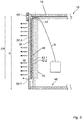
- FIG. 3 shows a further cross section through the battery transport device 10 according to the invention. It can be seen that the flow paths S5 pass an upper edge 44 of the inner tray 14 and then extend away from the lid 18 down.
- the vent openings 28.i are arranged adjacent to a bottom 46 of the battery transport device 10. It is favorable and represents a preferred embodiment that the vent openings 28.i round, in particular circular or oval, are formed.
- the plates 36.i have a thickness between 8 mm and 20 mm. Particularly favorable thicknesses between 11 and 14 mm have been found.
- FIG. 3 also shows a closure 48, by means of which the lid 18 is held in its closed position.
- the shutter 48 is, for example, a snap fastener having a bracket.
- the bracket is attached to a lever which snaps into its closed position. In this closed position, the bracket engages in a hook, which may be formed as a groove on the lid 18 is clamped to the base 16 to.
- the flow path S extends over a height difference ⁇ H of at least one third, in particular at least half, a height H of the outer box 12 along the outer walls 32.2.
- This section of the flow path S begins at the upper edge 44 and ends at the vent opening 28.7.
- heat W can be effectively released to the environment.
- the flow path S extends over a portion down, the length of which corresponds to 0.8 times the height H.
Landscapes
- Chemical & Material Sciences (AREA)
- Engineering & Computer Science (AREA)
- Chemical Kinetics & Catalysis (AREA)
- Electrochemistry (AREA)
- General Chemical & Material Sciences (AREA)
- Manufacturing & Machinery (AREA)
- Mechanical Engineering (AREA)
- Materials Engineering (AREA)
- General Engineering & Computer Science (AREA)
- Secondary Cells (AREA)
- Battery Mounting, Suspending (AREA)
Abstract
Description
- Die Erfindung betrifft eine Akku-Transportvorrichtung für einen Akkumulator, insbesondere für einen Lithium-Akkumulator, mit (a) einer Außen-Kiste, die (i) einen Grundkörper, der eine Einfüllöffnung hat, (ii) einen Deckel zum luftdichten Verschließen der Einfüllöffnung, und (iii) eine Entlüftungsöffnung aufweist, und (b) einer Innen-Wanne, die (i) in der Außen-Kiste angeordnet ist und (ii) einen Aufnahmeraum zum Aufnehmen des Akkumulators umgibt.
- Eine derartige Akku-Transportvorrichtung ist in der
DE 20 2014 004 436 U1 beschrieben. Derartige Akku-Transportvorrichtungen dienen zum sicheren Transport insbesondere von Lithium-Akkumulatoren. Solche Lithium-Akkumulatoren enthalten brennbare Substanzen und es besteht das Risiko, dass einzelnen Zellen der Lithium-Akkumulators kaskadierend versagen und es so zu einer Kettenreaktion kommt, bei der der Lithium-Akkumulator zerstört wird. Bei einer solchen Havarie werden große Mengen an Gasen freigesetzt. Diese Gase können giftig und/oder brennbar sein. Es muss jedoch sichergestellt sein, dass auch ein Durchgehen des Akkumulators nicht dazu führt, dass die Umgebung der Akku-Transportvorrichtung unzulässigen Gefahren ausgesetzt wird. - Da Akku-Transportvorrichtungen in großer Zahl benötigt werden, ist es zudem wünschenswert, dass diese möglichst einfach aufgebaut sind. Es ist zudem wünschenswert, dass das Nutzvolumenverhältnis, also das Verhältnis von nutzbarem Raum im Vergleich zu dem Raum, den die Akku-Transportvorrichtung einnimmt, möglichst groß ist.
- Aus der
WO 2016/033223 A1 ist eine gattungsgemäße Transportvorrichtung bekannt, bei der die Akkumulatoren in der Innen-Wanne angeordnet werden. Die Innenwände sind mit einem Superabsorber ausgekleidet, der mit Wasser gesättigt ist. Gehen die Lithium-Batterien durch, so nimmt diese Auskleidung Wärme auf. Die entstehenden Gase entweichen durch eine Lücke zwischen dem Grundkörper und dem Deckel. Nachteilig an einem derartigen System ist, dass die im Havariefall austretenden Gase die Umgebung schädigen können. - Eine weitere gattungsgemäße Akku-Transportvorrichtung ist aus der
US2013 / 0146603 A1 bekannt. Bei dieser Akku-Transportvorrichtung sind die Außenwände des Grundkörpers mit Wärme isolierendem Material ausgekleidet. Der Deckel ist gegenüber dem Grundkörper abgedichtet und besitzt eine Gas-Reinigungsvorrichtung, sodass bei einer Havarie entstehende giftige Dämpfe durch diese Gas-Reinigungsvorrichtung gereinigt abgeführt werden können. Dieses System ist vergleichsweise aufwändig. - Aus der
DE 10 2013 018 406 A1 ist eine Batterie bekannt, die ein Gehäuse besitzt, das mehrere galvanische Zellen umgibt. Zwischen den galvanischen Zellen und dem Gehäuse ist ein Pfad, entlang dem bei einer Havarie entstehende Gase abströmen können. Diese Gase strömen durch eine Austrittsöffnung aus. Vor dem austreten durch die Austrittsöffnung müssen die Gase Einbauteile zur Strömungsumlenkung und/oder Wärmeabfuhr passieren. Auf diese Weise werden Partikel zu einem gewissen Teil zurückgehalten und das austretende Gas wird gekühlt. - Der Erfindung liegt die Aufgabe zugrunde, eine vergleichsweise einfach aufgebaute und dennoch die Umwelt im Havariefall möglichst gut schützende Akku-Transportvorrichtung vorzuschlagen.
- Die Erfindung löst das Problem durch eine gattungsgemäße Akku-Transportvorrichtung, bei der zwischen der Außen-Kiste und der Innen-Wanne ein Strömungspfad vom Aufnahmeraum zur Entlüftungsöffnung gebildet ist und bei der entlang des Strömungspfads ein Wärmeaufnahmematerial angeordnet ist.
- Vorteilhaft an einer derartigen Akku-Transportvorrichtung ist, dass bei einer Havarie des Akkumulators entstehende heiße Gase zunächst am Wärmeaufnahmematerial entlang strömen müssen, um zur Entlüftungsöffnung zu gelangen. Beim Strömen entlang des Wärmeaufnahmematerials werden sie gekühlt. Das verringert die Wahrscheinlichkeit, dass sich die austretenden Gase entzünden oder Objekte in der Umgebung der Akku-Transportvorrichtung entzünden.
- Vorteilhaft ist zudem, dass die Akku-Transportvorrichtung vergleichsweise einfach aufgebaut sein kann.
- Vorteilhaft ist zudem, dass die Außenwände der Außen-Kiste als Abstrahlflächen für Wärme fungieren können, die von den heißen Gasen, die von dem Akkumulator ausgehen, beim Strömen entlang des Strömungspfads an das Wärmeaufnahmematerial abgegeben und von dort an die Außenwände geleitet wird.
- Vorzugsweise verläuft zumindest einer der Strömungspfade entlang von zumindest drei Außenwänden, insbesondere entlang von vier Außenwänden der Außen-Kiste. Das führt zu einer großen Wärmeabgabefläche und kühlt die austretenden Gase.
- Günstig ist es, wenn an den Außenwänden, entlang derer der Strömungspfad verläuft, plattenförmiges Wärmeaufnahmematerial angeordnet ist. Besonders günstig ist es, wenn zumindest 80%, vorzugsweise zumindest 90%, der Innenfläche der Außenseiten, entlang derer der Strömungspfad verläuft, mit plattenförmigem Wärmeaufnahmematerial verkleidet ist.
- Unter dem Wärmeaufnahmematerial wird ein Material verstanden, das oberhalb einer Aktivierungstemperatur oder Wärmeaufnahme reagiert und insbesondere Wasserdampf abgibt. Vorzugsweise ist die Aktivierungstemperatur kleiner als 200 °, insbesondere kleiner als 150 °. Infrage kommt beispielsweise Gips, der zwei Aktivierungstemperaturen, nämlich bei 147 ° C und bei 131 ° C, aufweist.
- Unter der Aktivierungstemperatur wird insbesondere die kleinste Temperatur verstanden, für die gilt, dass nach einer Stunde bei dieser Temperatur über 90 Masseprozent des Wärmeaufnahmematerials unter Wärmeaufnahme reagiert haben.
- Günstig ist es, wenn das Wärmeaufnahmematerial oberhalb der Aktivierungstemperatur beispielsweise durch die Abgabe von Kristallwasser und/oder durch die Abspaltung von Wasser reagiert. Wasser hat eine hohe Verdampfungswärme, sodass beim Verdampfen viel Wärme aufgenommen wird. In anderen Worten kann das Wärmeaufnahmematerial mineralisch gebundenes Wasser, insbesondere Kristallwasser, und/oder adsorbiertes Wasser enthalten, wie es beispielsweise in einem Superabsorber vorliegt.
- Als besonders geeignet hat sich ein Wärmeaufnahmematerial herausgestellt, dass zumindest zu 80 Gewichtsprozent aus Gips besteht. Gips hat zwei Aktivierungstemperaturen, nämlich bei 147 °C und 131 °C. Gips ist einfach zu verarbeiten, mechanisch belastbar und formstabil.
- Beispielsweise handelt es sich bei dem plattenförmigen Wärmeaufnahmematerial um Gipskartonplatten. Eine Gipskartonplatte besteht aus einem gepressten Kern, der zumindest 80 Gewichtsprozent Gips enthält, und zumindest einer Lage aus zellulosehaltigem Material, die auf den Kern aufgeklebt ist .Beim Entlangströmen an dem plattenförmigen Wärmeaufnahmematerial geben die Gase Wärme an das Wärmeaufnahmematerial ab, sodass sie abkühlen.
- Unter dem Merkmal, dass das Wärmeaufnahmematerial entlang des Strömungspfads angeordnet ist, wird insbesondere verstanden, dass bei einer Havarie entstehende Gase so dicht am Wärmeaufnahmematerial entlangströmen, dass sie Wärme an das Wärmeaufnahmematerial abgeben und gegebenenfalls chemisch mit dem Wärmeaufnahmematerial reagieren können.
- Vorzugsweise ist entlang des Strömungspfads ein Granulat angeordnet, das Kalziumhydroxid enthält. Kalziumhydroxid reagiert mit Säuren, sodass in den bei einer Havarie entstehenden Gasen enthaltene Säuren gebunden werden.
- Unter einem Strömungspfad wird diejenige Trajektorie verstanden, entlang der sich ein gedachtes Volumenelement von Gas, das bei einer Havarie entsteht, bewegen kann. Selbstverständlich existieren in der Regel sehr viele Strömungspfade. Es ist in der Regel weder möglich noch sinnvoll, alle Strömungspfade einzeln anzugeben, daher wird darauf verzichtet. Wenn mehrere Strömungspfade existieren, so ist das Wärmeaufnahmematerial vorzugsweise so angeordnet, dass zumindest 80 Gewichtsprozent, insbesondere zumindest 90 Gewichtsprozent, der bei einer Havarie entstehenden Gase am Wärmeaufnahmematerial vorbeiströmen.
- Die Innen-Wanne ist vorzugsweise fluiddicht, insbesondere flüssigkeitsdicht und/oder gasdicht. Dadurch kann Gas, das bei einer Havarie entsteht, nicht durch die Wände der Innen-Wanne entweichen, sondern muss durch die Öffnung der Innen-Wanne nach oben abströmen. Es ist möglich, nicht aber notwendig, dass die Innen-Wanne einen Deckel aufweist, in diesem Fall ist ein Entweichen des Gases durch den Deckel oder zwischen Deckel und dem Rest der Innen-Wanne möglich. Die Außenkiste ist - mit Ausnahme der zumindest einen Entlüftungsöffnung - vorzugsweise fluiddicht.
- Günstig ist es, wenn das Granulat ein Alkalimetallhydroxid enthält. Beispielsweise handelt es sich dabei um Natriumhydroxid und/oder Kaliumhydroxid. Es sei darauf hingewiesen, dass, wenn davon gesprochen wird, dass ein Objekt vorhanden ist, darunter grundsätzlich zu verstehen ist, dass zumindest ein entsprechendes Objekt vorhanden ist. Im vorliegenden Fall bedeutet dies, dass das Granulat zumindest ein Alkalimetallhydroxid enthält. Alkalimetallhydroxide sind hygroskopisch. Das führt dazu, dass an ihrer Oberfläche oft eine dünne wasserhaltige Schicht vorliegt. Das erleichtert die Reaktion der bei einer Havarie entstehenden Gase mit dem Alkalimetallhydroxid und gegebenenfalls dem Kalziumhydroxid, sodass schädliche Bestandteile der Gase besonders schnell und effektiv gebunden werden.
- Vorzugsweise enthält das Granulat einen Indikator. Dieser Indikator ändert beispielsweise seine Farbe, wenn sich der pH-Wert um mehr als einen vorgegebenen Differenzbetrag ändert. Eine Änderung des pH-Werts deutet darauf hin, dass die Menge an Kalziumhydroxid und/oder Alkalimetallhydroxid abgenommen hat. Das würde auf die Gefahr hinweisen, dass bei einer Havarie austretende Gase möglicherweise nicht hinreichend effizient gereinigt werden können. Umgekehrt zeigt ein nicht umgeschlagener Indikator, dass mit hoher Wahrscheinlichkeit davon ausgegangen werden kann, dass bei einer Havarie entstehende Gase spezifikationsgemäß in ihrem Schadstoffgehalt reduziert werden. Das Vorhandensein des Indikators hat damit den Vorteil, dass einfach festgestellt werden kann, ob die Akku-Transportvorrichtung weiterhin die sichere Funktionsweise garantieren kann.
- Günstig ist es, wenn ein Median-Partikeldurchmesser der Granulatpartikel zwischen 1,5 und 5 Millimeter beträgt. Zu kleine Granulatpartikel können dazu führen, dass der Strömungswiderstand für bei einer Havarie entstehende Gase zu groß wird. In diesem Fall kann der Innendruck im Aufnahmeraum und damit die Kraft, die auf dem Deckel lastet, zu groß werden, sodass eine gemäß einer bevorzugten Ausführungsform vorhandene Verschlussvorrichtung zum Verschließen des Deckels versagt. In diesem Fall würden potentiell gefährliche Gase ungekühlt und ungereinigt in die Umgebung entweichen können, was verhindert werden soll. Ist der Partikeldurchmesser hingegen zu groß, kann die Oberfläche, die für eine Reaktion von schädlichen Bestandteilen der Gase zur Verfügung steht, zu klein werden, sodass die Reinigungswirkung nicht garantiert ist. Es hat sich herausgestellt, dass der angegebene Median-Partikeldurchmesser zu optimalen Ergebnissen führt.
- Sind die Granulatpartikel ungeformt, so wird unter dem Partikeldurchmesser der aerodynamische Durchmesser verstanden. In anderen Worten ist der Partikeldurchmesser in dem Fall der Durchmesser einer hypothetischen Kugel gleicher Masse, die in Luv 1013 hPa und 22 °C genauso schnell fällt wie der entsprechende Granulatpartikel. Sind die Granulatpartikel zylinderförmig, so wird unter dem Durchmesser das Maximum aus der Länge der Zylinder und dessen Durchmesser verstanden.
- Besonders günstig ist es, wenn höchstens 20 Gewichtsprozent aller Granulatpartikel außerhalb eines Intervalls liegen, das von einem Drittel des Median-Partikel-Durchmessers bis zum dreifachen des Median-Partikeldurchmessers reicht.
- Vorzugsweise sind die Granulatpartikel zylinderförmig. Hierunter wird verstanden, dass die Granulatpartikel eine zylindermantelförmige Außenstruktur haben. Es ist möglich und vorteilhaft, nicht aber notwendig, dass es sich um streng zylinderförmige Partikel handelt, das heißt, dass die Kopfflächen plan sind. Derartiges Granulat neigt besonders wenig zum Verklumpen und bildet eine Schüttung, für die die Strömungswiderstände entlang unterschiedlicher, aber gleich langer Strömungspfade nicht stark voneinander abweichen. In anderen Worten wird eine derartige Schüttung gleichmäßig durchströmt, sodass einerseits der sich im Aufnahmeraum im Fall einer Havarie aufbauende Druck klein bleibt und andererseits ausströmende Gase mit hoher Effizienz von zumindest einigen Schadstoffen zumindest teilweise gereinigt werden.
- Vorzugsweise ist das Granulat porös. Beispielsweise beträgt das Porenvolumen zumindest 30%, vorzugsweise zumindest 50%, des Volumens des Granulatpartikels. Dieses Volumen wird pyknometrisch bestimmt. Beispielsweise wird ein Zylinder mit einem Durchmesser von 10 cm und einer Höhe von 30 cm vollständig mit Granulatpartikeln gefüllt und danach verschlossen. Nachfolgend wird der Behälter evakuiert und ermittelt, wieviel Gas nach dem Ende des Evakuierens in den Zylinder strömen kann, bis es zum Druckausgleich mit dem Umgebungsdruck kommt. Das Verhältnis dieses Volumens zum Innenvolumen des Zylinders stellt in guter Näherung das Porenvolumen dar.
- Besonders günstig ist es, wenn das Granulat Atemkalk ist. Atemkalk ist eine Mischung aus Kalziumhydroxid und einem Alkalimetallhydroxid, beispielsweise Natriumhydroxid oder Kaliumhydroxid, die beispielsweise in Narkosegeräten verwendet wird. Es hat sich herausgestellt, dass Atemkalk sehr effizient Schadstoffe aus den Gasen, die bei einer Havarie entstehen, entfernt.
- Günstig ist es, wenn im Strömungspfad hinter dem Granulat ein Aktivkohlefilter angeordnet ist. Aktivkohle kann weitere Schadstoffe aus den Gasen, die einer Havarie entstehen, entfernen. Da es im Strömungspfad hinter dem Granulat angeordnet ist, hat es eine vergleichsweise niedrige Temperatur. Die Adsorption von Schadstoffen an Aktivkohle ist umso effektiver, je geringer die Temperatur des Gases ist.
- Gemäß einer bevorzugten Ausführungsform verläuft zumindest ein Strömungspfad über eine Höhendifferenz von zumindest einem Drittel, insbesondere zumindest der Hälfte, der Höhe der Außen-Kiste. Hat in anderen Worten die Außen-Kiste eine Höhe H, so verläuft zumindest einer der Strömungspfade so, dass er bei seinem Weg entlang zumindest einer der Außenwände eine Weglänge von zumindest H/3, insbesondere zumindest H/2, besonders bevorzugt zumindest 2H/3, zurücklegt. Auf diese Weise werden entstehende Gase gut gekühlt und entgiftet.
- Besonders günstig ist es, wenn der Strömungspfad zumindest über einen Abschnitt abwärts verläuft, dessen Länge größer ist als ein Drittel, insbesondere zumindest die Hälfte, der Höhe der Außen-Kiste. So wird die Kühlfläche, die durch die Außenwand bereitgestellt wird, effizient ausgenutzt.
- Erfindungsgemäß ist zudem ein Gebinde aus einer erfindungsgemäßen Akku-Transportvorrichtung und zumindest einem Akkumulator, insbesondere einem Lithium-Ackumulator, der in dem Aufnahmeraum der Innen-Wanne aufgenommen ist.
- Im Folgenden wird die Erfindung anhand der beigefügten Zeichnungen näher erläutert. Dabei zeigt
- Figur 1
- eine schematische perspektivische Ansicht eines erfindungsgemäßen Akku-Transportvorrichtung,
- Figur 2
- einen Querschnitt entlang der Ebene A-A gemäß
Figur 1 und - Figur 3
- einen Querschnitt entlang des Schnittes B-B gemäß
Figur 1 . -
Figur 1 zeigt einen erfindungsgemäßen Akku-Transportbehälter 10, der eine Außen-Kiste 12 und eine Innen-Wanne 14 aufweist. Die Außen-Kiste 14 umfasst einen Grundkörper 16 und einen Deckel 18. Der Deckel 18 ist beispielsweise schwenkbar am Grundkörper 16 angelenkt. Es ist aber möglich, dass der Deckel 18 vollständig entnehmbar ist. Durch eine Einfüllöffnung 20 kann ein schematisch eingezeichneter Akkumulator 22 in die Außen-Kiste 12 eingesetzt werden. - Ist der Deckel 18 geschlossen, so schließt er mit dem Grundkörper 16 luftdicht ab. Dazu ist beispielsweise eine Dichtung 24 in einer Oberseite des Grundkörpers 26 und/oder dem Deckel 18 angeordnet. Kommt es zu einer Havarie des Akkumulators 22, so entstehen Gase 26. Diese können nicht zwischen Deckel und Grundkörper 16 entweichen.
- Der Grundkörper 16 weist dafür Entlüftungsöffnungen 28.1, 28.2, ... auf. Das Gas 26 kann entlang eines Strömungspfads S aus einem Aufnahmeraum 30 durch die Entlüftungsöffnungen 28.1, 28.2., ... in eine Umgebung U strömen. Der Aufnahmeraum 30 ist der Raum, der von der Innen-Wanne 14 umgeben wird und in dem der Akkumulator 22 aufgenommen ist.
-
Figur 2 zeigt einen horizontalen Querschnitt durch die Akku-Transportvorrichtung 10. Es ist zu erkennen, dass zwischen einer Außenseite 31 der Innen-Wanne 14 und einer Innenseite 33 der Außen-Kiste 12 ein Spalt 35 gebildet ist, durch den die Strömungspfade S verlaufen.Figur 2 zeigt, dass die Strömungspfade S1, S2, ... entlang von vier Außenwänden 32.1, 32.2, 43.3, 32.4 verlaufen. - Entlang der Innenseiten der Außenwände 32.i (i = 1, 2, 3 4) sind Platten 36.1, 36.2, ... angeordnet. Im vorliegenden Fall handelt es sich bei den Platten 36 um Gipsplatten, die auf ihrer nach außen weisenden Seite und ihrer nach innen weisenden Seite mit einer Papier- oder Kartonschicht verklebt sind. Auf der nach innen weisenden Seite können die Platten aber auch unbeschichtet sein, sodass die an der Platte 36 vorbeiströmenden Gase indirekt in Kontakt mit dem Gips kommen.
-
Figur 2 zeigt zudem, dass die Innen-Wanne 14 Innenwannen-Außenwände 38.1, 38.2, 38.3, 38.4 aufweist. Entlang der Innenwannen-Außenwände 38.g sind ebenfalls Platten 36.5, 36.6,36.7, 36.8 aus Wärmeaufnahmematerial angeordnet. Die Strömungspfade Sj (S = 1, 2 ...) sind damit von zwei Seiten von plattenförmigem Wärmeaufnahmematerial begrenzt. Dieses Merkmal charakterisiert - unabhängig von anderen Merkmalen der Erfindung - eine bevorzugte Ausführungsform der Erfindung. - Zwischen den Innenwannen-Außenwänden 38.i und den Außenwänden 32.i ist ein Granulat 40 angeordnet, das aus einer Vielzahl von Granulatpartikeln 42.1, 42.2, ... besteht. In
Figur 2 sind die Granulatpartikel alle gleich groß gezeichnet, dies ist jedoch nicht notwendig. Insbesondere ist es möglich, dass die Granulatpartikel variierende Partikeldurchmesser aufweisen. Die Granulatpartikel 42.1, 42.2, ... sind zylinderförmig und haben im vorliegenden Fall einen Durchmesser zwischen 2 und 5 Millimeter. - Im vorliegenden Fall ist das Granulat Atemkalk und besteht aus Kalziumhydroxid, Natriumhydroxid, einem Indikator sowie gegebenenfalls Hilfsstoffe. Bei dem Indikator handelt es sich beispielsweise um Ethylviolett.
-
Figur 3 zeigt einen weiteren Querschnitt durch die erfindungsgemäße Akku-Transportvorrichtung 10. Es ist zu erkennen, dass die Strömungspfade S5 eine Oberkante 44 der Innen-Wanne 14 passieren und dann vom Deckel 18 weg nach unten verlaufen. Die Entlüftungsöffnungen 28.i sind benachbart zu einem Boden 46 der Akku-Transportvorrichtung 10 angeordnet. Es ist günstig und stellt eine bevorzugte Ausführungsform dar, dass die Entlüftungsöffnungen 28.i rund, insbesondere kreisrund oder oval, ausgebildet sind. - In der vorliegenden Ausführungsform haben die Platten 36.i eine Dicke zwischen 8 mm und 20 mm. Besonders günstig haben sich Dicken zwischen 11 und 14 mm herausgestellt.
-
Figur 3 zeigt zudem einen Verschluss 48, mittels dem der Deckel 18 in seiner Schließstellung gehalten wird. Der Verschluss 48 ist beispielsweise ein Schnappverschluss, der einen Bügel aufweist. Der Bügel ist an einem Hebel befestigt, der in seine Schließstellung einschnappt. In dieser Schließstellung greift der Bügel in einen Haken, der als Rinne ausgebildet sein kann, am Deckel 18 auf den Grundkörper 16 zu gespannt wird. - Wie
Figur 3 zeigt, verläuft der Strömungspfad S über eine Höhendifferenz ΔH von zumindest einem Drittel, insbesondere zumindest der Hälfte, einer Höhe H der Außen-Kiste 12 entlang der Außenwände 32.2. Dieser Abschnitt des Strömungspfads S beginnt an der Oberkante 44 und endet an der Entlüftungsöffnung 28.7. So kann schematisch gezeigte Wärme W effektiv an die Umgebung abgegeben werden. Zudem ergibt sich ein langer Weg entlang des Wärmeaufnahmematerials 36 und/oder durch das Granulat 40. Der Strömungspfad S verläuft über einen Abschnitt abwärts, dessen Länge dem 0,8-fachen der Höhe H entspricht. -
- 10
- Akku-Transportvorrichtung
- 12
- Außen-Kiste
- 14
- Innen-Wand
- 16
- Grundkörper
- 18
- Deckel
- 20
- Einlassöffnung
- 22
- Akkumulator
- 24
- Dichtung
- 26
- Gas
- 28
- Entlüftungsöffnung
- 30
- Aufnahmeraum
- 31
- Außenseite der Innen-Wanne
- 32
- Außenwand
- 33
- Innenseite der Außen-Kiste
- 34
- Außenwand
- 35
- Spalt
- 36
- Platte
- 38
- Innenwanne-Außenwand
- 40
- Granulat
- 42
- Granulatpartikel
- 44
- Oberkante
- 46
- Boden
- 48
- Verschluss
- S
- Strömungspfad
- U
- Umgebung
- W
- Wärme
Claims (12)
- Akku-Transportvorrichtung (10) für einen Akkumulator (22), insbesondere für einen Lithium-Akkumulator, mit(a) einer Außen-Kiste (12), die(i) einen Grundkörper (16), der eine Einfüllöffnung (20) hat,(ii) einen Deckel (18) zum luftdichten Verschließen der Einfüllöffnung (20) und(iii) eine Entlüftungsöffnung (28) aufweist, und(b) einer Innen-Wanne (14), die(i) in der Außen-Kiste (12) angeordnet ist und(ii) einen Aufnahmeraum (30) zum Aufnehmen des Akkumulators (22) umgibt,dadurch gekennzeichnet, dass(c) zwischen der Außen-Kiste (12) und der Innen-Wanne (14) zumindest ein Strömungspfad (S) vom Aufnahmeraum (30) zur Entlüftungsöffnung (28) gebildet ist und(d) entlang des Strömungspfads (S) ein Wärmeaufnahmematerial (36) angeordnet ist.
- Akku-Transportvorrichtung (10) nach Anspruch 1, dadurch gekennzeichnet, dass(a) der zumindest eine Strömungspad (S) entlang von zumindest drei Außenwänden (32), insbesondere entlang von vier Außenwänden (32), der Außen-Kiste (12) verläuft und(b) an den Außenwänden (32), entlang derer der Strömungspfad (S) verläuft, plattenförmiges Wärmeaufnahmematerial (36) angeordnet ist.
- Akku-Transportvorrichtung (10) nach einem der vorstehenden Ansprüche, dadurch gekennzeichnet, dass(a) der zumindest eine Strömungspfad (S) entlang von zumindest drei Innenwannen-Außenwänden (32) der Innen-Wanne (14) verläuft und(b) an den Innenwannen-Außenwänden (38), entlang derer der Strömungspfad (S) verläuft, plattenförmiges Wärmeaufnahmematerial (36) angeordnet ist.
- Akku-Transportvorrichtung (10) nach einem der vorstehenden Ansprüche, dadurch gekennzeichnet, dass entlang des Strömungspfads (S) ein Granulat (40) angeordnet ist, das- Kalciumhydroxid enthält und/oder- ein Alkalimetallhydroxid enthält.
- Akku-Transportvorrichtung (10) nach Anspruch 3 oder 4, dadurch gekennzeichnet, dass das Granulat (40) einen Indikator enthält.
- Akku-Transportvorrichtung (10) nach einem der Ansprüche 3 bis 5, dadurch gekennzeichnet, dass ein Median-Partikeldurchmesser der Granulatpartikel (42) zwischen 1,5 und 5 Millimeter beträgt.
- Akku-Transportvorrichtung (10) nach einem der Ansprüche 3 bis 6, dadurch gekennzeichnet, dass die Granulatpartikel (42) zylinderförmig sind.
- Akku-Transportvorrichtung (10) nach einem der Ansprüche 3 bis 7, dadurch gekennzeichnet, dass das Granulat (40) porös ist.
- Akku-Transportvorrichtung (10) nach einem der Ansprüche 3 bis 8, dadurch gekennzeichnet, dass das Granulat (40) Atemkalk ist.
- Akku-Transportvorrichtung (10) nach einem der vorstehenden Ansprüche, dadurch gekennzeichnet, dass im Strömungspfad (S) hinter dem Granulat (40) ein Aktivkohlefilter angeordnet ist.
- Akku-Transportvorrichtung (10) nach einem der vorstehenden Ansprüche, dadurch gekennzeichnet, dass
zumindest ein Strömungspfad (S) über eine Höhendifferenz (ΔH) von zumindest einem Drittel, insbesondere zumindest der Hälfte, einer Höhe (H) der Außen-Kiste (12) entlang zumindest einer der Außenwände (32.1, 32.2, 32.3, 32.4) verläuft. - Akku-Transportvorrichtung (10) nach einem der vorstehenden Ansprüche, dadurch gekennzeichnet, dass
der Strömungspfad (S) zumindest über einen Abschnitt abwärts verläuft, dessen Länge größer ist als ein Drittel, insbesondere zumindest die Hälfte, der Höhe (H) der Außen-Kiste (12).
Applications Claiming Priority (1)
| Application Number | Priority Date | Filing Date | Title |
|---|---|---|---|
| DE102018105530.7A DE102018105530A1 (de) | 2018-03-09 | 2018-03-09 | Akku-Transportvorrichtung für einen Akkumulator |
Publications (1)
| Publication Number | Publication Date |
|---|---|
| EP3537501A1 true EP3537501A1 (de) | 2019-09-11 |
Family
ID=65717801
Family Applications (1)
| Application Number | Title | Priority Date | Filing Date |
|---|---|---|---|
| EP19160834.8A Pending EP3537501A1 (de) | 2018-03-09 | 2019-03-05 | Akku-transportvorrichtung für einen akkumulator |
Country Status (3)
| Country | Link |
|---|---|
| US (1) | US11424506B2 (de) |
| EP (1) | EP3537501A1 (de) |
| DE (1) | DE102018105530A1 (de) |
Cited By (1)
| Publication number | Priority date | Publication date | Assignee | Title |
|---|---|---|---|---|
| CN111516968A (zh) * | 2020-04-16 | 2020-08-11 | 深圳电魔术科技有限公司 | 一种手机电池的存储箱 |
Families Citing this family (7)
| Publication number | Priority date | Publication date | Assignee | Title |
|---|---|---|---|---|
| BR112017003400B1 (pt) * | 2014-08-26 | 2022-01-11 | Nochar, Inc | Recipiente de transporte que tem uma camada de retardante de chama e uma camada de bloqueio térmico |
| US11559709B2 (en) * | 2018-09-28 | 2023-01-24 | Cellblock Fcs, Llc | Receptacle for suppressing and containing a fire |
| DE102018130506A1 (de) * | 2018-11-30 | 2020-06-04 | Kautex Textron Gmbh & Co. Kg | Batterieeinheit sowie Hybridfahrzeug mit einer Batterieeinheit |
| DE102019217122A1 (de) * | 2019-11-06 | 2021-05-06 | Robert Bosch Gmbh | Batterie mit Propagationsschutz |
| SE545775C2 (en) | 2021-11-24 | 2024-01-09 | Composite Tech Sweden Ab | Device for storing batteries |
| KR20230162850A (ko) * | 2022-05-20 | 2023-11-29 | 주식회사 엘지에너지솔루션 | 각형 이차전지 |
| DE202022103907U1 (de) | 2022-07-12 | 2022-07-21 | B&W International GmbH | Feuerbeständige Transport- und Lagervorrichtung für intakte und beschädigte Akkumulatoren und/oder Batterien |
Citations (2)
| Publication number | Priority date | Publication date | Assignee | Title |
|---|---|---|---|---|
| DE102013222269A1 (de) * | 2013-10-31 | 2015-04-30 | TÜV Rheinland Industrie Service GmbH | Aufnahmeeinrichtung für eine elektrochemische Energiespeichereinheit |
| WO2016033223A1 (en) * | 2014-08-26 | 2016-03-03 | Nochar, Inc. | Shipping container having a flame retardant layer and a thermal blocking layer |
Family Cites Families (5)
| Publication number | Priority date | Publication date | Assignee | Title |
|---|---|---|---|---|
| DE3235708A1 (de) * | 1982-09-27 | 1984-03-29 | Brown, Boveri & Cie Ag, 6800 Mannheim | Thermische isolierung |
| US5038768A (en) * | 1989-10-02 | 1991-08-13 | The United States Of America As Represented By The Secretary Of The Navy | Carbon monoxide conversion device |
| US8544670B2 (en) * | 2010-04-15 | 2013-10-01 | George Howard Brilmyer | Fire containment case for portable battery operated electronic devices |
| DE202013004963U1 (de) | 2013-06-02 | 2013-07-16 | Markus Kohten | Sicherheitsbox zum Transport und Lagerung von Batterien |
| DE102013018406A1 (de) * | 2013-11-02 | 2015-05-07 | Daimler Ag | Batterie |
-
2018
- 2018-03-09 DE DE102018105530.7A patent/DE102018105530A1/de active Pending
-
2019
- 2019-03-05 US US16/292,951 patent/US11424506B2/en active Active
- 2019-03-05 EP EP19160834.8A patent/EP3537501A1/de active Pending
Patent Citations (2)
| Publication number | Priority date | Publication date | Assignee | Title |
|---|---|---|---|---|
| DE102013222269A1 (de) * | 2013-10-31 | 2015-04-30 | TÜV Rheinland Industrie Service GmbH | Aufnahmeeinrichtung für eine elektrochemische Energiespeichereinheit |
| WO2016033223A1 (en) * | 2014-08-26 | 2016-03-03 | Nochar, Inc. | Shipping container having a flame retardant layer and a thermal blocking layer |
Cited By (1)
| Publication number | Priority date | Publication date | Assignee | Title |
|---|---|---|---|---|
| CN111516968A (zh) * | 2020-04-16 | 2020-08-11 | 深圳电魔术科技有限公司 | 一种手机电池的存储箱 |
Also Published As
| Publication number | Publication date |
|---|---|
| DE102018105530A1 (de) | 2019-09-26 |
| US11424506B2 (en) | 2022-08-23 |
| US20190280259A1 (en) | 2019-09-12 |
Similar Documents
| Publication | Publication Date | Title |
|---|---|---|
| EP3537501A1 (de) | Akku-transportvorrichtung für einen akkumulator | |
| EP2897510B1 (de) | Transportable vorrichtung zum erhitzen von lebensmitteln und transportabler heizkörper | |
| DE102007008594B4 (de) | Sicherheitsgehäuse zum Schutz wärmeabgebender Objekte | |
| DE69411377T2 (de) | Chemischer reaktor, kältemaschine und behälter ausgestattet mit diesem reaktor und reagenzpatrone dafür | |
| EP3175504A1 (de) | Vorrichtung und verfahren zum transport von galvanischen zellen | |
| CH624856A5 (de) | ||
| EP2922133B1 (de) | Vorrichtung und Verfahren zum Transport von galvanischen Zellen | |
| DE10157272C2 (de) | Lithium- oder Lithium-Ionen-Batterie | |
| DE102014010650A1 (de) | Deckelelement zum Verschluss einer Serviceöffnung und Fahrzeugleuchte | |
| DE202014004436U1 (de) | Sicherheitsbehältnis für gefährliches Ladegut, insbesondere für Batterien | |
| DE202014010255U1 (de) | Granulat zur Absorption von Schadgasen | |
| EP3769595A1 (de) | Explosionssicheres gehäuse mit innerer druckreduzierung, verfahren | |
| DE102007057748A1 (de) | Sorptions-Kühlelement mit Regelorgan und zusätzlicher Wärmequelle | |
| DE202019103609U1 (de) | Gefahrgut-Transportbehälter | |
| EP4544626A1 (de) | Sicherheits-batteriesystem mit kontrollierter entgasungsfunktion | |
| DE102022112810A1 (de) | Vorrichtung und Verfahren zum Laden einer elektrischen Batterie | |
| DE102020114274A1 (de) | Batterie mit einer Schutzeinrichtung gegen eine thermische Kettenreaktion und Kraftfahrzeug | |
| DE102014007414A1 (de) | Druckentlastungsvorrichtung | |
| DE202016000506U1 (de) | Druckentlastungsvorrichtung | |
| DE102021123433A1 (de) | Elektronikvorrichtung für ein Kraftfahrzeug sowie Kraftfahrzeug | |
| DE102013113880B4 (de) | Vorrichtung und Verfahren zum Transport von galvanischen Zellen | |
| DE102015002319A1 (de) | Akkumulator | |
| DE102015010955A1 (de) | Formkörper, Gemische und Vorrichtungen zum Schutz von Hochenergiebatterien und -akkus, insbesondere solcher auf der Basis von Lithium, beim Betrieb, Lagern und Transport | |
| EP4382193A1 (de) | Adsorptionsvorrichtung | |
| EP4652642A1 (de) | Schutzgehäuse für batterien, akkumulatoren und elektrisch aufladbare zellen sowie allen mitteln zur speicherung elektrischer energie |
Legal Events
| Date | Code | Title | Description |
|---|---|---|---|
| PUAI | Public reference made under article 153(3) epc to a published international application that has entered the european phase |
Free format text: ORIGINAL CODE: 0009012 |
|
| STAA | Information on the status of an ep patent application or granted ep patent |
Free format text: STATUS: THE APPLICATION HAS BEEN PUBLISHED |
|
| AK | Designated contracting states |
Kind code of ref document: A1 Designated state(s): AL AT BE BG CH CY CZ DE DK EE ES FI FR GB GR HR HU IE IS IT LI LT LU LV MC MK MT NL NO PL PT RO RS SE SI SK SM TR |
|
| AX | Request for extension of the european patent |
Extension state: BA ME |
|
| STAA | Information on the status of an ep patent application or granted ep patent |
Free format text: STATUS: REQUEST FOR EXAMINATION WAS MADE |
|
| 17P | Request for examination filed |
Effective date: 20200304 |
|
| RBV | Designated contracting states (corrected) |
Designated state(s): AL AT BE BG CH CY CZ DE DK EE ES FI FR GB GR HR HU IE IS IT LI LT LU LV MC MK MT NL NO PL PT RO RS SE SI SK SM TR |
|
| STAA | Information on the status of an ep patent application or granted ep patent |
Free format text: STATUS: EXAMINATION IS IN PROGRESS |
|
| 17Q | First examination report despatched |
Effective date: 20230711 |