EP3532668B1 - Man-made cellulosic fibre and nonwoven product or fabric comprising the cellulosic fibre - Google Patents
Man-made cellulosic fibre and nonwoven product or fabric comprising the cellulosic fibre Download PDFInfo
- Publication number
- EP3532668B1 EP3532668B1 EP17792030.3A EP17792030A EP3532668B1 EP 3532668 B1 EP3532668 B1 EP 3532668B1 EP 17792030 A EP17792030 A EP 17792030A EP 3532668 B1 EP3532668 B1 EP 3532668B1
- Authority
- EP
- European Patent Office
- Prior art keywords
- fibre
- dadmac
- fibres
- cellulosic fibre
- paper
- Prior art date
- Legal status (The legal status is an assumption and is not a legal conclusion. Google has not performed a legal analysis and makes no representation as to the accuracy of the status listed.)
- Active
Links
Images
Classifications
-
- D—TEXTILES; PAPER
- D06—TREATMENT OF TEXTILES OR THE LIKE; LAUNDERING; FLEXIBLE MATERIALS NOT OTHERWISE PROVIDED FOR
- D06M—TREATMENT, NOT PROVIDED FOR ELSEWHERE IN CLASS D06, OF FIBRES, THREADS, YARNS, FABRICS, FEATHERS OR FIBROUS GOODS MADE FROM SUCH MATERIALS
- D06M15/00—Treating fibres, threads, yarns, fabrics, or fibrous goods made from such materials, with macromolecular compounds; Such treatment combined with mechanical treatment
- D06M15/19—Treating fibres, threads, yarns, fabrics, or fibrous goods made from such materials, with macromolecular compounds; Such treatment combined with mechanical treatment with synthetic macromolecular compounds
- D06M15/21—Macromolecular compounds obtained by reactions only involving carbon-to-carbon unsaturated bonds
- D06M15/356—Macromolecular compounds obtained by reactions only involving carbon-to-carbon unsaturated bonds of other unsaturated compounds containing nitrogen, sulfur, silicon or phosphorus atoms
- D06M15/3562—Macromolecular compounds obtained by reactions only involving carbon-to-carbon unsaturated bonds of other unsaturated compounds containing nitrogen, sulfur, silicon or phosphorus atoms containing nitrogen
-
- D—TEXTILES; PAPER
- D01—NATURAL OR MAN-MADE THREADS OR FIBRES; SPINNING
- D01F—CHEMICAL FEATURES IN THE MANUFACTURE OF ARTIFICIAL FILAMENTS, THREADS, FIBRES, BRISTLES OR RIBBONS; APPARATUS SPECIALLY ADAPTED FOR THE MANUFACTURE OF CARBON FILAMENTS
- D01F2/00—Monocomponent artificial filaments or the like of cellulose or cellulose derivatives; Manufacture thereof
- D01F2/06—Monocomponent artificial filaments or the like of cellulose or cellulose derivatives; Manufacture thereof from viscose
- D01F2/08—Composition of the spinning solution or the bath
-
- D—TEXTILES; PAPER
- D04—BRAIDING; LACE-MAKING; KNITTING; TRIMMINGS; NON-WOVEN FABRICS
- D04H—MAKING TEXTILE FABRICS, e.g. FROM FIBRES OR FILAMENTARY MATERIAL; FABRICS MADE BY SUCH PROCESSES OR APPARATUS, e.g. FELTS, NON-WOVEN FABRICS; COTTON-WOOL; WADDING ; NON-WOVEN FABRICS FROM STAPLE FIBRES, FILAMENTS OR YARNS, BONDED WITH AT LEAST ONE WEB-LIKE MATERIAL DURING THEIR CONSOLIDATION
- D04H3/00—Non-woven fabrics formed wholly or mainly of yarns or like filamentary material of substantial length
- D04H3/013—Regenerated cellulose series
-
- D—TEXTILES; PAPER
- D06—TREATMENT OF TEXTILES OR THE LIKE; LAUNDERING; FLEXIBLE MATERIALS NOT OTHERWISE PROVIDED FOR
- D06M—TREATMENT, NOT PROVIDED FOR ELSEWHERE IN CLASS D06, OF FIBRES, THREADS, YARNS, FABRICS, FEATHERS OR FIBROUS GOODS MADE FROM SUCH MATERIALS
- D06M15/00—Treating fibres, threads, yarns, fabrics, or fibrous goods made from such materials, with macromolecular compounds; Such treatment combined with mechanical treatment
- D06M15/19—Treating fibres, threads, yarns, fabrics, or fibrous goods made from such materials, with macromolecular compounds; Such treatment combined with mechanical treatment with synthetic macromolecular compounds
- D06M15/21—Macromolecular compounds obtained by reactions only involving carbon-to-carbon unsaturated bonds
- D06M15/356—Macromolecular compounds obtained by reactions only involving carbon-to-carbon unsaturated bonds of other unsaturated compounds containing nitrogen, sulfur, silicon or phosphorus atoms
-
- D—TEXTILES; PAPER
- D21—PAPER-MAKING; PRODUCTION OF CELLULOSE
- D21C—PRODUCTION OF CELLULOSE BY REMOVING NON-CELLULOSE SUBSTANCES FROM CELLULOSE-CONTAINING MATERIALS; REGENERATION OF PULPING LIQUORS; APPARATUS THEREFOR
- D21C9/00—After-treatment of cellulose pulp, e.g. of wood pulp, or cotton linters ; Treatment of dilute or dewatered pulp or process improvement taking place after obtaining the raw cellulosic material and not provided for elsewhere
-
- D—TEXTILES; PAPER
- D21—PAPER-MAKING; PRODUCTION OF CELLULOSE
- D21C—PRODUCTION OF CELLULOSE BY REMOVING NON-CELLULOSE SUBSTANCES FROM CELLULOSE-CONTAINING MATERIALS; REGENERATION OF PULPING LIQUORS; APPARATUS THEREFOR
- D21C9/00—After-treatment of cellulose pulp, e.g. of wood pulp, or cotton linters ; Treatment of dilute or dewatered pulp or process improvement taking place after obtaining the raw cellulosic material and not provided for elsewhere
- D21C9/001—Modification of pulp properties
- D21C9/002—Modification of pulp properties by chemical means; preparation of dewatered pulp, e.g. in sheet or bulk form, containing special additives
-
- D—TEXTILES; PAPER
- D21—PAPER-MAKING; PRODUCTION OF CELLULOSE
- D21H—PULP COMPOSITIONS; PREPARATION THEREOF NOT COVERED BY SUBCLASSES D21C OR D21D; IMPREGNATING OR COATING OF PAPER; TREATMENT OF FINISHED PAPER NOT COVERED BY CLASS B31 OR SUBCLASS D21G; PAPER NOT OTHERWISE PROVIDED FOR
- D21H11/00—Pulp or paper, comprising cellulose or lignocellulose fibres of natural origin only
- D21H11/16—Pulp or paper, comprising cellulose or lignocellulose fibres of natural origin only modified by a particular after-treatment
- D21H11/20—Chemically or biochemically modified fibres
-
- D—TEXTILES; PAPER
- D21—PAPER-MAKING; PRODUCTION OF CELLULOSE
- D21H—PULP COMPOSITIONS; PREPARATION THEREOF NOT COVERED BY SUBCLASSES D21C OR D21D; IMPREGNATING OR COATING OF PAPER; TREATMENT OF FINISHED PAPER NOT COVERED BY CLASS B31 OR SUBCLASS D21G; PAPER NOT OTHERWISE PROVIDED FOR
- D21H13/00—Pulp or paper, comprising synthetic cellulose or non-cellulose fibres or web-forming material
- D21H13/02—Synthetic cellulose fibres
- D21H13/08—Synthetic cellulose fibres from regenerated cellulose
-
- D—TEXTILES; PAPER
- D04—BRAIDING; LACE-MAKING; KNITTING; TRIMMINGS; NON-WOVEN FABRICS
- D04H—MAKING TEXTILE FABRICS, e.g. FROM FIBRES OR FILAMENTARY MATERIAL; FABRICS MADE BY SUCH PROCESSES OR APPARATUS, e.g. FELTS, NON-WOVEN FABRICS; COTTON-WOOL; WADDING ; NON-WOVEN FABRICS FROM STAPLE FIBRES, FILAMENTS OR YARNS, BONDED WITH AT LEAST ONE WEB-LIKE MATERIAL DURING THEIR CONSOLIDATION
- D04H1/00—Non-woven fabrics formed wholly or mainly of staple fibres or like relatively short fibres
- D04H1/40—Non-woven fabrics formed wholly or mainly of staple fibres or like relatively short fibres from fleeces or layers composed of fibres without existing or potential cohesive properties
- D04H1/42—Non-woven fabrics formed wholly or mainly of staple fibres or like relatively short fibres from fleeces or layers composed of fibres without existing or potential cohesive properties characterised by the use of certain kinds of fibres insofar as this use has no preponderant influence on the consolidation of the fleece
- D04H1/425—Cellulose series
- D04H1/4258—Regenerated cellulose series
-
- D—TEXTILES; PAPER
- D21—PAPER-MAKING; PRODUCTION OF CELLULOSE
- D21C—PRODUCTION OF CELLULOSE BY REMOVING NON-CELLULOSE SUBSTANCES FROM CELLULOSE-CONTAINING MATERIALS; REGENERATION OF PULPING LIQUORS; APPARATUS THEREFOR
- D21C9/00—After-treatment of cellulose pulp, e.g. of wood pulp, or cotton linters ; Treatment of dilute or dewatered pulp or process improvement taking place after obtaining the raw cellulosic material and not provided for elsewhere
- D21C9/001—Modification of pulp properties
- D21C9/002—Modification of pulp properties by chemical means; preparation of dewatered pulp, e.g. in sheet or bulk form, containing special additives
- D21C9/005—Modification of pulp properties by chemical means; preparation of dewatered pulp, e.g. in sheet or bulk form, containing special additives organic compounds
Definitions
- the present invention relates to a modified cellulosic fibre, especially a modified viscose staple fibre, and to a nonwoven product or fabric comprising the modified cellulosic fibre.
- the present invention relates to a man-made modified cellulosic fibre which is useful for applications like filtration papers, specialty papers and nonwoven products, especially hydroentangled nonwovens.
- WO 1996/026220 discloses modified cellulosic particles which exhibit cationic groups also in the interior of the particles, and the use of said particles in the manufacture of paper.
- WO 2011/012423 discloses regenerated cellulosic staple fibres in which carboxymethylcellulose (CMC) is incorporated, and their use in the manufacture of papers and nonwoven products. These fibre, therefore, have anionic properties. The improved binding properties of anionic viscose fibres are known.
- CMC carboxymethylcellulose
- both surface charged and bulk charged fibres were treated with poly-DADMAC.
- Torgnysdotter 2007 bulk charged fibres were treated with 25g/kg poly-DADMAC, while Torgnysdotter 2007 is silent about the amount of poly-DADMAC absorbed onto the fibres.
- cationic polymers as dry-strength agents is well known in the paper industry.
- the binding strength between anionic fibres alone is not strong enough to produce commercial quality papers from 100% viscose fibre, or to use the fibre as a full substitute for abacá fibres which are currently used for the modification of papers and nonwoven products.
- cationic polyelectrolytes can be added to the paper recipe only in smaller amounts and are not washproof.
- a modified cellulosic fibre that is characterized in that it comprises anionic moieties in an amount of more than 0.25mol/kg of dry fibre and has applied thereon a polymeric modifying agent in an amount of from 0.5 wt.% to 5.0 wt.%, based on dry fibre, the polymeric modifying agent comprising cationic moieties with a charge of at least 1.5meq per gram of polymer and the molar ratio of anionic moieties to cationic moieties contained in the fibre being in the range of from 1:1 to 25:1 and which is characterized in that the anionic moieties are incorporated in the fibre and are from carboxymethylcellulose, and that the polymeric modifying agent comprising cationic moieties is selected from the group consisting of polydiallyldimethylammonium chloride (poly-DADMAC), poly(acrylamide-co-diallyldimethylammonium chloride) (PAM-DADMAC) and mixtures thereof.
- poly-DADMAC polydiallyld
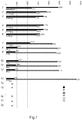
- Fig.1 shows the influence on various properties of papers produced from various anionic and non-ionic viscose fibres with and without addition of PAM-DADMAC.
- the modified cellulosic fibre according to the present invention may enable reversible fibre-fibre bondings and may impart a paper or nonwoven product when applied to it with redispersibility in liquids or an aqueous fluid, such as water.
- polymeric modifying agent means a polymeric modifying agent comprising cationic moieties with a charge of at least 1.5meq per gram of polymer.
- polymeric modifying agent is also referred to as "(cationic) polyelectrolyte” or “polymeric (cationic) polyelectrolyte”.
- the modified cellulosic fibre according to the present invention is characterized in that the cellulosic fibre is a man-made cellulosic staple fibre, such as a viscose fibre or a lycoell fibre.
- man-made fibre denotes a fibre that has been prepared by dissolving a cellulosic starting material, either with or without prior derivatisation, and spinning a fibre from the solution obtained by said dissolution.
- the term "man-made fibre” excludes natural cellulosic fibres, such as cotton. Further, cellulosic material such as cellulose pulp which has not been obtained by spinning a spinning solution, is also excluded.
- Well-known man-made cellulosic fibres include viscose fibres, including standard viscose fibres, modal fibres or polynosic fibres and lyocell fibres.
- staple fibre is well known to the skilled artisan and denotes a fibre that has been cut into discrete lengths after having been spun.
- Viscose fibres are fibres which are produced by the viscose process, wherein an alkaline solution of cellulose xanthogenate is spun into an acidic spin bath, whereupon underivatized cellulose is regenerated and precipitated in the form of a fibre.
- Lyocell fibres are a type of solvent spun fibres produced according to the aminoxide process typically involving the dissolution of cellulose in N-methylmorpholine N-oxide and subsequent spinning to fibres.
- the modified cellulosic fibre is characterized in that the molar ratio of anionic moieties to cationic moieties contained in the fibre is in the range of from from 2:1 to 20:1, in particular of from 3:1 to 15:1, more in particular of from 4:1 to 12:1.
- the modified cellulosic fibre of the present invention is characterized in that the anionic moieties comprise carboxyl (COOH) groups.
- the amount of anionic moieties in the fibre can be measured by methods well-known to the skilled artisan.
- the amount of COOH-groups in the fibre can be measured by way of e.g. acid-base titration. Other methods may rely on analytical derivatization.
- spectroscopic analysis methods are also available, cf. for example The surface charge of regenerated cellulose fibres, F. Weber et al., Cellulose, 2013, 20(6), 2719-2729 .
- the measurement of the anionic moieties may be performed prior to treatment of the fibre with the polymeric modifying agent.
- the modified cellulosic fibre according to the present invention is characterized in that the cationic moieties comprise ammonium groups, in particular quaternary ammonium groups.
- the modified cellulosic fibre according to the present invention is characterized in that the polymeric modifying agent comprising cationic moieties exhibits a molar weight of from 100,000 g/mol to 500,000 g/mol, in particular of from 200,000 g/mol to 300,000 g/mol.
- the cellulosic staple may be treated with the polymeric cationic polyelectrolyte in a known way, especially by contacting the fibre with a solution or dispersion containing said polyelectrolyte in the desired amount.
- the modified cellulosic fibre according to the present invention is characterized in that it comprises the anionic moieties incorporated in the fibre and has applied thereon the polymeric modifying agent comprising cationic moieties in an amount of from 0.5 wt.% to 5.0 wt.%, based on dry fibre.
- the modified cellulosic fibre according to the invention is characterized in that the anionic moieties, which are incorporated in the fibre, are from carboxymethylcellulose (CMC).
- CMC carboxymethylcellulose
- cellulosic staple fibre having CMC incorporated therein is well-known to the skilled artisan, such as, e.g. from US 4,199,367 A and US 4,289,824 A .
- CMC is mixed into the spinning dope, e.g. a viscose dope, before spinning the fibre.
- the CMC to be used may be a commercial product, with a degree of substitution (DS) of from 0.6 - 1.2, preferably 0.65 - 0.85, and a viscosity (2 wt.% solution; 25°C) of from 30-800 mPas, preferably 50-100 mPas.
- DS degree of substitution
- 2 wt.% solution 25°C
- the fibre according to the invention is not surface charged or bulk charged by carboxymethylation. Rather, the cellulose fibre material of the fibre of the present invention is not derivatized itself, but carboxymethylcellulose is incorporated, i.e. dispersed within the matrix of the cellulose fibre material.
- a cellulose fibre incorporating CMC can be produced by adding CMC to the spinning dope before spinning the fibre, such as a viscose spinning dope in the case of viscose fibres.
- the CMC is evenly distributed in the spinning dope and, as a consequence, is evenly distributed in the fibre spun therefrom, without derivatization of the cellulose fibre matrix itself.
- the modified cellulosic fibre according to the present invention is characterized in that it comprises carboxymethylcellulose (CMC) incorporated in the fibre in an amount such that the fibre comprises of from 1 wt.% to 4 wt.% COOH-groups, preferably 1.5 wt.% to 3 wt.% COOH-groups, based on dry fibre.
- CMC carboxymethylcellulose
- the modified cellulosic fibre according to the present invention is defined in the appended claims. It comprises anionic moieties and has applied thereon a polymeric modifying agent comprising cationic moieties in amount of from 0.5 wt.% to 5.0 wt.%, based on dry fibre, wherein the polymeric modifying agent comprising cationic moieties is selected from the group consisting of polydiallyldimethylammonium chloride (poly-DADMAC), poly(acrylamide-co-diallyldimethylammonium chloride) (PAM-DADMAC) and mixtures thereof.
- poly-DADMAC polydiallyldimethylammonium chloride
- PAM-DADMAC poly(acrylamide-co-diallyldimethylammonium chloride)
- the modified cellulosic fibre according to the present invention is characterized in that the amount of the polymeric modifying agent comprising cationic moieties is from 0.6 wt.% to 4.0 wt.%, in particular of from 0.7 wt.% to 3.0 wt.%, in particular of from 0.75 wt.% to 2.0 wt.%, such as of from 1.0 wt.% to 1.75 wt.%, each based on dry fibre.
- the modified cellulosic fibre according to the invention is characterized in that it is capable of providing reversible bonds to another modified cellulosic fibre, and/or it is dispersible in an aqueous fluid.
- the modified cellulosic fibre according to the present invention is used for the manufacture of a nonwoven product or paper.
- the present invention provides paper or non-woven product comprising a modified cellulosic fibre according to the present invention.
- the paper or non-woven material according to the present invention can for instance be a packaging material, such as a packaging material for food packaging; a filter material, especially a filtration paper, such as for infusion beverages, e.g. tea and coffee, or a filter material for oil filtration; a composite laminate, such as an overlay paper; an air-laid non-woven web, such as a hygiene and personal care product, home care product, e.g. wipes, towels, napkins and tablecloths, a speciality paper, e.g. wallcoverings (wall paper), mattress and upholstery padding.
- the paper or non-woven web according to the present invention is a filter material for tea and coffee.
- the paper or non-woven material according to the present invention may in particular be a wet-laid or an air-laid paper or non-woven material, preferably a wet-laid paper or non-woven material.
- the paper or non-woven material may be formed for instance by a wet-laid process, such as by a conventional paper-making process using a paper machine, e.g. an inclined wire paper machine, or an air-laid process, such as a dry-forming air-laid non-woven manufacturing process.
- a conventional paper-making process is described for instance in US 2004/0129632 A1 .
- a suitable dry-forming air-laid non-woven manufacturing process is described for instance in US 3,905,864 .
- the grammage of the paper or non-woven web is not particularly limited. Typically, the paper or non-woven web has a grammage of from 5 - 2000g/m 2 , preferably of from 5 - 600g/m 2 , more preferable of from 8.5 - 120g/m 2 .
- a nonwoven product or paper according to the present invention is characterized in that it comprises the modified cellulosic fibre according to the present invention in an amount of at least 5 wt.%, in particular of from 25 wt.% to 100 wt.%, in particular of from 40 wt.% to 90 wt.%., in particular of from 50 wt.% to 80 wt.%.
- a nonwoven product or paper according to the present invention is characterized in that it further comprises one or more substances selected from the group consisting of cellulose, viscose, lyocell, cotton, hemp, manila, jute, sisal, rayon, abacá soft wood pulp, hard wood pulp, synthetic fibres or heat-sealable fibres, including polyethylene (PE), polypropylene (PP), polyester, such as polyethylene terephthalate (PET) and poly(lactic acid) (PLA), bicomponent fibres, preferably bicomponent fibres of the sheath-core type.
- PE polyethylene
- PP polypropylene
- PET polyethylene terephthalate
- PLA poly(lactic acid)
- Bicomponent fibres are composed of two sorts of polymers having different physical and/or chemical characteristics, in particular different melting characteristics.
- a bicomponent fibre of the sheath-core type typically has a core of a higher melting point component and a sheath of a lower melting point component.
- Examples of bicomponent fibres, suitable for use in the present invention include PET/PET fibres, PE/PP fibres, PET/PE and PLA/PLA fibres.
- regenerated cellulosic fibres can be used, either in 100% or in a blend with wood pulp. It is in the nature of natural cellulosic fibres that their properties may vary considerably, and also the supply of these fibres can vary depending on each harvest. Man made cellulosic fibres are of consistent quality, and their supply is stable due to the use of commonly available wood pulp as a raw material.
- a nonwoven product or paper according to the present invention is characterized in that it does not comprise or substantially does not comprise any binder.
- binders if any may still be present in relatively minor amounts of up to 3 wt.%, up to 2 wt.%, or up to 1 wt.% based on the total weight of the nonwoven product or paper.
- binder denotes chemicals that are added during the paper-making process to modify strength of the paper.
- a process for the manufacture of a modified cellulosic fibre according to the present invention comprises the steps of providing a cellulosic fibre with anionic moieties as defined above in an amount of more than 0.25 mol/kg and treating the cellulosic fibre comprising anionic moieties with the polymeric modifying agent comprising cationic moieties as defined above.
- the decitex of the fibre according to the present invention is preferably of from 0.5 dtex to 12 dtex, most preferably of from 0.5 dtex to 3.5 dtex.
- the length of the fibre may range of from 2 mm to 15 mm, preferably of from 3 mm to 12 mm.
- the cross-section of the fibre may have a broad variety of shapes, e.g. round, serrated, flat, or multilobal such as trilobal.
- the decitex of the fibre according to the present invention is preferably of from 0.5 dtex to 12 dtex, most preferably of from 0.5 dtex to 3.5 dtex.
- the length of the fibre may range of from 20 mm to 80 mm, preferably of from 30 mm to 60 mm.
- the cross-section of the fibre may have a broad variety of shapes, e.g. round, serrated, flat, or multilobal such as trilobal.
- the fibre of the present invention allows an addition of more than 10 wt.% of the fibre in a recipe for filtration papers without a significant drop in paper strength.
- fibres according to the present invention enables the production of papers with high porosity while maintaining sufficient strength for the target applications.
- the parameter "porosity" air permeability was determined with an AKUSTRON Air-Permeability apparatus (Thwing-Albert, West Berlin, USA) according to the manufacturer's instructions.
- Tear strength was measured based on DIN EN 21974 grammage related.
- Viscose fibre with CMC-Incorporation and 2.4 wt.% COOH was produced in 0.9dtex/6mm (Fibre 1.2)
- the fibres were filtered off and the remaining liquid was squeezed out, until a total weight of 800g was reached. The fibre was then washed with de-ionized water and squeezed out again.
- the fibre prepared by this procedure (Fibre 1.3) was analyzed to have a nitrogen content of 0.89 wt.% which corresponds to a level of 6 wt.% PAM-DADMAC on fibre.
- the paper was produced in a Rapid Köthen Lab sheet former.
- the test sheets were dried in an oven at 105°C without any pressure load.
- the fibres 1.1-1.3 were added to previously refined reference pulps in an overall amount of 20 wt.%, 50 wt.% and 80 wt%, respectively. Test sheets were produced in a grammage of 30 g/m 2 .
- test sheets were tested for tensile strength, tear strength and porosity (air permeability).
- the fibres were treated with polyelectrolyte in a bath procedure analogous to Example 1. Different levels of polyelectrolyte were set by using different bath concentrations.
- the add-on level of polyelectrolyte on the fibres was determined by nitrogen analysis on the produced test paper sheets.
- test paper was produced in a Rapid Köthen Lab sheet former.
- the test paper sheets were dried in an oven at 105°C without any pressure load.
- Test sheets were produced in a basis weight of 30 g/m 2 from 100% modified viscose fibre and from 80 wt.% modified viscose fibre with addition of 20 wt.% of a reference pulp.
- test sheets were tested for tensile strength, tear strength and porosity (air permeability).
- a reference sheet with 80 wt.% untreated anionic fibre (Fibre 1.2) showed a breaking length of only 539m, which is 30%-40% of the strength achieved with the treated fibre, depending on the PAM-DADMAC add-on.
- the porosity of the produced sheets was within the desired range.
- the fibres were treated with polyelectrolyte in a bath procedure analogous to Example 1. Different levels of polyelectrolyte were set by using different bath concentrations.
- the paper was produced in a Rapid Köthen Lab sheet former.
- the test paper sheets with 30 g/m 2 were dried in an oven at 105°C without any pressure load.
- Anionic viscose fibres were produced in 1.3dtex/4mm (see WO2011/012423A1 ) with CMC incorporation.
- the grade of CMC incorporation was characterized by the percentage of carboxylic groups in the fibre, which was analyzed as 2 wt.%.
- PAM-DADMAC Poly(acrylamide-co-diallyldimethylammonium chloride) CAS: 26590-05-6 Mackernium 007 ® (Rhodia UK Ltd; Oldbury)
- PAM-DADMAC Poly(acrylamide-co-diallyldimethylammonium chloride) CAS: 26590-05-6 Mackernium 007N ® (Rhodia UK Ltd, Oldbury)
- the viscose fibres were treated with the different cationic polyelectrolytes in a bath procedure analogous to Example 1. Different levels of polyelectrolyte were set by using different bath concentrations. Polyethylenimine was added with a target of 1,5% polyelectrolyte on fibre, but it was observed that this polymer had a very high affinity to the anionic fibre resulting in an add-on level of 3,62%.
- Fibre ID Polyelectrolyte Polyelectrolyte on fibre [wt.%] Fibre 4.1 Poly-DADMAC; medium MW 0,28 Fibre 4.2 Poly-DADMAC; medium MW 1,25 Fibre 4.3 Poly-DADMAC; medium MW 1,75 Fibre 4.4 Poly-DADMAC; low MW 2,76 Fibre 4.5 Poly-DADMAC; high MW 1,48 Fibre 4.6 Poly-DADMAC; medium MW 1,53 Fibre 4.7 PAM-DADMAC 1 higher charge 1,26 Fibre 4.8 PAM-DADMAC 2 1,55 Comparative Fibre 4.9 Polyethylenimine 3,62
- the paper was produced in a Rapid Köthen Lab sheet former.
- the test paper sheets were dried in an oven at 105°C without any pressure load.
- Test sheets were produced in a basis weight of 30 g/m 2 from 100% of modified viscose fibre and from 80 wt.% of modified viscose fibre with addition of 20 wt.% of a reference fibre. The test sheets were tested for tensile strength, tear strength and porosity (air permeability).
- Anionic viscose fibres were produced in 1,3dtex/4mm (see WO 2011/012423A1 ) with CMC incorporation.
- the grade of CMC incorporation was characterized by the percentage of carboxylic groups in the fibre, which was analyzed as 2.6 wt.%.
- the viscose fibres were treated with the different cationic polyelectrolytes in a bath procedure analogous to Example 1, with the exception that no washing of the treated fibre took place.
- the add-on level of polyelectrolyte on the fibres was determined by nitrogen analysis: Sample ID Polyelectrolyte Poly-DADMAC on fibre [wt.%] Fibre 5.1 Poly-DADMAC - medium MW 0,30 Fibre 5.2 Poly-DADMAC - medium MW 1,00 Fibre 5.3 Poly-DADMAC - low MW 0,55 Fibre 5.4 Poly-DADMAC - low MW 1,60
- Test paper production The paper was produced in a Rapid Köthen Lab sheet former. The test sheets were dried in an oven at 105°C without any pressure load.
- Test sheets were produced in a basis weight of 30 g/m 2 from 100% of modified viscose fibre, after applying a series of washes.
- Test sheet Poly-DADMAC on fibre [wt.%] Poly-DADMAC medium MW, 1% - no wash 1.,0 Poly-DADMAC medium MW, 1% - 4 washes 1.0 Poly-DADMAC medium MW, 1% - 10 washes 1.0
- the Poly-DADMAC level on the paper sheets is identical to the level on the provided modified viscose fibre. This shows that in the chosen concentration the polyelectrolyte is quantitatively retained on the fibre and is not washed out in the paper making process or the final application.
- test sheets were tested for tensile strength (breaking length) and porosity (air permeability).
Landscapes
- Engineering & Computer Science (AREA)
- Chemical & Material Sciences (AREA)
- Textile Engineering (AREA)
- Chemical Kinetics & Catalysis (AREA)
- Life Sciences & Earth Sciences (AREA)
- General Chemical & Material Sciences (AREA)
- Wood Science & Technology (AREA)
- Biochemistry (AREA)
- Paper (AREA)
- Nonwoven Fabrics (AREA)
- Artificial Filaments (AREA)
- Treatments For Attaching Organic Compounds To Fibrous Goods (AREA)
Description
- The present invention relates to a modified cellulosic fibre, especially a modified viscose staple fibre, and to a nonwoven product or fabric comprising the modified cellulosic fibre.
- In particular, the present invention relates to a man-made modified cellulosic fibre which is useful for applications like filtration papers, specialty papers and nonwoven products, especially hydroentangled nonwovens.
- Under "specialty papers", papers are to be understood whose properties can be improved by the addition of fibres with defined geometrical parameters, such as cross section, length and diameter. Improved paper properties are e.g.: Increased or reduced porosity, improved strength (tensile strength, tear strength, burst strength), higher bulk, improved pliability.
- It is known that the properties of papers and nonwoven products can be influenced by the addition of modified cellulosic compounds.
-
WO 1996/026220 discloses modified cellulosic particles which exhibit cationic groups also in the interior of the particles, and the use of said particles in the manufacture of paper. -
WO 2011/012423 discloses regenerated cellulosic staple fibres in which carboxymethylcellulose (CMC) is incorporated, and their use in the manufacture of papers and nonwoven products. These fibre, therefore, have anionic properties. The improved binding properties of anionic viscose fibres are known. - An extensive overview of the interaction of polyelectrolytes in the fibre-fibre bonding is presented in the 2005 STFI-Packforsk report "On the nature of joint strength in paper - A review of dry and wet strength resins used in paper manufacturing " (http://www.innventia.com/documents/rapporter/stfi-packforsk%20report%2032.pdf).
- In this report the following article is cited:
"The link between the fibre contact zone and the physical properties of paper: a way to control paper properties"; A. Torgnysdotter et al, Journal of composite materials; Vol. 41; (in the following referred to as "Torgnysdotter 2007"). Therein, the influence of cationic polelectrolytes on bond strength between anionic fibres is described. Especially, in this document, inter alia the properties of carboxymethylated cellulose which is modified with Polydiallyldimethylammonium chloride (Poly-DADMAC) were investigated. - Further studies in this regard have been published by the same author in Nordic Pulp and Paper Research 18(4), 2003, 455-459 (in the following referred to as "Torgnysdotter 2003").
- Both in Torgnysdotter 2003 and Torgnysdotter 2007, rayon fibres were either surface charged or bulk charged by carboxymethylation. This means that the cellulose material of the fibre itself was derivatized to a certain degree to form carboxymethylcellulose.
- According to Torgnysdotter 2003, both surface charged and bulk charged fibres were treated with poly-DADMAC. The maximum amount of poly-DADMAC adsorbed in both surface charged and bulk charged fibres was found to be about 3 mg/g fibres (=0.3%).
- According to Torgnysdotter 2007, bulk charged fibres were treated with 25g/kg poly-DADMAC, while Torgnysdotter 2007 is silent about the amount of poly-DADMAC absorbed onto the fibres.
- In a dissertation written by R. Sczech "Haftvermittlung von Polyelektrolyten zwischen Celluloseoberflächen" PAM-DADMAC is mentioned as a well suited adhesion promotor between cellulosic surfaces (http://opus.kobv.de/ubp/volltexte/2006/733/pdf/sczech.pdf).
- The use of cationic polymers as dry-strength agents is well known in the paper industry.
- In none of the documents of the prior art, however, a positive influence on the binding strength of anionic fibres by addition of PAM-DADMAC or poly-DADMAC is described. On the contrary, in Torgnysdotter 2007 a negative influence on tensile strength of paper made from anionically charged fibres is described (cf. figure 3, p. 1623). This is explained with a reduced contact area between the fibres caused by a de-swelling of anionic fibres upon addition of cationic polymers.
- As regards the proposal of
WO 2011/012423 , the binding strength between anionic fibres alone is not strong enough to produce commercial quality papers from 100% viscose fibre, or to use the fibre as a full substitute for abacá fibres which are currently used for the modification of papers and nonwoven products. - Finally, cationic polyelectrolytes can be added to the paper recipe only in smaller amounts and are not washproof.
- Further state of the art is known from
WO 01/29309 A1 WO 00/39389 WO 00/39398 A1 GB 1 394 553A - It is an object of the present invention to provide a modified man-made cellulosic staple fibre which can be added in significant amounts to paper or to nonwoven products or the precursors thereof, whereby the properties of the end products are modified without a significant drop in the strength of the product.
- It is in particular an object of the present invention to provide a modified man-made cellulosic staple fibre which enables reversible fibre-fibre bondings and/or which, when applied to paper or to nonwoven products, allows a redispersibility of the fibres in liquids or an aqueous fluid, such as water, without substantial deterioration of the strength of the paper or nonwoven products. These objects are solved by a modified cellulosic fibre according to the present invention that is characterized in that it comprises anionic moieties in an amount of more than 0.25mol/kg of dry fibre and has applied thereon a polymeric modifying agent in an amount of from 0.5 wt.% to 5.0 wt.%, based on dry fibre, the polymeric modifying agent comprising cationic moieties with a charge of at least 1.5meq per gram of polymer and the molar ratio of anionic moieties to cationic moieties contained in the fibre being in the range of from 1:1 to 25:1 and which is characterized in that the anionic moieties are incorporated in the fibre and are from carboxymethylcellulose, and that the polymeric modifying agent comprising cationic moieties is selected from the group consisting of polydiallyldimethylammonium chloride (poly-DADMAC), poly(acrylamide-co-diallyldimethylammonium chloride) (PAM-DADMAC) and mixtures thereof.
-
Fig.1 shows the influence on various properties of papers produced from various anionic and non-ionic viscose fibres with and without addition of PAM-DADMAC. - Surprisingly, and contrary to the indications given in the documents of the prior art, it has been shown that a man-made cellulosic fibre having the combination of features according to the present invention is very useful in modifying the properties of papers and nonwoven products. In particular, the modified cellulosic fibre according to the present invention may enable reversible fibre-fibre bondings and may impart a paper or nonwoven product when applied to it with redispersibility in liquids or an aqueous fluid, such as water.
- In the following, the term "polymeric modifying agent" means a polymeric modifying agent comprising cationic moieties with a charge of at least 1.5meq per gram of polymer.
- Furthermore, such a polymeric modifying agent is also referred to as "(cationic) polyelectrolyte" or "polymeric (cationic) polyelectrolyte".
- In a preferred embodiment the modified cellulosic fibre according to the present invention is characterized in that the cellulosic fibre is a man-made cellulosic staple fibre, such as a viscose fibre or a lycoell fibre.
- The term "man-made fibre" denotes a fibre that has been prepared by dissolving a cellulosic starting material, either with or without prior derivatisation, and spinning a fibre from the solution obtained by said dissolution. Thus, the term "man-made fibre" excludes natural cellulosic fibres, such as cotton. Further, cellulosic material such as cellulose pulp which has not been obtained by spinning a spinning solution, is also excluded. Well-known man-made cellulosic fibres include viscose fibres, including standard viscose fibres, modal fibres or polynosic fibres and lyocell fibres.
- The term "staple fibre" is well known to the skilled artisan and denotes a fibre that has been cut into discrete lengths after having been spun.
- Viscose fibres are fibres which are produced by the viscose process, wherein an alkaline solution of cellulose xanthogenate is spun into an acidic spin bath, whereupon underivatized cellulose is regenerated and precipitated in the form of a fibre.
- Lyocell fibres are a type of solvent spun fibres produced according to the aminoxide process typically involving the dissolution of cellulose in N-methylmorpholine N-oxide and subsequent spinning to fibres.
- In a preferred embodiment of the present invention the modified cellulosic fibre is characterized in that the molar ratio of anionic moieties to cationic moieties contained in the fibre is in the range of from from 2:1 to 20:1, in particular of from 3:1 to 15:1, more in particular of from 4:1 to 12:1.
- The modified cellulosic fibre of the present invention is characterized in that the anionic moieties comprise carboxyl (COOH) groups.
- The amount of anionic moieties in the fibre can be measured by methods well-known to the skilled artisan. For example, the amount of COOH-groups in the fibre can be measured by way of e.g. acid-base titration. Other methods may rely on analytical derivatization. Furthermore, spectroscopic analysis methods are also available, cf. for example The surface charge of regenerated cellulose fibres, F. Weber et al., Cellulose, 2013, 20(6), 2719-2729. The measurement of the anionic moieties may be performed prior to treatment of the fibre with the polymeric modifying agent.
- Furthermore, the modified cellulosic fibre according to the present invention is characterized in that the cationic moieties comprise ammonium groups, in particular quaternary ammonium groups.
- Similar to the quantifaction of anionic moieties, the skilled artisan will be able to choose a suitable method for quantification of cationic moieties on the modified fibre. For example, in case the cationic moieties stem from nitrogen containing compounds, measurements based on the Kjeldahl method would be applicable.
- Preferably the modified cellulosic fibre according to the present invention is characterized in that the polymeric modifying agent comprising cationic moieties exhibits a molar weight of from 100,000 g/mol to 500,000 g/mol, in particular of from 200,000 g/mol to 300,000 g/mol.
- It has been found that the use of a polymeric cationic polyelectrolyte with a medium molecular weight, such as from 200,000 g/mol to 300,000 g/mol, results in advantageous properties of papers produced from the fibre according to the present invention.
- The cellulosic staple may be treated with the polymeric cationic polyelectrolyte in a known way, especially by contacting the fibre with a solution or dispersion containing said polyelectrolyte in the desired amount.
- The modified cellulosic fibre according to the present invention is characterized in that it comprises the anionic moieties incorporated in the fibre and has applied thereon the polymeric modifying agent comprising cationic moieties in an amount of from 0.5 wt.% to 5.0 wt.%, based on dry fibre.
- This is, again, in contrast to Torgnysdotter 2003 wherein it is reported that the maximum amount of poly-DADMAC adsorbed onto to the fibre was about 0.3 wt.%. Without wishing to be bound to any theory, it is believed that the higher amount of polyelectrolyte which is adsorbed onto the fibre is due to the fact that the fibre is not carboxymethylated itself, but contains CMC incorporated in the fibre.
- The modified cellulosic fibre according to the invention is characterized in that the anionic moieties, which are incorporated in the fibre, are from carboxymethylcellulose (CMC).
- The manufacture of cellulosic staple fibre having CMC incorporated therein is well-known to the skilled artisan, such as, e.g. from
US 4,199,367 A andUS 4,289,824 A . Especially CMC is mixed into the spinning dope, e.g. a viscose dope, before spinning the fibre. - The CMC to be used may be a commercial product, with a degree of substitution (DS) of from 0.6 - 1.2, preferably 0.65 - 0.85, and a viscosity (2 wt.% solution; 25°C) of from 30-800 mPas, preferably 50-100 mPas.
- In contrast to Torgnysdotter 2003 and Torgnysdotter 2007, the fibre according to the invention is not surface charged or bulk charged by carboxymethylation. Rather, the cellulose fibre material of the fibre of the present invention is not derivatized itself, but carboxymethylcellulose is incorporated, i.e. dispersed within the matrix of the cellulose fibre material. As known to the skilled artisan, a cellulose fibre incorporating CMC can be produced by adding CMC to the spinning dope before spinning the fibre, such as a viscose spinning dope in the case of viscose fibres. Thus, the CMC is evenly distributed in the spinning dope and, as a consequence, is evenly distributed in the fibre spun therefrom, without derivatization of the cellulose fibre matrix itself.
- In a preferred embodiment, the modified cellulosic fibre according to the present invention is characterized in that it comprises carboxymethylcellulose (CMC) incorporated in the fibre in an amount such that the fibre comprises of from 1 wt.% to 4 wt.% COOH-groups, preferably 1.5 wt.% to 3 wt.% COOH-groups, based on dry fibre.
- The modified cellulosic fibre according to the present invention is defined in the appended claims. It comprises anionic moieties and has applied thereon a polymeric modifying agent comprising cationic moieties in amount of from 0.5 wt.% to 5.0 wt.%, based on dry fibre, wherein the polymeric modifying agent comprising cationic moieties is selected from the group consisting of polydiallyldimethylammonium chloride (poly-DADMAC), poly(acrylamide-co-diallyldimethylammonium chloride) (PAM-DADMAC) and mixtures thereof.
- Preferably the modified cellulosic fibre according to the present invention is characterized in that the amount of the polymeric modifying agent comprising cationic moieties is from 0.6 wt.% to 4.0 wt.%, in particular of from 0.7 wt.% to 3.0 wt.%, in particular of from 0.75 wt.% to 2.0 wt.%, such as of from 1.0 wt.% to 1.75 wt.%, each based on dry fibre.
- In a preferred embodiment the modified cellulosic fibre according to the invention is characterized in that it is capable of providing reversible bonds to another modified cellulosic fibre, and/or it is dispersible in an aqueous fluid.
- Preferably the modified cellulosic fibre according to the present invention is used for the manufacture of a nonwoven product or paper.
- It has been found that, in terms of the properties of papers containing the fibre according to the present invention, very advantageous results can be obtained with a combination of comparably high anionic charge of the fibre (in terms of the amount of COOH-groups) with a comparably low content of polymeric cationic polyelectrolyte.
- Thus, in a further aspect the present invention provides paper or non-woven product comprising a modified cellulosic fibre according to the present invention.
- The paper or non-woven material according to the present invention can for instance be a packaging material, such as a packaging material for food packaging; a filter material, especially a filtration paper, such as for infusion beverages, e.g. tea and coffee, or a filter material for oil filtration; a composite laminate, such as an overlay paper; an air-laid non-woven web, such as a hygiene and personal care product, home care product, e.g. wipes, towels, napkins and tablecloths, a speciality paper, e.g. wallcoverings (wall paper), mattress and upholstery padding. Preferably, the paper or non-woven web according to the present invention is a filter material for tea and coffee.
- The paper or non-woven material according to the present invention may in particular be a wet-laid or an air-laid paper or non-woven material, preferably a wet-laid paper or non-woven material. In other words, the paper or non-woven material may be formed for instance by a wet-laid process, such as by a conventional paper-making process using a paper machine, e.g. an inclined wire paper machine, or an air-laid process, such as a dry-forming air-laid non-woven manufacturing process. A conventional paper-making process is described for instance in
US 2004/0129632 A1 . A suitable dry-forming air-laid non-woven manufacturing process is described for instance inUS 3,905,864 . - The grammage of the paper or non-woven web is not particularly limited. Typically, the paper or non-woven web has a grammage of from 5 - 2000g/m2, preferably of from 5 - 600g/m2, more preferable of from 8.5 - 120g/m2.
- Preferably a nonwoven product or paper according to the present invention is characterized in that it comprises the modified cellulosic fibre according to the present invention in an amount of at least 5 wt.%, in particular of from 25 wt.% to 100 wt.%, in particular of from 40 wt.% to 90 wt.%., in particular of from 50 wt.% to 80 wt.%.
- In a preferred embodiment a nonwoven product or paper according to the present invention is characterized in that it further comprises one or more substances selected from the group consisting of cellulose, viscose, lyocell, cotton, hemp, manila, jute, sisal, rayon, abacá soft wood pulp, hard wood pulp, synthetic fibres or heat-sealable fibres, including polyethylene (PE), polypropylene (PP), polyester, such as polyethylene terephthalate (PET) and poly(lactic acid) (PLA), bicomponent fibres, preferably bicomponent fibres of the sheath-core type.
- Bicomponent fibres are composed of two sorts of polymers having different physical and/or chemical characteristics, in particular different melting characteristics. A bicomponent fibre of the sheath-core type typically has a core of a higher melting point component and a sheath of a lower melting point component. Examples of bicomponent fibres, suitable for use in the present invention, include PET/PET fibres, PE/PP fibres, PET/PE and PLA/PLA fibres.
- Instead of specialty natural fibres (e.g. abacá, hemp, kenaf), regenerated cellulosic fibres can be used, either in 100% or in a blend with wood pulp. It is in the nature of natural cellulosic fibres that their properties may vary considerably, and also the supply of these fibres can vary depending on each harvest. Man made cellulosic fibres are of consistent quality, and their supply is stable due to the use of commonly available wood pulp as a raw material.
- Preferably a nonwoven product or paper according to the present invention is characterized in that it does not comprise or substantially does not comprise any binder. With regard to embodiments comprising "substantially no binder", binders if any may still be present in relatively minor amounts of up to 3 wt.%, up to 2 wt.%, or up to 1 wt.% based on the total weight of the nonwoven product or paper. In the art of paper making the term "binder" denotes chemicals that are added during the paper-making process to modify strength of the paper.
- A process for the manufacture of a modified cellulosic fibre according to the present invention comprises the steps of providing a cellulosic fibre with anionic moieties as defined above in an amount of more than 0.25 mol/kg and treating the cellulosic fibre comprising anionic moieties with the polymeric modifying agent comprising cationic moieties as defined above.
- If the fibre of the present invention is to be used for the production of wet-laid nonwovens or papers, the decitex of the fibre according to the present invention is preferably of from 0.5 dtex to 12 dtex, most preferably of from 0.5 dtex to 3.5 dtex. The length of the fibre may range of from 2 mm to 15 mm, preferably of from 3 mm to 12 mm. The cross-section of the fibre may have a broad variety of shapes, e.g. round, serrated, flat, or multilobal such as trilobal.
- If the fibre of the present invention is to be used for the production of dry-laid nonwovens, such as for spunlace applications, the decitex of the fibre according to the present invention is preferably of from 0.5 dtex to 12 dtex, most preferably of from 0.5 dtex to 3.5 dtex. The length of the fibre may range of from 20 mm to 80 mm, preferably of from 30 mm to 60 mm. The cross-section of the fibre may have a broad variety of shapes, e.g. round, serrated, flat, or multilobal such as trilobal.
- It has been found that the fibre of the present invention allows an addition of more than 10 wt.% of the fibre in a recipe for filtration papers without a significant drop in paper strength.
- The use of fibres according to the present invention enables the production of papers with high porosity while maintaining sufficient strength for the target applications.
- Throughout the following examples, the parameter "porosity" (air permeability) was determined with an AKUSTRON Air-Permeability apparatus (Thwing-Albert, West Berlin, USA) according to the manufacturer's instructions.
- Tensile strength was measured according DIN EN ISO 1924-2.
- Tear strength was measured based on DIN EN 21974 grammage related.
- Viscose fibre Danufil® 0.9dtex/6mm (Fibre 1.1)
- Viscose fibre with CMC-Incorporation and 2.4 wt.% COOH (see
WO 2011/012423A1 ) was produced in 0.9dtex/6mm (Fibre 1.2) - Poly(acrylamide-co-diallyldimethylammonium chloride) (PAM-DADMAC), 98%
CAS: 26590-05-6
Molecular weight: 105 g/mol
55 wt.% Acrylamide
(Sigma-Aldrich Chemie GmbH, Taufkirchen) - 200g of Fibre 1.2 were added to 2 liters of a 1 wt. % PAM-DADMAC solution in H2O and stirred for 5 minutes.
- The fibres were filtered off and the remaining liquid was squeezed out, until a total weight of 800g was reached. The fibre was then washed with de-ionized water and squeezed out again. The fibre prepared by this procedure (Fibre 1.3) was analyzed to have a nitrogen content of 0.89 wt.% which corresponds to a level of 6 wt.% PAM-DADMAC on fibre.
- The paper was produced in a Rapid Köthen Lab sheet former. The test sheets were dried in an oven at 105°C without any pressure load.
- The fibres 1.1-1.3 were added to previously refined reference pulps in an overall amount of 20 wt.%, 50 wt.% and 80 wt%, respectively. Test sheets were produced in a grammage of 30 g/m2.
- The test sheets were tested for tensile strength, tear strength and porosity (air permeability).
- Compared to the sheets produced with the reference fibre (Fibre 1.1) the following improvements were achieved (Mixture share of 80% viscose fibre and 20 % reference pulp):
# Sheets with anionic viscose-fibre (Fibre 1.2)Tensile strength: approx. + 65% Tear strength: approx. + 100% Porosity: approx. - 9% Parameter Fibre 1.1 Fibre 1.2 (Fibre 1.1 but anionic) Breaking length [m] 584 967 Tear strength [-] 61 124 Porosity [1/m2*s] 1463 1328
# Sheets with Viscose fibre according to invention (Fibre 1.3)Tensile strength: approx. + 400% Tear strength: approx. + 650% Porosity: approx. - 14% Parameter Fibre 1.1 Fibre 1.3 (Fibre 1.2 with PAM DADMAC) Tensile strength [m] 584 2952 Tear strength [-] 61 459 Porosity [l/m2*s] 1463 1251 - Compared to a sheet made from 100% reference pulp, with all viscose fibres the porosity is increased as desired (+50% - +300%, depending on % viscose fibre).
- Anionic viscose fibres were produced in 1.3dtex/6mm (see
WO 2011/012423A1 ) with different percentages of CMC incorporation. The grade of CMC incorporation was characterized by the percentage of carboxylic groups in the fibre.
Fibre 2.1: 1.3 wt.% COOH
Fibre 2.2: 1.7 wt.% COOH
Fibre 2.3: 2.3 wt.% COOH - Poly(acrylamide-co-diallyldimethylammonium chloride) (PAM-DADMAC), 98%
CAS: 26590-05-6
Molecular weight: 105 g/mol
55 wt.% Acrylamide
(Sigma-Aldrich Chemie GmbH, Taufkirchen) - The fibres were treated with polyelectrolyte in a bath procedure analogous to Example 1. Different levels of polyelectrolyte were set by using different bath concentrations.
- The add-on level of polyelectrolyte on the fibres was determined by nitrogen analysis on the produced test paper sheets.
Fibre ID wt.%COOH Polyelectrolyte Polyelectrolyte on fibre wt. % Fibre 2.1.1 1.3 PAM-DADMAC 2.3 Fibre 2.1.2 1.3 PAM- DADMAC 2 Fibre 2.1.2 1.3 PAM-DADMAC 2.5 Fibre 2.2.1 1.7 PAM-DADMAC 2.4 Fibre 2.2.2 1.7 PAM-DADMAC 2.6 Fibre 2.2.3 1.7 PAM-DADMAC 3.3 Fibre 2.3.1 2.3 PAM-DADMAC 2.2 Fibre 2.3.2 2.3 PAM-DADMAC 3.2 Fibre 2.3.3 2.3 PAM- DADMAC 4 - The test paper was produced in a Rapid Köthen Lab sheet former. The test paper sheets were dried in an oven at 105°C without any pressure load.
- Test sheets were produced in a basis weight of 30 g/m2 from 100% modified viscose fibre and from 80 wt.% modified viscose fibre with addition of 20 wt.% of a reference pulp.
- The test sheets were tested for tensile strength, tear strength and porosity (air permeability).
-
ID wt.% COOH Polyelectrolyte Polyelectrolyte on Fibre [wt. %] Breaking length - 80% modified viscose fibre [m] Porosity - 80 % m.v.f. [l/m2*s] Breaking length - 100% m.v.f. [m] Porosity -100 % m.v.f. [l/m2*s] Fibre 2.1.1 1.3 PAM-DADMAC 2.3 1552 2250 374 3259 Fibre 2.1.2 1.3 PAM-DADMAC 2.0 1086 2146 256 3082 Fibre 2.1.3 1.3 PAM-DADMAC 2.5 1107 2184 234 3104 Fibre 2.2.1 1.7 PAM-DADMAC 2.4 1857 1815 741 2538 Fibre 2.2.2 1.7 PAM-DADMAC 2.6 1285 1793 347 2565 Fibre 2.2.3 1.7 PAM-DADMAC 3.3 1336 1823 383 2648 Fibre 2.3.1 2.3 PAM-DADMAC 2.2 2312 1696 1384 2328 Fibre 2.3.2 2.3 PAM-DADMAC 3.2 1739 1714 811 2398 Fibre 2.3.3 2.3 PAM-DADMAC 4.0 1568 1736 755 2338 m.v.f......modified viscose fibre - A reference sheet with 80 wt.% untreated anionic fibre (Fibre 1.2) showed a breaking length of only 539m, which is 30%-40% of the strength achieved with the treated fibre, depending on the PAM-DADMAC add-on.
- The porosity of the produced sheets was within the desired range.
- It is shown that a higher anionic charge of the fibre (wt.% COOH) and a lower level of the cationic polyelectrolyte give the best results for tensile strength.
- Fibre 2.3 from Example 2
- Danufil® DeepDye 1.7dtex/5mm (Kelheim Fibres GmbH, Kelheim)
- Danufil® 1.7dtex/5mm (Kelheim Fibres GmbH, Kelheim)
- Poly(acrylamide-co-diallyldimethylammonium chloride) (PAM-DADMAC), 98% CAS: 26590-05-6
Molecular weight: 105 g/mol
55 wt.% Acrylamide
(Sigma-Aldrich Chemie GmbH, Taufkirchen) - The fibres were treated with polyelectrolyte in a bath procedure analogous to Example 1. Different levels of polyelectrolyte were set by using different bath concentrations.
- The paper was produced in a Rapid Köthen Lab sheet former. The test paper sheets with 30 g/m2 were dried in an oven at 105°C without any pressure load.
- Test results are depicted in
Fig.1 and show that only the combination of anionic fibre with cationic polyelectrolyte gives a significant improvement in paper strength. -
- X
- no sheet formation achievable
- A
- Tensile strength (breaking length) [m]
- B
- Porosity [l/m2*s]
- C
- Tear strength [-]
- 1
- 50 % anionic viscose + 1.3 % PAM DADMAC
- 2
- 50 % cationic viscose + 1.3 % PAM DADMAC
- 3
- 50 % non-ionic viscose + 1.3 % PAM DADMAC
- 4
- 50 % anionic viscose without PAM DADMAC
- 5
- 50 % cationic viscose without PAM DADMAC
- 6
- 50 % non-ionic viscose without PAM DADMAC
- 7
- 80 % anionic viscose + 1.3 % PAM DADMAC
- 8
- 80 % cationic viscose + 1.3 % PAM DADMAC
- 9
- 80 % non-ionic viscose + 1.3 % PAM DADMAC
- 10
- 80 % anionic viscose without PAM DADMAC
- 11
- 80 % cationic viscose without PAM DADMAC
- 12
- 80 % non-ionic viscose without PAM DADMAC
- 13
- 100 % anionic viscose + 1.3 % PAM DADMAC
- 14
- 100 % cationic viscose + 1.3 % PAM DADMAC
- 15
- 100 % non-ionic viscose + 1.3 % PAM DADMAC
- 16
- 100 % anionic viscose without PAM DADMAC
- 17
- 100 % cationic viscose without PAM DADMAC
- 18
- 100 % non-ionic viscose without PAM DADMAC
- Anionic viscose fibres were produced in 1.3dtex/4mm (see
WO2011/012423A1 ) with CMC incorporation. The grade of CMC incorporation was characterized by the percentage of carboxylic groups in the fibre, which was analyzed as 2 wt.%. - Poly(diallyldimethylammonium chloride)
CAS.: 26062-79-3
Mw < 100,000 (low molecular weight)
(Sigma-Aldrich Chemie GmbH, Taufkirchen) - Poly(diallyldimethylammonium chloride)
CAS.: 26062-79-3
Mw 200,000 - 300,000 (medium molecular weight)
(Sigma-Aldrich Chemie GmbH, Taufkirchen) - Poly(diallyldimethylammonium chloride)
CAS.: 26062-79-3
Mw 400,000 - 500,000 (high molecular weight)
(Sigma-Aldrich Chemie GmbH, Taufkirchen) - Poly(acrylamide-co-diallyldimethylammonium chloride) (PAM-DADMAC)
CAS: 26590-05-6
Mackernium 007 ®
(Rhodia UK Ltd; Oldbury) - Poly(acrylamide-co-diallyldimethylammonium chloride) (PAM-DADMAC)
CAS: 26590-05-6
Mackernium 007N ®
(Rhodia UK Ltd, Oldbury) - CAS: 25987-06-8
Lupasol G35 ®
(BASF Corporation, Ludwigshafen) - The viscose fibres were treated with the different cationic polyelectrolytes in a bath procedure analogous to Example 1. Different levels of polyelectrolyte were set by using different bath concentrations. Polyethylenimine was added with a target of 1,5% polyelectrolyte on fibre, but it was observed that this polymer had a very high affinity to the anionic fibre resulting in an add-on level of 3,62%.
- The add-on level of polyelectrolyte on the fibres was determined by nitrogen analysis:
Fibre ID Polyelectrolyte Polyelectrolyte on fibre [wt.%] Fibre 4.1 Poly-DADMAC; medium MW 0,28 Fibre 4.2 Poly-DADMAC; medium MW 1,25 Fibre 4.3 Poly-DADMAC; medium MW 1,75 Fibre 4.4 Poly-DADMAC; low MW 2,76 Fibre 4.5 Poly-DADMAC; high MW 1,48 Fibre 4.6 Poly-DADMAC; medium MW 1,53 Fibre 4.7 PAM-DADMAC 1 higher charge 1,26 Fibre 4.8 PAM- DADMAC 21,55 Comparative Fibre 4.9 Polyethylenimine 3,62 - The paper was produced in a Rapid Köthen Lab sheet former. The test paper sheets were dried in an oven at 105°C without any pressure load.
- Test sheets were produced in a basis weight of 30 g/m2 from 100% of modified viscose fibre and from 80 wt.% of modified viscose fibre with addition of 20 wt.% of a reference fibre.
The test sheets were tested for tensile strength, tear strength and porosity (air permeability). -
ID Polyelectrolyte Polyelectrolyte on fibre [wt. %] Breaking length -80 % modified viscose fibre [m] Porosity - 80 % m.v.f. [l/m2*s] Breaking length - 100 % m.v.f. [m] Porosity - 100 % m.v.f. [l/m2*s] 4.1 Poly-DADMAC medium MW 0.28 578 2042 177 2870 4.2 Poly-DADMAC medium MW 1.25 2154 1932 792 2739 4.3 Poly-DADMAC medium MW 1.75 2023 1848 939 2886 4.4 Poly-DADMAC low MW 2.76 1840 1987 770 2905 4.5 Poly-DADMAC high MW 1.48 1744 2004 761 3027 4.6 Poly-DADMAC medium MW 1.53 1765 1943 954 2750 4.7 PAM-DADMAC 1 higher charge 1.26 864 2025 214 3053 4.8 PAM- DADMAC 21.55 1069 1955 339 2915 4.9 Polyethylenimine 3.62 882 2061 81 2905 m.v.f.....modified viscose fibre - The results show that Poly-DADMAC in a medium molecular weight is an especially suited polymer for the use in the present invention.
- On the other hand side the fibre with a high level of polyethylenimine on fibre showed inferior performance in terms of paper strength. In this example the molar ratio of anionic moieties to cationic moieties (in mEq/mEq) is only 0,5 and thus smaller than 1, resulting in an insufficient improvement of paper strength.
- Anionic viscose fibres were produced in 1,3dtex/4mm (see
WO 2011/012423A1 ) with CMC incorporation. The grade of CMC incorporation was characterized by the percentage of carboxylic groups in the fibre, which was analyzed as 2.6 wt.%. - Poly(diallyldimethylammonium chloride)
CAS-Nr.: 26062-79-3
Mw < 100,000 (low molecular weight)
(Sigma-Aldrich Chemie GmbH, Taufkirchen) - Poly(diallyldimethylammonium chloride)
CAS-Nr.: 26062-79-3
Mw 200,000 - 300,000 (medium molecular weight)
(Sigma-Aldrich Chemie GmbH, Taufkirchen) - The viscose fibres were treated with the different cationic polyelectrolytes in a bath procedure analogous to Example 1, with the exception that no washing of the treated fibre took place.
- Different levels of polyelectrolyte were set by using different bath concentrations.
- The add-on level of polyelectrolyte on the fibres was determined by nitrogen analysis:
Sample ID Polyelectrolyte Poly-DADMAC on fibre [wt.%] Fibre 5.1 Poly-DADMAC - medium MW 0,30 Fibre 5.2 Poly-DADMAC - medium MW 1,00 Fibre 5.3 Poly-DADMAC - low MW 0,55 Fibre 5.4 Poly-DADMAC - low MW 1,60 - Test paper production: The paper was produced in a Rapid Köthen Lab sheet former. The test sheets were dried in an oven at 105°C without any pressure load.
- Test sheets were produced in a basis weight of 30 g/m2 from 100% of modified viscose fibre, after applying a series of washes.
- The add-on level of polyelectrolyte on the fibres was determined by nitrogen analysis on selected test sheets:
Test sheet Poly-DADMAC on fibre [wt.%] Poly-DADMAC medium MW, 1% - no wash 1.,0 Poly-DADMAC medium MW, 1% - 4 washes 1.0 Poly-DADMAC medium MW, 1% - 10 washes 1.0 - Even after 10 washes the Poly-DADMAC level on the paper sheets is identical to the level on the provided modified viscose fibre. This shows that in the chosen concentration the polyelectrolyte is quantitatively retained on the fibre and is not washed out in the paper making process or the final application.
- The test sheets were tested for tensile strength (breaking length) and porosity (air permeability).
-
Without washing 4x washed 10x washed Parameter Medium MW Poly-DADMAC 0.75 wt.% Medium MW Poly-DADMAC 0.75 wt.% Medium MW Poly-DADMAC 0.75 wt.% Breaking length [m] 901 1161 1104 Porosity [L/m2s] 2791 2730 2760 - Even after several washings of the fibre, the same tensile strength in the paper is achieved, confirming the quantitative retention of the polyelectrolyte on the fibre, without losing efficiency.
-
Parameter 100% Low MW Poly-DADMAC 0.25 wt.% 100% Medium MW Poly-DADMAC 0.25 wt.% 100% Low MW Poly-DADMAC 0.75 wt.% 100% Medium MW Poly-DADMAC 0.75 wt.% Breaking length [m] 96 132 648 1019 - In papers from 100% viscose fibre, those made with polyelectrolyte add-ons ≥1% showed significant higher strength than those which were made from fibres with <1% add-on. Together with the results from Example 4 this indicates, that there is an optimum add-on level of around 1% polyelectrolyte.
- Papers were formed after different wash cycles:

- In each case the medium molecular weight poly-DADMAC gives a higher strength in the produced test sheets, indicating that there is a preferred molecular weight for Poly-DADMAC > 100,000.
- Porosity of the produced papers was within expectation and no porosity losses were observed.
Claims (13)
- Modified cellulosic fibre characterized in that:
it comprises anionic moieties in an amount of more than 0.25mol/kg of dry fibre and has applied theron a polymeric modifying agent in an amount of from 0.5 wt.% to 5.0 wt.%, based on dry fibre, the polymeric modifying agent comprising cationic moieties with a charge of at least 1.5meq per gram of polymer, and the molar ratio of anionic moieties to cationic moieties contained in the fibre is in the range of from 1:1 to 25:1, characterized in that the anionic moieties are incorporated in the fibre and are from carboxymethylcellulose, and that the polymeric modifying agent comprising cationic moieties is selected from the group consisting of polydiallyldimethylammonium chloride (poly-DADMAC), poly(acrylamide-co-diallyldimethylammonium chloride) (PAM-DADMAC) and mixtures thereof. - Modified cellulosic fibre according to claim 1, characterized in that the cellulosic fibre is a man-made cellulosic staple fibre, such as a viscose fibre or a lyocell fibre.
- Modified cellulosic fibre according to claim 1 or 2, characterized in that the molar ratio of anionic moieties to cationic moieties is in the range of from 4:1 to 12:1.
- Modified cellulosic fibre according to any of the preceding claims, characterized in that the polymeric modifying agent comprising cationic moieties exhibits a molar weight of from 100,000 g/mol to 500,000 g/mol, in particular of from 200,000 g/mol to 300,000 g/mol.
- Modified cellulosic fibre according to any of the preceding claims, characterized in that it comprises carboxymethylcellulose (CMC) incorporated into the fibre in an amount such that the fibre comprises of from 1 wt.% to 4 wt.% COOH-groups, preferably 1.5 wt.% to 3 wt.% COOH-groups, based on dry fibre.
- Modified cellulosic fibre according to any of the preceding claims, characterized in that the amount of the polymeric modifying agent comprising cationic moieties is from 0.75 wt.% to 2.0 wt.%, based on dry fibre.
- Modified cellulosic fibre according to any of the preceding claims, characterized in that it is capable of providing reversible bonds to another modified cellulosic fibre, and/or it is dispersible in an aqueous fluid.
- Use of a modified cellulosic fibre according to any of the preceding claims for the manufacture of a nonwoven product or paper.
- Nonwoven product or paper comprising a modified cellulosic fibre according to any one of claims 1 to 7.
- Nonwoven product or paper according to claim 9, characterized in that it comprises the modified cellulosic fibre according to any of claims 1 to 13 in an amount of at least 5 wt.%, in particular of from 25 wt.% to 100 wt.%, in particular of from 50 wt.% to 80 wt.%.
- Nonwoven product or paper according to claims 9 or 10, characterized in that it further comprises one or more substances selected from the group consisting of cellulose, viscose, lyocell, cotton, hemp, manila, jute, sisal, rayon, abacá soft wood pulp, hard wood pulp, synthetic fibres or heat-sealable fibres, including polyethylene (PE), polypropylene (PP), polyester, such as polyethylene terephthalate (PET) and poly(lactic acid) (PLA), bicomponent fibres, including PET/PET fibres, PE/PP fibres, PET/PE and PLA/PLA fibres, preferably bicomponent fibres of the sheath-core type.
- Nonwoven product or paper according to any one of claims 9 to 11, characterized in that it does not comprise or substantially does not comprise any binder.
- Process for the manufacture of a modified cellulosic fibre according to any one of claims 1 to 7, comprising the steps of providing a cellulosic fibre with the anionic moieties in an amount of more than 0.25 mol/kg, and
treating the cellulosic fibre comprising anionic moieties with the polymeric modifying agent comprising cationic moieties with a charge of at least 1.5 meq per gram of polymer.
Applications Claiming Priority (2)
| Application Number | Priority Date | Filing Date | Title |
|---|---|---|---|
| EP16196098.4A EP3315659A1 (en) | 2016-10-27 | 2016-10-27 | Man-made cellulosic fibre and nonwoven product or paper comprising the cellulosic fibre |
| PCT/EP2017/077598 WO2018078094A1 (en) | 2016-10-27 | 2017-10-27 | Man-made cellulosic fibre and nonwoven product or fabric comprising the cellulosic fibre |
Publications (2)
| Publication Number | Publication Date |
|---|---|
| EP3532668A1 EP3532668A1 (en) | 2019-09-04 |
| EP3532668B1 true EP3532668B1 (en) | 2020-12-02 |
Family
ID=57209291
Family Applications (2)
| Application Number | Title | Priority Date | Filing Date |
|---|---|---|---|
| EP16196098.4A Withdrawn EP3315659A1 (en) | 2016-10-27 | 2016-10-27 | Man-made cellulosic fibre and nonwoven product or paper comprising the cellulosic fibre |
| EP17792030.3A Active EP3532668B1 (en) | 2016-10-27 | 2017-10-27 | Man-made cellulosic fibre and nonwoven product or fabric comprising the cellulosic fibre |
Family Applications Before (1)
| Application Number | Title | Priority Date | Filing Date |
|---|---|---|---|
| EP16196098.4A Withdrawn EP3315659A1 (en) | 2016-10-27 | 2016-10-27 | Man-made cellulosic fibre and nonwoven product or paper comprising the cellulosic fibre |
Country Status (7)
| Country | Link |
|---|---|
| US (1) | US11313075B2 (en) |
| EP (2) | EP3315659A1 (en) |
| JP (1) | JP6861276B2 (en) |
| KR (1) | KR102376083B1 (en) |
| CN (1) | CN109891020B (en) |
| RU (1) | RU2732131C1 (en) |
| WO (1) | WO2018078094A1 (en) |
Families Citing this family (9)
| Publication number | Priority date | Publication date | Assignee | Title |
|---|---|---|---|---|
| KR20210036308A (en) | 2018-03-23 | 2021-04-02 | 베스트 파이버 테크놀로지스 인코포레이티드. | Non-woven fabric consisting of crimped bast fibers |
| US20190323152A1 (en) * | 2018-04-18 | 2019-10-24 | Vijayaragavan Ranganathan | Ultra soft fabric and process of manufacturing same |
| WO2019220195A1 (en) * | 2018-05-16 | 2019-11-21 | Jhunjhunwala Sachin | A twill fabric comprising cotton warp and polyester weft |
| CN109778332A (en) * | 2019-01-03 | 2019-05-21 | 杭州优标科技有限公司 | A kind of preparation method of mascara regenerated celulose fibre |
| CN114746588A (en) | 2019-09-25 | 2022-07-12 | 巴斯特纤维技术股份有限公司 | Bast fibers, fabrics made therefrom and related methods of manufacture |
| EP4038227A1 (en) * | 2019-09-30 | 2022-08-10 | Kelheim Fibres GmbH | Wetlaid web comprising viscose fibre |
| DE102019129734A1 (en) * | 2019-11-05 | 2021-05-06 | Bode Chemie Gmbh | Wiping cloth for cleaning and disinfecting objects and surfaces |
| WO2021089388A1 (en) * | 2019-11-05 | 2021-05-14 | Cmc Consumer Medical Care Gmbh | Cloth for cleaning and disinfecting objects and surfaces |
| DE102022121488A1 (en) | 2022-08-25 | 2024-03-07 | Krones Aktiengesellschaft | Fiber material for making a container, method for making a container using the fiber material and container comprising the fiber material |
Family Cites Families (19)
| Publication number | Priority date | Publication date | Assignee | Title |
|---|---|---|---|---|
| FI47784C (en) * | 1972-05-09 | 1974-03-11 | Neste Oy | Method for bonding a nonwoven web containing artificial fibers. |
| GB1430760A (en) | 1972-09-09 | 1976-04-07 | Kroyer St Annes Ltd Karl | Multi-ply fibrous sheets |
| US4199367A (en) | 1975-11-07 | 1980-04-22 | Avtex Fibers Inc. | Alloy rayon |
| US4289824A (en) | 1977-04-22 | 1981-09-15 | Avtex Fibers Inc. | High fluid-holding alloy rayon fiber mass |
| KR0159921B1 (en) * | 1988-10-03 | 1999-01-15 | 마이클 비. 키한 | A composition comprising cathionic and anionic polymer process thereof |
| WO1996026220A1 (en) | 1995-02-21 | 1996-08-29 | Cellcat Gmbh | Cellulose particles, method for producing them and their use |
| GB9719472D0 (en) * | 1997-09-12 | 1997-11-12 | Allied Colloids Ltd | Process of making paper |
| JP4162783B2 (en) * | 1998-11-25 | 2008-10-08 | ピジョン株式会社 | Resin composition for fibers and fiber using the same |
| US6471824B1 (en) * | 1998-12-29 | 2002-10-29 | Weyerhaeuser Company | Carboxylated cellulosic fibers |
| US6361651B1 (en) * | 1998-12-30 | 2002-03-26 | Kimberly-Clark Worldwide, Inc. | Chemically modified pulp fiber |
| US6379494B1 (en) * | 1999-03-19 | 2002-04-30 | Weyerhaeuser Company | Method of making carboxylated cellulose fibers and products of the method |
| RU2226229C2 (en) | 2001-10-26 | 2004-03-27 | Творческо-производственное предприятие Московского союза дизайнеров "Вектор" | Method for chemically modifying cellulose fibers with alkaline solution of wool keratin |
| DE10231403B3 (en) | 2002-07-11 | 2004-02-05 | Papierfabrik Schoeller & Hoesch Gmbh & Co. Kg | Heat sealable filter material |
| EP1433898A1 (en) * | 2002-12-23 | 2004-06-30 | SCA Hygiene Products GmbH | Soft and strong tissue paper or non-woven webs from highly refined cellulosic fibres |
| CN100373003C (en) * | 2003-03-13 | 2008-03-05 | 王子制纸株式会社 | Method for producing paper |
| FI119481B (en) * | 2006-09-05 | 2008-11-28 | M Real Oyj | Cellulose particles modified with cationic polyelectrolytes, process for making them and use in the manufacture of paper and paperboard |
| CN102245819B (en) | 2008-10-10 | 2014-12-31 | 英威达技术有限公司 | Nylon staple fiber suitable for use in abrasion resistant, high strength nylon blended yarns and fabrics |
| EP2280099A1 (en) | 2009-07-31 | 2011-02-02 | Kelheim Fibres GmbH | Regenerated cellulose staple fibre |
| SE1050985A1 (en) * | 2010-09-22 | 2012-03-23 | Stora Enso Oyj | A paper or paperboard product and a process of manufacture of a paper or paperboard product |
-
2016
- 2016-10-27 EP EP16196098.4A patent/EP3315659A1/en not_active Withdrawn
-
2017
- 2017-10-27 WO PCT/EP2017/077598 patent/WO2018078094A1/en not_active Ceased
- 2017-10-27 KR KR1020197010756A patent/KR102376083B1/en active Active
- 2017-10-27 EP EP17792030.3A patent/EP3532668B1/en active Active
- 2017-10-27 US US16/344,896 patent/US11313075B2/en active Active
- 2017-10-27 JP JP2019522288A patent/JP6861276B2/en active Active
- 2017-10-27 RU RU2019115844A patent/RU2732131C1/en active
- 2017-10-27 CN CN201780066431.XA patent/CN109891020B/en active Active
Non-Patent Citations (1)
| Title |
|---|
| None * |
Also Published As
| Publication number | Publication date |
|---|---|
| EP3315659A1 (en) | 2018-05-02 |
| RU2732131C1 (en) | 2020-09-11 |
| EP3532668A1 (en) | 2019-09-04 |
| KR102376083B1 (en) | 2022-03-18 |
| KR20190066016A (en) | 2019-06-12 |
| JP6861276B2 (en) | 2021-04-21 |
| WO2018078094A1 (en) | 2018-05-03 |
| JP2019535917A (en) | 2019-12-12 |
| CN109891020A (en) | 2019-06-14 |
| US20190257029A1 (en) | 2019-08-22 |
| CN109891020B (en) | 2021-11-02 |
| US11313075B2 (en) | 2022-04-26 |
Similar Documents
| Publication | Publication Date | Title |
|---|---|---|
| US11313075B2 (en) | Man-made cellulosic fiber and nonwoven product or fabric comprising the cellulosic fiber | |
| EP2781652B2 (en) | Wet-laid nonwoven comprising nanofibrillar cellulose and a method of manufacturing such | |
| EP2951341B1 (en) | Crosslinking/functionalization system for a paper or non-woven web | |
| US20110247772A1 (en) | Fibrous products and methods of manufacture | |
| JP6931786B2 (en) | High-speed fibrillated lyocell fiber and its use | |
| JPH10501851A (en) | Lyocell fiber and method for producing the same | |
| JP6640606B2 (en) | Non-woven | |
| JPH10310960A (en) | Water-disintegratable nonwoven fabric and method for producing the same | |
| US20240175214A1 (en) | Filter material for food packaging | |
| EP3775345B1 (en) | Fibrous nonwoven web | |
| JP7490053B2 (en) | Wet-laid webs containing viscose fibers | |
| GB2381270A (en) | Regenerated cellulose fibres treated with metal ions | |
| WO2024013645A1 (en) | Nonwoven fabric and method of fabrication thereof | |
| EP0038136B1 (en) | Fibrous materials | |
| JP2023079776A (en) | Filter medium for liquid filter and manufacturing method thereof | |
| HK1217520B (en) | Crosslinking/functionalization system for a paper or non-woven web | |
| CN117144507A (en) | Composite spinning material and preparation method thereof, oil-conducting medium for electronic cigarettes, electronic cigarettes |
Legal Events
| Date | Code | Title | Description |
|---|---|---|---|
| STAA | Information on the status of an ep patent application or granted ep patent |
Free format text: STATUS: UNKNOWN |
|
| STAA | Information on the status of an ep patent application or granted ep patent |
Free format text: STATUS: THE INTERNATIONAL PUBLICATION HAS BEEN MADE |
|
| PUAI | Public reference made under article 153(3) epc to a published international application that has entered the european phase |
Free format text: ORIGINAL CODE: 0009012 |
|
| STAA | Information on the status of an ep patent application or granted ep patent |
Free format text: STATUS: REQUEST FOR EXAMINATION WAS MADE |
|
| 17P | Request for examination filed |
Effective date: 20190513 |
|
| AK | Designated contracting states |
Kind code of ref document: A1 Designated state(s): AL AT BE BG CH CY CZ DE DK EE ES FI FR GB GR HR HU IE IS IT LI LT LU LV MC MK MT NL NO PL PT RO RS SE SI SK SM TR |
|
| AX | Request for extension of the european patent |
Extension state: BA ME |
|
| DAV | Request for validation of the european patent (deleted) | ||
| DAX | Request for extension of the european patent (deleted) | ||
| GRAP | Despatch of communication of intention to grant a patent |
Free format text: ORIGINAL CODE: EPIDOSNIGR1 |
|
| STAA | Information on the status of an ep patent application or granted ep patent |
Free format text: STATUS: GRANT OF PATENT IS INTENDED |
|
| INTG | Intention to grant announced |
Effective date: 20200609 |
|
| GRAS | Grant fee paid |
Free format text: ORIGINAL CODE: EPIDOSNIGR3 |
|
| GRAA | (expected) grant |
Free format text: ORIGINAL CODE: 0009210 |
|
| STAA | Information on the status of an ep patent application or granted ep patent |
Free format text: STATUS: THE PATENT HAS BEEN GRANTED |
|
| AK | Designated contracting states |
Kind code of ref document: B1 Designated state(s): AL AT BE BG CH CY CZ DE DK EE ES FI FR GB GR HR HU IE IS IT LI LT LU LV MC MK MT NL NO PL PT RO RS SE SI SK SM TR |
|
| REG | Reference to a national code |
Ref country code: GB Ref legal event code: FG4D |
|
| REG | Reference to a national code |
Ref country code: AT Ref legal event code: REF Ref document number: 1341075 Country of ref document: AT Kind code of ref document: T Effective date: 20201215 Ref country code: CH Ref legal event code: EP |
|
| REG | Reference to a national code |
Ref country code: IE Ref legal event code: FG4D |
|
| REG | Reference to a national code |
Ref country code: DE Ref legal event code: R096 Ref document number: 602017028908 Country of ref document: DE |
|
| REG | Reference to a national code |
Ref country code: DE Ref legal event code: R081 Ref document number: 602017028908 Country of ref document: DE Owner name: KELHEIM FIBRES GMBH, DE Free format text: FORMER OWNER: KELHEIM FIBRES GMBH, 93309 KELHEIM, DE Ref country code: DE Ref legal event code: R081 Ref document number: 602017028908 Country of ref document: DE Owner name: GLATFELTER GERNSBACH GMBH, DE Free format text: FORMER OWNER: KELHEIM FIBRES GMBH, 93309 KELHEIM, DE |
|
| PG25 | Lapsed in a contracting state [announced via postgrant information from national office to epo] |
Ref country code: GR Free format text: LAPSE BECAUSE OF FAILURE TO SUBMIT A TRANSLATION OF THE DESCRIPTION OR TO PAY THE FEE WITHIN THE PRESCRIBED TIME-LIMIT Effective date: 20210303 Ref country code: NO Free format text: LAPSE BECAUSE OF FAILURE TO SUBMIT A TRANSLATION OF THE DESCRIPTION OR TO PAY THE FEE WITHIN THE PRESCRIBED TIME-LIMIT Effective date: 20210302 Ref country code: FI Free format text: LAPSE BECAUSE OF FAILURE TO SUBMIT A TRANSLATION OF THE DESCRIPTION OR TO PAY THE FEE WITHIN THE PRESCRIBED TIME-LIMIT Effective date: 20201202 Ref country code: RS Free format text: LAPSE BECAUSE OF FAILURE TO SUBMIT A TRANSLATION OF THE DESCRIPTION OR TO PAY THE FEE WITHIN THE PRESCRIBED TIME-LIMIT Effective date: 20201202 |
|
| REG | Reference to a national code |
Ref country code: NL Ref legal event code: MP Effective date: 20201202 |
|
| PG25 | Lapsed in a contracting state [announced via postgrant information from national office to epo] |
Ref country code: BG Free format text: LAPSE BECAUSE OF FAILURE TO SUBMIT A TRANSLATION OF THE DESCRIPTION OR TO PAY THE FEE WITHIN THE PRESCRIBED TIME-LIMIT Effective date: 20210302 Ref country code: SE Free format text: LAPSE BECAUSE OF FAILURE TO SUBMIT A TRANSLATION OF THE DESCRIPTION OR TO PAY THE FEE WITHIN THE PRESCRIBED TIME-LIMIT Effective date: 20201202 Ref country code: PL Free format text: LAPSE BECAUSE OF FAILURE TO SUBMIT A TRANSLATION OF THE DESCRIPTION OR TO PAY THE FEE WITHIN THE PRESCRIBED TIME-LIMIT Effective date: 20201202 Ref country code: LV Free format text: LAPSE BECAUSE OF FAILURE TO SUBMIT A TRANSLATION OF THE DESCRIPTION OR TO PAY THE FEE WITHIN THE PRESCRIBED TIME-LIMIT Effective date: 20201202 |
|
| PG25 | Lapsed in a contracting state [announced via postgrant information from national office to epo] |
Ref country code: HR Free format text: LAPSE BECAUSE OF FAILURE TO SUBMIT A TRANSLATION OF THE DESCRIPTION OR TO PAY THE FEE WITHIN THE PRESCRIBED TIME-LIMIT Effective date: 20201202 Ref country code: NL Free format text: LAPSE BECAUSE OF FAILURE TO SUBMIT A TRANSLATION OF THE DESCRIPTION OR TO PAY THE FEE WITHIN THE PRESCRIBED TIME-LIMIT Effective date: 20201202 |
|
| REG | Reference to a national code |
Ref country code: LT Ref legal event code: MG9D |
|
| PG25 | Lapsed in a contracting state [announced via postgrant information from national office to epo] |
Ref country code: RO Free format text: LAPSE BECAUSE OF FAILURE TO SUBMIT A TRANSLATION OF THE DESCRIPTION OR TO PAY THE FEE WITHIN THE PRESCRIBED TIME-LIMIT Effective date: 20201202 Ref country code: PT Free format text: LAPSE BECAUSE OF FAILURE TO SUBMIT A TRANSLATION OF THE DESCRIPTION OR TO PAY THE FEE WITHIN THE PRESCRIBED TIME-LIMIT Effective date: 20210405 Ref country code: SK Free format text: LAPSE BECAUSE OF FAILURE TO SUBMIT A TRANSLATION OF THE DESCRIPTION OR TO PAY THE FEE WITHIN THE PRESCRIBED TIME-LIMIT Effective date: 20201202 Ref country code: SM Free format text: LAPSE BECAUSE OF FAILURE TO SUBMIT A TRANSLATION OF THE DESCRIPTION OR TO PAY THE FEE WITHIN THE PRESCRIBED TIME-LIMIT Effective date: 20201202 Ref country code: LT Free format text: LAPSE BECAUSE OF FAILURE TO SUBMIT A TRANSLATION OF THE DESCRIPTION OR TO PAY THE FEE WITHIN THE PRESCRIBED TIME-LIMIT Effective date: 20201202 Ref country code: CZ Free format text: LAPSE BECAUSE OF FAILURE TO SUBMIT A TRANSLATION OF THE DESCRIPTION OR TO PAY THE FEE WITHIN THE PRESCRIBED TIME-LIMIT Effective date: 20201202 Ref country code: EE Free format text: LAPSE BECAUSE OF FAILURE TO SUBMIT A TRANSLATION OF THE DESCRIPTION OR TO PAY THE FEE WITHIN THE PRESCRIBED TIME-LIMIT Effective date: 20201202 |
|
| REG | Reference to a national code |
Ref country code: DE Ref legal event code: R097 Ref document number: 602017028908 Country of ref document: DE |
|
| PG25 | Lapsed in a contracting state [announced via postgrant information from national office to epo] |
Ref country code: IS Free format text: LAPSE BECAUSE OF FAILURE TO SUBMIT A TRANSLATION OF THE DESCRIPTION OR TO PAY THE FEE WITHIN THE PRESCRIBED TIME-LIMIT Effective date: 20210402 |
|
| PLBE | No opposition filed within time limit |
Free format text: ORIGINAL CODE: 0009261 |
|
| STAA | Information on the status of an ep patent application or granted ep patent |
Free format text: STATUS: NO OPPOSITION FILED WITHIN TIME LIMIT |
|
| PG25 | Lapsed in a contracting state [announced via postgrant information from national office to epo] |
Ref country code: IT Free format text: LAPSE BECAUSE OF FAILURE TO SUBMIT A TRANSLATION OF THE DESCRIPTION OR TO PAY THE FEE WITHIN THE PRESCRIBED TIME-LIMIT Effective date: 20201202 Ref country code: AL Free format text: LAPSE BECAUSE OF FAILURE TO SUBMIT A TRANSLATION OF THE DESCRIPTION OR TO PAY THE FEE WITHIN THE PRESCRIBED TIME-LIMIT Effective date: 20201202 |
|
| 26N | No opposition filed |
Effective date: 20210903 |
|
| PG25 | Lapsed in a contracting state [announced via postgrant information from national office to epo] |
Ref country code: DK Free format text: LAPSE BECAUSE OF FAILURE TO SUBMIT A TRANSLATION OF THE DESCRIPTION OR TO PAY THE FEE WITHIN THE PRESCRIBED TIME-LIMIT Effective date: 20201202 Ref country code: SI Free format text: LAPSE BECAUSE OF FAILURE TO SUBMIT A TRANSLATION OF THE DESCRIPTION OR TO PAY THE FEE WITHIN THE PRESCRIBED TIME-LIMIT Effective date: 20201202 |
|
| PG25 | Lapsed in a contracting state [announced via postgrant information from national office to epo] |
Ref country code: ES Free format text: LAPSE BECAUSE OF FAILURE TO SUBMIT A TRANSLATION OF THE DESCRIPTION OR TO PAY THE FEE WITHIN THE PRESCRIBED TIME-LIMIT Effective date: 20201202 |
|
| REG | Reference to a national code |
Ref country code: CH Ref legal event code: PL |
|
| PG25 | Lapsed in a contracting state [announced via postgrant information from national office to epo] |
Ref country code: IS Free format text: LAPSE BECAUSE OF FAILURE TO SUBMIT A TRANSLATION OF THE DESCRIPTION OR TO PAY THE FEE WITHIN THE PRESCRIBED TIME-LIMIT Effective date: 20210402 |
|
| REG | Reference to a national code |
Ref country code: BE Ref legal event code: MM Effective date: 20211031 |
|
| PG25 | Lapsed in a contracting state [announced via postgrant information from national office to epo] |
Ref country code: MC Free format text: LAPSE BECAUSE OF FAILURE TO SUBMIT A TRANSLATION OF THE DESCRIPTION OR TO PAY THE FEE WITHIN THE PRESCRIBED TIME-LIMIT Effective date: 20201202 |
|
| PG25 | Lapsed in a contracting state [announced via postgrant information from national office to epo] |
Ref country code: LU Free format text: LAPSE BECAUSE OF NON-PAYMENT OF DUE FEES Effective date: 20211027 Ref country code: BE Free format text: LAPSE BECAUSE OF NON-PAYMENT OF DUE FEES Effective date: 20211031 |
|
| PG25 | Lapsed in a contracting state [announced via postgrant information from national office to epo] |
Ref country code: LI Free format text: LAPSE BECAUSE OF NON-PAYMENT OF DUE FEES Effective date: 20211031 Ref country code: CH Free format text: LAPSE BECAUSE OF NON-PAYMENT OF DUE FEES Effective date: 20211031 |
|
| PG25 | Lapsed in a contracting state [announced via postgrant information from national office to epo] |
Ref country code: IE Free format text: LAPSE BECAUSE OF NON-PAYMENT OF DUE FEES Effective date: 20211027 |
|
| PG25 | Lapsed in a contracting state [announced via postgrant information from national office to epo] |
Ref country code: CY Free format text: LAPSE BECAUSE OF FAILURE TO SUBMIT A TRANSLATION OF THE DESCRIPTION OR TO PAY THE FEE WITHIN THE PRESCRIBED TIME-LIMIT Effective date: 20201202 |
|
| PG25 | Lapsed in a contracting state [announced via postgrant information from national office to epo] |
Ref country code: HU Free format text: LAPSE BECAUSE OF FAILURE TO SUBMIT A TRANSLATION OF THE DESCRIPTION OR TO PAY THE FEE WITHIN THE PRESCRIBED TIME-LIMIT; INVALID AB INITIO Effective date: 20171027 |
|
| REG | Reference to a national code |
Ref country code: AT Ref legal event code: UEP Ref document number: 1341075 Country of ref document: AT Kind code of ref document: T Effective date: 20201202 |
|
| PG25 | Lapsed in a contracting state [announced via postgrant information from national office to epo] |
Ref country code: MK Free format text: LAPSE BECAUSE OF FAILURE TO SUBMIT A TRANSLATION OF THE DESCRIPTION OR TO PAY THE FEE WITHIN THE PRESCRIBED TIME-LIMIT Effective date: 20201202 |
|
| PG25 | Lapsed in a contracting state [announced via postgrant information from national office to epo] |
Ref country code: TR Free format text: LAPSE BECAUSE OF FAILURE TO SUBMIT A TRANSLATION OF THE DESCRIPTION OR TO PAY THE FEE WITHIN THE PRESCRIBED TIME-LIMIT Effective date: 20201202 |
|
| PG25 | Lapsed in a contracting state [announced via postgrant information from national office to epo] |
Ref country code: MT Free format text: LAPSE BECAUSE OF FAILURE TO SUBMIT A TRANSLATION OF THE DESCRIPTION OR TO PAY THE FEE WITHIN THE PRESCRIBED TIME-LIMIT Effective date: 20201202 |
|
| PGFP | Annual fee paid to national office [announced via postgrant information from national office to epo] |
Ref country code: DE Payment date: 20251020 Year of fee payment: 9 |
|
| PGFP | Annual fee paid to national office [announced via postgrant information from national office to epo] |
Ref country code: GB Payment date: 20251024 Year of fee payment: 9 |
|
| PGFP | Annual fee paid to national office [announced via postgrant information from national office to epo] |
Ref country code: AT Payment date: 20250926 Year of fee payment: 9 |
|
| PGFP | Annual fee paid to national office [announced via postgrant information from national office to epo] |
Ref country code: FR Payment date: 20251029 Year of fee payment: 9 |