EP3532307B1 - Verfahren zum modifizieren von silikatfasern - Google Patents
Verfahren zum modifizieren von silikatfasern Download PDFInfo
- Publication number
- EP3532307B1 EP3532307B1 EP17798335.0A EP17798335A EP3532307B1 EP 3532307 B1 EP3532307 B1 EP 3532307B1 EP 17798335 A EP17798335 A EP 17798335A EP 3532307 B1 EP3532307 B1 EP 3532307B1
- Authority
- EP
- European Patent Office
- Prior art keywords
- fibres
- sepiolite
- modified
- magnesium
- silica
- Prior art date
- Legal status (The legal status is an assumption and is not a legal conclusion. Google has not performed a legal analysis and makes no representation as to the accuracy of the status listed.)
- Active
Links
Images








Classifications
-
- B—PERFORMING OPERATIONS; TRANSPORTING
- B60—VEHICLES IN GENERAL
- B60C—VEHICLE TYRES; TYRE INFLATION; TYRE CHANGING; CONNECTING VALVES TO INFLATABLE ELASTIC BODIES IN GENERAL; DEVICES OR ARRANGEMENTS RELATED TO TYRES
- B60C1/00—Tyres characterised by the chemical composition or the physical arrangement or mixture of the composition
- B60C1/0008—Compositions of the inner liner
-
- B—PERFORMING OPERATIONS; TRANSPORTING
- B29—WORKING OF PLASTICS; WORKING OF SUBSTANCES IN A PLASTIC STATE IN GENERAL
- B29D—PRODUCING PARTICULAR ARTICLES FROM PLASTICS OR FROM SUBSTANCES IN A PLASTIC STATE
- B29D30/00—Producing pneumatic or solid tyres or parts thereof
- B29D30/06—Pneumatic tyres or parts thereof (e.g. produced by casting, moulding, compression moulding, injection moulding, centrifugal casting)
- B29D30/0601—Vulcanising tyres; Vulcanising presses for tyres
-
- B—PERFORMING OPERATIONS; TRANSPORTING
- B60—VEHICLES IN GENERAL
- B60C—VEHICLE TYRES; TYRE INFLATION; TYRE CHANGING; CONNECTING VALVES TO INFLATABLE ELASTIC BODIES IN GENERAL; DEVICES OR ARRANGEMENTS RELATED TO TYRES
- B60C1/00—Tyres characterised by the chemical composition or the physical arrangement or mixture of the composition
-
- B—PERFORMING OPERATIONS; TRANSPORTING
- B60—VEHICLES IN GENERAL
- B60C—VEHICLE TYRES; TYRE INFLATION; TYRE CHANGING; CONNECTING VALVES TO INFLATABLE ELASTIC BODIES IN GENERAL; DEVICES OR ARRANGEMENTS RELATED TO TYRES
- B60C1/00—Tyres characterised by the chemical composition or the physical arrangement or mixture of the composition
- B60C1/0016—Compositions of the tread
-
- B—PERFORMING OPERATIONS; TRANSPORTING
- B60—VEHICLES IN GENERAL
- B60C—VEHICLE TYRES; TYRE INFLATION; TYRE CHANGING; CONNECTING VALVES TO INFLATABLE ELASTIC BODIES IN GENERAL; DEVICES OR ARRANGEMENTS RELATED TO TYRES
- B60C1/00—Tyres characterised by the chemical composition or the physical arrangement or mixture of the composition
- B60C1/0025—Compositions of the sidewalls
-
- B—PERFORMING OPERATIONS; TRANSPORTING
- B60—VEHICLES IN GENERAL
- B60C—VEHICLE TYRES; TYRE INFLATION; TYRE CHANGING; CONNECTING VALVES TO INFLATABLE ELASTIC BODIES IN GENERAL; DEVICES OR ARRANGEMENTS RELATED TO TYRES
- B60C11/00—Tyre tread bands; Tread patterns; Anti-skid inserts
- B60C11/03—Tread patterns
- B60C11/0302—Tread patterns directional pattern, i.e. with main rolling direction
-
- B—PERFORMING OPERATIONS; TRANSPORTING
- B60—VEHICLES IN GENERAL
- B60C—VEHICLE TYRES; TYRE INFLATION; TYRE CHANGING; CONNECTING VALVES TO INFLATABLE ELASTIC BODIES IN GENERAL; DEVICES OR ARRANGEMENTS RELATED TO TYRES
- B60C15/00—Tyre beads, e.g. ply turn-up or overlap
- B60C15/06—Flipper strips, fillers, or chafing strips and reinforcing layers for the construction of the bead
- B60C15/0603—Flipper strips, fillers, or chafing strips and reinforcing layers for the construction of the bead characterised by features of the bead filler or apex
- B60C15/0607—Flipper strips, fillers, or chafing strips and reinforcing layers for the construction of the bead characterised by features of the bead filler or apex comprising several parts, e.g. made of different rubbers
-
- C—CHEMISTRY; METALLURGY
- C04—CEMENTS; CONCRETE; ARTIFICIAL STONE; CERAMICS; REFRACTORIES
- C04B—LIME, MAGNESIA; SLAG; CEMENTS; COMPOSITIONS THEREOF, e.g. MORTARS, CONCRETE OR LIKE BUILDING MATERIALS; ARTIFICIAL STONE; CERAMICS; REFRACTORIES; TREATMENT OF NATURAL STONE
- C04B14/00—Use of inorganic materials as fillers, e.g. pigments, for mortars, concrete or artificial stone; Treatment of inorganic materials specially adapted to enhance their filling properties in mortars, concrete or artificial stone
- C04B14/02—Granular materials, e.g. microballoons
- C04B14/04—Silica-rich materials; Silicates
- C04B14/042—Magnesium silicates, e.g. talc, sepiolite
-
- C—CHEMISTRY; METALLURGY
- C08—ORGANIC MACROMOLECULAR COMPOUNDS; THEIR PREPARATION OR CHEMICAL WORKING-UP; COMPOSITIONS BASED THEREON
- C08J—WORKING-UP; GENERAL PROCESSES OF COMPOUNDING; AFTER-TREATMENT NOT COVERED BY SUBCLASSES C08B, C08C, C08F, C08G or C08H
- C08J5/00—Manufacture of articles or shaped materials containing macromolecular substances
- C08J5/005—Reinforced macromolecular compounds with nanosized materials, e.g. nanoparticles, nanofibres, nanotubes, nanowires, nanorods or nanolayered materials
-
- C—CHEMISTRY; METALLURGY
- C08—ORGANIC MACROMOLECULAR COMPOUNDS; THEIR PREPARATION OR CHEMICAL WORKING-UP; COMPOSITIONS BASED THEREON
- C08K—Use of inorganic or non-macromolecular organic substances as compounding ingredients
- C08K7/00—Use of ingredients characterised by shape
- C08K7/02—Fibres or whiskers
- C08K7/04—Fibres or whiskers inorganic
- C08K7/10—Silicon-containing compounds
-
- C—CHEMISTRY; METALLURGY
- C22—METALLURGY; FERROUS OR NON-FERROUS ALLOYS; TREATMENT OF ALLOYS OR NON-FERROUS METALS
- C22B—PRODUCTION AND REFINING OF METALS; PRETREATMENT OF RAW MATERIALS
- C22B3/00—Extraction of metal compounds from ores or concentrates by wet processes
- C22B3/04—Extraction of metal compounds from ores or concentrates by wet processes by leaching
- C22B3/06—Extraction of metal compounds from ores or concentrates by wet processes by leaching in inorganic acid solutions, e.g. with acids generated in situ; in inorganic salt solutions other than ammonium salt solutions
-
- G—PHYSICS
- G01—MEASURING; TESTING
- G01N—INVESTIGATING OR ANALYSING MATERIALS BY DETERMINING THEIR CHEMICAL OR PHYSICAL PROPERTIES
- G01N23/00—Investigating or analysing materials by the use of wave or particle radiation, e.g. X-rays or neutrons, not covered by groups G01N3/00 – G01N17/00, G01N21/00 or G01N22/00
- G01N23/02—Investigating or analysing materials by the use of wave or particle radiation, e.g. X-rays or neutrons, not covered by groups G01N3/00 – G01N17/00, G01N21/00 or G01N22/00 by transmitting the radiation through the material
- G01N23/06—Investigating or analysing materials by the use of wave or particle radiation, e.g. X-rays or neutrons, not covered by groups G01N3/00 – G01N17/00, G01N21/00 or G01N22/00 by transmitting the radiation through the material and measuring the absorption
- G01N23/18—Investigating the presence of flaws defects or foreign matter
- G01N23/185—Investigating the presence of flaws defects or foreign matter in tyres
-
- B—PERFORMING OPERATIONS; TRANSPORTING
- B29—WORKING OF PLASTICS; WORKING OF SUBSTANCES IN A PLASTIC STATE IN GENERAL
- B29D—PRODUCING PARTICULAR ARTICLES FROM PLASTICS OR FROM SUBSTANCES IN A PLASTIC STATE
- B29D30/00—Producing pneumatic or solid tyres or parts thereof
- B29D30/06—Pneumatic tyres or parts thereof (e.g. produced by casting, moulding, compression moulding, injection moulding, centrifugal casting)
- B29D30/0601—Vulcanising tyres; Vulcanising presses for tyres
- B29D30/0654—Flexible cores therefor, e.g. bladders, bags, membranes, diaphragms
- B29D2030/0655—Constructional or chemical features of the flexible cores
-
- B—PERFORMING OPERATIONS; TRANSPORTING
- B60—VEHICLES IN GENERAL
- B60C—VEHICLE TYRES; TYRE INFLATION; TYRE CHANGING; CONNECTING VALVES TO INFLATABLE ELASTIC BODIES IN GENERAL; DEVICES OR ARRANGEMENTS RELATED TO TYRES
- B60C1/00—Tyres characterised by the chemical composition or the physical arrangement or mixture of the composition
- B60C2001/0033—Compositions of the sidewall inserts, e.g. for runflat
-
- B—PERFORMING OPERATIONS; TRANSPORTING
- B60—VEHICLES IN GENERAL
- B60C—VEHICLE TYRES; TYRE INFLATION; TYRE CHANGING; CONNECTING VALVES TO INFLATABLE ELASTIC BODIES IN GENERAL; DEVICES OR ARRANGEMENTS RELATED TO TYRES
- B60C11/00—Tyre tread bands; Tread patterns; Anti-skid inserts
- B60C11/03—Tread patterns
- B60C2011/0337—Tread patterns characterised by particular design features of the pattern
-
- B—PERFORMING OPERATIONS; TRANSPORTING
- B60—VEHICLES IN GENERAL
- B60C—VEHICLE TYRES; TYRE INFLATION; TYRE CHANGING; CONNECTING VALVES TO INFLATABLE ELASTIC BODIES IN GENERAL; DEVICES OR ARRANGEMENTS RELATED TO TYRES
- B60C15/00—Tyre beads, e.g. ply turn-up or overlap
- B60C15/06—Flipper strips, fillers, or chafing strips and reinforcing layers for the construction of the bead
- B60C15/0603—Flipper strips, fillers, or chafing strips and reinforcing layers for the construction of the bead characterised by features of the bead filler or apex
- B60C2015/061—Dimensions of the bead filler in terms of numerical values or ratio in proportion to section height
-
- C—CHEMISTRY; METALLURGY
- C08—ORGANIC MACROMOLECULAR COMPOUNDS; THEIR PREPARATION OR CHEMICAL WORKING-UP; COMPOSITIONS BASED THEREON
- C08J—WORKING-UP; GENERAL PROCESSES OF COMPOUNDING; AFTER-TREATMENT NOT COVERED BY SUBCLASSES C08B, C08C, C08F, C08G or C08H
- C08J2309/00—Characterised by the use of homopolymers or copolymers of conjugated diene hydrocarbons
-
- C—CHEMISTRY; METALLURGY
- C08—ORGANIC MACROMOLECULAR COMPOUNDS; THEIR PREPARATION OR CHEMICAL WORKING-UP; COMPOSITIONS BASED THEREON
- C08K—Use of inorganic or non-macromolecular organic substances as compounding ingredients
- C08K2201/00—Specific properties of additives
- C08K2201/002—Physical properties
- C08K2201/003—Additives being defined by their diameter
-
- C—CHEMISTRY; METALLURGY
- C08—ORGANIC MACROMOLECULAR COMPOUNDS; THEIR PREPARATION OR CHEMICAL WORKING-UP; COMPOSITIONS BASED THEREON
- C08K—Use of inorganic or non-macromolecular organic substances as compounding ingredients
- C08K2201/00—Specific properties of additives
- C08K2201/011—Nanostructured additives
-
- C—CHEMISTRY; METALLURGY
- C08—ORGANIC MACROMOLECULAR COMPOUNDS; THEIR PREPARATION OR CHEMICAL WORKING-UP; COMPOSITIONS BASED THEREON
- C08K—Use of inorganic or non-macromolecular organic substances as compounding ingredients
- C08K2201/00—Specific properties of additives
- C08K2201/016—Additives defined by their aspect ratio
-
- Y—GENERAL TAGGING OF NEW TECHNOLOGICAL DEVELOPMENTS; GENERAL TAGGING OF CROSS-SECTIONAL TECHNOLOGIES SPANNING OVER SEVERAL SECTIONS OF THE IPC; TECHNICAL SUBJECTS COVERED BY FORMER USPC CROSS-REFERENCE ART COLLECTIONS [XRACs] AND DIGESTS
- Y02—TECHNOLOGIES OR APPLICATIONS FOR MITIGATION OR ADAPTATION AGAINST CLIMATE CHANGE
- Y02T—CLIMATE CHANGE MITIGATION TECHNOLOGIES RELATED TO TRANSPORTATION
- Y02T10/00—Road transport of goods or passengers
- Y02T10/80—Technologies aiming to reduce greenhouse gasses emissions common to all road transportation technologies
- Y02T10/86—Optimisation of rolling resistance, e.g. weight reduction
Definitions
- elastomeric materials for components of tyres, characterised by good static and dynamic mechanical properties, in particular by particularly low hysteresis.
- These elastomeric materials comprise silicate fibres of nanometric size that are suitably modified according description to the process described hereinbelow.
- the present description regards components of tyres and tyres for vehicle wheels comprising said elastomeric materials, such tyres being provided with minor rolling resistance.
- reinforcing In the rubber industry, and more particularly in the tyre industry, it is known to add reinforcing fillers to the elastomeric compositions for the purpose of improving the mechanical properties and the abrasion resistance of the elastomeric materials obtained thereby by vulcanisation.
- the hysteresis of the elastomeric materials filled with silica still remains too high for certain specific applications, for example in tyres with ultra low rolling resistance (ULRR) or in run-flat tyres in which decidedly lower heat dispersion and rolling resistance are instead required.
- the elastomeric materials filled with silica and/or silicates have not always proven to have sufficient performances when incorporated in those components of the tyre that are more greatly stressed, such as the tread, the under-layer, the bead protection layer, the sidewall, the internal layers or the sidewall insert, for example the insert in the sidewall of a self-supporting tyre type (run-flat).
- one problem of the fillers in general is represented by the fact that in dynamic conditions, i.e. when the elastomeric material filled with silica and vulcanised is stressed in the tyre during use, a partial disaggregation of the dispersed filler can be verified which negatively affects the mechanical properties.
- This phenomenon is manifested with a reduction of the dynamic modulus that is much more marked the higher the deformation to which the elastomeric material is subjected.
- Fillers silicate fibre based while unexpectedly improving the drivability of cars subjected to high operating speeds and/or extreme driving conditions, would not appear to remedy the drawbacks of the silica in terms of excessive rolling resistance and lower support at the highest deformations.
- the document WO2012164433A1 in the name of the Applicant describes tyres which have improved performances during use in extreme conditions, in particular an improved driving stability, especially at the rear part of the vehicle.
- at least one layer of an elastomeric materials is applied, in radially internal position with respect to the tread band; such at least one layer of an elastomeric material comprises fibres of nanometric size constituted by magnesium and/or aluminium silicates, in particular sepiolite.
- the elastomeric material which is considerably reinforced by the sepiolite fibres, nevertheless has a decrease of the dynamic shear modulus with the increase of the dynamic deformation (Payne effect) and a greater hysteresis with respect to the material filled with silica.
- the magnesium removal reaction is carried out by placing the sepiolite fibres in a suitable solvent, from the start, in contact with the total acid quantity necessary for the extraction.
- the pH of these suspensions is decidedly acidic, generally much lower than 2, which makes it difficult to use normal steel apparatuses, which are sensitive to acidic corrosion.
- the Applicant has set the problem of how to further reduce the hysteresis of the current elastomeric materials filled with silica in order to make tyres with minimum rolling resistance (ULRR tyres), usable in particularly difficult conditions or for wider applicability, e.g. in summer, all-season or winter tyres for cars, as well as in light transport tyres or tyres for heavy load vehicles.
- ULRR tyres minimum rolling resistance
- the Applicant has also set the objective of minimising that deterioration of the mechanical properties at high deformations typical of the elastomeric materials for tyres filled with silica and/or carbon black, simultaneously maintaining other important performances such as the limited rolling resistance, rigidity, abrasion resistance and, in driving the vehicle, manageability and comfort.
- silicate fibres of nanometric size - suitably modified according to the process described hereinbelow - confer unexpected properties to the elastomeric materials in which they are incorporated, as a substitution of or in addition to the conventional fillers.
- These elastomeric materials are characterised not only by high static modulus values, but also by the maintenance of the dynamic modulus at high deformations and by a decreased generation of heat when subjected to stresses, for the reduction of the Payne effect as well as of the hysteresis.
- the dynamic properties of the elastomeric materials comprising the present modified fibres are better than those of elastomeric materials of equivalent composition filled with the non-modified fibres (like those described in WO2012164433A1 ) or with only silica.
- the lower hysteresis of the present elastomeric materials is predictive in the tyre of a limited rolling resistance, lower than that of tyres comprising analogous elastomeric materials filled with silica.
- the Applicant deems that the process for treating the silicate fibres in the particularly controlled acidic conditions described herein, in the variants thereof, would only involve a partial removal of magnesium from the fibres with substantial maintenance of the crystillinity and of the needle-shaped morphology.
- the present process of partial removal of magnesium would appear to generate an intermediate species between the original silicate fibre, highly structured but poorly compatible with the elastomeric materials, and the amorphous silica with high surface area, completely destructured, obtainable by drastic acid treatment of the fibres (SilSep).
- the Applicant has found that it is possible to advantageously proceed with the progressive removal of the magnesium from the silicate fibres, without altering the morphology and the crystillinity thereof, adding the provided quantity of acid in small aliquots after the reaction has progressed rather than in a single initial solution, as in the prior art.
- the present process simply requires maintaining the pH of the medium within certain limits due to the gradual addition of the acid, without risking the loss of morphology or crystillinity even in the case of prolonged reactions.
- the present process in which the reaction medium comprises free acid though always in a rather low amount, is so effective in removing the magnesium, in particular in light of the prior art which instead taught high initial acid concentrations that are not very industrially feasible.
- the present reaction medium is only mildly acidic and therefore allows the use of apparatuses made of standard steel, with a significant cost reduction.
- a first aspect of the present description discloses an elastomeric composition for tyre components comprising at least:
- a vulcanisable elastomeric composition for tyre components further comprising (e) from 0.1 to 15 phr of a vulcanisation agent.
- a tyre component for vehicle wheels comprising a description vulcanisable elastomeric composition in accordance with the description, or at least partially vulcanised, obtainable by at least partial vulcanisation of said vulcanisable elastomeric composition in accordance with the description.
- tyre for vehicle wheels comprising at least one tyre component in accordance with the description
- a first aspect of the present invention regards a process for modifying silicate fibres with needle-shaped morphology of nanometric size comprising
- the term "phr" (parts per hundreds of rubber) signifies the parts by weight of a specific component of the vulcanisable elastomeric composition per 100 parts by weight of the diene elastomeric polymer.
- an elastomeric composition for tyre components comprising at least:
- silicate fibres of nanometric size are intended which have been modified via partial removal of the magnesium up to a final content thereof comprised between 3.8% and 12%, simultaneously substantially preserving the original needle-shaped morphology and crystalline structure.
- the elastomeric composition for tyre components according to the present description is characterised by one or more of the following preferred aspects taken on their own or in combination with each other.
- the elastomeric composition for tyre components according to the present description comprises 100 phr of at least (a) one diene elastomeric polymer.
- the diene elastomeric polymer (a) which can be used in the present description can be selected from among those commonly used in elastomeric materials crosslinkable with sulfur, which are particularly suitable for producing tyres, i.e. from elastomeric polymers or copolymers with an unsaturated chain having a glass transition temperature (Tg) generally lower than 20°C, preferably comprised in the interval from 0°C to -110°C.
- Tg glass transition temperature
- polymers or copolymers can be of natural origin or they can be obtained by means of polymerisation in solution, polymerisation in emulsion or polymerisation in gaseous phase of one or more conjugated diolefins, possibly mixed with at least one comonomer selected from among monovinylarenes and/or planar comonomers in a quantity not higher than 60% by weight.
- the conjugated diolefins generally contain from 4 to 12, preferably from 4 to 8 carbon atoms and can for example be selected from the group comprising: 1,3-butadiene, isoprene, 2,3-dimethyl-1,3-butadiene, 1,3-pentadiene, 1,3-hexadiene, 3-butyl-1,3-octadiene, 2-phenyl-1,3-butadiene and mixtures thereof.
- 1,3-butadiene and isoprene are particularly preferred.
- Monovinylarenes which can possibly be used as comonomers, generally contain from 8 to 20, preferably from 8 to 12 carbon atoms and can be selected for example from: styrene; 1-vinylnaphthalene; 2-vinylnaphthalene; various alkyl, cycloalkyl, aryl, alkylaryl derivatives, or styrene arylalkyl derivatives, such as ⁇ -methylstyrene, 3-methylstyrene, 4-propylstyrene, 4-cyclohexylstyrene, 4-dodecylstyrene, 2-ethyl-4-benzylstyrene, 4-p-tolylstyrene, 4-(4-phenylbutyl)styrene, and mixtures thereof. Styrene is particularly preferred.
- Polar comonomers which can possibly be used, can for example be selected from: vinylpyridine, vinylquinoline, acrylic acid esters and alkyl acrylic acid esters, nitriles, or mixtures thereof, such as, for example, methyl acrylate, ethyl acrylate, methyl methacrylate, ethyl methacrylate, acrylonitrile and mixtures thereof.
- the diene elastomeric polymer (a) which can be used in the present description can be selected, for example, from: cis-1,4-polyisoprene (natural or synthetic, preferably natural rubber), 3,4-polyisoprene, polybutadiene (in particular polybutadiene with a high content of 1,4-cis), possibly halogenated isoprene/isobutene copolymers, 1,3-butadiene/acrylonitrile copolymers, styrene/1,3-butadiene copolymers, styrene/isoprene/1,3-butadiene copolymers, styrene/1,3-butadiene/acrylonitrile , and mixtures thereof.
- cis-1,4-polyisoprene natural or synthetic, preferably natural rubber
- 3,4-polyisoprene polybutadiene (in particular polybutadiene with a high content of
- said elastomeric composition comprises at least 10% by weight, preferably between 20% by weight and 1 00% by weight, with respect to the total weight of said at least one diene elastomeric polymer (a), of natural rubber.
- the aforesaid elastomeric composition can possibly comprise at least one elastomeric polymer of one or more monoolefins with an olefin comonomer or derivatives thereof (a').
- the monoolefins can be selected from: ethylene and ⁇ -olefin generally containing from 3 to 12 carbon atoms, such as propylene, 1-butene, 1-pentene, 1-hexene, 1-octene and mixtures thereof.
- the following are preferred: copolymers from among ethylene and an ⁇ -olefin, possibly with a diene; homopolymers of isobutene or copolymers thereof with small quantities of a diene, which are possibly at least partly halogenated.
- the possibly present diene generally contains from 4 to 20 carbon atoms and it is preferably selected from: 1,3-butadiene, isoprene, 1,4-hexadiene, 1,4-cyclohexadiene, 5-ethylidene-2-norbornene, 5-methylene-2-norbornene, vinylnorbornene and mixtures thereof.
- the following are particularly preferred: ethylene/propylene (EPR) copolymers or ethylene/propylene/diene copolymers (EPDM); polyisobutene; butyl rubbers; halo-butyl rubbers, in particular chlorobutyl or bromobutyl rubbers; or mixtures thereof.
- a diene elastomeric polymer (a) or an elastomeric polymer (a') functionalised by means of reaction with suitable terminating agents or coupling agents can also be used.
- the diene elastomeric polymers obtained by means of anionic polymerisation in the presence of an organometallic initiator in particular an organolithium initiator
- an organometallic initiator in particular an organolithium initiator
- the present elastomeric composition comprises (b) modified silicate fibres with needle-shaped morphology of nanometric size.
- needle with needle-shaped morphology it is intended an elongated element having one dimension (length) much greater than the diameter or the maximum size of the cross section.
- said fibres have a ratio between the greater dimension (length) and the diameter or maximum dimension of the cross section (aspect ratio) of at least 2:1, preferably of at least 3:1, more preferably of at least 5:1.
- the fibres have an aspect ratio not higher than 1000:1, more preferably not higher than 100:1.
- Preferably said ratio is evaluated via microscopic observation, preferably conducted on at least one hundred fibres.
- At least 70%, 80%, 90% of the fibres have the aforesaid aspect ratio.
- the fibres have a diameter or maximum size of the cross section lower than 500 nm.
- said fibres have a diameter or a maximum size of the cross section comprised between 1 and 100 nm, more preferably between 5 and 50 nm, still more preferably between 15 and 20 nm.
- said fibres have a length lower than 10 ⁇ m, more preferably comprised between 0.1 and 10 ⁇ m, still more preferably between 0.1 and 5 ⁇ m.
- said modified silicate fibres of nanometric size substantially preserve the crystalline structure.
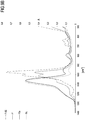
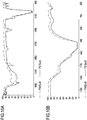
- substantially preserving the crystalline structure and the like it is intended to indicate that at the end of the process described herein the modified fibres preserve most of the crystalline structure, in accordance with that shown by the bands of the most intense signals of the spectrum IR ( fig. 9B and 10B ) in the interval 850 -1040 cm -1 (crystalline sepiolite) with respect to those in the interval 1040-1300 cm -1 (amorphous silica) of the spectrum IR.
- the crystalline structure of the fibres is deemed substantially preserved if, after the treatment, the ratio between the area under the curve of the spectrum IR in the interval 850-1040 cm -1 and the area under the curve in the interval 1040-1300 cm -1 is higher than 0.8, preferably higher than 1, more preferably higher than 1.25.
- substantially preserving their needle-shaped morphology it is intended to indicate that at the end of the process described herein at least 50%, 60%, 70% 80%, 90% of the modified fibres maintain their aspect ratio as previously defined.
- silicate fibres with needle-shaped morphology which are subjected to controlled acid treatment as described herein, are silicate fibres comprising magnesium, such as sepiolite fibres, paligorskite fibres (also known as attapulgite), possibly organically modified, or mixtures thereof.
- magnesium such as sepiolite fibres, paligorskite fibres (also known as attapulgite), possibly organically modified, or mixtures thereof.
- silicate fibres with needle-shaped morphology which can be used according to the present invention, are the sepiolites Pangel S9 or Pansil 100 or the organically modified sepiolites Pangel B5, Pangel B20, Pangel B40, commercialised by Tolsa Group (http://www.tolsa.com/).
- the aforesaid silicate fibres are modified according to a process which represents a first aspect of the present invention.
- Said process preferably comprises:
- the process for modifying silicate fibres with needle-shaped morphology of nanometric size comprises
- the process of preparation of the modified fibres comprises one or more of the following characteristics, taken separately or in combination.
- the silicate fibres in particular the natural sepiolite fibres, employed in the present process comprise originally from 12.5% to 15.5% of magnesium with respect to the weight of the fibres themselves. Sepiolite fibres originally comprising around 15% of magnesium are particularly preferred.
- the process of preparation of the modified fibres first of all provides for the suspension of the silicate fibres with needle-shaped morphology of nanometric size in a suitable liquid medium.
- said suitable liquid medium is selected from water, alcohols, ethers, ketones and mixtures thereof, more preferably is selected from water, mono- or poly-alcohols C 1 -C 6 and mixtures thereof.
- the liquid medium is water.
- the Applicant has found that the reaction proceeds as desired simply in water, without having to add an alcohol for controlling the magnesium extraction speed, in conditions that are more secure and advantageous industrially.
- the liquid medium can be an alcohol C 1 -C 6 , more preferably isopropanol, or a mixture of water and at least one alcohol C 1 -C 6 , more preferably water and isopropanol.
- said liquid medium is used in a volume / weight ratio with respect to the fibres comprised between 2 and 100 ml/g, preferably between 2 and 50 ml/g, more preferably between 4 and 15 ml/g.
- the suspension of the fibres in the liquid medium is carried out under stirring.
- Said suspension can be carried out with different means, for example by using a mechanical blade stirrer, a mechanical mixture, e.g. of the type used for mixing paints or mortar, a mechanical stirrer or sonication stirrer.
- the present process then provides for gradually adding at least one acid compound to the suspension.
- gradually adding to the suspension it is intended to indicate that, unlike the prior art, where in similar treatments all of the acid was added at the start of the reaction, in the present process one instead proceeds with a gradual addition of the acid, in successive aliquots, such to bring and then maintain the pH of the medium between 2 and 4. With this gradual addition mode, at any moment the content of free acid in the reaction medium is always much below the stoichiometry.
- the gradual addition of the acid compound is carried out under stirring.
- the acid is gradually added by means of an automatic doser driven by a pH-meter.
- This apparatus is commonly used in the silica industry for precipitating the sodium silicate by controlling the precipitation kinetics.
- the Applicant has found that the same apparatus can be advantageously used also for the acid treatment of extraction of the magnesium from the silicate fibres according to the invention.
- the quantity of added acid overall is lower than 1.4, preferably lower than 1.0, 0.8 or 0.6 moles/mole of magnesium present initially in the silicate.
- the quantity of acid added overall is comprised between 0.75 and 0.4 moles/mole of magnesium present initially in the silicate.
- the progressive addition of the acid which in the medium is always at concentrations well below the stoichiometry, equally allows the extraction of the magnesium in an efficient manner and without requiring a rigorous control of the times, temperatures or reaction solvents employed, all benefiting the industrial applicability of the present process.
- the acid compound is gradually added in a quantity such to be in the reaction medium in a concentration not higher than 0.01N, more preferably not higher than 0.005N.
- the at least one acid compound is gradually added in a manner such that the concentration of hydrogen ions in the reaction medium is comprised between 0.01 and 0.0005N, more preferably between 0.002N and 0.0008N.
- the gradual addition of the acid compound is carried out in a manner so as to maintain the pH of the medium between 2 and 4, preferably between 2.5 and 3.5, more preferably between 2.8 and 3.2, still more preferably at a pH of about 3.
- one or more strong inorganic acids are used, preferably selected from among hydrochloric acid, nitric acid, phosphoric acid and sulphuric acid, or organic acids are used selected from among acetic acid, formic acid, propionic acid, citric acid, tartaric acid and benzoic acid and mixtures thereof.
- hydrochloric acid is used.
- the medium is preferably a mono- or poly-alcohol C 1 -C 6 , more preferably isopropanol, or mixtures thereof with water, more preferably a water - isopropanol mixture.
- the silanising agent is selected from among mono or bifunctional silanes with one or two or three hydrolysable groups such as bis-(triethoxysilylpropyl)disulphide (TESPD), bis[3-(triethoxysilyl)propyl]tetrasulphide (TESPT), 3-thio-octanoyl-1-propyltriethoxysilane (NXT), Me 2 Si(OEt) 2 ), Me 2 PhSiCl, Ph 2 SiCl 2 , more preferably is selected from between TESPD and TESPT.
- the silanising agent is added in a quantity comprised between 3% and 1 00% by weight with respect to the weight of the fibres.
- the acidified suspension of the fibres possibly comprising the silanising agent, is allowed to react under stirring.
- the suspension of the fibres comprising at least one acid compound and possibly at least one silanising agent, is allowed to react at a temperature of at least 20°C, more preferably of at least 40°C, 50°C, 60°C.
- the suspension of the fibres comprising at least one acid compound and possibly at least one silanising agent is allowed to react at a temperature not higher than 100°C, 90°C, 80°C.
- the suspension of the fibres comprising at least one acid compound and possibly at least one silanising agent is allowed to react at a temperature comprised between -10°C and the boiling temperature of the medium, more preferably between 20 and 100°C, more preferably between 20°C and 70 °C.
- the acidified suspension of the fibres possibly comprising the silanising agent, is allowed to react at a pressure lower than 100 bar, more preferably at ambient pressure.
- the acidified suspension of the fibres possibly comprising the silanising agent, is allowed to react for a time of at least 5 minutes, preferably of at least 10 or 20 minutes, the reaction time depending on different variables such as the desired extent of extraction of the magnesium, the temperature, the dilution, the stirring, etc.
- reaction is not continued beyond 50 hours, preferably not beyond 20 hours, more preferably not beyond 10 hours.
- the optimal removal of the magnesium is obtained, in the desired quantities, without requiring a strict control of the other reaction conditions in order to prevent an excessive depletion, in particular of the solvents and times.
- Such man can easily verify the quantity of magnesium extracted from the fibres - which must be from 1 0% to 70% by weight- and the substantial preservation of the crystalline structure and of the needle-shaped morphology of the fibres themselves by means of the IR analysis thereof and observation at the microscope, by applying known techniques, illustrated in the present experimental part.
- the percentage by weight of extracted magnesium is calculated with respect to the total weight of magnesium originally contained in the fibres, i.e. before the present treatment.
- silicate fibres in particular natural sepiolite fibres, originally comprise from 12.5% to 15.5% of magnesium with respect to the weight of the fibres themselves.
- Sepiolite fibres originally comprising around 15% of magnesium are particularly preferred. Alternatively it is possible to proceed with the determination of the content of absolute residual magnesium in the fibres after treatment.
- the modified silicate fibres with needle-shaped morphology of nanometric size comprise from 3.8% to 12%, preferably from 9.5% to 12% of magnesium with respect to the weight of the fibres themselves.
- the determination of the absolute content of magnesium in the modified silicate fibres can be carried out according to known analytical methods (see as general reference the text " TREATISE ON SOLID STATE CHEMISTRY”; Ed. Norman Bruce Hannay; 1a Ed. (1921), Vol. 1: “The Chemical Structure of Solids", chapter 2.3 ), such as atomic emission spectroscopy (AES) or atomic absorption spectroscopy, plasma mass spectrometry (Inductively coupled plasma mass spectrometry or ICP-MS), isotopic dilution or conventional analyses of gravimetric type.
- AES atomic emission spectroscopy
- atomic absorption spectroscopy atomic absorption spectroscopy
- plasma mass spectrometry Inductively coupled plasma mass spectrometry or ICP-MS
- ICP-MS Inductively coupled plasma mass spectrometry
- isotopic dilution or conventional analyses of gravimetric type.
- the extraction reaction is continued up to extracting at least 1 5%, 20%, 25%, 30% by weight of magnesium from the fibres.
- reaction is continued up to extracting not more than 65%, 60%, 50%, 40% by weight of magnesium from the fibres.
- the reaction is continued up to extracting from 15% to 70%, preferably from 20% to 60%, still more preferably from 20% to 40%, from 20% to 35% by weight of magnesium from the fibres.
- the modified fibres with needle-shaped morphology comprise a residual quantity of magnesium equal to at least 30%, 40%, 50%, 60%, 80%, 90% of the quantity of magnesium initially present in the fibres.
- the modified fibres with needle-shaped morphology comprise a residual quantity of magnesium equal to at least 90%, preferably at least 80% or 70% or 60% of the quantity of magnesium initially present in the fibres before the present treatment.
- the quantity of magnesium extracted from the fibres is determined according to XRF analysis as described in the experimental part.
- the separation of the modified fibres is conducted via filtration, followed by washing with a suitable liquid medium, preferably equivalent to that used in the reaction, preferably water, followed by air or vacuum drying, possibly by heating until the solvent is removed.
- a suitable liquid medium preferably equivalent to that used in the reaction, preferably water, followed by air or vacuum drying, possibly by heating until the solvent is removed.
- the gradual addition of acid of the present process also simplifies the final working, which can avoid the neutralisation step, since the water washing is sufficient.
- the water washing is conducted until a substantially neutral solid is obtained, i.e. a solid which when suspended in water at 1% by weight does not cause a variation of the pH of more than two units with respect to neutrality, i.e. it leads to a suspension with pH comprised between 5 and 9.
- a substantially neutral solid i.e. a solid which when suspended in water at 1% by weight does not cause a variation of the pH of more than two units with respect to neutrality, i.e. it leads to a suspension with pH comprised between 5 and 9.
- the determination of the quantity of magnesium extracted from the fibres or residual can be carried out by means of conventional analytical techniques such as complexometric methods, spectroscopy methods such as X-ray fluorescence (XRF) or atomic emission spectroscopy, preferably by means of X-ray fluorescence.
- XRF X-ray fluorescence
- atomic emission spectroscopy preferably by means of X-ray fluorescence.
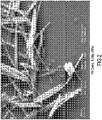
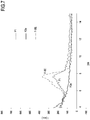
- the Applicant has observed that by applying the above-described process conditions, the silicate fibres are modified without substantially altering the crystalline structure and the needle-shaped morphology thereof. Indeed, by partial extraction of magnesium, the morphology of the fibres is substantially preserved, as can be detected from microscopic observation (e.g. Figure 5 ) and the crystalline structure is also substantially preserved, in accordance with the XRPD and IR analyses ( Figures 8 and 10 ).
- the silicate fibres with needle-shaped morphology of nanometric size are incorporated in the diene elastomeric polymer together with the other components in order to produce the elastomeric composition for tyre components.
- said modified fibres are present in the elastomeric composition in a quantity from 1 phr to 60 phr, preferably from 3 phr to 40 phr, more preferably from 5 phr to 30 phr.
- the elastomeric composition according to the present description can also comprise (c) a standard reinforcing filler.
- standard reinforcing filler a reinforcing filler commonly used in the tyre field, preferably selected from among carbon black, precipitated amorphous silica, amorphous silica of natural origin, such as diatomaceous earth, calcium carbonate, titanium dioxide, talc, alumina, aluminosilicates, kaolin, non-modified silicate fibres and mixtures thereof.
- non-modified silicate fibres it is intended non-modified silicate fibres according to the present process of controlled acidic extraction of magnesium.
- the silicate fibres can be modified in a different manner, for example they can be treated with a compatibliser, preferably selected from among quaternary ammonium salts, such as the fibres Pangel B5, or phosphonium salts, known in the field, as described for example in WO2012164433A1 .
- a compatibliser preferably selected from among quaternary ammonium salts, such as the fibres Pangel B5, or phosphonium salts, known in the field, as described for example in WO2012164433A1 .
- the elastomeric composition according to the present description comprises (c) a standard reinforcing filler.
- the standard reinforcing filler is selected from among carbon black, precipitated amorphous silica, amorphous silica of natural origin, non-modified silicate fibres and mixtures thereof.
- the standard reinforcing filler (c) is present in the elastomeric composition in a quantity generally comprised between 1 phr and 120 phr, preferably between 20 phr and 90 phr.
- the overall quantity of modified fibres (b) and standard filler (c) present in the elastomeric composition according to the description is at least 20 phr, more preferably at least 30 phr.
- the overall quantity of modified fibres (b) and standard filler (c) present in the elastomeric composition according to the description is comprised between 20 phr and 120 phr, more preferably between 30 phr and 90 phr.
- the standard reinforcing filler (c) is carbon black having a surface area not lower than 20 m 2 /g (determined by STSA - statistical thickness surface area according to ISO 18852:2005).
- said reinforcing carbon black (c) filler is present in the elastomeric composition in a quantity comprised between 1 phr and 120 phr, preferably between 20 phr and 90 phr.
- the standard reinforcing filler is silica, selected from among a pyrogenic silica or, preferably, a precipitated silica, with a surface area BET (measured according to Standard ISO 5794/1) comprised between 50 m 2 /g and 500 m 2 /g, preferably between 70 m 2 /g and 200 m 2 /g.
- a surface area BET measured according to Standard ISO 5794/1
- the elastomeric composition according to the present description can possibly also comprise at least one silane coupling agent (d) capable of interacting with the silica possibly present as reinforcing filler and/or the silicates and to bind them to the diene elastomeric polymer during the vulcanisation.
- the elastomeric composition comprises at least one coupling agent.
- the silane coupling agent (d) which can be used in the present description is selected from among those having at least one hydrolysable silane group, which can be identified, for example, from the following general formula (I): (R) 3 Si-C n H 2n -X (I) where the groups R, which can be identical or different, are selected from: alkyl, alkoxy or aryloxy groups or from halogen atoms, as long as at least one of the groups R is an alkoxy group or aryloxy group or a halogen; n is an integer between 1 and 6 included; X is a group selected from: nitrous, mercapto, amino, epoxide, vinyl, imide, chloro, -(S) m C n H 2n -Si-(R) 3 and -S-COR, where m and n are integer numbers between 1 and 6 included and the groups R are defined as above.
- R which can be identical or different, are selected from: alkyl, alk
- silane coupling agents those particularly preferred are bis(3-triethoxysilylpropyl) tetrasulphite and bis(3-triethoxysilylpropyl) disulphide.
- Said coupling agents can be used as is or as a mixture adapted with an inert filler (e.g. carbon black) so as to facilitate their incorporation in the elastomeric composition.
- said silane coupling agent (d) is present in the elastomeric composition in a quantity comprised between 0,1 phr and 20 phr, preferably between 0,5 phr and 10 phr,
- the vulcanisable elastomeric composition according to the present description comprises at least one vulcanisation agent (e).
- the vulcanisation agent most advantageously used is sulfur, or alternatively molecules containing sulfur (sulfur donors), with accelerators, activators and/or retardants known to those skilled in the art.
- the sulfur or derivatives thereof can be advantageously selected, for example, from among: (i) soluble sulfur (crystalline sulfur); (ii) insoluble sulfur (polymer sulfur); (iii) sulfur dispersed in oil (for example 33% sulfur known with the commercial name of Crystex OT33 by Eastman); (iv) sulfur donor such as, for example, caprolactam disulfide (CLD), bis[(trialkoxysilyl)propyl]polysulphides, dithiophosphates; and mixtures thereof.
- CLD caprolactam disulfide
- the vulcanisation agent (e) is present in the vulcanisable elastomeric composition herewith described in a quantity from 0.1 to 15 phr, preferably from 0.5 to 10 phr, still more preferably from 1 to 7 phr.
- the vulcanisation agent (e) is used in combination with accelerants (f) and activators (g) known to the men skilled in the art.
- the accelerants (f) that are commonly used can be selected from among: dithiocarbamates, guanidine, thioureas, thiazoles, sulfenamides, thiurams, amines, xanthates and mixtures thereof.
- the vulcanisation accelerants are present in the vulcanisable elastomeric composition of the description in a quantity from 0.1 to 8 phr, preferably from 0.3 to 6 phr.
- the activators (g) which are particularly effect are zinc compounds and in particular ZnO, ZnCO 3 , zinc salts of saturated or unsaturated fatty acids containing from 8 to 18 carbon atoms, such as, for example, zinc stearate, which are preferably formed in situ in the vulcanisable elastomeric composition by ZnO and fatty acid, as well as Bi 2 Oa. PbO, Pb 3 O 4 , PbO 2 , or mixtures thereof.
- the vulcanisation activators are present in the vulcanisable elastomeric composition of the description in a quantity from 0.2 to 15 phr, preferably from 0.5 to 10 phr.
- the above-described elastomeric materials can comprise other commonly used additives, selected on the basis of the specific application for which the composition is intended.
- the following can be added to said materials: antioxidants, anti-aging agents, plasticisers, adhesives, anti-ozone agents, modifying resins, or mixtures thereof.
- the following can be added to said vulcanisable elastomeric composition: at least one plasticiser generally selected from among mineral oils, vegetable oils, synthetic oils, low molecular weight polymers and mixtures thereof, such as, for example, aromatic oil, naphthenic oil, phthalates, soy oil and mixtures thereof.
- the quantity of plasticiser is generally comprised between 0 phr and 70 phr, preferably between 5 phr and 30 phr.
- the above-reported elastomeric compositions can be prepared by mixing the polymer components together with the reinforcing filler and with the other additives possibly present according to the techniques known in the field.
- the mixing can be executed, for example, by using an open mixer of "open-mill” type or an internal mixer of the type with tangential rotors (Banbury®) or with co-penetrating rotors (Intermix), or in continuous mixers of Ko-KneaderTM (Buss®) type or of the type with twin screws or multiple screws.
- An other aspect of the present description regards a tyre component for vehicle wheels comprising a vulcanisable elastomeric composition, or at least partially vulcanised, obtainable by at least partial vulcanisation of the above-described vulcanisable elastomeric composition comprising said modified fibres.
- the above-reported vulcanisable elastomeric compositions can be vulcanised according to known techniques, due to the presence of sulfur-based vulcanisation systems commonly used for diene elastomeric polymers.
- a vulcanisation agent preferably sulfur-based
- the temperature is generally maintained lower than 120°C and preferably lower than 100°C, so as to prevent any undesired pre-crosslinking phenomenon.
- the vulcanisable composition is incorporated in one or more components of the tyre and subjected to vulcanisation, according to known techniques.
- the tyre component according to the description is preferably selected from tread, under-layer, bead protection layer, sidewall, sidewall insert, mini-sidewall, under-liner, rubber layers, bead filler and sheet, more preferably tread, under-layer and sidewall insert.
- a tyre for vehicle wheels comprising at least one tyre component according to the description, preferably selected from tread, under-layer, bead protection layer, sidewall, sidewall insert, a mini-sidewall, under-liner, rubber layers, bead filler and sheet, said component comprising said modified fibres.
- At least the tread comprises said vulcanised elastomeric material comprising modified silicate fibres according to the description.
- At least the tread and at least one component selected from among under-layer, bead protection layer, sidewall, sidewall insert, mini-sidewall, under-liner, rubber layers, bead filler and sheet comprise said vulcanised elastomeric material.
- tyre for vehicles preferably a high-performance tyre (HP, SUV and UHP), comprising at least
- the tyre according to the description comprises the above vulcanised elastomeric material at least in the tread or in the under-layer or in the sidewall insert.
- the tyre comprises the above vulcanised elastomeric material in the tread and in one or more components selected from among under-layer, bead protection layer, sidewall, sidewall insert, under-liner, rubber layers, bead filler and sheet.
- the tyre according to the description comprises the above vulcanised elastomeric material in the tread and in the under-layer.
- the tyre according to the description comprises the above vulcanised elastomeric material in the tread and in the sidewall.
- One aspect according to the present description is a tyre for vehicles, preferably for vehicles whose driving performances benefit from an increase of the rigidity and a reduction of the hysteresis and of the Payne effect of the elastomeric material, such as for example high-performance vehicles HP, SUV and UHP.
- the tyre according to the description can be employed on vehicles with two or four wheels, or on heavy vehicles, or on light transport vehicles.
- the tyre according to the description can be for summer use, winter use or all-season.
- the tyre according to the present description can be manufactured according to a process that comprises:
- green is generally employed for indicating a material, a composition, a component or a tyre not yet vulcanised.
- Figure 1 illustrates a tyre for vehicle wheels in radial half-section.
- the tyre 100 for four-wheel vehicles comprises at least one carcass structure, comprising at least one carcass layer 101 having respectively opposite end flaps engaged with respective anchoring annular structures 102, termed bead cores, possibly associated with a bead filler 104.
- the carcass layer 101 is possibly made with an elastomeric composition.
- the zone of the tyre comprising the bead core 102 and the filler 104 forms a bead structure 103 intended for the anchoring of the tyre on a corresponding mounting rim, not illustrated.
- the carcass structure is usually of radial type, i.e. the reinforcing elements of the at least one carcass layer 101 are situated on planes comprising the rotation axis of the tyre and substantially perpendicular to the equatorial plane of the tyre.
- Said reinforcing elements are generally constituted by textile cords, for example rayon, nylon, polyester (e.g. polyethylene naphthalate (PEN)).
- PEN polyethylene naphthalate
- Each bead structure is associated with the carcass structure by means of folding back the opposite lateral edges of the at least one carcass layer 101 around the anchoring annular structure 102 so as to form the so-called turning up of the carcass 101a as illustrated in Figure 1 .
- the coupling between carcass structure and bead structure can be provided by means of a second carcass layer (not shown in Figure 1 ) applied in an axially external position with respect to the first carcass layer.
- a bead protection layer 105 possibly made with elastomeric composition is arranged in an external position of each bead structure 103.
- the carcass structure is associated with a belt structure 106 comprising one or more belt layers 106a, 106b situated radially superimposed with respect to each other and with respect to the carcass layer, having reinforcing cords that are typically textile and/or metallic incorporated within a layer of vulcanised elastomeric material.
- Such reinforcing cords can have cross orientation with respect to a circumferential extension direction of the tyre 100.
- circumferential direction it is intended a direction generically directed according to the rotation direction of the tyre.
- At least one zero degree reinforcing layer 106c can be applied, commonly known as "0° belt", which generally incorporates a plurality of elongated reinforcing elements, typically metallic or textile cords, oriented in a substantially circumferential direction, thus forming an angle of a few degrees (e.g. an angle between about 0° and 6°) with respect to a direction parallel to the equatorial plane of the tyre, and coated with vulcanised elastomeric material.
- 0° belt generally incorporates a plurality of elongated reinforcing elements, typically metallic or textile cords, oriented in a substantially circumferential direction, thus forming an angle of a few degrees (e.g. an angle between about 0° and 6°) with respect to a direction parallel to the equatorial plane of the tyre, and coated with vulcanised elastomeric material.
- a tread band 109 made of vulcanised elastomeric material is applied.
- Respective sidewalls 108 made of vulcanised elastomeric material are also applied in axially external position on the lateral surfaces of the carcass structure, each extended from one of the lateral edges of the tread 109 up to the respective bead structure 103.
- the tread band 109 In radially external position, the tread band 109 has a rolling surface 109a intended to come into contact with the ground.
- Circumferential grooves which are connected by transverse indentations (not represented in Figure 1 ) so as to define a plurality of blocks of various shapes and sizes distributed on the rolling surface 109a, are generally made in this surface 109a, which for the sake of simplicity in Figure 1 is represented smooth.
- An under-layer 111 of vulcanised elastomeric material can be arranged between the belt structure 106 and the tread band 109.
- a strip constituted by elastomeric composition 110 may possibly be present in the zone of connection between the sidewalls 108 and the tread band 109, this mini-sidewall generally being obtained by means of coextrusion with the tread band 109 and allowing an improvement of the mechanical interaction between the tread band 109 and the sidewalls 108.
- the end portion of the sidewall 108 directly covers the lateral edge of the tread band 109.
- a rubber layer 112 generally known as "liner”, which provides the necessary impermeability to the tyre inflation air, can also be provided in a radially internal position with respect to the carcass layer 101.
- the rigidity of the tyre sidewall 108 can be improved by equipping the bead structure 103 with a reinforcing layer 120 generally known as "flipper" or additional strip-like insert.
- the flipper 120 is a reinforcing layer that is wound around the respective bead core 102 and around the bead filler 104 so as to at least partially surround them, said reinforcing layer being arranged between the at least one carcass layer 101 and the bead structure 103. Usually, the flipper is in contact with said at least one carcass layer 101 and said bead structure 103.
- the flipper 120 typically comprises a plurality of textile cords incorporated within a layer of vulcanised elastomeric material.
- the bead structure 103 of a tyre can comprise a further protection layer which is generally known with the term "chafer" 121 or protection strip and which has the function of increasing rigidity and integrity of the bead structure 103.
- the chafer 121 usually comprises a plurality of cords incorporated within a rubber layer of vulcanised elastomeric material.
- Such cords are generally made of textile materials (e.g. aramide or rayon) or of metallic materials (e.g. steel cords).
- a layer or sheet of elastomeric material can be arranged between the belt structure and the carcass structure.
- the layer can have a uniform thickness.
- the layer can have a variable thickness in axial direction.
- the layer can have a greater thickness close to its axially external edges with respect to the central (crown) zone.
- the layer or sheet can be extended on a surface substantially corresponding to the extension surface of said belt structure.
- a layer or sheet made of elastomeric material as described above can be placed between said belt structure and said tread band, said supplementary layer or sheet preferably being extended on a surface substantially corresponding to the extension surface of said belt structure.
- the elastomeric composition according to the present description can be advantageously incorporated in one or more of the components of the tyre selected from among belt structure, carcass structure, tread band, under-layer, sidewall, mini-sidewall, sidewall insert, bead, flipper, chafer, sheet and bead protection layer.
- the elastomeric composition according to the present description can comprise at least
- the tyre can be a tyre for motorcycle wheels, which is typically a tyre that has a straight section marked by a high transverse curvature.
- the tyre can be a tyre for heavy transport vehicle wheels, such as trucks, buses, trailers, vans and generally for vehicles in which the tyre is subjected to a high load.
- one such tyre is adapted to be mounted on rims having diameter equal to or greater than 17.5 inches for directional or trailer wheels.
- XRF spectroscopy X-ray fluorescence spectrophotometry
- the measurement was conducted in helium at reduced pressure, using the standardless acquisition program "Fast-He34.mm” preset in the instrument, and processing the data with the software S4tools using the formula Si 6 Hi 4 O 23 as matrix for the calculation.
- the determination of the magnesium was carried out on the only component that was not decomposed when subjected in the TGA to oxidative treatment up to 800°C, as better explained in the comparative example 5.
- the magnesium extracted in the reaction medium can be measured by using, as in the literature ( " Preparation of Silica by Acid Dissolution of sepiolite and Study of its reinforcing effect in Elastomers", Die Angewandte Makrom Chemie (1982), 103, 51-60 ), a complexometric method with EDTA.
- 500 ⁇ l of filtration mother liquors are diluted with 100 ml of distilled water and treated with 4 ml of a buffer solution obtained by dissolving 5.4 g of NH 4 Cl in 60 ml of distilled water and 35 ml of aqueous NH 3 at 29% by weight.
- Two drops of eriochrome black T in 1% methanolic solution are added to the buffered solution.
- the solution is heated at 40-50 °C and titred with 0.01 M disodium EDTA up to colour change of the solution. From the titre of magnesium in the buffered solution, the total extracted magnesium is calculated, considering the quantity of supernatant drawn and the total volume of liquids in the reaction mixture.
- the percentage of extracted Mg is then calculated based on the initial weight of fibres containing magnesium that are made to react, and on the initial percentage of Mg in such fibres, calculated from the molecular formula of magnesium silicate.
- Field emission scanning electron microscopy FESEM the observations on the powders of the samples of the comparative example 5 ( Fig. 2 ) and of the examples according to the invention 8 and 9 ( Fig. 5 ) were made with a microscope Vega TS5136 XM Tescan in high vacuum configuration. The excitation of the electron ray was 30 kV with a current of 25 pA. Before the SEM analysis, the samples were attached to a metallic target with adhesive strip and subjected to sputtering with gold in order to improve the conductivity of the electrons through the material.
- Thermogravimetric Analysis (TGA): the determination of the profile of the weight loss was carried out with the device Mettler Toledo TGA/DSC1 Star-e System, in a temperature interval from 150 to 800°C. The measurements were made by using a temperature program which provides for a step with inert gas (ramp from 25 to 150°C and a plateau at 150°C in nitrogen flow) and an oxidation step (ramp from 150 to 800°C in dry air flow).
- Attenuated total reflectance infrared spectroscopy ATR-IR the measurements were carried out with the instrument Perkin Elmer Spectrum 100 (1 cm -1 resolution, interval from 650-4000 cm -1 , 16 scans). This analytical technique allows easily distinguishing the original sepiolite fibres F-SE and those modified according to the present process, characterised by more intense signals in the interval 850-1040 cm -1 - in two resolved signals or even in a single band - with respect to commercial silica, which instead shows very intense signals in the interval 1040-1300 cm- 1 .
- Modified sepiolite fibres were prepared by using the following materials:
- the sepiolite (5 g) is suspended in 50 ml of acid solution and it is heated in an oil bath at 60°C for 10 minutes under stirring.
- the suspension is filtered over Buchner.
- the solid is washed with abundant deionised water (about 1.5-2l) until the washing water lacks chloride ions (test of AgNO3).
- the complexometric analysis showed the presence in the filtration mother liquors of 31% of magnesium theoretically present in the starting silicate.
- the sepiolite fibres of the comparative example 1 showed a substantial preservation of the crystalline structure (ratio > 0.8) while the modified sepiolite fibres of the following comparative example 2a substantially had lost the crystillinity (ratio ⁇ 0.8).
- This example substantially reproduces the processes described in the literature for generating amorphous silica by means of exhaustive acid treatment of the sepiolite fibres.
- Modified sepiolite fibres were prepared by using the following materials:
- Modified sepiolite fibres were prepared by using the following materials:
- Modified sepiolite fibres were prepared by using the following materials:
- reaction mixture was filtered over Buchner and the solid was suspended in 2l of deionised water. Then, a solution of NH3 at 29% by weight was added until pH 7.0 ⁇ 0.2 was reached. The solid was collected over Buchner, washed with 1 l of deionised water and dried in oven at 120°C for 48h.
- Figure 2 shows the modified sepiolite fibres, needle-shaped and of nanometric size, of the comparative example 5. These fibres have an average diameter of 20 ⁇ 5 nm and a length of 460 ⁇ 400 nm, with an aspect ratio of approximately 23 ⁇ 10.
- the loss of weight during the TGA was calculated to be equal to 6.5% by weight for the sample of original non-modified sepiolite (F-SE) and to 17.6% by weight for the sample of the silanised comparative example 5 treated in controlled acidic conditions (F5).
- the two traces are generally very similar: appearing in both are the signals due to the stretching of the bonds of the groups OH bonded to the magnesium (3500-3700 cm -1 ) and to the silicon (3760-3730cm -1 ) and the double peak of the stretching of the bond Si-O (stretching SiOSi and SiOMg) at about 1000 cm -1 - typical of the magnesium silicates such as sepiolite and like the modified sepiolite fibres according to the present process.
- Figure 9B instead shows a detail of the IR spectra of commercial silica (SIL), of the non-modified sepiolite (F-SE), of the modified sepiolite with partial extraction of the magnesium of the comparative example 1 (F1) and with total extraction of the comparative example 2a (F2a).
- SIL commercial silica
- F-SE non-modified sepiolite
- F2a total extraction of the comparative example 2a
- the sample of the comparative example 1 like the non-modified sepiolite, shows a strong absorption between 850 and 1040 cm -1 , while the commercial silica and the sample F2a, from which about 95% of Mg was extracted, give rise to more intense peaks between 1040 and 1300 cm -1 .
- the same IR analysis ( Figure 10 ) conducted on samples according to the invention F8 and F9 showed, in the interval between 850 and 1040 cm-1, predominant signals with respect to those between 1040 and 1300 cm-1, indication of the substantial maintenance of the crystalline structure.
- the quantity of magnesium extracted from the fibres was carried out by means of complexometric titration on the filtration mother liquors: 500 ⁇ l of filtration mother liquors were diluted with 100 ml of distilled water and treated with 4 ml of a buffer solution obtained by dissolving 5.4 g of NH 4 Cl in 60 ml of distilled water and 35 ml of aqueous solution of NH 3 at 29% by weight.
- the percentage of extracted Mg was then calculated based on the initial quantity of fibres containing magnesium that were made to react (120 g), and on the initial percentage of Mg in such fibres, calculated from the molecular formula of the magnesium silicate Mg 4 Si 6 O 15 (OH) 2 (H 2 O) 6 , i.e. of a percentage by initial weight of magnesium of 15%.
- the percentage of extracted Mg was equal to 25% of the initially present Mg.
- sample F-SE Sepiolite as is
- comparative sample F5 sample treated as described above
- the quantity of magnesium was calculated on the samples after TGA, i.e. the only dry inorganic component thereof - respectively equal to 93.5% for the sepiolite sample F-SE and to 82.4% for the modified sepiolite F5 - which was not decomposed by oxidative treatment at 800°C.
- the residual quantity of magnesium in the sample subjected to controlled acid treatment according to the comparative process (F5) is lower (10.4%) and equal to about 74% of the initial quantity.
- the acid treatment has therefore removed 26% of magnesium from the sepiolite fibres, preserving the original structure of the silicate, as demonstrated by the XRD spectrum of Figure 6 and by the IR spectrum of Figure 9A .
- the magnesium extraction data calculated according to this method on the powders is in optimal accordance with the complexometric data obtained on the filtration mother liquors.
- Modified sepiolite fibres were prepared by using the following materials:
- the IR analysis in the region 850-1300 cm -1 showed signals between 850 and 1040 cm -1 that were predominant with respect to those between 1040 and 1300 cm -1 , indication of the substantial maintenance of the crystalline structure.
- Modified sepiolite fibres were prepared by using the following materials:
- the mixture was held under stirring for 120 minutes at 65°C and then filtered over Buchner.
- the solid was suspended in 2l of deionised water. Then, a solution of NH 3 at 29% by weight was added until pH 7.0 ⁇ 0.2 was reached.
- the solid was collected on Buchner, washed with 1l of deionised water and dried in oven at 120°C for 72h.
- the sample Upon microscopic observation, the sample maintained the morphology of the sepiolite fibres.
- the IR analysis in the region 850-1300 cm -1 showed signals between 850 and 1040 cm -1 that were predominant with respect to those between 1040 and 1300 cm -1 , indication of the substantial maintenance of the crystalline structure
- the suspension was then filtered, the filtered solid was washed with deionised water until pH 7 was reached and dried in oven at 100 °C for 48 h.
- Table 2 reports the examples of preparation of the fibres, the quantity of extracted magnesium, the elastomeric materials in which the fibres were incorporated, with reference to the corresponding examples (green and vulcanised materials): Table 2 Fillers / Fibres % Mg extracted Elastomeric material Preparation green material Preparation vulcanised material Comp. silica SIL ---- Standard 1 Ex. 10 MA Ex. 14 V-MA Comp. silica SIL ---- Internal app. Ex. 11 ME1 Ex. 15 V-ME1 Comp. silica SIL ---- Internal app. Ex. 11 ME2 Ex. 15 V-ME2 Comp. silica SIL ---- Tread1 Ex. 12 ML1 Ex. 16 V-ML1 Comp.
- vulcanisable elastomeric materials of the following examples were prepared according to the modes described herein. The quantities of the various components are indicated in phr.
- the sepiolite fibres F1 modified as in the comparative example 1 were incorporated together with conventional silica SIL in standard compositions (1) for vulcanisable elastomeric materials for tyre components. These materials (MD) were compared with elastomeric comparative materials, comprising standard fillers, in particular only containing conventional silica (SIL in MA) or conventional silica together with non-modified sepiolite fibres (F-SE in MB) or conventional silica together with sepiolite fibres treated in more energetic acidic conditions (F2a in MC1) as in Comparative example 2a.
- SIL in MA conventional silica
- F-SE in MB non-modified sepiolite fibres
- F2a in MC1 sepiolite fibres treated in more energetic acidic conditions
- the elastomeric materials of this example comprise standard compositions (1) suitable for many different applications, such as elastomeric materials for under-layer (car and heavy vehicles), soft bead (heavy vehicles), sidewall insert (car), or sidewall and are similar to formulations for tread (heavy vehicles).
- elastomeric materials for under-layer car and heavy vehicles
- soft bead latitude and low-latency vehicles
- sidewall insert car
- sidewall a sidewall insert
- Table 3 reports the compositions in phr of the comparative vulcanisable elastomeric materials (MA), (MB), (MC1) and (MD): Table 3 Comparative example 10 MA Comp. MB Comp. MC1 Comp. MD Comp. Filler Silica Silica + sepiolite Silica + modified sepiolite (Ex. 2a) Silica + modified sepiolite (Ex. 1) % Mg extracted -- -- 95% 33% Zeosil 1115MK 45 35 35 35 35 sepiolite 0 10 0 0 modified sepiolite Ex. 2a 0 0 10 0 modified sepiolite Ex.
- NR 100 100 100 100 100 100 100 Stearic acid 2 2 2 2 2 Silane TESPT 3.6 3.6 3.6 3.6 ZnO 3.6 3.6 3.6 3.6 3.6 6-PPD 2 2 2 2 TBBS 1.8 1.8 1.8 Sulfur 2.8 2.8 2.8 2.8 2.8 in which NR (natural rubber): natural rubber; TESPT: Bis[3-(triethoxysilyl)propyl]tetrasulphide; Zeosil 1115MK: precipitated synthetic amorphous silica (Rhodia); sepiolite: Pangel S9; ZnO: zinc oxide; 6-PPD: N-(1,3-Dimethylbutyl)-N'-phenyl-p-phenylenediamine; TBSS: N-tert-butyl-2-benzothiazylsulfenamide.
- NR natural rubber
- TESPT Bis[3-(triethoxysilyl)propyl]tetrasulphide
- the sepiolite fibres F2b, F3, F4, F5, F6 and F7, modified as in Comparative examples 2b, 3, 4, 5, 6 and 7, and the fibres F8, F9 as in examples of the invention 8 and 9, were incorporated together with carbon black and conventional silica in compositions for vulcanisable elastomeric materials for internal tyre components such as sidewall insert, bead or under-liner.
- the mixing was conducted in three steps by using an internal mixer with tangential rotors (Pomini PL 1.6): in the first step, the polymers, the fillers and the silane were introduced and the mixing was continued for 4-5 minutes, up to reaching 135°C ⁇ 5°C, when the composition was unloaded. After 12-24 hours, in the second step, conducted using the same mixer, ZnO, TMQ and 6-PPD were introduced and the mixing was continued for about 3 minutes, up to reaching 125°C ⁇ 5°C, when the composition was unloaded. After 12-24 hours, in the third step, conducted using the same mixer, TBBS and sulfur were introduced and the mixing was conducted for about 2 minutes, up to reaching 95°C ⁇ 5°C, when the composition was unloaded.
- Table 4a reports the compositions in phr of the comparative vulcanisable elastomeric materials (ME1), (MF1), (MC2), (MG), (MH), (MI), (MJ) and (MK): Table 4a: comparatives Example 11 ME1 Comp. MF1 Comp. MC2 Comp. MG Comp. MH Comp. MI Comp. MJ Comp. MK Comp. Filler Silica Silica + sepiolite Silica + mod. sepiolite (Ex.2b) Silica + mod. sepiolite (Ex.3) Silica + mod. sepiolite (Ex. 4) Silica + mod. sepiolite (Ex. 5) Silica + mod. sepiolite (Ex.
- the comparative compositions ME2 and MF2 differ from the compositions ME1 and MF1 reported in the preceding Table 4a due to the lower sulfur content.
- compositions are technical blends of sidewall filler type.
- 10 phr of silica was substituted with 7, 7.5 or 8.5 phr of sepiolite, of modified sepiolite as described in the examples 8 and 9 of the invention, respectively.
- the quantities used in the compositions (MQ) and (MR) of the modified materials according to the description were calculated based on the TGA of the modified materials described in examples 8 and 9, as illustrated above for the compositions (MG), (MH), (MI), (MJ) and (MK).
- the sepiolite fibres F4 modified as in the comparative example 4 (controlled acid treatment in presence of silanising agents) and the fibres modified according to the process of the invention of examples 8 and 9 (F8 and F9) were incorporated together with conventional silica in compositions for vulcanisable elastomeric materials for tread (here named tread1).
- tread1 conventional silica in compositions for vulcanisable elastomeric materials for tread
- tread1 conventional silica in compositions for vulcanisable elastomeric materials for tread
- These materials (MN comparative, MS and MT according to the invention) were compared with elastomeric materials comprising standard fillers, in particular containing only conventional silica (SIL in ML1) or conventional silica together with non-modified sepiolite fibres (F-SE in MM).
- the mixing was conducted in three steps by using an internal mixer with tangential rotors (Pomini PL 1.6): in the first step, the polymers, the fillers, the silane, the stearic acid and the TDAE oil were introduced and the mixing was continued for 4-5 minutes, up to reaching 140°C ⁇ 5°C, when the composition was unloaded. After 12-24 hours, in the second step, conducted using the same mixer, ZnO and 6-PPD were introduced and the mixing was continued for about 3 minutes, up to reaching 125°C ⁇ 5°C, when the composition was unloaded. After 12-24 hours, in the third step, conducted using the same mixer, TBBS, TBZTD and sulfur were introduced and the mixing was conducted for about 2 minutes, up to reaching 95°C ⁇ 5°C, when the composition was unloaded.
- Table 5a reports the compositions in phr of the comparative vulcanisable elastomeric materials (ML1), (MM) and (MN): Table 5a: comparatives Example 12 ML1 Comp. MM Comp. MN Comp. Filler Silica Silica + sepiolite Silica + modified sepiolite (Ex. 4) % Mg extracted -- -- 35% ZEOSIL 1165 MK 85 75 75 Sepiolite -- 7 -- mod. sepiolite Ex.
- the quantity of modified sepiolite to be added was calculated by considering the weight loss of the samples in the TGA, loss corresponding to the organic portion, which in the ramp up to 800°C was 28.5%, so as to add a quantity of modified fibres corresponding to 7 phr of dry inorganic component, with the objective of obtaining blends which had comparable hardness.
- Table 5b reports the compositions in phr of the vulcanisable elastomeric materials (named tread 2), comparative (ML2) and description (MS) (not claimed) and (MT) (not claimed): Table 5b
- Example 12 ML2 Comp. MS Inv. MT Inv. Filler Silica Silica + modified sepiolite (Ex. 8) Silica + modified sepiolite (Ex.9) % Mg extracted -- 33% 35% ZEOSIL 1165 MK 85 55 55 mod. sepiolite Ex. 8 -- 15 -- mod. sepiolite Ex.
- TMQ 2,2,4-Trimethyl-1,2-Dihydroquinoline, Rubatan 184
- General Quimica SA Antioxidant
- N-Octylpyrrolidone is Surfadone LP 100 of BASF; for the other ingredients reference is made to the key of table 5a.
- compositions are technical blends of tread type.
- examples MS, and MT 30 phr of silica were substituted with 15 or 17 phr of modified sepiolite as described in the examples 8 and 9 of the invention, respectively.
- Sepiolite fibres F5 modified as in Comparative example 5 were incorporated as single filler in a standard composition (2) for vulcanisable elastomeric materials.
- This comparative material (MP) was compared with the comparative material comprising non-modified sepiolite fibres (MO).
- Table 6 reports the compositions in phr of the comparative vulcanisable elastomeric materials (MO) and (MP): Table 6 Example 13 MO Comp. MP Comp. Filler sepiolite modified sepiolite (Ex. 5) % Mg extracted -- 26% sepiolite Pangel S9 35 -- mod. sepiolite Ex.
- S-SBR 100 100 TESPD 2.8 -- Stearic acid 0.85 0.85 ZnO 2.7 2.7 6-PPD 1 1 Sulfur 2 2 CBS 1.5 1.5 in which S-SBR: styrene-butadiene rubber SLR 4630 by Styron Europe GmbH; TESPD: Bis (3-triethoxysilylpropyl) disulphide by Aldrich; 6-PPD: N-(1,3-Dimethylbutyl)-N'-phenyl-p-phenylenediamine Santoflex-6 PPD by Flexsys; stearic acid: Stearina TP8 by Undesa; Sulfur: S8 (soluble sulfur) by Zolfosocial; ZnO: zinc oxide by Zincol Ossidi; CBS: N-cyclohexyl-2-benzothiazolsulfenamide Vulkacit CZ/C by Lanxess.
- Figure 12A reports the progression of the modulus G' for these materials (see Example 17 for a detailed comment).
- the elastomeric materials prepared in the preceding examples were vulcanised to give rise to specimens on which analytical characterisations were carried out together with the evaluation of the static and dynamic mechanical properties.
- the vulcanisation was conducted in a mould, in a hydraulic press at 170°C and at the pressure of 200 bar for a time of about 10 minutes
- the vulcanised samples were named with the same initials as the original elastomeric green material preceded by the letter V (for example, from the material MK, the specimen of vulcanised material named V-MK derives).
- the dynamic mechanical properties were evaluated by using a rheometer Monsanto R.P.A. 2000 according to the following method: cylindrical test samples with weights in the range from 4.5 g to 5.5 g were obtained by means of punching the vulcanisable elastomeric composition of the samples and their vulcanisation in the instrument "RPA” (at 170°C for 10 minutes). The vulcanised samples were subjected to the measurement of the dynamic elastic shear modulus (G') at 70°C, frequency 10 Hz, deformation from 0.1 % to 1 0%.
- G' dynamic elastic shear modulus
- the Payne effect was evaluated through the difference between the shear moduli (G') at 10% and at 0.5% except where otherwise indicated.
- the dynamic compression moduli were measured using a dynamic device Instron in the compression mode according to the following methods.
- the dynamic mechanical properties were expressed in terms of values of dynamic elastic modulus (E') and Tan delta (loss factor).
- Tan delta was calculated as ratio between the viscous dynamic modulus (E") and the elastic dynamic modulus (E'), both being determined with the abovementioned dynamic measurements.
- the generation of heat and the bending fatigue during the compression were measured by means of a Goodrich flexometer according to ASTM D 623-07.
- the test consisted of subjecting a rubber sample of defined size and shape to compression stresses by means of quick oscillation in controlled conditions. The increase of the temperature was measured. In particular, the increase of the temperature was measured up to an equilibrium temperature.
- a defined compression load is applied on a test sample through a lever system having high inertia, simultaneously imposing on the sample an additional high frequency cyclic compression with defined amplitude.
- the increase of the temperature at the base of the test sample is measured with a thermocouple in order to supply an indication relative to the heat generated during the bending of the sample.
- the standard test sample was moulded, a cylinder having a diameter of 17.8 mm and a height of 25 mm.
- modified sepiolite fibres for drastic acid treatment F2a (comparative V-MC1, prepared in the comparative example 2a, with extraction of the magnesium of 95% and loss of the crystalline structure and of the needle-shaped morphology), a worsening is observed both of the static properties and above all of the hysteresis (higher tan delta).
- modified sepiolite fibres F1 in the elastomeric material according to comparative acid treatment processes, with addition of all the acid at the start and pH of the medium lower than 2 (V-MD), a hysteresis is observed that is lower than that of the material comprising non-treated sepiolite (V-MB) and comparable to that of the material comprising only silica (V-MA) but with significant improvement of the Payne effect and satisfactory static properties.
- the sepiolite fibres treated in drastic acidic conditions F2a (as in the comparative example 2a) and incorporated in these elastomeric reference materials (V-MC1) involve a static reinforcement lower than that of the commercial silica (V-MA), and a much higher hysteresis (tan delta of 0.082 with respect to 0.071): it is particularly surprising that both the starting non-modified sepiolite (V-MB) and the product of the exhaustive reaction with acid (V-MC1) both induce higher hysteresis in the materials, while the sepiolite modified by comparative acid treatment F1 determines a hysteresis of the comparative material (V-MD) lower than both reference materials.
- Example 15 vulcanised elastomeric materials for internal applications
- the elastomeric comparative materials (ME1), (MF1), (MC2), (MG), (MH), (MI), (MJ) and (MK) prepared in example 11 and vulcanised at 170°C for 10 minutes were subjected to measurement of the static and dynamic mechanical properties according to the previously-described methods.
- Table 8a reports the values measured for the eight comparative samples: Table 8a example 15 V-ME1 Comp. V-MF1 Comp. V-MC2 Comp. V-MG Comp. V-MH Comp. V-MI Comp. V-MJ Comp. V-MK Comp. Filler Silica Silica + sepiolite Silica + mod. sepiolite Ex. 2b Silica + mod. sepiolite Ex. 3 Silica + mod.
- Table 8a reports the values of the final temperatures: it can be observed that the comparative samples with sepiolite V-MF1 and V-MC2 are heated by about 8°C and 4°C more than the comparative sample V-ME1, while the comparative sample V-MH is heated 8°C less than the comparative example V-ME1 and therefore respectively 16°C and 12°C less than the corresponding V-MF1 and V-MC2, given the same dynamic modulus.
- the temperature difference is 20°C with respect to V-MF1 and 16°C with respect to V-MC2.
- the comparative sample (V-MJ) comprising fibres in which the removal of the magnesium, with a quick procedure in water, was 20% (F6), showed excellent static and dynamic reinforcing properties, greater than those of the sample with non-modified sepiolite, maintaining a hysteresis that is reduced both with respect to the elastomeric comparative material V-MF1 and with respect to the elastomeric comparative material with silica V-ME1. Also the behaviour at the Goodrich test confirms an improved dynamic behaviour, leading to a final temperature that is lower than that of the references, notwithstanding the very high reinforcing level.
- the comparative sample comprising fibres in which the removal of the magnesium was 26% (F5 in V-MI), through a process in isopropanol-water, with 37% hydrochloric acid, in the presence of TESPT and over long times, showed excellent tensile properties, improved with respect to the comparative without sepiolite V-ME1, maintaining similar static and dynamic reinforcing properties, with a decreased hysteresis and Payne effect, as also shown by the behaviour at the Goodrich test, which leads to a final temperature that is lower with respect to the references, as well as a smaller permanent deformation measured at the end of the Goodrich test itself.
- the comparative samples V-MJ and V-MI were observed at the microscope at 100000 power magnification (STEM characterisation - Scanning Transmission Electron Microscopy - on ultramicrotome thin sections (50 nm) under cold conditions, -120°C).
- the modified sepiolite fibres incorporated in the elastomeric matrix are clearly visible, and it is evident that they have an aspect ratio considerably higher than three.
- Table 8b reports the values measured for the comparative vulcanised samples V-ME2, V-MF2 and those according to the description V-MQ and V-MR (not claimed): Table 8b example 15 V-ME2 Comp. V-MF2 Comp. V-MQ Inv. V-MR Inv. Filler Silica Silica + sepiolite Silica + mod. sepiolite Ex. 8 Silica + mod. sepiolite Ex.
- the materials according to the description show greater dynamic modulus E', considered advantageous in the run-flat function, when the tyre travels deflated. This property makes the present materials particularly interesting in the use as filler of the sidewall of run-flat tyres.
- the thermal stability of the samples according to the description is improved.
- the samples V-MQ and V-MR according to the description have an advantageous balance between hardness and hardness delta associated with an optimal modulus vs. hysteresis ratio. It can be observed that neither the comparative sample V-ME2 nor the comparative sample V-MF2 have the advantageous combination of all these properties (balance of hardness versus hardness delta together with high moduli versus low hystereses).
- Example 16 (elastomeric materials for tread applications)
- Table 9a reports the values measured for the three comparative samples: Table 9a (Tread 1)
- Example 16 V-ML1 Comp.
- V-MN Comp.
- V-MN elastomeric comparative material
- delta IRHD thermoplasticity
- Table 9b reports the values measured for the comparative sample (V-ML2) and for that of the description (V-MS) and (V-MT) (not claimed): Table 9b (Tread 2): Example 16 V-ML2 Comp. V-MS Inv. V-MT Inv. Filler Silica Silica + modified sepiolite Ex. 8 Silica + modified sepiolite Ex.
- V-MS and V-MT have improved dynamo-mechanical characteristics with respect to the reference material V-ML2 in terms of balance between dynamic modulus and hysteresis.
- a lower dependence of the dynamic modulus on the temperature is an indication of stability of the performance in high difficulty conditions, such as driving at the adherence limit or emergency manoeuvres such as breaking, conditions in which the tread generally reaches very high temperatures.
- Figure 12B illustrates the progression of the hysteresis for the two comparative materials: as can be observed, the sample V-MP has tan delta values significantly lower and more constant than those of the sample V-MO comprising non-modified sepiolite fibres. The data is particularly significant considering that no coupling agent was added to the sample V-MP during mixing step.
- the process of the invention has proven particularly advantageous, especially when applied at the industrial level, since it allows the use of conventional apparatuses and plants made of steel, it can be carried out simply in water, with limited quantities of acid and hence without final neutralisation steps.
- the extraction of the magnesium in such conditions is gradual, hence the process does not require the strict control of the times, of the solvents and a continuous monitoring of the extraction level of the magnesium, so as to terminate the reaction in order to prevent the excessive removal of the magnesium, as occurred for the known processes.
Landscapes
- Engineering & Computer Science (AREA)
- Chemical & Material Sciences (AREA)
- Mechanical Engineering (AREA)
- Organic Chemistry (AREA)
- Health & Medical Sciences (AREA)
- Materials Engineering (AREA)
- Chemical Kinetics & Catalysis (AREA)
- Medicinal Chemistry (AREA)
- Polymers & Plastics (AREA)
- Life Sciences & Earth Sciences (AREA)
- Ceramic Engineering (AREA)
- Manufacturing & Machinery (AREA)
- Physics & Mathematics (AREA)
- Analytical Chemistry (AREA)
- Pathology (AREA)
- Immunology (AREA)
- General Physics & Mathematics (AREA)
- General Health & Medical Sciences (AREA)
- Biochemistry (AREA)
- Civil Engineering (AREA)
- Structural Engineering (AREA)
- Nanotechnology (AREA)
- Inorganic Chemistry (AREA)
- Metallurgy (AREA)
- Geology (AREA)
- Geochemistry & Mineralogy (AREA)
- General Life Sciences & Earth Sciences (AREA)
- Environmental & Geological Engineering (AREA)
- Compositions Of Macromolecular Compounds (AREA)
- Tires In General (AREA)
- Reinforced Plastic Materials (AREA)
Claims (7)
- Verfahren zum Modifizieren von Silikatfasern mit nadelförmiger Morphologie nanometrischer Größe, umfassend- Bereitstellen von Silikatfasern mit nadelförmiger Morphologie nanometrischer Größe umfassend Magnesium,- Suspendieren der Fasern in einem geeigneten flüssigen Medium,- Zugeben von mindestens einer Säureverbindung zu der Suspension, wodurch der pH-Wert des Mediums auf zwischen 2 und 4, vorzugsweise auf zwischen 2,5 und 3,5, gebracht wird,- Ermöglichen der Reaktion, wobei der pH-Wert des Mediums durch weitere Zugabe von Säure bei zwischen 2 und 4, vorzugsweise bei zwischen 2,5 und 3,5 gehalten wird, bis zum Extrahieren von 10 bis 70 Gew.-% Magnesium aus den Fasern, wobei deren Kristallstruktur und nadelförmige Morphologie im Wesentlichen erhalten bleiben, und- Trennen der derart modifizierten Fasern von dem Endmedium.
- Verfahren nach Anspruch 1, wobei es sich bei den Fasern um Sepiolithfasern handelt.
- Verfahren nach Anspruch 1 oder 2, wobei das geeignete flüssige Medium aus Wasser, Alkoholen, Ethern, Ketonen und Gemischen davon ausgewählt ist, bevorzugter handelt es sich dabei um Wasser.
- Verfahren nach einem der Ansprüche 1 bis 3, wobei der pH-Wert des Mediums zwischen 2,8 und 3,2 liegt.
- Verfahren nach einem der Ansprüche 1 bis 4, wobei die Säureverbindung allmählich in einer Menge zugegeben wird, die eine Konzentration von nicht höher als 0,01 N, bevorzugter nicht höher als 0,005 N, in dem Reaktionsmedium ergibt.
- Verfahren nach einem der Ansprüche 1 bis 5, wobei der Suspension der Fasern ein Silanisierungsmittel zugesetzt wird, vorzugsweise ausgewählt aus Bis-(triethoxysilylpropyl)disulfid (TESPD), Bis[3-(triethoxysilyl)propyl]tetrasulfid (TESPT), 3-Thiooctanoyl-l-propyltriethoxysilan (NXT), Me2Si(OEt)2, Me2PhSiCI, Ph2SiCl2, bevorzugter ausgewählt aus TESPD und TESPT.
- Verfahren nach einem der Ansprüche 1 bis 6, wobei die Reaktion fortgesetzt wird, bis nicht mehr als 65 Gew.-%, 60 Gew.-%, 50 Gew.-% oder 40 Gew.-% Magnesium aus den Fasern extrahiert wurden.
Applications Claiming Priority (2)
| Application Number | Priority Date | Filing Date | Title |
|---|---|---|---|
| IT102016000108318A IT201600108318A1 (it) | 2016-10-26 | 2016-10-26 | Materiali elastomerici per componenti di pneumatici e pneumatici comprendenti fibre di silicati modificate |
| PCT/IB2017/056540 WO2018078500A1 (en) | 2016-10-26 | 2017-10-20 | Elastomeric materials for components of tyres and tyres comprising modified silicate fibres |
Publications (2)
| Publication Number | Publication Date |
|---|---|
| EP3532307A1 EP3532307A1 (de) | 2019-09-04 |
| EP3532307B1 true EP3532307B1 (de) | 2021-03-24 |
Family
ID=58163002
Family Applications (1)
| Application Number | Title | Priority Date | Filing Date |
|---|---|---|---|
| EP17798335.0A Active EP3532307B1 (de) | 2016-10-26 | 2017-10-20 | Verfahren zum modifizieren von silikatfasern |
Country Status (8)
| Country | Link |
|---|---|
| US (1) | US11383554B2 (de) |
| EP (1) | EP3532307B1 (de) |
| CN (1) | CN110087899B (de) |
| BR (1) | BR112019008112B1 (de) |
| IT (1) | IT201600108318A1 (de) |
| MX (1) | MX2019004362A (de) |
| RU (1) | RU2749274C2 (de) |
| WO (1) | WO2018078500A1 (de) |
Families Citing this family (8)
| Publication number | Priority date | Publication date | Assignee | Title |
|---|---|---|---|---|
| US11365306B2 (en) | 2017-11-29 | 2022-06-21 | Pirelli Tyre S.P.A. | Microbeads comprising silicate fibres with needle-shaped morphology of nanometric size, preparation thereof, elastomeric compositions and tyres for vehicles comprising them |
| EP3868578B1 (de) * | 2018-10-16 | 2025-12-03 | Sumitomo Rubber Industries, Ltd. | Reifen |
| US20230234403A1 (en) * | 2020-06-17 | 2023-07-27 | Pirelli Tyre S.P.A. | Self-supporting tyre for vehicle wheels |
| CN114755257B (zh) * | 2022-04-21 | 2023-08-08 | 中策橡胶集团股份有限公司 | 一种使用差示扫描量热仪测试电子辐照胎体帘布预交联的方法和设备 |
| IT202200008480A1 (it) * | 2022-04-28 | 2023-10-28 | Pirelli | Pneumatico per ruote di veicoli |
| IT202200008486A1 (it) | 2022-04-28 | 2023-10-28 | Pirelli | Pneumatico per ruote di veicoli |
| KR102725865B1 (ko) * | 2022-06-23 | 2024-11-05 | 넥센타이어 주식회사 | 공기입 타이어 |
| CN120082105B (zh) * | 2025-04-08 | 2025-09-12 | 青岛科技大学 | 一种海泡石负载氧化锌材料及其高活性天然橡胶复合材料 |
Family Cites Families (17)
| Publication number | Priority date | Publication date | Assignee | Title |
|---|---|---|---|---|
| US4152250A (en) * | 1975-12-09 | 1979-05-01 | Chiyoda Chemical Engineering & Construction | Demetallation of hydrocarbons with catalysts supported on sepiolite |
| JP3146920B2 (ja) * | 1994-08-01 | 2001-03-19 | 東レ株式会社 | ゴム・繊維用接着剤組成物、ゴム補強用合成繊維および繊維補強ゴム構造物 |
| CA2460924A1 (en) * | 2001-09-21 | 2003-05-01 | Bayer Aktiengesellschaft | Modified shock-resistant polymer compositions |
| DE102005023420A1 (de) * | 2005-05-20 | 2006-11-23 | Ems-Chemie Ag | Polyamidformmassen mit verbesserter Fliessfähigkeit, deren Herstellung sowie deren Verwendung |
| CN101555335B (zh) * | 2008-04-11 | 2011-02-16 | 北京化工大学 | 一种汽车传动带用微纳米短纤维橡胶复合材料及其制备方法 |
| CN101367960B (zh) * | 2008-09-12 | 2010-12-29 | 江苏工业学院 | 一种纳米凹凸棒石/二氧化硅复合材料的制备方法 |
| CN101885862B (zh) * | 2010-05-28 | 2011-12-21 | 北京化工大学 | 一种汽车轮胎用橡胶纳米短纤维复合材料及其制备方法 |
| ES2386711B1 (es) * | 2011-02-01 | 2013-07-09 | Tolsa, S.A. | Método de obtención de un compuesto basado en silicatos pseudolaminares y su uso como carga para materiales poliméricos. |
| ITMI20110975A1 (it) * | 2011-05-30 | 2012-12-01 | Pirelli | Pneumatico ad alte prestazioni per ruote di motoveicoli |
| ITMI20110974A1 (it) * | 2011-05-30 | 2012-12-01 | Pirelli | Pneumatico ad alte prestazioni per ruote di veicoli |
| ITMI20121623A1 (it) * | 2012-09-28 | 2014-03-29 | Pirelli | Pneumatico per ruote di veicoli |
| WO2015086039A1 (en) * | 2013-12-09 | 2015-06-18 | Trinseo Europe Gmbh | Silane modified elastomeric polymers |
| CN104788804A (zh) * | 2014-01-17 | 2015-07-22 | 汉达精密电子(昆山)有限公司 | 聚丙烯树脂组合物及其产品 |
| CN105017638A (zh) * | 2014-04-18 | 2015-11-04 | 汉达精密电子(昆山)有限公司 | 高抗蠕变性聚丙烯玻璃钢材料及其产品 |
| US10882981B2 (en) * | 2014-09-30 | 2021-01-05 | Exxonmobil Chemical Patents Inc. | Propylene-based polymer additives for improved tire tread performance |
| CN104448765A (zh) * | 2014-12-04 | 2015-03-25 | 侨健新能源科技(苏州)有限公司 | 一种高耐磨耐老化轮胎橡胶材料 |
| WO2016174629A1 (en) | 2015-04-29 | 2016-11-03 | Pirelli Tyre S.P.A. | Vulcanisable elastomeric materials for components of tyres comprising modified silicate fibres, and tyres thereof |
-
2016
- 2016-10-26 IT IT102016000108318A patent/IT201600108318A1/it unknown
-
2017
- 2017-10-20 CN CN201780066057.3A patent/CN110087899B/zh active Active
- 2017-10-20 US US16/343,669 patent/US11383554B2/en active Active
- 2017-10-20 WO PCT/IB2017/056540 patent/WO2018078500A1/en not_active Ceased
- 2017-10-20 EP EP17798335.0A patent/EP3532307B1/de active Active
- 2017-10-20 RU RU2019116066A patent/RU2749274C2/ru active
- 2017-10-20 BR BR112019008112-7A patent/BR112019008112B1/pt active IP Right Grant
- 2017-10-20 MX MX2019004362A patent/MX2019004362A/es unknown
Non-Patent Citations (1)
| Title |
|---|
| None * |
Also Published As
| Publication number | Publication date |
|---|---|
| RU2749274C2 (ru) | 2021-06-07 |
| CN110087899A (zh) | 2019-08-02 |
| RU2019116066A3 (de) | 2021-04-26 |
| US11383554B2 (en) | 2022-07-12 |
| US20200055335A1 (en) | 2020-02-20 |
| WO2018078500A1 (en) | 2018-05-03 |
| EP3532307A1 (de) | 2019-09-04 |
| CN110087899B (zh) | 2021-06-01 |
| IT201600108318A1 (it) | 2018-04-26 |
| MX2019004362A (es) | 2020-01-20 |
| BR112019008112B1 (pt) | 2022-08-23 |
| RU2019116066A (ru) | 2020-11-27 |
| BR112019008112A2 (pt) | 2019-07-30 |
Similar Documents
| Publication | Publication Date | Title |
|---|---|---|
| EP3532307B1 (de) | Verfahren zum modifizieren von silikatfasern | |
| EP3289013B1 (de) | Vulcanisierbares elastomerisches material für reifenbestandteile enthaltend veränderte silikatfasern und daraus hergestellte reifen | |
| EP3288778B1 (de) | Vulkanisierbare elastomere materialien für komponenten von reifen mit modifizierten silikatfasern und reifen daraus | |
| EP3532303B1 (de) | Neue verstärkungsmaterialien, elastomerzusammensetzungen und reifen für fahrzeugräder damit | |
| EP3681945B1 (de) | Reifen für fahrzeugräder mit einem verbundverstärkungsfüllstoff | |
| US6972307B2 (en) | Rubber composition containing nanoscaled zinc oxide particles | |
| KR20190120360A (ko) | 반응 생성물 및 고무 조성물 | |
| EP3558703B1 (de) | Elastomerzusammensetzungen mit silikatfasern mit nadelförmiger morphologie nanometrischer grösse und reifen für fahrzeuge damit | |
| JP7321058B2 (ja) | ゴム組成物及びタイヤ | |
| EP2397341B1 (de) | Kautschukzusammensetzung und Luftreifen, der diese einsetzt | |
| CN119317661A (zh) | 轮胎用胶料的制备方法和包含该胶料的轮胎 | |
| WO2017159286A1 (ja) | ゴム用無機充填材、ゴム組成物及びタイヤ |
Legal Events
| Date | Code | Title | Description |
|---|---|---|---|
| STAA | Information on the status of an ep patent application or granted ep patent |
Free format text: STATUS: UNKNOWN |
|
| STAA | Information on the status of an ep patent application or granted ep patent |
Free format text: STATUS: THE INTERNATIONAL PUBLICATION HAS BEEN MADE |
|
| PUAI | Public reference made under article 153(3) epc to a published international application that has entered the european phase |
Free format text: ORIGINAL CODE: 0009012 |
|
| STAA | Information on the status of an ep patent application or granted ep patent |
Free format text: STATUS: REQUEST FOR EXAMINATION WAS MADE |
|
| 17P | Request for examination filed |
Effective date: 20190523 |
|
| AK | Designated contracting states |
Kind code of ref document: A1 Designated state(s): AL AT BE BG CH CY CZ DE DK EE ES FI FR GB GR HR HU IE IS IT LI LT LU LV MC MK MT NL NO PL PT RO RS SE SI SK SM TR |
|
| AX | Request for extension of the european patent |
Extension state: BA ME |
|
| RAP1 | Party data changed (applicant data changed or rights of an application transferred) |
Owner name: PIRELLI TYRE S.P.A. |
|
| DAV | Request for validation of the european patent (deleted) | ||
| DAX | Request for extension of the european patent (deleted) | ||
| STAA | Information on the status of an ep patent application or granted ep patent |
Free format text: STATUS: EXAMINATION IS IN PROGRESS |
|
| 17Q | First examination report despatched |
Effective date: 20200708 |
|
| REG | Reference to a national code |
Ref country code: DE Ref legal event code: R079 Ref document number: 602017035342 Country of ref document: DE Free format text: PREVIOUS MAIN CLASS: B60C0001000000 Ipc: C08J0005000000 |
|
| GRAP | Despatch of communication of intention to grant a patent |
Free format text: ORIGINAL CODE: EPIDOSNIGR1 |
|
| STAA | Information on the status of an ep patent application or granted ep patent |
Free format text: STATUS: GRANT OF PATENT IS INTENDED |
|
| RIC1 | Information provided on ipc code assigned before grant |
Ipc: C08K 7/10 20060101ALI20201015BHEP Ipc: C22B 3/06 20060101ALI20201015BHEP Ipc: B60C 1/00 20060101ALI20201015BHEP Ipc: C08J 5/00 20060101AFI20201015BHEP |
|
| INTG | Intention to grant announced |
Effective date: 20201111 |
|
| GRAS | Grant fee paid |
Free format text: ORIGINAL CODE: EPIDOSNIGR3 |
|
| GRAA | (expected) grant |
Free format text: ORIGINAL CODE: 0009210 |
|
| STAA | Information on the status of an ep patent application or granted ep patent |
Free format text: STATUS: THE PATENT HAS BEEN GRANTED |
|
| AK | Designated contracting states |
Kind code of ref document: B1 Designated state(s): AL AT BE BG CH CY CZ DE DK EE ES FI FR GB GR HR HU IE IS IT LI LT LU LV MC MK MT NL NO PL PT RO RS SE SI SK SM TR |
|
| REG | Reference to a national code |
Ref country code: GB Ref legal event code: FG4D |
|
| REG | Reference to a national code |
Ref country code: CH Ref legal event code: EP |
|
| REG | Reference to a national code |
Ref country code: IE Ref legal event code: FG4D |
|
| REG | Reference to a national code |
Ref country code: AT Ref legal event code: REF Ref document number: 1374468 Country of ref document: AT Kind code of ref document: T Effective date: 20210415 Ref country code: DE Ref legal event code: R096 Ref document number: 602017035342 Country of ref document: DE |
|
| REG | Reference to a national code |
Ref country code: RO Ref legal event code: EPE |
|
| REG | Reference to a national code |
Ref country code: LT Ref legal event code: MG9D |
|
| PG25 | Lapsed in a contracting state [announced via postgrant information from national office to epo] |
Ref country code: NO Free format text: LAPSE BECAUSE OF FAILURE TO SUBMIT A TRANSLATION OF THE DESCRIPTION OR TO PAY THE FEE WITHIN THE PRESCRIBED TIME-LIMIT Effective date: 20210624 Ref country code: FI Free format text: LAPSE BECAUSE OF FAILURE TO SUBMIT A TRANSLATION OF THE DESCRIPTION OR TO PAY THE FEE WITHIN THE PRESCRIBED TIME-LIMIT Effective date: 20210324 Ref country code: GR Free format text: LAPSE BECAUSE OF FAILURE TO SUBMIT A TRANSLATION OF THE DESCRIPTION OR TO PAY THE FEE WITHIN THE PRESCRIBED TIME-LIMIT Effective date: 20210625 Ref country code: HR Free format text: LAPSE BECAUSE OF FAILURE TO SUBMIT A TRANSLATION OF THE DESCRIPTION OR TO PAY THE FEE WITHIN THE PRESCRIBED TIME-LIMIT Effective date: 20210324 Ref country code: BG Free format text: LAPSE BECAUSE OF FAILURE TO SUBMIT A TRANSLATION OF THE DESCRIPTION OR TO PAY THE FEE WITHIN THE PRESCRIBED TIME-LIMIT Effective date: 20210624 |
|
| PG25 | Lapsed in a contracting state [announced via postgrant information from national office to epo] |
Ref country code: SE Free format text: LAPSE BECAUSE OF FAILURE TO SUBMIT A TRANSLATION OF THE DESCRIPTION OR TO PAY THE FEE WITHIN THE PRESCRIBED TIME-LIMIT Effective date: 20210324 Ref country code: LV Free format text: LAPSE BECAUSE OF FAILURE TO SUBMIT A TRANSLATION OF THE DESCRIPTION OR TO PAY THE FEE WITHIN THE PRESCRIBED TIME-LIMIT Effective date: 20210324 Ref country code: RS Free format text: LAPSE BECAUSE OF FAILURE TO SUBMIT A TRANSLATION OF THE DESCRIPTION OR TO PAY THE FEE WITHIN THE PRESCRIBED TIME-LIMIT Effective date: 20210324 |
|
| REG | Reference to a national code |
Ref country code: NL Ref legal event code: MP Effective date: 20210324 |
|
| REG | Reference to a national code |
Ref country code: AT Ref legal event code: MK05 Ref document number: 1374468 Country of ref document: AT Kind code of ref document: T Effective date: 20210324 |
|
| PG25 | Lapsed in a contracting state [announced via postgrant information from national office to epo] |
Ref country code: NL Free format text: LAPSE BECAUSE OF FAILURE TO SUBMIT A TRANSLATION OF THE DESCRIPTION OR TO PAY THE FEE WITHIN THE PRESCRIBED TIME-LIMIT Effective date: 20210324 |
|
| PG25 | Lapsed in a contracting state [announced via postgrant information from national office to epo] |
Ref country code: LT Free format text: LAPSE BECAUSE OF FAILURE TO SUBMIT A TRANSLATION OF THE DESCRIPTION OR TO PAY THE FEE WITHIN THE PRESCRIBED TIME-LIMIT Effective date: 20210324 Ref country code: CZ Free format text: LAPSE BECAUSE OF FAILURE TO SUBMIT A TRANSLATION OF THE DESCRIPTION OR TO PAY THE FEE WITHIN THE PRESCRIBED TIME-LIMIT Effective date: 20210324 Ref country code: EE Free format text: LAPSE BECAUSE OF FAILURE TO SUBMIT A TRANSLATION OF THE DESCRIPTION OR TO PAY THE FEE WITHIN THE PRESCRIBED TIME-LIMIT Effective date: 20210324 Ref country code: SM Free format text: LAPSE BECAUSE OF FAILURE TO SUBMIT A TRANSLATION OF THE DESCRIPTION OR TO PAY THE FEE WITHIN THE PRESCRIBED TIME-LIMIT Effective date: 20210324 Ref country code: AT Free format text: LAPSE BECAUSE OF FAILURE TO SUBMIT A TRANSLATION OF THE DESCRIPTION OR TO PAY THE FEE WITHIN THE PRESCRIBED TIME-LIMIT Effective date: 20210324 |
|
| PG25 | Lapsed in a contracting state [announced via postgrant information from national office to epo] |
Ref country code: IS Free format text: LAPSE BECAUSE OF FAILURE TO SUBMIT A TRANSLATION OF THE DESCRIPTION OR TO PAY THE FEE WITHIN THE PRESCRIBED TIME-LIMIT Effective date: 20210724 Ref country code: PL Free format text: LAPSE BECAUSE OF FAILURE TO SUBMIT A TRANSLATION OF THE DESCRIPTION OR TO PAY THE FEE WITHIN THE PRESCRIBED TIME-LIMIT Effective date: 20210324 Ref country code: PT Free format text: LAPSE BECAUSE OF FAILURE TO SUBMIT A TRANSLATION OF THE DESCRIPTION OR TO PAY THE FEE WITHIN THE PRESCRIBED TIME-LIMIT Effective date: 20210726 Ref country code: SK Free format text: LAPSE BECAUSE OF FAILURE TO SUBMIT A TRANSLATION OF THE DESCRIPTION OR TO PAY THE FEE WITHIN THE PRESCRIBED TIME-LIMIT Effective date: 20210324 |
|
| REG | Reference to a national code |
Ref country code: DE Ref legal event code: R097 Ref document number: 602017035342 Country of ref document: DE |
|
| PG25 | Lapsed in a contracting state [announced via postgrant information from national office to epo] |
Ref country code: ES Free format text: LAPSE BECAUSE OF FAILURE TO SUBMIT A TRANSLATION OF THE DESCRIPTION OR TO PAY THE FEE WITHIN THE PRESCRIBED TIME-LIMIT Effective date: 20210324 Ref country code: DK Free format text: LAPSE BECAUSE OF FAILURE TO SUBMIT A TRANSLATION OF THE DESCRIPTION OR TO PAY THE FEE WITHIN THE PRESCRIBED TIME-LIMIT Effective date: 20210324 Ref country code: AL Free format text: LAPSE BECAUSE OF FAILURE TO SUBMIT A TRANSLATION OF THE DESCRIPTION OR TO PAY THE FEE WITHIN THE PRESCRIBED TIME-LIMIT Effective date: 20210324 |
|
| PLBE | No opposition filed within time limit |
Free format text: ORIGINAL CODE: 0009261 |
|
| STAA | Information on the status of an ep patent application or granted ep patent |
Free format text: STATUS: NO OPPOSITION FILED WITHIN TIME LIMIT |
|
| PG25 | Lapsed in a contracting state [announced via postgrant information from national office to epo] |
Ref country code: SI Free format text: LAPSE BECAUSE OF FAILURE TO SUBMIT A TRANSLATION OF THE DESCRIPTION OR TO PAY THE FEE WITHIN THE PRESCRIBED TIME-LIMIT Effective date: 20210324 |
|
| 26N | No opposition filed |
Effective date: 20220104 |
|
| REG | Reference to a national code |
Ref country code: CH Ref legal event code: PL |
|
| PG25 | Lapsed in a contracting state [announced via postgrant information from national office to epo] |
Ref country code: IS Free format text: LAPSE BECAUSE OF FAILURE TO SUBMIT A TRANSLATION OF THE DESCRIPTION OR TO PAY THE FEE WITHIN THE PRESCRIBED TIME-LIMIT Effective date: 20210724 |
|
| REG | Reference to a national code |
Ref country code: BE Ref legal event code: MM Effective date: 20211031 |
|
| PG25 | Lapsed in a contracting state [announced via postgrant information from national office to epo] |
Ref country code: MC Free format text: LAPSE BECAUSE OF FAILURE TO SUBMIT A TRANSLATION OF THE DESCRIPTION OR TO PAY THE FEE WITHIN THE PRESCRIBED TIME-LIMIT Effective date: 20210324 |
|
| PG25 | Lapsed in a contracting state [announced via postgrant information from national office to epo] |
Ref country code: LU Free format text: LAPSE BECAUSE OF NON-PAYMENT OF DUE FEES Effective date: 20211020 Ref country code: BE Free format text: LAPSE BECAUSE OF NON-PAYMENT OF DUE FEES Effective date: 20211031 |
|
| PG25 | Lapsed in a contracting state [announced via postgrant information from national office to epo] |
Ref country code: LI Free format text: LAPSE BECAUSE OF NON-PAYMENT OF DUE FEES Effective date: 20211031 Ref country code: CH Free format text: LAPSE BECAUSE OF NON-PAYMENT OF DUE FEES Effective date: 20211031 |
|
| PG25 | Lapsed in a contracting state [announced via postgrant information from national office to epo] |
Ref country code: IE Free format text: LAPSE BECAUSE OF NON-PAYMENT OF DUE FEES Effective date: 20211020 |
|
| PG25 | Lapsed in a contracting state [announced via postgrant information from national office to epo] |
Ref country code: CY Free format text: LAPSE BECAUSE OF FAILURE TO SUBMIT A TRANSLATION OF THE DESCRIPTION OR TO PAY THE FEE WITHIN THE PRESCRIBED TIME-LIMIT Effective date: 20210324 |
|
| PG25 | Lapsed in a contracting state [announced via postgrant information from national office to epo] |
Ref country code: HU Free format text: LAPSE BECAUSE OF FAILURE TO SUBMIT A TRANSLATION OF THE DESCRIPTION OR TO PAY THE FEE WITHIN THE PRESCRIBED TIME-LIMIT; INVALID AB INITIO Effective date: 20171020 |
|
| PG25 | Lapsed in a contracting state [announced via postgrant information from national office to epo] |
Ref country code: MK Free format text: LAPSE BECAUSE OF FAILURE TO SUBMIT A TRANSLATION OF THE DESCRIPTION OR TO PAY THE FEE WITHIN THE PRESCRIBED TIME-LIMIT Effective date: 20210324 |
|
| PG25 | Lapsed in a contracting state [announced via postgrant information from national office to epo] |
Ref country code: TR Free format text: LAPSE BECAUSE OF FAILURE TO SUBMIT A TRANSLATION OF THE DESCRIPTION OR TO PAY THE FEE WITHIN THE PRESCRIBED TIME-LIMIT Effective date: 20210324 |
|
| PG25 | Lapsed in a contracting state [announced via postgrant information from national office to epo] |
Ref country code: MT Free format text: LAPSE BECAUSE OF FAILURE TO SUBMIT A TRANSLATION OF THE DESCRIPTION OR TO PAY THE FEE WITHIN THE PRESCRIBED TIME-LIMIT Effective date: 20210324 |
|
| PGFP | Annual fee paid to national office [announced via postgrant information from national office to epo] |
Ref country code: DE Payment date: 20251029 Year of fee payment: 9 |
|
| PGFP | Annual fee paid to national office [announced via postgrant information from national office to epo] |
Ref country code: GB Payment date: 20251027 Year of fee payment: 9 |
|
| PGFP | Annual fee paid to national office [announced via postgrant information from national office to epo] |
Ref country code: IT Payment date: 20251021 Year of fee payment: 9 |
|
| PGFP | Annual fee paid to national office [announced via postgrant information from national office to epo] |
Ref country code: FR Payment date: 20251027 Year of fee payment: 9 |
|
| PGFP | Annual fee paid to national office [announced via postgrant information from national office to epo] |
Ref country code: RO Payment date: 20251006 Year of fee payment: 9 |