EP3527807A1 - Fuel-saving control device and fuel-saving control method - Google Patents
Fuel-saving control device and fuel-saving control method Download PDFInfo
- Publication number
- EP3527807A1 EP3527807A1 EP17860931.9A EP17860931A EP3527807A1 EP 3527807 A1 EP3527807 A1 EP 3527807A1 EP 17860931 A EP17860931 A EP 17860931A EP 3527807 A1 EP3527807 A1 EP 3527807A1
- Authority
- EP
- European Patent Office
- Prior art keywords
- fuel
- saving control
- driving force
- threshold value
- curvature radius
- Prior art date
- Legal status (The legal status is an assumption and is not a legal conclusion. Google has not performed a legal analysis and makes no representation as to the accuracy of the status listed.)
- Granted
Links
Images


Classifications
-
- F—MECHANICAL ENGINEERING; LIGHTING; HEATING; WEAPONS; BLASTING
- F02—COMBUSTION ENGINES; HOT-GAS OR COMBUSTION-PRODUCT ENGINE PLANTS
- F02D—CONTROLLING COMBUSTION ENGINES
- F02D41/00—Electrical control of supply of combustible mixture or its constituents
- F02D41/02—Circuit arrangements for generating control signals
- F02D41/14—Introducing closed-loop corrections
- F02D41/1497—With detection of the mechanical response of the engine
-
- F—MECHANICAL ENGINEERING; LIGHTING; HEATING; WEAPONS; BLASTING
- F02—COMBUSTION ENGINES; HOT-GAS OR COMBUSTION-PRODUCT ENGINE PLANTS
- F02D—CONTROLLING COMBUSTION ENGINES
- F02D41/00—Electrical control of supply of combustible mixture or its constituents
- F02D41/02—Circuit arrangements for generating control signals
- F02D41/04—Introducing corrections for particular operating conditions
- F02D41/10—Introducing corrections for particular operating conditions for acceleration
-
- F—MECHANICAL ENGINEERING; LIGHTING; HEATING; WEAPONS; BLASTING
- F02—COMBUSTION ENGINES; HOT-GAS OR COMBUSTION-PRODUCT ENGINE PLANTS
- F02D—CONTROLLING COMBUSTION ENGINES
- F02D11/00—Arrangements for, or adaptations to, non-automatic engine control initiation means, e.g. operator initiated
- F02D11/06—Arrangements for, or adaptations to, non-automatic engine control initiation means, e.g. operator initiated characterised by non-mechanical control linkages, e.g. fluid control linkages or by control linkages with power drive or assistance
- F02D11/10—Arrangements for, or adaptations to, non-automatic engine control initiation means, e.g. operator initiated characterised by non-mechanical control linkages, e.g. fluid control linkages or by control linkages with power drive or assistance of the electric type
- F02D11/105—Arrangements for, or adaptations to, non-automatic engine control initiation means, e.g. operator initiated characterised by non-mechanical control linkages, e.g. fluid control linkages or by control linkages with power drive or assistance of the electric type characterised by the function converting demand to actuation, e.g. a map indicating relations between an accelerator pedal position and throttle valve opening or target engine torque
-
- F—MECHANICAL ENGINEERING; LIGHTING; HEATING; WEAPONS; BLASTING
- F02—COMBUSTION ENGINES; HOT-GAS OR COMBUSTION-PRODUCT ENGINE PLANTS
- F02D—CONTROLLING COMBUSTION ENGINES
- F02D29/00—Controlling engines, such controlling being peculiar to the devices driven thereby, the devices being other than parts or accessories essential to engine operation, e.g. controlling of engines by signals external thereto
- F02D29/02—Controlling engines, such controlling being peculiar to the devices driven thereby, the devices being other than parts or accessories essential to engine operation, e.g. controlling of engines by signals external thereto peculiar to engines driving vehicles; peculiar to engines driving variable pitch propellers
-
- F—MECHANICAL ENGINEERING; LIGHTING; HEATING; WEAPONS; BLASTING
- F02—COMBUSTION ENGINES; HOT-GAS OR COMBUSTION-PRODUCT ENGINE PLANTS
- F02D—CONTROLLING COMBUSTION ENGINES
- F02D41/00—Electrical control of supply of combustible mixture or its constituents
- F02D41/02—Circuit arrangements for generating control signals
- F02D41/04—Introducing corrections for particular operating conditions
-
- F—MECHANICAL ENGINEERING; LIGHTING; HEATING; WEAPONS; BLASTING
- F02—COMBUSTION ENGINES; HOT-GAS OR COMBUSTION-PRODUCT ENGINE PLANTS
- F02D—CONTROLLING COMBUSTION ENGINES
- F02D41/00—Electrical control of supply of combustible mixture or its constituents
- F02D41/30—Controlling fuel injection
- F02D41/38—Controlling fuel injection of the high pressure type
- F02D41/40—Controlling fuel injection of the high pressure type with means for controlling injection timing or duration
-
- F—MECHANICAL ENGINEERING; LIGHTING; HEATING; WEAPONS; BLASTING
- F02—COMBUSTION ENGINES; HOT-GAS OR COMBUSTION-PRODUCT ENGINE PLANTS
- F02D—CONTROLLING COMBUSTION ENGINES
- F02D41/00—Electrical control of supply of combustible mixture or its constituents
- F02D41/30—Controlling fuel injection
- F02D41/38—Controlling fuel injection of the high pressure type
- F02D2041/389—Controlling fuel injection of the high pressure type for injecting directly into the cylinder
-
- F—MECHANICAL ENGINEERING; LIGHTING; HEATING; WEAPONS; BLASTING
- F02—COMBUSTION ENGINES; HOT-GAS OR COMBUSTION-PRODUCT ENGINE PLANTS
- F02D—CONTROLLING COMBUSTION ENGINES
- F02D2200/00—Input parameters for engine control
- F02D2200/02—Input parameters for engine control the parameters being related to the engine
- F02D2200/10—Parameters related to the engine output, e.g. engine torque or engine speed
- F02D2200/1002—Output torque
-
- F—MECHANICAL ENGINEERING; LIGHTING; HEATING; WEAPONS; BLASTING
- F02—COMBUSTION ENGINES; HOT-GAS OR COMBUSTION-PRODUCT ENGINE PLANTS
- F02D—CONTROLLING COMBUSTION ENGINES
- F02D2200/00—Input parameters for engine control
- F02D2200/60—Input parameters for engine control said parameters being related to the driver demands or status
- F02D2200/602—Pedal position
-
- F—MECHANICAL ENGINEERING; LIGHTING; HEATING; WEAPONS; BLASTING
- F02—COMBUSTION ENGINES; HOT-GAS OR COMBUSTION-PRODUCT ENGINE PLANTS
- F02D—CONTROLLING COMBUSTION ENGINES
- F02D2200/00—Input parameters for engine control
- F02D2200/70—Input parameters for engine control said parameters being related to the vehicle exterior
- F02D2200/701—Information about vehicle position, e.g. from navigation system or GPS signal
-
- F—MECHANICAL ENGINEERING; LIGHTING; HEATING; WEAPONS; BLASTING
- F02—COMBUSTION ENGINES; HOT-GAS OR COMBUSTION-PRODUCT ENGINE PLANTS
- F02D—CONTROLLING COMBUSTION ENGINES
- F02D2200/00—Input parameters for engine control
- F02D2200/70—Input parameters for engine control said parameters being related to the vehicle exterior
- F02D2200/702—Road conditions
-
- F—MECHANICAL ENGINEERING; LIGHTING; HEATING; WEAPONS; BLASTING
- F02—COMBUSTION ENGINES; HOT-GAS OR COMBUSTION-PRODUCT ENGINE PLANTS
- F02D—CONTROLLING COMBUSTION ENGINES
- F02D2250/00—Engine control related to specific problems or objectives
- F02D2250/18—Control of the engine output torque
Definitions
- the present disclosure relates to a fuel-saving control device and a fuel-saving control method.
- a fuel-saving control is widely known, in which, while a vehicle is traveling with an instructed fuel injection amount depending on an accelerator position, the instructed fuel injection amount is intentionally lowered and corrected by using a lowering correction value depending on a surplus driving force when a surplus driving force becomes equal to or greater than a threshold value, thereby reducing an actual fuel consumption of an engine (e.g., see PTL 1).
- a threshold value e.g. 1
- an accelerating force of the vehicle is limited.
- the surplus driving force becomes smaller than the threshold value or a kickdown operation is detected, the fuel-saving control is stopped.
- a driver is hardly influenced by the limited accelerating force of the vehicle, and convenience of the driver is prevented from being greatly impaired due to execution of the fuel-saving control.
- the fuel-saving performance of the vehicle is maximally enhanced by using the lowering correction value depending on the surplus driving force when the fuel-saving control is executed.
- the actual fuel consumption is reduced as much as possible by increasing the lowering correction value as the surplus driving force increases.
- the surplus driving force is frequently changed and thus the lowering correction value is also frequently changed.
- an accelerating force of the vehicle is frequently changed, thereby making a vehicle behavior unstable. Accordingly, the convenience and safety of the driver may be impaired.
- an object of the present disclosure is to provide a fuel-saving control device and a fuel-saving control method, in which even in a situation where a surplus driving force is frequently changed, it is possible to suppress a vehicle behavior from being frequently changed in accordance with execution of a fuel-saving control, thereby ensuring convenience and safety of a driver.
- a fuel-saving control device including: a surplus driving force calculation unit for calculating a surplus driving force; a fuel-saving control unit configured to execute a fuel-saving control for lowering and correcting an instructed fuel injection amount depending on an accelerator position using a lowering correction value depending on the surplus driving force when the surplus driving force becomes equal to or greater than a first threshold value, and configured to stop the fuel-saving control when the surplus driving force becomes smaller than the first threshold value, a vehicle position detection unit for detecting a vehicle position; a map information storage unit for storing map information; and a front curvature radius identification unit for identifying a front curvature radius based on the vehicle position and the map information, and , when the front curvature radius is smaller than a second threshold value, the fuel-saving control unit is configured not to change the lowering correction value at a change rate that is equal to or greater than a predetermined change rate.
- the fuel-saving control unit may be further configured not to change the lowering correction value at the change rate that is equal to or greater than the predetermined change rate even if the surplus driving force crosses the first threshold value.
- a fuel-saving control device including: a surplus driving force calculation unit for calculating a surplus driving force; a fuel-saving control unit configured to execute a fuel-saving control for lowering and correcting an instructed fuel injection amount depending on an accelerator position by using a lowering correction value depending on the surplus driving force when the surplus driving force becomes equal to or greater than a first threshold value, and configured to stop the fuel-saving control when the surplus driving force becomes smaller than the first threshold value, a vehicle position detection unit for detecting a vehicle position; a map information storage unit for storing map information; and a front curvature radius identification unit for identifying a front curvature radius based on the vehicle position and the map information, and , when the front curvature radius is smaller than a second threshold value, the fuel-saving control unit is configured not to change the lowering correction value entirely.
- the fuel-saving control unit may be further configured not to change the lowering correction value entirely even if the surplus driving force crosses the first threshold value.
- a fuel-saving control method including: a surplus driving force calculation step for calculating a surplus driving force; a fuel-saving control execution step for executing a fuel-saving control for lowering and correcting an instructed fuel injection amount depending on an accelerator position by using a lowering correction value depending on the surplus driving force when the surplus driving force becomes equal to or greater than a first threshold value; a fuel-saving control stop step for stopping the fuel-saving control when the surplus driving force becomes smaller than the first threshold value; a vehicle position detection step for detecting a vehicle position; and a front curvature radius identification step for identifying a front curvature radius based on the vehicle position and map information, and the fuel-saving control execution step and the fuel-saving control stop, when the front curvature radius is smaller than a second threshold value, the lowering correction value is not changed at a change rate that is equal to or greater than a predetermined change rate.
- the lowering correction value is not changed at the change rate that is equal to or greater than the predetermined change rate even if the surplus driving force crosses the first threshold value.
- a fuel-saving control method including: a surplus driving force calculation step for calculating a surplus driving force; a fuel-saving control execution step for executing a fuel-saving control for lowering and correcting an instructed fuel injection amount depending on an accelerator position by using a lowering correction value depending on the surplus driving force when the surplus driving force becomes equal to or greater than a first threshold value; a fuel-saving control stop step for stopping the fuel-saving control when the surplus driving force becomes smaller than the first threshold value, a vehicle position detection step for detecting a vehicle position; and a front curvature radius identification step for identifying a front curvature radius based on the vehicle position and map information, and in the fuel-saving control execution step and the fuel-saving control stop step, when the front curvature radius is smaller than a second threshold value, the lowering correction value is not changed entirely.
- the fuel-saving control device and the fuel-saving control method can be provided, in which even in a situation where a surplus driving force is frequently changed, it is possible to suppress a vehicle behavior from being frequently changed in accordance with execution of a fuel-saving control, thereby ensuring convenience and safety of a driver.
- the fuel-saving control device is mounted on an automobile traveling by transferring a driving force of an engine to a driving wheel of the vehicle via a transmission (a manual transmission vehicle or an automatic transmission vehicle).
- the fuel-saving control device 100 includes a surplus driving force calculation unit 101 for calculating a surplus driving force, and a fuel-saving control unit 102 for stopping a fuel-saving control when the surplus driving force becomes smaller than a first threshold value.
- a vehicle travels with an instructed fuel injection amount depending on an accelerator position.
- a fuel-saving control is executed for lowering and correcting the instructed fuel injection amount by using a lowering correction value depending on the surplus driving force.
- the surplus driving force is defined by a difference between a driving force of a driving wheel and a traveling resistance on the vehicle. Also, stopping the fuel-saving control means that, by setting the lowering correction value to zero regardless of the surplus driving force, lowering and correcting the instructed fuel injection amount depending on the accelerator position is stopped and thus the control returns to a normal control.
- the surplus driving force calculation unit 101 is configured to calculate a surplus driving force by calculating a difference between the driving force of the driving wheel and a travelling resistance force on the vehicle.
- the fuel-saving control unit 102 is configured to reduce an actual fuel consumption of the engine and thus to limit an accelerating force of the vehicle by intentionally lowering and correcting an instructed fuel injection amount, which originally depends on the accelerator position by a driver, by using the lowering correction value depending on the surplus driving force, when the surplus driving force becomes equal to or greater than the first threshold value.
- limiting the accelerating force of the vehicle means limiting a torque of the engine, a power of the engine and/or an acceleration of the vehicle (a rate of change in speed thereof from before the vehicle is accelerated).
- the fuel-saving control unit 102 may be further configured to stop the fuel-saving control even if the surplus driving force does not become smaller than the first threshold value, when a kickdown operation of the driver is detected.
- a controller 103 gets all variables for controlling the engine with various instruments. For example, the controller 103 gets an accelerator position with an accelerator position sensor 104.
- the controller 103 is equipped with an instructed fuel injection amount calculation unit 105 for calculating an instructed fuel injection amount depending on the accelerator position, and is configured to control a fuel injector 106 for injecting fuel into a cylinder of the engine.
- the fuel injector 106 is configured to inject fuel into the cylinder of the engine in accordance with the instructed fuel injection amount depending on the accelerator position.
- the fuel-saving performance of the vehicle is maximally enhanced by using the lowering correction value depending on the surplus driving force when the fuel-saving control is executed.
- the actual fuel consumption is reduced as much as possible by increasing the lowering correction value as the surplus driving force increases.
- the surplus driving force is frequently changed and thus the lowering correction value is also frequently changed.
- an accelerating force of the vehicle is frequently changed, thereby making a vehicle behavior unstable. Accordingly, the convenience and safety of the driver may be impaired.
- the fuel-saving control device 100 further includes a vehicle position detection unit 107 for detecting a vehicle position, a map information storage unit 108 for storing map information, and a front curvature radius identification unit 109 for identifying a front curvature radius based on the vehicle position and the map information.
- the front curvature radius means a curvature radius between two points on a road on which the vehicle is expected to travel in the near future.
- the vehicle position detection unit 107 is constituted, for example, by a global positioning system receiver.
- the map information storage unit 108 is constituted, for example, by a storage medium separate from the controller 103.
- the fuel-saving control unit 102 is configured not to change the lowering correction value at a change rate that is equal to or greater than a predetermined change rate, namely, to limit the lowering correction value at a change rate that is smaller than the predetermined change rate, when the front curvature radius is smaller than a second threshold value.
- a predetermined change rate namely, to limit the lowering correction value at a change rate that is smaller than the predetermined change rate
- the fuel-saving control unit 102 is configured not to change the lowering correction value at a change rate that is equal to or greater than a predetermined change rate, namely, to limit the lowering correction value at a change rate that is smaller than the predetermined change rate, when the front curvature radius is smaller than a second threshold value.
- the front curvature radius is smaller than the second threshold value, it is expected that the surplus driving force is frequently changed. Accordingly, by not changing the lowering correction value at the change rate that is equal to or greater than the predetermined change rate, it is possible to suppress the vehicle behavior
- the fuel-saving control unit 102 may be configured to change the lowering correction value at the change rate that is equal to or greater than the predetermined change rate even if the surplus driving force crosses the first threshold value,.
- the state where the surplus driving force crosses the first threshold value means that a state where the surplus driving force is greater than the first threshold value and a state where the surplus driving force is smaller than the first threshold value repeatedly occur within a predetermined period of time.
- the lowering correction value has no value (e.g., the lowering correction value becomes 0 in a case where the lowering correction value is an addition value, and the lowering correction value becomes 1 in a case where the lowering correction value is a multiplication value).
- the fuel-saving control is switched from execution to stop, there is a risk that the lowering correction value is largely changed.
- the surplus driving force becomes equal to or greater the first threshold value while the fuel-saving control is stopped, the fuel-saving control is executed.
- the lowering correction value has a certain value.
- the predetermined change rate may be a fixed value or a variable value.
- a method for not changing the lowering correction value at the change rate that is equal to or greater than the predetermined change rate for example, a method of limiting a change in the lowering correction value to a narrow range by using an averaging filter can be conceived. By properly adjusting a filter coefficient of the averaging filter, it is possible to minimize a change in the accelerating force of the vehicle.
- the fuel-saving control unit 102 is configured to change the lowering correction value at the change rate that is equal to or greater than the predetermined change rate when the front curvature radius is smaller than the second threshold value
- the fuel-saving control unit 102 may be configured not to change the lowering correction value entirely, namely, to fix the lowering correction value, when the front curvature radius is smaller than a second threshold value.
- the fuel-saving performance of the vehicle may be slightly decreased, as compared with the case of not changing the lowering correction value at the change rate that is equal to or greater than the predetermined change rate.
- the accelerating force of the vehicle is not changed at all.
- the control of not changing the lowering correction value at the change rate that is equal to or greater than the predetermined change rate and the control of not changing the lowering correction value entirely can be appropriately selected depending on situations, thereby ensuring the convenience and safety of the driver while enhancing the fuel-saving performance of the vehicle.
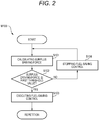
- a fuel-saving control method includes a basic fuel-saving control method M100 to be executed by the fuel-saving control device 100 after an ignition key is turned on.
- the basic fuel-saving control method M100 includes a surplus driving force calculation step S101, a surplus driving force determination step S102, a fuel-saving control execution step S103, and a fuel-saving control stop step S104.
- the surplus driving force calculation unit 101 calculates a surplus driving force.
- the fuel-saving control unit 102 determines whether the surplus driving force is equal to or greater than the first threshold value. When the surplus driving force is equal to or greater than the first threshold value, the method proceeds to the fuel-saving control execution step S103, whereas when the surplus driving force is smaller than the first threshold value, the method proceeds to the fuel-saving control stop step S104.
- the fuel-saving control execution step S103 the fuel-saving control unit 102 executes a fuel-saving control for lowering and correcting an instructed fuel injection amount depending on an accelerator position by using a lowering correction value depending on the surplus driving force.
- the fuel-saving control stop step S104 the fuel-saving control unit 102 stops the fuel-saving control.
- the fuel-saving control method includes an extended fuel-saving control method M200 to be executed by the fuel-saving control device 100 after the ignition key is turned on.
- the extended fuel-saving control method M200 includes a vehicle position detection step S201, a front curvature radius identification step S202, a front curvature radius determination step S203, and a change-in-lowering-correction-value limit step S204.
- the vehicle position detection unit 107 detects a vehicle position.
- the front curvature radius identification step S202 the front curvature radius identification unit 109 identifies a front curvature radius based on the vehicle position and the map information.
- the fuel-saving control unit 102 determines whether the front curvature radius is smaller than a second threshold value. When the front curvature radius is smaller than the second threshold value, the method proceeds to the change-in-lowering-correction-value limit step S204, whereas when the front curvature radius is not smaller than the second threshold value, the method returns to the vehicle position detection step S201.
- the fuel-saving control unit 102 changes the lowering correction value at a low change rate. Therefore, in the fuel-saving control execution step S103 described above, it is possible not to change the lowering correction value at a change rate that is equal to or greater than the predetermined change rate, when the front curvature radius is smaller than the second threshold value. Also, it is possible not to change the lowering correction value at the change rate that is equal to or greater than the predetermined change rate even if the surplus driving force crosses the first threshold value, when the front curvature radius is smaller than the second threshold value.
- a lowering correction value fixing step may be executed.
- the fuel-saving control unit 102 fixes the lowering correction value.
- the previous lowering correction value is used as a fixed value.
- numerical values is meaningless, in a situation where a state where the fuel-saving control is executed by using a lowering correction value of -10% is transited to a state where the fuel-saving control is stopped and the lowering correction value is 0%, the lowering correction value is not changed to 0%, but kept at -10%.
- the lowering correction value is not changed at a change rate that is equal to or greater than the predetermined change rate, or the lowering correction value not is changed entirely.
- the surplus driving force is frequently changed, it is possible to suppress the vehicle behavior from being frequently changed in accordance with execution of the fuel-saving control, thereby ensuring the convenience and safety of the driver.
- the present disclosure has effects that even in a situation where the surplus driving force is frequently changed, it is possible to suppress the vehicle behavior from being frequently changed in accordance with execution of the fuel-saving control, thereby ensuring the convenience and safety of the driver and is useful for a fuel-saving control device and a fuel-saving control method and the like.
Landscapes
- Engineering & Computer Science (AREA)
- Chemical & Material Sciences (AREA)
- Combustion & Propulsion (AREA)
- Mechanical Engineering (AREA)
- General Engineering & Computer Science (AREA)
- Control Of Vehicle Engines Or Engines For Specific Uses (AREA)
- Electrical Control Of Air Or Fuel Supplied To Internal-Combustion Engine (AREA)
- Combined Controls Of Internal Combustion Engines (AREA)
Abstract
Description
- The present disclosure relates to a fuel-saving control device and a fuel-saving control method.
- A fuel-saving control is widely known, in which, while a vehicle is traveling with an instructed fuel injection amount depending on an accelerator position, the instructed fuel injection amount is intentionally lowered and corrected by using a lowering correction value depending on a surplus driving force when a surplus driving force becomes equal to or greater than a threshold value, thereby reducing an actual fuel consumption of an engine (e.g., see PTL 1). By executing the fuel-saving control, an accelerating force of the vehicle is limited. However, when the surplus driving force becomes smaller than the threshold value or a kickdown operation is detected, the fuel-saving control is stopped. As a result, a driver is hardly influenced by the limited accelerating force of the vehicle, and convenience of the driver is prevented from being greatly impaired due to execution of the fuel-saving control.
- In addition to PTL 1, examples of the related art related to such a fuel-saving control device are also disclosed in PTL 2 and PTL 3.
-
- [PTL 1]
JP-A-2016-061177 - [PTL 2]
JP-A-2004-168154 - [PTL 3]
JP-A-2012-076700 - As described above, the fuel-saving performance of the vehicle is maximally enhanced by using the lowering correction value depending on the surplus driving force when the fuel-saving control is executed. Specifically, the actual fuel consumption is reduced as much as possible by increasing the lowering correction value as the surplus driving force increases. However, for example, when the vehicle is travelling on a mountain road (meandering road), in which a plurality of uphill road sections are connected to one another by a flat curve or a flat road section, the surplus driving force is frequently changed and thus the lowering correction value is also frequently changed. As a result, an accelerating force of the vehicle is frequently changed, thereby making a vehicle behavior unstable. Accordingly, the convenience and safety of the driver may be impaired.
- Accordingly, an object of the present disclosure is to provide a fuel-saving control device and a fuel-saving control method, in which even in a situation where a surplus driving force is frequently changed, it is possible to suppress a vehicle behavior from being frequently changed in accordance with execution of a fuel-saving control, thereby ensuring convenience and safety of a driver.
- In a first aspect of the present disclosure, there is provided a fuel-saving control device, including: a surplus driving force calculation unit for calculating a surplus driving force; a fuel-saving control unit configured to execute a fuel-saving control for lowering and correcting an instructed fuel injection amount depending on an accelerator position using a lowering correction value depending on the surplus driving force when the surplus driving force becomes equal to or greater than a first threshold value, and configured to stop the fuel-saving control when the surplus driving force becomes smaller than the first threshold value, a vehicle position detection unit for detecting a vehicle position; a map information storage unit for storing map information; and a front curvature radius identification unit for identifying a front curvature radius based on the vehicle position and the map information, and , when the front curvature radius is smaller than a second threshold value, the fuel-saving control unit is configured not to change the lowering correction value at a change rate that is equal to or greater than a predetermined change rate.
- When the front curvature radius is smaller than the second threshold value, the fuel-saving control unit may be further configured not to change the lowering correction value at the change rate that is equal to or greater than the predetermined change rate even if the surplus driving force crosses the first threshold value.
- In a second aspect of the present disclosure, there is provided a fuel-saving control device, including: a surplus driving force calculation unit for calculating a surplus driving force; a fuel-saving control unit configured to execute a fuel-saving control for lowering and correcting an instructed fuel injection amount depending on an accelerator position by using a lowering correction value depending on the surplus driving force when the surplus driving force becomes equal to or greater than a first threshold value, and configured to stop the fuel-saving control when the surplus driving force becomes smaller than the first threshold value, a vehicle position detection unit for detecting a vehicle position; a map information storage unit for storing map information; and a front curvature radius identification unit for identifying a front curvature radius based on the vehicle position and the map information, and , when the front curvature radius is smaller than a second threshold value, the fuel-saving control unit is configured not to change the lowering correction value entirely.
- When the front curvature radius is smaller than the second threshold value, the fuel-saving control unit may be further configured not to change the lowering correction value entirely even if the surplus driving force crosses the first threshold value.
- In a third aspect of the present disclosure, there is provided a fuel-saving control method, including: a surplus driving force calculation step for calculating a surplus driving force; a fuel-saving control execution step for executing a fuel-saving control for lowering and correcting an instructed fuel injection amount depending on an accelerator position by using a lowering correction value depending on the surplus driving force when the surplus driving force becomes equal to or greater than a first threshold value; a fuel-saving control stop step for stopping the fuel-saving control when the surplus driving force becomes smaller than the first threshold value; a vehicle position detection step for detecting a vehicle position; and a front curvature radius identification step for identifying a front curvature radius based on the vehicle position and map information, and the fuel-saving control execution step and the fuel-saving control stop, when the front curvature radius is smaller than a second threshold value, the lowering correction value is not changed at a change rate that is equal to or greater than a predetermined change rate.
- In the fuel-saving control execution step and the fuel-saving control stop step, when the front curvature radius is smaller than the second threshold value, the lowering correction value is not changed at the change rate that is equal to or greater than the predetermined change rate even if the surplus driving force crosses the first threshold value.
- In a fourth aspect of the present disclosure, there is provided a fuel-saving control method, including: a surplus driving force calculation step for calculating a surplus driving force; a fuel-saving control execution step for executing a fuel-saving control for lowering and correcting an instructed fuel injection amount depending on an accelerator position by using a lowering correction value depending on the surplus driving force when the surplus driving force becomes equal to or greater than a first threshold value; a fuel-saving control stop step for stopping the fuel-saving control when the surplus driving force becomes smaller than the first threshold value, a vehicle position detection step for detecting a vehicle position; and a front curvature radius identification step for identifying a front curvature radius based on the vehicle position and map information, and in the fuel-saving control execution step and the fuel-saving control stop step, when the front curvature radius is smaller than a second threshold value, the lowering correction value is not changed entirely.
- In the fuel-saving control execution step and the fuel-saving control stop step, when the front curvature radius is smaller than the second threshold value, the lowering correction value is not changed entirely even if the surplus driving force crosses the first threshold value.
- According to the present disclosure, the fuel-saving control device and the fuel-saving control method can be provided, in which even in a situation where a surplus driving force is frequently changed, it is possible to suppress a vehicle behavior from being frequently changed in accordance with execution of a fuel-saving control, thereby ensuring convenience and safety of a driver.
-
-
FIG. 1 is a configuration diagram of a fuel-saving control device according to an embodiment of the present disclosure. -
FIG. 2 is a flow chart of a basic fuel-saving control method of a fuel-saving control method according to an embodiment of the present disclosure. -
FIG. 3 is a flow chart of an extended fuel-saving control method of a fuel-saving control method according to an embodiment of the present disclosure. - Hereinafter, embodiments of the present disclosure will be described with reference to the accompanying drawings.
- First, a fuel-saving control device will be described.
- The fuel-saving control device is mounted on an automobile traveling by transferring a driving force of an engine to a driving wheel of the vehicle via a transmission (a manual transmission vehicle or an automatic transmission vehicle).
- As shown in
FIG. 1 , the fuel-savingcontrol device 100 according to an embodiment of the present disclosure includes a surplus drivingforce calculation unit 101 for calculating a surplus driving force, and a fuel-savingcontrol unit 102 for stopping a fuel-saving control when the surplus driving force becomes smaller than a first threshold value. - Typically, a vehicle travels with an instructed fuel injection amount depending on an accelerator position. However, when a surplus driving force becomes equal to or greater than a first threshold value, a fuel-saving control is executed for lowering and correcting the instructed fuel injection amount by using a lowering correction value depending on the surplus driving force.
- The surplus driving force is defined by a difference between a driving force of a driving wheel and a traveling resistance on the vehicle. Also, stopping the fuel-saving control means that, by setting the lowering correction value to zero regardless of the surplus driving force, lowering and correcting the instructed fuel injection amount depending on the accelerator position is stopped and thus the control returns to a normal control.
- The surplus driving
force calculation unit 101 is configured to calculate a surplus driving force by calculating a difference between the driving force of the driving wheel and a travelling resistance force on the vehicle. The fuel-savingcontrol unit 102 is configured to reduce an actual fuel consumption of the engine and thus to limit an accelerating force of the vehicle by intentionally lowering and correcting an instructed fuel injection amount, which originally depends on the accelerator position by a driver, by using the lowering correction value depending on the surplus driving force, when the surplus driving force becomes equal to or greater than the first threshold value. Herein, limiting the accelerating force of the vehicle (a force required for accelerating the vehicle) means limiting a torque of the engine, a power of the engine and/or an acceleration of the vehicle (a rate of change in speed thereof from before the vehicle is accelerated). Also, the fuel-savingcontrol unit 102 may be further configured to stop the fuel-saving control even if the surplus driving force does not become smaller than the first threshold value, when a kickdown operation of the driver is detected. The reason is that a fuel-saving performance of the vehicle needs not to be prioritized even when the driver desires to increase an accelerating force of the vehicle and thus pushes a kickdown switch or steps an accelerator pedal, but convenience and safety of the driver should be ensured. Acontroller 103 gets all variables for controlling the engine with various instruments. For example, thecontroller 103 gets an accelerator position with anaccelerator position sensor 104. Also, thecontroller 103 is equipped with an instructed fuel injectionamount calculation unit 105 for calculating an instructed fuel injection amount depending on the accelerator position, and is configured to control afuel injector 106 for injecting fuel into a cylinder of the engine. Thefuel injector 106 is configured to inject fuel into the cylinder of the engine in accordance with the instructed fuel injection amount depending on the accelerator position. - As described above, the fuel-saving performance of the vehicle is maximally enhanced by using the lowering correction value depending on the surplus driving force when the fuel-saving control is executed. Specifically, the actual fuel consumption is reduced as much as possible by increasing the lowering correction value as the surplus driving force increases. However, for example, when the vehicle is travelling on a mountain road (meandering road), in which a plurality of uphill road sections are connected to one another by a flat curves or a flat road section, the surplus driving force is frequently changed and thus the lowering correction value is also frequently changed. As a result, an accelerating force of the vehicle is frequently changed, thereby making a vehicle behavior unstable. Accordingly, the convenience and safety of the driver may be impaired.
- Therefore, the fuel-saving
control device 100 further includes a vehicleposition detection unit 107 for detecting a vehicle position, a mapinformation storage unit 108 for storing map information, and a front curvatureradius identification unit 109 for identifying a front curvature radius based on the vehicle position and the map information. Herein, the front curvature radius means a curvature radius between two points on a road on which the vehicle is expected to travel in the near future. The vehicleposition detection unit 107 is constituted, for example, by a global positioning system receiver. The mapinformation storage unit 108 is constituted, for example, by a storage medium separate from thecontroller 103. - In the fuel-saving
control device 100, the fuel-savingcontrol unit 102 is configured not to change the lowering correction value at a change rate that is equal to or greater than a predetermined change rate, namely, to limit the lowering correction value at a change rate that is smaller than the predetermined change rate, when the front curvature radius is smaller than a second threshold value. When the front curvature radius is smaller than the second threshold value, it is expected that the surplus driving force is frequently changed. Accordingly, by not changing the lowering correction value at the change rate that is equal to or greater than the predetermined change rate, it is possible to suppress the vehicle behavior from being frequently changed in accordance with execution of the fuel-saving control, thereby ensuring the convenience and safety of the driver. - Also, when the front curvature radius is smaller than the second threshold value, the fuel-saving
control unit 102 may be configured to change the lowering correction value at the change rate that is equal to or greater than the predetermined change rate even if the surplus driving force crosses the first threshold value,. Herein, the state where the surplus driving force crosses the first threshold value means that a state where the surplus driving force is greater than the first threshold value and a state where the surplus driving force is smaller than the first threshold value repeatedly occur within a predetermined period of time. When the surplus driving force becomes smaller than the first threshold value while the fuel-saving control is being executed, the fuel-saving control is stopped. However, by stopping the fuel-saving control, the lowering correction value has no value (e.g., the lowering correction value becomes 0 in a case where the lowering correction value is an addition value, and the lowering correction value becomes 1 in a case where the lowering correction value is a multiplication value). As a result, when the fuel-saving control is switched from execution to stop, there is a risk that the lowering correction value is largely changed. Also, when the surplus driving force becomes equal to or greater the first threshold value while the fuel-saving control is stopped, the fuel-saving control is executed. However, by executing the fuel-saving control, the lowering correction value has a certain value. As a result, when the fuel-saving control is switched from stop to execution, there is a risk that the lowering correction value is largely changed. When the lowering correction value is largely changed, an accelerating force of the vehicle is also largely changed, thereby making the vehicle behavior unstable. Meanwhile, the predetermined change rate may be a fixed value or a variable value. As a method for not changing the lowering correction value at the change rate that is equal to or greater than the predetermined change rate, for example, a method of limiting a change in the lowering correction value to a narrow range by using an averaging filter can be conceived. By properly adjusting a filter coefficient of the averaging filter, it is possible to minimize a change in the accelerating force of the vehicle. - Also, although the fuel-saving
control unit 102 is configured to change the lowering correction value at the change rate that is equal to or greater than the predetermined change rate when the front curvature radius is smaller than the second threshold value, the fuel-savingcontrol unit 102 may be configured not to change the lowering correction value entirely, namely, to fix the lowering correction value, when the front curvature radius is smaller than a second threshold value. In the case of not changing the lowering correction value entirely, the fuel-saving performance of the vehicle may be slightly decreased, as compared with the case of not changing the lowering correction value at the change rate that is equal to or greater than the predetermined change rate. However, when the front curvature radius is smaller than the second threshold value, the accelerating force of the vehicle is not changed at all. Therefore, in a situation where there is a risk of causing the driver to be in danger, the maximum safety can be provided to the driver. Thus, the control of not changing the lowering correction value at the change rate that is equal to or greater than the predetermined change rate and the control of not changing the lowering correction value entirely can be appropriately selected depending on situations, thereby ensuring the convenience and safety of the driver while enhancing the fuel-saving performance of the vehicle. - Next, a fuel-saving control method will be described.
- As shown in
FIG. 2 , a fuel-saving control method according to an embodiment of the present disclosure includes a basic fuel-saving control method M100 to be executed by the fuel-savingcontrol device 100 after an ignition key is turned on. The basic fuel-saving control method M100 includes a surplus driving force calculation step S101, a surplus driving force determination step S102, a fuel-saving control execution step S103, and a fuel-saving control stop step S104. - In the surplus driving force calculation step S101, the surplus driving
force calculation unit 101 calculates a surplus driving force. In the surplus driving force determination step S102, the fuel-savingcontrol unit 102 determines whether the surplus driving force is equal to or greater than the first threshold value. When the surplus driving force is equal to or greater than the first threshold value, the method proceeds to the fuel-saving control execution step S103, whereas when the surplus driving force is smaller than the first threshold value, the method proceeds to the fuel-saving control stop step S104. In the fuel-saving control execution step S103, the fuel-savingcontrol unit 102 executes a fuel-saving control for lowering and correcting an instructed fuel injection amount depending on an accelerator position by using a lowering correction value depending on the surplus driving force. In the fuel-saving control stop step S104, the fuel-savingcontrol unit 102 stops the fuel-saving control. - Further, as shown in
FIG. 3 , the fuel-saving control method according to the embodiment of the present disclosure includes an extended fuel-saving control method M200 to be executed by the fuel-savingcontrol device 100 after the ignition key is turned on. The extended fuel-saving control method M200 includes a vehicle position detection step S201, a front curvature radius identification step S202, a front curvature radius determination step S203, and a change-in-lowering-correction-value limit step S204. - In the vehicle position detection step S201, the vehicle
position detection unit 107 detects a vehicle position. In the front curvature radius identification step S202, the front curvatureradius identification unit 109 identifies a front curvature radius based on the vehicle position and the map information. In the front curvature radius determination step S203, the fuel-savingcontrol unit 102 determines whether the front curvature radius is smaller than a second threshold value. When the front curvature radius is smaller than the second threshold value, the method proceeds to the change-in-lowering-correction-value limit step S204, whereas when the front curvature radius is not smaller than the second threshold value, the method returns to the vehicle position detection step S201. In the change-in-lowering-correction-value limit step S204, the fuel-savingcontrol unit 102 changes the lowering correction value at a low change rate. Therefore, in the fuel-saving control execution step S103 described above, it is possible not to change the lowering correction value at a change rate that is equal to or greater than the predetermined change rate, when the front curvature radius is smaller than the second threshold value. Also, it is possible not to change the lowering correction value at the change rate that is equal to or greater than the predetermined change rate even if the surplus driving force crosses the first threshold value, when the front curvature radius is smaller than the second threshold value. For example, although numerical values is meaningless, in a situation where a state where the fuel-saving control is executed by using a lowering correction value of -10% is transited to a state where the fuel-saving control is stopped and thus the lowering correction value is 0%, the lowering correction value is not suddenly changed to 0%, but is changed to gradually approach 0%, such as -8%, -6%···. Also, on the contrary, in a situation where a state where the fuel-saving control is stopped and thus the lowering correction value is 0% is transited to a state where the fuel-saving control is executed by using a lowering correction value of -10%, the lowering correction value is not suddenly changed to -10%, but is changed to gradually approach -10%, such as -2%, -4%···. On the other hand, in a case where changing the lowering correction value at the low change rate is being executed via the previous control loop, as a case where the method returns to the vehicle position detection step S201 via the front curvature radius determination step S203, changing the lowering correction value at the low change late is canceled. - Further, instead of the change-in-lowering-correction-value limit step S204, a lowering correction value fixing step may be executed. In the lowering correction value fixing step, the fuel-saving
control unit 102 fixes the lowering correction value. For example, in order to execute the lowering correction value fixing step, the previous lowering correction value is used as a fixed value. For example, although numerical values is meaningless, in a situation where a state where the fuel-saving control is executed by using a lowering correction value of -10% is transited to a state where the fuel-saving control is stopped and the lowering correction value is 0%, the lowering correction value is not changed to 0%, but kept at -10%. Therefore, in the fuel-saving control execution step S103 and the fuel-saving control execution step S104 described above, it is possible not to change the lowering correction value entirely, when the front curvature radius is smaller than the second threshold value. Also, it is possible not to change the lowering correction value entirely even if the surplus driving force crosses the first threshold value, when the front curvature radius is smaller than the second threshold value. - As described above, according to the present disclosure, in a case where the front curvature radius is smaller than the second threshold value and therefore the surplus driving force may be frequently changed, the lowering correction value is not changed at a change rate that is equal to or greater than the predetermined change rate, or the lowering correction value not is changed entirely. As a result, even in a situation where the surplus driving force is frequently changed, it is possible to suppress the vehicle behavior from being frequently changed in accordance with execution of the fuel-saving control, thereby ensuring the convenience and safety of the driver. In particular, in the case of the manual transmission vehicles, it is possible to push the driver to perform upshifting in advance by limiting an accelerating force of the vehicles. As a result, it is possible to greatly enhance the fuel-saving performance of the vehicle by executing the fuel-saving control.
- This application is based on Japanese Patent Application No.
2016-200899 filed on October 12, 2016 - The present disclosure has effects that even in a situation where the surplus driving force is frequently changed, it is possible to suppress the vehicle behavior from being frequently changed in accordance with execution of the fuel-saving control, thereby ensuring the convenience and safety of the driver and is useful for a fuel-saving control device and a fuel-saving control method and the like.
-
- 100:
- Fuel-saving control device
- 101:
- Surplus driving force calculation unit
- 102:
- Fuel-saving control unit
- 103:
- Controller
- 104:
- Accelerator position sensor
- 105:
- Instructed fuel injection amount calculation unit
- 106:
- Fuel injector
- 107:
- Vehicle position detection unit
- 108:
- Map information storage unit
- 109:
- Front curvature radius identification unit
- M100:
- Basic fuel-saving control method
- S101:
- Surplus driving force calculation step
- S102:
- Surplus driving force determination step
- S103:
- Fuel-saving control execution step
- S104:
- Fuel-saving control stop step
- M200:
- Extended fuel-saving control method
- S201:
- Vehicle position detection step
- S202:
- Front curvature radius identification step
- S203:
- Front curvature radius determination step
- S204:
- Change-in-lowering-correction-value limit step
Claims (8)
- A fuel-saving control device, comprising:a surplus driving force calculation unit for calculating a surplus driving force; anda fuel-saving control unit configured to execute a fuel-saving control for lowering and correcting an instructed fuel injection amount depending on an accelerator position by using a lowering correction value depending on the surplus driving force when the surplus driving force becomes equal to or greater than a first threshold value, and configured to stop the fuel-saving control when the surplus driving force becomes smaller than the first threshold value,characterized by further comprising:a vehicle position detection unit for detecting a vehicle position;a map information storage unit for storing map information; anda front curvature radius identification unit for identifying a front curvature radius based on the vehicle position and the map information,wherein, when the front curvature radius is smaller than a second threshold value, the fuel-saving control unit is configured not to change the lowering correction value at a change rate that is equal to or greater than a predetermined change rate.
- The fuel-saving control device according to claim 1,
wherein, when the front curvature radius is smaller than the second threshold value, the fuel-saving control unit is configured not to change the lowering correction value at the change rate that is equal to or greater than the predetermined change rate even if the surplus driving force crosses the first threshold value. - A fuel-saving control device, comprising:a surplus driving force calculation unit for calculating a surplus driving force; anda fuel-saving control unit configured to execute a fuel-saving control for lowering and correcting an instructed fuel injection amount depending on an accelerator position by using a lowering correction value depending on the surplus driving force when the surplus driving force becomes equal to or greater than a first threshold value, and configured to stop the fuel-saving control when the surplus driving force becomes smaller than the first threshold value,characterized by further comprising:a vehicle position detection unit for detecting a vehicle position;a map information storage unit for storing map information; anda front curvature radius identification unit for identifying a front curvature radius based on the vehicle position and the map information,wherein, when the front curvature radius is smaller than a second threshold value, the fuel-saving control unit is configured not to change the lowering correction value entirely.
- The fuel-saving control device according to claim 3,
wherein, when the front curvature radius is smaller than the second threshold value, the fuel-saving control unit is configured not to change the lowering correction value entirely even if the surplus driving force crosses the first threshold value. - A fuel-saving control method, comprising:a surplus driving force calculation step for calculating a surplus driving force;a fuel-saving control execution step for executing a fuel-saving control for lowering and correcting an instructed fuel injection amount depending on an accelerator position by using a lowering correction value depending on the surplus driving force when the surplus driving force becomes equal to or greater than a first threshold value; anda fuel-saving control stop step for stopping the fuel-saving control when the surplus driving force becomes smaller than the first threshold value,characterized by further comprising:a vehicle position detection step for detecting a vehicle position; anda front curvature radius identification step for identifying a front curvature radius based on the vehicle position and map information,wherein in the fuel-saving control execution step and the fuel-saving control stop step, when the front curvature radius is smaller than a second threshold value, the lowering correction value is not changed at a change rate that is equal to or greater than a predetermined change rate.
- The fuel-saving control method according to claim 5,
wherein in the fuel-saving control execution step and the fuel-saving control stop step, when the front curvature radius is smaller than the second threshold value, the lowering correction value is not changed at the change rate that is equal to or greater than the predetermined change rate even if the surplus driving force crosses the first threshold value. - A fuel-saving control method, comprising:a surplus driving force calculation step for calculating a surplus driving force;a fuel-saving control execution step for executing a fuel-saving control for lowering and correcting an instructed fuel injection amount depending on an accelerator position by using a lowering correction value depending on the surplus driving force when the surplus driving force becomes equal to or greater than a first threshold value; anda fuel-saving control stop step for stopping the fuel-saving control when the surplus driving force becomes smaller than the first threshold value,characterized by further comprising:a vehicle position detection step for detecting a vehicle position; anda front curvature radius identification step for identifying a front curvature radius based on the vehicle position and map information,wherein in the fuel-saving control execution step and the fuel-saving control stop step, when the front curvature radius is smaller than a second threshold value, the lowering correction value is not changed entirely.
- The fuel-saving control method according to claim 7,
wherein in the fuel-saving control execution step and the fuel-saving control stop step, when the front curvature radius is smaller than the second threshold value, the lowering correction value is not changed entirely even if the surplus driving force crosses the first threshold value.
Applications Claiming Priority (2)
| Application Number | Priority Date | Filing Date | Title |
|---|---|---|---|
| JP2016200899A JP2018062886A (en) | 2016-10-12 | 2016-10-12 | Fuel-saving control device and fuel-saving control method |
| PCT/JP2017/036783 WO2018070407A1 (en) | 2016-10-12 | 2017-10-11 | Fuel-saving control device and fuel-saving control method |
Publications (3)
| Publication Number | Publication Date |
|---|---|
| EP3527807A1 true EP3527807A1 (en) | 2019-08-21 |
| EP3527807A4 EP3527807A4 (en) | 2019-10-09 |
| EP3527807B1 EP3527807B1 (en) | 2023-07-26 |
Family
ID=61906364
Family Applications (1)
| Application Number | Title | Priority Date | Filing Date |
|---|---|---|---|
| EP17860931.9A Active EP3527807B1 (en) | 2016-10-12 | 2017-10-11 | Fuel-saving control device and fuel-saving control method |
Country Status (5)
| Country | Link |
|---|---|
| US (1) | US10920697B2 (en) |
| EP (1) | EP3527807B1 (en) |
| JP (1) | JP2018062886A (en) |
| CN (1) | CN109844285B (en) |
| WO (1) | WO2018070407A1 (en) |
Family Cites Families (19)
| Publication number | Priority date | Publication date | Assignee | Title |
|---|---|---|---|---|
| CH696297A5 (en) * | 2002-01-04 | 2007-03-30 | Dauber Holdings Inc | of cold flame propulsion system. |
| JP3547732B2 (en) * | 2002-03-15 | 2004-07-28 | 本田技研工業株式会社 | Driving force control device for hybrid vehicle |
| JP3990623B2 (en) | 2002-11-19 | 2007-10-17 | 富士重工業株式会社 | Vehicle behavior control device |
| JP4175120B2 (en) * | 2003-01-21 | 2008-11-05 | マツダ株式会社 | Vehicle engine control device |
| JP2008115814A (en) * | 2006-11-07 | 2008-05-22 | Toyota Motor Corp | Vehicle control device and vehicle with continuously variable transmission |
| JP2009265806A (en) * | 2008-04-23 | 2009-11-12 | Denso Corp | Vehicular fuel-saving driving support device |
| JP4751455B2 (en) * | 2009-01-27 | 2011-08-17 | 本田技研工業株式会社 | Vehicle driving force control device |
| JP5601894B2 (en) | 2010-06-21 | 2014-10-08 | 日野自動車株式会社 | Vehicle control device |
| JP5614216B2 (en) | 2010-10-05 | 2014-10-29 | トヨタ自動車株式会社 | Vehicle control system |
| US8813884B2 (en) * | 2011-02-15 | 2014-08-26 | GM Global Technology Operations LLC | Optimization to reduce fuel consumption in charge depleting mode |
| US8781713B2 (en) * | 2011-09-23 | 2014-07-15 | GM Global Technology Operations LLC | System and method for controlling a valve of a cylinder in an engine based on fuel delivery to the cylinder |
| WO2013059682A1 (en) * | 2011-10-19 | 2013-04-25 | Fuel Saving Technologies, Llc | Energy conservation systems and methods |
| JP6065401B2 (en) * | 2012-04-12 | 2017-01-25 | 三菱自動車工業株式会社 | Eco-mode control device |
| JP5943089B2 (en) * | 2012-10-31 | 2016-06-29 | トヨタ自動車株式会社 | Vehicle travel control device |
| DE112012007222B4 (en) * | 2012-12-13 | 2018-08-16 | Toyota Jidosha Kabushiki Kaisha | Vehicle control system |
| JP6442946B2 (en) * | 2014-09-16 | 2018-12-26 | いすゞ自動車株式会社 | Fuel saving control device |
| JP6308167B2 (en) * | 2015-04-30 | 2018-04-11 | トヨタ自動車株式会社 | Vehicle control device |
| US20170298849A1 (en) * | 2016-04-15 | 2017-10-19 | Ford Global Technologies, Llc | System and method for enhanced operator control of fuel saving modes |
| KR102444667B1 (en) * | 2017-12-28 | 2022-09-19 | 현대자동차주식회사 | Hybrid vehicle and driving mode control method therefor |
-
2016
- 2016-10-12 JP JP2016200899A patent/JP2018062886A/en active Pending
-
2017
- 2017-10-11 US US16/341,379 patent/US10920697B2/en active Active
- 2017-10-11 CN CN201780062942.4A patent/CN109844285B/en active Active
- 2017-10-11 EP EP17860931.9A patent/EP3527807B1/en active Active
- 2017-10-11 WO PCT/JP2017/036783 patent/WO2018070407A1/en not_active Ceased
Also Published As
| Publication number | Publication date |
|---|---|
| EP3527807B1 (en) | 2023-07-26 |
| US20200056560A1 (en) | 2020-02-20 |
| CN109844285A (en) | 2019-06-04 |
| JP2018062886A (en) | 2018-04-19 |
| WO2018070407A1 (en) | 2018-04-19 |
| CN109844285B (en) | 2025-12-12 |
| EP3527807A4 (en) | 2019-10-09 |
| US10920697B2 (en) | 2021-02-16 |
Similar Documents
| Publication | Publication Date | Title |
|---|---|---|
| CN109606130B (en) | Creep control method and system for electric automobile | |
| US10030597B2 (en) | Vehicle speed limit apparatus | |
| US9714622B2 (en) | Vehicle speed limit apparatus | |
| US9290175B2 (en) | Vehicle control system | |
| GB2471997A (en) | Automatic transmission control | |
| EP3527451B1 (en) | Fuel-saving control device and fuel-saving control method | |
| CN112441004B (en) | Longitudinal planning method, system, vehicle and storage medium for automatic driving lane change | |
| WO2010064645A1 (en) | Fuel-efficient driving system | |
| US10920697B2 (en) | Fuel-saving control device and fuel-saving control method | |
| JP6121179B2 (en) | Reaction force control device | |
| EP3527452B1 (en) | Fuel-saving control device and fuel-saving control method | |
| US10920698B2 (en) | Fuel-saving control device and fuel-saving control method | |
| US9739369B2 (en) | Method and apparatus for selecting gear when SSC is released | |
| KR101481365B1 (en) | Method and system for auto driving improve fuel economy of vehicle | |
| EP2715083B1 (en) | Method for optimised launch of a vehicle | |
| JP7079071B2 (en) | Congestion suppression driving control method and vehicle driving control device | |
| JP2007132229A (en) | In-vehicle engine control system | |
| KR20180009541A (en) | Control method for maneuvering mode driving of vehicles |
Legal Events
| Date | Code | Title | Description |
|---|---|---|---|
| STAA | Information on the status of an ep patent application or granted ep patent |
Free format text: STATUS: THE INTERNATIONAL PUBLICATION HAS BEEN MADE |
|
| PUAI | Public reference made under article 153(3) epc to a published international application that has entered the european phase |
Free format text: ORIGINAL CODE: 0009012 |
|
| STAA | Information on the status of an ep patent application or granted ep patent |
Free format text: STATUS: REQUEST FOR EXAMINATION WAS MADE |
|
| 17P | Request for examination filed |
Effective date: 20190513 |
|
| AK | Designated contracting states |
Kind code of ref document: A1 Designated state(s): AL AT BE BG CH CY CZ DE DK EE ES FI FR GB GR HR HU IE IS IT LI LT LU LV MC MK MT NL NO PL PT RO RS SE SI SK SM TR |
|
| AX | Request for extension of the european patent |
Extension state: BA ME |
|
| A4 | Supplementary search report drawn up and despatched |
Effective date: 20190911 |
|
| RIC1 | Information provided on ipc code assigned before grant |
Ipc: F02D 11/10 20060101ALI20190905BHEP Ipc: F02D 41/10 20060101ALI20190905BHEP Ipc: F02D 41/04 20060101ALI20190905BHEP Ipc: F02D 29/02 20060101AFI20190905BHEP Ipc: F02D 41/14 20060101ALI20190905BHEP |
|
| DAV | Request for validation of the european patent (deleted) | ||
| DAX | Request for extension of the european patent (deleted) | ||
| STAA | Information on the status of an ep patent application or granted ep patent |
Free format text: STATUS: EXAMINATION IS IN PROGRESS |
|
| 17Q | First examination report despatched |
Effective date: 20201201 |
|
| GRAP | Despatch of communication of intention to grant a patent |
Free format text: ORIGINAL CODE: EPIDOSNIGR1 |
|
| STAA | Information on the status of an ep patent application or granted ep patent |
Free format text: STATUS: GRANT OF PATENT IS INTENDED |
|
| INTG | Intention to grant announced |
Effective date: 20230223 |
|
| GRAS | Grant fee paid |
Free format text: ORIGINAL CODE: EPIDOSNIGR3 |
|
| GRAA | (expected) grant |
Free format text: ORIGINAL CODE: 0009210 |
|
| STAA | Information on the status of an ep patent application or granted ep patent |
Free format text: STATUS: THE PATENT HAS BEEN GRANTED |
|
| AK | Designated contracting states |
Kind code of ref document: B1 Designated state(s): AL AT BE BG CH CY CZ DE DK EE ES FI FR GB GR HR HU IE IS IT LI LT LU LV MC MK MT NL NO PL PT RO RS SE SI SK SM TR |
|
| REG | Reference to a national code |
Ref country code: CH Ref legal event code: EP |
|
| REG | Reference to a national code |
Ref country code: IE Ref legal event code: FG4D |
|
| REG | Reference to a national code |
Ref country code: DE Ref legal event code: R096 Ref document number: 602017071924 Country of ref document: DE |
|
| REG | Reference to a national code |
Ref country code: LT Ref legal event code: MG9D |
|
| REG | Reference to a national code |
Ref country code: NL Ref legal event code: MP Effective date: 20230726 |
|
| PGFP | Annual fee paid to national office [announced via postgrant information from national office to epo] |
Ref country code: FR Payment date: 20230830 Year of fee payment: 7 |
|
| REG | Reference to a national code |
Ref country code: AT Ref legal event code: MK05 Ref document number: 1592169 Country of ref document: AT Kind code of ref document: T Effective date: 20230726 |
|
| PG25 | Lapsed in a contracting state [announced via postgrant information from national office to epo] |
Ref country code: NL Free format text: LAPSE BECAUSE OF FAILURE TO SUBMIT A TRANSLATION OF THE DESCRIPTION OR TO PAY THE FEE WITHIN THE PRESCRIBED TIME-LIMIT Effective date: 20230726 |
|
| PG25 | Lapsed in a contracting state [announced via postgrant information from national office to epo] |
Ref country code: GR Free format text: LAPSE BECAUSE OF FAILURE TO SUBMIT A TRANSLATION OF THE DESCRIPTION OR TO PAY THE FEE WITHIN THE PRESCRIBED TIME-LIMIT Effective date: 20231027 |
|
| PGFP | Annual fee paid to national office [announced via postgrant information from national office to epo] |
Ref country code: GB Payment date: 20231009 Year of fee payment: 7 |
|
| PG25 | Lapsed in a contracting state [announced via postgrant information from national office to epo] |
Ref country code: IS Free format text: LAPSE BECAUSE OF FAILURE TO SUBMIT A TRANSLATION OF THE DESCRIPTION OR TO PAY THE FEE WITHIN THE PRESCRIBED TIME-LIMIT Effective date: 20231126 |
|
| PG25 | Lapsed in a contracting state [announced via postgrant information from national office to epo] |
Ref country code: SE Free format text: LAPSE BECAUSE OF FAILURE TO SUBMIT A TRANSLATION OF THE DESCRIPTION OR TO PAY THE FEE WITHIN THE PRESCRIBED TIME-LIMIT Effective date: 20230726 Ref country code: RS Free format text: LAPSE BECAUSE OF FAILURE TO SUBMIT A TRANSLATION OF THE DESCRIPTION OR TO PAY THE FEE WITHIN THE PRESCRIBED TIME-LIMIT Effective date: 20230726 Ref country code: PT Free format text: LAPSE BECAUSE OF FAILURE TO SUBMIT A TRANSLATION OF THE DESCRIPTION OR TO PAY THE FEE WITHIN THE PRESCRIBED TIME-LIMIT Effective date: 20231127 Ref country code: NO Free format text: LAPSE BECAUSE OF FAILURE TO SUBMIT A TRANSLATION OF THE DESCRIPTION OR TO PAY THE FEE WITHIN THE PRESCRIBED TIME-LIMIT Effective date: 20231026 Ref country code: LV Free format text: LAPSE BECAUSE OF FAILURE TO SUBMIT A TRANSLATION OF THE DESCRIPTION OR TO PAY THE FEE WITHIN THE PRESCRIBED TIME-LIMIT Effective date: 20230726 Ref country code: LT Free format text: LAPSE BECAUSE OF FAILURE TO SUBMIT A TRANSLATION OF THE DESCRIPTION OR TO PAY THE FEE WITHIN THE PRESCRIBED TIME-LIMIT Effective date: 20230726 Ref country code: IS Free format text: LAPSE BECAUSE OF FAILURE TO SUBMIT A TRANSLATION OF THE DESCRIPTION OR TO PAY THE FEE WITHIN THE PRESCRIBED TIME-LIMIT Effective date: 20231126 Ref country code: HR Free format text: LAPSE BECAUSE OF FAILURE TO SUBMIT A TRANSLATION OF THE DESCRIPTION OR TO PAY THE FEE WITHIN THE PRESCRIBED TIME-LIMIT Effective date: 20230726 Ref country code: GR Free format text: LAPSE BECAUSE OF FAILURE TO SUBMIT A TRANSLATION OF THE DESCRIPTION OR TO PAY THE FEE WITHIN THE PRESCRIBED TIME-LIMIT Effective date: 20231027 Ref country code: FI Free format text: LAPSE BECAUSE OF FAILURE TO SUBMIT A TRANSLATION OF THE DESCRIPTION OR TO PAY THE FEE WITHIN THE PRESCRIBED TIME-LIMIT Effective date: 20230726 Ref country code: AT Free format text: LAPSE BECAUSE OF FAILURE TO SUBMIT A TRANSLATION OF THE DESCRIPTION OR TO PAY THE FEE WITHIN THE PRESCRIBED TIME-LIMIT Effective date: 20230726 |
|
| PG25 | Lapsed in a contracting state [announced via postgrant information from national office to epo] |
Ref country code: PL Free format text: LAPSE BECAUSE OF FAILURE TO SUBMIT A TRANSLATION OF THE DESCRIPTION OR TO PAY THE FEE WITHIN THE PRESCRIBED TIME-LIMIT Effective date: 20230726 |
|
| PG25 | Lapsed in a contracting state [announced via postgrant information from national office to epo] |
Ref country code: ES Free format text: LAPSE BECAUSE OF FAILURE TO SUBMIT A TRANSLATION OF THE DESCRIPTION OR TO PAY THE FEE WITHIN THE PRESCRIBED TIME-LIMIT Effective date: 20230726 |
|
| REG | Reference to a national code |
Ref country code: DE Ref legal event code: R097 Ref document number: 602017071924 Country of ref document: DE |
|
| PG25 | Lapsed in a contracting state [announced via postgrant information from national office to epo] |
Ref country code: SM Free format text: LAPSE BECAUSE OF FAILURE TO SUBMIT A TRANSLATION OF THE DESCRIPTION OR TO PAY THE FEE WITHIN THE PRESCRIBED TIME-LIMIT Effective date: 20230726 Ref country code: RO Free format text: LAPSE BECAUSE OF FAILURE TO SUBMIT A TRANSLATION OF THE DESCRIPTION OR TO PAY THE FEE WITHIN THE PRESCRIBED TIME-LIMIT Effective date: 20230726 Ref country code: ES Free format text: LAPSE BECAUSE OF FAILURE TO SUBMIT A TRANSLATION OF THE DESCRIPTION OR TO PAY THE FEE WITHIN THE PRESCRIBED TIME-LIMIT Effective date: 20230726 Ref country code: EE Free format text: LAPSE BECAUSE OF FAILURE TO SUBMIT A TRANSLATION OF THE DESCRIPTION OR TO PAY THE FEE WITHIN THE PRESCRIBED TIME-LIMIT Effective date: 20230726 Ref country code: DK Free format text: LAPSE BECAUSE OF FAILURE TO SUBMIT A TRANSLATION OF THE DESCRIPTION OR TO PAY THE FEE WITHIN THE PRESCRIBED TIME-LIMIT Effective date: 20230726 Ref country code: CZ Free format text: LAPSE BECAUSE OF FAILURE TO SUBMIT A TRANSLATION OF THE DESCRIPTION OR TO PAY THE FEE WITHIN THE PRESCRIBED TIME-LIMIT Effective date: 20230726 Ref country code: SK Free format text: LAPSE BECAUSE OF FAILURE TO SUBMIT A TRANSLATION OF THE DESCRIPTION OR TO PAY THE FEE WITHIN THE PRESCRIBED TIME-LIMIT Effective date: 20230726 |
|
| REG | Reference to a national code |
Ref country code: DE Ref legal event code: R082 Ref document number: 602017071924 Country of ref document: DE Representative=s name: MEISSNER BOLTE PATENTANWAELTE RECHTSANWAELTE P, DE |
|
| PG25 | Lapsed in a contracting state [announced via postgrant information from national office to epo] |
Ref country code: IT Free format text: LAPSE BECAUSE OF FAILURE TO SUBMIT A TRANSLATION OF THE DESCRIPTION OR TO PAY THE FEE WITHIN THE PRESCRIBED TIME-LIMIT Effective date: 20230726 Ref country code: MC Free format text: LAPSE BECAUSE OF FAILURE TO SUBMIT A TRANSLATION OF THE DESCRIPTION OR TO PAY THE FEE WITHIN THE PRESCRIBED TIME-LIMIT Effective date: 20230726 |
|
| PLBE | No opposition filed within time limit |
Free format text: ORIGINAL CODE: 0009261 |
|
| REG | Reference to a national code |
Ref country code: CH Ref legal event code: PL |
|
| STAA | Information on the status of an ep patent application or granted ep patent |
Free format text: STATUS: NO OPPOSITION FILED WITHIN TIME LIMIT |
|
| REG | Reference to a national code |
Ref country code: BE Ref legal event code: MM Effective date: 20231031 |
|
| PG25 | Lapsed in a contracting state [announced via postgrant information from national office to epo] |
Ref country code: LU Free format text: LAPSE BECAUSE OF NON-PAYMENT OF DUE FEES Effective date: 20231011 |
|
| PG25 | Lapsed in a contracting state [announced via postgrant information from national office to epo] |
Ref country code: LU Free format text: LAPSE BECAUSE OF NON-PAYMENT OF DUE FEES Effective date: 20231011 |
|
| 26N | No opposition filed |
Effective date: 20240429 |
|
| PG25 | Lapsed in a contracting state [announced via postgrant information from national office to epo] |
Ref country code: CH Free format text: LAPSE BECAUSE OF NON-PAYMENT OF DUE FEES Effective date: 20231031 |
|
| PG25 | Lapsed in a contracting state [announced via postgrant information from national office to epo] |
Ref country code: CH Free format text: LAPSE BECAUSE OF NON-PAYMENT OF DUE FEES Effective date: 20231031 Ref country code: SI Free format text: LAPSE BECAUSE OF FAILURE TO SUBMIT A TRANSLATION OF THE DESCRIPTION OR TO PAY THE FEE WITHIN THE PRESCRIBED TIME-LIMIT Effective date: 20230726 |
|
| PG25 | Lapsed in a contracting state [announced via postgrant information from national office to epo] |
Ref country code: BE Free format text: LAPSE BECAUSE OF NON-PAYMENT OF DUE FEES Effective date: 20231031 |
|
| PG25 | Lapsed in a contracting state [announced via postgrant information from national office to epo] |
Ref country code: IE Free format text: LAPSE BECAUSE OF NON-PAYMENT OF DUE FEES Effective date: 20231011 |
|
| PG25 | Lapsed in a contracting state [announced via postgrant information from national office to epo] |
Ref country code: IE Free format text: LAPSE BECAUSE OF NON-PAYMENT OF DUE FEES Effective date: 20231011 |
|
| PG25 | Lapsed in a contracting state [announced via postgrant information from national office to epo] |
Ref country code: BG Free format text: LAPSE BECAUSE OF FAILURE TO SUBMIT A TRANSLATION OF THE DESCRIPTION OR TO PAY THE FEE WITHIN THE PRESCRIBED TIME-LIMIT Effective date: 20230726 |
|
| PG25 | Lapsed in a contracting state [announced via postgrant information from national office to epo] |
Ref country code: BG Free format text: LAPSE BECAUSE OF FAILURE TO SUBMIT A TRANSLATION OF THE DESCRIPTION OR TO PAY THE FEE WITHIN THE PRESCRIBED TIME-LIMIT Effective date: 20230726 |
|
| GBPC | Gb: european patent ceased through non-payment of renewal fee |
Effective date: 20241011 |
|
| PG25 | Lapsed in a contracting state [announced via postgrant information from national office to epo] |
Ref country code: GB Free format text: LAPSE BECAUSE OF NON-PAYMENT OF DUE FEES Effective date: 20241011 |
|
| PG25 | Lapsed in a contracting state [announced via postgrant information from national office to epo] |
Ref country code: FR Free format text: LAPSE BECAUSE OF NON-PAYMENT OF DUE FEES Effective date: 20241031 |
|
| PG25 | Lapsed in a contracting state [announced via postgrant information from national office to epo] |
Ref country code: CY Free format text: LAPSE BECAUSE OF FAILURE TO SUBMIT A TRANSLATION OF THE DESCRIPTION OR TO PAY THE FEE WITHIN THE PRESCRIBED TIME-LIMIT; INVALID AB INITIO Effective date: 20171011 |
|
| PG25 | Lapsed in a contracting state [announced via postgrant information from national office to epo] |
Ref country code: HU Free format text: LAPSE BECAUSE OF FAILURE TO SUBMIT A TRANSLATION OF THE DESCRIPTION OR TO PAY THE FEE WITHIN THE PRESCRIBED TIME-LIMIT; INVALID AB INITIO Effective date: 20171011 |
|
| PG25 | Lapsed in a contracting state [announced via postgrant information from national office to epo] |
Ref country code: TR Free format text: LAPSE BECAUSE OF FAILURE TO SUBMIT A TRANSLATION OF THE DESCRIPTION OR TO PAY THE FEE WITHIN THE PRESCRIBED TIME-LIMIT Effective date: 20230726 |
|
| PGFP | Annual fee paid to national office [announced via postgrant information from national office to epo] |
Ref country code: DE Payment date: 20250923 Year of fee payment: 9 |