EP3527601B1 - Aerosoldosenanordnung - Google Patents
Aerosoldosenanordnung Download PDFInfo
- Publication number
- EP3527601B1 EP3527601B1 EP19000046.3A EP19000046A EP3527601B1 EP 3527601 B1 EP3527601 B1 EP 3527601B1 EP 19000046 A EP19000046 A EP 19000046A EP 3527601 B1 EP3527601 B1 EP 3527601B1
- Authority
- EP
- European Patent Office
- Prior art keywords
- aerosol
- configuration
- inner container
- foam
- contained
- Prior art date
- Legal status (The legal status is an assumption and is not a legal conclusion. Google has not performed a legal analysis and makes no representation as to the accuracy of the status listed.)
- Active
Links
Images
Classifications
-
- B—PERFORMING OPERATIONS; TRANSPORTING
- B65—CONVEYING; PACKING; STORING; HANDLING THIN OR FILAMENTARY MATERIAL
- B65D—CONTAINERS FOR STORAGE OR TRANSPORT OF ARTICLES OR MATERIALS, e.g. BAGS, BARRELS, BOTTLES, BOXES, CANS, CARTONS, CRATES, DRUMS, JARS, TANKS, HOPPERS, FORWARDING CONTAINERS; ACCESSORIES, CLOSURES, OR FITTINGS THEREFOR; PACKAGING ELEMENTS; PACKAGES
- B65D83/00—Containers or packages with special means for dispensing contents
- B65D83/14—Containers for dispensing liquid or semi-liquid contents by internal gaseous pressure, i.e. aerosol containers comprising propellant
- B65D83/68—Dispensing two or more contents
-
- B—PERFORMING OPERATIONS; TRANSPORTING
- B29—WORKING OF PLASTICS; WORKING OF SUBSTANCES IN A PLASTIC STATE IN GENERAL
- B29B—PREPARATION OR PRETREATMENT OF THE MATERIAL TO BE SHAPED; MAKING GRANULES OR PREFORMS; RECOVERY OF PLASTICS OR OTHER CONSTITUENTS OF WASTE MATERIAL CONTAINING PLASTICS
- B29B7/00—Mixing; Kneading
- B29B7/74—Mixing; Kneading using other mixers or combinations of mixers, e.g. of dissimilar mixers ; Plant
-
- B—PERFORMING OPERATIONS; TRANSPORTING
- B29—WORKING OF PLASTICS; WORKING OF SUBSTANCES IN A PLASTIC STATE IN GENERAL
- B29B—PREPARATION OR PRETREATMENT OF THE MATERIAL TO BE SHAPED; MAKING GRANULES OR PREFORMS; RECOVERY OF PLASTICS OR OTHER CONSTITUENTS OF WASTE MATERIAL CONTAINING PLASTICS
- B29B7/00—Mixing; Kneading
- B29B7/74—Mixing; Kneading using other mixers or combinations of mixers, e.g. of dissimilar mixers ; Plant
- B29B7/7404—Mixing devices specially adapted for foamable substances
-
- B—PERFORMING OPERATIONS; TRANSPORTING
- B29—WORKING OF PLASTICS; WORKING OF SUBSTANCES IN A PLASTIC STATE IN GENERAL
- B29B—PREPARATION OR PRETREATMENT OF THE MATERIAL TO BE SHAPED; MAKING GRANULES OR PREFORMS; RECOVERY OF PLASTICS OR OTHER CONSTITUENTS OF WASTE MATERIAL CONTAINING PLASTICS
- B29B7/00—Mixing; Kneading
- B29B7/74—Mixing; Kneading using other mixers or combinations of mixers, e.g. of dissimilar mixers ; Plant
- B29B7/7404—Mixing devices specially adapted for foamable substances
- B29B7/7409—Mixing devices specially adapted for foamable substances with supply of gas
- B29B7/7428—Methodical aspects
-
- B—PERFORMING OPERATIONS; TRANSPORTING
- B65—CONVEYING; PACKING; STORING; HANDLING THIN OR FILAMENTARY MATERIAL
- B65D—CONTAINERS FOR STORAGE OR TRANSPORT OF ARTICLES OR MATERIALS, e.g. BAGS, BARRELS, BOTTLES, BOXES, CANS, CARTONS, CRATES, DRUMS, JARS, TANKS, HOPPERS, FORWARDING CONTAINERS; ACCESSORIES, CLOSURES, OR FITTINGS THEREFOR; PACKAGING ELEMENTS; PACKAGES
- B65D83/00—Containers or packages with special means for dispensing contents
- B65D83/14—Containers for dispensing liquid or semi-liquid contents by internal gaseous pressure, i.e. aerosol containers comprising propellant
- B65D83/28—Nozzles, nozzle fittings or accessories specially adapted therefor
-
- B—PERFORMING OPERATIONS; TRANSPORTING
- B65—CONVEYING; PACKING; STORING; HANDLING THIN OR FILAMENTARY MATERIAL
- B65D—CONTAINERS FOR STORAGE OR TRANSPORT OF ARTICLES OR MATERIALS, e.g. BAGS, BARRELS, BOTTLES, BOXES, CANS, CARTONS, CRATES, DRUMS, JARS, TANKS, HOPPERS, FORWARDING CONTAINERS; ACCESSORIES, CLOSURES, OR FITTINGS THEREFOR; PACKAGING ELEMENTS; PACKAGES
- B65D83/00—Containers or packages with special means for dispensing contents
- B65D83/14—Containers for dispensing liquid or semi-liquid contents by internal gaseous pressure, i.e. aerosol containers comprising propellant
- B65D83/68—Dispensing two or more contents
- B65D83/682—Dispensing two or more contents initially separated and subsequently mixed
-
- C—CHEMISTRY; METALLURGY
- C08—ORGANIC MACROMOLECULAR COMPOUNDS; THEIR PREPARATION OR CHEMICAL WORKING-UP; COMPOSITIONS BASED THEREON
- C08G—MACROMOLECULAR COMPOUNDS OBTAINED OTHERWISE THAN BY REACTIONS ONLY INVOLVING UNSATURATED CARBON-TO-CARBON BONDS
- C08G18/00—Polymeric products of isocyanates or isothiocyanates
- C08G18/06—Polymeric products of isocyanates or isothiocyanates with compounds having active hydrogen
- C08G18/28—Polymeric products of isocyanates or isothiocyanates with compounds having active hydrogen characterised by the compounds used containing active hydrogen
- C08G18/40—High-molecular-weight compounds
- C08G18/48—Polyethers
- C08G18/4804—Two or more polyethers of different physical or chemical nature
-
- C—CHEMISTRY; METALLURGY
- C08—ORGANIC MACROMOLECULAR COMPOUNDS; THEIR PREPARATION OR CHEMICAL WORKING-UP; COMPOSITIONS BASED THEREON
- C08G—MACROMOLECULAR COMPOUNDS OBTAINED OTHERWISE THAN BY REACTIONS ONLY INVOLVING UNSATURATED CARBON-TO-CARBON BONDS
- C08G18/00—Polymeric products of isocyanates or isothiocyanates
- C08G18/06—Polymeric products of isocyanates or isothiocyanates with compounds having active hydrogen
- C08G18/70—Polymeric products of isocyanates or isothiocyanates with compounds having active hydrogen characterised by the isocyanates or isothiocyanates used
- C08G18/72—Polyisocyanates or polyisothiocyanates
- C08G18/74—Polyisocyanates or polyisothiocyanates cyclic
- C08G18/76—Polyisocyanates or polyisothiocyanates cyclic aromatic
- C08G18/7657—Polyisocyanates or polyisothiocyanates cyclic aromatic containing two or more aromatic rings
- C08G18/7664—Polyisocyanates or polyisothiocyanates cyclic aromatic containing two or more aromatic rings containing alkylene polyphenyl groups
- C08G18/7671—Polyisocyanates or polyisothiocyanates cyclic aromatic containing two or more aromatic rings containing alkylene polyphenyl groups containing only one alkylene bisphenyl group
-
- C—CHEMISTRY; METALLURGY
- C08—ORGANIC MACROMOLECULAR COMPOUNDS; THEIR PREPARATION OR CHEMICAL WORKING-UP; COMPOSITIONS BASED THEREON
- C08J—WORKING-UP; GENERAL PROCESSES OF COMPOUNDING; AFTER-TREATMENT NOT COVERED BY SUBCLASSES C08B, C08C, C08F, C08G or C08H
- C08J9/00—Working-up of macromolecular substances to porous or cellular articles or materials; After-treatment thereof
- C08J9/0014—Use of organic additives
- C08J9/0038—Use of organic additives containing phosphorus
-
- C—CHEMISTRY; METALLURGY
- C08—ORGANIC MACROMOLECULAR COMPOUNDS; THEIR PREPARATION OR CHEMICAL WORKING-UP; COMPOSITIONS BASED THEREON
- C08J—WORKING-UP; GENERAL PROCESSES OF COMPOUNDING; AFTER-TREATMENT NOT COVERED BY SUBCLASSES C08B, C08C, C08F, C08G or C08H
- C08J9/00—Working-up of macromolecular substances to porous or cellular articles or materials; After-treatment thereof
- C08J9/04—Working-up of macromolecular substances to porous or cellular articles or materials; After-treatment thereof using blowing gases generated by a previously added blowing agent
- C08J9/12—Working-up of macromolecular substances to porous or cellular articles or materials; After-treatment thereof using blowing gases generated by a previously added blowing agent by a physical blowing agent
- C08J9/14—Working-up of macromolecular substances to porous or cellular articles or materials; After-treatment thereof using blowing gases generated by a previously added blowing agent by a physical blowing agent organic
- C08J9/141—Hydrocarbons
-
- C—CHEMISTRY; METALLURGY
- C08—ORGANIC MACROMOLECULAR COMPOUNDS; THEIR PREPARATION OR CHEMICAL WORKING-UP; COMPOSITIONS BASED THEREON
- C08J—WORKING-UP; GENERAL PROCESSES OF COMPOUNDING; AFTER-TREATMENT NOT COVERED BY SUBCLASSES C08B, C08C, C08F, C08G or C08H
- C08J9/00—Working-up of macromolecular substances to porous or cellular articles or materials; After-treatment thereof
- C08J9/04—Working-up of macromolecular substances to porous or cellular articles or materials; After-treatment thereof using blowing gases generated by a previously added blowing agent
- C08J9/12—Working-up of macromolecular substances to porous or cellular articles or materials; After-treatment thereof using blowing gases generated by a previously added blowing agent by a physical blowing agent
- C08J9/14—Working-up of macromolecular substances to porous or cellular articles or materials; After-treatment thereof using blowing gases generated by a previously added blowing agent by a physical blowing agent organic
- C08J9/142—Compounds containing oxygen but no halogen atom
-
- C—CHEMISTRY; METALLURGY
- C08—ORGANIC MACROMOLECULAR COMPOUNDS; THEIR PREPARATION OR CHEMICAL WORKING-UP; COMPOSITIONS BASED THEREON
- C08J—WORKING-UP; GENERAL PROCESSES OF COMPOUNDING; AFTER-TREATMENT NOT COVERED BY SUBCLASSES C08B, C08C, C08F, C08G or C08H
- C08J9/00—Working-up of macromolecular substances to porous or cellular articles or materials; After-treatment thereof
- C08J9/04—Working-up of macromolecular substances to porous or cellular articles or materials; After-treatment thereof using blowing gases generated by a previously added blowing agent
- C08J9/12—Working-up of macromolecular substances to porous or cellular articles or materials; After-treatment thereof using blowing gases generated by a previously added blowing agent by a physical blowing agent
- C08J9/14—Working-up of macromolecular substances to porous or cellular articles or materials; After-treatment thereof using blowing gases generated by a previously added blowing agent by a physical blowing agent organic
- C08J9/143—Halogen containing compounds
- C08J9/144—Halogen containing compounds containing carbon, halogen and hydrogen only
-
- C—CHEMISTRY; METALLURGY
- C08—ORGANIC MACROMOLECULAR COMPOUNDS; THEIR PREPARATION OR CHEMICAL WORKING-UP; COMPOSITIONS BASED THEREON
- C08L—COMPOSITIONS OF MACROMOLECULAR COMPOUNDS
- C08L75/00—Compositions of polyureas or polyurethanes; Compositions of derivatives of such polymers
- C08L75/04—Polyurethanes
-
- C—CHEMISTRY; METALLURGY
- C08—ORGANIC MACROMOLECULAR COMPOUNDS; THEIR PREPARATION OR CHEMICAL WORKING-UP; COMPOSITIONS BASED THEREON
- C08G—MACROMOLECULAR COMPOUNDS OBTAINED OTHERWISE THAN BY REACTIONS ONLY INVOLVING UNSATURATED CARBON-TO-CARBON BONDS
- C08G2110/00—Foam properties
- C08G2110/0025—Foam properties rigid
-
- C—CHEMISTRY; METALLURGY
- C08—ORGANIC MACROMOLECULAR COMPOUNDS; THEIR PREPARATION OR CHEMICAL WORKING-UP; COMPOSITIONS BASED THEREON
- C08J—WORKING-UP; GENERAL PROCESSES OF COMPOUNDING; AFTER-TREATMENT NOT COVERED BY SUBCLASSES C08B, C08C, C08F, C08G or C08H
- C08J2203/00—Foams characterized by the expanding agent
- C08J2203/12—Organic compounds only containing carbon, hydrogen and oxygen atoms, e.g. ketone or alcohol
-
- C—CHEMISTRY; METALLURGY
- C08—ORGANIC MACROMOLECULAR COMPOUNDS; THEIR PREPARATION OR CHEMICAL WORKING-UP; COMPOSITIONS BASED THEREON
- C08J—WORKING-UP; GENERAL PROCESSES OF COMPOUNDING; AFTER-TREATMENT NOT COVERED BY SUBCLASSES C08B, C08C, C08F, C08G or C08H
- C08J2203/00—Foams characterized by the expanding agent
- C08J2203/14—Saturated hydrocarbons, e.g. butane; Unspecified hydrocarbons
-
- C—CHEMISTRY; METALLURGY
- C08—ORGANIC MACROMOLECULAR COMPOUNDS; THEIR PREPARATION OR CHEMICAL WORKING-UP; COMPOSITIONS BASED THEREON
- C08J—WORKING-UP; GENERAL PROCESSES OF COMPOUNDING; AFTER-TREATMENT NOT COVERED BY SUBCLASSES C08B, C08C, C08F, C08G or C08H
- C08J2203/00—Foams characterized by the expanding agent
- C08J2203/14—Saturated hydrocarbons, e.g. butane; Unspecified hydrocarbons
- C08J2203/142—Halogenated saturated hydrocarbons, e.g. H3C-CF3
-
- C—CHEMISTRY; METALLURGY
- C08—ORGANIC MACROMOLECULAR COMPOUNDS; THEIR PREPARATION OR CHEMICAL WORKING-UP; COMPOSITIONS BASED THEREON
- C08J—WORKING-UP; GENERAL PROCESSES OF COMPOUNDING; AFTER-TREATMENT NOT COVERED BY SUBCLASSES C08B, C08C, C08F, C08G or C08H
- C08J2207/00—Foams characterised by their intended use
- C08J2207/04—Aerosol, e.g. polyurethane foam spray
-
- C—CHEMISTRY; METALLURGY
- C08—ORGANIC MACROMOLECULAR COMPOUNDS; THEIR PREPARATION OR CHEMICAL WORKING-UP; COMPOSITIONS BASED THEREON
- C08J—WORKING-UP; GENERAL PROCESSES OF COMPOUNDING; AFTER-TREATMENT NOT COVERED BY SUBCLASSES C08B, C08C, C08F, C08G or C08H
- C08J2375/00—Characterised by the use of polyureas or polyurethanes; Derivatives of such polymers
- C08J2375/04—Polyurethanes
Definitions
- the invention relates to an aerosol can arrangement with a pressure-resistant outer can and at least one inner container, with at least one first component being held in the outer can together with at least one propellant gas and at least one further component being held in the inner container together with at least one propellant gas, which components during or after Discharge create (form) a foam that is dimensionally stable and watertight after hardening.
- Aerosol can arrangements of the generic type have hitherto been used to produce a foam consisting of at least two components.
- the previous foams are not or only partially suitable for producing a foam by means of which pipes and the like can be hydraulically sealed.
- a generic 2K aerosol can which is provided with two independent chambers filled with different components.
- the first chamber is formed by the actual main box, in which the first component is accommodated in preferably liquid form.
- the second chamber is formed by an inner container in which the second component, which accelerates the hardening of the discharged foam, is filled. This second component is preferably also liquid.
- Each chamber of the aerosol can is connected to a closable, outwardly leading outflow channel.
- Such a can has the advantage that the two components are only mixed after they have emerged from the outer can or the inner container, so that the can can be used several times at time intervals.
- a prepolymer for example, which is the result of the reaction of isocyanate, mostly diphenylmethane-4,4'-diisocyanate and polyol, is filled into the outer box.
- isocyanate mostly diphenylmethane-4,4'-diisocyanate and polyol
- flame retardants auxiliaries and liquefied propellants such as propane-butane 4.2 (PB4.2) and dimethyl ether (DME) in the formulation.
- PB4.2 propane-butane 4.2
- DME dimethyl ether
- a hardener or catalyst which initiates and / or accelerates the hardening of the main component -prepolymer- is usually accommodated in the inner container together with a liquefied propellant gas, the hardener or catalyst preferably also being in liquefied form.
- a foam produced with a generic aerosol can arrangement is suitable for various areas of application, it has not hitherto been possible to produce foam with it that enables a hollow body such as a pipe to be filled with foam in such a way that a reliable hydraulic seal is achieved.
- the previous aerosol can arrangements have also made it possible to produce foams which predominantly have closed pores and were therefore inherently watertight, it has not been possible to date to use such a foam to create large water pipes with an internal diameter of over 100 mm, in particular of to be filled in over 150 mm and to be sealed with long-term stability.
- a pressure vessel in the form of a 2K aerosol can is known, which is provided with two independent chambers filled with different components.
- the first chamber is formed by the actual main box, in which the first component is accommodated in preferably liquid form.
- the second chamber is formed by an inner container in which the second component, which accelerates the hardening of the discharged foam, is filled. This second component is preferably also liquid.
- Each chamber of the aerosol can is connected to a closable, outwardly leading outflow channel.
- the EP 0 963 625 A1 discloses a two-chamber aerosol can with a common outlet for two components received therein.
- the larger outer can contains a modified isocyanurate with a filler, while the smaller inner can contains a catalyst.
- One recipe stipulates that the outer can contains 48 g isocyanate and 20 g 1,1,1,2 tetrafluoroethane, while the inner can contains 10.6 g polyol and 4 g R134a. Steel balls can also be inserted into the chamber for modified isocyanurate and filler.
- Such an aerosol can is used to handle a fire-retardant assembly foam.
- a two-chamber cartridge for solidifying rock or coal is disclosed.
- One chamber of the cartridge contains a Diphenylmethane diisocyanate ', while the other chamber contains a polyol component with an OH number of 200-400 and 10-20% of an elasticizing agent and 0.3-5% water.
- the cartridge is inserted into a borehole and mechanically destroyed so that its contents escape and foam.
- the advantage of the applied diphenylmethane diisocyanate is said to be that its skin-damaging effect is significantly less than that of the toluene diisocyanate commonly used.
- the object of the invention is to propose an aerosol can arrangement, the filling of which forms a foam when discharged, which is suitable for sealing hollow bodies such as pipes, in particular pipes with an inside diameter of more than 100 mm, the foam being waterproof after hardening should and should be able to withstand a hydraulic pressure of at least 0.1 bar.
- the solution to the problem is defined by the features of claim 1.
- the aerosol can arrangement in the outer can at least 30 to 70% by weight (% by weight) of isocyanate, in particular diphenylmethane-4,4'-diisocyanate, 5 to 30% by weight of liquid gas with a critical temperature of ⁇ + 70 ° C, 3 to 15 wt .-% polyol with an OH number below 300 and 10 to 20 wt .-% flame retardant are included, and in the inner container (3) at least 5 to 30 wt .-% polyol with an OH Number greater than 300, 1 to 10% by weight of liquid gas with a critical temperature of ⁇ + 70 ° C and an additional 0.5 to 3% by weight of catalyst for urethane reaction and 0.5 to 3% by weight of trimerization catalyst are included, the basic requirement for the production of a waterproof foam is created by means of which pipes can be sealed reliably and with long-term stability and can also withstand a hydraulic pressure of 0.1 bar.
- a particularly preferred development provides that tris (1-chloro-2-propyl) phosphate is included in the outer can as the flame retardant. This commercially available flame retardant is inexpensive.
- catalyst for the prepolymer reaction is preferred in the outer can. This has the advantage that the PPR expires after one day.
- the commercially available and inexpensive 2,2'-dimorpholinodiethyl ether is preferably included in the outer can as the catalyst.
- 0.1 to 3% by weight of dye are also included in the inner can. This has the advantage that the user has a visual mixing control when spraying the foam.
- R152a propane-butane mixture and / or DME is taken up as liquid gas in the outer can.
- Such liquefied gas causes the components to be expelled from the can chambers and foam to form.
- polyether-polydimethylsiloxane copolymer is included in the outer can as a foam stabilizer, which has the advantage that the foam does not run.
- R152a and / or DME and / or propane-butane mixtures are preferably taken up as liquid gas in the inner container. These cause the active ingredients to be applied and foam to form.
- urethane reaction By at least 15 parts by weight of polyol with an OH number greater than 300 per 100 parts by weight of isocyanate or diphenylmethane-4,4'-diisocyanate, a urethane reaction can be achieved that also takes place in a cold pipe wall takes place.
- a preferred development of the aerosol can arrangement provides that the usable volume of the inner container is at least 20% of the usable volume of the outer container. This allows mixing ratios of 5 to 1 to be achieved, i.e. for example 20 g of hardener or polyol component are taken up in the inner container for 100 g of prepolymer in the outer can.
- the inner container is particularly preferably designed to be dimensionally stable and pressure-stable.
- this design has the advantage that the inner container can be filled with the components to be accommodated in it and put under pressure before it is inserted into the outer box.
- Another object of the invention is to propose a foam barrier produced by means of an aerosol can arrangement designed according to one of claims 1 to 10, which is suitable for long-term stable sealing of pipes with internal diameters of 100 millimeters and more, the foam barrier having pressures of at least 0.1 bar should withstand.
- foam barrier which has the features specified in the characterizing part of claim 12.
- the foam barrier has a thickness that is at least 0.6 times the inner diameter of the pipe, in particular corresponds to at least 0.8 times the pipe inner diameter, pipes can be reliably sealed hydraulically and, in addition, the foam barrier withstands a hydraulic pressure of at least 0.1 bar.
- the foam barrier mainly consists of a mixture of urethane and isocyanurate. This mixture has proven to be particularly suitable for a long-term stable seal.
- the foam barrier is formed in particular by the reaction of isocyanate and polyol and the trimerization of isocyanate, the reaction going through to the inner wall of the pipe to be sealed. This ensures that the foam barrier also seals reliably in the area of the pipe wall.
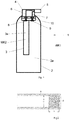
- the Fig. 1 shows the essential components of an aerosol can in a cut and simplified representation.
- the aerosol can essentially comprises a pressure-stable and dimensionally stable outer can 2, an inner container 3 and a spray head 4.
- the inner container 3 is also dimensionally stable and pressure-stable Formed box -inner box-.
- the spray head 4 is connected to the interior 3 a of the inner container 3 via a first channel 6 and to the interior 2 a of the outer box 2 via a second channel 7.
- the spray head is also provided with two outlet valves 8, 9 which close the two named channels 6, 7 and which can be opened together in a known manner by manually pressing the spray head 4.
- the two channels 6, 7 open into a discharge element 5 arranged on the spray head 4, in which the components emerging from the inner container 3 or the outer can 2 are brought together and mixed with one another.
- a mixing element (not shown) provided with mixing baffles can be placed on the discharge element 5, or the discharge element 5 itself can be provided with mixing baffles (not shown).
- the active ingredient components received in the outer can 2 are collectively designated as WK1, while the active ingredient components received in the inner can 3 are collectively designated as WK2.
- the aerosol can together with the active ingredient components received therein is collectively referred to as the aerosol can arrangement 1.
- the illustrated aerosol can arrangement 1 has the advantage that the active ingredient components WK1, WK2 received in the two inner spaces 2a, 3a are only brought together outside the respective container - outer can 2 or inner container 3- and the chemical-physical reaction by means of which the foam is formed or generated is, therefore also takes place outside of the two containers 2, 3.
- the aerosol can or the aerosol can arrangement 1 is preferably suitable for multiple use.
- the inner container 3 can either be formed from a flexible material or as a dimensionally and pressure-stable can.
- the design as a dimensionally stable and pressure-stable can has the advantage that it can be filled with the active ingredient components and pressurized, for example by means of liquid gas, even when not installed.
- the inner space 3a is first filled with an active ingredient such as hardener. Then the valve unscrewed and the container gassed through the valve body 8. Then the inner space 2a is filled with the other active ingredient, the inner container with valve is inserted and clinched. The interior 2a is gassed through the valve body 9. Finally the whole can is shaken.
- a foam barrier by means of which a foam barrier can be created, the following components are included in the respective can as an example. The following values are given in% by weight and relate to the total filling of the outer and inner box.
- a foam is generated which, after curing, is also suitable for filling larger water pipes, ie pipes with a diameter of 100 millimeters and more, and to create a foam barrier which is waterproof and can withstand a pressure of at least 0.1 bar.
- the foam hardens in about 5 to 10 minutes.
- the mixing ratio is preferably 3 to 7 parts by weight of WK1 to one part by weight of WK2, a mixing ratio of the order of magnitude of 5 to 1 having proven particularly useful. With such a mixing ratio, a different hardening mechanism can be used for the first time.
- the prepolymer is cured by a combination of the known trimerization according to formula 1 and a urethane reaction according to formula 2:
- Formula 1 shows that curing takes place catalytically, which is why it is sufficient to add a small amount of catalyst from chamber 3a to the prepolymer and therefore you can work with a mixing ratio in the order of magnitude of 10 to 1.
- the mixing ratio mentioned can vary in the range between approx. 8: 1 and 12: 1.
- stoichiometrically correct amounts must be added to the prepolymer.
- the amount depends, among other things, on the OH number of the polyol "R-OH" in formula 2.
- a mixing ratio of 1 to 1 is often necessary. With a clever formulation you can reduce it to 5 to 1. If you add the flame retardant and polyol with an OH number of less than 300 to the curable isocyanate, the volume increases considerably and you can mix 5 to 1.
- the Figure 2 shows, by way of example and in a simplified representation, a section through a pipe R provided with a foam barrier S.
- the foam barrier S has a thickness A which is at least 0.6 times the pipe inside diameter D, in particular at least 0.8 times the pipe inside diameter D. corresponds to.
- the foam barrier S preferably has a thickness A which corresponds at least to the inner diameter D of the pipe R.
- the foam barrier adheres along its circumference to the inner wall of the pipe R either by adhesion or mechanical interlocking.
- the foam barrier introduced into the pipe R with the aerosol can arrangement described above has a hardening that extends to the pipe wall, so that the foam barrier is continuously hardened and no perforated boundary surface arises on the pipe wall, which may be cold.
- the Foam barrier a hydraulically tight or watertight seal of the pipe.
- Tests have shown that the foam barrier can withstand a hydraulic pressure of at least 0.1 bar at a thickness A, which corresponds approximately to the inner pipe diameter D.
- the above-mentioned ratios do not apply to all pipe sizes, but rather apply in particular to pipes with an inside diameter between approx. In the case of smaller pipes, it may be sufficient to choose a thickness A that is in the range between 0.6 and 0.9 times the inside diameter D of the pipe R.
Landscapes
- Chemical & Material Sciences (AREA)
- Engineering & Computer Science (AREA)
- Polymers & Plastics (AREA)
- Health & Medical Sciences (AREA)
- Chemical Kinetics & Catalysis (AREA)
- Medicinal Chemistry (AREA)
- Organic Chemistry (AREA)
- Mechanical Engineering (AREA)
- Materials Engineering (AREA)
- Dispersion Chemistry (AREA)
- Containers And Packaging Bodies Having A Special Means To Remove Contents (AREA)
- Polyurethanes Or Polyureas (AREA)
- Manufacture Of Porous Articles, And Recovery And Treatment Of Waste Products (AREA)
- Nozzles (AREA)
Priority Applications (1)
| Application Number | Priority Date | Filing Date | Title |
|---|---|---|---|
| PL19000046T PL3527601T3 (pl) | 2018-02-16 | 2019-01-28 | Zespół puszki aerozolowej |
Applications Claiming Priority (1)
| Application Number | Priority Date | Filing Date | Title |
|---|---|---|---|
| DE102018001221.3A DE102018001221A1 (de) | 2018-02-16 | 2018-02-16 | Aerosoldosenanordnung |
Publications (2)
| Publication Number | Publication Date |
|---|---|
| EP3527601A1 EP3527601A1 (de) | 2019-08-21 |
| EP3527601B1 true EP3527601B1 (de) | 2021-07-14 |
Family
ID=65243300
Family Applications (1)
| Application Number | Title | Priority Date | Filing Date |
|---|---|---|---|
| EP19000046.3A Active EP3527601B1 (de) | 2018-02-16 | 2019-01-28 | Aerosoldosenanordnung |
Country Status (4)
| Country | Link |
|---|---|
| US (2) | US11220393B2 (pl) |
| EP (1) | EP3527601B1 (pl) |
| DE (1) | DE102018001221A1 (pl) |
| PL (1) | PL3527601T3 (pl) |
Families Citing this family (2)
| Publication number | Priority date | Publication date | Assignee | Title |
|---|---|---|---|---|
| US12006131B2 (en) * | 2017-11-27 | 2024-06-11 | Sika Technology Ag | Two-component aerosol can |
| AU2023204570A1 (en) * | 2022-07-21 | 2024-02-08 | Dap Global Inc. | One-component spray foam compositions and dispensers thereof |
Family Cites Families (11)
| Publication number | Priority date | Publication date | Assignee | Title |
|---|---|---|---|---|
| US3882684A (en) * | 1973-09-12 | 1975-05-13 | Bergwerksverband Gmbh | Two-compartment cartridge adapted for use in strengthening coal or stone walls |
| EP0111089B1 (de) | 1982-11-30 | 1987-09-09 | Ladoco Ag | Druckbehälter für Gase, Flüssigkeiten, pastöse Produkte oder dgl. |
| DE4121857A1 (de) * | 1991-07-02 | 1993-01-07 | Ladoco Ag | Druckbehaelter fuer gase, fluessigkeiten, pastoese produkte oder dergleichen |
| CA2184107A1 (en) * | 1994-02-24 | 1995-08-31 | Hermann Kluth | Foam plastic from disposable pressurized containers |
| RU2178802C2 (ru) * | 1996-09-19 | 2002-01-27 | Дэп Продактс Инк. | Устойчивые вспененные уплотняющие и герметизирующие составы и способы их применения |
| DE19918957A1 (de) * | 1998-04-27 | 1999-11-04 | Colux Licht & Leichtbau | Verwendung einer Zweikammer-Aerosoldose sowie feuerhemmend ausgerüsteter Montageschaum |
| US20070284390A1 (en) * | 2006-03-03 | 2007-12-13 | Liang Wang | Reactive mixture with growing molecular species |
| DE202009013510U1 (de) * | 2008-10-21 | 2010-01-07 | Colux Gmbh | Druckbehälter zur Abgabe eines zumindest aus zwei Komponenten bestehenden Schaums |
| WO2014019103A1 (en) * | 2012-07-31 | 2014-02-06 | Bayer Materialscience Ag | Method for the production of polyurethane foam using emulsified blowing agent |
| US20140275303A1 (en) * | 2013-03-15 | 2014-09-18 | Clayton Corporation | Rodent resistant polyurethane foams |
| US10731019B2 (en) * | 2015-04-10 | 2020-08-04 | Dap Products Inc. | Stable two component spray foam compositions containing hydrohaloolefin propellant or blowing agent |
-
2018
- 2018-02-16 DE DE102018001221.3A patent/DE102018001221A1/de active Pending
-
2019
- 2019-01-28 EP EP19000046.3A patent/EP3527601B1/de active Active
- 2019-01-28 PL PL19000046T patent/PL3527601T3/pl unknown
- 2019-02-06 US US16/268,680 patent/US11220393B2/en active Active
-
2021
- 2021-11-03 US US17/517,912 patent/US12600558B2/en active Active
Non-Patent Citations (1)
| Title |
|---|
| None * |
Also Published As
| Publication number | Publication date |
|---|---|
| EP3527601A1 (de) | 2019-08-21 |
| US11220393B2 (en) | 2022-01-11 |
| DE102018001221A1 (de) | 2019-08-22 |
| US12600558B2 (en) | 2026-04-14 |
| US20220055821A1 (en) | 2022-02-24 |
| PL3527601T3 (pl) | 2021-12-27 |
| US20190256277A1 (en) | 2019-08-22 |
Similar Documents
| Publication | Publication Date | Title |
|---|---|---|
| EP3527601B1 (de) | Aerosoldosenanordnung | |
| DE3815236C2 (pl) | ||
| DE3826011A1 (de) | Verfahren und vorrichtung zum ausschaeumen von hohlraeumen, insbesondere einer fahrzeugkarosserie | |
| EP2526333B1 (de) | Polyurethan-hartschaumstoffumhüllung der verbindungen von röhren | |
| CH712780B1 (de) | Thermisch gedämmte Mediumrohre mit HFO-haltigem Zellgas. | |
| DE102010049230B4 (de) | Verfahren zum Einbau eines Rohrs in einer Wandöffnung mit einem expandierenden Verpressharz | |
| EP0239851A2 (de) | Polyurethanmontageschaum und Vorichtung zur Ausübung seines Herstellungsverfahrens | |
| WO2012130376A1 (de) | Verfahren zur einbringung von schaummaterial in hohlkammerprofile | |
| EP3079876B1 (de) | Verfahren zur herstellung eines fahrzeug-karosserieelements sowie fahrzeug karosserieelement | |
| DE102023201120A1 (de) | Verfahren zur Anbringung einer Tülle an einem Leitungsstrang sowie Leitungsstrang mit Tülle | |
| EP0478758B1 (de) | Spritzpistole zum ausbringen von schaum, insbesondere zum ausschäumen von hohlräumen in der automobilindustrie | |
| DE112006002188T5 (de) | Verfahren und Anordnung zum Lokalisieren von Material innerhalb einer Struktur | |
| EP4476122B1 (de) | System eines strukturelementes mit darin angeordnetem dämmelement | |
| DE10143550C1 (de) | Verfahren zur Verstärkung eines Strukturelementes und schaumverstärktes Strukturelement | |
| EP2034120B1 (de) | Ausrüstung für Feuerschutzabschlüsse | |
| EP4554839A1 (de) | Dämmelement | |
| DE102021109307A1 (de) | Verfahren zum Ausschäumen eines Mehrkammerprofils, Karosserie und Kraftfahrzeug | |
| DE3926446C1 (en) | Prodn. of foam moulding with surface covering - includes placing cover material on mould inner wall and placing foamable polyurethane based reaction mixt. in mould | |
| DE3512244A1 (de) | Verfahren zum herstellen eines schaumstoffkoerpers | |
| DE3049834C2 (de) | Verfahren zur Herstellung von Einkomponenten-Polyurethanschaum | |
| DE3922050A1 (de) | Duebel | |
| DE2256388A1 (de) | Verfahren zur verankerung von bolzen oder staeben | |
| DE3808387A1 (de) | Verfahren zur herstellung eines stroemungskanals und stroemungskanal | |
| EP4155172A1 (de) | Verstärkungselement zur verstärkung eines strukturelementes | |
| DE1704581A1 (de) | Isolierbehaelter oder Isolierraum sowie Verfahren zu dessen Herstellung |
Legal Events
| Date | Code | Title | Description |
|---|---|---|---|
| PUAI | Public reference made under article 153(3) epc to a published international application that has entered the european phase |
Free format text: ORIGINAL CODE: 0009012 |
|
| STAA | Information on the status of an ep patent application or granted ep patent |
Free format text: STATUS: THE APPLICATION HAS BEEN PUBLISHED |
|
| AK | Designated contracting states |
Kind code of ref document: A1 Designated state(s): AL AT BE BG CH CY CZ DE DK EE ES FI FR GB GR HR HU IE IS IT LI LT LU LV MC MK MT NL NO PL PT RO RS SE SI SK SM TR |
|
| AX | Request for extension of the european patent |
Extension state: BA ME |
|
| STAA | Information on the status of an ep patent application or granted ep patent |
Free format text: STATUS: REQUEST FOR EXAMINATION WAS MADE |
|
| 17P | Request for examination filed |
Effective date: 20200206 |
|
| STAA | Information on the status of an ep patent application or granted ep patent |
Free format text: STATUS: EXAMINATION IS IN PROGRESS |
|
| 17Q | First examination report despatched |
Effective date: 20200618 |
|
| GRAP | Despatch of communication of intention to grant a patent |
Free format text: ORIGINAL CODE: EPIDOSNIGR1 |
|
| STAA | Information on the status of an ep patent application or granted ep patent |
Free format text: STATUS: GRANT OF PATENT IS INTENDED |
|
| INTG | Intention to grant announced |
Effective date: 20210325 |
|
| GRAS | Grant fee paid |
Free format text: ORIGINAL CODE: EPIDOSNIGR3 |
|
| GRAA | (expected) grant |
Free format text: ORIGINAL CODE: 0009210 |
|
| STAA | Information on the status of an ep patent application or granted ep patent |
Free format text: STATUS: THE PATENT HAS BEEN GRANTED |
|
| AK | Designated contracting states |
Kind code of ref document: B1 Designated state(s): AL AT BE BG CH CY CZ DE DK EE ES FI FR GB GR HR HU IE IS IT LI LT LU LV MC MK MT NL NO PL PT RO RS SE SI SK SM TR |
|
| REG | Reference to a national code |
Ref country code: GB Ref legal event code: FG4D Free format text: NOT ENGLISH |
|
| REG | Reference to a national code |
Ref country code: IE Ref legal event code: FG4D Free format text: LANGUAGE OF EP DOCUMENT: GERMAN |
|
| REG | Reference to a national code |
Ref country code: DE Ref legal event code: R096 Ref document number: 502019001791 Country of ref document: DE |
|
| REG | Reference to a national code |
Ref country code: AT Ref legal event code: REF Ref document number: 1410602 Country of ref document: AT Kind code of ref document: T Effective date: 20210815 |
|
| REG | Reference to a national code |
Ref country code: NL Ref legal event code: FP |
|
| REG | Reference to a national code |
Ref country code: SE Ref legal event code: TRGR |
|
| REG | Reference to a national code |
Ref country code: LT Ref legal event code: MG9D |
|
| PG25 | Lapsed in a contracting state [announced via postgrant information from national office to epo] |
Ref country code: RS Free format text: LAPSE BECAUSE OF FAILURE TO SUBMIT A TRANSLATION OF THE DESCRIPTION OR TO PAY THE FEE WITHIN THE PRESCRIBED TIME-LIMIT Effective date: 20210714 Ref country code: FI Free format text: LAPSE BECAUSE OF FAILURE TO SUBMIT A TRANSLATION OF THE DESCRIPTION OR TO PAY THE FEE WITHIN THE PRESCRIBED TIME-LIMIT Effective date: 20210714 Ref country code: ES Free format text: LAPSE BECAUSE OF FAILURE TO SUBMIT A TRANSLATION OF THE DESCRIPTION OR TO PAY THE FEE WITHIN THE PRESCRIBED TIME-LIMIT Effective date: 20210714 Ref country code: BG Free format text: LAPSE BECAUSE OF FAILURE TO SUBMIT A TRANSLATION OF THE DESCRIPTION OR TO PAY THE FEE WITHIN THE PRESCRIBED TIME-LIMIT Effective date: 20211014 Ref country code: LT Free format text: LAPSE BECAUSE OF FAILURE TO SUBMIT A TRANSLATION OF THE DESCRIPTION OR TO PAY THE FEE WITHIN THE PRESCRIBED TIME-LIMIT Effective date: 20210714 Ref country code: HR Free format text: LAPSE BECAUSE OF FAILURE TO SUBMIT A TRANSLATION OF THE DESCRIPTION OR TO PAY THE FEE WITHIN THE PRESCRIBED TIME-LIMIT Effective date: 20210714 Ref country code: PT Free format text: LAPSE BECAUSE OF FAILURE TO SUBMIT A TRANSLATION OF THE DESCRIPTION OR TO PAY THE FEE WITHIN THE PRESCRIBED TIME-LIMIT Effective date: 20211115 Ref country code: NO Free format text: LAPSE BECAUSE OF FAILURE TO SUBMIT A TRANSLATION OF THE DESCRIPTION OR TO PAY THE FEE WITHIN THE PRESCRIBED TIME-LIMIT Effective date: 20211014 |
|
| PG25 | Lapsed in a contracting state [announced via postgrant information from national office to epo] |
Ref country code: LV Free format text: LAPSE BECAUSE OF FAILURE TO SUBMIT A TRANSLATION OF THE DESCRIPTION OR TO PAY THE FEE WITHIN THE PRESCRIBED TIME-LIMIT Effective date: 20210714 Ref country code: GR Free format text: LAPSE BECAUSE OF FAILURE TO SUBMIT A TRANSLATION OF THE DESCRIPTION OR TO PAY THE FEE WITHIN THE PRESCRIBED TIME-LIMIT Effective date: 20211015 |
|
| REG | Reference to a national code |
Ref country code: DE Ref legal event code: R097 Ref document number: 502019001791 Country of ref document: DE |
|
| PG25 | Lapsed in a contracting state [announced via postgrant information from national office to epo] |
Ref country code: DK Free format text: LAPSE BECAUSE OF FAILURE TO SUBMIT A TRANSLATION OF THE DESCRIPTION OR TO PAY THE FEE WITHIN THE PRESCRIBED TIME-LIMIT Effective date: 20210714 |
|
| PLBE | No opposition filed within time limit |
Free format text: ORIGINAL CODE: 0009261 |
|
| STAA | Information on the status of an ep patent application or granted ep patent |
Free format text: STATUS: NO OPPOSITION FILED WITHIN TIME LIMIT |
|
| PG25 | Lapsed in a contracting state [announced via postgrant information from national office to epo] |
Ref country code: SM Free format text: LAPSE BECAUSE OF FAILURE TO SUBMIT A TRANSLATION OF THE DESCRIPTION OR TO PAY THE FEE WITHIN THE PRESCRIBED TIME-LIMIT Effective date: 20210714 Ref country code: SK Free format text: LAPSE BECAUSE OF FAILURE TO SUBMIT A TRANSLATION OF THE DESCRIPTION OR TO PAY THE FEE WITHIN THE PRESCRIBED TIME-LIMIT Effective date: 20210714 Ref country code: RO Free format text: LAPSE BECAUSE OF FAILURE TO SUBMIT A TRANSLATION OF THE DESCRIPTION OR TO PAY THE FEE WITHIN THE PRESCRIBED TIME-LIMIT Effective date: 20210714 Ref country code: EE Free format text: LAPSE BECAUSE OF FAILURE TO SUBMIT A TRANSLATION OF THE DESCRIPTION OR TO PAY THE FEE WITHIN THE PRESCRIBED TIME-LIMIT Effective date: 20210714 Ref country code: CZ Free format text: LAPSE BECAUSE OF FAILURE TO SUBMIT A TRANSLATION OF THE DESCRIPTION OR TO PAY THE FEE WITHIN THE PRESCRIBED TIME-LIMIT Effective date: 20210714 Ref country code: AL Free format text: LAPSE BECAUSE OF FAILURE TO SUBMIT A TRANSLATION OF THE DESCRIPTION OR TO PAY THE FEE WITHIN THE PRESCRIBED TIME-LIMIT Effective date: 20210714 |
|
| 26N | No opposition filed |
Effective date: 20220419 |
|
| PG25 | Lapsed in a contracting state [announced via postgrant information from national office to epo] |
Ref country code: IT Free format text: LAPSE BECAUSE OF FAILURE TO SUBMIT A TRANSLATION OF THE DESCRIPTION OR TO PAY THE FEE WITHIN THE PRESCRIBED TIME-LIMIT Effective date: 20210714 |
|
| PG25 | Lapsed in a contracting state [announced via postgrant information from national office to epo] |
Ref country code: MC Free format text: LAPSE BECAUSE OF FAILURE TO SUBMIT A TRANSLATION OF THE DESCRIPTION OR TO PAY THE FEE WITHIN THE PRESCRIBED TIME-LIMIT Effective date: 20210714 |
|
| PGFP | Annual fee paid to national office [announced via postgrant information from national office to epo] |
Ref country code: LU Payment date: 20220727 Year of fee payment: 4 Ref country code: IE Payment date: 20220726 Year of fee payment: 4 |
|
| P01 | Opt-out of the competence of the unified patent court (upc) registered |
Effective date: 20230526 |
|
| PG25 | Lapsed in a contracting state [announced via postgrant information from national office to epo] |
Ref country code: LU Free format text: LAPSE BECAUSE OF NON-PAYMENT OF DUE FEES Effective date: 20230128 |
|
| REG | Reference to a national code |
Ref country code: DE Ref legal event code: R082 Ref document number: 502019001791 Country of ref document: DE Representative=s name: PUSCHMANN BORCHERT KAISER KLETTNER PATENTANWAE, DE Ref country code: DE Ref legal event code: R082 Ref document number: 502019001791 Country of ref document: DE Representative=s name: PATCARE PATENTANWAELTE PARTNERSCHAFT MBB, DE |
|
| PG25 | Lapsed in a contracting state [announced via postgrant information from national office to epo] |
Ref country code: IE Free format text: LAPSE BECAUSE OF NON-PAYMENT OF DUE FEES Effective date: 20230128 |
|
| PG25 | Lapsed in a contracting state [announced via postgrant information from national office to epo] |
Ref country code: MK Free format text: LAPSE BECAUSE OF FAILURE TO SUBMIT A TRANSLATION OF THE DESCRIPTION OR TO PAY THE FEE WITHIN THE PRESCRIBED TIME-LIMIT Effective date: 20210714 Ref country code: CY Free format text: LAPSE BECAUSE OF FAILURE TO SUBMIT A TRANSLATION OF THE DESCRIPTION OR TO PAY THE FEE WITHIN THE PRESCRIBED TIME-LIMIT Effective date: 20210714 |
|
| PG25 | Lapsed in a contracting state [announced via postgrant information from national office to epo] |
Ref country code: HU Free format text: LAPSE BECAUSE OF FAILURE TO SUBMIT A TRANSLATION OF THE DESCRIPTION OR TO PAY THE FEE WITHIN THE PRESCRIBED TIME-LIMIT; INVALID AB INITIO Effective date: 20190128 |
|
| REG | Reference to a national code |
Ref country code: DE Ref legal event code: R081 Ref document number: 502019001791 Country of ref document: DE Owner name: TREMCO CPG GERMANY GMBH, DE Free format text: FORMER OWNER: COLUX GMBH, 78224 SINGEN, DE |
|
| REG | Reference to a national code |
Ref country code: GB Ref legal event code: 732E Free format text: REGISTERED BETWEEN 20240530 AND 20240605 |
|
| PG25 | Lapsed in a contracting state [announced via postgrant information from national office to epo] |
Ref country code: MT Free format text: LAPSE BECAUSE OF FAILURE TO SUBMIT A TRANSLATION OF THE DESCRIPTION OR TO PAY THE FEE WITHIN THE PRESCRIBED TIME-LIMIT Effective date: 20210714 |
|
| PGFP | Annual fee paid to national office [announced via postgrant information from national office to epo] |
Ref country code: CH Payment date: 20250201 Year of fee payment: 7 |
|
| PGFP | Annual fee paid to national office [announced via postgrant information from national office to epo] |
Ref country code: PL Payment date: 20250116 Year of fee payment: 7 |
|
| PGFP | Annual fee paid to national office [announced via postgrant information from national office to epo] |
Ref country code: GB Payment date: 20250128 Year of fee payment: 7 |
|
| PG25 | Lapsed in a contracting state [announced via postgrant information from national office to epo] |
Ref country code: TR Free format text: LAPSE BECAUSE OF FAILURE TO SUBMIT A TRANSLATION OF THE DESCRIPTION OR TO PAY THE FEE WITHIN THE PRESCRIBED TIME-LIMIT Effective date: 20210714 |
|
| REG | Reference to a national code |
Ref country code: CH Ref legal event code: U11 Free format text: ST27 STATUS EVENT CODE: U-0-0-U10-U11 (AS PROVIDED BY THE NATIONAL OFFICE) Effective date: 20260201 |
|
| PGFP | Annual fee paid to national office [announced via postgrant information from national office to epo] |
Ref country code: NL Payment date: 20260121 Year of fee payment: 8 |
|
| PGFP | Annual fee paid to national office [announced via postgrant information from national office to epo] |
Ref country code: SE Payment date: 20260121 Year of fee payment: 8 |
|
| REG | Reference to a national code |
Ref country code: CH Ref legal event code: R17 Free format text: ST27 STATUS EVENT CODE: U-0-0-R10-R17 (AS PROVIDED BY THE NATIONAL OFFICE) Effective date: 20260410 |
|
| PGFP | Annual fee paid to national office [announced via postgrant information from national office to epo] |
Ref country code: DE Payment date: 20260121 Year of fee payment: 8 |
|
| PGFP | Annual fee paid to national office [announced via postgrant information from national office to epo] |
Ref country code: AT Payment date: 20260122 Year of fee payment: 8 |
|
| PGFP | Annual fee paid to national office [announced via postgrant information from national office to epo] |
Ref country code: BE Payment date: 20260121 Year of fee payment: 8 |
|
| PGFP | Annual fee paid to national office [announced via postgrant information from national office to epo] |
Ref country code: FR Payment date: 20260123 Year of fee payment: 8 |