EP3525418A1 - Method and device for pushing information - Google Patents
Method and device for pushing information Download PDFInfo
- Publication number
- EP3525418A1 EP3525418A1 EP17868227.4A EP17868227A EP3525418A1 EP 3525418 A1 EP3525418 A1 EP 3525418A1 EP 17868227 A EP17868227 A EP 17868227A EP 3525418 A1 EP3525418 A1 EP 3525418A1
- Authority
- EP
- European Patent Office
- Prior art keywords
- display location
- information
- user
- identifier
- corresponds
- Prior art date
- Legal status (The legal status is an assumption and is not a legal conclusion. Google has not performed a legal analysis and makes no representation as to the accuracy of the status listed.)
- Granted
Links
Images



Classifications
-
- G—PHYSICS
- G06—COMPUTING OR CALCULATING; COUNTING
- G06Q—INFORMATION AND COMMUNICATION TECHNOLOGY [ICT] SPECIALLY ADAPTED FOR ADMINISTRATIVE, COMMERCIAL, FINANCIAL, MANAGERIAL OR SUPERVISORY PURPOSES; SYSTEMS OR METHODS SPECIALLY ADAPTED FOR ADMINISTRATIVE, COMMERCIAL, FINANCIAL, MANAGERIAL OR SUPERVISORY PURPOSES, NOT OTHERWISE PROVIDED FOR
- G06Q30/00—Commerce
- G06Q30/02—Marketing; Price estimation or determination; Fundraising
- G06Q30/0241—Advertisements
- G06Q30/0251—Targeted advertisements
-
- H—ELECTRICITY
- H04—ELECTRIC COMMUNICATION TECHNIQUE
- H04L—TRANSMISSION OF DIGITAL INFORMATION, e.g. TELEGRAPHIC COMMUNICATION
- H04L67/00—Network arrangements or protocols for supporting network services or applications
- H04L67/50—Network services
- H04L67/55—Push-based network services
-
- G—PHYSICS
- G06—COMPUTING OR CALCULATING; COUNTING
- G06F—ELECTRIC DIGITAL DATA PROCESSING
- G06F3/00—Input arrangements for transferring data to be processed into a form capable of being handled by the computer; Output arrangements for transferring data from processing unit to output unit, e.g. interface arrangements
- G06F3/01—Input arrangements or combined input and output arrangements for interaction between user and computer
- G06F3/048—Interaction techniques based on graphical user interfaces [GUI]
- G06F3/0487—Interaction techniques based on graphical user interfaces [GUI] using specific features provided by the input device, e.g. functions controlled by the rotation of a mouse with dual sensing arrangements, or of the nature of the input device, e.g. tap gestures based on pressure sensed by a digitiser
- G06F3/0488—Interaction techniques based on graphical user interfaces [GUI] using specific features provided by the input device, e.g. functions controlled by the rotation of a mouse with dual sensing arrangements, or of the nature of the input device, e.g. tap gestures based on pressure sensed by a digitiser using a touch-screen or digitiser, e.g. input of commands through traced gestures
-
- G—PHYSICS
- G06—COMPUTING OR CALCULATING; COUNTING
- G06F—ELECTRIC DIGITAL DATA PROCESSING
- G06F11/00—Error detection; Error correction; Monitoring
- G06F11/30—Monitoring
- G06F11/34—Recording or statistical evaluation of computer activity, e.g. of down time, of input/output operation ; Recording or statistical evaluation of user activity, e.g. usability assessment
- G06F11/3438—Recording or statistical evaluation of computer activity, e.g. of down time, of input/output operation ; Recording or statistical evaluation of user activity, e.g. usability assessment monitoring of user actions
-
- G—PHYSICS
- G06—COMPUTING OR CALCULATING; COUNTING
- G06F—ELECTRIC DIGITAL DATA PROCESSING
- G06F3/00—Input arrangements for transferring data to be processed into a form capable of being handled by the computer; Output arrangements for transferring data from processing unit to output unit, e.g. interface arrangements
- G06F3/01—Input arrangements or combined input and output arrangements for interaction between user and computer
- G06F3/048—Interaction techniques based on graphical user interfaces [GUI]
- G06F3/0484—Interaction techniques based on graphical user interfaces [GUI] for the control of specific functions or operations, e.g. selecting or manipulating an object, an image or a displayed text element, setting a parameter value or selecting a range
- G06F3/0485—Scrolling or panning
-
- G—PHYSICS
- G06—COMPUTING OR CALCULATING; COUNTING
- G06Q—INFORMATION AND COMMUNICATION TECHNOLOGY [ICT] SPECIALLY ADAPTED FOR ADMINISTRATIVE, COMMERCIAL, FINANCIAL, MANAGERIAL OR SUPERVISORY PURPOSES; SYSTEMS OR METHODS SPECIALLY ADAPTED FOR ADMINISTRATIVE, COMMERCIAL, FINANCIAL, MANAGERIAL OR SUPERVISORY PURPOSES, NOT OTHERWISE PROVIDED FOR
- G06Q30/00—Commerce
- G06Q30/02—Marketing; Price estimation or determination; Fundraising
- G06Q30/0241—Advertisements
- G06Q30/0251—Targeted advertisements
- G06Q30/0255—Targeted advertisements based on user history
-
- G—PHYSICS
- G06—COMPUTING OR CALCULATING; COUNTING
- G06Q—INFORMATION AND COMMUNICATION TECHNOLOGY [ICT] SPECIALLY ADAPTED FOR ADMINISTRATIVE, COMMERCIAL, FINANCIAL, MANAGERIAL OR SUPERVISORY PURPOSES; SYSTEMS OR METHODS SPECIALLY ADAPTED FOR ADMINISTRATIVE, COMMERCIAL, FINANCIAL, MANAGERIAL OR SUPERVISORY PURPOSES, NOT OTHERWISE PROVIDED FOR
- G06Q30/00—Commerce
- G06Q30/02—Marketing; Price estimation or determination; Fundraising
- G06Q30/0241—Advertisements
- G06Q30/0251—Targeted advertisements
- G06Q30/0269—Targeted advertisements based on user profile or attribute
- G06Q30/0271—Personalized advertisement
-
- G—PHYSICS
- G06—COMPUTING OR CALCULATING; COUNTING
- G06Q—INFORMATION AND COMMUNICATION TECHNOLOGY [ICT] SPECIALLY ADAPTED FOR ADMINISTRATIVE, COMMERCIAL, FINANCIAL, MANAGERIAL OR SUPERVISORY PURPOSES; SYSTEMS OR METHODS SPECIALLY ADAPTED FOR ADMINISTRATIVE, COMMERCIAL, FINANCIAL, MANAGERIAL OR SUPERVISORY PURPOSES, NOT OTHERWISE PROVIDED FOR
- G06Q30/00—Commerce
- G06Q30/02—Marketing; Price estimation or determination; Fundraising
- G06Q30/0241—Advertisements
- G06Q30/0277—Online advertisement
-
- H—ELECTRICITY
- H04—ELECTRIC COMMUNICATION TECHNIQUE
- H04L—TRANSMISSION OF DIGITAL INFORMATION, e.g. TELEGRAPHIC COMMUNICATION
- H04L67/00—Network arrangements or protocols for supporting network services or applications
- H04L67/50—Network services
- H04L67/51—Discovery or management thereof, e.g. service location protocol [SLP] or web services
-
- Y—GENERAL TAGGING OF NEW TECHNOLOGICAL DEVELOPMENTS; GENERAL TAGGING OF CROSS-SECTIONAL TECHNOLOGIES SPANNING OVER SEVERAL SECTIONS OF THE IPC; TECHNICAL SUBJECTS COVERED BY FORMER USPC CROSS-REFERENCE ART COLLECTIONS [XRACs] AND DIGESTS
- Y02—TECHNOLOGIES OR APPLICATIONS FOR MITIGATION OR ADAPTATION AGAINST CLIMATE CHANGE
- Y02D—CLIMATE CHANGE MITIGATION TECHNOLOGIES IN INFORMATION AND COMMUNICATION TECHNOLOGIES [ICT], I.E. INFORMATION AND COMMUNICATION TECHNOLOGIES AIMING AT THE REDUCTION OF THEIR OWN ENERGY USE
- Y02D30/00—Reducing energy consumption in communication networks
- Y02D30/50—Reducing energy consumption in communication networks in wire-line communication networks, e.g. low power modes or reduced link rate
Definitions
- the present application relates to the field of Internet technologies, and in particular, to an information pushing method and apparatus.
- the client can be an application (APP) on software, for example, an electronic wallet APP, an instant messaging APP, or a news APP.
- APP application
- software for example, an electronic wallet APP, an instant messaging APP, or a news APP.
- information can be displayed in a display location in the client.
- an arrangement order of display locations on the client is fixed. Orders of display locations that are displayed in different clients are also the same. The difference lies only in that the numbers of display locations that can be simultaneously displayed are different because screen sizes of different clients are different.
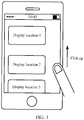
- a client shown in FIG. 1 can simultaneously display three display locations, while another client with a relatively small screen can simultaneously display two display locations.
- display locations 1, 2, 3, 4, 5, etc. are fixedly and sequentially displayed in an arrangement order of the display locations.
- the client sequentially obtains information in display location 1, information in display location 2, information in display location 3, etc.
- display locations that are displayed currently are 1, 2, and 3, and corresponding information is displayed.
- the client obtains information from a server only when the display location is displayed. Because it needs to take time to obtain information, this information acquisition method may cause stalling and affect user experience.
- a pre-acquisition method is usually used to alleviate the previous problem.
- a client When a user is browsing information in a current page, a client pre-obtains information in a next display location. Still as shown in FIG. 1 , information in display locations 1, 2, and 3 is displayed in the current page, and the client obtains, from the server, information in next display location 4 that is not displayed.
- the user when browsing display location 4, the user can directly use the pre-obtained information, to prevent stalling caused by a factor such as a communication delay from affecting user experience.
- the user does not necessarily sequentially browse the information in the display locations. Continuing to refer to FIG.
- the present application provides an information pushing method and apparatus, to alleviate the problem of the resource waste in an existing system.
- An implementation of the present application provides an information pushing method, where the method includes the following: receiving an information acquisition request sent by a client, where the information acquisition request includes an identifier of a source display location and an identifier of a user that requests to obtain information; querying a display location trajectory diagram that corresponds to the user identifier, where an order in which the user historically browses display locations is recorded in the display location trajectory diagram; querying the display location trajectory diagram for a target display location adjacent to the source display location and after the source display location; and pushing information in the target display location to the client that corresponds to the user identifier.
- the display location trajectory diagram is constructed by using the following method: obtaining display location data uploaded by each client and historically browsed by the user, where the display location data includes a user identifier, a display location identifier, and a timestamp; and associating display locations that correspond to the display location identifiers in the display location data with the same user identifier in order of the timestamp, to generate the display location trajectory diagram that corresponds to the user identifier.
- the querying the display location trajectory diagram for a target display location adjacent to the source display location and after the source display location includes the following: querying the display location trajectory diagram for the target display location associated with the source display location and after the source display location; obtaining a priority of each target display location when there is more than one target display location; and determining a target display location with a highest priority as a final target display location.
- the priority of the target display location is obtained based on the number of user's browses.
- the method further includes the following: querying a user preference diagram that corresponds to the user identifier, where an information type of information in a display location historically tapped by the user is recorded in the user preference diagram; and querying the user preference diagram for an information type that corresponds to an identified target display location based on the target display location; and the pushing information in the target display location to the client that corresponds to the user identifier includes the following: pushing information of an identified information type to the target display location in the client that corresponds to the user identifier.
- the user preference diagram is constructed by using the following method: obtaining information data uploaded by each client and historically tapped by the user, where the information data includes a user identifier, a display location identifier, and an information type; and associating the display location identifier with the information type in the information data with the same user identifier, to generate the user preference diagram that corresponds to the user identifier.
- the querying the user preference diagram for an information type that corresponds to an identified target display location based on the target display location includes the following: randomly determining an information type as the information type that corresponds to the target display location when the identified target display location is not identified in the user preference diagram based on the target display location.
- the pushing information of an identified information type to the target display location in the client that corresponds to the user identifier includes the following: obtaining a priority of each information type when there is more than one information type that corresponds to the identified target display location; determining information of an information type with a highest priority as information to be sent; and pushing the information to be sent to the target display location in the client that corresponds to the user identifier.
- the priority of the information type is determined based on the number of times of uploading the information type.
- the information includes an advertisement; the display location includes an advertisement display location; the information type includes an advertisement type; and the display location trajectory diagram includes an advertisement display location trajectory diagram.
- An implementation of the present application provides an information pushing apparatus, where the apparatus includes the following: a receiving unit, configured to receive an information acquisition request sent by a client, where the information acquisition request includes an identifier of a source display location and an identifier of a user that requests to obtain information; a first query unit, configured to query a display location trajectory diagram that corresponds to the user identifier, where an order in which the user historically browses display locations is recorded in the display location trajectory diagram; a second query unit, configured to query the display location trajectory diagram for a target display location adjacent to the source display location and after the source display location; and a pushing unit, configured to push information in the target display location to the client that corresponds to the user identifier.
- a receiving unit configured to receive an information acquisition request sent by a client, where the information acquisition request includes an identifier of a source display location and an identifier of a user that requests to obtain information
- a first query unit configured to query a display location trajectory diagram that corresponds to the user identifier, where an order in
- the display location trajectory diagram is constructed by using a first acquisition subunit and a first generation subunit below: the first acquisition subunit is configured to obtain display location data uploaded by each client and historically browsed by the user, where the display location data includes a user identifier, a display location identifier, and a timestamp; and the first generation subunit is configured to associate display locations that correspond to the display location identifiers in the display location data with the same user identifier in order of the timestamp, to generate the display location trajectory diagram that corresponds to the user identifier.
- the second query unit includes the following: a display location query subunit, configured to query the display location trajectory diagram for the target display location associated with the source display location and after the source display location; a priority acquisition subunit, configured to obtain a priority of each target display location when there is more than one target display location; and a display location determining subunit, configured to determine a target display location with a highest priority as a final target display location.
- a display location query subunit configured to query the display location trajectory diagram for the target display location associated with the source display location and after the source display location
- a priority acquisition subunit configured to obtain a priority of each target display location when there is more than one target display location
- a display location determining subunit configured to determine a target display location with a highest priority as a final target display location.
- the priority of the target display location is obtained based on the number of user's browses.
- the apparatus further includes the following: a third query unit, configured to query a user preference diagram that corresponds to the user identifier, where an information type of information in a display location historically tapped by the user is recorded in the user preference diagram; and a fourth query unit, configured to query the user preference diagram for an information type that corresponds to an identified target display location based on the target display location.
- a third query unit configured to query a user preference diagram that corresponds to the user identifier, where an information type of information in a display location historically tapped by the user is recorded in the user preference diagram
- a fourth query unit configured to query the user preference diagram for an information type that corresponds to an identified target display location based on the target display location.
- the pushing unit includes the following: a pushing subunit, configured to push information of an identified information type to the target display location in the client that corresponds to the user identifier.
- the user preference diagram is constructed by using a second acquisition subunit and a second generation subunit below: the second acquisition subunit is configured to obtain information data uploaded by each client and historically tapped by the user, where the information data includes a user identifier, a display location identifier, and an information type; and a second generation subunit, configured to associate the display location identifier with the information type in the information data with the same user identifier, to generate the user preference diagram that corresponds to the user identifier.
- the second query unit includes the following: a query subunit, configured to randomly determine an information type as the information type that corresponds to the target display location when the identified target display location is not identified in the user preference diagram based on the target display location.
- the pushing unit includes the following: an information type acquisition subunit, configured to obtain a priority of each information type when there is more than one information type that corresponds to the identified target display location; an information determining subunit, configured to determine information of an information type with a highest priority as information to be sent; and an information pushing subunit, configured to push the information to be sent to the target display location in the client that corresponds to the user identifier.
- the priority of the information type is determined based on the number of times of uploading the information type.
- the information includes an advertisement; the display location includes an advertisement display location; the information type includes an advertisement type; and the display location trajectory diagram includes an advertisement display location trajectory diagram.
- the display location trajectory diagram of the user can be constructed in advance in the order in which the user historically browses display locations.
- a server can predict, based on the display location trajectory diagram, a next display location that is most likely to be browsed by the user, namely, the target display location; and then push the information in the target display location. Therefore, the determined target display location is not necessarily a display location next to the current display location.
- the server can be prevented from still pushing information in a display location that is flicked by the user quickly and flashes by, to reduce meaningless consumption of system resources.
- first, second, third, etc. can be used in the present application to describe various types of information, the information is not limited to the terms. These terms are only used to differentiate information of a same type. For example, without departing from the scope of the present application, first information can also be referred to as second information, and similarly, the second information can be referred to as the first information. Depending on the context, for example, the word “if” used here can be explained as “while”, “when”, or "in response to determining”.
- FIG. 2 is a flowchart illustrating an information pushing method, according to an implementation of the present application.
- the present implementation is described from the perspective of a server side.
- the method can include the following steps.
- Step 210 Receive an information acquisition request sent by a client, where the information acquisition request includes an identifier of a source display location and an identifier of a user that requests to obtain information.
- the client can be an application on software, for example, an electronic wallet APP, an instant messaging APP, or a news APP.
- the display location mentioned in the present specification can be an area, in a client application interface, that is used to display information.
- the display locations are located in different areas and are clearly distinguished from each other.
- the user can view different information by flicking up and down. Different information is displayed in different display locations.
- the client can actively initiate the information acquisition request to the server. If the user browses display location 3 at the bottom of the interface, the information acquisition request can be used to obtain information that needs to be displayed in a next display location of display location 3.
- the information acquisition request includes a source display location identifier of display location 3 and the identifier of the user that requests to obtain information.
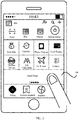
- FIG. 3 is another schematic diagram of display locations displayed on a client.
- the display locations are located in the same area.
- a user can control the client to display different information by flicking left and right.
- the client can actively initiate the information acquisition request to the server.
- Area 106 has five different display locations (five small circles). Because the first display location is displayed currently, the information acquisition request sent by the client is used to obtain information that needs to be displayed in a next display location of the first display location.
- the information acquisition request includes a source display location identifier of the first display location and the identifier of the user that requests to obtain information.
- the previous examples are only examples of a form of displaying the display locations.
- the display locations can also be displayed in other forms, for example, flicking up and down in the same area.
- the source display location identifier is an identifier that corresponds to the last display location currently displayed on the client. As shown in FIG. 1 , the source display location identifier is an identifier that corresponds to display location 3. In an implementation of actual applications, the source display location identifier can be a display location ID, for example, number 1, 2, or 3.
- the user identifier can be a user ID, for example, a user account user_1 or user_2.
- Step 220 Query a display location trajectory diagram that corresponds to the user identifier.
- an order in which the user historically browses display locations is recorded in the display location trajectory diagram.
- the display location trajectory diagram can be constructed by using the following method:
- a log tracing point is preset in the client, and then a log collection module of the client regularly collects the display location data historically browsed by the user, and uploads all the display location data to the server.
- the "regularly” can be understood as a fixed time, for example, 8:00, 17:00, or 24: 00 each day, every Monday; or can be understood as predetermined duration, that is, the log collection module of the client can start a timer, and collect a parameter when the timer reaches the predetermined duration.
- the log collection module can perform collection irregularly.
- the data can be uploaded to the server based on a data volume when a volume of the collected display location data and/or information data reaches a predetermined data volume.
- the log can be used to record a user's operation.
- the log tracing point is used to add some special functions to original functional logic of the log.
- Configuration can be performed in the log through a log collection interface, for example, the number of times that the user taps a button is counted.
- the log tracing point is mainly used to collect statistics about the display location data historically browsed by the user.
- the display location data can include the user identifier, the display location identifier, and the timestamp.
- the following describes how the client determines whether the user browsed the display location.
- FIG. 1 is used as an example.
- the client first displays information in display locations 1, 2, and 3, and then sequentially displays information in display location 4, information in display location 5, etc. as the user flicks the display locations up.
- display location 4 and display location 5 flash by, and information in display locations 6, 7, and 8 is displayed finally.
- the client can determine that display locations 4 and 5 are not browsed by the user. In other words, whether the user browsed the display location can be determined based on whether duration of the display location staying on a screen reaches predetermined duration.
- the predetermined duration can be an empirical value that is set manually. For example, the value can be 5 seconds. In this case, it can be considered that the user browses the display location if the duration of the display location staying on the screen of the client reaches 5 seconds. On the contrary, it can be considered that the user does not browse the display location if the duration does not reach 5 seconds.
- a subsequent browsed display location in the present specification can be understood as a display location whose duration reaches the predetermined duration.
- a system log records display location data, namely, a display location identifier, a user identifier, and a timestamp.
- the timestamp is a timestamp at which a moment of the display location is displayed when the user browses the display location.
- the user identifier is user 1
- the display location identifier is 4, and the timestamp is 1474873552 (namely, 15:5:52 9/26/2016).
- the log collection module can upload the collected display location data (user_1, 4, 1474873552) to the server.
- the server can associate the display locations that correspond to the display location identifiers in the display location data with the same user identifier in order of the timestamp.
- a sequence relationship between different display locations can be determined by using an order of timestamps, to further determine a source display location and a target display location.
- the source display location and the target display location are relative concepts.
- the former display location is a source display location relative to the latter display location, and the latter display location is a target display location relative to the former display location.
- a display location is a target display location relative to a source display location of the display location, but is a source display location relative to a target display location of the display location.
- Display locations are connected to form a chain by using timestamps, and a loop can be formed if there are the same display locations.
- first display location data ⁇ user_1, 1, 1474873552 ⁇ , where user_1 is a user identifier, 1 is a display location identifier, and 1474873552 is a timestamp, which have the same meaning as the following; second display location data ⁇ user_1, 2, 1474873553 ⁇ ; third display location data ⁇ user_1, 3, 1474873554 ⁇ ; fourth display location data ⁇ user_1, 6, 1474873570 ⁇ ; fifth display location data ⁇ user_1, 7, 1474873571 ⁇ ; and sixth display location data ⁇ user_1, 8, 1474873572 ⁇ .
- the server can determine the six sets of display location data as a browsing history of the same user because the six sets of display location data have the same user identifier user_1.
- an order of each display location can be determined based on the timestamps.
- the six sets of display location data are sequentially: 1474873552 (15:5:52 9/26/2016), 1474873553 (15:5:53 9/26/2016), 1474873554 (15:5:54 9/26/2017), 1474873570 (15:6:10 9/26/2017), 1474873571 (15:6:11 9/26/2016), and 1474873572 (15:6:12 9/26/2017).
- display location 1 is associated with display location 2, and display location 1 points to display location 2. In this case, it can indicate that the user browses display location 1 and then browses display location 2.
- Display location 2 is associated with display location 3, and display location 2 points to display location 3. In this case, it can indicate that the user browses display location 2 and then browses display location 3.
- Display location 3 is associated with display location 6, and display location 3 points to display location 6. In this case, it can indicate that a browsing trajectory is that the user browses display location 3 and then browses display location 6.
- Display location 6 is associated with display location 7, and display location 6 points to display location 7. In this case, it can indicate that a browsing trajectory is that the user browses display location 6 and then browses display location 7.
- Display location 7 is associated with display location 8, and display location 7 points to display location 8. In this case, it can indicate that a browsing trajectory is that the user browses display location 7 and then browses display location 8.
- display location data uploaded by different clients usually corresponds to different users, and the server generates a corresponding display location trajectory diagram for each user identifier.
- the server can query the display location trajectory diagram that corresponds to the user identifier based on the user identifier included in the information acquisition request.
- the server can associate the display location trajectory diagram with the user identifier, and store the display location trajectory diagram in a graph database.
- the server when querying for the display location trajectory diagram that corresponds to the user identifier, the server can query the graph database for the display location trajectory diagram that corresponds to the user identifier.
- Step 230 Query the display location trajectory diagram for a target display location adjacent to the source display location and after the source display location.
- the target display location is adjacent to the source display location, and the source display location points to the target display location, that is, the target display location is after the source display location.
- the server can further query the display location trajectory diagram for the target display location adjacent to the source display location and after the source display location.
- Example 1 Based on Example 1, with reference to the schematic diagram of the client shown in FIG. 1 , the user browses information again, and display locations 1, 2, and 3 are displayed on the screen of the client currently.
- the client sends an information acquisition request to the server.
- the information acquisition request includes the user identifier user_1 and source display location identifier 3.
- the server can identify the corresponding display location trajectory diagram based on the user identifier user 1, as shown in FIG. 4 . Because the source display location identifier is 3, the server queries that a target display location adjacent to source display location 3 and after source display location 3 is 6.
- the target display location that is most likely to be browsed after the user browses a current display location can be determined based on the display location trajectory diagram of the user and in the order in which the user historically browses the display locations.
- information in a next display location is not necessarily sequentially obtained.
- the client can obtain information in display location 6 instead of obtaining information in display location 4 in a fixed order of display locations in the existing technology.
- Step 240 Push information in the target display location to the client that corresponds to the user identifier.
- the server can push the information in the target display location to the client that corresponds to the user identifier.
- the client after receiving the information in the target display location that is pushed by the server, the client can display the information in the target display location. Because information pushing is preprocessed, when the server returns the information, the target display location may not have been browsed on the client. In this case, the client can first cache the returned information, and directly use the cached information when the user browses the target display location.
- the display location trajectory diagram of the user can be constructed in advance in the order in which the user historically browses display locations.
- the server can predict, based on the display location trajectory diagram, the next display location that is most likely to be browsed by the user, namely, the target display location; and then push the information in the target display location. Therefore, the determined target display location is not necessarily a display location next to the current display location. As such, the server can be prevented from still pushing information in a display location that is flicked by the user quickly and flashes by, to reduce meaningless consumption of system resources.
- target display locations of display location 3 are 4 and 10.
- the server can determine both display locations 4 and 10 as target display locations to push information about the two display locations to the client, that is, push a plurality of pieces of information when there are a plurality of target display locations.
- the user cannot simultaneously browse information in display locations far away from each other, and therefore it may be meaningless to push more information. Consequently, system resources are consumed.
- the querying the display location trajectory diagram for a target display location adjacent to the source display location and after the source display location in step 230 can include the following steps: querying the display location trajectory diagram for a target display location adjacent to the source display location and after the source display location; and obtaining a priority of each target display location when there is more than one target display location; and determining a target display location with a highest priority as a final target display location.
- different target display locations have different priorities. Still as shown in FIG. 5 , there are two target display locations of display location 3, namely, display location 4 and display location 10. If a priority of display location 10 is higher than a priority of display location 4, it can be determined that display location 10 is the target display location.
- the priority of the display location can be determined based on the number of user's browses. For example, a larger number of browses indicates a higher priority. On the contrary, a smaller number of browses indicates a lower priority. For example, for target display locations 4 and 10 of display location 3, because the number of user's browses in display location 10 is 10, and the number of user's browses in display location 4 is 5, the priority of display location 10 is high, and the priority of display location 4 is low.
- information of a particular type is usually pushed based on a group that the user belongs to. For example, information such as books, training, and postgraduate entrance examination is pushed for students, and information such as travel, shopping, and recruitment is pushed for white-collar workers.
- pushing information of this type is mainly set by an operator depending on experience, and pushed information usually cannot accurately match an interest of the user. Consequently, meaningless pushing is caused, and accordingly user experience degrades.
- the method can further include the following steps.
- Step 231 Query a user preference diagram that corresponds to the user identifier.
- an information type of information in a display location historically tapped by the user is recorded in the user preference diagram.
- the user preference diagram can be constructed by using the following method:
- the log tracing point described above can be further used to collect statistics about the information data historically tapped by the user.
- the information data can include the user identifier, the display location identifier, and the information type.
- the system log records information data, namely, a display location identifier of the display location where the information is located, a user identifier, and an information type of the information.
- the user identifier is user_1
- the display location identifier is 4, and the information type is football.
- the log collection module can upload the collected information data (user 1, 4, football) to the server.
- the server can associate the display location identifier with the information type in the information data with the same user identifier.
- Example 1 The content described in Example 1 is still used. Assume that the user taps display locations 1, 2, 6, and 8 in a browsing process, and the client records the following four sets of information data: first information data ⁇ user_1, 1, car ⁇ , where user_1 is a user identifier, 1 is a display location identifier, and car is an information type, which have the same meaning as the following; second information data ⁇ user_1, 2, games ⁇ ; third information data ⁇ user_1, 6, sports ⁇ ; and fourth information data ⁇ user_1, 8, music ⁇ .
- first information data ⁇ user_1, 1, car ⁇
- user_1 is a user identifier
- 1 is a display location identifier
- car an information type
- the server can determine the four sets of information data as a tapping history of the same user because the four sets of information data have the same user identifier user_1.
- the display location identifier is associated with the information type in each piece of information data.
- information displayed in display location 1 is still information of a car type
- information displayed in display location 3 is still information of a games type
- information displayed in display location 6 is still information of a sports type
- information displayed in display location 8 is still information of a music type. Because there is no information type in display locations 2 and 7, information displayed in display locations 2 and 7 is not necessarily information of a previous information type, and is likely to be information of a type that is randomly displayed.
- information data uploaded by different clients usually corresponds to different users, and the server generates a corresponding user preference diagram for each user identifier.
- the server can query the user preference diagram that corresponds to the user identifier based on the user identifier included in the information acquisition request.
- the server can associate the user preference diagram with the user identifier, and store the user preference diagram in the graph database.
- the server when querying for the user preference diagram that corresponds to the user identifier, the server can query the graph database for the user preference diagram that corresponds to the user identifier.
- Step 232 Query the user preference diagram for an information type that corresponds to an identified target display location based on the target display location.
- the server can identify the target display location, and can further query the user preference diagram for the information type that corresponds to the target display location.
- target display location is 6, it can be identified that an information type that corresponds to target display location 6 is sports.
- step 240 can include the following: pushing information of an identified information type to the target display location in the client that corresponds to the user identifier.
- the information can be information of the information type obtained by the server from a predetermined information base based on the identified information type that corresponds to the target display location.
- different information of the same information type can have different priorities. Therefore, when obtaining information, information with a higher priority can be obtained preferentially in order of priorities. Therefore, the server can push the information of the identified information type to the target display location in the client that corresponds to the user identifier.
- the client when receiving the information in the target display location pushed by the server, the client can display the information in the target display location. Because information pushing is preprocessed, when the server returns the information, the target display location may not have been browsed on the client. In this case, the client can first cache the returned information, and directly use the cached information when the user browses the target display location.
- the display location trajectory diagram of the user can be constructed in advance in the order in which the user historically browses display locations, and the user preference diagram of the user can be constructed based on the information type of the information in the display location historically tapped by the user.
- the server can predict, based on the display location trajectory diagram, a next display location that is most likely to be browsed by the user, and can further push information of interest to the user in advance based on the user preference diagram, to improve the probability that the user taps the information, improve user experience, and reduce meaningless consumption of system resources.
- the client can pre-obtain the next display location that is most likely to be browsed by the user and that is pushed by the server and the information of interest to the user that is to be displayed, and display the information immediately when the user actually browses the next display location.
- the information type of the information in the display location historically tapped by the user is recorded in the user preference diagram.
- the information type of the target display location does not exist in the user preference diagram. Accordingly, the target display location and the information type that corresponds to the target display location are not identified in the user preference diagram.
- the querying the user preference diagram for an information type that corresponds to an identified target display location based on the target display location in step 232 includes the following: randomly determining an information type as the information type that corresponds to the target display location when the identified target display location is not identified in the user preference diagram based on the target display location.
- an information type that corresponds to a target display location can be determined even if the target display location is not identified in the user preference diagram, to continue to perform subsequent steps.
- the priority of the display location can be alternatively obtained by using the following method: obtaining an information type recorded in the target display location; matching the information type recorded in the target display location with an information type recorded in the source display location; obtaining a priority of a successfully matched information type in the source display location; and determining the priority in the display location as a priority of the successfully matched target display location.
- information types in source display location 3 include football, basketball, and table tennis
- information types in target display location 10 include table tennis and swimming
- information types in target display location 4 include basketball and mountain climbing. It can be learned through matching that an information type in target display location 10 that successfully matches an information type in source display location 3 is table tennis, and an information type in target display location 4 that successfully matches an information type in source display location 3 is basketball.
- source display location 3 assume that a priority of table tennis is high, and a priority of basketball is low. Therefore, a priority of target display location 10 can be set to be high, and a priority of target display location 4 can be set to be low.
- the priority of the display location is used, so that the target display location with the higher priority can be determined as the final target display location.
- a case that a plurality of pieces of information need to be pushed due to a plurality of target display locations can be alleviated, to reduce meaningless consumption of system resources.
- information types recorded in the same display location include science and technology, games, and education. Because only one type of information can be displayed in one display location, the problem of how to select a type of information of most interest to the user from a plurality of information types needs to be alleviated.
- step 240 can include the following steps: obtaining a priority of each information type when there is more than one information type recorded in the identified target display location; and pushing information of an information type with a highest priority to the client that corresponds to the user identifier.
- the priority of the information type can be determined based on the number of times of uploading the information type. In other words, a larger number of uploading times indicates a higher priority. On the contrary, a smaller number of uploading times indicates a lower priority.
- the number of times of tapping information of a science and technology type is 5
- the number of times that the user taps information of a game type is 10
- the number of times that the user taps information of an education type is 8. In this case, games have the highest priority
- education has the second highest priority
- science and technology have the lowest priority.
- the server can use the priority of the information type to push the information of the information type with the highest priority to the client.
- the selected information type is a type of information of most interest to the user, to improve the tapping probability of the user and improve user experience.
- the information includes an advertisement; the display location includes an advertisement display location; the information type includes an advertisement type; and the display location trajectory diagram includes an advertisement display location trajectory diagram.
- the present implementation can be applied to an advertisement serving scenario, and the advertisement display location trajectory diagram of the user can be constructed in advance in an order in which the user historically browses advertisement display locations.
- the server can predict, based on the advertisement display location trajectory diagram, a next advertisement display location that is most likely to be browsed by the user; and then push information in the predicted advertisement display location.
- a user preference diagram can be constructed in advance based on a type of an advertisement in an advertisement display location historically tapped by the user, and an advertisement of interest to the user that corresponds to the predicted advertisement display location can be pushed, to improve the probability that the user taps the advertisement, improve user experience, and reduce meaningless consumption of system resources.
- the client can pre-obtain the next advertisement display location that is most likely to be browsed by the user and that is pushed by the server and the advertisement of interest to the user that is to be displayed, and display the advertisement immediately when the user actually browses the next advertisement display location.
- the present application further provides an information pushing apparatus implementation that corresponds to the previous information pushing method implementation.
- Implementations of the information pushing apparatus in the present application can be separately applied to an information pushing device.
- the apparatus implementation can be implemented by software, hardware, or a combination of hardware and software.
- Software implementation is used as an example.
- the apparatus is formed by reading a corresponding computer program instruction in a nonvolatile memory to a memory by a processor of a device where the apparatus is located.
- FIG. 8 is a structural diagram illustrating hardware of the device where the information pushing apparatus in the present application is located.
- the device where the apparatus is located in the present implementation usually can further include other hardware based on an actual function of the information pushing apparatus. Details are omitted here for simplicity.
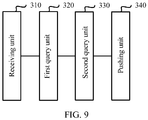
- FIG. 9 is a diagram illustrating modules of an information pushing apparatus, according to an implementation of the present application. The present implementation is described from the perspective of a server side.
- the apparatus includes a receiving unit 310, a first query unit 320, a second query unit 330, and a pushing unit 340.
- the receiving unit 310 is configured to receive an information acquisition request sent by a client, where the information acquisition request includes an identifier of a source display location and an identifier of a user that requests to obtain information.
- the first query unit 320 is configured to query a display location trajectory diagram that corresponds to the user identifier, where an order in which the user historically browses display locations is recorded in the display location trajectory diagram.
- the second query unit 330 is configured to query the display location trajectory diagram for a target display location adjacent to the source display location and after the source display location.
- the pushing unit 340 is configured to push information in the target display location to the client that corresponds to the user identifier.
- the display location trajectory diagram is constructed by using a first acquisition subunit and a first generation subunit below: the first acquisition subunit is configured to obtain display location data uploaded by each client and historically browsed by the user, where the display location data includes a user identifier, a display location identifier, and a timestamp; and the first generation subunit is configured to associate display locations that correspond to the display location identifiers in the display location data with the same user identifier in order of the timestamp, to generate the display location trajectory diagram that corresponds to the user identifier.
- the second query unit 330 includes the following: a display location query subunit, configured to query the display location trajectory diagram for the target display location associated with the source display location and after the source display location; a priority acquisition subunit, configured to obtain a priority of each target display location when there is more than one target display location; and a display location determining subunit, configured to determine a target display location with a highest priority as a final target display location.
- the priority of the target display location is obtained based on the number of user's browses.
- the apparatus in addition to the second query unit 330, the apparatus further includes the following: a third query unit, configured to query a user preference diagram that corresponds to the user identifier, where an information type of information in a display location historically tapped by the user is recorded in the user preference diagram; and a fourth query unit, configured to query the user preference diagram for an information type that corresponds to an identified target display location based on the target display location.
- a third query unit configured to query a user preference diagram that corresponds to the user identifier, where an information type of information in a display location historically tapped by the user is recorded in the user preference diagram
- a fourth query unit configured to query the user preference diagram for an information type that corresponds to an identified target display location based on the target display location.
- the pushing unit 340 includes the following: a pushing subunit, configured to push information of an identified information type to the target display location in the client that corresponds to the user identifier.
- the user preference diagram is constructed by using a second acquisition subunit and a second generation subunit below: the second acquisition subunit is configured to obtain information data uploaded by each client and historically tapped by the user, where the information data includes a user identifier, a display location identifier, and an information type; and a second generation subunit, configured to associate the display location identifier with the information type in the information data with the same user identifier, to generate the user preference diagram that corresponds to the user identifier.
- the second query unit includes the following: a query subunit, configured to randomly determine an information type as the information type that corresponds to the target display location when the identified target display location is not identified in the user preference diagram based on the target display location.
- the pushing unit 340 includes the following: an information type acquisition subunit, configured to obtain a priority of each information type when there is more than one information type that corresponds to the identified target display location; an information determining subunit, configured to determine information of an information type with a highest priority as information to be sent; and an information pushing subunit, configured to push the information to be sent to the target display location in the client that corresponds to the user identifier.
- the priority of the information type is determined based on the number of times of uploading the information type.
- the information includes an advertisement; the display location includes an advertisement display location; the information type includes an advertisement type; and the display location trajectory diagram includes an advertisement display location trajectory diagram.
Landscapes
- Engineering & Computer Science (AREA)
- Business, Economics & Management (AREA)
- Theoretical Computer Science (AREA)
- Accounting & Taxation (AREA)
- Development Economics (AREA)
- Finance (AREA)
- Strategic Management (AREA)
- Physics & Mathematics (AREA)
- General Physics & Mathematics (AREA)
- General Engineering & Computer Science (AREA)
- Computer Networks & Wireless Communication (AREA)
- Signal Processing (AREA)
- Entrepreneurship & Innovation (AREA)
- Marketing (AREA)
- Economics (AREA)
- Game Theory and Decision Science (AREA)
- General Business, Economics & Management (AREA)
- Human Computer Interaction (AREA)
- Quality & Reliability (AREA)
- Computer Hardware Design (AREA)
- Information Transfer Between Computers (AREA)
- User Interface Of Digital Computer (AREA)
- Control Of Indicators Other Than Cathode Ray Tubes (AREA)
- Digital Computer Display Output (AREA)
Abstract
Description
- The present application relates to the field of Internet technologies, and in particular, to an information pushing method and apparatus.
- With continuous development of the Internet, information dissemination becomes increasingly more convenient and rapid. Users can conveniently use a client to browse information.
- The client can be an application (APP) on software, for example, an electronic wallet APP, an instant messaging APP, or a news APP.
- Generally, information can be displayed in a display location in the client. Usually, an arrangement order of display locations on the client is fixed. Orders of display locations that are displayed in different clients are also the same. The difference lies only in that the numbers of display locations that can be simultaneously displayed are different because screen sizes of different clients are different. For example, a client shown in
FIG. 1 can simultaneously display three display locations, while another client with a relatively small screen can simultaneously display two display locations. However,display locations display location 1, information indisplay location 2, information indisplay location 3, etc. - Still as shown in
FIG. 1 , display locations that are displayed currently are 1, 2, and 3, and corresponding information is displayed. For a display location that is not displayed (for example,display locations 4 and 5), the client obtains information from a server only when the display location is displayed. Because it needs to take time to obtain information, this information acquisition method may cause stalling and affect user experience. - In the existing technology, a pre-acquisition method is usually used to alleviate the previous problem. When a user is browsing information in a current page, a client pre-obtains information in a next display location. Still as shown in
FIG. 1 , information indisplay locations next display location 4 that is not displayed. In this case, when browsingdisplay location 4, the user can directly use the pre-obtained information, to prevent stalling caused by a factor such as a communication delay from affecting user experience. However, when browsing information, the user does not necessarily sequentially browse the information in the display locations. Continuing to refer toFIG. 1 , assume that when the user flicks the display locations quickly on a screen or a flick amplitude is relatively large,display location 4 and display location 5 flash by, and information indisplay locations display locations display locations 4 and 5 because the information flashes by. Consequently, it becomes meaningless for the server to push the information indisplay locations 4 and 5, and system resources are wasted. - The present application provides an information pushing method and apparatus, to alleviate the problem of the resource waste in an existing system.
- An implementation of the present application provides an information pushing method, where the method includes the following: receiving an information acquisition request sent by a client, where the information acquisition request includes an identifier of a source display location and an identifier of a user that requests to obtain information; querying a display location trajectory diagram that corresponds to the user identifier, where an order in which the user historically browses display locations is recorded in the display location trajectory diagram; querying the display location trajectory diagram for a target display location adjacent to the source display location and after the source display location; and pushing information in the target display location to the client that corresponds to the user identifier.
- Optionally, the display location trajectory diagram is constructed by using the following method: obtaining display location data uploaded by each client and historically browsed by the user, where the display location data includes a user identifier, a display location identifier, and a timestamp; and associating display locations that correspond to the display location identifiers in the display location data with the same user identifier in order of the timestamp, to generate the display location trajectory diagram that corresponds to the user identifier.
- Optionally, the querying the display location trajectory diagram for a target display location adjacent to the source display location and after the source display location includes the following: querying the display location trajectory diagram for the target display location associated with the source display location and after the source display location; obtaining a priority of each target display location when there is more than one target display location; and determining a target display location with a highest priority as a final target display location.
- Optionally, the priority of the target display location is obtained based on the number of user's browses.
- Optionally, after the querying the display location trajectory diagram for a target display location adjacent to the source display location and after the source display location, the method further includes the following: querying a user preference diagram that corresponds to the user identifier, where an information type of information in a display location historically tapped by the user is recorded in the user preference diagram; and querying the user preference diagram for an information type that corresponds to an identified target display location based on the target display location; and the pushing information in the target display location to the client that corresponds to the user identifier includes the following: pushing information of an identified information type to the target display location in the client that corresponds to the user identifier.
- Optionally, the user preference diagram is constructed by using the following method: obtaining information data uploaded by each client and historically tapped by the user, where the information data includes a user identifier, a display location identifier, and an information type; and associating the display location identifier with the information type in the information data with the same user identifier, to generate the user preference diagram that corresponds to the user identifier.
- Optionally, the querying the user preference diagram for an information type that corresponds to an identified target display location based on the target display location includes the following: randomly determining an information type as the information type that corresponds to the target display location when the identified target display location is not identified in the user preference diagram based on the target display location.
- Optionally, the pushing information of an identified information type to the target display location in the client that corresponds to the user identifier includes the following: obtaining a priority of each information type when there is more than one information type that corresponds to the identified target display location; determining information of an information type with a highest priority as information to be sent; and pushing the information to be sent to the target display location in the client that corresponds to the user identifier.
- Optionally, the priority of the information type is determined based on the number of times of uploading the information type.
- Optionally, the information includes an advertisement; the display location includes an advertisement display location; the information type includes an advertisement type; and the display location trajectory diagram includes an advertisement display location trajectory diagram.
- An implementation of the present application provides an information pushing apparatus, where the apparatus includes the following: a receiving unit, configured to receive an information acquisition request sent by a client, where the information acquisition request includes an identifier of a source display location and an identifier of a user that requests to obtain information; a first query unit, configured to query a display location trajectory diagram that corresponds to the user identifier, where an order in which the user historically browses display locations is recorded in the display location trajectory diagram; a second query unit, configured to query the display location trajectory diagram for a target display location adjacent to the source display location and after the source display location; and a pushing unit, configured to push information in the target display location to the client that corresponds to the user identifier.
- Optionally, the display location trajectory diagram is constructed by using a first acquisition subunit and a first generation subunit below: the first acquisition subunit is configured to obtain display location data uploaded by each client and historically browsed by the user, where the display location data includes a user identifier, a display location identifier, and a timestamp; and the first generation subunit is configured to associate display locations that correspond to the display location identifiers in the display location data with the same user identifier in order of the timestamp, to generate the display location trajectory diagram that corresponds to the user identifier.
- Optionally, the second query unit includes the following: a display location query subunit, configured to query the display location trajectory diagram for the target display location associated with the source display location and after the source display location; a priority acquisition subunit, configured to obtain a priority of each target display location when there is more than one target display location; and a display location determining subunit, configured to determine a target display location with a highest priority as a final target display location.
- Optionally, the priority of the target display location is obtained based on the number of user's browses.
- Optionally, in addition to the second query unit, the apparatus further includes the following: a third query unit, configured to query a user preference diagram that corresponds to the user identifier, where an information type of information in a display location historically tapped by the user is recorded in the user preference diagram; and a fourth query unit, configured to query the user preference diagram for an information type that corresponds to an identified target display location based on the target display location.
- The pushing unit includes the following: a pushing subunit, configured to push information of an identified information type to the target display location in the client that corresponds to the user identifier.
- Optionally, the user preference diagram is constructed by using a second acquisition subunit and a second generation subunit below: the second acquisition subunit is configured to obtain information data uploaded by each client and historically tapped by the user, where the information data includes a user identifier, a display location identifier, and an information type; and a second generation subunit, configured to associate the display location identifier with the information type in the information data with the same user identifier, to generate the user preference diagram that corresponds to the user identifier.
- Optionally, the second query unit includes the following: a query subunit, configured to randomly determine an information type as the information type that corresponds to the target display location when the identified target display location is not identified in the user preference diagram based on the target display location.
- Optionally, the pushing unit includes the following: an information type acquisition subunit, configured to obtain a priority of each information type when there is more than one information type that corresponds to the identified target display location; an information determining subunit, configured to determine information of an information type with a highest priority as information to be sent; and an information pushing subunit, configured to push the information to be sent to the target display location in the client that corresponds to the user identifier.
- Optionally, the priority of the information type is determined based on the number of times of uploading the information type.
- Optionally, the information includes an advertisement; the display location includes an advertisement display location; the information type includes an advertisement type; and the display location trajectory diagram includes an advertisement display location trajectory diagram.
- In the implementations of the present application, the display location trajectory diagram of the user can be constructed in advance in the order in which the user historically browses display locations. When the user browses information displayed in a current display location, a server can predict, based on the display location trajectory diagram, a next display location that is most likely to be browsed by the user, namely, the target display location; and then push the information in the target display location. Therefore, the determined target display location is not necessarily a display location next to the current display location. As such, the server can be prevented from still pushing information in a display location that is flicked by the user quickly and flashes by, to reduce meaningless consumption of system resources.
-
-
FIG. 1 is a schematic diagram illustrating display locations displayed on a client, according to the present application; -
FIG. 2 is a flowchart illustrating an information pushing method, according to an implementation of the present application; -
FIG. 3 is another schematic diagram illustrating display locations displayed on a client, according to the present application; -
FIG. 4 illustrates a display location trajectory diagram, according to an implementation of the present application; -
FIG. 5 is a schematic diagram illustrating a plurality of target display locations, according to an implementation of the present application; -
FIG. 6 is a flowchart illustrating an information pushing method, according to an implementation of the present application; -
FIG. 7 illustrates a user preference diagram, according to an implementation of the present application; -
FIG. 8 is a structural diagram of hardware of a device where an information pushing apparatus is located, according to the present application; and -
FIG. 9 is a schematic diagram illustrating modules of an information pushing apparatus, according to an implementation of the present application. - Example implementations are described in detail here, and examples of the implementations are presented in the accompanying drawings. When the following description relates to the accompanying drawings, the same numbers in different accompanying drawings represent the same or similar elements unless specified otherwise. Implementations described in the following example implementations do not represent all implementations consistent with the present application. Instead, they are only examples of apparatuses and methods consistent with some aspects of the present application that are described in detail in the appended claims.
- The terms used in the present application are merely for illustrating specific implementations, and are not intended to limit the present application. The terms "a" and "the" of singular forms used in the present application and the appended claims are also intended to include plural forms, unless otherwise specified in the context clearly. It should be further understood that the term "and/or" used in the present specification indicates and includes any or all possible combinations of one or more associated listed items.
- It should be understood that although terms "first", "second", "third", etc. can be used in the present application to describe various types of information, the information is not limited to the terms. These terms are only used to differentiate information of a same type. For example, without departing from the scope of the present application, first information can also be referred to as second information, and similarly, the second information can be referred to as the first information. Depending on the context, for example, the word "if" used here can be explained as "while", "when", or "in response to determining".
-
FIG. 2 is a flowchart illustrating an information pushing method, according to an implementation of the present application. The present implementation is described from the perspective of a server side. The method can include the following steps. - Step 210: Receive an information acquisition request sent by a client, where the information acquisition request includes an identifier of a source display location and an identifier of a user that requests to obtain information.
- In the present implementation, the client can be an application on software, for example, an electronic wallet APP, an instant messaging APP, or a news APP. The display location mentioned in the present specification can be an area, in a client application interface, that is used to display information.
- Continue to refer to the schematic diagram illustrating display locations displayed on a client shown in
FIG. 1 . In the present example, the display locations are located in different areas and are clearly distinguished from each other. When browsing information on the client, the user can view different information by flicking up and down. Different information is displayed in different display locations. In a process that the user browses information, the client can actively initiate the information acquisition request to the server. If the user browsesdisplay location 3 at the bottom of the interface, the information acquisition request can be used to obtain information that needs to be displayed in a next display location ofdisplay location 3. As described above, the information acquisition request includes a source display location identifier ofdisplay location 3 and the identifier of the user that requests to obtain information. - For another example,
FIG. 3 is another schematic diagram of display locations displayed on a client. In the present example, the display locations are located in the same area. A user can control the client to display different information by flicking left and right. Similarly, in a process that the user browses information, the client can actively initiate the information acquisition request to the server.Area 106 has five different display locations (five small circles). Because the first display location is displayed currently, the information acquisition request sent by the client is used to obtain information that needs to be displayed in a next display location of the first display location. As described above, the information acquisition request includes a source display location identifier of the first display location and the identifier of the user that requests to obtain information. - The previous examples are only examples of a form of displaying the display locations. In an implementation, the display locations can also be displayed in other forms, for example, flicking up and down in the same area.
- The source display location identifier is an identifier that corresponds to the last display location currently displayed on the client. As shown in
FIG. 1 , the source display location identifier is an identifier that corresponds to displaylocation 3. In an implementation of actual applications, the source display location identifier can be a display location ID, for example,number - The user identifier can be a user ID, for example, a user account user_1 or user_2.
- Step 220: Query a display location trajectory diagram that corresponds to the user identifier.
- In the present implementation, an order in which the user historically browses display locations is recorded in the display location trajectory diagram.
- The display location trajectory diagram can be constructed by using the following method:
- A1: Obtain display location data uploaded by each client and historically browsed by the user, where the display location data includes a user identifier, a display location identifier, and a timestamp.
- A2: Obtain information data uploaded by the client and tapped by the user, where the information data includes a user identifier, a display location identifier, and an information type.
- A3: Associate display locations that correspond to the display location identifiers in the display location data with the same user identifier in order of the timestamp, to generate the display location trajectory diagram that corresponds to the user identifier.
- A log tracing point is preset in the client, and then a log collection module of the client regularly collects the display location data historically browsed by the user, and uploads all the display location data to the server.
- The "regularly" can be understood as a fixed time, for example, 8:00, 17:00, or 24: 00 each day, every Monday; or can be understood as predetermined duration, that is, the log collection module of the client can start a timer, and collect a parameter when the timer reaches the predetermined duration. Certainly, in some implementations, the log collection module can perform collection irregularly. For example, the data can be uploaded to the server based on a data volume when a volume of the collected display location data and/or information data reaches a predetermined data volume.
- In the present implementation, the log can be used to record a user's operation. The log tracing point is used to add some special functions to original functional logic of the log. Configuration can be performed in the log through a log collection interface, for example, the number of times that the user taps a button is counted.
- In the present implementation, the log tracing point is mainly used to collect statistics about the display location data historically browsed by the user.
- The display location data can include the user identifier, the display location identifier, and the timestamp.
- The following describes how the client determines whether the user browsed the display location.
-
FIG. 1 is used as an example. The client first displays information indisplay locations display location 4, information in display location 5, etc. as the user flicks the display locations up. However, if the user flicks the display locations quickly or a flick amplitude is relatively large when the user flicks the display locations up,display location 4 and display location 5 flash by, and information indisplay locations display locations 4 and 5 are not browsed by the user. In other words, whether the user browsed the display location can be determined based on whether duration of the display location staying on a screen reaches predetermined duration. - The predetermined duration can be an empirical value that is set manually. For example, the value can be 5 seconds. In this case, it can be considered that the user browses the display location if the duration of the display location staying on the screen of the client reaches 5 seconds. On the contrary, it can be considered that the user does not browse the display location if the duration does not reach 5 seconds. A subsequent browsed display location in the present specification can be understood as a display location whose duration reaches the predetermined duration.
- For example, if the user browses a display location, a system log records display location data, namely, a display location identifier, a user identifier, and a timestamp. The timestamp is a timestamp at which a moment of the display location is displayed when the user browses the display location. Assume that the user identifier is
user 1, the display location identifier is 4, and the timestamp is 1474873552 (namely, 15:5:52 9/26/2016). The log collection module can upload the collected display location data (user_1, 4, 1474873552) to the server. - After obtaining the display location data uploaded by each client and historically browsed by the user, the server can associate the display locations that correspond to the display location identifiers in the display location data with the same user identifier in order of the timestamp.
- In the present implementation, a sequence relationship between different display locations can be determined by using an order of timestamps, to further determine a source display location and a target display location. The source display location and the target display location are relative concepts. The former display location is a source display location relative to the latter display location, and the latter display location is a target display location relative to the former display location. A display location is a target display location relative to a source display location of the display location, but is a source display location relative to a target display location of the display location.
- Display locations are connected to form a chain by using timestamps, and a loop can be formed if there are the same display locations.
- As described in Example 1 above, assume that the client records the following six sets of display location data: first display location data {user_1, 1, 1474873552}, where user_1 is a user identifier, 1 is a display location identifier, and 1474873552 is a timestamp, which have the same meaning as the following; second display location data {user_1, 2, 1474873553}; third display location data {user_1, 3, 1474873554}; fourth display location data {user_1, 6, 1474873570}; fifth display location data {user_1, 7, 1474873571}; and sixth display location data {user_1, 8, 1474873572}.
- After obtaining the display location data uploaded by the client, the server can determine the six sets of display location data as a browsing history of the same user because the six sets of display location data have the same user identifier user_1.
- Afterwards, an order of each display location can be determined based on the timestamps. The six sets of display location data are sequentially: 1474873552 (15:5:52 9/26/2016), 1474873553 (15:5:53 9/26/2016), 1474873554 (15:5:54 9/26/2016), 1474873570 (15:6:10 9/26/2016), 1474873571 (15:6:11 9/26/2016), and 1474873572 (15:6:12 9/26/2016). In a schematic diagram of display locations shown in
FIG. 4 ,display location 1 is associated withdisplay location 2, anddisplay location 1 points to displaylocation 2. In this case, it can indicate that the user browsesdisplay location 1 and then browsesdisplay location 2. -
Display location 2 is associated withdisplay location 3, anddisplay location 2 points to displaylocation 3. In this case, it can indicate that the user browsesdisplay location 2 and then browsesdisplay location 3. -
Display location 3 is associated withdisplay location 6, anddisplay location 3 points to displaylocation 6. In this case, it can indicate that a browsing trajectory is that the user browsesdisplay location 3 and then browsesdisplay location 6. -
Display location 6 is associated withdisplay location 7, anddisplay location 6 points to displaylocation 7. In this case, it can indicate that a browsing trajectory is that the user browsesdisplay location 6 and then browsesdisplay location 7. -
Display location 7 is associated withdisplay location 8, anddisplay location 7 points to displaylocation 8. In this case, it can indicate that a browsing trajectory is that the user browsesdisplay location 7 and then browsesdisplay location 8. - It can be seen from the display location trajectory diagram shown in
FIG. 4 that the user first browsesdisplay locations display locations 4 and 5, and directly browsesdisplay locations - In practice, display location data uploaded by different clients usually corresponds to different users, and the server generates a corresponding display location trajectory diagram for each user identifier.
- There are usually display location trajectory diagrams of different users on the server. Therefore, after receiving the information acquisition request sent by the client, the server can query the display location trajectory diagram that corresponds to the user identifier based on the user identifier included in the information acquisition request.
- In practice, after generating the display location trajectory diagram, the server can associate the display location trajectory diagram with the user identifier, and store the display location trajectory diagram in a graph database.
- Therefore, when querying for the display location trajectory diagram that corresponds to the user identifier, the server can query the graph database for the display location trajectory diagram that corresponds to the user identifier.
- Step 230: Query the display location trajectory diagram for a target display location adjacent to the source display location and after the source display location.
- In the present implementation, as described above, the target display location is adjacent to the source display location, and the source display location points to the target display location, that is, the target display location is after the source display location.
- In the present implementation, after identifying the display location trajectory diagram that corresponds to the user identifier, the server can further query the display location trajectory diagram for the target display location adjacent to the source display location and after the source display location.
- Based on Example 1, with reference to the schematic diagram of the client shown in
FIG. 1 , the user browses information again, anddisplay locations display location identifier 3. In this case, the server can identify the corresponding display location trajectory diagram based on theuser identifier user 1, as shown inFIG. 4 . Because the source display location identifier is 3, the server queries that a target display location adjacent to sourcedisplay location 3 and aftersource display location 3 is 6. - It can be seen from the example in the present step that, in the present implementation, the target display location that is most likely to be browsed after the user browses a current display location can be determined based on the display location trajectory diagram of the user and in the order in which the user historically browses the display locations. In other words, in the present implementation, when the user browses the current display location, information in a next display location is not necessarily sequentially obtained. When the source display location displayed currently on the client in the example of the present step is
display location 3, the client can obtain information indisplay location 6 instead of obtaining information indisplay location 4 in a fixed order of display locations in the existing technology. - Step 240: Push information in the target display location to the client that corresponds to the user identifier.
- In the present implementation, after determining the target display location, the server can push the information in the target display location to the client that corresponds to the user identifier.
- Correspondingly, on the client side, after receiving the information in the target display location that is pushed by the server, the client can display the information in the target display location. Because information pushing is preprocessed, when the server returns the information, the target display location may not have been browsed on the client. In this case, the client can first cache the returned information, and directly use the cached information when the user browses the target display location.
- According to the present implementation of the present application, the display location trajectory diagram of the user can be constructed in advance in the order in which the user historically browses display locations. When the user browses information displayed in a current display location, the server can predict, based on the display location trajectory diagram, the next display location that is most likely to be browsed by the user, namely, the target display location; and then push the information in the target display location. Therefore, the determined target display location is not necessarily a display location next to the current display location. As such, the server can be prevented from still pushing information in a display location that is flicked by the user quickly and flashes by, to reduce meaningless consumption of system resources.
- In practice, there may be more than one target display location for the source display location. In a display location trajectory diagram shown in
FIG. 5 , target display locations ofdisplay location 3 are 4 and 10. In this case, the server can determine bothdisplay locations - To alleviate the problem, in an implementation of the present application, the querying the display location trajectory diagram for a target display location adjacent to the source display location and after the source display location in
step 230 can include the following steps: querying the display location trajectory diagram for a target display location adjacent to the source display location and after the source display location; and obtaining a priority of each target display location when there is more than one target display location; and determining a target display location with a highest priority as a final target display location. - In the present implementation, different target display locations have different priorities. Still as shown in
FIG. 5 , there are two target display locations ofdisplay location 3, namely,display location 4 anddisplay location 10. If a priority ofdisplay location 10 is higher than a priority ofdisplay location 4, it can be determined thatdisplay location 10 is the target display location. - Generally, the priority of the display location can be determined based on the number of user's browses. For example, a larger number of browses indicates a higher priority. On the contrary, a smaller number of browses indicates a lower priority. For example, for
target display locations display location 3, because the number of user's browses indisplay location 10 is 10, and the number of user's browses indisplay location 4 is 5, the priority ofdisplay location 10 is high, and the priority ofdisplay location 4 is low. - In the implementations described above, when information in the target display location is pushed, information of a particular type is usually pushed based on a group that the user belongs to. For example, information such as books, training, and postgraduate entrance examination is pushed for students, and information such as travel, shopping, and recruitment is pushed for white-collar workers. However, pushing information of this type is mainly set by an operator depending on experience, and pushed information usually cannot accurately match an interest of the user. Consequently, meaningless pushing is caused, and accordingly user experience degrades.
- To alleviate the problem, in another implementation of the present application, as shown in
FIG. 6 , afterstep 230, the method can further include the following steps. - Step 231: Query a user preference diagram that corresponds to the user identifier.
- In the present implementation, an information type of information in a display location historically tapped by the user is recorded in the user preference diagram.
- The user preference diagram can be constructed by using the following method:
- B1: Obtain information data uploaded by each client and historically tapped by the user, where the information data includes a user identifier, a display location identifier, and an information type.
- B2: Associate the display location identifier with the information type in the information data with the same user identifier, to generate the user preference diagram that corresponds to the user identifier.
- The log tracing point described above can be further used to collect statistics about the information data historically tapped by the user.
- The information data can include the user identifier, the display location identifier, and the information type.
- For example, when the user is interested in information in a display location, the user usually taps the display location to view specific content. In this case, the system log records information data, namely, a display location identifier of the display location where the information is located, a user identifier, and an information type of the information. Assume that the user identifier is user_1, the display location identifier is 4, and the information type is football. The log collection module can upload the collected information data (
user - After obtaining the information data uploaded by each client and historically tapped by the user, the server can associate the display location identifier with the information type in the information data with the same user identifier.
- The content described in Example 1 is still used. Assume that the user taps
display locations - After obtaining the information data uploaded by the client, the server can determine the four sets of information data as a tapping history of the same user because the four sets of information data have the same user identifier user_1.
- Then the display location identifier is associated with the information type in each piece of information data.
- 1 (display location identifier) is associated with car (information type), for example, 1-car.
- 3 (display location identifier) is associated with games (information type).
- 6 (display location identifier) is associated with sports (information type).
- 8 (display location identifier) is associated with music (information type). Therefore, a user preference diagram that corresponds to the user identifier user_1 shown in
FIG. 7 is generated. - According to the user preference diagram shown in
FIG. 7 , when the user browses next time, information displayed indisplay location 1 is still information of a car type, information displayed indisplay location 3 is still information of a games type, information displayed indisplay location 6 is still information of a sports type, and information displayed indisplay location 8 is still information of a music type. Because there is no information type indisplay locations display locations - In practice, information data uploaded by different clients usually corresponds to different users, and the server generates a corresponding user preference diagram for each user identifier.
- There are usually user preference diagrams of different users on the server. Therefore, after receiving the information acquisition request sent by the client, the server can query the user preference diagram that corresponds to the user identifier based on the user identifier included in the information acquisition request.
- In practice, after generating the user preference diagram, the server can associate the user preference diagram with the user identifier, and store the user preference diagram in the graph database.
- Therefore, when querying for the user preference diagram that corresponds to the user identifier, the server can query the graph database for the user preference diagram that corresponds to the user identifier.
- Step 232: Query the user preference diagram for an information type that corresponds to an identified target display location based on the target display location.
- After performing
step 230, the server can identify the target display location, and can further query the user preference diagram for the information type that corresponds to the target display location. - In the user preference diagram shown in
FIG. 7 , if the target display location is 6, it can be identified that an information type that corresponds to targetdisplay location 6 is sports. - Correspondingly, step 240 can include the following: pushing information of an identified information type to the target display location in the client that corresponds to the user identifier.
- Generally, the information can be information of the information type obtained by the server from a predetermined information base based on the identified information type that corresponds to the target display location.
- In some implementations, different information of the same information type can have different priorities. Therefore, when obtaining information, information with a higher priority can be obtained preferentially in order of priorities. Therefore, the server can push the information of the identified information type to the target display location in the client that corresponds to the user identifier.
- Correspondingly, on the client side, when receiving the information in the target display location pushed by the server, the client can display the information in the target display location. Because information pushing is preprocessed, when the server returns the information, the target display location may not have been browsed on the client. In this case, the client can first cache the returned information, and directly use the cached information when the user browses the target display location.
- According to the present implementation, the display location trajectory diagram of the user can be constructed in advance in the order in which the user historically browses display locations, and the user preference diagram of the user can be constructed based on the information type of the information in the display location historically tapped by the user. When the user browses information displayed in the current display location, the server can predict, based on the display location trajectory diagram, a next display location that is most likely to be browsed by the user, and can further push information of interest to the user in advance based on the user preference diagram, to improve the probability that the user taps the information, improve user experience, and reduce meaningless consumption of system resources. The client can pre-obtain the next display location that is most likely to be browsed by the user and that is pushed by the server and the information of interest to the user that is to be displayed, and display the information immediately when the user actually browses the next display location.
- As described above, only the information type of the information in the display location historically tapped by the user is recorded in the user preference diagram. In practice, if the identified target display location is not historically tapped by the user, the information type of the target display location does not exist in the user preference diagram. Accordingly, the target display location and the information type that corresponds to the target display location are not identified in the user preference diagram.
- For the problem, in still another implementation of the present application, the querying the user preference diagram for an information type that corresponds to an identified target display location based on the target display location in
step 232 includes the following: randomly determining an information type as the information type that corresponds to the target display location when the identified target display location is not identified in the user preference diagram based on the target display location. - According to the present implementation, an information type that corresponds to a target display location can be determined even if the target display location is not identified in the user preference diagram, to continue to perform subsequent steps.
- It is worthwhile to note that, when both the display location trajectory diagram and the user preference diagram are applied, the priority of the display location can be alternatively obtained by using the following method: obtaining an information type recorded in the target display location; matching the information type recorded in the target display location with an information type recorded in the source display location; obtaining a priority of a successfully matched information type in the source display location; and determining the priority in the display location as a priority of the successfully matched target display location.
- In the present implementation, assume that in the user preference diagram, information types in
source display location 3 include football, basketball, and table tennis, information types intarget display location 10 include table tennis and swimming, and information types intarget display location 4 include basketball and mountain climbing. It can be learned through matching that an information type intarget display location 10 that successfully matches an information type insource display location 3 is table tennis, and an information type intarget display location 4 that successfully matches an information type insource display location 3 is basketball. Insource display location 3, assume that a priority of table tennis is high, and a priority of basketball is low. Therefore, a priority oftarget display location 10 can be set to be high, and a priority oftarget display location 4 can be set to be low. - According to the present implementation, when there is more than one target display location, the priority of the display location is used, so that the target display location with the higher priority can be determined as the final target display location. As such, a case that a plurality of pieces of information need to be pushed due to a plurality of target display locations can be alleviated, to reduce meaningless consumption of system resources.
- In practice, there may be more than one information type recorded in the display location. For example, information types recorded in the same display location include science and technology, games, and education. Because only one type of information can be displayed in one display location, the problem of how to select a type of information of most interest to the user from a plurality of information types needs to be alleviated.
- To alleviate the problem, in an implementation of the present application,
step 240 can include the following steps: obtaining a priority of each information type when there is more than one information type recorded in the identified target display location; and pushing information of an information type with a highest priority to the client that corresponds to the user identifier. - In the present implementation, the priority of the information type can be determined based on the number of times of uploading the information type. In other words, a larger number of uploading times indicates a higher priority. On the contrary, a smaller number of uploading times indicates a lower priority. For example, in the same display location, the number of times of tapping information of a science and technology type is 5, the number of times that the user taps information of a game type is 10, and the number of times that the user taps information of an education type is 8. In this case, games have the highest priority, education has the second highest priority, and science and technology have the lowest priority.
- According to the present implementation, when more than one information type is recorded in the target display location, the server can use the priority of the information type to push the information of the information type with the highest priority to the client. As such, not only the selection problem can be alleviated, but also the selected information type is a type of information of most interest to the user, to improve the tapping probability of the user and improve user experience.
- In an implementation of the present application, the information includes an advertisement; the display location includes an advertisement display location; the information type includes an advertisement type; and the display location trajectory diagram includes an advertisement display location trajectory diagram.
- The present implementation can be applied to an advertisement serving scenario, and the advertisement display location trajectory diagram of the user can be constructed in advance in an order in which the user historically browses advertisement display locations. When the user browses an advertisement displayed in a current advertisement display location, the server can predict, based on the advertisement display location trajectory diagram, a next advertisement display location that is most likely to be browsed by the user; and then push information in the predicted advertisement display location. In addition, a user preference diagram can be constructed in advance based on a type of an advertisement in an advertisement display location historically tapped by the user, and an advertisement of interest to the user that corresponds to the predicted advertisement display location can be pushed, to improve the probability that the user taps the advertisement, improve user experience, and reduce meaningless consumption of system resources. The client can pre-obtain the next advertisement display location that is most likely to be browsed by the user and that is pushed by the server and the advertisement of interest to the user that is to be displayed, and display the advertisement immediately when the user actually browses the next advertisement display location.
- The present application further provides an information pushing apparatus implementation that corresponds to the previous information pushing method implementation.
- Implementations of the information pushing apparatus in the present application can be separately applied to an information pushing device. The apparatus implementation can be implemented by software, hardware, or a combination of hardware and software. Software implementation is used as an example. As a logical apparatus, the apparatus is formed by reading a corresponding computer program instruction in a nonvolatile memory to a memory by a processor of a device where the apparatus is located. In terms of hardware,
FIG. 8 is a structural diagram illustrating hardware of the device where the information pushing apparatus in the present application is located. In addition to a processor, a network interface, a memory, and a nonvolatile memory shown inFIG. 8 , the device where the apparatus is located in the present implementation usually can further include other hardware based on an actual function of the information pushing apparatus. Details are omitted here for simplicity. -
FIG. 9 is a diagram illustrating modules of an information pushing apparatus, according to an implementation of the present application. The present implementation is described from the perspective of a server side. The apparatus includes a receivingunit 310, afirst query unit 320, asecond query unit 330, and a pushingunit 340. - The receiving
unit 310 is configured to receive an information acquisition request sent by a client, where the information acquisition request includes an identifier of a source display location and an identifier of a user that requests to obtain information. - The
first query unit 320 is configured to query a display location trajectory diagram that corresponds to the user identifier, where an order in which the user historically browses display locations is recorded in the display location trajectory diagram. - The
second query unit 330 is configured to query the display location trajectory diagram for a target display location adjacent to the source display location and after the source display location. - The pushing
unit 340 is configured to push information in the target display location to the client that corresponds to the user identifier. - In an optional implementation, the display location trajectory diagram is constructed by using a first acquisition subunit and a first generation subunit below: the first acquisition subunit is configured to obtain display location data uploaded by each client and historically browsed by the user, where the display location data includes a user identifier, a display location identifier, and a timestamp; and the first generation subunit is configured to associate display locations that correspond to the display location identifiers in the display location data with the same user identifier in order of the timestamp, to generate the display location trajectory diagram that corresponds to the user identifier.
- In an optional implementation, the
second query unit 330 includes the following: a display location query subunit, configured to query the display location trajectory diagram for the target display location associated with the source display location and after the source display location; a priority acquisition subunit, configured to obtain a priority of each target display location when there is more than one target display location; and a display location determining subunit, configured to determine a target display location with a highest priority as a final target display location. - In an optional implementation, the priority of the target display location is obtained based on the number of user's browses.
- In an optional implementation, in addition to the
second query unit 330, the apparatus further includes the following: a third query unit, configured to query a user preference diagram that corresponds to the user identifier, where an information type of information in a display location historically tapped by the user is recorded in the user preference diagram; and a fourth query unit, configured to query the user preference diagram for an information type that corresponds to an identified target display location based on the target display location. - The pushing
unit 340 includes the following: a pushing subunit, configured to push information of an identified information type to the target display location in the client that corresponds to the user identifier. - In an optional implementation, the user preference diagram is constructed by using a second acquisition subunit and a second generation subunit below: the second acquisition subunit is configured to obtain information data uploaded by each client and historically tapped by the user, where the information data includes a user identifier, a display location identifier, and an information type; and a second generation subunit, configured to associate the display location identifier with the information type in the information data with the same user identifier, to generate the user preference diagram that corresponds to the user identifier.
- In an optional implementation, the second query unit includes the following: a query subunit, configured to randomly determine an information type as the information type that corresponds to the target display location when the identified target display location is not identified in the user preference diagram based on the target display location.
- In an optional implementation, the pushing
unit 340 includes the following: an information type acquisition subunit, configured to obtain a priority of each information type when there is more than one information type that corresponds to the identified target display location; an information determining subunit, configured to determine information of an information type with a highest priority as information to be sent; and an information pushing subunit, configured to push the information to be sent to the target display location in the client that corresponds to the user identifier. - In an optional implementation, the priority of the information type is determined based on the number of times of uploading the information type.
- In an optional implementation, the information includes an advertisement; the display location includes an advertisement display location; the information type includes an advertisement type; and the display location trajectory diagram includes an advertisement display location trajectory diagram.
- For an implementation process of functions and roles of each unit in the apparatus, references can be made to an implementation process of corresponding steps in the previous method. Details are omitted here for simplicity.
- Because an apparatus implementation basically corresponds to a method implementation, for related parts, references can be made to related descriptions in the method implementation. The previously described apparatus implementation is merely an example. The units described as separate parts may or may not be physically separate, and parts displayed as units may or may not be physical units, may be located in one position, or may be distributed on a plurality of network units. Some or all of the modules can be selected based on actual needs to achieve the objectives of the solutions in the present application. A person of ordinary skill in the art can understand and implement the implementations of the present application without creative efforts.
- A person skilled in the art can easily figure out another implementation solution of the present application after considering the present specification and practicing the disclosed invention here. The present application is intended to cover any variations, functions, or adaptive changes of the present application. These variations, functions, or adaptive changes comply with general principles of the present application, and include common knowledge or a commonly used technical means in the technical field that is not disclosed in the present application. The present specification and the implementations are considered as examples only. The actual scope and the spirit of the present application are pointed out by the following claims.
- It should be understood that the present application is not limited to the accurate structures described above and shown in the accompanying drawings, and modifications and changes may be made without departing from the scope of the present application. The scope of the present application is limited only by the appended claims.
Claims (20)
- An information pushing method, wherein the method comprises:receiving an information acquisition request sent by a client, wherein the information acquisition request comprises an identifier of a source display location and an identifier of a user that requests to obtain information;querying a display location trajectory diagram that corresponds to the user identifier, wherein an order in which the user historically browses display locations is recorded in the display location trajectory diagram;querying the display location trajectory diagram for a target display location adjacent to the source display location and after the source display location; andpushing information in the target display location to the client that corresponds to the user identifier.
- The method according to claim 1, wherein the display location trajectory diagram is constructed by using the following method:obtaining display location data uploaded by each client and historically browsed by the user, wherein the display location data comprises a user identifier, a display location identifier, and a timestamp; andassociating display locations that correspond to the display location identifiers in the display location data with the same user identifier in order of the timestamp, to generate the display location trajectory diagram that corresponds to the user identifier.
- The method according to claim 1, wherein the querying the display location trajectory diagram for a target display location adjacent to the source display location and after the source display location comprises:querying the display location trajectory diagram for the target display location associated with the source display location and after the source display location;obtaining a priority of each target display location when there is more than one target display location; anddetermining a target display location with a highest priority as a final target display location.
- The method according to claim 3, wherein the priority of the target display location is obtained based on the number of user's browses.
- The method according to claim 1, wherein after the querying the display location trajectory diagram for a target display location adjacent to the source display location and after the source display location, the method further comprises:querying a user preference diagram that corresponds to the user identifier, wherein an information type of information in a display location historically tapped by the user is recorded in the user preference diagram; andquerying the user preference diagram for an information type that corresponds to an identified target display location based on the target display location; andthe pushing information in the target display location to the client that corresponds to the user identifier comprises:
pushing information of an identified information type to the target display location in the client that corresponds to the user identifier. - The method according to claim 5, wherein the user preference diagram is constructed by using the following method:obtaining information data uploaded by each client and historically tapped by the user, wherein the information data comprises a user identifier, a display location identifier, and an information type; andassociating the display location identifier with the information type in the information data with the same user identifier, to generate the user preference diagram that corresponds to the user identifier.
- The method according to claim 5, wherein the querying the user preference diagram for an information type that corresponds to an identified target display location based on the target display location comprises:
randomly determining an information type as the information type that corresponds to the target display location when the identified target display location is not identified in the user preference diagram based on the target display location. - The method according to claim 5, wherein the pushing information of an identified information type to the target display location in the client that corresponds to the user identifier comprises:obtaining a priority of each information type when there is more than one information type that corresponds to the identified target display location;determining information of an information type with a highest priority as information to be sent; andpushing the information to be sent to the target display location in the client that corresponds to the user identifier.
- The method according to claim 8, wherein the priority of the information type is determined based on the number of times of uploading the information type.
- The method according to any one of claims 1 to 9, wherein the information comprises an advertisement;
the display location comprises an advertisement display location;
the information type comprises an advertisement type; and
the display location trajectory diagram comprises an advertisement display location trajectory diagram. - An information pushing apparatus, wherein the apparatus comprises:a receiving unit, configured to receive an information acquisition request sent by a client, wherein the information acquisition request comprises an identifier of a source display location and an identifier of a user that requests to obtain information;a first query unit, configured to query a display location trajectory diagram that corresponds to the user identifier, wherein an order in which the user historically browses display locations is recorded in the display location trajectory diagram;a second query unit, configured to query the display location trajectory diagram for a target display location adjacent to the source display location and after the source display location; anda pushing unit, configured to push information in the target display location to the client that corresponds to the user identifier.
- The apparatus according to claim 11, wherein the display location trajectory diagram is constructed by using a first acquisition subunit and a first generation subunit below:the first acquisition subunit is configured to obtain display location data uploaded by each client and historically browsed by the user, wherein the display location data comprises a user identifier, a display location identifier, and a timestamp; andthe first generation subunit is configured to associate display locations that correspond to the display location identifiers in the display location data with the same user identifier in order of the timestamp, to generate the display location trajectory diagram that corresponds to the user identifier.
- The apparatus according to claim 11, wherein the second query unit comprises:a display location query subunit, configured to query the display location trajectory diagram for the target display location associated with the source display location and after the source display location;a priority acquisition subunit, configured to obtain a priority of each target display location when there is more than one target display location; anda display location determining subunit, configured to determine a target display location with a highest priority as a final target display location.
- The apparatus according to claim 13, wherein the priority of the target display location is obtained based on the number of user's browses.
- The apparatus according to claim 11, wherein in addition to the second query unit, the apparatus further comprises:a third query unit, configured to query a user preference diagram that corresponds to the user identifier, wherein an information type of information in a display location historically tapped by the user is recorded in the user preference diagram; anda fourth query unit, configured to query the user preference diagram for an information type that corresponds to an identified target display location based on the target display location; andthe pushing unit comprises:
a pushing subunit, configured to push information of an identified information type to the target display location in the client that corresponds to the user identifier. - The apparatus according to claim 15, wherein the user preference diagram is constructed by using a second acquisition subunit and a second generation subunit below:the second acquisition subunit is configured to obtain information data uploaded by each client and historically tapped by the user, wherein the information data comprises a user identifier, a display location identifier, and an information type; anda second generation subunit, configured to associate the display location identifier with the information type in the information data with the same user identifier, to generate the user preference diagram that corresponds to the user identifier.
- The apparatus according to claim 15, wherein the second query unit comprises:
a query subunit, configured to randomly determine an information type as the information type that corresponds to the target display location when the identified target display location is not identified in the user preference diagram based on the target display location. - The apparatus according to claim 15, wherein the pushing unit comprises:an information type acquisition subunit, configured to obtain a priority of each information type when there is more than one information type that corresponds to the identified target display location;an information determining subunit, configured to determine information of an information type with a highest priority as information to be sent; andan information pushing subunit, configured to push the information to be sent to the target display location in the client that corresponds to the user identifier.
- The apparatus according to claim 18, wherein the priority of the information type is determined based on the number of times of uploading the information type.
- The apparatus according to any one of claims 11 to 19, wherein the information comprises an advertisement;
the display location comprises an advertisement display location;
the information type comprises an advertisement type; and
the display location trajectory diagram comprises an advertisement display location trajectory diagram.
Applications Claiming Priority (2)
| Application Number | Priority Date | Filing Date | Title |
|---|---|---|---|
| CN201610978785.9A CN106878372B (en) | 2016-11-07 | 2016-11-07 | Information pushing method and device |
| PCT/CN2017/107497 WO2018082478A1 (en) | 2016-11-07 | 2017-10-24 | Method and device for pushing information |
Publications (3)
| Publication Number | Publication Date |
|---|---|
| EP3525418A1 true EP3525418A1 (en) | 2019-08-14 |
| EP3525418A4 EP3525418A4 (en) | 2019-10-16 |
| EP3525418B1 EP3525418B1 (en) | 2021-07-14 |
Family
ID=59238950
Family Applications (1)
| Application Number | Title | Priority Date | Filing Date |
|---|---|---|---|
| EP17868227.4A Active EP3525418B1 (en) | 2016-11-07 | 2017-10-24 | Method and device for pushing information |
Country Status (10)
| Country | Link |
|---|---|
| US (1) | US11182065B2 (en) |
| EP (1) | EP3525418B1 (en) |
| JP (1) | JP6859514B2 (en) |
| KR (1) | KR102236501B1 (en) |
| CN (1) | CN106878372B (en) |
| MY (1) | MY186951A (en) |
| PH (1) | PH12019501011A1 (en) |
| SG (1) | SG10202100354QA (en) |
| TW (1) | TW201818241A (en) |
| WO (1) | WO2018082478A1 (en) |
Cited By (1)
| Publication number | Priority date | Publication date | Assignee | Title |
|---|---|---|---|---|
| EP4060592A4 (en) * | 2019-12-12 | 2023-01-11 | Petal Cloud Technology Co., Ltd. | CONTENT ACQUISITION METHOD AND SYSTEM, USER TERMINAL AND CONTENT SERVER |
Families Citing this family (10)
| Publication number | Priority date | Publication date | Assignee | Title |
|---|---|---|---|---|
| CN107547750B (en) * | 2017-09-11 | 2019-01-25 | Oppo广东移动通信有限公司 | Terminal control method, device and storage medium |
| CN109754298B (en) * | 2017-11-07 | 2022-04-19 | 阿里巴巴集团控股有限公司 | Interface information providing method and device and electronic equipment |
| CN108108054B (en) * | 2017-12-29 | 2021-07-23 | 努比亚技术有限公司 | Method, apparatus and computer-readable storage medium for predicting user sliding operation |
| CN109886821A (en) * | 2019-02-20 | 2019-06-14 | 阿里巴巴集团控股有限公司 | Case method for pushing and device calculate equipment and computer readable storage medium |
| CN110769119B (en) * | 2019-09-29 | 2021-07-02 | 北京淇瑀信息科技有限公司 | Application pop-up window display method, device and electronic device |
| CN111553673B (en) * | 2020-05-07 | 2021-09-24 | 支付宝(杭州)信息技术有限公司 | A kind of information display method and device based on graphic code recognition |
| CN111586180B (en) * | 2020-05-10 | 2024-11-19 | 韩端科技(深圳)有限公司 | An artificial intelligence information feedback system |
| CN112213755A (en) * | 2020-09-28 | 2021-01-12 | 平安普惠企业管理有限公司 | GPS information processing method, device, computer equipment and storage medium |
| CN113630612B (en) * | 2021-07-30 | 2023-09-05 | 北京达佳互联信息技术有限公司 | Data processing and data displaying method and device, electronic equipment and medium |
| CN113641912B (en) * | 2021-08-20 | 2024-02-09 | 北京得间科技有限公司 | Information pushing method, computing device and computer storage medium |
Family Cites Families (35)
| Publication number | Priority date | Publication date | Assignee | Title |
|---|---|---|---|---|
| US5717860A (en) * | 1995-09-20 | 1998-02-10 | Infonautics Corporation | Method and apparatus for tracking the navigation path of a user on the world wide web |
| US5999912A (en) * | 1996-05-01 | 1999-12-07 | Wodarz; Dennis | Dynamic advertising scheduling, display, and tracking |
| US6907566B1 (en) * | 1999-04-02 | 2005-06-14 | Overture Services, Inc. | Method and system for optimum placement of advertisements on a webpage |
| US20030126013A1 (en) * | 2001-12-28 | 2003-07-03 | Shand Mark Alexander | Viewer-targeted display system and method |
| US8516114B2 (en) * | 2002-03-29 | 2013-08-20 | International Business Machines Corporation | Method and apparatus for content pre-fetching and preparation |
| JP4963129B2 (en) * | 2006-09-11 | 2012-06-27 | インターナショナル・ビジネス・マシーンズ・コーポレーション | How to recommend shortcuts to facilitate and secure navigation within a navigation topology |
| JP4334559B2 (en) | 2006-10-13 | 2009-09-30 | 株式会社東芝 | Scroll position prediction device |
| US20080133314A1 (en) * | 2006-12-04 | 2008-06-05 | Yahoo! Inc. | Determining advertisement placement on search results page to improve revenue generation |
| US20090249229A1 (en) * | 2008-03-27 | 2009-10-01 | Or Offer | System and method for display of relevant web page images |
| US8271328B1 (en) * | 2008-12-17 | 2012-09-18 | Google Inc. | User-based advertisement positioning using markov models |
| KR101190265B1 (en) * | 2009-06-30 | 2012-10-12 | 고려대학교 산학협력단 | Head mouted operating magnifying apparatus |
| ES2533435T3 (en) * | 2010-06-28 | 2015-04-10 | Rakuten, Inc. | Information presentation system, information presentation apparatus, information presentation procedure, information presentation program, information provision apparatus and recording medium |
| US8732569B2 (en) * | 2011-05-04 | 2014-05-20 | Google Inc. | Predicting user navigation events |
| US9300545B2 (en) * | 2011-10-11 | 2016-03-29 | Google Inc. | Page layout in a flow visualization |
| CN102446222B (en) | 2011-12-22 | 2014-12-10 | 华为技术有限公司 | Method, device and system of webpage content preloading |
| US20130212487A1 (en) * | 2012-01-09 | 2013-08-15 | Visa International Service Association | Dynamic Page Content and Layouts Apparatuses, Methods and Systems |
| CN103853729B (en) * | 2012-11-29 | 2019-03-26 | 腾讯科技(深圳)有限公司 | Page loading method and its system |
| US9443036B2 (en) * | 2013-01-22 | 2016-09-13 | Yp Llc | Geo-aware spellchecking and auto-suggest search engines |
| US20140372205A1 (en) * | 2013-06-12 | 2014-12-18 | Google Inc. | Systems and methods for selecting and serving content items based on view probability |
| US20140379835A1 (en) * | 2013-06-21 | 2014-12-25 | Jeffrey R. Foerster | Predictive pre-caching of content |
| CN103440276A (en) | 2013-08-08 | 2013-12-11 | 星云融创(北京)信息技术有限公司 | Method and device for improving webpage display speed |
| US20150201001A1 (en) * | 2014-01-13 | 2015-07-16 | Facebook, Inc. | Systems and methods for priority-based digital content downloading |
| CN104883585B (en) * | 2014-02-28 | 2019-06-14 | 腾讯科技(北京)有限公司 | Show method, equipment and the system of media data |
| US9971846B1 (en) * | 2014-05-02 | 2018-05-15 | Tribune Publishing Company, Llc | Online information system with continuous scrolling and user-controlled content |
| CN104182515B (en) * | 2014-08-21 | 2018-10-12 | 北京金山安全软件有限公司 | Information recommendation method and device and mobile terminal |
| CN104572942A (en) * | 2014-12-30 | 2015-04-29 | 小米科技有限责任公司 | Push message display method and push message display device |
| CN106020784B (en) * | 2015-03-18 | 2020-09-08 | 小米科技有限责任公司 | Application message display method and device and terminal |
| TWI629652B (en) | 2015-04-30 | 2018-07-11 | 酷盈有限公司 | Intelligent network marketing analysis and judgment method |
| CN104991898A (en) * | 2015-06-02 | 2015-10-21 | 百度在线网络技术(北京)有限公司 | Processing method and apparatus for pushing information |
| US10261669B2 (en) * | 2015-07-14 | 2019-04-16 | Adobe Inc. | Publishing electronic documents utilizing navigation information |
| JP5906345B1 (en) * | 2015-08-05 | 2016-04-20 | 株式会社Cygames | Program, electronic device, system and control method for predicting touch target based on operation history |
| CN105302879B (en) | 2015-10-12 | 2019-03-08 | 百度在线网络技术(北京)有限公司 | For determining the method and apparatus of user demand |
| CN105404639A (en) * | 2015-10-19 | 2016-03-16 | 中国联合网络通信集团有限公司 | Unread message pushing displaying and sorting method and device |
| US20170212651A1 (en) * | 2016-01-27 | 2017-07-27 | Amadeus S.A.S. | Short cut links in a graphical user interface |
| CN105844499A (en) * | 2016-05-10 | 2016-08-10 | 福州思飞信息技术有限公司 | Goods information electronic display board with advertisement display function |
-
2016
- 2016-11-07 CN CN201610978785.9A patent/CN106878372B/en active Active
-
2017
- 2017-09-13 TW TW106131354A patent/TW201818241A/en unknown
- 2017-10-24 EP EP17868227.4A patent/EP3525418B1/en active Active
- 2017-10-24 JP JP2019544963A patent/JP6859514B2/en active Active
- 2017-10-24 MY MYPI2019002570A patent/MY186951A/en unknown
- 2017-10-24 WO PCT/CN2017/107497 patent/WO2018082478A1/en not_active Ceased
- 2017-10-24 KR KR1020197013093A patent/KR102236501B1/en active Active
- 2017-10-24 SG SG10202100354QA patent/SG10202100354QA/en unknown
-
2019
- 2019-04-08 US US16/378,213 patent/US11182065B2/en active Active
- 2019-05-07 PH PH12019501011A patent/PH12019501011A1/en unknown
Cited By (1)
| Publication number | Priority date | Publication date | Assignee | Title |
|---|---|---|---|---|
| EP4060592A4 (en) * | 2019-12-12 | 2023-01-11 | Petal Cloud Technology Co., Ltd. | CONTENT ACQUISITION METHOD AND SYSTEM, USER TERMINAL AND CONTENT SERVER |
Also Published As
| Publication number | Publication date |
|---|---|
| US11182065B2 (en) | 2021-11-23 |
| PH12019501011A1 (en) | 2019-12-02 |
| EP3525418A4 (en) | 2019-10-16 |
| KR102236501B1 (en) | 2021-04-08 |
| KR20190073418A (en) | 2019-06-26 |
| CN106878372A (en) | 2017-06-20 |
| WO2018082478A1 (en) | 2018-05-11 |
| US20190235723A1 (en) | 2019-08-01 |
| JP6859514B2 (en) | 2021-04-14 |
| CN106878372B (en) | 2020-10-02 |
| EP3525418B1 (en) | 2021-07-14 |
| TW201818241A (en) | 2018-05-16 |
| JP2019536181A (en) | 2019-12-12 |
| SG10202100354QA (en) | 2021-02-25 |
| MY186951A (en) | 2021-08-26 |
Similar Documents
| Publication | Publication Date | Title |
|---|---|---|
| EP3525418B1 (en) | Method and device for pushing information | |
| EP3120569B1 (en) | Manifest re-assembler for a streaming video channel | |
| KR101977773B1 (en) | Media content voting, ranking, and playing system | |
| JP6487201B2 (en) | Method and apparatus for generating recommended pages | |
| WO2017215175A1 (en) | Page processing method and device, terminal, and server | |
| CN112131410A (en) | Multimedia resource display method, device, system and storage medium | |
| CN104021140B (en) | A kind of processing method and processing device of Internet video | |
| CN106528813A (en) | Multimedia recommendation method and apparatus | |
| CN103150362B (en) | A kind of video searching method and system | |
| US20200026740A1 (en) | Annotation of videos using aggregated user session data | |
| WO2016091044A1 (en) | Method, apparatus, system, device and computer storage medium for recommending hot words | |
| WO2015024533A1 (en) | Information search method and device, server, and storage medium | |
| WO2014173168A1 (en) | Application software displaying method and device | |
| CN111416995A (en) | Content pushing method and system based on scene recognition and intelligent terminal | |
| WO2016202214A2 (en) | Method and device for displaying keyword | |
| CN110177306A (en) | Video broadcasting method, device, mobile terminal and medium based on mobile terminal | |
| CN109245989A (en) | A processing method, device and computer-readable storage medium based on information sharing | |
| CN109074359A (en) | Use models to optimize content distribution | |
| CN108762880A (en) | Method and device for determining display position of recommended content | |
| CN103577481B (en) | A kind of method and apparatus of ad data search | |
| CN109756759B (en) | A method and device for recommending bullet screen information | |
| JP2009070210A (en) | Category ranking device | |
| HK1238024B (en) | Information pushing method and apparatus | |
| HK1238024A1 (en) | Information pushing method and apparatus | |
| HK1238024A (en) | Information pushing method and apparatus |
Legal Events
| Date | Code | Title | Description |
|---|---|---|---|
| STAA | Information on the status of an ep patent application or granted ep patent |
Free format text: STATUS: THE INTERNATIONAL PUBLICATION HAS BEEN MADE |
|
| PUAI | Public reference made under article 153(3) epc to a published international application that has entered the european phase |
Free format text: ORIGINAL CODE: 0009012 |
|
| STAA | Information on the status of an ep patent application or granted ep patent |
Free format text: STATUS: REQUEST FOR EXAMINATION WAS MADE |
|
| 17P | Request for examination filed |
Effective date: 20190507 |
|
| AK | Designated contracting states |
Kind code of ref document: A1 Designated state(s): AL AT BE BG CH CY CZ DE DK EE ES FI FR GB GR HR HU IE IS IT LI LT LU LV MC MK MT NL NO PL PT RO RS SE SI SK SM TR |
|
| AX | Request for extension of the european patent |
Extension state: BA ME |
|
| A4 | Supplementary search report drawn up and despatched |
Effective date: 20190916 |
|
| RIC1 | Information provided on ipc code assigned before grant |
Ipc: H04L 29/08 20060101AFI20190910BHEP Ipc: G06Q 30/02 20120101ALI20190910BHEP |
|
| DAV | Request for validation of the european patent (deleted) | ||
| DAX | Request for extension of the european patent (deleted) | ||
| STAA | Information on the status of an ep patent application or granted ep patent |
Free format text: STATUS: EXAMINATION IS IN PROGRESS |
|
| 17Q | First examination report despatched |
Effective date: 20200703 |
|
| RAP1 | Party data changed (applicant data changed or rights of an application transferred) |
Owner name: ADVANCED NEW TECHNOLOGIES CO., LTD. |
|
| GRAP | Despatch of communication of intention to grant a patent |
Free format text: ORIGINAL CODE: EPIDOSNIGR1 |
|
| STAA | Information on the status of an ep patent application or granted ep patent |
Free format text: STATUS: GRANT OF PATENT IS INTENDED |
|
| INTG | Intention to grant announced |
Effective date: 20210317 |
|
| GRAS | Grant fee paid |
Free format text: ORIGINAL CODE: EPIDOSNIGR3 |
|
| GRAA | (expected) grant |
Free format text: ORIGINAL CODE: 0009210 |
|
| STAA | Information on the status of an ep patent application or granted ep patent |
Free format text: STATUS: THE PATENT HAS BEEN GRANTED |
|
| AK | Designated contracting states |
Kind code of ref document: B1 Designated state(s): AL AT BE BG CH CY CZ DE DK EE ES FI FR GB GR HR HU IE IS IT LI LT LU LV MC MK MT NL NO PL PT RO RS SE SI SK SM TR |
|
| REG | Reference to a national code |
Ref country code: GB Ref legal event code: FG4D |
|
| REG | Reference to a national code |
Ref country code: IE Ref legal event code: FG4D |
|
| REG | Reference to a national code |
Ref country code: DE Ref legal event code: R096 Ref document number: 602017042290 Country of ref document: DE |
|
| REG | Reference to a national code |
Ref country code: AT Ref legal event code: REF Ref document number: 1411546 Country of ref document: AT Kind code of ref document: T Effective date: 20210815 |
|
| REG | Reference to a national code |
Ref country code: LT Ref legal event code: MG9D |
|
| REG | Reference to a national code |
Ref country code: NL Ref legal event code: MP Effective date: 20210714 |
|
| REG | Reference to a national code |
Ref country code: DE Ref legal event code: R079 Ref document number: 602017042290 Country of ref document: DE Free format text: PREVIOUS MAIN CLASS: H04L0029080000 Ipc: H04L0065000000 |
|
| REG | Reference to a national code |
Ref country code: AT Ref legal event code: MK05 Ref document number: 1411546 Country of ref document: AT Kind code of ref document: T Effective date: 20210714 |
|
| PG25 | Lapsed in a contracting state [announced via postgrant information from national office to epo] |
Ref country code: RS Free format text: LAPSE BECAUSE OF FAILURE TO SUBMIT A TRANSLATION OF THE DESCRIPTION OR TO PAY THE FEE WITHIN THE PRESCRIBED TIME-LIMIT Effective date: 20210714 Ref country code: SE Free format text: LAPSE BECAUSE OF FAILURE TO SUBMIT A TRANSLATION OF THE DESCRIPTION OR TO PAY THE FEE WITHIN THE PRESCRIBED TIME-LIMIT Effective date: 20210714 Ref country code: HR Free format text: LAPSE BECAUSE OF FAILURE TO SUBMIT A TRANSLATION OF THE DESCRIPTION OR TO PAY THE FEE WITHIN THE PRESCRIBED TIME-LIMIT Effective date: 20210714 Ref country code: ES Free format text: LAPSE BECAUSE OF FAILURE TO SUBMIT A TRANSLATION OF THE DESCRIPTION OR TO PAY THE FEE WITHIN THE PRESCRIBED TIME-LIMIT Effective date: 20210714 Ref country code: FI Free format text: LAPSE BECAUSE OF FAILURE TO SUBMIT A TRANSLATION OF THE DESCRIPTION OR TO PAY THE FEE WITHIN THE PRESCRIBED TIME-LIMIT Effective date: 20210714 Ref country code: LT Free format text: LAPSE BECAUSE OF FAILURE TO SUBMIT A TRANSLATION OF THE DESCRIPTION OR TO PAY THE FEE WITHIN THE PRESCRIBED TIME-LIMIT Effective date: 20210714 Ref country code: AT Free format text: LAPSE BECAUSE OF FAILURE TO SUBMIT A TRANSLATION OF THE DESCRIPTION OR TO PAY THE FEE WITHIN THE PRESCRIBED TIME-LIMIT Effective date: 20210714 Ref country code: BG Free format text: LAPSE BECAUSE OF FAILURE TO SUBMIT A TRANSLATION OF THE DESCRIPTION OR TO PAY THE FEE WITHIN THE PRESCRIBED TIME-LIMIT Effective date: 20211014 Ref country code: NO Free format text: LAPSE BECAUSE OF FAILURE TO SUBMIT A TRANSLATION OF THE DESCRIPTION OR TO PAY THE FEE WITHIN THE PRESCRIBED TIME-LIMIT Effective date: 20211014 Ref country code: PT Free format text: LAPSE BECAUSE OF FAILURE TO SUBMIT A TRANSLATION OF THE DESCRIPTION OR TO PAY THE FEE WITHIN THE PRESCRIBED TIME-LIMIT Effective date: 20211115 Ref country code: NL Free format text: LAPSE BECAUSE OF FAILURE TO SUBMIT A TRANSLATION OF THE DESCRIPTION OR TO PAY THE FEE WITHIN THE PRESCRIBED TIME-LIMIT Effective date: 20210714 |
|
| PG25 | Lapsed in a contracting state [announced via postgrant information from national office to epo] |
Ref country code: PL Free format text: LAPSE BECAUSE OF FAILURE TO SUBMIT A TRANSLATION OF THE DESCRIPTION OR TO PAY THE FEE WITHIN THE PRESCRIBED TIME-LIMIT Effective date: 20210714 Ref country code: LV Free format text: LAPSE BECAUSE OF FAILURE TO SUBMIT A TRANSLATION OF THE DESCRIPTION OR TO PAY THE FEE WITHIN THE PRESCRIBED TIME-LIMIT Effective date: 20210714 Ref country code: GR Free format text: LAPSE BECAUSE OF FAILURE TO SUBMIT A TRANSLATION OF THE DESCRIPTION OR TO PAY THE FEE WITHIN THE PRESCRIBED TIME-LIMIT Effective date: 20211015 |
|
| REG | Reference to a national code |
Ref country code: DE Ref legal event code: R097 Ref document number: 602017042290 Country of ref document: DE |
|
| PG25 | Lapsed in a contracting state [announced via postgrant information from national office to epo] |
Ref country code: DK Free format text: LAPSE BECAUSE OF FAILURE TO SUBMIT A TRANSLATION OF THE DESCRIPTION OR TO PAY THE FEE WITHIN THE PRESCRIBED TIME-LIMIT Effective date: 20210714 |
|
| PLBE | No opposition filed within time limit |
Free format text: ORIGINAL CODE: 0009261 |
|
| STAA | Information on the status of an ep patent application or granted ep patent |
Free format text: STATUS: NO OPPOSITION FILED WITHIN TIME LIMIT |
|
| REG | Reference to a national code |
Ref country code: CH Ref legal event code: PL |
|
| PG25 | Lapsed in a contracting state [announced via postgrant information from national office to epo] |
Ref country code: SM Free format text: LAPSE BECAUSE OF FAILURE TO SUBMIT A TRANSLATION OF THE DESCRIPTION OR TO PAY THE FEE WITHIN THE PRESCRIBED TIME-LIMIT Effective date: 20210714 Ref country code: SK Free format text: LAPSE BECAUSE OF FAILURE TO SUBMIT A TRANSLATION OF THE DESCRIPTION OR TO PAY THE FEE WITHIN THE PRESCRIBED TIME-LIMIT Effective date: 20210714 Ref country code: RO Free format text: LAPSE BECAUSE OF FAILURE TO SUBMIT A TRANSLATION OF THE DESCRIPTION OR TO PAY THE FEE WITHIN THE PRESCRIBED TIME-LIMIT Effective date: 20210714 Ref country code: EE Free format text: LAPSE BECAUSE OF FAILURE TO SUBMIT A TRANSLATION OF THE DESCRIPTION OR TO PAY THE FEE WITHIN THE PRESCRIBED TIME-LIMIT Effective date: 20210714 Ref country code: CZ Free format text: LAPSE BECAUSE OF FAILURE TO SUBMIT A TRANSLATION OF THE DESCRIPTION OR TO PAY THE FEE WITHIN THE PRESCRIBED TIME-LIMIT Effective date: 20210714 Ref country code: AL Free format text: LAPSE BECAUSE OF FAILURE TO SUBMIT A TRANSLATION OF THE DESCRIPTION OR TO PAY THE FEE WITHIN THE PRESCRIBED TIME-LIMIT Effective date: 20210714 |
|
| 26N | No opposition filed |
Effective date: 20220419 |
|
| REG | Reference to a national code |
Ref country code: BE Ref legal event code: MM Effective date: 20211031 |
|
| PG25 | Lapsed in a contracting state [announced via postgrant information from national office to epo] |
Ref country code: MC Free format text: LAPSE BECAUSE OF FAILURE TO SUBMIT A TRANSLATION OF THE DESCRIPTION OR TO PAY THE FEE WITHIN THE PRESCRIBED TIME-LIMIT Effective date: 20210714 |
|
| PG25 | Lapsed in a contracting state [announced via postgrant information from national office to epo] |
Ref country code: LU Free format text: LAPSE BECAUSE OF NON-PAYMENT OF DUE FEES Effective date: 20211024 Ref country code: IT Free format text: LAPSE BECAUSE OF FAILURE TO SUBMIT A TRANSLATION OF THE DESCRIPTION OR TO PAY THE FEE WITHIN THE PRESCRIBED TIME-LIMIT Effective date: 20210714 Ref country code: BE Free format text: LAPSE BECAUSE OF NON-PAYMENT OF DUE FEES Effective date: 20211031 |
|
| PG25 | Lapsed in a contracting state [announced via postgrant information from national office to epo] |
Ref country code: LI Free format text: LAPSE BECAUSE OF NON-PAYMENT OF DUE FEES Effective date: 20211031 Ref country code: CH Free format text: LAPSE BECAUSE OF NON-PAYMENT OF DUE FEES Effective date: 20211031 |
|
| PG25 | Lapsed in a contracting state [announced via postgrant information from national office to epo] |
Ref country code: IE Free format text: LAPSE BECAUSE OF NON-PAYMENT OF DUE FEES Effective date: 20211024 |
|
| P01 | Opt-out of the competence of the unified patent court (upc) registered |
Effective date: 20230521 |
|
| PG25 | Lapsed in a contracting state [announced via postgrant information from national office to epo] |
Ref country code: CY Free format text: LAPSE BECAUSE OF FAILURE TO SUBMIT A TRANSLATION OF THE DESCRIPTION OR TO PAY THE FEE WITHIN THE PRESCRIBED TIME-LIMIT Effective date: 20210714 |
|
| PG25 | Lapsed in a contracting state [announced via postgrant information from national office to epo] |
Ref country code: HU Free format text: LAPSE BECAUSE OF FAILURE TO SUBMIT A TRANSLATION OF THE DESCRIPTION OR TO PAY THE FEE WITHIN THE PRESCRIBED TIME-LIMIT; INVALID AB INITIO Effective date: 20171024 |
|
| PG25 | Lapsed in a contracting state [announced via postgrant information from national office to epo] |
Ref country code: MK Free format text: LAPSE BECAUSE OF FAILURE TO SUBMIT A TRANSLATION OF THE DESCRIPTION OR TO PAY THE FEE WITHIN THE PRESCRIBED TIME-LIMIT Effective date: 20210714 |
|
| PG25 | Lapsed in a contracting state [announced via postgrant information from national office to epo] |
Ref country code: MT Free format text: LAPSE BECAUSE OF FAILURE TO SUBMIT A TRANSLATION OF THE DESCRIPTION OR TO PAY THE FEE WITHIN THE PRESCRIBED TIME-LIMIT Effective date: 20210714 |
|
| PGFP | Annual fee paid to national office [announced via postgrant information from national office to epo] |
Ref country code: DE Payment date: 20240925 Year of fee payment: 8 |
|
| PGFP | Annual fee paid to national office [announced via postgrant information from national office to epo] |
Ref country code: GB Payment date: 20250904 Year of fee payment: 9 |
|
| PGFP | Annual fee paid to national office [announced via postgrant information from national office to epo] |
Ref country code: FR Payment date: 20250908 Year of fee payment: 9 |
|
| PG25 | Lapsed in a contracting state [announced via postgrant information from national office to epo] |
Ref country code: TR Free format text: LAPSE BECAUSE OF FAILURE TO SUBMIT A TRANSLATION OF THE DESCRIPTION OR TO PAY THE FEE WITHIN THE PRESCRIBED TIME-LIMIT Effective date: 20210714 |