EP3514857A1 - Battery production method and battery production device - Google Patents
Battery production method and battery production device Download PDFInfo
- Publication number
- EP3514857A1 EP3514857A1 EP17850660.6A EP17850660A EP3514857A1 EP 3514857 A1 EP3514857 A1 EP 3514857A1 EP 17850660 A EP17850660 A EP 17850660A EP 3514857 A1 EP3514857 A1 EP 3514857A1
- Authority
- EP
- European Patent Office
- Prior art keywords
- region
- collector foils
- defective
- output value
- battery production
- Prior art date
- Legal status (The legal status is an assumption and is not a legal conclusion. Google has not performed a legal analysis and makes no representation as to the accuracy of the status listed.)
- Withdrawn
Links
Images



Classifications
-
- H—ELECTRICITY
- H01—ELECTRIC ELEMENTS
- H01M—PROCESSES OR MEANS, e.g. BATTERIES, FOR THE DIRECT CONVERSION OF CHEMICAL ENERGY INTO ELECTRICAL ENERGY
- H01M50/00—Constructional details or processes of manufacture of the non-active parts of electrochemical cells other than fuel cells, e.g. hybrid cells
- H01M50/50—Current conducting connections for cells or batteries
- H01M50/531—Electrode connections inside a battery casing
-
- B—PERFORMING OPERATIONS; TRANSPORTING
- B23—MACHINE TOOLS; METAL-WORKING NOT OTHERWISE PROVIDED FOR
- B23K—SOLDERING OR UNSOLDERING; WELDING; CLADDING OR PLATING BY SOLDERING OR WELDING; CUTTING BY APPLYING HEAT LOCALLY, e.g. FLAME CUTTING; WORKING BY LASER BEAM
- B23K20/00—Non-electric welding by applying impact or other pressure, with or without the application of heat, e.g. cladding or plating
- B23K20/10—Non-electric welding by applying impact or other pressure, with or without the application of heat, e.g. cladding or plating making use of vibrations, e.g. ultrasonic welding
-
- B—PERFORMING OPERATIONS; TRANSPORTING
- B23—MACHINE TOOLS; METAL-WORKING NOT OTHERWISE PROVIDED FOR
- B23K—SOLDERING OR UNSOLDERING; WELDING; CLADDING OR PLATING BY SOLDERING OR WELDING; CUTTING BY APPLYING HEAT LOCALLY, e.g. FLAME CUTTING; WORKING BY LASER BEAM
- B23K31/00—Processes relevant to this subclass, specially adapted for particular articles or purposes, but not covered by any single one of main groups B23K1/00 - B23K28/00
-
- B—PERFORMING OPERATIONS; TRANSPORTING
- B23—MACHINE TOOLS; METAL-WORKING NOT OTHERWISE PROVIDED FOR
- B23K—SOLDERING OR UNSOLDERING; WELDING; CLADDING OR PLATING BY SOLDERING OR WELDING; CUTTING BY APPLYING HEAT LOCALLY, e.g. FLAME CUTTING; WORKING BY LASER BEAM
- B23K37/00—Auxiliary devices or processes, not specially adapted for a procedure covered by only one of the other main groups of this subclass
- B23K37/04—Auxiliary devices or processes, not specially adapted for a procedure covered by only one of the other main groups of this subclass for holding or positioning work
- B23K37/0461—Welding tables
-
- H—ELECTRICITY
- H01—ELECTRIC ELEMENTS
- H01M—PROCESSES OR MEANS, e.g. BATTERIES, FOR THE DIRECT CONVERSION OF CHEMICAL ENERGY INTO ELECTRICAL ENERGY
- H01M4/00—Electrodes
- H01M4/02—Electrodes composed of, or comprising, active material
- H01M4/64—Carriers or collectors
-
- H—ELECTRICITY
- H01—ELECTRIC ELEMENTS
- H01M—PROCESSES OR MEANS, e.g. BATTERIES, FOR THE DIRECT CONVERSION OF CHEMICAL ENERGY INTO ELECTRICAL ENERGY
- H01M50/00—Constructional details or processes of manufacture of the non-active parts of electrochemical cells other than fuel cells, e.g. hybrid cells
- H01M50/50—Current conducting connections for cells or batteries
- H01M50/531—Electrode connections inside a battery casing
- H01M50/536—Electrode connections inside a battery casing characterised by the method of fixing the leads to the electrodes, e.g. by welding
-
- B—PERFORMING OPERATIONS; TRANSPORTING
- B23—MACHINE TOOLS; METAL-WORKING NOT OTHERWISE PROVIDED FOR
- B23K—SOLDERING OR UNSOLDERING; WELDING; CLADDING OR PLATING BY SOLDERING OR WELDING; CUTTING BY APPLYING HEAT LOCALLY, e.g. FLAME CUTTING; WORKING BY LASER BEAM
- B23K2101/00—Articles made by soldering, welding or cutting
- B23K2101/36—Electric or electronic devices
- B23K2101/38—Conductors
-
- Y—GENERAL TAGGING OF NEW TECHNOLOGICAL DEVELOPMENTS; GENERAL TAGGING OF CROSS-SECTIONAL TECHNOLOGIES SPANNING OVER SEVERAL SECTIONS OF THE IPC; TECHNICAL SUBJECTS COVERED BY FORMER USPC CROSS-REFERENCE ART COLLECTIONS [XRACs] AND DIGESTS
- Y02—TECHNOLOGIES OR APPLICATIONS FOR MITIGATION OR ADAPTATION AGAINST CLIMATE CHANGE
- Y02E—REDUCTION OF GREENHOUSE GAS [GHG] EMISSIONS, RELATED TO ENERGY GENERATION, TRANSMISSION OR DISTRIBUTION
- Y02E60/00—Enabling technologies; Technologies with a potential or indirect contribution to GHG emissions mitigation
- Y02E60/10—Energy storage using batteries
-
- Y—GENERAL TAGGING OF NEW TECHNOLOGICAL DEVELOPMENTS; GENERAL TAGGING OF CROSS-SECTIONAL TECHNOLOGIES SPANNING OVER SEVERAL SECTIONS OF THE IPC; TECHNICAL SUBJECTS COVERED BY FORMER USPC CROSS-REFERENCE ART COLLECTIONS [XRACs] AND DIGESTS
- Y02—TECHNOLOGIES OR APPLICATIONS FOR MITIGATION OR ADAPTATION AGAINST CLIMATE CHANGE
- Y02P—CLIMATE CHANGE MITIGATION TECHNOLOGIES IN THE PRODUCTION OR PROCESSING OF GOODS
- Y02P70/00—Climate change mitigation technologies in the production process for final industrial or consumer products
- Y02P70/50—Manufacturing or production processes characterised by the final manufactured product
Definitions
- the present invention relates to a battery production method and a battery production device.
- a secondary battery includes electrodes having ends from which a plurality of mutually overlapping collector foils are exposed, and includes leads joined to the plurality of collector foils.
- An aluminum lead is commonly joined to aluminum collector foils on a positive electrode, and a nickel or copper lead is commonly connected to copper collector foils on a negative electrode.
- Patent Literature 1 Japanese Patent Laid-Open No. 2009-87611
- the plurality of collector foils need to be satisfactorily integrated. Deformation and breakages of the collector foils need to be avoided as much as possible.
- an object of the present invention is to provide a battery production method and a battery production device in which occurrence of a defect can be reduced.
- a battery production method includes:
- a battery production device includes:
- the plurality of collector foils prior to joining of the plurality of collector foils by ultrasonic welding, the plurality of collector foils are pressurized in the region larger than the region where joining is to be performed.
- the plurality of collector foils are compressed by pressurization. Accordingly, air layers (air traps) interposed between the adjacent collector foils are substantially vanished so that the adjacent collector foils can come into surface contact with each other.
- the battery production device of the present invention includes not only the pressurization unit that forms the compressed region and the joining unit that forms the joining region but also the determination unit that determines whether the joining region is defective or non-defective. Whether the joining region is defective or non-defective is determined on the basis of the output waveform of the horn forming the joining region. Therefore, the battery production device of the present invention can determine whether the joining region is defective or non-defective while forming the joining region where the plurality of collector foils are integrated.
- the production device of the present invention by use of the production device of the present invention, any problem caused by the air traps interposed between the adjacent collector foils can be avoided. Therefore, the plurality of collector foils can be stably integrated by ultrasonic welding. Since the output waveform of the horn during the ultrasonic welding is stable, whether the joining state is defective or non-defective can be easily determined on the basis of the output waveform.
- a battery production device of the present invention includes a pressurization unit, a joining unit, and a determination unit.
- the pressurization unit pressurizes a predetermined region of a plurality of mutually overlapping collector foils exposed from an end of an electrode, and thereby forms a compressed region where spaces between the adjacent collector foils are reduced.
- the joining unit joins the plurality of collector foils together in an inner region of the compressed region by ultrasonic welding using a horn and an anvil, and thereby forms a joining region where the plurality of collector foils are integrated.
- the determination unit determines whether the joining region is defective or non-defective on the basis of the output waveform indicating the time change in the output value of the horn.
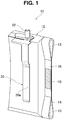
- a battery 10 illustrated in FIG. 1 can be produced with use of the battery production device of the present invention.
- the battery 10 illustrated in FIG. 1 includes an electrode 12 to which a lead 20 is joined.
- a connection terminal 22 is connected to the lead 20.
- a plurality of wound collector foils 14 are exposed from an end of the electrode 12 while overlapping one another.
- the plurality of overlapping collector foils 14 include a non-compressed region 15 and a compressed region 16. In the non-compressed region 15, since the collector foils 14 are adjacent to each other via air layers, the collector foils 14 are not necessarily in surface contact with each other.
- the adjacent collector foils 14 are in surface contact with each other. Therefore, the thickness of the compressed region 16 is substantially equal to the total thickness of the collector foils 14 included therein.
- the plurality of collector foils 14 are joined together and integrated in a joining region 18 inside the compressed region 16 by ultrasonic welding.
- the lead 20 is joined, at a joining surface 20a, to the joining region 18 of the plurality of collector foils 14 by ultrasonic welding.
- a production method of the present embodiment includes a first step of forming the compressed region 16 on the plurality of overlapping collector foils 14, and a second step of forming, inside the compressed region 16, the joining region 18 where the plurality of collector foils 14 are integrated.
- the first step and the second step are described.
- the first step is performed by the pressurization unit of the production device.
- the plurality of mutually overlapping collector foils 14 exposed from the end of the electrode 12 are pressurized with a machine exclusively for pressing, as illustrated in FIG. 2A .
- the plurality of collector foils 14 are placed on a pressing die 32, and a predetermined region of the plurality of collector foils 14 is pressurized with a pressing punch 34.
- This pressurization is so-called impact pressing of pressing an object by applying an impact force thereto by using a female die and a male die.
- the pressing die 32 and the pressing punch 34 are selected, as appropriate, according to the material or the number of the plurality of collector foils 14, or the area of the predetermined region to be pressurized.
- the pressing punch 34 may have a shape slightly tapered toward a tip end.
- points near the non-compressed region 15 of the plurality of collector foils 14 are preferably held by retainer tools 30 such that the plurality of collector foils 14 are fixed in the thickness direction. This state is maintained until the second step is completed.
- Arbitrary tools capable of fixing the plurality of collector foils 14 in the thickness direction can be used as the retainer tools 30.
- rein-made products can be used as the retainer tools 30.
- the pressurization is preferably carried out at pressure which is at least two times as high as pressure to be applied in the second step.
- the pressure (first pressure) in the first step may be adjusted to approximately 120 to 600 kgf/cm 2 .
- the first pressure can be adjusted, as appropriate, according to the material, thickness, number, and the like of the collector foils such that the adjacent collector foils are brought into surface contact with each other.
- the first pressure may be adjusted to approximately 500 to 1,000 kgf/cm 2 .
- the magnitude of the first pressure is desirably set also in view of the area of the predetermined region of the plurality of collector foils to be pressurized.
- the air layers (air traps) between the adjacent collector foils 14 are substantially vanished so that the spaces between the collector foils 14 are reduced.
- the adjacent collector foils 14 are in surface contact with each other to form the compressed region 16.
- the second step is performed by the joining unit of the production device.
- the plurality of collector foils 14 having undergone the first step are placed on an anvil 40, as illustrated in FIG. 2B , and joining is carried out in the joining region 18 by ultrasonic welding using a horn 42.
- the joining region 18 is an inner region of the compressed region 16 ( FIG. 2A ) formed on the plurality of collector foils 14 in the first step.
- the inner region refers to a region located inside in a plan view within a plane perpendicular to the layered direction of the plurality of collector foils 14.
- the horn 42 has a pressing surface 42a that has a plurality of protrusions formed thereon and that presses the joining region 18 of the plurality of collector foils 14.
- the anvil 40 has a support surface 40a that has a plurality of protrusions (not illustrated) formed thereon and that supports the plurality of collector foils 14 while holding the plurality of collector foils 14 between the support surface 40a and the pressing surface 42a of the horn 42.
- the pressure (second pressure) which is applied in the second step can be equal to or lower than the aforementioned first pressure, but is preferably equal to or lower than one half of the first pressure.
- the second pressure is generally several tens to several hundreds of kgf/cm 2 .
- the conditions of ultrasonic waves may be approximately a frequency of 20 to 40 kHz, an output of 400 to 4000 W, and a welding time of 0.2 to 2 seconds.
- the horn 42 oscillates with an amplitude of approximately 10 to 60 ⁇ m in the x-axis direction while pressing the plurality of collector foils 14 in the y-axis direction with predetermined current flowing therethrough. As a result of this, the joining region 18 where the plurality of collector foils 14 are joined together and integrated by ultrasonic welding is formed.
- the plurality of collector foils 14 are pressurized, whereby the spaces between the adjacent collector foils 14 are reduced (first step).
- the adhesion between the collector foils 14 is enhanced because no air layers (air traps) substantially exist between the adjacent collector foils 14.
- the plurality of collector foils 14 in the tight adhesion state are joined together and integrated by ultrasonic welding (second step). No air traps exist between the adjacent collector foils 14. Therefore, even when ultrasonic welding is carried out, deformation, wrinkles, and breakages (cleaves) of the collector foils are less likely to occur.
- the plurality of collector foils 14 are satisfactorily integrated in the joining region 18 so that deterioration of the strength due to a joining defect can be avoided.
- FIG. 3 shows a photographic image of a cross section of a sample 50 obtained by application of the aforementioned first step and second step.
- the sample 50 includes a plurality (sixty) of collector foils 54 joined together on a base material 52.
- spaces between the adjacent collector foils are reduced by pressurization of the plurality of collector foils 54, and subsequently, ultrasonic welding is carried out to join the plurality of collector foils 54 together with the base material 52.
- the collector foils 54 of the sample 50 are aligned, layered, and integrated while being in surface contact with each other. In the collector foils 54, any defect such as deformation, wrinkles, or bending is not found. Since the plurality of collector foils 54 are satisfactorily integrated, any problem such as a defect in joining to the base material 52 or insufficient strength can be avoided.
- FIG. 4 is a schematic diagram of a cross section of a sample 60 obtained by the second step alone without involving the first step.
- a method which involves only ultrasonic welding of the second step, is equivalent to a conventional production method.
- the sample 60 includes a plurality of collector foils 64 joined together on a base material 62.
- the collector foils 64 on the front surface or near the front surface are cut in such a manner shown in a region 66a.
- the plurality of collector foils 64 in an inner region 68 are found to be deformed.
- a cut in the collector foils 64 has occurred also in an inner region 66b where deformation is large.
- the plurality of collector foils 64 provided with air traps are subjected to ultrasonic welding.
- the air traps between the collector foils cause various failures during ultrasonic welding.
- the air traps between the collector foils 14 have been reduced in the first step. Consequently, a trouble caused by the air traps during ultrasonic welding can be avoided. Due to satisfactory propagation of ultrasonic waves, welding can be carried out with a smaller output of ultrasonic waves. Also, pressing pressure to be applied during ultrasonic welding is decreased to the minimum. Thus, an effect that the life of the horn and the life of the anvil are extended is also provided.
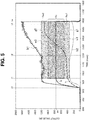
- ultrasonic welding is carried out in the state where the adhesion between the plurality of collector foils 14 has been increased. Since no air traps exist between the adjacent collector foils 14 at the time of ultrasonic welding, ultrasonic waves efficiently and uniformly propagate from the horn 42-side collector foil to the anvil 40-side collector foil. Therefore, the output value (output power value) of the horn is stabilized at a predetermined value. Specifically, as indicated by a curve a in FIG. 5 , an ideal output value of the horn increases from the start of welding (t0), reaches a stable output value ps at time t1, and is kept at the stable output value ps until the end of welding (te). The curve a is defined as a non-defective waveform.
- variation of the output value of the horn during ultrasonic welding in the second step is small, and a flat portion can be found in a part of the output waveform.
- this output waveform whether the joining state is defective or non-defective can be determined while ultrasonic welding is being carried out. Determination of whether the joining state is defective or non-defective is made by the determination unit of the production device.
- the output value of a horn is not stable ( FIG. 5 , curves b1, b2).
- the curves b1, b2 are defined as defective waveforms.
- the output value abruptly increases after time t2. The reason for this is that air traps between the adjacent collector foils act as a resistance and a larger output is needed.
- the output value unstably varies within a smaller range.
- the output value of a horn varies within a larger range or a smaller range. Therefore, only the maximum value of the output value of the horn is used for determination of whether the joining state is defective or non-defective, and thus, the reliability of quality determination is low.
- the non-defective waveform (curve a) and the defective waveforms b1, b2 are used to set various reference values, as described later. Whether the joining state is defective or non-defective can be determined by comparison with the reference values.
- the output value region of (stable output value ps ⁇ 30%) is defined as a stable region Rs.
- the lower limit and the upper limit of the stable region Rs are defined as a warning lower limit output value w1 and a warning upper limit output value w2, respectively.
- an output value equivalent to a value less than (stable output value ps -30%) but not less than (stable output value ps -50%) is defined as a non-defective lower limit output value g1
- an output value equivalent to (stable output value ps +50%) is defined as a non-defective upper limit output value g2.
- the non-defective lower limit output value g1 matches the output value of the defective waveform b2 at time t1
- the non-defective upper limit output value g2 matches the output value of the defective waveform b1 at time t1.
- a region between the non-defective lower limit output value g1 and the non-defective upper limit output value g2 is defined as a non-defective region Rg (not shown in FIG. 5 ).
- a region below the non-defective lower limit output value g1 and a region above the non-defective upper limit output value g2 are defective regions.
- a region between the non-defective lower limit output value g1 and the warning lower limit output value w1, and a region between the non-defective upper limit output value g2 and the warning upper limit output value w2 are defined as first and second warning regions Rw1, Rw2, respectively.
- a waveform c reaching the second warning region Rw2 from the first warning region Rw1 through the stable region Rs is defined as a warning waveform.
- a sample is prepared by ultrasonic welding after tight adhesion of the plurality of collector foils is made, whereby a non-defective waveform is obtained in advance.
- a reference output value P1 is set on the basis of the non-defective waveform in a period from start of welding to time T1, and warning upper and lower limits (WARNING) and abnormality upper and lower limits (ALARM) at T1 are set with respect to the reference output value P1.
- WARNING warning upper and lower limits
- ALARM abnormality upper and lower limits
- (P1+ALARM) is defined as an abnormality upper limit
- (P1-ALARM) is defined as an abnormality lower limit
- the warning upper and lower limits (WARNING) correspond to the warning upper limit output value w2 and the warning lower limit output value w1 in FIG. 5
- the abnormality upper and lower limits (ALARM) correspond to the non-defective upper limit output value g2 and the non-defective lower limit output value g1 in FIG. 5 .
- the detected value of a detected waveform of a measurement object at T1 is determined as follows.
- the joining state is determined to be non-defective.
- the detected value satisfies condition (4) or (5) below the joining state is determined to be defective.
- the detected value satisfies condition (2) or (3) below the joining state is determined to be not completely defective but is determined to have low reliability, and a warning is issued.
- a reference value is set on the basis of the non-defective waveform of the sample, the warning upper and lower limits (WARNING) and the abnormality upper and lower limits (ALARM) at the time when T2 is reached are set with respect to the reference value.
- WAA1+WARNING is defined as the warning upper limit
- A1-WARNING is defined as the warning lower limit
- A1+ALARM is defined as the abnormality upper limit
- A1- ALARM is defined as the abnormality lower limit.
- the joining state is determined to be non-defective.
- condition (9) or (10) below even once the joining state is determined to be defective.
- condition (7) or (8) below the joining state is determined to be not completely defective but have low reliability, and a warning is issued.
- whether the joining region is defective or non-defective can be determined by comparison between a non-defective waveform and a detected waveform.
- the quality can be sufficiently managed.
- an effect that the life of the horn and the life of the anvil can be managed by use of the non-defective waveform is also provided.
- the present invention is not limited to the aforementioned embodiment, and may be modified, as appropriate, within the scope of the gist of the present invention.
- the battery having the plurality of collector foils 14 wound therearound has been described.
- the plurality of collector foils 14 may be layered.
- the predetermined region of the plurality of collector foils 14 are pressurized by impact pressing using the pressing die 32 and the pressing punch 34.
- the predetermined region of the plurality of collector foils 14 may be pressurized by pressing the predetermined region using a roller.
- air layers interposed between the adjacent collector foils can be pushed out so that the spaces between the collector foils can be reduced.
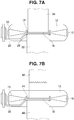
- the predetermined region of the plurality of collector foils 14 may be pressurized while the lead 20 is placed between the plurality of collector foils 14 and the pressing die 32, as illustrated in FIG. 7A .
- the plurality of collector foils 14 and the lead 20 can be integrated in the joining region 18 by ultrasonic welding using the horn 42 and the anvil 40, as illustrated in FIG. 7B .
Landscapes
- Engineering & Computer Science (AREA)
- Mechanical Engineering (AREA)
- Chemical & Material Sciences (AREA)
- Chemical Kinetics & Catalysis (AREA)
- Electrochemistry (AREA)
- General Chemical & Material Sciences (AREA)
- Physics & Mathematics (AREA)
- Optics & Photonics (AREA)
- Connection Of Batteries Or Terminals (AREA)
- Pressure Welding/Diffusion-Bonding (AREA)
- Secondary Cells (AREA)
- Manufacturing & Machinery (AREA)
Abstract

Description
- The present invention relates to a battery production method and a battery production device.
- The capacities of secondary batteries such as lithium-ion batteries (LIBs) and nickel metal hydride batteries are being increased to be used as on-vehicle power sources or stationary storage batteries. A secondary battery includes electrodes having ends from which a plurality of mutually overlapping collector foils are exposed, and includes leads joined to the plurality of collector foils. An aluminum lead is commonly joined to aluminum collector foils on a positive electrode, and a nickel or copper lead is commonly connected to copper collector foils on a negative electrode.
- Since large current instantaneously flows through a secondary battery, a plurality of collector foils and a lead thereof are commonly joined together by collective welding using ultrasonic waves (for example, Patent Literature 1). In a secondary battery, when the number of overlapping collector foils becomes greater, the battery capacity is increased. However, when the number of collector foils is increased, stable joining of the collector foils and a lead by ultrasonic welding becomes difficult.
- Patent Literature 1: Japanese Patent Laid-Open No.
2009-87611 - In order to more stably join a plurality of collector foils and a lead together by ultrasonic welding, the plurality of collector foils need to be satisfactorily integrated. Deformation and breakages of the collector foils need to be avoided as much as possible.
- Therefore, an object of the present invention is to provide a battery production method and a battery production device in which occurrence of a defect can be reduced.
- A battery production method according to the present invention includes:
- a first step of pressurizing a predetermined region of a plurality of mutually overlapping collector foils exposed from an end of an electrode, thereby forming a compressed region where spaces between adjacent collector foils are reduced, and
- a second step of joining the plurality of collector foils together in an inner region of the compressed region by ultrasonic welding, thereby forming a joining region where the plurality of collector foils are integrated.
- A battery production device according to the present invention includes:
- a pressurization unit that pressurizes a predetermined region of a plurality of mutually overlapping collector foils exposed from an end of an electrode, and thereby forms a compressed region where spaces between adjacent collector foils are reduced,
- a joining unit that joins the plurality of collector foils together in an inner region of the compressed region by ultrasonic welding using a horn and an anvil, and thereby forms a joining region where the plurality of collector foils are integrated, and
- a determination unit that determines a quality of the joining region, based on an output waveform indicating a time change in an output value of the horn.
- According to the present invention, prior to joining of the plurality of collector foils by ultrasonic welding, the plurality of collector foils are pressurized in the region larger than the region where joining is to be performed. The plurality of collector foils are compressed by pressurization. Accordingly, air layers (air traps) interposed between the adjacent collector foils are substantially vanished so that the adjacent collector foils can come into surface contact with each other.
- Since the plurality of collector foils in the tight adhesion state are joined together by ultrasonic welding, any problem caused by air traps is avoided. As a result of this, a battery in which occurrence of a defect can be reduced, can be produced.
- The battery production device of the present invention includes not only the pressurization unit that forms the compressed region and the joining unit that forms the joining region but also the determination unit that determines whether the joining region is defective or non-defective. Whether the joining region is defective or non-defective is determined on the basis of the output waveform of the horn forming the joining region. Therefore, the battery production device of the present invention can determine whether the joining region is defective or non-defective while forming the joining region where the plurality of collector foils are integrated.
- Moreover, by use of the production device of the present invention, any problem caused by the air traps interposed between the adjacent collector foils can be avoided. Therefore, the plurality of collector foils can be stably integrated by ultrasonic welding. Since the output waveform of the horn during the ultrasonic welding is stable, whether the joining state is defective or non-defective can be easily determined on the basis of the output waveform.
-
-
FIG. 1 is an exploded perspective view illustrating a part of a battery produced by a method of an embodiment. -
FIG. 2 is a schematic view illustrating a production method of the embodiment whereinFIG. 2A illustrates a first step andFIG. 2B illustrates a second step. -
FIG. 3 is a photographic image of a cross section of a sample produced by application of the method of the embodiment. -
FIG. 4 is a schematic view of a cross section of a sample produced by application of a conventional method. -
FIG. 5 is a graph showing the output waveform of a horn during ultrasonic welding. -
FIG. 6 is an explanatory diagram of an algorithm for determining whether a joining state is defective or non-defective. -
FIG. 7 is a schematic view illustrating a production method of a modification whereinFIG. 7A illustrates a first step andFIG. 7B illustrates a second step. - Hereinafter, an embodiment according to the present invention is described in detail with reference to the drawings.
- A battery production device of the present invention includes a pressurization unit, a joining unit, and a determination unit. The pressurization unit pressurizes a predetermined region of a plurality of mutually overlapping collector foils exposed from an end of an electrode, and thereby forms a compressed region where spaces between the adjacent collector foils are reduced. The joining unit joins the plurality of collector foils together in an inner region of the compressed region by ultrasonic welding using a horn and an anvil, and thereby forms a joining region where the plurality of collector foils are integrated. The determination unit determines whether the joining region is defective or non-defective on the basis of the output waveform indicating the time change in the output value of the horn. A
battery 10 illustrated inFIG. 1 can be produced with use of the battery production device of the present invention. - The
battery 10 illustrated inFIG. 1 includes anelectrode 12 to which alead 20 is joined. Aconnection terminal 22 is connected to thelead 20. A plurality ofwound collector foils 14 are exposed from an end of theelectrode 12 while overlapping one another. The plurality of overlappingcollector foils 14 include anon-compressed region 15 and acompressed region 16. In thenon-compressed region 15, since thecollector foils 14 are adjacent to each other via air layers, thecollector foils 14 are not necessarily in surface contact with each other. - In the
compressed region 16, theadjacent collector foils 14 are in surface contact with each other. Therefore, the thickness of thecompressed region 16 is substantially equal to the total thickness of thecollector foils 14 included therein. The plurality ofcollector foils 14 are joined together and integrated in a joiningregion 18 inside thecompressed region 16 by ultrasonic welding. - The
lead 20 is joined, at a joiningsurface 20a, to the joiningregion 18 of the plurality ofcollector foils 14 by ultrasonic welding. - A production method of the present embodiment includes a first step of forming the
compressed region 16 on the plurality of overlapping collector foils 14, and a second step of forming, inside the compressedregion 16, the joiningregion 18 where the plurality of collector foils 14 are integrated. Hereinafter, the first step and the second step are described. - The first step is performed by the pressurization unit of the production device. In the first step, the plurality of mutually overlapping collector foils 14 exposed from the end of the
electrode 12 are pressurized with a machine exclusively for pressing, as illustrated inFIG. 2A . Specifically, the plurality of collector foils 14 are placed on apressing die 32, and a predetermined region of the plurality of collector foils 14 is pressurized with apressing punch 34. This pressurization is so-called impact pressing of pressing an object by applying an impact force thereto by using a female die and a male die. - The
pressing die 32 and thepressing punch 34 are selected, as appropriate, according to the material or the number of the plurality of collector foils 14, or the area of the predetermined region to be pressurized. Thepressing punch 34 may have a shape slightly tapered toward a tip end. - In the pressurization, points near the
non-compressed region 15 of the plurality of collector foils 14 are preferably held byretainer tools 30 such that the plurality of collector foils 14 are fixed in the thickness direction. This state is maintained until the second step is completed. Arbitrary tools capable of fixing the plurality of collector foils 14 in the thickness direction can be used as theretainer tools 30. For example, rein-made products can be used as theretainer tools 30. - In the first step, the pressurization is preferably carried out at pressure which is at least two times as high as pressure to be applied in the second step. For example, when pressure of approximately 60 to 300 kgf/cm2 is to be applied in the second step, the pressure (first pressure) in the first step may be adjusted to approximately 120 to 600 kgf/cm2. The first pressure can be adjusted, as appropriate, according to the material, thickness, number, and the like of the collector foils such that the adjacent collector foils are brought into surface contact with each other. For example, when 60 copper-made collector foils are included, the first pressure may be adjusted to approximately 500 to 1,000 kgf/cm2. The magnitude of the first pressure is desirably set also in view of the area of the predetermined region of the plurality of collector foils to be pressurized.
- By the pressurization, the air layers (air traps) between the adjacent collector foils 14 are substantially vanished so that the spaces between the collector foils 14 are reduced. In the plurality of collector foils 14, the adjacent collector foils 14 are in surface contact with each other to form the compressed
region 16. - The second step is performed by the joining unit of the production device. In the second step, the plurality of collector foils 14 having undergone the first step are placed on an
anvil 40, as illustrated inFIG. 2B , and joining is carried out in the joiningregion 18 by ultrasonic welding using ahorn 42. The joiningregion 18 is an inner region of the compressed region 16 (FIG. 2A ) formed on the plurality of collector foils 14 in the first step. Specifically, the inner region refers to a region located inside in a plan view within a plane perpendicular to the layered direction of the plurality of collector foils 14. - The
horn 42 has apressing surface 42a that has a plurality of protrusions formed thereon and that presses the joiningregion 18 of the plurality of collector foils 14. Theanvil 40 has asupport surface 40a that has a plurality of protrusions (not illustrated) formed thereon and that supports the plurality of collector foils 14 while holding the plurality of collector foils 14 between thesupport surface 40a and thepressing surface 42a of thehorn 42. - The pressure (second pressure) which is applied in the second step can be equal to or lower than the aforementioned first pressure, but is preferably equal to or lower than one half of the first pressure. The second pressure is generally several tens to several hundreds of kgf/cm2. The conditions of ultrasonic waves may be approximately a frequency of 20 to 40 kHz, an output of 400 to 4000 W, and a welding time of 0.2 to 2 seconds.
- The
horn 42 oscillates with an amplitude of approximately 10 to 60 µm in the x-axis direction while pressing the plurality of collector foils 14 in the y-axis direction with predetermined current flowing therethrough. As a result of this, the joiningregion 18 where the plurality of collector foils 14 are joined together and integrated by ultrasonic welding is formed. - In the battery production method of the present embodiment, prior to ultrasonic welding of the plurality of collector foils 14, the plurality of collector foils 14 are pressurized, whereby the spaces between the adjacent collector foils 14 are reduced (first step). The adhesion between the collector foils 14 is enhanced because no air layers (air traps) substantially exist between the adjacent collector foils 14.
- The plurality of collector foils 14 in the tight adhesion state are joined together and integrated by ultrasonic welding (second step). No air traps exist between the adjacent collector foils 14. Therefore, even when ultrasonic welding is carried out, deformation, wrinkles, and breakages (cleaves) of the collector foils are less likely to occur. The plurality of collector foils 14 are satisfactorily integrated in the joining
region 18 so that deterioration of the strength due to a joining defect can be avoided. -
FIG. 3 shows a photographic image of a cross section of asample 50 obtained by application of the aforementioned first step and second step. Thesample 50 includes a plurality (sixty) of collector foils 54 joined together on abase material 52. In preparation of thesample 50, spaces between the adjacent collector foils are reduced by pressurization of the plurality of collector foils 54, and subsequently, ultrasonic welding is carried out to join the plurality of collector foils 54 together with thebase material 52. - The collector foils 54 of the
sample 50 are aligned, layered, and integrated while being in surface contact with each other. In the collector foils 54, any defect such as deformation, wrinkles, or bending is not found. Since the plurality of collector foils 54 are satisfactorily integrated, any problem such as a defect in joining to thebase material 52 or insufficient strength can be avoided. -
FIG. 4 is a schematic diagram of a cross section of asample 60 obtained by the second step alone without involving the first step. A method which involves only ultrasonic welding of the second step, is equivalent to a conventional production method. Thesample 60 includes a plurality of collector foils 64 joined together on abase material 62. The collector foils 64 on the front surface or near the front surface are cut in such a manner shown in aregion 66a. The plurality of collector foils 64 in aninner region 68 are found to be deformed. A cut in the collector foils 64 has occurred also in aninner region 66b where deformation is large. - When the first step is not performed, the plurality of collector foils 64 provided with air traps are subjected to ultrasonic welding. The air traps between the collector foils cause various failures during ultrasonic welding.
- Since the air traps inhibit propagation of ultrasonic waves from the horn, stable welding cannot be carried out. In order to allow propagation of sufficient ultrasonic waves from the horn to the collector foils on the anvil side farther from the horn, the output of ultrasonic waves needs to be increased. When a high output of ultrasonic waves is applied, the collector foils on the horn side are damaged to be broken, as illustrated in
FIG. 4 (region 66a). Due to the existence of the air traps between the adjacent collector foils, the collector foils are displaced by the oscillation of the horn in the crosswise direction. Thus, cleaves and wrinkles are generated (regions 66b, 68). - When ultrasonic welding is carried out, a horn is strongly pressed against a plurality of collector foils. Accordingly, the air traps interposed between the adjacent collector foils can be vanished. However, when the horn is strongly pressed, the contact resistance between the plurality of collector foils and the horn increases to inhibit the oscillation of the horn in the crosswise direction.
- In the production method of the present embodiment, the air traps between the collector foils 14 have been reduced in the first step. Consequently, a trouble caused by the air traps during ultrasonic welding can be avoided. Due to satisfactory propagation of ultrasonic waves, welding can be carried out with a smaller output of ultrasonic waves. Also, pressing pressure to be applied during ultrasonic welding is decreased to the minimum. Thus, an effect that the life of the horn and the life of the anvil are extended is also provided.
- As described above, in the production method of the present embodiment, ultrasonic welding is carried out in the state where the adhesion between the plurality of collector foils 14 has been increased. Since no air traps exist between the adjacent collector foils 14 at the time of ultrasonic welding, ultrasonic waves efficiently and uniformly propagate from the horn 42-side collector foil to the anvil 40-side collector foil. Therefore, the output value (output power value) of the horn is stabilized at a predetermined value. Specifically, as indicated by a curve a in
FIG. 5 , an ideal output value of the horn increases from the start of welding (t0), reaches a stable output value ps at time t1, and is kept at the stable output value ps until the end of welding (te). The curve a is defined as a non-defective waveform. - In the production method of the present embodiment, variation of the output value of the horn during ultrasonic welding in the second step is small, and a flat portion can be found in a part of the output waveform. By use of this output waveform, whether the joining state is defective or non-defective can be determined while ultrasonic welding is being carried out. Determination of whether the joining state is defective or non-defective is made by the determination unit of the production device.
- In a conventional production method, the output value of a horn is not stable (
FIG. 5 , curves b1, b2). The curves b1, b2 are defined as defective waveforms. In the curve b1, the output value abruptly increases after time t2. The reason for this is that air traps between the adjacent collector foils act as a resistance and a larger output is needed. In the curve b2, the output value unstably varies within a smaller range. - In a conventional production method, the output value of a horn varies within a larger range or a smaller range. Therefore, only the maximum value of the output value of the horn is used for determination of whether the joining state is defective or non-defective, and thus, the reliability of quality determination is low.
- In the production method of the present invention, the non-defective waveform (curve a) and the defective waveforms b1, b2 are used to set various reference values, as described later. Whether the joining state is defective or non-defective can be determined by comparison with the reference values.
- As shown in
FIG. 5 , the output value region of (stable output value ps ±30%) is defined as a stable region Rs. As shown inFIG. 5 , the lower limit and the upper limit of the stable region Rs are defined as a warning lower limit output value w1 and a warning upper limit output value w2, respectively. In addition, an output value equivalent to a value less than (stable output value ps -30%) but not less than (stable output value ps -50%) is defined as a non-defective lower limit output value g1, and an output value equivalent to (stable output value ps +50%) is defined as a non-defective upper limit output value g2. - In the example shown in
FIG. 5 , the non-defective lower limit output value g1 matches the output value of the defective waveform b2 at time t1, and the non-defective upper limit output value g2 matches the output value of the defective waveform b1 at time t1. A region between the non-defective lower limit output value g1 and the non-defective upper limit output value g2 is defined as a non-defective region Rg (not shown inFIG. 5 ). A region below the non-defective lower limit output value g1 and a region above the non-defective upper limit output value g2 are defective regions. - A region between the non-defective lower limit output value g1 and the warning lower limit output value w1, and a region between the non-defective upper limit output value g2 and the warning upper limit output value w2 are defined as first and second warning regions Rw1, Rw2, respectively. A waveform c reaching the second warning region Rw2 from the first warning region Rw1 through the stable region Rs is defined as a warning waveform.
- An algorithm for determination of whether the joining state is defective or non-defective is described with reference to
FIG. 6 . - By the aforementioned method, a sample is prepared by ultrasonic welding after tight adhesion of the plurality of collector foils is made, whereby a non-defective waveform is obtained in advance. In a detected waveform of the sample, a reference output value P1 is set on the basis of the non-defective waveform in a period from start of welding to time T1, and warning upper and lower limits (WARNING) and abnormality upper and lower limits (ALARM) at T1 are set with respect to the reference output value P1. Here, (P1+WARNING) is defined as a warning upper limit, and (P1-WARNING) is defined as a warning lower limit. Further, (P1+ALARM) is defined as an abnormality upper limit, and (P1-ALARM) is defined as an abnormality lower limit. The warning upper and lower limits (WARNING) correspond to the warning upper limit output value w2 and the warning lower limit output value w1 in
FIG. 5 . The abnormality upper and lower limits (ALARM) correspond to the non-defective upper limit output value g2 and the non-defective lower limit output value g1 inFIG. 5 . - The detected value of a detected waveform of a measurement object at T1 is determined as follows. When the detected value of the detected waveform satisfies condition (1) below, the joining state is determined to be non-defective. When the detected value satisfies condition (4) or (5) below, the joining state is determined to be defective. When the detected value satisfies condition (2) or (3) below, the joining state is determined to be not completely defective but is determined to have low reliability, and a warning is issued.


- Similarly, in a period (AREA1) from time T1 to time T2, a reference value is set on the basis of the non-defective waveform of the sample, the warning upper and lower limits (WARNING) and the abnormality upper and lower limits (ALARM) at the time when T2 is reached are set with respect to the reference value. Here, (A1+WARNING) is defined as the warning upper limit, and (A1-WARNING) is defined as the warning lower limit. Further, (A1+ALARM) is defined as the abnormality upper limit, and (A1- ALARM) is defined as the abnormality lower limit.
- When the detected value, of the detected waveform of a measurement object, between T1-T2 constantly satisfies a condition (6) below, the joining state is determined to be non-defective. When the detected value between T1-T2 satisfies condition (9) or (10) below even once, the joining state is determined to be defective. When the detected value between T1-T2 at least temporarily satisfies condition (7) or (8) below, the joining state is determined to be not completely defective but have low reliability, and a warning is issued.


- The same determination as that for (AREA1) is made for a period (AREA2) from time T2 to time T3, a period (AREA3) from time T3 to time T4, and a period (AREA4) from time T4 to time T5.
- When none of the determination results of the period from start of the welding to time T1 and the periods (AREA1) to (AREA4) show a defect, the sample is non-defective.
- As described above, whether the joining region is defective or non-defective can be determined by comparison between a non-defective waveform and a detected waveform. Thus, the quality can be sufficiently managed. Moreover, an effect that the life of the horn and the life of the anvil can be managed by use of the non-defective waveform, is also provided.
- The present invention is not limited to the aforementioned embodiment, and may be modified, as appropriate, within the scope of the gist of the present invention.
- In the aforementioned embodiment, the battery having the plurality of collector foils 14 wound therearound has been described. However, the plurality of collector foils 14 may be layered.
- In the first step, the predetermined region of the plurality of collector foils 14 are pressurized by impact pressing using the
pressing die 32 and thepressing punch 34. However, the predetermined region of the plurality of collector foils 14 may be pressurized by pressing the predetermined region using a roller. Thus, air layers interposed between the adjacent collector foils can be pushed out so that the spaces between the collector foils can be reduced. - In the first step, the predetermined region of the plurality of collector foils 14 may be pressurized while the
lead 20 is placed between the plurality of collector foils 14 and thepressing die 32, as illustrated inFIG. 7A . Next, the plurality of collector foils 14 and thelead 20 can be integrated in the joiningregion 18 by ultrasonic welding using thehorn 42 and theanvil 40, as illustrated inFIG. 7B . -
- 10
- battery
- 12
- electrode
- 14
- collector foil
- 16
- compressed region
- 18
- joining region
- 20
- lead
Claims (11)
- A battery production method comprising:a first step of pressurizing a predetermined region of a plurality of mutually overlapping collector foils exposed from an end of an electrode, thereby forming a compressed region where spaces between adjacent collector foils are reduced; anda second step of joining the plurality of collector foils together in an inner region of the compressed region by ultrasonic welding, thereby forming a joining region where the plurality of collector foils are integrated.
- The battery production method according to claim 1, wherein
the predetermined region of the plurality of collector foils is pressurized with first pressure in the first step, and the joining region is formed in the second step by pressurization with second pressure that is lower than the first pressure. - The battery production method according to claim 2, wherein
the first pressure is at least two times as high as the second pressure. - The battery production method according to any one of claims 1 to 3, wherein
the first step includes applying an impact force to the predetermined region of the plurality of collector foils. - The battery production method according to any one of claims 1 to 4, wherein
prior to the first step, the plurality of collector foils are fixed in a thickness direction with a retainer tool, and
after the second step, the retainer tool is removed. - The battery production method according to any one of claims 1 to 5, wherein
a lead is placed, prior to the first step, to be in contact with the predetermined region of the plurality of collector foils, and the plurality of collector foils and the lead are integrated by the ultrasonic welding. - The battery production method according to any one of claims 1 to 6, wherein
the ultrasonic welding is carried out using a horn having a pressing surface that has a plurality of protrusions formed thereon and that presses the joining region of the plurality of collector foils, and an anvil having a support surface that has a plurality of protrusions formed thereon and that supports the plurality of collector foils while holding the plurality of collector foils between the support surface and the pressing surface, and
the second step includes determining whether the joining region is defective or non-defective, based on an output waveform indicating a time change in an output value of the horn. - The battery production method according to claim 7, wherein
a non-defective upper limit output value and a non-defective lower limit output value are set for the output value of the horn, a region between the non-defective upper limit output value and the non-defective lower limit output value is defined as a non-defective region, and a plurality of measured output values are obtained by measurement of a plurality of points between start and end of the ultrasonic welding, and
when all of the plurality of measurement output values fall within the non-defective region, the joining region is determined to be non-defective. - The battery production method according to claim 8, wherein
a stable region is set between a warning upper limit output value that is less than the non-defective upper limit output value and a warning lower limit output value that is greater than the non-defective lower limit output value, and
when one of the plurality of measurement output values falls outside of the stable region and falls within the non-defective region, a warning is issued. - The battery production method according to claim 9, wherein
the output waveform is divided into a plurality of time-based sections, and the non-defective upper limit output value, the non-defective lower limit output value, and the stable region are set for each of the plurality of sections. - A battery production device comprising:a pressurization unit that pressurizes a predetermined region of a plurality of mutually overlapping collector foils exposed from an end of an electrode, and thereby forms a compressed region where spaces between adjacent collector foils are reduced;a joining unit that joins the plurality of collector foils together in an inner region of the compressed region by ultrasonic welding using a horn and an anvil, and thereby forms a joining region where the plurality of collector foils are integrated; anda determination unit that determines whether the joining region is defective or non-defective, based on an output waveform indicating a time change in an output value of the horn.
Applications Claiming Priority (2)
| Application Number | Priority Date | Filing Date | Title |
|---|---|---|---|
| JP2016182168A JP6280606B1 (en) | 2016-09-16 | 2016-09-16 | Battery manufacturing method and battery manufacturing apparatus |
| PCT/JP2017/030328 WO2018051756A1 (en) | 2016-09-16 | 2017-08-24 | Battery production method and battery production device |
Publications (2)
| Publication Number | Publication Date |
|---|---|
| EP3514857A1 true EP3514857A1 (en) | 2019-07-24 |
| EP3514857A4 EP3514857A4 (en) | 2020-04-22 |
Family
ID=61195803
Family Applications (1)
| Application Number | Title | Priority Date | Filing Date |
|---|---|---|---|
| EP17850660.6A Withdrawn EP3514857A4 (en) | 2016-09-16 | 2017-08-24 | Battery production method and battery production device |
Country Status (7)
| Country | Link |
|---|---|
| US (1) | US20190217413A1 (en) |
| EP (1) | EP3514857A4 (en) |
| JP (1) | JP6280606B1 (en) |
| KR (1) | KR20190049622A (en) |
| CN (1) | CN109716559A (en) |
| TW (1) | TWI711206B (en) |
| WO (1) | WO2018051756A1 (en) |
Families Citing this family (6)
| Publication number | Priority date | Publication date | Assignee | Title |
|---|---|---|---|---|
| CN208539000U (en) * | 2018-03-15 | 2019-02-22 | 宁德时代新能源科技股份有限公司 | Welding device and processing equipment for secondary battery current collector |
| JP7305367B2 (en) * | 2019-02-08 | 2023-07-10 | 三洋電機株式会社 | Electric storage element manufacturing method, electric storage element, joining method, and joined body |
| JP7194335B2 (en) | 2019-04-23 | 2022-12-22 | トヨタ自動車株式会社 | Method for manufacturing secondary battery and secondary battery |
| US20230042891A1 (en) * | 2020-02-07 | 2023-02-09 | Sanyo Electric Co., Ltd. | Secondary battery |
| JP2022150789A (en) * | 2021-03-26 | 2022-10-07 | プライムアースEvエナジー株式会社 | SECONDARY BATTERY AND METHOD FOR MANUFACTURING SECONDARY BATTERY |
| KR20250086959A (en) * | 2023-12-07 | 2025-06-16 | 주식회사 엘지에너지솔루션 | Method of manufacturing secondary battery |
Family Cites Families (13)
| Publication number | Priority date | Publication date | Assignee | Title |
|---|---|---|---|---|
| JP3681928B2 (en) * | 1999-07-29 | 2005-08-10 | 株式会社デンソー | Method for joining battery electrode bodies |
| JP2005205421A (en) * | 2004-01-20 | 2005-08-04 | Nissan Motor Co Ltd | Welding quality judgment method and welding quality judgment device |
| JP5252871B2 (en) | 2007-09-28 | 2013-07-31 | 三洋電機株式会社 | Stacked battery |
| CN105591041B (en) * | 2011-04-18 | 2019-04-30 | 日立汽车系统株式会社 | Secondary battery |
| CN102969478B (en) * | 2011-08-31 | 2016-06-29 | 株式会社杰士汤浅国际 | Storage element |
| US9604305B2 (en) * | 2011-10-26 | 2017-03-28 | GM Global Technology Operations LLC | Quality status display for a vibration welding process |
| DE112012006588T5 (en) * | 2012-06-28 | 2015-04-02 | Toyota Jidosha Kabushiki Kaisha | Method for producing a battery and a battery |
| JP5751218B2 (en) * | 2012-07-19 | 2015-07-22 | トヨタ自動車株式会社 | Terminal welding method |
| DE102012018912A1 (en) * | 2012-09-26 | 2013-03-21 | Daimler Ag | Preparing film stack, by forming film stack form a number of firmly bonded metal foils connected to each other, where the foils are arranged one above the other in a process step and compacted and prefixed by a high frequency ultrasound |
| JP6086240B2 (en) * | 2013-08-23 | 2017-03-01 | トヨタ自動車株式会社 | Non-aqueous electrolyte battery and manufacturing method thereof |
| KR102708552B1 (en) * | 2014-09-19 | 2024-09-24 | 가부시키가이샤 한도오따이 에네루기 켄큐쇼 | Secondary battery |
| KR101883126B1 (en) * | 2014-10-15 | 2018-07-27 | 닛산 지도우샤 가부시키가이샤 | Ultrasonic bonding device and ultrasonic bonding method |
| JP6047632B2 (en) * | 2015-06-25 | 2016-12-21 | 日立オートモティブシステムズ株式会社 | Secondary battery |
-
2016
- 2016-09-16 JP JP2016182168A patent/JP6280606B1/en active Active
-
2017
- 2017-08-24 KR KR1020187035863A patent/KR20190049622A/en not_active Ceased
- 2017-08-24 WO PCT/JP2017/030328 patent/WO2018051756A1/en not_active Ceased
- 2017-08-24 CN CN201780034254.7A patent/CN109716559A/en active Pending
- 2017-08-24 US US16/311,752 patent/US20190217413A1/en not_active Abandoned
- 2017-08-24 EP EP17850660.6A patent/EP3514857A4/en not_active Withdrawn
- 2017-08-31 TW TW106129773A patent/TWI711206B/en not_active IP Right Cessation
Also Published As
| Publication number | Publication date |
|---|---|
| KR20190049622A (en) | 2019-05-09 |
| TW201826593A (en) | 2018-07-16 |
| JP2018045975A (en) | 2018-03-22 |
| US20190217413A1 (en) | 2019-07-18 |
| EP3514857A4 (en) | 2020-04-22 |
| CN109716559A (en) | 2019-05-03 |
| TWI711206B (en) | 2020-11-21 |
| WO2018051756A1 (en) | 2018-03-22 |
| JP6280606B1 (en) | 2018-02-14 |
Similar Documents
| Publication | Publication Date | Title |
|---|---|---|
| EP3514857A1 (en) | Battery production method and battery production device | |
| EP3511107B1 (en) | System and method for inspecting welding of secondary battery | |
| EP3644390B1 (en) | Apparatus and method for manufacturing pouch and method for manufacturing secondary battery | |
| US8986874B2 (en) | Prismatic cell and production method for the same | |
| KR101706491B1 (en) | Welding state inspection method | |
| JP3853461B2 (en) | Explosion-proof sealing plate for sealed battery and method for manufacturing the same | |
| KR102795945B1 (en) | Defective Inspection Device of Pouch-type Battery Cell | |
| KR102758792B1 (en) | Method for Optimizing Ultrasonic Welding Process of Lithium Secondary Battery and Apparatus Thereof | |
| EP4183512A1 (en) | Ultrasonic welding device and welding method for secondary battery | |
| KR100831131B1 (en) | Connecting structure of conductive connecting tab of battery | |
| JP2020087754A (en) | Fixed state inspection device, fixed state inspection method, and assembled battery manufacturing method | |
| JP6070167B2 (en) | Molding method and molding apparatus | |
| KR20220042684A (en) | Ultrasonic welding condition judging system including vibration measurement sensor and judging method using the same | |
| JP6210046B2 (en) | Welding method for porous channel | |
| JP7151123B2 (en) | Electric storage element inspection method and electric storage element | |
| JP2010114012A (en) | Detecting device of burr of battery electrode plate | |
| JP2018122338A (en) | Weld strength inspection method | |
| JP2532799B2 (en) | Welding work placement condition determination method for cylindrical batteries | |
| JP2000061559A (en) | Device for bonding thin metal sheets and quality control method of bonded part | |
| CN115635180A (en) | Soldering tips, terminal components, and secondary batteries | |
| JP6667409B2 (en) | Judging method and joining apparatus for judging replacement of ultrasonic welding tool | |
| JP5335450B2 (en) | Ultrasonic metal bonding machine | |
| JP2007035306A (en) | Short-circuit test method for lead electrode battery group | |
| KR20240109398A (en) | Ultrasonic welding determination system and ultrasonic welding determination method using the system | |
| KR20250096569A (en) | Method and device for inspecting welding rod, and secondary battery manufacturing method including the same |
Legal Events
| Date | Code | Title | Description |
|---|---|---|---|
| STAA | Information on the status of an ep patent application or granted ep patent |
Free format text: STATUS: THE INTERNATIONAL PUBLICATION HAS BEEN MADE |
|
| PUAI | Public reference made under article 153(3) epc to a published international application that has entered the european phase |
Free format text: ORIGINAL CODE: 0009012 |
|
| STAA | Information on the status of an ep patent application or granted ep patent |
Free format text: STATUS: REQUEST FOR EXAMINATION WAS MADE |
|
| 17P | Request for examination filed |
Effective date: 20190416 |
|
| AK | Designated contracting states |
Kind code of ref document: A1 Designated state(s): AL AT BE BG CH CY CZ DE DK EE ES FI FR GB GR HR HU IE IS IT LI LT LU LV MC MK MT NL NO PL PT RO RS SE SI SK SM TR |
|
| AX | Request for extension of the european patent |
Extension state: BA ME |
|
| DAV | Request for validation of the european patent (deleted) | ||
| DAX | Request for extension of the european patent (deleted) | ||
| A4 | Supplementary search report drawn up and despatched |
Effective date: 20200324 |
|
| RIC1 | Information provided on ipc code assigned before grant |
Ipc: B23K 31/00 20060101ALI20200318BHEP Ipc: H01M 2/26 20060101AFI20200318BHEP Ipc: H01M 10/04 20060101ALI20200318BHEP Ipc: B23K 20/10 20060101ALI20200318BHEP |
|
| STAA | Information on the status of an ep patent application or granted ep patent |
Free format text: STATUS: THE APPLICATION HAS BEEN WITHDRAWN |
|
| 18W | Application withdrawn |
Effective date: 20210416 |