EP3514734B1 - Verfahren und vorrichtung zur erzeugung einer chemischen struktur unter verwendung eines neuronalen netzwerks - Google Patents
Verfahren und vorrichtung zur erzeugung einer chemischen struktur unter verwendung eines neuronalen netzwerks Download PDFInfo
- Publication number
- EP3514734B1 EP3514734B1 EP18201299.7A EP18201299A EP3514734B1 EP 3514734 B1 EP3514734 B1 EP 3514734B1 EP 18201299 A EP18201299 A EP 18201299A EP 3514734 B1 EP3514734 B1 EP 3514734B1
- Authority
- EP
- European Patent Office
- Prior art keywords
- neural network
- descriptors
- structure characteristic
- generation
- target
- Prior art date
- Legal status (The legal status is an assumption and is not a legal conclusion. Google has not performed a legal analysis and makes no representation as to the accuracy of the status listed.)
- Active
Links
Images




Classifications
-
- G—PHYSICS
- G06—COMPUTING OR CALCULATING; COUNTING
- G06N—COMPUTING ARRANGEMENTS BASED ON SPECIFIC COMPUTATIONAL MODELS
- G06N3/00—Computing arrangements based on biological models
- G06N3/12—Computing arrangements based on biological models using genetic models
- G06N3/126—Evolutionary algorithms, e.g. genetic algorithms or genetic programming
-
- G—PHYSICS
- G16—INFORMATION AND COMMUNICATION TECHNOLOGY [ICT] SPECIALLY ADAPTED FOR SPECIFIC APPLICATION FIELDS
- G16C—COMPUTATIONAL CHEMISTRY; CHEMOINFORMATICS; COMPUTATIONAL MATERIALS SCIENCE
- G16C20/00—Chemoinformatics, i.e. ICT specially adapted for the handling of physicochemical or structural data of chemical particles, elements, compounds or mixtures
- G16C20/40—Searching chemical structures or physicochemical data
-
- G—PHYSICS
- G06—COMPUTING OR CALCULATING; COUNTING
- G06N—COMPUTING ARRANGEMENTS BASED ON SPECIFIC COMPUTATIONAL MODELS
- G06N3/00—Computing arrangements based on biological models
- G06N3/02—Neural networks
- G06N3/04—Architecture, e.g. interconnection topology
- G06N3/045—Combinations of networks
-
- G—PHYSICS
- G06—COMPUTING OR CALCULATING; COUNTING
- G06N—COMPUTING ARRANGEMENTS BASED ON SPECIFIC COMPUTATIONAL MODELS
- G06N3/00—Computing arrangements based on biological models
- G06N3/02—Neural networks
- G06N3/04—Architecture, e.g. interconnection topology
-
- G—PHYSICS
- G06—COMPUTING OR CALCULATING; COUNTING
- G06N—COMPUTING ARRANGEMENTS BASED ON SPECIFIC COMPUTATIONAL MODELS
- G06N3/00—Computing arrangements based on biological models
- G06N3/02—Neural networks
- G06N3/04—Architecture, e.g. interconnection topology
- G06N3/044—Recurrent networks, e.g. Hopfield networks
-
- G—PHYSICS
- G06—COMPUTING OR CALCULATING; COUNTING
- G06N—COMPUTING ARRANGEMENTS BASED ON SPECIFIC COMPUTATIONAL MODELS
- G06N3/00—Computing arrangements based on biological models
- G06N3/02—Neural networks
- G06N3/04—Architecture, e.g. interconnection topology
- G06N3/044—Recurrent networks, e.g. Hopfield networks
- G06N3/0442—Recurrent networks, e.g. Hopfield networks characterised by memory or gating, e.g. long short-term memory [LSTM] or gated recurrent units [GRU]
-
- G—PHYSICS
- G06—COMPUTING OR CALCULATING; COUNTING
- G06N—COMPUTING ARRANGEMENTS BASED ON SPECIFIC COMPUTATIONAL MODELS
- G06N3/00—Computing arrangements based on biological models
- G06N3/02—Neural networks
- G06N3/04—Architecture, e.g. interconnection topology
- G06N3/045—Combinations of networks
- G06N3/0455—Auto-encoder networks; Encoder-decoder networks
-
- G—PHYSICS
- G06—COMPUTING OR CALCULATING; COUNTING
- G06N—COMPUTING ARRANGEMENTS BASED ON SPECIFIC COMPUTATIONAL MODELS
- G06N3/00—Computing arrangements based on biological models
- G06N3/02—Neural networks
- G06N3/04—Architecture, e.g. interconnection topology
- G06N3/047—Probabilistic or stochastic networks
-
- G—PHYSICS
- G06—COMPUTING OR CALCULATING; COUNTING
- G06N—COMPUTING ARRANGEMENTS BASED ON SPECIFIC COMPUTATIONAL MODELS
- G06N3/00—Computing arrangements based on biological models
- G06N3/02—Neural networks
- G06N3/04—Architecture, e.g. interconnection topology
- G06N3/0475—Generative networks
-
- G—PHYSICS
- G06—COMPUTING OR CALCULATING; COUNTING
- G06N—COMPUTING ARRANGEMENTS BASED ON SPECIFIC COMPUTATIONAL MODELS
- G06N3/00—Computing arrangements based on biological models
- G06N3/02—Neural networks
- G06N3/06—Physical realisation, i.e. hardware implementation of neural networks, neurons or parts of neurons
-
- G—PHYSICS
- G06—COMPUTING OR CALCULATING; COUNTING
- G06N—COMPUTING ARRANGEMENTS BASED ON SPECIFIC COMPUTATIONAL MODELS
- G06N3/00—Computing arrangements based on biological models
- G06N3/02—Neural networks
- G06N3/08—Learning methods
-
- G—PHYSICS
- G06—COMPUTING OR CALCULATING; COUNTING
- G06N—COMPUTING ARRANGEMENTS BASED ON SPECIFIC COMPUTATIONAL MODELS
- G06N3/00—Computing arrangements based on biological models
- G06N3/02—Neural networks
- G06N3/08—Learning methods
- G06N3/09—Supervised learning
-
- G—PHYSICS
- G16—INFORMATION AND COMMUNICATION TECHNOLOGY [ICT] SPECIALLY ADAPTED FOR SPECIFIC APPLICATION FIELDS
- G16C—COMPUTATIONAL CHEMISTRY; CHEMOINFORMATICS; COMPUTATIONAL MATERIALS SCIENCE
- G16C20/00—Chemoinformatics, i.e. ICT specially adapted for the handling of physicochemical or structural data of chemical particles, elements, compounds or mixtures
-
- G—PHYSICS
- G16—INFORMATION AND COMMUNICATION TECHNOLOGY [ICT] SPECIALLY ADAPTED FOR SPECIFIC APPLICATION FIELDS
- G16C—COMPUTATIONAL CHEMISTRY; CHEMOINFORMATICS; COMPUTATIONAL MATERIALS SCIENCE
- G16C20/00—Chemoinformatics, i.e. ICT specially adapted for the handling of physicochemical or structural data of chemical particles, elements, compounds or mixtures
- G16C20/30—Prediction of properties of chemical compounds, compositions or mixtures
-
- G—PHYSICS
- G16—INFORMATION AND COMMUNICATION TECHNOLOGY [ICT] SPECIALLY ADAPTED FOR SPECIFIC APPLICATION FIELDS
- G16C—COMPUTATIONAL CHEMISTRY; CHEMOINFORMATICS; COMPUTATIONAL MATERIALS SCIENCE
- G16C20/00—Chemoinformatics, i.e. ICT specially adapted for the handling of physicochemical or structural data of chemical particles, elements, compounds or mixtures
- G16C20/50—Molecular design, e.g. of drugs
-
- G—PHYSICS
- G16—INFORMATION AND COMMUNICATION TECHNOLOGY [ICT] SPECIALLY ADAPTED FOR SPECIFIC APPLICATION FIELDS
- G16C—COMPUTATIONAL CHEMISTRY; CHEMOINFORMATICS; COMPUTATIONAL MATERIALS SCIENCE
- G16C20/00—Chemoinformatics, i.e. ICT specially adapted for the handling of physicochemical or structural data of chemical particles, elements, compounds or mixtures
- G16C20/70—Machine learning, data mining or chemometrics
-
- G—PHYSICS
- G16—INFORMATION AND COMMUNICATION TECHNOLOGY [ICT] SPECIALLY ADAPTED FOR SPECIFIC APPLICATION FIELDS
- G16C—COMPUTATIONAL CHEMISTRY; CHEMOINFORMATICS; COMPUTATIONAL MATERIALS SCIENCE
- G16C20/00—Chemoinformatics, i.e. ICT specially adapted for the handling of physicochemical or structural data of chemical particles, elements, compounds or mixtures
- G16C20/80—Data visualisation
-
- G—PHYSICS
- G01—MEASURING; TESTING
- G01N—INVESTIGATING OR ANALYSING MATERIALS BY DETERMINING THEIR CHEMICAL OR PHYSICAL PROPERTIES
- G01N37/00—Details not covered by any other group of this subclass
-
- G—PHYSICS
- G06—COMPUTING OR CALCULATING; COUNTING
- G06N—COMPUTING ARRANGEMENTS BASED ON SPECIFIC COMPUTATIONAL MODELS
- G06N3/00—Computing arrangements based on biological models
- G06N3/02—Neural networks
-
- G—PHYSICS
- G16—INFORMATION AND COMMUNICATION TECHNOLOGY [ICT] SPECIALLY ADAPTED FOR SPECIFIC APPLICATION FIELDS
- G16B—BIOINFORMATICS, i.e. INFORMATION AND COMMUNICATION TECHNOLOGY [ICT] SPECIALLY ADAPTED FOR GENETIC OR PROTEIN-RELATED DATA PROCESSING IN COMPUTATIONAL MOLECULAR BIOLOGY
- G16B15/00—ICT specially adapted for analysing two-dimensional [2D] or three-dimensional [3D] molecular structures, e.g. structural or functional relations or structure alignment
-
- G—PHYSICS
- G16—INFORMATION AND COMMUNICATION TECHNOLOGY [ICT] SPECIALLY ADAPTED FOR SPECIFIC APPLICATION FIELDS
- G16C—COMPUTATIONAL CHEMISTRY; CHEMOINFORMATICS; COMPUTATIONAL MATERIALS SCIENCE
- G16C20/00—Chemoinformatics, i.e. ICT specially adapted for the handling of physicochemical or structural data of chemical particles, elements, compounds or mixtures
- G16C20/20—Identification of molecular entities, parts thereof or of chemical compositions
-
- G—PHYSICS
- G16—INFORMATION AND COMMUNICATION TECHNOLOGY [ICT] SPECIALLY ADAPTED FOR SPECIFIC APPLICATION FIELDS
- G16C—COMPUTATIONAL CHEMISTRY; CHEMOINFORMATICS; COMPUTATIONAL MATERIALS SCIENCE
- G16C60/00—Computational materials science, i.e. ICT specially adapted for investigating the physical or chemical properties of materials or phenomena associated with their design, synthesis, processing, characterisation or utilisation
-
- G—PHYSICS
- G16—INFORMATION AND COMMUNICATION TECHNOLOGY [ICT] SPECIALLY ADAPTED FOR SPECIFIC APPLICATION FIELDS
- G16C—COMPUTATIONAL CHEMISTRY; CHEMOINFORMATICS; COMPUTATIONAL MATERIALS SCIENCE
- G16C99/00—Subject matter not provided for in other groups of this subclass
Definitions
- the present disclosure relates to methods and apparatuses for generating a chemical structure using a neural network.
- a neural network refers to a computational architecture that models a biological brain.
- various types of electronic systems have analyzed input data and extracted valid information by using neural networks.
- RAFAEL GOMEZ-BOMBARELLI ET AL "Automatic Chemical Design Using a Data-Driven Continuous Representation of Molecules", ACS CENTRAL SCIENCE, vol. 4, no. 2, 12 January 2018, pages 268-276 , discloses using a variational autoencoder to convert a chemical structure e.g. in SMILES representation into a continuous molecular representation, and to convert this back into the same type of representation.
- the chemical properties may be predicted on the continuous molecular representation.
- Molecules may be designed by correlating the continuous molecular representation with target chemical properties, so that promising candidate molecules may be decoded.
- the present disclosure permits a neural network device to generate chemical structures that satisfy various requirements ( a target property value and a target structure characteristic value).
- the neural network device employs a set of models (a deep neural network and a recurrent neural network) that permits the neural network device to generate chemical structures that satisfy various input requirements.
- some implementations herein permit the neural network device to address the technical shortcomings of the related systems, and/or permit the neural network device to generate chemical structures in a more accurate manner, in a more efficient manner, and/or in a manner that conserves computing resources as compared to other systems and techniques that are incapable of doing so.
- Some exemplary embodiments of the present disclosure may be represented by functional block configurations and various processing operations. Some or all of these functional blocks may be implemented using various numbers of hardware and/or software components that perform particular functions.
- the functional blocks of the present disclosure may be implemented using one or more microprocessors or circuits for a given function.
- the functional blocks of the present disclosure may be implemented in various programming or scripting languages.
- the functional blocks may be implemented with algorithms running on one or more processors.
- the present disclosure may also employ conventional techniques for electronic configuration, signal processing, and/or data processing.
- the terms “mechanism”, “element”, “unit” and “configuration” may be used in a broad sense and are not limited to mechanical and physical configurations, and may be implemented in hardware, firmware, software, and/or a combination thereof.
- connection lines or connection members between the components illustrated in the drawings are merely illustrative of functional connections and/or physical or circuit connections. In actual devices, connections between the components may be represented by various functional connections, physical connections, or circuit connections that may be replaced or added.
- a descriptor that is data used in a neural network system refers to an indicator value used to describe characteristics of a substance and may be acquired by performing a relatively simple computation on a given substance.
- a descriptor includes a a molecular structure fingerprint indicating whether or not a substance includes a particular partial structure (e.g., Morgan fingerprint and extended connectivity fingerprint (ECFP)) and may include a quantitative structure-property relationship (QSPR) configured with a value that may immediately be calculated such as a molecular weight or the number of a partial structure (e.g., ring) included in a molecule.
- ECFP Morgan fingerprint and extended connectivity fingerprint
- QSPR quantitative structure-property relationship
- a property refers to a characteristic possessed by a substance and may be a real number measured by an experiment or calculated by a simulation.
- the property may be a transmission wavelength, emission wavelength, or the like with respect to light.
- the property may be a voltage. Unlike the descriptor, calculation of the property may require more complex simulations and require more time.
- a structure refers to an atomic level structure of a substance.
- the structure In order to derive a property by performing First Principles Calculation, the structure should be expressed at an atomic level.
- a structure of a substance should be derived to an atomic level to generate a novel chemical structure.
- the structure may be a structural formula based on atomic bonding relationships or a character string in a simple format (one-dimensional).
- the format of the character string expressing the structure is a Simplified Molecular-input Line-entry System (SMILES) code, a Smiles Arbitrary Target Specification (SMARTS) code, an International Chemical Identifier (InChi) code, or the like.
- SILES Simplified Molecular-input Line-entry System
- SARTS Smiles Arbitrary Target Specification
- InChi International Chemical Identifier
- a factor refers to an element defining the relationships among the descriptor, the property, and the structure.
- the factor may be determined by machine learning based on a descriptor-property-structural formula stored in a database.
- the way in which the factor is related to the descriptor, the property, and the structural formula may be determined.
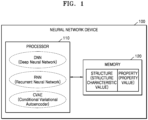
- FIG. 1 is a block diagram illustrating a hardware configuration of a neural network device according to an exemplary embodiment.
- a neural network device 100 may be implemented using various types of devices such as a personal computer (PC), a server device, a mobile device, and an embedded device. Examples of the neural network device 100 may include, but are not limited to, a smartphone, a tablet device, an augmented reality (AR) device, an Internet of Things (IoT) device, an autonomous vehicle, a robot, a medical device, and the like which perform speech recognition, image recognition, image classification, and the like using a neural network. Furthermore, the neural network device 100 may be a dedicated hardware (HW) accelerator mounted on the devices described above. The neural network device 100 may be a hardware accelerator such as a neural processing unit (NPU), a tensor processing unit (TPU), and a neural engine, which are dedicated modules for driving a neural network, without being limited thereto.
- NPU neural processing unit
- TPU tensor processing unit
- a neural engine which are dedicated modules for driving a neural network, without being limited thereto.
- the neural network device 100 includes a processor 110 and a memory 120.
- FIG. 1 illustrates components of the neural network device 100 related to the exemplary embodiments of the present disclosure. Thus, it should be apparent to a person skilled in the art that the neural network device 100 may further include any other components in addition to the components shown in FIG. 1 .
- the processor 110 controls the overall function for driving the neural network device 100.
- the processor 110 controls the overall operation of the neural network device 100 by executing programs stored in the memory 120 of the neural network device 100.
- the processor 110 may be implemented as a central processing unit (CPU), a graphics processing unit (GPU), an application processor (APU), and the like provided in the neural network device 100, without being limited thereto.
- the memory 120 is a component, at least partially implemented in hardware, that stores a variety of data processed by the neural network device 100.
- the memory 120 may store data to be processed by the neural network device 100.
- the memory 120 may also store applications, drivers, and the like to be driven by the neural network device 100.
- the memory 120 may include random access memory (RAM) such as dynamic random access memory (DRAM) and static random access memory (SRAM), read-only memory (ROM), electrically erasable programmable read-only memory (EEPROM), CD-ROM, Blue-ray, optical disk storage, hard disk drive (HDD), solid state drive (SSD), flash memory, or the like.
- RAM random access memory
- DRAM dynamic random access memory
- SRAM static random access memory
- ROM read-only memory
- EEPROM electrically erasable programmable read-only memory
- CD-ROM Compact Disk Read Only Memory
- Blue-ray optical disk storage
- HDD hard disk drive
- SSD solid state drive
- flash memory or the like.
- the memory 120 stores a structure characteristic value and a property value that are associated with each other as one set.
- the neural network device 100 may read the structure characteristic value and the property value from the memory 120 or write the structure characteristic value and the property value in the memory 120.
- the property value refers to a characteristic of a substance and may be a real number measured by an experiment or calculated by a simulation.
- the structure characteristic value refers to an indicator value used to express a structure of a substance.
- the processor 110 drives a deep neural network (DNN), a recurrent neural network (RNN).
- DNN deep neural network
- RNN recurrent neural network
- the processor 110 may allow the DNN to learn by using descriptors and properties (property values) and may determine a factor defining the relationship between the descriptors and the properties in this process. By driving the trained DNN, the processor 110 may perform a computation using a descriptor as input data to an input layer and generate a property value as output data based on a computation result.
- the processor 110 may allow the RNN to learn by using descriptors and structures (structure characteristic values) and may determine a factor defining the relationship between the descriptors and the structures in this process. By driving the trained RNN, the processor 110 may perform a computation using a descriptor or a factor as input data to an input layer and generate a structure characteristic value as output data based on a computation result.
- the processor 110 may generate a new chemical structure that is not present in the database by using the CVAE.
- a descriptor which is high-dimensional data stored in the database, may be used as input data to an input layer of the CVAE and encoding by converting the high-dimensional descriptor into a latent variable, which is low-dimensional data, may be performed by an encoder.
- the low-dimensional latent variable is decoded by a decoder of the CVAE.
- a descriptor which is high-dimensional data corresponding to a new chemical structure, may be output from an output layer.
- the neural network device 100 may further include a user interface (not shown).
- the user interface refers to a device used to input data to control the neural network device 100.
- Examples of the user interface may include, but are not limited to, a key pad, a dome switch, a touch pad (e.g., capacitive overlay type, resistive overlay type, infrared beam type, surface acoustic wave type, integral strain gauge type, and piezo electric type), a jog wheel, and a jog switch.
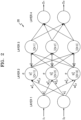
- FIG. 2 is a diagram for describing a computation performed by a DNN according to an exemplary embodiment.
- a DNN 20 has a structure including an input layer, one or more hidden layers, and an output layer. Further, the DNN 20 performs a computation based on received input data (e.g., I 1 and I 2 ), and generates output data (e.g., O 1 and O 2 ) based on a computation result.
- received input data e.g., I 1 and I 2
- output data e.g., O 1 and O 2
- the DNN 20 may include an input layer (Layer 1), two hidden layers (Layer 2 and Layer 3), and an output layer (Layer 4). Since the DNN 20 may include many layers to process valid information, the DNN 20 may process more complex data as compared to a neural network including a single layer. Meanwhile, although the DNN 20 illustrated in FIG. 2 includes 4 layers, the DNN 20 is merely an example and may also include more or less layers and more or less channels than those illustrated in FIG. 2 . That is, the DNN 20 may have various structures of layers different from that illustrated in FIG. 2 .
- Each of the layers included in the DNN 20 may have a plurality of channels.
- the channels may correspond to a plurality of artificial nodes known as neurons, processing elements (PEs), units, or similar terms.
- Layer 1 may include two channels (nodes)
- Layers 2 and 3 may include three channels, respectively.
- the layers are merely examples and each of the layers included in the DNN 20 may have various numbers of channels (nodes).
- the channels included in each of the layers of the DNN 20 may be interconnected to process data.
- a channel may perform a computation of data received from channels of one layer and output a computation result to channels of another layer.
- Input and output of each channel may be referred to as input activation and output activation. That is, an activation may be not only an output of one channel but also a parameter corresponding to an input of channels included in a successive layer. Meanwhile, each of the channels may determine an activation thereof based on activations and weights received from channels included in a previous layer. The weight is a parameter used to calculate the output activation of each channel and may be a value assigned to the relationship between channels.
- Each of the channels may be processed by a computational unit or a processing element that receives an input and outputs an output activation.
- the input-output of each channel may be mapped.
- ⁇ is an activation w jk i is a weight from a k th channel included in an (i-1) th layer to a j th channel included in an i th layer
- b j i is a bias of the j th channel included in the i th layer
- a j i is an activation of the j th channel of the i th layer
- an activation a j i may be calculated using Expression 1 below.
- a j i ⁇ ⁇ k jk i ⁇ a k i ⁇ 1 + b j i
- an activation of a first channel (CH1) of a second layer (Layer 2) may be expressed as a 1 2 .
- the above-described Expression 1 is merely an example for describing the activation and the weight used to process data in the DNN 20 and the exemplary embodiment is not limited thereto.
- the activation may be a value obtained by inputting a sum of activations received from the previous layer to an activation function and processing the result with a rectified linear unit (ReLU).
- ReLU rectified linear unit
- the DNN 20 may determine a factor defining the relationship between a descriptor and a property via learning using descriptors and property values. That is, among Layers 1 to 4 constituting the DNN 20, the descriptor corresponds to the input layer (Layer 1), the property value corresponds to the output layer (Layer 4), and the factor corresponds to at least one hidden layer (Layers 2 and 3).
- the DNN 20 may perform a computation using the descriptor as input data to the input layer and generate the property value as output data based on a computation result.
- FIG. 3 is a diagram for describing a computation performed by an RNN according to an exemplary embodiment.
- An RNN 30 is a neural network that learns using data changing with time such as time-series data, and the RNN 30 is constructed by connecting a network between a reference time point t and a next time point t+1. That is, the RNN 30 is a neural network in which a temporal aspect is considered and is capable of effectively learning a pattern from data sequentially input or data input with a sequence of features by modifying a model to allow a recursive input to a hidden layer of the neural network.
- nodes s constituting a hidden layer of the RNN 30 are illustrated.
- the nodes s may perform a computation based on input data x and generate output data o.
- the RNN 30 may apply the same task to all sequences and a final output result of the node s is affected by a result of a previous calculation.
- An RNN 31 is an unfolded RNN 30 with a loop.
- the term "unfold" the RNN 30 refers to expressing the RNN 30 for the entire sequence.
- x t is an input value at a time step t
- s t is a hidden state at the time step t.
- the s t may be expressed by Expression 2 below.
- a tanh or Relu function may be used as function f.
- the s -1 to calculate a first hidden state may generally be initialized to 0.
- o t is an output value at the time step t.
- s t f U x t + W s t ⁇ 1
- s t is a memory portion of the network and stores information on events at previous time steps.
- the output value o t depends only on the memory of the current time step t.
- the RNN 31 shares the parameters U, V, and W for all time steps. That is, since each step of the RNN 31 performs almost the same calculation except for an input value, the number of parameters to be learned may be reduced.
- an RNN 32 may determine a factor defining the relationship between the descriptor and the structure via learning using the descriptors and the structures (structure characteristic values). As described above with reference to FIG. 2 , the factor may be at least one hidden layer. The RNN 32 may perform a computation using a descriptor or a factor as input data to the input layer and generate a structure characteristic value as output data based on a computation result.
- each step of the RNN 32 may use a next character string of a character string input at a time point t as input of a time point t+1.
- the RNN 32 may perform learning to maximize the probability of generating a character string representing a structure s for data h and s (i.e., the factor and structure data).
- the probability p of generating a character string may be expressed by Expression 3 below.
- decoding proceeds sequentially by acquiring a first part 'ABC' of a decoded character string by using a factor e(x) as an input, acquiring a part 'BCD' of the character string using the acquired part 'ABC' as an input, and acquiring a part 'CED' of the character string using the acquired part 'BCD'.
- the first two characters of the part of the character string at the time point t are the same last two characters of the part of the character string at a time point t-1. Then, characters of each time point are aggregated to output a single character string "ABCDEFG.”
- FIG. 4 is a diagram for describing a computation performed by a CVAE according to an example which is not by itself an embodiment of the invention.
- a CVAE 40 has a structure including an input layer, an encoder, a decoder, and an output layer.
- High-dimensional data such as an image stored in a database is used as input data to the input layer of the CVAE 40, and the encoder performs encoding by converting the high-dimensional data into a low-dimensional latent variable z.
- the latent variable z follows a normal distribution with a mean ⁇ and a variance ⁇ and may be, for example, two-dimensional to fifty-dimensional data.
- the decoder decodes the low-dimensional latent variable z to output a new image (high-dimensional data) that is not present in the database from the output layer.
- the latent variable when an image of a human shape is used as input data, the latent variable may be a shape of an object, a view point of a camera, information on a light source, and the like.
- the latent variable When an image of a number is used as input data, the latent variable may be an angle between lines, an aspect ratio, and the like.
- the latent variable z may be mapped to a latent map.
- a predetermined value z' included in a region of the latent map to which the latent variable z is not mapped is input to the decoder, new data that is not stored in the database may be generated from the output layer.
- a descriptor that is high-dimensional data stored in the database may be used as input data to the input layer and encoding by converting the high-dimensional descriptor into a low-dimensional latent variable may be performed by the encoder. Then, the low-dimensional latent variable may be decoded by the decoder of the CVAE 40. Finally, a descriptor, which is high-dimensional data corresponding to a new chemical structure, may be output from the output layer.
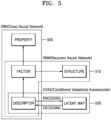
- FIG. 5 is a conceptual diagram illustrating a neural network system to generate a chemical structure according to an exemplary embodiment.
- a neural network system configured to generate a chemical structure by using a DNN 500, an RNN 510, and a CVAE 520 is illustrated.
- the descriptor may include a QSPR descriptor configured with an immediately calculable value such as a molecular structure fingerprint indicating whether or not a particular partial structure (ECFP) is included in a substance.
- the property refers to a characteristic possessed by a substance and may be a real number measured by an experiment or calculated by a simulation.
- the structure refers to an atomic level structure of a substance.
- a character string format expressing the structure may be a SMILES code, a SMARTS code, an InChi code, or the like.
- a structural formula may be expressed by a SMILES code as shown in Expression 4 or by a SMARTS code as shown in Expression 5.
- the factor is an element defining the relationships among the descriptor, the property, and the structure.
- the factor may be at least one hidden layer.
- a factor defining the relationship between the descriptor and the property a factor defining the relationship between the descriptor and the structure, and the like may be determined for each hidden layer.
- the latent map refers to visualizable coordinates to which two-dimensionally or three-dimensionally expressed descriptors are mapped. Similarity between the descriptors may be visualized and identified by using the latent map.
- the DNN 500 performs a computation using a descriptor as input data to the input layer and generate a property (property value) as output data based on a computation result.
- the RNN 510 performs a computation using a descriptor or a factor as input data to the input layer and generate a structure (structure characteristic value) as output data based on a computation result.
- a character string format expressing the structure characteristic value the SMILES code, the SMARTS code, or the like may be used.
- the DNN 500 and the RNN 510 may determine factors defining the relationship among the descriptor, the property, and the structure by performing learning based on the relationship between the property (property value) and the structure (structure characteristic value) stored in the memory.
- the factor may be at least one hidden layer.
- a factor defining the relationship between the descriptor and the property and a factor defining the relationship between the descriptor and the structure may be determined for each hidden layer.
- the RNN 510 may perform the computation using the factor determined by the DNN 500 as input data to the input layer and generate the structure characteristic value as output data based on the computation result.
- a descriptor which is high-dimensional data stored in the database, is used as input data to an input layer and encoding by converting the high-dimensional descriptor into a latent variable, which is low-dimensional data, may be performed by an encoder. Then, when the decoder of the CVAE 520 decodes the low-dimensional latent variable, a descriptor which is high-dimensional data corresponding to a new chemical structure may be output from an output layer.
- a property value may be generated.
- a structure characteristic value may be generated.
- FIG. 6 is a diagram for describing an example of expressing a structural formula of a substance as a character string according to an exemplary embodiment.
- FIG. 6 an example of expressing a structural formula of a substance as a character string is illustrated.
- a partial structure 620 to be maintained, i.e., necessarily included in a chemical structure to be finally generated.
- the partial structure 620 may be expressed by a character string such as a SMILES code, a SMARTS code, or an InChi code.
- the partial structure 620 may be expressed as a SMARTS code shown in Expression 6.
- the partial structure 620 may be expressed as a SMARTS code 621.
- the partial structure 620 may be expressed as a SMARTS code 622.
- bonds and atomic portions are fixed in the partial structure 620, the partial structure 620 may be expressed as a SMARTS code 623.
- FIG. 7 is a diagram for describing a process of selecting first generation descriptors according to an exemplary embodiment.
- a neural network device 700 may receive a target property value 710 and a target structure characteristic value 720 as input values.
- the neural network device 700 may generate chemical structures satisfying the target property value 710 and the target structure characteristic value 720. That is, the neural network device may generate a chemical structure including a predetermined partial structure and having improved properties.
- the target property value 710 refers to a numerical value of a certain property possessed by a chemical structure that is to be finally generated by the neural network device 700.
- the target property value 710 may be a refractive index value, an elastic modulus, a melting point, a transmission wavelength, an emission wavelength, and/or the like.
- the target property value 710 may include an indicator that identifies that a chemical structure to be finally generated is to include a property value in an increasing (+) direction or a decreasing (-) direction as compared to a predetermined value.
- a memory 730 stores a structure characteristic value and a property value matching each other as one set.
- the neural network device 700 may select a given property value stored in the memory 730.
- the neural network device 700 sets the target property value 710 as an indicator identifying that the chemical structure to be finally generated is to include a property value in the increasing direction rather than a certain numerical value, the chemical structure to be finally generated may have a property value greater than the property value selected in the memory 730.
- the target structure characteristic value 720 refers to a numerical value of a partial structure included in a chemical structure to be finally generated by the neural network device 700.
- the partial structure may be expressed, for example, as a SMILES code or SMARTS code.
- a descriptor such as ECFP and QSPR may be used.
- the target structure characteristic value 720 may be a descriptor of a particular chemical structure.
- the partial structure 721 may be expressed as a SMILES code 722a or a SMARTS code 722b.
- the neural network device 700 may receive a descriptor 723 corresponding to the SMILES code 722a or the SMARTS code 722b as the target structure characteristic value 720.
- FIG. 7 illustrates the SMILES code and the SMARTS code, and the chemical structure corresponding to the descriptor 723 for ease of understanding.
- the descriptor may be a binary value having a length of 100 bits.
- the descriptor will be expressed only by digits having a bit value of "1" for descriptive convenience.
- the descriptor 723 may be expressed by [0 2 4 8 9 10 18 19 20 29 30 42 47 48 49 51 53 56 57 63 64 66 72 79 83 86 87 93 95 97 98].
- the digits 0, 2, 4, 8, 9, 10, and the like of the descriptor 723 indicate the bit value "1”
- the digits 1, 3, 5, 6, 7, 11, and the like indicate the bit value "0".
- the neural network device 700 may select first generation descriptors 740 based on the received target property value 710 and the target structure characteristic value 720. Particularly, the neural network device 700 may select first generation descriptors 740 having a property value similar to the received target property value 710 (e.g., that satisfies a threshold similarity value) and a structure characteristic value similar to the received target structure characteristic value 720 (e.g., that satisfies a threshold similarity value) from the memory 730 in which structure characteristic values and property values matching each other are stored.
- first generation descriptors 740 having a property value similar to the received target property value 710 (e.g., that satisfies a threshold similarity value) and a structure characteristic value similar to the received target structure characteristic value 720 (e.g., that satisfies a threshold similarity value) from the memory 730 in which structure characteristic values and property values matching each other are stored.
- the neural network device 700 may select chemical structures having a structure characteristic value and a property value similar to the received inputs from the memory 730.
- the selected chemical structures may have the target structure characteristic value 740 expressed as Descriptors 1 and 2, and a plurality of descriptors (e.g., Descriptors 1 and 2) included in the target structure characteristic value 740 correspond to the first generation descriptors.
- FIG. 7 illustrates SMILES codes, SMARTS codes, and chemical structures corresponding respectively to Descriptors 1 and 2 for ease of understanding.
- FIG. 8 is a diagram for describing a process of applying a genetic algorithm to the first generation descriptors according to an exemplary embodiment.
- a neural network device generates second generation descriptors by applying a genetic algorithm to the first generation descriptors.
- Genetic algorithms are algorithms used to generate new candidate substances by performing crossover and mutation operations on previous candidate substances.
- the operations of the genetic algorithm might include arbitrary processes.
- the genetic algorithm includes operations such as selection, crossover, mutation, and/or the like.
- Selection is a process to select candidate substances that are passed on from one generation to a next generation.
- Crossover is a process of generating candidate substances of a next generation via mating within one generation.
- Mutation is a process of changing candidate substances via a random change in the order or value of the descriptor in one candidate substance.
- the neural network device selects the first generation descriptors.
- the first generation descriptors are Descriptors 1 to 4, and Descriptors 1 to 4 may be expressed by binary codes.
- the neural network device performs crossover and mutation operations on Descriptors 1 to 4 selected as the first generation descriptors. As a result of crossover and mutation operations, the neural network device generates second generation descriptors from the first generation descriptors (Descriptors 1 to 4).
- FIGS. 9A and 9B are diagrams for describing a process of evaluating properties and structures of descriptors according to an exemplary embodiment.
- a DNN 900 of the neural network device is a neural network in which a factor defining the relationship between a descriptor and a property is determined via learning using descriptors and properties (property values).
- the DNN 900 learns an encoding function e( ⁇ ) and a prediction function f( ⁇ ) based on (x, y) data that indicates a descriptor and a property value, and/or other information.
- the encoding function e( ⁇ ) is a function for deriving hidden parameters from the descriptor.
- the prediction function f( ⁇ ) is a function for predicting a property based on the factor acquired based on the encoding.
- the DNN 900 may determine the factor such that a probability of data (x, y) is maximized or a difference between a property value f(e(x)) via prediction and a real property y is minimized.
- the DNN 900 performs a computation using the descriptor as input data to the input layer and generates the property value as output data based on a computation result.
- the factor may be an undisclosed core element to represent the relationship between the descriptor and the property.
- the descriptor may be an input layer
- the factor may be a hidden layer
- the property value may be an output layer.
- the neural network device inputs second generation descriptors to the DNN 900 as input data and generates property values of the respective second generation descriptors as output data by applying the encoding function e( ⁇ ) and the prediction function f( ⁇ ) thereto.
- the neural network device may evaluate the properties of the second generation descriptors by comparing the generated property values with a target property value.
- an RNN 910 of the neural network device is a neural network in which a factor defining the relationship between a descriptor and a structure is determined via learning using descriptors and structures (structure characteristic values).
- the RNN 910 learns the encoding function e( ⁇ ) and a decoding function d(.) based on (x, s) data that indicates a descriptor and a structure characteristic value, and the factor may be determined in the process of learning the decoding function d( ⁇ ). Meanwhile, when the encoding function e( ⁇ ) is determined via the learning process of the DNN 900, the RNN 910 may learn the decoding function d(.) based on (h, s) data that includes a factor and a structure characteristic value by using the encoding function e( ⁇ ) determined by the DNN 900.
- the decoding function d(.) is a function to generate a structure of a substance at the atomic level by using the factor derived from the descriptor.
- s d(h)
- the RNN 910 performs a computation using the descriptor as input data to the input layer and generates the structure characteristic value as output data based on a computation result.
- the factor may be an undisclosed core element to represent the relationship between the descriptor and the structure and may be a hidden layer of the RNN 910.
- the hidden layer generated via the learning process of the DNN 900 may also be used.
- the neural network device inputs second generation descriptors to the RNN 910 as input data and generates structure characteristic values of the respective second generation descriptors as output data by applying the encoding function e( ⁇ ) and the decoding function d(.) thereto.
- the neural network device may evaluate structures of the second generation descriptors by identifying whether or not the generated structure characteristic values include the target structure characteristic value.
- the RNN 910 may generate the structure characteristic value (final chemical structure) in the form of SMILES code.
- the neural network device may determine whether or not the structure characteristic value includes the target structure characteristic value by comparing a SMILES code corresponding to the structure characteristic value with a SMARTS code corresponding to the target structure characteristic value by using an RDkit library.
- the structure characteristic value generated by the RNN 910 includes the target structure characteristic value, i.e., when the generated final chemical structure includes a partial structure
- the neural network device selects the second generation descriptor input to the RNN 910 as a candidate descriptor.
- methods of expressing the structure characteristic values (final chemical structures) and the target structures characteristic values (partial structures) are not limited thereto.
- the neural network device evaluates the properties of the second generation descriptors by using the DNN 900 and the structures of the second generation descriptors by using the RNN 910. In addition, the neural network device selects candidate descriptors having the target property value and the target structure characteristic value from the second generation descriptors based on the evaluation results of the properties and structures. Finally, the neural network device generates chemical structures for the selected candidate descriptors, thereby generating improved chemical structures including the particular partial structure and having the target property value.
- the neural network device when the property values and/or structure characteristic values of the second generation descriptors do not satisfy the target values, the neural network device generates third generation descriptors by applying the genetic algorithm to the second generation descriptors.
- the neural network device evaluates properties of the third generation descriptors by using the DNN 900 and structures of the third generation descriptors by using the RNN 910.
- the neural network device modifies (e.g. evolves) the descriptors by using the genetic algorithm until descriptors satisfying the target property value and the target structure characteristic value are generated. In other words, the neural network device iteratively generates descriptors, and evaluates properties and structures of the generated descriptors based on whether the generated descriptors satisfy the target property value and the target structure characteristic value.
- the neural network device may change a transformation index applied to the genetic algorithm.
- the degree of transformation of the first generation descriptors may vary according to the transformation index applied to the genetic algorithm.
- lowering the transformation index may refer to lowering the number of operations with large degrees of transformation of the first generation descriptors, among selection, crossover, mutation, and replace operations constituting the genetic algorithm.
- methods of changing the transformation index are not limited thereto.
- the neural network device may re-generate second generation descriptors from the first generation descriptors after changing the transformation index of the genetic algorithm.
- the neural network device may lower the transformation index of the genetic algorithm and then apply the genetic algorithm to the first generation descriptors again to re-generate the second generation descriptors.
- the neural network device generates chemical structures including a particular partial structure and having improved properties by evolving the descriptors by using the genetic algorithm and evaluating property values and structure characteristic values of the generated descriptors by using the DNN 900 and the RNN 910.
- the neural network device may gradually generate chemical structures including the particular partial structure and having improved properties.
- the neural network device may generate a chemical structure including a partial structure 921 and an increased wavelength (T1 value).
- the neural network device may generate a chemical structure including the partial structure 921 and having an increased T1 value by applying the genetic algorithm to the generated chemical structure 923.
- the neural network device may generate chemical structures by applying the genetic algorithm thereto until a chemical structure having a property value similar to the target property value is generated (e.g., that satisfies a threshold similarity value, that satisfies the target property value, that is within a threshold range of the target property value, that satisfies a predetermined metric, and/or the like).
- the neural network device may also generate a chemical structure including a particular partial structure and a reduced T1 value by applying the genetic algorithm to the generated chemical structure 923.
- FIG. 10 is a conceptual diagram of a neural network system configured to generate a chemical structure by using a CVAE according to an example which is not by itself an embodiment of the invention.
- a CVAE 1000 of the neural network device uses a descriptor that is high-dimensional data stored in the database as input data to an input layer, and encoding by converting the high-dimensional descriptor into a latent variable that is low-dimensional data is performed by an encoder. Next, a decoder of the CVAE 1000 decodes the low-dimensional latent variable, and finally, a descriptor that is high-dimensional data corresponding to a new chemical structure is output from an output layer.
- the CVAE 1000 may encode a high-dimensional descriptor x for each of the existing chemical structures into a low-dimensional latent variable I.
- the latent variable I may include a two-dimensional descriptor z obtained by lowering a dimension of the high-dimensional descriptor x and core structure information t.
- data included in the latent variable I is not limited thereto.
- Table 1 Examples of structures corresponding to the core structure information t are shown in Table 1 below.
- the latent variable I may be mapped to a latent map 1030.
- the two-dimensional descriptor z included in the latent variable I corresponds to (x, y) coordinate values of the latent map 1030 and the core structure information t included in the latent variable I is distinguished by colors in the latent map 1030 (where colors of the latent map 1030 are not shown in FIG. 10 ).
- core structure information t may be shown in eight different colors in the latent map 1030.
- a first color e.g., blue
- the latent map 1030 When the latent map 1030 is used, similarity between the descriptors may be visually identified. In the latent map 1030, it may be confirmed that the descriptors are gathered according to the structure form. Thus, a new chemical structure including a particular structural form may be generated thereby. Referring to the latent map 1030 of FIG. 10 , it may be confirmed that the descriptors are gathered by the same color, i.e., the same structural form.
- the CVAE 1000 may select a region 1040 to which latent variables are not mapped from the latent map 1030. When latent variables of the selected region 1040 are decoded, the latent variables may be converted into high-dimensional descriptors. The CVAE 1000 may generate chemical structures for the converted high-dimensional descriptors, thereby creating new chemical structures.
- the CVAE 1000 may generate new chemical structures not stored in the database by decoding predetermined latent variables of the region 1040 of the latent map 1030 to which the latent variables are not mapped. Also, chemical structures including the particular structure may be generated by decoding latent variables of a region of the latent map 1030 adjacent to a region in which latent variables of the particular structure are gathered.
- the neural network device may generate property values of the new chemical structures generated by the CVAE 1000 by using a DNN 1010 and structure characteristic values thereof by using an RNN 1020.
- the neural network device may also evaluate properties and structural characteristics of the new chemical structures. When the target property value and the target structure characteristic value are not satisfied as a result of evaluation, the neural network device generates next generation chemical structures by applying the genetic algorithm to the generated new chemical structures.
- FIG. 11 is a flowchart for describing a method of generating a chemical structure by using a DNN and an RNN according to an exemplary embodiment.
- the method of generating a chemical structure performed by the neural network device illustrated in FIG. 11 is related to the exemplary embodiments described above with reference to the drawings. Thus, although omitted in the following descriptions, the contents described above with reference to the drawings may also be applied to the method illustrated in FIG. 11 .
- the neural network device receives a target property value and a target structure characteristic value as input data in operation 1110.
- the target property value may be indicative of a certain property possessed by a chemical structure to be finally generated by the neural network device.
- the target property value may be a numerical value, a range of numerical values, or the like.
- the target property value may be, for example, a refractive index value, an elastic modulus, a melting point, a transmission wavelength, an emission wavelength, and/or the like.
- the target property value 710 may be set as an indicator identifying that a chemical structure to be finally generated is to include a property value in an increasing (+) direction or a decreasing (-) direction as compared to a predetermined value.
- the target structure characteristic value is indicative of a partial structure included in a chemical structure to be finally generated by the neural network device.
- a descriptor such as ECFP and QSPR may be used to express the partial structure with a numerical value.
- the neural network device may generate a chemical structure including the particular partial structure and having an improved property based on the target property value and the target structure characteristic value.
- the neural network device may select first generation descriptors based on the received input data.
- the neural network device may select descriptors having a property value similar to the received target property value and a structure characteristic value similar to the received target structure characteristic value as the first generation descriptors among the descriptors stored in the memory.
- the neural network device may determine a descriptor that includes a property value that satisfies a threshold similarity value to the received target property value.
- the property value may be within a threshold range of the target property value, may be greater than the target property value, and/or the like.
- the neural network device may select the descriptor based on the descriptor including a property value that satisfies the threshold similarity value.
- the neural network device may determine a descriptor that includes a structure characteristic value that satisfies a threshold similarity value to the target structure characteristic value.
- the structure characteristic value may satisfy a particular metric, may be within a threshold range of the target structure characteristic value, may match the target structure characteristic value, and/or the like.
- the neural network device may select the descriptor based on the descriptor including a structure characteristic value that satisfies the threshold similarity value.
- the neural network device generates second generation descriptors by applying the genetic algorithm to the first generation descriptors.
- the neural network device generates the second generation descriptors by performing crossover and mutation operations on the first generation descriptors.
- the neural network device evaluates properties and structures of the second generation descriptors.
- the neural network device may generate property values of the respective second generation descriptors as output data by inputting second generation descriptors to the DNN as input data and applying the encoding function and the prediction function thereto.
- the neural network device may evaluate the properties of the second generation descriptors by comparing the generated property values with the target property value.
- the neural network device may generate structure characteristic values of the respective second generation descriptors as output data by inputting second generation descriptors to the RNN as input data and applying the encoding function and the decoding function thereto.
- the neural network device may evaluate structures of the second generation descriptors by comparing the generated structure characteristic values with the target structure characteristic value.
- the neural network device may determine whether or not the structure characteristic values include a target structure characteristic value by comparing a SMILES code corresponding to the structure characteristic value with a SMARTS code corresponding to the target structure characteristic value by using the RDkit library.
- the neural network device selects the second generation descriptors input to the RNN as candidate descriptors.
- the neural network device may select candidate descriptors satisfying the target property value and the target structure characteristic value from the second generation descriptors based on the evaluation result.
- the neural network device may generate third generation descriptors by applying the genetic algorithm to the second generation descriptors.
- the neural network device may evaluate properties of the third generation descriptors by using the DNN and structures of the third generation descriptors by using the RNN. That is, the neural network device may evolve the descriptors by using the genetic algorithm until descriptors satisfying the target property value and the target structure characteristic value are generated. In other words, the neural network device may iteratively evolve the descriptors until the generated descriptors satisfy the target property value and the target characteristic value.
- the neural network device may generate chemical structures for the selected candidate descriptors.
- the neural network device may generate structure characteristic values of the respective candidate descriptors as output data by inputting the candidate descriptors to the RNN as input data and applying the encoding function and the decoding function thereto.
- the neural network device may generate chemical structures by converting the generated structure characteristic values into a SMILES code, an InChi code, or the like.
- FIG. 12 is a flowchart for describing a method of generating a chemical structure by using a CVAE according to an example which is not by itself an embodiment of the invention.
- the method of generating a chemical structure performed by the neural network device illustrated in FIG. 12 is related to the exemplary embodiments described above with reference to the drawings. Thus, although omitted in the following descriptions, the contents described above with reference to the drawings may also be applied to the method illustrated in FIG. 12 .
- the neural network device may convert first descriptors into low-dimensional latent variables in operation 1210.
- the memory stores a structure (structure characteristic value) and a property (property value) matching each other as one set. Since the structure characteristic value is stored in the memory in the form of descriptor and the descriptor stored in the memory may be high-dimensional data.
- the neural network device may convert the descriptors (i.e., first descriptors) of the chemical structures stored in the memory to low-dimensional latent variables respectively.
- the neural network device may select some of the descriptor of the chemical structures stored in the memory as the first descriptors based on the received input.
- the neural network device may convert the selected first descriptors into low-dimensional latent variables.
- the neural network device may encode high-dimensional descriptors into low-dimensional latent variables I by using the CVAE.
- the latent variables may include two-dimensional descriptors obtained by lowering dimension of the high-dimensional descriptors and core structures.
- the neural network device may map the latent variables to the latent map.
- the two-dimensional descriptors included in the latent variables may correspond to (x, y) coordinate values of the latent map and the core structures t included in the latent variables may be expressed as colors in the latent map.
- the neural network device may select a region to which latent variables are not mapped from the latent map.
- the neural network device may input predetermined values included in the region of the latent map to which the latent variables are not mapped to the decoder and decode the predetermined value, thereby generating new chemical structures not stored in the database.
- Chemical structures including the particular structure may be generated by decoding latent variables of a region adjacent to a region in which latent variables of the particular structure are gathered among the latent variables included in the regions to which the latent variables of the existing chemical structures are not mapped.
- the neural network device may convert the latent variables of the selected region into high-dimensional second descriptors and generate chemical structures for the second descriptors.
- the neural network device may convert the latent variables into the high-dimensional descriptors by decoding the latent variables of the selected region by using the CVAE. Also, the neural network device may generate new chemical structures by generating chemical structures for the converted high-dimensional descriptors by using the CVAE.
- the neural network device may evaluate properties and structures of the respective converted high-dimensional descriptors.
- the neural network device may generate next generation chemical structures by applying the genetic algorithm to the converted high-dimensional descriptors. Descriptions thereof are similar as those of operations 1110 to 1160 of FIG. 11 .
- the aforementioned exemplary embodiments may be embodied in the form of a recording medium including instructions executable by a computer, such as a program module, executed by a computer.
- the computer-readable medium may be any recording medium that may be accessed by a computer and may include volatile and non-volatile media and removable and non-removable media.
- the computer-readable medium may include a non-transitory computer-readable medium that stores one or more instructions that, when executed by one or more processors, cause the one or more processors to perform operations associated with exemplary embodiments described herein.
- the computer-readable medium may include computer storage media and communication media.
- the computer storage media include volatile and non-volatile and removable and non-removable media implemented using any method or technology to store information such as computer-readable instructions, data structures, program modules, or other data.
- the communication media include computer-readable instructions, data structures, program modules, or other data in a modulated data signal, or other transport mechanisms and include any delivery media.
- unit may be a hardware component such as a processor or a circuit and/or a software component executed by the hardware component such as a processor.
Landscapes
- Engineering & Computer Science (AREA)
- Physics & Mathematics (AREA)
- Theoretical Computer Science (AREA)
- Life Sciences & Earth Sciences (AREA)
- Health & Medical Sciences (AREA)
- Computing Systems (AREA)
- Biophysics (AREA)
- General Health & Medical Sciences (AREA)
- Data Mining & Analysis (AREA)
- Software Systems (AREA)
- Evolutionary Computation (AREA)
- Artificial Intelligence (AREA)
- Biomedical Technology (AREA)
- Bioinformatics & Cheminformatics (AREA)
- Molecular Biology (AREA)
- Computational Linguistics (AREA)
- General Engineering & Computer Science (AREA)
- General Physics & Mathematics (AREA)
- Mathematical Physics (AREA)
- Bioinformatics & Computational Biology (AREA)
- Chemical & Material Sciences (AREA)
- Crystallography & Structural Chemistry (AREA)
- Evolutionary Biology (AREA)
- Physiology (AREA)
- Genetics & Genomics (AREA)
- Medicinal Chemistry (AREA)
- Pharmacology & Pharmacy (AREA)
- Spectroscopy & Molecular Physics (AREA)
- Computer Vision & Pattern Recognition (AREA)
- Databases & Information Systems (AREA)
- Medical Informatics (AREA)
- Neurology (AREA)
- Probability & Statistics with Applications (AREA)
- Image Analysis (AREA)
- Management, Administration, Business Operations System, And Electronic Commerce (AREA)
Claims (5)
- Verfahren zum Erzeugen einer neuen chemischen Struktur, wobei das Verfahren durch eine neuronale Netzwerkvorrichtung durchgeführt wird und Folgendes umfasst:a) Empfangen eines Zieleigenschaftswertes und eines Zielstrukturcharakteristikwertes, wobei der Zielstrukturcharakteristikwert zumindest eines von einem SMARTS-Code, einem SMILES-Code oder einem InChi-Code-Ausdruck einer Teilstruktur umfasst, die in die zu erzeugende neue chemische Struktur aufzunehmen ist;b) Auswählen von Deskriptoren der ersten Generation basierend auf dem Zieleigenschaftswert und dem Zielstrukturcharakteristikwert;c) Erzeugen von Deskriptoren der zweiten Generation basierend auf den Deskriptoren der ersten Generation durch Durchführen von Crossover- und Mutationsoperationen an den Deskriptoren der ersten Generation unter Verwendung eines genetischen Algorithmus;
wobei jeder der Deskriptoren der ersten Generation und der Deskriptoren der zweiten Generation zumindest eines von Folgendem umfasst: einem Morgan-Fingerabdruck; und einem erweiterten Konnektivitätsfingerabdruck;d) Bestimmen, unter Verwendung eines ersten neuronalen Netzwerks der neuronalen Netzwerkvorrichtung, von Eigenschaftswerten der Deskriptoren der zweiten Generation, wobei das erste neuronale Netzwerk ein tiefes neuronales Netzwerk (DNN) ist;e) Bestimmen, unter Verwendung eines zweiten neuronalen Netzwerks der neuronalen Netzwerkvorrichtung, von Strukturcharakteristikwerten der Deskriptoren der zweiten Generation, wobei das zweite neuronale Netzwerk ein rekurrentes neuronales Netzwerk (RNN) ist, wobei das Bestimmen Eingeben der Deskriptoren der zweiten Generation in das zweite neuronale Netzwerk als Eingabedaten und Erzeugen von Strukturcharakteristikwerten als Ausgabedaten aus dem zweiten neuronalen Netzwerk umfasst, wobei die Strukturcharakteristikwerte, die von dem zweiten neuronalen Netzwerk ausgegeben werden, jeweils zumindest eines von einem SMARTS-Code, einem SMILES-Code oder einem InChi-Code-Ausdruck einer chemischen Struktur umfassen;f) Auswählen, aus den Deskriptoren der zweiten Generation, eines Kandidatendeskriptors, der den Zieleigenschaftswert und den Zielstrukturcharakteristikwert erfüllt, wobei das Auswählen des Kandidatendeskriptors auf dem Bestimmen der Eigenschaftswerte basiert und auf dem Bestimmen der Strukturcharakteristikwerte basiert, wobei das Auswählen des Kandidatendeskriptors basierend auf dem Bestimmen der Strukturcharakteristikwerte Auswählen eines Deskriptors der zweiten Generation, der in das zweite neuronale Netzwerk eingegeben wurde, nur dann als Kandidatendeskriptor umfasst, wenn der Strukturcharakteristikwert einer chemischen Struktur, der durch das zweite neuronale Netzwerk ausgegeben wird, die Teilstruktur beinhaltet, die durch den Zielstrukturcharakteristikwert ausgedrückt wird;wobei, wenn die Eigenschaftswerte und/oder die Strukturcharakteristikwerte der Deskriptoren der zweiten Generation die Zielwerte nicht erfüllen, das Verfahren ferner iteratives Weiterentwickeln der Deskriptoren durch Verwenden des genetischen Algorithmus und Wiederholen der Schritte d), e) und f) umfasst, um Eigenschaften und Strukturen der weiterentwickelten Deskriptoren zu bewerten, bis ein Deskriptor, der den Zieleigenschaftswert und den Zielstrukturcharakteristikwert erfüllt, erzeugt wird; undwobei die neue chemische Struktur der Strukturcharakteristikwert des ausgewählten Kandidatendeskriptors ist. - Verfahren nach Anspruch 1, ferner umfassend:Ändern eines Transformationsindex, der verwendet wird, um die Deskriptoren der zweiten Generation zu erzeugen, wobei das Ändern darauf basiert, dass eine Anzahl der ausgewählten Kandidatendeskriptoren weniger als ein vorbestimmter Wert ist; underneutes Erzeugen von Deskriptoren der zweiten Generation basierend auf dem geänderten Transformationsindex.
- Neuronale Netzwerkvorrichtung, die konfiguriert ist, um eine neue chemische Struktur zu erzeugen, wobei die neuronale Netzwerkvorrichtung Folgendes umfasst:eine Benutzerschnittstelle, die konfiguriert ist, um einen Zieleigenschaftswert und einen Zielstrukturcharakteristikwert zu empfangen, wobei der Zielstrukturcharakteristikwert zumindest eines von einem SMARTS-Code, einem SMILES-Code oder einem InChi-Code-Ausdruck einer Teilstruktur umfasst, die in die zu erzeugende neue chemische Struktur aufzunehmen ist;einen Speicher, der konfiguriert ist, um zumindest ein Programm zu speichern; undeinen Prozessor, der konfiguriert ist, um das zumindest eine Programm für Folgendes auszuführen:a) Auswählen von Deskriptoren der ersten Generation basierend auf dem Zieleigenschaftswert und dem Zielstrukturcharakteristikwert;b) Erzeugen von Deskriptoren der zweiten Generation basierend auf den Deskriptoren der ersten Generation durch Durchführen von Crossover- und Mutationsoperationen an den Deskriptoren der ersten Generation unter Verwendung eines genetischen Algorithmus;wobei jeder von den Deskriptoren der ersten Generation und den Deskriptoren der zweiten Generation zumindest eines von Folgendem umfasst: einem Morgan-Fingerabdruck; und einem erweiterten Konnektivitätsfingerabdruck;c) Bestimmen, unter Verwendung eines ersten neuronalen Netzwerks, von Eigenschaftswerten der Deskriptoren der zweiten Generation, wobei das erste neuronale Netzwerk ein tiefes neuronales Netzwerk (DNN) ist;d) Bestimmen, unter Verwendung eines zweiten neuronalen Netzwerks, von Strukturcharakteristikwerten der Deskriptoren der zweiten Generation, wobei das zweite neuronale Netzwerk ein rekurrierendes neuronales Netzwerk (RNN) ist, wobei das Bestimmen Eingeben der Deskriptoren der zweiten Generation in das zweite neuronale Netzwerk als Eingabedaten und Erzeugen von Strukturcharakteristikwerten als Ausgabedaten aus dem zweiten neuronalen Netzwerk umfasst, wobei die Strukturcharakteristikwerte, die von dem zweiten neuronalen Netzwerk ausgegeben werden, jeweils zumindest eines von einem SMARTS-Code, einem SMILES-Code oder einem InChi-Code-Ausdruck einer chemischen Struktur umfassen;e) Auswählen, aus den Deskriptoren der zweiten Generation, eines Kandidatendeskriptors, der den Zieleigenschaftswert und den Zielstrukturcharakteristikwert erfüllt, basierend auf dem Bestimmen der Eigenschaftswerte und der Strukturcharakteristikwerte, wobei das Auswählen des Kandidatendeskriptors basierend auf dem Bestimmen der Strukturcharakteristikwerte Auswählen eines Deskriptors der zweiten Generation, der in das zweite neuronale Netzwerk eingegeben wurde, nur dann als Kandidatendeskriptor umfasst, wenn der Strukturcharakteristikwert einer chemischen Struktur, die durch das zweite neuronale Netzwerk ausgegeben wird, die Teilstruktur beinhaltet, die durch den Zielstrukturcharakteristikwert ausgedrückt wird;wobei, wenn die Eigenschaftswerte und/oder die Strukturcharakteristikwerte der Deskriptoren der zweiten Generation die Zielwerte nicht erfüllen, das Verfahren ferner iteratives Weiterentwickeln der Deskriptoren durch Verwenden des genetischen Algorithmus und Wiederholen der Schritte c), d) und e) umfasst, um Eigenschaften und Strukturen der weiterentwickelten Deskriptoren zu bewerten, bis ein Deskriptor, der den Zieleigenschaftswert und den Zielstrukturcharakteristikwert erfüllt, erzeugt wird; undwobei die neue chemische Struktur der Strukturcharakteristikwert des ausgewählten Kandidatendeskriptors ist.
- Neuronale Netzwerkvorrichtung nach Anspruch 3, wobei der Prozessor ferner konfiguriert ist, um einen Transformationsindex zu ändern, der verwendet wird, um die Deskriptoren der zweiten Generation zu erzeugen, basierend darauf, dass eine Anzahl der ausgewählten Kandidatendeskriptoren weniger als ein vorbestimmter Wert ist; und
erneutes Erzeugen der Deskriptoren der zweiten Generation basierend auf dem geänderten Transformationsindex. - Computerprogramm, umfassend Computerprogrammcodemittel, die ausgelegt sind, um das Verfahren nach Anspruch 1 oder 2 durchzuführen, wenn das Programm auf einem Computer läuft.
Applications Claiming Priority (1)
| Application Number | Priority Date | Filing Date | Title |
|---|---|---|---|
| KR1020180006275A KR102587959B1 (ko) | 2018-01-17 | 2018-01-17 | 뉴럴 네트워크를 이용하여 화학 구조를 생성하는 장치 및 방법 |
Publications (2)
| Publication Number | Publication Date |
|---|---|
| EP3514734A1 EP3514734A1 (de) | 2019-07-24 |
| EP3514734B1 true EP3514734B1 (de) | 2024-05-29 |
Family
ID=63914913
Family Applications (1)
| Application Number | Title | Priority Date | Filing Date |
|---|---|---|---|
| EP18201299.7A Active EP3514734B1 (de) | 2018-01-17 | 2018-10-18 | Verfahren und vorrichtung zur erzeugung einer chemischen struktur unter verwendung eines neuronalen netzwerks |
Country Status (4)
| Country | Link |
|---|---|
| US (1) | US11581067B2 (de) |
| EP (1) | EP3514734B1 (de) |
| KR (1) | KR102587959B1 (de) |
| CN (1) | CN110046692B (de) |
Families Citing this family (25)
| Publication number | Priority date | Publication date | Assignee | Title |
|---|---|---|---|---|
| KR102547802B1 (ko) | 2018-08-23 | 2023-06-26 | 삼성전자주식회사 | 뉴럴 네트워크를 이용하여 화학 구조를 생성하는 장치 및 방법 |
| US11995854B2 (en) * | 2018-12-19 | 2024-05-28 | Nvidia Corporation | Mesh reconstruction using data-driven priors |
| US20220270711A1 (en) * | 2019-08-02 | 2022-08-25 | Flagship Pioneering Innovations Vi, Llc | Machine learning guided polypeptide design |
| KR102110176B1 (ko) * | 2019-10-11 | 2020-05-13 | 주식회사 메디리타 | 신약 후보 물질 도출 방법 및 장치 |
| JP7483244B2 (ja) * | 2019-10-21 | 2024-05-15 | 国立大学法人東京工業大学 | 化合物生成装置、化合物生成方法、学習装置、学習方法及びプログラム |
| US20220383993A1 (en) * | 2019-10-21 | 2022-12-01 | Standigm Inc. | Method and device for designing compound |
| KR20210072528A (ko) | 2019-12-09 | 2021-06-17 | 삼성전자주식회사 | 뉴럴 네트워크를 이용하여 새로운 화학 구조를 생성하는 장치 및 방법 |
| WO2021125206A1 (ja) * | 2019-12-16 | 2021-06-24 | 富士フイルム株式会社 | 画像解析装置、画像解析方法、及びプログラム |
| US11875264B2 (en) * | 2020-01-15 | 2024-01-16 | R4N63R Capital Llc | Almost unsupervised cycle and action detection |
| US12347530B2 (en) | 2020-03-31 | 2025-07-01 | International Business Machines Corporation | Expert-in-the-loop AI for materials generation |
| US12135927B2 (en) * | 2020-03-31 | 2024-11-05 | International Business Machines Corporation | Expert-in-the-loop AI for materials discovery |
| US12547889B2 (en) * | 2020-07-29 | 2026-02-10 | Samsung Electronics Co., Ltd. | Method and apparatus for synthesizing target products by using neural networks |
| CN112199884B (zh) * | 2020-09-07 | 2024-08-13 | 深圳先进技术研究院 | 物品分子生成方法、装置、设备及存储介质 |
| CN112270951B (zh) * | 2020-11-10 | 2022-11-01 | 四川大学 | 基于多任务胶囊自编码器神经网络的全新分子生成方法 |
| JP7312468B2 (ja) * | 2021-02-12 | 2023-07-21 | Hpcシステムズ株式会社 | 分子構造生成方法及びプログラム |
| CN113276119B (zh) * | 2021-05-25 | 2022-06-28 | 清华大学深圳国际研究生院 | 一种基于图Wasserstein自编码网络的机器人运动规划方法及系统 |
| CN114220488B (zh) * | 2021-11-08 | 2025-02-11 | 深圳晶泰科技有限公司 | 化合物设计方法、装置、设备及计算机可读存储介质 |
| WO2023077522A1 (zh) * | 2021-11-08 | 2023-05-11 | 深圳晶泰科技有限公司 | 化合物设计方法、装置、设备及计算机可读存储介质 |
| KR102729270B1 (ko) * | 2022-03-08 | 2024-11-11 | 연세대학교 산학협력단 | 딥러닝 기반 분자 설계 방법, 이를 수행하는 장치 및 컴퓨터 프로그램 |
| US20240143969A1 (en) * | 2022-10-31 | 2024-05-02 | International Business Machines Corporation | Formulation graph convolution networks (f-gcn) for predicting performance of formulated products |
| US12587274B2 (en) | 2023-03-28 | 2026-03-24 | Quantum Generative Materials Llc | Satellite optimization management system based on natural language input and artificial intelligence |
| US12627372B2 (en) | 2023-12-27 | 2026-05-12 | Quantum Generative Materials Llc | Advanced mission control predictive systems for low earth orbit semi-autonomous satellites |
| US12368503B2 (en) | 2023-12-27 | 2025-07-22 | Quantum Generative Materials Llc | Intent-based satellite transmit management based on preexisting historical location and machine learning |
| US12603701B2 (en) | 2023-12-27 | 2026-04-14 | Quantum Generative Materials Llc | Distributed satellite constellation management and control system |
| CN120297161B (zh) * | 2025-06-12 | 2025-09-23 | 宇曜(北京)科技有限公司 | 基于元素与结构复合描述符的晶格热导率模型构建方法 |
Family Cites Families (9)
| Publication number | Priority date | Publication date | Assignee | Title |
|---|---|---|---|---|
| US5463564A (en) | 1994-09-16 | 1995-10-31 | 3-Dimensional Pharmaceuticals, Inc. | System and method of automatically generating chemical compounds with desired properties |
| JP2003058579A (ja) | 2001-08-21 | 2003-02-28 | Bridgestone Corp | 設計・配合の最適化方法 |
| JP2004301928A (ja) | 2003-03-28 | 2004-10-28 | Seiko Epson Corp | 薄膜形成方法および薄膜を有する被処理体 |
| DE10350525A1 (de) | 2003-10-29 | 2005-06-09 | Bayer Technology Services Gmbh | Verfahren zur Visualisierung der ADME-Eigenschaften chemischer Substanzen |
| JP2006113893A (ja) | 2004-10-15 | 2006-04-27 | Mitsubishi Electric Corp | 化学物質の自動分類方法、情報空間の可視化法及び情報検索システム並びに情報検索プログラム |
| KR101375672B1 (ko) | 2011-10-27 | 2014-03-20 | 주식회사 켐에쎈 | 화합물의 물성을 예측하는 방법 및 화합물의 물성을 예측하는 시스템 |
| KR102457974B1 (ko) * | 2015-11-04 | 2022-10-21 | 삼성전자주식회사 | 신규 물질 탐색 방법 및 장치 |
| US10366779B2 (en) | 2015-12-30 | 2019-07-30 | International Business Machines Corporation | Scheme of new materials |
| KR102523472B1 (ko) | 2016-08-01 | 2023-04-18 | 삼성전자주식회사 | 신규 물질의 구조 생성 방법 및 장치 |
-
2018
- 2018-01-17 KR KR1020180006275A patent/KR102587959B1/ko active Active
- 2018-10-10 US US16/156,709 patent/US11581067B2/en active Active
- 2018-10-18 EP EP18201299.7A patent/EP3514734B1/de active Active
- 2018-10-29 CN CN201811266187.4A patent/CN110046692B/zh active Active
Also Published As
| Publication number | Publication date |
|---|---|
| CN110046692A (zh) | 2019-07-23 |
| KR20190087898A (ko) | 2019-07-25 |
| US20190220573A1 (en) | 2019-07-18 |
| EP3514734A1 (de) | 2019-07-24 |
| CN110046692B (zh) | 2025-01-17 |
| KR102587959B1 (ko) | 2023-10-11 |
| US11581067B2 (en) | 2023-02-14 |
Similar Documents
| Publication | Publication Date | Title |
|---|---|---|
| US11581067B2 (en) | Method and apparatus for generating a chemical structure using a neural network | |
| Kollmannsberger et al. | Deep learning in computational mechanics | |
| Chen | Deep learning and practice with mindspore | |
| JP6983937B2 (ja) | 畳み込みニューラルネットワークにおける構造学習 | |
| EP3614314B1 (de) | Verfahren und vorrichtung zur erzeugung einer chemischen struktur unter verwendung eines neuronalen netzwerks | |
| JP2024500182A (ja) | 説明可能なトランスデューサ・トランスフォーマ | |
| US11854672B2 (en) | Method and apparatus for generating chemical structure | |
| EP3751467A1 (de) | Maschinenlernsystem | |
| US12608647B2 (en) | Multimodal data inference | |
| US12626787B2 (en) | Method and apparatus for generating new chemical structure using neural network | |
| US11334791B2 (en) | Learning to search deep network architectures | |
| CN117321692A (zh) | 用于从分子图生成任务相关的结构嵌入的方法和系统 | |
| Kim et al. | Building deep random ferns without backpropagation | |
| Narayanan et al. | Introduction to deep learning | |
| Shen et al. | StructBoost: Boosting methods for predicting structured output variables | |
| Coors et al. | Automatic componentwise boosting: An interpretable automl system | |
| Mustapha et al. | Introduction to machine learning and artificial intelligence | |
| JP2024089666A (ja) | タスクマイニングのために画面画像から特徴を抽出すること | |
| Sun et al. | Evolutionary Deep Neural Architecture Search: Fundamentals, Methods, and Recent Advances | |
| Joseph | Programmable Neural Network Compression with Correctness Emphasis | |
| KR102963337B1 (ko) | 화학구조를 생성하는 장치 및 방법 | |
| Nayak et al. | A Proposal for Deep Learning Based Emotion Identification | |
| Salamon | Fusing two pretrained object detection networks | |
| KR20210042777A (ko) | 화학구조를 생성하는 장치 및 방법 | |
| CN116324815A (zh) | 神经元与神经网络的综合训练与推理 |
Legal Events
| Date | Code | Title | Description |
|---|---|---|---|
| PUAI | Public reference made under article 153(3) epc to a published international application that has entered the european phase |
Free format text: ORIGINAL CODE: 0009012 |
|
| STAA | Information on the status of an ep patent application or granted ep patent |
Free format text: STATUS: THE APPLICATION HAS BEEN PUBLISHED |
|
| AK | Designated contracting states |
Kind code of ref document: A1 Designated state(s): AL AT BE BG CH CY CZ DE DK EE ES FI FR GB GR HR HU IE IS IT LI LT LU LV MC MK MT NL NO PL PT RO RS SE SI SK SM TR |
|
| AX | Request for extension of the european patent |
Extension state: BA ME |
|
| STAA | Information on the status of an ep patent application or granted ep patent |
Free format text: STATUS: REQUEST FOR EXAMINATION WAS MADE |
|
| 17P | Request for examination filed |
Effective date: 20200124 |
|
| RBV | Designated contracting states (corrected) |
Designated state(s): AL AT BE BG CH CY CZ DE DK EE ES FI FR GB GR HR HU IE IS IT LI LT LU LV MC MK MT NL NO PL PT RO RS SE SI SK SM TR |
|
| STAA | Information on the status of an ep patent application or granted ep patent |
Free format text: STATUS: EXAMINATION IS IN PROGRESS |
|
| 17Q | First examination report despatched |
Effective date: 20201124 |
|
| P01 | Opt-out of the competence of the unified patent court (upc) registered |
Effective date: 20230520 |
|
| REG | Reference to a national code |
Ref country code: DE Ref legal event code: R079 Free format text: PREVIOUS MAIN CLASS: G06N0003040000 Ipc: G06N0003126000 Ref country code: DE Ref legal event code: R079 Ref document number: 602018069986 Country of ref document: DE Free format text: PREVIOUS MAIN CLASS: G06N0003040000 Ipc: G06N0003126000 |
|
| GRAP | Despatch of communication of intention to grant a patent |
Free format text: ORIGINAL CODE: EPIDOSNIGR1 |
|
| STAA | Information on the status of an ep patent application or granted ep patent |
Free format text: STATUS: GRANT OF PATENT IS INTENDED |
|
| RIC1 | Information provided on ipc code assigned before grant |
Ipc: G16C 20/80 20190101ALI20240214BHEP Ipc: G16C 20/70 20190101ALI20240214BHEP Ipc: G16C 20/50 20190101ALI20240214BHEP Ipc: G06N 3/045 20230101ALI20240214BHEP Ipc: G06N 3/044 20230101ALI20240214BHEP Ipc: G06N 3/09 20230101ALI20240214BHEP Ipc: G06N 3/126 20230101AFI20240214BHEP |
|
| INTG | Intention to grant announced |
Effective date: 20240227 |
|
| GRAS | Grant fee paid |
Free format text: ORIGINAL CODE: EPIDOSNIGR3 |
|
| GRAA | (expected) grant |
Free format text: ORIGINAL CODE: 0009210 |
|
| STAA | Information on the status of an ep patent application or granted ep patent |
Free format text: STATUS: THE PATENT HAS BEEN GRANTED |
|
| AK | Designated contracting states |
Kind code of ref document: B1 Designated state(s): AL AT BE BG CH CY CZ DE DK EE ES FI FR GB GR HR HU IE IS IT LI LT LU LV MC MK MT NL NO PL PT RO RS SE SI SK SM TR |
|
| REG | Reference to a national code |
Ref country code: CH Ref legal event code: EP |
|
| REG | Reference to a national code |
Ref country code: IE Ref legal event code: FG4D |
|
| REG | Reference to a national code |
Ref country code: DE Ref legal event code: R096 Ref document number: 602018069986 Country of ref document: DE |
|
| REG | Reference to a national code |
Ref country code: LT Ref legal event code: MG9D |
|
| REG | Reference to a national code |
Ref country code: NL Ref legal event code: MP Effective date: 20240529 |
|
| PG25 | Lapsed in a contracting state [announced via postgrant information from national office to epo] |
Ref country code: IS Free format text: LAPSE BECAUSE OF FAILURE TO SUBMIT A TRANSLATION OF THE DESCRIPTION OR TO PAY THE FEE WITHIN THE PRESCRIBED TIME-LIMIT Effective date: 20240929 |
|
| PG25 | Lapsed in a contracting state [announced via postgrant information from national office to epo] |
Ref country code: BG Free format text: LAPSE BECAUSE OF FAILURE TO SUBMIT A TRANSLATION OF THE DESCRIPTION OR TO PAY THE FEE WITHIN THE PRESCRIBED TIME-LIMIT Effective date: 20240529 |
|
| PG25 | Lapsed in a contracting state [announced via postgrant information from national office to epo] |
Ref country code: FI Free format text: LAPSE BECAUSE OF FAILURE TO SUBMIT A TRANSLATION OF THE DESCRIPTION OR TO PAY THE FEE WITHIN THE PRESCRIBED TIME-LIMIT Effective date: 20240529 Ref country code: HR Free format text: LAPSE BECAUSE OF FAILURE TO SUBMIT A TRANSLATION OF THE DESCRIPTION OR TO PAY THE FEE WITHIN THE PRESCRIBED TIME-LIMIT Effective date: 20240529 |
|
| PG25 | Lapsed in a contracting state [announced via postgrant information from national office to epo] |
Ref country code: GR Free format text: LAPSE BECAUSE OF FAILURE TO SUBMIT A TRANSLATION OF THE DESCRIPTION OR TO PAY THE FEE WITHIN THE PRESCRIBED TIME-LIMIT Effective date: 20240830 |
|
| REG | Reference to a national code |
Ref country code: AT Ref legal event code: MK05 Ref document number: 1691264 Country of ref document: AT Kind code of ref document: T Effective date: 20240529 |
|
| PG25 | Lapsed in a contracting state [announced via postgrant information from national office to epo] |
Ref country code: ES Free format text: LAPSE BECAUSE OF FAILURE TO SUBMIT A TRANSLATION OF THE DESCRIPTION OR TO PAY THE FEE WITHIN THE PRESCRIBED TIME-LIMIT Effective date: 20240529 |
|
| PG25 | Lapsed in a contracting state [announced via postgrant information from national office to epo] |
Ref country code: AT Free format text: LAPSE BECAUSE OF FAILURE TO SUBMIT A TRANSLATION OF THE DESCRIPTION OR TO PAY THE FEE WITHIN THE PRESCRIBED TIME-LIMIT Effective date: 20240529 |
|
| PG25 | Lapsed in a contracting state [announced via postgrant information from national office to epo] |
Ref country code: PL Free format text: LAPSE BECAUSE OF FAILURE TO SUBMIT A TRANSLATION OF THE DESCRIPTION OR TO PAY THE FEE WITHIN THE PRESCRIBED TIME-LIMIT Effective date: 20240529 |
|
| PG25 | Lapsed in a contracting state [announced via postgrant information from national office to epo] |
Ref country code: LV Free format text: LAPSE BECAUSE OF FAILURE TO SUBMIT A TRANSLATION OF THE DESCRIPTION OR TO PAY THE FEE WITHIN THE PRESCRIBED TIME-LIMIT Effective date: 20240529 |
|
| PG25 | Lapsed in a contracting state [announced via postgrant information from national office to epo] |
Ref country code: PL Free format text: LAPSE BECAUSE OF FAILURE TO SUBMIT A TRANSLATION OF THE DESCRIPTION OR TO PAY THE FEE WITHIN THE PRESCRIBED TIME-LIMIT Effective date: 20240529 Ref country code: NO Free format text: LAPSE BECAUSE OF FAILURE TO SUBMIT A TRANSLATION OF THE DESCRIPTION OR TO PAY THE FEE WITHIN THE PRESCRIBED TIME-LIMIT Effective date: 20240829 Ref country code: LV Free format text: LAPSE BECAUSE OF FAILURE TO SUBMIT A TRANSLATION OF THE DESCRIPTION OR TO PAY THE FEE WITHIN THE PRESCRIBED TIME-LIMIT Effective date: 20240529 Ref country code: IS Free format text: LAPSE BECAUSE OF FAILURE TO SUBMIT A TRANSLATION OF THE DESCRIPTION OR TO PAY THE FEE WITHIN THE PRESCRIBED TIME-LIMIT Effective date: 20240929 Ref country code: HR Free format text: LAPSE BECAUSE OF FAILURE TO SUBMIT A TRANSLATION OF THE DESCRIPTION OR TO PAY THE FEE WITHIN THE PRESCRIBED TIME-LIMIT Effective date: 20240529 Ref country code: GR Free format text: LAPSE BECAUSE OF FAILURE TO SUBMIT A TRANSLATION OF THE DESCRIPTION OR TO PAY THE FEE WITHIN THE PRESCRIBED TIME-LIMIT Effective date: 20240830 Ref country code: FI Free format text: LAPSE BECAUSE OF FAILURE TO SUBMIT A TRANSLATION OF THE DESCRIPTION OR TO PAY THE FEE WITHIN THE PRESCRIBED TIME-LIMIT Effective date: 20240529 Ref country code: ES Free format text: LAPSE BECAUSE OF FAILURE TO SUBMIT A TRANSLATION OF THE DESCRIPTION OR TO PAY THE FEE WITHIN THE PRESCRIBED TIME-LIMIT Effective date: 20240529 Ref country code: BG Free format text: LAPSE BECAUSE OF FAILURE TO SUBMIT A TRANSLATION OF THE DESCRIPTION OR TO PAY THE FEE WITHIN THE PRESCRIBED TIME-LIMIT Effective date: 20240529 Ref country code: AT Free format text: LAPSE BECAUSE OF FAILURE TO SUBMIT A TRANSLATION OF THE DESCRIPTION OR TO PAY THE FEE WITHIN THE PRESCRIBED TIME-LIMIT Effective date: 20240529 Ref country code: RS Free format text: LAPSE BECAUSE OF FAILURE TO SUBMIT A TRANSLATION OF THE DESCRIPTION OR TO PAY THE FEE WITHIN THE PRESCRIBED TIME-LIMIT Effective date: 20240829 |
|
| PG25 | Lapsed in a contracting state [announced via postgrant information from national office to epo] |
Ref country code: NL Free format text: LAPSE BECAUSE OF FAILURE TO SUBMIT A TRANSLATION OF THE DESCRIPTION OR TO PAY THE FEE WITHIN THE PRESCRIBED TIME-LIMIT Effective date: 20240529 |
|
| PG25 | Lapsed in a contracting state [announced via postgrant information from national office to epo] |
Ref country code: NL Free format text: LAPSE BECAUSE OF FAILURE TO SUBMIT A TRANSLATION OF THE DESCRIPTION OR TO PAY THE FEE WITHIN THE PRESCRIBED TIME-LIMIT Effective date: 20240529 |
|
| PG25 | Lapsed in a contracting state [announced via postgrant information from national office to epo] |
Ref country code: DK Free format text: LAPSE BECAUSE OF FAILURE TO SUBMIT A TRANSLATION OF THE DESCRIPTION OR TO PAY THE FEE WITHIN THE PRESCRIBED TIME-LIMIT Effective date: 20240529 |
|
| PG25 | Lapsed in a contracting state [announced via postgrant information from national office to epo] |
Ref country code: EE Free format text: LAPSE BECAUSE OF FAILURE TO SUBMIT A TRANSLATION OF THE DESCRIPTION OR TO PAY THE FEE WITHIN THE PRESCRIBED TIME-LIMIT Effective date: 20240529 |
|
| PG25 | Lapsed in a contracting state [announced via postgrant information from national office to epo] |
Ref country code: CZ Free format text: LAPSE BECAUSE OF FAILURE TO SUBMIT A TRANSLATION OF THE DESCRIPTION OR TO PAY THE FEE WITHIN THE PRESCRIBED TIME-LIMIT Effective date: 20240529 |
|
| PG25 | Lapsed in a contracting state [announced via postgrant information from national office to epo] |
Ref country code: RO Free format text: LAPSE BECAUSE OF FAILURE TO SUBMIT A TRANSLATION OF THE DESCRIPTION OR TO PAY THE FEE WITHIN THE PRESCRIBED TIME-LIMIT Effective date: 20240529 Ref country code: SK Free format text: LAPSE BECAUSE OF FAILURE TO SUBMIT A TRANSLATION OF THE DESCRIPTION OR TO PAY THE FEE WITHIN THE PRESCRIBED TIME-LIMIT Effective date: 20240529 |
|
| PG25 | Lapsed in a contracting state [announced via postgrant information from national office to epo] |
Ref country code: SM Free format text: LAPSE BECAUSE OF FAILURE TO SUBMIT A TRANSLATION OF THE DESCRIPTION OR TO PAY THE FEE WITHIN THE PRESCRIBED TIME-LIMIT Effective date: 20240529 |
|
| PG25 | Lapsed in a contracting state [announced via postgrant information from national office to epo] |
Ref country code: SM Free format text: LAPSE BECAUSE OF FAILURE TO SUBMIT A TRANSLATION OF THE DESCRIPTION OR TO PAY THE FEE WITHIN THE PRESCRIBED TIME-LIMIT Effective date: 20240529 Ref country code: SK Free format text: LAPSE BECAUSE OF FAILURE TO SUBMIT A TRANSLATION OF THE DESCRIPTION OR TO PAY THE FEE WITHIN THE PRESCRIBED TIME-LIMIT Effective date: 20240529 Ref country code: RO Free format text: LAPSE BECAUSE OF FAILURE TO SUBMIT A TRANSLATION OF THE DESCRIPTION OR TO PAY THE FEE WITHIN THE PRESCRIBED TIME-LIMIT Effective date: 20240529 Ref country code: EE Free format text: LAPSE BECAUSE OF FAILURE TO SUBMIT A TRANSLATION OF THE DESCRIPTION OR TO PAY THE FEE WITHIN THE PRESCRIBED TIME-LIMIT Effective date: 20240529 Ref country code: DK Free format text: LAPSE BECAUSE OF FAILURE TO SUBMIT A TRANSLATION OF THE DESCRIPTION OR TO PAY THE FEE WITHIN THE PRESCRIBED TIME-LIMIT Effective date: 20240529 Ref country code: CZ Free format text: LAPSE BECAUSE OF FAILURE TO SUBMIT A TRANSLATION OF THE DESCRIPTION OR TO PAY THE FEE WITHIN THE PRESCRIBED TIME-LIMIT Effective date: 20240529 |
|
| PG25 | Lapsed in a contracting state [announced via postgrant information from national office to epo] |
Ref country code: IT Free format text: LAPSE BECAUSE OF FAILURE TO SUBMIT A TRANSLATION OF THE DESCRIPTION OR TO PAY THE FEE WITHIN THE PRESCRIBED TIME-LIMIT Effective date: 20240529 |
|
| REG | Reference to a national code |
Ref country code: DE Ref legal event code: R097 Ref document number: 602018069986 Country of ref document: DE |
|
| PLBE | No opposition filed within time limit |
Free format text: ORIGINAL CODE: 0009261 |
|
| STAA | Information on the status of an ep patent application or granted ep patent |
Free format text: STATUS: NO OPPOSITION FILED WITHIN TIME LIMIT |
|
| PG25 | Lapsed in a contracting state [announced via postgrant information from national office to epo] |
Ref country code: SI Free format text: LAPSE BECAUSE OF FAILURE TO SUBMIT A TRANSLATION OF THE DESCRIPTION OR TO PAY THE FEE WITHIN THE PRESCRIBED TIME-LIMIT Effective date: 20240529 |
|
| 26N | No opposition filed |
Effective date: 20250303 |
|
| REG | Reference to a national code |
Ref country code: CH Ref legal event code: PL |
|
| PG25 | Lapsed in a contracting state [announced via postgrant information from national office to epo] |
Ref country code: MC Free format text: LAPSE BECAUSE OF FAILURE TO SUBMIT A TRANSLATION OF THE DESCRIPTION OR TO PAY THE FEE WITHIN THE PRESCRIBED TIME-LIMIT Effective date: 20240529 |
|
| PG25 | Lapsed in a contracting state [announced via postgrant information from national office to epo] |
Ref country code: LU Free format text: LAPSE BECAUSE OF NON-PAYMENT OF DUE FEES Effective date: 20241018 Ref country code: BE Free format text: LAPSE BECAUSE OF NON-PAYMENT OF DUE FEES Effective date: 20241031 |
|
| PG25 | Lapsed in a contracting state [announced via postgrant information from national office to epo] |
Ref country code: CH Free format text: LAPSE BECAUSE OF NON-PAYMENT OF DUE FEES Effective date: 20241031 |
|
| REG | Reference to a national code |
Ref country code: BE Ref legal event code: MM Effective date: 20241031 |
|
| PG25 | Lapsed in a contracting state [announced via postgrant information from national office to epo] |
Ref country code: SE Free format text: LAPSE BECAUSE OF FAILURE TO SUBMIT A TRANSLATION OF THE DESCRIPTION OR TO PAY THE FEE WITHIN THE PRESCRIBED TIME-LIMIT Effective date: 20240529 |
|
| PGFP | Annual fee paid to national office [announced via postgrant information from national office to epo] |
Ref country code: GB Payment date: 20250911 Year of fee payment: 8 |
|
| PGFP | Annual fee paid to national office [announced via postgrant information from national office to epo] |
Ref country code: FR Payment date: 20250908 Year of fee payment: 8 |
|
| PG25 | Lapsed in a contracting state [announced via postgrant information from national office to epo] |
Ref country code: IE Free format text: LAPSE BECAUSE OF NON-PAYMENT OF DUE FEES Effective date: 20241018 |
|
| PGFP | Annual fee paid to national office [announced via postgrant information from national office to epo] |
Ref country code: DE Payment date: 20250910 Year of fee payment: 8 |
|
| PG25 | Lapsed in a contracting state [announced via postgrant information from national office to epo] |
Ref country code: PT Free format text: LAPSE BECAUSE OF NON-PAYMENT OF DUE FEES Effective date: 20240529 |
|
| PG25 | Lapsed in a contracting state [announced via postgrant information from national office to epo] |
Ref country code: CY Free format text: LAPSE BECAUSE OF FAILURE TO SUBMIT A TRANSLATION OF THE DESCRIPTION OR TO PAY THE FEE WITHIN THE PRESCRIBED TIME-LIMIT; INVALID AB INITIO Effective date: 20181018 |
|
| PG25 | Lapsed in a contracting state [announced via postgrant information from national office to epo] |
Ref country code: HU Free format text: LAPSE BECAUSE OF FAILURE TO SUBMIT A TRANSLATION OF THE DESCRIPTION OR TO PAY THE FEE WITHIN THE PRESCRIBED TIME-LIMIT; INVALID AB INITIO Effective date: 20181018 |