EP3513644B1 - Mowing robot - Google Patents
Mowing robot Download PDFInfo
- Publication number
- EP3513644B1 EP3513644B1 EP19152518.7A EP19152518A EP3513644B1 EP 3513644 B1 EP3513644 B1 EP 3513644B1 EP 19152518 A EP19152518 A EP 19152518A EP 3513644 B1 EP3513644 B1 EP 3513644B1
- Authority
- EP
- European Patent Office
- Prior art keywords
- motor
- disposed
- wheel
- sensor
- blade
- Prior art date
- Legal status (The legal status is an assumption and is not a legal conclusion. Google has not performed a legal analysis and makes no representation as to the accuracy of the status listed.)
- Active
Links
Images


Classifications
-
- A—HUMAN NECESSITIES
- A01—AGRICULTURE; FORESTRY; ANIMAL HUSBANDRY; HUNTING; TRAPPING; FISHING
- A01D—HARVESTING; MOWING
- A01D34/00—Mowers; Mowing apparatus of harvesters
- A01D34/01—Mowers; Mowing apparatus of harvesters characterised by features relating to the type of cutting apparatus
- A01D34/412—Mowers; Mowing apparatus of harvesters characterised by features relating to the type of cutting apparatus having rotating cutters
- A01D34/63—Mowers; Mowing apparatus of harvesters characterised by features relating to the type of cutting apparatus having rotating cutters having cutters rotating about a vertical axis
-
- A—HUMAN NECESSITIES
- A01—AGRICULTURE; FORESTRY; ANIMAL HUSBANDRY; HUNTING; TRAPPING; FISHING
- A01D—HARVESTING; MOWING
- A01D34/00—Mowers; Mowing apparatus of harvesters
- A01D34/006—Control or measuring arrangements
- A01D34/008—Control or measuring arrangements for automated or remotely controlled operation
-
- A—HUMAN NECESSITIES
- A01—AGRICULTURE; FORESTRY; ANIMAL HUSBANDRY; HUNTING; TRAPPING; FISHING
- A01D—HARVESTING; MOWING
- A01D34/00—Mowers; Mowing apparatus of harvesters
- A01D34/001—Accessories not otherwise provided for
-
- A—HUMAN NECESSITIES
- A01—AGRICULTURE; FORESTRY; ANIMAL HUSBANDRY; HUNTING; TRAPPING; FISHING
- A01D—HARVESTING; MOWING
- A01D34/00—Mowers; Mowing apparatus of harvesters
- A01D34/006—Control or measuring arrangements
-
- A—HUMAN NECESSITIES
- A01—AGRICULTURE; FORESTRY; ANIMAL HUSBANDRY; HUNTING; TRAPPING; FISHING
- A01D—HARVESTING; MOWING
- A01D34/00—Mowers; Mowing apparatus of harvesters
- A01D34/01—Mowers; Mowing apparatus of harvesters characterised by features relating to the type of cutting apparatus
- A01D34/412—Mowers; Mowing apparatus of harvesters characterised by features relating to the type of cutting apparatus having rotating cutters
- A01D34/42—Mowers; Mowing apparatus of harvesters characterised by features relating to the type of cutting apparatus having rotating cutters having cutters rotating about a horizontal axis, e.g. cutting-cylinders
- A01D34/56—Driving mechanisms for the cutters
- A01D34/58—Driving mechanisms for the cutters electric
-
- B—PERFORMING OPERATIONS; TRANSPORTING
- B25—HAND TOOLS; PORTABLE POWER-DRIVEN TOOLS; MANIPULATORS
- B25J—MANIPULATORS; CHAMBERS PROVIDED WITH MANIPULATION DEVICES
- B25J11/00—Manipulators not otherwise provided for
-
- B—PERFORMING OPERATIONS; TRANSPORTING
- B25—HAND TOOLS; PORTABLE POWER-DRIVEN TOOLS; MANIPULATORS
- B25J—MANIPULATORS; CHAMBERS PROVIDED WITH MANIPULATION DEVICES
- B25J13/00—Controls for manipulators
- B25J13/08—Controls for manipulators by means of sensing devices, e.g. viewing or touching devices
- B25J13/088—Controls for manipulators by means of sensing devices, e.g. viewing or touching devices with position, velocity or acceleration sensors
-
- B—PERFORMING OPERATIONS; TRANSPORTING
- B25—HAND TOOLS; PORTABLE POWER-DRIVEN TOOLS; MANIPULATORS
- B25J—MANIPULATORS; CHAMBERS PROVIDED WITH MANIPULATION DEVICES
- B25J5/00—Manipulators mounted on wheels or on carriages
- B25J5/007—Manipulators mounted on wheels or on carriages mounted on wheels
-
- A—HUMAN NECESSITIES
- A01—AGRICULTURE; FORESTRY; ANIMAL HUSBANDRY; HUNTING; TRAPPING; FISHING
- A01D—HARVESTING; MOWING
- A01D2101/00—Lawn-mowers
Definitions
- the present invention relates to a sensor disposition structure of a mowing robot.
- Robots have been developed for industrial use and have been part of factory automation. Recently, the application field of robot has been expanded such that medical robot, aerospace robot, and the like have been developed and household robot that can be used in ordinary homes has been made. Among these robots, a robot capable of traveling by itself is called a mobile robot. A typical example of the mobile robot used in the outdoor environment of a home is a mowing robot.
- a movable area In the case of a mobile robot that autonomously travels indoors, a movable area is restricted by a wall, furniture, or the like. However, in the case of the mowing robot that autonomously travels outdoors, it is required to previously set the movable area. In addition, it is required to restrict the movable area so that the mowing robot can travel in the area where lawns are planted.
- the mowing robot travels outdoors unlike a cleaning robot that travels indoors, it is difficult to check a position through the surrounding image, and the role of the gyro sensing function and the acceleration sensing function is important.
- a first object of the present invention is to use a sensor having both a gyro sensing function and a magnetic field sensing function in a mowing robot for cost reduction and to solve a problem of using such a sensor. Further, when the sensor has a gyro sensing function, a magnetic field sensing function, and an acceleration sensing function, it is to solve a problem of using such a sensor.
- a second object of the present invention is to make it possible that the result of gyroscopic sensing of the sensor more effectively reflects the actual rotation result of a mobile robot, and further the combined result of the gyro sensing result and the acceleration sensing result of the sensor more effectively reflects the actual movement result of the mobile robot.
- a third object of the present invention is to reduce the influence of the magnetic field generated by other parts of the mowing robot on the magnetic field sensing result of the sensor while achieving the first object and second object of the present invention, so that the external magnetic field can be more accurately sensed by the sensor.
- a mowing robot includes: a body which forms an outer shape and an internal space; a first wheel and a second wheel which are independently rotatably provided in a left side and a right side respectively so that the body can rotate and move forward with respect to ground; a first motor which provides a rotational force of the first wheel; a second motor which provides a rotational force of the second wheel; and a sensor which is disposed in the internal space, has a gyro sensing function for at least horizontal rotation, and has a magnetic field sensing function, when i) a virtual wheel front end plane which is in contact with a front end of the first wheel and a front end of the second wheel and is vertically disposed; ii) a virtual wheel rear end plane which is in contact with a rear end of the first wheel and a rear end of the second wheel and is vertically disposed; iii) a virtual first motor upper end plane which is in contact with an upper end of the first motor and is horizontally
- the mowing robot further includes a cover, to which the sensor is fixed, that fully covers the sensor when viewed from the first motor and fully covers the sensor when viewed from the second motor. Further, the cover is configured to reduce the magnetic field influence of the first motor and the second motor on the sensor.
- the sensor may be disposed closest to a virtual wheel axis plane, among the wheel front end plane, the wheel rear end plane, and the wheel axis plane which passes through a center of the first wheel and a center of the second wheel and is disposed vertically.
- the mowing robot may further include: a blade which is disposed in front of a center of the first wheel and a center of the second wheel and is rotatably provided for mowing; a blade motor which provides a rotational force of the blade; and a battery which is disposed behind the center of the first wheel and the center of the second wheel and provides power to the first motor, the second motor, and the blade motor, and the sensor is disposed in an upper side portion of the internal space, and the first motor, the second motor, the blade motor, and the battery are disposed in a lower side portion of the internal space.
- the mowing robot may further include a battery which is disposed in a center of the first wheel and a center of the second wheel and provides power to the first motor and the second motor, and the sensor is disposed in front of a virtual battery front end plane which is in contact with a front end of the battery and is vertically disposed, and disposed in an upper side of a virtual battery upper end plane which is in contact with an upper end of the battery and is horizontally disposed.
- the sensor may be disposed in an upper side of a virtual blade motor upper end plane which is in contact with an upper end of the blade motor and is horizontally disposed, and is disposed in an upper side of a virtual battery upper end plane which is in contact with an upper end of the battery and is horizontally disposed.
- the cover may fully cover the sensor when viewed from below.
- the mowing robot may further include a main board which is disposed in an upper side of the first motor and the second motor, disposed in a lower side of the cover, fully covers the sensor when viewed from below, and controls a driving of the first motor and the second motor.
- the mowing robot may further include a covering supporting unit which fixes the cover to the main board while spacing the cover from the main board.
- the mowing robot may further include: a module case which is disposed inside the body, and accommodates the sensor, the cover, and the main board therein; and a display module which is disposed in an upper side of the sensor, and fixed to an upper side portion of the module case.
- first, second, etc. in front of the constituent elements mentioned in the lower side of is intended to avoid confusion of the constituent elements, and is not related to the order, importance, master-servant relationship, or the like between the constituent elements.
- an invention including only a second constituent element without a first constituent element can be implemented.
- the wheel axis Ow is a virtual axis for describing the position of the rotation axis of the first wheel 120a and the second wheel 120b, and does not refer to an actual component such as a shaft.
- the first wheel 120a and the second wheel 120b may be directly connected to the rotation axis of the first motor 130a and the rotation axis of the second motor 130b respectively.
- component such as shaft may be connected to the first wheel 120a and the second wheel 120b, and the rotational force of the motor 130a, 130b may be transmitted to the wheel 120a, 120b by a gear, a chain, or the like.
- a virtual wheel axis plane V1 which is vertically disposed while passing through the center of the first wheel 120a and the center of the second wheel 120b may be defined.
- the wheel axis plane V1 may be a plane including the wheel axis Ow.
- a virtual blade motor rear end plane V2 which is in contact with the rear R end of the blade motor 150 and is vertically disposed may be defined.
- a virtual battery front-end plane V3 which is in contact with the front F end of the battery Bt and is vertically disposed may be defined.
- a virtual wheel front end plane V4a which is in contact with the front end of the first wheel 120a and the front end of the second wheel 120b and is vertically disposed may be defined.
- the mowing robot 100 may include an obstacle detection unit 161 that detects an obstacle ahead.
- a plurality of obstacle detection units 161a, 161b, and 161c may be provided.
- the obstacle detection unit 161 may be disposed in the front of the body 110.
- the obstacle detection unit 161 may be disposed in the upper side of a frame 111.
- the mowing robot 100 may include a rain detection unit (not shown) for sensing rain.
- the rain detection unit may be disposed in a case 112.
- the lane detection unit may be disposed in the upper side of the frame 111.
- a plurality of remote signal reception units 101 may be provided.
- the plurality of remote signal reception units 101 may include a first remote signal reception unit 101a disposed in a front portion of the body 110 and a second remote signal reception unit 101b disposed in a rear portion of the body 110.
- the first remote signal reception unit 101a may receive a remote signal transmitted from the front.
- the second remote signal reception unit 101b may receive a remote signal transmitted from the rear.
- the mowing robot 100 may include an auxiliary wheel 162 disposed in front of the first wheel 120a and the second wheel 120b.
- the auxiliary wheel 162 may be disposed in front of the blade 140.
- the auxiliary wheel 162 may be a wheel that does not receive a driving force by the motor, and serve to supplementally support the body 110 with respect to the ground.
- a caster 107 supporting the rotation axis of the auxiliary wheel 162 may be rotatably coupled to the frame 111 with respect to a vertical axis.
- a first auxiliary wheel 162a disposed in the left side and a second auxiliary wheel 162b disposed in the right side may be provided.
- the mowing robot 100 may include an input unit 164 for inputting various instructions of a user.
- the input unit 164 may include a button, a dial, a touch-type display, and the like.
- the input unit 164 may include a microphone (not shown) for voice recognition.
- a plurality of buttons may be disposed in the upper side of the case 112.
- the mowing robot 100 may include an output unit 165 for outputting various information to the user.
- the output unit 165 may include a display module 165 for outputting visual information.
- the output unit 165 may include a speaker (not shown) for outputting auditory information.
- the display module 165 may output an image in the upward direction.
- the display module 165 may be disposed in the upper side of the case 112.
- the display module 165 may include a thin film transistor liquid crystal display (LCD) panel.
- the display module 165 may be implemented by using various display panels such as a plasma display panel or an organic light emitting diode display panel.
- the mowing robot 100 may include a communication unit (not shown) for communicating with an external device (terminal, etc.), a server, a router, and the like.
- the communication unit may vary depending on the communication method of other device or a server to communicate with.
- the mowing robot 100 may be able to change the height of the blade 140 with respect to the ground so that the lawn mowing height can be changed.
- the mowing robot 100 may include a height adjustment unit 166 for changing the height of the blade 140 by a user.
- the height adjustment unit 166 may include a rotatable dial, and may change the height of the blade 140 by rotating the dial.
- the mowing robot 100 may include a height display unit 167 for displaying the height level of the blade 140.
- the height display unit 167 may display a lawn height value which is estimated after the lawn mower robot 100 performs lawn mowing with a current height of the blade 140.
- the mowing robot 100 may include a docking insertion unit 169 which is connected to a docking equipment 200 when docked to the docking equipment 200.
- the docking insertion unit 169 may be recessed to receive a docking connection unit 210 of the docking equipment 200.
- the docking insertion unit 169 may be disposed in the front portion of the body 110. Due to the connection between the docking insertion unit 169 and the docking connection unit 210, a correct position can be guided when the mowing robot 100 is charged.
- the mowing robot 100 may include a charging corresponding terminal 102 disposed in a position which can be in contact with a charging terminal 211 described later, in a state where the docking insertion unit 169 is inserted into the docking connection unit 210.
- the charging corresponding terminal 102 may include a pair of charging corresponding terminals 102a and 102b disposed in a position corresponding to a pair of charging terminals 211a and 211b.
- the pair of charging corresponding terminals 102a, 102b may be disposed laterally with the docking insertion unit 169 therebetween.
- the controller 163 may control the driving of the first motor 130a and the second motor 130b.
- the controller 163 may control the driving of the blade motor 150.
- the controller 163 may control the output of the output unit 165.
- the docking equipment 200 may include a docking base 230 disposed in the floor and a docking support unit 220 protruding upward from a front portion of the docking base 230.
- it may include a docking connection unit 210 inserted into the docking insertion unit 169 during the charging of the mowing robot 100.
- the docking connection unit 210 may protrude rearward from the docking support unit 220.
- the charging terminal 211 may include a pair of charging terminals 211a and 211b which form a positive terminal and a negative terminal.
- the first charging terminal 211a may be provided to be in contact with a first charging corresponding terminal 102a
- the second charging terminal 211b may be provided to be in contact with a second charging corresponding terminal 102b.
- the pair of charging terminals 211a and 211b may be disposed with the docking connection unit 210 interposed therebetween.
- the pair of charging terminals 211a and 211b may be disposed in the left and right of the docking connection unit 210.
- a pair of side blocking units 111a-1 and 111a-2 may be disposed laterally with the blade 140 interposed therebetween.
- the side blocking unit 111a may be disposed apart from the blade 140 by a certain distance.
- the front blocking unit 111b may include a protrusion rib 111ba protruding downward in comparison with the lower side surface of the other portion of the frame 111.
- the protrusion ribs 111ba may extend in the front and rear direction.
- the upper end portion of the protrusion rib 111ba may be fixed to the frame 111, and the lower end portion of the protrusion rib 111ba may form a free end.
- the front of the protrusion rib 111ba may be formed to be rounded.
- the front of the protrusion rib 111ba may form a surface that is rounded upward from the lower side surface of the protrusion rib 111ba toward the front.
- the protrusion rib 111ba may easily overstride the lower obstacle in the lower side of a certain reference, by using the shape of the front of the protrusion rib 111ba.
- the frame 111 may be provided with a caster 107 which rotatably supports the auxiliary wheel 162.
- the caster 107 may be rotatably disposed with respect to the frame 111.
- the caster 107 may be provided to be rotatable around the vertical axis.
- the caster 107 may be disposed in the lower side the frame 111.
- a pair of casters 107 corresponding to the pair of auxiliary wheels 162 may be provided.
- the case connection unit 104 may be disposed in the frame 111 to be movable.
- the case connection unit 104 may be disposed to be movable only in the up and down direction with respect to the frame 111.
- the case connection unit 104 may be provided to be movable only within a certain range.
- the case connection unit 104 may be movable integrally with the case 112. Accordingly, the case 112 may be movable with respect to the frame 111.
- a pair of case connection units 104a and 104 may be disposed in both sides of the frame 111.
- the pair of case connection units 104 may be disposed in the front portion of the frame 111.
- the frame 111 may be provided with a movement sensor (not shown) for detecting the movement of the case connection unit 104.
- a movement sensor (not shown) for detecting the movement of the case connection unit 104.
- the case connection unit 104 may move upward and the movement sensor may detect the lifting of the case 112.
- the controller 163 may control the operation of the blade 140 to be stopped. For example, when a situation in which the user lifts the case 112 or a considerable sized lower obstacle lifts the case 112 occurs, the movement sensor may detect this situation.
- the body 110 may include a bumper 112b disposed in the front portion.
- the bumper 112b may serve to absorb an impact upon contact with an external obstacle.
- a bumper groove 112h which is recessed toward the rear side and formed to be long in the left and right direction, may be formed.
- a plurality of bumper grooves 112h may be disposed in the up and down direction.
- the lower end of the protrusion rib 111ba may be disposed in a lower position than the lower end of the auxiliary rib 111bb.
- the front of the bumper 112b and the left and right sides of the bumper 112b may be connected to each other.
- the front and sides of the bumper 112b may be connected in a rounded manner.
- the body 110 may include a bumper auxiliary unit 112c disposed around the outer surface of the bumper 112b.
- the bumper auxiliary unit 112c may cover the lower portion of the left and right sides and the lower portion of the front surface of the bumper 112b.
- the bumper auxiliary unit 112c may cover the lower half of the right and left sides and the front surface of the bumper 112b.
- the front end surface of the bumper auxiliary unit 112c may be disposed in front of the front end surface of the bumper 112b.
- the bumper auxiliary unit 112c may form a surface protruding from the surface of the bumper 112b.
- the bumper auxiliary unit 112c may be coupled to the bumper 112b.
- the bumper auxiliary unit 112c may include a bumper coupling unit 112ca coupled to the bumper 112b.
- the bumper coupling unit 112ca may protrude from the bumper auxiliary unit 112c in the inward direction of the bumper 112b and may be disposed to pass through the surface of the bumper 112b.
- the bumper coupling unit 112ca may have a hook and be hooked to the bumper 112b.
- FIG. 5 shows a state in which the bumper coupling unit 112ca passes through the bumper 112b and the protrusion end of the bumper coupling unit 112ca is disposed in the rear surface of the bumper 112b.
- the frame 111 may be provided with a movement fixation unit 105 to which the bumper 112b is fixed.
- the movement fixation unit 105 may be disposed to protrude upward from the frame 111.
- the bumper 112b may be fixed to the upper end of the movement fixation unit 105.
- the bumper 112b may be disposed to be movable within a certain range with respect to the frame 111.
- the bumper 112b may be fixed to the movement fixation unit 105 and move integrally with the movement fixation unit 105.
- the movement fixation unit 105 may rotate integrally with the bumper 112b. As the rotation sensor detects the rotation of the movement fixation unit 105, the impact of the bumper 112b may be detected.
- the body 110 may include a battery input unit 114 for inserting and withdrawing a battery Bt.
- the battery input unit 114 may be disposed in the lower side surface of the frame 111.
- the battery input unit 114 may be disposed in the rear portion of the frame 111.
- the body 110 may include a power switch 115 for turning on and off the power of the mowing robot 100.
- the power switch 115 may be disposed in the lower side surface of the frame 111.
- the body 110 may include a first opening and closing unit 117 for opening and closing a portion where the height adjustment unit 166 and the height display unit 167 are disposed.
- the first opening and closing unit 117 may be hinged to the case 112 so as to accomplish opening and closing operations.
- the first opening and closing unit 117 may be disposed in the upper side surface of the case 112.
- the body 110 may include a second opening and closing unit 118 for opening and closing a portion where the display module 165 and the input unit 164 are disposed.
- the second opening and closing unit 118 may be hinged to the case 112 so as to accomplish opening and closing operations.
- the second opening and closing unit 118 may be disposed in the upper side surface of the case 112.
- the second opening and closing unit 118 may be disposed behind the first opening and closing unit 117.
- the openable angle of the second opening and closing unit 118 may be previously set to be smaller than the openable angle of the first opening and closing unit 117.
- user can easily open the first opening and closing unit 117 and user can easily operate the height adjustment unit 166.
- user can visually check the contents of the height display unit 167.
- the rear end portion of the first opening and closing unit 117 may be lifted upward to be opened based on the front end portion thereof, and the rear end portion of the second opening and closing unit 118 may be lifted upward to be opened based on the front end portion thereof.
- user may open and close the first opening and closing unit 117 and the second opening and closing unit 118, in the rear of the mowing robot 100 which is a safe area when the mowing robot 100 moves forward.
- the opening operation of the first opening and closing unit 117 and the opening operation of the second opening and closing unit 118 may be prevented from interfering with each other.
- the mowing robot 100 may include an opening and closing detection unit (not shown) for detecting whether at least one of the first opening and closing unit 117 and the second opening and closing unit 118 is open or closed.
- the opening and closing detection unit may be disposed in the case 112.
- the opening and closing detection unit may be disposed in the upper side of the frame 111.
- the frame 111 may include a cable connection unit 106 to which a cable (not shown) is connected.
- the cable connection unit 106 may include a plurality of terminals to which a plurality of cables (not shown) are connected respectively.
- the plurality of terminals may be disposed concentrically in a part of the frame. When viewed from above, the plurality of terminals may be surrounded by a cable guide 108.
- the cable guide 108 may be formed in a rib shape protruding upward from the frame 111.
- the cable guide 108 may extend in a rectangular shape when viewed from in the upper side of, and a groove may be formed in a part of one side surface. The cable may be inserted into the groove of the cable guide 108, so that it can guide the disposition of the cable.
- the driving wheel unit 120 may include a first wheel 120a disposed in the left side and a second wheel 120b disposed in the right side.
- the first wheel 120a may be disposed in the left side of the second wheel 120b.
- the first wheel 120a and the second wheel 120b may be spaced laterally.
- the first wheel 120a and the second wheel 120b may be disposed in a rear lower portion of the body 110.
- the first wheel 120a and the second wheel 120b may be independently rotatable so that the body 110 can rotate and move forward with respect to the ground. For example, when the first wheel 120a and the second wheel 120b rotate at the same rotational speed, the body 110 may move forward with respect to the ground. For example, when the rotational speed of the first wheel 120a is higher than the rotational speed of the second wheel 120b, or when the rotational direction of the first wheel 120a and the rotational direction of the second wheel 120b are different from each other, the body 110 may rotate with respect to the ground.
- the first wheel 120a and the second wheel 120b may be formed larger than the auxiliary wheel 162.
- the axis of the first motor 130a may be fixed to the center of the first wheel 120a, and the axis of the second motor 130b may be fixed to the center of the second wheel 120b.
- the wheel 120 may include a wheel periphery unit 122 in contact with the ground.
- the wheel periphery unit 122 may be a tire.
- the wheel periphery unit 122 may be provided with a plurality of protrusions for enhancing the frictional force with the ground.
- the wheel 120 may include a wheel cover 121 covering the outer surface of the wheel frame 121.
- the wheel cover 121 may be disposed in the opposite direction (hereinafter referred to as 'outer direction') to the direction in which the motor 130 is disposed based on the wheel frame.
- the wheel cover 121 may be disposed in the center of the wheel periphery unit 122.
- the wheel axis Ow may pass through the center of the wheel cover 121.
- the wheel cover 121 may include a central portion 121a through which the wheel axis Ow passes.
- the central portion 121a may be formed in a circular shape when viewed from the side.
- the wheel cover 121 may include a centrifugal unit 121b extending in the direction away from the wheel axis Ow at the central portion 121a.
- a plurality of the centrifugal units 121b may be disposed spaced apart from each other by a certain distance along the circumferential direction based on the wheel axis Ow.
- six centrifugal units 121b may be provided.
- the central portion 121a and the centrifugal unit 121b may have a surface which protrudes in the outward direction in comparison with the other portion 121c of the wheel cover 121.
- the wheel cover 121 may include a recessed portion 121c having a surface which is dented in the opposite direction to the outward direction in comparison with the central portion 121a and the centrifugal unit 121b.
- the recessed portion 121c may be disposed between two adjacent centrifugal units 121b.
- the first motor 130a may be disposed in the right side of the first wheel 120a, and the second motor 130b may be disposed in the left side of the second wheel 120b.
- the first motor 130a and the second motor 130b may be fixed to the body 110.
- the blade 140 may be disposed in front of the center of the first wheel 120a.
- the blade 140 may be disposed in front of the center of the second wheel 120b.
- the blade 140 may be disposed in front of the wheel axis Ow.
- the blade motor 150 may be disposed in front of the center of the first wheel 120a.
- the blade motor 150 may be disposed in front of the center of the second wheel 120b.
- the blade motor 150 may be disposed in front of the wheel axis Ow.
- the blade motor 150 may be disposed in the rear side of the auxiliary wheel 162.
- the blade motor 150 may be disposed in the lower side portion of the body 110.
- the blade motor 150 may rotate a motor axis protruding upward.
- the rotational force of the motor axis may be transmitted to the blade 140 by using a configuration such as a gear.
- the sensor 170 may have a gyro sensing function for at least horizontal rotation of the body 110. At the same time, the sensor 170 may have a magnetic field sensing function. Furthermore, it is preferable that the sensor 170 further has an acceleration sensing function.
- the senor 170 is disposed closest to the wheel axis plane V1 among the wheel front end plane V4a, the wheel rear end plane V4b, and the wheel axis plane. Specifically, it is preferable that a detecting point of the sensor 170 is disposed closest to the wheel axis plane V1 among the wheel front end plane V4a, the wheel rear end plane V4b, and the wheel axis plane. In addition, it is preferable that the sensor 170 is disposed to cross the wheel axis plane V1. Through such a disposition of the sensor 170, information more effectively reflecting the horizontal rotation of the mowing robot 100 can be detected.
- the sensor 170 may be disposed in the upper side of the first motor upper end plane H1a.
- the sensor 170 may be disposed in the upper side of the second motor upper end plane H1b.
- the sensor 170 may be disposed in the right side of the first motor right end plane V5a, and disposed in the left side of the second motor left end plane V5b. Accordingly, when the sensor 170 detects an external magnetic field, the influence of the magnetic field of the first motor 130a and the second motor 130b can be reduced.
- the sensor 170 may be disposed in the upper side of the blade motor upper end plane H2.
- the sensor 170 may be disposed in the rear side of the blade motor rear end plane V2. Accordingly, when the sensor 170 detects an external magnetic field, the influence of the magnetic field of the blade motor 150 can be reduced.
- the sensor 170 may be disposed in the upper side of the virtual battery upper end plane which is in contact with the upper end of the battery and is horizontally disposed.
- the sensor 170 may be disposed in front of the battery front end plane V3. Accordingly, when the sensor 170 detects an external magnetic field, the influence of the magnetic field of the battery Bt can be reduced.
- the sensor 170 may be disposed in the upper side of the first motor upper end plane H1a, the second motor upper end plane H1b, the blade motor upper end plane H2, and the battery upper end plane.
- the sensor 170 may be disposed in the upper side of the internal space of the body 110.
- the first motor 130a and the second motor 130b may be disposed in the lower side portion of the internal space.
- the blade motor 150 may be disposed in the lower side portion of the internal space.
- the battery (Bt) may be disposed in the lower side portion of the internal space. This makes it possible to reduce the influence of the magnetic field of the first motor 130a, the second motor 130b, the blade motor 150, and the battery Bt, when the sensor 170 detects an external magnetic field.
- the blade motor 150 may be disposed in the lower side of the center portion in the internal space of the body 110.
- the battery Bt may be disposed in the lower side of the rear side portion in the internal space of the body 110.
- the first motor 130a may be disposed in the lower side of the left side portion in the internal space of the body 110.
- the second motor 130b may be disposed in the lower side of the right side portion in the internal space of the body 110.
- the front end of the first motor 130a may be disposed in front of the battery front end plane V3.
- the front end of the second motor 130b may be disposed in front of the battery front end plane V3.
- the upper end of the first motor 130a may be disposed lower than the battery upper end plane H3.
- the upper end of the second motor 130b may be disposed lower than the battery upper plane H3.
- the upper end of the first motor 130a may be disposed lower than the blade motor upper end plane H2.
- the upper end of the second motor 130b may be disposed lower than the blade motor upper end plane H2.
- the sensor 170 may be formed in a horizontal plate shape.
- the sensor 170 may be covered by the main board 163 when viewed from in the lower side of.
- the sensor 170 may be covered by a cover 181 when viewed from in the lower side of.
- the sensor 170 may be disposed in the center of the cover 181.
- the main board 163 may be disposed in the upper side of the first motor 130a and the second motor 130b.
- the main board 163 may be disposed in the upper side of the first motor upper end plane H1a.
- the main board 163 may be disposed in the upper side of the second motor upper end plane H1b.
- it is preferable that the main board 163 is disposed between the first motor right end plane V5a and the second motor left end plane V5b.
- the main board 163 is disposed in the upper side of the blade motor upper end plane H2. It is preferable that the main board 163 is disposed in the upper side of the battery upper end plane H3.
- the main board 163 may be disposed in the lower side of the cover 181.
- the main board 163 may be spaced up and down from the cover 181.
- the main board 163 When viewed from below, the main board 163 may fully cover the cover 181.
- the horizontal area of the main board 163 may be larger than the horizontal area of the cover 181.
- the length of the main board 163 in the left and right direction may be, preferably, larger than the length of the cover 181 in the left and right direction. It is preferable that the length of the front and rear direction of the main board 163 is larger than the length of the front and rear direction of the cover 181.
- the magnetic field is measured for the X axis and the Y axis, and a corresponding average magnitude (XY average magnetic field) is calculated based on uT unit.
- the plane containing the X axis and the Y axis means a horizontal plane.
- This experiment is intended to compare the results of the measurement of the magnetic field according to the disposition of the sensor 170 according to the present embodiment and the disposition of the sensor 170 according to other comparative example E1, E2.
- the magnetic field measurement result is 301.9772 uT in an external environment independent of the mowing robot 100.
- the magnetic field measurement result of the sensor 170 according to the present embodiment is 308.0956 uT, which shows a very slight difference in comparison with the control group.
- the result of measuring the magnetic field by disposing the sensor 170 in a position E1 according to a comparison group 1 is 271.9353 and the result of measuring the magnetic field by disposing the sensor 170 in a position E2 according to a comparison group 2 is 385.6744 uT, which is significantly different from the control group.
- a difference between the results of the magnetic field measurement of the control group and the present embodiment is about 6 uT.
- a difference between the results of the magnetic field measurement of the control group and the comparison group 1 is about 30 uT, and a difference between the results of the magnetic field measurement of the control group and the comparison group 1 is about 83 uT.
- the main board 163 may be disposed across a virtual straight line path between the sensor 170 and the first motor 130a.
- the main board 163 may be disposed across a virtual straight line path between the sensor 170 and the second motor 130b.
- the main board 163 may be disposed across a virtual straight line path between the sensor 170 and the blade motor 150.
- the main board 163 may be disposed across a virtual straight line path between the sensor 170 and the battery Bt.
- the horizontal area of the main board 163 may be, preferably, larger than the horizontal area of the sensor 170.
- the length of the main board 163 in the left and right direction may be greater than the length of the sensor 170 in the left and right direction.
- the length of the main board 163 in the front and rear direction may be greater than the length of the sensor 170 in the front and rear direction.
- the rear end of the main board 163 may be positioned behind the battery front end plane V3.
- the left end of the main board 163 may be disposed in the left side of the left end of the battery Bt, and the right end of the main board 163 may be disposed in the right side of the right end of the battery Bt.
- the front end of the main board 163 may be positioned in front of the center of the first wheel and the center of the second wheel.
- the front end of the main board 163 may be positioned in front of the wheel axis plane V1.
- the mowing robot 100 may include a module supporter 180 for supporting the sensor.
- the module supporter 180 may be fixed to the main board 163.
- the module supporter 180 may include the cover 181.
- the module supporter 180 may include a covering supporting unit 182 for fixing the cover 181 to the main board 163 while spacing the cover 181 away from the main board 163.
- the cover 181 may fully cover the sensor 170 when viewed from in the lower side of.
- the main board 163 may reduce the influence of the magnetic field on the first motor 130a, the second motor 130b, the blade motor 150, and the sensor 170 of the battery Bt.
- the cover 181 may fully cover the sensor 170 when viewed from the first motor 130a, and fully cover the sensor when viewed from the second motor.
- the cover 181 may be disposed across a virtual straight line path between the sensor 170 and the first motor 130a.
- the cover 181 may be disposed across a virtual straight line path between the sensor 170 and the second motor 130b.
- the cover 181 may fully cover the sensor 170 when viewed from the battery Bt.
- the cover 181 may be disposed across a virtual straight line path between the sensor 170 and the battery Bt.
- the horizontal area of the cover 181 may be, preferably, larger than the horizontal area of the sensor 170.
- the length of the cover 181 in the left and right direction may be greater than the length of the sensor 170 in the left and right direction.
- the length of the cover 181 in the front and rear direction may be greater than the length of the sensor 170 in the front and rear direction.
- the cover 181 may be formed in a horizontal plate shape.
- the cover 181 has a rectangular shape smaller than the main board 163 when viewed from below.
- the sensor 170 may be fixed to the upper side surface of the cover 181.
- the rear end of the cover 181 may be positioned behind the battery front end plane V3.
- the left end of the cover 181 may be disposed in the left side of the left end of the battery Bt, and the right end of the cover 181 may be disposed in the right side of the right end of the battery Bt.
- the front end of the cover 181 may be positioned in front of the center of the first wheel and the center of the second wheel.
- the front end of the cover 181 may be positioned in front of the wheel axis plane V1.
- the GPS board 168 may be disposed between the wheel front end plane V4a and the wheel rear end plane V4b. In addition, the GPS board 168 may be, preferably, positioned closest to the wheel axis plane V1, among the wheel front end plane V4a, the wheel rear end plane V4b, and the wheel axis plane.
- the GPS board 168 may be disposed in the upper side of the cover 181.
- the GPS board 168 may be disposed in the upper side of the sensor 170.
- the GPS board 168 may be fixed to the cover 181 by a fastening member.
- the GPS board 168 may form a gap spaced apart from the upper side surface of the cover 181, and at least a part of the sensor 171 may be disposed in the gap.
- the cover 181 may cover the GPS board 168 when viewed from below.
- the main board 163 may fully cover the GPS board 168 when viewed from below.
- the mowing robot 100 may include a module case 190 disposed inside the body.
- the module case 190 may accommodate the sensor 170 therein.
- the module case 190 may accommodate a module supporter 180 therein.
- the module case 190 may accommodate the main board 163 therein.
- the module case 190 may accommodate the GPS board 168 therein.
- the module case 190 may be provided separately from the case 112.
- the module case 190 may be coupled to the frame 111. A part of the upper side surface of the module case 190 may be exposed to the outside in the opened state of the second opening and closing unit 118.
- the module case 190 may include a module case front part 191, a module case rear part 192, and a module case side part 193.
- the module case front part 191, the module case rear part 192, and the module case side part 193 may support the display module 165.
- the module case front part 191, the module case rear part 192, and the module case side part 193 may cover the sensor 170 from above.
- the module case 190 may include a module case lower unit 194 covering the sensor 170 from below.
- the display module 165 may be disposed in the upper side of the sensor 170.
- the display module 165 may be disposed to be spaced apart from the sensor 170 in the up and down direction.
- the display module 165 may be fixed to the upper side portion of the module case 190.
- the sensor 170 may be disposed between the display module 165 and the cover 181.
- the battery Bt may be disposed behind the center of the first wheel 120a and the center of the second wheel 120b.
- the battery Bt may be disposed in the rear side of the wheel axis plane.
- a pair of batteries Bt may be disposed laterally.
- the battery Bt may be disposed between the first motor right end plane V5a and the second motor left end plane V5b.
- the mowing robot 100 may include a first motor housing 119a for accommodating the first motor 130a therein and a second motor housing 119b for accommodating the second motor 130b therein.
- the first motor housing 119a may be fixed to the left side of the frame 111 and the second motor housing 119b may be fixed to the right side of the frame.
- the right end of the first motor housing 119a may be fixed to the frame 111.
- the left end of the second motor housing 119b may be fixed to the frame 111.
- the first motor housing 119a may be formed in a cylindrical shape that forms a height in the left and right direction as a whole.
- a rigid reinforcing rib 119a1 may be formed in an outer periphery portion of the first motor housing 119a.
- the rigid reinforcing ribs 119a1 may protrude from the outer periphery portion of the first motor housing 119a in a direction away from the wheel axis Ow.
- the rigid reinforcing ribs 119a1 may be elongated in a direction parallel to the wheel axis Ow.
- One end of the rigid reinforcing rib 119a1 may be fixed to the frame 111.
- the other end of the rigid reinforcing rib 119a1 may form an end while the protrusion height is reduced.
- a plurality of rigid reinforcing ribs 119a1 may be disposed apart from each other around the outer periphery portion of the first motor housing 119a.
- the second motor housing 119b may be formed in a cylindrical shape that forms a height in the left and right direction as a whole.
- a rigid reinforcing rib 119ab1 may be formed in an outer periphery portion of the second motor housing 119b.
- the rigid reinforcing ribs 119b1 may protrude from the outer periphery portion of the second motor housing 119b in a direction away from the wheel axis Ow.
- the rigid reinforcing ribs 119b1 may be elongated in a direction parallel to the wheel axis Ow.
- One end of the rigid reinforcing rib 119b1 may be fixed to the frame 111.
- the other end of the rigid reinforcing rib 119b1 may form an end while the protrusion height is reduced.
- a plurality of rigid reinforcing ribs 119b1 may be disposed apart from each other around the outer periphery portion of the second motor housing 119b.
- the first motor housing 119a may block a virtual straight line path between the sensor 170 and the first motor 130a.
- the second motor housing 119b may block a virtual straight line path between the sensor 170 and the second motor 130b.
- the first motor 130a may be disposed inside the first motor housing 119a, and the motor axis may protrude to the left side.
- the second motor 130b may be disposed inside the second motor housing 119b, and the motor axis may protrude to the right side.
- the mowing robot 100 may include a blade motor housing 119c for accommodating the blade motor 150 therein.
- the blade motor housing 119c may be fixed to the center of the frame 111.
- the lower end of the blade motor housing 119c may be fixed to the frame 111.
- the blade motor housing 119c may be formed in a cylindrical shape that forms a height in the up and down direction as a whole.
- the blade motor housing 119c may block a virtual straight line path between the sensor 170 and the blade motor 150.
- the mowing robot 100 may include a battery housing 119d for accommodating the battery Bt therein.
- a pair of battery housings 119d may be provided to correspond to a pair of batteries Bt.
- the battery housing 119d may be disposed in the rear side of the frame 111.
- the lower end of the battery housing 119d may be fixed to the frame 111.
- the battery housing 119d may have an opening formed in a lower side portion thereof to allow the battery Bt to be drawn in and out through the opening.
- the battery input unit 114 may block the opening of the battery housing 119d.
- the first wheel and the second wheel may be independently driven so that an area connecting the first wheel and the second wheel becomes a center where rotational motion on a horizontal plane occurs.
- the sensor may be disposed relatively closest to the wheel axis plane or may be disposed to cross the wheel axis plane, so that the information that more effectively reflects the horizontal rotation of the mowing robot can be detected.
- the sensor may be disposed in the upper side of the first motor upper end plane and the sensor may be disposed in the upper side of the second motor upper end plane, so that the influence of the magnetic field of the first motor and the second motor can be reduced when the sensor detects an external magnetic field.
- the sensor may be disposed in the upper side of the upper end plane of the blade motor and disposed in the rear side of the rear end plane of the blade motor, so that the influence of the magnetic field of the blade motor can be reduced when the sensor detects an external magnetic field.
- the sensor may be disposed in the upper side of the battery upper end plane, and may be disposed in front of the battery front end plane, so that the influence of the magnetic field of the battery can be reduced when the sensor detects an external magnetic field.
- the cover covers the sensor, so that the cover can reduce the magnetic field influence of the first motor, the second motor, the blade motor, and the battery on the sensor.
- the sensor has a gyro sensing function, a magnetic field sensing function, and an acceleration sensing function, thereby reducing the sensor cost and detecting information that effectively reflects the rotational movement or the straight forward/backward movement of the mowing robot through the disposition feature of the sensor.
- the solving means of the present invention can detect the external magnetic field by minimizing the influence of the first motor, the second motor, the blade motor, and/or the battery, while achieving accurate track estimation.
Landscapes
- Engineering & Computer Science (AREA)
- Life Sciences & Earth Sciences (AREA)
- Environmental Sciences (AREA)
- Robotics (AREA)
- Mechanical Engineering (AREA)
- Human Computer Interaction (AREA)
- Harvester Elements (AREA)
Description
- The present invention relates to a sensor disposition structure of a mowing robot.
- Robots have been developed for industrial use and have been part of factory automation. Recently, the application field of robot has been expanded such that medical robot, aerospace robot, and the like have been developed and household robot that can be used in ordinary homes has been made. Among these robots, a robot capable of traveling by itself is called a mobile robot. A typical example of the mobile robot used in the outdoor environment of a home is a mowing robot.
- Generally, a mowing device includes a riding type device which mows the lawn by a user who get on the device while moving according to user's driving, a work-behind type device or a hand type device which a user pulls or pushes to mow the lawn, and the in the upper side of mentioned mowing robot which can accomplish an autonomous driving.
- In the case of a mobile robot that autonomously travels indoors, a movable area is restricted by a wall, furniture, or the like. However, in the case of the mowing robot that autonomously travels outdoors, it is required to previously set the movable area. In addition, it is required to restrict the movable area so that the mowing robot can travel in the area where lawns are planted.
- In the related art (
Korean Patent Laid-Open Publication No. 2015-0125508 - In addition, the mowing robot of the related art has a sensor for sensing the result of autonomous driving. For example, a gyro sensor and an acceleration sensor are used to detect an autonomous travel path of the mowing robot, and the like.
EP 3 225 094 A1 discloses a moving robot according to the preamble ofclaim 1. - When a mowing robot is equipped with a gyro sensor and a magnetic field sensor separately, the cost of sensor and the structural requirement for disposing each sensor are increased.
- According to the present invention, a sensor having both a gyro sensing function and a magnetic field sensing function is used in order to reduce the cost and the structural requirement, and an autonomous driving of the mowing robot is controlled according to the detection result of the sensor.
- In particular, since the mowing robot travels outdoors unlike a cleaning robot that travels indoors, it is difficult to check a position through the surrounding image, and the role of the gyro sensing function and the acceleration sensing function is important.
- A first object of the present invention is to use a sensor having both a gyro sensing function and a magnetic field sensing function in a mowing robot for cost reduction and to solve a problem of using such a sensor. Further, when the sensor has a gyro sensing function, a magnetic field sensing function, and an acceleration sensing function, it is to solve a problem of using such a sensor.
- A second object of the present invention is to make it possible that the result of gyroscopic sensing of the sensor more effectively reflects the actual rotation result of a mobile robot, and further the combined result of the gyro sensing result and the acceleration sensing result of the sensor more effectively reflects the actual movement result of the mobile robot.
- A third object of the present invention is to reduce the influence of the magnetic field generated by other parts of the mowing robot on the magnetic field sensing result of the sensor while achieving the first object and second object of the present invention, so that the external magnetic field can be more accurately sensed by the sensor.
- In accordance with an aspect of the present invention, a mowing robot includes: a body which forms an outer shape and an internal space; a first wheel and a second wheel which are independently rotatably provided in a left side and a right side respectively so that the body can rotate and move forward with respect to ground; a first motor which provides a rotational force of the first wheel; a second motor which provides a rotational force of the second wheel; and a sensor which is disposed in the internal space, has a gyro sensing function for at least horizontal rotation, and has a magnetic field sensing function, when i) a virtual wheel front end plane which is in contact with a front end of the first wheel and a front end of the second wheel and is vertically disposed; ii) a virtual wheel rear end plane which is in contact with a rear end of the first wheel and a rear end of the second wheel and is vertically disposed; iii) a virtual first motor upper end plane which is in contact with an upper end of the first motor and is horizontally disposed; and iv) a virtual second motor upper end plane which is in contact with an upper end of the second motor and is horizontally disposed are defined, wherein the sensor is disposed between the wheel front end plane and the wheel rear end plane, and is disposed in an upper side of the first motor upper end plane and the second motor upper end plane. The mowing robot further includes a cover, to which the sensor is fixed, that fully covers the sensor when viewed from the first motor and fully covers the sensor when viewed from the second motor. Further, the cover is configured to reduce the magnetic field influence of the first motor and the second motor on the sensor.
- The sensor may be disposed closest to a virtual wheel axis plane, among the wheel front end plane, the wheel rear end plane, and the wheel axis plane which passes through a center of the first wheel and a center of the second wheel and is disposed vertically.
- The sensor may be disposed to cross the wheel axis plane.
- The mowing robot may further include: a blade which is disposed in front of a center of the first wheel and a center of the second wheel and is rotatably provided for mowing; a blade motor which provides a rotational force of the blade; and a battery which is disposed behind the center of the first wheel and the center of the second wheel and provides power to the first motor, the second motor, and the blade motor, and the sensor is disposed in an upper side portion of the internal space, and the first motor, the second motor, the blade motor, and the battery are disposed in a lower side portion of the internal space.
- The mowing robot may further include: a blade which is disposed in front of a center of the first wheel and a center of the second wheel and is rotatably provided for mowing; and a blade motor which provides a rotational force of the blade, and the sensor is disposed in a rear side of a virtual blade motor rear end plane which is in contact with a rear end of the blade motor and is vertically disposed, and disposed in an upper side of a virtual blade motor upper end plane which is in contact with an upper end of the blade motor and is horizontally disposed.
- The mowing robot may further include a battery which is disposed in a center of the first wheel and a center of the second wheel and provides power to the first motor and the second motor, and the sensor is disposed in front of a virtual battery front end plane which is in contact with a front end of the battery and is vertically disposed, and disposed in an upper side of a virtual battery upper end plane which is in contact with an upper end of the battery and is horizontally disposed.
- The mowing robot may further include: a blade which is disposed in front of a center of the first wheel and a center of the second wheel and is rotatably provided for mowing; a blade motor which provides a rotational force of the blade; and a battery which is disposed behind the center of the first wheel and the center of the second wheel and provides power to the first motor, the second motor, and the blade motor, and the sensor is disposed in a rear side of a virtual blade motor rear end plane which is in contact with a rear end of the blade motor and is vertically disposed, and disposed in front of a virtual battery front end plane which is in contact with a front end of the battery and is vertically disposed.
- The sensor may be disposed in an upper side of a virtual blade motor upper end plane which is in contact with an upper end of the blade motor and is horizontally disposed, and is disposed in an upper side of a virtual battery upper end plane which is in contact with an upper end of the battery and is horizontally disposed.
- The first motor may be disposed in a left side of the second motor, and the sensor is disposed in a right side of a virtual first motor right end plane which is in contact with a right end of the first motor and is vertically disposed, and disposed in a left side of a virtual second motor left end plane which is in contact with a left end of the second motor and is vertically disposed.
- The mowing robot may further include a battery which supplies power to the first motor and the second motor, and the sensor is disposed in an upper side of a virtual battery upper end plane which is in contact with an upper end of the battery and is horizontally disposed, and the cover fully covers the sensor when viewed from the battery.
- The cover may fully cover the sensor when viewed from below.
- The mowing robot may further include a main board which is disposed in an upper side of the first motor and the second motor, disposed in a lower side of the cover, fully covers the sensor when viewed from below, and controls a driving of the first motor and the second motor.
- The mowing robot may further include a covering supporting unit which fixes the cover to the main board while spacing the cover from the main board.
- The mowing robot may further include: a module case which is disposed inside the body, and accommodates the sensor, the cover, and the main board therein; and a display module which is disposed in an upper side of the sensor, and fixed to an upper side portion of the module case.
- The sensor may further include an acceleration sensing function.
- The objects, features and advantages of the present invention will be more apparent from the following detailed description in conjunction with the accompanying drawings, in which:
-
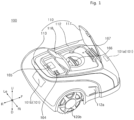
FIG. 1 is a perspective view of amowing robot 100 according to an embodiment of the present invention; -
FIG. 2 is a perspective view showing adocking equipment 200 docking themowing robot 100 ofFIG. 1 ; -
FIG. 3 is a front elevation of themowing robot 100 ofFIG. 1 ; -
FIG. 4 is an elevational view of a right side of themowing robot 100 ofFIG. 1 ; -
FIG. 5 is an elevational view of a lower side of themowing robot 100 ofFIG. 1 ; -
FIG. 6 is an elevational view of an upper side of themowing robot 100 ofFIG. 1 when acase 112 and amodule case 190 are removed; -
FIG. 7 is a partial perspective view showing a portion where asensor 170 of themowing robot 100 ofFIG. 6 is disposed; -
FIG. 8 is a cross-sectional view of themowing robot 100 ofFIG. 1 vertically taken along line S1-S1' ofFIG. 7 ; and -
FIG. 9 is a cross-sectional view of themowing robot 100 ofFIG. 8 vertically taken along line S2-S2'. - The following expressions referring to directions such as "front (F) /rear (R) /left (Le) /right (Ri) /up (U) / down(D)" are defined as shown in the drawings, but this is for the purpose of clarifying the present invention, and it is obvious that the directions can be defined differently depending on a reference.
- The use of the term "first, second, etc." in front of the constituent elements mentioned in the lower side of is intended to avoid confusion of the constituent elements, and is not related to the order, importance, master-servant relationship, or the like between the constituent elements. For example, an invention including only a second constituent element without a first constituent element can be implemented.
- Referring to
FIG. 1 andFIG. 3 toFIG. 9 , amowing robot 100 may include abody 110 which forms an external shape. Thebody 110 may form an internal space. Themowing robot 100 may include adriving wheel unit 120 which moves thebody 110 with respect to the ground (traveling surface). Thedriving wheel unit 120 may include afirst wheel 120a and asecond wheel 120b which are independently rotatably provided in the left and right sides respectively. Themowing robot 100 may include adriving motor module 130 which provides a rotational force to thedriving wheel unit 120. Thedriving motor module 130 may include afirst motor 130a which provides the rotational force of thefirst wheel 120a and asecond motor 130b which provides the rotational force of thesecond wheel 120b. Thefirst motor 130a may be disposed in the left side of thesecond motor 130b. Themowing robot 100 may include ablade 140 rotatably provided to mow the grass. The mowingrobot 100 may include ablade motor 150 that provides the rotational force of theblade 140. The mowingrobot 100 may include a battery Bt that supplies power to the drivingmotor module 130. The battery Bt may supply power to theblade motor 150. - The mowing
robot 100 may include asensor 170 disposed in the internal space of thebody 110. Thesensor 170 may have a gyro sensing function and a magnetic field sensing function. Thesensor 170 may further include an acceleration sensing function. - Referring to
FIG. 6 to FIG. 9 , thefirst wheel 120a may rotate on a virtual wheel axis Ow extending laterally. Thesecond wheel 120b may rotate on the wheel axis Ow. However, the present invention is not necessarily limited thereto. The rotation axis of the first wheel and the rotation axis of the second wheel may be crossed each other at an angle. Alternatively, the rotation axis of the first wheel and the rotation axis of the second wheel may be provided to be changeable according to the movement control of the mowing robot. That is, in the present embodiment, a virtual straight line connecting the center of thefirst wheel 120a and the center of thesecond wheel 120b corresponds to the wheel axis Ow. Alternatively, the virtual straight line connecting the center of thefirst wheel 120a and the center of thesecond wheel 120b may be different from the rotation axis of thefirst wheel 120a and may be different from the rotation axis of thesecond wheel 120b. - The wheel axis Ow is a virtual axis for describing the position of the rotation axis of the
first wheel 120a and thesecond wheel 120b, and does not refer to an actual component such as a shaft. In order to rotate thefirst wheel 120a and thesecond wheel 120b based on the wheel axis Ow, in the present embodiment, thefirst wheel 120a and thesecond wheel 120b may be directly connected to the rotation axis of thefirst motor 130a and the rotation axis of thesecond motor 130b respectively. Alternatively, component such as shaft may be connected to thefirst wheel 120a and thesecond wheel 120b, and the rotational force of themotor wheel - Referring to
FIG. 6 to FIG. 9 , virtual planes for describing the configuration of the present invention are defined as follows. The following virtual planes V1, V2, V3, V4a, V4b, V5a, V5b, H1a, H1b, H2, H3 do not refer to an actual component or an actual plane. Here, the vertically disposed plane means a plane parallel to the axes U and D in the up and down direction, and the horizontally disposed plane means a plane parallel to the axes F and R in the front and rear direction and the axes Le and Ri in the left and right direction. - A virtual wheel axis plane V1 which is vertically disposed while passing through the center of the
first wheel 120a and the center of thesecond wheel 120b may be defined. The wheel axis plane V1 may be a plane including the wheel axis Ow. A virtual blade motor rear end plane V2 which is in contact with the rear R end of theblade motor 150 and is vertically disposed may be defined. A virtual battery front-end plane V3 which is in contact with the front F end of the battery Bt and is vertically disposed may be defined. A virtual wheel front end plane V4a which is in contact with the front end of thefirst wheel 120a and the front end of thesecond wheel 120b and is vertically disposed may be defined. A virtual wheel rear end plane V4b which is in contact with the rear end of thefirst wheel 120a and the rear end of thesecond wheel 120b and is vertically disposed may be defined. A virtual first motor right end plane V5a which is in contact with the right Ri end of thefirst motor 130a and is vertically disposed may be defined. A virtual second motor left end plane V5b which is in contact with the left Le end of thesecond motor 130b and is vertically disposed may be defined. A virtual first motor upper end plane H1a which is in contact with the upper U end of thefirst motor 130a and is horizontally disposed may be defined. A virtual second motor upper end plane H1b which is in contact with the upper U end of thesecond motor 130b and is horizontally disposed may be defined. The first motor upper end plane H1a and the second motor upper end plane H1b may be coplanar. The driving motor upper end planes H1a and H1b which are in contact with the upper end of the drivingmotor module 130 and horizontally disposed may be defined. A virtual blade motor upper end plane H2 which is in contact with the upper end of theblade motor 150 and is horizontally disposed may be defined. A virtual battery upper end plane H3 which is in contact with the upper end of the battery Bt and is horizontally disposed may be defined. -
FIG. 1 andFIG. 3 toFIG. 5 , the mowingrobot 100 may include anobstacle detection unit 161 that detects an obstacle ahead. A plurality ofobstacle detection units obstacle detection unit 161 may be disposed in the front of thebody 110. Theobstacle detection unit 161 may be disposed in the upper side of aframe 111. - The mowing
robot 100 may include a rain detection unit (not shown) for sensing rain. The rain detection unit may be disposed in acase 112. The lane detection unit may be disposed in the upper side of theframe 111. - The mowing
robot 100 may include a remotesignal reception unit 101 for receiving an external remote signal. When a remote signal from an external remote controller is transmitted, the remotesignal reception unit 101 may receive the remote signal. For example, the remote signal may be an infrared signal. A signal received by the remotesignal reception unit 101 may be processed by acontroller 163. - A plurality of remote
signal reception units 101 may be provided. The plurality of remotesignal reception units 101 may include a first remotesignal reception unit 101a disposed in a front portion of thebody 110 and a second remotesignal reception unit 101b disposed in a rear portion of thebody 110. The first remotesignal reception unit 101a may receive a remote signal transmitted from the front. The second remotesignal reception unit 101b may receive a remote signal transmitted from the rear. - The mowing
robot 100 may include anauxiliary wheel 162 disposed in front of thefirst wheel 120a and thesecond wheel 120b. Theauxiliary wheel 162 may be disposed in front of theblade 140. Theauxiliary wheel 162 may be a wheel that does not receive a driving force by the motor, and serve to supplementally support thebody 110 with respect to the ground. Acaster 107 supporting the rotation axis of theauxiliary wheel 162 may be rotatably coupled to theframe 111 with respect to a vertical axis. A firstauxiliary wheel 162a disposed in the left side and a secondauxiliary wheel 162b disposed in the right side may be provided. - The mowing
robot 100 may include aninput unit 164 for inputting various instructions of a user. Theinput unit 164 may include a button, a dial, a touch-type display, and the like. Theinput unit 164 may include a microphone (not shown) for voice recognition. In the present embodiment, a plurality of buttons may be disposed in the upper side of thecase 112. - The mowing
robot 100 may include anoutput unit 165 for outputting various information to the user. Theoutput unit 165 may include adisplay module 165 for outputting visual information. Theoutput unit 165 may include a speaker (not shown) for outputting auditory information. - In the present embodiment, the
display module 165 may output an image in the upward direction. Thedisplay module 165 may be disposed in the upper side of thecase 112. For example, thedisplay module 165 may include a thin film transistor liquid crystal display (LCD) panel. In addition, thedisplay module 165 may be implemented by using various display panels such as a plasma display panel or an organic light emitting diode display panel. - The mowing
robot 100 may include a communication unit (not shown) for communicating with an external device (terminal, etc.), a server, a router, and the like. The communication unit may vary depending on the communication method of other device or a server to communicate with. - The mowing
robot 100 may be able to change the height of theblade 140 with respect to the ground so that the lawn mowing height can be changed. The mowingrobot 100 may include aheight adjustment unit 166 for changing the height of theblade 140 by a user. Theheight adjustment unit 166 may include a rotatable dial, and may change the height of theblade 140 by rotating the dial. - The mowing
robot 100 may include aheight display unit 167 for displaying the height level of theblade 140. When the height of theblade 140 is changed according to the operation of theheight adjustment unit 166, the height level displayed by theheight display unit 167 may also be changed. For example, theheight display unit 167 may display a lawn height value which is estimated after thelawn mower robot 100 performs lawn mowing with a current height of theblade 140. - The mowing
robot 100 may include aGPS board 168 which is provided to detect a global positioning system (GPS) signal. TheGPS board 168 may be a PCB. - The mowing
robot 100 may include adocking insertion unit 169 which is connected to adocking equipment 200 when docked to thedocking equipment 200. Thedocking insertion unit 169 may be recessed to receive adocking connection unit 210 of thedocking equipment 200. Thedocking insertion unit 169 may be disposed in the front portion of thebody 110. Due to the connection between thedocking insertion unit 169 and thedocking connection unit 210, a correct position can be guided when the mowingrobot 100 is charged. - The mowing
robot 100 may include a charging corresponding terminal 102 disposed in a position which can be in contact with a chargingterminal 211 described later, in a state where thedocking insertion unit 169 is inserted into thedocking connection unit 210. The chargingcorresponding terminal 102 may include a pair of chargingcorresponding terminals 102a and 102b disposed in a position corresponding to a pair of chargingterminals corresponding terminals 102a, 102b may be disposed laterally with thedocking insertion unit 169 therebetween. - A terminal cover (not shown) for covering the
docking insertion unit 169 and the pair of chargingterminals robot 100 travels, the terminal cover may cover thedocking insertion unit 169 and the pair of chargingterminals robot 100 is connected to thedocking equipment 200, the terminal cover may be opened to expose thedocking insertion unit 169 and the pair of chargingterminals - The mowing
robot 100 may include thecontroller 163 for controlling autonomous driving. Thecontroller 163 may process a signal of theobstacle detection unit 161. Thecontroller 163 may process a signal of theGPS board 168. Thecontroller 163 may process a signal of thesensor 170. Thecontroller 163 may process a signal of theinput unit 164. - The
controller 163 may control the driving of thefirst motor 130a and thesecond motor 130b. Thecontroller 163 may control the driving of theblade motor 150. Thecontroller 163 may control the output of theoutput unit 165. - The
controller 163 may include amain board 163 disposed in the internal space of thebody 110. Themain board 163 means a PCB. - Meanwhile, referring to
FIG. 2 , thedocking equipment 200 may include adocking base 230 disposed in the floor and adocking support unit 220 protruding upward from a front portion of thedocking base 230. In addition, it may include adocking connection unit 210 inserted into thedocking insertion unit 169 during the charging of the mowingrobot 100. Thedocking connection unit 210 may protrude rearward from thedocking support unit 220. - The thickness in the up and down direction of the
docking connection unit 210 may be smaller than the width in the left and right direction of thedocking connection unit 210. The width in the left and right direction of thedocking connection unit 210 may be narrowed toward the rear side. As viewed from in the upper side of, thedocking connection unit 210 may be generally trapezoidal. Thedocking connection unit 210 may be formed in a symmetrical shape. The rear portion of thedocking connection unit 210 may form a free end and the front portion of thedocking connection unit 210 may be fixed to thedocking support unit 220. The rear portion of thedocking connection unit 210 may be rounded. - When the
docking connection unit 210 is completely inserted into thedocking insertion unit 169, the mowingrobot 100 may be charged by the docking equipment. - The
docking equipment 200 may include a chargingterminal 211 for charging the mowingrobot 100. The chargingterminal 211 and thecharging corresponding terminal 102 of the mowingrobot 100 may be in contact with each other, so that a power for charging can be supplied from thedocking equipment 200 to themowing robot 100. - The charging
terminal 211 may include a contact surface facing the rear side, and thecharging corresponding terminal 102 may include a contact corresponding surface facing the front. The contact surface of the chargingterminal 211 and the contact corresponding surface of thecharging corresponding terminal 102 may be in contact with each other, so that the power of thedocking equipment 200 can be connected to themowing robot 100. - The charging
terminal 211 may include a pair of chargingterminals first charging terminal 211a may be provided to be in contact with a first charging corresponding terminal 102a, and thesecond charging terminal 211b may be provided to be in contact with a second charging corresponding terminal 102b. - The pair of charging
terminals docking connection unit 210 interposed therebetween. The pair of chargingterminals docking connection unit 210. - The
docking base 230 may include awheel guard 232 on which theauxiliary wheel 162 and thedriving wheel unit 120 of the mowingrobot 100 are mounted. Thewheel guard 232 may include afirst wheel guard 232a for guiding the movement of a firstauxiliary wheel 162 and asecond wheel guard 232b for guiding the movement of the secondauxiliary wheel 162. Acenter base 231 which is convex upward may be disposed between thefirst wheel guard 232a and thesecond wheel guard 232b. Thedocking base 230 may include aslip prevention unit 234 for preventing sliding of thefirst wheel 120a and thesecond wheel 120b. Theslip prevention unit 234 may include a plurality of protrusions protruding upward. - Referring to
FIG. 1 andFIG. 3 toFIG. 9 , thebody 110 may include theframe 111 to which thefirst motor 130a and thesecond motor 130b are fixed. Theblade motor 150 may be fixed to theframe 111. Theframe 111 may support themain board 163, amodule supporter 180 described later, and thesensor 170. Theframe 111 may support amodule case 190. Theframe 111 may support the battery Bt. Theframe 111 may provide a skeletal structure that supports various other components. Theframe 111 may be supported by theauxiliary wheel 162 and thedriving wheel unit 120. - The
body 110 may include aside blocking unit 111a for preventing user's finger from entering theblade 140 in both sides of theblade 140. Theside blocking unit 111a may be fixed to theframe 111. Theside blocking unit 111a may protrude downward in comparison with the lower side surface of the other portion of theframe 111. Theside blocking unit 111a may be disposed to cover an upper portion of a space between thewheel module 120 and theauxiliary wheel 162. - A pair of
side blocking units 111a-1 and 111a-2 may be disposed laterally with theblade 140 interposed therebetween. Theside blocking unit 111a may be disposed apart from theblade 140 by a certain distance. - A front face 111af of the
side blocking unit 111a may be formed to be rounded. The front face 111af may form a surface that is rounded upward from the lower side surface of theside blocking unit 111a toward the front. When the mowingrobot 100 moves forward, theside blocking unit 111a may easily overstride the lower obstacle in the lower side of a certain reference, by using the shape of the front face 111af. - The
body 110 may include afront blocking unit 111b for preventing the user's finger from entering theblade 140 in front of theblade 140. Thefront blocking unit 111b may be fixed to theframe 111. Thefront blocking unit 111b may be disposed to cover a part of an upper portion of a space between the pair ofauxiliary wheels - The
front blocking unit 111b may include a protrusion rib 111ba protruding downward in comparison with the lower side surface of the other portion of theframe 111. The protrusion ribs 111ba may extend in the front and rear direction. The upper end portion of the protrusion rib 111ba may be fixed to theframe 111, and the lower end portion of the protrusion rib 111ba may form a free end. - A plurality of protrusion ribs may be disposed to be spaced apart in the left-right direction. The plurality of protrusion ribs 111ba may be disposed in parallel to each other. A gap may be formed between two adjacent protrusion ribs 111ba.
- The front of the protrusion rib 111ba may be formed to be rounded. The front of the protrusion rib 111ba may form a surface that is rounded upward from the lower side surface of the protrusion rib 111ba toward the front. When the mowing
robot 100 moves forward, the protrusion rib 111ba may easily overstride the lower obstacle in the lower side of a certain reference, by using the shape of the front of the protrusion rib 111ba. - The
front blocking unit 111b may include an auxiliary rib 111bb for assisting rigidity. The auxiliary rib 111bb for reinforcing the rigidity of thefront blocking unit 111b may be disposed between the upper end portions of two adjacent protrusion ribs 111ba. The auxiliary ribs 111bb may protrude downward and extend in a lattice shape. - The
frame 111 may be provided with acaster 107 which rotatably supports theauxiliary wheel 162. Thecaster 107 may be rotatably disposed with respect to theframe 111. Thecaster 107 may be provided to be rotatable around the vertical axis. Thecaster 107 may be disposed in the lower side theframe 111. A pair ofcasters 107 corresponding to the pair ofauxiliary wheels 162 may be provided. - A
caster connection unit 103 for connecting theframe 111 and thecaster 107 may be provided. Thecaster connection unit 103 may be disposed to pass through theframe 111. Thecaster connection unit 103 may be fixed to one of theframe 111 and thecaster 107 and may be rotatably connected to the other. A pair ofcaster connection units casters 107 may be provided. - The
body 110 may include thecase 112 covering theframe 111 from in the upper side of. Thecase 112 may form an upper side and the front/rear/left /right sides of the mowingrobot 100. - An inwardly dented recessed
portion 112a may be formed on the side portion of thecase 112. A pair of recessedportions 112a may be formed on both sides of thecase 112. The recessedportion 112a may include a portion where the recess depth gradually increases from the rear portion toward the front portion. - The
body 110 may include acase connection unit 104 for fixing thecase 112 to theframe 111. Thecase 112 may be fixed to an upper end of thecase connection unit 104. The upper portion of thecase connection unit 104 may be exposed to the upper side of theframe 111. - The
case connection unit 104 may be disposed in theframe 111 to be movable. Thecase connection unit 104 may be disposed to be movable only in the up and down direction with respect to theframe 111. Thecase connection unit 104 may be provided to be movable only within a certain range. Thecase connection unit 104 may be movable integrally with thecase 112. Accordingly, thecase 112 may be movable with respect to theframe 111. - A pair of
case connection units frame 111. The pair ofcase connection units 104 may be disposed in the front portion of theframe 111. - The
frame 111 may be provided with a movement sensor (not shown) for detecting the movement of thecase connection unit 104. Thus, when thecase 112 is lifted to the upper side with respect to theframe 111, thecase connection unit 104 may move upward and the movement sensor may detect the lifting of thecase 112. When the movement sensor detects that thecase 112 is lifted, thecontroller 163 may control the operation of theblade 140 to be stopped. For example, when a situation in which the user lifts thecase 112 or a considerable sized lower obstacle lifts thecase 112 occurs, the movement sensor may detect this situation. - The
body 110 may include abumper 112b disposed in the front portion. Thebumper 112b may serve to absorb an impact upon contact with an external obstacle. In the front portion of thebumper 112b, abumper groove 112h, which is recessed toward the rear side and formed to be long in the left and right direction, may be formed. A plurality ofbumper grooves 112h may be disposed in the up and down direction. The lower end of the protrusion rib 111ba may be disposed in a lower position than the lower end of the auxiliary rib 111bb. - The front of the
bumper 112b and the left and right sides of thebumper 112b may be connected to each other. The front and sides of thebumper 112b may be connected in a rounded manner. - The
body 110 may include a bumperauxiliary unit 112c disposed around the outer surface of thebumper 112b. The bumperauxiliary unit 112c may cover the lower portion of the left and right sides and the lower portion of the front surface of thebumper 112b. The bumperauxiliary unit 112c may cover the lower half of the right and left sides and the front surface of thebumper 112b. - The front end surface of the bumper
auxiliary unit 112c may be disposed in front of the front end surface of thebumper 112b. The bumperauxiliary unit 112c may form a surface protruding from the surface of thebumper 112b. - The bumper
auxiliary unit 112c may be formed of a material, such as rubber, that is advantageous for shock absorption. The bumperauxiliary unit 112c may be formed of a flexible material. - The bumper
auxiliary unit 112c may be coupled to thebumper 112b. The bumperauxiliary unit 112c may include a bumper coupling unit 112ca coupled to thebumper 112b. The bumper coupling unit 112ca may protrude from the bumperauxiliary unit 112c in the inward direction of thebumper 112b and may be disposed to pass through the surface of thebumper 112b. The bumper coupling unit 112ca may have a hook and be hooked to thebumper 112b.FIG. 5 shows a state in which the bumper coupling unit 112ca passes through thebumper 112b and the protrusion end of the bumper coupling unit 112ca is disposed in the rear surface of thebumper 112b. - The
frame 111 may be provided with amovement fixation unit 105 to which thebumper 112b is fixed. Themovement fixation unit 105 may be disposed to protrude upward from theframe 111. Thebumper 112b may be fixed to the upper end of themovement fixation unit 105. - The
bumper 112b may be disposed to be movable within a certain range with respect to theframe 111. Thebumper 112b may be fixed to themovement fixation unit 105 and move integrally with themovement fixation unit 105. - The
movement fixation unit 105 may be disposed to be movable in theframe 111. In the present embodiment, themovement fixation unit 105 may be rotatably disposed in theframe 111 within a certain range. Themovement fixation unit 105 may be rotatably provided with respect to theframe 111, about a virtual rotation axis extending in the protruding direction of themovement fixation unit 105. Accordingly, thebumper 112b may be rotatably provided integrally with themovement fixation unit 105 with respect to theframe 111. - A rotation sensor (not shown) for detecting the rotation of the
movement fixation unit 105 may be provided. For example, a magnet may be disposed in one side of the lower portion of themovement fixation unit 105, and a magnetic field sensing unit for sensing a change in the magnetic field of the magnet may be disposed in theframe 111. When themovement fixation unit 105 is rotated, the magnetic field sensing unit may detect the change in the magnetic field of the magnet, thereby implementing the rotation sensor for detecting the rotation of themovement fixation unit 105. - When the
bumper 112b collides with an external obstacle, themovement fixation unit 105 may rotate integrally with thebumper 112b. As the rotation sensor detects the rotation of themovement fixation unit 105, the impact of thebumper 112b may be detected. - The
body 110 may include ahandle 113. Thehandle 113 may be disposed in the rear portion of thecase 112. - The
body 110 may include abattery input unit 114 for inserting and withdrawing a battery Bt. Thebattery input unit 114 may be disposed in the lower side surface of theframe 111. Thebattery input unit 114 may be disposed in the rear portion of theframe 111. - The
body 110 may include apower switch 115 for turning on and off the power of the mowingrobot 100. Thepower switch 115 may be disposed in the lower side surface of theframe 111. - The
body 110 may include ablade protection unit 116 that covers the lower side of the center of theblade 140. Theblade protection unit 116 may be provided to expose the blade of theblade 140 in the centrifugal direction, and to cover the center of theblade 140. - The
body 110 may include a first opening andclosing unit 117 for opening and closing a portion where theheight adjustment unit 166 and theheight display unit 167 are disposed. The first opening andclosing unit 117 may be hinged to thecase 112 so as to accomplish opening and closing operations. The first opening andclosing unit 117 may be disposed in the upper side surface of thecase 112. - The first opening and
closing unit 117 may be formed in a plate shape, and cover the upper side of theheight adjustment unit 166 and theheight display unit 167 in a closed state. - The
body 110 may include a second opening andclosing unit 118 for opening and closing a portion where thedisplay module 165 and theinput unit 164 are disposed. The second opening andclosing unit 118 may be hinged to thecase 112 so as to accomplish opening and closing operations. The second opening andclosing unit 118 may be disposed in the upper side surface of thecase 112. The second opening andclosing unit 118 may be disposed behind the first opening andclosing unit 117. - The second opening and
closing unit 118 may be formed in a plate shape, and cover thedisplay module 165 and theinput unit 164 in a closed state. - The openable angle of the second opening and
closing unit 118 may be previously set to be smaller than the openable angle of the first opening andclosing unit 117. Thus, even in the opened state of the second opening andclosing unit 118, user can easily open the first opening andclosing unit 117 and user can easily operate theheight adjustment unit 166. In addition, even in the opened state of the second opening andclosing unit 118, user can visually check the contents of theheight display unit 167. - For example, the openable angle of the first opening and
closing unit 117 may be about 80 to about 90 degrees based on a closed state. For example, the openable angle of the second opening andclosing unit 118 may be about 45 to about 60 degrees based on a closed state. - The rear end portion of the first opening and
closing unit 117 may be lifted upward to be opened based on the front end portion thereof, and the rear end portion of the second opening andclosing unit 118 may be lifted upward to be opened based on the front end portion thereof. Thus, user may open and close the first opening andclosing unit 117 and the second opening andclosing unit 118, in the rear of the mowingrobot 100 which is a safe area when the mowingrobot 100 moves forward. In addition, thus, the opening operation of the first opening andclosing unit 117 and the opening operation of the second opening andclosing unit 118 may be prevented from interfering with each other. - The first opening and
closing unit 117 may be provided to be rotatable with respect to thecase 112, about the rotation axis extending in the left and right direction in the front end portion of the first opening andclosing unit 117. The second opening andclosing unit 118 may be provided to be rotatable with respect to thecase 112, about the rotation axis extending in the left and right direction in the front end portion of the second opening andclosing unit 118. - Meanwhile, the mowing
robot 100 may include an opening and closing detection unit (not shown) for detecting whether at least one of the first opening andclosing unit 117 and the second opening andclosing unit 118 is open or closed. The opening and closing detection unit may be disposed in thecase 112. The opening and closing detection unit may be disposed in the upper side of theframe 111. - The
frame 111 may include acable connection unit 106 to which a cable (not shown) is connected. Thecable connection unit 106 may include a plurality of terminals to which a plurality of cables (not shown) are connected respectively. - The plurality of terminals may include a first terminal 106a to which a cable for transmitting detection information of the
obstacle detection unit 161 is connected. The plurality of terminals may include a second terminal 106b to which a cable for transmitting detection information of the rain detection unit is connected. The plurality of terminals may include a third terminal 106c to which a cable for transmitting detection information of the opening and closing detection unit is connected. The plurality of terminals may include afourth terminal 106d to which a cable for transmitting input information of theinput unit 164 is connected. - The
obstacle detection unit 161, the rain detection unit, the opening and closing detection unit, and theinput unit 164 may be disposed in the upper side of theframe 111, and thecable connection unit 106 may be disposed in the upper side surface of theframe 111. A signal (detection information, input information) transmitted to the plurality of terminals may be transmitted to thecontroller 163 through a cable or the like. - The plurality of terminals may be disposed concentrically in a part of the frame. When viewed from above, the plurality of terminals may be surrounded by a
cable guide 108. Thecable guide 108 may be formed in a rib shape protruding upward from theframe 111. Thecable guide 108 may extend in a rectangular shape when viewed from in the upper side of, and a groove may be formed in a part of one side surface. The cable may be inserted into the groove of thecable guide 108, so that it can guide the disposition of the cable. - The
driving wheel unit 120 may include afirst wheel 120a disposed in the left side and asecond wheel 120b disposed in the right side. Thefirst wheel 120a may be disposed in the left side of thesecond wheel 120b. Thefirst wheel 120a and thesecond wheel 120b may be spaced laterally. Thefirst wheel 120a and thesecond wheel 120b may be disposed in a rear lower portion of thebody 110. - The
first wheel 120a and thesecond wheel 120b may be independently rotatable so that thebody 110 can rotate and move forward with respect to the ground. For example, when thefirst wheel 120a and thesecond wheel 120b rotate at the same rotational speed, thebody 110 may move forward with respect to the ground. For example, when the rotational speed of thefirst wheel 120a is higher than the rotational speed of thesecond wheel 120b, or when the rotational direction of thefirst wheel 120a and the rotational direction of thesecond wheel 120b are different from each other, thebody 110 may rotate with respect to the ground. - The
first wheel 120a and thesecond wheel 120b may be formed larger than theauxiliary wheel 162. The axis of thefirst motor 130a may be fixed to the center of thefirst wheel 120a, and the axis of thesecond motor 130b may be fixed to the center of thesecond wheel 120b. - The
wheel 120 may include awheel periphery unit 122 in contact with the ground. For example, thewheel periphery unit 122 may be a tire. Thewheel periphery unit 122 may be provided with a plurality of protrusions for enhancing the frictional force with the ground. - The
wheel 120 may include a wheel frame (not shown) which fixes thewheel periphery unit 122 and receives the power of themotor 130. The axis of themotor 130 may be fixed to the center of the wheel frame, and receive a rotational force. The wheelperipheral unit 122 may be disposed around the wheel frame. - The
wheel 120 may include awheel cover 121 covering the outer surface of thewheel frame 121. Thewheel cover 121 may be disposed in the opposite direction (hereinafter referred to as 'outer direction') to the direction in which themotor 130 is disposed based on the wheel frame. Thewheel cover 121 may be disposed in the center of thewheel periphery unit 122. The wheel axis Ow may pass through the center of thewheel cover 121. - The
wheel cover 121 may include acentral portion 121a through which the wheel axis Ow passes. Thecentral portion 121a may be formed in a circular shape when viewed from the side. - The
wheel cover 121 may include acentrifugal unit 121b extending in the direction away from the wheel axis Ow at thecentral portion 121a. A plurality of thecentrifugal units 121b may be disposed spaced apart from each other by a certain distance along the circumferential direction based on the wheel axis Ow. In the present embodiment, sixcentrifugal units 121b may be provided. - The
central portion 121a and thecentrifugal unit 121b may have a surface which protrudes in the outward direction in comparison with theother portion 121c of thewheel cover 121. Thewheel cover 121 may include a recessedportion 121c having a surface which is dented in the opposite direction to the outward direction in comparison with thecentral portion 121a and thecentrifugal unit 121b. The recessedportion 121c may be disposed between two adjacentcentrifugal units 121b. - The driving
motor module 130 may include afirst motor 130a disposed in the left side and asecond motor 130b disposed in the right side. Thefirst motor 130a may be disposed in the left side of thesecond motor 130b. Thefirst motor 130a and thesecond motor 130b may be disposed to be spaced laterally. - The
first motor 130a and thesecond motor 130b may be disposed in the lower side portion of thebody 110. Thefirst motor 130a and thesecond motor 130b may be disposed in the rear portion of thebody 110. - The
first motor 130a may be disposed in the right side of thefirst wheel 120a, and thesecond motor 130b may be disposed in the left side of thesecond wheel 120b. Thefirst motor 130a and thesecond motor 130b may be fixed to thebody 110. - The
blade 140 may be disposed in front of the center of thefirst wheel 120a. Theblade 140 may be disposed in front of the center of thesecond wheel 120b. In the present embodiment, theblade 140 may be disposed in front of the wheel axis Ow. - The
blade 140 may be disposed in the rear side of theauxiliary wheel 162. Theblade 140 may be disposed in the lower side portion of thebody 110. Theblade 140 may rotate on a rotation axis extending in the up and down direction. - The
blade motor 150 may be disposed in front of the center of thefirst wheel 120a. Theblade motor 150 may be disposed in front of the center of thesecond wheel 120b. In the present embodiment, theblade motor 150 may be disposed in front of the wheel axis Ow. - The
blade motor 150 may be disposed in the rear side of theauxiliary wheel 162. Theblade motor 150 may be disposed in the lower side portion of thebody 110. Theblade motor 150 may rotate a motor axis protruding upward. The rotational force of the motor axis may be transmitted to theblade 140 by using a configuration such as a gear. - The
sensor 170 may have a gyro sensing function for at least horizontal rotation of thebody 110. At the same time, thesensor 170 may have a magnetic field sensing function. Furthermore, it is preferable that thesensor 170 further has an acceleration sensing function. - The
sensor 170 may, preferably, have a gyro sensing function for three axes of a spatial coordinate system orthogonal to each other. In addition, thesensor 170 may, preferably, have a magnetic field sensing function for the three axes. In addition, thesensor 170 may, preferably, have an acceleration sensing function for the three axes. - The
sensor 170 may be disposed to vertically overlap with a wheel area (not shown) including the first wheel, the second wheel, and an area in which the first wheel and the second wheel are connected in the horizontal direction, and may be disposed in a position vertically higher than thefirst motor 130a and thesecond motor 130b. Thesensor 170 may be disposed between the wheel front end plane V4a and the wheel rear end plane V4b. Specifically, thesensor 170 may be disposed in the rear side of the wheel front end plane V4a, and disposed in front of the wheel rear end plane V4b. - This allows the
sensor 170 to perform gyro sensing for horizontal rotation at the center (between the first wheel and thesecond wheel 120b) where the horizontal rotation of the mowingrobot 100 occurs, so that information effectively reflecting the horizontal rotation of the mowingrobot 100 can be detected. - In addition, it is preferable that the
sensor 170 is disposed closest to the wheel axis plane V1 among the wheel front end plane V4a, the wheel rear end plane V4b, and the wheel axis plane. Specifically, it is preferable that a detecting point of thesensor 170 is disposed closest to the wheel axis plane V1 among the wheel front end plane V4a, the wheel rear end plane V4b, and the wheel axis plane. In addition, it is preferable that thesensor 170 is disposed to cross the wheel axis plane V1. Through such a disposition of thesensor 170, information more effectively reflecting the horizontal rotation of the mowingrobot 100 can be detected. - The
sensor 170 may be disposed in the upper side of the first motor upper end plane H1a. Thesensor 170 may be disposed in the upper side of the second motor upper end plane H1b. In addition, thesensor 170 may be disposed in the right side of the first motor right end plane V5a, and disposed in the left side of the second motor left end plane V5b. Accordingly, when thesensor 170 detects an external magnetic field, the influence of the magnetic field of thefirst motor 130a and thesecond motor 130b can be reduced. - The
sensor 170 may be disposed in the upper side of the blade motor upper end plane H2. Thesensor 170 may be disposed in the rear side of the blade motor rear end plane V2. Accordingly, when thesensor 170 detects an external magnetic field, the influence of the magnetic field of theblade motor 150 can be reduced. - The
sensor 170 may be disposed in the upper side of the virtual battery upper end plane which is in contact with the upper end of the battery and is horizontally disposed. Thesensor 170 may be disposed in front of the battery front end plane V3. Accordingly, when thesensor 170 detects an external magnetic field, the influence of the magnetic field of the battery Bt can be reduced. - Preferably, the
sensor 170 may be disposed in the upper side of the first motor upper end plane H1a, the second motor upper end plane H1b, the blade motor upper end plane H2, and the battery upper end plane. Thesensor 170 may be disposed in the upper side of the internal space of thebody 110. Thefirst motor 130a and thesecond motor 130b may be disposed in the lower side portion of the internal space. Theblade motor 150 may be disposed in the lower side portion of the internal space. The battery (Bt) may be disposed in the lower side portion of the internal space. This makes it possible to reduce the influence of the magnetic field of thefirst motor 130a, thesecond motor 130b, theblade motor 150, and the battery Bt, when thesensor 170 detects an external magnetic field. - Specifically, the
blade motor 150 may be disposed in the lower side of the center portion in the internal space of thebody 110. The battery Bt may be disposed in the lower side of the rear side portion in the internal space of thebody 110. Thefirst motor 130a may be disposed in the lower side of the left side portion in the internal space of thebody 110. Thesecond motor 130b may be disposed in the lower side of the right side portion in the internal space of thebody 110. - The front end of the
first motor 130a may be disposed in front of the battery front end plane V3. The front end of thesecond motor 130b may be disposed in front of the battery front end plane V3. - The upper end of the
first motor 130a may be disposed lower than the battery upper end plane H3. The upper end of thesecond motor 130b may be disposed lower than the battery upper plane H3. The upper end of thefirst motor 130a may be disposed lower than the blade motor upper end plane H2. The upper end of thesecond motor 130b may be disposed lower than the blade motor upper end plane H2. - The
sensor 170 may be formed in a horizontal plate shape. Thesensor 170 may be covered by themain board 163 when viewed from in the lower side of. Thesensor 170 may be covered by acover 181 when viewed from in the lower side of. Thesensor 170 may be disposed in the center of thecover 181. - The
main board 163 may control the driving of thefirst motor 130a and thesecond motor 130b. Themain board 163 may control the driving of theblade motor 150. - The
main board 163 may be disposed in the upper side of thefirst motor 130a and thesecond motor 130b. Themain board 163 may be disposed in the upper side of the first motor upper end plane H1a. Themain board 163 may be disposed in the upper side of the second motor upper end plane H1b. In addition, it is preferable that themain board 163 is disposed between the first motor right end plane V5a and the second motor left end plane V5b. - In addition, it is preferable that the
main board 163 is disposed in the upper side of the blade motor upper end plane H2. It is preferable that themain board 163 is disposed in the upper side of the battery upper end plane H3. - The
main board 163 may be disposed in the lower side of thecover 181. Themain board 163 may be spaced up and down from thecover 181. - When viewed from below, the
main board 163 may fully cover thecover 181. The horizontal area of themain board 163 may be larger than the horizontal area of thecover 181. The length of themain board 163 in the left and right direction may be, preferably, larger than the length of thecover 181 in the left and right direction. It is preferable that the length of the front and rear direction of themain board 163 is larger than the length of the front and rear direction of thecover 181. - The
main board 163 may be disposed in the lower side of thesensor 170. Themain board 163 may fully cover thesensor 170 when viewed from in the lower side of. Thus, themain board 163 may reduce the influence of the magnetic field on thefirst motor 130a, thesecond motor 130b, theblade motor 150, and thesensor 170 of the battery Bt. - Referring to
FIG. 9 , an experimental example according to the disposition structure of the present invention will be described in the lower side of. In the present experimental example, for each experimental group, the magnetic field is measured for the X axis and the Y axis, and a corresponding average magnitude (XY average magnetic field) is calculated based on uT unit. Here, the plane containing the X axis and the Y axis means a horizontal plane. This experiment is intended to compare the results of the measurement of the magnetic field according to the disposition of thesensor 170 according to the present embodiment and the disposition of thesensor 170 according to other comparative example E1, E2. For the control group for this experiment, the magnetic field measurement result is 301.9772 uT in an external environment independent of the mowingrobot 100. The magnetic field measurement result of thesensor 170 according to the present embodiment is 308.0956 uT, which shows a very slight difference in comparison with the control group. On the other hand, the result of measuring the magnetic field by disposing thesensor 170 in a position E1 according to acomparison group 1 is 271.9353 and the result of measuring the magnetic field by disposing thesensor 170 in a position E2 according to acomparison group 2 is 385.6744 uT, which is significantly different from the control group. - Specifically, in the in the upper side of mentioned experiment, it is observed that a difference between the results of the magnetic field measurement of the control group and the present embodiment is about 6 uT. On the other hand, it is observed that a difference between the results of the magnetic field measurement of the control group and the
comparison group 1 is about 30 uT, and a difference between the results of the magnetic field measurement of the control group and thecomparison group 1 is about 83 uT. When comparing thecontrol group 1 and thecontrol group 2 with the present embodiment, it can be seen that the accuracy of the measurement result of the magnetic field of thesensor 170 according to the present embodiment is remarkably improved. - Referring to
FIG. 6 to FIG. 9 , themain board 163 may be disposed across a virtual straight line path between thesensor 170 and thefirst motor 130a. Themain board 163 may be disposed across a virtual straight line path between thesensor 170 and thesecond motor 130b. Themain board 163 may be disposed across a virtual straight line path between thesensor 170 and theblade motor 150. Themain board 163 may be disposed across a virtual straight line path between thesensor 170 and the battery Bt. - The horizontal area of the
main board 163 may be, preferably, larger than the horizontal area of thesensor 170. The length of themain board 163 in the left and right direction may be greater than the length of thesensor 170 in the left and right direction. The length of themain board 163 in the front and rear direction may be greater than the length of thesensor 170 in the front and rear direction. - The
main board 163 may be formed in a horizontal plate shape. Themain board 163 may have a rectangular shape when viewed from the lower side of themain board 163. Various elements may be disposed in the upper side surface of themain board 163. - The rear end of the
main board 163 may be positioned behind the battery front end plane V3. The left end of themain board 163 may be disposed in the left side of the left end of the battery Bt, and the right end of themain board 163 may be disposed in the right side of the right end of the battery Bt. - The front end of the
main board 163 may be positioned in front of the center of the first wheel and the center of the second wheel. The front end of themain board 163 may be positioned in front of the wheel axis plane V1. - The mowing
robot 100 may include amodule supporter 180 for supporting the sensor. Themodule supporter 180 may be fixed to themain board 163. Themodule supporter 180 may include thecover 181. Themodule supporter 180 may include acovering supporting unit 182 for fixing thecover 181 to themain board 163 while spacing thecover 181 away from themain board 163. - The
sensor 170 may be fixed to thecover 181. For example, four corners of thesensor 170 may be fastened to thecover 181 by a fastening member. - The
cover 181 may fully cover thesensor 170 when viewed from in the lower side of. Thus, themain board 163 may reduce the influence of the magnetic field on thefirst motor 130a, thesecond motor 130b, theblade motor 150, and thesensor 170 of the battery Bt. - The
cover 181 may fully cover thesensor 170 when viewed from thefirst motor 130a, and fully cover the sensor when viewed from the second motor. Thecover 181 may be disposed across a virtual straight line path between thesensor 170 and thefirst motor 130a. Thecover 181 may be disposed across a virtual straight line path between thesensor 170 and thesecond motor 130b. - The
cover 181 may fully cover thesensor 170 when viewed from theblade motor 150. Thecover 181 may be disposed across a virtual straight line path between thesensor 170 and theblade motor 150. - The
cover 181 may fully cover thesensor 170 when viewed from the battery Bt. Thecover 181 may be disposed across a virtual straight line path between thesensor 170 and the battery Bt. - The horizontal area of the
cover 181 may be, preferably, larger than the horizontal area of thesensor 170. The length of thecover 181 in the left and right direction may be greater than the length of thesensor 170 in the left and right direction. The length of thecover 181 in the front and rear direction may be greater than the length of thesensor 170 in the front and rear direction. - The
cover 181 may be formed in a horizontal plate shape. Thecover 181 has a rectangular shape smaller than themain board 163 when viewed from below. Thesensor 170 may be fixed to the upper side surface of thecover 181. - The rear end of the
cover 181 may be positioned behind the battery front end plane V3. The left end of thecover 181 may be disposed in the left side of the left end of the battery Bt, and the right end of thecover 181 may be disposed in the right side of the right end of the battery Bt. - The front end of the
cover 181 may be positioned in front of the center of the first wheel and the center of the second wheel. The front end of thecover 181 may be positioned in front of the wheel axis plane V1. - The
covering supporting unit 182 may extend in the up and down direction, and the lower end thereof may be fixed to themain board 163, and the upper end thereof may be fixed to thecover 181. A plurality of covering supportingunits 182 may be provided. In the present embodiment, fourcovering supporting units 182 may be fixed to four corners of thecover 181. - The
GPS board 168 may be disposed between the wheel front end plane V4a and the wheel rear end plane V4b. In addition, theGPS board 168 may be, preferably, positioned closest to the wheel axis plane V1, among the wheel front end plane V4a, the wheel rear end plane V4b, and the wheel axis plane. - The
GPS board 168 may be disposed in the upper side of thecover 181. TheGPS board 168 may be disposed in the upper side of thesensor 170. TheGPS board 168 may be fixed to thecover 181 by a fastening member. TheGPS board 168 may form a gap spaced apart from the upper side surface of thecover 181, and at least a part of the sensor 171 may be disposed in the gap. Thecover 181 may cover theGPS board 168 when viewed from below. Themain board 163 may fully cover theGPS board 168 when viewed from below. - The mowing
robot 100 may include amodule case 190 disposed inside the body. Themodule case 190 may accommodate thesensor 170 therein. Themodule case 190 may accommodate amodule supporter 180 therein. Themodule case 190 may accommodate themain board 163 therein. Themodule case 190 may accommodate theGPS board 168 therein. - The
module case 190 may be provided separately from thecase 112. Themodule case 190 may be coupled to theframe 111. A part of the upper side surface of themodule case 190 may be exposed to the outside in the opened state of the second opening andclosing unit 118. - The
module case 190 may include a module casefront part 191, a module caserear part 192, and a modulecase side part 193. The module casefront part 191, the module caserear part 192, and the modulecase side part 193 may support thedisplay module 165. The module casefront part 191, the module caserear part 192, and the modulecase side part 193 may cover thesensor 170 from above. Themodule case 190 may include a module caselower unit 194 covering thesensor 170 from below. - The
display module 165 may be disposed in the upper side of thesensor 170. Thedisplay module 165 may be disposed to be spaced apart from thesensor 170 in the up and down direction. Thedisplay module 165 may be fixed to the upper side portion of themodule case 190. Thesensor 170 may be disposed between thedisplay module 165 and thecover 181. - The battery Bt may be disposed behind the center of the
first wheel 120a and the center of thesecond wheel 120b. The battery Bt may be disposed in the rear side of the wheel axis plane. A pair of batteries Bt may be disposed laterally. The battery Bt may be disposed between the first motor right end plane V5a and the second motor left end plane V5b. - The battery Bt may supply power to the
first motor 130a. The battery Bt may supply power to thesecond motor 130b. The battery Bt may supply power to theblade motor 150. The battery Bt may provide power to themain board 163, thesensor 170, and thedisplay module 165. - The mowing
robot 100 may include afirst motor housing 119a for accommodating thefirst motor 130a therein and asecond motor housing 119b for accommodating thesecond motor 130b therein. Thefirst motor housing 119a may be fixed to the left side of theframe 111 and thesecond motor housing 119b may be fixed to the right side of the frame. The right end of thefirst motor housing 119a may be fixed to theframe 111. The left end of thesecond motor housing 119b may be fixed to theframe 111. - The
first motor housing 119a may be formed in a cylindrical shape that forms a height in the left and right direction as a whole. A rigid reinforcing rib 119a1 may be formed in an outer periphery portion of thefirst motor housing 119a. The rigid reinforcing ribs 119a1 may protrude from the outer periphery portion of thefirst motor housing 119a in a direction away from the wheel axis Ow. The rigid reinforcing ribs 119a1 may be elongated in a direction parallel to the wheel axis Ow. One end of the rigid reinforcing rib 119a1 may be fixed to theframe 111. The other end of the rigid reinforcing rib 119a1 may form an end while the protrusion height is reduced. A plurality of rigid reinforcing ribs 119a1 may be disposed apart from each other around the outer periphery portion of thefirst motor housing 119a. - The
second motor housing 119b may be formed in a cylindrical shape that forms a height in the left and right direction as a whole. A rigid reinforcing rib 119ab1 may be formed in an outer periphery portion of thesecond motor housing 119b. The rigid reinforcing ribs 119b1 may protrude from the outer periphery portion of thesecond motor housing 119b in a direction away from the wheel axis Ow. The rigid reinforcing ribs 119b1 may be elongated in a direction parallel to the wheel axis Ow. One end of the rigid reinforcing rib 119b1 may be fixed to theframe 111. The other end of the rigid reinforcing rib 119b1 may form an end while the protrusion height is reduced. A plurality of rigid reinforcing ribs 119b1 may be disposed apart from each other around the outer periphery portion of thesecond motor housing 119b. - The
first motor housing 119a may block a virtual straight line path between thesensor 170 and thefirst motor 130a. Thesecond motor housing 119b may block a virtual straight line path between thesensor 170 and thesecond motor 130b. - The
first motor 130a may be disposed inside thefirst motor housing 119a, and the motor axis may protrude to the left side. Thesecond motor 130b may be disposed inside thesecond motor housing 119b, and the motor axis may protrude to the right side. - The mowing
robot 100 may include ablade motor housing 119c for accommodating theblade motor 150 therein. Theblade motor housing 119c may be fixed to the center of theframe 111. The lower end of theblade motor housing 119c may be fixed to theframe 111. Theblade motor housing 119c may be formed in a cylindrical shape that forms a height in the up and down direction as a whole. Theblade motor housing 119c may block a virtual straight line path between thesensor 170 and theblade motor 150. - The mowing
robot 100 may include abattery housing 119d for accommodating the battery Bt therein. A pair ofbattery housings 119d may be provided to correspond to a pair of batteries Bt. Thebattery housing 119d may be disposed in the rear side of theframe 111. The lower end of thebattery housing 119d may be fixed to theframe 111. Thebattery housing 119d may have an opening formed in a lower side portion thereof to allow the battery Bt to be drawn in and out through the opening. Thebattery input unit 114 may block the opening of thebattery housing 119d. - The first wheel and the second wheel may be independently driven so that an area connecting the first wheel and the second wheel becomes a center where rotational motion on a horizontal plane occurs. By disposing the sensor between the wheel front end plane and the wheel rear end plane, information that effectively reflects the horizontal rotation of the mowing robot can be detected.
- The sensor may be disposed relatively closest to the wheel axis plane or may be disposed to cross the wheel axis plane, so that the information that more effectively reflects the horizontal rotation of the mowing robot can be detected.
- The sensor may be disposed in the upper side of the first motor upper end plane and the sensor may be disposed in the upper side of the second motor upper end plane, so that the influence of the magnetic field of the first motor and the second motor can be reduced when the sensor detects an external magnetic field.
- The sensor may be disposed in the upper side of the upper end plane of the blade motor and disposed in the rear side of the rear end plane of the blade motor, so that the influence of the magnetic field of the blade motor can be reduced when the sensor detects an external magnetic field.
- The sensor may be disposed in the upper side of the battery upper end plane, and may be disposed in front of the battery front end plane, so that the influence of the magnetic field of the battery can be reduced when the sensor detects an external magnetic field.
- The main board may cover the sensor, so that the main board can reduce the magnetic field influence of the first motor, the second motor, the blade motor, and the battery on the sensor.
- The cover covers the sensor, so that the cover can reduce the magnetic field influence of the first motor, the second motor, the blade motor, and the battery on the sensor.
- The sensor has a gyro sensing function, a magnetic field sensing function, and an acceleration sensing function, thereby reducing the sensor cost and detecting information that effectively reflects the rotational movement or the straight forward/backward movement of the mowing robot through the disposition feature of the sensor. In particular, when the mowing robot is rotating, if the gyro sensing and acceleration sensing are performed in a position far away from the wheel axis plane in the front and rear direction, there is a problem of measuring information that is different from the actual traveling track of the mowing robot. The solving means of the present invention can detect the external magnetic field by minimizing the influence of the first motor, the second motor, the blade motor, and/or the battery, while achieving accurate track estimation.
Claims (14)
- A mowing robot comprising:a body (110) forming an outer shape and an internal space;a first wheel (120a) and a second wheel (120b) independently rotatably provided in a left side and a right side respectively so that the body (110) can rotate and move forward with respect to ground;a first motor (130a) providing a rotational force to the first wheel (120a);a second motor (130b) providing a rotational force to the second wheel (120b); anda sensor (170) disposed in the internal space, having a gyro sensing function for at least horizontal rotation, and having a magnetic field sensing function,wherein there are defined i) a virtual wheel front end plane (V4a) which is in contact with a front end of the first wheel (120a) and a front end of the second wheel (120b) and is vertically disposed; ii) a virtual wheel rear end plane (V4b) which is in contact with a rear end of the first wheel (120a) and a rear end of the second wheel (120b) and is vertically disposed; iii) a virtual first motor upper end plane (H1a) which is in contact with an upper end of the first motor (130a) and is horizontally disposed; and iv) a virtual second motor upper end plane (H1b) which is in contact with an upper end of the second motor (130b) and is horizontally disposed,wherein the sensor (170) is disposed between the wheel front end plane (V4a) and the wheel rear end plane (V4b), and is disposed in an upper side of the first motor upper end plane (H1a) and the second motor upper end plane (H1b),characterized by a cover (181), to which the sensor (170) is fixed, that fully covers the sensor (170) when viewed from the first motor (130a) and fully covers the sensor (170) when viewed from the second motor (130b),wherein the cover (181) is configured to reduce the magnetic field influence of the first motor (130a), the second motor (130a), the blade motor (150), and the battery (Bt) on the sensor (170).
- The mowing robot of claim 1, wherein the sensor (170) is disposed closest to a virtual wheel axis plane (V1), among the wheel front end plane (V4a), the wheel rear end plane (V4b), and the virtual wheel axis plane (V1) which passes through a center of the first wheel (120a) and a center of the second wheel (120b) and is disposed vertically.
- The mowing robot of claim 2, wherein the sensor (170) is disposed to cross the wheel axis plane (V1).
- The mowing robot of any one of claims 1 to 3, further comprising:a blade (140) which is disposed in front of a center of the first wheel (120a) and a center of the second wheel (120b) and is rotatably provided for mowing;a blade motor (150) which provides a rotational force to the blade; anda battery (Bt) which is disposed behind the center of the first wheel (120a) and the center of the second wheel (120b) and provides power to the first motor (130a), the second motor (130b), and the blade motor (150),wherein the sensor (170) is disposed in an upper side portion of the internal space,wherein the first motor (130a), the second motor (130b), the blade motor (150), and the battery (Bt) are disposed in a lower side portion of the internal space.
- The mowing robot of any one of claims 1 to 3, further comprising:a blade (140) which is disposed in front of a center of the first wheel (120a) and a center of the second wheel (120b) and is rotatably provided for mowing; anda blade motor (150) which provides a rotational force to the blade (140),wherein the sensor (170) is disposed in a rear side of a virtual blade motor rear end plane (V2) which is in contact with a rear end of the blade motor (150) and is vertically disposed, and disposed in an upper side of a virtual blade motor upper end plane (H2) which is in contact with an upper end of the blade motor (150) and is horizontally disposed.
- The mowing robot of any one of claims 1 to 3, further comprising a battery (Bt) which is disposed in a center of the first wheel (120a) and a center of the second wheel (120b) and provides power to the first motor (120a) and the second motor (120b),
wherein the sensor (170) is disposed in front of a virtual battery front end plane (V3) which is in contact with a front end of the battery (Bt) and is vertically disposed, and disposed in an upper side of a virtual battery upper end plane (H3) which is in contact with an upper end of the battery (Bt) and is horizontally disposed. - The mowing robot of any one of claims 1 to 3, further comprising:a blade (140) which is disposed in front of a center of the first wheel (120a) and a center of the second wheel (120b) and is rotatably provided for mowing;a blade motor (150) which provides a rotational force to the blade (140); anda battery (Bt) which is disposed behind the center of the first wheel (120) and the center of the second wheel (120b) and provides power to the first motor (130a), the second motor (130b), and the blade motor (140),wherein the sensor (170) is disposed in a rear side of a virtual blade motor rear end plane (V2) which is in contact with a rear end of the blade motor (150) and is vertically disposed, and disposed in front of a virtual battery front end plane (V3) which is in contact with a front end of the battery (Bt) and is vertically disposed.
- The mowing robot of claim 7, wherein the sensor (170) is disposed in an upper side of a virtual blade motor upper end plane (H2) which is in contact with an upper end of the blade motor (150) and is horizontally disposed, and is disposed in an upper side of a virtual battery upper end plane (H3) which is in contact with an upper end of the battery (Bt) and is horizontally disposed.
- The mowing robot of claim 8, wherein the first motor (130a) is disposed at a left side of the second motor (120b),
wherein the sensor (170) is disposed at a right side of a virtual first motor right end plane (V5a) which is in contact with a right end of the first motor (130a) and is vertically disposed, and disposed in a left side of a virtual second motor left end plane (V5b) which is in contact with a left end of the second motor (130b) and is vertically disposed. - The mowing robot of claim 1, further comprising a battery (Bt) which supplies power to the first motor (130a) and the second motor (130b),wherein the sensor (170) is disposed in an upper side of a virtual battery upper end plane (H3) which is in contact with an upper end of the battery (Bt) and is horizontally disposed,wherein the cover (181) fully covers the sensor (170) when viewed from the battery (Bt).
- The mowing robot of claim 1 or 10, wherein the cover (181) fully covers the sensor (170) when viewed from below.
- The mowing robot of claim 11, further comprising a main board (163) which is disposed in an upper side of the first motor (130a) and the second motor (130b), disposed in a lower side of the cover (181), fully covers the sensor (170) when viewed from below, and configured to control a driving of the first motor (130a) and the second motor (130b).
- The mowing robot of claim 12, further comprising a covering supporting unit (182) which fixes the cover (181) to the main board (163) while spacing the cover (181) from the main board (163).
- The mowing robot of claim 12, further comprising:a module case (190) which is disposed inside the body (110), and accommodates the sensor (170), the cover (181), and the main board (163) therein; anda display module (165) which is disposed in an upper side of the sensor (170), and fixed to an upper side portion of the module case (190).
Applications Claiming Priority (1)
| Application Number | Priority Date | Filing Date | Title |
|---|---|---|---|
| KR1020180007091A KR101984926B1 (en) | 2018-01-19 | 2018-01-19 | Mowing robot |
Publications (2)
| Publication Number | Publication Date |
|---|---|
| EP3513644A1 EP3513644A1 (en) | 2019-07-24 |
| EP3513644B1 true EP3513644B1 (en) | 2024-07-17 |
Family
ID=65041637
Family Applications (1)
| Application Number | Title | Priority Date | Filing Date |
|---|---|---|---|
| EP19152518.7A Active EP3513644B1 (en) | 2018-01-19 | 2019-01-18 | Mowing robot |
Country Status (4)
| Country | Link |
|---|---|
| US (1) | US11140816B2 (en) |
| EP (1) | EP3513644B1 (en) |
| KR (1) | KR101984926B1 (en) |
| AU (1) | AU2019200303B2 (en) |
Families Citing this family (19)
| Publication number | Priority date | Publication date | Assignee | Title |
|---|---|---|---|---|
| SE541243C2 (en) * | 2017-02-21 | 2019-05-14 | Husqvarna Ab | Autonomous self-propelled robotic lawnmower comprising cambered wheels |
| EP3772888A1 (en) * | 2018-03-30 | 2021-02-17 | iRobot Corporation | Blade guard for a robot lawnmower |
| EP3549429B1 (en) * | 2018-04-06 | 2021-10-27 | LG Electronics Inc. | Lawn mower robot |
| US11129330B2 (en) * | 2018-04-06 | 2021-09-28 | Lg Electronics Inc. | Lawn mower robot |
| US11166409B2 (en) | 2018-04-06 | 2021-11-09 | Lg Electronics Inc. | Lawn mower robot |
| EP3549423B1 (en) * | 2018-04-06 | 2021-06-16 | Lg Electronics Inc. | Lawn mower robot |
| EP3560312B1 (en) * | 2018-04-06 | 2021-10-20 | LG Electronics Inc. | Lawn mower robot |
| EP3549424B1 (en) * | 2018-04-06 | 2022-01-05 | Lg Electronics Inc. | Lawn mower robot |
| EP3549426B1 (en) | 2018-04-06 | 2021-09-08 | LG Electronics Inc. | Lawn mower robot |
| EP3549425B1 (en) | 2018-04-06 | 2021-08-04 | LG Electronics Inc. | Lawn mower robot |
| KR102341829B1 (en) * | 2019-09-20 | 2021-12-23 | 한국자동차연구원 | Control unit for automatic operation of the engine-driven lawn mower and automatic driving method thereof |
| KR20210080004A (en) | 2019-12-20 | 2021-06-30 | 엘지전자 주식회사 | Robot and control method thereof |
| KR102387190B1 (en) * | 2020-02-13 | 2022-04-15 | 엘지전자 주식회사 | Wheel for lawn mower robot and lawn mower robot including the same |
| KR102901604B1 (en) | 2020-03-16 | 2025-12-18 | 삼성전자주식회사 | Lawn mower robot |
| WO2021197390A1 (en) | 2020-03-31 | 2021-10-07 | Globe (jiangsu) Co., Ltd. | A robotic mower with integrated assemblies |
| SE546711C2 (en) * | 2021-05-28 | 2025-02-11 | Husqvarna Ab | A robotic lawn mower with enhanced cutting properties |
| EP4136953B1 (en) * | 2021-08-17 | 2026-01-28 | Andreas Stihl AG & Co. KG | Autonomous mobile outdoor ground working robot |
| CN216609039U (en) * | 2021-11-17 | 2022-05-27 | 哈尔滨理工大学 | An intelligent bionic manipulator structure for working in high-risk environments |
| EP4186347B1 (en) * | 2021-11-25 | 2024-02-21 | Andreas Stihl AG & Co. KG | Self-propelled work device |
Family Cites Families (16)
| Publication number | Priority date | Publication date | Assignee | Title |
|---|---|---|---|---|
| JP2012235712A (en) | 2011-05-10 | 2012-12-06 | Original Soft:Kk | Automatic mower with mowing situation monitoring function |
| KR101659031B1 (en) | 2014-04-30 | 2016-09-23 | 엘지전자 주식회사 | Lawn mower robot and Controlling Method for the same |
| KR101597757B1 (en) * | 2014-05-19 | 2016-02-25 | 태하메카트로닉스 주식회사 | Robot base for medical robot having lifting function |
| DE102014226436A1 (en) | 2014-12-18 | 2016-06-23 | Robert Bosch Gmbh | Micromechanical sensor device and corresponding manufacturing method |
| JP2016208886A (en) * | 2015-04-30 | 2016-12-15 | 日立工機株式会社 | Grass mower |
| EP3395148B1 (en) * | 2015-12-24 | 2019-10-30 | Honda Motor Co., Ltd. | Robotic lawn mower |
| JP6280147B2 (en) | 2016-03-18 | 2018-02-14 | 本田技研工業株式会社 | Unmanned work vehicle |
| JP6263567B2 (en) * | 2016-03-31 | 2018-01-17 | 本田技研工業株式会社 | Control device for autonomous vehicle |
| KR101856503B1 (en) * | 2016-04-29 | 2018-05-11 | 엘지전자 주식회사 | Moving robot and controlling method thereof |
| KR101880591B1 (en) * | 2016-05-27 | 2018-07-23 | 엘지전자 주식회사 | Moving robot and controlling method thereof |
| JP6373930B2 (en) * | 2016-10-31 | 2018-08-15 | 本田技研工業株式会社 | Autonomous vehicle |
| EP3470311B1 (en) * | 2016-11-30 | 2021-01-06 | Honda Motor Co., Ltd. | Autonomously travelling vehicle |
| KR101918995B1 (en) * | 2017-01-02 | 2018-11-16 | 엘지전자 주식회사 | Lawn mower robot |
| EP3591513A4 (en) * | 2017-03-03 | 2020-02-19 | Honda Motor Co., Ltd. | DISPLAY CONTROL DEVICE, METHOD FOR CONTROLLING A DISPLAY AND STORAGE MEDIUM |
| US10881047B2 (en) * | 2018-06-04 | 2021-01-05 | Kubota Corporation | Robot mower with protruding blades |
| KR102315678B1 (en) * | 2019-07-05 | 2021-10-21 | 엘지전자 주식회사 | Lawn mower robot and control method the same |
-
2018
- 2018-01-19 KR KR1020180007091A patent/KR101984926B1/en active Active
-
2019
- 2019-01-17 AU AU2019200303A patent/AU2019200303B2/en active Active
- 2019-01-18 EP EP19152518.7A patent/EP3513644B1/en active Active
- 2019-01-18 US US16/251,957 patent/US11140816B2/en not_active Expired - Fee Related
Also Published As
| Publication number | Publication date |
|---|---|
| AU2019200303A1 (en) | 2019-08-08 |
| US20190223376A1 (en) | 2019-07-25 |
| KR101984926B1 (en) | 2019-05-31 |
| AU2019200303B2 (en) | 2020-03-26 |
| US11140816B2 (en) | 2021-10-12 |
| EP3513644A1 (en) | 2019-07-24 |
Similar Documents
| Publication | Publication Date | Title |
|---|---|---|
| EP3513644B1 (en) | Mowing robot | |
| EP3533311B1 (en) | Moving robot system | |
| US11630462B2 (en) | Moving robot and moving robot system | |
| KR102106100B1 (en) | Moving robot | |
| KR102306030B1 (en) | Moving robot and Controlling method for the same | |
| US11614745B2 (en) | Moving robot | |
| KR20210084392A (en) | Moving robot and Controlling method for the same | |
| KR102489615B1 (en) | Moving robot and Moving robot system | |
| KR20210080336A (en) | Moving robot and Moving robot system | |
| KR102293221B1 (en) | Moving robot and Moving robot system | |
| KR20220025602A (en) | Mobile robot and control method thereof | |
| KR102832426B1 (en) | Moving robot | |
| KR20190109609A (en) | Moving robot, Docking unitand Moving robot system |
Legal Events
| Date | Code | Title | Description |
|---|---|---|---|
| PUAI | Public reference made under article 153(3) epc to a published international application that has entered the european phase |
Free format text: ORIGINAL CODE: 0009012 |
|
| STAA | Information on the status of an ep patent application or granted ep patent |
Free format text: STATUS: REQUEST FOR EXAMINATION WAS MADE |
|
| 17P | Request for examination filed |
Effective date: 20190218 |
|
| AK | Designated contracting states |
Kind code of ref document: A1 Designated state(s): AL AT BE BG CH CY CZ DE DK EE ES FI FR GB GR HR HU IE IS IT LI LT LU LV MC MK MT NL NO PL PT RO RS SE SI SK SM TR |
|
| AX | Request for extension of the european patent |
Extension state: BA ME |
|
| RBV | Designated contracting states (corrected) |
Designated state(s): AL AT BE BG CH CY CZ DE DK EE ES FI FR GB GR HR HU IE IS IT LI LT LU LV MC MK MT NL NO PL PT RO RS SE SI SK SM TR |
|
| STAA | Information on the status of an ep patent application or granted ep patent |
Free format text: STATUS: EXAMINATION IS IN PROGRESS |
|
| 17Q | First examination report despatched |
Effective date: 20210303 |
|
| GRAP | Despatch of communication of intention to grant a patent |
Free format text: ORIGINAL CODE: EPIDOSNIGR1 |
|
| STAA | Information on the status of an ep patent application or granted ep patent |
Free format text: STATUS: GRANT OF PATENT IS INTENDED |
|
| INTG | Intention to grant announced |
Effective date: 20240213 |
|
| GRAS | Grant fee paid |
Free format text: ORIGINAL CODE: EPIDOSNIGR3 |
|
| GRAA | (expected) grant |
Free format text: ORIGINAL CODE: 0009210 |
|
| STAA | Information on the status of an ep patent application or granted ep patent |
Free format text: STATUS: THE PATENT HAS BEEN GRANTED |
|
| AK | Designated contracting states |
Kind code of ref document: B1 Designated state(s): AL AT BE BG CH CY CZ DE DK EE ES FI FR GB GR HR HU IE IS IT LI LT LU LV MC MK MT NL NO PL PT RO RS SE SI SK SM TR |
|
| REG | Reference to a national code |
Ref country code: CH Ref legal event code: EP |
|
| REG | Reference to a national code |
Ref country code: DE Ref legal event code: R096 Ref document number: 602019055242 Country of ref document: DE |
|
| REG | Reference to a national code |
Ref country code: IE Ref legal event code: FG4D |
|
| REG | Reference to a national code |
Ref country code: LT Ref legal event code: MG9D |
|
| REG | Reference to a national code |
Ref country code: NL Ref legal event code: MP Effective date: 20240717 |
|
| PG25 | Lapsed in a contracting state [announced via postgrant information from national office to epo] |
Ref country code: PT Free format text: LAPSE BECAUSE OF FAILURE TO SUBMIT A TRANSLATION OF THE DESCRIPTION OR TO PAY THE FEE WITHIN THE PRESCRIBED TIME-LIMIT Effective date: 20241118 |
|
| REG | Reference to a national code |
Ref country code: AT Ref legal event code: MK05 Ref document number: 1703217 Country of ref document: AT Kind code of ref document: T Effective date: 20240717 |
|
| PG25 | Lapsed in a contracting state [announced via postgrant information from national office to epo] |
Ref country code: NL Free format text: LAPSE BECAUSE OF FAILURE TO SUBMIT A TRANSLATION OF THE DESCRIPTION OR TO PAY THE FEE WITHIN THE PRESCRIBED TIME-LIMIT Effective date: 20240717 |
|
| PG25 | Lapsed in a contracting state [announced via postgrant information from national office to epo] |
Ref country code: PT Free format text: LAPSE BECAUSE OF FAILURE TO SUBMIT A TRANSLATION OF THE DESCRIPTION OR TO PAY THE FEE WITHIN THE PRESCRIBED TIME-LIMIT Effective date: 20241118 Ref country code: NL Free format text: LAPSE BECAUSE OF FAILURE TO SUBMIT A TRANSLATION OF THE DESCRIPTION OR TO PAY THE FEE WITHIN THE PRESCRIBED TIME-LIMIT Effective date: 20240717 |
|
| PG25 | Lapsed in a contracting state [announced via postgrant information from national office to epo] |
Ref country code: NO Free format text: LAPSE BECAUSE OF FAILURE TO SUBMIT A TRANSLATION OF THE DESCRIPTION OR TO PAY THE FEE WITHIN THE PRESCRIBED TIME-LIMIT Effective date: 20241017 |
|
| PG25 | Lapsed in a contracting state [announced via postgrant information from national office to epo] |
Ref country code: PL Free format text: LAPSE BECAUSE OF FAILURE TO SUBMIT A TRANSLATION OF THE DESCRIPTION OR TO PAY THE FEE WITHIN THE PRESCRIBED TIME-LIMIT Effective date: 20240717 Ref country code: FI Free format text: LAPSE BECAUSE OF FAILURE TO SUBMIT A TRANSLATION OF THE DESCRIPTION OR TO PAY THE FEE WITHIN THE PRESCRIBED TIME-LIMIT Effective date: 20240717 Ref country code: GR Free format text: LAPSE BECAUSE OF FAILURE TO SUBMIT A TRANSLATION OF THE DESCRIPTION OR TO PAY THE FEE WITHIN THE PRESCRIBED TIME-LIMIT Effective date: 20241018 |
|
| PG25 | Lapsed in a contracting state [announced via postgrant information from national office to epo] |
Ref country code: BG Free format text: LAPSE BECAUSE OF FAILURE TO SUBMIT A TRANSLATION OF THE DESCRIPTION OR TO PAY THE FEE WITHIN THE PRESCRIBED TIME-LIMIT Effective date: 20240717 |
|
| PG25 | Lapsed in a contracting state [announced via postgrant information from national office to epo] |
Ref country code: LV Free format text: LAPSE BECAUSE OF FAILURE TO SUBMIT A TRANSLATION OF THE DESCRIPTION OR TO PAY THE FEE WITHIN THE PRESCRIBED TIME-LIMIT Effective date: 20240717 |
|
| PG25 | Lapsed in a contracting state [announced via postgrant information from national office to epo] |
Ref country code: IS Free format text: LAPSE BECAUSE OF FAILURE TO SUBMIT A TRANSLATION OF THE DESCRIPTION OR TO PAY THE FEE WITHIN THE PRESCRIBED TIME-LIMIT Effective date: 20241117 Ref country code: AT Free format text: LAPSE BECAUSE OF FAILURE TO SUBMIT A TRANSLATION OF THE DESCRIPTION OR TO PAY THE FEE WITHIN THE PRESCRIBED TIME-LIMIT Effective date: 20240717 |
|
| PG25 | Lapsed in a contracting state [announced via postgrant information from national office to epo] |
Ref country code: HR Free format text: LAPSE BECAUSE OF FAILURE TO SUBMIT A TRANSLATION OF THE DESCRIPTION OR TO PAY THE FEE WITHIN THE PRESCRIBED TIME-LIMIT Effective date: 20240717 |
|
| PG25 | Lapsed in a contracting state [announced via postgrant information from national office to epo] |
Ref country code: ES Free format text: LAPSE BECAUSE OF FAILURE TO SUBMIT A TRANSLATION OF THE DESCRIPTION OR TO PAY THE FEE WITHIN THE PRESCRIBED TIME-LIMIT Effective date: 20240717 Ref country code: RS Free format text: LAPSE BECAUSE OF FAILURE TO SUBMIT A TRANSLATION OF THE DESCRIPTION OR TO PAY THE FEE WITHIN THE PRESCRIBED TIME-LIMIT Effective date: 20241017 |
|
| PG25 | Lapsed in a contracting state [announced via postgrant information from national office to epo] |
Ref country code: RS Free format text: LAPSE BECAUSE OF FAILURE TO SUBMIT A TRANSLATION OF THE DESCRIPTION OR TO PAY THE FEE WITHIN THE PRESCRIBED TIME-LIMIT Effective date: 20241017 Ref country code: PL Free format text: LAPSE BECAUSE OF FAILURE TO SUBMIT A TRANSLATION OF THE DESCRIPTION OR TO PAY THE FEE WITHIN THE PRESCRIBED TIME-LIMIT Effective date: 20240717 Ref country code: NO Free format text: LAPSE BECAUSE OF FAILURE TO SUBMIT A TRANSLATION OF THE DESCRIPTION OR TO PAY THE FEE WITHIN THE PRESCRIBED TIME-LIMIT Effective date: 20241017 Ref country code: LV Free format text: LAPSE BECAUSE OF FAILURE TO SUBMIT A TRANSLATION OF THE DESCRIPTION OR TO PAY THE FEE WITHIN THE PRESCRIBED TIME-LIMIT Effective date: 20240717 Ref country code: IS Free format text: LAPSE BECAUSE OF FAILURE TO SUBMIT A TRANSLATION OF THE DESCRIPTION OR TO PAY THE FEE WITHIN THE PRESCRIBED TIME-LIMIT Effective date: 20241117 Ref country code: HR Free format text: LAPSE BECAUSE OF FAILURE TO SUBMIT A TRANSLATION OF THE DESCRIPTION OR TO PAY THE FEE WITHIN THE PRESCRIBED TIME-LIMIT Effective date: 20240717 Ref country code: GR Free format text: LAPSE BECAUSE OF FAILURE TO SUBMIT A TRANSLATION OF THE DESCRIPTION OR TO PAY THE FEE WITHIN THE PRESCRIBED TIME-LIMIT Effective date: 20241018 Ref country code: FI Free format text: LAPSE BECAUSE OF FAILURE TO SUBMIT A TRANSLATION OF THE DESCRIPTION OR TO PAY THE FEE WITHIN THE PRESCRIBED TIME-LIMIT Effective date: 20240717 Ref country code: ES Free format text: LAPSE BECAUSE OF FAILURE TO SUBMIT A TRANSLATION OF THE DESCRIPTION OR TO PAY THE FEE WITHIN THE PRESCRIBED TIME-LIMIT Effective date: 20240717 Ref country code: BG Free format text: LAPSE BECAUSE OF FAILURE TO SUBMIT A TRANSLATION OF THE DESCRIPTION OR TO PAY THE FEE WITHIN THE PRESCRIBED TIME-LIMIT Effective date: 20240717 Ref country code: AT Free format text: LAPSE BECAUSE OF FAILURE TO SUBMIT A TRANSLATION OF THE DESCRIPTION OR TO PAY THE FEE WITHIN THE PRESCRIBED TIME-LIMIT Effective date: 20240717 |
|
| PG25 | Lapsed in a contracting state [announced via postgrant information from national office to epo] |
Ref country code: DK Free format text: LAPSE BECAUSE OF FAILURE TO SUBMIT A TRANSLATION OF THE DESCRIPTION OR TO PAY THE FEE WITHIN THE PRESCRIBED TIME-LIMIT Effective date: 20240717 Ref country code: SM Free format text: LAPSE BECAUSE OF FAILURE TO SUBMIT A TRANSLATION OF THE DESCRIPTION OR TO PAY THE FEE WITHIN THE PRESCRIBED TIME-LIMIT Effective date: 20240717 Ref country code: RO Free format text: LAPSE BECAUSE OF FAILURE TO SUBMIT A TRANSLATION OF THE DESCRIPTION OR TO PAY THE FEE WITHIN THE PRESCRIBED TIME-LIMIT Effective date: 20240717 |
|
| REG | Reference to a national code |
Ref country code: DE Ref legal event code: R097 Ref document number: 602019055242 Country of ref document: DE |
|
| PG25 | Lapsed in a contracting state [announced via postgrant information from national office to epo] |
Ref country code: EE Free format text: LAPSE BECAUSE OF FAILURE TO SUBMIT A TRANSLATION OF THE DESCRIPTION OR TO PAY THE FEE WITHIN THE PRESCRIBED TIME-LIMIT Effective date: 20240717 |
|
| PG25 | Lapsed in a contracting state [announced via postgrant information from national office to epo] |
Ref country code: CZ Free format text: LAPSE BECAUSE OF FAILURE TO SUBMIT A TRANSLATION OF THE DESCRIPTION OR TO PAY THE FEE WITHIN THE PRESCRIBED TIME-LIMIT Effective date: 20240717 |
|
| PG25 | Lapsed in a contracting state [announced via postgrant information from national office to epo] |
Ref country code: SK Free format text: LAPSE BECAUSE OF FAILURE TO SUBMIT A TRANSLATION OF THE DESCRIPTION OR TO PAY THE FEE WITHIN THE PRESCRIBED TIME-LIMIT Effective date: 20240717 |
|
| PLBE | No opposition filed within time limit |
Free format text: ORIGINAL CODE: 0009261 |
|
| STAA | Information on the status of an ep patent application or granted ep patent |
Free format text: STATUS: NO OPPOSITION FILED WITHIN TIME LIMIT |
|
| 26N | No opposition filed |
Effective date: 20250422 |
|
| REG | Reference to a national code |
Ref country code: DE Ref legal event code: R119 Ref document number: 602019055242 Country of ref document: DE |
|
| REG | Reference to a national code |
Ref country code: CH Ref legal event code: PL |
|
| PG25 | Lapsed in a contracting state [announced via postgrant information from national office to epo] |
Ref country code: SE Free format text: LAPSE BECAUSE OF FAILURE TO SUBMIT A TRANSLATION OF THE DESCRIPTION OR TO PAY THE FEE WITHIN THE PRESCRIBED TIME-LIMIT Effective date: 20240717 |
|
| PG25 | Lapsed in a contracting state [announced via postgrant information from national office to epo] |
Ref country code: MC Free format text: LAPSE BECAUSE OF FAILURE TO SUBMIT A TRANSLATION OF THE DESCRIPTION OR TO PAY THE FEE WITHIN THE PRESCRIBED TIME-LIMIT Effective date: 20240717 Ref country code: LU Free format text: LAPSE BECAUSE OF NON-PAYMENT OF DUE FEES Effective date: 20250118 |
|
| GBPC | Gb: european patent ceased through non-payment of renewal fee |
Effective date: 20250118 |
|
| PG25 | Lapsed in a contracting state [announced via postgrant information from national office to epo] |
Ref country code: DE Free format text: LAPSE BECAUSE OF NON-PAYMENT OF DUE FEES Effective date: 20250801 |
|
| PG25 | Lapsed in a contracting state [announced via postgrant information from national office to epo] |
Ref country code: GB Free format text: LAPSE BECAUSE OF NON-PAYMENT OF DUE FEES Effective date: 20250118 Ref country code: BE Free format text: LAPSE BECAUSE OF NON-PAYMENT OF DUE FEES Effective date: 20250131 |
|
| PG25 | Lapsed in a contracting state [announced via postgrant information from national office to epo] |
Ref country code: FR Free format text: LAPSE BECAUSE OF NON-PAYMENT OF DUE FEES Effective date: 20250131 |
|
| PG25 | Lapsed in a contracting state [announced via postgrant information from national office to epo] |
Ref country code: CH Free format text: LAPSE BECAUSE OF NON-PAYMENT OF DUE FEES Effective date: 20250131 |
|
| REG | Reference to a national code |
Ref country code: BE Ref legal event code: MM Effective date: 20250131 |
|
| PG25 | Lapsed in a contracting state [announced via postgrant information from national office to epo] |
Ref country code: IE Free format text: LAPSE BECAUSE OF NON-PAYMENT OF DUE FEES Effective date: 20250118 |
|
| PG25 | Lapsed in a contracting state [announced via postgrant information from national office to epo] |
Ref country code: IT Free format text: LAPSE BECAUSE OF FAILURE TO SUBMIT A TRANSLATION OF THE DESCRIPTION OR TO PAY THE FEE WITHIN THE PRESCRIBED TIME-LIMIT Effective date: 20240717 |