EP3507984B1 - Cross-component filter - Google Patents
Cross-component filter Download PDFInfo
- Publication number
- EP3507984B1 EP3507984B1 EP17765027.2A EP17765027A EP3507984B1 EP 3507984 B1 EP3507984 B1 EP 3507984B1 EP 17765027 A EP17765027 A EP 17765027A EP 3507984 B1 EP3507984 B1 EP 3507984B1
- Authority
- EP
- European Patent Office
- Prior art keywords
- sample
- component
- samples
- cross
- current
- Prior art date
- Legal status (The legal status is an assumption and is not a legal conclusion. Google has not performed a legal analysis and makes no representation as to the accuracy of the status listed.)
- Active
Links
Images





Classifications
-
- H—ELECTRICITY
- H04—ELECTRIC COMMUNICATION TECHNIQUE
- H04N—PICTORIAL COMMUNICATION, e.g. TELEVISION
- H04N19/00—Methods or arrangements for coding, decoding, compressing or decompressing digital video signals
- H04N19/10—Methods or arrangements for coding, decoding, compressing or decompressing digital video signals using adaptive coding
- H04N19/102—Methods or arrangements for coding, decoding, compressing or decompressing digital video signals using adaptive coding characterised by the element, parameter or selection affected or controlled by the adaptive coding
- H04N19/117—Filters, e.g. for pre-processing or post-processing
-
- H—ELECTRICITY
- H04—ELECTRIC COMMUNICATION TECHNIQUE
- H04N—PICTORIAL COMMUNICATION, e.g. TELEVISION
- H04N19/00—Methods or arrangements for coding, decoding, compressing or decompressing digital video signals
- H04N19/10—Methods or arrangements for coding, decoding, compressing or decompressing digital video signals using adaptive coding
- H04N19/102—Methods or arrangements for coding, decoding, compressing or decompressing digital video signals using adaptive coding characterised by the element, parameter or selection affected or controlled by the adaptive coding
- H04N19/124—Quantisation
-
- H—ELECTRICITY
- H04—ELECTRIC COMMUNICATION TECHNIQUE
- H04N—PICTORIAL COMMUNICATION, e.g. TELEVISION
- H04N19/00—Methods or arrangements for coding, decoding, compressing or decompressing digital video signals
- H04N19/10—Methods or arrangements for coding, decoding, compressing or decompressing digital video signals using adaptive coding
- H04N19/169—Methods or arrangements for coding, decoding, compressing or decompressing digital video signals using adaptive coding characterised by the coding unit, i.e. the structural portion or semantic portion of the video signal being the object or the subject of the adaptive coding
- H04N19/182—Methods or arrangements for coding, decoding, compressing or decompressing digital video signals using adaptive coding characterised by the coding unit, i.e. the structural portion or semantic portion of the video signal being the object or the subject of the adaptive coding the unit being a pixel
-
- H—ELECTRICITY
- H04—ELECTRIC COMMUNICATION TECHNIQUE
- H04N—PICTORIAL COMMUNICATION, e.g. TELEVISION
- H04N19/00—Methods or arrangements for coding, decoding, compressing or decompressing digital video signals
- H04N19/10—Methods or arrangements for coding, decoding, compressing or decompressing digital video signals using adaptive coding
- H04N19/169—Methods or arrangements for coding, decoding, compressing or decompressing digital video signals using adaptive coding characterised by the coding unit, i.e. the structural portion or semantic portion of the video signal being the object or the subject of the adaptive coding
- H04N19/186—Methods or arrangements for coding, decoding, compressing or decompressing digital video signals using adaptive coding characterised by the coding unit, i.e. the structural portion or semantic portion of the video signal being the object or the subject of the adaptive coding the unit being a colour or a chrominance component
-
- H—ELECTRICITY
- H04—ELECTRIC COMMUNICATION TECHNIQUE
- H04N—PICTORIAL COMMUNICATION, e.g. TELEVISION
- H04N19/00—Methods or arrangements for coding, decoding, compressing or decompressing digital video signals
- H04N19/50—Methods or arrangements for coding, decoding, compressing or decompressing digital video signals using predictive coding
- H04N19/503—Methods or arrangements for coding, decoding, compressing or decompressing digital video signals using predictive coding involving temporal prediction
- H04N19/51—Motion estimation or motion compensation
- H04N19/513—Processing of motion vectors
-
- H—ELECTRICITY
- H04—ELECTRIC COMMUNICATION TECHNIQUE
- H04N—PICTORIAL COMMUNICATION, e.g. TELEVISION
- H04N19/00—Methods or arrangements for coding, decoding, compressing or decompressing digital video signals
- H04N19/60—Methods or arrangements for coding, decoding, compressing or decompressing digital video signals using transform coding
- H04N19/63—Methods or arrangements for coding, decoding, compressing or decompressing digital video signals using transform coding using sub-band based transform, e.g. wavelets
- H04N19/635—Methods or arrangements for coding, decoding, compressing or decompressing digital video signals using transform coding using sub-band based transform, e.g. wavelets characterised by filter definition or implementation details
-
- H—ELECTRICITY
- H04—ELECTRIC COMMUNICATION TECHNIQUE
- H04N—PICTORIAL COMMUNICATION, e.g. TELEVISION
- H04N19/00—Methods or arrangements for coding, decoding, compressing or decompressing digital video signals
- H04N19/80—Details of filtering operations specially adapted for video compression, e.g. for pixel interpolation
-
- H—ELECTRICITY
- H04—ELECTRIC COMMUNICATION TECHNIQUE
- H04N—PICTORIAL COMMUNICATION, e.g. TELEVISION
- H04N19/00—Methods or arrangements for coding, decoding, compressing or decompressing digital video signals
- H04N19/80—Details of filtering operations specially adapted for video compression, e.g. for pixel interpolation
- H04N19/82—Details of filtering operations specially adapted for video compression, e.g. for pixel interpolation involving filtering within a prediction loop
Definitions
- This disclosure relates to devices for video coding.
- Digital video capabilities can be incorporated into a wide range of devices, including digital televisions, digital direct broadcast systems, wireless broadcast systems, personal digital assistants (PDAs), laptop or desktop computers, tablet computers, e-book readers, digital cameras, digital recording devices, digital media players, video gaming devices, video game consoles, cellular or satellite radio telephones, so-called "smart phones," video teleconferencing devices, video streaming devices, and the like.
- Digital video devices implement video compression techniques, such as those described in the standards defined by MPEG-2, MPEG-4, ITU-T H.263, ITU-T H.264/MPEG-4, Part 10, Advanced Video Coding (AVC), the recently finalized High Efficiency Video Coding (HEVC) standard, and extensions of such standards.
- the video devices may transmit, receive, encode, decode, and/or store digital video information more efficiently by implementing such video compression techniques.
- Video compression techniques perform spatial (intra-picture) prediction and/or temporal (inter-picture) prediction to reduce or remove redundancy inherent in video sequences.
- a video slice i.e., a video frame or a portion of a video frame
- video blocks which may also be referred to as treeblocks, coding units (CUs) and/or coding nodes.
- Video blocks in an intra-coded (I) slice of a picture are encoded using spatial prediction with respect to reference samples in neighboring blocks in the same picture.
- Video blocks in an inter-coded (P or B) slice of a picture may use spatial prediction with respect to reference samples in neighboring blocks in the same picture or temporal prediction with respect to reference samples in other reference pictures.
- Pictures may be referred to as frames, and reference pictures may be referred to as reference frames.
- Residual data represents pixel differences between the original block to be coded and the predictive block.
- An inter-coded block is encoded according to a motion vector that points to a block of reference samples forming the predictive block, and the residual data indicating the difference between the coded block and the predictive block.
- An intra-coded block is encoded according to an intra-coding mode and the residual data.
- the residual data may be transformed from the pixel domain to a transform domain, resulting in residual transform coefficients, which then may be quantized.
- the quantized transform coefficients initially arranged in a two-dimensional array, may be scanned in order to produce a one-dimensional vector of transform coefficients, and entropy coding may be applied to achieve even more compression.
- JCT-VC Joint Collaborative Team on Video Coding
- this disclosure describes techniques related to filtering one color component of a video sequence using information of at least one other color component of the video sequence.
- Video coding typically involves predicting a block of video data from either an already coded block of video data in the same picture (i.e. intra prediction) or an already coded block of video data in a different picture (i.e. inter prediction).
- the video encoder also calculates residual data by comparing the predictive block to the original block.
- the residual data represents a difference between the predictive block and the original block.
- the video encoder transforms and quantizes the residual data and signals the transformed and quantized residual data in the encoded bitstream.
- a video decoder adds the residual data to the predictive block to produce a reconstructed video block that matches the original video block more closely than the predictive block alone.
- a video decoder may also perform one or more filtering operations on the reconstructed video blocks.
- filtering operations include deblocking filtering, sample adaptive offset (SAO) filtering, and adaptive loop filtering (ALF). Parameters for these filtering operations may either be determined by a video encoder and explicitly signaled in the encoded video bitstream or may be implicitly determined by a video decoder.
- filtering is applied at a video encoder, and filter information, such as parameters, may be encoded (either directly or implicitly) in a bitstream to enable a video decoder to identify the filtering that was applied at the video encoder.
- An initial pixel value for a current pixel P c may be modified by the video decoder to a modified pixel P' c according to a predefined linear or non-linear relation between the current pixel and its spatial neighboring pixels and at least one corresponding pixels in the at least one other components.
- the video decoder receives encoded video data that includes the filter information, decodes the video data, and applies filtering based on the filtering information. In this way, the video decoder may apply the same filtering that was applied at the video encoder.
- This disclosure describes techniques related to filtering of one component of a video sequence using the information of at least one of the other components. For instance, this disclosure describes filter operations and the side information for transmitting the control parameters of the filter.
- the techniques described herein may be used with advanced video codecs, such as extensions of HEVC or the next generation of video coding standards.
- video coding generically refers to either video encoding or video decoding.
- video coding device may refer to a device that performs video encoding and/or video decoding.
- certain techniques described in this disclosure with respect to video encoding or video decoding may also apply to the other video decoding or video encoding.
- a video encoder may apply the same filtering applied by a video decoder for purposes of testing various encoding hypotheses and for storing decoded pictures for future use as reference pictures.
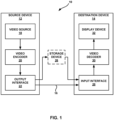
- FIG. 1 is a block diagram illustrating an example video encoding and decoding system 10 that may utilize the techniques described in this disclosure.
- system 10 includes a source device 12 that generates encoded video data to be decoded at a later time by a destination device 14.
- Source device 12 and destination device 14 may comprise any of a wide range of devices, including desktop computers, notebook (i.e., laptop) computers, tablet computers, set-top boxes, telephone handsets such as so-called “smart” phones, so-called “smart” pads, televisions, cameras, display devices, digital media players, video gaming consoles, video streaming device, or the like.
- source device 12 and destination device 14 are equipped for wireless communication.
- Link 16 may comprise any type of medium or device capable of moving the encoded video data from source device 12 to destination device 14.
- link 16 comprises a communication medium that enables source device 12 to transmit encoded video data directly to destination device 14 in real-time.
- the encoded video data may be modulated according to a communication standard, such as a wireless communication protocol, and transmitted to destination device 14.
- the communication medium may comprise any wireless or wired communication medium, such as a radio frequency (RF) spectrum or one or more physical transmission lines.
- the communication medium may form part of a packet-based network, such as a local area network, a wide-area network, or a global network such as the Internet.
- the communication medium may include routers, switches, base stations, or any other equipment that may be useful to facilitate communication from source device 12 to destination device 14.
- output interface 22 may output encoded data to a storage device 26.
- input interface 26 may access encoded data from storage device 26.
- Storage device 26 may include any of a variety of distributed or locally accessed data storage media such as a hard drive, Blu-ray discs, DVDs, CD-ROMs, flash memory, volatile or non-volatile memory, or any other suitable digital storage media for storing encoded video data.
- storage device 26 may correspond to a file server or another intermediate storage device that may hold the encoded video generated by source device 12.
- Destination device 14 may access stored video data from storage device 26 via streaming or download.
- the file server may be any type of server capable of storing encoded video data and transmitting that encoded video data to the destination device 14.
- Example file servers include a web server (e.g., for a website), a file transfer protocol (FTP) server, network attached storage (NAS) devices, a local disk drive, or other types of computer-readable storage media.
- Destination device 14 may access the encoded video data through any standard data connection, such as an Internet connection. This may include a wireless channel (e.g., a Wi-Fi connection), a wired connection (e.g., DSL, cable modem, etc.), or a combination of both that is suitable for accessing encoded video data stored on a file server.
- the transmission of encoded video data from storage device 26 may be a streaming transmission, a download transmission, or a combination of both.
- system 10 may be configured to support one-way or two-way video transmission to support applications such as video streaming, video playback, video broadcasting, and/or video telephony.
- source device 12 includes a video source 18, video encoder 20 and output interface 22.
- output interface 22 may include a modulator/demodulator (modem) and/or a transmitter.
- video source 18 may include a source such as a video capture device, e.g., a video camera, a video archive containing previously captured video, a video feed interface to receive video from a video content provider, and/or a computer graphics system for generating computer graphics data as the source video, or a combination of such sources.
- a source such as a video capture device, e.g., a video camera, a video archive containing previously captured video, a video feed interface to receive video from a video content provider, and/or a computer graphics system for generating computer graphics data as the source video, or a combination of such sources.
- the techniques described in this disclosure may be applicable to video coding in general, and may be applied to wireless and/or wired applications.
- the captured, pre-captured, or computer-generated video may be encoded by video encoder 20.
- the encoded video data may be transmitted directly to destination device 14 via output interface 22 of source device 12.
- the encoded video data may also (or alternatively) be stored onto storage device 26 for later access by destination device 14 or other devices, for decoding and/or playback.
- Destination device 14 includes an input interface 28, a video decoder 30, and a display device 32.
- input interface 28 may include a receiver and/or a modem.
- Input interface 28 of destination device 14 receives the encoded video data over link 16.
- the encoded video data communicated over link 16, or provided on storage device 26, may include a variety of syntax elements generated by video encoder 20 for use by a video decoder, such as video decoder 30, in decoding the video data.
- Such syntax elements may be included with the encoded video data transmitted on a communication medium, stored on a storage medium, or stored a file server.
- Display device 32 may be integrated with, or may be external to, destination device 14.
- destination device 14 may include an integrated display device and also be configured to interface with an external display device.
- destination device 14 may be a display device.
- display device 32 displays the decoded video data to a user, and may comprise any of a variety of display devices such as a liquid crystal display (LCD), a plasma display, an organic light emitting diode (OLED) display, or another type of display device.
- LCD liquid crystal display
- OLED organic light emitting diode
- Video encoder 20 and video decoder 30 may operate according to a video compression standard, such as High Efficiency Video Coding (HEVC) standard.
- video encoder 20 and video decoder 30 may operate according to other proprietary or industry standards, such as the ITU-T H.264 standard, alternatively referred to as ISO/IEC MPEG-4, Part 10, Advanced Video Coding (AVC), or extensions of such standards, such as the Scalable Video Coding (SVC) and Multi-view Video Coding (MVC) extensions.
- SVC Scalable Video Coding
- MVC Multi-view Video Coding
- the techniques of this disclosure are not limited to any particular coding standard.
- Other examples of video compression standards include ITU-T H.261, ISO/IEC MPEG-1 Visual, ITU-T H.262 or ISO/IEC MPEG-2 Visual, ITU-T H.263, and ISO/IEC MPEG-4 Visual.
- Techniques of this disclosure may utilize HEVC terminology for ease of explanation. It should not be assumed, however, that the techniques of this disclosure are limited to HEVC, and in fact, it is explicitly contemplated that the techniques of this disclosure may be implemented in successor standards to HEVC and its extensions.
- video encoder 20 and video decoder 30 may each be integrated with an audio encoder and decoder, and may include appropriate MUX-DEMUX units, or other hardware and software, to handle encoding of both audio and video in a common data stream or separate data streams. If applicable, in some examples, MUX-DEMUX units may conform to the ITU H.223 multiplexer protocol, or other protocols such as the user datagram protocol (UDP).
- MUX-DEMUX units may conform to the ITU H.223 multiplexer protocol, or other protocols such as the user datagram protocol (UDP).
- Video encoder 20 and video decoder 30 each may be implemented as any of a variety of suitable encoder circuitry, such as one or more microprocessors, digital signal processors (DSPs), application specific integrated circuits (ASICs), field programmable gate arrays (FPGAs), discrete logic, software, hardware, firmware or any combinations thereof.
- DSPs digital signal processors
- ASICs application specific integrated circuits
- FPGAs field programmable gate arrays
- a device may store instructions for the software in a suitable, non-transitory computer-readable medium and execute the instructions in hardware using one or more processors to perform the techniques of this disclosure.
- Each of video encoder 20 and video decoder 30 may be included in one or more encoders or decoders, either of which may be integrated as part of a combined encoder/decoder (CODEC) in a respective device.
- CODEC combined encoder/decoder
- JVET Joint Video Exploration Team
- All the above-mentioned coding standards support the coding of color video which contains different color components (typically one luma and two chroma components). Each component is an array or single sample from one of the three arrays (e.g., luma and two chroma) that compose a picture in 4:2:0, 4:2:2, or 4:4:4 color formats.
- color components typically one luma and two chroma components.
- Each component is an array or single sample from one of the three arrays (e.g., luma and two chroma) that compose a picture in 4:2:0, 4:2:2, or 4:4:4 color formats.
- a video sequence typically includes a series of pictures. Pictures may also be referred to as "frames.”
- a picture may include three components. Each of the components comprises a sample array, denoted S L , S Cb , and S Cr .
- S L is a two-dimensional array (i.e., a block) of luma samples.
- S Cb is a two-dimensional array of Cb chroma samples.
- S Cr is a two-dimensional array of Cr chroma samples.
- Other types of chroma samples may be used instead of Cb and Cr, such as Cg/Co.
- the terms "sample” and "pixel" are used interchangeably.
- video encoder 20 may generate a set of coding tree units (CTUs).
- Each of the CTUs may comprise a coding tree block of luma samples, two corresponding coding tree blocks of chroma samples, and syntax structures used to code the samples of the coding tree blocks.
- a CTU may comprise a single coding tree block and syntax structures used to code the samples of the coding tree block.
- a coding tree block may be an NxN block of samples.
- a CTU is not necessarily limited to a particular size and may include one or more coding units (CUs).
- a slice may include an integer number of CTUs ordered consecutively in a raster scan order.
- video encoder 20 may recursively perform quad-tree partitioning on the coding tree blocks of a CTU to divide the coding tree blocks into coding blocks, hence the name "coding tree units.”
- a coding block may be an NxN block of samples.
- a CU may comprise a coding block of luma samples and two corresponding coding blocks of chroma samples of a picture that has a luma sample array, a Cb sample array, and a Cr sample array, and syntax structures used to code the samples of the coding blocks.
- a CU may comprise a single coding block and syntax structures used to code the samples of the coding block.
- video encoder 20 partitions a coding block of a CU into two or more prediction blocks.
- a prediction block is the same size as the CU.
- a prediction block is a rectangular (i.e., square or non-square) block of samples on which the same prediction is applied.
- a prediction unit (PU) of a CU may comprise a prediction block of luma samples, two corresponding prediction blocks of chroma samples, and syntax structures used to predict the prediction blocks. In monochrome pictures or pictures having three separate color planes, a PU may comprise a single prediction block and syntax structures used to predict the prediction block.
- Video encoder 20 may generate predictive luma, Cb, and Cr blocks for luma, Cb, and Cr prediction blocks of each PU of the CU.
- Video encoder 20 may use intra prediction or inter prediction to generate the predictive blocks for a PU. If video encoder 20 uses intra prediction to generate the predictive blocks of a PU, video encoder 20 may generate the predictive blocks of the PU based on decoded samples of the picture associated with the PU. If video encoder 20 uses inter prediction to generate the predictive blocks of a PU, video encoder 20 may generate the predictive blocks of the PU based on decoded samples of one or more pictures other than the picture associated with the PU.
- video encoder 20 may generate residual blocks for the CU. For instance, video encoder 20 may generate a luma residual block for the CU. Each sample in the CU's luma residual block indicates a difference between a luma sample in one of the CU's predictive luma blocks and a corresponding sample in the CU's original luma coding block. In addition, video encoder 20 may generate a Cb residual block for the CU. Each sample in the CU's Cb residual block may indicate a difference between a Cb sample in one of the CU's predictive Cb blocks and a corresponding sample in the CU's original Cb coding block.
- Video encoder 20 may also generate a Cr residual block for the CU.
- Each sample in the CU's Cr residual block may indicate a difference between a Cr sample in one of the CU's predictive Cr blocks and a corresponding sample in the CU's original Cr coding block.
- video encoder 20 may partition the luma, Cb, and Cr residual blocks of a CU into one or more luma, Cb, and Cr transform blocks. For instance, video encoder 20 may use quadtree partitioning to partition the residual blocks of a CU into transform blocks.
- a transform block is a rectangular (e.g., square or non-square) block of samples on which the same transform is applied.
- a transform unit (TU) of a CU may comprise a transform block of luma samples, two corresponding transform blocks of chroma samples, and syntax structures used to transform the transform block samples.
- each TU of a CU may be associated with a luma transform block, a Cb transform block, and a Cr transform block.
- the luma transform block associated with the TU may be a sub-block of the CU's luma residual block.
- the Cb transform block may be a sub-block of the CU's Cb residual block.
- the Cr transform block may be a sub-block of the CU's Cr residual block.
- a TU may comprise a single transform block and syntax structures used to transform the samples of the transform block.
- Video encoder 20 may apply one or more transforms to a luma transform block of a TU to generate a luma coefficient block for the TU.
- a coefficient block may be a two-dimensional array of transform coefficients.
- a transform coefficient may be a scalar quantity.
- Video encoder 20 may apply one or more transforms to a Cb transform block of a TU to generate a Cb coefficient block for the TU.
- Video encoder 20 may apply one or more transforms to a Cr transform block of a TU to generate a Cr coefficient block for the TU.
- video encoder 20 may quantize the coefficient block. Quantization generally refers to a process in which transform coefficients are quantized to possibly reduce the amount of data used to represent the transform coefficients, providing further compression.
- video encoder 20 may entropy encode syntax elements indicating the quantized transform coefficients. For example, video encoder 20 may perform Context-Adaptive Binary Arithmetic Coding (CABAC) on the syntax elements indicating the quantized transform coefficients.
- CABAC Context-Adaptive Binary Arithmetic Coding
- Video encoder 20 may output a bitstream that includes a sequence of bits that forms a representation of coded pictures and associated data.
- the bitstream may comprise a sequence of Network Abstraction Layer (NAL) units.
- NAL unit is a syntax structure containing an indication of the type of data in the NAL unit and bytes containing that data in the form of a raw byte sequence payload (RBSP) interspersed as necessary with emulation prevention bits.
- Each of the NAL units includes a NAL unit header and encapsulates a RBSP.
- the NAL unit header may include a syntax element that indicates a NAL unit type code.
- the NAL unit type code specified by the NAL unit header of a NAL unit indicates the type of the NAL unit.
- a RBSP may be a syntax structure containing an integer number of bytes that is encapsulated within a NAL unit. In some instances, an RBSP includes zero bits.
- NAL units may encapsulate different types of RBSPs. For example, a first type of NAL unit may encapsulate an RBSP for a PPS, a second type of NAL unit may encapsulate an RBSP for a coded slice, a third type of NAL unit may encapsulate an RBSP for SEI messages, and so on.
- NAL units that encapsulate RBSPs for video coding data (as opposed to RBSPs for parameter sets and SEI messages) may be referred to as VCL NAL units.
- Video decoder 30 may receive a bitstream generated by video encoder 20.
- video decoder 30 may parse the bitstream to obtain syntax elements from the bitstream.
- Video decoder 30 may reconstruct the pictures of the video data based at least in part on the syntax elements obtained from the bitstream.
- the process to reconstruct the video data may be generally reciprocal to the process performed by video encoder 20. As one example, if video encoder 20 transmits certain information, then video decoder 30 may receive such information.
- video decoder 30 may inverse quantize coefficient blocks associated with TUs of a current CU. Video decoder 30 may perform inverse transforms on the coefficient blocks to reconstruct transform blocks associated with the TUs of the current CU.
- Video decoder 30 may reconstruct the coding blocks of the current CU by adding the samples of the predictive blocks for PUs of the current CU to corresponding samples of the transform blocks of the TUs of the current CU. By reconstructing the coding blocks for each CU of a picture, video decoder 30 may reconstruct the picture.
- the filter can be applied as a post-filter, where the filtered frame is not used for prediction of future frames, or as an in-loop filter, where the filtered frame is able to be used to predict future frame.
- a filter can be designed for example by minimizing the error between the original signal and the decoded filtered signal.
- the normFactor is usually equal to 2 n .
- larger values of normFactor produce coefficients f ( k,l ) requiring more bits to transmit.
- the decoded filter coefficients f ( k,l ) are applied to the reconstructed image R(i,j) as follows:
- the ALF in HM-3.0 is based on picture level optimization. That is, the ALF coefficients are derived after a whole frame is coded.
- the ALF in HM-3.0 has two modes for the luma component: block-based adaptation (BA) and region-based adaptation (RA). These two modes share the same filter shapes, filtering operations as well as syntax elements. The only difference between the two modes is the classification method.
- the classification in BA is at a block level.
- 4x4 blocks in the whole picture are classified based on one-dimensional (1D) Laplacian direction (up to 3 directions) and two-dimensional (2D) Laplacian activity (up to 5 activity values).
- each 4x4 block in a picture is assigned a group index based on one-dimensional (1D) Laplacian direction and two-dimensional (2D) Laplacian activity.
- Direction Dir b and unquantized activity Act b is shown in equations (2) - (5) below, where Î i,j indicates a reconstructed pixel with relative coordinate (i,j) to the top-left pixel position of a 4 ⁇ 4 block, V i,j and H i,j are the absolute values of vertical and horizontal gradient of the pixel located at (i,j).
- direction Dir b is generated by comparing the absolute values of the vertical gradient and the horizontal gradient in the 4x4 block and Act b is the sum of the gradients in both directions in the 4x4 block.
- Act b is further quantized to the range of 0 to 4, inclusive, as described in HEVC Working Draft 3.
- each block can be categorized into one out of fifteen (5x3) groups.
- An index is assigned to each 4x4 block according to the value of Dir b and Act b of the block. Denote the group index by C and set C equal to 5Dir b + ⁇ where ⁇ is the quantized value of Act b . Therefore, up to fifteen sets of ALF parameters can be signaled for the luma component of a picture.
- the groups may be merged along group index value. For each merged group, video encoder 20 signals a set of ALF coefficients. Up to three circular symmetric shapes (as shown in FIGS. 3A-3C ) are supported.
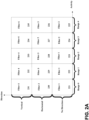
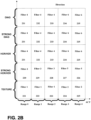
- FIG. 2A is a conceptual diagram illustrating these 15 groups used for BA classification.
- filters are mapped to ranges of values for an activity metric (i.e., Range 0 to Range 4) and a direction metric.
- the direction metric in FIG. 2A is shown as having values of No Direction, Horizontal, and Vertical, which may correspond to the values of 0, 1, and 2 above from equation 3.
- the particular example of FIG. 2A shows six different filters (i.e. Filter 1, Filter 2 ... Filter 6) as being mapped to the 15 categories, but more or fewer filters may similarly be used.
- FIG. 2A shows an example, with 15 groups, identified as groups 221 through 235, more or fewer groups may also be used.
- the filters associated with each group may be signaled using one or more merge flags.
- a single flag may be sent to indicate if a group is mapped to the same filter as a previous group.
- a first flag may be sent to indicate if a group is mapped to the same filter as a first neighboring block (e.g. one of a horizontal or vertical neighbor), and if that flag is false, a second flag may be sent to indicate if the group is mapped to a second neighboring block (e.g. the other of the horizontal neighbor or the vertical neighbor).
- Filter coefficients may be defined or selected in order to promote desirable levels of video block filtering that can reduce blockiness and/or improve the video quality in other ways.
- a set of filter coefficients may define how filtering is applied along edges of video blocks or other locations within video blocks. Different filter coefficients may cause different levels of filtering with respect to different pixels of the video blocks. Filtering, for example, may smooth or sharpen differences in intensity of adjacent pixel values in order to help eliminate unwanted artifacts.
- the term "filter” generally refers to a set of filter coefficients.
- a 3x3 filter may be defined by a set of 9 filter coefficients
- a 5x5 filter may be defined by a set of 25 filter coefficients
- a 9x5 filter may be defined by a set of 45 filter coefficients, and so on.
- set of filters generally refers to a group of more than one filter.
- a set of two 3x3 filters could include a first set of 9 filter coefficients and a second set of 9 filter coefficients.
- shape sometimes called the "filter support,” generally refers to the number of rows of filter coefficients and number of columns of filter coefficients for a particular filter.
- filters may take non-rectangular shapes including diamond-shapes, diamond-like shapes, circular shapes, circular-like shapes, hexagonal shapes, octagonal shapes, cross shapes, X-shapes, T-shapes, other geometric shapes, or numerous other shapes or configuration.
- FIGS. 3A-3C illustrate the three filter shapes.
- FIG. 3A illustrates a 5x5 diamond
- FIG. 3B illustrates a 7x7 diamond
- FIG. 3C illustrates a truncated 9x9 diamond.
- the examples in FIGS. 3A-3C are diamond shapes, however other shapes may be used.
- the center pixel in the filter mask is the pixel that is being filtered. In other examples, the filtered pixel may be offset from the center of the filter mask.
- a single set of ALF coefficients is applied to each of the chroma components in a picture.
- the 5x5 diamond shape filter is always used.
- each pixel sample Î i,j may be filtered to I' i,j based on the calculations as shown in equation (6) below, where L denotes filter length, f m,n represents filter coefficient, and o indicates filter offset or DC coefficient.
- Coding performance may be improved by utilizing the cross component correlation existing even in YUV 4:2:0 video sequences.
- CCLM cross-component linear model
- L ( n ) represents the down-sampled top and left neighboring reconstructed luma samples
- C ( n ) represents the top and left neighboring reconstructed chroma samples
- value of N is equal to twice of the minimum of width and height of the current chroma coding block.
- the above two equations (8) and (9) are applied directly.
- the neighboring samples of the longer boundary are first subsampled to have the same number of samples as the shorter boundary.
- CCLM prediction mode is extended to the prediction between two chroma components (e.g., a Cr component is predicted from a Cb component).
- a CCLM luma-to-chroma prediction mode is added as one additional chroma intra prediction mode.
- one more rate/distortion cost check for chroma components is added for selecting the optimal chroma intra prediction mode.
- CCLM Cb-to-Cr prediction is used to enhance the Cr component prediction.
- the linear model (LM) prediction mode does not fully utilize the correlation between the luma and chroma components because the residual of current chroma pixels are not considered.
- L(n) represents the down-sampled top and left neighboring reconstructed luma samples
- C ( n ) represents the top and left neighboring reconstructed chroma samples.
- L(n) and C(n) do not include the value of the current chroma sample.
- ⁇ and ⁇ are not based on the value of the current chroma sample.
- L(n) and C(n) do not include the value of the current chroma sample because L(n) and C(n) are used to derive ⁇ and ⁇ for use in CCLM.
- CCLM is performed as part of predicting the value of the current chroma sample. Thus, the value of the current chroma sample is unavailable for use in deriving ⁇ and ⁇ .
- the following techniques may improve video data compression performance relative to the existing CCLM techniques because the techniques of this disclosure are able to take advantage of the correlation between components of a picture, such as luma and chroma components of a picture.
- the techniques of this disclosure may be applied individually, or alternatively, any combination of the techniques may be applied.
- the following techniques may be applied by a video coding device, such as a device that includes either video encoder 20 or video decoder 30 ( FIG. 1 ).
- This disclosure describes techniques related to a cross-component in-loop filter in a video coding system.
- the initial value of the current pixel P c can be modified to P' c according to spatial neighboring pixels of the current pixel and at least one corresponding pixels in the at least one other components (i.e., cross-component pixels).
- the current pixel and its corresponding cross-component pixel(s) P cc in the other component(s) follow a predefined relation, such as an equation. This relation may be linear or non-linear.
- a video coder may apply a cross-component filter that determines a filtered value of a current sample (i.e., P' c ) based on a first parameter (i.e., ⁇ ), a second parameter (i.e., ⁇ ) and a cross-component sample (i.e., P cc ).
- a video coder may apply a cross-component filter that determines a filtered value of a current sample (i.e., P' c ) based on a plurality of first parameters (i.e., ⁇ 0 ...
- a difference between ⁇ j and ⁇ i is that ⁇ j are scale factors for the pixels of the current component and ⁇ i are scale factors for the pixels of the other component.
- the initial value of current pixel P c may be modified to be a value derived by a weighted sum of P c and P' c wherein P' c may be calculated using one of the example models described above.
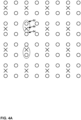
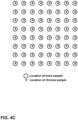
- FIGS. 4A-4C are schematic diagrams of sampling locations of luma and chroma samples in a picture for 4:2:0, 4:2:2 and 4:4:4 color format, according to an example of the present application.
- the corresponding pixels in the other components are those pixels at the same sampling position.
- the sampling position of luma and chroma pixels may not be aligned, as shown in FIG. 4A . Therefore, the present disclosure describes different methods to derive the corresponding cross-component pixels. For example, for the 4:4:4 color format, shown in FIG. 4C , several methods of selecting corresponding cross-component pixels may be utilized.
- the collocated pixel may be directly selected as the corresponding cross-component pixels.
- the collocated pixel along with its neighboring pixels in the other component are first applied a spatial filter for noise reduction (e.g. low-pass filter) and then the filtered one is used as the corresponding cross-component pixel.
- a spatial filter for noise reduction e.g. low-pass filter
- the correspondence between luma and chroma samples may be set up as indicated by dotted circles in FIG. 4A .
- One correspondence is to relate the luma samples located immediately upper to the chroma samples.
- Another correspondence is to relate the luma samples located immediately bottom to the chroma samples.
- a current sample 50 is located between an upper sample 52 and a lower sample 54.
- a video coder may determine the filtered value of current sample 50 based on ⁇ , ⁇ , and either the upper luma sample 52 or lower luma sample 54.
- the video coder may use upper luma sample 52 or lower luma sample 54 as P cc or p i cc in the example formulas for applying the cross-component filter described elsewhere in this disclosure.
- the collocated pixel may be directly selected as the corresponding cross-component pixels.
- the cross-component sample (P cc ) is equal to the collocated luma pixel.
- a video coder first applies a spatial filter to the collocated pixel along with neighboring pixels of the collocated pixel in the other component.
- the spatial filter provides noise reduction.
- the spatial filter may be a low-pass filter.
- the video coder may then use the filtered collocated pixel as the corresponding cross-component pixel.
- the video coder may use the filtered collocated pixel as the cross-component sample (P cc ).
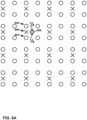
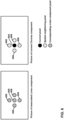
- FIGS. 5A and 5B are schematic diagrams of generation of correspondent cross-component pixels for 4:2:0 color format ( FIG. 5A ), use of upper and bottom luma pixels ( FIG. 5B ), and use of six surrounding luma pixels.
- the luma pixels located immediately at the upper and bottom of the current chroma pixel may be used to generate a virtual luma pixel using a predefined weighting factors (e.g. 1 ⁇ 2 and 1 ⁇ 2) as shown in FIG. 5A .
- a predefined weighting factors e.g. 1 ⁇ 2 and 1 ⁇ 2
- a current sample 500 is a chroma sample at a position between an upper luma sample 502 above the chroma sample and a lower luma sample 504 below the chroma sample.
- Upper luma sample 502 and lower luma sample 504 are luma samples.
- a video coding device may use a weighted average of upper luma sample 502 and lower luma sample 504 to determine a virtual luma sample 506.
- the video coding device determines a filtered value of the current sample based on ⁇ , ⁇ , and virtual luma sample 506.
- the video coding device may use virtual sample 506 as P cc or p i cc in the example formulas for applying the cross-component filter described elsewhere in this disclosure.
- the six luma pixels surrounding the current chroma pixel may be used to generate a virtual luma pixel using a predefined weighting factors as shown in FIG. 5B .
- a video coding device may use a weighted average of six luma samples (shown speckled in FIG. 5B ) to determine a virtual luma sample 552.
- the video coding device may determine a filtered value of a current sample 550 based on ⁇ , ⁇ , and virtual luma sample 552.
- the video coding device may use virtual luma sample 552 as P cc or p i cc in the example formulas for applying the cross-component filter described elsewhere in this disclosure.
- the surrounding pixels and the associated weighting factors are not limited to the example as shown in FIG. 5B .
- the initial pixel value of current pixel P c may be modified to P' c according to the predefined linear or non-linear relation between the current pixel and its spatial neighboring pixels and at least one corresponding pixels in the at least one other components.
- Parameters, such as ⁇ and ⁇ , used in such relations may be derived in various ways.
- ⁇ and ⁇ can be derived using the equation (8) and (9) as described above, where P' c is a current chroma pixel in a current chroma component (e.g., a Cb or Cr component) and P cc is a corresponding cross-component luma pixel.
- a current chroma component e.g., a Cb or Cr component
- L(n) denotes a cross-component luma sample for pixel index n located within a predefined local area
- C(n) represents the current chroma pixel and its spatially neighboring pixels within a predefined local area
- value of N is equal to number of pixels in this local area.
- C(n) do not include the current chroma pixel, but when determining ⁇ and ⁇ for the cross-component filter of this disclosure, C(n) does include the current chroma pixel and, accordingly, L(n) includes a cross-component luma sample corresponding to the current chroma pixel.
- FIGS. 6 and 7 are schematic diagrams of examples of local areas to derive parameters utilized in a predefined linear or non-linear relation formula, according to an example of the present disclosure.
- two examples of cross pattern ( FIG. 6 ) and 3x3 block pattern ( FIG. 7 ) to form the local area may be used to derive parameters used in a cross-component filter, respectively.
- C(n) includes current pixel 604 and spatial neighboring pixels 606.
- L(n) includes each of cross-component pixels 608.
- C(n) includes current pixel 704 and spatial neighboring pixels 706.
- L(n) includes each of cross-component pixels 708.
- the parameter is derived by a Gaussian filter or an edge-preserved filter (e.g. extending the concept of bilateral filter, such as described at https://en.wikipedia.org/wiki/Bilateral filter, for example, to incorporating the cross-component pixels).
- a Gaussian filter or an edge-preserved filter e.g. extending the concept of bilateral filter, such as described at https://en.wikipedia.org/wiki/Bilateral filter, for example, to incorporating the cross-component pixels.
- the weight ⁇ ( i,j,k,l ) is the weight assigned for reference sample (k, l) to filter the sample (i, j).
- I(i, j) and I(k, l) are the sample value of samples (i, j) and (k,l) respectively.
- ⁇ d is the spatial parameter
- ⁇ r is the range parameter for the bilateral filtering.
- more weight may be placed on the current pixel and its corresponding pixel.
- more weight is placed on the current sample and a corresponding cross-component sample of the plurality of cross-component samples than the plurality of neighbor samples that spatially neighbor the current sample and the plurality of cross-component samples that correspond to the neighbor samples.
- wi(n) is a weight assigned to the n-th cross-component pixel of a plurality of cross-component pixels that includes a cross-component pixel collocated with the current pixel.
- the weight assigned to the cross-component pixel collocated with the current pixel is greater than weights assigned to the other cross-component pixels.
- w 2 (n) is a weight assigned to the n-th pixel of a set of pixels that includes the current pixel and one or more neighboring pixels of the same color component as the current pixel.
- the weight assigned to the current pixel is greater than weights assigned to the neighboring pixels of the same color component as the current pixel.
- the weight for the current pixel may be fixed within a slice, tile, picture, or sequence.
- a video coder may use the same weight for the current pixel when applying a cross-component filter to pixels in a slice, all pixels in a tile, all pixels in a picture, or all pixels in a sequence.
- the weight for the current pixel is set to 4 and the weight for the cross-component pixel collocated with the current pixel is also set to 4.
- video encoder 20 signals the weight in a slice header, a picture parameter set, a sequence parameter set, a video parameter set, or another type of syntax structure.
- the weight may be adaptively changed within a specific size.
- the adaptively selected weight may be signaled.
- the weights for the current pixel and the cross-component pixel collocated with the current pixel can be set to one of a predefined weighting set (e.g. ⁇ 1, 4, 8, 12 ⁇ ).
- video encoder 20 tries different weights and signals the weight having the best rate-distortion performance into the bitstream.
- the adaptively selected weight is dependent on a coding mode/split structure.
- the weights for the current pixel and the cross-component pixel collocated with the current pixel are set to 12 when the current pixel belongs to a block coded as inter-prediction mode while the weights are set to 4 when the current pixel belong to a block coded as intra-prediction mode.
- a video coder may perform the cross-component filter at different stages of a codec.
- a video coder may perform the cross-component filter in the prediction stage.
- the video coder may perform the cross-component filter as part of applying a motion compensation filter.
- the video coder may include a filtered value of a current sample in a predictive block (e.g., a predictive block for a PU).
- the video coder may reconstruct a block by adding samples of the predictive block to corresponding samples of a residual block.
- the video coder may generate a final version of a current picture based on the reconstructed block.
- the video coder may apply the cross-component filter as an in-loop filter immediately after applying a de-blocking filter. Samples generated using an in-loop filter may be subsequently used for reference (e.g., in intra prediction or inter prediction).
- the video coder applies the cross-component filter as an in-loop filter immediately after applying the SAO filter.
- the cross-component filter and a chroma ALF process share the same on/off flags. For instance, in one example, one or more flags control whether a video coder applies a chroma ALF process.
- video encoder 20 may signal the one or more flags as one or more syntax elements in a bitstream. In this example, the same one or more flags control whether the video coder applies the cross-component filter.
- the video coder applies the cross-component filter as an in-loop filter immediately after applying an ALF.
- a video coder determines on/off flags of the cross-component filter by evaluating the reconstruction blocks before and after ALF. For example, a video coder may determine whether to apply the cross-component filter based on a value of an on/off flag.
- the video coder first performs the ALF for the luma component, the ALF filtered luma component is then used to apply a cross-component filter for the chroma components. The video coder then compares a rate-distortion of the filtered chroma components and the un-filtered chroma components to decide the value of an on/off flag for the cross-component filter.
- a video coder applies the cross-component filter as an in-loop filter immediately after applying ALF luma filtering and before applying ALF chroma filtering.
- a video coder applies the cross-component filter as an in-loop filter at the last position of all in-loop filters.
- a video coder may perform the cross-component filter as a post-filter.
- the filtered values generated by applying the cross-component filter are not used for reference in intra prediction or inter prediction.
- video encoder 20 may signal additional control information in the bitstream, such as on/off flags, for the cross-component filter. The control information controls whether video decoder 30 applies the cross-component filter.
- video encoder 20 may signal control syntax in the bitstreams at different levels. For instance, video encoder 20 may signal control syntax for a Cb component and separate control syntax for a Cr component. The control syntax control for a color component whether video decoder 30 applies the cross-component filter to determine filtered values of the color component. Video encoder 20 may signal the control syntax at a sequence level, a picture level, a slice level, a CTU/CTB level, a CU/CB level, a PU/predictive block level, or an MxN block level or the depth of quad tree or the depth of CU/PU.
- video encoder 20 signals one slice-level flag to indicate the enabling of the cross-component filter for a current slice. When this slice-flag is signaled as off, the filter is disabled and no further syntax needs to be signaled below the slice-level. When the slice-level flag is signaled as on, video encoder 20 may also signal lower-level syntax to control the cross-component filter in finer granularity. For example, for each respective CTU/CTB, video encoder 20 may further signal a flag to indicate whether the cross-component filter is enabled for the respective CTU/CTB. In one example, all the controlling syntax below the slice-level may be coded using CABAC.
- the on/off control for Cb and Cr components may share the same syntax element to save signaling overhead.
- a single syntax element control whether the video coder applies the cross-component filter to determine filtered values of Cb and Cr samples.
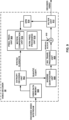
- FIG. 8 is a block diagram illustrating an example video encoder 20 configured to implement techniques described in this disclosure.
- Video encoder 20 may perform intra- and inter-coding of video blocks within slices.
- Intra-coding relies on spatial prediction to reduce or remove spatial redundancy in video within a given video frame or picture.
- Inter-coding relies on temporal prediction to reduce or remove temporal redundancy in video within adjacent frames or pictures of a video sequence.
- Intra-mode may refer to any of several spatial based compression modes.
- Inter-modes such as uni-directional prediction (P mode) or bi-prediction (B mode), may refer to any of several temporal-based compression modes.
- video encoder 20 includes a video data memory 800, partitioning unit 802, prediction processing unit 804, summer 806, transform processing unit 808, quantization unit 810, entropy encoding unit 812.
- Prediction processing unit 804 includes motion estimation unit 814, motion compensation unit 816, and intra prediction unit 818.
- video encoder 20 also includes inverse quantization unit 820, inverse transform processing unit 822, summer 824, filter unit 826, and decoded picture buffer (DPB) 828.
- DPB decoded picture buffer
- video encoder 20 receives video data and stores the received video data in video data memory 800.
- Video data memory 800 may store video data to be encoded by the components of video encoder 20.
- the video data stored in video data memory 800 may be obtained, for example, from video source 18.
- DPB 828 may be a reference picture memory that stores reference video data for use in encoding video data by video encoder 20, e.g., in intra- or inter-coding modes.
- Video data memory 800 and DPB 828 may be formed by any of a variety of memory devices, such as dynamic random access memory (DRAM), including synchronous DRAM (SDRAM), magnetoresistive RAM (MRAM), resistive RAM (RRAM), or other types of memory devices.
- Video data memory 800 and DPB 828 may be provided by the same memory device or separate memory devices.
- video data memory 800 may be on-chip with other components of video encoder 20, or off-chip relative to those components.
- Partitioning unit 802 retrieves the video data from video data memory 800 and partitions the video data into video blocks. This partitioning may also include partitioning into slices, tiles, or other larger units, as wells as video block partitioning, e.g., according to a quadtree structure of LCUs and CUs.
- Video encoder 20 generally illustrates the components that encode video blocks within a slice to be encoded. The slice may be divided into multiple video blocks (and possibly into sets of video blocks referred to as tiles).
- Prediction processing unit 804 may select one of a plurality of possible coding modes, such as one of a plurality of intra coding modes or one of a plurality of inter coding modes, for the current video block based on error results (e.g., coding rate and the level of distortion). Prediction processing unit 804 may provide the resulting intra- or inter-coded block to summer 806 to generate residual block data and to summer 824 to reconstruct the encoded block for use as a reference picture.
- Intra prediction unit 818 within prediction processing unit 804 may perform intra-predictive coding of the current video block relative to one or more neighboring blocks in the same frame or slice as the current block to be coded to provide spatial compression.
- Motion estimation unit 814 and motion compensation unit 816 within prediction processing unit 804 perform inter-predictive coding of the current video block relative to one or more predictive blocks in one or more reference pictures to provide temporal compression.
- Motion estimation unit 814 may be configured to determine the inter-prediction mode for a slice according to a predetermined pattern for a video sequence.
- the predetermined pattern may designate slices in the sequence as P slices or B slices.
- Motion estimation unit 814 and motion compensation unit 816 may be highly integrated, but are illustrated separately for conceptual purposes.
- Motion estimation, performed by motion estimation unit 814 is the process of generating motion vectors, which estimate motion for video blocks.
- a motion vector for example, may indicate the displacement of a PU of a video block within a current video frame or picture relative to a predictive block within a reference picture.
- a predictive block is a block that is found to closely match the PU of the video block to be coded in terms of pixel difference, which may be determined by sum of absolute difference (SAD), sum of square difference (SSD), or other difference metrics.
- video encoder 20 may calculate values for sub-integer pixel positions of reference pictures stored in DPB 828. For example, video encoder 20 may interpolate values of one-quarter pixel positions, one-eighth pixel positions, or other fractional pixel positions of the reference picture. Therefore, motion estimation unit 814 may perform a motion search relative to the full pixel positions and fractional pixel positions and output a motion vector with fractional pixel precision.
- Motion estimation unit 814 calculates a motion vector for a PU of a video block in an inter-coded slice by comparing the position of the PU to the position of a predictive block of a reference picture.
- the reference picture may be selected from a first reference picture list (List 0) or a second reference picture list (List 1), each of which identify one or more reference pictures stored in DPB 828.
- Motion estimation unit 814 sends the calculated motion vector to entropy encoding unit 812 and motion compensation unit 816.
- Motion compensation performed by motion compensation unit 816, may involve fetching or generating the predictive block based on the motion vector determined by motion estimation, possibly performing interpolations to sub-pixel precision.
- motion compensation unit 816 may locate the predictive block to which the motion vector points in one of the reference picture lists.
- Video encoder 20 forms a residual video block by subtracting pixel values of the predictive block from the pixel values of the current video block being coded, forming pixel difference values.
- the pixel difference values form residual data for the block, and may include both luma and chroma difference components.
- Summer 806 represents the component or components that perform this subtraction operation.
- Motion compensation unit 816 may also generate syntax elements associated with the video blocks and the slice for use by video decoder 30 in decoding the video blocks of the slice.
- video encoder 20 After prediction processing unit 804 generates the predictive block for the current video block, either via intra prediction or inter prediction, video encoder 20 forms a residual video block by subtracting the predictive block from the current video block.
- the residual video data in the residual block may be included in one or more TUs and applied to transform processing unit 808.
- Transform processing unit 808 transforms the residual video data into residual transform coefficients using a transform, such as a discrete cosine transform (DCT) or a conceptually similar transform.
- Transform processing unit 808 may convert the residual video data from a pixel domain to a transform domain, such as a frequency domain.
- DCT discrete cosine transform
- Transform processing unit 808 may send the resulting transform coefficients to quantization unit 810.
- Quantization unit 810 quantizes the transform coefficients to further reduce bit rate. The quantization process may reduce the bit depth associated with some or all of the coefficients. The degree of quantization may be modified by adjusting a quantization parameter. In some examples, quantization unit 810 may then perform a scan of the matrix including the quantized transform coefficients. Alternatively, entropy encoding unit 812 may perform the scan.
- entropy encoding unit 812 entropy encodes the quantized transform coefficients.
- entropy encoding unit 812 may perform context adaptive variable length coding (CAVLC), context adaptive binary arithmetic coding (CABAC), syntax-based context-adaptive binary arithmetic coding (SBAC), probability interval partitioning entropy (PIPE) coding or another entropy encoding methodology or technique.
- CAVLC context adaptive variable length coding
- CABAC context adaptive binary arithmetic coding
- SBAC syntax-based context-adaptive binary arithmetic coding
- PIPE probability interval partitioning entropy
- the encoded bitstream may be transmitted to video decoder 30, or archived for later transmission or retrieval by video decoder 30.
- Entropy encoding unit 812 may also entropy encode the motion vectors and the other syntax elements for the current slice being coded.
- Inverse quantization unit 820 and inverse transform processing unit 822 apply inverse quantization and inverse transformation, respectively, to reconstruct the residual block in the pixel domain for later use as a reference block of a reference picture.
- Motion compensation unit 816 may calculate a reference block by adding the residual block to a predictive block of one of the reference pictures within one of the reference picture lists. Motion compensation unit 816 may also apply one or more interpolation filters to the reconstructed residual block to calculate sub-integer pixel values for use in motion estimation.
- Summer 824 adds the reconstructed residual block to the motion compensated prediction block produced by motion compensation unit 816 to produce a reconstructed block.
- Filter unit 826 filters the reconstructed block (e.g. the output of summer 824) and stores the filtered reconstructed block in DPB 828 for uses as a reference block.
- the reference block may be used by motion estimation unit 814 and motion compensation unit 816 as a reference block to inter-predict a block in a subsequent video frame or picture.
- Filter unit 826 represents one or more filters that may be performed on a reconstructed block. Examples of the types of filtering that may be performed by filter unit 826 include, deblock filtering, ALF, filtering, SAO filtering, cross-component filtering, or other types of loop filters.
- a deblock filter may, for example, apply deblocking filtering to filter block boundaries to remove blockiness artifacts from reconstructed video.
- An SAO filter may apply offsets to reconstructed pixel values in order to improve overall coding quality. Additional loop filters (in loop or post loop) may also be used.
- the various filters applied by filter unit 826 may be applied in a variety of
- filter unit 826 applies the cross-component filter described elsewhere in this disclosure. In some examples where filter unit 826 applies the cross-component filter, filter unit 826 may apply one or more other types of filters before or after applying the cross-component filter. For instance, in some examples, filter unit 826 applies the cross-component filter after applying an ALF. In some examples where the cross-component filter is performed in the prediction stage, motion compensation unit 826 applies the in-loop cross-component filter.
- FIG. 9 is a block diagram illustrating an example video decoder 30 configured to implement the techniques described in this disclosure.
- video decoder 30 of FIG. 9 is configured to receive a bitstream generated by video encoder 20 of FIG. 8 .
- video decoder 30 includes video data memory 900, entropy decoding unit 902, prediction processing unit 904, inverse quantization unit 906, inverse transform processing unit 908, summer 910, filter unit 912, and DPB 914.
- Prediction processing unit 904 includes motion compensation unit 916 and intra prediction unit 918.
- video decoder 30 performs a decoding pass generally reciprocal to the encoding pass described with respect to video encoder 20 from FIG. 8 .
- video decoder 30 receives an encoded video bitstream that represents video blocks of an encoded slice and associated syntax elements from video encoder 20.
- Video decoder 30 stores the received encoded video bitstream in video data memory 900.
- Video data memory 900 may store video data, such as an encoded video bitstream, to be decoded by the components of video decoder 30.
- the video data stored in video data memory 900 may be obtained, for example, via link 16 ( FIG. 1 ), from storage device 26 ( FIG. 1 ), or from a local video source, such as a camera, or by accessing physical data storage media.
- Video data memory 900 may form a coded picture buffer (CPB) that stores encoded video data from an encoded video bitstream.
- CPB coded picture buffer
- DPB 914 may be a reference picture memory that stores reference video data for use in decoding video data by video decoder 30, e.g., in intra- or inter-coding modes.
- Video data memory 900 and DPB 914 may be formed by any of a variety of memory devices, such as DRAM, SDRAM, MRAM, RRAM, or other types of memory devices.
- Video data memory 900 and DPB 914 may be provided by the same memory device or separate memory devices.
- video data memory 900 may be on-chip with other components of video decoder 30, or off-chip relative to those components.
- Entropy decoding unit 902 entropy decodes video data stored in video data memory 900 to generate quantized coefficients, motion vectors, and other syntax elements. For example, entropy decoding unit 902 may perform CABAC decoding, or another type of entropy decoding. Entropy decoding unit 902 may forward particular syntax elements to prediction processing unit 904.
- intra prediction unit 918 of prediction processing unit 904 may generate prediction data for a video block of the current slice based on a signaled intra prediction mode and data from previously decoded blocks of the current frame or picture.
- motion compensation unit 916 of prediction processing unit 904 produces predictive blocks for a video block of the current slice based on the motion vectors and other syntax elements received from entropy decoding unit 902.
- the predictive blocks may be produced from one of the reference pictures within one of the reference picture lists.
- Video decoder 30 may construct the reference frame lists, List 0 and List 1, using default construction techniques based on reference pictures stored in DPB 914.
- Motion compensation unit 916 determines prediction information for a video block of the current slice by parsing the motion vectors and other syntax elements, and uses the prediction information to produce the predictive blocks for the current video block being decoded. For example, motion compensation unit 916 uses some of the received syntax elements to determine a prediction mode (e.g., intra- or inter-prediction) used to code the video blocks of the slice, an inter-prediction slice type (e.g., B slice or P slice), construction information for one or more of the reference picture lists for the slice, motion vectors for each inter-encoded video block of the slice, inter-prediction status for each inter-coded video block of the slice, and other information to decode the video blocks in the current slice.
- a prediction mode e.g., intra- or inter-prediction
- an inter-prediction slice type e.g., B slice or P slice
- construction information for one or more of the reference picture lists for the slice motion vectors for each inter-encoded video block of the slice, inter-prediction status for
- Motion compensation unit 916 may also perform interpolation based on interpolation filters. Motion compensation unit 916 may use interpolation filters as used by video encoder 20 during encoding of the video blocks to calculate interpolated values for sub-integer pixels of reference blocks. In this case, motion compensation unit 916 may determine the interpolation filters used by video encoder 20 from the received syntax elements and use the interpolation filters to produce predictive blocks.
- Inverse quantization unit 906 inverse quantizes, i.e., de-quantizes, the quantized transform coefficients provided in the bitstream and decoded by entropy decoding unit 902.
- the inverse quantization process may include use of a quantization parameter calculated by video encoder 20 for each video block in the slice to determine a degree of quantization and, likewise, a degree of inverse quantization that should be applied.
- Inverse transform processing unit 908 applies an inverse transform, e.g., an inverse DCT, an inverse integer transform, or a conceptually similar inverse transform process, to the transform coefficients in order to produce residual blocks in the pixel domain.
- video decoder 30 After prediction processing unit 904 generates the predictive block for the current video block using, for example, intra or inter prediction, video decoder 30 forms a reconstructed video block by summing the residual blocks from inverse transform processing unit 908 with the corresponding predictive blocks generated by motion compensation unit 916.
- Summer 910 represents the component or components that perform this summation operation.
- Filter unit 912 filters the reconstructed video block using, for example, one or more filters described in this disclosure.
- Filter unit 912 represents one or more filters that may be performed on a reconstructed block.
- Examples of the types of filtering that may be performed by filter unit 912 include, deblock filtering, ALF, filtering, SAO filtering, cross-component filtering, or other types of loop filters.
- a deblocking filter may, for example, apply deblocking filtering to filter block boundaries to remove blockiness artifacts from reconstructed video.
- An SAO filter may apply offsets to reconstructed pixel values in order to improve overall coding quality. Additional loop filters (in loop or post loop) may also be used.
- the various filters applied by filter unit 912 may be applied in a variety of different orders.
- DPB 914 stores reference pictures used for subsequent motion compensation.
- DPB 914 may be part of or separate from additional memory that stores decoded video for later presentation on a display device, such as display device 32 of FIG. 1 .
- Filter unit 912 in conjunction with other components of video decoder 30 may be configured to perform the various techniques described in this disclosure. For instance, in some examples, filter unit 912 applies the cross-component filter described elsewhere in this disclosure. In some examples where filter unit 912 applies the cross-component filter, filter unit 912 may apply one or more other types of filters before or after applying the cross-component filter. For instance, in some examples, filter unit 912 applies the cross-component filter after applying an ALF. In some examples where the cross-component filter is performed in the prediction stage, motion compensation unit 912 applies the in-loop cross-component filter.
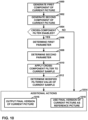
- FIG. 10 is a flowchart illustrating an example operation of a video coder, in accordance with techniques of this disclosure. Unless specified, the actions of the operation of FIG. 10 may be performed by either video encoder 20 or video decoder 30. In other examples, actions of FIG. 10 may be performed in different orders or in parallel. Other operations may include more, fewer, or different actions.
- the video coder generates a first component of a current picture of the video data (1000).
- the first component comprises a first array of samples.
- each sample of the first component may be a luma sample
- each sample of the first component may be a Cb sample
- each sample of the first component may be a Cr sample.
- the video coder generates a second component of the current picture (1002).
- the second component comprises a second array of samples separate from the first array of samples.
- samples of the first component are Cb or Cr samples
- samples of the second component may be luma samples.
- the first array of samples consists of a first type of chroma samples and either: the second array of samples consists of luma samples or the second array of samples consists of a second array of chroma samples.
- the video coder may determine whether the cross-component filter is enabled for the first component (1004).
- the video decoder may determine whether the cross-component filter is enabled in various ways. For example, the video decoder may obtain, from a bitstream that comprises an encoded representation of the current picture, a syntax element indicating whether the cross-component filter is enabled for the first component.
- a video encoder e.g., video encoder 20
- the video coder determines a first parameter (e.g., ⁇ ) (1006).
- the first parameter is based on a value of a current sample in the first component of the current picture.
- the video coder implicitly determines the first parameter.
- the video coder may determine the first parameter in accordance with equation (8), where L(n) includes a cross-component sample corresponding to the current sample and C(n) includes the current sample.
- the video decoder determines the first parameter by obtaining from a bitstream a syntax element specifying a value of the first parameter.
- the video decoder may determine the first parameter based on a first syntax element signaled in a bitstream that comprises an encoded representation of the current picture.
- the video encoder may signal the syntax element in the bitstream.
- the video coder also determines a second parameter (e.g., ⁇ ) (1008).
- the second parameter is based on the value of the current sample.
- the video coder implicitly determines the second parameter.
- the video coder may determine the first parameter in accordance with equation (9), where L(n) includes a cross-component sample corresponding to the current sample and C(n) includes the current sample.
- the video coder is a video decoder
- the video decoder determines the second parameter by obtaining from a bitstream a syntax element specifying a value of the second parameter.
- the video decoder may determine the first parameter based on a first syntax element signaled in a bitstream that comprises an encoded representation of the current picture.
- video encoder 20 may signal the syntax element in the bitstream.
- the video coder may determine the first and second parameters in various ways.
- the first component comprises a current set of samples.
- the current set of samples includes the current sample and a plurality of neighbor samples that spatially neighbor the current sample in the first component (e.g., samples 606 ( FIG. 6 ) or samples 706 ( FIG. 7 )).
- the one or more cross-component samples include a plurality of cross-component samples.
- the one or more cross-component samples may include samples 608 ( FIG. 6 ) or samples 708 ( FIG. 7 ).
- the plurality of cross-component samples includes a sample in the second component corresponding to the respective neighbor sample, the plurality of cross-component samples further includes a sample in the second component corresponding to the current sample.
- the video coder determines the first parameter by using a Gaussian filter or an edge-preserved filter. For instance, the video coder may derive the first parameter like a Bilateral parameter as shown in the equation (12). In some examples, the video coder determines the second parameter by using the Gaussian filter or the edge-preserved filter or simply set to zero.
- the video coder applies a cross-component filter to the current sample, thereby determining a filtered value of the current sample (1010).
- the cross-component filter is based on the first parameter, the second parameter, and one or more cross-component samples. Each of the one or more cross-component samples is in the second component of the current picture.
- the one or more cross-component samples include a plurality of cross-component samples
- the first parameter is a first instance of the first parameter
- the video coder determines a plurality of first parameters ( ⁇ i ) that includes the first instance of the first parameter and one or more additional instances of the first parameter.
- the parameters may be calculated through the minimization of the mean square error between the current pixel plus its neighboring pixels and their corresponding cross-component pixels given a predefined relation between them. For instance, in one example, if the number of cross-component is 5 in the relation formula which means there are 5 ⁇ i parameters and 1 ⁇ parameter to be determined.
- the current pixel and at least 5 of its surrounding pixels and their corresponding cross-component samples are used to determine the parameters through the minimization of the mean square error between the current pixel plus its neighboring pixels and their corresponding cross-component pixels given a predefined relation between them.
- the one or more cross-component samples include a plurality of cross-component samples and the first parameter is a first instance of the first parameter.
- the video coder determines a plurality of first parameters ( ⁇ i ) that includes the first instance of the first parameter and one or more additional instances of the first parameter.
- the parameters may be calculated through the minimization of the mean square error between the current pixel plus its neighboring pixels and their corresponding cross-component pixels given a predefined relation between them.
- Each respective additional instance of the first parameter of the one or more additional instances of the first parameter is based on a value of a different corresponding sample of the first component.
- the cross-component samples used in the cross-component filter may be defined or determined in various ways.
- the one or more cross-component samples may include a sample in the second component that is collocated with the current sample.
- the second component may include a set of neighboring samples that spatially neighbor a collocated sample in the second component.
- the collocated sample in the second component is collocated with the current sample.
- the video coder applies a spatial noise-reduction filter to the collocated sample and the set of neighboring samples, thereby deriving a filtered collocated sample.
- the cross-component filter is based on the first parameter, the second parameter, and the filtered collocated sample.
- the video coder may use the filtered collocated sample as a value p cc of p i cc in any of the formulas described elsewhere in this disclosure for applying the cross-component filter.
- the current picture has a 4:2:0 color format and the current sample is a chroma sample at a position between an upper luma sample above the chroma sample and a lower luma sample below the chroma sample.
- the upper luma sample and the lower luma sample are luma samples in the second component.
- the current sample is based on the first parameter, the second parameter, and either the upper luma sample or the lower luma sample.
- the video coder may use the upper luma sample or the lower luma sample as a value of p cc or p i cc in any of the formulas described elsewhere in this disclosure for applying the cross-component filter.
- the current picture has a 4:2:0 color format and the current sample is a chroma sample at a position between an upper luma sample above the chroma sample and a lower luma sample below the chroma sample.
- the upper luma sample and the lower luma sample are luma samples in the second component of the current picture.
- the video coder uses a weighted average of the upper luma sample and the lower luma sample to determine a virtual luma sample.
- the current sample is based on the first parameter, the second parameter, and the virtual luma sample.
- the video coder may use the virtual luma sample as a value of p cc or p i cc in any of the formulas described elsewhere in this disclosure for applying the cross-component filter.
- the current picture has a 4:2:0 color format and the current sample is a chroma sample at a position between six luma samples in the second component.
- the video coder may use a weighted average of the six luma samples to determine a virtual luma sample.
- the filtered value of the current sample is based on the first parameter, the second parameter, and the virtual luma sample.
- the video coder may use the virtual luma sample as a value of p cc or p i cc in any of the formulas described elsewhere in this disclosure for applying the cross-component filter.
- the video coder may determine a modified filtered value of the current sample (1012). In such examples, the video coder may determine the modified filtered value of the current sample as a weighted sum of the value of the current sample and the filtered value of the current sample. In such examples, the value of the pixel in a final version of the current picture is based on the modified filtered value of the current sample.
- the video coder may perform one or more actions after applying the cross-component filter or after determining that the cross-component filter is not enabled ("NO" branch of 1004) (1014). For instance, in an example where the video coder is a video decoder such as video decoder 30, the video decoder may output a final version of the current picture (1016). In this example, a value of a pixel in the final version of the current picture is based on the filtered value of the current sample. For example, the final version of the current picture may include an unaltered version of the filtered value of the current sample.
- the video coder may apply an additional filter (e.g., an SAO filter, an ALF, a deblocking filter, or other type of filter) to the filtered version of the current sample to generate a value of the current sample included in the final version of the current picture.
- an additional filter e.g., an SAO filter, an ALF, a deblocking filter, or other type of filter
- the video coder may use a final version of the current picture as a reference picture in encoding a later picture of the video data (1018). For instance, the video coder may use the final version of the current picture for inter prediction in the manner described elsewhere in this disclosure. In this example, a value of a pixel in the final version of the current picture is based on the filtered value of the current sample.
- Computer-readable media may include computer-readable storage media, which corresponds to a tangible medium such as data storage media, or communication media including any medium that facilitates transfer of a computer program from one place to another, e.g., according to a communication protocol.
- Computer-readable media generally may correspond to (1) tangible computer-readable storage media which is non-transitory or (2) a communication medium such as a signal or carrier wave.
- Data storage media may be any available media that can be accessed by one or more computers or one or more processors to retrieve instructions, code and/or data structures for implementation of the techniques described in this disclosure.
- a computer program product may include a computer-readable medium.
- such computer-readable storage media can comprise RAM, ROM, EEPROM, CD-ROM or other optical disk storage, magnetic disk storage, or other magnetic storage devices, flash memory, or any other medium that can be used to store desired program code in the form of instructions or data structures and that can be accessed by a computer.
- any connection is properly termed a computer-readable medium.
- a computer-readable medium For example, if instructions are transmitted from a website, server, or other remote source using a coaxial cable, fiber optic cable, twisted pair, digital subscriber line (DSL), or wireless technologies such as infrared, radio, and microwave, then the coaxial cable, fiber optic cable, twisted pair, DSL, or wireless technologies such as infrared, radio, and microwave are included in the definition of medium.
- DSL digital subscriber line
- Disk and disc includes compact disc (CD), laser disc, optical disc, digital versatile disc (DVD), floppy disk and Blu-ray disc, where disks usually reproduce data magnetically, while discs reproduce data optically with lasers. Combinations of the above should also be included within the scope of computer-readable media.
- processors such as one or more digital signal processors (DSPs), general purpose microprocessors, application specific integrated circuits (ASICs), field programmable logic arrays (FPGAs), or other equivalent integrated or discrete logic circuitry.
- DSPs digital signal processors
- ASICs application specific integrated circuits
- FPGAs field programmable logic arrays
- processors may refer to any of the foregoing structure or any other structure suitable for implementation of the techniques described herein.
- the functionality described herein may be provided within dedicated hardware and/or software modules configured for encoding and decoding, or incorporated in a combined codec. Also, the techniques could be fully implemented in one or more circuits or logic elements.
- the techniques of this disclosure may be implemented in a wide variety of devices or apparatuses, including a wireless handset, an integrated circuit (IC) or a set of ICs (e.g., a chip set).
- IC integrated circuit
- a set of ICs e.g., a chip set.
- Various components, modules, or units are described in this disclosure to emphasize functional aspects of devices configured to perform the disclosed techniques, but do not necessarily require realization by different hardware units. Rather, as described above, various units may be combined in a codec hardware unit or provided by a collection of interoperative hardware units, including one or more processors as described above, in conjunction with suitable software and/or firmware.
Landscapes
- Engineering & Computer Science (AREA)
- Multimedia (AREA)
- Signal Processing (AREA)
- Compression Or Coding Systems Of Tv Signals (AREA)
Applications Claiming Priority (3)
| Application Number | Priority Date | Filing Date | Title |
|---|---|---|---|
| US201662381978P | 2016-08-31 | 2016-08-31 | |
| US15/691,287 US10419757B2 (en) | 2016-08-31 | 2017-08-30 | Cross-component filter |
| PCT/US2017/049688 WO2018045207A1 (en) | 2016-08-31 | 2017-08-31 | Cross-component filter |
Publications (3)
| Publication Number | Publication Date |
|---|---|
| EP3507984A1 EP3507984A1 (en) | 2019-07-10 |
| EP3507984B1 true EP3507984B1 (en) | 2024-11-06 |
| EP3507984C0 EP3507984C0 (en) | 2024-11-06 |
Family
ID=61244077
Family Applications (1)
| Application Number | Title | Priority Date | Filing Date |
|---|---|---|---|
| EP17765027.2A Active EP3507984B1 (en) | 2016-08-31 | 2017-08-31 | Cross-component filter |
Country Status (6)
| Country | Link |
|---|---|
| US (1) | US10419757B2 (enExample) |
| EP (1) | EP3507984B1 (enExample) |
| JP (1) | JP2019525679A (enExample) |
| KR (1) | KR20190042579A (enExample) |
| CN (1) | CN109691102B (enExample) |
| WO (1) | WO2018045207A1 (enExample) |
Families Citing this family (171)
| Publication number | Priority date | Publication date | Assignee | Title |
|---|---|---|---|---|
| CN104375302B (zh) * | 2014-10-27 | 2020-09-08 | 上海中航光电子有限公司 | 一种像素结构、显示面板及其像素补偿方法 |
| US11272175B2 (en) * | 2016-10-05 | 2022-03-08 | Telefonaktiebolaget Lm Ericsson (Publ) | Deringing filter for video coding |
| CN106791477B (zh) * | 2016-11-29 | 2019-07-19 | Oppo广东移动通信有限公司 | 图像处理方法、图像处理装置、成像装置及制造方法 |
| WO2019139393A1 (ko) * | 2018-01-15 | 2019-07-18 | 김기백 | 색차 성분에 관한 화면내 예측 부호화/복호화 방법 및 장치 |
| US20190273946A1 (en) * | 2018-03-05 | 2019-09-05 | Markus Helmut Flierl | Methods and Arrangements for Sub-Pel Motion-Adaptive Image Processing |
| CA3251167A1 (en) * | 2018-03-25 | 2025-02-24 | B1 Institute Of Image Technology, Inc. | METHOD AND DEVICE FOR ENCODING/DECODING IMAGES |
| EP3547686A1 (en) * | 2018-03-29 | 2019-10-02 | InterDigital VC Holdings, Inc. | Method and apparatus for decoder side prediction based on weighted distortion |
| BR112020019800A2 (pt) | 2018-05-23 | 2021-01-05 | Panasonic Intellectual Property Corporation Of America | Codificador, decodificador, método de codificação e método de decodificação |
| KR102493516B1 (ko) * | 2018-07-02 | 2023-01-31 | 엘지전자 주식회사 | Cclm에 기반한 인트라 예측 방법 및 그 장치 |
| WO2020014563A1 (en) * | 2018-07-12 | 2020-01-16 | Futurewei Technologies, Inc. | Intra-prediction using a cross-component linear model in video coding |
| TWI815927B (zh) | 2018-07-15 | 2023-09-21 | 大陸商北京字節跳動網絡技術有限公司 | 視頻編解碼的塊尺寸限制 |
| SG11202101310PA (en) * | 2018-08-09 | 2021-03-30 | Guangdong Oppo Mobile Telecommunications Corp Ltd | Video image component prediction method and apparatus, and computer storage medium |
| GB2590844B (en) * | 2018-08-17 | 2023-05-03 | Beijing Bytedance Network Tech Co Ltd | Simplified cross component prediction |
| CN110876061B (zh) * | 2018-09-03 | 2022-10-11 | 华为技术有限公司 | 色度块预测方法及装置 |
| CN110896478B (zh) | 2018-09-12 | 2023-02-17 | 北京字节跳动网络技术有限公司 | 交叉分量线性建模中的下采样 |
| US11463686B2 (en) * | 2018-09-22 | 2022-10-04 | Lg Electronics Inc. | Method and device for decoding images using CCLM prediction in image coding system |
| EP3850853A4 (en) * | 2018-10-05 | 2022-08-10 | Huawei Technologies Co., Ltd. | Intra prediction method and device |
| CN117880501A (zh) | 2018-10-07 | 2024-04-12 | 三星电子株式会社 | 用于编码或解码视频信号的视频信号处理方法和设备 |
| FI3847816T3 (fi) | 2018-10-08 | 2023-06-30 | Beijing Dajia Internet Information Tech Co Ltd | Ristikomponenttisen lineaarisen mallin yksinkertaistukset |
| CN112789858B (zh) * | 2018-10-08 | 2023-06-06 | 华为技术有限公司 | 帧内预测方法及设备 |
| KR20250011712A (ko) * | 2018-10-12 | 2025-01-21 | 광동 오포 모바일 텔레커뮤니케이션즈 코포레이션 리미티드 | 비디오 이미지 요소 예측 방법 및 장치, 컴퓨터 저장 매체 |
| US11438596B2 (en) | 2018-10-12 | 2022-09-06 | Wilus Institute Of Standards And Technology Inc. | Method and device for processing video signal by using cross-component linear model |
| JP7714460B2 (ja) * | 2018-11-06 | 2025-07-29 | 北京字節跳動網絡技術有限公司 | イントラ予測のためのパラメータ導出における複雑性低減 |
| CN113170122B (zh) | 2018-12-01 | 2023-06-27 | 北京字节跳动网络技术有限公司 | 帧内预测的参数推导 |
| CN113170168B (zh) | 2018-12-07 | 2023-12-08 | 北京字节跳动网络技术有限公司 | 基于上下文的帧内预测 |
| US11095921B2 (en) | 2018-12-18 | 2021-08-17 | Tencent America LLC | Method and apparatus for video encoding or decoding |
| CN113287311B (zh) * | 2018-12-22 | 2024-03-12 | 北京字节跳动网络技术有限公司 | 两步交叉分量预测模式的指示 |
| CN111083486A (zh) * | 2019-01-03 | 2020-04-28 | 北京达佳互联信息技术有限公司 | 一种确定编码单元的色度信息的方法和装置 |
| KR102487528B1 (ko) * | 2019-01-09 | 2023-01-10 | 베이징 다지아 인터넷 인포메이션 테크놀로지 컴퍼니 리미티드 | 교차-성분 선형 모델을 사용하는 비디오 코딩 |
| WO2020143114A1 (zh) * | 2019-01-10 | 2020-07-16 | Oppo广东移动通信有限公司 | 图像解码方法、解码器及计算机存储介质 |
| CN113366836B (zh) * | 2019-01-11 | 2025-01-17 | 北京字节跳动网络技术有限公司 | 尺寸相关的跨分量线性模型 |
| CN112640458A (zh) * | 2019-01-16 | 2021-04-09 | Oppo广东移动通信有限公司 | 信息处理方法及装置、设备、存储介质 |
| WO2020150535A1 (en) * | 2019-01-17 | 2020-07-23 | Beijing Dajia Internet Information Technology Co., Ltd. | Methods and apparatus of linear model derivation for video coding |
| PH12021551828A1 (en) | 2019-02-22 | 2022-04-11 | Beijing Bytedance Network Tech Co Ltd | Neighbouring sample selection for intra prediction |
| PH12021551868A1 (en) | 2019-02-24 | 2022-05-23 | Beijing Bytedance Network Tech Co Ltd | Parameter derivation for intra prediction |
| CN118678090A (zh) * | 2019-03-06 | 2024-09-20 | Lg 电子株式会社 | 基于cclm预测的图像解码方法及其装置 |
| KR102777573B1 (ko) | 2019-03-08 | 2025-03-06 | 두인 비전 컴퍼니 리미티드 | 비디오 처리에서 변형 정보의 시그널링 |
| CN110662031B (zh) * | 2019-03-11 | 2021-03-23 | 杭州海康威视数字技术股份有限公司 | 解码方法及装置 |
| KR102801981B1 (ko) | 2019-03-12 | 2025-04-30 | 텐센트 아메리카 엘엘씨 | Vvc에서의 컬러 변환을 위한 방법 및 장치 |
| KR102921601B1 (ko) * | 2019-03-15 | 2026-01-30 | 엘지전자 주식회사 | 크로마 포맷에 대한 정보를 시그널링 하는 방법 및 장치 |
| KR20250074691A (ko) * | 2019-03-18 | 2025-05-27 | 광동 오포 모바일 텔레커뮤니케이션즈 코포레이션 리미티드 | 픽처 컴포넌트 예측 방법, 인코더, 디코더 및 저장 매체 |
| CN113767631B (zh) * | 2019-03-24 | 2023-12-15 | 北京字节跳动网络技术有限公司 | 用于帧内预测的参数推导中的条件 |
| KR20210139327A (ko) * | 2019-03-25 | 2021-11-22 | 광동 오포 모바일 텔레커뮤니케이션즈 코포레이션 리미티드 | 화상 예측 방법, 인코더, 디코더 및 저장 매체 |
| CN120639983A (zh) * | 2019-03-25 | 2025-09-12 | Oppo广东移动通信有限公司 | 图像分量的预测方法、编码器、解码器及计算机存储介质 |
| MX2021012472A (es) * | 2019-04-18 | 2021-11-12 | Beijing Bytedance Network Tech Co Ltd | Restriccion de la aplicabilidad del modo de componentes cruzados. |
| JP7303328B2 (ja) | 2019-04-20 | 2023-07-04 | 北京字節跳動網絡技術有限公司 | クロミナンス残差の結合符号化のための構文要素の信号通知 |
| SG11202110999PA (en) * | 2019-04-23 | 2021-11-29 | Beijing Bytedance Network Technology Co Ltd | Methods for cross component dependency reduction |
| WO2020216255A1 (en) * | 2019-04-25 | 2020-10-29 | Mediatek Inc. | Method and apparatus of encoding or decoding with mode dependent intra smoothing filter in intra prediction |
| CN111866510A (zh) * | 2019-04-30 | 2020-10-30 | 华为技术有限公司 | 视频序列的帧内预测方法及装置 |
| WO2020224629A1 (en) | 2019-05-08 | 2020-11-12 | Beijing Bytedance Network Technology Co., Ltd. | Conditions for applicability of cross-component coding |
| WO2020233659A1 (en) | 2019-05-21 | 2020-11-26 | Beijing Bytedance Network Technology Co., Ltd. | Adaptive motion vector difference resolution for affine mode |
| CN113632464B (zh) * | 2019-05-21 | 2023-04-28 | 华为技术有限公司 | 分量间预测的方法和设备 |
| CN115567707B (zh) | 2019-05-30 | 2025-05-13 | 抖音视界有限公司 | 一种处理视频数据的方法、装置、介质 |
| CN118138754A (zh) | 2019-06-14 | 2024-06-04 | 北京字节跳动网络技术有限公司 | 处理视频单元边界和虚拟边界 |
| CN113994697B (zh) | 2019-06-22 | 2024-10-18 | 北京字节跳动网络技术有限公司 | 色度残差缩放的语法元素 |
| WO2020262396A1 (en) | 2019-06-24 | 2020-12-30 | Sharp Kabushiki Kaisha | Systems and methods for reducing a reconstruction error in video coding based on a cross-component correlation |
| US11330298B2 (en) * | 2019-06-25 | 2022-05-10 | Qualcomm Incorporated | Simplified intra chroma mode coding in video coding |
| WO2020258052A1 (zh) * | 2019-06-25 | 2020-12-30 | Oppo广东移动通信有限公司 | 图像分量预测方法、装置及计算机存储介质 |
| CN114073094B (zh) * | 2019-06-27 | 2023-05-23 | 寰发股份有限公司 | 视频编解码的方法和装置 |
| JP7460748B2 (ja) | 2019-07-07 | 2024-04-02 | 北京字節跳動網絡技術有限公司 | クロマ残差スケーリングのシグナリング |
| KR102889119B1 (ko) | 2019-07-08 | 2025-11-19 | 엘지전자 주식회사 | 적응적 루프 필터 기반 비디오 또는 영상 코딩 |
| KR102889120B1 (ko) * | 2019-07-08 | 2025-11-19 | 엘지전자 주식회사 | 적응적 루프 필터를 적용하는 비디오 또는 영상 코딩 |
| WO2021006654A1 (ko) * | 2019-07-09 | 2021-01-14 | 엘지전자 주식회사 | 적응적 루프 필터 기반 비디오 또는 영상 코딩 |
| JP7291846B2 (ja) | 2019-07-09 | 2023-06-15 | 北京字節跳動網絡技術有限公司 | 適応ループフィルタリングのためのサンプル決定 |
| CA3146773C (en) | 2019-07-11 | 2025-05-06 | Beijing Bytedance Network Technology Co., Ltd. | SAMPLE FILLING IN AN ADAPTIVE LOOP FILTER |
| JP7361196B2 (ja) | 2019-07-15 | 2023-10-13 | 北京字節跳動網絡技術有限公司 | 適応ループ・フィルタリングにおける分類 |
| WO2021013178A1 (en) * | 2019-07-25 | 2021-01-28 | Mediatek Inc. | Method and apparatus of cross-component adaptive loop filtering with virtual boundary for video coding |
| WO2021021590A1 (en) | 2019-07-26 | 2021-02-04 | Mediatek Inc. | Method and apparatus of cross-component adaptive loop filtering for video coding |
| WO2021025080A1 (ja) * | 2019-08-07 | 2021-02-11 | パナソニック インテレクチュアル プロパティ コーポレーション オブ アメリカ | 符号化装置、復号装置、符号化方法、および復号方法 |
| US11197030B2 (en) * | 2019-08-08 | 2021-12-07 | Panasonic Intellectual Property Corporation Of America | System and method for video coding |
| CN119996681A (zh) | 2019-08-08 | 2025-05-13 | 松下电器(美国)知识产权公司 | 用于视频编码的系统和方法 |
| JP7372443B2 (ja) | 2019-08-10 | 2023-10-31 | 北京字節跳動網絡技術有限公司 | サブピクチャに依存するビデオビットストリーム内のシグナリング |
| GB2586484B (en) * | 2019-08-20 | 2023-03-08 | Canon Kk | A filter |
| CN110557621B (zh) * | 2019-08-27 | 2022-06-14 | 咪咕文化科技有限公司 | 参数获取方法、像素点对选择方法及相关设备 |
| JP7368145B2 (ja) * | 2019-08-28 | 2023-10-24 | シャープ株式会社 | 画像符号化装置、および、画像復号装置 |
| RS67101B1 (sr) | 2019-08-29 | 2025-09-30 | Lg Electronics Inc | Uređaj i postupak za kodiranje slike zasnovano na filtriranju adaptivne petlje unakrsnih komponenti |
| KR20220044894A (ko) * | 2019-08-29 | 2022-04-12 | 엘지전자 주식회사 | 영상 코딩 장치 및 방법 |
| CN120321388A (zh) * | 2019-08-29 | 2025-07-15 | Lg 电子株式会社 | 基于滤波的图像编译的装置和方法 |
| CN114586351B (zh) * | 2019-08-29 | 2024-04-16 | Lg电子株式会社 | 基于自适应环路滤波的图像编译装置和方法 |
| CN120475184A (zh) * | 2019-08-29 | 2025-08-12 | Lg 电子株式会社 | 基于环路内滤波的图像编译装置和方法 |
| CN114600466B (zh) * | 2019-08-29 | 2025-01-17 | Lg电子株式会社 | 基于交叉分量滤波的图像编码设备和方法 |
| CN118214863A (zh) * | 2019-09-11 | 2024-06-18 | 夏普株式会社 | 用于基于交叉分量相关性来减小视频编码中的重构误差的系统和方法 |
| WO2021049593A1 (en) | 2019-09-11 | 2021-03-18 | Panasonic Intellectual Property Corporation Of America | System and method for video coding |
| KR102799921B1 (ko) | 2019-09-14 | 2025-04-25 | 바이트댄스 아이엔씨 | 크로마 디블로킹 필터링을 위한 양자화 파라미터 |
| US11451834B2 (en) | 2019-09-16 | 2022-09-20 | Tencent America LLC | Method and apparatus for cross-component filtering |
| US11202068B2 (en) * | 2019-09-16 | 2021-12-14 | Mediatek Inc. | Method and apparatus of constrained cross-component adaptive loop filtering for video coding |
| CN120302064A (zh) * | 2019-09-18 | 2025-07-11 | 松下电器(美国)知识产权公司 | 用于视频编码的系统和方法 |
| CN114503594B (zh) | 2019-09-22 | 2024-04-05 | 北京字节跳动网络技术有限公司 | 自适应环路滤波中样点填充的选择性应用 |
| US11172199B2 (en) * | 2019-09-23 | 2021-11-09 | Tencent America LLC | Cross-component adaptive loop filter |
| US11343493B2 (en) * | 2019-09-23 | 2022-05-24 | Qualcomm Incorporated | Bit shifting for cross-component adaptive loop filtering for video coding |
| BR112022005487A2 (pt) * | 2019-09-23 | 2022-06-14 | Vid Scale Inc | Aparelho para processamento de vídeo, método, e, mídia legível por computador |
| JP7326600B2 (ja) | 2019-09-27 | 2023-08-15 | 北京字節跳動網絡技術有限公司 | 異なるビデオユニット間の適応ループフィルタリング |
| CN120881274A (zh) * | 2019-10-09 | 2025-10-31 | 夏普株式会社 | 用于基于交叉分量相关性来减小视频编码中的重构误差的系统和方法 |
| WO2021072177A1 (en) | 2019-10-09 | 2021-04-15 | Bytedance Inc. | Cross-component adaptive loop filtering in video coding |
| EP4029263B1 (en) * | 2019-10-10 | 2025-08-20 | Beijing Bytedance Network Technology Co., Ltd. | Padding process at unavailable sample locations in adaptive loop filtering |
| KR20220073746A (ko) | 2019-10-14 | 2022-06-03 | 바이트댄스 아이엔씨 | 비디오 처리에서 크로마 양자화 파라미터 사용 |
| CN117676135A (zh) | 2019-10-18 | 2024-03-08 | 北京字节跳动网络技术有限公司 | 子图片与环路滤波之间的相互影响 |
| CN115244924B (zh) * | 2019-10-29 | 2025-12-12 | 抖音视界有限公司 | 跨分量自适应环路滤波器的信令通知 |
| JP7614195B2 (ja) * | 2019-10-29 | 2025-01-15 | エルジー エレクトロニクス インコーポレイティド | 変換に基づく映像コーディング方法およびその装置 |
| US11265558B2 (en) * | 2019-11-22 | 2022-03-01 | Qualcomm Incorporated | Cross-component adaptive loop filter |
| KR102971725B1 (ko) | 2019-11-22 | 2026-06-01 | 한국전자통신연구원 | 적응적 루프내 필터링 방법 및 장치 |
| WO2021104409A1 (en) * | 2019-11-30 | 2021-06-03 | Beijing Bytedance Network Technology Co., Ltd. | Cross-component adaptive filtering and subblock coding |
| WO2021110017A1 (en) | 2019-12-02 | 2021-06-10 | Beijing Bytedance Network Technology Co., Ltd. | Merge with motion vector differencing in affine mode |
| WO2021110116A1 (en) * | 2019-12-04 | 2021-06-10 | Beijing Bytedance Network Technology Co., Ltd. | Prediction from multiple cross-components |
| US11432016B2 (en) | 2019-12-05 | 2022-08-30 | Hfi Innovation Inc. | Methods and apparatuses of syntax signaling constraint for cross-component adaptive loop filter in video coding system |
| WO2021115235A1 (en) | 2019-12-08 | 2021-06-17 | Beijing Bytedance Network Technology Co., Ltd. | Cross-component prediction using multiple components |
| EP4055827A4 (en) | 2019-12-09 | 2023-01-18 | ByteDance Inc. | USE OF QUANTIZATION GROUPS IN VIDEO CODING |
| MX2022006734A (es) | 2019-12-11 | 2022-06-09 | Beijing Bytedance Network Tech Co Ltd | Relleno de muestra para filtrado de circuito adaptivo de componente cruzado. |
| WO2021126061A1 (en) * | 2019-12-17 | 2021-06-24 | Telefonaktiebolaget Lm Ericsson (Publ) | Low complexity image filter |
| EP4447446B1 (en) * | 2019-12-18 | 2026-04-22 | Beijing Dajia Internet Information Technology Co., Ltd. | Cross component adaptive loop filter for video coding |
| US11716468B2 (en) * | 2019-12-20 | 2023-08-01 | Qualcomm Incorporated | Adaptive loop filter signaling redundancy removal field |
| KR20260006068A (ko) * | 2019-12-23 | 2026-01-12 | 후아웨이 테크놀러지 컴퍼니 리미티드 | 비디오 코딩을 위한 성분 간 적응 루프 필터링 |
| US11297316B2 (en) * | 2019-12-24 | 2022-04-05 | Tencent America LLC | Method and system for adaptive cross-component filtering |
| WO2021128277A1 (zh) * | 2019-12-27 | 2021-07-01 | 富士通株式会社 | 交叉分量自适应环路滤波方法、装置以及视频编解码设备 |
| CN112544081B (zh) | 2019-12-31 | 2023-12-22 | 北京大学 | 环路滤波的方法与装置 |
| WO2021136508A1 (en) * | 2019-12-31 | 2021-07-08 | Beijing Bytedance Network Technology Co., Ltd. | Inter-prediction with multiple-parameter model |
| CN114902657B (zh) | 2019-12-31 | 2025-06-13 | 字节跳动有限公司 | 视频编解码中的自适应颜色变换 |
| WO2021134635A1 (zh) * | 2019-12-31 | 2021-07-08 | Oppo广东移动通信有限公司 | 变换方法、编码器、解码器以及存储介质 |
| CN117544777A (zh) * | 2020-01-01 | 2024-02-09 | 字节跳动有限公司 | 用于视频编解码的跨分量自适应环路滤波 |
| WO2021136555A1 (en) | 2020-01-05 | 2021-07-08 | Beijing Bytedance Network Technology Co., Ltd. | Use of offsets with adaptive colour transform coding tool |
| US11303914B2 (en) | 2020-01-08 | 2022-04-12 | Tencent America LLC | Method and apparatus for video coding |
| CN113132724B (zh) * | 2020-01-13 | 2022-07-01 | 杭州海康威视数字技术股份有限公司 | 编码、解码方法、装置及其设备 |
| CN114982237B (zh) | 2020-01-14 | 2026-08-04 | 抖音视界(北京)有限公司 | 视频编解码中量化参数的信令通知 |
| WO2021143896A1 (en) | 2020-01-18 | 2021-07-22 | Beijing Bytedance Network Technology Co., Ltd. | Adaptive colour transform in image/video coding |
| US11303936B2 (en) * | 2020-02-21 | 2022-04-12 | Tencent America LLC | Method and apparatus for filtering |
| US11516469B2 (en) * | 2020-03-02 | 2022-11-29 | Tencent America LLC | Loop filter block flexible partitioning |
| CN113497937B (zh) * | 2020-03-20 | 2023-09-05 | Oppo广东移动通信有限公司 | 图像编码方法、图像解码方法及相关装置 |
| CN115606177B (zh) * | 2020-03-21 | 2025-09-16 | 抖音视界有限公司 | 处理视频数据的方法及装置、存储视频的比特流的方法 |
| WO2021194223A1 (ko) * | 2020-03-23 | 2021-09-30 | 주식회사 케이티 | 비디오 신호 처리 방법 및 장치 |
| EP4107941A4 (en) | 2020-03-23 | 2023-04-19 | Beijing Bytedance Network Technology Co., Ltd. | PREDICTION REFINEMENT FOR AFFINE MERGE AND AFFINER MOTION VECTOR PREDICTION MODE |
| US11509921B2 (en) * | 2020-03-29 | 2022-11-22 | Alibaba Group Holding Limited | High level syntax control of loop filter |
| WO2021203381A1 (zh) * | 2020-04-09 | 2021-10-14 | 北京大学 | 一种视频编解码方法、装置以及计算机可读存储介质 |
| WO2021203394A1 (zh) * | 2020-04-09 | 2021-10-14 | 北京大学 | 环路滤波的方法与装置 |
| US11394967B2 (en) * | 2020-04-26 | 2022-07-19 | Tencent America LLC | Geometric cross-component filtering |
| CN113747176A (zh) | 2020-05-29 | 2021-12-03 | Oppo广东移动通信有限公司 | 图像编码方法、图像解码方法及相关装置 |
| EP3959878A4 (en) | 2020-06-03 | 2022-07-27 | Beijing Dajia Internet Information Technology Co., Ltd. | IMPROVEMENT OF CHROMA CODING IN INTER-COMPONENT CORRELATION |
| JP7522237B2 (ja) * | 2020-06-30 | 2024-07-24 | 北京字節跳動網絡技術有限公司 | 適応ループフィルタリングのための境界位置 |
| CN116527923B (zh) * | 2020-07-28 | 2025-10-21 | 北京达佳互联信息技术有限公司 | 视频编码方法、电子装置和存储介质 |
| US11638019B2 (en) * | 2020-07-29 | 2023-04-25 | Alibaba Group Holding Limited | Methods and systems for prediction from multiple cross-components |
| EP3984222A4 (en) | 2020-08-13 | 2022-10-26 | Beijing Dajia Internet Information Technology Co., Ltd. | ENHANCED CHROMINANCE CODING IN INTER-COMPONENT ADAPTIVE SAMPLE SHIFT |
| EP4201063A4 (en) * | 2020-08-20 | 2024-05-29 | Beijing Dajia Internet Information Technology Co., Ltd. | Chroma coding enhancement in cross-component sample adaptive offset |
| WO2022046903A1 (en) | 2020-08-26 | 2022-03-03 | Beijing Dajia Internet Information Technology Co., Ltd. | Chroma coding enhancement in cross-component sample adaptive offset |
| US11595676B2 (en) * | 2020-09-16 | 2023-02-28 | Tencent America LLC | Method and apparatus for video coding |
| US11595644B2 (en) * | 2020-10-01 | 2023-02-28 | Tencent America LLC | Method and apparatus for offset in video filtering |
| US11825101B2 (en) * | 2020-10-05 | 2023-11-21 | Qualcomm Incorporated | Joint-component neural network based filtering during video coding |
| WO2022093992A1 (en) | 2020-10-28 | 2022-05-05 | Beijing Dajia Internet Information | Chroma coding enhancement in cross-component sample adaptive offset with virtual boundary |
| US11563964B2 (en) * | 2020-11-12 | 2023-01-24 | Tencent America LLC | Method and apparatus for video coding |
| WO2022115698A1 (en) | 2020-11-30 | 2022-06-02 | Beijing Dajia Internet Information Technology Co., Ltd. | Chroma coding enhancement in cross-component sample adaptive offset |
| US11750816B2 (en) | 2020-12-03 | 2023-09-05 | Alibaba Group Holding Limited | Methods and systems for cross-component sample adaptive offset |
| US11546638B2 (en) * | 2020-12-08 | 2023-01-03 | Tencent America LLC | Method and apparatus for video filtering |
| US11647198B2 (en) * | 2021-01-25 | 2023-05-09 | Lemon Inc. | Methods and apparatuses for cross-component prediction |
| US11683474B2 (en) | 2021-01-25 | 2023-06-20 | Lemon Inc. | Methods and apparatuses for cross-component prediction |
| JP7684411B2 (ja) * | 2021-02-01 | 2025-05-27 | ベイジン ダージャー インターネット インフォメーション テクノロジー カンパニー リミテッド | クロスコンポーネントサンプリング適応オフセットにおける彩度符号化復号化の強化 |
| CN116830577A (zh) * | 2021-02-08 | 2023-09-29 | 北京达佳互联信息技术有限公司 | 跨分量自适应环路滤波器 |
| WO2022174773A1 (en) * | 2021-02-22 | 2022-08-25 | Zhejiang Dahua Technology Co., Ltd. | Methods and systems for video coding |
| CN113489977B (zh) * | 2021-07-02 | 2022-12-06 | 浙江大华技术股份有限公司 | 环路滤波方法、视频/图像编解码方法及相关装置 |
| WO2022194197A1 (en) | 2021-03-17 | 2022-09-22 | Beijing Bytedance Network Technology Co., Ltd. | Separate Tree Coding Restrictions |
| MX2023010914A (es) | 2021-03-18 | 2023-09-27 | Beijing Dajia Internet Information Tech Co Ltd | Mejora de la codificacion en el desplazamiento adaptativo de muestras de componentes cruzados. |
| US11706461B2 (en) | 2021-03-18 | 2023-07-18 | Tencent America LLC | Method and apparatus for video coding |
| US11750846B2 (en) * | 2021-03-22 | 2023-09-05 | Tencent America LLC | Method and apparatus for video filtering |
| CN116368803A (zh) | 2021-04-14 | 2023-06-30 | 北京达佳互联信息技术有限公司 | 交叉分量样点自适应偏移中的编解码增强 |
| MX2023014057A (es) | 2021-05-26 | 2023-12-15 | Beijing Dajia Internet Information Tech Co Ltd | Mejora de la codificacion en desplazamiento adaptativo de muestra de componentes cruzados. |
| EP4356613A1 (en) | 2021-06-14 | 2024-04-24 | Qualcomm Incorporated | Joint clipping operating for filters for video coding |
| WO2022268185A1 (en) | 2021-06-25 | 2022-12-29 | Beijing Bytedance Network Technology Co., Ltd. | Bilateral filter in video coding |
| CN117597928A (zh) * | 2021-07-01 | 2024-02-23 | 抖音视界有限公司 | 视频编解码中的高级双边滤波器 |
| CN117581548A (zh) * | 2021-07-02 | 2024-02-20 | Lg 电子株式会社 | 图像编码/解码方法、用于发送比特流的方法以及存储比特流的记录介质 |
| KR20240042646A (ko) * | 2021-09-08 | 2024-04-02 | 베이징 다지아 인터넷 인포메이션 테크놀로지 컴퍼니 리미티드 | 교차-컴포넌트 샘플 적응적 오프셋에서의 코딩 강화 |
| CN118614063A (zh) * | 2022-01-25 | 2024-09-06 | Oppo广东移动通信有限公司 | 编解码方法、装置、编码设备、解码设备以及存储介质 |
| CA3255305A1 (en) * | 2022-03-29 | 2023-10-05 | Nokia Technologies Oy | APPARATUS, METHOD AND COMPUTER PROGRAM ENABLING THE ENCODING AND DECODING OF VIDEO |
| WO2024006231A1 (en) * | 2022-06-28 | 2024-01-04 | Beijing Dajia Internet Information Technology Co., Ltd. | Methods and apparatus on chroma motion compensation using adaptive cross-component filtering |
| WO2026017146A1 (en) * | 2024-07-19 | 2026-01-22 | Douyin Vision Co., Ltd. | Cross component based control information referencing for loop-filters in video coding |
Family Cites Families (8)
| Publication number | Priority date | Publication date | Assignee | Title |
|---|---|---|---|---|
| JP5649524B2 (ja) * | 2011-06-27 | 2015-01-07 | 日本電信電話株式会社 | 映像符号化方法,装置,映像復号方法,装置およびそれらのプログラム |
| US9326008B2 (en) * | 2012-04-10 | 2016-04-26 | Google Inc. | Noise reduction for image sequences |
| US9142012B2 (en) * | 2012-05-31 | 2015-09-22 | Apple Inc. | Systems and methods for chroma noise reduction |
| US10412419B2 (en) * | 2013-07-12 | 2019-09-10 | Qualcomm Incorporated | Adaptive filtering in video coding |
| WO2015053001A1 (ja) * | 2013-10-11 | 2015-04-16 | ソニー株式会社 | 画像処理装置及び画像処理方法 |
| WO2016066028A1 (en) * | 2014-10-28 | 2016-05-06 | Mediatek Singapore Pte. Ltd. | Method of guided cross-component prediction for video coding |
| US9998742B2 (en) | 2015-01-27 | 2018-06-12 | Qualcomm Incorporated | Adaptive cross component residual prediction |
| CN105306944B (zh) * | 2015-11-30 | 2018-07-06 | 哈尔滨工业大学 | 混合视频编码标准中色度分量预测方法 |
-
2017
- 2017-08-30 US US15/691,287 patent/US10419757B2/en active Active
- 2017-08-31 EP EP17765027.2A patent/EP3507984B1/en active Active
- 2017-08-31 WO PCT/US2017/049688 patent/WO2018045207A1/en not_active Ceased
- 2017-08-31 JP JP2019510909A patent/JP2019525679A/ja active Pending
- 2017-08-31 KR KR1020197005069A patent/KR20190042579A/ko not_active Ceased
- 2017-08-31 CN CN201780052096.8A patent/CN109691102B/zh active Active
Also Published As
| Publication number | Publication date |
|---|---|
| BR112019003603A2 (pt) | 2019-05-21 |
| CN109691102B (zh) | 2023-08-11 |
| WO2018045207A9 (en) | 2019-03-21 |
| US10419757B2 (en) | 2019-09-17 |
| JP2019525679A (ja) | 2019-09-05 |
| EP3507984C0 (en) | 2024-11-06 |
| KR20190042579A (ko) | 2019-04-24 |
| WO2018045207A1 (en) | 2018-03-08 |
| US20180063527A1 (en) | 2018-03-01 |
| CN109691102A (zh) | 2019-04-26 |
| EP3507984A1 (en) | 2019-07-10 |
Similar Documents
| Publication | Publication Date | Title |
|---|---|---|
| US12470709B2 (en) | Predicting filter coefficients from fixed filters for video coding | |
| US10419757B2 (en) | Cross-component filter | |
| US10887604B2 (en) | Signalling of filtering information | |
| EP3459245B1 (en) | Confusion of multiple filters in adaptive loop filtering in video coding | |
| KR20210015819A (ko) | 블록-기반 적응 루프 필터 (alf) 설계 및 시그널링 | |
| CN110800295B (zh) | 基于无除法双边滤波器解码方法、装置、存储介质 | |
| WO2019195281A1 (en) | Unification of deblocking filter and adaptive loop filter | |
| WO2023141338A1 (en) | Methods and devices for geometric partitioning mode with split modes reordering |
Legal Events
| Date | Code | Title | Description |
|---|---|---|---|
| STAA | Information on the status of an ep patent application or granted ep patent |
Free format text: STATUS: UNKNOWN |
|
| STAA | Information on the status of an ep patent application or granted ep patent |
Free format text: STATUS: THE INTERNATIONAL PUBLICATION HAS BEEN MADE |
|
| PUAI | Public reference made under article 153(3) epc to a published international application that has entered the european phase |
Free format text: ORIGINAL CODE: 0009012 |
|
| STAA | Information on the status of an ep patent application or granted ep patent |
Free format text: STATUS: REQUEST FOR EXAMINATION WAS MADE |
|
| 17P | Request for examination filed |
Effective date: 20190125 |
|
| AK | Designated contracting states |
Kind code of ref document: A1 Designated state(s): AL AT BE BG CH CY CZ DE DK EE ES FI FR GB GR HR HU IE IS IT LI LT LU LV MC MK MT NL NO PL PT RO RS SE SI SK SM TR |
|
| AX | Request for extension of the european patent |
Extension state: BA ME |
|
| DAV | Request for validation of the european patent (deleted) | ||
| DAX | Request for extension of the european patent (deleted) | ||
| STAA | Information on the status of an ep patent application or granted ep patent |
Free format text: STATUS: EXAMINATION IS IN PROGRESS |
|
| 17Q | First examination report despatched |
Effective date: 20210507 |
|
| GRAP | Despatch of communication of intention to grant a patent |
Free format text: ORIGINAL CODE: EPIDOSNIGR1 |
|
| STAA | Information on the status of an ep patent application or granted ep patent |
Free format text: STATUS: GRANT OF PATENT IS INTENDED |
|
| RIC1 | Information provided on ipc code assigned before grant |
Ipc: H04N 19/635 20140101ALI20240515BHEP Ipc: H04N 19/82 20140101ALI20240515BHEP Ipc: H04N 19/80 20140101ALI20240515BHEP Ipc: H04N 19/186 20140101AFI20240515BHEP |
|
| INTG | Intention to grant announced |
Effective date: 20240531 |
|
| GRAS | Grant fee paid |
Free format text: ORIGINAL CODE: EPIDOSNIGR3 |
|
| GRAA | (expected) grant |
Free format text: ORIGINAL CODE: 0009210 |
|
| STAA | Information on the status of an ep patent application or granted ep patent |
Free format text: STATUS: THE PATENT HAS BEEN GRANTED |
|
| AK | Designated contracting states |
Kind code of ref document: B1 Designated state(s): AL AT BE BG CH CY CZ DE DK EE ES FI FR GB GR HR HU IE IS IT LI LT LU LV MC MK MT NL NO PL PT RO RS SE SI SK SM TR |
|
| REG | Reference to a national code |
Ref country code: GB Ref legal event code: FG4D |
|
| REG | Reference to a national code |
Ref country code: CH Ref legal event code: EP |
|
| REG | Reference to a national code |
Ref country code: DE Ref legal event code: R096 Ref document number: 602017085931 Country of ref document: DE |
|
| REG | Reference to a national code |
Ref country code: IE Ref legal event code: FG4D |
|
| U01 | Request for unitary effect filed |
Effective date: 20241118 |
|
| U07 | Unitary effect registered |
Designated state(s): AT BE BG DE DK EE FI FR IT LT LU LV MT NL PT RO SE SI Effective date: 20241125 |
|
| PG25 | Lapsed in a contracting state [announced via postgrant information from national office to epo] |
Ref country code: IS Free format text: LAPSE BECAUSE OF FAILURE TO SUBMIT A TRANSLATION OF THE DESCRIPTION OR TO PAY THE FEE WITHIN THE PRESCRIBED TIME-LIMIT Effective date: 20250306 Ref country code: HR Free format text: LAPSE BECAUSE OF FAILURE TO SUBMIT A TRANSLATION OF THE DESCRIPTION OR TO PAY THE FEE WITHIN THE PRESCRIBED TIME-LIMIT Effective date: 20241106 |
|
| PG25 | Lapsed in a contracting state [announced via postgrant information from national office to epo] |
Ref country code: ES Free format text: LAPSE BECAUSE OF FAILURE TO SUBMIT A TRANSLATION OF THE DESCRIPTION OR TO PAY THE FEE WITHIN THE PRESCRIBED TIME-LIMIT Effective date: 20241106 |
|
| PG25 | Lapsed in a contracting state [announced via postgrant information from national office to epo] |
Ref country code: NO Free format text: LAPSE BECAUSE OF FAILURE TO SUBMIT A TRANSLATION OF THE DESCRIPTION OR TO PAY THE FEE WITHIN THE PRESCRIBED TIME-LIMIT Effective date: 20250206 |
|
| PG25 | Lapsed in a contracting state [announced via postgrant information from national office to epo] |
Ref country code: GR Free format text: LAPSE BECAUSE OF FAILURE TO SUBMIT A TRANSLATION OF THE DESCRIPTION OR TO PAY THE FEE WITHIN THE PRESCRIBED TIME-LIMIT Effective date: 20250207 |
|
| PG25 | Lapsed in a contracting state [announced via postgrant information from national office to epo] |
Ref country code: PL Free format text: LAPSE BECAUSE OF FAILURE TO SUBMIT A TRANSLATION OF THE DESCRIPTION OR TO PAY THE FEE WITHIN THE PRESCRIBED TIME-LIMIT Effective date: 20241106 |
|
| PG25 | Lapsed in a contracting state [announced via postgrant information from national office to epo] |
Ref country code: RS Free format text: LAPSE BECAUSE OF FAILURE TO SUBMIT A TRANSLATION OF THE DESCRIPTION OR TO PAY THE FEE WITHIN THE PRESCRIBED TIME-LIMIT Effective date: 20250206 |
|
| PG25 | Lapsed in a contracting state [announced via postgrant information from national office to epo] |
Ref country code: SM Free format text: LAPSE BECAUSE OF FAILURE TO SUBMIT A TRANSLATION OF THE DESCRIPTION OR TO PAY THE FEE WITHIN THE PRESCRIBED TIME-LIMIT Effective date: 20241106 |
|
| PG25 | Lapsed in a contracting state [announced via postgrant information from national office to epo] |
Ref country code: SK Free format text: LAPSE BECAUSE OF FAILURE TO SUBMIT A TRANSLATION OF THE DESCRIPTION OR TO PAY THE FEE WITHIN THE PRESCRIBED TIME-LIMIT Effective date: 20241106 |
|
| PG25 | Lapsed in a contracting state [announced via postgrant information from national office to epo] |
Ref country code: CZ Free format text: LAPSE BECAUSE OF FAILURE TO SUBMIT A TRANSLATION OF THE DESCRIPTION OR TO PAY THE FEE WITHIN THE PRESCRIBED TIME-LIMIT Effective date: 20241106 |
|
| U20 | Renewal fee for the european patent with unitary effect paid |
Year of fee payment: 9 Effective date: 20250710 |
|
| PLBE | No opposition filed within time limit |
Free format text: ORIGINAL CODE: 0009261 |
|
| STAA | Information on the status of an ep patent application or granted ep patent |
Free format text: STATUS: NO OPPOSITION FILED WITHIN TIME LIMIT |
|
| 26N | No opposition filed |
Effective date: 20250807 |
|
| PGFP | Annual fee paid to national office [announced via postgrant information from national office to epo] |
Ref country code: GB Payment date: 20250710 Year of fee payment: 9 |
|
| REG | Reference to a national code |
Ref country code: CH Ref legal event code: H13 Free format text: ST27 STATUS EVENT CODE: U-0-0-H10-H13 (AS PROVIDED BY THE NATIONAL OFFICE) Effective date: 20260324 |
|
| PG25 | Lapsed in a contracting state [announced via postgrant information from national office to epo] |
Ref country code: MC Free format text: LAPSE BECAUSE OF FAILURE TO SUBMIT A TRANSLATION OF THE DESCRIPTION OR TO PAY THE FEE WITHIN THE PRESCRIBED TIME-LIMIT Effective date: 20241106 |
|
| PG25 | Lapsed in a contracting state [announced via postgrant information from national office to epo] |
Ref country code: CH Free format text: LAPSE BECAUSE OF NON-PAYMENT OF DUE FEES Effective date: 20250831 |
|
| PG25 | Lapsed in a contracting state [announced via postgrant information from national office to epo] |
Ref country code: IE Free format text: LAPSE BECAUSE OF NON-PAYMENT OF DUE FEES Effective date: 20250831 |