EP3498724A1 - Nucleic acid complex - Google Patents
Nucleic acid complex Download PDFInfo
- Publication number
- EP3498724A1 EP3498724A1 EP17820358.4A EP17820358A EP3498724A1 EP 3498724 A1 EP3498724 A1 EP 3498724A1 EP 17820358 A EP17820358 A EP 17820358A EP 3498724 A1 EP3498724 A1 EP 3498724A1
- Authority
- EP
- European Patent Office
- Prior art keywords
- group
- nucleic acid
- compound
- substituted
- unsubstituted
- Prior art date
- Legal status (The legal status is an assumption and is not a legal conclusion. Google has not performed a legal analysis and makes no representation as to the accuracy of the status listed.)
- Granted
Links
- 0 C*NC(C(C)(C)CCOC(C)(C)*)=O Chemical compound C*NC(C(C)(C)CCOC(C)(C)*)=O 0.000 description 23
- QWPMPQTZUNQWGL-UHFFFAOYSA-N CC(C)(CCO)C(NC(COCCC(N[Sc])OC)COCCC(NC)=O)=O Chemical compound CC(C)(CCO)C(NC(COCCC(N[Sc])OC)COCCC(NC)=O)=O QWPMPQTZUNQWGL-UHFFFAOYSA-N 0.000 description 1
- XOIOOYJMJJGDKE-UHFFFAOYSA-N COP(OC)(ONC(CCC(N(C1)c2ccccc2C=Cc2c1cccc2)=O)=O)=O Chemical compound COP(OC)(ONC(CCC(N(C1)c2ccccc2C=Cc2c1cccc2)=O)=O)=O XOIOOYJMJJGDKE-UHFFFAOYSA-N 0.000 description 1
- NQBSMYPCYYTVKG-VXXYDKAOSA-N CO[C@H](C(C([C@@H]1O)O)O)OC1O Chemical compound CO[C@H](C(C([C@@H]1O)O)O)OC1O NQBSMYPCYYTVKG-VXXYDKAOSA-N 0.000 description 1
- KBXHWFIZJJMESC-OXZHPLCNSA-N C[C@@H](CC([C@H](C1)C=O)C(I)=O)C1O[C@H](C(C([C@@H]1O)O)O)OC1O Chemical compound C[C@@H](CC([C@H](C1)C=O)C(I)=O)C1O[C@H](C(C([C@@H]1O)O)O)OC1O KBXHWFIZJJMESC-OXZHPLCNSA-N 0.000 description 1
- YZTALXOTLYSMAJ-UHFFFAOYSA-N Cc1cc(OCC(N(CC(NC)=O)CC(NC)=O)=O)cc(OCC(N(CC(NC)=O)CC(NC)=O)=O)c1 Chemical compound Cc1cc(OCC(N(CC(NC)=O)CC(NC)=O)=O)cc(OCC(N(CC(NC)=O)CC(NC)=O)=O)c1 YZTALXOTLYSMAJ-UHFFFAOYSA-N 0.000 description 1
Images



Classifications
-
- C—CHEMISTRY; METALLURGY
- C12—BIOCHEMISTRY; BEER; SPIRITS; WINE; VINEGAR; MICROBIOLOGY; ENZYMOLOGY; MUTATION OR GENETIC ENGINEERING
- C12N—MICROORGANISMS OR ENZYMES; COMPOSITIONS THEREOF; PROPAGATING, PRESERVING, OR MAINTAINING MICROORGANISMS; MUTATION OR GENETIC ENGINEERING; CULTURE MEDIA
- C12N15/00—Mutation or genetic engineering; DNA or RNA concerning genetic engineering, vectors, e.g. plasmids, or their isolation, preparation or purification; Use of hosts therefor
- C12N15/09—Recombinant DNA-technology
- C12N15/11—DNA or RNA fragments; Modified forms thereof; Non-coding nucleic acids having a biological activity
- C12N15/113—Non-coding nucleic acids modulating the expression of genes, e.g. antisense oligonucleotides; Antisense DNA or RNA; Triplex- forming oligonucleotides; Catalytic nucleic acids, e.g. ribozymes; Nucleic acids used in co-suppression or gene silencing
-
- A—HUMAN NECESSITIES
- A61—MEDICAL OR VETERINARY SCIENCE; HYGIENE
- A61K—PREPARATIONS FOR MEDICAL, DENTAL OR TOILETRY PURPOSES
- A61K47/00—Medicinal preparations characterised by the non-active ingredients used, e.g. carriers or inert additives; Targeting or modifying agents chemically bound to the active ingredient
- A61K47/50—Medicinal preparations characterised by the non-active ingredients used, e.g. carriers or inert additives; Targeting or modifying agents chemically bound to the active ingredient the non-active ingredient being chemically bound to the active ingredient, e.g. polymer-drug conjugates
- A61K47/51—Medicinal preparations characterised by the non-active ingredients used, e.g. carriers or inert additives; Targeting or modifying agents chemically bound to the active ingredient the non-active ingredient being chemically bound to the active ingredient, e.g. polymer-drug conjugates the non-active ingredient being a modifying agent
- A61K47/56—Medicinal preparations characterised by the non-active ingredients used, e.g. carriers or inert additives; Targeting or modifying agents chemically bound to the active ingredient the non-active ingredient being chemically bound to the active ingredient, e.g. polymer-drug conjugates the non-active ingredient being a modifying agent the modifying agent being an organic macromolecular compound, e.g. an oligomeric, polymeric or dendrimeric molecule
- A61K47/59—Medicinal preparations characterised by the non-active ingredients used, e.g. carriers or inert additives; Targeting or modifying agents chemically bound to the active ingredient the non-active ingredient being chemically bound to the active ingredient, e.g. polymer-drug conjugates the non-active ingredient being a modifying agent the modifying agent being an organic macromolecular compound, e.g. an oligomeric, polymeric or dendrimeric molecule obtained otherwise than by reactions only involving carbon-to-carbon unsaturated bonds, e.g. polyureas or polyurethanes
- A61K47/60—Medicinal preparations characterised by the non-active ingredients used, e.g. carriers or inert additives; Targeting or modifying agents chemically bound to the active ingredient the non-active ingredient being chemically bound to the active ingredient, e.g. polymer-drug conjugates the non-active ingredient being a modifying agent the modifying agent being an organic macromolecular compound, e.g. an oligomeric, polymeric or dendrimeric molecule obtained otherwise than by reactions only involving carbon-to-carbon unsaturated bonds, e.g. polyureas or polyurethanes the organic macromolecular compound being a polyoxyalkylene oligomer, polymer or dendrimer, e.g. PEG, PPG, PEO or polyglycerol
-
- C—CHEMISTRY; METALLURGY
- C07—ORGANIC CHEMISTRY
- C07H—SUGARS; DERIVATIVES THEREOF; NUCLEOSIDES; NUCLEOTIDES; NUCLEIC ACIDS
- C07H21/00—Compounds containing two or more mononucleotide units having separate phosphate or polyphosphate groups linked by saccharide radicals of nucleoside groups, e.g. nucleic acids
- C07H21/02—Compounds containing two or more mononucleotide units having separate phosphate or polyphosphate groups linked by saccharide radicals of nucleoside groups, e.g. nucleic acids with ribosyl as saccharide radical
-
- A—HUMAN NECESSITIES
- A61—MEDICAL OR VETERINARY SCIENCE; HYGIENE
- A61K—PREPARATIONS FOR MEDICAL, DENTAL OR TOILETRY PURPOSES
- A61K31/00—Medicinal preparations containing organic active ingredients
- A61K31/70—Carbohydrates; Sugars; Derivatives thereof
- A61K31/7088—Compounds having three or more nucleosides or nucleotides
-
- A—HUMAN NECESSITIES
- A61—MEDICAL OR VETERINARY SCIENCE; HYGIENE
- A61K—PREPARATIONS FOR MEDICAL, DENTAL OR TOILETRY PURPOSES
- A61K47/00—Medicinal preparations characterised by the non-active ingredients used, e.g. carriers or inert additives; Targeting or modifying agents chemically bound to the active ingredient
- A61K47/50—Medicinal preparations characterised by the non-active ingredients used, e.g. carriers or inert additives; Targeting or modifying agents chemically bound to the active ingredient the non-active ingredient being chemically bound to the active ingredient, e.g. polymer-drug conjugates
- A61K47/51—Medicinal preparations characterised by the non-active ingredients used, e.g. carriers or inert additives; Targeting or modifying agents chemically bound to the active ingredient the non-active ingredient being chemically bound to the active ingredient, e.g. polymer-drug conjugates the non-active ingredient being a modifying agent
- A61K47/54—Medicinal preparations characterised by the non-active ingredients used, e.g. carriers or inert additives; Targeting or modifying agents chemically bound to the active ingredient the non-active ingredient being chemically bound to the active ingredient, e.g. polymer-drug conjugates the non-active ingredient being a modifying agent the modifying agent being an organic compound
-
- A—HUMAN NECESSITIES
- A61—MEDICAL OR VETERINARY SCIENCE; HYGIENE
- A61K—PREPARATIONS FOR MEDICAL, DENTAL OR TOILETRY PURPOSES
- A61K47/00—Medicinal preparations characterised by the non-active ingredients used, e.g. carriers or inert additives; Targeting or modifying agents chemically bound to the active ingredient
- A61K47/50—Medicinal preparations characterised by the non-active ingredients used, e.g. carriers or inert additives; Targeting or modifying agents chemically bound to the active ingredient the non-active ingredient being chemically bound to the active ingredient, e.g. polymer-drug conjugates
- A61K47/51—Medicinal preparations characterised by the non-active ingredients used, e.g. carriers or inert additives; Targeting or modifying agents chemically bound to the active ingredient the non-active ingredient being chemically bound to the active ingredient, e.g. polymer-drug conjugates the non-active ingredient being a modifying agent
- A61K47/54—Medicinal preparations characterised by the non-active ingredients used, e.g. carriers or inert additives; Targeting or modifying agents chemically bound to the active ingredient the non-active ingredient being chemically bound to the active ingredient, e.g. polymer-drug conjugates the non-active ingredient being a modifying agent the modifying agent being an organic compound
- A61K47/549—Sugars, nucleosides, nucleotides or nucleic acids
-
- A—HUMAN NECESSITIES
- A61—MEDICAL OR VETERINARY SCIENCE; HYGIENE
- A61K—PREPARATIONS FOR MEDICAL, DENTAL OR TOILETRY PURPOSES
- A61K47/00—Medicinal preparations characterised by the non-active ingredients used, e.g. carriers or inert additives; Targeting or modifying agents chemically bound to the active ingredient
- A61K47/50—Medicinal preparations characterised by the non-active ingredients used, e.g. carriers or inert additives; Targeting or modifying agents chemically bound to the active ingredient the non-active ingredient being chemically bound to the active ingredient, e.g. polymer-drug conjugates
- A61K47/51—Medicinal preparations characterised by the non-active ingredients used, e.g. carriers or inert additives; Targeting or modifying agents chemically bound to the active ingredient the non-active ingredient being chemically bound to the active ingredient, e.g. polymer-drug conjugates the non-active ingredient being a modifying agent
- A61K47/56—Medicinal preparations characterised by the non-active ingredients used, e.g. carriers or inert additives; Targeting or modifying agents chemically bound to the active ingredient the non-active ingredient being chemically bound to the active ingredient, e.g. polymer-drug conjugates the non-active ingredient being a modifying agent the modifying agent being an organic macromolecular compound, e.g. an oligomeric, polymeric or dendrimeric molecule
- A61K47/61—Medicinal preparations characterised by the non-active ingredients used, e.g. carriers or inert additives; Targeting or modifying agents chemically bound to the active ingredient the non-active ingredient being chemically bound to the active ingredient, e.g. polymer-drug conjugates the non-active ingredient being a modifying agent the modifying agent being an organic macromolecular compound, e.g. an oligomeric, polymeric or dendrimeric molecule the organic macromolecular compound being a polysaccharide or a derivative thereof
-
- A—HUMAN NECESSITIES
- A61—MEDICAL OR VETERINARY SCIENCE; HYGIENE
- A61K—PREPARATIONS FOR MEDICAL, DENTAL OR TOILETRY PURPOSES
- A61K48/00—Medicinal preparations containing genetic material which is inserted into cells of the living body to treat genetic diseases; Gene therapy
-
- A—HUMAN NECESSITIES
- A61—MEDICAL OR VETERINARY SCIENCE; HYGIENE
- A61K—PREPARATIONS FOR MEDICAL, DENTAL OR TOILETRY PURPOSES
- A61K9/00—Medicinal preparations characterised by special physical form
- A61K9/0012—Galenical forms characterised by the site of application
- A61K9/0019—Injectable compositions; Intramuscular, intravenous, arterial, subcutaneous administration; Compositions to be administered through the skin in an invasive manner
-
- C—CHEMISTRY; METALLURGY
- C07—ORGANIC CHEMISTRY
- C07H—SUGARS; DERIVATIVES THEREOF; NUCLEOSIDES; NUCLEOTIDES; NUCLEIC ACIDS
- C07H21/00—Compounds containing two or more mononucleotide units having separate phosphate or polyphosphate groups linked by saccharide radicals of nucleoside groups, e.g. nucleic acids
- C07H21/04—Compounds containing two or more mononucleotide units having separate phosphate or polyphosphate groups linked by saccharide radicals of nucleoside groups, e.g. nucleic acids with deoxyribosyl as saccharide radical
-
- C—CHEMISTRY; METALLURGY
- C12—BIOCHEMISTRY; BEER; SPIRITS; WINE; VINEGAR; MICROBIOLOGY; ENZYMOLOGY; MUTATION OR GENETIC ENGINEERING
- C12N—MICROORGANISMS OR ENZYMES; COMPOSITIONS THEREOF; PROPAGATING, PRESERVING, OR MAINTAINING MICROORGANISMS; MUTATION OR GENETIC ENGINEERING; CULTURE MEDIA
- C12N15/00—Mutation or genetic engineering; DNA or RNA concerning genetic engineering, vectors, e.g. plasmids, or their isolation, preparation or purification; Use of hosts therefor
- C12N15/09—Recombinant DNA-technology
-
- C—CHEMISTRY; METALLURGY
- C12—BIOCHEMISTRY; BEER; SPIRITS; WINE; VINEGAR; MICROBIOLOGY; ENZYMOLOGY; MUTATION OR GENETIC ENGINEERING
- C12N—MICROORGANISMS OR ENZYMES; COMPOSITIONS THEREOF; PROPAGATING, PRESERVING, OR MAINTAINING MICROORGANISMS; MUTATION OR GENETIC ENGINEERING; CULTURE MEDIA
- C12N15/00—Mutation or genetic engineering; DNA or RNA concerning genetic engineering, vectors, e.g. plasmids, or their isolation, preparation or purification; Use of hosts therefor
- C12N15/09—Recombinant DNA-technology
- C12N15/11—DNA or RNA fragments; Modified forms thereof; Non-coding nucleic acids having a biological activity
- C12N15/111—General methods applicable to biologically active non-coding nucleic acids
-
- C—CHEMISTRY; METALLURGY
- C12—BIOCHEMISTRY; BEER; SPIRITS; WINE; VINEGAR; MICROBIOLOGY; ENZYMOLOGY; MUTATION OR GENETIC ENGINEERING
- C12N—MICROORGANISMS OR ENZYMES; COMPOSITIONS THEREOF; PROPAGATING, PRESERVING, OR MAINTAINING MICROORGANISMS; MUTATION OR GENETIC ENGINEERING; CULTURE MEDIA
- C12N15/00—Mutation or genetic engineering; DNA or RNA concerning genetic engineering, vectors, e.g. plasmids, or their isolation, preparation or purification; Use of hosts therefor
- C12N15/09—Recombinant DNA-technology
- C12N15/11—DNA or RNA fragments; Modified forms thereof; Non-coding nucleic acids having a biological activity
- C12N15/113—Non-coding nucleic acids modulating the expression of genes, e.g. antisense oligonucleotides; Antisense DNA or RNA; Triplex- forming oligonucleotides; Catalytic nucleic acids, e.g. ribozymes; Nucleic acids used in co-suppression or gene silencing
- C12N15/1138—Non-coding nucleic acids modulating the expression of genes, e.g. antisense oligonucleotides; Antisense DNA or RNA; Triplex- forming oligonucleotides; Catalytic nucleic acids, e.g. ribozymes; Nucleic acids used in co-suppression or gene silencing against receptors or cell surface proteins
-
- C—CHEMISTRY; METALLURGY
- C12—BIOCHEMISTRY; BEER; SPIRITS; WINE; VINEGAR; MICROBIOLOGY; ENZYMOLOGY; MUTATION OR GENETIC ENGINEERING
- C12N—MICROORGANISMS OR ENZYMES; COMPOSITIONS THEREOF; PROPAGATING, PRESERVING, OR MAINTAINING MICROORGANISMS; MUTATION OR GENETIC ENGINEERING; CULTURE MEDIA
- C12N2310/00—Structure or type of the nucleic acid
- C12N2310/10—Type of nucleic acid
- C12N2310/11—Antisense
-
- C—CHEMISTRY; METALLURGY
- C12—BIOCHEMISTRY; BEER; SPIRITS; WINE; VINEGAR; MICROBIOLOGY; ENZYMOLOGY; MUTATION OR GENETIC ENGINEERING
- C12N—MICROORGANISMS OR ENZYMES; COMPOSITIONS THEREOF; PROPAGATING, PRESERVING, OR MAINTAINING MICROORGANISMS; MUTATION OR GENETIC ENGINEERING; CULTURE MEDIA
- C12N2310/00—Structure or type of the nucleic acid
- C12N2310/10—Type of nucleic acid
- C12N2310/14—Type of nucleic acid interfering nucleic acids [NA]
-
- C—CHEMISTRY; METALLURGY
- C12—BIOCHEMISTRY; BEER; SPIRITS; WINE; VINEGAR; MICROBIOLOGY; ENZYMOLOGY; MUTATION OR GENETIC ENGINEERING
- C12N—MICROORGANISMS OR ENZYMES; COMPOSITIONS THEREOF; PROPAGATING, PRESERVING, OR MAINTAINING MICROORGANISMS; MUTATION OR GENETIC ENGINEERING; CULTURE MEDIA
- C12N2310/00—Structure or type of the nucleic acid
- C12N2310/30—Chemical structure
- C12N2310/31—Chemical structure of the backbone
- C12N2310/315—Phosphorothioates
-
- C—CHEMISTRY; METALLURGY
- C12—BIOCHEMISTRY; BEER; SPIRITS; WINE; VINEGAR; MICROBIOLOGY; ENZYMOLOGY; MUTATION OR GENETIC ENGINEERING
- C12N—MICROORGANISMS OR ENZYMES; COMPOSITIONS THEREOF; PROPAGATING, PRESERVING, OR MAINTAINING MICROORGANISMS; MUTATION OR GENETIC ENGINEERING; CULTURE MEDIA
- C12N2310/00—Structure or type of the nucleic acid
- C12N2310/30—Chemical structure
- C12N2310/32—Chemical structure of the sugar
- C12N2310/323—Chemical structure of the sugar modified ring structure
- C12N2310/3231—Chemical structure of the sugar modified ring structure having an additional ring, e.g. LNA, ENA
-
- C—CHEMISTRY; METALLURGY
- C12—BIOCHEMISTRY; BEER; SPIRITS; WINE; VINEGAR; MICROBIOLOGY; ENZYMOLOGY; MUTATION OR GENETIC ENGINEERING
- C12N—MICROORGANISMS OR ENZYMES; COMPOSITIONS THEREOF; PROPAGATING, PRESERVING, OR MAINTAINING MICROORGANISMS; MUTATION OR GENETIC ENGINEERING; CULTURE MEDIA
- C12N2310/00—Structure or type of the nucleic acid
- C12N2310/30—Chemical structure
- C12N2310/34—Spatial arrangement of the modifications
- C12N2310/341—Gapmers, i.e. of the type ===---===
-
- C—CHEMISTRY; METALLURGY
- C12—BIOCHEMISTRY; BEER; SPIRITS; WINE; VINEGAR; MICROBIOLOGY; ENZYMOLOGY; MUTATION OR GENETIC ENGINEERING
- C12N—MICROORGANISMS OR ENZYMES; COMPOSITIONS THEREOF; PROPAGATING, PRESERVING, OR MAINTAINING MICROORGANISMS; MUTATION OR GENETIC ENGINEERING; CULTURE MEDIA
- C12N2310/00—Structure or type of the nucleic acid
- C12N2310/30—Chemical structure
- C12N2310/35—Nature of the modification
- C12N2310/351—Conjugate
-
- C—CHEMISTRY; METALLURGY
- C12—BIOCHEMISTRY; BEER; SPIRITS; WINE; VINEGAR; MICROBIOLOGY; ENZYMOLOGY; MUTATION OR GENETIC ENGINEERING
- C12N—MICROORGANISMS OR ENZYMES; COMPOSITIONS THEREOF; PROPAGATING, PRESERVING, OR MAINTAINING MICROORGANISMS; MUTATION OR GENETIC ENGINEERING; CULTURE MEDIA
- C12N2320/00—Applications; Uses
- C12N2320/30—Special therapeutic applications
- C12N2320/32—Special delivery means, e.g. tissue-specific
Definitions
- the present invention relates to a nucleic acid conjugate and a pharmaceutical composition comprising the nucleic acid conjugate, etc.
- nucleic acid medicines For example, antisenses, decoy nucleic acids, ribozymes, siRNA, miRNA and anti-miRNA are known as nucleic acid medicines. Such nucleic acid medicines are expected to be clinically applied to various previously difficult-to-treat diseases, because of their high versatility that permits control of every gene in cells.
- nucleic acid medicines are expected as next-generation medicines following antibody or low-molecular medicines, because of their high target selectivity and activity in cells.
- nucleic acid conjugate Use of a conjugate of a targeting compound and a nucleic acid (nucleic acid conjugate) has been reported as one of the methods for effectively delivering the nucleic acid medicines in vivo.
- the targeting compound include ligands capable of binding to extracellularly expressed receptors.
- the targeting compound include ligands capable of binding to extracellularly expressed receptors.
- GalNAc N-acetyl-D-galactosamine
- ASGPR asialoglycoprotein receptor
- nucleic acid conjugates containing such ligands bound to siRNAs have been reported to be efficiently delivered to liver cells (Non Patent Literature 1).
- Patent Literatures 1 and 2 disclose, for example, the following nucleic acid conjugate as a conjugate of a targeting compound and an oligonucleotide: wherein Ac represents an acetyl group; hereinafter, the same holds true for the present specification.
- Patent Literature 3 discloses a nucleic acid conjugate having the following structure having a sugar ligand-tether unit similar to that of Patent Literatures 1 and 2:
- Patent Literature 4 discloses a nucleic acid conjugate having the following structure as a sugar ligand-tether unit:
- C-type lectins such as CD209 (also called DC-SIGN: dendritic cell-specific intercellular adhesion molecule-3-grabbing nonintegrin) and CD206 (also called MR1: macrophage mannose receptor 1) are expressed in cells of the immune system such as dendritic cells, macrophages, and neutrophils, and the capture of foreign matter such as viruses or bacteria has been reported as one of their functions.
- CD206 is expressed on the surface of macrophages or dendritic cells, while CD209 is expressed on the surface of dendritic cells of the skin or mucosal tissues or dendritic cells of lymphoid tissues of the tonsil, lymph nodes, the spleen, and the like. Both of them are known to participate in the capture of viruses such as HIV (Non Patent Literatures 2 and 3).
- Patent Literature 5 discloses use of a conjugate of a sugar molecule such as mannose or fucose and an antigen in immunity induction.
- An object of the present invention is to provide a novel nucleic acid conjugate.
- the present invention relates to the following (1) to (22):
- a pharmaceutical composition comprising the nucleic acid conjugate of the present invention can be administered to mammals to treat various related diseases in vivo.
- the nucleic acid conjugate of the present invention is a nucleic acid conjugate in which a sugar chain ligand is bonded to an oligonucleotide via a linker, the sugar chain ligand having O-bonded mannose at its non-reducing end.
- the nucleic acid conjugate has a sugar chain ligand, a linker, and an oligonucleotide as its intramolecular components.
- the sugar chain ligand and the oligonucleotide are linked to each other through a bond via the linker.
- the bond of the sugar chain ligand or the oligonucleotide to the linker is preferably a covalent bond.
- the nucleic acid conjugate of the present invention has a sugar chain ligand-linker-oligonucleotide structure.
- linker and the oligonucleotide as long as the sugar chain ligand has O-bonded mannose at its non-reducing end.
- nucleic acid conjugates known in the art having the respective structures of a sugar chain ligand, a linker and an oligonucleotide, the sugar chain ligand being the sugar chain ligand having O-bonded mannose at its non-reducing end according to the present invention are included in the scope of the present invention.
- the sugar chain ligand has O-bonded mannose at its non-reducing end.
- Examples of the structure of the O-bonded mannose include the following structure:
- the O-linkage of the mannose may be an ⁇ -bond or may be a ⁇ -bond.
- the O-linkage of the mannose is an ⁇ -bond.
- sugar chains have non-reducing and reducing ends.
- the O-bonded mannose is located at the non-reducing end.
- O-bonded mannose is located at the non-reducing end
- the outermost part of the sugar chain ligand has the O-bonded mannose and does not further have any other structure.
- the sugar chain ligand means a group derived from a saccharide (monosaccharide, disaccharide, trisaccharide and polysaccharide, etc.) capable of binding to a receptor expressed on a target cell. Examples thereof include sugar chain ligands having a non-natural structure.
- Examples of the monosaccharide serving as a saccharide unit include naturally occurring monosaccharides such as allose, aldose, arabinose, cladinose, erythrose, erythrulose, fructose, fucitol, fucosamine, fucose, fuculose, galactosamine, galactosaminitol, N-acetyl-galactosamine, galactose, glucosamine, N-acetyl-glucosamine, glucosaminitol, glucose, glucose-6-phosphate, gulose, glyceraldehyde, glyceromanno-heptose, glycerol, glycerone, gulose, idose, lyxose, mannosamine, mannose, mannose-6-phosphate, psicose, quinovose, quinovosamine, rhamnitol, rhamnosamine, rhamnose
- the sugar chain ligand preferably has a non-natural structure. This means that a structure other than the monosaccharide described above is contained as the non-natural structure.
- Each monosaccharide as the saccharide may be in a D form or an L form and may be a mixture of D and L forms at an arbitrary ratio.
- aminosugar examples include amino monosaccharides as the saccharide, such as galactosamine, glucosamine, mannosamine, fucosamine, quinovosamine, neuraminic acid, muramic acid, lactosediamine, acosamine, bacillosamine, daunosamine, desosamine, forosamine, gallosamine, kanosamine, kansosamine, mycaminose, mycosamine, perosamine, pneumosamine, purpurosamine, and rhodosamine.
- the amino group of the aminosugar may be substituted with an acetyl group or the like.
- the sugar chain ligand preferably has a structure that exhibits binding affinity for CD209 and/or CD206.
- the O-bonded mannose is located at the non-reducing end so that the sugar chain ligand exhibits binding affinity for CD209 and/or CD206.
- the sugar chain ligand that exhibits binding affinity for CD209 and/or CD206 allows the nucleic acid conjugate to bind to a receptor expressed on the surface of dendritic cells or macrophage cells so that the oligonucleotide can be delivered as a nucleic acid medicine to the cells.
- the sugar chain ligand preferably has a structure bonded to a cyclohexane skeleton via an ether bond at position 1 of the mannose.
- the cyclohexane skeleton is present as a non-natural structure in the sugar chain ligand.
- Examples of the structure bonded to a cyclohexane skeleton via an ether bond at position 1 of the mannose include the following structure:
- the cyclohexane ring may have a substituent.
- the glycoside bond of the mannose to the cyclohexane may be an ⁇ -bond or may be a ⁇ -bond.
- the structure bonded to a cyclohexane skeleton via an ether bond at position 1 of the mannose is preferably, for example, the following structure: In the formula,
- each independently means that each group is a group selected from among choices independently of other groups recited at the same time therewith. These groups may be the same or different.
- Examples of the substituted or unsubstituted alkyl group having 1 to 20 carbon atoms include, but are not particularly limited to, methyl, ethyl, propyl, cyclopropyl, isopropyl, butyl, cyclobutyl, isobutyl, pentyl, cyclopentyl, hexyl, cyclohexyl, heptyl, octyl, nonyl, decyl, pentadecyl, and icosyl.
- substituent for the substituted or unsubstituted alkyl group having 1 to 20 carbon atoms include a substituent selected from the group consisting of hydroxy, halogen, mercapto, nitro, cyano, carboxy, carbamoyl, C1-C3 alkoxy, C1-C3 alkylthio, amino, C1-C3 monoalkylamino, and C1-C3 dialkylamino.
- the number of substituents is, for example, 1 to 3. In the case of having a plurality of substituents, the plurality of substituents may be the same or different.
- the substituents for the substituted or unsubstituted alkenyl group having 2 to 20 carbon atoms, the substituted or unsubstituted alkynyl group having 3 to 20 carbon atoms, the substituted or unsubstituted aryl group, the substituted or unsubstituted heteroaryl group, and the substituted or unsubstituted aralkyl group are as defined in the substituent for the substituted or unsubstituted alkyl group having 1 to 20 carbon atoms.
- the substituted or unsubstituted alkenyl group having 2 to 20 carbon atoms can be a group in which a substituted or unsubstituted alkyl group having 2 to 20 carbon atoms contains one or more double bonds.
- the substituted or unsubstituted alkynyl group having 3 to 20 carbon atoms can be a group in which a substituted or unsubstituted alkyl group having 3 to 20 carbon atoms contains one or more triple bonds.
- substituted or unsubstituted aryl group examples include, but are not particularly limited to, aromatic rings such as a phenyl group, a naphthyl group, and an anthracenyl group.
- the substituted or unsubstituted heteroaryl group means a heteroaromatic ring having a nitrogen atom, an oxygen atom or a sulfur atom in the ring.
- Examples thereof include 5- or 6-membered aromatic rings having 1 to 3 atoms selected from a nitrogen atom, an oxygen atom and a sulfur atom.
- the substituted or unsubstituted heteroalicyclic group means a heteroaliphatic ring having a nitrogen atom, an oxygen atom or a sulfur atom in the ring.
- Examples thereof include 5- or 6-membered aliphatic rings having 1 to 3 atoms selected from a nitrogen atom, an oxygen atom and a sulfur atom.
- the substituted or unsubstituted aralkyl group can be a group in which a substituted or unsubstituted alkyl group is substituted with a substituted or unsubstituted aryl group.
- Examples thereof include groups in which a substituted or unsubstituted alkyl group having 1 to 20 carbon atoms contains one or more aryl groups as substituents and specifically include a substituted or unsubstituted benzyl group and a phenethyl group.
- Each of Y 1 and Y 2 is preferably an oxygen atom, and NH is also preferred.
- R 1 and R 2 are each independently a substituted or unsubstituted alkyl group having 1 to 20 carbon atoms.
- each of R 1 and R 2 is preferably a methyl group.
- R 1 and R 2 are each independently a substituted or unsubstituted aralkyl group. More preferably, each of Y 1 and Y 2 is NH, and each of R 1 and R 2 is a substituted or unsubstituted aralkyl group. Still more preferably, each of Y 1 and Y 2 is NH, and each of R 1 and R 2 is a 4-hydroxybenzyl group, a 4-(hydroxymethyl)benzyl group or a 4-(methoxymethyl)benzyl group.
- R 1 ', R 2 ', Y 1 ', Y 2 ' and R 3 ' are as defined in their corresponding R 1 , R 2 , Y 1 , Y 2 and R 3 .
- sugar chain ligands having any of the following structures: In the formulas,
- sugar chain ligands having any of the following structures: In the formulas,
- the sugar chain ligand structure according to the present invention can be produced with reference to International Publication No. WO 2011/000721 , Molecular Diversity, 2011, Vol. 15, p. 347-360 , Chemistry A European Journal, 2013, Vol. 19, p. 4786-4797 and ACS Chemical Biology, 2010, Vol. 5, p. 301-312 .
- an oligonucleotide known to be used as a nucleic acid medicine can be used as the "oligonucleotide".
- the nucleic acid medicine means a nucleotide that is used as an antisense, a decoy nucleic acid, a ribozyme, siRNA, miRNA, anti-miRNA or the like.
- the linker and the oligonucleotide are not only bonded to the linker via position 3' or 5' of a sugar moiety constituting a nucleotide but may be bonded to the linker via a base moiety constituting the nucleotide.
- the oligonucleotide can be understood as a group having a structure that bonds the oligonucleotide to the linker.
- the oligonucleotide represented by X may be understood as -O-P(Z) (Z')O-oligonucleotide.
- the oligonucleotide may be a single-stranded or double-stranded oligonucleotide.
- the linker and the oligonucleotide in the nucleic acid conjugate can be bonded to each other at a nucleotide of the oligonucleotide or the like and are bonded to each other, for example, at the 3' and/or 5' end of the oligonucleotide.
- linker is preferably bonded to the 3' and/or 5' end of a sense strand constituting the double-stranded nucleic acid, though the bond is not limited thereto.
- a nucleic acid comprising a nucleotide sequence complementary to target mRNA is also referred to as an antisense nucleotide
- a nucleic acid comprising a nucleotide sequence complementary to the nucleotide sequence of the antisense nucleotide is also referred to as a sense nucleotide.
- the oligonucleotide constituting the nucleic acid conjugate used in the present invention can have any shape as long as the oligonucleotide has the ability to control the expression of a target gene when transferred to mammalian cells.
- a single-stranded oligonucleotide or a double-stranded oligonucleotide is suitably used.
- the oligonucleotide can be any molecule which is a polymer of nucleotides or molecules functionally equivalent to nucleotides. Examples thereof include DNA which is a polymer of deoxyribonucleotides, RNA which is a polymer of ribonucleotides, and a chimeric nucleic acid which is a polymer of DNA and RNA.
- the oligonucleotide may be a nucleotide polymer derived from DNA, RNA or a chimeric nucleic acid by the replacement of at least one nucleotide (deoxyribonucleotide, ribonucleotide, etc.) with a molecule functionally equivalent to the nucleotide.
- Uracil (U) in RNA and thymine (T) in DNA can be used interchangeably with each other.
- nucleotide derivatives prepared by modifying nucleotides examples include nucleotide derivatives prepared by modifying nucleotides.
- a modified deoxyribonucleotide or ribonucleotide molecule is suitably used for improving or stabilizing nuclease resistance, for enhancing affinity for a complementary strand nucleic acid, for enhancing cell permeability, or for visualizing the molecule, as compared with DNA or RNA.
- nucleotide derivatives include nucleotides modified at at least one of a sugar moiety, a phosphodiester bond and a base, such as nucleotides modified at the sugar moiety, nucleotides modified at the phosphodiester bond, and nucleotides modified at the base.
- the nucleotide modified at the sugar moiety can be any nucleotide in which a portion or the whole of the chemical structure of its sugar is modified or substituted with an arbitrary substituent or substituted with an arbitrary atom.
- a 2'-modified nucleotide is preferably used.
- Examples of the 2'-modified nucleotide include 2'-modified nucleotides in which the 2'-OH group of ribose is substituted with a substituent selected from the group consisting of OR, R, R'OR, SH, SR, NH 2 , NHR, NR 2 , N 3 , CN, F, Cl, Br and I (R is alkyl or aryl, preferably alkyl having 1 to 6 carbon atoms, and R' is alkylene, preferably alkylene having 1 to 6 carbon atoms).
- Examples of the 2'-modification preferably include substitution with F, a methoxy group and/or an ethoxy group.
- Further examples thereof include 2'-modified nucleotides having substitution with a substituent selected from the group consisting of a 2-(methoxy)ethoxy group, a 3-aminopropoxy group, a 2-[(N,N-dimethylamino)oxy]ethoxy group, a 3-(N,N-dimethylamino)propoxy group, a 2-[2-(N,N-dimethylamino)ethoxy]ethoxy group, a 2-(methylamino)-2-oxoethoxy group, a 2-(N-methylcarbamoyl)ethoxy group and a 2-cyanoethoxy group.
- a substituent selected from the group consisting of a 2-(methoxy)ethoxy group, a 3-aminopropoxy group, a 2-[(N,N-dimethylamino)oxy]ethoxy group, a 3-(N,N-dimethylamino)propoxy group, a 2-[2-(N,N
- Bridged nucleic acid (BNA) having two cyclic structures by the introduction of a bridged structure to the sugar moiety is also suitably used as the nucleotide modified at the sugar moiety.
- Specific examples thereof include locked nucleic acid (LNA) having the oxygen atom at position 2' and the carbon atom at position 4' bridged via methylene [ Tetrahedron Letters, 38, 8735 (1997 ); and Tetrahedron, 54, 3607 (1998 )], ethylene bridged nucleic acid (ENA) [ Nucleic Acid Research, 32, e175 (2004 )], constrained ethyl (cEt) [ The Journal of Organic Chemistry 75, 1569 (2010 )], amido-bridged nucleic acid (AmNA) [ Chem Bio Chem 13, 2513 (2012 )] and 2'-O,4'-C-spirocyclopropylene bridged nucleic acid (scpBNA) [ Chem. Commun., 51, 9737 (2015 )].
- nucleotide modified at the sugar moiety examples include peptide nucleic acid (PNA) [ Acc. Chem. Res., 32, 624 (1999 )], oxy-peptide nucleic acid (OPNA) [ J. Am. Chem. Soc., 123, 4653 (2001 )] and peptide ribonucleic acid (PRNA) [ J. Am. Chem. Soc., 122, 6900 (2000 )].
- PNA peptide nucleic acid
- OPNA oxy-peptide nucleic acid
- OPNA oxy-peptide nucleic acid
- RNA peptide ribonucleic acid
- the nucleotide modified at the phosphodiester bond can be any nucleotide in which a portion or the whole of the chemical structure of its phosphodiester bond is modified or substituted with an arbitrary substituent or substituted with an arbitrary atom.
- examples thereof include a nucleotide resulting from the substitution of the phosphodiester bond with a phosphorothioate bond, a nucleotide resulting from the substitution of the phosphodiester bond with a phosphorodithioate bond, a nucleotide resulting from the substitution of the phosphodiester bond with an alkyl phosphonate bond, and a nucleotide resulting from the substitution of the phosphodiester bond with a phosphoramidate bond and preferably include a nucleotide resulting from the substitution of the phosphodiester bond with a phosphorothioate bond.
- the nucleotide modified at the base can be any nucleotide in which a portion or the whole of the chemical structure of its base is modified or substituted with an arbitrary substituent or substituted with an arbitrary atom.
- examples thereof include a nucleotide resulting from the substitution of an oxygen atom in the base with a sulfur atom, a nucleotide resulting from the substitution of a hydrogen atom with an alkyl group having 1 to 6 carbon atoms or a halogen group, a nucleotide resulting from the substitution of a methyl group with a hydrogen atom, a hydroxymethyl group or an alkyl group having 2 to 6 carbon atoms, and a nucleotide resulting from the substitution of an amino group with an alkyl group having 1 to 6 carbon atoms, an alkanoyl group having 1 to 6 carbon atoms, an oxo group, a hydroxy group, or the like.
- 5-methylcytosine 5-mC
- nucleotide derivatives also include nucleotides or nucleotides modified at at least one of a sugar moiety, a phosphodiester bond and a base which contain an additional chemical substance, such as peptide, protein, sugar, lipid, phospholipid, phenazine, folate, phenanthridine, anthraquinone, acridine, fluorescein, rhodamine, coumarin, or a dye, added thereto directly or via a linker, and specifically include 5'-polyamine-added nucleotide derivatives, cholesterol-added nucleotide derivatives, steroid-added nucleotide derivatives, bile acid-added nucleotide derivatives, vitamin-added nucleotide derivatives, Cy5-added nucleotide derivatives, Cy3-added nucleotide derivatives, 6-FAM-added nucleotide derivatives, and biotin-added nucleo
- the nucleotide derivative may form a bridged structure, such as an alkylene structure, a peptide structure, a nucleotide structure, an ether structure, an ester structure, and a structure combined with at least one of these structures, with another nucleotide or nucleotide derivative within the nucleic acid.
- a bridged structure such as an alkylene structure, a peptide structure, a nucleotide structure, an ether structure, an ester structure, and a structure combined with at least one of these structures, with another nucleotide or nucleotide derivative within the nucleic acid.
- the oligonucleotide also encompasses molecules in which a portion or the whole of the atoms is substituted with an atom having an atomic mass number different therefrom (isotope).
- the term "complementation” means a relationship capable of forming a base pair between two bases and refers to a relationship taking a double helix structure as the whole duplex region via a mild hydrogen bond, for example, the relationship between adenine and thymine or uracil, and the relationship between guanine and cytosine.
- the term "complementary" not only means the case where two nucleotide sequences are completely complementary to each other, but means that 0 to 30%, 0 to 20% or 0 to 10% of a mismatch base can be present between the nucleotide sequences, and, for example, an antisense oligonucleotide complementary to target mRNA may contain the substitution of one or more bases in its nucleotide sequence completely complementary to a partial nucleotide sequence of the target mRNA.
- the antisense oligonucleotide may have 1 to 8, preferably 1 to 6, 1 to 4 or 1 to 3, particularly, 2 or 1 mismatch bases for a target sequence of a target gene.
- target mRNA and the antisense oligonucleotide may have 1 or 2 bulge bases in the antisense strand and/or target mRNA region by the addition and/or deletion of base(s) in the antisense oligonucleotide.
- the antisense oligonucleotide used in the present invention is an oligonucleotide complementary to DNA encoding the target gene or a mRNA precursor, mRNA, a microRNA precursor or microRNA transcribed from the DNA encoding the target gene, and inhibits the function of the DNA, the mRNA precursor, the mRNA, the microRNA precursor or the microRNA by forming a duplex with the DNA, the mRNA precursor or the mRNA targeted by the antisense oligonucleotide.
- the antisense oligonucleotide includes not only an oligonucleotide completely complementary to its target DNA, mRNA precursor, mRNA, microRNA precursor or microRNA, but an oligonucleotide having one or several mismatches as long as the oligonucleotide can hybridize under stringent conditions to the DNA, the mRNA precursor, the mRNA, the microRNA precursor or the microRNA.
- the antisense oligonucleotide may be introduced into the form of a hairpin oligomer or a cyclic oligomer and may contain a structural factor such as an internal or terminal bulge or loop as long as the nucleic acid hybridizes to the target gene.
- the length of the antisense oligonucleotide is 8 to 80 bases, preferably 8 to 30 bases.
- the length can be, for example, 8 to 20 bases, 10 to 20 bases, 13 to 20 bases, 13 to 16 bases, 13 bases, 14 bases, 15 bases, 16 bases, 17 bases, 18 bases, 19 bases, or 20 bases.
- the antisense oligonucleotide when transferred into cells, can bind to its complementary mRNA precursor or mRNA and sterically inhibit the translation thereof into a protein, inhibiting the expression of the target gene.
- the antisense oligonucleotide can also bind to its complementary microRNA precursor or microRNA in cells and sterically inhibit the function of the microRNA.
- the antisense oligonucleotide may bind to its complementary mRNA or mRNA precursor in cells and cleave the mRNA or the mRNA precursor.
- Action mediated by RNase H which is an endonuclease that cleaves the RNA strand of a duplex of RNA and DNA is known as such an example.
- RNase H an endonuclease that cleaves the RNA strand of a duplex of RNA and DNA is known as such an example.
- the antisense oligonucleotide of the present invention in cells forms a duplex with the mRNA or the mRNA precursor, the duplex can be recognized by RNase H, which then enzymatically can degrade the complementary mRNA strand.
- an antisense oligonucleotide having 4 to 80 consecutive DNA regions is preferred for inducing the cleavage of the mRNA or the mRNA precursor by RNase H.
- the antisense oligonucleotide preferably has 0 to 80%, more preferably 10 to 60%, further preferably 20 to 50%, of a nucleotide modified at the sugar moiety.
- the number of the consecutive DNA regions is more preferably 4 to 20, further preferably 4 to 15, most preferably 5 to 10.
- the position of the nucleotide modified at the sugar moiety in the antisense oligonucleotide is preferably near the 5' end and/or near the 3' end and is more preferably a position within 25% of the whole length from the 5' end and/or a position within 25% of the whole length from the 3' end.
- the antisense oligonucleotide can also induce the inhibition of the expression of a target gene by forming a duplex with its complementary oligonucleic acid and transferring the double-stranded nucleic acid into cells (see International Publication No. WO 2005/113571 ).
- the position of modification of the double-stranded nucleic acid with a ligand is preferably the 5' or 3' end of the complementary oligonucleic acid.
- the antisense oligonucleotide used in the present invention can also increase the expression of a target gene by using a nucleotide sequence complementary to a promoter sequence or the like of the target gene (see International Publication Nos. WO 2013/173601 and WO 2013/173637 ).
- Examples of a method for producing the antisense oligonucleotide include, but are not particularly limited to, methods using chemical synthesis known in the art, and enzymatic transcription methods.
- Examples of the methods using chemical synthesis known in the art can include a phosphoramidite method, a phosphorothioate method, a phosphotriester method, and a CEM method [ Nucleic Acid Research, 35, 3287 (2007 )].
- the antisense oligonucleotide can be synthesized using, for example, ABI3900 high-throughput nucleic acid synthesizer (manufactured by Applied Biosystems, Inc.).
- an antisense oligonucleotide having a purity of 90% or higher, preferably 95% or higher is obtained by the purification.
- the enzymatic transcription methods for producing the antisense oligonucleotide of the present invention include methods based on transcription using a plasmid or DNA having the nucleotide sequence of interest as a template and phage RNA polymerase, for example, T7, T3, or SP6 RNA polymerase.
- the double-stranded oligonucleotide used in the present invention may be constituted by any oligonucleotide or derivative thereof as long as the oligonucleotide or the derivative is a nucleic acid comprising a nucleotide sequence complementary to a partial nucleotide sequence of target mRNA and/or a nucleic acid comprising a nucleotide sequence complementary to the nucleotide sequence of the nucleic acid.
- the double-stranded oligonucleotide used in the present invention can have any length as long as the nucleic acid comprising a nucleotide sequence complementary to the target mRNA sequence and the nucleic acid comprising a nucleotide sequence complementary to the nucleotide sequence of the nucleic acid can form a duplex.
- the sequence length that allows formation of the duplex is usually 11 to 35 bases, preferably 15 to 30 bases, more preferably 17 to 25 bases, further preferably 17 to 23 bases, particularly preferably 19 to 23 bases.
- a single-stranded nucleic acid that consists of a nucleic acid comprising a nucleotide sequence complementary to the target mRNA sequence and inhibits the expression of the target protein or a double-stranded nucleic acid that consists of a nucleic acid comprising a nucleotide sequence complementary to the target mRNA sequence and a nucleic acid comprising a nucleotide sequence complementary to the nucleotide sequence of the nucleic acid and inhibits the expression of the target protein is suitably used as the double-stranded oligonucleotide inhibiting the expression of the target protein.
- the double-stranded oligonucleotide can also increase the expression of a target gene by using a molecule consisting of a nucleic acid comprising a nucleotide sequence complementary to a promoter sequence or the like of the target gene and a nucleic acid comprising a nucleotide sequence complementary to the nucleotide sequence of the nucleic acid [ Nucleic Acid Research, 41, 10086 (2013 ); and Hepatology, 59, 216 (2014 )].
- the double-stranded oligonucleotide refers to nucleotides having a duplex region formed by the pairing of two oligonucleotides.
- the duplex region refers to a moiety in which nucleotides or derivatives thereof, constituting the two strands have formed a duplex by constituting base pairs.
- the duplex region is usually 11 to 27 base pairs, preferably 15 to 25 base pairs, more preferably 15 to 23 base pairs, further preferably 17 to 21 base pairs.
- Each single-stranded oligonucleotide constituting the double-stranded oligonucleotide usually consists of 11 to 30 bases, preferably 15 to 29 bases, more preferably 15 to 27 bases, further preferably 15 to 25 bases, particularly preferably 17 to 23 bases.
- the double-stranded oligonucleotide may have a non-duplex-forming additional nucleotide or nucleotide derivative on the 3' or 5' side subsequent to the duplex region.
- This non-duplex-forming moiety is referred to as an overhang.
- the nucleotide constituting the overhang may be a ribonucleotide, a deoxyribonucleotide or a derivative thereof.
- a double-stranded oligonucleotide having an overhang consisting of 1 to 6 bases, usually 1 to 3 bases, at the 3' or 5' end of at least one of the strands is used as the double-stranded oligonucleotide having the overhang.
- a double-stranded oligonucleotide having an overhang consisting of 2 bases is preferably used. Examples thereof include double-stranded oligonucleotides having an overhang consisting of dTdT or UU.
- the overhang can be present in only the antisense oligonucleotide, only the sense oligonucleotide, and both the antisense oligonucleotide and the sense oligonucleotide.
- a double-stranded oligonucleotide having an overhang in the antisense oligonucleotide is preferably used.
- the antisense oligonucleotide comprises the duplex region and the over
- a nucleic acid consisting of a sequence identical to the nucleotide sequence of a target gene or the nucleotide sequence of its complementary strand may be used in the double-stranded oligonucleotide.
- a double-stranded nucleic acid consisting of a nucleic acid derived from the nucleic acid by the truncation of 1 to 4 bases from the 5' or 3' end of at least one strand, and a nucleic acid comprising a nucleotide sequence complementary to the nucleotide sequence of the nucleic acid may be used.
- the double-stranded oligonucleotide may be double-stranded RNA (dsRNA) comprising a RNA duplex, double-stranded DNA (dsDNA) comprising a DNA duplex, or a hybrid nucleic acid comprising a RNA-DNA duplex.
- dsRNA double-stranded RNA
- dsDNA double-stranded DNA
- hybrid nucleic acid comprising a RNA-DNA duplex
- the double-stranded oligonucleotide may be a chimeric nucleic acid having two strands, one or both of which consists of DNA and RNA. Double-stranded RNA (dsRNA) is preferred.
- the 2nd nucleotide counted from the 5' end of the antisense oligonucleotide is complementary to the 2nd deoxyribonucleotide counted from the 3' end of the target mRNA sequence. More preferably, the 2nd to 7th nucleotides counted from the 5' end of the antisense oligonucleotide are completely complementary to the 2nd to 7th deoxyribonucleotides counted from the 3' end of the target mRNA sequence.
- the 2nd to 11th nucleotides counted from the 5' end of the antisense oligonucleotide are completely complementary to the 2nd to 11th deoxyribonucleotides counted from the 3' end of the target mRNA sequence.
- the 11th nucleotide counted from the 5' end of the antisense oligonucleotide is complementary to the 11th deoxyribonucleotide counted from the 3' end of the target mRNA sequence.
- the 9th to 13th nucleotides counted from the 5' end of the antisense oligonucleotide are completely complementary to the 9th to 13th deoxyribonucleotides counted from the 3' end of the target mRNA sequence.
- the 7th to 15th nucleotides counted from the 5' end of the antisense oligonucleotide are completely complementary to the 7th to 15th deoxyribonucleotides counted from the 3' end of the target mRNA sequence.
- the double-stranded oligonucleotide preferably contains 50 to 100%, more preferably 70 to 100%, further preferably 90 to 100%, of a modified nucleotide with respect to the nucleotides within the double-stranded nucleic acid region.
- the double-stranded oligonucleotide can be chemically synthesized and can generally be synthesized by use of a solid-phase oligonucleotide synthesis method (see, for example, Usman et al., U.S. Patent No. 5,804,683 ; U.S. Patent No. 5,831,071 ; U.S. Patent No. 5,998,203 ; U.S. Patent No. 6,117,657 ; U.S. Patent No. 6,353,098 ; U.S. Patent No. Patent No. 6,362,323 ; U.S. Patent No. 6,437,117 ; and U.S. Patent No. 6,469,158 ; Scaringe et al., U.S. Patent No. 6,111,086 ; U.S. Patent No. 6,008,400 ; and U.S. Patent No. 6,111,086 ).
- a solid-phase oligonucleotide synthesis method see, for example, Usman e
- RNA may be produced enzymatically or by partial or total organic synthesis.
- a modified ribonucleotide can be introduced enzymatically or by organic synthesis in vitro.
- each strand is chemically prepared.
- a method for chemically synthesizing a RNA molecule is known in the art [see Nucleic Acids Research, 32, 936 (1998 )].
- RNA used in the present invention examples include RNA comprising a sequence of 15 to 30 consecutive bases, preferably 17 to 25 consecutive bases, more preferably 19 to 23 consecutive bases (hereinafter, referred to as sequence X) of mRNA of a target gene, and a sequence of bases complementary (hereinafter referred to as complementary sequence X') to the sequence X, for example, double-stranded RNA consisting of a sense oligonucleotide comprising sequence X and an antisense oligonucleotide comprising complementary sequence X', and RNA having a hairpin structure of the sense oligonucleotide and the antisense oligonucleotide connected via a spacer oligonucleotide.
- Examples of the sense oligonucleotide comprising sequence X include RNA comprising only the sequence X as bases (hereinafter, referred to as a sequence X strand), and RNA having 1 to 6, preferably 2 to 4 same or different nucleotides added to the 3' or 5' end, or both, of the sequence X strand.
- Examples of the antisense oligonucleotide comprising complementary sequence X' include RNA comprising only the complementary sequence X' as bases (hereinafter, referred to as a complementary sequence X' strand), and double-stranded RNA having 1 to 6, preferably 2 to 4 same or different nucleotides added to the 3' or 5' end, or both, of the complementary sequence X' strand.
- the spacer oligonucleotide in the RNA having a hairpin structure of the sense oligonucleotide comprising sequence X and the antisense oligonucleotide comprising complementary sequence X', connected via the spacer oligonucleotide is preferably nucleotides of 6 to 12 bases, and the 5' terminal sequence thereof is preferably UU.
- Examples of the spacer oligonucleotide include an oligonucleotide consisting of a nucleotide sequence UUCAAGAGA. As for the order of the two RNA strands connected via the spacer oligonucleotide, either of them may be located on the 5' side, and the sense strand comprising sequence X is preferably located on the 5' side.
- the nucleotides to be added to the sequence X strand and the complementary sequence X' strand, and the bases of the spacer oligonucleotide may be any one type or plural types selected from guanine, adenine, cytosine, thymine and uracil.
- a sugar bonded to each base may be ribose, deoxyribose or ribose substituted at the 2'-hydroxy group with a modifying group.
- the nucleotides to be added are more preferably any one type or two types selected from uridylic acid (U) and deoxythymidylic acid (dT).
- sequence of the bases of the nucleotides to be added to the 3' end of the sequence X strand may be the same as the sequence of bases of nucleotides adjacent to sequence X within the mRNA of the target gene.
- sequence of the bases of the nucleotides to be added to the 3' end of the complementary sequence X' strand may be complementary to the sequence of bases of nucleotides adjacent to sequence X within the mRNA of the target gene.
- RNA used in the present invention include (a) double-stranded RNA consisting of a sense oligonucleotide comprising sequence X and an antisense oligonucleotide comprising complementary sequence X', wherein: the sequence X is a sequence of 19 to 21 consecutive bases of the mRNA of the target gene; the sense oligonucleotide consists of a sequence X strand and 2 to 4 same or different nucleotides added to the 3' end of the sequence X strand; and the antisense oligonucleotide consists of a complementary sequence X' strand and 2 to 4 same or different nucleotides added to the 3' end of the complementary sequence X' strand, (b) double-stranded RNA consisting of a sense oligonucleotide comprising sequence X and an antisense oligonucleotide comprising complementary sequence X', wherein: the sequence X is a sequence of 23 to 25 consecutive
- RNA used in the present invention preferably include RNA having an inhibitory effect on the expression of the target gene through the use of RNA interference (RNAi).
- RNAi RNA interference
- the single-stranded oligonucleotide is synthesized by use of a solid-phase phosphoramidite method [see Nucleic Acids Research, 30, 2435 (1993 )], deprotected, and desalted on NAP-5 column (Amersham Pharmacia Biotech Ltd., Piscataway, NJ).
- the oligomer is purified by ionexchange high-performance liquid chromatography (IE-HPLC) on Amersham Source 15Q column (1.0 cm, height: 25 cm; Amersham Pharmacia Biotech Ltd., Piscataway, NJ) using a linear gradient in a 15-minute step. The gradient shifts from buffer solution A:B of 90:10 to buffer solution A:B of 52:48.
- the buffer solution A is 100 mmol/L Tris, pH 8.5
- the buffer solution B is 100 mmol/L Tris, pH 8.5 (1 mol/L NaCl).
- a sample is monitored at 260 nm, and a peak corresponding to full-length oligonucleotide species is collected, pooled, desalted on NAP-5 column, and freeze-dried.
- each single-stranded oligonucleotide is determined by capillary electrophoresis (CE) using Beckman PACE 5000 (Beckman Coulter, Inc., Fullerton, Calif).
- the CE capillary has an inside diameter of 100 ⁇ m and contains ssDNA 100R Gel (Beckman-Coulter, Inc.).
- approximately 0.6 nmole of the oligonucleotide is injected to the capillary, and CE is carried out in an electric field of 444 V/cm, followed by the detection of UV absorbance at 260 nm.
- An electrophoresis buffer solution containing modified Tris-borate and 7 mol/L urea is purchased from Beckman Coulter, Inc.
- a single-stranded oligonucleotide having at least 90% purity evaluated by CE is obtained for use in an experiment mentioned below. Compound identity is verified by matrix-assisted laser desorption/ionization time of flight (MALDI-TOF) mass spectrometry using Voyager DE(TM) Biospectometry workstation (Applied Biosystems, Inc., Foster City, Calif.) according to manufacturer's recommended protocol.
- the relative molecular mass of the single-stranded oligonucleotide can be obtained within 0.2% of a predicted molecular mass.
- the single-stranded oligonucleotide is resuspended at a concentration of 100 ⁇ mol/L in a buffer solution consisting of 100 mmol/L potassium acetate and 30 mmol/L HEPES, pH 7.5.
- the complementary sense strand and the antisense strand are mixed in equimolar amounts to obtain a final solution of 50 ⁇ mol/L double-stranded oligonucleotide.
- the sample is heated to 95°C for 5 minutes and cooled to room temperature before use.
- the double-stranded nucleic acid is preserved at -20°C.
- the single-stranded oligonucleotide is freeze-dried or stored at -80°C in nuclease-free water.
- linker an arbitrary linker known to be used as a nucleic acid conjugate can be used as the "linker”.
- linker structure examples include structures disclosed in International Publication Nos. WO 2009/073809 , WO 2013/075035 , WO 2015/105083 , WO 2014/179620 , WO 2015/006740 , and WO 2017/010575 .
- the linker may have a linear structure and preferably has any of structures serving as branched structures given below.
- the linker having the branch as described below allows the nucleic acid conjugate to have a plurality of sugar chain ligands in the molecule.
- a nucleic acid conjugate preferably has 2 to 8 sugar chain ligands.
- the linker further has any of the following structures:
- the linker having any of the following structures can be produced with reference to, for example, International Publication Nos. WO 2009/073809 , WO 2013/075035 , WO 2015/105083 , WO 2014/179620 , WO 2015/006740 , and WO 2017/010575 .
- X 1 is as defined above.
- the linker when the linker has the following structure, the nucleic acid conjugate of the present invention can be produced by a method as listed below.
- X 2 to X 4 are each independently as defined above. All of X 2 to X 4 are, for example, CH.
- the linker has the following structure:
- nucleic acid conjugate of the present invention is preferably a nucleic acid conjugate represented by the following formula 1: In formula 1,
- nucleic acid conjugate of formula 1 will be described.
- the description about formula 1 can be applied to nucleic acid conjugates instead having the following structures: S4 can be understood as having the same meaning as in S1 and S2, X 1 is as defined above, and L3 is a sugar chain ligand.
- S1 and S2 can each be bonded to the benzene ring at an ortho-, meta- or para-position with respect to the substitution position of S3 on the benzene ring.
- a nucleic acid conjugate represented by formula 1-1 given below is preferred.
- the bonds of S1 and S2 to the benzene ring in formula 1 mean that the bonds can be at arbitrary positions other than the substitution position of S3 on the benzene ring.
- X, L1, L2, S1, S2 and S3 are each as defined above.
- each of X, L1, L2, S1 and S2 in formula 1-1 can be the same group as in the definition about each of X, L1, L2, S1 and S2 described above in formula 1.
- the oligonucleotide is not only bonded to S3 via position 3' or 5' of a sugar moiety constituting a nucleotide but may be bonded to S3 via a base moiety constituting the nucleotide.
- the oligonucleotide can be understood as a group having a structure that bonds the oligonucleotide to S3.
- the oligonucleotide represented by X may be understood as -OP(Z)(Z')O-oligonucleotide.
- S1 and S2 are not particularly limited as long as their structures link sugar chain ligands L1 and L2 to the benzene ring.
- a structure known in the art for use in nucleic acid conjugates may be adopted.
- S1 and S2 may be the same or may be different.
- Sugar chain ligands L1 and L2 are preferably linked to S1 and S2 through glycoside bonds.
- S1 and S2 may each be linked to the benzene ring, for example, through a-CO-, -NH-, -O-, -S-, -O-CO-, -S-CO-, -NH-CO-, -CO-O-,-CO-S- or -CO-NH- bond.
- S3 is a linker having a binding site to the oligonucleotide and is not particularly limited as long as its structure links oligonucleotide X to the benzene ring.
- a structure known in the art for use in nucleic acid conjugates may be adopted.
- Oligonucleotide X is preferably linked to S3 through a phosphodiester bond.
- S3 may be linked to the benzene ring, for example, through a -CO-, -NH-, -O-, -S-, -O-CO-, -S-CO-, -NH-CO-, -CO-O-, -CO-S- or -CO-NH- bond.
- the nucleic acid conjugate is preferably a nucleic acid conjugate having a structure represented by the following formula 2: In formula 2,
- P1 and P4 are each independently absent, or -CO-,-NH-, -O-, -S-, -O-CO-, -S-CO-, -NH-CO-, -CO-O-, -CO-S- or -CO-NH- and are each preferably -O-, -O-CO, -NH-CO- or-CO-NH-, preferably -O-, -NH-CO- or -CO-NH-, further preferably -NH-CO-.
- P1 or P4 is, for example, -NH-CO-
- a substructure -NH-CO-benzene ring is present.
- Q1, Q2, Q3 and Q4 are each independently absent, or substituted or unsubstituted alkylene having 1 to 12 carbon atoms or -(CH 2 CH 2 O) n -CH 2 CH 2 - wherein n is an integer of 1 to 99, and are each preferably substituted or unsubstituted alkylene having 1 to 12 carbon atoms, more preferably unsubstituted alkylene having 1 to 12 carbon atoms, further preferably unsubstituted alkylene having 1 to 6 carbon atoms, still further preferably unsubstituted alkylene having 1 to 4 carbon atoms.
- P2 and P5 are each independently absent, or -CO-,-NH-, -O-, -S-, -O-CO-, -S-CO-, -NH-CO-, -CO-O-, -CO-S- or -CO-NH- and are each preferably absent, -CO-O- or -CO-NH-, more preferably absent or -CO-NH-.
- P2 and P5 is, for example, -CO-NH-, substructures B1-CO-NH-Q1 and B2-CO-NH-Q3 are present.
- -(P2-Q1) q1 - and -(P5-Q3) q3 - are each independently preferably absent, or any structure represented by the following formulas 3-1 to 3-3:
- m5 and m6 are each independently an integer of 0 to 10
- each of the terminal dots in the structures of formulas 3-1 to 3-3 is a binding site to B1 or B2, or P1 or P4.
- B1 and B2 are each independently a bond, or any structure represented by the following formulas, wherein each of the terminal dots in each structure is a binding site to P2 or P3, or P5 or P6, and m1, m2, m3 and m4 are each independently an integer of 0 to 10:
- Each of B1 and B2 is preferably a group derived from an amino acid such as glutamic acid, aspartic acid, lysine, including non-natural amino acids such as iminodiacetic acid, or an amino alcohol such as 1,3-propanediol.
- B1 and B2 are groups derived from glutamic acid or aspartic acid, it is preferred that the amino group of each glutamic acid or aspartic acid should be bonded while P2 and P5 should be -NH-CO- bonds.
- B1 and B2 are groups derived from lysine, it is preferred that the carboxyl group of each lysine should be bonded while P2 and P5 should be -CO-NH- bonds.
- B1 and B2 are groups derived from iminodiacetic acid, it is preferred that the amino group of each iminodiacetic acid should be bonded while P2 and P5 should be -CO- bonds.
- X 2 to X 4 are each independently CH. More preferably, X 2 to X 4 are CH at the same time.
- the nucleic acid conjugate is preferably a nucleic acid conjugate having any structure represented by the following formulas 4-1 to 4-9:
- formulas 4-1 to 4-9 X, L1, L2, S3, P3, P6, T1, T2, Q2, Q4, q2 and q4 are each as defined above.
- P3 and P6 are each independently absent, or -CO-, - NH-, -O-, -S-, -O-CO-, -S-CO-, -NH-CO-, -CO-O-, -CO-S- or -CO-NH- and are each preferably -OCO- or -NH-CO-, more preferably -NH-CO-.
- P3 and P6 is, for example, -NH-CO-, substructures B1-NH-CO-Q2 and B2-NH-CO-Q4 are present.
- T1 and T2 are each independently absent, or -CO-,-NH-, -O-, -S-, -O-CO-, -S-CO-, -NH-CO-, -CO-O-, -CO-S- or -CO-NH- and are each preferably -O- or -S-, more preferably -O-.
- the nucleic acid conjugate is preferably a nucleic acid conjugate having a structure represented by formula 5 given below.
- P1 and P4 in formula 2 are the same; P2 and P5 in formula 2 are the same; P3 and P6 in formula 2 are the same; Q1 and Q3 in formula 2 are the same; Q2 and Q4 in formula 2 are the same; B1 and B2 in formula 2 are the same; T1 and T2 in formula 2 are the same; L1 and L2 in formula 2 are the same; p1 and p2 in formula 2 are the same; q1 and q3 in formula 2 are the same; and q2 and q4 in formula 2 are the same.
- the nucleic acid conjugate is preferably a nucleic acid conjugate having any structure represented by the following formulas 6-1 to 6-9: In formulas 6-1 to 6-9, X, S3, P3, Q2, T1, and L1 are each as defined above.
- the nucleic acid conjugate is preferably a nucleic acid conjugate having any structure represented by the following formulas 7-1 to 7-9:
- formulas 7-1 to 7-21 X, L1, L2, S3, n2 or n3 are each as defined above.
- L1 and L2 may be the same or may be different and is preferably the same.
- a nucleic acid derivative other than the nucleic acid conjugate having any structure represented by formulas 7-1 to 7-9 can also be produced by introducing alkylene chains differing in chain length as each alkylene group moiety in formulas 7-1 to 7-9, or by replacing an amide bond or the like with another bond.
- the linker used in the nucleic acid conjugate of the present invention preferably has the following structure: wherein
- the nucleic acid conjugate is preferably a nucleic acid conjugate having a structure represented by the following formula 11: Formula 11: In formula 11,
- -(P7-Q5) q5 - is -O-(CH 2 ) m15 -NH- or -NH-CO-(CH 2 ) m16 -NH-, and m15 and m16 are each independently an integer of 1 to 10.
- the nucleic acid conjugate is preferably a nucleic acid conjugate having any structure represented by the following formulas 12-1 to 12-12:
- X, L1, L2, S1 and S2 are each as defined above, and n1' to n12' are each independently an integer of 1 to 10.
- the nucleic acid conjugate has any of the following structures: In the formulas, X, L1, S3 and n2 are each as defined above.
- the nucleic acid conjugate of the present invention is preferably a nucleic acid conjugate having both the structures of formula 2 and formula 11 as the nucleic acid conjugate represented by formula 1.
- the nucleic acid conjugate has the structure of formula 11, and formula 2 may be any of formulas 4-1 to 4-9, may be any of formulas 6-1 to 6-9, or may be any of formulas 7-1 to 7-9.
- formula 11 may be any of formulas 12-1 to 12-12.
- the nucleic acid conjugate of the present invention is more preferably a nucleic acid conjugate having both of any one structure of formulas 4-1 to 4-9 and any one structure of formulas 12-1 to 12-12, a nucleic acid conjugate having both of any one structure of formulas 6-1 to 6-9 and any one structure of formulas 12-1 to 12-12, or a nucleic acid conjugate having both of any one structure of formulas 7-1 to 7-9 and any one structure of formulas 12-1 to 12-12, as the nucleic acid conjugate represented by formula 1.
- the sugar chain ligand represented by “Ligand”, “L1”, etc. may include a portion (e.g., -O-(CH 2 ) 2 -) of the linker bonded directly to the sugar chain ligand.
- the nucleic acid conjugate of the present invention may form a salt with a pharmaceutically acceptable anion when hydrogen ions are coordinated to a lone pair of electrons on any nitrogen atom.
- examples of the pharmaceutically acceptable anion include: inorganic ions such as chloride ions, bromide ions, nitrate ions, sulfate ions, and phosphate ions; and organic acid ions such as acetate ions, oxalate ions, maleate ions, fumarate ions, citrate ions, benzoate ions, and methanesulfonate ions.
- inorganic ions such as chloride ions, bromide ions, nitrate ions, sulfate ions, and phosphate ions
- organic acid ions such as acetate ions, oxalate ions, maleate ions, fumarate ions, citrate ions, benzoate ions, and methanesulfonate ions.
- a method for producing the nucleic acid conjugate of the present invention will be described.
- the compounds of interest can be produced by use of methods for introducing and removing protective groups commonly used in organic synthetic chemistry [e.g., methods described in Protective Groups in Organic Synthesis, third edition, T.W. Greene, John Wiley & Sons Inc. (1999 )] or the like. If necessary, the order of reaction steps including substituent introduction and the like may be changed.
- the nucleic acid polymer represented by formula 1 can also be synthesized by solid-phase synthesis.
- the nucleic acid polymer represented by formula 1 can be synthesized with reference to a method for synthesizing a linker structure known in the art for nucleic acid conjugates.
- the L1-benzene ring unit and the L2-benzene ring unit in the nucleic acid conjugate represented by formula 2 has linkages by P1, P2, P3, P4, P5, and P6, and T1 and T2.
- the -CO-, -NH-, -O-, -S-, -O-CO-, -S-CO-, -NH-CO-, - CO-O-, -CO-S- or -CO-NH- bond represented by P1, P2, P3, P4, P5, and P6, and T1 and T2 can be appropriately synthesized by selecting a starting material suitable for forming the structure represented by formula 2 with reference to methods for binding reaction described in, for example, The Fourth Series of Experimental Chemistry 19, "Synthesis of Organic Compound I", Maruzen Co., Ltd. (1992 ) and The Fourth Series of Experimental Chemistry 20, "Synthesis of Organic Compound II", Maruzen Co., Ltd. (1992 ).
- a substructure of the L1-benzene ring unit can be produced by sequentially bonding a compound having Q1 as a substructure and a compound having B1 as a substructure to the benzene ring.
- the L1-benzene ring unit structure can be produced by separately synthesizing a compound having L1 and Q2 as a substructure, and bonding the compound having L1 and Q2 as a substructure to a compound having a substructure of a L1-benzene ring unit having the benzene ring, Q1 and B1 as a substructure.
- a substructure of the L2-benzene ring unit can be produced by sequentially bonding a compound having Q3 as a substructure and a compound having B2 as a substructure to the benzene ring.
- the L2-benzene ring unit structure can be produced by separately synthesizing a compound having L2 and Q4 as a substructure, and bonding the compound having L2 and Q4 as a substructure to a compound having a substructure of a L2-benzene ring unit having the benzene ring, Q3 and B2 as a substructure.
- Examples of the compound having Q1 as a substructure and the compound having Q3 as a substructure include compounds having a hydroxy group, a carboxyl group, an amino group, and/or a thiol group at both ends of alkylene having 1 to 10 carbon atoms or -(CH 2 CH 2 O) n -CH 2 CH 2 -.
- Examples of the compound having B1 as a substructure and the compound having B2 as a substructure include compounds having any structure represented by the following formula 2-1 and having a hydroxy group, a carboxyl group, an amino group, or a thiol group at each of the terminal dots in each structure:
- the compound having B1 as a substructure and the compound having B2 as a substructure include glycol, glutamic acid, aspartic acid, lysine, Tris, iminodiacetic acid, and 2-amino-1,3-propanediol. Glutamic acid, aspartic acid, lysine, or iminodiacetic acid are preferred.
- the L1-benzene ring unit structure may be produced by synthesizing a compound having L1, Q2 and B1 as a substructure and then bonding this compound to a compound having Q1 and the benzene ring.
- the L2-benzene ring unit structure may be produced by synthesizing a compound having L2, Q4 and B2 as a substructure and then bonding this compound to a compound having Q3 and the benzene ring.
- the substructure [L1-T1-(Q2-P3) q2 -] p1 -B1-(P2-Q1) q1 -P1- and the substructure [L2-T2-(Q3-P6) q4 -] p2 -B2-(P5-Q3) q3 -P2- may be the same or different and are preferably the same.
- Examples of the unit corresponding to L1-T1-Q2 in the sugar chain ligand include L3-T1-Q2-COOH and L3-T1-(Q2-P3) q2-1 -Q2-NH 2 . Specific examples thereof include L3-O-alkylene having 1 to 12 carbon atoms-COOH and L3-alkylene having 1 to 12 carbon atoms-CO-NH-alkylene having 2 to 12 carbon atoms-NH 2 .
- L3 is not particularly limited as long as L3 is a sugar chain ligand derivative that is converted to L1 by deprotection.
- the substituent on the sugar chain ligand is not particularly limited as long as the substituent is routinely used in the field of carbohydrate chemistry. An Ac group is preferred.
- the L1-benzene ring unit having linker S1 or the L2-benzene ring unit having linker S2 can be synthesized by appropriately increasing or decreasing the number of carbon atoms of an alkylene chain, and using a compound with a terminal amino group or a terminal carboxyl group converted to a group capable of forming a -CO-, -NH-, -O-, -S-, -O-CO-, -S-CO-, -NH-CO-, -CO-O-, - CO-S- or -CO-NH- bond, with reference to a method described in Examples.
- Mannose derivatives, mannose or N-acetylgalactosamine is taken as an example of sugar chain ligand L1 in Examples. However, sugar ligand L1 may be changed to other sugar chain ligands for the practice.
- the X-benzene ring unit in the nucleic acid conjugate represented by formula 11 has bonds represented by P7 and P8 in addition to the bond of the oligonucleotide.
- the -CO-, -NH-, -O-, -S-, -O-CO-, -S-CO-, -NH-CO-,-CO-O-, -CO-S- or -CO-NH- bond represented by P7 and P8 can be appropriately synthesized by selecting a starting material suitable for forming the structure represented by formula 11 with reference to methods for binding reaction described in, for example, The Fourth Series of Experimental Chemistry 19, "Synthesis of Organic Compound I", Maruzen Co., Ltd. (1992 ) and The Fourth Series of Experimental Chemistry 20, "Synthesis of Organic Compound II", Maruzen Co., Ltd. (1992 ).
- a substructure of the X-benzene ring unit can be produced by sequentially bonding a compound having Q5 as a substructure and a compound having B3 as a substructure to the benzene ring.
- the X-benzene ring unit structure can be produced by separately synthesizing a compound having X and Q7 as a substructure or a compound having X and Q6 as a substructure, and bonding the compound having X and Q7 as a substructure or the compound having X and Q6 as a substructure to a compound having a substructure of a X-benzene ring unit having the benzene ring and Q5 as a substructure to construct the B3 moiety.
- the X-benzene ring unit structure can be produced by reacting an oligonucleotide allowed to have a terminal binding functional group as disclosed in Examples so that a triazole ring is formed by cycloaddition to construct the B3 moiety.
- Examples of the compound having Q5 as a substructure, the compound having Q6 as a substructure, and the compound having Q7 as a substructure include compounds having a hydroxy group, a carboxyl group, an amino group, and/or a thiol group at both ends of alkylene having 1 to 10 carbon atoms or -(CH 2 CH 2 O) n8 -CH 2 CH 2 -.
- the L1-benzene ring unit structure, the L2-benzene ring unit structure, and the X-benzene ring unit structure can be sequentially produced. It is preferred to synthesize the L1-benzene ring unit structure and the L2-benzene ring unit structure and then bond the X-benzene ring unit structure thereto. Particularly, it is preferred to introduce X having the oligonucleotide moiety into the compound near the final step of sugar chain ligand conjugate synthesis.
- a L1-benzene ring unit structure and a L2-benzene ring unit structure in which each of P1 and P4 in formula 1-1 is -NH-CO-, -O-CO- or -S-CO- can be produced by the following method.
- Q1, Q2, Q3, Q4, Q5, P2, P3, P5, P6, P7, T1, T2, L1, L2, q1, q2, q3 and q4 are each as defined above
- q2' represents an integer smaller by 1 than q2
- q4' represents an integer smaller by 1 than q4
- P1' and P4' each independently represent -NH-CO-, -O-CO- or -S-CO-
- Z represents H, OH, NH 2 , SH, a chlorine atom, a bromine atom, an iodine atom, methanesulfonyloxy, p-toluenesulfonyloxy or carboxylic acid
- B1' and B2' each represent any one structure of the following formulas
- PG1, PG2, PG3, PG4, PG5, PG6 and PG7 each represent an appropriate protective group.
- m1, m2, m3 and m4 each independently represent an integer of 0 to
- Compound (I-C) can be produced by adding polymer-supported triphenylphosphine to compound (I-A) with compound (I-B) in a solvent such as tetrahydrofuran, and reacting the mixture with a solution of diisopropyl azodicarboxylate in toluene under ice cooling.
- solvent examples include methanol, ethanol, dichloromethane, chloroform, 1,2-dichloroethane, toluene, ethyl acetate, acetonitrile, diethyl ether, tetrahydrofuran, 1,2-dimethoxyethane, dioxane, N,N-dimethylformamide (DMF), N,N-dimethylacetamide, N-methylpyrrolidone, pyridine, and water.
- DMF N,N-dimethylformamide
- N-methylpyrrolidone pyridine
- solvents may be used alone or as a mixture.
- Compound (I-A) can be obtained as a commercially available product.
- Compound (I-D) can be produced by reacting compound (I-C) under ice cooling in the presence of a base in a solvent such as methanol.
- Examples of the solvent include those listed in step 1 of production method 1.
- Examples of the base include cesium carbonate, potassium carbonate, potassium hydroxide, sodium hydroxide, sodium methoxide, potassium tert-butoxide, triethylamine, diisopropylethylamine, N-methylmorpholine, pyridine, 1,8-diazabicyclo[5.4.0]-7-undecene (DBU), and N,N-dimethyl-4-aminopyridine (DMAP).
- Compound (1-F) can be produced by reacting compound (I-D) with compound (I-E) at a temperature between room temperature and 200°C for 5 minutes to 100 hours in the presence of 1 to 30 equivalents of a base, a condensing agent and, if necessary, 0.01 to 30 equivalents of an additive without a solvent or in a solvent.
- solvent examples include dichloromethane, chloroform, 1,2-dichloroethane, toluene, ethyl acetate, acetonitrile, diethyl ether, tetrahydrofuran, 1,2-dimethoxyethane, dioxane, N,N-dimethylformamide (DMF), N,N-dimethylacetamide, N-methylpyrrolidone, and pyridine. These solvents may be used alone or as a mixture.
- Examples of the base include those listed in step 2 of production method 1.
- condensing agent examples include 1,3-dicyclohexanecarbodiimide (DCC), 1-ethyl-3-(3-dimethylaminopropyl)carbodiimide hydrochloride (EDC), carbonyldiimidazole, benzotriazol-1-yloxytris(dimethylamino)phosphonium hexafluorophosphate, (benzotriazol-1-yloxy)tripyrrolidinophosphonium hexafluorophosphate, O-(7-azabenzotriazol-1-yl)-N,N,N',N'-tetramethyluronium hexafluorophosphate (HATU), O-(benzotriazol-l-yl)-N,N,N',N'-tetramethyluronium hexafluorophosphate (HBTU), and 2-chloro-1-methylpyridinium iodide.
- DCC 1,3-dicyclohe
- additives examples include 1-hydroxybenzotriazole (HOBt) and 4-dimethylaminopyridine (DMAP).
- Compound (I-H) can be produced under the same conditions as in step 3 of production method 1 using compound (I-F) and compound (I-G).
- Compound (I-J) can be produced under the same conditions as in step 3 of production method 1 using compound (I-H) and compound (I-I).
- Compound (I-J) having q1 adjusted to the desired value can be produced by repetitively performing step DP and step 5.
- Compound (I-L) can be produced under the same conditions as in step 3 of production method 1 step 2 of production method 1 using compound (I-J) and compound (I-K) .
- Compound (I-N) can be produced under the same conditions as in step 3 of production method 1 using compound (I-L) and compound (I-M).
- Compound (I') can be produced under the same conditions as in step 3 of production method 1 using compound (I-O), compound (I-P) and compound (I-Q).
- Compound (I') having q3 adjusted to the desired value can be produced by repetitively performing step DP and step 8.
- a method commonly used in organic synthetic chemistry e.g., a method described in Protective Groups in Organic Synthesis, third edition, T.W. Greene, John Wiley & Sons Inc. (1999 )] can be appropriately used in production.
- Compound (I-B), compound (I-E), compound (I-G), compound (I-I), compound (I-K), compound (I-M), compound (I-O), compound (I-P) and compound (I-Q) can be obtained as commercially available products, or by methods described in " The Fourth Series of Experimental Chemistry, Organic Synthesis, p. 258, Maruzen Co., Ltd. (1992 )” and “ March's Advanced Organic Chemistry: Reactions, Mechanisms, and Structure, 7th Editi on” in combination or methods equivalent thereto.
- a L1-benzene ring unit structure and a L2-benzene ring unit structure in which each of P1 and P4 in formula 2 is -O-, and each of X2 to X4 is CH can be produced by the following method.
- Q1, Q2, Q3, Q4, P2, P3, P5, P6, T1, T2, L1, L2, q1, q2, q3, q4, q2', q4', Z, B1' or B2' are each as defined above
- PG8, PG9, PG10, PG11, PG12, PG13 and PG14 each represent an appropriate protective group.
- Compound (II-C) can be produced by dissolving compound (II-A) and compound (II-B) in a solvent such as N,N'-dimethylformamide, adding a base such as potassium bicarbonate to the solution, and reacting the mixture at room temperature to 200°C for 5 minutes to 100 hours.
- a solvent such as N,N'-dimethylformamide
- Examples of the solvent include those listed in step 2 of production method 1.
- Examples of the base include those listed in step 3 of production method 1.
- Compound (II-E) can be produced by dissolving compound (II-C) and compound (II-D) in a solvent such as N,N'-dimethylformamide, adding a base such as potassium bicarbonate to the solution, and reacting the mixture at room temperature to 200°C for 5 minutes to 100 hours.
- a solvent such as N,N'-dimethylformamide
- Examples of the solvent include those listed in step 2 of production method 1.
- Examples of the base include those listed in step 3 of production method 1.
- Compound (II-A) can be obtained as a commercially available product.
- Compound (II-G) can be produced under the same conditions as in step 3 of production method 1 using compound (II-E) and compound (II-F).
- Compound (II-I) can be produced under the same conditions as in step 3 of production method 1 using compound (II-G) and compound (II-H).
- Compound (II-I) having q1 adjusted to the desired value can be produced by repetitively performing step DP and step 16.
- Compound (II-K) can be produced under the same conditions as in step 2 of production method 1 using compound (II-I) and compound (II-J).
- Compound (II-M) can be produced under the same conditions as in step 3 of production method 1 using compound (II-K) and compound (II-L).
- Compound (II') can be produced under the same conditions as in step 3 of production method 1 using compound (II-M), compound (II-N), compound (II-O) and compound (II-P).
- Compound (II') having q3 adjusted to the desired value can be produced by repetitively performing step DP and step 19.
- a method commonly used in organic synthetic chemistry e.g., a method described in Protective Groups in Organic Synthesis, third edition, T.W. Greene, John Wiley & Sons Inc. (1999 )] can be appropriately used in production.
- Compound (II-B), compound (II-D), compound (II-F), compound (II-H), compound (II-J), compound (II-L), compound (II-N), compound (II-O) and compound (II-P) can be obtained as commercially available products, or by methods described in " The Fourth Series of Experimental Chemistry, Organic Synthesis, p. 258, Maruzen Co., Ltd. (1992 )” and “ March's Advanced Organic Chemistry: Reactions, Mechanisms, and Structure, 7th Editi on” in combination or methods equivalent thereto.
- the nucleic acid conjugate of the present invention can be produced by reacting a compound of formula 6 having a sugar chain ligand with a compound of formula 7.
- the nucleic acid conjugate described in the present specification may be obtained as a salt, for example, an acid-addition salt, a metal salt, an ammonium salt, an organic amine-addition salt, or an amino acid-addition salt.
- Examples of the acid-addition salt include: inorganic acid salts such as hydrochloride, sulfate, and phosphate; and organic acid salts such as acetate, maleate, fumarate, citrate, and methanesulfonate.
- Examples of the metal salt include: alkali metal salts such as sodium salt and potassium salt; alkaline earth metal salts such as magnesium salt and calcium salt; and aluminum salt and zinc salt.
- Examples of the ammonium salt include salts of ammonium, tetramethylammonium, and the like.
- Examples of the organic amine-addition salt include addition salts of morpholine, piperidine, and the like.
- Examples of the amino acid-addition salt include addition salts of lysine, glycine, phenylalanine, and the like.
- the conjugate obtained in the form of the desired salt can be purified directly, or the conjugate obtained in a free form can be dissolved or suspended in an appropriate solvent, and a corresponding acid or base is added to the solution or the suspension, followed by isolation or purification.
- the conjugate salt can be dissolved or suspended in an appropriate solvent, and then, several equivalents to a large excess of an acid, a base and/or a salt (e.g., an inorganic salt such as sodium chloride or ammonium chloride) is added to the solution or the suspension, followed by isolation or purification.
- a salt e.g., an inorganic salt such as sodium chloride or ammonium chloride
- nucleic acid conjugates described in the present specification may have stereoisomers such as geometric isomers and optical isomers, tautomers, or the like. All possible isomers and mixtures thereof are also encompassed in the present invention.
- nucleic acid conjugate described in the present specification may be present in the form of an adduct with water or various solvents. These adducts are also encompassed in the present invention.
- the nucleic acid conjugate of the present invention further encompasses molecules in which a portion or the whole of the atoms is substituted with an atom having an atomic mass number different therefrom (isotope) (e.g., a deuterium atom).
- isotope e.g., a deuterium atom
- each band-like structure represents an oligonucleotide.
- the pharmaceutical composition of the present invention comprises the nucleic acid conjugate.
- the nucleic acid conjugate of the present invention owing to having O-bonded mannose at the non-reducing end of the sugar chain ligand, is recognized by a target cell and transferred into the cell.
- the nucleic acid conjugate of the present invention can be used in the treatment of diseases related to a target gene by inhibiting (reducing or silencing) the expression of the target gene in vivo when administered to a mammal.
- the administration route is not particularly limited, and an administration route most effective for treatment is desirably used. Examples thereof include intravenous administration, subcutaneous administration and intramuscular administration. Intravenous administration is preferred.
- the dose differs depending on the pathological condition or age of the recipient, the administration route, etc.
- the dose can be, for example, a daily dose of 0.1 ⁇ g to 1000 mg, more preferably 1 to 100 mg, in terms of the amount of the double-stranded oligonucleotide.
- a prepared liquid formulation may be used directly in the form of, for example, an injection.
- the liquid formulation may be used after removal of the solvent by, for example, filtration or centrifugation, or the liquid formulation may be used after being freeze-dried and/or may be used after being supplemented with, for example, an excipient such as mannitol, lactose, trehalose, maltose, or glycine and then freeze-dried.
- the liquid formulation or the solvent-free or freeze-dried composition is preferably mixed with, for example, water, an acid, an alkali, various buffer solutions, physiological saline, or an amino acid transfusion, to prepare the injection.
- the injection may be prepared by the addition of, for example, an antioxidant such as citric acid, ascorbic acid, cysteine, or EDTA or a tonicity agent such as glycerin, glucose or sodium chloride.
- the injection can also be cryopreserved by the addition of a cryopreserving agent such as glycerin.
- Compound 42 was obtained by the method described in ACS nano, Vol. 9, p. 9652-9664, 2015 using compound 41 allowed to have a terminal binding functional group synthesized by the method described in Molecules, Vol. 17, p. 13825-13854, 2012 .
- the mixture was subjected to gel filtration treatment (Nap column, manufactured by GE Healthcare Japan Corp., elution solvent: 20 mmol/L acetic acid/sodium acetate buffer solution (pH 5.0) and ultrafiltration to obtain compound 44.
- gel filtration treatment Nap column, manufactured by GE Healthcare Japan Corp., elution solvent: 20 mmol/L acetic acid/sodium acetate buffer solution (pH 5.0) and ultrafiltration to obtain compound 44.
- Compound 45 was obtained in the same way as in step 39 using dibenzocyclooctyne-N-hydroxysuccinimide ester.
- nucleic acid conjugates of Table 2 were obtained in the same way as above using the compound group of Table 1 or a sugar chain maleimide adduct synthesized by the method described in Bioconjugate Chemistry, Vol. 14, p. 232-238, 2003 , and thiol nucleic acid allowed to have a terminal binding functional group synthesized by the method described in Molecules, Vol. 17, p. 13825-13854, 2012 , compound 42, 44 or 45.
- Tables 3a and 3b The sequences and mass spectrometry results of nucleic acids in the nucleic acid conjugates synthesized in this Example are shown in Tables 3a and 3b.
- the description in the box "Compound” in Tables 3a and 3b represents [compound No. in the table]_[position to which a ligand, etc. is bonded in the nucleic acid]_[abbreviation of the nucleic acid sequence in the nucleic acid conjugate]-[type of the nucleic acid (ASO or ssRNA)].
- n represents DNA
- N(M) represents 2'-O-methyl-modified RNA
- N(F) represents 2'-fluorine-modified RNA
- N(L) represents LNA
- 5(L) represents LNAmC
- ⁇ represents phosphorothioate modification
- ss represents a sense strand
- a boldface number represents a modifying group corresponding to compound No. in Example.
- the single-stranded nucleic acid conjugate synthesized in step 41 was concentration-adjusted (50 ⁇ mol/L) with a mixed buffer solution (100 mmol/L potassium acetate, 30 mmol/L 2-[4-(2-hydroxyethyl)piperazin-1-yl]ethanesulfonic acid, HEPES)-KOH (pH 7.4), 2 mmol/L magnesium acetate).
- the sense strand and an antisense strand (50 ⁇ mol/L) were mixed in equal amounts and left standing at 80°C for 10 minutes.
- the antisense strand sequence is as described in Table 2. The temperature was gradually decreased, and the resultant was left standing at 37°C for 1 hour to obtain a double-stranded nucleic acid conjugate.
- nucleic acid conjugates synthesized in this Example are shown in Table 4, and the sequences of nucleic acids in the nucleic acid conjugates are shown in Table 5.
- the description in the box “Compound” in Table 5 represents [compound No. in the table]_[abbreviation of the nucleic acid sequence in the nucleic acid conjugate]-[type of the nucleic acid (siRNA)].
- the sense strand (ss) is represented by [compound No. in the table]_[position to which a ligand, etc.
- Tables 7a and 7b The sequences and mass spectrometry results of nucleic acids in the nucleic acid conjugates synthesized in this Comparative Example are shown in Tables 7a and 7b.
- the description in the box "Compound” in Tables 7a and 7b represents [compound No. in the table]_[position to which a ligand, etc. is bonded in the nucleic acid]_[abbreviation of the nucleic acid sequence in the nucleic acid conjugate]-[type of the nucleic acid (ASO or ssRNA)].
- Table 7a Compound Sequence (5' ⁇ 3') Calcd Found KAC_13 70_5'-B2M-ASO 70T(L) ⁇ T(L) ⁇ 5(L) ⁇ T(L) ⁇ a ⁇ a ⁇ g ⁇ c ⁇ a ⁇ g ⁇ a ⁇ g ⁇ T(L) ⁇ A(L) ⁇ T(L) ⁇ G(L) 7284 7282 KAC_14 71_5'-B2M-ASO 71 T(L) ⁇ T(L) ⁇ 5(L) ⁇ T(L) ⁇ a ⁇ a ⁇ g ⁇ c ⁇ a ⁇ g ⁇ a ⁇ g ⁇ T(L) ⁇ A(L) ⁇ T(L) ⁇ G(L) 8233 8231
- Table 7b Compound Sequence (5' ⁇ 3') Calcd Found 70_5'-B2M-ssRNA 8831 8831 71_5'-B2M-ssRNA 10033 10032
- a double-stranded sugar chain conjugate was obtained in the same way as in step 42 of Example 8 using the single-stranded sugar chain conjugate synthesized in step 43.
- the nucleic acid conjugates synthesized in this Comparative Example are shown in Table 8, and the sequences of nucleic acids in the nucleic acid conjugates are shown in Table 9.
- the description in the box "Compound” in Table 9 represents [compound No. in the table]_[abbreviation of the nucleic acid sequence in the nucleic acid conjugate]_[type of the nucleic acid (siRNA)].
- the sense strand (ss) is represented by [compound No. in the table]_[position to which a ligand, etc.
- 1,3-Dihydroxy 2-aminopropane 81 (manufactured by Tokyo Chemical Industry Co., Ltd., 0.55 g, 6.03 mmol) was dissolved in dimethyl sulfoxide (15 mL). To the solution, an aqueous sodium hydroxide solution (2 mmol/L, 3 mL) was added under ice cooling, then acrylic acid tert-butyl ester (1.93 g, 15.07 mmol) dissolved in dimethyl sulfoxide (2.2 mL) was gradually added, and the mixture was reacted at room temperature for 4 hours. Water was added to the mixture, followed by extraction with ethyl acetate.
- Step 50 deprotection of Z, amidation of alkyl azide, and deprotection of TFA
- 3,5-Dihydroxybenzoic acid 86 (manufactured by Tokyo Chemical Industry Co., Ltd., 2.11 g, 13.69 mmol) was dissolved in N,N'-dimethylformamide (35 mL). To the solution, potassium bicarbonate (1.716 g, 17.14 mmol) and benzyl bromide (3.51 g, 2.439 mL, 20.54 mmol) were added, and the mixture was stirred at room temperature for 4 hours. Saturated ammonium chloride was added to the reaction solution, followed by extraction with dichloromethane. Then, the organic layer was washed with water and dried over anhydrous sodium sulfate.
- Compound 116 was quantitatively obtained in the same way as in step 9 of Example 2 using iminodiacetic acid di-tert-butyl ester 115 (manufactured by Tokyo Chemical Industry Co., Ltd., 0.197 g, 0.803 mmol).
- ESI-MS m/z [detected in a state from which the tBu group was eliminated] 273 (M + H) +
- Table 12 Compound Sequence(5' ⁇ 3') Calcd Found 132_3'-B2MssRNA 10216 10217 133_3'-B2MssRNA 10420 10421 134_3'-B2MssRNA 10204 10205 135_3'-B2MssRNA 12472 12472 136_3'-B2MssRNA 12677 12676 137_3'-B2MssRNA 12460 12461 138_3'-B2MssRNA 9516 9516 139_3'-B2MssRNA 12901 12901 140_3'-B2MssRNA 8730 8732 141_3'-B2MssRNA 8832 8834 142_3'-B2MssRNA 11267 11266 143_3'-B2MssRNA 11302 11301 144
- Double-stranded sugar chain conjugates 154 to 175 were obtained in the same way as in step 38 of Example 8 using the single-stranded sugar chain conjugates synthesized in step 91.
- the nucleic acid conjugates synthesized in this Example are shown in Tables 13-1 to 13-4.
- Table 13-3 each of X and Y represents the 3'-terminal nucleotide of a sense strand.
- the sequences of the nucleic acid conjugates synthesized in this Example are shown in Table 14.
- the description in the box “Compound” in Table 14 represents [compound No. in the table]_[abbreviation of the nucleic acid sequence in the nucleic acid conjugate]_[type of the nucleic acid (siRNA)].
- the sense strand (ss) is represented by [compound No. in the table]_[position to which a ligand, etc.
- a nucleic acid conjugate having a distinctive sequence was obtained in the same way as in Examples 26 and 27 using compound 148.
- the sequence and mass spectrometry results of the nucleic acid conjugate are shown in Table 15 below, and the sequences of double-stranded conjugates are shown in Table 16.
- Test Example 1 mRNA knockdown test on human monocyte-derived dendritic cell using CD45 ASO
- Human CD14-positive monocyte cells (Untouched Frozen NPB-CD14+ Monocytes, manufactured by AllCells, PB011F) were lysed according to the attached protocol using RPMI1640 medium (manufactured by Nacalai Tesque, Inc., 30264-56) containing 10% fetal bovine serum (hereinafter, referred to as 10% FBS RPMI1640 medium) and DNase I Solution (manufactured by StemCell Technologies Inc., 07900) .
- RPMI1640 medium manufactured by Nacalai Tesque, Inc., 30264-56
- 10% FBS RPMI1640 medium 10% fetal bovine serum
- DNase I Solution manufactured by StemCell Technologies Inc., 07900
- IL-4 recombinant human interleukin-4
- IL-4 recombinant Human IL-4 Protein, manufactured by R&D Systems, Inc., 204-IL
- IL-4 recombinant Human IL-4 Protein, manufactured by R&D Systems, Inc., 204-IL
- GM-CSF recombinant human granulocyte macrophage colony-stimulating factor
- GM-CSF granulocyte macrophage colony-stimulating factor
- the cells Eight days after the start of culture, the cells were recovered, and adherent cells were also recovered using an ethylenediamine tetraacetic acid solution (0.2 g/L EDTA Solution, manufactured by Nacalai Tesque, Inc., 14367-74). After centrifugation, the cells were resuspended at 1,250,000 cells/mL in fresh 10% FBS RPMI1640 medium containing 100 ng/mL IL-4 and 50 ng/mL GM-CSF and inoculated at 80 uL/well to an ultralow adsorption 96-well plate (manufactured by Corning Inc., 3474) .
- FBS RPMI1640 medium containing 100 ng/mL IL-4 and 50 ng/mL GM-CSF
- the test samples used were KAC_008 and KAC_009, and KAC_CTR_001 having no ligand and KAC_CTR_002 having no complementary site to CD45 gene were established as comparative controls.
- the final concentration of KAC_008 was set to two concentrations: 1 ⁇ mol/L and 0.3 ⁇ mol/L.
- the final concentrations of KAC_009 and KAC_CTR_001 were set to four concentrations: 1 ⁇ mol/L, 0.3 ⁇ mol/L, 0.1 ⁇ mol/L and 0.03 umol/L.
- the final concentration of KAC_CTR_002 was set to 1 ⁇ mol/L.
- the nucleic acid conjugate solution was diluted by the following procedures: a nucleic acid conjugate solution prepared at 50 ⁇ M with a citrate buffer solution (20 mM citrate (pH 7), 150 mM NaCl) was diluted to 5 ⁇ M using Opti-MEM(R) I Reduced Serum Medium (manufactured by Life Technologies Corp., 31985-070). The further dilution of the solution was performed using a solution prepared from a citrate buffer solution and Opti-MEM at a ratio of 1:9. 20 ⁇ L of the diluted nucleic acid conjugate solution was added to the cell lysate, while 20 ⁇ L of the diluting solution was added to the negative control group, followed by culture at 37°C for 2 days under 5% CO 2 conditions.
- a cell lysate containing RNA was prepared using SuperPrep(R) Cell Lysis & RT Kit for qPCR (manufactured by Toyobo Co., Ltd., SCQ-101), and cDNA was prepared through reverse-transcription reaction using RT Kit for qPCR attached to the kit according to the instruction attached to the kit.
- This cDNA was used as a template for PCR reaction, and the Taqman probe method was carried out using QuantStudio 12K Flex Real-Time PCR System (manufactured by Applied Biosystems, Inc.) as follows: CD45 and control glyceraldehyde 3-phosphate dehydrogenase (hereinafter, referred to as GAPDH) genes were each subjected to PCR reaction. Their respective mRNA amplification levels were measured, and the semi-quantitative value of CD45 mRNA was calculated with the amplification level of GAPDH mRNA as an internal control. The CD45 and GAPDH mRNA amplification levels in the negative control group were also each measured in the same way as above, and the semi-quantitative value of CD45 mRNA was calculated.
- CD45 and control glyceraldehyde 3-phosphate dehydrogenase hereinafter, referred to as GAPDH
- the CD45 gene and the GAPDH gene were measured using TaqMan probes Hs00894727_m1 (manufactured by Applied Biosystems, Inc.) and Hs02758991_g1 (manufactured by Applied Biosystems, Inc.), respectively, and using TaqMan Gene Expression Master Mix (manufactured by Applied Biosystems, Inc., 4369542) as a reaction reagent according to the attached protocol.
- the target mRNA level of the nucleic acid conjugate (ASO-transferred specimen) was calculated as a relative ratio when the CD45 mRNA level in the negative control group (ASO-untransferred group) was defined as 1. Results indicating the relative ratio of the mRNA level by mean ⁇ standard deviation are shown in Figure 1 .
- test samples KAC_008 and KAC_009 exhibit a strong knockdown effect, as compared with the comparative controls (KAC_CTR_001 and KAC_CTR_002).
- Test Example 2 Protein knockdown test on human monocyte-derived dendritic cell using ASO against beta-2 microglobulin (hereinafter, referred to as B2M)
- Dendritic cells were induced from human CD14-positive monocyte cells by the same procedures as in Test Example 1. The cells were inoculated to an ultralow adsorption 6-well plate (manufactured by Corning Inc., 3471) and cultured at 37°C under 5% CO 2 conditions. Three days later, half the amount of the medium was replaced with 10% FBS RPMI1640 medium containing 100 ng/mL IL-4 and 50 ng/mL GM-CSF to induce dendritic cells.
- the cells were recovered, centrifuged, then resuspended at 125000 cells/mL in fresh 10% FBS RPMI1640 medium containing 100 ng/mL IL-4 and 50 ng/mL GM-CSF, and inoculated at 80 ⁇ L/well to an ultralow adsorption 96-well plate (manufactured by Corning Inc., 3474).
- test samples used were KAC_010 and KAC_012, and KAC_CTR_003 having no ligand and KAC_013 and KAC_014 having a GalNAc ligand were established as comparative controls.
- the final concentration of each ASO was set to two concentrations: 0.3 ⁇ mol/L and 0.1 ⁇ mol/L.
- the nucleic acid conjugate solution was diluted by the following procedures: each nucleic acid conjugate solution prepared at 40 ⁇ M with a citrate buffer solution was diluted to 1.5 ⁇ M using Opti-MEM. The further dilution of the solution was performed using a solution prepared from a citrate buffer solution and Opti-MEM at a ratio of 3:77. 20 ⁇ L of the diluted nucleic acid conjugate solution was added to the cell lysate, while 20 ⁇ L of the diluting solution was added to the negative control group, followed by culture at 37°C under 5% CO 2 conditions.
- the cells were recovered, centrifuged, then resuspended in 80 ⁇ L of fresh 10% FBS RPMI1640 medium containing 100 ng/mL IL-4 and 50 ng/mL GM-CSF, and further cultured at 37°C for 3 days under 5% CO 2 conditions.
- a washing solution for cells was prepared by adding 2.5 mL of a 10% sodium azide solution (manufactured by Nacalai Tesque, Inc.) and 685 ⁇ L of a 0.5 M EDTA solution (EDTA (0.5 M), pH 8.0, manufactured by Ambion, Inc., AM9260G) to 500 mL of phosphate-buffered saline containing 1% (w/v) BSA.
- EDTA 0.5 M
- pH 8.0 pH 8.0
- AM9260G phosphate-buffered saline containing 1% (w/v) BSA.
- FcR Blocking Reagent Human (manufactured by Miltenyi Biotec, 130-059-901) was added at 20% (v/v) to prepare an FcR blocking solution.
- the cells were recovered, centrifuged, and then washed once with the washing solution. After removal of a supernatant, 90 ⁇ L of the FcR blocking solution was added to the resultant, and the mixture was left standing on ice for 30 minutes for blocking reaction.
- a fresh plate was provided with a mixed solution of 15 ⁇ L of the FcR blocking solution and 5 ⁇ L of an antibody against B2M protein (APC anti-human ⁇ 2-microglobulin Antibody, manufactured by BioLegend, Inc., 316312). 80 uL of the cell lysate after the FcR blocking was added thereto, and the plate was left standing on ice for the antibody reaction.
- B2M protein APC anti-human ⁇ 2-microglobulin Antibody, manufactured by BioLegend, Inc., 316312
- results indicating an average MFI value are shown in Figure 2 . These results demonstrated that the test samples (KAC_010 and KAC_012) strongly knockdown the B2M protein in a low concentration range, as compared with the comparative controls (KAC_013, KAC_014, and KAC_CTR_003) .
- Test Example 3 Protein knockdown test on human monocyte-derived dendritic cell using B2M-siRNA
- Dendritic cells were induced by the same procedures as in Test 2. Six days after the start of culture, the cells were inoculated to an ultralow adsorption 96-well plate.
- test samples used were KsiRC_010, KsiRC_011 and KsiRC_012, and KsiRC_CTR_001 having no ligand and KsiRC_013 and KsiRC_014 having a GalNAc ligand were established as comparative controls.
- the final concentration of each siRNA was set to three concentrations: 3 ⁇ mol/L, 1 ⁇ mol/L, and 0.3 ⁇ mol/L.
- the nucleic acid conjugate solution was diluted by the following procedures: each nucleic acid prepared at 40 ⁇ M with a citrate buffer solution was diluted to 15 ⁇ M using Opti-MEM. The further dilution of the solution was performed using a solution prepared from a citrate buffer solution and Opti-MEM at a ratio of 21:35. 20 ⁇ L of the diluted nucleic acid conjugate solution was added to the cell lysate, while 20 ⁇ L of the diluting solution was added to the negative control group, followed by culture at 37°C under 5% CO 2 conditions.
- the results are shown in Figure 3 .
- the results about the negative control group were indicated by mean ⁇ standard deviation.
- the test samples (KsiRC_010, KsiRC_011, and KsiRC_012) exhibited marked knockdown of the B2M protein, as compared with the comparative controls (KsiRC_013, KsiRC_014, and KsiRC_CTR_001).
- Test Example 4 mRNA knockdown test on human monocyte-derived dendritic cell using B2M-siRNA
- Dendritic cells were induced by the same procedures as in Test Example 2. Six days after the start of culture, the cells were inoculated to an ultralow adsorption 96-well plate.
- the test sample used was KsiRC_010, and KsiRC_CTR_001 having no ligand was established as a comparative control.
- the final concentration of each siRNA was set to three concentrations: 3 ⁇ mol/L, 1 ⁇ ml/L, and 0.3 ⁇ mol/L.
- the dilution and addition of the nucleic acid conjugate solution were performed by the same procedures as in Test Example 3, followed by culture at 37°C under 5% CO 2 conditions.
- the B2M gene and the GAPDH gene were measured using TaqMan probes Hs00984230_m1 (manufactured by Applied Biosystems, Inc.) and Hs02758991_g1 (manufactured by Applied Biosystems, Inc.), respectively, and using TaqMan Gene Expression Master Mix as a reaction reagent according to the attached protocol.
- the target mRNA level of the siRNA-transferred specimen was calculated as a relative ratio when the B2M mRNA level in the siRNA-untransferred group (negative control group) was defined as 1. Results indicating the relative ratio of the mRNA level by mean ⁇ standard deviation are shown in Figure 4 .
- test sample (KsiRC_010) exhibited marked improvement in knockdown activity, as compared with the comparative control (KsiRC_CTR_001).
- Test Example 5 Protein knockdown test on human monocyte-derived dendritic cell using B2M-siRNA
- Dendritic cells were induced by the same procedures as in Test Example 3. Six days after the start of culture, the cells were inoculated to an ultralow adsorption 96-well plate.
- test samples used were KsiRC_010, KsiRC_003, KsiRC_004, KsiRC_005, KsiRC_006, KsiRC_008, KsiRC_001, KsiRC_002, and KsiRC_007, and KsiRC_CTR_001 having no ligand and control KsiRC_009 (GAPDH target sequence) derived from KsiRC_008 by changing the siRNA sequence were established as comparative controls.
- the final concentration of each siRNA was set to two concentrations: 1 ⁇ mol/L and 0.3 ⁇ mol/L.
- the nucleic acid conjugate solution was diluted by the following procedures: each nucleic acid prepared at 20 ⁇ M with a citrate buffer solution was diluted to 5 ⁇ M using Opti-MEM. The further dilution of the solution was performed using a solution prepared from a citrate buffer solution and Opti-MEM at a ratio of 1:3. 20 ⁇ L of the diluted nucleic acid conjugate solution was added to the cell lysate, while 20 ⁇ L of the diluting solution was added to the negative control group, followed by culture at 37°C under 5% CO 2 conditions.
- the cells were recovered, centrifuged, and then washed once with the washing solution. After removal of a supernatant, 75 ⁇ L of the FcR blocking solution was added to the resultant, and the mixture was left standing on ice for 30 minutes for blocking reaction.
- a fresh plate was provided with a mixed solution containing 5 ⁇ L of an antibody against B2M (APC anti-human ⁇ 2-microglobulin Antibody, manufactured by BioLegend, Inc., 316312), 1 ⁇ L of LIVE/DEAD(R) Fixable Aqua Dead Cell Stain Kit (Thermo Fisher Scientific Inc., L34957), 5 ⁇ L of an antibody against HLA-DR (Brilliant Violet 421(TM) anti-human HLA-DR Antibody, manufactured by BioLegend, Inc., 307635), and 5 ⁇ L of an antibody against CD11c (PE anti-human CD11c Antibody, manufactured by BioLegend, Inc., 301606). 65 uL of the blocked cell lysate was added thereto, and the plate was left standing on ice for 1 hour.
- B2M APC anti-human ⁇ 2-microglobulin Antibody, manufactured by BioLegend, Inc., 316312
- the cells were recovered, washed three times with the washing solution, and then resuspended in 200 ⁇ L, followed by measurement using BD FACSVerse(TM) flow cytometer (manufactured by Becton, Dickinson and Company).
- FSC forward scattered light
- SSC side scattered light
- LIVE/DEAD-negative fractions were regarded as live cells, and HLA-DR- and CD11c-positive fractions were to be analyzed.
- the expression level of the cell surface antigen was measured from the value of geometric means of the fluorescence intensity as mean fluorescence intensity of the APC channel.
- the obtained value is shown in Figure 5 .
- the negative control group was indicated by mean.
- the test samples (KsiRC_010, KsiRC_003, KsiRC_004, KsiRC_005, KsiRC_006, KsiRC_008, KsiRC_001, KsiRC_002, and KsiRC_007) exhibited marked knockdown of the B2M protein, as compared with the comparative controls (KsiRC_CTR_001 and KsiRC_009).
- Test Example 6 mRNA knockdown test on human monocyte-derived dendritic cell using B2M-siRNA
- Human CD14-positive monocyte cells (Untouched Frozen NPB-CD14+ Monocytes, manufactured by AllCells, PB011F) were lysed according to the attached protocol using X-VIVO 15(TM) medium (X-VIVO(TM) 15 Chemically Defined, Serum-free Hematopoietic Cell Medium, manufactured by Lonza Group AG, 04-418Q).
- IL-4 recombinant human interleukin-4 (Recombinant Human IL-4 Protein, manufactured by R&D Systems, Inc., 204-IL)
- IL-4 recombinant Human IL-4 Protein, manufactured by R&D Systems, Inc., 204-IL
- GM-CSF recombinant human granulocyte macrophage colony-stimulating factor
- GM-CSF human granulocyte macrophage colony-stimulating factor
- GM-CSF human granulocyte macrophage colony-stimulating factor
- the cells were inoculated at a density of 10 6 cells/mL to a 6-well plate (Falcon(R) Multiwell Cell Culture Plate 6-well, manufactured by Corning Inc., 353046) and cultured at 37°C under 5% CO 2 conditions. Two days and 3 days after the start of culture, the medium was replaced with fresh one to induce dendritic cells.
- the cells were recovered, and adherent cells were also recovered using an ethylenediamine tetraacetic acid solution (0.2 g/L EDTA Solution, manufactured by Nacalai Tesque, Inc., 14367-74). After centrifugation, the cells were resuspended at 500,000 cells/mL in fresh X-VIVO 15(TM) medium containing 100 ng/mL IL-4 and 100 ng/mL GM-CSF, inoculated at 200 ⁇ L/well to an ultralow adsorption 96-well plate (manufactured by Corning Inc., 3474), and further cultured at 37°C for 3 days under 5% CO 2 conditions.
- TM fresh X-VIVO 15(TM) medium containing 100 ng/mL IL-4 and 100 ng/mL GM-CSF
- the cells were recovered, centrifuged, then resuspended at 625,000 cells/mL in fresh X-VIVO 15(TM) medium containing 100 ng/mL IL-4 and 100 ng/mL GM-CSF, and inoculated at 80 ⁇ L/well to an ultralow adsorption 96-well plate.
- test samples used were KsiRC_025, KsiRC_027 and KsiRC_029, and KsiRC_CTR_001 having no ligand was established as a comparative control.
- the final concentration of each siRNA was set to 0.3 ⁇ mol/L and 0.1 ⁇ mol/L.
- the target mRNA level of the siRNA-transferred specimen was calculated as a relative ratio when the B2M mRNA level in the siRNA-untransferred group (negative control group) was defined as 1. Results indicating the relative ratio of the mRNA level by mean ⁇ standard deviation are shown in Figure 6 .
- test samples (KsiRC_025, KsiRC_027 and KsiRC_029) exhibited marked improvement in knockdown activity, as compared with the comparative control (KsiRC_CTR_0 01).
- Test Example 7 mRNA knockdown test on human monocyte-derived dendritic cell using B2M-siRNA
- test samples used were KsiRC_030, KsiRC_031, KsiRC_032, KsiRC_015, KsiRC_016, KsiRC_018, KsiRC_019 and KsiRC_017, and KsiRC_CTR_001 having no ligand was established as a comparative control.
- the final concentration of each siRNA was set to 0.03 ⁇ mol/L and 0.01 ⁇ mol/L.
- the target mRNA level of the siRNA-transferred specimen was calculated as a relative ratio when the B2M mRNA level in the siRNA-untransferred group (negative control group) was defined as 1. Results indicating the relative ratio of the mRNA level by mean ⁇ standard deviation are shown in Figure 7 .
- test samples (KsiRC_030, KsiRC_031, KsiRC_032, KsiRC_015, KsiRC_016, KsiRC_018, KsiRC_019 and KsiRC_017) exhibited improvement in knockdown activity, as compared with the comparative control (KsiRC_CTR_001).
- Test Example 8 mRNA knockdown test on human monocyte-derived dendritic cell using B2M-siRNA
- the test sample used was KsiRC_020, and KsiRC_CTR_001 having no ligand was established as a comparative control.
- the final concentration of each siRNA was set to 0.03 ⁇ mol/L and 0.01 ⁇ mol/L.
- the target mRNA level of the siRNA-transferred specimen was calculated as a relative ratio when the B2M mRNA level in the siRNA-untransferred group (negative control group) was defined as 1. Results indicating the relative ratio of the mRNA level by mean ⁇ standard deviation are shown in Figure 8 .
- test sample (KsiRC_020) exhibited improvement in knockdown activity, as compared with the comparative control (KsiRC_CTR_0 01).
- Test Example 9 mRNA knockdown test on human monocyte-derived dendritic cell using B2M-siRNA
- test samples used were KsiRC_023, KsiRC_024, KsiRC_021 and KsiRC_028, and KsiRC_CTR_001 having no ligand was established as a comparative control.
- the final concentration of each siRNA was set to 0.03 ⁇ mol/L and 0.01 ⁇ mol/L.
- the target mRNA level of the siRNA-transferred specimen was calculated as a relative ratio when the B2M mRNA level in the siRNA-untransferred group (negative control group) was defined as 1. Results indicating the relative ratio of the mRNA level by mean ⁇ standard deviation are shown in Figure 9 .
- test samples (KsiRC_023, KsiRC_024, KsiRC_021, and KsiRC_028) exhibited improvement in knockdown activity, as compared with the comparative control (KsiRC_CTR_0 01).
- Test Example 10 mRNA knockdown test on human monocyte-derived dendritic cell using B2M-siRNA
- test samples used were KsiRC_035, KsiRC_036, KsiRC_022, KsiRC_033, and KsiRC_034), and KsiRC_CTR_001 having no ligand was established as a comparative control.
- the final concentration of each siRNA was set to 0.01 ⁇ mol/L and 0.003 ⁇ mol/L.
- the target mRNA level of the siRNA-transferred specimen was calculated as a relative ratio when the B2M mRNA level in the siRNA-untransferred group (negative control group) was defined as 1. Results indicating the relative ratio of the mRNA level by mean ⁇ standard deviation are shown in Figure 10 .
- test samples (KsiRC_035, KsiRC_036, KsiRC_022, KsiRC_033, and KsiRC_034) exhibited improvement in knockdown activity, as compared with the comparative control (KsiRC_CTR_001).
- Test Example 11 mRNA knockdown test on mature human monocyte-derived dendritic cell using B2M-siRNA
- Human monocyte-derived dendritic cells were induced by the same procedures as in Test Example 6. Six days after the start of culture, the cells were recovered, then resuspended at 500,000 cells/mL in fresh X-VIVO 15(TM) medium containing 100 ng/mL IL-4 and 100 ng/mL GM-CSF, and inoculated at 200 ⁇ L/well to an ultralow adsorption 96-well plate (manufactured by Corning Inc., 3474). In this operation, the CD40 antibody described in the patent literature (International Publication No. WO 02/088186 , Clone: KM341-1-19) was added thereto, and the cells were cultured at 37°C for 3 days under 5% CO 2 conditions to prepare mature dendritic cells.
- the cells were recovered, centrifuged, then resuspended at 625,000 cells/mL in fresh X-VIVO 15(TM) medium containing 100 ng/mL IL-4, 100 ng/mL GM-CSF, and the CD40 antibody and inoculated at 80 ⁇ L/well to an ultralow adsorption 96-well plate (manufactured by Corning Inc., 3474).
- test samples used were KsiRC_003, KsiRC_031, and KsiRC_001, and KsiRC_CTR_001 having no ligand was established as a comparative control.
- the final concentration of each siRNA was set to 0.3 ⁇ mol/L and 0.1 ⁇ mol/L.
- the target mRNA level of the siRNA-transferred specimen was calculated as a relative ratio when the B2M mRNA level in the siRNA-untransferred group (negative control group) was defined as 1. Results indicating the relative ratio of the mRNA level by mean ⁇ standard deviation are shown in Figure 11 .
- test samples (KsiRC_003, KsiRC_031, and KsiRC_001) exhibited improvement in knockdown activity, as compared with the comparative control (KsiRC_CTR_001).
- Test Example 12 mRNA knockdown test on human monocyte-derived dendritic cell using hypoxanthine-guanine phosphoribosyl transferase 1 (hereinafter, referred to as HPRT1)-siRNA
- Mature human monocyte-derived dendritic cells were induced by the same procedures as in Test Example 11. Each HPRT1 siRNA was evaluated for its activity.
- the test sample used was KsiRC_037, and KsiRC_CTR_002 having no ligand was established as a comparative control.
- the final concentration of each siRNA was set to 0.3 ⁇ mol/L, 0.1 ⁇ mol/L, and 0.03 ⁇ mol/L.
- the HPRT1 gene and the GAPDH gene were measured using TaqMan probes Hs99999909_m1 (manufactured by Applied Biosystems, Inc.) and Hs02758991_g1 (manufactured by Applied Biosystems, Inc.), respectively, and using TaqMan Gene Expression Master Mix as a reaction reagent according to the attached protocol.
- the target mRNA level of the siRNA-transferred specimen was calculated as a relative ratio when the HPRT1 mRNA level in the siRNA-untransferred group (negative control group) was defined as 1. Results indicating the relative ratio of the mRNA level by mean ⁇ standard deviation are shown in Figure 12 .
- the test sample (KsiRC_037) exhibited marked improvement in knockdown activity, as compared with the comparative control (KsiRC_CTR_002).
- Test Example 13 mRNA knockdown test on human monocyte-derived macrophage cell using B2M-siRNA
- Human CD14-positive monocyte cells (Untouched Frozen NPB-CD14+ Monocytes, manufactured by AllCells, PB011F) were lysed according to the attached protocol using X-VIVO 15(TM) medium.
- GM-CSF was added to the cells such that the final concentration was 100 ng/mL.
- the cells were diluted to a density of 375,000 cells/mL, then inoculated at 200 ⁇ L/well to a 96-well plate (Nunc(TM) MicroWell(TM) 96-Well Microplates, manufactured by Thermo Fisher Scientific Inc., 167008), and cultured at 37°C under 5% CO 2 conditions to prepare monocyte-derived macrophage cells.
- test samples used were KsiRC_001, KsiRC_030, KsiRC_031 and KsiRC_032, and KsiRC_CTR_001 having no ligand was established as a comparative control.
- the final concentration of each siRNA was set to 1 ⁇ mol/L, 0.3 ⁇ mol/L, and 0.1 ⁇ mol/L.
- the target mRNA level of the siRNA-transferred specimen was calculated as a relative ratio when the B2M mRNA level in the siRNA-untransferred group (negative control group) was defined as 1. Results indicating the relative ratio of the mRNA level by mean ⁇ standard deviation are shown in Figure 13 .
- test samples (KsiRC_001, KsiRC_030, KsiRC_031 and KsiRC_032) exhibited improvement in knockdown activity, as compared with the comparative control (KsiRC_CTR_001).
- the nucleic acid conjugate of the present invention can be used for treating various related diseases in vivo by administration to mammals.
Landscapes
- Health & Medical Sciences (AREA)
- Life Sciences & Earth Sciences (AREA)
- Chemical & Material Sciences (AREA)
- Engineering & Computer Science (AREA)
- Genetics & Genomics (AREA)
- Molecular Biology (AREA)
- General Health & Medical Sciences (AREA)
- Organic Chemistry (AREA)
- Bioinformatics & Cheminformatics (AREA)
- Biomedical Technology (AREA)
- Biotechnology (AREA)
- Biochemistry (AREA)
- Epidemiology (AREA)
- Veterinary Medicine (AREA)
- Public Health (AREA)
- Animal Behavior & Ethology (AREA)
- Medicinal Chemistry (AREA)
- Pharmacology & Pharmacy (AREA)
- General Engineering & Computer Science (AREA)
- Wood Science & Technology (AREA)
- Zoology (AREA)
- Physics & Mathematics (AREA)
- Microbiology (AREA)
- Biophysics (AREA)
- Plant Pathology (AREA)
- Dermatology (AREA)
- Pharmaceuticals Containing Other Organic And Inorganic Compounds (AREA)
- Medicines That Contain Protein Lipid Enzymes And Other Medicines (AREA)
- Saccharide Compounds (AREA)
- Medicinal Preparation (AREA)
Abstract
Description
- The present invention relates to a nucleic acid conjugate and a pharmaceutical composition comprising the nucleic acid conjugate, etc.
- For example, antisenses, decoy nucleic acids, ribozymes, siRNA, miRNA and anti-miRNA are known as nucleic acid medicines. Such nucleic acid medicines are expected to be clinically applied to various previously difficult-to-treat diseases, because of their high versatility that permits control of every gene in cells.
- Also, the nucleic acid medicines are expected as next-generation medicines following antibody or low-molecular medicines, because of their high target selectivity and activity in cells.
- However, a problem of the nucleic acid medicines is difficult delivery to a target tissue.
- Use of a conjugate of a targeting compound and a nucleic acid (nucleic acid conjugate) has been reported as one of the methods for effectively delivering the nucleic acid medicines in vivo. Examples of the targeting compound include ligands capable of binding to extracellularly expressed receptors. Among others, there are a plurality of reports on a nucleic acid conjugate that utilizes N-acetyl-D-galactosamine (GalNAc) or the like as a ligand capable of binding to an asialoglycoprotein receptor (ASGPR) very highly expressed on liver cells. In recent years, nucleic acid conjugates containing such ligands bound to siRNAs have been reported to be efficiently delivered to liver cells (Non Patent Literature 1).
-
Patent Literatures 
- Patent Literature 3 discloses a nucleic acid conjugate having the following structure having a sugar ligand-tether unit similar to that of
Patent Literatures 1 and 2:
-
Patent Literature 4 discloses a nucleic acid conjugate having the following structure as a sugar ligand-tether unit:
- Most of the conventional nucleic acid conjugates as reported in
Patent Literatures 1 to 4 target the liver as an organ and are thus limited by their scopes of application. Thus, there is a strong demand for the development of a nucleic acid conjugate effective for cells of a target organ other than the liver. C-type lectins such as CD209 (also called DC-SIGN: dendritic cell-specific intercellular adhesion molecule-3-grabbing nonintegrin) and CD206 (also called MR1: macrophage mannose receptor 1) are expressed in cells of the immune system such as dendritic cells, macrophages, and neutrophils, and the capture of foreign matter such as viruses or bacteria has been reported as one of their functions. CD206 is expressed on the surface of macrophages or dendritic cells, while CD209 is expressed on the surface of dendritic cells of the skin or mucosal tissues or dendritic cells of lymphoid tissues of the tonsil, lymph nodes, the spleen, and the like. Both of them are known to participate in the capture of viruses such as HIV (Non Patent Literatures 2 and 3). - As a delivery technique using CD206 and CD209, Patent Literature 5 discloses use of a conjugate of a sugar molecule such as mannose or fucose and an antigen in immunity induction.
-
- Patent Literature 1: International Publication No.
WO 2009/073809 - Patent Literature 2: International Publication No.
WO 2013/075035 - Patent Literature 3: International Publication No.
WO 2015/105083 - Patent Literature 4: International Publication No.
WO 2014/179620 - Patent Literature 5: International Publication No.
WO 2006/093524 -
- Non Patent Literature 1: Journal of American Chemical Society, 2014, Vol. 136, p. 16958?16961
- Non Patent Literature 2: Nature Reviews Immunology, 2009, Vol. 9, p. 465?479
- Non Patent Literature 3: Nature Reviews Immunology, 2003, Vol. 3, p. 697?709
- An object of the present invention is to provide a novel nucleic acid conjugate.
- The present invention relates to the following (1) to (22):
- (1) A nucleic acid conjugate in which a sugar chain ligand is bonded to an oligonucleotide via a linker, the sugar chain ligand having O-bonded mannose at its non-reducing end.
- (2) The nucleic acid conjugate according to (1), wherein the sugar chain ligand has a structure that exhibits binding affinity for CD209 and/or CD206.
- (3) The nucleic acid conjugate according to (1) or (2), wherein the sugar chain ligand is bonded to a cyclohexane skeleton via an ether bond at
position 1 of the O-bonded mannose. - (4) The nucleic acid conjugate according to any of (1) to (3), wherein the sugar chain ligand has the following structure:

- R1 and R2 are each independently a group selected from the group consisting of a hydrogen atom, a substituted or unsubstituted alkyl group having 1 to 20 carbon atoms, a substituted or unsubstituted alkenyl group having 2 to 20 carbon atoms, a substituted or unsubstituted alkynyl group having 3 to 20 carbon atoms, a substituted or unsubstituted aryl group, a substituted or unsubstituted heteroaryl group, a substituted or unsubstituted heteroalicyclic group, and a substituted or unsubstituted aralkyl group,
- Y1 and Y2 are each independently a group selected from the group consisting of an oxygen atom, a sulfur atom, and NR3, and
- R3 is a hydrogen atom or a substituted or unsubstituted alkyl group having 1 to 20 carbon atoms.
- (5) The nucleic acid conjugate according to any of (1) to (4), wherein the sugar chain ligand is represented by the following structure:

- R1' and R2' are each independently a group selected from the group consisting of a hydrogen atom, a substituted or unsubstituted alkyl group having 1 to 20 carbon atoms, a substituted or unsubstituted alkenyl group having 2 to 20 carbon atoms, a substituted or unsubstituted alkynyl group having 3 to 20 carbon atoms, a substituted or unsubstituted aryl group, a substituted or unsubstituted heteroaryl group, a substituted or unsubstituted heteroalicyclic group, and a substituted or unsubstituted aralkyl group,
- Y1' and Y2' are each independently a group selected from the group consisting of an oxygen atom, a sulfur atom, and NR3', and
- R3' is a hydrogen atom or a substituted or unsubstituted alkyl group having 1 to 20 carbon atoms.
- (6) The nucleic acid conjugate according to (4) or (5), wherein each of Y1, and Y2 or Y1' and Y2' is NH.
- (7) The nucleic acid conjugate according to (6), wherein each of R1 and R2, or R1' and R2' is a substituted or unsubstituted aralkyl group.
- (8) The nucleic acid conjugate according to any of (1) to (7), wherein the sugar chain ligand is represented by the following structure:

- R1" and R2" are each independently a group selected from the group consisting of a hydrogen atom, a substituted or unsubstituted alkyl group having 1 to 20 carbon atoms, a substituted or unsubstituted alkenyl group having 2 to 20 carbon atoms, a substituted or unsubstituted alkynyl group having 3 to 20 carbon atoms, a substituted or unsubstituted aryl group, a substituted or unsubstituted heteroaryl group, a substituted or unsubstituted heteroalicyclic group, and a substituted or unsubstituted aralkyl group,
- Y1" and Y2" are each independently a group selected from the group consisting of an oxygen atom, a sulfur atom, and NR3'', and
- R3" is a hydrogen atom or a substituted or unsubstituted alkyl group having 1 to 20 carbon atoms.
- (9) The nucleic acid conjugate according to (8), wherein the sugar chain ligand is represented by the following structure:

- R1"' and R2''' are each independently a group selected from the group consisting of a hydrogen atom, a substituted or unsubstituted alkyl group having 1 to 20 carbon atoms, a substituted or unsubstituted alkenyl group having 2 to 20 carbon atoms, a substituted or unsubstituted alkynyl group having 3 to 20 carbon atoms, a substituted or unsubstituted aryl group, a substituted or unsubstituted heteroaryl group, a substituted or unsubstituted heteroalicyclic group, and a substituted or unsubstituted aralkyl group,
- Y1''' and Y2''' are each independently a group selected from the group consisting of an oxygen atom, a sulfur atom, and NR3'', and
- R3'" is a hydrogen atom or a substituted or unsubstituted alkyl group having 1 to 20 carbon atoms.
- (10) The nucleic acid conjugate according to any of (1) to (9), wherein the nucleic acid conjugate has 2 to 8 sugar chain ligands.
- (11) The nucleic acid conjugate according to any of (1) to (10), wherein the linker has any of the following structures:

- X1 is CH or a nitrogen atom, and
- X2 to X4 are each independently CH or a nitrogen atom.
- (12) The nucleic acid conjugate according to any of (1) to (11), wherein the linker has the following structure:

- (13) The nucleic acid conjugate according to any of (1) to (12), wherein the linker has any of the following structures:






- (14) The nucleic acid conjugate according to any of (1) to (13), wherein the linker has the following structure:

n1 is an integer of 1 to 100. - (15) The nucleic acid conjugate according to any of (1) to (13), wherein the linker has any of the following structures:


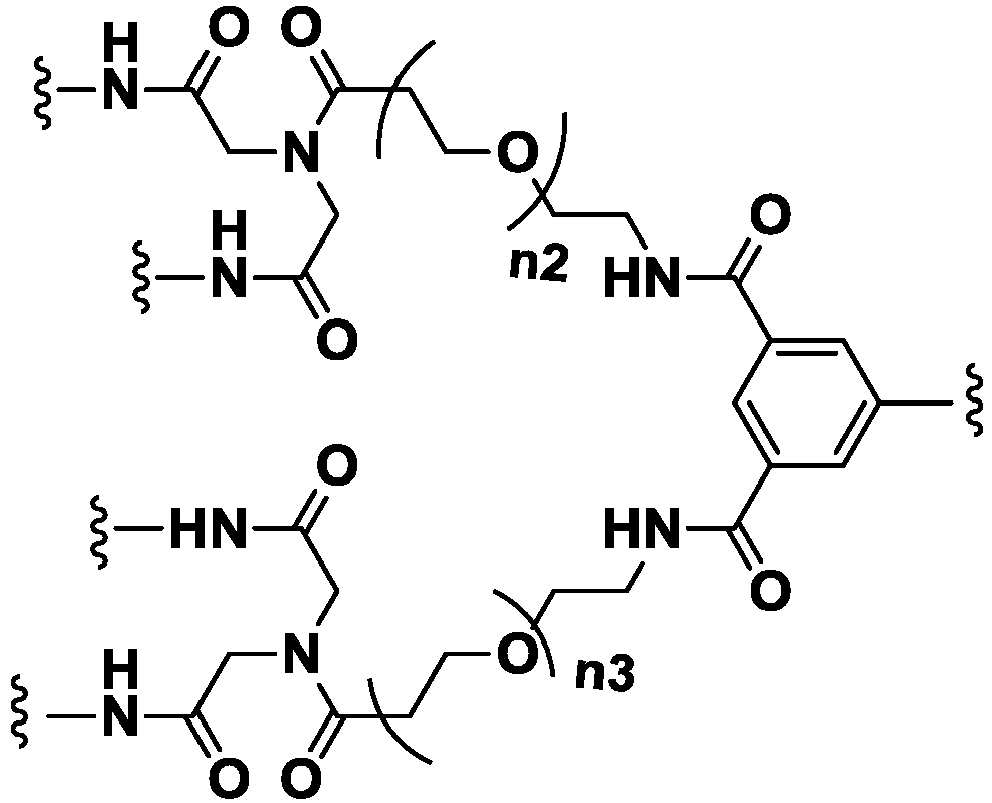


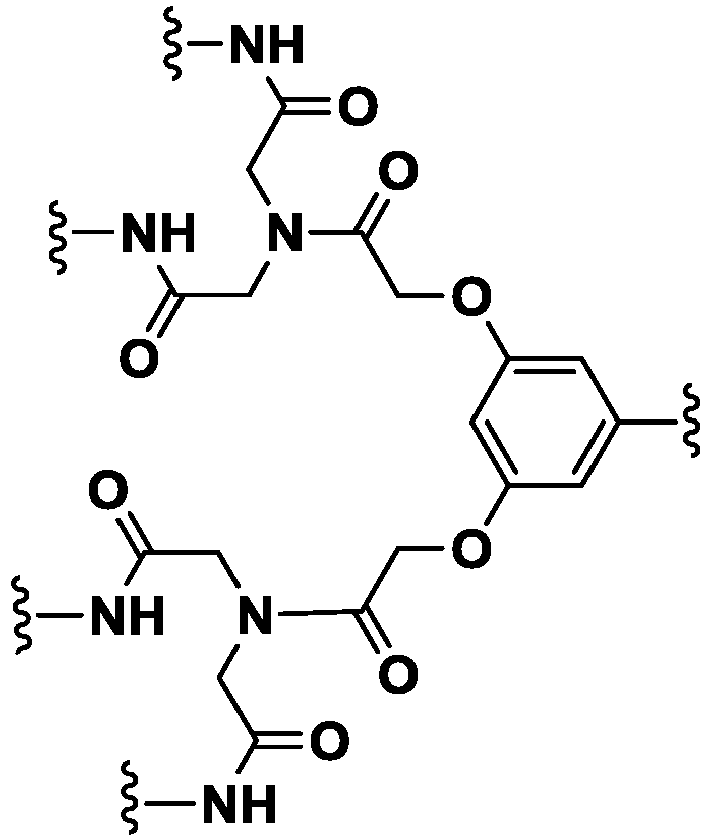


n2 and n3 are each independently an integer of 1 to 100. - (16) The nucleic acid conjugate according to any of (1) to (15), wherein the oligonucleotide comprises a modified nucleotide.
- (17) A pharmaceutical composition comprising the nucleic acid conjugate according to any of (1) to (16).
- (18) The pharmaceutical composition according to (17), wherein the pharmaceutical composition is for transfer into a cell.
- (19) The pharmaceutical composition according to (18), wherein the cell is a dendritic cell or a macrophage.
- (20) The pharmaceutical composition according to any of (17) to (19), wherein the pharmaceutical composition is intravenously administered or subcutaneously administered.
- (21) A method for treating or preventing a disease, comprising administering the nucleic acid conjugate according to any of (1) to (16) or the pharmaceutical composition according to any of (17) to (20) to a patient in need thereof.
- (22) The treatment or prevention method according to (21), wherein the patient is a mammal.
- For example, a pharmaceutical composition comprising the nucleic acid conjugate of the present invention can be administered to mammals to treat various related diseases in vivo.
-
-
Figure 1 shows results of a mRNA knockdown test on human monocyte-derived dendritic cells using an antisense oligonucleotide (ASO) against CD45 in Test Example 1. -
Figure 2 shows results of a protein knockdown test on human monocyte-derived dendritic cells using ASO against beta-2 microglobulin (B2M) in Test Example 2. -
Figure 3 shows results of a protein knockdown test on human monocyte-derived dendritic cells using B2M-siRNA in Test Example 3. -
Figure 4 shows results of a mRNA knockdown test on human monocyte-derived dendritic cells using B2M-siRNA in Test Example 4. -
Figure 5 shows results of a protein knockdown test on human monocyte-derived dendritic cells using B2M-siRNA in Test Example 5. -
Figure 6 shows results of a protein knockdown test on human monocyte-derived dendritic cells using B2M-siRNA in Test Example 6. -
Figure 7 shows results of a protein knockdown test on human monocyte-derived dendritic cells using B2M-siRNA in Test Example 7. -
Figure 8 shows results of a protein knockdown test on human monocyte-derived dendritic cells using B2M-siRNA in Test Example 8. -
Figure 9 shows results of a protein knockdown test on human monocyte-derived dendritic cells using B2M-siRNA in Test Example 9. -
Figure 10 shows results of a protein knockdown test on human monocyte-derived dendritic cells using B2M-siRNA in Test Example 10. -
Figure 11 shows results of a protein knockdown test on mature human monocyte-derived dendritic cells using B2M-siRNA in Test Example 11. -
Figure 12 shows results of a protein knockdown test on mature human monocyte-derived dendritic cells using HPRT1-siRNA in Test Example 12. -
Figure 13 shows results of a protein knockdown test on human monocyte-derived macrophage cells using B2M-siRNA in Test Example 13. - The nucleic acid conjugate of the present invention is a nucleic acid conjugate in which a sugar chain ligand is bonded to an oligonucleotide via a linker, the sugar chain ligand having O-bonded mannose at its non-reducing end.
- The nucleic acid conjugate has a sugar chain ligand, a linker, and an oligonucleotide as its intramolecular components. The sugar chain ligand and the oligonucleotide are linked to each other through a bond via the linker. The bond of the sugar chain ligand or the oligonucleotide to the linker is preferably a covalent bond.
- The nucleic acid conjugate of the present invention has a sugar chain ligand-linker-oligonucleotide structure.
- In the present invention, structures known in the art can be adopted for the linker and the oligonucleotide as long as the sugar chain ligand has O-bonded mannose at its non-reducing end.
- Specifically, conventional nucleic acid conjugates known in the art having the respective structures of a sugar chain ligand, a linker and an oligonucleotide, the sugar chain ligand being the sugar chain ligand having O-bonded mannose at its non-reducing end according to the present invention are included in the scope of the present invention.
- In the present invention, the sugar chain ligand has O-bonded mannose at its non-reducing end.
- Examples of the structure of the O-bonded mannose include the following structure:

- The O-linkage of the mannose may be an α-bond or may be a β-bond. Preferably, the O-linkage of the mannose is an α-bond.
- Usually, sugar chains have non-reducing and reducing ends. In the present invention, the O-bonded mannose is located at the non-reducing end.
- The phrase "O-bonded mannose is located at the non-reducing end" means that the outermost part of the sugar chain ligand has the O-bonded mannose and does not further have any other structure.
- The sugar chain ligand means a group derived from a saccharide (monosaccharide, disaccharide, trisaccharide and polysaccharide, etc.) capable of binding to a receptor expressed on a target cell. Examples thereof include sugar chain ligands having a non-natural structure.
- Examples of the monosaccharide serving as a saccharide unit include naturally occurring monosaccharides such as allose, aldose, arabinose, cladinose, erythrose, erythrulose, fructose, fucitol, fucosamine, fucose, fuculose, galactosamine, galactosaminitol, N-acetyl-galactosamine, galactose, glucosamine, N-acetyl-glucosamine, glucosaminitol, glucose, glucose-6-phosphate, gulose, glyceraldehyde, glyceromanno-heptose, glycerol, glycerone, gulose, idose, lyxose, mannosamine, mannose, mannose-6-phosphate, psicose, quinovose, quinovosamine, rhamnitol, rhamnosamine, rhamnose, ribose, ribulose, sedoheptulose, sorbose, tagatose, talose, tartaric acid, threose, xylose, and xylulose. These monosaccharides are bonded to each other through glycoside bonds and present as naturally occurring saccharides.
- In the present invention, the sugar chain ligand preferably has a non-natural structure. This means that a structure other than the monosaccharide described above is contained as the non-natural structure.
- Each monosaccharide as the saccharide may be in a D form or an L form and may be a mixture of D and L forms at an arbitrary ratio.
- The saccharide may contain deoxysugar (derived by the replacement of an alcoholic hydroxy group with a hydrogen atom), aminosugar (derived by the replacement of an alcoholic hydroxy group with an amino group), thiosugar (derived by the replacement of an alcoholic hydroxy group with thiol, the replacement of C=O with C=S, or the replacement of ring oxygen with sulfur), selenosugar, tellurosugar, azasugar (derived by the replacement of ring carbon with nitrogen), iminosugar (derived by the replacement of ring oxygen with nitrogen), phosphano-sugar (derived by the replacement of ring oxygen with phosphorus), phospha-sugar (derived by the replacement of ring carbon with phosphorus), C-substituted monosaccharide (derived by the replacement of a hydrogen atom on a nonterminal carbon atom with a carbon atom), unsaturated monosaccharide, alditol (derived by the replacement of a carbonyl group with a CHOH group), aldonic acid (derived by the replacement of an aldehyde group with a carboxy group), ketoaldonic acid, uronic acid, aldaric acid, or the like.
- Examples of the aminosugar include amino monosaccharides as the saccharide, such as galactosamine, glucosamine, mannosamine, fucosamine, quinovosamine, neuraminic acid, muramic acid, lactosediamine, acosamine, bacillosamine, daunosamine, desosamine, forosamine, gallosamine, kanosamine, kansosamine, mycaminose, mycosamine, perosamine, pneumosamine, purpurosamine, and rhodosamine. The amino group of the aminosugar may be substituted with an acetyl group or the like.
- In the present invention, the sugar chain ligand preferably has a structure that exhibits binding affinity for CD209 and/or CD206.
- In the present invention, the O-bonded mannose is located at the non-reducing end so that the sugar chain ligand exhibits binding affinity for CD209 and/or CD206.
- The sugar chain ligand that exhibits binding affinity for CD209 and/or CD206 allows the nucleic acid conjugate to bind to a receptor expressed on the surface of dendritic cells or macrophage cells so that the oligonucleotide can be delivered as a nucleic acid medicine to the cells.
- The sugar chain ligand preferably has a structure bonded to a cyclohexane skeleton via an ether bond at
position 1 of the mannose. - The cyclohexane skeleton is present as a non-natural structure in the sugar chain ligand. Examples of the structure bonded to a cyclohexane skeleton via an ether bond at
position 1 of the mannose include the following structure:
- The cyclohexane ring may have a substituent. The glycoside bond of the mannose to the cyclohexane may be an α-bond or may be a β-bond.
- The structure bonded to a cyclohexane skeleton via an ether bond at
position 1 of the mannose is preferably, for example, the following structure:
- R1 and R2 are each independently a group selected from the group consisting of a hydrogen atom, a substituted or unsubstituted alkyl group having 1 to 20 carbon atoms, a substituted or unsubstituted alkenyl group having 2 to 20 carbon atoms, a substituted or unsubstituted alkynyl group having 3 to 20 carbon atoms, a substituted or unsubstituted aryl group, a substituted or unsubstituted heteroaryl group, a substituted or unsubstituted heteroalicyclic group, and a substituted or unsubstituted aralkyl group,
- Y1 and Y2 are each independently a group selected from the group consisting of an oxygen atom, a sulfur atom, and NR3, and
- R3 is a hydrogen atom or a substituted or unsubstituted alkyl group having 1 to 20 carbon atoms.
- In the present specification, the term "each independently" means that each group is a group selected from among choices independently of other groups recited at the same time therewith. These groups may be the same or different.
- Examples of the substituted or unsubstituted alkyl group having 1 to 20 carbon atoms include, but are not particularly limited to, methyl, ethyl, propyl, cyclopropyl, isopropyl, butyl, cyclobutyl, isobutyl, pentyl, cyclopentyl, hexyl, cyclohexyl, heptyl, octyl, nonyl, decyl, pentadecyl, and icosyl.
- Examples of the substituent for the substituted or unsubstituted alkyl group having 1 to 20 carbon atoms include a substituent selected from the group consisting of hydroxy, halogen, mercapto, nitro, cyano, carboxy, carbamoyl, C1-C3 alkoxy, C1-C3 alkylthio, amino, C1-C3 monoalkylamino, and C1-C3 dialkylamino.
- The number of substituents is, for example, 1 to 3. In the case of having a plurality of substituents, the plurality of substituents may be the same or different.
- In the present specification, the substituents for the substituted or unsubstituted alkenyl group having 2 to 20 carbon atoms, the substituted or unsubstituted alkynyl group having 3 to 20 carbon atoms, the substituted or unsubstituted aryl group, the substituted or unsubstituted heteroaryl group, and the substituted or unsubstituted aralkyl group are as defined in the substituent for the substituted or unsubstituted alkyl group having 1 to 20 carbon atoms.
- The substituted or unsubstituted alkenyl group having 2 to 20 carbon atoms can be a group in which a substituted or unsubstituted alkyl group having 2 to 20 carbon atoms contains one or more double bonds. The substituted or unsubstituted alkynyl group having 3 to 20 carbon atoms can be a group in which a substituted or unsubstituted alkyl group having 3 to 20 carbon atoms contains one or more triple bonds.
- Examples of the substituted or unsubstituted aryl group include, but are not particularly limited to, aromatic rings such as a phenyl group, a naphthyl group, and an anthracenyl group.
- The substituted or unsubstituted heteroaryl group means a heteroaromatic ring having a nitrogen atom, an oxygen atom or a sulfur atom in the ring. Examples thereof include 5- or 6-membered aromatic rings having 1 to 3 atoms selected from a nitrogen atom, an oxygen atom and a sulfur atom.
- The substituted or unsubstituted heteroalicyclic group means a heteroaliphatic ring having a nitrogen atom, an oxygen atom or a sulfur atom in the ring. Examples thereof include 5- or 6-membered aliphatic rings having 1 to 3 atoms selected from a nitrogen atom, an oxygen atom and a sulfur atom.
- The substituted or unsubstituted aralkyl group can be a group in which a substituted or unsubstituted alkyl group is substituted with a substituted or unsubstituted aryl group. Examples thereof include groups in which a substituted or unsubstituted alkyl group having 1 to 20 carbon atoms contains one or more aryl groups as substituents and specifically include a substituted or unsubstituted benzyl group and a phenethyl group.
- Each of Y1 and Y2 is preferably an oxygen atom, and NH is also preferred.
- Preferably, R1 and R2 are each independently a substituted or unsubstituted alkyl group having 1 to 20 carbon atoms. Among others, each of R1 and R2 is preferably a methyl group. Also preferably, R1 and R2 are each independently a substituted or unsubstituted aralkyl group. More preferably, each of Y1 and Y2 is NH, and each of R1 and R2 is a substituted or unsubstituted aralkyl group. Still more preferably, each of Y1 and Y2 is NH, and each of R1 and R2 is a 4-hydroxybenzyl group, a 4-(hydroxymethyl)benzyl group or a 4-(methoxymethyl)benzyl group.
- The specific structure bonded to a cyclohexane skeleton via an ether bond at
position 1 of the mannose is not particularly limited and has, for example, the following structure:
R1', R2', Y1', Y2' and R3' are as defined in their corresponding R1, R2, Y1, Y2 and R3. - Specific examples of the sugar chain ligand represented by any of the structures mentioned above can include sugar chain ligands having any of the following structures:

- R1, R2, Y1 and Y2 are as defined above,
- R1", R2'', Y1'', Y2'' and R3'' are as defined in their corresponding R1, R2, Y1, Y2 and R3, and the preferred combination of substituents is also as defined above.
- More specific examples of the sugar chain ligand represented by any of the structures mentioned above can include sugar chain ligands having any of the following structures:

- R1', R2', Y1' and Y2 are as defined above,
- R1"' R2"', Y1'", Y2''' and R3'" are as defined in their corresponding R1, R2, Y1, Y2 and R3, and the preferred combination of substituents is also as defined above.
- The sugar chain ligand structure according to the present invention can be produced with reference to International Publication No.
WO 2011/000721 , Molecular Diversity, 2011, Vol. 15, p. 347-360, Chemistry A European Journal, 2013, Vol. 19, p. 4786-4797 and ACS Chemical Biology, 2010, Vol. 5, p. 301-312. - In the present invention, an oligonucleotide known to be used as a nucleic acid medicine can be used as the "oligonucleotide". In the present invention, the nucleic acid medicine means a nucleotide that is used as an antisense, a decoy nucleic acid, a ribozyme, siRNA, miRNA, anti-miRNA or the like.
- In the present invention, the linker and the oligonucleotide are not only bonded to the linker via position 3' or 5' of a sugar moiety constituting a nucleotide but may be bonded to the linker via a base moiety constituting the nucleotide. In the present invention, the oligonucleotide can be understood as a group having a structure that bonds the oligonucleotide to the linker. For example, when the oligonucleotide is bonded to the linker via -O-P(Z)(Z')O- (wherein Z and Z' are each independently an oxygen atom or a sulfur atom), the oligonucleotide represented by X may be understood as -O-P(Z) (Z')O-oligonucleotide.
- The oligonucleotide may be a single-stranded or double-stranded oligonucleotide.
- The linker and the oligonucleotide in the nucleic acid conjugate can be bonded to each other at a nucleotide of the oligonucleotide or the like and are bonded to each other, for example, at the 3' and/or 5' end of the oligonucleotide. When the oligonucleotide is double-stranded, linker is preferably bonded to the 3' and/or 5' end of a sense strand constituting the double-stranded nucleic acid, though the bond is not limited thereto.
- In the present invention, a nucleic acid comprising a nucleotide sequence complementary to target mRNA is also referred to as an antisense nucleotide, and a nucleic acid comprising a nucleotide sequence complementary to the nucleotide sequence of the antisense nucleotide is also referred to as a sense nucleotide.
- The oligonucleotide constituting the nucleic acid conjugate used in the present invention can have any shape as long as the oligonucleotide has the ability to control the expression of a target gene when transferred to mammalian cells. A single-stranded oligonucleotide or a double-stranded oligonucleotide is suitably used.
- The oligonucleotide can be any molecule which is a polymer of nucleotides or molecules functionally equivalent to nucleotides. Examples thereof include DNA which is a polymer of deoxyribonucleotides, RNA which is a polymer of ribonucleotides, and a chimeric nucleic acid which is a polymer of DNA and RNA. Alternatively, the oligonucleotide may be a nucleotide polymer derived from DNA, RNA or a chimeric nucleic acid by the replacement of at least one nucleotide (deoxyribonucleotide, ribonucleotide, etc.) with a molecule functionally equivalent to the nucleotide. Uracil (U) in RNA and thymine (T) in DNA can be used interchangeably with each other.
- Examples of the molecules functionally equivalent to nucleotides include nucleotide derivatives prepared by modifying nucleotides. For example, a modified deoxyribonucleotide or ribonucleotide molecule is suitably used for improving or stabilizing nuclease resistance, for enhancing affinity for a complementary strand nucleic acid, for enhancing cell permeability, or for visualizing the molecule, as compared with DNA or RNA.
- Examples of the nucleotide derivatives include nucleotides modified at at least one of a sugar moiety, a phosphodiester bond and a base, such as nucleotides modified at the sugar moiety, nucleotides modified at the phosphodiester bond, and nucleotides modified at the base.
- The nucleotide modified at the sugar moiety can be any nucleotide in which a portion or the whole of the chemical structure of its sugar is modified or substituted with an arbitrary substituent or substituted with an arbitrary atom. A 2'-modified nucleotide is preferably used.
- Examples of the 2'-modified nucleotide include 2'-modified nucleotides in which the 2'-OH group of ribose is substituted with a substituent selected from the group consisting of OR, R, R'OR, SH, SR, NH2, NHR, NR2, N3, CN, F, Cl, Br and I (R is alkyl or aryl, preferably alkyl having 1 to 6 carbon atoms, and R' is alkylene, preferably alkylene having 1 to 6 carbon atoms). Examples of the 2'-modification preferably include substitution with F, a methoxy group and/or an ethoxy group. Further examples thereof include 2'-modified nucleotides having substitution with a substituent selected from the group consisting of a 2-(methoxy)ethoxy group, a 3-aminopropoxy group, a 2-[(N,N-dimethylamino)oxy]ethoxy group, a 3-(N,N-dimethylamino)propoxy group, a 2-[2-(N,N-dimethylamino)ethoxy]ethoxy group, a 2-(methylamino)-2-oxoethoxy group, a 2-(N-methylcarbamoyl)ethoxy group and a 2-cyanoethoxy group.
- Bridged nucleic acid (BNA) having two cyclic structures by the introduction of a bridged structure to the sugar moiety is also suitably used as the nucleotide modified at the sugar moiety. Specific examples thereof include locked nucleic acid (LNA) having the oxygen atom at position 2' and the carbon atom at position 4' bridged via methylene [Tetrahedron Letters, 38, 8735 (1997); and Tetrahedron, 54, 3607 (1998)], ethylene bridged nucleic acid (ENA) [Nucleic Acid Research, 32, e175 (2004)], constrained ethyl (cEt) [The Journal of Organic Chemistry 75, 1569 (2010)], amido-bridged nucleic acid (AmNA) [Chem Bio Chem 13, 2513 (2012)] and 2'-O,4'-C-spirocyclopropylene bridged nucleic acid (scpBNA) [Chem. Commun., 51, 9737 (2015)].
- Further examples of the nucleotide modified at the sugar moiety include peptide nucleic acid (PNA) [Acc. Chem. Res., 32, 624 (1999)], oxy-peptide nucleic acid (OPNA) [J. Am. Chem. Soc., 123, 4653 (2001)] and peptide ribonucleic acid (PRNA) [J. Am. Chem. Soc., 122, 6900 (2000)].
- The nucleotide modified at the phosphodiester bond can be any nucleotide in which a portion or the whole of the chemical structure of its phosphodiester bond is modified or substituted with an arbitrary substituent or substituted with an arbitrary atom. Examples thereof include a nucleotide resulting from the substitution of the phosphodiester bond with a phosphorothioate bond, a nucleotide resulting from the substitution of the phosphodiester bond with a phosphorodithioate bond, a nucleotide resulting from the substitution of the phosphodiester bond with an alkyl phosphonate bond, and a nucleotide resulting from the substitution of the phosphodiester bond with a phosphoramidate bond and preferably include a nucleotide resulting from the substitution of the phosphodiester bond with a phosphorothioate bond.
- The nucleotide modified at the base can be any nucleotide in which a portion or the whole of the chemical structure of its base is modified or substituted with an arbitrary substituent or substituted with an arbitrary atom. Examples thereof include a nucleotide resulting from the substitution of an oxygen atom in the base with a sulfur atom, a nucleotide resulting from the substitution of a hydrogen atom with an alkyl group having 1 to 6 carbon atoms or a halogen group, a nucleotide resulting from the substitution of a methyl group with a hydrogen atom, a hydroxymethyl group or an alkyl group having 2 to 6 carbon atoms, and a nucleotide resulting from the substitution of an amino group with an alkyl group having 1 to 6 carbon atoms, an alkanoyl group having 1 to 6 carbon atoms, an oxo group, a hydroxy group, or the like. In a preferred aspect of the present invention, 5-methylcytosine (5-mC) is also used instead of cytosine (C) as the nucleotide modified at the base.
- Examples of the nucleotide derivatives also include nucleotides or nucleotides modified at at least one of a sugar moiety, a phosphodiester bond and a base which contain an additional chemical substance, such as peptide, protein, sugar, lipid, phospholipid, phenazine, folate, phenanthridine, anthraquinone, acridine, fluorescein, rhodamine, coumarin, or a dye, added thereto directly or via a linker, and specifically include 5'-polyamine-added nucleotide derivatives, cholesterol-added nucleotide derivatives, steroid-added nucleotide derivatives, bile acid-added nucleotide derivatives, vitamin-added nucleotide derivatives, Cy5-added nucleotide derivatives, Cy3-added nucleotide derivatives, 6-FAM-added nucleotide derivatives, and biotin-added nucleotide derivatives.
- The nucleotide derivative may form a bridged structure, such as an alkylene structure, a peptide structure, a nucleotide structure, an ether structure, an ester structure, and a structure combined with at least one of these structures, with another nucleotide or nucleotide derivative within the nucleic acid.
- The oligonucleotide also encompasses molecules in which a portion or the whole of the atoms is substituted with an atom having an atomic mass number different therefrom (isotope).
- In the present specification, the term "complementation" means a relationship capable of forming a base pair between two bases and refers to a relationship taking a double helix structure as the whole duplex region via a mild hydrogen bond, for example, the relationship between adenine and thymine or uracil, and the relationship between guanine and cytosine.
- In the present specification, the term "complementary" not only means the case where two nucleotide sequences are completely complementary to each other, but means that 0 to 30%, 0 to 20% or 0 to 10% of a mismatch base can be present between the nucleotide sequences, and, for example, an antisense oligonucleotide complementary to target mRNA may contain the substitution of one or more bases in its nucleotide sequence completely complementary to a partial nucleotide sequence of the target mRNA. Specifically, the antisense oligonucleotide may have 1 to 8, preferably 1 to 6, 1 to 4 or 1 to 3, particularly, 2 or 1 mismatch bases for a target sequence of a target gene.
- Also, the term "complementary" encompasses the case where two nucleotide sequences, one of which is completely complementary to the other nucleotide sequence, have the addition and/or deletion of one or more bases. For example, target mRNA and the antisense oligonucleotide may have 1 or 2 bulge bases in the antisense strand and/or target mRNA region by the addition and/or deletion of base(s) in the antisense oligonucleotide.
- Hereinafter, the term "complementary" is described to also encompass "complementation".
- The antisense oligonucleotide used in the present invention is an oligonucleotide complementary to DNA encoding the target gene or a mRNA precursor, mRNA, a microRNA precursor or microRNA transcribed from the DNA encoding the target gene, and inhibits the function of the DNA, the mRNA precursor, the mRNA, the microRNA precursor or the microRNA by forming a duplex with the DNA, the mRNA precursor or the mRNA targeted by the antisense oligonucleotide.
- The antisense oligonucleotide includes not only an oligonucleotide completely complementary to its target DNA, mRNA precursor, mRNA, microRNA precursor or microRNA, but an oligonucleotide having one or several mismatches as long as the oligonucleotide can hybridize under stringent conditions to the DNA, the mRNA precursor, the mRNA, the microRNA precursor or the microRNA.
- The antisense oligonucleotide may be introduced into the form of a hairpin oligomer or a cyclic oligomer and may contain a structural factor such as an internal or terminal bulge or loop as long as the nucleic acid hybridizes to the target gene.
- The length of the antisense oligonucleotide is 8 to 80 bases, preferably 8 to 30 bases. The length can be, for example, 8 to 20 bases, 10 to 20 bases, 13 to 20 bases, 13 to 16 bases, 13 bases, 14 bases, 15 bases, 16 bases, 17 bases, 18 bases, 19 bases, or 20 bases.
- The antisense oligonucleotide, when transferred into cells, can bind to its complementary mRNA precursor or mRNA and sterically inhibit the translation thereof into a protein, inhibiting the expression of the target gene.
- The antisense oligonucleotide can also bind to its complementary microRNA precursor or microRNA in cells and sterically inhibit the function of the microRNA.
- The antisense oligonucleotide may bind to its complementary mRNA or mRNA precursor in cells and cleave the mRNA or the mRNA precursor. Action mediated by RNase H which is an endonuclease that cleaves the RNA strand of a duplex of RNA and DNA is known as such an example. When the antisense oligonucleotide of the present invention in cells forms a duplex with the mRNA or the mRNA precursor, the duplex can be recognized by RNase H, which then enzymatically can degrade the complementary mRNA strand.
- An antisense oligonucleotide having 4 to 80 consecutive DNA regions is preferred for inducing the cleavage of the mRNA or the mRNA precursor by RNase H. In this case, the antisense oligonucleotide preferably has 0 to 80%, more preferably 10 to 60%, further preferably 20 to 50%, of a nucleotide modified at the sugar moiety. When the antisense oligonucleotide has a nucleotide modified at the sugar moiety, the number of the consecutive DNA regions is more preferably 4 to 20, further preferably 4 to 15, most preferably 5 to 10. The position of the nucleotide modified at the sugar moiety in the antisense oligonucleotide is preferably near the 5' end and/or near the 3' end and is more preferably a position within 25% of the whole length from the 5' end and/or a position within 25% of the whole length from the 3' end.
- The antisense oligonucleotide can also induce the inhibition of the expression of a target gene by forming a duplex with its complementary oligonucleic acid and transferring the double-stranded nucleic acid into cells (see International Publication No.
WO 2005/113571 ). In this case, the position of modification of the double-stranded nucleic acid with a ligand is preferably the 5' or 3' end of the complementary oligonucleic acid. - The antisense oligonucleotide used in the present invention can also increase the expression of a target gene by using a nucleotide sequence complementary to a promoter sequence or the like of the target gene (see International Publication Nos.
WO 2013/173601 andWO 2013/173637 ). - Examples of a method for producing the antisense oligonucleotide include, but are not particularly limited to, methods using chemical synthesis known in the art, and enzymatic transcription methods. Examples of the methods using chemical synthesis known in the art can include a phosphoramidite method, a phosphorothioate method, a phosphotriester method, and a CEM method [Nucleic Acid Research, 35, 3287 (2007)]. The antisense oligonucleotide can be synthesized using, for example, ABI3900 high-throughput nucleic acid synthesizer (manufactured by Applied Biosystems, Inc.). After the completion of synthesis, dissociation from a solid phase, deprotection of a protective group and purification of the compound of interest, etc. are performed. Desirably, an antisense oligonucleotide having a purity of 90% or higher, preferably 95% or higher is obtained by the purification. Examples of the enzymatic transcription methods for producing the antisense oligonucleotide of the present invention include methods based on transcription using a plasmid or DNA having the nucleotide sequence of interest as a template and phage RNA polymerase, for example, T7, T3, or SP6 RNA polymerase.
- The double-stranded oligonucleotide used in the present invention may be constituted by any oligonucleotide or derivative thereof as long as the oligonucleotide or the derivative is a nucleic acid comprising a nucleotide sequence complementary to a partial nucleotide sequence of target mRNA and/or a nucleic acid comprising a nucleotide sequence complementary to the nucleotide sequence of the nucleic acid.
- The double-stranded oligonucleotide used in the present invention can have any length as long as the nucleic acid comprising a nucleotide sequence complementary to the target mRNA sequence and the nucleic acid comprising a nucleotide sequence complementary to the nucleotide sequence of the nucleic acid can form a duplex. The sequence length that allows formation of the duplex is usually 11 to 35 bases, preferably 15 to 30 bases, more preferably 17 to 25 bases, further preferably 17 to 23 bases, particularly preferably 19 to 23 bases.
- In the present invention, a single-stranded nucleic acid that consists of a nucleic acid comprising a nucleotide sequence complementary to the target mRNA sequence and inhibits the expression of the target protein, or a double-stranded nucleic acid that consists of a nucleic acid comprising a nucleotide sequence complementary to the target mRNA sequence and a nucleic acid comprising a nucleotide sequence complementary to the nucleotide sequence of the nucleic acid and inhibits the expression of the target protein is suitably used as the double-stranded oligonucleotide inhibiting the expression of the target protein.
- The double-stranded oligonucleotide can also increase the expression of a target gene by using a molecule consisting of a nucleic acid comprising a nucleotide sequence complementary to a promoter sequence or the like of the target gene and a nucleic acid comprising a nucleotide sequence complementary to the nucleotide sequence of the nucleic acid [Nucleic Acid Research, 41, 10086 (2013); and Hepatology, 59, 216 (2014)].
- The double-stranded oligonucleotide refers to nucleotides having a duplex region formed by the pairing of two oligonucleotides. The duplex region refers to a moiety in which nucleotides or derivatives thereof, constituting the two strands have formed a duplex by constituting base pairs. The duplex region is usually 11 to 27 base pairs, preferably 15 to 25 base pairs, more preferably 15 to 23 base pairs, further preferably 17 to 21 base pairs.
- Each single-stranded oligonucleotide constituting the double-stranded oligonucleotide usually consists of 11 to 30 bases, preferably 15 to 29 bases, more preferably 15 to 27 bases, further preferably 15 to 25 bases, particularly preferably 17 to 23 bases.
- The double-stranded oligonucleotide may have a non-duplex-forming additional nucleotide or nucleotide derivative on the 3' or 5' side subsequent to the duplex region. This non-duplex-forming moiety is referred to as an overhang. When the double-stranded oligonucleotide has an overhang, the nucleotide constituting the overhang may be a ribonucleotide, a deoxyribonucleotide or a derivative thereof.
- A double-stranded oligonucleotide having an overhang consisting of 1 to 6 bases, usually 1 to 3 bases, at the 3' or 5' end of at least one of the strands is used as the double-stranded oligonucleotide having the overhang. A double-stranded oligonucleotide having an overhang consisting of 2 bases is preferably used. Examples thereof include double-stranded oligonucleotides having an overhang consisting of dTdT or UU. The overhang can be present in only the antisense oligonucleotide, only the sense oligonucleotide, and both the antisense oligonucleotide and the sense oligonucleotide. A double-stranded oligonucleotide having an overhang in the antisense oligonucleotide is preferably used. The antisense oligonucleotide comprises the duplex region and the overhang subsequent thereto.
- A nucleic acid consisting of a sequence identical to the nucleotide sequence of a target gene or the nucleotide sequence of its complementary strand may be used in the double-stranded oligonucleotide. A double-stranded nucleic acid consisting of a nucleic acid derived from the nucleic acid by the truncation of 1 to 4 bases from the 5' or 3' end of at least one strand, and a nucleic acid comprising a nucleotide sequence complementary to the nucleotide sequence of the nucleic acid may be used.
- The double-stranded oligonucleotide may be double-stranded RNA (dsRNA) comprising a RNA duplex, double-stranded DNA (dsDNA) comprising a DNA duplex, or a hybrid nucleic acid comprising a RNA-DNA duplex. Alternatively, the double-stranded oligonucleotide may be a chimeric nucleic acid having two strands, one or both of which consists of DNA and RNA. Double-stranded RNA (dsRNA) is preferred.
- Preferably, the 2nd nucleotide counted from the 5' end of the antisense oligonucleotide is complementary to the 2nd deoxyribonucleotide counted from the 3' end of the target mRNA sequence. More preferably, the 2nd to 7th nucleotides counted from the 5' end of the antisense oligonucleotide are completely complementary to the 2nd to 7th deoxyribonucleotides counted from the 3' end of the target mRNA sequence. Further preferably, the 2nd to 11th nucleotides counted from the 5' end of the antisense oligonucleotide are completely complementary to the 2nd to 11th deoxyribonucleotides counted from the 3' end of the target mRNA sequence. Also preferably, the 11th nucleotide counted from the 5' end of the antisense oligonucleotide is complementary to the 11th deoxyribonucleotide counted from the 3' end of the target mRNA sequence. More preferably, the 9th to 13th nucleotides counted from the 5' end of the antisense oligonucleotide are completely complementary to the 9th to 13th deoxyribonucleotides counted from the 3' end of the target mRNA sequence. Further preferably, the 7th to 15th nucleotides counted from the 5' end of the antisense oligonucleotide are completely complementary to the 7th to 15th deoxyribonucleotides counted from the 3' end of the target mRNA sequence.
- The double-stranded oligonucleotide preferably contains 50 to 100%, more preferably 70 to 100%, further preferably 90 to 100%, of a modified nucleotide with respect to the nucleotides within the double-stranded nucleic acid region.
- The double-stranded oligonucleotide can be chemically synthesized and can generally be synthesized by use of a solid-phase oligonucleotide synthesis method (see, for example,
Usman et al., U.S. Patent No. 5,804,683 ;U.S. Patent No. 5,831,071 ;U.S. Patent No. 5,998,203 ;U.S. Patent No. 6,117,657 ;U.S. Patent No. 6,353,098 ;U.S. Patent No. 6,362,323 ;U.S. Patent No. 6,437,117 ; andU.S. Patent No. 6,469,158 ;Scaringe et al., U.S. Patent No. 6,111,086 ;U.S. Patent No. 6,008,400 ; andU.S. Patent No. 6,111,086 ). - RNA may be produced enzymatically or by partial or total organic synthesis. A modified ribonucleotide can be introduced enzymatically or by organic synthesis in vitro. In one aspect, each strand is chemically prepared. A method for chemically synthesizing a RNA molecule is known in the art [see Nucleic Acids Research, 32, 936 (1998)].
- Examples of the RNA used in the present invention include RNA comprising a sequence of 15 to 30 consecutive bases, preferably 17 to 25 consecutive bases, more preferably 19 to 23 consecutive bases (hereinafter, referred to as sequence X) of mRNA of a target gene, and a sequence of bases complementary (hereinafter referred to as complementary sequence X') to the sequence X, for example, double-stranded RNA consisting of a sense oligonucleotide comprising sequence X and an antisense oligonucleotide comprising complementary sequence X', and RNA having a hairpin structure of the sense oligonucleotide and the antisense oligonucleotide connected via a spacer oligonucleotide.
- Examples of the sense oligonucleotide comprising sequence X include RNA comprising only the sequence X as bases (hereinafter, referred to as a sequence X strand), and RNA having 1 to 6, preferably 2 to 4 same or different nucleotides added to the 3' or 5' end, or both, of the sequence X strand.
- Examples of the antisense oligonucleotide comprising complementary sequence X' include RNA comprising only the complementary sequence X' as bases (hereinafter, referred to as a complementary sequence X' strand), and double-stranded RNA having 1 to 6, preferably 2 to 4 same or different nucleotides added to the 3' or 5' end, or both, of the complementary sequence X' strand.
- The spacer oligonucleotide in the RNA having a hairpin structure of the sense oligonucleotide comprising sequence X and the antisense oligonucleotide comprising complementary sequence X', connected via the spacer oligonucleotide is preferably nucleotides of 6 to 12 bases, and the 5' terminal sequence thereof is preferably UU. Examples of the spacer oligonucleotide include an oligonucleotide consisting of a nucleotide sequence UUCAAGAGA. As for the order of the two RNA strands connected via the spacer oligonucleotide, either of them may be located on the 5' side, and the sense strand comprising sequence X is preferably located on the 5' side.
- The nucleotides to be added to the sequence X strand and the complementary sequence X' strand, and the bases of the spacer oligonucleotide may be any one type or plural types selected from guanine, adenine, cytosine, thymine and uracil. A sugar bonded to each base may be ribose, deoxyribose or ribose substituted at the 2'-hydroxy group with a modifying group. The nucleotides to be added are more preferably any one type or two types selected from uridylic acid (U) and deoxythymidylic acid (dT). The sequence of the bases of the nucleotides to be added to the 3' end of the sequence X strand may be the same as the sequence of bases of nucleotides adjacent to sequence X within the mRNA of the target gene. The sequence of the bases of the nucleotides to be added to the 3' end of the complementary sequence X' strand may be complementary to the sequence of bases of nucleotides adjacent to sequence X within the mRNA of the target gene.
- More preferred examples of the RNA used in the present invention include (a) double-stranded RNA consisting of a sense oligonucleotide comprising sequence X and an antisense oligonucleotide comprising complementary sequence X', wherein: the sequence X is a sequence of 19 to 21 consecutive bases of the mRNA of the target gene; the sense oligonucleotide consists of a sequence X strand and 2 to 4 same or different nucleotides added to the 3' end of the sequence X strand; and the antisense oligonucleotide consists of a complementary sequence X' strand and 2 to 4 same or different nucleotides added to the 3' end of the complementary sequence X' strand, (b) double-stranded RNA consisting of a sense oligonucleotide comprising sequence X and an antisense oligonucleotide comprising complementary sequence X', wherein: the sequence X is a sequence of 23 to 25 consecutive bases of the mRNA of the target gene; the sense oligonucleotide is a sequence X strand; and the antisense oligonucleotide is a complementary sequence X' strand, and (c) double-stranded RNA consisting of a sense oligonucleotide comprising sequence X and an antisense oligonucleotide comprising complementary sequence X', wherein: the sequence X is a sequence of 23 to 27 consecutive bases of the mRNA of the target gene; the sense oligonucleotide consists of a sequence X strand and 2 to 4 same or different nucleotides added to the 3' end of the sequence X strand; the antisense oligonucleotide consists of a complementary sequence X' strand and 2 to 4 same or different nucleotides added to the 3' end of the complementary sequence X' strand; and the sequence of the bases of the nucleotides to be added to the 3' end of the complementary sequence X' strand is complementary the sequence of the bases of nucleotides adjacent to sequence X within the mRNA of the target gene.
- Further examples of the RNA used in the present invention preferably include RNA having an inhibitory effect on the expression of the target gene through the use of RNA interference (RNAi).
- The single-stranded oligonucleotide is synthesized by use of a solid-phase phosphoramidite method [see Nucleic Acids Research, 30, 2435 (1993)], deprotected, and desalted on NAP-5 column (Amersham Pharmacia Biotech Ltd., Piscataway, NJ). The oligomer is purified by ionexchange high-performance liquid chromatography (IE-HPLC) on Amersham Source 15Q column (1.0 cm, height: 25 cm; Amersham Pharmacia Biotech Ltd., Piscataway, NJ) using a linear gradient in a 15-minute step. The gradient shifts from buffer solution A:B of 90:10 to buffer solution A:B of 52:48. The buffer solution A is 100 mmol/L Tris, pH 8.5, and the buffer solution B is 100 mmol/L Tris, pH 8.5 (1 mol/L NaCl). A sample is monitored at 260 nm, and a peak corresponding to full-length oligonucleotide species is collected, pooled, desalted on NAP-5 column, and freeze-dried.
- The purity of each single-stranded oligonucleotide is determined by capillary electrophoresis (CE) using Beckman PACE 5000 (Beckman Coulter, Inc., Fullerton, Calif). The CE capillary has an inside diameter of 100 µm and contains ssDNA 100R Gel (Beckman-Coulter, Inc.). Typically, approximately 0.6 nmole of the oligonucleotide is injected to the capillary, and CE is carried out in an electric field of 444 V/cm, followed by the detection of UV absorbance at 260 nm. An electrophoresis buffer solution containing modified Tris-borate and 7 mol/L urea is purchased from Beckman Coulter, Inc. A single-stranded oligonucleotide having at least 90% purity evaluated by CE is obtained for use in an experiment mentioned below. Compound identity is verified by matrix-assisted laser desorption/ionization time of flight (MALDI-TOF) mass spectrometry using Voyager DE(TM) Biospectometry workstation (Applied Biosystems, Inc., Foster City, Calif.) according to manufacturer's recommended protocol. The relative molecular mass of the single-stranded oligonucleotide can be obtained within 0.2% of a predicted molecular mass.
- The single-stranded oligonucleotide is resuspended at a concentration of 100 µmol/L in a buffer solution consisting of 100 mmol/L potassium acetate and 30 mmol/L HEPES, pH 7.5. The complementary sense strand and the antisense strand are mixed in equimolar amounts to obtain a final solution of 50 µmol/L double-stranded oligonucleotide. The sample is heated to 95°C for 5 minutes and cooled to room temperature before use. The double-stranded nucleic acid is preserved at -20°C. The single-stranded oligonucleotide is freeze-dried or stored at -80°C in nuclease-free water.
- In the present invention, an arbitrary linker known to be used as a nucleic acid conjugate can be used as the "linker".
- Examples of the linker structure that can be adopted include structures disclosed in International Publication Nos.
WO 2009/073809 ,WO 2013/075035 ,WO 2015/105083 ,WO 2014/179620 ,WO 2015/006740 , andWO 2017/010575 . - The linker may have a linear structure and preferably has any of structures serving as branched structures given below.
- For example, the linker having the branch as described below allows the nucleic acid conjugate to have a plurality of sugar chain ligands in the molecule. Such a nucleic acid conjugate preferably has 2 to 8 sugar chain ligands.

- X1 is CH or a nitrogen atom, and
- X2 to X4 are each independently CH or a nitrogen atom.
- Preferably, the linker further has any of the following structures:


- In the present invention, the linker having any of the following structures can be produced with reference to, for example, International Publication Nos.
WO 2009/073809 ,WO 2013/075035 ,WO 2015/105083 ,WO 2014/179620 ,WO 2015/006740 , andWO 2017/010575 .
- In the present invention, when the linker has the following structure, the nucleic acid conjugate of the present invention can be produced by a method as listed below.


- In such a case, the nucleic acid conjugate of the present invention is preferably a nucleic acid conjugate represented by the following formula 1:

formula 1, - X is an oligonucleotide,
- X2 to X4 are each independently as defined above,
- L1 and L2 are each independently a sugar chain ligand, and
- S1, S2 and S3 are each independently a substructure constituting a linker.
- In
formula 1, the following structure represents a linker:
- Each of S1, S2 and S3 is a substructure constituting the linker, and
- X2 to X4 are each independently as defined above.
- Hereinafter, the nucleic acid conjugate of
formula 1 will be described. The description aboutformula 1 can be applied to nucleic acid conjugates instead having the following structures:
- In
formula 1, S1 and S2 can each be bonded to the benzene ring at an ortho-, meta- or para-position with respect to the substitution position of S3 on the benzene ring. A nucleic acid conjugate represented by formula 1-1 given below is preferred. The bonds of S1 and S2 to the benzene ring informula 1 mean that the bonds can be at arbitrary positions other than the substitution position of S3 on the benzene ring.
X, L1, L2, S1, S2 and S3 are each as defined above. - In the present specification, the phrase "as defined above" means that, when formula 1-1 is taken as an example, each of X, L1, L2, S1 and S2 in formula 1-1 can be the same group as in the definition about each of X, L1, L2, S1 and S2 described above in
formula 1. - In the present invention, the oligonucleotide is not only bonded to S3 via position 3' or 5' of a sugar moiety constituting a nucleotide but may be bonded to S3 via a base moiety constituting the nucleotide. In the present invention, the oligonucleotide can be understood as a group having a structure that bonds the oligonucleotide to S3. For example, when the oligonucleotide is bonded to S3 via -O-P(Z)(Z')O- (wherein Z and Z' are each independently an oxygen atom or a sulfur atom), the oligonucleotide represented by X may be understood as -OP(Z)(Z')O-oligonucleotide.
- In
formula 1, S1 and S2 are not particularly limited as long as their structures link sugar chain ligands L1 and L2 to the benzene ring. A structure known in the art for use in nucleic acid conjugates may be adopted. S1 and S2 may be the same or may be different. - Sugar chain ligands L1 and L2 are preferably linked to S1 and S2 through glycoside bonds. S1 and S2 may each be linked to the benzene ring, for example, through a-CO-, -NH-, -O-, -S-, -O-CO-, -S-CO-, -NH-CO-, -CO-O-,-CO-S- or -CO-NH- bond.
- S3 is a linker having a binding site to the oligonucleotide and is not particularly limited as long as its structure links oligonucleotide X to the benzene ring. A structure known in the art for use in nucleic acid conjugates may be adopted. Oligonucleotide X is preferably linked to S3 through a phosphodiester bond. S3 may be linked to the benzene ring, for example, through a -CO-, -NH-, -O-, -S-, -O-CO-, -S-CO-, -NH-CO-, -CO-O-, -CO-S- or -CO-NH- bond.
- For example, structures disclosed in International Publication Nos.
WO 2009/073809 ,WO 2013/075035 ,WO 2015/105083 ,WO 2014/179620 , andWO 2015/006740 may be adopted as a substructure constituting linkers S1, S2 and S3. - In the present invention, the nucleic acid conjugate is preferably a nucleic acid conjugate having a structure represented by the following formula 2:

formula 2, - X, X2 to X4, L1, L2 and S3 are each as defined above,
- P1, P2, P3, P4, P5 and P6, and T1 and T2 are each independently absent, or -CO-, -NH-, -O-, -S-, -O-CO-,-S-CO-, -NH-CO-, -CO-O-, -CO-S- or -CO-NH-,
- Q1, Q2, Q3 and Q4 are each independently absent, or substituted or unsubstituted alkylene having 2 to 12 carbon atoms or -(CH2CH2O)n-CH2CH2- wherein n is an integer of 0 to 99,
- B1 and B2 are each independently a bond, or any structure represented by the following formula 2-1, wherein each of the terminal dots in each structure is a binding site to P2 or P3, or P5 or P6, and m1, m2, m3 and m4 are each independently an integer of 0 to 10:

- p1 and p2 are each independently an integer of 1, 2 or 3, and
- q1, q2, q3 and q4 are each independently an integer of 0 to 10,
- provided that when each of p1 and p2 is an integer of 2 or 3, each P3 and P6, Q2 and Q4, T1 and T2 or L1 and L2 are the same or different.
- P1 and P4 are each independently absent, or -CO-,-NH-, -O-, -S-, -O-CO-, -S-CO-, -NH-CO-, -CO-O-, -CO-S- or -CO-NH- and are each preferably -O-, -O-CO, -NH-CO- or-CO-NH-, preferably -O-, -NH-CO- or -CO-NH-, further preferably -NH-CO-.
- When P1 or P4 is, for example, -NH-CO-, a substructure -NH-CO-benzene ring is present.
- Q1, Q2, Q3 and Q4 are each independently absent, or substituted or unsubstituted alkylene having 1 to 12 carbon atoms or -(CH2CH2O)n-CH2CH2- wherein n is an integer of 1 to 99, and are each preferably substituted or unsubstituted alkylene having 1 to 12 carbon atoms, more preferably unsubstituted alkylene having 1 to 12 carbon atoms, further preferably unsubstituted alkylene having 1 to 6 carbon atoms, still further preferably unsubstituted alkylene having 1 to 4 carbon atoms.
- P2 and P5 are each independently absent, or -CO-,-NH-, -O-, -S-, -O-CO-, -S-CO-, -NH-CO-, -CO-O-, -CO-S- or -CO-NH- and are each preferably absent, -CO-O- or -CO-NH-, more preferably absent or -CO-NH-. When each of P2 and P5 is, for example, -CO-NH-, substructures B1-CO-NH-Q1 and B2-CO-NH-Q3 are present.
- -(P2-Q1)q1- and -(P5-Q3)q3- are each independently preferably absent, or any structure represented by the following formulas 3-1 to 3-3:


m5 and m6 are each independently an integer of 0 to 10, and each of the terminal dots in the structures of formulas 3-1 to 3-3 is a binding site to B1 or B2, or P1 or P4. - B1 and B2 are each independently a bond, or any structure represented by the following formulas, wherein each of the terminal dots in each structure is a binding site to P2 or P3, or P5 or P6, and m1, m2, m3 and m4 are each independently an integer of 0 to 10:

- Each of B1 and B2 is preferably a group derived from an amino acid such as glutamic acid, aspartic acid, lysine, including non-natural amino acids such as iminodiacetic acid, or an amino alcohol such as 1,3-propanediol. When B1 and B2 are groups derived from glutamic acid or aspartic acid, it is preferred that the amino group of each glutamic acid or aspartic acid should be bonded while P2 and P5 should be -NH-CO- bonds. When B1 and B2 are groups derived from lysine, it is preferred that the carboxyl group of each lysine should be bonded while P2 and P5 should be -CO-NH- bonds. When B1 and B2 are groups derived from iminodiacetic acid, it is preferred that the amino group of each iminodiacetic acid should be bonded while P2 and P5 should be -CO- bonds.
- Preferably, X2 to X4 are each independently CH. More preferably, X2 to X4 are CH at the same time.
- In the present invention, the nucleic acid conjugate is preferably a nucleic acid conjugate having any structure represented by the following formulas 4-1 to 4-9:


X, L1, L2, S3, P3, P6, T1, T2, Q2, Q4, q2 and q4 are each as defined above. - P3 and P6 are each independently absent, or -CO-, - NH-, -O-, -S-, -O-CO-, -S-CO-, -NH-CO-, -CO-O-, -CO-S- or -CO-NH- and are each preferably -OCO- or -NH-CO-, more preferably -NH-CO-. When each of P3 and P6 is, for example, -NH-CO-, substructures B1-NH-CO-Q2 and B2-NH-CO-Q4 are present.
- T1 and T2 are each independently absent, or -CO-,-NH-, -O-, -S-, -O-CO-, -S-CO-, -NH-CO-, -CO-O-, -CO-S- or -CO-NH- and are each preferably -O- or -S-, more preferably -O-.
- In the present invention, the nucleic acid conjugate is preferably a nucleic acid conjugate having a structure represented by formula 5 given below.
- In formula 5, P1 and P4 in
formula 2 are the same; P2 and P5 informula 2 are the same; P3 and P6 informula 2 are the same; Q1 and Q3 informula 2 are the same; Q2 and Q4 informula 2 are the same; B1 and B2 informula 2 are the same; T1 and T2 informula 2 are the same; L1 and L2 informula 2 are the same; p1 and p2 informula 2 are the same; q1 and q3 informula 2 are the same; and q2 and q4 informula 2 are the same.

- X, S3, P1, P2, P3, Q1, Q2, B1, T1, L1, p1, q1 and q2 are each as defined above.
- X, S3, P1, P2, P3, Q1, Q2, B1, T1, L1, p1, q1 and q2 in formula 5 can each be any of the preferred groups mentioned above. P1 is preferably -CO-NH-, -NH-CO- or-O-.
- -(P2-Q1)q1- in formula 5 is preferably absent, or any structure represented by formulas 3-1 to 3-3 described above.
- In the present invention, the nucleic acid conjugate is preferably a nucleic acid conjugate having any structure represented by the following formulas 6-1 to 6-9:


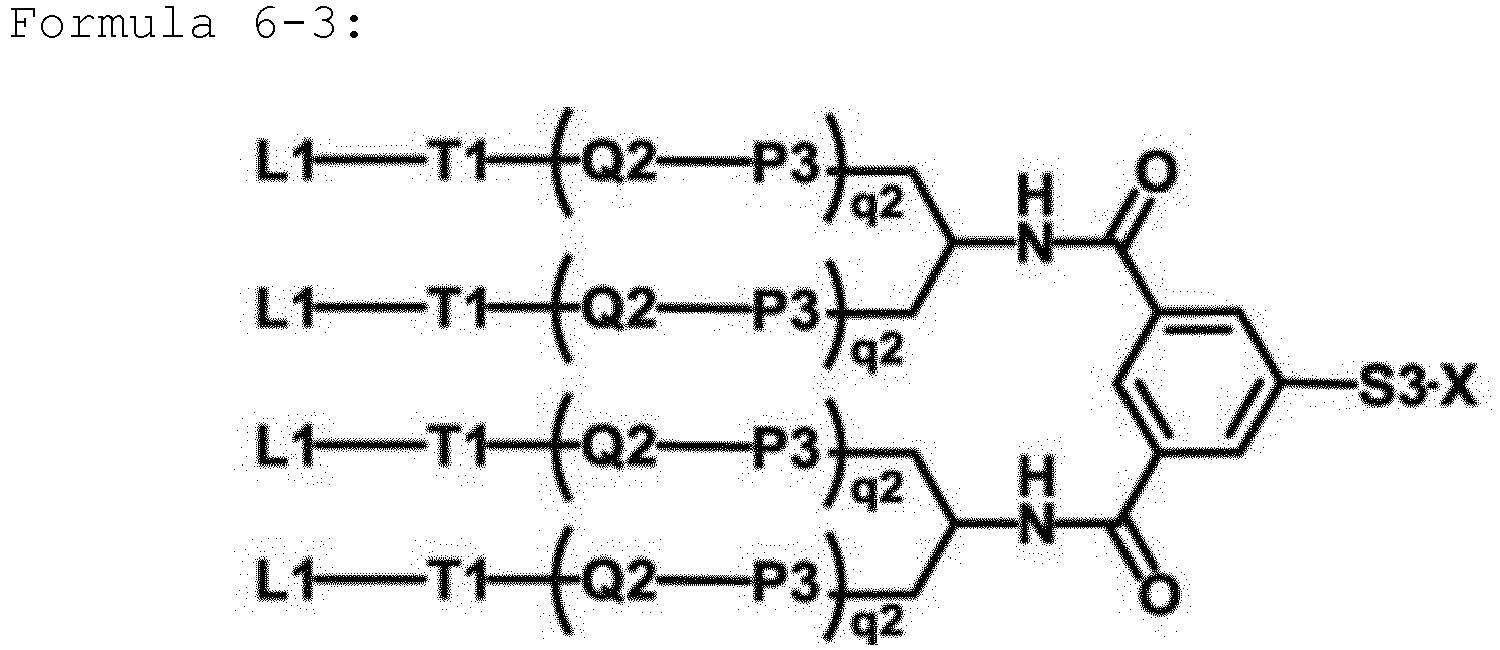


X, S3, P3, Q2, T1, and L1 are each as defined above. - In the present invention, the nucleic acid conjugate is preferably a nucleic acid conjugate having any structure represented by the following formulas 7-1 to 7-9:
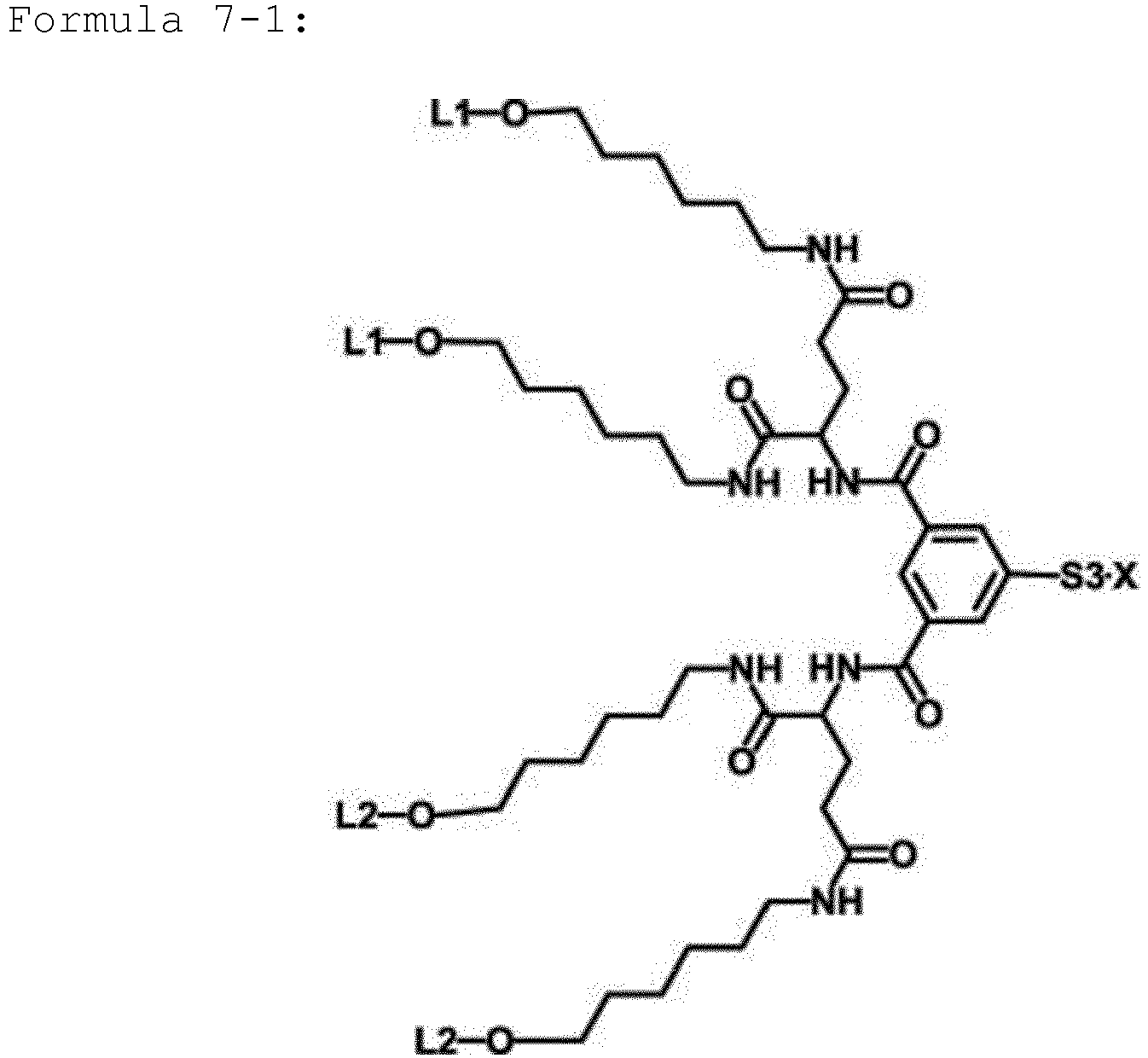
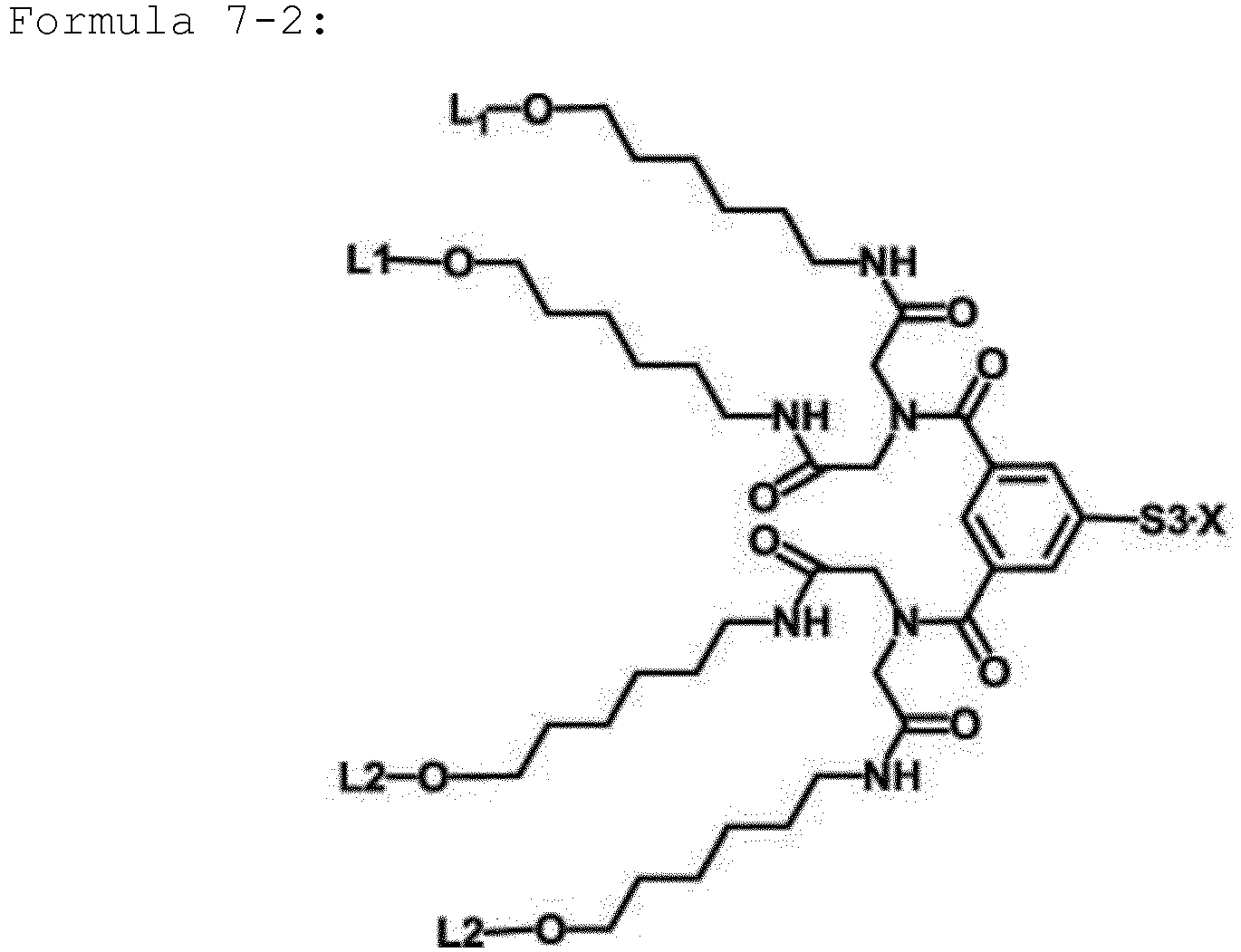




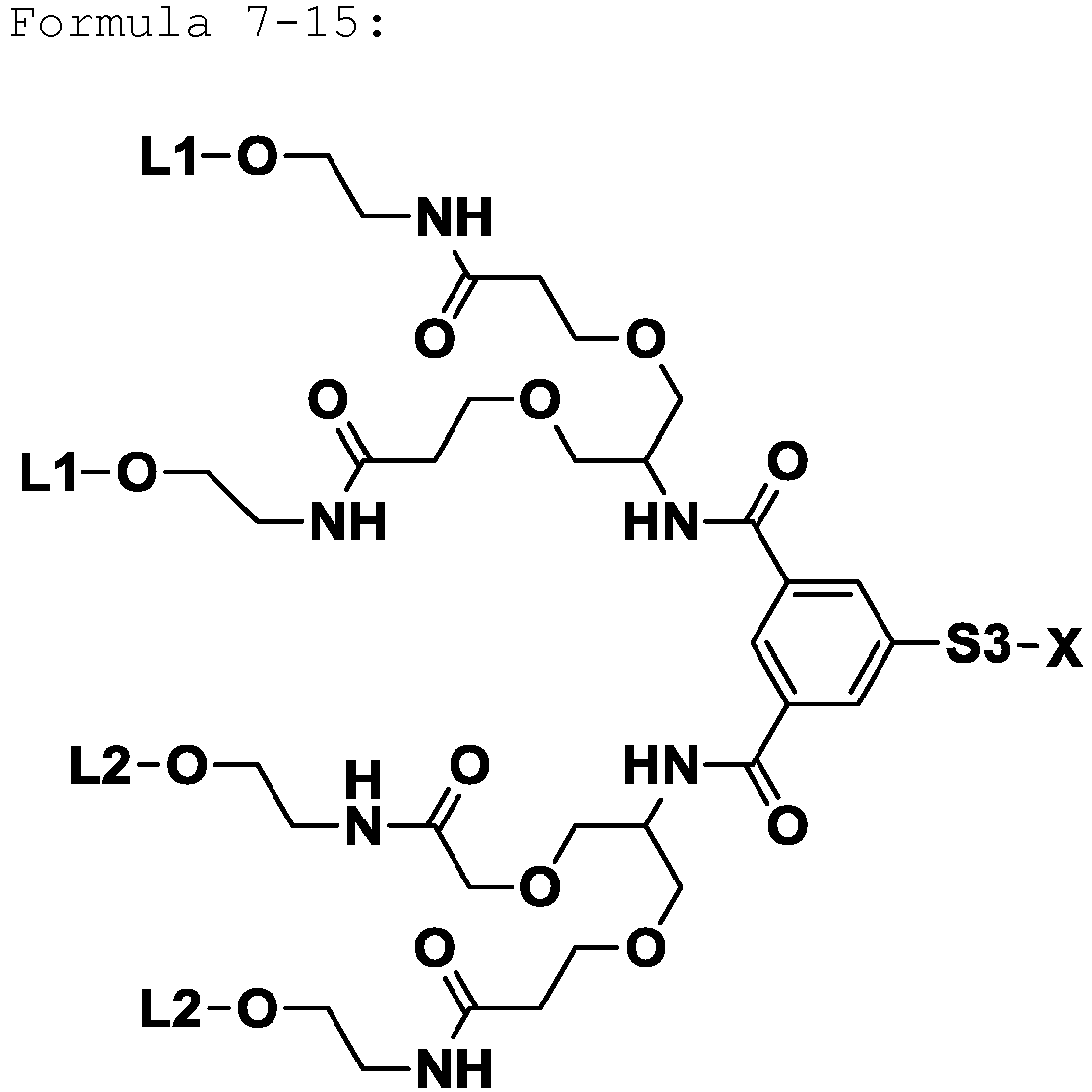

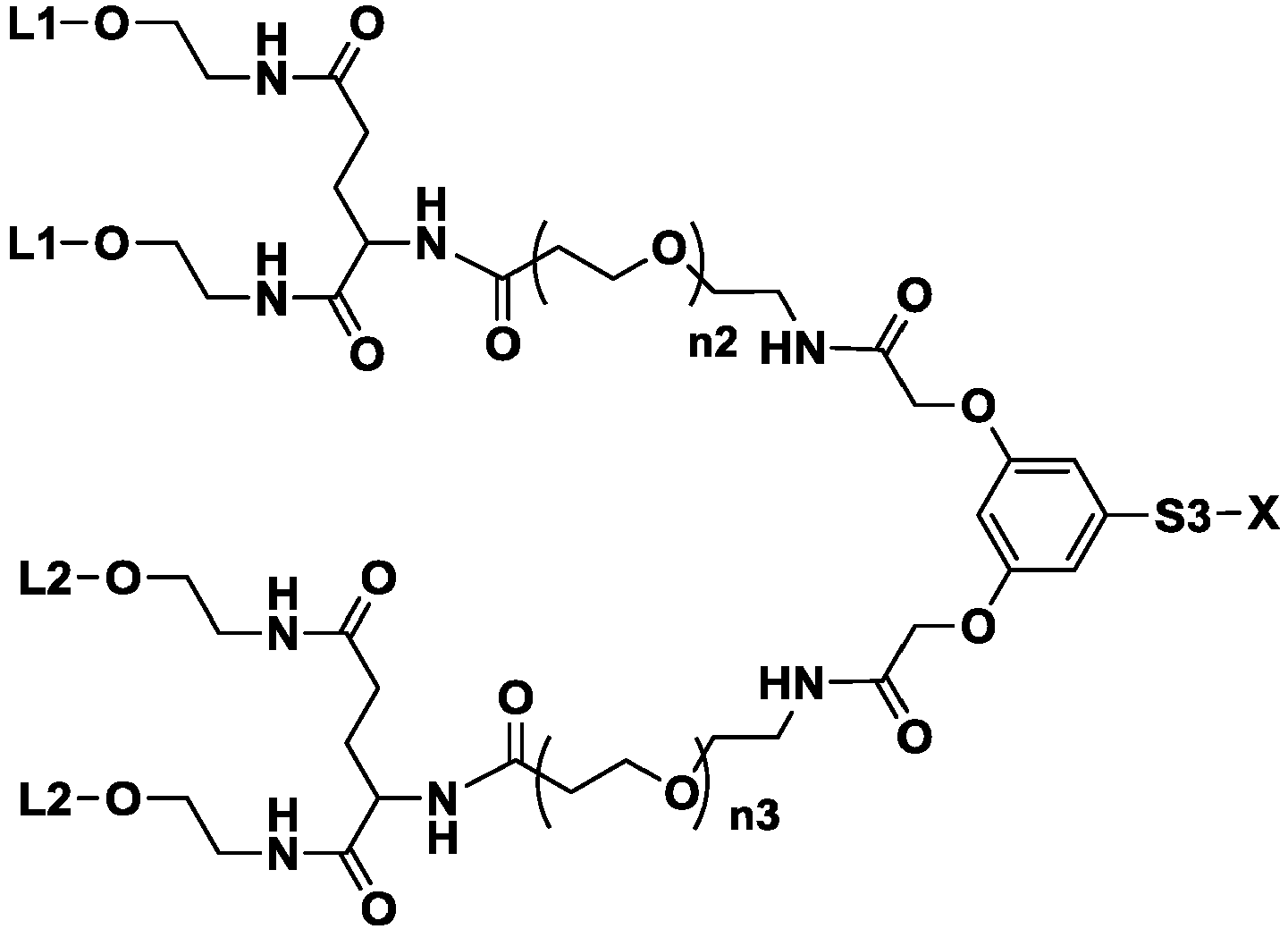


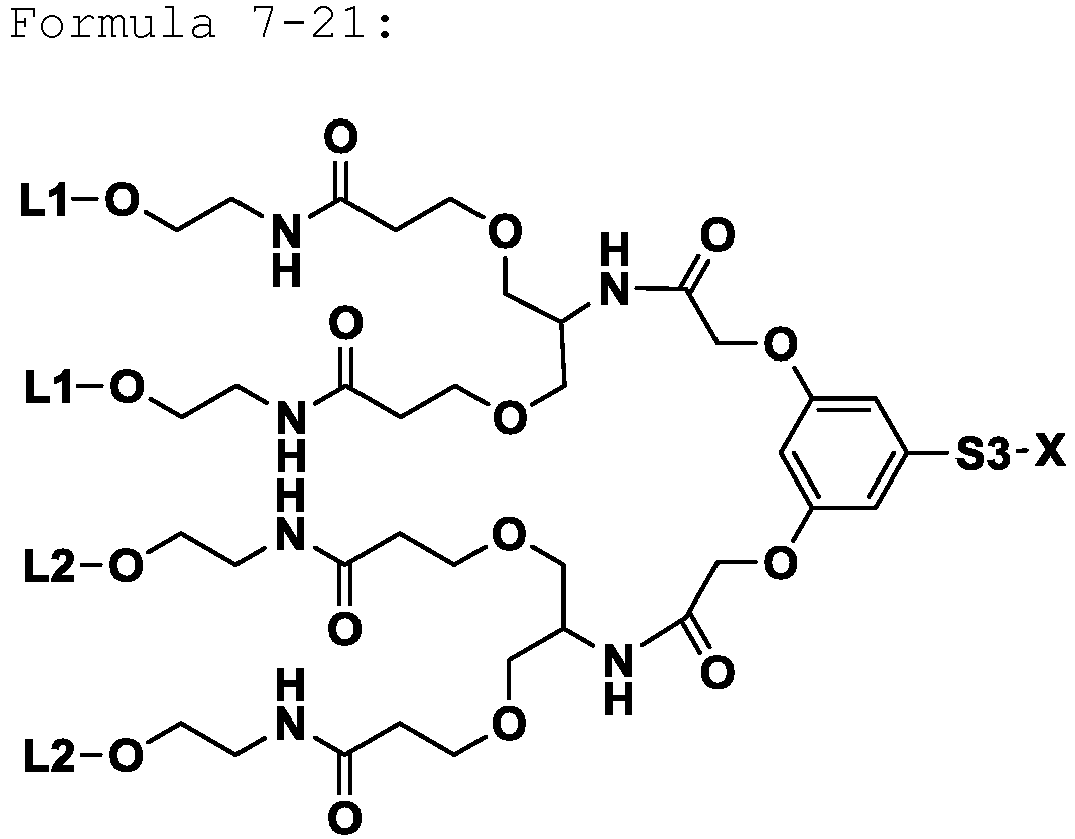
X, L1, L2, S3, n2 or n3 are each as defined above. L1 and L2 may be the same or may be different and is preferably the same. - A nucleic acid derivative other than the nucleic acid conjugate having any structure represented by formulas 7-1 to 7-9 can also be produced by introducing alkylene chains differing in chain length as each alkylene group moiety in formulas 7-1 to 7-9, or by replacing an amide bond or the like with another bond.
- As mentioned above, the linker used in the nucleic acid conjugate of the present invention preferably has the following structure:

- n1 is an integer of 1 to 100.
- n1 is preferably an integer of 5 to 95, more preferably an integer of 10 to 80, further preferably an integer of 15 to 60, still further preferably an integer of 20 to 40.
- n2 and n3 are the same as or different from each other and each are preferably an integer of 5 to 95, more preferably an integer of 10 to 80, further preferably an integer of 15 to 60, still further preferably an integer of 20 to 40.
- In the present invention, the nucleic acid conjugate is preferably a nucleic acid conjugate having a structure represented by the following formula 11:
Formula 11:
- L1, L2, S1 and S2 are each as defined above,
- P7 and P8 are each independently absent, or -CO-,-NH-, -O-, -S-, -O-CO-, -S-CO-, -NH-CO-, -CO-O-, -CO-S- or -CO-NH-,
- Q5, Q6 and Q7 are each independently absent, or substituted or unsubstituted alkylene having 1 to 12 carbon atoms or -(CH2CH2O)n8-CH2CH2- wherein n8 is an integer of 0 to 99,
- B3 is any structure represented by the following formula 11-1, wherein the broken lines respectively mean bonds to Q5 and Q6:


- q5 and q6 are each independently an integer of 0 to 10.
- P7 is absent, or -CO-, -NH-, -O-, -S-, -O-CO-, -S-CO-, -NH-CO-, -CO-O-, -CO-S- or -CO-NH- and is preferably -O-, -NH-CO- or -CONH-, more preferably -O- or -NH-CO-. When P7 is, for example, -O-, a substructure benzene ring-O- is present.
- P8 is absent, or -CO-, -NH-, -O-, -S-, -O-CO-, -S-CO-, -NH-CO-, -CO-O-, -CO-S- or -CO-NH-. When P8 is present, P8 is preferably -CO-O- or -CO-NH-, more preferably -CO-NH-. When P8 is, for example, -CO-NH-, a substructure Q6-CO-NH- is present.
- Q5, Q6 and Q7 are each independently absent, or substituted or unsubstituted alkylene having 1 to 12 carbon atoms or -(CH2CH2O)n8-CH2CH2- wherein n8 is an integer of 0 to 99, and are each preferably substituted or unsubstituted alkylene having 1 to 12 carbon atoms, more preferably unsubstituted alkylene having 1 to 12 carbon atoms, further preferably unsubstituted alkylene having 1 to 6 carbon atoms, still further preferably unsubstituted alkylene having 1 to 4 carbon atoms.
- Preferably, -(P7-Q5)q5- is -O-(CH2)m15-NH- or -NH-CO-(CH2)m16-NH-, and m15 and m16 are each independently an integer of 1 to 10.
- In the present invention, the nucleic acid conjugate is preferably a nucleic acid conjugate having any structure represented by the following formulas 12-1 to 12-12:



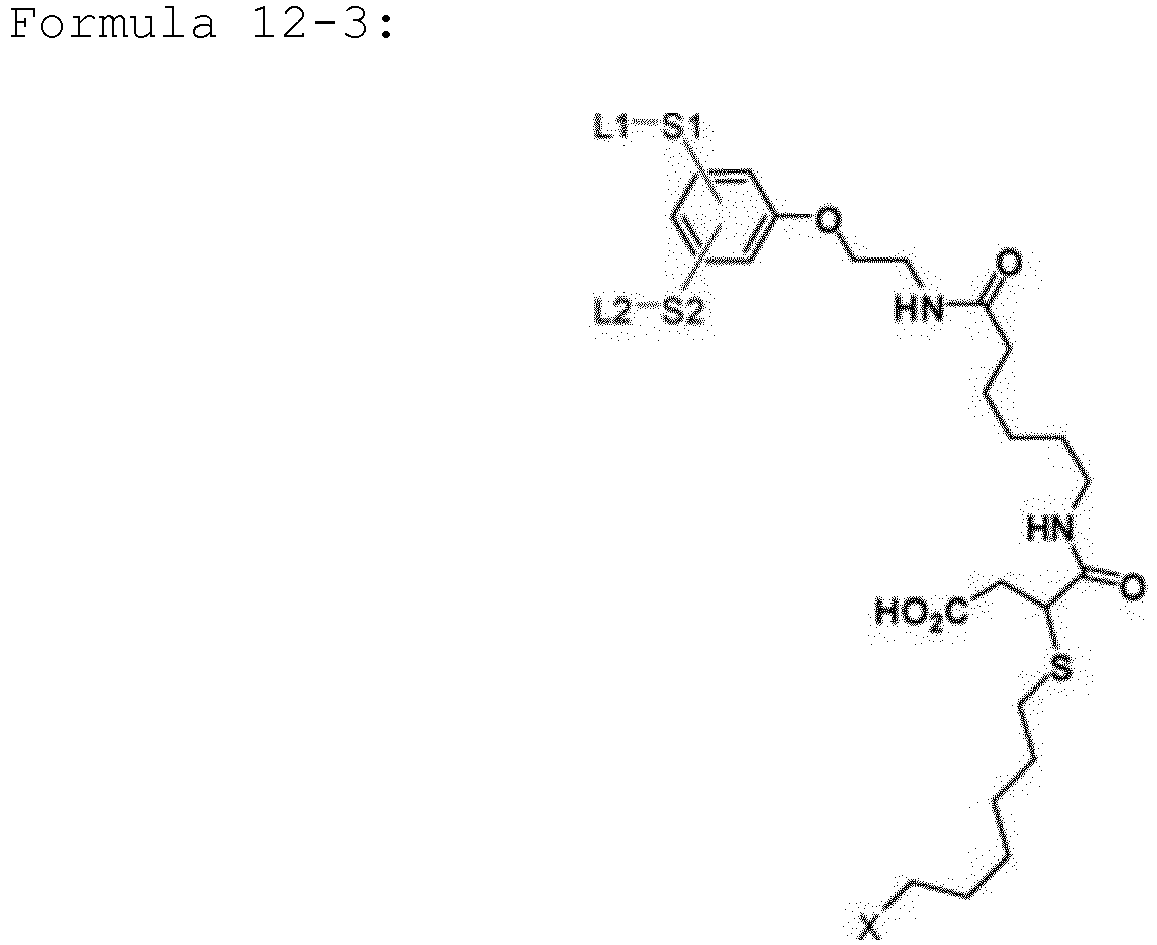



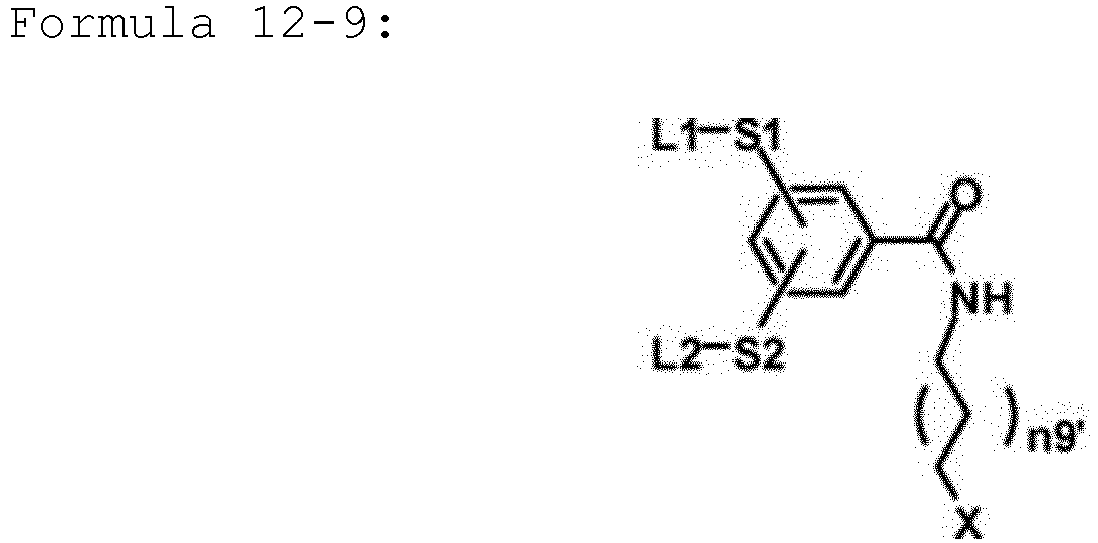


X, L1, L2, S1 and S2 are each as defined above, and n1' to n12' are each independently an integer of 1 to 10. - In another preferred aspect of the present invention, the nucleic acid conjugate has any of the following structures:

X, L1, S3 and n2 are each as defined above. - The nucleic acid conjugate of the present invention is preferably a nucleic acid conjugate having both the structures of
formula 2 and formula 11 as the nucleic acid conjugate represented byformula 1. The nucleic acid conjugate has the structure of formula 11, andformula 2 may be any of formulas 4-1 to 4-9, may be any of formulas 6-1 to 6-9, or may be any of formulas 7-1 to 7-9. Whenformula 2 is any of formulas 4-1 to 4-9, formulas 6-1 to 6-9, or formulas 7-1 to 7-9, formula 11 may be any of formulas 12-1 to 12-12. The nucleic acid conjugate of the present invention is more preferably a nucleic acid conjugate having both of any one structure of formulas 4-1 to 4-9 and any one structure of formulas 12-1 to 12-12, a nucleic acid conjugate having both of any one structure of formulas 6-1 to 6-9 and any one structure of formulas 12-1 to 12-12, or a nucleic acid conjugate having both of any one structure of formulas 7-1 to 7-9 and any one structure of formulas 12-1 to 12-12, as the nucleic acid conjugate represented byformula 1. - In the present specification, the sugar chain ligand represented by "Ligand", "L1", etc. may include a portion (e.g., -O-(CH2)2-) of the linker bonded directly to the sugar chain ligand.
- The nucleic acid conjugate of the present invention may form a salt with a pharmaceutically acceptable anion when hydrogen ions are coordinated to a lone pair of electrons on any nitrogen atom.
- In the present invention, examples of the pharmaceutically acceptable anion include: inorganic ions such as chloride ions, bromide ions, nitrate ions, sulfate ions, and phosphate ions; and organic acid ions such as acetate ions, oxalate ions, maleate ions, fumarate ions, citrate ions, benzoate ions, and methanesulfonate ions.
- A method for producing the nucleic acid conjugate of the present invention will be described. In the production methods given below, if defined groups react under conditions of the production methods or are unsuitable for carrying out the production methods, the compounds of interest can be produced by use of methods for introducing and removing protective groups commonly used in organic synthetic chemistry [e.g., methods described in Protective Groups in Organic Synthesis, third edition, T.W. Greene, John Wiley & Sons Inc. (1999)] or the like. If necessary, the order of reaction steps including substituent introduction and the like may be changed.
- The nucleic acid polymer represented by
formula 1 can also be synthesized by solid-phase synthesis. - The nucleic acid polymer represented by
formula 1 can be synthesized with reference to a method for synthesizing a linker structure known in the art for nucleic acid conjugates. - The synthesis of a L1-benzene ring unit having linker S1 or a L2-benzene ring unit having linker S2 in the nucleic acid conjugate represented by
formula 1 will be described by taking the nucleic acid conjugate represented byformula 2 as an example. - The L1-benzene ring unit and the L2-benzene ring unit in the nucleic acid conjugate represented by
formula 2 has linkages by P1, P2, P3, P4, P5, and P6, and T1 and T2. - The -CO-, -NH-, -O-, -S-, -O-CO-, -S-CO-, -NH-CO-, - CO-O-, -CO-S- or -CO-NH- bond represented by P1, P2, P3, P4, P5, and P6, and T1 and T2 can be appropriately synthesized by selecting a starting material suitable for forming the structure represented by
formula 2 with reference to methods for binding reaction described in, for example, The Fourth Series of Experimental Chemistry 19, "Synthesis of Organic Compound I", Maruzen Co., Ltd. (1992) and The Fourth Series of Experimental Chemistry 20, "Synthesis of Organic Compound II", Maruzen Co., Ltd. (1992). - A substructure of the L1-benzene ring unit can be produced by sequentially bonding a compound having Q1 as a substructure and a compound having B1 as a substructure to the benzene ring.
- The L1-benzene ring unit structure can be produced by separately synthesizing a compound having L1 and Q2 as a substructure, and bonding the compound having L1 and Q2 as a substructure to a compound having a substructure of a L1-benzene ring unit having the benzene ring, Q1 and B1 as a substructure.
- Likewise, a substructure of the L2-benzene ring unit can be produced by sequentially bonding a compound having Q3 as a substructure and a compound having B2 as a substructure to the benzene ring.
- The L2-benzene ring unit structure can be produced by separately synthesizing a compound having L2 and Q4 as a substructure, and bonding the compound having L2 and Q4 as a substructure to a compound having a substructure of a L2-benzene ring unit having the benzene ring, Q3 and B2 as a substructure.
- Examples of the compound having Q1 as a substructure and the compound having Q3 as a substructure include compounds having a hydroxy group, a carboxyl group, an amino group, and/or a thiol group at both ends of alkylene having 1 to 10 carbon atoms or -(CH2CH2O)n-CH2CH2-.
- Examples of the compound having B1 as a substructure and the compound having B2 as a substructure include compounds having any structure represented by the following formula 2-1 and having a hydroxy group, a carboxyl group, an amino group, or a thiol group at each of the terminal dots in each structure:


- Specific examples of the compound having B1 as a substructure and the compound having B2 as a substructure include glycol, glutamic acid, aspartic acid, lysine, Tris, iminodiacetic acid, and 2-amino-1,3-propanediol. Glutamic acid, aspartic acid, lysine, or iminodiacetic acid are preferred.
- The L1-benzene ring unit structure may be produced by synthesizing a compound having L1, Q2 and B1 as a substructure and then bonding this compound to a compound having Q1 and the benzene ring.
- The L2-benzene ring unit structure may be produced by synthesizing a compound having L2, Q4 and B2 as a substructure and then bonding this compound to a compound having Q3 and the benzene ring.
- In the present invention, the substructure [L1-T1-(Q2-P3)q2-]p1-B1-(P2-Q1)q1-P1- and the substructure [L2-T2-(Q3-P6)q4-]p2-B2-(P5-Q3)q3-P2- may be the same or different and are preferably the same.
- Examples of the unit corresponding to L1-T1-Q2 in the sugar chain ligand include L3-T1-Q2-COOH and L3-T1-(Q2-P3)q2-1-Q2-NH2. Specific examples thereof include L3-O-alkylene having 1 to 12 carbon atoms-COOH and L3-alkylene having 1 to 12 carbon atoms-CO-NH-alkylene having 2 to 12 carbon atoms-NH2.
- L3 is not particularly limited as long as L3 is a sugar chain ligand derivative that is converted to L1 by deprotection. The substituent on the sugar chain ligand is not particularly limited as long as the substituent is routinely used in the field of carbohydrate chemistry. An Ac group is preferred.
- Specifically, the L1-benzene ring unit having linker S1 or the L2-benzene ring unit having linker S2 can be synthesized by appropriately increasing or decreasing the number of carbon atoms of an alkylene chain, and using a compound with a terminal amino group or a terminal carboxyl group converted to a group capable of forming a -CO-, -NH-, -O-, -S-, -O-CO-, -S-CO-, -NH-CO-, -CO-O-, - CO-S- or -CO-NH- bond, with reference to a method described in Examples. Mannose derivatives, mannose or N-acetylgalactosamine is taken as an example of sugar chain ligand L1 in Examples. However, sugar ligand L1 may be changed to other sugar chain ligands for the practice.
- The synthesis of an X-benzene ring unit having linker S3 in the nucleic acid conjugate represented by
formula 1 will be described by taking the nucleic acid conjugate represented by formula 11 as an example. - The X-benzene ring unit in the nucleic acid conjugate represented by formula 11 has bonds represented by P7 and P8 in addition to the bond of the oligonucleotide.
- The -CO-, -NH-, -O-, -S-, -O-CO-, -S-CO-, -NH-CO-,-CO-O-, -CO-S- or -CO-NH- bond represented by P7 and P8 can be appropriately synthesized by selecting a starting material suitable for forming the structure represented by formula 11 with reference to methods for binding reaction described in, for example, The Fourth Series of Experimental Chemistry 19, "Synthesis of Organic Compound I", Maruzen Co., Ltd. (1992) and The Fourth Series of Experimental Chemistry 20, "Synthesis of Organic Compound II", Maruzen Co., Ltd. (1992).
- A substructure of the X-benzene ring unit can be produced by sequentially bonding a compound having Q5 as a substructure and a compound having B3 as a substructure to the benzene ring.
- The X-benzene ring unit structure can be produced by separately synthesizing a compound having X and Q7 as a substructure or a compound having X and Q6 as a substructure, and bonding the compound having X and Q7 as a substructure or the compound having X and Q6 as a substructure to a compound having a substructure of a X-benzene ring unit having the benzene ring and Q5 as a substructure to construct the B3 moiety.
- Specifically, the case of having an azide group at the end of the compound having a substructure of an X-benzene ring unit having the benzene ring and Q5 as a substructure will be taken as an example. The X-benzene ring unit structure can be produced by reacting an oligonucleotide allowed to have a terminal binding functional group as disclosed in Examples so that a triazole ring is formed by cycloaddition to construct the B3 moiety.
- Examples of the compound having Q5 as a substructure, the compound having Q6 as a substructure, and the compound having Q7 as a substructure include compounds having a hydroxy group, a carboxyl group, an amino group, and/or a thiol group at both ends of alkylene having 1 to 10 carbon atoms or -(CH2CH2O)n8-CH2CH2-.
- The L1-benzene ring unit structure, the L2-benzene ring unit structure, and the X-benzene ring unit structure can be sequentially produced. It is preferred to synthesize the L1-benzene ring unit structure and the L2-benzene ring unit structure and then bond the X-benzene ring unit structure thereto. Particularly, it is preferred to introduce X having the oligonucleotide moiety into the compound near the final step of sugar chain ligand conjugate synthesis.
- A L1-benzene ring unit structure and a L2-benzene ring unit structure in which each of P1 and P4 in formula 1-1 is -NH-CO-, -O-CO- or -S-CO- can be produced by the following method.


- Compound (I-C) can be produced by adding polymer-supported triphenylphosphine to compound (I-A) with compound (I-B) in a solvent such as tetrahydrofuran, and reacting the mixture with a solution of diisopropyl azodicarboxylate in toluene under ice cooling.
- Examples of the solvent include methanol, ethanol, dichloromethane, chloroform, 1,2-dichloroethane, toluene, ethyl acetate, acetonitrile, diethyl ether, tetrahydrofuran, 1,2-dimethoxyethane, dioxane, N,N-dimethylformamide (DMF), N,N-dimethylacetamide, N-methylpyrrolidone, pyridine, and water. These solvents may be used alone or as a mixture.
- Compound (I-A) can be obtained as a commercially available product.
- Compound (I-D) can be produced by reacting compound (I-C) under ice cooling in the presence of a base in a solvent such as methanol.
- Examples of the solvent include those listed in
step 1 ofproduction method 1. - Examples of the base include cesium carbonate, potassium carbonate, potassium hydroxide, sodium hydroxide, sodium methoxide, potassium tert-butoxide, triethylamine, diisopropylethylamine, N-methylmorpholine, pyridine, 1,8-diazabicyclo[5.4.0]-7-undecene (DBU), and N,N-dimethyl-4-aminopyridine (DMAP).
- Compound (1-F) can be produced by reacting compound (I-D) with compound (I-E) at a temperature between room temperature and 200°C for 5 minutes to 100 hours in the presence of 1 to 30 equivalents of a base, a condensing agent and, if necessary, 0.01 to 30 equivalents of an additive without a solvent or in a solvent.
- Examples of the solvent include dichloromethane, chloroform, 1,2-dichloroethane, toluene, ethyl acetate, acetonitrile, diethyl ether, tetrahydrofuran, 1,2-dimethoxyethane, dioxane, N,N-dimethylformamide (DMF), N,N-dimethylacetamide, N-methylpyrrolidone, and pyridine. These solvents may be used alone or as a mixture.
- Examples of the base include those listed in
step 2 ofproduction method 1. - Examples of the condensing agent include 1,3-dicyclohexanecarbodiimide (DCC), 1-ethyl-3-(3-dimethylaminopropyl)carbodiimide hydrochloride (EDC), carbonyldiimidazole, benzotriazol-1-yloxytris(dimethylamino)phosphonium hexafluorophosphate, (benzotriazol-1-yloxy)tripyrrolidinophosphonium hexafluorophosphate, O-(7-azabenzotriazol-1-yl)-N,N,N',N'-tetramethyluronium hexafluorophosphate (HATU), O-(benzotriazol-l-yl)-N,N,N',N'-tetramethyluronium hexafluorophosphate (HBTU), and 2-chloro-1-methylpyridinium iodide.
- Examples of the additive include 1-hydroxybenzotriazole (HOBt) and 4-dimethylaminopyridine (DMAP).
- Compound (I-H) can be produced under the same conditions as in step 3 of
production method 1 using compound (I-F) and compound (I-G). - Compound (I-J) can be produced under the same conditions as in step 3 of
production method 1 using compound (I-H) and compound (I-I). - Compound (I-J) having q1 adjusted to the desired value can be produced by repetitively performing step DP and step 5.
- Compound (I-L) can be produced under the same conditions as in step 3 of
production method 1step 2 ofproduction method 1 using compound (I-J) and compound (I-K) . - Compound (I-N) can be produced under the same conditions as in step 3 of
production method 1 using compound (I-L) and compound (I-M). - Compound (I') can be produced under the same conditions as in step 3 of
production method 1 using compound (I-O), compound (I-P) and compound (I-Q). - Compound (I') having q3 adjusted to the desired value can be produced by repetitively performing step DP and step 8.
- A method commonly used in organic synthetic chemistry [e.g., a method described in Protective Groups in Organic Synthesis, third edition, T.W. Greene, John Wiley & Sons Inc. (1999)] can be appropriately used in production.
- Compound (I-B), compound (I-E), compound (I-G), compound (I-I), compound (I-K), compound (I-M), compound (I-O), compound (I-P) and compound (I-Q) can be obtained as commercially available products, or by methods described in "The Fourth Series of Experimental Chemistry, Organic Synthesis, p. 258, Maruzen Co., Ltd. (1992)" and "March's Advanced Organic Chemistry: Reactions, Mechanisms, and Structure, 7th Edition" in combination or methods equivalent thereto.
- A L1-benzene ring unit structure and a L2-benzene ring unit structure in which each of P1 and P4 in
formula 2 is -O-, and each of X2 to X4 is CH can be produced by the following method.
- Compound (II-C) can be produced by dissolving compound (II-A) and compound (II-B) in a solvent such as N,N'-dimethylformamide, adding a base such as potassium bicarbonate to the solution, and reacting the mixture at room temperature to 200°C for 5 minutes to 100 hours.
- Examples of the solvent include those listed in
step 2 ofproduction method 1. - Examples of the base include those listed in step 3 of
production method 1. - Compound (II-E) can be produced by dissolving compound (II-C) and compound (II-D) in a solvent such as N,N'-dimethylformamide, adding a base such as potassium bicarbonate to the solution, and reacting the mixture at room temperature to 200°C for 5 minutes to 100 hours.
- Examples of the solvent include those listed in
step 2 ofproduction method 1. - Examples of the base include those listed in step 3 of
production method 1. - Compound (II-A) can be obtained as a commercially available product.
- Compound (II-G) can be produced under the same conditions as in step 3 of
production method 1 using compound (II-E) and compound (II-F). - Compound (II-I) can be produced under the same conditions as in step 3 of
production method 1 using compound (II-G) and compound (II-H). - Compound (II-I) having q1 adjusted to the desired value can be produced by repetitively performing step DP and step 16.
- Compound (II-K) can be produced under the same conditions as in
step 2 ofproduction method 1 using compound (II-I) and compound (II-J). - Compound (II-M) can be produced under the same conditions as in step 3 of
production method 1 using compound (II-K) and compound (II-L). - Compound (II') can be produced under the same conditions as in step 3 of
production method 1 using compound (II-M), compound (II-N), compound (II-O) and compound (II-P). - Compound (II') having q3 adjusted to the desired value can be produced by repetitively performing step DP and step 19.
- A method commonly used in organic synthetic chemistry [e.g., a method described in Protective Groups in Organic Synthesis, third edition, T.W. Greene, John Wiley & Sons Inc. (1999)] can be appropriately used in production.
- Compound (II-B), compound (II-D), compound (II-F), compound (II-H), compound (II-J), compound (II-L), compound (II-N), compound (II-O) and compound (II-P) can be obtained as commercially available products, or by methods described in "The Fourth Series of Experimental Chemistry, Organic Synthesis, p. 258, Maruzen Co., Ltd. (1992)" and "March's Advanced Organic Chemistry: Reactions, Mechanisms, and Structure, 7th Edition" in combination or methods equivalent thereto.
- In the present invention, a compound represented by the following
formula 6 is obtained as an intermediate.
- Y9 and Y10 may be groups represented by P1 and P4 and each are preferably an oxygen atom or -NH-,
- R17 and R18 are each independently a hydrogen atom, a maleimide group, a substituted or unsubstituted alkyl group having 1 to 20 carbon atoms, a t-butoxycarbonyl group (Boc group), a benzyloxycarbonyl group (Z group), a 9-fluorenylmethyloxycarbonyl group (Fmoc group), -[Q8-P9]q7-R19, or -[Q9-P10]q8-B4-[(P11-Q10)q7]p3-T3-L3,
- P9 to P11 and T3 are each independently absent, or-CO-, -NH-, -O-, -S-, -O-CO-, -S-CO-, -NH-CO-, -CO-O-,-CO-S- or -CO-NH-,
- each of Q8 to Q10 is absent, or substituted or unsubstituted alkylene having 2 to 12 carbon atoms, - CH2CH2-(OCH2CH2O)n- or -CH2CH2-(CH2CH2O)n-CH2CH2-, n is an integer of 0 to 99,
- R19 is a hydrogen atom, a maleimide group, a substituted or unsubstituted alkyl group having 1 to 20 carbon atoms, a t-butoxycarbonyl group (Boc group), a benzyloxycarbonyl group (Z group), or a 9-fluorenylmethyloxycarbonyl group (Fmoc group),
- B4 is a bond or a carbon skeleton structure selected from the group consisting of the following formulas, wherein each of the terminal dots in each carbon skeleton structure is a binding site to a carbonyl group or P9, and m1 and m2 are each independently an integer of 0 to 10:

- p3 is an integer of 1, 2 or 3,
- q7 is an integer of 0 to 10, and
- L3 is an optionally protected sugar chain ligand.
- In the present invention, the nucleic acid conjugate of the present invention can be produced by reacting a compound of
formula 6 having a sugar chain ligand with a compound of formula 7.
- The nucleic acid conjugate described in the present specification may be obtained as a salt, for example, an acid-addition salt, a metal salt, an ammonium salt, an organic amine-addition salt, or an amino acid-addition salt.
- Examples of the acid-addition salt include: inorganic acid salts such as hydrochloride, sulfate, and phosphate; and organic acid salts such as acetate, maleate, fumarate, citrate, and methanesulfonate. Examples of the metal salt include: alkali metal salts such as sodium salt and potassium salt; alkaline earth metal salts such as magnesium salt and calcium salt; and aluminum salt and zinc salt. Examples of the ammonium salt include salts of ammonium, tetramethylammonium, and the like. Examples of the organic amine-addition salt include addition salts of morpholine, piperidine, and the like. Examples of the amino acid-addition salt include addition salts of lysine, glycine, phenylalanine, and the like.
- In the case of preparing the salt of the nucleic acid conjugate described in the present specification, the conjugate obtained in the form of the desired salt can be purified directly, or the conjugate obtained in a free form can be dissolved or suspended in an appropriate solvent, and a corresponding acid or base is added to the solution or the suspension, followed by isolation or purification. In order to convert counter ions forming the conjugate salt to different counter ions, the conjugate salt can be dissolved or suspended in an appropriate solvent, and then, several equivalents to a large excess of an acid, a base and/or a salt (e.g., an inorganic salt such as sodium chloride or ammonium chloride) is added to the solution or the suspension, followed by isolation or purification.
- Some nucleic acid conjugates described in the present specification may have stereoisomers such as geometric isomers and optical isomers, tautomers, or the like. All possible isomers and mixtures thereof are also encompassed in the present invention.
- The nucleic acid conjugate described in the present specification may be present in the form of an adduct with water or various solvents. These adducts are also encompassed in the present invention.
- The nucleic acid conjugate of the present invention further encompasses molecules in which a portion or the whole of the atoms is substituted with an atom having an atomic mass number different therefrom (isotope) (e.g., a deuterium atom).
- Specific examples of the nucleic acid conjugate of the present invention will be shown. However, the nucleic acid conjugate of the present invention is not limited thereto. In the drawings, each band-like structure represents an oligonucleotide.


- The pharmaceutical composition of the present invention comprises the nucleic acid conjugate. The nucleic acid conjugate of the present invention, owing to having O-bonded mannose at the non-reducing end of the sugar chain ligand, is recognized by a target cell and transferred into the cell.
- The nucleic acid conjugate of the present invention can be used in the treatment of diseases related to a target gene by inhibiting (reducing or silencing) the expression of the target gene in vivo when administered to a mammal.
- In the case of using the nucleic acid conjugate of the present invention as a therapeutic agent or a prophylactic agent, the administration route is not particularly limited, and an administration route most effective for treatment is desirably used. Examples thereof include intravenous administration, subcutaneous administration and intramuscular administration. Intravenous administration is preferred.
- The dose differs depending on the pathological condition or age of the recipient, the administration route, etc. The dose can be, for example, a daily dose of 0.1 µg to 1000 mg, more preferably 1 to 100 mg, in terms of the amount of the double-stranded oligonucleotide.
- Examples of the preparation appropriate for intravenous administration or intramuscular administration include injections. A prepared liquid formulation may be used directly in the form of, for example, an injection. Alternatively, the liquid formulation may be used after removal of the solvent by, for example, filtration or centrifugation, or the liquid formulation may be used after being freeze-dried and/or may be used after being supplemented with, for example, an excipient such as mannitol, lactose, trehalose, maltose, or glycine and then freeze-dried.
- In the case of an injection, the liquid formulation or the solvent-free or freeze-dried composition is preferably mixed with, for example, water, an acid, an alkali, various buffer solutions, physiological saline, or an amino acid transfusion, to prepare the injection. Alternatively, the injection may be prepared by the addition of, for example, an antioxidant such as citric acid, ascorbic acid, cysteine, or EDTA or a tonicity agent such as glycerin, glucose or sodium chloride. Also, the injection can also be cryopreserved by the addition of a cryopreserving agent such as glycerin.
- Next, the present invention will be specifically described with reference to Examples and Test Examples. However, the present invention is not limited by these Examples and Test Examples. Proton nuclear magnetic resonance spectra (1H NMR) shown in Examples were measured at 270 MHz, 300 MHz or 400 MHz, and no exchangeable proton may be clearly observed depending on compounds and measurement conditions. Signal multiplicity is indicated as usually used, and br represents an apparently broad signal.
-

- Dimethyl 5-hydroxyisophthalate (
compound 1, manufactured by Wako Pure Chemical Industries, Ltd., 5.0443 g, 24 mmol) was dissolved in tetrahydrofuran (manufactured by Wako Pure Chemical Industries, Ltd., 25 mL). To the solution, 2-(tert-butoxycarbonylamino)-1-ethanol (manufactured by Tokyo Chemical Industry Co., Ltd., 4.0343 g, 25.03 mmol), and polymer-supported triphenylphosphine (manufactured by Aldrich Co. LLC, 6.61 g, 25.2 mmol) were added, then a 40% solution of diisopropyl azodicarboxylate (DIAD) in toluene (manufactured by Tokyo Chemical Industry Co., Ltd., 13.26 mL, 25.2 mmol) was added under ice cooling, and the mixture was stirred overnight at room temperature. The reaction solution was filtered, and the solvent in the filtrate was distilled off under reduced pressure. Then, the residue was purified by amino silica gel column chromatography (hexane/ethyl acetate = 95/5 to 80/20) to obtain compound 2 (5.3071 g, yield: 63%). ESI-MS m/z: 254 (M + H)+, detected as a Boc-deprotected form - Compound 2 (5.3071 g, 15.02 mmol) synthesized in
step 1 was dissolved in methanol (25 mL). To the solution, a 2 mol/L aqueous sodium hydroxide solution (manufactured by Wako Pure Chemical Industries, Ltd., 13 mL) was added under ice cooling, and the mixture was stirred at room temperature for 4 hours. The reaction solution was ice-cooled, and a 10% aqueous citric acid solution was added thereto, followed by extraction with ethyl acetate. Then, the organic layer was washed with saturated saline and dried over anhydrous magnesium sulfate. The solvent was distilled off under reduced pressure to quantitatively obtain compound 3.
ESI-MS m/z: 324 (M - H)- - Compound 3 (0.9372 g, 2.8809 mmol) synthesized in
step 2 and β-alanine methyl ester hydrochloride (manufactured by Tokyo Chemical Industry Co., Ltd., 0.8082 g, 5.7902 mmol) were dissolved in N,N'-dimethylformamide (10 mL). To the solution, diisopropylethylamine (2.52 mL, 14.40 mmol) and 2-(1H-benzotriazol-1-yl)-1,1,3,3-tetramethyluronium hexafluorophosphate (2.1908 g, 5.76 mmol) were added, and the mixture was stirred overnight at room temperature. The reaction solution was ice-cooled, and a 10% aqueous citric acid solution was added thereto, followed by extraction with chloroform. Then, the organic layer was washed with a saturated aqueous solution of sodium bicarbonate and saturated saline and dried over anhydrous magnesium sulfate. The solvent was distilled off under reduced pressure to quantitatively obtaincompound 4. ESI-MS m/z: 496 (M + H)+ - Compound 4 (0.9622 g, 1.9518 mmol) synthesized in step 3 was dissolved in dichloromethane (10 mL). To the solution, trifluoroacetic acid (2.5 mL, 32.4 mmol) was added under ice cooling, and the mixture was stirred at room temperature for 2 hours. The solvent in the reaction solution was distilled off under reduced pressure to quantitatively obtain compound 5.
ESI-MS m/z: 396 (M + H)+ - Compound 5 (0.1146 g, 0.290 mmol) synthesized in
step 4 and N- succinimidyl 15-azido-4,7,10,13-tetraoxapentadecanoic acid (N3-PEG4-NHS, manufactured by Tokyo Chemical Industry Co., Ltd., 0.0750 g, 0.1931 mmol) were dissolved in tetrahydrofuran (6 mL). To the solution, diisopropylethylamine (0.337 mL, 1.931 mmol) was added, and the mixture was stirred at room temperature for 2 hours. The solvent was distilled off under reduced pressure, and the residue was purified by silica gel column chromatography (chloroform/methanol) to quantitatively obtaincompound 6.
ESI-MS m/z: 669 (M + H)+ - Compound 7 was quantitatively obtained in the same way as in
step 2 using compound 6 (0.1291 g, 0.193 mmol) synthesized in step 5.
ESI-MS m/z: 641 (M + H)+
1H-NMR (DMSO-D6) δ: 2.35 (2H, t, J = 7.2 Hz), 2.51-2.54 (4H, m), 3.38-3.65 (24H, m), 4.07 (2H, t, J = 5.4 Hz), 7.51 (2H, br s), 7.89 (1H, br s), 8.13 (1H, dd, J = 5.3, 2.7 Hz), 8.63 (2H, t, J = 5.4 Hz) - Compound 8 (0.0521 g, yield: 24%) was obtained in the same way as in step 3 using compound 7 (0.1252 g, 0.193 mmol) synthesized in
step 6 and L-glutamic acid di-tert-butyl ester (manufactured by Watanabe Chemical Industries, Ltd., 0.1180 g, 0.399 mmol).
ESI-MS m/z: 1124 (M + H)+ - Compound 8 (0.0521 g, 0.0464 mmol) synthesized in step 7 was dissolved in dichloromethane (2 mL). To the solution, trifluoroacetic acid (0.2 mL, 32.4 mmol) was added under ice cooling, and the mixture was stirred overnight at room temperature. The solvent in the reaction solution was distilled off under reduced pressure to quantitatively obtain compound 9. ESI-MS m/z: 899 (M + H)+
1H -NMR (DMSO-D6) δ: 1.70-1.82 (2H, m), 1.90-2.02 (2H, m), 2.23-2.30 (4H, m), 2.35 (2H, t, J = 5.3 Hz), 2.44 (4H, t, J = 7.4 Hz), 3.38-3.65 (24H, m), 4.07 (2H, t, J = 5.3 Hz), 4.17-4.26 (2H, m), 7.51 (2H, d, J = 1.3 Hz), 7.89 (1H, br s), 8.13 (1H, dd, J = 10.0, 5.0 Hz), 8.21 (2H, d, J = 7.6 Hz), 8.57 (2H, t, J = 5.8 Hz) -
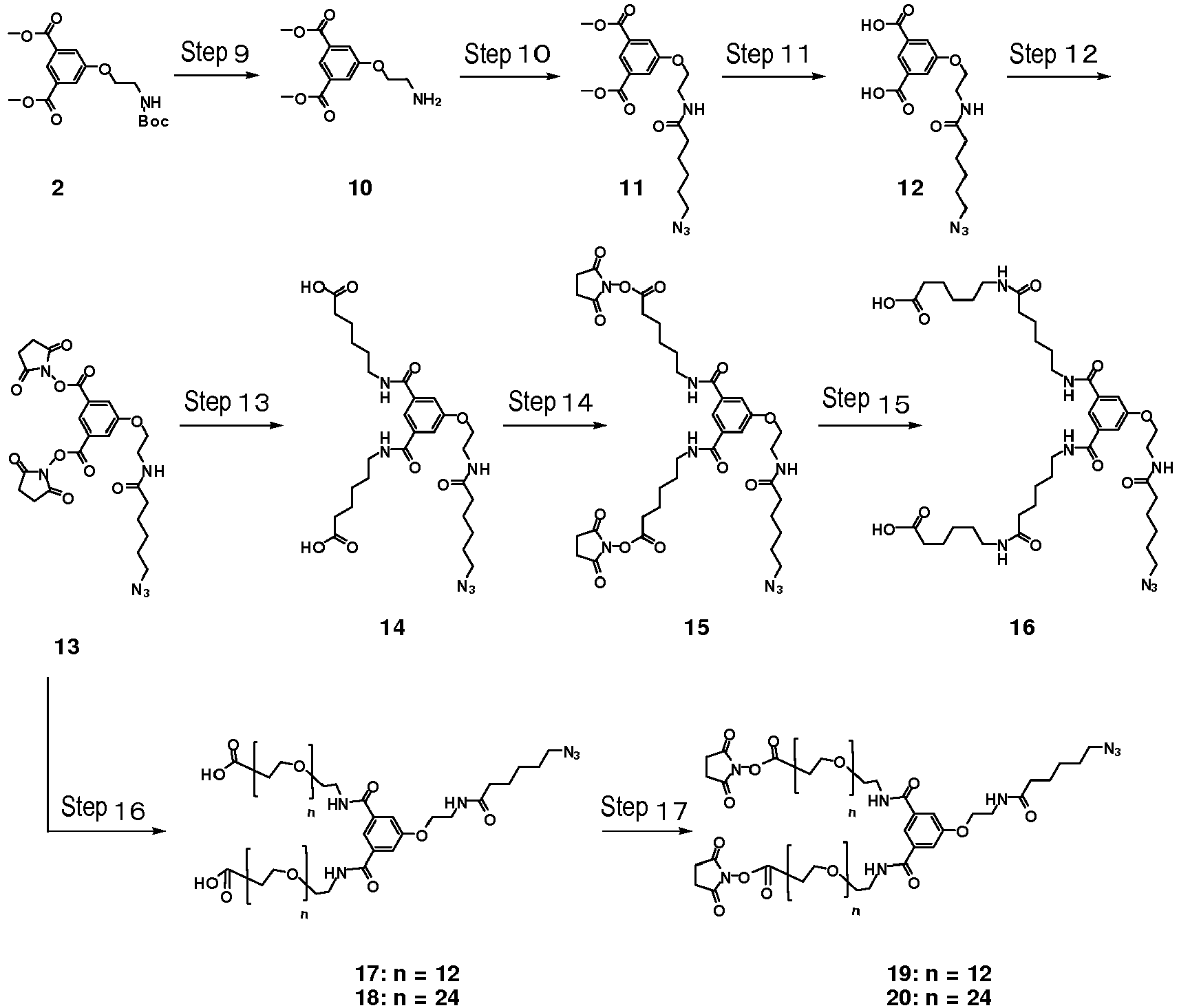
- Compound 10 was quantitatively obtained in the same way as in
step 4 of Example 1 using compound 2 (2.1 g, 5.940 mmol) synthesized instep 1 of Example 1. ESI-MS m/z: 254 (M + H)+
1H-NMR (DMSO-D6) δ: 3.26 (2H, t, J = 5.1 Hz), 3.90 (6H, s), 4.30 (2H, t, J = 5.1 Hz), 7.77 (2H, dd, J = 1.5, 0.8 Hz), 8.13 (1H, dd, J = 1.4, 0.7 Hz). - Compound 11 (0.248 g, yield: 38%) was obtained in the same way as in step 5 of Example 1 using compound 10 (0.427 g, 1.686 mmol) synthesized in step 9 and 6-azidohexanoic acid pyrrolidinyl ester (0.6 g, 2.360 mmol) synthesized by the method described in Organic & Biomolecular chemistry, Vol. 13, p. 1778?1791, 2015. ESI-MS m/z: 393 (M + H)+
1H-NMR (CDCl3) δ: 1.37-1.44 (2H, m), 1.64-1.69 (4H, m), 2.23 (2H, t, J = 7.5 Hz), 3.25 (2H, t, J = 6.8 Hz), 3.71 (2H, dd, J = 5.3, 2.7 Hz), 3.95 (6H, s), 4.13 (2H, t, J = 6.7 Hz), 7.75 (2H, dd, J = 1.5, 0.8 Hz), 8.30 (1H, dd, J = 1.4, 0.7 Hz). - Compound 12 was quantitatively obtained in the same way as in
step 2 of Example 1 using compound 11 (0.248 g, 0.632 mmol) synthesized in step 10.
ESI-MS m/z: 365 (M + H)+
1H-NMR (MeOD) δ: 1.37-1.41 (2H, m), 1.60-1.65 (4H, m), 2.25 (2H, t, J = 7.4 Hz), 3.25 (2H, t, J = 6.7 Hz), 3.63 (2H, t, J = 4.9 Hz), 4.18 (2H, t, J = 5.2 Hz), 7.79 (2H, dd, J = 1.6, 0.8 Hz), 8.27 (1H, dd, J = 1.4, 0.7 Hz). - Compound 12 (0.230 mg, 0.631 mmol) obtained in step 11 was dissolved in tetrahydrofuran (274.7 µL). To the solution, N-hydroxysuccinimide (0.174 g, 1.515 mmol) and 1-ethyl-3-(3-dimethylaminopropyl)carbodiimide hydrochloride (0.313 g, 1.515 mmol) were added, and the mixture was stirred overnight at room temperature in an argon atmosphere. The solvent was distilled off under reduced pressure, followed by extraction with chloroform. Then, the organic layer was washed with saturated saline and dried over anhydrous magnesium sulfate. The solvent was distilled off under reduced pressure to obtain a crude product of compound 13.
ESI-MS m/z: 559 (M + H)+ - Compound 13 (0.200 g, 0.358 mmol) synthesized in step 12, 6-aminohexanoic acid (manufactured by Nacalai Tesque, Inc., 0.141 g, 1.074 mmol) and diisopropylethylamine (0.139 mL, 1.074 mmol) were stirred overnight at room temperature in a phosphate buffer solution/dimethyl sulfoxide mixed solvent (v/v = 1/1, 50 mL). A 10% citric acid solution (50 mL) was added to the reaction solution, followed by extraction with chloroform. Then, the organic layer was washed with a saturated aqueous solution of sodium bicarbonate and saturated saline and dried over anhydrous magnesium sulfate. The solvent was distilled off under reduced pressure to obtain compound 14 (0.157 g, yield: 74%).
ESI-MS m/z: 591 (M + H)+ 1H-NMR (DMSO-D6) δ: 1.26-1.33 (8H, m), 1.51-1.53 (10H, m), 2.10 (2H, t, J = 7.2 Hz), 2.21 (4H, t, J = 7.4 Hz), 3.25 (8H, t, J = 6.5 Hz), 4.08 (2H, t, J = 5.4 Hz), 7.48-7.51 (2H, br m), 7.87-7.89 (1H, br m), 8.07-8.08 (1H, br m), 8.53-8.54 (2H, br m). - Compound 15 was quantitatively obtained in the same way as in step 12 using compound 14 (0.1442 g, 0.2441 mmol) synthesized in step 13.
ESI-MS m/z: 785 (M + H)+ - Compound 16 was quantitatively obtained in the same way as in step 13 using compound 15 (0.0958 g, 0.1221 mmol) synthesized in step 14.
ESI-MS m/z: 818 (M + H)+ - Compound 17 (0.0580 g, yield: 99%) was obtained in the same way as in step 13 using compound 13 (0.0209 g, 0.0375 mmol) synthesized in step 12 and carboxyl-(12 ethylene glycol) ethylamine (manufactured by Thermo Fisher Scientific Inc., 0.0674 g, 0.1091 mmol).
ESI-MS m/z: 1564 (M + H)+ - Compound 18 (0.0144 g, yield: 79%) was obtained in the same way as in step 13 using compound 13 (0.0047 g, 0.00654 mmol) synthesized in step 12 and carboxyl-(24 ethylene glycol) ethylamine (manufactured by Thermo Fisher Scientific Inc., 0.0225 g, 0.01963 mmol).
ESI-MS m/z: 2622 (M + H)+ - Compound 19 was quantitatively obtained in the same way as in step 12 using compound 17 (0.0580 g, 0.0375 mmol) synthesized in step 16.
ESI-MS m/z: 1759 (M + H)+
1H-NMR (DMSO-D6) δ: 1.22-1.25 (6H, m), 2.10 (2H, t, J = 7.5 Hz), 2.81 (8H, br s), 2.93 (4H, t, J = 6.1 Hz), 3.26-3.27 (6H, m), 3.43-3.45 (2H, m), 3.49-3.50 (92H, m), 3.71 (4H, t, J = 6.0 Hz), 4.07 (2H, t, J = 6.0 Hz), 7.53 (2H, dd, J = 1.5, 0.8 Hz), 7.93 (1H, dd, J = 1.5, 0.8 Hz), 8.05-8.07 (1H, br m), 8.59-8.61 (2H, br m). - Compound 20 was quantitatively obtained in the same way as in step 12 using compound 18 (0.0580 g, 0.0375 mmol) synthesized in step 16.
ESI-MS m/z: 2817 (M + H)+ -

-
- (a); Compound 13 (10 mg, 17.9 µmol) synthesized in step 12 of Example 2 was dissolved in a mixed solution of tetrahydrofuran (90 µL) and a phosphate buffer solution (90 µL). To the solution, carboxyl-(12 oligoethylene glycol) ethylamine (manufactured by Thermo Fisher Scientific Inc., 22.1 mg, 35.8 µmol) was added, and the mixture was stirred at room temperature for 1 hour in an argon atmosphere. The solvent was distilled off under reduced pressure, followed by extraction with chloroform and a 10% aqueous citric acid solution. Then, the organic layer was dried over anhydrous magnesium sulfate. The solvent was distilled off under reduced pressure to obtain a crude product of compound 17.
ESI-MS m/z: 1564 (M+H)+ - (b); Compound 13 (10 mg, 17.9 µmol) synthesized in step 12 of Example 2 was dissolved in a mixed solution of tetrahydrofuran (90 µL) and a phosphate buffer solution (90 µL). To the solution, carboxyl-(24 oligoethylene glycol) ethylamine (manufactured by Thermo Fisher Scientific Inc., 41 mg, 35.8 µmol) was added, and the mixture was stirred at room temperature for 1 hour in an argon atmosphere. The solvent was distilled off under reduced pressure, followed by extraction with chloroform and a 10% aqueous citric acid solution. Then, the organic layer was dried over anhydrous magnesium sulfate. The solvent was distilled off under reduced pressure to obtain a crude product of compound 18.
ESI-MS m/z: 2622 (M + H)+ -
- (a); Compound 17 (14 mg, 8.9 µmol) synthesized in step 18 was dissolved in tetrahydrofuran (90 µL). To the solution, L-glutamic acid di-tert-butyl ester (manufactured by Watanabe Chemical Industries, Ltd., 5.2 mg, 17.9 µmol), 2-(1H-benzotriazol-1-yl)-1,1,3,3-tetramethyluronium hexafluorophosphate (6.8 mg, 17.9 µmol), and diisopropylethylamine (3.1 µL, 17.9 µmol) were added, and the mixture was stirred overnight at room temperature in an argon atmosphere. The solvent was distilled off under reduced pressure, followed by extraction with chloroform. Then, the organic layer was washed with saturated saline and dried over anhydrous magnesium sulfate. Then, the residue was purified by reverse-phase high-performance liquid chromatography to obtain compound 21a (4.5 mg, yield: 25%).
ESI-MS m/z: 2046 (M + H)+
1H-NMR (CDCl3) δ: 1.44-1.46 (36H, m), 1.61-1.66 (4H, m), 1.89-1.91 (4H, m), 2.06-2.16 (2H, m), 2.20-2.37 (6H, m), 2.50 (4H, t, J = 6.0 Hz), 3.26 (2H, t, J = 6.8 Hz), 3.59-3.68 (98H, m), 3.71-3.76 (4H, m), 4.14 (2H, t, J = 5.2 Hz), 4.48-4.50 (2H, m), 7.59 (2H, dd, J = 1.3, 0.6 Hz), 7.92 (1H, br s). - (b); Compound 18 (23.4 mg, 8.9 µmol) synthesized in step 18 was dissolved in tetrahydrofuran (90 µL). To the solution, L-glutamic acid α,γ-di(t-butyl ester) hydrochloride (5.2 mg, 17.9 µmol), 2-(1H-benzotriazol-1-yl)-1,1,3,3-tetramethyluronium hexafluorophosphate (6.8 mg, 17.9 µmol), and diisopropylethylamine (3.1 µL, 17.9 µmol) were added, and the mixture was stirred overnight at room temperature in an argon atmosphere. The solvent was distilled off under reduced pressure, followed by extraction with chloroform. Then, the organic layer was washed with saturated saline and dried over anhydrous magnesium sulfate. Then, the residue was purified by reverse-phase high-performance liquid chromatography to obtain compound 21b (7.4 mg, yield: 27%).
ESI-MS m/z: 1553 (M - 2H)2-
1H-NMR (CDCl3) δ: 1.44 (18H, s), 1.46 (18H, s), 1.62-1.67 (4H, m), 1.86-1.89 (2H, m), 2.20-2.36 (10H, m), 2.51 (4H, t, J = 5.8 Hz), 3.26 (2H, t, J = 7.0 Hz), 3.63-3.65 (194H, m), 3.73-3.76 (4H, m), 4.14 (2H, t, J = 5.1 Hz), 4.46-4.50 (2H, m), 7.60 (2H, dd, J = 1.0, 0.5 Hz), 7.92 (1H, br s) -
- (a); Compound 22a was quantitatively obtained in the same way as in step 8 of Example 1 using compound 21a (4.5 mg, 2.1 µmol) synthesized in step 19.
ESI-MS m/z: 1822 (M + H)+ - (b); Compound 22b was quantitatively obtained in the same way as in step 8 of Example 1 using compound 21b (4.5 mg, 2.1 µmol) synthesized in step 19.
ESI-MS m/z: 2878 (M + H)+ -
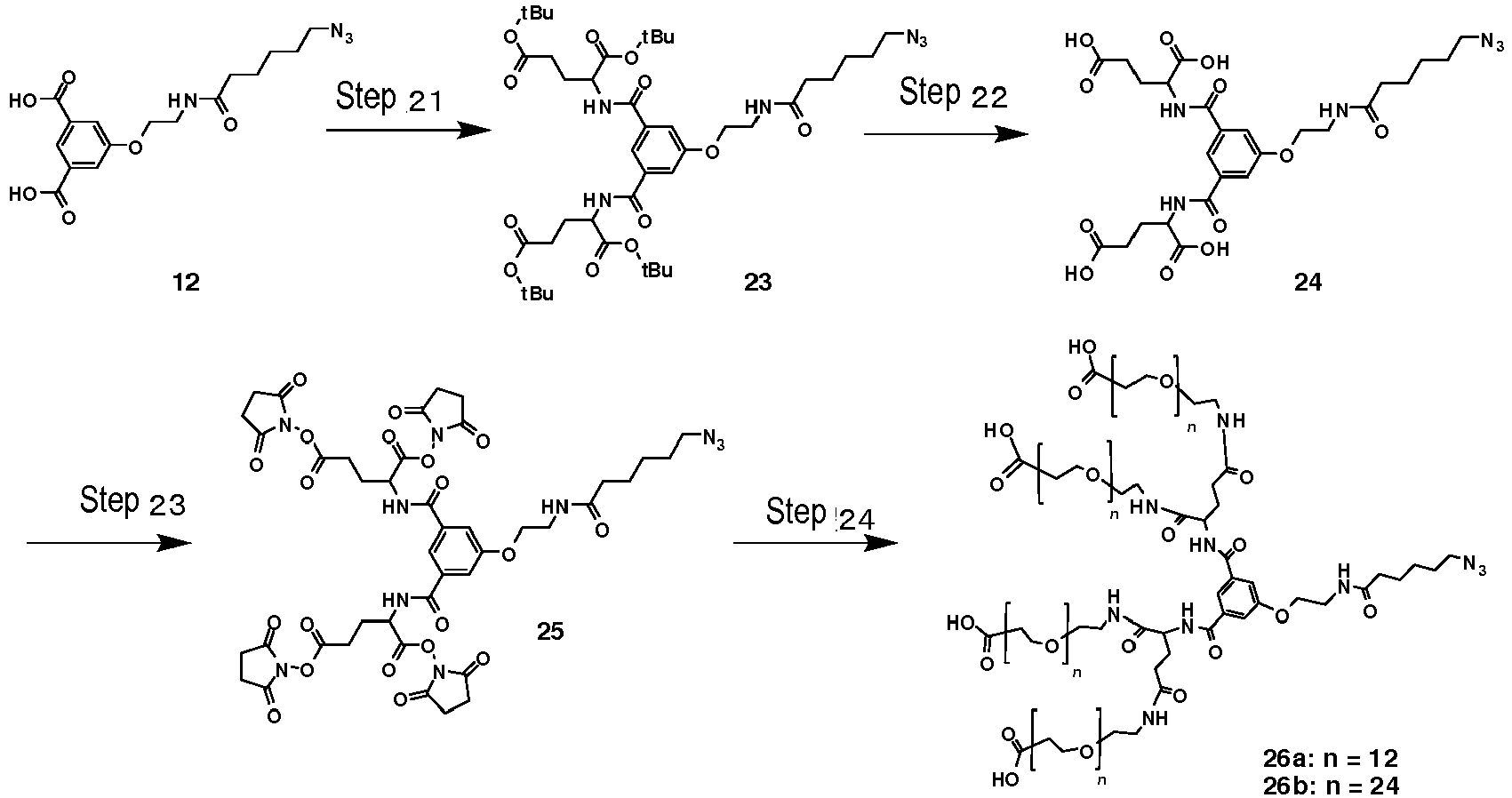
- Compound 12 (10 mg, 27.4 µmol) synthesized in step 11 of Example 2 was dissolved in tetrahydrofuran (274.7 µmol). To the solution, L-glutamic acid di-tert-butyl ester (manufactured by Watanabe Chemical Industries, Ltd., 32.5 mg, 109.8 µmol), 2-(1H-benzotriazol-1-yl)-1,1,3,3-tetramethyluronium hexafluorophosphate (41.7 mg, 109.8 µmol), and diisopropylethylamine (24.2 µL, 137.3 µmol) were added, and the mixture was stirred overnight at room temperature in an argon atmosphere. The solvent was distilled off under reduced pressure, followed by extraction with chloroform and a 10% aqueous citric acid solution. Then, the organic layer was dried over anhydrous magnesium sulfate. The solvent was distilled off under reduced pressure to obtain a crude product of compound 23.
ESI-MS m/z: 847 (M + H)+ - Compound 23 (139.4 mg, 164.6 µmol) synthesized in step 21 was dissolved in methylene chloride (1.3 mL) and trifluoroacetic acid (0.3 mL), and the solution was stirred overnight at room temperature. The solvent was distilled off under reduced pressure to quantitatively obtain compound 24.
ESI-MS m/z: 623 (M + H)+ - Compound 24 (100 mg, 160.7 µmol) synthesized in step 22 was dissolved in dimethylamine (1 mL). To the solution, N-hydroxysuccinimide (81.3 mg, 707 µmol) and 1-ethyl-3-(3-dimethylaminopropyl)carbodiimide hydrochloride (135.4 mg, 707 µmol) were added, and the mixture was stirred overnight at room temperature in an argon atmosphere to obtain a crude product of compound 25. ESI-MS m/z: 1011 (M + H)+
-
- (a); Compound 25 (16.2 mg, 16 µmol) synthesized in step 23 was dissolved in a phosphate buffer solution (95 µL). To the solution, carboxyl-(ethylene glycol) ethylamine (80.4 mg, 129.8 µmol) was added, and the mixture was stirred at room temperature for 1 hour in an argon atmosphere. The solvent was distilled off under reduced pressure, and the residue was purified by reverse-phase high-performance liquid chromatography to obtain compound 26a (6.2 mg, yield: 21%).
ESI-MS m/z: 1511 (M + 2H)2+ - (b); Compound 25 (16.2 mg, 16 µmol) synthesized in step 23 was dissolved in a phosphate buffer solution (95 µL). To the solution, carboxyl-(ethylene glycol) ethylamine (149.3 mg, 129.8 µmol) was added, and the mixture was stirred at room temperature for 1 hour in an argon atmosphere. The solvent was distilled off under reduced pressure, and the residue was purified by reverse-phase high-performance liquid chromatography to obtain compound 26b (5.5 mg, yield: 11%).
ESI-MS m/z: 2566 (M + 2H)2+ -

- Compound 7 (0.8 mg, 1.249 µmol) synthesized in
step 6 of Example 1, aminoethyl group-modified α(1,2)α(1,6) pseudomannotriose (3.0 mg, 5.0 µmol) synthesized by the method described in ACS Chemical Biology, Vol. 5, p. 301?312, 2010, 2-(1H-benzotriazol-1-yl)-1,1,3,3-tetramethyluronium hexafluorophosphate (3.8 mg, 10 µmol), and diisopropylethylamine (1.7 µL, 10 µmol) were dissolved in N,N-dimethylacetamide (1 mL), and the solution was left standing at room temperature for 2 days. The mixture was purified by reverse-phase high-performance liquid chromatography to obtain compound 25 (1.6 mg, yield: 71%).
ESI-MS m/z: 1802 (M - H)- - Compound 26 (2.3 mg, yield: 68%) was obtained in the same way as in step 25 using compound 9 (0.9 mg, 1.04 µmol) synthesized in step 8 of Example 1 and α(1,2)α(1,6) pseudomannotriose (8.34 g, 8.34 µmol) described in step 25.
ESI-MS m/z: 1611 (M - 2H)2- -


- Compound 29 (1.1 mg, yield: 65%) was obtained in the same way as in step 13 of Example 2 using compound 13 (0.6 mg, 0.00111 mmol) synthesized in step 12 of Example 2 and α(1,2)α(1,6) pseudomannotriose (2.0 mg, 0.00334 mmol) described in step 25 of Example 5.
ESI-MS m/z: 1528 (M + H)+ - Compound 30 (0.3 mg, yield: 15%) was obtained in the same way as in step 25 of Example 5 using compound 14 (0.66 mg, 0.00111 mmol) synthesized in step 13 of Example 2.
ESI-MS m/z: 1754 (M + H)+ - Compound 31 (0.4 mg, yield: 18%) was obtained in the same way as in step 25 of Example 5 using compound 16 (0.91 mg, 0.00111 mmol) synthesized in step 15 of Example 2.
ESI-MS m/z: 1981 (M + H)+ - Compound 32 (0.5 mg, yield: 17%) was obtained in the same way as in step 13 of Example 2 using compound 19 (1.95 mg, 0.00111 mmol) synthesized in step 17 of Example 2.
ESI-MS m/z: 2728 (M + H)+ - Compound 33 (2.2 mg, yield: 52%) was obtained in the same way as in step 25 of Example 5 using compound 18 (2.91 mg, 0.00111 mmol) synthesized in step 16 of Example 2.
ESI-MS m/z: 1892 (M + 2H)2+ -


-
- (a); Compound 34a (2 mg, yield: 44%) was obtained in the same way as in step 25 of Example 5 using compound 22a (2 mg, 1.1 µmol) obtained in step 20 of Example 3. ESI-MS m/z: 2073 (M - 2H)2-
- (b); Compound 34b (1.8 mg, yield: 37%) was obtained in the same way as in step 25 of Example 5 using compound 22a (3.1 mg, 1.1 µmol) obtained in step 20 of Example 3. ESI-MS m/z: 2601 (M - 2H)2-
-
- (a); Compound 35a (3 mg, yield: 55%) was obtained in the same way as in step 25 of Example 5 using compound 26a (3.1 mg, 1.1 µmol) obtained in step 24 of Example 4. ESI-MS m/z; 2671 (M - 2H)2-
- (b); Compound 35b (2.2 mg, yield: 56%) was obtained in the same way as in step 25 of Example 5 using compound 26b (2.7 mg, 0.5 µmol) obtained in step 24 of Example 4. ESI-MS m/z; 2486 (M - 2H)2-
-

- Compound 36 (0.9602 g, 2.1460 mmol) synthesized by the method described in Journal of American Chemical Society, Vol. 136, p. 16958-16961, 2014 was dissolved in N,N'-dimethylformamide (10 mL). To the solution, N-Boc-ethylenediamine (manufactured by Sigma-Aldrich Co. LLC, 0.6877 g, 4.292 mmol), diisopropylethylamine (1.90 mL, 10.87 mmol), and 2-(1H-benzotriazol-1-yl)-1,1,3,3-tetramethyluronium hexafluorophosphate (manufactured by Wako Pure Chemical Industries, Ltd., 1.6437 g, 4.3229 mmol) were added, and the mixture was stirred overnight at room temperature. Water was added to the reaction solution, followed by extraction with chloroform twice. Then, the organic layer was washed with saturated saline and dried over anhydrous magnesium sulfate. The solvent was distilled off under reduced pressure to obtain a crude product of compound 37.
ESI-MS m/z: 590 (M + H)+ - Compound 37 (1.2654 g, 2.1460 mmol) synthesized in step 34 was dissolved in dichloromethane (15 mL). To the solution, trifluoroacetic acid (4 mL) was added, and the mixture was stirred overnight at room temperature. Water was added to the reaction solution, followed by extraction with ethyl acetate. Then, the organic layer was washed with saturated saline and dried over anhydrous magnesium sulfate. The solvent was distilled off under reduced pressure, followed by elution by reverse-phase column chromatography (water/methanol = 80/20) to obtain compound 38 (0.3879 g, yield: 37%).
ESI-MS m/z: 490 (M + H)+
1H-NMR (DMSO-D6) δ: 1.46-1.52 (4H, m), 1.78 (3H, s), 1.90 (3H, s), 2.00 (3H, s), 2.08 (2H, t, J = 7.4 Hz), 2.11 (3H, s), 2.85 (2H, t, J = 6.3 Hz), 3.27 (2H, dd, J = 12.3, 6.2 Hz), 3.67-3.69 (1H, m), 3.68-3.73 (1H, m), 3.86-3.90 (1H, m), 4.01-4.04 (3H, m), 4.49 (1H, d, J = 8.4 Hz), 4.97 (1H, dd, J = 11.3, 3.4 Hz), 5.22 (1H, d, J = 3.5 Hz), 7.86 (1H, d, J = 9.1 Hz), 7.95-8.02 (1H, m). -


- Compound 39 (7 mg, yield: 65%) was obtained in the same way as in step 25 of Example 5 using compound 7 (4.36 mg, 0.006 mmol) synthesized in
step 6 of Example 1 and compound 38 (10 mg, 0.02 mmol) synthesized in step 35 of Comparative Example 1.
ESI-MS m/z: 1581 (M - H)- - Compound 39 (22 mg, yield: 72%) was obtained in the same way as in step 25 of Example 5 using compound 9 (10 mg, 0.011 mmol)) synthesized in step 8 of Example 1 and compound 38 (43.9 mg, 0.090 mmol) synthesized in step 35 of Comparative Example 1.
ESI-MS m/z: 2785 (M - 2H)2- -


- Compound 42 was obtained by the method described in ACS nano, Vol. 9, p. 9652-9664, 2015 using compound 41 allowed to have a terminal binding functional group synthesized by the method described in Molecules, Vol. 17, p. 13825-13854, 2012.
- To compound 43 allowed to have a terminal binding functional group synthesized by the method described in Molecules, Vol. 17, p. 13825-13854, 2012 using Symmetric Doubler Phosphoramidite (manufactured by Glen Research Corp., catalog No. 10-1920-90), a solution of N-succinimidyl 3-(2-pyridyldithiol)propionate in dimethyl sulfoxide was added, and the mixture was left standing at room temperature for 4 hours in a phosphate buffer solution. Dithiothreitol was added to the reaction solution, and the mixture was left standing overnight at room temperature. The mixture was subjected to gel filtration treatment (Nap column, manufactured by GE Healthcare Japan Corp., elution solvent: 20 mmol/L acetic acid/sodium acetate buffer solution (pH 5.0) and ultrafiltration to obtain compound 44.
- Compound 45 was obtained in the same way as in step 39 using dibenzocyclooctyne-N-hydroxysuccinimide ester.

- To compound 46 synthesized by the method described in ACS Chemical Biology, Vol. 5, No. 3, p. 301-312, 2010, compound 42 synthesized in step 38 of Example 8 was added, and the mixture was left standing at room temperature for 1 hour. Single-stranded nucleic acid conjugates 47 were obtained by purification by any method of anion-exchange chromatography (GE Healthcare Japan Corp., Mono Q 5/50 GL, 10 µm, 5.0 mm x 50 mm, solution A: 10 mM Tris buffer solution/30% acetonitrile, solution B: gradient with 10 mM Tris buffer solution/30% acetonitrile/1 M NaBr) and reverse-phase liquid chromatography (Waters Corp., X Bridge C18, 5 µm, 4.6 mm x 250 mm, 0.1 M triethylammonium acetate buffer solution, solution B: gradient with acetonitrile).
- The nucleic acid conjugates of Table 2 were obtained in the same way as above using the compound group of Table 1 or a sugar chain maleimide adduct synthesized by the method described in Bioconjugate Chemistry, Vol. 14, p. 232-238, 2003, and thiol nucleic acid allowed to have a terminal binding functional group synthesized by the method described in Molecules, Vol. 17, p. 13825-13854, 2012, compound 42, 44 or 45.


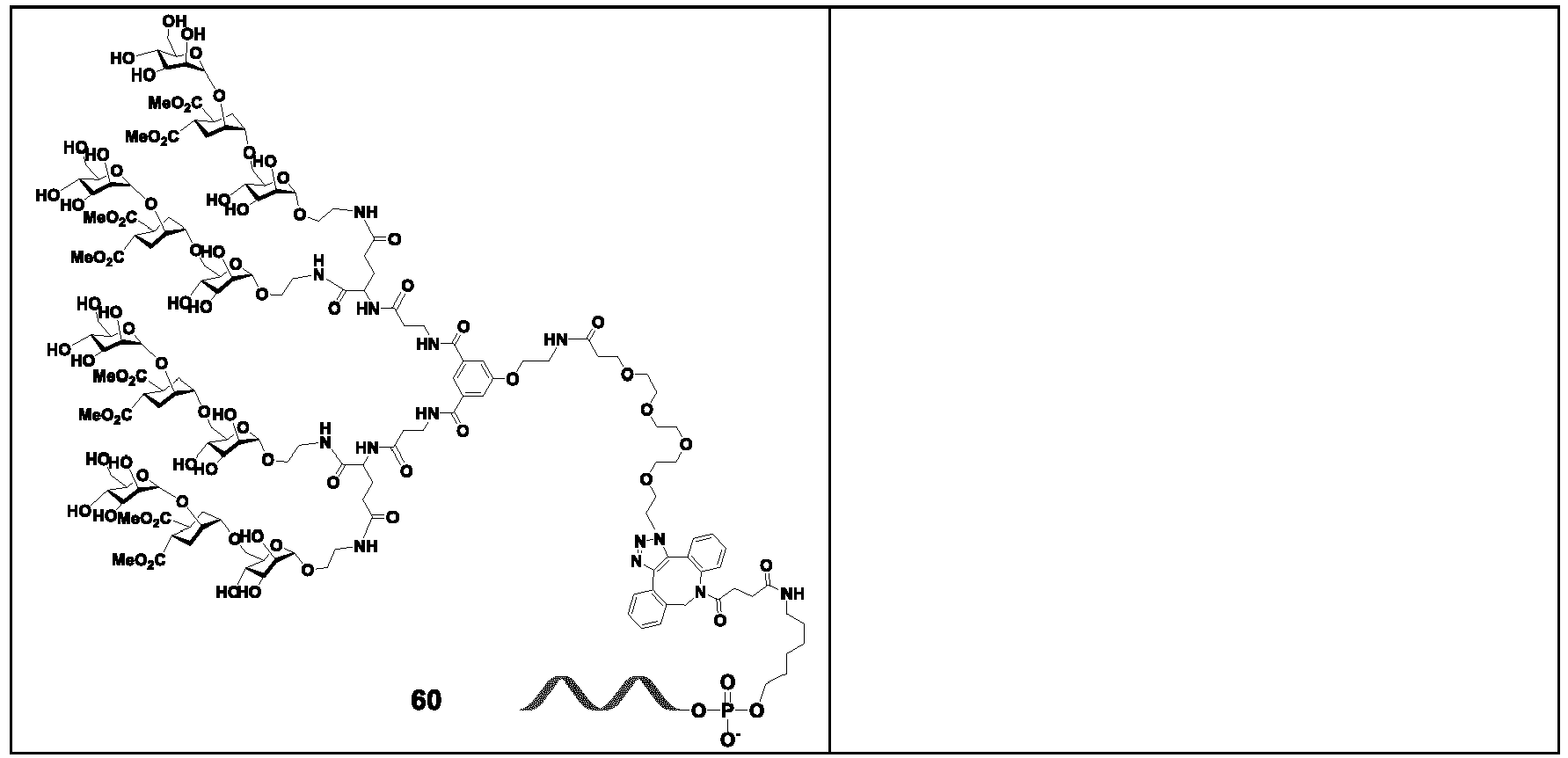
- The sequences and mass spectrometry results of nucleic acids in the nucleic acid conjugates synthesized in this Example are shown in Tables 3a and 3b. The description in the box "Compound" in Tables 3a and 3b represents [compound No. in the table]_[position to which a ligand, etc. is bonded in the nucleic acid]_[abbreviation of the nucleic acid sequence in the nucleic acid conjugate]-[type of the nucleic acid (ASO or ssRNA)].
Table 3a Compound Sequence (5'→3') Calcd Found KAC-CTR-001 CD45-ASO C(L)^C(L)^A(L)^A(L)^a^t^g^c^c^a^a^g^A(L)^G(L)^T(L)^T(L) - - KAC-CTR-002 ApoB-ASO G(L)^5(L)^a^t^t^g^g^t^a^t^T(L)^5(L)^A(L) - - KAC-CTR-003 B2M-ASO T(L)^T(L)^5(L)^T(L)^a^a^g^c^a^g^a^g^T(L)^A(L)^T(L)^G(L) - - KAC_001 47_5'-CD45-ASO 47 C(L)^C(L)^A(L)^A(L)^a^t^g^c^c^a^a^g^A(L)^G(L)^T(L)^T(L) 7441 7439 KAC_002 51_5'-B2M-ASO 51T(L)^T(L)^5(L)^T(L)^a^a^g^c^a^g^a^g^T(L)^A(L)^T(L)^G(L) 7480 7480 KAC_003 52_5'-B2M-ASO 52 T(L)^T(L)^5(L)^T(L)^a^a^g^c^a^g^a^g^T(L)^A(L)^T(L)^G(L) 7706 7700 KAC_004 53_5'-B2M-ASO 53 T(L)^T(L)^5(L)^T(L)^a^a^g^c^a^g^a^g^T(L)^A(L)^T(L)^G(L) 7933 7927 KAC_005 54_5'-B2M-ASO 54 T(L)^T(L)^5(L)^T(L)^a^a^g^c^a^g^a^g^T(L)^A(L)^T(L)^G(L) 8679 8677 KAC_006 55_5'-B2M-ASO 55 T(L)^T(L)^5(L)^T(L)^a^a^g^c^a^g^a^g^T(L)^A(L)^T(L)^G(L) 9737 9737 KAC_007 56_5'-CD45-ASO 56 C(L)^C(L)^A(L)^A(L)^a^t^g^c^c^a^a^g^A(L)^G(L)^T(L)^T(L) 6514 6513 KAC_008 57_5'-CD45-ASO 57 C(L)^C(L)^A(L)^A(L)^a^t^g^c^c^a^a^g^A(L)^G(L)^T(L)^T(L) 7839 7836 KAC_009 58_5'-CD45-ASO 58 C(L)^C(L)^A(L)^A(L)^a^t^g^c^c^a^a^g^A(L)^G(L)^T(L)^T(L) 7902 7904 KAC_010 59_5'-B2M-ASO 59 T(L)^T(L)^5(L)^T(L)^a^a^g^c^a^g^a^g^T(L)^A(L)^T(L)^G(L) 7755 7755 KAC_011 59_5'-CD45-ASO 59 C(L)^C(L)^A(L)^A(L)^a^t^g^c^c^a^a^g^A(L)^G(L)^T(L)^T(L) 8618 8620 KAC_012 60_5'-B2M-ASO 60 T(L)^T(L)^5(L)^T(L)^a^a^g^c^a^g^a^g^T(L)^A(L)^T(L)^G(L) 9176 9177 Table 3b Compound Sequence (5'→3') Calcd Found 49a_3'_3'PS_-B2M-ssRNA 
11395 11397 49b_5'-B2M-ssRNA 
12452 12452 50a_3'_3'PS_-B2M-ssRNA 
12594 12626 50b_5'-B2M-ssRNA 
14708 14724 51_5'-B2M-ssRNA 
8776 8774 52_5'-B2M-ssRNA 
9002 9001 53_5'-B2M-ssRNA 
9228 9229 54_5'-B2M-ssRNA 
9975 9975 55_3'_5'PS_-B2M-ssRNA 
11033 11024 55_5'-B2M-ssRNA 
11033 11033 55_5'-GAPDH-ssRNA 
10949 10946 58_5'-B2M-ssRNA 
9317 9320 59_5'-B2M-ssRNA 
9052 9051 60_5'-B2M-ssRNA 
8831 8831 - In the tables, n represents DNA; N(M) represents 2'-O-methyl-modified RNA; N(F) represents 2'-fluorine-modified RNA; N(L) represents LNA; 5(L) represents LNAmC; ^ represents phosphorothioate modification; ss represents a sense strand; as represents an antisense strand; and a boldface number represents a modifying group corresponding to compound No. in Example. The same holds true for each table described below.
- The single-stranded nucleic acid conjugate synthesized in step 41 was concentration-adjusted (50 µmol/L) with a mixed buffer solution (100 mmol/L potassium acetate, 30 mmol/L 2-[4-(2-hydroxyethyl)piperazin-1-yl]ethanesulfonic acid, HEPES)-KOH (pH 7.4), 2 mmol/L magnesium acetate). The sense strand and an antisense strand (50 µmol/L) were mixed in equal amounts and left standing at 80°C for 10 minutes. The antisense strand sequence is as described in Table 2. The temperature was gradually decreased, and the resultant was left standing at 37°C for 1 hour to obtain a double-stranded nucleic acid conjugate.
- The nucleic acid conjugates synthesized in this Example are shown in Table 4, and the sequences of nucleic acids in the nucleic acid conjugates are shown in Table 5. The description in the box "Compound" in Table 5 represents [compound No. in the table]_[abbreviation of the nucleic acid sequence in the nucleic acid conjugate]-[type of the nucleic acid (siRNA)]. In the description in the box "Single strand name", the sense strand (ss) is represented by [compound No. in the table]_[position to which a ligand, etc. is bonded in the nucleic acid]_[abbreviation of the nucleic acid sequence in the nucleic acid conjugate]-[type of the nucleic acid (ssRNA)], and the antisense strand (as) is represented by [abbreviation of the nucleic acid sequence in the nucleic acid conjugate]-[type of the nucleic acid (as-RNA)].


Table 5 Compound Single strand name Sequence (5'→3') KsiRC_CTR_001 B2M-siRNA B2M-ssRNA 
B2M-as-RNA 
KsiRC_001 61-B2M-siRNA 49b_5'-B2M-ssRNA 
B2M-as-RNA 
KsiRC_002 62_B2M-siRNA 50b_5'-B2M-ssRNA 
B2M-as-RNA 
KsiRC_003 63_B2M-siRNA 51_5'-B2M-ssRNA 
B2M-as-RNA 
KsiRC_004 64_B2M-siRNA 52_5'-B2M-ssRNA 
B2M-as-RNA 
KsiRC_005 65_B2M-siRNA 53_5'-B2M-ssRNA 
B2M-as-RNA 
KsiRC_006 66_B2M-siRNA 54_5'-B2M-ssRNA 
B2M-as-RNA 
KsiRC_007 67_B2M-siRNA 55_3'_5'PS_-B2M-ssRNA 
B2M-as-RNA 
KsiRC_008 55_5'-B2M-ssRNA 
B2M-as-RNA 
KsiRC_009 55_5'-GAPDH-ssRNA 
GAPDH-as-RNA 
KsiRC_010 68_B2M-siRNA 58_5'-B2M-ssRNA 
B2M-as-RNA 
KsiRC_011 69_B2M-siRNA 59_5'-B2M-ssRNA 
B2M-as-RNA 
KsiRC_012 70_B2M-siRNA 60_5'-B2M-ssRNA 
B2M-as-RNA 
- To compounds 39 and 40 synthesized in steps 36 and 37 of Comparative Example 2, compound 42 synthesized in step 37 of Example 8 was added, and the mixture was left standing at room temperature for 1 hour. Sodium carbonate was added to the reaction mixture, and the mixture was left standing overnight at 4°C. The nucleic acid conjugates of Table 6 were obtained by purification in the same way as in step 41 of Example 8.

- The sequences and mass spectrometry results of nucleic acids in the nucleic acid conjugates synthesized in this Comparative Example are shown in Tables 7a and 7b. The description in the box "Compound" in Tables 7a and 7b represents [compound No. in the table]_[position to which a ligand, etc. is bonded in the nucleic
acid]_[abbreviation of the nucleic acid sequence in the nucleic acid conjugate]-[type of the nucleic acid (ASO or ssRNA)].Table 7a Compound Sequence (5'→3') Calcd Found KAC_13 70_5'-B2M-ASO 70T(L)^T(L)^5(L)^T(L)^a^a^g^c^a^g^a^g^T(L)^A(L)^T(L)^G(L) 7284 7282 KAC_14 71_5'-B2M-ASO 71 T(L)^T(L)^5(L)^T(L)^a^a^g^c^a^g^a^g^T(L)^A(L)^T(L)^G(L) 8233 8231 Table 7b Compound Sequence (5'→3') Calcd Found 70_5'-B2M-ssRNA 
8831 8831 71_5'-B2M-ssRNA 
10033 10032 - A double-stranded sugar chain conjugate was obtained in the same way as in step 42 of Example 8 using the single-stranded sugar chain conjugate synthesized in step 43.
- The nucleic acid conjugates synthesized in this Comparative Example are shown in Table 8, and the sequences of nucleic acids in the nucleic acid conjugates are shown in Table 9. The description in the box "Compound" in Table 9 represents [compound No. in the table]_[abbreviation of the nucleic acid sequence in the nucleic acid conjugate]_[type of the nucleic acid (siRNA)]. In the description in the box "Single strand name", the sense strand (ss) is represented by [compound No. in the table]_[position to which a ligand, etc. is bonded in the nucleic acid]_[abbreviation of the nucleic acid sequence in the nucleic acid conjugate]-type of the nucleic acid (ssRNA), and the antisense strand (as) is represented by [abbreviation of the nucleic acid sequence in the nucleic acid conjugate]-[type of the nucleic acid (as-RNA)] .

Table 9 Compound Single strand name Sequence (5'→3') KsiRC_13 72 _B2M-siRNA 70_5'-B2M-ssRNA 
B2M-as-RNA 
KsiRC_14 73_B2M-siRNA 71_5'-B2M-ssRNA 
B2M-as-RNA 
-

- Compound 75 (3.7 g, 14.63 mmol, yield: 63%) was obtained in the same way as in
step 4 of Example 1 using compound 2 (8.17 g, 23.12 mmol) synthesized instep 1 of Example 1.
ESI-MS m/z: 254 (M + H)+ - Compound 75 (3.70 g, 14.63 mmol) synthesized in step 42 of Example 9 was dissolved in tetrahydrofuran (10 mL). To the solution, benzoyl chloride (4.12 mL, 29.3 mmol) was added under ice cooling, and the mixture was stirred at room temperature for 1 hour. The solvent in the reaction solution was distilled off under reduced pressure, and the residue was purified by silica gel column chromatography (chloroform/methanol) to obtain compound 76 (3.82 g, 9.86 mmol, yield: 67%). ESI-MS m/z: 432 (M + HCOO)-
- Compound 77 (3.07 g, 8.56 mmol, yield: 87%) was obtained in the same way as in
step 2 of Example 1 using compound 76 (3.82 g, 9.86 mmol) synthesized in step 43 of Example 9.
ESI-MS m/z: 360 (M + H)+ - Compound 78 was quantitatively obtained in the same way as in step 7 of Example 1 using compound 77 (213 mg, 0.592 mmol) synthesized in step 44 of Example 9 and iminodiacetic acid di-tert-butyl ester (375 mg, 1.529 mmol).
ESI-MS m/z: 858 (M + HCOO)- -
- STEP 1: Compound 78 (482 mg, 0.593 mmol) synthesized in step 45 of Example 9 was dissolved in methanol (10 mL), followed by catalytic hydrogen reduction using palladium/carbon. The solvent in the obtained solution fraction was distilled off under reduced pressure.
- STEP 2: A coupling compound having an alkyl azide group was obtained in the same way as in step 9 of Example 2 using the obtained crude product.
- STEP 3: Compound 79 (238 mg, yield: 92%) was obtained in the same way as in step 8 of Example 1 using the compound obtained in
STEP 2.
ESI-MS m/z: 595 (M + H)+ - Compound 80 (1.3 mg, 0.445 µmol) was obtained in the same way as in step 26 of Example 5 using compound 79 (0.8 mg, 1.346 µmol) synthesized in step 46 of Example 9. ESI-MS m/z: 2918 (M - H)-
-

- 1,3-Dihydroxy 2-aminopropane 81 (manufactured by Tokyo Chemical Industry Co., Ltd., 0.55 g, 6.03 mmol) was dissolved in dimethyl sulfoxide (15 mL). To the solution, an aqueous sodium hydroxide solution (2 mmol/L, 3 mL) was added under ice cooling, then acrylic acid tert-butyl ester (1.93 g, 15.07 mmol) dissolved in dimethyl sulfoxide (2.2 mL) was gradually added, and the mixture was reacted at room temperature for 4 hours. Water was added to the mixture, followed by extraction with ethyl acetate. Then, the organic layer was washed with saturated saline and dried over anhydrous sodium sulfate. The solvent was distilled off under reduced pressure, and the residue was purified by silica gel column chromatography (chloroform/methanol= 98/2 → 90/10) to obtain compound 82 (0.74 g, yield: 35%).
ESI-MS m/z: 348 (M + H)+ - Compound 83 was quantitatively obtained in the same way as in step 7 of Example 1 using compound 82 (0.150 g, 0.433 mmol) synthesized in step 48 of Example 10. ESI-MS m/z: 1062 (M + HCOO)-
- Compound 84 (91.4 mg, 0.114 mmol, yield: 67%) was obtained in the same way as in step 46 of Example 9 using compound 83 (0.149 g, 0.147 mmol) synthesized in step 49 of Example 10.
ESI-MS m/z: 799 (M + H)+ - Compound 85 (2.4 mg, 0.768 µmol, yield: 54.9%) was obtained in the same way as in step 26 of Example 5 using compound 84 (1.3 mg, 1.4 µmol) synthesized in step 51 of Example 10.
ESI-MS m/z: 1562 (M + 2H) 2+ -

- 3,5-Dihydroxybenzoic acid 86 (manufactured by Tokyo Chemical Industry Co., Ltd., 2.11 g, 13.69 mmol) was dissolved in N,N'-dimethylformamide (35 mL). To the solution, potassium bicarbonate (1.716 g, 17.14 mmol) and benzyl bromide (3.51 g, 2.439 mL, 20.54 mmol) were added, and the mixture was stirred at room temperature for 4 hours. Saturated ammonium chloride was added to the reaction solution, followed by extraction with dichloromethane. Then, the organic layer was washed with water and dried over anhydrous sodium sulfate. The solvent was distilled off under reduced pressure, and the residue was purified by silica gel column chromatography (heptane/ethyl acetate = 50/50) to quantitatively obtain compound 87.
ESI-MS m/z: 245 (M + H)+ - Compound 87 (3.34 g, 13.69 mmol) synthesized in step 52 was dissolved in N,N'-dimethylformamide (40 mL). To the solution, potassium carbonate (7.57 g, 54.8 mmol) and tert-butyl bromoacetic acid (4.42 mL, 30.1 mmol) were added, and the mixture was stirred at 90°C for 4 hours. Saturated ammonium chloride was added to the reaction solution, followed by extraction with dichloromethane. Then, the organic layer was washed with saturated saline and dried over anhydrous sodium sulfate. The solvent was distilled off under reduced pressure, and the residue was purified by silica gel column chromatography (heptane/ethyl acetate = 75/25) to obtain compound 88 (5.67 g, yield: 88%).
ESI-MS m/z: 471 (M - H)- - Compound 88 (5.67 g, 12.00 mmol) synthesized in step 53 was dissolved in dichloromethane (40 mL). To the solution, trifluoroacetic acid (10 mL, 130.0 mmol) was added, and the mixture was stirred overnight at room temperature. The solvent was distilled off under reduced pressure to obtain a crude product of compound 89. ESI-MS m/z: 359 (M - H)-
- Compound 90 was quantitatively obtained in the same way as in step 7 of Example 1 using iminodiacetic acid di-tert-butyl ester (0.407 g, 1.660 mmol) and compound 89 (0.239 g, 0.664 mmol) synthesized in step 54 of Example 11.
-
- [STEP 1] Compound 90 (541 mg, 0.664 mmol) synthesized in step 55 of Example 11 was dissolved in methanol (8 mL), followed by catalytic hydrogen reduction using palladium/carbon. The solvent in the obtained solution fraction was distilled off under reduced pressure.
- [STEP 2] A coupling compound was obtained in the same way as in step 7 of Example 1 using the obtained crude product and 3-azidopropan-1-amine (0.101 g, 1.009 mmol).
- STEP 3: Compound 91 was quantitatively obtained in the same way as in step 8 of Example 1 using the obtained crude product of the compound.
ESI-MS m/z: 583 (M + H)+ - Compound 92 (2.0 mg, yield: 47%) was obtained in the same way as in step 26 of Example 5 using compound 84 (2.0 mg, 1.476 µmol) synthesized in step 50 of Example 10. ESI-MS m/z: 1456 (M + 2H) 2+
-

- Compound 77 (63 mg, 0.175 mmol) synthesized in step 44 of Example 9 was dissolved in dichloromethane (5 mL). To the solution, triethylamine (0.24 mL, 1.75 mmol) was added, then pentafluorophenyl-2,2,2-trifluoroacetic acid (0.119 mL, 0.699 mmol) was added, and the mixture was stirred at room temperature for 4 hours. Chloroform was added to the mixture, and the organic layer was washed with a 10% aqueous citric acid solution, saturated saline, and an aqueous sodium bicarbonate solution and dried over anhydrous magnesium sulfate. The solvent was distilled off under reduced pressure to quantitatively obtain compound 93.
ESI-MS m/z: (detected as a monoester form (compound with one PEP added thereto)) 524 (M - H)- - Compound 93 (0.121 g, 0.175 mmol) synthesized in step 58 of Example 12 was dissolved in dimethyl sulfoxide (8 mL). To the solution, carboxyl-(12 oligoethylene glycol) ethylamine (0.510 g, 0.444 mmol) was added, and the mixture was stirred at room temperature for 1 hour in an argon atmosphere. The solvent was distilled off under reduced pressure, followed by extraction with chloroform and a 10% aqueous citric acid solution. Then, the organic layer was dried over anhydrous magnesium sulfate. The solvent was distilled off under reduced pressure to obtain a crude product of compound 94.
ESI-MS m/z: 2614 (M-H)- - Compound 95 was quantitatively obtained in the same way as in step 7 of Example 1 using compound 94 (0.333 g, 0.092 mmol) synthesized in step 59 of Example 12. ESI-MS m/z: 1537 (M + 2H)2+
- Compound 96 (0.0825 g, yield: 58%) was obtained in the same way as in step 42 of Example 9 using compound 95 (0.138 g, 0.045 mmol) synthesized in step 60 of Example 12.
ESI-MS m/z: 1426 (M + 2H)2+ - Compound 97 (2.1 mg, yield: 29%) was obtained in the same way as in step 26 of Example 5 using compound 96 (4.2 mg, 14.04 µmol) synthesized in step 61 of Example 12. ESI-MS m/z: 2590 (M + 2H) 2+
-
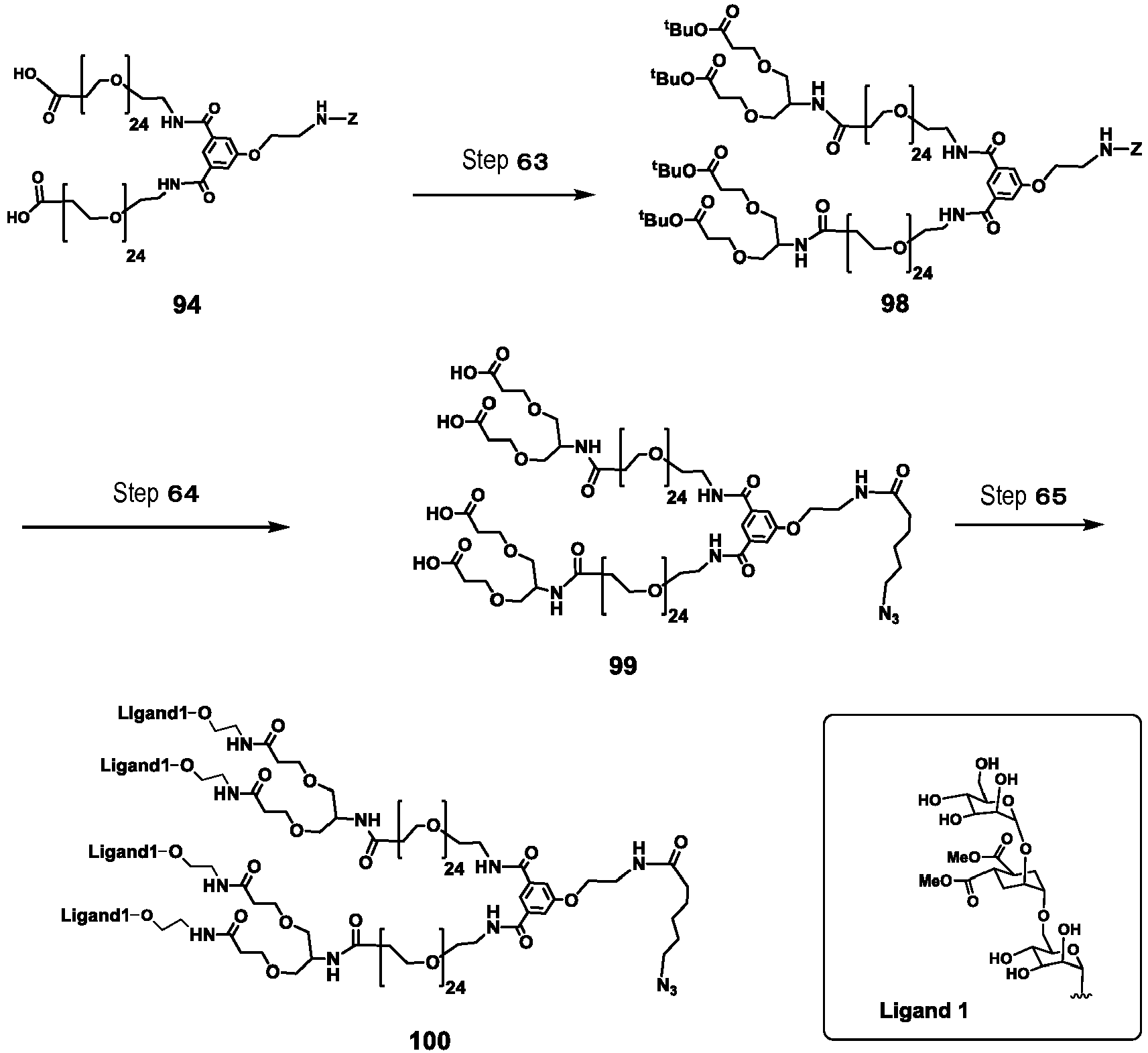
- Compound 98 (0.087 g, yield: 51%) was obtained in the same way as in step 7 of Example 1 using compound 94 (0.189 g, 0.052 mmol) synthesized in step 59 of Example 12 and compound 82 (0.051 g, 0.148 mmol) synthesized in step 48 of Example 10.
ESI-MS m/z: 1639 (M + 2H) 2+ - Compound 99 (38.5 mg, yield: 43%) was obtained in the same way as in step 42 of Example 9 using compound 98 (0.087 g, 0.027 mmol) synthesized in step 63 of Example 13.
ESI-MS m/z: 1529 (M + 2H) 2+ - Compound 100 (2.4 mg, yield: 32%) was obtained in the same way as in step 26 of Example 5 using compound 99 (4.7 mg, 1.403 µmol) synthesized in step 64 of Example 13. ESI-MS m/z: 2689 (M + 2H)2+
-

-
- [STEP 1] An active ester form was obtained in the same way as in step 58 of Example 12 using compound 86 (0.0678 g, 0.1888 mmol) synthesized in step 54 of Example 11.
- [STEP 2] Compound 101 (0.2819 g, 0.108 mmol, yield: 58.1%) was obtained in the same way as in step 59 of Example 12 using the active ester (0.1283 g, 0.185 mmol) obtained by
STEP 1.
ESI-MS m/z: 2615 (M - H)- - Compound 102 (0.085 g, 0.028 mmol, yield: 26%) was obtained in the same way as in step 45 of Example 9 using compound 101 (0.282 g, 0.108 mmol) synthesized in step 66 of Example 14.
ESI-MS m/z: (detected in a state from which the tBu group was eliminated) 712 (M + 4H)4+ - Compound 103 (57.9 mg, yield: 66%) was obtained in the same way as in step 56 of Example 11 using compound 102 (84.5 mg, 0.028 mmol) synthesized in step 67 of Example 14.
ESI-MS m/z: 2837 (M - H)- - Compound 104 (2.6 mg, yield: 33%) was obtained in the same way as in step 26 of Example 5 using compound 103 (4.8 mg, 1.528 µmol) synthesized in step 69 of Example 14.
ESI-MS m/z: 2584 (M + 2H) 2+ -

-
- [STEP 1] A ligand-added compound (6.0 mg, yield: 36%) was obtained in the same way as in step 26 of Example 5 using compound 86 (4 mg, 0.011 mmol) synthesized in step 54 of Example 11.
- [STEP 2] Compound 105 (5.6 mg, yield: 99%) was obtained in the same way as in
STEP 1 of step 42 of Example 9 using the compound (6.0 mg, 3.94 µmol) obtained inSTEP 1.
ESI-MS m/z: 1522 (M - H)- -

- Compound 106 was quantitatively obtained in the same way as in step 45 of Example 9 using compound 99 (0.204 g, 0.067 mmol) synthesized in step 67 of Example 14. ESI-MS m/z: 2846 (M - H)-
- Compound 107 (6.3 mg, yield: 23%) was obtained in the same way as in step 26 of Example 5 using compound 106 (16.7 mg, 5.22 µmol) synthesized in step 71 of Example 16.
ESI-MS m/z: 2586 (M - H)- - Compound 108 (5.6 mg, yield: 90%) was obtained in the same way as in
STEP 1 of step 46 of Example 9 using compound 107 (6.3 mg, 1.218 µmol) synthesized in step 72 of Example 16.
ESI-MS m/z: 2540 (M - 2H)2- -

- Compound 110 (0.116 g, yield: 43%) was obtained in the same way as in step 9 of Example 2 using compound 109 (0.209 g, 0.414 mmol) synthesized by the method described in International Publication No.
WO 2009/073809 . ESI-MS m/z: 645 (M + H)+ - Compound 111 was quantitatively obtained in the same way as in step 44 of Example 9 using compound 110 (0.116 g, 0.179 mmol) synthesized in step 74 of Example 17. ESI-MS m/z: 477 (M + H)+
- Compound 112 (1.6 mg, yield: 40%) was obtained in the same way as in step 26 of Example 5 using compound 111 (1.1 mg, 1.821 µmol) synthesized in step 75 of Example 17.
ESI-MS m/z: 2219 (M - H)- -

- Compound 113 (88.2 mg, yield: 43%) was obtained in the same way as in step 62 of Example 14 using compound 111 (30 mg, 0.05 mmol) synthesized in step 75 of Example 17.
ESI-MS m/z: 1930 (M - 2H)2- - Compound 114 (5.9 mg, yield: 50%) was obtained in the same way as in step 26 of Example 5 using compound 113 (8.1 mg, 2.098 µmol) synthesized in step 77 of Example 18.
ESI-MS m/z: 2801 (M - 2H)2- -

- Compound 116 was quantitatively obtained in the same way as in step 9 of Example 2 using iminodiacetic acid di-tert-butyl ester 115 (manufactured by Tokyo Chemical Industry Co., Ltd., 0.197 g, 0.803 mmol). ESI-MS m/z: [detected in a state from which the tBu group was eliminated] 273 (M + H)+
- Compound 117 was quantitatively obtained in the same way as in step 45 of Example 9 using compound 116 (0.309 g, 0.803 mmol) synthesized in step 79 of Example 19. ESI-MS m/z: 273 (M + H)+
- Compound 118 (1.1 mg, 0.766 mmol, yield: 29%) was obtained in the same way as in step 26 of Example 5 using compound 117 (1.2 g, 2.62 mmol) synthesized in step 76 of Example 17.
ESI-MS m/z: 1436 (M + H)+ -

- Compound 119 (0.096 g, 0.197 mmol, yield: 43%) was obtained in the same way as in step 9 of Example 2 using compound 82 (0.159 g, 0.459 mmol) synthesized in step 47 of Example 10.
ESI-MS m/z: 487 (M + H)+ - Compound 120 was quantitatively obtained in the same way as in step 41 of Example 9 using compound 119 (96 mg, 0.197 mmol) synthesized in step 82 of Example 20. ESI-MS m/z: 375 (M + H)+
- Compound 121 (2.6 mg, yield: 66%) was obtained in the same way as in step 26 of Example 5 using compound 120 (1.0 mg, 2.55 µmol) synthesized in step 83 of Example 20.
ESI-MS m/z: 1539 (M + H)+ -

- Compound 123 (0.22 g, yield: 23%) was obtained by the method described in Chemistry European Journal, Vol. 19, p. 4786-4797, 2013 using compound 122 (1 g, 0.914 mmol) synthesized by the method described in the literature mentioned above and 4-(aminomethyl)phenol hydrochloride (0.362 g, 2.287 mmol).
ESI-MS m/z: 1062 (M + H)+ - Compound 123 (0.2 g, 0.191 mmol) synthesized in step 85 of Example 21 was dissolved in a 25% aqueous ammonia solution. To the solution, pyridine (2 mL) and trimethylphosphine (0.12 mL) were added, and the mixture was then stirred at room temperature for 16 hours. The mixture was concentrated under reduced pressure, and the residue was purified by column chromatography to obtain compound 124 (0.048 g, yield: 25%).
ESI-MS m/z: 1037 (M + H)+ -
- [STEP 1] A coupling compound (0.2 g, yield: 42%) was obtained in the same way as in step 84 using compound 122 (0.5 g, 0.457 mmol) synthesized by the method described in Chemistry European Journal, Vol. 19, p. 4786-4797, 2013.
- [STEP 2] The compound (0.2 g, 0.191 mmol) synthesized in
STEP 1 was dissolved in normal butanol (2 mL), followed by catalytic reduction for 12 hours using platinum/carbon (200 mg). The reaction solution was concentrated under reduced pressure, and the residue was purified by column chromatography to obtain compound 125 (0.060 g, yield: 30%).
ESI-MS m/z: 1019 (M + H)+ -

-
- [STEP 1] A coupling compound having an azide group was obtained as a crude product (2.293 g, yield: 50%) in the same way as in step 10 of Example 2 using compound 5 (3.39 g, 8.584 mmol) synthesized in
step 4 of Example 1. - [STEP 2] Carboxylic acid ester was obtained as a hydrolysate (2.021 g, yield: 93%) in the same way as in
step 2 of Example 1 using the compound (2.293 g, 4.29 mmol) obtained inSTEP 1. - [STEP 3] An active ester form was quantitatively obtained in the same way as in step 54 of Example 12 using the compound (0.100 g, 0.197 mmol) obtained in
STEP 2. - [STEP 3] Compound 126 (0.216 g, yield: 85%) was obtained in the same way as in step 55 of Example 12 using the active ester (0.214 g, 0.255 mmol) obtained by the method of STEP 3.
ESI-MS m/z: 2763 (M - H)- - Results obtained from R = R1 will be shown below. Similar results are obtained in the case of R2.
- [STEP 1] Compound 124 (9.9 mg, 0.069 mmol) synthesized in
step 86 of Example 21 was dissolved in methanol (500 µL). To the solution, a 28% solution of sodium methoxide in methanol (14 uL) was added, and the mixture was then left standing overnight at room temperature. The mixture was purified by reverse-phase chromatography (water/acetonitrile) to quantitatively obtain the compound of interest with the benzoyl group deprotected. - [STEP 2] Compound 127 (0.6 mg, yield: 30%) was obtained in the same way as in step 26 of Example 5 using compound 125 (1.4 mg, 0.502 µmol) obtained in step 87 of Example 21 and the compound (4.2 mg, 5.02 µmol) obtained by
STEP 1.
ESI-MS m/z: 1982 (M - 2H)2- -
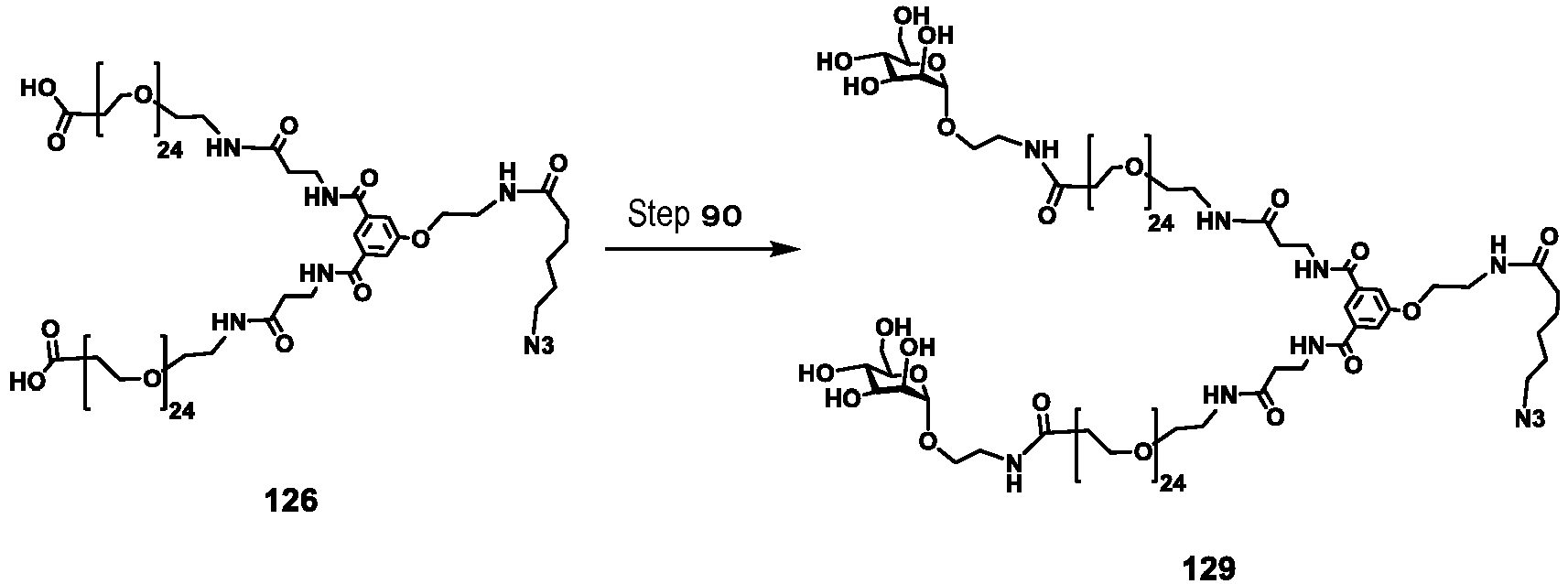
- Compound 129 (11 mg, 48%) was obtained in the same way as in step 26 of Example 5 using compound 126 (24 mg, 7.30 µmol) synthesized in step 18 of Example 3. ESI-MS m/z: 1608 (M - 2H)2-
-

-
- [STEP 1] A ligand adduct (0.9 mg, 10%) was obtained in the same way as in step 26 of Example 5 using compound 22b (4 mg, 1.342 µmol) synthesized in step 20 of Example 3.
- [STEP 2] The compound (0.9 mg, 0.129 µmol) obtained by
STEP 1 was dissolved in methanol (0.6 mL). To the solution, sodium methoxide (2 µL, 10 µmol) was added, and the mixture was then reacted at room temperature for 3 hours. The reaction solution was fractionated by reverse-phase chromatography, and the fraction of interest was freeze-dried to obtain compound 130 (0.3 mg, 44%) .
ESI-MS m/z: 2642 (M - 2H)2- - Compound 131 (3.6 mg, 17%) was obtained in the same way as in step 26 of Example 5 using compound 22b (22 mg, 5.88 µmol) synthesized in step 20 of Example 3. ESI-MS m/z: 1851 (M + 2H) 2+
-
- [Method 1] Single-stranded nucleic acid conjugates 132 to 151 described in Tables 11-1 to 11-4 were obtained in the same way as in step 38 of Example 9 using the compounds described in Tables 10-1 to 10-3. In Table 11-3, each of X and Y represents the 3'-terminal nucleotide structure of an oligonucleotide.
- [Method 2] Single-stranded nucleic acid conjugates 152 and 153 described in Table 11-3 were obtained by the method of Bioconjugate Chemistry, Vol. 22, p. 1723-1728, 2011 using a terminally amino group-modified oligonucleotide synthesized by the method described in Molecules, Vol. 17, p. 13825-13843, 2012, and compound 105.
- The sequences and mass spectrometry results of the nucleic acid conjugates synthesized in this Example are shown in Table 12.


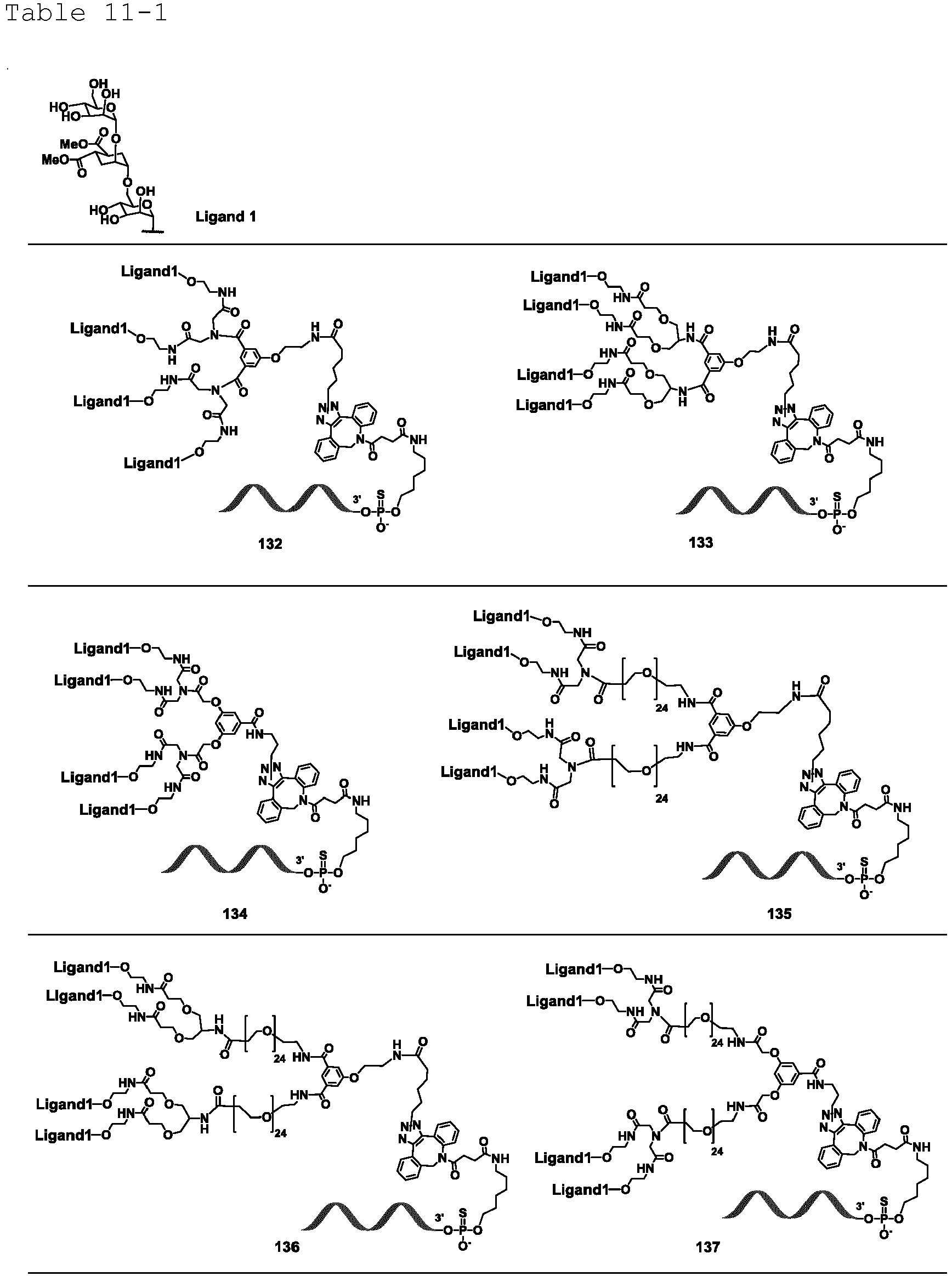


Table 12 Compound Sequence(5'→3') Calcd Found 132_3'-B2MssRNA 
10216 10217 133_3'-B2MssRNA 
10420 10421 134_3'-B2MssRNA 
10204 10205 135_3'-B2MssRNA 
12472 12472 136_3'-B2MssRNA 
12677 12676 137_3'-B2MssRNA 
12460 12461 138_3'-B2MssRNA 
9516 9516 139_3'-B2MssRNA 
12901 12901 140_3'-B2MssRNA 
8730 8732 141_3'-B2MssRNA 
8832 8834 142_3'-B2MssRNA 
11267 11266 143_3'-B2MssRNA 
11302 11301 144_3'-B2MssRNA 
11422 11421 145_3'-B2MssRNA 
12581 12581 146_3'-B2MssRNA 
11036 11037 147_5'-B2MssRNA 
12500 12501 148_3'-B2MssRNA 
12454 12454 149_3'-B2MssRNA 
12500 12500 150_5'-B2MssRNA 
18374 18370 151_5'-B2MssRNA 
18470 18470 152_5'-B2MssRNA 
8423 8424 153_5'-B2MssRNA 
10034 10035 - Double-stranded sugar chain conjugates 154 to 175 were obtained in the same way as in step 38 of Example 8 using the single-stranded sugar chain conjugates synthesized in step 91. The nucleic acid conjugates synthesized in this Example are shown in Tables 13-1 to 13-4. In Table 13-3, each of X and Y represents the 3'-terminal nucleotide of a sense strand.

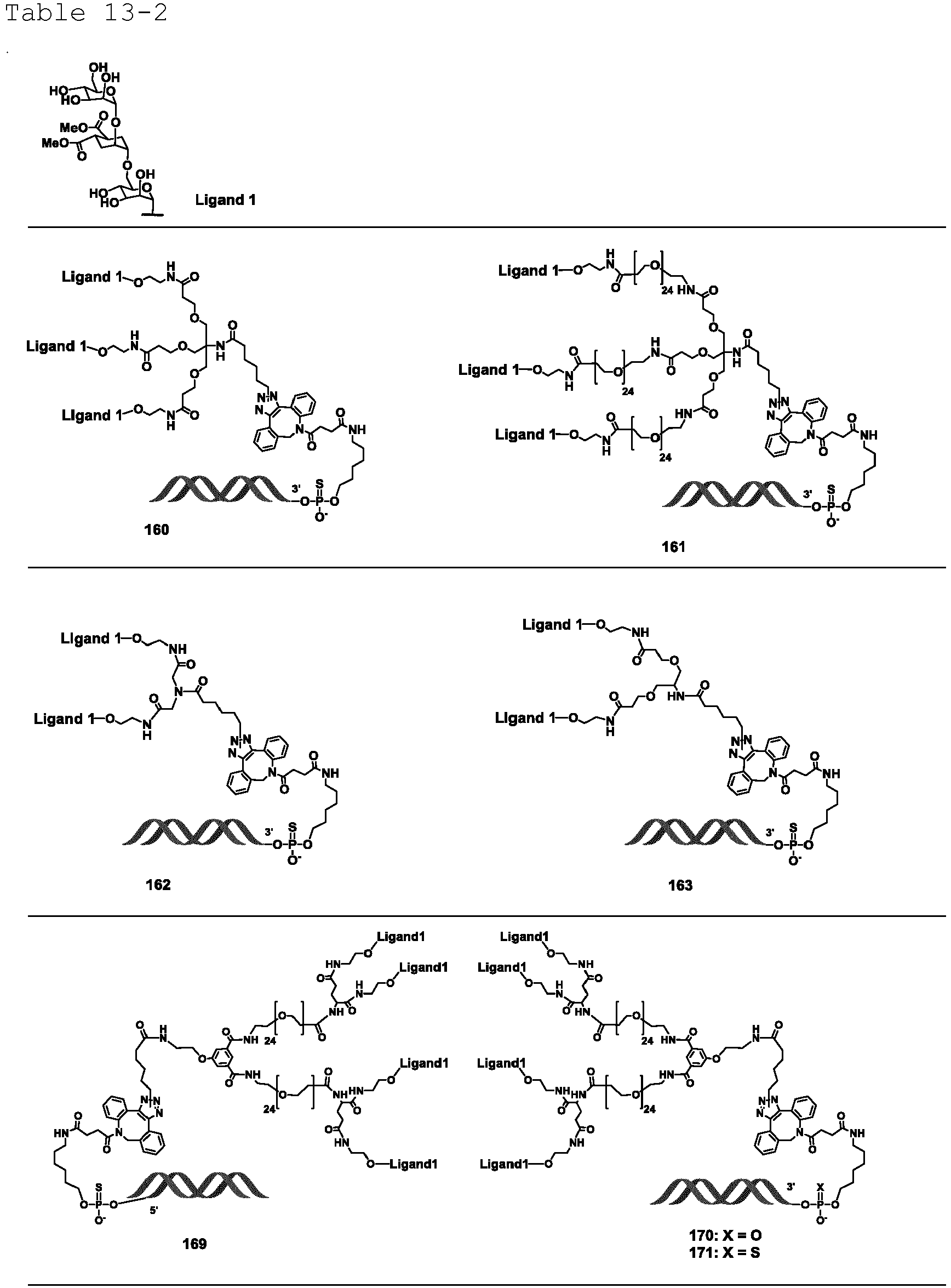


- The sequences of the nucleic acid conjugates synthesized in this Example are shown in Table 14. The description in the box "Compound" in Table 14 represents [compound No. in the table]_[abbreviation of the nucleic acid sequence in the nucleic acid conjugate]_[type of the nucleic acid (siRNA)]. In the description in the box "Single strand name", the sense strand (ss) is represented by [compound No. in the table]_[position to which a ligand, etc. is bonded in the nucleic acid]_[abbreviation of the nucleic acid sequence in the nucleic acid conjugate]-type of the nucleic acid (ssRNA), and the antisense strand (as) is represented by [abbreviation of the nucleic acid sequence in the nucleic acid conjugate]-[type of the nucleic acid (as-RNA)].
Table 14 Compound Single strand name Sequence KsiRC_15 154_B2M-siRNA 132_3'-B2MssRNA 
B2M-as-RNA 
KsiRC_16 155_B2M-siRNA 133_3'-B2MssRNA 
B2M-as-RNA 
KsiRC_17 156_B2M-siRNA 134_3'-B2MssRNA 
B2M-as-RNA 
KsiRC_ 18 157 _B2M-siRNA 135 3'-B2MssRNA 
B2M-as-RNA 
KsiRC_19 158_B2M-siRNA 136_3'-B2MssRNA 
B2M-as-RNA KsiRC_20 159_B2M-siRNA 137_3'-B2MssRNA 
B2M-as-RNA 
KsiRC_21 160_B2M-siRNA 138_3'-B2MssRNA B2M-as-RNA 
KsiRC_22 161_B2M-siRNA 139_3'- B2MssRNA 
B2M-as-RNA 
KsiRC_23 162_ B2M-siRNA 140_3'-B2MssRNA 
B2M-as-RNA 
KsiRC_24 163_B2M-siRNA 141_3'-B2MssRNA 
B2M-as-RNA 
KsiRC_25 164_B2M-siRNA 142_3'-B2MssRNA 
B2M-as-RNA 
KsiRC_26 165_B2M-siRNA 143_3'-B2MssRNA 
B2M-as-RNA 
B2M-as-RNA 
B2M-as-RNA 
KsiRC_27 166_B2M-siRNA 144_3'-B2MssRNA 
B2M-as-RNA KsiRC_28 167_B2M-siRNA 145_3'-B2MssRNA 
B2M-as-RNA 
KsiRC_29 168_B2M-siRNA 146_3'-B2MssRNA 
B2M-as-RNA KsiRC_30 169_B2M-siRNA 147_5'-B2MssRNA 
B2M-as-RNA 
KsiRC_31 170_B2M-siRNA 148_3'-B2MssRNA 
B2M-as-RNA 
KsiRC_32 171_B2M-siRNA 149_3'-B2MssRNA 
B2M-as-RNA 
KsiRC_33 172_B2M-siRNA 150_5'-B2MssRNA 
B2M-as-RNA 
KsiRC_34 173_B2M-siRNA 151_5'-B2MssRNA 
B2M-as-RNA 
KsiRC_35 174_B2M-siRNA 152_5'-B2MssRNA 
B2M-as-RNA 
KsiRC_ 36 175_B2M-siRNA 153_5'- B2MssRNA 
B2M-as-RNA 
B2M-as-RNA 
- A nucleic acid conjugate having a distinctive sequence was obtained in the same way as in Examples 26 and 27 using compound 148. The sequence and mass spectrometry results of the nucleic acid conjugate are shown in Table 15 below, and the sequences of double-stranded conjugates are shown in Table 16.
Table 15 Compound Sequence (5'→3') Calcd Found 148_3'- HPRT-1ssRNA 
12431 12433 Table 16 Compound Single strand name Sequence (5'→3') KsiRC_CTR_002 H2NC6_HPRT1-siRNA H2NC6-3'-HPRT1-ssRNA 
HPRT-1-as-RNA 
KsiRC_37 170_HPRT-1-siRNA 148_3'-HPRT-1ssRNA 
HPRT-1-as-RNA 
- Human CD14-positive monocyte cells (Untouched Frozen NPB-CD14+ Monocytes, manufactured by AllCells, PB011F) were lysed according to the attached protocol using RPMI1640 medium (manufactured by Nacalai Tesque, Inc., 30264-56) containing 10% fetal bovine serum (hereinafter, referred to as 10% FBS RPMI1640 medium) and DNase I Solution (manufactured by StemCell Technologies Inc., 07900) .
- Then, recombinant human interleukin-4 (Recombinant Human IL-4 Protein, manufactured by R&D Systems, Inc., 204-IL) (hereinafter, referred to as IL-4) at a final concentration of 100 ng/mL and recombinant human granulocyte macrophage colony-stimulating factor (Recombinant Human GM-CSF Protein CF, manufactured by R&D Systems, Inc., 215-GM-050/CF) (hereinafter, referred to as GM-CSF) at a final concentration of 50 ng/mL were added to the cells, and the cells were inoculated at a density of 106 cells/mL to a multi-plate for floating culture (manufactured by SUMILON/Sumitomo Bakelite Co., Ltd., MS-8006R) and cultured at 37°C under 5% CO2 conditions.
- Three days and 6 days after the start of culture, half the amount of the medium was replaced with 10% FBS RPMI1640 medium containing 100 ng/mL IL-4 and 50 ng/mL GM-CSF to induce dendritic cells.
- Eight days after the start of culture, the cells were recovered, and adherent cells were also recovered using an ethylenediamine tetraacetic acid solution (0.2 g/L EDTA Solution, manufactured by Nacalai Tesque, Inc., 14367-74). After centrifugation, the cells were resuspended at 1,250,000 cells/mL in fresh 10% FBS RPMI1640 medium containing 100 ng/mL IL-4 and 50 ng/mL GM-CSF and inoculated at 80 uL/well to an ultralow adsorption 96-well plate (manufactured by Corning Inc., 3474) .
- The test samples used were KAC_008 and KAC_009, and KAC_CTR_001 having no ligand and KAC_CTR_002 having no complementary site to CD45 gene were established as comparative controls. The final concentration of KAC_008 was set to two concentrations: 1 µmol/L and 0.3 µmol/L. The final concentrations of KAC_009 and KAC_CTR_001 were set to four concentrations: 1 µmol/L, 0.3 µmol/L, 0.1 µmol/L and 0.03 umol/L. The final concentration of KAC_CTR_002 was set to 1 µmol/L. The test was conducted at N = 3.
- The nucleic acid conjugate solution was diluted by the following procedures: a nucleic acid conjugate solution prepared at 50 µM with a citrate buffer solution (20 mM citrate (pH 7), 150 mM NaCl) was diluted to 5 µM using Opti-MEM(R) I Reduced Serum Medium (manufactured by Life Technologies Corp., 31985-070). The further dilution of the solution was performed using a solution prepared from a citrate buffer solution and Opti-MEM at a ratio of 1:9. 20 µL of the diluted nucleic acid conjugate solution was added to the cell lysate, while 20 µL of the diluting solution was added to the negative control group, followed by culture at 37°C for 2 days under 5% CO2 conditions.
- A cell lysate containing RNA was prepared using SuperPrep(R) Cell Lysis & RT Kit for qPCR (manufactured by Toyobo Co., Ltd., SCQ-101), and cDNA was prepared through reverse-transcription reaction using RT Kit for qPCR attached to the kit according to the instruction attached to the kit.
- This cDNA was used as a template for PCR reaction, and the Taqman probe method was carried out using QuantStudio 12K Flex Real-Time PCR System (manufactured by Applied Biosystems, Inc.) as follows: CD45 and control glyceraldehyde 3-phosphate dehydrogenase) (hereinafter, referred to as GAPDH) genes were each subjected to PCR reaction. Their respective mRNA amplification levels were measured, and the semi-quantitative value of CD45 mRNA was calculated with the amplification level of GAPDH mRNA as an internal control. The CD45 and GAPDH mRNA amplification levels in the negative control group were also each measured in the same way as above, and the semi-quantitative value of CD45 mRNA was calculated.
- The CD45 gene and the GAPDH gene were measured using TaqMan probes Hs00894727_m1 (manufactured by Applied Biosystems, Inc.) and Hs02758991_g1 (manufactured by Applied Biosystems, Inc.), respectively, and using TaqMan Gene Expression Master Mix (manufactured by Applied Biosystems, Inc., 4369542) as a reaction reagent according to the attached protocol. The target mRNA level of the nucleic acid conjugate (ASO-transferred specimen) was calculated as a relative ratio when the CD45 mRNA level in the negative control group (ASO-untransferred group) was defined as 1. Results indicating the relative ratio of the mRNA level by mean ± standard deviation are shown in
Figure 1 . - These results demonstrated that the test samples (KAC_008 and KAC_009) exhibit a strong knockdown effect, as compared with the comparative controls (KAC_CTR_001 and KAC_CTR_002).
- Test Example 2: Protein knockdown test on human monocyte-derived dendritic cell using ASO against beta-2 microglobulin (hereinafter, referred to as B2M)
- Dendritic cells were induced from human CD14-positive monocyte cells by the same procedures as in Test Example 1. The cells were inoculated to an ultralow adsorption 6-well plate (manufactured by Corning Inc., 3471) and cultured at 37°C under 5% CO2 conditions. Three days later, half the amount of the medium was replaced with 10% FBS RPMI1640 medium containing 100 ng/mL IL-4 and 50 ng/mL GM-CSF to induce dendritic cells.
- Six days after the start of culture, the cells were recovered, centrifuged, then resuspended at 125000 cells/mL in fresh 10% FBS RPMI1640 medium containing 100 ng/mL IL-4 and 50 ng/mL GM-CSF, and inoculated at 80 µL/well to an ultralow adsorption 96-well plate (manufactured by Corning Inc., 3474).
- The test samples used were KAC_010 and KAC_012, and KAC_CTR_003 having no ligand and KAC_013 and KAC_014 having a GalNAc ligand were established as comparative controls. The final concentration of each ASO was set to two concentrations: 0.3 µmol/L and 0.1 µmol/L. The test was conducted at N = 2.
- The nucleic acid conjugate solution was diluted by the following procedures: each nucleic acid conjugate solution prepared at 40 µM with a citrate buffer solution was diluted to 1.5 µM using Opti-MEM. The further dilution of the solution was performed using a solution prepared from a citrate buffer solution and Opti-MEM at a ratio of 3:77. 20 µL of the diluted nucleic acid conjugate solution was added to the cell lysate, while 20 µL of the diluting solution was added to the negative control group, followed by culture at 37°C under 5% CO2 conditions.
- One day after the nucleic acid addition, the cells were recovered, centrifuged, then resuspended in 80 µL of fresh 10% FBS RPMI1640 medium containing 100 ng/mL IL-4 and 50 ng/mL GM-CSF, and further cultured at 37°C for 3 days under 5% CO2 conditions.
- A washing solution for cells was prepared by adding 2.5 mL of a 10% sodium azide solution (manufactured by Nacalai Tesque, Inc.) and 685 µL of a 0.5 M EDTA solution (EDTA (0.5 M), pH 8.0, manufactured by Ambion, Inc., AM9260G) to 500 mL of phosphate-buffered saline containing 1% (w/v) BSA. To this washing solution, FcR Blocking Reagent, Human (manufactured by Miltenyi Biotec, 130-059-901) was added at 20% (v/v) to prepare an FcR blocking solution.
- Four days after the nucleic acid addition, the cells were recovered, centrifuged, and then washed once with the washing solution. After removal of a supernatant, 90 µL of the FcR blocking solution was added to the resultant, and the mixture was left standing on ice for 30 minutes for blocking reaction.
- A fresh plate was provided with a mixed solution of 15 µL of the FcR blocking solution and 5 µL of an antibody against B2M protein (APC anti-human β2-microglobulin Antibody, manufactured by BioLegend, Inc., 316312). 80 uL of the cell lysate after the FcR blocking was added thereto, and the plate was left standing on ice for the antibody reaction.
- One hour later, the cells were recovered, washed three times with the washing solution, and then resuspended in 200 µL, followed by measurement using BD FACSCanto(TM) II flow cytometer (manufactured by Becton, Dickinson and Company).
- Analysis was conducted using FlowJo 7.6.5 (manufactured by Tomy Digital Biology Co., Ltd.). Cell fractions were gated with forward scattered light (FSC) vs. side scattered light (SSC), and the expression level of the cell surface antigen was measured from the value of geometric means of the fluorescence intensity as mean fluorescence intensity (hereinafter, referred to as MFI).
- Results indicating an average MFI value are shown in
Figure 2 . These results demonstrated that the test samples (KAC_010 and KAC_012) strongly knockdown the B2M protein in a low concentration range, as compared with the comparative controls (KAC_013, KAC_014, and KAC_CTR_003) . - Dendritic cells were induced by the same procedures as in
Test 2. Six days after the start of culture, the cells were inoculated to an ultralow adsorption 96-well plate. - The test samples used were KsiRC_010, KsiRC_011 and KsiRC_012, and KsiRC_CTR_001 having no ligand and KsiRC_013 and KsiRC_014 having a GalNAc ligand were established as comparative controls. The final concentration of each siRNA was set to three concentrations: 3 µmol/L, 1 µmol/L, and 0.3 µmol/L. The test was conducted at N = 1, and was conducted at N = 3 for the nucleic acid-free negative control group.
- The nucleic acid conjugate solution was diluted by the following procedures: each nucleic acid prepared at 40 µM with a citrate buffer solution was diluted to 15 µM using Opti-MEM. The further dilution of the solution was performed using a solution prepared from a citrate buffer solution and Opti-MEM at a ratio of 21:35. 20 µL of the diluted nucleic acid conjugate solution was added to the cell lysate, while 20 µL of the diluting solution was added to the negative control group, followed by culture at 37°C under 5% CO2 conditions.
- Four days after the nucleic acid addition, the cells were recovered, centrifuged, and then washed once with the washing solution. The subsequent procedures were the same as in Test Example 2 to carry out the measurement of the expression level of the B2M protein as the cell surface antigen, and analysis.
- The results are shown in
Figure 3 . The results about the negative control group were indicated by mean ± standard deviation. The test samples (KsiRC_010, KsiRC_011, and KsiRC_012) exhibited marked knockdown of the B2M protein, as compared with the comparative controls (KsiRC_013, KsiRC_014, and KsiRC_CTR_001). - Dendritic cells were induced by the same procedures as in Test Example 2. Six days after the start of culture, the cells were inoculated to an ultralow adsorption 96-well plate.
- The test sample used was KsiRC_010, and KsiRC_CTR_001 having no ligand was established as a comparative control. The final concentration of each siRNA was set to three concentrations: 3 µmol/L, 1 µml/L, and 0.3 µmol/L. The test was conducted at N = 3.
- The dilution and addition of the nucleic acid conjugate solution were performed by the same procedures as in Test Example 3, followed by culture at 37°C under 5% CO2 conditions.
- Four days after the nucleic acid addition, the cells were recovered, centrifuged, and then washed once with the washing solution. The subsequent procedures were the same as in Test Example 1 to measure the expression level of mRNA.
- The B2M gene and the GAPDH gene were measured using TaqMan probes Hs00984230_m1 (manufactured by Applied Biosystems, Inc.) and Hs02758991_g1 (manufactured by Applied Biosystems, Inc.), respectively, and using TaqMan Gene Expression Master Mix as a reaction reagent according to the attached protocol. The target mRNA level of the siRNA-transferred specimen was calculated as a relative ratio when the B2M mRNA level in the siRNA-untransferred group (negative control group) was defined as 1. Results indicating the relative ratio of the mRNA level by mean ± standard deviation are shown in
Figure 4 . - The test sample (KsiRC_010) exhibited marked improvement in knockdown activity, as compared with the comparative control (KsiRC_CTR_001).
- Dendritic cells were induced by the same procedures as in Test Example 3. Six days after the start of culture, the cells were inoculated to an ultralow adsorption 96-well plate.
- The test samples used were KsiRC_010, KsiRC_003, KsiRC_004, KsiRC_005, KsiRC_006, KsiRC_008, KsiRC_001, KsiRC_002, and KsiRC_007, and KsiRC_CTR_001 having no ligand and control KsiRC_009 (GAPDH target sequence) derived from KsiRC_008 by changing the siRNA sequence were established as comparative controls. The final concentration of each siRNA was set to two concentrations: 1 µmol/L and 0.3 µmol/L. The test was conducted at N = 1, and was conducted at N = 2 for the nucleic acid-free negative control group.
- The nucleic acid conjugate solution was diluted by the following procedures: each nucleic acid prepared at 20 µM with a citrate buffer solution was diluted to 5 µM using Opti-MEM. The further dilution of the solution was performed using a solution prepared from a citrate buffer solution and Opti-MEM at a ratio of 1:3. 20 µL of the diluted nucleic acid conjugate solution was added to the cell lysate, while 20 µL of the diluting solution was added to the negative control group, followed by culture at 37°C under 5% CO2 conditions.
- Four days after the nucleic acid addition, the cells were recovered, centrifuged, and then washed once with the washing solution. After removal of a supernatant, 75 µL of the FcR blocking solution was added to the resultant, and the mixture was left standing on ice for 30 minutes for blocking reaction.
- A fresh plate was provided with a mixed solution containing 5 µL of an antibody against B2M (APC anti-human β2-microglobulin Antibody, manufactured by BioLegend, Inc., 316312), 1 µL of LIVE/DEAD(R) Fixable Aqua Dead Cell Stain Kit (Thermo Fisher Scientific Inc., L34957), 5 µL of an antibody against HLA-DR (Brilliant Violet 421(TM) anti-human HLA-DR Antibody, manufactured by BioLegend, Inc., 307635), and 5 µL of an antibody against CD11c (PE anti-human CD11c Antibody, manufactured by BioLegend, Inc., 301606). 65 uL of the blocked cell lysate was added thereto, and the plate was left standing on ice for 1 hour.
- Then, the cells were recovered, washed three times with the washing solution, and then resuspended in 200 µL, followed by measurement using BD FACSVerse(TM) flow cytometer (manufactured by Becton, Dickinson and Company).
- Analysis was conducted using FlowJo 7.6.5. Cells were gated with forward scattered light (FSC) vs. side scattered light (SSC). LIVE/DEAD-negative fractions were regarded as live cells, and HLA-DR- and CD11c-positive fractions were to be analyzed. The expression level of the cell surface antigen was measured from the value of geometric means of the fluorescence intensity as mean fluorescence intensity of the APC channel.
- The obtained value is shown in
Figure 5 . The negative control group was indicated by mean. The test samples (KsiRC_010, KsiRC_003, KsiRC_004, KsiRC_005, KsiRC_006, KsiRC_008, KsiRC_001, KsiRC_002, and KsiRC_007) exhibited marked knockdown of the B2M protein, as compared with the comparative controls (KsiRC_CTR_001 and KsiRC_009). - Human CD14-positive monocyte cells (Untouched Frozen NPB-CD14+ Monocytes, manufactured by AllCells, PB011F) were lysed according to the attached protocol using X-VIVO 15(TM) medium (X-VIVO(TM) 15 Chemically Defined, Serum-free Hematopoietic Cell Medium, manufactured by Lonza Group AG, 04-418Q).
- Then, recombinant human interleukin-4 (Recombinant Human IL-4 Protein, manufactured by R&D Systems, Inc., 204-IL) (hereinafter, referred to as IL-4) at a final concentration of 100 ng/mL and recombinant human granulocyte macrophage colony-stimulating factor (Human GM-CSF premium grade, manufactured by Miltenyi Biotec, 130-093-864, 130-093-865) (hereinafter, referred to as GM-CSF) at a final concentration of 100 ng/mL were added to the cells, and the cells were inoculated at a density of 106 cells/mL to a 6-well plate (Falcon(R) Multiwell Cell Culture Plate 6-well, manufactured by Corning Inc., 353046) and cultured at 37°C under 5% CO2 conditions. Two days and 3 days after the start of culture, the medium was replaced with fresh one to induce dendritic cells.
- Six days after the start of culture, the cells were recovered, and adherent cells were also recovered using an ethylenediamine tetraacetic acid solution (0.2 g/L EDTA Solution, manufactured by Nacalai Tesque, Inc., 14367-74). After centrifugation, the cells were resuspended at 500,000 cells/mL in fresh X-VIVO 15(TM) medium containing 100 ng/mL IL-4 and 100 ng/mL GM-CSF, inoculated at 200 µL/well to an ultralow adsorption 96-well plate (manufactured by Corning Inc., 3474), and further cultured at 37°C for 3 days under 5% CO2 conditions.
- Nine days after the start of culture, the cells were recovered, centrifuged, then resuspended at 625,000 cells/mL in fresh X-VIVO 15(TM) medium containing 100 ng/mL IL-4 and 100 ng/mL GM-CSF, and inoculated at 80 µL/well to an ultralow adsorption 96-well plate.
- The test samples used were KsiRC_025, KsiRC_027 and KsiRC_029, and KsiRC_CTR_001 having no ligand was established as a comparative control. The final concentration of each siRNA was set to 0.3 µmol/L and 0.1 µmol/L. The test was conducted at N = 3.
- 20 µL of the nucleic acid conjugate solution diluted using Opti-MEM(R) I Reduced Serum Medium (manufactured by Life Technologies Corp., 31985-070, 31985-088) in the same way as in Test Example 1-5 was added to the cell lysate, while 20 µL of the diluting solution was added to the negative control group, followed by culture at 37°C for 4 days under 5% CO2 conditions.
- Four days after the nucleic acid addition, the cells were recovered. The subsequent procedures were the same as in Test Example 4 to measure the expression level of mRNA.
- The target mRNA level of the siRNA-transferred specimen was calculated as a relative ratio when the B2M mRNA level in the siRNA-untransferred group (negative control group) was defined as 1. Results indicating the relative ratio of the mRNA level by mean ± standard deviation are shown in
Figure 6 . - The test samples (KsiRC_025, KsiRC_027 and KsiRC_029) exhibited marked improvement in knockdown activity, as compared with the comparative control (KsiRC_CTR_0 01).
- Human monocyte-derived dendritic cells were induced by the same procedures as in Test Example 6. Each B2M siRNA was evaluated for its activity.
- The test samples used were KsiRC_030, KsiRC_031, KsiRC_032, KsiRC_015, KsiRC_016, KsiRC_018, KsiRC_019 and KsiRC_017, and KsiRC_CTR_001 having no ligand was established as a comparative control. The final concentration of each siRNA was set to 0.03 µmol/L and 0.01 µmol/L. The test was conducted at N = 3.
- Four days after the nucleic acid addition, the cells were recovered. The subsequent procedures were the same as in Test Example 6 to measure the expression level of mRNA.
- The target mRNA level of the siRNA-transferred specimen was calculated as a relative ratio when the B2M mRNA level in the siRNA-untransferred group (negative control group) was defined as 1. Results indicating the relative ratio of the mRNA level by mean ± standard deviation are shown in
Figure 7 . - The test samples (KsiRC_030, KsiRC_031, KsiRC_032, KsiRC_015, KsiRC_016, KsiRC_018, KsiRC_019 and KsiRC_017) exhibited improvement in knockdown activity, as compared with the comparative control (KsiRC_CTR_001).
- Human monocyte-derived dendritic cells were induced by the same procedures as in Test Example 6. Each B2M siRNA was evaluated for its activity.
- The test sample used was KsiRC_020, and KsiRC_CTR_001 having no ligand was established as a comparative control. The final concentration of each siRNA was set to 0.03 µmol/L and 0.01 µmol/L. The test was conducted at N = 3.
- Four days after the nucleic acid addition, the cells were recovered. The subsequent procedures were the same as in Test Example 7 to measure the expression level of mRNA.
- The target mRNA level of the siRNA-transferred specimen was calculated as a relative ratio when the B2M mRNA level in the siRNA-untransferred group (negative control group) was defined as 1. Results indicating the relative ratio of the mRNA level by mean ± standard deviation are shown in
Figure 8 . - The test sample (KsiRC_020) exhibited improvement in knockdown activity, as compared with the comparative control (KsiRC_CTR_0 01).
- Human monocyte-derived dendritic cells were induced by the same procedures as in Test Example 6. Each B2M siRNA was evaluated for its activity.
- The test samples used were KsiRC_023, KsiRC_024, KsiRC_021 and KsiRC_028, and KsiRC_CTR_001 having no ligand was established as a comparative control. The final concentration of each siRNA was set to 0.03 µmol/L and 0.01 µmol/L. The test was conducted at N = 3.
- Four days after the nucleic acid addition, the cells were recovered. The subsequent procedures were the same as in Test Example 8 to measure the expression level of mRNA.
- The target mRNA level of the siRNA-transferred specimen was calculated as a relative ratio when the B2M mRNA level in the siRNA-untransferred group (negative control group) was defined as 1. Results indicating the relative ratio of the mRNA level by mean ± standard deviation are shown in
Figure 9 . - The test samples (KsiRC_023, KsiRC_024, KsiRC_021, and KsiRC_028) exhibited improvement in knockdown activity, as compared with the comparative control (KsiRC_CTR_0 01).
- Human monocyte-derived dendritic cells were induced by the same procedures as in Test Example 6. Each B2M siRNA was evaluated for its activity.
- The test samples used were KsiRC_035, KsiRC_036, KsiRC_022, KsiRC_033, and KsiRC_034), and KsiRC_CTR_001 having no ligand was established as a comparative control. The final concentration of each siRNA was set to 0.01 µmol/L and 0.003 µmol/L. The test was conducted at N = 3.
- Four days after the nucleic acid addition, the cells were recovered. The subsequent procedures were the same as in Test Example 9 to measure the expression level of mRNA.
- The target mRNA level of the siRNA-transferred specimen was calculated as a relative ratio when the B2M mRNA level in the siRNA-untransferred group (negative control group) was defined as 1. Results indicating the relative ratio of the mRNA level by mean ± standard deviation are shown in
Figure 10 . - The test samples (KsiRC_035, KsiRC_036, KsiRC_022, KsiRC_033, and KsiRC_034) exhibited improvement in knockdown activity, as compared with the comparative control (KsiRC_CTR_001).
- Human monocyte-derived dendritic cells were induced by the same procedures as in Test Example 6. Six days after the start of culture, the cells were recovered, then resuspended at 500,000 cells/mL in fresh X-VIVO 15(TM) medium containing 100 ng/mL IL-4 and 100 ng/mL GM-CSF, and inoculated at 200 µL/well to an ultralow adsorption 96-well plate (manufactured by Corning Inc., 3474). In this operation, the CD40 antibody described in the patent literature (International Publication No.
WO 02/088186 - Nine days after the start of culture, the cells were recovered, centrifuged, then resuspended at 625,000 cells/mL in fresh X-VIVO 15(TM) medium containing 100 ng/mL IL-4, 100 ng/mL GM-CSF, and the CD40 antibody and inoculated at 80 µL/well to an ultralow adsorption 96-well plate (manufactured by Corning Inc., 3474).
- The test samples used were KsiRC_003, KsiRC_031, and KsiRC_001, and KsiRC_CTR_001 having no ligand was established as a comparative control. The final concentration of each siRNA was set to 0.3 µmol/L and 0.1 µmol/L. The test was conducted at N = 3.
- 20 µL of the nucleic acid conjugate solution diluted using Opti-MEM in the same way as in Test Example 1-5 was added to the cell lysate, while 20 µL of the diluting solution was added to the negative control group, followed by culture at 37°C for 4 days under 5% CO2 conditions.
- Four days after the nucleic acid addition, the cells were recovered. The subsequent procedures were the same as in Test Example 10 to measure the expression level of mRNA. The target mRNA level of the siRNA-transferred specimen was calculated as a relative ratio when the B2M mRNA level in the siRNA-untransferred group (negative control group) was defined as 1. Results indicating the relative ratio of the mRNA level by mean ± standard deviation are shown in
Figure 11 . - The test samples (KsiRC_003, KsiRC_031, and KsiRC_001) exhibited improvement in knockdown activity, as compared with the comparative control (KsiRC_CTR_001).
- Mature human monocyte-derived dendritic cells were induced by the same procedures as in Test Example 11. Each HPRT1 siRNA was evaluated for its activity.
- The test sample used was KsiRC_037, and KsiRC_CTR_002 having no ligand was established as a comparative control. The final concentration of each siRNA was set to 0.3 µmol/L, 0.1 µmol/L, and 0.03 µmol/L. The test was conducted at N = 3.
- Four days after the nucleic acid addition, the cells were recovered. The subsequent procedures were the same as in Test Example 11 to measure the expression level of mRNA.
- The HPRT1 gene and the GAPDH gene were measured using TaqMan probes Hs99999909_m1 (manufactured by Applied Biosystems, Inc.) and Hs02758991_g1 (manufactured by Applied Biosystems, Inc.), respectively, and using TaqMan Gene Expression Master Mix as a reaction reagent according to the attached protocol. The target mRNA level of the siRNA-transferred specimen was calculated as a relative ratio when the HPRT1 mRNA level in the siRNA-untransferred group (negative control group) was defined as 1. Results indicating the relative ratio of the mRNA level by mean ± standard deviation are shown in
Figure 12 . - The test sample (KsiRC_037) exhibited marked improvement in knockdown activity, as compared with the comparative control (KsiRC_CTR_002).
- Human CD14-positive monocyte cells (Untouched Frozen NPB-CD14+ Monocytes, manufactured by AllCells, PB011F) were lysed according to the attached protocol using X-VIVO 15(TM) medium.
- Then, GM-CSF was added to the cells such that the final concentration was 100 ng/mL. The cells were diluted to a density of 375,000 cells/mL, then inoculated at 200 µL/well to a 96-well plate (Nunc(TM) MicroWell(TM) 96-Well Microplates, manufactured by Thermo Fisher Scientific Inc., 167008), and cultured at 37°C under 5% CO2 conditions to prepare monocyte-derived macrophage cells.
- Seven days after the start of culture, a supernatant was removed, and 80 µL of fresh X-VIVO 15(TM) medium containing 125 ng/mL GM-CSF was added to the resultant.
- The test samples used were KsiRC_001, KsiRC_030, KsiRC_031 and KsiRC_032, and KsiRC_CTR_001 having no ligand was established as a comparative control. The final concentration of each siRNA was set to 1 µmol/L, 0.3 µmol/L, and 0.1 µmol/L. The test was conducted at N = 3.
- 20 µL of the nucleic acid conjugate solution diluted using Opti-MEM in the same way as in Test Example 1-5 was added to the cell lysate, while 20 µL of the diluting solution was added to the negative control group, followed by culture at 37°C for 4 days under 5% CO2 conditions.
- Four days after the nucleic acid addition, the cells were recovered. The subsequent procedures were the same as in Test Example 12 to measure the expression level of mRNA. The target mRNA level of the siRNA-transferred specimen was calculated as a relative ratio when the B2M mRNA level in the siRNA-untransferred group (negative control group) was defined as 1. Results indicating the relative ratio of the mRNA level by mean ± standard deviation are shown in
Figure 13 . - The test samples (KsiRC_001, KsiRC_030, KsiRC_031 and KsiRC_032) exhibited improvement in knockdown activity, as compared with the comparative control (KsiRC_CTR_001).
- The nucleic acid conjugate of the present invention can be used for treating various related diseases in vivo by administration to mammals.
-
- SEQ ID NO: 1 represents the nucleotide sequence of CD45-ASO.
- SEQ ID NO: 2 represents the nucleotide sequence of ApoB-ASO.
- SEQ ID NO: 3 represents the nucleotide sequence of B2M-ASO.
- SEQ ID NO: 4 represents the nucleotide sequence of B2M-ssRNA.
- SEQ ID NO: 5 represents the nucleotide sequence of B2M-asRNA.
- SEQ ID NO: 6 represents the nucleotide sequence of GAPDH-ssRNA.
- SEQ ID NO: 7 represents the nucleotide sequence of GAPDH-asRNA.
- SEQ ID NO: 8 represents the nucleotide sequence of Hprt-1ssRNA.
- SEQ ID NO: 9 represents the nucleotide sequence of Hprt-1asRNA.


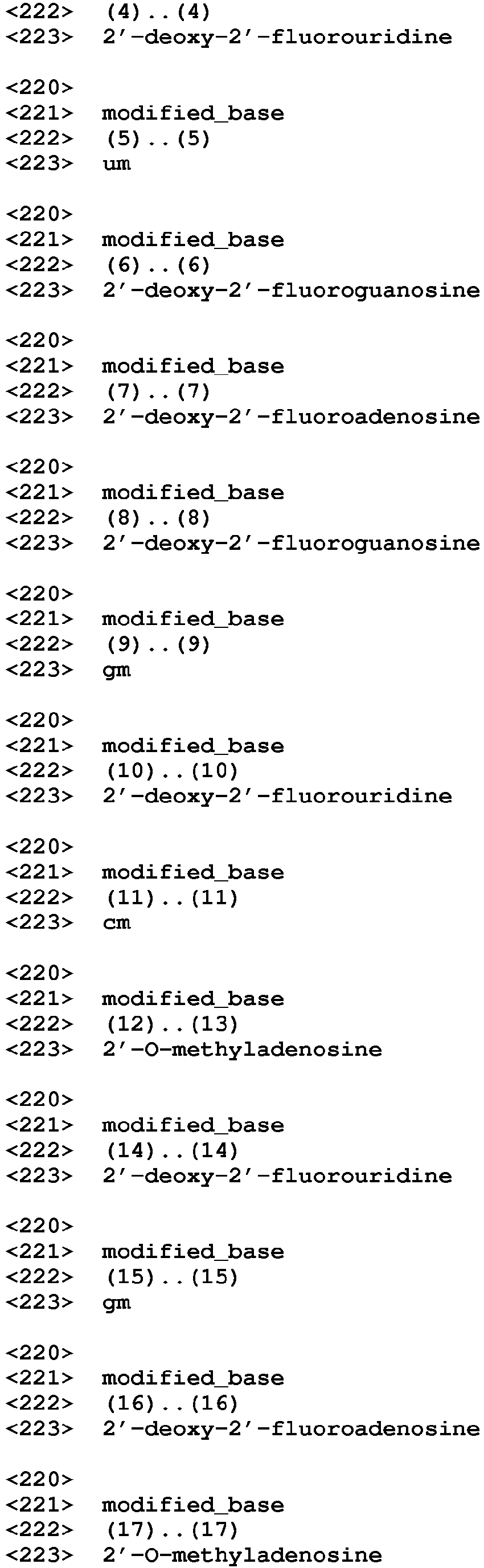


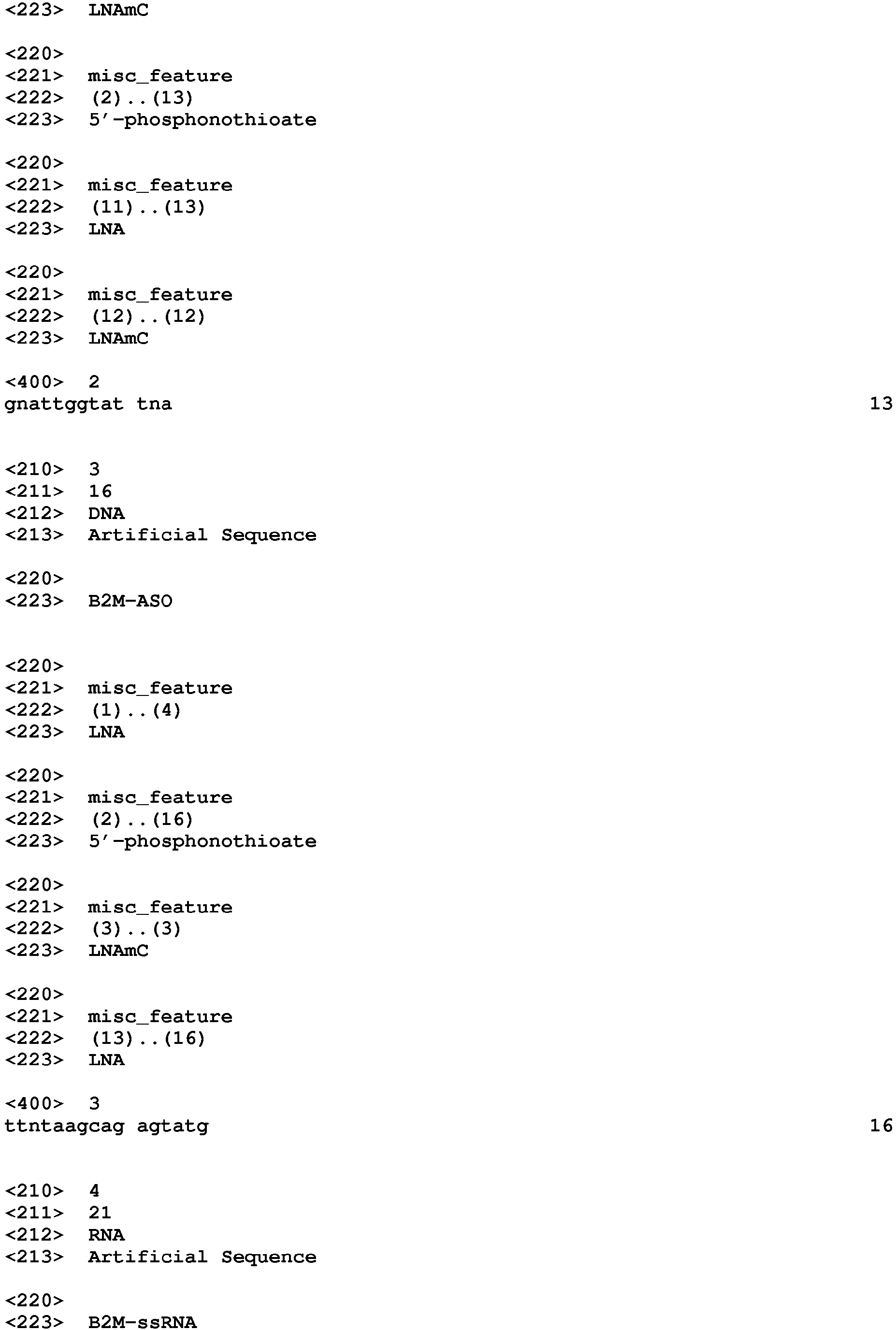



Claims (20)
- A nucleic acid conjugate in which a sugar chain ligand is bonded to an oligonucleotide via a linker, the sugar chain ligand having O-bonded mannose at its non-reducing end.
- The nucleic acid conjugate according to claim 1, wherein the sugar chain ligand has a structure that exhibits binding affinity for CD209 and/or CD206.
- The nucleic acid conjugate according to claim 1 or 2, wherein the sugar chain ligand is bonded to a cyclohexane skeleton via an ether bond at position 1 of the O-bonded mannose.
- The nucleic acid conjugate according to any one of claims 1 to 3, wherein the sugar chain ligand has the following structure:
 R1 and R2 are each independently a group selected from the group consisting of a hydrogen atom, a substituted or unsubstituted alkyl group having 1 to 20 carbon atoms, a substituted or unsubstituted alkenyl group having 2 to 20 carbon atoms, a substituted or unsubstituted alkynyl group having 3 to 20 carbon atoms, a substituted or unsubstituted aryl group, a substituted or unsubstituted heteroaryl group, a substituted or unsubstituted heteroalicyclic group, and a substituted or unsubstituted aralkyl group,Y1 and Y2 are each independently a group selected from the group consisting of an oxygen atom, a sulfur atom, and NR3, andR3 is a hydrogen atom or a substituted or unsubstituted alkyl group having 1 to 20 carbon atoms.
 - The nucleic acid conjugate according to any one of claims 1 to 4, wherein the sugar chain ligand has the following structure:
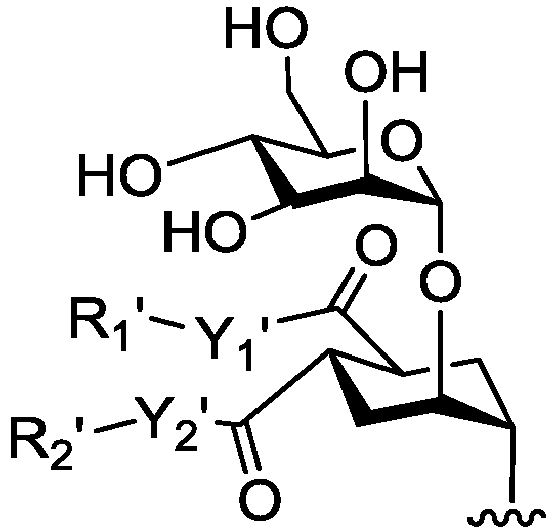 R1' and R2' are each independently a group selected from the group consisting of a hydrogen atom, a substituted or unsubstituted alkyl group having 1 to 20 carbon atoms, a substituted or unsubstituted alkenyl group having 2 to 20 carbon atoms, a substituted or unsubstituted alkynyl group having 3 to 20 carbon atoms, a substituted or unsubstituted aryl group, a substituted or unsubstituted heteroaryl group, a substituted or unsubstituted heteroalicyclic group, and a substituted or unsubstituted aralkyl group,Y1' and Y2' are each independently a group selected from the group consisting of an oxygen atom, a sulfur atom, and NR3', andR3' is a hydrogen atom or a substituted or unsubstituted alkyl group having 1 to 20 carbon atoms.
 - The nucleic acid conjugate according to claim 4 or 5, wherein each of Y1 and Y2, or Y1' and Y2' is NH.
- The nucleic acid conjugate according to claim 6, wherein each of R1 and R2, or R1' and R2' is a substituted or unsubstituted aralkyl group.
- The nucleic acid conjugate according to any one of claims 1 to 7, wherein the sugar chain ligand is represented by the following structure:
 R1'' and R2'' are each independently a group selected from the group consisting of a hydrogen atom, a substituted or unsubstituted alkyl group having 1 to 20 carbon atoms, a substituted or unsubstituted alkenyl group having 2 to 20 carbon atoms, a substituted or unsubstituted alkynyl group having 3 to 20 carbon atoms, a substituted or unsubstituted aryl group, a substituted or unsubstituted heteroaryl group, a substituted or unsubstituted heteroalicyclic group, and a substituted or unsubstituted aralkyl group,Y1'' and Y2" are each independently a group selected from the group consisting of an oxygen atom, a sulfur atom, and NR3", andR3" is a hydrogen atom or a substituted or unsubstituted alkyl group having 1 to 20 carbon atoms.
 - The nucleic acid conjugate according to claim 8, wherein the sugar chain ligand is represented by the following structure:
 R1''' and R2''' are each independently a group selected from the group consisting of a hydrogen atom, a substituted or unsubstituted alkyl group having 1 to 20 carbon atoms, a substituted or unsubstituted alkenyl group having 2 to 20 carbon atoms, a substituted or unsubstituted alkynyl group having 3 to 20 carbon atoms, a substituted or unsubstituted aryl group, a substituted or unsubstituted heteroaryl group, a substituted or unsubstituted heteroalicyclic group, and a substituted or unsubstituted aralkyl group,Y1''' and Y2''' are each independently a group selected from the group consisting of an oxygen atom, a sulfur atom, and NR3'', andR3'" is a hydrogen atom or a substituted or unsubstituted alkyl group having 1 to 20 carbon atoms.
 - The nucleic acid conjugate according to any one of claims 1 to 9, wherein the nucleic acid conjugate has 2 to 8 sugar chain ligands.
- The nucleic acid conjugate according to any one of claims 1 to 10, wherein the linker has any of the following structures:
 X1 is CH or a nitrogen atom, andX2 to X4 are each independently CH or a nitrogen atom.
 - The nucleic acid conjugate according to any one of claims 1 to 11, wherein the linker has the following structure:

- The nucleic acid conjugate according to any one of claims 1 to 12, wherein the linker has the following structure:

n1 is an integer of 1 to 100. - The nucleic acid conjugate according to any one of claims 1 to 12, wherein the linker has any of the following structures:


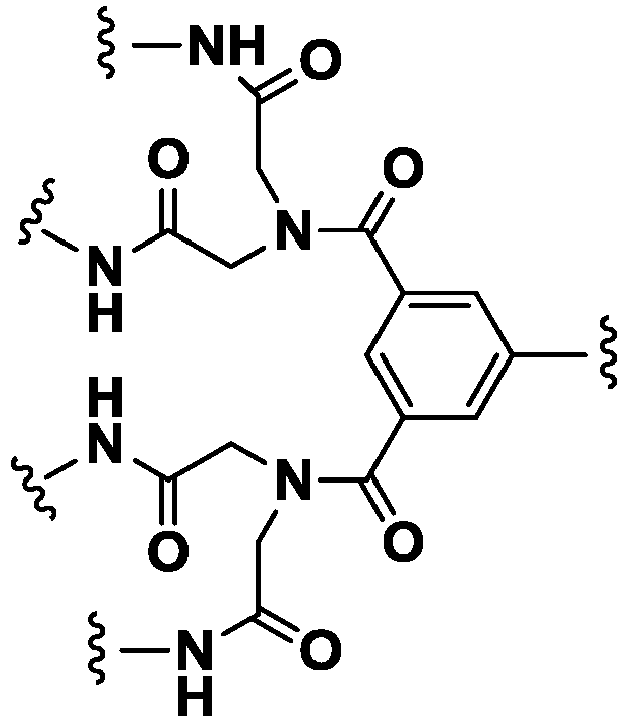


n2 and n3 are each independently an integer of 1 to 100. - The nucleic acid conjugate according to any one of claims 1 to 14, wherein the oligonucleotide comprises a modified nucleotide.
- A pharmaceutical composition comprising the nucleic acid conjugate according to any one of claims 1 to 15.
- The pharmaceutical composition according to claim 16, wherein the pharmaceutical composition is for transfer into a cell.
- The pharmaceutical composition according to claim 17, wherein the cell is a dendritic cell or a macrophage.
- The pharmaceutical composition according to any one of claims 16 to 18, wherein the pharmaceutical composition is intravenously administered or subcutaneously administered.
- A method for treating or preventing a disease, comprising administering the nucleic acid conjugate according to any one of claims 1 to 15 or the pharmaceutical composition according to any one of claims 16 to 19 to a patient in need thereof.
Applications Claiming Priority (2)
| Application Number | Priority Date | Filing Date | Title |
|---|---|---|---|
| JP2016131054 | 2016-06-30 | ||
| PCT/JP2017/024268 WO2018004004A1 (en) | 2016-06-30 | 2017-06-30 | Nucleic acid complex |
Publications (3)
| Publication Number | Publication Date |
|---|---|
| EP3498724A1 true EP3498724A1 (en) | 2019-06-19 |
| EP3498724A4 EP3498724A4 (en) | 2020-03-18 |
| EP3498724B1 EP3498724B1 (en) | 2023-06-21 |
Family
ID=60786901
Family Applications (1)
| Application Number | Title | Priority Date | Filing Date |
|---|---|---|---|
| EP17820358.4A Active EP3498724B1 (en) | 2016-06-30 | 2017-06-30 | Nucleic acid complex |
Country Status (9)
| Country | Link |
|---|---|
| US (1) | US12251446B2 (en) |
| EP (1) | EP3498724B1 (en) |
| JP (1) | JP7022687B2 (en) |
| KR (1) | KR102520362B1 (en) |
| CN (1) | CN109415401B (en) |
| AU (1) | AU2017287536B9 (en) |
| ES (1) | ES2952757T3 (en) |
| TW (1) | TWI746590B (en) |
| WO (1) | WO2018004004A1 (en) |
Cited By (5)
| Publication number | Priority date | Publication date | Assignee | Title |
|---|---|---|---|---|
| EP3409780A4 (en) * | 2016-01-29 | 2019-09-25 | Kyowa Hakko Kirin Co., Ltd. | NUCLEIC ACID COMPLEX |
| EP3902813A4 (en) * | 2018-12-28 | 2022-05-04 | Sirnaomics, Inc. | TARGETED DELIVERY OF THERAPEUTIC MOLECULES |
| WO2022226396A1 (en) * | 2021-04-23 | 2022-10-27 | Ganna Bio, Inc. | Glycan modified nucleic acids, methods of preparation, and therapeutic uses |
| WO2023187760A1 (en) * | 2022-04-01 | 2023-10-05 | Genevant Sciences Gmbh | Mannose-targeted compositions |
| WO2024086767A3 (en) * | 2022-10-21 | 2024-06-13 | Ganna Bio, Inc. | Glycan conjugate compositions and methods |
Families Citing this family (5)
| Publication number | Priority date | Publication date | Assignee | Title |
|---|---|---|---|---|
| WO2019027009A1 (en) * | 2017-08-02 | 2019-02-07 | 協和発酵キリン株式会社 | Nucleic acid complex |
| TW201909925A (en) * | 2017-08-02 | 2019-03-16 | 日商協和醱酵麒麟有限公司 | Nucleic acid complex |
| CN114514236B (en) * | 2019-09-27 | 2025-01-10 | Agc株式会社 | Nucleic acid containing perfluoroalkyl and method for producing the same |
| EP4071163A4 (en) * | 2020-01-30 | 2024-03-20 | Eisai R&D Management Co., Ltd. | Nucleic acid complex and pharmaceutical composition containing same |
| WO2026082185A1 (en) * | 2024-10-17 | 2026-04-23 | 浙江扬厉医药技术有限公司 | Double-stranded sirna which inhibits hsd17b13 expression, and conjugate thereof |
Family Cites Families (24)
| Publication number | Priority date | Publication date | Assignee | Title |
|---|---|---|---|---|
| US6469158B1 (en) | 1992-05-14 | 2002-10-22 | Ribozyme Pharmaceuticals, Incorporated | Synthesis, deprotection, analysis and purification of RNA and ribozymes |
| US5804683A (en) | 1992-05-14 | 1998-09-08 | Ribozyme Pharmaceuticals, Inc. | Deprotection of RNA with alkylamine |
| US5977343A (en) | 1992-05-14 | 1999-11-02 | Ribozyme Pharmaceuticals, Inc. | Synthesis, deprotection, analysis and purification of RNA and ribozymes |
| WO1995006731A2 (en) | 1993-09-02 | 1995-03-09 | Ribozyme Pharmaceuticals, Inc. | Non-nucleotide containing enzymatic nucleic acid |
| US5889136A (en) | 1995-06-09 | 1999-03-30 | The Regents Of The University Of Colorado | Orthoester protecting groups in RNA synthesis |
| US5998203A (en) | 1996-04-16 | 1999-12-07 | Ribozyme Pharmaceuticals, Inc. | Enzymatic nucleic acids containing 5'-and/or 3'-cap structures |
| US6111086A (en) | 1998-02-27 | 2000-08-29 | Scaringe; Stephen A. | Orthoester protecting groups |
| US20030059427A1 (en) | 2000-04-28 | 2003-03-27 | Force Walker R. | Isolation and characterization of highly active anti-CD40 antibody |
| WO2005113571A2 (en) | 2004-05-13 | 2005-12-01 | The University Of North Carolina At Chapel Hill | Methods for the delivery of oligomeric compounds |
| WO2006093524A2 (en) | 2004-07-16 | 2006-09-08 | The General Hospital Corporation | Antigen-carbohydrate conjugates |
| JP5301872B2 (en) | 2007-08-29 | 2013-09-25 | 国立大学法人東北大学 | Thiol group-containing UV-sensitive compound and use thereof |
| CN102006890A (en) | 2007-12-04 | 2011-04-06 | 阿尔尼拉姆医药品有限公司 | Targeting lipids |
| EP2289904A1 (en) * | 2009-07-03 | 2011-03-02 | Universita' degli Studi di Milano | Inhibitors of microbial infections |
| JP2013075035A (en) | 2011-09-30 | 2013-04-25 | Canon Inc | Ophthalmic apparatus, ophthalmic image processing method, and recording medium |
| MY167390A (en) | 2011-11-18 | 2018-08-16 | Alnylam Pharmaceuticals Inc | Rnai agents, compositions and methods of use thereof for treating transthyretin (ttr) associated diseases |
| BR112014028647A2 (en) | 2012-05-16 | 2017-07-25 | Rana Therapeutics Inc | compositions and methods for modulating bdnf expression |
| WO2013173637A1 (en) | 2012-05-16 | 2013-11-21 | Rana Therapeutics, Inc. | Compositions and methods for modulating gene expression |
| CA2921162A1 (en) | 2013-05-01 | 2014-11-06 | Ionis Pharmaceuticals, Inc. | Conjugated antisense compounds and their use |
| EP4039278A1 (en) | 2013-07-11 | 2022-08-10 | Alnylam Pharmaceuticals, Inc. | Oligonucleotide-ligand conjugates and process for their preparation |
| JP2016537027A (en) | 2013-11-06 | 2016-12-01 | ソルスティス バイオロジクス,リミティッド | Polynucleotide construct having a disulfide group |
| WO2015105083A1 (en) | 2014-01-07 | 2015-07-16 | 塩野義製薬株式会社 | Double-stranded oligonucleotide containing antisense oligonucleotide and sugar derivative |
| EP3230393B1 (en) * | 2014-12-12 | 2019-04-24 | Marcella Chiari | New clickable polymers and gels for microarray and other applications |
| WO2017010575A1 (en) | 2015-07-16 | 2017-01-19 | 協和発酵キリン株式会社 | β2GPI GENE EXPRESSION INHIBITING NUCLEIC ACID COMPLEX |
| JP6853193B2 (en) | 2016-01-29 | 2021-03-31 | 協和キリン株式会社 | Nucleic acid complex |
-
2017
- 2017-06-30 EP EP17820358.4A patent/EP3498724B1/en active Active
- 2017-06-30 TW TW106122151A patent/TWI746590B/en active
- 2017-06-30 WO PCT/JP2017/024268 patent/WO2018004004A1/en not_active Ceased
- 2017-06-30 US US16/314,015 patent/US12251446B2/en active Active
- 2017-06-30 ES ES17820358T patent/ES2952757T3/en active Active
- 2017-06-30 KR KR1020197002874A patent/KR102520362B1/en active Active
- 2017-06-30 CN CN201780040847.4A patent/CN109415401B/en active Active
- 2017-06-30 JP JP2018525319A patent/JP7022687B2/en active Active
- 2017-06-30 AU AU2017287536A patent/AU2017287536B9/en active Active
Cited By (6)
| Publication number | Priority date | Publication date | Assignee | Title |
|---|---|---|---|---|
| EP3409780A4 (en) * | 2016-01-29 | 2019-09-25 | Kyowa Hakko Kirin Co., Ltd. | NUCLEIC ACID COMPLEX |
| EP3902813A4 (en) * | 2018-12-28 | 2022-05-04 | Sirnaomics, Inc. | TARGETED DELIVERY OF THERAPEUTIC MOLECULES |
| WO2022226396A1 (en) * | 2021-04-23 | 2022-10-27 | Ganna Bio, Inc. | Glycan modified nucleic acids, methods of preparation, and therapeutic uses |
| US11766481B2 (en) | 2021-04-23 | 2023-09-26 | Ganna Bio, Inc. | Glycan modified short interfering RNA |
| WO2023187760A1 (en) * | 2022-04-01 | 2023-10-05 | Genevant Sciences Gmbh | Mannose-targeted compositions |
| WO2024086767A3 (en) * | 2022-10-21 | 2024-06-13 | Ganna Bio, Inc. | Glycan conjugate compositions and methods |
Also Published As
| Publication number | Publication date |
|---|---|
| AU2017287536A1 (en) | 2019-02-21 |
| TWI746590B (en) | 2021-11-21 |
| US20190192674A1 (en) | 2019-06-27 |
| CN109415401B (en) | 2023-02-03 |
| ES2952757T3 (en) | 2023-11-03 |
| JP7022687B2 (en) | 2022-02-18 |
| US12251446B2 (en) | 2025-03-18 |
| KR102520362B1 (en) | 2023-04-10 |
| TW201803572A (en) | 2018-02-01 |
| JPWO2018004004A1 (en) | 2019-04-18 |
| AU2017287536B9 (en) | 2021-03-25 |
| WO2018004004A1 (en) | 2018-01-04 |
| KR20190022832A (en) | 2019-03-06 |
| EP3498724B1 (en) | 2023-06-21 |
| AU2017287536B2 (en) | 2021-03-11 |
| EP3498724A4 (en) | 2020-03-18 |
| CN109415401A (en) | 2019-03-01 |
| CA3029508A1 (en) | 2018-01-04 |
Similar Documents
| Publication | Publication Date | Title |
|---|---|---|
| EP3409780B1 (en) | Nucleic acid complex | |
| EP3498724B1 (en) | Nucleic acid complex | |
| JP7842850B2 (en) | 1'-alkyl-modified ribose derivative and method of use | |
| EP2326656B1 (en) | Rna synthesis - phosphoramidites for synthetic rna in the reverse direction, and application in convenient introduction of ligands, chromophores and modifications of synthetic rna at the 3' - end | |
| EP3323893A1 (en) | Beta2gpi gene expression inhibiting nucleic acid complex | |
| TW201909925A (en) | Nucleic acid complex | |
| Johannsen et al. | Amino acids attached to 2′-amino-LNA: synthesis and excellent duplex stability | |
| EP3888663A1 (en) | Nucleic acid complex | |
| CA3029508C (en) | Nucleic acid conjugate | |
| TW201920668A (en) | Nucleic acid complex | |
| TWI541249B (en) | 5-position modified pyrimidines and their use | |
| HK40059056A (en) | Nucleic acid complex | |
| Zhao | Chemical synthesis of glycosylated oligoribonucleotides for siRNA development |
Legal Events
| Date | Code | Title | Description |
|---|---|---|---|
| STAA | Information on the status of an ep patent application or granted ep patent |
Free format text: STATUS: THE INTERNATIONAL PUBLICATION HAS BEEN MADE |
|
| PUAI | Public reference made under article 153(3) epc to a published international application that has entered the european phase |
Free format text: ORIGINAL CODE: 0009012 |
|
| STAA | Information on the status of an ep patent application or granted ep patent |
Free format text: STATUS: REQUEST FOR EXAMINATION WAS MADE |
|
| 17P | Request for examination filed |
Effective date: 20190130 |
|
| AK | Designated contracting states |
Kind code of ref document: A1 Designated state(s): AL AT BE BG CH CY CZ DE DK EE ES FI FR GB GR HR HU IE IS IT LI LT LU LV MC MK MT NL NO PL PT RO RS SE SI SK SM TR |
|
| AX | Request for extension of the european patent |
Extension state: BA ME |
|
| DAV | Request for validation of the european patent (deleted) | ||
| DAX | Request for extension of the european patent (deleted) | ||
| RAP1 | Party data changed (applicant data changed or rights of an application transferred) |
Owner name: KYOWA KIRIN CO., LTD. |
|
| A4 | Supplementary search report drawn up and despatched |
Effective date: 20200213 |
|
| RIC1 | Information provided on ipc code assigned before grant |
Ipc: A61K 48/00 20060101ALI20200207BHEP Ipc: A61K 31/7088 20060101ALI20200207BHEP Ipc: C12N 15/113 20100101ALI20200207BHEP Ipc: C12N 15/09 20060101ALI20200207BHEP Ipc: C07H 21/02 20060101AFI20200207BHEP Ipc: A61K 47/54 20170101ALI20200207BHEP |
|
| STAA | Information on the status of an ep patent application or granted ep patent |
Free format text: STATUS: EXAMINATION IS IN PROGRESS |
|
| 17Q | First examination report despatched |
Effective date: 20210114 |
|
| GRAP | Despatch of communication of intention to grant a patent |
Free format text: ORIGINAL CODE: EPIDOSNIGR1 |
|
| STAA | Information on the status of an ep patent application or granted ep patent |
Free format text: STATUS: GRANT OF PATENT IS INTENDED |
|
| INTG | Intention to grant announced |
Effective date: 20230113 |
|
| GRAS | Grant fee paid |
Free format text: ORIGINAL CODE: EPIDOSNIGR3 |
|
| GRAA | (expected) grant |
Free format text: ORIGINAL CODE: 0009210 |
|
| STAA | Information on the status of an ep patent application or granted ep patent |
Free format text: STATUS: THE PATENT HAS BEEN GRANTED |
|
| AK | Designated contracting states |
Kind code of ref document: B1 Designated state(s): AL AT BE BG CH CY CZ DE DK EE ES FI FR GB GR HR HU IE IS IT LI LT LU LV MC MK MT NL NO PL PT RO RS SE SI SK SM TR |
|
| REG | Reference to a national code |
Ref country code: CH Ref legal event code: EP |
|
| REG | Reference to a national code |
Ref country code: DE Ref legal event code: R096 Ref document number: 602017070486 Country of ref document: DE |
|
| REG | Reference to a national code |
Ref country code: AT Ref legal event code: REF Ref document number: 1580846 Country of ref document: AT Kind code of ref document: T Effective date: 20230715 |
|
| REG | Reference to a national code |
Ref country code: IE Ref legal event code: FG4D |
|
| REG | Reference to a national code |
Ref country code: LT Ref legal event code: MG9D |
|
| REG | Reference to a national code |
Ref country code: NL Ref legal event code: MP Effective date: 20230621 |
|
| PG25 | Lapsed in a contracting state [announced via postgrant information from national office to epo] |
Ref country code: SE Free format text: LAPSE BECAUSE OF FAILURE TO SUBMIT A TRANSLATION OF THE DESCRIPTION OR TO PAY THE FEE WITHIN THE PRESCRIBED TIME-LIMIT Effective date: 20230621 Ref country code: NO Free format text: LAPSE BECAUSE OF FAILURE TO SUBMIT A TRANSLATION OF THE DESCRIPTION OR TO PAY THE FEE WITHIN THE PRESCRIBED TIME-LIMIT Effective date: 20230921 |
|
| REG | Reference to a national code |
Ref country code: ES Ref legal event code: FG2A Ref document number: 2952757 Country of ref document: ES Kind code of ref document: T3 Effective date: 20231103 |
|
| REG | Reference to a national code |
Ref country code: AT Ref legal event code: MK05 Ref document number: 1580846 Country of ref document: AT Kind code of ref document: T Effective date: 20230621 |
|
| PG25 | Lapsed in a contracting state [announced via postgrant information from national office to epo] |
Ref country code: RS Free format text: LAPSE BECAUSE OF FAILURE TO SUBMIT A TRANSLATION OF THE DESCRIPTION OR TO PAY THE FEE WITHIN THE PRESCRIBED TIME-LIMIT Effective date: 20230621 Ref country code: NL Free format text: LAPSE BECAUSE OF FAILURE TO SUBMIT A TRANSLATION OF THE DESCRIPTION OR TO PAY THE FEE WITHIN THE PRESCRIBED TIME-LIMIT Effective date: 20230621 Ref country code: LV Free format text: LAPSE BECAUSE OF FAILURE TO SUBMIT A TRANSLATION OF THE DESCRIPTION OR TO PAY THE FEE WITHIN THE PRESCRIBED TIME-LIMIT Effective date: 20230621 Ref country code: LT Free format text: LAPSE BECAUSE OF FAILURE TO SUBMIT A TRANSLATION OF THE DESCRIPTION OR TO PAY THE FEE WITHIN THE PRESCRIBED TIME-LIMIT Effective date: 20230621 Ref country code: HR Free format text: LAPSE BECAUSE OF FAILURE TO SUBMIT A TRANSLATION OF THE DESCRIPTION OR TO PAY THE FEE WITHIN THE PRESCRIBED TIME-LIMIT Effective date: 20230621 Ref country code: GR Free format text: LAPSE BECAUSE OF FAILURE TO SUBMIT A TRANSLATION OF THE DESCRIPTION OR TO PAY THE FEE WITHIN THE PRESCRIBED TIME-LIMIT Effective date: 20230922 |
|
| PG25 | Lapsed in a contracting state [announced via postgrant information from national office to epo] |
Ref country code: FI Free format text: LAPSE BECAUSE OF FAILURE TO SUBMIT A TRANSLATION OF THE DESCRIPTION OR TO PAY THE FEE WITHIN THE PRESCRIBED TIME-LIMIT Effective date: 20230621 |
|
| PG25 | Lapsed in a contracting state [announced via postgrant information from national office to epo] |
Ref country code: SK Free format text: LAPSE BECAUSE OF FAILURE TO SUBMIT A TRANSLATION OF THE DESCRIPTION OR TO PAY THE FEE WITHIN THE PRESCRIBED TIME-LIMIT Effective date: 20230621 |
|
| PG25 | Lapsed in a contracting state [announced via postgrant information from national office to epo] |
Ref country code: IS Free format text: LAPSE BECAUSE OF FAILURE TO SUBMIT A TRANSLATION OF THE DESCRIPTION OR TO PAY THE FEE WITHIN THE PRESCRIBED TIME-LIMIT Effective date: 20231021 |
|
| P01 | Opt-out of the competence of the unified patent court (upc) registered |
Effective date: 20231218 |
|
| PG25 | Lapsed in a contracting state [announced via postgrant information from national office to epo] |
Ref country code: SM Free format text: LAPSE BECAUSE OF FAILURE TO SUBMIT A TRANSLATION OF THE DESCRIPTION OR TO PAY THE FEE WITHIN THE PRESCRIBED TIME-LIMIT Effective date: 20230621 Ref country code: SK Free format text: LAPSE BECAUSE OF FAILURE TO SUBMIT A TRANSLATION OF THE DESCRIPTION OR TO PAY THE FEE WITHIN THE PRESCRIBED TIME-LIMIT Effective date: 20230621 Ref country code: RO Free format text: LAPSE BECAUSE OF FAILURE TO SUBMIT A TRANSLATION OF THE DESCRIPTION OR TO PAY THE FEE WITHIN THE PRESCRIBED TIME-LIMIT Effective date: 20230621 Ref country code: PT Free format text: LAPSE BECAUSE OF FAILURE TO SUBMIT A TRANSLATION OF THE DESCRIPTION OR TO PAY THE FEE WITHIN THE PRESCRIBED TIME-LIMIT Effective date: 20231023 Ref country code: IS Free format text: LAPSE BECAUSE OF FAILURE TO SUBMIT A TRANSLATION OF THE DESCRIPTION OR TO PAY THE FEE WITHIN THE PRESCRIBED TIME-LIMIT Effective date: 20231021 Ref country code: EE Free format text: LAPSE BECAUSE OF FAILURE TO SUBMIT A TRANSLATION OF THE DESCRIPTION OR TO PAY THE FEE WITHIN THE PRESCRIBED TIME-LIMIT Effective date: 20230621 Ref country code: CZ Free format text: LAPSE BECAUSE OF FAILURE TO SUBMIT A TRANSLATION OF THE DESCRIPTION OR TO PAY THE FEE WITHIN THE PRESCRIBED TIME-LIMIT Effective date: 20230621 Ref country code: AT Free format text: LAPSE BECAUSE OF FAILURE TO SUBMIT A TRANSLATION OF THE DESCRIPTION OR TO PAY THE FEE WITHIN THE PRESCRIBED TIME-LIMIT Effective date: 20230621 |
|
| REG | Reference to a national code |
Ref country code: CH Ref legal event code: PL |
|
| REG | Reference to a national code |
Ref country code: BE Ref legal event code: MM Effective date: 20230630 |
|
| PG25 | Lapsed in a contracting state [announced via postgrant information from national office to epo] |
Ref country code: PL Free format text: LAPSE BECAUSE OF FAILURE TO SUBMIT A TRANSLATION OF THE DESCRIPTION OR TO PAY THE FEE WITHIN THE PRESCRIBED TIME-LIMIT Effective date: 20230621 |
|
| PG25 | Lapsed in a contracting state [announced via postgrant information from national office to epo] |
Ref country code: LU Free format text: LAPSE BECAUSE OF NON-PAYMENT OF DUE FEES Effective date: 20230630 |
|
| PG25 | Lapsed in a contracting state [announced via postgrant information from national office to epo] |
Ref country code: MC Free format text: LAPSE BECAUSE OF FAILURE TO SUBMIT A TRANSLATION OF THE DESCRIPTION OR TO PAY THE FEE WITHIN THE PRESCRIBED TIME-LIMIT Effective date: 20230621 |
|
| REG | Reference to a national code |
Ref country code: DE Ref legal event code: R097 Ref document number: 602017070486 Country of ref document: DE |
|
| REG | Reference to a national code |
Ref country code: IE Ref legal event code: MM4A |
|
| PG25 | Lapsed in a contracting state [announced via postgrant information from national office to epo] |
Ref country code: MC Free format text: LAPSE BECAUSE OF FAILURE TO SUBMIT A TRANSLATION OF THE DESCRIPTION OR TO PAY THE FEE WITHIN THE PRESCRIBED TIME-LIMIT Effective date: 20230621 Ref country code: LU Free format text: LAPSE BECAUSE OF NON-PAYMENT OF DUE FEES Effective date: 20230630 |
|
| PG25 | Lapsed in a contracting state [announced via postgrant information from national office to epo] |
Ref country code: IE Free format text: LAPSE BECAUSE OF NON-PAYMENT OF DUE FEES Effective date: 20230630 |
|
| PLBE | No opposition filed within time limit |
Free format text: ORIGINAL CODE: 0009261 |
|
| STAA | Information on the status of an ep patent application or granted ep patent |
Free format text: STATUS: NO OPPOSITION FILED WITHIN TIME LIMIT |
|
| PG25 | Lapsed in a contracting state [announced via postgrant information from national office to epo] |
Ref country code: IE Free format text: LAPSE BECAUSE OF NON-PAYMENT OF DUE FEES Effective date: 20230630 Ref country code: DK Free format text: LAPSE BECAUSE OF FAILURE TO SUBMIT A TRANSLATION OF THE DESCRIPTION OR TO PAY THE FEE WITHIN THE PRESCRIBED TIME-LIMIT Effective date: 20230621 Ref country code: CH Free format text: LAPSE BECAUSE OF NON-PAYMENT OF DUE FEES Effective date: 20230630 |
|
| PG25 | Lapsed in a contracting state [announced via postgrant information from national office to epo] |
Ref country code: SI Free format text: LAPSE BECAUSE OF FAILURE TO SUBMIT A TRANSLATION OF THE DESCRIPTION OR TO PAY THE FEE WITHIN THE PRESCRIBED TIME-LIMIT Effective date: 20230621 |
|
| 26N | No opposition filed |
Effective date: 20240322 |
|
| PG25 | Lapsed in a contracting state [announced via postgrant information from national office to epo] |
Ref country code: SI Free format text: LAPSE BECAUSE OF FAILURE TO SUBMIT A TRANSLATION OF THE DESCRIPTION OR TO PAY THE FEE WITHIN THE PRESCRIBED TIME-LIMIT Effective date: 20230621 Ref country code: BE Free format text: LAPSE BECAUSE OF NON-PAYMENT OF DUE FEES Effective date: 20230630 |
|
| PG25 | Lapsed in a contracting state [announced via postgrant information from national office to epo] |
Ref country code: BG Free format text: LAPSE BECAUSE OF FAILURE TO SUBMIT A TRANSLATION OF THE DESCRIPTION OR TO PAY THE FEE WITHIN THE PRESCRIBED TIME-LIMIT Effective date: 20230621 |
|
| PG25 | Lapsed in a contracting state [announced via postgrant information from national office to epo] |
Ref country code: BG Free format text: LAPSE BECAUSE OF FAILURE TO SUBMIT A TRANSLATION OF THE DESCRIPTION OR TO PAY THE FEE WITHIN THE PRESCRIBED TIME-LIMIT Effective date: 20230621 |
|
| PGFP | Annual fee paid to national office [announced via postgrant information from national office to epo] |
Ref country code: DE Payment date: 20250507 Year of fee payment: 9 |
|
| PGFP | Annual fee paid to national office [announced via postgrant information from national office to epo] |
Ref country code: GB Payment date: 20250508 Year of fee payment: 9 |
|
| PGFP | Annual fee paid to national office [announced via postgrant information from national office to epo] |
Ref country code: IT Payment date: 20250522 Year of fee payment: 9 |
|
| PGFP | Annual fee paid to national office [announced via postgrant information from national office to epo] |
Ref country code: FR Payment date: 20250508 Year of fee payment: 9 |
|
| PG25 | Lapsed in a contracting state [announced via postgrant information from national office to epo] |
Ref country code: CY Free format text: LAPSE BECAUSE OF FAILURE TO SUBMIT A TRANSLATION OF THE DESCRIPTION OR TO PAY THE FEE WITHIN THE PRESCRIBED TIME-LIMIT; INVALID AB INITIO Effective date: 20170630 |
|
| PG25 | Lapsed in a contracting state [announced via postgrant information from national office to epo] |
Ref country code: HU Free format text: LAPSE BECAUSE OF FAILURE TO SUBMIT A TRANSLATION OF THE DESCRIPTION OR TO PAY THE FEE WITHIN THE PRESCRIBED TIME-LIMIT; INVALID AB INITIO Effective date: 20170630 |
|
| PGFP | Annual fee paid to national office [announced via postgrant information from national office to epo] |
Ref country code: ES Payment date: 20250701 Year of fee payment: 9 |
|
| PG25 | Lapsed in a contracting state [announced via postgrant information from national office to epo] |
Ref country code: TR Free format text: LAPSE BECAUSE OF FAILURE TO SUBMIT A TRANSLATION OF THE DESCRIPTION OR TO PAY THE FEE WITHIN THE PRESCRIBED TIME-LIMIT Effective date: 20230621 |