EP3497258B1 - Modified hot-dip galvanize coatings with low liquidus temperature, methods of making and using the same - Google Patents
Modified hot-dip galvanize coatings with low liquidus temperature, methods of making and using the same Download PDFInfo
- Publication number
- EP3497258B1 EP3497258B1 EP17840131.1A EP17840131A EP3497258B1 EP 3497258 B1 EP3497258 B1 EP 3497258B1 EP 17840131 A EP17840131 A EP 17840131A EP 3497258 B1 EP3497258 B1 EP 3497258B1
- Authority
- EP
- European Patent Office
- Prior art keywords
- zinc
- dopant
- coating
- based alloy
- temperature
- Prior art date
- Legal status (The legal status is an assumption and is not a legal conclusion. Google has not performed a legal analysis and makes no representation as to the accuracy of the status listed.)
- Active
Links
Images





Classifications
-
- C—CHEMISTRY; METALLURGY
- C23—COATING METALLIC MATERIAL; COATING MATERIAL WITH METALLIC MATERIAL; CHEMICAL SURFACE TREATMENT; DIFFUSION TREATMENT OF METALLIC MATERIAL; COATING BY VACUUM EVAPORATION, BY SPUTTERING, BY ION IMPLANTATION OR BY CHEMICAL VAPOUR DEPOSITION, IN GENERAL; INHIBITING CORROSION OF METALLIC MATERIAL OR INCRUSTATION IN GENERAL
- C23C—COATING METALLIC MATERIAL; COATING MATERIAL WITH METALLIC MATERIAL; SURFACE TREATMENT OF METALLIC MATERIAL BY DIFFUSION INTO THE SURFACE, BY CHEMICAL CONVERSION OR SUBSTITUTION; COATING BY VACUUM EVAPORATION, BY SPUTTERING, BY ION IMPLANTATION OR BY CHEMICAL VAPOUR DEPOSITION, IN GENERAL
- C23C2/00—Hot-dipping or immersion processes for applying the coating material in the molten state without affecting the shape; Apparatus therefor
- C23C2/26—After-treatment
- C23C2/28—Thermal after-treatment, e.g. treatment in oil bath
-
- C—CHEMISTRY; METALLURGY
- C23—COATING METALLIC MATERIAL; COATING MATERIAL WITH METALLIC MATERIAL; CHEMICAL SURFACE TREATMENT; DIFFUSION TREATMENT OF METALLIC MATERIAL; COATING BY VACUUM EVAPORATION, BY SPUTTERING, BY ION IMPLANTATION OR BY CHEMICAL VAPOUR DEPOSITION, IN GENERAL; INHIBITING CORROSION OF METALLIC MATERIAL OR INCRUSTATION IN GENERAL
- C23C—COATING METALLIC MATERIAL; COATING MATERIAL WITH METALLIC MATERIAL; SURFACE TREATMENT OF METALLIC MATERIAL BY DIFFUSION INTO THE SURFACE, BY CHEMICAL CONVERSION OR SUBSTITUTION; COATING BY VACUUM EVAPORATION, BY SPUTTERING, BY ION IMPLANTATION OR BY CHEMICAL VAPOUR DEPOSITION, IN GENERAL
- C23C2/00—Hot-dipping or immersion processes for applying the coating material in the molten state without affecting the shape; Apparatus therefor
- C23C2/04—Hot-dipping or immersion processes for applying the coating material in the molten state without affecting the shape; Apparatus therefor characterised by the coating material
- C23C2/06—Zinc or cadmium or alloys based thereon
-
- C—CHEMISTRY; METALLURGY
- C21—METALLURGY OF IRON
- C21D—MODIFYING THE PHYSICAL STRUCTURE OF FERROUS METALS; GENERAL DEVICES FOR HEAT TREATMENT OF FERROUS OR NON-FERROUS METALS OR ALLOYS; MAKING METAL MALLEABLE, e.g. BY DECARBURISATION OR TEMPERING
- C21D1/00—General methods or devices for heat treatment, e.g. annealing, hardening, quenching or tempering
- C21D1/18—Hardening; Quenching with or without subsequent tempering
- C21D1/19—Hardening; Quenching with or without subsequent tempering by interrupted quenching
- C21D1/20—Isothermal quenching, e.g. bainitic hardening
-
- C—CHEMISTRY; METALLURGY
- C21—METALLURGY OF IRON
- C21D—MODIFYING THE PHYSICAL STRUCTURE OF FERROUS METALS; GENERAL DEVICES FOR HEAT TREATMENT OF FERROUS OR NON-FERROUS METALS OR ALLOYS; MAKING METAL MALLEABLE, e.g. BY DECARBURISATION OR TEMPERING
- C21D1/00—General methods or devices for heat treatment, e.g. annealing, hardening, quenching or tempering
- C21D1/18—Hardening; Quenching with or without subsequent tempering
- C21D1/19—Hardening; Quenching with or without subsequent tempering by interrupted quenching
- C21D1/22—Martempering
-
- C—CHEMISTRY; METALLURGY
- C21—METALLURGY OF IRON
- C21D—MODIFYING THE PHYSICAL STRUCTURE OF FERROUS METALS; GENERAL DEVICES FOR HEAT TREATMENT OF FERROUS OR NON-FERROUS METALS OR ALLOYS; MAKING METAL MALLEABLE, e.g. BY DECARBURISATION OR TEMPERING
- C21D8/00—Modifying the physical properties of ferrous metals or ferrous alloys by deformation combined with, or followed by, heat treatment
- C21D8/02—Modifying the physical properties of ferrous metals or ferrous alloys by deformation combined with, or followed by, heat treatment during manufacturing of plates or strips
- C21D8/0278—Modifying the physical properties of ferrous metals or ferrous alloys by deformation combined with, or followed by, heat treatment during manufacturing of plates or strips involving a particular surface treatment
- C21D8/0284—Application of a separating or insulating coating
-
- C—CHEMISTRY; METALLURGY
- C21—METALLURGY OF IRON
- C21D—MODIFYING THE PHYSICAL STRUCTURE OF FERROUS METALS; GENERAL DEVICES FOR HEAT TREATMENT OF FERROUS OR NON-FERROUS METALS OR ALLOYS; MAKING METAL MALLEABLE, e.g. BY DECARBURISATION OR TEMPERING
- C21D8/00—Modifying the physical properties of ferrous metals or ferrous alloys by deformation combined with, or followed by, heat treatment
- C21D8/02—Modifying the physical properties of ferrous metals or ferrous alloys by deformation combined with, or followed by, heat treatment during manufacturing of plates or strips
- C21D8/04—Modifying the physical properties of ferrous metals or ferrous alloys by deformation combined with, or followed by, heat treatment during manufacturing of plates or strips to produce plates or strips for drawing, e.g. for deep-drawing
- C21D8/0478—Modifying the physical properties of ferrous metals or ferrous alloys by deformation combined with, or followed by, heat treatment during manufacturing of plates or strips to produce plates or strips for drawing, e.g. for deep-drawing involving a particular surface treatment
- C21D8/0484—Application of a separating or insulating coating
-
- C—CHEMISTRY; METALLURGY
- C22—METALLURGY; FERROUS OR NON-FERROUS ALLOYS; TREATMENT OF ALLOYS OR NON-FERROUS METALS
- C22C—ALLOYS
- C22C18/00—Alloys based on zinc
- C22C18/04—Alloys based on zinc with aluminium as the next major constituent
-
- C—CHEMISTRY; METALLURGY
- C23—COATING METALLIC MATERIAL; COATING MATERIAL WITH METALLIC MATERIAL; CHEMICAL SURFACE TREATMENT; DIFFUSION TREATMENT OF METALLIC MATERIAL; COATING BY VACUUM EVAPORATION, BY SPUTTERING, BY ION IMPLANTATION OR BY CHEMICAL VAPOUR DEPOSITION, IN GENERAL; INHIBITING CORROSION OF METALLIC MATERIAL OR INCRUSTATION IN GENERAL
- C23C—COATING METALLIC MATERIAL; COATING MATERIAL WITH METALLIC MATERIAL; SURFACE TREATMENT OF METALLIC MATERIAL BY DIFFUSION INTO THE SURFACE, BY CHEMICAL CONVERSION OR SUBSTITUTION; COATING BY VACUUM EVAPORATION, BY SPUTTERING, BY ION IMPLANTATION OR BY CHEMICAL VAPOUR DEPOSITION, IN GENERAL
- C23C2/00—Hot-dipping or immersion processes for applying the coating material in the molten state without affecting the shape; Apparatus therefor
- C23C2/26—After-treatment
- C23C2/28—Thermal after-treatment, e.g. treatment in oil bath
- C23C2/29—Cooling or quenching
-
- C—CHEMISTRY; METALLURGY
- C23—COATING METALLIC MATERIAL; COATING MATERIAL WITH METALLIC MATERIAL; CHEMICAL SURFACE TREATMENT; DIFFUSION TREATMENT OF METALLIC MATERIAL; COATING BY VACUUM EVAPORATION, BY SPUTTERING, BY ION IMPLANTATION OR BY CHEMICAL VAPOUR DEPOSITION, IN GENERAL; INHIBITING CORROSION OF METALLIC MATERIAL OR INCRUSTATION IN GENERAL
- C23C—COATING METALLIC MATERIAL; COATING MATERIAL WITH METALLIC MATERIAL; SURFACE TREATMENT OF METALLIC MATERIAL BY DIFFUSION INTO THE SURFACE, BY CHEMICAL CONVERSION OR SUBSTITUTION; COATING BY VACUUM EVAPORATION, BY SPUTTERING, BY ION IMPLANTATION OR BY CHEMICAL VAPOUR DEPOSITION, IN GENERAL
- C23C2/00—Hot-dipping or immersion processes for applying the coating material in the molten state without affecting the shape; Apparatus therefor
- C23C2/34—Hot-dipping or immersion processes for applying the coating material in the molten state without affecting the shape; Apparatus therefor characterised by the shape of the material to be treated
- C23C2/36—Elongated material
- C23C2/40—Plates; Strips
-
- C—CHEMISTRY; METALLURGY
- C21—METALLURGY OF IRON
- C21D—MODIFYING THE PHYSICAL STRUCTURE OF FERROUS METALS; GENERAL DEVICES FOR HEAT TREATMENT OF FERROUS OR NON-FERROUS METALS OR ALLOYS; MAKING METAL MALLEABLE, e.g. BY DECARBURISATION OR TEMPERING
- C21D1/00—General methods or devices for heat treatment, e.g. annealing, hardening, quenching or tempering
- C21D1/68—Temporary coatings or embedding materials applied before or during heat treatment
-
- C—CHEMISTRY; METALLURGY
- C21—METALLURGY OF IRON
- C21D—MODIFYING THE PHYSICAL STRUCTURE OF FERROUS METALS; GENERAL DEVICES FOR HEAT TREATMENT OF FERROUS OR NON-FERROUS METALS OR ALLOYS; MAKING METAL MALLEABLE, e.g. BY DECARBURISATION OR TEMPERING
- C21D1/00—General methods or devices for heat treatment, e.g. annealing, hardening, quenching or tempering
- C21D1/68—Temporary coatings or embedding materials applied before or during heat treatment
- C21D1/70—Temporary coatings or embedding materials applied before or during heat treatment while heating or quenching
-
- C—CHEMISTRY; METALLURGY
- C21—METALLURGY OF IRON
- C21D—MODIFYING THE PHYSICAL STRUCTURE OF FERROUS METALS; GENERAL DEVICES FOR HEAT TREATMENT OF FERROUS OR NON-FERROUS METALS OR ALLOYS; MAKING METAL MALLEABLE, e.g. BY DECARBURISATION OR TEMPERING
- C21D2211/00—Microstructure comprising significant phases
- C21D2211/002—Bainite
-
- C—CHEMISTRY; METALLURGY
- C21—METALLURGY OF IRON
- C21D—MODIFYING THE PHYSICAL STRUCTURE OF FERROUS METALS; GENERAL DEVICES FOR HEAT TREATMENT OF FERROUS OR NON-FERROUS METALS OR ALLOYS; MAKING METAL MALLEABLE, e.g. BY DECARBURISATION OR TEMPERING
- C21D2211/00—Microstructure comprising significant phases
- C21D2211/005—Ferrite
-
- C—CHEMISTRY; METALLURGY
- C21—METALLURGY OF IRON
- C21D—MODIFYING THE PHYSICAL STRUCTURE OF FERROUS METALS; GENERAL DEVICES FOR HEAT TREATMENT OF FERROUS OR NON-FERROUS METALS OR ALLOYS; MAKING METAL MALLEABLE, e.g. BY DECARBURISATION OR TEMPERING
- C21D2211/00—Microstructure comprising significant phases
- C21D2211/008—Martensite
Definitions
- the present invention involves lower liquidus temperature coatings to enhance substrate responses in a variety of applications, and processes for making and using the same.
- Zinc coatings are applied to steel and steel alloys, both in batch and continuous processing, to provide corrosion protection. While electroplating is sometimes used, more often the coating is applied by dipping the steel substrate into a molten metallic bath, thereby exposing the steel substrate to thermal histories controlled by the melting temperature of the metallic coating. These thermal histories influence the substrate metallurgy, sometimes affecting product properties in a deleterious manner, for example, carbon aging the substrate material. Furthermore, zinc coatings that require high temperature baths inhibit substantial formation of martensite or bainite, and therefore require additional processing to form these microstructures, in steels where their formation is possible.
- WO 2006/002843 and EP 1 621 645 A1 relate to a steel strip provided with a hot galvanized zinc alloy coating layer and a process for hot dip galvanizing a steel strip with a zinc alloy coating layer carried out in a bath of molten zinc alloy.
- the zinc alloy in the coating consisting of: 0.3 - 2.3 weight % magnesium; 0.6 - 2.3 weight % aluminum; optional ⁇ 0.2 weight % of one or more additional elements.
- EP 0 594 520 A1 describes a process for galvanizing iron and steel products according to which coating of the products is performed by dipping in a molten bath of zinc alloy, characterized in that the alloy contains, in percentages by weight, 1 to 3.5 % of magnesium, 0.5 to 1.5 % of aluminum and 0.0010 to 0.0060 % of silicon.
- WO 2012/141659 A1 shows a method of production of hot dip galvanized flat steel products by hot dip galvanizing in zinc-magnesium-aluminum alloy, containing aluminum content in the bath from 0.1 to 1.00 wt% and magnesium content from 0.1 to 1.00 wt%, with addition of one or more elements in the total amount of 0.2 wt%.
- the annealed flat steel product Before entering the zinc-magnesium-aluminum bath, the annealed flat steel product is cooled to 400-520°C.
- the temperature of zinc-magnesium-aluminum bath, in which the flat steel product is hot dip galvanized is 380-500°C.
- US 2015/231726 A1 and EP 2 862 662 A1 disclose a method for producing an arc-welded Zn-Al-Mg alloy coated steel plate structural member excellent in liquid metal embrittlement cracking resistance is provided.
- Lower bath temperatures in some instances would enable processing to enhance properties.
- the present invention enhances quench and partitioning for hot-dip coated processing. Quenching in a zinc bath is difficult as quench temperatures lower than the melting point of zinc are required. Lower bath temperatures can eliminate the need for capital modification to control quenching temperature, and might also allow different control of partitioning.
- Dual phase sheet steels usually undergo transformation to martensite after the zinc bath. Furthermore, bath temperatures are too high for effective martensite tempering due to the associated softening. Lowering of the melting temperature can allow control of martensite tempering to enhance ductility without overly compromising strength.
- the liquidus temperature for a coating is above the melting temperature of zinc (i.e. 419.5°C). While the quenching temperature to form microstructures (like martensite or bainite) will depend upon the particular steel, the steel must be quenched at low temperatures, typically below about 419°C, in order to form a martensitic microstructure, or a finer bainitic microstructure than is achieved in conventional hot-dip galvanizing. Thus, a steel requiring coating and a change in the microstructure would require multiple steps to achieve a suitable coated steel.
- the present invention allows for a steel to be subjected to quenching to form a microstructure, while coating the substrate in the same step, or to form a finer microstructure (due to the lower temperature) while coating.
- the present invention uses a coating with a liquidus temperature between 275°C and 365°C so that the quenching and coating steps can occur simultaneously.
- the quenching temperature will affect the microstructure of the steel alloy.
- the quenching (austempering) temperature can be chosen to form a particular microstructure, such as martensite (bainite), or a combination of martensite and bainite.
- the quenching temperature which is critical to the present invention, must be higher than the liquidus temperature of the coating.
- the alloyed material includes a coating or temperature reducing agent.
- the coating or temperature reducing agent includes a metal material and a temperature reducing agent.
- the temperature reducing agent can include Sn, Li, Ga and/or In.
- the alloyed material has wide applicability. It can be used as a coating, in welding, for corrosion resistance, or to maintain a surface quality, to name a few examples.
- a not claimed aspect of the invention is a new coating composition.
- the coating can include a zinc-based alloy and a second material, which can be a dopant.
- An aspect of the invention is the use of a coating at a lower temperature than typically used in a galvanizing process.
- the use of a coating which has a lower liquidus temperature is the use of a coating at a lower temperature than typically used in a galvanizing process.
- An aspect of the invention is a method to reduce the liquidus temperature of a metallic material.
- the method includes providing a metal material, then coating the metal material with a zinc-based alloy material and a dopant.
- the invention is a method of claim 1 to coat a metallic material at low temperature.
- the method includes providing a metallic material, then coating the metallic material with a zinc-based alloy coating.
- the zinc-based alloy material includes a doping material, and the liquidus temperature of the zinc-based alloy material with the doping material is less than the liquidus temperature of the zinc-based alloy material without the doping material.
- the coated substrate alloy includes a metallic material coated with a zinc-based alloy coating.
- the zinc-based alloy coating includes a metal alloy material, and at least one dopant.
- the liquidus temperature of the zinc-based alloy coating is between 275°C and 365°C.
- a not claimed aspect of the invention is a binary zinc alloy.
- the binary zinc alloy includes zinc and a second material.
- the mass fraction of the second material is at most about 70%, and the mass fraction of the zinc is at least about 30%.
- An aspect of the invention is a method to reduce a liquidus temperature of a zinc-based alloy coating for galvanizing.
- the method includes combining a zinc-based alloy with a dopant.
- the dopant is selected from the group consisting of aluminum, magnesium, copper, titanium, antimony, silicon, bismuth, gallium, indium, tin, lead, lithium, potassium or combinations thereof.
- An aspect of the invention is a method of producing a coated steel part.
- the method includes providing a liquid coating where the liquidus temperature of the coating is less than a quenching temperature required to form an alternative microstructure in the steel.
- the alternative microstructure is a change in at least one of martensite tempering, bainite tempering, or carbon aging of the steel.
- the steel is coated with the coating and the alternative microstructure is formed in the steel during coating.
- a not claimed aspect of the invention is a coated steel.
- the coated steel includes a steel substrate.
- the steel substrate includes an alternative microstructure formed by altering a first microstructure in the steel substrate.
- the alternative microstructure is formed during a coating process.
- the coated steel also includes a coating on at least a portion of the steel substrate.
- the present invention relates to zinc-based alloy coatings, which can be applied to substrates at lower temperatures than traditional zinc-based coatings.
- the present invention also relates to a method of coating a steel or steel alloy material.
- the present invention has been illustrated using a constant alloying amount of a quaternary system of Zn-3.9Al-2.45Mg-x (where x is the added material to lower the liquidus temperature). However, it is possible to vary the amounts of each material without deviating from the invention.
- the zinc-based alloy coatings and the zinc-based alloys can include incidental materials or impurities without deviating from the invention.
- Liquidus temperature is the lowest temperature where the alloy is fully liquid. The alloy will start to become solid below this temperature. While the invention can be used at temperatures above the liquidus temperature, advantages, such as the formation of microstructures, can be achieved by utilizing the lowest liquidus temperature possible for a given coating.
- Eutectic temperature is the temperature at which a particular low melting point for a binary eutectic mixture melts/solidifies.
- the eutectic temperature is the lowest possible melting temperature over all of the mixing ratios for the involved components.
- Melting temperature represents the temperature at which melting begins.
- Coatings can be applied at an "operating temperature,” which can be at a temperature greater than the liquidus temperature so that the coating remains as a liquid even after the substrate is dipped into the coating bath.
- the operating temperature can be up to about 50 degrees higher than the liquidus temperature (e.g. if the liquidus temperature was about 123°C, then the operating temperature can be between about 123°C and about 173°C). In some embodiments, the operating temperature can be between about 5 degrees to about 45 degrees hotter than the liquidus temperature for a coating. In some embodiments, the operating temperature can be greater than the liquidus temperature (i.e.
- the operating temperature is critical to the success of the invention in forming an alternative microstructure while coating the substrate. If the operating temperature is too low, then the coating will not remain in liquid form (i.e. cannot coat the substrate). If the operating temperature is too hot, then it will not provide an adequate quenching temperature for forming the alternative microstructure. Thus, several factors must be considered when determining the operating temperature. Furthermore, it becomes clear that the operating temperature is selected with consideration of both the particular coating, and the particular substrate material.
- the "quenching temperature” is the temperature for a particular alloy where a microstructure is formed or altered.
- the microstructure can be, for example, martensite, bainite, ferrite or a combination thereof. Martensite forms immediately upon cooling, while bainite occurs over time.
- the quenching temperature and subsequent coating process also relates to an "austempering" temperature wherein bainite can form.
- the quenching temperature is above the liquidus temperature for a particular coating so that exposure of the substrate to the quenching temperature results in both the formation of at least one quenched microstructure, and coating of the steel. If an alternative quenched microstructure is desired in the substrate, then the operating temperature can be the quenching temperature.
- the quenching temperature can be +/- about 20 degrees of the temperature required to form the microstructure. In some embodiments, the quenching temperature can be within the temperature required to form the microstructure by about 1°, about 5°, about 8°, about 10°, about 12°, about 15°, or about 20°. In some embodiments, the quenching temperature can be within about 5° to about 10° of the temperature required to form the microstructure. In some embodiments, the substrate can be exposed to the quenching temperature for a time sufficient to form a microstructure or alternative microstructure. In some embodiments, the time is sufficient to begin a perpetuating reaction. In some embodiments, the substrate is exposed to the temperature for a sufficient time for the part to reach an equilibrium temperature.
- the exposure time is dependent upon the temperature and time required for the reaction to result in the desired microstructure or alternative microstructure.
- the quenching temperature can be sufficiently low enough to prevent damages to the microstructure because the microstructure is not subjected to high temperatures required by traditional galvanizing methods.
- an "alternative microstructure” or “alternative quenched microstructure” are related to changes in carbon aging microstructures of steels containing ferrite including tempering or formation of martensite, modification of austempered bainite, or combinations thereof. Carbon aging and modifications to martensite or bainite microstructures are each dependent upon the quenching temperature of substrate containing ferrite, martensite, or bainite, respectively. Thus, one can alter a microstructure in the ferrite, martensite or bainite by subjecting a substrate with one or more of these microstructures to one or more quenching temperatures corresponding to a desired microstructure (i.e. the alternative microstructure).
- An aspect of the present invention is a method to coat a metallic material at an operating temperature.
- the method includes providing a metallic material, then coating the metallic material with a zinc-based alloy coating.
- the zinc-based alloy coating includes a zinc-based alloy material and a doping material.
- the liquidus temperature of the zinc-based alloy coating i.e. the zinc-based alloy material with the doping material is less than the liquidus temperature of the zinc-based alloy material without the doping material.
- the melting temperature or liquidus temperature of the zinc-based alloy material without the dopant can be determined either by undue experimentation or by literature searching.
- the melting temperature of pure zinc is about 419.5 °C.
- the liquidus temperature of a Zn-Al-Mg alloy is about 344.5 °C, which can be determined with a ternary phase diagram as explained in Example 3 below generated with experimentation or using software programs, or literature searching.
- a material discussed earlier is Zn-3.9Al-2.45Mg.
- the liquidus temperature of this material is 344.5°C.
- the melting temperature and liquidus temperature of a particular zinc-based alloy coating will depend upon the composition of the coating.
- the zinc-based alloy material can be pure zinc, a binary composition, a ternary composition, a quaternary composition, or a "n-ary" composition.
- the zinc-based alloy material can include, but are not limited to, zinc-aluminum, zinc-aluminum-magnesium, zinc-magnesium, zinc-element(s), or other zinc based alloy material.
- Zinc based material useful for the invention have a liquidus temperature that is less than the melting temperature of zinc.
- the zinc-based alloy material can be used as a coating.
- the doping material is combined with the zinc-based material to form the zinc-based alloy coating, which can be a ternary, quaternary, or "p"-ary (where “p” can be between 2 and "n”+2) material.
- the doping material(s) (also referred to as the temperature reducing agent) can be magnesium, tin, lithium, gallium, indium, copper, titanium, antimony, silicon, bismuth, lead, or potassium.
- the mass fraction of the dopant can be chosen to reduce the liquidus temperature.
- Figure 19 illustrates a ternary diagram used to determine the liquidus temperature of quaternary Zn-Al-Mg-dopant systems.
- Example 3 provides a method to determine an appropriate mass fraction of the dopant(s).
- suitable zinc-based alloy coatings can include Zn-aAl-bMg-dopant, Zn-bMg-(x)dopant, Zn-aAl-(x)dopant, Zn-aAl-bMg-(x)dopant 1 -(y)dopant 2 , Zn-bMg- (x)dopant 1 -(y)dopant 2 , Zn-aAl- (x)dopant 1 -(y)dopant 2 , Zn-3.9Al-2.45Mg-(x)dopant, Zn-3.9Al-2.45Mg-(x)dopanti-(y)dopant 2 .
- each of the coefficients can be selected so that liquidus temperature is less than the melting temperature of zinc.
- the general formula for the zinc-based alloy coating comprising aluminum can be between 0 and 20. In some embodiments, “a” can be between 3.35 and 30. In some embodiments, “a” can be between 3.9 and 16.75. In some embodiments, “a” can be between 6.7 and 20. In some embodiments, “a” can be 0, 1, 2, 3, 3.35, 3.9, 4, 6, 6.7, 7, 8, 10, 10.05, 12, 13.4, 15, 16.75, or 20.
- "b” can be between 0 and 20.
- "b” can be between about 0 and 6.7. In some embodiments, “b” can be 0, 1, 2, 2.5, 3, 3.35, 4, or 6.7.
- "x" can be between 0 and 40. In some embodiments, “x" can be between 1 and 20. In some embodiments, “x” can be between 1 and 10.
- each of the coefficients preceding the specific dopant can be between 0 and 40, between 1 and 20, or between 1 and 10.
- the mass fraction of aluminum in the zinc-based alloy coatings can be less than about 20%. In some embodiments, the mass fraction of aluminum in the zinc-based alloy coating can be between about 3.35 % and about 13.4 %. In some embodiments, the mass fraction of aluminum in the zinc-based alloy coating can be greater than about 6.7 % and less than about 20%.
- the mass fraction of magnesium in the zinc-based alloy coating can be less than about 10.05%. In some embodiments, the mass fraction of magnesium in the zinc-based alloy coating can be between about 0 % and about 20 %.
- the mass fraction of a dopant in the zinc-based alloy coating can be less than about 60%. In some embodiments, the mass fraction of the dopant in the zinc-based alloy coating can be between about 7.5% and about 12%.
- the mass fraction of the dopant can be between about 1% and about 30%.
- the total mass fraction of the second to additional nth dopant in the reduced temperature coatings can be between about 0 % and about 60 %.
- the total mass fraction of the additional dopant can be between about 1% and about 30%.
- the resulting zinc-based alloy coating can have a liquidus temperatures that can be less than the melting temperature of zinc (i.e. about 419°C).
- the liquidus temperature of the zinc-based alloy coating is between about 275°C and about 365°C. In some embodiments, the liquidus temperature of the zinc-based alloy coating can be between about 279°C and about 365°C.
- the metallic material can be a steel or steel alloy.
- Suitable steel alloy materials include, but are not limited to, steel sheets, strips, bars, rods, pipes, wires, reinforced bars, plates, hardware (for example fasteners), and combinations thereof.
- the present invention can be used with the broad class of sheet steel alloys.
- the zinc-based alloy coating can be applied to the metallic material by dipping or spraying.
- the zinc-based alloy coating can be heated to an operating temperature, which is above the melting temperature or the liquidus temperature to liquify the zinc-based alloy coating prior to application.
- the zinc-based alloy coating can be applied at any thickness suitable for a particular application as set forth in ASTMs, such as for example ASTM A123/A123M. In some embodiments, the thickness of the coating can be applied to between about 5 ⁇ m and about 200 ⁇ m.
- the surface of the metallic material can be treated to increase adhesion of the coating to the substrate.
- the surface treatment can include, for example, cleaning, etching, mechanical abrasion, or chemical etching.
- the surface treatment can increase the surface area of the substrate.
- a not claimed aspect of the invention is a coated substrate alloy.
- the coated substrate alloy includes a metallic material coated with a zinc-based alloy coating.
- the zinc-based alloy coating includes a zinc-based alloy material, and at least one dopant.
- the liquidus temperature of the zinc-based alloy coating is between 275°C and 365°C.
- the substrate is a metallic material.
- the metallic material can be a steel or steel alloy.
- Suitable steel alloy materials include, but are not limited to, steel sheets, strips, bars, rods, pipes, wires, reinforced bars, plates, hardware (for example fasteners).
- the present invention can be used with the broad class of sheet steel alloys.
- the melting temperature or liquidus temperature of the zinc-based alloy material without the dopant can be determined either by undue experimentation or by literature searching.
- the melting temperature of pure zinc is about 419.5 °C.
- the liquidus temperature of a Zn-Al-Mg alloy is about 344.5 °C, which can be determined with a ternary phase diagram as explained in Example 3 below generated with experimentation or using software programs, or literature searching.
- a material discussed earlier is Zn-3.9Al-2.45Mg.
- the liquidus temperature of this material is 344.5°C.
- the melting temperature and liquidus temperature of a particular zinc-based alloy coating will depend upon the composition of the coating.
- the zinc-based alloy material can be pure zinc, a binary composition, a ternary composition, a quaternary composition, or a "n-ary" composition.
- the zinc-based alloy material can include, but are not limited to, zinc-aluminum, zinc-aluminum-magnesium, zinc-magnesium, zinc-element(s), or other zinc based alloy material.
- Zinc based material useful for the invention have a liquidus temperature that is less than the melting temperature of zinc.
- the zinc-based alloy material can be used as a coating.
- the doping material is combined with the zinc-based material to form the zinc-based alloy coating, which can be a ternary, quaternary, or "p"-ary (where “p” can be between 2 and "n”+2) material.
- the doping material(s) (also referred to as the temperature reducing agent) can be magnesium, tin, lithium, gallium, indium, copper, titanium, antimony, silicon, bismuth, lead, or potassium.
- the mass fraction of the dopant can be chosen to reduce the liquidus temperature.
- Figure 19 illustrates a ternary diagram used to determine the liquidus temperature of quaternary Zn-Al-Mg-dopant systems.
- Example 3 provides a method to determine an appropriate mass fraction of the dopant(s).
- suitable zinc-based alloy coatings can include Zn-aAl-bMg-dopant, Zn-bMg-(x)dopant, Zn-aAl-(x)dopant, Zn-aAl-bMg-(x)dopant 1 -(y)dopant 2 , Zn-bMg- (x)dopant 1 -(y)dopant 2 , Zn-aAl- (x)dopant 1 -(y)dopant 2 , Zn-3.9Al-2.45Mg-(x)dopant, Zn-3.9Al-2.45Mg-(x)dopanti-(y)dopant 2 .
- each of the coefficients can be selected so that liquidus temperature is less than the melting temperature of zinc.
- the general formula for the zinc-based alloy coating comprising aluminum can be between 0 and 20. In some embodiments, “a” can be between 3.35 and 30. In some embodiments, “a” can be between 3.9 and 16.75. In some embodiments, “a” can be between 6.7 and 20. In some embodiments, “a” can be 0, 1, 2, 3, 3.35, 3.9, 4, 6, 6.7, 7, 8, 10, 10.05, 12, 13.4, 15, 16.75, or 20.
- "b” can be between 0 and 20.
- "b” can be between about 0 and 6.7. In some embodiments, “b” can be 0, 1, 2, 2.5, 3, 3.35, 4, or 6.7.
- "x" can be between 0 and 40. In some embodiments, “x" can be between 1 and 20. In some embodiments, “x” can be between 1 and 10.
- each of the coefficients preceding the specific dopant can be between 0 and 40, between 1 and 20, or between 1 and 10.
- the mass fraction of aluminum in the zinc-based alloy coatings can be less than about 20%. In some embodiments, the mass fraction of aluminum in the zinc-based alloy coating can be between about 3.35 % and about 13.4 %. In some embodiments, the mass fraction of aluminum in the zinc-based alloy coating can be greater than about 6.7 % and less than about 20%.
- the mass fraction of magnesium in the zinc-based alloy coating can be less than about 10.05%. In some embodiments, the mass fraction of magnesium in the zinc-based alloy coating can be between about 0 % and about 20 %.
- the mass fraction of a dopant in the zinc-based alloy coating can be less than about 60%. In some embodiments, the mass fraction of the dopant in the zinc-based alloy coating can be between about 7.5% and about 12%.
- the mass fraction of the dopant can be between about 1% and about 30%.
- the total mass fraction of the second to additional nth dopant in the reduced temperature coatings can be between about 0 % and about 60 %.
- the total mass fraction of the additional dopant can be between about 1% and about 30%.
- the resulting zinc-based alloy coating can have a liquidus temperatures that can be less than the melting temperature of zinc (i.e. about 419°C).
- the liquidus temperature of the zinc-based alloy coating is between about 275°C and about 365°C. In some embodiments, the liquidus temperature of the zinc-based alloy coating can be between about 279°C and about 365°C.
- the zinc-based alloy coating can be applied at any thickness suitable for a particular application as set forth in ASTMs, such as for example ASTM A123/A123M. In some embodiments, the thickness of the coating can be applied to between about 5 ⁇ m and about 200 ⁇ m.
- the coated substrate alloy advantageously is not carbon aged compared (for example via tension testing) to a substrate traditionally coated at high temperatures (i.e. above 420°C).
- the coated substrate alloy can also have improved corrosion resistance compared to traditionally coated substrates.
- the corrosion resistance of a coated substrate of the present invention can provide sufficient protection for a substrate.
- a not claimed aspect of the invention is a binary zinc alloy.
- the binary zinc alloy includes zinc and a second material.
- the mass fraction of the second material is most about 70%, and the mass fraction of the zinc is at least about 30%.
- the binary zinc alloy has a liquidus temperature that is below the melting temperature of zinc.
- the second material can be aluminum, magnesium or tin.
- the liquidus temperature of the binary zinc alloy can be less than about 390°C. In some embodiments, the liquidus temperature of the binary zinc alloy can be between about 375°C and about 390°C.
- An aspect of the invention is a method to reduce a liquidus temperature of a zinc-based alloy coating for galvanizing.
- the method includes combining a zinc-based alloy with a dopant.
- the dopant is selected from the group consisting of aluminum, magnesium, copper, titanium, antimony, silicon, bismuth, gallium, indium, tin, lead, lithium, potassium or combinations thereof.
- the liquidus temperature of the zinc based alloy coating is between 275°C and 365°C.
- the zinc-based alloy material can be pure zinc, a binary composition, a ternary composition, a quaternary composition, or a "n-ary" composition.
- the zinc-based alloy material can include, but are not limited to, zinc-aluminum, zinc-aluminum-magnesium, zinc-magnesium, zinc-element(s), or other zinc based alloy material.
- Zinc based material useful for the invention have a liquidus temperature that is less than the melting temperature of zinc.
- the zinc-based alloy material can be used as a coating.
- the doping material is combined with the zinc-based material to form the zinc-based alloy coating, which can be a ternary, quaternary, or "p"-ary (where “p” can be between 2 and "n”+2) material.
- the doping material(s) (also referred to as the temperature reducing agent) can be magnesium, tin, lithium, gallium, indium, copper, titanium, antimony, silicon, bismuth, lead, or potassium.
- the mass fraction of the dopant can be chosen to reduce the liquidus temperature.
- Figure 19 illustrates a ternary diagram used to determine the liquidus temperature of quaternary Zn-Al-Mg-dopant systems.
- Example 3 provides a method to determine an appropriate mass fraction of the dopant(s).
- suitable zinc-based alloy coatings can include Zn-aAl-bMg-dopant, Zn-bMg-(x)dopant, Zn-aAl-(x)dopant, Zn-aAl-bMg-(x)dopant 1 -(y)dopant 2 , Zn-bMg- (x)dopant 1 -(y)dopant 2 , Zn-aAl- (x)dopant 1 -(y)dopant 2 , Zn-3.9Al-2.45Mg-(x)dopant, Zn-3.9Al-2.45Mg-(x)dopanti-(y)dopant 2 .
- each of the coefficients can be selected so that liquidus temperature is less than the melting temperature of zinc.
- the general formula for the zinc-based alloy coating comprising aluminum can be between 0 and 20. In some embodiments, “a” can be between 3.35 and 30. In some embodiments, “a” can be between 3.9 and 16.75. In some embodiments, “a” can be between 6.7 and 20. In some embodiments, “a” can be 0, 1, 2, 3, 3.35, 3.9, 4, 6, 6.7, 7, 8, 10, 10.05, 12, 13.4, 15, 16.75, or 20.
- "b” can be between 0 and 20.
- "b” can be between about 0 and 6.7. In some embodiments, “b” can be 0, 1, 2, 2.5, 3, 3.35, 4, or 6.7.
- "x" can be between 0 and 40. In some embodiments, “x" can be between 1 and 20. In some embodiments, “x” can be between 1 and 10.
- each of the coefficients preceding the specific dopant can be between 0 and 40, between 1 and 20, or between 1 and 10.
- the mass fraction of aluminum in the zinc-based alloy coatings can be less than about 20%. In some embodiments, the mass fraction of aluminum in the zinc-based alloy coating can be between about 3.35 % and about 13.4 %. In some embodiments, the mass fraction of aluminum in the zinc-based alloy coating can be greater than about 6.7 % and less than about 20%.
- the mass fraction of magnesium in the zinc-based alloy coating can be less than about 10.05%. In some embodiments, the mass fraction of magnesium in the zinc-based alloy coating can be between about 0 % and about 20 %.
- the mass fraction of a dopant in the zinc-based alloy coating can be less than about 60%. In some embodiments, the mass fraction of the dopant in the zinc-based alloy coating can be between about 7.5% and about 12%.
- the mass fraction of the dopant can be between about 1% and about 30%.
- the total mass fraction of the second to additional nth dopant in the reduced temperature coatings can be between about 0 % and about 60 %.
- the total mass fraction of the additional dopant can be between about 1% and about 30%.
- the melting temperature or liquidus temperature of the zinc-based alloy material without the dopant can be determined either by undue experimentation or by literature searching.
- the melting temperature of pure zinc is about 419.5 °C.
- the liquidus temperature of a Zn-Al-Mg alloy is about 344.5 °C, which can be determined with a ternary phase diagram as explained in Example 3 below generated with experimentation or using software programs, or literature searching.
- a material discussed earlier is Zn-3.9Al-2.45Mg.
- the liquidus temperature of this material is 344.5°C.
- the melting temperature and liquidus temperature of a particular zinc-based alloy coating will depend upon the composition of the coating.
- the liquidus temperature of the zinc-based alloy coating is between about 275°C and about 365°C. In some embodiments, the liquidus temperature of the zinc-based alloy coating can be between about 279°C and about 365°C.
- An advantage of the galvanizing coating of the present invention is that it can prevent or reduce carbon aging in the steel alloy substrate.
- Another advantage of the zinc-based alloy coating of the present invention is that the corrosion resistance properties of the new coating material can be as good, if not better than traditional zinc alloy materials without the dopant.
- not claimed embodiments of the invention are directed to a coated steel alloy substrate comprising the zinc-based alloy coating of the present invention wherein the corrosion resistance is better than the corrosion resistance of a traditional zinc coating (i.e. a traditional zinc coating, including zinc coatings without a dopant of the present invention).
- martensite formation such as is critical in quenching and partitioning
- austempering of the coated materials can occur at a lower temperature. The temperature can be between about 279 °C and about 365°C.
- martensite tempering is limited or controlled. Martensite is a hard phase that forms upon cooling. Tempering is a thermal process that softens the martensite to increase its toughness or formability. If martensite is formed prior to coating (by designing a cooling step into the process and then reheating before coating, or by using a lower coating bath temperature), quenching temperatures provide a lower tempering temperature.
- Another aspect of the present invention is a low temperature coating process for the formation of an alternative microstructure in the steel substrate.
- transformation to martensite during immersion in the coating bath will be promoted at lower bath temperatures, and lower austempering temperatures (at which bainite forms) will be possible, enabling the formation of high strength formable microstructures and/or alternative microstructures.
- the coating can have a liquidus temperatures that can be less than the melting temperature of zinc (i.e. about 419°C).
- the liquidus temperature of the coating is between about 275°C and about 365°C. In some embodiments, the liquidus temperature of the coating can be between about 279°C and about 365°C.
- the coating can be a zinc-based material and can include a doping material, which can be a ternary, quaternary, or "p"-ary material.
- the zinc-based alloy material can include, but are not limited to, zinc-aluminum, zinc-aluminum-magnesium, zinc-magnesium, zinc-element(s), or other zinc based alloy material.
- Zinc based material useful for the invention have a liquidus temperature that is less than the melting temperature of zinc.
- the zinc-based alloy material can be used as a coating.
- the zinc-based material can be combined with a dopant to form the coating.
- the doping material(s) can be magnesium, tin, lithium, gallium, indium, copper, titanium, antimony, silicon, bismuth, lead, or potassium.
- the mass fraction of the dopant can be chosen to reduce the liquidus temperature.
- Figure 19 illustrates a ternary diagram used to determine the liquidus temperature of quaternary Zn-Al-Mg-dopant systems.
- Example 3 provides a method to determine an appropriate mass fraction of the dopant(s).
- suitable zinc-based alloy coatings i.e.
- zinc-based alloy material with the doping material can include Zn-aAl-bMg-dopant, Zn-bMg-(x)dopant, Zn-aAl-(x)dopant, Zn-aAl-bMg-(x)dopant 1 -(y)dopant 2 , Zn-bMg- (x)dopant 1 -(y)dopant 2 , Zn-aAl- (x)dopant 1 -(y)dopant 2 , Zn-3.9Al-2.45Mg-(x)dopant, Zn-3.9Al-2.45Mg-(x)dopant 1 -(y)dopant 2 .
- each of the coefficients can be selected so that liquidus temperature is less than the melting temperature of zinc.
- the general formula for the zinc-based alloy coating comprising aluminum can be between 0 and 20. In some embodiments, “a” can be between 3.35 and 30. In some embodiments, “a” can be between 3.9 and 16.75. In some embodiments, “a” can be between 6.7 and 20. In some embodiments, “a” can be 0, 1, 2, 3, 3.35, 3.9, 4, 6, 6.7, 7, 8, 10, 10.05, 12, 13.4, 15, 16.75, or 20.
- "b” can be between 0 and 20.
- "b” can be between about 0 and 6.7. In some embodiments, “b” can be 0, 1, 2, 2.5, 3, 3.35, 4, or 6.7.
- "x" can be between 0 and 40. In some embodiments, “x" can be between 1 and 20. In some embodiments, “x” can be between 1 and 10.
- each of the coefficients preceding the specific dopant can be between 0 and 40, between 1 and 20, or between 1 and 10.
- the mass fraction of aluminum in the coating can be less than about 20%. In some embodiments, the mass fraction of aluminum in the coating can be between about 3.35 % and about 13.4 %. In some embodiments, the mass fraction of aluminum in the coating can be greater than about 6.7 % and less than about 20%.
- the mass fraction of magnesium in the coating can be less than about 10.05%. In some embodiments, the mass fraction of magnesium in the coating can be between about 0 % and about 20 %.
- the mass fraction of a dopant in the coating can be less than about 12%. In some embodiments, the mass fraction of the dopant in the coating can be between about 7.5% and about 12%. When more than one dopant is used in the coating, the total mass fraction of the second to additional nth dopant in the coating can be between about 0 % and about 30 %.
- Another aspect of the present invention is a method of coating a steel substrate while forming an alternative microstructure than a microstructure that is possible using traditional processing.
- a microstructure formed during traditional processing can result in either the formation of bainite, retention of the untransformed austenite at that step in the process or another microstructure in the steel such as ferrite, pearlite or martensite.
- the method includes providing a steel alloy material, and coating the steel alloy material with a zinc-based alloy coating.
- the operating temperature to apply the zinc-based alloy coating is at a quenching temperature for the steel alloy material to form at least one alternative microstructure.
- the alternative microstructure is different from a microstructure formed during traditional processing for the steel substrate.
- Suitable steel alloy materials include, but are not limited to, steel sheets, strips, bars, rods, pipes, wires, reinforced bars, plates, hardware (for example fasteners).
- the present invention can be used with the broad class of sheet steel alloys.
- Zinc-based alloy materials can be used as a coating.
- the zinc-based alloy material can be pure zinc, a binary composition, a ternary composition, a quaternary composition, or a "n-ary" composition.
- the zinc-based alloy material can include, but are not limited to, zinc-aluminum, zinc-aluminum-magnesium, zinc-magnesium, zinc-element(s), or other zinc based alloy material.
- Zinc based material useful for the invention have a liquidus temperature that is less than the melting temperature of zinc.
- the doping material is combined with the zinc-based material to form the coating, which can be a ternary, quaternary, or "p"-ary (where “p” can be between 2 and "n”+2) material.
- the doping material (also referred to as the temperature reducing agent) can be magnesium, tin, lithium, gallium, indium, copper, titanium, antimony, silicon, bismuth, lead, or potassium.
- the mass fraction of the dopant can be chosen to reduce the liquidus temperature.
- Figure 19 illustrates a ternary diagram used to determine the liquidus temperature of quaternary Zn-Al-Mg-dopant systems.
- Example 3 provides a method to determine an appropriate mass fraction of the dopant(s).
- suitable coatings that are zinc-based alloy coatings can include Zn-aAl-bMg-dopant, Zn-bMg-(x)dopant, Zn-aAl-(x)dopant, Zn-aAl-bMg-(x)dopant 1 -(y)dopant 2 , Zn-bMg- (x)dopanti-(y)dopant 2 , Zn-aAl- (x)dopant 1 -(y)dopant 2 , Zn-3.9Al-2.45Mg-(x)dopant, Zn-3.9Al-2.45Mg-(x)dopant 1 -(y)dopant 2 .
- each of the coefficients can be selected so that liquidus temperature is less than the melting temperature of zinc.
- the general formula for the zinc-based alloy coating comprising aluminum can be between 0 and 20. In some embodiments, “a” can be between 3.35 and 30. In some embodiments, “a” can be between 3.9 and 16.75. In some embodiments, “a” can be between 6.7 and 20. In some embodiments, “a” can be 0, 1, 2, 3, 3.35, 3.9, 4, 6, 6.7, 7, 8, 10, 10.05, 12, 13.4, 15, 16.75, or 20.
- "b” can be between 0 and 20.
- "b” can be between about 0 and 6.7. In some embodiments, “b” can be 0, 1, 2, 2.5, 3, 3.35, 4, or 6.7. For the dopant, in some embodiments, "x" can be between 0 and 40. Similarly, when a second or additional dopants are used, in some embodiments, each of the coefficients preceding the specific dopant can be between 0 and 40.
- the mass fraction of aluminum in the coatings can be less than about 20%. In some embodiments, the mass fraction of aluminum in the coating can be between about 3.35 % and about 13.4 %. In some embodiments, the mass fraction of aluminum in the coating can be greater than about 6.7 % and less than about 20%.
- the mass fraction of magnesium in the coating can be less than about 10.05%. In some embodiments, the mass fraction of magnesium in the coating can be between about 0 % and about 20 %.
- the mass fraction of a dopant in the coating can be less than about 12%. In some embodiments, the mass fraction of the dopant in the coating can be between about 7.5% and about 12%. When more than one dopant is used in the coating, the total mass fraction of the second to additional nth dopant in the coating can be between about 0 % and about 30 %.
- the melting temperature or liquidus temperature of the zinc-based alloy material without the dopant can be determined either by undue experimentation or by literature searching.
- the melting temperature of pure zinc is about 419.5 °C.
- the liquidus temperature of a Zn-Al-Mg alloy is about 344.5 °C, which can be determined with a ternary phase diagram as explained in Example 3 below generated with experimentation or using software programs, or literature searching.
- a material discussed earlier is Zn-3.9Al-2.45Mg.
- the liquidus temperature of this material is 344.5°C.
- the melting temperature and liquidus temperature of a particular coating will depend upon the composition of the coating.
- the liquidus temperature is at a temperature greater than 275°C, but less than 365°C.
- exposing the substrate to the liquidus temperature not only alloys for coating of the substrate, but also provides a heat treatment for the substrate material to form at least one alternative microstructure.
- the alternative microstructure is different from a microstructure formed during traditional processing for the steel substrate.
- the alternative microstructure for example, can be selected from the group consisting of martensite, bainite, microstructures related to carbon aging for a particular steel substrate, and combinations thereof. In other situations, the alternative microstructural characteristics will be on a finer scale, related to differences in carbon aging or martensite tempering.
- the coated substrate can be exposed to a second quenching temperature to form a second microstructure in the steel alloy.
- a microstructure formed during traditional processing can result in either the formation of bainite, retention of the untransformed austenite at that step in the process or another microstructure in the steel such as ferrite, pearlite or martensite.
- the coating can be applied to the metallic material by dipping or spraying.
- the coating can be heated to an operating temperature, which is above the melting temperature or the liquidus temperature to liquify the coating prior to application.
- the coating can be applied at any thickness suitable for a particular application as set forth in ASTMs, such as for example ASTM A123/A123M. In some embodiments, the thickness of the coating can be applied to between about 5 ⁇ m and about 200 ⁇ m.
- the surface of the metallic material can be treated to increase adhesion of the coating to the substrate.
- the surface treatment can include, for example, cleaning, etching, mechanical abrasion, or chemical etching.
- the surface treatment can increase the surface area of the substrate.
- the coated steel alloy includes a zinc-based alloy coating and a steel alloy substrate.
- the steel substrate is exposed to the coating (as a liquid) at the quenching temperature for the steel, to form an alternative microstructure in the coated steel.
- Suitable steel alloy materials include, but are not limited to, steel sheets, strips, bars, rods, pipes, wires, reinforced bars, plates, hardware (for example fasteners).
- the present invention can be used with the broad class of sheet steel alloys.
- Zinc-based alloy materials can be used as a coating.
- the zinc-based alloy material can be pure zinc, a binary composition, a ternary composition, a quaternary composition, or a "n-ary" composition.
- the zinc-based alloy material can include, but are not limited to, zinc-aluminum, zinc-aluminum-magnesium, zinc-magnesium, zinc-element(s), or other zinc based alloy material.
- Zinc based material useful for the invention have a liquidus temperature that is less than the melting temperature of zinc.
- the doping material is combined with the zinc-based material to form the zinc-based alloy coating, which can be a ternary, quaternary, or "p"-ary (where “p” can be between 2 and "n”+2) material.
- the doping material (also referred to as the temperature reducing agent) can be magnesium, tin, lithium, gallium, indium, copper, titanium, antimony, silicon, bismuth, lead, or potassium.
- the mass fraction of the dopant can be chosen to reduce the liquidus temperature.
- Figure 19 illustrates a ternary diagram used to determine the liquidus temperature of quaternary Zn-Al-Mg-dopant systems.
- Example 3 provides a method to determine an appropriate mass fraction of the dopant(s).
- suitable zinc-based alloy coatings can include Zn-aAl-bMg-dopant, Zn-bMg-(x)dopant, Zn-aAl-(x)dopant, Zn-aAl-bMg-(x)dopant 1 -(y)dopant 2 , Zn-bMg- (x)dopant 1 -(y)dopant 2 , Zn-aAl-(x)dopant 1 -(y)dopant 2 , Zn-3.9Al-2.45Mg-(x)dopant, Zn-3.9Al-2.45Mg-(x)dopant 1 -(y)dopant 2 .
- each of the coefficients can be selected so that liquidus temperature is less than the melting temperature of zinc.
- the general formula for the zinc-based alloy coating comprising aluminum can be between 0 and 20. In some embodiments, “a” can be between 3.35 and 30. In some embodiments, “a” can be between 3.9 and 16.75. In some embodiments, “a” can be between 6.7 and 20. In some embodiments, “a” can be 0, 1, 2, 3, 3.35, 3.9, 4, 6, 6.7, 7, 8, 10, 10.05, 12, 13.4, 15, 16.75, or 20.
- "b” can be between 0 and 20.
- "b” can be between about 0 and 6.7. In some embodiments, “b” can be 0, 1, 2, 2.5, 3, 3.35, 4, or 6.7. For the dopant, in some embodiments, "x" can be between 0 and 40. Similarly, when a second or additional dopants are used, in some embodiments, each of the coefficients preceding the specific dopant can be between 0 and 40.
- the mass fraction of aluminum in the zinc-based alloy coatings can be less than about 20%. In some embodiments, the mass fraction of aluminum in the zinc-based alloy coating can be between about 3.35 % and about 13.4 %. In some embodiments, the mass fraction of aluminum in the zinc-based alloy coating can be greater than about 6.7 % and less than about 20%.
- the mass fraction of magnesium in the zinc-based alloy coating can be less than about 10.05%. In some embodiments, the mass fraction of magnesium in the zinc-based alloy coating can be between about 0 % and about 20 %.
- the mass fraction of a dopant in the zinc-based alloy coating can be less than about 60%. In some embodiments, the mass fraction of the dopant in the zinc-based alloy coating can be between about 7.5% and about 12%.
- the mass fraction of the dopant can be between about 1% and about 30%.
- the total mass fraction of the second to additional nth dopant in the reduced temperature coatings can be between about 0 % and about 60 %.
- the total mass fraction of the additional dopant can be between about 1% and about 30%.
- the resulting zinc-based alloy coating can have a liquidus temperatures that can be less than the melting temperature of zinc (i.e. about 419°C).
- the liquidus temperature of the zinc-based alloy coating is between about 275°C and about 365°C. In some embodiments, the liquidus temperature of the zinc-based alloy coating can be between about 279°C and about 365°C.
- the melting temperature or liquidus temperature of the zinc-based alloy material without the dopant can be determined either by undue experimentation or by literature searching. For example, the melting temperature of pure zinc is about 419.5 °C.
- the liquidus temperature of a Zn-Al-Mg alloy is about 344.5 °C, which can be determined with a ternary phase diagram as explained in Example 3 below generated with experimentation or using software programs, or literature searching.
- a material discussed earlier is Zn-3.9Al-2.45Mg.
- the liquidus temperature of this material is 344.5°C.
- the melting temperature and liquidus temperature of a particular zinc-based alloy coating will depend upon the composition of the coating.
- the zinc-based alloy coating can be applied to the metallic material by dipping or spraying.
- the zinc-based alloy coating can be heated to an operating temperature, which is above the melting temperature or the liquidus temperature to liquify the zinc-based alloy coating prior to application.
- the zinc-based alloy coating can be applied at any thickness suitable for a particular application as set forth in ASTMs, such as for example ASTM A123/A123M. In some embodiments, the thickness of the coating can be applied to between about 5 ⁇ m and about 200 ⁇ m
- the alternative microstructure for example, can be selected from the group consisting of martensite, bainite, microstructures related to carbon aging for a particular steel substrate, and combinations thereof. In other situations, the alternative microstructural characteristics will be on a finer scale, related to differences in carbon aging or martensite tempering.
- the coated substrate can be exposed to a second quenching temperature to form a second microstructure in the steel alloy.
- a microstructure formed during traditional processing can result in either the formation of bainite, retention of the untransformed austenite at that step in the process or another microstructure in the steel such as ferrite, pearlite or martensite.
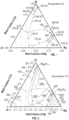
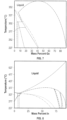
- Figure 1 illustrates a ternary graph of zinc-aluminum-magnesium system at different mole fractions made using Thermo-Calc Software.
- the temperature in the graph are in Kelvin.
- the eutectic temperature is below 630K.
- Figure 2 provides a ternary graph of Zn-Al-Mg system from literature ( P.Liang, et al. Thermochimica Acta, 314 (1998) 87-110 ) for comparison to Figure 1 .
- the temperatures in Figure 2 are in Celsius.
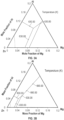
- Figure 3A illustrates liquidus projections of a Zn-Al-Mg system in mole fraction
- Figure 3B illustrates the liquidus projection of a Zn-Al-Mg system in mass fraction.
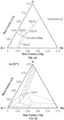
- Figures 4A-4D illustrate isotherm sections at different temperatures (mass fraction).
- Figure 4A illustrates liquidus surface of the Zn-Al-Mg system.
- the eutectic point of the Zn-Al-Mg system is about 344.5°C (about 617.5K) for Zn-3.9Al-2.45Mg.
- the liquid point for Zn-Al-Mg at about 357°C (about 630K) is indicated on the graph of Figure 4B .
- Figure 4C indicates the liquid point for Zn-Al-Mg at about 347°C (about 620K).
- Figure 4D indicates the liquid point for Zn-Al-Mg at about 345°C (about 618K).
- the area for the liquid states decreases as the temperature decreases for this material.
- the Scheil equation can be used to determine the liquidus temperature of Zn-Al-Mg systems.
- the liquidus temperature of Zn-3.9Al-2.45Mg calculated with this equation is about 344.5°C.
- the liquidus temperature for Zn-4Al-3Mg-8Sn was calculated as about 330°C using the Scheil equation.
- the liquidus temperatures for potential quaternary systems can be estimated using ternary results as a starting point.
- Several dopants were considered for combination with Zn-Al-Mg.
- the dopants include copper, titanium, antimony, tin, bismuth, gallium, and indium.
- the liquidus temperature for Zn-Al-Mg-Ti may be higher than about 350°C, and therefore do not provide the benefit of reducing the liquidus temperature of the coating.
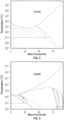
- Figures 5-8 each illustrate the liquid phase for a variety of mass percentages for the particular element (i.e. Sn, Bi, Ga, Cu or In) and the melting temperature for particular compositions.
- Figure 5 illustrates a phase diagram for Zn-3.9Al-2.45Mg-xSn, where the fraction of Al and Mg were held constant.
- Figure 6 illustrates a phase diagram for Zn-3.9Al-2.45Mg-xBi, where the fraction of Al and Mg were held constant.
- Figure 7 illustrates a phase diagram for Zn-3.9Al-2.45Mg-xGa, where the fraction of Al and Mg were held constant.
- Figure 8 illustrates a phase diagram for Zn-3.9Al-2.45Mg-xIn, where the fraction of Al and Mg were held constant.
- Figure 9 illustrates liquidus temperatures for various mass fractions in percent for four doping materials. Tin illustrated the lowest liquidus temperature for various mass fractions.
- Figures 10-17 illustrate other Zn-Al-Mg-dopant systems that can be used with the present invention.
- Figure 10 illustrates liquidus temperatures for various mass fractions of magnesium in a Zn-4Al-xMg-8Sn. The liquidus temperature approaches about 500°C when the mass fraction of magnesium was approximately 10.
- Figure 11 illustrates liquidus temperatures for various mass fractions of aluminum in a Zn-xAl-3Mg-8Sn system. The liquidus temperature of the Zn-xAl-3Mg-8Sn system is less than about 350°C when the mass fraction of aluminum is between about 0.5% and about 15.5%.
- Figure 12 illustrates the liquidus temperature for various mass fractions of tin in a Zn-7Al-3Mg-xSn. The liquidus temperature was less than about 360°C when the mass fraction of tin was between about 0.5% and about 12%.
- Figure 13 illustrates the liquidus temperature for various mass fractions of Sn in a Zn-15Al-1Mg-xSn system. The liquidus temperature is less than about 350°C when the mass fraction is between about 0.5% and about 19%.
- Figure 14 illustrates the liquidus temperature that is less than about 415°C when the mass fraction of aluminum is between about 0.5% and about 10% for aZn-xAl-3Mg-10Ga system.
- Figure 15 illustrates the liquidus temperature is less than about 420°C when the mass fraction is between about 1% and about 4% in a Zn-4Al-xMg-10Ga.
- Figure 16 illustrates the liquidus temperature is less than about 475°C for mass fractions of magnesium between about 1% and about 5% in a Zn-3.5Al-xMg-6In.
- Figure 17 illustrates the liquidus temperature is less than about 375°C for mass fractions of aluminum between about 1% and about 6% in a Zn-xAl-2.5Mg-6In.
- Table 1 provides various liquidus temperatures for different compositions (wt.%) Zn-Al-Mg-dopant systems can have liquidus temperatures as low as about 300°C, which can be used for galvanization. The temperatures in Table 1 are approximate.
- Table 1 System Liquidus Temperature (°C) Zn-3.5Al-2.5Mg-6In 340 Zn-4Al-2Mg-10Ga 321 Zn-4Al-3Mg-8Sn 330 Zn-4Al-3Mg-4Bi 356 Zn-4Al-3Mg-4Ga 365 Zn-4Al-3Mg-1In 350 Zn-7Al-3Mg-12Sn 320 Zn-15Al-1Mg-4Sn 320 Zn-15Al-1Mg-17Sn 300
- Figure 18 illustrates liquidus temperatures for various mass fractions for several dopants in a Zn-3.9Al-2.45Mg-dopant system. Also included in Figure 18 is the melting temperature for pure zinc and the liquidus temperature for Zn-3 .9Al-2.45Mg.
- adding lead, silver, antimony, potassium and bismuth increased the liquid temperatures of the Zn-3.9Al-2.45Mg-dopant systems.
- Adding gallium, indium, tin or lithium lowered the liquidus temperatures at specific compositions in the Zn-3.9Al-2.45Mg-dopant systems. Adding tin or lithium was more effective at lowering the liquidus temperature of a Zn-3.9Al-2.45Mg-dopant system compared to gallium or indium.
- Figure 19 illustrates a ternary diagram used to determine the liquidus temperature of quaternary Zn-Al-Mg-dopant systems.
- a Zn-Al-Mg ternary diagram was divided by smaller equilateral triangles, then points were selected to calculate the liquidus temperature of quaternary alloys with a dopant added (e.g. tin as the dopant).
- the temperature at which the calculated volume fraction of liquid when each quaternary alloy was 100% was determined as the liquidus temperature of the quaternary alloy.
- the calculation starts from the points near the eutectic temperature of a Zn-Al-Mg system. When the temperature of the quaternary alloy is less than about 344.5°C, additional points near this temperature are calculated. Software, for example ThermoCalc, can be used for these calculations.
- a good starting point for the calculation can be effective to find the phase equilibrium in the multi-component systems.
- a good starting point for the calculation of the quaternary Zn-Al-Mg-Sn is an equilibrium close to an invariant point belonging to a lower order system (i.e. the ternary eutectic of Zn-Al-Sn). It is not guaranteed that the lowest liquidus temperature of the quaternary alloy must occur around the eutectic point of a lower order system.
- Figures 20-23 illustrate liquidus temperatures for various mass fractions of tin for various weight percentage of aluminum and magnesium for a Zn-Al-Mg-Sn system.
- the connotation [0, 20] corresponds to a Zn-0Al-20Mg-xSn system.
- Figure 21 illustrates liquidus temperatures for various mass fractions of tin for various weight percent of aluminum and magnesium for a Zn-Al-Mg-Sn system, where the amount of magnesium is 6.7 wt.%.
- Figure 22 illustrates liquidus temperatures for various mass fractions of tin for various weight percentage of aluminum and magnesium for a Zn-Al-Mg-Sn system, where the amount of magnesium is 3.35 wt. %.
- Figure 23 illustrates liquidus temperatures for various mass fractions of tin for various weight percentages of aluminum and magnesium for a Zn-Al-Sn system (i.e. magnesium is 0 wt.%).
- Figure 24 illustrates the distribution of low liquid temperatures for various conditions from Figures 20-23 .
- Box (a) in Figure 24 corresponds to Figure 20 ; box (b) corresponds to Figure 21 ; box (c) corresponds to Figure 22 and box (d) corresponds to Figure 23 .
- the liquidus temperature of a Zn-Al-Mg-Sn can be lowered.
- Lower liquidus temperatures of the quaternary alloys can occur at points with less Mg or more Al, especially when considering the remaining compositions.
- Figure 25 illustrates liquid temperatures in Zn-Al-Mg-Sn systems for various mass fractions of tin, and various compositions of aluminum and magnesium.
- a low liquidus temperature can be achieved when no magnesium is present in the alloy and between about 16.75 wt.% and about 20 wt.% of aluminum are included in the system.
- Corrosion resistance may be increased with the alloys of the present invention but does not form part of the invention. Corrosion resistance remains a critical requirement of any galvanized coatings that are designed.
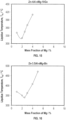
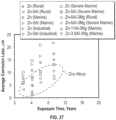
- Figures 26-27 that are not forming part of the invention illustrate a relationship between the operating temperature of the coating (i.e. the zinc bath temperature) and the corrosion potential and time to 5% rust.
- the present study confirmed the addition of specific alloy elements can significantly lower the Zn bath temperature.
- the influence of adding alloy elements on the corrosion resistance of galvanized coating is twofold: (1) influence of Zn bath temperature, and (2) influence of alloys.
- Figure 26 (from literature - Bakhtiari, A., et al., The effect of zinc bath temperature on the morphology, texture and corrosion behavior of industrially produced hot-dip galvanized coatings.
- Metall. Mater. Eng. 20, 41-52 (2014 ) illustrates the reported corrosion resistance of some hot-dip galvanized coatings, as a function of the Zn bath temperature over a range from 450 to 480 °C (note that all the coatings have the same composition).
- the corrosion potential higher negative values related to increased galvanic protection
- time to 5% rust higher values relate to improved corrosion resistance.
- Lower Zn bath temperature in the range examined provided enhance corrosion performance.
- Figure 27 (literature - Aoki, T., et al., Results of 10-year atmospheric corrosion testing of hot dip Zn-5 mass% Al alloy coated sheet steel. Galvatech'95, Chicago, 1995 ; Shimizu, T., et al., Corrosion products of hot-dip Zn-6%Al-3%Mg coated steel subjected to atmospheric exposure. ISIJ 89, 166-173 (2003 ); Shimoda, N., et al., Atmospheric corrosion resistance of Zn-11%Al-3%Mg-0.2%Si coated steel.
- Galvatech'11, Genova, Italy, 2011 ; and ArcelorMitall Steel Specification, Magnelis ® , 2014) summarizes the average corrosion loss of galvanized coatings in four different natural environments: rural, marine, industrial and severe marine.
- the zinc alloys coatings in this case with Al and/or Mg additions
- have much lower corrosion (thickness) loss that is, better corrosion resistance in all the natural environments over years of exposure.
- the results from literature suggest that addition of specific alloys can provide suitable galvanic corrosion resistance, and support the advantages of the alloys of the present invention.
Landscapes
- Chemical & Material Sciences (AREA)
- Engineering & Computer Science (AREA)
- Materials Engineering (AREA)
- Mechanical Engineering (AREA)
- Metallurgy (AREA)
- Organic Chemistry (AREA)
- Physics & Mathematics (AREA)
- Thermal Sciences (AREA)
- Chemical Kinetics & Catalysis (AREA)
- Crystallography & Structural Chemistry (AREA)
- Oil, Petroleum & Natural Gas (AREA)
- Coating With Molten Metal (AREA)
Description
- This application claims priority and benefits under 35 U.S.C. §119(e) to
U.S. Provisional Patent Application Serial No. 62/372,193 filed on August 8, 2016 - The present invention involves lower liquidus temperature coatings to enhance substrate responses in a variety of applications, and processes for making and using the same.
- Zinc coatings are applied to steel and steel alloys, both in batch and continuous processing, to provide corrosion protection. While electroplating is sometimes used, more often the coating is applied by dipping the steel substrate into a molten metallic bath, thereby exposing the steel substrate to thermal histories controlled by the melting temperature of the metallic coating. These thermal histories influence the substrate metallurgy, sometimes affecting product properties in a deleterious manner, for example, carbon aging the substrate material. Furthermore, zinc coatings that require high temperature baths inhibit substantial formation of martensite or bainite, and therefore require additional processing to form these microstructures, in steels where their formation is possible.
-
WO 2006/002843 andEP 1 621 645 A1 -
EP 0 594 520 A1 -
WO 2012/141659 A1 shows a method of production of hot dip galvanized flat steel products by hot dip galvanizing in zinc-magnesium-aluminum alloy, containing aluminum content in the bath from 0.1 to 1.00 wt% and magnesium content from 0.1 to 1.00 wt%, with addition of one or more elements in the total amount of 0.2 wt%. Before entering the zinc-magnesium-aluminum bath, the annealed flat steel product is cooled to 400-520°C. The temperature of zinc-magnesium-aluminum bath, in which the flat steel product is hot dip galvanized, is 380-500°C.
US 2015/231726 A1 andEP 2 862 662 A1 - Lower bath temperatures in some instances would enable processing to enhance properties. The present invention enhances quench and partitioning for hot-dip coated processing. Quenching in a zinc bath is difficult as quench temperatures lower than the melting point of zinc are required. Lower bath temperatures can eliminate the need for capital modification to control quenching temperature, and might also allow different control of partitioning.
- Lower bath temperatures would also enable austempering at lower temperatures. Thus, a not claimed aspect of the invention is an alloy coating with lower melting points than previously envisioned and currently available for steels.
- Lower bath temperatures can diminish undesirable effects due to carbon aging, which could enhance properties in numerous applications including sheet steel, high strength galvanized wire, and other steels. Another method, heat to coat galvanizing of batch annealed low-carbon steels, was replaced by in-line annealed continuous coating of aging-resistant interstitial free steels. Lower melting alloys could allow alternative grades and processing for such applications to reduce cost.
- Dual phase sheet steels usually undergo transformation to martensite after the zinc bath. Furthermore, bath temperatures are too high for effective martensite tempering due to the associated softening. Lowering of the melting temperature can allow control of martensite tempering to enhance ductility without overly compromising strength.
- Typically, the liquidus temperature for a coating is above the melting temperature of zinc (i.e. 419.5°C). While the quenching temperature to form microstructures (like martensite or bainite) will depend upon the particular steel, the steel must be quenched at low temperatures, typically below about 419°C, in order to form a martensitic microstructure, or a finer bainitic microstructure than is achieved in conventional hot-dip galvanizing. Thus, a steel requiring coating and a change in the microstructure would require multiple steps to achieve a suitable coated steel.
- The present invention according to
claim 1 allows for a steel to be subjected to quenching to form a microstructure, while coating the substrate in the same step, or to form a finer microstructure (due to the lower temperature) while coating. The present invention uses a coating with a liquidus temperature between 275°C and 365°C so that the quenching and coating steps can occur simultaneously. The quenching temperature will affect the microstructure of the steel alloy. The quenching (austempering) temperature can be chosen to form a particular microstructure, such as martensite (bainite), or a combination of martensite and bainite. In order for coating process to work as a heat treatment to form the microstructure and to coat the substrate with the coating material in its liquid state, the quenching temperature, which is critical to the present invention, must be higher than the liquidus temperature of the coating. - One not claimed aspect of the invention is an alloyed material. The alloyed material includes a coating or temperature reducing agent. The coating or temperature reducing agent includes a metal material and a temperature reducing agent. The temperature reducing agent can include Sn, Li, Ga and/or In. The alloyed material has wide applicability. It can be used as a coating, in welding, for corrosion resistance, or to maintain a surface quality, to name a few examples.
- A not claimed aspect of the invention is a new coating composition. The coating can include a zinc-based alloy and a second material, which can be a dopant.
- An aspect of the invention is the use of a coating at a lower temperature than typically used in a galvanizing process. In other words, the use of a coating which has a lower liquidus temperature.
- An aspect of the invention is a method to reduce the liquidus temperature of a metallic material. The method includes providing a metal material, then coating the metal material with a zinc-based alloy material and a dopant.
- According to the invention is a method of
claim 1 to coat a metallic material at low temperature. The method includes providing a metallic material, then coating the metallic material with a zinc-based alloy coating. The zinc-based alloy material includes a doping material, and the liquidus temperature of the zinc-based alloy material with the doping material is less than the liquidus temperature of the zinc-based alloy material without the doping material. - According to the invention, but not claimed, is a coated substrate alloy. The coated substrate alloy includes a metallic material coated with a zinc-based alloy coating. The zinc-based alloy coating includes a metal alloy material, and at least one dopant. The liquidus temperature of the zinc-based alloy coating is between 275°C and 365°C.
- A not claimed aspect of the invention is a binary zinc alloy. The binary zinc alloy includes zinc and a second material. The mass fraction of the second material is at most about 70%, and the mass fraction of the zinc is at least about 30%.
- An aspect of the invention is a method to reduce a liquidus temperature of a zinc-based alloy coating for galvanizing. The method includes combining a zinc-based alloy with a dopant. The dopant is selected from the group consisting of aluminum, magnesium, copper, titanium, antimony, silicon, bismuth, gallium, indium, tin, lead, lithium, potassium or combinations thereof.
- An aspect of the invention is a method of producing a coated steel part. The method includes providing a liquid coating where the liquidus temperature of the coating is less than a quenching temperature required to form an alternative microstructure in the steel. The alternative microstructure is a change in at least one of martensite tempering, bainite tempering, or carbon aging of the steel. The steel is coated with the coating and the alternative microstructure is formed in the steel during coating.
- A not claimed aspect of the invention is a coated steel. The coated steel includes a steel substrate. The steel substrate includes an alternative microstructure formed by altering a first microstructure in the steel substrate. The alternative microstructure is formed during a coating process. The coated steel also includes a coating on at least a portion of the steel substrate.
-
-
Figure 1 illustrates a ternary graph of zinc-aluminum-magnesium system at different mole fractions made using Thermo-Calc Software; -
Figure 2 provides a ternary graph of a Zn-Al-Mg system from literature for comparison toFigure 1 ; -
Figure 3A illustrates liquidus projections of a Zn-Al-Mg system in mole fraction; -
Figure 3B illustrates the liquidus projection of a Zn-Al-Mg system in mass fraction; -
Figure 4A illustrates the liquidus surface of the Zn-Al-Mg system; -
Figure 4B illustrates the liquid point for a Zn-Al-Mg system at about 630K; -
Figure 4C indicates the liquid point for a Zn-Al-Mg system at about 620K; -
Figure 4D indicates the liquid point for a Zn-Al-Mg system at about 618K; -
Figure 5 illustrates a phase diagram for Zn-3.9Al-2.45Mg-xSn, where the mass fraction of Al and Mg were held constant; -
Figure 6 illustrates a phase diagram for Zn-3.9Al-2.45Mg-xBi, where the mass fraction of Al and Mg were held constant; -
Figure 7 illustrates a phase diagram for Zn-3.9Al-2.45Mg-xGa, where the mass fraction of Al and Mg were held constant; -
Figure 8 illustrates a phase diagram for Zn-3.9Al-2.45Mg-xIn, where the mass fraction of Al and Mg were held constant; -
Figure 9 illustrates liquidus temperature for various mass fractions in percent for four doping materials; -
Figure 10 illustrates liquidus temperature for various mass fractions of magnesium in a Zn-4Al-xMg-8Sn; -
Figure 11 illustrates liquidus temperature for various mass fractions of aluminum in a Zn-xAl-3Mg-8Sn system; -
Figure 12 illustrates the liquidus temperature for various mass fractions of tin in a Zn-7Al-3Mg-xSn; -
Figure 13 illustrates the liquidus temperature for various mass fractions of tin in a Zn-15Al-1Mg-xSn system; -
Figure 14 illustrates the liquidus temperature when the mass fraction of aluminum is between about 0.5% and about 10% for a Zn-xAl-3Mg-10Ga system; -
Figure 15 illustrates the liquidus temperature when the mass fraction is between about 1% and about 4% in a Zn-4AI -xMg- 10 Ga; -
Figure 16 illustrates the liquidus temperature for mass fractions of magnesium between about 1% and about 5% in a Zn-3.5Al-xMg-6In; -
Figure 17 illustrates the liquidus temperature for mass fractions of aluminum between about 1% and about 6% in a Zn-xAl-2.5Mg-6In; -
Figure 18 illustrates liquidus temperatures for various mass fractions for several dopants in a Zn-3.9Al-2.45Mg-dopant system; -
Figure 19 illustrates a ternary diagram used to determine the liquidus temperature of quaternary Zn-Al-Mg-dopant systems; -
Figure 20 illustrates liquidus temperatures for various mass fraction of tin; -
Figure 21 illustrates illustrate liquidus temperatures for various mass fractions of tin for various weight percent of aluminum and magnesium for a Zn-Al-Mg-Sn system; -
Figure 22 illustrate liquidus temperatures for various mass fractions of tin for various weight percentage of aluminum and magnesium for a Zn-Al-Mg-Sn system; -
Figure 23 illustrate liquidus temperatures for various mass fractions of tin for various weight percentages of aluminum for a Zn-Al-Sn system; -
Figure 24 illustrates the distribution of low liquidus temperatures for various conditions fromFigures 20-23 ; -
Figure 25 illustrates liquid temperatures in Zn-Al-Mg-Sn systems for various mass fractions of tin, and various compositions of aluminum and magnesium; -
Figure 26 illustrates corrosion resistance of some hot-dip galvanized coatings, as a function of the Zn bath temperature over a range from 450 to 480 °C from literature; and -
Figure 27 summarizes the average corrosion loss of galvanized coatings in four different natural environments: rural, marine, industrial and severe marine from literature. - The present invention relates to zinc-based alloy coatings, which can be applied to substrates at lower temperatures than traditional zinc-based coatings. The present invention also relates to a method of coating a steel or steel alloy material.
- The present invention has been illustrated using a constant alloying amount of a quaternary system of Zn-3.9Al-2.45Mg-x (where x is the added material to lower the liquidus temperature). However, it is possible to vary the amounts of each material without deviating from the invention.
- For each aspect and embodiment of the present invention, the zinc-based alloy coatings and the zinc-based alloys can include incidental materials or impurities without deviating from the invention.
- "Liquidus temperature" is the lowest temperature where the alloy is fully liquid. The alloy will start to become solid below this temperature. While the invention can be used at temperatures above the liquidus temperature, advantages, such as the formation of microstructures, can be achieved by utilizing the lowest liquidus temperature possible for a given coating.
- "Eutectic temperature" is the temperature at which a particular low melting point for a binary eutectic mixture melts/solidifies. The eutectic temperature is the lowest possible melting temperature over all of the mixing ratios for the involved components.
- "Melting temperature" represents the temperature at which melting begins.
- Coatings can be applied at an "operating temperature," which can be at a temperature greater than the liquidus temperature so that the coating remains as a liquid even after the substrate is dipped into the coating bath. The operating temperature can be up to about 50 degrees higher than the liquidus temperature (e.g. if the liquidus temperature was about 123°C, then the operating temperature can be between about 123°C and about 173°C). In some embodiments, the operating temperature can be between about 5 degrees to about 45 degrees hotter than the liquidus temperature for a coating. In some embodiments, the operating temperature can be greater than the liquidus temperature (i.e. hotter) by about 0°, about 5°, about 10°, about 15°, about 20°, about 25°, about 30°, about 35°, about 40°, about 45°, or about 50°. The operating temperature is critical to the success of the invention in forming an alternative microstructure while coating the substrate. If the operating temperature is too low, then the coating will not remain in liquid form (i.e. cannot coat the substrate). If the operating temperature is too hot, then it will not provide an adequate quenching temperature for forming the alternative microstructure. Thus, several factors must be considered when determining the operating temperature. Furthermore, it becomes clear that the operating temperature is selected with consideration of both the particular coating, and the particular substrate material.
- The "quenching temperature" is the temperature for a particular alloy where a microstructure is formed or altered. The microstructure can be, for example, martensite, bainite, ferrite or a combination thereof. Martensite forms immediately upon cooling, while bainite occurs over time. The quenching temperature and subsequent coating process also relates to an "austempering" temperature wherein bainite can form. The quenching temperature is above the liquidus temperature for a particular coating so that exposure of the substrate to the quenching temperature results in both the formation of at least one quenched microstructure, and coating of the steel. If an alternative quenched microstructure is desired in the substrate, then the operating temperature can be the quenching temperature. The quenching temperature can be +/- about 20 degrees of the temperature required to form the microstructure. In some embodiments, the quenching temperature can be within the temperature required to form the microstructure by about 1°, about 5°, about 8°, about 10°, about 12°, about 15°, or about 20°. In some embodiments, the quenching temperature can be within about 5° to about 10° of the temperature required to form the microstructure. In some embodiments, the substrate can be exposed to the quenching temperature for a time sufficient to form a microstructure or alternative microstructure. In some embodiments, the time is sufficient to begin a perpetuating reaction. In some embodiments, the substrate is exposed to the temperature for a sufficient time for the part to reach an equilibrium temperature. One skilled in the art would understand that the exposure time is dependent upon the temperature and time required for the reaction to result in the desired microstructure or alternative microstructure. In some embodiments, the quenching temperature can be sufficiently low enough to prevent damages to the microstructure because the microstructure is not subjected to high temperatures required by traditional galvanizing methods.
- An "alternative microstructure" or "alternative quenched microstructure" are related to changes in carbon aging microstructures of steels containing ferrite including tempering or formation of martensite, modification of austempered bainite, or combinations thereof. Carbon aging and modifications to martensite or bainite microstructures are each dependent upon the quenching temperature of substrate containing ferrite, martensite, or bainite, respectively. Thus, one can alter a microstructure in the ferrite, martensite or bainite by subjecting a substrate with one or more of these microstructures to one or more quenching temperatures corresponding to a desired microstructure (i.e. the alternative microstructure).
- An aspect of the present invention is a method to coat a metallic material at an operating temperature. The method includes providing a metallic material, then coating the metallic material with a zinc-based alloy coating. The zinc-based alloy coating includes a zinc-based alloy material and a doping material. The liquidus temperature of the zinc-based alloy coating (i.e. the zinc-based alloy material with the doping material) is less than the liquidus temperature of the zinc-based alloy material without the doping material.
- The melting temperature or liquidus temperature of the zinc-based alloy material without the dopant can be determined either by undue experimentation or by literature searching. For example, the melting temperature of pure zinc is about 419.5 °C. The liquidus temperature of a Zn-Al-Mg alloy is about 344.5 °C, which can be determined with a ternary phase diagram as explained in Example 3 below generated with experimentation or using software programs, or literature searching. A material discussed earlier is Zn-3.9Al-2.45Mg. The liquidus temperature of this material is 344.5°C. The melting temperature and liquidus temperature of a particular zinc-based alloy coating will depend upon the composition of the coating.
- The zinc-based alloy material can be pure zinc, a binary composition, a ternary composition, a quaternary composition, or a "n-ary" composition. In some embodiments, the zinc-based alloy material can include, but are not limited to, zinc-aluminum, zinc-aluminum-magnesium, zinc-magnesium, zinc-element(s), or other zinc based alloy material. Zinc based material useful for the invention have a liquidus temperature that is less than the melting temperature of zinc. The zinc-based alloy material can be used as a coating. In some embodiments, the doping material is combined with the zinc-based material to form the zinc-based alloy coating, which can be a ternary, quaternary, or "p"-ary (where "p" can be between 2 and "n"+2) material. The doping material(s) (also referred to as the temperature reducing agent) can be magnesium, tin, lithium, gallium, indium, copper, titanium, antimony, silicon, bismuth, lead, or potassium. The mass fraction of the dopant can be chosen to reduce the liquidus temperature.
Figure 19 illustrates a ternary diagram used to determine the liquidus temperature of quaternary Zn-Al-Mg-dopant systems. Example 3 provides a method to determine an appropriate mass fraction of the dopant(s). By way of non-limiting example, suitable zinc-based alloy coatings (i.e. zinc-based alloy material with the doping material) can include Zn-aAl-bMg-dopant, Zn-bMg-(x)dopant, Zn-aAl-(x)dopant, Zn-aAl-bMg-(x)dopant1-(y)dopant2, Zn-bMg- (x)dopant1-(y)dopant2, Zn-aAl- (x)dopant1-(y)dopant2, Zn-3.9Al-2.45Mg-(x)dopant, Zn-3.9Al-2.45Mg-(x)dopanti-(y)dopant2. Each of the coefficients (i.e. "a", "b", "x", or "y") can be selected so that liquidus temperature is less than the melting temperature of zinc. In some embodiments, the general formula for the zinc-based alloy coating comprising aluminum, "a" can be between 0 and 20. In some embodiments, "a" can be between 3.35 and 30. In some embodiments, "a" can be between 3.9 and 16.75. In some embodiments, "a" can be between 6.7 and 20. In some embodiments, "a" can be 0, 1, 2, 3, 3.35, 3.9, 4, 6, 6.7, 7, 8, 10, 10.05, 12, 13.4, 15, 16.75, or 20. For magnesium, in some embodiments, "b" can be between 0 and 20. In some embodiments, "b" can be between about 0 and 6.7. In some embodiments, "b" can be 0, 1, 2, 2.5, 3, 3.35, 4, or 6.7. For the dopant, in some embodiments, "x" can be between 0 and 40. In some embodiments, "x" can be between 1 and 20. In some embodiments, "x" can be between 1 and 10. Similarly, when a second or additional dopants are used, in some embodiments, each of the coefficients preceding the specific dopant can be between 0 and 40, between 1 and 20, or between 1 and 10. - The mass fraction of aluminum in the zinc-based alloy coatings can be less than about 20%. In some embodiments, the mass fraction of aluminum in the zinc-based alloy coating can be between about 3.35 % and about 13.4 %. In some embodiments, the mass fraction of aluminum in the zinc-based alloy coating can be greater than about 6.7 % and less than about 20%. The mass fraction of magnesium in the zinc-based alloy coating can be less than about 10.05%. In some embodiments, the mass fraction of magnesium in the zinc-based alloy coating can be between about 0 % and about 20 %. The mass fraction of a dopant in the zinc-based alloy coating can be less than about 60%. In some embodiments, the mass fraction of the dopant in the zinc-based alloy coating can be between about 7.5% and about 12%. In some embodiments of the invention, the mass fraction of the dopant can be between about 1% and about 30%. When more than one dopant is used in the zinc-based alloy coating, the total mass fraction of the second to additional nth dopant in the reduced temperature coatings can be between about 0 % and about 60 %. In some embodiments, the total mass fraction of the additional dopant can be between about 1% and about 30%.
- The resulting zinc-based alloy coating can have a liquidus temperatures that can be less than the melting temperature of zinc (i.e. about 419°C). The liquidus temperature of the zinc-based alloy coating is between about 275°C and about 365°C. In some embodiments, the liquidus temperature of the zinc-based alloy coating can be between about 279°C and about 365°C.
- The metallic material can be a steel or steel alloy. Suitable steel alloy materials include, but are not limited to, steel sheets, strips, bars, rods, pipes, wires, reinforced bars, plates, hardware (for example fasteners), and combinations thereof. In particular, the present invention can be used with the broad class of sheet steel alloys.
- The zinc-based alloy coating can be applied to the metallic material by dipping or spraying. The zinc-based alloy coating can be heated to an operating temperature, which is above the melting temperature or the liquidus temperature to liquify the zinc-based alloy coating prior to application. The zinc-based alloy coating can be applied at any thickness suitable for a particular application as set forth in ASTMs, such as for example ASTM A123/A123M. In some embodiments, the thickness of the coating can be applied to between about 5 µm and about 200 µm.
- The surface of the metallic material can be treated to increase adhesion of the coating to the substrate. The surface treatment can include, for example, cleaning, etching, mechanical abrasion, or chemical etching. The surface treatment can increase the surface area of the substrate.
- A not claimed aspect of the invention is a coated substrate alloy. The coated substrate alloy includes a metallic material coated with a zinc-based alloy coating. The zinc-based alloy coating includes a zinc-based alloy material, and at least one dopant. The liquidus temperature of the zinc-based alloy coating is between 275°C and 365°C.
- The substrate is a metallic material. The metallic material can be a steel or steel alloy. Suitable steel alloy materials include, but are not limited to, steel sheets, strips, bars, rods, pipes, wires, reinforced bars, plates, hardware (for example fasteners). In particular, the present invention can be used with the broad class of sheet steel alloys.
- The melting temperature or liquidus temperature of the zinc-based alloy material without the dopant can be determined either by undue experimentation or by literature searching. For example, the melting temperature of pure zinc is about 419.5 °C. The liquidus temperature of a Zn-Al-Mg alloy is about 344.5 °C, which can be determined with a ternary phase diagram as explained in Example 3 below generated with experimentation or using software programs, or literature searching. A material discussed earlier is Zn-3.9Al-2.45Mg. The liquidus temperature of this material is 344.5°C. The melting temperature and liquidus temperature of a particular zinc-based alloy coating will depend upon the composition of the coating.
- The zinc-based alloy material can be pure zinc, a binary composition, a ternary composition, a quaternary composition, or a "n-ary" composition. In some embodiments, the zinc-based alloy material can include, but are not limited to, zinc-aluminum, zinc-aluminum-magnesium, zinc-magnesium, zinc-element(s), or other zinc based alloy material. Zinc based material useful for the invention have a liquidus temperature that is less than the melting temperature of zinc. The zinc-based alloy material can be used as a coating. In some embodiments, the doping material is combined with the zinc-based material to form the zinc-based alloy coating, which can be a ternary, quaternary, or "p"-ary (where "p" can be between 2 and "n"+2) material. The doping material(s) (also referred to as the temperature reducing agent) can be magnesium, tin, lithium, gallium, indium, copper, titanium, antimony, silicon, bismuth, lead, or potassium. The mass fraction of the dopant can be chosen to reduce the liquidus temperature.
Figure 19 illustrates a ternary diagram used to determine the liquidus temperature of quaternary Zn-Al-Mg-dopant systems. Example 3 provides a method to determine an appropriate mass fraction of the dopant(s). By way of non-limiting example, suitable zinc-based alloy coatings (i.e. zinc-based alloy material with the doping material) can include Zn-aAl-bMg-dopant, Zn-bMg-(x)dopant, Zn-aAl-(x)dopant, Zn-aAl-bMg-(x)dopant1-(y)dopant2, Zn-bMg- (x)dopant1-(y)dopant2, Zn-aAl- (x)dopant1-(y)dopant2, Zn-3.9Al-2.45Mg-(x)dopant, Zn-3.9Al-2.45Mg-(x)dopanti-(y)dopant2. Each of the coefficients (i.e. "a", "b", "x", or "y") can be selected so that liquidus temperature is less than the melting temperature of zinc. In some embodiments, the general formula for the zinc-based alloy coating comprising aluminum, "a" can be between 0 and 20. In some embodiments, "a" can be between 3.35 and 30. In some embodiments, "a" can be between 3.9 and 16.75. In some embodiments, "a" can be between 6.7 and 20. In some embodiments, "a" can be 0, 1, 2, 3, 3.35, 3.9, 4, 6, 6.7, 7, 8, 10, 10.05, 12, 13.4, 15, 16.75, or 20. For magnesium, in some embodiments, "b" can be between 0 and 20. In some embodiments, "b" can be between about 0 and 6.7. In some embodiments, "b" can be 0, 1, 2, 2.5, 3, 3.35, 4, or 6.7. For the dopant, in some embodiments, "x" can be between 0 and 40. In some embodiments, "x" can be between 1 and 20. In some embodiments, "x" can be between 1 and 10. Similarly, when a second or additional dopants are used, in some embodiments, each of the coefficients preceding the specific dopant can be between 0 and 40, between 1 and 20, or between 1 and 10. - The mass fraction of aluminum in the zinc-based alloy coatings can be less than about 20%. In some embodiments, the mass fraction of aluminum in the zinc-based alloy coating can be between about 3.35 % and about 13.4 %. In some embodiments, the mass fraction of aluminum in the zinc-based alloy coating can be greater than about 6.7 % and less than about 20%. The mass fraction of magnesium in the zinc-based alloy coating can be less than about 10.05%. In some embodiments, the mass fraction of magnesium in the zinc-based alloy coating can be between about 0 % and about 20 %. The mass fraction of a dopant in the zinc-based alloy coating can be less than about 60%. In some embodiments, the mass fraction of the dopant in the zinc-based alloy coating can be between about 7.5% and about 12%. In some embodiments of the invention, the mass fraction of the dopant can be between about 1% and about 30%. When more than one dopant is used in the zinc-based alloy coating, the total mass fraction of the second to additional nth dopant in the reduced temperature coatings can be between about 0 % and about 60 %. In some embodiments, the total mass fraction of the additional dopant can be between about 1% and about 30%.
- The resulting zinc-based alloy coating can have a liquidus temperatures that can be less than the melting temperature of zinc (i.e. about 419°C). The liquidus temperature of the zinc-based alloy coating is between about 275°C and about 365°C. In some embodiments, the liquidus temperature of the zinc-based alloy coating can be between about 279°C and about 365°C.
- The zinc-based alloy coating can be applied at any thickness suitable for a particular application as set forth in ASTMs, such as for example ASTM A123/A123M. In some embodiments, the thickness of the coating can be applied to between about 5 µm and about 200 µm.
- The coated substrate alloy advantageously is not carbon aged compared (for example via tension testing) to a substrate traditionally coated at high temperatures (i.e. above 420°C). The coated substrate alloy can also have improved corrosion resistance compared to traditionally coated substrates. The corrosion resistance of a coated substrate of the present invention can provide sufficient protection for a substrate.
- A not claimed aspect of the invention is a binary zinc alloy. The binary zinc alloy includes zinc and a second material. The mass fraction of the second material is most about 70%, and the mass fraction of the zinc is at least about 30%. The binary zinc alloy has a liquidus temperature that is below the melting temperature of zinc.
- The second material can be aluminum, magnesium or tin. The liquidus temperature of the binary zinc alloy can be less than about 390°C. In some embodiments, the liquidus temperature of the binary zinc alloy can be between about 375°C and about 390°C.
- An aspect of the invention is a method to reduce a liquidus temperature of a zinc-based alloy coating for galvanizing. The method includes combining a zinc-based alloy with a dopant. The dopant is selected from the group consisting of aluminum, magnesium, copper, titanium, antimony, silicon, bismuth, gallium, indium, tin, lead, lithium, potassium or combinations thereof. The liquidus temperature of the zinc based alloy coating is between 275°C and 365°C.
- The zinc-based alloy material can be pure zinc, a binary composition, a ternary composition, a quaternary composition, or a "n-ary" composition. In some embodiments, the zinc-based alloy material can include, but are not limited to, zinc-aluminum, zinc-aluminum-magnesium, zinc-magnesium, zinc-element(s), or other zinc based alloy material. Zinc based material useful for the invention have a liquidus temperature that is less than the melting temperature of zinc. The zinc-based alloy material can be used as a coating. In some embodiments, the doping material is combined with the zinc-based material to form the zinc-based alloy coating, which can be a ternary, quaternary, or "p"-ary (where "p" can be between 2 and "n"+2) material. The doping material(s) (also referred to as the temperature reducing agent) can be magnesium, tin, lithium, gallium, indium, copper, titanium, antimony, silicon, bismuth, lead, or potassium. The mass fraction of the dopant can be chosen to reduce the liquidus temperature.
Figure 19 illustrates a ternary diagram used to determine the liquidus temperature of quaternary Zn-Al-Mg-dopant systems. Example 3 provides a method to determine an appropriate mass fraction of the dopant(s). By way of non-limiting example, suitable zinc-based alloy coatings (i.e. zinc-based alloy material with the doping material) can include Zn-aAl-bMg-dopant, Zn-bMg-(x)dopant, Zn-aAl-(x)dopant, Zn-aAl-bMg-(x)dopant1-(y)dopant2, Zn-bMg- (x)dopant1-(y)dopant2, Zn-aAl- (x)dopant1-(y)dopant2, Zn-3.9Al-2.45Mg-(x)dopant, Zn-3.9Al-2.45Mg-(x)dopanti-(y)dopant2. Each of the coefficients (i.e. "a", "b", "x", or "y") can be selected so that liquidus temperature is less than the melting temperature of zinc. In some embodiments, the general formula for the zinc-based alloy coating comprising aluminum, "a" can be between 0 and 20. In some embodiments, "a" can be between 3.35 and 30. In some embodiments, "a" can be between 3.9 and 16.75. In some embodiments, "a" can be between 6.7 and 20. In some embodiments, "a" can be 0, 1, 2, 3, 3.35, 3.9, 4, 6, 6.7, 7, 8, 10, 10.05, 12, 13.4, 15, 16.75, or 20. For magnesium, in some embodiments, "b" can be between 0 and 20. In some embodiments, "b" can be between about 0 and 6.7. In some embodiments, "b" can be 0, 1, 2, 2.5, 3, 3.35, 4, or 6.7. For the dopant, in some embodiments, "x" can be between 0 and 40. In some embodiments, "x" can be between 1 and 20. In some embodiments, "x" can be between 1 and 10. Similarly, when a second or additional dopants are used, in some embodiments, each of the coefficients preceding the specific dopant can be between 0 and 40, between 1 and 20, or between 1 and 10. - The mass fraction of aluminum in the zinc-based alloy coatings can be less than about 20%. In some embodiments, the mass fraction of aluminum in the zinc-based alloy coating can be between about 3.35 % and about 13.4 %. In some embodiments, the mass fraction of aluminum in the zinc-based alloy coating can be greater than about 6.7 % and less than about 20%. The mass fraction of magnesium in the zinc-based alloy coating can be less than about 10.05%. In some embodiments, the mass fraction of magnesium in the zinc-based alloy coating can be between about 0 % and about 20 %. The mass fraction of a dopant in the zinc-based alloy coating can be less than about 60%. In some embodiments, the mass fraction of the dopant in the zinc-based alloy coating can be between about 7.5% and about 12%. In some embodiments of the invention, the mass fraction of the dopant can be between about 1% and about 30%. When more than one dopant is used in the zinc-based alloy coating, the total mass fraction of the second to additional nth dopant in the reduced temperature coatings can be between about 0 % and about 60 %. In some embodiments, the total mass fraction of the additional dopant can be between about 1% and about 30%.
- The melting temperature or liquidus temperature of the zinc-based alloy material without the dopant can be determined either by undue experimentation or by literature searching. For example, the melting temperature of pure zinc is about 419.5 °C. The liquidus temperature of a Zn-Al-Mg alloy is about 344.5 °C, which can be determined with a ternary phase diagram as explained in Example 3 below generated with experimentation or using software programs, or literature searching. A material discussed earlier is Zn-3.9Al-2.45Mg. The liquidus temperature of this material is 344.5°C. The melting temperature and liquidus temperature of a particular zinc-based alloy coating will depend upon the composition of the coating. The liquidus temperature of the zinc-based alloy coating is between about 275°C and about 365°C. In some embodiments, the liquidus temperature of the zinc-based alloy coating can be between about 279°C and about 365°C.
- An advantage of the galvanizing coating of the present invention is that it can prevent or reduce carbon aging in the steel alloy substrate. Another advantage of the zinc-based alloy coating of the present invention is that the corrosion resistance properties of the new coating material can be as good, if not better than traditional zinc alloy materials without the dopant. Thus, not claimed embodiments of the invention are directed to a coated steel alloy substrate comprising the zinc-based alloy coating of the present invention wherein the corrosion resistance is better than the corrosion resistance of a traditional zinc coating (i.e. a traditional zinc coating, including zinc coatings without a dopant of the present invention). Another advantage is that martensite formation (such as is critical in quenching and partitioning) and austempering of the coated materials can occur at a lower temperature. The temperature can be between about 279 °C and about 365°C.
- Another advantage of the present invention is that martensite tempering is limited or controlled. Martensite is a hard phase that forms upon cooling. Tempering is a thermal process that softens the martensite to increase its toughness or formability. If martensite is formed prior to coating (by designing a cooling step into the process and then reheating before coating, or by using a lower coating bath temperature), quenching temperatures provide a lower tempering temperature.
- Another aspect of the present invention is a low temperature coating process for the formation of an alternative microstructure in the steel substrate. Compared to prior art methods, transformation to martensite during immersion in the coating bath will be promoted at lower bath temperatures, and lower austempering temperatures (at which bainite forms) will be possible, enabling the formation of high strength formable microstructures and/or alternative microstructures.
- The coating can have a liquidus temperatures that can be less than the melting temperature of zinc (i.e. about 419°C). The liquidus temperature of the coating is between about 275°C and about 365°C. In some embodiments, the liquidus temperature of the coating can be between about 279°C and about 365°C.
- In some embodiments, the coating can be a zinc-based material and can include a doping material, which can be a ternary, quaternary, or "p"-ary material. In some embodiments, the zinc-based alloy material can include, but are not limited to, zinc-aluminum, zinc-aluminum-magnesium, zinc-magnesium, zinc-element(s), or other zinc based alloy material. Zinc based material useful for the invention have a liquidus temperature that is less than the melting temperature of zinc. The zinc-based alloy material can be used as a coating. The zinc-based material can be combined with a dopant to form the coating. The doping material(s) (also referred to as the temperature reducing agent) can be magnesium, tin, lithium, gallium, indium, copper, titanium, antimony, silicon, bismuth, lead, or potassium. The mass fraction of the dopant can be chosen to reduce the liquidus temperature.
Figure 19 illustrates a ternary diagram used to determine the liquidus temperature of quaternary Zn-Al-Mg-dopant systems. Example 3 provides a method to determine an appropriate mass fraction of the dopant(s). By way of non-limiting example, suitable zinc-based alloy coatings (i.e. zinc-based alloy material with the doping material) can include Zn-aAl-bMg-dopant, Zn-bMg-(x)dopant, Zn-aAl-(x)dopant, Zn-aAl-bMg-(x)dopant1-(y)dopant2, Zn-bMg- (x)dopant1-(y)dopant2, Zn-aAl- (x)dopant1-(y)dopant2, Zn-3.9Al-2.45Mg-(x)dopant, Zn-3.9Al-2.45Mg-(x)dopant1-(y)dopant2. Each of the coefficients (i.e. "a", "b", "x", or "y") can be selected so that liquidus temperature is less than the melting temperature of zinc. In some embodiments, the general formula for the zinc-based alloy coating comprising aluminum, "a" can be between 0 and 20. In some embodiments, "a" can be between 3.35 and 30. In some embodiments, "a" can be between 3.9 and 16.75. In some embodiments, "a" can be between 6.7 and 20. In some embodiments, "a" can be 0, 1, 2, 3, 3.35, 3.9, 4, 6, 6.7, 7, 8, 10, 10.05, 12, 13.4, 15, 16.75, or 20. For magnesium, in some embodiments, "b" can be between 0 and 20. In some embodiments, "b" can be between about 0 and 6.7. In some embodiments, "b" can be 0, 1, 2, 2.5, 3, 3.35, 4, or 6.7. For the dopant, in some embodiments, "x" can be between 0 and 40. In some embodiments, "x" can be between 1 and 20. In some embodiments, "x" can be between 1 and 10. Similarly, when a second or additional dopants are used, in some embodiments, each of the coefficients preceding the specific dopant can be between 0 and 40, between 1 and 20, or between 1 and 10. - The mass fraction of aluminum in the coating can be less than about 20%. In some embodiments, the mass fraction of aluminum in the coating can be between about 3.35 % and about 13.4 %. In some embodiments, the mass fraction of aluminum in the coating can be greater than about 6.7 % and less than about 20%. The mass fraction of magnesium in the coating can be less than about 10.05%. In some embodiments, the mass fraction of magnesium in the coating can be between about 0 % and about 20 %. The mass fraction of a dopant in the coating can be less than about 12%. In some embodiments, the mass fraction of the dopant in the coating can be between about 7.5% and about 12%. When more than one dopant is used in the coating, the total mass fraction of the second to additional nth dopant in the coating can be between about 0 % and about 30 %.
- Another aspect of the present invention is a method of coating a steel substrate while forming an alternative microstructure than a microstructure that is possible using traditional processing. For example, a microstructure formed during traditional processing can result in either the formation of bainite, retention of the untransformed austenite at that step in the process or another microstructure in the steel such as ferrite, pearlite or martensite. The method includes providing a steel alloy material, and coating the steel alloy material with a zinc-based alloy coating. The operating temperature to apply the zinc-based alloy coating is at a quenching temperature for the steel alloy material to form at least one alternative microstructure. The alternative microstructure is different from a microstructure formed during traditional processing for the steel substrate.
- Suitable steel alloy materials include, but are not limited to, steel sheets, strips, bars, rods, pipes, wires, reinforced bars, plates, hardware (for example fasteners). In particular, the present invention can be used with the broad class of sheet steel alloys.
- Zinc-based alloy materials can be used as a coating. The zinc-based alloy material can be pure zinc, a binary composition, a ternary composition, a quaternary composition, or a "n-ary" composition. In some embodiments, the zinc-based alloy material can include, but are not limited to, zinc-aluminum, zinc-aluminum-magnesium, zinc-magnesium, zinc-element(s), or other zinc based alloy material. Zinc based material useful for the invention have a liquidus temperature that is less than the melting temperature of zinc.
- In some embodiments, the doping material is combined with the zinc-based material to form the coating, which can be a ternary, quaternary, or "p"-ary (where "p" can be between 2 and "n"+2) material. The doping material (also referred to as the temperature reducing agent) can be magnesium, tin, lithium, gallium, indium, copper, titanium, antimony, silicon, bismuth, lead, or potassium. The mass fraction of the dopant can be chosen to reduce the liquidus temperature.
Figure 19 illustrates a ternary diagram used to determine the liquidus temperature of quaternary Zn-Al-Mg-dopant systems. Example 3 provides a method to determine an appropriate mass fraction of the dopant(s). By way of non-limiting example, suitable coatings that are zinc-based alloy coatings (i.e. zinc-based alloy material with the doping material) can include Zn-aAl-bMg-dopant, Zn-bMg-(x)dopant, Zn-aAl-(x)dopant, Zn-aAl-bMg-(x)dopant1-(y)dopant2, Zn-bMg- (x)dopanti-(y)dopant2, Zn-aAl- (x)dopant1-(y)dopant2, Zn-3.9Al-2.45Mg-(x)dopant, Zn-3.9Al-2.45Mg-(x)dopant1-(y)dopant2. Each of the coefficients (i.e. "a", "b", "x", or "y") can be selected so that liquidus temperature is less than the melting temperature of zinc. In some embodiments, the general formula for the zinc-based alloy coating comprising aluminum, "a" can be between 0 and 20. In some embodiments, "a" can be between 3.35 and 30. In some embodiments, "a" can be between 3.9 and 16.75. In some embodiments, "a" can be between 6.7 and 20. In some embodiments, "a" can be 0, 1, 2, 3, 3.35, 3.9, 4, 6, 6.7, 7, 8, 10, 10.05, 12, 13.4, 15, 16.75, or 20. For magnesium, in some embodiments, "b" can be between 0 and 20. In some embodiments, "b" can be between about 0 and 6.7. In some embodiments, "b" can be 0, 1, 2, 2.5, 3, 3.35, 4, or 6.7. For the dopant, in some embodiments, "x" can be between 0 and 40. Similarly, when a second or additional dopants are used, in some embodiments, each of the coefficients preceding the specific dopant can be between 0 and 40. - The mass fraction of aluminum in the coatings can be less than about 20%. In some embodiments, the mass fraction of aluminum in the coating can be between about 3.35 % and about 13.4 %. In some embodiments, the mass fraction of aluminum in the coating can be greater than about 6.7 % and less than about 20%. The mass fraction of magnesium in the coating can be less than about 10.05%. In some embodiments, the mass fraction of magnesium in the coating can be between about 0 % and about 20 %. The mass fraction of a dopant in the coating can be less than about 12%. In some embodiments, the mass fraction of the dopant in the coating can be between about 7.5% and about 12%. When more than one dopant is used in the coating, the total mass fraction of the second to additional nth dopant in the coating can be between about 0 % and about 30 %.
- The melting temperature or liquidus temperature of the zinc-based alloy material without the dopant can be determined either by undue experimentation or by literature searching. For example, the melting temperature of pure zinc is about 419.5 °C. The liquidus temperature of a Zn-Al-Mg alloy is about 344.5 °C, which can be determined with a ternary phase diagram as explained in Example 3 below generated with experimentation or using software programs, or literature searching. A material discussed earlier is Zn-3.9Al-2.45Mg. The liquidus temperature of this material is 344.5°C. The melting temperature and liquidus temperature of a particular coating will depend upon the composition of the coating. The liquidus temperature is at a temperature greater than 275°C, but less than 365°C.
- Thus, exposing the substrate to the liquidus temperature not only alloys for coating of the substrate, but also provides a heat treatment for the substrate material to form at least one alternative microstructure. The alternative microstructure is different from a microstructure formed during traditional processing for the steel substrate.
- The alternative microstructure for example, can be selected from the group consisting of martensite, bainite, microstructures related to carbon aging for a particular steel substrate, and combinations thereof. In other situations, the alternative microstructural characteristics will be on a finer scale, related to differences in carbon aging or martensite tempering. In some embodiments, the coated substrate can be exposed to a second quenching temperature to form a second microstructure in the steel alloy. For example, a microstructure formed during traditional processing can result in either the formation of bainite, retention of the untransformed austenite at that step in the process or another microstructure in the steel such as ferrite, pearlite or martensite.
- The coating can be applied to the metallic material by dipping or spraying. The coating can be heated to an operating temperature, which is above the melting temperature or the liquidus temperature to liquify the coating prior to application. The coating can be applied at any thickness suitable for a particular application as set forth in ASTMs, such as for example ASTM A123/A123M. In some embodiments, the thickness of the coating can be applied to between about 5 µm and about 200 µm.
- The surface of the metallic material can be treated to increase adhesion of the coating to the substrate. The surface treatment can include, for example, cleaning, etching, mechanical abrasion, or chemical etching. The surface treatment can increase the surface area of the substrate.
- Another not claimed aspect of the present invention is a coated steel alloy with an alternative microstructure. The coated steel alloy includes a zinc-based alloy coating and a steel alloy substrate. The steel substrate is exposed to the coating (as a liquid) at the quenching temperature for the steel, to form an alternative microstructure in the coated steel.
- Suitable steel alloy materials include, but are not limited to, steel sheets, strips, bars, rods, pipes, wires, reinforced bars, plates, hardware (for example fasteners). In particular, the present invention can be used with the broad class of sheet steel alloys.
- Zinc-based alloy materials can be used as a coating. The zinc-based alloy material can be pure zinc, a binary composition, a ternary composition, a quaternary composition, or a "n-ary" composition. In some embodiments, the zinc-based alloy material can include, but are not limited to, zinc-aluminum, zinc-aluminum-magnesium, zinc-magnesium, zinc-element(s), or other zinc based alloy material. Zinc based material useful for the invention have a liquidus temperature that is less than the melting temperature of zinc. In some embodiments, the doping material is combined with the zinc-based material to form the zinc-based alloy coating, which can be a ternary, quaternary, or "p"-ary (where "p" can be between 2 and "n"+2) material. The doping material (also referred to as the temperature reducing agent) can be magnesium, tin, lithium, gallium, indium, copper, titanium, antimony, silicon, bismuth, lead, or potassium. The mass fraction of the dopant can be chosen to reduce the liquidus temperature.
Figure 19 illustrates a ternary diagram used to determine the liquidus temperature of quaternary Zn-Al-Mg-dopant systems. Example 3 provides a method to determine an appropriate mass fraction of the dopant(s). By way of non-limiting example, suitable zinc-based alloy coatings (i.e. zinc-based alloy material with the doping material) can include Zn-aAl-bMg-dopant, Zn-bMg-(x)dopant, Zn-aAl-(x)dopant, Zn-aAl-bMg-(x)dopant1-(y)dopant2, Zn-bMg- (x)dopant1-(y)dopant2, Zn-aAl-(x)dopant1-(y)dopant2, Zn-3.9Al-2.45Mg-(x)dopant, Zn-3.9Al-2.45Mg-(x)dopant1-(y)dopant2. Each of the coefficients (i.e. "a", "b", "x", or "y") can be selected so that liquidus temperature is less than the melting temperature of zinc. In some embodiments, the general formula for the zinc-based alloy coating comprising aluminum, "a" can be between 0 and 20. In some embodiments, "a" can be between 3.35 and 30. In some embodiments, "a" can be between 3.9 and 16.75. In some embodiments, "a" can be between 6.7 and 20. In some embodiments, "a" can be 0, 1, 2, 3, 3.35, 3.9, 4, 6, 6.7, 7, 8, 10, 10.05, 12, 13.4, 15, 16.75, or 20. For magnesium, in some embodiments, "b" can be between 0 and 20. In some embodiments, "b" can be between about 0 and 6.7. In some embodiments, "b" can be 0, 1, 2, 2.5, 3, 3.35, 4, or 6.7. For the dopant, in some embodiments, "x" can be between 0 and 40. Similarly, when a second or additional dopants are used, in some embodiments, each of the coefficients preceding the specific dopant can be between 0 and 40. - The mass fraction of aluminum in the zinc-based alloy coatings can be less than about 20%. In some embodiments, the mass fraction of aluminum in the zinc-based alloy coating can be between about 3.35 % and about 13.4 %. In some embodiments, the mass fraction of aluminum in the zinc-based alloy coating can be greater than about 6.7 % and less than about 20%. The mass fraction of magnesium in the zinc-based alloy coating can be less than about 10.05%. In some embodiments, the mass fraction of magnesium in the zinc-based alloy coating can be between about 0 % and about 20 %. The mass fraction of a dopant in the zinc-based alloy coating can be less than about 60%. In some embodiments, the mass fraction of the dopant in the zinc-based alloy coating can be between about 7.5% and about 12%. In some embodiments of the invention, the mass fraction of the dopant can be between about 1% and about 30%. When more than one dopant is used in the zinc-based alloy coating, the total mass fraction of the second to additional nth dopant in the reduced temperature coatings can be between about 0 % and about 60 %. In some embodiments, the total mass fraction of the additional dopant can be between about 1% and about 30%.
- The resulting zinc-based alloy coating can have a liquidus temperatures that can be less than the melting temperature of zinc (i.e. about 419°C). The liquidus temperature of the zinc-based alloy coating is between about 275°C and about 365°C. In some embodiments, the liquidus temperature of the zinc-based alloy coating can be between about 279°C and about 365°C. The melting temperature or liquidus temperature of the zinc-based alloy material without the dopant can be determined either by undue experimentation or by literature searching. For example, the melting temperature of pure zinc is about 419.5 °C. The liquidus temperature of a Zn-Al-Mg alloy is about 344.5 °C, which can be determined with a ternary phase diagram as explained in Example 3 below generated with experimentation or using software programs, or literature searching. A material discussed earlier is Zn-3.9Al-2.45Mg. The liquidus temperature of this material is 344.5°C. The melting temperature and liquidus temperature of a particular zinc-based alloy coating will depend upon the composition of the coating.
- The zinc-based alloy coating can be applied to the metallic material by dipping or spraying. The zinc-based alloy coating can be heated to an operating temperature, which is above the melting temperature or the liquidus temperature to liquify the zinc-based alloy coating prior to application. The zinc-based alloy coating can be applied at any thickness suitable for a particular application as set forth in ASTMs, such as for example ASTM A123/A123M. In some embodiments, the thickness of the coating can be applied to between about 5 µm and about 200 µm
- The alternative microstructure for example, can be selected from the group consisting of martensite, bainite, microstructures related to carbon aging for a particular steel substrate, and combinations thereof. In other situations, the alternative microstructural characteristics will be on a finer scale, related to differences in carbon aging or martensite tempering. In some embodiments, the coated substrate can be exposed to a second quenching temperature to form a second microstructure in the steel alloy. For example, a microstructure formed during traditional processing can result in either the formation of bainite, retention of the untransformed austenite at that step in the process or another microstructure in the steel such as ferrite, pearlite or martensite.
-
Figure 1 illustrates a ternary graph of zinc-aluminum-magnesium system at different mole fractions made using Thermo-Calc Software. The temperature in the graph are in Kelvin. The eutectic temperature is below 630K.Figure 2 provides a ternary graph of Zn-Al-Mg system from literature (P.Liang, et al. Thermochimica Acta, 314 (1998) 87-110) for comparison toFigure 1 . The temperatures inFigure 2 are in Celsius.Figure 3A illustrates liquidus projections of a Zn-Al-Mg system in mole fraction, whileFigure 3B illustrates the liquidus projection of a Zn-Al-Mg system in mass fraction.Figures 4A-4D illustrate isotherm sections at different temperatures (mass fraction).Figure 4A illustrates liquidus surface of the Zn-Al-Mg system. The eutectic point of the Zn-Al-Mg system is about 344.5°C (about 617.5K) for Zn-3.9Al-2.45Mg. The liquid point for Zn-Al-Mg at about 357°C (about 630K) is indicated on the graph ofFigure 4B .Figure 4C indicates the liquid point for Zn-Al-Mg at about 347°C (about 620K).Figure 4D indicates the liquid point for Zn-Al-Mg at about 345°C (about 618K). As illustrated inFigures 4B-4D , the area for the liquid states decreases as the temperature decreases for this material. - The Scheil equation can be used to determine the liquidus temperature of Zn-Al-Mg systems. The liquidus temperature of Zn-3.9Al-2.45Mg calculated with this equation is about 344.5°C. The liquidus temperature for Zn-4Al-3Mg-8Sn was calculated as about 330°C using the Scheil equation.
- The liquidus temperatures for potential quaternary systems can be estimated using ternary results as a starting point. Several dopants were considered for combination with Zn-Al-Mg. The dopants include copper, titanium, antimony, tin, bismuth, gallium, and indium. The liquidus temperature for Zn-Al-Mg-Ti may be higher than about 350°C, and therefore do not provide the benefit of reducing the liquidus temperature of the coating.
-
Figures 5-8 each illustrate the liquid phase for a variety of mass percentages for the particular element (i.e. Sn, Bi, Ga, Cu or In) and the melting temperature for particular compositions.Figure 5 illustrates a phase diagram for Zn-3.9Al-2.45Mg-xSn, where the fraction of Al and Mg were held constant.Figure 6 illustrates a phase diagram for Zn-3.9Al-2.45Mg-xBi, where the fraction of Al and Mg were held constant.Figure 7 illustrates a phase diagram for Zn-3.9Al-2.45Mg-xGa, where the fraction of Al and Mg were held constant.Figure 8 illustrates a phase diagram for Zn-3.9Al-2.45Mg-xIn, where the fraction of Al and Mg were held constant. -
Figure 9 illustrates liquidus temperatures for various mass fractions in percent for four doping materials. Tin illustrated the lowest liquidus temperature for various mass fractions.Figures 10-17 illustrate other Zn-Al-Mg-dopant systems that can be used with the present invention.Figure 10 illustrates liquidus temperatures for various mass fractions of magnesium in a Zn-4Al-xMg-8Sn. The liquidus temperature approaches about 500°C when the mass fraction of magnesium was approximately 10.Figure 11 illustrates liquidus temperatures for various mass fractions of aluminum in a Zn-xAl-3Mg-8Sn system. The liquidus temperature of the Zn-xAl-3Mg-8Sn system is less than about 350°C when the mass fraction of aluminum is between about 0.5% and about 15.5%.Figure 12 illustrates the liquidus temperature for various mass fractions of tin in a Zn-7Al-3Mg-xSn. The liquidus temperature was less than about 360°C when the mass fraction of tin was between about 0.5% and about 12%.Figure 13 illustrates the liquidus temperature for various mass fractions of Sn in a Zn-15Al-1Mg-xSn system. The liquidus temperature is less than about 350°C when the mass fraction is between about 0.5% and about 19%.Figure 14 illustrates the liquidus temperature that is less than about 415°C when the mass fraction of aluminum is between about 0.5% and about 10% for aZn-xAl-3Mg-10Ga system.Figure 15 illustrates the liquidus temperature is less than about 420°C when the mass fraction is between about 1% and about 4% in a Zn-4Al-xMg-10Ga.Figure 16 illustrates the liquidus temperature is less than about 475°C for mass fractions of magnesium between about 1% and about 5% in a Zn-3.5Al-xMg-6In.Figure 17 illustrates the liquidus temperature is less than about 375°C for mass fractions of aluminum between about 1% and about 6% in a Zn-xAl-2.5Mg-6In. - Table 1 provides various liquidus temperatures for different compositions (wt.%) Zn-Al-Mg-dopant systems can have liquidus temperatures as low as about 300°C, which can be used for galvanization. The temperatures in Table 1 are approximate.
Table 1 System Liquidus Temperature (°C) Zn-3.5Al-2.5Mg- 6In 340 Zn-4Al-2Mg-10Ga 321 Zn-4Al-3Mg- 8Sn 330 Zn-4Al-3Mg-4Bi 356 Zn-4Al-3Mg-4Ga 365 Zn-4Al-3Mg- 1In 350 Zn-7Al-3Mg- 12Sn 320 Zn-15Al-1Mg- 4Sn 320 Zn-15Al-1Mg- 17Sn 300 -
Figure 18 illustrates liquidus temperatures for various mass fractions for several dopants in a Zn-3.9Al-2.45Mg-dopant system. Also included inFigure 18 is the melting temperature for pure zinc and the liquidus temperature for Zn-3 .9Al-2.45Mg. For Zn-3.9Al-2.45Mg-dopant systems, adding lead, silver, antimony, potassium and bismuth increased the liquid temperatures of the Zn-3.9Al-2.45Mg-dopant systems. Adding gallium, indium, tin or lithium lowered the liquidus temperatures at specific compositions in the Zn-3.9Al-2.45Mg-dopant systems. Adding tin or lithium was more effective at lowering the liquidus temperature of a Zn-3.9Al-2.45Mg-dopant system compared to gallium or indium. - The following method was utilized to determine the liquidus temperature for various Zn-Al-Mg-dopant systems.
Figure 19 illustrates a ternary diagram used to determine the liquidus temperature of quaternary Zn-Al-Mg-dopant systems. First, a Zn-Al-Mg ternary diagram was divided by smaller equilateral triangles, then points were selected to calculate the liquidus temperature of quaternary alloys with a dopant added (e.g. tin as the dopant). Next, the temperature at which the calculated volume fraction of liquid when each quaternary alloy was 100% was determined as the liquidus temperature of the quaternary alloy. The calculation starts from the points near the eutectic temperature of a Zn-Al-Mg system. When the temperature of the quaternary alloy is less than about 344.5°C, additional points near this temperature are calculated. Software, for example ThermoCalc, can be used for these calculations. - For high order alloy systems (e.g. quaternary system), a good starting point for the calculation can be effective to find the phase equilibrium in the multi-component systems. For instance, a good starting point for the calculation of the quaternary Zn-Al-Mg-Sn is an equilibrium close to an invariant point belonging to a lower order system (i.e. the ternary eutectic of Zn-Al-Sn). It is not guaranteed that the lowest liquidus temperature of the quaternary alloy must occur around the eutectic point of a lower order system.
- Experiments were conducted and calculated for various Zn-Al-Mg-Sn systems to illustrate the invention of the present invention. One skilled in the art would understand that other dopants could be used besides tin and liquidus temperatures can be calculated without undue experimentation.
-
Figures 20-23 illustrate liquidus temperatures for various mass fractions of tin for various weight percentage of aluminum and magnesium for a Zn-Al-Mg-Sn system. For example, the connotation [0, 20] corresponds to a Zn-0Al-20Mg-xSn system.Figure 21 illustrates liquidus temperatures for various mass fractions of tin for various weight percent of aluminum and magnesium for a Zn-Al-Mg-Sn system, where the amount of magnesium is 6.7 wt.%.Figure 22 illustrates liquidus temperatures for various mass fractions of tin for various weight percentage of aluminum and magnesium for a Zn-Al-Mg-Sn system, where the amount of magnesium is 3.35 wt. %.Figure 23 illustrates liquidus temperatures for various mass fractions of tin for various weight percentages of aluminum and magnesium for a Zn-Al-Sn system (i.e. magnesium is 0 wt.%). - Higher fractions of magnesium lead to higher liquid temperatures of Zn-Al-Mg-Sn alloys with the tin mass fraction ranging from about 1% to about 30% as illustrated in
Figure 20 . For Zn-Al-Mg-Sn alloys with a constant Mg (6.67 wt. % illustrated inFigure 21 ), increasing the fraction of aluminum can lower the liquidus temperature of alloy, so long as the alloy is not Zn-20Al-6.7Mg.Figures 20 and21 indicate that tin is in favor of decreasing the liquidus temperature of an Zn-Al-Mg-Sn alloy, especially when the mass fraction of Sn is less than about 12%. - For Zn-Al-Mg-Sn alloys with a constant fraction of Mg (3.35 wt.%), decreasing the fraction of aluminum can greatly lower the liquidus temperature of the alloy as illustrated in
Figure 22 . For Zn-Al-Mg-Sn alloys without magnesium, increasing the fraction of aluminum can lower the liquid temperature of the alloy as illustrated inFigure 23 . - From
Figures 20-23 , it can be understood that the lower fraction of magnesium is in favor of decreasing the liquidus temperature of the Zn-Al-Mg-Sn alloy.Figure 24 illustrates the distribution of low liquid temperatures for various conditions fromFigures 20-23 . Box (a) inFigure 24 corresponds toFigure 20 ; box (b) corresponds toFigure 21 ; box (c) corresponds toFigure 22 and box (d) corresponds toFigure 23 . By adding tin, the liquidus temperature of a Zn-Al-Mg-Sn can be lowered. Lower liquidus temperatures of the quaternary alloys can occur at points with less Mg or more Al, especially when considering the remaining compositions. -
Figure 25 illustrates liquid temperatures in Zn-Al-Mg-Sn systems for various mass fractions of tin, and various compositions of aluminum and magnesium. A low liquidus temperature can be achieved when no magnesium is present in the alloy and between about 16.75 wt.% and about 20 wt.% of aluminum are included in the system. - Corrosion resistance may be increased with the alloys of the present invention but does not form part of the invention. Corrosion resistance remains a critical requirement of any galvanized coatings that are designed.
Figures 26-27 that are not forming part of the invention illustrate a relationship between the operating temperature of the coating (i.e. the zinc bath temperature) and the corrosion potential and time to 5% rust. The present study confirmed the addition of specific alloy elements can significantly lower the Zn bath temperature. The influence of adding alloy elements on the corrosion resistance of galvanized coating is twofold: (1) influence of Zn bath temperature, and (2) influence of alloys.Figure 26 (from literature - Bakhtiari, A., et al., The effect of zinc bath temperature on the morphology, texture and corrosion behavior of industrially produced hot-dip galvanized coatings. Metall. Mater. Eng. 20, 41-52 (2014)) illustrates the reported corrosion resistance of some hot-dip galvanized coatings, as a function of the Zn bath temperature over a range from 450 to 480 °C (note that all the coatings have the same composition). In terms of the corrosion potential (higher negative values related to increased galvanic protection) and time to 5% rust (higher values relate to improved corrosion resistance). Lower Zn bath temperature in the range examined provided enhance corrosion performance.Figure 27 (literature - Aoki, T., et al., Results of 10-year atmospheric corrosion testing of hot dip Zn-5 mass% Al alloy coated sheet steel. Galvatech'95, Chicago, 1995; Shimizu, T., et al., Corrosion products of hot-dip Zn-6%Al-3%Mg coated steel subjected to atmospheric exposure. ISIJ 89, 166-173 (2003); Shimoda, N., et al., Atmospheric corrosion resistance of Zn-11%Al-3%Mg-0.2%Si coated steel. Galvatech'11, Genova, Italy, 2011; and ArcelorMitall Steel Specification, Magnelis®, 2014) summarizes the average corrosion loss of galvanized coatings in four different natural environments: rural, marine, industrial and severe marine. Compared with the performance of pure zinc coatings, the zinc alloys coatings (in this case with Al and/or Mg additions) have much lower corrosion (thickness) loss, that is, better corrosion resistance in all the natural environments over years of exposure. The results from literature suggest that addition of specific alloys can provide suitable galvanic corrosion resistance, and support the advantages of the alloys of the present invention. - Ranges have been discussed and used within the forgoing description. One skilled in the art would understand that any sub-range within the stated range would be suitable, as would any number within the broad range, without deviating from the invention.
Claims (14)
- A method of coating a steel or steel alloy material consisting of ferrite, martensite or bainite as a first microstructure at a reduced bath temperature, comprising:providing a steel or steel alloy material;simultaneously quenching and coating the steel or steel alloy material in a zinc-based alloy bath with a zinc-based alloy coating including a zinc-based alloy material and at least one dopant to form a coated steel or steel alloy material, wherein a liquidus temperature of the zinc-based alloy coating in the zinc-based alloy bath is between 275°C and 365°C, and wherein the zinc-based alloy bath has an operating temperature that is between 0°C and 50°C higher than the liquidus temperature; andaltering said first microstructure of the ferrite, martensite or bainite in the steel or steel alloy material to form an alternative microstructure by a change in at least one of martensite tempering, bainite austempering, or a lack of carbon aging when coating the steel or steel alloy material with the zinc-based coating.
- The method of claim 1, wherein the zinc-based alloy coating is a zinc-magnesium-aluminum coating.
- The method of claim 1, wherein the dopant is selected from the group consisting of tin, lithium, gallium, magnesium, indium, and combinations thereof.
- The method of claim 1, wherein the liquidus temperature of the zinc-based alloy coating is between 300°C and 365°C.
- The method of claim 1, wherein a formula of the zinc-based alloy coating is selected from the group consisting of Zn-aAl-bMg-dopant, Zn-bMg-(x)dopant, Zn-aAl-(x)dopant, Zn-aAl-bMg-(x)dopant1-(y)dopant2, Zn-bMg-(x)dopant1-(y)dopant2, Zn-aAl-(x)dopant1-(y)dopant2, Zn-3.9AI-2.45Mg-(x)dopant, or Zn-3.9Al-2.45Mg-(x)dopant1-(y)dopant2.
- The method of claim 5, wherein the formula of the zinc-based alloy coating is Zn-4Al-3Mg-dopant, and wherein the dopant is selected from the group consisting of tin, gallium, bismuth, or indium, and wherein a mass fraction of the dopant is between 1 and 15.
- The method of claim 6, wherein the mass fraction of the dopant is between 1 and 9.
- The method of claim 5, wherein the formula of the zinc-based alloy coating is Zn-4Al-bMg-8Sn, and wherein b is between 1 and 6.
- The method of claim 5, wherein the formula of the zinc-based alloy coating is Zn-aAl-3Mg-8Sn, and wherein a is between 1 and 15.
- The method of claim 5, wherein the formula of the zinc-based alloy coating is Zn-7AI-3Mg-xSn, and wherein x is between 1 and 12.
- The method of claim 5, wherein the formula of the zinc-based alloy coating is Zn-15AI-1Mg-xSn, and wherein x is between 1 and 20.
- The method of claim 5, wherein the formula of the zinc-based alloy coating is Zn-aAl-3Mg-10Ga, and wherein a is between 1 and 10.
- The method of claim 5, wherein the formula of the zinc-based alloy coating is Zn-3.5Al-bMg-6In, and wherein b is between 1 and 4.
- The method of claim 5, wherein the formula of the zinc-based alloy coating is Zn-aAl-2.5Mg-6In, and wherein a is between 1 and 6.
Applications Claiming Priority (2)
| Application Number | Priority Date | Filing Date | Title |
|---|---|---|---|
| US201662372193P | 2016-08-08 | 2016-08-08 | |
| PCT/US2017/045858 WO2018031523A1 (en) | 2016-08-08 | 2017-08-08 | Modified hot-dip galvanize coatings with low liquidus temperature, methods of making and using the same |
Publications (3)
| Publication Number | Publication Date |
|---|---|
| EP3497258A1 EP3497258A1 (en) | 2019-06-19 |
| EP3497258A4 EP3497258A4 (en) | 2020-06-24 |
| EP3497258B1 true EP3497258B1 (en) | 2024-02-21 |
Family
ID=61163309
Family Applications (1)
| Application Number | Title | Priority Date | Filing Date |
|---|---|---|---|
| EP17840131.1A Active EP3497258B1 (en) | 2016-08-08 | 2017-08-08 | Modified hot-dip galvanize coatings with low liquidus temperature, methods of making and using the same |
Country Status (6)
| Country | Link |
|---|---|
| US (2) | US20210180172A1 (en) |
| EP (1) | EP3497258B1 (en) |
| JP (1) | JP7257955B2 (en) |
| CN (1) | CN109844162A (en) |
| CA (1) | CA3033387A1 (en) |
| WO (1) | WO2018031523A1 (en) |
Families Citing this family (4)
| Publication number | Priority date | Publication date | Assignee | Title |
|---|---|---|---|---|
| US20210180172A1 (en) | 2016-08-08 | 2021-06-17 | John Speer | Modified hot-dip galvanize coatings with low liquidus temperature, methods of making and using the same |
| US11913118B2 (en) * | 2018-03-01 | 2024-02-27 | Nucor Corporation | Zinc alloy coated press-hardenable steels and method of manufacturing the same |
| WO2021154240A1 (en) | 2020-01-29 | 2021-08-05 | Nucor Corporation | Zinc alloy coating layer of press-hardenable steel |
| KR102666358B1 (en) * | 2020-03-03 | 2024-05-14 | 제이에프이 스틸 가부시키가이샤 | Hot pressed member and method of producing same |
Citations (2)
| Publication number | Priority date | Publication date | Assignee | Title |
|---|---|---|---|---|
| EP2862662A1 (en) * | 2012-06-14 | 2015-04-22 | Nisshin Steel Co., Ltd. | Process for producing arc-welded structural member |
| US20150231726A1 (en) * | 2014-02-19 | 2015-08-20 | Nisshin Steel Co., Ltd. | METHOD FOR PRODUCING ARC-WELDED Zn-Al-Mg ALLOY COATED STEEL PLATE STRUCTURAL MEMBER |
Family Cites Families (32)
| Publication number | Priority date | Publication date | Assignee | Title |
|---|---|---|---|---|
| US3993482A (en) * | 1975-01-08 | 1976-11-23 | Dalmine S.P.A. | Anticorrosion zinc based coating material |
| JPH02175852A (en) * | 1988-09-07 | 1990-07-09 | Nippon Steel Corp | Production of hot dip zinc-aluminum alloy plated steel sheet having superior surface smoothness and high corrosion resistance |
| FR2697031B1 (en) | 1992-10-21 | 1994-12-16 | Lorraine Laminage | Process for galvanizing steel products and steel products thus obtained. |
| JP3179401B2 (en) * | 1996-12-13 | 2001-06-25 | 日新製鋼株式会社 | Hot-dip Zn-Al-Mg plated steel sheet with good corrosion resistance and surface appearance and method for producing the same |
| JP2001207249A (en) * | 2000-01-24 | 2001-07-31 | Nippon Steel Corp | Hot-dip Zn-Al-Sn alloy coated steel sheet with excellent spangle uniformity and corrosion resistance |
| JP4555492B2 (en) | 2000-03-16 | 2010-09-29 | 新日本製鐵株式会社 | Hot-dip zinc-aluminum alloy plated steel sheet with excellent anti-glare properties |
| JP4555498B2 (en) | 2000-04-11 | 2010-09-29 | 新日本製鐵株式会社 | Hot-dip zinc-aluminum alloy plated steel sheet with excellent spot weldability and manufacturing method thereof |
| JP2005350689A (en) * | 2004-06-08 | 2005-12-22 | Nippon Steel Corp | Zinc alloy plated steel sheet for laser lap welding |
| CN103320738A (en) | 2004-06-29 | 2013-09-25 | 塔塔钢铁艾默伊登有限责任公司 | Steel sheet with hot dip galvanized zinc alloy coating and process to produce it |
| EP1621645A1 (en) * | 2004-07-28 | 2006-02-01 | Corus Staal BV | Steel sheet with hot dip galvanized zinc alloy coating |
| EP3421634A1 (en) * | 2007-02-23 | 2019-01-02 | Tata Steel IJmuiden B.V. | Cold rolled and continuously annealed high strength steel strip and method for producing said steel |
| CN101787494A (en) | 2009-10-16 | 2010-07-28 | 东南大学 | Dispersed particle-strengthened medium manganese steel and preparation method thereof |
| CN101942600A (en) | 2010-09-15 | 2011-01-12 | 北京科技大学 | Preparation method of transformation-induced plasticity (TRIP) medium-manganese hot-rolled steel sheet |
| JP2013545890A (en) | 2010-10-12 | 2013-12-26 | タタ、スティール、アイモイデン、ベスローテン、フェンノートシャップ | Steel blank hot forming method and hot formed parts |
| WO2012141659A1 (en) * | 2011-04-13 | 2012-10-18 | U.S. STEEL KOŠICE, s.r.o. | Method of production of hot dip galvanized flat steel products with improved corrosion resistance |
| CN102304664A (en) | 2011-09-13 | 2012-01-04 | 北京科技大学 | High strength and high plasticity aluminum-containing medium manganese transformation-induced plasticity (TRIP) cold-rolled steel plate and preparation method thereof |
| CN102534406B (en) | 2011-12-07 | 2013-09-18 | 铜陵安东铸钢有限责任公司 | Medium manganese steel and preparation method thereof |
| CA2870532C (en) * | 2012-04-17 | 2016-12-13 | Arcelormittal Investigacion Y Desarrollo Sl | Steel sheet provided with a coating offering sacrificial cathodic protection, method for the production of a part using such a sheet, and resulting part |
| KR101417304B1 (en) * | 2012-07-23 | 2014-07-08 | 주식회사 포스코 | HOT DIP Zn ALLOY PLATED STEEL SHEET HAVING EXCELLENT ANTI-CORROSION AND SURFACE APPEARANCE AND METHOD FOR MANUFACTURING THE STEEL SHEET USING THE SAME |
| WO2014112594A1 (en) | 2013-01-18 | 2014-07-24 | 株式会社神戸製鋼所 | Manufacturing method for hot press formed steel member |
| BR112015018780B1 (en) * | 2013-02-06 | 2021-04-27 | Arcelormittal | METALLIC PLATE AND PROCESS OF MAKING A METALLIC PLATE |
| CN103103438B (en) | 2013-03-07 | 2015-04-01 | 北京科技大学 | High-strength and high-plasticity medium manganese cold-roll steel sheet and manufacturing method thereof |
| CN103695765A (en) | 2013-12-11 | 2014-04-02 | 蔡志辉 | Cold-rolled medium manganese steel with high strength and high plasticity and preparation method thereof |
| EP3084032B1 (en) * | 2013-12-18 | 2017-09-06 | Tata Steel Nederland Technology B.V. | Steel substrate provided with corrosion resistant coating with high melting temperature and manufacturing method thereof |
| KR101639844B1 (en) * | 2013-12-24 | 2016-07-14 | 주식회사 포스코 | Zinc alloy plating steel sheet having excellent weldability and method for manufacturing the same |
| WO2016001699A1 (en) | 2014-07-03 | 2016-01-07 | Arcelormittal | Method for manufacturing a high strength steel sheet having improved formability and sheet obtained |
| JP6295893B2 (en) | 2014-08-29 | 2018-03-20 | 新日鐵住金株式会社 | Ultra-high-strength cold-rolled steel sheet excellent in hydrogen embrittlement resistance and method for producing the same |
| MX2017009017A (en) * | 2015-01-09 | 2018-04-13 | Kobe Steel Ltd | Wire winding apparatus and wire winding method. |
| US20160312323A1 (en) | 2015-04-22 | 2016-10-27 | Colorado School Of Mines | Ductile Ultra High Strength Medium Manganese Steel Produced Through Continuous Annealing and Hot Stamping |
| KR102207969B1 (en) | 2015-07-17 | 2021-01-26 | 잘쯔기터 플래시슈탈 게엠베하 | Method for producing a hot strip consisting of bainite multiphase steel with a Zn-Mg-Al coating and the corresponding hot strip |
| DE202015105104U1 (en) * | 2015-07-17 | 2015-10-27 | Salzgitter Flachstahl Gmbh | Hot strip of a bainitic multi-phase steel with a Zn-Mg-Al coating |
| US20210180172A1 (en) | 2016-08-08 | 2021-06-17 | John Speer | Modified hot-dip galvanize coatings with low liquidus temperature, methods of making and using the same |
-
2017
- 2017-08-08 US US16/324,251 patent/US20210180172A1/en not_active Abandoned
- 2017-08-08 EP EP17840131.1A patent/EP3497258B1/en active Active
- 2017-08-08 JP JP2019529139A patent/JP7257955B2/en active Active
- 2017-08-08 WO PCT/US2017/045858 patent/WO2018031523A1/en not_active Ceased
- 2017-08-08 CA CA3033387A patent/CA3033387A1/en active Pending
- 2017-08-08 CN CN201780061853.8A patent/CN109844162A/en active Pending
-
2023
- 2023-08-07 US US18/231,060 patent/US12540383B2/en active Active
Patent Citations (2)
| Publication number | Priority date | Publication date | Assignee | Title |
|---|---|---|---|---|
| EP2862662A1 (en) * | 2012-06-14 | 2015-04-22 | Nisshin Steel Co., Ltd. | Process for producing arc-welded structural member |
| US20150231726A1 (en) * | 2014-02-19 | 2015-08-20 | Nisshin Steel Co., Ltd. | METHOD FOR PRODUCING ARC-WELDED Zn-Al-Mg ALLOY COATED STEEL PLATE STRUCTURAL MEMBER |
Also Published As
| Publication number | Publication date |
|---|---|
| US12540383B2 (en) | 2026-02-03 |
| CA3033387A1 (en) | 2018-02-15 |
| US20210180172A1 (en) | 2021-06-17 |
| CN109844162A (en) | 2019-06-04 |
| US20240002994A1 (en) | 2024-01-04 |
| JP7257955B2 (en) | 2023-04-14 |
| EP3497258A1 (en) | 2019-06-19 |
| EP3497258A4 (en) | 2020-06-24 |
| WO2018031523A1 (en) | 2018-02-15 |
| JP2019531413A (en) | 2019-10-31 |
Similar Documents
| Publication | Publication Date | Title |
|---|---|---|
| US12540383B2 (en) | Modified hot-dip galvanize coatings with low liquidus temperature, methods of making and using the same | |
| EP2762590B1 (en) | Galvanized steel sheet and method of manufacturing same | |
| EP3561135B1 (en) | Hot-dipped galvanized steel material having excellent weldability and press workability and manufacturing method therefor | |
| EP2980262A1 (en) | Plated steel sheet for hot pressing, process for hot-pressing plated steel sheet and automobile part | |
| JP6009438B2 (en) | Method for producing austenitic steel | |
| KR101500043B1 (en) | Hot dip zinc alloy plated steel sheet having superior formability and processed part corrosion resistance, and method for manufacturing the same | |
| JP4837604B2 (en) | Alloy hot-dip galvanized steel sheet | |
| KR102305753B1 (en) | Zn-Al-Mg BASED HOT DIP ALLOY COATED STEEL MATERIAL HAVING EXCELLENT CORROSION RESISTANCE OF PROCESSED PARTS AND METHOD OF MANUFACTURING THE SAME | |
| JP5098864B2 (en) | High strength automotive parts with excellent post-painting corrosion resistance and plated steel sheets for hot pressing | |
| KR20150000896A (en) | Steel strip having a low si content | |
| KR101621630B1 (en) | Galvannealed steel sheet having high corrosion resistance after painting | |
| KR20130002228A (en) | Plated steel sheet for hot press forming having good anti-lme property | |
| CN114072533A (en) | Plated steel wire and method for producing same | |
| CA2605487C (en) | A method for hot-dip galvanizing | |
| CN111566252B (en) | Fusion plated steel wire and method for producing same | |
| JP5206114B2 (en) | Alloyed hot-dip galvanized steel sheet with excellent workability, plating adhesion, corrosion resistance, and appearance quality | |
| JP4544579B2 (en) | Manufacturing method of high strength molten Zn-Al-Mg alloy plated steel sheet | |
| WO2012141659A1 (en) | Method of production of hot dip galvanized flat steel products with improved corrosion resistance | |
| KR20170048651A (en) | Zn ALLOY PLATED STEEL SHEET HAVING EXCELLENT SCRATCH RESISTANCE AND BENDABILITY AND METHOD FOR MANUFACTURING SAME | |
| JP4940813B2 (en) | Method for producing hot-dip galvanized steel sheet having a value of TS × El of 21000 MPa ·% or more | |
| JP3262061B2 (en) | Hot-dip galvanizing method | |
| JP4846550B2 (en) | Steel plate for galvannealed alloy and galvannealed steel plate | |
| JPH04263054A (en) | Molten galvanized steel sheet for alloying | |
| JPH07233458A (en) | Production of zn-al alloy plated steel | |
| KR880002516B1 (en) | Zinc-aluminium alloys and coatings |
Legal Events
| Date | Code | Title | Description |
|---|---|---|---|
| STAA | Information on the status of an ep patent application or granted ep patent |
Free format text: STATUS: THE INTERNATIONAL PUBLICATION HAS BEEN MADE |
|
| PUAI | Public reference made under article 153(3) epc to a published international application that has entered the european phase |
Free format text: ORIGINAL CODE: 0009012 |
|
| STAA | Information on the status of an ep patent application or granted ep patent |
Free format text: STATUS: REQUEST FOR EXAMINATION WAS MADE |
|
| 17P | Request for examination filed |
Effective date: 20190308 |
|
| AK | Designated contracting states |
Kind code of ref document: A1 Designated state(s): AL AT BE BG CH CY CZ DE DK EE ES FI FR GB GR HR HU IE IS IT LI LT LU LV MC MK MT NL NO PL PT RO RS SE SI SK SM TR |
|
| AX | Request for extension of the european patent |
Extension state: BA ME |
|
| RAP1 | Party data changed (applicant data changed or rights of an application transferred) |
Owner name: COLORADO SCHOOL OF MINES |
|
| RIN1 | Information on inventor provided before grant (corrected) |
Inventor name: COLORADO SCHOOL OF MINES |
|
| DAV | Request for validation of the european patent (deleted) | ||
| DAX | Request for extension of the european patent (deleted) | ||
| A4 | Supplementary search report drawn up and despatched |
Effective date: 20200526 |
|
| RIC1 | Information provided on ipc code assigned before grant |
Ipc: C23C 2/06 20060101AFI20200518BHEP Ipc: C23C 2/40 20060101ALI20200518BHEP Ipc: C21D 1/70 20060101ALI20200518BHEP Ipc: C21D 8/02 20060101ALI20200518BHEP Ipc: C21D 8/04 20060101ALI20200518BHEP Ipc: C21D 1/68 20060101ALI20200518BHEP |
|
| STAA | Information on the status of an ep patent application or granted ep patent |
Free format text: STATUS: EXAMINATION IS IN PROGRESS |
|
| 17Q | First examination report despatched |
Effective date: 20210423 |
|
| GRAP | Despatch of communication of intention to grant a patent |
Free format text: ORIGINAL CODE: EPIDOSNIGR1 |
|
| STAA | Information on the status of an ep patent application or granted ep patent |
Free format text: STATUS: GRANT OF PATENT IS INTENDED |
|
| INTG | Intention to grant announced |
Effective date: 20230330 |
|
| GRAJ | Information related to disapproval of communication of intention to grant by the applicant or resumption of examination proceedings by the epo deleted |
Free format text: ORIGINAL CODE: EPIDOSDIGR1 |
|
| STAA | Information on the status of an ep patent application or granted ep patent |
Free format text: STATUS: EXAMINATION IS IN PROGRESS |
|
| INTC | Intention to grant announced (deleted) | ||
| GRAP | Despatch of communication of intention to grant a patent |
Free format text: ORIGINAL CODE: EPIDOSNIGR1 |
|
| STAA | Information on the status of an ep patent application or granted ep patent |
Free format text: STATUS: GRANT OF PATENT IS INTENDED |
|
| INTG | Intention to grant announced |
Effective date: 20230919 |
|
| GRAS | Grant fee paid |
Free format text: ORIGINAL CODE: EPIDOSNIGR3 |
|
| RIN1 | Information on inventor provided before grant (corrected) |
Inventor name: ZHAO, LIJIA Inventor name: SPEER, JOHN |
|
| GRAA | (expected) grant |
Free format text: ORIGINAL CODE: 0009210 |
|
| STAA | Information on the status of an ep patent application or granted ep patent |
Free format text: STATUS: THE PATENT HAS BEEN GRANTED |
|
| AK | Designated contracting states |
Kind code of ref document: B1 Designated state(s): AL AT BE BG CH CY CZ DE DK EE ES FI FR GB GR HR HU IE IS IT LI LT LU LV MC MK MT NL NO PL PT RO RS SE SI SK SM TR |
|
| REG | Reference to a national code |
Ref country code: GB Ref legal event code: FG4D |
|
| REG | Reference to a national code |
Ref country code: CH Ref legal event code: EP |
|
| REG | Reference to a national code |
Ref country code: IE Ref legal event code: FG4D |
|
| REG | Reference to a national code |
Ref country code: DE Ref legal event code: R096 Ref document number: 602017079403 Country of ref document: DE |
|
| REG | Reference to a national code |
Ref country code: LT Ref legal event code: MG9D |
|
| REG | Reference to a national code |
Ref country code: NL Ref legal event code: MP Effective date: 20240221 |
|
| PG25 | Lapsed in a contracting state [announced via postgrant information from national office to epo] |
Ref country code: IS Free format text: LAPSE BECAUSE OF FAILURE TO SUBMIT A TRANSLATION OF THE DESCRIPTION OR TO PAY THE FEE WITHIN THE PRESCRIBED TIME-LIMIT Effective date: 20240621 |
|
| PG25 | Lapsed in a contracting state [announced via postgrant information from national office to epo] |
Ref country code: LT Free format text: LAPSE BECAUSE OF FAILURE TO SUBMIT A TRANSLATION OF THE DESCRIPTION OR TO PAY THE FEE WITHIN THE PRESCRIBED TIME-LIMIT Effective date: 20240221 |
|
| PG25 | Lapsed in a contracting state [announced via postgrant information from national office to epo] |
Ref country code: GR Free format text: LAPSE BECAUSE OF FAILURE TO SUBMIT A TRANSLATION OF THE DESCRIPTION OR TO PAY THE FEE WITHIN THE PRESCRIBED TIME-LIMIT Effective date: 20240522 |
|
| REG | Reference to a national code |
Ref country code: AT Ref legal event code: MK05 Ref document number: 1659172 Country of ref document: AT Kind code of ref document: T Effective date: 20240221 |
|
| PG25 | Lapsed in a contracting state [announced via postgrant information from national office to epo] |
Ref country code: HR Free format text: LAPSE BECAUSE OF FAILURE TO SUBMIT A TRANSLATION OF THE DESCRIPTION OR TO PAY THE FEE WITHIN THE PRESCRIBED TIME-LIMIT Effective date: 20240221 Ref country code: RS Free format text: LAPSE BECAUSE OF FAILURE TO SUBMIT A TRANSLATION OF THE DESCRIPTION OR TO PAY THE FEE WITHIN THE PRESCRIBED TIME-LIMIT Effective date: 20240521 Ref country code: NL Free format text: LAPSE BECAUSE OF FAILURE TO SUBMIT A TRANSLATION OF THE DESCRIPTION OR TO PAY THE FEE WITHIN THE PRESCRIBED TIME-LIMIT Effective date: 20240221 |
|
| PG25 | Lapsed in a contracting state [announced via postgrant information from national office to epo] |
Ref country code: ES Free format text: LAPSE BECAUSE OF FAILURE TO SUBMIT A TRANSLATION OF THE DESCRIPTION OR TO PAY THE FEE WITHIN THE PRESCRIBED TIME-LIMIT Effective date: 20240221 |
|
| PG25 | Lapsed in a contracting state [announced via postgrant information from national office to epo] |
Ref country code: AT Free format text: LAPSE BECAUSE OF FAILURE TO SUBMIT A TRANSLATION OF THE DESCRIPTION OR TO PAY THE FEE WITHIN THE PRESCRIBED TIME-LIMIT Effective date: 20240221 |
|
| PG25 | Lapsed in a contracting state [announced via postgrant information from national office to epo] |
Ref country code: RS Free format text: LAPSE BECAUSE OF FAILURE TO SUBMIT A TRANSLATION OF THE DESCRIPTION OR TO PAY THE FEE WITHIN THE PRESCRIBED TIME-LIMIT Effective date: 20240521 Ref country code: NO Free format text: LAPSE BECAUSE OF FAILURE TO SUBMIT A TRANSLATION OF THE DESCRIPTION OR TO PAY THE FEE WITHIN THE PRESCRIBED TIME-LIMIT Effective date: 20240521 Ref country code: NL Free format text: LAPSE BECAUSE OF FAILURE TO SUBMIT A TRANSLATION OF THE DESCRIPTION OR TO PAY THE FEE WITHIN THE PRESCRIBED TIME-LIMIT Effective date: 20240221 Ref country code: LT Free format text: LAPSE BECAUSE OF FAILURE TO SUBMIT A TRANSLATION OF THE DESCRIPTION OR TO PAY THE FEE WITHIN THE PRESCRIBED TIME-LIMIT Effective date: 20240221 Ref country code: IS Free format text: LAPSE BECAUSE OF FAILURE TO SUBMIT A TRANSLATION OF THE DESCRIPTION OR TO PAY THE FEE WITHIN THE PRESCRIBED TIME-LIMIT Effective date: 20240621 Ref country code: HR Free format text: LAPSE BECAUSE OF FAILURE TO SUBMIT A TRANSLATION OF THE DESCRIPTION OR TO PAY THE FEE WITHIN THE PRESCRIBED TIME-LIMIT Effective date: 20240221 Ref country code: GR Free format text: LAPSE BECAUSE OF FAILURE TO SUBMIT A TRANSLATION OF THE DESCRIPTION OR TO PAY THE FEE WITHIN THE PRESCRIBED TIME-LIMIT Effective date: 20240522 Ref country code: FI Free format text: LAPSE BECAUSE OF FAILURE TO SUBMIT A TRANSLATION OF THE DESCRIPTION OR TO PAY THE FEE WITHIN THE PRESCRIBED TIME-LIMIT Effective date: 20240221 Ref country code: ES Free format text: LAPSE BECAUSE OF FAILURE TO SUBMIT A TRANSLATION OF THE DESCRIPTION OR TO PAY THE FEE WITHIN THE PRESCRIBED TIME-LIMIT Effective date: 20240221 Ref country code: BG Free format text: LAPSE BECAUSE OF FAILURE TO SUBMIT A TRANSLATION OF THE DESCRIPTION OR TO PAY THE FEE WITHIN THE PRESCRIBED TIME-LIMIT Effective date: 20240221 Ref country code: AT Free format text: LAPSE BECAUSE OF FAILURE TO SUBMIT A TRANSLATION OF THE DESCRIPTION OR TO PAY THE FEE WITHIN THE PRESCRIBED TIME-LIMIT Effective date: 20240221 |
|
| PG25 | Lapsed in a contracting state [announced via postgrant information from national office to epo] |
Ref country code: PT Free format text: LAPSE BECAUSE OF FAILURE TO SUBMIT A TRANSLATION OF THE DESCRIPTION OR TO PAY THE FEE WITHIN THE PRESCRIBED TIME-LIMIT Effective date: 20240621 Ref country code: PL Free format text: LAPSE BECAUSE OF FAILURE TO SUBMIT A TRANSLATION OF THE DESCRIPTION OR TO PAY THE FEE WITHIN THE PRESCRIBED TIME-LIMIT Effective date: 20240221 |
|
| PG25 | Lapsed in a contracting state [announced via postgrant information from national office to epo] |
Ref country code: SE Free format text: LAPSE BECAUSE OF FAILURE TO SUBMIT A TRANSLATION OF THE DESCRIPTION OR TO PAY THE FEE WITHIN THE PRESCRIBED TIME-LIMIT Effective date: 20240221 Ref country code: PT Free format text: LAPSE BECAUSE OF FAILURE TO SUBMIT A TRANSLATION OF THE DESCRIPTION OR TO PAY THE FEE WITHIN THE PRESCRIBED TIME-LIMIT Effective date: 20240621 Ref country code: PL Free format text: LAPSE BECAUSE OF FAILURE TO SUBMIT A TRANSLATION OF THE DESCRIPTION OR TO PAY THE FEE WITHIN THE PRESCRIBED TIME-LIMIT Effective date: 20240221 Ref country code: LV Free format text: LAPSE BECAUSE OF FAILURE TO SUBMIT A TRANSLATION OF THE DESCRIPTION OR TO PAY THE FEE WITHIN THE PRESCRIBED TIME-LIMIT Effective date: 20240221 |
|
| PG25 | Lapsed in a contracting state [announced via postgrant information from national office to epo] |
Ref country code: DK Free format text: LAPSE BECAUSE OF FAILURE TO SUBMIT A TRANSLATION OF THE DESCRIPTION OR TO PAY THE FEE WITHIN THE PRESCRIBED TIME-LIMIT Effective date: 20240221 |
|
| PG25 | Lapsed in a contracting state [announced via postgrant information from national office to epo] |
Ref country code: SM Free format text: LAPSE BECAUSE OF FAILURE TO SUBMIT A TRANSLATION OF THE DESCRIPTION OR TO PAY THE FEE WITHIN THE PRESCRIBED TIME-LIMIT Effective date: 20240221 |
|
| PG25 | Lapsed in a contracting state [announced via postgrant information from national office to epo] |
Ref country code: CZ Free format text: LAPSE BECAUSE OF FAILURE TO SUBMIT A TRANSLATION OF THE DESCRIPTION OR TO PAY THE FEE WITHIN THE PRESCRIBED TIME-LIMIT Effective date: 20240221 Ref country code: EE Free format text: LAPSE BECAUSE OF FAILURE TO SUBMIT A TRANSLATION OF THE DESCRIPTION OR TO PAY THE FEE WITHIN THE PRESCRIBED TIME-LIMIT Effective date: 20240221 |
|
| PG25 | Lapsed in a contracting state [announced via postgrant information from national office to epo] |
Ref country code: SK Free format text: LAPSE BECAUSE OF FAILURE TO SUBMIT A TRANSLATION OF THE DESCRIPTION OR TO PAY THE FEE WITHIN THE PRESCRIBED TIME-LIMIT Effective date: 20240221 |
|
| PG25 | Lapsed in a contracting state [announced via postgrant information from national office to epo] |
Ref country code: SM Free format text: LAPSE BECAUSE OF FAILURE TO SUBMIT A TRANSLATION OF THE DESCRIPTION OR TO PAY THE FEE WITHIN THE PRESCRIBED TIME-LIMIT Effective date: 20240221 Ref country code: SK Free format text: LAPSE BECAUSE OF FAILURE TO SUBMIT A TRANSLATION OF THE DESCRIPTION OR TO PAY THE FEE WITHIN THE PRESCRIBED TIME-LIMIT Effective date: 20240221 Ref country code: RO Free format text: LAPSE BECAUSE OF FAILURE TO SUBMIT A TRANSLATION OF THE DESCRIPTION OR TO PAY THE FEE WITHIN THE PRESCRIBED TIME-LIMIT Effective date: 20240221 Ref country code: EE Free format text: LAPSE BECAUSE OF FAILURE TO SUBMIT A TRANSLATION OF THE DESCRIPTION OR TO PAY THE FEE WITHIN THE PRESCRIBED TIME-LIMIT Effective date: 20240221 Ref country code: DK Free format text: LAPSE BECAUSE OF FAILURE TO SUBMIT A TRANSLATION OF THE DESCRIPTION OR TO PAY THE FEE WITHIN THE PRESCRIBED TIME-LIMIT Effective date: 20240221 Ref country code: CZ Free format text: LAPSE BECAUSE OF FAILURE TO SUBMIT A TRANSLATION OF THE DESCRIPTION OR TO PAY THE FEE WITHIN THE PRESCRIBED TIME-LIMIT Effective date: 20240221 |
|
| REG | Reference to a national code |
Ref country code: DE Ref legal event code: R097 Ref document number: 602017079403 Country of ref document: DE |
|
| PG25 | Lapsed in a contracting state [announced via postgrant information from national office to epo] |
Ref country code: IT Free format text: LAPSE BECAUSE OF FAILURE TO SUBMIT A TRANSLATION OF THE DESCRIPTION OR TO PAY THE FEE WITHIN THE PRESCRIBED TIME-LIMIT Effective date: 20240221 |
|
| PLBE | No opposition filed within time limit |
Free format text: ORIGINAL CODE: 0009261 |
|
| STAA | Information on the status of an ep patent application or granted ep patent |
Free format text: STATUS: NO OPPOSITION FILED WITHIN TIME LIMIT |
|
| PG25 | Lapsed in a contracting state [announced via postgrant information from national office to epo] |
Ref country code: IT Free format text: LAPSE BECAUSE OF FAILURE TO SUBMIT A TRANSLATION OF THE DESCRIPTION OR TO PAY THE FEE WITHIN THE PRESCRIBED TIME-LIMIT Effective date: 20240221 |
|
| 26N | No opposition filed |
Effective date: 20241122 |
|
| REG | Reference to a national code |
Ref country code: CH Ref legal event code: PL |
|
| PG25 | Lapsed in a contracting state [announced via postgrant information from national office to epo] |
Ref country code: LU Free format text: LAPSE BECAUSE OF NON-PAYMENT OF DUE FEES Effective date: 20240808 |
|
| GBPC | Gb: european patent ceased through non-payment of renewal fee |
Effective date: 20240808 |
|
| PG25 | Lapsed in a contracting state [announced via postgrant information from national office to epo] |
Ref country code: SI Free format text: LAPSE BECAUSE OF FAILURE TO SUBMIT A TRANSLATION OF THE DESCRIPTION OR TO PAY THE FEE WITHIN THE PRESCRIBED TIME-LIMIT Effective date: 20240221 Ref country code: MC Free format text: LAPSE BECAUSE OF FAILURE TO SUBMIT A TRANSLATION OF THE DESCRIPTION OR TO PAY THE FEE WITHIN THE PRESCRIBED TIME-LIMIT Effective date: 20240221 Ref country code: CH Free format text: LAPSE BECAUSE OF NON-PAYMENT OF DUE FEES Effective date: 20240831 |
|
| REG | Reference to a national code |
Ref country code: BE Ref legal event code: MM Effective date: 20240831 |
|
| PG25 | Lapsed in a contracting state [announced via postgrant information from national office to epo] |
Ref country code: GB Free format text: LAPSE BECAUSE OF NON-PAYMENT OF DUE FEES Effective date: 20240808 |
|
| PG25 | Lapsed in a contracting state [announced via postgrant information from national office to epo] |
Ref country code: BE Free format text: LAPSE BECAUSE OF NON-PAYMENT OF DUE FEES Effective date: 20240831 |
|
| PG25 | Lapsed in a contracting state [announced via postgrant information from national office to epo] |
Ref country code: IE Free format text: LAPSE BECAUSE OF NON-PAYMENT OF DUE FEES Effective date: 20240808 |
|
| PGFP | Annual fee paid to national office [announced via postgrant information from national office to epo] |
Ref country code: DE Payment date: 20250724 Year of fee payment: 9 |
|
| PGFP | Annual fee paid to national office [announced via postgrant information from national office to epo] |
Ref country code: FR Payment date: 20250725 Year of fee payment: 9 |
|
| PG25 | Lapsed in a contracting state [announced via postgrant information from national office to epo] |
Ref country code: CY Free format text: LAPSE BECAUSE OF FAILURE TO SUBMIT A TRANSLATION OF THE DESCRIPTION OR TO PAY THE FEE WITHIN THE PRESCRIBED TIME-LIMIT; INVALID AB INITIO Effective date: 20170808 |
|
| PG25 | Lapsed in a contracting state [announced via postgrant information from national office to epo] |
Ref country code: HU Free format text: LAPSE BECAUSE OF FAILURE TO SUBMIT A TRANSLATION OF THE DESCRIPTION OR TO PAY THE FEE WITHIN THE PRESCRIBED TIME-LIMIT; INVALID AB INITIO Effective date: 20170808 |