EP3495002A2 - Sterilization-assistance device - Google Patents
Sterilization-assistance device Download PDFInfo
- Publication number
- EP3495002A2 EP3495002A2 EP18210782.1A EP18210782A EP3495002A2 EP 3495002 A2 EP3495002 A2 EP 3495002A2 EP 18210782 A EP18210782 A EP 18210782A EP 3495002 A2 EP3495002 A2 EP 3495002A2
- Authority
- EP
- European Patent Office
- Prior art keywords
- sterilization
- assistance device
- pressure
- elongate medical
- lumen
- Prior art date
- Legal status (The legal status is an assumption and is not a legal conclusion. Google has not performed a legal analysis and makes no representation as to the accuracy of the status listed.)
- Withdrawn
Links
Images
Classifications
-
- A—HUMAN NECESSITIES
- A61—MEDICAL OR VETERINARY SCIENCE; HYGIENE
- A61L—METHODS OR APPARATUS FOR STERILISING MATERIALS OR OBJECTS IN GENERAL; DISINFECTION, STERILISATION OR DEODORISATION OF AIR; CHEMICAL ASPECTS OF BANDAGES, DRESSINGS, ABSORBENT PADS OR SURGICAL ARTICLES; MATERIALS FOR BANDAGES, DRESSINGS, ABSORBENT PADS OR SURGICAL ARTICLES
- A61L2/00—Disinfection or sterilisation of materials or objects, in general; Accessories therefor
- A61L2/02—Disinfection or sterilisation of materials or objects, in general; Accessories therefor using physical processes
-
- A—HUMAN NECESSITIES
- A61—MEDICAL OR VETERINARY SCIENCE; HYGIENE
- A61L—METHODS OR APPARATUS FOR STERILISING MATERIALS OR OBJECTS IN GENERAL; DISINFECTION, STERILISATION OR DEODORISATION OF AIR; CHEMICAL ASPECTS OF BANDAGES, DRESSINGS, ABSORBENT PADS OR SURGICAL ARTICLES; MATERIALS FOR BANDAGES, DRESSINGS, ABSORBENT PADS OR SURGICAL ARTICLES
- A61L2/00—Disinfection or sterilisation of materials or objects, in general; Accessories therefor
- A61L2/24—Apparatus using programmed or automatic operation
-
- A—HUMAN NECESSITIES
- A61—MEDICAL OR VETERINARY SCIENCE; HYGIENE
- A61L—METHODS OR APPARATUS FOR STERILISING MATERIALS OR OBJECTS IN GENERAL; DISINFECTION, STERILISATION OR DEODORISATION OF AIR; CHEMICAL ASPECTS OF BANDAGES, DRESSINGS, ABSORBENT PADS OR SURGICAL ARTICLES; MATERIALS FOR BANDAGES, DRESSINGS, ABSORBENT PADS OR SURGICAL ARTICLES
- A61L2/00—Disinfection or sterilisation of materials or objects, in general; Accessories therefor
- A61L2/26—Accessories
-
- A—HUMAN NECESSITIES
- A61—MEDICAL OR VETERINARY SCIENCE; HYGIENE
- A61B—DIAGNOSIS; SURGERY; IDENTIFICATION
- A61B1/00—Instruments for performing medical examinations of the interior of cavities or tubes of the body by visual or photographical inspection, e.g. endoscopes; Illuminating arrangements therefor
- A61B1/12—Instruments for performing medical examinations of the interior of cavities or tubes of the body by visual or photographical inspection, e.g. endoscopes; Illuminating arrangements therefor with cooling or rinsing arrangements
-
- A—HUMAN NECESSITIES
- A61—MEDICAL OR VETERINARY SCIENCE; HYGIENE
- A61B—DIAGNOSIS; SURGERY; IDENTIFICATION
- A61B1/00—Instruments for performing medical examinations of the interior of cavities or tubes of the body by visual or photographical inspection, e.g. endoscopes; Illuminating arrangements therefor
- A61B1/12—Instruments for performing medical examinations of the interior of cavities or tubes of the body by visual or photographical inspection, e.g. endoscopes; Illuminating arrangements therefor with cooling or rinsing arrangements
- A61B1/121—Instruments for performing medical examinations of the interior of cavities or tubes of the body by visual or photographical inspection, e.g. endoscopes; Illuminating arrangements therefor with cooling or rinsing arrangements provided with means for cleaning post-use
- A61B1/123—Instruments for performing medical examinations of the interior of cavities or tubes of the body by visual or photographical inspection, e.g. endoscopes; Illuminating arrangements therefor with cooling or rinsing arrangements provided with means for cleaning post-use using washing machines
-
- A—HUMAN NECESSITIES
- A61—MEDICAL OR VETERINARY SCIENCE; HYGIENE
- A61B—DIAGNOSIS; SURGERY; IDENTIFICATION
- A61B90/00—Instruments, implements or accessories specially adapted for surgery or diagnosis and not covered by any of the groups A61B1/00 - A61B50/00, e.g. for luxation treatment or for protecting wound edges
- A61B90/70—Cleaning devices specially adapted for surgical instruments
-
- A—HUMAN NECESSITIES
- A61—MEDICAL OR VETERINARY SCIENCE; HYGIENE
- A61L—METHODS OR APPARATUS FOR STERILISING MATERIALS OR OBJECTS IN GENERAL; DISINFECTION, STERILISATION OR DEODORISATION OF AIR; CHEMICAL ASPECTS OF BANDAGES, DRESSINGS, ABSORBENT PADS OR SURGICAL ARTICLES; MATERIALS FOR BANDAGES, DRESSINGS, ABSORBENT PADS OR SURGICAL ARTICLES
- A61L2/00—Disinfection or sterilisation of materials or objects, in general; Accessories therefor
- A61L2/16—Disinfection or sterilisation of materials or objects, in general; Accessories therefor using chemical substances
- A61L2/20—Gaseous substances, e.g. vapours
-
- A—HUMAN NECESSITIES
- A61—MEDICAL OR VETERINARY SCIENCE; HYGIENE
- A61L—METHODS OR APPARATUS FOR STERILISING MATERIALS OR OBJECTS IN GENERAL; DISINFECTION, STERILISATION OR DEODORISATION OF AIR; CHEMICAL ASPECTS OF BANDAGES, DRESSINGS, ABSORBENT PADS OR SURGICAL ARTICLES; MATERIALS FOR BANDAGES, DRESSINGS, ABSORBENT PADS OR SURGICAL ARTICLES
- A61L2/00—Disinfection or sterilisation of materials or objects, in general; Accessories therefor
- A61L2/16—Disinfection or sterilisation of materials or objects, in general; Accessories therefor using chemical substances
- A61L2/20—Gaseous substances, e.g. vapours
- A61L2/208—Hydrogen peroxide
-
- A—HUMAN NECESSITIES
- A61—MEDICAL OR VETERINARY SCIENCE; HYGIENE
- A61L—METHODS OR APPARATUS FOR STERILISING MATERIALS OR OBJECTS IN GENERAL; DISINFECTION, STERILISATION OR DEODORISATION OF AIR; CHEMICAL ASPECTS OF BANDAGES, DRESSINGS, ABSORBENT PADS OR SURGICAL ARTICLES; MATERIALS FOR BANDAGES, DRESSINGS, ABSORBENT PADS OR SURGICAL ARTICLES
- A61L2/00—Disinfection or sterilisation of materials or objects, in general; Accessories therefor
- A61L2/26—Accessories
- A61L2/28—Devices for testing the effectiveness or completeness of sterilisation or disinfection, e.g. indicators which change colour
-
- G—PHYSICS
- G01—MEASURING; TESTING
- G01L—MEASURING FORCE, STRESS, TORQUE, WORK, MECHANICAL POWER, MECHANICAL EFFICIENCY, OR FLUID PRESSURE
- G01L1/00—Measuring force or stress, in general
- G01L1/20—Measuring force or stress, in general by measuring variations in ohmic resistance of solid materials or of electrically-conductive fluids; by making use of electrokinetic cells, i.e. liquid-containing cells wherein an electrical potential is produced or varied upon the application of stress
- G01L1/22—Measuring force or stress, in general by measuring variations in ohmic resistance of solid materials or of electrically-conductive fluids; by making use of electrokinetic cells, i.e. liquid-containing cells wherein an electrical potential is produced or varied upon the application of stress using resistance strain gauges
-
- G—PHYSICS
- G01—MEASURING; TESTING
- G01L—MEASURING FORCE, STRESS, TORQUE, WORK, MECHANICAL POWER, MECHANICAL EFFICIENCY, OR FLUID PRESSURE
- G01L5/00—Apparatus for, or methods of, measuring force, work, mechanical power, or torque, specially adapted for specific purposes
- G01L5/0028—Force sensors associated with force applying means
-
- A—HUMAN NECESSITIES
- A61—MEDICAL OR VETERINARY SCIENCE; HYGIENE
- A61B—DIAGNOSIS; SURGERY; IDENTIFICATION
- A61B1/00—Instruments for performing medical examinations of the interior of cavities or tubes of the body by visual or photographical inspection, e.g. endoscopes; Illuminating arrangements therefor
- A61B1/12—Instruments for performing medical examinations of the interior of cavities or tubes of the body by visual or photographical inspection, e.g. endoscopes; Illuminating arrangements therefor with cooling or rinsing arrangements
- A61B1/121—Instruments for performing medical examinations of the interior of cavities or tubes of the body by visual or photographical inspection, e.g. endoscopes; Illuminating arrangements therefor with cooling or rinsing arrangements provided with means for cleaning post-use
-
- A—HUMAN NECESSITIES
- A61—MEDICAL OR VETERINARY SCIENCE; HYGIENE
- A61B—DIAGNOSIS; SURGERY; IDENTIFICATION
- A61B90/00—Instruments, implements or accessories specially adapted for surgery or diagnosis and not covered by any of the groups A61B1/00 - A61B50/00, e.g. for luxation treatment or for protecting wound edges
- A61B90/70—Cleaning devices specially adapted for surgical instruments
- A61B2090/701—Cleaning devices specially adapted for surgical instruments for flexible tubular instruments, e.g. endoscopes
-
- A—HUMAN NECESSITIES
- A61—MEDICAL OR VETERINARY SCIENCE; HYGIENE
- A61L—METHODS OR APPARATUS FOR STERILISING MATERIALS OR OBJECTS IN GENERAL; DISINFECTION, STERILISATION OR DEODORISATION OF AIR; CHEMICAL ASPECTS OF BANDAGES, DRESSINGS, ABSORBENT PADS OR SURGICAL ARTICLES; MATERIALS FOR BANDAGES, DRESSINGS, ABSORBENT PADS OR SURGICAL ARTICLES
- A61L2103/00—Materials or objects being the target of disinfection or sterilisation
- A61L2103/15—Laboratory, medical or dentistry appliances, e.g. catheters or sharps
-
- A—HUMAN NECESSITIES
- A61—MEDICAL OR VETERINARY SCIENCE; HYGIENE
- A61L—METHODS OR APPARATUS FOR STERILISING MATERIALS OR OBJECTS IN GENERAL; DISINFECTION, STERILISATION OR DEODORISATION OF AIR; CHEMICAL ASPECTS OF BANDAGES, DRESSINGS, ABSORBENT PADS OR SURGICAL ARTICLES; MATERIALS FOR BANDAGES, DRESSINGS, ABSORBENT PADS OR SURGICAL ARTICLES
- A61L2202/00—Aspects relating to methods or apparatus for disinfecting or sterilising materials or objects
- A61L2202/10—Apparatus features
- A61L2202/12—Apparatus for isolating biocidal substances from the environment
- A61L2202/122—Chambers for sterilisation
-
- A—HUMAN NECESSITIES
- A61—MEDICAL OR VETERINARY SCIENCE; HYGIENE
- A61L—METHODS OR APPARATUS FOR STERILISING MATERIALS OR OBJECTS IN GENERAL; DISINFECTION, STERILISATION OR DEODORISATION OF AIR; CHEMICAL ASPECTS OF BANDAGES, DRESSINGS, ABSORBENT PADS OR SURGICAL ARTICLES; MATERIALS FOR BANDAGES, DRESSINGS, ABSORBENT PADS OR SURGICAL ARTICLES
- A61L2202/00—Aspects relating to methods or apparatus for disinfecting or sterilising materials or objects
- A61L2202/10—Apparatus features
- A61L2202/14—Means for controlling sterilisation processes, data processing, presentation and storage means, e.g. sensors, controllers, programs
Definitions
- sterilization-assistance devices including dry boosters, which are devices that assist in sterilizing medical devices having lumens, e.g., endoscopes.
- Medical devices are typically sterilized before use in order to minimize the likelihood that a contaminated device might be used on a subject, which could cause an infection in the subject.
- Various sterilization techniques may be employed, such as steam, hydrogen peroxide, and vapor phase sterilization, either with or without a gas plasma and ethylene oxide (EtO).
- Certain sterilization techniques are conducted at pressures other than ambient pressure or atmospheric pressure.
- the STERRAD® System, STERRAD® NX System or STERRAD® 100NX System of Advanced Sterilization Products, Division of Ethicon US, LLC, a Johnson & Johnson company are examples of sterilization systems, or sterilizers, that vaporize hydrogen peroxide and operate at low pressures, e.g., less than 200 millitorr.
- lumens e.g., endoscopes
- endoscopes are challenging to sterilize for various reasons. For example, because pressure within a lumen decreases from the lumen's inlet as a function of length and diameter, the pressure drop must be overcome to ensure that sterilant passes through the entire lumen and reaches all surfaces of the lumen. Further, lumens may collect debris or be blocked by fluids, such as rinse water.
- a dry booster is a device that may be connected to a lumen of an elongate medical device.
- pressure differentials between the inside of a dry booster at one end of the lumen and a pressure chamber at the other end of a lumen help pass a sterilant through the lumen, which assists in sterilizing the lumen.
- the sterilization assistance device comprises a dry booster and at least one measurement device attached to the dry booster.
- the at least one measurement device may include strain gauge.
- the at least one measurement device may include a pressure sensor.
- the at least one measurement device may include a pressure sensor and a strain gauge.
- the sterilization assistance device may also include a communication module.
- the communication module may be a wireless-communication module.
- a sterilization-assistance device may be used according to the following exemplary steps. First, a sterilization-assistance device comprising a dry booster and a measurement device may be provided. In some versions of the method, the sterilization-assistance device may be provided with a measurement device including a strain gauge. In some versions of the method, the sterilization-assistance device may be provided with a communication module. This communication module may be a wireless-communication module.
- the sterilization-assistance device may be attached to an elongate medical device having a lumen.
- the sterilization-assistance device and the elongate medical device may be placed into a vacuum chamber.
- a first strain may be determined.
- the first strain may be compared to a predetermined strain.
- the method may additionally include determining whether the sterilization-assistance device is detached from the elongate medical device.
- the method may further include determining whether leaks occurred between the sterilization-assistance device and the elongate medical device.
- the method may further include determining whether a blockage occurred in the lumen.
- the method may further include aborting a sterilization process and reattaching the sterilization-assistance device to the elongate medical device.
- a sterilization-assistance device may be used according to the following alternative exemplary steps.
- a sterilization-assistance device comprising a dry booster and a measurement device may be provided.
- the sterilization-assistance device may be provided with a measurement device including a pressure sensor.
- the sterilization-assistance device may be provided with a communication module. This communication module may be a wireless-communication module.
- the sterilization-assistance device may be attached to an elongate medical device having a lumen.
- the sterilization-assistance device and the elongate medical device into a vacuum chamber.
- a first pressure within the dry booster may be determined.
- a second pressure outside the dry booster may be determined.
- Sixth a first pressure difference between the first pressure and second pressure may be determined.
- Seventh the first pressure difference may be compared to a predetermined pressure difference.
- the method may additionally include determining whether the sterilization-assistance device is detached from the elongate medical device.
- the method may further include determining whether leaks occurred between the sterilization-assistance device and the elongate medical device.
- the method may further include determining whether a blockage occurred in the lumen.
- the method may further include aborting a sterilization process and reattaching the sterilization-assistance device to the elongate medical device.
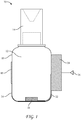
- Figure 1 depicts a schematic representation of a sterilization-assistance device.
- Dry boosters may be used to help draw chemical sterilants into a lumen of an elongate medical device, e.g., an endoscope. Dry boosters are disclosed in U.S. Patent Nos. 6,451,255 and 7,229,591 , which are hereby incorporated by reference in their entirety.
- a dry booster may include an adapter to assist in establishing a connection between the dry booster and a lumen of an elongate medical device.
- An exemplary adapter is described in U.S. Patent No. 6,187,265 , which is hereby incorporated by reference in its entirety.
- dry boosters may be used to assist in sterilizing elongate medical devices having more than one lumen
- the present disclosure focuses on elongate devices having a single lumen having a single inlet and a single outlet. Nonetheless, it should be apparent how to apply the teachings herein to elongate devices that may have more than a single lumen, a lumen having more than a single inlet, a lumen having more than a single outlet, or any combination thereof.
- FIG. 1 shows a sterilization-assistance device 10, which includes a dry booster comprised of a vial 12 and an adapter 14 configured to connect vial 12 to an outlet of a lumen of an elongate medical device.
- sterilization-assistance device 10 may be connected to the elongated medical device before placing the elongate medical device into a vacuum chamber of a sterilizer, such as the STERRAD® System, STERRAD® NX System or STERRAD® 100NX System, and subjecting it to a sterilization procedure.
- a sterilizer such as the STERRAD® System, STERRAD® NX System or STERRAD® 100NX System
- pressure within the sterilizer's vacuum chamber may be decreased or increased considerably and/or quickly.
- the pressure in the vacuum chamber may be decreased from approximately 760 torr to approximately 2 torr over a time ranging between approximately 30 seconds to 15 minutes.
- various phases of a sterilization cycle are performed during which pressure is lowered from approximately 760 torr to approximately 2 torr at differing rates based on the purpose of the phase.
- some phases include injecting a sterilant, e.g., hydrogen peroxide (which slows down the rate of pressure change), whereas other phases are performed to remove residual moisture from within the chamber (which may cause evaporation that can also slow down the rate of pressure change), whereas other phases do not include injecting a sterilant or removing residual moisture (which may correspond to the fastest pressure change).
- a sterilant e.g., hydrogen peroxide
- other phases are performed to remove residual moisture from within the chamber (which may cause evaporation that can also slow down the rate of pressure change)
- other phases do not include injecting a sterilant or removing residual moisture (which may correspond to the fastest pressure change).
- the STERRAD® 100NX phase that has the slowest change in pressure may take from approximately 5 minutes to approximately 8 minutes to lower the pressure from approximately 760 torr to approximately 2 torr.
- the STERRAD® 100NX phase that has the fastest change in pressure takes approximately 1.5 minutes to change the pressure from approximately 760
- the average rate of negative change of pressure in the STERRAD® 100NX System's vacuum chamber may be between approximately 90 torr per minute and 510 torr per minute.
- Pressure changes over a portion of a cycle or instantaneous pressure changes, dP/dt may be greater or less than the aforementioned average rates.
- the phases typically include an evacuation step during which the vacuum chamber is vented to the atmosphere and pressure within the vacuum chamber returns to atmospheric pressure. This pressure change may occur rapidly.
- the pressure may be changed from approximately 150 mTorr to approximately 760 torr over a time ranging between approximately 10 seconds and one minute, such as thirty seconds.
- the pressure can be changed at a positive rate of approximately 1500 torr per minute.
- vial 12 and adapter 14 are in fluid communication with the vacuum chamber via the elongate device's lumen, the pressure within them may not be equal to the pressure within the vacuum chamber while the pressure therein is being changed. That is, the pressure within vial 12 and adapter 14 may "lag" behind the pressure in the vacuum chamber. Such pressure changes may cause surfaces of vial 12 to deflect inwardly or outwardly, which, in turn, could cause a leak between the vial and adapter or the adapter and the lumen. In some instances, this pressure changes may cause the dry booster to detach from the elongate medical device. Such a leak or detachment may prevent, or lower the ability of, the dry booster to pull sterilant through the lumen, which would reduce the effectiveness of the sterilization process and raise the likelihood that the sterilization process would not sterilize the entire lumen.
- the sterilization process may be aborted and the elongate medical device removed from the vacuum chamber so that the dry booster may be reattached to the medical device or so that it may be replaced by another dry booster.
- the sterilization process may be aborted and the elongate medical device removed from the vacuum chamber so that the dry booster may be reattached to the medical device or so that it may be replaced by another dry booster.
- a lumen of the elongate medical device be blocked, e.g., with residual water or cleaning solution left behind following a preparation for sterilization, it may be advantageous to detect and remove the blockage before conducting the balance of a sterilization process that might be ineffective.
- a sterilization-assistance device 10 includes a dry booster comprising a vial 12 and an adapter 14, and at least one measurement device, such as a pressure sensor 16 and/or a strain gauge 18, and a communication module or relay 20.
- a measurement device such as pressure sensor 16 may be disposed upon or within vial 12, e.g., on an inner surface of vial 12.
- pressure sensor 16 may be bonded to vial 12 with an epoxy.
- vial 12 and pressure sensor 16 may be fabricated as a single unit by 3D printing techniques. Thus pressure within the vial 12 may be monitored as a function of time.
- the pressure within vial 12 should differ from the pressure within the vacuum chamber but outside vial 12 due to a pressure drop through the lumen.
- This pressure drop is a function of the lumen's diameter and length in accordance with the Hagen-Poiseuille equation, although it should be understood that a theoretical pressure drop indicated by this equation may be somewhat different than an actual or experimental pressure drop. Nonetheless, an actual pressure drop should at least approximate the theoretical pressure drop. Accordingly, the difference in pressure between the inside and outside of a vial 12 that is attached to a clean (i.e., unblocked) lumen and that does not experience leaks or detachment may be determined-or predetermined-such that this difference may be used as a reference during subsequent sterilization procedures.
- a sterilization-system manufacturer or sterilization-assistance device manufacturer may predetermine a first reference pressure difference between the inside and outside of vial 12 and corresponding to the scenario where no leaks occur between vial 12 and adapter 14, between adapter 14 and the elongate medical device, and where the dry booster remained fully attached to the elongate medical device.
- the manufacturer may predetermine a second reference pressure difference between the inside and the outside of vial 12 and corresponding to the scenario where leakage occurs.
- the manufacturer may predetermine a third reference pressure difference between the inside and outside of vial 12 and corresponding to the scenario where the dry booster detaches from elongate medical device.
- This third reference pressure difference may be approximately zero or close to zero because when the dry booster is detached from the elongate medical device, gas need not pass through the device's lumen to affect the pressure within vial 12. Accordingly, pressure inside and outside the dry booster should be substantially similar. Additionally, the manufacturer may predetermine a fourth reference pressure difference corresponding to the scenario where the lumen in the elongate medical device is blocked.
- a healthcare provider who uses a sterilizer to sterilize an elongate medical device may monitor pressure differences between a sterilization-assistance device attached to the elongate medical device and a vacuum chamber of the sterilizer.
- the healthcare provider may compare the monitored pressure difference to the predetermined reference pressure difference to determine whether the monitored pressure corresponds to a scenario of no leaking, leaking, detachment between the sterilization-assistance device and the elongate medical device, or lumen blockage.
- the pressure monitoring may automated and may be performed by the sterilizer or a stand-alone monitoring system, explained below.
- the sterilization process may be aborted to allow a healthcare provider to remedy the problem, e.g., by reattaching the dry booster, attaching a new dry booster, and/or removing the blockage.
- sterilization assistance device 10 may additionally or alternatively include another measurement device, e.g., strain gage 18, disposed upon or within vial 12, e.g., on an outer surface 19 of vial 12.
- strain gage 18 may be bonded to vial 12 with an epoxy.
- vial 12 and strain gage 18 may be fabricated as a single unit by 3D printing techniques.
- predetermined reference strain information may be collected.
- a sterilization-system manufacturer or sterilization-assistance device manufacturer may predetermine a first reference strain profile corresponding to the scenario where no leaks occur between vial 12 and adapter 14, between adapter 14 and the elongate medical device, and where the dry booster remains fully attached to the elongate medical device.
- the manufacturer may also predetermine a second reference strain profile corresponding to the scenario where leakage occurs.
- the manufacturer may predetermine a third reference strain profile corresponding to the scenario where the dry booster detaches from elongate medical device.
- This third reference strain profile may be approximately zero and constant because when the dry booster is detached from the elongate medical device, gas need not pass through the device's lumen to affect the pressure within vial 12 such that deformation of vial 12 should not occur.
- the manufacturer may predetermine a fourth reference strain profile corresponding to the scenario where the lumen in the elongate medical device is blocked.
- a healthcare provider conducting device sterilization may monitor strain of a sterilization-assistance device attached to an elongate medical device, and compare the monitored strain to the predetermined reference strain profiles to determine whether the monitored strain corresponds to a scenario of no leaking, leaking, detachment between the sterilization-assistance device and the elongate medical device, or lumen blockage.
- the pressure monitoring may be performed by the sterilizer or a stand-alone monitoring system, explained below.
- the sterilization process may be aborted to allow a healthcare provider to remedy the problem, e.g., by reattaching the dry booster, attaching a new dry booster and/or removing the blockage.
- Pressure sensor 16 and/or strain gauge 18 may communicate with a communication module or relay 20.
- a connection such as by wires 22 and 24, may be established from sensor 16 and/or gauge 18 to communication module 20 to allow communication between these components.
- Communication module 20 may be attached directly to a surface, e.g., surface 19 of the sterilization-assistance device, e.g., with epoxy, or in some embodiments, it may not be attached to sterilization-assistance device, instead only connected thereto by wires 22 and/or 24.
- communication module 20 may communicate by wire or wirelessly with a data collection and processing system ("DCPS").
- DCPS data collection and processing system
- Communication module 20 relays any information it receives from pressure sensor 16 and/or strain gauge 18 to the DCPS for processing.
- the DCPS may perform the comparisons of pressure and strain data necessary to determine whether there are leaks between a dry booster and an elongate medical device, whether the dry booster is detached from the elongate medical device, or whether there is a blockage in a lumen of the elongate medical device.
- the DCPS may be a control system of the sterilizer or a stand alone device that is located outside the sterilizer and may be entirely separate from the sterilizer.
- the DCPS may include a processor, a nontransitory storage medium, a receiver, a screen, and, optionally, an alarm.
- the receiver may include a standard wire connector, e.g., a pin connector or coaxial cable connector.
- the receiver may include an antenna 26 and any other components necessary to establish wireless communication and successfully transfer data from module 20 and to the DCPS.
- module 20 must also include components necessary to establish wireless communication and successfully transfer data from module 20 to the DCPS.
- the wireless communication may be performed according to the Bluetooth® wireless technology standard.
- the DCPS may be the control system of the sterilizer.
- the DCPS may be a stand-alone device, separate from the sterilizer, such as a stand alone user interface device.
- the stand-alone device may be a portable computer, such as a Smartphone containing an application capable of interfacing with communication module 20 using, e.g., wireless communication capabilities of the Smartphone.
- the predetermined reference pressure differences and/or predetermined reference strain profiles may be stored in the non-transitory storage medium of the DCPS.
- the processor of the DCPS may compare the data to the reference information and determine whether leaks occurred, detachment occurred, or blockage occurred.
- the DCPS may notify healthcare personnel of the determination by providing a message on its display and/or sounding an alarm.
- the DCPS may automatically abort a sterilization procedure upon determining leakage, detachment, or blockage.
- the DCPS is included in a stand-alone device, e.g., a stand-alone user interface device, the DCPS would alert healthcare personnel of the leakage, detachment, or blockage and the healthcare personnel could manually abort the sterilization procedure.
- communication module 20 is a component of sterilization assistance device 10, it will be subject to sterilization procedures.
- communication module 20 should be configured to function, i.e., relay data from pressure sensor 16 and/or strain gauge 18 to the DCPS, while being exposed to sterilant, low temperatures, and low pressures.
- U.S. Patent Application Publication No. US2009/0225517 which is hereby by reference in its entirety, describes a system suitable for use as communication module 20. This reference describes using a container to protect a wireless transmitter that operates within an autoclave.
- Predetermined reference pressure differences and predetermined reference strain profiles may also be correlated with volume flow rates of sterilants such that a volume flow rate of a sterilant through a lumen of an elongate medical device and into a dry booster may be determined.
- Efficacy of a sterilization process upon an elongate medical device having a lumen depends upon delivery a sufficient amount of sterilant through the lumen. Accordingly, a volume flow rate of a sterilant through a lumen, determined during an active sterilization process, may be used to adjust, i.e., shorten or lengthen, the amount of time that the sterilant should be exposed to the lumen at that volume flow rate.
- Such an adjustment helps ensure that a correct amount of sterilant passes through the lumen of the elongate medical device, and in some instances may save time and avoid wasting sterilant.
- the adjustment may be performed by a processor within the sterilizer's control system, which may then make adjustments to the sterilization procedure.
- Sterilization-assistance device 10 may be used to perform the following example methods.
- a dry booster of a sterilization-assistance device 10 may be connected to an elongate medical device having a lumen, e.g., an endoscope.
- sterilization-assistance device, along with the elongate medical device may be placed into a vacuum chamber of a sterilizer.
- a sterilization process that includes changing a pressure within the vacuum chamber may be commenced.
- pressure sensor 16 may measure the pressure within a vial 12 of sterilization-assistance device.
- strain gauge 18 may measure strain upon a surface of vial 12.
- communication module 20 may receive pressure data generated by pressure sensor 16 and/or strain data generated by strain gauge 18. Seventh, communication module 20 may relay the pressure and/or strain data to a DCPS, which may be a control system of the sterilization or may be included in a stand alone device, such as a stand alone user-interface device. Eighth, a processor of the DCPS may compare the pressure and/or strain data to predetermined reference data. Ninth, the processor of the DCPS may determine whether a connection between a dry booster of sterilization-assistance device and the elongate medical device leaked, whether the dry booster became detached from the elongate medical device, and/or whether there are any blockages within the lumen of the elongate medical device.
- a DCPS which may be a control system of the sterilization or may be included in a stand alone device, such as a stand alone user-interface device.
- a processor of the DCPS may compare the pressure and/or strain data to predetermined reference data.
- the processor of the DCPS may determine whether a
- a user-interface such as a display or an alert, may notify healthcare personnel of the DCPS's determination concerning leakage, detachment, and blockage.
- the sterilization process may be ended. The sterilization process may be ended or aborted before it has completed when leakage, detachment, or blockage is determined by the DCPS.
- healthcare personnel may reattach the dry booster of the sterilization-assistance device 10, may attach a new or different dry booster of another sterilization-assistance device 10, or may remove a blockage within the lumen.
Landscapes
- Health & Medical Sciences (AREA)
- Life Sciences & Earth Sciences (AREA)
- Public Health (AREA)
- Veterinary Medicine (AREA)
- Animal Behavior & Ethology (AREA)
- General Health & Medical Sciences (AREA)
- Epidemiology (AREA)
- Surgery (AREA)
- Physics & Mathematics (AREA)
- Nuclear Medicine, Radiotherapy & Molecular Imaging (AREA)
- Pathology (AREA)
- Molecular Biology (AREA)
- Medical Informatics (AREA)
- Heart & Thoracic Surgery (AREA)
- Biomedical Technology (AREA)
- Engineering & Computer Science (AREA)
- Chemical & Material Sciences (AREA)
- Radiology & Medical Imaging (AREA)
- Optics & Photonics (AREA)
- Biophysics (AREA)
- General Chemical & Material Sciences (AREA)
- Chemical Kinetics & Catalysis (AREA)
- General Physics & Mathematics (AREA)
- Oral & Maxillofacial Surgery (AREA)
- Analytical Chemistry (AREA)
- Apparatus For Disinfection Or Sterilisation (AREA)
- External Artificial Organs (AREA)
- Endoscopes (AREA)
Abstract
Description
- The subject matter disclosed herein relates to sterilization-assistance devices including dry boosters, which are devices that assist in sterilizing medical devices having lumens, e.g., endoscopes.
- Medical devices are typically sterilized before use in order to minimize the likelihood that a contaminated device might be used on a subject, which could cause an infection in the subject. Various sterilization techniques may be employed, such as steam, hydrogen peroxide, and vapor phase sterilization, either with or without a gas plasma and ethylene oxide (EtO).
- Certain sterilization techniques are conducted at pressures other than ambient pressure or atmospheric pressure. For example the STERRAD® System, STERRAD® NX System or STERRAD® 100NX System of Advanced Sterilization Products, Division of Ethicon US, LLC, a Johnson & Johnson company, are examples of sterilization systems, or sterilizers, that vaporize hydrogen peroxide and operate at low pressures, e.g., less than 200 millitorr.
- Various elongate medical devices having lumens, e.g., endoscopes, are challenging to sterilize for various reasons. For example, because pressure within a lumen decreases from the lumen's inlet as a function of length and diameter, the pressure drop must be overcome to ensure that sterilant passes through the entire lumen and reaches all surfaces of the lumen. Further, lumens may collect debris or be blocked by fluids, such as rinse water.
- A dry booster is a device that may be connected to a lumen of an elongate medical device. When subject to a sterilization process in which pressure changes are implemented, pressure differentials between the inside of a dry booster at one end of the lumen and a pressure chamber at the other end of a lumen help pass a sterilant through the lumen, which assists in sterilizing the lumen.
- A sterilization-assistance device is described herein. In some embodiments, the sterilization assistance device comprises a dry booster and at least one measurement device attached to the dry booster. In various embodiments, the at least one measurement device may include strain gauge. In various embodiments, the at least one measurement device may include a pressure sensor. In various embodiments, the at least one measurement device may include a pressure sensor and a strain gauge. The sterilization assistance device may also include a communication module. The communication module may be a wireless-communication module.
- A sterilization-assistance device may be used according to the following exemplary steps. First, a sterilization-assistance device comprising a dry booster and a measurement device may be provided. In some versions of the method, the sterilization-assistance device may be provided with a measurement device including a strain gauge. In some versions of the method, the sterilization-assistance device may be provided with a communication module. This communication module may be a wireless-communication module.
- Second, the sterilization-assistance device may be attached to an elongate medical device having a lumen. Third, the sterilization-assistance device and the elongate medical device may be placed into a vacuum chamber. Fourth, a first strain may be determined. Fifth, the first strain may be compared to a predetermined strain.
- The method may additionally include determining whether the sterilization-assistance device is detached from the elongate medical device. The method may further include determining whether leaks occurred between the sterilization-assistance device and the elongate medical device. The method may further include determining whether a blockage occurred in the lumen. The method may further include aborting a sterilization process and reattaching the sterilization-assistance device to the elongate medical device.
- A sterilization-assistance device may be used according to the following alternative exemplary steps. First, a sterilization-assistance device comprising a dry booster and a measurement device may be provided. In some versions of the method, the sterilization-assistance device may be provided with a measurement device including a pressure sensor. In some versions of the method, the sterilization-assistance device may be provided with a communication module. This communication module may be a wireless-communication module.
- Second, the sterilization-assistance device may be attached to an elongate medical device having a lumen. Third, the sterilization-assistance device and the elongate medical device into a vacuum chamber. Fourth a first pressure within the dry booster may be determined. Fifth, a second pressure outside the dry booster may be determined. Sixth a first pressure difference between the first pressure and second pressure may be determined. Seventh the first pressure difference may be compared to a predetermined pressure difference.
- The method may additionally include determining whether the sterilization-assistance device is detached from the elongate medical device. The method may further include determining whether leaks occurred between the sterilization-assistance device and the elongate medical device. The method may further include determining whether a blockage occurred in the lumen. The method may further include aborting a sterilization process and reattaching the sterilization-assistance device to the elongate medical device.
- While the specification concludes with claims which particularly point out and distinctly claim the subject matter described herein, it is believed the subject matter will be better understood from the following description of certain examples taken in conjunction with the accompanying drawing, in which like reference numerals identify the same elements and in which:
-
Figure 1 depicts a schematic representation of a sterilization-assistance device. - The following description sets forth certain illustrative examples of the claimed subject matter. Other examples, features, aspects, embodiments, and advantages of the technology should become apparent to those skilled in the art from the following description. Accordingly, the drawings and descriptions should be regarded as illustrative in nature.
- Dry boosters may be used to help draw chemical sterilants into a lumen of an elongate medical device, e.g., an endoscope. Dry boosters are disclosed in
U.S. Patent Nos. 6,451,255 and7,229,591 , which are hereby incorporated by reference in their entirety. A dry booster may include an adapter to assist in establishing a connection between the dry booster and a lumen of an elongate medical device. An exemplary adapter is described inU.S. Patent No. 6,187,265 , which is hereby incorporated by reference in its entirety. Although dry boosters may be used to assist in sterilizing elongate medical devices having more than one lumen, the present disclosure focuses on elongate devices having a single lumen having a single inlet and a single outlet. Nonetheless, it should be apparent how to apply the teachings herein to elongate devices that may have more than a single lumen, a lumen having more than a single inlet, a lumen having more than a single outlet, or any combination thereof. -
Figure 1 shows a sterilization-assistance device 10, which includes a dry booster comprised of avial 12 and anadapter 14 configured to connect vial 12 to an outlet of a lumen of an elongate medical device. Thus, sterilization-assistance device 10 may be connected to the elongated medical device before placing the elongate medical device into a vacuum chamber of a sterilizer, such as the STERRAD® System, STERRAD® NX System or STERRAD® 100NX System, and subjecting it to a sterilization procedure. - During many sterilization procedures involving a chemical sterilant, such as hydrogen peroxide, pressure within the sterilizer's vacuum chamber may be decreased or increased considerably and/or quickly. For example, the pressure in the vacuum chamber may be decreased from approximately 760 torr to approximately 2 torr over a time ranging between approximately 30 seconds to 15 minutes. For example, in the STERRAD® 100NX System, various phases of a sterilization cycle are performed during which pressure is lowered from approximately 760 torr to approximately 2 torr at differing rates based on the purpose of the phase. For example, some phases include injecting a sterilant, e.g., hydrogen peroxide (which slows down the rate of pressure change), whereas other phases are performed to remove residual moisture from within the chamber (which may cause evaporation that can also slow down the rate of pressure change), whereas other phases do not include injecting a sterilant or removing residual moisture (which may correspond to the fastest pressure change). The STERRAD® 100NX phase that has the slowest change in pressure may take from approximately 5 minutes to approximately 8 minutes to lower the pressure from approximately 760 torr to approximately 2 torr. The STERRAD® 100NX phase that has the fastest change in pressure takes approximately 1.5 minutes to change the pressure from approximately 760 torr to approximately 2 torr. Thus the average rate of negative change of pressure in the STERRAD® 100NX System's vacuum chamber may be between approximately 90 torr per minute and 510 torr per minute. Pressure changes over a portion of a cycle or instantaneous pressure changes, dP/dt, may be greater or less than the aforementioned average rates. Furthermore, the phases typically include an evacuation step during which the vacuum chamber is vented to the atmosphere and pressure within the vacuum chamber returns to atmospheric pressure. This pressure change may occur rapidly. For example, the pressure may be changed from approximately 150 mTorr to approximately 760 torr over a time ranging between approximately 10 seconds and one minute, such as thirty seconds. Thus the pressure can be changed at a positive rate of approximately 1500 torr per minute.
- Because
vial 12 andadapter 14 are in fluid communication with the vacuum chamber via the elongate device's lumen, the pressure within them may not be equal to the pressure within the vacuum chamber while the pressure therein is being changed. That is, the pressure withinvial 12 andadapter 14 may "lag" behind the pressure in the vacuum chamber. Such pressure changes may cause surfaces ofvial 12 to deflect inwardly or outwardly, which, in turn, could cause a leak between the vial and adapter or the adapter and the lumen. In some instances, this pressure changes may cause the dry booster to detach from the elongate medical device. Such a leak or detachment may prevent, or lower the ability of, the dry booster to pull sterilant through the lumen, which would reduce the effectiveness of the sterilization process and raise the likelihood that the sterilization process would not sterilize the entire lumen. - Should leaks or detachment occur, it may be advantageous to detect and address them when or promptly after they occur and before conducting the balance of a sterilization process that might be ineffective. For example, the sterilization process may be aborted and the elongate medical device removed from the vacuum chamber so that the dry booster may be reattached to the medical device or so that it may be replaced by another dry booster. Additionally, should a lumen of the elongate medical device be blocked, e.g., with residual water or cleaning solution left behind following a preparation for sterilization, it may be advantageous to detect and remove the blockage before conducting the balance of a sterilization process that might be ineffective.
- The present disclosure is directed to sterilization-assistance devices, which comprise dry boosters and additional components that enable detection of leaks between the dry booster and an elongate medical device, detachment of the dry booster from the elongate medical device, and blockages in a lumen of the elongate medical device. For example, in some embodiments, a sterilization-
assistance device 10 includes a dry booster comprising avial 12 and anadapter 14, and at least one measurement device, such as apressure sensor 16 and/or astrain gauge 18, and a communication module orrelay 20. - In some embodiments a measurement device, such as
pressure sensor 16, may be disposed upon or withinvial 12, e.g., on an inner surface ofvial 12. In some embodiments,pressure sensor 16 may be bonded tovial 12 with an epoxy. In other embodiments,vial 12 andpressure sensor 16 may be fabricated as a single unit by 3D printing techniques. Thus pressure within thevial 12 may be monitored as a function of time. When the booster is properly attached to an elongate medical device having a lumen and subject to a sterilization procedure, the pressure withinvial 12 should differ from the pressure within the vacuum chamber but outsidevial 12 due to a pressure drop through the lumen. This pressure drop is a function of the lumen's diameter and length in accordance with the Hagen-Poiseuille equation, although it should be understood that a theoretical pressure drop indicated by this equation may be somewhat different than an actual or experimental pressure drop. Nonetheless, an actual pressure drop should at least approximate the theoretical pressure drop. Accordingly, the difference in pressure between the inside and outside of avial 12 that is attached to a clean (i.e., unblocked) lumen and that does not experience leaks or detachment may be determined-or predetermined-such that this difference may be used as a reference during subsequent sterilization procedures. For example, a sterilization-system manufacturer or sterilization-assistance device manufacturer may predetermine a first reference pressure difference between the inside and outside ofvial 12 and corresponding to the scenario where no leaks occur betweenvial 12 andadapter 14, betweenadapter 14 and the elongate medical device, and where the dry booster remained fully attached to the elongate medical device. Similarly, the manufacturer may predetermine a second reference pressure difference between the inside and the outside ofvial 12 and corresponding to the scenario where leakage occurs. Further, the manufacturer may predetermine a third reference pressure difference between the inside and outside ofvial 12 and corresponding to the scenario where the dry booster detaches from elongate medical device. This third reference pressure difference may be approximately zero or close to zero because when the dry booster is detached from the elongate medical device, gas need not pass through the device's lumen to affect the pressure withinvial 12. Accordingly, pressure inside and outside the dry booster should be substantially similar. Additionally, the manufacturer may predetermine a fourth reference pressure difference corresponding to the scenario where the lumen in the elongate medical device is blocked. - A healthcare provider who uses a sterilizer to sterilize an elongate medical device may monitor pressure differences between a sterilization-assistance device attached to the elongate medical device and a vacuum chamber of the sterilizer. The healthcare provider may compare the monitored pressure difference to the predetermined reference pressure difference to determine whether the monitored pressure corresponds to a scenario of no leaking, leaking, detachment between the sterilization-assistance device and the elongate medical device, or lumen blockage. Alternatively, the pressure monitoring may automated and may be performed by the sterilizer or a stand-alone monitoring system, explained below. Thus, when a problem such as leakage, detachment, or blockage is detected, the sterilization process may be aborted to allow a healthcare provider to remedy the problem, e.g., by reattaching the dry booster, attaching a new dry booster, and/or removing the blockage.
- In some embodiments,
sterilization assistance device 10 may additionally or alternatively include another measurement device, e.g.,strain gage 18, disposed upon or withinvial 12, e.g., on anouter surface 19 ofvial 12. In some embodiments,strain gage 18 may be bonded tovial 12 with an epoxy. In other embodiments,vial 12 andstrain gage 18 may be fabricated as a single unit by 3D printing techniques. - Assuming that
sterilization assistance device 10 is properly connected to an elongate medical device and that no leaks occur during a sterilization process, the difference in pressures inside andoutside vial 12 may causevial 12 to deform, causing strain invial 12. This strain may be measured bystrain gage 18. Accordingly, similar to the predetermined reference pressure information described above, predetermined reference strain information may be collected. A sterilization-system manufacturer or sterilization-assistance device manufacturer may predetermine a first reference strain profile corresponding to the scenario where no leaks occur betweenvial 12 andadapter 14, betweenadapter 14 and the elongate medical device, and where the dry booster remains fully attached to the elongate medical device. The manufacturer may also predetermine a second reference strain profile corresponding to the scenario where leakage occurs. Further, the manufacturer may predetermine a third reference strain profile corresponding to the scenario where the dry booster detaches from elongate medical device. This third reference strain profile may be approximately zero and constant because when the dry booster is detached from the elongate medical device, gas need not pass through the device's lumen to affect the pressure withinvial 12 such that deformation ofvial 12 should not occur. Additionally, the manufacturer may predetermine a fourth reference strain profile corresponding to the scenario where the lumen in the elongate medical device is blocked. - A healthcare provider conducting device sterilization may monitor strain of a sterilization-assistance device attached to an elongate medical device, and compare the monitored strain to the predetermined reference strain profiles to determine whether the monitored strain corresponds to a scenario of no leaking, leaking, detachment between the sterilization-assistance device and the elongate medical device, or lumen blockage. Alternatively, the pressure monitoring may be performed by the sterilizer or a stand-alone monitoring system, explained below. Thus, when a problem such as leakage, detachment, or blockage is detected, the sterilization process may be aborted to allow a healthcare provider to remedy the problem, e.g., by reattaching the dry booster, attaching a new dry booster and/or removing the blockage.
-
Pressure sensor 16 and/orstrain gauge 18 may communicate with a communication module orrelay 20. A connection, such as bywires sensor 16 and/or gauge 18 tocommunication module 20 to allow communication between these components.Communication module 20 may be attached directly to a surface, e.g.,surface 19 of the sterilization-assistance device, e.g., with epoxy, or in some embodiments, it may not be attached to sterilization-assistance device, instead only connected thereto bywires 22 and/or 24. - In
turn communication module 20 may communicate by wire or wirelessly with a data collection and processing system ("DCPS").Communication module 20 relays any information it receives frompressure sensor 16 and/orstrain gauge 18 to the DCPS for processing. The DCPS may perform the comparisons of pressure and strain data necessary to determine whether there are leaks between a dry booster and an elongate medical device, whether the dry booster is detached from the elongate medical device, or whether there is a blockage in a lumen of the elongate medical device. The DCPS may be a control system of the sterilizer or a stand alone device that is located outside the sterilizer and may be entirely separate from the sterilizer. The DCPS may include a processor, a nontransitory storage medium, a receiver, a screen, and, optionally, an alarm. In those embodiments where the connection betweenmodule 20 and the DCPS is a wired connection, the receiver may include a standard wire connector, e.g., a pin connector or coaxial cable connector. In those embodiments where the connection betweenmodule 20 and the DCPS is a wireless connection, the receiver may include anantenna 26 and any other components necessary to establish wireless communication and successfully transfer data frommodule 20 and to the DCPS. Similarly, in these wireless embodiments,module 20 must also include components necessary to establish wireless communication and successfully transfer data frommodule 20 to the DCPS. For example, the wireless communication may be performed according to the Bluetooth® wireless technology standard. - In some embodiments, the DCPS may be the control system of the sterilizer. In other embodiments, the DCPS may be a stand-alone device, separate from the sterilizer, such as a stand alone user interface device. In some embodiments, the stand-alone device may be a portable computer, such as a Smartphone containing an application capable of interfacing with
communication module 20 using, e.g., wireless communication capabilities of the Smartphone. The predetermined reference pressure differences and/or predetermined reference strain profiles may be stored in the non-transitory storage medium of the DCPS. Upon receiving data from the pressure sensor and/or the strain gauge, as relayed bycommunication module 20, the processor of the DCPS may compare the data to the reference information and determine whether leaks occurred, detachment occurred, or blockage occurred. The DCPS may notify healthcare personnel of the determination by providing a message on its display and/or sounding an alarm. In those embodiments where the DCPS is the control system of the sterilizer, the DCPS may automatically abort a sterilization procedure upon determining leakage, detachment, or blockage. In those embodiments where the DCPS is included in a stand-alone device, e.g., a stand-alone user interface device, the DCPS would alert healthcare personnel of the leakage, detachment, or blockage and the healthcare personnel could manually abort the sterilization procedure. - Because
communication module 20 is a component ofsterilization assistance device 10, it will be subject to sterilization procedures. Thuscommunication module 20 should be configured to function, i.e., relay data frompressure sensor 16 and/orstrain gauge 18 to the DCPS, while being exposed to sterilant, low temperatures, and low pressures. U.S. Patent Application Publication No.US2009/0225517 , which is hereby by reference in its entirety, describes a system suitable for use ascommunication module 20. This reference describes using a container to protect a wireless transmitter that operates within an autoclave. - Predetermined reference pressure differences and predetermined reference strain profiles may also be correlated with volume flow rates of sterilants such that a volume flow rate of a sterilant through a lumen of an elongate medical device and into a dry booster may be determined. Efficacy of a sterilization process upon an elongate medical device having a lumen depends upon delivery a sufficient amount of sterilant through the lumen. Accordingly, a volume flow rate of a sterilant through a lumen, determined during an active sterilization process, may be used to adjust, i.e., shorten or lengthen, the amount of time that the sterilant should be exposed to the lumen at that volume flow rate. Such an adjustment helps ensure that a correct amount of sterilant passes through the lumen of the elongate medical device, and in some instances may save time and avoid wasting sterilant. The adjustment may be performed by a processor within the sterilizer's control system, which may then make adjustments to the sterilization procedure.
- Sterilization-
assistance device 10 may be used to perform the following example methods. First, a dry booster of a sterilization-assistance device 10 may be connected to an elongate medical device having a lumen, e.g., an endoscope. Second, sterilization-assistance device, along with the elongate medical device, may be placed into a vacuum chamber of a sterilizer. Third, a sterilization process that includes changing a pressure within the vacuum chamber may be commenced. Fourth, in those embodiments that include apressure sensor 16,pressure sensor 16 may measure the pressure within avial 12 of sterilization-assistance device. Fifth, in those embodiments that include astrain gauge 18,strain gauge 18 may measure strain upon a surface ofvial 12. Sixth,communication module 20 may receive pressure data generated bypressure sensor 16 and/or strain data generated bystrain gauge 18. Seventh,communication module 20 may relay the pressure and/or strain data to a DCPS, which may be a control system of the sterilization or may be included in a stand alone device, such as a stand alone user-interface device. Eighth, a processor of the DCPS may compare the pressure and/or strain data to predetermined reference data. Ninth, the processor of the DCPS may determine whether a connection between a dry booster of sterilization-assistance device and the elongate medical device leaked, whether the dry booster became detached from the elongate medical device, and/or whether there are any blockages within the lumen of the elongate medical device. Tenth, a user-interface, such as a display or an alert, may notify healthcare personnel of the DCPS's determination concerning leakage, detachment, and blockage. Eleventh, the sterilization process may be ended. The sterilization process may be ended or aborted before it has completed when leakage, detachment, or blockage is determined by the DCPS. Twelfth, healthcare personnel may reattach the dry booster of the sterilization-assistance device 10, may attach a new or different dry booster of another sterilization-assistance device 10, or may remove a blockage within the lumen. - It should be understood that any of the examples and/or embodiments described herein may include various other features in addition to or in lieu of those described above. The teachings, expressions, embodiments, examples, etc. described herein should not be viewed in isolation relative to each other. Various suitable ways in which the teachings herein may be combined should be readily apparent to those of ordinary skill in the art in view of the teachings herein.
- Having shown and described exemplary embodiments of the subject matter contained herein, further adaptations of the methods and systems described herein may be accomplished by appropriate modifications without departing from the scope of the claims. Some such modifications should be apparent to those skilled in the art. For instance, the examples, embodiments, geometries, materials, dimensions, ratios, steps, and the like discussed above are illustrative. Accordingly, the claims should not be limited to the specific details of structure and operation set forth in the written description and drawings.
Claims (14)
- A sterilization-assistance device, comprising:a dry booster; andat least one measurement device attached to the dry booster.
- The sterilization assistance device of claim 1,wherein the at least one measurement device includes a strain gauge.
- The sterilization assistance device of claim 1, wherein the at least one measurement device includes a pressure sensor.
- The sterilization-assistance device of claim 2, further comprising a communication module.
- The sterilization-assistance device of claim 4, wherein the communications module is a wireless-communication module.
- The sterilization-assistance device of claim 5, wherein the at least one measurement device further includes a pressure sensor.
- A method of using a sterilization-assistance device, comprising:providing the sterilization-assistance device, the sterilization-assistance device comprising a dry booster and a measurement device including a strain gauge attached to the dry booster;attaching the sterilization-assistance device to an elongate medical device having a lumen;placing the sterilization-assistance device and the elongate medical device into a vacuum chamber;determining a first strain; andcomparing the first strain to a predetermined strain.
- A method of using a sterilization-assistance device, comprising:providing the sterilization-assistance device, the sterilization-assistance device comprising a dry booster and a measurement device including a pressure sensor disposed within the dry booster;attaching the sterilization-assistance device to an elongate medical device having a lumen;placing the sterilization-assistance device and the elongate medical device into a vacuum chamber;determining a first pressure within the dry booster;determining a second pressure outside the dry booster;determining a first pressure difference between the first pressure and second pressure; andcomparing the first pressure difference to a predetermined pressure difference.
- The method of claim 7 or claim 8, further comprising determining whether the sterilization-assistance device is detached from the elongate medical device.
- The method of claim 9, further comprising determining whether leaks occurred between the sterilization-assistance device and the elongate medical device.
- The method of claim 10, further comprising determining whether a blockage occurred in the lumen.
- The method of claim 11, further comprising:aborting a sterilization process; andreattaching the sterilization-assistance device to the elongate medical device.
- The method of claim 12, wherein the sterilization-assistance device further comprises a communication module.
- The method of claim 13, wherein the communication module is a wireless-communication module.
Applications Claiming Priority (1)
| Application Number | Priority Date | Filing Date | Title |
|---|---|---|---|
| US15/834,233 US10814027B2 (en) | 2017-12-07 | 2017-12-07 | Sterilization-assistance device |
Publications (2)
| Publication Number | Publication Date |
|---|---|
| EP3495002A2 true EP3495002A2 (en) | 2019-06-12 |
| EP3495002A3 EP3495002A3 (en) | 2019-12-11 |
Family
ID=64650269
Family Applications (1)
| Application Number | Title | Priority Date | Filing Date |
|---|---|---|---|
| EP18210782.1A Withdrawn EP3495002A3 (en) | 2017-12-07 | 2018-12-06 | Sterilization-assistance device |
Country Status (11)
| Country | Link |
|---|---|
| US (1) | US10814027B2 (en) |
| EP (1) | EP3495002A3 (en) |
| JP (1) | JP2019098190A (en) |
| KR (1) | KR20190067702A (en) |
| CN (1) | CN109954155A (en) |
| AU (1) | AU2018274865A1 (en) |
| BR (1) | BR102018075236A2 (en) |
| CA (1) | CA3026670A1 (en) |
| MX (1) | MX2018015159A (en) |
| RU (1) | RU2018141831A (en) |
| TW (1) | TW201924727A (en) |
Families Citing this family (9)
| Publication number | Priority date | Publication date | Assignee | Title |
|---|---|---|---|---|
| JP7048628B2 (en) | 2016-11-28 | 2022-04-05 | アダプティブエンドウ エルエルシー | Endoscope with separable disposable shaft |
| JP6495551B1 (en) * | 2017-05-01 | 2019-04-03 | オリンパス株式会社 | Endoscope connection tube |
| US10967084B2 (en) | 2017-12-15 | 2021-04-06 | Asp Global Manufacturing Gmbh | Flow restrictor |
| USD1018844S1 (en) | 2020-01-09 | 2024-03-19 | Adaptivendo Llc | Endoscope handle |
| USD1051380S1 (en) | 2020-11-17 | 2024-11-12 | Adaptivendo Llc | Endoscope handle |
| US11603551B2 (en) | 2020-12-02 | 2023-03-14 | Steritec Products Mfg. Co., Inc. | Biological indicators, and systems and methods for determining efficacy of sterilization |
| USD1070082S1 (en) | 2021-04-29 | 2025-04-08 | Adaptivendo Llc | Endoscope handle |
| USD1031035S1 (en) | 2021-04-29 | 2024-06-11 | Adaptivendo Llc | Endoscope handle |
| USD1066659S1 (en) | 2021-09-24 | 2025-03-11 | Adaptivendo Llc | Endoscope handle |
Citations (4)
| Publication number | Priority date | Publication date | Assignee | Title |
|---|---|---|---|---|
| US6187265B1 (en) | 1997-12-17 | 2001-02-13 | Johnson & Johnson Medical, Inc. | Apparatus and method to deliver sterilants to articles having contact surfaces |
| US6451255B1 (en) | 1997-08-21 | 2002-09-17 | Ethicon, Inc. | Dry booster |
| US7229591B2 (en) | 1997-08-21 | 2007-06-12 | Ethicon, Inc. | Lumen sterilization device and method |
| US20090225517A1 (en) | 2008-03-04 | 2009-09-10 | Nelson Karl M | Wireless transmission of process data from within pressure vessels |
Family Cites Families (109)
| Publication number | Priority date | Publication date | Assignee | Title |
|---|---|---|---|---|
| US3701434A (en) | 1971-03-15 | 1972-10-31 | Hugh C Moore | Test tube system for separating blood into serum and red cells |
| US4416417A (en) | 1980-07-25 | 1983-11-22 | Roger S. Sanderson | Sterilized storage container |
| JPS58180130A (en) | 1982-04-16 | 1983-10-21 | オリンパス光学工業株式会社 | Cleaning apparatus of endoscope |
| US4637378A (en) | 1984-11-01 | 1987-01-20 | Olympus Optical Co., Ltd. | Cleaning apparatus for endoscope |
| ATE78388T1 (en) | 1985-08-16 | 1992-08-15 | Olympus Optical Co | ENDOSCOPE. |
| US4748003A (en) | 1986-03-11 | 1988-05-31 | Riley Medical Incorporated | Container for flash sterilization |
| NZ236809A (en) | 1987-07-30 | 1997-12-19 | Johnson & Johnson Medical | Vapour sterilisation device containing vaporisable antimicrobial solution connectable to lumen of medical article to be sterilised |
| US5580530A (en) | 1987-07-30 | 1996-12-03 | Johnson & Johnson Medical, Inc. | Device for vapor sterilization of articles having lumens |
| US4943414A (en) | 1987-07-30 | 1990-07-24 | Johnson & Johnson Medical, Inc. | Method for vapor sterilizaton of articles having lumens |
| DE3819257C1 (en) | 1988-06-06 | 1989-07-13 | Hans 8904 Friedberg De Biermaier | |
| US5288467A (en) | 1988-06-06 | 1994-02-22 | Hans Biermaier | Cleaning and disinfecting machine for medical equipment and instruments, anesthetic tubes, catheters, and endoscopes |
| US4878484A (en) | 1988-07-15 | 1989-11-07 | Machida Endoscope Co., Ltd. | Water-tight endoscope |
| US5244629A (en) | 1990-08-31 | 1993-09-14 | Caputo Ross A | Plasma sterilizing process with pulsed antimicrobial agent pretreatment |
| US5645796A (en) | 1990-08-31 | 1997-07-08 | Abtox, Inc. | Process for plasma sterilizing with pulsed antimicrobial agent treatment |
| US5084239A (en) | 1990-08-31 | 1992-01-28 | Abtox, Inc. | Plasma sterilizing process with pulsed antimicrobial agent treatment |
| US5165503A (en) | 1990-09-24 | 1992-11-24 | Hoffman Elliott S | Method and apparatus for lubricating and disinfecting dental drills |
| WO1993017726A1 (en) | 1992-03-13 | 1993-09-16 | American Sterilizer Company | Sterilization apparatus and method for multicomponent sterilant |
| US5308406A (en) | 1992-12-14 | 1994-05-03 | Joan Wallock | Cleaning of health care instruments |
| US5471706A (en) | 1992-12-14 | 1995-12-05 | James M. Leu | Means for cleaning of health care instruments |
| US5279317A (en) | 1993-02-26 | 1994-01-18 | Bowman Michael D | Endoscopic cannulated instrument flushing apparatus for forcing a cleaning solution through an endoscopic cannulated instrument for removal of gross debris |
| US5320119A (en) | 1993-03-05 | 1994-06-14 | Tnco, Inc. | Surgical tools cleansing |
| US5348711A (en) | 1993-07-21 | 1994-09-20 | Mdt Corporation | Dental handpiece sterilizer |
| CH688083A5 (en) | 1993-12-30 | 1997-05-15 | Hans Biermaier | Cleaning and disinfecting machine for medical devices that have narrow canals, in particular for endoscopes. |
| DE4404460C1 (en) | 1993-12-30 | 1995-06-08 | Hans Biermaier | Cleaning disinfecting machine for medical instruments such as endoscopes |
| US5533518A (en) | 1994-04-22 | 1996-07-09 | Becton, Dickinson And Company | Blood collection assembly including mechanical phase separating insert |
| US5547456A (en) | 1995-01-24 | 1996-08-20 | Karl Storz Gmbh & Co. | Vent system for endoscopes |
| US5667495A (en) | 1995-04-21 | 1997-09-16 | Becton Dickinson France S.A. | Backstop device for a syringe |
| US5634880A (en) | 1995-05-22 | 1997-06-03 | Johnson & Johnson Medical, Inc. | Endoscope pressure equalization system and method |
| DE69605548T2 (en) | 1995-06-13 | 2000-07-13 | Bitiess Microtecnica S.A., Barbengo | UNIVERSAL DEVICE FOR THE DEEP CLEANING, DISINFECTION AND STERILIZATION OF DENTAL, SURGICAL AND VETERINARY INSTRUMENTS AND OTHER APPLICATIONS |
| CA2221149C (en) | 1995-06-13 | 2006-10-24 | Luciano Gobbato | Universal device for the thorough cleaning, disinfecting and sterilizing of dental, surgical and veterinary instruments as well as for other uses |
| US5711921A (en) | 1996-01-02 | 1998-01-27 | Kew Import/Export Inc. | Medical cleaning and sterilizing apparatus |
| US6030579A (en) | 1996-04-04 | 2000-02-29 | Johnson & Johnson Medical, Inc. | Method of sterilization using pretreatment with hydrogen peroxide |
| US6325972B1 (en) | 1998-12-30 | 2001-12-04 | Ethicon, Inc. | Apparatus and process for concentrating a liquid sterilant and sterilizing articles therewith |
| US6495100B1 (en) | 1996-04-04 | 2002-12-17 | Ethicon, Inc. | Method for sterilizing devices in a container |
| US6379631B1 (en) | 1996-06-28 | 2002-04-30 | Johnson & Johnson Medical, Inc. | Instrument sterilization container formed of a liquid crystal polymer |
| US6264902B1 (en) | 1996-06-28 | 2001-07-24 | Johnson & Johnson Medical, Inc. | Instrument sterilization container having an improved latching mechanism |
| US6572819B1 (en) | 1996-06-28 | 2003-06-03 | Johnson & Johnson Medical, Inc. | Instrument sterilization container having improved drainage and support for an instrument mat |
| US6977061B2 (en) | 1997-04-04 | 2005-12-20 | Ethicon Endo-Surgery, Inc. | Method and apparatus for sterilizing a lumen device |
| US6528017B2 (en) | 1997-04-04 | 2003-03-04 | Ethicon, Inc. | System and method for sterilizing a lumen device |
| US7556767B2 (en) | 1997-12-17 | 2009-07-07 | Ethicon, Inc. | Integrated washing and sterilization process |
| US7803316B2 (en) | 1997-08-21 | 2010-09-28 | Ethicon, Inc. | Method and apparatus for processing a lumen device |
| JPH11253538A (en) | 1997-12-17 | 1999-09-21 | Ethicon Inc | Sterilization container, instrument holder used for the sterilization container, and sterilization method |
| US6083458A (en) | 1997-12-17 | 2000-07-04 | Ethicon, Inc. | Apparatus and method for providing fluid to devices with reduced or without occlusion |
| US5868667A (en) | 1998-03-27 | 1999-02-09 | Ethicon, Inc. | Pressure-equalizing cap |
| US6099812A (en) | 1998-06-18 | 2000-08-08 | Paragon Medical, Inc. | Sterilization tray with removable instrumentation wall |
| US6312646B2 (en) | 1998-08-17 | 2001-11-06 | Enviromedical Systems, Inc. | Sterilization of elongate lumens |
| US6162395A (en) | 1998-08-17 | 2000-12-19 | Enviromedical Systems, Inc. | Sterilization of elongate lumens |
| JP2000102508A (en) | 1998-09-30 | 2000-04-11 | Olympus Optical Co Ltd | Endoscope |
| US7670550B2 (en) | 1998-12-30 | 2010-03-02 | Ethicon, Inc. | Rapid sterilization system |
| US7569180B2 (en) | 2004-10-12 | 2009-08-04 | Ethicon, Inc. | Sterilization system and method and orifice inlet control apparatus therefor |
| US6534002B1 (en) | 1998-12-30 | 2003-03-18 | Ethicon, Inc. | Flow of fluid through a lumen device from smaller-caliber end to larger-caliber end |
| US7252800B2 (en) | 1998-12-30 | 2007-08-07 | Ethicon, Inc. | Sterilization system and method and inlet control apparatus therefor |
| US6569128B1 (en) | 1999-09-22 | 2003-05-27 | Advanced Infusion Corporation | Catheter with adjustable flow restrictor |
| CA2298165C (en) | 2000-02-11 | 2006-05-16 | Technologies Of Sterilization With Ozone Ts03 Inc. | Method for sterilizing an endoscope |
| US6365103B1 (en) | 2000-02-11 | 2002-04-02 | Technologies Of Sterilization With Ozone Tso3 Inc. | Method for sterilizing an endoscope |
| FR2808003B1 (en) | 2000-04-25 | 2002-08-30 | Metrolog Services Metrologique | STERILIZATION CONTAINER WITH CLOSURE CONTROLLED BY AN ELECTRONIC APPARATUS |
| JP3833879B2 (en) | 2000-08-04 | 2006-10-18 | オリンパス株式会社 | Endoscope device |
| AU2001218028A1 (en) | 2000-11-27 | 2002-06-03 | Enviromedical Systems, Inc. | Sterilization of elongate lumens |
| AU2001245092A1 (en) | 2000-11-29 | 2002-06-11 | Enviromedical Systems, Inc. | Sterilization of elongate lumens |
| JP2002253648A (en) | 2001-02-28 | 2002-09-10 | Olympus Optical Co Ltd | Used endoscope regeneration processing unit |
| US20020191938A1 (en) | 2001-06-13 | 2002-12-19 | Ethicon Endo-Surgery, Inc. | Fiberoptic coil tray and carrier package |
| JP4338368B2 (en) | 2002-08-09 | 2009-10-07 | Hoya株式会社 | Endoscopic vent valve and endoscope |
| JP2004105283A (en) | 2002-09-13 | 2004-04-08 | Olympus Corp | Washing device for surgical treatment instrument |
| US6884392B2 (en) | 2002-11-12 | 2005-04-26 | Minntech Corporation | Apparatus and method for steam reprocessing flexible endoscopes |
| ES2246027T3 (en) | 2003-03-28 | 2006-02-01 | Ulrich Dr. Kaiser | SPECIAL TEST DEVICE TO CONTROL THE PENETRATION CHARACTERISTICS OF A STERILIZING AGENT IN THE STERILIZATION PROCESSES. |
| US7314966B2 (en) | 2003-08-01 | 2008-01-01 | Steris Inc. | Method for deactivating and maintaining items in a deactivated state |
| JP2005052410A (en) | 2003-08-05 | 2005-03-03 | Olympus Corp | Sterilization system |
| JP4414734B2 (en) | 2003-11-12 | 2010-02-10 | オリンパス株式会社 | Endoscope system |
| JP4276995B2 (en) | 2004-01-08 | 2009-06-10 | オリンパス株式会社 | Endoscope sterilization test pack |
| US7753932B2 (en) | 2004-03-25 | 2010-07-13 | Boston Scientific Scimed, Inc. | Medical device and related methods of packaging |
| US7300638B2 (en) | 2004-05-18 | 2007-11-27 | American Sterilizer Company | Sterilization device for sterilization of lumen devices |
| JP4375162B2 (en) | 2004-08-19 | 2009-12-02 | 興研株式会社 | Endoscope cleaning coupler |
| US7479257B2 (en) | 2005-08-26 | 2009-01-20 | Ethicon, Inc. | Automated endoscope reprocessor solution testing |
| DE102006026103B4 (en) | 2006-06-03 | 2010-05-06 | Lurgi Gmbh | Reactor for the production of C2- to C8-olefins from an oxygenate, water vapor and one or more hydrocarbons containing stream |
| JP5042738B2 (en) | 2007-07-30 | 2012-10-03 | テルモ株式会社 | Working mechanism and cleaning method of medical manipulator |
| US9060804B2 (en) | 2007-09-28 | 2015-06-23 | Asico, Llc. | Apparatus and method for cleaning microsurgical instruments |
| US20090107529A1 (en) | 2007-10-31 | 2009-04-30 | Szu-Min Lin | Delivery of fluid to medical device lumens |
| JP2011513737A (en) | 2008-02-29 | 2011-04-28 | ベックマン コールター, インコーポレイテッド | Apparatus and method for cleaning fluid processing probes |
| PL2138127T3 (en) | 2008-06-27 | 2013-08-30 | Oro Clean Chemie Ag | Cleaning device |
| EP2348951B1 (en) | 2008-10-20 | 2014-08-06 | Smart Medical Systems Ltd. | Assemblies for use with endoscopes and applications thereof |
| EP2236102B1 (en) | 2009-03-03 | 2015-05-06 | W & H Dentalwerk Bürmoos GmbH | Cleaning or care device for cleaning or caring for a medical, in particular dental instrument |
| WO2010126824A1 (en) | 2009-04-29 | 2010-11-04 | Wilson-Cook Medical Inc. | Adaptor for an endoscope |
| WO2011041578A2 (en) | 2009-10-01 | 2011-04-07 | Macroplata, Inc. | Detachable balloon catheter |
| US20110301414A1 (en) | 2010-06-04 | 2011-12-08 | Robert Hotto | Intelligent endoscopy systems and methods |
| CN102481092B (en) | 2010-08-03 | 2014-04-09 | 奥林巴斯医疗株式会社 | Endoscope cleaning and disinfection device connecting device and endoscope cleaning and disinfection device |
| JP5399342B2 (en) | 2010-08-20 | 2014-01-29 | 富士フイルム株式会社 | Endoscopy cleaning adapter |
| GB201015526D0 (en) | 2010-09-17 | 2010-10-27 | 3M Innovative Properties Co | Device and method for determining sterilization conditions |
| WO2012148589A2 (en) | 2011-04-27 | 2012-11-01 | Sterilucent, Inc. | Sterilization system and method with compression and expansion |
| US8920574B2 (en) | 2011-10-21 | 2014-12-30 | Ethicon, Inc. | Instrument reprocessor and instrument reprocessing methods |
| DE102012200331A1 (en) | 2012-01-11 | 2013-07-11 | Melag Medizintechnik Ohg | Container for medical or dental instruments for mounting in an autoclave and method for instrument preparation |
| US9295374B2 (en) | 2012-10-04 | 2016-03-29 | Karl Storz Endovision, Inc. | Pressure compensation cap for endoscopes |
| EP2938374B1 (en) | 2012-12-28 | 2018-10-03 | Porex Corporation | Sintered porous polymeric caps and vents for components of medical devices |
| CN108498811B (en) * | 2013-03-13 | 2021-05-11 | 史赛克公司 | Sterilization container capable of providing an indication of whether or not a sterilized surgical instrument in the container has been properly sterilized |
| JP5838189B2 (en) | 2013-09-06 | 2016-01-06 | 富士フイルム株式会社 | Endoscope system |
| US9216064B2 (en) | 2014-05-02 | 2015-12-22 | David B. Geddis | System for cleaning robotic surgical instruments |
| US9808324B2 (en) | 2014-06-12 | 2017-11-07 | Covidien Lp | Cleaning system for reprocessing medical devices |
| US20160009439A1 (en) | 2014-07-14 | 2016-01-14 | Rock-Tenn Shared Services, Llc | Tab style container with internal support structures |
| FR3028408A1 (en) | 2014-11-13 | 2016-05-20 | Analytic- Tracabilite Hospitaliere | TRACEABILITY AND FOLLOW-UP OF A STERILIZATION BOX AND ITS CONTENT |
| US9922533B2 (en) | 2014-11-21 | 2018-03-20 | Stryker Corporation | System and method of managing the cleaning of a medical apparatus |
| CN108024690B (en) * | 2015-05-15 | 2020-12-01 | 维兰德.K.沙马 | System and method for steam sterilization of endoscopes |
| DE102015113430A1 (en) | 2015-08-14 | 2017-02-16 | Invendo Medical Gmbh | Endoscope package with two separate chambers |
| KR102629368B1 (en) | 2015-09-09 | 2024-01-25 | 각코우 호우진 도쿄 죠시 이카다이가꾸 | Treatment substance transport device and treatment substance transport kit |
| US20180311439A1 (en) | 2015-11-27 | 2018-11-01 | Sanofi-Aventis Deutschland Gmbh | An injection device with an expandable cavity |
| US10472122B2 (en) | 2016-01-27 | 2019-11-12 | Westrock Shared Services, Llc | Container with a reinforcement structure and method of forming the same |
| US11229497B2 (en) | 2016-02-09 | 2022-01-25 | Exactech, Inc. | Adaptable medical tray |
| US20190046024A1 (en) | 2017-08-10 | 2019-02-14 | Ethicon, Inc. | Volume expanders for endoscopes |
| US10967084B2 (en) | 2017-12-15 | 2021-04-06 | Asp Global Manufacturing Gmbh | Flow restrictor |
| US20190201568A1 (en) | 2017-12-29 | 2019-07-04 | Ethicon, Inc. | Sterilization tray |
| WO2019244098A1 (en) | 2018-06-20 | 2019-12-26 | Asp Global Manufacturing Gmbh | Dry-booster adapter |
-
2017
- 2017-12-07 US US15/834,233 patent/US10814027B2/en active Active
-
2018
- 2018-11-28 RU RU2018141831A patent/RU2018141831A/en not_active Application Discontinuation
- 2018-12-04 AU AU2018274865A patent/AU2018274865A1/en not_active Abandoned
- 2018-12-05 KR KR1020180154967A patent/KR20190067702A/en not_active Withdrawn
- 2018-12-05 TW TW107143582A patent/TW201924727A/en unknown
- 2018-12-06 EP EP18210782.1A patent/EP3495002A3/en not_active Withdrawn
- 2018-12-06 JP JP2018228782A patent/JP2019098190A/en active Pending
- 2018-12-06 BR BR102018075236-7A patent/BR102018075236A2/en not_active Application Discontinuation
- 2018-12-06 CA CA3026670A patent/CA3026670A1/en not_active Abandoned
- 2018-12-06 MX MX2018015159A patent/MX2018015159A/en unknown
- 2018-12-07 CN CN201811495770.2A patent/CN109954155A/en active Pending
Patent Citations (4)
| Publication number | Priority date | Publication date | Assignee | Title |
|---|---|---|---|---|
| US6451255B1 (en) | 1997-08-21 | 2002-09-17 | Ethicon, Inc. | Dry booster |
| US7229591B2 (en) | 1997-08-21 | 2007-06-12 | Ethicon, Inc. | Lumen sterilization device and method |
| US6187265B1 (en) | 1997-12-17 | 2001-02-13 | Johnson & Johnson Medical, Inc. | Apparatus and method to deliver sterilants to articles having contact surfaces |
| US20090225517A1 (en) | 2008-03-04 | 2009-09-10 | Nelson Karl M | Wireless transmission of process data from within pressure vessels |
Also Published As
| Publication number | Publication date |
|---|---|
| CA3026670A1 (en) | 2019-06-07 |
| RU2018141831A (en) | 2020-05-29 |
| JP2019098190A (en) | 2019-06-24 |
| CN109954155A (en) | 2019-07-02 |
| AU2018274865A1 (en) | 2019-06-27 |
| TW201924727A (en) | 2019-07-01 |
| US10814027B2 (en) | 2020-10-27 |
| KR20190067702A (en) | 2019-06-17 |
| BR102018075236A2 (en) | 2019-06-25 |
| EP3495002A3 (en) | 2019-12-11 |
| US20190175775A1 (en) | 2019-06-13 |
| MX2018015159A (en) | 2019-08-16 |
Similar Documents
| Publication | Publication Date | Title |
|---|---|---|
| US10814027B2 (en) | Sterilization-assistance device | |
| CN110000137B (en) | Endoscope reprocessing system and method | |
| JP2021515618A (en) | System for managing chest drainage | |
| EP3238747B1 (en) | Method for detecting moisture in a vacuum chamber | |
| KR20180090194A (en) | Apparatus and method for detecting moisture in a vacuum chamber | |
| ES2959619T3 (en) | Apparatus and procedure for detecting humidity in a vacuum chamber | |
| CN114555135A (en) | Adjusting sterilization cycle by imaging load | |
| KR101453627B1 (en) | Electronic sterilization validation system | |
| US20220372424A1 (en) | Biological indicator for use with a liquid sterilant | |
| WO2021150999A1 (en) | Devices and methods for managing chest or wound drainage | |
| EP3052144B1 (en) | System for washing, disinfecting and/or sterilizing medical, dental, laboratory and/or pharmaceutical goods | |
| GB2525846A (en) | A storage container for an endoscope | |
| EP3508111A2 (en) | Flow restrictor for szerilizing an endoscope | |
| US20260108668A1 (en) | Devices and methods for managing chest or wound drainage | |
| WO2020106460A1 (en) | Vacuum-releasing sterilant pod | |
| JP2005278766A (en) | Method of supervising infusion condition |
Legal Events
| Date | Code | Title | Description |
|---|---|---|---|
| PUAI | Public reference made under article 153(3) epc to a published international application that has entered the european phase |
Free format text: ORIGINAL CODE: 0009012 |
|
| STAA | Information on the status of an ep patent application or granted ep patent |
Free format text: STATUS: THE APPLICATION HAS BEEN PUBLISHED |
|
| AK | Designated contracting states |
Kind code of ref document: A2 Designated state(s): AL AT BE BG CH CY CZ DE DK EE ES FI FR GB GR HR HU IE IS IT LI LT LU LV MC MK MT NL NO PL PT RO RS SE SI SK SM TR |
|
| AX | Request for extension of the european patent |
Extension state: BA ME |
|
| PUAL | Search report despatched |
Free format text: ORIGINAL CODE: 0009013 |
|
| AK | Designated contracting states |
Kind code of ref document: A3 Designated state(s): AL AT BE BG CH CY CZ DE DK EE ES FI FR GB GR HR HU IE IS IT LI LT LU LV MC MK MT NL NO PL PT RO RS SE SI SK SM TR |
|
| AX | Request for extension of the european patent |
Extension state: BA ME |
|
| RIC1 | Information provided on ipc code assigned before grant |
Ipc: A61L 2/28 20060101AFI20191107BHEP |
|
| RAP1 | Party data changed (applicant data changed or rights of an application transferred) |
Owner name: ASP GLOBAL MANUFACTURING GMBH |
|
| STAA | Information on the status of an ep patent application or granted ep patent |
Free format text: STATUS: REQUEST FOR EXAMINATION WAS MADE |
|
| 17P | Request for examination filed |
Effective date: 20200601 |
|
| RBV | Designated contracting states (corrected) |
Designated state(s): AL AT BE BG CH CY CZ DE DK EE ES FI FR GB GR HR HU IE IS IT LI LT LU LV MC MK MT NL NO PL PT RO RS SE SI SK SM TR |
|
| STAA | Information on the status of an ep patent application or granted ep patent |
Free format text: STATUS: THE APPLICATION HAS BEEN WITHDRAWN |
|
| 18W | Application withdrawn |
Effective date: 20211008 |