EP3489315A1 - Adhesive composition - Google Patents
Adhesive composition Download PDFInfo
- Publication number
- EP3489315A1 EP3489315A1 EP17831051.2A EP17831051A EP3489315A1 EP 3489315 A1 EP3489315 A1 EP 3489315A1 EP 17831051 A EP17831051 A EP 17831051A EP 3489315 A1 EP3489315 A1 EP 3489315A1
- Authority
- EP
- European Patent Office
- Prior art keywords
- meth
- adhesive composition
- acrylate
- composition according
- group
- Prior art date
- Legal status (The legal status is an assumption and is not a legal conclusion. Google has not performed a legal analysis and makes no representation as to the accuracy of the status listed.)
- Granted
Links
Classifications
-
- B—PERFORMING OPERATIONS; TRANSPORTING
- B32—LAYERED PRODUCTS
- B32B—LAYERED PRODUCTS, i.e. PRODUCTS BUILT-UP OF STRATA OF FLAT OR NON-FLAT, e.g. CELLULAR OR HONEYCOMB, FORM
- B32B27/00—Layered products comprising a layer of synthetic resin
- B32B27/30—Layered products comprising a layer of synthetic resin comprising vinyl (co)polymers; comprising acrylic (co)polymers
-
- C—CHEMISTRY; METALLURGY
- C09—DYES; PAINTS; POLISHES; NATURAL RESINS; ADHESIVES; COMPOSITIONS NOT OTHERWISE PROVIDED FOR; APPLICATIONS OF MATERIALS NOT OTHERWISE PROVIDED FOR
- C09J—ADHESIVES; NON-MECHANICAL ASPECTS OF ADHESIVE PROCESSES IN GENERAL; ADHESIVE PROCESSES NOT PROVIDED FOR ELSEWHERE; USE OF MATERIALS AS ADHESIVES
- C09J4/00—Adhesives based on organic non-macromolecular compounds having at least one polymerisable carbon-to-carbon unsaturated bond ; adhesives, based on monomers of macromolecular compounds of groups C09J183/00 - C09J183/16
-
- B—PERFORMING OPERATIONS; TRANSPORTING
- B32—LAYERED PRODUCTS
- B32B—LAYERED PRODUCTS, i.e. PRODUCTS BUILT-UP OF STRATA OF FLAT OR NON-FLAT, e.g. CELLULAR OR HONEYCOMB, FORM
- B32B27/00—Layered products comprising a layer of synthetic resin
- B32B27/18—Layered products comprising a layer of synthetic resin characterised by the use of special additives
- B32B27/20—Layered products comprising a layer of synthetic resin characterised by the use of special additives using fillers, pigments, thixotroping agents
-
- B—PERFORMING OPERATIONS; TRANSPORTING
- B32—LAYERED PRODUCTS
- B32B—LAYERED PRODUCTS, i.e. PRODUCTS BUILT-UP OF STRATA OF FLAT OR NON-FLAT, e.g. CELLULAR OR HONEYCOMB, FORM
- B32B27/00—Layered products comprising a layer of synthetic resin
- B32B27/34—Layered products comprising a layer of synthetic resin comprising polyamides
-
- B—PERFORMING OPERATIONS; TRANSPORTING
- B32—LAYERED PRODUCTS
- B32B—LAYERED PRODUCTS, i.e. PRODUCTS BUILT-UP OF STRATA OF FLAT OR NON-FLAT, e.g. CELLULAR OR HONEYCOMB, FORM
- B32B7/00—Layered products characterised by the relation between layers; Layered products characterised by the relative orientation of features between layers, or by the relative values of a measurable parameter between layers, i.e. products comprising layers having different physical, chemical or physicochemical properties; Layered products characterised by the interconnection of layers
- B32B7/04—Interconnection of layers
- B32B7/12—Interconnection of layers using interposed adhesives or interposed materials with bonding properties
-
- C—CHEMISTRY; METALLURGY
- C09—DYES; PAINTS; POLISHES; NATURAL RESINS; ADHESIVES; COMPOSITIONS NOT OTHERWISE PROVIDED FOR; APPLICATIONS OF MATERIALS NOT OTHERWISE PROVIDED FOR
- C09J—ADHESIVES; NON-MECHANICAL ASPECTS OF ADHESIVE PROCESSES IN GENERAL; ADHESIVE PROCESSES NOT PROVIDED FOR ELSEWHERE; USE OF MATERIALS AS ADHESIVES
- C09J11/00—Features of adhesives not provided for in group C09J9/00, e.g. additives
- C09J11/02—Non-macromolecular additives
- C09J11/06—Non-macromolecular additives organic
-
- C—CHEMISTRY; METALLURGY
- C09—DYES; PAINTS; POLISHES; NATURAL RESINS; ADHESIVES; COMPOSITIONS NOT OTHERWISE PROVIDED FOR; APPLICATIONS OF MATERIALS NOT OTHERWISE PROVIDED FOR
- C09J—ADHESIVES; NON-MECHANICAL ASPECTS OF ADHESIVE PROCESSES IN GENERAL; ADHESIVE PROCESSES NOT PROVIDED FOR ELSEWHERE; USE OF MATERIALS AS ADHESIVES
- C09J201/00—Adhesives based on unspecified macromolecular compounds
-
- C—CHEMISTRY; METALLURGY
- C09—DYES; PAINTS; POLISHES; NATURAL RESINS; ADHESIVES; COMPOSITIONS NOT OTHERWISE PROVIDED FOR; APPLICATIONS OF MATERIALS NOT OTHERWISE PROVIDED FOR
- C09J—ADHESIVES; NON-MECHANICAL ASPECTS OF ADHESIVE PROCESSES IN GENERAL; ADHESIVE PROCESSES NOT PROVIDED FOR ELSEWHERE; USE OF MATERIALS AS ADHESIVES
- C09J4/00—Adhesives based on organic non-macromolecular compounds having at least one polymerisable carbon-to-carbon unsaturated bond ; adhesives, based on monomers of macromolecular compounds of groups C09J183/00 - C09J183/16
- C09J4/06—Organic non-macromolecular compounds having at least one polymerisable carbon-to-carbon unsaturated bond in combination with a macromolecular compound other than an unsaturated polymer of groups C09J159/00 - C09J187/00
-
- C—CHEMISTRY; METALLURGY
- C08—ORGANIC MACROMOLECULAR COMPOUNDS; THEIR PREPARATION OR CHEMICAL WORKING-UP; COMPOSITIONS BASED THEREON
- C08F—MACROMOLECULAR COMPOUNDS OBTAINED BY REACTIONS ONLY INVOLVING CARBON-TO-CARBON UNSATURATED BONDS
- C08F220/00—Copolymers of compounds having one or more unsaturated aliphatic radicals, each having only one carbon-to-carbon double bond, and only one being terminated by only one carboxyl radical or a salt, anhydride ester, amide, imide or nitrile thereof
- C08F220/02—Monocarboxylic acids having less than ten carbon atoms; Derivatives thereof
- C08F220/10—Esters
- C08F220/12—Esters of monohydric alcohols or phenols
- C08F220/16—Esters of monohydric alcohols or phenols of phenols or of alcohols containing two or more carbon atoms
- C08F220/18—Esters of monohydric alcohols or phenols of phenols or of alcohols containing two or more carbon atoms with acrylic or methacrylic acids
- C08F220/1807—C7-(meth)acrylate, e.g. heptyl (meth)acrylate or benzyl (meth)acrylate
-
- C—CHEMISTRY; METALLURGY
- C08—ORGANIC MACROMOLECULAR COMPOUNDS; THEIR PREPARATION OR CHEMICAL WORKING-UP; COMPOSITIONS BASED THEREON
- C08K—Use of inorganic or non-macromolecular organic substances as compounding ingredients
- C08K5/00—Use of organic ingredients
- C08K5/0091—Complexes with metal-heteroatom-bonds
-
- C—CHEMISTRY; METALLURGY
- C08—ORGANIC MACROMOLECULAR COMPOUNDS; THEIR PREPARATION OR CHEMICAL WORKING-UP; COMPOSITIONS BASED THEREON
- C08K—Use of inorganic or non-macromolecular organic substances as compounding ingredients
- C08K5/00—Use of organic ingredients
- C08K5/49—Phosphorus-containing compounds
- C08K5/51—Phosphorus bound to oxygen
- C08K5/52—Phosphorus bound to oxygen only
- C08K5/521—Esters of phosphoric acids, e.g. of H3PO4
-
- C—CHEMISTRY; METALLURGY
- C08—ORGANIC MACROMOLECULAR COMPOUNDS; THEIR PREPARATION OR CHEMICAL WORKING-UP; COMPOSITIONS BASED THEREON
- C08K—Use of inorganic or non-macromolecular organic substances as compounding ingredients
- C08K7/00—Use of ingredients characterised by shape
- C08K7/02—Fibres or whiskers
- C08K7/04—Fibres or whiskers inorganic
Definitions
- the present invention relates to an adhesive composition.
- Means for joining resin members includes mechanical fastening with bolts and nuts and welding.
- the fasteners cause a great increase in the mass of the laminate, and the stress is heavily concentrated on the junction, which may be a fracture origin.
- welding does not cause any increase in the mass and is effective for thermoplastic resins such as polyamides.
- thermoplastic resins such as polyamides.
- materials with different electric potentials such as a metal and a resin reinforced with an electric conductor, for example, carbon fiber, and joined by mechanical fastening or welding, the resulting laminate may be easily corroded (electrolytic corrosion).
- An adhesive composition used for bonding can be easily applied over a large area. Bonding with an adhesive composition is expected to prevent electrolytic corrosion because an adhesive layer is interposed between different types of materials to be joined to prevent contact between the adherends.
- Patent Literatures 1 to 5 disclose adhesive compositions for bonding polyamides. However, Patent Literatures 1 and 2 do not refer to acidic phosphate compounds, and Patent Literature 3 does not refer to (meth)acrylates. In Patent Literatures 4 and 5, imidazoles and tertiary amines are used as reducing agents, and they have had problems with the hardenability and adhesive strength.
- An object of the present invention is to provide an adhesive composition for bonding a polyamide.
- the present invention can provide the following aspects.
- the present invention can provide an adhesive composition having high adhesiveness to polyamides.
- (Meth)acrylates (1) may, for example, be monomers having (meth)acryloyl groups.
- An adhesive composition according to the present embodiment may be either a one-part or two-part adhesive. In the case of a two-part adhesive, the amounts of components used are based on the total of the first and second parts unless otherwise indicated.
- the (meth)acrylates (1) may preferably include a (meth)acrylate (1-1) having an aromatic group; a (meth)acrylate (1-2) having a hydroxy group; and a (meth)acrylate (1-3) represented by general formula (A).
- the component (1) does not include a component (2) described later.
- the (meth)acrylate (1-1) having an aromatic group may make the adhesive composition stiff and improves the solubility of the elastomer component. It is preferable that the ingredient (1-1) do not include the ingredient (1-3) described later.
- Examples of the monomer may include a (meth)acrylate represented by formula (B), phenoxyethyl (meth)acrylate, and 2-hydroxy-3-phenoxypropyl (meth)acrylate.
- the (meth)acrylate represented by formula (B) is preferable.
- Z represents a (meth)acryloyl group
- R 3 represents a hydrogen atom, a halogen atom, an alkyl group with 1 to 12 carbon atoms, or an alkoxy group with 1 to 12 carbon atoms.
- Examples of the (meth)acrylate represented by formula (B) may include benzyl (meth)acrylate, methylbenzyl (meth)acrylate, ethylbenzyl (meth)acrylate, propylbenzyl (meth)acrylate, methoxybenzyl (meth)acrylate, and chlorobenzyl (meth)acrylate.
- benzyl (meth)acrylate is preferable.
- the amount of the ingredient (1-1) may preferably be 10 to 85 parts by mass, more preferably 20 to 70 parts by mass, most preferably 35 to 65 parts by mass, in a total of 100 parts by mass of the component (1). If the amount is 10 parts by mass or more, the solubility of the elastomer component is improved, so that the workability and spreadability are improved. If the amount is 85 parts by mass or less, the peel strength is enhanced.
- the (meth)acrylate (1-2) having a hydroxy group may improve the adhesiveness to the adherend.
- Examples of the monomer may include hydroxyalkyl (meth)acrylates, polyethylene glycol (meth)acrylate, phenoxy diethylene glycol (meth)acrylate, tripropylene glycol di(meth)acrylate, and 1,6-hexanediol di(meth)acrylate.
- hydroxyalkyl (meth)acrylates are preferable.
- a (meth)acrylate represented by formula (D) is preferable.
- the alkylene group may preferably be an alkylene group with two to six carbon atoms.
- q is an integer, preferably 1.
- Examples of the (meth)acrylate represented by formula (D) may include 2-hydroxyethyl (meth)acrylate, 2-hydroxypropyl (meth)acrylate, and 2-hydroxybutyl (meth)acrylate. Among these substances, 2-hydroxybutyl (meth)acrylate is more preferable.
- the amount of the ingredient (1-2) may preferably be 5 to 60 parts by mass, more preferably 10 to 50 parts by mass, most preferably 15 to 40 parts by mass, in a total of 100 parts by mass of the component (1). If the amount is 5 parts by mass or more, the adhesiveness is improved. If the amount is 60 parts by mass or less, the solubility of the elastomer component is improved, so that the workability, spreadability, and heat resistance are improved.
- the (meth)acrylate (1-3) represented by general formula (A) has the following structure. (wherein Z and Z' each represent a (meth)acryloyl group, and Z and Z' are the same or different; R 1 and R 1 ' each represent an alkylene group, and R 1 and R 1 ' are the same or different; R 2 and R 2 ' each represent hydrogen or an alkyl group with 1 to 4 carbon atoms, and R 2 and R 2 ' are the same or different; and p and p' each represent an integer from 0 to 8, and p and p' are the same or different).
- R 1 and R 1 ' are each preferably an alkylene group with two to six carbon atoms, more preferably an ethylene group, which has two carbon atoms.
- R 2 and R 2 ' are each preferably a methyl group.
- p and p' are each an integer, preferably 0 to 8, more preferably 1 to 8, more preferably 3 to 8, most preferably 5.
- Examples of the monomer may include 2,2-bis(4-(meth)acryloxyphenyl)propane, 2,2-bis(4-(meth)acryloxyethoxyphenyl)propane, 2,2-bis(4-(meth)acryloxydiethoxyphenyl)propane, 2,2-bis(4-(meth)acryloxypropoxyphenyl)propane, 2,2-bis(4-(meth)acryloxytetraethoxyphenyl)propane, and 2,2-bis(4-(meth)acryloxypolyethoxyphenyl)propane.
- 2,2-bis(4-(meth)acryloxypolyethoxyphenyl)propane is preferable.
- the amount of the ingredient (1-3) may preferably be 1 to 60 parts by mass, more preferably 10 to 45 parts by mass, most preferably 15 to 30 parts by mass, in a total of 100 parts by mass of the component (1). If the amount is 1 part by mass or more, the heat resistance is improved. If the amount is 60 parts by mass or less, the solubility of the elastomer component is improved, so that the workability and spreadability are improved.
- An acidic phosphate compound (2) is preferably an acidic phosphate compound represented by general formula (C).
- the acidic phosphate compound may improve the adhesiveness to the adherend.
- R 5 represents hydrogen or a methyl group
- R 6 represents -C 2 H 4 -, -C 3 H 6 -, - CH 2 CH(CH 3 )-, -C 4 H 8 -, -C 6 H 12 -, or and m represents an integer from 1 to 10
- n represents an integer of 1 or 2.
- the component (2) may include acid phosphoxyethyl (meth)acrylate, acid phosphoxypropyl (meth)acrylate, and bis(2-(meth)acryloyloxyethyl)phosphate. Among these substances, acid phosphoxyethyl (meth)acrylate is preferable.
- the component (2) is preferably contained in the second part.
- the amount of the component (2) may preferably be 0.05 to 20 parts by mass, more preferably 0.5 to 10 parts by mass, most preferably 1 to 6 parts by mass, with respect to the total of 100 parts by mass of the component (1). If the amount is 0.05 parts by mass or more, the hardening speed is high, and the adhesiveness is improved. If the amount is 20 parts by mass or less, good compatibility is obtained, and the adhesiveness is improved.
- a polymerization initiator (3) may preferably be a thermal radical polymerization initiator.
- the thermal radical polymerization initiator may preferably be an organic peroxide.
- the organic peroxide may include cumene hydroperoxide, p-menthane hydroperoxide, t-butyl hydroperoxide, diisopropylbenzene dihydroperoxide, methyl ethyl ketone peroxide, benzoyl peroxide, and t-butyl peroxybenzoate.
- cumene hydroperoxide is preferable in view of the stability.
- the amount of the polymerization initiator (3) may preferably be 0.1 to 20 parts by mass, more preferably 0.5 to 10 parts by mass, most preferably 0.8 to 5 parts by mass, with respect to the total of 100 parts by mass of the component (1). If the amount is 0.1 parts by mass or more, the hardening speed is enhanced. If the amount is 20 parts by mass or less, the storage stability is improved.
- a reducing agent that reacts with the polymerization initiator to generate a radical may be used as a reducing agent (4) containing a transition metal salt.
- transition metal salt (4) may include cobalt naphthenate, copper naphthenate, and vanadyl acetylacetonate.
- vanadyl acetylacetonate is preferable.
- the amount of the reducing agent (4) containing a transition metal salt may preferably be 0.05 to 15 parts by mass, more preferably 0.1 to 5 parts by mass, with respect to the total of 100 parts by mass of the component (1). If the amount is 0.05 parts by mass or more, the hardening speed is enhanced. If the amount is 15 parts by mass or less, the storage stability is improved.
- an elastomer (5) it is preferable to use an elastomer (5) to enhance the peel strength and impact strength.
- the elastomer used in the present embodiment may preferably be a macromolecular substance that has rubberlike elasticity at ordinary temperatures and can be dissolved or dispersed in a polymerizable vinyl monomer.
- the ordinary temperatures are temperatures defined by JIS Z 8708:1983; that is, 20 ⁇ 15°C.
- the elastomer may include copolymers such as (meth)acrylonitrile-butadiene-(meth)acrylic acid copolymers, (meth)acrylonitrile-butadiene-methyl (meth)acrylate copolymers, and methyl (meth)acrylate-butadiene-styrene copolymers (MBS); various synthetic rubbers such as (meth)acrylonitrile-butadiene rubbers (NBR), linear polyurethanes, and styrene-butadiene; natural rubbers; and various thermoplastic elastomers.
- NBR nonitrile-butadiene rubbers
- NBR linear polyurethanes
- styrene-butadiene natural rubbers
- thermoplastic elastomers One or more of these elastomers may be used unless the use causes a problem in compatibility.
- At least one selected from the group consisting of methyl (meth)acrylate-butadiene-styrene copolymers and (meth)acrylonitrile-butadiene rubbers is preferable because the solubility in a polymerizable vinyl monomer and the adhesiveness are good. It is more preferable to use a methyl (meth)acrylate-butadiene-styrene copolymer and a (meth)acrylonitrile-butadiene rubber in combination.
- the amount of the elastomer may preferably be 10 to 50 parts by mass, more preferably 20 to 40 parts by mass, with respect to the total of 100 parts by mass of the component (1).
- the present embodiment provides an adhesive composition for bonding adherends containing a polyamide.
- at least one of two adherend sheets or plates is preferably an adherend sheet or plate containing a polyamide as the matrix resin.
- the polyamide that serves as the matrix resin of the adherend is preferably a linear polymer including an amido group (-NHCO-) in the repeating unit of the molecular structure.
- the polyamide may include polyamides with aliphatic skeletons, polyamides with aromatic skeletons, and polyamides with alicyclic skeletons. Among these substances, polyamides (nylons) with aliphatic skeletons are preferable.
- Polyamides may be used for, for example, auto parts because polyamides have good mechanical properties such as high strength and toughness. Polyamides are, for example, thermoplastic.
- a polyamide may be obtained by, for example, polycondensation of a lactam or an amino acid or polycondensation of a diamine and a dicarboxylic acid.
- the polyamide may be a homopolymer, a copolyamide resin of two or more types of monomers, or a blend.
- nylons include nylon 6 (which has the structure -(-(CH 2 ) 5 -CONH-) n -), nylon 6,6 (which has the structure -(-(CH 2 ) 4 -CONH-(CH 2 ) 6 -NH-) n -), and nylon 12 (which has the structure -(-(CH 2 ) 11 -CONH-) n -).
- nylons at least one selected from nylon 6 and nylon 6,6 is preferable in view of formability and availability.
- the polyamide used in the present embodiment may contain a filling material such as organic fibers, inorganic fibers, and fillers to provide effective reinforcement.
- Examples of the organic fibers may include aramid fibers and polyester fibers.
- Examples of the inorganic fibers may include glass fiber, carbon fiber, and mineral fibers.
- Examples of the fillers may include talc and calcium carbonate.
- the filling materials inorganic fibers are preferable.
- the inorganic fibers carbon fiber is preferable.
- the fiber in the polyamide may be either continuous fiber or discontinuous fiber.
- the fiber may be one of a woven fabric, a knitted fabric, a fabric in which filaments are oriented in one direction, a nonwoven fabric, and a laminate of these fabrics.
- the content of the filling material may preferably be 5 to 50 parts by mass, more preferably 10 to 40 parts by mass, in 100 parts by mass of the polyamide.
- the product provided by the present embodiment is used as an adhesive composition.
- the product of the present embodiment is preferably used as a two-part adhesive composition.
- the essential components of the adhesive composition according to the present embodiment are not mixed during storage, in other words, the adhesive composition is separated into a first part containing at least the polymerization initiator and a second part containing at least the reducing agent and stored separately.
- the two-part adhesive is preferable because good storage stability is obtained.
- the composition can be used as a two-part adhesive composition by applying both parts at the same time or separately to contact them and harden the composition.
- Examples of an adherend containing no polyamide, that can constitute the laminate according to the present embodiment, may include paper, wood, ceramics, glass, pottery, rubber, plastics, mortar, concrete, and metal.
- NBR acrylonitrile-butadiene copolymer
- MBS methyl methacrylate-butadiene-styrene copolymer
- compositions containing cumene hydroperoxide (3) were regarded as first parts, and compositions containing vanadyl acetylacetonate (4) were regarded as second parts. Equal parts of each first part and the corresponding second part were mixed and stirred to provide an adhesive composition.
- CFRTP carbon-fiber-reinforced thermoplastic resin
- A5052-H34 aluminum alloy
- the state of the fracture was inspected.
- the state of the fracture is preferably cohesive failure or adherend failure near surface, more preferably cohesive failure, because the failure indicates strong adhesion between the adhesive layer and the adherend.
- the measurement was carried out at a temperature of 23°C and a strain rate of 10 mm/min.
- CFRTP a carbon-fiber-reinforced thermoplastic resin containing nylon 6 as the matrix resin
- Torayca TLP 1060 which contains 30 mass% of long carbon fiber
- Aluminum alloy A5052-H34
- Laminates each including an adhesive layer of an adhesive composition, which had a composition for the corresponding example or comparative example shown in Table 1, between adherends were produced, and the tensile shear strength was measured.
- Laminates (CFRTP (PA6)/CFRTP (PA6)) each including an adhesive layer between carbon-fiber-reinforced thermoplastic resin plates and laminates (CFRTP (PA6)/aluminum alloy) each including an adhesive layer between a carbon-fiber-reinforced thermoplastic resin plate and an aluminum alloy plate were produced as the laminates.
- the present embodiment provided high adhesive strength because of the acidic phosphate compound.
- the adhesiveness of 2-hydroxybutyl methacrylate is higher than the adhesiveness of 2-hydroxypropyl methacrylate (see Example 1 and Example 4).
- the absence of the component (2) caused decrease in adhesiveness when the thickness of the adhesive was 3 mm and decrease in adhesiveness to the aluminum alloy (see Comparative Example 1).
- the tensile shear strength could not be measured because of insufficient curing (see Comparative Example 2).
- Use of dimethylaniline as the reducing agent reduced the adhesive strength (see Comparative Example 3).
- the present embodiment can provide a laminate in which adherend sheets or plates are strongly bonded in the case where at least one of the adherends contains a polyamide as the matrix resin.
- the present embodiment provides the laminate in which adherends are strongly bonded even without use of a solvent, heating, or pressurization during the bonding process.
- the present embodiment provides a polyamide composite member in which adherends are firmly bonded and are not easily detached.
- the present embodiment also provides a large part having a low risk of electrolytic corrosion even in the case where the adherends are made of different types of materials.
- the adhesiveness is high even when the gap (thickness of the adhesive) between the adherends is as large as 3 mm.
- the present embodiment popularizes parts, such as auto parts, made of resin, which offers weight reduction. The present embodiment is therefore of high industrial value.
Landscapes
- Chemical & Material Sciences (AREA)
- Organic Chemistry (AREA)
- Adhesives Or Adhesive Processes (AREA)
- Health & Medical Sciences (AREA)
- Chemical Kinetics & Catalysis (AREA)
- Medicinal Chemistry (AREA)
- Polymers & Plastics (AREA)
- Laminated Bodies (AREA)
- Engineering & Computer Science (AREA)
- Manufacturing & Machinery (AREA)
- Materials Engineering (AREA)
Abstract
(meth)acrylates (1), excluding the component (2), comprising the following ingredients (1-1), (1-2), and (1-3) :
a (meth)acrylate (1-1), excluding an ingredient (1-3), having an aromatic group;
a (meth)acrylate (1-2) having a hydroxy group; and
a (meth)acrylate (1-3) represented by general formula (A);
an acidic phosphate compound (2);
a polymerization initiator (3); and
a reducing agent (4) comprising a transition metal salt.
Description
- The present invention relates to an adhesive composition.
- Means for joining resin members includes mechanical fastening with bolts and nuts and welding. In the case of mechanical fastening, the fasteners cause a great increase in the mass of the laminate, and the stress is heavily concentrated on the junction, which may be a fracture origin. On the other hand, welding does not cause any increase in the mass and is effective for thermoplastic resins such as polyamides. However, it is difficult to perform welding over a large area, and the size of the resulting laminate is therefore limited. In addition, if materials with different electric potentials, such as a metal and a resin reinforced with an electric conductor, for example, carbon fiber, and joined by mechanical fastening or welding, the resulting laminate may be easily corroded (electrolytic corrosion).
- An adhesive composition used for bonding can be easily applied over a large area. Bonding with an adhesive composition is expected to prevent electrolytic corrosion because an adhesive layer is interposed between different types of materials to be joined to prevent contact between the adherends.
- However, resin is more difficult to bond than metal, and it has been difficult to obtain a laminate including resin in which adherends are strongly bonded. There is a technique of melting adherend resin to bond the adherends, but the process is complicated because the technique requires a solvent for dissolving the resin, heating, pressurization, or the like.
- Patent Literatures 1 to 5 disclose adhesive compositions for bonding polyamides. However, Patent Literatures 1 and 2 do not refer to acidic phosphate compounds, and Patent Literature 3 does not refer to (meth)acrylates. In Patent Literatures 4 and 5, imidazoles and tertiary amines are used as reducing agents, and they have had problems with the hardenability and adhesive strength.
-
- Patent Literature 1: Japanese Patent Laid-Open No.
2005-126591 - Patent Literature 2: Japanese Patent Laid-Open No.
H11-256120 - Patent Literature 3: Japanese Patent Laid-Open No.
2012-007066 - Patent Literature 4: Japanese Patent Laid-Open No.
S59-221372 - Patent Literature 5: Japanese Patent Laid-Open No.
S59-221371 - An object of the present invention is to provide an adhesive composition for bonding a polyamide.
- The present invention can provide the following aspects.
- <1> An adhesive composition for bonding adherends containing a polyamide, the composition comprising the following components (1) to (4):
(meth)acrylates (1), excluding the component (2), including the following ingredients (1-1), (1-2), and (1-3) :- a (meth)acrylate (1-1), excluding an the ingredient (1-3), having an aromatic group,
- a (meth)acrylate (1-2) having a hydroxy group, and
- a (meth)acrylate (1-3) represented by general formula (A);

- an acidic phosphate compound (2);
- a polymerization initiator (3); and
- a reducing agent (4) containing a transition metal salt.
- <2> The adhesive composition according to aspect <1>, in which the acidic phosphate compound (2) is an acidic phosphate compound represented by general formula (C).


- <3> The adhesive composition according to aspect <1> or <2>, in which the polymerization initiator (3) is a thermal radical polymerization initiator.
- <4> The adhesive composition according to one of aspects <1> to <3>, in which the reducing agent (4) is vanadyl acetylacetonate.
- <5> The adhesive composition according to one of aspects <1> to <4>, further containing an elastomer (5).
- <6> The adhesive composition according to one of aspects <1> to <5>, in which the polyamide is at least one selected from the group consisting of nylon 6 and nylon 6,6.
- <7> The adhesive composition according to one of aspects <1> to <6>, in which the polyamide contains a filling material.
- <8> The adhesive composition according to aspect <7>, in which the filling material is an inorganic fiber.
- <9> A two-part adhesive composition, wherein the adhesive composition according to one of aspects <1> to <8> is separated into a first part containing at least the polymerization initiator (3) and a second part containing at least the reducing agent (4).
- <10> A laminate having adherends at least one of which is a polyamide sheet or plate, and an adhesive layer formed of the adhesive composition according to one of aspects <1> to <9>.
- The present invention can provide an adhesive composition having high adhesiveness to polyamides.
- The following describes the present embodiment in detail. In the present specification, a range of values includes its upper and lower limits unless otherwise stated.
- (Meth)acrylates (1) may, for example, be monomers having (meth)acryloyl groups. An adhesive composition according to the present embodiment may be either a one-part or two-part adhesive. In the case of a two-part adhesive, the amounts of components used are based on the total of the first and second parts unless otherwise indicated.
- The (meth)acrylates (1) may preferably include a (meth)acrylate (1-1) having an aromatic group; a (meth)acrylate (1-2) having a hydroxy group; and a (meth)acrylate (1-3) represented by general formula (A). The component (1) does not include a component (2) described later.
- For example, the (meth)acrylate (1-1) having an aromatic group may make the adhesive composition stiff and improves the solubility of the elastomer component. It is preferable that the ingredient (1-1) do not include the ingredient (1-3) described later.
- Examples of the monomer may include a (meth)acrylate represented by formula (B), phenoxyethyl (meth)acrylate, and 2-hydroxy-3-phenoxypropyl (meth)acrylate. Among these substances, the (meth)acrylate represented by formula (B) is preferable.

- Examples of the (meth)acrylate represented by formula (B) may include benzyl (meth)acrylate, methylbenzyl (meth)acrylate, ethylbenzyl (meth)acrylate, propylbenzyl (meth)acrylate, methoxybenzyl (meth)acrylate, and chlorobenzyl (meth)acrylate. Among the (meth)acrylates represented by formula (1), benzyl (meth)acrylate is preferable.
- The amount of the ingredient (1-1) may preferably be 10 to 85 parts by mass, more preferably 20 to 70 parts by mass, most preferably 35 to 65 parts by mass, in a total of 100 parts by mass of the component (1). If the amount is 10 parts by mass or more, the solubility of the elastomer component is improved, so that the workability and spreadability are improved. If the amount is 85 parts by mass or less, the peel strength is enhanced.
- For example, the (meth)acrylate (1-2) having a hydroxy group may improve the adhesiveness to the adherend.
- Examples of the monomer may include hydroxyalkyl (meth)acrylates, polyethylene glycol (meth)acrylate, phenoxy diethylene glycol (meth)acrylate, tripropylene glycol di(meth)acrylate, and 1,6-hexanediol di(meth)acrylate. Among these substances, hydroxyalkyl (meth)acrylates are preferable.
- Among hydroxyalkyl (meth)acrylates, a (meth)acrylate represented by formula (D) is preferable.
Formula (D): Z-O-(R7O)q-H
(In formula (D), Z represents a (meth)acryloyl group, R7 represents an alkylene group, and q represents an integer from 1 to 10.) - The alkylene group may preferably be an alkylene group with two to six carbon atoms. q is an integer, preferably 1.
- Examples of the (meth)acrylate represented by formula (D) may include 2-hydroxyethyl (meth)acrylate, 2-hydroxypropyl (meth)acrylate, and 2-hydroxybutyl (meth)acrylate. Among these substances, 2-hydroxybutyl (meth)acrylate is more preferable.
- The amount of the ingredient (1-2) may preferably be 5 to 60 parts by mass, more preferably 10 to 50 parts by mass, most preferably 15 to 40 parts by mass, in a total of 100 parts by mass of the component (1). If the amount is 5 parts by mass or more, the adhesiveness is improved. If the amount is 60 parts by mass or less, the solubility of the elastomer component is improved, so that the workability, spreadability, and heat resistance are improved.
- The (meth)acrylate (1-3) represented by general formula (A) has the following structure.

- R1 and R1' are each preferably an alkylene group with two to six carbon atoms, more preferably an ethylene group, which has two carbon atoms. R2 and R2' are each preferably a methyl group. p and p' are each an integer, preferably 0 to 8, more preferably 1 to 8, more preferably 3 to 8, most preferably 5.
- Examples of the monomer may include 2,2-bis(4-(meth)acryloxyphenyl)propane, 2,2-bis(4-(meth)acryloxyethoxyphenyl)propane, 2,2-bis(4-(meth)acryloxydiethoxyphenyl)propane, 2,2-bis(4-(meth)acryloxypropoxyphenyl)propane, 2,2-bis(4-(meth)acryloxytetraethoxyphenyl)propane, and 2,2-bis(4-(meth)acryloxypolyethoxyphenyl)propane. Among these substances, 2,2-bis(4-(meth)acryloxypolyethoxyphenyl)propane is preferable.
- The amount of the ingredient (1-3) may preferably be 1 to 60 parts by mass, more preferably 10 to 45 parts by mass, most preferably 15 to 30 parts by mass, in a total of 100 parts by mass of the component (1). If the amount is 1 part by mass or more, the heat resistance is improved. If the amount is 60 parts by mass or less, the solubility of the elastomer component is improved, so that the workability and spreadability are improved.
- An acidic phosphate compound (2) is preferably an acidic phosphate compound represented by general formula (C). For example, the acidic phosphate compound may improve the adhesiveness to the adherend.


- Examples of the component (2) may include acid phosphoxyethyl (meth)acrylate, acid phosphoxypropyl (meth)acrylate, and bis(2-(meth)acryloyloxyethyl)phosphate. Among these substances, acid phosphoxyethyl (meth)acrylate is preferable. The component (2) is preferably contained in the second part.
- The amount of the component (2) may preferably be 0.05 to 20 parts by mass, more preferably 0.5 to 10 parts by mass, most preferably 1 to 6 parts by mass, with respect to the total of 100 parts by mass of the component (1). If the amount is 0.05 parts by mass or more, the hardening speed is high, and the adhesiveness is improved. If the amount is 20 parts by mass or less, good compatibility is obtained, and the adhesiveness is improved.
- A polymerization initiator (3) may preferably be a thermal radical polymerization initiator. The thermal radical polymerization initiator may preferably be an organic peroxide. Examples of the organic peroxide may include cumene hydroperoxide, p-menthane hydroperoxide, t-butyl hydroperoxide, diisopropylbenzene dihydroperoxide, methyl ethyl ketone peroxide, benzoyl peroxide, and t-butyl peroxybenzoate. Among these substances, cumene hydroperoxide is preferable in view of the stability.
- The amount of the polymerization initiator (3) may preferably be 0.1 to 20 parts by mass, more preferably 0.5 to 10 parts by mass, most preferably 0.8 to 5 parts by mass, with respect to the total of 100 parts by mass of the component (1). If the amount is 0.1 parts by mass or more, the hardening speed is enhanced. If the amount is 20 parts by mass or less, the storage stability is improved.
- A reducing agent that reacts with the polymerization initiator to generate a radical may be used as a reducing agent (4) containing a transition metal salt.
- Examples of the transition metal salt (4) may include cobalt naphthenate, copper naphthenate, and vanadyl acetylacetonate. Among the transition metal salts, vanadyl acetylacetonate is preferable.
- The amount of the reducing agent (4) containing a transition metal salt may preferably be 0.05 to 15 parts by mass, more preferably 0.1 to 5 parts by mass, with respect to the total of 100 parts by mass of the component (1). If the amount is 0.05 parts by mass or more, the hardening speed is enhanced. If the amount is 15 parts by mass or less, the storage stability is improved.
- In the present embodiment, it is preferable to use an elastomer (5) to enhance the peel strength and impact strength.
- The elastomer used in the present embodiment may preferably be a macromolecular substance that has rubberlike elasticity at ordinary temperatures and can be dissolved or dispersed in a polymerizable vinyl monomer. The ordinary temperatures are temperatures defined by JIS Z 8708:1983; that is, 20 ± 15°C.
- Examples of the elastomer may include copolymers such as (meth)acrylonitrile-butadiene-(meth)acrylic acid copolymers, (meth)acrylonitrile-butadiene-methyl (meth)acrylate copolymers, and methyl (meth)acrylate-butadiene-styrene copolymers (MBS); various synthetic rubbers such as (meth)acrylonitrile-butadiene rubbers (NBR), linear polyurethanes, and styrene-butadiene; natural rubbers; and various thermoplastic elastomers. One or more of these elastomers may be used unless the use causes a problem in compatibility.
- Among these substances, at least one selected from the group consisting of methyl (meth)acrylate-butadiene-styrene copolymers and (meth)acrylonitrile-butadiene rubbers is preferable because the solubility in a polymerizable vinyl monomer and the adhesiveness are good. It is more preferable to use a methyl (meth)acrylate-butadiene-styrene copolymer and a (meth)acrylonitrile-butadiene rubber in combination. In the case where a methyl (meth)acrylate-butadiene-styrene copolymer and a (meth)acrylonitrile-butadiene rubber are used in combination, the ratio between their contents is preferably such that the methyl (meth)acrylate-butadiene-styrene copolymer: the (meth)acrylonitrile-butadiene rubber = 10-90:90-10, more preferably 40-60:60-40, in terms of the mass ratio in a total of 100 parts by mass of the methyl (meth)acrylate-butadiene-styrene copolymer and the (meth)acrylonitrile-butadiene rubber.
- The amount of the elastomer may preferably be 10 to 50 parts by mass, more preferably 20 to 40 parts by mass, with respect to the total of 100 parts by mass of the component (1).
- The present embodiment provides an adhesive composition for bonding adherends containing a polyamide. In the present embodiment, at least one of two adherend sheets or plates is preferably an adherend sheet or plate containing a polyamide as the matrix resin.
- The polyamide that serves as the matrix resin of the adherend is preferably a linear polymer including an amido group (-NHCO-) in the repeating unit of the molecular structure. Examples of the polyamide may include polyamides with aliphatic skeletons, polyamides with aromatic skeletons, and polyamides with alicyclic skeletons. Among these substances, polyamides (nylons) with aliphatic skeletons are preferable. Polyamides may be used for, for example, auto parts because polyamides have good mechanical properties such as high strength and toughness. Polyamides are, for example, thermoplastic. A polyamide may be obtained by, for example, polycondensation of a lactam or an amino acid or polycondensation of a diamine and a dicarboxylic acid. The polyamide may be a homopolymer, a copolyamide resin of two or more types of monomers, or a blend. Examples of nylons include nylon 6 (which has the structure -(-(CH2)5-CONH-)n-), nylon 6,6 (which has the structure -(-(CH2)4-CONH-(CH2)6-NH-)n-), and nylon 12 (which has the structure -(-(CH2)11-CONH-)n-). Among nylons, at least one selected from nylon 6 and nylon 6,6 is preferable in view of formability and availability.
- The polyamide used in the present embodiment may contain a filling material such as organic fibers, inorganic fibers, and fillers to provide effective reinforcement.
- Examples of the organic fibers may include aramid fibers and polyester fibers. Examples of the inorganic fibers may include glass fiber, carbon fiber, and mineral fibers. Examples of the fillers may include talc and calcium carbonate. Among the filling materials, inorganic fibers are preferable. Among the inorganic fibers, carbon fiber is preferable.
- The fiber in the polyamide may be either continuous fiber or discontinuous fiber. In the case of continuous fiber, for example, the fiber may be one of a woven fabric, a knitted fabric, a fabric in which filaments are oriented in one direction, a nonwoven fabric, and a laminate of these fabrics.
- The content of the filling material may preferably be 5 to 50 parts by mass, more preferably 10 to 40 parts by mass, in 100 parts by mass of the polyamide.
- The product provided by the present embodiment is used as an adhesive composition. The product of the present embodiment is preferably used as a two-part adhesive composition. In the case of a two-part adhesive, the essential components of the adhesive composition according to the present embodiment are not mixed during storage, in other words, the adhesive composition is separated into a first part containing at least the polymerization initiator and a second part containing at least the reducing agent and stored separately. The two-part adhesive is preferable because good storage stability is obtained. In this case, the composition can be used as a two-part adhesive composition by applying both parts at the same time or separately to contact them and harden the composition.
- Examples of an adherend containing no polyamide, that can constitute the laminate according to the present embodiment, may include paper, wood, ceramics, glass, pottery, rubber, plastics, mortar, concrete, and metal.
- The following describes the present embodiment in more detail referring to examples. The amount of each substance used is indicated in parts by mass.
- Commercial products were used as the substances. Special remarks are as follows.
NBR: acrylonitrile-butadiene copolymer
MBS: methyl methacrylate-butadiene-styrene copolymer
2,2-Bis(4-methacryloxypolyethoxyphenyl)propane: A compound represented by formula (A) where p and p' = 5 was used. - Acidic phosphate compound: a phosphate ester, specifically an acid phosphoxyethyl methacrylate (represented by the following structural formula):
(CH2=C(CH3)-COOC2H4O)nP(O)(OH)3-n,
where n is 1 or 2. - Physical properties were measured as follows.
- Components of the amounts shown in Table 1 were mixed and stirred to provide adhesive compositions. Compositions containing cumene hydroperoxide (3) were regarded as first parts, and compositions containing vanadyl acetylacetonate (4) were regarded as second parts. Equal parts of each first part and the corresponding second part were mixed and stirred to provide an adhesive composition.
- Plates of a carbon-fiber-reinforced thermoplastic resin (CFRTP (PA6)) containing nylon 6 as the matrix resin and plates of an aluminum alloy (A5052-H34) were used as test pieces. Each test piece measured 100 × 25 × 2.0 mm and was used after being wiped with a waste rag. The adhesive composition prepared by mixing the first part and the second part was applied on one side of a test piece, and test pieces were immediately bonded together according to JIS K-6850 at a temperature of 23°C and a humidity of 50%. The thickness of the adhesive layer was adjusted to 0.1 mm or 3 mm. Subsequently, the product was aged at room temperature for 24 hours. The resulting product was used as a test sample for measurement of tensile shear strength (in units of MPa) to determine the tensile shear strength.
- After the measurement of the tensile shear strength, the state of the fracture was inspected. The state of the fracture is preferably cohesive failure or adherend failure near surface, more preferably cohesive failure, because the failure indicates strong adhesion between the adhesive layer and the adherend. The measurement was carried out at a temperature of 23°C and a strain rate of 10 mm/min.
- The following shows details of each test piece.
CFRTP (PA6): a carbon-fiber-reinforced thermoplastic resin containing nylon 6 as the matrix resin, Torayca TLP 1060 (which contains 30 mass% of long carbon fiber), manufactured by Toray Industries, Inc.
Aluminum alloy: A5052-H34 - Laminates each including an adhesive layer of an adhesive composition, which had a composition for the corresponding example or comparative example shown in Table 1, between adherends were produced, and the tensile shear strength was measured. Laminates (CFRTP (PA6)/CFRTP (PA6)) each including an adhesive layer between carbon-fiber-reinforced thermoplastic resin plates and laminates (CFRTP (PA6)/aluminum alloy) each including an adhesive layer between a carbon-fiber-reinforced thermoplastic resin plate and an aluminum alloy plate were produced as the laminates.
[Table 1] Example 1 Example 2 Example 3 Example 4 Comparative Example 1 Comparative Example 2 Comparative Example 3 Comparative Example 4 Comparative Example 5 Comparative Example 6 First part (1-1) Benzyl methacrylate 60 60 60 60 60 60 60 75 75 (1-2) 2-Hydroxybutyl methacrylate 20 20 20 20 20 20 50 25 (1-2) 2-Hydroxypropyl methacrylate 20 (1-3) 2.2-Bis(4-methacryloxypolyethoxyphenyl)propane 20 20 20 20 20 20 20 50 25 (3) Cumene hydroperoxide 5 5 5 5 5 5 5 5 5 5 (5) NBR 15 15 15 15 15 15 15 15 15 15 (5) MBS 15 15 15 15 15 15 15 15 15 15 Second part (1-1) Benzyl methacrylate 60 60 60 60 60 60 60 75 75 (1-2) 2-Hydroxybutyl methacrylate 20 20 20 20 20 20 50 25 (1-2) 2-Hydroxypropyl methacrylate 20 (1-3) 2,2-Bis(4-methacryloxypolyethoxyphenyl)propane 20 20 20 20 20 20 20 50 25 (2) Acid phosphoxyethyl methacrylate 0.5 5 20 0.5 5 5 5 5 5 (4) Vanadyl acetylacetonate 1 1 1 1 1 1 1 1 Mercaptobenzimidazole 1 Dimethylaniline 1 (5) NBR 15 15 15 15 15 15 15 15 15 15 (5) MBS 15 15 15 15 15 15 15 15 15 15 Evaluation Tensile shear adhesive strength [MPa] CFRTP(PA6)/CFRTP(PA6) Thickness of adhesive 0.1 mm 13.5 16.5 17.1 13.0 12.1 Unmeasurable because of insufficient curing of composition 7.8 Unmeasurable because of insufficient dissolution of elastomer 12.8 12.2 Cohesive failure Cohesive failure Cohesive failure Cohesive failure Cohesive failure Cohesive failure Cohesive failure Cohesive failure Thickness of adhesive 3 mm 5.2 7.3 8.2 4.4 3.1 2.0 2.1 2.3 Interfacial failure Cohesive failure Cohesive failure Cohesive failure Cohesive failure Cohesive failure Interfacial failure Interfacial failure CFRTP(PA6)/Aluminum alloy Thickness of adhesive 0.1 mm 13.4 16.8 17.3 13.1 11.8 6.4 8.6 12.6 Cohesive failure Cohesive failure Adherend failure near surface Cohesive failure Cohesive failure Interfacial failure Interfacial failure Cohesive failure The amount used is indicated in parts by mass. - The present embodiment provided high adhesive strength because of the acidic phosphate compound. The adhesiveness of 2-hydroxybutyl methacrylate is higher than the adhesiveness of 2-hydroxypropyl methacrylate (see Example 1 and Example 4). The absence of the component (2) caused decrease in adhesiveness when the thickness of the adhesive was 3 mm and decrease in adhesiveness to the aluminum alloy (see Comparative Example 1). In the case where mercaptobenzimidazole was used as the reducing agent, the tensile shear strength could not be measured because of insufficient curing (see Comparative Example 2). Use of dimethylaniline as the reducing agent reduced the adhesive strength (see Comparative Example 3). The absence of the ingredient (1-1) prevented the elastomer component from being dissolved in the monomer component, and the tensile shear strength could not be measured (see Comparative Example 4). The absence of the ingredient (1-2) caused decrease in adhesiveness when the thickness of the adhesive was 3 mm and decrease in adhesiveness to the aluminum alloy (see Comparative Example 5). The absence of the ingredient (1-3) caused decrease in adhesiveness when the thickness of the adhesive was 3 mm (see Comparative Example 6).
- The present embodiment can provide a laminate in which adherend sheets or plates are strongly bonded in the case where at least one of the adherends contains a polyamide as the matrix resin. The present embodiment provides the laminate in which adherends are strongly bonded even without use of a solvent, heating, or pressurization during the bonding process. The present embodiment provides a polyamide composite member in which adherends are firmly bonded and are not easily detached. The present embodiment also provides a large part having a low risk of electrolytic corrosion even in the case where the adherends are made of different types of materials.
- When parts such as auto parts are to be bonded, there has been a case where a large gap is left between two adherend sheets or plates because it is difficult to make the gap between the adherends uniform. In the present embodiment, the adhesiveness is high even when the gap (thickness of the adhesive) between the adherends is as large as 3 mm. The present embodiment popularizes parts, such as auto parts, made of resin, which offers weight reduction. The present embodiment is therefore of high industrial value.
Claims (10)
- An adhesive composition for bonding adherends comprising a polyamide, comprising the following components (1) to (4):(meth)acrylates (1), excluding the component (2), comprising the following ingredients (1-1), (1-2), and (1-3) :a (meth)acrylate (1-1), excluding an ingredient (1-3), having an aromatic group;a (meth)acrylate (1-2) having a hydroxy group; anda (meth)acrylate (1-3) represented by general formula (A);
 an acidic phosphate compound (2);a polymerization initiator (3); anda reducing agent (4) comprising a transition metal salt.
 - The adhesive composition according to claim 1, wherein the acidic phosphate compound (2) is an acidic phosphate compound represented by general formula (C):
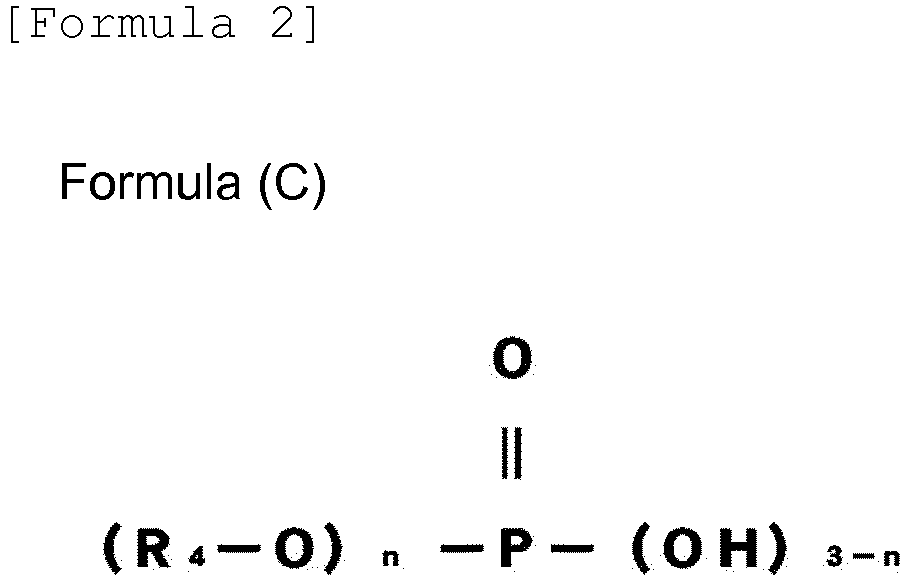

- The adhesive composition according to claim 1 or 2, wherein the polymerization initiator (3) is a thermal radical polymerization initiator.
- The adhesive composition according to one of claims 1 to 3, wherein the reducing agent (4) is vanadyl acetylacetonate.
- The adhesive composition according to one of claims 1 to 4, further comprising an elastomer (5).
- The adhesive composition according to one of claims 1 to 5, wherein the polyamide is at least one selected from the group consisting of nylon 6 and nylon 6,6.
- The adhesive composition according to one of claims 1 to 6, wherein the polyamide comprises a filling material.
- The adhesive composition according to claim 7, wherein the filling material is an inorganic fiber.
- A two-part adhesive composition, wherein the adhesive composition according to one of claims 1 to 8 is separated into:a first part comprising at least the polymerization initiator (3); anda second part comprising at least the reducing agent (4) .
- A laminate having adherends at least one of which is a polyamide sheet or plate and an adhesive layer formed of the adhesive composition according to one of claims 1 to 9 between the adherends.
Applications Claiming Priority (2)
| Application Number | Priority Date | Filing Date | Title |
|---|---|---|---|
| JP2016141783 | 2016-07-19 | ||
| PCT/JP2017/026134 WO2018016535A1 (en) | 2016-07-19 | 2017-07-19 | Adhesive composition |
Publications (3)
| Publication Number | Publication Date |
|---|---|
| EP3489315A1 true EP3489315A1 (en) | 2019-05-29 |
| EP3489315A4 EP3489315A4 (en) | 2019-06-26 |
| EP3489315B1 EP3489315B1 (en) | 2020-09-02 |
Family
ID=60992193
Family Applications (1)
| Application Number | Title | Priority Date | Filing Date |
|---|---|---|---|
| EP17831051.2A Active EP3489315B1 (en) | 2016-07-19 | 2017-07-19 | Laminate and adhesive composition |
Country Status (6)
| Country | Link |
|---|---|
| US (1) | US11098225B2 (en) |
| EP (1) | EP3489315B1 (en) |
| JP (1) | JP7057280B2 (en) |
| KR (1) | KR102399784B1 (en) |
| CN (1) | CN109476956B (en) |
| WO (1) | WO2018016535A1 (en) |
Families Citing this family (4)
| Publication number | Priority date | Publication date | Assignee | Title |
|---|---|---|---|---|
| EP4247909B1 (en) * | 2020-11-23 | 2026-01-28 | SciGrip Adhesives Ltd. | Acrylate structural adhesive free of mma |
| CN119731221A (en) | 2022-03-17 | 2025-03-28 | 科学把手粘合剂公司 | Self-curing and foamable two-component acrylic adhesive |
| CN120936638A (en) | 2023-04-14 | 2025-11-11 | 3M创新有限公司 | Two-part adhesive composition and method of making bonded articles |
| WO2025177204A1 (en) | 2024-02-20 | 2025-08-28 | 3M Innovative Properties Company | Two-part adhesive composition and method of making a bonded article |
Family Cites Families (17)
| Publication number | Priority date | Publication date | Assignee | Title |
|---|---|---|---|---|
| JPS59221371A (en) | 1983-05-31 | 1984-12-12 | Yokohama Rubber Co Ltd:The | Electrically conductive adhesive |
| JPS59221372A (en) | 1983-05-31 | 1984-12-12 | Yokohama Rubber Co Ltd:The | Structural adhesive |
| JP3332438B2 (en) | 1992-03-31 | 2002-10-07 | セメダイン株式会社 | Room temperature curable two-part composition |
| US5459206A (en) | 1992-03-31 | 1995-10-17 | Cemedine Co., Ltd. | Two-part room temperature curable composition |
| TW353666B (en) * | 1996-04-18 | 1999-03-01 | Denki Kagaku Kogyo Kk | Curable resin composition |
| GB9722736D0 (en) | 1997-10-29 | 1997-12-24 | Ciba Sc Holding Ag | Adhesive compositions |
| JP4212761B2 (en) * | 1999-06-10 | 2009-01-21 | 電気化学工業株式会社 | Curable resin composition, adhesive composition, joined body and adhesion method |
| JP4416179B2 (en) | 2000-06-02 | 2010-02-17 | 大倉工業株式会社 | Two-component acrylic curable composition |
| JP4020236B2 (en) * | 2000-09-18 | 2007-12-12 | 電気化学工業株式会社 | Curable resin composition, cured body, adhesive composition, and joined body |
| JP4947831B2 (en) | 2000-09-18 | 2012-06-06 | 電気化学工業株式会社 | Curable resin composition, cured body, adhesive composition, and joined body |
| JP2005126591A (en) | 2003-10-24 | 2005-05-19 | Hori Glass Kk | Bonded structure using two-pack type acrylic adhesive for construction |
| JP2012007066A (en) | 2010-06-24 | 2012-01-12 | Mitsubishi Engineering Plastics Corp | Resin composition for adhesion |
| CN105473628B (en) * | 2013-06-24 | 2019-04-12 | 比克化学股份有限公司 | Adhesion enhancing additive and coating composition containing the same |
| WO2015186803A1 (en) * | 2014-06-05 | 2015-12-10 | 電気化学工業株式会社 | Adhesive agent composition, and temporary member-fixation method using same |
| JP6624065B2 (en) * | 2014-11-18 | 2019-12-25 | 日立化成株式会社 | Semiconductor device, method of manufacturing the same, and resin composition for forming flexible resin layer |
| CN106398552A (en) * | 2015-07-30 | 2017-02-15 | 电气化学工业株式会社 | Composition and adhesive composition |
| WO2017170955A1 (en) * | 2016-03-31 | 2017-10-05 | デンカ株式会社 | Composition |
-
2017
- 2017-07-19 JP JP2018528837A patent/JP7057280B2/en active Active
- 2017-07-19 WO PCT/JP2017/026134 patent/WO2018016535A1/en not_active Ceased
- 2017-07-19 CN CN201780044626.4A patent/CN109476956B/en active Active
- 2017-07-19 US US16/319,115 patent/US11098225B2/en active Active
- 2017-07-19 KR KR1020197002306A patent/KR102399784B1/en active Active
- 2017-07-19 EP EP17831051.2A patent/EP3489315B1/en active Active
Also Published As
| Publication number | Publication date |
|---|---|
| KR102399784B1 (en) | 2022-05-19 |
| CN109476956A (en) | 2019-03-15 |
| JPWO2018016535A1 (en) | 2019-05-09 |
| CN109476956B (en) | 2022-02-25 |
| EP3489315A4 (en) | 2019-06-26 |
| KR20190029611A (en) | 2019-03-20 |
| WO2018016535A1 (en) | 2018-01-25 |
| JP7057280B2 (en) | 2022-04-19 |
| EP3489315B1 (en) | 2020-09-02 |
| US20190276715A1 (en) | 2019-09-12 |
| US11098225B2 (en) | 2021-08-24 |
Similar Documents
| Publication | Publication Date | Title |
|---|---|---|
| EP3489315B1 (en) | Laminate and adhesive composition | |
| KR101475102B1 (en) | Adhesive compositions and jointing method | |
| EP2135904B2 (en) | Adhesives for bonding composites | |
| KR920000474B1 (en) | Adhesive Composition and Adhesion Method | |
| US9683149B2 (en) | Oriented structural adhesives | |
| US9845413B1 (en) | Structural adhesive compositions | |
| JP6684800B2 (en) | Composition | |
| WO2020100832A1 (en) | Composition | |
| CN116490584A (en) | Adhesives, adhesives for bonding dissimilar materials, adhesive sheets, and adhesive sheets for bonding dissimilar materials | |
| US8419890B2 (en) | Composition for structural adhesive | |
| KR101771751B1 (en) | Composition for a structural adhesive | |
| CN101463235B (en) | High elongation rate acrylic ester adhesive | |
| JP6712920B2 (en) | Adhesive composition | |
| JP3615470B2 (en) | Damping adhesive rubber composition | |
| JPS59159866A (en) | Adhesive composition | |
| JP2004059827A (en) | Adhesive composition for aluminum alloy | |
| WO2024042389A1 (en) | Curable precursors of structural adhesive compositions including self-polymerizable toughening agent, and methods of using same | |
| JP2009051944A (en) | Radical-curable adhesive composition | |
| WO2024042388A1 (en) | Two-part compositions including self-polymerizable toughening agent, and methods of using same | |
| WO2025215051A1 (en) | Use of eggshell or seashell particles to improve properties of heat-curing epoxy resin compositions | |
| JP2025102122A (en) | Adhesives and Adhesive Sheets | |
| HK1175487B (en) | Composition for a structural adhesive |
Legal Events
| Date | Code | Title | Description |
|---|---|---|---|
| STAA | Information on the status of an ep patent application or granted ep patent |
Free format text: STATUS: THE INTERNATIONAL PUBLICATION HAS BEEN MADE |
|
| PUAI | Public reference made under article 153(3) epc to a published international application that has entered the european phase |
Free format text: ORIGINAL CODE: 0009012 |
|
| STAA | Information on the status of an ep patent application or granted ep patent |
Free format text: STATUS: REQUEST FOR EXAMINATION WAS MADE |
|
| 17P | Request for examination filed |
Effective date: 20190218 |
|
| AK | Designated contracting states |
Kind code of ref document: A1 Designated state(s): AL AT BE BG CH CY CZ DE DK EE ES FI FR GB GR HR HU IE IS IT LI LT LU LV MC MK MT NL NO PL PT RO RS SE SI SK SM TR |
|
| AX | Request for extension of the european patent |
Extension state: BA ME |
|
| A4 | Supplementary search report drawn up and despatched |
Effective date: 20190527 |
|
| RIC1 | Information provided on ipc code assigned before grant |
Ipc: C09J 4/02 20060101AFI20190521BHEP Ipc: B32B 27/30 20060101ALI20190521BHEP Ipc: C08K 5/00 20060101ALI20190521BHEP Ipc: C08K 5/521 20060101ALI20190521BHEP Ipc: C09J 4/00 20060101ALI20190521BHEP Ipc: C09J 201/00 20060101ALI20190521BHEP Ipc: B32B 27/34 20060101ALI20190521BHEP Ipc: C09J 11/06 20060101ALI20190521BHEP Ipc: C09J 4/06 20060101ALI20190521BHEP |
|
| DAV | Request for validation of the european patent (deleted) | ||
| DAX | Request for extension of the european patent (deleted) | ||
| GRAP | Despatch of communication of intention to grant a patent |
Free format text: ORIGINAL CODE: EPIDOSNIGR1 |
|
| STAA | Information on the status of an ep patent application or granted ep patent |
Free format text: STATUS: GRANT OF PATENT IS INTENDED |
|
| INTG | Intention to grant announced |
Effective date: 20200326 |
|
| GRAS | Grant fee paid |
Free format text: ORIGINAL CODE: EPIDOSNIGR3 |
|
| GRAA | (expected) grant |
Free format text: ORIGINAL CODE: 0009210 |
|
| STAA | Information on the status of an ep patent application or granted ep patent |
Free format text: STATUS: THE PATENT HAS BEEN GRANTED |
|
| AK | Designated contracting states |
Kind code of ref document: B1 Designated state(s): AL AT BE BG CH CY CZ DE DK EE ES FI FR GB GR HR HU IE IS IT LI LT LU LV MC MK MT NL NO PL PT RO RS SE SI SK SM TR |
|
| REG | Reference to a national code |
Ref country code: GB Ref legal event code: FG4D |
|
| REG | Reference to a national code |
Ref country code: AT Ref legal event code: REF Ref document number: 1308792 Country of ref document: AT Kind code of ref document: T Effective date: 20200915 Ref country code: CH Ref legal event code: EP |
|
| REG | Reference to a national code |
Ref country code: DE Ref legal event code: R096 Ref document number: 602017023030 Country of ref document: DE |
|
| REG | Reference to a national code |
Ref country code: IE Ref legal event code: FG4D |
|
| REG | Reference to a national code |
Ref country code: LT Ref legal event code: MG4D |
|
| PG25 | Lapsed in a contracting state [announced via postgrant information from national office to epo] |
Ref country code: BG Free format text: LAPSE BECAUSE OF FAILURE TO SUBMIT A TRANSLATION OF THE DESCRIPTION OR TO PAY THE FEE WITHIN THE PRESCRIBED TIME-LIMIT Effective date: 20201202 Ref country code: LT Free format text: LAPSE BECAUSE OF FAILURE TO SUBMIT A TRANSLATION OF THE DESCRIPTION OR TO PAY THE FEE WITHIN THE PRESCRIBED TIME-LIMIT Effective date: 20200902 Ref country code: HR Free format text: LAPSE BECAUSE OF FAILURE TO SUBMIT A TRANSLATION OF THE DESCRIPTION OR TO PAY THE FEE WITHIN THE PRESCRIBED TIME-LIMIT Effective date: 20200902 Ref country code: SE Free format text: LAPSE BECAUSE OF FAILURE TO SUBMIT A TRANSLATION OF THE DESCRIPTION OR TO PAY THE FEE WITHIN THE PRESCRIBED TIME-LIMIT Effective date: 20200902 Ref country code: NO Free format text: LAPSE BECAUSE OF FAILURE TO SUBMIT A TRANSLATION OF THE DESCRIPTION OR TO PAY THE FEE WITHIN THE PRESCRIBED TIME-LIMIT Effective date: 20201202 Ref country code: FI Free format text: LAPSE BECAUSE OF FAILURE TO SUBMIT A TRANSLATION OF THE DESCRIPTION OR TO PAY THE FEE WITHIN THE PRESCRIBED TIME-LIMIT Effective date: 20200902 Ref country code: GR Free format text: LAPSE BECAUSE OF FAILURE TO SUBMIT A TRANSLATION OF THE DESCRIPTION OR TO PAY THE FEE WITHIN THE PRESCRIBED TIME-LIMIT Effective date: 20201203 |
|
| REG | Reference to a national code |
Ref country code: NL Ref legal event code: MP Effective date: 20200902 |
|
| REG | Reference to a national code |
Ref country code: AT Ref legal event code: MK05 Ref document number: 1308792 Country of ref document: AT Kind code of ref document: T Effective date: 20200902 |
|
| PG25 | Lapsed in a contracting state [announced via postgrant information from national office to epo] |
Ref country code: RS Free format text: LAPSE BECAUSE OF FAILURE TO SUBMIT A TRANSLATION OF THE DESCRIPTION OR TO PAY THE FEE WITHIN THE PRESCRIBED TIME-LIMIT Effective date: 20200902 Ref country code: LV Free format text: LAPSE BECAUSE OF FAILURE TO SUBMIT A TRANSLATION OF THE DESCRIPTION OR TO PAY THE FEE WITHIN THE PRESCRIBED TIME-LIMIT Effective date: 20200902 Ref country code: PL Free format text: LAPSE BECAUSE OF FAILURE TO SUBMIT A TRANSLATION OF THE DESCRIPTION OR TO PAY THE FEE WITHIN THE PRESCRIBED TIME-LIMIT Effective date: 20200902 |
|
| PG25 | Lapsed in a contracting state [announced via postgrant information from national office to epo] |
Ref country code: SM Free format text: LAPSE BECAUSE OF FAILURE TO SUBMIT A TRANSLATION OF THE DESCRIPTION OR TO PAY THE FEE WITHIN THE PRESCRIBED TIME-LIMIT Effective date: 20200902 Ref country code: CZ Free format text: LAPSE BECAUSE OF FAILURE TO SUBMIT A TRANSLATION OF THE DESCRIPTION OR TO PAY THE FEE WITHIN THE PRESCRIBED TIME-LIMIT Effective date: 20200902 Ref country code: PT Free format text: LAPSE BECAUSE OF FAILURE TO SUBMIT A TRANSLATION OF THE DESCRIPTION OR TO PAY THE FEE WITHIN THE PRESCRIBED TIME-LIMIT Effective date: 20210104 Ref country code: RO Free format text: LAPSE BECAUSE OF FAILURE TO SUBMIT A TRANSLATION OF THE DESCRIPTION OR TO PAY THE FEE WITHIN THE PRESCRIBED TIME-LIMIT Effective date: 20200902 Ref country code: EE Free format text: LAPSE BECAUSE OF FAILURE TO SUBMIT A TRANSLATION OF THE DESCRIPTION OR TO PAY THE FEE WITHIN THE PRESCRIBED TIME-LIMIT Effective date: 20200902 |
|
| PG25 | Lapsed in a contracting state [announced via postgrant information from national office to epo] |
Ref country code: IS Free format text: LAPSE BECAUSE OF FAILURE TO SUBMIT A TRANSLATION OF THE DESCRIPTION OR TO PAY THE FEE WITHIN THE PRESCRIBED TIME-LIMIT Effective date: 20210102 Ref country code: ES Free format text: LAPSE BECAUSE OF FAILURE TO SUBMIT A TRANSLATION OF THE DESCRIPTION OR TO PAY THE FEE WITHIN THE PRESCRIBED TIME-LIMIT Effective date: 20200902 Ref country code: AL Free format text: LAPSE BECAUSE OF FAILURE TO SUBMIT A TRANSLATION OF THE DESCRIPTION OR TO PAY THE FEE WITHIN THE PRESCRIBED TIME-LIMIT Effective date: 20200902 Ref country code: AT Free format text: LAPSE BECAUSE OF FAILURE TO SUBMIT A TRANSLATION OF THE DESCRIPTION OR TO PAY THE FEE WITHIN THE PRESCRIBED TIME-LIMIT Effective date: 20200902 |
|
| REG | Reference to a national code |
Ref country code: DE Ref legal event code: R097 Ref document number: 602017023030 Country of ref document: DE |
|
| PG25 | Lapsed in a contracting state [announced via postgrant information from national office to epo] |
Ref country code: SK Free format text: LAPSE BECAUSE OF FAILURE TO SUBMIT A TRANSLATION OF THE DESCRIPTION OR TO PAY THE FEE WITHIN THE PRESCRIBED TIME-LIMIT Effective date: 20200902 |
|
| PLBE | No opposition filed within time limit |
Free format text: ORIGINAL CODE: 0009261 |
|
| STAA | Information on the status of an ep patent application or granted ep patent |
Free format text: STATUS: NO OPPOSITION FILED WITHIN TIME LIMIT |
|
| 26N | No opposition filed |
Effective date: 20210603 |
|
| PG25 | Lapsed in a contracting state [announced via postgrant information from national office to epo] |
Ref country code: SI Free format text: LAPSE BECAUSE OF FAILURE TO SUBMIT A TRANSLATION OF THE DESCRIPTION OR TO PAY THE FEE WITHIN THE PRESCRIBED TIME-LIMIT Effective date: 20200902 Ref country code: DK Free format text: LAPSE BECAUSE OF FAILURE TO SUBMIT A TRANSLATION OF THE DESCRIPTION OR TO PAY THE FEE WITHIN THE PRESCRIBED TIME-LIMIT Effective date: 20200902 |
|
| PG25 | Lapsed in a contracting state [announced via postgrant information from national office to epo] |
Ref country code: IT Free format text: LAPSE BECAUSE OF FAILURE TO SUBMIT A TRANSLATION OF THE DESCRIPTION OR TO PAY THE FEE WITHIN THE PRESCRIBED TIME-LIMIT Effective date: 20200902 |
|
| REG | Reference to a national code |
Ref country code: CH Ref legal event code: PL |
|
| GBPC | Gb: european patent ceased through non-payment of renewal fee |
Effective date: 20210719 |
|
| PG25 | Lapsed in a contracting state [announced via postgrant information from national office to epo] |
Ref country code: MC Free format text: LAPSE BECAUSE OF FAILURE TO SUBMIT A TRANSLATION OF THE DESCRIPTION OR TO PAY THE FEE WITHIN THE PRESCRIBED TIME-LIMIT Effective date: 20200902 |
|
| REG | Reference to a national code |
Ref country code: BE Ref legal event code: MM Effective date: 20210731 |
|
| PG25 | Lapsed in a contracting state [announced via postgrant information from national office to epo] |
Ref country code: LI Free format text: LAPSE BECAUSE OF NON-PAYMENT OF DUE FEES Effective date: 20210731 Ref country code: GB Free format text: LAPSE BECAUSE OF NON-PAYMENT OF DUE FEES Effective date: 20210719 Ref country code: CH Free format text: LAPSE BECAUSE OF NON-PAYMENT OF DUE FEES Effective date: 20210731 |
|
| PG25 | Lapsed in a contracting state [announced via postgrant information from national office to epo] |
Ref country code: LU Free format text: LAPSE BECAUSE OF NON-PAYMENT OF DUE FEES Effective date: 20210719 Ref country code: FR Free format text: LAPSE BECAUSE OF NON-PAYMENT OF DUE FEES Effective date: 20210731 |
|
| PG25 | Lapsed in a contracting state [announced via postgrant information from national office to epo] |
Ref country code: IE Free format text: LAPSE BECAUSE OF NON-PAYMENT OF DUE FEES Effective date: 20210719 Ref country code: BE Free format text: LAPSE BECAUSE OF NON-PAYMENT OF DUE FEES Effective date: 20210731 |
|
| P01 | Opt-out of the competence of the unified patent court (upc) registered |
Effective date: 20230512 |
|
| PG25 | Lapsed in a contracting state [announced via postgrant information from national office to epo] |
Ref country code: NL Free format text: LAPSE BECAUSE OF NON-PAYMENT OF DUE FEES Effective date: 20200923 Ref country code: CY Free format text: LAPSE BECAUSE OF FAILURE TO SUBMIT A TRANSLATION OF THE DESCRIPTION OR TO PAY THE FEE WITHIN THE PRESCRIBED TIME-LIMIT Effective date: 20200902 |
|
| PG25 | Lapsed in a contracting state [announced via postgrant information from national office to epo] |
Ref country code: HU Free format text: LAPSE BECAUSE OF FAILURE TO SUBMIT A TRANSLATION OF THE DESCRIPTION OR TO PAY THE FEE WITHIN THE PRESCRIBED TIME-LIMIT; INVALID AB INITIO Effective date: 20170719 |
|
| PG25 | Lapsed in a contracting state [announced via postgrant information from national office to epo] |
Ref country code: MK Free format text: LAPSE BECAUSE OF FAILURE TO SUBMIT A TRANSLATION OF THE DESCRIPTION OR TO PAY THE FEE WITHIN THE PRESCRIBED TIME-LIMIT Effective date: 20200902 |
|
| PG25 | Lapsed in a contracting state [announced via postgrant information from national office to epo] |
Ref country code: MT Free format text: LAPSE BECAUSE OF FAILURE TO SUBMIT A TRANSLATION OF THE DESCRIPTION OR TO PAY THE FEE WITHIN THE PRESCRIBED TIME-LIMIT Effective date: 20200902 |
|
| PGFP | Annual fee paid to national office [announced via postgrant information from national office to epo] |
Ref country code: DE Payment date: 20250528 Year of fee payment: 9 |
|
| PG25 | Lapsed in a contracting state [announced via postgrant information from national office to epo] |
Ref country code: TR Free format text: LAPSE BECAUSE OF FAILURE TO SUBMIT A TRANSLATION OF THE DESCRIPTION OR TO PAY THE FEE WITHIN THE PRESCRIBED TIME-LIMIT Effective date: 20200902 |