EP3484514B1 - Compositions and methods related to engineered fc constructs - Google Patents
Compositions and methods related to engineered fc constructs Download PDFInfo
- Publication number
- EP3484514B1 EP3484514B1 EP17803463.3A EP17803463A EP3484514B1 EP 3484514 B1 EP3484514 B1 EP 3484514B1 EP 17803463 A EP17803463 A EP 17803463A EP 3484514 B1 EP3484514 B1 EP 3484514B1
- Authority
- EP
- European Patent Office
- Prior art keywords
- domain
- construct
- domain monomer
- polypeptide
- monomer
- Prior art date
- Legal status (The legal status is an assumption and is not a legal conclusion. Google has not performed a legal analysis and makes no representation as to the accuracy of the status listed.)
- Active
Links
Images









Classifications
-
- C—CHEMISTRY; METALLURGY
- C07—ORGANIC CHEMISTRY
- C07K—PEPTIDES
- C07K16/00—Immunoglobulins [IGs], e.g. monoclonal or polyclonal antibodies
- C07K16/46—Hybrid immunoglobulins
-
- C—CHEMISTRY; METALLURGY
- C07—ORGANIC CHEMISTRY
- C07K—PEPTIDES
- C07K16/00—Immunoglobulins [IGs], e.g. monoclonal or polyclonal antibodies
-
- A—HUMAN NECESSITIES
- A61—MEDICAL OR VETERINARY SCIENCE; HYGIENE
- A61K—PREPARATIONS FOR MEDICAL, DENTAL OR TOILETRY PURPOSES
- A61K39/00—Medicinal preparations containing antigens or antibodies
- A61K39/395—Antibodies; Immunoglobulins; Immune serum, e.g. antilymphocytic serum
-
- A—HUMAN NECESSITIES
- A61—MEDICAL OR VETERINARY SCIENCE; HYGIENE
- A61P—SPECIFIC THERAPEUTIC ACTIVITY OF CHEMICAL COMPOUNDS OR MEDICINAL PREPARATIONS
- A61P29/00—Non-central analgesic, antipyretic or antiinflammatory agents, e.g. antirheumatic agents; Non-steroidal antiinflammatory drugs [NSAID]
-
- A—HUMAN NECESSITIES
- A61—MEDICAL OR VETERINARY SCIENCE; HYGIENE
- A61P—SPECIFIC THERAPEUTIC ACTIVITY OF CHEMICAL COMPOUNDS OR MEDICINAL PREPARATIONS
- A61P37/00—Drugs for immunological or allergic disorders
-
- A—HUMAN NECESSITIES
- A61—MEDICAL OR VETERINARY SCIENCE; HYGIENE
- A61P—SPECIFIC THERAPEUTIC ACTIVITY OF CHEMICAL COMPOUNDS OR MEDICINAL PREPARATIONS
- A61P37/00—Drugs for immunological or allergic disorders
- A61P37/02—Immunomodulators
-
- A—HUMAN NECESSITIES
- A61—MEDICAL OR VETERINARY SCIENCE; HYGIENE
- A61P—SPECIFIC THERAPEUTIC ACTIVITY OF CHEMICAL COMPOUNDS OR MEDICINAL PREPARATIONS
- A61P37/00—Drugs for immunological or allergic disorders
- A61P37/02—Immunomodulators
- A61P37/06—Immunosuppressants, e.g. drugs for graft rejection
-
- A—HUMAN NECESSITIES
- A61—MEDICAL OR VETERINARY SCIENCE; HYGIENE
- A61P—SPECIFIC THERAPEUTIC ACTIVITY OF CHEMICAL COMPOUNDS OR MEDICINAL PREPARATIONS
- A61P43/00—Drugs for specific purposes, not provided for in groups A61P1/00-A61P41/00
-
- C—CHEMISTRY; METALLURGY
- C07—ORGANIC CHEMISTRY
- C07K—PEPTIDES
- C07K16/00—Immunoglobulins [IGs], e.g. monoclonal or polyclonal antibodies
- C07K16/46—Hybrid immunoglobulins
- C07K16/468—Immunoglobulins having two or more different antigen binding sites, e.g. multifunctional antibodies
-
- A—HUMAN NECESSITIES
- A61—MEDICAL OR VETERINARY SCIENCE; HYGIENE
- A61K—PREPARATIONS FOR MEDICAL, DENTAL OR TOILETRY PURPOSES
- A61K39/00—Medicinal preparations containing antigens or antibodies
- A61K2039/505—Medicinal preparations containing antigens or antibodies comprising antibodies
-
- C—CHEMISTRY; METALLURGY
- C07—ORGANIC CHEMISTRY
- C07K—PEPTIDES
- C07K2317/00—Immunoglobulins specific features
- C07K2317/50—Immunoglobulins specific features characterized by immunoglobulin fragments
- C07K2317/52—Constant or Fc region; Isotype
-
- C—CHEMISTRY; METALLURGY
- C07—ORGANIC CHEMISTRY
- C07K—PEPTIDES
- C07K2317/00—Immunoglobulins specific features
- C07K2317/50—Immunoglobulins specific features characterized by immunoglobulin fragments
- C07K2317/52—Constant or Fc region; Isotype
- C07K2317/524—CH2 domain
-
- C—CHEMISTRY; METALLURGY
- C07—ORGANIC CHEMISTRY
- C07K—PEPTIDES
- C07K2317/00—Immunoglobulins specific features
- C07K2317/50—Immunoglobulins specific features characterized by immunoglobulin fragments
- C07K2317/52—Constant or Fc region; Isotype
- C07K2317/526—CH3 domain
-
- C—CHEMISTRY; METALLURGY
- C07—ORGANIC CHEMISTRY
- C07K—PEPTIDES
- C07K2317/00—Immunoglobulins specific features
- C07K2317/50—Immunoglobulins specific features characterized by immunoglobulin fragments
- C07K2317/52—Constant or Fc region; Isotype
- C07K2317/53—Hinge
-
- C—CHEMISTRY; METALLURGY
- C07—ORGANIC CHEMISTRY
- C07K—PEPTIDES
- C07K2317/00—Immunoglobulins specific features
- C07K2317/60—Immunoglobulins specific features characterized by non-natural combinations of immunoglobulin fragments
-
- C—CHEMISTRY; METALLURGY
- C07—ORGANIC CHEMISTRY
- C07K—PEPTIDES
- C07K2317/00—Immunoglobulins specific features
- C07K2317/90—Immunoglobulins specific features characterized by (pharmaco)kinetic aspects or by stability of the immunoglobulin
- C07K2317/94—Stability, e.g. half-life, pH, temperature or enzyme-resistance
-
- C—CHEMISTRY; METALLURGY
- C07—ORGANIC CHEMISTRY
- C07K—PEPTIDES
- C07K2319/00—Fusion polypeptide
- C07K2319/30—Non-immunoglobulin-derived peptide or protein having an immunoglobulin constant or Fc region, or a fragment thereof, attached thereto
Definitions
- Therapeutic proteins e.g., therapeutic antibodies and Fc-fusion proteins, have rapidly become a clinically important drug class for patients with immunological and inflammatory diseases, cancers, and infections.
- WO 2008/151088 relates to biologically active biomimetic molecules comprising immunoglobulin Fc domains, compositions comprising such biomimetics, and methods of using such biomimetics.
- WO 2015/168643 describes polymeric human Fc-fusion proteins with modified effector functions.
- the present invention provides an Fc construct comprising:
- B and B' combine to form a first Fc domain
- a and the fifth Fc domain monomer combine to form a second Fc domain
- A' and the sixth Fc domain monomer combine to form a third Fc domain
- the present invention also provides a pharmaceutical composition comprising an Fc construct of the invention.
- the invention also provides an Fc construct of the invention for use in a method of reducing immune cell activation of the immune response in a subject, for use in a method of treating an autoimmune disease, or for use in a method of treating inflammation in a subject.
- the present invention further provides a cell culture medium comprising a substantially homogenous population of an Fc construct comprising:
- the present invention also provides a method of preparing a cell culture medium comprising a substantially homogenous population of the Fc construct of the invention, the method comprising:
- references to methods for treatment of the human or animal body by surgery or therapy and diagnostic methods practised on the human or animal body are not to be construed as claiming protection for such methods as such, but are instead to be construed as referring to products, in particular substances or compositions, for use in any of these methods.
- the present disclosure features biologically active Fc domain-containing therapeutic constructs.
- Such constructs may have desirable serum half-life and/or binding affinity and/or avidity for Fc receptors.
- the disclosure features Fc constructs having 2-10 Fc domains, e.g., Fc constructs having 2, 3, 4, 5, 6, 7, 8, 9, or 10 Fc domains.
- a Fc construct disclosed herein includes 2-10 Fc domains, 2-5 Fc domains, 2-4 Fc domains, 2-3 Fc domains, 3-5 Fc domains, 2-8 Fc domains, or 2-6 Fc domains.
- the Fc construct includes 2-4 Fc domains.
- the Fc construct includes 5-10 Fc domains (e.g., 5-6, 5-7, 5-8, 5-9, or 5-10 Fc domains).
- constructs e.g., Fc constructs having 2-4 Fc domains, e.g., 2, 3, or 4 Fc domains
- homogenous pharmaceutical compositions e.g., those containing Fc constructs having 2-4 Fc domains, e.g., 2, 3, or4 Fc domains
- constructs e.g., to reduce inflammation in a subject, to promote clearance of autoantibodies in a subject, to suppress antigen presentation in a subject, to block an immune response, e.g., block an immune complex-based activation of the immune response in a subject, and to treat immunological and inflammatory diseases (e.g., autoimmune diseases) in a subject.
- immunological and inflammatory diseases e.g., autoimmune diseases
- constructs described herein can be used to treat patients having immunological and inflammatory diseases without significant stimulation of immune cells.
- constructs e.g., reconstructs having 5-10 Fc domains, e.g., 5, 6, 7, 8, 9, or 10 Fc domains
- homogenous pharmaceutical compositions e.g., those containing Fc constructs having 5-10 Fc domains, e.g., 5, 6, 7, 8, 9, or 10 Fc domains
- constructs e.g., reconstructs having 5-10 Fc domains, e.g., 5, 6, 7, 8, 9, or 10 Fc domains
- homogenous pharmaceutical compositions e.g., those containing Fc constructs having 5-10 Fc domains, e.g., 5, 6, 7, 8, 9, or 10 Fc domains
- a target cell i.e., a cancer cell or an infected cell
- the properties of these constructs allow for the efficient generation of substantially homogenous compositions.
- the degree of homogeneity of a composition influences the pharmacokinetics and in vivo performance of the composition. Such homogeneity in a composition is desirable in order to ensure the safety, efficacy, uniformity, and reliability of the composition.
- An Fc construct of the disclosure can be in a population or composition that is substantially homogenous (e.g., at least 85%, 90%, 95%, 98%, or 99% homogeneous).
- the disclosure features substantially homogenous compositions containing Fc constructs that all have the same number of Fc domains, as well as methods of preparing such substantially homogenous compositions.
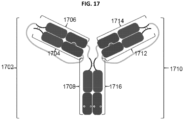
- the disclosure features an Fc construct including: a) a first polypeptide having the formula A-L-B; wherein i) A includes a first Fc domain monomer; ii) L is a glycine spacer; and iii) B includes a second Fc domain monomer; b) a second polypeptide having the formula A'-L'-B'; wherein i) A' includes a third Fc domain monomer; ii) L' is a glycine spacer; and iii) B' includes a fourth Fc domain monomer; c) a third polypeptide that includes a fifth Fc domain monomer; and d) a fourth polypeptide that includes a sixth Fc domain monomer; wherein B and B' combine to form a first Fc domain, A and the fifth Fc domain monomer combine to form a second Fc domain, and A' and the sixth Fc domain monomer combine to form a third Fc domain.
- the invention relates to
- each of B and B' includes the mutations D399K and K409D
- each of A and A' includes the mutations S354C, T366W, and E357K
- each of the fifth and sixth Fc domain monomers includes the mutations Y349C, T366S, L368A, Y407V, and K370D.
- the disclosure features an Fc construct including: a) a first polypeptide having the formula A-L-B; wherein i) A includes a first Fc domain monomer; ii) L is a glycine spacer; and iii) B includes a second Fc domain monomer; b) a second polypeptide having the formula A'-L'-B'; wherein i) A' includes a third Fc domain monomer; ii) L' is a glycine spacer; and iii) B' includes a fourth Fc domain monomer; c) a third polypeptide that includes a fifth Fc domain monomer; and d) a fourth polypeptide that includes a sixth Fc domain monomer; wherein A and A' combine to form a first Fc domain, B and the fifth Fc domain monomer combine to form a second Fc domain, and B' and the sixth Fc domain monomer combine to form a third Fc domain.
- each of A and A' includes the mutations D399K and K409D
- each of B and B' includes the mutations S354C, T366W, and E357K
- each of the fifth and sixth Fc domain monomers includes the mutations Y349C, T366S, L368A, Y407V, and K370D.
- each of Land L' includes at least 4, 8, 12, 14, 16, 18, or 20 glycines. In some instances, each of Land L' includes 4-30, 8-30, or 12-30 glycines. In some instances, each of L and L' comprises, consists of, or consists essentially of GGGGGGGGGGGGGGGGGGGG (SEQ ID NO: 27).
- A consists of an Fc domain monomer.
- B consists of an Fc domain monomer.
- A' consists of an Fc domain monomer.
- B' consists of an Fc domain monomer.
- the third polypeptide consists of an Fc domain monomer.
- the fourth polypeptide consists of an Fc domain monomer.
- one or more of the Fc domain monomers includes an IgG hinge domain, an IgG C H 2 antibody constant domain, and an IgG C H 3 antibody constant domain. In some instances, each of the Fc domain monomers includes an IgG hinge domain, an IgG C H 2 antibody constant domain, and an IgG C H 3 antibody constant domain. In some instances, each of the Fc domain monomers is an IgG1 Fc domain monomer.
- the N-terminal Asp in one or more of the first, second, third, and fourth polypeptides is mutated to Gln. In some instances, the N-terminal Asp in each of the first, second, third and fourth polypeptides is mutated to Gln.
- one or more of the first, second, third, and fourth polypeptides lack a C-terminal lysine. In some instances, each of the first, second, third, and fourth polypeptides lacks a C-terminal lysine.
- the first polypeptide and the second polypeptide have the same amino acid sequence and wherein the third polypeptide and the fourth polypeptide have the same amino acid sequence.
- each of the first and second polypeptides has at least 95% sequence identity (e.g., at least 97%, 99%, or 99.5% sequence identity) to the sequence of DKTHTCPPCPAPELLGGPSVFLFPPKPKDTLMISRTPEVTCVVVDVSHEDPEVKFNWYVDGVEV HNAKTKPREEQYNSTYRVVSVLTVLHQDWLNGKEYKCKVSNKALPAPIEKTISKAKGQPREPQVYTLPPC RDKLTKNQVSLWCLVKGFYPSDIAVEWESNGQPENNYKTTPPVLDSDGSFFLYSKLTVDKSRWQQGNV FSCSVMHEALHNHYTQKSLSLSPGKGGGGGGGGGGGGGGGGGGDKTHTCPPCPAPELLGGPSVF LFPPKPKDTLMISRTPEVTCVVVDVSHEDPEVKFNWYVDGVEVHNAKTKPREEQYNSTYRVVSVLTVLHQDWLNGKEYKCKVSNK
- each of the first and second polypeptides comprises, consists of, or consists essentially of the sequence of DKTHTCPPCPAPELLGGPSVFLFPPKPKDTLMISRTPEVTCVWDVSHEDPEVKFNWYVDGVEVHNAKT KPREEQYNSTYRVVSVLTVLHQDWLNGKEYKCKVSNKALPAPIEKTISKAKGQPREPQVYTLPPCRDKLT KNQVSLWCLVKGFYPSDIAVEWESNGQPENNYKTTPPVLDSDGSFFLYSKLTVDKSRWQQGNVFSCSV MHEALHNHYTQKSLSLSPGKGGGGGGGGGGGGGGGGGGDKTHTCPPCPAPELLGGPSVFLFPPK PKDTLMISRTPEVTCVVVDVSHEDPEVKFNWYVDGVEVHNAKTKPREEQYNSTYRVVSVLTVLHQDWLN GKEYKCKVSNKALPAPIEKTISKAKGQPREPQVYTL
- each of the first and second polypeptides comprises, consists of, or consists essentially of the sequence of DKTHTCPPCPAPELLGGPSVFLFPPKPKDTLMISRTPEVTCVWDVSHEDPEVKFNWYVDGVEVHNAKT KPREEQYNSTYRVVSVLTVLHQDWLNGKEYKCKVSNKALPAPIEKTISKAKGQPREPQVYTLPPCRDKLT KNQVSLWCLVKGFYPSDIAVEWESNGQPENNYKTTPPVLDSDGSFFLYSKLTVDKSRWQQGNVFSCSV MHEALHNHYTQKSLSLSPGKGGGGGGGGGGGGGGGGGGDKTHTCPPCPAPELLGGPSVFLFPPK PKDTLMISRTPEVTCVVVDVSHEDPEVKFNWYVDGVEVHNAKTKPREEQYNSTYRVVSVLTVLHQDWLN GKEYKCKVSNKALPAPIEKTISKAKGQPREPQ
- each of the third and fourth polypeptides has at least 95% sequence identity (e.g., at least 97%, 99%, or 99.5% sequence identity) to the sequence of DKTHTCPPCPAPELLGGPSVFLFPPKPKDTLMISRTPEVTCVWDVSHEDPEVKFNWYVDGVEVHNAKT KPREEQYNSTYRVVSVLTVLHQDWLNGKEYKCKVSNKALPAPIEKTISKAKGQPREPQVCTLPPSRDELT KNQVS LSCAV DG FYPSDIAVE WESNGQPENNYKTTP PVLDS DGS FFLVS KLTV DKS RWQQG NVFSCSV MHEALHNHYTQKSLSLSPG (SEQ ID NO: 48).
- each of the third and fourth polypeptides comprises, consists of, or consists essentially of the sequence of DKTHTCPPCPAPELLGGPSVFLFPPKPKDTLMISRTPEVTCVWDVSHEDPEVKFNWYVDGVEVHNAKT KPREEQYNSTYRVVSVLTVLHQDWLNGKEYKCKVSNKALPAPIEKTISKAKGQPREPQVCTLPPSRDELT KNQVS LSCAV DG FYPSDIAVE WESNGQPENNYKTTP PVLDS DGS FFLVS KLTV DKS RWQQG NVFSCSV MHEALHNHYTQKSLSLSPG (SEQ ID NO: 48).
- each of the third and fourth polypeptides have the amino acid sequence of SEQ ID NO: 48.
- each of the third and fourth polypeptides comprises, consists of, or consists essentially of the sequence of DKTHTCPPCPAPELLGGPSVFLFPPKPKDTLMISRTPEVTCVWDVSHEDPEVKFNWYVDGVEVHNAKT KPREEQYNSTYRVVSVLTVLHQDWLNGKEYKCKVSNKALPAPIEKTISKAKGQPREPQVCTLPPSRDELT KNQVSLSCAVDGFYPSDIAVEWESNGQPENNYKTTPPVLDSDGSFFLVSKLTVDKSRWQQGNVFSCSV MHEALHNHYTQKSLSPG (SEQ ID NO: 48) with up to 10 (9, 8, 7, 6, 5, 4, 3, 2, or 1) single amino acid modifications (e.g., substitutions, e.g., conservative substitutions).
- each of the first and second polypeptides comprises, consists of, or consists essentially of the sequence of each of the third and fourth polypeptides comprises, consists of, or consists essentially of the sequence of
- each of the first and second polypeptides comprises, consists of, or consists essentially of the sequence of DKTHTCPPCPAPELLGGPSVFLFPPKPKDTLMISRTPEVTCVWDVSHEDPEVKFNWYVDGVEVHNAKT KPREEQYNSTYRWSVLTVLHQDWLNGKEYKCKVSNKALPAPIEKTISKAKGQPREPQVYTLPPCRDKLT KNQVSLWCLVKGFYPSDIAVEWESNGQPENNYKTTPPVLDSDGSFFLYSKLTVDKSRWQQGNVFSCSV MHEALHNHYTQKSLSLSPGKGGGGGGGGGGGGGGGGGGGGDKTHTCPPCPAPELLGGPSVFLFPPK PKDTLMISRTPEVTCVVVDVSHEDPEVKFNWYVDGVEVHNAKTKPREEQYNSTYRVVSVLTVLHQDWLN GKEYKCKVSNKALPAPIEKTISKAKGQ
- each of the first and second polypeptides comprises, consists of, or consists essentially of the sequence of QKTHTCPPCPAPELLGGPSVFLFPPKPKDTLMISRTPEVTCVVVDVSHEDPEVKFNWYVDGVEVHNAKT KPREEQYNSTYRWSVLTVLHQDWLNGKEYKCKVSNKALPAPIEKTISKAKGQPREPQVYTLPPCRDKLT KNQVSLWCLVKGFYPSDIAVEWESNGQPENNYKTTPPVLDSDGSFFLYSKLTVDKSRWQQGNVFSCSV MHEALHNHYTQKSLSLSPGKGGGGGGGGGGGGGGGGGGGGDKTHTCPPCPAPELLGGPSVFLFPPK PKDTLMISRTPEVTCVVVDVSHEDPEVKFNWYVDGVEVHNAKTKPREEQYNSTYRVVSVLTVLHQDWLN GKEYKCKVSNKALPAPIEKTISKA
- each of the first and second polypeptides comprises, consists of, or consists essentially of at least 95% sequence identity (e.g., at least 97%, 99%, or 99.5% sequence identity) to the sequence of
- each of the first and second polypeptides comprises, consists of, or consists essentially of the sequence of
- each of the first and second polypeptides comprises, consists of, or consists essentially of the sequence of DKTHTCPPCPAPELLGGPSVFLFPPKPKDTLMISRTPEVTCVWDVSHEDPEVKFNWYVDGVEVHNAKT KPREEQYNSTYRVVSVLTVLHQDWLNGKEYKCKVSNKALPAPIEKTISKAKGQPREPQVYTLPPSRDELT KNQVSLTCLVKGFYPSDIAVEWESNGQPENNYKTTPPVLKSDGSFFLYSDLTVDKSRWQQGNVFSCSV MHEALHNHYTQKSLSLSPGKGGGGGGGGGGGGGGGGGGDKTHTCPPCPAPELLGGPSVFLFPPK PKDTLMISRTPEVTCVVVDVSHEDPEVKFNWYVDGVEVHNAKTKPREEQYNSTYRVVSVLTVLHQDWLN GKEYKCKVSNKALPAPIEKTISKAKGQPREPQV
- each of the third and fourth polypeptides has at least 95% sequence identity (e.g., at least 97%, 99%, or 99.5% sequence identity) to the sequence of DKTHTCPPCPAPELLGGPSVFLFPPKPKDTLMISRTPEVTCVWDVSHEDPEVKFNWYVDGVEVHNAKT KPREEQYNSTYRWSVLTVLHQDWLNGKEYKCKVSNKALPAPIEKTISKAKGQPREPQVCTLPPSRDELT KNQVSLSCAVDGFYPSDIAVEWESNGQPENNYKTTPPVLDSDGSFFLVSKLTVDKSRWQQGNVFSCSV MHEALHNHYTQKSLSLSPG (SEQ ID NO: 48).
- each of the third and fourth polypeptides comprises, consists of, or consists essentially of the sequence of DKTHTCPPCPAPELLGGPSVFLFPPKPKDTLMISRTPEVTCVWDVSHEDPEVKFNWYVDGVEVHNAKT KPREEQYNSTYRWSVLTVLHQDWLNGKEYKCKVSNKALPAPIEKTISKAKGQPREPQVCTLPPSRDELT KNQVS LSCAV DG FYPSDIAVE WESNGQ PENNYKTTP PVLDS DGS FFLVS KLTV DKS RWQQGNVFSCSV MHEALHNHYTQKSLSLSPG (SEQ ID NO: 48).
- each of the third and fourth polypeptides comprises, consists of, or consists essentially of the sequence of DKTHTCPPCPAPELLGGPSVFLFPPKPKDTLMISRTPEVTCVWDVSHEDPEVKFNWYVDGVEVHNAKT KPREEQYNSTYRVVSVLTVLHQDWLNGKEYKCKVSNKALPAPIEKTISKAKGQPREPQVCTLPPSRDELT KNQVSLSCAVDGFYPSDIAVEWESNGQPENNYKTTPPVLDSDGSFFLVSKLTVDKSRWQQG NVFSCSVMHEALHNHYTQKSLSPG (SEQ ID NO: 48) with up to 10 (9, 8, 7, 6, 5, 4, 3, 2, or 1) single amino acid modifications (e.g., substitutions, e.g., conservative substitutions).
- each of the first and second polypeptides comprises, consists of, or consists essentially of the sequence of DKTHTCPPCPAPELLGGPSVFLFPPKPKDTLMISRTPEVTCVWDVSHEDPEVKFNWYVDGVEVHNAKT KPREEQYNSTYRWSVLTVLHQDWLNGKEYKCKVSNKALPAPIEKTISKAKGQPREPQVYTLPPSRDELT KNQVSLTCLVKGFYPSDIAVEWESNGQPENNYKTTPPVLKSDGSFFLYSDLTVDKSRWQQGNVFSCSV MHEALHNHYTQKSLSLSPGKGGGGGGGGGGGGGGGGGGDKTHTCPPCPAPELLGGPSVFLFPPK PKDTLMISRTPEVTCVVVDVSHEDPEVKFNWYVDGVEVHNAKTKPREEQYNSTYRVVSVLTVLHQDWLN GKEYKCKVSNKALPAPIEKTISKAKGQPR
- each of the first and second polypeptides comprises, consists of, or consists essentially of the sequence of QKTHTCPPCPAPELLGGPSVFLFPPKPKDTLMISRTPEVTCVVVDVSHEDPEVKFNWYVDGVEVHNAKT KPREEQYNSTYRWSVLTVLHQDWLNGKEYKCKVSNKALPAPIEKTISKAKGQPREPQVYTLPPSRDELT KNQVSLTCLVKGFYPSDIAVEWESNGQPENNYKTTPPVLKSDGSFFLYSDLTVDKSRWQQGNVFSCSV MHEALHNHYTQKSLSLSPGKGGGGGGGGGGGGGGGGGGDKTHTCPPCPAPELLGGPSVFLFPPK PKDTLMISRTPEVTCVVVDVSHEDPEVKFNWYVDGVEVHNAKTKPREEQYNSTYRVVSVLTVLHQDWLN GKEYKCKVSNKALPAPIEKTISKAKG
- the disclosure features an Fc construct including: a) a first polypeptide having the formula A-L-B; wherein i) A includes a first Fc domain monomer; ii) L is a linker; and iii) B includes a second Fc domain monomer; b) a second polypeptide having the formula A'-L'-B'; wherein i) A' includes a third Fc domain monomer; ii) L' is a linker; and iii) B' includes a fourth Fc domain monomer; c) a third polypeptide that includes a fifth Fc domain monomer; and d) a fourth polypeptide that includes a sixth Fc domain monomer; wherein B and B' combine to form a first Fc domain, A and the fifth Fc domain monomer combine to form a second Fc domain, and A'and the sixth Fc domain monomer combine to form a third Fc domain, and wherein the first polypeptide and the second polypeptide each
- the disclosure features an Fc construct including: a) a first polypeptide having the formula A-L-B; wherein i) A includes a first Fc domain monomer; ii) L is a linker; and iii) B includes a second Fc domain monomer; b) a second polypeptide having the formula A'-L'-B'; wherein i) A' includes a third Fc domain monomer; ii) L' is a linker; and iii) B' includes a fourth Fc domain monomer; c) a third polypeptide that includes a fifth Fc domain monomer; and d) a fourth polypeptide that includes a sixth Fc domain monomer; wherein A and A' combine to form a first Fc domain, B and the fifth Fc domain monomer combine to form a second Fc domain, and B' and the sixth Fc domain monomer combine to form a third Fc domain, and wherein the first polypeptide and the second polypeptide each
- the disclosure features an Fc construct including: a) a first polypeptide having the formula A-L-B; wherein i) A includes a first Fc domain monomer; ii) L is a glycine spacer; and iii) B includes a second Fc domain monomer; b) a second polypeptide including a third Fc domain monomer; and c) a third polypeptide including a fourth Fc domain monomer; wherein the first Fc domain monomer and the third Fc domain monomer combine to form a first Fc domain and the second Fc domain monomer and the fourth Fc domain monomer combine to form a second Fc domain.
- each of the first and third Fc domain monomers includes a complementary dimerization selectivity module that promote dimerization between the first Fc domain monomer and the third Fc domain monomer
- each of the second and fourth Fc domain monomers includes a complementary dimerization selectivity module that promote dimerization between the second Fc domain monomer and the fourth Fc domain monomer.
- the complementary dimerization selectivity module of each of the first and second Fc domain monomers includes an engineered protuberance
- the complementary dimerization selectivity module of each of the third and fourth Fc domain monomers includes an engineered cavity.
- L includes at least 4, 8, or 12 glycines. In some instances, L includes 4-30, 8-30, or 12-30 glycines. In some instances, L comprises, consists of, or consists essentially of the sequence of GGGGGGGGGGGGGGGGGG (SEQ ID NO: 27).
- one or more of A, B, the second polypeptide, and the third polypeptide consists of an Fc domain monomer. In some instances, each of A, B, the second polypeptide, and the third polypeptide consists of an Fc domain monomer.
- the N-terminal Asp in one or more of the first, second, and third polypeptides is mutated to Gln. In some instances, the N-terminal Asp in each of the first, second, and third polypeptides is mutated to Gln.
- one or more of the first, second, and third polypeptides lacks a C-terminal lysine. In some instances, each of the first, second, and third polypeptides lacks a C-terminal lysine
- the second polypeptide and the third polypeptide have the same amino acid sequence.
- the disclosure features an Fc construct including: a) a first polypeptide having the formula A-L1-B-L2-C; wherein i) A includes a first Fc domain monomer; ii) L1 is a glycine spacer; iii) B includes a second Fc domain monomer; iv) L2 is a glycine spacer; and v) C includes a third Fc domain monomer; b) a second polypeptide having the formula A'-L1 '-B'-L2'-C'; wherein i) A' includes a fourth Fc domain monomer; ii) L1' is a glycine spacer; iii) B' includes a fifth Fc domain monomer; iv) L2' is a glycine spacer; and v) C' includes a sixth Fc domain monomer; c) a third polypeptide that includes a seventh Fc domain monomer; d) a fourth
- each of the first and seventh Fc domain monomers includes a complementary dimerization selectivity module that promote dimerization between the first Fc domain monomer and the seventh Fc domain monomer
- each of the second and fifth Fc domain monomers includes a complementary dimerization selectivity module that promote dimerization between the second Fc domain monomer and the fifth Fc domain monomer
- each of the third and eighth Fc domain monomers includes a complementary dimerization selectivity module that promote dimerization between the third Fc domain monomer and the eighth Fc domain monomer
- each of the fourth and ninth Fc domain monomers includes a complementary dimerization selectivity module that promote dimerization between the fourth Fc domain monomer and the ninth Fc domain monomer
- each of the sixth and tenth Fc domain monomers includes a complementary dimerization selectivity module that promote dimerization between the sixth Fc domain monomer and the tenth Fc domain monomer.
- the complementary dimerization selectivity module of the second Fc domain monomer includes a negatively-charged amino acid substitution
- the complementary dimerization selectivity module of the fifth Fc domain monomer includes a positively-charged amino acid substitution
- the complementary dimerization selectivity module of each of the first, third, fourth, and sixth Fc domain monomers includes an engineered protuberance
- complementary dimerization selectivity module of each of the seventh, eighth, ninth, and tenth Fc domain monomers includes an engineered cavity.
- the disclosure features an Fc construct including: a) a first polypeptide having the formula A-L1-B-L2-C; wherein i) A includes a first Fc domain monomer; ii) L1 is a glycine spacer; iii) B includes a second Fc domain monomer; iv) L2 is a glycine spacer; and v) C includes a third Fc domain monomer; b) a second polypeptide having the formula A'-L1'-B'-L2'-C'; wherein i) A' includes a fourth Fc domain monomer; ii) L1' is a glycine spacer; iii) B' includes a fifth Fc domain monomer; iv) L2' is a glycine spacer; and v) C' includes a sixth Fc domain monomer; c) a third polypeptide that includes a seventh Fc domain monomer; d) a fourth polypeptide that
- each of the third and sixth Fc domain monomers includes complementary dimerization selectivity modules that promote dimerization between the third Fc domain monomer and the sixth Fc domain monomer
- each of the second and seventh Fc domain monomers includes complementary dimerization selectivity modules that promote dimerization between the second Fc domain monomer and the seventh Fc domain monomer
- each of the first and eighth Fc domain monomers includes complementary dimerization selectivity modules that promote dimerization between the first Fc domain monomer and the eighth Fc domain monomer
- each of the fifth and ninth Fc domain monomers includes complementary dimerization selectivity modules that promote dimerization between the fifth Fc domain monomer and the ninth Fc domain monomer
- each of the fourth and tenth Fc domain monomers includes complementary dimerization selectivity modules that promote dimerization between the fourth Fc domain monomer and the tenth Fc domain monomer.
- the complementary dimerization selectivity module of the third Fc domain monomer includes a negatively-charged amino acid substitution
- the complementary dimerization selectivity module of the sixth Fc domain monomer includes a positively-charged amino acid substitution
- the complementary dimerization selectivity module of each of the first, second, fourth, and fifth Fc domain monomers includes an engineered protuberance
- complementary dimerization selectivity module of each of the seventh, eighth, ninth, and tenth Fc domain monomers includes an engineered cavity.
- the disclosure features an Fc construct including: a) a first polypeptide having the formula A-L1-B-L2-C; wherein i) A includes a first Fc domain monomer; ii) L1 is a glycine spacer; iii) B includes a second Fc domain monomer; iv) L2 is a glycine spacer; and v) C includes a third Fc domain monomer; b) a second polypeptide having the formula A'-L1 '-B'-L2'-C'; wherein i) A' includes a fourth Fc domain monomer; ii) L1' is a glycine spacer; iii) B' includes a fifth Fc domain monomer; iv) L2' is a glycine spacer; and v) C' includes a sixth Fc domain monomer; c) a third polypeptide that includes a seventh Fc domain monomer; d) a fourth
- each of the first and fourth Fc domain monomers includes complementary dimerization selectivity modules that promote dimerization between the first Fc domain monomer and the fourth Fc domain monomer
- each of the second and seventh Fc domain monomers includes complementary dimerization selectivity modules that promote dimerization between the second Fc domain monomer and the seventh Fc domain monomer
- each of the third and eighth Fc domain monomers includes complementary dimerization selectivity modules that promote dimerization between the third Fc domain monomer and the eighth Fc domain monomer
- each of the fifth and ninth Fc domain monomers includes complementary dimerization selectivity modules that promote dimerization between the fifth Fc domain monomer and the ninth Fc domain monomer
- each of the sixth and tenth Fc domain monomers includes complementary dimerization selectivity modules that promote dimerization between the sixth Fc domain monomer and the tenth Fc domain monomer.
- the complementary dimerization selectivity module of the first Fc domain monomer includes a negatively-charged amino acid substitution
- the complementary dimerization selectivity module of the fourth Fc domain monomer includes a positively-charged amino acid substitution
- the complementary dimerization selectivity module of each of the second, third, fifth, and sixth Fc domain monomers includes an engineered protuberance
- complementary dimerization selectivity module of each of the seventh, eighth, ninth, and tenth Fc domain monomers includes an engineered cavity.
- each of L1, L2, L1', and L2' includes at least 4, 8, or 12 glycines. In some instances, each of L1, L2, L1', and L2' includes 4-30, 8-30, or 12-30 glycines. In some instances, each of L1, L2, L1', and L2' comprises, consists of, or consists essentially of the sequence of GGGGGGGGGGGGGGGGGG (SEQ ID NO: 27).
- each of A, B, C, A', B', C', the third polypeptide, the fourth polypeptide, the fifth polypeptide, and the six polypeptide consists of an Fc domain monomer.
- the N-terminal Asp in one or more of the first, second, third, fourth, fifth, and sixth polypeptides is mutated to Gln. In some instances, the N-terminal Asp in each of the first, second, third, fourth, fifth, and sixth polypeptides is mutated to Gln.
- one or more of the first, second, third, fourth, fifth, and sixth polypeptides lacks a C-terminal lysine. In some instances, each of the first, second, third, fourth, fifth, and sixth polypeptides lacks a C-terminal lysine.
- first polypeptide and the second polypeptide have the same amino acid sequence
- third, fourth, fifth, and sixth polypeptides have the same amino acid sequence
- the disclosure features an Fc construct including: a) a first polypeptide having the formula A-L1-B-L2-C; wherein i) A includes a first Fc domain monomer; ii) L1 is a linker; iii) B includes a second Fc domain monomer; iv) L2 is a glycine spacer; v) C includes a third Fc domain monomer; and b) a second polypeptide having the formula A'-L1 '-B'-L2'-C'; wherein i) A' includes a fourth Fc domain monomer; ii) L1' is a linker; iii) B' includes a fifth Fc domain monomer; iv) L2' is a glycine spacer; v) C' includes a sixth Fc domain monomer; wherein the first Fc domain monomer and the second Fc domain monomer combine to form a first Fc domain, the fourth Fc domain monomer and
- each of the first and second Fc domain monomers includes complementary dimerization selectivity modules that promote dimerization between the first Fc domain monomer and the second Fc domain monomer
- each of the fourth and fifth Fc domain monomers includes complementary dimerization selectivity modules that promote dimerization between the fourth Fc domain monomer and the fifth Fc domain monomer
- each of the third and sixth Fc domain monomers includes complementary dimerization selectivity modules that promote dimerization between the third Fc domain monomer and the sixth Fc domain monomer.
- the complementary dimerization selectivity module of each of the first and fourth Fc domain monomers includes an engineered protuberance
- the complementary dimerization selectivity module of each of the second and fifth Fc domain monomer includes an engineered cavity
- the complementary dimerization selectivity module of the third Fc domain monomer includes a negatively-charged amino acid substitution
- the complementary dimerization selectivity module of the sixth Fc domain monomer includes a positively-charged amino acid substitution
- each of L2 and L2' includes at least 12 glycines. In some instances, each of L2 and L2' includes 4-30, 8-30, or 12-30 glycines. In some instances, each of L2 and L2' comprises, consists of, or consists essentially of the sequence of GGGGGGGGGGGGGGGGGG (SEQ ID NO: 27).
- each of A, B, C, A', B', and C' consists of an Fc domain monomer.
- the first polypeptide and the second polypeptide have the same amino acid sequence.
- the disclosure features an Fc construct including: a) a first polypeptide having the formula A-L-B; wherein i) A includes a first Fc domain monomer; ii) L is a linker; iii) B includes a second Fc domain monomer; b) a second polypeptide having the formula A'-L'-B'; wherein i) A' includes a third Fc domain monomer; ii) L' is a linker; iii) B' includes a fourth Fc domain monomer; wherein the first Fc domain monomer and the third Fc domain monomer combine to form a first Fc domain, and the second Fc domain monomer and the fourth Fc domain monomer combine to form a second Fc domain, and wherein at least one of L and L' is a glycine spacer.
- each of the first and third Fc domain monomers includes complementary dimerization selectivity modules that promote dimerization between the first Fc domain monomer and the third Fc domain monomer
- each of the second and fourth Fc domain monomers includes complementary dimerization selectivity modules that promote dimerization between the second Fc domain monomer and the fourth Fc domain monomer.
- the complementary dimerization selectivity module of each of the first and second Fc domain monomers includes an engineered protuberance
- the complementary dimerization selectivity module of each of the third and fourth Fc domain monomer includes an engineered cavity
- At least one of L and L' includes at least 4, 8, or 12 glycines. In some instances, at least one of Land L' includes 4-30, 8-30, or 12-30 glycines. In some instances, at least one of L and L' comprises, consists of, or consists essentially of the sequence of GGGGGGGGGGGGGGGGGGGG (SEQ ID NO: 27). In some instances of this aspect, each of L and L' includes at least 4, 8, or 12 glycines. In some instances, each of Land L' includes 4-30, 8-30, or 12-30 glycines. In some instances, each of Land L' comprises, consists of, or consists essentially of the sequence of GGGGGGGGGGGGGGGGGG (SEQ ID NO: 27).
- one or more of A, B, A', and B' consists of an Fc domain monomer. In some instances of this aspect, each of A, B, A', and B' consists of an Fc domain monomer.
- the N-terminal Asp in one or more of the first and second polypeptides is mutated to Gln. In some instances, the N-terminal Asp in each of the first and second polypeptides is mutated to Gln.
- one or more of the first and second polypeptides lacks a C-terminal lysine. In some instances, each of the first and second polypeptides lacks a C-terminal lysine.
- each of the Fc domain monomers in an Fc construct described herein includes an IgG hinge domain, an IgG C H 2 antibody constant domain, and an IgG C H 3 antibody constant domain. In some instances, each of the Fc domain monomers in an Fc construct described herein is an IgG1 Fc domain monomer.
- the disclosure features a composition including a substantially homogenous population of an Fc construct including: a) a first polypeptide having the formula A-L-B; wherein i) A includes a first Fc domain monomer; ii) L is a glycine spacer; and iii) B includes a second Fc domain monomer; b) a second polypeptide having the formula A'-L'-B'; wherein i) A' includes a third Fc domain monomer; ii) L' is a glycine spacer; and iii) B' includes a fourth Fc domain monomer; c) a third polypeptide that includes a fifth Fc domain monomer; and d) a fourth polypeptide that includes a sixth Fc domain monomer; wherein B and B' combine to form a first Fc domain, A and the fifth Fc domain monomer combine to form a second Fc domain, and A' and the sixth Fc domain monomer combine to form a
- each of B and B' includes the mutations D399K and K409D
- each of A and A' includes the mutations S354C, T366W, and E357K
- each of the fifth and sixth Fc domain monomers includes the mutations Y349C, T366S, L368A, Y407V, and K370D.
- first polypeptide and the second polypeptide have the same amino acid sequence and wherein the third polypeptide and the fourth polypeptide have the same amino acid sequence in the Fc construct in the composition.
- each of the first and second polypeptides has at least 95% sequence identity (e.g., at least 97%, 99%, or 99.5% sequence identity) to the sequence of DKTHTCPPCPAPELLGGPSVFLFPPKPKDTLMISRTPEVTCVWDVSHEDPEVKFNWYVDGVEVHNAKT KPREEQYNSTYRWSVLTVLHQDWLNGKEYKCKVSNKALPAPIEKTISKAKGQPREPQVYTLPPCRDKLT KNQVSLWCLVKGFYPSDIAVEWESNGQPENNYKTTPPVLDSDGSFFLYSKLTVDKSRWQQGNVFSCSV MHEALHNHYTQKSLSLSPGKGGGGGGGGGGGGGGGGGGGGDKTHTCPPCPAPELLGGPSVFLFPPK PKDTLMISRTPEVTCVVVDVSHEDPEVKFNWYVDGVEVHNAKTKPREEQYNSTYRVVSVLTVLHQDWLN GKEYKCKVS
- each of the first and second polypeptides comprises, consists of, or consists essentially of the sequence of DKTHTCPPCPAPELLGGPSVFLFPPKPKDTLMISRTPEVTCVWDVSHEDPEVKFNWYVDGVEVHNAKT KPREEQYNSTYRVVSVLTVLHQDWLNGKEYKCKVSNKALPAPIEKTISKAKGQPREPQVYTLPPCRDKLT KNQVSLWCLVKGFYPSDIAVEWESNGQPENNYKTTPPVLDSDGSFFLYSKLTVDKSRWQQGNVFSCSV MHEALHNHYTQKSLSLSPGKGGGGGGGGGGGGGGGGGGDKTHTCPPCPAPELLGGPSVFLFPPK PKDTLMISRTPEVTCVVVDVSHEDPEVKFNWYVDGVEVHNAKTKPREEQYNSTYRVVSVLTVLHQDWLN GKEYKCKVSNKALPAPIEKTISKAKGQPREPQVYTL
- each of the first and second polypeptides comprises, consists of, or consists essentially of the sequence of DKTHTCPPCPAPELLGGPSVFLFPPKPKDTLMISRTPEVTCVWDVSHEDPEVKFNWYVDGVEVHNAKT KPREEQYNSTYRVVSVLTVLHQDWLNGKEYKCKVSNKALPAPIEKTISKAKGQPREPQVYTLPPCRDKLT KNQVSLWCLVKGFYPSDIAVEWESNGQPENNYKTTPPVLDSDGSFFLYSKLTVDKSRWQQGNVFSCSV MHEALHNHYTQKSLSLSPGKGGGGGGGGGGGGGGGGGGDKTHTCPPCPAPELLGGPSVFLFPPK PKDTLMISRTPEVTCVVVDVSHEDPEVKFNWYVDGVEVHNAKTKPREEQYNSTYRVVSVLTVLHQDWLN GKEYKCKVSNKALPAPIEKTISKAKGQPREPQVYTL
- each of the third and fourth polypeptides has at least 95% sequence identity (e.g., at least 97%, 99%, or 99.5% sequence identity) to the sequence of DKTHTCPPCPAPELLGGPSVFLFPPKPKDTLMISRTPEVTCVWDVSHEDPEVKFNWYVDGVEVHNAKT KPREEQYNSTYRWSVLTVLHQDWLNGKEYKCKVSNKALPAPIEKTISKAKGQPREPQVCTLPPSRDELT KNQVSLSCAVDGFYPSDIAVEWESNGQPENNYKTTPPVLDSDGSFFLVSKLTVDKSRWQQGNVFSCSV MHEALHNHYTQKSLSLSPG (SEQ ID NO: 48).
- each of the third and fourth polypeptides comprises, consists of, or consists essentially of the sequence of DKTHTCPPCPAPELLGGPSVFLFPPKPKDTLMISRTPEVTCVWDVSHEDPEVKFNWYVDGVEVHNAKT KPREEQYNSTYRVVSVLTVLHQDWLNGKEYKCKVSNKALPAPIEKTISKAKGQPREPQVCTLPPSRDELT KNQVSLSCAVDGFYPSDIAVEWESNGQPENNYKTTPPVLDSDGSFFLVSKLTVDKSRWQQGNVFSCSV MHEALHNHYTQKSLSLSPG (SEQ ID NO: 48).
- each of the third and fourth polypeptides comprises, consists of, or consists essentially of the sequence of DKTHTCPPCPAPELLGGPSVFLFPPKPKDTLMISRTPEVTCVWDVSHEDPEVKFNWYVDGVEVHNAKT KPREEQYNSTYRVVSVLTVLHQDWLNGKEYKCKVSNKALPAPIEKTISKAKGQPREPQVCTLPPSRDELT KNQVS LSCAV DG FYPSDIAVE WESNGQPENNYKTTP PVLDS DGS FFLVS KLTV DKS RWQQG NVFSCSV MHEALHNHYTQKSLSLSPG (SEQ ID NO: 48) with up to 10 (9, 8, 7, 6, 5, 4, 3, 2, or 1) single amino acid modifications (e.g., substitutions, e.g., conservative substitutions).
- each of the first and second polypeptides in the Fc construct in the composition comprises, consists of, or consists essentially of the sequence of DKTHTCPPCPAPELLGGPSVFLFPPKPKDTLMISRTPEVTCVWDVSHEDPEVKFNWYVDGVEVHNAKT KPREEQYNSTYRVVSVLTVLHQDWLNGKEYKCKVSNKALPAPIEKTISKAKGQPREPQVYTLPPCRDKLT KNQVSLWCLVKGFYPSDIAVEWESNGQPENNYKTTPPVLDSDGSFFLYSKLTVDKSRWQQGNVFSCSV MHEALHNHYTQKSLSLSPGKGGGGGGGGGGGGGGGGGGGGDKTHTCPPCPAPELLGGPSVFLFPPK PKDTLMISRTPEVTCVVVDVSHEDPEVKFNWYVDGVEVHNAKTKPREEQYNSTYRVVSVLTVLHQDWLN GKEYKCKVSNKALPAPIE
- the Fc construct comprises, consists of, or consists essentially of the sequence of DKTHTCPPCPAPELLGGPSVFLFPPKPKDTLMISRTPEVTCVWDVSHEDPEVKFNWYVDGVEVHNAKT KPREEQYNSTYRVVSVLTVLHQDWLNGKEYKCKVSNKALPAPIEKTISKAKGQPREPQVYTLPPCRDKLT KNQVSLWCLVKGFYPSDIAVEWESNGQPENNYKTTPPVLDSDGSFFLYSKLTVDKSRWQQGNVFSCSV MHEALHNHYTQKSLSLSPGKGGGGGGGGGGGGGGGGGGGGDKTHTCPPCPAPELLGGPSVFLFPPK PKDTLMISRTPEVTCVVVDVSHEDPEVKFNWYVDGVEVHNAKTKPREEQYNSTYRVVSVLTVLHQDWLN GKEYKCKVSNKALPAPIEKTISKAKGQPREPQVYTLPPSRDELTKN
- one or more of the Fc domain monomers is an IgG Fc domain monomer (e.g., an IgG1, IgG2a, IgG2b. IgG3, or IgG4).
- one or more of the Fc domain monomers is an IgG Fc domain monomer having up to ten amino acid modifications (e.g., up to 1, 2, 3, 4, 5, 6, 7, 8, 9, or 10 amino acid modifications).
- each Fc domain monomer has no more than ten amino acid modifications (e.g., up to 1, 2, 3, 4, 5, 6, 7, 8, 9, or 10 amino acid modifications).
- the disclosure features a composition including a substantially homogenous population of an Fc construct including: a) a first polypeptide having the formula A-L-B; wherein i) A includes a first Fc domain monomer; ii) L is a glycine spacer; and iii) B includes a second Fc domain monomer; b) a second polypeptide having the formula A'-L'-B'; wherein i) A' includes a third Fc domain monomer; ii) L' is a glycine spacer; and iii) B' includes a fourth Fc domain monomer; c) a third polypeptide that includes a fifth Fc domain monomer; and d) a fourth polypeptide that includes a sixth Fc domain monomer; wherein A and A' combine to form a first Fc domain, B and the fifth Fc domain monomer combine to form a second Fc domain, and B' and the sixth Fc domain monomer combine to form a
- each of A and A' includes the mutations D399K and K409D
- each of B and B' includes the mutations S354C, T366W, and E357K
- each of the fifth and sixth Fc domain monomers includes the mutations Y349C, T366S, L368A, Y407V, and K370D.
- the first polypeptide and the second polypeptide have the same amino acid sequence and wherein the third polypeptide and the fourth polypeptide have the same amino acid sequence in the Fc construct in the composition.
- the first polypeptide and the second polypeptide have the same amino acid sequence (e.g., SEQ ID NO:. 49) and wherein the third polypeptide and the fourth polypeptide have the same amino acid sequence (e.g., SEQ ID NO: 48) in the Fc construct in the composition.
- each of the first and second polypeptides has at least 95% sequence identity (e.g., at least 97%, 99%, or 99.5% sequence identity) to the sequence of DKTHTCPPCPAPELLGGPSVFLFPPKPKDTLMISRTPEVTCVWDVSHEDPEVKFNWYVDGVEVHNAKT KPREEQYNSTYRVVSVLTVLHQDWLNGKEYKCKVSNKALPAPIEKTISKAKGQPREPQVYTLPPSRDELT KNQVSLTCLVKGFYPSDIAVEWESNGQPENNYKTTPPVLKSDGSFFLYSDLTVDKSRWQQGNVFSCSV MHEALHNHYTQKSLSLSPGKGGGGGGGGGGGGGGGGGGGGDKTHTCPPCPAPELLGGPSVFLFPPK PKDTLMISRTPEVTCVVVDVSHEDPEVKFNWYVDGVEVHNAKTKPREEQYNSTYRVVSVLTVLHQDWLN GKEY
- each of the third and fourth polypeptides has at least 95% sequence identity (e.g., at least 97%, 99%, or 99.5% sequence identity) to the sequence of DKTHTCPPCPAPELLGGPSVFLFPPKPKDTLMISRTPEVTCVWDVSHEDPEVKFNWYVDGVEVHNAKT KPREEQYNSTYRWSVLTVLHQDWLNGKEYKCKVSNKALPAPIEKTISKAKGQPREPQVCTLPPSRDELT KNQVS LSCAV DG FYPSDIAVE WESNGQPENNYKTTP PVLDS DGS FFLVS KLTV DKS RWQQG NVFSCSV MHEALHNHYTQKSLSLSPG (SEQ ID NO: 48).
- each of the third and fourth polypeptides comprises, consists of, or consists essentially of the sequence of
- each of the first and second polypeptides in the Fc construct in the composition comprises, consists of, or consists essentially of the sequence of DKTHTCPPCPAPELLGGPSVFLFPPKPKDTLMISRTPEVTCVWDVSHEDPEVKFNWYVDGVEVHNAKT KPREEQYNSTYRWSVLTVLHQDWLNGKEYKCKVSNKALPAPIEKTISKAKGQPREPQVYTLPPSRDELT KNQVSLTCLVKGFYPSDIAVEWESNGQPENNYKTTPPVLKSDGSFFLYSDLTVDKSRWQQGNVFSCSV MHEALHNHYTQKSLSLSPGKGGGGGGGGGGGGGGGGGGDKTHTCPPCPAPELLGGPSVFLFPPK PKDTLMISRTPEVTCVVVDVSHEDPEVKFNWYVDGVEVHNAKTKPREEQYNSTYRVVSVLTVLHQDWLN GKEYKCKVSNKALPAPIEKTIS
- the disclosure features a composition including a substantially homogenous population of an Fc construct including: a) a first polypeptide having the formula A-L-B; wherein i) A includes a first Fc domain monomer; ii) L is a linker; and iii) B includes a second Fc domain monomer; b) a second polypeptide having the formula A'-L'-B'; wherein i) A' includes a third Fc domain monomer; ii) L' is a linker; and iii) B' includes a fourth Fc domain monomer; c) a third polypeptide that includes a fifth Fc domain monomer; and d) a fourth polypeptide that includes a sixth Fc domain monomer; wherein B and B' combine to form a first Fc domain, A and the fifth Fc domain monomer combine to form a second Fc domain, and A' and the sixth Fc domain monomer combine to form a third Fc domain, and wherein
- the disclosure features a composition including a substantially homogenous population of an Fc construct including: a) a first polypeptide having the formula A-L-B; wherein i) A includes a first Fc domain monomer; ii) L is a linker; and iii) B includes a second Fc domain monomer; b) a second polypeptide having the formula A'-L'-B'; wherein i) A' includes a third Fc domain monomer; ii) L' is a linker; and iii) B' includes a fourth Fc domain monomer; c) a third polypeptide that includes a fifth Fc domain monomer; and d) a fourth polypeptide that includes a sixth Fc domain monomer; wherein A and A' combine to form a first Fc domain, Band the fifth Fc domain monomer combine to form a second Fc domain, and B'and the sixth Fc domain monomer combine to form a third Fc domain, and wherein the
- the disclosure features a composition including a substantially homogenous population of an Fc construct including: a) a first polypeptide having the formula A-L-B; wherein i) A includes a first Fc domain monomer; ii) L is a glycine spacer; and iii) B includes a second Fc domain monomer; b) a second polypeptide including a third Fc domain monomer; and c) a third polypeptide including a fourth Fc domain monomer; wherein the first Fc domain monomer and the third Fc domain monomer combine to form a first Fc domain and the second Fc domain monomer and the fourth Fc domain monomer combine to form a second Fc domain.
- each of the first and third Fc domain monomers in the Fc construct in the composition includes a complementary dimerization selectivity module that promote dimerization between the first Fc domain monomer and the third Fc domain monomer
- each of the second and fourth Fc domain monomers in the Fc construct in the composition includes a complementary dimerization selectivity module that promote dimerization between the second Fc domain monomer and the fourth Fcdomain monomer.
- the complementary dimerization selectivity module of each of the first and second Fc domain monomers includes an engineered protuberance
- the complementary dimerization selectivity module of each of the third and fourth Fc domain monomers includes an engineered cavity
- the second polypeptide and the third polypeptide have the same amino acid sequence.
- the disclosure features a composition including a substantially homogenous population of an Fc construct including: a) a first polypeptide having the formula A-L1-B-L2-C; wherein i) A includes a first Fc domain monomer; ii) L1 is a glycine spacer; iii) B includes a second Fc domain monomer; iv) L2 is a glycine spacer; and v) C includes a third Fc domain monomer; b) a second polypeptide having the formula A'-L1'-B'-L2'-C'; wherein i) A' includes a fourth Fc domain monomer; ii) L1' is a glycine spacer; iii) B' includes a fifth Fc domain monomer; iv) L2' is a glycine spacer; and v) C' includes a sixth Fc domain monomer; c) a third polypeptide that includes a seventh F
- each of the first and seventh Fc domain monomers in the Fc construct in the composition includes a complementary dimerization selectivity module that promote dimerization between the first Fc domain monomer and the seventh Fc domain monomer; each of the second and fifth Fc domain monomers in the Fc construct in the composition includes a complementary dimerization selectivity module that promote dimerization between the second Fc domain monomer and the fifth Fc domain monomer; each of the third and eighth Fc domain monomers in the Fc construct in the composition includes a complementary dimerization selectivity module that promote dimerization between the third Fc domain monomer and the eighth Fc domain monomer; each of the fourth and ninth Fc domain monomers in the Fc construct in the composition includes a complementary dimerization selectivity module that promote dimerization between the fourth Fc domain monomer and the ninth Fc domain monomer; and each of the sixth and tenth Fc domain monomers in the Fc construct in the composition includes a complementary dimerization selectivity module that promote dimerization between the sixth Fc domain monomer; and each of the
- the complementary dimerization selectivity module of the second Fc domain monomer includes a negatively-charged amino acid substitution
- the complementary dimerization selectivity module of the fifth Fc domain monomer includes a positively-charged amino acid substitution
- the complementary dimerization selectivity module of each of the first, third, fourth, and sixth Fc domain monomers includes an engineered protuberance
- complementary dimerization selectivity module of each of the seventh, eighth, ninth, and tenth Fc domain monomers includes an engineered cavity.
- the disclosure features a composition including a substantially homogenous population of an Fc construct including: a) a first polypeptide having the formula A-L1-B-L2-C; wherein i) A includes a first Fc domain monomer; ii) L1 is a glycine spacer; iii) B includes a second Fc domain monomer; iv) L2 is a glycine spacer; and v) C includes a third Fc domain monomer; b) a second polypeptide having the formula A'-L1 '-B'-L2'-C'; wherein i) A' includes a fourth Fc domain monomer; ii) L1' is a glycine spacer; iii) B' includes a fifth Fc domain monomer; iv) L2' is a glycine spacer; and v) C' includes a sixth Fc domain monomer; c) a third polypeptide that includes a seventh
- each of the third and sixth Fc domain monomers in the Fc construct in the composition includes complementary dimerization selectivity modules that promote dimerization between the third Fc domain monomer and the sixth Fc domain monomer; each of the second and seventh Fc domain monomers in the Fc construct in the composition includes complementary dimerization selectivity modules that promote dimerization between the second Fc domain monomer and the seventh Fc domain monomer; each of the first and eighth Fc domain monomers in the Fc construct in the composition includes complementary dimerization selectivity modules that promote dimerization between the first Fc domain monomer and the eighth Fc domain monomer; each of the fifth and ninth Fc domain monomers in the Fc construct in the composition includes complementary dimerization selectivity modules that promote dimerization between the fifth Fc domain monomer and the ninth Fc domain monomer; and each of the fourth and tenth Fc domain monomers in the Fc construct in the composition includes complementary dimerization selectivity modules that promote dimerization between the fourth Fc domain monomer and the tenth Fc domain monomer;
- the complementary dimerization selectivity module of the third Fc domain monomer includes a negatively-charged amino acid substitution
- the complementary dimerization selectivity module of the sixth Fc domain monomer includes a positively-charged amino acid substitution
- the complementary dimerization selectivity module of each of the first, second, fourth, and fifth Fc domain monomers includes an engineered protuberance
- complementary dimerization selectivity module of each of the seventh, eighth, ninth, and tenth Fc domain monomers includes an engineered cavity.
- the disclosure features a composition including a substantially homogenous population of an Fc construct including: a) a first polypeptide having the formula A-L1-B-L2-C; wherein i) A includes a first Fcdomain monomer; ii) L1 is a glycine spacer; iii) B includes a second Fcdomain monomer; iv) L2 is a glycine spacer; and v) C includes a third Fc domain monomer; b) a second polypeptide having the formula A'-L1'-B'-L2'-C'; wherein i) A' includes a fourth Fc domain monomer; ii) L1' is a glycine spacer; iii) B' includes a fifth Fc domain monomer; iv) L2' is a glycine spacer; and v) C' includes a sixth Fc domain monomer; c) a third polypeptide that includes a seventh F
- each of the first and fourth Fc domain monomers in the Fc construct in the composition includes complementary dimerization selectivity modules that promote dimerization between the first Fc domain monomer and the fourth Fc domain monomer; each of the second and seventh Fc domain monomers in the Fc construct in the composition includes complementary dimerization selectivity modules that promote dimerization between the second Fc domain monomer and the seventh Fc domain monomer; each of the third and eighth Fc domain monomers in the Fc construct in the composition includes complementary dimerization selectivity modules that promote dimerization between the third Fc domain monomer and the eighth Fc domain monomer; each of the fifth and ninth Fc domain monomers in the Fc construct in the composition includes complementary dimerization selectivity modules that promote dimerization between the fifth Fc domain monomer and the ninth Fc domain monomer; and each of the sixth and tenth Fc domain monomers in the Fc construct in the composition includes complementary dimerization selectivity modules that promote dimerization between the sixth Fc domain monomer and the tenth Fc domain monomer;
- the complementary dimerization selectivity module of the first Fc domain monomer includes a negatively-charged amino acid substitution
- the complementary dimerization selectivity module of the fourth Fc domain monomer includes a positively-charged amino acid substitution
- the complementary dimerization selectivity module of each of the second, third, fifth, and sixth Fc domain monomers includes an engineered protuberance
- complementary dimerization selectivity module of each of the seventh, eighth, ninth, and tenth Fc domain monomers includes an engineered cavity.
- the first polypeptide and the second polypeptide have the same amino acid sequence
- the third, fourth, fifth, and sixth polypeptides have the same amino acid sequence
- the disclosure features a composition including a substantially homogenous population of an Fc construct including: a) a first polypeptide having the formula A-L1-B-L2-C; wherein i) A includes a first Fc domain monomer; ii) L1 is a linker; iii) B includes a second Fc domain monomer; iv) L2 is a g lycine spacer; v) C includes a third Fc domain monomer; and b) a second polypeptide having the formula A'-L1 '-B'-L2'-C'; wherein i) A' includes a fourth Fc domain monomer; ii) L1' is a linker; iii) B' includes a fifth Fc domain monomer; iv) L2' is a glycine spacer; v) C' includes a sixth Fc domain monomer; wherein the first Fc domain monomer and the second Fc domain monomer combine to form a
- each of the first and second Fc domain monomers in the Fc construct in the composition includes complementary dimerization selectivity modules that promote dimerization between the first Fc domain monomer and the second Fc domain monomer; each of the fourth and fifth Fc domain monomers in the Fc construct in the composition includes complementary dimerization selectivity modules that promote dimerization between the fourth Fc domain monomer and the fifth Fc domain monomer; and each of the third and sixth Fc domain monomers in the Fc construct in the composition includes complementary dimerization selectivity modules that promote dimerization between the third Fc domain monomer and the sixth Fc domain monomer.
- the complementary dimerization selectivity module of each of the first and fourth Fc domain monomers includes an engineered protuberance
- the complementary dimerization selectivity module of each of the second and fifth Fc domain monomer includes an engineered cavity
- the complementary dimerization selectivity module of the third Fc domain monomer includes a negatively-charged amino acid substitution
- the complementary dimerization selectivity module of the sixth Fc domain monomer includes a positively-charged amino acid substitution
- the first polypeptide and the second polypeptide have the same amino acid sequence.
- the disclosure features a composition including a substantially homogenous population of an Fc construct including: a) a first polypeptide having the formula A-L-B; wherein i) A includes a first Fc domain monomer; ii) L is a linker; iii) B includes a second Fc domain monomer; b) a second polypeptide having the formula A'-L'-B'; wherein i) A' includes a third Fc domain monomer; ii) L' is a linker; iii) B' includes a fourth Fc domain monomer; wherein the first Fc domain monomer and the third Fc domain monomer combine to form a first Fc domain, and the second Fc domain monomer and the fourth Fc domain monomer combine to form a second Fc domain, and wherein at least one of L and L' is a glycine spacer.
- each of the first and third Fc domain monomers in the Fc construct in the composition includes complementary dimerization selectivity modules that promote dimerization between the first Fc domain monomer and the third Fc domain monomer
- each of the second and fourth Fc domain monomers in the Fc construct in the composition includes complementary dimerization selectivity modules that promote dimerization between the second Fc domain monomer and the fourth Fcdomain monomer.
- the complementary dimerization selectivity module of each of the first and second Fc domain monomers in the Fc construct in the composition includes an engineered protuberance
- the complementary dimerization selectivity module of each of the third and fourth Fc domain monomer in the Fc construct in the composition includes an engineered cavity
- At least one of L and L' in the Fc construct in the composition includes at least 4, 8, or 12 glycines. In some instances, at least one of Land L' includes 4-30, 8-30, or 12-30 glycines. In some instances, at least one of L and L' comprises, consists of, or consists essentially of the sequence of GGGGGGGGGGGGGGGGGGGG (SEQ ID NO: 27). In some instances of this aspect, each of L and L' in the Fc construct in the composition includes at least 4, 8, or 12 glycines. In some instances, each of Land L' includes 4-30, 8-30, or 12-30 glycines. In some instances, each of L and L' comprises, consists of, or consists essentially of the sequence of GGGGGGGGGGGGGGGG (SEQ ID NO: 27).
- one or more of A, B, A', and B' in the Fc construct in the composition consists of an Fc domain monomer. In some instances of this aspect, each of A, B, A', and B' consists of an Fcdomain monomer.
- one or more of L, L', L1, L2, L1', and L2' in the Fc construct in the composition includes at least 4, 8, or 12 glycines. In some instances, each of L, L', L1, L2, L1', and L2' includes at least 4, 8, or 12 glycines.
- one or more of L, L', L1, L2, L1', and L2' in the Fc construct in the composition includes 4-30, 8-30, or 12-30 glycines.
- each of L, L', L1, L2, L1', and L2' includes 4-30, 8-30, or 12-30 glycines.
- one or more of L, L', L1, L2, L1', and L2' in the Fc construct in the composition comprises, consists of, or consists essentially of the sequence of GGGGGGGGGGGGGGGGGGGGGG (SEQ ID NO: 27).
- each of L, L', L1, L2, L1', and L2' comprises, consists of, or consists essentially of the sequence of GGGGGGGGGGGGGGGGGGGG (SEQ ID NO: 27).
- compositions including a substantially homogenous population of an Fc construct described herein one or more of A, B, C, A', B', C', the second polypeptide, the third polypeptide, the fourth polypeptide, the fifth polypeptide, and the six polypeptide in the Fc construct in the composition consists of an Fc domain monomer.
- each of A, B, C, A', B', C', the second polypeptide, the third polypeptide, the fourth polypeptide, the fifth polypeptide, and the six polypeptide consists of an Fc domain monomer.
- one or more of the Fc domain monomers in the reconstruct in the composition includes an IgG hinge domain, an IgG C H 2 antibody constant domain, and an IgG C H 3 antibody constant domain.
- each of the Fc domain monomers includes an IgG hinge domain, an IgG C H 2 antibody constant domain, and an IgG C H 3 antibody constant domain.
- one or more of the Fc domain monomers in the reconstruct in the composition is an IgG1 Fc domain monomer.
- each of the Fc domain monomers is an IgG1 Fc domain monomer.
- the N-terminal Asp in one or more of the polypeptides in the Fc construct in the composition is mutated to Gln. In some instances of a composition including a substantially homogenous population of an Fc construct described herein, the N-terminal Asp in each of the polypeptides in the Fc construct in the composition is mutated to Gln.
- compositions including a substantially homogenous population of an Fc construct described herein one or more of the polypeptides in the Fc construct in the composition lacks a C-terminal lysine. In some instances of a composition including a substantially homogenous population of an Fc construct described herein, each of the polypeptides in the Fc construct in the composition lacks a C-terminal lysine.
- the disclosure features a composition including a substantially homogenous population of an Fc construct including: a) a first polypeptide having the formula A-L-B; wherein i) A includes a first Fc domain monomer; ii) L is a linker; and iii) B includes a second Fc domain monomer; b) a second polypeptide having the formula A'-L'-B'; wherein i) A' includes a third Fc domain monomer; ii) L' is a linker; and iii) B' includes a fourth Fc domain monomer; c) a third polypeptide that includes a fifth Fc domain monomer; and d) a fourth polypeptide that includes a sixth Fc domain monomer; wherein B and B' combine to form a first Fc domain, A and the fifth Fc domain monomer combine to form a second Fc domain, and A'and the sixth Fc domain monomer combine to form a third Fc domain, and wherein
- the disclosure features a host cell that expresses two polynucleotides both lacking the codon of C-terminal lysine, wherein the first polynucleotide encodes each of the first and second polypeptides of the previous aspect of the disclosure and the second polynucleotide encodes each of the third and fourth polypeptides of the previous aspect of the disclosure.
- the disclosure features a composition including a substantially homogenous population of an Fc construct including: a) a first polypeptide having the formula A-L-B; wherein i) A includes a first Fc domain monomer; ii) L is a linker; and iii) B includes a second Fc domain monomer; b) a second polypeptide including a third Fc domain monomer; and c) a third polypeptide including a fourth Fc domain monomer; wherein the first Fc domain monomer and the third Fc domain monomer combine to form a first Fc domain and the second Fc domain monomer and the fourth Fc domain monomer combine to form a second Fc domain, and wherein each of the first, second, and third polypeptides lacks a C-terminal lysine.
- the disclosure features a host cell that expresses two polynucleotides both lacking the codon of C-terminal lysine, wherein the first polynucleotide encodes the first polypeptide of the previous aspect of the disclosure and the second polynucleotide encodes each of the second and third polypeptides of the previous aspect of the disclosure.
- the disclosure features a composition including a substantially homogenous population of an Fc construct including: a) a first polypeptide having the formula A-L1-B-L2-C; wherein i) A includes a first Fc domain monomer; ii) L1 is a linker; iii) B includes a second Fc domain monomer; iv) L2 is a linker; and v) C includes a third Fc domain monomer; b) a second polypeptide having the formula A'-L1 '-B'-L2'-C'; wherein i) A' includes a fourth Fc domain monomer; ii) L1' is a linker; iii) B' includes a fifth Fc domain monomer; iv) L2' is a linker; and v) C' includes a sixth Fc domain monomer; c) a third polypeptide that includes a seventh Fc domain monomer; d) a fourth polypeptide that
- the disclosure features a composition including a substantially homogenous population of an Fc construct including: a) a first polypeptide having the formula A-L1-B-L2-C; wherein i) A includes a first Fc domain monomer; ii) L1 is a linker; iii) B includes a second Fc domain monomer; iv) L2 is a linker; and v) C includes a third Fc domain monomer; b) a second polypeptide having the formula A'-L1'-B'-L2'-C'; wherein i) A' includes a fourth Fc domain monomer; ii) L1' is a linker; iii) B' includes a fifth Fc domain monomer; iv) L2' is a linker; and v) C' includes a sixth Fc domain monomer; c) a third polypeptide that includes a seventh Fc domain monomer; d) a fourth polypeptide that includes
- the disclosure features a composition including a substantially homogenous population of an Fc construct including: a) a first polypeptide having the formula A-L1-B-L2-C; wherein i) A includes a first Fc domain monomer; ii) L1 is a linker; iii) B includes a second Fc domain monomer; iv) L2 is a linker; and v) C includes a third Fc domain monomer; b) a second polypeptide having the formula A'-L1'-B'-L2'-C'; wherein i) A' includes a fourth Fc domain monomer; ii) L1' is a linker; iii) B' includes a fifth Fc domain monomer; iv) L2' is a linker; and v) C' includes a sixth Fc domain monomer; c) a third polypeptide that includes a seventh Fc domain monomer; d) a fourth polypeptide that includes
- the disclosure features a host cell that expresses two polynucleotides both lacking the codon of C-terminal lysine, wherein the first polynucleotide encodes each of the first and second polypeptides of any one of the previous three aspects of the disclosure and the second polynucleotide encodes each of the third, fourth, fifth, and sixth polypeptides of any one of the previous three aspects of the disclosure.
- the disclosure features a composition including a substantially homogenous population of an Fc construct including: a) a first polypeptide having the formula A-L1-B-L2-C; wherein i) A includes a first Fc domain monomer; ii) L1 is a linker; iii) B includes a second Fc domain monomer; iv) L2 is a linker; v) C includes a third Fc domain monomer; and b) a second polypeptide having the formula A'-L1'-B'-L2'-C'; wherein i) A' includes a fourth Fc domain monomer; ii) L1' is a linker; iii) B' includes a fifth Fc domain monomer; iv) L2' is a linker; v) C' includes a sixth Fc domain monomer; wherein the first Fc domain monomer and the second Fc domain monomer combine to form a first Fc domain, the fourth Fc domain
- the disclosure features a composition including a substantially homogenous population of an Fc construct including: a) a first polypeptide having the formula A-L-B; wherein i) A includes a first Fc domain monomer; ii) L is a linker; iii) B includes a second Fc domain monomer; b) a second polypeptide having the formula A'-L'-B'; wherein i) A' includes a third Fc domain monomer; ii) L' is a linker; iii) B' includes a fourth Fc domain monomer; wherein the first Fc domain monomer and the third Fc domain monomer combine to form a first Fc domain, and the second Fc domain monomer and the fourth Fc domain monomer combine to form a second Fc domain, and wherein each of the first and second polypeptides lacks a C-terminal lysine.
- the disclosure features a host cell that expresses a polynucleotide lacking the codon of C-terminal lysine, wherein the polynucleotide encodes each of the first and second polypeptides of any of the previous two aspects of the disclosure.
- the disclosure features a method of preparing an Fc construct described herein.
- the method includes: a) providing a host cell including polynucleotides encoding the polypeptides of the disclosure; b) expressing the polypeptides in the host cell under conditions that allow for the formation of the reconstruct; and c) recovering the reconstruct.
- the disclosure features a host cell that expresses an Fc construct described herein.
- the host cell includes polynucleotides encoding the polypeptides of the disclosure, wherein the polynucleotides are expressed in the host cell.
- the disclosure features a pharmaceutical composition including a substantially homogenous population of an Fc construct described herein (e.g., an Fc construct having three Fc domains) or a composition including a substantially homogenous population of an Fc construct described herein (e.g., a composition including a substantially homogenous population of an Fc construct having three Fc domains) and one or more pharmaceutically acceptable carriers or excipients.
- a pharmaceutical composition including a substantially homogenous population of an Fc construct described herein (e.g., an Fc construct having three Fc domains) or a composition including a substantially homogenous population of an Fc construct described herein (e.g., a composition including a substantially homogenous population of an Fc construct having three Fc domains) and one or more pharmaceutically acceptable carriers or excipients.
- Such pharmaceutical compositions can be produced without substantial aggregation or unwanted multimerization of reconstructs.
- the disclosure relates to reducing immune cell activation of the immune response in a subject, including ad ministering to the subject an Fc construct described herein (e.g., an Fc construct having three Fc domains) or a composition including a substantially homogenous population of an Fc construct described herein (e.g., a composition including a substantially homogenous population of an Fc construct having three Fc domains).
- the present invention provides an Fc construct of the invention for use in a method of reducing immune cell activation of the immune response in a subject, the method comprising administering said Fc construct to the subject.
- the subject has an autoimmune disease.
- the disclosure relates to treating inflammation or an inf lammatory disease in a subject, including administering to the subject an reconstruct described herein (e.g., an Fc construct having three Fc domains) or a composition including a substantially homogenous population of an Fc construct described herein (e.g., a composition including a substantially homogenous population of an Fc construct having three Fc domains).
- an reconstruct described herein e.g., an Fc construct having three Fc domains
- a composition including a substantially homogenous population of an Fc construct described herein e.g., a composition including a substantially homogenous population of an Fc construct having three Fc domains.
- the disclosure relates to promoting clearance of autoantibodies and/or suppressing antigen presentation in a subject, including administering to the subject an Fc construct described herein (e.g., an Fc construct having three Fc domains) or a composition including a substantially homogenous population of an Fc construct described herein (e.g., a composition including a substantially homogenous population of an Fc construct having three Fc domains).
- an Fc construct described herein e.g., an Fc construct having three Fc domains
- a composition including a substantially homogenous population of an Fc construct described herein e.g., a composition including a substantially homogenous population of an Fc construct having three Fc domains
- exemplary diseases that may be treated by administering an Fc construct described herein include: rheumatoid arthritis (RA); systemic lupus erythematosus (SLE); ANCA-associated vasculitis; antiphospholipid antibody syndrome; autoimmune hemolytic anemia; chronic inflammatory demyelinating neuropathy; clearance of anti-allo in transplant, anti-self in GVHD, anti-replacement, IgG therapeutics, IgG paraproteins; dermatomyositis; Goodpasture's Syndrome; organ system-targeted type II hypersensitivity syndromes mediated through antibody-dependent cell-mediated cytotoxicity, e.g., Guillain Barre syndrome, CIDP, dermatomyositis, Felty's syndrome, antibody-mediated rejection, autoimmune thyroid disease, ulcerative colitis, autoimmune liver disease; idiopathic thrombocytopenia purpura; Myasth
- the disclosure features a cell culture medium including a substantially homogenous population of an Fc construct including: a) a first polypeptide having the formula A-L-B; wherein i) A includes a first Fc domain monomer; ii) L is a glycine spacer; and iii) B includes a second Fc domain monomer; b) a second polypeptide having the formula A'-L'-B'; wherein i) A' includes a third Fc domain monomer; ii) L' is a glycine spacer; and iii) B' includes a fourth Fc domain monomer; c) a third polypeptide that includes a fifth Fc domain monomer; and d) a fourth polypeptide that includes a sixth Fc domain monomer; wherein each of the first and second polypeptides has at least 95% sequence identity to the sequence of DKTHTCPPCPAPELLGGPSVFLFPPKPKDTLMISRTPEVTCVWDVSHEDP
- the present invention provides a cell culture medium comprising a substantially homogenous population of an Fc construct comprising: a) a first polypeptide having the formula A-L-B; wherein i) A comprises a first Fc domain monomer; ii) L is a glycine spacer; and iii) B comprises a second Fc domain monomer; b) a second polypeptide having the formula A'-L'-B'; wherein i) A' comprises a third Fc domain monomer; ii) L' is a glycine spacer; and iii) B' comprises a fourth Fc domain monomer; c) a third polypeptide that comprises a fifth Fc domain monomer; and d) a fourth polypeptide that comprises a sixth Fc domain monomer; wherein each of the first and second polypeptides have the amino acid sequence: DKTHTCPPCPAPELLGGPSVFLFPPKPKDTLMISRTPEVTCVWDVSHEDPEVKFNWY
- the disclosure features a method of preparing a cell culture medium including a substantially homogenous population of an Fc construct described herein (e.g., the Fc construct of the first aspect of the disclosure).
- the invention also provides a method of preparing a cell culture medium comprising a substantially homogeneous population f the Fc construct of the invention.
- the method of the disclosure or invention includes: a) providing host cells in a cell culture medium, wherein the cells include polynucleotides encoding each of the first, second, third, and fourth polypeptides of an Fc construct (e.g., the Fc construct of the first aspect of the disclosure or the Fc construct of the invention); b) expressing the polypeptides in the host cells under conditions that allow for the formation of the Fc construct and secretion into the cell culture medium; and c) collecting the cell culture medium.
- an Fc construct e.g., the Fc construct of the first aspect of the disclosure or the Fc construct of the invention
- the disclosure also features other cell culture medium including a substantially homogenous population of other Fc constructs of the disclosure and methods of preparing such cell culture medium.
- the Fc constructs described herein do not include an antigen-recognition region, e.g., a variable domain or a complementarity determining region (CDR).
- the Fc construct (or an Fc domain within an Fc construct) is formed entirely or in part by association of Fc domain monomers that are present in different polypeptides.
- the Fc constructs described herein include an antigen-recognition region, e.g., a variable domain or a CDR.
- the Fc construct does not include an additional domain (e.g., an IgM tailpiece or an IgA tailpiece) that promotes association of two polypeptides.
- covalent linkages are present in the Fc construct only between two Fc domain monomers that join to form an Fc domain.
- the Fc construct does not include covalent linkages between Fc domains.
- the Fc construct provides for sufficient structural flexibility such that all or substantially all of the Fc domains in the Fc construct are capable of simultaneously interacting with an Fc receptor on a cell surface.
- the domain monomers are different in primary sequence from wild-type or from each other in that they have dimerization selectivity modules.
- the Fc domain monomers of an Fc domain of the construct can have the same primary amino acid sequence.
- both Fc domain monomers of an Fc domain may have the same dimerization selectivity module, e.g., both Fc domain monomers of an Fc domain may have identical reverse charge mutations in at least two positions within the ring of charged residues at the interface between C H 3 domains.
- the Fc domain monomers of an Fc domain of a construct can have different sequences, e.g., sequences that differ by no more than 20 amino acids (e.g., no more than 15, 10 amino acids), e.g., no more than 20, 15, 10, 8, 7, 6, 5, 4, 3 or 2 amino acids, between two Fc domain monomers (i.e., between the Fc domain monomer and another monomer of the Fc construct).
- sequences that differ by no more than 20 amino acids (e.g., no more than 15, 10 amino acids), e.g., no more than 20, 15, 10, 8, 7, 6, 5, 4, 3 or 2 amino acids, between two Fc domain monomers (i.e., between the Fc domain monomer and another monomer of the Fc construct).
- Fc domain monomer sequences of a construct described herein may be different because complementary dimerization selectivity modules of any of the Fc constructs can include an engineered cavity in the C H 3 antibody constant domain of one of the domain monomers and an engineered protuberance in the C H 3 antibody constant domain of the other of the Fc domain monomers, wherein the engineered cavity and the engineered protuberance are positioned to form a protuberance-into-cavity pair of Fc domain monomers.
- Exemplary engineered cavities and protuberances are shown in Table 1.
- the complementary dimerization selectivity modules include an engineered (substituted) negatively-charged amino acid in the C H 3 antibody constant domain of one of the domain monomers and an engineered (substituted) positively-charged amino acid in the C H 3 antibody constant domain of the other of the Fc domain monomers, wherein the negatively-charged amino acid and the positively-charged amino acid are positioned to promote formation of an Fc domain between complementary domain monomers.
- Exemplary complementary amino acid changes are shown in Tables 2A-2C.
- the disclosure also features a pharmaceutical composition that includes a substantially homogenous population of any Fc construct described herein.
- a sterile syringe or vial qualified for pharmaceutical use contains a pharmaceutical composition wherein the only or primary active ingredient is a substantially homogenous population of any one of the Fc constructs described herein.
- the pharmaceutical composition may include one or more inactive ingredients, e.g., selected from salts, detergents, surfactants, bulking agents, polymers, preservatives, and other pharmaceutical excipients.
- this disclosure provides for a pharmaceutical composition that includes any of the Fc constructs described herein. Accordingly, the invention provides a pharmaceutical composition comprising the Fc construct as defined in the appended claims.
- the Fc construct is formed at least in part by association of Fc domain monomers that are present in different polypeptides. In certain embodiments, the Fc construct is formed by association of Fc domain monomers that are present in different polypeptides. In these embodiments, the Fc construct does not include an additional domain that promotes association of two polypeptides (e.g., an IgM tailpiece or an IgA tailpiece). In other embodiments, covalent linkages (e.g., disulfide bridges) are present only between two Fc domain monomers that join to form an Fc domain. In other embodiments, the Fc construct does not include covalent linkages (e.g., disulfide bridges) between Fc domains.
- covalent linkages e.g., disulfide bridges
- the Fc construct provides for sufficient structural flexibility such that all or substantially all of the Fc domains in the Fc construct are capable of simultaneously interacting with an Fc receptor on a cell surface.
- the Fc construct includes at least two Fc domains joined through a linker (e.g., a flexible amino acid spacer).
- the disclosure features compositions and methods for promoting selective dimerization of Fc domain monomers.
- the disclosure includes an Fcdomain wherein the two Fcdomain monomers of the Fc domain include identical mutations in at least two positions within the ring of charged residues at the interface between C H 3 antibody constant domains.
- the disclosure also includes a method of making such an Fc domain, including introducing complementary dimerization selectivity modules having identical mutations in two Fc domain monomer sequences in at least two positions within the ring of charged residues at the interface between C H 3 antibody constant domains.
- the interface between C H 3 antibody constant domains consists of a hydrophobic patch surrounded by a ring of charged residues.
- Such Fc domains include Fc domain monomers containing the double mutants K409D/D399K, K392D/D399K, E357K/K370E, D356K/K439D, K409E/D399K, K392E/D399K, E357K/K370D, or D356K/K439E.
- an Fc domain includes Fc domain monomers including quadruple mutants combining any pair of the double mutants, e.g., K409D/D399K/E357K/K370E.
- the Fc domain monomers of the Fc domain include complementary dimerization selectivity modules having non-identical mutations that promote specific association (e.g., engineered cavity and protuberance).
- the two Fc domain monomers include two dimerization selectivity modules and remain complementary to each other, but have a decreased complementarity to other Fc domain monomers. This instance promotes heterodimerization between a cavity-containing Fc domain and a protuberance-containing Fc domain monomer.
- the complementary dimerization selectivity modules having non-identical mutations in charged pair residues of both Fc domain monomers are combined with a protuberance on one Fc domain monomer and a cavity on the other Fc domain monomer.
- the order of the Fc domain monomers is interchangeable.
- the carboxy terminus of A can be joined to the amino terminus of L, which in turn is joined at its carboxy terminus to the amino terminus of B.
- the carboxy terminus of B can be joined to the amino terminus of L, which in turn is joined at its carboxy terminus to the amino terminus of C. Both of these configurations are encompassed by the formula A-L-B.
- Fc domain monomer refers to a polypeptide chain that includes at least a hinge domain and second and third antibody constant domains (C H 2 and C H 3) or f unctional frag ments thereof (e.g., fragments that that capable of (i) dimerizing with another Fc domain monomer to form an Fc domain, and (ii) binding to an Fc receptor).
- the Fc domain monomer can be any immunoglobulin antibody isotype, including IgG, IgE, IgM, IgA, or IgD (e.g., IgG).
- the Fc domain monomer can be an IgG subtype (e.g., IgG1, IgG2a, IgG2b, IgG3, or IgG4) (e.g., IgG1).
- An Fc domain monomer does not include any portion of an immunoglobulin that is capable of acting as an antigen-recognition region, e.g., a variable domain or a complementarity determining region (CDR).
- Fc domain monomers can contain as many as ten changes from a wild-type Fc domain monomer sequence (e.g., 1-10, 1-8, 1-6, 1-4 amino acid substitutions, additions, or deletions) that alter the interaction between an Fc domain and an Fc receptor. Examples of suitable changes are known in the art.
- Fc domain refers to a dimer of two Fc domain monomers that is capable of binding an Fc receptor.
- the two Fc domain monomers dimerize by the interaction between the two C H 3 antibody constant domains, as well as one or more disulfide bonds that form between the hinge domains of the two dimerizing Fc domain monomers.
- Fc construct refers to associated polypeptide chains forming Fc domains as described herein (e.g., an Fc construct having three Fc domains).
- Fc constructs described herein can include Fc domain monomers that have the same or different sequences.
- an Fc construct can have three Fc domains, two of which includes IgG1 or lgG1-derived Fc domain monomers, and a third which includes IgG2 or IgG2-derived Fc domain monomers.
- an Fc construct can have three Fc domains, two of which comprises a "protuberance-into-cavity pair" and a third which does not comprise a "protuberance-into-cavity pair.”
- an Fc domain does not include a variable region of an antibody, e.g., V H , V L , CDR, or HVR.
- An Fc domain forms the minimum structure that binds to an Fc receptor, e.g., FcyRI, Fc ⁇ Rlla, FcyRllb, Fc ⁇ Rllla, Fc ⁇ Rlllb, Fc ⁇ RIV.
- the Fc constructs described herein do not include an antigen-recognition region, e.g., a variable domain or a complementarity determining region (CDR). In some embodiments, the Fc constructs described herein include an antigen-recognition region, e.g., a variable domain or a CDR.
- an antigen-recognition region e.g., a variable domain or a CDR.
- antibody constant domain refers to a polypeptide that corresponds to a constant reg ion domain of an antibody (e.g., a C L antibody constant domain, a C H 1 antibody constant domain, a C H 2 antibody constant domain, or a C H 3 antibody constant domain).
- the term "promote” means to encourage and to favor, e.g., to favor the formation of an Fc domain from two Fc domain monomers which have higher binding affinity for each other than for other, distinct Fc domain monomers.
- two Fc domain monomers that combine to form an Fc domain can have compatible amino acid modifications (e.g., engineered protuberances and engineered cavities) at the interface of their respective C H 3 antibody constant domains.
- the compatible amino acid modifications promote or favor the selective interaction of such Fc domain monomers with each other relative to with other Fc domain monomers which lack such amino acid modifications or with incompatible amino acid modifications. This occurs because, due to the amino acid modifications at the interface of the two interacting C H 3 antibody constant domains, the Fc domain monomers to have a higher affinity toward each other than to other Fc domain monomers lacking amino acid modifications.
- a dimerization selectivity module refers to a sequence of the Fc domain monomer that facilitates the favored pairing between two Fc domain monomers.
- “Complementary” dimerization selectivity modules are dimerization selectivity modules that promote or favor the selective interaction of two Fc domain monomers with each other. Complementary dimerization selectivity modules can have the same or different sequences. Exemplary complementary dimerization selectivity modules are described herein.
- engineered cavity refers to the substitution of at least one of the original amino acid residues in the C H 3 antibody constant domain with a different amino acid residue having a smaller side chain volume than the original amino acid residue, thus creating a three dimensional cavity in the C H 3 antibody constant domain.
- original amino acid residue refers to a naturally occurring amino acid residue encoded by the genetic code of a wild-type C H 3 antibody constant domain.
- engineered protuberance refers to the substitution of at least one of the original amino acid residues in the C H 3 antibody constant domain with a different amino acid residue having a larger side chain volume than the original amino acid residue, thus creating a three dimensional protuberance in the C H 3 antibody constant domain.
- original amino acid residues refers to naturally occurring amino acid residues encoded by the genetic code of a wild-type C H 3 antibody constant domain.
- protuberance-into-cavity pair describes an Fc domain including two Fc domain monomers, wherein the first Fc domain monomer includes an engineered cavity in its C H 3 antibody constant domain, while the second Fc domain monomer includes an engineered protuberance in its C H 3 antibody constant domain.
- the engineered protuberance in the C H 3 antibody constant domain of the first Fc domain monomer is positioned such that it interacts with the eng ineered cavity of the C H 3 antibody constant domain of the second Fc domain monomer without significantly perturbing the normal association of the dimer at the inter-C H 3 antibody constant domain interface.
- heterodimer Fc domain refers to an Fc domain that is formed by the heterod imerization of two Fc domain monomers, wherein the two Fc domain monomers contain different reverse charge mutations (see, e.g., mutations in Table 2A) that promote the favorable formation of these two Fc domain monomers. As shown in FIGS.
- each of the amino terminal "branch” Fc domains may be a heterodimeric Fc domain (also called a "branch heterodimeric Fc domain”) (e.g., a heterodimeric Fc domain formed by Fc domain monomers 106 and 114 or Fc domain monomers 112 and 116 in FIG. 1 ; a heterodimeric Fc domain formed by Fc domain monomers 206 and 214 or Fc domain monomers 212 and 216 in FIG. 2 ).
- a heterodimeric Fc domain also called a "branch heterodimeric Fc domain”
- homodimeric Fc domain refers to an Fc domain that is formed by the homodimerization of two Fc domain monomers, wherein the two Fc domain monomers contain the same reverse charge mutations (see, e.g., mutations in Tables 2B and 2C). As shown in FIGS.
- the carboxy terminal "stem” Fc domain may be a homodimeric Fc domain (also called a "stem homodimeric Fc domain”) (e.g., a homodimeric Fc domain formed by Fc domain monomers 104 and 110 in FIG. 1 ; a homodimeric Fc domain formed by Fc domain monomers 204 and 210 in FIG. 2 ).
- heterodimerizing selectivity module refers to engineered protuberances, engineered cavities, and certain reverse charge amino acid substitutions that can be made in the C H 3 antibody constant domains of Fc domain monomers in order to promote favorable heterod imerization of two Fc domain monomers that have compatible heterodimerizing selectivity mod ules.
- Fc domain monomers containing heterodimerizing selectivity modules may combine to form a heterod imeric Fc domain. Examples of heterodimerizing selectivity modules are shown in Table 1 and 2A.
- homodimerizing selectivity module refers to reverse charge mutations in an Fc domain monomer in at least two positions within the ring of charged residues at the interface between C H 3 domains that promote homodimerization of the Fc domain monomer to form a homodimeric Fc domain. Examples of homodimerizing selectivity modules are shown in Tables 2A and 2B.
- the term "joined" is used to describe the combination or attachment of two or more elements, components, or protein domains, e.g., polypeptides, by means including chemical conjugation, recombinant means, and chemical bonds, e.g., disulfide bonds and amide bonds.
- two single polypeptides can be joined to form one contiguous protein structure through chemical conjugation, a chemical bond, a peptide linker, or any other means of covalent linkage.
- a first Fc domain monomer is joined to a second Fc domain monomer by way of a peptide linker, wherein the N-terminus of the peptide linker is joined to the C-terminus of the first Fc domain monomer through a chemical bond, e.g., a peptide bond, and the C-terminus of the peptide linker is joined to the N-terminus of the second Fc domain monomer through a chemical bond, e.g., a peptide bond.
- the N-terminus of an albumin-binding peptide is joined to the C-terminus of the C H 3 antibody constant domain of an Fc domain monomer by way of a linker in the same fashion as mentioned above.
- the term "associated” is used to describe the interaction, e.g., hydrogen bonding, hydrophobic interaction, or ionic interaction, between polypeptides (or sequences within one single polypeptide) such that the polypeptides (or sequences within one single polypeptide) are positioned to form an Fc construct described herein (e.g., an Fc construct having three Fc domains).
- an Fc construct described herein e.g., an Fc construct having three Fc domains.
- four polypeptides e.g., two polypeptides each including two Fc domain monomers and two polypeptides each including one Fc domain monomer, associate to form an Fc construct that has three Fc domains (e.g., as depicted in FIGS. 1 and 2 ).
- the four polypeptides can associate through their respective Fc domain monomers.
- the association between polypeptides does not include covalent interactions.
- linker refers to a linkage between two elements, e.g., protein domains.
- a linker can be a covalent bond or a spacer.
- bond refers to a chemical bond, e.g., an amide bond or a disulfide bond, or any kind of bond created from a chemical reaction, e.g., chemical conjugation.
- spacer refers to a moiety (e.g., a polyethylene glycol (PEG) polymer) or an amino acid sequence (e.g., a 3-200 amino acid, 3-150 amino acid, 3-100 amino acid, 3-60 amino acid, 3-50 amino acid, 3-40 amino acid, 3-30 amino acid, 3-20 amino acid, 3-10 amino acid, 3-8 amino acid, 3-5 amino acid, 4-30 amino acid, 5-30 amino acid, 6-30 amino acid, 8-30 amino acid, 10-20 amino acid, 10-30 amino acid, 12-30 amino acid, 14-30 amino acid, 20-30 amino acid, 15-25 amino acid, 15-30 amino acid, 18- 22 amino acid, and 20-30 amino acid sequence) occurring between two polypeptides or polypeptide domains to provide space and/or flexibility between the two polypeptides or polypeptide domains.
- PEG polyethylene glycol
- An amino acid spacer is part of the primary sequence of a polypeptide (e.g., joined to the spaced polypeptides or polypeptide domains via the polypeptide backbone).
- the formation of disulfide bonds, e.g., between two hinge regions or two Fc domain monomers that form an Fc domain, is not considered a linker.
- glycine spacer refers to a linker containing only glycines that joins two Fc domain monomers in tandem series.
- a glycine spacer may contain at least 4, 8, 10, 12, 14, 16, 18, or 20 glycines (e.g., 4-30, 8-30, 12-30, 12-50, 12-100, or 12-200 glycines; e.g., 12-30, 4, 5, 6, 7, 8, 9, 10, 11, 12, 13, 14, 15, 16, 17, 18, 19, 20, 21, 22, 23, 24, 25, 26, 27, 28, 29, or30glycines).
- a glycine spacer comprises, consists of, or consists essentially of the sequence of GGGGGGGGGGGGGGGGGGGG (SEQ ID NO: 27).
- albumin-binding peptide refers to an amino acid sequence of 12 to 16 amino acids that has affinity for and functions to bind serum albumin.
- An albumin-binding peptide can be of different origins, e.g., human, mouse, or rat.
- an albumin-binding peptide is fused to the C-terminus of an Fc domain monomer to increase the serum half-life of the Fc construct.
- An albumin-binding peptide can be fused, either directly or through a linker, to the N- or C-terminus of an Fc domain monomer.
- purification peptide refers to a peptide of any length that can be used for purification, isolation, or identification of a polypeptide.
- a purification peptide may be joined to a polypeptide to aid in purifying the polypeptide and/or isolating the polypeptide from, e.g., a cell lysate mixture.
- the purification peptide binds to another moiety that has a specific affinity for the purification peptide.
- such moieties which specifically bind to the purification peptide are attached to a solid support, such as a matrix, a resin, or agarose beads. Examples of purification peptides that may be joined to an Fc construct are described in further detail herein.
- multimer refers to a molecule including at least two associated Fc constructs described herein.
- antigen-recognition region refers to the portions of the light and heavy chains of an antibody that are responsible for the recognition and binding of an antibody to an antigen.
- the antigen-recognition region includes the variable domains of the light and heavy chains (Fab), which include the complementary determining regions (CDRs, e.g., CDR L1, CDR L2, CDR L3, CDR H1, CDR H2, and CDR H3) and framework regions (FRs).
- CDRs complementary determining regions
- FRs framework regions
- immune cell activation of the immune response refers to an immune response that is induced or activated by the binding of an immune complex or an Fc construct to an Fc ⁇ receptor (Fc ⁇ R) (e.g., an activating FcyR, e.g., Fc ⁇ RI, Fc ⁇ RIIa, Fc ⁇ RIIc, Fc ⁇ RIIIa, or Fc ⁇ RIIIb) on a cell (e.g., an immune cell (e.g., a monocyte)).
- Fc ⁇ R Fc ⁇ receptor
- An immune complex is an antigen-antibody complex formed from the binding of an antibody to an antigen.
- Fc constructs of the disclosure are able to bind to FcyRs and induce activating FcyR (e.g., Fc ⁇ RI, Fc ⁇ RIIa, Fc ⁇ RIIc, Fc ⁇ RIIIa, or Fc ⁇ RIIIb) signaling on immune cells (e.g., a monocyte).
- FcyR e.g., Fc ⁇ RI, Fc ⁇ RIIa, Fc ⁇ RIIc, Fc ⁇ RIIIa, or Fc ⁇ RIIIb
- Measurement of certain downstream signaling events such as kinase phosphorylation (e.g., Syk phosphorylation) and calcium influx in the Fc ⁇ R-expressing cell may be used to detect immune cell activation of an immune response caused by the binding of an immune complex or an Fc construct.
- kinase phosphorylation e.g., Syk phosphorylation
- calcium influx in the Fc ⁇ R-expressing cell may be used to detect immune cell activation of an immune response caused by the binding of an immune complex or an Fc construct.
- immune cell activation of the immune response is induced if the level of kinase phosphorylation (e.g., Syk phosphorylation) or the level of calcium influx of the cell is at least 5 fold, e.g., 5-100 fold (e.g., 5-100, 10-95, 15-90, 20-85, 25-80, 30-75, 35-70, 40-65, 45-60, or 50-55 fold; e.g., 5-, 6-, 7-, 8-, 9-, 10-, 11-, 12-, 13-, 14-, 15-, 16-, 17-, 18-, 19-, 20-, 21-, 22-, 23-, 24-, 25-, 26-, 27-, 28-, 29-, 30-, 31-, 32-, 33-, 34-, 35-, 36-, 37-, 38-, 39-, 40-, 41-, 42-, 43-, 44-, 45-, 46-, 47-, 48-, 49-, 50-, 51-, 52-, 53
- phagocytosis refers a form of endocytosis, in which a cell, often a phagocyte (e.g., a monocyte), engulfs another cell, a particle, or a pathogen (e.g., a microbe or a parasite) to form a phagosome.
- phagocytosis is a major mechanism used to remove diseased cells (e.g., a cancer cell, an infected cell, or a dead cell), pathogens, and cell debris.
- a cell that is targeted to be phagocytosed by another cell e.g., a phagocyte (e.g., a monocyte)
- a target cell e.g., a phagocyte (e.g., a monocyte)
- an immune cell e.g., a monocyte
- activated by the binding of an Fc construct of the disclosure to the FcyRs e.g., FcyRI, Fc ⁇ RIIa, Fc ⁇ RIIc, Fc ⁇ RIIIa, or Fc ⁇ RIIIb
- a target cell which may be a cancer cell or an infected cell in a subject.
- telomere As used herein, “increase” or “increasing" phagocytosis of a target cell refers to the increase in phagocytosis induced by the binding of an Fc construct of the disclosure to FcyRs (e.g., FcyRI, Fc ⁇ Rlla, Fc ⁇ Rllc, Fc ⁇ Rllla, or Fc ⁇ Rlllb) on an immune cell (e.g., a monocyte) relative the level of phagocytosis that occur without Fc construct induction.
- FcyRs e.g., FcyRI, Fc ⁇ Rlla, Fc ⁇ Rllc, Fc ⁇ Rllla, or Fc ⁇ Rlllb
- an immune cell e.g., a monocyte
- phagocytosis of a target cell is increased if the level of phagocytosis is at least 10%, e.g., 10-100% (e.g., 10-100%, 15-95%, 20-90%, 25-85%, 30-80%, 35-75%, 40-70%, 45-65%, or50-60%; e.g., 10%, 11%, 12%, 13%, 14%, 15%, 16%, 17%, 18%, 19%, 20%, 21%, 22%, 23%, 24%, 25%, 26%, 27%, 28%, 29%, 30%, 31%, 32%, 33%, 34%, 35%, 36%, 37%, 38%, 39%, 40%, 41%, 42%, 43%, 44%, 45%, 46%, 47%, 48%, 49%, 50%, 51%, 52%, 53%, 54%, 55%, 56%, 57%, 58%, 59%, 60%, 61%, 62%, 63%, 64%, 65%, 66%, 67%,
- treating cancer refers to a therapeutic treatment of cancer in a subject.
- a therapeutic treatment slows the progression of cancer, improves the subject's outcome, and/or eliminates the cancer.
- treating an infection refers to a therapeutic treatment of an infection in a subject.
- a therapeutic treatment slows the progression of the infection, improves the subject's outcome, and/or eliminates the infection.
- the term "infection” refers to the invasion of a subject's cells, tissues, and/or organs by a pathogen, such as bacteria, viruses, fungi, helminths, protozoans, arthropods, and other microbes, parasites, and worms.
- the pathogen may grow, multiply, and/or produce toxins in the subject's cells, tissues, and/or organs.
- the subject may develop a negative reaction (i.e., an allergic reaction or an immune response) to the pathogen.
- infections include, but are not limited to, a bacterial infection, a viral infection, a fungal infection, a helmintic infection, and a protozoal infection.
- bacterial infection refers to an infection caused by one or more bacteria.
- infections-causing bacteria include, but are not limited to, bacteria in the genus Streptococcus (e.g., Streptococcus pyogenes), bacteria in the genus Escherichia (e.g., Escherichia coli), bacteria in the genus Vibrio (e.g., Vibrio cholerae), bacteria in the genus Enteritis (e.g., Enteritis salmonella), and bacteria in the genus Salmonella (e.g., Salmonella typhi).
- Streptococcus e.g., Streptococcus pyogenes
- Escherichia e.g., Escherichia coli
- Vibrio e.g., Vibrio cholerae
- bacteria in the genus Enteritis e.g., Enteritis salmonella
- Salmonella e.g., Salmonella typhi
- viral infection refers to an infection caused by one or more viruses.
- retroviridae e.g., human immunodeficiency virus (HIV)
- viruses in the family Adenoviridae e.g., adenovirus
- viruses in the family Herpesviridae e.g., herpes simplex virus types 1 and 2
- viruses in the family Papillomaviridae e.g., human papillomavirus (HPV)
- viruses in the family Poxviridae e.g., smallpox
- viruses in the family Picornaviridae e.g., hepatitis A virus, poliovirus, rhinovirus
- viruses in the family Hepadnaviridae e.g., hepatitis B virus
- viruses in the family Flaviviridae virus e.g., hepatitus
- fungal infection refers to an infection caused one or more fungi.
- infections-causing fungi are well-known in the art and include, but are not limited to, fungi in the genus Aspergillus (e.g., Aspergillus fumigatus, A. flavus, A. terreus. A. niger, A. candidus, A. clavatus, A. ochraceus), fungi in the genus Candida (e.g., Candida albicans, C. parapsilosis, C. glabrata, C. guilliermondii, C. krusei, C. lusitaniae, C.
- Candida albicans e.g., Candida albicans, C. parapsilosis, C. glabrata, C. guilliermondii, C. krusei, C. lusitaniae, C.
- Cryptococcus e.g., Cryptococcus neoformans
- Fusarium e.g., Fusarium solani, F. verticillioides, F. oxysporum
- helmintic infection refers to an infection caused by one or more helminths.
- helminths include, but are not limited to, tapeworms (cestodes), roundworms (nematodes), flukes (trematodes), and monogeneans.
- protozoans refers to an infection caused by one or more protozoans.
- protozoans include, but are not limited to, protozoans in the genus Entamoeba (e.g., Entamoeba histolytica), protozoans in the genus Plasmodium(e.g., Plasmodium falciparum, P. malariae), protozoans in the genus Giardia (e.g., Giardia lamblia), and protozoans in the genus Trypanosoma (e.g., Trypanosoma brucei ).
- protozoans include, but are not limited to, protozoans in the genus Entamoeba (e.g., Entamoeba histolytica), protozoans in the genus Plasmodium(e.g., Plasmodium falciparum, P. malariae), protozoans in the genus Giardia (e.g
- polynucleotide refers to an oligonucleotide, or nucleotide, and fragments or portions thereof, and to DNA or RNA of genomic or synthetic origin, which may be single- or double-stranded, and represent the sense or anti-sense strand. A single polynucleotide is translated into a single polypeptide.
- polypeptide describes a single polymer in which the monomers are amino acid residues which are joined together through amide bonds.
- a polypeptide is intended to encompass any amino acid sequence, either naturally occurring, recombinant, or synthetically produced.
- amino acid positions refers to the position numbers of amino acids in a protein or protein domain.
- the amino acid positions for antibody or Fc constructs are numbered using the Kabat numbering system ( Kabat et al., Sequences of Proteins of Immunological Interest, National Institutes of Health, Bethesda, Md., ed 5, 1991 ).
- amino acid modification or refers to an alteration of an Fc domain polypeptide sequence that, compared with a reference sequence (e.g., a wild-type, unmutated, or unmodified Fc sequence) may have an effect on the pharmacokinetics (PK) and/or pharmacodynamics (PD) properties, serum half-life, effector functions (e.g., cell lysis (e.g., antibody-dependent cell-mediated toxicity(ADCC) and/or complement dependent cytotoxicity activity (CDC)), phagocytosis (e.g., antibody dependent cellular phagocytosis (ADCP) and/or complement-dependent cellular cytotoxicity (CDCC)), immune activation, and T-cell activation), affinity for Fc receptors (e.g., Fc-gamma receptors (FcyR) (e.g., Fc ⁇ Rl (CD64), FcyRlla (CD32), Fc ⁇ RIIb (CD32), Fc ⁇
- Fc ⁇ R Fc ⁇ R
- amino acid modification includes amino acid substitutions, deletions, and/or insertions.
- an amino acid modification is the modification of a single amino acid.
- the amino acid modification is the modification of multiple (e.g., more than one) amino acids.
- the amino acid modification may comprise a combination of amino acid substitutions, deletions, and/or insertions. Included in the description of amino acid modifications, are genetic (i.e., DNA and RNA) alterations such as point mutations (e.g., the exchange of a single nucleotide for another), insertions and deletions (e.g., the addition and/or removal of one or more nucleotides) of the nucleotide sequence that codes for an Fc polypeptide.
- genetic i.e., DNA and RNA
- point mutations e.g., the exchange of a single nucleotide for another
- insertions and deletions e.g., the addition and/or removal of one or more nucleotides
- At least one (e.g., one, two, or three) Fc domain within an Fc construct includes an amino acid modification.
- the at least one Fc domain includes one or more (e.g., two, three, four, five, six, seven, eight, nine, ten, or twenty or more) amino acid modifications.
- the at least one Fc domain includes no more than sixteen amino acid modifications (e.g., no more than one, two, three, four, five, six, seven, eight, nine, ten, eleven, twelve, thirteen, fourteen, fifteen, or sixteen amino acid modifications).
- the Fc domain monomer includes no more than ten amino acid modifications.
- the Fc domain monomer includes no more than 12 amino acid modifications.
- the Fc domain monomer includes no more than 14 amino acid modifications.
- percent (%) identity refers to the percentage of amino acid (or nucleic acid) residues of a candidate sequence, e.g., the sequence of an Fc domain monomer in an Fc construct described herein, that are identical to the amino acid (or nucleic acid) residues of a reference sequence, e.g., the sequence of a wild-type Fc domain monomer, after aligning the sequences and introducing gaps, if necessary, to achieve the maximum percent identity (i.e., gaps can be introduced in one or both of the candidate and reference sequences for optimal alignment and non-homologous sequences can be disregarded for comparison purposes).
- Alignment for purposes of determining percent identity can be achieved in various ways that are within the skill in the art, for instance, using publicly available computer software such as BLAST, ALIGN, or Megalign (DNASTAR) software. Those skilled in the art can determine appropriate parameters for measuring alignment, including any algorithms needed to achieve maximal alignment over the full length of the sequences being compared.
- the percent amino acid (or nucleic acid) sequence identity of a given candidate sequence to, with, or against a given reference sequence is calculated as follows: 100 ⁇ fraction of A / B where A is the number of amino acid (or nucleic acid) residues scored as identical in the alignment of the candidate sequence and the reference sequence, and where B is the total number of amino acid (or nucleic acid) residues in the reference sequence.
- the percent amino acid (or nucleic acid) sequence identity of the candidate sequence to the reference sequence would not equal to the percent amino acid (or nucleic acid) sequence identity of the reference sequence to the candidate sequence.
- a reference sequence aligned for comparison with a candidate sequence may show that the candidate sequence exhibits from 50% to 100% identity (e.g., 50% to 100%, 60% to 100%, 70% to 100%, 80% to 100%, 90% to 100%, 92% to 100%, 95% to 100%, 97% to 100%, 99% to 100%, or 99.5% to 100% identity), across the full length of the candidate sequence or a selected portion of contiguous amino acid (or nucleic acid) residues of the candidate sequence.
- the length of the candidate sequence aligned for comparison purpose is at least 30%, e.g., at least 40%, e.g., at least 50%, 60%, 70%, 80%, 90%, or 100% of the length of the reference sequence.
- an Fc domain monomer in an Fc construct described herein may have a sequence that is at least 95% identical (e.g., at least 97%, 99%, or 99.5% identical) to the sequence of a wild-type Fc domain monomer (e.g., SEQ ID NO: 42).
- an Fc domain monomer in an Fc construct described herein may have a sequence that is at least 95% identical (e.g., at least 97%, 99%, or 99.5% identical) to the sequence of any one of SEQ ID NOs: 44, 46, 48, and 50-53.
- an Fc domain monomer in the Fc construct may have a sequence that is at least 95% identical (e.g., at least 97%, 99%, or 99.5% identical) to the sequence of SEQ ID NO: 48, 52, and 53.
- the Fc domain monomer in an Fc construct described herein may have a sequence with up to 10 (e.g., 9, 8, 7, 6, 5, 4, 3, 2, or 1) single amino acid modifications (e.g., substitutions, e.g., conservative substitutions).
- the at least one Fc domain includes no more than sixteen amino acid modifications (e.g., no more than one, two, three, four, five, six, seven, eight, nine, ten, eleven, twelve, thirteen, fourteen, fifteen, or sixteen amino acid modifications).
- a polypeptide having two Fc domain monomers in an Fc construct described herein may have a sequence that is at least 95% identical (e.g., at least 97%, 99%, or 99.5% identical) to the sequence of any one of SEQ ID NOs: 43, 45, 47, and 49.
- a polypeptide having two Fc domain monomers in an Fc construct described herein may have a sequence that is at least 95% identical (e.g., at least 97%, 99%, or 99.5% identical) to the sequence of SEQ ID NO: 49.
- a spacer between two Fc domain monomers may have a sequence that is at least 75% identical (e.g., 75%, 77%, 79%, 81%, 83%, 85%, 87%, 89%, 91%, 93%, 95%, 97%, 99%, 99.5%, or 100% identical) to the sequence of any one of SEQ ID NOs: 1-36 (e.g., SEQ ID NOs: 17, 18, 26, and 27) described further herein.
- the term "host cell” refers to a vehicle that includes the necessary cellular components, e.g., organelles, needed to express proteins from their corresponding nucleic acids.
- the nucleic acids are typically included in nucleic acid vectors that can be introduced into the host cell by conventional techniques known in the art (transformation, transfection, electroporation, calcium phosphate precipitation, direct microinjection, etc.).
- a host cell may be a prokaryotic cell, e.g., a bacterial cell, or a eukaryotic cell, e.g., a mammalian cell (e.g., a CHO cell).
- a host cell is used to express one or more polypeptides encoding desired domains which can then combine to form a desired reconstruct.
- the term "pharmaceutical composition” refers to a medicinal or pharmaceutical formulation that contains an active ingredient as well as one or more excipients and diluents to enable the active ingredient to be suitable for the method of administration.
- the pharmaceutical composition of the present disclosure includes pharmaceutically acceptable components that are compatible with the Fc construct.
- the pharmaceutical composition is typically in aqueous form for intravenous or subcutaneous administration.
- a "substantially homogenous population" of polypeptides or of an Fc construct is one in which at least 50% of the polypeptides or Fc constructs in a composition (e.g., a cell culture medium or a pharmaceutical composition) have the same number of Fc domains, as determined by non-reducing SDS gel electrophoresis or size exclusion chromatography.
- a substantially homogenous population e.g., a population that is at least 85%, 90%, or 95% homogenous
- polypeptides or of an Fc construct may be obtained prior to purification, or after Protein A or Protein G purification, or after any Fab or Fc-specific affinity chromatography only.
- At least 55%, 60%, 65%, 70%, 75%, 80%, or 85% of the polypeptides or Fc constructs in the composition have the same number of Fc domains. In other embodiments, up to 85%, 90%, 92%, or 95% of the polypeptides or Fc constructs in the composition have the same number of Fc domains.
- the term "pharmaceutically acceptable carrier” refers to an excipient or diluent in a pharmaceutical composition.
- the pharmaceutically acceptable carrier must be compatible with the other ingredients of the formulation and not deleterious to the recipient.
- the pharmaceutically acceptable carrier must provide adequate pharmaceutical stability to the Fc construct.
- the nature of the carrier differs with the mode of administration. For example, for oral administration, a solid carrier is preferred; for intravenous administration, an aqueous solution carrier (e.g., WFI, and/or a buffered solution) is generally used.
- terapéuticaally effective amount refers to an amount, e.g., pharmaceutical dose, effective in inducing a desired biological effect in a subject or patient or in treating a patient having a condition or disorder described herein. It is also to be understood herein that a “therapeutically effective amount” may be interpreted as an amount giving a desired therapeutic effect, either taken in one dose or in any dosage or route, taken alone or in combination with other therapeutic agents.
- Therapeutic proteins that include Fc domains of IgG can be used to treat inflammation and immunological and inflammatory diseases, cancers, and infections.
- the present disclosure features compositions and methods for preparing Fc constructs containing Fc domains (e.g., Fc constructs having 2-10 Fc domains, e.g., Fc constructs having 2, 3, 4, 5, 6, 7, 8, 9, or 10 Fc domains).
- Fc constructs described herein facilitate the preparation of homogenous pharmaceutical compositions by incorporating structural features (for example, glycine spacers) that significantly improve manufacturing outcome.
- compositions that include a substantially homogenous population of an Fc construct described herein (e.g., an Fc construct having three Fc domains).
- Homogeneity is an important aspect of a pharmaceutical composition as it influences the pharmacokinetics and in vivo performance of the composition.
- the pharmaceutical product may undergo random product cleavage, proteolysis, degradation, and/or aggregation, off-target association of subunits, and/or inefficient protein folding.
- Different organisms having different biosynthetic processes or cellular machineries that are used to produce the pharmaceutical product may also cause heterogeneity in the product.
- the initial culture containing the desired pharmaceutical product needs to undergo a rigorous purification process to produce a less heterogenous composition containing the pharmaceutical product.
- the disclosure features, in one aspect, Fc constructs having structural features that significantly improve the folding efficiency of the Fc constructs and minimize off-target association of the subunits, thus, leading to pharmaceutical compositions containing these Fc constructs with high homogeneity.
- Having a high degree of homogeneity ensures the safety, efficacy, uniformity, and reliability of the pharmaceutical composition.
- Having a high degree of homogeneity also minimizes potential aggregation or degradation of the pharmaceutical product caused by unwanted materials (e.g., degradation products and/or aggregated products or multimers, as well as limiting off-target and adverse side effects caused by the unwanted materials.
- the disclosure features substantially homogenous containing Fc constructs that all have the same number of Fc domains, as well as methods of preparing such substantially homogenous compositions.
- the Fc constructs described herein include glycine spacers between Fc domains.
- linkers containing both serines and glycines provide structural flexibility in a protein and are commonly used for joining two polypeptides.
- O-glycosylation e.g., O-xylosylation
- homogeneity is the result of Fc construct components.
- linkers containing only glycines to join Fc domain monomers may be utilized.
- all-glycine spacers e.g., at least 12 glycines, e.g., 12-30 glycines; SEQ ID NO: 27
- all-glycine spacers e.g., at least 12 glycines, e.g., 12-30 glycines; SEQ ID NO: 27
- in an Fc construct do not undergo O-glycosylation and are less susceptible to proteolysis as compared to traditional linkers that include serines and glycines (see Example 4).
- homogeneity of a composition containing an Fc construct described herein is improved by removal of C-terminal lysines.
- C-terminal lysine residue are highly conserved in immunoglobulins across many species and may be fully or partially removed by the cellular machinery during protein production. Removal of the C-terminal lysines in the Fc constructs of the disclosure improves uniformity of the resulting composition and achieves a more homogenous Fc construct preparation (see Example 8).
- Fc constructs described herein e.g., an Fc construct having three Fc domains
- the codon of the C-terminal lysine is removed, thus, generating Fc constructs having polypeptides without C-terminal lysine residues and a resultant homogenous population.
- an Fc domain monomer containing (i) at leastone reverse charge mutation and (ii) at least one engineered cavity or at least one engineered protuberance may be produced and will selectively combine with another Fc domain monomer containing (i) at least one reverse charge mutation and (ii) at least one engineered protuberance or at least one engineered cavity to form an Fc domain.
- an Fc domain monomer containing reversed charge mutation K370D and engineered cavities Y349C, T366S, L368A, and Y407V and another Fc domain monomer containing reversed charge mutation E357K and engineered protuberances S354C and T366W may be produced and will selectively combine to form an Fc domain.
- a substantially homogenous composition containing an Fc construct of the disclosure may be achieved by using all-glycine spacers between two Fc domain monomers in the Fc construct (approach (a)), by using polypeptides that lack C-terminal lysines in the Fc construct (approach (b)), and/or by using two sets of heterodimerizing selectivity modules ((i) heterodimerizing selectivity modules having different reverse charge mutations and (ii) heterodimerizing selectivity modules having engineered cavities and protuberances) to promote heterod imeric Fc domain formation by some Fc domain monomers in the Fc construct (approach (c)).
- a substantially homogenous composition containing an Fc construct described herein may be achieved through approach (a).
- a substantially homogenous composition containing an Fc construct described herein may be achieved through approach (b).
- a substantially homogenous composition containing an Fc construct described herein may be achieved through approach (c).
- a substantially homogenous composition containing an Fc construct described herein may be achieved through a combination of approaches (a) and (b).
- a substantially homogenous composition containing an Fc construct described herein may be achieved through a combination of approaches (a) and (c).
- a substantially homogenous composition containing an Fc construct described herein may be achieved through a combination of approaches (b) and (c).
- a substantially homogenous composition containing an Fc construct described herein may be achieved through a combination of approaches (a), (b), and (c).
- the N-terminal Asp in one or more of the polypeptides in the Fc construct in the composition is mutated to Gln.
- the N-terminal Asp in each of the polypeptides in the Fc construct in the composition is mutated to Gln.
- the length of the linkers that join Fc domain monomers influences the folding efficiency of the Fc constructs.
- a linker having at least 4, 8, or 12 glycines e.g., 4-30, 8-30, 12-30 glycines; SEQ ID NOs: 26 and 27
- SEQ ID NOs: 26 and 27 may be used to join Fc domain monomers in Fc constructs of the disclosure.
- An Fc domain monomer includes a hinge domain, a C H 2 antibody constant domain, and a C H 3 antibody constant domain.
- the Fc domain monomer can be of immunoglobulin antibody isotype IgG, IgE, IgM, IgA, orIgD.
- the Fc domain monomer may also be of any immunoglobulin antibody isotype (e.g., IgG1, IgG2a, IgG2b, IgG3, orIgG4).
- the Fc domain monomers may also be hybrids, e.g., with the hinge and C H 2 from IgG1 and the C H 3 from IgA, or with the hinge and C H 2 from lgG1 but the C H 3 from IgG3.
- a dimer of Fc domain monomers is an Fc domain (further defined herein) that can bind to an Fc receptor, e.g., Fc ⁇ Rllla, which is a receptor located on the surface of leukocytes.
- Fc receptor e.g., Fc ⁇ Rllla
- the C H 3 antibody constant domain of an Fc domain monomer may contain amino acid substitutions at the interface of the C H 3-C H 3 antibody constant domains to promote their association with each other.
- an Fc domain monomer includes an additional moiety, e.g., an albumin-binding peptide or a purification peptide, attached to the N- or C-terminus.
- an Fcdomain monomerdoes not contain any type of antibody variable region, e.g., V H , V L , a complementarity determining region (CDR), or a hypervariable region (HVR).
- the Fc domain monomer can be of different origins, e.g., human, mouse, or rat.
- an Fc domain monomer in an Fc construct described herein may have a sequence that is at least 95% identical (e.g., at least 97%, 99%, or 99.5% identical) to the sequence of a wild-type Fc domain monomer (SEQ ID NO: 42).
- an Fc domain monomer in an Fc construct described herein may comprise, consist of, or consist essentially of a sequence that is the sequence of a wild-type Fc domain monomer (SEQ ID NO: 42) with up to 10 (9, 8, 7, 6, 5, 4, 3, 2, or 1) single amino acid modifications (e.g., substitutions, e.g., conservative substitutions).
- an Fc domain monomer in an Fc construct described herein may have a sequence that is at least 95% identical (e.g., at least 97%, 99%, or 99.5% identical) to the sequence of any one of SEQ ID NOs: 44, 46, 48, and 50-53 (see Example 1, Tables 4 and 5).
- an Fc domain monomer in an Fc construct described herein may have a sequence that is the sequence of any one of SEQ ID NOs: 44, 46, 48, and 50-53 (see Example 1, Tables 4 and 5) with up to 10 (9, 8, 7, 6, 5, 4, 3, 2, or 1) single amino acid modifications (e.g., substitutions, e.g., conservative substitutions).
- an Fc domain monomer in the Fc construct may have a sequence that is at least 95% identical (e.g., at least 97%, 99%, or 99.5% identical) to the sequence of any one of SEQ ID NOs: 48, 52, and 53.
- an Fc domain monomer in the Fc construct may have a sequence that is the sequence of any one of SEQ ID NOs: 48, 52, and 53 with up to 10 (e.g., 9, 8, 7, 6, 5, 4, 3, 2, or 1) sing le amino acid modifications (e.g., substitutions, e.g., conservative substitutions).
- an Fc domain includes two Fc domain monomers that are dimerized by the interaction between the C H 3 antibody constant domains.
- an Fc domain does not include a variable region of an antibody, e.g., V H , V L , CDR, or HVR.
- An Fc domain forms the minimum structure that binds to an Fc receptor, e.g., Fc-gamma receptors (i.e., Fc ⁇ receptors (Fc ⁇ R)), Fc-alpha receptors (i.e., Fc ⁇ receptors (Fc ⁇ R)), Fc-epsilon receptors (i.e., Fc ⁇ receptors (Fc ⁇ R)), and/or the neonatal Fc receptor (FcRn).
- Fc-gamma receptors i.e., Fc ⁇ receptors (Fc ⁇ R)
- Fc-alpha receptors i.e., Fc ⁇ receptors (Fc ⁇ R)
- Fc-epsilon receptors i.e., Fc ⁇ receptors (Fc ⁇ R)
- FcRn neonatal Fc receptor
- an Fc domain of the present disclosure binds to an Fc ⁇ receptor (e.g., Fc ⁇ Rl (CD64), FcyRlla (CD32), Fc ⁇ RIIb (CD32), Fc ⁇ Rllla (CD16a), Fc ⁇ Rlllb (CD16b)), and/or Fc ⁇ RIV and/or the neonatal Fc receptor (FcRn).
- Fc ⁇ Rl CD64
- FcyRlla CD32
- Fc ⁇ RIIb CD32
- Fc ⁇ Rllla CD16a
- Fc ⁇ Rlllb CD16b
- FcRn neonatal Fc receptor
- the amino acid modification may alter binding affinity to one or more Fc receptors.
- the amino acid modification is S267E/L328F.
- the Fc receptor is Fc ⁇ RIIb.
- the modification described herein increases affinity to the Fc ⁇ RIIb receptor.
- the S267E/L328F modification increases binding affinity to Fc ⁇ RIIb.
- a dimerization selectivity module is the part of the Fc domain monomer that facilitates the preferred pairing of two Fc domain monomers to form an Fc domain.
- a dimerization selectivity module is that part of the C H 3 antibody constant domain of an Fc domain monomer which includes amino acid substitutions positioned at the interface between interacting C H 3 antibody constant domains of two Fc domain monomers.
- the amino acid substitutions make favorable the dimerization of the two C H 3 antibody constant domains as a result of the compatibility of amino acids chosen for those substitutions.
- the ultimate formation of the favored Fc domain is selective over other Fc domains which form from Fc domain monomers lacking dimerization selectivity modules or with incompatible amino acid substitutions in the dimerization selectivity modules.
- This type of amino acid substitution can be made using conventional molecular cloning techniques well-known in the art, such as QuikChange ® mutagenesis.
- a dimerization selectivity module includes an engineered cavity (described further herein) in the C H 3 antibody constant domain. In other instances, a dimerization selectivity module includes an engineered protuberance (described further herein) in the C H 3 antibody constant domain.
- two Fc domain monomers with compatible dimerization selectivity modules e.g., one C H 3 antibody constant domain containing an engineered cavity and the other C H 3 antibody constant domain containing an engineered protuberance, combine to form a protuberance-into-cavity pair of Fc domain monomers.
- Engineered protuberances and engineered cavities are examples of heterod imerizing selectivity modules, which can be made in the C H 3 antibody constant domains of Fc domain monomers in order to promote favorable heterodimerization of two Fc domain monomers that have compatible heterodimerizing selectivity modules.
- an Fc domain monomer with a dimerization selectivity module containing positively-charged amino acid substitutions and an Fc domain monomer with a dimerization selectivity module containing negatively-charged amino acid substitutions may selectively combine to form an Fc domain through the favorable electrostatic steering (described further herein) of the charged amino acids.
- an Fc domain monomer may include one of the following positively-charged and negatively-charged amino acid substitutions: K392D, K392E, D399K, K409D, K409E, K439D, and K439E.
- an Fc domain monomer containing a positively-charged amino acid substitution e.g., D356K or E357K
- an Fc domain monomer containing a negatively-charged amino acid substitution e.g., K370D or K370E
- an Fc domain monomer containing E357K and an Fc domain monomer containing K370D may selectively combine to form an Fc domain through favorable electrostatic steering of the charged amino acids.
- reverse charge amino acid substitutions may be used as heterodimerizing selectivity modules, wherein two Fc domain monomers containing different, but compatible, reverse charge amino acid substitutions combine to form a heterodimeric Fc domain.
- Specific dimerization selectivity modules are further listed, without limitation, in Tables 1 and 2A described further below.
- two Fc domain monomers include homodimerizing selectivity modules containing identical reversecharge mutations in at least two positions within the ring of charged residues at the interface between C H 3 domains.
- Homodimerizing selectivity modules are reverse charge amino acid substitutions that promote the homodimerization of Fc domain monomers to form a homodimeric Fc domain.
- mutated Fc domain monomers remain complementary to Fc domain monomers of the same mutated sequence, but have a lower complementarity to Fc domain monomers without those mutations.
- an Fc domain includes Fc domain monomers including the double mutants K409D/D399K, K392D/D399K, E357K/K370E, D356K/K439D, K409E/D399K, K392E/D399K, E357K/K370D, or D356K/K439E.
- an Fc domain includes Fc domain monomers including quadruple mutants combining any pair of the double mutants, e.g., K409D/D399K/E357K/K370E. Examples of homodimerizing selectivity modules are further shown in Tables 2B and 2C.
- An unmodified Fc domain monomer can be a naturally occurring human Fc domain monomer or a WT human Fc domain monomer.
- An Fc domain monomer can be a naturally occurring human Fc domain monomer comprising a hinge, a CH2 domain, and a CH3 domain; or a variant thereof having up to 16 (e.g., up to 2, 3, 4, 5, 6, 7, 8, 9, 10, 11, 12, 13, 14, 15, or 16) amino acid modifications (e.g., single amino acid modifications) to accommodate or promote directed dimerization.
- the Fc domain includes at least one amino acid modification, wherein the amino acid modifications alter one or more of (i) binding affinity to one or more Fc receptors, (ii) effector functions, (iii) the level of Fc domain sulfation, (iv) half-life, (v) protease resistance, (vi) Fc domain stability, and/or (vii) susceptibility to degradation (e.g., when compared to the unmodified Fc domain).
- an Fc domain monomer containing (i) at least one reverse charge mutation and (ii) at least one engineered cavity or at least one engineered protuberance may selectively combine with another Fc domain monomer containing (i) at least one reverse charge mutation and (ii) at least one engineered protuberance or at least one engineered cavity to form an Fc domain.
- an Fc domain monomer containing reversed charge mutation K370D and engineered cavities Y349C, T366S, L368A, and Y407V and another Fc domain monomer containing reversed charge mutation E357K and engineered protuberances S354C and T366W may selectively combine to form an Fc domain.
- the Fc domain includes no more than 16 amino acid modifications (e.g., no more than 2, 3, 4, 5, 6, 7, 8, 9, 10, 11, 12, 13, 14, 15, or 16 amino acid modifications in the CH3 domain).
- Fc domains are promoted by the compatible amino acid substitutions in the C H 3 antibody constant domains.
- Two dimerization selectivity modules containing incompatible amino acid substitutions e.g., both containing engineered cavities, both containing engineered protuberances, or both containing the same charged amino acids at the C H 3-C H 3 interface, will not promote the formation of a heterodimeric Fc domain.
- Fc domains with defined Fc domain monomers include, without limitation, the LUZ-Y approach (U.S. Patent Application Publication No. WO2011034605 ) which includes C-terminal fusion of a monomer ⁇ -helices of a leucine zipper to each of the Fc domain monomers to allow heterodimer formation, as well as strand-exchange engineered domain (SEED) body approach ( Davis et al., Protein Eng Des Sel. 23:195-202, 2010 ) that generates Fc domain with heterodimeric Fc domain monomers each including alternating segments of IgA and IgG C H 3 seq uences.
- SEED strand-exchange engineered domain
- engineered cavities and engineered protuberances are used in the preparation of the Fc constructs described herein.
- An engineered cavity is a void that is created when an original amino acid in a protein is replaced with a different amino acid having a smaller side-chain volume.
- An engineered protuberance is a bump that is created when an original amino acid in a protein is replaced with a different amino acid having a larger side-chain volume.
- the amino acid being replaced is in the C H 3 antibody constant domain of an Fc domain monomer and is involved in the dimerization of two Fc domain monomers.
- an engineered cavity in one C H 3 antibody constant domain is created to accommodate an engineered protuberance in another C H 3 antibody constant domain, such that both C H 3 antibody constant domains act as dimerization selectivity modules (e.g., heterodimerizing selectivity modules) (described above) that promote or favor the dimerization of the two Fc domain monomers.
- dimerization selectivity modules e.g., heterodimerizing selectivity modules
- an engineered cavity in one C H 3 antibody constant domain is created to better accommodate an original amino acid in another C H 3 antibody constant domain.
- an engineered protuberance in one C H 3 antibody constant domain is created to form additional interactions with original amino acids in another C H 3 antibody constant domain.
- An engineered cavity can be constructed by replacing amino acids containing larger side chains such as tyrosine or tryptophan with amino acids containing smaller side chains such as alanine, valine, or threonine.
- some dimerization selectivity modules e.g., heterodimerizing selectivity modules
- engineered cavities such as Y407V mutation in the C H 3 antibody constant domain.
- an engineered protuberance can be constructed by replacing amino acids containing smaller side chains with amino acids containing larger side chains.
- some dimerization selectivity modules e.g., heterodimerizing selectivity modules
- contain engineered protuberances such as T366W mutation in the C H 3 antibody constant domain.
- engineered cavities and engineered protuberances are also combined with inter-C H 3 domain disulfide bond engineering to enhance heterodimer formation.
- an Fc domain monomer containing engineered cavities Y349C, T366S, L368A, and Y407V may selectively combine with another Fc domain monomer containing engineered protuberances S354C and T366W to form an Fc domain.
- an Fc domain monomer containing engineered cavity Y349C and an Fc domain monomer containing engineered protuberance S354C may selectively combine to form an Fc domain.
- Replacing an original amino acid residue in the C H 3 antibody constant domain with a different amino acid residue can be achieved by altering the nucleic acid encoding the original amino acid residue.
- the upper limit for the number of original amino acid residues that can be replaced is the total number of residues in the interface of the C H 3 antibody constant domains, given that sufficient interaction at the interface is still maintained.
- Electrostatic steering is the utilization of favorable electrostatic interactions between oppositely charged amino acids in peptides, protein domains, and proteins to control the formation of higher ordered protein molecules.
- a method of using electrostatic steering effects to alter the interaction of antibody domains to reduce for formation of homodimer in favor of heterodimer formation in the generation of bi-specific antibodies is disclosed in U.S. Patent Application Publication No. 2014-0024111 .
- electrostatic steering is used to control the dimerization of Fc domain monomers and the formation of Fc constructs.
- one or more amino acid residues that make up the C H 3-C H 3 interface are replaced with positively- or negatively-charged amino acid residues such that the interaction becomes electrostatically favorable or unfavorable depending on the specific charged amino acids introduced.
- a positively-charged amino acid in the interface such as lysine, arginine, or histidine, is replaced with a negatively-charged amino acid such as aspartic acid or glutamic acid.
- a negatively-charged amino acid in the interface is replaced with a positively-charged amino acid.
- the charged amino acids may be introduced to one of the interacting C H 3 antibody constant domains, or both.
- dimerization selectivity modules (described further above) are created that can selectively form dimers of Fc domain monomers as controlled by the electrostatic steering effects resulting from the interaction between charged amino acids.
- the two Fc domain monomers may be selectively formed through heterodimerization or homodimerization.
- an Fc domain monomer may include one of the following positively-charged and negatively-charged amino acid substitutions: D356K, D356R, E357K, E357R, K370D, K370E, K392D, K392E, D399K, K409D, K409E, K439D, and K439E.
- an Fc domain monomer containing a positively-charged amino acid substitution e.g., D356K or E357K
- an Fc domain monomer containing a negatively-charged amino acid substitution e.g., K370D or K370E
- an Fc domain monomer containing E357K and an Fc domain monomer containing K370D may selectively combine to form an Fc domain through favorable electrostatic steering of the charged amino acids.
- heterodimeric Fc domain refers to an Fc domain that is formed by the heterodimerization of two Fc domain monomers, wherein the two Fc domain monomers contain different reverse charge mutations (heterodimerizing selectivity modules) (see, e.g., mutations in Table 2A) that promote the favorable formation of these two Fc domain monomers. As shown in FIGS.
- each of the amino terminal "branch” Fc domains may be a heterodimeric Fc domain (also called a "branch heterodimeric Fc domain”) (e.g., a heterodimeric Fc domain formed by Fc domain monomers 106 and 114 or Fc domain monomers 112 and 116 in FIG. 1 ; a heterodimeric Fc domain formed by Fc domain monomers 206 and 214 or Fc domain monomers 212 and 216 in FIG. 2 ).
- a heterodimeric Fc domain also called a "branch heterodimeric Fc domain”
- a branch heterodimeric Fc domain may be formed by an Fc domain monomer containing E357K and another Fc domain monomer containing K370D.
- Table 2A Reverse charge mutation(s) in C H 3 antibody constant domain of Fc domain monomer 1 Reverse charge mutation(s) in C H 3 antibody constant domain of Fc domain monomer 2 K409D D399K K409D D399R K409E D399K K409E D399R K392D D399K K392D D399R K392E D399K K392E D399R K370D E357K K370D E357R K370E E357K K370E E357R K370D D356K K370D D356R K370E D356K K370E D356R K409D, K392D D399K, E356K K370E, K409D, K439E E356K, E357K, D399K, D399
- Homodimerization of Fc domain monomers can be promoted by introducing the same electrostatic steering mutations (homodimerizing selectivity modules) in both Fc domain monomers in a symmetric fashion.
- two Fc domain monomers include homodimerizing selectivity modules containing identical reverse charge mutations in at least two positions within the ring of charged residues at the interface between C H 3 domains. By reversing the charge of both members of two or more complementary pairs of residues in the two Fc domain monomers, mutated Fc domain monomers remain complementary to Fc domain monomers of the same mutated sequence, but have a lower complementarity to Fc domain monomers without those mutations.
- an Fc domain includes two Fc domain monomers each including the double reverse charge mutants (Table 2B), e.g., K409D/D399K.
- an Fc domain includes two Fc domain monomers each including quadruple reverse mutants (Table 2C), e.g., K409D/D399K/K370D/E357K.
- one of the three Fc domains may be formed by the homodimerization of two Fc domain monomers, as promoted by the electrostatic steering effects.
- a "homodimeric Fc domain” refers to an Fc domain that is formed by the homodimerization of two Fc domain monomers, wherein the two Fc domain monomers contain the same reverse charge mutations (see, e.g., mutations in Tables 2B and 2C). As shown in FIGS.
- the carboxy terminal "stem” Fc domain may be a homodimeric Fc domain (also called a "stem homodimeric Fc domain") (e.g., a homodimeric Fcdomain formed by Fcdomain monomers 104 and 110 in FIG. 1 ; a homodimeric Fc domain formed by Fc domain monomers 204 and 210 in FIG. 2 ).
- a stem homodimeric Fc domain may be formed by two Fc domain monomers each containing the double mutants K409D/D399K.
- a linker is used to describe a linkage or connection between polypeptides or protein domains and/or associated non-protein moieties.
- a linker is a linkage or connection between at least two Fc domain monomers, for which the linker connects the C-terminus of the C H 3 antibody constant domain of a first Fc domain monomer to the N-terminus of the hinge domain of a second Fc domain monomer, such that the two Fc domain monomers are joined to each other in tandem series.
- a linker is a linkage between an Fc domain monomer and any other protein domains that are attached to it.
- a linker can attach the C-terminus of the C H 3 antibody constant domain of an Fc domain monomer to the N-terminus of an albumin-binding peptide.
- a linker can be a simple covalent bond, e.g., a peptide bond, a synthetic polymer, e.g., a polyethylene glycol (PEG) polymer, or any kind of bond created from a chemical reaction, e.g., chemical conjugation.
- a linker is a peptide bond
- the carboxylic acid group at the C-terminus of one protein domain can react with the amino group at the N-terminus of another protein domain in a condensation reaction to form a peptide bond.
- the peptide bond can be formed from synthetic means through a conventional organic chemistry reaction well-known in the art, or by natural prod uction from a host cell, wherein a polynucleotide sequence encoding the DNA sequences of both proteins, e.g., two Fc domain monomer, in tandem series can be directly transcribed and translated into a contiguous polypeptide encoding both proteins by the necessary molecular machineries, e.g., DNA polymerase and ribosome, in the host cell.
- a polynucleotide sequence encoding the DNA sequences of both proteins e.g., two Fc domain monomer
- a linker is a synthetic polymer, e.g., a PEGpolymer
- the polymer can be functionalized with reactive chemical functional groups at each end to react with the terminal amino acids at the connecting ends of two proteins.
- a linker (except peptide bond mentioned above) is made from a chemical reaction
- chemical functional groups e.g., amine, carboxylic acid, ester, azide, or other functional groups commonly used in the art
- the two functional groups can then react to through synthetic chemistry means to form a chemical bond, thus connecting the two proteins together.
- Such chemical conjugation procedures are routine for those skilled in the art.
- a linker between two Fc domain monomers can be an amino acid spacer including 3-200 amino acids (e.g., 3-200, 3-180, 3-160, 3-140, 3-120, 3-100, 3-90, 3-80, 3-70, 3-60, 3-50, 3-45, 3-40, 3-35, 3-30, 3-25, 3-20, 3-15, 3-10, 3-9, 3-8, 3-7, 3-6, 3-5, 3-4, 4-200, 5-200, 6-200, 7-200, 8-200, 9-200, 10-200, 15-200, 20-200, 25-200, 30-200, 35-200, 40-200, 45-200, 50-200, 60-200, 70-200, 80-200, 90-200, 100-200, 120-200, 140-200, 160-200, or 180-200 amino acids)(e.g., 3-150, 3-100, 3-60, 3-50, 3-40, 3-30, 3-20, 3-10, 3-8, 3-5, 4-30, 5-30, 6-30, 8-30, 10-20, 10-30
- a linker between two Fc domain monomers is an amino acid spacer containing at least 12 amino acids, such as 12-200 amino acids (e.g., 12-200, 12-180, 12-160, 12-140, 12-120, 12-100, 12-90, 12-80, 12-70, 12-60, 12-50, 12-40, 12-30, 12-20, 12-19, 12-18, 12-17, 12-16, 12-15, 12-14, or 12-13 amino acids) (e.g., 14-200, 16-200, 18-200, 20-200, 30-200, 40-200, 50-200, 60-200, 70-200, 80-200, 90-200, 100-200, 120-200, 140-200, 160-200, 180-200, or 190-200 amino acids)(e.g., 3-150, 3-100, 3-60, 3-50, 3-40, 3-30, 3-20, 3-10, 3-8, 3-5, 4-30, 5-30, 6-30, 8-30, 10-20, 10-30, 12-30, 14-30, 20-30, 15-25, 15-30, 18-
- a linker between two Fc domain monomers is an amino acid spacer containing 12-30 amino acids (e.g., 12, 13, 14, 15, 16, 17, 18, 19, 20, 21, 22, 23, 24, 25, 26, 27, 28, 29, or 30 amino acids).
- Suitable peptide spacers are known in the art, and include, for example, peptide linkers containing flexible amino acid residues such as glycine and serine.
- a spacer can contain motifs, e.g., multiple or repeating motifs, of GS, GGS, GGGGS (SEQ ID NO: 1), GGSG (SEQ ID NO: 2), or SGGG (SEQ ID NO: 3).
- a spacer can contain 2 to 12 amino acids including motifs of GS, e.g., GS, GSGS (SEQ ID NO: 4), GSGSGS (SEQ ID NO: 5), GSGSGSGS (SEQ ID NO: 6), GSGSGSGSGS (SEQ ID NO: 7), or GSGSGSGSGSGSGSGS (SEQ ID NO: 8).
- a spacer can contain 3 to 12 amino acids including motifs of GGS, e.g., GGS, GGSGGS (SEQ ID NO: 9), GGSGGSGGS (SEQ ID NO: 10), and GGSGGSGGSGGS (SEQ ID NO: 11).
- a spacer can contain 4 to 20 amino acids including motifs of GGSG (SEQ ID NO: 2), e.g., GGSGGGSG (SEQ ID NO: 12), GGSGGGSGGGSG (SEQ ID NO: 13), GGSGGGSGGGSG (SEQ ID NO: 14), or GGSGGGSGGGSGGGSG (SEQ ID NO: 15).
- a spacer can contain motifs of GGGGS (SEQ ID NO: 1), e.g., GGGGSGGGGS (SEQ ID NO: 16) or GGGGSGGGGSGGGGS (SEQ ID NO: 17).
- a spacer is SGGGSGGGSGGGSGGGSGGG (SEQ ID NO: 18).
- a spacer between two Fc domain monomers contains only glycine residues, e.g., at least 4 glycine residues (e.g., 4-200, 4-180, 4-160, 4-140, 4-40, 4-100, 4-90, 4-80, 4-70, 4-60, 4-50, 4-40, 4-30, 4-20, 4-19, 4-18, 4-17, 4-16, 4-15, 4-14, 4-13, 4-12, 4-11, 4-10, 4-9, 4-8, 4-7, 4-6 or 4-5 glycine residues) (e.g., 4-200, 6-200, 8-200, 10-200, 12-200, 14-200, 16-200, 18-200, 20-200, 30-200, 40-200, 50-200, 60-200, 70-200, 80-200, 90-200, 100-200, 120-200, 140-200, 160-200, 180-200, 190-200 or 20 glycine residues).
- 4 glycine residues e.g., 4-200, 4-180, 4-
- a spacer has 4-30 glycine residues (e.g., 4, 5, 6, 7, 8, 9, 10, 11, 12, 13, 14, 15, 16, 17, 18, 19, 20, 21, 22, 23, 24, 25, 26, 27, 28, 29, or 30 glycine residues).
- a spacer containing only glycine residues may not be glycosylated (e.g., O-linked glycosylation, also referred to as O-glycosylation) or may have a decreased level of glycosylation (e.g., a decreased level of O-glycosylation) (e.g., a decreased level of O-glycosylation with glycans such as xylose, mannose, sialic acids, fucose (Fuc), and/or galactose (Gal) (e.g., xylose)) as compared to, e.g., a spacer containing one or more serine residues (e.g., SGGGSGGGSGGGSGGG (SEQ
- a spacer containing only glycine residues may not be O-glycosylated (e.g., O-xylosylation) or may have a decreased level of O-glycosylation (e.g., a decreased level of O-xylosylation) as compared to, e.g., a spacer containing one or more serine residues (e.g., SGGGSGGGSGGGSGGGSGGG (SEQ ID NO: 18)).
- a spacer containing only glycine residues may not undergo proteolysis or may have a decreased rate of proteolysis as compared to, e.g., a spacer containing one or more serine residues (e.g., SGGGSGGGSGGGSGGGSGGG (SEQ ID NO: 18)) (see Example 4).
- a spacer containing one or more serine residues e.g., SGGGSGGGSGGGSGGGSGGG (SEQ ID NO: 18)
- a spacer can contain motifs of GGGG (SEQ ID NO: 19), e.g., GGGGGGGG (SEQ ID NO: 20), GGGGGGGGGGGG (SEQ ID NO: 21), GGGGGGGGGGGGGG (SEQ ID NO: 22), orGGGGGGGGGGGGGGGGGG (SEQ ID NO: 23).
- a spacer can contain motifs of GGGGG (SEQ ID NO:24), e.g., GGGGGGGGGG (SEQ ID NO:25), or GGGGGGGGGGGGGGG (SEQ ID NO: 26).
- a spacer is GGGGGGGGGGGGGGGGGGGG (SEQ ID NO: 27).
- a spacer can also contain amino acids other than glycine and serine, e.g., GENLYFQSGG (SEQ ID NO: 28), SACYCELS (SEQ ID NO: 29), RSIAT (SEQ ID NO: 30), RPACKIPNDLKQKVMNH (SEQ ID NO: 31), GGSAGGSGSGSSGGSSGASGTGTAGGTGSGSGTGSG (SEQ ID NO: 32), AAANSSIDLISVPVDSR (SEQ ID NO: 33), or GGSGGGSEGGGSEGGGSEGGGSEGGGSEGGGSGGGSGGGS (SEQ ID NO: 34).
- amino acids other than glycine and serine e.g., GENLYFQSGG (SEQ ID NO: 28), SACYCELS (SEQ ID NO: 29), RSIAT (SEQ ID NO: 30), RPACKIPNDLKQKVMNH (SEQ ID NO: 31), GGSAGGSGSGSSGGSSGASGTGTAGGTGSGSGTGSG (SEQ ID NO
- a 12- or20-amino acid peptide spacer is used to connect two Fc domain monomers in tandem series (e.g., polypeptides 102 and 108 in FIG. 1 ; polypeptides 202 and 208 in FIG. 2 ), the 12- and 20-amino acid peptide spacers consisting of sequences GGGSGGGSGGGS (SEQ ID NO: 35) and SGGGSGGGSGGGSGGGSGGG (SEQ ID NO: 18), respectively.
- an 18-amino acid peptide spacer consisting of sequence GGSGGGSGGGSGGGSGGS (SEQ ID NO: 36) may be used.
- a spacer between two Fc domain monomers comprises, consists of, or consists essentially of a sequence that is at least 75% identical (e.g., at least 77%, 79%, 81%, 83%, 85%, 87%, 89%, 91%, 93%, 95%, 97%, 99%, or 99.5% identical) to the sequence of any one of SEQ ID NOs: 1-36 described above.
- a spacer between two Fc domain monomers comprises, consists of, or consists essentially of a sequence that is at least 80% identical (e.g., at least 82%, 85%, 87%, 90%, 92%, 95%, 97%, 99%, or 99.5% identical) to the sequence of any one of SEQ ID NOs: 17, 18, 26, and 27.
- a spacer between two Fc domain monomers comprises, consists of, or consists essentially of a sequence that is at least 80% identical (e.g., at least 82%, 85%, 87%, 90%, 92%, 95%, 97%, 99%, or 99.5%) to the sequence of SEQ ID NO: 18 or 27.
- a spacer between two Fc domain monomers comprises, consists of, or consists essentially of the sequence of any one of SEQ ID NOs: 1-36 described above.
- Bind ing to serum protein peptides can improve the pharmacokinetics of protein pharmaceuticals, and in particular the Fc constructs described here may be fused with serum protein-binding peptides
- albumin-binding peptides that can be used in the methods and compositions described here are generally known in the art.
- the albumin binding peptide includes the sequence DICLPRWGCLW (SEQ ID NO: 37).
- the albumin binding peptide has a sequence that is at least 80% identical (e.g., 80%, 90%, or 100% identical) to the sequence of SEQ ID NO: 37.
- albumin-binding peptides may be attached to the N- or C-terminus of certain polypeptides in the Fc construct.
- an albumin-binding peptide may be attached to the C-terminus of one or more polypeptides in Fc constructs 1-4 ( FIGS. 1 and 2 ).
- an albumin-binding peptide can be fused to the C-terminus of the polypeptide encoding two Fc domain monomers linked in tandem series in Fc constructs 1-4 (e.g., polypeptide 102 and 108 in FIG. 1 and polypeptides 202 and 208 in FIG. 2 ).
- an albumin-binding peptide can be attached to the C-terminus of Fc domain monomer (e.g., Fc domain monomers 114 and 116 in FIG. 1 ; Fc domain monomers 214 and 216 in FIG. 2 ) which is joined to the second Fc domain monomer in the polypeptide encoding the two Fcdomain monomers linked in tandem series.
- Albumin-binding peptides can be fused genetically to Fc constructs or attached to Fc constructs through chemical means, e.g., chemical conjugation. If desired, a spacer can be inserted between the Fc construct and the albumin-binding peptide. Without being bound to a theory, it is expected that inclusion of an albumin-binding peptide in an Fc construct of the disclosure may lead to prolonged retention of the therapeutic protein through its binding to serum albumin.
- the disclosure features Fc constructs having Fc domains (e.g., an Fc construct having three Fc domains). These may have greater binding affinity and/or avidity than a single wild-type Fc domain for an Fc receptor, e.g., Fc ⁇ RIIIa.
- the disclosure discloses methods of engineering amino acids at the interface of two interacting C H 3 antibody constant domains such that the two Fc domain monomers of an Fc domain selectively form a dimer with each other, thus preventing the formation of unwanted multimers or aggregates.
- An Fc construct includes an even number of Fc domain monomers, with each pair of Fc domain monomers forming an Fc domain.
- An Fc construct includes, at a minimum, one functional Fc domain formed from a dimer of two Fc domain monomers.
- the Fc constructs described herein do not include an antigen-recognition region, e.g., a variable domain (e.g., V H , V L , a hypervariable region (HVR)) or a complementarity determining region (CDR).
- the Fc constructs described herein include an antigen-recognition region, e.g., a variable domain (e.g., V H , V L , a HVR) or a CDR.
- An Fc construct containing three Fc domains may form from four polypeptides ( FIGS. 1 and 2 ).
- the first and second polypeptides e.g., polypeptides 102 and 108 in FIG. 1 ; polypeptides 202 and 208 in FIG. 2
- the third and fourth polypeptides e.g., polypeptides 114 and 116 in FIG. 1 ; polypeptides 214 and 216 in FIG. 2 ).
- the first and second polypeptides both encode two Fc domain monomers (e.g., Fc domain monomers 104, 106, 110, and 112) connected by way of a linker in tandem series, wherein one Fc domain monomer contains charged amino acid substitutions in the C H 3 antibody constant domain (e.g., Fc domain monomers 104 and 110) while the other Fc domain monomer contains a protuberance in the C H 3 antibody constant domain (e.g., Fc domain monomers 106 and 112).
- the third and fourth polypeptides both encode an Fc domain monomer with a cavity (e.g., Fc domain monomers 114 and 116).
- a stem homodimeric Fc domain may be formed by combining Fc domain monomers 104 and 110, each of which contains the same reverse charge mutations in its C H 3 antibody constant domain (e.g., each of Fc domain monomers 104 and 110 contains D399Kand K409D.
- a first branch heterodimeric Fc domain may be formed by combining Fc domain monomers 106 and 114 (e.g., Fc domain monomer 106 contains engineered protuberances S354C and T366W, and Fc domain monomer 114 contains engineered cavities Y349C, T366S, L368A, and Y409V).
- a second heterodimeric Fc domain may be formed by combining Fc domain monomers 112 and 116 (e.g., Fc domain monomer 112 contains engineered protuberances S354C and T366W, and Fc domain monomer 116 contains engineered cavities Y349C, T366S, L368A, and Y409V).
- Fc domain monomers 112 and 116 e.g., Fc domain monomer 112 contains engineered protuberances S354C and T366W, and Fc domain monomer 116 contains engineered cavities Y349C, T366S, L368A, and Y409V).
- the first and second polypeptides both encode two Fc domain monomers (e.g., Fc domain monomers 204, 206, 210, and 212) connected by way of a linker in tandem series, wherein one Fc domain monomer contains charged amino acid substitutions in the C H 3 antibody constant domain (e.g., Fc domain monomers 204 and 210) while the other Fc domain monomer contains a protuberance and charged amino acid substitutions in the C H 3 antibody constant domain (e.g., Fc domain monomers 206 and 212).
- the third and fourth polypeptides both encode an Fc domain monomer with a cavity and charged amino acid substitutions (e.g., Fc domain monomers 214 and 216).
- a stem homodimeric Fc domain may be formed by combining Fc domain monomers 204 and 210, each of which contains the same reverse charge mutations in its C H 3 antibody constant domain (e.g., each of Fc domain monomers 204 and 210 contains D399K and K409D.
- a first branch heterodimeric Fc domain may be formed by combining Fc domain monomers 206 and 214 (e.g., Fc domain monomer 206 contains engineered protuberances S354C and T366W and reverse charge mutation E357K, and Fc domain monomer 214 contains engineered cavities Y349C, T366S, L368A, and Y409V and reverse charge mutation K370D).
- a second heterodimeric Fc domain may be formed by combining Fc domain monomers 212 and 216 (e.g., Fc domain monomer 212 contains engineered protuberances S354C and T366W and reverse charge mutation E357K, and Fc domain monomer 216 contains engineered cavities Y349C, T366S, L368A, and Y409V and reverse charge mutation K370D).
- Fc domain monomers 212 and 216 e.g., Fc domain monomer 212 contains engineered protuberances S354C and T366W and reverse charge mutation E357K
- Fc domain monomer 216 contains engineered cavities Y349C, T366S, L368A, and Y409V and reverse charge mutation K370D).
- an Fc domain monomer containing (i) at least one reverse charge mutation and (ii) at least one engineered cavity or at least one engineered protuberance may selectively combine with another Fc domain monomer containing (i) at least one reverse charge mutation and (ii) at least one engineered protuberance or at least one engineered cavity to form an Fc domain.
- an Fc domain monomer containing reversed charge mutation K370D and engineered cavities Y349C, T366S, L368A, and Y407V and another Fc domain monomer containing reversed charge mutation E357K and engineered protuberances S354C and T366W may selectively combine to form an Fc domain.
- an Fc construct including: a) a first polypeptide having the formula A-L-B; wherein i) A includes a first Fc domain monomer; ii) L is a linker; and iii) B includes a second Fc domain monomer; b) a second polypeptide having the formula A'-L'-B'; wherein i) A' includes a third Fc domain monomer; ii) L' is a linker; and iii) B' includes a fourth Fc domain monomer; c) a third polypeptide that includes a fifth Fc domain monomer; and d) a fourth polypeptide that includes a sixth Fc domain monomer; wherein B and B' combine to form a first Fc domain, A and the fifth Fc domain monomer combine to form a second Fc domain, and A' and the sixth Fc domain monomer combine to form a third Fc domain, examples of some amino acid mutations that can be incorporated into the Fc domain
- each of the first, second, third, and fourth polypeptides in the Fc construct lacks a C-terminal lysine.
- the N-terminal Asp in each of the first, second, third, and fourth polypeptides in the Fc construct is mutated to Gln.
- each of L and L' comprises, consists of, or consists essentially of the sequence GGGGGGGGGGGGGGGGGGGG (SEQ ID NO: 27).
- an Fc construct contains two Fc domains formed from three polypeptides.
- the first polypeptide contains two Fc domain monomers joined in tandem series joined by way of a linker (e.g., a glycine spacer; SEQ ID NOs: 26 and 27), and the second and third polypeptides contain one Fc domain monomer.
- the second and third polypeptides may be the same polypeptide or may be different polypeptides.
- FIG. 13 depicts an example of such an Fc construct.
- the first polypeptide (1302) contains two Fc domain monomers (1304 and 1306) joined in tandem series by way of a linker (e.g., a glycine spacer; SEQ ID NOs: 26 and 27).
- Both Fc domain monomers 1304 and 1306 contain engineered protuberances in the C H 3 antibody constant domains.
- the second and third polypeptides (1308 and 1310) each contain one Fc domain monomer having engineered cavities in the C H 3 antibody constant domain.
- One of the Fc domain monomers (1304) in the first polypeptide forms a first heterodimeric Fc domain with the second polypeptide (1308), while the other Fc domain monomer (1306) in the first polypeptide forms a second heterodimeric Fc domain with the third polypeptide (1310).
- the second and third polypeptides are not attached or linked to each other.
- each of the Fc domain monomers may further contain reverse charge mutations to promote heterodimerization.
- Fc domain monomer 1304 having engineered protuberances and reverse charge mutations e.g., E357K
- Fc domain monomer 1308 having engineered cavities and reverse charge mutations e.g., K370D
- Fc constructs can contain five Fc domains formed from six polypeptides. Two examples are depicted in FIGS. 14 and 15 . While these depicted Fc constructs are comprised of six polypeptides, four of the polypeptides can be encoded by the same nucleic acid, and the remaining two polypeptides can also be encoded by the same nucleic acid. As a result, these Fc constructs can be produced by the expression of two nucleic acids in a suitable host cell.
- FIG. 14 is an illustration of an Fc construct containing five Fc domains formed from six polypeptides.
- the first and second polypeptides (1402 and 1410) each contain three Fc domain monomers (1404, 1406, 1408, and 1412, 1414, 1416, respectively) joined in a tandem series by way of a linker (e.g., a glycine spacer; SEQ ID NOs: 26 and 27).
- a linker e.g., a glycine spacer; SEQ ID NOs: 26 and 27.
- a first protuberance-containing Fc domain monomer (1404 or 1412) is connected to a second Fc domain monomer containing different charged amino acids at the C H 3-C H 3 interface (1406 or 1414) than the wild-type sequence, which is connected to a third protuberance-containing Fcdomain monomer (1408 or 1416).
- Fcdomain monomers 1406 and 1414 may each contain the same reverse charge mutations (e.g., D399K/K409D) that promote formation of a homodimeric Fc domain.
- the third through sixth polypeptides each contain a cavity-containing Fc domain monomer and form a heterodimeric Fc domain with each of Fc domain monomers 1404, 1408, 1412 and 1416, respectively.
- each of the Fc domain monomers 1404, 1408, 1412, 1416, 1418, 1420, 1422, and 1424 may further contain reverse charge mutations to promote heterodimerization.
- Fc domain monomer 1408 having engineered protuberances and reverse charge mutations e.g., E357K
- Fc domain monomer 1408 having engineered protuberances and reverse charge mutations may favorably form a heterodimeric Fc domain with Fc domain monomer 1420 having engineered cavities and reverse charge mutations (e.g., K370D).
- FIG. 15 is an illustration of an Fc construct containing five Fc domains formed from six polypeptides.
- the first and second polypeptides (1502 and 1510) each contain three Fc domain monomers (1504, 1506, 1508, and 1512, 1514, 1516, respectively) joined in a tandem series by way of a linker (e.g., a glycine spacer; SEQ ID NOs: 26 and 27).
- a linker e.g., a glycine spacer; SEQ ID NOs: 26 and 27.
- a first protuberance-containing Fc domain monomer (1504 or 1512) is connected to a second protuberance-containing Fc domain monomer (1506 or 1514), which is connected to a third Fc domain monomer containing different charged amino acids at the C H 3-C H 3 interface (1508 or 1516) than the wild-type sequence.
- Fc domain monomers 1508 and 1516 may each contain the same reverse charge mutations (e.g., D399K/K409D) that promote formation of a homodimeric Fc domain.
- the third through sixth polypeptides each contain a cavity-containing Fc domain monomer and form a heterodimeric Fc domain with each of Fc domain monomers 1504, 1506, 1512 and 1514, respectively.
- each of the Fc domain monomers 1504, 1506, 1512, 1514, 1518, 1520, 1522, and 1524 may further contain reverse charge mutations to promote heterodimerization.
- Fc domain monomer 1504 having engineered protuberances and reverse charge mutations e.g., E357K
- Fc domain monomer 1504 having engineered protuberances and reverse charge mutations may favorably form a heterodimeric Fc domain with Fc domain monomer 1518 having engineered cavities and reverse charge mutations (e.g., K370D).
- FIG. 16 is an illustration of another Fc construct containing five Fc domains formed from six polypeptides.
- the first and second polypeptides (1602 and 1610) each contain three Fc domain monomers (1604, 1606, 1608, and 1612, 1614, 1616, respectively) joined in a tandem series by way of a linker (e.g., a glycine spacer; SEQ ID NOs: 26 and 27).
- a linker e.g., a glycine spacer; SEQ ID NOs: 26 and 27.
- a first Fc domain monomer containing different charged amino acids at the C H 3-C H 3 interface (1604 or 1612) is connected to a second protuberance-containing Fc domain monomer (1606 or 1614), which is connected to a third protuberance-containing Fc domain monomer (1608 or 1616) than the wild-type sequence.
- Fc domain monomers 1604 and 1612 may each contain the same reverse charge mutations (e.g., D399K/K409D) that promote formation of a homodimeric Fc domain.
- the third through sixth polypeptides (1618, 1620, 1622, and 1624) each contain a cavity-containing Fc domain monomer and form a heterodimeric Fc domain with each of Fc domain monomers 1606, 1608, 1614 and 1616, respectively.
- each of the Fc domain monomers 1606, 1608, 1614, 1616, 1618, 1620, 1622, and 1624 may further contain reverse charge mutations to promote heterodimerization.
- Fc domain monomer 1608 having engineered protuberances and reverse charge mutations e.g., E357K
- Fc domain monomer 1620 having engineered cavities and reverse charge mutations e.g., K370D
- an Fc construct containing two or more Fc domains can be formed from two polypeptides having the same primary sequence.
- Such a construct can be formed from expression of a single polypeptide sequence in a host cell.
- An example is depicted in FIG. 17 .
- a single nucleic acid is sufficient to encode an Fc construct containing three Fc domains.
- Two Fc domain monomers that are part of the same polypeptide are permitted to form a heterodimeric Fc domain by the inclusion of a flexible linker of a sufficient length and flexibility.
- This same polypeptide also contains a third Fc domain monomer joined byway of a flexible linker (e.g., a glycine spacer; SEQ ID NOs: 26 and 27).
- This third Fc domain monomer (1708) is capable of joining to another Fc domain monomer (1716) to form a homodimeric Fc domain and to produce the Y-shaped reconstruct depicted in FIG. 17 .
- Formation of Fc domains can be controlled through the use of dimerization selectivity modules, as is also depicted in FIG. 17 .
- each of the Fc domain monomers 1704, 1706, 1712, and 1714 may further contain reverse charge mutations to promote heterodimerization.
- Fc domain monomer 1704 having engineered protuberances and reverse charge mutations may favorably form a heterodimeric Fc domain with Fc domain monomer 1706 having engineered cavities and reverse charge mutations (e.g., K370D).
- one or more Fc polypeptides in an Fc construct (e.g., Fc construct 1-3 in FIG. 1 ; Fc construct 4 in FIG. 2 ) lack a C-terminal lysine residue. In some instances, all of the Fc polypeptides in an Fc construct lack a C-terminal lysine residue. In some instances, the absence of a C-terminal lysine in one or more Fc polypeptides in an Fc construct may improve the homogeneity of a population of an Fc construct (e.g., an Fc construct having three Fc domains), e.g., a population of an Fc construct having three Fc domains that is substantially homogeneous (see Example 8).
- the C-terminal lysine residue in an Fc polypeptide having the sequence of any one of SEQ ID NOs: 43 and 44 may be removed to generate a corresponding Fc polypeptide that does not contain a C-terminal lysine residue.
- one or more Fc polypeptides in an Fc construct include the S267E/L328F mutations.
- the Fc construct is Fc construct 4 and the construct includes the S267E/L328F mutations. This mutation increases the Fc construct's binding affinity to Fc ⁇ RIIb.
- an Fc domain monomer in an Fc construct described herein may have a sequence that is at least 95% identical (e.g., at least 97%, 99%, or 99.5% identical) to the sequence of a wild-type Fc domain monomer (e.g., SEQ ID NO: 42).
- an Fc domain monomer in an Fc construct described herein may have a sequence that is at least 95% identical (e.g., at least 97%, 99%, or 99.5% identical) to the sequence of any one of SEQ ID NOs: 44, 46, 48, and 50-53.
- an Fcdomain monomer in the Fc construct may have a sequence that is at least 95% identical (e.g., at least 97%, 99%, or 99.5% identical) to the sequence of SEQ ID NO: 48, 52, and 53.
- a polypeptide having two Fc domain monomers in an Fc construct described herein may comprise, consist of, or consist essentially of a sequence that is at least 95% identical (e.g., at least 97%, 99%, or 99.5% identical) to the sequence of any one of SEQ ID NOs: 43, 45, 47, and 49 (see Example 1, Table 6).
- a polypeptide having two Fc domain monomers in an Fc construct described herein may comprise, consist of, or consist essentially of a sequence that is at least 95% identical (e.g., at least 97%, 99%, or 99.5% identical) to the sequence of SEQ ID NOs: 49.
- the amino acid mutations in a polypeptide having two Fc domain monomers in an Fc construct described herein e.g., polypeptides 102 and 108 in FIG. 1 ; polypeptides 202 and 208 in FIG.
- Fc domain monomers 204, 206, 210, and 212 in FIG 2 additional amino acid mutations may be made in the Fc domain monomers comprising, consisting of, or consisting essentially of the sequences of SEQ ID NOs: 50-53 while the spacers having the sequences of SEQ ID NOs: 18, 26, and 27 do not change.
- the N-terminal Asp in one or more of the first, second, third and fourth polypeptides in an Fc construct described herein may be mutated to Gln.
- the N-terminal Asp in each of the first, second, third, and fourth polypeptides in an Fc construct described herein is mutated to Gln.
- an Fc construct described herein e.g., an Fc construct having three Fc domains
- the mutation of N-terminal Asp to Gln in one or more of the first, second, third and fourth polypeptides in an Fc construct described herein may improve the homogeneity of a population of an Fc construct (e.g., an Fc construct having three Fc domains), e.g., a population of an Fc construct having three Fc domains that is substantially homogeneous.
- Table 4 shows amino acid sequences of first, second, third, and fourth polypeptides that have N-terminal Asp mutated to Gln in an Fc construct having three Fc domains.
- a host cell refers to a vehicle that includes the necessary cellular components, e.g., organelles, needed to express the polypeptides and constructs described herein from their corresponding nucleic acids.
- the nucleic acids may be included in nucleic acid vectors that can be introduced into the host cell by conventional techniques known in the art (transformation, transfection, electroporation, calcium phosphate precipitation, direct microinjection, etc.).
- Host cells can be of mammalian, bacterial, fungal, or insect origin.
- Mammalian host cells include, but are not limited to, CHO (or CHO-derived cell strains, e.g., CHO-K1, CHO-DXB11 CHO-DG44), murine host cells (e.g., NS0, Sp2/0), VERY, HEK (e.g., HEK293), BHK, HeLa, COS, MDCK, 293, 3T3, W138, BT483, Hs578T, HTB2, BT20 and T47D, CRL7O3O and HsS78Bst cells.
- Host cells can also be chosen that modulate the expression of the protein constructs, or modify and process the protein product in the specific fashion desired. Different host cells have characteristic and specific mechanisms for the post-translational processing and modification of protein products. Appropriate cell lines or host systems can be chosen to ensure the correct modification and processing of the protein expressed.
- host cells may be transfected or transformed with DNA controlled by appropriate expression control elements known in the art, including promoter, enhancer, sequences, transcription terminators, polyadenylation sites, and selectable markers.
- appropriate expression control elements known in the art, including promoter, enhancer, sequences, transcription terminators, polyadenylation sites, and selectable markers.
- Methods for expression of therapeutic proteins are known in the art. See, for example, Paulina Balbas, Argelia Lorence (eds.) Recombinant Gene Expression: Reviews and Protocols (Methods in Molecular Biology), Humana Press; 2nd ed. 2004 ed ition (J uly 20, 2004 ); Vladimir Voynov and J ustin A. Caravella (eds.) Therapeutic Proteins: Methods and Protocols (Methods in Molecular Biology) Humana Press; 2nd ed. 2012 edition (June 28, 2012 ).
- An Fc construct can be purified by any method known in the art of protein purification, for example, by chromatography (e.g., ion exchange, affinity (e.g., Protein A affinity), and size-exclusion column chromatography), centrifugation, differential solubility, or by any other standard technique for the purification of proteins.
- chromatography e.g., ion exchange, affinity (e.g., Protein A affinity), and size-exclusion column chromatography
- centrifugation e.g., Centrifugation, differential solubility, or by any other standard technique for the purification of proteins.
- an Fc construct can be isolated and purified by appropriately selecting and combining affinity columns such as Protein A column with chromatography columns, filtration, ultra filtration, salting-out and dialysis procedures (see, e.g., Process Scale Purification of Antibodies, Uwe Gottschalk (ed.) John Wiley & Sons, Inc., 2009 ; and Subramanian (ed.) Antibodies- Volume I-Production and Purification, Kluwer Academic/Plenum Publishers, New York (2004 )).
- affinity columns such as Protein A column with chromatography columns, filtration, ultra filtration, salting-out and dialysis procedures
- an Fc construct can be conjugated to one or more purification peptides to facilitate purification and isolation of the Fc construct from, e.g., a whole cell lysate mixture.
- the purification peptide binds to another moiety that has a specific affinity for the purification peptide.
- such moieties which specifically bind to the purification peptide are attached to a solid support, such as a matrix, a resin, or agarose beads.
- purification peptides that may be joined to an Fc construct include, but are not limited to, a hexa-histidine peptide, a FLAG peptide, a myc peptide, and a hemagglutinin (HA) peptide.
- a hexa-histidine peptide (HHHHHH (SEQ ID NO: 38)) binds to nickel-f unctionalized agarose affinity column with micromolar affinity.
- a FLAG peptide includes the sequence DYKDDDDK (SEQ ID NO: 39).
- a FLAG peptide includes integer multiples of the sequence DYKDDDDK in tandem series, e.g., 3xDYKDDDDK.
- a myc peptide includes the sequence EQKLISEEDL (SEQ ID NO: 40). In some embodiments, a myc peptide includes integer multiples of the sequence EQKLISEEDL in tandem series, e.g., 3xEQKLISEEDL. In some embodiments, an HA peptide includes the sequence YPYDVPDYA (SEQ ID NO: 41). In some embodiments, an HA peptide includes integer multiples of the sequence YPYDVPDYA in tandem series, e.g., 3xYPYDVPDYA.
- Antibodies that specifically recognize and bind to the FLAG, myc, or HA purification peptide are well-known in the art and often commercially available. A solid support (e.g., a matrix, a resin, or agarose beads) functionalized with these antibodies may be used to purify an Fc construct that includes a FLAG, myc, or HA peptide.
- Protein A column chromatography may be employed as a purification process. Protein A ligands interact with Fc constructs through the Fc region, making Protein A chromatography a highly selective capture process that is able to remove most of the host cell proteins.
- Fc constructs may be purified using Protein A column chromatography as described in Example 2.
- compositions that include one or more Fc constructs described herein.
- a pharmaceutical composition includes a substantially homogenous population of Fc constructs.
- the pharmaceutical composition includes a substantially homogenous population of any one of Fc constructs 1-4.
- a therapeutic protein construct e.g., an Fc construct described herein (e.g., an reconstruct having three Fc domains), of the present disclosure can be incorporated into a pharmaceutical composition.
- Pharmaceutical compositions including therapeutic proteins can be formulated by methods know to those skilled in the art.
- the pharmaceutical composition can be administered parenterally in the form of an injectable formulation including a sterile solution or suspension in water or another pharmaceutically acceptable liquid.
- the pharmaceutical composition can be formulated by suitably combining the Fc construct with pharmaceutically acceptable vehicles or media, such as sterile water for injection (WFI), physiological saline, emulsifier, suspension agent, surfactant, stabilizer, diluent, binder, excipient, followed by mixing in a unit dose form required for generally accepted pharmaceutical practices.
- WFI sterile water for injection
- the amount of active ingredient included in the pharmaceutical preparations is such that a suitable dose within the designated range is provided.
- the sterile composition for injection can be formulated in accordance with conventional pharmaceutical practices using distilled water for injection as a vehicle.
- physiological saline or an isotonic solution containing glucose and other supplements such as D-sorbitol, D-mannose, D-mannitol, and sodium chloride may be used as an aqueous solution for injection, optionally in combination with a suitable solubilizing agent, for example, alcohol such as ethanol and polyalcohol such as propylene glycol or polyethylene glycol, and a nonionic surfactant such as polysorbate 80 TM , HCO-50, and the like commonly known in the art.
- a suitable solubilizing agent for example, alcohol such as ethanol and polyalcohol such as propylene glycol or polyethylene glycol
- a nonionic surfactant such as polysorbate 80 TM , HCO-50, and the like commonly known in the art.
- Formulation methods for therapeutic protein products are known in the art, see e.g., Banga (ed
- the pharmaceutical compositions are ad ministered in a manner compatible with the dosage formulation and in such amount as is therapeutically effective to result in an improvement or remediation of the symptoms.
- the pharmaceutical compositions are administered in a variety of dosage forms, e.g., intravenous dosage forms, subcutaneous dosage forms, oral dosage forms such as ingestible solutions, drug release capsules, and the like.
- the appropriate dosage for the individual subject depends on the therapeutic objectives, the route of administration, and the condition of the patient.
- recombinant proteins are dosed at 1-200 mg/kg, e.g., 1-100 mg/kg, e.g., 20-100 mg/kg. Accordingly, it will be necessary for a healthcare provider to tailor and titer the dosage and modify the route of administration as required to obtain the optimal therapeutic effect.
- compositions of the disclosure are useful to reduce inflammation in asubject, to promote clearance of autoantibodies in a subject, to suppress antigen presentation in a subject, to reduce the immune response, e.g., to block immune complex-based activation of the immune response in a subject, and to treat immunological and inflammatory conditions or diseases in a subject.
- Exemplary conditions and diseases include rheumatoid arthritis (RA); systemic lupus erythematosus (SLE); ANCA-associated vasculitis; antiphospholipid antibody syndrome; autoimmune hemolytic anemia; chronic inflammatory demyelinating neuropathy; clearance of anti-allo in transplant, anti-self in GVHD, anti-replacement, IgG therapeutics, IgG paraproteins; dermatomyositis; Goodpasture's Syndrome; organ system-targeted type II hypersensitivity syndromes mediated through antibody-dependent cell-mediated cytotoxicity, e.g., Guillain Barre syndrome, CIDP, dermatomyositis, Felty's syndrome, antibody-mediated rejection, autoimmune thyroid disease, ulcerative colitis, autoimmune liver disease; idiopathic thrombocytopenia purpura; Myasthenia Gravis, neuro myelitis optica; pemphigus and other autoimmune blistering disorders; Sjogren's Syndrome; autoimmune
- the pharmaceutical compositions of the disclosure containing reconstructs having 5-10 Fc domains are also useful, e.g., to induce immune cell activation of the immune response in a subject, to increase phagocytosis of a target cell (i.e., a cancer cell or an infected cell) in a subject, and to treat diseases such as cancers and infections in a subject.
- Fc constructs and homogenous pharmaceutical compositions of the disclosure may bind to activating Fc ⁇ receptors (e.g., Fc ⁇ RI, Fc ⁇ RIIa, Fc ⁇ RIIc, Fc ⁇ RIIIa, and Fc ⁇ RIIIb) to induce an immune response.
- Fc constructs and homogenous pharmaceutical compositions of the disclosure may activate Syk phosphorylation and calcium flux from primary THP-1 monocytes. Activated monocytes and their differentiated macrophages have the ability to phagocytose or kill target cells.
- the disclosure therefore provides Fc constructs for use in methods of treatment that may be used to treat subjects who are suffering from diseases and disorders such as cancers and infections.
- Fc constructs and homogenous pharmaceutical compositions described herein may be administered to a subject in a therapeutically effective amount to phagocytose or kill cancer cells or infected cells in the subject.
- Cancers that are amenable to treatment according to the methods of the disclosure include, but are not limited to, bladder cancer, pancreatic cancer, lung cancer, liver cancer, ovarian cancer, colon cancer, stomach cancer, breast cancer, prostate cancer, renal cancer, testicular cancer, thyroid cancer, uterine cancer, rectal cancer, a cancer of the respiratory system, a cancer of the urinary system, oral cavity cancer, skin cancer, leukemia, sarcoma, carcinoma, basal cell carcinoma, non-Hodgkin's lymphoma, acute myeloid leukemia (AML), chronic lymphocytic leukemia (CLL), B-cells chronic lymphocytic leukemia (B-CLL), multiple myeloma (MM), erythroleukemia, renal cell carcinoma, astrocytoma, oligoastrocytoma, biliary tract cancer, choriocarcinoma, CNS cancer, larynx cancer, small cell lung cancer, ad enocarcinoma, giant (or
- Infections that are amenable to treatment according to the methods of the disclosure include, but are not limited to, a bacterial infection, a viral infection, a fungal infection, a helmintic infection, and a protozoal infection.
- infection-causing bacteria examples include, but are not limited to, bacteria in the genus Streptococcus (e.g., Streptococcus pyogenes ), bacteria in the genus Escherichia (e.g., Escherichia coli ), bacteria in the genus Vibrio (e.g., Vibrio cholerae ), bacteria in the genus Enteritis (e.g., Enteritis salmonella ), and bacteria in the genus Salmonella (e.g., Salmonella typhi ) .
- Streptococcus e.g., Streptococcus pyogenes
- bacteria in the genus Escherichia e.g., Escherichia coli
- bacteria in the genus Vibrio e.g., Vibrio cholerae
- bacteria in the genus Enteritis e.g., Enteritis salmonella
- Salmonella e.g., Salmonella t
- infectious-causing viruses include, but are not limited to, viruses in the family Retroviridae (e.g., human immunodeficiency virus (HIV)), viruses in the family Adenoviridae (e.g., adenovirus), viruses in the family Herpesviridae (e.g., herpes simplex virus types 1 and 2), viruses in the family Papillomaviridae (e.g., human papillomavirus (HPV), viruses in the family Poxviridae (e.g., smallpox), viruses in the family Picornaviridae (e.g., hepatitis A virus, poliovirus, rhinovirus), viruses in the family Hepadnaviridae (e.g., hepatitis B virus), viruses in the family Flaviviridae virus (e.g., hepatitus C virus, yellow fever virus, West Nile virus), viruses in the family Togaviridae (e.
- Retroviridae e
- infection-causing fungi examples include, but are not limited to, fungi in the genus Aspergillus (e.g., Aspergillus fumigatus , A. flavus , A. terreus. A. niger , A. candidus , A. clavatus , A. ochraceus ), fungi in the genus Candida (e.g., Candida albicans , C. parapsilosis , C. glabrata , C. guilliermondii , C. krusei , C. lusitaniae , C.
- Aspergillus e.g., Aspergillus fumigatus , A. flavus , A. terreus. A. niger , A. candidus , A. clavatus , A. ochraceus
- Candida e.g., Candida albicans , C. parapsilosis , C. glabrata ,
- Cryptococcus e.g., Cryptococcus neoformans
- Fusarium e.g. , Fusarium solani , F. verticillioides , F. oxysporum
- helminths include, but are not limited to, tapeworms (cestodes), roundworms (nematodes), flukes (trematodes), and monogeneans.
- protozoans examples include, but are not limited to, protozoans in the genus Entamoeba (e.g., Entamoeba histolytica ), protozoans in the genus Plasmodium (e.g., Plasmodium falciparum , P. malariae ), protozoans in the genus Giardia (e.g., Giardia lamblia), and protozoans in the genus Trypanosoma (e.g., Trypanosoma brucei ).
- protozoans include, but are not limited to, protozoans in the genus Entamoeba (e.g., Entamoeba histolytica ), protozoans in the genus Plasmodium (e.g., Plasmodium falciparum , P. malariae ), protozoans in the genus Giardia (e.g., Giardia lamblia), and protoz
- Fc constructs are designed to increase folding efficiencies, to minimize uncontrolled association of subunits, which may create unwanted high molecular weight oligomers and multimers, and to generate compositions that are substantially homogenous.
- FIGS. 1 and 2 we designed four Fc constructs ( FIGS. 1 and 2 ), each including a long polypeptide including two Fc domain monomers separated by a spacer (polypeptides 102 and 108 in FIG. 1 and polypeptides 202 and 208 in FIG. 2 ) and a short polypeptide including a single Fc domain monomer (polypeptides 114 and 116 in FIG. 1 and polypeptides 214 and 216 in FIG. 2 ).
- DNA sequences encoding the long and short polypeptides were optimized for expression in mammalian cells and cloned into the pcDNA3.4 mammalian expression vector.
- the DNA plasmid constructs were transfected via liposomes into human embryonic kidney (HEK) 293 cells. A total of eight DNA plasmid constructs were used to assemble four Fc constructs each having three Fc domains.
- the long and short polypeptides when co-expressed, produce a branched molecule containing three Fc domains, with the C-terminal Fc monomers of the long polypeptides specifically associating with each other to form one C-terminal Fc domain and with the N-terminal Fc monomers of the long polypeptides specifically associating with the short polypeptides to form two N-terminal Fc domains.
- Fc constructs 1-4 and their design are described in Table 5 and FIGS. 1 and 2 .
- FIG. 1 FIG. 1 FIG. 2 *Sequence positions are numbered according to the Kabat numbering system ( Kabat et al., Sequences of Proteins of Immunological Interest, National Institutes of Health, Bethesda, Md., ed 5, 1991 ).
- Each of the long polypeptides 102 and 108 in Fc constructs 1-3 ( FIG. 1 ) and long polypeptides 202 and 208 in Fc construct 4 ( FIG. 2 ) contains two Fc domain monomers joined in atandem series byway of a spacer.
- Table 8 below provides the sequences of the Fc domain monomers in the long polypeptides and the spacers in Fc constructs 1-4.
- Fc construct 1 polypeptides 102/108 N-terminal Fc domain monomer spacer SGGGSGGGSGGGSGGGSGGG (SEQ ID NO: 18) C-terminal Fc domain monomer
- Fc construct 2 polypeptides 102/108 N-terminal Fc domain monomer spacer SGGGSGGGSGGGSGGGSGGG (SEQ ID NO: 18) C-terminal Fc domain monomer
- Fc construct 3 polypeptides 102/108 N-terminal Fc domain monomer spacer GGGGGGGGGGGGGGG (SEQ ID NO: 26)
- C-terminal Fc domain monomer Fc construct 4 polypeptides 202/208 N-terminal Fc domain monomer spacer GGGGGGGGGGGGGGGGGG (SEQ ID NO: 27) C-terminal Fc domain monomer
- the expressed proteins were purified from the cell culture supernatant by Protein A-based affinity column chromatography, using a Poros MabCapture A (LifeTechnologies) column. Captured Fc constructs were washed with phosphate buffered saline (low-salt wash) and eluted with 100 mM glycine, pH 3. The eluate was quickly neutralized by the addition of 1 M TRIS pH 7.4 and sterile filtered through a 0.2 ⁇ m filter.
- the proteins were further fractionated by ion exchange chromatography using Poros XS resin (Applied Biosciences).
- the column was pre-equilibrated with 50 mM MES, pH 6 (buffer A), and the sample was eluted with a step gradient using 50 mM MES, 400 mM sodium chloride, pH 6 (buffer B) as the elution buffer.
- the target fraction was buffer exchanged into PBS buffer using a 10 kDa cutoff polyether sulfone (PES) membrane cartridge on a tangential flow filtration system.
- PES polyether sulfone
- the proteins were diluted to 1 ⁇ g/ ⁇ L in 6M guanidine (Sigma). Dithiothreitol (DTT) was added to a concentration of 10 mM, to reduce the disulfide bonds under denaturing conditions at 65 °C for 30 min. After cooling on ice, the samples were incubated with 30 mM iodoacetamide (IAM) for 1 h in the dark to alkylate (carbamidomethylate) the free thiols. The protein was then dialyzed across a 10-kDa membrane into 25 mM ammonium bicarbonate buffer (pH 7.8) to remove IAM, DTTand guanidine.
- DTT Dithiothreitol
- IAM iodoacetamide
- the protein was digested with trypsin in a Barocycler (NEP 2320; Pressure Biosciences, Inc.). The pressure was cycled between 20,000 psi and ambient pressure at 37 °C for a total of 30 cycles in 1 h.
- the protein was diluted to a concentration of 2 ⁇ g/ ⁇ L in the running buffer consisting of 78.98% water, 20% acetonitrile, 1% formic acid (FA), and 0.02% trifluoroacetic acid.
- Size exclusion chromatography separation was performed on two Zenix-C SEC-300 (Sepax Technologies, Newark, DE) 2.1 ⁇ 350 mm in tandem for a total length column length of 700 mm.
- the proteins were eluted from the SEC column using the running buffer described above at a flow rate of 80 ⁇ L/min.
- Mass spectra were acquired on an QSTAR Elite (Applied Biosystems) Q-ToF mass spectrometer operated in positive mode.
- the neutral masses under the individual size fractions were deconvoluted using Bayesian peak deconvolution by summing the spectra across the entire width of the chromatographic peak.
- CE-SDS Capillary electrophoresis-sodium dodecyl sulfate
- Samples were diluted to 1 mg/mL and mixed with the HT Protein Express denaturing buffer (PerkinElmer). The mixture was incubated at 40 °C for 20 min. Samples were diluted with 70 ⁇ L of water and transferred to a 96-well plate. Samples were analyzed by a Caliper GXII instrument (PerkinElmer) equipped with the HT Protein Express LabChip (PerkinElmer). Fluorescence intensity was used to calculate the relative abundance of each size variant.
- CDC was evaluated by a colorimetric assay in which Raji cells (ATCC) were coated with serially diluted Rituximab, Fc construct 4, or IVIg. Human serum complement (Quidel) was added to all wells at 25% v/v and incubated for 2 h at 37 °C. Cells were incubated for 12 h at 37 °C after addition of WST-1 cell proliferation reagent (Roche Applied Science). Plates were placed on a shaker for 2 min and absorbance at 450 nm was measured.
- Fc construct 1 and Fc construct 2 each has a serine-glycine linker (SGGGSGGGSGGGSGGGSGGG (SEQ ID NO: 18)) between the two Fc domain monomers in the long polypeptide.
- Fc construct 2 which contains the linker SGGGSGGGSGGGSGGGSGGG (SEQ ID NO: 18) between the two Fc domain monomers in the long polypeptide
- linker SGGGSGGGSGGGSGGGSGGG SEQ ID NO: 18
- FIG. 3 O-xylosylation was observed.
- fragments y2 to y9 do not contain xylose
- the fifth serine in the linker is not O-xylosylated.
- Fc construct 3 has a 15-mer all-glycine spacer (GGGGGGGGGGGGG (SEQ ID NO: 26)) between the two Fc domain monomers in the long polypeptide.
- Fc construct 4 has a 20-mer all-glycine spacer (GGGGGGGGGGGGGGGGGGGG (SEQ ID NO: 27)) between the two Fc domain monomers in the long polypeptide.
- Fc constructs were found to undergo proteolysis in the linkers upon incubation at 45 °C in phosphate buffered saline, generating monomeric Fc products.
- the rate of monomer formation in Fc construct 2 (which contains the linker SGGGSGGGSGGGSGGGSGGG in each of the polypeptides 102 and 108) was faster than in Fc construct 4 (which contains the all-glycine spacer GGGGGGGGGGGGGGGGGGGGGG in each of the polypeptides 202 and 208) ( FIG. 5 ), indicating that the all-glycine spacer is less susceptible to proteolysis.
- linker length was explored by preparing variations on the Fc construct 2 sequence in which the (SG 3 ) 5 linker was replaced with a G 8 , G 15 , or G 20 spacer. Analyses by in vitro assays indicated that the linker length impacted biological activity, presumably by altering the ability of the Fc construct to interact with Fc ⁇ receptors.
- Inhibition of IL-8 release by THP-1 cells stimulated by plate-bound IgG was found to depend on linker length ( FIG. 8 ). Inhibition at low Fc construct concentrations followed the order G 8 ⁇ G 15 ⁇ G 20 , with Fc construct 2 having a G 20 spacer most strongly inhibiting IL-8 release by THP-1 cells.
- Plasmids expressing the Fc construct 2 long and short polypeptides (polypeptides 102, 108, 114, and 116 in FIG. 1 ) or Fc construct 4 long and short polypeptides (polypeptides 202, 208, 214, and 216 in FIG. 2 ) were transfected into HEK293 cells. Following seven days in culture, cells were cleared by centrifugation and raw media supernatants were separated by non-reducing SDS-PAGE ( FIG. 10 ). Densitometric analysis of the visualized protein bands revealed that Fc construct 2 having three Fc domains and Fc construct 4 having three Fc domains (Fc3) are expressed at similar levels.
- Fc construct 2 expressed significantly higher levels of contaminating dimer (Fc2) species ( FIG. 10 ). Both sets of constructs expressed similar levels of the monomer species (Fc1). Additional bands present in the image represent media components that are present in mock transfected controls.
- knobs and holes mutations that favor heterodimerization (e.g., knobs and holes) were introduced into the "branch" subunits (e.g., Fc domain monomers 106, 112, 114, and 116 in FIG. 1 ; Fc domain monomers 206, 212, 214, and 216 in FIG. 2 ). These amino acid substitutions preserve the attraction of knobs subunits (e.g., Fc domain monomers 106 and 112 in FIG. 1 ; Fc domain monomers 206 and 212 in FIG. 2 ) for the holes counterparts (e.g., Fc domain monomers 114 and 116 in FIG.
- knobs subunits e.g., Fc domain monomers 106 and 112 in FIG. 1 ; Fc domain monomers 206 and 212 in FIG. 2
- the holes counterparts e.g., Fc domain monomers 114 and 116 in FIG.
- knobs mutations also inhibit assembly with wild-type Fc sequences, it calls into question the necessity of including additional mutations to further reduce affinity of the "stem" Fc subunits (e.g., Fc domain monomers 104 and 110 in FIG. 1 ; Fc domain monomers 204 and 210 in FIG. 2 ) for the knobs and holes "branch" subunits.
- an Fc construct long polypeptide was generated which contained a wild-type Fc domain monomer sequence in the carboxyl terminal "stem” subunit and an Fc domain monomer carrying knob mutations in the amino terminal "branch” subunit.
- the corresponding short polypeptide was the Fc domain monomer carrying hole mutations.
- This Fc construct is based on the sequences of the polypeptides in Fc construct 2, but has a wild-type Fc domain monomer sequence in the carboxyl terminal "stem" subunit in each of the long polypeptides.
- HEK293 cells were co-transfected with plasmids expressing Fc construct 2 (which has homodimerizing electrostatic steering mutations in the Fc domain monomer in the carboxyl terminal "stem” subunit in each of the long polypeptides; see Tables 5 and 6 in Example 1), or an Fc construct based on Fc construct 2 in which the Fc domain monomer in the carboxyl terminal "stem” subunit in each of the long polypeptides was replaced with a wild-type Fc domain monomer sequence (SEQ ID NO: 42) (as described above). Following seven days in culture, cells were cleared by centrifugation and raw media supernatants were separated by non-reducing SDS-PAGE.
- the C-terminal lysine residue of immunoglobulins is highly conserved across many species.
- C-terminal lysines in polypeptides are removed by the cellular machinery during protein production.
- Fc construct 2 does not contain any C-terminal lysine residues in either its long polypeptides (102 and 108; see Example 1, Tables 5-7; FIG. 1 ) or short polypeptides (114 and 116).
- mice Female C57BL/6 mice weighing 18-22 grams were purchased from Charles River Labs and used in the studies after one week of acclimation. Mice were treated i.p. with rat anti-mouse CD41 antibody (anti-CD41; 1.5 pg/mouse) for 4 days. Saline, IVIg, Construct 2, and Construct 4 were given i.v. one to two h after the 3rd antibody injection on Day 3. Platelet levels were measured on Day 5, 24 h after the 4th anti-CD41 antibody injection, in blood taken by submandibular bleeds.
- anti-CD41 rat anti-mouse CD41 antibody
- Saline, IVIg, Construct 2, and Construct 4 were given i.v. one to two h after the 3rd antibody injection on Day 3. Platelet levels were measured on Day 5, 24 h after the 4th anti-CD41 antibody injection, in blood taken by submandibular bleeds.
- Fc multimers were generated as described in ( Strome et al, US 2010/0239633 A1 ; Jain et al, Arthritis Res. Ther. 14, R192 (2012 )). Specifically, the wild type IgG1 Fc was fused at the C-terminus to an IgG2 hinge sequence (construct X1). The DNA plasmid construct was transfected via liposomes into HEK293 cells. Following seven days in culture, cells were cleared by centrifugation.
- the expressed proteins were purified from the cell culture supernatant by Protein A-based affinity column chromatography, using a Poros MabCapture A column. Captured constructs were washed with phosphate buffered saline (low-salt wash) and eluted with 100 mM glycine, pH 3. The eluate was quickly neutralized by the addition of 1 M TRIS pH 7.4 and sterile filtered through a 0.2 ⁇ m filter.
- the proteins were further fractionated by ion exchange chromatography using Poros XS resin.
- the column was pre-equilibrated with 50 mM MES, pH 6 (buffer A), and the sample was diluted in the equilibration buffer before loading.
- the sample was eluted using a multi-step gradient with 50 mM MES, 400 mM sodium chloride, pH 6 (buffer B) as the elution buffer.
- the gradient steps included 0-40% B for 2 column volumes (CV) to remove low molecular weig ht species, a step hold at 40% B (4 CV), followed by 40-80% B (4 CV) to isolate the target species and then increased linearly to 100% B.
- the target fraction was buffer exchanged into PBS buffer using a 30 kDa cutoff polyether sulfone (PES) membrane cartridge on a tangential flow filtration system.
- PES polyether sulfone
- Construct 4 is principally comprised of an ⁇ 150 kDa species (three Fc domains).
- Construct X1 is comprised of multiple species ranging from -100 kDa (two Fc domains) with numerous bands above 250 kDa and with no single component in the majority.
- construct X1 As demonstrated in FIG. 22 , the serum levels of construct X1 are lower than those of construct 4 at most time points, although the curves cross briefly between days 3 and 5.
- Construct 4 is shown with black squares and solid line, and construct X1 is show with open circles, dashed lines.
- An expansion of the early time points is shown in FIG. 23 with Construct 4 (black square with solid line) and construct X1 (open circles with dashed lines).
- FIG. 24 is a graph comparing the efficacy of construct 4 dosed therapeutically in a collagen antibody-induced arthritis (CAIA) model on day 6 at 50 mg/kg (black triangles, solid black line), 25 mg/kg (black squares, dotted black line), or 12.5 mg/kg (black circles, dashed black line).
- An equivalent volume of saline (gray exes, solid gray line) was dosed on day 6 as the vehicle control. Mean and standard error of the mean are shown for each time point.
- Prophylactic dosing in the CAIA model was performed with 100 mg/kg of construct 4 on Day 1 ( FIG. 25 ).
- the vehicle control (saline) was dosed only on Day 1.
- FIG. 25 is a graph comparing the efficacy of construct 4 (AA: black squares, solid line) or saline (gray circles, dash-dot line) dosed prophylactically at 100 mg/kg on day 1 in a collagen antibody-induced arthritis (CAIA) model. An equivalent volume of saline (gray circles, dash-dot line) was dosed on day 1. Mean and standard error of the mean are shown for each time point.
- Construct 4 was found to reduce the disease severity compared to the vehicle control when dosed therapeutically ( FIG. 24 ) or prophylactically ( FIG. 25 ).
- 26 is an image of the non-reduced sodium dodecyl sulfate polyacrylamide gel electrophoreses results for the clarified media obtained from transient expression of Construct 4 (SIF) and Construct 4-FcyRllb+ mutant.
- the plasmids encoding the long and short chains of the Construct 4-FcyRllb were tranfected into HEK293 cells at 1/1 (w/w)or2/1 ratios.
- binding of the Construct 4-FcyRllb+ mutant to the inhibitory Fc ⁇ Rllb receptor was greatly enhanced when compared to the Construct 4 (SIF3) control (over 300 fold increase in binding).
- binding to the activating Fc ⁇ Rlla is relatively unaffected, whereas binding to Fc ⁇ RIIIa is reduced (see FIG. 27 ).
- FIG. 27 are graphs that summarize results of experiments which compare binding to Fc gamma receptors of an IgG1 control, Construct 4 and the Construct 4-FcyRllb+ mutant. Relative binding was measured using cell based, competitive Time Resolved Fluorescence Resonance Energy Transfer assays (CisBio Bioassays, Bedford, MA). Results are expressed as EC50 values, indicating the concentration of proband needed to displace a fluorescently labeled antibody bound to the specific cell surface Fc gamma receptor. The higher the number the lower the binding or affinity.
- Construct 4-FcyRllb+ mutant greatly potentiates activation of monocyte derived dendritic cells (moDCs).
- DCs Dendritic cells
- FcyRs can play a major role in regulating moDC function. Immune complex engagement of activating FcyRs can trigger maturation and activation of immature human moDCs. Conversely, engagement of inhibitory Fc ⁇ Rllb can suppress maturation and activation ( Boruchov AM et al. J Clin Invest. 2005 115(10 )).
- Fc constructs can inhibit maturation and activation of moDCs ( Ortiz et al Sci Transl Med 2016 and see figure 3 ).
- Fc constructs e.g., Construct 4 / SIF3 with the Fc ⁇ RIIb+ mutations can significantly potentiate moDC activation in response to exposure to an immune complex surrogate such as plate bound lgG1 ( FIG. 28 ). Incubation with Construct 4-Fc ⁇ RIIb+ alone does not induce moDC activation ( FIG. 29 ).
- Immature human moDCs were generated from negatively selected CD14+ monocytes in the presence of 100 ng/mL GM-CSF and 50 ng/mL IL-4.
- Harvested DCs were incubated with either PBS, anti-CD32a antibody IV.3, Construct 4 (SIF3), or Construct 4-FcyRllb+ at 37°C for 20 min in medium. After blocking, the cell suspension was transferred to the IgG1 coated plates and an additional GM-CSF and IL-4 supplemented med ium was added. After a 48 h incubation, lightly adherent cells were harvested by washing plates twice with ice cold PBS. Harvested cells were stained with anti-HLA-DR FITC and anti-CD86-PE Cy7 Abs. Cells were analyzed with a FACSCanto (BD) and FlowJo Software (TreeStar).
- FIG. 28 Construct 4 inhibits moDC activation by plate bound IgG whereas Construct 4-Fc ⁇ RIIb+ enhances activation.
- Representative histograms show CD86 surface expression on moDCs that were cultured on untreated plates as negative controls (UT) or were pre-treated for 20 min with an antibody blocking activating Fc ⁇ Rlla (IV.3), with Construct 4 or with increasing concentrations of Construct 4-FcyRIIB+. Treated cells were then transferred to plates containing immobilized IgG1 (PB IgG). Tumor Necrosis Factor alpha (TNFa) treatment was used as a positive control. Surface expression of CD86 was assessed by flow cytometry. Histograms of CD86 expression were gated using unstimulated cells as a control. Percentage of cells positive for CD86 for the treatment conditions are plotted on the y-axis.
- FIG. 29 Construct 4-FcyRllb+ does not by itself induce moDC activation but does enhance activation by plate bound IgG.
- Representative histograms show CD86 surface expression on moDCs that were cultured on untreated plates as negative controls (UT) or pre-treated for 20 min with Construct 4-Fc ⁇ RIIB+ and then transferred to untreated plates (Fc ⁇ RIIb+ only).
- MoDCs pre-treated with PBS (PB IgG), with an antibody that blocks the activating Fc ⁇ Rlla (IV.3), or with Construct 4-FcyRIIB+ (FcgRllb+) were transferred to plates containing immobilized IgG1.
- Surface expression of CD86 was assessed by flow cytometry. Histograms of CD86 expression were gated using unstimulated cells as a control. Percentage of cells positive for CD86 for the treatment conditions are plotted on the y-axis.
Landscapes
- Health & Medical Sciences (AREA)
- Chemical & Material Sciences (AREA)
- Immunology (AREA)
- Organic Chemistry (AREA)
- Life Sciences & Earth Sciences (AREA)
- Medicinal Chemistry (AREA)
- General Health & Medical Sciences (AREA)
- Public Health (AREA)
- Veterinary Medicine (AREA)
- Pharmacology & Pharmacy (AREA)
- Animal Behavior & Ethology (AREA)
- Bioinformatics & Cheminformatics (AREA)
- Engineering & Computer Science (AREA)
- Nuclear Medicine, Radiotherapy & Molecular Imaging (AREA)
- General Chemical & Material Sciences (AREA)
- Chemical Kinetics & Catalysis (AREA)
- Genetics & Genomics (AREA)
- Proteomics, Peptides & Aminoacids (AREA)
- Molecular Biology (AREA)
- Biochemistry (AREA)
- Biophysics (AREA)
- Microbiology (AREA)
- Mycology (AREA)
- Epidemiology (AREA)
- Rheumatology (AREA)
- Pain & Pain Management (AREA)
- Transplantation (AREA)
- Peptides Or Proteins (AREA)
- Medicines Containing Antibodies Or Antigens For Use As Internal Diagnostic Agents (AREA)
- Micro-Organisms Or Cultivation Processes Thereof (AREA)
- Medicines That Contain Protein Lipid Enzymes And Other Medicines (AREA)
- Medicinal Preparation (AREA)
- Preparation Of Compounds By Using Micro-Organisms (AREA)
- Prostheses (AREA)
Applications Claiming Priority (3)
| Application Number | Priority Date | Filing Date | Title |
|---|---|---|---|
| US201662340322P | 2016-05-23 | 2016-05-23 | |
| US201762443451P | 2017-01-06 | 2017-01-06 | |
| PCT/US2017/034084 WO2017205434A1 (en) | 2016-05-23 | 2017-05-23 | Compositions and methods related to engineered fc constructs |
Publications (3)
| Publication Number | Publication Date |
|---|---|
| EP3484514A1 EP3484514A1 (en) | 2019-05-22 |
| EP3484514A4 EP3484514A4 (en) | 2020-08-12 |
| EP3484514B1 true EP3484514B1 (en) | 2023-12-06 |
Family
ID=60412547
Family Applications (2)
| Application Number | Title | Priority Date | Filing Date |
|---|---|---|---|
| EP17803463.3A Active EP3484514B1 (en) | 2016-05-23 | 2017-05-23 | Compositions and methods related to engineered fc constructs |
| EP17803465.8A Pending EP3464376A4 (en) | 2016-05-23 | 2017-05-23 | COMPOSITIONS AND METHODS RELATING TO GENETICALLY MODIFIED FC CONSTRUCTIONS |
Family Applications After (1)
| Application Number | Title | Priority Date | Filing Date |
|---|---|---|---|
| EP17803465.8A Pending EP3464376A4 (en) | 2016-05-23 | 2017-05-23 | COMPOSITIONS AND METHODS RELATING TO GENETICALLY MODIFIED FC CONSTRUCTIONS |
Country Status (15)
| Country | Link |
|---|---|
| US (4) | US11155640B2 (enExample) |
| EP (2) | EP3484514B1 (enExample) |
| JP (5) | JP2019519527A (enExample) |
| KR (3) | KR102635635B1 (enExample) |
| CN (4) | CN109789203B (enExample) |
| AU (2) | AU2017272111B2 (enExample) |
| BR (2) | BR112018074056A2 (enExample) |
| CA (2) | CA3025306A1 (enExample) |
| DK (1) | DK3484514T3 (enExample) |
| ES (1) | ES2973251T3 (enExample) |
| IL (3) | IL263211B2 (enExample) |
| NZ (2) | NZ749292A (enExample) |
| PL (1) | PL3484514T3 (enExample) |
| SG (3) | SG11201810466PA (enExample) |
| WO (2) | WO2017205436A1 (enExample) |
Families Citing this family (18)
| Publication number | Priority date | Publication date | Assignee | Title |
|---|---|---|---|---|
| CN106661125B (zh) | 2014-05-02 | 2021-10-01 | 动量制药公司 | 涉及工程化Fc构建体的组合物和方法 |
| US12391759B2 (en) | 2016-03-02 | 2025-08-19 | Momenta Pharmaceuticals, Inc. | Methods related to engineered Fc constructs |
| KR102635635B1 (ko) * | 2016-05-23 | 2024-02-14 | 모멘타 파머슈티컬스 인코포레이티드 | 유전자 조작 Fc 작제물에 관한 조성물 및 방법 |
| CN110650748B (zh) | 2017-01-06 | 2024-01-02 | 动量制药公司 | 与经工程改造的Fc构建体相关的组合物和方法 |
| CN113164592A (zh) * | 2018-07-11 | 2021-07-23 | 动量制药公司 | 与工程化Fc-抗原结合结构域构建体有关的组合物和方法 |
| CA3106207A1 (en) * | 2018-07-11 | 2020-01-16 | Momenta Pharmaceuticals, Inc. | Compositions and methods related to engineered fc-antigen binding domain constructs targeted to ctla-4 |
| CN112996910A (zh) * | 2018-07-11 | 2021-06-18 | 动量制药公司 | 与靶向PD-L1的工程化Fc-抗原结合结构域构建体有关的组合物和方法 |
| CA3106254A1 (en) * | 2018-07-11 | 2020-01-16 | Momenta Pharmaceuticals, Inc. | Compositions and methods related to engineered fc-antigen binding domain constructs |
| US20250346676A1 (en) * | 2018-07-11 | 2025-11-13 | Momenta Pharmaceuticals, Inc. | COMPOSITIONS AND METHODS RELATED TO ENGINEERED Fc-ANTIGEN BINDING DOMAIN CONSTRUCTS TARGETED TO CCR4 |
| BR112021000392A2 (pt) * | 2018-07-11 | 2021-04-06 | Momenta Pharmaceuticals, Inc. | Composições e métodos relacionados a construtos do domínio de ligação fc-antígeno manipulados |
| CA3106142A1 (en) * | 2018-07-11 | 2020-01-16 | Momenta Pharmaceuticals, Inc. | Compositions and methods related to engineered fc-antigen binding domain constructs targeted to cd38 |
| BR112021000415A2 (pt) * | 2018-07-11 | 2021-04-06 | Momenta Pharmaceuticals, Inc. | Composições e métodos relacionados a construtos do domínio de ligação fc-antígeno manipulados |
| KR102661494B1 (ko) | 2019-03-08 | 2024-04-29 | 에이치엘만도 주식회사 | 랙구동형 동력 보조 조향장치 |
| KR20220062084A (ko) | 2019-09-13 | 2022-05-13 | 체에스엘 베링 렝나우 아게 | 면역 복합체 매개된 콩팥 장애의 치료를 위한 재조합 IgG Fc 다량체 |
| JP2023505493A (ja) * | 2019-12-06 | 2023-02-09 | ツェー・エス・エル・ベーリング・レングナウ・アクチエンゲゼルシャフト | Fc多量体の安定組成物 |
| CN111808170A (zh) * | 2020-06-29 | 2020-10-23 | 江苏为真生物医药技术股份有限公司 | 多肽、hla-dr蛋白及其制备方法和应用 |
| WO2022125355A1 (en) * | 2020-12-07 | 2022-06-16 | Invetx Inc. | Compositions for increasing half-life of a therapeutic agent in livestock animals and methods of use |
| WO2024206820A1 (en) * | 2023-03-30 | 2024-10-03 | Dna Twopointo, Inc. | Fc engineering for heterodimeric antibody format |
Family Cites Families (57)
| Publication number | Priority date | Publication date | Assignee | Title |
|---|---|---|---|---|
| FR2556219B1 (fr) | 1983-12-07 | 1987-06-26 | Merieux Inst | Nouveau medicament immunomodulateur, a base de fragments fc d'igg humaines |
| US5426641A (en) | 1994-01-28 | 1995-06-20 | Bell Communications Research, Inc. | Adaptive class AB amplifier for TDMA wireless communications systems |
| US5731168A (en) | 1995-03-01 | 1998-03-24 | Genentech, Inc. | Method for making heteromultimeric polypeptides |
| AU3804397A (en) | 1996-06-14 | 1998-01-07 | Smithkline Beecham Corporation | Hexameric fusion proteins and uses therefor |
| US20090074839A1 (en) | 1997-01-22 | 2009-03-19 | Marton Milankovits | Pharmaceutical Compositions Primarily for the Treatment and Prevention of Genitourinary Infections and their Extragenital Complications |
| US7951917B1 (en) * | 1997-05-02 | 2011-05-31 | Genentech, Inc. | Method for making multispecific antibodies having heteromultimeric and common components |
| US20020062010A1 (en) | 1997-05-02 | 2002-05-23 | Genentech, Inc. | Method for making multispecific antibodies having heteromultimeric and common components |
| US6737056B1 (en) * | 1999-01-15 | 2004-05-18 | Genentech, Inc. | Polypeptide variants with altered effector function |
| WO2001045746A2 (en) | 1999-12-24 | 2001-06-28 | Genentech, Inc. | Methods and compositions for prolonging elimination half-times of bioactive compounds |
| US20050089932A1 (en) | 2001-04-26 | 2005-04-28 | Avidia Research Institute | Novel proteins with targeted binding |
| WO2005077981A2 (en) | 2003-12-22 | 2005-08-25 | Xencor, Inc. | Fc POLYPEPTIDES WITH NOVEL Fc LIGAND BINDING SITES |
| JP5620626B2 (ja) | 2005-03-31 | 2014-11-05 | 中外製薬株式会社 | 会合制御によるポリペプチド製造方法 |
| GB0614780D0 (en) | 2006-07-25 | 2006-09-06 | Ucb Sa | Biological products |
| WO2008088422A2 (en) | 2006-10-25 | 2008-07-24 | Amgen Inc. | Toxin peptide therapeutic agents |
| BRPI0620639A2 (pt) | 2006-12-21 | 2011-11-22 | Micromet Ag | anticorpos de cadeia simples biespecìficos e composição farmacêutica compreendendo os mesmos |
| US20080260738A1 (en) | 2007-04-18 | 2008-10-23 | Moore Margaret D | Single chain fc, methods of making and methods of treatment |
| BRPI0811857A2 (pt) | 2007-05-14 | 2014-10-21 | Biogen Idec Inc | Regiões fc (scfc) de cadeia simples, polipeptídeos de aglutinação que as compreendem e métodos relacionados. |
| EP2185589B1 (en) | 2007-06-01 | 2016-01-06 | University of Maryland, Baltimore | Immunoglobulin constant region fc receptor binding agents |
| PT2235064E (pt) | 2008-01-07 | 2016-03-01 | Amgen Inc | Método de preparação de moléculas heterodiméricas de fc de anticorpos utilizando efeitos de indução eletrostática |
| SG189730A1 (en) | 2008-04-02 | 2013-05-31 | Macrogenics Inc | Her2/neu-specific antibodies and methods of using same |
| WO2010042481A1 (en) | 2008-10-06 | 2010-04-15 | University Of Chicago | Compositions and methods related to bacterial eap, emp, and/or adsa proteins |
| US20100143353A1 (en) | 2008-12-04 | 2010-06-10 | Mosser David M | POLYPEPTIDES COMPRISING Fc FRAGMENTS OF IMMUNOGLOBULIN G (lgG) AND METHODS OF USING THE SAME |
| CA2747011C (en) | 2008-12-18 | 2018-06-19 | Dana-Farber Cancer Institute, Inc. | Nkg2d-fc for immunotherapy |
| AU2010206681A1 (en) | 2009-01-23 | 2011-09-01 | Biogen Idec Ma Inc. | Stabilized Fc polypeptides with reduced effector function and methods of use |
| EP2432803A2 (en) | 2009-05-20 | 2012-03-28 | Theraclone Sciences, Inc. | Compositions and methods for the therapy and diagnosis of influenza |
| WO2010135534A2 (en) | 2009-05-20 | 2010-11-25 | Children's Medical Center Corporation | Compositions for the treatment of metastatic cancer and methods of use thereof |
| JP5683581B2 (ja) | 2009-06-30 | 2015-03-11 | リサーチ ディベロップメント ファウンデーション | 免疫グロブリンFcポリペプチド |
| CA2781519A1 (en) | 2009-09-16 | 2011-03-24 | Genentech, Inc. | Coiled coil and/or tether containing protein complexes and uses thereof |
| KR101808602B1 (ko) | 2009-10-07 | 2017-12-13 | 마크로제닉스, 인크. | 푸코실화 정도의 변경으로 인해 개선된 이펙터 기능을 나타내는 Fc 영역-함유 폴리펩티드, 그것의 사용 방법 |
| EP2504360B1 (en) | 2009-11-23 | 2018-08-15 | Amgen Inc. | Monomeric antibody fc |
| GB0922209D0 (en) | 2009-12-18 | 2010-02-03 | Univ Nottingham | Proteins, nucleic acid molecules and compositions |
| JP6200806B2 (ja) | 2010-05-21 | 2017-09-20 | メリマック ファーマシューティカルズ インコーポレーティッド | 二重特異的融合タンパク質 |
| WO2012006635A1 (en) | 2010-07-09 | 2012-01-12 | Biogen Idec Hemophilia Inc. | Processable single chain molecules and polypeptides made using same |
| MX368531B (es) | 2010-07-28 | 2019-10-07 | Gliknik Inc | Proteinas de fusion de fragmentos de proteinas humanas naturales para crear composiciones de fc de inmunoglobulinas multimerizadas ordenadamente. |
| US20130177555A1 (en) | 2010-08-13 | 2013-07-11 | Medimmune Limited | Monomeric Polypeptides Comprising Variant FC Regions And Methods Of Use |
| RU2604490C2 (ru) | 2010-11-05 | 2016-12-10 | Займворкс Инк. | ДИЗАЙН УСТОЙЧИВОГО ГЕТЕРОДИМЕРНОГО АНТИТЕЛА С МУТАЦИЯМИ В Fc ДОМЕНЕ |
| CA2822366A1 (en) * | 2010-12-23 | 2012-06-28 | Janssen Biotech, Inc. | Active protease-resistant antibody fc mutants |
| BR112013023653A2 (pt) | 2011-03-17 | 2016-12-13 | Univ Ramot | anticorpo biespecífico, método de preparação do anticorpo, e composição farmacêutica |
| SG10201602371VA (en) | 2011-03-25 | 2016-04-28 | Glenmark Pharmaceuticals Sa | Hetero-dimeric immunoglobulins |
| KR102052774B1 (ko) * | 2011-11-04 | 2019-12-04 | 자임워크스 인코포레이티드 | Fc 도메인 내의 돌연변이를 갖는 안정한 이종이합체 항체 설계 |
| CA2875246A1 (en) | 2012-06-08 | 2013-12-12 | Biogen Idec Ma Inc. | Procoagulant compounds |
| WO2013192131A1 (en) * | 2012-06-21 | 2013-12-27 | Indiana University Research And Technology Corporation | Incretin receptor ligand polypeptide fc-region fusion polypeptides and conjugates with altered fc-effector function |
| WO2014031646A2 (en) | 2012-08-20 | 2014-02-27 | Gliknik Inc. | Molecules with antigen binding and polyvalent fc gamma receptor binding activity |
| CN110894231A (zh) | 2012-10-17 | 2020-03-20 | 康诺贝林伦瑙有限公司 | 免疫调节蛋白 |
| US20140302037A1 (en) * | 2013-03-15 | 2014-10-09 | Amgen Inc. | BISPECIFIC-Fc MOLECULES |
| CN104558194B (zh) | 2013-10-17 | 2018-04-27 | 泰州迈博太科药业有限公司 | 一类抗CD20-Flex双功能融合蛋白、其制备方法及用途 |
| CN106029087A (zh) * | 2013-12-20 | 2016-10-12 | 印第安纳大学研究及科技有限公司 | 脂质化肠降血糖素受体配体人免疫球蛋白fc区融合多肽 |
| BR112016016416A2 (pt) | 2014-01-15 | 2017-10-03 | Hoffmann La Roche | VARIANTES DE REGIÕES-"Fc" COM 'FcRn' MODIFICADAS E PROPRIEDADES DE LIGAÇÃO DE PROTEÍNA "A" MANTIDAS |
| CA2931979A1 (en) | 2014-01-15 | 2015-07-23 | F. Hoffmann-La Roche Ag | Fc-region variants with modified fcrn-binding properties |
| AU2015226101B2 (en) | 2014-03-05 | 2019-08-22 | Ucb Biopharma Sprl | Multimeric Fc proteins |
| BR112016020368A2 (pt) | 2014-03-05 | 2018-01-23 | Ucb Biopharma Sprl | proteínas fc multiméricas |
| AU2015248785A1 (en) | 2014-04-16 | 2016-11-24 | Ucb Biopharma Sprl | Multimeric Fc proteins |
| CN106661125B (zh) | 2014-05-02 | 2021-10-01 | 动量制药公司 | 涉及工程化Fc构建体的组合物和方法 |
| NZ726520A (en) | 2014-05-29 | 2018-12-21 | Macrogenics Inc | Tri-specific binding molecules that specifically bind to multiple cancer antigens and methods of use thereof |
| US12391759B2 (en) | 2016-03-02 | 2025-08-19 | Momenta Pharmaceuticals, Inc. | Methods related to engineered Fc constructs |
| KR102635635B1 (ko) | 2016-05-23 | 2024-02-14 | 모멘타 파머슈티컬스 인코포레이티드 | 유전자 조작 Fc 작제물에 관한 조성물 및 방법 |
| CN110650748B (zh) * | 2017-01-06 | 2024-01-02 | 动量制药公司 | 与经工程改造的Fc构建体相关的组合物和方法 |
-
2017
- 2017-05-23 KR KR1020227037780A patent/KR102635635B1/ko active Active
- 2017-05-23 BR BR112018074056-0A patent/BR112018074056A2/pt active Search and Examination
- 2017-05-23 PL PL17803463.3T patent/PL3484514T3/pl unknown
- 2017-05-23 IL IL263211A patent/IL263211B2/en unknown
- 2017-05-23 CA CA3025306A patent/CA3025306A1/en active Pending
- 2017-05-23 SG SG11201810466PA patent/SG11201810466PA/en unknown
- 2017-05-23 JP JP2018561639A patent/JP2019519527A/ja not_active Withdrawn
- 2017-05-23 US US16/303,793 patent/US11155640B2/en active Active
- 2017-05-23 SG SG11201810465RA patent/SG11201810465RA/en unknown
- 2017-05-23 ES ES17803463T patent/ES2973251T3/es active Active
- 2017-05-23 JP JP2018561641A patent/JP7045333B6/ja active Active
- 2017-05-23 NZ NZ749292A patent/NZ749292A/en unknown
- 2017-05-23 CA CA3025310A patent/CA3025310A1/en active Pending
- 2017-05-23 SG SG10202011624SA patent/SG10202011624SA/en unknown
- 2017-05-23 NZ NZ749279A patent/NZ749279A/en unknown
- 2017-05-23 AU AU2017272111A patent/AU2017272111B2/en active Active
- 2017-05-23 CN CN201780045710.8A patent/CN109789203B/zh active Active
- 2017-05-23 CN CN202410270902.0A patent/CN118206639A/zh active Pending
- 2017-05-23 DK DK17803463.3T patent/DK3484514T3/da active
- 2017-05-23 BR BR112018074032-2A patent/BR112018074032A2/pt unknown
- 2017-05-23 WO PCT/US2017/034087 patent/WO2017205436A1/en not_active Ceased
- 2017-05-23 IL IL309293A patent/IL309293A/en unknown
- 2017-05-23 CN CN202210924611.XA patent/CN116063540A/zh active Pending
- 2017-05-23 KR KR1020187037345A patent/KR102590061B1/ko active Active
- 2017-05-23 AU AU2017272109A patent/AU2017272109B2/en active Active
- 2017-05-23 EP EP17803463.3A patent/EP3484514B1/en active Active
- 2017-05-23 IL IL263213A patent/IL263213B2/en unknown
- 2017-05-23 US US16/303,831 patent/US11623964B2/en active Active
- 2017-05-23 KR KR1020187037334A patent/KR102462084B1/ko active Active
- 2017-05-23 EP EP17803465.8A patent/EP3464376A4/en active Pending
- 2017-05-23 CN CN201780045688.7A patent/CN109963869A/zh active Pending
- 2017-05-23 WO PCT/US2017/034084 patent/WO2017205434A1/en not_active Ceased
-
2021
- 2021-10-01 US US17/491,677 patent/US12297291B2/en active Active
-
2022
- 2022-01-27 JP JP2022010912A patent/JP2022068176A/ja active Pending
- 2022-03-18 JP JP2022044109A patent/JP7295301B2/ja active Active
-
2023
- 2023-04-10 US US18/298,131 patent/US20240067757A1/en active Pending
-
2024
- 2024-11-01 JP JP2024193057A patent/JP2025026880A/ja not_active Withdrawn
Non-Patent Citations (1)
| Title |
|---|
| CHU S Y ET AL: "Inhibition of B cell receptor-mediated activation of primary human B cells by coengagement of CD19 and Fc@cRIIb with Fc-engineered antibodies", MOLECULAR IMMUNOLOGY, PERGAMON, GB, vol. 45, no. 15, 1 September 2008 (2008-09-01), pages 3926 - 3933, XP023976264, ISSN: 0161-5890, [retrieved on 20080808], DOI: 10.1016/J.MOLIMM.2008.06.027 * |
Also Published As
Similar Documents
| Publication | Publication Date | Title |
|---|---|---|
| US12297291B2 (en) | Compositions and methods related to engineered Fc constructs | |
| US11827682B2 (en) | Engineered Fc constructs | |
| US20250346676A1 (en) | COMPOSITIONS AND METHODS RELATED TO ENGINEERED Fc-ANTIGEN BINDING DOMAIN CONSTRUCTS TARGETED TO CCR4 | |
| US20210284717A1 (en) | Compositions and methods related to engineered fc-antigen binding domain constructs | |
| HK40005981A (en) | Compositions and methods related to engineered fc constructs | |
| HK40005981B (en) | Compositions and methods related to engineered fc constructs | |
| RU2816477C2 (ru) | КОМПОЗИЦИИ И СПОСОБЫ, СВЯЗАННЫЕ СО СКОНСТРУИРОВАННЫМИ Fc-КОНСТРУКЦИЯМИ |
Legal Events
| Date | Code | Title | Description |
|---|---|---|---|
| STAA | Information on the status of an ep patent application or granted ep patent |
Free format text: STATUS: THE INTERNATIONAL PUBLICATION HAS BEEN MADE |
|
| PUAI | Public reference made under article 153(3) epc to a published international application that has entered the european phase |
Free format text: ORIGINAL CODE: 0009012 |
|
| STAA | Information on the status of an ep patent application or granted ep patent |
Free format text: STATUS: REQUEST FOR EXAMINATION WAS MADE |
|
| 17P | Request for examination filed |
Effective date: 20181220 |
|
| AK | Designated contracting states |
Kind code of ref document: A1 Designated state(s): AL AT BE BG CH CY CZ DE DK EE ES FI FR GB GR HR HU IE IS IT LI LT LU LV MC MK MT NL NO PL PT RO RS SE SI SK SM TR |
|
| AX | Request for extension of the european patent |
Extension state: BA ME |
|
| DAV | Request for validation of the european patent (deleted) | ||
| DAX | Request for extension of the european patent (deleted) | ||
| REG | Reference to a national code |
Ref country code: HK Ref legal event code: DE Ref document number: 40005981 Country of ref document: HK |
|
| REG | Reference to a national code |
Ref country code: DE Ref legal event code: R079 Free format text: PREVIOUS MAIN CLASS: A61K0039395000 Ipc: C12N0009000000 Ref document number: 602017077279 Country of ref document: DE |
|
| A4 | Supplementary search report drawn up and despatched |
Effective date: 20200715 |
|
| RIC1 | Information provided on ipc code assigned before grant |
Ipc: A61P 37/04 20060101ALI20200709BHEP Ipc: C07K 16/46 20060101ALI20200709BHEP Ipc: A61P 37/02 20060101ALI20200709BHEP Ipc: A61K 39/395 20060101ALI20200709BHEP Ipc: C07K 16/08 20060101ALI20200709BHEP Ipc: G01N 33/574 20060101ALI20200709BHEP Ipc: A61P 37/00 20060101ALI20200709BHEP Ipc: C07K 16/00 20060101ALI20200709BHEP Ipc: C07K 16/12 20060101ALI20200709BHEP Ipc: C07K 16/28 20060101ALI20200709BHEP Ipc: G01N 33/53 20060101ALI20200709BHEP Ipc: C12N 9/96 20060101ALI20200709BHEP Ipc: A61P 29/00 20060101ALI20200709BHEP Ipc: C12N 9/00 20060101AFI20200709BHEP Ipc: A61P 43/00 20060101ALI20200709BHEP Ipc: A61P 37/06 20060101ALI20200709BHEP |
|
| STAA | Information on the status of an ep patent application or granted ep patent |
Free format text: STATUS: EXAMINATION IS IN PROGRESS |
|
| 17Q | First examination report despatched |
Effective date: 20210715 |
|
| GRAP | Despatch of communication of intention to grant a patent |
Free format text: ORIGINAL CODE: EPIDOSNIGR1 |
|
| STAA | Information on the status of an ep patent application or granted ep patent |
Free format text: STATUS: GRANT OF PATENT IS INTENDED |
|
| INTG | Intention to grant announced |
Effective date: 20230616 |
|
| RIN1 | Information on inventor provided before grant (corrected) |
Inventor name: WASHBURN, NATHANIAL, J. Inventor name: RUTITZKY, LAURA Inventor name: ORTIZ, DANIEL Inventor name: LANSING, JONATHAN C. Inventor name: BOSQUES, CARLOS J. |
|
| GRAS | Grant fee paid |
Free format text: ORIGINAL CODE: EPIDOSNIGR3 |
|
| GRAA | (expected) grant |
Free format text: ORIGINAL CODE: 0009210 |
|
| STAA | Information on the status of an ep patent application or granted ep patent |
Free format text: STATUS: THE PATENT HAS BEEN GRANTED |
|
| P01 | Opt-out of the competence of the unified patent court (upc) registered |
Effective date: 20231025 |
|
| RAP3 | Party data changed (applicant data changed or rights of an application transferred) |
Owner name: MOMENTA PHARMACEUTICALS, INC. |
|
| AK | Designated contracting states |
Kind code of ref document: B1 Designated state(s): AL AT BE BG CH CY CZ DE DK EE ES FI FR GB GR HR HU IE IS IT LI LT LU LV MC MK MT NL NO PL PT RO RS SE SI SK SM TR |
|
| REG | Reference to a national code |
Ref country code: GB Ref legal event code: FG4D |
|
| REG | Reference to a national code |
Ref country code: CH Ref legal event code: EP |
|
| REG | Reference to a national code |
Ref country code: DE Ref legal event code: R096 Ref document number: 602017077279 Country of ref document: DE |
|
| REG | Reference to a national code |
Ref country code: IE Ref legal event code: FG4D |
|
| REG | Reference to a national code |
Ref country code: NL Ref legal event code: FP |
|
| REG | Reference to a national code |
Ref country code: DK Ref legal event code: T3 Effective date: 20240125 |
|
| REG | Reference to a national code |
Ref country code: SE Ref legal event code: TRGR |
|
| REG | Reference to a national code |
Ref country code: LT Ref legal event code: MG9D |
|
| PG25 | Lapsed in a contracting state [announced via postgrant information from national office to epo] |
Ref country code: GR Free format text: LAPSE BECAUSE OF FAILURE TO SUBMIT A TRANSLATION OF THE DESCRIPTION OR TO PAY THE FEE WITHIN THE PRESCRIBED TIME-LIMIT Effective date: 20240307 |
|
| PG25 | Lapsed in a contracting state [announced via postgrant information from national office to epo] |
Ref country code: LT Free format text: LAPSE BECAUSE OF FAILURE TO SUBMIT A TRANSLATION OF THE DESCRIPTION OR TO PAY THE FEE WITHIN THE PRESCRIBED TIME-LIMIT Effective date: 20231206 |
|
| PG25 | Lapsed in a contracting state [announced via postgrant information from national office to epo] |
Ref country code: LT Free format text: LAPSE BECAUSE OF FAILURE TO SUBMIT A TRANSLATION OF THE DESCRIPTION OR TO PAY THE FEE WITHIN THE PRESCRIBED TIME-LIMIT Effective date: 20231206 Ref country code: GR Free format text: LAPSE BECAUSE OF FAILURE TO SUBMIT A TRANSLATION OF THE DESCRIPTION OR TO PAY THE FEE WITHIN THE PRESCRIBED TIME-LIMIT Effective date: 20240307 Ref country code: BG Free format text: LAPSE BECAUSE OF FAILURE TO SUBMIT A TRANSLATION OF THE DESCRIPTION OR TO PAY THE FEE WITHIN THE PRESCRIBED TIME-LIMIT Effective date: 20240306 |
|
| PG25 | Lapsed in a contracting state [announced via postgrant information from national office to epo] |
Ref country code: RS Free format text: LAPSE BECAUSE OF FAILURE TO SUBMIT A TRANSLATION OF THE DESCRIPTION OR TO PAY THE FEE WITHIN THE PRESCRIBED TIME-LIMIT Effective date: 20231206 Ref country code: NO Free format text: LAPSE BECAUSE OF FAILURE TO SUBMIT A TRANSLATION OF THE DESCRIPTION OR TO PAY THE FEE WITHIN THE PRESCRIBED TIME-LIMIT Effective date: 20240306 Ref country code: LV Free format text: LAPSE BECAUSE OF FAILURE TO SUBMIT A TRANSLATION OF THE DESCRIPTION OR TO PAY THE FEE WITHIN THE PRESCRIBED TIME-LIMIT Effective date: 20231206 Ref country code: HR Free format text: LAPSE BECAUSE OF FAILURE TO SUBMIT A TRANSLATION OF THE DESCRIPTION OR TO PAY THE FEE WITHIN THE PRESCRIBED TIME-LIMIT Effective date: 20231206 |
|
| REG | Reference to a national code |
Ref country code: ES Ref legal event code: FG2A Ref document number: 2973251 Country of ref document: ES Kind code of ref document: T3 Effective date: 20240619 |
|
| PG25 | Lapsed in a contracting state [announced via postgrant information from national office to epo] |
Ref country code: IS Free format text: LAPSE BECAUSE OF FAILURE TO SUBMIT A TRANSLATION OF THE DESCRIPTION OR TO PAY THE FEE WITHIN THE PRESCRIBED TIME-LIMIT Effective date: 20240406 |
|
| PG25 | Lapsed in a contracting state [announced via postgrant information from national office to epo] |
Ref country code: CZ Free format text: LAPSE BECAUSE OF FAILURE TO SUBMIT A TRANSLATION OF THE DESCRIPTION OR TO PAY THE FEE WITHIN THE PRESCRIBED TIME-LIMIT Effective date: 20231206 |
|
| PG25 | Lapsed in a contracting state [announced via postgrant information from national office to epo] |
Ref country code: SK Free format text: LAPSE BECAUSE OF FAILURE TO SUBMIT A TRANSLATION OF THE DESCRIPTION OR TO PAY THE FEE WITHIN THE PRESCRIBED TIME-LIMIT Effective date: 20231206 |
|
| PG25 | Lapsed in a contracting state [announced via postgrant information from national office to epo] |
Ref country code: SM Free format text: LAPSE BECAUSE OF FAILURE TO SUBMIT A TRANSLATION OF THE DESCRIPTION OR TO PAY THE FEE WITHIN THE PRESCRIBED TIME-LIMIT Effective date: 20231206 Ref country code: SK Free format text: LAPSE BECAUSE OF FAILURE TO SUBMIT A TRANSLATION OF THE DESCRIPTION OR TO PAY THE FEE WITHIN THE PRESCRIBED TIME-LIMIT Effective date: 20231206 Ref country code: RO Free format text: LAPSE BECAUSE OF FAILURE TO SUBMIT A TRANSLATION OF THE DESCRIPTION OR TO PAY THE FEE WITHIN THE PRESCRIBED TIME-LIMIT Effective date: 20231206 Ref country code: IS Free format text: LAPSE BECAUSE OF FAILURE TO SUBMIT A TRANSLATION OF THE DESCRIPTION OR TO PAY THE FEE WITHIN THE PRESCRIBED TIME-LIMIT Effective date: 20240406 Ref country code: EE Free format text: LAPSE BECAUSE OF FAILURE TO SUBMIT A TRANSLATION OF THE DESCRIPTION OR TO PAY THE FEE WITHIN THE PRESCRIBED TIME-LIMIT Effective date: 20231206 Ref country code: CZ Free format text: LAPSE BECAUSE OF FAILURE TO SUBMIT A TRANSLATION OF THE DESCRIPTION OR TO PAY THE FEE WITHIN THE PRESCRIBED TIME-LIMIT Effective date: 20231206 |
|
| PG25 | Lapsed in a contracting state [announced via postgrant information from national office to epo] |
Ref country code: PT Free format text: LAPSE BECAUSE OF FAILURE TO SUBMIT A TRANSLATION OF THE DESCRIPTION OR TO PAY THE FEE WITHIN THE PRESCRIBED TIME-LIMIT Effective date: 20240408 |
|
| REG | Reference to a national code |
Ref country code: AT Ref legal event code: UEP Ref document number: 1638435 Country of ref document: AT Kind code of ref document: T Effective date: 20231206 |
|
| PG25 | Lapsed in a contracting state [announced via postgrant information from national office to epo] |
Ref country code: PT Free format text: LAPSE BECAUSE OF FAILURE TO SUBMIT A TRANSLATION OF THE DESCRIPTION OR TO PAY THE FEE WITHIN THE PRESCRIBED TIME-LIMIT Effective date: 20240408 |
|
| REG | Reference to a national code |
Ref country code: DE Ref legal event code: R097 Ref document number: 602017077279 Country of ref document: DE |
|
| PLBE | No opposition filed within time limit |
Free format text: ORIGINAL CODE: 0009261 |
|
| STAA | Information on the status of an ep patent application or granted ep patent |
Free format text: STATUS: NO OPPOSITION FILED WITHIN TIME LIMIT |
|
| PG25 | Lapsed in a contracting state [announced via postgrant information from national office to epo] |
Ref country code: SI Free format text: LAPSE BECAUSE OF FAILURE TO SUBMIT A TRANSLATION OF THE DESCRIPTION OR TO PAY THE FEE WITHIN THE PRESCRIBED TIME-LIMIT Effective date: 20231206 |
|
| PG25 | Lapsed in a contracting state [announced via postgrant information from national office to epo] |
Ref country code: SI Free format text: LAPSE BECAUSE OF FAILURE TO SUBMIT A TRANSLATION OF THE DESCRIPTION OR TO PAY THE FEE WITHIN THE PRESCRIBED TIME-LIMIT Effective date: 20231206 |
|
| 26N | No opposition filed |
Effective date: 20240909 |
|
| PG25 | Lapsed in a contracting state [announced via postgrant information from national office to epo] |
Ref country code: MC Free format text: LAPSE BECAUSE OF FAILURE TO SUBMIT A TRANSLATION OF THE DESCRIPTION OR TO PAY THE FEE WITHIN THE PRESCRIBED TIME-LIMIT Effective date: 20231206 |
|
| PG25 | Lapsed in a contracting state [announced via postgrant information from national office to epo] |
Ref country code: MC Free format text: LAPSE BECAUSE OF FAILURE TO SUBMIT A TRANSLATION OF THE DESCRIPTION OR TO PAY THE FEE WITHIN THE PRESCRIBED TIME-LIMIT Effective date: 20231206 |
|
| PGFP | Annual fee paid to national office [announced via postgrant information from national office to epo] |
Ref country code: NL Payment date: 20250409 Year of fee payment: 9 |
|
| PGFP | Annual fee paid to national office [announced via postgrant information from national office to epo] |
Ref country code: PL Payment date: 20250414 Year of fee payment: 9 Ref country code: DE Payment date: 20250402 Year of fee payment: 9 |
|
| PGFP | Annual fee paid to national office [announced via postgrant information from national office to epo] |
Ref country code: GB Payment date: 20250401 Year of fee payment: 9 Ref country code: ES Payment date: 20250606 Year of fee payment: 9 Ref country code: DK Payment date: 20250516 Year of fee payment: 9 |
|
| PGFP | Annual fee paid to national office [announced via postgrant information from national office to epo] |
Ref country code: LU Payment date: 20250516 Year of fee payment: 9 Ref country code: BE Payment date: 20250410 Year of fee payment: 9 Ref country code: IT Payment date: 20250422 Year of fee payment: 9 |
|
| PGFP | Annual fee paid to national office [announced via postgrant information from national office to epo] |
Ref country code: FR Payment date: 20250401 Year of fee payment: 9 |
|
| PGFP | Annual fee paid to national office [announced via postgrant information from national office to epo] |
Ref country code: CH Payment date: 20250601 Year of fee payment: 9 |
|
| PGFP | Annual fee paid to national office [announced via postgrant information from national office to epo] |
Ref country code: AT Payment date: 20250425 Year of fee payment: 9 |
|
| PGFP | Annual fee paid to national office [announced via postgrant information from national office to epo] |
Ref country code: TR Payment date: 20250515 Year of fee payment: 9 |
|
| PGFP | Annual fee paid to national office [announced via postgrant information from national office to epo] |
Ref country code: IE Payment date: 20250402 Year of fee payment: 9 |
|
| PGFP | Annual fee paid to national office [announced via postgrant information from national office to epo] |
Ref country code: SE Payment date: 20250411 Year of fee payment: 9 |
|
| PG25 | Lapsed in a contracting state [announced via postgrant information from national office to epo] |
Ref country code: CY Free format text: LAPSE BECAUSE OF FAILURE TO SUBMIT A TRANSLATION OF THE DESCRIPTION OR TO PAY THE FEE WITHIN THE PRESCRIBED TIME-LIMIT; INVALID AB INITIO Effective date: 20170523 |
|
| PG25 | Lapsed in a contracting state [announced via postgrant information from national office to epo] |
Ref country code: HU Free format text: LAPSE BECAUSE OF FAILURE TO SUBMIT A TRANSLATION OF THE DESCRIPTION OR TO PAY THE FEE WITHIN THE PRESCRIBED TIME-LIMIT; INVALID AB INITIO Effective date: 20170523 |
|
| PG25 | Lapsed in a contracting state [announced via postgrant information from national office to epo] |
Ref country code: FI Free format text: LAPSE BECAUSE OF FAILURE TO SUBMIT A TRANSLATION OF THE DESCRIPTION OR TO PAY THE FEE WITHIN THE PRESCRIBED TIME-LIMIT Effective date: 20231207 |