EP3481865B1 - Fc-mutanten mit verbesserter funktioneller aktivität - Google Patents
Fc-mutanten mit verbesserter funktioneller aktivität Download PDFInfo
- Publication number
- EP3481865B1 EP3481865B1 EP17739229.7A EP17739229A EP3481865B1 EP 3481865 B1 EP3481865 B1 EP 3481865B1 EP 17739229 A EP17739229 A EP 17739229A EP 3481865 B1 EP3481865 B1 EP 3481865B1
- Authority
- EP
- European Patent Office
- Prior art keywords
- fragment
- mutation
- variant
- mutations
- preferably greater
- Prior art date
- Legal status (The legal status is an assumption and is not a legal conclusion. Google has not performed a legal analysis and makes no representation as to the accuracy of the status listed.)
- Active
Links
Images

Classifications
-
- C—CHEMISTRY; METALLURGY
- C07—ORGANIC CHEMISTRY
- C07K—PEPTIDES
- C07K16/00—Immunoglobulins [IG], e.g. monoclonal or polyclonal antibodies
- C07K16/18—Immunoglobulins [IG], e.g. monoclonal or polyclonal antibodies against material from animals or humans
- C07K16/28—Immunoglobulins [IG], e.g. monoclonal or polyclonal antibodies against material from animals or humans against receptors, cell surface antigens or cell surface determinants
- C07K16/2887—Immunoglobulins [IG], e.g. monoclonal or polyclonal antibodies against material from animals or humans against receptors, cell surface antigens or cell surface determinants against CD20
-
- A—HUMAN NECESSITIES
- A61—MEDICAL OR VETERINARY SCIENCE; HYGIENE
- A61P—SPECIFIC THERAPEUTIC ACTIVITY OF CHEMICAL COMPOUNDS OR MEDICINAL PREPARATIONS
- A61P31/00—Antiinfectives, i.e. antibiotics, antiseptics, chemotherapeutics
-
- A—HUMAN NECESSITIES
- A61—MEDICAL OR VETERINARY SCIENCE; HYGIENE
- A61P—SPECIFIC THERAPEUTIC ACTIVITY OF CHEMICAL COMPOUNDS OR MEDICINAL PREPARATIONS
- A61P35/00—Antineoplastic agents
-
- A—HUMAN NECESSITIES
- A61—MEDICAL OR VETERINARY SCIENCE; HYGIENE
- A61P—SPECIFIC THERAPEUTIC ACTIVITY OF CHEMICAL COMPOUNDS OR MEDICINAL PREPARATIONS
- A61P37/00—Drugs for immunological or allergic disorders
-
- C—CHEMISTRY; METALLURGY
- C07—ORGANIC CHEMISTRY
- C07K—PEPTIDES
- C07K16/00—Immunoglobulins [IG], e.g. monoclonal or polyclonal antibodies
-
- C—CHEMISTRY; METALLURGY
- C07—ORGANIC CHEMISTRY
- C07K—PEPTIDES
- C07K16/00—Immunoglobulins [IG], e.g. monoclonal or polyclonal antibodies
- C07K16/08—Immunoglobulins [IG], e.g. monoclonal or polyclonal antibodies against material from viruses
-
- C—CHEMISTRY; METALLURGY
- C07—ORGANIC CHEMISTRY
- C07K—PEPTIDES
- C07K16/00—Immunoglobulins [IG], e.g. monoclonal or polyclonal antibodies
- C07K16/14—Immunoglobulins [IG], e.g. monoclonal or polyclonal antibodies against material from fungi, algea or lichens
-
- C—CHEMISTRY; METALLURGY
- C07—ORGANIC CHEMISTRY
- C07K—PEPTIDES
- C07K16/00—Immunoglobulins [IG], e.g. monoclonal or polyclonal antibodies
- C07K16/18—Immunoglobulins [IG], e.g. monoclonal or polyclonal antibodies against material from animals or humans
- C07K16/32—Immunoglobulins [IG], e.g. monoclonal or polyclonal antibodies against material from animals or humans against translation products of oncogenes
-
- C—CHEMISTRY; METALLURGY
- C07—ORGANIC CHEMISTRY
- C07K—PEPTIDES
- C07K2317/00—Immunoglobulins specific features
- C07K2317/50—Immunoglobulins specific features characterized by immunoglobulin fragments
- C07K2317/52—Constant or Fc region; Isotype
-
- C—CHEMISTRY; METALLURGY
- C07—ORGANIC CHEMISTRY
- C07K—PEPTIDES
- C07K2317/00—Immunoglobulins specific features
- C07K2317/50—Immunoglobulins specific features characterized by immunoglobulin fragments
- C07K2317/52—Constant or Fc region; Isotype
- C07K2317/524—CH2 domain
-
- C—CHEMISTRY; METALLURGY
- C07—ORGANIC CHEMISTRY
- C07K—PEPTIDES
- C07K2317/00—Immunoglobulins specific features
- C07K2317/50—Immunoglobulins specific features characterized by immunoglobulin fragments
- C07K2317/52—Constant or Fc region; Isotype
- C07K2317/526—CH3 domain
-
- C—CHEMISTRY; METALLURGY
- C07—ORGANIC CHEMISTRY
- C07K—PEPTIDES
- C07K2317/00—Immunoglobulins specific features
- C07K2317/70—Immunoglobulins specific features characterized by effect upon binding to a cell or to an antigen
- C07K2317/72—Increased effector function due to an Fc-modification
-
- C—CHEMISTRY; METALLURGY
- C07—ORGANIC CHEMISTRY
- C07K—PEPTIDES
- C07K2317/00—Immunoglobulins specific features
- C07K2317/70—Immunoglobulins specific features characterized by effect upon binding to a cell or to an antigen
- C07K2317/73—Inducing cell death, e.g. apoptosis, necrosis or inhibition of cell proliferation
- C07K2317/732—Antibody-dependent cellular cytotoxicity [ADCC]
-
- C—CHEMISTRY; METALLURGY
- C07—ORGANIC CHEMISTRY
- C07K—PEPTIDES
- C07K2317/00—Immunoglobulins specific features
- C07K2317/90—Immunoglobulins specific features characterized by (pharmaco)kinetic aspects or by stability of the immunoglobulin
- C07K2317/92—Affinity (KD), association rate (Ka), dissociation rate (Kd) or EC50 value
Definitions
- the present invention relates to a polypeptide comprising a mutated Fc region and exhibiting an increased affinity for at least one of the Fc fragment receptors (FcR) chosen from the Fc ⁇ RIIIa (CD16a), Fc ⁇ RIIa (CD32a), and Fc ⁇ RIIb (CD32b) receptors.
- FcR Fc fragment receptors
- Therapeutic antibodies and Fc fusion proteins are used today to treat various diseases, such as rheumatoid arthritis, psoriasis, multiple sclerosis and many forms of cancer.
- Therapeutic antibodies can be monoclonal or polyclonal antibodies. Monoclonal antibodies are obtained from a single antibody-producing cell line, which shows identical specificity for a single antigen.
- Fc receptors effector cells expressing receptors for the crystallizable fragment of the antibodies
- Fc receptors are proteins present on the surface of certain cells contributing to the functions of the immune system, in particular NK ("natural killer") cells, macrophages, neutrophils and mast cells.
- NK natural killer
- Fc ⁇ R Fc alpha receptor
- Fc epsilon receptors F ⁇ R
- the binding of the Fc receptor with the Fc region of an antibody triggers different mechanisms depending on the nature of the cell on which this receptor is expressed.
- the functional activity of the antibodies is notably mediated by the binding of the Fc fragment to the Fc receptors.
- variants exhibiting a modified, preferably increased, affinity for the Fc receptors and exhibiting in particular a better functional activity mediated by the Fc (e.g., antibody-dependent cellular cytotoxicity, complement-dependent cytotoxicity, or antibody-dependent cellular phagocytosis).
- WO2014/140322 describes Fc variants with different mutations. Among the latter, there are substitutions making it possible to increase the affinity for various FcyR receptors.
- Fc fragments possess a single mutation allowing optimal control of the impact of said mutation on the binding of the Fc fragment to at least one of the Fc receptors and/or on its effector activities.
- Fc fragments may comprise at least one additional mutation, conferring advantageous properties such as increased binding to FcRn and/or increased half-life.
- the present invention relates to a variant of a parent polypeptide comprising an Fc fragment, the said variant exhibiting an increased affinity for at least one of the receptors of the Fc fragment (FcR) chosen from the FcyRIIIa (CD16a), FcyRIIa (CD32a) receptors. , and FcyRIIb (CD32b) relative to that of the parent polypeptide, characterized in that it comprises the mutations defined in claim 1.
- variant of a parent polypeptide is referred to as a "variant according to the invention" in the present application.
- the numbering of the residues in the Fc region is that of the heavy chain of immunoglobulin according to the EU index or equivalent in Kabat et al. (Sequences of Proteins of Immunological Interest, 5th ed. Public Health Service, National Institutes of Health, Bethesda, MD, 1991 ).
- EU index or equivalent in Kabat refers to the EU numbering of the residues of the human IgG1, IgG2, IgG3 or IgG4 antibody. This is illustrated on the IMGT site (http://www.imgt.org/IMGTScientificChart/Numbering/Hu IGHGnber.html).
- FcRs allow immune cells to take advantage of the specificity of the antibodies that bind to them to direct their cellular functions to the antigens and pathogens specific to this antibody.
- FcyRI, FcyRIIa, FcyRIIIa are activating receptors, which differ in their binding affinities and in their cellular expressions.
- the FcyRIIIa receptor (CD16a) is involved in antibody-dependent cellular cytotoxicity (ADCC or Antibody-Dependent Cell-mediated Cytotoxicity), it has a V/F polymorphism at position 158.
- the FcyRIIa receptor (CD32a) is, for its part, involved in platelet activation and phagocytosis; it has an H/R polymorphism at position 131.
- the FcyRI receptor (CD64) is also involved in antibody-dependent cell cytotoxicity (ADCC or Antibody-Dependent Cell-mediated Cytotoxicity) as well as in phagocytosis mechanisms.
- FcyRIIb receptor (CD32b) is involved in the inhibition of cellular activity.
- complement C1q is involved in CDC activity or Complement Dependent Cytotoxicity.
- polypeptide or "protein” is meant a sequence comprising at least 100 covalently attached amino acids.
- amino acid is meant one of the 20 natural amino acids or non-natural analogs.
- position means a position in the sequence of a polypeptide.
- positions are numbered according to the EU index or equivalent in Kabat.
- antibody is used in the common sense. It corresponds to a tetramer which comprises at least one Fc region, and two variable regions. Antibodies include, but are not limited to, full-length immunoglobulins, monoclonal antibodies, multi-specific antibodies, chimeric antibodies, humanized antibodies, and fully human antibodies.
- the amino-terminal part of each heavy chain comprises a variable region of about 100 to 110 amino acids responsible for antigen recognition. In each variable region, three loops are brought together to form an antigen binding site. Each of the loops is referred to as a complementarity determining region (hereinafter referred to as a "CDR").
- CDR complementarity determining region
- the carboxy-terminal part of each heavy chain defines a constant region mainly responsible for the effector function.
- IgGs have several subclasses, including IgG1, IgG2, IgG3, and IgG4.
- IgM subclasses include IgM1 and IgM2.
- isotype is meant one of the subclasses of immunoglobulins defined by the chemical and antigenic characteristics of their constant regions.
- the known isotypes of human immunoglobulins are IgG1, IgG2, IgG3, IgG4, IgA1, IgA2, IgM1, IgM2, IgD and IgE.
- Full-length IgGs are tetramers and consist of two identical pairs of two immunoglobulin chains, each pair having a light chain and a heavy chain, each light chain comprising the VL and CL domains, and each heavy chain comprising the VH domains , C ⁇ l (also called CH1), C ⁇ 2 (also called CH2), and Cy3 (also called CH3).
- CH1 refers to positions 118 to 215
- CH2 refers to positions 231 to 340
- CH3 refers to positions 341 to 447 according to the EU index or equivalent in Kabat.
- the IgG heavy chain also includes an N-terminal flexible hinge domain which refers to positions 216 to 230 in the case of IgG1.
- the lower hinge domain refers to positions 226 to 230 according to the EU index or equivalent in Kabat.
- variable region is meant the region of an immunoglobulin which comprises one or more Ig domains substantially encoded by any of the VK, V ⁇ and/or VH genes which make up the kappa, lambda, and heavy chains of immunoglobulin , respectively.
- VDRs complementarity determining regions
- FRs framework regions
- Fc or "Fc region” refers to the constant region of an antibody excluding the first immunoglobulin constant region domain (CH1).
- Fc refers to the last two constant region domains (CH2 and CH3) of IgG1, and to the flexible N-terminal hinge of these domains.
- the Fc region corresponds to residue C226 up to its carboxy-terminal end, ie the residues from position 226 to 447, where the numbering is according to the EU index or equivalent in Kabat.
- the Fc region used may further comprise part of the upper hinge region, located between positions 216 to 226 according to the EU index or equivalent in Kabat; in this case, the Fc region used corresponds to the residues of position 216 to 447, 217 to 447, 218 to 447, 219 to 447, 220 to 447, 221 to 447, 222 to 447, 223 to 447, 224 to 447 or 225 to 447, where the numbering is according to the EU index or equivalent in Kabat.
- the Fc region used corresponds to residues from position 216 to 447, where the numbering is according to the EU index or equivalent in Kabat.
- the Fc region used is chosen from the sequences SEQ ID NO: 1 to 10.
- the Fc fragment used is chosen from the sequences SEQ ID NO: 1, 2, 3, 4 and 5.
- the Fc fragment of the parent antibody has the sequence SEQ ID NO: 1.
- the sequences represented in SEQ ID NO: 1, 2, 3, 4 and 5 are free of hinge region at the N-terminal.
- the sequences represented in SEQ ID NO: 6, 7, 8, 9 and 10 correspond respectively to the sequences represented in SEQ ID NO: 1, 2, 3, 4 and 5 with their N-terminal hinge regions.
- the Fc fragment of the parent antibody is chosen from the sequences SEQ ID NO: 6, 7, 8, 9 and 10.
- the Fc fragment of the parent antibody has a sequence corresponding to positions 1-232, 2-232, 3-232, 4-232, 5-232, 6-232, 7-232, 8-232, 9-232, 10-232 or 11-232 of the sequence SEQ ID NO: 6.
- parent polypeptide is meant a reference polypeptide.
- Said parent polypeptide can be of natural or synthetic origin.
- the parent polypeptide comprises an Fc region, referred to as the "parent Fc region". This Fc region can be chosen from the group of wild-type Fc regions, their fragments and their mutants.
- the parent polypeptide comprises a human Fc region, preferably a human IgG1 Fc region.
- the parent polypeptide may comprise pre-existing amino acid changes in the Fc region (e.g. an Fc mutant) by compared to wild-type Fc regions.
- the parent polypeptide is an isolated Fc region (ie an Fc fragment as such), a sequence derived from an isolated Fc region, an antibody, a fusion protein comprising an Fc region or an Fc conjugate, this list n not being limiting.
- sequence derived from an isolated Fc region is meant a sequence comprising at least two isolated Fc regions linked together, such as an scFc (single chain Fc) or an Fc multimer.
- fusion protein comprising an Fc region means a polypeptide sequence fused to an Fc region, said polypeptide sequence preferably being chosen from the variable regions of any antibody, the binding sequences of a receptor to its ligand, the adhesion molecules, ligands, enzymes, cytokines and chemokines.
- Fc conjugate is meant a compound which is the result of the chemical coupling of an Fc region with a conjugation partner.
- the mating partner can be proteinaceous or non-proteinaceous.
- the coupling reaction generally uses functional groups on the Fc region and the conjugation partner.
- linking groups are known in the prior art to be suitable for the synthesis of a conjugate; for example, homo- or heterobifunctional linking groups are well known (see, Pierce Chemical Company catalog, 2005-2006, technical section on crosslinking agents, pages 321-350).
- Suitable mating partners include therapeutic proteins, tags, cytotoxic agents such as chemotherapeutic agents, toxins and their active fragments.
- parent polypeptide and therefore the variant according to the invention—is an antibody.
- mutation is meant a change of at least one amino acid in the sequence of a polypeptide, in particular a change of at least one amino acid in the Fc region of the parent polypeptide.
- the mutated polypeptide thus obtained is a variant polypeptide; it is a variant according to the invention.
- Such a polypeptide comprises a mutated Fc region, relative to the parent polypeptide.
- the mutation is a substitution, insertion or deletion of at least one amino acid.
- substitution is meant the replacement of an amino acid at a particular position in a parent polypeptide sequence with another amino acid.
- the N434S substitution refers to a variant polypeptide, in this case a variant for which the asparagine at position 434 is replaced by serine.
- amino acid insertion or “insertion” is meant the addition of an amino acid at a particular position in a parent polypeptide sequence.
- the insertion G>235-236 denotes a glycine insertion between positions 235 and 236.
- amino acid deletion or “deletion” is meant the deletion of an amino acid at a particular position in a parent polypeptide sequence.
- E294del denotes deletion of glutamic acid at position 294.
- the following mutation wording is used: "434S” or “N434S”, and means that the parent polypeptide includes asparagine at position 434, which is replaced by serine in the variant.
- the preferred format is: “259I/315D/434Y” or “V259I/N315D/N434Y”.
- the variant according to the invention exhibits an increased functional activity mediated by the Fc region compared to that of the parent polypeptide.
- the functional activity mediated by the Fc region is meant in particular the effector functions.
- the functional activity mediated by the Fc region thus includes in particular antibody-dependent cellular cytotoxicity (ADCC or Antibody-Dependent Cell-mediated Cytotoxicity), complement-dependent cytotoxicity (CDC or Complement Dependent Cytotoxicity), antibody-dependent cellular phagocytosis ( ADCP), endocytosis activity, cytokine secretion, or a combination of two or more of these activities.
- ADCC antibody-dependent cellular cytotoxicity
- CDC complement-dependent cytotoxicity
- ADCP antibody-dependent cellular phagocytosis
- endocytosis activity cytokine secretion
- a combination of two or more of these activities a combination of two or more of these activities.
- the functional activity mediated by the Fc region considered in the invention is chosen from ADCC, ADCP, CDC and their combination. This functional activity can be assessed by methods well known in the prior art.
- the functional activity mediated by the Fc region of the variant according to the invention is increased compared to that of the parent polypeptide, typically by a ratio at least equal to 2, preferably greater than 5, preferably greater than 10, preferably greater than 15, preferably greater than 20, preferably greater than 25, and preferably greater than 30.
- said mutated Fc region has an increased affinity for at least one of the FcRs.
- the affinity is increased, compared to that of the parent Fc, by a ratio at least equal to 2, preferably greater than 5, preferably greater than 10, preferably greater than 15, preferably greater than 20, preferably greater than 25, and preferably greater than 30.
- the The affinity of the mutated Fc region for an FcR is greater than that of the parent polypeptide.
- the affinity of a polypeptide comprising an Fc region for an FcR can be assessed by methods well known in the prior art. For example, one skilled in the art can determine affinity (Kd) using surface plasmon resonance (SPR). Alternatively, one skilled in the art can perform an appropriate ELISA test. A suitable ELISA assay allows comparison of the binding strengths of the parent Fc and the mutated Fc. The detected signals specific for the mutated Fc and the parent Fc are compared. The binding affinity can be determined either by evaluating the whole polypeptides or by evaluating the Fc regions isolated from them.
- a mutated Fc region of the variant comprising from 1 to 20 mutations with respect to the parent polypeptide, preferably from 2 to 20 mutations.
- 1 to 20 amino acid changes is meant 1, 2, 3, 4, 5, 6, 7, 8, 9, 10, 11, 12, 13, 14, 15, 16, 17, 18 , 19 and 20 amino acid mutations. It can comprise from 1 to 15 mutations, preferably from 2 to 15 mutations, preferably from 1 to 10 mutations with respect to the parent polypeptide, preferably from 2 to 10 mutations.
- the variant described is characterized in that the mutation is chosen from among an insertion, a substitution, preferably pointwise, and a deletion.
- the variant described comprises at least one mutation i) chosen from V240H, V240I, V240M, V240N, V240S, F241H, F241Y, L242A, L242F, L242G, L242H, L242I, L242K, L242P, L242S, L242T, L242V, F243L, F 243S, E258G, E258I, E258R, E258M, E258Q, E258Y, V259C, V259I, V259L, T260A, T260H, T260I, T260M, T260N, T260R, T260S, T260W, V262A, V262S, V263T, V2 64L, V264S, V264T, V266L, V266M, S267A, S267Q, S267V, K290D, K290E, K290G, K290H, K290L, K290
- a variant of a parent polypeptide comprising an Fc fragment is also described, the said variant exhibiting a modified, preferably increased, affinity for at least one of the receptors for the Fc fragment (FcR) chosen from the Fc ⁇ RIIIa (CD16a), Fc ⁇ RIIa ( CD32a), and FcyRIIb (CD32b) relative to that of the parent polypeptide, comprising a single mutation i) selected from V240H, V240I, V240M, V240N, V240S, F241H, F241Y, L242A, L242F, L242G, L242H, L242I, L242K, L242P, L242S, L242T, L242V, F243L, F243S, E258G, E258I, E258R, E258M, E258Q, E258Y, V259C, V259I, V259L, T260A, T260H, T260I,
- a variant comprising a single mutation i) chosen from V240H, V240I, V240M, V240N, V240S, F241H, F241Y, L242A, L242F, L242G, L242H, L242I, L242K, L242P, L242S, L242T, L242V, F243L, F243S, E258G, E258I, E258R, E258M, E258Q, E258Y, V259C, V259I, V259L, T260A, T260H, T260I, T260M, T260N, T260R, T260S, T260W, V262A, V2 62S, V263T, V264L, V264S, V264T, V266L, V266M, S267A, S267Q, S267V, K290D, K290E, K290G, K290H, K
- an Fc variant comprising at least two mutations i), said mutations being chosen from i) V240H, V240I, V240M, V240N, V240S, F241H, F241Y, L242A, L242F, L242G, L242H, L242I, L242K, L242P, L242S, L242T, L242V, F243L, F243S, E258G, E258I, E258R, E258M, E258Q, E258Y, V259C, V259I, V2 59L, T260A, T260H, T260I, T260M, T260N, T260R, T260S, T260W, V262A, V262S, V263T, V264L, V264S, V264T, V266L, V266M, S267A, S267Q, S267V, K290D, K290E, K290
- an Fc variant comprising at least three mutations i), said mutations i) being chosen from V240H, V240I, V240M, V240N, V240S, F241H, F241Y, L242A, L242F, L242G, L242H, L242I, L242K, L242P, L242S, L242T, L242V, F243L, F243S, E258G, E258I, E258R, E258M, E258Q, E258Y, V259C, V259I, V259L, T260A, T260H, T260I, T260M, T260N, T260R, T2 60S, T260W, V262A, V262S, V263T, V264L, V264S, V264T, V266L, V266M, S267A, S267Q, S267V, K290D, K290E, K290
- an Fc variant comprising at least four mutations i), said mutations i) being chosen from V240H, V240I, V240M, V240N, V240S, F241H, F241Y, L242A, L242F, L242G, L242H, L242I, L242K, L242P, L242S, L242T, L242V, F243L, F243S, E258G, E258I, E258R, E258M, E258Q, E258Y, V259C, V259I, V259L, T260A, T260H, T260I, T260M, T260N, T260R, T2 60S, T260W, V262A, V262S, V263T, V264L, V264S, V264T, V266L, V266M, S267A, S267Q, S267V, K290D, K290E, K290
- the variant according to the invention has an increased affinity for the FcyRIIIa receptor (CD16a).
- said variant comprises at least the i) Y296W mutation of said Fc fragment; the numbering being that of the EU index or equivalent in Kabat.
- said variant comprises at least one mutation i) chosen from F241H, F241Y, F243L, L242A, L242F, L242G, L242H, L242I, L242K, L242P, L242S, L242T, L242V, V240H, V240I, V240M, V240S, E258G, E258I, E258R, E258M, E258Q, E258Y, S267A, S267Q, S267V, T260A, T260H, T260I, T260M, T260N, T260R, T260S, T260W, V259C, V259I, V2 59L, V262A, V262S, V263T, V264L, V264S, V264T, V266L, V266M, E293A
- said variant comprises at least one mutation i) chosen from E258R, E258Y, V262A, S267A, S267Q, S267V, V264S, V266L, V266M, K290R, R301A, R301M, S304T, V302A, V302L, V302R, V303S, V305A, V305F, V305I, V305R, Y300V of said Fc fragment; the numbering being that of the EU index or equivalent in Kabat.
- said variant comprises at least one combination of mutations chosen from the group consisting of 226G/315D/434Y, 230S/315D/434Y, 230T/315D/434Y, 230T/264E/434S, 230T/389T/ 434S, 241L/264E/378V, 241L/264E/434S, 250A/389K/434Y, 259I/315D/434Y, 264E/378T/396L, 264E/378V/416K, 264E/378V/434S, 264 E/396L/434S, 294del/307P/434Y, 307P/378V/434Y, 315D/330V/434Y, 315D/382V/434Y and 378V/383N/434Y, it being understood that the numbering of the amino acid positions of the Fc fragment is that of the EU index or equivalent in Kabat.
- said variant further comprises at least one mutation selected from the group consisting of 226G, 227L, 230S, 230T, 230L, 231T, 241L, 243L, 250A, 256N, 259I, 264E, 265G, 267R, 290E, 294del, 303A, 305A, 307P, 307A, 308I, 315D, 322R, 325S, 327V, 330V, 342R, 347R, 352S, 361D, 362R, 362E, 370R, 378V, 3 78T, 382V, 383N, 386R, 386K, 387T, 389T, 389K, 392R, 395A, 396L, 397M, 403T, 404L, 415N, 416K, 421T, 426T, 428L, 433R, 434Y, 434S and 439R, it being understood that the group consisting of 2
- said variant comprises at least one combination of mutations chosen from the group consisting of 307A/315D/330V/382V/389T/434Y, 256N/378V/383N/434Y, 315D/330V/361D/378V/ 434Y, 259I/315D/434Y, 230S/315D/428L/434Y, 241L/264E/307P/378V/433R, 250A/389K/434Y, 305A/315D/330V/395A/434Y, 264E/386R/ 396L/434S/ 439R, 315D/330V/362R/434Y, 294del/307P/434Y, 305A/315D/330V/389K/434Y, 315D/327V/330V/397M/434Y, 230T/241L/264E/265G/378V/4 21T, 264E/ 396L/415N/434S, 227L/264E/378V/434S
- the variant according to the invention comprises at least one mutation i), preferably the single mutation i) Y296W of said Fc fragment; and a combination of mutations ii) and iii) selected from 315D/330V/361D/378V/434Y, 230S/315D/428L/434Y, 307A/315D/330V/382V/389T/434Y, 259I/315D/434Y, 256N/ 378V/383N/434Y.
- mutation (iv) is selected from 378V, 396L and 397M.
- the polypeptide further comprises a mutation selected from 248E, 326T, 333G and 423Y.
- the mutation (v) according to the invention is chosen from 226Y, 227S, 230S, 231V, 234P, 243I, 243L, 246R, 246E, 247T, 248E, 253F, 254F, 255W, 259A, 261R, 262A, 263 A , 266M, 267G, 274E, 274R, 276S, 278H, 282A, 283G, 284L, 286I, 286Y, 287T, 288E, 288R, 290E, 298N, 302A, 305A, 307P, 308A, 308I, 308G, 309P, 312G, 316D , 319H, 320T, 320R, 320M, 322E, 323I, 325S, 333G, 334N, 334R, 336T, 339T, 340E, 343S, 345G, 349S, 3
- mutation (iv) is selected from 378V, 396L and 397M and mutation (v) is selected from 248E, 316D, 326E, 333G, 378T, 396L and 421T.
- mutation (iv) is 378V and mutation (v) is selected from 298N and 336T.
- mutation (iv) is selected from 378V, 396L and 397M; and mutation (v) is selected from 231V, 286I, 286Y, 290E, 315D, 334N, 352S, 361H, 366A, 378T, 397M, 412M, 421T and 423Y.
- mutation (iv) is 378V; and mutation (v) is selected from 248E, 308A, 334R, 447N.
- mutation (iv) is selected from 378V, 326E, 397M, 334N and 396L; and mutation (v) is selected from 316D, 397M, 334N, 248E, 231V, 246R, 336T, 421T, 361H, 366A, 439R, 290E, 394P, 307P, 378V, 378T, 286I, 286Y and 298 n.
- mutation (iv) is selected from 378V, 326E, 397M, 307N, 394P, 326T, 396L and 334N; and mutation (v) is selected from 316D, 334R, 334N, 323I, 231V, 246R, 336T, 378T, 286Y, 286I, 352S, 383R, 359A, 421T, 361H, 315D, 366A, 290E, 307 P and 439R.
- the mutation (v) is chosen from: 316D, 334R, 334N, 323I, 231V, 246R, 336T, 378T, 286Y, 286I, 352S, 383R, 359A, 421T, 361H, 366A, 290E, 307P and 439R.
- mutation (iv) is selected from 326E, 326T, 378V, 397M, 352L, 394P, 396L and 421T; and mutation (v) is selected from 316D, 334R, 248E, 334N, 418P, 231V, 320E, 402D, 359A, 383R, 421T and 361H.
- mutation (iv) is selected from 378V, 378T, 396L, 421T, 334R and 326E; and mutation (v) is selected from 361H, 290E, 316D, 248E, 410R, 421T, 334R, 394P, 307P, 447N, 378V, 284L, 421T, 396L, 286I, 315D and 397M.
- mutation (iv) is selected from 378V, 326E, 397M, 334N and 396L; and mutation (v) is selected from 316D, 397M, 334N, 248E, 231V, 246R, 336T, 421T, 361H, 366A, 439R, 290E, 394P, 307P, 378V, 378T, 286I, 286Y and 298 n.
- mutation (iv) is selected from 326E, 326T, 352L, 378V, 378T, 396L, 397M, 421T, 334N, 334R, 307N and 394P
- mutation (v) consists of at least 2 mutations selected from 226Y, 227S, 230S, 231V, 234P, 243I, 243L, 246R, 246E, 247T, 248E, 253F, 254F, 255W, 259A, 261R, 262A, 263A, 266M, 267 N, 267G, 274E, 274R, 276S , 278H, 282A, 283G, 284L, 286I, 286Y, 287T, 288E, 288R, 290E, 298N, 302A, 305A, 307P, 308A, 308I, 308G, 309P, 312G, 315D, 316D
- the at least 2 mutations (v) are chosen from 226Y, 227S, 230S, 231V, 234P, 243I, 243L, 246R, 246E, 247T, 248E, 253F, 254F, 255W, 259A, 261R, 262A, 263 A, 3 08I, 308G, 309P, 312G, 316D, 319H, 320T, 320R, 320M, 322E, 323I, 325S, 333G, 334N, 334R, 336T, 339T, 340E, 343S, 345G, 349S, 349H, 350A 352S, 359A, 36 1H, 362R, 363I, 366A, 373D, 375R , 377T, 378T, 379A, 380G, 383R, 385R, 389S, 389T, 392R, 393A, 393I,
- composition comprising a plurality of variants of a parent polypeptide comprising an Fc fragment, which all have substantially the same sequence, said variants comprising Fc fragments which, taken together, have a particular glycosylation profile.
- the Fc fragments of the variants within a composition used in the context of the invention have on their glycosylation site (Asn 297, the numbering being that of the EU index or equivalent in Kabat) N -glycans, characterized in that the said N-glycans of the Fc fragments have a fucosylation rate of less than 65%, preferably less than 60%, preferably less than 55%, preferably less than 50%, preferably less than 45 %, preferably less than 40%, preferably less than 35%, preferably less than 30%, preferably less than 25%, preferably less than 20%.
- the Fc fragments of the variants within a composition used in the context of the invention possess on their glycosylation site (Asn 297) N-glycans, characterized in that said N-glycans of the fragments Fc exhibit a biantennary type glycan structure, with short chains, low sialylation, exhibiting non-intercalating terminal N-acetylglucosamines.
- the Fc fragments of the variants within a composition used within the framework of the invention possess on their glycosylation site (Asn 297) N-glycans, characterized in that the said N-glycans of the fragments Fc have a content greater than 60% for the G0+G1+G0F+G1F forms, the G0F+G1F forms being less than 50%.
- the Fc fragments of the variants within a composition used in the context of the invention possess on their glycosylation site (Asn 297) N-glycans, characterized in that the said N-glycans of Fc fragments have a content greater than 60% for the G0+G1+G0F+G1F forms, the fucose content being less than 65%.
- the Fc fragments of the variants within a composition used in the context of the invention possess on their glycosylation site (Asn 297) N-glycans, characterized in that said N-glycans Fc fragments have a content of less than 40% for the G1F+G0F forms.
- the Fc fragments of the variants within a composition used in the context of the invention possess on their glycosylation site (Asn 297) N-glycans, said N-glycans of the Fc fragments having a rate of fucosylation equal to 0%.
- the invention thus provides a composition comprising variants of a parent polypeptide comprising an Fc fragment, the Fc fragments of said variants possessing, on the Asn297 glycosylation site, N-glycans characterized in that said N-glycans of the Fc fragments are devoid of fucose.
- the Fc fragments of the variants within a composition used in the context of the invention have N-glycans on the Asn297 glycosylation site, characterized in that the said N-glycans of the Fc fragments have a fucosylation rate of between 20% and 55%.
- the invention provides a composition comprising variants of a parent polypeptide comprising an Fc fragment, the Fc fragments of said variants having N-glycans on the Asn297 glycosylation site, characterized in that said N-glycans of the Fc fragments have a fucosylation rate of between 20% and 50%, between 25% and 55%, between 25% and 50%, between 20% and 45% or between 25 and 45%.
- a useful composition according to the invention comprises variants of a parent polypeptide comprising an Fc fragment, the Fc fragments of said variants possessing N-glycans on the Asn297 glycosylation site, characterized in that said N- glycans of the Fc fragments have a content greater than 60%, preferably greater than 80%, for the G0+G1+G0F+G1F forms, the G0F+G1F forms being less than 50%, preferably less than 40%, or 30%.
- the N-glycans of the Fc fragments within the composition have a content greater than 60% for the G0+G1+G0F+G1F forms, the fucose content being less than 65%.
- the N-glycans of the Fc fragments within the composition have a content of less than 50% for the G1F+G0F forms, preferably less than 40%, or 30%.
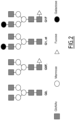
- Shapes G0, G0F, G1 and G1F are selected from the shapes indicated on the Figure 2 .
- the N-glycans of the Fc fragments within the variant composition have an average sialic acid content of less than 25%, 20%, 15%, or 10%, preferably 5%, 4%, 3% or 2%.
- a composition which can be used in the context of the invention comprises variants of a parent polypeptide comprising an Fc fragment, the Fc fragments of said variants having on their glycosylation site (Asn 297) N-glycans, said N-glycans Fc fragments having a glycan structure of the biantennary type, with short chains, low sialylation, and low fucosylation, the N-glycans having for example a content greater than 60% for the G0 + G1 + G0F + G1F forms, and a fucosylation of less than 60%, preferably less than 55%, the N-glycans having for example a content of less than 50% of G0F+G1F forms and a fucosylation of less than 55%.
- the Fc fragments according to the invention have glycan structures as described in the patent application WO01/77181 .
- the Fc fragments used in the invention comprise at least one mutation of one amino acid with respect to a parent Fc fragment, and possess on their glycosylation site (Asn 297) N-glycans, said N-glycans of Fc fragments having a fucosylation rate of less than 65%, preferably less than 60%, preferably less than 55%, preferably less than 50%, preferably less than 45%, preferably less than 40% , preferably less than 35%, preferably less than 30%, preferably less than 25%, preferably less than 20%.
- the Fc fragments carry at least the mutation i) Y296W of said Fc fragment; the numbering being that of the EU index or equivalent in Kabat, and also have on their glycosylation site (Asn 297) N-glycans, having a fucosylation rate of less than 55%, preferably less than 50%, of preferably less than 45%, preferably less than 40%, preferably less than 35%, preferably less than 30%, preferably less than 25%, preferably less than 20%.
- Fc fragments of the composition according to the invention carrying a mutation i) selected from V240H, F241H, F241Y, L242H, L242P, L242T, E258G, E258R, E258M, E258Q, E258Y, V259C, V259I, V259L, T260H , T260I, T260M, T260N, T260R, T260S, T260W, V262A, V262S, V263T, V264L, V264S, V264T, V266L, V266M, S267A, S267Q, S267V, K290L,K290N, K290R, P291G, P291Q, P291R, R292I, R292L , E293A, E293D, E293G, E293M, E293Q, E293S, E293T, E294A, E294G
- the Fc fragments having a modified glycosylation at the level of the glycosylation site at position 297, in particular a weak fucosylation exhibit an increase in the binding of said fragment to the Fcgamma receptors (FcyR), in particular the FcyRIIIa receptor (CD16a) .
- FcyR Fcgamma receptors
- CD16a CD16a
- said Fc fragments have an affinity for CD16a at least equal to 2 ⁇ 10 6 M -1 , at least equal to 2 ⁇ 10 7 M -1 , 2 ⁇ 10 8 M -1 or 2 ⁇ 10 9 M - 1 as determined by Scatchard analysis or Label-free surface plasmon resonance based technology (BIAcore).
- the variant according to the invention is characterized in that it comprises from 1 to 20 mutations of said Fc fragment, preferably from 1 to 10 mutations.
- the variant according to the invention is characterized in that the parent polypeptide comprises a parent Fc fragment which is a human Fc fragment, preferably an Fc fragment of a human IgG1 or of a human IgG2.
- the variant according to the invention is characterized in that it is chosen from an isolated Fc fragment, a sequence derived from an isolated Fc fragment, an antibody and a fusion protein comprising an Fc fragment.
- the variant according to the invention is characterized in that it is an antibody.
- a subject of the present invention is also a composition of polypeptides according to the invention.
- a subject of the present invention is also a pharmaceutical composition
- a pharmaceutical composition comprising (1) a variant according to the invention or a composition as described in the preceding paragraph, and (2) at least one pharmaceutically acceptable excipient.
- a subject of the present invention is also the variant according to the invention or the composition as described above, for its use as a medicament.
- the antibody can be directed against an antigen chosen from among a tumor antigen, a viral antigen, a bacterial antigen, a fungal antigen, a toxin, a membrane or circulating cytokine and a membrane receptor.
- cancer When the antibody is directed against a tumor antigen, its use is particularly suitable in the treatment of cancers.
- cancer is meant any physiological condition characterized by abnormal proliferation of cells. Examples of cancers include, but are not limited to, carcinomas, lymphomas, blastomas, sarcomas (including liposarcomas), neuroendocrine tumors, mesotheliomas, meningiomas, adenocarcinomas, melanomas, leukemias and malignant lymphoid pathologies, this list n not being exhaustive.
- Viral infections include infections due to HIV, retrovirus, coxsackie virus, smallpox virus, influenza virus, yellow fever virus, West Nile virus, cytomegalovirus, rotavirus, or hepatitis B or C, this list not being exhaustive.
- the antibody When the antibody is directed against a toxin, its use is particularly suitable in the treatment of bacterial infections, for example infections with tetanus toxin, diphtheria toxin, Bacillus anthracis anthrax toxins, or else in the treatment of infections with botulinum toxins, ricin toxins, shigatoxins, this list not being exhaustive.
- Inflammatory and/or autoimmune diseases include in particular thrombotic thrombocytopenic purpura (TIP), rejection of transplants or organs, graft versus host disease, rheumatoid arthritis, systemic lupus erythematosus, the various types of sclerosis, primary Sjögren syndrome (or Gougerot-Sjögren syndrome), autoimmune polyneuropathies such as multiple sclerosis, type I diabetes, autoimmune hepatitis, ankylosing spondylitis, Reiter's syndrome, gout arthritis, celiac disease, Crohn's disease, chronic Hashimoto's thyroiditis (hypothyroidism), Adisson's disease, autoimmune hepatitis , Graves' disease (hyperthyroidism), ulcerative colitis, vasculitis such as systemic vasculitis associated with ANCA (anti
- inflammatory diseases are also included, such as, for example, acute respiratory distress syndrome (ARDS), acute septic arthritis, adjuvant arthritis, allergic encephalomyelitis, allergic rhinitis, allergic vasculitis, allergy, asthma, atherosclerosis, chronic inflammation due to chronic bacterial or viral infections, chronic obstructive pulmonary disease (COPD), coronary heart disease, encephalitis, inflammatory bowel disease, inflammatory osteolysis, inflammation associated with acute and delayed hypersensitivity reactions, inflammation associated with tumors, peripheral nerve injury or diseases inflammation associated with tissue trauma such as burns and ischemia, inflammation due to meningitis, multiple organ dysfunction syndrome (MODS), pulmonary fibrosis, sepsis and shock septic, Stevens-Johnson syndrome, undifferentiated arthritis, and undifferentiated spondyloarthropathies.
- ARDS acute respiratory distress syndrome
- COPD chronic obstructive pulmonary disease
- COPD chronic obstructive pulmonary disease
- COPD chronic obstructive pulmonary disease
- the autoimmune disease is idiopathic thrombotic purpura (ITP) and chronic inflammatory demyelinating polyradiculoneuritis (PDCI).
- ITP idiopathic thrombotic purpura
- PDCI chronic inflammatory demyelinating polyradiculoneuritis
- a subject of the present invention is also a method for producing a variant of a parent polypeptide comprising an Fc fragment, said variant exhibiting an increased affinity for at least one of the receptors of the Fc fragment (FcR) chosen from Fc ⁇ RIIIa receptors ( CD16a), FcyRIIa (CD32a), and FcyRIIb (CD32b) relative to that of the parent polypeptide, which comprises a step of mutating at least one amino acid, the mutation being Y296W of said Fc fragment; the numbering being that of the EU index or equivalent in Kabat, and the method being according to claim 12.
- FcR Fc ⁇ RIIIa receptors
- CD32a FcyRIIa
- CD32b FcyRIIb
- the present invention relates in particular to a process for producing a variant of a polypeptide comprising an Fc fragment, said variant exhibiting an increased affinity for at least one of the receptors of the Fc fragment (FcR) chosen from Fc ⁇ RIIIa receptors (CD16a ), FcyRIIa (CD32a), and FcyRIIb (CD32b), relative to that of the parent polypeptide, of a ratio at least equal to 2, preferably greater than 5, preferably greater than 10, preferably greater than 15, of preferably greater than 20, preferably greater than 25, preferably greater than 30, which comprises a step of mutating at least one amino acid, the mutation being Y296W of said Fc fragment; the numbering being that of the EU index or equivalent in Kabat, and the method being according to claim 13.
- FcR Fc ⁇ RIIIa receptors
- CD32a FcyRIIa
- CD32b FcyRIIb
- SEQ ID NO Protein Sequence 1 Fc region of human IgG1 G1m1,17 (residues 226-447 according to EU index or equivalent in Kabat) without N-terminal upper hinge region 2 Human IgG2 Fc region without N-terminal upper hinge region 3 Human IgG3 Fc region without N-terminal upper hinge region 4 Fc region of human IgG4 without N-terminal upper hinge region 5 Human IgG1 G1m3 Fc region without N-terminal upper hinge region 6 Fc region of human IgG1 G1m1,17 with N-terminal upper hinge region (residues 216-447 according to EU index or equivalent in Kabat) 7 Human IgG2 Fc region with N-terminal upper hinge region 8 Human IgG3 Fc region with N-terminal upper hinge region 9 Human IgG4 Fc region with N-terminal upper hinge region 10 Fc region of human IgG1 G1m3 with N-terminal upper hinge region
- Example 1 Production of Fc variants according to the invention by site-directed mutagenesis
- Each mutation of interest in the Fc fragment was inserted independently into an expression vector containing the anti-CD20 heavy chain by overlap PCR using two sets of primers adapted to integrate a deletion or a degenerate codon (NNN or NNK ) in targeted position (240 to 243, 258 to 267, 290 to 296, 298 to 305).
- NNN or NNK a degenerate codon
- the PCR product was purified on 1% (w/v) agarose gels, digested with the appropriate restriction enzymes and cloned into the eukaryotic expression vector pMGM05-CD20 (pCEP4 InvitroGen), which contains cloning sites for the Fc fragment (BamHI and NotI) and the VH variable chain of the anti-CD20 antibody.
- pMGM05-CD20 pCEP4 InvitroGen
- This construction entails the mutation of two amino acids in the Fc (aa224 and 225, HT changed to GS) and the addition of the EFAAA sequence at the C-terminal of the Fc, but makes it possible to test a very large number of clones very quickly. Initially, it was verified that these mutations did not modify the binding of IgG-WT to the various receptors.
- the DNA of the isolated clones was sequenced after PCR on colonies. After bioinformatics analyses, the clones containing new mutations were frozen at -80°C in XL1-Blue bacteria and the sequences included in our database.
- the anti-CD20 light chain was inserted into a vector pCEP4 identical to the vector used for the heavy chain, denoted pMGM01-CDC20 (pCEP4 InvitroGen).
- HEK293-F Freestyle TM cells (Invitrogen), cultured in 24-well plates, were cotransfected with the vectors pMGM01-CD20 and pMGM05-CD20 (Fc-WT and variants) in equimolar quantities (250 ng/ml) with a transfection reagent (1 ⁇ l/ml) using standard protocols (Invitrogen).
- CD16a is an activating receptor that exhibits a V/F polymorphism at position 158, at the Fc-binding site. The affinity is better for CD16aV.
- CD16aV is commercially available (R&D system).
- CD32a is an activating receptor that exhibits an H/R polymorphism at position 131, at the Fc-binding site. The affinity is better for CD32aH.
- CD32aH was produced by PX'Therapeutics.
- CD32aR and CD32b are commercially available (R&D system).
- IgG variants were tested for binding to several human FcRs and to FcRn by ELISA.
- Maxisorp immunoplates were coated with 0.1 ⁇ g CD32aH/well, or 0.2 ⁇ g CD16aV/well in PBS or 0.25 ⁇ g FcRn in P6 (100mM sodium phosphate, 50mM sodium chloride pH6.0).
- NiNTA plates (HisGrab Pierce) were coated with 0.05 ⁇ g CD32aR/well, or 0.2 ⁇ g CD32b/well in PBS.
- IgGs aggregated with F(ab')2 are then incubated with gentle shaking for 1 hour at 30°C on ELISA plates saturated without dilution for CD16aV, CD32aR and CD32b (ie IgG at 0.5 ⁇ g/ml), diluted in PBS at 0.25 ⁇ g/ml for CD32aH and diluted in P6 at 0.035 ⁇ g/ml for FcRn.
- the plates are then revealed with TMB (Pierce) and the absorbance is read at 450 nm.
- variants produced in the supernatants of HEK293-F cells as described in example 1 were purified by a standard method of affinity chromatography on protein A.
- the IgGs aggregated with the F(ab')2 were then incubated with gentle shaking for 1 hour at 30° C. on the ELISA plates saturated with different dilutions in PBS. The plates were then revealed with TMB and the absorbance read at 450 nm.
- Biosensors Anti Penta-HIS (HIS 1K) are used.
- the hCD16aV receptor (R&D Systems) diluted to 1 ⁇ g/ml in Kinetics Buffer, ie 44 nM, is immobilized.
- IgG variants were tested at 1000, 500, 250, 125, 62.5, 31.25, 15 and 0 nM in Kinetics Buffer.
- KD analysis was performed with a 1:1 association model.
- Example 3 Production of additional IgG variants in HEK293 cells
- Combinations of mutants comprising at least one mutation i) according to the invention were produced from an Fc fragment comprising the starting mutations N315D/A330V/N361D/A378V/N434Y (T5A-74 mutant), or V259I/N315D /N434Y (C6A_74 mutant) or N315D/N361D/A378V/N434Y (T5A_74A mutant) or K334N/P352S/V397M/A378V (A3A_184A mutant). They are shown in Table 5.
Landscapes
- Health & Medical Sciences (AREA)
- Chemical & Material Sciences (AREA)
- Organic Chemistry (AREA)
- Life Sciences & Earth Sciences (AREA)
- Immunology (AREA)
- General Health & Medical Sciences (AREA)
- Medicinal Chemistry (AREA)
- Biochemistry (AREA)
- Biophysics (AREA)
- Genetics & Genomics (AREA)
- Molecular Biology (AREA)
- Proteomics, Peptides & Aminoacids (AREA)
- Pharmacology & Pharmacy (AREA)
- Animal Behavior & Ethology (AREA)
- Veterinary Medicine (AREA)
- Chemical Kinetics & Catalysis (AREA)
- General Chemical & Material Sciences (AREA)
- Nuclear Medicine, Radiotherapy & Molecular Imaging (AREA)
- Public Health (AREA)
- Oncology (AREA)
- Virology (AREA)
- Communicable Diseases (AREA)
- Engineering & Computer Science (AREA)
- Bioinformatics & Cheminformatics (AREA)
- Peptides Or Proteins (AREA)
- Medicines Containing Antibodies Or Antigens For Use As Internal Diagnostic Agents (AREA)
- Preparation Of Compounds By Using Micro-Organisms (AREA)
Claims (13)
- Variante eines Elternpolypeptids, umfassend ein Fc-Fragment, wobei die Variante eine erhöhte Affinität für mindestens einen der Fc-Fragment-Rezeptoren (FcR) aufweist, der ausgewählt ist aus den Rezeptoren FcyRllla (CD 16a), FcyRlla (CD32a), et FcyRllb (CD32b), im Vergleich zu der des Elternpolypeptids, dadurch gekennzeichnet, dass sie mindestens die Mutation Y296W des Fragments Fc umfasst; also
entweder:(ii) eine Mutation, ausgewählt aus 378V, 378T, 434Y und 434S; und(iii) mindestens eine Mutation, ausgewählt aus 226G, P228L, P228R, 230S, 230T, 230L, 241L, 264E, 307P, 315D, 330V, 362R, 378V, 378T, 389T, 389K, 434Y und 434S,mit der Maßgabe, dass die Mutationen (ii) und (iii) nicht auf denselben Aminosäuren vorkommen,oder:(iv) eine Mutation, ausgewählt aus 307N, 326E, 326T, 334N, 334R, 352L, 378V, 378T, 394P, 396L, 397M und 421T; und(v) mindestens eine Mutation, ausgewählt aus 226Y, 227S, 230S, 231V, 234P, 243I 243L, 246R, 246E, 247T, 248E, 253F, 254F, 255W, 259A, 261R 262A, 263A, 266M, 267N, 267G, 274E, 274R, 276S, 278H, 282A, 283G, 284L, 2861 286Y, 287T, 288E, 288R, 290E, 298N, 302A, 305A, 307P, 308A, 308I, 308G, 309P, 312G, 315D, 316D, 319H, 320T, 320R, 320M, 322E, 323I, 325S, 333G, 334N, 334R, 336T, 339T, 340E, 343S, 345G, 349S, 349H, 350A 352S, 359A, 361H, 362R, 363I, 366A, 373D, 375R, 377T, 378V, 378T, 379A, 380G, 383R, 385R, 389S, 389T, 392R, 393A, 3931, 394P, 396L, 3971, 397M, 398P, 405V, 405L, 410R, 412M, 414R, 421T, 421S, 423L, 423Y, 423S, 423P, 428T, 431V, 431T, 434K, 434S, 435R, 436H, 439R, 440G, 440N, 442F, 442P und 447N, mit der Maßgabe, dass die Mutationen (iv) und (v) nicht an denselben Aminosäuren vorkommen,wobei die Nummerierung die des EU-Index oder entsprechend in Kabat ist. - Variante nach Anspruch 1, die eine erhöhte Affinität für mindestens einen der Rezeptoren des Fc-Fragments (FcR), ausgewählt aus FcyRllla (CD 16a), FcyRlla (CD32a) und FcyRllb (CD32b), im Vergleich zu der des Elternpolypeptids in einem Verhältnis von mindestens 2, vorzugsweise größer als 5, vorzugsweise größer als 10, vorzugsweise größer als 15, vorzugsweise größer als 20, vorzugsweise größer als 25, vorzugsweise größer als 30 aufweist.
- Variante nach Anspruch 1 oder 2, die eine erhöhte Affinität für den Rezeptor FcyRllla (CD 16a) aufweist.
- Variante nach einem der Ansprüche 1 bis 3, dadurch gekennzeichnet, dass sie als Mutation (v) mindestens 2 Mutationen umfasst, ausgewählt aus 226Y, 227S, 230S, 231V, 234P, 243I, 243L, 246R, 246E, 247T, 248E, 253F, 254F, 255W, 259A, 261R, 262A, 263A, 266M, 267G, 274E, 274R, 276S, 278H, 282A, 283G, 284L, 2861, 286Y, 287T, 288E, 288R, 290E, 298N, 302A, 305A, 307P, 308A, 308I, 308G, 309P, 312G, 316D, 319H, 320T, 320R, 320M, 322E, 323I, 325S, 333G, 334N, 334R, 336T, 339T, 340E, 343S, 345G, 349S, 349H, 350A, 352S, 359A, 361H, 362R, 3631, 366A, 373D, 375R, 377T, 378T, 379A, 380G, 383R, 385R, 389S, 389T, 392R, 393A, 393I, 394P, 396L, 3971, 398P, 405V, 405L, 410R, 412M, 414R, 421T, 421S, 423L, 423Y, 423S, 423P, 428T, 431V, 431T, 434K, 434S, 435R, 436H, 439R, 440G, 440N, 442F, 442P und 447N.
- Verfahren nach einem der Ansprüche 1 oder 4, dadurch gekennzeichnet, dass:
die Mutation (iv) ausgewählt ist aus 378V, 326E, 397M, 307N, 394P, 326T, 396L und 334N, und die Mutation (v) ausgewählt ist aus 316D, 334R, 334N, 323I, 231V, 246R, 336T, 378T, 286Y, 2861, 352S, 383R, 359A, 421T, 361H, 315D, 366A, 290E, 307P und 439R, wobei die Nummerierung die des EU-Index oder entsprechend in Kabat ist und mit der Maßgabe, dass die Mutationen (iv) und (v) nicht an denselben Aminosäuren vorkommen. - Variante nach einem der Ansprüche 1 bis 5, dadurch gekennzeichnet, dass sie 1 bis 20 Mutationen des Fragments Fc, vorzugsweise 1 bis 10 Mutationen, umfasst.
- Variante nach einem der Ansprüche 1 bis 6, dadurch gekennzeichnet, dass das Elternpolypeptid ein Fc-Elternfragment umfasst, das ein menschliches Fc-Fragment ist, vorzugsweise ein Fc-Fragment eines menschlichen IgGI oder eines menschlichen IgG2.
- Variante nach einem der Ansprüche 1 bis 7, dadurch gekennzeichnet, dass sie ausgewählt ist aus einem isolierten Fc-Fragment, einer Sequenz, die von einem isolierten Fc-Fragment abgeleitet ist, einem Antikörper und einem Fusionsprotein, das ein Fc-Fragment umfasst.
- Variante nach Anspruch 1 bis 8, die ein Antikörper ist, der
gegen ein Antigen gerichtet ist, das ausgewählt ist aus einem
Tumorantigen, einem viralen Antigen, einem bakteriellen Antigen, einem Pilzantigen, einem Toxin, einem membranständigen oder zirkulierenden Zytokin, einem membranständigen Rezeptor. - Variante nach einem der Ansprüche 1 bis 9 zur Verwendung als Arzneimittel.
- Pharmazeutische Zusammensetzung, umfassend (1) eine Variante nach einem der Ansprüche 1 bis 9 und (2) mindestens einen pharmazeutisch annehmbaren Hilfsstoff.
- Verfahren zur Herstellung einer Variante eines Polypeptids, umfassend ein Fc-Fragment, wobei die Variante eine erhöhte Affinität für mindestens einen der Rezeptoren des Fc-Fragments (FcR), ausgewählt aus den Rezeptoren FcyRllla (CD16a), FcyRlla (CD32a) und FcyRllb (CD32b) im Vergleich zu der des Elternpolypeptids aufweist, dadurch gekennzeichnet, dass es einen Schritt des Mutierens von mindestens einer Aminosäure umfasst, wobei die Mutation Y296W des Fragments Fc ist;
wobei die Variante bereits entweder Folgendes umfasst:(ii) eine Mutation, ausgewählt aus 378V, 378T, 434Y und 434S; und(iii) mindestens eine Mutation, ausgewählt aus 226G, P228L, P228R, 230S, 230T, 230L, 241L, 264E, 307P, 315D, 330V, 362R, 378V, 378T, 389T, 389K, 434Y und 434S,mit der Maßgabe, dass die Mutationen (ii) und (iii) nicht auf denselben Aminosäuren vorkommen,oder:(iv) eine Mutation, ausgewählt aus 307N, 326E, 326T, 334N, 334R, 352L, 378V, 378T, 394P, 396L, 397M und 421T; und(v) mindestens eine Mutation, ausgewählt aus 226Y, 227S, 230S, 231V, 234P, 2431, 243L, 246R, 246E, 247T, 248E, 253F, 254F, 255W, 259A, 261R, 262A, 263A, 266M, 267N, 267G, 274E, 274R, 276S, 278H, 282A, 283G, 284L, 2861, 286Y, 287T, 288E, 288R, 290E, 298N, 302A, 305A, 307P, 308A, 308I, 308G, 309P, 312G, 315D, 316D, 319H, 320T, 320R, 320M, 322E,-323I, 325S, 333G, 334N, 334R, 336T, 339T, 340E, 343S, 345G, 349S, 349H, 350A 352S, 359A, 361H, 362R, 363I, 366A, 373D, 375R, 377T, 378V, 378T, 379A, 380G, 383R, 385R, 389S, 389T, 392R, 393A, 393I, 394P, 396L, 397I, 397M, 398P, 405V, 405L, 410R, 412M, 414R, 421T, 421S, 423L, 423Y, 423S, 423P, 428T, 431V, 431T, 434K, 434S, 435R, 436H, 439R, 440G, 440N, 442F, 442P und 447N,mit der Maßgabe, dass die Mutationen (iv) und (v) nicht an denselben Aminosäuren vorkommen,wobei die Nummerierung die des EU-Index oder entsprechend in Kabat ist. - Verfahren zur Herstellung einer Variante eines Polypeptids, umfassend ein Fc-Fragment nach Anspruch 12, wobei die Variante eine Affinität für mindestens einen der Rezeptoren des Fc-Fragments (FcR), ausgewählt aus FcyRllla (CD 16a), FcyRlla (CD32a) und FcyRllb (CD32b), im Vergleich zu der des Elternpolypeptids in einem Verhältnis von mindestens 2, vorzugsweise größer als 5, vorzugsweise größer als 10, vorzugsweise größer als 15, vorzugsweise größer als 20, vorzugsweise größer als 25, vorzugsweise größer als 30 aufweist.
Priority Applications (1)
| Application Number | Priority Date | Filing Date | Title |
|---|---|---|---|
| EP23183322.9A EP4273163A3 (de) | 2016-07-06 | 2017-07-05 | Fc-mutanten mit verbesserter funktioneller aktivität |
Applications Claiming Priority (2)
| Application Number | Priority Date | Filing Date | Title |
|---|---|---|---|
| FR1656463A FR3053688A1 (fr) | 2016-07-06 | 2016-07-06 | Mutants fc a activite fonctionnelle amelioree |
| PCT/EP2017/066791 WO2018007453A1 (fr) | 2016-07-06 | 2017-07-05 | Mutants fc a activite fonctionnelle amelioree |
Related Child Applications (2)
| Application Number | Title | Priority Date | Filing Date |
|---|---|---|---|
| EP23183322.9A Division EP4273163A3 (de) | 2016-07-06 | 2017-07-05 | Fc-mutanten mit verbesserter funktioneller aktivität |
| EP23183322.9A Division-Into EP4273163A3 (de) | 2016-07-06 | 2017-07-05 | Fc-mutanten mit verbesserter funktioneller aktivität |
Publications (2)
| Publication Number | Publication Date |
|---|---|
| EP3481865A1 EP3481865A1 (de) | 2019-05-15 |
| EP3481865B1 true EP3481865B1 (de) | 2023-09-06 |
Family
ID=57583168
Family Applications (2)
| Application Number | Title | Priority Date | Filing Date |
|---|---|---|---|
| EP23183322.9A Pending EP4273163A3 (de) | 2016-07-06 | 2017-07-05 | Fc-mutanten mit verbesserter funktioneller aktivität |
| EP17739229.7A Active EP3481865B1 (de) | 2016-07-06 | 2017-07-05 | Fc-mutanten mit verbesserter funktioneller aktivität |
Family Applications Before (1)
| Application Number | Title | Priority Date | Filing Date |
|---|---|---|---|
| EP23183322.9A Pending EP4273163A3 (de) | 2016-07-06 | 2017-07-05 | Fc-mutanten mit verbesserter funktioneller aktivität |
Country Status (8)
| Country | Link |
|---|---|
| US (1) | US11814438B2 (de) |
| EP (2) | EP4273163A3 (de) |
| CA (1) | CA3029971A1 (de) |
| DK (1) | DK3481865T5 (de) |
| ES (1) | ES2965076T3 (de) |
| FR (1) | FR3053688A1 (de) |
| PL (1) | PL3481865T3 (de) |
| WO (1) | WO2018007453A1 (de) |
Families Citing this family (5)
| Publication number | Priority date | Publication date | Assignee | Title |
|---|---|---|---|---|
| FR3075200B1 (fr) * | 2017-12-15 | 2022-12-23 | Lab Francais Du Fractionnement | Variants avec fragment fc ayant une affinite augmentee pour fcrn et une affinite augmentee pour au moins un recepteur du fragment fc |
| EP3805400A4 (de) * | 2018-06-04 | 2022-06-29 | Chugai Seiyaku Kabushiki Kaisha | Antigen-bindendes molekül mit veränderter halbwertszeit im cytoplasma |
| EP4143224A1 (de) * | 2020-05-01 | 2023-03-08 | Novartis AG | Immunglobulinvarianten |
| CA3183689A1 (en) * | 2020-05-20 | 2021-11-25 | Janssen Biotech, Inc. | Site-specific conjugation of glycosylated monoclonal antibodies with transglutaminase |
| WO2024092031A1 (en) | 2022-10-25 | 2024-05-02 | Seismic Therapeutic, Inc. | VARIANT IgG FC POLYPEPTIDES AND USES THEREOF |
Citations (3)
| Publication number | Priority date | Publication date | Assignee | Title |
|---|---|---|---|---|
| WO2012125850A1 (en) * | 2011-03-16 | 2012-09-20 | Amgen Inc. | Fc variants |
| WO2014081955A1 (en) * | 2012-11-21 | 2014-05-30 | Amgen Inc. | Heterodimeric immunoglobulins |
| WO2014140322A1 (fr) * | 2013-03-15 | 2014-09-18 | Laboratoire Francais Du Fractionnement Et Des Biotechnologies | Nouveaux médicaments comprenant une composition d'anticorps enrichie en isoforme de charge majoritaire |
Family Cites Families (6)
| Publication number | Priority date | Publication date | Assignee | Title |
|---|---|---|---|---|
| FR2807767B1 (fr) | 2000-04-12 | 2005-01-14 | Lab Francais Du Fractionnement | Anticorps monoclonaux anti-d |
| US20040002587A1 (en) * | 2002-02-20 | 2004-01-01 | Watkins Jeffry D. | Fc region variants |
| US7317091B2 (en) * | 2002-03-01 | 2008-01-08 | Xencor, Inc. | Optimized Fc variants |
| US7662925B2 (en) * | 2002-03-01 | 2010-02-16 | Xencor, Inc. | Optimized Fc variants and methods for their generation |
| EP2233500A1 (de) * | 2009-03-20 | 2010-09-29 | LFB Biotechnologies | Optimierte Fc Varianten |
| EP3597747B1 (de) * | 2012-08-24 | 2023-03-15 | Chugai Seiyaku Kabushiki Kaisha | Maus-fgcgammarii-spezifischer fc-antikörper |
-
2016
- 2016-07-06 FR FR1656463A patent/FR3053688A1/fr active Pending
-
2017
- 2017-07-05 ES ES17739229T patent/ES2965076T3/es active Active
- 2017-07-05 WO PCT/EP2017/066791 patent/WO2018007453A1/fr not_active Ceased
- 2017-07-05 DK DK17739229.7T patent/DK3481865T5/da active
- 2017-07-05 US US16/315,356 patent/US11814438B2/en active Active
- 2017-07-05 CA CA3029971A patent/CA3029971A1/fr active Pending
- 2017-07-05 PL PL17739229.7T patent/PL3481865T3/pl unknown
- 2017-07-05 EP EP23183322.9A patent/EP4273163A3/de active Pending
- 2017-07-05 EP EP17739229.7A patent/EP3481865B1/de active Active
Patent Citations (3)
| Publication number | Priority date | Publication date | Assignee | Title |
|---|---|---|---|---|
| WO2012125850A1 (en) * | 2011-03-16 | 2012-09-20 | Amgen Inc. | Fc variants |
| WO2014081955A1 (en) * | 2012-11-21 | 2014-05-30 | Amgen Inc. | Heterodimeric immunoglobulins |
| WO2014140322A1 (fr) * | 2013-03-15 | 2014-09-18 | Laboratoire Francais Du Fractionnement Et Des Biotechnologies | Nouveaux médicaments comprenant une composition d'anticorps enrichie en isoforme de charge majoritaire |
Also Published As
| Publication number | Publication date |
|---|---|
| DK3481865T3 (da) | 2023-12-11 |
| EP4273163A3 (de) | 2024-04-03 |
| US11814438B2 (en) | 2023-11-14 |
| PL3481865T3 (pl) | 2024-02-19 |
| WO2018007453A1 (fr) | 2018-01-11 |
| US20190309085A1 (en) | 2019-10-10 |
| ES2965076T3 (es) | 2024-04-11 |
| EP3481865A1 (de) | 2019-05-15 |
| CA3029971A1 (fr) | 2018-01-11 |
| FR3053688A1 (fr) | 2018-01-12 |
| DK3481865T5 (da) | 2024-09-02 |
| EP4273163A2 (de) | 2023-11-08 |
Similar Documents
| Publication | Publication Date | Title |
|---|---|---|
| EP3292145B1 (de) | Fc-mutanten mit modifizierter funktioneller aktivität | |
| JP7671718B2 (ja) | 免疫療法における改変Fc断片の使用 | |
| EP3481865B1 (de) | Fc-mutanten mit verbesserter funktioneller aktivität | |
| CN111320695B (zh) | 治疗或预防认知障碍的人源化抗体、其生产方法及使用其用于治疗或预防认识障碍的剂 | |
| EP2931749A1 (de) | Verwendung monoklonaler antikörper zur behandlung von entzündungen und bakteriellen infektionen | |
| EP3724221A1 (de) | Varianten mit fc-fragment mit erhöhter affinität für fcrn und erhöhter affinität für mindestens einen rezeptor des fc-fragments | |
| CA2956822A1 (fr) | Procede de production de variants ayant un fc presentant une sialylation amelioree | |
| CN112074292A (zh) | 治疗性抗sPLA2-GIB抗体及其用途 | |
| KR20230170017A (ko) | 항C1s 항체 | |
| CA3026145A1 (fr) | Anticorps pour le traitement de cancers | |
| TW202307007A (zh) | 多特異性fgf21受體促效劑及其等用途 | |
| WO2022180342A1 (fr) | Anticorps, fragments ou derives se liant specifiquement a un antigene proteique capable de se lier aux acides nucleiques et leurs utilisations | |
| KR20240054896A (ko) | 항C1s 항체의 사용 | |
| EA048622B1 (ru) | АНТИТЕЛО ПРОТИВ C1s | |
| TW202432574A (zh) | 具有增強的效應子功能之糖基工程化Fc變體多肽 | |
| HK40013632A (en) | Humanized antibody for treating or preventing cognitive disorders, process for producing the same, and agent for treating or preventing cognitive disorders using the same |
Legal Events
| Date | Code | Title | Description |
|---|---|---|---|
| STAA | Information on the status of an ep patent application or granted ep patent |
Free format text: STATUS: UNKNOWN |
|
| STAA | Information on the status of an ep patent application or granted ep patent |
Free format text: STATUS: THE INTERNATIONAL PUBLICATION HAS BEEN MADE |
|
| PUAI | Public reference made under article 153(3) epc to a published international application that has entered the european phase |
Free format text: ORIGINAL CODE: 0009012 |
|
| STAA | Information on the status of an ep patent application or granted ep patent |
Free format text: STATUS: REQUEST FOR EXAMINATION WAS MADE |
|
| 17P | Request for examination filed |
Effective date: 20190107 |
|
| AK | Designated contracting states |
Kind code of ref document: A1 Designated state(s): AL AT BE BG CH CY CZ DE DK EE ES FI FR GB GR HR HU IE IS IT LI LT LU LV MC MK MT NL NO PL PT RO RS SE SI SK SM TR |
|
| AX | Request for extension of the european patent |
Extension state: BA ME |
|
| DAV | Request for validation of the european patent (deleted) | ||
| DAX | Request for extension of the european patent (deleted) | ||
| PUAG | Search results despatched under rule 164(2) epc together with communication from examining division |
Free format text: ORIGINAL CODE: 0009017 |
|
| STAA | Information on the status of an ep patent application or granted ep patent |
Free format text: STATUS: EXAMINATION IS IN PROGRESS |
|
| 17Q | First examination report despatched |
Effective date: 20200507 |
|
| B565 | Issuance of search results under rule 164(2) epc |
Effective date: 20200507 |
|
| RIC1 | Information provided on ipc code assigned before grant |
Ipc: C07K 16/00 20060101ALI20200501BHEP Ipc: C07K 16/28 20060101AFI20200501BHEP |
|
| RAP3 | Party data changed (applicant data changed or rights of an application transferred) |
Owner name: LABORATOIRE FRANCAIS DU FRACTIONNEMENT ET DES BIOTECHNOLOGIES |
|
| GRAP | Despatch of communication of intention to grant a patent |
Free format text: ORIGINAL CODE: EPIDOSNIGR1 |
|
| STAA | Information on the status of an ep patent application or granted ep patent |
Free format text: STATUS: GRANT OF PATENT IS INTENDED |
|
| INTG | Intention to grant announced |
Effective date: 20230222 |
|
| P01 | Opt-out of the competence of the unified patent court (upc) registered |
Effective date: 20230502 |
|
| GRAS | Grant fee paid |
Free format text: ORIGINAL CODE: EPIDOSNIGR3 |
|
| GRAA | (expected) grant |
Free format text: ORIGINAL CODE: 0009210 |
|
| STAA | Information on the status of an ep patent application or granted ep patent |
Free format text: STATUS: THE PATENT HAS BEEN GRANTED |
|
| AK | Designated contracting states |
Kind code of ref document: B1 Designated state(s): AL AT BE BG CH CY CZ DE DK EE ES FI FR GB GR HR HU IE IS IT LI LT LU LV MC MK MT NL NO PL PT RO RS SE SI SK SM TR |
|
| REG | Reference to a national code |
Ref country code: GB Ref legal event code: FG4D Free format text: NOT ENGLISH |
|
| REG | Reference to a national code |
Ref country code: CH Ref legal event code: EP |
|
| REG | Reference to a national code |
Ref country code: IE Ref legal event code: FG4D Free format text: LANGUAGE OF EP DOCUMENT: FRENCH |
|
| REG | Reference to a national code |
Ref country code: DE Ref legal event code: R096 Ref document number: 602017073769 Country of ref document: DE |
|
| REG | Reference to a national code |
Ref country code: DK Ref legal event code: T3 Effective date: 20231207 |
|
| REG | Reference to a national code |
Ref country code: NL Ref legal event code: FP |
|
| REG | Reference to a national code |
Ref country code: LT Ref legal event code: MG9D Ref country code: SE Ref legal event code: TRGR |
|
| PG25 | Lapsed in a contracting state [announced via postgrant information from national office to epo] |
Ref country code: GR Free format text: LAPSE BECAUSE OF FAILURE TO SUBMIT A TRANSLATION OF THE DESCRIPTION OR TO PAY THE FEE WITHIN THE PRESCRIBED TIME-LIMIT Effective date: 20231207 |
|
| PG25 | Lapsed in a contracting state [announced via postgrant information from national office to epo] |
Ref country code: RS Free format text: LAPSE BECAUSE OF FAILURE TO SUBMIT A TRANSLATION OF THE DESCRIPTION OR TO PAY THE FEE WITHIN THE PRESCRIBED TIME-LIMIT Effective date: 20230906 Ref country code: NO Free format text: LAPSE BECAUSE OF FAILURE TO SUBMIT A TRANSLATION OF THE DESCRIPTION OR TO PAY THE FEE WITHIN THE PRESCRIBED TIME-LIMIT Effective date: 20231206 Ref country code: LV Free format text: LAPSE BECAUSE OF FAILURE TO SUBMIT A TRANSLATION OF THE DESCRIPTION OR TO PAY THE FEE WITHIN THE PRESCRIBED TIME-LIMIT Effective date: 20230906 Ref country code: LT Free format text: LAPSE BECAUSE OF FAILURE TO SUBMIT A TRANSLATION OF THE DESCRIPTION OR TO PAY THE FEE WITHIN THE PRESCRIBED TIME-LIMIT Effective date: 20230906 Ref country code: HR Free format text: LAPSE BECAUSE OF FAILURE TO SUBMIT A TRANSLATION OF THE DESCRIPTION OR TO PAY THE FEE WITHIN THE PRESCRIBED TIME-LIMIT Effective date: 20230906 Ref country code: GR Free format text: LAPSE BECAUSE OF FAILURE TO SUBMIT A TRANSLATION OF THE DESCRIPTION OR TO PAY THE FEE WITHIN THE PRESCRIBED TIME-LIMIT Effective date: 20231207 Ref country code: FI Free format text: LAPSE BECAUSE OF FAILURE TO SUBMIT A TRANSLATION OF THE DESCRIPTION OR TO PAY THE FEE WITHIN THE PRESCRIBED TIME-LIMIT Effective date: 20230906 |
|
| PG25 | Lapsed in a contracting state [announced via postgrant information from national office to epo] |
Ref country code: IS Free format text: LAPSE BECAUSE OF FAILURE TO SUBMIT A TRANSLATION OF THE DESCRIPTION OR TO PAY THE FEE WITHIN THE PRESCRIBED TIME-LIMIT Effective date: 20240106 |
|
| REG | Reference to a national code |
Ref country code: ES Ref legal event code: FG2A Ref document number: 2965076 Country of ref document: ES Kind code of ref document: T3 Effective date: 20240411 |
|
| REG | Reference to a national code |
Ref country code: AT Ref legal event code: UEP Ref document number: 1608480 Country of ref document: AT Kind code of ref document: T Effective date: 20230906 |
|
| PG25 | Lapsed in a contracting state [announced via postgrant information from national office to epo] |
Ref country code: SM Free format text: LAPSE BECAUSE OF FAILURE TO SUBMIT A TRANSLATION OF THE DESCRIPTION OR TO PAY THE FEE WITHIN THE PRESCRIBED TIME-LIMIT Effective date: 20230906 Ref country code: RO Free format text: LAPSE BECAUSE OF FAILURE TO SUBMIT A TRANSLATION OF THE DESCRIPTION OR TO PAY THE FEE WITHIN THE PRESCRIBED TIME-LIMIT Effective date: 20230906 Ref country code: IS Free format text: LAPSE BECAUSE OF FAILURE TO SUBMIT A TRANSLATION OF THE DESCRIPTION OR TO PAY THE FEE WITHIN THE PRESCRIBED TIME-LIMIT Effective date: 20240106 Ref country code: EE Free format text: LAPSE BECAUSE OF FAILURE TO SUBMIT A TRANSLATION OF THE DESCRIPTION OR TO PAY THE FEE WITHIN THE PRESCRIBED TIME-LIMIT Effective date: 20230906 Ref country code: CZ Free format text: LAPSE BECAUSE OF FAILURE TO SUBMIT A TRANSLATION OF THE DESCRIPTION OR TO PAY THE FEE WITHIN THE PRESCRIBED TIME-LIMIT Effective date: 20230906 Ref country code: PT Free format text: LAPSE BECAUSE OF FAILURE TO SUBMIT A TRANSLATION OF THE DESCRIPTION OR TO PAY THE FEE WITHIN THE PRESCRIBED TIME-LIMIT Effective date: 20240108 Ref country code: SK Free format text: LAPSE BECAUSE OF FAILURE TO SUBMIT A TRANSLATION OF THE DESCRIPTION OR TO PAY THE FEE WITHIN THE PRESCRIBED TIME-LIMIT Effective date: 20230906 |
|
| REG | Reference to a national code |
Ref country code: DE Ref legal event code: R097 Ref document number: 602017073769 Country of ref document: DE |
|
| PLBE | No opposition filed within time limit |
Free format text: ORIGINAL CODE: 0009261 |
|
| STAA | Information on the status of an ep patent application or granted ep patent |
Free format text: STATUS: NO OPPOSITION FILED WITHIN TIME LIMIT |
|
| PG25 | Lapsed in a contracting state [announced via postgrant information from national office to epo] |
Ref country code: SI Free format text: LAPSE BECAUSE OF FAILURE TO SUBMIT A TRANSLATION OF THE DESCRIPTION OR TO PAY THE FEE WITHIN THE PRESCRIBED TIME-LIMIT Effective date: 20230906 |
|
| 26N | No opposition filed |
Effective date: 20240607 |
|
| REG | Reference to a national code |
Ref country code: DK Ref legal event code: T5 Effective date: 20240830 |
|
| PG25 | Lapsed in a contracting state [announced via postgrant information from national office to epo] |
Ref country code: BG Free format text: LAPSE BECAUSE OF FAILURE TO SUBMIT A TRANSLATION OF THE DESCRIPTION OR TO PAY THE FEE WITHIN THE PRESCRIBED TIME-LIMIT Effective date: 20230906 |
|
| PG25 | Lapsed in a contracting state [announced via postgrant information from national office to epo] |
Ref country code: BG Free format text: LAPSE BECAUSE OF FAILURE TO SUBMIT A TRANSLATION OF THE DESCRIPTION OR TO PAY THE FEE WITHIN THE PRESCRIBED TIME-LIMIT Effective date: 20230906 |
|
| PG25 | Lapsed in a contracting state [announced via postgrant information from national office to epo] |
Ref country code: MC Free format text: LAPSE BECAUSE OF FAILURE TO SUBMIT A TRANSLATION OF THE DESCRIPTION OR TO PAY THE FEE WITHIN THE PRESCRIBED TIME-LIMIT Effective date: 20230906 |
|
| PGFP | Annual fee paid to national office [announced via postgrant information from national office to epo] |
Ref country code: PL Payment date: 20250618 Year of fee payment: 9 |
|
| PGFP | Annual fee paid to national office [announced via postgrant information from national office to epo] |
Ref country code: NL Payment date: 20250726 Year of fee payment: 9 Ref country code: LU Payment date: 20250728 Year of fee payment: 9 |
|
| PGFP | Annual fee paid to national office [announced via postgrant information from national office to epo] |
Ref country code: ES Payment date: 20250801 Year of fee payment: 9 |
|
| PGFP | Annual fee paid to national office [announced via postgrant information from national office to epo] |
Ref country code: DE Payment date: 20250729 Year of fee payment: 9 Ref country code: DK Payment date: 20250725 Year of fee payment: 9 |
|
| PGFP | Annual fee paid to national office [announced via postgrant information from national office to epo] |
Ref country code: TR Payment date: 20250707 Year of fee payment: 9 Ref country code: IT Payment date: 20250721 Year of fee payment: 9 |
|
| PGFP | Annual fee paid to national office [announced via postgrant information from national office to epo] |
Ref country code: BE Payment date: 20250728 Year of fee payment: 9 Ref country code: GB Payment date: 20250728 Year of fee payment: 9 |
|
| PGFP | Annual fee paid to national office [announced via postgrant information from national office to epo] |
Ref country code: FR Payment date: 20250725 Year of fee payment: 9 Ref country code: AT Payment date: 20250620 Year of fee payment: 9 |
|
| PGFP | Annual fee paid to national office [announced via postgrant information from national office to epo] |
Ref country code: SE Payment date: 20250727 Year of fee payment: 9 Ref country code: CH Payment date: 20250801 Year of fee payment: 9 |
|
| PGFP | Annual fee paid to national office [announced via postgrant information from national office to epo] |
Ref country code: IE Payment date: 20250728 Year of fee payment: 9 |
|
| PG25 | Lapsed in a contracting state [announced via postgrant information from national office to epo] |
Ref country code: CY Free format text: LAPSE BECAUSE OF FAILURE TO SUBMIT A TRANSLATION OF THE DESCRIPTION OR TO PAY THE FEE WITHIN THE PRESCRIBED TIME-LIMIT; INVALID AB INITIO Effective date: 20170705 |
|
| REG | Reference to a national code |
Ref country code: CH Ref legal event code: R18 Free format text: ST27 STATUS EVENT CODE: U-0-0-R10-R18 (AS PROVIDED BY THE NATIONAL OFFICE) Effective date: 20260106 |
|
| PG25 | Lapsed in a contracting state [announced via postgrant information from national office to epo] |
Ref country code: HU Free format text: LAPSE BECAUSE OF FAILURE TO SUBMIT A TRANSLATION OF THE DESCRIPTION OR TO PAY THE FEE WITHIN THE PRESCRIBED TIME-LIMIT; INVALID AB INITIO Effective date: 20170705 |