EP3480234A1 - Block-copolymere, enthaltend polyester- und polyolefin-struktureinheiten, und deren verwendung - Google Patents
Block-copolymere, enthaltend polyester- und polyolefin-struktureinheiten, und deren verwendung Download PDFInfo
- Publication number
- EP3480234A1 EP3480234A1 EP17199877.6A EP17199877A EP3480234A1 EP 3480234 A1 EP3480234 A1 EP 3480234A1 EP 17199877 A EP17199877 A EP 17199877A EP 3480234 A1 EP3480234 A1 EP 3480234A1
- Authority
- EP
- European Patent Office
- Prior art keywords
- polymer
- functional
- polyolefin
- silane
- adhesives
- Prior art date
- Legal status (The legal status is an assumption and is not a legal conclusion. Google has not performed a legal analysis and makes no representation as to the accuracy of the status listed.)
- Withdrawn
Links
- 229920000098 polyolefin Polymers 0.000 title claims abstract description 46
- 229920001400 block copolymer Polymers 0.000 title claims abstract description 21
- 229920000728 polyester Polymers 0.000 title claims abstract description 16
- 229920000642 polymer Polymers 0.000 claims abstract description 74
- 229920005862 polyol Polymers 0.000 claims abstract description 44
- 150000003077 polyols Chemical class 0.000 claims abstract description 43
- 238000000576 coating method Methods 0.000 claims abstract description 37
- 229920002857 polybutadiene Polymers 0.000 claims abstract description 36
- 239000000758 substrate Substances 0.000 claims abstract description 34
- 239000005062 Polybutadiene Substances 0.000 claims abstract description 31
- 238000000034 method Methods 0.000 claims abstract description 29
- -1 silane compound Chemical class 0.000 claims abstract description 20
- 230000001070 adhesive effect Effects 0.000 claims abstract description 19
- 239000008199 coating composition Substances 0.000 claims abstract description 18
- 239000000853 adhesive Substances 0.000 claims abstract description 17
- 125000002887 hydroxy group Chemical group [H]O* 0.000 claims abstract description 17
- 230000008569 process Effects 0.000 claims abstract description 17
- 239000013466 adhesive and sealant Substances 0.000 claims abstract description 15
- 229910000077 silane Inorganic materials 0.000 claims abstract description 12
- 238000004519 manufacturing process Methods 0.000 claims abstract description 11
- 239000000565 sealant Substances 0.000 claims abstract description 11
- 239000004215 Carbon black (E152) Substances 0.000 claims abstract description 10
- 229930195733 hydrocarbon Natural products 0.000 claims abstract description 10
- 125000004122 cyclic group Chemical group 0.000 claims abstract description 8
- 125000004432 carbon atom Chemical group C* 0.000 claims abstract description 5
- 239000007795 chemical reaction product Substances 0.000 claims abstract description 5
- 229930195734 saturated hydrocarbon Natural products 0.000 claims abstract description 4
- BLRPTPMANUNPDV-UHFFFAOYSA-N Silane Chemical compound [SiH4] BLRPTPMANUNPDV-UHFFFAOYSA-N 0.000 claims description 14
- PAPBSGBWRJIAAV-UHFFFAOYSA-N ε-Caprolactone Chemical compound O=C1CCCCCO1 PAPBSGBWRJIAAV-UHFFFAOYSA-N 0.000 claims description 13
- FZHAPNGMFPVSLP-UHFFFAOYSA-N silanamine Chemical compound [SiH3]N FZHAPNGMFPVSLP-UHFFFAOYSA-N 0.000 claims description 9
- JJTUDXZGHPGLLC-UHFFFAOYSA-N lactide Chemical compound CC1OC(=O)C(C)OC1=O JJTUDXZGHPGLLC-UHFFFAOYSA-N 0.000 claims description 8
- 238000002360 preparation method Methods 0.000 claims description 8
- 125000005442 diisocyanate group Chemical group 0.000 claims description 7
- 239000005056 polyisocyanate Substances 0.000 claims description 5
- 229920001228 polyisocyanate Polymers 0.000 claims description 5
- YXFVVABEGXRONW-UHFFFAOYSA-N Toluene Natural products CC1=CC=CC=C1 YXFVVABEGXRONW-UHFFFAOYSA-N 0.000 claims description 4
- 125000004429 atom Chemical group 0.000 claims description 2
- 239000011248 coating agent Substances 0.000 abstract description 28
- KAKZBPTYRLMSJV-UHFFFAOYSA-N Butadiene Chemical compound C=CC=C KAKZBPTYRLMSJV-UHFFFAOYSA-N 0.000 description 32
- 238000006243 chemical reaction Methods 0.000 description 21
- 239000000178 monomer Substances 0.000 description 18
- 239000000203 mixture Substances 0.000 description 17
- 239000000463 material Substances 0.000 description 13
- 239000004721 Polyphenylene oxide Substances 0.000 description 9
- 150000001875 compounds Chemical class 0.000 description 9
- 238000001723 curing Methods 0.000 description 9
- 229920000570 polyether Polymers 0.000 description 9
- 239000004971 Cross linker Substances 0.000 description 8
- 239000003054 catalyst Substances 0.000 description 8
- 239000010410 layer Substances 0.000 description 8
- 229920005906 polyester polyol Polymers 0.000 description 8
- RTAQQCXQSZGOHL-UHFFFAOYSA-N Titanium Chemical compound [Ti] RTAQQCXQSZGOHL-UHFFFAOYSA-N 0.000 description 7
- 238000009472 formulation Methods 0.000 description 7
- 229910052719 titanium Inorganic materials 0.000 description 7
- 239000010936 titanium Substances 0.000 description 7
- IJGRMHOSHXDMSA-UHFFFAOYSA-N Atomic nitrogen Chemical compound N#N IJGRMHOSHXDMSA-UHFFFAOYSA-N 0.000 description 6
- LYCAIKOWRPUZTN-UHFFFAOYSA-N Ethylene glycol Chemical compound OCCO LYCAIKOWRPUZTN-UHFFFAOYSA-N 0.000 description 6
- DNIAPMSPPWPWGF-UHFFFAOYSA-N Propylene glycol Chemical compound CC(O)CO DNIAPMSPPWPWGF-UHFFFAOYSA-N 0.000 description 6
- UKLDJPRMSDWDSL-UHFFFAOYSA-L [dibutyl(dodecanoyloxy)stannyl] dodecanoate Chemical compound CCCCCCCCCCCC(=O)O[Sn](CCCC)(CCCC)OC(=O)CCCCCCCCCCC UKLDJPRMSDWDSL-UHFFFAOYSA-L 0.000 description 6
- 230000008901 benefit Effects 0.000 description 6
- 239000012975 dibutyltin dilaurate Substances 0.000 description 6
- VYPSYNLAJGMNEJ-UHFFFAOYSA-N Silicium dioxide Chemical compound O=[Si]=O VYPSYNLAJGMNEJ-UHFFFAOYSA-N 0.000 description 5
- 229910000831 Steel Inorganic materials 0.000 description 5
- GWEVSGVZZGPLCZ-UHFFFAOYSA-N Titan oxide Chemical compound O=[Ti]=O GWEVSGVZZGPLCZ-UHFFFAOYSA-N 0.000 description 5
- 239000012948 isocyanate Substances 0.000 description 5
- 229910052751 metal Inorganic materials 0.000 description 5
- 239000002184 metal Substances 0.000 description 5
- 150000001282 organosilanes Chemical class 0.000 description 5
- 239000010959 steel Substances 0.000 description 5
- VTYYLEPIZMXCLO-UHFFFAOYSA-L Calcium carbonate Chemical compound [Ca+2].[O-]C([O-])=O VTYYLEPIZMXCLO-UHFFFAOYSA-L 0.000 description 4
- 239000004433 Thermoplastic polyurethane Substances 0.000 description 4
- 239000000654 additive Substances 0.000 description 4
- TZCXTZWJZNENPQ-UHFFFAOYSA-L barium sulfate Chemical compound [Ba+2].[O-]S([O-])(=O)=O TZCXTZWJZNENPQ-UHFFFAOYSA-L 0.000 description 4
- WERYXYBDKMZEQL-UHFFFAOYSA-N butane-1,4-diol Chemical compound OCCCCO WERYXYBDKMZEQL-UHFFFAOYSA-N 0.000 description 4
- 238000005227 gel permeation chromatography Methods 0.000 description 4
- 150000002513 isocyanates Chemical class 0.000 description 4
- 150000002739 metals Chemical class 0.000 description 4
- 239000000049 pigment Substances 0.000 description 4
- 229920001200 poly(ethylene-vinyl acetate) Polymers 0.000 description 4
- 229920000058 polyacrylate Polymers 0.000 description 4
- 150000004756 silanes Chemical class 0.000 description 4
- 239000000126 substance Substances 0.000 description 4
- 229920002803 thermoplastic polyurethane Polymers 0.000 description 4
- 108010048295 2-isopropylmalate synthase Proteins 0.000 description 3
- FMGBDYLOANULLW-UHFFFAOYSA-N 3-isocyanatopropyl(trimethoxy)silane Chemical compound CO[Si](OC)(OC)CCCN=C=O FMGBDYLOANULLW-UHFFFAOYSA-N 0.000 description 3
- MLOKHANBEXWBKS-UHFFFAOYSA-N 3-triacetyloxysilylpropyl 2-methylprop-2-enoate Chemical compound CC(=C)C(=O)OCCC[Si](OC(C)=O)(OC(C)=O)OC(C)=O MLOKHANBEXWBKS-UHFFFAOYSA-N 0.000 description 3
- XDLMVUHYZWKMMD-UHFFFAOYSA-N 3-trimethoxysilylpropyl 2-methylprop-2-enoate Chemical compound CO[Si](OC)(OC)CCCOC(=O)C(C)=C XDLMVUHYZWKMMD-UHFFFAOYSA-N 0.000 description 3
- UPMLOUAZCHDJJD-UHFFFAOYSA-N 4,4'-Diphenylmethane Diisocyanate Chemical compound C1=CC(N=C=O)=CC=C1CC1=CC=C(N=C=O)C=C1 UPMLOUAZCHDJJD-UHFFFAOYSA-N 0.000 description 3
- 229920002121 Hydroxyl-terminated polybutadiene Polymers 0.000 description 3
- LCKIEQZJEYYRIY-UHFFFAOYSA-N Titanium ion Chemical compound [Ti+4] LCKIEQZJEYYRIY-UHFFFAOYSA-N 0.000 description 3
- 238000005229 chemical vapour deposition Methods 0.000 description 3
- 229920001577 copolymer Polymers 0.000 description 3
- 238000012001 immunoprecipitation mass spectrometry Methods 0.000 description 3
- 238000003475 lamination Methods 0.000 description 3
- 125000002496 methyl group Chemical group [H]C([H])([H])* 0.000 description 3
- 229910052757 nitrogen Inorganic materials 0.000 description 3
- 238000005240 physical vapour deposition Methods 0.000 description 3
- 239000000047 product Substances 0.000 description 3
- 239000006120 scratch resistant coating Substances 0.000 description 3
- 239000002904 solvent Substances 0.000 description 3
- 238000005507 spraying Methods 0.000 description 3
- 239000004753 textile Substances 0.000 description 3
- 238000012546 transfer Methods 0.000 description 3
- JXUKBNICSRJFAP-UHFFFAOYSA-N triethoxy-[3-(oxiran-2-ylmethoxy)propyl]silane Chemical compound CCO[Si](OCC)(OCC)CCCOCC1CO1 JXUKBNICSRJFAP-UHFFFAOYSA-N 0.000 description 3
- BPSIOYPQMFLKFR-UHFFFAOYSA-N trimethoxy-[3-(oxiran-2-ylmethoxy)propyl]silane Chemical compound CO[Si](OC)(OC)CCCOCC1CO1 BPSIOYPQMFLKFR-UHFFFAOYSA-N 0.000 description 3
- UOKUUKOEIMCYAI-UHFFFAOYSA-N trimethoxysilylmethyl 2-methylprop-2-enoate Chemical compound CO[Si](OC)(OC)COC(=O)C(C)=C UOKUUKOEIMCYAI-UHFFFAOYSA-N 0.000 description 3
- 239000002023 wood Substances 0.000 description 3
- QWOVEJBDMKHZQK-UHFFFAOYSA-N 1,3,5-tris(3-trimethoxysilylpropyl)-1,3,5-triazinane-2,4,6-trione Chemical compound CO[Si](OC)(OC)CCCN1C(=O)N(CCC[Si](OC)(OC)OC)C(=O)N(CCC[Si](OC)(OC)OC)C1=O QWOVEJBDMKHZQK-UHFFFAOYSA-N 0.000 description 2
- LFSYUSUFCBOHGU-UHFFFAOYSA-N 1-isocyanato-2-[(4-isocyanatophenyl)methyl]benzene Chemical compound C1=CC(N=C=O)=CC=C1CC1=CC=CC=C1N=C=O LFSYUSUFCBOHGU-UHFFFAOYSA-N 0.000 description 2
- LOKPJYNMYCVCRM-UHFFFAOYSA-N 16-Hexadecanolide Chemical compound O=C1CCCCCCCCCCCCCCCO1 LOKPJYNMYCVCRM-UHFFFAOYSA-N 0.000 description 2
- YEJRWHAVMIAJKC-UHFFFAOYSA-N 4-Butyrolactone Chemical compound O=C1CCCO1 YEJRWHAVMIAJKC-UHFFFAOYSA-N 0.000 description 2
- VGHBEMPMIVEGJP-UHFFFAOYSA-N 4-methyl-2h-furan-5-one Chemical compound CC1=CCOC1=O VGHBEMPMIVEGJP-UHFFFAOYSA-N 0.000 description 2
- CSCPPACGZOOCGX-UHFFFAOYSA-N Acetone Chemical compound CC(C)=O CSCPPACGZOOCGX-UHFFFAOYSA-N 0.000 description 2
- FKUPPRZPSYCDRS-UHFFFAOYSA-N Cyclopentadecanolide Chemical compound O=C1CCCCCCCCCCCCCCO1 FKUPPRZPSYCDRS-UHFFFAOYSA-N 0.000 description 2
- 239000013032 Hydrocarbon resin Substances 0.000 description 2
- MHAJPDPJQMAIIY-UHFFFAOYSA-N Hydrogen peroxide Chemical compound OO MHAJPDPJQMAIIY-UHFFFAOYSA-N 0.000 description 2
- WYURNTSHIVDZCO-UHFFFAOYSA-N Tetrahydrofuran Chemical compound C1CCOC1 WYURNTSHIVDZCO-UHFFFAOYSA-N 0.000 description 2
- NOZAQBYNLKNDRT-UHFFFAOYSA-N [diacetyloxy(ethenyl)silyl] acetate Chemical compound CC(=O)O[Si](OC(C)=O)(OC(C)=O)C=C NOZAQBYNLKNDRT-UHFFFAOYSA-N 0.000 description 2
- KXJLGCBCRCSXQF-UHFFFAOYSA-N [diacetyloxy(ethyl)silyl] acetate Chemical compound CC(=O)O[Si](CC)(OC(C)=O)OC(C)=O KXJLGCBCRCSXQF-UHFFFAOYSA-N 0.000 description 2
- 239000012790 adhesive layer Substances 0.000 description 2
- SIFBVNDLLGPEKT-UHFFFAOYSA-N alpha'-angelica lactone Chemical compound C=C1CCC(=O)O1 SIFBVNDLLGPEKT-UHFFFAOYSA-N 0.000 description 2
- GSLDEZOOOSBFGP-UHFFFAOYSA-N alpha-methylene gamma-butyrolactone Chemical compound C=C1CCOC1=O GSLDEZOOOSBFGP-UHFFFAOYSA-N 0.000 description 2
- 229910052782 aluminium Inorganic materials 0.000 description 2
- XAGFODPZIPBFFR-UHFFFAOYSA-N aluminium Chemical compound [Al] XAGFODPZIPBFFR-UHFFFAOYSA-N 0.000 description 2
- 150000001412 amines Chemical class 0.000 description 2
- 230000003712 anti-aging effect Effects 0.000 description 2
- 239000012752 auxiliary agent Substances 0.000 description 2
- 229910000019 calcium carbonate Inorganic materials 0.000 description 2
- 239000006229 carbon black Substances 0.000 description 2
- 239000012876 carrier material Substances 0.000 description 2
- 230000000052 comparative effect Effects 0.000 description 2
- 239000000470 constituent Substances 0.000 description 2
- 238000010276 construction Methods 0.000 description 2
- 238000004132 cross linking Methods 0.000 description 2
- SJJCABYOVIHNPZ-UHFFFAOYSA-N cyclohexyl-dimethoxy-methylsilane Chemical compound CO[Si](C)(OC)C1CCCCC1 SJJCABYOVIHNPZ-UHFFFAOYSA-N 0.000 description 2
- JWCYDYZLEAQGJJ-UHFFFAOYSA-N dicyclopentyl(dimethoxy)silane Chemical compound C1CCCC1[Si](OC)(OC)C1CCCC1 JWCYDYZLEAQGJJ-UHFFFAOYSA-N 0.000 description 2
- JJQZDUKDJDQPMQ-UHFFFAOYSA-N dimethoxy(dimethyl)silane Chemical compound CO[Si](C)(C)OC JJQZDUKDJDQPMQ-UHFFFAOYSA-N 0.000 description 2
- ORHSGYTWJUDWKU-UHFFFAOYSA-N dimethoxymethyl(ethenyl)silane Chemical compound COC(OC)[SiH2]C=C ORHSGYTWJUDWKU-UHFFFAOYSA-N 0.000 description 2
- YYLGKUPAFFKGRQ-UHFFFAOYSA-N dimethyldiethoxysilane Chemical compound CCO[Si](C)(C)OCC YYLGKUPAFFKGRQ-UHFFFAOYSA-N 0.000 description 2
- 150000002009 diols Chemical class 0.000 description 2
- 125000003700 epoxy group Chemical group 0.000 description 2
- FWDBOZPQNFPOLF-UHFFFAOYSA-N ethenyl(triethoxy)silane Chemical compound CCO[Si](OCC)(OCC)C=C FWDBOZPQNFPOLF-UHFFFAOYSA-N 0.000 description 2
- NKSJNEHGWDZZQF-UHFFFAOYSA-N ethenyl(trimethoxy)silane Chemical compound CO[Si](OC)(OC)C=C NKSJNEHGWDZZQF-UHFFFAOYSA-N 0.000 description 2
- RSIHJDGMBDPTIM-UHFFFAOYSA-N ethoxy(trimethyl)silane Chemical compound CCO[Si](C)(C)C RSIHJDGMBDPTIM-UHFFFAOYSA-N 0.000 description 2
- 239000005038 ethylene vinyl acetate Substances 0.000 description 2
- 239000000945 filler Substances 0.000 description 2
- 239000011888 foil Substances 0.000 description 2
- 125000000524 functional group Chemical group 0.000 description 2
- RSKGMYDENCAJEN-UHFFFAOYSA-N hexadecyl(trimethoxy)silane Chemical compound CCCCCCCCCCCCCCCC[Si](OC)(OC)OC RSKGMYDENCAJEN-UHFFFAOYSA-N 0.000 description 2
- 229920001519 homopolymer Polymers 0.000 description 2
- 229920006270 hydrocarbon resin Polymers 0.000 description 2
- 239000002346 layers by function Substances 0.000 description 2
- 239000003446 ligand Substances 0.000 description 2
- 239000007788 liquid Substances 0.000 description 2
- 239000000155 melt Substances 0.000 description 2
- SWCBJPFUUHBWJP-UHFFFAOYSA-N methyl(silylmethoxy)carbamic acid Chemical compound [SiH3]CON(C(O)=O)C SWCBJPFUUHBWJP-UHFFFAOYSA-N 0.000 description 2
- BFXIKLCIZHOAAZ-UHFFFAOYSA-N methyltrimethoxysilane Chemical compound CO[Si](C)(OC)OC BFXIKLCIZHOAAZ-UHFFFAOYSA-N 0.000 description 2
- PHQOGHDTIVQXHL-UHFFFAOYSA-N n'-(3-trimethoxysilylpropyl)ethane-1,2-diamine Chemical compound CO[Si](OC)(OC)CCCNCCN PHQOGHDTIVQXHL-UHFFFAOYSA-N 0.000 description 2
- 239000003921 oil Substances 0.000 description 2
- DQGSJTVMODPFBK-UHFFFAOYSA-N oxacyclotridecan-2-one Chemical compound O=C1CCCCCCCCCCCO1 DQGSJTVMODPFBK-UHFFFAOYSA-N 0.000 description 2
- 239000000123 paper Substances 0.000 description 2
- 239000005011 phenolic resin Substances 0.000 description 2
- 229920001568 phenolic resin Polymers 0.000 description 2
- 239000004417 polycarbonate Substances 0.000 description 2
- 229920000515 polycarbonate Polymers 0.000 description 2
- 229920001195 polyisoprene Polymers 0.000 description 2
- 238000006116 polymerization reaction Methods 0.000 description 2
- 239000000843 powder Substances 0.000 description 2
- 238000003847 radiation curing Methods 0.000 description 2
- 238000010526 radical polymerization reaction Methods 0.000 description 2
- 238000007142 ring opening reaction Methods 0.000 description 2
- 239000000377 silicon dioxide Substances 0.000 description 2
- 239000007787 solid Substances 0.000 description 2
- 238000003860 storage Methods 0.000 description 2
- 239000000454 talc Substances 0.000 description 2
- 229910052623 talc Inorganic materials 0.000 description 2
- VXUYXOFXAQZZMF-UHFFFAOYSA-N titanium(IV) isopropoxide Chemical compound CC(C)O[Ti](OC(C)C)(OC(C)C)OC(C)C VXUYXOFXAQZZMF-UHFFFAOYSA-N 0.000 description 2
- IZRJPHXTEXTLHY-UHFFFAOYSA-N triethoxy(2-triethoxysilylethyl)silane Chemical compound CCO[Si](OCC)(OCC)CC[Si](OCC)(OCC)OCC IZRJPHXTEXTLHY-UHFFFAOYSA-N 0.000 description 2
- HXOGQBSDPSMHJK-UHFFFAOYSA-N triethoxy(6-methylheptyl)silane Chemical compound CCO[Si](OCC)(OCC)CCCCCC(C)C HXOGQBSDPSMHJK-UHFFFAOYSA-N 0.000 description 2
- CPUDPFPXCZDNGI-UHFFFAOYSA-N triethoxy(methyl)silane Chemical compound CCO[Si](C)(OCC)OCC CPUDPFPXCZDNGI-UHFFFAOYSA-N 0.000 description 2
- JCVQKRGIASEUKR-UHFFFAOYSA-N triethoxy(phenyl)silane Chemical compound CCO[Si](OCC)(OCC)C1=CC=CC=C1 JCVQKRGIASEUKR-UHFFFAOYSA-N 0.000 description 2
- UWSYCPWEBZRZNJ-UHFFFAOYSA-N trimethoxy(2,4,4-trimethylpentyl)silane Chemical compound CO[Si](OC)(OC)CC(C)CC(C)(C)C UWSYCPWEBZRZNJ-UHFFFAOYSA-N 0.000 description 2
- 150000004072 triols Chemical class 0.000 description 2
- PHXATPHONSXBIL-UHFFFAOYSA-N xi-gamma-Undecalactone Chemical compound CCCCCCCC1CCC(=O)O1 PHXATPHONSXBIL-UHFFFAOYSA-N 0.000 description 2
- WYTZZXDRDKSJID-UHFFFAOYSA-N (3-aminopropyl)triethoxysilane Chemical compound CCO[Si](OCC)(OCC)CCCN WYTZZXDRDKSJID-UHFFFAOYSA-N 0.000 description 1
- RYSXWUYLAWPLES-MTOQALJVSA-N (Z)-4-hydroxypent-3-en-2-one titanium Chemical compound [Ti].C\C(O)=C\C(C)=O.C\C(O)=C\C(C)=O.C\C(O)=C\C(C)=O.C\C(O)=C\C(C)=O RYSXWUYLAWPLES-MTOQALJVSA-N 0.000 description 1
- POILWHVDKZOXJZ-ARJAWSKDSA-M (z)-4-oxopent-2-en-2-olate Chemical compound C\C([O-])=C\C(C)=O POILWHVDKZOXJZ-ARJAWSKDSA-M 0.000 description 1
- TYKCBTYOMAUNLH-MTOQALJVSA-J (z)-4-oxopent-2-en-2-olate;titanium(4+) Chemical compound [Ti+4].C\C([O-])=C\C(C)=O.C\C([O-])=C\C(C)=O.C\C([O-])=C\C(C)=O.C\C([O-])=C\C(C)=O TYKCBTYOMAUNLH-MTOQALJVSA-J 0.000 description 1
- MVOSYKNQRRHGKX-UHFFFAOYSA-N 11-Undecanolactone Chemical compound O=C1CCCCCCCCCCO1 MVOSYKNQRRHGKX-UHFFFAOYSA-N 0.000 description 1
- IURGWERPLNHEGY-UHFFFAOYSA-L 2-[4-[4-[3,5-bis(4-nitrophenyl)tetrazol-2-ium-2-yl]-3-methoxyphenyl]-2-methoxyphenyl]-3,5-bis(4-nitrophenyl)tetrazol-2-ium;ethanol;dichloride Chemical compound [Cl-].[Cl-].CCO.CCO.COC1=CC(C=2C=C(OC)C(=CC=2)[N+]=2N(N=C(N=2)C=2C=CC(=CC=2)[N+]([O-])=O)C=2C=CC(=CC=2)[N+]([O-])=O)=CC=C1[N+]1=NC(C=2C=CC(=CC=2)[N+]([O-])=O)=NN1C1=CC=C([N+]([O-])=O)C=C1 IURGWERPLNHEGY-UHFFFAOYSA-L 0.000 description 1
- IHZHYITXFSSZIZ-UHFFFAOYSA-N 2-isocyanatoethyl(trimethoxy)silane Chemical compound CO[Si](OC)(OC)CCN=C=O IHZHYITXFSSZIZ-UHFFFAOYSA-N 0.000 description 1
- CTRNPTLUEVNRNH-UHFFFAOYSA-N 2-isocyanatoethyl-tri(propan-2-yloxy)silane Chemical compound CC(C)O[Si](OC(C)C)(OC(C)C)CCN=C=O CTRNPTLUEVNRNH-UHFFFAOYSA-N 0.000 description 1
- SDTMFDGELKWGFT-UHFFFAOYSA-N 2-methylpropan-2-olate Chemical compound CC(C)(C)[O-] SDTMFDGELKWGFT-UHFFFAOYSA-N 0.000 description 1
- HXLAEGYMDGUSBD-UHFFFAOYSA-N 3-[diethoxy(methyl)silyl]propan-1-amine Chemical compound CCO[Si](C)(OCC)CCCN HXLAEGYMDGUSBD-UHFFFAOYSA-N 0.000 description 1
- ZYAASQNKCWTPKI-UHFFFAOYSA-N 3-[dimethoxy(methyl)silyl]propan-1-amine Chemical compound CO[Si](C)(OC)CCCN ZYAASQNKCWTPKI-UHFFFAOYSA-N 0.000 description 1
- JQKBYCKXGRPGAV-UHFFFAOYSA-N 3-isocyanatopropyl-tri(propan-2-yloxy)silane Chemical compound CC(C)O[Si](OC(C)C)(OC(C)C)CCCN=C=O JQKBYCKXGRPGAV-UHFFFAOYSA-N 0.000 description 1
- SJECZPVISLOESU-UHFFFAOYSA-N 3-trimethoxysilylpropan-1-amine Chemical compound CO[Si](OC)(OC)CCCN SJECZPVISLOESU-UHFFFAOYSA-N 0.000 description 1
- AONXMESMHBIONB-UHFFFAOYSA-N 4-isocyanatobutyl(trimethoxy)silane Chemical compound CO[Si](OC)(OC)CCCCN=C=O AONXMESMHBIONB-UHFFFAOYSA-N 0.000 description 1
- FVMPSSZYZUMFDB-UHFFFAOYSA-N 4-isocyanatobutyl-tri(propan-2-yloxy)silane Chemical compound CC(C)O[Si](OC(C)C)(OC(C)C)CCCCN=C=O FVMPSSZYZUMFDB-UHFFFAOYSA-N 0.000 description 1
- SWDDLRSGGCWDPH-UHFFFAOYSA-N 4-triethoxysilylbutan-1-amine Chemical compound CCO[Si](OCC)(OCC)CCCCN SWDDLRSGGCWDPH-UHFFFAOYSA-N 0.000 description 1
- BCVOCJHUBCSGHB-UHFFFAOYSA-N 5-phenyloxepan-2-one Chemical compound C1COC(=O)CCC1C1=CC=CC=C1 BCVOCJHUBCSGHB-UHFFFAOYSA-N 0.000 description 1
- YZRXRLLRSPQHDK-UHFFFAOYSA-N 6-Hexyltetrahydro-2H-pyran-2-one Chemical compound CCCCCCC1CCCC(=O)O1 YZRXRLLRSPQHDK-UHFFFAOYSA-N 0.000 description 1
- OKTJSMMVPCPJKN-UHFFFAOYSA-N Carbon Chemical compound [C] OKTJSMMVPCPJKN-UHFFFAOYSA-N 0.000 description 1
- RZTOWFMDBDPERY-UHFFFAOYSA-N Delta-Hexanolactone Chemical compound CC1CCCC(=O)O1 RZTOWFMDBDPERY-UHFFFAOYSA-N 0.000 description 1
- 239000004593 Epoxy Substances 0.000 description 1
- 239000005057 Hexamethylene diisocyanate Substances 0.000 description 1
- UFHFLCQGNIYNRP-UHFFFAOYSA-N Hydrogen Chemical compound [H][H] UFHFLCQGNIYNRP-UHFFFAOYSA-N 0.000 description 1
- 239000005058 Isophorone diisocyanate Substances 0.000 description 1
- 239000004793 Polystyrene Substances 0.000 description 1
- WNVCMFHPRIBNCW-UHFFFAOYSA-N Quercuslactone a Chemical compound CCCCC1OC(=O)CC1C WNVCMFHPRIBNCW-UHFFFAOYSA-N 0.000 description 1
- 239000004823 Reactive adhesive Substances 0.000 description 1
- 240000002871 Tectona grandis Species 0.000 description 1
- ATJFFYVFTNAWJD-UHFFFAOYSA-N Tin Chemical compound [Sn] ATJFFYVFTNAWJD-UHFFFAOYSA-N 0.000 description 1
- HCHKCACWOHOZIP-UHFFFAOYSA-N Zinc Chemical compound [Zn] HCHKCACWOHOZIP-UHFFFAOYSA-N 0.000 description 1
- YBUIRAZOPRQNDE-UHFFFAOYSA-N [dimethoxy(methyl)silyl]methyl 2-methylprop-2-enoate Chemical compound CO[Si](C)(OC)COC(=O)C(C)=C YBUIRAZOPRQNDE-UHFFFAOYSA-N 0.000 description 1
- 230000001464 adherent effect Effects 0.000 description 1
- 150000001298 alcohols Chemical class 0.000 description 1
- 150000001336 alkenes Chemical class 0.000 description 1
- 150000004703 alkoxides Chemical class 0.000 description 1
- QOTQFLOTGBBMEX-UHFFFAOYSA-N alpha-angelica lactone Chemical compound CC1=CCC(=O)O1 QOTQFLOTGBBMEX-UHFFFAOYSA-N 0.000 description 1
- 125000003277 amino group Chemical group 0.000 description 1
- 238000004458 analytical method Methods 0.000 description 1
- 125000003118 aryl group Chemical group 0.000 description 1
- QVGXLLKOCUKJST-UHFFFAOYSA-N atomic oxygen Chemical compound [O] QVGXLLKOCUKJST-UHFFFAOYSA-N 0.000 description 1
- 230000004888 barrier function Effects 0.000 description 1
- GSCLMSFRWBPUSK-UHFFFAOYSA-N beta-Butyrolactone Chemical compound CC1CC(=O)O1 GSCLMSFRWBPUSK-UHFFFAOYSA-N 0.000 description 1
- VEZXCJBBBCKRPI-UHFFFAOYSA-N beta-propiolactone Chemical compound O=C1CCO1 VEZXCJBBBCKRPI-UHFFFAOYSA-N 0.000 description 1
- 229910052797 bismuth Inorganic materials 0.000 description 1
- JCXGWMGPZLAOME-UHFFFAOYSA-N bismuth atom Chemical compound [Bi] JCXGWMGPZLAOME-UHFFFAOYSA-N 0.000 description 1
- 230000001680 brushing effect Effects 0.000 description 1
- YHWCPXVTRSHPNY-UHFFFAOYSA-N butan-1-olate;titanium(4+) Chemical compound [Ti+4].CCCC[O-].CCCC[O-].CCCC[O-].CCCC[O-] YHWCPXVTRSHPNY-UHFFFAOYSA-N 0.000 description 1
- 229910052799 carbon Inorganic materials 0.000 description 1
- 150000007942 carboxylates Chemical class 0.000 description 1
- 239000003795 chemical substances by application Substances 0.000 description 1
- 239000002131 composite material Substances 0.000 description 1
- 238000007766 curtain coating Methods 0.000 description 1
- 125000001891 dimethoxy group Chemical group [H]C([H])([H])O* 0.000 description 1
- 238000003618 dip coating Methods 0.000 description 1
- 238000007598 dipping method Methods 0.000 description 1
- 238000001035 drying Methods 0.000 description 1
- 230000008030 elimination Effects 0.000 description 1
- 238000003379 elimination reaction Methods 0.000 description 1
- 239000003480 eluent Substances 0.000 description 1
- 239000003925 fat Substances 0.000 description 1
- 239000003733 fiber-reinforced composite Substances 0.000 description 1
- 239000011094 fiberboard Substances 0.000 description 1
- 239000013538 functional additive Substances 0.000 description 1
- 229920001002 functional polymer Polymers 0.000 description 1
- PHXATPHONSXBIL-JTQLQIEISA-N gamma-Undecalactone Natural products CCCCCCC[C@H]1CCC(=O)O1 PHXATPHONSXBIL-JTQLQIEISA-N 0.000 description 1
- JBFHTYHTHYHCDJ-UHFFFAOYSA-N gamma-caprolactone Chemical compound CCC1CCC(=O)O1 JBFHTYHTHYHCDJ-UHFFFAOYSA-N 0.000 description 1
- IPBFYZQJXZJBFQ-UHFFFAOYSA-N gamma-octalactone Chemical class CCCCC1CCC(=O)O1 IPBFYZQJXZJBFQ-UHFFFAOYSA-N 0.000 description 1
- 229940020436 gamma-undecalactone Drugs 0.000 description 1
- GAEKPEKOJKCEMS-UHFFFAOYSA-N gamma-valerolactone Chemical compound CC1CCC(=O)O1 GAEKPEKOJKCEMS-UHFFFAOYSA-N 0.000 description 1
- RRAMGCGOFNQTLD-UHFFFAOYSA-N hexamethylene diisocyanate Chemical compound O=C=NCCCCCCN=C=O RRAMGCGOFNQTLD-UHFFFAOYSA-N 0.000 description 1
- 239000012943 hotmelt Substances 0.000 description 1
- 239000001257 hydrogen Substances 0.000 description 1
- 229910052739 hydrogen Inorganic materials 0.000 description 1
- 230000003301 hydrolyzing effect Effects 0.000 description 1
- 238000010348 incorporation Methods 0.000 description 1
- QRFPECUQGPJPMV-UHFFFAOYSA-N isocyanatomethyl(trimethoxy)silane Chemical compound CO[Si](OC)(OC)CN=C=O QRFPECUQGPJPMV-UHFFFAOYSA-N 0.000 description 1
- NIMLQBUJDJZYEJ-UHFFFAOYSA-N isophorone diisocyanate Chemical compound CC1(C)CC(N=C=O)CC(C)(CN=C=O)C1 NIMLQBUJDJZYEJ-UHFFFAOYSA-N 0.000 description 1
- 150000002596 lactones Chemical class 0.000 description 1
- 239000010687 lubricating oil Substances 0.000 description 1
- 238000000691 measurement method Methods 0.000 description 1
- 125000005395 methacrylic acid group Chemical group 0.000 description 1
- 239000002480 mineral oil Substances 0.000 description 1
- 238000012986 modification Methods 0.000 description 1
- 230000004048 modification Effects 0.000 description 1
- KGNDVXPHQJMHLX-UHFFFAOYSA-N n-(3-trimethoxysilylpropyl)cyclohexanamine Chemical compound CO[Si](OC)(OC)CCCNC1CCCCC1 KGNDVXPHQJMHLX-UHFFFAOYSA-N 0.000 description 1
- WUFHQGLVNNOXMP-UHFFFAOYSA-N n-(triethoxysilylmethyl)cyclohexanamine Chemical compound CCO[Si](OCC)(OCC)CNC1CCCCC1 WUFHQGLVNNOXMP-UHFFFAOYSA-N 0.000 description 1
- 230000003287 optical effect Effects 0.000 description 1
- 239000003960 organic solvent Substances 0.000 description 1
- 239000001301 oxygen Substances 0.000 description 1
- 229910052760 oxygen Inorganic materials 0.000 description 1
- 238000004806 packaging method and process Methods 0.000 description 1
- LVECZGHBXXYWBO-UHFFFAOYSA-N pentadecanolide Natural products CC1CCCCCCCCCCCCC(=O)O1 LVECZGHBXXYWBO-UHFFFAOYSA-N 0.000 description 1
- 150000004291 polyenes Chemical class 0.000 description 1
- 239000004848 polyfunctional curative Substances 0.000 description 1
- 229920002223 polystyrene Polymers 0.000 description 1
- 238000007639 printing Methods 0.000 description 1
- 238000012545 processing Methods 0.000 description 1
- HKJYVRJHDIPMQB-UHFFFAOYSA-N propan-1-olate;titanium(4+) Chemical compound CCCO[Ti](OCCC)(OCCC)OCCC HKJYVRJHDIPMQB-UHFFFAOYSA-N 0.000 description 1
- 229960000380 propiolactone Drugs 0.000 description 1
- 239000002994 raw material Substances 0.000 description 1
- 239000011541 reaction mixture Substances 0.000 description 1
- 230000009257 reactivity Effects 0.000 description 1
- 238000010992 reflux Methods 0.000 description 1
- 238000005096 rolling process Methods 0.000 description 1
- 238000007789 sealing Methods 0.000 description 1
- 238000005204 segregation Methods 0.000 description 1
- SCPYDCQAZCOKTP-UHFFFAOYSA-N silanol Chemical compound [SiH3]O SCPYDCQAZCOKTP-UHFFFAOYSA-N 0.000 description 1
- 229910052814 silicon oxide Inorganic materials 0.000 description 1
- 239000000243 solution Substances 0.000 description 1
- 241000894007 species Species 0.000 description 1
- 238000004381 surface treatment Methods 0.000 description 1
- 238000010345 tape casting Methods 0.000 description 1
- 238000012360 testing method Methods 0.000 description 1
- YLQBMQCUIZJEEH-UHFFFAOYSA-N tetrahydrofuran Natural products C=1C=COC=1 YLQBMQCUIZJEEH-UHFFFAOYSA-N 0.000 description 1
- 229910052718 tin Inorganic materials 0.000 description 1
- OGIDPMRJRNCKJF-UHFFFAOYSA-N titanium oxide Inorganic materials [Ti]=O OGIDPMRJRNCKJF-UHFFFAOYSA-N 0.000 description 1
- DVKJHBMWWAPEIU-UHFFFAOYSA-N toluene 2,4-diisocyanate Chemical class CC1=CC=C(N=C=O)C=C1N=C=O DVKJHBMWWAPEIU-UHFFFAOYSA-N 0.000 description 1
- 231100000331 toxic Toxicity 0.000 description 1
- 230000002588 toxic effect Effects 0.000 description 1
- KEIBTGABMNALIT-UHFFFAOYSA-N triethoxy(2-isocyanatoethyl)silane Chemical compound CCO[Si](OCC)(OCC)CCN=C=O KEIBTGABMNALIT-UHFFFAOYSA-N 0.000 description 1
- FRGPKMWIYVTFIQ-UHFFFAOYSA-N triethoxy(3-isocyanatopropyl)silane Chemical compound CCO[Si](OCC)(OCC)CCCN=C=O FRGPKMWIYVTFIQ-UHFFFAOYSA-N 0.000 description 1
- ASUUSZXVXTVKDD-UHFFFAOYSA-N triethoxy(4-isocyanatobutyl)silane Chemical compound CCO[Si](OCC)(OCC)CCCCN=C=O ASUUSZXVXTVKDD-UHFFFAOYSA-N 0.000 description 1
- BOTMPGMIDPRZGP-UHFFFAOYSA-N triethoxy(isocyanatomethyl)silane Chemical compound CCO[Si](OCC)(OCC)CN=C=O BOTMPGMIDPRZGP-UHFFFAOYSA-N 0.000 description 1
- QQQSFSZALRVCSZ-UHFFFAOYSA-N triethoxysilane Chemical class CCO[SiH](OCC)OCC QQQSFSZALRVCSZ-UHFFFAOYSA-N 0.000 description 1
- GBXQPDCOMJJCMJ-UHFFFAOYSA-M trimethyl-[6-(trimethylazaniumyl)hexyl]azanium;bromide Chemical compound [Br-].C[N+](C)(C)CCCCCC[N+](C)(C)C GBXQPDCOMJJCMJ-UHFFFAOYSA-M 0.000 description 1
- 238000005406 washing Methods 0.000 description 1
- XLYOFNOQVPJJNP-UHFFFAOYSA-N water Substances O XLYOFNOQVPJJNP-UHFFFAOYSA-N 0.000 description 1
- 239000001993 wax Substances 0.000 description 1
- 238000005303 weighing Methods 0.000 description 1
- 238000010626 work up procedure Methods 0.000 description 1
- 229910052725 zinc Inorganic materials 0.000 description 1
- 239000011701 zinc Substances 0.000 description 1
Classifications
-
- C—CHEMISTRY; METALLURGY
- C08—ORGANIC MACROMOLECULAR COMPOUNDS; THEIR PREPARATION OR CHEMICAL WORKING-UP; COMPOSITIONS BASED THEREON
- C08G—MACROMOLECULAR COMPOUNDS OBTAINED OTHERWISE THAN BY REACTIONS ONLY INVOLVING UNSATURATED CARBON-TO-CARBON BONDS
- C08G18/00—Polymeric products of isocyanates or isothiocyanates
- C08G18/06—Polymeric products of isocyanates or isothiocyanates with compounds having active hydrogen
- C08G18/28—Polymeric products of isocyanates or isothiocyanates with compounds having active hydrogen characterised by the compounds used containing active hydrogen
- C08G18/67—Unsaturated compounds having active hydrogen
- C08G18/69—Polymers of conjugated dienes
- C08G18/694—Polymers of conjugated dienes containing carboxylic ester groups
-
- C—CHEMISTRY; METALLURGY
- C08—ORGANIC MACROMOLECULAR COMPOUNDS; THEIR PREPARATION OR CHEMICAL WORKING-UP; COMPOSITIONS BASED THEREON
- C08G—MACROMOLECULAR COMPOUNDS OBTAINED OTHERWISE THAN BY REACTIONS ONLY INVOLVING UNSATURATED CARBON-TO-CARBON BONDS
- C08G18/00—Polymeric products of isocyanates or isothiocyanates
- C08G18/06—Polymeric products of isocyanates or isothiocyanates with compounds having active hydrogen
- C08G18/28—Polymeric products of isocyanates or isothiocyanates with compounds having active hydrogen characterised by the compounds used containing active hydrogen
- C08G18/67—Unsaturated compounds having active hydrogen
- C08G18/69—Polymers of conjugated dienes
- C08G18/698—Mixtures with compounds of group C08G18/40
-
- C—CHEMISTRY; METALLURGY
- C08—ORGANIC MACROMOLECULAR COMPOUNDS; THEIR PREPARATION OR CHEMICAL WORKING-UP; COMPOSITIONS BASED THEREON
- C08G—MACROMOLECULAR COMPOUNDS OBTAINED OTHERWISE THAN BY REACTIONS ONLY INVOLVING UNSATURATED CARBON-TO-CARBON BONDS
- C08G18/00—Polymeric products of isocyanates or isothiocyanates
- C08G18/06—Polymeric products of isocyanates or isothiocyanates with compounds having active hydrogen
- C08G18/70—Polymeric products of isocyanates or isothiocyanates with compounds having active hydrogen characterised by the isocyanates or isothiocyanates used
- C08G18/71—Monoisocyanates or monoisothiocyanates
- C08G18/718—Monoisocyanates or monoisothiocyanates containing silicon
-
- C—CHEMISTRY; METALLURGY
- C09—DYES; PAINTS; POLISHES; NATURAL RESINS; ADHESIVES; COMPOSITIONS NOT OTHERWISE PROVIDED FOR; APPLICATIONS OF MATERIALS NOT OTHERWISE PROVIDED FOR
- C09D—COATING COMPOSITIONS, e.g. PAINTS, VARNISHES OR LACQUERS; FILLING PASTES; CHEMICAL PAINT OR INK REMOVERS; INKS; CORRECTING FLUIDS; WOODSTAINS; PASTES OR SOLIDS FOR COLOURING OR PRINTING; USE OF MATERIALS THEREFOR
- C09D175/00—Coating compositions based on polyureas or polyurethanes; Coating compositions based on derivatives of such polymers
- C09D175/04—Polyurethanes
- C09D175/06—Polyurethanes from polyesters
-
- C—CHEMISTRY; METALLURGY
- C09—DYES; PAINTS; POLISHES; NATURAL RESINS; ADHESIVES; COMPOSITIONS NOT OTHERWISE PROVIDED FOR; APPLICATIONS OF MATERIALS NOT OTHERWISE PROVIDED FOR
- C09J—ADHESIVES; NON-MECHANICAL ASPECTS OF ADHESIVE PROCESSES IN GENERAL; ADHESIVE PROCESSES NOT PROVIDED FOR ELSEWHERE; USE OF MATERIALS AS ADHESIVES
- C09J167/00—Adhesives based on polyesters obtained by reactions forming a carboxylic ester link in the main chain; Adhesives based on derivatives of such polymers
-
- C—CHEMISTRY; METALLURGY
- C09—DYES; PAINTS; POLISHES; NATURAL RESINS; ADHESIVES; COMPOSITIONS NOT OTHERWISE PROVIDED FOR; APPLICATIONS OF MATERIALS NOT OTHERWISE PROVIDED FOR
- C09J—ADHESIVES; NON-MECHANICAL ASPECTS OF ADHESIVE PROCESSES IN GENERAL; ADHESIVE PROCESSES NOT PROVIDED FOR ELSEWHERE; USE OF MATERIALS AS ADHESIVES
- C09J175/00—Adhesives based on polyureas or polyurethanes; Adhesives based on derivatives of such polymers
- C09J175/04—Polyurethanes
- C09J175/06—Polyurethanes from polyesters
-
- C—CHEMISTRY; METALLURGY
- C08—ORGANIC MACROMOLECULAR COMPOUNDS; THEIR PREPARATION OR CHEMICAL WORKING-UP; COMPOSITIONS BASED THEREON
- C08G—MACROMOLECULAR COMPOUNDS OBTAINED OTHERWISE THAN BY REACTIONS ONLY INVOLVING UNSATURATED CARBON-TO-CARBON BONDS
- C08G2150/00—Compositions for coatings
- C08G2150/20—Compositions for powder coatings
-
- C—CHEMISTRY; METALLURGY
- C08—ORGANIC MACROMOLECULAR COMPOUNDS; THEIR PREPARATION OR CHEMICAL WORKING-UP; COMPOSITIONS BASED THEREON
- C08G—MACROMOLECULAR COMPOUNDS OBTAINED OTHERWISE THAN BY REACTIONS ONLY INVOLVING UNSATURATED CARBON-TO-CARBON BONDS
- C08G2190/00—Compositions for sealing or packing joints
Definitions
- Silane-functionalized polymers are known and are widely used today as reactive adhesives, sealants or coating materials.
- the reactive silane groups used are usually alkoxysilanes, in particular dimethoxy, trimethoxy, diethoxy or triethoxy silanes. These alkoxysilanes condense with moisture and optionally a corresponding catalyst with elimination of the alcohols to form a crosslinked system, which can then no longer or only with great difficulty be melted.
- the SFPs In contrast to the also frequently used reactive systems based on polyisocyanates, the SFPs have the advantage that no toxic free isocyanate is present.
- WO2007037824 such as WO2016180649 describe a one-step process in which a polyol is reacted with an isocyanate-functional silane. This process may be advantageous since a clearly defined product is obtained here, while in the conversion of polyols with diisocyanates or polyisocyanates it is also possible to obtain polyol oligomers which greatly increase the viscosity.
- polyolefins When bonding strongly non-polar substrates or the sealing of substrates, where the sealant is to take over a barrier function against oxygen or humidity, polyolefins are often used as polyols. Also find polyolefins as polyols in adhesives or sealants an application where high elasticity and flexibility, especially at low temperatures, is needed. In addition, find polyolefins in coatings an application where, for example, a high hydrophobicity is needed, for example, for improved hydrolytic stability of a coating.
- polyolefins as polyols in adhesives or sealants and coatings, however, is that polyolefins often have very little cohesion and in particular have a comparatively low bond strength on polar substrates such as metals.
- the object of the present invention was therefore to provide an SFP which does not have one or more of the disadvantages of the prior art SFP.
- the polymer having a silane group has one or more polyester and one or more polyolefin structural units.
- the present invention therefore relates to the polymers described below and claimed in the claims.
- a process for the preparation of a Silane-functionalized polymer in which the reaction product of a block copolymer based on OH-functional polyolefin, which may also be partially or fully hydrogenated, but is preferably unhydrogenated, preferably OH-functional polybutadiene, and cyclic esters as a polyol, which is at least 1 , 8, preferably at least two OH groups, is reacted directly or after an intermediate step with at least one organic silane compound.
- the present invention also relates to the use of the polymer or of the silane-functionalized polymer produced by the process for the production of or as adhesives, sealants or coatings, and the use of these adhesives and sealants for bonding Substrates and the use of the coating compositions for coating substrates.
- the polymers produced according to the invention or the SFPs obtained according to the invention have the advantage that they have improved cohesion after curing compared to pure polyolefin-based SFP. Preferably, they have a good bond strength on polar surfaces, such. As metals and preferably also have a good flexibility and elasticity.
- Another advantage of preparing SFPs by reacting polyols with organosilanes over isocyanates is that the choice of polyols can be tailored to the application requirements.
- the SFP according to the invention also have the advantage that the different systems - polyolefin and polyester - are made compatible with each other by the covalent bonding in the block copolymer.
- a blend of SFP containing a polyester-based SFP and a polyolefin-based SFP without covalent bonding between the two SFPs could segregate on storage and yield an inhomogeneous system.
- the SFPs according to the invention have the advantage that they function as compatibilizers.
- further SFP for example polyester-, polyether- or polyolefin-based SFP can be used together with the SFP according to the invention in a formulation without any segregation taking place.
- Molar mass averages given are, unless otherwise stated, the number average. Are below material properties such. As viscosities or the like, it is, unless otherwise stated, the material properties at 25 ° C.
- the indicated indices may represent both absolute numbers and averages. For polymeric compounds, the indices are preferably average values.
- the polymer according to the invention is preferably a silane-functionalized polymer (SFP).
- SFP silane-functionalized polymer
- the polymers according to the invention, in particular the SFP, preferably have a number-average molecular weight of at least 1000 g / mol, preferably from 1500 to 15000 g / mol, more preferably from 2000 to 10000 g / mol.
- the polymers according to the invention preferably have linkers X of the formulas (IIc) or (IId) and (IIe) or (IIa) and (IIb), particularly preferably (IIc).
- At least one polyolefin structural unit is based on an OH-functional polyolefin, preferably on an OH-functional polybutadiene.
- At least one polyester structural unit is based on a cyclic ester, preferably on ⁇ -caprolactone, more preferably exclusively on ⁇ -caprolactone.
- at least one polyester structural unit is based on ⁇ -caprolactone and lactide, very particularly preferably exclusively on ⁇ -caprolactone and lactide.
- At least one polyolefin structural unit is based on an OH-functional polyolefin, preferably on an OH-functional polybutadiene and at least one polyester structural unit on ⁇ -caprolactone, preferably on ⁇ -caprolactone and lactide.
- the polymer according to the invention is preferably based on a block copolymer based on OH-functional polyolefin, which may also be present in a proportionate or fully hydrogenated, but is preferably unhydrogenated, preferably OH-functional polybutadiene and cyclic esters as polyol, which is at least 1.8, preferably has at least two OH groups.
- OH-functionalized polyolefins in the context of the present invention are those OH- or COOH-functionalized polymers which are based on alkenes and / or polyenes as monomers.
- the repeating units of the polyolefins preferably consist exclusively of the elements carbon and hydrogen and preferably have no aromatic structures.
- the polyolefins may contain any proportion of double bonds.
- the value of w reflects the functionality of the OH-functionalized, preferably terminated, polyolefin.
- the block copolymers are in particular ABA triblock systems.
- block structures of the formula (AB) m are also possible, where m> 1.
- the polybutadiene radical has up to 5 mole percent, preferably from 0.01 to 4 mole percent of one or more branching structure (s) and or where "(C 4 H 6 ) n " corresponds to a butadiene oligomer comprising or consisting of the repeating units (IIIa), (IIIb) and (IIIc), w ⁇ 1.8, preferably w ⁇ 2, preferably w> 2 and a weight ratio of the structures A 'to B' of 1:19 to 19: 1.
- the process according to the invention for preparing a silane-functionalized polymer is characterized in that the reaction product of a block copolymer based on OH-functional polyolefin, which may also be present in a proportionate or fully hydrogenated form, but is preferably unhydrogenated, preferably OH-functional polybutadiene, and cyclic esters as polyol, which has at least 1.8, preferably at least two OH groups, is reacted directly or after an intermediate step with at least one organic silane compound.
- a silane compound an isocyanate-functional silane is preferably used.
- the polyol is preferably reacted with a polyisocyanate, preferably diisocyanate (to give a prepolymer), which is subsequently reacted with an aminosilane or hydroxyalkylsilane.
- a polyisocyanate preferably diisocyanate (to give a prepolymer)
- an aminosilane or hydroxyalkylsilane Both reaction paths are basically known from the prior art.
- diisocyanate compound are preferably 4,4'-diphenylmethane diisocyanate, 2,4'-diphenylmethane diisocyanate, toluene diisocyanate isomers, isophorone diisocyanate, hexamethylene diisocyanate, 4,4'-dicyclohexylmethane diisocyanate or mixtures thereof, preferably 4,4'-diphenylmethane diisocyanate or a mixture of 4,4 'Diphenylmethane diisocyanate and 2,4'-diphenylmethane diisocyanate used.
- Aminosilanes which are preferably used for the reaction of the prepolymer are, for example, aminopropyltriethoxysilane, aminopropyltrimethoxysilane, aminobutyltriethoxysilane, N- (2-aminoethyl-3-aminopropyl) triethoxysilane, aminopropylmethyldiethoxysilane, aminopropylmethyldimethoxysilane, N- (2-aminoethyl) -3-aminopropyltrimethoxysilane, N- (2 -Aminoethyl) -3-aminopropyltrimethoxysilane, N-cyclohexyl-3-aminopropyltrimethoxysilane, N-Cyclohexylaminomethyltriethoxysilane and 3- (2-aminomethylamino) propyltriethoxysilane.
- isocyanate-functionalized organosilanes for direct reaction with the polyol preference is given to 3-isocyanatopropyltrimethoxysilane, 3-isocyanatopropyltriethoxysilane, 3-isocyanatopropyltriisopropoxysilane, 2-isocyanatoethyltrimethoxysilane, 2-isocyanatoethyltriethoxysilane, 2-isocyanatoethyltriisopropoxysilane, 4-isocyanatobutyltrimethoxysilane, 4-isocyanatobutyltriethoxysilane, 4-isocyanatobutyltriisopropoxysilane, isocyanatomethyltrimethoxysilane, isocyanatomethyltriethoxysilane or isocyanatomethytriisopropoxysilane, and mixtures thereof.
- the SFP according to the invention preferably contain at least one terminal silane group, preferably at least two terminal silane groups.
- the SFP according to the invention is particularly preferably obtained via a stoichiometric reaction of the NCO-terminated prepolymer with an aminosilane or hydroxyalkylsilane or via a stoichiometric reaction of the polyol with the isocyanate-functionalized aminosilane, so that there are no free OH and no free NCO groups ,
- the reaction of the polyol with a diisocyanate and / or the isocyanate-functionalized organosilane and the reaction of the prepolymer with an aminosilane or hydroxyalkylsilane can be catalyzed.
- Preferred catalysts for this purpose are, for example, alkoxides and / or carboxylates of the metals titanium, bismuth, zinc, tin or aluminum.
- the block copolymers contained in the SFP of the present invention are preferably prepared by using a titanium-containing compound as a catalyst.
- the titanium-containing compound is preferably an organic titanium (IV) compound, preferably titanium (IV) alcoholate, titanium (IV) carboxylate or titanium (IV) acetylacetonate.
- the titanium (IV) compound is preferably a titanium (IV) alcoholate, and it may be advantageous if it is a bidentate ligand in the form of a diol.
- titanium (IV) compounds are Titantetramethanolat, Titantetraethanloat, titanium tetrapropylate, titanium tetraisopropoxide, titanium tetra n-butoxide, titanium tetra t-butoxide, Titantetraphenylat, titanium oxide acetylacetonate, titanium acetylacetonate and Titandialkoholate based on diols.
- the titanium is not present as a compound having an amino group-containing ligand.
- the titanium-containing compound is already used in the preparation of the block copolymer, preferably as a catalyst.
- the proportion of titanium in the reaction mixture is preferably from 0.0001 wt .-% to 1 wt .-%, preferably 0.001 to 0.1 wt .-%.
- the preparation of the block copolymers is preferably carried out by ring-opening reaction (or polymerization), preferably at temperatures of 20 to 250 ° C, preferably in a period of 0.1 to 20 hours.
- the ring-opening reaction may preferably be carried out in the melt or in the presence of solvents.
- C 3 lactones such as ⁇ -propiolactone
- C 4 lactones such as ⁇ -butyrolactone or ⁇ -butyrolactone
- C 5 lactones such as 4-hydroxy-3-pentenoic acid gamma lactone
- ⁇ -methylene- ⁇ -butyrolactone ⁇ -methylene- ⁇ -butyrolactone
- 3-methyl-2 (5H) -furanone ⁇ -valerolactone
- C 6 -lactones such as ⁇ -hexalactone, ⁇ -caprolactone or ⁇ -hexalactone
- other lactones such as 5-butyl-4-methyldihydro-2 (3H) -furanone, ⁇ -octanolactones, ⁇ -phenyl- ⁇ -caprolactone, oxacyclododecan-2-one, oxacyclotride
- a mixture of ⁇ -caprolactone and lactide is preferably used.
- At least ⁇ -caprolactone and optionally lactide are used as the cyclic ester.
- the polybutadiene radical has up to 5 mole percent, preferably from 0.01 to 4 mole percent of one or more branching structure (s) or and where "(C 4 H 6 ) n " corresponds to a butadiene oligomer comprising or consisting of the repeating units (IIIa), (IIIb) and (IIIc).
- the above-mentioned hydroxy-terminated polybutadiene is preferably a polybutadiene having hydroxyl groups produced by radical polymerization of 1,3-butadiene, each comprising the monomer units (IIIa), (IIIb) and (IIIc) derived from 1,3-butadiene contained in the polybutadiene
- an angular bracket shows that the bond provided with the respective square bracket does not correspond approximately to with a Methyl group ends, but that the corresponding monomer unit is connected via this bond with another monomer unit or a hydroxy group.
- the monomer units (IIIa), (IIIb) and (IIIc) can be arranged in any order in the polymer. Preferred is a statistical arrangement.
- the proportion of (IIIa), (IIIb) and (IIIc) in the entirety of the 1,3-butadiene-derived monomer units contained in the polybutadiene in each case and independently of one another is at least 10 mol%.
- the proportion of (IIIa) in the entirety of the 1,3-butadiene-derived monomer units contained in the polybutadiene is 15 to 30 mol%
- the average molecular weight, determined by gel permeation chromatography, of the hydroxy-terminated polybutadienes is typically between 500 and 10,000 g / mol, preferably between 1,000 and 5,000 g / mol, particularly preferably between 1,500 and 4,000 g / mol.
- the total of the 1,3-butadiene-derived monomer units (IIIa), (IIIb) and (IIIc) contained in the polybutadiene constitutes a proportion of the total of the monomer units incorporated in the polymer, comprising Butadiene and others, of at least 80, preferably 90, more preferably 95, most preferably 100 mole percent.
- the polybutadiene radical used has a proportion of up to 5 mol%, preferably from 0.01 to 4 mol% of one or more branching structure (s) and where "(C 4 H 6 ) n " corresponds to a butadiene oligomer comprising or consisting of the repeating units (IIIa), (IIIb) and (IIIc).
- polybutadiene may be in a partially or fully hydrogenated form.
- the hydroxy-terminated polybutadienes used are preferably prepared by free-radical polymerization, for example by polymerization of 1,3-butadiene in the presence of hydrogen peroxide, water and an organic solvent. Suitable methods are, for example, in EP 2 492 292 described.
- polybutadienes which can preferably be used in the context of the present invention are commercially available, for example as POLYVEST® HT from Evonik Resource Efficiency GmbH.
- the functionality of the OH-functional, preferably OH-terminated polyolefins used, preferably polybutadienes, which may also be present proportionately or fully hydrogenated, but are preferably unhydrogenated, is preferably in the range from 1.8 to 5, preferably in the range from 2 to 3, 5, and more preferably in the range of 2 to 3.
- Essential in the context of the present invention is the presence of OH groups to form the copolymers. These OH groups are preferably present at the chain end of the polybutadiene, moreover, further OH groups can be present along the chain in the OH-terminated polybutadienes. In the context of the present invention, the functionality is determined by the correlation of molecular weight to OH.
- the process according to the invention preferably produces the above-described polymers according to the invention.
- polymers according to the invention or SFPs or the polymers obtainable by the process according to the invention can be used as or for the production of adhesives, sealants or coatings.
- Inventive adhesives and sealants and coating compositions comprising polymers according to the invention or such polymers which can be obtained by the process according to the invention for bonding substrates, preferably non-polar or metallic, preferably oily substrates, as well as for coating substrates used.
- Oily substrates are to be understood as those substrates which contain natural, synthetic or mineral oils on the surface.
- the oily substances can reach the substrates by processing steps (eg drawing fats, waxes, release agents, etc.) or get into the substrates or they can reach the surface from the substrate (eg oily wood species such as teak, for example Wood or meranti wood).
- the adhesives and sealants according to the invention may contain, in addition to the polymer according to the invention, further silane-terminated or silane-functionalized polyols.
- Polyols for other silane-functionalized polymers can e.g. Polyester polyols, polyether polyols or any hydroxy-functional components. The choice of these optional polyols is arbitrary per se.
- polyester polyols for example, liquid or solid, amorphous or (partially) crystalline polyester polyols having molecular weights with a number average between 1000 g / mol and 30000 g / mol, preferably between 2000 g / mol and 10000 g / mol (calculated from the hydroxyl number) are used, with linear polyester polyols are preferably used.
- polyether polyols e.g. Polyether di- or triols are used. Examples of this are e.g. Homopolymers and copolymers of ethylene glycol, propylene glycol and / or 1,4-butanediol.
- the number average molecular weight of the mixed polyether polyols should preferably be in a range of from 1000 g / mol to 10000 g / mol, preferably from 2000 g / mol to 8000 g / mol.
- hydroxy-functional polyolefins such as hydroxy-functional polybutadienes, hydroxy-functional polyisoprenes, hydroxy-functional polycarbonates or hydroxy-functional polyacrylates.
- the adhesives and sealants according to the invention may contain, in addition to the polymer according to the invention, further silane-functionalized polymers which have not been obtained by reaction of a polyol with a diisocyanate and subsequent reaction of an aminosilane or hydroxyalkylsilane and / or reaction of a polyol with an isocyanate-functionalized silane ,
- silane-functionalized polymer is VESTOPLAST® 206 (Evonik Resource Efficiency GmbH).
- the adhesives and sealants according to the invention may contain, in addition to the polymers according to the invention, further low molecular weight silanes which, for example, function as crosslinkers or insert further functional groups.
- low molecular weight silanes are vinyltrimethoxysilane, vinyldimethoxymethylsilane, vinyltriethoxysilane, vinyltriacetoxysilane, 3-methacryloxypropyltrimethoxysilane, methacryloxymethyl) -methyldimethoxysilan, methacryloxymethyltrimethoxysilane, 3-Methacryloxypropyltriacetoxysilan, N-methyl [3- (trimethoxysilyl) propyl] carbamate, N-TrimethoxysilylmethylO-methylcarbamate, N-dimethoxy (methyl) silylmethyl-O-methylcarbamate, tris [3- (trimethoxysilyl) propyl] isocyanurate, 3-glycidoxypropyltrime
- the adhesives and sealants of the invention may contain a catalyst which catalyzes the reaction of the silane groups with moisture, for example dibutyltin dilaurate (DBTL).
- DBTL dibutyltin dilaurate
- the adhesives and sealants according to the invention can, in addition to the polymers according to the invention, contain up to 50% by weight, based on the total adhesive or sealant composition, of other additives.
- additives may be, for example: non-OH-functionalized polymers, e.g. Thermoplastic polyurethanes (TPU) and / or polyacrylates and / or ethylene-vinyl acetate copolymers (EVA); Pigments or fillers, eg. Talc, silica, titania, barium sulfate, calcium carbonate, carbon black or colored pigments; Tackifier, like. z. As rosins, hydrocarbon resins, phenolic resins and anti-aging and auxiliary agents.
- non-OH-functionalized polymers e.g. Thermoplastic polyurethanes (TPU) and / or polyacrylates and / or ethylene-vinyl acetate copolymers (EVA); Pigments or fillers, eg. Talc, silica, titania, barium sulfate, calcium carbonate, carbon black or colored pigments; Tackifier, like.
- rosins hydrocarbon resins, phenol
- the adhesions are preferably adhesions in the woodworking and furniture industry (for example assembly bonding and the lamination and lamination of decorative films on fiberboard), in the automotive sector (for example lamination of films or textiles on door side parts, roof lining, seat production and retainer bonding, add-on parts in the automotive industry) (semi) -structural area, fiber-reinforced composites and / or metals), in the construction industry, shoe industry and textile industry (for example siliconized or hydrophobized textiles) as well as in window construction (for example for profile wrapping).
- the adhesives and sealants according to the invention are suitable in the packaging industry, as sealants and as a coating material.
- the SFP according to the invention are suitable both for use in one-component and in two-component systems.
- the preparation of the mixture takes place independently of the adhesive application, usually at a much earlier date.
- the curing takes place, for example, by moisture or thermally induced reaction of the reaction partners contained in the adhesive.
- the mixture is prepared immediately before the adhesive is applied.
- adhesives and sealants are dual-cure systems which, in addition to curing by moisture, are also radiation-curing.
- suitable low molecular weight crosslinkers for example by adding 3-methacryloxypropyltrimethoxysilane, methacryloxymethylmethyldimethoxysilane, methacryloxymethyltrimethoxysilane or 3-methacryloxypropyltriacetoxysilane as low molecular weight, reactive crosslinkers, systems can be obtained in which the silane groups crosslink via moisture, the methacrylic groups of the low molecular weight crosslinkers, however, by radiation curing ,
- the respective networks can be carried out independently of each other in terms of time.
- the adhesives and sealants according to the invention are dual-cure systems which, in addition to curing by moisture, crosslink via epoxy groups and amine hardeners.
- suitable low molecular weight crosslinkers for example by adding 3-glycidoxypropyltrimethoxysilane or 3-glycidoxypropyltriethoxysilane as low molecular weight, reactive crosslinkers, systems are obtained in which crosslink the silane groups via moisture, the epoxy groups of the low molecular weight crosslinkers, however, by reaction with amines and optionally further epoxy compounds.
- the respective networks can be carried out independently of each other in terms of time.
- the adhesives and sealants according to the invention can be applied by all known methods, for. Extruder, caterpillar, die, brushing, dipping, spraying, pouring, rolling, spraying, printing, wiping, washing, tumbling, centrifuging, powder (electrostatic).
- the coating compositions according to the invention can be used for coating substrates, preferably nonpolar or metallic, preferably oily substrates.
- the coating compositions according to the invention may contain, in addition to the polymer according to the invention, further silane-terminated or silane-functionalized polyols.
- Polyols for other silane-functionalized polymers can e.g. Polyester polyols, polyether polyols or any hydroxy-functional components. The choice of these optional polyols is arbitrary per se.
- polyester polyols e.g. liquid or solid, amorphous or (partially) crystalline polyester polyols having molecular weights with a number average between 1000 g / mol and 30,000 g / mol, preferably between 2000 g / mol and 10,000 g / mol (calculated from the hydroxyl number) are used, wherein light branched polyester polyols are preferably used.
- polyether polyols e.g. Polyether di- or triols are used. Examples of this are e.g. Homopolymers and copolymers of ethylene glycol, propylene glycol and / or 1,4-butanediol.
- the number average molecular weight of the mixed polyether polyols should preferably be in a range of from 1000 g / mol to 10000 g / mol, preferably from 2000 g / mol to 8000 g / mol.
- hydroxy-functional polyolefins such as hydroxy-functional polybutadienes, hydroxy-functional polyisoprenes, hydroxy-functional polycarbonates or hydroxy-functional polyacrylates.
- the coating compositions according to the invention may contain, in addition to the polymer according to the invention, further silane-functionalized polymers which have not been obtained by reacting a polyol with a diisocyanate and then reacting an aminosilane or hydroxyalkylsilane and / or reacting a polyol with an isocyanate-functionalized silane.
- silane-functionalized polymer is VESTOPLAST® 206 (Evonik Resource Efficiency GmbH).
- the coating compositions according to the invention may contain further low molecular weight silanes which, for example, function as crosslinkers, insert further functional groups or function as functional additives, for example for hydrophobization or improved scratch resistance.
- Examples of such low molecular weight silanes are vinyltrimethoxysilane, vinyldimethoxymethylsilane, vinyltriethoxysilane, vinyltriacetoxysilane, 3-methacryloxypropyltrimethoxysilane, methacryloxymethyl) -methyldimethoxysilan, methacryloxymethyltrimethoxysilane, 3-Methacryloxypropyltriacetoxysilan, N-methyl [3- (trimethoxysilyl) propyl] carbamate, N-TrimethoxysilylmethylO-methylcarbamate, N-dimethoxy (methyl) silylmethyl-O-methylcarbamate, tris [3- (trimethoxysilyl) propyl] isocyanurate, 3-glycidoxypropyltrimethoxysilane, 3-glycidoxypropyltriethoxysilane, methyltrimethoxysilane, methyltriethoxysilane, dimethyldimethoxy
- the coating compositions according to the invention may contain a catalyst which accelerates the crosslinking of the silane groups, for example dibutyltin dilaurate (DBTL).
- DBTL dibutyltin dilaurate
- the coating compositions according to the invention preferably contain at least one solvent.
- coating compositions according to the invention in addition to the polymers according to the invention up to 50 wt .-%, based on the total coating composition, of other additives.
- additives may be, for example: non-OH-functionalized polymers, e.g. Thermoplastic polyurethanes (TPU) and / or polyacrylates and / or ethylene-vinyl acetate copolymers (EVA); Pigments or fillers, eg. Talc, silica, titania, barium sulfate, calcium carbonate, carbon black or colored pigments; Tackifier, like. z. As rosins, hydrocarbon resins, phenolic resins and anti-aging and auxiliary agents.
- non-OH-functionalized polymers e.g. Thermoplastic polyurethanes (TPU) and / or polyacrylates and / or ethylene-vinyl acetate copolymers (EVA); Pigments or fillers, eg. Talc, silica, titania, barium sulfate, calcium carbonate, carbon black or colored pigments; Tackifier, like.
- rosins hydrocarbon resins, phenol
- the coating compositions according to the invention can be applied by all known methods.
- the coating is applied directly to the substrate.
- a method is used in which the formulation according to the invention in organic solution is applied to the substrate together with further formulation constituents as "organosol" and the applied layer is then dried.
- the coating takes place, for example, by means of knife coating, roll coating, dip coating, curtain coating, spray coating. During drying, the crosslinking of the coating takes place in parallel.
- the formulations according to the invention are used in the context of coil coating processes, also called coil coating.
- Coil Coating is a process for single or double-sided coating of flat steel or aluminum strips, for example.
- the resulting material is a composite of a metallic carrier material, optionally pretreated and / or provided with an anti-corrosive primer, and an organic coating. Methods and embodiments of coil coating processes are known to those skilled in the art.
- the coating is realized in the form of a surface-treatment foil, which has been provided with the coating composition according to the invention, onto the respective substrate material.
- the adherent coating of the coating composition according to the invention initially takes place on a corresponding film substrate material.
- the application of this surface coating film on the respective final substrate material is then carried out.
- the underside of the surface-covering foil is either coated with a self-adhesive adhesive formulation, equipped with a hotmelt or with an adhesive layer. This modification of the bottom binds to the final substrate material during a temperature and pressure assisted application.
- the coating is realized in the form of a thermal transfer process of the coating composition according to the invention to the respective substrate material.
- a corresponding film or paper carrier material is equipped in a first coating step with a release layer, which allows a thermal transfer of, applied in a second coating step, inventive coating formulation to the respective substrate material.
- an adhesive layer can be applied which ensures proper adhesion of the thermal transfer layer structure to the respective substrate material.
- a fourth embodiment represents the solvent-free powder coating. Suitable methods and embodiments in this regard are well known to those skilled in the art.
- the formulations according to the invention are used for the production of coil laminates.
- Corresponding systems and embodiments are known in principle to the person skilled in the art.
- the coating according to the invention can then optionally be provided with one or more further functional layers.
- This can be, for example, a scratch-resistant coating, a conductive layer, an antisoiling coating and / or a reflection-enhancing layer or other optically functional layers.
- additional layers can be applied, for example, by means of Physical Vapor Deposition (PVD) or Chemical Vapor Deposition (CVD).
- scratch-resistant coating can optionally be applied to further improve scratch resistance.
- scratch-resistant coatings it may, for.
- silicon oxide layers can be applied directly by PVD or CVD.
- the number average and the weight average molecular weight of the block copolymers used in the context of the present invention is determined according to DIN 55672-1 by gel permeation chromatography in tetrahydrofuran as the eluent and polystyrene for calibration.
- the polydispersity (U) Mw / Mn.
- the prepared block copolymers have hydroxyl groups as end groups.
- the concentration of the OH groups is determined according to DIN 53240-2 titrimetrically in mgKOH / g polymer.
- the elasticity and flexibility of the films of the invention and the adhesive properties of the adhesive formulations produced are measured in terms of tensile shear strength according to DIN EN 1465 in N / mm 2 .
- Table 1 Amounts used for the substances used for SFP production and results of the testing of the SPF characteristics SFP 2a (comparative example) 2b (comparative example) 2c (Inventive) Used polyol DYNACOLL 7360 POLYVEST HT example 1 OHZ polyol 30 45 25 Weight of polyol 300 g 300 g 300 g Weighing IPMS 34.8 g 54.6 g 23.6 g Film properties after 1 week curing tensile strenght 17 N / mm 2 0.4 N / mm 2 5 N / mm 2 Elongation at break 8th% 17% 27% Film properties after 2 weeks curing tensile strenght 19 N / mm 2 1 N / mm 2 6 N / mm 2 Elongation at break 9% 21% 27% Adhesive properties (tensile shear strength according to DIN EN 1465) after 2 weeks hardening PVC 5.2 N / mm 2 0.8 N / mm 2 5.1 N / mm 2 Steel clean
- the substrate was first cleaned with acetone and then applied with the aid of a towel paper as an example substance, the lubricating oil for vacuum pumps N62 (Fa. Leybold). It was found that an amount of oil of 0.0384 g was applied to an area of 15.3 ⁇ 10.0 cm, which gives about 2.5 g / m 2 . Before the Oil application, the steel was heated to 65 ° C.
Landscapes
- Chemical & Material Sciences (AREA)
- Organic Chemistry (AREA)
- Chemical Kinetics & Catalysis (AREA)
- Health & Medical Sciences (AREA)
- Medicinal Chemistry (AREA)
- Polymers & Plastics (AREA)
- Life Sciences & Earth Sciences (AREA)
- Engineering & Computer Science (AREA)
- Materials Engineering (AREA)
- Wood Science & Technology (AREA)
- Sealing Material Composition (AREA)
- Adhesives Or Adhesive Processes (AREA)
- Polyurethanes Or Polyureas (AREA)
Abstract
Die vorliegende Erfindung betrifft ein Polymer enthaltend eine oder mehrere Polyester- und eine oder mehreren Polyolefin-Struktureinheiten, welches sich dadurch auszeichnet, dass es mindestens eine Struktureinheit der Formel (I)
aufweist, mit R, R' und R" gleiche oder verschiedene, gesättigte Kohlenwasserstoffreste, vorzugsweise lineare Kohlenwasserstoffreste, bevorzugt mit 1 bis 3 Kohlenstoffatomen, und x = 0 bis 3, y = 0 bis 3, mit der Maßgabe, dass x + y = 3 ist, und wobei die geschwungene Linie eine kovalenten Bindung zum Polymer darstellt, ein Verfahren zur Herstellung eines Silan-funktionalisierten Polymers, bei dem das Umsetzungsprodukt eines Block-Copolymers auf Basis von OH-funktionellem Polyolefin, welches auch anteilig oder vollständig hydriert vorliegen kann, vorzugsweise aber unhydriert ist, bevorzugt OH-funktionellem Polybutadien, und zyklischen Estern als Polyol, welches mindestens 1,8 OH-Gruppen aufweist, direkt oder nach einem Zwischenschritt mit mindestens einer organischen Silanverbindung umgesetzt wird sowie die Verwendung des Polymers oder des mit dem Verfahren hergestellten Silan-funktionalisierten Polymers zur Herstellung von Klebstoffen, Dichtstoffen oder Beschichtungen und die Verwendung dieser Kleb- und Dichtstoffe zu Verklebung von Substraten sowie die Verwendung der Beschichtungszusammensetzungen zur Beschichtung von Substraten.
Description
- Die vorliegende Erfindung betrifft ein Polymer enthaltend eine oder mehrere Polyester- und eine oder mehreren Polyolefin-Struktureinheiten, welches sich dadurch auszeichnet, dass es mindestens eine Struktureinheit der Formel (I)

- Silan-funktionalisierte Polymere (SFP) sind bekannt und werden heute vielfach als reaktive Kleb-, Dicht- oder Beschichtungsstoffe verwendet. Als reaktive Silangruppen werden dabei üblicherweise Alkoxysilane verwendet, insbesondere Dimethoxy-, Trimethoxy-, Diethoxy- oder Triethoxy-Silane. Diese Alkoxysilane kondensieren mit Feuchtigkeit und optional einem entsprechenden Katalysator unter Abspaltung der Alkohole zu einem vernetzten System, welches anschließend nicht mehr oder nur sehr schwer aufgeschmolzen werden kann. Im Gegensatz zu den ebenfalls häufig verwendeten reaktiven Systemen basierend auf Polyisocyanaten haben die SFPs den Vorteil, dass kein toxisches freies Isocyanat vorhanden ist.
- Für die Herstellung von SFPs ist eine Vielzahl von möglichen Reaktionen denkbar und beschrieben, so unter anderem das Verknüpfen von OH-funktionellen Polymeren (sog. Polyole) mit einem Organosilan über Di- oder Polyisocyanate. So beschreibt die
WO2007037915 eine Umsetzung von Polyether-Polyolen mit einem Überschuss Diisocyanat zur Herstellung von NCO-terminierten Pre-Polymeren, welche anschließend mit einem Aminosilan zu dem SFP reagieren. - Die Anmeldungen
WO2007037824 sowieWO2016180649 beschreiben dagegen einen einstufigen Prozess, in dem ein Polyol mit einem Isocyanat-funktionellem Silan umgesetzt wird. Dieser Prozess kann vorteilhaft sein, da hier ein klar definiertes Produkt erhalten wird, während bei dem Umsatz von Polyolen mit Di- oder Polyisocyanaten auch Polyol-Oligomere erhalten werden können, welche die Viskosität stark erhöhen. - Beim Verkleben von stark unpolaren Substraten oder dem Abdichten von Substraten, wo der Dichtstoff eine Barrierefunktion gegen Sauerstoff oder Luftfeuchtigkeit übernehmen soll, werden häufig Polyolefine als Polyole eingesetzt. Ebenfalls finden Polyolefine als Polyole in Kleb- oder Dichtstoffen eine Anwendung, wo eine hohe Elastizität und Flexibilität, insbesondere bei tiefen Temperaturen, benötigt wird. Darüber hinaus finden Polyolefine in Beschichtungen eine Anwendung, wo beispielsweise eine hohe Hydrophobie benötigt wird, beispielsweise zur verbesserten Hydrolysestabilität einer Beschichtung.
- Ein Nachteil in der Verwendung von Polyolefinen als Polyole in Kleb- oder Dichtstoffen sowie Beschichtungen ist jedoch, dass Polyolefine häufig über eine sehr geringe Kohäsion verfügen und insbesondere auf polaren Substraten wie Metallen eine vergleichsweise geringe Klebkraft aufweisen.
- Aufgabe der vorliegenden Erfindung war daher die Bereitstellung eines SFP, welches einen oder mehrere der Nachteile der SFP aus dem Stand der Technik nicht aufweist.
- Überraschenderweise wurde gefunden, dass diese Aufgabe gelöst werden kann, wenn das Polymer, welches eine Silan-Gruppe aufweist, eine oder mehrere Polyester- und eine oder mehrere Polyolefin-Struktureinheiten aufweist.
- Gegenstand der vorliegenden Erfindung sind deshalb die nachfolgend beschriebenen und in den Ansprüchen beanspruchten Polymere.
- Ebenfalls Gegenstand der vorliegenden Erfindung ist ein Verfahren zur Herstellung eines Silan-funktionalisierten Polymers, bei dem das Umsetzungsprodukt eines Block-Copolymers auf Basis von OH-funktionellem Polyolefin, welches auch anteilig oder vollständig hydriert vorliegen kann, vorzugsweise aber unhydriert ist, bevorzugt OH-funktionellem Polybutadien, und zyklischen Estern als Polyol, welches mindestens 1,8, vorzugsweise mindestens zwei OH-Gruppen aufweist, direkt oder nach einem Zwischenschritt mit mindestens einer organischen Silanverbindung umgesetzt wird.
- Außerdem Gegenstand der vorliegenden Erfindung ist die Verwendung des Polymers oder des mit dem Verfahren hergestellten Silan-funktionalisierten Polymers zur Herstellung von oder als Klebstoffe(n), Dichtstoffe(n) oder Beschichtung(en) sowie die Verwendung dieser Kleb- und Dichtstoffe zur Verklebung von Substraten sowie die Verwendung der Beschichtungszusammensetzungen zur Beschichtung von Substraten.
- Die erfindungsgemäß hergestellten Polymere bzw. die erfindungsgemäß erhaltenen SFP haben den Vorteil, dass sie nach dem Aushärten eine gegenüber reinen Polyolefin-basierten SFP eine verbesserte Kohäsion aufweisen. Bevorzugt weisen sie eine gute Klebkraft auf polaren Oberflächen, wie z. B. Metallen auf und verfügen vorzugsweise auch über eine gute Flexibilität und Elastizität.
- Die Vorteile der Herstellung von SFPs über das Verknüpfen von Isocyanaten mit Organosilanen liegt darin, dass die Silangruppen ausschließlich an den OH-Gruppen der Polyole eingebaut werden und die entsprechenden Produkte daher in ihrer Funktionalität klar definiert sind. Ebenfalls erfolgt der Einbau mittels Isocyanaten üblicherweise quantitativ, sodass keine flüchtigen Bestandteile oder Isocyanatreste vorhanden sind.
- Ein weiterer Vorteil der Herstellung von SFPs durch die Umsetzung von Polyolen mit Organosilanen über Isocyanaten ist, dass die Auswahl der Polyole sich nach den Anwendungsanforderungen richten kann.
- Die erfindungsgemäßen SFP weisen außerdem den Vorteil auf, dass die unterschiedlichen Systeme - Polyolefin und Polyester - durch die kovalente Anbindung im Block-Copolymer miteinander kompatibel gemacht werden. Eine Abmischung von SFP enthaltend ein Polyesterbasiertes SFP und ein Polyolefin-basiertes SFP ohne kovalente Bindung zwischen den beiden SFP könnte sich bei Lagerung entmischen und ein inhomogenes System ergeben.
- Darüber hinaus weisen die erfindungsgemäßen SFP den Vorteil auf, dass sie als Kompatibilitätsvermittler fungieren. So können weitere SFP, beispielsweise Polyester-, Polyether- oder Polyolefin-basierte SFP gemeinsam mit den erfindungsgemäßen SFP in einer Formulierung verwendet werden, ohne dass eine Entmischung stattfindet.
- Die erfindungsgemäßen Polymere und das erfindungsgemäße Verfahren sowie die erfindungsgemäße Verwendung der Polymere bzw. SFP werden nachfolgend beispielhaft beschrieben, ohne dass die Erfindung auf diese beispielhaften Ausführungsformen beschränkt sein soll. Sind nachfolgend Bereiche, allgemeine Formeln oder Verbindungsklassen angegeben, so sollen diese nicht nur die entsprechenden Bereiche oder Gruppen von Verbindungen umfassen, die explizit erwähnt sind, sondern auch alle Teilbereiche und Teilgruppen von Verbindungen, die durch Herausnahme von einzelnen Werten (Bereichen) oder Verbindungen erhalten werden können. Werden im Rahmen der vorliegenden Beschreibung Dokumente zitiert, so soll deren Inhalt, insbesondere bezüglich der in Bezug genommenen Sachverhalte vollständig zum Offenbarungsgehalt der vorliegenden Erfindung gehören. Werden nachfolgend Angaben in Prozent gemacht, so handelt es sich, wenn nicht anders angegeben um Angaben in Gewichts-%. Werden nachfolgend Mittelwerte, z.B. Molmassen-Mittelwerte angegeben, so handelt es sich, wenn nicht anders angegeben um das Zahlenmittel. Werden nachfolgend Stoffeigenschaften, wie z. B. Viskositäten oder ähnliches angegeben, so handelt es sich, wenn nicht anders angegeben, um die Stoffeigenschaften bei 25 °C. Werden in der vorliegenden Erfindung chemische (Summen-)Formeln verwendet, so können die angegebenen Indizes sowohl absolute Zahlen als auch Mittelwerte darstellen. Bei polymeren Verbindungen stellen die Indizes vorzugsweise Mittelwerte dar.
- Die erfindungsgemäßen Polymere enthaltend eine oder mehrere Polyester- und eine oder mehrere Polyolefin-Struktureinheiten, zeichnen sich dadurch aus, dass das Polymer mindestens eine Struktureinheit der Formel (I)

- Das erfindungsgemäße Polymer ist vorzugsweise ein Silan-funktionalisiertes Polymer (SFP). Die erfindungsgemäßen Polymere, insbesondere die SFP, weisen vorzugsweise ein zahlenmittleres Molekulargewicht von mindestens 1000 g/mol, bevorzugt von 1500 bis 15000 g/mol, besonders bevorzugt von 2000 bis 10000 g/mol auf.
- Das erfindungsgemäße Polymer genügt vorzugsweise der Formel (II)

- P = Polyolefinstruktureinheit,
- A = gleiche oder verschiedene Kohlenwasserstoffreste, bevorzugt -C5H10- und/oder - C(CH3)H-Rest,
- X = Linker, der mindestens eine -N-C(O)-O- Gruppe aufweist,
- z >= 1, vorzugsweise >= 1,8, bevorzugt >=2 bis 10, besonders bevorzugt >= 2 bis 3.
und - n von 2 bis 500, vorzugsweise 3 bis 90 und bevorzugt 4 bis 50 ist.
- Die Linker X weisen vorzugsweise gleiche oder verschiedene Strukturen entsprechend Formel (IIa), (IIb), (IIc), (IId) und/oder (IIe) auf,


- Vorzugsweise basiert in dem erfindungsgemäßen Polymer mindestens eine Polyolefinstruktureinheit auf einem OH-funktionellen Polyolefin, bevorzugt auf einem OH-funktionellen Polybutadien.
- In dem erfindungsgemäßen Polymer basiert mindestens eine Polyesterstruktureinheit auf einem zyklischen Ester, bevorzugt auf ε-Caprolacton, besonders bevorzugt ausschließlich auf ε-Caprolacton. Besonders bevorzugt basiert mindestens eine Polyesterstruktureinheit auf ε-Caprolacton und Lactid, ganz besonders bevorzugt ausschließlich auf ε-Caprolacton und Lactid.
- In besonders bevorzugten erfindungsgemäßen Polymeren basiert mindestens eine Polyolefinstruktureinheit auf einem OH-funktionellen Polyolefin, bevorzugt auf einem OH-funktionellen Polybutadien und mindestens eine Polyesterstruktureinheit auf ε-Caprolacton, bevorzugt auf ε-Caprolacton und Lactid.
- Der Rest R ist in dem erfindungsmäßen Polymer vorzugsweise ein linearer Kohlenwasserstoffrest -CkH2k- mit k = 1 bis 3, bevorzugt k = 1 oder 3, besonders bevorzugt k = 3. Ein Wert von k = 1 kann vorteilhaft für eine hohe Reaktivität des SFP gegenüber Feuchtigkeit zur schnelleren Aushärtung bzw. der Vermeidung eines Aushärtungskatalysators sein.
- Das erfindungsgemäße Polymer basiert vorzugsweise auf einem Block-Copolymer auf Basis von OH-funktionellem Polyolefin, welches auch anteilig oder vollständig hydriert vorliegen kann, vorzugsweise aber unhydriert ist, bevorzugt OH-funktionellem Polybutadien und zyklischen Estern als Polyol, welches mindestens 1,8, vorzugsweise mindestens zwei OH-Gruppen aufweist.
- Als OH-funktionalisierte Polyolefine gelten im Rahmen der vorliegenden Erfindung jene OH- oder COOH-funktionalisierte Polymere, die auf Alkenen und/oder Polyenen als Monomere basieren. Im Rahmen der vorliegenden Erfindung bestehen die Wiederholungseinheiten der Polyolefine vorzugsweise ausschließlich aus den Elementen Kohlenstoff und Wasserstoff und weisen bevorzugt keine aromatischen Strukturen auf. Die Polyolefine können dabei einen beliebigen Anteil an Doppelbindungen enthalten.
- Vorzugsweise handelt es sich bei den eingesetzten Block-Copolymeren auf Basis von OH-funktionellem, vorzugsweise OH-terminiertem Polyolefin, welches auch anteilig oder vollständig hydriert vorliegen kann, vorzugsweise aber unhydriert ist, bevorzugt OH-funktionellem, vorzugsweise OH-terminiertem Polybutadien, welches auch anteilig oder vollständig hydriert vorliegen kann, vorzugsweise aber unhydriert ist, um B(A)w-Blocksysteme, mit A = Polyester, mit B = OH-funktionellem, vorzugsweise OH-terminiertem Polyolefin, welches auch anteilig oder vollständig hydriert vorliegen kann, vorzugsweise aber unhydriert ist, bevorzugt OH-funktionellem, vorzugsweise OH-terminiertem Polybutadien, welches auch anteilig oder vollständig hydriert vorliegen kann, vorzugsweise aber unhydriert ist, und mit w ≥ 1,8, vorzugsweise w ≥ 2 bis 5, bevorzugt w > 2 bis 3. Der Wert für w spiegelt die Funktionalität des OH-funktionalisierten, bevorzugt terminierten, Polyolefin wieder. In der Regel liegt die Funktionalität der OH-funktionalisierten, bevorzugt terminierten, Polyolefin, und damit w im Bereich von 1,8 bis 5, vorzugsweise im Bereich von 2 bis 3,5, insbesondere bevorzugt im Bereich von 2 bis 3. Im Falle von w = 2, also bei OH-funktionalisierten, bevorzugt terminierten, Polyolefinen mit einer Funktionalität von 2, handelt es sich bei den Block-Copolymeren insbesondere um ABA-Triblocksysteme. Weiterhin sind ebenfalls Block-Strukturen der Formel (AB)m möglich, wobei m > 1 ist.
- Detaillierter lassen sich die Block-Copolymere auf Basis von OH-funktionellem, vorzugsweise OH-terminiertem Polyolefin, welches auch anteilig oder vollständig hydriert vorliegen kann, vorzugsweise aber unhydriert ist, bevorzugt OH-funktionellem, vorzugsweise OH-terminiertem Polybutadien, welches auch anteilig oder vollständig hydriert vorliegen kann, vorzugsweise aber unhydriert ist, und zyklischen Estern als B'(YA'-Z)w-Systeme beschreiben, mit A' = Polyesterrest, B' = Polyolefinrest, Y =COO -Gruppen, Z = OH-Endgruppen und w wie oben definiert.
- Der Polyolefinrest B' ist vorzugsweise ein Polybutadienrest aufweisend die oder bevorzugt bestehend aus den von 1,3-Butadien abgeleiteten Monomereinheiten


- Das erfindungsgemäße Verfahren zur Herstellung eines Silan-funktionalisierten Polymers zeichnet sich dadurch aus, dass das Umsetzungsprodukt eines Block-Copolymers auf Basis von OH-funktionellem Polyolefin, welches auch anteilig oder vollständig hydriert vorliegen kann, vorzugsweise aber unhydriert ist, bevorzugt OH-funktionellem Polybutadien, und zyklischen Estern als Polyol, welches mindestens 1,8, vorzugsweise mindestens zwei OH-Gruppen aufweist, direkt oder nach einem Zwischenschritt mit mindestens einer organischen Silanverbindung umgesetzt wird. Als Silanverbindung wird vorzugsweise ein Isocyanat-funktionelles Silan eingesetzt wird. Erfolgt die Umsetzung nach einem Zwischenschritt, wird vorzugsweise das Polyol mit einem Polyisocyanat, vorzugsweise Diisocyanat umgesetzt (zu einem Pre-Polymer), welches anschließend mit einem Aminosilan oder Hydroxyalkylsilan umgesetzt wird. Beide Reaktionswege sind grundsätzlich aus dem Stand der Technik bekannt.
- Als Diisocyanatverbindung werden vorzugsweise 4,4'-Diphenylmethandiisocyanat, 2,4'-Diphenylmethandiisocyanat, Toluoldiisocyanat-Isomere, Isophorondiisocyanat, Hexamethylendiisocyanat, 4,4'-Dicyclohexylmethandiisocyanat oder Mischungen daraus, bevorzugt 4,4'-Diphenylmethandiisocyanat oder eine Mischung aus 4,4'-Diphenylmethandiisocyanat und 2,4'-Diphenylmethandiisocyanat eingesetzt.
- Zur Umsetzung des Pre-Polymers vorzugsweise verwendete Aminosilane sind beispielsweise Aminopropyltriethoxysilan, Aminopropyltrimethoxysilan, Aminobutyltriethoxysilan, N-(2-aminoethyl-3-aminopropyl)triethoxysilan, Aminopropylmethyldiethoxysilan, Aminopropylmethyldimethoxysilan, N-(2-Aminoethyl)-3-aminopropyltrimethoxysilan, N-(2-Aminoethyl)-3-aminopropyltrimethoxysilan, N-Cyclohexyl-3-aminopropyltrimethoxysilan, N-Cyclohexylaminomethyltriethoxysilan sowie 3-(2-Aminomethylamino)-propyltriethoxysilan. Als Hydroxysilan bzw. Hydroxyalkylsilan kann vorzugsweise 3-(Hydroxypropyl)trimethoxysilan eingesetzt werden.
- Als Isocyanat-funktionalisierte Organisilane zur direktem Umsetzung mit dem Polyol werden vorzugsweise 3-Isocyanatopropyltrimethoxysilan, 3-Isocyanatopropyltriethoxysilan, 3-Isocyanatopropyltriisopropoxysilan, 2-Isocyanatoethyltrimethoxysilan, 2-Isocyanatoethyltriethoxysilan, 2-Isocyanatoethyltriisopropoxysilan, 4-Isocyanatobutyltrimethoxysilan, 4-Isocyanatobutyltriethoxysilan, 4-Isocyanatobutyltriisopropoxysilane, Isocyanatomethyltrimethoxysilan, Isocyanatomethyltriethoxysilan oder Isocyanatomethytriisopropoxysilan sowie Mischungen hiervon verwendet.
- Die erfindungsgemäßen SFP enthalten vorzugsweise mindestens eine terminale Silan-Gruppe, bevorzugt mindestens zwei terminale Silan-Gruppen. Besonders bevorzugt werden die erfindungsgemäßen SFP über eine stöchiometrische Umsetzung des NCO-terminierten Pre-Polymers mit einem Aminosilan oder Hydroxyalkylsilan oder über eine stöchiometrische Umsetzung des Polyols mit dem Isocyanat-funktionalisiertem Aminosilan erhalten, sodass keine freien OH- und keine freien NCO-Gruppen vorhanden sind.
- Die Umsetzung des Polyols mit einem Diisocyanat und/oder dem Isocyanat-funktionalisiertem Organosilan sowie die Umsetzung des Pre-Polymers mit einem Aminosilan oder Hydroxyalkylsilan kann katalysiert erfolgen. Hierfür vorzugsweise eingesetzte Katalysatoren sind beispielsweise Alkoholate und/oder Carboxylate der Metalle Titan, Bismut, Zink, Zinn oder Aluminium.
- Die in den erfindungsgemäßen SFP enthaltenen Block-Copolymere werden bevorzugt unter Verwendung einer Titan aufweisenden Verbindung als Katalysator hergestellt. Als Titan aufweisende Verbindung wird vorzugsweise eine organische Titan(IV)-verbindung, bevorzugt Titan(IV)-alkoholat, Titan(IV)-carboxylat oder Titan(IV)-acetylacetonat eingesetzt. Bevorzugt handelt es sich bei der Titan(IV)-verbindung um ein Titan(IV)-alkoholat, wobei es vorteilhaft sein kann, wenn es sich um einen zweizähnigen Liganden in Form eines Diols handelt. Beispiele bevorzugter Titan(IV)-verbindungen sind Titantetramethanolat, Titantetraethanloat, Titantetrapropylat, Titantetraisopropylat, Titantetra-n-butylat, Titantetra-t butylat, Titantetraphenylat, Titanoxidacetylacetonat, Titanacetylacetonat sowie Titandialkoholate basierend auf Diolen. Vorzugsweise liegt das Titan nicht als Verbindung vor, die einen Amino-gruppen haltigen Ligand aufweist.
- Bevorzugt wird die Titan aufweisende Verbindung bereits bei der Herstellung des Block-Copolymers, vorzugsweise als Katalysator, eingesetzt. Der Anteil an Titan in der Reaktionsmischung beträgt vorzugsweise von 0,0001 Gew.-% bis 1 Gew.-%, bevorzugt 0,001 bis 0,1 Gew.-%.
- Die Herstellung der Block-Copolymere erfolgt vorzugsweise durch Ringöffnungsreaktion (bzw. -polymerisation), bevorzugt bei Temperaturen von 20 bis 250 °C, vorzugsweise in einem Zeitraum von 0,1 bis 20 Stunden. Die Ringöffnungsreaktion kann vorzugsweise in der Schmelze oder in Anwesenheit von Lösungsmitteln durchgeführt werden.
- Vorzugsweise werden in dem Verfahren zur Herstellung der Block-Copolymere als zyklische Ester C3-Lactone wie β-Propiolacton, C4-Lactone wie β-Butyrolacton oder γ-Butyrolacton, C5-Lactone wie 4-Hydroxy-3-pentensäure-gamma-lacton, α-Methylene-γ-butyrolacton, γ-Methylene-γ-butyrolacton, 3-Methyl-2(5H)-furanon, γ-Valerolacton, δ-Valerolacton, C6-Lactone wie δ-Hexalacton, ε-Caprolacton oder γ-Hexalacton, oder weitere Lactone wie 5-Butyl-4-methyldihydro-2(3H)-furanon, δ-Octanolactone, γ-Phenyl-ε-caprolacton, Oxacyclododecan-2-on, Oxacyclotridecan-2-on, Pentadecanolid, 16-Hexadecanolid, γ-Undecalacton, δ-Undecalacton, γ-Methylene-γ-butyrolacton oder Lactid oder Mischungen daraus, bevorzugt ε-Caprolacton und/oder Lactid, eingesetzt.
- In einer besonderen Ausführungsform wird bevorzugt eine Mischung aus ε-Caprolacton und Lactid eingesetzt.
- Vorzugsweise wird in dem erfindungsgemäßen Verfahren als zyklischer Ester mindestens ε-Caprolacton und gegebenenfalls Lactid eingesetzt.
- Das Hydroxy-funktionelle, vorzugsweise Hydroxy-terminierte Polyolefin, ist vorzugsweise ein Polybutadienrest aufweisend die oder bevorzugt bestehend aus den von 1,3-Butadien abgeleiteten Monomereinheiten




- Bei dem vorab genannten hydroxyterminierten Polybutadien handelt es sich vorzugsweise um ein durch radikalische Polymerisation von 1,3-Butadien erzeugtes Polybutadien mit Hydroxygruppen, jeweils umfassend die im Polybutadien enthaltenen aus 1,3-Butadien abgeleiteten Monomereinheiten (IIIa), (IIIb) und (IIIc), wobei eine eckige Klammer bei der in dieser Anmeldung gewählten formelmäßigen Darstellung der im Polybutadien enthaltenen aus 1,3-Butadien abgeleiteten Monomereinheiten (IIIa), (IIIb) und (IIIc) zeigt, dass die mit der jeweiligen eckigen Klammer versehene Bindung nicht etwa mit einer Methylgruppe endet, sondern dass die entsprechende Monomereinheit über diese Bindung mit einer weiteren Monomereinheit oder einer Hydroxygruppe verbunden ist. Die Monomereinheiten (IIIa), (IIIb) und (IIIc) können dabei in beliebiger Reihenfolge im Polymer angeordnet sein. Bevorzugt ist eine statistische Anordnung.
- In einer bevorzugten Ausführungsform beträgt der Anteil von (IIIa), (IIIb) und (IIIc) an der Gesamtheit der im Polybutadien enthaltenen aus 1,3-Butadien abgeleiteten Monomereinheiten jeweils und unabhängig voneinander wenigstens 10 Mol-%.
- Insbesondere bevorzugt beträgt der Anteil von (IIIa) an der Gesamtheit der im Polybutadien enthaltenen aus 1,3-Butadien abgeleiteten Monomereinheiten 15 bis 30 Mol-%, der Anteil von (IIIb) an der Gesamtheit der im Polybutadien enthaltenen aus 1,3 Butadien abgeleiteten Monomereinheiten 50 bis 70 Mol-% und der Anteil von (IIIc) an der Gesamtheit der im Polybutadien enthaltenen aus 1,3 Butadien abgeleiteten Monomereinheiten 15 bis 30 Mol-%. Das mittlere Molekulargewicht, bestimmt durch Gelpermeationschromatographie, der hydroxyterminierten Polybutadiene liegt typischerweise zwischen 500 und 10.000 g/mol, bevorzugt zwischen 1.000 und 5.000 g/mol, besonders bevorzugt zwischen 1.500 und 4.000 g/mol.
- In einer bevorzugten Ausführungsform können neben den im Polybutadien enthaltenen aus 1,3-Butadien abgeleiteten Monomereinheiten (IIIa), (IIIb) und (IIIc) auch noch andere Monomereinheiten enthalten sein, insbesondere solche, die nicht aus 1,3-Butadien abgeleitet sind. In einer bevorzugten Ausführungsform stellt die Gesamtheit der im Polybutadien enthaltenen aus 1,3-Butadien abgeleiteten Monomereinheiten (IIIa), (IIIb) und (IIIc) jedoch einen Anteil an der Gesamtheit der in dem Polymer eingebauten Monomereinheiten, umfassend die aus 1,3-Butadien abgeleiteten und andere, von wenigstens 80, bevorzugt 90, noch bevorzugter 95, am bevorzugtesten 100 Molprozent dar.
- Vorzugsweise weist der eingesetzte Polybutadienrest zu einem Anteil von bis zu 5 Molprozent, bevorzugt von 0,01 bis 4 Mol-% eine oder mehrere verzweigende Struktur/en

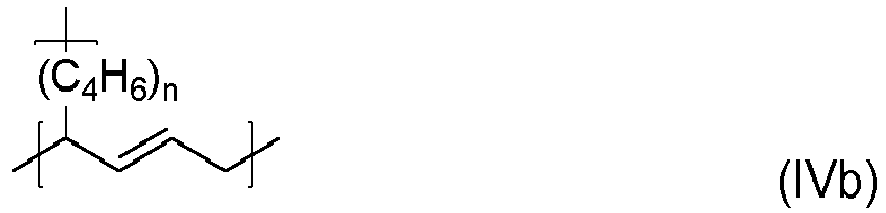

- Darüber hinaus kann das Polybutadien in einer teilweise oder vollständig hydrierten Form vorliegen.
- Die eingesetzten hydroxyterminierten Polybutadiene werden vorzugsweise mittels radikalischer Polymerisation, beispielsweise durch Polymerisation von 1,3-Butadien in Anwesenheit von Wasserstoffperoxid, Wasser und einem organischen Lösungsmittel hergestellt. Geeignete Verfahren sind beispielsweise in
EP 2 492 292 beschrieben. - Die im Rahmen der vorliegenden Erfindung vorzugsweise einsetzbaren Polybutadiene sind kommerziell erhältlich, beispielsweise als POLYVEST® HT von der Evonik Resource Efficiency GmbH.
- Die Funktionalität der eingesetzten OH-funktionellen, vorzugsweise OH-terminierten Polyolefine, bevorzugt Polybutadiene, welche auch anteilig oder vollständig hydriert vorliegen können, vorzugsweise aber unhydriert sind, liegt vorzugsweise im Bereich von 1,8 bis 5, bevorzugt im Bereich von 2 bis 3,5, und insbesondere bevorzugt im Bereich von 2 bis 3.
- Es ist möglich, die Funktionalität des OH-funktionellen Polyolefins sowie des erhaltenen Block-Copolymers beispielsweise durch die Reaktion von Monoisocyanaten mit den OH-Gruppen einzustellen.
- Wesentlich im Rahmen der vorliegenden Erfindung ist das Vorliegen von OH-Gruppen zur Bildung der Copolymere. Diese OH-Gruppen sind vorzugsweise am Kettenende des Polybutadiens vorhanden, darüber hinaus können in den OH-terminierten Polybutadienen weitere OH-Gruppen entlang der Kette vorliegen. Im Rahmen der vorliegenden Erfindung wird die Funktionalität bestimmt durch die Korrelation von Molekulargewicht zu OHZ.
- Mit dem erfindungsgemäßen Verfahren werden vorzugsweise die vorab beschriebenen erfindungsgemäßen Polymere hergestellt.
- Die erfindungsgemäßen Polymere (bzw. SFP) oder die nach dem erfindungsgemäßen Verfahren erhältlichen Polymere können als oder zur Herstellung von Klebstoffen, Dichtstoffen oder Beschichtungen verwendet werden.
- Erfindungsgemäße Kleb- und Dichtstoffe sowie Beschichtungszusammensetzungen enthaltend erfindungsgemäße Polymere oder solche Polymere die nach dem erfindungsgemäßen Verfahren erhalten werden können zur Verklebung von Substraten, vorzugsweise unpolaren oder metallischen, bevorzugt öligen Substraten, sowie zur Beschichtung von Substraten verwendet werden.
- Unter öligen Substraten sind solche Untergründe zu verstehen, die auf der Oberfläche natürliche, synthetische oder mineralische Öle enthalten. Dabei können die öligen Substanzen durch Verarbeitungsschritte auf die Substrate gelangen (z. B. Ziehfette, Wachse, Trennmittel etc.) bzw. in die Substrate gelangen oder sie können aus dem Substrat an die Oberfläche gelangen (z. B. ölhaltige Holzarten wie beispielsweise Teak-Holz oder Meranti-Holz).
- Die erfindungsgemäßen Kleb- und Dichtstoffe können neben dem erfindungsgemäßen Polymer weitere Silan-terminierte bzw. Silan-funktionalisierten Polyole enthalten.
- Polyole für weitere Silan-funktionalisierte Polymere können z.B. Polyesterpolyole, Polyetherpolyole oder beliebige hydroxyfunktionelle Komponenten sein. Die Wahl dieser optionalen Polyole ist an sich beliebig.
- Als optionale weitere Polyesterpolyole können z.B. flüssige oder feste, amorphe oder (teil-)kristalline Polyesterpolyole mit Molekulargewichten mit einem Zahlenmittel zwischen 1000 g/mol und 30000 g/mol, bevorzugt zwischen 2000 g/mol und 10000 g/mol (berechnet aus der Hydroxylzahl) eingesetzt werden, wobei lineare Polyesterpolyole bevorzugt verwendet werden.
- Als optionale Polyetherpolyole können z.B. Polyetherdi- oder -triole eingesetzt werden. Beispiele hierfür sind z.B. Homo- und Copolymere aus Ethylenglykol, Propylenglykol und/oder Butandiol-1,4. Das Molekulargewicht (Zahlenmittel) der beigemischten Polyetherpolyole sollte vorzugsweise in einem Bereich von 1000 g/mol bis 10000 g/mol, bevorzugt zwischen 2000 g/mol und 8000 g/mol liegen.
- Als optionale beliebige hydroxyfunktionelle Komponenten werden vorzugsweise hydroxyfunktionelle Polyolefine wie hydroxyfunktionelle Polybutadiene, hydroxyfunktionelle Polyisoprene, hydroxyfunktionelle Polycarbonate oder hydroxyfunktionelle Polyacrylate eingesetzt.
- Die erfindungsgemäßen Kleb- und Dichtstoffe können neben dem erfindungsgemäßen Polymer weitere Silan-funktionalisierte Polymere enthalten, welche nicht durch die Umsetzung eines Polyols mit einem Diisocyanat und anschließender Umsetzung eines Aminosilans oder Hydroxyalkylsilans und/oder der Umsetzung eines Polyols mit einem Isocyanat-funktionalisiertem Silan erhalten wurden. Ein Beispiel für ein solches Silan-funktionalisiertes Polymer ist VESTOPLAST ® 206 (Fa. Evonik Resource Efficiency GmbH).
- Die erfindungsgemäßen Kleb- und Dichtstoffe können neben den erfindungsgemäßen Polymeren weitere niedermolekulare Silane enthalten, welche beispielsweise als Vernetzer fungieren oder weitere funktionelle Gruppen einfügen. Beispiele solcher niedermolekularen Silane sind Vinyltrimethoxysilan, Vinyldimethoxymethylsilan, Vinyltriethoxysilan, Vinyltriacetoxysilan, 3-Methacryloxypropyltrimethoxysilan, Methacryloxymethyl)-methyldimethoxysilan, Methacryloxymethyltrimethoxysilan, 3-Methacryloxypropyltriacetoxysilan, N-Methyl[3-(Trimethoxysilyl) propyl]carbamat, N-TrimethoxysilylmethylO-methylcarbamat, N-Dimethoxy(methyl)silylmethyl-O-methylcarbamat, Tris-[3-(trimethoxysilyl) propyl]-isocyanurat, 3-Glycidoxypropyltrimethoxysilan, 3-Glycidoxypropyltriethoxysilan, Methyltrimethoxysilan, Methyltriethoxysilan, Dimethyldimethoxysilan, Dimethyldiethoxysilan, Trimethylethoxysilan, Isooctyltrimethoxysilan, Isooctyltriethoxysilan, Hexadecyltrimethoxysilan, (Cyclohexyl)methyldimethoxysilan, Dicyclopentyldimethoxysilan, Phenyltriethoxysilan, Triacetoxyethylsilan oder 1,2-Bis(triethoxysilyl)ethan.
- Die erfindungsgemäßen Kleb- und Dichtstoffe können einen Katalysator enthalten, welcher die Reaktion der Silangruppen mit Feuchtigkeit katalysiert, beispielsweise Dibutylzinndilaurat (DBTL).
- Die erfindungsgemäßen Kleb- und Dichtstoffe können neben den erfindungsgemäßen Polymeren bis zu 50 Gew.-%, bezogen auf die gesamte Kleb- oder Dichtstoffzusammensetzung, an weiteren Additiven enthalten.
- Diese Additive können zum Beispiel sein: nicht OH-funktionalisierte Polymere, z. B. thermoplastische Polyurethane (TPU) und/oder Polyacrylate und/oder Ethylen-Vinylacetatcopolymere (EVA); Pigmente bzw. Füllstoffe, z. B. Talkum, Siliciumdioxid, Titandioxid, Bariumsulfat, Calciumcarbonat, Ruß oder farbige Pigmente; Tackifier, wie. z. B. Kolophoniumharze, Kohlenwasserstoffharze, Phenolharze sowie Alterungsschutz- und Hilfsmittel.
- Vorzugsweise handelt es sich bei den Verklebungen um Verklebungen in der Holz- und Möbelindustrie (beispielsweise Montageverklebung sowie die Kaschierung und Laminierung von Dekorfolien auf Faserplatten), im Automobilbereich (beispielsweise Kaschierungen von Folien oder Textilien auf Türseitenteilen, Dachhimmel, die Sitzherstellung sowie Retainerverklebungen, Anbauteile im (semi)-strukturellen Bereich, faserverstärkten Verbundwerkstoffen oder/und Metalle), in der Bauindustrie, Schuhindustrie und Textilindustrie (beispielsweise silikonisierte oder hydrophobierte Textilien) sowie im Fensterbau (beispielsweise zur Profilummantelung).
- Weiterhin eignen sich die erfindungsgemäßen Kleb- und Dichtstoffe in der Verpackungsindustrie, als Dichtstoffe sowie als Beschichtungsmaterial.
- Die erfindungsgemäßen SFP eignen sich sowohl für den Einsatz in einkomponentigen als auch in zweikomponentigen Systemen.
- Bei den einkomponentigen Klebstoffen erfolgt die Herstellung der Mischung zeitlich unabhängig vom Klebstoffauftrag, üblicherweise zu einem deutlich früheren Zeitpunkt. Nach dem Auftrag des erfindungsgemäßen Klebstoffs erfolgt die Härtung beispielsweise durch Feuchtigkeit oder thermisch induzierte Reaktion der im Klebstoff enthaltenen Reaktionspartner. Bei den zweikomponentigen Klebstoffen wird die Mischung unmittelbar vor Klebstoffauftrag hergestellt.
- In einer besonderen Ausführungsform handelt es sich bei Kleb- und Dichtstoffen um Dual-Cure-Systeme, welche neben der Aushärtung durch Feuchtigkeit auch strahlenhärtend sind. Durch die Wahl geeigneter niedermolekularen Vernetzer, beispielsweise durch das Zufügen von 3-Methacryloxypropyltrimethoxysilan, Methacryloxymethylmethyldimethoxysilan, Methacryloxymethyltrimethoxysilan oder 3-Methacryloxypropyltriacetoxysilan als niedermolekularer, reaktiver Vernetzer, können Systeme erhalten werden, in denen die Silangruppen über Feuchtigkeit vernetzen, die Methacrylgruppen der niedermolekularen Vernetzer hingegen per Strahlenhärtung. Die jeweiligen Vernetzungen können dabei zeitlich unabhängig voneinander erfolgen.
- In einer weiteren besonderen Ausführungsform handelt es sich bei erfindungsgemäßen Kleb- und Dichtstoffen um Dual-Cure-Systeme, welche neben der Aushärtung durch Feuchtigkeit über Epoxygruppen und Aminhärter vernetzen. Durch die Wahl geeigneter niedermolekularen Vernetzer, beispielsweise durch das Zufügen von 3-Glycidoxypropyltrimethoxysilan oder 3-Glycidoxypropyltriethoxysilan als niedermolekularer, reaktiver Vernetzer, werden Systeme erhalten, in denen die Silangruppen über Feuchtigkeit vernetzen, die Epoxygruppen der niedermolekularen Vernetzer hingegen per Reaktion mit Aminen und optional weiteren Epoxy-Verbindungen. Die jeweiligen Vernetzungen können dabei zeitlich unabhängig voneinander erfolgen.
- Die erfindungsgemäßen Kleb- und Dichtstoffe können durch alle bekannten Methoden appliziert werden, z. B. Extruder, Raupe, Düse, Streichen, Tauchen, Spritzen, Gießen, Walzen, Sprühen, Drucken, Wischen, Waschen, Trommeln, Zentrifugieren, Pulver (elektrostatisch).
- Die erfindungsgemäßen Beschichtungszusammensetzungen können zur Beschichtung von Substraten, vorzugsweise unpolaren oder metallischen, bevorzugt öligen Substraten, verwendet werden.
- Die erfindungsgemäßen Beschichtungszusammensetzungen können neben dem erfindungsgemäßen Polymer weitere Silan-terminierte bzw. Silan-funktionalisierten Polyole enthalten.
- Polyole für weitere Silan-funktionalisierte Polymere können z.B. Polyesterpolyole, Polyetherpolyole oder beliebige hydroxyfunktionelle Komponenten sein. Die Wahl dieser optionalen Polyole ist an sich beliebig.
- Als optionale weitere Polyesterpolyole können z.B. flüssige oder feste, amorphe oder (teil-)kristalline Polyesterpolyole mit Molekulargewichten mit einem Zahlenmittel zwischen 1000 g/mol und 30000 g/mol, bevorzugt zwischen 2000 g/mol und 10000 g/mol (berechnet aus der Hydroxylzahl) eingesetzt werden, wobei leicht verzweigte Polyesterpolyole bevorzugt verwendet werden.
- Als optionale Polyetherpolyole können z.B. Polyetherdi- oder -triole eingesetzt werden. Beispiele hierfür sind z.B. Homo- und Copolymere aus Ethylenglykol, Propylenglykol und/oder Butandiol-1,4. Das Molekulargewicht (Zahlenmittel) der beigemischten Polyetherpolyole sollte vorzugsweise in einem Bereich von 1000 g/mol bis 10000 g/mol, bevorzugt zwischen 2000 g/mol und 8000 g/mol liegen.
- Als optionale beliebige hydroxyfunktionelle Komponenten werden vorzugsweise hydroxyfunktionelle Polyolefine wie hydroxyfunktionelle Polybutadiene, hydroxyfunktionelle Polyisoprene, hydroxyfunktionelle Polycarbonate oder hydroxyfunktionelle Polyacrylate eingesetzt.
- Die erfindungsgemäßen Beschichtungszusammensetzungen können neben dem erfindungsgemäßen Polymer weitere Silan-funktionalisierte Polymere enthalten, welche nicht durch die Umsetzung eines Polyols mit einem Diisocyanat und anschließender Umsetzung eines Aminosilans oder Hydroxyalkylsilans und/oder der Umsetzung eines Polyols mit einem Isocyanat-funktionalisiertem Silan erhalten wurden. Ein Beispiel für ein solches Silan-funktionalisiertes Polymer ist VESTOPLAST ® 206 (Fa. Evonik Resource Efficiency GmbH).
- Die erfindungsgemäßen Beschichtungszusammensetzungen können neben den erfindungsgemäßen Polymeren weitere niedermolekulare Silane enthalten, welche beispielsweise als Vernetzer fungieren, weitere funktionelle Gruppen einfügen oder als funktionelle Additive, beispielsweise zur Hydrophobierung oder verbesserten Kratzfestigkeit fungieren. Beispiele solcher niedermolekularen Silane sind Vinyltrimethoxysilan, Vinyldimethoxymethylsilan, Vinyltriethoxysilan, Vinyltriacetoxysilan, 3-Methacryloxypropyltrimethoxysilan, Methacryloxymethyl)-methyldimethoxysilan, Methacryloxymethyltrimethoxysilan, 3-Methacryloxypropyltriacetoxysilan, N-Methyl[3-(Trimethoxysilyl) propyl]carbamat, N-TrimethoxysilylmethylO-methylcarbamat, N-Dimethoxy(methyl)silylmethyl-O-methylcarbamat, Tris-[3-(trimethoxysilyl) propyl]-isocyanurat, 3-Glycidoxypropyltrimethoxysilan, 3-Glycidoxypropyltriethoxysilan, Methyltrimethoxysilan, Methyltriethoxysilan, Dimethyldimethoxysilan, Dimethyldiethoxysilan, Trimethylethoxysilan, Isooctyltrimethoxysilan, Isooctyltriethoxysilan, Hexadecyltrimethoxysilan, (Cyclohexyl)methyldimethoxysilan, Dicyclopentyldimethoxysilan, Phenyltriethoxysilan, Triacetoxyethylsilan oder 1,2-Bis(triethoxysilyl)ethan.
- Die erfindungsgemäßen Beschichtungszusammensetzungen können einen Katalysator enthalten, welcher die Vernetzung der Silangruppen beschleunigt, beispielsweise Dibutylzinndilaurat (DBTL).
- Die erfindungsgemäßen Beschichtungszusammensetzungen enthalten bevorzugt mindestens ein Lösungsmittel.
- Darüber hinaus können die erfindungsgemäßen Beschichtungszusammensetzungen neben den erfindungsgemäßen Polymeren bis zu 50 Gew.-%, bezogen auf die gesamte Beschichtungszusammensetzung, an weiteren Additiven enthalten.
- Diese Additive können zum Beispiel sein: nicht OH-funktionalisierte Polymere, z. B. thermoplastische Polyurethane (TPU) und/oder Polyacrylate und/oder Ethylen-Vinylacetatcopolymere (EVA); Pigmente bzw. Füllstoffe, z. B. Talkum, Siliciumdioxid, Titandioxid, Bariumsulfat, Calciumcarbonat, Ruß oder farbige Pigmente; Tackifier, wie. z. B. Kolophoniumharze, Kohlenwasserstoffharze, Phenolharze sowie Alterungsschutz- und Hilfsmittel.
- Die erfindungsgemäßen Beschichtungszusammensetzungen können durch alle bekannten Methoden appliziert werden. In der einfachsten Ausführungsform erfolgt die Beschichtung direkt auf das Substrat. Hierzu wird insbesondere ein Verfahren verwendet, in dem die erfindungsgemäße Formulierung in organischer Lösung gemeinsam mit weiteren Formulierungsbestandteilen als "Organosol" auf das Substrat aufgetragen und die aufgetragene Schicht anschließend getrocknet wird. Dabei erfolgt die Beschichtung beispielsweise mittels Knife Coating, Roll Coating, Dip Coating, Curtain Coating, Spray Coating. Während des Trocknens erfolgt parallel die Vernetzung der Beschichtung.
- In einer besonders bevorzugten, jedoch nicht ausschließlichen, Variante der genannten Beschichtungsvariante der vorliegenden Erfindung werden die erfindungsgemäßen Formulierungen im Rahmen von Bandbeschichtungsprozessen, auch Coil-Coating genannt, eingesetzt. Coil Coating ist ein Verfahren zur ein- oder beidseitigen Beschichtung von flachen beispielsweise Stahl- oder Aluminium-Bändern. Das resultierende Material ist ein Verbundwerkstoff aus einem metallischen Trägermaterial, optional vorbehandelt und/oder mit einem Korrosionsschutzprimer versehen, und einer organischen Beschichtung. Verfahren und Ausführungsformen von Coil-Coating-Prozessen sind dem Fachmann bekannt.
- In einer zweiten Ausführungsform wird die Beschichtung in Form einer, mit der erfindungsgemäßen Beschichtungszusammensetzung ausgerüsteten Oberflächenvergütungsfolie auf das jeweilige Substratmaterial realisiert. Hierbei erfolgt zunächst die haftfeste Beschichtung der erfindungsgemäßen Beschichtungszusammensetzung auf ein entsprechendes Folien-Substratmaterial. Die Applikation dieser Oberflächenvergütungsfolie auf das jeweilige Endsubstratmaterial erfolgt anschließend. Dabei ist die Unterseite der Oberflächenvergütungsfolie entweder mit einer selbstklebenden Kleberformulierung beschichtet, mit einem Hotmelt oder mit einer Adhäsivschicht ausgerüstet. Diese Modifikation der Unterseite bindet bei einer temperatur- und druckunterstützten Applikation auf dem Endsubstratmaterial an.
- Über die Materialeigenschaften der Oberflächenvergütungsfolie können auf diese Weise weitere Produktmerkmale, z. B. auch optischer Natur, realisiert werden. Außerdem ist ein solches Verfahren sehr flexibel, z. B. bei größeren zu beschichtenden Substraten, vor Ort ohne Handhabung von Lösungsmitteln oder hohen Temperaturen anwendbar.
- In einer dritten, der zweiten Ausführungsform ähnlichen Variante, wird die Beschichtung in Form eines Thermotransfer-Prozesses der erfindungsgemäßen Beschichtungszusammensetzung auf das jeweilige Substratmaterial realisiert.
- Hierbei wird ein entsprechendes Folien- oder Papier-Trägermaterial in einem ersten Beschichtungsschritt mit einer Releaseschicht ausgerüstet, welche einen ThermoTransfer der, in einem zweiten Beschichtungsschritt applizierten, erfinderischen Coatingformulierung auf das jeweilige Substratmaterial ermöglicht.
- Optional kann hierbei, falls notwendig, in einem dritten Beschichtungsschritt eine Adhäsivschicht appliziert werden, welche eine sachgerechte Haftung des Thermotransfer-Schichtenaufbaus auf dem jeweiligen Substratmaterial gewährleistet.
- Eine vierte Ausführungsform repräsentiert die Lösungsmittel-freie Pulverlackbeschichtung. Geeignete Verfahren und Ausführungsformen diesbezüglich sind dem Fachmann hinlänglich bekannt.
- In einer weiteren Ausführungsform der vorliegenden Erfindung werden die erfindungsgemäßen Formulierungen zur Herstellung von Coil-Laminaten eingesetzt. Entsprechende Systeme und Ausführungsformen sind dem Fachmann grundsätzlich bekannt.
- Die erfindungsgemäße Beschichtung kann anschließend optional mit einer oder mehreren weiteren funktionellen Schichten versehen werden. Dabei kann es sich beispielsweise um eine Kratzfestbeschichtung, eine leitfähige Schicht, eine Antisoiling-Beschichtung und/oder um eine reflektionserhöhende Schicht oder anderen optisch funktionelle Schichten handeln. Diese zusätzlichen Schichten können beispielsweise mittels Physical Vapour Deposition (PVD) oder Chemical Vapour Deposition (CVD) aufgebracht werden.
- Eine zusätzliche Kratzfestbeschichtung kann optional zur weiteren Verbesserung der Kratzfestigkeit aufgetragen werden. Bei Kratzfestbeschichtungen kann es sich z. B. um Siliziumoxid-Schichten handeln, die direkt mittels PVD oder CVD aufgetragen werden.
- Auch ohne weitere Ausführungen wird davon ausgegangen, dass ein Fachmann die obige Beschreibung im weitesten Umfang nutzen kann. Die bevorzugten Ausführungsformen und Beispiele sind deswegen lediglich als beschreibende, keinesfalls als in irgendeiner Weise limitierende Offenbarung aufzufassen.
- Der Gegenstand der vorliegenden Erfindung wird in den nachfolgenden Beispielen näher erläutert, ohne dass der Gegenstand der vorliegenden Erfindung darauf beschränkt sein soll.
- Das zahlenmittlere und das gewichtsmittlere Molekulargewicht der im Rahmen der vorliegenden Erfindung eingesetzten Block-Copolymere wird nach DIN 55672-1 mittels Gelpermeationschromatographie in Tetrahydrofuran als Eluent und Polystyrol zur Kalibrierung bestimmt. Die Polydispersität (U) = Mw/Mn.
- Die hergestellten Block-Copolymere besitzen Hydroxylgruppen als Endgruppen. Die Konzentration der OH-Gruppen wird nach DIN 53240-2 titrimetrisch in mgKOH / g Polymer bestimmt.
- Die Elastizität und Flexibilität der erfindungsgemäßen Filme sowie die Klebeigenschaften der hergestellten Klebstoff-Formulierungen wird anhand der Zugscherfestigkeit nach DIN EN 1465 in N/mm2 gemessen.
-
- POLYVEST® HT: Hydroxyfunktionalisiertes Polybutadien (Fa. Evonik Resource Efficiency GmbH)
- DYNACOLL 7360: Hydroxyterminierter Polyester (Fa. Evonik Resource Efficiency GmbH)
- ε-Caprolacton (Fa. BASF SE)
- Isocyanatopropyltrimethoxysilan (IPMS - Fa. Evonik Resource Efficiency GmbH)
- 750 g POLYVEST® HT wurden mit 750 g ε-Caprolacton und 0,75g TYTAN TNBT unter Stickstoffstrom in einen 2 I Mehrhalskolben mit Rückflusskühler vermengt. Anschließend wurde die Mischung unter stetem Stickstoffstrom auf 160 °C für 6 Stunden erhitzt. Das daraus hergestellte Block-Copolymer wurde per GPC-Analyse auf vollständigen Umsatz untersucht und konnte anschließend ohne weitere Aufarbeitungen zur Herstellung des SFP verwendet werden.
- In einem 500 ml Planschliffkolben wurden 300g Polyol bei 130 °C für 45 Minuten im Vakuum (< 10 mbar) getrocknet. Danach wurde die Schmelze auf 80 °C abgekühlt und 0,03 g DBTL (0,01 Gew-% bezogen auf das Polyol) sowie die in Tabelle 1 angegebene Menge IPMS in einem molaren OH/NCO-Verhältnis von 1:1 zugegeben und für 45 Minuten bei 80 °C unter Stickstoff homogenisiert. Anschließend wurden 0,17 g DBTL als Aushärtungskatalysator zugegeben. Danach wurde der SFP abgefüllt.
- Aus den SFP 2a-c wurden Filme mit ca. 1 mm Schichtdicke hergestellt und bei 20 °C und 65 % rel. Luftfeuchtigkeit für die in Tabelle 1 angegebene Zeit gelagert sowie anschließend bzgl. Kohäsion und Elastizität analysiert. Ebenfalls wurden ausgewählte Substrate mit den SFP verklebt und nach 2 Wochen Lagerung bei 20 °C und 65 % rel. Luftfeuchtigkeit bzgl. der Zugscherfestigkeit analysiert.
Tabelle 1: Einsatzmengen der zur SFP-Herstellung verwendeten Substanzen sowie Ergebnisse der Ausprüfung derSFP-Kenndaten SFP 2a (Vergleichsbeispiel) 2b (Vergleichsbeispiel) 2c (Erfindungsgemäß) Verwendetes Polyol DYNACOLL 7360 POLYVEST HT Beispiel 1 OHZ Polyol 30 45 25 Einwaage Polyol 300 g 300 g 300 g Einwaage IPMS 34,8 g 54,6 g 23,6 g Filmeigenschaften nach 1 Woche Aushärtung Zugfestigkeit 17 N/mm2 0,4 N/mm2 5 N/mm2 Elongation at Break 8% 17% 27% Filmeigenschaften nach 2 Wochen Aushärtung Zugfestigkeit 19 N/mm2 1 N/mm2 6 N/mm2 Elongation at Break 9% 21% 27% Klebeigenschaften (Zugscherfestigkeit nach DIN EN 1465) nach 2 Wochen Aushärtung PVC 5,2 N/mm2 0,8 N/mm2 5,1 N/mm2 Stahl sauber 2,4 N/mm2 0,3 N/mm2 3,1 N/mm2 Stahl ölig* < 0,3 N/mm2 0,3 N/mm2 2,8 N/mm2 *Das Stahl wurde kontrolliert kontaminiert. Hierzu wurde das Substrat zunächst mit Aceton gereinigt und dann mit Hilfe eines Handtuchpapiers als Beispielsubstanz das Schmieröl für Vakuumpumpen N62 (Fa. Leybold) aufgetragen. Es ergab sich, dass auf eine Fläche von 15,3 x 10,0 cm eine Ölmenge von 0,0384 g aufgetragen wurde, das ergibt ca. 2,5 g/m2. Vor dem Ölauftrag wurde der Stahl auf 65 °C erwärmt. - Die erhaltenen Werte in Tabelle 1 zeigen deutlich, dass die erfindungsgemäßen SFP basierend auf Block-Copolymeren im Vergleich zu reinen Polyester-basierten Systemen eine verbesserte Elastizität haben, gleichzeitig jedoch im Vergleich zu reinen Polyolefin-basierten SFP eine bessere Kohäsion und deutlich verbesserte Klebeigenschaften auf polaren Substraten wie PVC oder Metall aufweisen.
Claims (15)
- Polymer enthaltend eine oder mehrere Polyester- und eine oder mehrere Polyolefin-Struktureinheiten, dadurch gekennzeichnet, dass das Polymer mindestens eine Struktureinheit der Formel (I)

- Polymer gemäß Anspruch 1, dadurch gekennzeichnet, dass das Polymer der Formel (II)
 P = Polyolefinstruktureinheit,A = gleiche oder verschiedene Kohlenwasserstoffreste, bevorzugt -C5H10- und/oder-C(CH3)H-Rest,X = Linker, der mindestens eine -N-C(O)-O- Gruppe aufweist,z >= 1 undn von 2 bis 500 ist.
 - Polymer nach Anspruch 2, dadurch gekennzeichnet, dass der Linker X die Formel (IIa), (IIb), (IIc), (IId) und/oder (IIe) aufweist,


- Polymer nach mindestens einem der Ansprüche 1 bis 3, dadurch gekennzeichnet, dass mindestens eine Polyolefinstruktureinheit auf einem OH-funktionellen Polyolefin, vorzugsweise OH-funktionellem Polybutadien basiert.
- Polymer nach einem der vorangegangenen Ansprüche, dadurch gekennzeichnet, dass mindestens eine Polyesterstruktureinheit auf ε-Caprolacton und zusätzlich gegebenenfalls Lactid basiert.
- Polymer nach einem der vorangegangenen Ansprüche, dadurch gekennzeichnet, dass R ein linearer Kohlenwasserstoffrest -CkH2k- mit k = 1 bis 3, bevorzugt k = 1 oder 3, besonders bevorzugt k = 3 ist.
- Polymer nach einem der vorangegangenen Ansprüche, dadurch gekennzeichnet, dass x => 2 ist.
- Polymer nach einem der vorangegangenen Ansprüche, dadurch gekennzeichnet, dass z => 2 ist.
- Verfahren zur Herstellung eines Silan-funktionalisierten Polymers, dadurch gekennzeichnet, dass das Umsetzungsprodukt eines Block-Copolymers auf Basis von OH-funktionellem Polyolefin, welches auch anteilig oder vollständig hydriert vorliegen kann, vorzugsweise aber unhydriert ist, bevorzugt OH-funktionellem Polybutadien, und zyklischen Estern als Polyol, welches mindestens 1,8 OH-Gruppen aufweist, direkt oder nach einem Zwischenschritt mit mindestens einer organischen Silanverbindung umgesetzt wird.
- Verfahren nach Anspruch 9, dadurch gekennzeichnet, dass als Silanverbindung ein Isocyanat-funktionelles Silan eingesetzt wird.
- Verfahren nach Anspruch 9, dadurch gekennzeichnet, dass das Polyol mit einem Polyisocyanat, vorzugsweise Diisocyanat umgesetzt wird, welches anschließend mit einem Aminosilan umgesetzt wird.
- Verfahren nach einem der Ansprüche 9 bis 11, dadurch gekennzeichnet, dass ein Polymer gemäß einem der Ansprüche 1 bis 8 hergestellt wird.
- Verwendung von Polymeren nach einem der Ansprüche 1 bis 8 oder erhältlich nach einem Verfahren gemäß einem der Ansprüche 9 bis 12 zur Herstellung von Klebstoffen, Dichtstoffen oder Beschichtungen.
- Kleb- und Dichtstoffe sowie Beschichtungszusammensetzungen enthaltend Polymere nach einem der Ansprüche 1 bis 8 oder erhältlich nach einem Verfahren gemäß einem der Ansprüche 9 bis 12.
- Verwendung der Kleb- und Dichtstoffe gemäß Anspruch 14 zur Verklebung von Substraten, vorzugsweise öligen Substraten.
Priority Applications (3)
| Application Number | Priority Date | Filing Date | Title |
|---|---|---|---|
| EP17199877.6A EP3480234A1 (de) | 2017-11-03 | 2017-11-03 | Block-copolymere, enthaltend polyester- und polyolefin-struktureinheiten, und deren verwendung |
| PCT/EP2018/079857 WO2019086533A1 (de) | 2017-11-03 | 2018-10-31 | Formulierungen enthaltend block-copolymere und deren verwendung |
| TW107138808A TW201925328A (zh) | 2017-11-03 | 2018-11-01 | 包含嵌段共聚物之調配物及其用途 |
Applications Claiming Priority (1)
| Application Number | Priority Date | Filing Date | Title |
|---|---|---|---|
| EP17199877.6A EP3480234A1 (de) | 2017-11-03 | 2017-11-03 | Block-copolymere, enthaltend polyester- und polyolefin-struktureinheiten, und deren verwendung |
Publications (1)
| Publication Number | Publication Date |
|---|---|
| EP3480234A1 true EP3480234A1 (de) | 2019-05-08 |
Family
ID=60421557
Family Applications (1)
| Application Number | Title | Priority Date | Filing Date |
|---|---|---|---|
| EP17199877.6A Withdrawn EP3480234A1 (de) | 2017-11-03 | 2017-11-03 | Block-copolymere, enthaltend polyester- und polyolefin-struktureinheiten, und deren verwendung |
Country Status (3)
| Country | Link |
|---|---|
| EP (1) | EP3480234A1 (de) |
| TW (1) | TW201925328A (de) |
| WO (1) | WO2019086533A1 (de) |
Cited By (1)
| Publication number | Priority date | Publication date | Assignee | Title |
|---|---|---|---|---|
| JP2020172625A (ja) * | 2019-04-09 | 2020-10-22 | 三菱ケミカル株式会社 | ポリエステル系粘着剤組成物、ポリエステル系粘着剤及び粘着シート |
Families Citing this family (1)
| Publication number | Priority date | Publication date | Assignee | Title |
|---|---|---|---|---|
| EP3243863A1 (de) | 2016-05-09 | 2017-11-15 | Evonik Degussa GmbH | Verwendung von block-copolymeren in klebstoffen |
Citations (7)
| Publication number | Priority date | Publication date | Assignee | Title |
|---|---|---|---|---|
| WO2007037824A2 (en) | 2005-09-14 | 2007-04-05 | Momentive Performance Materials Inc. | Process for the continuous production of silylated resin |
| WO2007037915A2 (en) | 2005-09-15 | 2007-04-05 | Momentive Performance Materials Inc. | Preparation of amino-silane terminated polymer by using organic bismuth catalyst and cured polymer therefrom by using non-tin catalyst |
| EP2492292A1 (de) | 2012-05-29 | 2012-08-29 | Evonik Industries AG | Polymerisation von Dien |
| EP2821423A1 (de) * | 2012-05-30 | 2015-01-07 | Nippon Soda Co., Ltd. | Polyurethan |
| US20150031806A1 (en) * | 2013-07-24 | 2015-01-29 | Momentive Performance Materials Inc. | Moisture curable compositions with enhanced elongation and tear strentgh properties |
| WO2016180649A1 (de) | 2015-05-13 | 2016-11-17 | Evonik Degussa Gmbh | Verbesserung des rollwiderstands von dienkautschukreifen durch silanmodifizierte polybutadiene |
| WO2017162529A1 (de) * | 2016-03-21 | 2017-09-28 | Basf Se | Vernetztes polyurethan |
Family Cites Families (1)
| Publication number | Priority date | Publication date | Assignee | Title |
|---|---|---|---|---|
| US7976951B2 (en) * | 2006-11-14 | 2011-07-12 | Momentive Performance Materials Inc. | Laminate containing an adhesive-forming composition |
-
2017
- 2017-11-03 EP EP17199877.6A patent/EP3480234A1/de not_active Withdrawn
-
2018
- 2018-10-31 WO PCT/EP2018/079857 patent/WO2019086533A1/de not_active Ceased
- 2018-11-01 TW TW107138808A patent/TW201925328A/zh unknown
Patent Citations (7)
| Publication number | Priority date | Publication date | Assignee | Title |
|---|---|---|---|---|
| WO2007037824A2 (en) | 2005-09-14 | 2007-04-05 | Momentive Performance Materials Inc. | Process for the continuous production of silylated resin |
| WO2007037915A2 (en) | 2005-09-15 | 2007-04-05 | Momentive Performance Materials Inc. | Preparation of amino-silane terminated polymer by using organic bismuth catalyst and cured polymer therefrom by using non-tin catalyst |
| EP2492292A1 (de) | 2012-05-29 | 2012-08-29 | Evonik Industries AG | Polymerisation von Dien |
| EP2821423A1 (de) * | 2012-05-30 | 2015-01-07 | Nippon Soda Co., Ltd. | Polyurethan |
| US20150031806A1 (en) * | 2013-07-24 | 2015-01-29 | Momentive Performance Materials Inc. | Moisture curable compositions with enhanced elongation and tear strentgh properties |
| WO2016180649A1 (de) | 2015-05-13 | 2016-11-17 | Evonik Degussa Gmbh | Verbesserung des rollwiderstands von dienkautschukreifen durch silanmodifizierte polybutadiene |
| WO2017162529A1 (de) * | 2016-03-21 | 2017-09-28 | Basf Se | Vernetztes polyurethan |
Cited By (1)
| Publication number | Priority date | Publication date | Assignee | Title |
|---|---|---|---|---|
| JP2020172625A (ja) * | 2019-04-09 | 2020-10-22 | 三菱ケミカル株式会社 | ポリエステル系粘着剤組成物、ポリエステル系粘着剤及び粘着シート |
Also Published As
| Publication number | Publication date |
|---|---|
| TW201925328A (zh) | 2019-07-01 |
| WO2019086533A1 (de) | 2019-05-09 |
Similar Documents
| Publication | Publication Date | Title |
|---|---|---|
| EP3224295B1 (de) | Silangruppen-haltige zusammensetzung mit schneller aushärtung | |
| EP3224294B1 (de) | Silangruppen-haltige zusammensetzung mit schneller aushärtung | |
| EP2852649B1 (de) | Silangruppen-haltiges polymer | |
| EP2510027B1 (de) | Polyurethan-prepolymere | |
| EP2641924B1 (de) | Nicht wässriges, bei Umgebungstemperatur härtendes Beschichtungsmittel | |
| EP2523986B1 (de) | 1k- kaschierklebstoff mit silanvernetzung | |
| EP3265532B1 (de) | Klebstoffe mit geringen voc und fogging-werten | |
| EP2832757A1 (de) | Silangruppen-haltiges Polymer | |
| DE10237270A1 (de) | Silanvernetzbare Beschichtungsformulierungen | |
| EP3455288A1 (de) | Verwendung von block-copolymeren in klebstoffen | |
| DE102009046190A1 (de) | Kaschierklebstoff mit Silanvernetzung | |
| EP3620479A1 (de) | Zinnfreie katalyse von silan-funktionalen polyurethan vernetzern | |
| EP3728472B1 (de) | Feuchtigkeitshärtende zusammensetzungen | |
| EP3099697B1 (de) | Silanmodifizierte formamide | |
| EP3480234A1 (de) | Block-copolymere, enthaltend polyester- und polyolefin-struktureinheiten, und deren verwendung | |
| EP3727686B1 (de) | Feuchtigkeitshärtende zusammensetzungen | |
| EP2665790B1 (de) | Lagerstabiler nco-freier kaschierklebstoff | |
| EP3613786A1 (de) | Trocknungsmittel für feuchtigkeitshärtende zusammensetzungen | |
| EP3704173A1 (de) | Reaktivklebstoffe auf basis von block-copolymeren | |
| EP3613785A1 (de) | Trocknungsmittel für feuchtigkeitshärtende zusammensetzungen | |
| EP4305107A1 (de) | Alterungsbeständige feuchtigkeitshärtende zusammensetzungen | |
| WO2001060885A1 (de) | Polyisocyanate als beschichtungskomponenten für festkörperreiche beschichtungsmittel | |
| EP3083743A1 (de) | Haftvermittler für lösemittelbasierte klarlacke | |
| EP3620480A1 (de) | Zinnfreie katalyse von silan-funktionalen polyurethan vernetzern |
Legal Events
| Date | Code | Title | Description |
|---|---|---|---|
| PUAI | Public reference made under article 153(3) epc to a published international application that has entered the european phase |
Free format text: ORIGINAL CODE: 0009012 |
|
| STAA | Information on the status of an ep patent application or granted ep patent |
Free format text: STATUS: THE APPLICATION HAS BEEN PUBLISHED |
|
| AK | Designated contracting states |
Kind code of ref document: A1 Designated state(s): AL AT BE BG CH CY CZ DE DK EE ES FI FR GB GR HR HU IE IS IT LI LT LU LV MC MK MT NL NO PL PT RO RS SE SI SK SM TR |
|
| AX | Request for extension of the european patent |
Extension state: BA ME |
|
| RAP1 | Party data changed (applicant data changed or rights of an application transferred) |
Owner name: EVONIK OPERATIONS GMBH |
|
| STAA | Information on the status of an ep patent application or granted ep patent |
Free format text: STATUS: THE APPLICATION IS DEEMED TO BE WITHDRAWN |
|
| 18D | Application deemed to be withdrawn |
Effective date: 20191109 |