EP3472945B1 - Beam reporting and scheduling in multicarrier beamformed communications - Google Patents
Beam reporting and scheduling in multicarrier beamformed communications Download PDFInfo
- Publication number
- EP3472945B1 EP3472945B1 EP17730011.8A EP17730011A EP3472945B1 EP 3472945 B1 EP3472945 B1 EP 3472945B1 EP 17730011 A EP17730011 A EP 17730011A EP 3472945 B1 EP3472945 B1 EP 3472945B1
- Authority
- EP
- European Patent Office
- Prior art keywords
- carrier
- groups
- base station
- group
- carriers
- Prior art date
- Legal status (The legal status is an assumption and is not a legal conclusion. Google has not performed a legal analysis and makes no representation as to the accuracy of the status listed.)
- Active
Links
Images






Classifications
-
- H—ELECTRICITY
- H04—ELECTRIC COMMUNICATION TECHNIQUE
- H04W—WIRELESS COMMUNICATION NETWORKS
- H04W24/00—Supervisory, monitoring or testing arrangements
- H04W24/10—Scheduling measurement reports ; Arrangements for measurement reports
-
- H—ELECTRICITY
- H04—ELECTRIC COMMUNICATION TECHNIQUE
- H04B—TRANSMISSION
- H04B7/00—Radio transmission systems, i.e. using radiation field
- H04B7/02—Diversity systems; Multi-antenna system, i.e. transmission or reception using multiple antennas
- H04B7/04—Diversity systems; Multi-antenna system, i.e. transmission or reception using multiple antennas using two or more spaced independent antennas
- H04B7/06—Diversity systems; Multi-antenna system, i.e. transmission or reception using multiple antennas using two or more spaced independent antennas at the transmitting station
- H04B7/0613—Diversity systems; Multi-antenna system, i.e. transmission or reception using multiple antennas using two or more spaced independent antennas at the transmitting station using simultaneous transmission
- H04B7/0615—Diversity systems; Multi-antenna system, i.e. transmission or reception using multiple antennas using two or more spaced independent antennas at the transmitting station using simultaneous transmission of weighted versions of same signal
- H04B7/0617—Diversity systems; Multi-antenna system, i.e. transmission or reception using multiple antennas using two or more spaced independent antennas at the transmitting station using simultaneous transmission of weighted versions of same signal for beam forming
-
- H—ELECTRICITY
- H04—ELECTRIC COMMUNICATION TECHNIQUE
- H04L—TRANSMISSION OF DIGITAL INFORMATION, e.g. TELEGRAPHIC COMMUNICATION
- H04L5/00—Arrangements affording multiple use of the transmission path
- H04L5/0001—Arrangements for dividing the transmission path
- H04L5/0003—Two-dimensional division
- H04L5/0005—Time-frequency
- H04L5/0007—Time-frequency the frequencies being orthogonal, e.g. OFDM(A) or DMT
- H04L5/001—Time-frequency the frequencies being orthogonal, e.g. OFDM(A) or DMT the frequencies being arranged in component carriers
-
- H—ELECTRICITY
- H04—ELECTRIC COMMUNICATION TECHNIQUE
- H04L—TRANSMISSION OF DIGITAL INFORMATION, e.g. TELEGRAPHIC COMMUNICATION
- H04L5/00—Arrangements affording multiple use of the transmission path
- H04L5/0001—Arrangements for dividing the transmission path
- H04L5/0014—Three-dimensional division
- H04L5/0023—Time-frequency-space
-
- H—ELECTRICITY
- H04—ELECTRIC COMMUNICATION TECHNIQUE
- H04L—TRANSMISSION OF DIGITAL INFORMATION, e.g. TELEGRAPHIC COMMUNICATION
- H04L5/00—Arrangements affording multiple use of the transmission path
- H04L5/003—Arrangements for allocating sub-channels of the transmission path
- H04L5/0048—Allocation of pilot signals, i.e. of signals known to the receiver
- H04L5/0051—Allocation of pilot signals, i.e. of signals known to the receiver of dedicated pilots, i.e. pilots destined for a single user or terminal
-
- H—ELECTRICITY
- H04—ELECTRIC COMMUNICATION TECHNIQUE
- H04L—TRANSMISSION OF DIGITAL INFORMATION, e.g. TELEGRAPHIC COMMUNICATION
- H04L5/00—Arrangements affording multiple use of the transmission path
- H04L5/0091—Signalling for the administration of the divided path, e.g. signalling of configuration information
- H04L5/0092—Indication of how the channel is divided
-
- H—ELECTRICITY
- H04—ELECTRIC COMMUNICATION TECHNIQUE
- H04L—TRANSMISSION OF DIGITAL INFORMATION, e.g. TELEGRAPHIC COMMUNICATION
- H04L67/00—Network arrangements or protocols for supporting network services or applications
- H04L67/2866—Architectures; Arrangements
- H04L67/30—Profiles
- H04L67/303—Terminal profiles
-
- H—ELECTRICITY
- H04—ELECTRIC COMMUNICATION TECHNIQUE
- H04W—WIRELESS COMMUNICATION NETWORKS
- H04W16/00—Network planning, e.g. coverage or traffic planning tools; Network deployment, e.g. resource partitioning or cells structures
- H04W16/24—Cell structures
- H04W16/28—Cell structures using beam steering
-
- H—ELECTRICITY
- H04—ELECTRIC COMMUNICATION TECHNIQUE
- H04L—TRANSMISSION OF DIGITAL INFORMATION, e.g. TELEGRAPHIC COMMUNICATION
- H04L5/00—Arrangements affording multiple use of the transmission path
- H04L5/14—Two-way operation using the same type of signal, i.e. duplex
-
- H—ELECTRICITY
- H04—ELECTRIC COMMUNICATION TECHNIQUE
- H04W—WIRELESS COMMUNICATION NETWORKS
- H04W88/00—Devices specially adapted for wireless communication networks, e.g. terminals, base stations or access point devices
- H04W88/02—Terminal devices
-
- H—ELECTRICITY
- H04—ELECTRIC COMMUNICATION TECHNIQUE
- H04W—WIRELESS COMMUNICATION NETWORKS
- H04W88/00—Devices specially adapted for wireless communication networks, e.g. terminals, base stations or access point devices
- H04W88/08—Access point devices
Definitions
- the following relates generally to multicarrier beamformed wireless communication, and more specifically to beam reporting and scheduling in multicarrier beamformed communications.
- Wireless communications systems are widely deployed to provide various types of communication content such as voice, video, packet data, messaging, broadcast, and so on. These systems may be capable of supporting communication with multiple users by sharing the available system resources (e.g., time, frequency, and power).
- Examples of such multiple-access systems include code division multiple access (CDMA) systems, time division multiple access (TDMA) systems, frequency division multiple access (FDMA) systems, and orthogonal frequency division multiple access (OFDMA) systems, (e.g., a Long Term Evolution (LTE) system).
- CDMA code division multiple access
- TDMA time division multiple access
- FDMA frequency division multiple access
- OFDMA orthogonal frequency division multiple access
- a wireless multiple-access communications system may include a number of base stations, each simultaneously supporting communication for multiple communication devices, which may be otherwise known as user equipment (UE).
- UE user equipment
- Some wireless communication systems may operate in mmW frequency ranges, e.g., 28 GHz, 40 GHz, 60 GHz, etc. Wireless communication at these frequencies may be associated with increased signal attenuation (e.g ., path loss), which may be influenced by various factors, such as temperature, barometric pressure, diffraction, etc. As a result, signal processing techniques, such as beamforming, may be used to coherently combine energy and overcome the path losses at these frequencies. Due to the increased amount of path loss in beamformed communications systems, transmissions from the UE may be beamformed. In frequency bands lower than mmW frequency ranges, UEs and base stations with large number of antenna elements may use beamformed communications to increase reliability.
- Some wireless communications systems may support operation on multiple cells or carriers, a feature which may be referred to as carrier aggregation (CA) or multi-carrier operation.
- a carrier may also be referred to as a component carrier (CC), a layer, a channel, etc.
- CC component carrier
- the terms “carrier,” “component carrier,” “cell,” and “channel” may be used interchangeably herein.
- a UE 115 may be configured with multiple downlink CCs and one or more uplink CCs for carrier aggregation.
- Carrier aggregation may be used with both frequency division duplex (FDD) and time division duplex (TDD) component carriers.
- FDD frequency division duplex
- TDD time division duplex
- CA may be used to further increase the available bandwidth and data-rates.
- CA may include operations on multiple cells or carriers.
- analog beamforming which may have or use new functionality when combined with CA.
- the multiple component carriers may share the same antenna panels, in which case, the beams from the carriers will point in the same direction (e.g., a single beam carries all the carriers).
- the carriers may be divided into groups, where carriers in the same group use the same panel while those in different groups use different panels. In this case, the beams from different groups may be pointed in different directions.
- the UE measurement and reporting may be done separately on each component carrier. The frequency selectivity could arise in beamformed communication systems as well. However, if the beams from all the component carriers within a group of component carriers are known to be in the same direction at the transmitter, then beam related UE measurements may be combined across multiple component carriers.
- the strongest beam received at the UE may not be the same across all carriers.
- these separate strongest-beam reports may be combined across carriers in some fashion at the base station to determine which beam to use. For example, the base station may select a beam that is commonly reported for all carriers.
- the base station may combine the strengths across carriers for each beam, and thus determine the globally strongest beam across all the carriers. This solution, however, may require extensive reporting from the UE. To reduce uplink reporting overhead, it may be preferable to report at most a few strongest beams on each carrier.
- the UE may also be able to form a separate beam for each group of carriers that is sent on a common downlink beam. It is likely that the antenna panel locations at the UE may have different (and possibly more heavy) constraints than that at the base station. Thus the UE may have a different set of constraints on the number of distinct beams to which the carriers may be allocated.
- a base station partitions carriers into group(s), e.g., carrier group(s). Each carrier within the group may share antenna panel(s) to be directed by a transmit beam in the same direction, e.g., beamformed in the same direction.
- the base station transmits a carrier grouping indication to a UE that identifies the partitioning of the carriers into the carrier group(s) and maps a group identifier for each carrier group to a beam identifier that identifies the corresponding transmit beam.
- the UE receives the carrier grouping indication from the base station and receive transmission(s) from the base station relating to UE communications on at least one of the carrier group(s) using one of the transmit beams that corresponds to the carrier group(s).
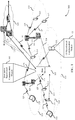
- FIG. 1 illustrates an example of a wireless communications system 100, in accordance with one or more aspects of the present disclosure.
- the wireless communications system 100 includes network access devices (e.g., base stations 105, gNodeBs (gNBs), and/or radio heads (RHs)), UEs 115, and a core network 130.
- network access devices e.g., base stations 105, gNodeBs (gNBs), and/or radio heads (RHs)
- UEs 115 e.g., gNodeBs (gNBs), and/or radio heads (RHs)
- the wireless communications system 100 may be a LTE (or LTE-Advanced) network.
- the wireless communications system 100 may be an advanced wireless communication system operating in the millimeter wave spectrum, e.g., a mmW wireless communication system.
- Base stations 105 may wirelessly communicate with UEs 115 via one or more base station antennas. Each base station 105 may provide communication coverage for a respective geographic coverage area 110.
- Communication links 125 shown in wireless communications system 100 may include uplink (UL) transmissions from a UE 115 to a base station 105, or downlink (DL) transmissions, from a base station 105 to a UE 115.
- UEs 115 may be dispersed throughout the wireless communications system 100, and each UE 115 may be stationary or mobile.
- a UE 115 may additionally or alternatively be referred to as a mobile station, a subscriber station, a remote unit, a wireless device, an access terminal (AT), a handset, a user agent, a client, or like terminology.
- a UE 115 may additionally or alternatively be a cellular phone, a wireless modem, a handheld device, a personal computer, a tablet, a personal electronic device, a machine-type communication (MTC) device, etc.
- Base stations 105 may communicate with the core network 130 and with one another. For example, base stations 105 may interface with the core network 130 through backhaul links 132 (e.g., S1, etc. ) . Base stations 105 may communicate with one another over backhaul links 134 ( e.g., X2, etc. ) either directly or indirectly ( e.g., through core network 130). A UE 115 may communicate with the core network 130 through communication link 135. Base stations 105 may perform radio configuration and scheduling for communication with UEs 115, or may operate under the control of a base station controller (not shown). In some examples, base stations 105 may be macro cells, small cells, hot spots, or the like. Base stations 105 may additionally or alternatively be referred to as eNodeBs (eNBs) 105. In some examples, base station 105 may additionally or alternatively be referred to as gNBs.
- eNodeBs eNodeBs
- Wireless communications system 100 may operate in an ultra high frequency (UHF) frequency region using frequency bands from 700 MHz to 2600 MHz (2.6 GHz), although in some cases wireless local area network (WLAN) networks may use frequencies as high as 4 GHz.
- This region may additionally or alternatively be known as the decimeter band, since the wavelengths range from approximately one decimeter to one meter in length.
- UHF waves may propagate mainly by line of sight, and may be blocked by buildings and environmental features. However, the waves may penetrate walls sufficiently to provide service to UEs 115 located indoors.
- wireless communications system 100 may utilize extremely high frequency (EHF) portions of the spectrum (e.g. , from 30 GHz to 300 GHz). This region may be known as the millimeter band, since the wavelengths range from approximately one millimeter to one centimeter in length.
- EHF antennas may be even smaller and more closely spaced than UHF antennas. In some cases, this may facilitate use of antenna arrays within a UE 115 ( e.g., for directional beamforming).
- EHF transmissions may be subject to even greater atmospheric attenuation and shorter range than UHF transmissions.
- base station antennas may be located within one or more antenna arrays.
- One or more base station antennas or antenna arrays may be collocated at an antenna assembly, such as an antenna tower.
- antennas or antenna arrays associated with a base station 105 may be located in diverse geographic locations.
- a base station 105 may multiple use antennas or antenna arrays to conduct beamforming operations for directional communications with a UE 115.
- a base station 105 and a UE 115 may communicate using more than one carrier.
- Each aggregated carrier is referred to as a CC.
- Each component can have a bandwidth of, e.g., 1.4, 3, 5, 10, 15 or 20MHz.
- the number of CCs can be limited to, e.g., a maximum of five giving maximum aggregated bandwidth is 100 MHz.
- the number of aggregated carriers can be different in DL and UL.
- the number of UL component carriers may be equal to or lower than the number of DL component carriers.
- the individual component carriers can additionally or alternatively be of different bandwidths.
- the number of CCs as well as the bandwidths of each CC will normally be the same for DL and UL.
- Component carriers may be arranged in a number of ways.
- a CA configuration may be based on contiguous component carriers within the same operating frequency band, i.e., called intra-band contiguous CA.
- Non-contiguous allocations can also be used, where the component carriers may be either be intra-band, or inter-band.
- wireless communications system 100 may utilize enhanced component carriers (eCCs).
- eCC may be characterized by one or more features including: wider bandwidth, shorter symbol duration, shorter TTIs, and modified control channel configuration.
- an eCC may be associated with a carrier aggregation configuration or a dual connectivity configuration (e.g., when multiple serving cells have a suboptimal or non-ideal backhaul link).
- An eCC may additionally or alternatively be configured for use in unlicensed spectrum or shared spectrum (where more than one operator is allowed to use the spectrum).
- An eCC characterized by wide bandwidth may include one or more segments that may be utilized by UEs 115 that are not capable of monitoring the whole bandwidth or prefer to use a limited bandwidth ( e.g ., to conserve power).
- an eCC may utilize a different symbol duration than other CCs, which may include use of a reduced symbol duration as compared with symbol durations of the other CCs.
- a shorter symbol duration is associated with increased subcarrier spacing.
- a device such as a UE 115 or base station 105, utilizing eCCs may transmit wideband signals ( e.g., 20, 40, 60, 80 MHz, etc.) at reduced symbol durations ( e.g., 16.67 microseconds).
- a TTI in eCC may comprise of one or multiple symbols. In some cases, the TTI duration (that is, the number of symbols in a TTI) may be variable.
- Wireless communications system 100 may be or include a multicarrier beamformed wireless communication system.
- aspects of wireless communications system 100 may include a UE 115 and a base station 105 informing each other about which CCs are constrained to share the same transmit beam.
- a base station 105 may include a base station beamformed communication module 101 that may partition carriers into group(s), e.g., carrier group(s). Each carrier within the group may share antenna panel(s) to be directed by a transmit beam in the same direction, e.g., beamformed in the same direction.
- the base station beamformed communication module 101 may transmit a carrier grouping indication to a UE 115 that identifies the partitioning of the carriers into the carrier group(s) and maps a group identifier for each carrier group to a beam identifier that identifies the corresponding transmit beam.
- the UE 115 may include a UE beamformed communication module 102 that may receive the carrier grouping indication from the base station 105 and receive transmission(s) from the base station 105 relating to UE communications on at least one of the carrier group(s) using one of the transmit beams that corresponds to the carrier group(s).
- FIG. 2 illustrates an example of a wireless communications system 200 for beam reporting and scheduling in multicarrier beamformed communications, in accordance with one or more aspects of the present invention
- Wireless communications system 200 may be an example of aspects of wireless communications system 100 of FIG. 1 .
- Wireless communications system 200 may include a UE 115-a, a base station 105-a, and/or a base station 105-b, which may be examples of the corresponding devices of FIG. 1 .
- Base station 105-a may be a serving base station for UE 115-a (additionally or alternatively referred to as a primary cell or PCell).
- Base station 105-b may be a neighbor base station for UE 115-a (additionally or alternatively referred to as a secondary cell or SCell).
- Base station 105-a and/or base station 105-b may be mmW base stations that transmit beamformed signals using one or more antenna panels. The transmissions from base station 105-a and/or base station 105-b may be beamformed transmissions that are directional towards UE 115-a.
- Base station 105-a and/or base station 105-b may additionally or alternatively support multicarrier communications using one or more component carriers in a beamformed wireless communication system.
- base station 105-a may transmit a beamformed transmission 205 to UE 115-a.
- Beamformed transmission 205 may include a plurality of carriers 210 that are partitioned into one or more carrier groups 215.
- base station 105-b may transmit a beamformed transmission 220 to UE 115-a that includes a carrier group 225 having a plurality of carriers.
- the wireless communications system 200 may have more than one carrier group 215 and/or carrier group 225.
- each carrier group may include more or less than three carriers 210.
- base station 105-a indicates to UE 115-a the partitioning of carriers into groups wherein all carriers within a group use the same transmit beam, e.g., may be transmitted in the same direction. For example, this could be indicated in a radio resource configuration (RRC) message that configures the UE 115-a to receive additional carriers, after the UE 115-a receives RRC connected message on the primary carrier.
- RRC radio resource configuration
- UE 115-a may report to the network (e.g., to or via base station 105-a) the UE 115-a's constraints (e.g., a carrier grouping capability indication) on how the carriers may be grouped into distinct uplink beams. Based on these UE 115-a reports, the network may choose to reconfigure the carrier groups. For example if the base station 105-a is capable of supporting two carrier groups, but the UE 115-a can support one carrier group (e.g., all uplink carriers have to be on the same beam), then the base station 105-a may be configured such that both its carrier groups use the same beam, thus combining them into a single carrier group, to better allow use of channel reciprocity across all carriers.
- the base station 105-a may be configured such that both its carrier groups use the same beam, thus combining them into a single carrier group, to better allow use of channel reciprocity across all carriers.
- UE 115-a may send two types of beam measurement reports, e.g., a "per-carrier" measurement report and a "per-carrier-group” report.
- the carrier measurements for the per-carrier-group measurement report may be performed by treating the beam reference signals of all carriers within the group as though they came from a single carrier. For example, the frequency window over which coherent combining is performed may be widened to span multiple carriers in this group.
- the carrier measurement report in this context may refer to both periodic and aperiodic reports, and both short-term and long-term average reports.
- Base station 105-a may signal in the carrier measurement request as to whether a per-carrier or per-carrier-group carrier measurement report is requested. Alternatively, if the measurement is triggered by a UE 115-a event, the UE 115-a may determine the carrier measurement report type based on various criteria such as uplink quality (e.g. , use more compact per-carrier-group reporting if uplink is heavily loaded).
- uplink quality e.g. , use more compact per-carrier-group reporting if uplink is heavily loaded.
- the carrier measurement report may require a field denoting the carrier identity.
- the carrier measurement report may require a field denoting the carrier identity.
- any one of the corresponding uplink carriers may suffice.
- a field for carrier-group identity may be used in the uplink report.
- the neighbor cell e.g., base station 105-b
- measurements may be initially reported separately per carrier.
- base station 105-b and UE 115-a may negotiate the carrier groups on the base station 105-b, using the described techniques above, and then generate per-carrier-group measurement reports on the base station 105-b as well.
- the described techniques may not use per-carrier-group reports and, instead, rely on per-carrier reports and scheduling.
- Carrier-group reports enable finding the best common beam to use for all carriers within the group.
- the UE 115-a reports the best beam for each carrier in the group separately; this may be different for different carriers.
- the transmit antenna panel constraint may prevent the base station 105-a and/or base station 105-b from using different beams on different carriers in the same TTI, hence the base station 105-a and/or base station 105-b may schedule the UE 115-a on different carriers in different TTIs.
- each carrier may use its own downlink control information (DCI) scheduling grant.
- DCI downlink control information
- a new scheduling grant may be designed to schedule the UE 115-a simultaneously (in the same TTI) on all carriers in the carrier-group. This may reduce the scheduling overhead. Further constraints may be introduced to additionally or alternatively reduce the overhead of decoding the scheduling grants at the UE 115-a.
- a grant scheduling a UE over a whole carrier group may be transmitted in a carrier within that group; and if present, the other carriers in the group refrain from carrying scheduling grants to that UE, thus making it unnecessary for that UE to look for scheduling grants in those other carriers.
- uplink scheduling grants that apply across a carrier group may use a different definition of the carrier groups compared to downlink, to reflect the different antenna panel constraints on uplink as compared to downlink.
- base station 105-a may partition a plurality of carriers into group(s). Each carrier within a group may share antenna panel(s) so as to be directed by a transmit beam in a same direction.
- the base station 105-a may transmit to UE 115-a a carrier grouping indication that identifies the partitioning of the plurality of carriers into the group(s) and maps a group identifier for at least one of the group(s) to a beam identifier that identifies the corresponding transmit beam.
- the base station 105-a may receive from UE 115-a a carrier grouping capability indication that indicates UE constraint(s) on the partitioning of the plurality of carriers.
- the base station 105-a may determine whether to modify the partitioning of the plurality of carriers based at least in part on the carrier grouping capability indication.
- the base station 105-a may transmit to the UE 115-a a request for carrier measurement report(s).
- the request may indicate whether the UE 115-a is to provide one or more reports on a per carrier basis (e.g., a per-carrier report), one or more reports on a per group basis ( e.g., a per-carrier-group report), or combinations thereof.
- the base station 105-a may indicate to the UE 115-a that the carrier measurement report(s) for carriers of at least one group are to be transmitted on a single respective carrier.
- the base station 105-a may receive from the UE 115-a carrier measurement report(s) representing carrier measurements of each group.
- the carrier measurement report(s) may include one or more reports on a per carrier basis for carriers within each group.
- the carrier measurement report(s) may include one or more reports on a per group basis for all carriers within each group.
- the carrier measurement report(s) may include periodic or aperiodic reports, and short-term or long-term average reports.
- the base station 105-a may receive the carrier measurement report(s) for carriers of at least one group on a single respective carrier.
- the carrier measurement report(s) for the carriers of the at least one group may each include a carrier identity field.
- the base station 105-a may transmit, on a carrier of the plurality of carriers, a single scheduling grant to the UE 115-a to simultaneously schedule the UE 115-a on one or more carriers within one of the one or more groups.
- the base station 105-a may refrain from transmitting additional scheduling grants for the carrier(s) within the one of the one or more groups during the same TTI as that on which the single scheduling grant is transmitted.
- partitioning of the plurality of carriers into one or more groups is UE-specific.
- the base station 105-b may negotiate with the UE 115-a to use carrier grouping.
- the base station 105-b may receive, from the UE 115-a, per carrier measurement reports in advance of negotiating with the UE 115-a, and receive, from the UE 115-a, per group measurement reports after negotiating with the UE 115-a
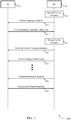
- FIG. 3 illustrates an example of a process flow 300 for beam reporting and scheduling in multicarrier beamformed communications, in accordance with one or more aspects of the present disclosure.
- Process flow 300 may implement aspects of wireless communications system 100 of FIG. 1 and/or wireless communications system 200 of FIG. 2 .
- Process flow 300 may include a UE 115-b and a base station 105-c, which may be examples of the corresponding devices of FIG. 1 and/or FIG. 2 .
- base station 105-c may partition a plurality of carriers into one or more groups. Each carrier within a group may share antenna panel(s) so as to each be directed by a transmit beam in the same direction. In some examples, partitioning the plurality of carriers may be UE-specific, e.g., particular to UE 115-b.
- base station 105-c may transmit to UE 115-b a carrier group indication that identifies the partitioning of the plurality of carriers into the group(s).
- the carrier group indication may map a group identifier for at least one group to a beam identifier that identifies the corresponding transmit beam.
- the base station 105-c may receive additional constraint information from the UE 115-b such that the base station 105-c may modify the grouping and send an updated message to the UE 115-b.
- the grouping may be based on both the base station 105-c and the UE 115-b.
- the base station 105-c may transmit (and UE 115-b may receive) transmissions relating to UE 115-b communications on at least one of the group(s) using one of the transmit beams corresponding to the at least one group.
- the base station 105-c may request measurement reports from the UE 115-b on a per-carrier basis and/or on a per-carrier-group (or per-group) basis.
- the base station 105-c may indicate to the UE 115-b which carrier, how many carriers, etc., the measurement reports are to be provided.
- the per-carrier-group measurement reports may include a measurement associated with all of the carriers in the group and/or may include a measurement associated with one or more individual carriers in the group.
- the measurement reports may be periodic and/or aperiodic and may additionally or alternatively be short-term and/or long-term reports.
- the base station 105-c may negotiate with a second UE (not shown) using the described techniques. For example, the base station 105-c may negotiate with the second UE to establish carrier grouping for communications with the second UE. The base station 105-c may receive per-carrier measurement reports from the second UE before the negotiation and receiver per-carrier group measurement reports from the second UE after the negotiations.
- the UE 115-b may negotiate with a neighbor base station (not shown) using the described techniques. For example, the UE 115-b may negotiate with the neighbor base station to establish carrier grouping for communications between the UE 115-b and the neighbor base station. The UE 115-b may transmit per-carrier measurement reports to the neighbor base station before the negotiation and transmit per-carrier group measurement reports to the neighbor base station after the negotiations.
- FIG. 4 illustrates an example of a process flow 400 for beam reporting and scheduling in multicarrier beamformed communications, in accordance with one or more aspects of the present disclosure.
- Process flow 400 may implement aspects of wireless communications system 100 of FIG. 1 and/or wireless communications system 200 of FIG. 2 .
- Process flow 400 may include a UE 115-c and a base station 105-d, which may be examples of the corresponding devices of FIGs. 1 through 3 .
- base station 105-d may partition a plurality of carriers into one or more groups. Each carrier within a group may share antenna panel(s) so as to each be directed by a transmit beam in the same direction. In some examples, partitioning the plurality of carriers may be UE-specific, e.g., particular to UE 115-c.
- base station 105-d may transmit to UE 115-c a carrier group indication that identifies the partitioning of the plurality of carriers into the group(s).
- the carrier group indication may map a group identifier for at least one group to a beam identifier that identifies the corresponding transmit beam.
- UE 115-c may transmit to base station 105-d a carrier grouping capability indication that indicates one or more UE 115-c constraints on partitioning the plurality of carriers.
- the base station 105-d may determine whether to modify (and update when necessary) the partitioning of the plurality of carriers based on the carrier grouping capability indication.
- the base station 105-d may transmit a modified carrier grouping indication to the UE 115-c.
- the base station 105-d may transmit transmission(s) relating to UE 115-c communications on at least one of the group(s) using one of the transmit beams corresponding to the at least one group.
- the UE 115-c may receive, on a carrier of the plurality of carriers in the carrier group, a single scheduling grant to simultaneously schedule the UE 115-c on one or more carriers within one of the one or more carrier groups.
- the base station 105-d may transmit to the UE 115-c a request for one or more carrier measurement reports.
- the request may indicate whether the UE 115-c is to provide one or more reports on a per-carrier basis and/or on a per-carrier-group basis.
- the base station 105-d may receive from UE 115-c the one or more carrier measurement reports representing carrier measurements, e.g., carrier measurements of each group.
- the carrier measurement report may be transmitted on a single respective carrier, in some examples.
- the carrier measurement report may include a carrier identity field.
- FIG. 5 shows a block diagram 500 of a wireless device 505 that supports beam reporting and scheduling in multicarrier beamformed communications, in accordance with one or more aspects of the present disclosure.
- Wireless device 505 may be an example of aspects of a base station 105 as described with reference to FIGs. 1 through 4 .
- Wireless device 505 may include receiver 510, base station beamformed communication module 515, and transmitter 520.
- Wireless device 505 may also include a processor. Each of these components may be in communication with one another (e.g., via one or more buses).
- Receiver 510 may receive information such as packets, user data, or control information associated with various information channels (e.g., control channels, data channels, and information related to beam reporting and scheduling in multicarrier beamformed communications, etc.). Information may be passed on to other components of the device.
- the receiver 510 may be an example of aspects of the transceiver 835 described with reference to FIG. 8 .
- Base station beamformed communication module 515 may be an example of aspects of the base station beamformed communication module 815 described with reference to FIG. 8 .
- Base station beamformed communication module 515 may partition a set of carriers into one or more groups, each carrier within a group sharing one or more antenna panels so as to each be directed by a transmit beam in a same direction and transmit to a UE a carrier grouping indication that identifies the partitioning of the set of carriers into the one or more groups and maps a group identifier for at least one of the one or more groups to a beam identifier that identifies the corresponding transmit beam.
- Transmitter 520 may transmit signals generated by other components of the device.
- the transmitter 520 may be collocated with a receiver 510 in a transceiver module.
- the transmitter 520 may be an example of aspects of the transceiver 835 described with reference to FIG. 8 .
- the transmitter 520 may include a single antenna, or it may include a set of antennas, including a set of antenna panels for beamformed transmission.
- FIG. 6 shows a block diagram 600 of a wireless device 605 that supports beam reporting and scheduling in multicarrier beamformed communications, in accordance with one or more aspects of the present disclosure.
- Wireless device 605 may be an example of aspects of a wireless device 505 or a base station 105 as described with reference to FIGs. 1 through 5 .
- Wireless device 605 may include receiver 610, base station beamformed communication module 615, and transmitter 620.
- Wireless device 605 may also include a processor. Each of these components may be in communication with one another (e.g., via one or more buses).
- Receiver 610 may receive information such as packets, user data, or control information associated with various information channels (e.g., control channels, data channels, and information related to beam reporting and scheduling in multicarrier beamformed communications, etc.). Information may be passed on to other components of the device.
- the receiver 610 may be an example of aspects of the transceiver 835 described with reference to FIG. 8 .
- Base station beamformed communication module 615 may be an example of aspects of the base station beamformed communication module 815 described with reference to FIG. 8 .
- Base station beamformed communication module 615 may additionally or alternatively include carrier partition component 625 and carrier group indication component 630.
- Carrier partition component 625 may partition a set of carriers into one or more groups, each carrier within a group sharing one or more antenna panels so as to each be directed by a transmit beam in a same direction. In some cases, the partitioning of the set of carriers into one or more groups is UE-specific.
- Carrier group indication component 630 may transmit to a UE a carrier grouping indication that identifies the partitioning of the set of carriers into the one or more groups and maps a group identifier for at least one of the one or more groups to a beam identifier that identifies the corresponding transmit beam.
- Transmitter 620 may transmit signals generated by other components of the device.
- the transmitter 620 may be collocated with a receiver 610 in a transceiver module.
- the transmitter 620 may be an example of aspects of the transceiver 835 described with reference to FIG. 8 .
- the transmitter 620 may include a single antenna, or it may include a set of antennas, including a set of antenna panels for beamformed transmission.
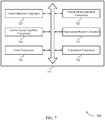
- FIG. 7 shows a block diagram 700 of a base station beamformed communication module 715 that supports beam reporting and scheduling in multicarrier beamformed communications, in accordance with one or more aspects of the present disclosure.
- the base station beamformed communication module 715 may be an example of aspects of a base station beamformed communication module 515, a base station beamformed communication module 615, or a base station beamformed communication module 815 described with reference to FIGs. 5 , 6 , and 8 .
- the base station beamformed communication module 715 may include carrier partition component 720, carrier group indication component 725, carrier group capability component 730, measurement report component 735, grant component 740, and negotiation component 745. Each of these modules may communicate, directly or indirectly, with one another (e.g., via one or more buses).
- Carrier partition component 720 may partition a set of carriers into one or more groups, each carrier within a group sharing one or more antenna panels so as to each be directed by a transmit beam in a same direction.
- Carrier group indication component 725 may transmit to a UE a carrier grouping indication that identifies the partitioning of the set of carriers into the one or more groups and maps a group identifier for at least one of the one or more groups to a beam identifier that identifies the corresponding transmit beam.
- Carrier group capability component 730 may receive from the UE a carrier grouping capability indication that indicates one or more UE constraints on the partitioning of the set of carriers and determine whether to modify the partitioning of the set of carriers based on the carrier grouping capability indication.
- Measurement report component 735 may transmit to a UE a request for one or more carrier measurement reports, the request indicating whether the UE is to provide one or more reports on a per carrier basis, one or more reports on a per group basis, or combinations thereof, indicate to the UE that the one or more carrier measurement reports for carriers of at least one group are to be transmitted on a single respective carrier, receive from the UE one or more carrier measurement reports representing carrier measurements of each group, receive the one or more carrier measurement reports for carriers of at least one group on a single respective carrier, receive, from the second UE, per carrier measurement reports in advance of negotiating with the second UE, and receive, from the second UE, per group measurement reports after negotiating with the second UE.
- the one or more carrier measurement reports include one or more reports on a per carrier basis for carriers within each group. In some cases, the one or more carrier measurement reports include one or more reports on a per group basis for all carriers within each group. In some cases, the one or more carrier measurement reports include periodic or aperiodic reports, and short-term or long-term average reports. In some cases, the one or more carrier measurement reports for the carriers of the at least one group each include a carrier identity field.
- Grant component 740 may transmit, on a carrier of the set of carriers, a single scheduling grant to the UE to simultaneously schedule the UE on one or more carriers within one of the one or more groups and refrain from transmitting additional scheduling grants for the one or more carriers within the one of the one or more groups during a same TTI as that on which the single scheduling grant is transmitted.
- Negotiation component 745 may negotiate with a second UE to use carrier grouping with the second UE.
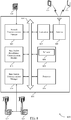
- FIG. 8 shows a diagram of a system 800 including a device 805 that supports beam reporting and scheduling in multicarrier beamformed communications, in accordance with one or more aspects of the present disclosure.
- Device 805 may be an example of or include the components of wireless device 505, wireless device 605, or a base station 105 as described above, e.g., with reference to FIGs. 1 through 6 .
- Device 805 may include components for bi-directional voice and data communications including components for transmitting and receiving communications, including base station beamformed communication module 815, processor 820, memory 825, software 830, transceiver 835, antenna 840, network communications manager 845, and base station communications manager 850.
- Processor 820 may include an intelligent hardware device, (e.g., a general-purpose processor, a digital signal processor (DSP), a central processing unit (CPU), a microcontroller, an application specific integrated circuit (ASIC), a field-programmable gate array (FPGA), a programmable logic device, a discrete gate or transistor logic component, a discrete hardware component, or any combination thereof).
- processor 820 may be configured to operate a memory array using a memory controller.
- a memory controller may be integrated into processor 820.
- Processor 820 may be configured to execute computer-readable instructions stored in a memory to perform various functions (e.g., functions or tasks supporting beam reporting and scheduling in multicarrier beamformed communications).
- Memory 825 may include random access memory (RAM) and read only memory (ROM).
- the memory 825 may store computer-readable, computer-executable software 830 including instructions that, when executed, cause the processor to perform various functions described herein.
- the memory 825 may contain, among other things, a Basic Input-Output system (BIOS) which may control basic hardware and/or software operation such as the interaction with peripheral components or devices.
- BIOS Basic Input-Output system
- Software 830 may include code to implement aspects of the present disclosure, including code to support beam reporting and scheduling in multicarrier beamformed communications.
- Software 830 may be stored in a non-transitory computer-readable medium such as system memory or other memory. In some cases, the software 830 may not be directly executable by the processor but may cause a computer (e.g., when compiled and executed) to perform functions described herein.
- Transceiver 835 may communicate bi-directionally, via one or more antennas, wired, or wireless links as described above.
- the transceiver 835 may represent a wireless transceiver and may communicate bi-directionally with another wireless transceiver.
- the transceiver 835 may additionally or alternatively include a modem to modulate the packets and provide the modulated packets to the antennas for transmission, and to demodulate packets received from the antennas.
- the wireless device may include a single antenna 840. However, in some cases the device may have more than one antenna 840, which may be capable of concurrently transmitting or receiving multiple wireless transmissions. In some cases the device may have one or more antenna panels that may be used for beamformed transmission.
- Network communications manager 845 may manage communications with the core network ( e.g., via one or more wired backhaul links). For example, the network communications manager 845 may manage the transfer of data communications for client devices, such as one or more UEs 115.
- Base station communications manager 850 may manage communications with other base station 105, and may include a controller or scheduler for controlling communications with UEs 115 in cooperation with other base stations 105. For example, the base station communications manager 850 may coordinate scheduling for transmissions to UEs 115 for various interference mitigation techniques such as beamforming or joint transmission. In some examples, base station communications manager 850 may provide an X2 interface within an LTE/LTE-A wireless communication network technology to provide communication between base stations 105.
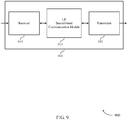
- FIG. 9 shows a block diagram 900 of a wireless device 905 that supports beam reporting and scheduling in multicarrier beamformed communications, in accordance with one or more aspects of the present disclosure.
- Wireless device 905 may be an example of aspects of a UE 115 as described with reference to FIG. 1 through 4 .
- Wireless device 905 may include receiver 910, UE beamformed communication module 915, and transmitter 920.
- Wireless device 905 may also include a processor. Each of these components may be in communication with one another ( e.g., via one or more buses).
- Receiver 910 may receive information such as packets, user data, or control information associated with various information channels (e.g., control channels, data channels, and information related to beam reporting and scheduling in multicarrier beamformed communications, etc. ) . Information may be passed on to other components of the device.
- the receiver 910 may be an example of aspects of the transceiver 1235 described with reference to FIG. 12 .
- UE beamformed communication module 915 may be an example of aspects of the UE beamformed communication module 1215 described with reference to FIG. 12 .
- UE beamformed communication module 915 may receive, at a UE and from a base station, a carrier grouping indication that indicates that a set of carriers are partitioned into one or more groups, each carrier within a group sharing one or more antenna panels so as to each be directed by a transmit beam in a same direction, the carrier grouping indication further mapping a group identifier for at least one of the one or more groups to a beam identifier that identifies the corresponding transmit beam and receive one or more transmissions from the base station relating to UE communication on at least one of the one or more groups using one of the transmit beams corresponding to the one of the one or more groups.
- Transmitter 920 may transmit signals generated by other components of the device.
- the transmitter 920 may be collocated with a receiver 910 in a transceiver module.
- the transmitter 920 may be an example of aspects of the transceiver 1235 described with reference to FIG. 12 .
- the transmitter 920 may include a single antenna, or it may include a set of antennas or antenna panels.
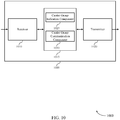
- FIG. 10 shows a block diagram 1000 of a wireless device 1005 that supports beam reporting and scheduling in multicarrier beamformed communications, in accordance with one or more aspects of the present disclosure.
- Wireless device 1005 may be an example of aspects of a wireless device 905 or a UE 115 as described with reference to FIGs. 1 through 4 and 9 .
- Wireless device 1005 may include receiver 1010, UE beamformed communication module 1015, and transmitter 1020.
- Wireless device 1005 may also include a processor. Each of these components may be in communication with one another (e.g., via one or more buses).
- Receiver 1010 may receive information such as packets, user data, or control information associated with various information channels (e.g., control channels, data channels, and information related to beam reporting and scheduling in multicarrier beamformed communications, etc. ) . Information may be passed on to other components of the device.
- the receiver 1010 may be an example of aspects of the transceiver 1235 described with reference to FIG. 12 .
- UE beamformed communication module 1015 may be an example of aspects of the UE beamformed communication module 1215 described with reference to FIG. 12 .
- UE beamformed communication module 1015 may additionally or alternatively include carrier group indication component 1025 and carrier group communication component 1030.
- Carrier group indication component 1025 may receive, at a UE and from a base station, a carrier grouping indication that indicates that a set of carriers are partitioned into one or more groups, each carrier within a group sharing one or more antenna panels so as to each be directed by a transmit beam in a same direction, the carrier grouping indication further mapping a group identifier for at least one of the one or more groups to a beam identifier that identifies the corresponding transmit beam.
- Carrier group communication component 1030 may receive one or more transmissions from the base station relating to UE communication on at least one of the one or more groups using one of the transmit beams corresponding to the one of the one or more groups.
- Transmitter 1020 may transmit signals generated by other components of the device.
- the transmitter 1020 may be collocated with a receiver 1010 in a transceiver module.
- the transmitter 1020 may be an example of aspects of the transceiver 1235 described with reference to FIG. 12 .
- the transmitter 1020 may include a single antenna, or it may include a set of antennas or antenna panels.
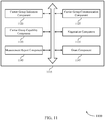
- FIG. 11 shows a block diagram 1100 of a UE beamformed communication module 1115 that supports beam reporting and scheduling in multicarrier beamformed communications, in accordance with one or more aspects of the present disclosure.
- the UE beamformed communication module 1115 may be an example of aspects of a UE beamformed communication module 1215 described with reference to FIGs. 9 , 10 , and 12 .
- the UE beamformed communication module 1115 may include carrier group indication component 1120, carrier group communication component 1125, carrier group capability component 1130, negotiation component 1135, measurement report component 1140, and grant component 1145. Each of these modules may communicate, directly or indirectly, with one another ( e.g., via one or more buses).
- Carrier group indication component 1120 may receive, at a UE and from a base station, a carrier grouping indication that indicates that a set of carriers are partitioned into one or more groups, each carrier within a group sharing one or more antenna panels so as to each be directed by a transmit beam in a same direction, the carrier grouping indication further mapping a group identifier for at least one of the one or more groups to a beam identifier that identifies the corresponding transmit beam.
- Carrier group communication component 1125 may receive one or more transmissions from the base station relating to UE communication on at least one of the one or more groups using one of the transmit beams corresponding to the one of the one or more groups.
- Carrier group capability component 1130 may transmit to the base station a carrier grouping capability indication that indicates one or more UE constraints on the partitioning of the set of carriers.
- Negotiation component 1135 may negotiate with a neighbor base station to use carrier grouping between the UE and the neighbor base station.
- Measurement report component 1140 may transmit to the neighbor base station per carrier measurement reports in advance of negotiating with the neighbor base station, transmit to the neighbor base station per group measurement reports after negotiating with the neighbor base station, transmit to the base station one or more carrier measurement reports representing carrier measurements of each group, and transmit the one or more carrier measurement reports for carriers of at least one group on a single respective carrier.
- receiving one or more transmission includes: receiving from the base station a request for one or more carrier measurement reports, where the request indicates whether the UE is to provide one or more reports on a per carrier basis, one or more reports on a per group basis, or combinations thereof.
- the request for one or more carrier measurement reports may additionally or alternatively indicate that the one or more carrier measurement reports for carriers of at least one group are to be transmitted on a single respective carrier.
- the one or more carrier measurement reports include one or more reports on a per carrier basis for carriers within each group.
- the one or more carrier measurement reports include one or more reports on a per group basis for all carriers within each group.
- the one or more carrier measurement reports include periodic or aperiodic reports, and short-term or long-term average reports.
- the one or more carrier measurement reports for the carriers of the at least one group each include a carrier identity field.
- Grant component 1145 may receive, on a carrier of the set of carriers, a single scheduling grant to the UE to simultaneously schedule the UE on one or more carriers within one of the one or more groups.
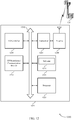
- FIG. 12 shows a diagram of a system 1200 including a device 1205 that supports beam reporting and scheduling in multicarrier beamformed communications, in accordance with one or more aspects of the present disclosure.
- Device 1205 may be an example of or include the components of UE 115 as described above, e.g., with reference to FIGs. 1 through 4 .
- Device 1205 may include components for bi-directional voice and data communications including components for transmitting and receiving communications, including UE beamformed communication module 1215, processor 1220, memory 1225, software 1230, transceiver 1235, antenna 1240, and I/O controller 1245.
- Processor 1220 may include an intelligent hardware device, (e.g., a general-purpose processor, a DSP, a CPU, a microcontroller, an ASIC, a FPGA, a programmable logic device, a discrete gate or transistor logic component, a discrete hardware component, or any combination thereof).
- processor 1220 may be configured to operate a memory array using a memory controller.
- a memory controller may be integrated into processor 1220.
- Processor 1220 may be configured to execute computer-readable instructions stored in a memory to perform various functions (e.g., functions or tasks supporting beam reporting and scheduling in multicarrier beamformed communications). 1220.
- Memory 1225 may include RAM and ROM.
- the memory 1225 may store computer-readable, computer-executable software 1230 including instructions that, when executed, cause the processor to perform various functions described herein.
- the memory 1225 may contain, among other things, a BIOS which may control basic hardware and/or software operation such as the interaction with peripheral components or devices.
- Software 1230 may include code to implement aspects of the present disclosure, including code to support beam reporting and scheduling in multicarrier beamformed communications.
- Software 1230 may be stored in a non-transitory computer-readable medium such as system memory or other memory. In some cases, the software 1230 may not be directly executable by the processor but may cause a computer (e.g., when compiled and executed) to perform functions described herein.
- Transceiver 1235 may communicate bi-directionally, via one or more antennas, wired, or wireless links as described above.
- the transceiver 1235 may represent a wireless transceiver and may communicate bi-directionally with another wireless transceiver.
- the transceiver 1235 may also include a modem to modulate the packets and provide the modulated packets to the antennas for transmission, and to demodulate packets received from the antennas.
- the wireless device may include a single antenna 1240. However, in some cases the device may have more than one antenna 1240, which may be capable of concurrently transmitting or receiving multiple wireless transmissions. In some cases the device may have one or more antenna panels that may be used for beamformed transmission.
- I/O controller 1245 may manage input and output signals for device 1205. Input/output control component 1245 may additionally or alternatively manage peripherals not integrated into device 1205. In some cases, input/output control component 1245 may represent a physical connection or port to an external peripheral. In some cases, I/O controller 1245 may utilize an operating system such as iOS®, ANDROID®, MS-DOS®, MS-WINDOWS®, OS/2®, UNIX®, LINUX®, or another known operating system.
- an operating system such as iOS®, ANDROID®, MS-DOS®, MS-WINDOWS®, OS/2®, UNIX®, LINUX®, or another known operating system.
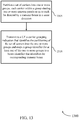
- FIG. 13 shows a flowchart illustrating a method 1300 for beam reporting and scheduling in multicarrier beamformed communications, in accordance with one or more aspects of the present disclosure.
- the operations of method 1300 may be implemented by a base station 105 or its components as described herein.
- the operations of method 1300 may be performed by a base station beamformed communication module as described with reference to FIGs. 5 through 8 .
- a base station 105 may execute a set of codes to control the functional elements of the device to perform the functions described below. Additionally or alternatively, the base station 105 may perform aspects of the functions described below using special-purpose hardware.
- the base station 105 partition a set of carriers into one or more groups, each carrier within a group sharing one or more antenna panels so as to each be directed by a transmit beam in a same direction.
- the operations of block 1305 may be performed according to the methods described with reference to FIGs. 1 through 4 . In some examples, aspects of the operations of block 1305 may be performed by a carrier partition component as described with reference to FIGs. 5 through 8 .
- the base station 105 may transmit to a UE a carrier grouping indication that identifies the partitioning of the set of carriers into the one or more groups and maps a group identifier for at least one of the one or more groups to a beam identifier that identifies the corresponding transmit beam.
- the operations of block 1310 may be performed according to the methods described with reference to FIGs. 1 through 4 . In some examples, aspects of the operations of block 1310 may be performed by a carrier group indication component as described with reference to FIGs. 5 through 8 .
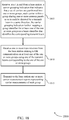
- FIG. 14 shows a flowchart illustrating a method 1400 for beam reporting and scheduling in multicarrier beamformed communications, in accordance with one or more aspects of the present disclosure.
- the operations of method 1400 may be implemented by a base station 105 or its components as described herein.
- the operations of method 1400 may be performed by a base station beamformed communication module as described with reference to FIGs. 5 through 8 .
- a base station 105 may execute a set of codes to control the functional elements of the device to perform the functions described below. Additionally or alternatively, the base station 105 may perform aspects of the functions described below using special-purpose hardware.
- the base station 105 may partition a set of carriers into one or more groups, each carrier within a group sharing one or more antenna panels so as to each be directed by a transmit beam in a same direction.
- the operations of block 1405 may be performed according to the methods described with reference to FIGs. 1 through 4 . In some examples, aspects of the operations of block 1405 may be performed by a carrier partition component as described with reference to FIGs. 5 through 8 .
- the base station 105 may transmit to a UE a carrier grouping indication that identifies the partitioning of the set of carriers into the one or more groups and maps a group identifier for at least one of the one or more groups to a beam identifier that identifies the corresponding transmit beam.
- the operations of block 1410 may be performed according to the methods described with reference to FIGs. 1 through 4 . In some examples, aspects of the operations of block 1410 may be performed by a carrier group indication component as described with reference to FIGs. 5 through 8 .
- the base station 105 may receive from the UE a carrier grouping capability indication that indicates one or more UE constraints on the partitioning of the set of carriers.
- the operations of block 1415 may be performed according to the methods described with reference to FIGs. 1 through 4 . In some examples, aspects of the operations of block 1415 may be performed by a carrier group capability component as described with reference to FIGs. 5 through 8 .
- the base station 105 may determine whether to modify the partitioning of the set of carriers based on the carrier grouping capability indication.
- the operations of block 1420 may be performed according to the methods described with reference to FIGs. 1 through 4 . In some examples, aspects of the operations of block 1420 may be performed by a carrier group capability component as described with reference to FIGs. 5 through 8 .
- FIG. 15 shows a flowchart illustrating a method 1500 for beam reporting and scheduling in multicarrier beamformed communications, in accordance with one or more aspects of the present disclosure.
- the operations of method 1500 may be implemented by a base station 105 or its components as described herein.
- the operations of method 1500 may be performed by a base station beamformed communication module as described with reference to FIGs. 5 through 8 .
- a base station 105 may execute a set of codes to control the functional elements of the device to perform the functions described below. Additionally or alternatively, the base station 105 may perform aspects of the functions described below using special-purpose hardware.
- the base station 105 may partition a set of carriers into one or more groups, each carrier within a group sharing one or more antenna panels so as to each be directed by a transmit beam in a same direction.
- the operations of block 1505 may be performed according to the methods described with reference to FIGs. 1 through 4 . In some examples, aspects of the operations of block 1505 may be performed by a carrier partition component as described with reference to FIGs. 5 through 8 .
- the base station 105 may transmit to the UE a carrier grouping indication that identifies the partitioning of the set of carriers into the one or more groups and maps a group identifier for at least one of the one or more groups to a beam identifier that identifies the corresponding transmit beam.
- the operations of block 1510 may be performed according to the methods described with reference to FIGs. 1 through 4 . In some examples, aspects of the operations of block 1510 may be performed by a carrier group indication component as described with reference to FIGs. 5 through 8 .
- the base station 105 may transmit to the UE a request for one or more carrier measurement reports, the request indicating whether the UE is to provide one or more reports on a per carrier basis, one or more reports on a per group basis, or combinations thereof.
- the operations of block 1515 may be performed according to the methods described with reference to FIGs. 1 through 4 . In some examples, aspects of the operations of block 1515 may be performed by a measurement report component as described with reference to FIGs. 5 through 8 .
- FIG. 16 shows a flowchart illustrating a method 1600 for beam reporting and scheduling in multicarrier beamformed communications, in accordance with one or more aspects of the present disclosure.
- the operations of method 1600 may be implemented by a UE 115 or its components as described herein.
- the operations of method 1600 may be performed by a UE beamformed communication module as described with reference to FIGs. 9 through 12 .
- a UE 115 may execute a set of codes to control the functional elements of the device to perform the functions described below. Additionally or alternatively, the UE 115 may perform aspects of the functions described below using special-purpose hardware.
- the UE 115 may receive from a base station a carrier group indication that indicates that a set of carriers are partitioned into one or more groups, each carrier within a group sharing one or more antenna panels so as to each be directed by a transmit beam in a same direction, the carrier grouping indication further mapping a group identifier for at least one of the one or more groups to a beam identifier that identifies the corresponding transmit beam.
- the operations of block 1605 may be performed according to the methods described with reference to FIGs. 1 through 4 . In some examples, aspects of the operations of block 1605 may be performed by a carrier group indication component as described with reference to FIGs. 9 through 12 .
- the UE 115 may receive one or more transmissions from the base station relating to UE communication on at least one of the one or more groups using one of the transmit beams corresponding to the one of the one or more groups.
- the operations of block 1610 may be performed according to the methods described with reference to FIGs. 1 through 4 . In some examples, aspects of the operations of block 1610 may be performed by a carrier group communication component as described with reference to FIGs. 9 through 12 .
- FIG. 17 shows a flowchart illustrating a method 1700 for beam reporting and scheduling in multicarrier beamformed communications, in accordance with one or more aspects of the present disclosure.
- the operations of method 1700 may be implemented by a UE 115 or its components as described herein.
- the operations of method 1700 may be performed by a UE beamformed communication module as described with reference to FIGs. 9 through 12 .
- a UE 115 may execute a set of codes to control the functional elements of the device to perform the functions described below. Additionally or alternatively, the UE 115 may perform aspects of the functions described below using special-purpose hardware.
- the UE 115 may receive, from a base station, a carrier grouping indication that indicates that a set of carriers are partitioned into one or more groups, each carrier within a group sharing one or more antenna panels so as to each be directed by a transmit beam in a same direction, the carrier grouping indication further mapping a group identifier for at least one of the one or more groups to a beam identifier that identifies the corresponding transmit beam.
- the operations of block 1705 may be performed according to the methods described with reference to FIGs. 1 through 4 . In some examples, aspects of the operations of block 1705 may be performed by a carrier group indication component as described with reference to FIGs. 9 through 12 .
- the UE 115 may receive one or more transmissions from the base station relating to UE communication on at least one of the one or more groups using one of the transmit beams corresponding to the one of the one or more groups.
- the operations of block 1710 may be performed according to the methods described with reference to FIGs. 1 through 4 . In some examples, aspects of the operations of block 1710 may be performed by a carrier group communication component as described with reference to FIGs. 9 through 12 .
- the UE 115 may receive from the base station a request for one or more carrier measurement reports, where the request indicates whether the UE is to provide one or more reports on a per carrier basis, one or more reports on a per group basis, or combinations thereof.
- the operations of block 1715 may be performed according to the methods described with reference to FIGs. 1 through 4 . In some examples, aspects of the operations of block 1715 may be performed by a measurement report component as described with reference to FIGs. 9 through 12 .
- FIG. 18 shows a flowchart illustrating a method 1800 for beam reporting and scheduling in multicarrier beamformed communications, in accordance with one or more aspects of the present disclosure.
- the operations of method 1800 may be implemented by a UE 115 or its components as described herein.
- the operations of method 1800 may be performed by a UE beamformed communication module as described with reference to FIGs. 9 through 12 .
- a UE 115 may execute a set of codes to control the functional elements of the device to perform the functions described below. Additionally or alternatively, the UE 115 may perform aspects of the functions described below using special-purpose hardware.
- the UE 115 may receive, from a base station, a carrier grouping indication that indicates that a set of carriers are partitioned into one or more groups, each carrier within a group sharing one or more antenna panels so as to each be directed by a transmit beam in a same direction, the carrier grouping indication further mapping a group identifier for at least one of the one or more groups to a beam identifier that identifies the corresponding transmit beam.
- the operations of block 1805 may be performed according to the methods described with reference to FIGs. 1 through 4 . In some examples, aspects of the operations of block 1805 may be performed by a carrier group indication component as described with reference to FIGs. 9 through 12 .
- the UE 115 may receive one or more transmissions from the base station relating to UE communication on at least one of the one or more groups using one of the transmit beams corresponding to the one of the one or more groups.
- the operations of block 1810 may be performed according to the methods described with reference to FIGs. 1 through 4 . In some examples, aspects of the operations of block 1810 may be performed by a carrier group communication component as described with reference to FIGs. 9 through 12 .
- the UE 115 may transmit to the base station one or more carrier measurement reports representing carrier measurements of each group.
- the operations of block 1815 may be performed according to the methods described with reference to FIGs. 1 through 4 . In some examples, aspects of the operations of block 1815 may be performed by a measurement report component as described with reference to FIGs. 9 through 12 .
- a CDMA system may implement a radio technology such as CDMA2000, Universal Terrestrial Radio Access (UTRA), etc.
- CDMA2000 covers IS-2000, IS-95, and IS-856 standards.
- IS-2000 Releases may be commonly referred to as CDMA2000 IX, IX, etc.
- IS-856 (TIA-856) is commonly referred to as CDMA2000 1xEV-DO, High Rate Packet Data (HRPD), etc.
- UTRA includes Wideband CDMA (WCDMA) and other variants of CDMA.
- a TDMA system may implement a radio technology such as Global System for Mobile Communications (GSM).
- GSM Global System for Mobile Communications
- An OFDMA system may implement a radio technology such as Ultra Mobile Broadband (UMB), Evolved UTRA (E-UTRA), Institute of Electrical and Electronics Engineers (IEEE) 802.11 (Wi-Fi), IEEE 802.16 (WiMAX), IEEE 802.20, Flash-OFDM, etc.
- UMB Ultra Mobile Broadband
- E-UTRA Evolved UTRA
- IEEE Institute of Electrical and Electronics Engineers
- Wi-Fi Wi-Fi
- WiMAX IEEE 802.16
- IEEE 802.20 Flash-OFDM
- UMB Ultra Mobile Broadband
- E-UTRA Evolved UTRA
- IEEE 802.11 Wi-Fi
- WiMAX IEEE 802.16
- Flash-OFDM Flash-OFDM
- UTRA and E-UTRA are part of Universal Mobile Telecommunications system (UMTS).
- 3GPP LTE and LTE-Advanced (LTE-A) are new releases of UMTS that use E-UTRA.
- CDMA2000 and UMB are described in documents from an organization named "3rd Generation Partnership Project 2" (3GPP2).
- 3GPP2 3rd Generation Partnership Project 2
- the techniques described herein may be used for the systems and radio technologies mentioned above as well as other systems and radio technologies. While aspects an LTE system may be described for purposes of example, and LTE terminology may be used in much of the description, the techniques described herein are applicable beyond LTE applications.
- the term eNB may for example, be used to describe the base stations.
- the wireless communications system or systems described herein may include a heterogeneous LTE/LTE-A network in which different types of eNBs provide coverage for various geographical regions.
- each eNB or base station may provide communication coverage for a macro cell, a small cell, or other types of cell.
- the term "cell" may be used to describe a base station, a carrier or component carrier associated with a base station, or a coverage area ( e.g., sector, etc. ) of a carrier or base station, depending on context.
- Base stations may include or may be referred to by those skilled in the art as a base transceiver station, a radio base station, an access point, a radio transceiver, a NodeB, eNB, Home NodeB, a Home eNodeB, or some other suitable terminology.
- the geographic coverage area for a base station may be divided into sectors making up a portion of the coverage area.
- the wireless communications system or systems described herein may include base stations of different types (e.g., macro or small cell base stations).
- the UEs described herein may be able to communicate with various types of base stations and network equipment including macro eNBs, small cell eNBs, relay base stations, and the like. There may be overlapping geographic coverage areas for different technologies.
- a macro cell covers a relatively large geographic area (e.g., several kilometers in radius) and may allow unrestricted access by UEs with service subscriptions with the network provider.
- a small cell is a lower-powered base station, as compared with a macro cell, that may operate in the same or different ( e.g., licensed, unlicensed, etc. ) frequency bands as macro cells.
- Small cells may include pico cells, femto cells, and micro cells according to various examples.
- a pico cell for example, may cover a small geographic area and may allow unrestricted access by UEs with service subscriptions with the network provider.
- a femto cell may also cover a small geographic area (e.g., a home) and may provide restricted access by UEs having an association with the femto cell (e.g., UEs in a closed subscriber group (CSG), UEs for users in the home, and the like).
- An eNB for a macro cell may be referred to as a macro eNB.
- An eNB for a small cell may be referred to as a small cell eNB, a pico eNB, a femto eNB, or a home eNB.
- An eNB may support one or multiple (e.g., two, three, four, and the like) cells (e.g., component carriers).
- a gNB for a macro cell may be referred to as a macro gNB.
- a gNB for a small cell may be referred to as a small cell gNB, a pico gNB, a femto gNB, or a home gNB.
- a gNB may support one or multiple (e.g., two, three, four, and the like) cells (e.g., component carriers).
- a UE may be able to communicate with various types of base stations and network equipment including macro eNBs, small cell eNBs, macro gNBs, small cell gNBs, relay base stations, and the like.
- the wireless communications system or systems described herein may support synchronous or asynchronous operation.
- the base stations may have similar frame timing, and transmissions from different base stations may be approximately aligned in time.
- the base stations may have different frame timing, and transmissions from different base stations may not be aligned in time.
- the techniques described herein may be used for either synchronous or asynchronous operations.
- Information and signals described herein may be represented using any of a variety of different technologies and techniques.
- data, instructions, commands, information, signals, bits, symbols, and chips that may be referenced throughout the above description may be represented by voltages, currents, electromagnetic waves, magnetic fields or particles, optical fields or particles, or any combination thereof.
- a general-purpose processor may be a microprocessor, but in the alternative, the processor may be any conventional processor, controller, microcontroller, or state machine.
- a processor may also be implemented as a combination of computing devices (e.g., a combination of a DSP and a microprocessor, multiple microprocessors, one or more microprocessors in conjunction with a DSP core, or any other such configuration).
- the functions described herein may be implemented in hardware, software executed by a processor, firmware, or any combination thereof. If implemented in software executed by a processor, the functions may be stored on or transmitted over as one or more instructions or code on a computer-readable medium. Other examples and implementations are within the scope and spirit of the disclosure and appended claims. For example, due to the nature of software, functions described above can be implemented using software executed by a processor, hardware, firmware, hardwiring, or combinations of any of these. Features implementing functions may be physically located at various positions, including being distributed such that portions of functions are implemented at different physical locations.
- the term "and/or,” when used in a list of two or more items, means that any one of the listed items can be employed by itself, or any combination of two or more of the listed items can be employed.
- the composition can contain A alone; B alone; C alone; A and B in combination; A and C in combination; B and C in combination; or A, B, and C in combination.
- "at least one of: A, B, or C” is intended to cover A, B, C, A-B, A-C, B-C, and A-B-C., as well as any combination with multiples of the same element (e.g., A-A A-A-A, A-A-B, A-A-C, A-B-B, A-C-C, B-B, B-B-B, B-B-C, C-C, and C-C-C or any other ordering of A, B, and C).
- the phrase "based on” shall not be construed as a reference to a closed set of conditions.
- an exemplary operation that is described as “based on condition A” may be based on both a condition A and a condition B without departing from the scope of the present disclosure.
- the phrase “based on” shall be construed in the same manner as the phrase “based at least in part on.”
- Computer-readable media includes both non-transitory computer storage media and communication media including any medium that facilitates transfer of a computer program from one place to another.
- a non-transitory storage medium may be any available medium that can be accessed by a general purpose or special purpose computer.
- non-transitory computer-readable media can comprise RAM, ROM, electrically erasable programmable read only memory (EEPROM), compact disk (CD) ROM or other optical disk storage, magnetic disk storage or other magnetic storage devices, or any other non-transitory medium that can be used to carry or store desired program code means in the form of instructions or data structures and that can be accessed by a general-purpose or special-purpose computer, or a general-purpose or special-purpose processor.
- RAM random access memory
- ROM read only memory
- EEPROM electrically erasable programmable read only memory
- CD compact disk
- magnetic disk storage or other magnetic storage devices or any other non-transitory medium that can be used to carry or store desired program code means in the form of instructions or data structures
- any connection is properly termed a computer-readable medium.
- the software is transmitted from a website, server, or other remote source using a coaxial cable, fiber optic cable, twisted pair, digital subscriber line (DSL), or wireless technologies such as infrared, radio, and microwave
- the coaxial cable, fiber optic cable, twisted pair, DSL, or wireless technologies such as infrared, radio, and microwave are included in the definition of medium.
- Disk and disc include CD, laser disc, optical disc, digital versatile disc (DVD), floppy disk and Blu-ray disc where disks usually reproduce data magnetically, while discs reproduce data optically with lasers. Combinations of the above are also included within the scope of computer-readable media.
Landscapes
- Engineering & Computer Science (AREA)
- Signal Processing (AREA)
- Computer Networks & Wireless Communication (AREA)
- Mobile Radio Communication Systems (AREA)
Applications Claiming Priority (3)
| Application Number | Priority Date | Filing Date | Title |
|---|---|---|---|
| US201662350630P | 2016-06-15 | 2016-06-15 | |
| US15/457,873 US10904784B2 (en) | 2016-06-15 | 2017-03-13 | Beam reporting and scheduling in multicarrier beamformed communications |
| PCT/US2017/035606 WO2017218210A1 (en) | 2016-06-15 | 2017-06-02 | Beam reporting and scheduling in multicarrier beamformed communications |
Publications (2)
| Publication Number | Publication Date |
|---|---|
| EP3472945A1 EP3472945A1 (en) | 2019-04-24 |
| EP3472945B1 true EP3472945B1 (en) | 2021-04-28 |
Family
ID=60659960
Family Applications (1)
| Application Number | Title | Priority Date | Filing Date |
|---|---|---|---|
| EP17730011.8A Active EP3472945B1 (en) | 2016-06-15 | 2017-06-02 | Beam reporting and scheduling in multicarrier beamformed communications |
Country Status (8)
| Country | Link |
|---|---|
| US (2) | US10904784B2 (enExample) |
| EP (1) | EP3472945B1 (enExample) |
| JP (1) | JP6945564B2 (enExample) |
| CN (1) | CN109314561B (enExample) |
| AU (1) | AU2017286142B2 (enExample) |
| BR (1) | BR112018075092A2 (enExample) |
| CA (1) | CA3022929C (enExample) |
| WO (1) | WO2017218210A1 (enExample) |
Families Citing this family (18)
| Publication number | Priority date | Publication date | Assignee | Title |
|---|---|---|---|---|
| US10904784B2 (en) | 2016-06-15 | 2021-01-26 | Qualcomm Incorporated | Beam reporting and scheduling in multicarrier beamformed communications |
| WO2018031908A1 (en) | 2016-08-11 | 2018-02-15 | Convida Wireless, Llc | Beam management |
| CN109152018B (zh) * | 2017-06-16 | 2021-02-09 | 华为技术有限公司 | 一种载波分组方法及设备 |
| WO2019218296A1 (en) * | 2018-05-17 | 2019-11-21 | Qualcomm Incorporated | Ue specific beamforming for narrowband communications |
| US11711702B2 (en) | 2018-08-09 | 2023-07-25 | Sony Corporation | Communication device, communication method, and recording medium |
| US11522274B2 (en) * | 2018-09-28 | 2022-12-06 | Nokia Technologies Oy | Facilitating user equipment beamforming control |
| US12136967B2 (en) | 2018-12-28 | 2024-11-05 | Google Llc | User-equipment-coordination set for a wireless network |
| US12114173B2 (en) | 2019-02-21 | 2024-10-08 | Google Llc | User-equipment-coordination set for a wireless network using an unlicensed frequency band |
| FI3930366T3 (fi) | 2019-02-22 | 2025-09-01 | Beijing Xiaomi Mobile Software Co Ltd | Tiedonsiirtomenetelmä ja -laite sekä tallennusväline |
| CN109983823B (zh) * | 2019-02-22 | 2022-11-04 | 北京小米移动软件有限公司 | 数据传输方法、装置及存储介质 |
| CN113519130B (zh) * | 2019-03-12 | 2024-03-08 | 谷歌有限责任公司 | 用户设备协调集合波束扫描 |
| US11457350B2 (en) * | 2019-05-10 | 2022-09-27 | Qualcomm Incorporated | Signaling user equipment multi-panel capability |
| US11026235B2 (en) * | 2019-05-16 | 2021-06-01 | Qualcomm Incorporated | Beam grouping for inter-band carrier aggregation |
| US10893572B2 (en) | 2019-05-22 | 2021-01-12 | Google Llc | User-equipment-coordination set for disengaged mode |
| US12294552B2 (en) * | 2019-10-03 | 2025-05-06 | Telefonaktiebolaget Lm Ericsson (Publ) | Method and device for providing resource status information |
| US11588592B2 (en) | 2019-11-18 | 2023-02-21 | Qualcomm Incorporated | Techniques for beamforming for multiple component carriers in wireless communications |
| WO2021160689A1 (en) * | 2020-02-13 | 2021-08-19 | Fraunhofer-Gesellschaft zur Förderung der angewandten Forschung e.V. | Beamforming and carrier aggregation |
| EP4226465A1 (en) * | 2020-10-06 | 2023-08-16 | Telefonaktiebolaget LM Ericsson (publ) | Radio network node, and method performed therein |
Citations (1)
| Publication number | Priority date | Publication date | Assignee | Title |
|---|---|---|---|---|
| EP2555568A2 (en) * | 2010-03-29 | 2013-02-06 | Pantech Co., Ltd | Apparatus and method for performing random access in a wireless communication system |
Family Cites Families (70)
| Publication number | Priority date | Publication date | Assignee | Title |
|---|---|---|---|---|
| GB2418324B (en) * | 2002-02-15 | 2006-09-06 | Inmarsat Global Ltd | Carrier allocation |
| WO2003096710A2 (en) * | 2002-05-13 | 2003-11-20 | Interdigital Technology Corporation | Resource allocation to users in slotted code division multiple access systems using beams |
| US20040004951A1 (en) * | 2002-07-05 | 2004-01-08 | Interdigital Technology Corporation | Method for performing wireless switching |
| US7742533B2 (en) * | 2004-03-12 | 2010-06-22 | Kabushiki Kaisha Toshiba | OFDM signal transmission method and apparatus |
| US9154211B2 (en) * | 2005-03-11 | 2015-10-06 | Qualcomm Incorporated | Systems and methods for beamforming feedback in multi antenna communication systems |
| US8543070B2 (en) * | 2006-04-24 | 2013-09-24 | Qualcomm Incorporated | Reduced complexity beam-steered MIMO OFDM system |
| CN101102136B (zh) * | 2006-07-03 | 2011-10-26 | 华为技术有限公司 | 一种宽带随机波束的形成方法 |
| EP2039194A1 (en) * | 2006-07-11 | 2009-03-25 | Nokia Corporation | Data transmission method, base station and user transceiver |
| US8068552B2 (en) * | 2007-02-22 | 2011-11-29 | Cisco Technology, Inc. | Method and system for achieving spatial diversity of a wireless communications network |
| US8948704B2 (en) * | 2008-10-22 | 2015-02-03 | Qualcomm Incorporated | Scope of channel quality reporting region in a multi-carrier system |
| KR101151048B1 (ko) * | 2008-11-25 | 2012-06-01 | 한국전자통신연구원 | 부분 주파수 재사용 기법을 적용한 지상보조장치를 포함하는 이동 위성 통신 장치 및 방법 |
| JP5598771B2 (ja) * | 2009-04-17 | 2014-10-01 | マーベル ワールド トレード リミテッド | セグメント化ビーム形成 |
| EP2437404B1 (en) * | 2009-05-29 | 2018-09-05 | LG Electronics Inc. | Method and apparatus for transmitting signal using spatial silencing |
| CN101997808A (zh) * | 2009-08-12 | 2011-03-30 | 雷凌科技股份有限公司 | 用于一无线通讯系统的次载波分组方法及装置 |
| US20110053628A1 (en) | 2009-08-27 | 2011-03-03 | Electronics And Telecommunications Research Institute | Service providing system and method in satellite communication system |
| CN101635619B (zh) * | 2009-08-28 | 2012-09-05 | 华为技术有限公司 | 子载波发送方法、基站和系统 |
| KR101803015B1 (ko) * | 2010-02-10 | 2017-12-01 | 주식회사 골드피크이노베이션즈 | 다수의 요소 반송파를 운영하는 무선 통신 시스템에서 업링크 동기를 설정하는 방법 및 장치 |
| WO2011150549A1 (en) * | 2010-06-01 | 2011-12-08 | Nokia Corporation | Apparatus and method for selection of beam groups and subset of beams in communication system |
| US9467885B2 (en) * | 2010-11-08 | 2016-10-11 | Qualcomm Incorporated | Inter-frequency measurement control in a multi-carrier system |
| US8824587B2 (en) * | 2011-06-07 | 2014-09-02 | Marvell World Trade Ltd | Systems and methods for compressed feedback and subcarrier grouping for beamforming |
| KR101847400B1 (ko) * | 2011-09-01 | 2018-04-10 | 삼성전자주식회사 | 무선 통신 시스템에서 최적의 빔을 선택하기 위한 장치 및 방법 |
| KR20130028397A (ko) * | 2011-09-09 | 2013-03-19 | 삼성전자주식회사 | 무선 통신 시스템에서 동기 및 시스템 정보 획득을 위한 장치 및 방법 |
| US20130170452A1 (en) * | 2012-01-04 | 2013-07-04 | Futurewei Technologies, Inc. | Low Complexity Beamforming Scheme |
| KR102109655B1 (ko) * | 2012-02-23 | 2020-05-12 | 한국전자통신연구원 | 대규모 안테나 시스템에서의 다중 입력 다중 출력 통신 방법 |
| EP2688330B1 (en) * | 2012-07-17 | 2014-06-11 | Alcatel Lucent | Method for interference reduction in a radio communication system, processing unit, and wireless access network node thereof |
| RU2636655C2 (ru) * | 2012-07-31 | 2017-11-27 | Самсунг Электроникс Ко., Лтд. | Способ и устройство связи с использованием формирования диаграммы направленности в системе беспроводной связи |
| KR102049772B1 (ko) * | 2013-01-15 | 2019-11-28 | 삼성전자 주식회사 | 빔포밍 시스템에서 신호 측정 방법 및 장치 |
| WO2014148875A1 (en) * | 2013-03-22 | 2014-09-25 | Lg Electronics Inc. | Method and apparatus for performing interference coordination in wireless communication system |
| WO2014154325A1 (en) * | 2013-03-28 | 2014-10-02 | Sony Corporation | Communication device and method providing beamforming for two or more transmission channels |
| US9497047B2 (en) * | 2013-07-02 | 2016-11-15 | Samsung Electronics Co., Ltd. | Methods and apparatus for sounding channel operation in millimeter wave communication systems |
| WO2015042855A1 (zh) * | 2013-09-27 | 2015-04-02 | 华为技术有限公司 | 通信方法、基站和用户设备 |
| JP2015164281A (ja) * | 2014-01-31 | 2015-09-10 | 株式会社Nttドコモ | ユーザ装置、基地局、及び通信方法 |
| US9444138B2 (en) * | 2014-02-17 | 2016-09-13 | Broadcom Corporation | Link quality to static and non-static devices |
| KR102169662B1 (ko) * | 2014-03-10 | 2020-10-23 | 삼성전자주식회사 | 무선 통신 시스템에서 빔 결정 장치 및 방법 |
| KR102177804B1 (ko) * | 2014-03-25 | 2020-11-11 | 삼성전자주식회사 | 다중입력 다중출력 시스템에서 스케줄링 방법 및 장치 |
| EP2928234B1 (en) * | 2014-03-31 | 2016-05-25 | Alcatel Lucent | Methods For Operating A Mobile Station And A Base Station In A Radio Communication System, Mobile Station And Base Station Thereof |
| WO2015156574A1 (ko) * | 2014-04-10 | 2015-10-15 | 엘지전자 주식회사 | 무선 통신 시스템에서 신호를 송수신하는 방법 및 이를 위한 장치 |
| US10219232B2 (en) * | 2014-04-17 | 2019-02-26 | Samsung Electronics Co., Ltd. | Apparatus and method searching neighboring cells in wireless communication system |
| CN105471487B (zh) * | 2014-07-01 | 2020-07-24 | 索尼公司 | 通信设备、基站和通信方法 |
| CN106471751A (zh) * | 2014-08-15 | 2017-03-01 | 富士通株式会社 | 资源配置方法、装置以及通信系统 |
| US10251071B2 (en) * | 2014-09-26 | 2019-04-02 | Mediatek Inc. | Incremental scheduling for wireless communication system with beamforming |
| US9867192B2 (en) * | 2014-10-24 | 2018-01-09 | Futurewei Technologies, Inc. | System and method for beam selection using multiple frequencies |
| CN105530685B (zh) * | 2014-10-24 | 2020-01-07 | 中兴通讯股份有限公司 | 消息发送接收方法、发送接收装置、基站及终端 |
| KR102363547B1 (ko) * | 2014-11-26 | 2022-02-17 | 삼성전자주식회사 | 빔포밍을 이용한 통신 방법 및 장치 |
| EP3229382B1 (en) * | 2014-12-02 | 2022-04-20 | LG Electronics Inc. | Method and device for transmitting control channel on basis of hybrid beamforming in wireless communication system |
| US20160190707A1 (en) * | 2014-12-29 | 2016-06-30 | Electronics And Telecommunications Research Institute | Antenna structure based on millimeter wave and operation method thereof |
| US10506545B2 (en) * | 2015-02-13 | 2019-12-10 | Lg Electronics Inc. | Scanning method using position information of terminal in wireless access system supporting millimeter waves and devices for same |
| CN107408966B (zh) * | 2015-03-06 | 2020-07-31 | 瑞典爱立信有限公司 | 用于适配波束图案的方法、控制系统和通信系统 |
| US11350254B1 (en) * | 2015-05-05 | 2022-05-31 | F5, Inc. | Methods for enforcing compliance policies and devices thereof |
| US10158413B2 (en) * | 2015-05-08 | 2018-12-18 | Newracom, Inc. | Uplink sounding for WLAN system |
| CN106301692B (zh) * | 2015-05-21 | 2019-12-10 | 电信科学技术研究院 | 一种信道状态信息获取方法及装置 |
| US10523304B2 (en) * | 2015-07-31 | 2019-12-31 | Intel IP Corporation | Network discovery and beam acquisition in 5G rat beam cell operation |
| EP3332512B1 (en) * | 2015-08-06 | 2020-02-19 | Telefonaktiebolaget LM Ericsson (publ) | Method and apparatus for listening based transmission |
| US10356631B1 (en) * | 2015-09-03 | 2019-07-16 | Sprint Spectrum L.P. | Method and apparatus for invoking beamforming responsive to carrier transition |
| CN106937394B (zh) * | 2015-12-29 | 2023-02-03 | 华为技术有限公司 | 一种下行数据传输方法及设备 |
| US20170195026A1 (en) * | 2016-01-05 | 2017-07-06 | Intel IP Corporation | Single user beamforming in wireless networks |
| CN107041012B (zh) * | 2016-02-03 | 2022-11-22 | 北京三星通信技术研究有限公司 | 基于差分波束的随机接入方法、基站设备及用户设备 |
| MY191242A (en) * | 2016-03-03 | 2022-06-10 | Idac Holdings Inc | Methods and apparatus for beam control in beamformed systems |
| JP6542143B2 (ja) * | 2016-03-11 | 2019-07-10 | 株式会社Nttドコモ | 基地局 |
| US10141986B2 (en) * | 2016-04-14 | 2018-11-27 | Samsung Electronics Co., Ltd. | Method and apparatus for transmitting and receiving signal through beamforming in communication system |
| WO2017180037A1 (en) * | 2016-04-15 | 2017-10-19 | Telefonaktiebolaget Lm Ericsson (Publ) | Radio-network node, wireless device and methods performed therein |
| US10582406B2 (en) * | 2016-04-20 | 2020-03-03 | Telefonaktiebolaget Lm Ericsson (Publ) | Self-contained scheduled mobility measurement signals |
| US10574304B2 (en) * | 2016-05-10 | 2020-02-25 | Nokia Solutions And Networks Oy | Method, system and apparatus of beam selection |
| US11245456B2 (en) * | 2016-05-11 | 2022-02-08 | Idac Holdings, Inc. | Systems and methods for beamformed uplink transmission |
| WO2017196491A1 (en) * | 2016-05-13 | 2017-11-16 | Intel IP Corporation | Beam measurement in a wireless communication network for identifying candidate beams for a handover |
| CN109478924B (zh) * | 2016-05-27 | 2022-03-04 | 瑞典爱立信有限公司 | 无线通信系统中的参考信号跟踪 |
| US10904784B2 (en) | 2016-06-15 | 2021-01-26 | Qualcomm Incorporated | Beam reporting and scheduling in multicarrier beamformed communications |
| WO2017217899A1 (en) * | 2016-06-15 | 2017-12-21 | Telefonaktiebolaget Lm Ericsson (Publ) | Radio link reporting using multiple symbol sequences |
| CN115664484B (zh) * | 2016-08-11 | 2025-10-10 | 中兴通讯股份有限公司 | 分组指示信息的获取及告知方法、设备及介质 |
| US10225867B2 (en) * | 2016-09-02 | 2019-03-05 | Qualcomm Incorporated | Transmission configuration and format for random access messages |
-
2017
- 2017-03-13 US US15/457,873 patent/US10904784B2/en active Active
- 2017-06-02 WO PCT/US2017/035606 patent/WO2017218210A1/en not_active Ceased
- 2017-06-02 CN CN201780036706.5A patent/CN109314561B/zh active Active
- 2017-06-02 AU AU2017286142A patent/AU2017286142B2/en active Active
- 2017-06-02 EP EP17730011.8A patent/EP3472945B1/en active Active
- 2017-06-02 BR BR112018075092A patent/BR112018075092A2/pt unknown
- 2017-06-02 CA CA3022929A patent/CA3022929C/en active Active
- 2017-06-02 JP JP2018565058A patent/JP6945564B2/ja active Active
-
2021
- 2021-01-08 US US17/144,740 patent/US11665568B2/en active Active
Patent Citations (1)
| Publication number | Priority date | Publication date | Assignee | Title |
|---|---|---|---|---|
| EP2555568A2 (en) * | 2010-03-29 | 2013-02-06 | Pantech Co., Ltd | Apparatus and method for performing random access in a wireless communication system |
Also Published As
| Publication number | Publication date |
|---|---|
| US20210136613A1 (en) | 2021-05-06 |
| EP3472945A1 (en) | 2019-04-24 |
| BR112018075092A2 (pt) | 2019-03-26 |
| CN109314561A (zh) | 2019-02-05 |
| US11665568B2 (en) | 2023-05-30 |
| AU2017286142B2 (en) | 2021-09-02 |
| WO2017218210A1 (en) | 2017-12-21 |
| CN109314561B (zh) | 2022-02-08 |
| CA3022929A1 (en) | 2017-12-21 |
| AU2017286142A1 (en) | 2018-11-22 |
| JP6945564B2 (ja) | 2021-10-06 |
| JP2019526954A (ja) | 2019-09-19 |
| US20170366994A1 (en) | 2017-12-21 |
| CA3022929C (en) | 2023-03-14 |
| US10904784B2 (en) | 2021-01-26 |
Similar Documents
| Publication | Publication Date | Title |
|---|---|---|
| US11665568B2 (en) | Beam reporting and scheduling in multicarrier beamformed communications | |
| US11323972B2 (en) | Synchronization and data channel numerology in wireless communications | |
| EP3539247B1 (en) | Search space design and use | |
| US12225517B2 (en) | Data and control channels in synchronization bursts for millimeter wave new radio | |
| EP3533265B1 (en) | Coexistence of interleaved and contiguous uplink transmissions | |
| KR102642075B1 (ko) | 무선 통신을 위한 업링크 제어 채널 구성 | |
| EP3643128B1 (en) | Multiplexing clustered control information and data | |
| EP3993307B1 (en) | Sounding reference signal triggering for enhanced carrier aggregation | |
| EP3731452B1 (en) | Sounding reference signal transmission for carrier aggregation | |
| WO2019010130A1 (en) | UPLINK TRANSMISSION TECHNIQUES IN SHARED SPECTRUM WIRELESS COMMUNICATIONS | |
| EP3510714B1 (en) | Cell-specific reference signal (crs) and control channel configuration in wireless communications | |
| US20180109406A1 (en) | Resource block alignment in mixed numerology wireless communications | |
| US10448380B2 (en) | Split symbol control for aligned numerology | |
| EP3682584B1 (en) | Ue capability constraint indications for high order modulation |
Legal Events
| Date | Code | Title | Description |
|---|---|---|---|
| STAA | Information on the status of an ep patent application or granted ep patent |
Free format text: STATUS: UNKNOWN |
|
| STAA | Information on the status of an ep patent application or granted ep patent |
Free format text: STATUS: THE INTERNATIONAL PUBLICATION HAS BEEN MADE |
|
| PUAI | Public reference made under article 153(3) epc to a published international application that has entered the european phase |
Free format text: ORIGINAL CODE: 0009012 |
|
| STAA | Information on the status of an ep patent application or granted ep patent |
Free format text: STATUS: REQUEST FOR EXAMINATION WAS MADE |
|
| 17P | Request for examination filed |
Effective date: 20181030 |
|
| AK | Designated contracting states |
Kind code of ref document: A1 Designated state(s): AL AT BE BG CH CY CZ DE DK EE ES FI FR GB GR HR HU IE IS IT LI LT LU LV MC MK MT NL NO PL PT RO RS SE SI SK SM TR |
|
| AX | Request for extension of the european patent |
Extension state: BA ME |
|
| STAA | Information on the status of an ep patent application or granted ep patent |
Free format text: STATUS: EXAMINATION IS IN PROGRESS |
|
| DAV | Request for validation of the european patent (deleted) | ||
| DAX | Request for extension of the european patent (deleted) | ||
| 17Q | First examination report despatched |
Effective date: 20190919 |
|
| GRAP | Despatch of communication of intention to grant a patent |
Free format text: ORIGINAL CODE: EPIDOSNIGR1 |
|
| STAA | Information on the status of an ep patent application or granted ep patent |
Free format text: STATUS: GRANT OF PATENT IS INTENDED |
|
| RIC1 | Information provided on ipc code assigned before grant |
Ipc: H04L 5/00 20060101ALI20201030BHEP Ipc: H04B 7/06 20060101AFI20201030BHEP Ipc: H04W 16/28 20090101ALI20201030BHEP Ipc: H04L 5/14 20060101ALN20201030BHEP |
|
| INTG | Intention to grant announced |
Effective date: 20201116 |
|
| GRAS | Grant fee paid |
Free format text: ORIGINAL CODE: EPIDOSNIGR3 |
|
| GRAA | (expected) grant |
Free format text: ORIGINAL CODE: 0009210 |
|
| STAA | Information on the status of an ep patent application or granted ep patent |
Free format text: STATUS: THE PATENT HAS BEEN GRANTED |
|
| AK | Designated contracting states |
Kind code of ref document: B1 Designated state(s): AL AT BE BG CH CY CZ DE DK EE ES FI FR GB GR HR HU IE IS IT LI LT LU LV MC MK MT NL NO PL PT RO RS SE SI SK SM TR |
|
| REG | Reference to a national code |
Ref country code: GB Ref legal event code: FG4D |
|
| REG | Reference to a national code |
Ref country code: CH Ref legal event code: EP |
|
| REG | Reference to a national code |
Ref country code: AT Ref legal event code: REF Ref document number: 1388325 Country of ref document: AT Kind code of ref document: T Effective date: 20210515 |
|
| REG | Reference to a national code |
Ref country code: DE Ref legal event code: R096 Ref document number: 602017037585 Country of ref document: DE |
|
| REG | Reference to a national code |
Ref country code: IE Ref legal event code: FG4D |
|
| REG | Reference to a national code |
Ref country code: LT Ref legal event code: MG9D |
|
| REG | Reference to a national code |
Ref country code: AT Ref legal event code: MK05 Ref document number: 1388325 Country of ref document: AT Kind code of ref document: T Effective date: 20210428 |
|
| PG25 | Lapsed in a contracting state [announced via postgrant information from national office to epo] |
Ref country code: FI Free format text: LAPSE BECAUSE OF FAILURE TO SUBMIT A TRANSLATION OF THE DESCRIPTION OR TO PAY THE FEE WITHIN THE PRESCRIBED TIME-LIMIT Effective date: 20210428 Ref country code: LT Free format text: LAPSE BECAUSE OF FAILURE TO SUBMIT A TRANSLATION OF THE DESCRIPTION OR TO PAY THE FEE WITHIN THE PRESCRIBED TIME-LIMIT Effective date: 20210428 Ref country code: NL Free format text: LAPSE BECAUSE OF FAILURE TO SUBMIT A TRANSLATION OF THE DESCRIPTION OR TO PAY THE FEE WITHIN THE PRESCRIBED TIME-LIMIT Effective date: 20210428 Ref country code: BG Free format text: LAPSE BECAUSE OF FAILURE TO SUBMIT A TRANSLATION OF THE DESCRIPTION OR TO PAY THE FEE WITHIN THE PRESCRIBED TIME-LIMIT Effective date: 20210728 Ref country code: AT Free format text: LAPSE BECAUSE OF FAILURE TO SUBMIT A TRANSLATION OF THE DESCRIPTION OR TO PAY THE FEE WITHIN THE PRESCRIBED TIME-LIMIT Effective date: 20210428 Ref country code: HR Free format text: LAPSE BECAUSE OF FAILURE TO SUBMIT A TRANSLATION OF THE DESCRIPTION OR TO PAY THE FEE WITHIN THE PRESCRIBED TIME-LIMIT Effective date: 20210428 |
|
| PG25 | Lapsed in a contracting state [announced via postgrant information from national office to epo] |
Ref country code: LV Free format text: LAPSE BECAUSE OF FAILURE TO SUBMIT A TRANSLATION OF THE DESCRIPTION OR TO PAY THE FEE WITHIN THE PRESCRIBED TIME-LIMIT Effective date: 20210428 Ref country code: IS Free format text: LAPSE BECAUSE OF FAILURE TO SUBMIT A TRANSLATION OF THE DESCRIPTION OR TO PAY THE FEE WITHIN THE PRESCRIBED TIME-LIMIT Effective date: 20210828 Ref country code: GR Free format text: LAPSE BECAUSE OF FAILURE TO SUBMIT A TRANSLATION OF THE DESCRIPTION OR TO PAY THE FEE WITHIN THE PRESCRIBED TIME-LIMIT Effective date: 20210729 Ref country code: PT Free format text: LAPSE BECAUSE OF FAILURE TO SUBMIT A TRANSLATION OF THE DESCRIPTION OR TO PAY THE FEE WITHIN THE PRESCRIBED TIME-LIMIT Effective date: 20210830 Ref country code: PL Free format text: LAPSE BECAUSE OF FAILURE TO SUBMIT A TRANSLATION OF THE DESCRIPTION OR TO PAY THE FEE WITHIN THE PRESCRIBED TIME-LIMIT Effective date: 20210428 Ref country code: NO Free format text: LAPSE BECAUSE OF FAILURE TO SUBMIT A TRANSLATION OF THE DESCRIPTION OR TO PAY THE FEE WITHIN THE PRESCRIBED TIME-LIMIT Effective date: 20210728 Ref country code: RS Free format text: LAPSE BECAUSE OF FAILURE TO SUBMIT A TRANSLATION OF THE DESCRIPTION OR TO PAY THE FEE WITHIN THE PRESCRIBED TIME-LIMIT Effective date: 20210428 Ref country code: SE Free format text: LAPSE BECAUSE OF FAILURE TO SUBMIT A TRANSLATION OF THE DESCRIPTION OR TO PAY THE FEE WITHIN THE PRESCRIBED TIME-LIMIT Effective date: 20210428 |
|
| REG | Reference to a national code |
Ref country code: NL Ref legal event code: MP Effective date: 20210428 |
|
| PG25 | Lapsed in a contracting state [announced via postgrant information from national office to epo] |
Ref country code: ES Free format text: LAPSE BECAUSE OF FAILURE TO SUBMIT A TRANSLATION OF THE DESCRIPTION OR TO PAY THE FEE WITHIN THE PRESCRIBED TIME-LIMIT Effective date: 20210428 Ref country code: RO Free format text: LAPSE BECAUSE OF FAILURE TO SUBMIT A TRANSLATION OF THE DESCRIPTION OR TO PAY THE FEE WITHIN THE PRESCRIBED TIME-LIMIT Effective date: 20210428 Ref country code: CZ Free format text: LAPSE BECAUSE OF FAILURE TO SUBMIT A TRANSLATION OF THE DESCRIPTION OR TO PAY THE FEE WITHIN THE PRESCRIBED TIME-LIMIT Effective date: 20210428 Ref country code: DK Free format text: LAPSE BECAUSE OF FAILURE TO SUBMIT A TRANSLATION OF THE DESCRIPTION OR TO PAY THE FEE WITHIN THE PRESCRIBED TIME-LIMIT Effective date: 20210428 Ref country code: EE Free format text: LAPSE BECAUSE OF FAILURE TO SUBMIT A TRANSLATION OF THE DESCRIPTION OR TO PAY THE FEE WITHIN THE PRESCRIBED TIME-LIMIT Effective date: 20210428 Ref country code: MC Free format text: LAPSE BECAUSE OF FAILURE TO SUBMIT A TRANSLATION OF THE DESCRIPTION OR TO PAY THE FEE WITHIN THE PRESCRIBED TIME-LIMIT Effective date: 20210428 Ref country code: SM Free format text: LAPSE BECAUSE OF FAILURE TO SUBMIT A TRANSLATION OF THE DESCRIPTION OR TO PAY THE FEE WITHIN THE PRESCRIBED TIME-LIMIT Effective date: 20210428 Ref country code: SK Free format text: LAPSE BECAUSE OF FAILURE TO SUBMIT A TRANSLATION OF THE DESCRIPTION OR TO PAY THE FEE WITHIN THE PRESCRIBED TIME-LIMIT Effective date: 20210428 |
|
| REG | Reference to a national code |
Ref country code: DE Ref legal event code: R097 Ref document number: 602017037585 Country of ref document: DE Ref country code: CH Ref legal event code: PL |
|
| PLBE | No opposition filed within time limit |
Free format text: ORIGINAL CODE: 0009261 |
|
| STAA | Information on the status of an ep patent application or granted ep patent |
Free format text: STATUS: NO OPPOSITION FILED WITHIN TIME LIMIT |
|
| REG | Reference to a national code |
Ref country code: BE Ref legal event code: MM Effective date: 20210630 |
|
| PG25 | Lapsed in a contracting state [announced via postgrant information from national office to epo] |
Ref country code: LU Free format text: LAPSE BECAUSE OF NON-PAYMENT OF DUE FEES Effective date: 20210602 |
|
| 26N | No opposition filed |
Effective date: 20220131 |
|
| PG25 | Lapsed in a contracting state [announced via postgrant information from national office to epo] |
Ref country code: LI Free format text: LAPSE BECAUSE OF NON-PAYMENT OF DUE FEES Effective date: 20210630 Ref country code: IE Free format text: LAPSE BECAUSE OF NON-PAYMENT OF DUE FEES Effective date: 20210602 Ref country code: CH Free format text: LAPSE BECAUSE OF NON-PAYMENT OF DUE FEES Effective date: 20210630 |
|
| PG25 | Lapsed in a contracting state [announced via postgrant information from national office to epo] |
Ref country code: IS Free format text: LAPSE BECAUSE OF FAILURE TO SUBMIT A TRANSLATION OF THE DESCRIPTION OR TO PAY THE FEE WITHIN THE PRESCRIBED TIME-LIMIT Effective date: 20210828 Ref country code: AL Free format text: LAPSE BECAUSE OF FAILURE TO SUBMIT A TRANSLATION OF THE DESCRIPTION OR TO PAY THE FEE WITHIN THE PRESCRIBED TIME-LIMIT Effective date: 20210428 |
|
| PG25 | Lapsed in a contracting state [announced via postgrant information from national office to epo] |
Ref country code: IT Free format text: LAPSE BECAUSE OF FAILURE TO SUBMIT A TRANSLATION OF THE DESCRIPTION OR TO PAY THE FEE WITHIN THE PRESCRIBED TIME-LIMIT Effective date: 20210428 Ref country code: BE Free format text: LAPSE BECAUSE OF NON-PAYMENT OF DUE FEES Effective date: 20210630 |
|
| PG25 | Lapsed in a contracting state [announced via postgrant information from national office to epo] |
Ref country code: CY Free format text: LAPSE BECAUSE OF FAILURE TO SUBMIT A TRANSLATION OF THE DESCRIPTION OR TO PAY THE FEE WITHIN THE PRESCRIBED TIME-LIMIT Effective date: 20210428 |
|
| PG25 | Lapsed in a contracting state [announced via postgrant information from national office to epo] |
Ref country code: HU Free format text: LAPSE BECAUSE OF FAILURE TO SUBMIT A TRANSLATION OF THE DESCRIPTION OR TO PAY THE FEE WITHIN THE PRESCRIBED TIME-LIMIT; INVALID AB INITIO Effective date: 20170602 |
|
| PG25 | Lapsed in a contracting state [announced via postgrant information from national office to epo] |
Ref country code: MK Free format text: LAPSE BECAUSE OF FAILURE TO SUBMIT A TRANSLATION OF THE DESCRIPTION OR TO PAY THE FEE WITHIN THE PRESCRIBED TIME-LIMIT Effective date: 20210428 |
|
| PG25 | Lapsed in a contracting state [announced via postgrant information from national office to epo] |
Ref country code: TR Free format text: LAPSE BECAUSE OF FAILURE TO SUBMIT A TRANSLATION OF THE DESCRIPTION OR TO PAY THE FEE WITHIN THE PRESCRIBED TIME-LIMIT Effective date: 20210428 |
|
| PG25 | Lapsed in a contracting state [announced via postgrant information from national office to epo] |
Ref country code: MT Free format text: LAPSE BECAUSE OF FAILURE TO SUBMIT A TRANSLATION OF THE DESCRIPTION OR TO PAY THE FEE WITHIN THE PRESCRIBED TIME-LIMIT Effective date: 20210428 |
|
| PGFP | Annual fee paid to national office [announced via postgrant information from national office to epo] |
Ref country code: DE Payment date: 20250509 Year of fee payment: 9 |
|
| PGFP | Annual fee paid to national office [announced via postgrant information from national office to epo] |
Ref country code: GB Payment date: 20250508 Year of fee payment: 9 |
|
| PGFP | Annual fee paid to national office [announced via postgrant information from national office to epo] |
Ref country code: FR Payment date: 20250512 Year of fee payment: 9 |