EP3472879B1 - Elektrochemische zelle mit optimiertem innenwiderstand - Google Patents
Elektrochemische zelle mit optimiertem innenwiderstand Download PDFInfo
- Publication number
- EP3472879B1 EP3472879B1 EP17725617.9A EP17725617A EP3472879B1 EP 3472879 B1 EP3472879 B1 EP 3472879B1 EP 17725617 A EP17725617 A EP 17725617A EP 3472879 B1 EP3472879 B1 EP 3472879B1
- Authority
- EP
- European Patent Office
- Prior art keywords
- current collector
- contact plate
- longitudinal edge
- anode
- cathode
- Prior art date
- Legal status (The legal status is an assumption and is not a legal conclusion. Google has not performed a legal analysis and makes no representation as to the accuracy of the status listed.)
- Active
Links
Images
Classifications
-
- H—ELECTRICITY
- H01—ELECTRIC ELEMENTS
- H01M—PROCESSES OR MEANS, e.g. BATTERIES, FOR THE DIRECT CONVERSION OF CHEMICAL ENERGY INTO ELECTRICAL ENERGY
- H01M10/00—Secondary cells; Manufacture thereof
- H01M10/04—Construction or manufacture in general
- H01M10/0422—Cells or battery with cylindrical casing
-
- H—ELECTRICITY
- H01—ELECTRIC ELEMENTS
- H01M—PROCESSES OR MEANS, e.g. BATTERIES, FOR THE DIRECT CONVERSION OF CHEMICAL ENERGY INTO ELECTRICAL ENERGY
- H01M50/00—Constructional details or processes of manufacture of the non-active parts of electrochemical cells other than fuel cells, e.g. hybrid cells
- H01M50/50—Current conducting connections for cells or batteries
- H01M50/531—Electrode connections inside a battery casing
- H01M50/538—Connection of several leads or tabs of wound or folded electrode stacks
-
- H—ELECTRICITY
- H01—ELECTRIC ELEMENTS
- H01M—PROCESSES OR MEANS, e.g. BATTERIES, FOR THE DIRECT CONVERSION OF CHEMICAL ENERGY INTO ELECTRICAL ENERGY
- H01M10/00—Secondary cells; Manufacture thereof
- H01M10/04—Construction or manufacture in general
- H01M10/0431—Cells with wound or folded electrodes
-
- H—ELECTRICITY
- H01—ELECTRIC ELEMENTS
- H01M—PROCESSES OR MEANS, e.g. BATTERIES, FOR THE DIRECT CONVERSION OF CHEMICAL ENERGY INTO ELECTRICAL ENERGY
- H01M50/00—Constructional details or processes of manufacture of the non-active parts of electrochemical cells other than fuel cells, e.g. hybrid cells
- H01M50/50—Current conducting connections for cells or batteries
- H01M50/531—Electrode connections inside a battery casing
- H01M50/533—Electrode connections inside a battery casing characterised by the shape of the leads or tabs
-
- H—ELECTRICITY
- H01—ELECTRIC ELEMENTS
- H01M—PROCESSES OR MEANS, e.g. BATTERIES, FOR THE DIRECT CONVERSION OF CHEMICAL ENERGY INTO ELECTRICAL ENERGY
- H01M50/00—Constructional details or processes of manufacture of the non-active parts of electrochemical cells other than fuel cells, e.g. hybrid cells
- H01M50/50—Current conducting connections for cells or batteries
- H01M50/531—Electrode connections inside a battery casing
- H01M50/536—Electrode connections inside a battery casing characterised by the method of fixing the leads to the electrodes, e.g. by welding
-
- H—ELECTRICITY
- H01—ELECTRIC ELEMENTS
- H01M—PROCESSES OR MEANS, e.g. BATTERIES, FOR THE DIRECT CONVERSION OF CHEMICAL ENERGY INTO ELECTRICAL ENERGY
- H01M50/00—Constructional details or processes of manufacture of the non-active parts of electrochemical cells other than fuel cells, e.g. hybrid cells
- H01M50/50—Current conducting connections for cells or batteries
- H01M50/531—Electrode connections inside a battery casing
- H01M50/534—Electrode connections inside a battery casing characterised by the material of the leads or tabs
-
- Y—GENERAL TAGGING OF NEW TECHNOLOGICAL DEVELOPMENTS; GENERAL TAGGING OF CROSS-SECTIONAL TECHNOLOGIES SPANNING OVER SEVERAL SECTIONS OF THE IPC; TECHNICAL SUBJECTS COVERED BY FORMER USPC CROSS-REFERENCE ART COLLECTIONS [XRACs] AND DIGESTS
- Y02—TECHNOLOGIES OR APPLICATIONS FOR MITIGATION OR ADAPTATION AGAINST CLIMATE CHANGE
- Y02E—REDUCTION OF GREENHOUSE GAS [GHG] EMISSIONS, RELATED TO ENERGY GENERATION, TRANSMISSION OR DISTRIBUTION
- Y02E60/00—Enabling technologies; Technologies with a potential or indirect contribution to GHG emissions mitigation
- Y02E60/10—Energy storage using batteries
-
- Y—GENERAL TAGGING OF NEW TECHNOLOGICAL DEVELOPMENTS; GENERAL TAGGING OF CROSS-SECTIONAL TECHNOLOGIES SPANNING OVER SEVERAL SECTIONS OF THE IPC; TECHNICAL SUBJECTS COVERED BY FORMER USPC CROSS-REFERENCE ART COLLECTIONS [XRACs] AND DIGESTS
- Y02—TECHNOLOGIES OR APPLICATIONS FOR MITIGATION OR ADAPTATION AGAINST CLIMATE CHANGE
- Y02P—CLIMATE CHANGE MITIGATION TECHNOLOGIES IN THE PRODUCTION OR PROCESSING OF GOODS
- Y02P70/00—Climate change mitigation technologies in the production process for final industrial or consumer products
- Y02P70/50—Manufacturing or production processes characterised by the final manufactured product
Definitions
- the invention described below relates to an electrochemical cell with a strip-shaped electrode-separator assembly of the sequence anode / separator / cathode, which is in the form of a coil with two end faces.
- Such cells are basically already known, for example from the DE 10 2009 060 800 A1 .
- This German patent application describes cylindrical coils made of electrode-separator assemblies which are inserted into cylindrical metal housings.
- Current collectors loaded with electrode active materials are used to make electrical contact with the electrodes.
- the current collectors are each welded to a metal foil, which acts as a separate current conductor and electrically connects the current collectors to the housing.
- a cylindrical cell which comprises an electrode-separator assembly in the form of a spiral coil.
- Circular metal plates are arranged on the end faces of the roll.
- the contact plates have several depressions directed towards the center of the plates. At the deepest point of the depressions, the plates are in direct contact with the longitudinal edges of the electrodes of the roll and are connected to them by means of point-like welding.
- the present invention was based on the object of providing electrochemical cells with strip-shaped electrode-separator assemblies of the sequence anode / separator / cathode, which are distinguished by an improved current-carrying capacity compared to the prior art cited.
- the electrochemical cell according to the invention is preferably a secondary cell, that is to say a rechargeable cell.
- the active materials which can be used in secondary electrochemical cells are therefore preferably considered as electrode active material for the cell according to the invention.
- the electrochemical cell is particularly preferably a lithium-ion cell.
- the negative electrode active material is, for example, graphite and the positive electrode active material is, for example, lithium cobalt oxide.
- the cell according to the invention can be a nickel-metal hydride cell which has a hydrogen storage alloy on the negative electrode side and nickel hydroxide / nickel oxyhydroxide on the positive electrode side.
- the electrodes of the cell according to the invention like the electrodes in FIG WO 2016/005529 A1 and in the WO 2016/005528 A2 systems described be formed.
- the positive electrode is based on nickel oxyhydroxide / nickel hydroxide while the negative electrode contains a mixture of activated carbon and a hydrogen storage alloy or a mixture of activated carbon and iron in metallic and / or oxidized form.
- the overhang of the current collectors resulting from the offset arrangement is used by making contact with them over a large area by means of a corresponding current conductor.
- the aforementioned contact plate is used as a current conductor.
- the contact plate Via the contact plate, it is possible to make electrical contact with a current collector and thus also an associated band-shaped electrode over its entire length. This very significantly lowers the internal resistance within the cell according to the invention.
- the arrangement described can thus intercept the occurrence of large currents much better than cells known from the prior art. With minimized internal resistance, thermal losses are reduced at high currents. In addition, the dissipation of thermal energy via the poles is promoted.
- the contact plate can in turn be connected to a pole of the cell according to the invention, for example a housing pole.
- the cell according to the invention is designed as a button cell and has a metallic housing made up of two housing parts which are isolated from one another by an electrically insulating seal, for example as shown in FIG Fig. 1 the DE 10 2009 060 800 A1 is shown.
- the contact plate can, for example, be connected to the positively polarized housing half.
- the cell can, however, also be a round cell, that is to say have a height that is greater than its diameter.
- the contact plate can be connected to the longitudinal edge.
- the contact plate is connected to the longitudinal edge along the line-like contact zone via at least one weld seam.
- the longitudinal edge comprises one or more sections which are each continuously connected to the contact plate over their entire length via a weld seam.
- the section or sections continuously connected to the contact plate over their entire length extend over at least 25% of the total length of the longitudinal edge.
- the section (s) continuously connected to the contact plate over their entire length extend over at least 50%, particularly preferably over at least 75%, of the total length of the longitudinal edge.
- the longitudinal edge is continuously welded to the contact plate over its entire length.
- the contact plate is connected to the longitudinal edge via a large number of weld points.
- the welding points form at least one line, in particular at least one straight line, which crosses the line-like contact zone.
- the electrode-separator composite is in the form of a spiral coil. This results in the longitudinal edges emerging from the end faces of the roll of the anode current collector and the cathode current collector also have a spiral geometry. The same applies to the linear contact zone along which the contact plate is welded to the longitudinal edge.
- the anode current collector and / or the cathode current collector is a foam, a fabric, a net, a grid, a fleece, a felt or a film.
- the anode current collector and / or the cathode current collector is particularly preferably a metal foam.
- the anode current collector and / or the cathode current collector have a thickness in the range from 4 ⁇ m to 700 ⁇ m.
- Thicknesses in the range from 4 ⁇ m to 25 ⁇ m are particularly preferred when the anode current collector and / or the cathode current collector is a metal foil, in particular a foil made of nickel, aluminum or copper.
- the thicknesses can be in the range from 30 ⁇ m to 700 ⁇ m.
- the anode current collector and / or the cathode current collector is a foam, a fabric, a net, a grid, a fleece or a felt
- the anode and / or the cathode itself preferably also have thicknesses in the range from 30 ⁇ m to 700 ⁇ m.
- the thickness ratios between anode and cathode often result as a function of the active materials used and the respective specific capacity of the active materials.
- EDLC electric double layer capacitor
- lithium-ion and NiMH-based systems thicknesses between 50 and 300 ⁇ m are preferred.
- Asymmetrical systems such as lithium-ion capacitors or aqueous Ni (OH) 2 -based capacitors require activated carbon electrodes with a thickness of preferably 200-700 ⁇ m and thin redox counter-electrodes (graphite, Ni (OH) 2, lithium titanate, MnO2, etc. .) with a thickness of preferably 30-200 ⁇ m.
- the anode current collector and / or the cathode current collector are preferably made of aluminum, titanium, copper, nickel, stainless steel or of nickel-plated steel.
- the contact plate has at least one slot and / or at least one perforation. These serve to counteract any deformation of the plate when the welded connection is made.
- the contact plate particularly preferably has a thickness in the range from 200 ⁇ m to 1000 ⁇ m and the at least one slot and / or the at least one perforation.
- this preferably means that the contact plate is perforated, that is to say has several holes, in particular in a regular arrangement.
- the contact plate can have a sequence of holes along a line, in particular along a straight line, as a linear perforation, it being preferred that the holes are made in the plate at regular intervals.
- this preferably means that the contact plate has an elongated opening, preferably a straight elongated opening, in particular an elongated opening of equal width.
- the contact plate has the shape of a disk, in particular the shape of a circular or at least approximately circular disk. It then has an outer circular or at least approximately circular disk edge.
- An approximately circular disk is to be understood here in particular as a disk which has the shape of a circle with at least one separated circle segment, preferably with two to four separated circle segments.
- the contact plate can, for example, also have the shape of a polygon, preferably a regular polygon, in particular a regular polygon with 4 to 10 corners and sides.
- the contact plate in particular if it is designed as a circular or at least approximately circular disk or has the shape of a polygon, can in preferred embodiments have a central opening located in its center, in particular in the form of a circular hole.
- Contact plates designed as circular or at least approximately circular disks then have an outer circular or at least approximately circular disk edge and an inner, preferably circular, disk edge.
- the contact plate is designed as a circular or at least approximately circular disk and has the aforementioned outer circular or at least approximately circular disk edge, then it also has the at least one slot and / or the at least one perforation, in particular the at least one linear perforation.
- the at least one slot and / or the at least one perforation are, preferably starting from the outer edge of the disk, oriented radially in the direction of the center of the disk.
- three or more slots, starting from different points on the outer edge of the disk have this orientation and thereby subdivide the disk into several, preferably equally large, sectors, in particular circular sectors.
- the contact plate is designed as a circular or at least approximately circular disc and has the central opening, it is also possible for the at least one slot and / or the at least one perforation to extend radially outward from the inner disc edge in the direction of the outer disc edge .
- the disk has 2 to 6 slots or 2 to 6 perforations, particularly preferably 4 slots or 4 perforations.
- the slots and / or perforations ensure that the contact plate does not warp during welding. In addition, it is ensured that the contact plate does not hinder the penetration of electrolyte into the coil-shaped electrode-separator assembly.
- the first contact plate and the anode current collector are both made of the same material. This is particularly preferably selected from the group with copper, nickel, titanium, nickel-plated steel and stainless steel.
- the second contact plate and the cathode current collector particularly preferably both consist of the same material from the group consisting of aluminum, nickel, titanium, nickel-plated steel and stainless steel.
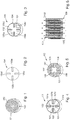
- Fig. 1 an embodiment of a spiral roll 101 is shown schematically, which can be processed into a cell according to the invention.
- the winding consists of a spiral wound electrode-separator composite and has two terminal end faces, of which only one, the end face 103, in Fig. 1 is visible.
- the electrode-separator assembly has an anode and a cathode, which are arranged offset within the electrode-separator assembly.
- the anode comprises a band-shaped metallic anode current collector which is loaded with negative electrode active material.
- the cathode comprises a band-shaped metallic cathode current collector which is loaded with positive electrode active material. Both current collectors are each made of porous metal foam.
- a longitudinal edge 102 of the cathode current collector emerges from the end face 103.
- the longitudinal edge of the anode current collector emerges from the second end face 109, not shown here, of the roll 101.
- a first embodiment of a contact plate 104 is shown schematically, which can be processed into a cell according to the invention.
- the contact plate 104 has the shape of a flat disk and has slots 105a, 105b, 105c and 105d. These slots are intended to counteract unintentional deformation of the contact plate as a result of heating, for example during a welding process.
- FIG. 3 an embodiment of a cell 100 not according to the invention is shown schematically.
- the cell is made up of the in Fig. 1 spiral winding 101 shown and the in Fig. 2 contact plate 104 shown together.
- the contact plate is welded onto the end face 103 of the roll.
- the contact plate 104 is placed on the end face 103.
- the contact with the spiral-shaped longitudinal edge 102 results in a line-like contact zone of spiral-shaped geometry, via which the longitudinal edge 102 and the contact plate 104 are connected.
- the contact plate 104 is fixed on the longitudinal edge 102.
- the contact plate 104 and the longitudinal edge 102 are welded to one another along the welding lines 106a, 106b, 106c and 106d by means of a laser beam.
- the weld lines 106a, 106b, 106c and 106d form lines that cross the line-like contact zone of spiral geometry. At each crossing point, the longitudinal edge 102 is connected to the contact plate 104 by welding. Overall, this results in a large-area connection of the contact plate 104 to the longitudinal edge 102.
- a further embodiment, not according to the invention, of a cell 111 according to the invention is shown schematically.
- the cell is also made up of the in Fig. 1 spiral winding 101 shown and the in Fig. 2 contact plate 104 shown together.
- the contact with the spiral-shaped longitudinal edge 102 also results here in the linear contact zone of spiral-shaped geometry, via which the longitudinal edge 102 is connected to the contact plate 104.
- the contact plate is welded onto the end face 103 of the roll along the welding lines 107a, 107b, 107c and 107d.
- the welding lines 107a, 107b, 107c and 107d here form straight lines which cross the line-like contact zone of spiral geometry. At each point of intersection of the straight line with the line-like contact zone, the longitudinal edge 102 is connected to the contact plate 104 by welding. Overall, this results in a large-area connection of the contact plate 104 to the longitudinal edge 102.
- a preferred embodiment of a cell 112 according to the invention is shown schematically.
- the cell is also made up of the in Fig. 1 spiral winding 101 shown and the in Fig. 2 contact plate 104 shown together.
- the contact with the spiral-shaped longitudinal edge 102 also results here in a line-like contact zone of spiral-shaped geometry, via which the longitudinal edge 102 is connected to the contact plate 104.
- the contact plate is welded onto the end face 103 of the roll along the welding line 108, which follows the spiral course of the longitudinal edge 102.
- the weld line 108 does not form a line that crosses the line-like contact zone of spiral geometry. Instead, the welding line 108 follows the line-like contact zone and thus fixes the longitudinal edge 102 lengthwise to the contact plate 104.
- the longitudinal edge 102 Because of the slots 105a to 105d, it is not possible for the longitudinal edge 102 to be continuously welded to the contact plate 104 over its entire length. Instead, the longitudinal edge 102 - interrupted by the slots 105a to 105d - comprises a multiplicity of sections which are each continuously connected to the contact plate 104 over their entire length via the weld seam 108 along the contact zone.
- Fig. 6 are a schematic of some turns of the in Fig. 1 shown winding shown in cross section. Between the windings of the separator "S" there are alternately band-shaped cathode “+” and band-shaped anode windings "-".
- the cathode and the anode each include a current collector. Due to an offset arrangement of the cathode and the anode within the coil, the longitudinal edge 102 of the cathode current collector emerges from the end face 103 while the longitudinal edge 110 of the anode current collector emerges from the end face 109.
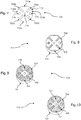
- a second embodiment of a contact plate 704 is shown schematically, which can be processed into a cell according to the invention.
- the contact plate 704 is designed as an approximately circular disk. Only approximately because the disc edge 713 is in four places 713a to 713d, at each of which a flat segment of a circle is separated, deviates from a perfect circle geometry.
- the contact plate 704 has the slots 705a, 705b, 705c and 705d.
- the four slots are aligned radially, starting from the outer disk edge 713, in the direction of the center of the contact plate.
- the contact plate 704 In its center, has a passage 714 in the form of a circular hole.
- Two further passages 715 and 716 are located to the right and left of the central opening 714. These can serve as positioning aids when the contact plate 704 is mounted.
- FIG. 13 is a schematic of an intermediate product 113 in the manufacture of a cell according to the invention according to FIG Fig. 9 or a cell according to Fig. 10 shown.
- the intermediate is made up of the in Fig. 1 spiral winding 101 shown and the in Fig. 7 contact plate 704 shown together.
- the contact plate 704 is placed on the end face 103 of the spiral winding 103.
- the contact with the spiral-shaped longitudinal edge 102 also results here in a line-like contact zone of spiral-shaped geometry, via which the longitudinal edge 102 is connected to the contact plate 704.
- the intermediate product 113 is further processed to form a cell according to the invention by welding the contact plate 704 to the spiral-shaped longitudinal edge 102 in order to fix the linear contact zone.
- a further embodiment of a cell 114 according to the invention is shown schematically.
- the cell 114 was formed from the intermediate product 113 by welding the contact plate 704 to the spiral-shaped longitudinal edge 102.
- the contact plate 704 and the longitudinal edge 102 are connected via the weld seam 116.
- This here has the same spiral shape as the longitudinal edge 102.
- the weld seam exactly follows the spiral course of the longitudinal edge 102.
- the longitudinal edge 102 - interrupted by the slots 705a to 705d - comprises a multiplicity of sections which are each continuously connected to the contact plate 704 over their entire length via the weld seam 108 along the contact zone.
- FIG. 10 an embodiment of a cell 115 according to the invention which is not according to the invention is shown schematically.
- the cell 115 was formed from the intermediate product 113 by welding the contact plate 704 to the spiral-shaped longitudinal edge 102.
- the contact plate 704 and the longitudinal edge 102 are connected here not via a weld but along the spiral shape Line 117, which is composed of a large number of individual welding points.
- the line 117 exactly follows the spiral shape of the longitudinal edge 102.
Landscapes
- Chemical & Material Sciences (AREA)
- Chemical Kinetics & Catalysis (AREA)
- Electrochemistry (AREA)
- General Chemical & Material Sciences (AREA)
- Engineering & Computer Science (AREA)
- Manufacturing & Machinery (AREA)
- Secondary Cells (AREA)
Description
- Die nachfolgend beschriebene Erfindung betrifft eine elektrochemische Zelle mit einem bandförmigen Elektroden-Separator-Verbund der Sequenz Anode/Separator/ Kathode, der in Form eines Wickels mit zwei endständigen Stirnseiten vorliegt.
- Derartige Zellen sind grundsätzlich bereits bekannt, beispielsweise aus der
DE 10 2009 060 800 A1 . In dieser deutschen Patentanmeldung sind zylindrische Wickel aus Elektroden-Separator-Verbünden beschrieben, die in zylindrische Metallgehäuse eingesetzt werden. Zur elektrischen Kontaktierung der Elektroden werden Stromkollektoren eingesetzt, die mit Elektrodenaktivmaterialien beladen sind. Die Stromkollektoren sind jeweils mit einer Metallfolie verschweißt, die als separater Stromableiter fungiert und die Stromkollektoren elektrisch mit dem Gehäuse verbindet. - Die in der
DE 10 2009 060 800 A1 beschriebene Vorgehensweise zur elektrischen Kontaktierung der Elektroden ist effizient und kostengünstig. In bestimmten Anwendungsfällen bietet sie aber Nachteile. Problematisch ist beispielsweise, dass die elektrische Anbindung der Elektroden über nur eine Stromableiterfolie erfolgt, die zudem meist an ein Ende des Wickels angeschweißt ist. Wenn von derart angebundenen Elektroden hohe Ströme in kurzer Zeit gespeichert oder abgegeben werden sollen, stößt die beschriebene Lösung sehr schnell an ihre Grenzen. - Aus der
JP 2004-119330 A - Ähnliche Konstruktionen mit stirnseitigen Metallplatten sind auch aus der
EP 2133942 A1 , derUS 2014/0087225 A1 , derJP 2004-55511 A EP 1102337 A1 bekannt. - Der vorliegenden Erfindung lag die Aufgabe zugrunde, elektrochemische Zellen mit bandförmigem Elektroden-Separator-Verbund der Sequenz Anode / Separator / Kathode bereitzustellen, die sich gegenüber dem zitierten Stand der Technik durch eine verbesserte Strombelastbarkeit auszeichnen.
- Diese Aufgabe wird gelöst durch die elektrochemische Zelle mit den Merkmalen des Anspruchs 1. Bevorzugte Ausführungsformen der erfindungsgemäßen Zelle sind in den abhängigen Ansprüchen 2 bis 6 angegeben.
- Die erfindungsgemäße elektrochemische Zelle zeichnet sich stets durch die folgenden Merkmale aus:
- Sie umfasst einen bandförmigen Elektroden-Separator-Verbund der Sequenz Anode / Separator/ Kathode. In bevorzugten Ausführungsformen weist der Verbund die Sequenz Anode / Separator/ Kathode / Separator /Anode oder Kathode / Separator / Anode / Separator / Kathode auf.
- Die Anode umfasst einen bandförmigen metallischen Anodenstromkollektor, der mit einem negativem Elektrodenaktivmaterial beladen ist, und die Kathode umfasst einen bandförmigen metallischen Kathodenstromkollektor, der mit einem positiven Elektrodenaktivmaterial beladen ist. Die Elektrodenaktivmaterialien dienen der Speicherung von Energie. Die Stromkollektoren dienen der elektrischen Kontaktierung der Elektroden sowie der thermischen und mechanischen Anbindung.
- Wie die eingangs erwähnten gattungsgemäßen Zellen liegt auch der Elektroden-Separator-Verbund einer erfindungsgemäßen Zelle in Form eines Wickels mit zwei endständigen Stirnseiten vor.
- Bevorzugt handelt es sich bei der erfindungsgemäßen elektrochemischen Zelle um eine sekundäre Zelle, also eine wieder aufladbare Zelle. Als Elektrodenaktivmaterial kommen für die erfindungsgemäße Zelle daher vorzugsweise die Aktivmaterialien in Betracht, die in sekundären elektrochemischen Zellen zum Einsatz kommen können.
- Besonders bevorzugt handelt es sich bei der elektrochemischen Zelle um eine Lithium-Ionen-Zelle. In diesem Fall ist das negative Elektrodenaktivmaterial beispielsweise Graphit und das positive Elektrodenaktivmaterial beispielsweise Lithiumkobaltoxid.
- In einerweiteren bevorzugten Ausführungsform kann es sich bei der erfindungsgemäßen Zelle um eine Nickel-Metallhydrid-Zelle handeln, die auf der Seite der negativen Elektrode eine Wasserstoffspeicherlegierung aufweist und auf der Seite der positiven Elektrode Nickelhydroxid / Nickeloxyhydroxid.
- Weiterhin können die Elektroden der erfindungsgemäße Zelle wie die Elektroden der in der
WO 2016/005529 A1 und in derWO 2016/005528 A2 beschriebenen Systeme ausgebildet sein. In diesen Dokumenten sind Systeme beschrieben, bei denen die positive Elektrode auf Nickeloxyhydroxid / Nickelhydroxid basiert während die negative Elektrode eine Mischung aus Aktivkohle und einer Wasserstoffspeicherlegierung oder eine Mischung aus Aktivkohle und Eisen in metallischerund/oderoxidierter Form enthält. - Besonders zeichnet sich die erfindungsgemäße Zelle dadurch aus, dass
- innerhalb des Elektroden-Separator-Verbunds die Anode und die Kathode versetzt zueinander angeordnet sind, so dass ein Längsrand des Anodenstromkollektors aus einer der endständigen Stirnseiten und ein Längsrand des Kathodenstromkollektors aus der anderen der endständigen Stirnseiten austritt,
- Die erfindungsgemäße Zelle eine Kontaktplatte aufweist, die auf einem der Längsränder aufliegt, so dass sich eine linienartige Kontaktzone ergibt, und
- Die Kontaktplatte mit dem Längsrand entlang dieser linienartigen Kontaktzone durch Verschweißung verbunden ist.
- Bei der Herstellung von Elektroden-Separator-Verbünden wird üblicherweise darauf geachtet, dass Elektroden und Stromkollektoren derart miteinander kombiniert werden, dass es nicht zu einem einseitigen Überstehen entgegengesetzt gepolter Stromkollektoren kommt, da dies die Kurzschlussgefahr erhöhen kann. Bei der beschriebenen versetzten Anordnung ist die Kurzschlussgefahr jedoch minimiert, da die entgegengesetzt gepolten Stromkollektoren aus sich gegenüberliegenden Stirnseiten des Wickels austreten.
- Erfindungsgemäß macht man sich den aus der versetzten Anordnung resultierenden Überstand der Stromkollektoren zunutze, indem man sie mittels eines entsprechenden Stromableiters großflächig kontaktiert. Als Stromableiter kommt hierbei die erwähnte Kontaktplatte zum Einsatz.
- Über die Kontaktplatte ist es möglich, einen Stromkollektor und damit auch eine dazugehörige bandförmige Elektrode über seine / ihre gesamte Länge elektrisch zu kontaktieren. Dies senkt den Innenwiderstand innerhalb der erfindungsgemäßen Zelle sehr deutlich. Die beschriebene Anordnung kann das Auftreten großer Ströme somit sehr viel besser abfangen als aus dem Stand der Technik bekannte Zellen. Mit minimiertem Innenwiderstand reduzieren sich thermische Verluste bei hohen Strömen. Zudem wird die Abfuhr thermischer Energie über die Pole begünstigt.
- Die Kontaktplatte kann wiederum mit einem Pol der erfindungsgemäßen Zelle, beispielsweise einem Gehäusepol, verbunden sein.
- Die erfindungsgemäße Zelle ist in bevorzugten Ausführungsformen als Knopfzelle ausgebildet und weist ein metallisches Gehäuse aus zwei Gehäuseteilen aus, die durch eine elektrisch isolierende Dichtung voneinander isoliert sind, beispielsweise wie es in
Fig. 1 derDE 10 2009 060 800 A1 dargestellt ist. In diesem Fall kann die Kontaktplatte beispielsweise mit dem positiv gepolten Gehäusehalbteil verbunden sein. Die Zelle kann aber auch eine Rundzelle sein, also eine Höhe aufweisen, die größer als ihr Durchmesser ist. - Es gibt mehrere Möglichkeiten, wie die Kontaktplatte mit dem Längsrand verbunden werden kann.
- Die Kontaktplatte ist mit dem Längsrand entlang der linienartigen Kontaktzone über mindestens eine Schweißnaht verbunden. Der Längsrand umfasst erfindungsgemäß einen oder mehrere Abschnitte, die jeweils über ihre gesamte Länge über eine Schweißnaht durchgehend mit der Kontaktplatte verbunden sind.
- Weiterhin ist erfindungsgemäß, dass sich der oder die mit der Kontaktplatte über ihre gesamte Länge durchgehend verbundenen Abschnitte über mindestens 25 % der Gesamtlänge des Längsrandes erstrecken.
- In einer möglichen Weiterbildung erstrecken sich der / die mit der Kontaktplatte über ihre gesamte Länge durchgehend verbundenen Abschnitte über mindestens 50 %, besonders bevorzugt über mindestens 75 %, der Gesamtlänge des Längsrandes.
- Ganz besonders bevorzugt ist der Längsrand über seine gesamte Länge durchgehend mit der Kontaktplatte verschweißt.
- In nicht erfindungsgemäßen Ausführungsformen ist die Kontaktplatte mit dem Längsrand über eine Vielzahl von Schweißpunkten verbunden. In diesem Fall ist es bevorzugt, dass die Schweißpunkte mindestens eine Linie bilden, insbesondere mindestens eine Gerade, welche die linienartige Kontaktzone kreuzt.
- Der Elektroden-Separator-Verbund liegt erfindungsgemäß in Form eines spiralförmigen Wickels vor. Hieraus resultiert, dass die aus den endständigen Stirnseiten des Wickels austretenden Längsränder des Anodenstromkollektors und des Kathodenstromkollektors ebenfalls eine spiralförmige Geometrie aufweisen. Analoges gilt für die linienartige Kontaktzone, entlang der die Kontaktplatte mit dem Längsrand verschweißt ist.
- Bei dem Anodenstromkollektor und/oder dem Kathodenstromkollektor handelt es sich in bevorzugten Ausführungsformen um einen Schaum, ein Gewebe, ein Netz, ein Gitter, ein Vlies, einen Filz oder eine Folie. Besonders bevorzugt handelt es sich bei dem Anodenstromkollektor und/oder dem Kathodenstromkollektor um einen Metallschaum.
- In weiteren bevorzugten Ausführungsformen weisen der Anodenstromkollektor und/oder der Kathodenstromkollektor eine Dicke im Bereich von 4 µm bis 700 µm auf.
- Dicken im Bereich von 4 µm bis 25 µm sind insbesondere dann bevorzugt, wenn es sich bei dem Anodenstromkollektor und/oder dem Kathodenstromkollektor um eine Metallfolie handelt, insbesondere eine Folie aus Nickel, Aluminium oder Kupfer.
- Wenn es sich bei dem Anodenstromkollektor und/oder dem Kathodenstromkollektor um einen Schaum, ein Gewebe, ein Netz, ein Gitter, ein Vlies oder einen Filz handelt, so können die Dicken im Bereich von 30 µm bis 700 µm liegen.
- Wenn es sich bei dem Anodenstromkollektor und/oder dem Kathodenstromkollektor um einen Schaum, ein Gewebe, ein Netz, ein Gitter, ein Vlies oder einen Filz handelt, so weisen bevorzugt auch die Anode und/oder die Kathode selbst Dicken im Bereich von 30 µm bis 700 µm auf.
- Die Dickenverhältnisse zwischen Anode und Kathode ergeben sich häufig in Abhängigkeit der verwendeten Aktivmaterialien und derjeweiligen spezifischen Kapazität der Aktivmaterialien. Für EDLC- (EDLC = electric double layer capacitor), Lithium-Ionen- und NiMH-basierte Systeme werden Dicken zwischen 50 und 300 µm bevorzugt. Asymmetrische Systeme wie Lithium-Ionen-Kondensatoren oder wässrige Ni(OH)2-basierte Kondensatoren benötigen Aktivkohle-Elektroden mit bevorzugt 200 - 700 µm Dicke und dünne Redox-Gegenelektroden (Graphit, Ni(OH)2, Lithium-Titanat, MnO2, etc.) mit bevorzugt 30 - 200 µm Dicke.
- Der Anodenstromkollektor und/oder der Kathodenstromkollektor bestehen bevorzugt aus Aluminium, Titan, Kupfer, Nickel, Edelstahl oder aus vernickeltem Stahl.
- In einigen bevorzugten Ausführungsformen weist die erfindungsgemäße Zelle mindestens eines der folgenden Merkmale auf:
- Die Kontaktplatte ist eine Metallplatte mit einer Dicke im Bereich von 200 µm bis 1000 µm, bevorzugt 400 - 500µm.
- Die Kontaktplatte besteht aus Aluminium, Titan, Nickel, Edelstahl oder vernickeltem Stahl.
- Die Kontaktplatte weist mindestens einen Schlitz und/oder mindestens eine Perforierung auf. Diese dienen dazu, einer Verformung der Platte bei der Herstellung der Schweißverbindung entgegenzuwirken.
- Besonders bevorzugt weist die Kontaktplatte die Dicke im Bereich von 200 µm bis 1000 µm und den mindestens einen Schlitz und/oder die mindestens eine Perforierung auf.
- Wenn vorliegend von einer Perforierung der Kontaktplatte die Rede ist, so bedeutet dies vorzugsweise, dass die Kontaktplatte gelocht ist, also mehrere Löcher aufweist, insbesondere in einer regelmäßigen Anordnung. Beispielsweise kann die Kontaktplatte als linienförmige Perforierung eine Abfolge von Löchern entlang einer Linie, insbesondere entlang einer Gerade, aufweisen, wobei es bevorzugt ist, dass die Löcher in regelmäßigen Abständen in die Platte eingebracht sind.
- Wenn vorliegend von einem Schlitz in der Kontaktplatte die Rede ist, so bedeutet dies vorzugsweise, dass die Kontaktplatte eine längliche Durchbrechung, bevorzugt eine gerade längliche Durchbrechung, aufweist, insbesondere eine längliche Durchbrechung gleichbreitender Breite.
- In bevorzugten Ausführungsformen hat die Kontaktplatte die Form einer Scheibe, insbesondere die Form einer kreisförmigen oder zumindest näherungsweise kreisförmigen Scheibe. Sie weist dann also einen äußeren kreisförmigen oder zumindest näherungsweise kreisförmigen Scheibenrand auf. Unter einer näherungsweise kreisförmigen Scheibe soll hierbei insbesondere eine Scheibe verstanden werden, die die Form eines Kreises mit mindestens einem abgetrennten Kreissegment, bevorzugt mit zwei bis vier abgetrennten Kreissegmenten, aufweist.
- In weiteren bevorzugten Ausführungsformen kann die Kontaktplatte beispielsweise aber auch die Form eines Polygons, bevorzugt eines regelmäßigen Polygons, insbesondere eines regelmäßigen Polygons mit 4 bis 10 Ecken und Seiten, aufweisen.
- Die Kontaktplatte, insbesondere wenn sie als kreisförmige oder zumindest näherungsweise kreisförmige Scheibe ausgebildet ist oder die Form eines Polygons aufweist, kann in bevorzugten Ausführungsformen eine zentrale, in ihrem Zentrum liegende Öffnung, insbesondere in Form eines kreisrunden Lochs, aufweisen. Als kreisförmige oder zumindest näherungsweise kreisförmige Scheiben ausgebildete Kontaktplatten weisen dann einen äußeren kreisförmigen oder zumindest näherungsweise kreisförmigen Scheibenrand und einen inneren, bevorzugt kreisrunden, Scheibenrand auf.
- Insbesondere wenn die Kontaktplatte als kreisförmige oder zumindest näherungsweise kreisförmige Scheibe ausgebildet ist und den erwähnten äußeren kreisförmigen oder zumindest näherungsweise kreisförmigen Scheibenrand aufweist, dann weist sie auch den mindestens einen Schlitz und/oder die mindestens eine Perforierung, insbesondere die mindestens eine linienförmige Perforierung, auf.
- Der mindestens eine Schlitz und/oder die mindestens eine Perforierung sind, bevorzugt ausgehend von dem äußeren Scheibenrand, radial in Richtung des Zentrums der Scheibe ausgerichtet. Bevorzugt weisen drei oder mehr Schlitze ausgehend von unterschiedlichen Punkten auf dem äußeren Scheibenrand diese Orientierung auf und unterteilen dabei die Scheibe in mehrere, bevorzugt gleich große Sektoren, insbesondere Kreissektoren.
- Wenn die Kontaktplatte als kreisförmige oderzumindest näherungsweise kreisförmige Scheibe ausgebildet ist und die zentrale Öffnung aufweist, so ist es auch möglich, dass sich der mindestens eine Schlitz und/oder die mindestens eine Perforierung ausgehend von dem inneren Scheibenrand radial nach außen in Richtung des äußeren Scheibenrands erstrecken.
- Es ist bevorzugt, dass die Scheibe 2 bis 6 Schlitze oder 2 bis 6 Perforierungen, besonders bevorzugt 4 Schlitze oder 4 Perforierungen, aufweist.
- Durch die Schlitze und/oder Perforierungen ist gewährleistet, dass sich die Kontaktplatte bei Schweißvorgängen nicht verzieht. Darüber hinaus ist gewährleistet, dass die Kontaktplatte das Eindringen von Elektrolyt in den wickelförmigen Elektroden-Separator-Verbund nicht behindert.
- In einer besonders bevorzugten Ausführungsform weist die erfindungsgemäße Zelle mindestens eines der folgenden Merkmale, insbesondere eine Kombination aus den folgenden Merkmalen, auf:
- Der Elektroden-Separator-Verbund liegt in Form eines spiralförmigen Wickels mit zwei endständigen Stirnseiten vor.
- Die aus den endständigen Stirnseiten des Wickels austretenden Längsränder des Anodenstromkollektors und des Kathodenstromkollektors weisen eine spiralförmige Geometrie auf.
- Die Zelle weist eine erste Kontaktplatte auf, die auf dem Längsrand des Anodenstromkollektors aufliegt, so dass sich eine linienartige erste Kontaktzone mit spiralförmiger Geometrie ergibt.
- Die Zelle weist eine zweite Kontaktplatte auf, die auf dem Längsrand des Kathodenstromkollektors aufliegt, so dass sich eine linienartige zweite Kontaktzone mit spiralförmiger Geometrie ergibt.
- Bei dem Anodenstromkollektor und dem Kathodenstromkollektor handelt es sich jeweils um einen Schaum.
- Der Längsrand des Anodenstromkollektors umfasst einen oder mehrere Abschnitte, die jeweils über ihre gesamte Länge über eine Schweißnaht entlang der Kontaktzone durchgehend mit der ersten Kontaktplatte verbunden sind.
- Der Längsrand des Kathodenstromkollektors umfasst einen oder mehrere Abschnitte, die jeweils über ihre gesamte Länge über eine Schweißnaht entlang der Kontaktzone durchgehend mit der zweiten Kontaktplatte verbunden sind.
- In einer nicht erfindungsgemäßen Ausführungsform weist die erfindungsgemäße Zelle mindestens eines der folgenden Merkmale, insbesondere eine Kombination aus den folgenden Merkmalen, auf:
- Der Elektroden-Separator-Verbund liegt in Form eines spiralförmigen Wickels mit zwei endständigen Stirnseiten vor.
- Die aus den endständigen Stirnseiten des Wickels austretenden Längsränder des Anodenstromkollektors und des Kathodenstromkollektors weisen eine spiralförmige Geometrie auf.
- Die Zelle weist eine erste Kontaktplatte auf, die auf dem Längsrand des Anodenstromkollektors aufliegt, so dass sich eine linienartige erste Kontaktzone mit spiralförmiger Geometrie ergibt.
- Die Zelle weist eine zweite Kontaktplatte auf, die auf dem Längsrand des Kathodenstromkollektors aufliegt, so dass sich eine linienartige zweite Kontaktzone mit spiralförmiger Geometrie ergibt.
- Bei dem Anodenstromkollektor und dem Kathodenstromkollektor handelt es sich jeweils um einen Metallschaum.
- Der Längsrand des Anodenstromkollektors ist über eine Vielzahl von Schweißpunkten entlang der Kontaktzone mit der ersten Kontaktplatte verbunden.
- Der Längsrand des Kathodenstromkollektors ist über eine Vielzahl von Schweißpunkten entlang der Kontaktzone mit der zweiten Kontaktplatte verbunden.
- Die Schweißpunkte bilden jeweils mindestens eine Linie, insbesondere mindestens eine Gerade, welche die linienartige erste und die linienartige zweite Kontaktzone kreuzen.
- In besonders bevorzugten Ausführungsformen bestehen die erste Kontaktplatte und der Anodenstromkollektor beide aus dem gleichen Material. Dieses wird besonders bevorzugt aus der Gruppe mit Kupfer, Nickel, Titan, vernickeltem Stahl und Edelstahl gewählt.
- Die zweite Kontaktplatte und der Kathodenstromkollektor bestehen besonders bevorzugt beide aus dem gleichen Material aus der Gruppe mit Aluminium, Nickel, Titan, vernickelter Stahl und Edelstahl.
- Weitere Merkmale der Erfindung sowie aus der Erfindung resultierende Vorteile ergeben sich aus den Zeichnungen sowie aus der nachfolgenden Beschreibung der Zeichnungen. Die nachfolgend beschriebenen Ausführungsformen dienen lediglich zur Erläuterung und zum besseren Verständnis der Erfindung und sind in keiner Weise einschränkend zu verstehen.
- In
Fig. 1 ist schematisch eine Ausführungsform eines spiralförmigen Wickels 101 dargestellt, der sich zu einer erfindungsgemäßen Zelle verarbeiten lässt. Der Wickel besteht aus einem spiralförmig aufgewickelten Elektroden-Separator-Verbund und weist zwei endständige Stirnseiten auf, von denen nur eine, die Stirnseite 103, inFig. 1 sichtbar ist. - Der Elektroden-Separator-Verbund weist eine Anode und eine Kathode auf, die innerhalb des Elektroden-Separator-Verbunds versetzt angeordnet sind. Die Anode umfasst einen bandförmigen metallischen Anodenstromkollektor, der mit negativem Elektrodenaktivmaterial beladen ist. Die Kathode umfasst einen bandförmigen metallischen Kathodenstromkollektor, der mit positivem Elektrodenaktivmaterial beladen ist. Bei beiden Stromkollektoren handelt es sich jeweils um einen porösen Metallschaum.
- Ein Längsrand 102 des Kathodenstromkollektors tritt aus der Stirnseite 103 aus. Er weist als Folge der spiralförmigen Wicklung des Elektroden-Separator-Verbunds gleichfalls eine spiralförmige Geometrie auf. Der Längsrand des Anodenstromkollektors tritt aus der hier nicht dargestellten zweiten Stirnseite 109 des Wickels 101 aus.
- In
Fig. 2 ist schematisch eine erste Ausführungsform einer Kontaktplatte 104 dargestellt, die sich zu einer erfindungsgemäßen Zelle verarbeiten lässt. Die Kontaktplatte 104 hat die Form einer flachen Scheibe und weist die weist Schlitze 105a, 105b, 105c und 105d auf. Durch diese Schlitze soll einer unbeabsichtigten Deformation der Kontaktplatte in Folge von Erwärmung, beispielsweise während eines Schweißvorgangs, entgegengewirkt werden. - In
Fig. 3 ist schematisch eine nicht erfindungsgemäße Ausführungsform einer Zelle 100 dargestellt. Die Zelle setzt sich aus dem inFig. 1 dargestellten spiralförmigen Wickel 101 und der inFig. 2 dargestellten Kontaktplatte 104 zusammen. Die Kontaktplatte ist auf die Stirnseite 103 des Wickels aufgeschweißt. Zur Herstellung der Zelle 101 wird die Kontaktplatte 104 auf die Stirnseite 103 aufgelegt. Durch den Kontakt mit dem spiralförmigen Längsrand 102 ergibtsich eine linienartige Kontaktzone spiralförmiger Geometrie, über die der Längsrand 102 und die Kontaktplatte 104 verbunden sind. - Nach dem Auflegen wird die Kontaktplatte 104 auf dem Längsrand 102 fixiert. Hierzu werden mittels eines Laserstrahls die Kontaktplatte 104 und der Längsrand 102 entlang den Schweißlinien 106a, 106b, 106c und 106d miteinander verschweißt.
- Die Schweißlinien 106a, 106b, 106c und 106d bilden Linien, die die linienartige Kontaktzone spiralförmiger Geometrie kreuzen. An jedem Kreuzungspunkt ist der Längsrand 102 mit der Kontaktplatte 104 durch Verschweißung verbunden. Insgesamt ergibt sich hierdurch eine großflächige Anbindung der Kontaktplatte 104 an den Längsrand 102.
- In
Fig. 4 ist schematisch eine weitere nicht erfindungsgemäße Ausführungsform einer erfindungsgemä-βen Zelle 111 dargestellt. Die Zelle setzt sich gleichfalls aus dem inFig. 1 dargestellten spiralförmigen Wickel 101 und der inFig. 2 dargestellten Kontaktplatte 104 zusammen. Durch den Kontakt mit dem spiralförmigen Längsrand 102 ergibt sich auch hier die linienartige Kontaktzone spiralförmiger Geometrie, über die der Längsrand 102 mit der Kontaktplatte 104 verbunden ist. Die Kontaktplatte ist auf die Stirnseite 103 des Wickels entlang den Schweißlinien 107a, 107b, 107c und 107d aufgeschweißt. - Die Schweißlinien 107a, 107b, 107c und 107d bilden hier Geraden, die die linienartige Kontaktzone spiralförmiger Geometrie kreuzen. An jedem Kreuzungspunkt der Geraden mit der linienartigen Kontaktzone ist der Längsrand 102 mit der Kontaktplatte 104 durch Verschweißung verbunden. Insgesamt ergibt sich hierdurch eine großflächige Anbindung der Kontaktplatte 104 an den Längsrand 102.
- In
Fig. 5 ist schematisch eine bevorzugte Ausführungsform einer erfindungsgemäßen Zelle 112 dargestellt. Die Zelle setzt sich gleichfalls aus dem inFig. 1 dargestellten spiralförmigen Wickel 101 und der inFig. 2 dargestellten Kontaktplatte 104 zusammen. Durch den Kontakt mit dem spiralförmigen Längsrand 102 ergibt sich auch hier eine linienartige Kontaktzone spiralförmiger Geometrie, über die der Längsrand 102 mit der Kontaktplatte 104 verbunden ist. Die Kontaktplatte ist auf die Stirnseite 103 des Wickels entlang der Schweißlinie 108, die dem spiralförmigen Verlauf des Längsrandes 102 folgt, aufgeschweißt. - Im Unterschied zur ersten und zur zweiten Ausführungsform bildet die Schweißlinie 108 keine Linie, die die linienartige Kontaktzone spiralförmiger Geometrie kreuzt. Stattdessen folgt die Schweißlinie 108 der linienartigen Kontaktzone und fixiert somit den Längsrand 102 der Länge nach an die Kontaktplatte 104.
- Aufgrund der Schlitze 105a bis 105d ist es nicht möglich, dass der Längsrand 102 über seine gesamte Länge durchgehend mit der Kontaktplatte 104 verschweißt ist. Stattdessen umfasst der Längsrand 102 - unterbrochen durch die Schlitze 105a bis 105d - eine Vielzahl von Abschnitten, die jeweils über ihre gesamte Länge über die Schweißnaht 108 entlang der Kontaktzone durchgehend mit der Kontaktplatte 104 verbunden sind.
- In
Fig. 6 sind schematisch einige Windungen des inFig. 1 dargestellten Wickels im Querschnitt dargestellt. Zwischen den Windungen des Separators "S" sind abwechselnd bandförmige Kathoden- "+" und bandförmige Anodenwindungen "-" angeordnet. Die Kathode und die Anode umfassen jeweils einen Stromkollektor. Aufgrund einer versetzten Anordnung der Kathode und der Anode innerhalb des Wickels tritt der Längsrand 102 des Kathodenstromkollektors aus der Stirnseite 103 aus während der Längsrand 110 des Anodenstromkollektors aus der Stirnseite 109 austritt. - In
Fig. 7 ist schematisch eine zweite Ausführungsform einer Kontaktplatte 704 dargestellt, die sich zu einer erfindungsgemäßen Zelle verarbeiten lässt. Die Kontaktplatte 704 ist als näherungsweise kreisförmige Scheibe ausgebildet. Nur näherungsweise deshalb, weil der Scheibenrand 713 an vier Stellen 713a bis 713d, an denen jeweils ein flaches Kreissegment abgetrennt ist, von einer perfekten Kreisgeometrie abweicht. - Die Kontaktplatte 704 weist die Schlitze 705a, 705b, 705c und 705d auf. Die vier Schlitze sind ausgehend von dem äußeren Scheibenrand 713 radial in Richtung des Zentrums der Kontaktplatte ausgerichtet. In ihrem Zentrum weist die Kontaktplatte 704 einen Durchlass 714 in Form eines kreisrunden Lochs auf. Zwei weitere Durchlässe 715 und 716 finden sich rechts und links der zentralen Öffnung 714. Diese können als Positionierungshilfen bei der Montage der Kontaktplatte 704 dienen.
- In
Fig. 8 ist schematisch ein Zwischenprodukt 113 bei der Herstellung einer erfindungsgemäßen Zelle gemäßFig. 9 oder einer Zelle gemäßFig. 10 dargestellt. Das Zwischenprodukt setzt sich aus dem inFig. 1 dargestellten spiralförmigen Wickel 101 und der inFig. 7 dargestellten Kontaktplatte 704 zusammen. Die Kontaktplatte 704 ist auf die Stirnseite 103 des spiralförmigen Wickels 103 aufgelegt. Durch den Kontakt mit dem spiralförmigen Längsrand 102 ergibt sich auch hier eine linienartige Kontaktzone spiralförmiger Geometrie, über die der Längsrand 102 mit der Kontaktplatte 704 verbunden ist. Die Weiterverarbeitung des Zwischenprodukts 113 zu einer erfindungsgemäßen Zelle erfolgt durch Verschwei-βen der Kontaktplatte 704 mit dem spiralförmigen Längsrand 102, um die linienartige Kontaktzone zu fixieren. - In
Fig. 9 ist schematisch eine weitere Ausführungsform einer erfindungsgemäßen Zelle 114 dargestellt. Die Zelle 114 wurde durch Verschweißung der Kontaktplatte 704 mit dem spiralförmigen Längsrand 102 aus dem Zwischenprodukt 113 gebildet. Verbunden sind die Kontaktplatte 704 und der Längsrand 102 über die Schweißnaht 116. Diese weist hierbei denselben spiralförmigen Verlauf wie der Längsrand 102 auf. Die Schweißnaht folgt exakt dem spiralförmigen Verlauf des Längsrands 102.Auch hier ist es aufgrund der Schlitze 705a bis 705d ist es nicht möglich, dass der Längsrand 102 überseine gesamte Länge durchgehend mit der Kontaktplatte 704 verschweißt ist. Stattdessen umfasst der Längsrand 102 - unterbrochen durch die Schlitze 705a bis 705d - eine Vielzahl von Abschnitten, die jeweils über ihre gesamte Länge über die Schweißnaht 108 entlang der Kontaktzone durchgehend mit der Kontaktplatte 704 verbunden sind. - In
Fig. 10 ist schematisch eine nicht erfindungsgemäße Ausführungsform einer erfindungsgemäßen Zelle 115 dargestellt. Die Zelle 115 wurde durch Verschweißung der Kontaktplatte 704 mit dem spiralförmigen Längsrand 102 aus dem Zwischenprodukt 113 gebildet. Verbunden sind die Kontaktplatte 704 und der Längsrand 102 allerdings hier nicht über eine Schweißnahtsondern entlangderspiralförmigen Linie 117, die sich aus einer Vielzahl von einzelnen Schweißpunkten zusammensetzt. Die Linie 117 folgt auch hier exakt dem spiralförmigen Verlauf des Längsrands 102. - Aufgrund der Schlitze 705a bis 705d ist es auch nicht möglich, dass der Längsrand über seine gesamte Länge durchgehend mit der Kontaktplatte 704 verschweißt ist.
Claims (6)
- Elektrochemische Zelle (112; 114) mit den Merkmalena. Die Zelle umfasst einen bandförmigen Elektroden-Separator-Verbund (101) der Sequenz Anode / Separator / Kathode,b. Die Anode umfasst einen bandförmigen metallischen Anodenstromkollektor, der mit negativem Elektrodenaktivmaterial beladen ist,c. Die Kathode umfasst einen bandförmigen metallischen Kathodenstromkollektor, der mit positivem Elektrodenaktivmaterial beladen ist,d. Der Elektroden-Separator-Verbund (101) liegt in Form eines Wickels mit zwei endständigen Stirnseiten (103; 109) vor,e. Die Anode und die Kathode sind innerhalb des Elektroden-Separator-Verbunds (101) versetzt angeordnet, so dass ein Längsrand (110) des Anodenstromkollektors aus einer der endständigen Stirnseiten und ein Längsrand (102) des Kathodenstromkollektors aus der anderen der endständigen Stirnseiten austritt,f. Die Zelle weist eine Kontaktplatte (104; 704) auf, die auf einem der Längsränder (102) aufliegt, so dass sich eine linienartige Kontaktzone ergibt,g. Die Kontaktplatte (104; 704) ist mit dem Längsrand (102) entlang der linienartigen Kontaktzone durch Verschweißung verbunden,h. Die Kontaktplatte (104; 704) weist mindestens einen Schlitz (105a, 105b, 105c, 105d; 705a, 705b, 705c, 705d) und/oder mindestens eine Perforierung auf, und der mindestens eine Schlitz und/oder die mindestens eine Perforierung sind so ausgestattet, dass einer Verformung der Kontaktplatte bei der Herstellung einer Schweißverbindung entgegengewirkt wird,i. Der Elektroden-Separator-Verbund (101) liegt in Form eines spiralförmigen Wickels vor,j. Die aus den endständigen Stirnseiten (103; 109) des Wickels austretenden Längsränder (102; 110) des Anodenstromkollektors und des Kathodenstromkollektors weisen eine spiralförmige Geometrie auf, undk. Die linienartige Kontaktzone, entlang der die Kontaktplatte (104; 704) mit dem Längsrand (102) verschweißt ist, weist eine spiralförmige Geometrie auf, und dadurch gekennzeichnet, dassl. Der Längsrand (102) einen oder mehrere Abschnitte umfasst, die jeweils über ihre gesamte Länge über eine Schweißnaht (108; 116) durchgehend mit der Kontaktplatte (104; 704) verbunden sind, wobei der oder die mit der Kontaktplatte (104; 704) über ihre gesamte Länge durchgehend verbundenen Abschnitte sich über mindestens 25 % der Gesamtlänge des Längsrandes (102) erstrecken.
- Zelle nach Anspruch 1 mit mindestens einem der folgenden zusätzlichen Merkmale:a. Der oder die mit der Kontaktplatte über ihre gesamte Länge durchgehend verbundenen Abschnitte erstrecken sich über mindestens 50 %, besonders bevorzugt über mindestens 75 %, der Gesamtlänge des Längsrandes.b. Der Längsrand ist über seine gesamte Länge durchgehend mit der Kontaktplatte verschweißt.
- Zelle nach einem der vorhergehenden Ansprüche mit mindestens einem der folgenden zusätzlichen Merkmale:a. Der Anodenstromkollektor und/oder der Kathodenstromkollektor ist ein Schaum, ein Gewebe, ein Netz, ein Gitter, ein Vlies oder ein Filz.b. Der Anodenstromkollektor und/oder der Kathodenstromkollektor weist eine Dicke im Bereich von 3 µm bis 700 µm auf.c. Der Anodenstromkollektor und/oder der Kathodenstromkollektor bestehen aus Aluminium, Titan, Kupfer, Nickel, Edelstahl oder vernickeltem Stahl.
- Zelle nach einem der vorhergehenden Ansprüche mit mindestens einem der folgenden zusätzlichen Merkmale:a. Die Kontaktplatte ist eine Metallplatte mit einer Dicke im Bereich von 200 µm bis 1000 µm.b. Die Kontaktplatte bestehtausAluminium, Titan, Kupfer, Nickel, Edelstahl oder vernickeltem Stahl.
- Zelle nach einem der vorhergehenden Ansprüche mit mindestens einem der folgenden zusätzlichen Merkmale:a. Die Zelle weist eine erste Kontaktplatte auf, die auf dem Längsrand des Anodenstromkollektors aufliegt, so dass sich eine linienartige erste Kontaktzone mit spiralförmiger Geometrie ergibt.b. Die Zelle weist eine zweite Kontaktplatte (104; 704) auf, die auf dem Längsrand (102) des Kathodenstromkollektors aufliegt, so dass sich eine linienartige zweite Kontaktzone mit spiralförmiger Geometrie ergibt.c. Bei dem Anodenstromkollektorund dem Kathodenstromkollektor handeltessichjeweilsum einen Schaum.d. Der Längsrand des Anodenstromkollektors umfasst einen oder mehrere Abschnitte, die jeweils über ihre gesamte Länge über eine Schweißnaht entlang der Kontaktzone durchgehend mit der ersten Kontaktplatte verbunden sind.e. Der Längsrand (102) des Kathodenstromkollektors umfasst einen oder mehrere Abschnitte, die jeweils über ihre gesamte Länge über eine Schweißnaht (108; 116) entlang der Kontaktzone durchgehend mit der zweiten Kontaktplatte (104; 704) verbunden sind.
- Zelle nach Anspruch 5 mit mindestens einem der folgenden zusätzlichen Merkmalea. Die erste Kontaktplatte und der Anodenstromkollektor bestehen beide aus dem gleichen Material aus der Gruppe mit Kupfer, Nickel, Titan, vernickelter Stahl und Edelstahl.b. Die zweite Kontaktplatte und der Kathodenstromkollektor bestehen beide aus dem gleichen Material aus der Gruppe mit Aluminium, Nickel, Titan, vernickelter Stahl und Edelstahl.
Applications Claiming Priority (2)
| Application Number | Priority Date | Filing Date | Title |
|---|---|---|---|
| EP16174720.9A EP3258519A1 (de) | 2016-06-16 | 2016-06-16 | Elektrochemische zelle mit optimiertem innenwiderstand |
| PCT/EP2017/062818 WO2017215900A1 (de) | 2016-06-16 | 2017-05-28 | Elektrochemische zelle mit optimiertem innenwiderstand |
Publications (2)
| Publication Number | Publication Date |
|---|---|
| EP3472879A1 EP3472879A1 (de) | 2019-04-24 |
| EP3472879B1 true EP3472879B1 (de) | 2021-08-18 |
Family
ID=56132838
Family Applications (2)
| Application Number | Title | Priority Date | Filing Date |
|---|---|---|---|
| EP16174720.9A Withdrawn EP3258519A1 (de) | 2016-06-16 | 2016-06-16 | Elektrochemische zelle mit optimiertem innenwiderstand |
| EP17725617.9A Active EP3472879B1 (de) | 2016-06-16 | 2017-05-28 | Elektrochemische zelle mit optimiertem innenwiderstand |
Family Applications Before (1)
| Application Number | Title | Priority Date | Filing Date |
|---|---|---|---|
| EP16174720.9A Withdrawn EP3258519A1 (de) | 2016-06-16 | 2016-06-16 | Elektrochemische zelle mit optimiertem innenwiderstand |
Country Status (2)
| Country | Link |
|---|---|
| EP (2) | EP3258519A1 (de) |
| WO (1) | WO2017215900A1 (de) |
Cited By (1)
| Publication number | Priority date | Publication date | Assignee | Title |
|---|---|---|---|---|
| EP4687187A1 (de) | 2024-07-30 | 2026-02-04 | VARTA Microbattery GmbH | Verfahren zur herstellung eines elektrochemischen energiespeicherelements |
Families Citing this family (46)
| Publication number | Priority date | Publication date | Assignee | Title |
|---|---|---|---|---|
| EP3742526B1 (de) | 2019-05-24 | 2024-02-28 | VARTA Microbattery GmbH | Elektrochemische zelle und verfahren zu ihrer herstellung |
| EP3905388A1 (de) | 2020-04-29 | 2021-11-03 | VARTA Microbattery GmbH | Sekundäre elektrochemische lithium-ionen-zelle |
| EP3916826A1 (de) | 2020-05-29 | 2021-12-01 | VARTA Microbattery GmbH | Elektrochemische zelle |
| EP3916877A1 (de) | 2020-05-29 | 2021-12-01 | VARTA Microbattery GmbH | Energiespeicherzelle und herstellungsverfahren |
| EP3965196A1 (de) * | 2020-09-07 | 2022-03-09 | VARTA Microbattery GmbH | Energiespeicherzelle |
| EP3916827A1 (de) | 2020-05-29 | 2021-12-01 | VARTA Microbattery GmbH | Lithium-ionen-zelle mit hoher energiedichte |
| EP3916841B1 (de) | 2020-05-29 | 2022-09-14 | VARTA Microbattery GmbH | Lithium-ionen-zelle mit hoher spezifischer energiedichte |
| EP3916870A1 (de) | 2020-05-29 | 2021-12-01 | VARTA Microbattery GmbH | Energiespeicherelement mit prismatischem gehäuse |
| EP3916868A1 (de) | 2020-05-29 | 2021-12-01 | VARTA Microbattery GmbH | Energiespeicherzelle und herstellungsverfahren |
| EP3916869A1 (de) | 2020-05-29 | 2021-12-01 | VARTA Microbattery GmbH | Lithium-ionen-zelle mit hoher spezifischer energiedichte |
| CN115668564A (zh) | 2020-06-09 | 2023-01-31 | 瓦尔达微电池有限责任公司 | 高比能量密度的锂离子电池 |
| JP7791118B2 (ja) | 2020-06-19 | 2025-12-23 | ヴァルタ マイクロバッテリー ゲゼルシャフト ミット ベシュレンクテル ハフツング | 高い比エネルギー密度を有するリチウムイオン電池 |
| WO2022034156A1 (de) | 2020-08-11 | 2022-02-17 | Varta Microbattery Gmbh | Energiespeicherzelle und herstellungsverfahren |
| EP3972037B1 (de) | 2020-09-22 | 2026-05-13 | VARTA Microbattery GmbH | Energiespeicherzelle |
| EP4053955A1 (de) | 2021-03-03 | 2022-09-07 | VARTA Microbattery GmbH | Verfahren zur herstellung eines elektrochemischen energiespeicherelements |
| DE102021115799A1 (de) | 2021-06-18 | 2022-12-22 | Bayerische Motoren Werke Aktiengesellschaft | Elektrode und elektrochemische Speicherzelle |
| US20240283100A1 (en) | 2021-08-11 | 2024-08-22 | Varta Microbattery Gmbh | Energy storage element, assembly of energy storage elements and production process |
| EP4135088A1 (de) | 2021-08-11 | 2023-02-15 | VARTA Microbattery GmbH | Energiespeicherelement, verbund aus energiespeicherelementen und herstellungsverfahren |
| EP4152434A1 (de) | 2021-09-17 | 2023-03-22 | VARTA Microbattery GmbH | Energiespeicherelement |
| EP4164048A1 (de) | 2021-10-05 | 2023-04-12 | VARTA Microbattery GmbH | Energiespeicherelement und herstellungsverfahren |
| EP4164049B1 (de) | 2021-10-06 | 2026-05-06 | VARTA Microbattery GmbH | Energiespeicherelement und herstellungsverfahren |
| EP4170812A1 (de) | 2021-10-20 | 2023-04-26 | VARTA Microbattery GmbH | Lithium-ionen-zelle |
| EP4187688A1 (de) | 2021-11-24 | 2023-05-31 | VARTA Microbattery GmbH | Energiespeicherzelle, verbund aus energiespeicherzellen und herstellungsverfahren |
| EP4216327A1 (de) | 2022-01-20 | 2023-07-26 | VARTA Microbattery GmbH | Verfahren und vorrichtung zur thermischen trocknungsbehandlung von elektroden-separator-verbünden mittels induktion |
| EP4228019A1 (de) | 2022-02-14 | 2023-08-16 | VARTA Microbattery GmbH | Verfahren und vorrichtung zur herstellung von bandförmigen elektroden |
| EP4250412A1 (de) | 2022-03-22 | 2023-09-27 | VARTA Microbattery GmbH | Energiespeicherzelle |
| EP4505542A1 (de) | 2022-04-06 | 2025-02-12 | VARTA Microbattery GmbH | Energiespeicherzelle mit zylindrischem gehäuse und verfahren zur herstellung |
| DE102022113906A1 (de) | 2022-06-02 | 2023-12-07 | Varta Microbattery Gmbh | Energiespeicherzelle mit zylindrischem Gehäuse und Verfahren zur Herstellung |
| EP4258397A1 (de) | 2022-04-06 | 2023-10-11 | VARTA Microbattery GmbH | Energiespeicherzelle mit zylindrischem gehäuse und verfahren zur herstellung |
| EP4266473A1 (de) | 2022-04-22 | 2023-10-25 | VARTA Microbattery GmbH | Lithium-ionen-zelle mit gewickeltem elektroden-separator-verbund und verfahren zu deren herstellung |
| EP4266437A1 (de) | 2022-04-22 | 2023-10-25 | VARTA Microbattery GmbH | Energiespeicherelement und herstellungsverfahren |
| EP4270614A1 (de) | 2022-04-29 | 2023-11-01 | VARTA Microbattery GmbH | Energiespeicherzelle |
| EP4333138A1 (de) | 2022-09-01 | 2024-03-06 | VARTA Microbattery GmbH | Energiespeicherzelle und verfahren zum herstellen einer solchen energiespeicherzelle |
| EP4336632A1 (de) | 2022-09-07 | 2024-03-13 | VARTA Microbattery GmbH | Energiespeicherelement und verfahren zum herstellen eines solchen energiespeicherelements |
| EP4425588A1 (de) | 2023-03-01 | 2024-09-04 | VARTA Microbattery GmbH | Bandförmige elektrode für ein elektrochemisches energiespeicherelement |
| DE102023110708A1 (de) | 2023-04-26 | 2024-10-31 | Varta Microbattery Gmbh | Energiespeicherelement und Batterie |
| EP4456270A1 (de) | 2023-04-26 | 2024-10-30 | VARTA Microbattery GmbH | Elektrochemisches energiespeicherelement |
| EP4465393A1 (de) | 2023-05-13 | 2024-11-20 | VARTA Microbattery GmbH | Elektrochemische knopfzelle und verfahren zur herstellung |
| EP4468472A1 (de) | 2023-05-24 | 2024-11-27 | VARTA Microbattery GmbH | Dichtung, deckelbaugruppe, energiespeicherzelle und verbund aus energiespeicherzellen |
| EP4485675A1 (de) | 2023-06-27 | 2025-01-01 | VARTA Microbattery GmbH | Kontaktblechteil und energiespeicherelement |
| EP4496082A1 (de) | 2023-07-18 | 2025-01-22 | VARTA Microbattery GmbH | Elektrochemisches energiespeicherelement mit kontaktblechteil und verfahren zu dessen herstellung |
| EP4498462A1 (de) | 2023-07-28 | 2025-01-29 | VARTA Microbattery GmbH | Elektroden-separator-verbund für ein elektrochemisches energiespeicherelement |
| EP4507077A1 (de) | 2023-08-08 | 2025-02-12 | VARTA Microbattery GmbH | Energiespeicherelement und herstellungsverfahren |
| EP4693633A1 (de) | 2024-08-07 | 2026-02-11 | VARTA Microbattery GmbH | Herstellungsverfahren, energiespeicherelement und deckelbaugruppe |
| EP4539180A1 (de) | 2023-10-11 | 2025-04-16 | VARTA Microbattery GmbH | Energiespeicherelement |
| EP4712178A1 (de) | 2024-09-11 | 2026-03-18 | VARTA Microbattery GmbH | Elektrochemisches energiespeicherelement |
Citations (2)
| Publication number | Priority date | Publication date | Assignee | Title |
|---|---|---|---|---|
| JP2000323117A (ja) * | 1999-05-14 | 2000-11-24 | Sanyo Electric Co Ltd | 円筒型蓄電池 |
| US20070196730A1 (en) * | 2006-02-23 | 2007-08-23 | Kiyomi Kozuki | Sealed rechargeable battery |
Family Cites Families (7)
| Publication number | Priority date | Publication date | Assignee | Title |
|---|---|---|---|---|
| JP4866496B2 (ja) * | 1999-04-08 | 2012-02-01 | パナソニック株式会社 | 二次電池の製造方法 |
| JP4822647B2 (ja) * | 2002-05-31 | 2011-11-24 | 三洋電機株式会社 | 電池 |
| JP4401065B2 (ja) * | 2002-09-30 | 2010-01-20 | 三洋電機株式会社 | 二次電池及びその製造方法 |
| US20100104945A1 (en) * | 2007-03-15 | 2010-04-29 | Klyomi Kozuki | Secondary battery and method for manufacturing secondary battery |
| DE102009060800A1 (de) | 2009-06-18 | 2011-06-09 | Varta Microbattery Gmbh | Knopfzelle mit Wickelelektrode und Verfahren zu ihrer Herstellung |
| CN102683634B (zh) * | 2012-04-24 | 2014-08-06 | 张贵萍 | 一种大容量圆柱形锂离子电池及其生产方法 |
| EP3528323B1 (de) | 2014-07-09 | 2020-01-29 | VARTA Microbattery GmbH | Sekundäre elektrochemische zelle |
-
2016
- 2016-06-16 EP EP16174720.9A patent/EP3258519A1/de not_active Withdrawn
-
2017
- 2017-05-28 WO PCT/EP2017/062818 patent/WO2017215900A1/de not_active Ceased
- 2017-05-28 EP EP17725617.9A patent/EP3472879B1/de active Active
Patent Citations (2)
| Publication number | Priority date | Publication date | Assignee | Title |
|---|---|---|---|---|
| JP2000323117A (ja) * | 1999-05-14 | 2000-11-24 | Sanyo Electric Co Ltd | 円筒型蓄電池 |
| US20070196730A1 (en) * | 2006-02-23 | 2007-08-23 | Kiyomi Kozuki | Sealed rechargeable battery |
Cited By (1)
| Publication number | Priority date | Publication date | Assignee | Title |
|---|---|---|---|---|
| EP4687187A1 (de) | 2024-07-30 | 2026-02-04 | VARTA Microbattery GmbH | Verfahren zur herstellung eines elektrochemischen energiespeicherelements |
Also Published As
| Publication number | Publication date |
|---|---|
| EP3472879A1 (de) | 2019-04-24 |
| EP3258519A1 (de) | 2017-12-20 |
| WO2017215900A1 (de) | 2017-12-21 |
Similar Documents
| Publication | Publication Date | Title |
|---|---|---|
| WO2017215900A1 (de) | Elektrochemische zelle mit optimiertem innenwiderstand | |
| DE69636345T2 (de) | Nichtwässrige batterie | |
| EP2443691B1 (de) | Knopfzelle mit wickelelektrode und verfahren zu ihrer herstellung | |
| EP2771922B1 (de) | Knopfzelle mit elektrodenwickel | |
| EP3667761B1 (de) | Zylindrische zelle mit kontaktfahnen | |
| EP3550656A1 (de) | Sekundäres energiespeicherelement mit einer referenzelektrode | |
| EP3491682B1 (de) | Elektrochemische zelle und vorrichtung mit der zelle | |
| EP4158712B1 (de) | Lithium-ionen-zelle mit hoher spezifischer energiedichte | |
| DE212015000018U1 (de) | Lithium-lonen-Zelle | |
| DE1671925A1 (de) | Elektrochemischer Generator mit einem zylinderringfoermigen Gehaeuse | |
| EP3284119B1 (de) | Batterie mit prismatischem metallgehäuse | |
| EP3965196A1 (de) | Energiespeicherzelle | |
| DE102011004932A1 (de) | Spiralförmig gewickelte Elektrode, galvanisches Element und Herstellung derselben | |
| EP4143903A1 (de) | Sekundäre elektrochemische lithium-ionen-zelle | |
| EP3742526B1 (de) | Elektrochemische zelle und verfahren zu ihrer herstellung | |
| EP3945617B1 (de) | Elektrochemische energiespeicherzelle | |
| EP3151304B1 (de) | Knopfzelle auf lithium-ionen-basis | |
| DE202025106059U1 (de) | Batterie | |
| EP3745490A1 (de) | Verfahren zur herstellung einer batterie und gemäss dem verfahren hergestellte batterie | |
| DE102008041713A1 (de) | Verfahren zur Herstellung einer elektrischen Zelle | |
| EP4135088A1 (de) | Energiespeicherelement, verbund aus energiespeicherelementen und herstellungsverfahren | |
| EP3972025B1 (de) | Elektrochemische zelle mit kontaktfahne | |
| DE102015207069A1 (de) | Batterie mit prismatischem Metallgehäuse | |
| DE102015200921A1 (de) | Zellwickel für einen Lithium-Ionen-Akkumulator | |
| EP4117106A1 (de) | Elektrochemische zelle mit verlustarmem anschluss zwischen elektrode und gehäuse |
Legal Events
| Date | Code | Title | Description |
|---|---|---|---|
| STAA | Information on the status of an ep patent application or granted ep patent |
Free format text: STATUS: UNKNOWN |
|
| STAA | Information on the status of an ep patent application or granted ep patent |
Free format text: STATUS: THE INTERNATIONAL PUBLICATION HAS BEEN MADE |
|
| PUAI | Public reference made under article 153(3) epc to a published international application that has entered the european phase |
Free format text: ORIGINAL CODE: 0009012 |
|
| STAA | Information on the status of an ep patent application or granted ep patent |
Free format text: STATUS: REQUEST FOR EXAMINATION WAS MADE |
|
| 17P | Request for examination filed |
Effective date: 20181204 |
|
| AK | Designated contracting states |
Kind code of ref document: A1 Designated state(s): AL AT BE BG CH CY CZ DE DK EE ES FI FR GB GR HR HU IE IS IT LI LT LU LV MC MK MT NL NO PL PT RO RS SE SI SK SM TR |
|
| AX | Request for extension of the european patent |
Extension state: BA ME |
|
| DAV | Request for validation of the european patent (deleted) | ||
| DAX | Request for extension of the european patent (deleted) | ||
| RAP1 | Party data changed (applicant data changed or rights of an application transferred) |
Owner name: VARTA MICROBATTERY GMBH |
|
| STAA | Information on the status of an ep patent application or granted ep patent |
Free format text: STATUS: EXAMINATION IS IN PROGRESS |
|
| 17Q | First examination report despatched |
Effective date: 20200207 |
|
| REG | Reference to a national code |
Ref country code: DE Ref legal event code: R079 Ref document number: 502017011227 Country of ref document: DE Free format text: PREVIOUS MAIN CLASS: H01M0002260000 Ipc: H01M0010040000 |
|
| GRAP | Despatch of communication of intention to grant a patent |
Free format text: ORIGINAL CODE: EPIDOSNIGR1 |
|
| STAA | Information on the status of an ep patent application or granted ep patent |
Free format text: STATUS: GRANT OF PATENT IS INTENDED |
|
| RIC1 | Information provided on ipc code assigned before grant |
Ipc: H01M 10/04 20060101AFI20210507BHEP |
|
| GRAS | Grant fee paid |
Free format text: ORIGINAL CODE: EPIDOSNIGR3 |
|
| INTG | Intention to grant announced |
Effective date: 20210615 |
|
| GRAA | (expected) grant |
Free format text: ORIGINAL CODE: 0009210 |
|
| STAA | Information on the status of an ep patent application or granted ep patent |
Free format text: STATUS: THE PATENT HAS BEEN GRANTED |
|
| AK | Designated contracting states |
Kind code of ref document: B1 Designated state(s): AL AT BE BG CH CY CZ DE DK EE ES FI FR GB GR HR HU IE IS IT LI LT LU LV MC MK MT NL NO PL PT RO RS SE SI SK SM TR |
|
| REG | Reference to a national code |
Ref country code: GB Ref legal event code: FG4D Free format text: NOT ENGLISH |
|
| REG | Reference to a national code |
Ref country code: CH Ref legal event code: EP |
|
| REG | Reference to a national code |
Ref country code: DE Ref legal event code: R096 Ref document number: 502017011227 Country of ref document: DE |
|
| REG | Reference to a national code |
Ref country code: IE Ref legal event code: FG4D Free format text: LANGUAGE OF EP DOCUMENT: GERMAN Ref country code: AT Ref legal event code: REF Ref document number: 1422444 Country of ref document: AT Kind code of ref document: T Effective date: 20210915 |
|
| REG | Reference to a national code |
Ref country code: LT Ref legal event code: MG9D |
|
| REG | Reference to a national code |
Ref country code: NL Ref legal event code: MP Effective date: 20210818 |
|
| REG | Reference to a national code |
Ref country code: DE Ref legal event code: R082 Ref document number: 502017011227 Country of ref document: DE Representative=s name: OSTERTAG & PARTNER, PATENTANWAELTE MBB, DE |
|
| PG25 | Lapsed in a contracting state [announced via postgrant information from national office to epo] |
Ref country code: HR Free format text: LAPSE BECAUSE OF FAILURE TO SUBMIT A TRANSLATION OF THE DESCRIPTION OR TO PAY THE FEE WITHIN THE PRESCRIBED TIME-LIMIT Effective date: 20210818 Ref country code: RS Free format text: LAPSE BECAUSE OF FAILURE TO SUBMIT A TRANSLATION OF THE DESCRIPTION OR TO PAY THE FEE WITHIN THE PRESCRIBED TIME-LIMIT Effective date: 20210818 Ref country code: SE Free format text: LAPSE BECAUSE OF FAILURE TO SUBMIT A TRANSLATION OF THE DESCRIPTION OR TO PAY THE FEE WITHIN THE PRESCRIBED TIME-LIMIT Effective date: 20210818 Ref country code: LT Free format text: LAPSE BECAUSE OF FAILURE TO SUBMIT A TRANSLATION OF THE DESCRIPTION OR TO PAY THE FEE WITHIN THE PRESCRIBED TIME-LIMIT Effective date: 20210818 Ref country code: BG Free format text: LAPSE BECAUSE OF FAILURE TO SUBMIT A TRANSLATION OF THE DESCRIPTION OR TO PAY THE FEE WITHIN THE PRESCRIBED TIME-LIMIT Effective date: 20211118 Ref country code: PT Free format text: LAPSE BECAUSE OF FAILURE TO SUBMIT A TRANSLATION OF THE DESCRIPTION OR TO PAY THE FEE WITHIN THE PRESCRIBED TIME-LIMIT Effective date: 20211220 Ref country code: NO Free format text: LAPSE BECAUSE OF FAILURE TO SUBMIT A TRANSLATION OF THE DESCRIPTION OR TO PAY THE FEE WITHIN THE PRESCRIBED TIME-LIMIT Effective date: 20211118 Ref country code: FI Free format text: LAPSE BECAUSE OF FAILURE TO SUBMIT A TRANSLATION OF THE DESCRIPTION OR TO PAY THE FEE WITHIN THE PRESCRIBED TIME-LIMIT Effective date: 20210818 Ref country code: ES Free format text: LAPSE BECAUSE OF FAILURE TO SUBMIT A TRANSLATION OF THE DESCRIPTION OR TO PAY THE FEE WITHIN THE PRESCRIBED TIME-LIMIT Effective date: 20210818 |
|
| PG25 | Lapsed in a contracting state [announced via postgrant information from national office to epo] |
Ref country code: PL Free format text: LAPSE BECAUSE OF FAILURE TO SUBMIT A TRANSLATION OF THE DESCRIPTION OR TO PAY THE FEE WITHIN THE PRESCRIBED TIME-LIMIT Effective date: 20210818 Ref country code: LV Free format text: LAPSE BECAUSE OF FAILURE TO SUBMIT A TRANSLATION OF THE DESCRIPTION OR TO PAY THE FEE WITHIN THE PRESCRIBED TIME-LIMIT Effective date: 20210818 Ref country code: GR Free format text: LAPSE BECAUSE OF FAILURE TO SUBMIT A TRANSLATION OF THE DESCRIPTION OR TO PAY THE FEE WITHIN THE PRESCRIBED TIME-LIMIT Effective date: 20211119 |
|
| PG25 | Lapsed in a contracting state [announced via postgrant information from national office to epo] |
Ref country code: NL Free format text: LAPSE BECAUSE OF FAILURE TO SUBMIT A TRANSLATION OF THE DESCRIPTION OR TO PAY THE FEE WITHIN THE PRESCRIBED TIME-LIMIT Effective date: 20210818 |
|
| PG25 | Lapsed in a contracting state [announced via postgrant information from national office to epo] |
Ref country code: DK Free format text: LAPSE BECAUSE OF FAILURE TO SUBMIT A TRANSLATION OF THE DESCRIPTION OR TO PAY THE FEE WITHIN THE PRESCRIBED TIME-LIMIT Effective date: 20210818 |
|
| REG | Reference to a national code |
Ref country code: DE Ref legal event code: R097 Ref document number: 502017011227 Country of ref document: DE |
|
| PG25 | Lapsed in a contracting state [announced via postgrant information from national office to epo] |
Ref country code: SM Free format text: LAPSE BECAUSE OF FAILURE TO SUBMIT A TRANSLATION OF THE DESCRIPTION OR TO PAY THE FEE WITHIN THE PRESCRIBED TIME-LIMIT Effective date: 20210818 Ref country code: SK Free format text: LAPSE BECAUSE OF FAILURE TO SUBMIT A TRANSLATION OF THE DESCRIPTION OR TO PAY THE FEE WITHIN THE PRESCRIBED TIME-LIMIT Effective date: 20210818 Ref country code: RO Free format text: LAPSE BECAUSE OF FAILURE TO SUBMIT A TRANSLATION OF THE DESCRIPTION OR TO PAY THE FEE WITHIN THE PRESCRIBED TIME-LIMIT Effective date: 20210818 Ref country code: EE Free format text: LAPSE BECAUSE OF FAILURE TO SUBMIT A TRANSLATION OF THE DESCRIPTION OR TO PAY THE FEE WITHIN THE PRESCRIBED TIME-LIMIT Effective date: 20210818 Ref country code: CZ Free format text: LAPSE BECAUSE OF FAILURE TO SUBMIT A TRANSLATION OF THE DESCRIPTION OR TO PAY THE FEE WITHIN THE PRESCRIBED TIME-LIMIT Effective date: 20210818 Ref country code: AL Free format text: LAPSE BECAUSE OF FAILURE TO SUBMIT A TRANSLATION OF THE DESCRIPTION OR TO PAY THE FEE WITHIN THE PRESCRIBED TIME-LIMIT Effective date: 20210818 |
|
| PLBE | No opposition filed within time limit |
Free format text: ORIGINAL CODE: 0009261 |
|
| STAA | Information on the status of an ep patent application or granted ep patent |
Free format text: STATUS: NO OPPOSITION FILED WITHIN TIME LIMIT |
|
| 26N | No opposition filed |
Effective date: 20220519 |
|
| PG25 | Lapsed in a contracting state [announced via postgrant information from national office to epo] |
Ref country code: IT Free format text: LAPSE BECAUSE OF FAILURE TO SUBMIT A TRANSLATION OF THE DESCRIPTION OR TO PAY THE FEE WITHIN THE PRESCRIBED TIME-LIMIT Effective date: 20210818 |
|
| PG25 | Lapsed in a contracting state [announced via postgrant information from national office to epo] |
Ref country code: SI Free format text: LAPSE BECAUSE OF FAILURE TO SUBMIT A TRANSLATION OF THE DESCRIPTION OR TO PAY THE FEE WITHIN THE PRESCRIBED TIME-LIMIT Effective date: 20210818 |
|
| REG | Reference to a national code |
Ref country code: CH Ref legal event code: PL |
|
| REG | Reference to a national code |
Ref country code: BE Ref legal event code: MM Effective date: 20220531 |
|
| PG25 | Lapsed in a contracting state [announced via postgrant information from national office to epo] |
Ref country code: MC Free format text: LAPSE BECAUSE OF FAILURE TO SUBMIT A TRANSLATION OF THE DESCRIPTION OR TO PAY THE FEE WITHIN THE PRESCRIBED TIME-LIMIT Effective date: 20210818 Ref country code: LU Free format text: LAPSE BECAUSE OF NON-PAYMENT OF DUE FEES Effective date: 20220528 Ref country code: LI Free format text: LAPSE BECAUSE OF NON-PAYMENT OF DUE FEES Effective date: 20220531 Ref country code: CH Free format text: LAPSE BECAUSE OF NON-PAYMENT OF DUE FEES Effective date: 20220531 |
|
| PG25 | Lapsed in a contracting state [announced via postgrant information from national office to epo] |
Ref country code: IE Free format text: LAPSE BECAUSE OF NON-PAYMENT OF DUE FEES Effective date: 20220528 |
|
| PG25 | Lapsed in a contracting state [announced via postgrant information from national office to epo] |
Ref country code: BE Free format text: LAPSE BECAUSE OF NON-PAYMENT OF DUE FEES Effective date: 20220531 |
|
| P01 | Opt-out of the competence of the unified patent court (upc) registered |
Effective date: 20230526 |
|
| REG | Reference to a national code |
Ref country code: AT Ref legal event code: MM01 Ref document number: 1422444 Country of ref document: AT Kind code of ref document: T Effective date: 20220528 |
|
| PG25 | Lapsed in a contracting state [announced via postgrant information from national office to epo] |
Ref country code: AT Free format text: LAPSE BECAUSE OF NON-PAYMENT OF DUE FEES Effective date: 20220528 |
|
| PG25 | Lapsed in a contracting state [announced via postgrant information from national office to epo] |
Ref country code: HU Free format text: LAPSE BECAUSE OF FAILURE TO SUBMIT A TRANSLATION OF THE DESCRIPTION OR TO PAY THE FEE WITHIN THE PRESCRIBED TIME-LIMIT; INVALID AB INITIO Effective date: 20170528 |
|
| PG25 | Lapsed in a contracting state [announced via postgrant information from national office to epo] |
Ref country code: MK Free format text: LAPSE BECAUSE OF FAILURE TO SUBMIT A TRANSLATION OF THE DESCRIPTION OR TO PAY THE FEE WITHIN THE PRESCRIBED TIME-LIMIT Effective date: 20210818 Ref country code: CY Free format text: LAPSE BECAUSE OF FAILURE TO SUBMIT A TRANSLATION OF THE DESCRIPTION OR TO PAY THE FEE WITHIN THE PRESCRIBED TIME-LIMIT Effective date: 20210818 |
|
| PG25 | Lapsed in a contracting state [announced via postgrant information from national office to epo] |
Ref country code: TR Free format text: LAPSE BECAUSE OF FAILURE TO SUBMIT A TRANSLATION OF THE DESCRIPTION OR TO PAY THE FEE WITHIN THE PRESCRIBED TIME-LIMIT Effective date: 20210818 |
|
| PG25 | Lapsed in a contracting state [announced via postgrant information from national office to epo] |
Ref country code: MT Free format text: LAPSE BECAUSE OF FAILURE TO SUBMIT A TRANSLATION OF THE DESCRIPTION OR TO PAY THE FEE WITHIN THE PRESCRIBED TIME-LIMIT Effective date: 20210818 |
|
| REG | Reference to a national code |
Ref country code: DE Ref legal event code: R082 Ref document number: 502017011227 Country of ref document: DE Ref country code: DE Ref legal event code: R081 Ref document number: 502017011227 Country of ref document: DE Owner name: DR. ING. H.C. F. PORSCHE AKTIENGESELLSCHAFT, DE Free format text: FORMER OWNER: VARTA MICROBATTERY GMBH, 73479 ELLWANGEN, DE |
|
| PGFP | Annual fee paid to national office [announced via postgrant information from national office to epo] |
Ref country code: DE Payment date: 20250521 Year of fee payment: 9 |
|
| PGFP | Annual fee paid to national office [announced via postgrant information from national office to epo] |
Ref country code: GB Payment date: 20250527 Year of fee payment: 9 |
|
| REG | Reference to a national code |
Ref country code: GB Ref legal event code: 732E Free format text: REGISTERED BETWEEN 20250619 AND 20250625 |
|
| PGFP | Annual fee paid to national office [announced via postgrant information from national office to epo] |
Ref country code: FR Payment date: 20250528 Year of fee payment: 9 |