EP3472256B1 - Mélanges réfrigérants faiblement inflammables ou ininflammables caractérisés par une faible volatilite relative pour les systèmes d'échange thermique diphasique - Google Patents
Mélanges réfrigérants faiblement inflammables ou ininflammables caractérisés par une faible volatilite relative pour les systèmes d'échange thermique diphasique Download PDFInfo
- Publication number
- EP3472256B1 EP3472256B1 EP17734803.4A EP17734803A EP3472256B1 EP 3472256 B1 EP3472256 B1 EP 3472256B1 EP 17734803 A EP17734803 A EP 17734803A EP 3472256 B1 EP3472256 B1 EP 3472256B1
- Authority
- EP
- European Patent Office
- Prior art keywords
- mixture
- hfe
- category
- heat
- flammable
- Prior art date
- Legal status (The legal status is an assumption and is not a legal conclusion. Google has not performed a legal analysis and makes no representation as to the accuracy of the status listed.)
- Active
Links
Images


Classifications
-
- C—CHEMISTRY; METALLURGY
- C09—DYES; PAINTS; POLISHES; NATURAL RESINS; ADHESIVES; COMPOSITIONS NOT OTHERWISE PROVIDED FOR; APPLICATIONS OF MATERIALS NOT OTHERWISE PROVIDED FOR
- C09K—MATERIALS FOR MISCELLANEOUS APPLICATIONS, NOT PROVIDED FOR ELSEWHERE
- C09K5/00—Heat-transfer, heat-exchange or heat-storage materials, e.g. refrigerants; Materials for the production of heat or cold by chemical reactions other than by combustion
- C09K5/02—Materials undergoing a change of physical state when used
- C09K5/04—Materials undergoing a change of physical state when used the change of state being from liquid to vapour or vice versa
- C09K5/041—Materials undergoing a change of physical state when used the change of state being from liquid to vapour or vice versa for compression-type refrigeration systems
- C09K5/044—Materials undergoing a change of physical state when used the change of state being from liquid to vapour or vice versa for compression-type refrigeration systems comprising halogenated compounds
-
- C—CHEMISTRY; METALLURGY
- C09—DYES; PAINTS; POLISHES; NATURAL RESINS; ADHESIVES; COMPOSITIONS NOT OTHERWISE PROVIDED FOR; APPLICATIONS OF MATERIALS NOT OTHERWISE PROVIDED FOR
- C09K—MATERIALS FOR MISCELLANEOUS APPLICATIONS, NOT PROVIDED FOR ELSEWHERE
- C09K5/00—Heat-transfer, heat-exchange or heat-storage materials, e.g. refrigerants; Materials for the production of heat or cold by chemical reactions other than by combustion
- C09K5/02—Materials undergoing a change of physical state when used
- C09K5/04—Materials undergoing a change of physical state when used the change of state being from liquid to vapour or vice versa
-
- F—MECHANICAL ENGINEERING; LIGHTING; HEATING; WEAPONS; BLASTING
- F28—HEAT EXCHANGE IN GENERAL
- F28D—HEAT-EXCHANGE APPARATUS, NOT PROVIDED FOR IN ANOTHER SUBCLASS, IN WHICH THE HEAT-EXCHANGE MEDIA DO NOT COME INTO DIRECT CONTACT
- F28D15/00—Heat-exchange apparatus with the intermediate heat-transfer medium in closed tubes passing into or through the conduit walls ; Heat-exchange apparatus employing intermediate heat-transfer medium or bodies
- F28D15/02—Heat-exchange apparatus with the intermediate heat-transfer medium in closed tubes passing into or through the conduit walls ; Heat-exchange apparatus employing intermediate heat-transfer medium or bodies in which the medium condenses and evaporates, e.g. heat pipes
- F28D15/04—Heat-exchange apparatus with the intermediate heat-transfer medium in closed tubes passing into or through the conduit walls ; Heat-exchange apparatus employing intermediate heat-transfer medium or bodies in which the medium condenses and evaporates, e.g. heat pipes with tubes having a capillary structure
-
- C—CHEMISTRY; METALLURGY
- C09—DYES; PAINTS; POLISHES; NATURAL RESINS; ADHESIVES; COMPOSITIONS NOT OTHERWISE PROVIDED FOR; APPLICATIONS OF MATERIALS NOT OTHERWISE PROVIDED FOR
- C09K—MATERIALS FOR MISCELLANEOUS APPLICATIONS, NOT PROVIDED FOR ELSEWHERE
- C09K2205/00—Aspects relating to compounds used in compression type refrigeration systems
- C09K2205/10—Components
- C09K2205/102—Alcohols
-
- C—CHEMISTRY; METALLURGY
- C09—DYES; PAINTS; POLISHES; NATURAL RESINS; ADHESIVES; COMPOSITIONS NOT OTHERWISE PROVIDED FOR; APPLICATIONS OF MATERIALS NOT OTHERWISE PROVIDED FOR
- C09K—MATERIALS FOR MISCELLANEOUS APPLICATIONS, NOT PROVIDED FOR ELSEWHERE
- C09K2205/00—Aspects relating to compounds used in compression type refrigeration systems
- C09K2205/10—Components
- C09K2205/104—Carboxylic acid esters
-
- C—CHEMISTRY; METALLURGY
- C09—DYES; PAINTS; POLISHES; NATURAL RESINS; ADHESIVES; COMPOSITIONS NOT OTHERWISE PROVIDED FOR; APPLICATIONS OF MATERIALS NOT OTHERWISE PROVIDED FOR
- C09K—MATERIALS FOR MISCELLANEOUS APPLICATIONS, NOT PROVIDED FOR ELSEWHERE
- C09K2205/00—Aspects relating to compounds used in compression type refrigeration systems
- C09K2205/10—Components
- C09K2205/108—Aldehydes or ketones
-
- C—CHEMISTRY; METALLURGY
- C09—DYES; PAINTS; POLISHES; NATURAL RESINS; ADHESIVES; COMPOSITIONS NOT OTHERWISE PROVIDED FOR; APPLICATIONS OF MATERIALS NOT OTHERWISE PROVIDED FOR
- C09K—MATERIALS FOR MISCELLANEOUS APPLICATIONS, NOT PROVIDED FOR ELSEWHERE
- C09K2205/00—Aspects relating to compounds used in compression type refrigeration systems
- C09K2205/10—Components
- C09K2205/11—Ethers
- C09K2205/112—Halogenated ethers
-
- C—CHEMISTRY; METALLURGY
- C09—DYES; PAINTS; POLISHES; NATURAL RESINS; ADHESIVES; COMPOSITIONS NOT OTHERWISE PROVIDED FOR; APPLICATIONS OF MATERIALS NOT OTHERWISE PROVIDED FOR
- C09K—MATERIALS FOR MISCELLANEOUS APPLICATIONS, NOT PROVIDED FOR ELSEWHERE
- C09K2205/00—Aspects relating to compounds used in compression type refrigeration systems
- C09K2205/24—Only one single fluoro component present
-
- C—CHEMISTRY; METALLURGY
- C09—DYES; PAINTS; POLISHES; NATURAL RESINS; ADHESIVES; COMPOSITIONS NOT OTHERWISE PROVIDED FOR; APPLICATIONS OF MATERIALS NOT OTHERWISE PROVIDED FOR
- C09K—MATERIALS FOR MISCELLANEOUS APPLICATIONS, NOT PROVIDED FOR ELSEWHERE
- C09K2205/00—Aspects relating to compounds used in compression type refrigeration systems
- C09K2205/32—The mixture being azeotropic
Definitions
- the present invention relates to the field of heat transfer fluids for heat exchangers, such as two-phase exchangers with capillary or mechanical pumping.
- the choice of the coolant for a two-phase heat exchanger is of the utmost importance. Indeed, the operating principle of a two-phase heat exchange system is based on the evaporation and condensation of a so-called heat transfer fluid, in that it allows heat exchanges. Also, the performance of the device as well as its suitability for a given environment depend largely on the properties of the fluid. In the case of two-phase capillary pumped exchangers for example, the setting in motion of the fluid is directly impacted by its wettability with the porous structure of the exchanger.
- the refrigerants commonly used in two-phase cooling systems are mainly pure substances, namely ammonia, methanol, acetone, and ethanol.
- their use is particularly dangerous, insofar as the first two are toxic (the median lethal dose, LD 50 , of ammonia is only 350 mg / kg), while the other two are very flammable (the flash points, denoted PE, of acetone and ethanol are respectively -20 ° C and 13 ° C).
- the heat transfer fluid must have characteristics that ensure good performance as a coolant.
- high enthalpy of vaporization (.DELTA.h vap below)
- heat capacity and thermal conductivity promotes heat exchange and thus possible to design more compact and lighter heat exchangers, which is a definite advantage for applications in the transport sector (car, plane, train) in particular.
- Water might appear to be the ideal candidate. In fact, it is a non-toxic, non-flammable compound which has a very high enthalpy of vaporization, greater than 2000 kJ / kg, all of which are criteria that a good heat transfer fluid must verify. However, its melting point (T f below) is much too high, which drastically restricts its potential applications. In fact, water freezes at 0 ° C, while a fluid must exist in the liquid state at lower temperatures in order to be able to envisage its use within a cooling system which is an integral part of a vehicle. transport for example. It is therefore important that the heat transfer fluid has a sufficiently low melting temperature, while having a boiling point (T eb ) compatible with the desired conditions of use. It is in particular necessary for the fluid to have good volatility, which results in a moderate boiling temperature (typically T eb less than 120 ° C. under a pressure of 1 atm) at the operating pressure.
- T eb boiling point
- mixtures of water and ethylene glycol are frequently used in industrial cooling systems, especially in radiators of transport vehicles, despite the acute toxicity of ethylene glycol, which acts as an antifreeze. in the mix.
- the mixtures have a major drawback from the perspective of use in a two-phase heat exchange system which is linked to their very nature.
- the vapor and liquid phases in equilibrium generally have different compositions, which can lead to phenomena of partial vaporization or condensation, which results in a degradation of the thermal performance of the gas. 'heat exchanger within which said mixture is incorporated.
- azeotropic mixtures which has already been proposed in the literature.
- an azeotrope is a mixture of two or more compounds which behaves like a pure substance, in that with the so-called azeotropic composition, the vapor and liquid phases have the same composition. Therefore, a change of liquid-vapor state at constant pressure does not cause any change in the composition of the vapor phase.
- binary or ternary azeotropic mixtures are marketed as refrigerant fluid by the company 3M in particular.
- HFE hydrofluoroethers
- CFCs chlorofluorocarbons
- HCFCs hydrochlorofluorocarbons
- New generation solvents comprising one or more HFEs are marketed by the 3M company as refrigerant fluids in the field of electronics, but also for domestic and industrial refrigeration systems such as refrigerators, heat pumps, air conditioning, etc. as well as for thermal management of chemical reactors.
- the 3M TM Novec TM range of heat transfer fluids offer many advantages. First of all, they do not constitute a danger to humans or the environment, as they are non-flammable and non-toxic, do not cause damage to the ozone layer, and have a very low GWP which is explained by a reduced lifespan in the atmosphere. In addition, their melting temperatures are extremely low, and depending on the HFE used, the boiling point can be very different, which makes it possible to consider uses under various conditions. However, these commercial products have an enthalpy of vaporization of less than 150 kJ / kg, which is too low for them to be considered efficient from the point of view of heat exchange.
- Table 1 summarizes the physicochemical characteristics of certain HFEs in the 3M TM Novec TM range.
- Table 1 ⁇ /u>: ⁇ i> Properties of the refrigerants of the 3M TM Novec TM range ⁇ /i> 3M TM Novec TM PRG PE (° C) T f (° C) T eb (° C) ⁇ H vap (kJ / kg) HFE 7000 1-methoxyheptafluropropane 370 No -122 34 142 HFE 7100 1-methoxynonaflurobutane 320 No -135 61 112 HFE 7200 1-ethoxynonaflurobutane 55 No -138 76 119 HFE 7300 1,1,1,2,2,3,4,5,5,5,5-decafluoro-3-methoxy-2-trifluoromethylpentane 200 No -38 98 102 HFE 7500 2-trifluoromethyl-3-ethoxydode
- US 6,417,153 discloses an azeotropic mixture comprising a hydrofluoroether (3-ethoxyperfluoro-2-methylhexane) and heptan-2-one. The mixture is considered flammable and as a result shows a flash point greater than or equal to 38 ° C. US 6,417,153 also discloses the use of the mixture as a heat transfer fluid in indirect heat exchange processes (for example in a heat pump).
- WO 00/36046 discloses a first azeotropic or pseudo-azeotropic mixture comprising HFC-365mfc, perfluorohexane and ethyl acetate and a second azeotropic or pseudo-azeotropic mixture comprising HFC-365mfc, perfluorobutyl ether and isopropanol.
- the compositions do not show flash points.
- Azeotropic compositions containing 3M TM Novec TM 7100 HFE, which actually corresponds to two inseparable isomers (1-methoxyperfluorobutane and 1-methoxynonafluoroisobutane), mixed with various organic solvents have been patented by the company 3M ( EP 0 828 815 B1 and US 005827812 A ).
- the organic solvents used consist essentially of alcohols, ethers, chlorinated compounds, and fluoroalcohols. Table 2 below indicates the composition and the temperature of certain azeotropes proposed in the aforementioned European patent, as well as their flammable nature, or not (PE greater than 60 ° C.).
- the Applicant has calculated the liquid-vapor equilibria of the various mixtures according to said patent using the UNIFAC ORIGINAL thermodynamic model ( Fredenslund et al., AjChE J. Vol. 21 1975 ).
- the present invention therefore aims to provide new non-toxic refrigerant mixtures that respect the environment, which can be used under various conditions without derogating from the safety requirements, while ensuring the efficiency of the exchanger. of heat in which they are incorporated.
- An object of the present invention therefore consists of a cooling mixture comprising a fluorinated compound and a non-fluorinated compound, in which the fluorinated compound is a hydrofluoroether chosen from 1-methoxyperfluoropentane, 1-methoxyperfluorohexane, 1,1,1,2 , 2,3,4,5,5,5-decafluoro-3-methoxy-2-trifluoromethylpentane, 1,1,2,2-tetrafluoroethyl-2,2,3,3-tetrafluoropropylether and 1 H, 1 H , 2H ', 3H-decafluoro-dipropylether, and the non-fluorinated compound contains a carbonyl function and is chosen from butyl formate, tert-butyl acetate, propyl acetate, methyl and ethyl carbonate , dimethyl carbonate and pentan-3-one, said mixture having a flash point greater than or equal to 23 °
- Another object of the invention relates to the use of such a mixture as a heat transfer fluid, advantageously in a heat exchanger such as a two-phase exchanger.
- PE or “flash point” is understood to mean the minimum temperature expressed in degrees Celsius at which a combustible substance emits vapors in sufficient concentration to form with the ambient air a gaseous mixture which s 'ignites on contact with a flame or a hot spot, but insufficient for the combustion to propagate by itself in the absence of the so-called pilot flame.
- EC Regulation
- a fluid with a PE such as 23 ° C ⁇ PE ⁇ 60 ° C belongs to category 3 "low flammability", category 4 "non-flammable" corresponding to a PE greater than or equal to 60 ° C.
- flame retardant is meant within the meaning of the present invention a substance which has the function of reducing the flash point of another compound.
- a hydrofluoroether or HFE also called fluoro-ether in the literature, is, within the meaning of the present invention, an R 1 -OR 2 ether, part of which or all of the hydrogen atoms of the R 1 and R 2 hydrocarbon chains are replaced by fluorine atoms.
- fluoroalcohol is understood to mean an alcohol R 3 —OH in which some or all of the hydrogen atoms of the R 3 hydrocarbon chain are replaced by fluorine atoms.
- a fluoroalkane is an alkane, that is to say a saturated hydrocarbon, some or all of the hydrogen atoms of which are replaced by fluorine atoms.
- the “global warming potential”, or “GWP” is a comparison index associated with a greenhouse gas, which quantifies its marginal contribution to global warming compared to that of carbon dioxide over a period of 100 years.
- mixture having a "low relative volatility” is meant within the meaning of the invention a mixture which has a relative volatility close to unity over a wide range of composition, which is reflected in a liquid-vapor equilibrium diagram. by almost coincident boiling and dew temperature curves, which thus form a squashed bundle of curves, such as in figures 3.a, 3b and 3.c . Note that the existence of an azeotropic point is neither a necessary nor a sufficient condition for such a crushing to emerge.
- the present invention relates firstly to a cooling mixture comprising a fluorinated compound and a non-fluorinated compound, in which the fluorinated compound is a hydrofluoroether chosen from 1-methoxyperfluoropentane, 1-methoxyperfluorohexane, 1,1,1,2,2 , 3,4,5,5,5-decafluoro-3-methoxy-2-trifluoromethylpentane, 1,1,2,2-tetrafluoroethyl-2,2,3,3-tetrafluoropropylether and 1H, 1H, 2H ', 3H-decafluoro-dipropylether, and the non-fluorinated compound contains a carbonyl function and is chosen from butyl formate, tert-butyl acetate, propyl acetate, methyl and ethyl carbonate, dimethyl carbonate and pentan-3-one, said mixture having a flash point greater than or equal to 23 ° C and being
- Such a mixture may or may not contain an azeotropic point. This being the case, it necessarily has low relative volatility over the composition range. of interest.
- the carbonyl compound is chosen from butyl formate, tert-butyl acetate, propyl acetate, methyl and ethyl carbonate, dimethyl carbonate and pentan-3-one.
- a mixture according to the invention comprises a fluorinated compound.
- the fluorinated compound is a hydrofluoroether.
- the hydrofluoroether is chosen from 1-methoxyperfluoropentane, 1-methoxyperfluorohexane, 1,1,1,2,2,3,4,5,5,5-decafluoro-3-methoxy-2-trifluoromethylpentane, 1, 1,2,2-tetrafluoroethyl-2,2,3,3-tetrafluoropropylether and 1H, 1H, 2H ', 3H-decafluoro-dipropylether.
- Such mixtures are characterized by the existence of strong intermolecular hydrogen bonds: the hydrofluoroether is, through the significant electron-withdrawing effect of the fluorine atom, a hydrogen donor, while the carbonyl group is an acceptor.
- These strong electrostatic interactions promote the formation of an azeotrope at maximum boiling point.
- This negative azeotropic deviation which is not found in any of the cooling mixtures in the literature, is particularly interesting insofar as the flash point of a mixture tends to be all the higher the higher its temperature of. boiling is great, because of the intrinsic link between these two quantities. If the mixture does not contain an azeotropic composition, the The bundle of dew and boiling curves is nevertheless also concave, which therefore has the same effects on the flash point.
- a cooling mixture according to the invention comprises a hydrofluoroether and a carbonyl compound, said hydrofluoroether being chosen from 1-methoxyperfluoropentane, 1-methoxyperfluorohexane, 1,1,1,2,2,3,4,5,5,5,5 -decafluoro-3-methoxy-2-trifluoromethylpentane, 1,1,2,2-tetrafluoroethyl-2,2,3,3-tetrafluoropropylether and 1H, 1H, 2H ', 3H-decafluoro-dipropylether, and the carbonyl compound being selected from butyl formate, tert-butyl acetate, propyl acetate, methyl and ethyl carbonate, dimethyl carbonate and pentan-3-one, said mixture having a point of flash greater than or equal to 23 ° C and characterized by low relative volatility.
- Table 3 lists the compositions and characteristics of certain mixtures according to the invention, which are particularly advantageous. When the mixture has an azeotropic point, it is specified.
- a mixture can include a fluoroalcohol and a carbonyl compound.
- the fluoroalcohol is chosen from pentafluoropropanol, heptafluorobutanol and heptafluoropentan-2-ol
- the carbonyl compound is chosen from butyl formate, tert-butyl acetate, methyl carbonate and ethyl, dimethyl carbonate and pentan-3-one.
- Another category of cooling mixtures includes a fluoro alcohol and an alcohol.
- the fluoro-alcohol is chosen from pentafluoropropan-1-ol, heptafluorobutanol and heptafluoropentan-2-ol, and the alcohol is chosen from ethanol, propanol and propan-2-ol.
- Table 5 summarizes the compositions and characteristics of some of these mixtures. When the mixture has an azeotropic point, it is specified.
- the present invention also relates to the use of a mixture according to it as a heat transfer fluid, advantageously in a heat exchanger such as a two-phase exchanger.
- It may be a two-phase capillary pumped exchanger, such as heat pipes, CPL, LHP and thermosyphon, well known to those skilled in the art, or a two-phase loop with mechanical pumping.
- a two-phase capillary pumped exchanger such as heat pipes, CPL, LHP and thermosyphon, well known to those skilled in the art, or a two-phase loop with mechanical pumping.
- the invention also relates to a heat exchange device comprising, as heat transfer fluid, a mixture according to the invention.
- Said heat exchange device may in particular consist of a two-phase exchanger with capillary pumping or a two-phase loop with mechanical pumping.
Landscapes
- Chemical & Material Sciences (AREA)
- Engineering & Computer Science (AREA)
- Thermal Sciences (AREA)
- Physics & Mathematics (AREA)
- Materials Engineering (AREA)
- Combustion & Propulsion (AREA)
- Chemical Kinetics & Catalysis (AREA)
- Organic Chemistry (AREA)
- Life Sciences & Earth Sciences (AREA)
- Sustainable Development (AREA)
- Mechanical Engineering (AREA)
- General Engineering & Computer Science (AREA)
- Organic Low-Molecular-Weight Compounds And Preparation Thereof (AREA)
- Lubricants (AREA)
Description
- La présente invention concerne le domaine des fluides caloporteurs pour échangeurs de chaleur, tels que des échangeurs diphasiques à pompage capillaire ou mécanique.
- Le choix du fluide caloporteur pour un échangeur de chaleur diphasique est de la plus haute importance. En effet, le principe de fonctionnement d'un système d'échange thermique diphasique est fondé sur l'évaporation et la condensation d'un fluide dit caloporteur, en cela qu'il permet les échanges de chaleur. Aussi, la performance du dispositif ainsi que son adéquation à un environnement donné dépendent largement des propriétés du fluide. Dans le cas des échangeurs diphasiques à pompage capillaire par exemple, la mise en mouvement du fluide est directement impactée par sa mouillabilité avec la structure poreuse de l'échangeur.
- Les fluides réfrigérants couramment employés dans les systèmes de refroidissement diphasiques sont principalement des corps purs, à savoir l'ammoniac, le méthanol, l'acétone, et l'éthanol. Or, leur utilisation s'avère particulièrement dangereuse, dans la mesure où les deux premiers sont toxiques (la dose létale médiane, DL50, de l'ammoniac n'est que de 350 mg/kg), tandis que les deux autres sont très inflammables (les points d'éclair, notés PE, de l'acétone et de l'éthanol sont respectivement de -20°C et 13°C).
- Outre les exigences relatives à la sécurité, le fluide caloporteur doit présenter des caractéristiques qui garantissent de bonnes performances en tant que liquide réfrigérant. Ainsi, de fortes enthalpies de vaporisation (ΔHvap ci-après), capacité calorifique et conductivité thermique favorisent les échanges thermiques et permettent ainsi de concevoir des échangeurs de chaleur plus compacts et moins lourds, ce qui constitue un avantage indéniable pour des applications dans le domaine des transports (auto, avion, train) notamment.
- L'eau pourrait apparaître comme étant le candidat idéal. De fait, il s'agit d'un composé non-toxique, ininflammable, et qui présente une enthalpie de vaporisation très élevée, supérieure à 2000 kJ/kg, autant de critères que doit vérifier un bon fluide caloporteur. Néanmoins, sa température de fusion (Tf ci-après) est beaucoup trop élevée, ce qui restreint drastiquement ses potentielles applications. En effet, l'eau gèle à 0°C, tandis qu'un fluide doit exister à l'état liquide à des températures inférieures afin de pouvoir envisager son utilisation au sein d'un système de refroidissement faisant partie intégrante d'un véhicule de transport par exemple. Il importe donc que le fluide caloporteur présente une température de fusion suffisamment basse, tout en ayant une température d'ébullition (Téb) compatible avec les conditions d'usage souhaitées. Il est notamment nécessaire que le fluide ait une bonne volatilité, ce qui se traduit par une température d'ébullition modérée (typiquement Téb inférieure à 120°C sous une pression de 1 atm) à la pression d'utilisation.
- Par conséquent, le nombre de caractéristiques que doit comporter un fluide caloporteur est tel qu'il est difficile de trouver un composé pur qui soit pleinement satisfaisant. De ce fait, le recours à des mélanges s'impose, de façon à pallier les insuffisances d'un fluide pur relativement à une ou plusieurs spécifications.
- Ainsi, des mélanges d'eau et d'éthylène glycol sont fréquemment employés dans les systèmes de refroidissement industriels, notamment au sein des radiateurs de véhicules de transport, et ce malgré la toxicité aiguë de l'éthylène glycol, qui fait office d'antigel dans le mélange.
- Néanmoins, les mélanges présentent un inconvénient majeur dans la perspective d'une utilisation dans un système d'échange thermique diphasique qui est lié à leur nature même. En effet, lorsqu'un mélange s'évapore, les phases vapeur et liquide en équilibre ont de manière générale des compositions différentes, ce qui peut conduire à des phénomènes de vaporisation ou de condensation partielles, dont il résulte une dégradation des performances thermiques de l'échangeur de chaleur au sein duquel est incorporé ledit mélange.
- Ce problème peut être évité en privilégiant l'utilisation de mélanges azéotropiques, ce qui a d'ores et déjà été proposé dans la littérature. Par définition, un azéotrope est un mélange de deux composés ou plus qui se comporte comme un corps pur, en cela qu'à la composition dite azéotropique, les phases vapeur et liquide ont la même composition. De ce fait, un changement d'état liquide - vapeur à pression constante n'entraîne aucune modification de la composition de la phase vapeur. Ainsi, des mélanges azéotropiques binaires ou ternaires sont commercialisés en tant que fluide réfrigérant par la société 3M notamment.
- Elle a été la première à développer des solvants comprenant des hydrofluoroéthers (HFE) pour diverses applications industrielles, telles que le dégraissage à la vapeur, le nettoyage à froid et les systèmes de refroidissement fondés sur l'utilisation d'un fluide caloporteur. Ces composés ont été proposés en remplacement des hydrofluorocarbures (HFC), qui constituaient eux-mêmes une alternative aux chlorofluorocarbures (CFC) et hydrochlorofluorocarbures (HCFC), largement utilisés par le passé en tant que fluides de réfrigération et propulseurs d'aérosols. Si les HFC ne dégradent pas directement l'ozone stratosphérique contrairement à leurs analogues chlorés, ils font néanmoins partie de la liste des principaux gaz à effet de serre du protocole de Kyoto, du fait de leur contribution au réchauffement climatique quantifiée par un potentiel de réchauffement global (PRG) très élevé.
- Des solvants de nouvelle génération comportant un ou plusieurs HFE sont commercialisés par la société 3M comme fluides réfrigérants dans le domaine de l'électronique, mais aussi pour des systèmes de réfrigérations domestiques et industriels tels que les réfrigérateurs, les pompes à chaleur, les climatisations, ainsi que pour la gestion thermique des réacteurs chimiques.
- La gamme de fluides caloporteurs 3M™ Novec™ présente de nombreux avantages. Tout d'abord, ils ne constituent pas un danger pour l'homme ou l'environnement, dans la mesure où ils sont ininflammables et non toxiques, ne causent pas de détérioration de la couche d'ozone, et ont un PRG très faible qui s'explique par une durée de vie dans l'atmosphère réduite. En outre, leurs températures de fusion sont extrêmement basses, et selon l'HFE employé, la température d'ébullition peut être très différente, ce qui permet d'envisager des utilisations dans des conditions variées. Ceci étant, ces produits commerciaux ont une enthalpie de vaporisation inférieure à 150 kJ/kg, ce qui est trop faible pour qu'ils puissent être considérés comme efficaces du point de vue des échanges thermiques. Le tableau 1 ci-dessous récapitule les caractéristiques physico-chimiques de certains HFE de la gamme 3M™ Novec™.
Tableau 1 : Propriétés des fluides réfrigérants de la gamme 3M™ Novec™ 3M™ Novec™ PRG PE (°C) Tf (°C) Téb (°C) ΔHvap (kJ/kg) HFE 7000 1-méthoxyheptafluropropane 370 Aucun -122 34 142 HFE 7100 1-méthoxynonaflurobutane 320 Aucun -135 61 112 HFE 7200 1-éthoxynonaflurobutane 55 Aucun -138 76 119 HFE 7300 1,1,1,2,2,3,4,5,5,5-décafluoro-3-méthoxy-2-trifluorométhylpentane 200 Aucun -38 98 102 HFE 7500 2-trifluorométhyl-3-éthoxydodécafluorohexane 210 Aucun -110 128 88 - Le fait de mélanger un HFE et un solvant organique non toxique ayant une bonne capacité calorifique peut permettre de pallier les insuffisances du composé fluoré en termes de performances thermiques. En effet, le mélange bénéficie de l'enthalpie de vaporisation d'un solvant organique bien choisi, tandis que le HFE agit en tant que retardateur de flamme et abaisse le point d'éclair du solvant afin de satisfaire à de strictes exigences relatives à la sécurité. Ainsi, il est souhaitable que le mélange soit faiblement inflammable (catégorie 3 selon la classification européenne), ce qui correspond à un point d'éclair PE tel que 23°C ≤ PE < 60°C, ou ininflammable (catégorie 4), c'est-à-dire ayant un PE supérieur ou égal à 60°C.
-
US 6 417 153 divulgue un mélange azéotropique comprenant un hydrofluoroéther (le 3-éthoxyperfluoro-2-méthylhexane) et l'heptane-2-one. Le mélange est considéré inflammable et comme conséquence montre un point d'éclair supérieur ou égal à 38 °C.US 6 417 153 divulgue aussi l'utilisation du mélange comme fluide caloporteur dans des procédé d'échange de chaleur indirecte (par exemple dans un pompe à chaleur). -
WO 00/36046 - Des compositions azéotropiques contenant le HFE 3M™ Novec™ 7100, qui correspond en réalité à deux isomères inséparables (le 1-méthoxyperfluorobutane et le 1-méthoxynonafluoroisobutane), en mélange avec différents solvants organiques ont été brevetées par la société 3M (
EP 0 828 815 B1 etUS 005827812 A ). Les solvants organiques employés consistent essentiellement en des alcools, des éthers, des composés chlorés, et des fluoro-alcools. Le tableau 2 ci-dessous indique la composition et la température de certains azéotropes proposés dans le brevet européen précédemment mentionné, ainsi que leur caractère inflammable, ou non (PE supérieur à 60°C).Tableau 2 : Azéotropes décrits dans le brevet EP 082881581 HFE : 1-méthoxyperfluorobutane 0,35 % (du poids total) 1-méthoxynonafluoroisobutane 0,65 % (du poids total) Solvant azéotrope Téb (°C) Fraction massique en HFE Inflammable ? Méthanol 45,8 0,896 Oui Ethanol 52 0,934 Oui Propanol 56,2 0,974 Non Iso-butanol 58,3 0,988 Non Tert-butanol 55,8 0,938 Non Hexafluoro-Propan-2-ol 52,5 0,575 Non - La quasi-totalité des mélanges azéotropiques ininflammables proposés dans le brevet ont une fraction massique (notée x ci-après) en HFE supérieure à 0,9. Il en résulte une enthalpie de vaporisation proche de celle du HFE, qui est par conséquent insatisfaisante.
- La demanderesse a calculé les équilibres liquide-vapeur des différents mélanges selon ledit brevet à l'aide du modèle thermodynamique UNIFAC ORIGINAL (Fredenslund et al., AjChE J. Vol. 21 1975).
- Le diagramme obtenu pour le mélange avec le méthanol (
figure 1 ) met en évidence un inconvénient majeur caractéristique des azéotropes HFE - alcools. En effet, lorsque la composition du mélange s'éloigne légèrement de celle de l'azéotrope, la volatilité relative devient rapidement supérieure à 1,5, si bien que les phases vapeur et liquide ont des compositions sensiblement différentes, ce qui entraîne le phénomène de vaporisation partielle du mélange qui nuirait à l'efficacité de l'échangeur thermique qui l'incorporerait. En pratique, la variation de la composition du mélange par rapport au point azéotropique peut résulter d'une simple et faible variation de pression au sein du dispositif. - Le diagramme binaire du mélange breveté le plus prometteur du point de vue de la performance thermique, en cela que la fraction massique en HFE de l'azéotrope est seulement de 0,575, présente une allure radicalement différente (
figure 2 ). En effet, il est à noter que la volatilité relative du mélange constitué de HFE 3M™ Novec™ 7100 (0,35 % de 1-méthoxyperfluorobutane, 0,65 % de 1-méthoxynonafluoroisobutane en poids par rapport au poids total) et d'hexafluoropropan-2-ol est proche de l'unité quelle que soit la composition du mélange, ce qui permet d'éviter le phénomène de vaporisation partielle. - La présente invention a donc pour but de proposer de nouveaux mélanges réfrigérants non-toxiques et respectueux de l'environnement, qui peuvent être utilisés dans des conditions variées sans déroger aux exigences en matière de sécurité, tout en assurant l'efficacité de l'échangeur de chaleur au sein duquel ils sont incorporés.
- Cette dernière spécification peut être exprimée sous la forme de deux critères que doivent vérifier les mélanges de l'invention :
- le mélange peut emmagasiner une importante quantité de chaleur, ce qui peut s'exprimer par une enthalpie de vaporisation supérieure à 150 kJ/kg pour un mélange faiblement inflammable (catégorie 3) et supérieure à 100 kJ/kg pour un mélange ininflammable (catégorie 4).
- la composition du mélange ne varie pas sous l'effet d'une faible variation de pression. Ledit mélange doit donc avoir une faible volatilité relative sur une large plage de composition, caractéristique qui se traduit dans un diagramme composition - température ou composition - pression par un faisceau de courbes de bulle et de rosée écrasé.
- Le demandeur a résolu ce problème technique par la mise au point de nouveaux mélanges réfrigérants qui vérifient l'ensemble des critères précédemment énumérés.
- Un objet de la présente invention consiste donc en un mélange réfrigérant comprenant un composé fluoré et un composé non fluoré, dans lequel le composé fluoré est un hydrofluoroéther choisi parmi le 1-méthoxyperfluoropentane, le 1-méthoxyperfluorohexane, le 1,1,1,2,2,3,4,5,5,5-décafluoro-3-méthoxy-2-trifluorométhylpentane, le 1,1,2,2-tétrafluoroéthyl-2,2,3,3-tétrafluoropropyléther et le 1 H,1 H,2H',3H-décafluoro-dipropyléther, et le composé non fluoré comporte une fonction carbonyle et est choisi parmi le formiate de butyle, l'acétate de tert-butyle, l'acétate de propyle, le carbonate de méthyle et d'éthyle, le carbonate de diméthyle et la pentan-3-one, ledit mélange présentant un point d'éclair supérieur ou égal à 23°C et étantcaractérisé parune faible volatilité relative.
- Un autre objet de l'invention concerne l'utilisation d'un tel mélange comme fluide caloporteur, avantageusement dans un échangeur de chaleur tel qu'un échangeur diphasique.
- Un objet additionnel de la présente invention a trait à un dispositif d'échange de chaleur comprenant comme fluide caloporteur un mélange selon l'invention.
- La
figure 1 représente le diagramme composition - température de l'équilibre liquide-vapeur du mélange constitué du HFE 3M™ Novec™ 7100 (0,35 % de 1-méthoxyperfluorobutane, 0,65 % de 1-méthoxynonafluoroisobutane en poids par rapport au poids total) et de méthanol. Sur le diagramme est également indiquée la valeur du point d'éclair du mélange en fonction de la fraction massique en HFE, x(HFE). - La
figure 2 correspond quant à elle au diagramme composition - température de l'équilibre liquide-vapeur du mélange constitué du HFE 3M™ Novec™ 7100 (0,35 % de 1-méthoxyperfluorobutane, 0,65 % de 1-méthoxynonafluoroisobutane en poids par rapport au poids total) et d'hexafluoropropan-2-ol. - La
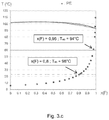
figure 3 répertorie les diagrammes binaires composition - température des équilibres liquide - vapeur de certains mélanges selon l'invention, caractérisés par des faisceaux de courbes de rosée et d'ébullition écrasés. Sur un diagramme donné est également indiquée la valeur du point d'éclair du mélange correspondant en fonction de la fraction massique en composé fluoré, x(F). Le modèle thermodynamique UNIFAC ORIGINAL a été utilisé pour le calcul de l'équilibre binaire liquide - vapeur ainsi que pour le calcul de point d'éclair en appliquant la règle de Le Chatelier (Annals of Mines 19, 388-395. 1891) pour les mélanges binaires avec un composant ininflammable (Liaw H-J et al., Fluid Phase Equilibria. 300. 70-82. 2011). L'enthalpie de vaporisation de mélange résultante est calculée par interpolation linéaire en fonction de la composition massique. - - La
figure 3.a correspond au diagramme binaire du mélange : 1,1,2,2-tetrafluoroéthyl-2,2,3,3-tétrafluoropropyléther et formiate de butyle. - - La
figure 3.b correspond au diagramme binaire du mélange : 1,1,2,2-tetrafluoroéthyl-2,2,3,3-tétrafluoropropyléther et carbonate de diméthyle. - - La
figure 3.c correspond au diagramme binaire du mélange : 1,1,2,2-tetrafluoroéthyl-2,2,3,3-tétrafluoropropyléther et pentan-3-one. - Au sens de la présente invention, on entend par « PE » ou « point d'éclair » la température minimale exprimée en degré Celsius à laquelle une substance combustible émet des vapeurs en concentration suffisante pour former avec l'air ambiant un mélange gazeux qui s'enflamme au contact d'une flamme ou d'un point chaud, mais insuffisante pour que la combustion se propage d'elle-même en l'absence de la flamme dite pilote. Selon le règlement (CE) N° 1272/2008, du Parlement européen et du Conseil du 16 décembre 2008 relatif à la classification, à l'étiquetage et à l'emballage des substances et des mélanges, un fluide ayant un PE tel que 23°C ≤ PE < 60°C appartient à la catégorie 3 « faiblement inflammable », la catégorie 4 « ininflammable » correspondant à un PE supérieur ou égal à 60°C.
- Par « retardateur de flamme », on entend au sens de la présente invention une substance qui a pour fonction de diminuer le point éclair d'un autre composé.
- Un hydrofluoroéther ou HFE, également appelé fluoro-éther dans la littérature, est, au sens de la présente invention, un éther R1-O-R2 dont une partie ou la totalité des atomes d'hydrogène des chaînes hydrocarbonées R1 et R2 sont remplacés par des atomes de fluor.
- Par fluoro-alcool, on entend un alcool R3-OH dont une partie ou la totalité des atomes d'hydrogène de la chaîne hydrocarbonée R3 sont remplacés par des atomes de fluor.
- Un fluoro-alcane est, un alcane, c'est-à-dire un hydrocarbure saturé, dont une partie ou la totalité des atomes d'hydrogène sont remplacés par des atomes de fluor.
- Au sens de la présente invention, le « potentiel de réchauffement global », ou « PRG », est un indice de comparaison associé à un gaz à effet de serre, qui quantifie sa contribution marginale au réchauffement global comparativement à celle du dioxyde de carbone sur une période de 100 ans.
- Par mélange ayant une « faible volatilité relative », on entend au sens de l'invention un mélange qui présente une volatilité relative proche de l'unité sur une large plage de composition, ce qui se traduit dans un diagramme d'équilibre liquide-vapeur par des courbes de température d'ébullition et de rosée quasi coïncidentes, qui forment ainsi un faisceau de courbes écrasé, tel que dans les
figures 3.a, 3b et3.c . A noter que l'existence d'un point azéotropique est une condition ni nécessaire, ni suffisante pour qu'un tel écrasement émerge. - La présente invention concerne en premier lieu un mélange réfrigérant comprenant un composé fluoré et un composé non fluoré, dans lequel le composé fluoré est un hydrofluoroéther choisi parmi le 1-méthoxyperfluoropentane, le 1-méthoxyperfluorohexane, le 1,1,1,2,2,3,4,5,5,5-décafluoro-3-méthoxy-2-trifluorométhylpentane, le 1,1,2,2-tétrafluoroéthyl-2,2,3,3-tétrafluoropropyléther et le 1 H,1 H,2H',3H-décafluoro-dipropyléther, et le composé non fluoré comporte une fonction carbonyle et est choisi parmi le formiate de butyle, l'acétate de tert-butyle, l'acétate de propyle, le carbonate de méthyle et d'éthyle, le carbonate de diméthyle et la pentan-3-one, ledit mélange présentant un point d'éclair supérieur ou égal à 23°C et étantcaractérisé parune faible volatilité relative.
- Un tel mélange peut comporter un point azéotropique, ou non. Ceci étant, il a nécessairement une faible volatilité relative sur la gamme de composition d'intérêt.
- Le composé carbonylé est choisi parmi le formiate de butyle, l'acétate de tert-butyle, l'acétate de propyle, le carbonate de méthyle et d'éthyle, le carbonate de diméthyle et la pentan-3-one.
- Outre un composé non fluoré, un mélange selon l'invention comprend un composé fluoré.
- Le composé fluoré est un hydrofluoroéther.
- L'hydrofluoroéther est choisi parmi le 1-méthoxyperfluoropentane, le 1-méthoxyperfluorohexane, le 1,1,1,2,2,3,4,5,5,5-décafluoro-3-méthoxy-2-trifluorométhylpentane, le 1,1,2,2-tétrafluoroéthyl-2,2,3,3-tétrafluoropropyléther et le 1H, 1H,2H',3H-décafluoro-dipropyléther.
- De tels mélanges sont caractérisés par l'existence de fortes liaisons hydrogène intermoléculaires : l'hydrofluoroéther est, de par l'important effet électroattracteur de l'atome de fluor, donneur d'hydrogène, tandis que le groupement carbonyle est accepteur. Ces fortes interactions électrostatiques favorisent la formation d'un azéotrope à température d'ébullition maximale. Cette déviation azéotropique négative, que l'on ne trouve dans aucun des mélanges réfrigérants de la littérature, est particulièrement intéressante dans la mesure où le point d'éclair d'un mélange a tendance à être d'autant plus élevé que sa température d'ébullition est grande, du fait du lien intrinsèque entre ces deux grandeurs. Si le mélange ne comporte pas de composition azéotropique, le faisceau de courbes de rosée et d'ébullition est néanmoins également concave, ce qui a donc les mêmes effets sur le point d'éclair.
- Un mélange réfrigérant selon l'invention comprend un hydrofluoroéther et un composé carbonylé, ledit hydrofluoroéther étant choisi parmi le 1-méthoxyperfluoropentane, le 1-méthoxyperfluorohexane, le 1,1,1,2,2,3,4,5,5,5-décafluoro-3-méthoxy-2-trifluorométhylpentane, le 1,1,2,2-tétrafluoroéthyl-2,2,3,3-tétrafluoropropyléther et le 1H ,1H,2H',3H-décafluoro-dipropyléther, et le composé carbonylé étant choisi parmi le formiate de butyle, l'acétate de tert-butyle, l'acétate de propyle, le carbonate de méthyle et d'éthyle, le carbonate de diméthyle et la pentan-3-one, ledit mélange présentant un point d'éclair supérieur ou égal à 23°C et étant caractérisé par une faible volatilité relative..
- Le tableau 3 répertorie les compositions et caractéristiques de certains mélanges selon l'invention, particulièrement avantageux. Lorsque le mélange présente un point azéotropique, celui-ci est précisé.
Tableau 3 : Caractéristiques de mélanges HFE - composé carbonylé de l'invention 1-Méthoxyperfluoropentane PE (en °C) Téb (en °C) Tf (en °C) ΔHvap (kJ/kg) 
aucun 84,9 -69 105 Formiate de butyle 18 106 -90 358 
Mélange catégorie 3 XHFE = 0,43 23 - - 249 Mélange catégorie 4 xHFE= 0,93 60 - - 123 Carbonate de diméthyle 17 90 4 366 
azéotrope XHFE = 0,64 28 96 - 200 Mélange catégorie 3 XHFE = 0,5 23 96 - 235 Mélange catégorie 4 XHFE = 0,92 60 90 - 126 1-Méthoxyperfluorohexane PE (en °C) Téb (en °C) Tf (en °C) ΔHvap (kJ/kg 
aucun 108 -88 95,4 Formiate de butyle 18 106 -90 358 
azéotrope XHFE = 0,77 31 112 - 156 Mélange catégorie 3 XHFE = 0,48 23 110 - 232 Mélange catégorie 4 xHFE= 0,93 60 110 - 114 Acétate de propyle 14 102 -95 332 
azéotrope XHFE = 0,89 41 109 - 122 Mélange catégorie 3 XHFE = 0,65 23 - - 178 Mélange catégorie 4 XHFE = 0,96 60 - - 105 Carbonate de méthyle et d'éthyle 23 107 -53 352 
azéotrope XHFE = 0,73 39 114 165 Mélange catégorie 3 XHFE = 0 23 107 -53 352 Mélange catégorie 4 XHFE = 0,90 60 112 - 121 Pentan-3-one 13 102 -39 388 
azéotrope XHFE = 0,87 37 109 - 134 Mélange catégorie 3 XHFE = 0,7 23 - - 184 Mélange catégorie 4 XHFE = 0,96 60 - - 108 1,1,1,2,2,3,4,5,5,5-décafluoro-3-méthoxy-2-trifluorométhylpentane PE (en °C) Téb (en °C) Tf (en °C) ΔHvap (kJ/kg) 
aucun 98 -38 89 Formiate de butyle 18 106 -90 358 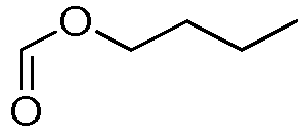
azéotrope XHFE = 0,55 25 109 - 210 Mélange catégorie 3 XHFE = 0,47 23 108 - 232 Mélange catégorie 4 XHFE = 0,94 60 102 - 106 Acétate de tert-butyle 14 96 -58 285 
azéotrope XHFE = 0,88 36 99 - 112 Mélange catégorie 3 XHFE = 0,67 23 - - 153 Mélange catégorie 4 XHFE = 0,96 60 - - 97 Carbonate de méthyle et d'éthyle 23 107 -53 352 
azéotrope XHFE = 0,55 31 111 - 207 Mélange catégorie 3 XHFE = 0 23 107 -53 352 Mélange catégorie 4 XHFE = 0,90 60 - - 116 Carbonate de diméthyle 17 90 4 366 
azéotrope XHFE = 0,84 41 101 - 133 Mélange catégorie 3 XHFE = 0,8 23 - - 144 Mélange catégorie 4 xHFE= 0,93 60 - - 110 Pentan-3-one 13 102 -39 388 
azéotrope XHFE = 0,67 22 105 - 187 Mélange catégorie 3 XHFE = 0,70 23 - - 180 Mélange catégorie 4 XHFE = 0,96 60 - - 101 1,1,2,2-tetrafluoroéthyl-2,2,3, 3-tétrafluoropropyléther PE (en °C) Téb (en °C) Tf (en °C) ΔHvap (kJ/kg) 
aucun 93 -94 140 Formiate de butyle 18 106 -90 358 
Mélange catégorie 3 XHFE = 0,43 23 104 - 264 Mélange catégorie 4 XHFE = 0,91 60 96 - 159 Acétate de tert-butyle 14 96 -58 285 
Mélange catégorie 3 XHFE = 0,57 23 - - 202 Mélange catégorie 4 XHFE = 0,9 60 - - 154 Acétate de propyle 14 102 -95 332 
Mélange catégorie 3 XHFE = 0,53 23 - - 230 Mélange catégorie 4 XHFE = 0,92 60 - - 155 Carbonate de méthyle et d'éthyle 23 107 -53 352 
Mélange catégorie 3 XHFE = 0 23 107 -53 352 Mélange catégorie 4 XHFE = 0,87 60 - - 167 Carbonate de diméthyle 17 90 4 366 
azéotrope XHFE = 0,73 35 96 - 201 Mélange catégorie 3 XHFE = 0,45 23 94 - 264 Mélange catégorie 4 XHFE = 0,91 60 95 - 160 Pentan-3-one 13 102 -39 388 
Mélange catégorie 3 XHFE = 0,8 23 189 Mélange catégorie 4 XHFE = 0,96 60 150 1H, 1H, 2H', 3H-décafluorodipropyléther PE (en °C) Téb (en °C) Tf (en °C) ΔHvap (kJ/kg) 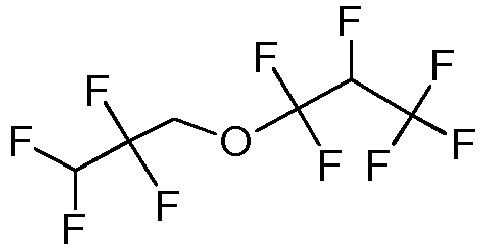
aucun 105 -11 131 Formiate de butyle 18 106 -90 358 
azéotrope XHFE = 0,72 44 110 - 195 Mélange catégorie 3 XHFE = 0,47 23 109 - 251 Mélange catégorie 4 XHFE = 0,92 60 108,5 - 149 Acétate de propyle 14 102 -95 332 
azéotrope xHFE= 0,93 50 107 - 145 Mélange catégorie 3 XHFE = 0,65 23 - - 202 Mélange catégorie 4 XHFE = 0,95 60 - - 141 Carbonate de méthyle et d'éthyle 23 107 -53 352 
azéotrope XHFE = 0,66 37 110 - 206 Mélange catégorie 3 XHFE = 0 23 107 -53 352 Mélange catégorie 4 XHFE = 0,89 60 - - 156 Pentan-3-one 13 102 -39 388 
azéotrope XHFE = 0,84 35 108 - 172 Mélange catégorie 3 XHFE = 0,65 23 - - 221 Mélange catégorie 4 XHFE = 0,95 60 - - 144 - Un mélange peut comporter un fluoro-alcool et un composé carbonylé.
- De manière avantageuse, le fluoro-alcool est choisi parmi le pentafluoropropanol, l'heptafluorobutanol et l'heptafluoropentan-2-ol, et le composé carbonylé est choisi parmi le formiate de butyle, l'acétate de tert-butyle, le carbonate de méthyle et d'éthyle, le carbonate de diméthyle et la pentan-3-one.
- Les compositions et caractéristiques de certains de ces mélanges figurent dans le tableau 4. Lorsque le mélange présente un point azéotropique, celui-ci est précisé.
Tableau 4 : Caractéristiques de mélanges fluoroalcool - composé carbonylé de l'invention Pentafluoropropanol PE (en °C) Téb (en °C) Tf (en °C) ΔHvap (kJ/kg) 
aucun 80 -3 206 Carbonate de diméthyle 17 90 4 366 
Mélange catégorie 3 XHFE = 0,36 23 - - 308 Mélange catégorie 4 XHFE = 0,89 60 - - 223 Heptafluorobutanol PE (en °C) Téb (en °C) Tf (en °C) ΔHvap (kJ/kg) 
91 96 N.A 195 Formiate de butyle 18 106 -90 358 
Mélange catégorie 3 XHFE = 0,41 23 103 - 291 Mélange catégorie 4 XHFE = 0,95 60 97 - 203 Pentan-3-one 13 102 -39 388 
Mélange catégorie 3 XHFE = 0,64 23 - - 265 Mélange catégorie 4 XHFE = 0,96 60 - - 203 Heptafluoropentan-2-ol PE (en °C) Téb (en °C) Tf (en °C) ΔHvap (kJ/kg) 
aucun 100 N.A 188 Formiate de butyle 18 106 -90 358 
Mélange catégorie 3 XHFE = 0,41 23 103 - 288 Mélange catégorie 4 XHFE = 0,92 60 - - 202 Carbonate de méthyle et d'éthyle 23 107 -53 352 
azéotrope XHFE = 0,36 30 109 - 293 Mélange catégorie 3 XHFE = 0 23 107 -53 352 Mélange catégorie 4 XHFE = 0,8 60 - - 221 Carbonate de diméthyle 17 90 4 366 
azéotrope XHFE = 0,85 36 101 - 215 Mélange catégorie 3 XHFE = 0,42 23 - - 291 Mélange catégorie 4 XHFE = 0,9 60 - - 206 - Une autre catégorie de mélanges réfrigérants comprend un fluoro-alcool et un alcool.
- Les liaisons hydrogène au sein de tels mélanges sont très faibles, puisque les deux constituants sont donneurs d'hydrogène. Cela favorise l'émergence d'une déviation azéotropique positive.
- Préférentiellement, le fluoro-alcool est choisi parmi le pentafluoropropan-1-ol, l'heptafluorobutanol et l'heptafluoropentan-2-ol, et l'alcool est choisi parmi l'éthanol, le propanol et le propan-2-ol.
- Le tableau 5 résume les compositions et caractéristiques de certains de ces mélanges. Lorsque le mélange présente un point azéotropique, celui-ci est précisé.
Tableau 5 : Caractéristiques de mélanges fluoroalcool - alcool de l'invention Pentafluoropropanol PE (en °C) Téb (en °C) Tf (en °C) ΔHvap (kJ/kg) 
aucun 80 -3 313 éthanol 13 78 -114 837 azéotrope XHFE = 0,71 19 77 - 465 Mélange catégorie 3 XHFE = 0,77 23 78 - 433 Mélange catégorie 4 XHFE = 0,98 60 - - 324 Propan-2-ol 11 82 -88 606 Azéotrope Mélange catégorie 3 XHFE = 0,8 23 78 - 372 Mélange catégorie 4 XHFE = 0,98 60 - - 319 Heptafluorobutanol PE (en °C) Téb (en °C) Tf (en °C) ΔHvap (kJ/kg) 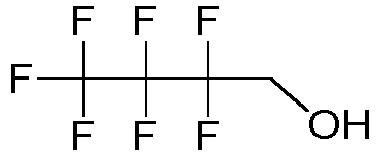
91 96 N.A 195 propanol 25 97 -124 690 azéotrope XHFE = 0,72 29 92 - 334 Mélange catégorie 4 XHFE = 0,98 60 - - 205 Heptafluoropentan-2-ol PE (en °C) Téb (en °C) Tf (en °C) ΔHvap (kJ/kg) 
aucun 100 N.A 188 propanol 25 97 -124 690 azéotrope XHFE = 0,58 29 96 - 399 Mélange catégorie 4 XHFE = 0,97 60 - - 203 - La présente invention porte en outre sur l'utilisation d'un mélange selon elle comme fluide caloporteur, avantageusement dans un échangeur de chaleur tel qu'un échangeur diphasique.
- Il peut s'agir d'un échangeur diphasique à pompage capillaire, comme les caloduc, CPL, LHP et thermosyphon, bien connus de l'homme du métier, ou d'une boucle diphasique à pompage mécanique.
- Plus généralement, l'invention concerne également un dispositif d'échange de chaleur comprenant comme fluide caloporteur un mélange selon l'invention.
- Ledit dispositif d'échange de chaleur peut notamment consister en un échangeur diphasique à pompage capillaire ou une boucle diphasique à pompage mécanique.
Claims (6)
- Mélange réfrigérant comprenant un composé fluoré et un composé non fluoré, dans lequel le composé fluoré est un hydrofluoroéther choisi parmi le 1-méthoxyperfluoropentane, le 1-méthoxyperfluorohexane, le 1,1,1,2,2,3,4,5,5,5-décafluoro-3-méthoxy-2-trifluorométhylpentane, le 1,1,2,2-tétrafluoroéthyl-2,2,3,3-tétrafluoropropyléther et le 1H,1H,2H',3H-décafluoro-dipropyléther, et le composé non fluoré comporte une fonction carbonyle et est choisi parmi le formiate de butyle, l'acétate de tert-butyle, l'acétate de propyle, le carbonate de méthyle et d'éthyle, le carbonate de diméthyle et la pentan-3-one, ledit mélange présentant un point d'éclair supérieur ou égal à 23°C et étant caractérisé par une faible volatilité relative.
- Utilisation d'un mélange selon la revendication 1 comme fluide caloporteur.
- Utilisation selon la revendication 2 dans un échangeur de chaleur.
- Utilisation selon la revendication 3, caractérisée en ce que ledit échangeur de chaleur est un échangeur diphasique à pompage capillaire ou une boucle diphasique à pompage mécanique.
- Dispositif d'échange de chaleur comprenant un fluide caloporteur, caractérisé en ce que ledit fluide caloporteur est un mélange selon la revendication 1.
- Dispositif d'échange de chaleur selon la revendication 5, caractérisé en ce que ledit dispositif d'échange de chaleur est un échangeur diphasique à pompage capillaire ou une boucle diphasique à pompage mécanique.
Applications Claiming Priority (2)
| Application Number | Priority Date | Filing Date | Title |
|---|---|---|---|
| FR1655577A FR3052774B1 (fr) | 2016-06-16 | 2016-06-16 | Melanges refrigerants faiblement inflammables ou ininflammables caracterises par une faible volatilite relative pour les systemes d'echange thermique diphasique |
| PCT/FR2017/051559 WO2017216492A1 (fr) | 2016-06-16 | 2017-06-15 | Mélanges réfrigérants faiblement inflammables ou ininflammables caractérisés par une faible volatilite relative pour les systèmes d'échange thermique diphasique |
Publications (3)
| Publication Number | Publication Date |
|---|---|
| EP3472256A1 EP3472256A1 (fr) | 2019-04-24 |
| EP3472256B1 true EP3472256B1 (fr) | 2020-08-19 |
| EP3472256B8 EP3472256B8 (fr) | 2020-11-18 |
Family
ID=57233559
Family Applications (1)
| Application Number | Title | Priority Date | Filing Date |
|---|---|---|---|
| EP17734803.4A Active EP3472256B8 (fr) | 2016-06-16 | 2017-06-15 | Mélanges réfrigérants faiblement inflammables ou ininflammables caractérisés par une faible volatilite relative pour les systèmes d'échange thermique diphasique |
Country Status (4)
| Country | Link |
|---|---|
| US (1) | US10836940B2 (fr) |
| EP (1) | EP3472256B8 (fr) |
| FR (1) | FR3052774B1 (fr) |
| WO (1) | WO2017216492A1 (fr) |
Families Citing this family (4)
| Publication number | Priority date | Publication date | Assignee | Title |
|---|---|---|---|---|
| WO2020055782A1 (fr) * | 2018-09-11 | 2020-03-19 | The Chemours Company Fc, Llc | Compositions azéotropiques comprenant du carbonate de diméthyle et des éthers de perfluoroalcène |
| SG10201906722QA (en) * | 2019-07-19 | 2021-02-25 | 3M Innovative Properties Co | Azeotropic solvent formulation of hydrofluoroether and organic carbonates |
| EP4051750B1 (fr) * | 2019-10-28 | 2025-08-13 | The Chemours Company FC, LLC | Fluides caloporteurs pour utilisation dans des applications de refroidisseur à basse température |
| CN119752422A (zh) * | 2024-12-11 | 2025-04-04 | 中国石油化工股份有限公司 | 一种纯电动汽车冷却介质及其制备方法 |
Family Cites Families (5)
| Publication number | Priority date | Publication date | Assignee | Title |
|---|---|---|---|---|
| US5827812A (en) | 1995-05-16 | 1998-10-27 | Minnesota Mining And Manufacturing Company | Azeotrope-like compositions and their use |
| US6660709B1 (en) | 1998-12-12 | 2003-12-09 | Solvay (Societe Anonyme) | Compositions comprising 1,1,1,3,3-pentafluorobutane and use of these compositions |
| US6417153B1 (en) * | 2000-07-20 | 2002-07-09 | 3M Innovative Properties Company | Azeotrope-like compositions and their use |
| US7476331B2 (en) * | 2005-02-09 | 2009-01-13 | E I Du Pont Nemours And Company | Compositions comprising 1,1,1,2,2,3,4,5,5,6,6,7,7,7-tetradecafluoroheptane and uses thereof |
| JP2010185048A (ja) * | 2009-02-13 | 2010-08-26 | Daikin Ind Ltd | 熱伝達装置および熱伝達方法、ならびにそれに用いる熱伝達流体 |
-
2016
- 2016-06-16 FR FR1655577A patent/FR3052774B1/fr active Active
-
2017
- 2017-06-15 US US16/309,659 patent/US10836940B2/en active Active
- 2017-06-15 EP EP17734803.4A patent/EP3472256B8/fr active Active
- 2017-06-15 WO PCT/FR2017/051559 patent/WO2017216492A1/fr not_active Ceased
Non-Patent Citations (1)
| Title |
|---|
| None * |
Also Published As
| Publication number | Publication date |
|---|---|
| FR3052774A1 (fr) | 2017-12-22 |
| US10836940B2 (en) | 2020-11-17 |
| EP3472256A1 (fr) | 2019-04-24 |
| US20190233699A1 (en) | 2019-08-01 |
| EP3472256B8 (fr) | 2020-11-18 |
| FR3052774B1 (fr) | 2020-01-31 |
| WO2017216492A1 (fr) | 2017-12-21 |
Similar Documents
| Publication | Publication Date | Title |
|---|---|---|
| EP2092037B1 (fr) | Compositions utilisables comme fluide frigorigene | |
| WO2017216492A1 (fr) | Mélanges réfrigérants faiblement inflammables ou ininflammables caractérisés par une faible volatilite relative pour les systèmes d'échange thermique diphasique | |
| EP2513244B1 (fr) | Procede metant en oeuvre de fluides de transfert de chaleur a inflammabilite reduite | |
| EP2459668B1 (fr) | Procede de transfert de chaleur | |
| FR2956406A1 (fr) | Compositions notamment de transfert de chaleur | |
| EP2487216B1 (fr) | Compositions binaires de 2,3,3,3-tétrafluoropropène et d'ammoniac | |
| FR2948678A1 (fr) | Procede de transfert de chaleur | |
| JP2001503082A (ja) | 冷媒、発泡剤、溶媒、エアゾール噴射剤、滅菌剤の可燃性を減少させるための対流圏大気中分解性臭素含有ハロカーボン添加剤 | |
| FR2957350A1 (fr) | Compositions d'agent d'expansion a base d'hydrochlorofluoroolefine | |
| CN102449100A (zh) | Z-1,1,1,4,4,4-六氟-2-丁烯的共沸和类共沸组合物 | |
| US8329057B2 (en) | Working liquid for latent heat transport apparatus and method for operating latent heat transport apparatus | |
| WO2012072910A1 (fr) | Compositions a base de 1,1,1,4,4,4-hexafluorobut-2-ene et de 3,3,4,4,4-pentafluorobut-1-ene | |
| EP4234657B1 (fr) | Compositions | |
| FR2977256A1 (fr) | Compositions de 2,4,4,4-tetrafluorobut-1-ene et de cis-1,1,1,4,4,4-hexafluorobut-2-ene | |
| EP0632002B1 (fr) | Mélanges non azéotropiques contenant du difluorométhane et du 1,1,1,2-tétrafluoroethane et leurs applications comme fluides frigorigènes en conditionnement d'air | |
| FR2733242A1 (fr) | Melanges pseudo-azeotropiques a base de difluoromethane et de pentafluoroethane, et leurs applications comme fluides frigorigenes | |
| EP2694612B1 (fr) | Compositions comprenant du 3,3,3-trifluoropropene et de l'ammoniac | |
| WO1998039378A1 (fr) | Compositions azeotropiques ou pseudo-azeotropiques et utilisation de ces compositions | |
| EP3472257B1 (fr) | Melanges refrigerants pour une utilisation au sein de dispositifs d'echange de chaleur dans le domaine de l'aerospatiale | |
| FR2694764A1 (fr) | Mélanges pseudo-azéotropiques de difluorométhane, de pentafluoroéthane et de 1,1,1-trifluoroéthane, et leur application comme fluides frigorigènes en réfrigération basse température. | |
| WO2000066678A1 (fr) | Fluide frigorigene | |
| FR2921665A1 (fr) | Composition a base de trans-1,2 dichloroethylene. | |
| FR2725200A1 (fr) | Melange pseudo-azeotropique de chlorodifluoromethane, de 1,1,1-trifluoroethane et de pentafluoroethane, et son application comme fluide frigorigene en refrigeration basse temperature | |
| WO2026034091A1 (fr) | Composition de gaz de couverture ainsi que procédé d'alimentation associé, mélange de gaz de couverture, procédé d'inhibition d'oxydation ou de combustion de métal fondu, et dispositif d'alimentation en gaz de couverture | |
| FR3033796A1 (fr) | Fluide frigorigene |
Legal Events
| Date | Code | Title | Description |
|---|---|---|---|
| STAA | Information on the status of an ep patent application or granted ep patent |
Free format text: STATUS: UNKNOWN |
|
| STAA | Information on the status of an ep patent application or granted ep patent |
Free format text: STATUS: THE INTERNATIONAL PUBLICATION HAS BEEN MADE |
|
| PUAI | Public reference made under article 153(3) epc to a published international application that has entered the european phase |
Free format text: ORIGINAL CODE: 0009012 |
|
| STAA | Information on the status of an ep patent application or granted ep patent |
Free format text: STATUS: REQUEST FOR EXAMINATION WAS MADE |
|
| 17P | Request for examination filed |
Effective date: 20190108 |
|
| AK | Designated contracting states |
Kind code of ref document: A1 Designated state(s): AL AT BE BG CH CY CZ DE DK EE ES FI FR GB GR HR HU IE IS IT LI LT LU LV MC MK MT NL NO PL PT RO RS SE SI SK SM TR |
|
| AX | Request for extension of the european patent |
Extension state: BA ME |
|
| DAV | Request for validation of the european patent (deleted) | ||
| DAX | Request for extension of the european patent (deleted) | ||
| GRAP | Despatch of communication of intention to grant a patent |
Free format text: ORIGINAL CODE: EPIDOSNIGR1 |
|
| STAA | Information on the status of an ep patent application or granted ep patent |
Free format text: STATUS: GRANT OF PATENT IS INTENDED |
|
| INTG | Intention to grant announced |
Effective date: 20200226 |
|
| GRAS | Grant fee paid |
Free format text: ORIGINAL CODE: EPIDOSNIGR3 |
|
| GRAA | (expected) grant |
Free format text: ORIGINAL CODE: 0009210 |
|
| STAA | Information on the status of an ep patent application or granted ep patent |
Free format text: STATUS: THE PATENT HAS BEEN GRANTED |
|
| AK | Designated contracting states |
Kind code of ref document: B1 Designated state(s): AL AT BE BG CH CY CZ DE DK EE ES FI FR GB GR HR HU IE IS IT LI LT LU LV MC MK MT NL NO PL PT RO RS SE SI SK SM TR |
|
| REG | Reference to a national code |
Ref country code: CH Ref legal event code: EP |
|
| REG | Reference to a national code |
Ref country code: DE Ref legal event code: R096 Ref document number: 602017021975 Country of ref document: DE |
|
| REG | Reference to a national code |
Ref country code: AT Ref legal event code: REF Ref document number: 1303930 Country of ref document: AT Kind code of ref document: T Effective date: 20200915 |
|
| REG | Reference to a national code |
Ref country code: IE Ref legal event code: FG4D Free format text: LANGUAGE OF EP DOCUMENT: FRENCH |
|
| GRAT | Correction requested after decision to grant or after decision to maintain patent in amended form |
Free format text: ORIGINAL CODE: EPIDOSNCDEC |
|
| REG | Reference to a national code |
Ref country code: CH Ref legal event code: PK Free format text: RECTIFICATION B8 |
|
| RAP2 | Party data changed (patent owner data changed or rights of a patent transferred) |
Owner name: UNIVERSITE DES SCIENCES ET TECHNOLOGIES DE LILLE Owner name: INSTITUT NATIONAL POLYTECHNIQUE DE TOULOUSE Owner name: ECOLE NATIONALE SUPERIEURE DE CHIMIE DE LILLE Owner name: CENTRE NATIONAL DE LA RECHERCHE SCIENTIFIQUE (CNRS) Owner name: SAFRAN ELECTRICAL & POWER |
|
| REG | Reference to a national code |
Ref country code: LT Ref legal event code: MG4D |
|
| REG | Reference to a national code |
Ref country code: NL Ref legal event code: MP Effective date: 20200819 |
|
| PG25 | Lapsed in a contracting state [announced via postgrant information from national office to epo] |
Ref country code: GR Free format text: LAPSE BECAUSE OF FAILURE TO SUBMIT A TRANSLATION OF THE DESCRIPTION OR TO PAY THE FEE WITHIN THE PRESCRIBED TIME-LIMIT Effective date: 20201120 Ref country code: LT Free format text: LAPSE BECAUSE OF FAILURE TO SUBMIT A TRANSLATION OF THE DESCRIPTION OR TO PAY THE FEE WITHIN THE PRESCRIBED TIME-LIMIT Effective date: 20200819 Ref country code: HR Free format text: LAPSE BECAUSE OF FAILURE TO SUBMIT A TRANSLATION OF THE DESCRIPTION OR TO PAY THE FEE WITHIN THE PRESCRIBED TIME-LIMIT Effective date: 20200819 Ref country code: BG Free format text: LAPSE BECAUSE OF FAILURE TO SUBMIT A TRANSLATION OF THE DESCRIPTION OR TO PAY THE FEE WITHIN THE PRESCRIBED TIME-LIMIT Effective date: 20201119 Ref country code: SE Free format text: LAPSE BECAUSE OF FAILURE TO SUBMIT A TRANSLATION OF THE DESCRIPTION OR TO PAY THE FEE WITHIN THE PRESCRIBED TIME-LIMIT Effective date: 20200819 Ref country code: FI Free format text: LAPSE BECAUSE OF FAILURE TO SUBMIT A TRANSLATION OF THE DESCRIPTION OR TO PAY THE FEE WITHIN THE PRESCRIBED TIME-LIMIT Effective date: 20200819 Ref country code: NO Free format text: LAPSE BECAUSE OF FAILURE TO SUBMIT A TRANSLATION OF THE DESCRIPTION OR TO PAY THE FEE WITHIN THE PRESCRIBED TIME-LIMIT Effective date: 20201119 Ref country code: PT Free format text: LAPSE BECAUSE OF FAILURE TO SUBMIT A TRANSLATION OF THE DESCRIPTION OR TO PAY THE FEE WITHIN THE PRESCRIBED TIME-LIMIT Effective date: 20201221 |
|
| REG | Reference to a national code |
Ref country code: AT Ref legal event code: MK05 Ref document number: 1303930 Country of ref document: AT Kind code of ref document: T Effective date: 20200819 |
|
| PG25 | Lapsed in a contracting state [announced via postgrant information from national office to epo] |
Ref country code: RS Free format text: LAPSE BECAUSE OF FAILURE TO SUBMIT A TRANSLATION OF THE DESCRIPTION OR TO PAY THE FEE WITHIN THE PRESCRIBED TIME-LIMIT Effective date: 20200819 Ref country code: LV Free format text: LAPSE BECAUSE OF FAILURE TO SUBMIT A TRANSLATION OF THE DESCRIPTION OR TO PAY THE FEE WITHIN THE PRESCRIBED TIME-LIMIT Effective date: 20200819 Ref country code: NL Free format text: LAPSE BECAUSE OF FAILURE TO SUBMIT A TRANSLATION OF THE DESCRIPTION OR TO PAY THE FEE WITHIN THE PRESCRIBED TIME-LIMIT Effective date: 20200819 Ref country code: PL Free format text: LAPSE BECAUSE OF FAILURE TO SUBMIT A TRANSLATION OF THE DESCRIPTION OR TO PAY THE FEE WITHIN THE PRESCRIBED TIME-LIMIT Effective date: 20200819 Ref country code: IS Free format text: LAPSE BECAUSE OF FAILURE TO SUBMIT A TRANSLATION OF THE DESCRIPTION OR TO PAY THE FEE WITHIN THE PRESCRIBED TIME-LIMIT Effective date: 20201219 |
|
| PG25 | Lapsed in a contracting state [announced via postgrant information from national office to epo] |
Ref country code: CZ Free format text: LAPSE BECAUSE OF FAILURE TO SUBMIT A TRANSLATION OF THE DESCRIPTION OR TO PAY THE FEE WITHIN THE PRESCRIBED TIME-LIMIT Effective date: 20200819 Ref country code: DK Free format text: LAPSE BECAUSE OF FAILURE TO SUBMIT A TRANSLATION OF THE DESCRIPTION OR TO PAY THE FEE WITHIN THE PRESCRIBED TIME-LIMIT Effective date: 20200819 Ref country code: RO Free format text: LAPSE BECAUSE OF FAILURE TO SUBMIT A TRANSLATION OF THE DESCRIPTION OR TO PAY THE FEE WITHIN THE PRESCRIBED TIME-LIMIT Effective date: 20200819 Ref country code: EE Free format text: LAPSE BECAUSE OF FAILURE TO SUBMIT A TRANSLATION OF THE DESCRIPTION OR TO PAY THE FEE WITHIN THE PRESCRIBED TIME-LIMIT Effective date: 20200819 Ref country code: SM Free format text: LAPSE BECAUSE OF FAILURE TO SUBMIT A TRANSLATION OF THE DESCRIPTION OR TO PAY THE FEE WITHIN THE PRESCRIBED TIME-LIMIT Effective date: 20200819 |
|
| REG | Reference to a national code |
Ref country code: DE Ref legal event code: R097 Ref document number: 602017021975 Country of ref document: DE |
|
| PG25 | Lapsed in a contracting state [announced via postgrant information from national office to epo] |
Ref country code: AL Free format text: LAPSE BECAUSE OF FAILURE TO SUBMIT A TRANSLATION OF THE DESCRIPTION OR TO PAY THE FEE WITHIN THE PRESCRIBED TIME-LIMIT Effective date: 20200819 Ref country code: AT Free format text: LAPSE BECAUSE OF FAILURE TO SUBMIT A TRANSLATION OF THE DESCRIPTION OR TO PAY THE FEE WITHIN THE PRESCRIBED TIME-LIMIT Effective date: 20200819 Ref country code: ES Free format text: LAPSE BECAUSE OF FAILURE TO SUBMIT A TRANSLATION OF THE DESCRIPTION OR TO PAY THE FEE WITHIN THE PRESCRIBED TIME-LIMIT Effective date: 20200819 |
|
| PLBE | No opposition filed within time limit |
Free format text: ORIGINAL CODE: 0009261 |
|
| STAA | Information on the status of an ep patent application or granted ep patent |
Free format text: STATUS: NO OPPOSITION FILED WITHIN TIME LIMIT |
|
| PG25 | Lapsed in a contracting state [announced via postgrant information from national office to epo] |
Ref country code: SK Free format text: LAPSE BECAUSE OF FAILURE TO SUBMIT A TRANSLATION OF THE DESCRIPTION OR TO PAY THE FEE WITHIN THE PRESCRIBED TIME-LIMIT Effective date: 20200819 |
|
| 26N | No opposition filed |
Effective date: 20210520 |
|
| PG25 | Lapsed in a contracting state [announced via postgrant information from national office to epo] |
Ref country code: IT Free format text: LAPSE BECAUSE OF FAILURE TO SUBMIT A TRANSLATION OF THE DESCRIPTION OR TO PAY THE FEE WITHIN THE PRESCRIBED TIME-LIMIT Effective date: 20200819 |
|
| PG25 | Lapsed in a contracting state [announced via postgrant information from national office to epo] |
Ref country code: SI Free format text: LAPSE BECAUSE OF FAILURE TO SUBMIT A TRANSLATION OF THE DESCRIPTION OR TO PAY THE FEE WITHIN THE PRESCRIBED TIME-LIMIT Effective date: 20200819 |
|
| PG25 | Lapsed in a contracting state [announced via postgrant information from national office to epo] |
Ref country code: MC Free format text: LAPSE BECAUSE OF FAILURE TO SUBMIT A TRANSLATION OF THE DESCRIPTION OR TO PAY THE FEE WITHIN THE PRESCRIBED TIME-LIMIT Effective date: 20200819 |
|
| REG | Reference to a national code |
Ref country code: CH Ref legal event code: PL |
|
| REG | Reference to a national code |
Ref country code: BE Ref legal event code: MM Effective date: 20210630 |
|
| PG25 | Lapsed in a contracting state [announced via postgrant information from national office to epo] |
Ref country code: LU Free format text: LAPSE BECAUSE OF NON-PAYMENT OF DUE FEES Effective date: 20210615 |
|
| PG25 | Lapsed in a contracting state [announced via postgrant information from national office to epo] |
Ref country code: LI Free format text: LAPSE BECAUSE OF NON-PAYMENT OF DUE FEES Effective date: 20210630 Ref country code: IE Free format text: LAPSE BECAUSE OF NON-PAYMENT OF DUE FEES Effective date: 20210615 Ref country code: CH Free format text: LAPSE BECAUSE OF NON-PAYMENT OF DUE FEES Effective date: 20210630 |
|
| PG25 | Lapsed in a contracting state [announced via postgrant information from national office to epo] |
Ref country code: BE Free format text: LAPSE BECAUSE OF NON-PAYMENT OF DUE FEES Effective date: 20210630 |
|
| PG25 | Lapsed in a contracting state [announced via postgrant information from national office to epo] |
Ref country code: CY Free format text: LAPSE BECAUSE OF FAILURE TO SUBMIT A TRANSLATION OF THE DESCRIPTION OR TO PAY THE FEE WITHIN THE PRESCRIBED TIME-LIMIT Effective date: 20200819 |
|
| PG25 | Lapsed in a contracting state [announced via postgrant information from national office to epo] |
Ref country code: HU Free format text: LAPSE BECAUSE OF FAILURE TO SUBMIT A TRANSLATION OF THE DESCRIPTION OR TO PAY THE FEE WITHIN THE PRESCRIBED TIME-LIMIT; INVALID AB INITIO Effective date: 20170615 |
|
| PG25 | Lapsed in a contracting state [announced via postgrant information from national office to epo] |
Ref country code: MK Free format text: LAPSE BECAUSE OF FAILURE TO SUBMIT A TRANSLATION OF THE DESCRIPTION OR TO PAY THE FEE WITHIN THE PRESCRIBED TIME-LIMIT Effective date: 20200819 |
|
| PG25 | Lapsed in a contracting state [announced via postgrant information from national office to epo] |
Ref country code: TR Free format text: LAPSE BECAUSE OF FAILURE TO SUBMIT A TRANSLATION OF THE DESCRIPTION OR TO PAY THE FEE WITHIN THE PRESCRIBED TIME-LIMIT Effective date: 20200819 |
|
| PG25 | Lapsed in a contracting state [announced via postgrant information from national office to epo] |
Ref country code: MT Free format text: LAPSE BECAUSE OF FAILURE TO SUBMIT A TRANSLATION OF THE DESCRIPTION OR TO PAY THE FEE WITHIN THE PRESCRIBED TIME-LIMIT Effective date: 20200819 |
|
| PGFP | Annual fee paid to national office [announced via postgrant information from national office to epo] |
Ref country code: GB Payment date: 20260623 Year of fee payment: 10 |
|
| PGFP | Annual fee paid to national office [announced via postgrant information from national office to epo] |
Ref country code: DE Payment date: 20260623 Year of fee payment: 10 |
|
| PGFP | Annual fee paid to national office [announced via postgrant information from national office to epo] |
Ref country code: FR Payment date: 20260616 Year of fee payment: 10 |