EP3471176A1 - Deposition of lithium fluoride on lithium metal surface and lithium secondary battery using same - Google Patents
Deposition of lithium fluoride on lithium metal surface and lithium secondary battery using same Download PDFInfo
- Publication number
- EP3471176A1 EP3471176A1 EP17891409.9A EP17891409A EP3471176A1 EP 3471176 A1 EP3471176 A1 EP 3471176A1 EP 17891409 A EP17891409 A EP 17891409A EP 3471176 A1 EP3471176 A1 EP 3471176A1
- Authority
- EP
- European Patent Office
- Prior art keywords
- lithium metal
- lithium
- secondary battery
- lif
- deposition
- Prior art date
- Legal status (The legal status is an assumption and is not a legal conclusion. Google has not performed a legal analysis and makes no representation as to the accuracy of the status listed.)
- Pending
Links
Images

Classifications
-
- H—ELECTRICITY
- H01—ELECTRIC ELEMENTS
- H01M—PROCESSES OR MEANS, e.g. BATTERIES, FOR THE DIRECT CONVERSION OF CHEMICAL ENERGY INTO ELECTRICAL ENERGY
- H01M4/00—Electrodes
- H01M4/02—Electrodes composed of, or comprising, active material
- H01M4/13—Electrodes for accumulators with non-aqueous electrolyte, e.g. for lithium-accumulators; Processes of manufacture thereof
- H01M4/139—Processes of manufacture
- H01M4/1397—Processes of manufacture of electrodes based on inorganic compounds other than oxides or hydroxides, e.g. sulfides, selenides, tellurides, halogenides or LiCoFy
-
- H—ELECTRICITY
- H01—ELECTRIC ELEMENTS
- H01M—PROCESSES OR MEANS, e.g. BATTERIES, FOR THE DIRECT CONVERSION OF CHEMICAL ENERGY INTO ELECTRICAL ENERGY
- H01M4/00—Electrodes
- H01M4/02—Electrodes composed of, or comprising, active material
- H01M4/13—Electrodes for accumulators with non-aqueous electrolyte, e.g. for lithium-accumulators; Processes of manufacture thereof
- H01M4/134—Electrodes based on metals, Si or alloys
-
- H—ELECTRICITY
- H01—ELECTRIC ELEMENTS
- H01M—PROCESSES OR MEANS, e.g. BATTERIES, FOR THE DIRECT CONVERSION OF CHEMICAL ENERGY INTO ELECTRICAL ENERGY
- H01M10/00—Secondary cells; Manufacture thereof
- H01M10/05—Accumulators with non-aqueous electrolyte
- H01M10/052—Li-accumulators
- H01M10/0525—Rocking-chair batteries, i.e. batteries with lithium insertion or intercalation in both electrodes; Lithium-ion batteries
-
- H—ELECTRICITY
- H01—ELECTRIC ELEMENTS
- H01M—PROCESSES OR MEANS, e.g. BATTERIES, FOR THE DIRECT CONVERSION OF CHEMICAL ENERGY INTO ELECTRICAL ENERGY
- H01M4/00—Electrodes
- H01M4/02—Electrodes composed of, or comprising, active material
- H01M4/04—Processes of manufacture in general
- H01M4/0402—Methods of deposition of the material
- H01M4/0421—Methods of deposition of the material involving vapour deposition
-
- H—ELECTRICITY
- H01—ELECTRIC ELEMENTS
- H01M—PROCESSES OR MEANS, e.g. BATTERIES, FOR THE DIRECT CONVERSION OF CHEMICAL ENERGY INTO ELECTRICAL ENERGY
- H01M4/00—Electrodes
- H01M4/02—Electrodes composed of, or comprising, active material
- H01M4/04—Processes of manufacture in general
- H01M4/0402—Methods of deposition of the material
- H01M4/0421—Methods of deposition of the material involving vapour deposition
- H01M4/0423—Physical vapour deposition
-
- H—ELECTRICITY
- H01—ELECTRIC ELEMENTS
- H01M—PROCESSES OR MEANS, e.g. BATTERIES, FOR THE DIRECT CONVERSION OF CHEMICAL ENERGY INTO ELECTRICAL ENERGY
- H01M4/00—Electrodes
- H01M4/02—Electrodes composed of, or comprising, active material
- H01M4/04—Processes of manufacture in general
- H01M4/0402—Methods of deposition of the material
- H01M4/0421—Methods of deposition of the material involving vapour deposition
- H01M4/0428—Chemical vapour deposition
-
- H—ELECTRICITY
- H01—ELECTRIC ELEMENTS
- H01M—PROCESSES OR MEANS, e.g. BATTERIES, FOR THE DIRECT CONVERSION OF CHEMICAL ENERGY INTO ELECTRICAL ENERGY
- H01M4/00—Electrodes
- H01M4/02—Electrodes composed of, or comprising, active material
- H01M4/13—Electrodes for accumulators with non-aqueous electrolyte, e.g. for lithium-accumulators; Processes of manufacture thereof
- H01M4/136—Electrodes based on inorganic compounds other than oxides or hydroxides, e.g. sulfides, selenides, tellurides, halogenides or LiCoFy
-
- H—ELECTRICITY
- H01—ELECTRIC ELEMENTS
- H01M—PROCESSES OR MEANS, e.g. BATTERIES, FOR THE DIRECT CONVERSION OF CHEMICAL ENERGY INTO ELECTRICAL ENERGY
- H01M4/00—Electrodes
- H01M4/02—Electrodes composed of, or comprising, active material
- H01M4/13—Electrodes for accumulators with non-aqueous electrolyte, e.g. for lithium-accumulators; Processes of manufacture thereof
- H01M4/139—Processes of manufacture
- H01M4/1395—Processes of manufacture of electrodes based on metals, Si or alloys
-
- H—ELECTRICITY
- H01—ELECTRIC ELEMENTS
- H01M—PROCESSES OR MEANS, e.g. BATTERIES, FOR THE DIRECT CONVERSION OF CHEMICAL ENERGY INTO ELECTRICAL ENERGY
- H01M4/00—Electrodes
- H01M4/02—Electrodes composed of, or comprising, active material
- H01M2004/026—Electrodes composed of, or comprising, active material characterised by the polarity
-
- H—ELECTRICITY
- H01—ELECTRIC ELEMENTS
- H01M—PROCESSES OR MEANS, e.g. BATTERIES, FOR THE DIRECT CONVERSION OF CHEMICAL ENERGY INTO ELECTRICAL ENERGY
- H01M4/00—Electrodes
- H01M4/02—Electrodes composed of, or comprising, active material
- H01M2004/026—Electrodes composed of, or comprising, active material characterised by the polarity
- H01M2004/027—Negative electrodes
-
- Y—GENERAL TAGGING OF NEW TECHNOLOGICAL DEVELOPMENTS; GENERAL TAGGING OF CROSS-SECTIONAL TECHNOLOGIES SPANNING OVER SEVERAL SECTIONS OF THE IPC; TECHNICAL SUBJECTS COVERED BY FORMER USPC CROSS-REFERENCE ART COLLECTIONS [XRACs] AND DIGESTS
- Y02—TECHNOLOGIES OR APPLICATIONS FOR MITIGATION OR ADAPTATION AGAINST CLIMATE CHANGE
- Y02E—REDUCTION OF GREENHOUSE GAS [GHG] EMISSIONS, RELATED TO ENERGY GENERATION, TRANSMISSION OR DISTRIBUTION
- Y02E60/00—Enabling technologies; Technologies with a potential or indirect contribution to GHG emissions mitigation
- Y02E60/10—Energy storage using batteries
Definitions
- the present invention relates to a negative electrode of a lithium metal secondary battery and a method of manufacturing the same, and more particularly to a method of depositing lithium fluoride (LiF) on the surface of a lithium metal, which is used as a negative electrode of a lithium metal secondary battery, a lithium metal manufactured by the same, and a negative electrode and a lithium metal secondary battery using the same.
- LiF lithium fluoride
- a material that reversibly stores and releases lithium ion to exhibit high reversible potential such as LiCoO 2 , LiNiO 2 , or LiMn 2 O 4 , is used as the material of a positive electrode of a lithium secondary battery.
- the positive electrode material is still under development in order to improve the performance and stability of the lithium secondary battery.
- a lithium metal which has highest energy density per unit weight and a standard hydrogen potential of -3.04V, which is the lowest, is most ideally used as the material of a negative electrode of the lithium secondary battery.
- a lithium metal is used as the material of the negative electrode of the lithium secondary battery, it is theoretically possible to obtain a capacity of 3860 mAhg - 1 , which is 10 times or more of the capacities of current commercial batteries.
- dendrite may easily grow on the surface of the lithium metal, and such dendrite may damage a separator of the battery, whereby the performance and safety of the battery may be reduced.
- the precipitated dendrite may abruptly increase the specific surface area and reactivity of the lithium metal, whereby a polymer film having no electrical conductivity may be formed after reaction with an electrolytic solution. Rapid charging, which has been rising in popularity in recent years, makes this effect worse.
- a carbon material such as graphite or carbon, which is usable for a long time, has been mainly used as the negative electrode material.
- the lithium metal is directly used as the negative electrode material, the maximum possible number of charge and discharge cycles is only several tens, which is insufficient for practical application. For this reason, a material that can be used for a long time even though the one-time capacity thereof is small, such as graphite or carbon, has been mainly used. Since the lithium metal is not precipitated, an internal short circuit or additional problems due to dendrite do not occur, whereby stable use for a long time becomes possible.
- a theoretical lithium storage capacity of the negative electrode material, such as graphite or carbon, is 372 mAhg -1 , which is equivalent to 10 % of that of the lithium metal. Although much effort has been made in order to increase the lithium storage capacity, therefore, it has not greatly exceeded theoretical limitations.
- Patent Document 1 discloses copper as a negative electrode current collector, a lithium metal as a negative electrode active material, and a coating layer, composed of LiF-based particles, formed on the surface of the negative electrode active material. During charging and discharging processes of a battery, a LiF-based coating layer is formed on the surface of a negative electrode due to the side reaction of LiPF6.
- Patent Document 2 discloses that a negative electrode active material is a lithium metal and that a LiF protective film is provided on the surface of the negative electrode active material.
- the surface of the lithium metal is treated using a method such as mechanical etching, chemical etching, electrochemical etching, or plasma etching, and then a polymer film is formed using a polymer containing fluorine.
- a lithium metal film is treated in a gas atmosphere containing fluorine, such as CF 4 or C 2 F 6 , in order to provide an LiF protective film.
- Patent Document 3 discloses a method of coating the surface of an electrode of a lithium secondary battery with a fluorine-based gas, such as LiF, using CVD or PVD.
- a negative electrode is Li 4 Ti 5 O 12 (LTO), graphite, silicon, or a silicon alloy, rather than a lithium metal, and the coating sequence is as follows: an oxide, such as Al 2 O 3 , TiO 2 , SiO 2 , SnO, VnO 5 , HfO, ZrO 2 , or ZnO, is coated as a first layer, and then a material such as AlF 3 or LiF is coated on the oxide using CVD or PVD.
- an oxide such as Al 2 O 3 , TiO 2 , SiO 2 , SnO, VnO 5 , HfO, ZrO 2 , or ZnO
- Patent Document 4 discloses a method of coating LiF on the surface of a negative electrode active material for lithium secondary batteries.
- the negative electrode active material is a carbon-based material, rather than a lithium metal. That is, technology for coating the surface of the lithium metal with LiF through deposition has not been proposed.
- An object of the present invention is to provide a method of improving the performance of a lithium metal used as a negative electrode material. Another object of the present invention is to improve the reversibility of a lithium metal by depositing lithium fluoride on the surface of the lithium metal.
- the above and other objects can be accomplished by the provision of a method of reforming the surface of a lithium metal, the method including 1) preparing a lithium metal and 2) depositing lithium fluoride (LiF) on the surface of the lithium metal.
- a method of reforming the surface of a lithium metal including 1) preparing a lithium metal and 2) depositing lithium fluoride (LiF) on the surface of the lithium metal.
- the deposition may be physical vapor deposition (PVD) or chemical vapor deposition (CVD).
- the method may be performed to reform a lithium metal negative electrode of a lithium metal secondary battery.
- a deposition thickness may be 0.01 to 1 ⁇ m.
- an electrode for secondary batteries including the lithium metal.
- a lithium metal secondary battery including the electrode for secondary batteries.
- the present invention provides a method of depositing the surface of a lithium metal including the following steps:
- step 2) chemical vapor deposition (CVD) or physical vapor deposition (PVD) may be utilized.
- a lithium metal foil is placed in a chamber for deposition, and then LiF is deposited.
- the present invention is characterized in that LiF is directly deposited without the use of an additional precursor.
- the deposition of LiF on the surface of the lithium metal according to the present invention is distinct from conventional deposition of LiF on a carbon-based material, which is widely used as a negative electrode material. Since the lithium metal exhibits high oxidizing power, the process must be performed in an inactive atmosphere (Ar, etc.) in order to prevent the lithium metal from being oxidized during deposition. Since the lithium metal is easily oxidized even by a small amount of air and moisture, attention must be paid thereto. On the other hand, the oxidizing power of the carbon-based negative electrode material is not high, whereby it is not necessary to pay particular attention thereto even in a normal atmosphere.
- the lithium metal has a melting point of 180 °C, which is lower than the melting points of other metals, it is necessary to carefully adjust the temperature of the chamber for deposition. In order to deposit LiF without melting the lithium metal, it is necessary for the temperature in the chamber to be lower than the melting point of the lithium metal.
- the deposition of LiF according to the present invention is superior to conventional coating using a polymer, including a fluorine compound.
- a polymer including a fluorine compound.
- the formation process is complicated, and the lithium metal is consumed during the formation process, whereby the total capacity of the battery is reduced.
- fluorine-containing gas is used, as disclosed in Patent Document 2
- the gas is dangerous, and the structure of a device for processing the gas is complicated.
- a lithium metal which is used as an electrode, reacts with fluorine. As a result, the lithium metal, which is an electrode material, is consumed, whereby the capacity of the battery is reduced.
- the deposition method according to the present invention it is possible to more easily adjust a thickness than in a conventional coating method. Consequently, it is possible to easily set an optimum thickness based on a positive electrode material, an electrolytic solution, and a separator according to the configuration of the battery.
- the deposition thickness according to the present invention is 0.01 to 1 ⁇ m, preferably 0.05 to 0.8 ⁇ m, and more preferably 0. 1 to 0.5 ⁇ m.
- a secondary battery using the lithium metal according to the present invention as a negative electrode.
- materials that are generally used for a lithium secondary battery may be used as a current collector, a positive electrode, a separator, and an electrolytic solution, which correspond to the negative electrode.
- Example and Experimental Example the present invention will be described in detail with reference to the following Example and Experimental Example; however, the present invention is not limited by the Example and the Experimental Example.
- the Example may be modified into various other forms, and the scope of the present invention should not be interpreted as being limited by the Example, which will be described in detail.
- the Example is provided in order to more completely explain the prevent invention to a person who has average knowledge in the art to which the present invention pertains.
- LiF was applied to a lithium metal foil through physical vapor deposition (PVD).
- PVD physical vapor deposition
- LiF powder as a raw material, was put into a deposition device (e.g. a thermal evaporator manufactured by Sunic System, Korea), and was evaporated at a temperature of 800 °C for one hour through thermal evaporation in order to deposit an LiF layer having a thickness of 100 nm on the lithium metal foil, whereby a lithium metal foil having LiF deposited on the surface thereof was manufactured.
- a deposition device e.g. a thermal evaporator manufactured by Sunic System, Korea
- 96 weight % of LiCoO 2 as a positive electrode active material 2 weight % of Denka black (a conductive agent), and 2 weight % of polyvinylidene fluoride (PVDF) (a binder) were added to N-methyl-2-pyrrolidone (NMP) in order to manufacture a positive electrode material slurry.
- NMP N-methyl-2-pyrrolidone
- the manufactured positive electrode material slurry was coated on one surface of an aluminum current collector such that the positive electrode material slurry had a thickness of 65 ⁇ m.
- the positive electrode material slurry was dried, and the aluminum current collector was rolled. Subsequently, the aluminum current collector was punched so as to have a predetermined size, whereby a positive electrode was manufactured.
- a lithium metal foil 150 ⁇ m, having LiF deposited thereon to a thickness of 100 nm through physical vapor deposition (PVD), was used as a counter electrode.
- PVD physical vapor deposition
- a polyolefin-based separator was interposed between the positive electrode and the counter electrode, and an electrolytic solution, in which 1M LiPF6 was dissolved in a solvent obtained by mixing ethylene carbonate (EC) and ethyl methyl carbonate (EMC) at a volume ratio of 50:50, was injected into the electrode assembly in order to manufacture a coin-type half battery.
- EC ethylene carbonate
- EMC ethyl methyl carbonate
- the coin-type half battery manufactured as described above, was charged and discharged using an electrochemical charging and discharging device. Charging was performed until the voltage of the coin-type half battery became 4.4 V vs. Li/Li + , and discharging was performed until the voltage of the coin-type half battery became 3.0 V vs. Li/Li + . At this time, the current density was 0.5 C-rate.
- a coin-type half battery was manufactured in the same manner as in the Example except that a non-treated lithium metal foil was used as a counter electrode, in place of the lithium metal foil (150 ⁇ m), having LiF deposited thereon to a thickness of 100 nm, according to the Example, and the coin-type half battery was charged and discharged under the same conditions as in charging and discharging according to the Example.
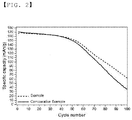
- a charging capacity and a discharging capacity were measured during charging and discharging processes according to the Example and the Comparative Example. The results are shown in FIG. 2 .
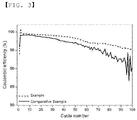
- the charging and discharging efficiencies at that time are shown in FIG. 3 .
- the cycle performance of the Example and the cycle performance of the Comparative Example are similar to each other in the early cycles; however, the cycle performance of the Example and the cycle performance of the Comparative Example are very different from each other after 50 cycles. It can be seen that the Example exhibits better performance than the Comparative Example and that the difference in the performance between the Example and the Comparative Example becomes greater as the number of cycles is increased.
- the Example exhibits higher charging and discharging efficiency than the Comparative Example even in the early cycles.
- a lithium metal having LiF deposited thereon exhibits high stability, whereby reversibility of charging and discharging is increased.
- LiF is deposited, it is possible to easily adjust a deposition thickness and to form a more uniform film than when using a conventional coating method. Meanwhile, the lithium metal, which is a negative electrode material, is not consumed, and the shape of a lithium metal electrode is not greatly changed.
Landscapes
- Chemical & Material Sciences (AREA)
- Engineering & Computer Science (AREA)
- Chemical Kinetics & Catalysis (AREA)
- Electrochemistry (AREA)
- General Chemical & Material Sciences (AREA)
- Manufacturing & Machinery (AREA)
- Materials Engineering (AREA)
- Inorganic Chemistry (AREA)
- Battery Electrode And Active Subsutance (AREA)
- Secondary Cells (AREA)
Abstract
Description
- The present invention relates to a negative electrode of a lithium metal secondary battery and a method of manufacturing the same, and more particularly to a method of depositing lithium fluoride (LiF) on the surface of a lithium metal, which is used as a negative electrode of a lithium metal secondary battery, a lithium metal manufactured by the same, and a negative electrode and a lithium metal secondary battery using the same.
- With the recent weight reduction and performance improvement of portable devices, such as smartphones, laptop computers, tablet PCs, and portable game consoles, the demand for secondary batteries used as driving sources thereof has been changed. In the past, a nickel-cadmium battery, a nickel-hydride battery, and a nickel-zinc battery were used. At present, a lithium secondary battery, which has high operating voltage and high energy density per unit weight, is being used in the greatest numbers.
- A material that reversibly stores and releases lithium ion to exhibit high reversible potential, such as LiCoO2, LiNiO2, or LiMn2O4, is used as the material of a positive electrode of a lithium secondary battery. The positive electrode material is still under development in order to improve the performance and stability of the lithium secondary battery.
- A lithium metal, which has highest energy density per unit weight and a standard hydrogen potential of -3.04V, which is the lowest, is most ideally used as the material of a negative electrode of the lithium secondary battery. In the case in which a lithium metal is used as the material of the negative electrode of the lithium secondary battery, it is theoretically possible to obtain a capacity of 3860 mAhg- 1, which is 10 times or more of the capacities of current commercial batteries. In this case, however, dendrite may easily grow on the surface of the lithium metal, and such dendrite may damage a separator of the battery, whereby the performance and safety of the battery may be reduced. In addition, the precipitated dendrite may abruptly increase the specific surface area and reactivity of the lithium metal, whereby a polymer film having no electrical conductivity may be formed after reaction with an electrolytic solution. Rapid charging, which has been rising in popularity in recent years, makes this effect worse.
- In order to solve this problem, a carbon material, such as graphite or carbon, which is usable for a long time, has been mainly used as the negative electrode material. In the case in which the lithium metal is directly used as the negative electrode material, the maximum possible number of charge and discharge cycles is only several tens, which is insufficient for practical application. For this reason, a material that can be used for a long time even though the one-time capacity thereof is small, such as graphite or carbon, has been mainly used. Since the lithium metal is not precipitated, an internal short circuit or additional problems due to dendrite do not occur, whereby stable use for a long time becomes possible. A theoretical lithium storage capacity of the negative electrode material, such as graphite or carbon, is 372 mAhg-1, which is equivalent to 10 % of that of the lithium metal. Although much effort has been made in order to increase the lithium storage capacity, therefore, it has not greatly exceeded theoretical limitations.
- Various attempts to improve the lithium metal to a level sufficient for practical use as a negative electrode material have been made in order to support the performance improvement of portable devices. In particular, various attempts to reform the surface of the lithium metal as a negative electrode material have been made. Patent Document 1 discloses copper as a negative electrode current collector, a lithium metal as a negative electrode active material, and a coating layer, composed of LiF-based particles, formed on the surface of the negative electrode active material. During charging and discharging processes of a battery, a LiF-based coating layer is formed on the surface of a negative electrode due to the side reaction of LiPF6.
- Patent Document 2 discloses that a negative electrode active material is a lithium metal and that a LiF protective film is provided on the surface of the negative electrode active material. The surface of the lithium metal is treated using a method such as mechanical etching, chemical etching, electrochemical etching, or plasma etching, and then a polymer film is formed using a polymer containing fluorine. Alternatively, a lithium metal film is treated in a gas atmosphere containing fluorine, such as CF4 or C2F6, in order to provide an LiF protective film.
- Patent Document 3 discloses a method of coating the surface of an electrode of a lithium secondary battery with a fluorine-based gas, such as LiF, using CVD or PVD. In Patent Document 3, however, a negative electrode is Li4Ti5O12 (LTO), graphite, silicon, or a silicon alloy, rather than a lithium metal, and the coating sequence is as follows: an oxide, such as Al2O3, TiO2, SiO2, SnO, VnO5, HfO, ZrO2, or ZnO, is coated as a first layer, and then a material such as AlF3 or LiF is coated on the oxide using CVD or PVD.
- Patent Document 4 discloses a method of coating LiF on the surface of a negative electrode active material for lithium secondary batteries. However, the negative electrode active material is a carbon-based material, rather than a lithium metal. That is, technology for coating the surface of the lithium metal with LiF through deposition has not been proposed.
- [Patent Document 001] Korean Patent Application Publication No.
10-2009-0091659 - [Patent Document 002] Korean Patent Application Publication No.
10-2002-0091748 - [Patent Document 003]
U.S. Patent Application Publication No. 2015/0180023 - [Patent Document 004] Korean Patent Application Publication No.
10-2008-0076527 - An object of the present invention is to provide a method of improving the performance of a lithium metal used as a negative electrode material. Another object of the present invention is to improve the reversibility of a lithium metal by depositing lithium fluoride on the surface of the lithium metal.
- In accordance with a first aspect of the present invention, the above and other objects can be accomplished by the provision of a method of reforming the surface of a lithium metal, the method including 1) preparing a lithium metal and 2) depositing lithium fluoride (LiF) on the surface of the lithium metal.
- In accordance with a second aspect of the present invention, the deposition may be physical vapor deposition (PVD) or chemical vapor deposition (CVD).
- In accordance with a third aspect of the present invention, the method may be performed to reform a lithium metal negative electrode of a lithium metal secondary battery.
- In accordance with a fourth aspect of the present invention, a deposition thickness may be 0.01 to 1 µm.
- In accordance with a fifth aspect of the present invention, there is provided a lithium metal manufactured using the method described above.
- In accordance with a sixth aspect of the present invention, there is provided an electrode for secondary batteries including the lithium metal.
- In accordance with a seventh aspect of the present invention, there is provided a lithium metal secondary battery including the electrode for secondary batteries.
- The above and other objects, features and other advantages of the present invention will be more clearly understood from the following detailed description taken in conjunction with the accompanying drawings, in which:
-
FIG. 1 is a view showing a comparison between a lithium metal (a) and a lithium metal having lithium fluoride (LiF) deposited on the upper surface thereof (b); -
FIG. 2 is a graph showing a charging capacity and a discharging capacity measured during charging and discharging processes according to an Example and a Comparative Example; and -
FIG. 3 is a graph showing charging and discharging efficiencies during the charging and discharging processes according to the Example and the Comparative Example. - The present invention provides a method of depositing the surface of a lithium metal including the following steps:
- 1) a step of preparing a lithium metal; and
- 2) a step of depositing lithium fluoride (LiF) on the surface of the lithium metal.
- At step 2), chemical vapor deposition (CVD) or physical vapor deposition (PVD) may be utilized. A lithium metal foil is placed in a chamber for deposition, and then LiF is deposited. The present invention is characterized in that LiF is directly deposited without the use of an additional precursor.
- The deposition of LiF on the surface of the lithium metal according to the present invention is distinct from conventional deposition of LiF on a carbon-based material, which is widely used as a negative electrode material. Since the lithium metal exhibits high oxidizing power, the process must be performed in an inactive atmosphere (Ar, etc.) in order to prevent the lithium metal from being oxidized during deposition. Since the lithium metal is easily oxidized even by a small amount of air and moisture, attention must be paid thereto. On the other hand, the oxidizing power of the carbon-based negative electrode material is not high, whereby it is not necessary to pay particular attention thereto even in a normal atmosphere.
- In addition, since the lithium metal has a melting point of 180 °C, which is lower than the melting points of other metals, it is necessary to carefully adjust the temperature of the chamber for deposition. In order to deposit LiF without melting the lithium metal, it is necessary for the temperature in the chamber to be lower than the melting point of the lithium metal.
- Meanwhile, the deposition of LiF according to the present invention is superior to conventional coating using a polymer, including a fluorine compound. In the case in which LiF is formed through charging and discharging disclosed in Patent Document 1, the formation process is complicated, and the lithium metal is consumed during the formation process, whereby the total capacity of the battery is reduced. In the case in which fluorine-containing gas is used, as disclosed in Patent Document 2, the gas is dangerous, and the structure of a device for processing the gas is complicated. In addition, in conventional technologies in which LiF itself is not deposited, a lithium metal, which is used as an electrode, reacts with fluorine. As a result, the lithium metal, which is an electrode material, is consumed, whereby the capacity of the battery is reduced. In the deposition method according to the present invention, it is possible to more easily adjust a thickness than in a conventional coating method. Consequently, it is possible to easily set an optimum thickness based on a positive electrode material, an electrolytic solution, and a separator according to the configuration of the battery.
- The deposition thickness according to the present invention is 0.01 to 1 µm, preferably 0.05 to 0.8 µm, and more preferably 0. 1 to 0.5 µm.
- It is possible to manufacture a secondary battery using the lithium metal according to the present invention as a negative electrode. At this time, materials that are generally used for a lithium secondary battery may be used as a current collector, a positive electrode, a separator, and an electrolytic solution, which correspond to the negative electrode.
- Hereinafter, the present invention will be described in detail with reference to the following Example and Experimental Example; however, the present invention is not limited by the Example and the Experimental Example. The Example may be modified into various other forms, and the scope of the present invention should not be interpreted as being limited by the Example, which will be described in detail. The Example is provided in order to more completely explain the prevent invention to a person who has average knowledge in the art to which the present invention pertains.
- LiF was applied to a lithium metal foil through physical vapor deposition (PVD). For deposition, LiF powder, as a raw material, was put into a deposition device (e.g. a thermal evaporator manufactured by Sunic System, Korea), and was evaporated at a temperature of 800 °C for one hour through thermal evaporation in order to deposit an LiF layer having a thickness of 100 nm on the lithium metal foil, whereby a lithium metal foil having LiF deposited on the surface thereof was manufactured.
- 96 weight % of LiCoO2 as a positive electrode active material, 2 weight % of Denka black (a conductive agent), and 2 weight % of polyvinylidene fluoride (PVDF) (a binder) were added to N-methyl-2-pyrrolidone (NMP) in order to manufacture a positive electrode material slurry. The manufactured positive electrode material slurry was coated on one surface of an aluminum current collector such that the positive electrode material slurry had a thickness of 65 µm. The positive electrode material slurry was dried, and the aluminum current collector was rolled. Subsequently, the aluminum current collector was punched so as to have a predetermined size, whereby a positive electrode was manufactured.
- A lithium metal foil (150 µm), having LiF deposited thereon to a thickness of 100 nm through physical vapor deposition (PVD), was used as a counter electrode. A polyolefin-based separator was interposed between the positive electrode and the counter electrode, and an electrolytic solution, in which 1M LiPF6 was dissolved in a solvent obtained by mixing ethylene carbonate (EC) and ethyl methyl carbonate (EMC) at a volume ratio of 50:50, was injected into the electrode assembly in order to manufacture a coin-type half battery.
- The coin-type half battery, manufactured as described above, was charged and discharged using an electrochemical charging and discharging device. Charging was performed until the voltage of the coin-type half battery became 4.4 V vs. Li/Li+, and discharging was performed until the voltage of the coin-type half battery became 3.0 V vs. Li/Li+. At this time, the current density was 0.5 C-rate.
- A coin-type half battery was manufactured in the same manner as in the Example except that a non-treated lithium metal foil was used as a counter electrode, in place of the lithium metal foil (150 µm), having LiF deposited thereon to a thickness of 100 nm, according to the Example, and the coin-type half battery was charged and discharged under the same conditions as in charging and discharging according to the Example.
- A charging capacity and a discharging capacity were measured during charging and discharging processes according to the Example and the Comparative Example. The results are shown in
FIG. 2 . The charging and discharging efficiencies at that time are shown inFIG. 3 . - Referring to
FIG. 2 , the cycle performance of the Example and the cycle performance of the Comparative Example are similar to each other in the early cycles; however, the cycle performance of the Example and the cycle performance of the Comparative Example are very different from each other after 50 cycles. It can be seen that the Example exhibits better performance than the Comparative Example and that the difference in the performance between the Example and the Comparative Example becomes greater as the number of cycles is increased. - Referring to
FIG. 3 , it can be seen that the Example exhibits higher charging and discharging efficiency than the Comparative Example even in the early cycles. - As described above, it can be seen that, in the case in which the lithium metal having LiF deposited thereon is used, it is possible to remarkably improve charging and discharging efficiency of the battery.
- In the case in which a lithium metal is used in order to increase the capacity of a lithium secondary battery, reversibility of charging and discharging is reduced due to dendrite, etc. According to the present invention, a lithium metal having LiF deposited thereon exhibits high stability, whereby reversibility of charging and discharging is increased. In addition, in the case in which LiF is deposited, it is possible to easily adjust a deposition thickness and to form a more uniform film than when using a conventional coating method. Meanwhile, the lithium metal, which is a negative electrode material, is not consumed, and the shape of a lithium metal electrode is not greatly changed.
Claims (9)
- A method of reforming a surface of a lithium metal, the method comprising:1) preparing a lithium metal; and2) depositing lithium fluoride (LiF) on a surface of the lithium metal.
- The method according to claim 1, wherein the deposition is physical vapor deposition (PVD) or chemical vapor deposition (CVD).
- The method according to claim 1, wherein the method is performed to reform a lithium metal negative electrode of a lithium metal secondary battery.
- The method according to claim 1, wherein a deposition thickness is 0.01 to 1 µm.
- A lithium metal manufactured using a method according to any one of claims 1 to 4.
- An electrode for secondary batteries comprising a lithium metal according to claim 5.
- The electrode according to claim 6, wherein the electrode is a negative electrode.
- A secondary battery comprising an electrode for secondary batteries according to claim 6.
- The secondary battery according to claim 8, wherein the electrode is a negative electrode, and the secondary battery is a lithium metal secondary battery.
Applications Claiming Priority (2)
| Application Number | Priority Date | Filing Date | Title |
|---|---|---|---|
| KR1020170004358A KR102155025B1 (en) | 2017-01-11 | 2017-01-11 | Deposition of LiF on Li metal surface and Li secondary battery using thereof |
| PCT/KR2017/015589 WO2018131824A1 (en) | 2017-01-11 | 2017-12-27 | Deposition of lithium fluoride on lithium metal surface and lithium secondary battery using same |
Publications (2)
| Publication Number | Publication Date |
|---|---|
| EP3471176A1 true EP3471176A1 (en) | 2019-04-17 |
| EP3471176A4 EP3471176A4 (en) | 2019-09-04 |
Family
ID=62839888
Family Applications (1)
| Application Number | Title | Priority Date | Filing Date |
|---|---|---|---|
| EP17891409.9A Pending EP3471176A4 (en) | 2017-01-11 | 2017-12-27 | DEPOSITION OF LITHIUM FLUORIDE ON A METAL LITHIUM SURFACE AND LITHIUM ACCUMULATOR USING THE SAME |
Country Status (5)
| Country | Link |
|---|---|
| US (2) | US12051798B2 (en) |
| EP (1) | EP3471176A4 (en) |
| KR (1) | KR102155025B1 (en) |
| CN (1) | CN109565039A (en) |
| WO (1) | WO2018131824A1 (en) |
Families Citing this family (5)
| Publication number | Priority date | Publication date | Assignee | Title |
|---|---|---|---|---|
| US11631840B2 (en) * | 2019-04-26 | 2023-04-18 | Applied Materials, Inc. | Surface protection of lithium metal anode |
| CN111725486A (en) * | 2020-07-01 | 2020-09-29 | 昆山宝创新能源科技有限公司 | Lithium metal negative electrode and preparation method and application thereof |
| WO2022060021A1 (en) * | 2020-09-16 | 2022-03-24 | 주식회사 엘지에너지솔루션 | Method for manufacturing lithium metal electrode, lithium metal electrode manufactured thereby, and lithium secondary battery comprising same |
| CN114597515A (en) * | 2020-12-07 | 2022-06-07 | 恒大新能源技术(深圳)有限公司 | Negative electrode, method for producing same, and lithium secondary battery |
| CN119725385B (en) * | 2024-12-20 | 2026-04-28 | 天府绛溪实验室 | A lithium-based anode material, its preparation method and application |
Family Cites Families (25)
| Publication number | Priority date | Publication date | Assignee | Title |
|---|---|---|---|---|
| US5989743A (en) * | 1994-09-27 | 1999-11-23 | Asahi Kasei Kogyo Kabushiki Kaisha | Non-aqueous battery |
| JP3428428B2 (en) | 1998-04-03 | 2003-07-22 | 松下電器産業株式会社 | Negative electrode for non-aqueous electrolyte battery and method for producing the same |
| JP3812324B2 (en) * | 2000-11-06 | 2006-08-23 | 日本電気株式会社 | Lithium secondary battery and manufacturing method thereof |
| KR100413796B1 (en) | 2001-05-31 | 2004-01-03 | 삼성에스디아이 주식회사 | Method of manufacturing lithium metal anode protective layer for lithium battery |
| CN1179432C (en) * | 2001-05-31 | 2004-12-08 | 三星Sdi株式会社 | Method for forming lithium metal anode protective layer of lithium battery |
| JP2002373707A (en) * | 2001-06-14 | 2002-12-26 | Nec Corp | Lithium secondary battery and method of manufacturing lithium secondary battery |
| US6911280B1 (en) * | 2001-12-21 | 2005-06-28 | Polyplus Battery Company | Chemical protection of a lithium surface |
| JP2004087402A (en) | 2002-08-28 | 2004-03-18 | Sony Corp | Negative electrode, method for producing the same, and battery |
| KR100450208B1 (en) * | 2002-09-23 | 2004-09-24 | 삼성에스디아이 주식회사 | Negative electrode for lithium battery and lithium battery comprising same |
| JP2004165097A (en) | 2002-11-15 | 2004-06-10 | Sony Corp | Negative electrode and battery, and methods for their production |
| KR100522694B1 (en) | 2003-08-23 | 2005-10-19 | 삼성에스디아이 주식회사 | Lithium-sulfur battery |
| KR100853327B1 (en) | 2007-02-16 | 2008-08-21 | 엘에스엠트론 주식회사 | Anode active material for lithium battery, manufacturing method thereof and lithium secondary battery using same |
| KR101196798B1 (en) | 2008-02-25 | 2012-11-05 | 주식회사 엘지화학 | ANODE COATED WITH LiF COMPOUNDS AND METHOD FOR PREPARATION THEREOF AND LITHIUM SECONDARY BATTERY COMPRISING THE ANODE |
| US9843041B2 (en) * | 2009-11-11 | 2017-12-12 | Zenlabs Energy, Inc. | Coated positive electrode materials for lithium ion batteries |
| CN104185521B (en) * | 2012-01-13 | 2017-07-28 | 罗克伍德锂有限责任公司 | Lithium metal product, the preparation method and the usage coated with phosphorus |
| KR101920714B1 (en) | 2012-05-16 | 2018-11-21 | 삼성전자주식회사 | Negative electrode for lithium battery and the lithium battery comprising the same |
| US9692039B2 (en) * | 2012-07-24 | 2017-06-27 | Quantumscape Corporation | Nanostructured materials for electrochemical conversion reactions |
| KR101503572B1 (en) * | 2012-08-03 | 2015-03-18 | (주)오렌지파워 | Anode electrode, rechargeable battery including the same and method of fabricating the same |
| JP2014127315A (en) * | 2012-12-26 | 2014-07-07 | Elna Co Ltd | Method for manufacturing negative electrode for electricity storage device |
| KR20140125970A (en) * | 2013-04-19 | 2014-10-30 | 국립대학법인 울산과학기술대학교 산학협력단 | Lithium metal battery and method of preparing the same |
| US9531004B2 (en) | 2013-12-23 | 2016-12-27 | GM Global Technology Operations LLC | Multifunctional hybrid coatings for electrodes made by atomic layer deposition techniques |
| KR101984719B1 (en) * | 2014-10-23 | 2019-05-31 | 주식회사 엘지화학 | Li metal electrode with multi-layer and forming method thereof |
| DE112017003085T5 (en) * | 2016-06-21 | 2019-03-14 | Applied Materials, Inc. | Interfacial layer for improved lithium metal cyclization |
| CN106159200B (en) | 2016-07-29 | 2019-01-11 | 中国科学院青岛生物能源与过程研究所 | A kind of lithium anode and its preparation and application with protective coating |
| US10553874B2 (en) * | 2017-08-04 | 2020-02-04 | Uchicago Argonne, Llc | Protective coatings for lithium anodes |
-
2017
- 2017-01-11 KR KR1020170004358A patent/KR102155025B1/en active Active
- 2017-12-27 US US16/330,006 patent/US12051798B2/en active Active
- 2017-12-27 EP EP17891409.9A patent/EP3471176A4/en active Pending
- 2017-12-27 WO PCT/KR2017/015589 patent/WO2018131824A1/en not_active Ceased
- 2017-12-27 CN CN201780049655.XA patent/CN109565039A/en active Pending
-
2024
- 2024-07-24 US US18/782,197 patent/US20240379940A1/en active Pending
Also Published As
| Publication number | Publication date |
|---|---|
| WO2018131824A1 (en) | 2018-07-19 |
| CN109565039A (en) | 2019-04-02 |
| KR102155025B1 (en) | 2020-09-11 |
| KR20180082902A (en) | 2018-07-19 |
| US20200203714A1 (en) | 2020-06-25 |
| EP3471176A4 (en) | 2019-09-04 |
| US20240379940A1 (en) | 2024-11-14 |
| US12051798B2 (en) | 2024-07-30 |
Similar Documents
| Publication | Publication Date | Title |
|---|---|---|
| US20240379940A1 (en) | Deposition of lithium fluoride on surface of lithium metal and lithium secondary battery using the same | |
| US10991946B2 (en) | Polymerization process for forming polymeric ultrathin conformal coatings on electrode materials | |
| US12107255B2 (en) | Positive electrode, method for preparing the same and electrochemical device | |
| KR102088478B1 (en) | An anode for an lithium ion secondary battery and a method for manufacturing the same | |
| JP5219339B2 (en) | Lithium secondary battery | |
| JP6849817B2 (en) | Cathode for secondary battery, its manufacturing method and lithium secondary battery manufactured using this | |
| JP2003524857A (en) | Lithium ion electrochemical battery | |
| JP2011515824A (en) | High voltage cathode composition | |
| WO2011161865A1 (en) | Lithium-ion secondary-battery charging method and charging system | |
| CN102449811A (en) | Lithium secondary battery with high energy density | |
| CN102326284A (en) | Lithium ion rechargeable battery, electrode for battery, and electrodeposited copper foil for electrode for battery | |
| US7556881B2 (en) | Lithium secondary battery | |
| JP4949905B2 (en) | Non-aqueous electrolyte secondary battery | |
| JP2001283834A (en) | Secondary battery | |
| CN109565041B (en) | Cathode material based on nickel coating and preparation method | |
| KR101654047B1 (en) | anode for lithium secondary battery, manufacturing method thereof and lithium secondary battery comprising the same | |
| JP4419404B2 (en) | Electrode, battery using the same, and nonaqueous electrolyte secondary battery | |
| CN105470473B (en) | Positive electrode active material and secondary battery | |
| TWI663128B (en) | Electrode material for secondary battery and secondary battery | |
| WO2008044449A1 (en) | Negative electrode for nonaqueous electrolyte secondary battery, process for producing the same and nonaqueous electrolyte secondary battery utilizing the electrode | |
| KR20140058928A (en) | The non-aqueous and high-capacity lithium secondary battery | |
| JP4419402B2 (en) | Electrode, battery using the same, and nonaqueous electrolyte secondary battery | |
| JP4958405B2 (en) | Nonaqueous electrolyte secondary battery | |
| JP4382319B2 (en) | Lithium secondary battery | |
| CN121546040A (en) | Negative electrode active materials, negative electrode sheets, lithium-ion batteries and electrical devices |
Legal Events
| Date | Code | Title | Description |
|---|---|---|---|
| STAA | Information on the status of an ep patent application or granted ep patent |
Free format text: STATUS: THE INTERNATIONAL PUBLICATION HAS BEEN MADE |
|
| PUAI | Public reference made under article 153(3) epc to a published international application that has entered the european phase |
Free format text: ORIGINAL CODE: 0009012 |
|
| STAA | Information on the status of an ep patent application or granted ep patent |
Free format text: STATUS: REQUEST FOR EXAMINATION WAS MADE |
|
| 17P | Request for examination filed |
Effective date: 20190110 |
|
| AK | Designated contracting states |
Kind code of ref document: A1 Designated state(s): AL AT BE BG CH CY CZ DE DK EE ES FI FR GB GR HR HU IE IS IT LI LT LU LV MC MK MT NL NO PL PT RO RS SE SI SK SM TR |
|
| AX | Request for extension of the european patent |
Extension state: BA ME |
|
| A4 | Supplementary search report drawn up and despatched |
Effective date: 20190801 |
|
| RIC1 | Information provided on ipc code assigned before grant |
Ipc: H01M 4/04 20060101ALI20190726BHEP Ipc: H01M 4/134 20100101ALI20190726BHEP Ipc: H01M 4/02 20060101ALI20190726BHEP Ipc: H01M 4/1395 20100101AFI20190726BHEP |
|
| DAV | Request for validation of the european patent (deleted) | ||
| DAX | Request for extension of the european patent (deleted) | ||
| STAA | Information on the status of an ep patent application or granted ep patent |
Free format text: STATUS: EXAMINATION IS IN PROGRESS |
|
| 17Q | First examination report despatched |
Effective date: 20210225 |
|
| RAP1 | Party data changed (applicant data changed or rights of an application transferred) |
Owner name: LG ENERGY SOLUTION LTD. |
|
| RAP3 | Party data changed (applicant data changed or rights of an application transferred) |
Owner name: LG ENERGY SOLUTION, LTD. |