EP3468532B1 - Dispensing device and pharmaceutical composition for the treatment of rhinitis - Google Patents
Dispensing device and pharmaceutical composition for the treatment of rhinitis Download PDFInfo
- Publication number
- EP3468532B1 EP3468532B1 EP18823894.3A EP18823894A EP3468532B1 EP 3468532 B1 EP3468532 B1 EP 3468532B1 EP 18823894 A EP18823894 A EP 18823894A EP 3468532 B1 EP3468532 B1 EP 3468532B1
- Authority
- EP
- European Patent Office
- Prior art keywords
- composition
- olopatadine
- nasal
- baseline
- container
- Prior art date
- Legal status (The legal status is an assumption and is not a legal conclusion. Google has not performed a legal analysis and makes no representation as to the accuracy of the status listed.)
- Active
Links
Images




Classifications
-
- A—HUMAN NECESSITIES
- A61—MEDICAL OR VETERINARY SCIENCE; HYGIENE
- A61M—DEVICES FOR INTRODUCING MEDIA INTO, OR ONTO, THE BODY; DEVICES FOR TRANSDUCING BODY MEDIA OR FOR TAKING MEDIA FROM THE BODY; DEVICES FOR PRODUCING OR ENDING SLEEP OR STUPOR
- A61M11/00—Sprayers or atomisers specially adapted for therapeutic purposes
- A61M11/006—Sprayers or atomisers specially adapted for therapeutic purposes operated by applying mechanical pressure to the liquid to be sprayed or atomised
- A61M11/007—Syringe-type or piston-type sprayers or atomisers
-
- A—HUMAN NECESSITIES
- A61—MEDICAL OR VETERINARY SCIENCE; HYGIENE
- A61K—PREPARATIONS FOR MEDICAL, DENTAL OR TOILETRY PURPOSES
- A61K31/00—Medicinal preparations containing organic active ingredients
- A61K31/56—Compounds containing cyclopenta[a]hydrophenanthrene ring systems; Derivatives thereof, e.g. steroids
- A61K31/58—Compounds containing cyclopenta[a]hydrophenanthrene ring systems; Derivatives thereof, e.g. steroids containing heterocyclic rings, e.g. danazol, stanozolol, pancuronium or digitogenin
-
- A—HUMAN NECESSITIES
- A61—MEDICAL OR VETERINARY SCIENCE; HYGIENE
- A61K—PREPARATIONS FOR MEDICAL, DENTAL OR TOILETRY PURPOSES
- A61K31/00—Medicinal preparations containing organic active ingredients
- A61K31/33—Heterocyclic compounds
- A61K31/335—Heterocyclic compounds having oxygen as the only ring hetero atom, e.g. fungichromin
-
- A—HUMAN NECESSITIES
- A61—MEDICAL OR VETERINARY SCIENCE; HYGIENE
- A61K—PREPARATIONS FOR MEDICAL, DENTAL OR TOILETRY PURPOSES
- A61K31/00—Medicinal preparations containing organic active ingredients
- A61K31/56—Compounds containing cyclopenta[a]hydrophenanthrene ring systems; Derivatives thereof, e.g. steroids
- A61K31/57—Compounds containing cyclopenta[a]hydrophenanthrene ring systems; Derivatives thereof, e.g. steroids substituted in position 17 beta by a chain of two carbon atoms, e.g. pregnane or progesterone
- A61K31/573—Compounds containing cyclopenta[a]hydrophenanthrene ring systems; Derivatives thereof, e.g. steroids substituted in position 17 beta by a chain of two carbon atoms, e.g. pregnane or progesterone substituted in position 21, e.g. cortisone, dexamethasone, prednisone or aldosterone
-
- A—HUMAN NECESSITIES
- A61—MEDICAL OR VETERINARY SCIENCE; HYGIENE
- A61K—PREPARATIONS FOR MEDICAL, DENTAL OR TOILETRY PURPOSES
- A61K47/00—Medicinal preparations characterised by the non-active ingredients used, e.g. carriers or inert additives; Targeting or modifying agents chemically bound to the active ingredient
- A61K47/02—Inorganic compounds
-
- A—HUMAN NECESSITIES
- A61—MEDICAL OR VETERINARY SCIENCE; HYGIENE
- A61K—PREPARATIONS FOR MEDICAL, DENTAL OR TOILETRY PURPOSES
- A61K47/00—Medicinal preparations characterised by the non-active ingredients used, e.g. carriers or inert additives; Targeting or modifying agents chemically bound to the active ingredient
- A61K47/06—Organic compounds, e.g. natural or synthetic hydrocarbons, polyolefins, mineral oil, petrolatum or ozokerite
- A61K47/16—Organic compounds, e.g. natural or synthetic hydrocarbons, polyolefins, mineral oil, petrolatum or ozokerite containing nitrogen, e.g. nitro-, nitroso-, azo-compounds, nitriles, cyanates
- A61K47/18—Amines; Amides; Ureas; Quaternary ammonium compounds; Amino acids; Oligopeptides having up to five amino acids
- A61K47/186—Quaternary ammonium compounds, e.g. benzalkonium chloride or cetrimide
-
- A—HUMAN NECESSITIES
- A61—MEDICAL OR VETERINARY SCIENCE; HYGIENE
- A61K—PREPARATIONS FOR MEDICAL, DENTAL OR TOILETRY PURPOSES
- A61K47/00—Medicinal preparations characterised by the non-active ingredients used, e.g. carriers or inert additives; Targeting or modifying agents chemically bound to the active ingredient
- A61K47/06—Organic compounds, e.g. natural or synthetic hydrocarbons, polyolefins, mineral oil, petrolatum or ozokerite
- A61K47/26—Carbohydrates, e.g. sugar alcohols, amino sugars, nucleic acids, mono-, di- or oligo-saccharides; Derivatives thereof, e.g. polysorbates, sorbitan fatty acid esters or glycyrrhizin
-
- A—HUMAN NECESSITIES
- A61—MEDICAL OR VETERINARY SCIENCE; HYGIENE
- A61K—PREPARATIONS FOR MEDICAL, DENTAL OR TOILETRY PURPOSES
- A61K47/00—Medicinal preparations characterised by the non-active ingredients used, e.g. carriers or inert additives; Targeting or modifying agents chemically bound to the active ingredient
- A61K47/30—Macromolecular organic or inorganic compounds, e.g. inorganic polyphosphates
- A61K47/36—Polysaccharides; Derivatives thereof, e.g. gums, starch, alginate, dextrin, hyaluronic acid, chitosan, inulin, agar or pectin
- A61K47/38—Cellulose; Derivatives thereof
-
- A—HUMAN NECESSITIES
- A61—MEDICAL OR VETERINARY SCIENCE; HYGIENE
- A61K—PREPARATIONS FOR MEDICAL, DENTAL OR TOILETRY PURPOSES
- A61K9/00—Medicinal preparations characterised by special physical form
- A61K9/0012—Galenical forms characterised by the site of application
- A61K9/0043—Nose
-
- A—HUMAN NECESSITIES
- A61—MEDICAL OR VETERINARY SCIENCE; HYGIENE
- A61K—PREPARATIONS FOR MEDICAL, DENTAL OR TOILETRY PURPOSES
- A61K9/00—Medicinal preparations characterised by special physical form
- A61K9/08—Solutions
-
- A—HUMAN NECESSITIES
- A61—MEDICAL OR VETERINARY SCIENCE; HYGIENE
- A61K—PREPARATIONS FOR MEDICAL, DENTAL OR TOILETRY PURPOSES
- A61K9/00—Medicinal preparations characterised by special physical form
- A61K9/10—Dispersions; Emulsions
-
- A—HUMAN NECESSITIES
- A61—MEDICAL OR VETERINARY SCIENCE; HYGIENE
- A61M—DEVICES FOR INTRODUCING MEDIA INTO, OR ONTO, THE BODY; DEVICES FOR TRANSDUCING BODY MEDIA OR FOR TAKING MEDIA FROM THE BODY; DEVICES FOR PRODUCING OR ENDING SLEEP OR STUPOR
- A61M11/00—Sprayers or atomisers specially adapted for therapeutic purposes
- A61M11/006—Sprayers or atomisers specially adapted for therapeutic purposes operated by applying mechanical pressure to the liquid to be sprayed or atomised
-
- A—HUMAN NECESSITIES
- A61—MEDICAL OR VETERINARY SCIENCE; HYGIENE
- A61M—DEVICES FOR INTRODUCING MEDIA INTO, OR ONTO, THE BODY; DEVICES FOR TRANSDUCING BODY MEDIA OR FOR TAKING MEDIA FROM THE BODY; DEVICES FOR PRODUCING OR ENDING SLEEP OR STUPOR
- A61M15/00—Inhalators
- A61M15/0001—Details of inhalators; Constructional features thereof
- A61M15/0021—Mouthpieces therefor
- A61M15/0025—Mouthpieces therefor with caps
-
- A—HUMAN NECESSITIES
- A61—MEDICAL OR VETERINARY SCIENCE; HYGIENE
- A61M—DEVICES FOR INTRODUCING MEDIA INTO, OR ONTO, THE BODY; DEVICES FOR TRANSDUCING BODY MEDIA OR FOR TAKING MEDIA FROM THE BODY; DEVICES FOR PRODUCING OR ENDING SLEEP OR STUPOR
- A61M15/00—Inhalators
- A61M15/08—Inhaling devices inserted into the nose
-
- A—HUMAN NECESSITIES
- A61—MEDICAL OR VETERINARY SCIENCE; HYGIENE
- A61P—SPECIFIC THERAPEUTIC ACTIVITY OF CHEMICAL COMPOUNDS OR MEDICINAL PREPARATIONS
- A61P11/00—Drugs for disorders of the respiratory system
- A61P11/02—Nasal agents, e.g. decongestants
-
- A—HUMAN NECESSITIES
- A61—MEDICAL OR VETERINARY SCIENCE; HYGIENE
- A61P—SPECIFIC THERAPEUTIC ACTIVITY OF CHEMICAL COMPOUNDS OR MEDICINAL PREPARATIONS
- A61P37/00—Drugs for immunological or allergic disorders
- A61P37/08—Antiallergic agents
-
- B—PERFORMING OPERATIONS; TRANSPORTING
- B05—SPRAYING OR ATOMISING IN GENERAL; APPLYING FLUENT MATERIALS TO SURFACES, IN GENERAL
- B05B—SPRAYING APPARATUS; ATOMISING APPARATUS; NOZZLES
- B05B11/00—Single-unit hand-held apparatus in which flow of contents is produced by the muscular force of the operator at the moment of use
- B05B11/01—Single-unit hand-held apparatus in which flow of contents is produced by the muscular force of the operator at the moment of use characterised by the means producing the flow
- B05B11/10—Pump arrangements for transferring the contents from the container to a pump chamber by a sucking effect and forcing the contents out through the dispensing nozzle
-
- B—PERFORMING OPERATIONS; TRANSPORTING
- B05—SPRAYING OR ATOMISING IN GENERAL; APPLYING FLUENT MATERIALS TO SURFACES, IN GENERAL
- B05B—SPRAYING APPARATUS; ATOMISING APPARATUS; NOZZLES
- B05B11/00—Single-unit hand-held apparatus in which flow of contents is produced by the muscular force of the operator at the moment of use
- B05B11/01—Single-unit hand-held apparatus in which flow of contents is produced by the muscular force of the operator at the moment of use characterised by the means producing the flow
- B05B11/10—Pump arrangements for transferring the contents from the container to a pump chamber by a sucking effect and forcing the contents out through the dispensing nozzle
- B05B11/1042—Components or details
-
- A—HUMAN NECESSITIES
- A61—MEDICAL OR VETERINARY SCIENCE; HYGIENE
- A61K—PREPARATIONS FOR MEDICAL, DENTAL OR TOILETRY PURPOSES
- A61K2300/00—Mixtures or combinations of active ingredients, wherein at least one active ingredient is fully defined in groups A61K31/00 - A61K41/00
Definitions
- the present invention is directed to a dispensing device and pharmaceutical composition for nasal administration to a human for treatment of rhinitis; and more particularly to a dispensing device with pharmaceutical composition comprising mometasone, an ester thereof (e.g., mometasone furoate), or a salt thereof and olopatadine or a salt thereof (e.g., olopatadine hydrochloride).
- a dispensing device and pharmaceutical composition comprising mometasone, an ester thereof (e.g., mometasone furoate), or a salt thereof and olopatadine or a salt thereof (e.g., olopatadine hydrochloride).
- Rhinitis is a medical term for irritation and inflammation of the mucous membrane inside the nose. Rhinitis may cause additional symptoms, such as sneezing, nasal itching, coughing, headache, fatigue, malaise, and cognitive impairment.
- US2016/0287612 discloses the pharmaceutical compositions mometasone in combination with olopatadine.
- the present invention is directed to a dispensing device for nasal administration of a pharmaceutical composition containing mometasone, an ester thereof (e.g., mometasone furoate), or a salt thereof and olopatadine or a salt thereof (e.g., olopatadine hydrochloride).
- a pharmaceutical composition containing mometasone, an ester thereof (e.g., mometasone furoate), or a salt thereof and olopatadine or a salt thereof (e.g., olopatadine hydrochloride).
- the dispensing device and pharmaceutical composition are particularly suitable for the treatment of allergic rhinitis in a human subject.
- the combination of dispensing device and pharmaceutical composition achieves consistent dosing of the mometasone and olopatadine components.
- the compositions comprises mometasone furoate and olopatadine hydrochloride.
- a dispensing device and pharmaceutical composition for nasal administration to a human subject includes (a) a container for the pharmaceutical composition; (b) a dispenser head for dispensing the pharmaceutical composition from the container, the dispenser head including at least a pump or valve mechanism, a dispensing channel, and a dispensing orifice; (c) a dip tube extending along the longitudinal axis of the container, the dip tube having a proximal end communicating with the dispenser head and an open distal end extending into the container; and (d) a pharmaceutical composition in the container and in communication with the distal end of the dip tube, where the pharmaceutical composition comprises mometasone, an ester thereof, or a salt thereof and olopatadine or a salt thereof.
- the pharmaceutical composition is an aqueous suspension containing a hydrocolloid, where the mometasone is present in particulate form and the olopatadine is in dissolved form.
- the pharmaceutical composition comprises a suitable amount of hydrocolloid such that the pharmaceutical composition has a viscosity of 10 cps to about 200 cps or preferably from about 20 cps to about 150 cps.
- the pharmaceutical composition may comprise about 0.001% w/w to about 0.075% w/w mometasone , an ester thereof (e.g., mometasone furoate), or a salt thereof in particulate form, and about 0.5% w/w to about 0.8% w/w olopatadine or a salt thereof (e.g., olopatadine hydrochloride) in dissolved form.
- a cap to cover a tip of the dispensing head may also be included.
- the container has a conically shaped internal bottom, where the internal bottom is angled downwardly from a side of the container toward a center.
- the center is located along a longitudinal axis of the container.
- the internal bottom can include a further angularly deepened well centrally located about the longitudinal axis, where the center is a low point of the internal bottom of the container.
- the distal end of the dip tube can extend into the well, or can be located at a top of the well.
- the well of the internal bottom of the container can further include a groove therein.
- the groove further deepens an internal bottom of the well and extends across the longitudinal axis of the container. Accordingly, the internal bottom of the well, at the center, is the low point of the internal bottom of the container.
- the open distal end of the dip tube can extend into the groove or can be located at a top of the groove. Also in this aspect, a dimension of the groove, that further deepens the internal bottom of the well, does not affect an external bottom of the well, as a deepening dimension of the groove is within a wall thickness of the bottom of the well.
- At least the well of the internal bottom of the container further includes a groove therein.
- This groove further deepens an internal bottom of the well in a dimension greater than a wall thickness of the bottom of the well, thereby requiring modification of an external bottom of at least the well.
- a support bead, with the groove therein extends from at least an external bottom of the well.
- the support bead also extends across the longitudinal axis of the container.
- the open distal end of the dip tube can extend into the groove or can be located at a top of the groove.
- the dispenser head is defined exteriorly by at least an end or tip wall and a lateral wall.
- the end wall has the dispensing orifice included therein.
- the cap is releasably attachable to the dispenser head for covering at least the dispensing orifice.
- the cap includes a sealing sleeve that can extend from an interior surface of the cap and communicate in a leak tight or seal tight manner with a perimeter of the lateral wall of the dispenser head.
- an inner diameter of a distal end of the sealing sleeve is smaller than an exterior diameter of the lateral wall of the dispenser head, at a point of communication of the sealing sleeve with the lateral wall. This relationship assists to create the seal tight manner in which the cap and dispenser head engage in the closed position. In this engagement, the distal end of the sealing sleeve is radially deformed.
- the sealing sleeve can have a wall thickness that decreases as the sealing sleeve extends away from the inside of the cap.
- the cap could further include, on an interior thereof, one or more protruding tabs that snap fit against the lateral wall of the dispenser head to hold the cap securely on the dispenser head in the closed position.
- the pharmaceutical composition includes about 0.001% w/w to about 0.075% w/w mometasone, an ester thereof (e.g., mometasone furoate), or a salt thereof in particulate form and about 0.5% w/w to about 0.8% w/w olopatadine or its salt (e.g., olopatadine hydrochloride) in dissolved form.
- the composition could further include a hydrocolloid system, for example, in an amount sufficient to inhibit phase separation for at least 24 hours when stored at 25 ⁇ 2° C. and 60% ⁇ 5% relative humidity.
- the composition when stored for up to 12 months at 25 ⁇ 2° C and 60% ⁇ 5% relative humidity in the dispensing device contains has one or more of the following properties:
- the pharmaceutical composition includes about 0.025% w/w to about 0.05% w/w mometasone, an ester thereof (e.g., mometasone furoate), or a salt thereof in particulate form; and about 0.5% w/w to about 0.8% w/w olopatadine or its salt (e.g., olopatadine hydrochloride).
- the pharmaceutical composition includes about 0.025% w/w to about 0.05% w/w mometasone, an ester thereof (e.g., mometasone furoate), or a salt thereof in particulate form; and about 0.6% w/w to about 0.7% w/w olopatadine or its salt.
- the pharmaceutical composition may further include a hydrocolloid as described above.
- the dispensing device dispenses about 100 ⁇ l of the pharmaceutical composition per actuation, wherein a single actuation dispenses about 665 mcg of olopatadine hydrochloride and about 25 mcg or about 50 mcg of mometasone furoate (preferably 25 mcg mometasone furoate).
- the dispensing device can include a container, a cap, and a dispenser head which can include a pump, a dip tube, a valve, an actuator, a dispensing channel and a dispensing orifice.
- the pump is designed to dispense the pharmaceutical composition through the dip tube into the valve, through the actuator fitted with the dispensing orifice.
- the pharmaceutical composition is released in the form of a uniform spray.
- Valves can be continuous spray valves and/or metering valves. Valves can operate in tandem with the actuator which allow for easy opening and closing of the valve and provide for a desired spray characteristic.
- Actuators include, but are not limited to, spray actuators, foam actuators, solid-stream actuators, and special actuators.
- the dispensing device delivers a nasal spray in a uniform dose of, for instance, mometasone (e.g., as mometasone furoate) and olopatadine (e.g., as olopatadine hydrochloride), where the dose is dispensed every time the dispensing device is actuated by a user.
- mometasone e.g., as mometasone furoate
- olopatadine e.g., as olopatadine hydrochloride
- the dispensing device may require priming for about 2-6 actuations to consistently dispense the composition.
- the droplet size of the nasal spray can be controlled by the size of the dispensing orifice of the container. The dispensing orifice size also influences characteristics of the spray pattern.
- the pharmaceutical composition when delivered as a nasal spray by the dispensing device, has a spray pattern having a longest axis of about 15-75 mm, a shortest axis of about 10-65 mm, and an ellipticity of about 1-2.
- the present invention is directed to a dispensing device and pharmaceutical composition for nasal administration to a human for treatment of rhinitis; and more particularly to a dispensing device with pharmaceutical composition comprising mometasone, an ester thereof, or a salt thereof and olopatadine or its salt.
- a dispensing device and pharmaceutical composition for nasal administration to a human includes (a) a container for the pharmaceutical composition; (b) a dispenser head for dispensing the pharmaceutical composition from the container, the dispenser head including at least a pump or valve mechanism, a dispensing channel, and a dispensing orifice; (c) a dip tube extending along the longitudinal axis of the container, the dip tube having a proximal end communicating with the dispenser head and an open distal end extending into the container; and (d) a pharmaceutical composition in the container and in communication with the distal end of the dip tube, where the pharmaceutical composition comprises mometasone, an ester thereof (e.g., mometasone furoate), or a salt thereof and olopadatine or a salt thereof (e.g., olopatadine hydrochloride).
- the pharmaceutical composition comprises mometasone, an ester thereof (e.g., mometasone furoate), or a salt thereof and
- the pharmaceutical composition is an aqueous suspension containing a hydrocolloid, where the mometasone, an ester thereof (e.g., mometasone furoate), or a salt thereof is present in particulate form and the olopatadine or a salt thereof (e.g., olopatadine hydrochloride) is in dissolved form.
- the pharmaceutical composition comprises a suitable amount of hydrocolloid such that the pharmaceutical composition has a viscosity of 10 cps to about 200 cps or preferably from about 20 cps to about 150 cps.
- the pharmaceutical composition may comprise about 0.001% w/w to about 0.075% w/w mometasone, an ester thereof (e.g., mometasone furoate), or a salt thereof in particulate form, and about 0.5% w/w to about 0.8% w/w olopatadine or its salt (e.g., olopatadine hydrochloride) in dissolved form.
- a cap to cover a tip of the dispensing head may also be included.
- the container can have a conically shaped internal bottom, where the internal bottom is angled downwardly from a side of the container toward a center.
- the center is located along a longitudinal axis of the container.
- the internal bottom can include a further angularly deepened well centrally located about the longitudinal axis, where the center is a low point of the internal bottom of the container.
- the distal end of the dip tube can extend into the well, or can be located at a top of the well.
- the dispenser head is defined exteriorly by at least an end or tip wall and a lateral wall.
- the end wall has the dispensing orifice included therein.
- the cap is releasably attachable to the dispenser head for covering at least the dispensing orifice.
- the cap includes a sealing sleeve, extending from an interior surface of the cap, that communicates in a leak tight or seal tight manner with a perimeter of the lateral wall of the dispenser head.
- the pharmaceutical composition includes about 0.001% w/w to about 0.075% w/w mometasone, an ester thereof (e.g., mometasone furoate), or a salt thereof in particulate form and about 0.5% w/w to about 0.8% w/w olopatadine or its salt (e.g., olopatadine hydrochloride) in dissolved form.
- the composition could further include a hydrocolloid system, for example, in an amount sufficient to inhibit phase separation for at least 24 hours when stored at 25 ⁇ 2° C. and 60% ⁇ 5% relative humidity.
- the composition when stored for up to 12 months at 25 ⁇ 2° C and 60% ⁇ 5% relative humidity in the dispensing device contains has one or more of the following properties:
- the pharmaceutical composition includes about 0.025% w/w to about 0.05% w/w mometasone, an ester thereof (e.g., mometasone furoate), or a salt thereof in particulate form; and about 0.5% w/w to about 0.8% w/w olopatadine or its salt (e.g., olopatadine hydrochloride).
- the pharmaceutical composition could further include a hydrocolloid.
- the dispensing device can include a container, a cap, and a dispenser head which can include a pump, a dip tube, a valve, an actuator, a dispensing channel and a dispensing orifice.
- the pump is designed to dispense the pharmaceutical composition through the dip tube into the valve, through the actuator fitted with the dispensing orifice.
- the pharmaceutical composition is released in the form of a uniform spray.
- Valves can be continuous spray valves and/or metering valves. Valves can operate in tandem with the actuator which allow for easy opening and closing of the valve and provide for a desired spray characteristic. Actuators include but are not limited to spray actuators, foam actuators, solid-stream actuators, and special actuators.
- the dispensing device delivers a nasal spray in a uniform dose of mometasone (e.g., mometasone furoate) and olopatadine (e.g., olopatadine hydrochloride), where the dose is dispensed every time the dispensing device is actuated by a user.
- mometasone e.g., mometasone furoate
- olopatadine e.g., olopatadine hydrochloride
- the dispensing device dispenses about 100 ⁇ l of the pharmaceutical composition per actuation, where a single actuation dispenses about 665 mcg of olopatadine hydrochloride and about 25 mcg or about 50 mcg of mometasone furoate, preferably about 25 mcg mometasone furoate.
- the dispensing device may require priming for about 2-6 actuations to consistently dispense the composition.
- the droplet size of the nasal spray can be controlled by the size of the dispensing orifice of the container. The dispensing orifice size also influences characteristics of the spray pattern.
- the term "effective amount" when used in connection with an active ingredient denotes an amount of the active ingredient that, when administered to a subject for treating rhinitis, produces an intended therapeutic benefit in a subject.
- active ingredient (used interchangeably with “active” or “active substance” or “drug”) as used herein includes mometasone furoate or its salt and olopatadine or its salt.
- the effective amount of mometasone furoate or its salt can range from about 0.01 mg to about 10 mg or preferably from about 0.02 mg to about 5 mg.
- the effective amount of olopatadine or its salt can range from about 0.05 mg to about 20 mg, or preferably from about 0.1 mg to about 15 mg.
- the effective amount of mometasone furoate or its salt can range from about 10 mcg to about 500 mcg, or preferably from about 20 mcg to about 400 mcg, and that for olopatadine or its salt can ranges from about 50 mcg to about 7000 mcg, or preferably from about 100 mcg to about 5400 mcg.
- salt or “pharmaceutically acceptable salt” it is meant those salts which are, within the scope of sound medical judgment, suitable for use in contact with the tissues of humans and lower animals without undue toxicity, irritation, and allergic response, commensurate with a reasonable benefit to risk ratio, and effective for their intended use.
- Representative acid additions salts include hydrochloride, hydrobromide, sulphate, bisulphate, acetate, oxalate, valerate, oleate, palmitate, stearate, laurate, borate, benzoate, lactate, phosphate, tosylate, mesylate, citrate, maleate, fumarate, succinate, tartrate, ascorbate, glucoheptonate, lactobionate, and lauryl sulphate salts.
- Representative alkali or alkaline earth metal salts include sodium, calcium, potassium and magnesium salts.
- treating includes the prophylaxis, mitigation, prevention, amelioration, or suppression of a disorder modulated by mometasone, an ester thereof, or a salt thereof or olopatadine or its salt, or by a combination of the two in a mammal.
- pharmaceutically acceptable excipients any of the components of a pharmaceutical composition other than the active ingredients and which are approved by regulatory authorities or are generally regarded as safe for human or animal use.
- the term "average particle size” refers to the distribution of particles, wherein about 50 volume percent of all the particles measured have a size less than the defined average particle size value and about 50 volume percent of all particles measured have a particle size greater than the defined average particle size value. This can be identified by the term “D50” or "d(0.5)".
- the average particle size can be measured using various techniques such as microscopy, laser diffraction, photon correlation spectroscopy (PCS) and Coulter's principle.
- hydrocolloid refers to a colloid system wherein hydrophilic colloid particles (e.g., hydrophilic polymers) are dispersed in water.
- the hydrocolloid system can exist in gel state or sol (liquid) state.
- the hydrocolloids function as thickening, stabilizing and suspending agents.
- Nonlimiting examples of hydrocolloid include xanthan gum, gum arabic, guar gum, locust bean gum, alginate, starch, agar-agar, carrageenan, gelatin, Avicel RC591® (mixture of microcrystalline cellulose & sodium carboxymethyl cellulose) and cellulose derivatives (e.g., carboxymethyl cellulose sodium).
- the hydrocolloid includes xanthan gum or carboxymethylcellulose sodium.
- a-hydroxy olopatadine of olopatadine refers to "(Z)-2- ⁇ 11-[3-(Dimethylamino)propylidene]-6,11-dihydrodibenz[b,e]oxepin-2-yl ⁇ -2-hydroxyacetic acid".
- Olatadine E-Isomer refers to "11-[(E)-3-(Dimethylamino)propylidene]-6,11-dihydrodibenz[b,e]oxepin-2-acetic acid".
- Olatadine Related Compound B refers to "(Z)-3- ⁇ 2-(Carboxymethyl)dibenzo[b,e]oxepin-11(6H)-ylidene ⁇ -N,N-dimethylpropan-1-amine oxide".
- 8-DM of mometasone refers to "(9 ⁇ ,11 ⁇ -epoxy-17 ⁇ , 21-dihydroxy-16 ⁇ -methyl pregna-1,4-dience -3,20-dione)".
- DMC of mometasone refers to "(21-chloro-9 ⁇ , 11 ⁇ -epoxy,17 ⁇ ,-hydroxyl-16 ⁇ -methyl pregna-1,4-dience-3,20-dione)".
- DMCF of mometasone refers to "(21-chloro-9 ⁇ ,11 ⁇ -epoxy-16a-methyl-3,20-dioxo pregna-1,4-dien-17ylfuran-2-carboxylate)".
- the "onset of action” is the point at which patients might reasonably expect to see a meaningful decrease in their allergic rhinitis symptoms (such as a meaningful decrease in reflective total nasal symptom score (rTNSS), instantaneous total nasal symptom score (iTNSS) or reflective total ocular symptom score (rTOSS)).
- rTNSS reflective total nasal symptom score
- iTNSS instantaneous total nasal symptom score
- rTOSS reflective total ocular symptom score
- faster onset of action refers, in one embodiment, to a statistically significant faster reduction in one or more parameters associated with the treatment of allergic rhinitis in a subject, such as a statistically significant faster reduction in reflective total nasal symptom score (rTNSS), instantaneous total nasal symptom score (iTNSS) or reflective total ocular symptom score (rTOSS) of the subject.
- rTNSS reflective total nasal symptom score
- iTNSS instantaneous total nasal symptom score
- rTOSS reflective total ocular symptom score
- the term “advertising” refers to notifying, informing, and/or apprising one or more individuals of information (e.g., the efficacy or time for onset of action of a pharmaceutical product for treating or reducing an indication), such as by mass media, including, but not limited to, newspaper, magazine, and internet advertisements, television commercials, and billboard signs.
- information e.g., the efficacy or time for onset of action of a pharmaceutical product for treating or reducing an indication
- mass media including, but not limited to, newspaper, magazine, and internet advertisements, television commercials, and billboard signs.
- the term “advertising” as used herein also includes including a statement that the pharmaceutical product can treat or reduce the indication in the labeling for the pharmaceutical product.
- marketing refers to the act or process of selling a product, including, but not limited to, any offer for sale or sale of a product, as well as advertising.
- the dispensing device for nasal administration to a human includes (a) a container for the pharmaceutical composition; (b) a dispenser head for dispensing the pharmaceutical composition from the container, the dispenser head including at least a pump or valve mechanism, a dispensing channel, and a dispensing orifice; and (c) a dip tube extending along the longitudinal axis of the container, the dip tube having a proximal end communicating with the dispenser head and an open distal end extending into the container.
- a cap may or may not be included.
- the container of the dispensing device can be a round or oval; preferably, the container is round.
- the container can further have a flat bottom or a generally conically shaped bottom.
- the conically shaped bottom is angled downwardly from a side of the container to a center of the bottom, the center being a low point of the bottom of the container.
- the center of the bottom is preferably located along a longitudinal axis of the container.
- a dip tube is located within the container.
- the distal (open) end of the dip tube is located near the flat bottom.
- the distal end of the dip tube is located in the conically shaped portion (down in the low point) of the container. Locating the distal end of the dip tube as close as possible to the low point of the bottom of the container assists in avoidance of dead volume residue in the container during multiple actuations (especially when the container nears exhaustion).
- the generally conically shaped bottom can further have a support bead or an angularly deepened well located about the longitudinal axis, between the side and the center of the container, resulting in the center providing an even lower point to an internal bottom of the container. Accordingly, the well accommodates the distal end of the dip tube to more effectively reduce any dead volume residue.
- the flat bottom, the conically shaped bottom, and the conically shaped bottom with deepened well can each accommodate and rest onto a base cup having a flat, closed bottom.
- the base cup can snap-fit against a bottom of the container, where an upper, open end of the base cup is equipped to accommodate the respective bottom of the container.
- FIG. 1 illustrates one container embodiment of the dispensing device.
- the container 110 has a flat bottom 120.
- the flat bottom 120 of the container 110 rests onto a base cup 140 which has a flat exterior bottom surface to secure the container for easy storage.
- FIG. 2 illustrates another container embodiment of the dispensing device.
- the container 210 has a conically shaped bottom 220 having an internal low point 230.
- the low point 230 can accommodate residual volume of the pharmaceutical composition 260.
- the conically shaped bottom 220 is shown resting on a base cup 240 having a flat bottom surface to secure the container in place.
- a dip tube 250 is located within the container 210 and has a distal (open) end located in the low point 230 of the container 210.
- This specific configuration of the conically shaped bottom 220, having the distal end of the dip tube 250 as close as possible to the low point 230 of the conically shaped bottom 220, allows for low residual volumes of pharmaceutical composition 260, upon multiple actuations of the dispensing device, to provide a dose volume, especially when content of the container 210 nears exhaustion.
- FIG. 3 illustrates a further container embodiment of the dispensing device.
- the container 310 has a generally conically shaped bottom 320 having an angularly deepened well 325 located about a longitudinal axis L of the container 310.
- the well 325 deepening between a side of the container 310 and the center of the container 310, results in the center providing a low point 330 to an internal bottom of the container 310.
- the low point 330 can accommodate residual volume of the pharmaceutical composition 360.
- This embodiment is again shown resting on a base cup 340 having a flat bottom surface to secure the container in place.
- a bottom of the well 325 has a groove 365 internally located therein.
- the groove 365 further deepens an internal bottom of the well 325.
- a dimension of the groove 365 does not affect an external bottom of the well 325 (or container 310).
- an external bottom of the container 310 takes a shape and contour of the well 325.
- the height (or deepening dimension) of the groove 365 is within a wall thickness of a bottom of the well 325 (and container 310).
- the groove 365 extends laterally across the longitudinal axis L of the container 310.
- a dip tube 350 is located within the container 310.
- the distal (open) end of the dip tube 350 is located in the low point 330 of the well 325.
- the distal (open) end of the dip tube 350 extends into the groove 365, or extends to the internal bottom of the well 325 (just at a top of the groove 365, as shown in FIG. 3 ).
- the dip tube 350 extending into the groove 365, or extending to the internal bottom of the well 325 (just at a top of the groove 365), allows that low residual volumes of pharmaceutical composition 360, upon multiple actuations of the dispensing device, provides an adequate dose volume, especially when a content of the container 310 nears exhaustion.
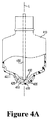
- FIG. 4A illustrates a cross-section of a still further container embodiment of the dispensing device.
- FIG. 4B illustrates an external, bottom perspective view of a container embodiment of the dispensing device, the external container embodiment shown in FIG. 4B can be used with one or more of the internal container embodiments described above and below (e.g., the external container embodiment of FIG. 4B can be used with the internal container embodiments of FIG. 3 or FIG. 4A ).
- the container 410 has a conically shaped bottom 420 having an angularly deepened well 425 located about a longitudinal axis L of the container 410.
- the well 425 deepening between a side of the container 410 and the center of the container 410, results in the center providing a low point 430 to an internal bottom of the container 410.
- a groove 465 extends below a bottom of the well 425 (shown in dotted lines in FIG. 4A ), deepening the low point 430 of the internal bottom of the container 410 below the bottom of the well 425.
- a support bead 470 is externally located about a bottom of the well 425, as shown in FIG. 4B , further deepening the external bottom of the well 425.
- the groove 465 laterally extends, across the longitudinal axis L of the container 410, in a dimension greater than a diameter of the deepened well 425.
- an external bottom of the container 410 takes a shape and contour of the support bead 470 rounded about the (semi-circular) well 425.
- a dip tube 450 is located within the container 410, and has a distal (open) end extending into the groove 465, or extending to the bottom of the well 425 (just at a top of the groove 465, as shown in FIG. 4A ).
- the dip tube 450 extending into the groove 465, or extending to the bottom of the well 425 (just at a top of the groove 465), allows that low residual volumes of pharmaceutical composition 460, upon multiple actuations of the dispensing device, provides a dose volume, especially when a content of the container 410 nears exhaustion.
- the external embodiment of the container 410 can include the internal embodiment of the container 410 shown in FIG. 4A , or can include the internal embodiment of the container 310 shown in FIG. 3 .
- the external embodiment of FIG. 4B including support bead 470, provides structural support to a container bottom regardless of internal container embodiment employed.
- the support bead 470 provides structural support to an external bottom of the container 310, where a wall thickness of a bottom of the well 325 is lessened because of the groove 365.
- the support bead 470 is necessary because the groove 465 is deepened below a normal bottom of the well 425.
- the present invention contemplates an addition of a support bead to an external bottom of a container regardless of the characteristics of the internal bottom of the respective container.
- the container can be made of any polymeric substance.
- suitable polymers include, but are not limited to, polyethylene, polypropylene (PP), polystyrene (PS), nylon (Ny), polyvinyl chloride (PVC), polyethylene terephthalate (PET), polycarbonate (PC), polyoxymethylene (POM), polysulfone (PSF), polyethersulfone (PES), polyacrylate (PAR), and polyamide (PA).
- the polymer is polyethylene, particularly medium-density polyethylene (MDPE) (or branched polyethylene) or high density polyethylene (HDPE) (or linear, polyethylene).
- the bottle is made of high density polyethylene (HDPE).
- the container may have an inert coating on an inner surface thereof to avoid any interaction of the container component with the pharmaceutical compositions of the present invention.
- the dispensing device of the present invention further comprises a cap equipped to cover a dispensing head of the dispensing device.
- the cap is made of polymeric substances, as described above.
- the cap is an Antilop cap also known as Anti-Loss On Priming cap.
- the cap has a sealing element extending from an inside of a top wall thereof, the sealing element providing a sealing between the cap and an dispensing orifice of the dispensing head.
- the sealing element arrangement about a distal tip of the dispensing head, and about the dispensing orifice of the dispensing head prevents the distal tip of the dispensing head from drying and prevents misfiring of the pharmaceutical composition from the dispensing head upon accidental actuation.
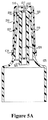
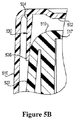
- FIGs. 5A and 5B illustrate a cross-section and a partial exploded view, respectively, of a protective cap 510 of the present invention on a dispenser head 515.
- the exploded view in FIG. 5B is a partial portion of FIG. 5A.
- FIGs. 5A and 5B show the cap in a closed, seal or leak tight position on the dispenser head 515.
- the dispenser head 515 can be frustoconical in shape, but generally has a shape of a typical nasal-spray actuator.
- a distal end of the dispenser head 515 includes a dispensing orifice 517 in a tip or end wall 519 of the dispenser head 515, the dispensing orifice 517 being located at an end of a dispensing channel 521.
- an actuating surface 523 for actuating the dispensing device, along with a connector 525 for connecting the dispenser head 515 to a pump or a valve (not shown).
- Adjacent to the tip or end wall 519 of the dispenser head 515 is a lateral wall 527 of the dispenser head 515, there being rounded edge therebetween.
- the cap 510 includes a sealing element or sleeve 530 that projects from an inside of a top wall 532 of the cap 510.
- the sealing element 530 can be a ringshaped sealing flange or sleeve.
- the sealing element 530 communicates in a leak or seal tight manner with the lateral wall 527 of the dispenser head 515 when the cap 510 is in the closed position.
- the sealing element 530 can be integral with the cap.
- the sealing element or sleeve 530 may have a thickness that decreases as the sealing element extends away from the inside of the top wall 532 of the cap 510, as readily shown in FIG. 5B where the sealing element 530 is thicker at a proximal end 534 (at a point of connection with the inside of the top wall 532 of the cap 510) than at a distal end 536.
- the sealing element 530 provides flexibility to ensure a seal or leak tight communication with the lateral wall 527 of the dispenser head 515.
- the distal end 536 of the sealing element 530 communicates with the lateral wall 527 by friction fit to create the seal or leak tight fit.
- an inner diameter of the distal end 536 of the sealing element 530 is smaller than an exterior diameter of the lateral wall 527 of the dispenser head 515, at a point of communication of the sealing element 530 with the dispenser head 515, to ensure a seal tight fit between the sealing element 530 and the dispenser head 515.
- the distal end 536 of the sealing element 530 is radially deformed when the cap 510 is in the closed position.
- An interior of the cap 510, and/or the exterior of the lateral wall 527 of the dispenser head 515, can further include one or more tabs 538 that snap fit against engaging detents to hold the cap 510 securely on the dispenser head 515 when the cap 510 is in the closed position.
- the inside of the top wall 532 of the cap 510 does not contact tip wall 519 of the dispenser head 515. Only the sealing element 530 contacts, in a leak or seal tight manner, the lateral wall 527 of the dispenser head 515.
- FIG. 6 illustrates one embodiment of the dispensing device 605 of the present invention.
- the dispensing device 605 shown in FIG. 6 includes an optional cap 611, a container 610, a dispenser head 615, a pump 619, and a dip tube 650 (not seen in fig.6 ).
- the pump 619 is adequate to dispense a stable fixed dose pharmaceutical composition of the present invention from the container 610, through the dip tube 650 (not seen in fig.6 ), into the dispenser head 615, and out a dispensing orifice.
- a valve can be included to release the composition from the dispensing orifice in the dispenser head in the form of a spray.
- the pump 619 may comprise a pre-compression pump, such as the VP3 or VP7 model, or a modified version thereof, manufactured by Valois SA.
- the dispensing device 605 is adequate to dispense a nasal spray of uniform dosage of mometasone (e.g., mometasone furoate) and olopatadine (e.g., olopataine hydrochloride) every time the dispensing device is actuated by a user.
- mometasone e.g., mometasone furoate
- olopatadine e.g., olopataine hydrochloride
- the dispensing device 605 can comprise a valve to release a spray of the stable fixed dose composition from the dispensing orifice.
- Valves can include, but are not limited to, continuous spray valves and metering valves. Opening and closing of a valve is facilitated by actuation of the dispenser head.
- Various types of actuation include, but are not limited to, spray actuators, foam actuators, solid-stream actuators, and special actuators.
- the dispensing device is adequate to dispense about 100 ⁇ l of a pharmaceutical composition per actuation, wherein a single actuation dispenses about 665 mcg of olopatadine hydrochloride and about 25 mcg or about 50 mcg of mometasone furoate, preferably 25 mcg mometasone furoate.
- the pharmaceutical composition for nasal administration to a human can comprise about 0.001% w/w to about 0.075% w/w mometasone, an ester thereof (e.g., mometasone furoate), or a salt thereof and about 0.5% w/w to about 0.8% w/w olopatadine or its salt (e.g., olopatadine hydrochloride).
- the pharmaceutical composition is stable and typically includes a fixed dose of mometasone, an ester thereof (e.g., mometasone furoate), or a salt thereof and olopatadine or its salt (e.g., olopatadine hydrochloride).
- the pharmaceutical composition may be in the form of a solution or a suspension.
- the composition is in the form of a suspension (such as a single phase suspension), wherein mometasone, an ester thereof (e.g., mometasone furoate), or a salt thereof is present in particle form and olopatadine or its salt (e.g., olopatadine hydrochloride) is present in dissolved form.
- the mometasone, an ester thereof (e.g., mometasone furoate), or a salt thereof and olopatadine or its salt (e.g., olopatadine hydrochloride) may be present at a weight ratio of about 1:3 to about 1:106, or from about 1:5 to about 1:53 or preferably from about 1:5 to about 1:36.
- the composition preferably also includes a hydrocolloid.
- the composition is a suspension and includes a hydrocolloid in a sufficient amount to prevent phase separation (i.e., separation of the particles and solution) after 3 or 6 months of storage at 25 ⁇ 2° C and 60% ⁇ 5% relative humidity (RH) or at 40 ⁇ 2° C and 75% ⁇ 5% RH.
- the aqueous pharmaceutical composition is a single phase suspension which remains a single phase suspension even after 3 or 6 months of storage at 25 ⁇ 2° C and 60% ⁇ 5% RH or at 4 ⁇ 2° C and 75% ⁇ 5% RH.
- 'stable' refers to a composition when shaken and then stored for at least 24 hours at ambient condition does not show phase separation on visual inspection.
- such stable composition does not show phase separation for a period of at least 3 days, or at least 5 days, or at least 7 days.
- the 'stable' composition shows, upon shaking (e.g., for 1 minute) and visual inspection, no lump formation and a total impurity content of no more than 1.0% after storage at ambient conditions (at about 25° C. and a relative humidity of about 60%) for a period of at least 6 months.
- the drug content and impurities can be determined by various analytical techniques such as HPLC, LC-MS, and TLC.
- compositions for nasal administration comprising mometasone, an ester thereof, or a salt thereof and olopatadine or its salt were prepared, the compositions generally showed physical separation in the suspension composition. This physical instability further leads to lack of dose uniformity.
- addition of a hydrocolloid at certain concentrations e.g. at a concentration of at least about 0.1% w/w
- a physically stable composition yielded a physically stable composition (with no separation) suitable for nasal administration.
- the pharmaceutical composition is a stable fixed dose, aqueous pharmaceutical suspension composition for nasal administration to a human, where the composition comprises about 0.025% w/w to about 0.05% w/w mometasone, an ester thereof (e.g., mometasone furoate), or a salt thereof, about 0.6% w/w to about 0.7% w/w olopatadine or its salt (e.g., olopatadine hydrochloride) and a hydrocolloid.
- the composition comprises about 0.025% w/w to about 0.05% w/w mometasone, an ester thereof (e.g., mometasone furoate), or a salt thereof, about 0.6% w/w to about 0.7% w/w olopatadine or its salt (e.g., olopatadine hydrochloride) and a hydrocolloid.
- the pharmaceutical composition is a stable fixed dose, aqueous pharmaceutical suspension composition for nasal administration to a human, where the composition comprises about 0.025% w/w to about 0.05% w/w mometasone, an ester thereof (e.g., mometasone furoate), or a salt thereof, about 0.6% w/w to about 0.7% w/w olopatadine or its salt (e.g., olopatadine hydrochloride) and a hydrocolloid which includes carboxymethylcellulose sodium and xanthan gum.
- the hydrocolloid may be present at a concentration of at least about 0.1% w/w of the composition.
- the pharmaceutical composition is a stable fixed dose, aqueous pharmaceutical suspension composition for nasal administration to a human, comprising about 0.025% w/w to about 0.05% w/w mometasone furoate, about 0.6% w/w to about 0.7% w/w olopatadine hydrochloride and a hydrocolloid which comprises xanthan gum.
- the xanthan gum may be present at a concentration of at least about 0.1% w/w, or preferably between about 0.3% w/w to about 3% w/w of the composition.
- the pharmaceutical composition is a stable fixed dose, aqueous pharmaceutical suspension composition for nasal administration to a human, comprising about 0.025% w/w to about 0.05% w/w mometasone furoate, about 0.6% w/w to about 0.7% w/w olopatadine hydrochloride and a hydrocolloid which comprises sodium carboxymethyl cellulose.
- the sodium carboxymethyl cellulose may be present at a concentration of at least about 0.1% w/w, or preferably between about 0.1% w/w to about 3% w/w of the composition.
- the pharmaceutical composition is a stable fixed dose aqueous pharmaceutical composition in the form of suspension for nasal administration to a human, comprising mometasone, an ester thereof, or a pharmaccutically acceptable salt thereof (e.g., mometasone furoate), olopatadine or its pharmaceutically acceptable salt (e.g., olopatadine hydrochloride), a hydrocolloid (e.g., at a concentration of at least about 0.1% w/w of the composition) and a pharmaceutical acceptable excipient.
- a pharmaccutically acceptable salt thereof e.g., mometasone furoate
- olopatadine or its pharmaceutically acceptable salt e.g., olopatadine hydrochloride
- a hydrocolloid e.g., at a concentration of at least about 0.1% w/w of the composition
- Suitable pharmaceutical acceptable excipients include, but are not limited to, chelating agents, preservatives, buffers, surfactants, isotonicity agents, taste masking agents, antioxidants, humectants, pH adjusting agents, and any combination of any of the foregoing.
- Suitable surfactants which can be used for preparing aqueous nasal spray composition may include one or more of anionic, cationic, non-ionic or zwitterionic surfactants.
- suitable surfactants which can be employed in the aqueous nasal spray suspension may be selected from, but not limited to, polyethoxylated sorbitan derivatives such as polysorbates, their ether ethoxylates, produced by reaction of sorbitan esters with ethylene oxide, polyoxyethylene alkyl phenol, polyoxyethylene cetyl ether, polyoxyethylene alkyl-aryl ether, polyoxyethylene monolaurate, polyoxyethylene vegetable oil, polyoxyethylene sorbitan monolaurate, polyoxyethylene esters or mixed fatty and resin acids, polyoxyethylene sorbitol lanolin derivative, polyoxyethylene tridecylether, polyoxyethylene sorbitan esters of mixed fatty and resin acids, polyoxyethylene sorbitan monostearate, polyoxyethylene sorbitan monooleate, polyoxyethylene
- the osmolality can be set by variation of the amounts of the substances present in the aqueous nasal spray suspension besides mometasone, olopatadine and any further substances present, and/or by addition of an isotonicity agent, preferably a physiologically tolerated salt, such as, for example, sodium chloride or potassium chloride, or a physiologically tolerated polyol, such as, for example, a sugar alcohol, in particular sorbitol or glycerol, in the concentration necessary for rendering isotonic.
- an isotonicity agent preferably a physiologically tolerated salt, such as, for example, sodium chloride or potassium chloride, or a physiologically tolerated polyol, such as, for example, a sugar alcohol, in particular sorbitol or glycerol, in the concentration necessary for rendering isotonic.
- Suitable preservatives which can be employed in the aqueous nasal spray suspension include, but are not limited to, benzyl alcohol, quaternary ammonium halides, phenylcarbinol, thimerosal, and disodium edetate. Quaternary ammonium halide preservatives are preferred. Suitable quaternary ammonium halide preservatives include polyquaternium-1 and benzalkonium halides. Preferred benzalkonium halides include benzalkonium chloride and benzalkonium bromide.
- the amount of the preservative present in the aqueous nasal spray suspension may range from about 0.005 to about 0.2% w/w relative to the total weight of the composition. Preferably, the preservative is present at a concentration of about 0.02% w/w relative to the total weight of the composition.
- the amount of the chelating agent present in the aqueous nasal spray suspension may range from about 0.0002% w/w to about 0.5% w/w relative to the total weight of the composition.
- Suitable buffers which can be employed in the aqueous nasal spray suspension include, but are not limited to, citric acid, acetic acid, fumaric acid, hydrochloric acid, malic acid, nitric acid, phosphoric acid, propionic acid, sulfuric acid, tartaric acid, phosphate salts (e.g., dibasic sodium phosphate, such as dibasic sodium phosphate heptahydrate), or combinations thereof.
- the suspension may comprise an amount of a buffer sufficient to maintain the pH of the composition to from about 3 to about 6.
- the amount of buffer ranges from about 0.005% to about 1% w/w relative to the total weight of the composition.
- suitable sweetener/taste masking agents which can be employed in the aqueous nasal spray suspension include, but are not limited to, sucralose, thaumatin, sucrose, saccharin (including salt forms such as sodium and calcium salts), fructose, glucose, dextrose, corn syrup, aspartame, acesulfame-K, xylitol, sorbitol, erythritol, ammonium glycyrrhizinate, neotame, mannitol, eucalyptus oil, camphor, and natural or artificial flavors or flavoring agents (for example menthol, mints, vanilla, orange, etc.), or combinations of two or more of such agents.
- a particularly preferred taste masking agent is sucralose.
- the amount of the sweetener/taste masking agent present in the aqueous nasal spray suspension may range from about 0.01% to about 1% w/w relative to the total weight of the composition.
- the amount of the antioxidants present in the aqueous nasal spray composition may range from about 0.0002% to about 0.5% w/w relative to the total weight of the composition.
- a suitable humectant vehicle such as water.
- the amount of humectant present in the aqueous nasal spray suspension may range from about 0.0002% to about 0.5% w/w relative to the total weight of the composition.
- Suitable pH adjusting agents include, but are not limited to, sodium hydroxide and hydrochloric acid.
- the pharmaceutical composition for nasal administration may have a pH of between about 3.3 and about 4.1, or between about 3.5 and about 3.9.
- the inventors discovered that the olopatadine hydrochloride crystallizes out of the fixed dose combination aqueous suspension at a pH of 5 to 5.5.
- the olopatadine hydrochloride remains dissolved in the aqueous suspension at a pH of about 3.3 to about 4.1.
- the aqueous pharmaceutical composition preferably is substantially free of crystals of olopatadine hydrochloride.
- the aqueous pharmaceutical composition contains less than 2%, less than 1%, less than 0.5%, less than 0.2%, or less than 0.1% of crystalline olopatadine hydrochloride, based on the 100% total weight of olopatadine hydrochloride in the composition.
- the aqueous pharmaceutical composition is substantially free of crystals of olopatadine hydrochloride after 3 or 6 months of storage at 25 ⁇ 2° C and 60% ⁇ 5% RH or at 40 ⁇ 2° C and 75% ⁇ 5% RH.
- the aqueous pharmaceutical composition contains less than 2%, less than 1%, less than 0.5%, less than 0.2%, or less than 0.1% of crystalline olopatadine hydrochloride, based on the 100% total weight of olopatadine hydrochloride in the composition, after 3 or 6 months of storage at 25 ⁇ 2° C and 60% ⁇ 5% RH or at 40 ⁇ 2° C and 75% ⁇ 5% RH.
- the osmolality of the composition may range between about 200 mOsm/kg and about 400 mOsm/kg, or about 250 mOsm/kg and about 350 mOsm/kg.
- the viscosity of the composition may be about 10 cps to about 200 cps or preferably from about 20 cps to about 150 cps.
- the viscosity can be determined by various known instruments such as a Dynamic stress rheometer or Brookfield viscometer. In a preferred embodiment, the viscosity is determined by a Brookfield viscometer by measuring torque transmission through a sample using a rotating spindle.
- the pharmaceutical composition in the form of a suspension and contains mometasone, an ester thereof, or a salt thereof, preferably mometasone furoate, in particles having a mean particle size in the range of from about 1 ⁇ m to about 20 ⁇ m, or preferably from about 1 ⁇ m to about 15 ⁇ m.
- the suspension pharmaceutical composition has a mean particle size of less than 15 ⁇ m when determined by microscopy technique.
- the pharmaceutical composition when delivered as in the dispensing device can have a spray pattern having a longest axis of about 15-75 mm, a shortest axis of about 10-65 mm, and an ellipticity of about 1-2.
- the pharmaceutical composition is a stable fixed dose, aqueous pharmaceutical composition for nasal administration to a human, where the composition comprises about 0.001% w/w to about 0.075% w/w mometasone furoate monohydrate and about 0.5% w/w to about 0.8% w/w olopatadine hydrochloride.
- the pharmaceutical composition is a stable fixed dose pharmaceutical composition in the form of suspension for nasal administration to a human, comprising mometasone furoate monohydrate, olopatadine hydrochloride and a hydrocolloid which comprises xanthan gum at a concentration of about 0.3% w/w of the composition, wherein the composition has a pH between about 3.5 and about 3.9.
- the pharmaceutical composition is a stable fixed dose pharmaceutical composition in the form of suspension for nasal administration to a human, comprising mometasone furoate monohydrate, olopatadine hydrochloride and a hydrocolloid which comprises sodium carboxymethyl cellulose at a concentration of about 0.5% w/w of the composition, wherein the composition has a pH between about 3.5 and about 3.9.
- the pharmaceutical composition is a stable fixed dose pharmaceutical aqueous suspension composition for nasal administration to a human, where the composition comprises (1) about 0.025% w/w mometasone furoate monohydrate, (2) about 0.665% w/w olopatadine hydrochloride, (3) a hydrocolloid selected from about 0.3% w/w of xanthan gum and about 0.5% w/w carboxymethyl cellulose sodium, (4) about 0.02% w/w benzalkonium chloride, (5) about 0.4% w/w sodium chloride, (6) about 0.01% w/w di-sodium edetate, (7) about 0.94% w/w sodium phosphate heptahydrate, and (8) about 0.01% w/w polysorbate 80.
- the composition comprises (1) about 0.025% w/w mometasone furoate monohydrate, (2) about 0.665% w/w olopatadine hydrochloride, (3) a hydrocolloid selected from about 0.3% w/
- the pharmaceutical composition is a stable fixed dose pharmaceutical aqueous suspension composition for nasal administration to a human, where the composition comprises (1) about 0.050% w/w mometasone furoate monohydrate, (2) about 0.665% w/w olopatadine hydrochloride, (3) a hydrocolloid selected from about 0.3% w/w of xanthan gum and about 0.5% w/w carboxymethyl cellulose sodium, (4) about 0.02% w/w benzalkonium chloride, (5) about 0.4% w/w sodium chloride, (6) about 0.01% w/w di-sodium edetate, (7) about 0.94% w/w sodium phosphate heptahydrate, and (8) about 0.01% w/w polysorbate 80.
- the composition comprises (1) about 0.050% w/w mometasone furoate monohydrate, (2) about 0.665% w/w olopatadine hydrochloride, (3) a hydrocolloid selected from about 0.3% w/
- the pharmaceutical composition is a stable fixed dose pharmaceutical aqueous suspension composition for nasal administration to a human, where the composition comprises (1) about 0.025% w/w mometasone furoate monohydrate, (2) about 0.665% w/w olopatadine hydrochloride, (3) a hydrocolloid selected from about 0.3% w/w of xanthan gum and about 0.5% w/w carboxymethyl cellulose sodium, (4) about 1% w/w to about 1.2% w/w mixture of microcrystalline cellulose and carboxymethyl cellulose sodium, (5) about 0.02% w/w benzalkonium chloride, (6) about 0.4% w/w sodium chloride, (7) about 0.01% w/w di-sodium edetate, (8) about 0.94% w/w sodium phosphate heptahydrate, and (9) about 0.01% w/w polysorbate 80.
- the composition comprises (1) about 0.025% w/w mometasone furoate monohydrate, (2) about 0.6
- the pharmaceutical composition is a stable fixed dose pharmaceutical aqueous suspension composition for nasal administration to a human, where the composition comprises (1) about 0.050% w/w mometasone furoate monohydrate, (2) about 0.665% w/w olopatadine hydrochloride, (3) a hydrocolloid selected from about 0.3% w/w of xanthan gum and about 0.5% w/w carboxymethyl cellulose sodium, (4) about 1% w/w to about 1.2% w/w mixture of microcrystalline cellulose and carboxymethyl cellulose sodium, (5) about 0.02% w/w benzalkonium chloride, (6) about 0.4% w/w sodium chloride, (7) about 0.01% w/w di-sodium edetate, (8) about 0.94% w/w sodium phosphate heptahydrate, and (9) about 0.01% w/w polysorbate 80.
- the composition comprises (1) about 0.050% w/w mometasone furoate monohydrate, (2) about 0.6
- the pharmaceutical composition is a stable suspension suitable for nasal administration to a human, comprising (a) an aqueous solvent, (b) particles of mometasone furoate suspended in the solvent, the particles having a mean particle size of from about 1 to about 20 ⁇ m, (c) olopatadine hydrochloride dissolved in the solvent, and (d) a hydrocolloid, the suspension having a viscosity in the range of about 20 cps to about 150 cps.
- the suspension has a pH of about 3.5-3.9, and osmolality in the range of about 250 mOsm/kg to about 350 mOsm/kg.
- the suspension further comprises a chelating agent, a preservative, a buffer, a surfactant, an isotonicity agent, and optionally a pH adjusting agent.
- the suspensions have only one phase (i.e., they are preferably a single phase suspension).
- the dispensing device containing the pharmaceutical composition is provided in a kit with of a package insert containing instructions about the use of the pharmaceutical composition.
- the pharmaceutical composition when dispensed from the dispensing device can provide a spray pattern having a longest axis of 15-75 mm, a shortest axis of 10-65 mm, and an ellipticity of 1-2.
- the spray pattern can be determined by various known techniques such as with an ADSA with NSPUA set up (Innova System) and the spray droplet size distribution can be determined by various known techniques such as with a Malvern Spraytec with NSPUA set up (Innova System).
- the sprayer is loaded with a composition as described above and primed by an actuating pump via an actuator until a fine mist appears out of the nozzle of the sprayer.
- a commercially available laser diffraction instrument is arranged so that the nozzle is about 3 cm or 6 cm below the laser beam of the laser diffraction instrument.
- the pump is actuated with an actuator using a constant force.
- the resulting spray of the composition crosses the laser beam.
- Data are collected for D 10 , D 50 , D 90 , SPAN, and % Volume ⁇ 10 ⁇ m. The average values for each of these parameters for three sprays are calculated.
- the pharmaceutical composition may be administered with the dispensing device to treat rhinitis.
- each spray provides (i) mometasone furoate monohydrate equivalent to about 25 mcg of mometasone furoate and (ii) olopatadine hydrochloride equivalent to about 600 mcg olopatadine (e.g., 665 mcg olopatadine hydrochloride).
- a human subject suffering from allergic rhinitis is administered two sprays of the pharmaceutical composition from the dispensing device twice daily.
- a human subject suffering from allergic rhinitis is nasally administered 100 mcg of mometasone furoate and 1330 mcg olopatadine hydrochloride twice daily with the dispensing device.
- a human subject suffering from allergic rhinitis is nasally administered 200 mcg of mometasone furoate and 2660 mcg olopatadine hydrochloride daily with the dispensing device.
- Rhinitis includes, but is not limited to, irritation and inflammation of the mucous membrane inside the nose and nasal and non-nasal symptoms associated therewith.
- rhinitis includes allergic rhinitis, persistent rhinitis, perennial rhinitis, seasonal rhinitis, chronic rhinitis, rhinitis medicamentosa, vasomotor rhinitis, infective rhinitis, autonomic rhinitis, hormonal rhinitis, drug-induced rhinitis, atrophic rhinitis, and gustatory rhinitis.
- it includes allergic rhinitis, perennial rhinitis, persistent rhinitis, seasonal rhinitis and nasal and non-nasal symptoms associated therewith.
- nasal and non-nasal symptoms associated with allergic rhinitis include sneezing, nasal itching, rhinorrhea (runny nose), nasal obstruction, coughing, ocular pruritis, excess lacrimation, headache, fatigue, common cold (also known as nasopharyngitis, rhinopharyngitis, acute coryza, or cold), malaise and cognitive impairment.
- the pharmaceutical composition may comprise one or more additional pharmaceutical active agent(s) selected from the therapeutic category of, but not limited to, non-steroidal anti-inflammatory agents, decongestants, and any combination of any of the foregoing.
- the pharmaceutical composition includes about 0.001% w/w to about 0.075% w/w mometasone, an ester thereof (e.g., mometasone furoate), or a salt thereof in particulate form and about 0.5% w/w to about 0.8% w/w olopatadine or its salt (e.g., olopatadine hydrochloride) in dissolved form.
- the composition could further include a hydrocolloid system, for example, in an amount sufficient to inhibit phase separation for at least 24 hours when stored at 25 ⁇ 2° C. and 60% ⁇ 5% relative humidity.
- the composition when stored for up to 12 months at 25 ⁇ 2° C and 60% ⁇ 5% relative humidity in the dispensing device contains has one or more of the following properties:
- a pharmaceutical composition of mometasone, an ester thereof (e.g., mometasone furoate), or a salt thereof and olopatadine or a salt thereof (such as olopatadine hydrochloride) provides a faster onset of action of relief of symptoms associated with allergic rhinitis, such as seasonal allergic rhinitis or perennial allergic rhinitis, when compared to olopatadine hydrochloride monotherapy or mometasone fuorate monotherapy.
- the pharmaceutical composition provides faster relief of nasal symptoms, such as nasal congestion, rhinorrhea, itching and sneezing.
- the pharmaceutical composition may also provide a faster onset of action of ocular symptoms, such as ocular itching, tearing/watery eyes and ocular redness.
- the onset of action may be less than 30 minutes, such as within about 15 minutes, such as within about 10 minutes.
- One embodiment is a method of treating allergic rhinitis in a subject (e.g., a human) in need thereof comprising nasally administering to the subject an effective amount of a fixed-dose pharmaceutical composition, such as from a dispensing device described above, where the pharmaceutical composition comprises mometasone, an ester thereof, or a salt thereof and olopatadine or its salt.
- the composition is nasally administered as 1 or 2 sprays per nostril of the subject at least once daily.
- Each spray preferably comprises mometasone, an ester thereof, or a salt thereof and olopatadine or its salt in a weight ratio of about 1:5 to about 1:60, such as in a weight ratio of from about 1:12 to about 1:53, from about 1:13.3 to about 1:50, or from about 1:18 to about 1:40 (based on the equivalent weight of olopatadine free base).
- the fixed-dose pharmaceutical composition is a suspension wherein the mometasone, an ester thereof, or a salt thereof is present in particulate form and the olopatadine or its salt is present in dissolved form.
- Yet another embodiment is a method for providing faster onset of relief of symptoms associated with allergic rhinitis in a human subject in need thereof comprising nasally administering twice daily, two sprays per nostril of a fixed-dose pharmaceutical composition, such as from a dispensing device described above, where the pharmaceutical composition comprises mometasone, an ester thereof, or a salt thereof (e.g., mometasone furoate) and olopatadine its salt (e.g., olopatadine hydrochloride).
- This method may provide faster onset of relief of one or more symptoms compared to administration of the mometasone, an ester thereof, or a salt thereof alone or olopatadine or its salt alone.
- Each spray may comprise mometasone, an ester thereof, or a salt thereof and olopatadine or its salt in a weight ratio of about 1:5 to about 1:60 (such as a weight ratio of about 1:12 to about 1:53, about 1:13.3 to about 1:50, or from about 1:18 to about 1:40) (based on the equivalent weight of olopatadine free base) (for example, each spray comprises about 12.5 mcg, about 25 mcg, about 37.5 mcg, about 50 mcg, or about 62.5 mcg of mometasone, an ester thereof, or a salt thereof (such as about 50 mcg mometasone furoate) and olopatadine hydrochloride equivalent to about 300 mcg, about 450 mcg, about 600 mcg, about 750 mcg, or about 900 mcg of olopatadine (such as about 665 mcg
- the administration may provide relief from one or more symptoms within 30 minutes, such as within 15 minutes or 10 minutes.
- the administration may provide relief from one or more symptoms of allergic rhinitis (such as nasal symptoms) in a subject exposed to an environmental exposure chamber (EEC) (such as one with ragweed pollen at a concentration of 3500 ⁇ 500 particles/m3 for 6 hours) in less than 15 minutes, such as within about 10 minutes.
- EEC environmental exposure chamber
- the methods herein provide faster onset of action for relief of nasal symptoms in the subject. In another embodiment, the methods herein provide faster onset of action for relief of ocular symptoms in the subject.
- the pharmaceutical composition provides faster onset of action for relief of nasal symptoms in the subject. In another embodiment, the pharmaceutical composition provides faster onset of action for relief of ocular symptoms in the subject.
- Yet another embodiment is a method of treating a human subject suffering from allergic rhinitis comprising the step of administering to the subject a pharmaceutical composition for twice daily nasal administration of two sprays per nostril, such as from a dispensing device described above, wherein (i) the pharmaceutical composition provides an onset of action within 15 minutes for the treatment of allergic rhinitis and (ii) each spray of the pharmaceutical composition comprises about 25 mcg of mometasone furoate and about 665 mcg of olopatadine hydrochloride.
- Yet another embodiment is a method of treating a human subject suffering from allergic rhinitis (such as seasonal allergic rhinitis or perennial allergic rhinitis) comprising the step of administering to the subject a prescribed fixed-dose pharmaceutical composition for twice daily nasal administration of two sprays per nostril,, optionally with a dispensing device described above, where the fixed-dose pharmaceutical composition comprises mometasone, an ester thereof, or a salt thereof (such as mometasone furoate) and olopatadine or its salt (such as olopatadine hydrochloride), and each spray comprises mometasone, an ester thereof, or a salt thereof and olopatadine or its salt in a weight ratio of about 1:5 to about 1:60 (such as a weight ratio of about 1:12 to about 1:53, about 1:13.3 to about 1:50, or from about 1:18 to about 1:40) (based on the equivalent weight of olopatadine free base) (for example, each
- the pharmaceutical composition is prescribed in response to (a) marketing of the pharmaceutical composition, optionally with a dispensing device described above, as (A) providing faster onset of action (such as an onset of action within less than 30 minutes, such as within 15 minutes, such as within 10 minutes) for relief of symptoms (e.g., nasal symptoms) of allergic rhinitis than nasal administration of mometasone, an ester thereof, or a salt thereof (such as 50 mcg mometasone furoate) or olopatadine or its salt (such as 665 mcg olopatadine hydrochloride) alone or (B) providing relief of one or more symptoms of allergic rhinitis within 15 minutes (or 30 minutes), and (b) a diagnosis of the subject as suffering from allergic rhinitis.
- each spray of the fixed-dose pharmaceutical composition provides 25 mcg mometasone furoate and 665 mcg olopatadine hydrochloride.
- the administration of the pharmaceutical composition may provide relief from one or more symptoms of allergic rhinitis (such as nasal symptoms or ocular symptoms) in a subject faster (e.g., an onset of action in less than 30 minutes, such as within about 15 minutes, such as within 10 minutes) than nasal administration of the mometasone, an ester thereof, or a salt thereof or the olopatadine or its salt alone.
- allergic rhinitis such as nasal symptoms or ocular symptoms
- a subject faster e.g., an onset of action in less than 30 minutes, such as within about 15 minutes, such as within 10 minutes
- nasal administration of the mometasone, an ester thereof, or a salt thereof or the olopatadine or its salt alone e.g., an onset of action in less than 30 minutes, such as within about 15 minutes, such as within 10 minutes
- the administration may provide relief from one or more symptoms of allergic rhinitis (such as nasal symptoms) in a subject exposed to an environmental exposure chamber (EEC) (such as one with ragweed pollen at a concentration of 3500 ⁇ 500 particles/m 3 for 6 hours) faster (e.g., an onset of action in less than 15 minutes, such as within about 10 minutes) than nasal administration of the mometasone, an ester thereof, or a salt thereof or the olopatadine or its salt alone.
- EEC environmental exposure chamber
- Yet another embodiment is a method for providing faster onset of relief of symptoms associated with allergic rhinitis in a human subject in need thereof comprising nasally administering twice daily, two sprays per nostril of a fixed-dose pharmaceutical composition, such as with a dispensing device described above, where the pharmaceutical composition comprises mometasone, an ester thereof, or a salt thereof (e.g., mometasone furoate) and olopatadine its salt (e.g., olopatadine hydrochloride).
- This method may provide faster onset of relief of one or more symptoms compared to administration of the mometasone, an ester thereof, or a salt thereof alone or olopatadine or its salt alone.
- Each spray may comprise mometasone, an ester thereof, or a salt thereof and olopatadine or its salt in a weight ratio of about 1:5 to about 1:60 (such as a weight ratio of about 1:12 to about 1:53, about 1:13.3 to about 1:50, or from about 1:18 to about 1:40) (based on the equivalent weight of olopatadine free base) (for example, each spray comprises about 12.5 mcg, about 25 mcg, about 37.5 mcg, about 50 mcg, or about 62.5 mcg of mometasone, an ester thereof, or a salt thereof (such as about 50 mcg mometasone furoate) and olopatadine hydrochloride equivalent to about 300 mcg, about 450 mcg, about 600 mcg, about 750 mcg, or about 900 mcg of olopatadine (such as about 665 mcg
- the administration may provide relief from one or more symptoms within 30 minutes, such as within 15 minutes or within 10 minutes.
- the administration may provide relief from one or more symptoms of allergic rhinitis (such as nasal symptoms) in a subject exposed to an environmental exposure chamber (EEC) (such as one with ragweed pollen at a concentration of 3500 ⁇ 500 particles/m 3 for 6 hours) in less than 15 minutes, such as within about 10 minutes.
- EEC environmental exposure chamber
- Yet another embodiment is a method of treating a human subject suffering from allergic rhinitis comprising the step of administering to the subject a pharmaceutical composition for twice daily nasal administration of two sprays per nostril, such as with a dispensing device described above, wherein (i) the pharmaceutical composition provides an onset of action within 15 minutes for the treatment of allergic rhinitis and (ii) each spray of the pharmaceutical composition comprises about 25 mcg of mometasone furoate and about 665 mcg of olopatadine hydrochloride.
- the allergic rhinitis is selected from perennial allergic rhinitis, persistent allergic rhinitis, seasonal allergic rhinitis, and nasal and/or non-nasal symptoms associated therewith.
- the allergic rhinitis is seasonal allergic rhinitis.
- the allergic rhinitis is perennial allergic rhinitis.
- Example 1 (% w/w)
- Example 2 (% w/w) 1 Mometasone Furoate monohydrate 0.050 0.025 Eq. to Mometasone furoate 2 Olopatadine Hydrochloride 0.665 0.665 3
- Avicel RC 591 Microcrystalline Cellulose and Carboxymethylcellulose Sodium
- Benzalkonium chloride (50 % solution) 0.040 0.040 5
- Carboxymethylcellulose Sodium (Cekol 2000 P) 0.500 0.500 6
- Sodium chloride 0.410 0.410 7 Edetate disodium 0.010 0.010 8 Dibasic sodium phosphate heptahydrate 0.940 0.940 9
- Polysorbate 80 0.010 0.010 10 Sodium Hydroxide Q.S.
- Example 3 (% w/w)
- Example 4 (% w/w) 1 Mometasone Furoate monohydrate Eq. to Mometasone furoate 0.050 0.025 2 Olopatadine HCl 0.665 0.665 3
- Avicel RC 591 Microcrystalline Cellulose and Carboxymethylcellulose Sodium
- Xantural 75 (Xanthan Gum) 0.300 0.300 6
- Sodium chloride 0.410 0.410 Edetate disodium 0.010 0.010 8
- Polysorbate 80 0.010 0.010 10 Sodium Hydroxide Q.S.
- composition was subjected to stability studies at different conditions. The results of the same are as follows: Container details: Sprayer containing HDPE bottle crimped with pump and fitted with a actuator and cap Stability Study Results Test Initial 3 months 6 months Ex.3 Ex. 4 Ex.3 Ex. 4 Ex. 3 Ex.
- EEC Environmental Exposure Chamber
- Subjects suffering from seasonal allergic rhinitis for the last two years that require treatment either with intranasal antihistamines and/or intranasal steroids were included in the study.
- TP-1 Fixed dose combination of mometasone furoate 25 mcg + olopatadine hydrochloride 665 mcg twice daily (BID) Active Active Active Active 2 TP-2: Fixed dose combination of mometasone furoate 50 mcg + Active Active Placebo Placebo olopatadine hydrochloride 665 mcg once daily (QD) 3 DYMISTA® twice daily (BID) Placebo Active Placebo Active 4 PATANASE® twice daily (BID) Active Active Active Active 5 Placebo Placebo Placebo Placebo Placebo Placebo Placebo Placebo Placebo
- ePDATTM electronic diary
- TNSS minimum qualifying TNSS of 6/12, including a score of at least 2 for nasal congestion on two consecutive diary entries continued in the study.
- Visit 3 on the following day (Day 1), patients who met the minimum criteria returned to the EEC for a second consecutive EEC session. Patients were exposed to allergen for approximately 10 hours during this visit.
- Post-treatment symptom assessments in the EEC were used to determine onset of action for study treatments. Patients were then sent home with their study medication to continue at-home BID dosing starting from the evening dose for Day 1. Patients continued at-home dosing for a period of 12 days. Following the 12 days (Days 2-13) of at-home dosing, patients returned to the EEC on Day 14 (Visit 4) for a post-treatment 6-hour priming EEC session. Patients were dosed with the morning dose of study drug one hour prior to entering the EEC.
- EEC-QoLQ EEC-Quality-of-Life Questionnaires
- test product formulations used in the study were as follows:
- Table B shows a summary of the TNSS change from baseline to post-treatment over 6 hours in EEC (ITT Population). TABLE B Parameters Placebo TP-1 TP-2 DYMISTA® ® (Reference) PATANASE (Reference) N 36 36 36 36 36 36 36 Baseline EEC Mean 7.64 8.07 8.20 8.67 8.27 EEC at the end of treatment (2 weeks) Mean 6.61 3.31 3.94 4.80 6.38 % Change from Baseline - 13.35 58.98 51.95 45.67 22.85
- Table C shows a summary of the TNSS change from baseline to post-treatment over 12 hours in EEC (ITT Population).
- the data for NASONEX in Table C is sourced from its U.S. FDA approved label.
- TABLE C Parameters TP-1 TP-2 PATANASE® (Reference) NASONEX®* DYMISTA® (Reference) N 36 36 36 176 36 Baseline EEC Mean 7.58 7.85 7.90 9.60 8.25 EEC at the end of treatment (2 weeks) Mean 2.85 3.36 5.72 - 4.34 % Change from Baseline - 62.4 57.07 27.5 27.92 48.24 * NASONEX® (mometasone furoate nasal spray) US FDA Approved label (Jan. 19, 2011)
- Table D shows a summary of the TOSS change from baseline to post-treatment over 12 hours in EEC (ITT Population).
- EEC EEC
- Table D shows a summary of the TOSS change from baseline to post-treatment over 12 hours in EEC (ITT Population).
- TABLE D Parameters TP-1 TP-2 PATANASE® (Reference) DYMISTA® (Reference) N 36 36 36 36 36 36 Baseline EEC Mean 3.97 4.17 3.92 4.54 EEC at the end of treatment (2 weeks) Mean 1.97 2.34 2.82 2.82 % Change from Baseline - 50.37 43.6 28.3 37.88
- the study is a double-blind, randomized, parallel-group, comparative study to evaluate the efficacy, safety and tolerability of two different strengths and regimens of a fixed dose combination of mometasone furoate and olopatadine hydrochloride nasal spray compared with a placebo nasal spray and individual monotherapy formulations of olopatadine hydrochloride nasal spray and mometasone furoate nasal spray, in subjects (12 years of age and older) with seasonal allergic rhinitis (SAR).
- SAR seasonal allergic rhinitis
- Subjects were randomized to treatment in a 1:1:1:1:1:1:1 ratio to the following seven treatment arms, at multiple study sites.
- the double-dummy design including two identical nasal spray bottles (one for morning [AM] dosing and one for evening [PM] dosing) are utilized for this study (Table F).
- the double-dummy design is ensured for adequate blinding considering that treatments being compared vary in dosing frequency (BID compared with QD).
- This study consisted of four visits to the study site. After the initial screening visit (Visit 1), subjects who met all study selection criteria were required to undergo a single-blind placebo run-in period for 7-10 days. Following the completion of the run-in period, eligible subjects meeting the randomization criteria were enrolled and randomized to one of the seven treatment arms. Subjects were dispensed medication as per the randomization list. Randomized subjects were required to undergo a 2 week (14 days) treatment period as per the protocol to assess the efficacy and safety of the assigned treatment.
- the non-nasal symptoms are assessed in a similar manner to the ocular symptoms above.
- PNSS Nasal Symptom Score
- RQLQ Rhinoconjuntivitis Quality of Life Questionnaire
- Table G shows a summary of the primary clinical endpoint (rTNSS) and secondary clinical endpoints (iTNSS, rTOSS, onset of action and RQLQ) observed during this Phase II study. For comparison of the combination therapy against a monotherapy, a p-value below 0.05 is considered statistically significant.
- rTNSS primary clinical endpoint
- iTNSS secondary clinical endpoints
- rTOSS onset of action and RQLQ
- the combination of mometasone fuorate and olopatadine hydrochloride, when administered once daily (TP-2) or twice daily (TP-1) is statistically superior to placebo (p ⁇ 0.0001) for the primary endpoint, change in rTNSS from baseline.
- the combination of mometasone fuorate and olopatadine hydrochloride, when administered once daily (TP-2) or twice daily (TP-1) also met secondary clinical endpoints in the trial, supportive of its efficacy in the treatment of seasonal allergic rhinitis (SAR).
- mometasone fuorate and olopatadine hydrochloride when administered twice daily (TP-1) was also statistically superior to the individual monotherapies (GO-2 and GM-2) for both primary (rTNSS) and secondary endpoints (iTNSS).
- Table G2 shows the least squares mean difference in individual reflective nasal symptoms scores for TP-1 and TP-2 versus placebo.
- Table G2 Least Squares Mean Difference in Individual Reflective Nasal Symptom Scores with TP-1 or TP-2 versus Placebo TP-1 Least squares mean difference (97.5% confidence interval) P value Rhinorrhea -0.27 (-0.42, -0.12) ⁇ 0.001 Nasal congestion -0.24 (-0.38, -0.99) ⁇ 0.001 Nasal itching -0.27 (-0.43, -0.11) ⁇ 0.001 Sneezing -0.39 (-0.57, -0.22) ⁇ 0.001 TP-2 Rhinorrhea -0.26 (-0.40, -0.11) ⁇ 0.001 Nasal congestion -0.22 (-0.37, -0.08) ⁇ 0.001 Nasal itching -0.26 (-0.42, -0.10) ⁇ 0.001 Sneezing -0.37 (-0.55, -0.20) ⁇ 0.001
- Table H shows a summary of the treatment emergent adverse events (TEAEs) observed during this Phase II study.
- TEAEs treatment emergent adverse events
- This study was a double-blind, randomized, parallel-group, comparative study to evaluate the efficacy, safety and tolerability of a fixed dose combination of mometasone furoate and olopatadine hydrochloride nasal spray compared with a placebo nasal spray and individual monotherapy formulations of olopatadine hydrochloride nasal spray and mometasone furoate nasal spray, in subjects (12 years of age and older) with seasonal allergic rhinitis (SAR), spring season.
- SAR seasonal allergic rhinitis
- This study consisted of four visits to the study site. After the initial screening visit (Visit 1), subjects who met all study selection criteria were required to undergo a single-blind placebo run-in period for 7-10 days. Following the completion of the run-in period, eligible subjects meeting the randomization criteria were enrolled and randomized to one of the four treatment arms. Subjects were dispensed medication as per the randomization list. Randomized subjects were required to undergo a 2 week (14 days) treatment period as per the protocol to assess the efficacy and safety of the assigned treatment. Subjects were instructed to record the symptom scores in a symptom assessment diary. They were also scheduled to have at least two blood samples for PK assessment during the treatment period.
- the non-nasal symptoms are assessed in a similar manner to the ocular symptoms above.
- PNSS Nasal Symptom Score
- RQLQ(S) Rhinoconjuntivitis Quality of Life Questionnaire Standardized Activities
- RCAT Rhinitis Control Assessment Test
- Table K shows a summary of the primary clinical endpoint (rTNSS) and secondary clinical endpoints (iTNSS, rTOSS, onset of action and RQLQ) observed during this Phase III study.
- rTNSS primary clinical endpoint
- iTNSS secondary clinical endpoint
- rTOSS onset of action
- RQLQ rate of action
- mometasone fuorate and olopatadine hydrochloride when administered twice daily (TP-1) also exhibited a faster (rapid) onset of action (an onset of action within 15 minutes), as measured by iTNSS, when compared to olopatadine hydrochloride monotherapy or mometasone fuorate monotherapy.
- PK pharmacokinetics
- This study was a double-blind, randomized, parallel-group, comparative study to evaluate the efficacy, safety and tolerability of a fixed dose combination of mometasone furoate and olopatadine hydrochloride nasal spray compared with a placebo nasal spray and individual monotherapy formulations of olopatadine hydrochloride nasal spray and mometasone furoate nasal spray, in subjects (12 years of age and older) with seasonal allergic rhinitis (SAR), fall and mountain cedar season.
- SAR seasonal allergic rhinitis
- a total of 1,176 randomized subjects (-294 subjects per treatment arm) were enrolled in the study.
- the subject population is adult and adolescent subjects (12 years of age and older) with SAR who exhibit symptoms of SAR during the fall allergy season to the relevant seasonal allergen (e.g., ragweed).
- This study consisted of four visits to the study site. After the initial screening visit (Visit 1), subjects who met all study selection criteria were required to undergo a single-blind placebo run-in period for 7-10 days. Following the completion of the run-in period, eligible subjects meeting the randomization criteria were enrolled and randomized to one of the four treatment arms. Subjects were dispensed medication as per the randomization list. Randomized subjects were required to undergo a 2 week (14 days) treatment period as per the protocol to assess the efficacy and safety of the assigned treatment. Subjects were instructed to record the symptom scores in a symptom assessment diary.
- the non-nasal symptoms are assessed in a similar manner to the ocular symptoms above.
- PNSS Nasal Symptom Score
- RQLQ(S) Rhinoconjuntivitis Quality of Life Questionnaire Standardized Activities
- RCAT Rhinitis Control Assessment Test
- Table N shows a summary of the primary clinical endpoint (rTNSS) and secondary clinical endpoints (iTNSS, rTOSS, onset of action and RQLQ) observed during this Phase III study. For comparison of the combination therapy against a monotherapy, a p-value below 0.05 is considered statistically significant.
- Table N2 shows the least squares mean difference in individual reflective and instantaneous nasal symptoms scores for the TP-1 group versus the placebo group.
- Table N2 Least Squares Mean Difference in Individual Reflective and Instantaneous Nasal Symptom Scores with TP-1 versus Placebo Reflective Least squares mean difference (97.5% confidence interval) P value Rhinorrhea -0.30 (-0.41, -0.19) ⁇ 0.001 Nasal congestion -0.20 (-0.30, -0.09) ⁇ 0.001 Nasal itching -0.23 (-0.34, -0.12) ⁇ 0.001 Sneezing -0.41 (-0.53, -0.29) ⁇ 0.001 Instantaneous Rhinorrhea -0.29 (-0.39, -0.18) ⁇ 0.001 Nasal congestion -0.19 (-0.29, -0.09) ⁇ 0.001 Nasal itching -0.21 (-0.32, -0.10) ⁇ 0.001 Sneezing -0.29 (-0.41, -0.18)
- mometasone fuorate and olopatadine hydrochloride when administered twice daily (TP-1) also exhibited a faster (rapid) onset of action (an onset of action within 15 minutes), as measured by iTNSS, when compared to olopatadine hydrochloride monotherapy or mometasone fuorate monotherapy.
- the study is a double-blind, randomized, parallel-group, comparative study to evaluate the long-term safety, efficacy, and tolerability of a fixed dose combination of mometasone furoate and olopatadine hydrochloride nasal spray compared with two placebo nasal sprays, in subjects (12 years of age and older) with perennial allergic rhinitis (PAR).
- PAR perennial allergic rhinitis
- This study consisted of twelve visits to the study site. After the initial screening visit (Visit 1), subjects who met all study selection criteria underwent a single-blind placebo run-in period for 7-10 days. Following the completion of the run-in period, eligible subjects meeting the randomization criteria were enrolled and randomized to one of the three treatment arms. Randomized subjects underwent a 52 week treatment period as per the protocol to assess the efficacy and safety of the assigned treatment.
- endpoints included other assessments of AM subject-reported individual nasal symptoms, AM subject-reported rTNSS and iTNSS from baseline to the end of each treatment week, Physician-assessed Nasal Symptom Score and physician-assessed individual nasal symptoms, individual domains of the RQLQ for the FAS population, and change from baseline in the Rhinitis Control Assessment Test and individual domains of Rhinitis Control Assessment Test.
- the safety endpoints related to AEs were:
- the pharmacokinetics of olopatadine in a fixed dose combination of mometasone furoate and olopatadine hydrochloride nasal spray was evaluated in a clinical trial.
- the clinical trial was a randomized, single-center, single-dose, open-label, three-period, six-sequence, cross-over study to evaluate three treatments administered as a nasal spray.
- the three treatments included a combination of mometasone furoate and olopatadine hydrochloride nasal spray, olopatadine hydrochloride nasal spray and PATANASE® nasal spray.
- Subjects were randomized to 1 of 6 treatment sequences in a 1:1:1:1:1 ratio with all subjects receiving single doses of a fixed dose combination of mometasone furoate and olopatadine hydrochloride nasal spray, olopatadine hydrochloride nasal spray, and PATANASE® nasal spray.
- the study consisted of a screening visit, 3 single-dose treatment periods with washout periods of 7 to 14 days between dosing in each treatment period, an early withdrawal visit if applicable, and a follow-up telephone call (or visit) 1 to 7 days after completing the third treatment period.
- a total of 30 subjects were randomized to 1 of 6 treatment sequences and received at least 1 dose of study drug. All 30 subjects were included in the safety analysis set and the pharmacokinetic subset. All but 2 subjects completed the study per protocol.
- the safety analysis set consisted of 30 subjects: 29, 29, and 30 subjects in the safety analysis set received a single dose of the fixed dose combination of mometasone furoate and olopatadine hydrochloride nasal spray, olopatadine hydrochloride nasal spray, and PATANASE® nasal spray, respectively.
- the pharmacokinetic subset consisted of 30 subjects: 29, 29, and 30 subjects in the pharmacokinetic subset received a single dose of the fixed dose combination of mometasone furoate and olopatadine hydrochloride nasal spray, olopatadine hydrochloride nasal spray, and PATANASE® nasal spray, respectively.
- the pharmacokinetics of mometasone furoate in a fixed dose combination of mometasone furoate and olopatadine hydrochloride nasal spray was evaluated in a clinical trial.
- the clinical trial was a randomized, single-center, single-dose, open-label, three-period, six-sequence, cross-over study to evaluate three treatments administered by nasal spray.
- the three treatments included a combination of mometasone furoate and olopatadine hydrochloride nasal spray, mometasone furoate nasal spray and Nasonex® nasal spray.
- Subjects were randomized to 1 of 6 treatment sequences in a 1:1:1:1:1 ratio with all subjects receiving single doses of a fixed dose combination of mometasone furoate and olopatadine hydrochloride nasal spray, mometasone furoate nasal spray and Nasonex® nasal spray.
- the study consisted of a screening visit, 3 single-dose treatment periods with washout periods of 7 to 14 days between dosing in each treatment period, an early withdrawal visit if applicable, and a follow-up telephone call (or visit) 1 to 7 days after completing the third treatment period.
- a total of 30 subjects were randomized to 1 of 6 treatment sequences and received at least 1 dose of study drug. All 30 subjects were included in the safety analysis set and the pharmacokinetic subset. All but 2 subjects completed the study per protocol.
- the safety analysis set consisted of 30 subjects: 29, 29, and 30 subjects in the safety analysis set received a single dose of the fixed dose combination of mometasone furoate and olopatadine hydrochloride nasal spray, mometasone furoate nasal spray and Nasonex® nasal spray, respectively.
- the pharmacokinetic subset consisted of 30 subjects: 29, 29, and 30 subjects in the pharmacokinetic subset received a single dose of the fixed dose combination of mometasone furoate and olopatadine hydrochloride nasal spray, mometasone furoate nasal spray and Nasonex® nasal spray respectively.
- This study is a double blind, randomized, parallel-group, 12-week study to evaluate the efficacy, safety, and tolerability of a fixed dose combination of mometasone furoate and olopatadine hydrochloride nasal spray compared with a placebo nasal spray in pediatric subjects (aged 2 to under 12 years) with perennial seasonal allergic rhinitis (PAR).
- PAR perennial seasonal allergic rhinitis
- a secondary objective is to compare the safety and tolerability of mometasone furoate and olopatadine hydrochloride nasal spray with a placebo nasal spray over 12 weeks of study treatment.
- a total of approximately 540 subjects ( ⁇ 2 to ⁇ 12 years) will be randomized in the study in a 2:1 ratio for a fixed dose combination of mometasone furoate and olopatadine hydrochloride nasal spray (360 subjects) versus placebo nasal spray (180 subjects).
- the study will be 12 weeks in duration.
- the subject participation may extend up to 13 to 14 weeks consisting of up to 7 to 10 days of a screening/placebo run-in period and 12 weeks of treatment period with allowable window periods for the study visits.
- the treatment groups are provided in the table below.
- TNSS Total Nasal Symptom Score
- PNSS Physician Assessed Nasal Symptom Score
- This study is a double blind, randomized, parallel-group 14 day study to evaluate the efficacy, safety, and tolerability of a fixed dose combination of mometasone furoate and olopatadine hydrochloride nasal spray compared with a placebo nasal spray over 14 days in pediatric subjects (aged 6 to under 12 years) with seasonal allergic rhinitis (SAR).
- SAR seasonal allergic rhinitis
- a secondary objective is to compare the safety and tolerability of mometasone furoate and olopatadine hydrochloride nasal spray with a placebo nasal spray over the study period.
- a total of approximately 450 subjects ( ⁇ 6 to ⁇ 12 years) will be randomized in the study in a 1:1 ratio for a fixed dose combination of mometasone furoate and olopatadine hydrochloride nasal spray (225 subjects) versus placebo nasal spray (225 subjects).
- the treatment groups are provided in the table below.
- the subject participation may be 22 days up to 27 days with 7 to 10 days of a screening/run-in period and 14 days of treatment period, with allowable window periods for the study visits.
- Non-nasal symptoms will be assessed in a similar manner to the ocular symptoms above (as described in the Statistical Analysis Plan [SAP]).
- PNSS Physician Assessed Nasal Symptom Score
Landscapes
- Health & Medical Sciences (AREA)
- Chemical & Material Sciences (AREA)
- Life Sciences & Earth Sciences (AREA)
- Public Health (AREA)
- Animal Behavior & Ethology (AREA)
- Veterinary Medicine (AREA)
- General Health & Medical Sciences (AREA)
- Medicinal Chemistry (AREA)
- Pharmacology & Pharmacy (AREA)
- Engineering & Computer Science (AREA)
- Epidemiology (AREA)
- General Chemical & Material Sciences (AREA)
- Chemical Kinetics & Catalysis (AREA)
- Bioinformatics & Cheminformatics (AREA)
- Pulmonology (AREA)
- Otolaryngology (AREA)
- Hematology (AREA)
- Heart & Thoracic Surgery (AREA)
- Biomedical Technology (AREA)
- Anesthesiology (AREA)
- Oil, Petroleum & Natural Gas (AREA)
- Inorganic Chemistry (AREA)
- Nuclear Medicine, Radiotherapy & Molecular Imaging (AREA)
- Organic Chemistry (AREA)
- Mechanical Engineering (AREA)
- Dispersion Chemistry (AREA)
- Biochemistry (AREA)
- Molecular Biology (AREA)
- Proteomics, Peptides & Aminoacids (AREA)
- Immunology (AREA)
- Pharmaceuticals Containing Other Organic And Inorganic Compounds (AREA)
- Acyclic And Carbocyclic Compounds In Medicinal Compositions (AREA)
- Medicinal Preparation (AREA)
- Steroid Compounds (AREA)
- Pyrane Compounds (AREA)
- Medical Preparation Storing Or Oral Administration Devices (AREA)
Priority Applications (2)
| Application Number | Priority Date | Filing Date | Title |
|---|---|---|---|
| HRP20202048TT HRP20202048T1 (hr) | 2017-06-28 | 2018-06-28 | Uređaj za doziranje i farmaceutski pripravak za liječenje rinitisa |
| PL18823894T PL3468532T3 (pl) | 2017-06-28 | 2018-06-28 | Urządzenie dozujące i kompozycja farmaceutyczna do leczenia nieżytu nosa |
Applications Claiming Priority (7)
| Application Number | Priority Date | Filing Date | Title |
|---|---|---|---|
| US15/636,120 US10016443B2 (en) | 2013-10-04 | 2017-06-28 | Treatment of allergic rhinitis using a combination of mometasone and olopatadine |
| US201715691500A | 2017-08-30 | 2017-08-30 | |
| US201715716661A | 2017-09-27 | 2017-09-27 | |
| US15/842,063 US10653661B2 (en) | 2013-10-04 | 2017-12-14 | Treatment of allergic rhinitis using a combination of mometasone and olopatadine |
| US15/903,597 US10758550B2 (en) | 2013-10-04 | 2018-02-23 | Treatment of allergic rhinitis using a combination of mometasone and olopatadine |
| IN201821014426 | 2018-04-16 | ||
| PCT/US2018/040098 WO2019006173A1 (en) | 2017-06-28 | 2018-06-28 | DISPENSING DEVICE AND PHARMACEUTICAL COMPOSITION FOR THE TREATMENT OF RHINITIS |
Publications (3)
| Publication Number | Publication Date |
|---|---|
| EP3468532A1 EP3468532A1 (en) | 2019-04-17 |
| EP3468532A4 EP3468532A4 (en) | 2019-05-22 |
| EP3468532B1 true EP3468532B1 (en) | 2020-09-23 |
Family
ID=64741866
Family Applications (1)
| Application Number | Title | Priority Date | Filing Date |
|---|---|---|---|
| EP18823894.3A Active EP3468532B1 (en) | 2017-06-28 | 2018-06-28 | Dispensing device and pharmaceutical composition for the treatment of rhinitis |
Country Status (17)
| Country | Link |
|---|---|
| EP (1) | EP3468532B1 (pl) |
| JP (1) | JP2020526233A (pl) |
| KR (1) | KR102562797B1 (pl) |
| CN (3) | CN115444851A (pl) |
| AU (3) | AU2018260934B2 (pl) |
| CA (1) | CA3023355A1 (pl) |
| DK (1) | DK3468532T3 (pl) |
| ES (1) | ES2849026T3 (pl) |
| HR (1) | HRP20202048T1 (pl) |
| HU (1) | HUE052939T2 (pl) |
| LT (1) | LT3468532T (pl) |
| MX (1) | MX384555B (pl) |
| PH (1) | PH12018502518A1 (pl) |
| PL (1) | PL3468532T3 (pl) |
| UA (1) | UA124500C2 (pl) |
| WO (1) | WO2019006173A1 (pl) |
| ZA (1) | ZA201807513B (pl) |
Cited By (1)
| Publication number | Priority date | Publication date | Assignee | Title |
|---|---|---|---|---|
| EP4699633A1 (en) * | 2024-08-20 | 2026-02-25 | Becton Dickinson France | Cap assembly for a medical device |
Families Citing this family (13)
| Publication number | Priority date | Publication date | Assignee | Title |
|---|---|---|---|---|
| US8580801B2 (en) | 2008-07-23 | 2013-11-12 | Robert I. Henkin | Phosphodiesterase inhibitor treatment |
| US10758550B2 (en) | 2013-10-04 | 2020-09-01 | Glenmark Specialty S.A. | Treatment of allergic rhinitis using a combination of mometasone and olopatadine |
| US10598672B2 (en) | 2014-02-18 | 2020-03-24 | Cyrano Therapeutics, Inc. | Methods and compositions for diagnosing and treating loss and/or distortion of taste or smell |
| FR3089126B1 (fr) | 2018-11-30 | 2020-12-18 | Fresenius Medical Care Deutschland Gmbh | Poche pour concentré solide |
| CN116474219A (zh) * | 2019-06-28 | 2023-07-25 | 四川普锐特药业有限公司 | 保持给药均一度的药物流体分配器及右美托咪定鼻喷器 |
| US20210137888A1 (en) * | 2019-11-12 | 2021-05-13 | GSK Consumer Healthcare S.A. | Novel combination product |
| WO2021094452A1 (en) * | 2019-11-14 | 2021-05-20 | GSK Consumer Healthcare S.A. | Skin-care balm and device for internal and external nasal application |
| PL3821927T3 (pl) * | 2019-11-14 | 2022-05-16 | Gsk Consumer Healthcare Sarl | Urządzenie do wewnętrznej i zewnętrznej aplikacji donosowej |
| CN115279364A (zh) * | 2019-12-06 | 2022-11-01 | 东兴药品工业株式会社 | 包含甾体化合物和奥洛他定的药物组合物 |
| JP7606530B2 (ja) | 2020-03-24 | 2024-12-25 | シラノ セラピューティクス, インコーポレイテッド | コロナウイルス感染症による化学感覚機能障害の治療 |
| FR3128701B1 (fr) | 2021-11-04 | 2024-01-05 | Aptar France Sas | Capot d'amorçage pour dispositif de distribution de produit fluide |
| WO2023133460A1 (en) * | 2022-01-06 | 2023-07-13 | Cyrano Therapeutics, Inc. | Improved nasal administration of pharmaceutical formulations |
| KR200497249Y1 (ko) * | 2022-12-13 | 2023-09-12 | 주식회사 엘엠 | 비강용 스프레이 용기 |
Family Cites Families (16)
| Publication number | Priority date | Publication date | Assignee | Title |
|---|---|---|---|---|
| US2564400A (en) * | 1949-10-29 | 1951-08-14 | Sharp & Dohme Inc | Atomizer |
| US5062549A (en) * | 1989-11-03 | 1991-11-05 | Dowbrands Inc. | Hand held, dip-tube style liquid dispenser |
| AU2001263292A1 (en) * | 2000-05-23 | 2001-12-03 | Carter Wallace Inc. | Dispensing container |
| ITMI20021684A1 (it) * | 2002-07-29 | 2004-01-29 | Therapicon Srl | Composizione farmaceutica di peptide nasale |
| GB0305583D0 (en) * | 2003-03-11 | 2003-04-16 | Glaxo Group Ltd | A fluid dispensing device |
| US20070233012A1 (en) * | 2006-02-24 | 2007-10-04 | Lerrick Andrew J | Multi-chamber spray container and system |
| BRPI0710654B1 (pt) * | 2006-04-21 | 2021-11-03 | Toko Yakuhin Kogyo Kabushiki Kaisha | Preparação de adesivo para pele/mucosa do tipo gel, pulverizável, e sistema de administração usando a preparação |
| US20080066739A1 (en) * | 2006-09-20 | 2008-03-20 | Lemahieu Edward | Methods and systems of delivering medication via inhalation |
| FR2916429B1 (fr) * | 2007-05-22 | 2012-10-05 | Valois Sas | Capot de protection pour tete de distribution de produit fluide. |
| CN202314772U (zh) * | 2011-11-14 | 2012-07-11 | 中国人民解放军第三军医大学第一附属医院 | 药液喷雾嘴及喷雾器 |
| CN103285469A (zh) * | 2012-02-22 | 2013-09-11 | 北京天衡药物研究院 | 醋酸去氨加压素鼻喷剂 |
| WO2015009776A1 (en) * | 2013-07-19 | 2015-01-22 | Merck Sharp & Dohme Corp. | Low dose corticosteroid microemulsion compositions and methods of treatments thereof |
| HRP20211515T1 (hr) * | 2013-09-13 | 2021-12-24 | Glenmark Specialty S.A. | Stabilni farmaceutski pripravak u fiksnoj dozi koji sadrži mometazon i olopatadin, namijenjen nazalnoj primjeni |
| US9370483B2 (en) * | 2013-09-13 | 2016-06-21 | Glenmark Specialty S.A. | Stable fixed dose pharmaceutical composition comprising mometasone and olopatadine |
| CN112773808A (zh) * | 2013-10-04 | 2021-05-11 | 格兰马克专业公司 | 使用莫米松和奥洛他定的组合治疗过敏性鼻炎 |
| CN204765082U (zh) * | 2015-05-26 | 2015-11-18 | 芽可创造有限公司 | 滤杯结构 |
-
2018
- 2018-06-28 MX MX2018015739A patent/MX384555B/es unknown
- 2018-06-28 HR HRP20202048TT patent/HRP20202048T1/hr unknown
- 2018-06-28 HU HUE18823894A patent/HUE052939T2/hu unknown
- 2018-06-28 CN CN202211226931.4A patent/CN115444851A/zh active Pending
- 2018-06-28 EP EP18823894.3A patent/EP3468532B1/en active Active
- 2018-06-28 KR KR1020197001290A patent/KR102562797B1/ko active Active
- 2018-06-28 PL PL18823894T patent/PL3468532T3/pl unknown
- 2018-06-28 CN CN201880002822.XA patent/CN109475495B9/zh active Active
- 2018-06-28 UA UAA201811850A patent/UA124500C2/uk unknown
- 2018-06-28 ES ES18823894T patent/ES2849026T3/es active Active
- 2018-06-28 DK DK18823894.3T patent/DK3468532T3/da active
- 2018-06-28 CN CN202110372062.5A patent/CN112870203B/zh active Active
- 2018-06-28 CA CA3023355A patent/CA3023355A1/en not_active Abandoned
- 2018-06-28 LT LTEP18823894.3T patent/LT3468532T/lt unknown
- 2018-06-28 JP JP2018567626A patent/JP2020526233A/ja active Pending
- 2018-06-28 AU AU2018260934A patent/AU2018260934B2/en active Active
- 2018-06-28 WO PCT/US2018/040098 patent/WO2019006173A1/en not_active Ceased
- 2018-11-08 ZA ZA2018/07513A patent/ZA201807513B/en unknown
- 2018-11-28 PH PH12018502518A patent/PH12018502518A1/en unknown
-
2023
- 2023-11-23 AU AU2023270308A patent/AU2023270308B2/en active Active
-
2025
- 2025-05-14 AU AU2025203489A patent/AU2025203489A1/en active Pending
Non-Patent Citations (1)
| Title |
|---|
| None * |
Cited By (2)
| Publication number | Priority date | Publication date | Assignee | Title |
|---|---|---|---|---|
| EP4699633A1 (en) * | 2024-08-20 | 2026-02-25 | Becton Dickinson France | Cap assembly for a medical device |
| WO2026041674A1 (en) * | 2024-08-20 | 2026-02-26 | Becton Dickinson France | Cap assembly for a medical device |
Also Published As
| Publication number | Publication date |
|---|---|
| ZA201807513B (en) | 2020-02-26 |
| AU2018260934A1 (en) | 2019-01-17 |
| HUE052939T2 (hu) | 2021-05-28 |
| JP2020526233A (ja) | 2020-08-31 |
| PH12018502518A1 (en) | 2019-10-21 |
| EP3468532A4 (en) | 2019-05-22 |
| HRP20202048T1 (hr) | 2021-02-19 |
| AU2018260934B2 (en) | 2023-10-19 |
| AU2025203489A1 (en) | 2025-06-05 |
| AU2023270308B2 (en) | 2025-04-24 |
| UA124500C2 (uk) | 2021-09-29 |
| MX2018015739A (es) | 2019-09-19 |
| CN109475495B9 (zh) | 2023-01-03 |
| WO2019006173A1 (en) | 2019-01-03 |
| EP3468532A1 (en) | 2019-04-17 |
| KR102562797B1 (ko) | 2023-08-03 |
| MX384555B (es) | 2025-03-14 |
| NZ748176A (en) | 2024-08-30 |
| CN109475495A (zh) | 2019-03-15 |
| PL3468532T4 (pl) | 2021-06-14 |
| CA3023355A1 (en) | 2018-12-28 |
| CN109475495B (zh) | 2022-10-25 |
| KR20200023599A (ko) | 2020-03-05 |
| CN112870203A (zh) | 2021-06-01 |
| CN115444851A (zh) | 2022-12-09 |
| BR112018076537A2 (pt) | 2019-04-02 |
| DK3468532T3 (da) | 2021-01-04 |
| PL3468532T3 (pl) | 2021-06-14 |
| ES2849026T3 (es) | 2021-08-13 |
| LT3468532T (lt) | 2021-01-11 |
| CN112870203B (zh) | 2022-09-23 |
| AU2023270308A1 (en) | 2023-12-14 |
Similar Documents
| Publication | Publication Date | Title |
|---|---|---|
| EP3468532B1 (en) | Dispensing device and pharmaceutical composition for the treatment of rhinitis | |
| US20250242115A1 (en) | Dispensing device and pharmaceutical composition for the treatment of rhinitis | |
| US10016443B2 (en) | Treatment of allergic rhinitis using a combination of mometasone and olopatadine | |
| US20240156840A1 (en) | Treatment of allergic rhinitis using a combination of mometasone and olopatadine | |
| US11679210B2 (en) | Dispensing device and pharmaceutical composition for the treatment of rhinitis | |
| EP3755375B1 (en) | Treatment of allergic rhinitis in pediatric subjects using a combination of mometasone and olopatadine | |
| HK1262678A1 (en) | Dispensing device and pharmaceutical composition for the treatment of rhinitis | |
| HK1262678B (en) | Dispensing device and pharmaceutical composition for the treatment of rhinitis | |
| TWI790316B (zh) | 用於向人類經鼻投與之含有水性醫藥組合物的分配裝置 | |
| HK40084612A (en) | Dispensing device and pharmaceutical composition for the treatment of rhinitis | |
| US10653661B2 (en) | Treatment of allergic rhinitis using a combination of mometasone and olopatadine | |
| EA041137B1 (ru) | Дозирующее устройство и фармацевтическая композиция для лечения ринита | |
| HK40033829B (en) | Treatment of allergic rhinitis in pediatric subjects using a combination of mometasone and olopatadine | |
| HK40033829A (en) | Treatment of allergic rhinitis in pediatric subjects using a combination of mometasone and olopatadine | |
| BR112018076537B1 (pt) | Dispositivo de distribuição contendo uma composição farmacêutica para administração nasal a um humano |
Legal Events
| Date | Code | Title | Description |
|---|---|---|---|
| STAA | Information on the status of an ep patent application or granted ep patent |
Free format text: STATUS: THE INTERNATIONAL PUBLICATION HAS BEEN MADE |
|
| PUAI | Public reference made under article 153(3) epc to a published international application that has entered the european phase |
Free format text: ORIGINAL CODE: 0009012 |
|
| STAA | Information on the status of an ep patent application or granted ep patent |
Free format text: STATUS: REQUEST FOR EXAMINATION WAS MADE |
|
| 17P | Request for examination filed |
Effective date: 20190110 |
|
| AK | Designated contracting states |
Kind code of ref document: A1 Designated state(s): AL AT BE BG CH CY CZ DE DK EE ES FI FR GB GR HR HU IE IS IT LI LT LU LV MC MK MT NL NO PL PT RO RS SE SI SK SM TR |
|
| AX | Request for extension of the european patent |
Extension state: BA ME |
|
| RIN1 | Information on inventor provided before grant (corrected) |
Inventor name: DHUPPAD, ULHAS, R. Inventor name: BHOSALE, VIKRAM, MANSINGH Inventor name: WALE, DINESH, PRADEEP Inventor name: GUPTA, YASHWANT Inventor name: TANTRY, SUDEESH, K. Inventor name: KULKARNI, ABHAY Inventor name: OH, CHAD Inventor name: KATKURWAR, ASHOK Inventor name: ANKAM, RAJESH Inventor name: KHAIRATKAR-JOSHI, NEELIMA Inventor name: KEOHANE, PATRICK Inventor name: AGARWAL, PIYUSH Inventor name: DHATRAK, CHANDRAKANT |
|
| A4 | Supplementary search report drawn up and despatched |
Effective date: 20190425 |
|
| RIC1 | Information provided on ipc code assigned before grant |
Ipc: A61M 15/08 20060101ALI20190417BHEP Ipc: A61K 47/02 20060101ALI20190417BHEP Ipc: B05B 11/00 20060101ALI20190417BHEP Ipc: A61K 9/00 20060101AFI20190417BHEP Ipc: A61M 11/00 20060101ALI20190417BHEP |
|
| RIN1 | Information on inventor provided before grant (corrected) |
Inventor name: KATKURWAR, ASHOK Inventor name: KHAIRATKAR-JOSHI, NEELIMA Inventor name: DHATRAK, CHANDRAKANT Inventor name: WALE, DINESH, PRADEEP Inventor name: GUPTA, YASHWANT Inventor name: BHOSALE, VIKRAM, MANSINGH Inventor name: ANKAM, RAJESH Inventor name: DHUPPAD, ULHAS, R. Inventor name: AGARWAL, PIYUSH Inventor name: KULKARNI, ABHAY Inventor name: KEOHANE, PATRICK Inventor name: TANTRY, SUDEESH, K. Inventor name: OH, CHAD |
|
| STAA | Information on the status of an ep patent application or granted ep patent |
Free format text: STATUS: EXAMINATION IS IN PROGRESS |
|
| 17Q | First examination report despatched |
Effective date: 20190812 |
|
| REG | Reference to a national code |
Ref country code: HK Ref legal event code: DE Ref document number: 1262678 Country of ref document: HK |
|
| GRAP | Despatch of communication of intention to grant a patent |
Free format text: ORIGINAL CODE: EPIDOSNIGR1 |
|
| STAA | Information on the status of an ep patent application or granted ep patent |
Free format text: STATUS: GRANT OF PATENT IS INTENDED |
|
| GRAJ | Information related to disapproval of communication of intention to grant by the applicant or resumption of examination proceedings by the epo deleted |
Free format text: ORIGINAL CODE: EPIDOSDIGR1 |
|
| STAA | Information on the status of an ep patent application or granted ep patent |
Free format text: STATUS: EXAMINATION IS IN PROGRESS |
|
| INTG | Intention to grant announced |
Effective date: 20200610 |
|
| INTC | Intention to grant announced (deleted) | ||
| GRAR | Information related to intention to grant a patent recorded |
Free format text: ORIGINAL CODE: EPIDOSNIGR71 |
|
| GRAS | Grant fee paid |
Free format text: ORIGINAL CODE: EPIDOSNIGR3 |
|
| STAA | Information on the status of an ep patent application or granted ep patent |
Free format text: STATUS: GRANT OF PATENT IS INTENDED |
|
| GRAA | (expected) grant |
Free format text: ORIGINAL CODE: 0009210 |
|
| STAA | Information on the status of an ep patent application or granted ep patent |
Free format text: STATUS: THE PATENT HAS BEEN GRANTED |
|
| AK | Designated contracting states |
Kind code of ref document: B1 Designated state(s): AL AT BE BG CH CY CZ DE DK EE ES FI FR GB GR HR HU IE IS IT LI LT LU LV MC MK MT NL NO PL PT RO RS SE SI SK SM TR |
|
| DAV | Request for validation of the european patent (deleted) | ||
| DAX | Request for extension of the european patent (deleted) | ||
| INTG | Intention to grant announced |
Effective date: 20200818 |
|
| REG | Reference to a national code |
Ref country code: GB Ref legal event code: FG4D |
|
| REG | Reference to a national code |
Ref country code: CH Ref legal event code: EP |
|
| REG | Reference to a national code |
Ref country code: IE Ref legal event code: FG4D |
|
| REG | Reference to a national code |
Ref country code: DE Ref legal event code: R096 Ref document number: 602018008145 Country of ref document: DE Ref country code: AT Ref legal event code: REF Ref document number: 1315656 Country of ref document: AT Kind code of ref document: T Effective date: 20201015 |
|
| REG | Reference to a national code |
Ref country code: HR Ref legal event code: TUEP Ref document number: P20202048 Country of ref document: HR |
|
| REG | Reference to a national code |
Ref country code: FI Ref legal event code: FGE |
|
| REG | Reference to a national code |
Ref country code: DK Ref legal event code: T3 Effective date: 20201223 |
|
| REG | Reference to a national code |
Ref country code: NL Ref legal event code: FP |
|
| REG | Reference to a national code |
Ref country code: SE Ref legal event code: TRGR |
|
| PG25 | Lapsed in a contracting state [announced via postgrant information from national office to epo] |
Ref country code: BG Free format text: LAPSE BECAUSE OF FAILURE TO SUBMIT A TRANSLATION OF THE DESCRIPTION OR TO PAY THE FEE WITHIN THE PRESCRIBED TIME-LIMIT Effective date: 20201223 Ref country code: GR Free format text: LAPSE BECAUSE OF FAILURE TO SUBMIT A TRANSLATION OF THE DESCRIPTION OR TO PAY THE FEE WITHIN THE PRESCRIBED TIME-LIMIT Effective date: 20201224 |
|
| REG | Reference to a national code |
Ref country code: AT Ref legal event code: MK05 Ref document number: 1315656 Country of ref document: AT Kind code of ref document: T Effective date: 20200923 |
|
| REG | Reference to a national code |
Ref country code: HR Ref legal event code: T1PR Ref document number: P20202048 Country of ref document: HR |
|
| PG25 | Lapsed in a contracting state [announced via postgrant information from national office to epo] |
Ref country code: RS Free format text: LAPSE BECAUSE OF FAILURE TO SUBMIT A TRANSLATION OF THE DESCRIPTION OR TO PAY THE FEE WITHIN THE PRESCRIBED TIME-LIMIT Effective date: 20200923 Ref country code: LV Free format text: LAPSE BECAUSE OF FAILURE TO SUBMIT A TRANSLATION OF THE DESCRIPTION OR TO PAY THE FEE WITHIN THE PRESCRIBED TIME-LIMIT Effective date: 20200923 |
|
| REG | Reference to a national code |
Ref country code: NO Ref legal event code: T2 Effective date: 20200923 |
|
| REG | Reference to a national code |
Ref country code: SK Ref legal event code: T3 Ref document number: E 36293 Country of ref document: SK |
|
| PG25 | Lapsed in a contracting state [announced via postgrant information from national office to epo] |
Ref country code: PT Free format text: LAPSE BECAUSE OF FAILURE TO SUBMIT A TRANSLATION OF THE DESCRIPTION OR TO PAY THE FEE WITHIN THE PRESCRIBED TIME-LIMIT Effective date: 20210125 Ref country code: RO Free format text: LAPSE BECAUSE OF FAILURE TO SUBMIT A TRANSLATION OF THE DESCRIPTION OR TO PAY THE FEE WITHIN THE PRESCRIBED TIME-LIMIT Effective date: 20200923 Ref country code: EE Free format text: LAPSE BECAUSE OF FAILURE TO SUBMIT A TRANSLATION OF THE DESCRIPTION OR TO PAY THE FEE WITHIN THE PRESCRIBED TIME-LIMIT Effective date: 20200923 Ref country code: SM Free format text: LAPSE BECAUSE OF FAILURE TO SUBMIT A TRANSLATION OF THE DESCRIPTION OR TO PAY THE FEE WITHIN THE PRESCRIBED TIME-LIMIT Effective date: 20200923 |
|
| REG | Reference to a national code |
Ref country code: HU Ref legal event code: AG4A Ref document number: E052939 Country of ref document: HU |
|
| PG25 | Lapsed in a contracting state [announced via postgrant information from national office to epo] |
Ref country code: IS Free format text: LAPSE BECAUSE OF FAILURE TO SUBMIT A TRANSLATION OF THE DESCRIPTION OR TO PAY THE FEE WITHIN THE PRESCRIBED TIME-LIMIT Effective date: 20210123 Ref country code: AT Free format text: LAPSE BECAUSE OF FAILURE TO SUBMIT A TRANSLATION OF THE DESCRIPTION OR TO PAY THE FEE WITHIN THE PRESCRIBED TIME-LIMIT Effective date: 20200923 Ref country code: AL Free format text: LAPSE BECAUSE OF FAILURE TO SUBMIT A TRANSLATION OF THE DESCRIPTION OR TO PAY THE FEE WITHIN THE PRESCRIBED TIME-LIMIT Effective date: 20200923 |
|
| REG | Reference to a national code |
Ref country code: DE Ref legal event code: R097 Ref document number: 602018008145 Country of ref document: DE |
|
| REG | Reference to a national code |
Ref country code: DE Ref legal event code: R088 Ref document number: 602018008145 Country of ref document: DE |
|
| REG | Reference to a national code |
Ref country code: HR Ref legal event code: ODRP Ref document number: P20202048 Country of ref document: HR Payment date: 20210614 Year of fee payment: 4 |
|
| PLBE | No opposition filed within time limit |
Free format text: ORIGINAL CODE: 0009261 |
|
| STAA | Information on the status of an ep patent application or granted ep patent |
Free format text: STATUS: NO OPPOSITION FILED WITHIN TIME LIMIT |
|
| REG | Reference to a national code |
Ref country code: ES Ref legal event code: GD2A Effective date: 20210811 |
|
| REG | Reference to a national code |
Ref country code: ES Ref legal event code: FG2A Ref document number: 2849026 Country of ref document: ES Kind code of ref document: T3 Effective date: 20210813 |
|
| REG | Reference to a national code |
Ref country code: GB Ref legal event code: 732E Free format text: REGISTERED BETWEEN 20210722 AND 20210728 |
|
| PG25 | Lapsed in a contracting state [announced via postgrant information from national office to epo] |
Ref country code: SI Free format text: LAPSE BECAUSE OF FAILURE TO SUBMIT A TRANSLATION OF THE DESCRIPTION OR TO PAY THE FEE WITHIN THE PRESCRIBED TIME-LIMIT Effective date: 20200923 |
|
| 26N | No opposition filed |
Effective date: 20210624 |
|
| REG | Reference to a national code |
Ref country code: NL Ref legal event code: QB Free format text: DETAILS LICENCE OR PLEDGE: LICENCE, NEW LICENCE REGISTRATION Name of requester: A. MENARINI FARMACEUTICA INTERNAZIONALE S.R.L. Effective date: 20210805 |
|
| REG | Reference to a national code |
Ref country code: BE Ref legal event code: QB Free format text: DETAILS LICENCE: LICENCE, NEW LICENCE REGISTRATION Name of requester: A. MENARINI FARMACEUTICA INTERNAZIONALE S.R.L. Effective date: 20210929 |
|
| PG25 | Lapsed in a contracting state [announced via postgrant information from national office to epo] |
Ref country code: MC Free format text: LAPSE BECAUSE OF FAILURE TO SUBMIT A TRANSLATION OF THE DESCRIPTION OR TO PAY THE FEE WITHIN THE PRESCRIBED TIME-LIMIT Effective date: 20200923 |
|
| PG25 | Lapsed in a contracting state [announced via postgrant information from national office to epo] |
Ref country code: LU Free format text: LAPSE BECAUSE OF NON-PAYMENT OF DUE FEES Effective date: 20210628 |
|
| REG | Reference to a national code |
Ref country code: HR Ref legal event code: ODRP Ref document number: P20202048 Country of ref document: HR Payment date: 20220628 Year of fee payment: 5 |
|
| REG | Reference to a national code |
Ref country code: CH Ref legal event code: PK Free format text: EINTRAGUNG DER AUSSCHLIESSLICHEN LIZENZ |
|
| P01 | Opt-out of the competence of the unified patent court (upc) registered |
Effective date: 20230510 |
|
| PG25 | Lapsed in a contracting state [announced via postgrant information from national office to epo] |
Ref country code: CY Free format text: LAPSE BECAUSE OF FAILURE TO SUBMIT A TRANSLATION OF THE DESCRIPTION OR TO PAY THE FEE WITHIN THE PRESCRIBED TIME-LIMIT Effective date: 20200923 |
|
| REG | Reference to a national code |
Ref country code: HR Ref legal event code: ODRP Ref document number: P20202048 Country of ref document: HR Payment date: 20230619 Year of fee payment: 6 |
|
| PG25 | Lapsed in a contracting state [announced via postgrant information from national office to epo] |
Ref country code: AT Free format text: LAPSE BECAUSE OF FAILURE TO SUBMIT A TRANSLATION OF THE DESCRIPTION OR TO PAY THE FEE WITHIN THE PRESCRIBED TIME-LIMIT Effective date: 20200923 |
|
| PGRI | Patent reinstated in contracting state [announced from national office to epo] |
Ref country code: AT Effective date: 20200930 |
|
| PG25 | Lapsed in a contracting state [announced via postgrant information from national office to epo] |
Ref country code: MK Free format text: LAPSE BECAUSE OF FAILURE TO SUBMIT A TRANSLATION OF THE DESCRIPTION OR TO PAY THE FEE WITHIN THE PRESCRIBED TIME-LIMIT Effective date: 20200923 |
|
| REG | Reference to a national code |
Ref country code: HR Ref legal event code: ODRP Ref document number: P20202048 Country of ref document: HR Payment date: 20240430 Year of fee payment: 7 |
|
| PG25 | Lapsed in a contracting state [announced via postgrant information from national office to epo] |
Ref country code: MT Free format text: LAPSE BECAUSE OF FAILURE TO SUBMIT A TRANSLATION OF THE DESCRIPTION OR TO PAY THE FEE WITHIN THE PRESCRIBED TIME-LIMIT Effective date: 20200923 |
|
| PGFP | Annual fee paid to national office [announced via postgrant information from national office to epo] |
Ref country code: NL Payment date: 20250526 Year of fee payment: 8 |
|
| PGFP | Annual fee paid to national office [announced via postgrant information from national office to epo] |
Ref country code: FI Payment date: 20250620 Year of fee payment: 8 |
|
| PGFP | Annual fee paid to national office [announced via postgrant information from national office to epo] |
Ref country code: DE Payment date: 20250521 Year of fee payment: 8 Ref country code: PL Payment date: 20250529 Year of fee payment: 8 |
|
| PGFP | Annual fee paid to national office [announced via postgrant information from national office to epo] |
Ref country code: GB Payment date: 20250522 Year of fee payment: 8 Ref country code: DK Payment date: 20250618 Year of fee payment: 8 |
|
| PGFP | Annual fee paid to national office [announced via postgrant information from national office to epo] |
Ref country code: LT Payment date: 20250522 Year of fee payment: 8 |
|
| PGFP | Annual fee paid to national office [announced via postgrant information from national office to epo] |
Ref country code: NO Payment date: 20250610 Year of fee payment: 8 |
|
| PGFP | Annual fee paid to national office [announced via postgrant information from national office to epo] |
Ref country code: AL Payment date: 20250616 Year of fee payment: 8 Ref country code: IT Payment date: 20250528 Year of fee payment: 8 Ref country code: BE Payment date: 20250526 Year of fee payment: 8 |
|
| PGFP | Annual fee paid to national office [announced via postgrant information from national office to epo] |
Ref country code: HR Payment date: 20250604 Year of fee payment: 8 |
|
| PGFP | Annual fee paid to national office [announced via postgrant information from national office to epo] |
Ref country code: FR Payment date: 20250523 Year of fee payment: 8 |
|
| REG | Reference to a national code |
Ref country code: HR Ref legal event code: ODRP Ref document number: P20202048 Country of ref document: HR Payment date: 20250604 Year of fee payment: 8 |
|
| PGFP | Annual fee paid to national office [announced via postgrant information from national office to epo] |
Ref country code: SK Payment date: 20250523 Year of fee payment: 8 |
|
| PGFP | Annual fee paid to national office [announced via postgrant information from national office to epo] |
Ref country code: CZ Payment date: 20250618 Year of fee payment: 8 |
|
| PGFP | Annual fee paid to national office [announced via postgrant information from national office to epo] |
Ref country code: IE Payment date: 20250523 Year of fee payment: 8 |
|
| PGFP | Annual fee paid to national office [announced via postgrant information from national office to epo] |
Ref country code: SE Payment date: 20250528 Year of fee payment: 8 |
|
| PGFP | Annual fee paid to national office [announced via postgrant information from national office to epo] |
Ref country code: HU Payment date: 20250610 Year of fee payment: 8 |
|
| PGFP | Annual fee paid to national office [announced via postgrant information from national office to epo] |
Ref country code: ES Payment date: 20250704 Year of fee payment: 8 |
|
| PGFP | Annual fee paid to national office [announced via postgrant information from national office to epo] |
Ref country code: CH Payment date: 20250701 Year of fee payment: 8 |
|
| PG25 | Lapsed in a contracting state [announced via postgrant information from national office to epo] |
Ref country code: TR Free format text: LAPSE BECAUSE OF FAILURE TO SUBMIT A TRANSLATION OF THE DESCRIPTION OR TO PAY THE FEE WITHIN THE PRESCRIBED TIME-LIMIT Effective date: 20200923 |