EP3467008B1 - Polysaccharid-aerogel-verstärkte kunststoffe - Google Patents
Polysaccharid-aerogel-verstärkte kunststoffe Download PDFInfo
- Publication number
- EP3467008B1 EP3467008B1 EP18191938.2A EP18191938A EP3467008B1 EP 3467008 B1 EP3467008 B1 EP 3467008B1 EP 18191938 A EP18191938 A EP 18191938A EP 3467008 B1 EP3467008 B1 EP 3467008B1
- Authority
- EP
- European Patent Office
- Prior art keywords
- aerogel
- composite body
- cellulose
- polysaccharide
- plastic material
- Prior art date
- Legal status (The legal status is an assumption and is not a legal conclusion. Google has not performed a legal analysis and makes no representation as to the accuracy of the status listed.)
- Active
Links
Images

Classifications
-
- C—CHEMISTRY; METALLURGY
- C08—ORGANIC MACROMOLECULAR COMPOUNDS; THEIR PREPARATION OR CHEMICAL WORKING-UP; COMPOSITIONS BASED THEREON
- C08J—WORKING-UP; GENERAL PROCESSES OF COMPOUNDING; AFTER-TREATMENT NOT COVERED BY SUBCLASSES C08B, C08C, C08F, C08G or C08H
- C08J5/00—Manufacture of articles or shaped materials containing macromolecular substances
- C08J5/04—Reinforcing macromolecular compounds with loose or coherent fibrous material
- C08J5/046—Reinforcing macromolecular compounds with loose or coherent fibrous material with synthetic macromolecular fibrous material
-
- C—CHEMISTRY; METALLURGY
- C08—ORGANIC MACROMOLECULAR COMPOUNDS; THEIR PREPARATION OR CHEMICAL WORKING-UP; COMPOSITIONS BASED THEREON
- C08J—WORKING-UP; GENERAL PROCESSES OF COMPOUNDING; AFTER-TREATMENT NOT COVERED BY SUBCLASSES C08B, C08C, C08F, C08G or C08H
- C08J2300/00—Characterised by the use of unspecified polymers
- C08J2300/22—Thermoplastic resins
-
- C—CHEMISTRY; METALLURGY
- C08—ORGANIC MACROMOLECULAR COMPOUNDS; THEIR PREPARATION OR CHEMICAL WORKING-UP; COMPOSITIONS BASED THEREON
- C08J—WORKING-UP; GENERAL PROCESSES OF COMPOUNDING; AFTER-TREATMENT NOT COVERED BY SUBCLASSES C08B, C08C, C08F, C08G or C08H
- C08J2300/00—Characterised by the use of unspecified polymers
- C08J2300/24—Thermosetting resins
-
- C—CHEMISTRY; METALLURGY
- C08—ORGANIC MACROMOLECULAR COMPOUNDS; THEIR PREPARATION OR CHEMICAL WORKING-UP; COMPOSITIONS BASED THEREON
- C08J—WORKING-UP; GENERAL PROCESSES OF COMPOUNDING; AFTER-TREATMENT NOT COVERED BY SUBCLASSES C08B, C08C, C08F, C08G or C08H
- C08J2325/00—Characterised by the use of homopolymers or copolymers of compounds having one or more unsaturated aliphatic radicals, each having only one carbon-to-carbon double bond, and at least one being terminated by an aromatic carbocyclic ring; Derivatives of such polymers
- C08J2325/02—Homopolymers or copolymers of hydrocarbons
- C08J2325/04—Homopolymers or copolymers of styrene
- C08J2325/06—Polystyrene
-
- C—CHEMISTRY; METALLURGY
- C08—ORGANIC MACROMOLECULAR COMPOUNDS; THEIR PREPARATION OR CHEMICAL WORKING-UP; COMPOSITIONS BASED THEREON
- C08J—WORKING-UP; GENERAL PROCESSES OF COMPOUNDING; AFTER-TREATMENT NOT COVERED BY SUBCLASSES C08B, C08C, C08F, C08G or C08H
- C08J2361/00—Characterised by the use of condensation polymers of aldehydes or ketones; Derivatives of such polymers
- C08J2361/04—Condensation polymers of aldehydes or ketones with phenols only
- C08J2361/06—Condensation polymers of aldehydes or ketones with phenols only of aldehydes with phenols
- C08J2361/08—Condensation polymers of aldehydes or ketones with phenols only of aldehydes with phenols with monohydric phenols
- C08J2361/10—Phenol-formaldehyde condensates
Definitions
- the present invention relates to plastics reinforced with polysaccharide aerogel and to processes for their production.
- plastics are provided which are reinforced with polysaccharide aerogel fibers in the form of three-dimensional networks, wherein the polysaccharide aerogel and the plastic are connected in a form-fitting and force-fitting manner and the composite body is free of air inclusions.
- the polysaccharide is preferably cellulose.
- Fiber-reinforced plastic composites consist of at least two components, the combination of which ideally shows the best properties of both individual components.
- Conventional fiber materials are, for example, glass or carbon fibers as reinforcing components, as well as a matrix material that envelops the fibers and usually uses plastic resins, whereby fiber-reinforced plastics such as glass fiber reinforced plastics (GRP) and carbon fiber reinforced plastics (CFRP) are obtained.
- GRP glass fiber reinforced plastics
- CFRP carbon fiber reinforced plastics
- thermosetting plastics are also carried out by Sabo ( Sabo et al., Characterization and Processing of Nanocellulose Thermosetting Composites, book chapter in, "Technological advancement in polymer nanocomposites of cellulose nanoparticle: processing, performance and applications, (2015) 265-287 ) and Ramamoorthy ( Ramamoorthy, Properties and performance of regenerated cellulose thermoset biocomposites, PhD thesis, University of Boras, Sweden (2015 )).
- This has so far mainly been done in the form of powders. Due to the difference in density between the fiber and the thermosetting matrix material, however, the problem arises that sedimentation of the fiber materials often occurs.
- the approaches pursued to date in the state of the art therefore do not lead to the provision of homogeneous composite bodies for either thermoplastics or thermosets.
- this is achieved by carrying out a pore fluid exchange in the wet state of the bacterial cellulose and then supercritical drying. Ready-made polymers are used and the cellulose is then dried using a solvent. removed. In this way, the desired inverse thermoplastic gel is obtained.
- Fiber-reinforced plastics present some difficulties, particularly in the manufacturing process. Manufacturing using resin transfer molding (RTM) or resin infusion molding (RIM) always carries the risk of incomplete filling of the pore spaces, which can lead to predetermined breaking points in the final component in the form of air inclusions.
- RTM resin transfer molding
- RIM resin infusion molding
- Dufresne Dufresne, Nanocomposites based on natural fibers, book chapter 6 in Natural Fiber Reinforced Polymer Composites: From Macro to Nanoscale eds. Sabu, Pothan (2009) 142-165 ) points to the problem of sedimentation, which leads to an inhomogeneous distribution of properties.
- Fiber reinforcement of plastics can be present in different ways, for example as short fiber reinforcement or continuous fiber reinforcement. However, none of these reinforcements forms a cohesive fiber system that acts in all three spatial directions.
- Glass fiber reinforced plastics (GRP) and carbon fiber reinforced plastics (CFRP) are always used in the case of continuous fibers in the form of fabrics or woven fabrics and only show outstanding properties in the direction of the fibers. If the load axis is perpendicular to the direction of the fibers, the forces are mainly absorbed by the matrix. An improvement is achieved by stacking layers on top of one another and offset at an angle.
- Both glass and carbon fibers require pre-treatment or the application of an adhesion promoter, which improves the compatibility between the fiber and the matrix or enables it in the first place. Only this pre-treatment improves the force transmission from the matrix to the highly modulus fiber material.
- Nanocrystalline cellulose is also subject to Chemical modifications are occasionally necessary to ensure better compatibility between fibre and matrix, as described by Dufresne ( Dufresne, Nanocomposites based on natural fibers, book chapter 6 in Natural Fiber Reinforced Polymer Composites: From Macro to Nanoscale eds. Sabu, Pothan (2009) 142-165 ) is documented.
- the present invention is therefore based on the object of providing stable composite bodies that have no or only minimal air inclusions (nanoscale, less than 5 nm in diameter), whose properties are as homogeneous and direction-independent as possible (anisotropic) and which are also based on renewable raw materials.
- such composites are to be provided from natural fibers and thermoplastic or thermosetting plastics.
- Any polysaccharide in aerogel form can be used as a polysaccharide aerogel.
- Amylose, (amylo)pectin, pectins, chitin and/or cellulose can be used in particular.
- Cellulose aerogel is preferred.
- Duroplasts or thermoplastics can be used as plastics in particular.
- the polysaccharide aerogel is preferably in the form of open-pore fibers, macroscopically in particular in the form of two-dimensional textile structures such as fleeces and/or fabrics and/or in the form of a nanoscale three-dimensional network. Such a three-dimensional network of cellulose aerogel is particularly preferred.
- the fibers preferably have diameters from 5 to 25 nm. Suitable fibers are, for example, DE 10 2006 049 179 1 described.
- the composite body according to the invention is characterized in particular by the fact that the fiber component of the polysaccharide-based composite material is in the form of an aerogel.
- the stability of the composite body is ensured by the material and force-fit connection between the reinforcing fiber and the matrix.
- aerogels can be used as a disordered three-dimensional network, which has identical properties in all three spatial directions. If, however, ordered textile surface structures such as fabrics are used, the force absorption of the composite body is directed.
- a polysaccharide with an aerogel structure also prevents the sedimentation of fibers, which can prevent an inhomogeneous distribution of properties.
- the reinforcing component e.g. cellulose aerogel
- the nanoscale fibers are in a solid three-dimensional network and cannot sink as individual fibers in the matrix that is liquid during production, despite the difference in density.
- the three-dimensional network of the polysaccharide aerogel is materially and force-fit because there is a chemical bond where two or more nanofibrils touch. It is therefore not possible for two fibers to slip apart.
- cellulose aerogels in particular are able to transport a polymerization liquid with sufficient viscosity into the pore space by means of capillary forces during the manufacturing process of the composite body. This reduces the number of predetermined breaking points and thus also waste.
- An important distinguishing criterion from the methods of the state of the art is the use of the capillary forces, which result from the small pore sizes (20 to 200 nm) in cellulose aerogels. Due to this fine pore network, the cellulose aerogel is able to absorb a polymerization liquid without applying negative pressure, using only the resulting capillary forces, and thus create a bubble-free composite body.
- ultrasound methods that are standardly used to detect gas inclusions in fiber-reinforced composite bodies, it has been proven that no gas inclusions are found in the composite bodies according to the invention.
- the three-dimensional network coupled with the thermal properties of the polysaccharide, in particular the cellulose, can also enable a relatively simple degradation of the composite body according to the invention at the end of the product life. If the thermal decomposition of the polysaccharide-plastic composite begins, the fiber material supplies oxygen, which can result in simple degradation with fewer harmful degradation products. In particular, a simple thermal degradation of cellulose-plastic composites with fewer harmful degradation products is possible.
- the composite body according to the invention is free of air inclusions and/or solvents.
- the freedom from air inclusions is achieved by completely filling the pore spaces of the polysaccharide aerogel with plastic material. This prevents the formation of predetermined breaking points and thus improves the stability of the composite body according to the invention.
- the plastic used is a thermoplastic.
- acrylates, polyamides, lactides, polystyrenes and/or polycarbonates can be used as thermoplastics.
- Suitable acrylates include, for example, polymethyl methacrylate and polyacrylic acid, but the invention is not limited thereto.
- Suitable polyamides include, for example, PA-6, PA-6,6, PA-8, PA-12 and the like, but the invention is not limited thereto.
- Suitable lactides include, for example, polylactic acid, but are not limited thereto.
- the composite body according to the invention can be transparent or translucent, but is opaque to whitish at increased saccharide concentrations (of more than 4% by weight).
- the plastic used is a thermoset.
- epoxy resins phenol-formaldehyde resins, melamine-formaldehyde resins, saturated and/or unsaturated polyester resins, cyanoacrylates and/or polyurethanes can be used as thermosetting plastics.
- the method according to the invention is characterized in particular by the fact that a polysaccharide aerogel, in particular a cellulose aerogel, is infiltrated with a polymerization liquid and the composite body is then formed by polymerization, polyaddition or polycondensation of this liquid.
- a polysaccharide aerogel in particular a cellulose aerogel
- the composite body is then formed by polymerization, polyaddition or polycondensation of this liquid.
- This allows the polymerization liquid to penetrate the aerogel network in a material-locking manner.
- prefabricated polymer is combined with the polysaccharide in a solvent and the solvent is then removed, whereby no force- and material-locking bond is obtained. Surprisingly, it has been shown that such a bond can be realized using the method according to the invention.
- the polymerization liquid can be, for example, liquid polymerizable monomers or precondensed oligomers, optionally diluted in a suitable solvent.
- the polymerization liquid can be suitable and intended for the synthesis of a thermoplastic or thermosetting plastic.
- Cationic, anionic and/or radical processes using radical initiators and/or IR, UV initiators can be used as polymerization processes.
- the temperature is preferably kept below 250 °C.
- the temperature is particularly preferably below 180 °C.
- the temperature is most preferably below 150 °C.
- the polysaccharide aerogel is provided in the form of fibers, in particular in the form of two-dimensional textile structures such as nonwovens and/or woven fabrics and/or in the form of a three-dimensional network.
- a cellulose aerogel is particularly preferably provided in the form of a three-dimensional network.
- the fibers preferably have diameters in a range from 5 to 25 nm.
- the polymerization liquid is preferably free of solvents.
- the polymerization liquid comprises low-viscosity monomers, oligomers and/or precondensates.
- the polymerization liquid is particularly preferably free of polymers.
- Preferred oligomers comprise more than 10 monomer units and, for example, up to 30 monomer units.
- the polymerization liquid preferably has a viscosity of less than 100 Pa ⁇ s.
- the viscosity is particularly preferably less than 10 Pa ⁇ s, very particularly preferably less than 1 Pa ⁇ s.
- thermosets for example, as described below.
- Dry cellulose aerogels of all shapes are placed in a mold and impregnated with a precondensed resin system (phenol-, epoxy-, polyester-, polyester-urethane-, cyanoacrylate ester-based resin system, diluted with suitable solvents or in pure form).
- a precondensed resin system phenol-, epoxy-, polyester-, polyester-urethane-, cyanoacrylate ester-based resin system, diluted with suitable solvents or in pure form.
- Applicable methods for infiltrating cellulose aerogels include resin infusion molding (RIM) and resin transfer molding (RTM), which are also used for CFRP/GFRP.
- Resin systems used must have long pot/open times (even at elevated temperatures) to ensure complete infiltration.
- Preferred pot lives are between 30 and 300 minutes. The lower the viscosity, the shorter the pot life can be. The shortened pot life at elevated temperatures or any solvents contained that evaporate when negative pressure is applied must be taken into account.
- the process according to the invention can be carried out at temperatures of up to 180 °C without causing significant changes in the nanofiber material.
- the composite bodies are characterized by a low density and a low fiber content compared to glass or carbon fibers.
- Figure 1 a comparison of the densities of current materials with cellulose aerogel-reinforced thermosets according to the invention is shown depending on the fiber contents commonly used (GFRP: glass fiber reinforced plastics, CFRP: carbon fiber reinforced plastics, CA: cellulose aerogel, CARP: cellulose aerogel fiber reinforced plastics according to the invention).
- This composite body according to the invention differ significantly from those of the individual components.
- Cellulose aerogels themselves have relatively poor mechanical properties, which is due to the fact that they consist predominantly of air. With a porosity between 65% and 98%, very low solids contents are used.
- the E-moduli of cellulose aerogels (1 to 10% by weight), which were produced from aqueous salt hydrate melts, are in the range of 10 to 280 MPa and show a strong dependence on the solids content.
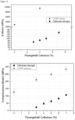
- Figure 2 shows the mechanical properties of two thermosetting CARPs according to the invention.
- the upper half shows the compression moduli from compression testing with phenolic resin matrix, while the lower half shows E-moduli from tensile testing with epoxy resin matrix.
- the process according to the invention can be carried out for thermoplastics, for example, as described below.
- the fine-pored aerogel network can be filled with sufficiently low-viscosity media (less than 100 Pa ⁇ s).
- Dry cellulose aerogels of all shapes are mixed with monomers of thermoplastics (amides, acrylates, vinyl compounds, Esters, lactates, carbonates, ether ether ketones, etc.) are impregnated with aerogels (e.g. esters, lactates, carbonates, ether ether ketones, etc.).
- monomers/polymerization liquid are absorbed into the aerogel pore space by capillary forces.
- thermoplastic aerogel composite body After subsequent polymerization in the pore space, a thermoplastic aerogel composite body is obtained.
- the introduction of the material and force-fit network causes significant changes in the properties of the respective thermoplastics.
- the glass transition point of the thermoplastics used is significantly increased.
- the example of cellulose-aerogel-polystyrene composite bodies with a cellulose content of 3% by weight shows an increase in the glass transition temperature in the double-digit percentage range. Similar behavior within a comparable range can also be observed with other thermoplastics. Glass transition temperature shifts of up to 40% have been observed.
- the composite body Through infiltration with clear, transparent thermoplastics, the composite body also acquires a high degree of transparency (when wet but not fully cured).
- the temperature-induced reactions e.g. the decomposition of initiators to radical starters
- the object according to the invention is achieved by a composite body comprising polysaccharide aerogel, in particular cellulose aerogel, and at least one plastic, obtainable by the method according to the invention described above.
- the plastic can be, for example, a duroplastic or a thermoplastic.
- the object of the invention is achieved by using polysaccharide aerogel, in particular cellulose aerogel, to reinforce plastics in a composite body.
- the reinforced plastics can be, for example, thermoplastics or thermosets.
- a cellulose aerogel with 5% cellulose by weight is used as the fiber reinforcement material. Before infiltration, the residual moisture in the aerogel is removed by drying in a vacuum drying cabinet at 120 °C and 10 mbar for at least 3 hours. The completely dry aerogel is covered with a phenolic resin in a pre-tempered state (approx. 90 °C) and placed in an oven. A phenol-formaldehyde resin (pre-condensed, diluted with 2-propanol) with a viscosity of 2 Pa s is used for infiltration. Infiltration takes place exclusively through capillary forces. Working at an increased temperature of 60 to 80 °C enables the resin viscosity to be reduced, which accelerates infiltration.
- the entire pore volume of the aerogel is completely filled with the resin.
- This green body is transparent and shows no air inclusions that are visible to the naked eye or detectable by ultrasound. Since the resin system has not yet gelled, this green body can now be removed and given the desired final shape. It is then cured in an oven at 100 °C. If necessary, a vacuum can be used to remove excess matrix material. In order to obtain optimal properties from the matrix, a curing process is usually carried out afterwards.
- a cellulose aerogel with 5% cellulose by weight is used as the fiber reinforcement material. Before infiltration, the residual moisture in the aerogel is removed by drying in a vacuum drying cabinet at 120 °C and 10 mbar for at least 5 hours.
- the aerogel can be further processed.
- This embodiment involves the radical polymerization of styrene in the mass.
- Styrene contains commercially available stabilizers. These can either washed out or compensated by an excess of initiator adjusted to the amount of stabilizer.
- At least 0.1% of a suitable initiator is added to styrene.
- Azo compounds such as azobis(isobutyronitrile) (AIBN) or peroxides such as (di-)benzoyl peroxide (DBPO) can be used as radical initiators.
- AIBN azobis(isobutyronitrile)
- DBPO peroxides
- the dry aerogel is immersed in the solution at room temperature under protective gas. Within a few minutes, the entire pore volume of the aerogel is completely filled with the monomer solution. Gas bubbles can be observed rising from the aerogel. The aerogel becomes transparent and shows no air inclusions that are visible to the naked eye or detectable under a light microscope.
- the filled aerogel As soon as the filled aerogel is completely transparent, it can be heated (preferably under protective gas) to a temperature of 70 to 110 °C to initiate the initiator decomposition into radical starters. After completion of the polymerization, a cellulose-polystyrene composite is obtained, which appears opaque to whitish at a cellulose content of 5% by weight.
Landscapes
- Chemical & Material Sciences (AREA)
- Engineering & Computer Science (AREA)
- Manufacturing & Machinery (AREA)
- Materials Engineering (AREA)
- Health & Medical Sciences (AREA)
- Chemical Kinetics & Catalysis (AREA)
- Medicinal Chemistry (AREA)
- Polymers & Plastics (AREA)
- Organic Chemistry (AREA)
- Reinforced Plastic Materials (AREA)
- Compositions Of Macromolecular Compounds (AREA)
Description
- Die vorliegende Erfindung betrifft Kunststoffe, die mit Polysaccharid-Aerogel verstärkt sind sowie Verfahren zu deren Herstellung. Insbesondere werden Kunststoffe bereitgestellt, die mit Polysaccharid-Aerogel-Fasern in Form dreidimensionaler Netzwerke verstärkt sind, wobei das Polysaccharid-Aerogel und der Kunststoff form- und kraftschlüssig verbunden sind und der Verbundkörper frei von Lufteinschlüssen ist. Bevorzugt handelt es sich bei dem Polysaccharid um Cellulose.
- Faser-Kunststoff-Verbunde (FKV) bestehen aus mindestens zwei Komponenten, deren Kombination idealerweise die besten Eigenschaften beider Einzelkomponenten zeigt. Konventionelle Fasermaterialien sind beispielsweise Glas- oder Carbonfasern als verstärkende Komponenten, sowie einem die Fasern umhüllenden Matrixmaterial bei dem meist Kunststoffharze verwendet werden, wobei faserverstärkte Kunststoffe wie glasfaserverstärkte Kunststoffe (GFK) und carbonfaserverstärkte Kunststoffe (CFK) erhalten werden.
- Im Zuge des wachsenden Interesses an erneuerbaren Rohstoffen rücken Naturfasern nicht nur als Füllstoffe, sondern auch als verstärkende Komponenten zunehmend in den Fokus wissenschaftlicher Bestrebungen. Eine bedeutende Gruppe von Naturfasern bilden hierbei die Polysaccharide, deren wichtigster Vertreter die Cellulose ist.
-
WO 2015/055338 A1 beschreibt die Benetzung von Fasermatten mit Aerogelfasern. In Pirchner, N et al.: "Reinforcement of bacterial cellulose aerogels with biocompatible polymer" wird bakterielle Cellulose verwendet, deren Verhältnis von Feststoff zu Hohlraum eindeutig nicht unter den Begriff Aerogel fällt. - Tuukka, Nissilä: "Oriented nanofiber templates for resin impregnation of cellulose nanocomposites", 31. Dezember 2016 (2016)-12-31), Seiten 1-108, XP055561727, zu finden im Internet unter http://jultika.oulu.fi/files/nbnfioulu-201701121049.pdf und
- Zhai, Tianlang et al.: "Poly(vinyl alcohol)/Cellulose nanofibrill hybrid aerogels with an aligned microtubular prous structure and their composites with polydimethylsiloxane" Applied Material & Interfaces, Bd. 7, Nr.13, 30. März 2015 (2015-03-30), Seiten 7436-7444, XP093029155
- Beschreiben die Infiltration von Nano-Cellulosefasern mit Polymeren. Dabei werden gerichtete unidirektionale Strukturen gebildet.
- Dabei liegt ein wissenschaftlicher Fokus zunehmend auf der Herstellung von Cellulose-basierten Nanokompositen. Cellulose ist ein vielversprechender nachwachsender Rohstoff mit hoher Festigkeit (bis zu 150 MPa) bei einer verhältnismäßig geringen Dichte (etwa 1,5 g/cm3).
- Beurteilt man die Festigkeit und Steifigkeit dieser Werkstoffe unter Berücksichtigung ihrer geringen Dichte, wären Verbunde von Polysacchariden wie Cellulose mit geeigneter Matrix hinsichtlich ihrer spezifischen Festigkeiten/Steifigkeiten konkurrenzfähig gegenüber konventionellen Verbunden. Einige Vergleichswerte sind in Tabelle 1 aufgelistet.


- Seit einigen Jahren werden in der Literatur neuartige Nano-Komposite auf Basis von Cellulose und thermoplastischen Kunststoffsystemen beschrieben, beispielsweise von Dufresne (Dufresne, Nanocellulose: a new ageless bionanomaterial, Materials Today, 16, 6, (2013) 220-227) und Oksman (Oksman et al., Review of the recent developments in cellulose nanocomposite Processing, Composites: Part A 83 (2016) 2-18).
- Bei der Verarbeitung von Thermoplasten ist die Temperatur ein entscheidender Faktor, denn eine hohe Temperatur führt häufig zum Abbau oder mindestens zur Beeinträchtigung der ursprünglichen Eigenschaften der Cellulose und somit auch zu minderwertigen Verbundkörpern, wie Lee (K.-Y. Lee et al., On the use of nanocellulose as reinforcement in polymer matrix composites, Composites Science and Technology 105 (2014) 15-27) und auch das Handbook of Nanocellulose and Cellulose Nanocomposites ausführen (Kargarzadeh (Editor), Ahmad (Editor), Thomas (Editor), Dufresne (Editor), Handbook of Nanocellulose and Cellulose Nanocomposites (2017).
- Auch die Einarbeitung in duroplastische Kunststoffe wird beispielsweise von Sabo (Sabo et al., Characterization and Processing of Nanocellulose Thermosetting Composites, Buchkapitel in, "Technological advancement in polymer nanocomposites of cellulose nanoparticle: processing, performance and applications, (2015) 265-287) und Ramamoorthy (Ramamoorthy, Properties and performance of regenerated Cellulose Thermoset Biocomposites, Phd-Thesis, University of Boras, Schweden (2015)) beschrieben. Diese erfolgt dabei bisher hauptsächlich in Form von Pulvern. Aufgrund des Dichteunterschieds zwischen Faser und duroplastischem Matrixmaterial ergibt sich jedoch das Problem, dass häufig Sedimentation der Fasermaterialien auftritt. Die bisher im Stand der Technik verfolgten Ansätze führen damit sowohl für Thermoplaste als auch für Duroplaste nicht zur Bereitstellung homogener Verbundkörper.
- In einer Arbeit von Pircher (Pircher et al., Reinforcement of bacterial cellulose aerogels with biocompatible polymers, Carbohydrate Polymers, 111 (2014) 505-513) wird die Einbringung von bakteriellen Cellulose-Aerogelen in das biokompatible thermoplastische Polymer der Polymilchsäure (PLA), Polycaprolacton (PCL), Cellulose-Acetat und Polymethylmethacrylat (PMMA) beschrieben. In dieser Arbeit wird mit verdünnten Lösungen gearbeitet, wobei das Ziel verfolgt wird, das cellulosische Substrat anschließend zu entfernen, um ein inverses thermoplastisches Gel zu erhalten.
- Verfahrenstechnisch wird dies erreicht, indem ein Porenflüssigkeitsaustausch im nassen Zustand der bakteriellen Cellulose durchgeführt wird und anschließend eine überkritische Trocknung stattfindet. Hierbei werden bereits fertige Polymere eingesetzt und anschließend die Cellulose mithilfe eines Lösungsmittels entfernt. Auf diese Weise wird das angestrebte inverse thermoplastische Gel erhalten.
- Faserverstärkte Kunststoffe zeigen gerade im Herstellungsprozess einige Schwierigkeiten. Die Herstellung über Resin Transfer Moulding (RTM) oder Resin Infusion Moulding (RIM) birgt immer die Gefahr einer unvollständigen Füllung der Porenräume, was im finalen Bauteil in Form von Lufteinschlüssen zu Sollbruchstellen führen kann. Bei der Einarbeitung von Cellulose in Form von nano- oder mikrokristalliner Cellulose weist Dufresne (Dufresne, Nanocomposites based on natural fibers, Buchkapitel 6 in Natural Fibre Reinforced Polymer Composites: From Macro to Nanoscale eds. Sabu, Pothan (2009) 142-165) auf die Problemstellung der Sedimentation hin, welche zu einer inhomogenen Eigenschaftsverteilung führt.
- Faserverstärkung von Kunststoffen kann in unterschiedlichen Arten vorliegen, zum Beispiel als Kurzfaserverstärkung oder Endlosfaserverstärkung. Doch keine dieser Verstärkungen bildet ein stoffschlüssiges Fasersystem, welches in alle drei Raumrichtungen wirkt.
- Glasfaserverstärkte Kunststoffe (GFK) und carbonfaserverstärkte Kunststoffe (CFK) werden im Falle der Endlosfasern immer in Gelegen oder Geweben angewendet und zeigen nur in Faserlaufrichtung herausragende Eigenschaften. Befindet sich die Belastungsachse senkrecht zur Faserrichtung werden die Kräfte vorwiegend von der Matrix aufgenommen. Eine Verbesserung wird dabei durch aufeinander gestapelte und im Winkel versetzte Lagen erzielt.
- Sowohl Glas- als auch Carbonfasern bedürfen zwingend einer Vorbehandlung beziehungsweise der Applikation eines Haftvermittlers, welcher die Verträglichkeit zwischen der Faser und der Matrix verbessert oder überhaupt erst ermöglicht. Erst diese Vorbehandlung verbessert die Kraftübertragung von der Matrix auf das hochmodulare Fasermaterial. Auch für nanokristalline Cellulose sind chemische Modifikationen gelegentlich notwendig, um eine bessere Verträglichkeit zwischen Faser und Matrix zu gewährleisten, wie von Dufresne (Dufresne, Nanocomposites based on natural fibers, Buchkapitel 6 in Natural Fibre Reinforced Polymer Composites: From Macro to Nanoscale eds. Sabu, Pothan (2009) 142-165) dokumentiert ist.
- Gegenüber dem dargestellten Stand der Technik liegt der vorliegenden Erfindung daher die Aufgabe zugrunde, stabile Verbundkörper bereitzustellen, die keine oder nur geringste Lufteinschlüsse (nanoskalig, weniger als 5 nm Durchmesser) aufweisen, deren Eigenschaften möglichst homogen und richtungsunabhängig (anisotrop) sind und die zudem auf nachwachsenden Rohstoffen basieren. Insbesondere sollen solche Verbunde aus Naturfasern und thermoplastischen oder auch duroplastischen Kunststoffen bereitgestellt werden.
- Als Polysaccharid-Aerogel kann jedes Polysaccharid in aerogeler Form eingesetzt werden. Insbesondere können Amylose, (Amylo)Pektin, Pektine, Chitin, und/oder Cellulose eingesetzt werden. Bevorzugt wird Cellulose-Aerogel eingesetzt. Als Kunststoff können insbesondere Duroplaste oder Thermoplaste eingesetzt werden.
- Das Polysaccharid-Aerogel liegt bevorzugt in Form von offenporigen Fasern, makroskopisch insbesondere in Form zweidimensionaler textiler Gebilde wie Vliesen und/oder Geweben und/oder in Form eines nanoskaligen dreidimensionalen Netzwerks vor. Besonders bevorzugt liegt ein solches dreidimensionales Netzwerk von Cellulose-Aerogel vor. Die Fasern weisen bevorzugt Durchmesser von 5 bis 25 nm auf. Geeignete Fasern sind beispielswiese in
DE 10 2006 049 179 1 - Gegenüber dem Stand der Technik zeichnet sich der erfindungsgemäße Verbundkörper insbesondere dadurch aus, dass die Faserkomponente des Verbundmaterials auf Polysaccharidbasis in Form eines Aerogels vorliegt. Durch die stoff- und kraftschlüssige Verbindung zwischen Verstärkungsfaser und Matrix wird die Stabilität des Verbundkörpers gewährleistet.
- Überraschenderweise hat sich gezeigt, dass die für GFK und CFK zwingend erforderliche Applikation eines Haftmittlers vermieden werden kann, denn Polysaccharide beinhalten verschiedene funktionelle Gruppen, die in der Lage sind, Reaktionen mit dem Matrixmaterial aus Kunststoff einzugehen. Daraus ergibt sich die Möglichkeit der Ausbildung einer chemischen Bindung zwischen Faser- und Matrixmaterial über die eine Kraftübertragung gewährleistet werden kann. Auch die beispielsweise bei nanokristallinen Cellulose-Wiskern erforderliche chemische Modifizierung ist insbesondere bei Einsatz von Cellulose-Aerogel nicht zwingend notwendig.
- Anstelle versetzter Faserlagen kann bei Aerogelen ein ungeordnetes dreidimensionales Netzwerk genutzt werden, welches in allen drei Raumrichtungen identische Eigenschaften aufweist. Werden hingegen geordnete textile Flächengebilde wie Gewebe eingesetzt erfolgt die Kraftaufnahme des Verbundkörpers gerichtet.
- Durch den Einsatz eines Polysaccharids mit aerogeler Struktur kann überraschenderweise auch die Sedimentation von Fasern vermieden werden, wodurch eine inhomogene Eigenschaftsverteilung unterbunden werden kann. Die verstärkende Komponente (zum Beispiel Cellulose-Aerogel) liegt in Form eines Polysaccharid-Aerogels bereits in ihrer finalen Morphologie vor und löst sich nicht in der Matrix. Die nanoskaligen Fasern befinden sich in einem festen dreidimensionalen Netzwerk und können in der während der Herstellung flüssigen Matrix trotz des Dichteunterschieds nicht als einzelne Fasern absinken.
- Das dreidimensionale Netzwerk des Polysaccharid-Aerogels ist stoff- und kraftschlüssig, denn dort, wo sich zwei und mehr Nanofibrillen berühren besteht eine chemische Bindung. Ein Abgleiten zweier Fasern ist somit nicht möglich.
- Zudem hat sich überraschenderweise gezeigt, dass insbesondere Cellulose-Aerogele in der Lage sind, während des Herstellungsprozesses des Verbundkörpers eine Polymerisationsflüssigkeit mit hinreichender Viskosität durch Kapillarkräfte in den Porenraum zu befördern. Damit reduziert sich die Menge an Sollbruchstellen und somit auch Ausschuss. Ein wichtiges Unterscheidungskriterium von den Methoden des Standes der Technik ist die Ausnutzung der Kapillarkräfte, welche sich aus den geringen Porengrößen (20 bis 200 nm) in Cellulose-Aerogelen ergeben. Durch dieses feine Porennetzwerk ist das Cellulose-Aerogel in der Lage auch ohne Anlegen von Unterdruck, nur unter Nutzung der entstehenden Kapillarkräfte eine Polymerisationsflüssigkeit aufzunehmen und so einen blasenfreien Verbundkörper zu realisieren. Insbesondere mithilfe der zur Detektion von Gaseinschlüssen in faserverstärkten Verbundkörpern standardmäßig verwendeten Ultraschallverfahren finden sich in den erfindungsgemäßen Verbundkörpern nachweislich keine Gaseinschlüsse.
- Das dreidimensionale Netzwerk, gepaart mit den thermischen Eigenschaften des Polysaccharids, insbesondere der Cellulose, kann am Ende der Produktlebenszeit zusätzlich einen verhältnismäßig simplen Abbau des erfindungsgemäßen Verbundkörpers ermöglichen. Setzt die thermische Zersetzung des Polysaccharid-Kunststoffverbunds ein, so liefert das Fasermaterial Sauerstoff, welcher einen einfachen Abbau mit weniger schädlichen Abbauprodukten zur Folge haben kann. Insbesondere ist ein einfacher thermischer Abbau von Cellulose-Kunststoffverbunden mit weniger schädlichen Abbauprodukten möglich.
- In einer bevorzugten Ausführungsform ist der erfindungsgemäße Verbundkörper frei von Lufteinschlüssen und/oder Lösungsmitteln. Die Freiheit von Lufteinschlüssen wird erreicht, indem die Porenräume des Polysaccharid-Aerogels vollständig durch Kunststoffmaterial ausgefüllt werden. Dadurch wird die Entstehung von Sollbruchstellen vermieden und somit die Stabilität des erfindungsgemäßen Verbundkörpers verbessert.
- In einer Ausführungsform des erfindungsgemäßen Verbundkörpers handelt es sich bei dem eingesetzten Kunststoff um einen Thermoplasten. Insbesondere Acrylate, Polyamide, Lactide, Polystryole und/oder Polycarbonate können als thermoplastische Kunststoffe eingesetzt werden.
- Geeignete Acrylate umfassen beispielsweise Polymethylmethacrylat und Polyacrylsäure, ohne dass die Erfindung auf diese beschränkt wäre. Geeignete Polyamide umfassen beispielsweise PA-6, PA-6,6, PA-8, PA-12 und dergleichen, ohne dass die Erfindung auf diese beschränkt wäre. Geeignete Lactide umfassen beispielsweise Polymilchsäure ohne darauf beschränkt zu sein.
- Überraschenderweise hat sich gezeigt, dass, insbesondere wenn Acrylate wie Polymethylmethacrylat als thermoplastische Kunststoffkomponente und Cellulose als aerogeles Fasermaterial eingesetzt werden, ein optisch in flüssiger Phase transparenter und in fester Phase transluzenter Verbundkörper erhalten werden kann. Durch die Feinporigkeit bei geringen Fasergehalten des aerogelen Netzwerks bleiben die transparenten Eigenschaften des eingesetzten Kunststoffs erhalten. In einer bevorzugten Ausführungsform kann der erfindungsgemäße Verbundkörper transparent oder transluzent vorliegen, liegt bei erhöhten Saccharid-Konzentrationen (von mehr als 4 Gewichts-%) jedoch opak bis weißlich vor.
- In einer alternativen Ausführungsform des erfindungsgemäßen Verbundkörpers handelt es sich bei dem eingesetzten Kunststoff um einen Duroplasten.
- Insbesondere Epoxidharze, Phenol-Formaldehyd-Harze, Melamin-Formaldehyd-Harze, gesättigte und/oder ungesättigte Polyesterharze, Cyanacrylate und/oder Polyurethane können als duroplastische Kunststoffe eingesetzt werden.
- Die der Erfindung zugrundeliegende Aufgabenstellung wird gelöst durch ein Verfahren nach Anspruch 1.
- Das erfindungsgemäße Verfahren zeichnet sich insbesondere dadurch aus, dass ein bereitgestelltes Polysaccharid-Aerogel, insbesondere ein Cellulose-Aerogel, mit einer Polymerisationsflüssigkeit infiltriert wird und der Verbundkörper anschließend durch Polymerisation, Polyaddition beziehungsweise Polykondensation dieser Flüssigkeit gebildet wird. Dadurch kann die Polymerisationsflüssigkeit stoffschlüssig in das Aerogelnetzwerk eindringen. In den aus dem Stand der Technik bekannten Verbunden aus Polysacchariden und Kunststoffen wird demgegenüber vorgefertigtes Polymer in einem Lösungsmittel mit dem Polysaccharid in Verbindung gebracht und das Lösungsmittel anschließend entfernt, wodurch kein kraft- und stoffschlüssiger Verbund erhalten wird. Überraschenderweise hat sich gezeigt, dass ein solcher mit dem erfindungsgemäßen Verfahren realisiert werden kann.
- Bei der Polymerisationsflüssigkeit kann es sich beispielsweise um flüssige polymerisierbare Monomere oder vorkondensierte Oligomere, optional verdünnt in einem geeigneten Lösungsmittel, handeln. Die Polymerisationsflüssigkeit kann zur Synthese eines thermoplastischen oder duroplastischen Kunststoffs geeignet und bestimmt sein.
- Als Polymerisationsverfahren können kationische, anionische und/oder radikalischen Verfahren mittels Radikalstarter und/oder IR,UV-Starter zum Einsatz kommen.
- Während der Durchführung des Verfahrens wird die Temperatur bevorzugt unter 250 °C gehalten. Besonders bevorzugt liegt die Temperatur unter 180 °C. Ganz besonders bevorzugt liegt die Temperatur unter 150 °C.
- In einer bevorzugten Ausführungsform des erfindungsgemäßen Verfahrens wird das Polysaccharid-Aerogel in Form von Fasern, insbesondere in Form zweidimensionaler textiler Gebilde wie Vliesen und/oder Geweben und/oder in Form eines dreidimensionalen Netzwerks bereitgestellt. Besonders bevorzugt wird ein Cellulose-Aerogel in Form eines dreidimensionalen Netzwerks bereitgestellt. Die Fasern weisen bevorzugt Durchmesser in einem Bereich von 5 bis 25 nm auf.
- Bevorzugt ist die Polymerisationsflüssigkeit frei von Lösungsmitteln. In einer bevorzugten Ausführungsform umfasst die Polymerisationsflüssigkeit niedrigviskose Monomere, Oligomere und/oder Vorkondensate. Besonders bevorzugt ist die Polymerisationsflüssigkeit frei von Polymeren. Bevorzugte Oligomere umfassen mehr als 10 Monomereinheiten und beispielsweise bis zu 30 Monomereinheiten. Bevorzugt weist die Polymerisationsflüssigkeit eine Viskosität von weniger als 100 Pa·s auf. Besonders bevorzugt liegt die Viskosität bei weniger als 10 Pa·s, ganz besonders bevorzugt weniger als 1 Pa·s.
- Im Folgenden wird das Verfahren beispielhaft für den Einsatz von Cellulose-Aerogel als Polysaccharid-Aerogel konkreter beschrieben, wobei das erfindungsgemäße Verfahren nicht auf diese Beschreibung beziehungsweise solche Aerogele beschränkt ist. Die Vorgehensweise kann sich danach unterscheiden, ob Duroplaste oder Thermoplaste als Kunststoff eingesetzt werden sollen.
- Das erfindungsgemäße Verfahren kann für Duroplaste beispielsweise wie im Folgenden beschrieben ausgeführt werden. Trockene Cellulose-Aerogele aller Formen (Platten, Fasern, et cetera) werden in einer Form platziert und mit einem vorkondensierten Harzsystem (Phenol-, Epoxid-, Polyester-, Polyesterurethan-, Cyanacrylatester-basiertes Harzsystem, verdünnt mit geeigneten Lösungsmittel oder in reiner Form) getränkt. Anwendbare Verfahren zur Infiltration von Cellulose-Aerogelen sind beispielsweise Resin Infusion Moulding (RIM) und Resin Transfer Moulding (RTM), welche für CFK/GFK ebenfalls angewendet werden. Bedingt durch die offenporige Struktur des Cellulose-Aerogels besteht zudem die Möglichkeit der Kapillarinfiltration, welche keiner weiteren Hilfsmittel bedarf beziehungsweise allenfalls einer Temperaturerhöhung, welche der Prozessbeschleunigung dienlich ist. Im RIM ist der Einsatz diverser Membran-Materialien, Fließhilfen und Folien empfehlenswert, um vollständige Infiltration zu ermöglichen. Sofern eine hinreichend niedrige Viskosität (insbesondere weniger als 100 Pa·s) gegeben ist wird der gesamte Porenraum des Aerogels mit dem Matrixsystem gefüllt. Gegebenenfalls ist eine Temperaturerhöhung notwendig, um das Fließverhalten im Aerogel zu begünstigen. Die Nutzung vakuumassistierter Methoden (RIM sowie damit genutzte Folien, Fließhilfen et cetera) ebenso wie eine Temperaturerhöhung verkürzen die Herstellungszeit blasenfrei infiltrierter Aerogele. Eingesetzte Harzsysteme müssen lange Topf/Offenzeiten (auch bei erhöhter Temperatur) haben, um die vollständige Infiltration zu gewährleisten. Bevorzugte Topfzeiten liegen zwischen 30 und 300 Minuten. Je geringer die Viskosität desto kürzer kann die Topfzeit gewählt sein. Dabei ist die verkürzte Topfzeit bei erhöhter Temperatur oder gegebenenfalls enthaltene Lösungsmittel, die bei Anlegen von Unterdruck evaporieren, zu beachten. Nach erfolgter Gelation, Härtung und gegebenenfalls notwendiger Nachhärtung (curing) wird ein mit Polysaccharid-Aerogel, insbesondere Cellulose-Aerogel, nanofaserverstärkter Verbundkörper erhalten. Das erfindungsgemäße Verfahren kann bei Temperaturen von bis zu 180 °C durchgeführt werden, ohne nennenswerte Veränderungen im Nanofaser-Werkstoff hervorzurufen.
- Die Verbundkörper zeichnen sich im Vergleich zu Glas- oder Carbonfasern durch eine geringe Dichte sowie einen geringen Fasergehalt aus. In
Figur 1 ist ein Vergleich der Dichten von aktuellen Materialien mit erfindungsgemäßen Cellulose Aerogel-verstärkten Duroplasten in Abhängigkeit der üblich verwendeten Fasergehalte. (GFRP: glasfaserverstärkte Kunststoffe, CFRP: carbonfaserverstärkte Kunststoffe, CA: Cellulose Aerogel, CARP: erfindungsgemäße Celluloseaerogelfaserverstärkte Kunststoffe) gezeigt. - Die Eigenschaften dieses erfindungsgemäßen Verbundkörpers unterscheiden sich deutlich von denjenigen der einzelnen Komponenten. Cellulose-Aerogele selbst zeigen verhältnismäßig schlechte mechanische Eigenschaften, was sich aus dem Umstand ergibt, dass sie überwiegend aus Luft bestehen. Mit einer Porosität zwischen 65% und 98% wird mit sehr geringen Feststoffgehalten gearbeitet. Die E-Module von Cellulose-Aerogelen (1 bis 10 Gewichts-%), welche aus wässrigen Salzhydratschmelzen hergestellt wurden, liegen im Bereich von 10 bis 280 MPa und zeigen eine starke Abhängigkeit vom Feststoffgehalt.
-
Figur 2 zeigt die mechanischen Eigenschaften zweier erfindungsgemäßer duroplastischer CARPs. In der oberen Hälfte sind die Kompressions-Moduli aus Druckprüfung mit Phenolharzmatrix gezeigt, während in der unteren Hälfte E-Moduli aus Zugprüfung mit Epoxydharzmatrix dargestellt sind. - Aus weiteren Untersuchungen geht hervor, dass in Bezug auf die Wasseraufnahme trotz der enthaltenen teils hygroskopischen Polysaccharide keine Änderung im Vergleich zu dem reinen Matrixsystem zu verzeichnen ist.
- Das erfindungsgemäße Verfahren kann für Thermoplaste beispielsweise wie im Folgenden beschrieben ausgeführt werden. Mit hinreichend niedrigviskosen Medien (weniger als 100 Pa·s) lässt sich das feinporige Aerogelnetzwerk füllen. Trockene Cellulose-Aerogele aller Formen (Platten, Fasern, et cetera) werden mit Monomeren thermoplastischer Kunststoffe (Amide, Acrylate, VinylVerbindungen, Ester, Lactate, Carbonate, Etheretherketone, et cetera) getränkt. Innerhalb kürzester Zeit erfolgt bereits durch Kapillarkräfte die Aufnahme der Monomere/Polymerisationsflüssigkeit in den Aerogel-Porenraum. Nach anschließender Polymerisation im Porenraum wird ein thermoplastischer Aerogel-Verbundkörper erhalten. Das Einbringen des stoff- und kraftschlüssigen Netzwerks bedingt deutliche Änderungen der Eigenschaften der jeweiligen Thermoplaste. So wird beispielsweise der Glaspunkt der eingesetzten Thermoplaste signifikant erhöht. Am Beispiel von Cellulose-Aerogel-Polystyrol-Verbundkörpern mit einem Cellulosegehalt von 3 Gewichts-% zeigt sich eine Erhöhung der Glastemperatur im zweistelligen Prozentbereich. Ähnliches Verhalten im vergleichbaren Rahmen ist bei weiteren Thermoplasten auch zu beobachten. Glastemperaturverschiebungen um bis zu 40 % wurden beobachtet. Durch die Infiltration mit klaren transparenten Thermoplasten erhält auch der Verbundkörper einen hohen Grad an Transparenz (im nassen, aber nicht durchgehärteten Zustand). Die temperaturinduzierten Reaktionen (beispielsweise der Zerfall von Initiatoren zu Radikalstartern) können bei Temperaturen von bis zu 180 °C durchgeführt werden.
- Die erfindungsgemäße Aufgabenstellung wird gelöst durch einen Verbundkörper umfassend Polysaccharid-Aerogel, insbesondere Cellulose-Aerogel, sowie mindestens einen Kunststoff, erhältlich nach dem zuvor beschriebenen erfindungsgemäßen Verfahren. Bei dem Kunststoff kann es sich beispielsweise um einen Duroplasten oder einen Thermoplasten handeln.
- Die erfindungsgemäße Aufgabenstellung wird durch die Verwendung von Polysaccharid-Aerogel, insbesondere Cellulose-Aerogel, zur Verstärkung von Kunststoffen in einem Verbundkörper. Die verstärkten Kunststoffe können beispielsweise Thermoplaste oder Duroplaste sein.
- Als Faserverstärkungsmaterial wird ein Cellulose-Aerogel mit 5 Gewichts-% Cellulose verwendet. Vor der Infiltration wird die Restfeuchte im Aerogel durch Trocknung im Vakuumtrockenschrank bei 120 °C und 10 mbar, mindestens 3 h durchgeführt. Das vollständig trockene Aerogel wird im vortemperierten Zustand (circa 90 °C warm) mit einem Phenolharz bedeckt und in einen Ofen platziert. Zur Infiltration wird ein Phenol-Formaldehyd-Harz (vorkondensiert, mit 2-Propanol verdünnt) mit einer Viskosität von 2 Pa·s verwendet. Die Infiltration erfolgt ausschließlich durch Kapillarkräfte. Das Arbeiten bei erhöhter Temperatur von 60 bis 80 °C ermöglicht eine Verringerung der Harz-Viskosität, welche die Infiltration beschleunigt. Innerhalb weniger Stunden wird das gesamte Porenvolumen des Aerogels vollständig mit dem Harz gefüllt. Dieser Grünling ist transparent und zeigt keine Lufteinschlüsse, die mit bloßem Auge sichtbar oder mittels Ultraschall nachweisbar sind. Da noch keine Gelation des Harzsystems stattgefunden hat kann dieser Grünkörper nun entnommen und in die gewünschte finale Form gebracht werden. Anschließend findet bei 100 °C im Ofen die Durchhärtung statt. Gegebenenfalls kann hier ein Vakuumaufbau zum Abziehen von überschüssigem Matrixmaterial verwendet werden. Um optimale Eigenschaften seitens der Matrix zu erhalten, wird in der Regel ein Curing nachgeschaltet.
- Als Faserverstärkungsmaterial wird ein Cellulose-Aerogel mit 5 Gewichts-% Cellulose verwendet. Vor der Infiltration wird die Restfeuchte im Aerogel durch Trocknung im Vakuumtrockenschrank bei 120 °C und 10 mbar, mindestens 5 h durchgeführt.
- Nach Abkühlen auf Raumtemperatur kann das Aerogel weiterverarbeitet werden. Dieses Ausführungsbeispiel umfasst die radikalische Polymerisation von Styrol in der Masse. Styrol enthält handelsüblich Stabilisatoren. Diese können entweder ausgewaschen werden, oder durch einen, an die Stabilisatormenge angepassten Initiatorüberschuss kompensiert werden.
- Styrol wird mit mindestens 0,1 % eines geeigneten Initiators versetzt. Als radikalische Initiatoren können z.B. Azoverbindungen wie Azobis(isobutyronitril) (AIBN) oder Peroxide wie (Di-)Benzoylperoxid (DBPO) verwendet werden. Das trockene Aerogel wird bei Raumtemperatur unter Schutzgas in die Lösung getaucht. Innerhalb weniger Minuten wird das gesamte Porenvolumen des Aerogels vollständig mit der Monomer-Lösung gefüllt. Dabei kann beobachtet werden wie Gasblasen aus dem Aerogel aufsteigen. Das Aerogel wird dabei transparent und zeigt keine Lufteinschlüsse, die mit bloßem Auge sichtbar oder lichtmikroskopisch nachweisbar sind. Sobald das gefüllte Aerogel vollständig transparent ist kann dieses (bevorzugt unter Schutzgas) auf eine Temperatur von 70 bis 110 °C aufgeheizt werden um den Initiatorzerfall zu Radikalstartern einzuleiten. Nach Abschluss der Polymerisation wird ein Cellulose-Polystyrol-Composit erhalten, welcher bei einem Cellulosegehalt von 5 Gewichts-% opak bis weislich erscheint.
Claims (13)
- Verfahren zur Herstellung eines Verbundkörpers umfassend Polysaccharid-Aerogel, insbesondere Cellulose-Aerogel, sowie mindestens einen Kunststoff, wobei der Kunststoff und das Polysaccharid-Aerogel stoff- und kraftschlüssig verbunden sind, wobei das Verfahren die folgenden Schritte umfasst:i) Bereitstellen von Polysaccharid-Aerogel, insbesondere Cellulose-Aerogel, in einem Formkörperii) Infiltrieren des Polysaccharid-Aerogels mit einer Polymerisationsflüssigkeit des Kunststoffs undiii) Aushärten der Polymerisationsflüssigkeit zum Erhalt des Verbundkörpers.
- Verfahren gemäß Anspruch 1, dadurch gekennzeichnet, dass das Polysaccharid-Aerogel in Form von Fasern, insbesondere in Form zweidimensionaler textiler Gebilde wie Vliese und/oder Gewebe und/oder in Form eines dreidimensionalen Netzwerks bereitgestellt wird.
- Verfahren gemäß Anspruch 1 oder 2, dadurch gekennzeichnet, dass die Polymerisationsflüssigkeit frei von Lösungsmitteln ist.
- Verfahren gemäß einem der Ansprüche 1 bis 2, dadurch gekennzeichnet, dass die Polymerisationsflüssigkeit niedrigviskose Monomere, Oligomere und/oder Vorkondensate umfasst, insbesondere frei von Polymeren ist.
- Verbundkörper umfassend Polysaccharid-Aerogel, insbesondere Cellulose-Aerogel, sowie mindestens einen Kunststoff erhältlich mit einem Verfahren gemäß einem der Ansprüche 1 bis 4.
- Verbundkörper gemäß Anspruch 5, dadurch gekennzeichnet, dass er Polysaccharid-Aerogel, insbesondere Cellulose-Aerogel, in Form von Fasern, insbesondere in Form zweidimensionaler textiler Gebilde wie Vliese und/oder Gewebe und/oder in Form eines dreidimensionalen Netzwerks, umfasst.
- Verbundkörper gemäß Anspruch 5 oder 6, dadurch gekennzeichnet, dass der Verbundkörper frei von Lufteinschlüssen und/oder Lösungsmitteln ist.
- Verbundkörper gemäß einem der Ansprüche 5 bis 7, dadurch gekennzeichnet, dass es sich bei dem Kunststoff um einen thermoplastischen Kunststoff handelt.
- Verbundkörper gemäß Anspruch 8, dadurch gekennzeichnet, dass es sich bei dem Kunststoff um ein Polyacrylat, Polyamid, Polylactid, Polystyrol und/oder Polycarbonat handelt.
- Verbundkörper gemäß einem der Ansprüche 5 bis 9, dadurch gekennzeichnet, dass der Verbundkörper optisch transparent, transluzent und/oder opak bis weißlich ist.
- Verbundkörper gemäß Anspruch 5 oder 6, dadurch gekennzeichnet, dass es sich bei dem Kunststoff um einen duroplastischen Kunststoff handelt.
- Verbundkörper gemäß Anspruch 11, dadurch gekennzeichnet, dass es sich bei dem Kunststoff um Epoxidharze, Phenol-Formaldehyd-Harze, MelaminFormaldehyd-Harze, gesättigte und/oder ungesättigte Polyesterharze, Cyanacrylate und/oder Polyurethane handelt.
- Verwendung von Polysaccharid-Aerogel, insbesondere Cellulose-Aerogel, in Verfahren gemäß der Ansprüche 1-4 zur Verstärkung von Kunststoffen in einem Verbundkörper.
Applications Claiming Priority (1)
| Application Number | Priority Date | Filing Date | Title |
|---|---|---|---|
| DE102017123123.4A DE102017123123A1 (de) | 2017-10-05 | 2017-10-05 | Polysaccharid-Aerogel-verstärkte Kunststoffe |
Publications (2)
| Publication Number | Publication Date |
|---|---|
| EP3467008A1 EP3467008A1 (de) | 2019-04-10 |
| EP3467008B1 true EP3467008B1 (de) | 2025-02-26 |
Family
ID=63642501
Family Applications (1)
| Application Number | Title | Priority Date | Filing Date |
|---|---|---|---|
| EP18191938.2A Active EP3467008B1 (de) | 2017-10-05 | 2018-08-31 | Polysaccharid-aerogel-verstärkte kunststoffe |
Country Status (2)
| Country | Link |
|---|---|
| EP (1) | EP3467008B1 (de) |
| DE (1) | DE102017123123A1 (de) |
Families Citing this family (4)
| Publication number | Priority date | Publication date | Assignee | Title |
|---|---|---|---|---|
| CN112480465B (zh) * | 2019-09-12 | 2022-05-24 | 北京化工大学 | 一种热空气干燥凝胶导热骨架材料的制备方法、骨架材料及高分子复合材料 |
| CN111849135A (zh) * | 2020-06-23 | 2020-10-30 | 南宁学院 | 一种聚己内酯复合材料及其制备方法 |
| CN114437400B (zh) * | 2022-03-08 | 2023-06-20 | 武汉纺织大学 | 超低导热蚕丝微纳米纤维气凝胶及其制备方法 |
| CN114806068B (zh) * | 2022-04-25 | 2024-02-27 | 万华化学(四川)有限公司 | 一种高强度高刚性的环保耐候abs树脂及其制备方法 |
Family Cites Families (3)
| Publication number | Priority date | Publication date | Assignee | Title |
|---|---|---|---|---|
| DE102004060261B4 (de) * | 2004-12-15 | 2010-09-09 | Deutsches Zentrum für Luft- und Raumfahrt e.V. | Mechanisch stabiler Aerogel-Formkörper und Verfahren zu seiner Herstellung |
| US7790787B2 (en) * | 2006-05-03 | 2010-09-07 | The United States Of America As Represented By The Administrator Of The National Aeronautics And Space Administration | Aerogel/polymer composite materials |
| DE102013111459A1 (de) * | 2013-10-17 | 2015-04-23 | Elringklinger Ag | Akustisch wirksame Abschirmteile und Abdeckungen |
-
2017
- 2017-10-05 DE DE102017123123.4A patent/DE102017123123A1/de not_active Ceased
-
2018
- 2018-08-31 EP EP18191938.2A patent/EP3467008B1/de active Active
Non-Patent Citations (1)
| Title |
|---|
| ZHAI TIANLIANG ET AL: "Poly(vinyl alcohol)/Cellulose Nanofibril Hybrid Aerogels with an Aligned Microtubular Porous Structure and Their Composites with Polydimethylsiloxane", APPLIED MATERIALS & INTERFACES, vol. 7, no. 13, 30 March 2015 (2015-03-30), US, pages 7436 - 7444, XP093029155, ISSN: 1944-8244, DOI: 10.1021/acsami.5b01679 * |
Also Published As
| Publication number | Publication date |
|---|---|
| DE102017123123A1 (de) | 2019-04-11 |
| EP3467008A1 (de) | 2019-04-10 |
Similar Documents
| Publication | Publication Date | Title |
|---|---|---|
| Senthilkumar et al. | Compressive, dynamic and thermo-mechanical properties of cellulosic pineapple leaf fibre/polyester composites: Influence of alkali treatment on adhesion | |
| Wang et al. | Processing nanocellulose to bulk materials: A review | |
| Soykeabkaew et al. | All-cellulose composites by surface selective dissolution of aligned ligno-cellulosic fibres | |
| DE60319150T3 (de) | Vor-form und verfahren zum vorbereiten einer vor-form | |
| Zhang et al. | All-cellulose nanocomposites reinforced with in situ retained cellulose nanocrystals during selective dissolution of cellulose in an ionic liquid | |
| EP3467008A1 (de) | Polysaccharid-aerogel-verstärkte kunststoffe | |
| Arévalo et al. | Binderless all-cellulose fibreboard from microfibrillated lignocellulosic natural fibres | |
| US20100222460A1 (en) | Cellulose/resin composite and process for producing same | |
| EP1492666A1 (de) | Verbundwerkstoff, verfahren zu seiner herstellung und seine verwendung | |
| JP2010024413A (ja) | 繊維強化複合材料およびその製造方法 | |
| Zhang et al. | Shape and stiffness switchable hydroplastic wood with programmability and reproducibility | |
| EP4010410B1 (de) | Verfahren zur herstellung von polymethylmethacrylat-hartschäumen als kernmaterialien in rotorblättern von windkraftanlagen und im bootsbau | |
| Venkatesha Gupta et al. | Fabrication and evaluation of mechanical properties of alkaline treated sisal/hemp fiber reinforced hybrid composite | |
| DE10228649A1 (de) | Verfahren zur Herstellung eines faserverstärkten Produktes auf Epoxidharzbasis | |
| Mandal et al. | Studies on bamboo/glass fiber reinforced USP and VE resin | |
| Olatunji et al. | Processing and characterization of natural polymers | |
| DE1938282A1 (de) | Neue faserverstaerkte Verbundstoffe | |
| Sabo et al. | Characterization and processing of nanocellulose thermosetting composites | |
| DE10300979A1 (de) | Ultraleichte Verbundwerkstoffe | |
| Temesgen | A research on the use of enset woven fabric structures for the applications of sound absorption and biodegradable composite material development | |
| Liu et al. | Bio-based nanocomposites by in situ cure of phenolic prepolymers with cellulose whiskers | |
| Han et al. | Natural fiber nonwoven preform using cellulose nanocrystal as a green additive | |
| Khan et al. | Studies on okra bast fibre-reinforced phenol formaldehyde resin composites | |
| Patel et al. | Hemp fibre as alternative to glass fibre in sheet moulding compound Part 1–influence of fibre content and surface treatment on mechanical properties | |
| Ramesh et al. | Development and evaluation of water absorption, compression and impact properties of okra Nanofibrillated cellulose reinforcement in epoxy resin composites |
Legal Events
| Date | Code | Title | Description |
|---|---|---|---|
| PUAI | Public reference made under article 153(3) epc to a published international application that has entered the european phase |
Free format text: ORIGINAL CODE: 0009012 |
|
| STAA | Information on the status of an ep patent application or granted ep patent |
Free format text: STATUS: THE APPLICATION HAS BEEN PUBLISHED |
|
| AK | Designated contracting states |
Kind code of ref document: A1 Designated state(s): AL AT BE BG CH CY CZ DE DK EE ES FI FR GB GR HR HU IE IS IT LI LT LU LV MC MK MT NL NO PL PT RO RS SE SI SK SM TR |
|
| AX | Request for extension of the european patent |
Extension state: BA ME |
|
| STAA | Information on the status of an ep patent application or granted ep patent |
Free format text: STATUS: REQUEST FOR EXAMINATION WAS MADE |
|
| 17P | Request for examination filed |
Effective date: 20190823 |
|
| RBV | Designated contracting states (corrected) |
Designated state(s): AL AT BE BG CH CY CZ DE DK EE ES FI FR GB GR HR HU IE IS IT LI LT LU LV MC MK MT NL NO PL PT RO RS SE SI SK SM TR |
|
| STAA | Information on the status of an ep patent application or granted ep patent |
Free format text: STATUS: EXAMINATION IS IN PROGRESS |
|
| 17Q | First examination report despatched |
Effective date: 20210510 |
|
| GRAP | Despatch of communication of intention to grant a patent |
Free format text: ORIGINAL CODE: EPIDOSNIGR1 |
|
| STAA | Information on the status of an ep patent application or granted ep patent |
Free format text: STATUS: GRANT OF PATENT IS INTENDED |
|
| INTG | Intention to grant announced |
Effective date: 20240926 |
|
| GRAS | Grant fee paid |
Free format text: ORIGINAL CODE: EPIDOSNIGR3 |
|
| GRAA | (expected) grant |
Free format text: ORIGINAL CODE: 0009210 |
|
| STAA | Information on the status of an ep patent application or granted ep patent |
Free format text: STATUS: THE PATENT HAS BEEN GRANTED |
|
| AK | Designated contracting states |
Kind code of ref document: B1 Designated state(s): AL AT BE BG CH CY CZ DE DK EE ES FI FR GB GR HR HU IE IS IT LI LT LU LV MC MK MT NL NO PL PT RO RS SE SI SK SM TR |
|
| REG | Reference to a national code |
Ref country code: GB Ref legal event code: FG4D Free format text: NOT ENGLISH |
|
| REG | Reference to a national code |
Ref country code: CH Ref legal event code: EP |
|
| REG | Reference to a national code |
Ref country code: DE Ref legal event code: R081 Ref document number: 502018015588 Country of ref document: DE Owner name: DEUTSCHES ZENTRUM FUER LUFT- UND RAUMFAHRT E.V, DE Free format text: FORMER OWNER: ANMELDERANGABEN UNKLAR / UNVOLLSTAENDIG, 80297 MUENCHEN, DE Ref country code: DE Ref legal event code: R081 Ref document number: 502018015588 Country of ref document: DE Owner name: DEUTSCHES ZENTRUM FUER LUFT- UND RAUMFAHRT E.V, DE Free format text: FORMER OWNER: DEUTSCHES ZENTRUM FUER LUFT- UND RAUMFAHRT E.V. (DLR), 51147 KOELN, DE |
|
| REG | Reference to a national code |
Ref country code: DE Ref legal event code: R096 Ref document number: 502018015588 Country of ref document: DE |
|
| REG | Reference to a national code |
Ref country code: IE Ref legal event code: FG4D Free format text: LANGUAGE OF EP DOCUMENT: GERMAN |
|
| REG | Reference to a national code |
Ref country code: NL Ref legal event code: MP Effective date: 20250226 |
|
| PG25 | Lapsed in a contracting state [announced via postgrant information from national office to epo] |
Ref country code: RS Free format text: LAPSE BECAUSE OF FAILURE TO SUBMIT A TRANSLATION OF THE DESCRIPTION OR TO PAY THE FEE WITHIN THE PRESCRIBED TIME-LIMIT Effective date: 20250526 |
|
| PG25 | Lapsed in a contracting state [announced via postgrant information from national office to epo] |
Ref country code: FI Free format text: LAPSE BECAUSE OF FAILURE TO SUBMIT A TRANSLATION OF THE DESCRIPTION OR TO PAY THE FEE WITHIN THE PRESCRIBED TIME-LIMIT Effective date: 20250226 |
|
| PG25 | Lapsed in a contracting state [announced via postgrant information from national office to epo] |
Ref country code: PL Free format text: LAPSE BECAUSE OF FAILURE TO SUBMIT A TRANSLATION OF THE DESCRIPTION OR TO PAY THE FEE WITHIN THE PRESCRIBED TIME-LIMIT Effective date: 20250226 |
|
| PG25 | Lapsed in a contracting state [announced via postgrant information from national office to epo] |
Ref country code: ES Free format text: LAPSE BECAUSE OF FAILURE TO SUBMIT A TRANSLATION OF THE DESCRIPTION OR TO PAY THE FEE WITHIN THE PRESCRIBED TIME-LIMIT Effective date: 20250226 |
|
| REG | Reference to a national code |
Ref country code: LT Ref legal event code: MG9D |
|
| PG25 | Lapsed in a contracting state [announced via postgrant information from national office to epo] |
Ref country code: IS Free format text: LAPSE BECAUSE OF FAILURE TO SUBMIT A TRANSLATION OF THE DESCRIPTION OR TO PAY THE FEE WITHIN THE PRESCRIBED TIME-LIMIT Effective date: 20250626 Ref country code: NO Free format text: LAPSE BECAUSE OF FAILURE TO SUBMIT A TRANSLATION OF THE DESCRIPTION OR TO PAY THE FEE WITHIN THE PRESCRIBED TIME-LIMIT Effective date: 20250526 |
|
| PG25 | Lapsed in a contracting state [announced via postgrant information from national office to epo] |
Ref country code: NL Free format text: LAPSE BECAUSE OF FAILURE TO SUBMIT A TRANSLATION OF THE DESCRIPTION OR TO PAY THE FEE WITHIN THE PRESCRIBED TIME-LIMIT Effective date: 20250226 |
|
| PG25 | Lapsed in a contracting state [announced via postgrant information from national office to epo] |
Ref country code: HR Free format text: LAPSE BECAUSE OF FAILURE TO SUBMIT A TRANSLATION OF THE DESCRIPTION OR TO PAY THE FEE WITHIN THE PRESCRIBED TIME-LIMIT Effective date: 20250226 |
|
| PG25 | Lapsed in a contracting state [announced via postgrant information from national office to epo] |
Ref country code: PT Free format text: LAPSE BECAUSE OF FAILURE TO SUBMIT A TRANSLATION OF THE DESCRIPTION OR TO PAY THE FEE WITHIN THE PRESCRIBED TIME-LIMIT Effective date: 20250626 Ref country code: LV Free format text: LAPSE BECAUSE OF FAILURE TO SUBMIT A TRANSLATION OF THE DESCRIPTION OR TO PAY THE FEE WITHIN THE PRESCRIBED TIME-LIMIT Effective date: 20250226 |
|
| PGFP | Annual fee paid to national office [announced via postgrant information from national office to epo] |
Ref country code: FR Payment date: 20250618 Year of fee payment: 8 |
|
| PG25 | Lapsed in a contracting state [announced via postgrant information from national office to epo] |
Ref country code: GR Free format text: LAPSE BECAUSE OF FAILURE TO SUBMIT A TRANSLATION OF THE DESCRIPTION OR TO PAY THE FEE WITHIN THE PRESCRIBED TIME-LIMIT Effective date: 20250527 Ref country code: BG Free format text: LAPSE BECAUSE OF FAILURE TO SUBMIT A TRANSLATION OF THE DESCRIPTION OR TO PAY THE FEE WITHIN THE PRESCRIBED TIME-LIMIT Effective date: 20250226 |
|
| PG25 | Lapsed in a contracting state [announced via postgrant information from national office to epo] |
Ref country code: SE Free format text: LAPSE BECAUSE OF FAILURE TO SUBMIT A TRANSLATION OF THE DESCRIPTION OR TO PAY THE FEE WITHIN THE PRESCRIBED TIME-LIMIT Effective date: 20250226 |
|
| PG25 | Lapsed in a contracting state [announced via postgrant information from national office to epo] |
Ref country code: SM Free format text: LAPSE BECAUSE OF FAILURE TO SUBMIT A TRANSLATION OF THE DESCRIPTION OR TO PAY THE FEE WITHIN THE PRESCRIBED TIME-LIMIT Effective date: 20250226 |
|
| PG25 | Lapsed in a contracting state [announced via postgrant information from national office to epo] |
Ref country code: DK Free format text: LAPSE BECAUSE OF FAILURE TO SUBMIT A TRANSLATION OF THE DESCRIPTION OR TO PAY THE FEE WITHIN THE PRESCRIBED TIME-LIMIT Effective date: 20250226 |
|
| PGFP | Annual fee paid to national office [announced via postgrant information from national office to epo] |
Ref country code: DE Payment date: 20250709 Year of fee payment: 8 |
|
| PG25 | Lapsed in a contracting state [announced via postgrant information from national office to epo] |
Ref country code: IT Free format text: LAPSE BECAUSE OF FAILURE TO SUBMIT A TRANSLATION OF THE DESCRIPTION OR TO PAY THE FEE WITHIN THE PRESCRIBED TIME-LIMIT Effective date: 20250226 |
|
| PG25 | Lapsed in a contracting state [announced via postgrant information from national office to epo] |
Ref country code: CZ Free format text: LAPSE BECAUSE OF FAILURE TO SUBMIT A TRANSLATION OF THE DESCRIPTION OR TO PAY THE FEE WITHIN THE PRESCRIBED TIME-LIMIT Effective date: 20250226 Ref country code: EE Free format text: LAPSE BECAUSE OF FAILURE TO SUBMIT A TRANSLATION OF THE DESCRIPTION OR TO PAY THE FEE WITHIN THE PRESCRIBED TIME-LIMIT Effective date: 20250226 |
|
| PG25 | Lapsed in a contracting state [announced via postgrant information from national office to epo] |
Ref country code: RO Free format text: LAPSE BECAUSE OF FAILURE TO SUBMIT A TRANSLATION OF THE DESCRIPTION OR TO PAY THE FEE WITHIN THE PRESCRIBED TIME-LIMIT Effective date: 20250226 |
|
| PG25 | Lapsed in a contracting state [announced via postgrant information from national office to epo] |
Ref country code: SK Free format text: LAPSE BECAUSE OF FAILURE TO SUBMIT A TRANSLATION OF THE DESCRIPTION OR TO PAY THE FEE WITHIN THE PRESCRIBED TIME-LIMIT Effective date: 20250226 |
|
| REG | Reference to a national code |
Ref country code: DE Ref legal event code: R097 Ref document number: 502018015588 Country of ref document: DE |
|
| PLBE | No opposition filed within time limit |
Free format text: ORIGINAL CODE: 0009261 |
|
| STAA | Information on the status of an ep patent application or granted ep patent |
Free format text: STATUS: NO OPPOSITION FILED WITHIN TIME LIMIT |
|
| REG | Reference to a national code |
Ref country code: CH Ref legal event code: L10 Free format text: ST27 STATUS EVENT CODE: U-0-0-L10-L00 (AS PROVIDED BY THE NATIONAL OFFICE) Effective date: 20260107 |
|
| 26N | No opposition filed |
Effective date: 20251127 |
|
| REG | Reference to a national code |
Ref country code: CH Ref legal event code: H13 Free format text: ST27 STATUS EVENT CODE: U-0-0-H10-H13 (AS PROVIDED BY THE NATIONAL OFFICE) Effective date: 20260324 |
|
| PG25 | Lapsed in a contracting state [announced via postgrant information from national office to epo] |
Ref country code: MC Free format text: LAPSE BECAUSE OF FAILURE TO SUBMIT A TRANSLATION OF THE DESCRIPTION OR TO PAY THE FEE WITHIN THE PRESCRIBED TIME-LIMIT Effective date: 20250226 |
|
| PG25 | Lapsed in a contracting state [announced via postgrant information from national office to epo] |
Ref country code: LU Free format text: LAPSE BECAUSE OF NON-PAYMENT OF DUE FEES Effective date: 20250831 |
|
| PG25 | Lapsed in a contracting state [announced via postgrant information from national office to epo] |
Ref country code: CH Free format text: LAPSE BECAUSE OF NON-PAYMENT OF DUE FEES Effective date: 20250831 |
|
| GBPC | Gb: european patent ceased through non-payment of renewal fee |
Effective date: 20250831 |