EP3461415A1 - System and method for positioning a mobile medical imaging system - Google Patents
System and method for positioning a mobile medical imaging system Download PDFInfo
- Publication number
- EP3461415A1 EP3461415A1 EP17193396.3A EP17193396A EP3461415A1 EP 3461415 A1 EP3461415 A1 EP 3461415A1 EP 17193396 A EP17193396 A EP 17193396A EP 3461415 A1 EP3461415 A1 EP 3461415A1
- Authority
- EP
- European Patent Office
- Prior art keywords
- imaging system
- positioning
- medical imaging
- mobile medical
- mobile
- Prior art date
- Legal status (The legal status is an assumption and is not a legal conclusion. Google has not performed a legal analysis and makes no representation as to the accuracy of the status listed.)
- Withdrawn
Links
- 238000002059 diagnostic imaging Methods 0.000 title claims abstract description 132
- 238000000034 method Methods 0.000 title claims description 31
- 238000003384 imaging method Methods 0.000 claims abstract description 40
- 238000004590 computer program Methods 0.000 claims description 14
- 230000015654 memory Effects 0.000 claims description 9
- 238000002604 ultrasonography Methods 0.000 claims description 4
- 238000005259 measurement Methods 0.000 description 17
- 238000004364 calculation method Methods 0.000 description 7
- 238000001514 detection method Methods 0.000 description 7
- 125000001153 fluoro group Chemical group F* 0.000 description 4
- 238000004422 calculation algorithm Methods 0.000 description 3
- 238000006243 chemical reaction Methods 0.000 description 3
- 230000001419 dependent effect Effects 0.000 description 3
- 230000007246 mechanism Effects 0.000 description 3
- 230000008901 benefit Effects 0.000 description 2
- 238000012804 iterative process Methods 0.000 description 2
- 230000003936 working memory Effects 0.000 description 2
- 206010073306 Exposure to radiation Diseases 0.000 description 1
- 230000009286 beneficial effect Effects 0.000 description 1
- 230000008859 change Effects 0.000 description 1
- 238000006073 displacement reaction Methods 0.000 description 1
- 230000000694 effects Effects 0.000 description 1
- 230000006870 function Effects 0.000 description 1
- 230000005484 gravity Effects 0.000 description 1
- ACGUYXCXAPNIKK-UHFFFAOYSA-N hexachlorophene Chemical compound OC1=C(Cl)C=C(Cl)C(Cl)=C1CC1=C(O)C(Cl)=CC(Cl)=C1Cl ACGUYXCXAPNIKK-UHFFFAOYSA-N 0.000 description 1
- 230000003287 optical effect Effects 0.000 description 1
- 230000005855 radiation Effects 0.000 description 1
- 238000005070 sampling Methods 0.000 description 1
- 230000002195 synergetic effect Effects 0.000 description 1
Images


Classifications
-
- A—HUMAN NECESSITIES
- A61—MEDICAL OR VETERINARY SCIENCE; HYGIENE
- A61B—DIAGNOSIS; SURGERY; IDENTIFICATION
- A61B6/00—Apparatus or devices for radiation diagnosis; Apparatus or devices for radiation diagnosis combined with radiation therapy equipment
- A61B6/44—Constructional features of apparatus for radiation diagnosis
- A61B6/4405—Constructional features of apparatus for radiation diagnosis the apparatus being movable or portable, e.g. handheld or mounted on a trolley
-
- A—HUMAN NECESSITIES
- A61—MEDICAL OR VETERINARY SCIENCE; HYGIENE
- A61B—DIAGNOSIS; SURGERY; IDENTIFICATION
- A61B6/00—Apparatus or devices for radiation diagnosis; Apparatus or devices for radiation diagnosis combined with radiation therapy equipment
- A61B6/10—Safety means specially adapted therefor
- A61B6/102—Protection against mechanical damage, e.g. anti-collision devices
-
- A—HUMAN NECESSITIES
- A61—MEDICAL OR VETERINARY SCIENCE; HYGIENE
- A61B—DIAGNOSIS; SURGERY; IDENTIFICATION
- A61B6/00—Apparatus or devices for radiation diagnosis; Apparatus or devices for radiation diagnosis combined with radiation therapy equipment
- A61B6/44—Constructional features of apparatus for radiation diagnosis
- A61B6/4429—Constructional features of apparatus for radiation diagnosis related to the mounting of source units and detector units
- A61B6/4435—Constructional features of apparatus for radiation diagnosis related to the mounting of source units and detector units the source unit and the detector unit being coupled by a rigid structure
- A61B6/4441—Constructional features of apparatus for radiation diagnosis related to the mounting of source units and detector units the source unit and the detector unit being coupled by a rigid structure the rigid structure being a C-arm or U-arm
-
- A—HUMAN NECESSITIES
- A61—MEDICAL OR VETERINARY SCIENCE; HYGIENE
- A61B—DIAGNOSIS; SURGERY; IDENTIFICATION
- A61B6/00—Apparatus or devices for radiation diagnosis; Apparatus or devices for radiation diagnosis combined with radiation therapy equipment
- A61B6/54—Control of apparatus or devices for radiation diagnosis
- A61B6/547—Control of apparatus or devices for radiation diagnosis involving tracking of position of the device or parts of the device
-
- A—HUMAN NECESSITIES
- A61—MEDICAL OR VETERINARY SCIENCE; HYGIENE
- A61B—DIAGNOSIS; SURGERY; IDENTIFICATION
- A61B6/00—Apparatus or devices for radiation diagnosis; Apparatus or devices for radiation diagnosis combined with radiation therapy equipment
- A61B6/52—Devices using data or image processing specially adapted for radiation diagnosis
- A61B6/5211—Devices using data or image processing specially adapted for radiation diagnosis involving processing of medical diagnostic data
- A61B6/5229—Devices using data or image processing specially adapted for radiation diagnosis involving processing of medical diagnostic data combining image data of a patient, e.g. combining a functional image with an anatomical image
Definitions
- the invention generally relates to positioning of a mobile medical imaging system relative to an object, and more specifically to a positioning arrangement for a mobile medical imaging system, to a mobile medical imaging system and to a method for positioning a mobile medical imaging system.
- mobile systems such as C-arm stands
- imaging sensors such as X-ray systems
- X-ray systems for example
- such mobile systems are aligned manually.
- a surgeon needs to align a mobile system in a trial and error procedure. This means, the surgeon has to re-position a mobile system after movement by using multiple X-ray exposure and by comparing measurements determined at a current position and at a target position. This method is a manual iterative process and, therefore, very time consuming.
- Document US 7,065,393 B2 shows a system that includes a module for determining positions of an imaging source and an imaging receptor and a local gravity vector to determine an imaging source focal point displacement.
- a positioning arrangement for a mobile medical imaging system includes at least one positioning sensor.
- the at least one positioning sensor determines a current distance between a mobile structure of a mobile medical imaging system and at least one object in an environment of the mobile medical imaging system using the at least one positioning sensor.
- the at least one positioning sensor operates in a first mode if a current distance is greater than a predetermined threshold, and in a second mode, if the current distance is smaller than the predetermined threshold.
- the at least one positioning sensor operates at a first spatial resolution
- the at least one positioning sensor operates at a second spatial resolution, which second spatial resolution differs from the first spatial resolution.
- the at least one positioning sensor can operate in the first mode or in the second mode as alternating modes.
- the at least one positioning sensor can operate in the first mode and in the second mode simultaneous modes.
- the first mode and the second mode are provided by the same sensor, or same plurality of sensors.
- the first mode and the second mode are provided by different sensors, or different pluralities of sensors.
- a mobile medical imaging system in a second aspect, includes a mobile structure for holding an imaging device and a positioning arrangement according to the example described above.
- the at least one positioning sensor determines a current distance between the mobile structure of the mobile medical imaging system and at least one object in an environment.
- the imaging device may be a fluoro image system and may comprise an X-ray source and a detector.
- the detector and the X-ray source may be mounted to the mobile structure, particularly opposite each other.
- either the X-ray source or the detector may be mounted to the mobile structure, so that the detector or the X-ray source which is not mounted to the mobile structure may be moved independent from the mobile structure.
- the mobile structure may comprise an arc, such as a C-arm for holding and moving the medical imaging system.
- the C-arm may be configured for horizontal and angular movement of the medical imaging system, preferably with eight degrees of freedom.
- the mobile structure comprises an arc with an X-ray source mounted to a first end of the arc and a detector mounted to a second end of the arc.
- the predetermined threshold may be between 10 cm and 500 cm, preferably between 40 cm and 200 cm, more preferably between 100 cm and 140 cm, most preferably 125 cm.
- the positioning arrangement comprises at least one first positioning sensor and at least one second positioning sensor.
- the positioning arrangement may be configured to determine a current position of the mobile medical imaging system using the at least one first positioning sensor in the first mode. Further, the positioning arrangement may be configured to determine a current position of the mobile medical imaging system using the at least one second positioning sensor in the second mode.
- the at least one first positioning sensor may be an ultrawideband sensor, such as an ultrawideband radar sensor, for example, and the at least one second positioning sensor may be an ultrasound sensor, for example.
- the output of the second sensor may be in form of an analog envelop signal.
- the positioning arrangement is configured to detect an obstacle between a current position of the mobile medical imaging system and the at least one object.
- the positioning system may comprise at least a first pair of transmitter-receiver sensors and a second pair of transmitter-receiver sensors
- the processor may be configured to output a warning for an obstacle using a user interface, if a differential value of a measurement determined by the at least one first pair of transmitter-receiver sensors and an expected measurement calculated based on a measurement of the second pair of transmitter-receiver sensors is greater than a given security threshold.
- the mobile medical positioning system comprises an output device, a memory and a processor, wherein the processor is configured to determine a position and/or orientation of the mobile medical imaging system at a first instant, and to store the position and/or orientation determined at the first instant in the memory, and to output instructions for moving the mobile medical imaging system to the position and/or orientation stored in the memory via the output device at a second instant.
- a positioning-kit for positioning a mobile medical imaging system comprises a positioning arrangement according to the examples described above and a processor.
- the processor is configured to determine a current distance between the at least one positioning sensor and at least one object in an environment of the at least one positioning sensor.
- the processor is further configured to operate the at least one positioning sensor in the first mode, if the current distance between the at least one positioning sensor and the at least one object is greater than a predetermined threshold, and to operate the at least one positioning sensor in the second mode, if the current distance between the at least one positioning sensor and the at least one object is smaller than the predetermined threshold.
- the at least one positioning sensor and the processor are attachable to a mobile medical imaging system.
- the at least one positioning sensor may be attached to a C-stand of a mobile imaging device. More preferably, a transmitter or a receiver of the at least one positioning sensor may be attached to a mobile imaging device and a corresponding receiver or transmitter may be attached to a reference point, such as an object in an environment of the mobile imaging device, for example.
- a method for positioning a mobile medical imaging system includes a first step of determining a current distance between the medical imaging system and at least one object in an environment of the mobile medical imaging system by using a positioning arrangement comprising at least one positioning sensor.
- the method further includes a second step of operating the at least one positioning sensor in a first mode at a first spatial resolution, if the current distance between the mobile medical imaging system and the at least one object is greater than a predetermined threshold.
- the method further includes a third step of operating the at least one positioning sensor in a second mode at a second spatial resolution, which differs from the first spatial resolution, if the current distance between the mobile medical imaging system and the at least one object is smaller than the predetermined threshold.
- the positioning arrangement comprises at least one positioning sensor.
- the at least one positioning sensor determines a current distance between a mobile structure of a mobile medical imaging system and at least one object in an environment of the mobile medical imaging system. Further, the positioning arrangement is configured to determine a current position of the mobile medical imaging system based on signals determined by the at least one positioning sensor in a first mode, if a current distance is greater than a predetermined threshold and to determine a current position of the mobile medical imaging system based on signals determined by the at least one positioning sensor in a second mode, if the current distance is smaller than the predetermined threshold. In the first mode, the at least one positioning sensor operates at a first spatial resolution.
- the at least one positioning sensor operates at a second spatial resolution, which second spatial resolution differs from the first spatial resolution.
- the at least one positioning sensor is configured to operate in the first mode and the second mode simultaneously or the at least one positioning sensor is configured to operate in the first mode and the second mode in an alternating manner.
- the second and third step may be arranged as simultaneous steps or as alternating steps.
- This means the at least one positioning sensor can be operated in the first mode and switched to the second mode, if the current distance between the mobile medical imaging system and the at least one object becomes smaller that the predetermined threshold.
- the at least one sensor can be run in the first mode and in the second mode simultaneously. If the at least one sensor is run in the first mode and in the second mode simultaneously, either a signal determined in the first mode or a signal determined in the second is used for positioning of the mobile medical imaging system.
- At least one positioning sensor is used that can be run in a first mode for coarse movement of a mobile medical imaging system using a first spatial resolution and in a second mode for fine movement of the mobile medical imaging system using a second spatial resolution that is higher, i.e. that creates more datapoints per distance than the first resolution.
- Switching between the first mode and the second mode is performed automatically depending on a current distance between the mobile medical imaging system and an object in an environment.
- Other devices, systems, and methods specifically configured to interface with such devices and/or implement such methods are also provided. Providing two different operating modes allows for coarse and fine positioning of the mobile medical imaging system and thus provides improved positioning of a mobile medical imaging system.
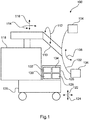
- a mobile medical imaging system 100 is shown.
- the mobile medical imaging system 100 has a mobile structure 102 in form of a C-arm. Attached to the mobile structure 102 is an imaging device comprising an X-ray source 104 and a detector unit 106.
- the mobile medical imaging system 100 will also be described in more details below with reference to the further drawings.
- the mobile structure 102 can be moved to change position, particularly an angle of the imaging device with respect to a reference point such as an operating table, as indicated by arrow 108.
- the mobile structure 102 is attached to a support member 110, which can be moved laterally, as indicated by arrow 112, in a vertical direction, as indicated by arrow 114 and in horizontal direction, as indicated by arrow 116.
- the support member 110 is connected to a base member 118 mounted to a mobility member 120, which can be moved laterally, as indicated by arrow 122 and horizontal, as indicated by arrow 124.
- Attached to the mobility member 120 is a positioning arrangement 126 that includes a positioning sensor 128 of a positioning arrangement.
- the positioning sensor 128 may be a transmitter or a receiver exchanging signals with a corresponding receiver or transmitter attached to a reference point, such as an object in an environment of the mobile medical imaging system 100.
- the positioning arrangement 126 comprises an output device 130, a memory 132, and a processor 134.
- the processor 134 is configured to determine a position of the mobile medical imaging system 100 using the positioning sensor 128 at a first instant, to store the position determined at the first instant in the memory 132 and to output instructions for moving the mobile structure 102 to the position stored in the memory 132 via the output device 130 at a second instant.
- a positioning-kit for positioning a mobile imaging system comprises a positioning arrangement as mentioned above and below, and a processor (also mentioned above).
- the processor is configured: to determine a current distance between the at least one positioning sensor and at least one object in an environment of the at least one positioning sensor; and to operate the at least one positioning sensor in the first mode, if the current distance between the at least one positioning sensor and the at least one object is greater than a predetermined threshold; and to operate the at least one positioning sensor in the second mode, if the current distance between the at least one positioning sensor and the at least one object is smaller than the predetermined threshold.
- the at least one positioning sensor and the processor are attachable to a mobile imaging system, such as the one shown in Fig. 1 .
- a kit is provided to upgrade an existing mobile imaging system, e.g. to achieve a system as described above.
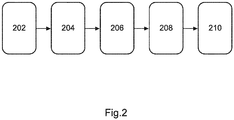
- a method for calculation of a current position of a mobile medical imaging system is shown.
- detection step 202 a signal is detected by a positioning sensor of the mobile medical imaging system.
- the signal detected in the detection step 202 is processed in processing step 204 by applying filters, such as bandpass filter, for example.
- filters such as bandpass filter, for example.
- a relative time stamping to distance conversion is performed in conversion step 206.
- the output of the conversion step 206 is used for calculation of an exact distance of the sensor to a particular object sensed by the sensor using a time-difference-of-arrival and/or a time-of-flight algorithm in sensing step 208.
- the exact distance calculated in the sensing step 208 is used as input for a hybrid positioning module 210 that switches at least one sensor of a positioning arrangement of the mobile medical imaging system between a first mode and a second mode and triggers the at least one sensor respectively.
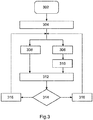
- a method for precise positioning of a mobile medical imaging system comprising two sensor modules, according to an embodiment, is shown.
- the system is started in starting step 302.
- an initializing step 304 a first positioning sensor and a second positioning sensor are initialized.
- a distance between the mobile positioning system and an object is determined using the first positioning sensor.
- the first positioning sensor is an ultrawideband sensor capable of sensing information in a non-line of sight environment.
- a distance between the mobile positioning system and the object is determined using the second positioning sensor.
- the second positioning sensor is an ultrasound sensor.
- an obstacle detection algorithm is performed in detection step 310. Therefore, particular measurements of the sensor units, i.e. measurements determined by particular transmitter-receiver pairs, are compared. If a differential value between a measurement determined by at least one sensor unit and a measurement determined by the remaining sensor units is greater than a given security threshold, an obstacle warning is shown in a user interface, for example.
- a distance between the mobile medical imaging system and at least one object in the environment is calculated based on the measurements determined in the first determination step 306 and/or the second determination step 308.
- the distance calculated in the calculation step 312 is compared with a predetermined threshold of 125 cm, for example. The outcome of this comparison is used to decide, whether the further positioning of the mobile medical imaging system is to be performed in a first mode 316 or in a second mode 318. Since in the first mode 316 a first spatial resolution is used that is preferably smaller than a second spatial resolution used in the second mode 318, the first mode 316 is used for coarse positioning of the mobile medical imaging system and the second mode 318 is used for fine positioning of the mobile medical imaging system.
- a positioning arrangement of the mobile medical imaging system is used in the first mode 316 with a first spatial resolution of one datapoint per 10 cm, for example. Respectively, further measurements for positioning the mobile medical imaging system are determined using the first positioning sensor in the first mode 316. However, if the distance determined in the calculation step 312 is smaller than the predetermined threshold, the positioning arrangement of the mobile medical imaging system is switched to the second mode 318 with a second spatial resolution of one datapoint per 5 mm, for example. Thus, further measurements for positioning the mobile medical imaging system are determined using the second positioning sensor in the second mode 318.
- the mobile medical imaging system can be moved much more precisely in the second mode 318 than in the first mode 316.
- the mobile medical imaging system can be moved very quick, i.e. with higher speed in the first mode 316 than in the second mode 318.
- the obstacle detection algorithm performed in the detection step 310 an operator can move the mobile medical imaging system with high speed even in a non-sight environment.
- the measurements determined in the first mode 316 or in the second mode 318 are used to calculate guiding instructions that are shown on a user interface, for example.
- the operator can maneuver the mobile medical imaging system according to the guiding instructions shown on the user interface with high speed, if the positioning system is run in the first mode 316.
- the operator can maneuver the mobile medical imaging system very precisely, if the positioning system is run in the second mode 318. Since the switching between the first mode 316 and the second mode 318 is performed automatically using the system disclosed herein, the operator who maneuvers the mobile medical imaging system can move the mobile medical imaging system with high speed towards a design space, such as a coordinate system around an operating table and move the mobile medical imaging system precisely within the design space.
- FIG. 4 an angular measurement is shown using a first transmitter 402 and a second transmitter 404 attached to a mobile medical imaging system 406.
- a dashed line 408 shows an alignment of a reference point, such as an operating table, for example.
- a first receiver 410 and a second receiver 412 are attached on the operating table. Since a first distance 414 between the first transmitter 402 and the first receiver 410 is smaller than a second distance 416 between the second transmitter 404 and the second receiver 412, the operating table must be in an angular alignment with the mobile medical imaging system 406.
- an angle 420 between the mobile medical imaging system 406 and the operating table can be calculated.
- the mobile medical imaging system comprises a mobile structure, such as a C-arm equipped with an imaging device.
- the medical imaging system can be a fluoro image system, for example.
- an imaging device is moved several times.
- the imaging device has to be re-positioned in a manual time consuming and iterative process involving try and error imaging after each movement. Therefore, a mobile structure that holds the imaging device is moved relative a patient's body and X-ray exposers are used to locate a current position of the imaging device relative to a position of the imaging device before it was moved.
- the patient's body is exposed to several radiation exposures that may be avoided using the mobile medical imaging system disclosed herein.
- the mobile medical imaging system disclosed herein can be positioned precise and fast using the positioning arrangement disclosed herein. Further, the mobile medical imaging system may present a warning, if an obstacle is recognized in a trajectory planned for a movement of the mobile medical imaging system.
- the mobile medical imaging system disclosed herein comprises a mobile structure for holding an imaging device and a positioning arrangement.
- the positioning arrangement comprises at least one positioning sensor that determines a current distance between a mobile structure of the mobile medical imaging system and at least one object in an environment of the mobile medical imaging system.
- the at least one positioning sensor is configured to operate in a first mode, if the current distance between the mobile medical imaging system and the at least one object is greater than a predetermined threshold, and to operate in a second mode, if the current distance between the mobile medical imaging system and the at least one object is smaller than the predetermined threshold.
- the mobile medical imaging system disclosed herein is based on a positioning arrangement with a hybrid sensor mechanism that makes use of a current distance to at least one reference point, such as an operating table or any other reference point, to switch the positioning system between a first and a second mode.
- the current distance to the at least one reference point is preferably determined using the at least one sensor of the positioning arrangement.
- the positioning arrangement is operated in the first mode with a first spatial resolution.
- the positioning arrangement is operated in the second mode with a second spatial resolution.
- the positioning arrangement is operated in the first mode for coarse positioning and in the second mode for fine positioning.
- the positioning arrangement may be a hybrid sensor system comprising a first sensor that is used in the first mode and a second sensor that is used in the second mode.
- the first positioning sensor is used for positioning the mobile medical imaging system, particularly a mobile structure of the mobile medical imaging system, in a coarse way and also detect obstacles. This means the first sensor is used with low accuracy, i.e. with a small spatial resolution that creates a smaller number of datapoints per distance compared to a high resolution that is used in the second mode.
- the first mode and the first sensor may be used to position the mobile structure towards a given design room.
- the second sensor is used in the second mode for positioning the mobile medical imaging system, particularly a mobile structure of the mobile medical imaging system in a fine way.
- the second sensor is used with high accuracy, i.e. with a high spatial resolution that creates a higher number of datapoints per distance compared to the first sensor used for coarse positioning at a small spatial resolution, for example.
- the second mode and the second sensor may be used to position the mobile structure within a given design room, such as a coordinate system, for example.
- the second spatial resolution used in the second mode is higher than the first spatial resolution used in the first mode and is based on a higher sampling rate, for example.
- the first sensor may be a sensor module capable of non-line of sight operation, such as an ultrawideband sensor module.
- the second sensor may be an ultrasound sensor module.
- the first sensor and the second sensor may be used as multiple receivers and single transmitter or single receiver and multiple transmitter configurations.
- An obstacle detection mechanism may be implemented based on at least one sensor. Therefore, each transmitter-receiver pair of the at least one sensor performs a distance measurement. If an obstacle is present between one of the transmitter-receiver pair and a particular reference point, the particular transmitter-receiver pair will show a difference in distance with respect to other transmitter-receiver pairs. With help of this mechanism asymmetric variation can be eliminated.
- the point at which the first positioning sensor is deactivated and the second positioning sensor is used i.e. the point where the positioning sensor used for positioning the mobile medical imaging system is switched, may be a given distance between the mobile medical imaging system and the reference point of about 125 cm, for example. This means that an automatic switching and triggering procedure from the first sensor to the second sensor is performed, if the mobile medical imaging systems is moved closer than 125 cm to the reference point.
- the invention disclosed herein is beneficial for a precise and fast positioning of a mobile medical imaging system.
- an overlay or stitching of pictures can be achieved.
- an overlay of pre-operation CT and/or MR image data with live 2D fluoro image data determined by the mobile medical imaging system can be achieved by using the systems and methods disclosed herein.
- a collision of the mobile medical imaging system with an obstacle can be avoided during movement of the mobile medical imaging system, even if a surgeon or an operator who is moving the mobile medical imaging system is not in a line of sight of a trajectory of the mobile medical imaging system.
- Fig. 5 shows a schematic illustration of a method 500 for positioning a mobile medical imaging system.
- the method 500 comprises the following steps: In a first step 502, also referred to as step a), a current distance between a mobile structure and at least one object in an environment of the mobile medical imaging system is determined by using a positioning arrangement comprising at least one positioning sensor. In a second step 504, also referred to as step b1), a current position of the mobile medical imaging system is determined using signals determined by the at least one positioning sensor in a first mode at a first spatial resolution, if the current distance between the mobile medical imaging system and the at least one object is greater than a predetermined threshold.
- a current position of the mobile medical imaging system is determined using signals determined by the at least one positioning sensor in a second mode at a second spatial resolution, which differs from the first spatial resolution, if the current distance between the mobile medical imaging system and the at least one object is smaller than the predetermined threshold.
- two or more transmitters on an operating table and three or more, preferably four transmitters on a particular imaging system are used to account for three degrees of freedom. Since the two transmitters on the operating table provide information for another three degrees of freedom, this embodiment accounts for six degrees of freedom.
- a computer program which may be executed by a processor, or a computer program element is provided, that is characterized by being adapted to execute the method steps of the method according to one of the preceding embodiments, on an appropriate system.
- the computer program element might therefore be stored on a computer unit, which might also be part of an embodiment of the present invention.
- This computing unit may be adapted to perform or induce a performing of the steps of the method described above. Moreover, it may be adapted to operate the components of the above described apparatus.
- the computing unit can be adapted to operate automatically and/or to execute the orders of a user.
- a computer program may be loaded into a working memory of a data processor.
- the data processor may thus be equipped to carry out the method of the invention.
- This exemplary embodiment of the invention covers both, a computer program that right from the beginning uses the invention and a computer program that by means of an up-date turns an existing program into a program that uses the invention.
- the computer program element might be able to provide all necessary steps to fulfil the procedure of an exemplary embodiment of the method 200 as described above.
- a computer readable medium such as a CD-ROM
- the computer readable medium has a computer program element stored on it which computer program element is described by the preceding section.
- a computer program may be stored and/or distributed on a suitable medium, such as an optical storage medium or a solid-state medium supplied together with or as part of other hardware, but may also be distributed in other forms, such as via the internet or other wired or wireless telecommunication systems.
- the computer program may also be presented over a network like the World Wide Web and can be downloaded into the working memory of a data processor from such a network.
- a medium for making a computer program element available for downloading is provided, which computer program element is arranged to perform a method according to one of the previously described embodiments of the invention.
Landscapes
- Health & Medical Sciences (AREA)
- Life Sciences & Earth Sciences (AREA)
- Medical Informatics (AREA)
- Engineering & Computer Science (AREA)
- Radiology & Medical Imaging (AREA)
- Biomedical Technology (AREA)
- Biophysics (AREA)
- Nuclear Medicine, Radiotherapy & Molecular Imaging (AREA)
- Optics & Photonics (AREA)
- Pathology (AREA)
- Physics & Mathematics (AREA)
- High Energy & Nuclear Physics (AREA)
- Heart & Thoracic Surgery (AREA)
- Molecular Biology (AREA)
- Surgery (AREA)
- Animal Behavior & Ethology (AREA)
- General Health & Medical Sciences (AREA)
- Public Health (AREA)
- Veterinary Medicine (AREA)
- Apparatus For Radiation Diagnosis (AREA)
Priority Applications (6)
| Application Number | Priority Date | Filing Date | Title |
|---|---|---|---|
| EP17193396.3A EP3461415A1 (en) | 2017-09-27 | 2017-09-27 | System and method for positioning a mobile medical imaging system |
| EP18770047.1A EP3687409B1 (en) | 2017-09-27 | 2018-09-25 | System and method for positioning a mobile medical imaging system |
| US16/649,701 US11213263B2 (en) | 2017-09-27 | 2018-09-25 | System and method for positioning a mobile medical imaging system |
| JP2020513879A JP7198808B2 (ja) | 2017-09-27 | 2018-09-25 | 可動性医療撮像システムを配置するシステム及び方法 |
| CN201880062476.4A CN111148472B (zh) | 2017-09-27 | 2018-09-25 | 用于定位移动医学成像系统的系统和方法 |
| PCT/EP2018/075912 WO2019063525A1 (en) | 2017-09-27 | 2018-09-25 | SYSTEM AND METHOD FOR POSITIONING A MOBILE MEDICAL IMAGING SYSTEM |
Applications Claiming Priority (1)
| Application Number | Priority Date | Filing Date | Title |
|---|---|---|---|
| EP17193396.3A EP3461415A1 (en) | 2017-09-27 | 2017-09-27 | System and method for positioning a mobile medical imaging system |
Publications (1)
| Publication Number | Publication Date |
|---|---|
| EP3461415A1 true EP3461415A1 (en) | 2019-04-03 |
Family
ID=60009443
Family Applications (2)
| Application Number | Title | Priority Date | Filing Date |
|---|---|---|---|
| EP17193396.3A Withdrawn EP3461415A1 (en) | 2017-09-27 | 2017-09-27 | System and method for positioning a mobile medical imaging system |
| EP18770047.1A Active EP3687409B1 (en) | 2017-09-27 | 2018-09-25 | System and method for positioning a mobile medical imaging system |
Family Applications After (1)
| Application Number | Title | Priority Date | Filing Date |
|---|---|---|---|
| EP18770047.1A Active EP3687409B1 (en) | 2017-09-27 | 2018-09-25 | System and method for positioning a mobile medical imaging system |
Country Status (5)
| Country | Link |
|---|---|
| US (1) | US11213263B2 (enExample) |
| EP (2) | EP3461415A1 (enExample) |
| JP (1) | JP7198808B2 (enExample) |
| CN (1) | CN111148472B (enExample) |
| WO (1) | WO2019063525A1 (enExample) |
Families Citing this family (2)
| Publication number | Priority date | Publication date | Assignee | Title |
|---|---|---|---|---|
| DE102021210771A1 (de) | 2021-09-27 | 2023-03-30 | Siemens Healthcare Gmbh | Verfahren zur Ansteuerung eines medizinischen Gerätes und Vorrichtung |
| CN118660668A (zh) * | 2022-01-26 | 2024-09-17 | 华沙整形外科股份有限公司 | 移动式x射线定位系统 |
Citations (4)
| Publication number | Priority date | Publication date | Assignee | Title |
|---|---|---|---|---|
| US7065393B2 (en) | 2002-07-11 | 2006-06-20 | Cedara Software Corp. | Apparatus, system and method of calibrating medical imaging systems |
| US20080031413A1 (en) * | 2006-08-03 | 2008-02-07 | Bernard Bouvier | Method for the reconstruction of a body map |
| US20140163736A1 (en) * | 2012-12-10 | 2014-06-12 | Intuitive Surgical Operations, Inc. | Collision avoidance during controlled movement of image capturing device and manipulatable device movable arms |
| US20160296185A1 (en) * | 2015-04-07 | 2016-10-13 | Siemens Healthcare Gmbh | Mobile c-arm system |
Family Cites Families (15)
| Publication number | Priority date | Publication date | Assignee | Title |
|---|---|---|---|---|
| JPS60175208U (ja) * | 1984-04-30 | 1985-11-20 | 株式会社島津製作所 | 医療用ベツド装置 |
| US5279309A (en) | 1991-06-13 | 1994-01-18 | International Business Machines Corporation | Signaling device and method for monitoring positions in a surgical operation |
| JPH09183087A (ja) * | 1995-12-28 | 1997-07-15 | Komatsu Ltd | 作業ロボット装置 |
| JP2001208504A (ja) * | 2000-01-28 | 2001-08-03 | Hitachi Medical Corp | 静電容量型距離センサ及びこれを用いた医用診断装置の障害物検出システム |
| US7159695B2 (en) * | 2001-05-25 | 2007-01-09 | Russell W. Strong | Dampening for a dolly wheel within a steering system |
| CN1297110C (zh) | 2003-07-02 | 2007-01-24 | 精工爱普生株式会社 | 液体喷射数据的数据传送装置、液体喷射装置 |
| US7319738B2 (en) | 2004-10-08 | 2008-01-15 | General Electric Company | Delivering X-ray systems to pipe installations |
| DE102005049106A1 (de) * | 2005-10-13 | 2007-04-19 | Siemens Ag | Medizinisches Bildgebungssystem und Kollisionsschutzverfahren mit regelbarem Arm |
| JP5343739B2 (ja) | 2009-07-02 | 2013-11-13 | ブラザー工業株式会社 | 出力装置及びプログラム |
| JP2012030320A (ja) * | 2010-07-30 | 2012-02-16 | Dainippon Screen Mfg Co Ltd | 作業システム、作業ロボット制御装置および作業プログラム |
| WO2013072810A1 (en) * | 2011-11-14 | 2013-05-23 | Koninklijke Philips Electronics N.V. | Positioning distance control for x-ray imaging systems |
| DE102012214016B4 (de) * | 2012-08-07 | 2015-09-24 | Siemens Aktiengesellschaft | C-Bogen-Röntgengerät mit einem C-Bogen und dazugehöriges Verfahren |
| WO2014027312A1 (en) * | 2012-08-17 | 2014-02-20 | Koninklijke Philips N.V. | Camera-based visual adustment of a movable x-ray imaging system |
| EP2910187B1 (en) | 2014-02-24 | 2018-04-11 | Université de Strasbourg (Etablissement Public National à Caractère Scientifique, Culturel et Professionnel) | Automatic multimodal real-time tracking of a moving marker for image plane alignment inside a MRI scanner |
| EP3348193B1 (en) * | 2015-09-08 | 2022-06-01 | FUJIFILM Corporation | Conveyance assistance method and conveyance assistance device for radiation emitting device, and radiological imaging device |
-
2017
- 2017-09-27 EP EP17193396.3A patent/EP3461415A1/en not_active Withdrawn
-
2018
- 2018-09-25 EP EP18770047.1A patent/EP3687409B1/en active Active
- 2018-09-25 WO PCT/EP2018/075912 patent/WO2019063525A1/en not_active Ceased
- 2018-09-25 US US16/649,701 patent/US11213263B2/en active Active
- 2018-09-25 CN CN201880062476.4A patent/CN111148472B/zh active Active
- 2018-09-25 JP JP2020513879A patent/JP7198808B2/ja active Active
Patent Citations (4)
| Publication number | Priority date | Publication date | Assignee | Title |
|---|---|---|---|---|
| US7065393B2 (en) | 2002-07-11 | 2006-06-20 | Cedara Software Corp. | Apparatus, system and method of calibrating medical imaging systems |
| US20080031413A1 (en) * | 2006-08-03 | 2008-02-07 | Bernard Bouvier | Method for the reconstruction of a body map |
| US20140163736A1 (en) * | 2012-12-10 | 2014-06-12 | Intuitive Surgical Operations, Inc. | Collision avoidance during controlled movement of image capturing device and manipulatable device movable arms |
| US20160296185A1 (en) * | 2015-04-07 | 2016-10-13 | Siemens Healthcare Gmbh | Mobile c-arm system |
Also Published As
| Publication number | Publication date |
|---|---|
| US20200253570A1 (en) | 2020-08-13 |
| EP3687409A1 (en) | 2020-08-05 |
| CN111148472A (zh) | 2020-05-12 |
| US11213263B2 (en) | 2022-01-04 |
| CN111148472B (zh) | 2023-11-17 |
| EP3687409B1 (en) | 2022-12-28 |
| JP2020534887A (ja) | 2020-12-03 |
| WO2019063525A1 (en) | 2019-04-04 |
| JP7198808B2 (ja) | 2023-01-04 |
Similar Documents
| Publication | Publication Date | Title |
|---|---|---|
| US9795357B2 (en) | Positioning distance control for X-ray imaging systems | |
| US7789562B2 (en) | Calibration of a multi-plane X-ray unit | |
| US10660599B2 (en) | Method and device for positioning an emitter | |
| CN111278380B (zh) | 用于追踪目标对象的位置的系统 | |
| CN106955120B (zh) | 成像方法及成像系统 | |
| EP3206585B1 (en) | Detector rotation controlled by x-ray collimation | |
| CN102961154A (zh) | 调节x射线系统的曝光视场的方法及装置和x射线系统 | |
| US20190254623A1 (en) | Integration of ultrasound and x-ray modalities | |
| US20120050277A1 (en) | Stereoscopic image displaying method and device | |
| JP6701438B1 (ja) | 合成画像生成システム及び初期条件リセットシステム | |
| WO2020157984A1 (ja) | 合成画像生成システム及び位置情報補正システム | |
| EP3687409B1 (en) | System and method for positioning a mobile medical imaging system | |
| EP2779906B1 (en) | User interface for x-ray positioning | |
| US20110004431A1 (en) | Device and method for computer-assisted 2d navigation in a medical procedure | |
| US20230248467A1 (en) | Method of medical navigation | |
| JP5441491B2 (ja) | X線診断装置 | |
| US20240335240A1 (en) | Camera tracking system identifying phantom markers during computer assisted surgery navigation | |
| EP4536085B1 (en) | Auto positioning of x-ray tube support with respect to detector | |
| JP2003079616A (ja) | 身体部位に挿入された検査器具の3次元位置の検出方法 | |
| JP2001525074A (ja) | 可動対象物の位置検出 | |
| US11890126B2 (en) | Radiation imaging apparatus | |
| US20220096165A1 (en) | Interventional device tracking | |
| JP2015006264A (ja) | 撮影装置および撮影方法 | |
| US20250124589A1 (en) | Radiation irradiation apparatus, operation method of radiation irradiation apparatus, and operation program | |
| WO2022264125A1 (en) | Systems and methods for detecting and monitoring a drape configuration |
Legal Events
| Date | Code | Title | Description |
|---|---|---|---|
| PUAI | Public reference made under article 153(3) epc to a published international application that has entered the european phase |
Free format text: ORIGINAL CODE: 0009012 |
|
| AK | Designated contracting states |
Kind code of ref document: A1 Designated state(s): AL AT BE BG CH CY CZ DE DK EE ES FI FR GB GR HR HU IE IS IT LI LT LU LV MC MK MT NL NO PL PT RO RS SE SI SK SM TR |
|
| AX | Request for extension of the european patent |
Extension state: BA ME |
|
| STAA | Information on the status of an ep patent application or granted ep patent |
Free format text: STATUS: THE APPLICATION IS DEEMED TO BE WITHDRAWN |
|
| 18D | Application deemed to be withdrawn |
Effective date: 20191005 |