EP3454807B1 - Negative pressure wound dressing management system - Google Patents
Negative pressure wound dressing management system Download PDFInfo
- Publication number
- EP3454807B1 EP3454807B1 EP17796717.1A EP17796717A EP3454807B1 EP 3454807 B1 EP3454807 B1 EP 3454807B1 EP 17796717 A EP17796717 A EP 17796717A EP 3454807 B1 EP3454807 B1 EP 3454807B1
- Authority
- EP
- European Patent Office
- Prior art keywords
- layer
- dressing
- wound
- negative pressure
- pump
- Prior art date
- Legal status (The legal status is an assumption and is not a legal conclusion. Google has not performed a legal analysis and makes no representation as to the accuracy of the status listed.)
- Active
Links
Images


Classifications
-
- A—HUMAN NECESSITIES
- A61—MEDICAL OR VETERINARY SCIENCE; HYGIENE
- A61F—FILTERS IMPLANTABLE INTO BLOOD VESSELS; PROSTHESES; DEVICES PROVIDING PATENCY TO, OR PREVENTING COLLAPSING OF, TUBULAR STRUCTURES OF THE BODY, e.g. STENTS; ORTHOPAEDIC, NURSING OR CONTRACEPTIVE DEVICES; FOMENTATION; TREATMENT OR PROTECTION OF EYES OR EARS; BANDAGES, DRESSINGS OR ABSORBENT PADS; FIRST-AID KITS
- A61F13/00—Bandages or dressings; Absorbent pads
- A61F13/05—Bandages or dressings; Absorbent pads specially adapted for use with sub-pressure or over-pressure therapy, wound drainage or wound irrigation, e.g. for use with negative-pressure wound therapy [NPWT]
-
- A—HUMAN NECESSITIES
- A61—MEDICAL OR VETERINARY SCIENCE; HYGIENE
- A61F—FILTERS IMPLANTABLE INTO BLOOD VESSELS; PROSTHESES; DEVICES PROVIDING PATENCY TO, OR PREVENTING COLLAPSING OF, TUBULAR STRUCTURES OF THE BODY, e.g. STENTS; ORTHOPAEDIC, NURSING OR CONTRACEPTIVE DEVICES; FOMENTATION; TREATMENT OR PROTECTION OF EYES OR EARS; BANDAGES, DRESSINGS OR ABSORBENT PADS; FIRST-AID KITS
- A61F13/00—Bandages or dressings; Absorbent pads
- A61F13/00051—Accessories for dressings
- A61F13/00059—Accessories for dressings provided with visual effects, e.g. printed or colored
-
- A—HUMAN NECESSITIES
- A61—MEDICAL OR VETERINARY SCIENCE; HYGIENE
- A61F—FILTERS IMPLANTABLE INTO BLOOD VESSELS; PROSTHESES; DEVICES PROVIDING PATENCY TO, OR PREVENTING COLLAPSING OF, TUBULAR STRUCTURES OF THE BODY, e.g. STENTS; ORTHOPAEDIC, NURSING OR CONTRACEPTIVE DEVICES; FOMENTATION; TREATMENT OR PROTECTION OF EYES OR EARS; BANDAGES, DRESSINGS OR ABSORBENT PADS; FIRST-AID KITS
- A61F13/00—Bandages or dressings; Absorbent pads
- A61F13/00051—Accessories for dressings
- A61F13/00055—Saturation indicators
-
- A—HUMAN NECESSITIES
- A61—MEDICAL OR VETERINARY SCIENCE; HYGIENE
- A61F—FILTERS IMPLANTABLE INTO BLOOD VESSELS; PROSTHESES; DEVICES PROVIDING PATENCY TO, OR PREVENTING COLLAPSING OF, TUBULAR STRUCTURES OF THE BODY, e.g. STENTS; ORTHOPAEDIC, NURSING OR CONTRACEPTIVE DEVICES; FOMENTATION; TREATMENT OR PROTECTION OF EYES OR EARS; BANDAGES, DRESSINGS OR ABSORBENT PADS; FIRST-AID KITS
- A61F13/00—Bandages or dressings; Absorbent pads
- A61F13/02—Adhesive bandages or dressings
- A61F13/0203—Adhesive bandages or dressings with fluid retention members
- A61F13/0206—Adhesive bandages or dressings with fluid retention members with absorbent fibrous layers, e.g. woven or non-woven absorbent pads or island dressings
-
- A—HUMAN NECESSITIES
- A61—MEDICAL OR VETERINARY SCIENCE; HYGIENE
- A61F—FILTERS IMPLANTABLE INTO BLOOD VESSELS; PROSTHESES; DEVICES PROVIDING PATENCY TO, OR PREVENTING COLLAPSING OF, TUBULAR STRUCTURES OF THE BODY, e.g. STENTS; ORTHOPAEDIC, NURSING OR CONTRACEPTIVE DEVICES; FOMENTATION; TREATMENT OR PROTECTION OF EYES OR EARS; BANDAGES, DRESSINGS OR ABSORBENT PADS; FIRST-AID KITS
- A61F13/00—Bandages or dressings; Absorbent pads
- A61F13/02—Adhesive bandages or dressings
- A61F13/0203—Adhesive bandages or dressings with fluid retention members
- A61F13/0213—Adhesive bandages or dressings with fluid retention members the fluid retention member being a layer of hydrocolloid, gel forming material
-
- A—HUMAN NECESSITIES
- A61—MEDICAL OR VETERINARY SCIENCE; HYGIENE
- A61F—FILTERS IMPLANTABLE INTO BLOOD VESSELS; PROSTHESES; DEVICES PROVIDING PATENCY TO, OR PREVENTING COLLAPSING OF, TUBULAR STRUCTURES OF THE BODY, e.g. STENTS; ORTHOPAEDIC, NURSING OR CONTRACEPTIVE DEVICES; FOMENTATION; TREATMENT OR PROTECTION OF EYES OR EARS; BANDAGES, DRESSINGS OR ABSORBENT PADS; FIRST-AID KITS
- A61F13/00—Bandages or dressings; Absorbent pads
- A61F13/02—Adhesive bandages or dressings
- A61F13/0203—Adhesive bandages or dressings with fluid retention members
- A61F13/022—Adhesive bandages or dressings with fluid retention members having more than one layer with different fluid retention characteristics
-
- A—HUMAN NECESSITIES
- A61—MEDICAL OR VETERINARY SCIENCE; HYGIENE
- A61M—DEVICES FOR INTRODUCING MEDIA INTO, OR ONTO, THE BODY; DEVICES FOR TRANSDUCING BODY MEDIA OR FOR TAKING MEDIA FROM THE BODY; DEVICES FOR PRODUCING OR ENDING SLEEP OR STUPOR
- A61M1/00—Suction or pumping devices for medical purposes; Devices for carrying-off, for treatment of, or for carrying-over, body-liquids; Drainage systems
- A61M1/71—Suction drainage systems
- A61M1/73—Suction drainage systems comprising sensors or indicators for physical values
-
- A—HUMAN NECESSITIES
- A61—MEDICAL OR VETERINARY SCIENCE; HYGIENE
- A61M—DEVICES FOR INTRODUCING MEDIA INTO, OR ONTO, THE BODY; DEVICES FOR TRANSDUCING BODY MEDIA OR FOR TAKING MEDIA FROM THE BODY; DEVICES FOR PRODUCING OR ENDING SLEEP OR STUPOR
- A61M1/00—Suction or pumping devices for medical purposes; Devices for carrying-off, for treatment of, or for carrying-over, body-liquids; Drainage systems
- A61M1/90—Negative pressure wound therapy devices, i.e. devices for applying suction to a wound to promote healing, e.g. including a vacuum dressing
- A61M1/91—Suction aspects of the dressing
- A61M1/912—Connectors between dressing and drainage tube
-
- A—HUMAN NECESSITIES
- A61—MEDICAL OR VETERINARY SCIENCE; HYGIENE
- A61M—DEVICES FOR INTRODUCING MEDIA INTO, OR ONTO, THE BODY; DEVICES FOR TRANSDUCING BODY MEDIA OR FOR TAKING MEDIA FROM THE BODY; DEVICES FOR PRODUCING OR ENDING SLEEP OR STUPOR
- A61M1/00—Suction or pumping devices for medical purposes; Devices for carrying-off, for treatment of, or for carrying-over, body-liquids; Drainage systems
- A61M1/90—Negative pressure wound therapy devices, i.e. devices for applying suction to a wound to promote healing, e.g. including a vacuum dressing
- A61M1/91—Suction aspects of the dressing
- A61M1/915—Constructional details of the pressure distribution manifold
-
- A—HUMAN NECESSITIES
- A61—MEDICAL OR VETERINARY SCIENCE; HYGIENE
- A61M—DEVICES FOR INTRODUCING MEDIA INTO, OR ONTO, THE BODY; DEVICES FOR TRANSDUCING BODY MEDIA OR FOR TAKING MEDIA FROM THE BODY; DEVICES FOR PRODUCING OR ENDING SLEEP OR STUPOR
- A61M1/00—Suction or pumping devices for medical purposes; Devices for carrying-off, for treatment of, or for carrying-over, body-liquids; Drainage systems
- A61M1/90—Negative pressure wound therapy devices, i.e. devices for applying suction to a wound to promote healing, e.g. including a vacuum dressing
- A61M1/98—Containers specifically adapted for negative pressure wound therapy
- A61M1/982—Containers specifically adapted for negative pressure wound therapy with means for detecting level of collected exudate
-
- A—HUMAN NECESSITIES
- A61—MEDICAL OR VETERINARY SCIENCE; HYGIENE
- A61M—DEVICES FOR INTRODUCING MEDIA INTO, OR ONTO, THE BODY; DEVICES FOR TRANSDUCING BODY MEDIA OR FOR TAKING MEDIA FROM THE BODY; DEVICES FOR PRODUCING OR ENDING SLEEP OR STUPOR
- A61M1/00—Suction or pumping devices for medical purposes; Devices for carrying-off, for treatment of, or for carrying-over, body-liquids; Drainage systems
- A61M1/90—Negative pressure wound therapy devices, i.e. devices for applying suction to a wound to promote healing, e.g. including a vacuum dressing
- A61M1/98—Containers specifically adapted for negative pressure wound therapy
- A61M1/984—Containers specifically adapted for negative pressure wound therapy portable on the body
-
- A—HUMAN NECESSITIES
- A61—MEDICAL OR VETERINARY SCIENCE; HYGIENE
- A61M—DEVICES FOR INTRODUCING MEDIA INTO, OR ONTO, THE BODY; DEVICES FOR TRANSDUCING BODY MEDIA OR FOR TAKING MEDIA FROM THE BODY; DEVICES FOR PRODUCING OR ENDING SLEEP OR STUPOR
- A61M27/00—Drainage appliance for wounds or the like, i.e. wound drains, implanted drains
-
- A—HUMAN NECESSITIES
- A61—MEDICAL OR VETERINARY SCIENCE; HYGIENE
- A61M—DEVICES FOR INTRODUCING MEDIA INTO, OR ONTO, THE BODY; DEVICES FOR TRANSDUCING BODY MEDIA OR FOR TAKING MEDIA FROM THE BODY; DEVICES FOR PRODUCING OR ENDING SLEEP OR STUPOR
- A61M1/00—Suction or pumping devices for medical purposes; Devices for carrying-off, for treatment of, or for carrying-over, body-liquids; Drainage systems
- A61M1/90—Negative pressure wound therapy devices, i.e. devices for applying suction to a wound to promote healing, e.g. including a vacuum dressing
- A61M1/98—Containers specifically adapted for negative pressure wound therapy
- A61M1/984—Containers specifically adapted for negative pressure wound therapy portable on the body
- A61M1/985—Containers specifically adapted for negative pressure wound therapy portable on the body the dressing itself forming the collection container
-
- A—HUMAN NECESSITIES
- A61—MEDICAL OR VETERINARY SCIENCE; HYGIENE
- A61M—DEVICES FOR INTRODUCING MEDIA INTO, OR ONTO, THE BODY; DEVICES FOR TRANSDUCING BODY MEDIA OR FOR TAKING MEDIA FROM THE BODY; DEVICES FOR PRODUCING OR ENDING SLEEP OR STUPOR
- A61M2205/00—General characteristics of the apparatus
- A61M2205/18—General characteristics of the apparatus with alarm
Definitions
- the present disclosure generally relates to wound dressing systems, and in particular, to a wound dressing system for use with a negative-pressure pump. Further, the present invention relates to dressings, systems for treating a wound with a dressing that can be used with a source of negative pressure to deliver negative pressure therapy.
- the dressing is suitable for the treatment of a variety of wounds including chronic and acute types including infected wounds, venous ulcers, diabetic ulcers, burns, surgical wounds and the like.
- Wound dressings are known and are generally suitable for treating a variety of wounds, including chronic and acute wound types, such as infected wounds, venous ulcers, diabetic ulcers, burns and surgical wounds.
- Negative pressure has been used to treat a range of chronic and acute wounds. Negative pressure may facilitate wound healing through a number of mechanisms, including removal of excess exudate, reduction in periwound edema and increased perfusion. Combined with the physical forces exerted by the negative pressure which draw the wound edges together, this can result in improved wound outcomes.
- Conventional devices are generally large and require the use of sophisticated equipment which may include a suction pump to generate negative pressure, a pressure regulator, canisters for the collection of wound exudate and a wound dressing to deliver the therapy to the wound site. As a result, such devices may be bulky, costly and confine the patient to bed or at least render the patient immobile and unable to go about their usual activities.
- portable systems which include a means to manage the exudate produced by the wound by collecting exudate within the wound dressing, typically in an absorbent material, and by evaporation through the dressing.
- a separate collection canister may not be an essential part of the system.
- An advantage of not needing a canister is that the device is less bulky and more portable.
- a disadvantage with such devices is that if the dressing exceeds its fluid handling capacity, exudate may be drawn from the absorbent material(s) and enter the pump. The presence of exudate in the pump will eventually cause it to fail and require its replacement.
- the therapy provided by the system may also be less than optimal due to the potential for excess exudate to collect at the wound interface.
- liquid barrier layer between the absorbent material and the pump.
- the liquid barrier layer does not however give the user of the device or care giver an indication that the dressing has exceeded its fluid handling capacity and needs to be changed.
- the user or care giver is given a visual indication of how much exudate is being produced by the wound by the presence of exudate in the canister.
- the presence of exudate in the canister will however only occur once the dressing has exceeded its fluid handling capacity. There is no early warning that the dressing needs to be changed.
- WO 2015/065612 A1 relating to a condensate absorbing and dissipating system, discloses a dressing for treating a tissue site including a base layer, a sealing member, a first and a second wicking layer, and an absorbent layer.
- the sealing member and the base layer may define an enclosure with the first and the second wicking layer disposed therein, and the absorbent layer positioned between the first and the second wicking layer.
- existing portable negative-pressure wound dressing systems often include rigid dressing and connection components, adversely affecting system utility and user comfort. Additionally, existing portable negative-pressure wound dressing systems do not utilize absorbent materials and additional wound dressing components arranged to maximize the management of wound exudate within the dressing. Thus, there exists a need for a portable exudate management system that incorporates these, and other, features.
- the present disclosure seeks to overcome limitations and other drawbacks of the prior art, and to provide new features not heretofore available. A full discussion of the features and advantages of the present disclosure is deferred to the following detailed description, which proceeds with reference to the accompanying drawings.
- the present invention relates to a negative pressure wound dressing according to the subject-matter of claim 1, and a negative pressure wound exudate management system comprising said wound dressing according to the subject-matter of claim 12.
- the present disclosure provides a negative pressure wound dressing for use in applying negative pressure to a wound comprising: an absorbent layer capable of absorbing exudate from the wound and allowing the passage of fluid through it; an outer cover layer covering the side of the absorbent layer furthest from the wound, the cover layer adapted to enable negative pressure to be applied at the wound and having a port; a conduit having a proximal end attached to the port and a distal end, the dressing provided with a pathway for fluid from the wound, through the absorbent layer, the port and to the distal end of the conduit; and an indicator means positioned in the pathway at a location between the absorbent layer and the distal end of the conduit, the indicator means capable of absorbing exudate to indicate the presence of exudate at the side of the absorbent layer furthest from the wound.
- the present disclosure provides a negative pressure wound dressing for use in applying negative pressure to a wound comprising: an absorbent layer capable of absorbing exudate from the wound and allowing the passage of fluid through it; an outer cover layer covering the side of the absorbent layer furthest from the wound, the cover layer adapted to enable negative pressure to be applied at the wound and having a port; a conduit having a proximal end attached to the port and a distal end, the dressing provided with a pathway for fluid from the wound, through the absorbent layer, the port and to the distal end of the conduit; an indicator means positioned in the pathway at a location between the absorbent layer and the distal end of the conduit, the indicator means capable of absorbing exudate to indicate the presence of exudate at the side of the absorbent layer furthest from the wound; and a source of negative pressure connected to the distal end of the conduit.
- the source of negative pressure is capable of generating a minimum of 75mmHg and a maximum of 125mmHg at the wound.
- a wound exudate management system comprises a pump for generating negative pressure, a dressing for covering and protecting a wound, the dressing comprising an adhesive layer for adhering the dressing adjacent the wound, a wound contact layer for contacting the wound, a pressure dispersion layer, a plurality of layers of absorbent material disposed between the wound contact layer and the pressure dispersion layer, and a backing layer having a first surface and a second surface, the first surface of the backing layer being adjacent, and in contact with, the pressure dispersion layer and the adhesive layer, a pressure tube having an interior lumen, the pressure tube disposed between the pump and the dressing such that the pump and the dressing are in fluid communication via the interior lumen, and, a flexible connector connected to the second surface of the backing layer.
- the disclosed technology further relates to a dressing for covering and protecting a wound.
- the disclosed technology further relates to a wound exudate management system, comprising: a dressing for covering and protecting a wound, the dressing comprising: a wound contact layer, the wound contact layer having a first surface and a second surface, the wound contact layer further having a peripheral region and a central region, wherein the first surface of the wound contact layer contacts the wound when the dressing is adhered to skin adjacent the wound, a pressure dispersion layer having a peripheral region and a central region, a plurality of layers of absorbent material disposed between the second surface of the wound contact layer and the pressure dispersion layer, and, an envelope formed by joining the peripheral region of the pressure dispersion layer with the peripheral region of the second surface of the wound contact layer, the plurality of layers of absorbent material being disposed substantially within an interior cavity of the envelope.
- an envelope may be formed by joining the peripheral region of a thermoplastic spun lace layer connected to the pressure dispersion layer with the peripheral region of a nonwoven spun lace layer connected to the second surface of the wound contact layer, such that the plurality of layers of absorbent material are disposed substantially within an interior cavity of the envelope.
- the disclosed technology further relates to a wound exudate management system further comprising a thermoplastic spun lace layer connected to the pressure dispersion layer, and a nonwoven spun lace layer connected to the wound contact layer, and wherein the envelope is formed by joining peripheral portions of the thermoplastic spun lace layer and the nonwoven spun lace layer, wherein the interior cavity of the envelope is formed by the nonwoven spun lace layer and the thermoplastic spun lace layer, and wherein the plurality of layers of absorbent material are disposed substantially within an interior cavity of the envelope.
- the disclosed technology further relates to a wound exudate management system, comprising: a dressing for covering and protecting a wound, the dressing comprising a wound contact layer, a backing layer and at least one layer of absorbent material layer between the wound contact layer and the backing layer, a flexible connector having an interior lumen, the flexible connector secured to the backing layer of the dressing, an indicator between the backing layer and the flexible connector, a tube having an interior lumen, the tube connected to the flexible connector, wherein the interior lumen of the flexible connector and the interior lumen of the tube are in fluid communication, and, a pressure conveyance member disposed within the interior lumen of the tube.
- the disclosed technology further relates to a wound exudate management system, comprising: a pump for generating negative pressure, a dressing for covering and protecting a wound, the dressing comprising a wound contact layer, a backing layer and at least one layer of absorbent material between the wound contact layer and the backing layer, a tube connecting the pump and the dressing, the tube having an interior lumen for placing the pump and the dressing in fluid communication via the interior lumen, and, a one-way valve in-line between the pump and the dressing to maintain a negative pressure within the dressing when the pump is disconnected from the tube.
- the disclosed technology further relates to a wound exudate management system, comprising: a pump for generating negative pressure, a dressing for covering and protecting a wound, a tube including an interior lumen, the tube disposed between the pump and the dressing such that the pump and the dressing are in fluid communication via the interior lumen of the tube, and, a plurality of layers of absorbent material disposed in the dressing, wherein the absorbent material has fibers that swell upon contact with wound exudate to manage a flow of wound exudate through a portion of the dressing.
- the system may be adapted to allow for fluid communication between the wound and a negative pressure source, such as a pump.
- a fluid communication pathway is provided from the wound, through the wound contact layer and through one or more layers of absorbent material disposed in the dressing, to the negative pressure source.
- the fluid communication pathway may extend though an opening in the backing layer to the interior lumen of a tube, optionally via the interior lumen or conduit of a flexible connector.
- an indicator such as an absorbent indicator member is present, the fluid communication pathway may also extend through the indicator.
- the flexible connector is elongate with an interior lumen or conduit that runs parallel to the longitudinal axis of the flexible connector, wherein the flexible connector is attachable to the opening in the backing layer of the dressing in an orientation such that the longitudinal axis of the flexible connector is substantially parallel to the plane of the backing layer.
- the flexible member may comprise a head portion for securement to the backing layer via adhesive or other means.
- the fluid communication pathway extends from the interior lumen or conduit of the flexible connector through the opening in the backing layer in a direction substantially perpendicular to the longitudinal axis of the flexible connector. Once secured, a fluid-tight seal may be formed between the flexible connector and the backing layer.
- the presence of an indicator means may have the advantage that the user or caregiver is given an indication of the need to change the dressing.
- the indicator means allows the user or caregiver to change the dressing and prevent fouling of the pump.
- the presence of exudate at the side of the absorbent layer furthest from the wound occurs when the absorbent layer has absorbed significant quantities of exudate. If the indicator means is located in the conduit of the dressing and is triggered by the absorption of exudate, exudate is present not only at the side of the absorbent layer furthest from the wound but has also been drawn out past the cover layer and into the conduit. It gives a forewarning to the user or caregiver that the fluid handling capacity of the dressing has been or shortly will be reached and that dressing change is advisable.
- the indicator means can give an indication that the dressing has reached its fluid handling capacity and that there is potential for exudate to be drawn from the dressing, into the conduit and eventually into the pump which is undesirable.
- the indicator means may be visual or may result in an audible alarm or other signal.
- the indicator means is visual and is located so that it is visible to the user of the dressing.
- the visual indicator means may be located in the port in the cover layer or it may be located in the conduit or in both the port and conduit.
- the visual indicator means may be located to traverse the opening in the backing layer and/or be located in the interior lumen or conduit of the flexible connector.
- the visual indicator means is a gelling absorbent which visually indicates that it has absorbed exudate by forming a gel. If the exudate is coloured then the gel will also be coloured and add to the visual indication.
- the visual indicator means may indicate that it has absorbed exudate by changing colour for instance by activation of a dye in the indicator means.
- the indicator means is provided by gel-forming fibres.
- gel forming fibres is meant hygroscopic fibres which upon the uptake of wound exudate become moist slippery or gelatinous.
- the gel forming fibres can be of the type which retain their structural integrity on absorption of exudate or can be of the type which lose their fibrous form and become an amorphous or structureless gel.
- the gel forming fibres are preferably sodium carboxymethylcellulose fibres, chemically modified cellulosic fibres, alkyl sulphonate modified cellulosic fibres such as those described in WO2012/061225 , pectin fibres, alginate fibres, chitosan fibres, hyaluronic acid fibres, or other polysaccharide fibres or fibres derived from gums.
- the cellulosic fibres preferably have a degree of substitution of at least 0.05 carboxymethyl groups per glucose unit.
- the gel forming fibres preferably have an absorbency of at least 2 grams 0.9% saline solution per gram of fibre (as measured by the free swell method).
- the gel forming fibres are preferably chemically modified cellulosic fibres in the form of a fabric and in particular carboxymethylated cellulose fibres as described in PCT WO00/01425 to Azko Nobel UK Ltd .
- the indicator means can be provided by a layer of gel forming fibres preferably located in the port of the cover layer or as a layer of fibres in the conduit.
- the layer of fibres can also serve to keep the conduit open to the passage of fluid in the event that the conduit is kinked or otherwise restricted by being lain on or leaned on by the user.
- the carboxymethylated cellullosic fabrics preferably have a degree of substitution between 0.12 to 0.35 as measured by IR spectroscopy (as defined in WO00/01425 ) more preferably a degree of substitution of between 0.20 and 0.30 and are made by carboxymethylating a woven or non-woven cellulosic fabric such that the absorbency is increased.
- Particular preferred fabrics have an absorbency of between 10g/g of sodium/calcium chloride as defined above to 30g/g of sodium/calcium chloride as measured by the method described in BS EN 13726-1 (2002) "Test methods for primary wound dressings", section 3.2 "Free swell absorptive capacity".
- Particularly preferred fabrics have an absorbency of 15g/g to 25g/g and most preferred of 15g/g to 20g/g of sodium/calcium chloride as measured by the method defined above.
- the cellulosic fabric preferably consists solely of cellulosic fibre but may contain a proportion of non-cellulosic textile fibre or gel forming fibre.
- the cellulosic fibre is of known kind and may comprise continuous filament yarn and/or staple fibre.
- the carboxymethylation is generally performed by contacting the fabric with an alkali and a carboxymethylating agent such a chloracetic acid in an aqueous system.
- the fabric is preferably of a non-woven type to reduce shedding in the wound on cutting the dressing.
- the fabric is hydroentangled and thus comprises a series of apertures on a microscopic scale.
- the absorbent layer of the dressing is capable of absorbing exudate from the wound and allowing the passage of fluid through it.
- the absorbent layer can comprise any absorbent capable of absorbing exudate while allowing the passage of fluid through it, such as a foam, sponge or fibre-based material, preferably the absorbent layer is provided by gel forming fibres of the same type or of a different type as those used in the indicator means.
- the gel-forming fibres are hygroscopic fibres which upon the uptake of wound exudate become moist slippery or gelatinous and thus reduce the tendency for the surrounding fibres to adhere to the wound.
- the gel forming fibres are preferably spun sodium carboxymethylcellulose fibres, chemically modified cellulosic fibres, alkyl sulphonate modified cellulosic fibres such as those described in WO2012/061225 , pectin fibres, alginate fibres, chitosan fibres, hyaluronic acid fibres, or other polysaccharide fibres or fibres derived from gums.
- the cellulosic fibres preferably have a degree of substitution of at least 0.05 carboxymethyl groups per glucose unit and more preferably are lightly substituted so that the absorbency of the fibres is limited.
- the gel forming fibres preferably have an absorbency of at least 2 grams 0.9% saline solution per gram of fibre (as measured by the method described above) but less than 30 grams 0.9% saline solution per gram of fibre.
- the gel forming fibres are preferably carboxymethylated cellulose fibres as described in PCT WO00/01425 to Azko Nobel UK Ltd which describes lightly carboxymethylated cellulose fabrics and more preferably are of the type used in the indicator means.
- the gel forming fibres are preferably lightly carboxymethylated in order to reduce the tendency of the absorbent layer to gel block and block the pathway for fluid from the wound, through the absorbent layer, the port and to the distal end of the conduit.
- the absorbent layer is provided with fenestrations to aid the application of negative pressure to the wound and maintain the pathway for fluid from the wound, through the absorbent layer.
- fenestrations are only provided in internal absorbent layers.
- the dressing comprises a wound contact layer, positioned between the wound and the absorbent layer.
- the wound contact layer is capable of absorbing exudate from the wound and transmitting it to the absorbent layer.
- the wound contact layer is capable of allowing the passage of fluid through it so that negative pressure may applied to the wound and the pathway for fluid from the wound and to the distal end of the conduit may be maintained.
- the wound contact layer comprises gel-forming fibres of the same or a similar type to those comprising the absorbent layer but the wound contact layer may be strengthened to increase its integrity and that of the dressing.
- the wound contact layer may be of the type described in EP 1904011 and comprise gel-forming fibres in the form of a mat with lines of longitudinal stitching made of cellulose or nylon or polyolefin yarn to increase the integrity of the layer.
- the wound contact layer is porous to maintain the pathway for fluid from the wound to the distal end of the conduit.
- the outer cover layer of the dressing is a bacterial and viral barrier layer which preferably resists the ingress of liquid and air but allows moisture vapour transmission. In this way the outer cover layer enhances the overall fluid handling capacity of the dressing by allowing for the escape of moisture vapour through the cover while enabling the application of negative pressure to the wound.
- the outer cover layer is for instance a layer having a MVTR of at least 10,000 g m-2 per 24 hours or in the range of from 10,000gm-2 to 50,000g m-2 per 24 hours measured by the method described in BS EN 13726-2 2002 "Test methods for primary wound dressings Part 2 Moisture vapour transmission rate of permeable film dressings".
- the cover layer may be in the form of a film of polyurethane, for example Epurex 912 T/129 manufactured by Covestro or Inspire 2350 manufactures by Coveris or Medifilm 426 manufactured by Mylan.
- the cover layer is provided with a port for connection to the conduit.
- the port is preferably located in that part of the cover layer that overlies the absorbent layer but towards the periphery of the absorbent layer so that it is not directly in vertical alignment with the centre of the dressing (or the wound when in use). This assists in the spread of exudate across the full extent of the absorbent layer.
- the conduit of the dressing is preferably a transparent passageway secured to the outside of the cover layer at the proximal end of the conduit so as to surround the port in the cover layer from above. In this manner if the visual indicator is located in the port in the cover layer and/or in the conduit itself, the visual indicator may be seen by the user.
- the wound exudate management systems comprise a flexible connector
- the flexible connector may be partially or entirely transparent so as to allow the visual indicator to be seen by the user.
- the head of the flexible connector is transparent.
- the conduit of the dressing may comprise a connector, at its distal end, for connecting the dressing to a source of negative pressure, for example a pump.
- the connector is a luer lock to facilitate secure connection to the pump and to maintain the negative pressure on the wound while the pump is temporarily disconnected.
- the connector preferably comprises a one way lock to assist in the maintenance of negative pressure.
- the visual indicator may be located in the conduit and can be in the form of a knitted cylinder, or the like, of gel forming fibres.
- the conduit may comprise an internal cylinder of nylon fibres to maintain openness of the conduit to fluid.
- the dressing comprises a distribution layer, e.g., a pressure distribution layer, located between the absorbent layer and the outer cover layer which is gas and liquid permeable and moisture vapour permeable and serves to aid access of exudate to a greater area of the absorbent layer by allowing it to spread under the distribution layer.
- the distribution layer also serves to even out the negative pressure applied to the wound over the whole dressing.
- the distribution layer preferably distributes exudate and negative pressure over the dressing. In this way, uptake of exudate by the absorbent layer is maximised before the exudate leaves the absorbent layer and activates the indicator means and the transfer of negative pressure to the wound is optimised.
- the distribution layer is a foam layer such as a polyester foam of the type XD4200AS manufactured by Caligen or another suitable reticulated foam.
- the dressing may also comprise additional optional layers such as an adhesive layer for adhering the dressing to the skin surrounding the wound to form a fluid tight seal.
- the adhesive layer may be applied to the side of dressing closest to the wound and may be provided with perforations to assist transport of exudate and fluid through the dressing.
- the adhesive layer may also be applied to any of the other layers to provide an island configuration such as to the cover layer.
- wound exudate management system discussed herein may be implemented in many different forms, there is shown in the drawings, and will herein describe in detail, preferred implementations with the understanding that the present description is to be considered as an exemplification of the principles of the wound exudate management system and is not intended to limit the broad aspects of the disclosure to the implementations illustrated.
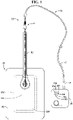
- the wound exudate management system 10 of this embodiment has a wound dressing 14, a pump 18 and a tube 22 (also referred to as a pressure tube 22).
- the wound exudate management system 10 facilitates wound healing and wound protection.
- the dressing 14 is applied to the skin of a user, as will be described below, and the system 10 utilizes negative pressure generated by the pump 18 to aid wound healing.
- the dressing 14 and the pump 18 are fluidly connected via the tube 22. Negative pressure generated by the pump 18 is communicated to the dressing 14 by the tube 22, thereby enabling the dressing 14 to employ negative pressure for enhanced wound healing.
- the pump 18 operates to generate negative pressure in response to a variety of user inputs.
- a user control 30 for the pump 18 is disposed on the pump 18 and/or remote to the pump 18.
- the user control 30 may be one or more of a button, switch, lever, sensor or any other control device. It is to be understood that any common user control 30 is within the scope of this disclosure.
- the pump 18 may also have one or more indicators 34a, 34b, 34c disposed on the pump 18 for apprising the pump user of a current operational status, condition, battery life, etc. of the pump 18.
- the indicators 34a-c may be lights including Light-Emitting Diodes (LEDs), however any other type of indicator may be used such as a speaker for generating an audible sound or a motor with a radially asymmetric flywheel for generating a vibration.
- Instructional indicia 36a, 36b, 36c may be associated with one or more of the indicators 34a-c for apprising a user of the significance of an operation of a particular indicator 34a-c. In some implementations, however, the pump 18 operates without a user input and generates negative pressure in response to a timer, remote signal, sensor reading or other stimulus.
- the indicators 34a-c for the pump 18 are preferably not illuminated. In such a state, the pump 18 is generally not generating negative pressure, which may correspond to the pump 18 being in an off condition. Further, in one embodiment, when all of indicators 34a-c transition to an illuminated state, the pump 18 is preferably in a ready state and is ready for use. Further, in one embodiment, when one indicator 34a remains in an illuminated state and the remaining indicators 34b and 34c transition to a non-illuminated state, this is an indication that the pump 18 is in an operating state. Normal operation of the pump 18 may include the generation of negative pressure, alternating periods of negative pressure generation, and/or no generation of negative pressure.
- the pump 18 may transition between one or more of the off condition, ready state and operating state as a result of manipulation of the user control 30.
- Manipulation of the user control 30 to change the pump state may include and/or require manipulation of the user control 30 for a predetermined amount of time.
- the pump 18 In the operational state, in a preferred embodiment the pump 18 generates a minimum pressure of 75mmHg at the wound and a maximum pressure of 125mmHg at the wound, however, alternate pressures may be generated by the pump 18. In one embodiment, the pump 18 generates negative pressure until a first pressure threshold is reached.
- the first pressure threshold may be, for example, a value between 75mmHg and 125mmHg, inclusive. The pump 18 may then refrain from generating negative pressure until a second threshold pressure is reached, at which point the pump 18 may generate negative pressure until the first pressure threshold is again reached. Alternate operations of the pump are allowable.
- the pump 18 is connected to the pressure tube 22 with a pump connector 38.
- the pump connector 38 may allow for selective separation of the pump 18 and the tube 22.
- the tube 22 comprises a distal tube portion 40 and a proximal tubular portion 42.
- the proximal tubular portion 42 may be an extension of the flexible connector 50.
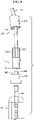
- a separable connector 44 may join the distal tube portion 40 and the proximal tubular portion 42, as shown in FIGS. 7 and 8 .
- the pump connector 38 connects one end of the tube 22, and preferably the distal tube 40 portion of the tube 22, to the pump 18, as shown in FIG. 1 .
- the pump connector 38 may connect the proximal tubular portion 42 to the pump 18.
- the distal tube portion 40 forms a portion of the pressure tube 22 and may be flexible, transparent, partially-transparent, and/or formed from a polymer, metal, metal alloy or any other suitable material.
- the flexible connector 50 is structurally connected to the dressing 14, and further includes a flexible connector lumen 54.
- the flexible connector lumen 54 is disposed within the flexible connector 50 along a portion, or all, of the flexible connector 50 and enables fluid communication between the pump 18 and the dressing 14.
- a flexible connector aperture 60 enables fluid communication between the flexible connector lumen 54 and the dressing 14.
- the flexible connector 50 may include a lower flexible connector portion 66 and an upper flexible connector portion 67.
- the lower flexible connector portion 66 and the upper flexible connector portion 67 may be joined by welding, adhesives or any other joining technique to form the flexible connector 50.
- the flexible connector 50 may preferably be formed from polyvinyl chloride, polyurethane or any other suitable material.
- the flexible connector 50 has a generally planar exterior surface.
- a pressure conveyance structure 62 is disposed within the flexible connector lumen 54.
- the pressure conveyance structure 62 enables the flexible connector 50 to convey fluid flow and/or pressure within the flexible connector lumen 54 without collapsing when the flexible connector 50 is made of a thin-walled flexible material, thereby enabling the dressing 14 to experience or exhibit negative pressure generated by the pump 18.
- the pressure conveyance structure 62 may include various materials including, but not limited to, nylon. Further, the pressure conveyance structure 62 may be comprised of a lattice structure 53.
- the shape, material and arrangement of the pressure conveyance structure 62 enables continued fluid flow along the flexible connector 50 that may otherwise be hindered by the shape, flexibility, material or arrangement of the flexible connector 50 in light of negative pressure generated by the pump 18 and in light of general wound exudate management system 10 use and positioning.
- the dressing 14 preferably includes an indicator 70, which in one embodiment is an upper absorbent indicator member 70 formed of an absorbent material.
- the indicator 70 may produce a signal, such as a visual, audible, vibrational, etc. signal.
- the absorbent material may include gel-forming fibers, which may be hygroscopic fibers that become moist, slippery or gelatinous upon the intake of wound exudate or other fluids. The gel-forming fibers may retain their structural integrity upon absorption of exudate or they may lose their fibrous form and become an amorphous or structure-less gel.
- the gel-forming fibers are, in some implementations, sodium carboxymethylcellulose fibers, chemically modified cellulosic fibers, alkyl sulphonate modified cellulosic fibers such as those described in WO2012/061225 , pectin fibers, alginate fibers, chitosan fibers, hyaluronic acid fibers, other polysaccharide fibers or fibers derived from gums.
- the cellulosic fibers exemplarily have a degree of substitution of at least 0.05 carboxymethyl groups per glucose unit.
- the gel-forming fibers may have an absorbency of at least 2 grams 0.9% saline solution per gram of fiber (as measured by a free swell method) but less than 30 grams 0.9% saline solution per gram of fiber.
- the gel-forming fibers are preferably chemically modified cellulosic fibers in the form of a fabric and in particular carboxymethylated cellulose fibers as described in PCT WO00/01425 to Azko Nobel UK Ltd .
- the carboxymethylated cellullosic fabrics exemplarily have a degree of substitution between 0.12 to 0.35 as measured by IR spectroscopy (as defined in WO00/01425 ) and further may have a degree of substitution of between 0.20 and 0.30.
- the carboxymethylated cellullosic fabrics may be formed by carboxymethylating a woven or non-woven cellulosic fabric such that absorbency is increased.
- the fabric may have an absorbency of between 10g/g of sodium/calcium chloride to 30g/g of sodium/calcium chloride as measured by the method described in BS EN 13726-1 (2002) "Test methods for primary wound dressings", section 3.2 "Free swell absorptive capacity.” Some fabrics have an absorbency of 15g/g to 25g/g or 15g/g to 20g/g of sodium/calcium chloride.
- the gel-forming fibers may be lightly carboxymethylated to reduce a tendency of the absorbent material to gel block and block a fluid pathway from the wound and through the dressing 14.
- the cellulosic fabric may consist solely of cellulosic fiber but may also contain non-cellulosic textile fibers or gel-forming fibers.
- the cellulosic fiber may be of known kind and may include continuous filament yarn and/or staple fiber.
- the carboxymethylation may be performed by contacting the fabric with an alkali and a carboxymethylating agent, such a chloracetic acid in an aqueous system.
- the fabric may be of a non-woven type, and may further be hydroentangled and thus comprise a series of apertures on a microscopic scale.
- the absorbent material may also comprise any absorbent material capable of absorbing exudate while allowing the passage of fluid therethrough, such as a foam, sponge or fiber-based material.
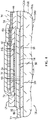
- the upper absorbent indicator member 70 is preferably above the backing layer 82 and may be adjacent, joined to and/or in contact with the flexible connector 50 and may also be adjacent the flexible connector aperture 60. As best shown in FIG. 4 , in one embodiment a first side of an upper adhesive 74 is adhered to both the upper absorbent indicator member 70 and the lower flexible connector portion 66 of the flexible connector 50. The lower flexible connector portion 66 is preferably adhered to a portion of the first side of the upper adhesive 74 radially outward from a portion of the upper adhesive 74 to which the upper absorbent indicator member 70 is adhered.
- the upper adhesive 74 also has an upper adhesive aperture 78 extending from the first side of the upper adhesive 74 to a second side of the upper adhesive 74 and arranged to be adjacent the upper absorbent indicator member 70 to limit interference with the vacuum effect of the negative pressure draw through the upper absorbent indicator member 70.
- a backing layer 82 is disposed between both the indicator member 70 and the flexible connector 50 and the plurality of absorbent layers of the dressing 14.
- the backing layer 82 is disposed below the upper adhesive 74.
- the backing layer 82 preferably has a backing layer aperture 86 disposed through the backing layer 82, and extending from a first surface 83 of the backing layer 82 to a second surface 84 of the backing layer.
- the upper adhesive 74 is provided adjacent the second surface 84 of the backing layer 82.
- the aperture 86 of the backing layer 82 is provided adjacent the aperture 78 in the upper adhesive 74.
- the backing layer 82 is a bacterial and viral barrier layer which resists the ingress of liquid and air while allowing moisture vapor transmission. In this way, the backing layer 82 enhances an overall fluid handling capacity of the dressing 14 by allowing moisture vapor to escape through the backing layer 82 while enabling the application of negative pressure to the wound or dressing 14.
- the backing layer 82 may have a Moisture Vapor Transmission Rate (MVTR) of at least 10,000 g/m 2 per 24 hours or in the range of from 10,000g/m 2 to 50,000g/m 2 per 24 hours measured by the method described in BS EN 13726-2 2002 "Test methods for primary wound dressings Part 2 Moisture vapour transmission rate of permeable film dressings.”
- the backing layer 82 may be partially or fully transparent.
- the backing layer 82 may be a layer, or film, of polyurethane, for example Epurex 912 T/129 manufactured by Covestro or Inspire 2350 manufactures by Coveris or Medifilm 426 manufactured by Mylan.
- a layer of adhesive 90 is disposed adjacent the second surface 82b of the backing layer 82.
- the backing layer adhesive 90 includes a backing layer adhesive aperture 94 preferably extending through the backing layer adhesive 90 from a first surface of the backing layer adhesive 90 to a second surface of the backing layer adhesive 90.
- the aperture 94 in the backing layer adhesive 90 is preferably positioned adjacent the aperture 78 in the upper adhesive member 74.
- the flexible connector aperture 60, upper absorbent indicator member 70, upper adhesive aperture 78, backing layer aperture 86 and backing layer adhesive aperture 94 are all arranged substantially concentric such that fluid flow is enabled from the flexible connector aperture 60, across the upper absorbent indicator member 70, and through the upper adhesive aperture 78, backing layer aperture 86 and backing layer adhesive aperture 94.
- the upper flexible connector portion 67, lower flexible connector portion 66, upper absorbent indicator member 70, upper adhesive 74, backing layer 82, and backing layer adhesive 90 are arranged sequentially in the wound exudate management system 10.
- the inner envelope structure 100 preferably houses a plurality of layers of absorbent material to aid in exudate management.
- the inner envelope structure 100 is defined by an upper envelope layer and a lower envelope layer.
- the upper envelope layer may have a peripheral section 108 and a central section 109.
- the peripheral section 108 of the upper envelope layer may also be referred to as the upper peripheral section 108, and the central section 109 of the upper envelope layer may also be referred to the upper central section 109.
- the lower envelope layer may have a peripheral section 116 and a central section 117.
- the peripheral section 116 of the lower envelope layer may be referred to as the lower peripheral section 116, and the central section 117 of the lower envelope layer may be referred to as the lower central section 117.
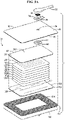
- FIGS. 3B and 5B An alternate embodiment of the dressing 14 of the wound management system 10 is shown in FIGS. 3B and 5B .
- a nonwoven spun lace layer 119 is preferably stitchbonded to the second surface 113 of the wound contact layer 112.
- a regenerated cellulose yarn is used for the stitchbonding.
- the nonwoven spun lace material 119 may be comprised of an 80 gsm nonwoven layer comprising viscose fibers and polyester fibers in substantially equal portion, and preferably less than 5% acrylic co-polymer binder.
- a thermoplastic spun lace layer 121 such as a polyamide layer, may be provided between the pressure dispensing layer 104 and the plurality of absorbent material layers 130.
- the thermoplastic spun lace layer 121 has a first surface 123 that may be heat bonded at its perimeter to the pressure dispersing layer 104, and a second surface 125 that may be similarly heat bonded at its perimeter around the plurality of absorbent material layers 130 to the nonwoven spun lace layer 119. Accordingly, the thermoplastic spun lace layer 121 and the nonwoven spun lace layer 119 form an inner enclosure or envelope around the absorbent material layers 130.
- the inner envelope or enclosure of this embodiment is defined by an upper envelope layer and a lower envelope layer.
- the upper envelope layer of this embodiment comprising the thermoplastic spun lace layer 121, and the lower envelope layer of this embodiment comprising the nonwoven spun lace material 119.
- the upper envelope layer is a pressure dispersing layer 104, and the lower envelope layer is a wound contact layer 112.
- the upper envelope layer is a thermoplastic spun lace layer 121 and the lower envelope layer is a non-woven spun lace layer 119.
- the pressure dispersing layer 104 serves to distribute pressure, or negative pressure, laterally across the pressure dispersing layer 104.
- the pressure dispersing layer 104 is gas, liquid and moisture-vapor permeable and serves to aid exudate access to a greater portion of the dressing 14 by distributing negative pressure laterally over the dressing 14. In this way, uptake of exudate by the dressing 14 is maximized and a more uniform transfer of negative pressure to the wound, or dressing 14, is optimized.
- the pressure dispensing layer 104 is formed from a foam such as a polyester foam of the type XD4200AS manufactured by Caligen, another suitable reticulated foam or a polyurethane foam.
- the wound contact layer 112 may be formed of an absorbent material. Further, the wound contact layer 112 may be comprised of a structurally reinforced material or structure to enhance the strength and physical properties of the lower envelope layer 112. For example, the wound contact layer 112 may be formed from carboxymethylated cellulose fibers. The structural reinforced material of the wound contact layer 112 may include stitching 118. In some implementations, the wound contact layer 112 is formed of an absorbent material that has reinforcing stitching 118, including reinforcing stitching 118 made of nylon. It is also understood that the pressure dispersing layer 104 and the wound contact layer 112 may be formed from any one of the absorbent materials described above.
- the wound contact layer 112 has a first surface 114 and a second surface 113.
- the first surface 114 of the wound contact layer 112 is an outer layer for contacting a wound of user when the dressing 14 is adhered to the skin of a user adjacent the wound.
- the second surface 113 of the wound contact layer 112 opposes the first surface 114, and the second surface 113 is an inner layer that is adjacent the plurality of absorbent material layers within the dressing 14, as described below.
- the peripheral section 108 of the upper envelope layer 104 i.e., the pressure dispersing layer 104 and peripheral section 116 of the lower envelope layer 112 (i.e., the wound contact layer 112) pare joined, as best shown in FIG. 3A .
- the upper peripheral section 108 and the lower peripheral section 116 may be joined by adhesives, welding, stitching or any other common joining method.
- the joining of the upper peripheral section 108 and the lower peripheral section 116 substantially forms the inner envelope 100 and further defines an envelope cavity 120 disposed within the envelope 100.
- a plurality of absorbent material layers 130a, 130b, 130c, 130d, 130e, 130f, 130g, 130h, etc. are, in some implementations, disposed adjacent one another and substantially within the envelope cavity 120. In one embodiment there are eight layers of the absorbent material within the envelope cavity 120.
- the absorbent material layers 130a-h includes gel-forming fibers, such as those described above, and the gel-forming fibers may be sodium carboxymethylcellulose fibers. Further, the absorbent material layers 130a-h may include any of the absorbent materials, water-swellable fibers or gel-forming fibers as described above. For example, the absorbent material layers 130a-h may be formed from carboxymethylated cellulose fibers.
- one or more of the absorbent material layers 130a-h includes one or more fenestrations 129, as shown in FIG. 5A .
- the fenestrations 129 may be slits or openings 129 in one or more directions on the absorbent material layers 130a-h, preferably in a direction planar to a longitudinal axis and transverse to a longitudinal axis of the absorbent materials, which aid in managing a flow of exudate through the various layers 130a-h of the dressing 14.
- the fenestrations 129 encourage or enable wound exudate to travel, or be absorbed, in a preferred direction.
- the fenestrations 129 encourage or enable wound exudate to travel laterally about each layer of the absorbent material layers, as opposed to axially from one layer to another.
- the fenestrations 129 may be formed mechanically, such as via cutting.
- the fenestrations 129 are preferably slits about 10 mm in length that may alternate vertically and horizontally in rows and columns across preferably each of the absorbent material layers. The fenestrations all for full use of the absorbent capacity of the absorbent material layers and can also assist in negative pressure transmission through these layers.
- the dressing 14 includes an adhesive layer 150.
- the adhesive layer 150 may assist in securing the dressing 14 to the skin of a patient.
- the adhesive layer 150 may also assist in creating an exterior housing or envelope with the backing layer 82, within which the inner envelope 100 resides.
- the adhesive layer 150 is connected to both the backing layer 82 and the wound contact layer 112.
- the backing layer 82 is adhered to an exterior portion of the adhesive layer 150 radially outwardly from an interior portion of the adhesive layer 150 to which the wound contact layer 112 is adhered.
- the adhesive layer 150 has a perimetral shape with a central aperture 154. The aperture 154 in the adhesive layer 150 enables the skin of a user to contact, or be in fluid communication with, the wound contact layer 112 when the dressing 14 is applied to the skin of a user.
- the backing layer first surface 83 is preferably adjacent, and in contact with, the pressure dispersing layer 104 and the adhesive layer 150, while the flexible connector 50 is disposed on the backing layer second surface 84.
- a removable cover 156 may be adhered to an outer surface of the adhesive layer 150. As shown in FIGS. 3A and 5 , in one embodiment the removable cover 156 may be adhered to the outer surface of the adhesive layer 150, which is located on an opposite side of the adhesive layer 150 to which the wound contact layer 112 and backing layer 82 are adhered.
- the removable cover 156 which may include multiple sections 156a, 156b with folded grip sections 158a, 158b, is removable from the adhesive layer 150.
- the removable cover 156 protects the adhesive layer 150 when the removable cover 156 is adhered to the adhesive layer 150, but when the removable cover 156 is removed from the adhesive layer 150 for use of the dressing 14 the outer surface of the adhesive layer 150 is exposed and able to releasably secure the dressing 14 to the skin of a user.
- the distal tube 40 includes, and preferably terminates at one end with, a distal connection portion 170.
- the distal connection portion 170 may include one or more distal splines 172 arranged radially around the distal connection portion 170.
- the distal splines 172 engage with corresponding internal splines 174 of a torque member 176 disposed around a portion of the distal tube 40.
- the torque member 176 assists in rotating the distal connection portion 170 to secure the distal connection portion 170 to the proximate connection portion 188.
- the distal connection portion 170 also preferably includes a first mating member 180, such as threads 180, which may be helical threads.
- a corresponding second mating member 184, such as threads 184, may be disposed in a proximate connection portion 188, such that the distal connection portion 170 can releasably attach to the proximate connection portion 188 via the engagement of the first mating member 180 with the second mating member 184.
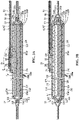
- FIG. 7 shows the distal connection portion 170 and the proximate connection portion 188 in an attached state
- FIG. 8 shows the distal connection portion 170 and the proximate connection portion 188 in a detached stated.
- the proximate connection portion 188 is connected to, and in fluid communication with, an interface tube 194 disposed substantially between the proximate connection portion 188 and the flexible connector 50. It is to be understood that the distal tube 40, distal connection portion 170, proximate connection portion 188, interface tube 194 and flexible connector 50 are all in fluid communication with each other along the tube 22, thus enabling fluid communication between the pump 18 and the dressing 14.
- the proximate connection portion 188 includes a one-way valve 198.
- the one-way valve 198 allows fluid to travel through the one-way valve 198 in a first direction while substantially or completely preventing fluid from traveling through the one-way valve 198 in a second direction.
- the one-way valve 198 allows fluid to flow through the proximate connection portion 188 towards the pump 18 and away from the dressing 14 while preventing fluid flow away from the pump 18 and towards the dressing 14.
- Such an arrangement enables a dressing 14 to continue experiencing or exhibiting negative pressure when the distal connection portion 170 and the proximate connection portion 188 are releasably detached, as shown in FIG. 8 , increasing user comfort, flexibility and utility of the dressing 14 even when detached from the pump 18.
- the wound exudate management system 10 preferably also includes an indicator system 200 that indicates that a fluid handling capacity of the dressing 14 has been, or shortly will be, reached and that the dressing 14 should be changed to avoid exudate leaking from the dressing 14 or entering the pump 18.
- the indicator system 200 may produce a signal, such as a visual, audible, vibrational, etc. signal.
- the indicator system 200 includes one or more of a gelling absorbent disposed within one or more of the upper absorbent indicator member 70, the backing layer 82, the pressure dispersing layer 104, the wound contact layer 112, the absorbent material layers 130a-h or the flexible connector 50.
- the gelling absorbent may include the absorbent material described above.
- the indicator system 200 may visually indicate that exudate has been absorbed by forming a gel.
- the indicator system 200 may also visually indicate that exudate has been absorbed by changing color as a result of the wound exudate entering the indicator, as a result of the wound exudate contacting some component or material within the dressing, as a result of a color-changing die activated by exudate or another fluid, or by some other means.
- the wound exudate management system 10, and particularly the dressing 14 can be disposed in a plurality of states.
- the dressing 14 can be in a first state where the dressing 14 is substantially free of exudate and fluids.
- the first state may correspond to fibers in the absorbent material of the dressing 14 having a first volume or size. Additionally, in the first state passages between the fibers have a first volume.
- the dressing 14 can also be in a second state where the fibers in the absorbent material of the dressing 14 have absorbed, and are partially or wholly saturated with, exudate.
- the first state may correspond to fibers in the absorbent material of the dressing 14 having a second volume or size.
- the first volume or size is relatively smaller than the second volume or size.
- the passages or openings between the fibers are relatively large.
- the volume or size of the passages between the fibers decreases, and the passages or openings between the fibers are relatively small or the fibers close the passages or openings.
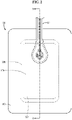
- FIG. 1 shows a wound dressing comprising an outer cover layer, which completely overlies the other layers of the dressing, and a conduit or tube. Beneath the cover layer is an absorbent pad forming a central raised island beneath the cover layer. In one embodiment the absorbent pad comprises the plurality of absorbent material layers.
- the absorbent layer is capable of absorbing exudate from the wound.
- the outer cover layer covers the side of the absorbent layer furthest from the wound as shown in FIGS. 3A , 4 and 5 , the cover layer, also referred to as the backing layer, adapted to enable negative pressure to be applied at the wound and having a port in fluid communication with the absorbent layer.
- the conduit, or tubing allows fluid communication between the port and a source of negative pressure, the conduit being connected to the outer layer by an adhesive ring.
- An indicator means, or upper absorbent indicator member is provided in the port.
- the indicator means comprises a layer of gel forming fibres.
- the indicator means may also be provided still in the port, but above the cover layer.
- the dressing further comprises a wound contact layer adhered to the absorbent layer by a layer of heat sealable lace consisting of a polyamide lace layer.
- the dressing further comprises an exudate and pressure distribution layer, also referred to as a pressure dispersing layer, preferably of polyester foam which serves to spread exudate across the absorbent layer and smooth the application of negative pressure across the dressing.
- a further heat sealable lace layer may be provided between the distribution layer and the cover layer. The heat sealable layers assist in adhering the layers together.
- the absorbent layer, the wound contact layer and the indicator means comprise gel forming fibres in the form of a layer or layers carboxymethylated cellulose fabric.
- the absorbent layer is smaller in area than the cover layer, as shown in FIG. 5A , so that it forms an island within a frame of the cover layer.
- a silicone adhesive may be applied to the frame on the side of the cover layer facing the wound so as to seal the dressing to the skin surrounding the wound.
- the dressing can be secured to the wound by a perforated adhesive covering the wound facing surface of the dressing with or without a window over the adhesive pad and/or by dressing strips applied to the outer surface of the cover layer and the skin surrounding the dressing.
- the dressing may be secured to the skin surrounding the wound and the conduit, connected to a source of negative pressure by the connector located at the distal end of the conduit. Negative pressure is applied to the wound by the application of negative pressure through the pathway for fluid leading from the wound, through the absorbent layer, the port and to the distal end of the conduit. Exudate is absorbed by the wound contact layer and transmitted to the absorbent layer by close contact. Fenestrations which may be present in the absorbent layer, assist with the absorbance of exudate and that application of negative pressure. As exudate is absorbed by the absorbent layer it spreads beneath the distribution layer so that a greater area of the absorbent layer is accessed by the exudate and a greater capacity of the absorbent layer is used.
- the exudate spreads towards the port and is absorbed by the indicator means which gels.
- the formation of the gel and possible colour change of the indicator means is visible to the user of the dressing and indicates that the dressing needs to be changed.
- the indicator means may also or alternatively be present in the conduit or in its lock where it can also be seen by the user and may provide additional time for dressing change before the exudate is drawn into the pump or other source of negative pressure.
- compositions and methods are described in terms of “comprising,” “containing,” or “including” various components or steps, the compositions and methods can also “consist essentially of' or “consist of' the various components and steps. All numbers and ranges disclosed above may vary by some amount. Whenever a numerical range with a lower limit and an upper limit is disclosed, any number and any included range falling within the range are specifically disclosed. In particular, every range of values (of the form, “from about a to about b,” or, equivalently, “from approximately a to b,” or, equivalently, “from approximately a-b”) disclosed herein is to be understood to set forth every number and range encompassed within the broader range of values.
- the phrase "at least one of' preceding a series of items, with the terms “and” or “or” to separate any of the items, modifies the list as a whole, rather than each article of the list (i.e., each item).
- the phrase "at least one of' allows a meaning that includes at least one of any one of the items, and/or at least one of any combination of the items, and/or at least one of each of the items.
- the phrases “at least one of A, B, and C” or “at least one of A, B, or C” each refer to only A, only B, or only C; any combination of A, B, and C; and/or at least one of each of A, B, and C.
Landscapes
- Health & Medical Sciences (AREA)
- Heart & Thoracic Surgery (AREA)
- Public Health (AREA)
- Veterinary Medicine (AREA)
- Biomedical Technology (AREA)
- Engineering & Computer Science (AREA)
- General Health & Medical Sciences (AREA)
- Life Sciences & Earth Sciences (AREA)
- Animal Behavior & Ethology (AREA)
- Vascular Medicine (AREA)
- Hematology (AREA)
- Anesthesiology (AREA)
- Chemical & Material Sciences (AREA)
- Dispersion Chemistry (AREA)
- Otolaryngology (AREA)
- Media Introduction/Drainage Providing Device (AREA)
- Materials For Medical Uses (AREA)
- External Artificial Organs (AREA)
- Medicinal Preparation (AREA)
- Medicines That Contain Protein Lipid Enzymes And Other Medicines (AREA)
- Controlling Rewinding, Feeding, Winding, Or Abnormalities Of Webs (AREA)
Description
- The present disclosure generally relates to wound dressing systems, and in particular, to a wound dressing system for use with a negative-pressure pump. Further, the present invention relates to dressings, systems for treating a wound with a dressing that can be used with a source of negative pressure to deliver negative pressure therapy. The dressing is suitable for the treatment of a variety of wounds including chronic and acute types including infected wounds, venous ulcers, diabetic ulcers, burns, surgical wounds and the like.
- Wound dressings are known and are generally suitable for treating a variety of wounds, including chronic and acute wound types, such as infected wounds, venous ulcers, diabetic ulcers, burns and surgical wounds.
- Negative pressure has been used to treat a range of chronic and acute wounds. Negative pressure may facilitate wound healing through a number of mechanisms, including removal of excess exudate, reduction in periwound edema and increased perfusion. Combined with the physical forces exerted by the negative pressure which draw the wound edges together, this can result in improved wound outcomes. Conventional devices are generally large and require the use of sophisticated equipment which may include a suction pump to generate negative pressure, a pressure regulator, canisters for the collection of wound exudate and a wound dressing to deliver the therapy to the wound site. As a result, such devices may be bulky, costly and confine the patient to bed or at least render the patient immobile and unable to go about their usual activities.
- More recently, portable systems have been developed which include a means to manage the exudate produced by the wound by collecting exudate within the wound dressing, typically in an absorbent material, and by evaporation through the dressing. Such systems mean that a separate collection canister may not be an essential part of the system. Such a system is described in
EP 2021046 . An advantage of not needing a canister is that the device is less bulky and more portable. A disadvantage with such devices is that if the dressing exceeds its fluid handling capacity, exudate may be drawn from the absorbent material(s) and enter the pump. The presence of exudate in the pump will eventually cause it to fail and require its replacement. The therapy provided by the system may also be less than optimal due to the potential for excess exudate to collect at the wound interface. In order to prevent fouling of the pump with exudate, it is known to provide a barrier layer between the absorbent material and the pump. The liquid barrier layer does not however give the user of the device or care giver an indication that the dressing has exceeded its fluid handling capacity and needs to be changed. - In those devices where a canister is present, the user or care giver is given a visual indication of how much exudate is being produced by the wound by the presence of exudate in the canister. The presence of exudate in the canister will however only occur once the dressing has exceeded its fluid handling capacity. There is no early warning that the dressing needs to be changed.
-
WO 2015/065612 A1 relating to a condensate absorbing and dissipating system, discloses a dressing for treating a tissue site including a base layer, a sealing member, a first and a second wicking layer, and an absorbent layer. The sealing member and the base layer may define an enclosure with the first and the second wicking layer disposed therein, and the absorbent layer positioned between the first and the second wicking layer. - There exists a need for an indication that the dressing has reached or exceeded its fluid handling capacity.
- Additionally, existing portable negative-pressure wound dressing systems often include rigid dressing and connection components, adversely affecting system utility and user comfort. Additionally, existing portable negative-pressure wound dressing systems do not utilize absorbent materials and additional wound dressing components arranged to maximize the management of wound exudate within the dressing. Thus, there exists a need for a portable exudate management system that incorporates these, and other, features. The present disclosure seeks to overcome limitations and other drawbacks of the prior art, and to provide new features not heretofore available. A full discussion of the features and advantages of the present disclosure is deferred to the following detailed description, which proceeds with reference to the accompanying drawings.
- The present invention relates to a negative pressure wound dressing according to the subject-matter of
claim 1, and a negative pressure wound exudate management system comprising said wound dressing according to the subject-matter of claim 12. - In one implementation, the present disclosure provides a negative pressure wound dressing for use in applying negative pressure to a wound comprising: an absorbent layer capable of absorbing exudate from the wound and allowing the passage of fluid through it; an outer cover layer covering the side of the absorbent layer furthest from the wound, the cover layer adapted to enable negative pressure to be applied at the wound and having a port; a conduit having a proximal end attached to the port and a distal end, the dressing provided with a pathway for fluid from the wound, through the absorbent layer, the port and to the distal end of the conduit; and an indicator means positioned in the pathway at a location between the absorbent layer and the distal end of the conduit, the indicator means capable of absorbing exudate to indicate the presence of exudate at the side of the absorbent layer furthest from the wound.
- In a further implementation, the present disclosure provides a negative pressure wound dressing for use in applying negative pressure to a wound comprising: an absorbent layer capable of absorbing exudate from the wound and allowing the passage of fluid through it; an outer cover layer covering the side of the absorbent layer furthest from the wound, the cover layer adapted to enable negative pressure to be applied at the wound and having a port; a conduit having a proximal end attached to the port and a distal end, the dressing provided with a pathway for fluid from the wound, through the absorbent layer, the port and to the distal end of the conduit; an indicator means positioned in the pathway at a location between the absorbent layer and the distal end of the conduit, the indicator means capable of absorbing exudate to indicate the presence of exudate at the side of the absorbent layer furthest from the wound; and a source of negative pressure connected to the distal end of the conduit.
- Preferably the source of negative pressure is capable of generating a minimum of 75mmHg and a maximum of 125mmHg at the wound.
- In some implementations of the disclosed subject technology, a wound exudate management system is provided. In one embodiment, the wound exudate management system comprises a pump for generating negative pressure, a dressing for covering and protecting a wound, the dressing comprising an adhesive layer for adhering the dressing adjacent the wound, a wound contact layer for contacting the wound, a pressure dispersion layer, a plurality of layers of absorbent material disposed between the wound contact layer and the pressure dispersion layer, and a backing layer having a first surface and a second surface, the first surface of the backing layer being adjacent, and in contact with, the pressure dispersion layer and the adhesive layer, a pressure tube having an interior lumen, the pressure tube disposed between the pump and the dressing such that the pump and the dressing are in fluid communication via the interior lumen, and, a flexible connector connected to the second surface of the backing layer.
- The disclosed technology further relates to a dressing for covering and protecting a wound. The disclosed technology further relates to a wound exudate management system, comprising: a dressing for covering and protecting a wound, the dressing comprising: a wound contact layer, the wound contact layer having a first surface and a second surface, the wound contact layer further having a peripheral region and a central region, wherein the first surface of the wound contact layer contacts the wound when the dressing is adhered to skin adjacent the wound, a pressure dispersion layer having a peripheral region and a central region, a plurality of layers of absorbent material disposed between the second surface of the wound contact layer and the pressure dispersion layer, and, an envelope formed by joining the peripheral region of the pressure dispersion layer with the peripheral region of the second surface of the wound contact layer, the plurality of layers of absorbent material being disposed substantially within an interior cavity of the envelope. Alternately, an envelope may be formed by joining the peripheral region of a thermoplastic spun lace layer connected to the pressure dispersion layer with the peripheral region of a nonwoven spun lace layer connected to the second surface of the wound contact layer, such that the plurality of layers of absorbent material are disposed substantially within an interior cavity of the envelope.
- The disclosed technology further relates to a wound exudate management system further comprising a thermoplastic spun lace layer connected to the pressure dispersion layer, and a nonwoven spun lace layer connected to the wound contact layer, and wherein the envelope is formed by joining peripheral portions of the thermoplastic spun lace layer and the nonwoven spun lace layer, wherein the interior cavity of the envelope is formed by the nonwoven spun lace layer and the thermoplastic spun lace layer, and wherein the plurality of layers of absorbent material are disposed substantially within an interior cavity of the envelope.
- The disclosed technology further relates to a wound exudate management system, comprising: a dressing for covering and protecting a wound, the dressing comprising a wound contact layer, a backing layer and at least one layer of absorbent material layer between the wound contact layer and the backing layer, a flexible connector having an interior lumen, the flexible connector secured to the backing layer of the dressing, an indicator between the backing layer and the flexible connector, a tube having an interior lumen, the tube connected to the flexible connector, wherein the interior lumen of the flexible connector and the interior lumen of the tube are in fluid communication, and, a pressure conveyance member disposed within the interior lumen of the tube.
- The disclosed technology further relates to a wound exudate management system, comprising: a pump for generating negative pressure, a dressing for covering and protecting a wound, the dressing comprising a wound contact layer, a backing layer and at least one layer of absorbent material between the wound contact layer and the backing layer, a tube connecting the pump and the dressing, the tube having an interior lumen for placing the pump and the dressing in fluid communication via the interior lumen, and, a one-way valve in-line between the pump and the dressing to maintain a negative pressure within the dressing when the pump is disconnected from the tube.
- The disclosed technology further relates to a wound exudate management system, comprising: a pump for generating negative pressure, a dressing for covering and protecting a wound, a tube including an interior lumen, the tube disposed between the pump and the dressing such that the pump and the dressing are in fluid communication via the interior lumen of the tube, and, a plurality of layers of absorbent material disposed in the dressing, wherein the absorbent material has fibers that swell upon contact with wound exudate to manage a flow of wound exudate through a portion of the dressing.
- In any of the wound exudate management systems, the system may be adapted to allow for fluid communication between the wound and a negative pressure source, such as a pump. Typically, a fluid communication pathway is provided from the wound, through the wound contact layer and through one or more layers of absorbent material disposed in the dressing, to the negative pressure source. The fluid communication pathway may extend though an opening in the backing layer to the interior lumen of a tube, optionally via the interior lumen or conduit of a flexible connector. Where an indicator such as an absorbent indicator member is present, the fluid communication pathway may also extend through the indicator.
- Typically, the flexible connector is elongate with an interior lumen or conduit that runs parallel to the longitudinal axis of the flexible connector, wherein the flexible connector is attachable to the opening in the backing layer of the dressing in an orientation such that the longitudinal axis of the flexible connector is substantially parallel to the plane of the backing layer. The flexible member may comprise a head portion for securement to the backing layer via adhesive or other means. Typically, the fluid communication pathway extends from the interior lumen or conduit of the flexible connector through the opening in the backing layer in a direction substantially perpendicular to the longitudinal axis of the flexible connector. Once secured, a fluid-tight seal may be formed between the flexible connector and the backing layer.
- In any of the above embodiments, the presence of an indicator means may have the advantage that the user or caregiver is given an indication of the need to change the dressing. The indicator means allows the user or caregiver to change the dressing and prevent fouling of the pump. The presence of exudate at the side of the absorbent layer furthest from the wound occurs when the absorbent layer has absorbed significant quantities of exudate. If the indicator means is located in the conduit of the dressing and is triggered by the absorption of exudate, exudate is present not only at the side of the absorbent layer furthest from the wound but has also been drawn out past the cover layer and into the conduit. It gives a forewarning to the user or caregiver that the fluid handling capacity of the dressing has been or shortly will be reached and that dressing change is advisable. The indicator means can give an indication that the dressing has reached its fluid handling capacity and that there is potential for exudate to be drawn from the dressing, into the conduit and eventually into the pump which is undesirable.
- The indicator means may be visual or may result in an audible alarm or other signal. Preferably the indicator means is visual and is located so that it is visible to the user of the dressing. For example, the visual indicator means may be located in the port in the cover layer or it may be located in the conduit or in both the port and conduit. Similarly, in the wound exudate management systems, the visual indicator means may be located to traverse the opening in the backing layer and/or be located in the interior lumen or conduit of the flexible connector. Preferably the visual indicator means is a gelling absorbent which visually indicates that it has absorbed exudate by forming a gel. If the exudate is coloured then the gel will also be coloured and add to the visual indication. Alternatively the visual indicator means may indicate that it has absorbed exudate by changing colour for instance by activation of a dye in the indicator means.
- Preferably the indicator means is provided by gel-forming fibres. By gel forming fibres is meant hygroscopic fibres which upon the uptake of wound exudate become moist slippery or gelatinous. The gel forming fibres can be of the type which retain their structural integrity on absorption of exudate or can be of the type which lose their fibrous form and become an amorphous or structureless gel. The gel forming fibres are preferably sodium carboxymethylcellulose fibres, chemically modified cellulosic fibres, alkyl sulphonate modified cellulosic fibres such as those described in
WO2012/061225 , pectin fibres, alginate fibres, chitosan fibres, hyaluronic acid fibres, or other polysaccharide fibres or fibres derived from gums. The cellulosic fibres preferably have a degree of substitution of at least 0.05 carboxymethyl groups per glucose unit. The gel forming fibres preferably have an absorbency of at least 2 grams 0.9% saline solution per gram of fibre (as measured by the free swell method). - The gel forming fibres are preferably chemically modified cellulosic fibres in the form of a fabric and in particular carboxymethylated cellulose fibres as described in PCT
WO00/01425 to Azko Nobel UK Ltd WO00/01425 - The cellulosic fabric preferably consists solely of cellulosic fibre but may contain a proportion of non-cellulosic textile fibre or gel forming fibre. The cellulosic fibre is of known kind and may comprise continuous filament yarn and/or staple fibre. The carboxymethylation is generally performed by contacting the fabric with an alkali and a carboxymethylating agent such a chloracetic acid in an aqueous system. The fabric is preferably of a non-woven type to reduce shedding in the wound on cutting the dressing. Preferably the fabric is hydroentangled and thus comprises a series of apertures on a microscopic scale.
- The absorbent layer of the dressing is capable of absorbing exudate from the wound and allowing the passage of fluid through it. Although the absorbent layer can comprise any absorbent capable of absorbing exudate while allowing the passage of fluid through it, such as a foam, sponge or fibre-based material, preferably the absorbent layer is provided by gel forming fibres of the same type or of a different type as those used in the indicator means. The gel-forming fibres are hygroscopic fibres which upon the uptake of wound exudate become moist slippery or gelatinous and thus reduce the tendency for the surrounding fibres to adhere to the wound. The gel forming fibres are preferably spun sodium carboxymethylcellulose fibres, chemically modified cellulosic fibres, alkyl sulphonate modified cellulosic fibres such as those described in
WO2012/061225 , pectin fibres, alginate fibres, chitosan fibres, hyaluronic acid fibres, or other polysaccharide fibres or fibres derived from gums. The cellulosic fibres preferably have a degree of substitution of at least 0.05 carboxymethyl groups per glucose unit and more preferably are lightly substituted so that the absorbency of the fibres is limited. The gel forming fibres preferably have an absorbency of at least 2 grams 0.9% saline solution per gram of fibre (as measured by the method described above) but less than 30 grams 0.9% saline solution per gram of fibre. The gel forming fibres are preferably carboxymethylated cellulose fibres as described inPCT WO00/01425 to Azko Nobel UK Ltd - Preferably the absorbent layer is provided with fenestrations to aid the application of negative pressure to the wound and maintain the pathway for fluid from the wound, through the absorbent layer. Typically, however, fenestrations are only provided in internal absorbent layers. External absorbent layers, including those in direct contact with the wound, generally do not have mechanically added fenestrations, however, they do have openings between the fibres.
- Although the absorbent layer can be in direct contact with the wound, preferably the dressing comprises a wound contact layer, positioned between the wound and the absorbent layer. The wound contact layer is capable of absorbing exudate from the wound and transmitting it to the absorbent layer. Like the absorbent layer, the wound contact layer is capable of allowing the passage of fluid through it so that negative pressure may applied to the wound and the pathway for fluid from the wound and to the distal end of the conduit may be maintained.
- Preferably the wound contact layer comprises gel-forming fibres of the same or a similar type to those comprising the absorbent layer but the wound contact layer may be strengthened to increase its integrity and that of the dressing. For example the wound contact layer may be of the type described in
EP 1904011 and comprise gel-forming fibres in the form of a mat with lines of longitudinal stitching made of cellulose or nylon or polyolefin yarn to increase the integrity of the layer. Preferably the wound contact layer is porous to maintain the pathway for fluid from the wound to the distal end of the conduit. - The outer cover layer of the dressing is a bacterial and viral barrier layer which preferably resists the ingress of liquid and air but allows moisture vapour transmission. In this way the outer cover layer enhances the overall fluid handling capacity of the dressing by allowing for the escape of moisture vapour through the cover while enabling the application of negative pressure to the wound. The outer cover layer is for instance a layer having a MVTR of at least 10,000 g m-2 per 24 hours or in the range of from 10,000gm-2 to 50,000g m-2 per 24 hours measured by the method described in BS EN 13726-2 2002 "Test methods for primary
wound dressings Part 2 Moisture vapour transmission rate of permeable film dressings". The cover layer may be in the form of a film of polyurethane, for example Epurex 912 T/129 manufactured by Covestro or Inspire 2350 manufactures by Coveris or Medifilm 426 manufactured by Mylan. - The cover layer is provided with a port for connection to the conduit. The port is preferably located in that part of the cover layer that overlies the absorbent layer but towards the periphery of the absorbent layer so that it is not directly in vertical alignment with the centre of the dressing (or the wound when in use). This assists in the spread of exudate across the full extent of the absorbent layer.
- The conduit of the dressing is preferably a transparent passageway secured to the outside of the cover layer at the proximal end of the conduit so as to surround the port in the cover layer from above. In this manner if the visual indicator is located in the port in the cover layer and/or in the conduit itself, the visual indicator may be seen by the user. Similarly, where the wound exudate management systems comprise a flexible connector, the flexible connector may be partially or entirely transparent so as to allow the visual indicator to be seen by the user. Typically the head of the flexible connector is transparent. The conduit of the dressing may comprise a connector, at its distal end, for connecting the dressing to a source of negative pressure, for example a pump. Preferably the connector is a luer lock to facilitate secure connection to the pump and to maintain the negative pressure on the wound while the pump is temporarily disconnected. The connector preferably comprises a one way lock to assist in the maintenance of negative pressure. The visual indicator may be located in the conduit and can be in the form of a knitted cylinder, or the like, of gel forming fibres. To resist collapse, the conduit may comprise an internal cylinder of nylon fibres to maintain openness of the conduit to fluid.
- The dressing comprises a distribution layer, e.g., a pressure distribution layer, located between the absorbent layer and the outer cover layer which is gas and liquid permeable and moisture vapour permeable and serves to aid access of exudate to a greater area of the absorbent layer by allowing it to spread under the distribution layer. The distribution layer also serves to even out the negative pressure applied to the wound over the whole dressing. The distribution layer preferably distributes exudate and negative pressure over the dressing. In this way, uptake of exudate by the absorbent layer is maximised before the exudate leaves the absorbent layer and activates the indicator means and the transfer of negative pressure to the wound is optimised. The distribution layer is a foam layer such as a polyester foam of the type XD4200AS manufactured by Caligen or another suitable reticulated foam.
- The dressing may also comprise additional optional layers such as an adhesive layer for adhering the dressing to the skin surrounding the wound to form a fluid tight seal. The adhesive layer may be applied to the side of dressing closest to the wound and may be provided with perforations to assist transport of exudate and fluid through the dressing. The adhesive layer may also be applied to any of the other layers to provide an island configuration such as to the cover layer.
- It is understood that other embodiments and configurations of the subject technology will become readily apparent to those skilled in the art from the following detailed description, wherein various configurations of the subject technology are shown and described by way of illustration. As will be realized, the subject technology is capable of other and different configurations and its several details are capable of modification in various other respects, all without departing from the scope of the subject technology. Accordingly, the drawings and detailed description are to be regarded as illustrative in nature and not as restrictive.
- To understand the present disclosure, it will now be described by way of example, with reference to the accompanying drawings in which implementations of the disclosures are illustrated and, together with the descriptions below, serve to explain the principles of the disclosure.
-
FIG. 1 is a top view of a wound exudate management system according to exemplary implementations of the present disclosure, in particular showing a pump, a dressing and a tube, among other features. -
FIG. 2 is a top view of a wound exudate management system according to exemplary implementations of the present disclosure, in particular showing a dressing and a portion of a flexible connector of the wound exudate management system. -
FIG. 3A is a cross-sectional view about line 3-3 ofFIG. 2 of a wound exudate management system according to exemplary implementations of the present disclosure, in particular showing a dressing, a portion of a flexible connector and various constituent elements of the dressing. -
FIG. 3B is an alternate embodiment of a cross-sectional view about line 3-3 ofFIG. 2 of a wound exudate management system showing a dressing, a portion of a flexible connector and various constituent elements of the dressing. -
FIG. 4 is an enlarged cross-sectional view of the wound exudate management system ofFIG. 3A , in particular illustrating the region indicated by arrow 4-4. -
FIG. 5A is an exploded perspective view of a wound exudate management system according to exemplary implementations of the present disclosure. -
FIG. 5B is an alternate embodiment of an exploded perspective view of a wound exudate management system of the present disclosure. -
FIG. 6 is a bottom view of a wound exudate management system according to exemplary implementations of the present disclosure, in particular showing a removable cover and a portion of a flexible connector of the wound exudate management system. -
FIG. 7 is a top view of a releasable connector of a wound exudate management system according to exemplary implementations of the present disclosure, in particular showing the releasable connector in a connected state. -
FIG. 8 is a top view of the releasable connector ofFIG. 7 , in particular showing the releasable connector in a detached state. - While the wound exudate management system discussed herein may be implemented in many different forms, there is shown in the drawings, and will herein describe in detail, preferred implementations with the understanding that the present description is to be considered as an exemplification of the principles of the wound exudate management system and is not intended to limit the broad aspects of the disclosure to the implementations illustrated.
- Referring now to the figures, and specifically to
FIG. 1 , one embodiment of a woundexudate management system 10 is shown. The woundexudate management system 10 of this embodiment has a wound dressing 14, apump 18 and a tube 22 (also referred to as a pressure tube 22). Generally, the woundexudate management system 10 facilitates wound healing and wound protection. The dressing 14 is applied to the skin of a user, as will be described below, and thesystem 10 utilizes negative pressure generated by thepump 18 to aid wound healing. The dressing 14 and thepump 18 are fluidly connected via thetube 22. Negative pressure generated by thepump 18 is communicated to the dressing 14 by thetube 22, thereby enabling the dressing 14 to employ negative pressure for enhanced wound healing. - In various embodiments, the
pump 18 operates to generate negative pressure in response to a variety of user inputs. In one embodiment, a user control 30 for thepump 18 is disposed on thepump 18 and/or remote to thepump 18. The user control 30 may be one or more of a button, switch, lever, sensor or any other control device. It is to be understood that any common user control 30 is within the scope of this disclosure. Thepump 18 may also have one ormore indicators pump 18 for apprising the pump user of a current operational status, condition, battery life, etc. of thepump 18. Theindicators 34a-c may be lights including Light-Emitting Diodes (LEDs), however any other type of indicator may be used such as a speaker for generating an audible sound or a motor with a radially asymmetric flywheel for generating a vibration.Instructional indicia indicators 34a-c for apprising a user of the significance of an operation of aparticular indicator 34a-c. In some implementations, however, thepump 18 operates without a user input and generates negative pressure in response to a timer, remote signal, sensor reading or other stimulus. - In one embodiment, prior to operation of the
pump 18, theindicators 34a-c for thepump 18 are preferably not illuminated. In such a state, thepump 18 is generally not generating negative pressure, which may correspond to thepump 18 being in an off condition. Further, in one embodiment, when all ofindicators 34a-c transition to an illuminated state, thepump 18 is preferably in a ready state and is ready for use. Further, in one embodiment, when oneindicator 34a remains in an illuminated state and the remainingindicators pump 18 is in an operating state. Normal operation of thepump 18 may include the generation of negative pressure, alternating periods of negative pressure generation, and/or no generation of negative pressure. Thepump 18 may transition between one or more of the off condition, ready state and operating state as a result of manipulation of the user control 30. Manipulation of the user control 30 to change the pump state may include and/or require manipulation of the user control 30 for a predetermined amount of time. - In the operational state, in a preferred embodiment the
pump 18 generates a minimum pressure of 75mmHg at the wound and a maximum pressure of 125mmHg at the wound, however, alternate pressures may be generated by thepump 18. In one embodiment, thepump 18 generates negative pressure until a first pressure threshold is reached. The first pressure threshold may be, for example, a value between 75mmHg and 125mmHg, inclusive. Thepump 18 may then refrain from generating negative pressure until a second threshold pressure is reached, at which point thepump 18 may generate negative pressure until the first pressure threshold is again reached. Alternate operations of the pump are allowable. - In one embodiment, as shown in
FIG. 1 , thepump 18 is connected to thepressure tube 22 with apump connector 38. Thepump connector 38 may allow for selective separation of thepump 18 and thetube 22. - In one embodiment, the
tube 22 comprises adistal tube portion 40 and a proximal tubular portion 42. The proximal tubular portion 42 may be an extension of theflexible connector 50. Aseparable connector 44 may join thedistal tube portion 40 and the proximal tubular portion 42, as shown inFIGS. 7 and8 . Thepump connector 38 connects one end of thetube 22, and preferably thedistal tube 40 portion of thetube 22, to thepump 18, as shown inFIG. 1 . However, in an alternate embodiment, not shown, thepump connector 38 may connect the proximal tubular portion 42 to thepump 18. In one embodiment, thedistal tube portion 40 forms a portion of thepressure tube 22 and may be flexible, transparent, partially-transparent, and/or formed from a polymer, metal, metal alloy or any other suitable material. - Turning to
FIGS. 3A and4 , in one embodiment theflexible connector 50 is structurally connected to the dressing 14, and further includes aflexible connector lumen 54. Theflexible connector lumen 54 is disposed within theflexible connector 50 along a portion, or all, of theflexible connector 50 and enables fluid communication between thepump 18 and thedressing 14. Aflexible connector aperture 60 enables fluid communication between theflexible connector lumen 54 and thedressing 14. Theflexible connector 50 may include a lowerflexible connector portion 66 and an upperflexible connector portion 67. The lowerflexible connector portion 66 and the upperflexible connector portion 67 may be joined by welding, adhesives or any other joining technique to form theflexible connector 50. Theflexible connector 50 may preferably be formed from polyvinyl chloride, polyurethane or any other suitable material. In one embodiment theflexible connector 50 has a generally planar exterior surface. - In one embodiment, a
pressure conveyance structure 62 is disposed within theflexible connector lumen 54. Thepressure conveyance structure 62 enables theflexible connector 50 to convey fluid flow and/or pressure within theflexible connector lumen 54 without collapsing when theflexible connector 50 is made of a thin-walled flexible material, thereby enabling the dressing 14 to experience or exhibit negative pressure generated by thepump 18. Thepressure conveyance structure 62 may include various materials including, but not limited to, nylon. Further, thepressure conveyance structure 62 may be comprised of alattice structure 53. The shape, material and arrangement of thepressure conveyance structure 62 enables continued fluid flow along theflexible connector 50 that may otherwise be hindered by the shape, flexibility, material or arrangement of theflexible connector 50 in light of negative pressure generated by thepump 18 and in light of general woundexudate management system 10 use and positioning. - As best shown in
FIGS. 3A ,4 and5 , the dressing 14 preferably includes anindicator 70, which in one embodiment is an upperabsorbent indicator member 70 formed of an absorbent material. Theindicator 70 may produce a signal, such as a visual, audible, vibrational, etc. signal. When theindicator 70 is made of an absorbent material the absorbent material may include gel-forming fibers, which may be hygroscopic fibers that become moist, slippery or gelatinous upon the intake of wound exudate or other fluids. The gel-forming fibers may retain their structural integrity upon absorption of exudate or they may lose their fibrous form and become an amorphous or structure-less gel. The gel-forming fibers are, in some implementations, sodium carboxymethylcellulose fibers, chemically modified cellulosic fibers, alkyl sulphonate modified cellulosic fibers such as those described inWO2012/061225 , pectin fibers, alginate fibers, chitosan fibers, hyaluronic acid fibers, other polysaccharide fibers or fibers derived from gums. - The cellulosic fibers exemplarily have a degree of substitution of at least 0.05 carboxymethyl groups per glucose unit. The gel-forming fibers may have an absorbency of at least 2 grams 0.9% saline solution per gram of fiber (as measured by a free swell method) but less than 30 grams 0.9% saline solution per gram of fiber.
- The gel-forming fibers are preferably chemically modified cellulosic fibers in the form of a fabric and in particular carboxymethylated cellulose fibers as described in PCT
WO00/01425 to Azko Nobel UK Ltd WO00/01425 - The cellulosic fabric may consist solely of cellulosic fiber but may also contain non-cellulosic textile fibers or gel-forming fibers. The cellulosic fiber may be of known kind and may include continuous filament yarn and/or staple fiber. The carboxymethylation may be performed by contacting the fabric with an alkali and a carboxymethylating agent, such a chloracetic acid in an aqueous system. The fabric may be of a non-woven type, and may further be hydroentangled and thus comprise a series of apertures on a microscopic scale. The absorbent material may also comprise any absorbent material capable of absorbing exudate while allowing the passage of fluid therethrough, such as a foam, sponge or fiber-based material.
- The upper
absorbent indicator member 70 is preferably above thebacking layer 82 and may be adjacent, joined to and/or in contact with theflexible connector 50 and may also be adjacent theflexible connector aperture 60. As best shown inFIG. 4 , in one embodiment a first side of anupper adhesive 74 is adhered to both the upperabsorbent indicator member 70 and the lowerflexible connector portion 66 of theflexible connector 50. The lowerflexible connector portion 66 is preferably adhered to a portion of the first side of theupper adhesive 74 radially outward from a portion of theupper adhesive 74 to which the upperabsorbent indicator member 70 is adhered. Theupper adhesive 74 also has an upperadhesive aperture 78 extending from the first side of theupper adhesive 74 to a second side of theupper adhesive 74 and arranged to be adjacent the upperabsorbent indicator member 70 to limit interference with the vacuum effect of the negative pressure draw through the upperabsorbent indicator member 70. - In one embodiment a
backing layer 82 is disposed between both theindicator member 70 and theflexible connector 50 and the plurality of absorbent layers of the dressing 14. In one embodiment thebacking layer 82 is disposed below theupper adhesive 74. Thebacking layer 82 preferably has abacking layer aperture 86 disposed through thebacking layer 82, and extending from afirst surface 83 of thebacking layer 82 to asecond surface 84 of the backing layer. Accordingly, in one embodiment theupper adhesive 74 is provided adjacent thesecond surface 84 of thebacking layer 82. In assembly, theaperture 86 of thebacking layer 82 is provided adjacent theaperture 78 in theupper adhesive 74. In some implementations, thebacking layer 82 is a bacterial and viral barrier layer which resists the ingress of liquid and air while allowing moisture vapor transmission. In this way, thebacking layer 82 enhances an overall fluid handling capacity of the dressing 14 by allowing moisture vapor to escape through thebacking layer 82 while enabling the application of negative pressure to the wound or dressing 14. Thebacking layer 82 may have a Moisture Vapor Transmission Rate (MVTR) of at least 10,000 g/m2 per 24 hours or in the range of from 10,000g/m2 to 50,000g/m2 per 24 hours measured by the method described in BS EN 13726-2 2002 "Test methods for primarywound dressings Part 2 Moisture vapour transmission rate of permeable film dressings." Thebacking layer 82 may be partially or fully transparent. Thebacking layer 82 may be a layer, or film, of polyurethane, for example Epurex 912 T/129 manufactured by Covestro or Inspire 2350 manufactures by Coveris or Medifilm 426 manufactured by Mylan. - As shown in
FIGS. 4 and5A , in one embodiment a layer of adhesive 90, referred to as thebacking layer adhesive 90, is disposed adjacent the second surface 82b of thebacking layer 82. Thebacking layer adhesive 90 includes a backing layeradhesive aperture 94 preferably extending through the backing layer adhesive 90 from a first surface of the backing layer adhesive 90 to a second surface of thebacking layer adhesive 90. Theaperture 94 in thebacking layer adhesive 90 is preferably positioned adjacent theaperture 78 in theupper adhesive member 74. It is to be understood that in a preferred embodiment, theflexible connector aperture 60, upperabsorbent indicator member 70, upperadhesive aperture 78,backing layer aperture 86 and backing layeradhesive aperture 94 are all arranged substantially concentric such that fluid flow is enabled from theflexible connector aperture 60, across the upperabsorbent indicator member 70, and through the upperadhesive aperture 78,backing layer aperture 86 and backing layeradhesive aperture 94. Further, it is also to be understood that in a preferred embodiment the upperflexible connector portion 67, lowerflexible connector portion 66, upperabsorbent indicator member 70,upper adhesive 74,backing layer 82, and backing layer adhesive 90 are arranged sequentially in the woundexudate management system 10. - Referring to
FIG. 3A , the dressing 14, in some implementations, includes aninner envelope structure 100. Theinner envelope structure 100 preferably houses a plurality of layers of absorbent material to aid in exudate management. As best shown inFIGS. 3A ,4 and5 , in one embodiment theinner envelope structure 100 is defined by an upper envelope layer and a lower envelope layer. The upper envelope layer may have aperipheral section 108 and acentral section 109. Theperipheral section 108 of the upper envelope layer may also be referred to as the upperperipheral section 108, and thecentral section 109 of the upper envelope layer may also be referred to the uppercentral section 109. Similarly, the lower envelope layer may have aperipheral section 116 and acentral section 117. Theperipheral section 116 of the lower envelope layer may be referred to as the lowerperipheral section 116, and thecentral section 117 of the lower envelope layer may be referred to as the lowercentral section 117. - An alternate embodiment of the dressing 14 of the
wound management system 10 is shown inFIGS. 3B and5B . In this alternate embodiment, a nonwoven spunlace layer 119 is preferably stitchbonded to thesecond surface 113 of thewound contact layer 112. In one embodiment a regenerated cellulose yarn is used for the stitchbonding. Further, in one embodiment the nonwoven spunlace material 119 may be comprised of an 80 gsm nonwoven layer comprising viscose fibers and polyester fibers in substantially equal portion, and preferably less than 5% acrylic co-polymer binder. Additionally, a thermoplastic spunlace layer 121, such as a polyamide layer, may be provided between thepressure dispensing layer 104 and the plurality of absorbent material layers 130. The thermoplastic spunlace layer 121 has afirst surface 123 that may be heat bonded at its perimeter to thepressure dispersing layer 104, and asecond surface 125 that may be similarly heat bonded at its perimeter around the plurality of absorbent material layers 130 to the nonwoven spunlace layer 119. Accordingly, the thermoplastic spunlace layer 121 and the nonwoven spunlace layer 119 form an inner enclosure or envelope around the absorbent material layers 130. The inner envelope or enclosure of this embodiment is defined by an upper envelope layer and a lower envelope layer. The upper envelope layer of this embodiment comprising the thermoplastic spunlace layer 121, and the lower envelope layer of this embodiment comprising the nonwoven spunlace material 119. - Accordingly, in one embodiment, as shown in
FIG. 3A , the upper envelope layer is apressure dispersing layer 104, and the lower envelope layer is awound contact layer 112. In an alternate embodiment, as shown inFIG. 3B , the upper envelope layer is a thermoplastic spunlace layer 121 and the lower envelope layer is a non-woven spunlace layer 119. - The
pressure dispersing layer 104, also referred to as the pressure distribution layer, serves to distribute pressure, or negative pressure, laterally across thepressure dispersing layer 104. Thepressure dispersing layer 104 is gas, liquid and moisture-vapor permeable and serves to aid exudate access to a greater portion of the dressing 14 by distributing negative pressure laterally over the dressing 14. In this way, uptake of exudate by the dressing 14 is maximized and a more uniform transfer of negative pressure to the wound, or dressing 14, is optimized. Thepressure dispensing layer 104 is formed from a foam such as a polyester foam of the type XD4200AS manufactured by Caligen, another suitable reticulated foam or a polyurethane foam. - In some implementations the
wound contact layer 112 may be formed of an absorbent material. Further, thewound contact layer 112 may be comprised of a structurally reinforced material or structure to enhance the strength and physical properties of thelower envelope layer 112. For example, thewound contact layer 112 may be formed from carboxymethylated cellulose fibers. The structural reinforced material of thewound contact layer 112 may include stitching 118. In some implementations, thewound contact layer 112 is formed of an absorbent material that has reinforcingstitching 118, including reinforcingstitching 118 made of nylon. It is also understood that thepressure dispersing layer 104 and thewound contact layer 112 may be formed from any one of the absorbent materials described above. - The
wound contact layer 112 has afirst surface 114 and asecond surface 113. Thefirst surface 114 of thewound contact layer 112 is an outer layer for contacting a wound of user when the dressing 14 is adhered to the skin of a user adjacent the wound. Further, in one embodiment, thesecond surface 113 of thewound contact layer 112 opposes thefirst surface 114, and thesecond surface 113 is an inner layer that is adjacent the plurality of absorbent material layers within the dressing 14, as described below. - The
peripheral section 108 of the upper envelope layer 104 (i.e., the pressure dispersing layer 104) andperipheral section 116 of the lower envelope layer 112 (i.e., the wound contact layer 112) pare joined, as best shown inFIG. 3A . The upperperipheral section 108 and the lowerperipheral section 116 may be joined by adhesives, welding, stitching or any other common joining method. The joining of the upperperipheral section 108 and the lowerperipheral section 116 substantially forms theinner envelope 100 and further defines anenvelope cavity 120 disposed within theenvelope 100. - A plurality of
absorbent material layers envelope cavity 120. In one embodiment there are eight layers of the absorbent material within theenvelope cavity 120. In some implementations, theabsorbent material layers 130a-h includes gel-forming fibers, such as those described above, and the gel-forming fibers may be sodium carboxymethylcellulose fibers. Further, theabsorbent material layers 130a-h may include any of the absorbent materials, water-swellable fibers or gel-forming fibers as described above. For example, theabsorbent material layers 130a-h may be formed from carboxymethylated cellulose fibers. - In some implementations, one or more of the
absorbent material layers 130a-h includes one or more fenestrations 129, as shown inFIG. 5A . Thefenestrations 129 may be slits oropenings 129 in one or more directions on theabsorbent material layers 130a-h, preferably in a direction planar to a longitudinal axis and transverse to a longitudinal axis of the absorbent materials, which aid in managing a flow of exudate through thevarious layers 130a-h of the dressing 14. In particular, thefenestrations 129 encourage or enable wound exudate to travel, or be absorbed, in a preferred direction. In some implementations, thefenestrations 129 encourage or enable wound exudate to travel laterally about each layer of the absorbent material layers, as opposed to axially from one layer to another. Thefenestrations 129 may be formed mechanically, such as via cutting. Thefenestrations 129 are preferably slits about 10 mm in length that may alternate vertically and horizontally in rows and columns across preferably each of the absorbent material layers. The fenestrations all for full use of the absorbent capacity of the absorbent material layers and can also assist in negative pressure transmission through these layers. - In various embodiments, the dressing 14 includes an
adhesive layer 150. Theadhesive layer 150 may assist in securing the dressing 14 to the skin of a patient. In one embodiment, theadhesive layer 150 may also assist in creating an exterior housing or envelope with thebacking layer 82, within which theinner envelope 100 resides. As shown inFIG. 3A , in one embodiment theadhesive layer 150 is connected to both thebacking layer 82 and thewound contact layer 112. In particular, in such an embodiment, thebacking layer 82 is adhered to an exterior portion of theadhesive layer 150 radially outwardly from an interior portion of theadhesive layer 150 to which thewound contact layer 112 is adhered. As best shown inFIG. 5A , in one embodiment theadhesive layer 150 has a perimetral shape with acentral aperture 154. Theaperture 154 in theadhesive layer 150 enables the skin of a user to contact, or be in fluid communication with, thewound contact layer 112 when the dressing 14 is applied to the skin of a user. - As best shown in
FIG. 4 , in one embodiment the backing layerfirst surface 83 is preferably adjacent, and in contact with, thepressure dispersing layer 104 and theadhesive layer 150, while theflexible connector 50 is disposed on the backing layersecond surface 84. - A
removable cover 156 may be adhered to an outer surface of theadhesive layer 150. As shown inFIGS. 3A and5 , in one embodiment theremovable cover 156 may be adhered to the outer surface of theadhesive layer 150, which is located on an opposite side of theadhesive layer 150 to which thewound contact layer 112 andbacking layer 82 are adhered. Theremovable cover 156, which may includemultiple sections grip sections adhesive layer 150. Thus, in a preferred embodiment theremovable cover 156 protects theadhesive layer 150 when theremovable cover 156 is adhered to theadhesive layer 150, but when theremovable cover 156 is removed from theadhesive layer 150 for use of the dressing 14 the outer surface of theadhesive layer 150 is exposed and able to releasably secure the dressing 14 to the skin of a user. - Turning to
FIGS. 7 and8 , theseparable connector 44 is shown in detail along with thedistal tube 40 andflexible connector 50 of thepressure tube 22. In one embodiment, thedistal tube 40 includes, and preferably terminates at one end with, adistal connection portion 170. Thedistal connection portion 170 may include one or moredistal splines 172 arranged radially around thedistal connection portion 170. Thedistal splines 172 engage with correspondinginternal splines 174 of atorque member 176 disposed around a portion of thedistal tube 40. Thetorque member 176 assists in rotating thedistal connection portion 170 to secure thedistal connection portion 170 to theproximate connection portion 188. - The
distal connection portion 170 also preferably includes a first mating member 180, such as threads 180, which may be helical threads. A correspondingsecond mating member 184, such asthreads 184, may be disposed in aproximate connection portion 188, such that thedistal connection portion 170 can releasably attach to theproximate connection portion 188 via the engagement of the first mating member 180 with thesecond mating member 184. - The combination of the
internal splines 174 of thetorque member 176 that are able to engage with the correspondingdistal splines 172 of thedistal connection portion 170 enables a user to more easily manipulate and rotate thedistal connection portion 170 relative to theproximate connection portion 188 to selectively attach and detach thedistal connection portion 170 to theproximate connection portion 188.FIG. 7 shows thedistal connection portion 170 and theproximate connection portion 188 in an attached state, whereasFIG. 8 shows thedistal connection portion 170 and theproximate connection portion 188 in a detached stated. - As shown in
FIGS. 7 and8 , in one embodiment theproximate connection portion 188 is connected to, and in fluid communication with, aninterface tube 194 disposed substantially between theproximate connection portion 188 and theflexible connector 50. It is to be understood that thedistal tube 40,distal connection portion 170,proximate connection portion 188,interface tube 194 andflexible connector 50 are all in fluid communication with each other along thetube 22, thus enabling fluid communication between thepump 18 and thedressing 14. - In a preferred embodiment, the
proximate connection portion 188 includes a one-way valve 198. The one-way valve 198 allows fluid to travel through the one-way valve 198 in a first direction while substantially or completely preventing fluid from traveling through the one-way valve 198 in a second direction. As an example, the one-way valve 198 allows fluid to flow through theproximate connection portion 188 towards thepump 18 and away from the dressing 14 while preventing fluid flow away from thepump 18 and towards the dressing 14. Such an arrangement enables a dressing 14 to continue experiencing or exhibiting negative pressure when thedistal connection portion 170 and theproximate connection portion 188 are releasably detached, as shown inFIG. 8 , increasing user comfort, flexibility and utility of the dressing 14 even when detached from thepump 18. - The wound
exudate management system 10 preferably also includes anindicator system 200 that indicates that a fluid handling capacity of the dressing 14 has been, or shortly will be, reached and that the dressing 14 should be changed to avoid exudate leaking from the dressing 14 or entering thepump 18. Theindicator system 200 may produce a signal, such as a visual, audible, vibrational, etc. signal. As an example, theindicator system 200 includes one or more of a gelling absorbent disposed within one or more of the upperabsorbent indicator member 70, thebacking layer 82, thepressure dispersing layer 104, thewound contact layer 112, theabsorbent material layers 130a-h or theflexible connector 50. The gelling absorbent may include the absorbent material described above. Theindicator system 200 may visually indicate that exudate has been absorbed by forming a gel. Theindicator system 200 may also visually indicate that exudate has been absorbed by changing color as a result of the wound exudate entering the indicator, as a result of the wound exudate contacting some component or material within the dressing, as a result of a color-changing die activated by exudate or another fluid, or by some other means. - In some implementations, the wound
exudate management system 10, and particularly the dressing 14, can be disposed in a plurality of states. For example, the dressing 14 can be in a first state where the dressing 14 is substantially free of exudate and fluids. The first state may correspond to fibers in the absorbent material of the dressing 14 having a first volume or size. Additionally, in the first state passages between the fibers have a first volume. The dressing 14 can also be in a second state where the fibers in the absorbent material of the dressing 14 have absorbed, and are partially or wholly saturated with, exudate. The first state may correspond to fibers in the absorbent material of the dressing 14 having a second volume or size. The first volume or size is relatively smaller than the second volume or size. Accordingly, the passages or openings between the fibers are relatively large. Similarly, in the second state, wherein after the fibers swell upon contact with the wound exudate, the volume or size of the passages between the fibers decreases, and the passages or openings between the fibers are relatively small or the fibers close the passages or openings. Upon continued application of negative pressure the exudate id drawn through the saturated fibers of the absorbent material to theindicator system 200. - Put another way,
FIG. 1 shows a wound dressing comprising an outer cover layer, which completely overlies the other layers of the dressing, and a conduit or tube. Beneath the cover layer is an absorbent pad forming a central raised island beneath the cover layer. In one embodiment the absorbent pad comprises the plurality of absorbent material layers. - The absorbent layer is capable of absorbing exudate from the wound. The outer cover layer covers the side of the absorbent layer furthest from the wound as shown in
FIGS. 3A ,4 and5 , the cover layer, also referred to as the backing layer, adapted to enable negative pressure to be applied at the wound and having a port in fluid communication with the absorbent layer. The conduit, or tubing, allows fluid communication between the port and a source of negative pressure, the conduit being connected to the outer layer by an adhesive ring. An indicator means, or upper absorbent indicator member, is provided in the port. In one embodiment the indicator means comprises a layer of gel forming fibres. Alternatively, the indicator means may also be provided still in the port, but above the cover layer. The dressing further comprises a wound contact layer adhered to the absorbent layer by a layer of heat sealable lace consisting of a polyamide lace layer. The dressing further comprises an exudate and pressure distribution layer, also referred to as a pressure dispersing layer, preferably of polyester foam which serves to spread exudate across the absorbent layer and smooth the application of negative pressure across the dressing. A further heat sealable lace layer may be provided between the distribution layer and the cover layer. The heat sealable layers assist in adhering the layers together. The absorbent layer, the wound contact layer and the indicator means comprise gel forming fibres in the form of a layer or layers carboxymethylated cellulose fabric. - In one embodiment, the absorbent layer is smaller in area than the cover layer, as shown in
FIG. 5A , so that it forms an island within a frame of the cover layer. A silicone adhesive may be applied to the frame on the side of the cover layer facing the wound so as to seal the dressing to the skin surrounding the wound. Alternatively, the dressing can be secured to the wound by a perforated adhesive covering the wound facing surface of the dressing with or without a window over the adhesive pad and/or by dressing strips applied to the outer surface of the cover layer and the skin surrounding the dressing. - In use, the dressing may be secured to the skin surrounding the wound and the conduit, connected to a source of negative pressure by the connector located at the distal end of the conduit. Negative pressure is applied to the wound by the application of negative pressure through the pathway for fluid leading from the wound, through the absorbent layer, the port and to the distal end of the conduit. Exudate is absorbed by the wound contact layer and transmitted to the absorbent layer by close contact. Fenestrations which may be present in the absorbent layer, assist with the absorbance of exudate and that application of negative pressure. As exudate is absorbed by the absorbent layer it spreads beneath the distribution layer so that a greater area of the absorbent layer is accessed by the exudate and a greater capacity of the absorbent layer is used. Once the absorbent capacity of the absorbent layer has been reached, the exudate spreads towards the port and is absorbed by the indicator means which gels. The formation of the gel and possible colour change of the indicator means is visible to the user of the dressing and indicates that the dressing needs to be changed. The indicator means may also or alternatively be present in the conduit or in its lock where it can also be seen by the user and may provide additional time for dressing change before the exudate is drawn into the pump or other source of negative pressure.
- The disclosed systems and methods are well adapted to attain the ends and advantages mentioned as well as those that are inherent therein. The particular implementations disclosed above are illustrative only, as the teachings of the present disclosure may be modified and practiced in different but equivalent manners apparent to those skilled in the art having the benefit of the teachings herein. Furthermore, no limitations are intended to the details of construction or design herein shown, other than as described in the claims below. It is therefore evident that the particular illustrative implementations disclosed above may be altered, combined, or modified and all such variations are considered within the scope of the present disclosure. The systems and methods illustratively disclosed herein may suitably be practiced in the absence of any element that is not specifically disclosed herein and/or any optional element disclosed herein. While compositions and methods are described in terms of "comprising," "containing," or "including" various components or steps, the compositions and methods can also "consist essentially of' or "consist of' the various components and steps. All numbers and ranges disclosed above may vary by some amount. Whenever a numerical range with a lower limit and an upper limit is disclosed, any number and any included range falling within the range are specifically disclosed. In particular, every range of values (of the form, "from about a to about b," or, equivalently, "from approximately a to b," or, equivalently, "from approximately a-b") disclosed herein is to be understood to set forth every number and range encompassed within the broader range of values. Also, the terms in the claims have their plain, ordinary meaning unless otherwise explicitly and clearly defined by the patentee. Moreover, the indefinite articles "a" or "an," as used in the claims, are defined herein to mean one or more than one of the element that it introduces. If there is any conflict in the usages of a word or term in this specification and one or more patent or other documents that may be incorporated herein by reference, the definitions that are consistent with this specification should be adopted.
- As used herein, the phrase "at least one of' preceding a series of items, with the terms "and" or "or" to separate any of the items, modifies the list as a whole, rather than each article of the list (i.e., each item). The phrase "at least one of' allows a meaning that includes at least one of any one of the items, and/or at least one of any combination of the items, and/or at least one of each of the items. By way of example, the phrases "at least one of A, B, and C" or "at least one of A, B, or C" each refer to only A, only B, or only C; any combination of A, B, and C; and/or at least one of each of A, B, and C.
Claims (14)
- A negative pressure wound dressing (14) for covering and protecting a wound, the dressing comprising:a wound contact layer (112), the wound contact layer having a first surface and a second surface, the wound contact layer further having a peripheral region (116) and a central region (117), wherein the first surface of the wound contact layer contacts the wound when the dressing is adhered to skin adjacent the wound;a pressure dispersion layer (104) located between an outer cover layer (82) and a plurality of layers of absorbent material (130a-h), the pressure dispersion layer being arranged to distribute negative pressure laterally across the pressure dispersion layer, wherein the pressure dispersion layer is gas, liquid and moisture-vapour permeable and has a peripheral region (108) and a central region (109), wherein the plurality of layers of absorbent material (130a-h) are disposed between the second surface of the wound contact layer and the pressure dispersion layer; and,an envelope formed by joining the peripheral region of the pressure dispersion layer with the peripheral region of the second surface of the wound contact layer, the plurality of layers of absorbent material being disposed substantially within an interior cavity of the envelope,wherein the pressure dispersion layer is formed from foam.
- The dressing of claim 1, further comprising a thermoplastic spun lace layer (121) connected to the pressure distribution layer, and a nonwoven spun lace layer (119) connected to the wound contact layer, and wherein the envelope is formed by joining peripheral portions of the thermoplastic spun lace layer and the nonwoven spun lace layer, wherein the inner cavity of the envelope is formed by the nonwoven spun lace layer and the thermoplastic spun lace layer, and wherein the plurality of layers of absorbent material are disposed substantially within an interior cavity of the envelope.
- The dressing of claim 1 or claim 2, wherein the absorbent material includes carboxymethylated cellulose fibers.
- The dressing of claim 1 or claim 2, wherein the wound contact layer includes carboxymethylated cellulose fibers.
- The dressing according to any preceding claim wherein the pressure dispersion layer is formed from a polyester foam, a reticulated foam or a polyurethane foam.
- The dressing of any preceding claim, wherein one or more of the layers of absorbent material comprises one or more fenestrations.
- The dressing of any preceding claim, wherein the dressing comprises an upper absorbent indicator member formed of an absorbent material.
- The dressing of claim 7, wherein the indicator member is provided by gel-forming fibers.
- The dressing of claim 7 or 8, wherein the indicator member is a visual indicator and is located in a port (86) in the outer cover layer.
- The dressing of any preceding claim, wherein the outer cover layer has a Moisture Vapor Transmission Rate (MVTR) of at least about 10,000 g/m2 to 50,000 g/m2 per 24 hours measured by the method described in BS EN 13726-2 2002 "Test methods for primary wound dressings Part 2 Moisture vapour transmission rate of permeable film dressings".
- The dressing of any preceding claim, wherein the dressing further comprises an adhesive layer (150) for adhering the dressing to the skin surrounding the wound to form a fluid tight seal.
- A negative pressure wound exudate management system comprising the wound dressing (14) of claims 1 to 11 and further comprising:a source of negative pressure (18) anda conduit or tube (22) for providing negative pressure to the wound dressing via an internal lumen of the conduit or tube and an opening in the cover layer.
- The system of claim 12, wherein the source of negative pressure comprises a pump for generating negative pressure and the tube connects the pump and wound dressing, the system further comprising:
a one-way valve in-line between the pump and the dressing to maintain a negative pressure within the dressing when the pump is disconnected from the tube. - The system of claim 13, wherein the one-way valve is connected to one of the pump and the tube.
Priority Applications (2)
| Application Number | Priority Date | Filing Date | Title |
|---|---|---|---|
| EP22163538.6A EP4035636A1 (en) | 2016-05-09 | 2017-05-09 | Negative pressure wound dressing management system |
| PL17796717T PL3454807T3 (en) | 2016-05-09 | 2017-05-09 | VACUUM Wound Management System |
Applications Claiming Priority (3)
| Application Number | Priority Date | Filing Date | Title |
|---|---|---|---|
| GBGB1608099.6A GB201608099D0 (en) | 2016-05-09 | 2016-05-09 | Negative pressure wound dressing |
| US201662370667P | 2016-08-03 | 2016-08-03 | |
| PCT/US2017/031817 WO2017196888A1 (en) | 2016-05-09 | 2017-05-09 | Negative pressure wound dressing management system |
Related Child Applications (1)
| Application Number | Title | Priority Date | Filing Date |
|---|---|---|---|
| EP22163538.6A Division EP4035636A1 (en) | 2016-05-09 | 2017-05-09 | Negative pressure wound dressing management system |
Publications (3)
| Publication Number | Publication Date |
|---|---|
| EP3454807A1 EP3454807A1 (en) | 2019-03-20 |
| EP3454807A4 EP3454807A4 (en) | 2019-12-18 |
| EP3454807B1 true EP3454807B1 (en) | 2022-04-20 |
Family
ID=56297394
Family Applications (2)
| Application Number | Title | Priority Date | Filing Date |
|---|---|---|---|
| EP22163538.6A Pending EP4035636A1 (en) | 2016-05-09 | 2017-05-09 | Negative pressure wound dressing management system |
| EP17796717.1A Active EP3454807B1 (en) | 2016-05-09 | 2017-05-09 | Negative pressure wound dressing management system |
Family Applications Before (1)
| Application Number | Title | Priority Date | Filing Date |
|---|---|---|---|
| EP22163538.6A Pending EP4035636A1 (en) | 2016-05-09 | 2017-05-09 | Negative pressure wound dressing management system |
Country Status (21)
| Country | Link |
|---|---|
| US (2) | US10779993B2 (en) |
| EP (2) | EP4035636A1 (en) |
| JP (2) | JP6953437B2 (en) |
| KR (1) | KR20190008286A (en) |
| CN (2) | CN114869590B (en) |
| AR (1) | AR108410A1 (en) |
| AU (3) | AU2017264703B2 (en) |
| BR (1) | BR112018072971A2 (en) |
| CA (1) | CA3023247A1 (en) |
| CL (1) | CL2018003173A1 (en) |
| CO (1) | CO2018013317A2 (en) |
| DK (1) | DK3454807T3 (en) |
| EC (1) | ECSP18091428A (en) |
| ES (1) | ES2921676T3 (en) |
| GB (1) | GB201608099D0 (en) |
| IL (1) | IL262858A (en) |
| MX (1) | MX385423B (en) |
| PL (1) | PL3454807T3 (en) |
| SG (1) | SG11201809956VA (en) |
| TW (1) | TWI767911B (en) |
| WO (1) | WO2017196888A1 (en) |
Cited By (4)
| Publication number | Priority date | Publication date | Assignee | Title |
|---|---|---|---|---|
| US11628093B2 (en) | 2008-05-08 | 2023-04-18 | Convatec Technologies, Inc. | Wound dressing |
| US11883577B2 (en) | 2016-07-08 | 2024-01-30 | Convatec Technologies Inc. | Fluid collection apparatus |
| US12161792B2 (en) | 2017-11-16 | 2024-12-10 | Convatec Limited | Fluid collection apparatus |
| US12458540B2 (en) | 2016-05-09 | 2025-11-04 | Convatec Technologies Inc. | Negative pressure wound dressing management system |
Families Citing this family (73)
| Publication number | Priority date | Publication date | Assignee | Title |
|---|---|---|---|---|
| GB0817796D0 (en) | 2008-09-29 | 2008-11-05 | Convatec Inc | wound dressing |
| GB201020236D0 (en) | 2010-11-30 | 2011-01-12 | Convatec Technologies Inc | A composition for detecting biofilms on viable tissues |
| CA2819475C (en) | 2010-12-08 | 2019-02-12 | Convatec Technologies Inc. | Integrated system for assessing wound exudates |
| WO2012078724A1 (en) | 2010-12-08 | 2012-06-14 | Convatec Technologies Inc. | Apparatus and method for applying pressure to a wound site |
| US9526816B2 (en) | 2010-12-08 | 2016-12-27 | Convatec Technologies Inc. | Wound exudate monitor accessory |
| GB201115182D0 (en) | 2011-09-02 | 2011-10-19 | Trio Healthcare Ltd | Skin contact material |
| GB2497406A (en) | 2011-11-29 | 2013-06-12 | Webtec Converting Llc | Dressing with a perforated binder layer |
| BR112015002154A2 (en) | 2012-08-01 | 2017-07-04 | Smith & Nephew | wound dressing |
| EP2935688A2 (en) | 2012-12-20 | 2015-10-28 | ConvaTec Technologies Inc. | Processing of chemically modified cellulosic fibres |
| GB2543544A (en) | 2015-10-21 | 2017-04-26 | Brightwake Ltd | Wound dressing |
| US12274823B2 (en) | 2015-11-20 | 2025-04-15 | Solventum Intellectual Properties Company | Medical system and dressing for use under compression |
| WO2017087163A1 (en) | 2015-11-20 | 2017-05-26 | Kci Licensing, Inc. | Medical system with flexible fluid storage bridge |
| US11723809B2 (en) | 2016-03-07 | 2023-08-15 | Smith & Nephew Plc | Wound treatment apparatuses and methods with negative pressure source integrated into wound dressing |
| AU2017243601A1 (en) | 2016-03-30 | 2018-11-22 | Acib Gmbh | Detecting microbial infection in wounds |
| CN109310528B (en) | 2016-03-30 | 2021-07-20 | 康沃特克科技公司 | Detection of microbial infections in wounds |
| JP7027332B2 (en) | 2016-04-26 | 2022-03-01 | スミス アンド ネフュー ピーエルシー | Wound dressing and usage with an integrated negative pressure source with fluid infiltration prevention components |
| CA3038206A1 (en) | 2016-05-03 | 2017-11-09 | Smith & Nephew Plc | Optimizing power transfer to negative pressure sources in negative pressure therapy systems |
| WO2017191154A1 (en) | 2016-05-03 | 2017-11-09 | Smith & Nephew Plc | Negative pressure wound therapy device activation and control |
| US11305047B2 (en) | 2016-05-03 | 2022-04-19 | Smith & Nephew Plc | Systems and methods for driving negative pressure sources in negative pressure therapy systems |
| TW201805034A (en) | 2016-07-08 | 2018-02-16 | 美商康瓦鐵克科技股份有限公司 | Flexible negative pressure system |
| EP3481360B1 (en) * | 2016-07-08 | 2022-03-09 | ConvaTec Technologies Inc. | Fluid flow sensing |
| CA3034789A1 (en) | 2016-08-25 | 2018-03-01 | Smith & Nephew Plc | Absorbent negative pressure wound therapy dressing |
| US12447260B2 (en) | 2016-09-30 | 2025-10-21 | Smith & Nephew Plc | Negative pressure wound treatment apparatuses and methods with integrated electronics |
| JP7055795B2 (en) | 2016-09-30 | 2022-04-18 | スミス アンド ネフュー ピーエルシー | Negative pressure wound healing equipment and methods with integrated electronic devices |
| WO2019053101A1 (en) | 2017-09-13 | 2019-03-21 | Smith & Nephew Plc | Negative pressure wound treatment apparatuses and methods with integrated electronics |
| US12005181B2 (en) | 2016-12-12 | 2024-06-11 | Smith & Nephew Plc | Pressure wound therapy status indication via external device |
| WO2018162613A1 (en) | 2017-03-08 | 2018-09-13 | Smith & Nephew Plc | Negative pressure wound therapy device control in presence of fault condition |
| WO2018206420A1 (en) | 2017-05-09 | 2018-11-15 | Smith & Nephew Plc | Redundant controls for negative pressure wound therapy systems |
| WO2018226630A1 (en) | 2017-06-07 | 2018-12-13 | Kci Licensing, Inc. | Assembly features and methods for a peel-and-place dressing for use with negative-pressure treatment |
| AU2018285235B2 (en) | 2017-06-14 | 2023-11-02 | T.J.Smith & Nephew, Limited | Negative pressure wound therapy apparatus |
| US11559622B2 (en) * | 2017-07-29 | 2023-01-24 | Edward D. Lin | Deformation resistant wound therapy apparatus and related methods of use |
| US12036353B2 (en) | 2017-07-29 | 2024-07-16 | Edward D. Lin | Apparatus and methods for pressure management within a wound chamber |
| GB201718070D0 (en) | 2017-11-01 | 2017-12-13 | Smith & Nephew | Negative pressure wound treatment apparatuses and methods with integrated electronics |
| US12127916B2 (en) | 2017-10-23 | 2024-10-29 | Solventum Intellectual Properties Company | High-density evaporative bridge dressing |
| GB201718054D0 (en) | 2017-11-01 | 2017-12-13 | Smith & Nephew | Sterilization of integrated negative pressure wound treatment apparatuses and sterilization methods |
| GB201718072D0 (en) | 2017-11-01 | 2017-12-13 | Smith & Nephew | Negative pressure wound treatment apparatuses and methods with integrated electronics |
| WO2019086332A1 (en) | 2017-11-01 | 2019-05-09 | Smith & Nephew Plc | Negative pressure wound treatment apparatuses and methods with integrated electronics |
| CN111601545B (en) | 2017-11-09 | 2024-05-07 | 康沃特克科技公司 | Ostomy monitoring systems and methods |
| GB201813282D0 (en) | 2018-08-15 | 2018-09-26 | Smith & Nephew | System for medical device activation and opertion |
| US12208029B2 (en) | 2018-02-20 | 2025-01-28 | Coloplast A/S | Base plate having a mechanical and electrical connector |
| WO2019199389A1 (en) * | 2018-04-10 | 2019-10-17 | Kci Licensing, Inc. | Bridge dressing with fluid management |
| USD898925S1 (en) | 2018-09-13 | 2020-10-13 | Smith & Nephew Plc | Medical dressing |
| USD893514S1 (en) | 2018-11-08 | 2020-08-18 | 11 Health And Technologies Limited | Display screen or portion thereof with graphical user interface |
| PL3669843T3 (en) | 2018-12-21 | 2024-03-25 | Paul Hartmann Ag | Superabsorbent wound dressing with silicone wound contact layer |
| ES2988449T3 (en) | 2018-12-21 | 2024-11-20 | Hartmann Paul Ag | Superabsorbent wound dressing with silicone wound contact layer |
| EP3679958A1 (en) * | 2019-01-09 | 2020-07-15 | Medela Holding AG | Suction pump with visual status indicator |
| GB201903774D0 (en) | 2019-03-20 | 2019-05-01 | Smith & Nephew | Negative pressure wound treatment apparatuses and methods with integrated electronics |
| WO2020232239A1 (en) * | 2019-05-16 | 2020-11-19 | Kci Licensing, Inc. | Connection assembly with perforated film layer for absorbent negative pressure dressing |
| GB201907716D0 (en) | 2019-05-31 | 2019-07-17 | Smith & Nephew | Systems and methods for extending operational time of negative pressure wound treatment apparatuses |
| SG11202112292QA (en) * | 2019-06-03 | 2021-12-30 | Convatec Ltd | Methods and devices to disrupt and contain pathogens |
| WO2021033077A1 (en) * | 2019-08-20 | 2021-02-25 | Kci Licensing, Inc. | Gel-blocking connection assembly for absorbent negative pressure dressing |
| GB201912071D0 (en) * | 2019-08-22 | 2019-10-09 | Smith & Nephew | Wound dressing |
| CN110584881B (en) * | 2019-09-05 | 2024-08-20 | 大博医疗科技股份有限公司 | Medical device for managing seepage of damaged tissue |
| EP4400152B1 (en) * | 2019-10-08 | 2025-06-04 | ConvaTec Limited | Wound exudate management systems |
| US11771819B2 (en) | 2019-12-27 | 2023-10-03 | Convatec Limited | Low profile filter devices suitable for use in negative pressure wound therapy systems |
| US11331221B2 (en) * | 2019-12-27 | 2022-05-17 | Convatec Limited | Negative pressure wound dressing |
| GB202000274D0 (en) | 2020-01-09 | 2020-02-26 | Smith & Nephew | Systems and methods for monitoring operational lifetime of negative pressure wound treatment apparatuses |
| GB202000574D0 (en) | 2020-01-15 | 2020-02-26 | Smith & Nephew | Fluidic connectors for negative pressure wound therapy |
| ES2970999T3 (en) * | 2020-01-29 | 2024-06-03 | Convatec Ltd | Pump set and apparatus for wound therapy |
| CA3171933A1 (en) * | 2020-02-20 | 2021-08-26 | Convatec Limited | A wound dressing and a wound therapy apparatus |
| CA3172240A1 (en) * | 2020-04-02 | 2021-10-07 | Maria ASPIOTI | Wound dressing |
| EP3915600A1 (en) * | 2020-05-25 | 2021-12-01 | Mölnlycke Health Care AB | A negative pressure wound therapy (npwt) system |
| EP3915532B1 (en) * | 2020-05-25 | 2024-04-17 | Mölnlycke Health Care AB | A negative pressure wound therapy (npwt) dressing |
| EP3915530B1 (en) * | 2020-05-25 | 2024-02-21 | Mölnlycke Health Care AB | A negative pressure wound therapy (npwt) dressing |
| EP3915531B1 (en) * | 2020-05-25 | 2024-05-01 | Mölnlycke Health Care AB | A negative pressure wound therapy (npwt) dressing |
| TWI768362B (en) * | 2020-05-29 | 2022-06-21 | 研能科技股份有限公司 | Medical negative pressure lamination component |
| CN113730098A (en) * | 2020-05-29 | 2021-12-03 | 研能科技股份有限公司 | Medical negative pressure laminating subassembly |
| USD993424S1 (en) * | 2020-09-16 | 2023-07-25 | Mölnlycke Health Care Ab | Wound dressing |
| CA3198681A1 (en) | 2020-10-15 | 2022-04-21 | Convatec Technologies Inc. | Ostomy systems and methods |
| CN112618159B (en) * | 2020-12-23 | 2022-12-09 | 上海交通大学医学院附属第九人民医院 | Optical application with built-in light-emitting element |
| US12485043B2 (en) * | 2021-07-23 | 2025-12-02 | Convatec Limited | Selectively configurable wound dressing |
| CN114569330A (en) * | 2022-01-24 | 2022-06-03 | 惠州华阳医疗器械有限公司 | Wound dressing and negative pressure wound therapy device |
| WO2024100409A1 (en) * | 2022-11-10 | 2024-05-16 | Convatec Limited | A wound dressing |
Citations (3)
| Publication number | Priority date | Publication date | Assignee | Title |
|---|---|---|---|---|
| WO2009145703A1 (en) * | 2008-05-29 | 2009-12-03 | Mölnlycke Health Care Ab | Wound dressing |
| WO2015065612A1 (en) * | 2013-10-30 | 2015-05-07 | Kci Licensing, Inc. | Condensate absorbing and dissipating system |
| WO2015123340A1 (en) | 2014-02-11 | 2015-08-20 | Spiracur Inc. | Methods and devices for applying closed incision negative pressure wound therapy |
Family Cites Families (691)
| Publication number | Priority date | Publication date | Assignee | Title |
|---|---|---|---|---|
| US4441215A (en) | 1980-11-17 | 1984-04-10 | Kaster Robert L | Vascular graft |
| US5358492A (en) | 1991-05-02 | 1994-10-25 | Feibus Miriam H | Woven surgical drain and method of making |
| CN1204928C (en) | 1998-07-01 | 2005-06-08 | 厄苛迪斯特制纤维有限公司 | Bandage, method for its preparation and suitable materials for use |
| GB9900348D0 (en) | 1999-01-09 | 1999-02-24 | Bristol Myers Squibb Co | Multi layered wound dressing |
| GB2380945B (en) | 1999-01-09 | 2003-06-04 | Bristol Myers Squibb Co | Multi layered wound dressing |
| JP3851737B2 (en) * | 1999-01-21 | 2006-11-29 | ユニ・チャーム株式会社 | Absorbent article for body fluid treatment |
| AU774512B2 (en) | 1999-04-02 | 2004-07-01 | Kci Licensing, Inc. | Vacuum assisted closure system with heating and cooling provision |
| US6695823B1 (en) | 1999-04-09 | 2004-02-24 | Kci Licensing, Inc. | Wound therapy device |
| GB0011202D0 (en) | 2000-05-09 | 2000-06-28 | Kci Licensing Inc | Abdominal wound dressing |
| US6685681B2 (en) * | 2000-11-29 | 2004-02-03 | Hill-Rom Services, Inc. | Vacuum therapy and cleansing dressing for wounds |
| US7700819B2 (en) | 2001-02-16 | 2010-04-20 | Kci Licensing, Inc. | Biocompatible wound dressing |
| GB2393120A (en) | 2002-09-18 | 2004-03-24 | Johnson & Johnson Medical Ltd | Compositions for wound treatment |
| GB0224986D0 (en) | 2002-10-28 | 2002-12-04 | Smith & Nephew | Apparatus |
| CA2512896C (en) | 2003-01-09 | 2012-10-16 | Polyganics B.V. | Biodegradable absorbent foam for packing antrums or other cavities of the human or animal body comprising a phase-separated polymer |
| JP2007502273A (en) | 2003-08-14 | 2007-02-08 | ミリケン・アンド・カンパニー | Silver-containing wound treatment device, configuration and manufacturing method thereof |
| GB0325129D0 (en) | 2003-10-28 | 2003-12-03 | Smith & Nephew | Apparatus in situ |
| US8062272B2 (en) | 2004-05-21 | 2011-11-22 | Bluesky Medical Group Incorporated | Flexible reduced pressure treatment appliance |
| US7909805B2 (en) | 2004-04-05 | 2011-03-22 | Bluesky Medical Group Incorporated | Flexible reduced pressure treatment appliance |
| US10413644B2 (en) | 2004-04-27 | 2019-09-17 | Smith & Nephew Plc | Wound treatment apparatus and method |
| GB0409446D0 (en) | 2004-04-28 | 2004-06-02 | Smith & Nephew | Apparatus |
| GB0508531D0 (en) | 2005-04-27 | 2005-06-01 | Smith & Nephew | Sai with ultrasound |
| JP5154228B2 (en) * | 2004-11-05 | 2013-02-27 | コンバテック・テクノロジーズ・インコーポレイテッド | Vacuum wound dressing |
| US20060110594A1 (en) | 2004-11-24 | 2006-05-25 | Frutos Anthony G | Polymer-coated substrates for binding biomolecules and methods of making and using thereof |
| US9162005B2 (en) | 2005-04-25 | 2015-10-20 | Arch Biosurgery, Inc. | Compositions for prevention of adhesions and other barrier applications |
| GB0513552D0 (en) | 2005-07-01 | 2005-08-10 | Bristol Myers Squibb Co | Bandage |
| US7438705B2 (en) | 2005-07-14 | 2008-10-21 | Boehringer Technologies, L.P. | System for treating a wound with suction and method detecting loss of suction |
| CN101252902A (en) * | 2005-08-31 | 2008-08-27 | 科洛普拉斯特公司 | Absorbent Wound Care Devices |
| CA2619925A1 (en) | 2005-09-07 | 2007-03-15 | Tyco Healthcare Group Lp | Wound dressing with vacuum reservoir |
| BRPI0616591A2 (en) | 2005-09-07 | 2011-06-28 | Tyco Healthcare | independent wound dressing apparatus |
| EP3616669A1 (en) | 2006-01-23 | 2020-03-04 | KCI Licensing, Inc. | System for treating a wound using ultrasonic debribement |
| CN102430158B (en) | 2006-02-06 | 2014-09-10 | 凯希特许有限公司 | Systems and methods for improved connection to wound dressings in conjunction with reduced pressure wound treatment systems |
| WO2007103715A2 (en) | 2006-03-01 | 2007-09-13 | Applied Medical Resources Corporation | Gas insufflation and suction/irrigation tubing |
| US7779625B2 (en) | 2006-05-11 | 2010-08-24 | Kalypto Medical, Inc. | Device and method for wound therapy |
| GB2439928A (en) | 2006-07-13 | 2008-01-16 | Ethicon Inc | Hydrogel wound dressings exhibiting reduced fiber losses |
| EP3473293A1 (en) | 2006-10-13 | 2019-04-24 | KCI Licensing, Inc. | Reduced pressure delivery system having a manually-activated pump for providing treatment to low-severity wounds |
| EP2081618B1 (en) | 2006-10-13 | 2016-01-06 | Bluesky Medical Group Inc. | Improved control circuit and apparatus for negative pressure wound treatment |
| US8083712B2 (en) | 2007-03-20 | 2011-12-27 | Neogen Technologies, Inc. | Flat-hose assembly for wound drainage system |
| FR2916356B1 (en) | 2007-05-25 | 2009-08-28 | Urgo Soc Par Actions Simplifie | NOVEL AGENT FOR RELOCATING ACTIVE INGREDIENTS IN DRESSINGS CONTAINING AT LEAST ONE FATTY BODY |
| GB2450926A (en) | 2007-07-12 | 2009-01-14 | Talley Group Ltd | Medical apparatus for collecting fluid |
| WO2009020612A1 (en) | 2007-08-06 | 2009-02-12 | Stb Lifesaving Technologies, Inc. | Methods and dressing for sealing internal injuries |
| GB2452720A (en) | 2007-09-11 | 2009-03-18 | Ethicon Inc | Wound dressing with an antimicrobial absorbent layer and an apertured cover sheet |
| US20090082731A1 (en) | 2007-09-20 | 2009-03-26 | Ethicon Endo-Surgery, Inc. | Dilating trocar cannula |
| EP3590480B1 (en) | 2007-10-11 | 2023-05-03 | 3M Innovative Properties Company | Closed incision negative pressure wound therapy device |
| WO2009067711A2 (en) | 2007-11-21 | 2009-05-28 | T.J. Smith & Nephew, Limited | Suction device and dressing |
| CN104382691B (en) | 2007-11-21 | 2018-08-31 | 史密夫及内修公开有限公司 | wound dressing |
| CA2709289A1 (en) | 2007-12-12 | 2009-06-18 | 3M Innovative Properties Company | Hydrophilic gel materials and methods of making |
| GB0803564D0 (en) | 2008-02-27 | 2008-04-02 | Smith & Nephew | Fluid collection |
| EP2361641B2 (en) | 2008-03-05 | 2021-11-03 | KCI Licensing, Inc. | Dressing for applying reduced pressure to and collecting and storing fluid from a tissue site |
| US20090234306A1 (en) * | 2008-03-13 | 2009-09-17 | Tyco Healthcare Group Lp | Vacuum wound therapy wound dressing with variable performance zones |
| US8152785B2 (en) | 2008-03-13 | 2012-04-10 | Tyco Healthcare Group Lp | Vacuum port for vacuum wound therapy |
| GB0805162D0 (en) | 2008-03-19 | 2008-04-23 | Bristol Myers Squibb Co | Antibacterial wound dressing |
| JP2011516167A (en) | 2008-04-04 | 2011-05-26 | スリーエム イノベイティブ プロパティズ カンパニー | Wound dressing with micropump |
| GB0808376D0 (en) | 2008-05-08 | 2008-06-18 | Bristol Myers Squibb Co | Wound dressing |
| US8414519B2 (en) | 2008-05-21 | 2013-04-09 | Covidien Lp | Wound therapy system with portable container apparatus |
| KR101567619B1 (en) | 2008-05-21 | 2015-11-10 | 모리스 토파즈 | Wound healing device |
| ITAR20080022A1 (en) | 2008-05-26 | 2009-11-27 | Daniele Guidi | DRAINAGE DEVICE, IN PARTICULAR FOR ASPIRATION IN CASE OF SUCTION THERAPIES, FISTULAS, SURGICAL WOUND DEFICIENCIES, DECUBITUS INJURIES, TRAUMAS AND SIMILAR INJURIES. |
| US8521979B2 (en) | 2008-05-29 | 2013-08-27 | Micron Technology, Inc. | Memory systems and methods for controlling the timing of receiving read data |
| EP3556407B1 (en) | 2008-05-30 | 2023-03-15 | 3M Innovative Properties Company | Reduced-pressure, linear-wound treatment systems |
| EP3115034B1 (en) | 2008-05-30 | 2020-05-06 | KCI Licensing, Inc. | Reduced-pressure, linear wound closing bolsters and systems |
| JP5406283B2 (en) | 2008-05-30 | 2014-02-05 | ケーシーアイ ライセンシング インコーポレイテッド | Decompression / compression system and device for curved body parts |
| US20200113741A1 (en) | 2008-05-30 | 2020-04-16 | Kci Licensing, Inc. | Dressing with tissue viewing capability |
| US8460698B2 (en) | 2008-08-01 | 2013-06-11 | Milliken & Company | Composite article suitable for use as a wound dressing |
| US20100036333A1 (en) | 2008-08-06 | 2010-02-11 | Schenk Iii Albert A | Fluid level sensor for a container of a negative pressure wound treatment system |
| AU2009279525B2 (en) | 2008-08-08 | 2015-04-09 | Smith & Nephew Inc. | Wound dressing of continuous fibers |
| GB2463523B (en) | 2008-09-17 | 2013-05-01 | Medtrade Products Ltd | Wound care device |
| MX2011002864A (en) | 2008-09-18 | 2011-04-26 | Kci Licensing Inc | Laminar dressings, systems, and methods for applying reduced pressure at a tissue site. |
| GB0904582D0 (en) | 2008-09-24 | 2009-04-29 | Lumina Adhesives | Switchable adhesives |
| GB0817796D0 (en) * | 2008-09-29 | 2008-11-05 | Convatec Inc | wound dressing |
| ES2829956T3 (en) | 2008-10-02 | 2021-06-02 | Lrr & D Ltd | Interface Layer Wound Dressing |
| EP3421020B1 (en) | 2008-11-07 | 2022-05-11 | 3M Innovative Properties Company | Reduced-pressure, wound-treatment dressings |
| RU2011114002A (en) | 2008-11-14 | 2012-12-20 | КейСиАй ЛАЙСЕНЗИНГ, ИНК. | FLUID POCKET, SYSTEM AND METHOD FOR STORING A FLUID FROM A FABRIC SECTION |
| CN102215798B (en) | 2008-11-18 | 2014-09-10 | 凯希特许有限公司 | Pressure Reducing Composite Manifold |
| US20100137775A1 (en) | 2008-11-25 | 2010-06-03 | Spiracur Inc. | Device for delivery of reduced pressure to body surfaces |
| US8361043B2 (en) | 2009-01-07 | 2013-01-29 | Spiracur Inc. | Reduced pressure therapy of the sacral region |
| CA2749555C (en) * | 2009-01-15 | 2017-02-28 | Convatec Technologies Inc. | Aspirated wound dressing |
| US8162907B2 (en) | 2009-01-20 | 2012-04-24 | Tyco Healthcare Group Lp | Method and apparatus for bridging from a dressing in negative pressure wound therapy |
| GB0902368D0 (en) | 2009-02-13 | 2009-04-01 | Smith & Nephew | Wound packing |
| US20120100538A1 (en) | 2009-03-24 | 2012-04-26 | Biocept, Inc. | Devices and methods of cell capture and analysis |
| US20190298578A1 (en) | 2009-03-26 | 2019-10-03 | Stephen Shulman | Vented emergency wound dressings with anti-thrombogenic layers |
| US10792404B2 (en) | 2009-04-10 | 2020-10-06 | Kci Licensing, Inc. | Methods and devices for applying closed incision negative pressure wound therapy |
| US8444614B2 (en) * | 2009-04-10 | 2013-05-21 | Spiracur, Inc. | Methods and devices for applying closed incision negative pressure wound therapy |
| GB2470040A (en) | 2009-05-06 | 2010-11-10 | Systagenix Wound Man Ip Co Bv | Wound dressing material comprising N-acetyl cysteine |
| US20100318043A1 (en) | 2009-06-10 | 2010-12-16 | Tyco Healthcare Group Lp | Negative Pressure Wound Therapy Systems Capable of Vacuum Measurement Independent of Orientation |
| EP3050545B1 (en) | 2009-06-16 | 2019-07-24 | 3M Innovative Properties Company | Conformable medical dressing with self supporting substrate |
| DK2442835T3 (en) | 2009-06-16 | 2015-03-16 | Baxter Int | Styptic sponge |
| US20100324516A1 (en) | 2009-06-18 | 2010-12-23 | Tyco Healthcare Group Lp | Apparatus for Vacuum Bridging and/or Exudate Collection |
| US8469936B2 (en) | 2009-07-15 | 2013-06-25 | Kci Licensing, Inc. | Reduced-pressure dressings, systems, and methods employing desolidifying barrier layers |
| US20110066123A1 (en) | 2009-09-15 | 2011-03-17 | Aidan Marcus Tout | Medical dressings, systems, and methods employing sealants |
| WO2011057240A1 (en) | 2009-11-09 | 2011-05-12 | 3M Innovative Properties Company | Medical articles and methods of making using immiscible material |
| EP2498988B1 (en) | 2009-11-09 | 2019-02-27 | 3M Innovative Properties Company | Medical articles and methods of making using miscible composition |
| GB0919659D0 (en) | 2009-11-10 | 2009-12-23 | Convatec Technologies Inc | A component for a wound dressing |
| EP2515961B1 (en) | 2009-12-22 | 2019-04-17 | Smith & Nephew, Inc. | Apparatuses for negative pressure wound therapy |
| US8377018B2 (en) | 2009-12-23 | 2013-02-19 | Kci Licensing, Inc. | Reduced-pressure, multi-orientation, liquid-collection canister |
| AU2011207572A1 (en) | 2010-01-20 | 2012-07-05 | Kci Licensing, Inc. | Foam wound inserts with regions of higher and lower densities, wound dressings, and methods |
| US8791315B2 (en) | 2010-02-26 | 2014-07-29 | Smith & Nephew, Inc. | Systems and methods for using negative pressure wound therapy to manage open abdominal wounds |
| US10709883B2 (en) | 2010-03-04 | 2020-07-14 | Donald Spector | Bandage with microneedles for antimicrobial delivery and fluid absorption from a wound |
| US8469935B2 (en) | 2010-03-11 | 2013-06-25 | Kci Licensing, Inc. | Abdominal treatment systems, delivery devices, and methods |
| US8721606B2 (en) | 2010-03-11 | 2014-05-13 | Kci Licensing, Inc. | Dressings, systems, and methods for treating a tissue site |
| US8430867B2 (en) | 2010-03-12 | 2013-04-30 | Kci Licensing, Inc. | Reduced-pressure dressing connection pads, systems, and methods |
| US8814842B2 (en) | 2010-03-16 | 2014-08-26 | Kci Licensing, Inc. | Delivery-and-fluid-storage bridges for use with reduced-pressure systems |
| US9358158B2 (en) | 2010-03-16 | 2016-06-07 | Kci Licensing, Inc. | Patterned neo-epithelialization dressings, systems, and methods |
| EP2552371B1 (en) | 2010-03-31 | 2020-06-24 | Pharmaplast SAE | A wound care dressing, a method and a production line for manufacturing the wound care dressing |
| US8632512B2 (en) | 2010-04-09 | 2014-01-21 | Kci Licensing, Inc. | Apparatuses, methods, and compositions for the treatment and prophylaxis of chronic wounds |
| JP6075732B2 (en) | 2010-04-13 | 2017-02-08 | ケーシーアイ ライセンシング インク | Compositions containing reactive components and wound dressings, devices and methods |
| US8702665B2 (en) * | 2010-04-16 | 2014-04-22 | Kci Licensing, Inc. | Reduced-pressure sources, systems, and methods employing a polymeric, porous, hydrophobic material |
| US20190381222A9 (en) | 2010-04-16 | 2019-12-19 | Kci Licensing, Inc. | Reduced-Pressure Sources, Systems, And Methods Employing A Polymeric, Porous, Hydrophobic Material |
| GB201006986D0 (en) | 2010-04-27 | 2010-06-09 | Smith & Nephew | Wound dressing |
| GB201008347D0 (en) | 2010-05-19 | 2010-07-07 | Smith & Nephew | Wound protection |
| USRE48117E1 (en) | 2010-05-07 | 2020-07-28 | Smith & Nephew, Inc. | Apparatuses and methods for negative pressure wound therapy |
| US10639404B2 (en) | 2010-06-03 | 2020-05-05 | Wound Healing Technologies, Llc | Wound dressing |
| EP2582404B1 (en) | 2010-06-17 | 2020-08-19 | Covalon Technologies Inc. | Antimicrobial silicone-based wound dressings |
| US8795257B2 (en) | 2010-07-19 | 2014-08-05 | Kci Licensing, Inc. | Systems and methods for electrically detecting the presence of exudate in dressings |
| US8795246B2 (en) | 2010-08-10 | 2014-08-05 | Spiracur Inc. | Alarm system |
| RU2599326C2 (en) * | 2010-09-20 | 2016-10-10 | СМИТ ЭНД НЕФЬЮ ПиЭлСи | Negative pressure device |
| GB201015656D0 (en) | 2010-09-20 | 2010-10-27 | Smith & Nephew | Pressure control apparatus |
| US8579872B2 (en) | 2010-10-27 | 2013-11-12 | Kci Licensing, Inc. | Reduced-pressure systems, dressings, and methods employing a wireless pump |
| CN103282511A (en) | 2010-11-01 | 2013-09-04 | 贝克顿·迪金森公司 | Gardnerella vaginalis assay |
| CN107033596A (en) | 2010-11-25 | 2017-08-11 | 史密夫及内修公开有限公司 | Composition I-II and products thereof and purposes |
| US8613733B2 (en) | 2010-12-15 | 2013-12-24 | Kci Licensing, Inc. | Foam dressing with integral porous film |
| GB2488749A (en) | 2011-01-31 | 2012-09-12 | Systagenix Wound Man Ip Co Bv | Laminated silicone coated wound dressing |
| RU2756986C2 (en) | 2011-02-04 | 2021-10-08 | Юниверсити Оф Массачусетс | Wound closure device with the creation of negative pressure |
| US9107990B2 (en) | 2011-02-14 | 2015-08-18 | Kci Licensing, Inc. | Reduced-pressure dressings, systems, and methods for use with linear wounds |
| US8439894B1 (en) | 2011-03-07 | 2013-05-14 | Larry W. Miller | Negative pressure bandage with internal storage chamber |
| WO2013022498A1 (en) | 2011-04-12 | 2013-02-14 | Kci Licensing, Inc. | Reduced-pressure dressings, systems, and methods with evaporative devices |
| CN103619366B (en) | 2011-04-15 | 2018-02-16 | 马萨诸塞州大学 | Surgical cavity drainage and closed-system |
| GB201106491D0 (en) | 2011-04-15 | 2011-06-01 | Systagenix Wound Man Ip Co Bv | Patterened silicone coating |
| CA2828634A1 (en) | 2011-04-29 | 2012-11-01 | Kci Licensing, Inc. | Aptamer -modified polymeric materials for the binding of therapeutic factors in a wound environment |
| GB201108229D0 (en) | 2011-05-17 | 2011-06-29 | Smith & Nephew | Tissue healing |
| WO2012162287A1 (en) | 2011-05-26 | 2012-11-29 | Kci Licensing, Inc. | Systems and methods of stimulation and activation of fluids for use with instillation therapy |
| US9681993B2 (en) | 2011-06-07 | 2017-06-20 | Kci Licensing, Inc. | Solutions for bridging and pressure concentration reduction at wound sites |
| KR20140039024A (en) | 2011-06-07 | 2014-03-31 | 스미쓰 앤드 네퓨 피엘씨 | Wound contacting members and methods |
| EP2717935B1 (en) | 2011-06-07 | 2016-12-07 | BSN medical GmbH | Wound-covering article with preparation for attachment of a vacuum device |
| US8758328B2 (en) | 2011-07-26 | 2014-06-24 | Kci Licensing, Inc. | Systems and methods for treating a tissue site with reduced pressure involving a reduced-pressure interface having a cutting element |
| CN105749363B (en) | 2011-07-26 | 2019-04-23 | 史密夫及内修公开有限公司 | System and method for controlling the operation of Reduced pressure treatment system |
| GB201113515D0 (en) | 2011-08-04 | 2011-09-21 | Convatec Technologies Inc | A dressing |
| DE102011081818A1 (en) | 2011-08-30 | 2013-02-28 | Beiersdorf Ag | Active skin coatings |
| US11534523B2 (en) | 2011-08-30 | 2022-12-27 | Avery Dennison Corporation | Silicone absorbent adhesive layer |
| AU2012302238B2 (en) | 2011-08-31 | 2016-09-22 | Kci Licensing, Inc. | Inline storage pouches for use with body fluids |
| DE102011120492A1 (en) | 2011-09-02 | 2013-03-07 | BLüCHER GMBH | Wound dressing, useful e.g. for topical wound care, comprises an air-permeable layer having a porous and/or foam-based structure, preferably in the form of a solid foam, and a sorbent in the form of an activated carbon |
| PL2567682T5 (en) | 2011-09-09 | 2018-06-29 | Paul Hartmann Ag | Abdominal wound dressing with application aid |
| US9408913B2 (en) | 2011-09-12 | 2016-08-09 | Protege Biomedical, Llc | Composition and dressing for wound treatment |
| EP2572737B1 (en) | 2011-09-26 | 2016-03-23 | BSN Medical GmbH | Improved wound dressing |
| WO2013064831A1 (en) | 2011-11-01 | 2013-05-10 | Brightwake Limited | Wound dressings, and yarn useful therein |
| US9393354B2 (en) | 2011-11-01 | 2016-07-19 | J&M Shuler Medical, Inc. | Mechanical wound therapy for sub-atmospheric wound care system |
| US9233028B2 (en) | 2011-11-15 | 2016-01-12 | Kci Licensing, Inc. | Medical dressings, systems, and methods with thermally-enhanced vapor transmissions |
| US9132040B2 (en) | 2011-11-17 | 2015-09-15 | Ethicon, Inc. | Dressing device |
| EP2780045B1 (en) | 2011-11-18 | 2017-11-01 | KCI Licensing, Inc. | Tissue treatment systems and methods having a porous substrate with a compressed region and an expanded region |
| EP2782606B1 (en) | 2011-11-21 | 2021-01-20 | 3M Innovative Properties Company | Systems, devices, and methods for identifying portions of a wound filler left at a tissue site |
| US20150159066A1 (en) * | 2011-11-25 | 2015-06-11 | Smith & Nephew Plc | Composition, apparatus, kit and method and uses thereof |
| US10940047B2 (en) | 2011-12-16 | 2021-03-09 | Kci Licensing, Inc. | Sealing systems and methods employing a hybrid switchable drape |
| WO2013106251A1 (en) | 2012-01-10 | 2013-07-18 | Kcl Licensing, Inc. | Systems and methods for delivering fluid to a wound therapy dressing |
| IN2014DN06200A (en) | 2012-01-25 | 2015-10-23 | Univ Akron | |
| GB201201751D0 (en) | 2012-02-01 | 2012-03-14 | Haemostatix Ltd | Haemostatic wound dressing |
| CA2858110C (en) | 2012-02-02 | 2020-09-22 | Kci Licensing, Inc. | Foam structure wound inserts for directional granulation |
| US20130211307A1 (en) * | 2012-02-13 | 2013-08-15 | Bsn Medical, Inc. | Negative pressure wound therapy product and method |
| WO2013123022A1 (en) | 2012-02-13 | 2013-08-22 | Integrated Healing Technologies | Multi-modal wound treatment apparatus |
| CN106924830B (en) | 2012-02-21 | 2020-10-16 | 凯希特许有限公司 | Multi-orientation reservoir for use with reduced pressure treatment systems |
| EP3622971A1 (en) | 2012-02-29 | 2020-03-18 | Hollister Incorporated | Buffered adhesive compositions for skin-adhering medical products |
| US10470936B2 (en) | 2012-02-29 | 2019-11-12 | Hollister Incorporated | Buffered adhesive compositions for skin-adhering medical products |
| EP2636417B1 (en) | 2012-03-05 | 2017-04-26 | Lohmann & Rauscher GmbH | Wound treatment assembly and covering device for same |
| EP2825220B2 (en) | 2012-03-12 | 2021-03-03 | Smith & Nephew PLC | Reduced pressure apparatus and methods |
| US10576037B2 (en) | 2012-03-14 | 2020-03-03 | MAM Holdings of West Florida, L.L.C. | Compositions comprising placental collagen for use in wound healing |
| JP6238417B2 (en) | 2012-03-28 | 2017-11-29 | ケーシーアイ ライセンシング インコーポレイテッド | Vacuum system, dressing and method for facilitating separation of electronic and clinical components |
| US20130267918A1 (en) * | 2012-04-05 | 2013-10-10 | Li Pan | Negative Pressure Wound Therapy Pump with Tilt and Fill Sensors |
| US9427505B2 (en) | 2012-05-15 | 2016-08-30 | Smith & Nephew Plc | Negative pressure wound therapy apparatus |
| EP2852419B1 (en) | 2012-05-22 | 2019-11-20 | Smith & Nephew plc | Wound closure device |
| BR112014029100A2 (en) | 2012-05-23 | 2017-06-27 | Smith & Nephew | negative pressure wound therapy apparatus and methods |
| GB201209745D0 (en) | 2012-05-31 | 2012-07-18 | Convatec Technologies Inc | Wound dressing |
| AU2013204083B2 (en) | 2012-06-03 | 2016-02-25 | Daniel Eduard Kleiner | Endoluminal vacuum therapy device |
| EP3597227A1 (en) | 2012-06-28 | 2020-01-22 | KCI Licensing, Inc. | Wound connection pad with rfid and integrated strain gauge pressure sensor |
| AU2013290445A1 (en) | 2012-07-16 | 2015-02-05 | University Of Massachusetts | Negative pressure wound closure device |
| US10434210B2 (en) | 2012-07-19 | 2019-10-08 | Innovotech, Inc. | Antimicrobial silver iodate |
| CN104487033B (en) * | 2012-07-30 | 2018-06-15 | 凯希特许有限公司 | Decompression absorbability for treating tissue site applies part, system and manufactures the method for applying part |
| BR112015002154A2 (en) * | 2012-08-01 | 2017-07-04 | Smith & Nephew | wound dressing |
| AU2013298198B2 (en) * | 2012-08-01 | 2017-05-11 | Smith & Nephew Plc | Wound dressing |
| EP2882470B1 (en) | 2012-08-13 | 2020-03-18 | KCI Licensing, Inc. | Intelligent therapy system with evaporation management |
| AU2013309002B2 (en) | 2012-08-28 | 2016-05-26 | 3M Innovative Properties Company | Chlorhexidine gluconate compositions, resin systems and articles |
| EP3763397B1 (en) | 2012-08-31 | 2023-07-12 | Stryker European Operations Holdings LLC | Hemostatic foam |
| US20150202354A1 (en) | 2012-09-04 | 2015-07-23 | Integrated Healing Technolgies, LLC | Wound Dressing |
| EP2895213B8 (en) | 2012-09-12 | 2017-08-30 | KCI Licensing, Inc. | Systems for collecting exudates in reduced-pressure therapy |
| WO2014044400A1 (en) | 2012-09-20 | 2014-03-27 | Lohmann & Rauscher Gmbh | Vacuum treatment array and film for producing a vacuum treatment array |
| GB201216928D0 (en) | 2012-09-21 | 2012-11-07 | I2R Medical Ltd | Portable medical device system |
| US9877875B2 (en) | 2012-10-09 | 2018-01-30 | Parasol Medical LLC | Antimicrobial hydrogel formulation |
| US9572968B2 (en) | 2012-10-11 | 2017-02-21 | Hanuman Pelican, Inc. | Compressive oxygen diffusive wound dressings |
| JP6183831B2 (en) | 2012-10-23 | 2017-08-23 | 義之 小山 | Hydrogel forming material |
| US9616151B2 (en) | 2012-10-24 | 2017-04-11 | Kci Licensing, Inc. | Sulfhydryl-functionalized polymeric compositions for medical devices |
| EP2912087A1 (en) | 2012-10-24 | 2015-09-02 | KCI Licensing, Inc. | Amine-functionalized polymeric compositions for medical devices |
| EP2935688A2 (en) | 2012-12-20 | 2015-10-28 | ConvaTec Technologies Inc. | Processing of chemically modified cellulosic fibres |
| EP2934402B1 (en) | 2012-12-21 | 2020-10-07 | 3M Innovative Properties Company | Medical dressing comprising a flap |
| AU2013371545B2 (en) | 2013-01-03 | 2018-05-17 | 3M Innovative Properties Company | Moisture absorbing seal |
| GB201300470D0 (en) * | 2013-01-11 | 2013-02-27 | Smith & Nephew | Moisture indicator dressing |
| GB201317742D0 (en) * | 2013-10-08 | 2013-11-20 | Smith & Nephew | Ph indicator dressing |
| GB201309369D0 (en) | 2013-05-24 | 2013-07-10 | Smith & Nephew | Moisture indicating system |
| US10973962B2 (en) | 2013-01-16 | 2021-04-13 | Kci Licensing, Inc. | Ion exchange enhanced absorbent systems |
| EP3019547B1 (en) | 2013-03-05 | 2020-07-22 | The Penn State Research Foundation | Composite materials |
| EP2968702B1 (en) | 2013-03-13 | 2019-12-11 | KCI Licensing, Inc. | Expandable fluid collection canister |
| US9669139B2 (en) | 2013-03-14 | 2017-06-06 | Kci Licensing, Inc. | Fluid collection canister with integrated moisture trap |
| CN105188792B (en) | 2013-03-14 | 2017-05-10 | 凯希特许有限公司 | Micro-porous conduit |
| WO2014158526A1 (en) | 2013-03-14 | 2014-10-02 | Kci Licensing, Inc. | Negative pressure therapy with dynamic profile capability |
| US20160022861A1 (en) | 2013-03-15 | 2016-01-28 | Martin MacPhee | Compositions having absorbable materials, methods, and applicators for sealing injuries |
| US20140303261A1 (en) | 2013-03-15 | 2014-10-09 | Euromed Inc. | Adhesive Composition |
| US10492956B2 (en) | 2013-03-15 | 2019-12-03 | Kci Licensing, Inc. | Topical vacuum-press surgical incisional dressings, surgical adjuncts, hybrids and composites |
| RU2015137174A (en) | 2013-03-15 | 2017-04-24 | Смит энд Невью, Инк. | SOLUBLE FORMING FILM GEL AND WAY CLEANING METHOD |
| WO2014151107A1 (en) | 2013-03-15 | 2014-09-25 | Kcl Licensing, Inc. | Wound healing compositions |
| US20160120706A1 (en) | 2013-03-15 | 2016-05-05 | Smith & Nephew Plc | Wound dressing sealant and use thereof |
| US10493184B2 (en) | 2013-03-15 | 2019-12-03 | Smith & Nephew Plc | Wound dressing and method of treatment |
| GB2512841B (en) | 2013-04-08 | 2020-07-15 | Brightwake Ltd | Absorbent wound dressings |
| US9655990B2 (en) | 2013-04-08 | 2017-05-23 | Yeditepe Universitesi | Polymer based hydrogel |
| WO2014169250A1 (en) | 2013-04-11 | 2014-10-16 | President And Fellows Of Harvard College | Prefabricated alginate-drug bandages |
| WO2014170461A1 (en) | 2013-04-17 | 2014-10-23 | Molnlycke Health Care Ab | Wound pad |
| US10016380B2 (en) | 2013-05-01 | 2018-07-10 | Lanny Leo Johnson | Antimicrobials and methods of use thereof |
| US9884087B1 (en) | 2013-05-03 | 2018-02-06 | Chan Soon-Shiong Nanthealth Foundation | Compositions and methods of improved wound healing |
| CN105188795B (en) | 2013-05-10 | 2018-07-31 | 史密夫及内修公开有限公司 | For rinsing and the fluid connection of suction wound |
| BR112015028665B1 (en) | 2013-05-16 | 2022-09-13 | Bsn Medical Gmbh | DEVICE FOR THE TREATMENT OF INJURIES |
| AU2014268601B2 (en) | 2013-05-22 | 2017-06-15 | The Penn State Research Foundation | Wound dressings and applications thereof |
| US10772767B2 (en) | 2013-06-28 | 2020-09-15 | 3M Innovative Properties Company | Fibrin-coated wound dressing |
| US9993577B2 (en) | 2013-07-01 | 2018-06-12 | Trustees Of Boston University | Dissolvable hydrogel compositions for wound management and methods of use |
| US10765774B2 (en) | 2013-07-09 | 2020-09-08 | Ethicon, Inc. | Hemostatic pad assembly kit and method |
| EP3030207B1 (en) | 2013-08-05 | 2019-12-25 | 3M Innovative Properties Company | A support device with a contained cushioning element |
| AU2014307884B2 (en) | 2013-08-12 | 2019-03-28 | Bsn Medical Gmbh | Wound care article having a substantially polygonal or ellipsoid main surface and at least one recess arranged on one side |
| WO2015022907A1 (en) | 2013-08-13 | 2015-02-19 | 生化学工業株式会社 | Drug containing cationized chitosan |
| EP3038667B1 (en) | 2013-08-26 | 2019-10-09 | KCI Licensing, Inc. | Dressing interface with moisture controlling feature and sealing function |
| GB2518199A (en) | 2013-09-13 | 2015-03-18 | Xiros Ltd | Method of producing a swellable polymer fibre |
| US10342891B2 (en) | 2013-09-19 | 2019-07-09 | Medline Industries, Inc. | Wound dressing containing saccharide and collagen |
| EP3052158B1 (en) | 2013-10-02 | 2017-11-22 | KCI Licensing, Inc. | Disposable reduced-pressure therapy system with mechanical feedback |
| DK3054908T3 (en) | 2013-10-10 | 2018-06-14 | Hoffmann La Roche | CARRIER SYSTEM FOR A BODY-MOUNTED OBJECT AND PROCEDURE FOR PREPARING THEREOF |
| US20160271178A1 (en) | 2013-10-18 | 2016-09-22 | Agency For Science, Technology And Research | Nanoparticle-containing hydrogels |
| JP6723917B2 (en) | 2013-10-21 | 2020-07-15 | スミス アンド ネフュー インコーポレイテッド | Negative pressure wound closure device |
| GB201318842D0 (en) | 2013-10-24 | 2013-12-11 | First Water Ltd | Flexible hydrogel wound dressings |
| EP3470030B1 (en) | 2013-10-28 | 2024-06-26 | Solventum Intellectual Properties Company | Hybrid sealing tape |
| MX351120B (en) | 2013-11-07 | 2017-10-03 | Bsn Medical Gmbh | Medical dressing. |
| GB2522178B (en) | 2013-11-12 | 2018-07-18 | First Water Ltd | Multilayer composition |
| WO2015075406A1 (en) | 2013-11-19 | 2015-05-28 | Lipopeptide Ab | New treatment of chronic ulcers |
| SG11201604596RA (en) | 2013-12-12 | 2016-07-28 | Innovation Technologies Inc | Materials and methods for controlling infections |
| CN105873549B (en) | 2013-12-31 | 2017-10-27 | 3M创新有限公司 | Conformal drape covering dressing |
| MX2016009476A (en) | 2014-01-21 | 2016-10-13 | Smith & Nephew | Wound treatment apparatuses. |
| US10568771B2 (en) | 2014-01-24 | 2020-02-25 | Avent, Inc. | Traumatic wound dressing system with conformal cover |
| DE102014202578A1 (en) | 2014-02-12 | 2015-08-13 | Aesculap Ag | Medical product and process for its preparation |
| WO2015123353A1 (en) | 2014-02-14 | 2015-08-20 | Kci Licensing, Inc. | Systems and methods for increasing absorbent capacity of a dressing |
| EP3104817B1 (en) | 2014-02-14 | 2023-10-04 | Atomic Medical Innovations, Inc. | Systems and methods for tissue healing |
| CA2940730C (en) | 2014-02-28 | 2022-07-26 | Kci Licensing, Inc. | Hybrid drape having a gel-coated perforated mesh |
| US11026844B2 (en) * | 2014-03-03 | 2021-06-08 | Kci Licensing, Inc. | Low profile flexible pressure transmission conduit |
| GB201404021D0 (en) | 2014-03-05 | 2014-04-23 | Lumina Adhesives Ab | Low cytotoxity switchable adhesive compositions, medical dressings and skin coverings, and methods of treatment using same |
| US20150367019A1 (en) | 2014-03-12 | 2015-12-24 | Stb, Ltd. | Hemostatic compositions and methods |
| AU2015231054B2 (en) | 2014-03-21 | 2019-11-07 | Medline Industries, Inc. | Wound management system and methods of using |
| EP3122300B1 (en) | 2014-03-24 | 2020-03-11 | Datt Life Sciences Private Limited | A ready to use biodegradable and biocompatible device and a method of preparation thereof |
| GB2524510B (en) | 2014-03-25 | 2020-02-19 | Brightwake Ltd | Wound dressing impregnated with honey |
| GB2535666B (en) | 2014-04-30 | 2017-03-29 | Matoke Holdings Ltd | Antimicrobial compositions |
| US10406266B2 (en) | 2014-05-02 | 2019-09-10 | Kci Licensing, Inc. | Fluid storage devices, systems, and methods |
| EP4424252B1 (en) | 2014-05-09 | 2026-03-11 | Solventum Intellectual Properties Company | System having tissue contact layer for use with negative pressure |
| WO2015172108A1 (en) | 2014-05-09 | 2015-11-12 | Kci Licensing, Inc. | Dressing with contracting layer for linear tissue sites |
| US10398610B2 (en) | 2014-05-13 | 2019-09-03 | The Procter & Gamble Company | Absorbent article with dual core |
| GB2526267B (en) | 2014-05-14 | 2020-10-28 | Brightwake Ltd | Dressing for surgical drain |
| AU2015269359B2 (en) | 2014-06-05 | 2019-08-15 | Kci Licensing, Inc. | Dressing with fluid acquisition and distribution characteristics |
| KR101743274B1 (en) | 2014-06-12 | 2017-06-02 | 주식회사 엘지화학 | Super absorbent polymer |
| CN106659590B (en) | 2014-06-18 | 2020-08-21 | 史密夫及内修公开有限公司 | Wound dressing |
| WO2015194616A1 (en) | 2014-06-18 | 2015-12-23 | 東レ株式会社 | Laminate and production method therefor |
| JP6659540B2 (en) | 2014-07-07 | 2020-03-04 | 株式会社村田製作所 | Negative pressure closure therapy device |
| EP3166650B1 (en) | 2014-07-09 | 2021-03-03 | Lubrizol Advanced Materials, Inc. | Hydrogel compositions |
| EP3167007A1 (en) | 2014-07-10 | 2017-05-17 | Smith & Nephew PLC | Improvements in and relating to polymer materials |
| CN107075165A (en) | 2014-07-24 | 2017-08-18 | 亚瑟罗凯尔公司 | Many sugarwhips of elasticity and application thereof |
| US12133789B2 (en) | 2014-07-31 | 2024-11-05 | Smith & Nephew, Inc. | Reduced pressure therapy apparatus construction and control |
| EP3659638B1 (en) | 2014-07-31 | 2026-01-07 | Smith & Nephew, Inc. | Systems and methods for applying reduced pressure therapy |
| PL3177329T3 (en) | 2014-08-04 | 2020-09-21 | Hospital Sant Joan De Deu | System for immediate release of active substances |
| US10583042B2 (en) | 2014-08-08 | 2020-03-10 | Neogenix, Llc | Wound care devices, apparatus, and treatment methods |
| US9770369B2 (en) | 2014-08-08 | 2017-09-26 | Neogenix, Llc | Wound care devices, apparatus, and treatment methods |
| JP6751076B2 (en) | 2014-08-11 | 2020-09-02 | ケーシーアイ ライセンシング インコーポレイテッド | Protease-regulated wound interface layer for use with negative pressure wound therapy |
| CN106999270B (en) | 2014-09-09 | 2021-01-01 | 华盛顿大学 | Functionalized zwitterionic and mixed-charge polymers, related hydrogels, and methods for their use |
| EP2995287A1 (en) | 2014-09-11 | 2016-03-16 | Mölnlycke Health Care AB | Medical dressing |
| EP2995324A1 (en) | 2014-09-11 | 2016-03-16 | Mölnlycke Health Care AB | Medical dressing |
| JP6793117B2 (en) | 2014-10-01 | 2020-12-02 | スリーエム イノベイティブ プロパティズ カンパニー | Porous devices, kits, and methods for debridement |
| AU2015328825B2 (en) | 2014-10-06 | 2019-02-21 | Gatt Technologies B.V. | Tissue-adhesive porous haemostatic product |
| EP3203954B1 (en) | 2014-10-06 | 2018-12-05 | KCI Licensing, Inc. | Multi-function dressing structure for negative-pressure therapy |
| US9855364B2 (en) | 2014-10-15 | 2018-01-02 | Allison Coomber | Wound dressing materials incorporating anthocyanins derived from fruit or vegetable sources |
| EP3011978B1 (en) | 2014-10-24 | 2017-05-10 | Sefar AG | Wound dressing material and method for producing the same |
| US10485893B2 (en) | 2014-11-13 | 2019-11-26 | Sarasota Medical Products, Inc. | Antimicrobial hydrocolloid dressing containing sequestered peroxide and preparation thereof |
| EP3023083A1 (en) | 2014-11-20 | 2016-05-25 | Mölnlycke Health Care AB | Wound dressings |
| US10653782B2 (en) | 2014-11-25 | 2020-05-19 | Nortwestern University | Retroviral particles expressing Sirt1 embedded within PPCN |
| US20180303873A1 (en) | 2014-12-04 | 2018-10-25 | 3M Innovative Properties Company | Antimicrobial compositions comprising bioglass |
| EP3229851A4 (en) | 2014-12-09 | 2018-08-01 | Tangible Science LLC | Medical device coating with a biocompatible layer |
| TW201622668A (en) | 2014-12-16 | 2016-07-01 | 準訊生醫股份有限公司 | Long-term effective patch structure |
| WO2016100098A1 (en) | 2014-12-17 | 2016-06-23 | Kci Licensing, Inc. | Dressing with offloading capability |
| WO2016099986A2 (en) | 2014-12-18 | 2016-06-23 | 3M Innovative Properties Company | Methods of handling adhesive laminate patches |
| WO2016100021A1 (en) | 2014-12-19 | 2016-06-23 | 3M Innovative Properties Company | Adhesive article comprising a poly(meth)acrylate-based primer layer and methods of making same |
| US10737002B2 (en) | 2014-12-22 | 2020-08-11 | Smith & Nephew Plc | Pressure sampling systems and methods for negative pressure wound therapy |
| JP2018510035A (en) | 2014-12-29 | 2018-04-12 | スミス アンド ネフュー ピーエルシーSmith & Nephew Public Limited Company | Negative pressure closure therapy device and method of operating the device |
| JP6744315B2 (en) | 2014-12-30 | 2020-08-19 | スリーエム イノベイティブ プロパティズ カンパニー | Wound dressing having multiple adhesive layers |
| EP3240586B1 (en) | 2014-12-30 | 2024-08-28 | Smith & Nephew, Inc | System for applying reduced pressure therapy |
| US10660851B2 (en) | 2015-01-02 | 2020-05-26 | Rxos Medical | Polyfunctional radical scavenger hydrogel formulation |
| KR101949455B1 (en) | 2015-01-07 | 2019-02-18 | 주식회사 엘지화학 | Superabsorbent Polymers with Improved Anticaking Property And Method Of Preparing The Same |
| GB201500430D0 (en) | 2015-01-12 | 2015-02-25 | Univ Birmingham | Dressing |
| US10806819B2 (en) | 2015-01-15 | 2020-10-20 | Marshall University Research Corporation | Wound coverings comprising vitamin d and related methods |
| GB201501333D0 (en) | 2015-01-27 | 2015-03-11 | Medtrade Products Ltd | Composition for a wound dressing |
| GB201501334D0 (en) | 2015-01-27 | 2015-03-11 | Medtrade Products Ltd | Composition for a wound dressing |
| GB201501330D0 (en) | 2015-01-27 | 2015-03-11 | Medtrade Products Ltd | Composition for a wound dressing |
| WO2016123539A1 (en) | 2015-01-29 | 2016-08-04 | Wardell Mark R | Wound healing compositions involving medicinal honey, mineral ions, and methylglyoxal, and methods of use |
| US20200093756A1 (en) | 2015-01-29 | 2020-03-26 | Sanmelix Laboratories, Inc. | Buckwheat honey and povidone-iodine wound-healing dressing |
| KR101841469B1 (en) | 2015-01-30 | 2018-03-23 | (주)메디팁 | Method for manufacturing wound covering material using biopolymer and wound covering material using biopolymer manufactured by the same |
| EP3253426B1 (en) | 2015-02-02 | 2019-11-20 | KCI Licensing, Inc. | Pressure-operated switch |
| WO2016126444A1 (en) | 2015-02-02 | 2016-08-11 | Kci Licensing, Inc. | Customizable closed tissue site dressing for improved postoperative removal |
| US10512707B2 (en) | 2015-02-02 | 2019-12-24 | University Of Southern California | System for sutureless closure of scleral perforations and other ocular tissue discontinuities |
| CA2975197A1 (en) | 2015-02-03 | 2016-08-11 | Matoke Holdings Limited | Antimicrobial fibers and compositions |
| GB201501965D0 (en) | 2015-02-05 | 2015-03-25 | Lumina Adhesives Ab | Polyurethane based switchable adhesives |
| EP3265137B1 (en) | 2015-03-10 | 2020-06-17 | Covalon Technologies Inc. | Method for local reduction of microbial skin flora |
| US10485892B2 (en) | 2015-03-10 | 2019-11-26 | Covalon Technologies Inc. | Method for local reduction of microbial skin flora |
| US10478394B2 (en) | 2015-03-11 | 2019-11-19 | Wayne State University | Compositions and methods to promote wound healing |
| GB201506236D0 (en) | 2015-04-13 | 2015-05-27 | Jellagen Pty Ltd | Modified collagen, methods of manufacture thereof |
| ES2773324T3 (en) | 2015-04-21 | 2020-07-10 | Moelnlycke Health Care Ab | A wound pad and a self-adhesive member comprising a wound pad |
| US11458042B2 (en) | 2015-04-23 | 2022-10-04 | Sharklet Technologies, Inc. | Bilayered devices for enhanced healing |
| EP3701920B1 (en) | 2015-04-27 | 2024-06-05 | Smith & Nephew plc | Reduced pressure apparatus and methods |
| WO2016179575A1 (en) | 2015-05-07 | 2016-11-10 | Kci Liensing, Inc. | A controlled release iodine structure for use with wound care |
| US10507259B2 (en) | 2015-05-08 | 2019-12-17 | First Quality Retail Services, Llc | Flexible absorbent pad |
| WO2016182977A1 (en) | 2015-05-08 | 2016-11-17 | Kci Licensing, Inc. | Low acuity dressing with integral pump |
| US20190298580A1 (en) | 2015-05-08 | 2019-10-03 | Kci Licensing, Inc. | Low-acuity dressing with integral pump |
| US10471190B2 (en) | 2015-05-08 | 2019-11-12 | Kci Licensing, Inc. | Wound debridement by irrigation with ultrasonically activated microbubbles |
| EP3092987A1 (en) | 2015-05-11 | 2016-11-16 | 3M Innovative Properties Company | System for treatment of wounds using serum |
| EP3093031A1 (en) | 2015-05-11 | 2016-11-16 | 3M Innovative Properties Company | Wound care system |
| US10076594B2 (en) * | 2015-05-18 | 2018-09-18 | Smith & Nephew Plc | Fluidic connector for negative pressure wound therapy |
| US11071653B2 (en) | 2015-05-18 | 2021-07-27 | Smith & Nephew Plc | Heat-assisted pumping systems for use in negative pressure wound therapy |
| EP3303352A4 (en) | 2015-05-26 | 2018-12-26 | Monash University | Antibacterial bismuth complexes |
| US10780114B2 (en) | 2015-06-12 | 2020-09-22 | Jfe Mineral Company, Ltd. | Therapeutic agent for skin wound or rough skin |
| US11559421B2 (en) | 2015-06-25 | 2023-01-24 | Hill-Rom Services, Inc. | Protective dressing with reusable phase-change material cooling insert |
| TR201901383T4 (en) | 2015-06-29 | 2019-02-21 | Kci Licensing Inc | Apparatus for negative pressure therapy and irrigation. |
| EP3978042A1 (en) | 2015-07-14 | 2022-04-06 | 3M Innovative Properties Company | Medical dressing interface devices, systems, and methods |
| EP3117806B1 (en) | 2015-07-16 | 2020-06-10 | Lohmann & Rauscher GmbH | Wound treatment assembly |
| AU2016300968B2 (en) | 2015-07-24 | 2020-05-14 | Mölnlycke Health Care Ab | Absorbent antimicrobial wound dressings |
| US10583228B2 (en) | 2015-07-28 | 2020-03-10 | J&M Shuler Medical, Inc. | Sub-atmospheric wound therapy systems and methods |
| US10682257B2 (en) | 2015-07-29 | 2020-06-16 | Evophancie Biotech Ltd | Biological fiber composite dressing |
| US10471122B2 (en) | 2015-07-31 | 2019-11-12 | Blue Blood Biotech Corp. | Composition for use in promoting wound healing |
| US10639350B2 (en) | 2015-08-10 | 2020-05-05 | The Medical Research, Infrastructure and Health Services Fund of the Tel Aviv Medical Center | Methods and pharmaceutical compositions for improving wound healing using CD24 |
| KR101787192B1 (en) | 2015-08-12 | 2017-10-18 | 주식회사 제네웰 | Antimicrbacterial dressing material and method for preparing thereof |
| EP3135304A1 (en) | 2015-08-26 | 2017-03-01 | Mölnlycke Health Care AB | Foamed silicone in wound care |
| JP6875378B2 (en) | 2015-08-31 | 2021-05-26 | スリーエム イノベイティブ プロパティズ カンパニー | Negative pressure wound therapy dressing containing (meth) acrylate pressure-sensitive adhesive with enhanced adhesion to wet surfaces |
| WO2017052301A1 (en) | 2015-09-25 | 2017-03-30 | 롯데정밀화학 주식회사 | Composition for hydrogel sheet, hydrogel sheet manufactured therefrom, and method for manufacturing same |
| EP3356485B1 (en) | 2015-09-30 | 2020-08-05 | 3M Innovative Properties Company | Hydrogel compositions bonded to polymeric substrates |
| GB2543307B (en) | 2015-10-14 | 2020-12-09 | Selentus Science Ltd | Haemostatic device |
| GB2543544A (en) | 2015-10-21 | 2017-04-26 | Brightwake Ltd | Wound dressing |
| RU2729930C2 (en) | 2015-10-30 | 2020-08-13 | Лорейн Каунти Коммьюнити Коллидж Инновейшн Фаундейшн | Device and method for treating wounds |
| GB2544342B (en) | 2015-11-13 | 2020-06-03 | First Water Ltd | Compositions for application to wounds |
| CN108430524B (en) | 2015-11-13 | 2021-07-20 | 3M创新有限公司 | Antimicrobial products and methods of use |
| EP3377014A1 (en) | 2015-11-18 | 2018-09-26 | KCI Licensing, Inc. | Medical drapes and methods for reducing trauma on removal |
| WO2017087163A1 (en) * | 2015-11-20 | 2017-05-26 | Kci Licensing, Inc. | Medical system with flexible fluid storage bridge |
| GB201520990D0 (en) | 2015-11-27 | 2016-01-13 | Edixomed Ltd | Dressing system |
| FR3044893B1 (en) | 2015-12-09 | 2018-05-18 | Emile Droche | DRESSING FOR SKIN CARE IN A WET MEDIUM |
| US10575991B2 (en) | 2015-12-15 | 2020-03-03 | University Of Massachusetts | Negative pressure wound closure devices and methods |
| US11878106B2 (en) | 2015-12-29 | 2024-01-23 | 3M Innovative Properties Company | System and methods for the treatment of wounds with negative pressure and instillation of peroxide pyruvic acid |
| EP3187204B1 (en) | 2015-12-30 | 2020-07-15 | Paul Hartmann AG | Methods and devices for controlling negative pressure wound therapy |
| EP3397219B1 (en) | 2015-12-30 | 2020-10-21 | Smith & Nephew plc | Absorbent negative pressure wound therapy dressing |
| AU2016383524A1 (en) | 2015-12-30 | 2018-05-24 | Smith & Nephew Plc | Negative pressure wound therapy apparatus |
| EP3400032B1 (en) | 2016-01-06 | 2020-03-18 | KCI Licensing, Inc. | System for the treatment of wounds with dressing having closed cells |
| WO2017122224A1 (en) | 2016-01-12 | 2017-07-20 | Council Of Scientific & Industrial Research | A nanobiocomposite formulation for wound healing and a process for the preparation thereof |
| DE102016000569B3 (en) | 2016-01-20 | 2017-06-22 | Lohmann & Rauscher Gmbh | Method for producing a film tube |
| US10918770B2 (en) | 2016-02-12 | 2021-02-16 | Corning Incorporated | Vacuum assisted wound closure assembly and methods of irradiating a wound using the same |
| FR3047901B1 (en) | 2016-02-22 | 2018-02-23 | Universite Pierre Et Marie Curie (Paris 6) | BIOMATERIAL COMPOSITIONS WITH CONTROLLED RELEASE OF ACTIVE INGREDIENTS |
| US20190060127A1 (en) | 2016-03-01 | 2019-02-28 | Kci Licensing, Inc. | Drape For Use With Medical Therapy Systems |
| KR101958014B1 (en) | 2016-03-14 | 2019-03-13 | 주식회사 엘지화학 | Preparation method of super absorbent polymer |
| FR3048885A1 (en) | 2016-03-17 | 2017-09-22 | Bluestar Silicones France | SILICONE ADHESIVE GEL WITH SKIN |
| WO2017161038A1 (en) | 2016-03-18 | 2017-09-21 | Kci Usa, Inc. | Antimicrobial wound dressing |
| KR101959547B1 (en) | 2016-03-25 | 2019-03-18 | 주식회사 엘지화학 | Preparation method for super absorbent polymer |
| WO2017176849A1 (en) | 2016-04-05 | 2017-10-12 | Patrick Kenneth Powell | Wound therapy system |
| GB201608099D0 (en) * | 2016-05-09 | 2016-06-22 | Convatec Technologies Inc | Negative pressure wound dressing |
| EP3246050A1 (en) | 2016-05-17 | 2017-11-22 | BSN medical GmbH | Wound or skin patch |
| CN109789245B (en) | 2016-05-31 | 2022-10-18 | 瑞士奥克特珐玛公司 | Plasma-based membranes and methods of making and using the same |
| US20200282100A1 (en) | 2016-06-01 | 2020-09-10 | 3-D Matrix, Ltd. | Hemostatic Dressings with Self-Assembling Peptide Hydrogels |
| EP3481360B1 (en) | 2016-07-08 | 2022-03-09 | ConvaTec Technologies Inc. | Fluid flow sensing |
| TW201805034A (en) | 2016-07-08 | 2018-02-16 | 美商康瓦鐵克科技股份有限公司 | Flexible negative pressure system |
| MX2019000234A (en) | 2016-07-08 | 2019-09-06 | Convatec Technologies Inc | Fluid collection apparatus. |
| US11883261B2 (en) | 2016-07-14 | 2024-01-30 | 3M Innovative Properties Company | Medical dressing full indicator |
| TWI673056B (en) | 2016-07-22 | 2019-10-01 | 大江生醫股份有限公司 | Bacterium-containing hydrogel and method of making the same |
| US10076552B2 (en) | 2016-08-09 | 2018-09-18 | DATT MEDIPRODUCTS LIMITED and DATT LIFE SCIENCE PVT. LTD. | Multifunctional formulation comprised of natural ingredients and method of preparation/manufacturing thereof |
| EP3281617B1 (en) | 2016-08-10 | 2020-09-23 | Advanced Medical Solutions Limited | Wound dressing |
| WO2018031761A1 (en) | 2016-08-10 | 2018-02-15 | Argentum Medical, Llc | Antimicrobial hydrogel dressings |
| DE102016114819A1 (en) | 2016-08-10 | 2018-02-15 | Paul Hartmann Ag | Absorbent body for endoluminal negative pressure therapy |
| US20180056087A1 (en) | 2016-08-26 | 2018-03-01 | Adolfo Ribeiro | Wearable Micro-LED Healing Bandage |
| IT201600096247A1 (en) | 2016-09-26 | 2018-03-26 | Emodial S R L | Polyurethane-based bandage and hydrogel comprising chlorhexidine |
| TWI674903B (en) | 2016-09-26 | 2019-10-21 | 國立陽明大學 | Process for a preparation of the modified porcine plasma fibronectin for enhance wound healing |
| US11111362B2 (en) | 2016-09-26 | 2021-09-07 | Becton, Dickinson And Company | Breathable films with microbial barrier properties |
| WO2019053101A1 (en) | 2017-09-13 | 2019-03-21 | Smith & Nephew Plc | Negative pressure wound treatment apparatuses and methods with integrated electronics |
| US10940233B2 (en) | 2016-10-05 | 2021-03-09 | 3M Innovative Properties Company | Fibrinogen composition, method and wound articles |
| US10293080B2 (en) | 2016-10-05 | 2019-05-21 | The Arizona Board Of Regents On Behalf Of Northern Arizona University | Ionic liquids that sterilize and prevent biofilm formation in skin wound healing devices |
| GB2555584B (en) | 2016-10-28 | 2020-05-27 | Smith & Nephew | Multi-layered wound dressing and method of manufacture |
| EP3315145B2 (en) | 2016-10-28 | 2025-07-16 | BSN medical GmbH | Multi-layer wound care product with perforated collagen layer |
| WO2018085457A1 (en) | 2016-11-02 | 2018-05-11 | Smith & Nephew Inc. | Wound closure devices |
| CN109906383A (en) | 2016-11-02 | 2019-06-18 | 荷兰联合利华有限公司 | The peculiar smell thing. sampling method |
| US11590255B2 (en) | 2016-11-11 | 2023-02-28 | Avery Dennison Corporation | Rubber-based soft gel skin adhesives |
| WO2018089563A1 (en) | 2016-11-11 | 2018-05-17 | 3M Innovative Properties Company | Trimmable conformable wound dressing |
| WO2018094061A1 (en) | 2016-11-18 | 2018-05-24 | Kci Licensing, Inc. | Medical system and dressing for use under compression |
| US11446185B2 (en) | 2016-12-02 | 2022-09-20 | 3M Innovative Properties Company | Muscle or joint support article |
| US20190314187A1 (en) | 2016-12-02 | 2019-10-17 | 3M Innovative Properties Company | Muscle or joint support article with bump |
| US10426874B2 (en) | 2016-12-02 | 2019-10-01 | Apex Medical Corp. | Wound management assembly and negative pressure wound therapy system |
| EP3551195B1 (en) | 2016-12-06 | 2026-04-08 | Sami Shamoon College Of Engineering (R.A) | Topical antimicrobial formulations containing monovalent copper ions and systems for generating monovalent copper ions |
| US10500104B2 (en) | 2016-12-06 | 2019-12-10 | Novomer, Inc. | Biodegradable sanitary articles with higher biobased content |
| WO2018107130A1 (en) | 2016-12-09 | 2018-06-14 | Sanvio,Inc. | Composition for treating wounds and other dermatological conditions |
| US11806217B2 (en) | 2016-12-12 | 2023-11-07 | Smith & Nephew Plc | Wound dressing |
| DK3335696T3 (en) | 2016-12-15 | 2020-03-16 | Upm Kymmene Corp | Process for drying cell-free tissue extract in a hydrogel comprising nanofibrillar cellulose and a dried hydrogel comprising nanofibrillar cellulose and cell-free tissue extract |
| EP3335695B1 (en) | 2016-12-15 | 2020-02-05 | UPM-Kymmene Corporation | A method for freeze-drying hydrogel comprising nanofibrillar cellulose, a freeze-dried medical hydrogel comprising nanofibrillar cellulose, and a hydrogel comprising nanofibrillar cellulose |
| EP3335740B1 (en) | 2016-12-15 | 2024-07-24 | UPM-Kymmene Corporation | Medical hydrogel |
| EP3338813B2 (en) | 2016-12-20 | 2026-04-15 | BSN Medical GmbH | Multi-layer wound care product with perforated release layer |
| CN108884236B (en) | 2016-12-22 | 2021-02-09 | 株式会社Lg化学 | Method for preparing superabsorbent polymer and superabsorbent polymer |
| AU2017382407B2 (en) | 2016-12-22 | 2023-08-17 | Applied Tissue Technologies Llc | Devices and methods for wound treatment |
| DE102016125579A1 (en) | 2016-12-23 | 2018-06-28 | Paul Hartmann Ag | Hydrous hydrogel composition comprising elemental silver particles |
| AU2017382363B2 (en) | 2016-12-23 | 2023-08-24 | Calgon Carbon Corporation | Activated carbon composite wound dressing |
| EP3562520B1 (en) | 2016-12-28 | 2022-08-10 | Systagenix Wound Management, Limited | Antimicrobial wound dressings |
| JP7255059B2 (en) | 2016-12-29 | 2023-04-11 | アルケア株式会社 | Foams and foam compositions |
| EP3565514A1 (en) | 2017-01-09 | 2019-11-13 | KCI Licensing, Inc. | Wound dressing layer for improved fluid removal |
| TWI621453B (en) | 2017-01-13 | 2018-04-21 | 廈門聖慈醫療器材有限公司 | Suction disc |
| KR102039701B1 (en) | 2017-01-19 | 2019-11-26 | 주식회사 리포바이오메드 | A pad for treating and alleviating the skin diseases associated with the exudation of plasma protein comprising atopic disease |
| EP3570798A1 (en) | 2017-01-23 | 2019-11-27 | Medela Holding AG | Porous wound insert for use in negative pressure therapy |
| WO2018140363A1 (en) | 2017-01-27 | 2018-08-02 | Aziyo Biologics, Inc. | Lyophilized placental composite sheet and uses thereof |
| ES2932273T3 (en) | 2017-02-06 | 2023-01-17 | Basf Se | fluid absorbent article |
| CN110709113A (en) | 2017-02-15 | 2020-01-17 | 新加坡施乐辉有限公司 | Negative pressure wound therapy device and method of use thereof |
| US11730853B2 (en) | 2017-02-16 | 2023-08-22 | Covestro Intellectual Property Gmbh & Co. Kg | Method for producing an adhesive-free wound contact composite material |
| CN110997028B (en) | 2017-02-22 | 2022-12-30 | 康奈尔大学 | Mechanical vacuum dressing for mechanical management, protection and aspiration of small incision wounds |
| AU2018228663B2 (en) | 2017-02-28 | 2023-05-18 | T.J.Smith And Nephew, Limited | Multiple dressing negative pressure wound therapy system |
| US20200009289A1 (en) | 2017-03-03 | 2020-01-09 | Loma Linda University Health | Compositions and methods for promoting hemostasis |
| WO2018162613A1 (en) | 2017-03-08 | 2018-09-13 | Smith & Nephew Plc | Negative pressure wound therapy device control in presence of fault condition |
| GB2560365B (en) | 2017-03-09 | 2021-10-20 | Brightwake Ltd | Improvements relating to apparatus negative pressure wound therapy |
| JP7134991B2 (en) | 2017-03-09 | 2022-09-12 | セクレタリー・デパートメント・オブ・バイオテクノロジー | Wound dressings for systems that combine negative pressure and fluid delivery |
| WO2018162736A1 (en) | 2017-03-09 | 2018-09-13 | Smith & Nephew Plc | Wound dressing, patch member and method of sensing one or more wound parameters |
| EP3378450A1 (en) | 2017-03-22 | 2018-09-26 | Mölnlycke Health Care AB | Method for manufacturing a wound dressing and a wound dressing |
| JP7150744B2 (en) | 2017-03-29 | 2022-10-11 | スリーエム イノベイティブ プロパティズ カンパニー | Hydrogel composition bound to a polymer matrix |
| JP7675501B2 (en) | 2017-04-04 | 2025-05-13 | アンタイ-プラスミン テクノロジーズ, エルエルシー | How to improve non-surgical treatments |
| KR101852718B1 (en) | 2017-04-04 | 2018-05-18 | 주식회사 제네웰 | Kit for pain reduction of incision site after surgical operation |
| EP3932442B1 (en) | 2017-04-04 | 2024-07-17 | Solventum Intellectual Properties Company | Apparatuses, systems, and methods for the treatment of a tissue site with negative pressure and oxygen |
| GB201800057D0 (en) | 2018-01-03 | 2018-02-14 | Smith & Nephew Inc | Component Positioning And stress Relief For Sensor Enabled Wound Dressings |
| CN108721677B (en) | 2017-04-17 | 2021-11-19 | 广西美丽肤医疗器械有限公司 | Composite material |
| WO2018195101A1 (en) | 2017-04-19 | 2018-10-25 | Smith & Nephew, Inc. | Negative pressure wound therapy canisters |
| DE102017003826A1 (en) | 2017-04-20 | 2018-10-25 | Lohmann & Rauscher Gmbh | Wound treatment arrangement for the negative pressure therapy |
| WO2018201257A1 (en) | 2017-05-04 | 2018-11-08 | Klox Technologies Inc. | Absorbent biophotonic devices and systems for wound healing |
| EP3621569B1 (en) | 2017-05-10 | 2021-07-28 | Mölnlycke Health Care AB | Composite foam in wound treatment |
| WO2018207586A1 (en) | 2017-05-10 | 2018-11-15 | 東レ株式会社 | Medical device |
| CN110870021B (en) | 2017-05-15 | 2024-12-20 | 史密夫及内修公开有限公司 | Negative pressure wound therapy system using Euler video zoom |
| EP3960138B8 (en) | 2017-05-16 | 2024-04-03 | Solventum Intellectual Properties Company | An absorbent negative-pressure dressing system for use with post-surgical breast wounds |
| US12138140B2 (en) | 2017-05-17 | 2024-11-12 | Uvic Industry Partnerships Inc | Wound covering for wound monitoring and therapeutic agent delivery |
| US20200170841A1 (en) | 2017-05-19 | 2020-06-04 | Kci Usa, Inc. | Dressings for filtering wound fluids |
| EP3634341A1 (en) | 2017-05-22 | 2020-04-15 | KCI USA, Inc. | Post-operative surgical wound dressing |
| US20200155361A1 (en) | 2017-05-22 | 2020-05-21 | Kci Usa, Inc. | Extensible dressings |
| CN110785151A (en) | 2017-05-22 | 2020-02-11 | 凯希美国公司 | Elastically deformable wound dressing |
| EP3409248B1 (en) | 2017-06-01 | 2019-11-06 | Absorbest AB | Wound dressing |
| EP3634330A1 (en) | 2017-06-07 | 2020-04-15 | KCI Licensing, Inc. | Composite dressings for improved granulation reduced maceration with negative-pressure treatment |
| US20200085629A1 (en) | 2017-06-07 | 2020-03-19 | Kci Licensing, Inc. | Composite dressings with even expansion profiles for treatment of wounds using negative-pressure treatment |
| EP3634335B1 (en) | 2017-06-07 | 2023-05-24 | 3M Innovative Properties Company | Composite dressings for improved granulation and reduced maceration with negative-pressure treatment |
| JP2020523087A (en) | 2017-06-07 | 2020-08-06 | ケーシーアイ ライセンシング インコーポレイテッド | Customizable composite dressing for promoting granulation and reducing maceration by negative pressure treatment |
| CA3065379A1 (en) | 2017-06-07 | 2018-12-13 | Kci Licensing, Inc. | Systems, apparatuses, and methods for negative-pressure treatment with reduced tissue in-growth |
| SG11201909388RA (en) | 2017-06-07 | 2019-11-28 | Kci Licensing Inc | Peel and place dressing for thick exudate and instillation |
| WO2018226592A1 (en) | 2017-06-07 | 2018-12-13 | Kci Usa, Inc. | Wound dressing with odor absorption and increased moisture vapor transmission |
| EP3634336B1 (en) | 2017-06-07 | 2022-07-27 | 3M Innovative Properties Company | Composite dressings for improved granulation and reduced maceration with negative-pressure treatment |
| WO2018226687A1 (en) | 2017-06-07 | 2018-12-13 | Kci Licensing, Inc. | Methods for manufacturing and assembling dual material tissue interface for negative-pressure therapy |
| WO2018226691A1 (en) | 2017-06-07 | 2018-12-13 | Kci Licensing, Inc. | Methods for manufacturing and assembling dual material tissue interface for negative-pressure therapy |
| EP4233813B1 (en) | 2017-06-07 | 2025-11-12 | Solventum Intellectual Properties Company | Composite dressings for improved granulation and reduced maceration with negative-pressure treatment |
| CN110831552B (en) | 2017-06-07 | 2022-06-10 | 3M创新知识产权公司 | Multilayer wound filler with extended wear time |
| WO2018226630A1 (en) | 2017-06-07 | 2018-12-13 | Kci Licensing, Inc. | Assembly features and methods for a peel-and-place dressing for use with negative-pressure treatment |
| WO2018227144A1 (en) | 2017-06-08 | 2018-12-13 | Kci Licensing, Inc. | Negative-pressure therapy with oxygen |
| WO2018226429A1 (en) | 2017-06-09 | 2018-12-13 | Kci Licensing, Inc. | Granulating chronic wound dressing |
| EP3412319A1 (en) | 2017-06-09 | 2018-12-12 | Mölnlycke Health Care AB | Foam in wound treatment |
| JP2020523115A (en) | 2017-06-12 | 2020-08-06 | ケーシーアイ ライセンシング インコーポレイテッド | Foamed and textured, sintered polymeric wound filler |
| JP7179022B2 (en) | 2017-06-13 | 2022-11-28 | スミス アンド ネフュー ピーエルシー | Wound closure device and method of use |
| US11395873B2 (en) | 2017-06-14 | 2022-07-26 | Smith & Nephew, Inc. | Control of wound closure and fluid removal management in wound therapy |
| AU2018285235B2 (en) | 2017-06-14 | 2023-11-02 | T.J.Smith & Nephew, Limited | Negative pressure wound therapy apparatus |
| EP3638332A1 (en) | 2017-06-14 | 2020-04-22 | Smith & Nephew, Inc | Fluid removal management and control of wound closure in wound therapy |
| EP3641714A1 (en) | 2017-06-19 | 2020-04-29 | KCI USA, Inc. | Wound dressing with saturation indicator |
| US11633153B2 (en) | 2017-06-23 | 2023-04-25 | Smith & Nephew Plc | Positioning of sensors for sensor enabled wound monitoring or therapy |
| US20200214898A1 (en) | 2017-06-26 | 2020-07-09 | Kci Usa, Inc. | Absorbent wound dressing that incorporates a novel wound fluid indicating system |
| US10751212B2 (en) | 2017-06-26 | 2020-08-25 | Maryam Raza | Multilayer dressing device and method for preventing and treating pressure ulcers and chronic wounds |
| DE102017006025A1 (en) | 2017-06-27 | 2018-12-27 | Carl Freudenberg Kg | Hydrogel-forming multicomponent fiber |
| US11554051B2 (en) | 2017-06-30 | 2023-01-17 | T.J. Smith And Nephew, Limited | Negative pressure wound therapy apparatus |
| US20200121510A1 (en) | 2017-07-07 | 2020-04-23 | Smith & Nephew Plc | Wound therapy system and dressing for delivering oxygen to a wound |
| FR3068974B1 (en) | 2017-07-12 | 2019-08-02 | Urgo Recherche Innovation Et Developpement | DRESSING FOR THE CONTROLLED AND PROLONGED DELIVERY OF ASSETS |
| GB201711183D0 (en) | 2017-07-12 | 2017-08-23 | Smith & Nephew | Antimicrobial or wound care materials, devices and uses |
| GB201711179D0 (en) | 2017-07-12 | 2017-08-23 | Smith & Nephew | Wound care materials, devices and uses |
| GB201711181D0 (en) | 2017-07-12 | 2017-08-23 | Smith & Nephew | Polymer foam material, device and use |
| FR3068975B1 (en) | 2017-07-12 | 2020-07-17 | Urgo Recherche Innovation Et Developpement | COMPOSITION FOR INTERFACE DRESSING |
| IL271378B2 (en) | 2017-07-21 | 2023-03-01 | Speed Care Mineral Gmbh | Novel wound dressing for haemostasis |
| GB201804502D0 (en) | 2018-03-21 | 2018-05-02 | Smith & Nephew | Biocompatible encapsulation and component stress relief for sensor enabled negative pressure wound therapy dressings |
| EP3659631B1 (en) | 2017-07-26 | 2023-08-30 | Youreh Co., Ltd. | Wound dressing comprising hyaluronic acid-calcium and polylysine and manufacturing method therefor |
| GB201712165D0 (en) | 2017-07-28 | 2017-09-13 | Smith & Nephew | Wound dressing and method of manufacture |
| US10780201B2 (en) | 2017-07-29 | 2020-09-22 | Edward D. Lin | Control apparatus and related methods for wound therapy delivery |
| US10729826B2 (en) | 2017-07-29 | 2020-08-04 | Edward D. Lin | Wound cover apparatus and related methods of use |
| EP4445922A3 (en) | 2017-07-31 | 2024-12-04 | KCI USA, Inc. | Bioresorbable dressing with structural support |
| US20200246195A1 (en) | 2017-08-02 | 2020-08-06 | Kci Licensing, Inc. | Systems and methods for wound debridement |
| US11285048B2 (en) | 2017-08-02 | 2022-03-29 | Kci Licensing, Inc. | Multi-layer compartment dressing and negative-pressure treatment method |
| DE102017117828A1 (en) | 2017-08-07 | 2019-02-07 | Ivf Hartmann Ag | Bandage, in particular compression bandage |
| WO2019030136A1 (en) | 2017-08-07 | 2019-02-14 | Smith & Nephew Plc | Wound closure device with protective layer and method of use |
| SG11201912840UA (en) | 2017-08-09 | 2020-01-30 | Toray Industries | Medical device and method for manufacturing same |
| CA3072006A1 (en) | 2017-08-10 | 2019-02-14 | Smith & Nephew Plc | Positioning of sensors for sensor enabled wound monitoring or therapy |
| US20200197580A1 (en) | 2017-08-22 | 2020-06-25 | Kci Licensing, Inc. | In-line wound fluid sampling systems and methods for use with negative pressure wound therapy |
| GB201713511D0 (en) | 2017-08-23 | 2017-10-04 | Scapa Uk Ltd | Wound dressing |
| EP4527365A3 (en) | 2017-08-23 | 2025-06-18 | Osteal Therapeutics, Inc. | Post-operative surgical site wound treatment and method for device removal |
| US20200197559A1 (en) | 2017-08-24 | 2020-06-25 | Kci Usa, Inc. | Biomaterial and methods of making and using said biomaterial |
| US11246756B2 (en) | 2017-08-24 | 2022-02-15 | The United States Of America, As Represented By The Secretary Of Agriculture | Healthcare textiles |
| GB2565823A (en) | 2017-08-24 | 2019-02-27 | Xiros Ltd | Psyllium based moisture absorbent material |
| EP3678620B1 (en) | 2017-09-05 | 2023-07-12 | 3M Innovative Properties Company | Systems and methods for mitigating premature light deactivation of light deactivated adhesive drapes |
| US11752041B2 (en) | 2017-09-05 | 2023-09-12 | Kci Licensing, Inc. | Systems and methods for mitigating premature light deactivation of light deactivated adhesive drapes using a filtering layer |
| WO2019048624A1 (en) | 2017-09-10 | 2019-03-14 | Smith & Nephew Plc | Systems and methods for inspection of encapsulation and components in sensor equipped wound dressings |
| GB201718070D0 (en) | 2017-11-01 | 2017-12-13 | Smith & Nephew | Negative pressure wound treatment apparatuses and methods with integrated electronics |
| EP3681549B1 (en) | 2017-09-14 | 2023-10-11 | 3M Innovative Properties Company | Oxygen therapy with fluid removal |
| EP3681545B1 (en) | 2017-09-15 | 2025-10-29 | Bard Access Systems, Inc. | Antimicrobial dressing with liner for a medical device |
| US12004926B2 (en) | 2017-09-18 | 2024-06-11 | Kci Licensing, Inc. | Wound dressings and systems with remote oxygen generation for topical wound therapy and related methods |
| US11547611B2 (en) | 2017-09-22 | 2023-01-10 | Kci Licensing, Inc. | Wound dressings and systems with high-flow therapeutic gas sources for topical wound therapy and related methods |
| IL254644B (en) | 2017-09-24 | 2021-06-30 | Reddress Ltd | Wound dressing device, assembly and method |
| IL254636A0 (en) | 2017-09-24 | 2017-11-30 | Reddress Ltd | Assembly and method for the preparation of a wound dressing |
| GB2566951A (en) | 2017-09-27 | 2019-04-03 | Brightwake Ltd | Compositions for wound treatment |
| US11266537B2 (en) | 2017-09-29 | 2022-03-08 | Kci Licensing, Inc. | Dressing exhibiting low tissue ingrowth and negative-pressure treatment method |
| EP3694457A1 (en) | 2017-10-09 | 2020-08-19 | 3M Innovative Properties Company | Securement dressing with conformal border |
| GB201716986D0 (en) | 2017-10-16 | 2017-11-29 | Matoke Holdings Ltd | Antimicrobial compositions |
| ES2911647T3 (en) | 2017-10-20 | 2022-05-20 | Safeguard Medical Tech Limited | Composition |
| US11432967B2 (en) | 2017-10-23 | 2022-09-06 | Kci Licensing, Inc. | Fluid bridge for simultaneous application of negative pressure to multiple tissue sites |
| WO2019084006A1 (en) | 2017-10-23 | 2019-05-02 | Kci Licensing, Inc. | Low profile distribution components for wound therapy |
| US12127916B2 (en) | 2017-10-23 | 2024-10-29 | Solventum Intellectual Properties Company | High-density evaporative bridge dressing |
| JP7333316B2 (en) | 2017-10-23 | 2023-08-24 | スリーエム イノベイティブ プロパティズ カンパニー | Regional management of tissue sites on articular joints |
| US20200337906A1 (en) | 2017-10-23 | 2020-10-29 | Kci Licensing, Inc. | Wound Dressing For Use With Anti-Bacterial Material |
| US11850124B2 (en) | 2017-10-24 | 2023-12-26 | 3M Innovative Properties Company | Debridement wound dressings and systems and methods using the same |
| WO2019083868A1 (en) | 2017-10-26 | 2019-05-02 | Kcl Licensing, Inc. | Manifolding apparatus or dressing exhibiting low tissue ingrowth and negative-pressure treatment method |
| EP3700479B8 (en) | 2017-10-26 | 2023-11-22 | 3M Innovative Properties Company | Wound dressing with welded elastic structure |
| US11466187B2 (en) | 2017-10-26 | 2022-10-11 | 3M Innovative Properties Company | Composition containing a silicone-based adhesive and cellulose nanocrystals, and methods and articles |
| AU2018355103B2 (en) | 2017-10-27 | 2021-01-07 | Solventum Intellectual Properties Company | Contoured foam dressing shaped for providing negative pressure to incisions in the breast |
| KR102566942B1 (en) | 2017-10-27 | 2023-08-14 | 주식회사 엘지화학 | Preparation method of super absorbent polymer |
| US11400202B2 (en) | 2017-10-30 | 2022-08-02 | Kci Licensing, Inc. | Systems, apparatuses, and methods for negative-pressure treatment with pressure delivery indication |
| WO2019089856A1 (en) | 2017-10-31 | 2019-05-09 | InMEDBio, LLC | Absorbent, breathable and pathogen blocking/killing wound care dressing and fabrication thereof |
| WO2019086332A1 (en) | 2017-11-01 | 2019-05-09 | Smith & Nephew Plc | Negative pressure wound treatment apparatuses and methods with integrated electronics |
| GB201718054D0 (en) | 2017-11-01 | 2017-12-13 | Smith & Nephew | Sterilization of integrated negative pressure wound treatment apparatuses and sterilization methods |
| GB201718014D0 (en) | 2017-11-01 | 2017-12-13 | Smith & Nephew | Dressing for negative pressure wound therapy with filter |
| WO2019089522A1 (en) | 2017-11-02 | 2019-05-09 | Systagenix Wound Management, Limited | Wound dressing with humidity colorimeter sensor |
| IL255404B (en) | 2017-11-02 | 2018-10-31 | Technion Res & Dev Foundation | Hipe-templated zwitterionic hydrogels, process of preparation and uses thereof |
| US11877910B2 (en) | 2017-11-03 | 2024-01-23 | Systagenix Wound Management, Limited | Nutrient-enriched dressing |
| CN111432761B (en) | 2017-11-03 | 2022-09-09 | 3M创新知识产权公司 | Dressings for extended wear |
| GB2568101B (en) | 2017-11-06 | 2022-09-07 | Brightwake Ltd | Antimicrobial dressing |
| EP3706689A4 (en) | 2017-11-08 | 2021-12-01 | University Of Massachusetts | POST-OPERATIVE HYBRID DRESSING TO OPTIMIZE SKIN TRANSPLANT PROCEDURES IN RECONSTRUCTIVE SURGERY |
| EP3706686B1 (en) | 2017-11-09 | 2023-06-07 | KCI Licensing, Inc. | Multi-module dressing and therapy methods |
| CN107899061A (en) | 2017-11-13 | 2018-04-13 | 广东泰宝医疗科技股份有限公司 | A kind of alginates wound repair dressing and preparation method thereof |
| WO2019094923A1 (en) | 2017-11-13 | 2019-05-16 | Kci Licensing, Inc. | Light-responsive pressure sensitive adhesives for wound dressings |
| EP3709943B1 (en) | 2017-11-15 | 2024-07-24 | Smith & Nephew PLC | Integrated sensor enabled wound monitoring and/or therapy dressings and systems |
| EP3720518B1 (en) | 2017-12-06 | 2024-09-04 | Cornell University | Manually-operated negative pressure wound therapy (npwt) bandage with improved pump efficiency, automatic pressure indicator and automatic pressure limiter |
| WO2019113091A1 (en) | 2017-12-06 | 2019-06-13 | Kci Licensing, Inc. | Wound dressing with negative pressure retaining valve |
| US11338055B2 (en) | 2017-12-11 | 2022-05-24 | Animal Ethics Pty Ltd | Wound dressing |
| EP3498242A1 (en) | 2017-12-15 | 2019-06-19 | Mölnlycke Health Care AB | Medical dressing |
| IL256405A (en) | 2017-12-19 | 2018-01-31 | Omrix Biopharmaceuticals Ltd | Wound dressing and a method for producing the same |
| WO2019126368A1 (en) | 2017-12-20 | 2019-06-27 | Kci Usa, Inc. | Dressing including dehydrated placental tissue for wound healing |
| US20200315853A1 (en) | 2017-12-20 | 2020-10-08 | Kci Licensing, Inc. | Wound dressing for the harvesting of superficial epidermal grafts |
| DE102017130893A1 (en) | 2017-12-21 | 2019-06-27 | Paul Hartmann Ag | pH regulating wound dressing |
| WO2019134169A1 (en) | 2018-01-08 | 2019-07-11 | 万绵水 | Connecting device for wound protection dressing, and wound protection dressing |
| WO2019139806A1 (en) | 2018-01-09 | 2019-07-18 | Kci Licensing, Inc. | Systems and methods for coupling a wearable therapy system to a dressing |
| KR102565968B1 (en) | 2018-03-26 | 2023-08-09 | 디로얄 인더스트리즈, 인코퍼레이티드 | Multi Lumen Bridge for Negative Pressure Wound Care System |
| US20190298882A1 (en) | 2018-03-27 | 2019-10-03 | Kevin M. Nelson | Hydrogel bandage |
| WO2019190993A1 (en) | 2018-03-29 | 2019-10-03 | Kci Licensing, Inc. | Wound therapy system with wound volume estimation |
| US20210015677A1 (en) | 2018-03-30 | 2021-01-21 | Kci Licensing, Inc. | An absorbent dressing incorporating ph wound condition indication |
| GB201805584D0 (en) | 2018-04-05 | 2018-05-23 | Smith & Nephew | Negative pressure wound treatment apparatuses and methods with integrated electronics |
| GB2572642B (en) | 2018-04-06 | 2021-03-31 | Pellis Care Ltd | Treatment of diabetic foot ulcers |
| US11040127B2 (en) | 2018-04-09 | 2021-06-22 | Kci Licensing, Inc. | Abdominal dressing with mechanism for fascial closure |
| WO2019199389A1 (en) | 2018-04-10 | 2019-10-17 | Kci Licensing, Inc. | Bridge dressing with fluid management |
| BR102018007306A2 (en) | 2018-04-11 | 2019-10-29 | Maria Cristina De Paula Mesquita | specific shape adhesive tape / plate making process / silicone dressing |
| US11998426B2 (en) | 2018-04-12 | 2024-06-04 | Kci Licensing, Inc. | Cutting template for a negative pressure wound therapy drape |
| CN112040996B (en) | 2018-04-13 | 2024-09-27 | 3M创新知识产权公司 | A system for dynamically measuring the application and limb movement of negative pressure incision closure dressings |
| WO2019200035A1 (en) | 2018-04-13 | 2019-10-17 | Kci Licensing, Inc. | Npwt system with selectively controllable airflow |
| US12097093B2 (en) | 2018-04-13 | 2024-09-24 | Solventum Intellectual Properties Company | Dressing bolster with area pressure indicator |
| WO2019199798A1 (en) | 2018-04-13 | 2019-10-17 | Kci Licensing, Inc. | Compression strain and negative pressure delivery indicator for a wound dressing |
| WO2019212825A2 (en) | 2018-05-03 | 2019-11-07 | Kci Licensing, Inc. | Negative pressure wound therapy system with detection of full absorbant dressing |
| CN112236110A (en) | 2018-05-04 | 2021-01-15 | 干燥可视有限责任公司 | Liquid detection product and preparation method thereof |
| AU2019265757B2 (en) | 2018-05-08 | 2024-05-09 | Fidia Farmaceutici S.P.A. | Wound dressing for treatment of damaged skin |
| EP3569261B1 (en) | 2018-05-14 | 2024-04-03 | Paul Hartmann AG | Functional wound dressing |
| US10898606B2 (en) | 2018-05-15 | 2021-01-26 | Legacy Research and Development Group, LLC | Self-fusing low density silicone |
| EP3569210B1 (en) | 2018-05-15 | 2022-04-27 | The Procter & Gamble Company | Disposable absorbent articles |
| WO2019221869A1 (en) | 2018-05-16 | 2019-11-21 | Midwest Training and Development Services, LLC | Negative pressure wound apposition dressing system |
| PL239827B1 (en) | 2018-05-18 | 2022-01-17 | Centrum Mat Polimerowych I Weglowych Polskiej Akademii Nauk | Dressing unwoven fabric and method for producing the dressing unwoven fabric |
| US12403214B2 (en) | 2018-05-21 | 2025-09-02 | Milliken & Company | Wound care device having fluid transfer and adhesive properties |
| US12478708B2 (en) | 2018-05-21 | 2025-11-25 | Milliken & Company | Wound care device having fluid transfer and adhesive properties |
| FR3082123B1 (en) | 2018-06-07 | 2020-10-16 | Urgo Rech Innovation Et Developpement | CELLULARIZED DRESSING AND ITS MANUFACTURING PROCESS |
| NL2021186B1 (en) | 2018-06-26 | 2020-01-06 | Icap Holding B V | Intelligent cap for skin tissue treatment |
| TWI693929B (en) | 2018-06-27 | 2020-05-21 | 南六企業股份有限公司 | Antibacterial wound dressing |
| WO2020005546A1 (en) | 2018-06-27 | 2020-01-02 | Kci Licensing, Inc. | Wound therapy system with wound volume estimation using geometric approximation |
| US11628094B2 (en) | 2018-06-27 | 2023-04-18 | Kci Licensing, Inc. | Wound dressing for wound volume estimation |
| US11826234B2 (en) | 2018-06-28 | 2023-11-28 | Kci Licensing, Inc. | Distributed negative pressure wound therapy system incorporating an absorbent dressing and piezo-electric pump |
| EP3813746A1 (en) | 2018-06-28 | 2021-05-05 | KCI Licensing, Inc. | Long-duration, deep wound filler with means to prevent granulation in-growth |
| WO2020005344A1 (en) | 2018-06-28 | 2020-01-02 | Kci Licensing, Inc. | Release liner with edge protection |
| WO2020003067A2 (en) | 2018-06-28 | 2020-01-02 | Systagenix Wound Management, Limited | Multilayer absorbent dressing construction |
| WO2020005535A1 (en) | 2018-06-28 | 2020-01-02 | Kci Licensing, Inc. | A highly conformable wound dressing |
| US20200000640A1 (en) | 2018-06-29 | 2020-01-02 | Milliken & Company | Multi-Layer Wound Care Device Having Absorption and Fluid Transfer Properties |
| CN112334162A (en) | 2018-07-04 | 2021-02-05 | 科洛普拉斯特公司 | Foam wound dressing comprising an antimicrobial agent |
| EP3820417B1 (en) | 2018-07-12 | 2025-02-19 | Solventum Intellectual Properties Company | Abdominal dressing with user selection of fascial closure force profile |
| GB201811449D0 (en) | 2018-07-12 | 2018-08-29 | Smith & Nephew | Apparatuses and methods for negative pressure wound therapy |
| WO2020014310A1 (en) | 2018-07-13 | 2020-01-16 | Kci Licensing, Inc. | Advanced wound dressing with compression and increased total fluid handling |
| US11806216B2 (en) | 2018-07-16 | 2023-11-07 | Kci Licensing, Inc. | Fluid instillation apparatus for use with negative-pressure system incorporating wireless therapy monitoring |
| US11383019B2 (en) | 2018-07-18 | 2022-07-12 | Kci Licensing, Inc. | Wound view dressing and customization kit |
| WO2020026061A1 (en) | 2018-07-30 | 2020-02-06 | 3M Innovative Properties Company | Antimicrobial foam articles and method of making the same |
| US20200038252A1 (en) | 2018-07-31 | 2020-02-06 | Joseph Spiro | Tri-layered wound dressing and method therefor |
| WO2020040863A2 (en) | 2018-07-31 | 2020-02-27 | Kci Licensing, Inc. | Devices and methods for preventing localized pressure points in distribution components for tissue therapy |
| US12178777B2 (en) | 2018-08-01 | 2024-12-31 | Solventum Intellectual Properties Company | Soft-tissue treatment with negative pressure |
| WO2020026144A1 (en) | 2018-08-01 | 2020-02-06 | Systagenix Wound Management, Limited | Dressing packaging with controlled hydration of fluid-activated dressing |
| CN118320197A (en) | 2018-08-03 | 2024-07-12 | 3M创新知识产权公司 | Wound treatment system with wound volume estimation |
| EP3829504B1 (en) | 2018-08-03 | 2023-03-01 | KCI Licensing, Inc. | Flexible and conformable wound dressing with enhanced fluid absorption capability |
| US20210161725A1 (en) | 2018-08-10 | 2021-06-03 | Kci Licensing, Inc. | Wound dressing system for management of fluids in a wound and methods for manufacturing same |
| US20200046876A1 (en) | 2018-08-13 | 2020-02-13 | Chuang Sheng Medicine Equipment Co. Ltd. | Hydrogel surgical dressing product having a multi-dimensional flexible hydrophilic structure-linkage composite |
| WO2020036785A1 (en) | 2018-08-13 | 2020-02-20 | Kci Licensing, Inc. | Disruptive dressing for use with negative pressure and fluid instillation |
| US11938236B2 (en) | 2018-08-17 | 2024-03-26 | Seoul Viosys Co., Ltd. | Medical dressing |
| WO2020035811A1 (en) | 2018-08-17 | 2020-02-20 | 3M Innovative Properties Company | Wound dressing system |
| US20200078223A1 (en) | 2018-08-21 | 2020-03-12 | Kci Licensing, Inc. | Dressing And System With Improved Total Fluid Handling |
| WO2020040816A1 (en) | 2018-08-21 | 2020-02-27 | Kci Licensing, Inc. | System and method for utilizing pressure decay to determine available fluid capacity in a negative pressure dressing |
| AU2019325411C1 (en) | 2018-08-24 | 2025-07-10 | Case Western Reserve University | Devices, systems, and methods for remotely monitoring and treating wounds or wound infections |
| EP3840795B1 (en) | 2018-08-24 | 2024-07-17 | Solventum Intellectual Properties Company | Methods of managing moisture when using a low profile wound connection conduit |
| US20210252182A1 (en) | 2018-08-27 | 2021-08-19 | Advamedica Inc. | Composite dressings, manufacturing methods and applications thereof |
| WO2020043665A1 (en) | 2018-08-27 | 2020-03-05 | Claudia Eder | Antiseptic gel |
| US11752039B2 (en) | 2018-08-28 | 2023-09-12 | Systagenix Wound Management, Limited | Dressings for reduced tissue ingrowth |
| US11007083B2 (en) | 2018-08-28 | 2021-05-18 | Aatru Medical, LLC | Dressing |
| US11752252B2 (en) | 2018-08-30 | 2023-09-12 | Kci Licensing, Inc. | Electro-mechanical pump for negative-pressure treatment |
| WO2020047255A1 (en) | 2018-08-31 | 2020-03-05 | Kci Licensing, Inc. | Cooling dressing for improved comfort |
| AU2019336327B2 (en) | 2018-09-04 | 2024-09-05 | Lohmann & Rauscher Gmbh | Wound cleansing device |
| US11419972B2 (en) | 2018-09-04 | 2022-08-23 | Kci Licensing, Inc. | Wound therapy device, kit, and method for improved application to wounds on complex geometries |
| US11471335B2 (en) | 2018-09-05 | 2022-10-18 | University Of South Carolina | Gel-within-gel wound dressing |
| WO2020051273A1 (en) | 2018-09-05 | 2020-03-12 | Kci Licensing, Inc. | Systems and methods for scheduling and controlling wound therapy |
| WO2020055945A1 (en) | 2018-09-12 | 2020-03-19 | Kci Licensing, Inc. | Negative pressure wound therapy systems and methods to indicate total fluid handling |
| WO2020056182A1 (en) | 2018-09-12 | 2020-03-19 | Kci Licensing, Inc. | Systems, apparatuses, and methods for negative-pressure treatment with reduced tissue in-growth |
| US11957858B2 (en) | 2018-09-12 | 2024-04-16 | 3M Innovative Properties Company | Wound therapy system with instillation therapy and dynamic pressure control |
| EP3622975A1 (en) | 2018-09-13 | 2020-03-18 | Absorbest AB | Absorbent tube and apparatus for negative pressure wound therapy |
| EP3849482A1 (en) | 2018-09-14 | 2021-07-21 | KCI Licensing, Inc. | Differential collapse wound dressings |
| EP3852706A1 (en) | 2018-09-17 | 2021-07-28 | KCI Licensing, Inc. | Absorbent negative pressure dressing |
| WO2020060872A1 (en) | 2018-09-17 | 2020-03-26 | Kci Licensing, Inc. | Fluid ingress protection for npwt device |
| CN112739294A (en) | 2018-09-19 | 2021-04-30 | 帝皇工业有限公司 | Pipe fitting connecting system for negative pressure wound treatment |
| WO2020060674A1 (en) | 2018-09-20 | 2020-03-26 | Kci Licensing, Inc. | Super-absorbent, low trauma, advanced wound dressing |
| US12622996B2 (en) | 2018-09-25 | 2026-05-12 | Systagenix Wound Management, Limited | Wound dressing compositions and uses thereof |
| DE102018007692A1 (en) | 2018-09-30 | 2020-04-02 | Alexander Folwarzny | Wound dressing |
| US11432965B2 (en) | 2018-10-05 | 2022-09-06 | Deborah Kantor | Medical bandage for the head, a limb or a stump |
| EP3632476A1 (en) | 2018-10-05 | 2020-04-08 | John J. Ryan (Sealing Products) Limited | Wound contact surface and method of manufacture |
| US11266538B2 (en) | 2018-10-07 | 2022-03-08 | Michael David Francis | Adhesive wound dressing |
| PL3636233T3 (en) | 2018-10-12 | 2023-10-16 | Ivf Hartmann Ag | Wet wound dressing having an adhesive edge |
| WO2020081391A1 (en) | 2018-10-15 | 2020-04-23 | Kci Licensing, Inc. | Micro balloon-on-tube wound filler |
| FR3087126A1 (en) | 2018-10-16 | 2020-04-17 | Jean Francois Van Cleef | COMPOSITE WOUND MOLDING PROTECTION DEVICE |
| WO2020081322A1 (en) | 2018-10-17 | 2020-04-23 | Kci Licensing, Inc. | Peel and place dressing having a closed-cell contact layer |
| US20210338490A1 (en) | 2018-10-17 | 2021-11-04 | Kci Licensing, Inc. | Systems, Apparatuses, And Methods For Negative-Pressure Treatment With Reduced Tissue In-Growth |
| GB2611267B (en) | 2018-10-18 | 2023-06-28 | Smith & Nephew | Tissue treatment device |
| GB201817052D0 (en) | 2018-10-19 | 2018-12-05 | Smith & Nephew | Tissue treatment device |
| US11839528B2 (en) | 2018-10-22 | 2023-12-12 | Medline Industries, Lp | Drypad with rapid absorption and liquid removal |
| PL3643328T3 (en) | 2018-10-24 | 2026-04-13 | Paul Hartmann Ag | Ph-triggered diagnostic wound dressing |
| US20200129339A1 (en) | 2018-10-24 | 2020-04-30 | Hydrofera, Llc | Sterilization of medical devices with enhanced antimicrobial properties |
| PL3643330T3 (en) | 2018-10-24 | 2026-03-09 | Paul Hartmann Ag | Ph-triggered buffered wound dressing |
| PL3643331T3 (en) | 2018-10-24 | 2026-04-27 | Paul Hartmann Ag | Ph-triggered therapeutic wound dressing |
| WO2020092598A1 (en) | 2018-10-30 | 2020-05-07 | Kci Licensing, Inc. | Ease of use dressing with integrated pouch and release liner |
| MX2021005161A (en) | 2018-11-02 | 2021-10-13 | Covalon Tech Inc | FOAM COMPOSITIONS, FOAM MATRIXES AND METHODS. |
| CN113543755B (en) | 2018-11-08 | 2023-12-15 | 3M创新知识产权公司 | Dressings with raised layers that allow clearance of macroscopic deformations of the wound bed |
| CN113507908A (en) | 2018-11-08 | 2021-10-15 | 3M创新知识产权公司 | Wound dressing with semi-rigid support using perforated dressing and negative pressure wound therapy to increase disruption |
| CN113507910A (en) | 2018-11-09 | 2021-10-15 | 3M创新知识产权公司 | Hybrid Adhesive Tissue Covers |
| EP4268861A3 (en) | 2018-11-13 | 2024-01-03 | 3M Innovative Properties Company | Low profile distribution components for wound therapy |
| GB2579211A (en) | 2018-11-23 | 2020-06-17 | Brightwake Ltd | Medical tube |
| GB2579368B (en) | 2018-11-29 | 2022-11-09 | Nexa Medical Ltd | Wound-dressing conditioning device |
| US20200179300A1 (en) | 2018-12-10 | 2020-06-11 | Joseph Urban | Topical Formulation Cures and Heals a Variety of Skin Conditions Including Ulcers, Decubitus Ulcers, Cancer, Abrasions and other Conditions and also accelerates the curing and healing of those Conditions |
| GB2579790B (en) | 2018-12-13 | 2022-10-05 | Adv Med Solutions Ltd | Ribbon wound dressing |
| WO2020124038A1 (en) | 2018-12-13 | 2020-06-18 | University Of Massachusetts | Negative pressure wound closure devices and methods |
| GB2579800B (en) | 2018-12-13 | 2021-11-03 | Adv Med Solutions Ltd | Resilient wound dressing |
| CN109847085B (en) | 2018-12-19 | 2021-12-28 | 军事科学院系统工程研究院军用标准研究中心 | Hemostatic and anti-infectious wound dressing and preparation method thereof |
| DE102018132884A1 (en) | 2018-12-19 | 2020-06-25 | Paul Hartmann Ag | Wound dressing with particles that can release a fluorescent dye |
| ES2988449T3 (en) | 2018-12-21 | 2024-11-20 | Hartmann Paul Ag | Superabsorbent wound dressing with silicone wound contact layer |
| EP3669838A1 (en) | 2018-12-21 | 2020-06-24 | Paul Hartmann S.A. | Array of absorbent dressings for the treatment of wounds |
| PL3669843T3 (en) | 2018-12-21 | 2024-03-25 | Paul Hartmann Ag | Superabsorbent wound dressing with silicone wound contact layer |
| EP3902882A1 (en) | 2018-12-27 | 2021-11-03 | 3M Innovative Properties Company | Hot melt processable (meth)acrylate-based medical adhesives |
| GB201900015D0 (en) | 2019-01-02 | 2019-02-13 | Smith & Nephew | Negative pressure wound therapy apparatus |
| EP3905998A1 (en) | 2019-01-03 | 2021-11-10 | KCI Licensing, Inc. | Superabsorbent laminate dressing |
| GB201900407D0 (en) | 2019-01-11 | 2019-02-27 | Smith & Nephew | Method of manufacturing a component for a wound dressing |
| WO2020150548A1 (en) | 2019-01-17 | 2020-07-23 | Scapa Tapes Na | Composition for use in wound dressings |
| CN109481731B (en) | 2019-01-23 | 2020-03-27 | 中南大学 | A kind of nano-oxide/kaolin composite hemostatic and antibacterial material, hemostatic and healing-promoting dressing and preparation method thereof |
| WO2020154175A1 (en) | 2019-01-24 | 2020-07-30 | Kci Licensing, Inc. | Variable density dressing |
| EP3917471B1 (en) | 2019-01-28 | 2024-06-19 | Solventum Intellectual Properties Company | Tearable dressing structure |
| CN113382755A (en) | 2019-01-28 | 2021-09-10 | 希普罗特克有限公司 | Antimicrobial compositions having procoagulant, immunomodulatory and tissue regeneration properties |
| EP3917591B1 (en) | 2019-01-29 | 2024-05-08 | Solventum Intellectual Properties Company | Removable and replaceable dressing interface for a negative-pressure therapy system |
| CN113631127A (en) | 2019-01-29 | 2021-11-09 | 凯希特许有限公司 | Absorbent dressing with indicator and mechanical detachment of inflation force |
| EP3917476A1 (en) | 2019-02-01 | 2021-12-08 | KCI Licensing, Inc. | Abdominal negative pressure therapy dressing with remote wound sensing capability |
| TWM578166U (en) | 2019-02-01 | 2019-05-21 | 嬌朋生技股份有限公司 | Negative pressure wound dressing |
| CN113365588B (en) | 2019-02-01 | 2022-08-30 | 凯希特许有限公司 | Partially transparent wound dressing |
| US20200246190A1 (en) | 2019-02-01 | 2020-08-06 | Kci Licensing, Inc. | Drape strip having selectable adhesive |
| US20220226536A1 (en) | 2019-02-04 | 2022-07-21 | T.J.Smith And Nephew,Limited | Wound contact layer and dressing for iodine delivery |
| EP4480516A3 (en) | 2019-02-06 | 2025-01-22 | Solventum Intellectual Properties Company | Wound therapy system with internal alternating orifice |
| CN113382700A (en) | 2019-02-07 | 2021-09-10 | 凯希特许有限公司 | Contoured foam dressing shaped to provide negative pressure to an incision in a shoulder |
| IT201900002767A1 (en) | 2019-02-26 | 2020-08-26 | Univ Bologna Alma Mater Studiorum | MEDICAL DEVICE FOR THE TREATMENT OF SKIN DISEASES AND RELATIVE METHOD OF IMPLEMENTATION |
| WO2020174264A1 (en) | 2019-02-27 | 2020-09-03 | Systagenix Wound Management, Limited | Antimicrobial dressing, dressing components, and methods |
| US11529504B2 (en) | 2019-02-27 | 2022-12-20 | Jeffrey Wayne Hegg | Dynamic gas-flow wound dressing assembly and method for enhancing the effect of generated gas flow across a wound |
| EA202191884A1 (en) | 2019-02-28 | 2021-12-08 | Спид Кеа Минерал Гмбх | PASTE FOR MARKING TEXTILE FABRICS AND/OR OTHER PRODUCTS NOT CAPABLE OF X-RAY CONTRAST |
| EP3931231B1 (en) | 2019-02-28 | 2024-09-25 | Covestro Deutschland AG | Thermoplastic foam made from two specific polyurethane dispersions |
| WO2020185810A1 (en) | 2019-03-11 | 2020-09-17 | Kci Licensing, Inc. | Apparatus, system, and method for forming a compound film, and apparatus having a compound film |
| DE202019101382U1 (en) | 2019-03-12 | 2020-06-15 | Lohmann & Rauscher Gmbh | Vacuum treatment arrangement |
| US12453513B2 (en) | 2019-03-14 | 2025-10-28 | Coloplast A/S | Data collection schemes for a wound dressing and related methods |
| US11998435B2 (en) | 2019-03-14 | 2024-06-04 | Coloplast A/S | Wound dressing with electrode multiplexing and related methods |
| US11540950B2 (en) | 2019-03-14 | 2023-01-03 | Coloplast A/S | Moisture sensing wound dressing |
| EP3946186B1 (en) | 2019-03-25 | 2024-07-10 | Solventum Intellectual Properties Company | Absorbent dressing with remote measurement of dressing moisture |
| WO2020197759A1 (en) | 2019-03-25 | 2020-10-01 | Kci Licensing, Inc. | Systems and methods for sensing ph of fluids on wound tissue interface |
| US20220167987A1 (en) | 2019-03-27 | 2022-06-02 | Kci Licensing, Inc. | Apparatus, system, and method for wound closure |
| US11471573B2 (en) | 2019-03-27 | 2022-10-18 | Kci Licensing, Inc. | Wound therapy system with wound volume estimation |
| JP7596293B2 (en) | 2019-03-29 | 2024-12-09 | スリーエム イノベイティブ プロパティズ カンパニー | Negative Pressure Therapy with Area Stabilization |
| EP3946500B1 (en) | 2019-03-29 | 2025-10-08 | Solventum Intellectual Properties Company | Negative-pressure treatment with area stabilization |
| US12409074B2 (en) | 2019-04-01 | 2025-09-09 | Solventum Intellectual Properties Company | Conformable dressing |
| US20200315894A1 (en) | 2019-04-03 | 2020-10-08 | Hill-Rom Services, Inc. | Dressing with targeted low-intensity vibration |
| US11305052B2 (en) | 2019-04-07 | 2022-04-19 | Steven Simpson | Suction-based medical dressing and method of dermal irrigation |
| US11504466B2 (en) | 2019-04-08 | 2022-11-22 | Jeffrey Hegg | Medical gauze and gas flow assembly and method of applying a medical gauze with gas flow on a wound |
| KR102047942B1 (en) | 2019-04-18 | 2019-11-22 | 충남대학교산학협력단 | wound dressing patch |
-
2016
- 2016-05-09 GB GBGB1608099.6A patent/GB201608099D0/en not_active Ceased
-
2017
- 2017-05-09 DK DK17796717.1T patent/DK3454807T3/en active
- 2017-05-09 TW TW106115372A patent/TWI767911B/en not_active IP Right Cessation
- 2017-05-09 PL PL17796717T patent/PL3454807T3/en unknown
- 2017-05-09 BR BR112018072971-0A patent/BR112018072971A2/en not_active Application Discontinuation
- 2017-05-09 CA CA3023247A patent/CA3023247A1/en active Pending
- 2017-05-09 CN CN202210593363.5A patent/CN114869590B/en active Active
- 2017-05-09 US US16/099,999 patent/US10779993B2/en active Active
- 2017-05-09 ES ES17796717T patent/ES2921676T3/en active Active
- 2017-05-09 MX MX2018013653A patent/MX385423B/en unknown
- 2017-05-09 WO PCT/US2017/031817 patent/WO2017196888A1/en not_active Ceased
- 2017-05-09 CN CN201780042750.7A patent/CN109414351B/en active Active
- 2017-05-09 SG SG11201809956VA patent/SG11201809956VA/en unknown
- 2017-05-09 AU AU2017264703A patent/AU2017264703B2/en active Active
- 2017-05-09 EP EP22163538.6A patent/EP4035636A1/en active Pending
- 2017-05-09 KR KR1020187035745A patent/KR20190008286A/en not_active Ceased
- 2017-05-09 AR ARP170101213A patent/AR108410A1/en unknown
- 2017-05-09 EP EP17796717.1A patent/EP3454807B1/en active Active
- 2017-05-09 JP JP2018558688A patent/JP6953437B2/en active Active
-
2018
- 2018-11-07 IL IL262858A patent/IL262858A/en unknown
- 2018-11-08 CL CL2018003173A patent/CL2018003173A1/en unknown
- 2018-12-07 CO CONC2018/0013317A patent/CO2018013317A2/en unknown
- 2018-12-10 EC ECSENADI201891428A patent/ECSP18091428A/en unknown
-
2020
- 2020-08-11 US US16/989,996 patent/US12458540B2/en active Active
-
2021
- 2021-09-21 JP JP2021153236A patent/JP7174821B2/en active Active
-
2022
- 2022-04-06 AU AU2022202310A patent/AU2022202310B2/en not_active Ceased
-
2024
- 2024-05-13 AU AU2024203149A patent/AU2024203149A1/en not_active Abandoned
Patent Citations (3)
| Publication number | Priority date | Publication date | Assignee | Title |
|---|---|---|---|---|
| WO2009145703A1 (en) * | 2008-05-29 | 2009-12-03 | Mölnlycke Health Care Ab | Wound dressing |
| WO2015065612A1 (en) * | 2013-10-30 | 2015-05-07 | Kci Licensing, Inc. | Condensate absorbing and dissipating system |
| WO2015123340A1 (en) | 2014-02-11 | 2015-08-20 | Spiracur Inc. | Methods and devices for applying closed incision negative pressure wound therapy |
Cited By (4)
| Publication number | Priority date | Publication date | Assignee | Title |
|---|---|---|---|---|
| US11628093B2 (en) | 2008-05-08 | 2023-04-18 | Convatec Technologies, Inc. | Wound dressing |
| US12458540B2 (en) | 2016-05-09 | 2025-11-04 | Convatec Technologies Inc. | Negative pressure wound dressing management system |
| US11883577B2 (en) | 2016-07-08 | 2024-01-30 | Convatec Technologies Inc. | Fluid collection apparatus |
| US12161792B2 (en) | 2017-11-16 | 2024-12-10 | Convatec Limited | Fluid collection apparatus |
Also Published As
Similar Documents
| Publication | Publication Date | Title |
|---|---|---|
| AU2022202310B2 (en) | Negative pressure wound dressing management system | |
| US20250017784A1 (en) | Wound dressing and method of treatment | |
| EP4400152B1 (en) | Wound exudate management systems | |
| CN117693372A (en) | Optionally configurable wound dressings | |
| WO2023002212A1 (en) | A selectively configurable wound dressing | |
| EP4568627B1 (en) | A wound dressing | |
| US20230026730A1 (en) | Selectively configurable wound dressing | |
| WO2023002210A1 (en) | A selectively configurable wound dressing | |
| WO2023002211A1 (en) | A selectively configurable wound dressing | |
| CN120379625A (en) | Negative Pressure Wound Therapy (NPWT) dressing |
Legal Events
| Date | Code | Title | Description |
|---|---|---|---|
| STAA | Information on the status of an ep patent application or granted ep patent |
Free format text: STATUS: THE INTERNATIONAL PUBLICATION HAS BEEN MADE |
|
| PUAI | Public reference made under article 153(3) epc to a published international application that has entered the european phase |
Free format text: ORIGINAL CODE: 0009012 |
|
| STAA | Information on the status of an ep patent application or granted ep patent |
Free format text: STATUS: REQUEST FOR EXAMINATION WAS MADE |
|
| 17P | Request for examination filed |
Effective date: 20181121 |
|
| AK | Designated contracting states |
Kind code of ref document: A1 Designated state(s): AL AT BE BG CH CY CZ DE DK EE ES FI FR GB GR HR HU IE IS IT LI LT LU LV MC MK MT NL NO PL PT RO RS SE SI SK SM TR |
|
| AX | Request for extension of the european patent |
Extension state: BA ME |
|
| TPAC | Observations filed by third parties |
Free format text: ORIGINAL CODE: EPIDOSNTIPA |
|
| DAV | Request for validation of the european patent (deleted) | ||
| DAX | Request for extension of the european patent (deleted) | ||
| TPAC | Observations filed by third parties |
Free format text: ORIGINAL CODE: EPIDOSNTIPA |
|
| A4 | Supplementary search report drawn up and despatched |
Effective date: 20191114 |
|
| RIC1 | Information provided on ipc code assigned before grant |
Ipc: A61F 13/02 20060101AFI20191108BHEP Ipc: A61M 1/00 20060101ALI20191108BHEP Ipc: A61F 13/00 20060101ALI20191108BHEP |
|
| STAA | Information on the status of an ep patent application or granted ep patent |
Free format text: STATUS: EXAMINATION IS IN PROGRESS |
|
| 17Q | First examination report despatched |
Effective date: 20200910 |
|
| TPAC | Observations filed by third parties |
Free format text: ORIGINAL CODE: EPIDOSNTIPA |
|
| GRAP | Despatch of communication of intention to grant a patent |
Free format text: ORIGINAL CODE: EPIDOSNIGR1 |
|
| STAA | Information on the status of an ep patent application or granted ep patent |
Free format text: STATUS: GRANT OF PATENT IS INTENDED |
|
| INTG | Intention to grant announced |
Effective date: 20211112 |
|
| GRAS | Grant fee paid |
Free format text: ORIGINAL CODE: EPIDOSNIGR3 |
|
| GRAA | (expected) grant |
Free format text: ORIGINAL CODE: 0009210 |
|
| STAA | Information on the status of an ep patent application or granted ep patent |
Free format text: STATUS: THE PATENT HAS BEEN GRANTED |
|
| AK | Designated contracting states |
Kind code of ref document: B1 Designated state(s): AL AT BE BG CH CY CZ DE DK EE ES FI FR GB GR HR HU IE IS IT LI LT LU LV MC MK MT NL NO PL PT RO RS SE SI SK SM TR |
|
| REG | Reference to a national code |
Ref country code: GB Ref legal event code: FG4D |
|
| REG | Reference to a national code |
Ref country code: CH Ref legal event code: EP |
|
| REG | Reference to a national code |
Ref country code: DK Ref legal event code: T3 Effective date: 20220428 |
|
| REG | Reference to a national code |
Ref country code: NL Ref legal event code: FP |
|
| REG | Reference to a national code |
Ref country code: IE Ref legal event code: FG4D |
|
| REG | Reference to a national code |
Ref country code: DE Ref legal event code: R096 Ref document number: 602017056301 Country of ref document: DE |
|
| REG | Reference to a national code |
Ref country code: AT Ref legal event code: REF Ref document number: 1484609 Country of ref document: AT Kind code of ref document: T Effective date: 20220515 |
|
| REG | Reference to a national code |
Ref country code: LT Ref legal event code: MG9D |
|
| REG | Reference to a national code |
Ref country code: ES Ref legal event code: FG2A Ref document number: 2921676 Country of ref document: ES Kind code of ref document: T3 Effective date: 20220830 |
|
| REG | Reference to a national code |
Ref country code: AT Ref legal event code: MK05 Ref document number: 1484609 Country of ref document: AT Kind code of ref document: T Effective date: 20220420 |
|
| PG25 | Lapsed in a contracting state [announced via postgrant information from national office to epo] |
Ref country code: SE Free format text: LAPSE BECAUSE OF FAILURE TO SUBMIT A TRANSLATION OF THE DESCRIPTION OR TO PAY THE FEE WITHIN THE PRESCRIBED TIME-LIMIT Effective date: 20220420 Ref country code: PT Free format text: LAPSE BECAUSE OF FAILURE TO SUBMIT A TRANSLATION OF THE DESCRIPTION OR TO PAY THE FEE WITHIN THE PRESCRIBED TIME-LIMIT Effective date: 20220822 Ref country code: NO Free format text: LAPSE BECAUSE OF FAILURE TO SUBMIT A TRANSLATION OF THE DESCRIPTION OR TO PAY THE FEE WITHIN THE PRESCRIBED TIME-LIMIT Effective date: 20220720 Ref country code: LT Free format text: LAPSE BECAUSE OF FAILURE TO SUBMIT A TRANSLATION OF THE DESCRIPTION OR TO PAY THE FEE WITHIN THE PRESCRIBED TIME-LIMIT Effective date: 20220420 Ref country code: HR Free format text: LAPSE BECAUSE OF FAILURE TO SUBMIT A TRANSLATION OF THE DESCRIPTION OR TO PAY THE FEE WITHIN THE PRESCRIBED TIME-LIMIT Effective date: 20220420 Ref country code: GR Free format text: LAPSE BECAUSE OF FAILURE TO SUBMIT A TRANSLATION OF THE DESCRIPTION OR TO PAY THE FEE WITHIN THE PRESCRIBED TIME-LIMIT Effective date: 20220721 Ref country code: FI Free format text: LAPSE BECAUSE OF FAILURE TO SUBMIT A TRANSLATION OF THE DESCRIPTION OR TO PAY THE FEE WITHIN THE PRESCRIBED TIME-LIMIT Effective date: 20220420 Ref country code: BG Free format text: LAPSE BECAUSE OF FAILURE TO SUBMIT A TRANSLATION OF THE DESCRIPTION OR TO PAY THE FEE WITHIN THE PRESCRIBED TIME-LIMIT Effective date: 20220720 Ref country code: AT Free format text: LAPSE BECAUSE OF FAILURE TO SUBMIT A TRANSLATION OF THE DESCRIPTION OR TO PAY THE FEE WITHIN THE PRESCRIBED TIME-LIMIT Effective date: 20220420 |
|
| PG25 | Lapsed in a contracting state [announced via postgrant information from national office to epo] |
Ref country code: RS Free format text: LAPSE BECAUSE OF FAILURE TO SUBMIT A TRANSLATION OF THE DESCRIPTION OR TO PAY THE FEE WITHIN THE PRESCRIBED TIME-LIMIT Effective date: 20220420 Ref country code: LV Free format text: LAPSE BECAUSE OF FAILURE TO SUBMIT A TRANSLATION OF THE DESCRIPTION OR TO PAY THE FEE WITHIN THE PRESCRIBED TIME-LIMIT Effective date: 20220420 Ref country code: IS Free format text: LAPSE BECAUSE OF FAILURE TO SUBMIT A TRANSLATION OF THE DESCRIPTION OR TO PAY THE FEE WITHIN THE PRESCRIBED TIME-LIMIT Effective date: 20220820 |
|
| REG | Reference to a national code |
Ref country code: CH Ref legal event code: PL |
|
| REG | Reference to a national code |
Ref country code: DE Ref legal event code: R026 Ref document number: 602017056301 Country of ref document: DE |
|
| PLBI | Opposition filed |
Free format text: ORIGINAL CODE: 0009260 |
|
| REG | Reference to a national code |
Ref country code: BE Ref legal event code: MM Effective date: 20220531 |
|
| PLAB | Opposition data, opponent's data or that of the opponent's representative modified |
Free format text: ORIGINAL CODE: 0009299OPPO |
|
| PG25 | Lapsed in a contracting state [announced via postgrant information from national office to epo] |
Ref country code: SM Free format text: LAPSE BECAUSE OF FAILURE TO SUBMIT A TRANSLATION OF THE DESCRIPTION OR TO PAY THE FEE WITHIN THE PRESCRIBED TIME-LIMIT Effective date: 20220420 Ref country code: SK Free format text: LAPSE BECAUSE OF FAILURE TO SUBMIT A TRANSLATION OF THE DESCRIPTION OR TO PAY THE FEE WITHIN THE PRESCRIBED TIME-LIMIT Effective date: 20220420 Ref country code: RO Free format text: LAPSE BECAUSE OF FAILURE TO SUBMIT A TRANSLATION OF THE DESCRIPTION OR TO PAY THE FEE WITHIN THE PRESCRIBED TIME-LIMIT Effective date: 20220420 Ref country code: MC Free format text: LAPSE BECAUSE OF FAILURE TO SUBMIT A TRANSLATION OF THE DESCRIPTION OR TO PAY THE FEE WITHIN THE PRESCRIBED TIME-LIMIT Effective date: 20220420 Ref country code: LU Free format text: LAPSE BECAUSE OF NON-PAYMENT OF DUE FEES Effective date: 20220509 Ref country code: LI Free format text: LAPSE BECAUSE OF NON-PAYMENT OF DUE FEES Effective date: 20220531 Ref country code: EE Free format text: LAPSE BECAUSE OF FAILURE TO SUBMIT A TRANSLATION OF THE DESCRIPTION OR TO PAY THE FEE WITHIN THE PRESCRIBED TIME-LIMIT Effective date: 20220420 Ref country code: CZ Free format text: LAPSE BECAUSE OF FAILURE TO SUBMIT A TRANSLATION OF THE DESCRIPTION OR TO PAY THE FEE WITHIN THE PRESCRIBED TIME-LIMIT Effective date: 20220420 Ref country code: CH Free format text: LAPSE BECAUSE OF NON-PAYMENT OF DUE FEES Effective date: 20220531 |
|
| PLAX | Notice of opposition and request to file observation + time limit sent |
Free format text: ORIGINAL CODE: EPIDOSNOBS2 |
|
| 26 | Opposition filed |
Opponent name: LOHMANN & RAUSCHER GMBH & CO. KG Effective date: 20230119 |
|
| R26 | Opposition filed (corrected) |
Opponent name: LOHMANN & RAUSCHER GMBH & CO. KG Effective date: 20230119 |
|
| PG25 | Lapsed in a contracting state [announced via postgrant information from national office to epo] |
Ref country code: AL Free format text: LAPSE BECAUSE OF FAILURE TO SUBMIT A TRANSLATION OF THE DESCRIPTION OR TO PAY THE FEE WITHIN THE PRESCRIBED TIME-LIMIT Effective date: 20220420 |
|
| PG25 | Lapsed in a contracting state [announced via postgrant information from national office to epo] |
Ref country code: SI Free format text: LAPSE BECAUSE OF FAILURE TO SUBMIT A TRANSLATION OF THE DESCRIPTION OR TO PAY THE FEE WITHIN THE PRESCRIBED TIME-LIMIT Effective date: 20220420 Ref country code: BE Free format text: LAPSE BECAUSE OF NON-PAYMENT OF DUE FEES Effective date: 20220531 |
|
| PLBB | Reply of patent proprietor to notice(s) of opposition received |
Free format text: ORIGINAL CODE: EPIDOSNOBS3 |
|
| P01 | Opt-out of the competence of the unified patent court (upc) registered |
Effective date: 20230518 |
|
| P02 | Opt-out of the competence of the unified patent court (upc) changed |
Effective date: 20230527 |
|
| PG25 | Lapsed in a contracting state [announced via postgrant information from national office to epo] |
Ref country code: HU Free format text: LAPSE BECAUSE OF FAILURE TO SUBMIT A TRANSLATION OF THE DESCRIPTION OR TO PAY THE FEE WITHIN THE PRESCRIBED TIME-LIMIT; INVALID AB INITIO Effective date: 20170509 |
|
| PG25 | Lapsed in a contracting state [announced via postgrant information from national office to epo] |
Ref country code: MK Free format text: LAPSE BECAUSE OF FAILURE TO SUBMIT A TRANSLATION OF THE DESCRIPTION OR TO PAY THE FEE WITHIN THE PRESCRIBED TIME-LIMIT Effective date: 20220420 Ref country code: CY Free format text: LAPSE BECAUSE OF FAILURE TO SUBMIT A TRANSLATION OF THE DESCRIPTION OR TO PAY THE FEE WITHIN THE PRESCRIBED TIME-LIMIT Effective date: 20220420 |
|
| PGFP | Annual fee paid to national office [announced via postgrant information from national office to epo] |
Ref country code: NL Payment date: 20240418 Year of fee payment: 8 |
|
| PLAB | Opposition data, opponent's data or that of the opponent's representative modified |
Free format text: ORIGINAL CODE: 0009299OPPO |
|
| PG25 | Lapsed in a contracting state [announced via postgrant information from national office to epo] |
Ref country code: TR Free format text: LAPSE BECAUSE OF FAILURE TO SUBMIT A TRANSLATION OF THE DESCRIPTION OR TO PAY THE FEE WITHIN THE PRESCRIBED TIME-LIMIT Effective date: 20220420 |
|
| PGFP | Annual fee paid to national office [announced via postgrant information from national office to epo] |
Ref country code: IE Payment date: 20240419 Year of fee payment: 8 |
|
| PGFP | Annual fee paid to national office [announced via postgrant information from national office to epo] |
Ref country code: DK Payment date: 20240418 Year of fee payment: 8 |
|
| PGFP | Annual fee paid to national office [announced via postgrant information from national office to epo] |
Ref country code: ES Payment date: 20240603 Year of fee payment: 8 |
|
| R26 | Opposition filed (corrected) |
Opponent name: LOHMANN & RAUSCHER GMBH & CO. KG Effective date: 20230119 |
|
| PG25 | Lapsed in a contracting state [announced via postgrant information from national office to epo] |
Ref country code: MT Free format text: LAPSE BECAUSE OF FAILURE TO SUBMIT A TRANSLATION OF THE DESCRIPTION OR TO PAY THE FEE WITHIN THE PRESCRIBED TIME-LIMIT Effective date: 20220420 |
|
| PG25 | Lapsed in a contracting state [announced via postgrant information from national office to epo] |
Ref country code: BG Free format text: LAPSE BECAUSE OF FAILURE TO SUBMIT A TRANSLATION OF THE DESCRIPTION OR TO PAY THE FEE WITHIN THE PRESCRIBED TIME-LIMIT Effective date: 20220420 |
|
| PG25 | Lapsed in a contracting state [announced via postgrant information from national office to epo] |
Ref country code: BG Free format text: LAPSE BECAUSE OF FAILURE TO SUBMIT A TRANSLATION OF THE DESCRIPTION OR TO PAY THE FEE WITHIN THE PRESCRIBED TIME-LIMIT Effective date: 20220420 |
|
| PLCK | Communication despatched that opposition was rejected |
Free format text: ORIGINAL CODE: EPIDOSNREJ1 |
|
| PGFP | Annual fee paid to national office [announced via postgrant information from national office to epo] |
Ref country code: PL Payment date: 20250425 Year of fee payment: 9 Ref country code: DE Payment date: 20250423 Year of fee payment: 9 |
|
| PGFP | Annual fee paid to national office [announced via postgrant information from national office to epo] |
Ref country code: GB Payment date: 20250423 Year of fee payment: 9 |
|
| PGFP | Annual fee paid to national office [announced via postgrant information from national office to epo] |
Ref country code: IT Payment date: 20250423 Year of fee payment: 9 |
|
| PGFP | Annual fee paid to national office [announced via postgrant information from national office to epo] |
Ref country code: FR Payment date: 20250423 Year of fee payment: 9 |
|
| REG | Reference to a national code |
Ref country code: DK Ref legal event code: EBP Effective date: 20250531 |
|
| REG | Reference to a national code |
Ref country code: NL Ref legal event code: MM Effective date: 20250601 |
|
| PG25 | Lapsed in a contracting state [announced via postgrant information from national office to epo] |
Ref country code: NL Free format text: LAPSE BECAUSE OF NON-PAYMENT OF DUE FEES Effective date: 20250601 |
|
| PG25 | Lapsed in a contracting state [announced via postgrant information from national office to epo] |
Ref country code: DK Free format text: LAPSE BECAUSE OF NON-PAYMENT OF DUE FEES Effective date: 20250531 Ref country code: IE Free format text: LAPSE BECAUSE OF NON-PAYMENT OF DUE FEES Effective date: 20250509 |