EP3448308B1 - Transplantate für hernienreparatur mit adhäsionsschutzbarrieren - Google Patents
Transplantate für hernienreparatur mit adhäsionsschutzbarrieren Download PDFInfo
- Publication number
- EP3448308B1 EP3448308B1 EP17790379.6A EP17790379A EP3448308B1 EP 3448308 B1 EP3448308 B1 EP 3448308B1 EP 17790379 A EP17790379 A EP 17790379A EP 3448308 B1 EP3448308 B1 EP 3448308B1
- Authority
- EP
- European Patent Office
- Prior art keywords
- pattern
- mesh
- layer
- hernia repair
- substrate
- Prior art date
- Legal status (The legal status is an assumption and is not a legal conclusion. Google has not performed a legal analysis and makes no representation as to the accuracy of the status listed.)
- Active
Links
Images











Classifications
-
- A—HUMAN NECESSITIES
- A61—MEDICAL OR VETERINARY SCIENCE; HYGIENE
- A61F—FILTERS IMPLANTABLE INTO BLOOD VESSELS; PROSTHESES; DEVICES PROVIDING PATENCY TO, OR PREVENTING COLLAPSING OF, TUBULAR STRUCTURES OF THE BODY, e.g. STENTS; ORTHOPAEDIC, NURSING OR CONTRACEPTIVE DEVICES; FOMENTATION; TREATMENT OR PROTECTION OF EYES OR EARS; BANDAGES, DRESSINGS OR ABSORBENT PADS; FIRST-AID KITS
- A61F2/00—Filters implantable into blood vessels; Prostheses, i.e. artificial substitutes or replacements for parts of the body; Appliances for connecting them with the body; Devices providing patency to, or preventing collapsing of, tubular structures of the body, e.g. stents
- A61F2/0063—Implantable repair or support meshes, e.g. hernia meshes
-
- A—HUMAN NECESSITIES
- A61—MEDICAL OR VETERINARY SCIENCE; HYGIENE
- A61L—METHODS OR APPARATUS FOR STERILISING MATERIALS OR OBJECTS IN GENERAL; DISINFECTION, STERILISATION OR DEODORISATION OF AIR; CHEMICAL ASPECTS OF BANDAGES, DRESSINGS, ABSORBENT PADS OR SURGICAL ARTICLES; MATERIALS FOR BANDAGES, DRESSINGS, ABSORBENT PADS OR SURGICAL ARTICLES
- A61L31/00—Materials for other surgical articles, e.g. stents, stent-grafts, shunts, surgical drapes, guide wires, materials for adhesion prevention, occluding devices, surgical gloves, tissue fixation devices
- A61L31/005—Ingredients of undetermined constitution or reaction products thereof
-
- D—TEXTILES; PAPER
- D04—BRAIDING; LACE-MAKING; KNITTING; TRIMMINGS; NON-WOVEN FABRICS
- D04B—KNITTING
- D04B21/00—Warp knitting processes for the production of fabrics or articles not dependent on the use of particular machines; Fabrics or articles defined by such processes
- D04B21/10—Open-work fabrics
- D04B21/12—Open-work fabrics characterised by thread material
-
- D—TEXTILES; PAPER
- D04—BRAIDING; LACE-MAKING; KNITTING; TRIMMINGS; NON-WOVEN FABRICS
- D04B—KNITTING
- D04B21/00—Warp knitting processes for the production of fabrics or articles not dependent on the use of particular machines; Fabrics or articles defined by such processes
- D04B21/14—Fabrics characterised by the incorporation by knitting, in one or more thread, fleece, or fabric layers, of reinforcing, binding, or decorative threads; Fabrics incorporating small auxiliary elements, e.g. for decorative purposes
- D04B21/16—Fabrics characterised by the incorporation by knitting, in one or more thread, fleece, or fabric layers, of reinforcing, binding, or decorative threads; Fabrics incorporating small auxiliary elements, e.g. for decorative purposes incorporating synthetic threads
- D04B21/165—Fabrics characterised by the incorporation by knitting, in one or more thread, fleece, or fabric layers, of reinforcing, binding, or decorative threads; Fabrics incorporating small auxiliary elements, e.g. for decorative purposes incorporating synthetic threads with yarns stitched through one or more layers or tows, e.g. stitch-bonded fabrics
-
- A—HUMAN NECESSITIES
- A61—MEDICAL OR VETERINARY SCIENCE; HYGIENE
- A61F—FILTERS IMPLANTABLE INTO BLOOD VESSELS; PROSTHESES; DEVICES PROVIDING PATENCY TO, OR PREVENTING COLLAPSING OF, TUBULAR STRUCTURES OF THE BODY, e.g. STENTS; ORTHOPAEDIC, NURSING OR CONTRACEPTIVE DEVICES; FOMENTATION; TREATMENT OR PROTECTION OF EYES OR EARS; BANDAGES, DRESSINGS OR ABSORBENT PADS; FIRST-AID KITS
- A61F2/00—Filters implantable into blood vessels; Prostheses, i.e. artificial substitutes or replacements for parts of the body; Appliances for connecting them with the body; Devices providing patency to, or preventing collapsing of, tubular structures of the body, e.g. stents
- A61F2/0063—Implantable repair or support meshes, e.g. hernia meshes
- A61F2002/0068—Implantable repair or support meshes, e.g. hernia meshes having a special mesh pattern
-
- A—HUMAN NECESSITIES
- A61—MEDICAL OR VETERINARY SCIENCE; HYGIENE
- A61F—FILTERS IMPLANTABLE INTO BLOOD VESSELS; PROSTHESES; DEVICES PROVIDING PATENCY TO, OR PREVENTING COLLAPSING OF, TUBULAR STRUCTURES OF THE BODY, e.g. STENTS; ORTHOPAEDIC, NURSING OR CONTRACEPTIVE DEVICES; FOMENTATION; TREATMENT OR PROTECTION OF EYES OR EARS; BANDAGES, DRESSINGS OR ABSORBENT PADS; FIRST-AID KITS
- A61F2210/00—Particular material properties of prostheses classified in groups A61F2/00 - A61F2/26 or A61F2/82 or A61F9/00 or A61F11/00 or subgroups thereof
- A61F2210/0004—Particular material properties of prostheses classified in groups A61F2/00 - A61F2/26 or A61F2/82 or A61F9/00 or A61F11/00 or subgroups thereof bioabsorbable
-
- A—HUMAN NECESSITIES
- A61—MEDICAL OR VETERINARY SCIENCE; HYGIENE
- A61F—FILTERS IMPLANTABLE INTO BLOOD VESSELS; PROSTHESES; DEVICES PROVIDING PATENCY TO, OR PREVENTING COLLAPSING OF, TUBULAR STRUCTURES OF THE BODY, e.g. STENTS; ORTHOPAEDIC, NURSING OR CONTRACEPTIVE DEVICES; FOMENTATION; TREATMENT OR PROTECTION OF EYES OR EARS; BANDAGES, DRESSINGS OR ABSORBENT PADS; FIRST-AID KITS
- A61F2210/00—Particular material properties of prostheses classified in groups A61F2/00 - A61F2/26 or A61F2/82 or A61F9/00 or A61F11/00 or subgroups thereof
- A61F2210/0076—Particular material properties of prostheses classified in groups A61F2/00 - A61F2/26 or A61F2/82 or A61F9/00 or A61F11/00 or subgroups thereof multilayered, e.g. laminated structures
-
- A—HUMAN NECESSITIES
- A61—MEDICAL OR VETERINARY SCIENCE; HYGIENE
- A61F—FILTERS IMPLANTABLE INTO BLOOD VESSELS; PROSTHESES; DEVICES PROVIDING PATENCY TO, OR PREVENTING COLLAPSING OF, TUBULAR STRUCTURES OF THE BODY, e.g. STENTS; ORTHOPAEDIC, NURSING OR CONTRACEPTIVE DEVICES; FOMENTATION; TREATMENT OR PROTECTION OF EYES OR EARS; BANDAGES, DRESSINGS OR ABSORBENT PADS; FIRST-AID KITS
- A61F2220/00—Fixations or connections for prostheses classified in groups A61F2/00 - A61F2/26 or A61F2/82 or A61F9/00 or A61F11/00 or subgroups thereof
- A61F2220/0025—Connections or couplings between prosthetic parts, e.g. between modular parts; Connecting elements
- A61F2220/0075—Connections or couplings between prosthetic parts, e.g. between modular parts; Connecting elements sutured, ligatured or stitched, retained or tied with a rope, string, thread, wire or cable
-
- A—HUMAN NECESSITIES
- A61—MEDICAL OR VETERINARY SCIENCE; HYGIENE
- A61F—FILTERS IMPLANTABLE INTO BLOOD VESSELS; PROSTHESES; DEVICES PROVIDING PATENCY TO, OR PREVENTING COLLAPSING OF, TUBULAR STRUCTURES OF THE BODY, e.g. STENTS; ORTHOPAEDIC, NURSING OR CONTRACEPTIVE DEVICES; FOMENTATION; TREATMENT OR PROTECTION OF EYES OR EARS; BANDAGES, DRESSINGS OR ABSORBENT PADS; FIRST-AID KITS
- A61F2250/00—Special features of prostheses classified in groups A61F2/00 - A61F2/26 or A61F2/82 or A61F9/00 or A61F11/00 or subgroups thereof
- A61F2250/0014—Special features of prostheses classified in groups A61F2/00 - A61F2/26 or A61F2/82 or A61F9/00 or A61F11/00 or subgroups thereof having different values of a given property or geometrical feature, e.g. mechanical property or material property, at different locations within the same prosthesis
- A61F2250/0015—Special features of prostheses classified in groups A61F2/00 - A61F2/26 or A61F2/82 or A61F9/00 or A61F11/00 or subgroups thereof having different values of a given property or geometrical feature, e.g. mechanical property or material property, at different locations within the same prosthesis differing in density or specific weight
-
- A—HUMAN NECESSITIES
- A61—MEDICAL OR VETERINARY SCIENCE; HYGIENE
- A61F—FILTERS IMPLANTABLE INTO BLOOD VESSELS; PROSTHESES; DEVICES PROVIDING PATENCY TO, OR PREVENTING COLLAPSING OF, TUBULAR STRUCTURES OF THE BODY, e.g. STENTS; ORTHOPAEDIC, NURSING OR CONTRACEPTIVE DEVICES; FOMENTATION; TREATMENT OR PROTECTION OF EYES OR EARS; BANDAGES, DRESSINGS OR ABSORBENT PADS; FIRST-AID KITS
- A61F2250/00—Special features of prostheses classified in groups A61F2/00 - A61F2/26 or A61F2/82 or A61F9/00 or A61F11/00 or subgroups thereof
- A61F2250/0014—Special features of prostheses classified in groups A61F2/00 - A61F2/26 or A61F2/82 or A61F9/00 or A61F11/00 or subgroups thereof having different values of a given property or geometrical feature, e.g. mechanical property or material property, at different locations within the same prosthesis
- A61F2250/003—Special features of prostheses classified in groups A61F2/00 - A61F2/26 or A61F2/82 or A61F9/00 or A61F11/00 or subgroups thereof having different values of a given property or geometrical feature, e.g. mechanical property or material property, at different locations within the same prosthesis differing in adsorbability or resorbability, i.e. in adsorption or resorption time
- A61F2250/0031—Special features of prostheses classified in groups A61F2/00 - A61F2/26 or A61F2/82 or A61F9/00 or A61F11/00 or subgroups thereof having different values of a given property or geometrical feature, e.g. mechanical property or material property, at different locations within the same prosthesis differing in adsorbability or resorbability, i.e. in adsorption or resorption time made from both resorbable and non-resorbable prosthetic parts, e.g. adjacent parts
-
- A—HUMAN NECESSITIES
- A61—MEDICAL OR VETERINARY SCIENCE; HYGIENE
- A61F—FILTERS IMPLANTABLE INTO BLOOD VESSELS; PROSTHESES; DEVICES PROVIDING PATENCY TO, OR PREVENTING COLLAPSING OF, TUBULAR STRUCTURES OF THE BODY, e.g. STENTS; ORTHOPAEDIC, NURSING OR CONTRACEPTIVE DEVICES; FOMENTATION; TREATMENT OR PROTECTION OF EYES OR EARS; BANDAGES, DRESSINGS OR ABSORBENT PADS; FIRST-AID KITS
- A61F2250/00—Special features of prostheses classified in groups A61F2/00 - A61F2/26 or A61F2/82 or A61F9/00 or A61F11/00 or subgroups thereof
- A61F2250/0058—Additional features; Implant or prostheses properties not otherwise provided for
- A61F2250/0067—Means for introducing or releasing pharmaceutical products into the body
-
- A—HUMAN NECESSITIES
- A61—MEDICAL OR VETERINARY SCIENCE; HYGIENE
- A61L—METHODS OR APPARATUS FOR STERILISING MATERIALS OR OBJECTS IN GENERAL; DISINFECTION, STERILISATION OR DEODORISATION OF AIR; CHEMICAL ASPECTS OF BANDAGES, DRESSINGS, ABSORBENT PADS OR SURGICAL ARTICLES; MATERIALS FOR BANDAGES, DRESSINGS, ABSORBENT PADS OR SURGICAL ARTICLES
- A61L2430/00—Materials or treatment for tissue regeneration
- A61L2430/34—Materials or treatment for tissue regeneration for soft tissue reconstruction
Definitions
- the apparatuses relate generally to the field of soft tissue repair. More particularly, described herein are graft materials for soft tissue repair that include an adhesion barrier that inhibits the formation of post-surgical adhesions while advantageously matching the biomechanical properties of the tissue during healing and recovery.
- Adhesions are fibrous bands of connective tissue that form between tissues and organs in the body that are not normally connected together, or that form in a way that is different from the normal connective tissue anatomy between tissues and organs in the body. Adhesions commonly form after surgery on the abdomen or the pelvic regions, though post-surgical adhesions may form anywhere in the body. In certain cases, adhesions may cause complications such as pain or obstruction of the organs to which they connect.
- Adhesions generally begin forming shortly after surgery, and continue to develop thereafter. There are no known treatments to reverse adhesion formation. If adhesions lead to complications in the patient, the typical treatment is to remove them surgically. The best approach to adhesion management is prevention.
- Another anti-adhesion product is a physical barrier, such as polytetrafluorethylene membranes.
- the barriers need not be permanent implants and, to this end, oxidized regenerated cellulose (ORC) sheets are commonly implanted within surgical sites. These ORC sheets are resorbed over the course of a few days, and are typically well-tolerated by patients.
- ORC oxidized regenerated cellulose
- Adhesions may be particularly troublesome when repairing soft tissue, such as a hernia, in which success and recovery of the procedure in both the short and long term may be determined in part by the biomechanical response of the graft used to repair the tissue.
- the compliance of the graft used to repair the tissue may largely affect outcome of the procedure; it is generally better to match the compliance of the tissue, and avoid both over-compliant and under-compliant implants.
- the compliance of the implant may change over time, in part because of the tissue response, including the presence of adhesions. Adhesions may change the compliance of the implant.
- Hernia repair surgery which is a form of abdominal or pelvic surgery, often induces adhesion formation.
- Certain hernia repair procedures involve the implantation of synthetic or biologic mesh materials that support biologic loads at the site of herniation while the body repairs itself. But over time, these implanted hernia repair substrates may become progressively infiltrated with and covered with scar tissue, and themselves become a source of adhesions.
- hernia repair grafts that are sufficiently compliant and that maintain their biomechanical properties, including compliance, over time while implanted into a patient.
- US 2013/116799 A1 discloses a biocompatible tissue graft.
- the graft includes a first layer of a bioremodelable collagenous material, a second layer of biocompatible synthetic or natural remodelable or substantially remodelable material attached to the first layer; and at least one fiber that is stitched in a reinforcing pattern in the first layer and/or second layer to mitigate tearing and/or improve fixation retention of the graft, and substantially maintain the improved properties while one or more of the layers is remodeling.
- US 2011/166673 A1 discloses a multilaminate or multiple layer implantable surgical graft with an illustrative graft comprising a remodelable collagenous sheet material.
- the graft includes one or more interweaving members to stitch together the graft to help prevent the layers from delaminating or separating during handling and the initial stages of remodeling.
- the interweaving members may comprise lines of suture, thread, individual stitches, strips of material, etc. that are woven through the layers of biomaterial in a desired pattern.
- the graft further comprises a reinforcing material, such as a synthetic mesh, within the layers of remodelable biomaterial and stitched together by one or more interweaving members.
- US 2010/318108 A1 discloses a composite implantable device for promoting tissue ingrowth therein.
- the device comprises a biodurable reticulated elastomeric matrix having a three-dimensional porous structure having a continuous network of interconnected and intercommunicating open pores and a support structure.
- the support structure may be a polymeric surgical mesh comprising a plurality of intersecting one-dimensional reinforcement elements, wherein said mesh is affixed to a face of said first matrix.
- US 2015/250582 A1 discloses a hybrid medical device for use in reconstructive or augmentative surgery of the breast.
- the device utilizes a suitable biological collagen tissue matrix combined with a synthetic material.
- apparatuses e.g., devices, systems, materials, including but not limited to grafts, such as hernia repair grafts
- methods for repairing soft tissue using such apparatuses and methods of making these apparatuses may have desirable biomechanical and biochemical properties, including having a compliance that matches the body, and that changes over time in the body as portions are controllably absorbed in a manner that promotes healing and strengthen of the resulting tissue.
- these apparatuses may include an anti-adhesion (e.g., "adhesion barrier”) barrier on one or both sides of the relatively flat material (e.g., graft).
- these apparatuses may include a first layer and a second layer that are flexibly attached through a plurality small and discrete attachment sites distributed between the layers.
- the first layer, or substrate may include a mesh.
- the mesh may be reinforced with one or more filaments embroidered in a first pattern.
- the mesh may have a first compliance and the compliance of the mesh may be decreased when reinforced with the embroidered pattern.
- the second layer generally includes an anti-adhesion layer, which may comprise one or more sheets of material, such as a biologic (e.g., ECM) the like.
- an apparatus may include a first layer comprising a mesh and a second layer comprising a sheet of anti-adhesive material.
- first layer comprising a mesh
- second layer comprising a sheet of anti-adhesive material.
- the first layer are provided herein, including examples having an embroidered pattern.
- the second layer may include one or more sheets of anti-adhesive material stacked atop each other.
- the first layer may be attached to the second layer with a plurality of relatively small attachment sites that are separated by regions in which the two layers are not attached.
- the sizes of the discrete attachment sites, the spacing between discrete attachment sites, and/or the density (e.g., average density) and/or pattern(s) of attachment sites may be controlled so that attachment of the two layers does not change the relative compliance of the first and/or second layer.
- the attachment sites may change the overall compliance of the material (e.g., graft) 15% or less (e.g., 13% or less, 10% or less, 9% or less, 8% or less, 7% or less, 6% or less, 5% or less, etc.) compared to the compliance of either the first layer, the second layer, or a stack of the first and second layer that are not connected together.
- the flexible attachment between these two layers may refer to the ability of the regions of the first and second layer between the discrete attachment sites to slide relative to each other.
- the discrete attachment sites may be stitches and/or chemical adhesives (e.g., glues).
- the discrete attachment sites may be separated from one another (or from adjacent groups of one another) by a distance of between 0.5 mm and 30 mm.
- the discrete attachment sites may have a diameter of between about 0.001 inch (0.0254 mm) and 0.20 inches (5.08 mm) (e.g., between about 0.001 inches (0.0254 mm) to about 0.010 inches (0.254 mm), between about 0.001 (0.0254 mm) to about 0.060 inches (1.524 mm), etc.).
- the discrete attachment sites may be individual attachment sites (e.g., threads passing through the layers) or small groups of attachment sites (e.g., a plurality of threads that intersect and/or interlock as they pass through the material).
- Adhesion barriers may be sewn onto or sewn into surgical implants such as a biotextile or medical textile (e.g., a hernia repair scaffold).
- a biotextile or medical textile e.g., a hernia repair scaffold.
- the combination of the substrate or scaffold (e.g., mesh) and the adhesion barrier (e.g., sheet or sheets of ECM) may inhibit adhesions between the implanted scaffold and other tissues in the body.
- the adhesion barrier further imparts additional benefits into the scaffold, including strength and axial stiffness, as well as benefits to the implantation procedure such as placement orientation and additional suturing points.
- the scaffold-adhesion barrier combination provides additional benefits to the patient as it lessens the need to implant a secondary adhesion barrier or to apply an anti-adhesion material at the surgical site, thereby lessening the potential for an infection or other complication.
- Biotextile or medical textile scaffolds such as meshes may be used for soft tissue repair or reconstruction and, in this capacity, may generally be surgically implanted within the body.
- Such scaffolds may serve, for example, to replace or reinforce diseased or damaged soft tissue, or to hold internal organs in place in the case of a hernia repair.
- these scaffolds are intended to be a permanent fixture within the body.
- these scaffolds are intended to be a temporary fixture within the body such that they are made of a material that is gradually resorbed by the body as it is replaced by the body's own tissue.
- the substrate material may be any material onto or into which an adhesion barrier may be sewn according to this disclosure ("substrate,” “scaffold,” and “substrate material” and “substrate materials” are used interchangeably herein).
- a substrate material may be a natural or synthetic material, may be a textile, and may be knitted, braided, woven or non-woven. Typical substrate materials may preferably include, but are not limited to, meshes.
- the substrate material may have any thickness, or length and width dimensions.
- the substrate material may be a biotextile or a medical textile. Biotextiles or medical textiles may be implantable in or on the human body. Thus, a substrate or substrate material may be an implant or a part of an implant.
- Biotextiles include biocompatible materials, which may also include bioabsorbable materials. Biotextiles may be synthetic or may be obtained or derived from living tissue. Living tissue includes, for example dermis/skin tissue (and sub-tissue, extracellular matrices), pericardium, peritoneum, amnion, intestine, stomach, forestomach, and other suitable tissues.
- the animal source may be any suitable animal, including a mammal such as human, pig, cow, or sheep, or may be synthesized, for example, by recombinant expression. Biotextiles may be biodegradable or resorbable.
- Biotextiles may comprise collagen, or reconstituted collagen. Some non-limiting examples of biotextiles include extracellular matrix-derived tissue scaffolds or patches, autograft tissue, allograft tissue, and xenograft tissue, as well as artificial skin, artificial heart valves, and other implantable prosthetics. Medical textiles include biocompatible materials, which may include synthetic materials. Some non-limiting examples of medical textiles include hernia repair patches or meshes.
- both the scaffold and the anti-adhesive layers may be medical textiles and/or may comprise a biodegradable or resorbable material or a non-absorbable material.
- the medical textile material may comprise a polydioxanone, polycarbonate, polyurethane, poly(alpha-ester), polyglycolide, polylactide (e.g., poly(L-lactic acid), poly(D-lactic acid), and poly(D,L-lactic acid), poly (4-hydroxybutyric acid) - which is a homopolymer of 4-hydroxybutyrate (4HB), and belongs to a diverse class of materials called polyhydroxyalkanoates (PHAs) - and poly(lactide-co-glycolide)), polycaprolactone, polypropylene, polyester, polypropylene fumarate), polyanhhydride, polyacetal, polycarbonate (e.g., poly(trimethylene carbonate)), poly(ortho ester), polyphosphazene, polyphosphoest
- Polypropylene, polyester, and polyethylene are a preferred medical textile materials. Copolymers or mixtures of such polymers may also be used, for example, as a way to modulate the properties of the medical textile, including to make the medical textile more or less capable of stretching, or more or less stiff, or stronger or weaker, or for long-term, mid-term, or short-term potential for resorption/biodegradation.
- the substrate material may comprise any suitable thickness, size, or dimensions. These properties may relate, in part, to the intended location of the substrate material once implanted in the body, as well as particular patient needs, condition, or characteristics.
- the substrate comprises a single layer.
- the substrate comprises a plurality of layers.
- the substrate may be three dimensional.
- one or more or the layers in a substrate comprising a plurality of layers may be sewn together in a first pattern.
- the substrate material may comprise a film, preferably a biocompatible film.
- the film may comprise a layer placed on the outer surfaces of the substrate material, or the film may constitute the entire substrate material.
- the substrate material may comprise a coating or otherwise be impregnated with one or more therapeutic agents.
- the substrate material may comprise an antibiotic or anti-inflammatory therapeutic agent.
- the adhesion barrier is preferably incorporated as a layer onto the substrate material.
- the adhesion barrier may comprise a separate sheet, leaf, or layer that is sewn onto the substrate material or sewn into a layer of substrate material where the implant comprises more than one layer of substrate material.
- these these stitches may be sewn using a material that is also anti-adhesive.
- the adhesion barrier may comprise any material that is suitable for implantation within a patient that has anti-adhesion properties or functionality.
- the adhesion barrier/anti-adhesion material may comprise chitosan, collagen, hyaluronic acid, icodextrin, fibrin, poly(L-lactide-co-D,L-lactide)/polylactic acid, polydioxanone, polytetrafluoroethylene, oxidized regenerated cellulose (ORC), a hydrogel, or any combination thereof. ORC is preferred.
- a hydrogel may comprise a self-healing hydrogel scaffold.
- the adhesion barrier/anti-adhesion material may be in the form of a scaffold, mesh, film, sheet, leaf, membrane, filament, thread, yarn, or other form suitable for inclusion as a layer that is sewn/embroidered onto or sewn/embroidered into a substrate material.
- the adhesion barrier material may be resorbable by the body.
- the adhesion barrier material is substantially resorbed by the human body by about three weeks following implantation of the implant within the human body.
- the adhesion barrier material is substantially resorbed by the human body by about one month following implantation of the implant within the human body.
- the adhesion barrier material is substantially resorbed by the human body by about six weeks following implantation of the implant within the human body.
- the adhesion barrier material is substantially resorbed by the human body by about two months following implantation of the implant within the human body.
- the adhesion barrier material is substantially resorbed by the human body by about six months following implantation of the implant within the human body.
- the adhesion barrier (anti-adhesive material) is not absorbed by the body.
- An adhesion barrier in the form of a mesh, sheet, leaf or membrane may have any suitable dimensions (e.g., 1 x w), and may have any suitable thickness.
- a plurality of sheets may be used (which sheets may, but need not be, joined together, for example, with an adhesive or by sewing sheets together, or may be unjoined until they are all attached to the substrate) in order to enhance the thickness and/or the duration of adhesion inhibition within the body.
- An adhesion barrier may be colored. Colors may be used to indicate a proper orientation of the substrate for implantation, for example, or may indicate a front or back.
- a filament, yarn or thread that is used sew an adhesive barrier onto a substrate may comprise any suitable material, including any adhesion barrier material described or exemplified herein.
- the filament, yarn, or thread, whether or not it comprises an adhesion barrier material may comprises a non-bioabsorbable or a biodegradable/bioresorbable material, including any such material suitable for use as a medical textile as described or exemplified herein.
- Preferred materials may include, without limitation, ORC, polyglycolic acid, polylactic acid, polydioxanone, or any combination thereof.
- a filament, yarn or thread used to stitch/embroider an adhesive barrier (anti-adhesive material) into or onto a substrate may comprise any suitable weight.
- the yarn or thread may comprise monofilament yarn or thread, or multi-filament yarn or thread.
- the thread weight may range from about 20 weight to about 120 weight.
- the thread may comprise a denier of from about 1 denier to about 2000 denier.
- the thread may comprise a denier of at least about 20-denier.
- the thread may comprise a denier of at least about 30-denier.
- the thread may comprise a denier of at least about 40-denier.
- the thread may comprise a denier of at least about 50-denier.
- the thread may comprise a denier of at least about 60-denier.
- the thread may comprise a denier of at least about 70-denier.
- the thread may comprise a denier of at least about 80-denier.
- the thread may comprise a denier of at least about 90-denier.
- the thread may comprise a denier of at least about 100-denier.
- the thread may comprise a denier of at least about 120-denier.
- the thread may comprise a denier of at least about 150-denier.
- the thread may comprise a denier of at least about 200-denier.
- the thread may comprise a denier of at least about 250-denier.
- the thread may comprise a denier of at least about 300-denier.
- the thread may comprise a denier of at least about 400-denier.
- the thread may comprise a denier of at least about 500-denier.
- the thread may comprise a denier of at least about 600-denier.
- the thread may comprise a denier of at least about 700-denier.
- a yarn of an anti-adhesion material may be used and may comprise plied yarn or twisted yarn (e.g., z twist or s twist), or may comprise a braided yarn.
- the thread of an anti-adhesion material may comprise a continuous filament.
- the thread of an anti-adhesion material may comprise a staple filament.
- the filament, yarn or thread may be colored. Colors may be used to indicate a proper orientation of the substrate for implantation, for example, or may indicate a front or back.
- the combination of a substrate and adhesion barrier may be used in a surgical implantation procedure, for example, for purposes of soft tissue repair or regeneration such as a hernia repair.
- the adhesion barrier serves to inhibit adhesion formation, at least between the substrate and adjacent tissue or organs in the body.
- An adhesion barrier layer (e.g., sheet) may be sewn onto the substrate, forming a plurality of discrete attachment sites corresponding to the stitches between the two layers.
- the adhesion barrier layer may be sufficiently flexible (compliant) so as not to stiffen the substrate material or restrict the intended and natural flexibility of the substrate within the body, less the substrate-barrier unit cause discomfort within the patient.
- the stitching pattern that joins the adhesion barrier layer to the substrate material can be selected to allow the adhesion barrier layer to move and flex with the movement and flexing of the substrate, particularly when implanted.
- the stitching type, stitching pattern, stitching density, and stitching location(s), as well as the stitch density and number of stitches may modulate flexibility and capacity for movement, as well as provide for a more stable attachment between the adhesion barrier layer and the substrate.
- the filament, thread, or yarn preferably comprises an adhesion barrier material such as ORC. Where the discrete attachment sites are formed by an adhesive rather than or in addition to a stitch, the same considerations list above for stitching may apply (e.g., attachment pattern, attachment density, attachment location(s), etc.).
- the adhesion barrier layer (e.g., sheet) may be joined to the substrate material in a way that the adhesion barrier layer is more freely movable (e.g., slideable) or flexible relative to the substrate material, and/or relative to the different layers of a substrate material where the substrate material comprises a plurality of layers.
- the capacity of the adhesion barrier to move may relate to the stitching pattern, as well as aspects of stitching such as the density or number of stitches, angles of the stitch pattern, stitch direction, and the overlay of one or more stitch patterns, as well as the placement and relative tightness or looseness of how the stitches are laid.
- the stitching pattern used to join the adhesion barrier layer and the substrate together is laid in a way (e.g., at a sufficient density (e.g., relatively high density sewing), number of thread interlace points, etc.) that allows the remaining substrate-barrier unit to remain joined together without delaminating, or without having loose severed ends of threads hanging off of the cut points on the substrate-barrier unit.
- the stitching pattern to join an adhesion barrier (e.g., sheet(s)) to the substrate material may constitute a single stitch pattern or a combination of stitch patterns.
- the type of stitch may include a chain stitch, Merrow stitch, lock stitch, zigzag stitch, straight stitch, running stitch, back stitch, satin stitch, or combinations thereof. Any of these stitching types or patterns may be used to form the embroidered pattern on the substrate as well.
- the stitching pattern to join an adhesion barrier (e.g., sheet) to the substrate material may comprise one or more straight lines.
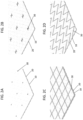
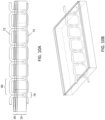
- the stitching pattern to join an adhesion barrier (e.g., sheet) 20 to the substrate material 10 may comprise island stitches 30, whereby stitches are laid at certain points in the substrate and the adhesion barrier sheet (the islands), with spaces in between having no stitching ( FIG. 1 , FIG. 2A, and FIG. 2B).
- FIG. 2A shows an example of a small island stitch pattern 30
- FIG. 2B shows an example of a large island stitch pattern 30. Where a plurality of straight lines are employed, they may be sewn/embroidered in parallel, including in a grid pattern 30 ( FIG.
- the stitching pattern may also comprise interrupted patterns (e.g., interrupted straight lines, interrupted curves, interrupted zig-zags, and interruptions of other patterns described or exemplified herein, or otherwise known), with a non-limiting example of an interrupted zig-zag shown in FIG. 2F .
- the stitching pattern may also comprise random patterns, a non-limiting example of which is shown in FIG. 2G .
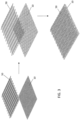
- a reinforcing embroidered pattern may be sewn into the substrate material. See, for example, FIG. 3 .
- threads or yarns 50 (which may be an adhesion barrier material) may be are sewn or embroidered into the substrate material 10.
- the embroidered threads (fibers, etc.) may form a layer that is integral with the substrate material ( FIG. 3 , third panel), and connected to the substrate material at numerous thread interlace points (e.g., FIG.
- Each stitch may comprise one or more, e.g., at least two threads, yarns, or filaments - e.g., an upper thread and a lower thread, which each are sewn into the substrate material.
- an additional anti-adhesion layer is not needed; however, in general, an adhesion barrier is preferably attached (flexibly attached) to the substrate material.
- Sewing or embroidery may be by hand, by machine, or any combination thereof. Sewing may be with a ballpoint needle.
- the addition of the embroidered pattern of material may decrease the compliance of the substrate.
- a substrate e.g., mesh
- a compliance that is greater than the range of compliances identified as most beneficial for soft tissue (e.g., hernia) repair, such as the range of between 10% and 30% compliance strain at 16N/cm (see, e.g., Deeken et al. (2011), Physiocomechanical evaluation of absorbable and nonabsorbable barrier composite meshes for laparoscopic ventral hernia repair.
- the bare mesh may have a % compliance strain at 16N/cm of between 30% and 80%).
- the addition of the embroidered pattern typically using a filament that is bioabsorbable in a pattern such as a grid pattern (or a plurality of overlapping, rotationally offset, grid patterns) may decrease the % compliance strain at 16N/cm to within the 10%-30% range or thereabouts (e.g., between 40%-10%).
- Filaments, threads, or yarns may be sewn in both the embroidered pattern on the mesh and/or the pattern connecting the substrate to the anti-adhesion layers may be any suitable stitch patterns.
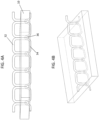
- the material is sewn as a line, for example, as shown in FIG. 4A and FIG. 4B .
- an upper thread 32 and lower thread 34 of adhesion barrier material may be sewn into the substrate 10.
- the upper thread 32 may have a larger diameter relative to the lower thread 34 ( FIG. 4A ), though the upper 32 and lower 34 threads may have substantially the same diameter relative to each other, or the lower thread 34 may have a larger diameter relative to the upper thread 32.
- the upper thread 32 and lower thread 34 may be joined at a thread interlace point 36, created by the sewing machine.
- a suitable diameter may be from about 0.001 inches (about 0.0025 mm) to about 0.05 inches (about 1.27 mm) for a monofilament or multifilament.
- the adhesion barrier materials may be attached to the substrate in a sewn pattern that is different from that of the embroidered pattern (which is typically a tighter, higher-density pattern).
- the embroidered pattern may be a pattern comprising a plurality of lines, including parallel lines (e.g., FIG. 5D , FIG. 5E , and FIG. 6C ), or non-parallel lines that may, but need not, intersect with other sewn lines.
- the stitches may interlace between substrate fibers (fibers, for example, as shown in FIG. 5A ), for example, as shown in FIG. 5B , FIG. 5C , FIG. 6A, and FIG. 6B .
- the stitched lines may comprise interruptions (e.g., breaks between lines such that the lines are not continuous) or may be continuous.
- the stitched lines may be staggered relative to other stitched lines.
- Stitches and stitch patterns may be sewn (embroidered) into the substrate material at any suitable density.
- the density may provide for higher surface area coverage and, at least for a period of time, the density may also impart strength or reinforcement into the substrate.
- the stitching density may also make the substrate more resistant to stretching relative to a lower density of stitches.
- Density may comprise the number of stitches within a stitch pattern. Density may comprise the number of adjacent or parallel stitch patterns and/or the proximity of adjacent or parallel stitch patterns to each other or other stitch patterns (e.g., FIG. 5D , FIG. 5E , and FIG> 6C).
- Stitch patterns may be overlaid in either the embroidered pattern on the substrate and/or the pattern connecting the first and second layers (e.g., substrate and anti-adhesion layers).
- a second stitch pattern (second sub-pattern) may be sewn or embroidered over a first stitch pattern (first sub-pattern).
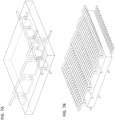
- the filaments (threads, etc.) may be sewn into a pattern comprising a plurality of perpendicular or intersecting lines (e.g., FIG. 7A ).
- Subsequent stitch patterns may be sewn in a different direction relative to another stitch pattern.
- a second stitch pattern may be sewn into the substrate material in a direction that is diagonal or perpendicular to the direction of another stitch pattern sewn into the substrate material.
- Each set of intersecting lines may be sewn into the substrate material at any suitable density.
- one set of lines may be sewn at a relatively high density and another set of lines (the intersecting set) may be sewn at a relatively low density, for example, as shown in FIG. 7B .
- both sets of intersecting lines may be sewn at a high density (not shown).
- the high density line set may be sewn on top of the low density line set ( FIG. 7B ), or vice versa.
- Stitch patterns may comprise parallel straight lines, non-parallel straight lines, intersecting lines, staggered lines, grids, random stitching, curves, angled lines, zig-zags, or any combination thereof, any of which may comprise irregular patterns, regular patterns, or a combination of regular and irregular patterns, and any of which may comprise continuous stitching, interrupted stitching, or a combination of continuous and interrupted stitching.
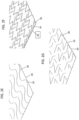
- FIGS. 8A through 8G show examples of suitable stitch patterns.
- FIG. 8A shows a squared stitch pattern, with threads 50 are sewn into the substrate 10 as a series of squares.
- FIG. 8B shows an example of a basic zig-zag pattern, with FIGS. 8C and 8D showing variations of a zig-zag pattern.
- the zig-zag pattern is sewn at a high density and with larger-diameter threads.
- FIG. 8D the zig-zag pattern is sewn with different amplitudes and frequencies among the angled stitches.
- FIG. 8A shows a squared stitch pattern, with threads 50 are sewn into the substrate 10 as a series of squares.
- FIG. 8B shows an example of a basic zig-zag pattern, with FIGS. 8C and 8D showing variations of a zig-zag pattern.
- the zig-zag pattern is sewn at a high density and with larger-diameter threads.
- FIG. 8E a curved stitch pattern is sewn into the substrate material.
- FIG. 8F a stitch pattern comprising interrupted stitching is shown sewn into the substrate material, with the interrupted stitch pattern showing interrupted zig-zag stitches solely for illustration purposes, as any stitch pattern may comprise interruptions in the continuity of the stitches.
- FIG. 8G a random stitch pattern is shown sewn into the substrate material.
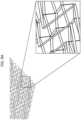
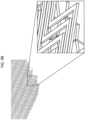
- FIGS. 9A through 9D show a close-up view of the patterns shown in FIGS. 8A through 8D , respectively, and illustrate that the threads interlace throughout the substrate in order to form the stitch pattern.
- Stitch patterns may comprise a plurality of angles, which may comprise a plurality of repeating angles ( FIGS. 8B to 8D ). Where a plurality of angled lines is employed, they may be sewn/embroidered in parallel or in a grid pattern.
- the angle is formed between inflection points in the stitch pattern, and each angle may be from about 0 degrees to about 180 degrees, or at any integer between 0 degrees and 180 degrees, inclusive (e.g., 1 degrees, 2 degrees, 3 degrees, 4 degrees, 5 degrees, 6 degrees, 7 degrees, etc.). It is preferred that the same angle is used throughout a given stitch line, but in some aspects, a combination of different angles may be used throughout a given stitch line.
- a stitch pattern may comprise a plurality of repeating 30 degree angles, or may comprise a plurality of alternating 30 and 50 degree angles, or may comprise any combination of angles.
- Stitch patterns may comprise a plurality of lines arranged in a pattern comprising a plurality of curves, including a wave pattern, an undulating pattern, a ripple pattern, an oscillating line pattern, or any combination thereof, which may be regular or irregular.
- a subset of the lines in a curve pattern may comprise a different amplitude, frequency, or amplitude and frequency relative to another subset of the lines in a curve in the stitch pattern.
- the embroidered pattern may be highly dense (e.g., covering more than 80%, 85%, 90%, 95%, 98%, 99%, etc. of at least the upper or lower surface of the substrate. Higher density patterns may be particularly helpful when an additional anti-adhesive layer is not applied.
- High density parallel stitch patterns may comprise adjacent stitch patterns placed from about 0.5 mm to about 5 mm apart, may comprise adjacent stitch patterns placed from about 1 mm to about 4 mm apart, from about 1 mm to about 3.5 mm apart, from about 1 mm to about 3.3 mm apart, from about 1 mm to about 3.2 mm apart, from about 1 mm to about 3.1 mm apart, from about 1 mm to about 3 mm apart, from about 1 mm to about 2.8 mm apart, from about 1 mm to about 2.6 mm apart, from about 1 mm to about 2.5 mm apart, from about 1 mm to about 2.3 mm apart, from about 1 mm to about 2 mm apart, from about 2 mm to about 3.5 mm apart, from about 2 mm to about 3.3 mm apart, from about 2 mm to about 3.1 mm apart, from about 2 mm to about 3 mm apart
- Stitches may be from about 0.5 mm to about 12 mm per stitch. Stitches may be from about 1 mm to about 7 mm per stitch, from about 1 mm to about 6 mm per stitch, from about 1 mm to about 5 mm per stitch, from about 2 mm to about 6 mm per stitch, from about 2 mm to about 5 mm per stitch, from about 2 mm to about 4 mm per stitch, from about 3 mm to about 6 mm per stitch, or from about 3 mm to about 5 mm per stich.
- the adhesion barrier material e.g., threads, etc.
- the adhesion barrier material may be sewn into the substrate in a corner-locked stitch pattern.
- Such patterns are described in in U.S. patent application No. 15/196,439 , incorporated by reference herein.
- a stitch patterns may be sewn or embroidered through all layers of a layered substrate material. In some aspects, combinations of different stitch patterns may be sewn or embroidered into different portions of the substrate material, for example, to accommodate the direction or orientation or site of implantation.
- any of the anti-adhesive materials may be a biologic such as a sheet or sheets of ECM.
- the sheet of anti-adhesive material may be a sheet of extracellular matrix derived from one or more of the dermis, pericardium, peritoneum, intestine, stomach, or forestomach.
- adhesion barrier materials may include oxidized regenerated cellulose (ORC).
- ORC is typically produced by oxidizing the cellulose by exposing the cellulose to nitrogen dioxide or nitrogen tetroxide. See, for example, U.S. Pat. No. 3,364,200 .
- an adhesion barrier in the form of a sheet, leaf or membrane preferably comprises ORC, such that the cellulose is already in oxidized form when the barrier is joined to the substrate as a substrate-barrier unit.
- ORC in the form of a thread, yarn, or filament may be used to sew an adhesion barrier to the substrate and/or to embroider the substrate.
- the adhesion barrier material may be sewn to the substrate already in oxidized form.
- a thread, yarn, or filament of non-oxidized cellulose e.g., rayon
- a stitch pattern as described or exemplified herein of the cellulose in non-oxidized form may be sewn into the substrate, and then the substrate and the stitches may be oxidized according to any suitable technique such that ORC results, thereby imparting adhesion barrier properties into the stitch pattern.
- FIG. 10A illustrates an example of a portion of a material (such as a graft material) formed as described herein.
- the anti-adhesive layer 30 is shown on the top and includes two (thorough one or more than two sheets may be used) sheets.
- the sheets are sewn into the substrate (e.g., a mesh) using a pair of threads 72,75 that interlock.
- the resulting stitching pattern forms a plurality of discrete attachment sites 70.
- the discrete attachment sites in the line of stitches are separated from each other by a distance 80.
- the stitching pattern may extend along the outer surfaces of the material, and may form an overall attachment pattern such as a grid or any of the other patterns described herein.
- the attachment pattern flexibly secures the layers together.
- the openings between the grids may have a minimum distance of between about 0.5 mm and 30 mm (e.g., between about 1 mm and 30 mm, between about 2 mm and 30 mm, between about 3 mm and 30 mm, between about 5 mm and 30 mm, etc.).
- the openings between lines of stitching may have a minimum distance of between about 0.5 mm and 30 mm (e.g., between about 1 mm and 30 mm, between about 2 mm and 30 mm, between about 3 mm and 30 mm, between about 5 mm and 30 mm, etc.).
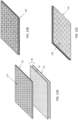
- FIGS. 11A-C and 12A-C illustrate examples of graft materials having a first layer stacked onto a second layer.
- the first layer 10 comprises a mesh formed of a non-absorbable material.
- the mesh includes a first pattern stitched (embroidered) into the mesh with a bioabsorbable material.
- the embroidered pattern does not connect the mesh to another material, but may alter the compliance properties and/or strength of the material, as discussed above.
- the second layer 30 comprises an anti-adhesive material comprising a plurality of sheets 25, 25' (two are shown) of extracellular matrix material (ECM).
- ECM extracellular matrix material
- the second layer is flexibly attached to the first layer with a second pattern 110 of discrete stitched attachment sites (visible on the back surface of the graft, shown in FIG. 12C ).
- the second pattern of discrete stitched attachment sites is less dense than the first pattern 115 stitched into the mesh, wherein adjacent discrete attachment sites are separated by a distance of between 0.5 mm and 30 mm and wherein adjacent regions of the first layer and second layer between the discrete attachment sites may slide relative to each other.
- FIGS. 11B and 12B show the "top" of the grafts, while FIGS. 11C and 12C show the "bottom" (opposite) sides.
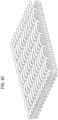
- FIGS. 13A-13B illustrate a substrate 131 material shown as an open-celled mesh.
- the mesh is a polypropylene mesh having an open cell pore of between 0.5 mm and 6 mm diameter.
- the filaments forming the mesh may have a diameter of between 0.001 inch and 0.010 inches.
- This mesh may be reinforced with an embroidered pattern of a bioabsorbable material, as shown in FIG. 13B .
- the pattern comprises a pair of grid sub-patterns 133 that are rotated at 45° relative offset.
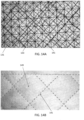
- FIGS. 13A and 13B may be attached via an attachment pattern to an anti-anti-adhesive material as shown in FIGS. 14A-14B.
- FIG. 14A shows the top or front side of the graft material showing both the mesh 131 with the embroidered pattern 133 as shown in FIGS. 13B , but also shows the attachment pattern of stitches forming the plurality of discrete attachment sites between the two layers.
- FIG. 14B shows the opposite (back) side of the graft of FIG. 14A , showing the attachment pattern corresponding to the discrete attachment sites sewn to flexibly secure the two layers together.
- This arrangement of discrete attachment sites does not modify the compliance of the overall material substantially (e.g. less than 15%, less than 13%, less than 11%, less than 10%, etc.), and may allow the two layers to slide relative to each other, particularly in the regions between the attachment sites 149.
- the overall compliance of the material may be controlled and may provide advantages compared to other materials, particularly when inserted into the body as a graft.
- the manner of attachment between the substrate and the anti-adhesion material may be particularly important. In general, it is desirable that the attachment between the two layers does not increase the stiffness (decrease compliance) substantially.
- the graph shows a comparison between materials having different substrate attached.
- the first bar corresponds to a material in which the substrate (mesh) layer is attached to the anti-adhesion layer (e.g., ECM) by an adhesive or glue.
- the overall compliance changes substantially compared to the compliance of either the substrate, the ECM or a loose (unattached) stack of the two, typically > 30% (e.g., between 20% and 70%).
- a material in which small, discrete islands ("spots") of adhesive are used to attach the Mesh to the ECM layer shown in the second bar
- the compliance changes less than 15%.
- the number of attachment sites between the layers may also be generally beneficial to reduce the number of attachment sites between the layers, as this may impact adhesion formation to the implant.
- the density corresponds to a stitch density (and may correspond to the amount to exposed thread/polymer material on the surface of the graft).
- the stitching pattern shown is in a 2-layer (e.g., 2 ECM sheet) embodiment in which the attachment pattern of discrete attachment sites is a stitched grid pattern having grid spacing of between 25 and 1 mm.
- FIGS. 15C and 15D illustrate the effect of attachment site density (e.g., stitch density) on compliance for different stitch patterns and different layer numbers of ECM (anti-adhesion material).
- FIG. 15C shows the relative compliance in layered closed-cell attachment patterns
- FIG. 15D shows a similar relationship in layered open-cell patterns.
- the closed-cell patterns may also benefit from having increase strength due to the attachment pattern.
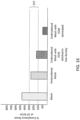
- FIG. 16 illustrates the percent compliance strain at 16 N/cm of the mesh alone (far left), the embroidered mesh, the embroidered mesh with ECM stitched at low density, and an embroidered mesh with ECM laminated on. It is desirable, based on clinical and experimental data, to have the percent compliance strain at 16 N/cm be between 10% and 30% 157, at least at implantation. As indicated the meshes described herein (and particularly the embroidered mesh with ECM stitched at low density) is within this desired compliance window, in contrast to variations in which the anti-adhesion material is laminated or attached at high density.
- inhibiting includes reducing, decreasing, blocking, preventing, delaying, stopping, and/or down regulating.
- inhibiting adhesions includes reducing adhesion formation.
- references to a structure or feature that is disposed "adjacent" another feature may have portions that overlap or underlie the adjacent feature.
- the device may be otherwise oriented (rotated 90 degrees or at other orientations) and the spatially relative descriptors used herein interpreted accordingly.
- the terms “upwardly”, “downwardly”, “vertical”, “horizontal” and the like are used herein for the purpose of explanation only unless specifically indicated otherwise.
- first and second may be used herein to describe various features/elements (including steps), these features/elements should not be limited by these terms, unless the context indicates otherwise. These terms may be used to distinguish one feature/element from another feature/element. Thus, a first feature/element discussed below could be termed a second feature/element, and similarly, a second feature/element discussed below could be termed a first feature/element without departing from the teachings of the present invention.
- any of the apparatuses and methods described herein should be understood to be inclusive, but all or a sub-set of the components and/or steps may alternatively be exclusive, and may be expressed as “consisting of” or alternatively “consisting essentially of” the various components, steps, sub-components or sub-steps.
- a numeric value may have a value that is +/- 0.1% of the stated value (or range of values), +/- 1% of the stated value (or range of values), +/- 2% of the stated value (or range of values), +/- 5% of the stated value (or range of values), +/-10% of the stated value (or range of values), etc.
- Any numerical values given herein should also be understood to include about or approximately that value, unless the context indicates otherwise. For example, if the value "10" is disclosed, then “about 10" is also disclosed. Any numerical range recited herein is intended to include all sub-ranges subsumed therein.
Landscapes
- Health & Medical Sciences (AREA)
- Engineering & Computer Science (AREA)
- Life Sciences & Earth Sciences (AREA)
- Public Health (AREA)
- Veterinary Medicine (AREA)
- General Health & Medical Sciences (AREA)
- Heart & Thoracic Surgery (AREA)
- Vascular Medicine (AREA)
- Animal Behavior & Ethology (AREA)
- Textile Engineering (AREA)
- Cardiology (AREA)
- Biomedical Technology (AREA)
- Transplantation (AREA)
- Oral & Maxillofacial Surgery (AREA)
- Chemical & Material Sciences (AREA)
- Chemical Kinetics & Catalysis (AREA)
- Surgery (AREA)
- Epidemiology (AREA)
- Prostheses (AREA)
Claims (15)
- Hernienreparaturtransplantat, umfassend:eine erste Schicht (10), die auf eine zweite Schicht (30) gestapelt ist;wobei die erste Schicht Folgendes umfasst:
ein Netz (10, 131), das aus einem nicht-absorbierbaren Material und einem ersten Muster (115, 133) gebildet ist, das in das Netz mit einem bioresorbierbaren Material (50) gestickt ist;wobei die zweite Schicht eine Lage aus nicht-haftendem Material umfasst, das ein extrazelluläres Matrix (ECM) -Material umfasst;wobei ferner die zweite Schicht flexibel an der ersten Schicht befestigt ist, mit einem zweiten Muster aus separaten Befestigungsstellen (110), wobei das zweite Muster aus separaten Befestigungsstellen die Nachgiebigkeit der gestapelten ersten und zweiten Schicht um weniger als 15 % im Vergleich zu der Nachgiebigkeit eines Stapels aus der ersten und zweiten Schicht verringert, die nicht miteinander befestigt sind, und benachbarte Regionen der ersten Schicht und zweiten Schicht zwischen den separaten Befestigungsstellen können sich relativ zueinander verschieben. - Hernienreparaturtransplantat nach Anspruch 1, wobei das zweite Muster weniger dicht als das erste Muster in der Ebene der ersten Schicht ist.
- Hernienreparaturtransplantat nach Anspruch 1, wobei das Netz ein gestricktes Netz umfasst.
- Hernienreparaturtransplantat nach Anspruch 1, wobei das Netz Polypropylen, Polytetrafluorethylen (PTFE), Nylon oder Polyester umfasst.
- Hernienreparaturtransplantat nach Anspruch 1, wobei das Netz offenzellige Pore von zwischen 0,5 mm und 6 mm Durchmesser aufweist.
- Hernienreparaturtransplantat nach Anspruch 1, wobei das Netz aus einem gewirkten Filament mit einem Durchmesser zwischen 0,0254 mm (0,001 Zoll) und 0,254 mm (0,010 Zoll) gebildet ist.
- Hernienreparaturtransplantat nach Anspruch 1, wobei das Netz aus einem gewirkten Filament mit einem Durchmesser zwischen 0,0762 mm (0,003 Zoll) und 0,1524 mm (0,006 Zoll) gebildet ist.
- Hernienreparaturtransplantat nach Anspruch 1, wobei das erste Muster benachbarte Stichlinien umfasst, die sich kreuzen, um in regelmäßigen Intervallen ineinanderzugreifen.
- Hernienreparaturtransplantat nach Anspruch 1, wobei das erste Muster ein erstes Stichuntermuster und ein zweites Stichuntermuster umfasst, wobei das erste Stichuntermuster das zweite Stichuntermuster überlagert und das erste Stichuntermuster zwischen 25 und 65 Grad relativ zu dem zweiten Stichuntermuster gedreht wird.
- Hernienreparaturtransplantat nach Anspruch 1, wobei die zweite Schicht ferner eine Vielzahl von gestapelten Lagen aus dem extrazellulären Matrix (ECM) -Material umfasst.
- Hernienreparaturtransplantat nach Anspruch 1, wobei die separaten Befestigungsstellen ein zweites Stichmuster umfassen.
- Hernienreparaturtransplantat nach Anspruch 1, wobei benachbarte separate Befestigungsstellen um eine Distanz von zwischen 0,5 mm und 30 mm getrennt sind.
- Hernienreparaturtransplantat nach Anspruch 1, wobei die zweite Schicht flexibel an der ersten Schicht befestigt ist, wobei ein zweites Muster aus separaten Befestigungsstellen eine Dichte von Befestigungsstellen aufweist, die geringer als etwa 10 Befestigungen/mm2 ist.
- Hernienreparaturtransplantat nach Anspruch 1, wobei die Nachgiebigkeitsdehnung des Hernienreparaturtransplantats 10-30 % bei 16 N/cm beträgt.
- Hernienreparaturtransplantat nach Anspruch 1, wobei das erste Muster die Nachgiebigkeit des Netzes verringert, sodass die Nachgiebigkeit der Hernienreparaturvorrichtung im Laufe der Zeit in einem Patienten zunehmen wird, während das bioresorbierbare Material absorbiert wird.
Applications Claiming Priority (2)
| Application Number | Priority Date | Filing Date | Title |
|---|---|---|---|
| US201662327494P | 2016-04-26 | 2016-04-26 | |
| PCT/US2017/029713 WO2017189772A1 (en) | 2016-04-26 | 2017-04-26 | Hernia repair grafts having anti-adhesion barriers |
Publications (4)
| Publication Number | Publication Date |
|---|---|
| EP3448308A1 EP3448308A1 (de) | 2019-03-06 |
| EP3448308A4 EP3448308A4 (de) | 2020-01-08 |
| EP3448308C0 EP3448308C0 (de) | 2024-08-14 |
| EP3448308B1 true EP3448308B1 (de) | 2024-08-14 |
Family
ID=60089257
Family Applications (1)
| Application Number | Title | Priority Date | Filing Date |
|---|---|---|---|
| EP17790379.6A Active EP3448308B1 (de) | 2016-04-26 | 2017-04-26 | Transplantate für hernienreparatur mit adhäsionsschutzbarrieren |
Country Status (3)
| Country | Link |
|---|---|
| US (5) | US9820843B2 (de) |
| EP (1) | EP3448308B1 (de) |
| WO (1) | WO2017189772A1 (de) |
Families Citing this family (17)
| Publication number | Priority date | Publication date | Assignee | Title |
|---|---|---|---|---|
| CN106028861B (zh) * | 2014-03-25 | 2018-09-11 | 安德阿默有限公司 | 包括织物元件的鞋 |
| US10213284B2 (en) | 2015-06-30 | 2019-02-26 | Tela Bio, Inc. | Corner-lock stitch patterns |
| EP3324882B1 (de) | 2015-07-21 | 2023-10-25 | Tela Bio, Inc. | Nachgiebigkeitskontrolle von nähten in trägermaterialien |
| US9820843B2 (en) | 2016-04-26 | 2017-11-21 | Tela Bio, Inc. | Hernia repair grafts having anti-adhesion barriers |
| WO2019173792A1 (en) | 2018-03-09 | 2019-09-12 | Tela Bio, Inc. | Surgical repair graft |
| EP3653171B1 (de) | 2018-11-16 | 2024-08-21 | Sofradim Production | Implantate zur weichgewebereparatur |
| US11446130B2 (en) | 2019-03-08 | 2022-09-20 | Tela Bio, Inc. | Textured medical textiles |
| US20210022842A1 (en) * | 2019-07-22 | 2021-01-28 | Poly-Med, Inc. | Self-affixing medical devices and additive manufacture of same |
| AU2021246049A1 (en) * | 2020-04-03 | 2021-12-23 | Edwards Lifesciences Corporation | A multi-layer covering for a prosthetic heart valve |
| US11672635B2 (en) * | 2020-04-29 | 2023-06-13 | Bvw Holding Ag | Microstructure soft tissue graft |
| TWI888616B (zh) * | 2020-08-04 | 2025-07-01 | 瑞士商Bvw控股公司 | 用於修補軟組織之可植入式裝置 |
| EP4199833A4 (de) * | 2020-08-19 | 2024-04-10 | Bioforma, Inc. | Unidirektionale und bidirektionale ankergerüste |
| CN112779661B (zh) * | 2020-12-30 | 2025-05-13 | 福建信泰新材料科技有限公司 | 具有开放式网眼结构的织物及其制作方法 |
| CN115125666A (zh) * | 2022-06-08 | 2022-09-30 | 绍兴格锐恩纺织品有限公司 | 三角锁针结构的毛毯后整理工艺 |
| CN115569242B (zh) * | 2022-09-28 | 2024-02-20 | 北京桀亚莱福生物技术有限责任公司 | 一种防粘连腹壁疝复合补片及其制备方法 |
| US20240374367A1 (en) * | 2023-05-10 | 2024-11-14 | Tela Bio, Inc. | Nonuniform embroidered soft tissue implant structure |
| WO2025216861A1 (en) * | 2024-03-19 | 2025-10-16 | Tela Bio, Inc. | Compliance control stitching with multiple axis stitch pattern |
Family Cites Families (147)
| Publication number | Priority date | Publication date | Assignee | Title |
|---|---|---|---|---|
| US2259025A (en) | 1941-02-15 | 1941-10-14 | Daniel J Cosgro | Cleaning device for pots and pans and the like |
| US3033139A (en) | 1957-10-31 | 1962-05-08 | Nippon Mishin Seizo Kabushiki | Stitch forming mechanism of lock-stitch sewing machine for zigzag sewing |
| US3054406A (en) | 1958-10-17 | 1962-09-18 | Phillips Petroleum Co | Surgical mesh |
| US3364200A (en) | 1960-03-28 | 1968-01-16 | Johnson & Johnson | Oxidized cellulose product and method for preparing the same |
| US3155095A (en) | 1961-02-07 | 1964-11-03 | Adolph M Brown | Anastomosis method and means |
| US3658023A (en) | 1969-07-15 | 1972-04-25 | Alfred G Rossi | Fabric and method for making the fabric |
| JPS57119781A (en) | 1981-01-19 | 1982-07-26 | Janome Sewing Machine Co Ltd | Hemming sewing method by zigzag sewing machine |
| US5683400A (en) | 1991-12-13 | 1997-11-04 | Mcguire; David A. | Graft preparation table |
| WO1993017635A1 (en) | 1992-03-04 | 1993-09-16 | C.R. Bard, Inc. | Composite prosthesis and method for limiting the incidence of postoperative adhesions |
| FR2720266B1 (fr) | 1994-05-27 | 1996-12-20 | Cogent Sarl | Tissu prothétique. |
| US5634931A (en) | 1994-09-29 | 1997-06-03 | Surgical Sense, Inc. | Hernia mesh patches and methods of their use |
| US6371985B1 (en) | 1995-03-09 | 2002-04-16 | Robert S. Goldberg | Prostheses restrained by immediate attachment while ingrowth proceeds naturally over time |
| US5723010A (en) | 1995-03-31 | 1998-03-03 | Toyo Boseki Kabushiki Kaisha | Medical device and method for producing the same |
| GB9510624D0 (en) | 1995-05-25 | 1995-07-19 | Ellis Dev Ltd | Textile surgical implants |
| US6814748B1 (en) | 1995-06-07 | 2004-11-09 | Endovascular Technologies, Inc. | Intraluminal grafting system |
| WO1997035533A1 (en) | 1996-03-25 | 1997-10-02 | Enrico Nicolo | Surgical mesh prosthetic material and methods of use |
| US5707395A (en) | 1997-01-16 | 1998-01-13 | Li Medical Technologies, Inc. | Surgical fastener and method and apparatus for ligament repair |
| US6120539A (en) * | 1997-05-01 | 2000-09-19 | C. R. Bard Inc. | Prosthetic repair fabric |
| PT1014946E (pt) | 1997-09-18 | 2010-07-06 | Pacira Pharmaceuticals Inc | COMPOSIÃES ANESTéSICAS LIPOSSOMAIS DE LIBERTAÃO SUSTENTADA |
| US6090998A (en) | 1997-10-27 | 2000-07-18 | University Of Florida | Segmentally demineralized bone implant |
| ATE554748T1 (de) | 1997-11-14 | 2012-05-15 | Pacira Pharmaceuticals Inc | Herstellung von multivesikulären liposomen |
| US6319264B1 (en) * | 1998-04-03 | 2001-11-20 | Bionx Implants Oy | Hernia mesh |
| US20030225355A1 (en) | 1998-10-01 | 2003-12-04 | Butler Charles E. | Composite material for wound repair |
| US6287316B1 (en) | 1999-03-26 | 2001-09-11 | Ethicon, Inc. | Knitted surgical mesh |
| US6258124B1 (en) | 1999-05-10 | 2001-07-10 | C. R. Bard, Inc. | Prosthetic repair fabric |
| US6383201B1 (en) | 1999-05-14 | 2002-05-07 | Tennison S. Dong | Surgical prosthesis for repairing a hernia |
| US7273497B2 (en) | 1999-05-28 | 2007-09-25 | Anova Corp. | Methods for treating a defect in the annulus fibrosis |
| FR2807937B1 (fr) | 2000-04-20 | 2002-08-02 | Sofradim Production | Tricot prothetique agrippant, son procede de fabrication et implant de renfort pour le traitement des deficits parietaux |
| US7108721B2 (en) | 2000-05-11 | 2006-09-19 | Massachusetts Institute Of Technology | Tissue regrafting |
| WO2002010348A2 (en) | 2000-07-29 | 2002-02-07 | Smith & Nephew Plc | Tissue implant for cartilage repair |
| US8366787B2 (en) * | 2000-08-04 | 2013-02-05 | Depuy Products, Inc. | Hybrid biologic-synthetic bioabsorbable scaffolds |
| US7404819B1 (en) | 2000-09-14 | 2008-07-29 | C.R. Bard, Inc. | Implantable prosthesis |
| GB0024903D0 (en) | 2000-10-11 | 2000-11-22 | Ellis Dev Ltd | A textile prothesis |
| US6537569B2 (en) | 2001-02-14 | 2003-03-25 | Microvention, Inc. | Radiation cross-linked hydrogels |
| GB0108088D0 (en) | 2001-03-30 | 2001-05-23 | Browning Healthcare Ltd | Surgical implant |
| US7056331B2 (en) | 2001-06-29 | 2006-06-06 | Quill Medical, Inc. | Suture method |
| CA2465371A1 (en) | 2001-10-29 | 2003-05-08 | Charite - Universitaetsmedizin Berlin | Enzyme-deficient c3 botulinum protein species and their use to promote neuronal growth and neuronal regeneration |
| US6790213B2 (en) | 2002-01-07 | 2004-09-14 | C.R. Bard, Inc. | Implantable prosthesis |
| JP3718801B2 (ja) | 2002-03-25 | 2005-11-24 | 株式会社ミカサ | ミシンの縫い目形成方法 |
| US6743463B2 (en) | 2002-03-28 | 2004-06-01 | Scimed Life Systems, Inc. | Method for spray-coating a medical device having a tubular wall such as a stent |
| DE10221320A1 (de) | 2002-05-07 | 2003-11-27 | Gfe Medizintechnik Gmbh | Flächiges Implantat aus textilem Fadenmaterial, insbesondere Herniennetz |
| US20120035608A1 (en) | 2002-05-20 | 2012-02-09 | Marchitto Kevin S | Electromagnetic treatment of tissues and cells |
| US8142515B2 (en) | 2002-11-04 | 2012-03-27 | Sofradim Production | Prosthesis for reinforcement of tissue structures |
| US20050118236A1 (en) | 2002-12-03 | 2005-06-02 | Gentis Inc. | Bioactive, resorbable scaffolds for tissue engineering |
| US8197837B2 (en) | 2003-03-07 | 2012-06-12 | Depuy Mitek, Inc. | Method of preparation of bioabsorbable porous reinforced tissue implants and implants thereof |
| US7081135B2 (en) | 2003-06-09 | 2006-07-25 | Lane Fielding Smith | Mastopexy stabilization apparatus and method |
| US8226715B2 (en) | 2003-06-30 | 2012-07-24 | Depuy Mitek, Inc. | Scaffold for connective tissue repair |
| KR101136114B1 (ko) | 2003-07-17 | 2012-04-17 | 군제 가부시키가이샤 | 자동봉합장치용 봉합보강재 |
| US20050070930A1 (en) | 2003-09-30 | 2005-03-31 | Gene W. Kammerer | Implantable surgical mesh |
| US20050113849A1 (en) | 2003-11-26 | 2005-05-26 | Nicholas Popadiuk | Prosthetic repair device |
| US20070190108A1 (en) | 2004-05-17 | 2007-08-16 | Arindam Datta | High performance reticulated elastomeric matrix preparation, properties, reinforcement, and use in surgical devices, tissue augmentation and/or tissue repair |
| US8007531B2 (en) | 2004-08-06 | 2011-08-30 | Frank Robert E | Implantable prosthesis for positioning and supporting a breast implant |
| US6962120B1 (en) | 2004-09-13 | 2005-11-08 | Mikasa Corporation | Seam forming method using sewing machine |
| US8470038B2 (en) | 2005-03-04 | 2013-06-25 | Rti Biologics, Inc. | Adjustable and fixed assembled bone-tendon-bone graft |
| AU2006242214B2 (en) | 2005-04-29 | 2012-02-09 | Cook Biotech Incorporated | Volumetric grafts for treatment of fistulae and related methods and systems |
| US9788821B2 (en) | 2005-04-29 | 2017-10-17 | Cook Biotech Incorporated | Physically modified extracellular matrix materials and uses thereof |
| WO2007070141A1 (en) | 2005-09-12 | 2007-06-21 | Proxy Biomedical Limited | Soft tissue implants and methods for making same |
| US8858632B2 (en) | 2006-03-23 | 2014-10-14 | Formae, Inc. | Implants for replacing hyaline cartilage, with hydrogel reinforced by three-dimensional fiber arrays |
| FR2904214B1 (fr) | 2006-07-28 | 2009-02-27 | Gibaud Soc Par Actions Simplif | Dispositif de protection et/ou de cicatrisation |
| WO2008016919A2 (en) | 2006-07-31 | 2008-02-07 | Organogenesis Inc. | Mastopexy and breast reconstruction prostheses and method |
| US8074591B2 (en) | 2006-09-25 | 2011-12-13 | Nuvasive, Inc. | Embroidery using soluble thread |
| US9289279B2 (en) | 2006-10-06 | 2016-03-22 | Promethean Surgical Devices, Llc | Apparatus and method for limiting surgical adhesions |
| EP2091964A2 (de) | 2006-10-30 | 2009-08-26 | Southern Research Institute | Targeting von mbs1-interaktion zur sensibilisierung von krebszellen gegenüber strahlentherapie und chemotherapie |
| EP2088962B1 (de) | 2006-11-22 | 2017-10-11 | Inspiremd Ltd. | Optimierter stentmantel |
| US20080181928A1 (en) | 2006-12-22 | 2008-07-31 | Miv Therapeutics, Inc. | Coatings for implantable medical devices for liposome delivery |
| US8795384B2 (en) | 2007-01-10 | 2014-08-05 | Cook Biotech Incorporated | Implantable devices useful for reinforcing a surgically created stoma |
| US7946236B2 (en) | 2007-01-31 | 2011-05-24 | Nuvasive, Inc. | Using zigzags to create three-dimensional embroidered structures |
| EP2148887B1 (de) | 2007-04-19 | 2014-04-30 | Fibralign Corporation | Orientierte, auf kollagen basierende materialien, filme und verfahren zu deren herstellung |
| US20090018655A1 (en) | 2007-07-13 | 2009-01-15 | John Brunelle | Composite Implant for Surgical Repair |
| US7731988B2 (en) | 2007-08-03 | 2010-06-08 | Zimmer, Inc. | Multi-polymer hydrogels |
| ES2702809T3 (es) | 2007-08-22 | 2019-03-05 | Noveome Biotherapeutics Inc | Composiciones novedosas de solución que contiene factor celular y su uso para tratar heridas |
| US7875074B2 (en) | 2007-09-19 | 2011-01-25 | Ethicon, Inc. | Naturally contoured, preformed, three dimensional mesh device for breast implant support |
| BRPI0816524A2 (pt) | 2007-10-16 | 2015-03-24 | Orbix Medical Ltda | "sistema de moldagem de tecido macio, método para moldagem de um tecido macio de um paciente e material laminado" |
| WO2009120966A2 (en) | 2008-03-27 | 2009-10-01 | The Cleveland Clinic Foundation | Reinforced tissue graft |
| US20130116799A1 (en) * | 2008-03-27 | 2013-05-09 | The Cleveland Clinic Foundation | Reinforced tissue graft |
| EP2323591B1 (de) | 2008-06-06 | 2017-08-02 | Edwards Lifesciences Corporation | Transkatheter-herzklappe mit niedrigem profil |
| EP2300066B1 (de) | 2008-06-10 | 2017-02-15 | Cook Biotech Incorporated | Gestepptes implantierbares graft-transplantat |
| US9295757B2 (en) * | 2008-06-10 | 2016-03-29 | Cook Biotech Incorporated | Quilted implantable graft |
| CA2727777A1 (en) | 2008-07-07 | 2010-01-14 | Biomimedica, Inc. | Hydrophilic interpenetrating polymer networks derived from hydrophobic polymers |
| EP2907531A1 (de) | 2008-07-30 | 2015-08-19 | Mesynthes Limited | Verfahren zum Trennen oder Dezellularisieren Gewebsschichten |
| EP2323670A4 (de) | 2008-08-05 | 2013-12-25 | Biomimedica Inc | Polyurethan-gepfropfte hydrogele |
| US9387280B2 (en) | 2008-09-05 | 2016-07-12 | Synovis Orthopedic And Woundcare, Inc. | Device for soft tissue repair or replacement |
| CN102231978B (zh) | 2008-10-07 | 2016-01-20 | 耶路撒冷希伯来大学伊森姆研究发展公司 | 包含包埋在聚合物基质中的脂质体的组合物和其使用方法 |
| WO2010045207A2 (en) | 2008-10-13 | 2010-04-22 | The General Hospital Corporation | Single tunnel, double bundle anterior cruciate ligament reconstruction using bone-patellar tendon-bone grafts |
| WO2010048189A2 (en) | 2008-10-20 | 2010-04-29 | IMDS, Inc. | Systems and methods for cerebrospinal fluid repair |
| US9326840B2 (en) | 2008-12-15 | 2016-05-03 | Allergan, Inc. | Prosthetic device and method of manufacturing the same |
| US20130304098A1 (en) | 2008-12-15 | 2013-11-14 | Allergan, Inc. | Silk medical device for use in breast augmentation and breast reconstruction |
| US9204953B2 (en) | 2008-12-15 | 2015-12-08 | Allergan, Inc. | Biocompatible surgical scaffold with varying stretch |
| EP2391395A4 (de) | 2009-02-02 | 2014-04-09 | Biomerix Corp | Verbundnetzvorrichtung und verfahren zur weichgewebereparatur |
| DE102009015302A1 (de) | 2009-03-19 | 2010-09-23 | Aesculap Ag | Chirurgisches Implantat, insbesondere zur Versorgung von Hernien |
| US20100249929A1 (en) | 2009-03-24 | 2010-09-30 | Joint Restoration Foundation | Adjustable patella ligament for acl repair |
| US20100305500A1 (en) | 2009-05-29 | 2010-12-02 | Pacira Pharmaceuticals, Inc. | Hyaluronidase as an adjuvant for increasing the injection volume and dispersion of large diameter synthetic membrane vesicles containing a therapeutic agent |
| BR112012000114A2 (pt) | 2009-07-06 | 2016-11-01 | Coloplast As | arcabouço biodegradável para regeneração de tecido mole e uso do mesmo |
| US8298586B2 (en) * | 2009-07-22 | 2012-10-30 | Acell Inc | Variable density tissue graft composition |
| JP5767235B2 (ja) | 2009-11-09 | 2015-08-19 | スリーエム イノベイティブ プロパティズ カンパニー | 医療用物品及び不混和性材料を用いる製造方法 |
| US8690960B2 (en) | 2009-11-24 | 2014-04-08 | Covidien Lp | Reinforced tissue patch |
| US9510925B2 (en) | 2010-02-02 | 2016-12-06 | Covidien Lp | Surgical meshes |
| US8992411B2 (en) | 2010-02-16 | 2015-03-31 | Ams Research Corporation | Bioabsorbable mesh for surgical implants |
| CN103002878B (zh) | 2010-04-09 | 2015-07-01 | 帕西拉制药有限公司 | 用于配制大直径合成膜囊泡的方法 |
| US20120095482A1 (en) | 2010-05-11 | 2012-04-19 | Dale Peterson | Endoprosthetic textile scaffold |
| US9770414B2 (en) | 2010-05-13 | 2017-09-26 | Pacira Pharmaceuticals, Inc. | Sustained release formulation of methotrexate as a disease-modifying antirheumatic drug (DMARD) and an anti-cancer agent |
| US20110301717A1 (en) | 2010-06-03 | 2011-12-08 | Hilton Becker | Supporting and Forming Transitional Material for Use in Supporting Prosthesis Devices, Implants and to Provide Structure in a Human Body |
| US20130172994A1 (en) | 2010-06-03 | 2013-07-04 | Hilton Becker | Supporting and forming transitional material for use in supporting prosthesis devices, implants and to provide structure in a human body |
| US20120184974A1 (en) | 2010-06-03 | 2012-07-19 | Hilton Becker | Supporting and Forming Transitional Material for Use in Supporting Prosthesis Devices, Implants and to Provide Structure in a Human Body |
| US9211175B2 (en) | 2010-07-08 | 2015-12-15 | Covidien Lp | Self-detachable medical devices |
| WO2012017415A2 (en) | 2010-08-05 | 2012-02-09 | Lifebond Ltd. | Dry composition wound dressings and adhesives |
| US9572907B2 (en) | 2010-10-01 | 2017-02-21 | Covidien Lp | Implantable polymeric films |
| CN103220998B (zh) * | 2010-10-06 | 2016-05-04 | Ams研究公司 | 用于治疗女性骨盆病症,具有可吸收性和不可吸收性特征的移植物 |
| US9192385B2 (en) | 2010-10-12 | 2015-11-24 | Evan Richard Geller | Device and method to facilitate safe, adhesion-free surgical closures |
| JP6194248B2 (ja) | 2010-10-28 | 2017-09-06 | パシラ ファーマシューティカルズ インコーポレーテッド | 非ステロイド性抗炎症薬の徐放性処方物 |
| US8728159B2 (en) | 2010-12-01 | 2014-05-20 | Northwestern University | Prosthetic breast support |
| US20120179176A1 (en) | 2010-12-28 | 2012-07-12 | Promethean Surgical Devices, Llc | Apparatus and method for limiting surgical adhesions |
| ES2684949T3 (es) | 2011-03-09 | 2018-10-05 | Tepha, Inc. | Sistemas para mastopexia |
| FR2972626B1 (fr) | 2011-03-16 | 2014-04-11 | Sofradim Production | Prothese comprenant un tricot tridimensionnel et ajoure |
| US8579924B2 (en) | 2011-07-26 | 2013-11-12 | Covidien Lp | Implantable devices including a mesh and a pivotable film |
| WO2013017835A1 (en) | 2011-08-02 | 2013-02-07 | Xiros Limited | Connective tissue repair |
| WO2013036771A1 (en) | 2011-09-08 | 2013-03-14 | Indicator Systems International, Inc. | Infection activated wound caring compositions and devices |
| FR2985171B1 (fr) | 2011-12-29 | 2014-06-06 | Sofradim Production | Prothese pour hernie avec moyen de marquage |
| FR2985169B1 (fr) | 2011-12-29 | 2014-12-05 | Sofradim Production | Tricot avec zones sans picots |
| EP2659800B1 (de) | 2012-01-18 | 2018-02-28 | Mrm Hk Limited | Verstärkter Stoff |
| US20130211307A1 (en) | 2012-02-13 | 2013-08-15 | Bsn Medical, Inc. | Negative pressure wound therapy product and method |
| WO2013126718A1 (en) | 2012-02-24 | 2013-08-29 | Bvw Holding Ag | Anti-erosion soft tissue repair device |
| EP3241933B1 (de) * | 2012-04-06 | 2020-12-23 | Poly-Med Inc. | Polymere siebprodukte und verfahren zur herstellung |
| US9554902B2 (en) | 2012-06-28 | 2017-01-31 | St. Jude Medical, Cardiology Division, Inc. | Leaflet in configuration for function in various shapes and sizes |
| US9433489B2 (en) | 2013-03-12 | 2016-09-06 | Soft Tissue Regeneration, Inc. | Absorbable synthetic braided matrix for breast reconstruction and hernia repair |
| RU2524196C1 (ru) | 2013-03-20 | 2014-07-27 | Общество с ограниченной ответственностью "Линтекс" | Эндопротез сетчатый основовязаный усиленный для пластики вентральных грыж (варианты) и способ его применения |
| WO2015006737A1 (en) | 2013-07-11 | 2015-01-15 | Tepha, Inc. | Absorbable implants for plastic surgery |
| WO2015006429A1 (en) | 2013-07-12 | 2015-01-15 | The United States Of America, As Represented By The Secretary, Department Of Health And Human Services | Photoactivatable lipid-based nanoparticles as vehicles for dual agent delivery |
| US20150057685A1 (en) | 2013-08-22 | 2015-02-26 | Allergan, Inc. | Medical device with anti adhesive property |
| US10286119B2 (en) | 2014-01-24 | 2019-05-14 | University of Pittsburgh—of the Commonwealth System of Higher Education | Extracellular matrix mesh coating |
| US10130457B2 (en) | 2014-03-05 | 2018-11-20 | Tela Bio, Inc. | Surgical attachment device |
| US9574292B2 (en) | 2014-03-24 | 2017-02-21 | L&P Property Management Company | Method of dynamically changing stitch density for optimal quilter throughput |
| US10004586B2 (en) | 2014-08-27 | 2018-06-26 | The Cleveland Clinic Foundation | Biocompatible tissue graft |
| EP3142656B1 (de) | 2015-01-21 | 2018-10-17 | Pacira Pharmaceuticals, Inc. | Multivesikuläre liposomformulierungen von tranexamsäure |
| DK3261589T3 (da) | 2015-02-26 | 2020-12-14 | Merit Medical Systems Inc | Lagdelte medicinske indretninger |
| US20160262208A1 (en) | 2015-03-06 | 2016-09-08 | Jia-Cheng Hsieh | Fixing method of carbon fiber bundle and flexible gas permeable electric heating structure made thereof |
| US10213284B2 (en) | 2015-06-30 | 2019-02-26 | Tela Bio, Inc. | Corner-lock stitch patterns |
| EP3324882B1 (de) | 2015-07-21 | 2023-10-25 | Tela Bio, Inc. | Nachgiebigkeitskontrolle von nähten in trägermaterialien |
| US10675141B2 (en) | 2015-09-21 | 2020-06-09 | Tela Bio, Inc | Reinforced Orthopedic devices |
| WO2017050837A1 (en) | 2015-09-23 | 2017-03-30 | Novus Scientific Ab | Three-dimensional medical implant for regeneration of soft tissue |
| TWI766853B (zh) | 2016-01-14 | 2022-06-11 | 學校法人大阪醫科藥科大學 | 經編針織物及醫療材料 |
| US9820843B2 (en) | 2016-04-26 | 2017-11-21 | Tela Bio, Inc. | Hernia repair grafts having anti-adhesion barriers |
| EP3241895A1 (de) | 2016-05-04 | 2017-11-08 | ETH Zürich, ETH Transfer | Transglutaminasevermittelte hyaluronanhydrogele mit hohem molekulargewicht |
| WO2017223462A1 (en) | 2016-06-24 | 2017-12-28 | President And Fellows Of Harvard College | Composition and method for adhering biomaterials to a target surface |
| WO2019173792A1 (en) | 2018-03-09 | 2019-09-12 | Tela Bio, Inc. | Surgical repair graft |
| US11446130B2 (en) | 2019-03-08 | 2022-09-20 | Tela Bio, Inc. | Textured medical textiles |
| US20230338637A1 (en) | 2022-04-26 | 2023-10-26 | Tela Bio, Inc. | Breast pocket irrigation apparatuses and methods |
-
2017
- 2017-04-26 US US15/498,409 patent/US9820843B2/en active Active
- 2017-04-26 EP EP17790379.6A patent/EP3448308B1/de active Active
- 2017-04-26 WO PCT/US2017/029713 patent/WO2017189772A1/en not_active Ceased
- 2017-11-15 US US15/814,275 patent/US10561485B2/en active Active
-
2020
- 2020-02-14 US US16/792,068 patent/US11464616B2/en active Active
-
2022
- 2022-10-05 US US17/938,250 patent/US12070380B2/en active Active
-
2024
- 2024-07-22 US US18/779,698 patent/US20250049552A1/en active Pending
Also Published As
| Publication number | Publication date |
|---|---|
| US9820843B2 (en) | 2017-11-21 |
| US10561485B2 (en) | 2020-02-18 |
| EP3448308A4 (de) | 2020-01-08 |
| WO2017189772A1 (en) | 2017-11-02 |
| US20170304040A1 (en) | 2017-10-26 |
| EP3448308A1 (de) | 2019-03-06 |
| US12070380B2 (en) | 2024-08-27 |
| US20180071071A1 (en) | 2018-03-15 |
| US20250049552A1 (en) | 2025-02-13 |
| US11464616B2 (en) | 2022-10-11 |
| US20200253707A1 (en) | 2020-08-13 |
| EP3448308C0 (de) | 2024-08-14 |
| US20230277287A1 (en) | 2023-09-07 |
Similar Documents
| Publication | Publication Date | Title |
|---|---|---|
| US12070380B2 (en) | Hernia repair grafts having anti-adhesion barriers | |
| US11872118B2 (en) | Implantable mesh and method of use | |
| US20250041040A1 (en) | Compliance control stitching in substrate materials | |
| US6319264B1 (en) | Hernia mesh | |
| US7615065B2 (en) | Areal implant | |
| EP2514862B1 (de) | Medizinprodukt und dessen Herstellung | |
| EP2543339A1 (de) | Medizinisches Implantat, insbesondere zur Verwendung in einem Implantat zur Reparatur von Hernien | |
| US20140194926A1 (en) | Umbilical hernia prosthesis | |
| JP2016508854A (ja) | 乳房再建およびヘルニア修復のための吸収性合成編組マトリクス | |
| US12226299B2 (en) | Textured medical textiles | |
| US11696819B2 (en) | Method for forming a mesh having a barbed suture attached thereto and the mesh thus obtained | |
| CN111821064A (zh) | 时间依赖性生理组织支架 | |
| HK40032744A (en) | Time dependent physiologic tissue scaffold |
Legal Events
| Date | Code | Title | Description |
|---|---|---|---|
| STAA | Information on the status of an ep patent application or granted ep patent |
Free format text: STATUS: THE INTERNATIONAL PUBLICATION HAS BEEN MADE |
|
| PUAI | Public reference made under article 153(3) epc to a published international application that has entered the european phase |
Free format text: ORIGINAL CODE: 0009012 |
|
| STAA | Information on the status of an ep patent application or granted ep patent |
Free format text: STATUS: REQUEST FOR EXAMINATION WAS MADE |
|
| 17P | Request for examination filed |
Effective date: 20181123 |
|
| AK | Designated contracting states |
Kind code of ref document: A1 Designated state(s): AL AT BE BG CH CY CZ DE DK EE ES FI FR GB GR HR HU IE IS IT LI LT LU LV MC MK MT NL NO PL PT RO RS SE SI SK SM TR |
|
| AX | Request for extension of the european patent |
Extension state: BA ME |
|
| DAV | Request for validation of the european patent (deleted) | ||
| DAX | Request for extension of the european patent (deleted) | ||
| A4 | Supplementary search report drawn up and despatched |
Effective date: 20191211 |
|
| RIC1 | Information provided on ipc code assigned before grant |
Ipc: D04B 21/16 20060101ALI20191205BHEP Ipc: A61L 31/00 20060101ALI20191205BHEP Ipc: D04B 21/12 20060101ALI20191205BHEP Ipc: A61F 2/00 20060101AFI20191205BHEP |
|
| GRAP | Despatch of communication of intention to grant a patent |
Free format text: ORIGINAL CODE: EPIDOSNIGR1 |
|
| STAA | Information on the status of an ep patent application or granted ep patent |
Free format text: STATUS: GRANT OF PATENT IS INTENDED |
|
| INTG | Intention to grant announced |
Effective date: 20240307 |
|
| GRAS | Grant fee paid |
Free format text: ORIGINAL CODE: EPIDOSNIGR3 |
|
| GRAA | (expected) grant |
Free format text: ORIGINAL CODE: 0009210 |
|
| STAA | Information on the status of an ep patent application or granted ep patent |
Free format text: STATUS: THE PATENT HAS BEEN GRANTED |
|
| AK | Designated contracting states |
Kind code of ref document: B1 Designated state(s): AL AT BE BG CH CY CZ DE DK EE ES FI FR GB GR HR HU IE IS IT LI LT LU LV MC MK MT NL NO PL PT RO RS SE SI SK SM TR |
|
| REG | Reference to a national code |
Ref country code: GB Ref legal event code: FG4D |
|
| REG | Reference to a national code |
Ref country code: CH Ref legal event code: EP |
|
| REG | Reference to a national code |
Ref country code: DE Ref legal event code: R096 Ref document number: 602017084092 Country of ref document: DE |
|
| REG | Reference to a national code |
Ref country code: IE Ref legal event code: FG4D |
|
| U01 | Request for unitary effect filed |
Effective date: 20240814 |
|
| U07 | Unitary effect registered |
Designated state(s): AT BE BG DE DK EE FI FR IT LT LU LV MT NL PT SE SI Effective date: 20240828 |
|
| PG25 | Lapsed in a contracting state [announced via postgrant information from national office to epo] |
Ref country code: NO Free format text: LAPSE BECAUSE OF FAILURE TO SUBMIT A TRANSLATION OF THE DESCRIPTION OR TO PAY THE FEE WITHIN THE PRESCRIBED TIME-LIMIT Effective date: 20241114 |
|
| PG25 | Lapsed in a contracting state [announced via postgrant information from national office to epo] |
Ref country code: GR Free format text: LAPSE BECAUSE OF FAILURE TO SUBMIT A TRANSLATION OF THE DESCRIPTION OR TO PAY THE FEE WITHIN THE PRESCRIBED TIME-LIMIT Effective date: 20241115 Ref country code: PL Free format text: LAPSE BECAUSE OF FAILURE TO SUBMIT A TRANSLATION OF THE DESCRIPTION OR TO PAY THE FEE WITHIN THE PRESCRIBED TIME-LIMIT Effective date: 20240814 |
|
| PG25 | Lapsed in a contracting state [announced via postgrant information from national office to epo] |
Ref country code: IS Free format text: LAPSE BECAUSE OF FAILURE TO SUBMIT A TRANSLATION OF THE DESCRIPTION OR TO PAY THE FEE WITHIN THE PRESCRIBED TIME-LIMIT Effective date: 20241214 |
|
| PG25 | Lapsed in a contracting state [announced via postgrant information from national office to epo] |
Ref country code: HR Free format text: LAPSE BECAUSE OF FAILURE TO SUBMIT A TRANSLATION OF THE DESCRIPTION OR TO PAY THE FEE WITHIN THE PRESCRIBED TIME-LIMIT Effective date: 20240814 |
|
| PG25 | Lapsed in a contracting state [announced via postgrant information from national office to epo] |
Ref country code: RS Free format text: LAPSE BECAUSE OF FAILURE TO SUBMIT A TRANSLATION OF THE DESCRIPTION OR TO PAY THE FEE WITHIN THE PRESCRIBED TIME-LIMIT Effective date: 20241114 Ref country code: ES Free format text: LAPSE BECAUSE OF FAILURE TO SUBMIT A TRANSLATION OF THE DESCRIPTION OR TO PAY THE FEE WITHIN THE PRESCRIBED TIME-LIMIT Effective date: 20240814 |
|
| PG25 | Lapsed in a contracting state [announced via postgrant information from national office to epo] |
Ref country code: RS Free format text: LAPSE BECAUSE OF FAILURE TO SUBMIT A TRANSLATION OF THE DESCRIPTION OR TO PAY THE FEE WITHIN THE PRESCRIBED TIME-LIMIT Effective date: 20241114 Ref country code: PL Free format text: LAPSE BECAUSE OF FAILURE TO SUBMIT A TRANSLATION OF THE DESCRIPTION OR TO PAY THE FEE WITHIN THE PRESCRIBED TIME-LIMIT Effective date: 20240814 Ref country code: NO Free format text: LAPSE BECAUSE OF FAILURE TO SUBMIT A TRANSLATION OF THE DESCRIPTION OR TO PAY THE FEE WITHIN THE PRESCRIBED TIME-LIMIT Effective date: 20241114 Ref country code: IS Free format text: LAPSE BECAUSE OF FAILURE TO SUBMIT A TRANSLATION OF THE DESCRIPTION OR TO PAY THE FEE WITHIN THE PRESCRIBED TIME-LIMIT Effective date: 20241214 Ref country code: HR Free format text: LAPSE BECAUSE OF FAILURE TO SUBMIT A TRANSLATION OF THE DESCRIPTION OR TO PAY THE FEE WITHIN THE PRESCRIBED TIME-LIMIT Effective date: 20240814 Ref country code: GR Free format text: LAPSE BECAUSE OF FAILURE TO SUBMIT A TRANSLATION OF THE DESCRIPTION OR TO PAY THE FEE WITHIN THE PRESCRIBED TIME-LIMIT Effective date: 20241115 Ref country code: ES Free format text: LAPSE BECAUSE OF FAILURE TO SUBMIT A TRANSLATION OF THE DESCRIPTION OR TO PAY THE FEE WITHIN THE PRESCRIBED TIME-LIMIT Effective date: 20240814 |
|
| PG25 | Lapsed in a contracting state [announced via postgrant information from national office to epo] |
Ref country code: SM Free format text: LAPSE BECAUSE OF FAILURE TO SUBMIT A TRANSLATION OF THE DESCRIPTION OR TO PAY THE FEE WITHIN THE PRESCRIBED TIME-LIMIT Effective date: 20240814 |
|
| U20 | Renewal fee for the european patent with unitary effect paid |
Year of fee payment: 9 Effective date: 20250310 |
|
| PG25 | Lapsed in a contracting state [announced via postgrant information from national office to epo] |
Ref country code: CZ Free format text: LAPSE BECAUSE OF FAILURE TO SUBMIT A TRANSLATION OF THE DESCRIPTION OR TO PAY THE FEE WITHIN THE PRESCRIBED TIME-LIMIT Effective date: 20240814 |
|
| PG25 | Lapsed in a contracting state [announced via postgrant information from national office to epo] |
Ref country code: SK Free format text: LAPSE BECAUSE OF FAILURE TO SUBMIT A TRANSLATION OF THE DESCRIPTION OR TO PAY THE FEE WITHIN THE PRESCRIBED TIME-LIMIT Effective date: 20240814 |
|
| PGFP | Annual fee paid to national office [announced via postgrant information from national office to epo] |
Ref country code: GB Payment date: 20250306 Year of fee payment: 9 |
|
| PLBE | No opposition filed within time limit |
Free format text: ORIGINAL CODE: 0009261 |
|
| STAA | Information on the status of an ep patent application or granted ep patent |
Free format text: STATUS: NO OPPOSITION FILED WITHIN TIME LIMIT |
|
| 26N | No opposition filed |
Effective date: 20250515 |
|
| REG | Reference to a national code |
Ref country code: CH Ref legal event code: H13 Free format text: ST27 STATUS EVENT CODE: U-0-0-H10-H13 (AS PROVIDED BY THE NATIONAL OFFICE) Effective date: 20251125 |