EP3446657A1 - Iris-lens diaphragm - Google Patents
Iris-lens diaphragm Download PDFInfo
- Publication number
- EP3446657A1 EP3446657A1 EP17786235.6A EP17786235A EP3446657A1 EP 3446657 A1 EP3446657 A1 EP 3446657A1 EP 17786235 A EP17786235 A EP 17786235A EP 3446657 A1 EP3446657 A1 EP 3446657A1
- Authority
- EP
- European Patent Office
- Prior art keywords
- iris
- lens diaphragm
- colored ring
- support elements
- lens
- Prior art date
- Legal status (The legal status is an assumption and is not a legal conclusion. Google has not performed a legal analysis and makes no representation as to the accuracy of the status listed.)
- Granted
Links
Images

Classifications
-
- A—HUMAN NECESSITIES
- A61—MEDICAL OR VETERINARY SCIENCE; HYGIENE
- A61F—FILTERS IMPLANTABLE INTO BLOOD VESSELS; PROSTHESES; DEVICES PROVIDING PATENCY TO, OR PREVENTING COLLAPSING OF, TUBULAR STRUCTURES OF THE BODY, e.g. STENTS; ORTHOPAEDIC, NURSING OR CONTRACEPTIVE DEVICES; FOMENTATION; TREATMENT OR PROTECTION OF EYES OR EARS; BANDAGES, DRESSINGS OR ABSORBENT PADS; FIRST-AID KITS
- A61F2/00—Filters implantable into blood vessels; Prostheses, i.e. artificial substitutes or replacements for parts of the body; Appliances for connecting them with the body; Devices providing patency to, or preventing collapsing of, tubular structures of the body, e.g. stents
- A61F2/02—Prostheses implantable into the body
- A61F2/14—Eye parts, e.g. lenses or corneal implants; Artificial eyes
- A61F2/16—Intraocular lenses
-
- A—HUMAN NECESSITIES
- A61—MEDICAL OR VETERINARY SCIENCE; HYGIENE
- A61F—FILTERS IMPLANTABLE INTO BLOOD VESSELS; PROSTHESES; DEVICES PROVIDING PATENCY TO, OR PREVENTING COLLAPSING OF, TUBULAR STRUCTURES OF THE BODY, e.g. STENTS; ORTHOPAEDIC, NURSING OR CONTRACEPTIVE DEVICES; FOMENTATION; TREATMENT OR PROTECTION OF EYES OR EARS; BANDAGES, DRESSINGS OR ABSORBENT PADS; FIRST-AID KITS
- A61F2/00—Filters implantable into blood vessels; Prostheses, i.e. artificial substitutes or replacements for parts of the body; Appliances for connecting them with the body; Devices providing patency to, or preventing collapsing of, tubular structures of the body, e.g. stents
- A61F2/02—Prostheses implantable into the body
- A61F2/14—Eye parts, e.g. lenses or corneal implants; Artificial eyes
- A61F2/16—Intraocular lenses
- A61F2/1602—Corrective lenses for use in addition to the natural lenses of the eyes or for pseudo-phakic eyes
- A61F2/1605—Anterior chamber lenses for use in addition to the natural lenses of the eyes, e.g. iris fixated, iris floating
-
- A—HUMAN NECESSITIES
- A61—MEDICAL OR VETERINARY SCIENCE; HYGIENE
- A61F—FILTERS IMPLANTABLE INTO BLOOD VESSELS; PROSTHESES; DEVICES PROVIDING PATENCY TO, OR PREVENTING COLLAPSING OF, TUBULAR STRUCTURES OF THE BODY, e.g. STENTS; ORTHOPAEDIC, NURSING OR CONTRACEPTIVE DEVICES; FOMENTATION; TREATMENT OR PROTECTION OF EYES OR EARS; BANDAGES, DRESSINGS OR ABSORBENT PADS; FIRST-AID KITS
- A61F2/00—Filters implantable into blood vessels; Prostheses, i.e. artificial substitutes or replacements for parts of the body; Appliances for connecting them with the body; Devices providing patency to, or preventing collapsing of, tubular structures of the body, e.g. stents
- A61F2/02—Prostheses implantable into the body
- A61F2/14—Eye parts, e.g. lenses or corneal implants; Artificial eyes
-
- A—HUMAN NECESSITIES
- A61—MEDICAL OR VETERINARY SCIENCE; HYGIENE
- A61F—FILTERS IMPLANTABLE INTO BLOOD VESSELS; PROSTHESES; DEVICES PROVIDING PATENCY TO, OR PREVENTING COLLAPSING OF, TUBULAR STRUCTURES OF THE BODY, e.g. STENTS; ORTHOPAEDIC, NURSING OR CONTRACEPTIVE DEVICES; FOMENTATION; TREATMENT OR PROTECTION OF EYES OR EARS; BANDAGES, DRESSINGS OR ABSORBENT PADS; FIRST-AID KITS
- A61F2/00—Filters implantable into blood vessels; Prostheses, i.e. artificial substitutes or replacements for parts of the body; Appliances for connecting them with the body; Devices providing patency to, or preventing collapsing of, tubular structures of the body, e.g. stents
- A61F2/02—Prostheses implantable into the body
- A61F2/14—Eye parts, e.g. lenses or corneal implants; Artificial eyes
- A61F2/16—Intraocular lenses
- A61F2002/1681—Intraocular lenses having supporting structure for lens, e.g. haptics
- A61F2002/1683—Intraocular lenses having supporting structure for lens, e.g. haptics having filiform haptics
-
- A—HUMAN NECESSITIES
- A61—MEDICAL OR VETERINARY SCIENCE; HYGIENE
- A61F—FILTERS IMPLANTABLE INTO BLOOD VESSELS; PROSTHESES; DEVICES PROVIDING PATENCY TO, OR PREVENTING COLLAPSING OF, TUBULAR STRUCTURES OF THE BODY, e.g. STENTS; ORTHOPAEDIC, NURSING OR CONTRACEPTIVE DEVICES; FOMENTATION; TREATMENT OR PROTECTION OF EYES OR EARS; BANDAGES, DRESSINGS OR ABSORBENT PADS; FIRST-AID KITS
- A61F2/00—Filters implantable into blood vessels; Prostheses, i.e. artificial substitutes or replacements for parts of the body; Appliances for connecting them with the body; Devices providing patency to, or preventing collapsing of, tubular structures of the body, e.g. stents
- A61F2/02—Prostheses implantable into the body
- A61F2/14—Eye parts, e.g. lenses or corneal implants; Artificial eyes
- A61F2/16—Intraocular lenses
- A61F2002/1681—Intraocular lenses having supporting structure for lens, e.g. haptics
- A61F2002/1689—Intraocular lenses having supporting structure for lens, e.g. haptics having plate-haptics
-
- A—HUMAN NECESSITIES
- A61—MEDICAL OR VETERINARY SCIENCE; HYGIENE
- A61F—FILTERS IMPLANTABLE INTO BLOOD VESSELS; PROSTHESES; DEVICES PROVIDING PATENCY TO, OR PREVENTING COLLAPSING OF, TUBULAR STRUCTURES OF THE BODY, e.g. STENTS; ORTHOPAEDIC, NURSING OR CONTRACEPTIVE DEVICES; FOMENTATION; TREATMENT OR PROTECTION OF EYES OR EARS; BANDAGES, DRESSINGS OR ABSORBENT PADS; FIRST-AID KITS
- A61F2/00—Filters implantable into blood vessels; Prostheses, i.e. artificial substitutes or replacements for parts of the body; Appliances for connecting them with the body; Devices providing patency to, or preventing collapsing of, tubular structures of the body, e.g. stents
- A61F2/02—Prostheses implantable into the body
- A61F2/14—Eye parts, e.g. lenses or corneal implants; Artificial eyes
- A61F2/16—Intraocular lenses
- A61F2002/1681—Intraocular lenses having supporting structure for lens, e.g. haptics
- A61F2002/169—Surrounding optic
-
- A—HUMAN NECESSITIES
- A61—MEDICAL OR VETERINARY SCIENCE; HYGIENE
- A61F—FILTERS IMPLANTABLE INTO BLOOD VESSELS; PROSTHESES; DEVICES PROVIDING PATENCY TO, OR PREVENTING COLLAPSING OF, TUBULAR STRUCTURES OF THE BODY, e.g. STENTS; ORTHOPAEDIC, NURSING OR CONTRACEPTIVE DEVICES; FOMENTATION; TREATMENT OR PROTECTION OF EYES OR EARS; BANDAGES, DRESSINGS OR ABSORBENT PADS; FIRST-AID KITS
- A61F2/00—Filters implantable into blood vessels; Prostheses, i.e. artificial substitutes or replacements for parts of the body; Appliances for connecting them with the body; Devices providing patency to, or preventing collapsing of, tubular structures of the body, e.g. stents
- A61F2/02—Prostheses implantable into the body
- A61F2/14—Eye parts, e.g. lenses or corneal implants; Artificial eyes
- A61F2/16—Intraocular lenses
- A61F2002/1696—Having structure for blocking or reducing amount of light transmitted, e.g. glare reduction
-
- G—PHYSICS
- G02—OPTICS
- G02C—SPECTACLES; SUNGLASSES OR GOGGLES INSOFAR AS THEY HAVE THE SAME FEATURES AS SPECTACLES; CONTACT LENSES
- G02C7/00—Optical parts
- G02C7/02—Lenses; Lens systems ; Methods of designing lenses
- G02C7/04—Contact lenses for the eyes
- G02C7/046—Contact lenses having an iris pattern
Definitions
- the invention relates to the field of medicine, more particularly to ophthalmology, and more particularly to reconstructive surgery for pathology of the iris pathology or combined pathology of the iris and lens.
- iris-lens diaphragm Artificial iris or iris-lens diaphragm (ILD) and its' production method are known, patent is RU 2526245 , published on 20.08.2014, A61F9/007, A61F2/14.
- This iris-lens diaphragm consists of optics and haptics, which are one-piece and made of flexible material.
- Haptics includes a colored ring and support elements, located on the edge of the colored ring.
- the colored ring has a pattern imitating a netlike radial pattern of a person's fellow eye iris by its form and color.
- Support elements are arc-shaped open-ended support elements for one-point contact that are capable of bending in the plane of the colored ring.
- This iris-lens diaphragm according patent RU 2526245 is the closest analogue to the invention.
- Iris-lens diaphragm production method allows to increase rigidity of support elements only by enlargement of the total haptics thickness or by making the iris-lens diaphragm of more tough material. But it is unacceptable as it leads to impossibility of the iris-lens diaphragm implantation through the small incision using the injector. Disadvantage of the closest analogue is insufficient rigidity of supporting elements for secure retention of the iris-lens diaphragm in the post-operative period.
- the technical result is aimed at providing support elements with the necessary rigidity and suitable for secure retention, keeping the implantation of an iris-lens diaphragm easy.
- an iris-lens diaphragm which is made of an elastic material in the form of a colored ring comprising peripheral arc-shaped open-ended support elements for one-point contact that are capable of bending in the plane of the colored ring, wherein the thickness of the support elements exceeds the thickness of the colored ring.
- Colored ring may include a flange on the edge. Thickness of the colored ring varies from 0.1 to 0.4 mm, and thickness of the support elements is not more than 0.6 mm.
- the colored ring may include optics depending on clinical case.
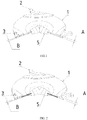
- FIGS. 1-4 depict sectional views of exemplary embodiment of an iris-lens diaphragm.
- FIGS. 1-4 depict view of exemplary embodiment of an iris-lens diaphragm that is made in the form of a colored ring 1 comprising peripheral arc-shaped open-ended support elements 2 for one-point contact.
- the colored ring 1 has a pattern (not showed in the FIGS) imitating the person's fellow eye iris by its form and color.
- Support elements 2 can be bent in a plane of the colored ring 1.
- Iris-lens diaphragm can include a flange 4 on the edge of the colored ring 1 as shown in FIGS.3 and 4 .
- Flange 4 can be made of the same material as the support elements 2 like in the FIG. 3 , or of another material as shown in the FIG.4 .
- Thickness C of the flanged edge 4 mainly coincides with the thickness A of the support elements 2. Thickness A of the support elements 2 exceeds the thickness B of the colored ring 1, where A is not more 0.6 mm, B - 0.1-0.4 mm.
- the colored ring 1 may include optics 5 depending on clinical case.
- the colored ring 1 and support elements 2 can be made of material with similar ( FIG.1 ) or different resilience ( FIG.2 ). In case the colored ring 1 and support elements 2 have different resilience the resilience of support elements 2 exceeds resilience of the colored ring 1.
- Iris-lens diaphragm by the invention can be manufactured by photo polymerization of the material consisting of methacrylates with different structure: octyl methacrylate, methacrylate with linear hydrocarbon side chain, methacrylate with branched hydrocarbon side chain. Material resilience of iris-lens diaphragm parts varies due to different proportion of the components mentioned above. However, the given example of production method does not limit all possible production methods, which can be different.
- Iris-lens diaphragm is placed in the ciliary sulcus.
- Support elements 2 one-point contact against ciliary sulcus and are bent in a plane of the colored ring 1, then fall in line with an individual diameter of the ciliary sulcus, which usually varies from 11.0 mm to 12.5 mm.
- Support elements 2 make iris-lens diaphragm self-centering.
- Proposed proportion of material thickness and resilience of support elements 2 and colored ring 1 provides secure iris-lens diaphragm positioning in the ciliary sulcus in post-operative period.
- thinner and more flexible colored ring can be easily rolled up to sizes sufficient for injector implantation through the small incision of 2.6 mm for models without optics and up to 3.2-4.0 mm depending on iris-lens diaphragm optical power for models with optics and then it straightens to flat form when leaving the injector. It mitigates the risk of eye injury during the surgery.
- Flange 4 reduces the load on the thin colored ring 1 from support elements 2 and allows to avoid uncontrolled bends and decentration of the iris-lens diaphragm in post-operative period.
- OS has a total posttraumatic aniridia, pseudophakia, corneo-scleral corneal cicatrix, mixed astigmatism, state after subtotal vitrectomy in regard to intraocular hemorrhage. Implantation of the described iris-lens diaphragm without optics was proposed to the patient: considering the previously implanted intraocular lens.
- the iris-lens diaphragm according to the invention was implanted onto the intraocular lens located in the capsular bag, through the corneal tunnel incision of 2.6 mm using the injector.
- the following surgical treatment was proposed and performed: implantation of iris-lens diaphragm +19 D through the tunnel incision 3.5 mm long using the injector. Iris-lens diaphragm was implanted onto the surface of lens capsule in the eye; it took central position, resting on the tips of supporting elements at the level of ciliary sulcus. Then discission of lens capsule was performed through the port in the flat area of ciliary body using the vitrectomy cutter. Check-up examinations of the patient in 1, 3, 6, 12 months showed absence of disposition, iris-lens diaphragm decentering, sideward bends of the supporting elements. The patient was satisfied with cosmetic effect, improvement of vision acuity, absence of diplopia and blinding lights.
- Patient T 46 y.o., enquired with clinic complaining of poor visual acuity in the right eye, embarrassment while daily activity: increased sensitivity to glare, blinding lights, impossibility of being outdoor without sunglasses.
- the patient had radial keratotomy related to high myopia in early years, 2 years ago the patient sustained contusion trauma, as a result there was a laceration of corneal cicatrix and iris prolapse.
- the patient got primary surgical treatment and corneal cicatrix closure was performed, lens mass removed and capsule partially saved in the upper half. In half a year retinal detachment, which maturated later, was surgically treated with a good anatomic result.
- iris-lens diaphragm In post-operative period iris-lens diaphragm was centered, supporting elements were not displaced and held iris-lens diaphragm in the correct position despite the fact that suturing was performed only in one bottom point. It means that iris-lens diaphragm has sufficient both rigidity and resilience.
- follow-up examinations of the patient in 1, 3, 6, 12 months showed absence of disposition, iris-lens diaphragm decentering, sideward bends of the supporting elements. The patient was satisfied with improvement of vision acuity, absence of increased sensitivity to glare.
- the invention provides required rigidity and security of supporting elements fixation keeping the ease of iris-lens diaphragm implantation.
Landscapes
- Health & Medical Sciences (AREA)
- Ophthalmology & Optometry (AREA)
- Cardiology (AREA)
- Oral & Maxillofacial Surgery (AREA)
- Transplantation (AREA)
- Engineering & Computer Science (AREA)
- Biomedical Technology (AREA)
- Heart & Thoracic Surgery (AREA)
- Vascular Medicine (AREA)
- Life Sciences & Earth Sciences (AREA)
- Animal Behavior & Ethology (AREA)
- General Health & Medical Sciences (AREA)
- Public Health (AREA)
- Veterinary Medicine (AREA)
- Prostheses (AREA)
Abstract
Description
- The invention relates to the field of medicine, more particularly to ophthalmology, and more particularly to reconstructive surgery for pathology of the iris pathology or combined pathology of the iris and lens.
- Combination of eye-lens opacity with severe iris defects up to total aniridia may be the result of congenital pathology or serious eye injury. Impairment or lack of iris diaphragmatic function leads not only to vision acuity reduction, but also to the formation of a serious cosmetic defect, that can interfere with a social adaptation and professional activity of a person. Different models of artificial iris combined with artificial eye-lens or without it are used in the clinical practice. They are implanted into the eye cavity through a small incision using an injector.
- Artificial iris or iris-lens diaphragm (ILD) and its' production method are known, patent is
RU 2526245 RU 2526245 - Experience has proven that in some surgery cases related to the implantation of the Iris-lens diaphragm according patent
RU 2526245 RU 2526245 - The technical result is aimed at providing support elements with the necessary rigidity and suitable for secure retention, keeping the implantation of an iris-lens diaphragm easy.
- The technical result is achieved in that an iris-lens diaphragm is proposed which is made of an elastic material in the form of a colored ring comprising peripheral arc-shaped open-ended support elements for one-point contact that are capable of bending in the plane of the colored ring, wherein the thickness of the support elements exceeds the thickness of the colored ring.
- Material resilience of support elements may exceed material resilience of the colored ring. Colored ring may include a flange on the edge. Thickness of the colored ring varies from 0.1 to 0.4 mm, and thickness of the support elements is not more than 0.6 mm. The colored ring may include optics depending on clinical case.
- The non-limiting embodiments of the present technology are depicted in the following drawings.
-
FIGS. 1-4 depict sectional views of exemplary embodiment of an iris-lens diaphragm. -
FIGS. 1-4 depict view of exemplary embodiment of an iris-lens diaphragm that is made in the form of acolored ring 1 comprising peripheral arc-shaped open-ended support elements 2 for one-point contact. Thecolored ring 1 has a pattern (not showed in the FIGS) imitating the person's fellow eye iris by its form and color. There are holes for anchoring 3 (if required) and manipulations with iris-lens diaphragm during surgery at the bottom ofsupport elements 2.Support elements 2 can be bent in a plane of thecolored ring 1. Iris-lens diaphragm can include aflange 4 on the edge of thecolored ring 1 as shown inFIGS.3 and 4 .Flange 4 can be made of the same material as thesupport elements 2 like in theFIG. 3 , or of another material as shown in theFIG.4 . - Thickness C of the
flanged edge 4 mainly coincides with the thickness A of thesupport elements 2. Thickness A of thesupport elements 2 exceeds the thickness B of thecolored ring 1, where A is not more 0.6 mm, B - 0.1-0.4 mm. Thecolored ring 1 may includeoptics 5 depending on clinical case. - The
colored ring 1 andsupport elements 2 can be made of material with similar (FIG.1 ) or different resilience (FIG.2 ). In case thecolored ring 1 andsupport elements 2 have different resilience the resilience ofsupport elements 2 exceeds resilience of thecolored ring 1. Iris-lens diaphragm by the invention can be manufactured by photo polymerization of the material consisting of methacrylates with different structure: octyl methacrylate, methacrylate with linear hydrocarbon side chain, methacrylate with branched hydrocarbon side chain. Material resilience of iris-lens diaphragm parts varies due to different proportion of the components mentioned above. However, the given example of production method does not limit all possible production methods, which can be different. - Performance of the invention is described below.
Iris-lens diaphragm is placed in the ciliary sulcus.Support elements 2 one-point contact against ciliary sulcus and are bent in a plane of thecolored ring 1, then fall in line with an individual diameter of the ciliary sulcus, which usually varies from 11.0 mm to 12.5 mm.Support elements 2 make iris-lens diaphragm self-centering. Proposed proportion of material thickness and resilience ofsupport elements 2 andcolored ring 1 provides secure iris-lens diaphragm positioning in the ciliary sulcus in post-operative period. In addition, thinner and more flexible colored ring can be easily rolled up to sizes sufficient for injector implantation through the small incision of 2.6 mm for models without optics and up to 3.2-4.0 mm depending on iris-lens diaphragm optical power for models with optics and then it straightens to flat form when leaving the injector. It mitigates the risk of eye injury during the surgery.Flange 4 reduces the load on the thincolored ring 1 fromsupport elements 2 and allows to avoid uncontrolled bends and decentration of the iris-lens diaphragm in post-operative period. - Given below clinical examples depict implantation variants for the invention.
- Patient K. 37 y.o., enquired with clinic complaining of impaired vision, blinding light, sunlight and bright daylight sensitivity after injury of the left pseudophakic eye and subsequent iris prolapse. Diagnosis: OS has a total posttraumatic aniridia, pseudophakia, corneo-scleral corneal cicatrix, mixed astigmatism, state after subtotal vitrectomy in regard to intraocular hemorrhage. Implantation of the described iris-lens diaphragm without optics was proposed to the patient: considering the previously implanted intraocular lens. The iris-lens diaphragm according to the invention was implanted onto the intraocular lens located in the capsular bag, through the corneal tunnel incision of 2.6 mm using the injector. Support elements bumped against ciliary sulcus by their ends and colored ring took a correct central position. Subsequent examinations of the patient in 1, 3, 6, 12 months showed absence of disposition, decentration, sideward bends of the support elements.
- Patient S., 28 y.o., enquired with clinic complaining of monocular diplopia, poor visual acuity, increased sensitivity to glare and serious cosmetic defect of the right eye. In the past medical history, the patient had severe injury of the right eye in adolescence life: there was a partial iris prolapse through the corneo-scleral laceration. The patient got primary surgical treatment and wound was sutured after injury: iris tissue was partially saved, lens mass removed and capsular bag saved. Examination of the right eye showed partial aniridia (absence of iris tissue from 10 to 6 clockwise, aphakia, fibrosis of lens capsule, not critical vitreous degeneration. The following surgical treatment was proposed and performed: implantation of iris-lens diaphragm +19 D through the tunnel incision 3.5 mm long using the injector. Iris-lens diaphragm was implanted onto the surface of lens capsule in the eye; it took central position, resting on the tips of supporting elements at the level of ciliary sulcus. Then discission of lens capsule was performed through the port in the flat area of ciliary body using the vitrectomy cutter. Check-up examinations of the patient in 1, 3, 6, 12 months showed absence of disposition, iris-lens diaphragm decentering, sideward bends of the supporting elements. The patient was satisfied with cosmetic effect, improvement of vision acuity, absence of diplopia and blinding lights.
- Patient T, 46 y.o., enquired with clinic complaining of poor visual acuity in the right eye, embarrassment while daily activity: increased sensitivity to glare, blinding lights, impossibility of being outdoor without sunglasses. In the past clinical history, the patient had radial keratotomy related to high myopia in early years, 2 years ago the patient sustained contusion trauma, as a result there was a laceration of corneal cicatrix and iris prolapse. The patient got primary surgical treatment and corneal cicatrix closure was performed, lens mass removed and capsule partially saved in the upper half. In half a year retinal detachment, which maturated later, was surgically treated with a good anatomic result. At the examination time diagnosis was the following: total post-traumatic aniridia, aphakia with partially saved capsule in the upper half, surgically treated retinal detachment (attached), peripheral and central dry retinal regeneration, corneal cicatrices (after X-ray computer tomography). The following treatment was proposed and then undertaken: Implantation of iris-lens diaphragm (optical power +11 D) into the ciliary sulcus area through the corneo-scleral tunnel 3.5 mm and with transscleral suture fixation in the lower segment through the hole in the bottom of supporting element. In post-operative period iris-lens diaphragm was centered, supporting elements were not displaced and held iris-lens diaphragm in the correct position despite the fact that suturing was performed only in one bottom point. It means that iris-lens diaphragm has sufficient both rigidity and resilience. Follow-up examinations of the patient in 1, 3, 6, 12 months showed absence of disposition, iris-lens diaphragm decentering, sideward bends of the supporting elements. The patient was satisfied with improvement of vision acuity, absence of increased sensitivity to glare.
- The invention provides required rigidity and security of supporting elements fixation keeping the ease of iris-lens diaphragm implantation.
Claims (6)
- Iris-lens diaphragm made of elastic material in the form of a colored ring comprises peripheral arc-shaped and open-ended support elements for one-point contact that are capable of bending in the plane of the colored ring, wherein a thickness of support elements exceeds a thickness of the colored ring.
- Iris-lens diaphragm of claim 1, wherein the material resilience of support elements exceeds material resilience of the colored ring.
- Iris-lens diaphragm of claim 1, wherein the colored ring includes a flange on the edge.
- Iris-lens diaphragm of claim 1, wherein the thickness of the colored ring varies from 0.1 mm to 0.4 mm.
- Iris-lens diaphragm of claim 1, wherein the thickness of the support elements is not more than 0.6 mm.
- Iris-lens diaphragm of claim 1, wherein colored ring includes optics.
Applications Claiming Priority (2)
| Application Number | Priority Date | Filing Date | Title |
|---|---|---|---|
| RU2016115971A RU2621302C1 (en) | 2016-04-22 | 2016-04-22 | Iridochrussive diaphragm |
| PCT/RU2017/000240 WO2017184030A1 (en) | 2016-04-22 | 2017-04-17 | Iris-lens diaphragm |
Publications (3)
| Publication Number | Publication Date |
|---|---|
| EP3446657A1 true EP3446657A1 (en) | 2019-02-27 |
| EP3446657A4 EP3446657A4 (en) | 2019-12-25 |
| EP3446657B1 EP3446657B1 (en) | 2025-10-01 |
Family
ID=59032167
Family Applications (1)
| Application Number | Title | Priority Date | Filing Date |
|---|---|---|---|
| EP17786235.6A Active EP3446657B1 (en) | 2016-04-22 | 2017-04-17 | Iris-lens diaphragm |
Country Status (4)
| Country | Link |
|---|---|
| US (1) | US10888417B2 (en) |
| EP (1) | EP3446657B1 (en) |
| RU (1) | RU2621302C1 (en) |
| WO (1) | WO2017184030A1 (en) |
Families Citing this family (1)
| Publication number | Priority date | Publication date | Assignee | Title |
|---|---|---|---|---|
| RU2761289C1 (en) * | 2021-03-04 | 2021-12-06 | федеральное государственное автономное учреждение "Национальный медицинский исследовательский центр "Межотраслевой научно-технический комплекс "Микрохирургия глаза" имени академика С.Н. Федорова" Министерства здравоохранения Российской Федерации | Surgical method of transcleral fixation of an artificial iridolenticular diaphragm in dislocation or decentration thereof in patients with aniridia and aphakia |
Family Cites Families (10)
| Publication number | Priority date | Publication date | Assignee | Title |
|---|---|---|---|---|
| US20020072796A1 (en) * | 2000-12-11 | 2002-06-13 | Hoffmann Laurent G. | Iris fixated intraocular lenses |
| US7025781B2 (en) * | 2003-01-31 | 2006-04-11 | Delary Alberto Kahn | Artificial iris diaphragm implant |
| RU2275174C2 (en) | 2004-04-19 | 2006-04-27 | Общество с ограниченной ответственностью предприятие "Репер-НН" | Artificial iridolenticular diaphragm and method for implanting it in aniridia and aphakia cases |
| DE102004061943A1 (en) * | 2004-12-22 | 2006-07-06 | *Acri.Tec Gesellschaft für ophthalmologische Produkte mbH | Artificial iris replacement implantable in one eye |
| RU47693U1 (en) * | 2005-03-10 | 2005-09-10 | Государственное учреждение Межотраслевой научно-технический комплекс "Микрохирургия глаза" имени академика С.Н. Федорова Министерства здравоохранения Российской Федерации" | IRID-CRYSTAL IRIS OF THE EYE |
| RU73196U1 (en) * | 2007-10-22 | 2008-05-20 | Кировская клиническая офтальмологическая больница | IRIDO-CRYSTAL IRIS OF THE EYE |
| US8197540B2 (en) * | 2010-04-26 | 2012-06-12 | Stellar Devices Llc | Ocular implant iris diaphragm |
| CN102090941B (en) * | 2011-02-17 | 2016-01-20 | 史晓春 | There is the artificial iris of metachrosis |
| RU2526248C2 (en) * | 2012-09-20 | 2014-08-20 | Общество с ограниченной ответственностью предприятие "Репер-НН" | Iridolenticular block |
| RU2526245C1 (en) * | 2013-03-05 | 2014-08-20 | Федеральное государственное бюджетное учреждение "Межотраслевой научно-технический комплекс "Микрохирургия глаза имени академика С.Н. Федорова" Министерства здравоохранения Российской Федерации | Iris-lens diaphragm and method of its manufacturing |
-
2016
- 2016-04-22 RU RU2016115971A patent/RU2621302C1/en active
-
2017
- 2017-04-17 US US16/095,397 patent/US10888417B2/en active Active
- 2017-04-17 EP EP17786235.6A patent/EP3446657B1/en active Active
- 2017-04-17 WO PCT/RU2017/000240 patent/WO2017184030A1/en not_active Ceased
Also Published As
| Publication number | Publication date |
|---|---|
| US10888417B2 (en) | 2021-01-12 |
| RU2621302C1 (en) | 2017-06-01 |
| EP3446657A4 (en) | 2019-12-25 |
| WO2017184030A1 (en) | 2017-10-26 |
| US20190133753A1 (en) | 2019-05-09 |
| EP3446657B1 (en) | 2025-10-01 |
Similar Documents
| Publication | Publication Date | Title |
|---|---|---|
| CA1322627C (en) | Method and artificial intraocular lens device for the phakic treatment of myopia | |
| RU2033114C1 (en) | Artificial crystalline lens | |
| US8728158B2 (en) | Exchangeable intraocular lens device and method of use | |
| US8197540B2 (en) | Ocular implant iris diaphragm | |
| US6241777B1 (en) | Phakic intraocular lenses | |
| US4612012A (en) | Corneal implant | |
| US20140379078A1 (en) | Small aperture (pinhole) intraocular implant to increase depth of focus | |
| US20110313523A1 (en) | Pseudophakic Accommodating Intraocular Lens | |
| US20110313522A1 (en) | Pseudophakic Accommodating Intraocular Lens | |
| KR102697891B1 (en) | Intraocular pseudophakic contactlens wiht mechanism for securing by anterior leaflet of capsular wall and related system and method | |
| US10010405B2 (en) | Haptic devices for intraocular lens | |
| EP3171821B1 (en) | Haptic devices for intraocular lens | |
| JP2023508122A (en) | Intraocular pseudophakic contact lenses with anterior leaflet fixation of the capsular wall and related systems and methods | |
| Muth et al. | Novel surgical technique of sutureless artificial iris and intraocular lens scleral fixation using Yamane technique | |
| RU86462U1 (en) | REAR CAMERA ELASTIC INTRAOCULAR LENS FOR AFACIA CORRECTION | |
| US10888417B2 (en) | Iris-lens diaphragm | |
| EP0069089B1 (en) | Intraocular lens | |
| Panahi-Bazaz et al. | Hydrophilic acrylic versus PMMA intraocular lens implantation in pediatric cataract surgery | |
| HK40005151A (en) | Iris-lens diaphragm | |
| EP3446658B1 (en) | Artificial iris | |
| Manabe et al. | Photokeratoscopy in fitting contact lens after penetrating keratoplasty. | |
| Pfeifer et al. | Artificial Iris Implantation: overview of surgical techniques | |
| RU2202988C2 (en) | Artificial intraocular lens and method for fixing it | |
| RU2526248C2 (en) | Iridolenticular block | |
| RU51489U1 (en) | ARTIFICIAL EYE CRYSTAL |
Legal Events
| Date | Code | Title | Description |
|---|---|---|---|
| STAA | Information on the status of an ep patent application or granted ep patent |
Free format text: STATUS: THE INTERNATIONAL PUBLICATION HAS BEEN MADE |
|
| PUAI | Public reference made under article 153(3) epc to a published international application that has entered the european phase |
Free format text: ORIGINAL CODE: 0009012 |
|
| STAA | Information on the status of an ep patent application or granted ep patent |
Free format text: STATUS: REQUEST FOR EXAMINATION WAS MADE |
|
| 17P | Request for examination filed |
Effective date: 20181026 |
|
| AK | Designated contracting states |
Kind code of ref document: A1 Designated state(s): AL AT BE BG CH CY CZ DE DK EE ES FI FR GB GR HR HU IE IS IT LI LT LU LV MC MK MT NL NO PL PT RO RS SE SI SK SM TR |
|
| AX | Request for extension of the european patent |
Extension state: BA ME |
|
| DAV | Request for validation of the european patent (deleted) | ||
| DAX | Request for extension of the european patent (deleted) | ||
| A4 | Supplementary search report drawn up and despatched |
Effective date: 20191127 |
|
| RIC1 | Information provided on ipc code assigned before grant |
Ipc: A61F 2/14 20060101AFI20191121BHEP |
|
| REG | Reference to a national code |
Ref country code: HK Ref legal event code: DE Ref document number: 40005151 Country of ref document: HK |
|
| STAA | Information on the status of an ep patent application or granted ep patent |
Free format text: STATUS: EXAMINATION IS IN PROGRESS |
|
| 17Q | First examination report despatched |
Effective date: 20220517 |
|
| RAP3 | Party data changed (applicant data changed or rights of an application transferred) |
Owner name: LIMITED LIABILITY COMPANY ENTERPRISE"REPER-NN" |
|
| GRAP | Despatch of communication of intention to grant a patent |
Free format text: ORIGINAL CODE: EPIDOSNIGR1 |
|
| STAA | Information on the status of an ep patent application or granted ep patent |
Free format text: STATUS: GRANT OF PATENT IS INTENDED |
|
| INTG | Intention to grant announced |
Effective date: 20250423 |
|
| GRAS | Grant fee paid |
Free format text: ORIGINAL CODE: EPIDOSNIGR3 |
|
| GRAA | (expected) grant |
Free format text: ORIGINAL CODE: 0009210 |
|
| STAA | Information on the status of an ep patent application or granted ep patent |
Free format text: STATUS: THE PATENT HAS BEEN GRANTED |
|
| AK | Designated contracting states |
Kind code of ref document: B1 Designated state(s): AL AT BE BG CH CY CZ DE DK EE ES FI FR GB GR HR HU IE IS IT LI LT LU LV MC MK MT NL NO PL PT RO RS SE SI SK SM TR |
|
| REG | Reference to a national code |
Ref country code: GB Ref legal event code: FG4D Ref country code: CH Ref legal event code: F10 Free format text: ST27 STATUS EVENT CODE: U-0-0-F10-F00 (AS PROVIDED BY THE NATIONAL OFFICE) Effective date: 20251001 |
|
| REG | Reference to a national code |
Ref country code: IE Ref legal event code: FG4D |
|
| REG | Reference to a national code |
Ref country code: DE Ref legal event code: R096 Ref document number: 602017092017 Country of ref document: DE |
|
| REG | Reference to a national code |
Ref country code: NL Ref legal event code: MP Effective date: 20251001 |
|
| REG | Reference to a national code |
Ref country code: AT Ref legal event code: MK05 Ref document number: 1841773 Country of ref document: AT Kind code of ref document: T Effective date: 20251001 |
|
| PG25 | Lapsed in a contracting state [announced via postgrant information from national office to epo] |
Ref country code: NL Free format text: LAPSE BECAUSE OF FAILURE TO SUBMIT A TRANSLATION OF THE DESCRIPTION OR TO PAY THE FEE WITHIN THE PRESCRIBED TIME-LIMIT Effective date: 20251001 |
|
| PG25 | Lapsed in a contracting state [announced via postgrant information from national office to epo] |
Ref country code: ES Free format text: LAPSE BECAUSE OF FAILURE TO SUBMIT A TRANSLATION OF THE DESCRIPTION OR TO PAY THE FEE WITHIN THE PRESCRIBED TIME-LIMIT Effective date: 20251001 |
|
| REG | Reference to a national code |
Ref country code: LT Ref legal event code: MG9D |
|
| PG25 | Lapsed in a contracting state [announced via postgrant information from national office to epo] |
Ref country code: NO Free format text: LAPSE BECAUSE OF FAILURE TO SUBMIT A TRANSLATION OF THE DESCRIPTION OR TO PAY THE FEE WITHIN THE PRESCRIBED TIME-LIMIT Effective date: 20260101 |
|
| PG25 | Lapsed in a contracting state [announced via postgrant information from national office to epo] |
Ref country code: FI Free format text: LAPSE BECAUSE OF FAILURE TO SUBMIT A TRANSLATION OF THE DESCRIPTION OR TO PAY THE FEE WITHIN THE PRESCRIBED TIME-LIMIT Effective date: 20251001 Ref country code: AT Free format text: LAPSE BECAUSE OF FAILURE TO SUBMIT A TRANSLATION OF THE DESCRIPTION OR TO PAY THE FEE WITHIN THE PRESCRIBED TIME-LIMIT Effective date: 20251001 Ref country code: HR Free format text: LAPSE BECAUSE OF FAILURE TO SUBMIT A TRANSLATION OF THE DESCRIPTION OR TO PAY THE FEE WITHIN THE PRESCRIBED TIME-LIMIT Effective date: 20251001 |
|
| PG25 | Lapsed in a contracting state [announced via postgrant information from national office to epo] |
Ref country code: RS Free format text: LAPSE BECAUSE OF FAILURE TO SUBMIT A TRANSLATION OF THE DESCRIPTION OR TO PAY THE FEE WITHIN THE PRESCRIBED TIME-LIMIT Effective date: 20260101 |
|
| PG25 | Lapsed in a contracting state [announced via postgrant information from national office to epo] |
Ref country code: IS Free format text: LAPSE BECAUSE OF FAILURE TO SUBMIT A TRANSLATION OF THE DESCRIPTION OR TO PAY THE FEE WITHIN THE PRESCRIBED TIME-LIMIT Effective date: 20260201 |
|
| PG25 | Lapsed in a contracting state [announced via postgrant information from national office to epo] |
Ref country code: CZ Free format text: LAPSE BECAUSE OF FAILURE TO SUBMIT A TRANSLATION OF THE DESCRIPTION OR TO PAY THE FEE WITHIN THE PRESCRIBED TIME-LIMIT Effective date: 20251001 Ref country code: PT Free format text: LAPSE BECAUSE OF FAILURE TO SUBMIT A TRANSLATION OF THE DESCRIPTION OR TO PAY THE FEE WITHIN THE PRESCRIBED TIME-LIMIT Effective date: 20260202 |
|
| PG25 | Lapsed in a contracting state [announced via postgrant information from national office to epo] |
Ref country code: PL Free format text: LAPSE BECAUSE OF FAILURE TO SUBMIT A TRANSLATION OF THE DESCRIPTION OR TO PAY THE FEE WITHIN THE PRESCRIBED TIME-LIMIT Effective date: 20251001 |
|
| PG25 | Lapsed in a contracting state [announced via postgrant information from national office to epo] |
Ref country code: LV Free format text: LAPSE BECAUSE OF FAILURE TO SUBMIT A TRANSLATION OF THE DESCRIPTION OR TO PAY THE FEE WITHIN THE PRESCRIBED TIME-LIMIT Effective date: 20251001 |
|
| PG25 | Lapsed in a contracting state [announced via postgrant information from national office to epo] |
Ref country code: BG Free format text: LAPSE BECAUSE OF FAILURE TO SUBMIT A TRANSLATION OF THE DESCRIPTION OR TO PAY THE FEE WITHIN THE PRESCRIBED TIME-LIMIT Effective date: 20251001 |
|
| PG25 | Lapsed in a contracting state [announced via postgrant information from national office to epo] |
Ref country code: LT Free format text: LAPSE BECAUSE OF FAILURE TO SUBMIT A TRANSLATION OF THE DESCRIPTION OR TO PAY THE FEE WITHIN THE PRESCRIBED TIME-LIMIT Effective date: 20251001 |
|
| PG25 | Lapsed in a contracting state [announced via postgrant information from national office to epo] |
Ref country code: SM Free format text: LAPSE BECAUSE OF FAILURE TO SUBMIT A TRANSLATION OF THE DESCRIPTION OR TO PAY THE FEE WITHIN THE PRESCRIBED TIME-LIMIT Effective date: 20251001 |
|
| PG25 | Lapsed in a contracting state [announced via postgrant information from national office to epo] |
Ref country code: DK Free format text: LAPSE BECAUSE OF FAILURE TO SUBMIT A TRANSLATION OF THE DESCRIPTION OR TO PAY THE FEE WITHIN THE PRESCRIBED TIME-LIMIT Effective date: 20251001 |
|
| PGFP | Annual fee paid to national office [announced via postgrant information from national office to epo] |
Ref country code: GB Payment date: 20260420 Year of fee payment: 10 |
|
| PG25 | Lapsed in a contracting state [announced via postgrant information from national office to epo] |
Ref country code: IT Free format text: LAPSE BECAUSE OF FAILURE TO SUBMIT A TRANSLATION OF THE DESCRIPTION OR TO PAY THE FEE WITHIN THE PRESCRIBED TIME-LIMIT Effective date: 20251001 |
|
| PGFP | Annual fee paid to national office [announced via postgrant information from national office to epo] |
Ref country code: DE Payment date: 20260422 Year of fee payment: 10 |
|
| PG25 | Lapsed in a contracting state [announced via postgrant information from national office to epo] |
Ref country code: EE Free format text: LAPSE BECAUSE OF FAILURE TO SUBMIT A TRANSLATION OF THE DESCRIPTION OR TO PAY THE FEE WITHIN THE PRESCRIBED TIME-LIMIT Effective date: 20251001 |
|
| PGFP | Annual fee paid to national office [announced via postgrant information from national office to epo] |
Ref country code: FR Payment date: 20260420 Year of fee payment: 10 |
|
| PG25 | Lapsed in a contracting state [announced via postgrant information from national office to epo] |
Ref country code: SK Free format text: LAPSE BECAUSE OF FAILURE TO SUBMIT A TRANSLATION OF THE DESCRIPTION OR TO PAY THE FEE WITHIN THE PRESCRIBED TIME-LIMIT Effective date: 20251001 |
|
| PG25 | Lapsed in a contracting state [announced via postgrant information from national office to epo] |
Ref country code: SE Free format text: LAPSE BECAUSE OF FAILURE TO SUBMIT A TRANSLATION OF THE DESCRIPTION OR TO PAY THE FEE WITHIN THE PRESCRIBED TIME-LIMIT Effective date: 20251001 |
|
| PLBE | No opposition filed within time limit |
Free format text: ORIGINAL CODE: 0009261 |
|
| STAA | Information on the status of an ep patent application or granted ep patent |
Free format text: STATUS: NO OPPOSITION FILED WITHIN TIME LIMIT |
|
| REG | Reference to a national code |
Ref country code: CH Ref legal event code: L10 Free format text: ST27 STATUS EVENT CODE: U-0-0-L10-L00 (AS PROVIDED BY THE NATIONAL OFFICE) Effective date: 20260812 |