EP3440463B1 - Technische oberfläche zwischen tropfen zur erfassung eines molekularen ziels - Google Patents
Technische oberfläche zwischen tropfen zur erfassung eines molekularen ziels Download PDFInfo
- Publication number
- EP3440463B1 EP3440463B1 EP17715712.0A EP17715712A EP3440463B1 EP 3440463 B1 EP3440463 B1 EP 3440463B1 EP 17715712 A EP17715712 A EP 17715712A EP 3440463 B1 EP3440463 B1 EP 3440463B1
- Authority
- EP
- European Patent Office
- Prior art keywords
- surfactant
- droplets
- functionalized
- chemoprobe
- molecular target
- Prior art date
- Legal status (The legal status is an assumption and is not a legal conclusion. Google has not performed a legal analysis and makes no representation as to the accuracy of the status listed.)
- Active
Links
- 0 CC(C)O*(*)NC(C)(*)I=C Chemical compound CC(C)O*(*)NC(C)(*)I=C 0.000 description 6
- XDZCPOSVPBEZLJ-DKUFRXAESA-N C/C(/N(CCOCCOCCOCCOCCOCCOCCC(NCCOCCOCCOCCOCCOCCN)=O)N)=C(/CNC(CCCC[C@@H](C1N2)SCC1NC2=O)=O)\N Chemical compound C/C(/N(CCOCCOCCOCCOCCOCCOCCC(NCCOCCOCCOCCOCCOCCN)=O)N)=C(/CNC(CCCC[C@@H](C1N2)SCC1NC2=O)=O)\N XDZCPOSVPBEZLJ-DKUFRXAESA-N 0.000 description 1
- AEARPZNULDFPNQ-UHFFFAOYSA-N CCNC(OC)=O Chemical compound CCNC(OC)=O AEARPZNULDFPNQ-UHFFFAOYSA-N 0.000 description 1
Images










Classifications
-
- G—PHYSICS
- G01—MEASURING; TESTING
- G01N—INVESTIGATING OR ANALYSING MATERIALS BY DETERMINING THEIR CHEMICAL OR PHYSICAL PROPERTIES
- G01N33/00—Investigating or analysing materials by specific methods not covered by groups G01N1/00 - G01N31/00
- G01N33/48—Biological material, e.g. blood, urine; Haemocytometers
- G01N33/50—Chemical analysis of biological material, e.g. blood, urine; Testing involving biospecific ligand binding methods; Immunological testing
- G01N33/53—Immunoassay; Biospecific binding assay; Materials therefor
- G01N33/543—Immunoassay; Biospecific binding assay; Materials therefor with an insoluble carrier for immobilising immunochemicals
- G01N33/54313—Immunoassay; Biospecific binding assay; Materials therefor with an insoluble carrier for immobilising immunochemicals the carrier being characterised by its particulate form
- G01N33/54346—Nanoparticles
-
- C—CHEMISTRY; METALLURGY
- C09—DYES; PAINTS; POLISHES; NATURAL RESINS; ADHESIVES; COMPOSITIONS NOT OTHERWISE PROVIDED FOR; APPLICATIONS OF MATERIALS NOT OTHERWISE PROVIDED FOR
- C09K—MATERIALS FOR MISCELLANEOUS APPLICATIONS, NOT PROVIDED FOR ELSEWHERE
- C09K23/00—Use of substances as emulsifying, wetting, dispersing, or foam-producing agents
- C09K23/42—Ethers, e.g. polyglycol ethers of alcohols or phenols
-
- G—PHYSICS
- G01—MEASURING; TESTING
- G01N—INVESTIGATING OR ANALYSING MATERIALS BY DETERMINING THEIR CHEMICAL OR PHYSICAL PROPERTIES
- G01N33/00—Investigating or analysing materials by specific methods not covered by groups G01N1/00 - G01N31/00
- G01N33/48—Biological material, e.g. blood, urine; Haemocytometers
- G01N33/50—Chemical analysis of biological material, e.g. blood, urine; Testing involving biospecific ligand binding methods; Immunological testing
- G01N33/53—Immunoassay; Biospecific binding assay; Materials therefor
- G01N33/543—Immunoassay; Biospecific binding assay; Materials therefor with an insoluble carrier for immobilising immunochemicals
- G01N33/54313—Immunoassay; Biospecific binding assay; Materials therefor with an insoluble carrier for immobilising immunochemicals the carrier being characterised by its particulate form
- G01N33/5432—Liposomes or microcapsules
-
- C—CHEMISTRY; METALLURGY
- C09—DYES; PAINTS; POLISHES; NATURAL RESINS; ADHESIVES; COMPOSITIONS NOT OTHERWISE PROVIDED FOR; APPLICATIONS OF MATERIALS NOT OTHERWISE PROVIDED FOR
- C09K—MATERIALS FOR MISCELLANEOUS APPLICATIONS, NOT PROVIDED FOR ELSEWHERE
- C09K23/00—Use of substances as emulsifying, wetting, dispersing, or foam-producing agents
- C09K23/22—Amides or hydrazides
-
- C—CHEMISTRY; METALLURGY
- C09—DYES; PAINTS; POLISHES; NATURAL RESINS; ADHESIVES; COMPOSITIONS NOT OTHERWISE PROVIDED FOR; APPLICATIONS OF MATERIALS NOT OTHERWISE PROVIDED FOR
- C09K—MATERIALS FOR MISCELLANEOUS APPLICATIONS, NOT PROVIDED FOR ELSEWHERE
- C09K23/00—Use of substances as emulsifying, wetting, dispersing, or foam-producing agents
- C09K23/32—Heterocyclic compounds
-
- G—PHYSICS
- G01—MEASURING; TESTING
- G01N—INVESTIGATING OR ANALYSING MATERIALS BY DETERMINING THEIR CHEMICAL OR PHYSICAL PROPERTIES
- G01N24/00—Investigating or analyzing materials by the use of nuclear magnetic resonance, electron paramagnetic resonance or other spin effects
- G01N24/08—Investigating or analyzing materials by the use of nuclear magnetic resonance, electron paramagnetic resonance or other spin effects by using nuclear magnetic resonance
- G01N24/088—Assessment or manipulation of a chemical or biochemical reaction, e.g. verification whether a chemical reaction occurred or whether a ligand binds to a receptor in drug screening or assessing reaction kinetics
-
- G—PHYSICS
- G01—MEASURING; TESTING
- G01N—INVESTIGATING OR ANALYSING MATERIALS BY DETERMINING THEIR CHEMICAL OR PHYSICAL PROPERTIES
- G01N30/00—Investigating or analysing materials by separation into components using adsorption, absorption or similar phenomena or using ion-exchange, e.g. chromatography or field flow fractionation
- G01N30/02—Column chromatography
- G01N30/62—Detectors specially adapted therefor
- G01N30/72—Mass spectrometers
-
- G—PHYSICS
- G01—MEASURING; TESTING
- G01N—INVESTIGATING OR ANALYSING MATERIALS BY DETERMINING THEIR CHEMICAL OR PHYSICAL PROPERTIES
- G01N30/00—Investigating or analysing materials by separation into components using adsorption, absorption or similar phenomena or using ion-exchange, e.g. chromatography or field flow fractionation
- G01N30/90—Plate chromatography, e.g. thin layer or paper chromatography
-
- G—PHYSICS
- G01—MEASURING; TESTING
- G01N—INVESTIGATING OR ANALYSING MATERIALS BY DETERMINING THEIR CHEMICAL OR PHYSICAL PROPERTIES
- G01N33/00—Investigating or analysing materials by specific methods not covered by groups G01N1/00 - G01N31/00
- G01N33/48—Biological material, e.g. blood, urine; Haemocytometers
- G01N33/50—Chemical analysis of biological material, e.g. blood, urine; Testing involving biospecific ligand binding methods; Immunological testing
- G01N33/53—Immunoassay; Biospecific binding assay; Materials therefor
- G01N33/543—Immunoassay; Biospecific binding assay; Materials therefor with an insoluble carrier for immobilising immunochemicals
- G01N33/54353—Immunoassay; Biospecific binding assay; Materials therefor with an insoluble carrier for immobilising immunochemicals with ligand attached to the carrier via a chemical coupling agent
Definitions
- the present invention relates to interface chemistry in droplet-based systems, preferably in microfluidic systems, and in particular to interfaces allowing specific interactions and capture of a molecule of interest.
- Microdroplets in microfluidics provide a compartment in which species or reaction can be isolated.
- microdroplets of one phase are generated in another, immiscible phase by exploiting capillary instabilities in a microfluidic two-phase flow.
- the addition of a surfactant to either or both of the phases stabilizes the microdroplets against coalescence and allows them to function as discrete microreactors.
- a wide range of chemical and biological reactions can be performed inside aqueous microdroplets, including for example DNA/RNA amplification ( Mazutis et al., A.D. Lab Chip, 2009, 9, 2665-2672 ; Mazutis et al., Anal. Chem., 2009, 81(12), 4813- 4821 ), in vitro transcription/translation ( Courtois et al., Chembiochem., 2008, 9(3), 439- 446 ), enzymatic catalysis ( Baret et al., Lab Chip, 2009, 9(13), 1850- 1858 ), and cell-based assays ( Clausell-Tormos et al., Chem.
- the present invention provides a new method for capturing a molecular target present in the aqueous phase of a water-in-oil emulsion, based on the use of a binding system comprising (a) a surfactant bearing a functional moiety on its hydrophilic head group and (b) a chemoprobe.
- the present invention relates to a method for capturing a molecular target, said method comprising
- the molecular target is captured at the inner interface of the emulsion droplets through (i) the direct or indirect binding of the chemoprobe to the functionalized surfactant and (ii) the specific binding of the chemoprobe to the molecular target.
- the functionalized surfactant may comprise one or several functional moieties on a hydrophilic head group.
- the chemoprobe may directly or indirectly interact with one or several of the functional moieties present in a hydrophilic head of the functionalized surfactant.
- the method of the invention is implemented using a microfluidic system.
- the method may further comprise inverting the phase of water-in-oil emulsion droplets thereby producing oil-in-water emulsion droplets and exposing the captured molecular target at the outer surface of the emulsion droplets.
- the method may also further comprise a step of recovering, detecting, and/or quantifying the captured molecular target.
- the molecular target is a protein or a nucleic acid.
- the capture moiety of the chemoprobe is selected from the group consisting of an antibody, a aptmer, a peptide aptamer, an aptamer, a ligand or a substrate of the molecular target, a nucleic acid capable of hybridizing the molecular target, and a receptor fragment able to bind the molecular target.
- the functionalized surfactant is a diblock or triblock surfactant.
- the chemoprobe may bind the functionalized surfactant through covalent or non-covalent interactions, preferably through covalent interactions.
- the chemoprobe may directly bind the functionalized surfactant through covalent interactions.
- the functionalized hydrophilic head of the surfactant and the binding domain of the chemoprobe each bear a reactive chemical moiety able to react together through a click reaction or a bioconjugation reaction.
- the chemoprobe may bind the functionalized surfactant via a binding intermediate.
- the functionalized hydrophilic head of the surfactant and the binding intermediate each bear a reactive chemical moiety able to react together through a click reaction or a bioconjugation reaction.
- the click reaction may be selected from the group consisting of copper-catalyzed azide-alkyne dipolar cycloaddition (CuAAC), strain promoted alkyne-azide cycloaddition (SPAAC), Diels-Alder reactions with tetrazines and strained alkynes or alkenes, tetrazine-isonitrile cycloaddition thiol-alkene click reaction such as maleimide-cysteine cycloaddition, and a sydnone-alkyne cycloaddition, preferably is a strain promoted alkyne-azide cycloaddition (SPAAC).
- CuAAC copper-catalyzed azide-alkyne dipolar cycloaddition
- SPAAC strain promoted alkyne-azide cycloaddition
- Diels-Alder reactions with tetrazines and strained alkynes or alkenes t
- the chemoprobe may bind the functionalized surfactant through non-covalent interactions, directly or via a binding intermediate.
- the non-covalent interaction between the chemoprobe and the functionalized surfactant may rely on an affinity system or protein tags.
- the molecular target is from a biological entity encapsulated within the droplets and the method optionally comprises lysing said entity to release said molecular target.
- each emulsion droplet comprises a single genetic element or biological entity.
- the present document also discloses a kit to capture a molecular target according to the method of the invention, comprising
- the kit may further comprise a binding intermediate which is able to bind both the chemoprobe and the functionalized surfactant thereby acting as a bridge between said two entities.
- the kit may also further comprise
- the present invention also relates to the use of a kit as disclosed herein for capturing a molecular target according to the method of the invention.
- the functionalized surfactant comprises or consists in a moiety of formula (Ib) wherein :
- the functionalized surfactant comprises
- the inventors conceived a new method for capturing a molecular target present in the aqueous phase of a water-in-oil emulsion.
- the method is based on the use of a binding system comprising (a) a surfactant bearing a functional moiety on its hydrophilic head group and (b) a chemoprobe.
- the chemoprobe comprises at least two distinct domains namely (i) at least one capture moiety which is able to specifically bind the molecular target and (ii) at least one binding domain which is able to interact with the functional group of the surfactant through covalent or non-covalent interactions, directly or through a binding intermediary.
- the chemoprobe thus acts as a molecular staple between the functionalized surfactant and the molecular target, whereby the molecular target is captured at the inner surface of the emulsion droplets.
- the capture of the molecular target at the inner surface of the emulsion droplets aims at promoting its recovery, detection and/or quantification.
- the method for capturing a molecular target developed by the inventors can be used in various biotechnological fields, in particular in single cell proteomic analysis, and is particularly adapted to be implemented in microfluidic systems.
- the method of the invention is not limited to the capture of recombinant proteins bearing a specific tag such as a His-tag. It can be implemented for the capture of any molecular target of interest.
- the present invention relates to a method for capturing a molecular target, said method comprising
- steps b) and c) may be performed simultaneously or sequentially, in any order.
- the aqueous phase of the droplets provided in step a) comprises a molecular target and a chemoprobe.
- the aqueous phase of the droplets provided in step a) comprises a molecular target and a chemoprobe is then added to the aqueous phase.
- the aqueous phase of the droplets provided in step a) comprises a chemoprobe, and a molecular target is then added to the aqueous phase.
- the aqueous phase of the droplets provided in step a) does not comprise neither a molecular target nor a chemoprobe.
- the molecular target and the chemoprobe are then added to the aqueous phase of the droplets, simultaneously or sequentially, in any order.
- chemoprobe or a molecular target in the aqueous phase of a droplet may be carried out by using any method well-known by the skilled person such as droplet fusion or pico-injection.
- each droplet may comprise one or several functionalized surfactants, one or several chemoprobes and one or several molecular targets.
- step (a) of the method water-in-oil emulsion droplets are provided. These droplets are characterized as comprising a functionalized surfactant at their interface.
- the aqueous phase of these droplets may comprise a molecular target and/or a chemoprobe.
- the term "droplet” or microdroplet” refers to an isolated portion of a first fluid that is surrounded by a second fluid.
- a droplet may be spherical or of other shapes depending on the external environment.
- the droplet has a volume of less than 1 ⁇ L, preferably of less than 1 nL, and more preferably of less than 500 pL.
- a droplet may have a volume ranging from 10 to 500 pL, preferably from 10 to 250 pL, more preferably from 10 to 200 pL and even more preferably of about 40 pL.
- water-in-oil emulsion droplet water-in-oil droplet
- water-in-oil droplet water-in-oil droplet
- w/o droplet water-in-oil emulsion droplet
- water-in-oil emulsion or “w/o emulsion” refers to an emulsion comprising an aqueous phase in the form of droplets dispersed in an oil phase.
- the droplets have a homogenous distribution of diameters, i.e., the droplets may have a distribution of diameters such that no more than about 10%, about 5%, about 3%, about 1%, about 0.03%, or about 0.01% of the droplets have an average diameter greater than about 10%, about 5%, about 3%, about 1%, about 0.03%, or about 0.01% of the average diameter of the droplets.
- the water-in-oil emulsion is a monodispersed emulsion, i.e. an emulsion comprising droplets of the same volume. Techniques for producing such a homogenous distribution of diameters are well-known by the skilled person (see for example WO 2004/091763 ).
- the w/o droplet has a volume of less than 1 nL, and more preferably of less than 500 pL.
- a w/o droplet has a volume ranging from 10 to 500 pL, more preferably from 10 to 250 pL, even more preferably from 10 to 100 pL.
- a w/o droplet has a volume ranging from 15 to 50 pL, preferably from 20 pL to 40 pL.
- the aqueous phase is typically water or an aqueous buffer solution, such as Tris HCl buffer, Tris HCl / EDTA (TE) buffer, phosphate buffer saline (PBS) or acetate buffer.
- the aqueous phase may contain a water-soluble organic solvent such as ethanol, methanol, acetonitrile, dimethylformamide, and dimethylsulfoxide.
- the aqueous phase is water or an aqueous buffer solution.
- the oil phase used to generate the w/o droplets may be selected from the group consisting of fluorinated oil such as FC40 oil (3M®), FC43 (3M®), FC77 oil (3M®), FC72 (3M®), FC84 (3M®), FC70 (3M®), HFE-7500 (3M®), HFE-7100 (3M®), perfluorohexane, perfluorooctane, perfluorodecane, Galden-HT135 oil (Solvay Solexis), Galden-HT170 oil (Solvay Solexis), Galden-HT110 oil (Solvay Solexis), Galden-HT90 oil (Solvay Solexis), Galden-HT70 oil (Solvay Solexis), Galden PFPE liquids, Galden® SV Fluids or H-Galden® ZV Fluids; and hydrocarbon oils such as Mineral oils, Light mineral oil, Adepsine oil, Albolene, Cable oil, Baby Oil, Drakeol, Electrical Insulating Oil, Heat
- the oil phase is fluorinated oil such as HFE-7500 (CAS number: 297730-93-9 ), FC40 oil ( CAS Number: 51142-49-5 ), Galden-HT135 oil ( CAS number: 69991-67-9 ) or FC77 oil ( CAS Number: 86508-42-1 ), more preferably is HFE-7500 (also named Novec 7500).
- HFE-7500 also named Novec 7500.
- FC40 oil CAS Number: 51142-49-5
- Galden-HT135 oil CAS number: 69991-67-9
- FC77 oil CAS Number: 86508-42-1
- HFE-7500 also named Novec 7500
- the water-in-oil emulsion can be prepared by any method known by the skilled artisan.
- the water in oil emulsion can be prepared on a microfluidic system.
- the functionalized surfactant is contacted with a molecular target present or added in the aqueous phase of the droplets.
- the molecular target may be dissolved or suspended in the aqueous phase.
- the term "molecular target” refers to any kind of molecules to be recovered, detected and/or quantified which may be possibly present in the aqueous phase of the emulsion.
- the molecular target can be a biomolecule, i.e. a molecule that is present in living organisms, or a chemical compound that is not naturally found in living organism such as pharmaceutical drugs, toxicants, heavy metals, pollutants, etc...
- the molecular target is a biomolecule.
- biomolecules include, but are not limited to, nucleic acids, e.g.
- DNA or RNA molecules proteins such as antibodies, enzymes or growth factors, lipids such as fatty acids, glycolipids, sterols or glycerolipids, vitamins, hormones, neurotransmitters, and carbohydrates, e.g., mono-, oligo- and polysaccharides.
- proteins such as antibodies, enzymes or growth factors, lipids such as fatty acids, glycolipids, sterols or glycerolipids, vitamins, hormones, neurotransmitters, and carbohydrates, e.g., mono-, oligo- and polysaccharides.
- the terms "polypeptide”, “peptide” and “protein” are used interchangeably to refer to a polymer of amino acid residues, and are not limited to a minimum length.
- the protein may comprise any post-translational modification such as phosphorylation, acetylation, amidation, methylation, glycosylation or lipidation.
- nucleic acid or “polynucleotide” refers to a polymeric form of nucleotides of any length, either ribonucleotides or deoxyribonucleotides.
- the molecular target is a protein or a nucleic acid. More preferably, the molecular target is a protein.
- the molecular target may be added to the aqueous phase before forming the emulsion or after.
- the molecular target is present in a complex medium such as a cell lysate, a cell extract such as a DNA, protein, lipid extract, or in the form of a cell or genetic element, said complex medium being added to the aqueous phase.
- the molecular target is obtained from a genetic element encapsulated within the droplets.
- each droplet contains only one genetic element.
- a genetic element may be a molecule or molecular construct comprising a nucleic acid.
- the genetic element may comprise any nucleic acid (for example, DNA, RNA or any analogue, natural or artificial, thereof).
- the nucleic acid component of the genetic element may moreover be linked, covalently or non-covalently, to one or more molecules or structures, including proteins, chemical entities and groups, solid-phase supports such as magnetic beads, and the like.
- the droplets may further comprise an in vitro transcription and/or translation system or a nucleic acid amplification system.
- prokaryotic phage RNA polymerase and promoter e.g. T7, T3, or SP6
- eukaryotic e.g. rabbit reticulocyte or wheat germ
- prokaryotic e.g. E.coli
- cell-free translation systems reconstituted with purified components, to synthesize proteins from DNA templates.
- the appropriate system may vary depending on several parameters such as the nature of the molecular target, e.g. nucleic acid or protein, or the nature of the genetic element, e.g. organism of origin, nature of the promoter, etc..., as will be apparent to the skilled person.
- amplification may be performed by any known technique such as polymerase chain reaction (PCR), reverse transcription polymerase chain reaction (RT-PCR), nucleic acid sequence-based amplification (NASBA), loop-mediated isothermal amplification (LAMP), helicase-dependent amplification (HDA), rolling circle amplification (RCA), multiple displacement amplification (MDA) and recombinase polymerase amplification (RPA).
- PCR polymerase chain reaction
- RT-PCR reverse transcription polymerase chain reaction
- NASBA nucleic acid sequence-based amplification
- LAMP loop-mediated isothermal amplification
- HDA helicase-dependent amplification
- RCA rolling circle amplification
- MDA multiple displacement amplification
- RPA recombinase polymerase amplification
- the molecular target is from a biological entity encapsulated with the droplets.
- each droplet contains only one biological entity.
- the biological entity may be any organism of interest including, but not being limited to, prokaryotic cells, eukaryotic cells such as animal, plant, fungal or algae cells, protoplasts or viral particles such as animal, plant or bacterial viruses.
- the molecular target may be secreted by the biological entity encapsulated in the droplet or exposed at the surface of the biological entity.
- the molecular target may also be kept inside the biological entity, e.g. non-secreted protein.
- the method of the invention may further comprise lysing said biological entity to release the molecular target.
- This lysis may be performed using physical, chemical or biological means.
- the biological entity may be lysed using radiation (e.g. UV, X or ⁇ -rays) or laser (see e.g. Rau et al. Appl. Phys. Lett. 2004. 84, 2940-2942 ).
- the lysis may also be induced by osmotic shock or by addition of a detergent or enzyme (see, e.g. Kintses et al. Chem. Biol. 2012.
- a component altering the osmotic balance or the detergent or enzyme may be introduced inside the droplet by any known technique such as pico-injection or droplet fusion.
- the water-in-oil emulsion comprises one or several surfactants.
- Said surfactant(s) can aid in controlling or optimizing droplet size, flow and uniformity and stabilizing aqueous emulsions.
- Suitable surfactants for preparing the water-in-oil emulsion of the invention are typically non-ionic and contain at least one hydrophilic head and one or several lipophilic tails, preferably one or two lipophilic tails.
- Said hydrophilic head(s) and the tail(s) may be directly linked, or linked via a spacer moiety.
- a diblock surfactant refers to a surfactant comprising one hydrophilic head and one lipophilic chain.
- a triblock surfactant refers to a surfactant comprising one hydrophilic head and two lipophilic chains.
- suitable surfactants include, but are not limited to, sorbitan-based carboxylic acid esters such as sorbitan monolaurate (Span 20), sorbitan monopalmitate (Span 40), sorbitan monostearate (Span 60) and sorbitan monooleate (Span 80); block copolymers of polyethylene glycol and polypropylene glycol such as the tri-block copolymer EA-surfactant (RainDance Technologies) and DMP (dimorpholino phosphate)-surfactant (Baret, Kleinschmidt, et al., 2009); polymeric silicon-based surfactants such as Abil EM 90; triton X-100; and fluorinated surfactants such as PFPE-PEG and perfluorinated polyethers (e.g., Krytox-PEG, DuPont Krytox 157 F
- the total amount of surfactant (including non-functionalized and functionalized surfactants) in the carrier oil is preferably chosen in order to ensure stability of the emulsion and prevent spontaneous coalescence of droplets.
- the carrier oil used to generate droplets comprises from 0.5 to 10% (w/w), preferably from 1 to 8% (w/w), more preferably from 1 to 5% (w/w), and even more preferably from 2 to 5% (w/w) of surfactant.
- the carrier oil used to generate droplets comprises from 2 to 2.5% (w/w) of surfactant (including non-functionalized and functionalized surfactants).
- Water-in-oil emulsion droplets provided in step (a) comprise a functionalized surfactant at their interface.
- the interface of these droplets may comprise only functionalized surfactant(s) or a mix of functionalized and non-functionalized surfactants.
- the ratio between functionalized and non-functionalized surfactants may vary according to the specific use of the method of the invention and can be easily adapted by the skilled person.
- functionalized surfactant may represent from 1 to 50% (w/w) of total surfactants, preferably from 2 to 30% (w/w), and more preferably from 5 to 20% (w/w).
- a “functionalized surfactant” refers to a surfactant which bears at least one functional moiety either on one of its hydrophilic head(s) or lipophilic tail(s).
- the functional moiety is preferably present on a hydrophilic head of the surfactant.
- the term “functionalized surfactant” refers to a surfactant comprising one or two lipophilic tails, preferably two lipophilic tails (i.e. triblock surfactant), linked to a functionalized hydrophilic head.
- the functionalized surfactant may comprise one or several (for instance, 2, 3, 4, 5, or 6) functionalized hydrophilic heads, whereby said surfactant can bind to one or several (for instance, 2, 3, 4, 5, or 6) chemoprobes (or binding intermediates).
- these heads may be identical or different and may bind to identical or different chemoprobes (or binding intermediates).
- the one or more hydrophilic heads of the functionalized surfactant may each comprise one or several (e.g. 2, 3, 4 or 5) functional moieties.
- a "functional moiety" is virtually any chemical or biological entity which provides the surfactant with a function of interest.
- the functional moiety can enable to create a covalent interaction between the surfactant and an entity of interest.
- the functional moiety may comprise a chemical reactive group which can promote the formation of a covalent bond with the entity of interest.
- the functional moiety may comprise a chemical reactive group suitable to create a covalent bond by click-chemistry or by bioconjugation reaction.
- Bioconjugation reactions encompass reactions between amino acids such as lysine, cysteine or tyrosine with reactive groups as detailed in Koniev, O., Wagner, A, Chem. Soc. Rev., 44, 5495 (2015 ).
- the functional moiety may comprise a maleimide group or a squarane moiety, which can react with cysteine or tyrosine residues, respectively. Bioconjugation reactions are for instance depicted in the below table:
- the functional moiety can enable to bind selectively and non-covalently an entity of interest.
- the functionalized surfactant is involved in the capture of the molecular target which is present in the aqueous phase of the emulsion, through interaction with the chemoprobe.
- the functionalized surfactant enables to immobilize the chemoprobe on the inner interface of the droplets through its functional moiety, and thus to capture the molecular target.
- the functionalized surfactant has thus to be able to bind, directly or indirectly (i.e. via a binding intermediate), the chemoprobe.
- the functional moiety is thus selected with respect to the couple(s) chemoprobe(s) / functionalized surfactant(s) or in view of the combination chemoprobe(s) / binding intermediate(s) / functionalized surfactant(s). It goes without saying that, in the context of the invention, the functional moiety is selected so as to enable a specific binding with the chemoprobe, even in the presence of a complex medium.
- the skilled person may easily select the functional moiety in view of the entity of interest to bind and the type of interactions (covalent or non-covalent interactions) to create between the surfactant and the entity of interest, in the present case the chemoprobe or a binding intermediate.
- Each droplet of the emulsion may comprise one or several functionalized surfactant specific of one or several chemoprobes or binding intermediates.
- the functionalized surfactant may comprise a detection mean, such as a fluorophore or a MS-tag, which may be present on one of its tail and/or head.
- a detection mean such as a fluorophore or a MS-tag
- the functionalized surfactant may comprise one or more functionalized hydrophilic heads, each hydrophilic head being optionally linked to at least one tail and each hydrophilic head optionally bearing at least one functional moiety.
- the functionalized surfactant of the invention may be a multiblock and/or a multifunctionalized surfactant. Each hydrophilic head, tail and functional moiety of a surfactant may be identical or different.
- the functionalized surfactant of the invention comprises, or consists in, a moiety of formula (Ia): wherein
- the weight ratio between the hydrophilic part (namely the HYDRO head(s)) and the lipophilic part (namely the LIPO chain(s) ) of the functionalized surfactant may have some impact on the capacity of the functionalized surfactant to stabilize the emulsion.
- the weight ratio of "the lipophilic part" to "the hydrophilic part” in the functionalized surfactant is from 2.5 to 15, for instance from 2.5 to 7.5, from 3.0 to 7.0. , from 6 to 15 or from 5.5 to 14.
- a weight ratio from 2.5 to 15 encompass a weight ratio from 2.5 to 5.0, from 5.0 to 6.0, from 6.0 to 7.0, from 7.0 to 10, from 10 to 12, from 12 to 13, from 13 to 14.
- each HYDRO head has a molecular weight ranging from 500 to 2500 g.mol -1 , for instance from 500 to 1500 g.mol -1 , from 600 to 1500 g.mol -1 , from 600 to 1000 g.mol -1 or from 1000 to 1500 g.mol -1 .
- each LIPO chain has a molecular weight from 4000 to 8500 g.mol -1 , for instance from 6000 to 7000 g.mol -1 , such as about 6 500 g.mol -1 .
- the functionalized surfactant comprises, or consists in, a moiety of formula (Ia) which comprises at least two HYDRO moieties (i.e. c is at least 2), each HYDRO bearing at least one FUNCT moiety (i.e. each a is at least 1) and wherein b is 0 except for one HYDRO moiety in which b is at least 1, preferably 2 or 3.
- formula (Ia) which comprises at least two HYDRO moieties (i.e. c is at least 2), each HYDRO bearing at least one FUNCT moiety (i.e. each a is at least 1) and wherein b is 0 except for one HYDRO moiety in which b is at least 1, preferably 2 or 3.
- the functionalized surfactant comprises or consists in a moiety of formula (Ib)
- the functionalized surfactant is of formula (Ib), wherein a is 1 or 2 and b is selected from 1, 2, 3 and 4.
- the functionalized surfactant is of formula (Ib) wherein a is an integer from 1 to 6, more preferably 1, 2, or 3, and b is an integer from 1 to 3, more preferably 1 or 2.
- the functionalized surfactant comprises or consists in a moiety of formula (Ic)
- the LIPO, HYDRO and FUNCT moieties present in the functionalized surfactant are as follows:
- the surfactant comprises several LIPO groups
- said LIPO may be the same or different.
- said HYDRO groups may be the same or different.
- the surfactant comprises several FUNCT moieties
- said FUNCT groups may be the same or different.
- the surfactant comprises at least two distinct FUNCT.
- the presence of distinct FUNCT moieties in the functionalized surfactants may be useful to selectively capture distinct molecular targets.
- LIPO and HYDRO on one hand and HYDRO and FUNCT on the other hand may be directly linked, or linked via a connector group or a linker.
- a connector group refers to moiety comprising a heteroatom and able to connect two chemical groups.
- linker refers to any chemical group comprising from 2 to 40, preferably from 2 to 30 carbon atoms and at least one connector group as described above. Examples of linkers are for instance described in table 4 of US patent application 2010/0240883 . Another example of an appropriate linker is iminodiacetic acid moiety.
- the linker comprises at least one cyclic moiety.
- the cyclic moiety typically has 5 to 14 ring atoms and may comprise one or several heteroatoms such as O, N, or S.
- the cyclic moiety may be aliphatic or aromatic.
- the cyclic moiety may comprise 2 or 3 rings which are fused together. Preferred cyclic moieties are 5-atom or 6-atom rings.
- Cyclic moieties of interest encompass, without being limited to, pyrrole, furan, thiophene, pyrazole, imidazole, oxazole, triazole, phenyl, naphthalene, pyridine, piperidine, pyridazine, pyrimidine, pyrazine, oxazine, dioxine, triazine, piperazine, morpholine, and thiazine.
- the linker is a saturated or unsaturated hydrocarbon chain, optionally interrupted by one or several heteroatoms or by one or several cycles or heterocycles; and optionally substituted by one or several groups selected from C 1 -C 3 alkyl groups, halogens such as F, Cl or Br, -OH, -OMe, and -CF 3 ; said linker having a connector group at least one of its extremity.
- the linker may be of formula: -(X 1 ) a -(CH 2 )n-(Y) b -(CH 2 ) m -(X 2 ) c - wherein
- the functionalized surfactant comprises at least one cleavable linker.
- the at least one cleavable linker preferably links together a LIPO moiety and a HYDRO moiety.
- the cleavable linkers can be selected among the group consisting of enzymatically cleavable linkers, nucleophile/base sensitive linkers, reduction sensitive linkers, photocleavable linkers, electrophile/acid sensitive linkers, and oxidation sensitive linkers, for instance as illustrated in Leriche,et al. Bioorg. Med. Chem. 20, 571 (2012 ). Other examples of cleavable linkers can be found in West et al. Current Drug Discovery Technologies, 2, 123 (2005 ).
- the surfactants comprise one or two LIPO chains, which can be identical or different. In some embodiments, the surfactants comprise two identical LIPO chains.
- each LIPO present in the surfactant is independently selected from perfluoropolyether chains and perfluorocarbon chains.
- each LIPO is a perfluoropolyether chain comprising from 10 to 50 monomers, preferably from 25 to 45 monomers.
- perfluoropolyethers chain encompass, without being limited to, poly((per)fluoromethylene oxide), poly((per)fluoroethylene oxide), poly((per)fluoropropylene oxide) (also called polyhexafluoropropylene oxide) and poly((per)fluorobutylene oxide).
- each LIPO is a polyhexafluoropropylene oxide chain comprising from 10 to 50 monomers.
- each LIPO may comprise the following moiety (L 1 ): wherein n is an integer from 25 to 45, preferably from 35 to 40.
- each HYDRO comprises at least one polyether chain comprising from 2 to 50 monomers, preferably from 2 to 30 monomers, more preferably from 2 to 10 monomers, such as 2, 3, 4, 5, 6, 7, 8, 9 and 10 monomers.
- HYDRO may comprise several polyether chains, for instance 2, 3, 4, 5, 6, or 7 polyether chains, each polyether chain comprising from 2 to 50 monomers.
- the polyether chains are preferably linearly connected. The connection between two consecutive polyether chains may be of any type, and can be for instance performed via a connector group or a linker as described above.
- Each polyether chain may bear one or several FUNCT moieties, which can be the same or different.
- suitable polyether chains encompass polyethylene glycol, polypropylene glycol, poly(ethylene glycol) diamine and poly(propylene glycol) diamine.
- HYDRO may comprise one or several polyethylene glycol chains comprising from 2 to 30, preferably from 2 to 10 monomers, said polyethylene glycol chains being linearly connected.
- each functional moiety FUNCT may be of any type, with the proviso that FUNCT comprises a moiety enabling to create covalent or non-covalent interactions with the chemoprobe or the binding intermediate of interest.
- Each FUNCT is thus selected depending on the interaction to achieve with said chemoprobe or binding intermediate. Examples of FUNCT are further detailed below in the section entitled "Interactions between the functional surfactant and the chemoprobe".
- the FUNCT moieties present in the surfactant may be the same or may be different.
- the functionalized surfactant comprises from 1 to 4 FUNCT moieties, preferably one or two FUNCT moieties.
- each FUNCT moiety has a molecular weight lower than 2000 g.mol -1 , preferably lower than 1000 g.mol -1 .
- each FUNCT comprises a reactive chemical group suitable to perform a click reaction, such as an azide-alkyne dipolar addition and iminosydnone or sydnone derivatives-strained alkyne cycloadditions as described in PCT/EP2015/060805 and PCT/EP2015/063750 .
- each FUNCT may comprise an azido group or an alkyne group, such as a strained alkynyl group.
- Strained alkynyl groups encompass, without being limited to, cyclooctyne scaffolds (a)-(f):
- each FUNCT enables to promote direct or indirect non-covalent interactions with the chemoprobe.
- Each FUNC may be selected in the group consisting of biotin, avidin and streptavidin, preferably biotin.
- the functionalized surfactant is of formula (Ic). In some more specific embodiments, the functionalized surfactant of the invention is a diblock surfactant of formula (II): wherein
- the functionalized surfactant of the invention is a triblock surfactant of formula (IIIa) wherein
- the invention relates to a functionalized surfactant comprising:
- LIPO is as defined above.
- LIPO is selected from perfluoropolyether chains and perfluorocarbon chain comprising from 10 to 50 monomers, preferably from 25 to 45 monomers.
- perfluoropolyethers chain encompass, without being limited to, poly((per)fluoromethylene oxide), poly((per)fluoroethylene oxide), poly((per)fluoropropylene oxide) (also called polyhexafluoropropylene oxide) and poly((per)fluorobutylene oxide).
- each LIPO present in the functionalized surfactant may comprise, or consist in, the following moiety (L 1 ): wherein n is an integer from 25 to 45, preferably from 35 to 40.
- the weight ratio of the lipophilic part (namely the LIPO chain(s) ) to the hydrophilic part (namely the hydrophilic head (HEAD) ) in the functionalized surfactant is from 2.5 to 15, for instance from 6 to 15 or from 6.5 to 14 .
- the molecular weight of the functionalized surfactant is from 6000 to 20 000 g.mol - 1, for instance from 6 500 to 16 000 g.mol -1 or from 7 000 to 15 000 g.mol -1 .
- the functionalized surfactant of the invention comprises:
- the weight ratio of the lipophilic part to the hydrophilic part in said functionalized surfactant is from 2.5 to 15, preferably from 2.5 to 7.5.
- the hydrophilic head of the functionalized surfactant may comprise at least two moieties of the following formula (H 1 ) :
- the hydrophilic head of the functionalized surfactant may comprise at least one moiety of formula (H 2 ): wherein d is an integer from 1 to 12, for instance from 2 to 6, such as 3, 4 or 5.
- the functionalized surfactant of the invention comprises :
- the functionalized surfactant may comprise one H 2 moiety and one L 1 moiety.
- the functionalized surfactant may comprise two H 2 moieties and one L 1 moieties.
- the functionalized surfactant may comprise two H 2 moiety and two L 1 moieties.
- the molecular weight of the functionalized surfactant is from 6 000 to 20 000 g.mol - 1, for instance from 6 500 to 16 000 g.mol -1 or from 7 000 to 15 000 g.mol -1 .
- the hydrophilic head typically comprises a Central moiety (CENTRAL).
- the central moiety is a C 2 -C 40 , preferably a C 2 -C 30 group which may comprise one or several heteroatoms such as N, O or S.
- the central moiety bears the H 1 or H 2 moieties and is linked to the at least one LIPO group.
- the Central moiety is typically a linker which may optionally comprise one or several polyether chains, for instance 1 to 4 polyether chains.
- the polyethers chains typically comprise from 2 to 12 monomers, such as 2 to 6 monomers.
- a preferred polyether chain is polyethylene glycol and derivatives thereof.
- the linker present in the Central moiety may be any linker as defined above.
- the linker may comprise at least one cyclic moiety having from 5 to 14 ring atoms.
- the ring atoms may comprise one or several heteroatoms such as O, N, or S.
- the cyclic moiety may be aliphatic or aromatic.
- the cyclic moiety may comprise 2 or 3 rings which are fused together. Preferred cyclic moieties are 5-atom or 6-atom rings.
- Cyclic moieties of interest encompass, without being limited to, pyrrole, furan, thiophene, pyrazole, imidazole, oxazole, triazole, triazine, phenyl, naphthalene, pyridine, piperidine, pyridazine, pyrimidine, pyrazine, oxazine, dioxine, piperazine, morpholine, and thiazine.
- the L 1 and/or H 2 moieties can be connected to said cyclic moiety directly or by the mean of a connector and/or a polyether chain.
- the linker may be a saturated or unsaturated hydrocarbon chain having a connector group at least one of its extremity.
- Said hydrocarbon chain is optionally interrupted by one or several heteroatoms, or by one or several carbon cycles or heterocycles.
- Said hydrocarbon chain may be further substituted by one or several groups selected from C 1 -C 3 alkyl groups, halogens such as F, Cl or Br, -OH, -OMe, and -CF 3 .
- the Central moiety may be of one of the following formula: wherein e is an integer from 1 to 12, preferably from 2 to 6 such as 3, 4 or 5, X 1 and Y 1 are independently selected from NH, CH 2 and O. wherein Y 2 and Y 3 are independently selected from NH, CH 2 or O and X 2 , X 3 and X 4 are independently selected from CH and N, and wherein
- Functionalized surfactants comprising such a central moiety are for instance : wherein L 1 and H 2 are as defined above.
- the functionalized surfactant of the invention may be selected among : and Wherein n is an integer from 25 to 45, preferably from 35 to 40 and d is an integer from 1 to 12, preferably from 2 to 6.
- Preferred surfactants are those wherein n is an integer from 35 to 45 and d is 3.
- the functionalized surfactants may be prepared by chemical synthesis.
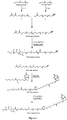
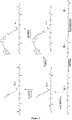
- diblock surfactants of formula (II) may be prepared by pseudo-peptidic coupling reactions between a peg-based hydrophilic chain bearing a free amine and the perfluoropolyether acidic chain prealably activated as its acyl chloride form.
- the hydrophilic chain can be obtained by coupling two oligoethylene glycol derivatives conveniently functionalized, for instance with biotin or alkyne group.
- Functionalized triblock surfactants of formula (IIIa) can be prepared from a trifunctional peg derivative by pseudo-peptidic coupling reaction with Krytox-COCl.
- the trifunctional peg derivative can be prepared by reductive azide dimerization of an oligoethylene glycol derivative bearing an azide and an N-protected amino moiety followed by the pseudo-peptidic coupling of an acid peg chain with the central secondary amine.
- the invention also relates to functionalized surfactants per se described herein, in particular those of formula (Ia), (Ib), (Ic), (II) and (IIIa) or those comprising H 1 or H 2 moieties as described above
- the functional moiety of the functionalized surfactant may promote either covalent or non-covalent interactions with the chemoprobe. This interaction may be direct or indirect, i.e. through a binding intermediate.
- the functional moiety promotes covalent interactions with the chemoprobe or a binding intermediate, preferably specific covalent interactions with the chemoprobe or a binding intermediate.
- a "covalent interaction" between the functionalized surfactant and the chemoprobe or binding intermediate refers to the creation of a covalent bond (i.e. at least one covalent bond) between the hydrophilic head of the functionalized surfactant and the binding domain of the chemoprobe or binding intermediate.
- the covalent bond(s) can be formed by reaction of a chemical reactive group present on the binding domain of the chemoprobe or binding intermediate with another chemical reactive group present in the functional moiety of the functionalized surfactant.
- the reactive group present on the chemoprobe or binding intermediate and that present on the functionalized surfactant are selected so as to react together through a click-reaction and/or a bioconjugation reaction, in particular as described above.
- the reactive group present on the chemoprobe or binding intermediate and that present on the functionalized surfactant are selected so as to react together through a click-reaction.
- the term "specific covalent interactions" is used herein to indicate that the functional moiety of the surfactant has the capacity to create a covalent bond (i.e. at least one covalent bond) with the binding domain of the chemoprobe or the binding intermediate, while having relatively little detectable reactivity with other structures present in the aqueous phase.
- the specific covalent interaction is a biorthogonal or biocompatible reaction between the functional moiety of the surfactant and a specific reactive group present in the binding domain of the chemoprobe or the binding intermediate
- Click-reaction or “Click-chemistry” is a concept introduced by Sharpless in 2001.
- Click chemistry generally refers to chemical reactions characterized by high yields, high chemoselectivity, which are simple to conduct and which generate inoffensive by-products.
- Click reactions can be typically conducted in complex media with high efficiency. Click reactions are typically used to create covalent heteroatom links (C-X-C) between two entities of interest.
- C-X-C covalent heteroatom links
- click reactions encompass, without being limited to, copper-catalyzed azide-alkyne dipolar cycloadditions (CuAAC), strain-promoted alkyne-azide cycloaddition (SPAAC), Diels-Alder reactions with tetrazines and strained alkynes or alkenes, tetrazine-isonitrile cycloadditions, thiol-alkene click reactions such as maleimide-cysteine cycloadditions, Staudinger azide-triarylphosphine conjugation, and sydnone-alkyne cycloadditions.
- CuAAC copper-catalyzed azide-alkyne dipolar cycloadditions
- SPAAC strain-promoted alkyne-azide cycloaddition
- Diels-Alder reactions with tetrazines and strained alkynes or alkenes t
- the click reactions can be conducted in aqueous media.
- the click reaction may be "bioorthogonal” or “biocompatible”, this means that the reagents involved in the click reaction may react selectively and rapidly with each other in the presence of a plurality of biological entities.
- the click reaction may be conducted in media comprising living cells, without interfering with cellular process.
- biocompatible or biorthogonal click reactions encompass metal-free click-reactions (i.e. which do not require metal catalysts). Examples of metal-free click reactions are depicted hereunder:
- metal-free click-reactions of interest are for instance iminosydnone or sydnone derivatives-strained alkyne cycloadditions as described in PCT/EP2015/060805 and PCT/EP2015/063750 .
- Preferred click-reactions are free-metal reaction, i.e. click-reactions which do not require the presence of a metal catalyzer such as copper salt.
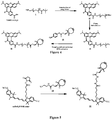
- a preferred free-metal click reaction is strain-promoted alkyne-azide 1,3-dipolar cycloaddition (SPAAC) which refers to the reaction between an azido group and a strained alkyne moiety which leads to the formation of a triazole moiety.
- SPAAC strain-promoted alkyne-azide 1,3-dipolar cycloaddition
- SPAAC strain-promoted alkyne-azide 1,3-dipolar cycloaddition
- Preferred strained alkynes are C 6 -C 30 alkynes wherein the triple bond is sterically strained, in particular in a cyclooctyne scaffold.
- the strained alkyne may comprise a cyclooctyne scaffold which may be optionally substituted by one or several substituants such as halogens and/or fused to one or several cycles, including heterocycles.
- the strained alkyne may comprise one of the following cyclooctyne scaffolds (a)-(f):
- Strained alkynes containing one of said scaffolds can be prepared from commercially available reagents such as OCT, DIBO, BARAC, ALO, DIFO, MOFO, DIBAC and DIMAC:
- the functional moiety of the surfactant i.e. FUNCT
- the binding domain of the chemoprobe or binding intermediate can bear a strained alkyne scaffold, and vice versa.
- the strained alkynyl group is selected from cyclooctyne scaffolds (a)-(f) as shown above, and more preferably is cyclooctyne scaffold (f).
- the chemoprobe or binding intermediate may bear several chemical reactive groups, e.g. 2, 3, 4, 5 or 6 chemical reactive groups. Said chemical groups may enable the chemoprobe or binding intermediate to interact with several functionalized surfactants. Alternatively, said chemical groups may enable the chemoprobe or binding intermediate to create several covalent bonds with one single functionalized surfactant bearing several functional moieties, such as 2, 3, or 4 functional moieties.
- the chemical reactive group(s) present in the binding domain of the chemoprobe or binding intermediate are preferably selected from strained alkynes and azido group.
- the chemoprobe or binding intermediate bears one single type of chemical reactive groups.
- the chemical reactive group(s) can be introduced by bioconjugation reaction.
- the binding domain of the chemoprobe or binding intermediate may bear one of the following moieties: or
- the functional moiety promotes non-covalent interactions with the chemoprobe or a binding intermediate.
- a non-covalent interaction between the functionalized surfactant and the chemoprobe or binding intermediate refers to the formation of a complex involving the functional moiety of the surfactant and a binding domain of the chemoprobe or the binding intermediate.
- the functional moiety specifically binds to the binding domain of the chemoprobe or binding intermediate.
- the term "specifically binding” is used herein to indicate that the functional moiety of the surfactant has the capacity to recognize and interact specifically with the binding domain of the chemoprobe or the binding intermediate, while having relatively little detectable reactivity with other structures present in the aqueous phase.
- the degree of affinity is much greater than such non-specific binding interactions.
- the affinity of a molecule X for its partner Y can generally be represented by the dissociation constant (Kd).
- Kd representing the affinity of the functional moiety of the surfactant and the binding domain of the chemoprobe or binding intermediate is from 1. 10 -6 M or lower, preferably from 1. 10 -7 M or lower, and even more preferably from 1. 10 -8 M or lower.
- the functional moiety may comprise, for example, an antibody, or a fragment or derivative thereof such as Fab, Fab', F(ab) 2 , F(ab') 2 , F(ab) 3 , Fv, single-chain Fv (ScFv), diabodies or VHH, a ligand, a peptide or protein, an aptamer, a polysaccharide, a small organic molecule, a protein tag, or a cation binding group, while the binding domain of the chemoprobe or the binding intermediate comprises a group which specifically binds said functional moiety, or vice versa.
- an antibody or a fragment or derivative thereof such as Fab, Fab', F(ab) 2 , F(ab') 2 , F(ab) 3 , Fv, single-chain Fv (ScFv), diabodies or VHH, a ligand, a peptide or protein, an aptamer, a polysaccharide, a
- the interaction between the functionalized surfactant and the chemoprobe or the binding intermediate may rely on various interaction systems such as affinity systems, ligand/anti-ligand couples or protein tags.
- the interaction between the functionalized surfactant and the chemoprobe or the binding intermediate may rely on cation binding groups (e.g. nitrilotriacetate (NTA, for binding to His tags), iminediacetate or triazacyclononane), protein binding tags or ligand/anti-ligand couples (e.g. antibody/antigen such as biotin/anti-biotin antibody and digoxygenine/anti-digoxigenin antibody, or ligand/receptor).
- cation binding groups e.g. nitrilotriacetate (NTA, for binding to His tags), iminediacetate or triazacyclononane
- protein binding tags or ligand/anti-ligand couples e.g. antibody/antigen such as biotin/anti-biotin antibody and digoxygenine/anti-digoxigenin antibody, or ligand/receptor.
- the functional moiety of the surfactant comprises a protein binding tag while the chemoprobe or the binding intermediate comprises a protein, a peptide or a fragment thereof which specifically binds said tag, or vice versa.
- chemoprobe or the binding intermediate comprises a protein, a peptide or a fragment thereof which specifically binds said tag, or vice versa.
- biotin for binding to streptavidin or avidin derivatives
- glutathione for binding to proteins or other substances linked to glutathione-S-transferase
- maltose for binding to proteins or other substances linked to maltose binding protein
- lectins for binding to sugar moieties
- c-myc tag hemaglutinin antigen (HA) tag
- thioredoxin tag FLAG tag, polyArg tag, polyHis tag, Strep-tag, OmpA signal sequence tag, calmodulin-binding peptide, chitin-binding domain, cellulose-binding domain, S-tag, and Softag3, and the like.
- the chemoprobe and the functionalized surfactant directly interact together.
- the functional moiety of the surfactant may comprise a protein tag, e.g. biotin, while the binding domain of the chemoprobe comprises a group specifically interacting with said tag e.g. streptavidin or avidin, or vice versa.
- the functional moiety of the surfactant may comprise an aptamer or an antibody, while the chemoprobe comprises the ligand of said aptamer or said antibody, and vice versa.
- the chemoprobe and the functionalized surfactant interact through a binding intermediate.
- the binding intermediate is able to bind both the chemoprobe and the surfactant and thus acts as a bridge between said two entities.
- the binding intermediate thus contains a first binding domain able to bind to the chemoprobe and a second binding domain able to bind the functionalized surfactant.
- the binding domains of the intermediate can be of any type and are selected depending on the functional moiety of the surfactant and the binding domain of the chemoprobe.
- the binding intermediate may be a streptavidin while the functional moiety of the surfactant and the binding domain of the chemoprobe both comprise a biotin.
- the chemoprobe may be a biotinylated aptamer or a biotinylated antibody specific to the molecular target.
- the chemoprobe may comprise one or several (for instance, 2, 3, or 4) binding domains, whereby said chemoprobe can bind to one or several (for instance, 2, 3, or 4) functionalized surfactants or binding intermediates.
- binding domains of the chemoprobe may be identical or different and may bind to identical or different functionalized surfactants or binding intermediates.
- the molecular target present in the aqueous phase is contacted with a chemoprobe comprising (i) at least one capture moiety capable of specific binding to the molecular target and (ii) at least one binding domain capable of directly or indirectly binding to the functionalized surfactant.
- the chemoprobe may comprise one or several (for instance, 2, 3, or 4) capture moieties, whereby said chemoprobe can bind one or several (for instance, 2, 3, or 4) molecular targets.
- these moieties may be identical or different and may target identical or different molecular targets.
- the capture moiety of the chemoprobe may be any group which can specifically bind the molecular target.
- groups include, but are not limited to an antibody, a fragment or derivative of an antibody, an aptamer, a spiegelmer, a peptide aptamer, a ligand or a substrate of the molecular target, a nucleic acid capable of hybridizing the molecular target, and a receptor or receptor fragment able to bind the molecular target.
- the capture moiety of the chemoprobe is an antibody directed against the molecular target, a fragment or derivative of such antibody which is able to bind to the molecular target.
- the binding domain of the chemoprobe i.e. the domain which binds the functionalized surfactant or the binding intermediate, may be of any type, with the proviso that it comprises a moiety enabling to create covalent or non-covalent interactions with the functionalized surfactant or the binding intermediate, as explained and detailed above.
- the binding domain of the chemoprobe may be easily chosen by the skilled person depending on the nature of the functionalized moiety of the surfactant or, when a binding intermediate is used, the nature of the domain of the binding intermediate interacting with the chemoprobe.
- the binding domain of the chemoprobe comprises a group selected from reactive chemical groups for click-reaction and protein tags.
- the binding domain of the chemoprobe may comprise a moiety selected from an azido group, an alkynyl group, a strained cycloalkynyl group and a protein tag such as biotin.
- the chemoprobe is an antibody directed against the molecular target and functionalized with a protein tag, preferably biotin, or with a chemical reactive group for click reaction such as a strained cycloalkynyl group, an azido group or an iminosydnone or sydnone derivative.
- a protein tag preferably biotin
- a chemical reactive group for click reaction such as a strained cycloalkynyl group, an azido group or an iminosydnone or sydnone derivative.
- the functional moiety of the surfactant comprises an azido group and the binding domain of the chemoprobe comprises a strained cycloalkynyl group, or vice-versa.
- the functional moiety of the surfactant is biotin and the binding domain of the chemoprobe is streptavidin, or vice-versa.
- the functional moiety of the surfactant is a biotin
- the binding intermediate is streptavidin
- the binding domain of the chemoprobe is biotin
- the chemoprobe and/or the binding intermediate may comprise at least one cleavable linker.
- Said cleavable linkers may be as defined above for the surfactants.
- the chemoprobe may be encapsulated within the droplets, optionally with the molecular target, during the generation of droplets or may be added to the droplets by any methods known by the skilled person such as pico-injection or droplet fusion.
- the chemoprobe In embodiments wherein the chemoprobe is able to directly interact with the functionalized surfactant, the chemoprobe binds the molecular target and captures it at the inner interface of the droplets by interacting with the functional moiety of the surfactant.
- the chemoprobe interacts with the functionalized surfactant through a binding intermediate
- the chemoprobe binds the molecular target and the binding intermediate, and captures the molecular target at the inner interface of the droplets through the binding of the binding intermediate with the functional moiety of the surfactant.
- the bindings between the chemoprobe, the functionalized surfactant, the molecular target, and optionally the binding intermediate can take place in any order.
- the chemoprobe simultaneously binds to the molecular target and the functionalized surfactant, optionally via a binding intermediate.
- the chemoprobe firstly interacts with the molecular target, whereby a complex is formed between the molecular target and the chemoprobe. Then, said complex binds to the functionalized surfactant via the chemoprobe entity, and optionally via a binding intermediate.
- the chemoprobe firstly binds to the surfactant, optionally via a binding intermediate, and then binds to the molecular target.
- Each droplet of the emulsion may comprise one or several chemoprobes specific of one or several molecular targets. In embodiments wherein each droplet comprises several chemoprobes, these chemoprobes may bind to identical or different functionalized surfactants.
- the aqueous phase further comprise a poloxamer, e.g. Pluronics such as Pluronic® F-127 (Sigma), a poloxamer (triblock copolymer) of polypropylene glycol which is hydrophobic and sticks to the hydrophobic surface, to prevent adsorption of strained cycloalkynyl groups on microfluidic chip matrices, in particular PDMS chips.
- Pluronics such as Pluronic® F-127 (Sigma)
- a poloxamer (triblock copolymer) of polypropylene glycol which is hydrophobic and sticks to the hydrophobic surface, to prevent adsorption of strained cycloalkynyl groups on microfluidic chip matrices, in particular PDMS chips.
- the method of the invention is implemented using a microfluidic system.
- microfluidic device As used herein, the term "microfluidic device”, “microfluidic chip” or “microfluidic system” refers to a device, apparatus or system including at least one microfluidic channel.
- the microfluidic system may be or comprise silicon-based chips and may be fabricated using a variety of techniques, including, but not limited to, hot embossing, molding of elastomers, injection molding, LIGA, soft lithography, silicon fabrication and related thin film processing techniques.
- Suitable materials for fabricating a microfluidic device include, but are not limited to, cyclic olefin copolymer (COC), polycarbonate, poly(dimethylsiloxane) (PDMS), poly(methyl methacrylate) (PMMA), and glass.
- COC cyclic olefin copolymer
- PDMS poly(dimethylsiloxane)
- PMMA poly(methyl methacrylate)
- microfluidic devices are prepared by standard soft lithography techniques in PDMS and subsequent bonding to glass microscope slides.
- a passivating agent may be necessary. Suitable passivating agents are known in the art and include, but are not limited to silanes, fluorosilanes, parylene, n -dodecyl- ⁇ -D-maltoside (DDM), poloxamers such as Pluronics.
- the term “channel” refers to a feature on or in an article (e.g., a substrate) that at least partially directs the flow of a fluid.
- the term “microfluidic channel” refers to a channel having a cross-sectional dimension of less than 1 mm, typically less than 500 ⁇ m, 200 ⁇ m, 150 ⁇ m, 100 ⁇ m or 50 ⁇ m, and a ratio of length to largest cross-sectional dimension of at least 2:1, more typically at least 3: 1, 5:1, 10: 1 or more.
- the channel can have any cross-sectional shape (circular, oval, triangular, irregular, square or rectangular, or the like).
- the channel has a square or rectangular cross-sectional shape.
- the channel can be, partially or entirely, covered or uncovered.
- cross-sectional dimension of a channel is measured perpendicular to the direction of fluid flow.
- Water-in-oil emulsion droplets can be generated on the device used to implement the method of the invention ("on-chip”) or on another system (“off-chip”).
- w/o droplets production is carried out in an on-chip droplet generation module.
- Droplets may be produced by any technique known by the skilled person to generated droplets on microfluidic devices such as drop-breakoff in co-flowing streams, cross-flowing streams in a T-shaped junction, and hydrodynamic flow-focussing (reviewed by Christopher and Anna, 2007, J. Phys. D: Appl. Phys. 40, R319-R336 ).
- w/o droplets are generated on another system before to be re-injected on the chip.
- the droplets are generated on a droplet generation module on another system and are then re-injected on the system used to implement the method of the invention through an emulsion re-injection module.
- droplets may be re-injected through an emulsion re-injection module comprising a ⁇ -shaped structure where injected droplets are spaced by carrier oil supplying by at least one, preferably two side channels connected with the re-injection channel.
- the w/o droplets have a cross-sectional dimension that is substantially equal to the largest dimension of the channel perpendicular to fluid flow in which the droplets are located.
- the w/o droplets are provided (generated or re-injected) to the fluidic system at a frequency ranging from 0.01 Hz to 10 kHz, preferably from 0.1 kHz to 5 kHz, more preferably from 0.5 kHz to 2.5 kHz.
- a frequency of 1 kHz means that droplets are provided at a rate of 1000 droplets per second. This frequency may be easily chosen and adjusted by the skilled person.
- the microfluidic chip used in the method of the invention comprises droplet generation module or an emulsion re-injection module in fluid communication with a mixing module.
- This mixing module may insure homogeneous mixing of the contents of the droplets and thus optimize the capture of molecular targets at the interface.
- Exemplary mixing modules include, but are not limited to, chaotic mixers ( Stroock et al. Science, vol. 295, pp. 647-651, 2002 ) or serpentine mixing modules ( Liu et al. J. Microelectromech. Syst, 9, pp. 190-197, 2000 ).
- the microfluidic chip used in the method of the invention may comprise a delay line, in particular a delay line allowing reliable incubation time such as disclosed in the patent application WO 2010/042744 .
- the inventors have developed and herein provide systems and methods for reliable phase inversion of water-in-oil emulsion droplets, in particular in microfluidic systems. They demonstrated that water-in-oil emulsions can be efficiently inverted by creating double emulsion and destabilising said emulsion thereby producing oil-in-water emulsion.
- the method of inverting the phase of water-in-oil emulsion droplets thus comprises
- double emulsion droplet refers to water-in-oil-in-water droplet (also named w/o/w droplet) and consists of an aqueous droplet inside an oil droplet, i.e. an aqueous core and an oil shell, surrounded by an aqueous carrier fluid.
- the double emulsion droplets have a homogenous distribution of diameters, i.e., the droplets may have a distribution of diameters such that no more than about 10%, about 5%, about 3%, about 1%, about 0.03%, or about 0.01% of the droplets have an average diameter greater than about 10%, about 5%, about 3%, about 1%, about 0.03%, or about 0.01% of the average diameter of the droplets.
- the double emulsion is a monodispersed emulsion, i.e. an emulsion comprising droplets of the same volume.
- the w/o/w droplet has a volume of less than 2000 pL, preferably of less than 1500 pL.
- a w/o/w droplet has a volume ranging from 40 pL to 1500 pL, more preferably from 40 pL to 500 pL, even more preferably from 40 pL to 200 pL, and in particular from 40 pL to 150 pL.
- the ratio of oil shell over aqueous core is between 1 and 10 (v/v), preferably between 1.5 and 5 (v/v).
- the aqueous carrier fluid is typically water or an aqueous buffer solution, such as Tris HCl buffer, Tris HCl / EDTA (TE) buffer, phosphate buffer saline (PBS) or acetate buffer.
- the aqueous phase may also be chosen from organic solutions such as ethanol, methanol, acetonitrile, dimethylformamide, and dimethylsulfoxide.
- the aqueous carrier fluid is water.
- the aqueous carrier fluid is a buffered medium of low salinity such as buffers comprising Tris or HEPES, preferably at a concentration of 100 mM or less, more preferably at a concentration of 10 mM or less.
- the aqueous carrier fluid may comprise one or several water-soluble surfactants such as Tween 20, Tween 80, SDS, Triton X-100, Pluronics, perfluorooctanol, NP40 or CHAPS.
- the aqueous carrier fluid comprises Triton X-100 and /or Tween 20.
- said water-soluble surfactant(s) are present in the aqueous carrier fluid at a concentration ranging from 0.05 % to 2 %, preferably from 0.1 to 1 % (w/w).
- double emulsion droplets may be produced using a flow-focusing junction (see for example Yan et al., 2013, Micromachines, 4, 402-413 and the patent application WO 2011/028764 ) or a T-shaped junction (see for example Okushima et al., 2004, Langmuir, 20, 9905-9908 ).
- double emulsion droplets are formed using a flow-focusing junction.
- Double emulsions may be prepared by controlling the hydrophilicity and/or hydrophobicity of the channels used to form such emulsion.
- double emulsions may be produced using partially hydrophilic and partially hydrophobic microfluidic devices.
- oil-in-water emulsion may be obtained from double emulsion droplets through electrical destabilisation, electroporation or spontaneous destabilisation.
- double emulsion droplets are destabilised by applying an electric field.
- the method of inverting the phase of water-in-oil emulsion droplets comprises
- the electric field is used to destabilize and break the oil capsule of w/o/w droplets in order to obtain oil-in-water emulsion droplets.
- the main difficulty is to preserve the integrity of the interface between the oil capsule and the aqueous core. In particular, it is important that captured molecular targets remain attached on the outer surface of the inversed droplets for further characterization or assays.
- substantially similar denotes a sufficiently high degree of similarity between two numeric values, such that one of skill in the art would consider the difference between the two values to be of little or no statistical significance within the context of the characteristic measured by said values (e.g., sizes of the cross-sections).
- the difference between said two values is, for example, less than about 30%, 20%, 10% or 5%.
- the cross section of the hydrophilic channel is about 30% smaller than the cross section of double emulsion droplets.
- the electric field applied to a double emulsion droplet induces coalescence of the inner aqueous phase (i.e. aqueous core) with the external aqueous phase (i.e. aqueous carrier fluid) thereby producing oil-in-water emulsion droplet.
- the electric field may be generated from an electric field generator, i.e., a device or system able to create an electric field.
- the electric field generator may produce an AC field (i.e., one that varies periodically with respect to time, for example, sinusoidally, sawtooth, square, etc.), a DC field (i.e., one that is constant with respect to time), a pulsed field, etc..
- an electric field may be produced by applying voltage across a pair of electrodes, which may be positioned on or embedded within the fluidic system (for example, within a substrate defining the channel or under the channel using gold or ITO vapour deposition), and/or positioned proximate to the channel such that at least a portion of the electric field interacts with the double emulsion (for example, electrodes may consist in microchannels aside the fluidic channels and filled with a solder or a salt solution to which the electrical field is applied).
- the electric field generator applies a sinusoidal or squared-shape current.
- the electric field generator may apply a voltage with a frequency between 1 kHz and 1 GHz, preferably between 1 kHz and 50 kHz, more preferably of a frequency between 10 kHz and 30 kHz and even more preferably a frequency between 20 kHz and 30 kHz, and an amplitude between 100 V and 10 000 V, preferably from 1 500 V to 3000 V, and more preferably from 2000 V to 3000 V.
- the electric field generator applies a sinusoidal voltage with a frequency of about 10 kHz and an amplitude of about 300 V.
- the electric field generator applies an AC field, preferably a squared-shape current.
- the frequency is from 20 kHz to 30 kHz and the amplitude is from 2,000 V to 3,000 V.
- w/o/w droplets pass the electrodes at a frequency from 10 to 1000 droplets per second, preferably at a frequency from 100 to 500 droplets per second and more preferably at a frequency from 250 to 350 droplets per second.
- the frequency of the droplets may be adjusted by injection oil spacer, preferably surfactant-free oil, e.g. using a ⁇ -shaped structure.
- an electrical shielding is provided, typically using one or several shielding electrodes.
- These shielding electrodes are grounded and therefore impose a zero voltage boundary condition for the rest of the chip, in particular for upstream modules such as the re-injection or droplet generation module and the module for creating double emulsion, or downstream modules such as an emulsion collection module.
- These shielding electrodes are commonly used by the skilled person.
- the section of the hydrophilic channel between the module for creating double emulsion, e.g. the nozzle or the T-shaped junction, and the phase inversion module applying the electric field is of more than 4 mm, preferably more than 4.1, 4.2, 4.5, or 5 mm, i.e. double emulsion droplets have thus to flow more than 4 mm before to go through the electric field.
- double emulsion droplets are destabilised by electroporation.
- the method of inverting the phase of water-in-oil emulsion droplets comprises
- the double emulsion is generated in a microfluidic chip before to be placed in an electroporation cuvette wherein the voltage is applied using an electroporator.
- the applied voltage is from 20V to 500V during 10 ms to 1000 ms. In a preferred embodiment, the applied voltage is about 50V during about 100 ms.
- double emulsion droplets are spontaneously destabilised.
- the method of inverting the phase of water-in-oil emulsion droplets comprises
- double emulsion droplets are incubated in a microfluidic chip using a delay-line.
- delay-lines are well-known and commonly used by the skilled person (see for example, the European patent application EP 2 340 435 ).
- double emulsion droplets are incubated are incubated for at least 2 min, more preferably for at least 5 min, and even more preferably for at least 10 min.
- non-inverted droplets may be further eliminated based on their size that was bigger than the inverted one.
- oil-in-water emulsion droplets may be stabilized by adding surfactant to the aqueous carrier fluid.
- surfactant can be provided by inlets downstream of the phase inversion module.
- Oil-in-water emulsion droplets may be collected, in particular to be submitted to further analysis.
- o/w droplets are stabilized by surfactant in order to prevent any coalescence during the storage.
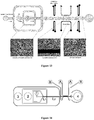
- the microfluidic system used in the present invention may combine the production of a double emulsion (i.e. w/o/w emulsion) and its inversion.
- the system may thus comprise a module for generating water-in-oil emulsion droplets (i.e. a module that produces droplets using any known techniques such as breakup in co-flowing streams, breakup in cross-flowing streams, for example at T-shaped junctions, breakup in elongational or stretching dominated flows, as for example in hydrodynamic flow-focussing), or re-injecting water-in-oil emulsion (e.g.
- an emulsion re-injection module comprising a ⁇ -shaped structure), a module for creating double emulsion (e.g. using flow-focusing junction or a T-shaped junction) in fluid communication and downstream of the module for generating water-in-oil emulsion droplets or re-injecting water-in-oil emulsion, and a phase inversion module in fluid communication and downstream of the module for creating double emulsion.
- the production of double emulsion and the inversion process may be decoupled and performed on different microfluidic chips.
- the double emulsion is produced on a first microfluidic system comprising
- the double emulsion is then re-injected into a second microfluidic system comprising
- the phase inversion module comprises one or more electrodes that generate an electric field directed to a hydrophilic channel.
- the electrodes may be positioned on or embedded within the fluidic system, or positioned proximate to the channel such that at least a portion of the electric field interacts with the double emulsion.
- upstream refers to components or modules in the direction opposite to the flow of fluids from a given reference point in a microfluidic system.
- downstream refers to components or modules in the direction of the flow of fluids from a given reference point in a microfluidic system.
- the channels of said system are partially hydrophilic and partially hydrophobic.
- the region downstream of the module for generating or re-injecting water-in-oil emulsion droplets and upstream of the module for creating double emulsion droplets is hydrophobic.
- the region downstream of the module for creating double emulsion droplets is hydrophilic.
- a localized hydrophilic region may be created in a hydrophobic microfluidic channel by various methods known and appreciated by one of skill in the art, including, but not limited to, applying various treatments such as oxygen plasma, applying a hydrophilic coating such as poly(ethylene glycol) or a fluorinated activated silane, chemically grafting small molecules or polymers onto the dielectric layer to increase the hydrophilicity of the surface, and/or constructing the microfluidic channel with a material having surface chemistry that may be initiated with ultraviolet (UV) light, such that shining UV light to the localized region will induce said surface chemistry resulting in a change in the material surface property of the region from relatively hydrophobic to relatively hydrophilic. All these techniques to control the wetting properties of microfluidic devices are well-known by the skilled person and described for example in the patent applications WO 2011/028764 and WO 2009/120254 .
- a localized region of a channel may be rendered more hydrophobic by various well-known methods including, but not limited to, applying coating materials such as a polysilicon and/or hydrophobic coating materials such as a polydimethylsiloxane composition or a polytetrafluoroethylene composition (e.g. TEFLON-AF).
- coating materials such as a polysilicon and/or hydrophobic coating materials such as a polydimethylsiloxane composition or a polytetrafluoroethylene composition (e.g. TEFLON-AF).
- the channels of the first system i.e. producing the double emulsion
- the channels of the second system i.e. phase invention system
- the phase inversion module is the region of the microfluidic system wherein an electric field is applied on double emulsion droplets in order to obtain oil-in-water emulsion.
- This module is in fluid communication and downstream of the module for creating double emulsion and comprises an hydrophilic channel and one or more electrodes that generate an electric field directed to said hydrophilic channel in which double emulsion droplets flow.
- the electric field is produced by applying voltage across a pair of electrodes.
- These electrodes may be positioned on or embedded within the fluidic system (for example, within a substrate defining the channel), and/or positioned proximate the channel (e.g. at about 50 ⁇ m) such that at least a portion of the electric field interacts with the double emulsion.
- the electrodes can be fashioned from any suitable electrode material or materials known to those of ordinary skill in the art, including, but not limited to, silver, gold, copper, carbon, platinum, copper, tungsten, tin, cadmium, nickel, indium tin oxide, etc., as well as combinations thereof.
- the electrodes may be formed of the same material, or different materials.
- the electrodes may also be liquid electrodes made of salt solution (e.g. NaCl) molded around the hydrophilic channel in which droplets flow.
- the electric field generator may be integral to or separate from the fluidic system containing the hydrophilic channel.
- integral means that portions of the components integral to each other are joined in such a way that the components cannot be manually separated from each other without cutting or breaking at least one of the components.
- one or several shielding electrodes are provided to prevent the electric field to spread everywhere. These electrodes are grounded and therefore impose a zero voltage boundary condition for upstream and/or downstream regions, in particular for the re-injection or droplet generation module and the module for generating double emulsion.
- the distance between the phase inversion module and the module for generating double emulsion is of more than 4 mm, preferably more than 4.1, 4.2, 4.5, or 5 mm.
- the microfluidic system may further comprise a spacing module in fluid communication and downstream of the module for generating or re-injecting water-in-oil emulsion droplets, for the purpose of changing the spacing between droplets before creating double emulsion.
- This spacing module comprises one or more inlet channels to inject or remove fluid, preferably oil phase, between droplets in a fluidic stream.
- the micro fluidic system may further comprise a spacing module in fluid communication and downstream of the module for creating double emulsion droplets, for the purpose of changing the spacing between droplets before the phase inversion module.
- This spacing module comprises one or more inlet channels to inject or remove fluid, preferably aqueous phase, between droplets in a fluidic stream.
- the micro fluidic system may further comprise a detection module (e.g. a module to detect a signal such as a fluorescent signal), a stabilization module (e.g. a module wherein a surfactant is added to the aqueous carrier phase in order to stabilize the inversed emulsion), a droplet sorting module (e.g. a module to sort droplets based on any detectable signal such as a fluorescent signal) and/or a droplet collection module (a module to collect droplet, for example to carry out further off-chip analysis).
- a detection module e.g. a module to detect a signal such as a fluorescent signal
- a stabilization module e.g. a module wherein a surfactant is added to the aqueous carrier phase in order to stabilize the inversed emulsion
- a droplet sorting module e.g. a module to sort droplets based on any detectable signal such as a fluorescent signal
- a droplet collection module a module to collect droplet
- the captured molecular target After capture of the molecular target at the inner interface of the droplets thanks to the interactions between i) the molecular target and the chemoprobe, and ii) the chemoprobe and the functionalized surfactant (optionally through interaction with a binding intermediate), the captured molecular target may be detected, recovered and/or quantified.
- the method of the invention may thus further comprise a step of detecting, recovering and/or quantifying the captured molecular target.
- This step may be carried out directly in the w/o droplets or after inverting the phase of droplets to produce oil-in water emulsion droplets and to expose captured targets at the outer surface of droplets as described above.
- the choice of the method used to detect, recover or quantify the molecular target depends on several parameters such as the nature of the functionalized surfactant, the chemoprobe or the molecular target, and the presence or absence of a step of inverting the emulsion phase.
- captured molecular targets are detected, recovered and/or quantified after phase inversion.
- the method may further comprise, before detecting, recovering or quantifiying, washing o/w droplets in order to eliminate non-captured molecules.
- captured molecular targets may be recovered from the interface of the droplets by any methods known by the skilled person, for example by disrupting the interaction between the chemoprobe and the molecular target or by disrupting the interaction between the chemoprobe and the functionalized surfactant and or the binding intermediate.
- this linker may be cleaved to allow the release and recovering of the captured molecular targets.
- captured molecular targets are exposed at the outer surface of droplets and can thus be easily detected using any methods known by the skilled person, for example using an antibody or another ligand which is specific to the molecular target and comprises a mean for detection.
- a mean of detection refers to any entity which may be useful for detection purpose, in terms of detection or calibration.
- the mean of detection may be a MS-tag or a fluorophore.
- captured molecular targets are detected/quantified using one or several antibodies directed against said targets and comprising a MS-tag.
- Different MS-tag may be used to detect/quantify simultaneously different targets.
- the w/o emulsion comprises a surfactant comprising a hydrophilic head linked to a MS-tag. Detection or quantification of targets may be performed by mass spectrometry analysis after cleavage of MS-tags.
- the tag of the surfactant may be used as a calibrator for mass spectrometry analysis.
- captured molecular targets are detected, recovered and/or quantified directly in the w/o droplets.
- the emulsion may be broken by any methods known by the skilled person such as methods described in Mazutis et al. Nat. Protoc., 2013, 8, 870 or Chokkalingam et al. Lab Chip, 2014, 14, 2398 .
- the captured molecular targets may be recovered by any methods known by the skilled person, for example by disrupting the interaction between the chemoprobe and the molecular target or by disrupting the interaction between the chemoprobe and the functionalized surfactant and/or the binding intermediate.
- the functionalized surfactant, the chemoprobe and/or the binding intermediate comprises a cleavable linker, this linker may be cleaved to allow the release and recovering of the captured molecular targets.
- the detection or quantification of captured molecular target may be carried out directly in the w/o droplets using an antibody or another ligand which is specific to the molecular target and comprises a mean of detection.
- the detection or quantification of captured molecular target is carried out directly in the w/o droplets using microfluidic laser/PMT detection thank to a ligand specific to the molecular target and detectable by laser/PMT, e.g. an antibody conjugated to a fluorophore.
- the detection or quantification of captured molecular target is carried out directly in the w/o droplets using proximity ligation assay (PLA, Gullberg et al., Proc. Natl. Acad. Sci. U.S.A., 2004 ; Soderberg et al., Nature Methods, 2006 ).
- proximity ligation assay PHA, Gullberg et al., Proc. Natl. Acad. Sci. U.S.A., 2004 ; Soderberg et al., Nature Methods, 2006 .
- this technic enables highly sensitive protein analysis. Briefly, this method requires an antibody directed against the molecular target and an antibody directed against the chemoprobe, each antibody containing oligonucleotides extension as probes.
- Amplification may be performed by any methods known by the skilled person such as rolling circle amplification, using detectable probes such as fluorescent probes. Using calibration curve, the signal intensity at the inner interface of the droplets, allows the detection and quantification of the molecular target.
- PLA analysis may be performed simultaneously in the same droplets for several targets using different detectable probes.
- the captured molecular target is a nucleic acid and the detection or quantification of said target is carried out directly in the w/o droplets using in vitro transcription and/or translation system and/or a nucleic acid amplification system. Detection and/or quantification are then performed by detecting or quantifying the product of the transcription and/or translation system or of the nucleic acid amplification system. Methods to carry out in vitro transcription and/or translation or nucleic acid amplification in droplets are well known by the skilled person.
- the method of the invention may further comprise sorting w/o droplets comprising the desired captured molecular target.
- the skilled person may use any methods known in the art, such as methods reviewed in the article of Wyatt Shields et al (Lab Chip. 2015 Feb 16; 15(5): 1230-1249 ).
- the method of the invention may be used in various applications.
- the method may be used in genomics, epigenomics, transcriptomics, proteomics, metabolomics, lipidomics, interactomics, secretomics approaches, and in particular in single cell "omics" to apprehend cellular diversity and heterogeneity.
- An application among others may be to define the normal cell-to-cell variation, to correlate the variation with changes in biological function and disease processes and finally to identify personalized therapy.
- the method of the invention may also be used to detect, recover and/or quantify one or several molecular targets of interest, in particular of diagnostic/prognostic/theranostic importance.
- the method of the invention may further comprise providing a sample from a subject, said sample comprising a molecular target of interest to be captured at the interface of droplets according to the method of the invention.
- sample means any sample containing cells derived from a subject, preferably a sample which contains nucleic acids.
- samples include fluids such as blood, plasma, saliva, urine, cerebrospinal fluid and seminal fluid samples as well as biopsies, organs, tissues or cell samples. It may be fresh, frozen or fixed (e.g. formaldehyde or paraffin fixed) sample.
- the sample may be a disease sample, preferably a cancer sample, i. e. a sample containing tumoral cells derived from a patient.
- the term "subject” or “patient” refers to an animal, preferably to a mammal, even more preferably to a human, including adult, child and human at the prenatal stage.
- Said sample may be treated prior to be used in the method of the invention, e.g. to extract nucleic acid, proteins, lipids, etc..., to wash cells, to isolate cells from tissues or organs, etc...
- each w/o droplet used in the method of the invention comprises a single cell obtained from a patient sample and one or several molecular targets of diagnostic/prognostic/theranostic importance may be captured/detected and/or quantified using the method of the invention.
- the present document also discloses a kit for capturing a molecular target, comprising
- the kit may comprise
- the functionalized surfactant and the binding domain of the chemoprobe may comprise a functional moiety with a chemical reactive group suitable to create a covalent bond by click-chemistry.
- the chemical reactive group suitable to create a covalent bond by click-chemistry is selected from the group consisting of azido group, and an alkynyl group such as a strained cycloalkynyl group.
- the functional moiety of the surfactant is an azido group and the binding domain of the chemoprobe is a strained cycloalkynyl group, or vice-versa.
- the kit comprises a functionalized surfactant with a functional moiety comprising protein tag, preferably a biotin, and a chemoprobe with a binding domain comprising a group that can specifically interact with the protein tag of the surfactant, preferably a streptavidin or avidin, or vice-versa.
- the kit comprises
- the chemoprobe is a biotinylated aptamer or a biotinylated antibody specific to the molecular target.
- kit may further comprise
- the present invention also relates to the use of the kit as disclosed herein for capturing a molecular target according to the method of the invention.
- indefinite article “a” or “an” does not exclude the possibility that more than one of the element is present, unless the context clearly requires that there be one and only one of the elements.
- the indefinite article “a” or “an” thus usually means “at least one”.
- the term "about” refers to a range of values ⁇ 10% of the specified value.
- “about 20” includes ⁇ 10 % of 20, or from 18 to 22.
- the term “about” refers to a range of values ⁇ 5 % of the specified value.
- High resolution mass spectra were obtained using a Agilent Q-TOF (time of flight) 6520 and low resolution mass spectra using a Agilent MSD 1200 SL (ESI/APCI) with a Agilent HPLC1200 SL.
- Preparative HPLC procedures were performed on semi-preparative HPLC Shimadzu Auto-injector SIL-10A (pump: Shimadzu LC-8A, UV-Vis detector: Shimadzu SPD-10A, collector: Shimadzu fraction collector FRC-10A) using a Sunfire C18 (150 mm ⁇ 19 mm i.d., 5 ⁇ m, Waters) at a flow of 17 mL/min. Per sample 1 mL was injected and water/ACN containing 0.05% TFA was used as eluent system. The gradient applied was 5% to 95% ACN in 40 minutes and 10 minutes of re-equilibration. Detection was done at 550 nm for TAMRA derivatives.
- diblock surfactants Four functionalized diblock surfactants were synthesized to perform capture at the inner surface of the microdroplet by two different strategies.
- An alkyne diblock surfactant (Krytox-peg 10 -alkyne, 6 ) and an azide diblock surfactant (Krytox-peg 12 -azide, 14 ) were synthesized to develop capture by click chemistry and two biotinylated diblock surfactants (Krytox-pegio-biotin 10 and Krytox-peg 12 -biotin 18 ) were prepared to perform capture by immuno-sandwich.
- Diblock surfactants were obtained by pseudo-peptidic coupling reactions between a peg-based hydrophilic chain bearing a free amine and the perfluoropolyether acidic chain activated as its acyl chloride form (Krytox157-COCl, 5 ).
- the hydrophilic chain was obtained by coupling two oligoethylene glycol derivatives conveniently functionalized ( Figure 1 ).
- a peg 10 derivative 3 bearing an N -boc protected amino group and an alkyne was synthesized by a pseudo-peptidic coupling reaction between building blocks 1 and 2 beforehand obtained respectively from hexaethyleneglycol and tetraethyleneglycol.
- This intermediate led to the synthesis of the alkyne diblock surfactant 6 after N -boc cleavage and coupling with Krytox-COCl 5.
- a biotinylated diblock surfactant 10 was obtained after click reaction with Biotin-N 3 7, N -boc deprotection and coupling with Krytox-COCl 5.
- a peg 12 derivative containing an azide and an N -boc amino moities was prepared by coupling the oligoethylene derivatives 1 and 12 both obtained from hexaethylene glycol ( Figure 2 ).
- the azide diblock surfactant 14 was obtained after N -boc deprotection and coupling with the fluorinated chain.
- a second biotinylated surfactant 18 was also synthesized after click reaction with biotin-alkyne 15, N -boc cleavage and coupling with Krytox-COCl 5.
- N -(17-amino-3,6,9,12,15-pentaoxaheptadecan-1-yl)carbamate 11a Tamura, S.; Inomata, S.; Ebine, M.; Genji, T.; Iwakura, I.; Mukai, M.; Shoji, M.; Sugai, T.; Ueda, M. Bioorg. Med. Chem.
- BocNH-peg 12 -azide 12 (1.62 g, 2.19 mmol, 83 %) as a yellow oil.
- BocNH-peg 12 -azide 12 (1 eq., 350 mg, 0.47 mmol), 5-((3a S ,4 S ,6a R )-2-oxohexahydro-1 H -thieno[3,4- d ]imidazol-4-yl)- N -(prop-2-yn-1-yl)pentanamide 15 (1.3 eq., 172 mg, 0.61 mmol), THF (6 mL) and water (6 mL). The flask was evacuated and back flushed with argon. The process of evacuation and flushing was repeated three times.
- trifunctional peg linkers 20a and 20b were submitted to the reductive azide dimerization under hydrogenation condition to obtain trifunctional peg linkers 20a and 20b .
- a third acidic peg azide chain was coupled to the central secondary amine afforded tri-peg derivatives bearing an azide moiety 21a and 21b.
- These intermediates led to the synthesis of the azide triblock surfactants 23a and 23b after N- boc cleavage followed by pseudo-peptidic coupling reaction with Krytox-COCl 5.
- a biotinylated triblock surfactant was also obtained starting from tripeg 6 azide intermediate 21a after click reaction with Biotin-alkyne 15, N -boc moieties deprotection and coupling with Krytox-COCl 5.
- BCN ((1 R ,8 S ,9 s )-bicyclo[6.1.0]non-4-yn-9-ylmethyl) was chosen for its readily availability and conjugated with TAMRA and sulfo-Cy5 fluorophores.
- TAMRA derivative a pseudo-peptidic coupling reaction was first performed between TAMRA-6-CO 2 H and mono N -boc peg6 diamine derivative 1. After N -boc deprotection the fluorophore was coupled to BCN in its nitro-phenyl carbonate activated form 21 ( Figure 4 ). SulfoCy5 NHS ester was directly coupled to BCN-NH 2 31 via an amide bond ( Figure 5 ).
- TAMRA-peg6-NHBoc 27 To a solution of TAMRA-peg6-NHBoc 27 (1 eq., 60 mg, 0.076 mmol) in MeOH (3 mL) was added a 4M solution of HCl in dioxane (15 eq., 0.28 mL, 1.14 mmol) and the reaction was stirred at room temperature for 3 hours. After concentration under reduced pressure the mixture was dissolved in a minimum of MeOH and purified by flash chromatography (RP 16 g, H 2 O (0.05% TFA) to ACN, 30 minutes) to afford TAMRA-peg6-NH 2 (TFA salt) 28 (59.2 mg, 0.0643 mmol, 85 %) as a pink solid.
- TAMRA-peg6-NH 2 28 (TFA salt) (1 eq., 17 mg, 0.018 mmol) and TEA (5 eq., 0.013 mL, 0.092 mmol) in DMF (2 mL) was added (1 R ,8 S ,9 s )-bicyclo[6.1.0]non-4-yn-9-ylmethyl (4-nitrophenyl) carbonate 29 (1.1 eq., 6.4 mg, 0.020 mmol). The reaction was stirred at room temperature for 3 hours.
- Example 2 Microdroplet surface engineering by SPAAC (strain-promoted azide-alkyne cycloaddition)
- a mold of SU-8 resist (MicroChem Corp.) was prepared on a silicon wafer (Siltronix) by UV exposure (MJB3 contact mask aligner; SUSS MicroTec) through a photolithography mask (Selba SA) and subsequent development (SU-8 developer; MicroChem Corp.).
- a curing agent was added to the PDMS base (Sylgard 184 silicone elastomer kit; Dow Corning Corporation) to a final concentration of 10% (w/w), mixed and poured over the mold to a depth of 5 mm.
- the PDMS was peeled off the mold and the input and output ports were punched with a 0.75 mm-diameter Harris Uni-Core biopsy punch (Electron Microscopy Sciences).
- the PDMS was activated by incubation for 3 minutes in an oxygen plasma (Diener Zepto) and was bound to a 50 mm x 75 mm glass slide (Fisher Bioblock). Channels were made fluorophilic using a commercial surface coating agent (ABCR, AB111155). Height of the channel was 40 ⁇ m and size of the nozzle was 25 ⁇ m with a channel width of 40 ⁇ m.
- a second chip was used to reinject collected emulsion with a channel width of 50 ⁇ m.
- the optical setup comprises an Eclipse Ti inverted microscope (Nikon) mounted on an optical table and includes 4 lasers (Strasus-375 nm 16mW, Stradus-488 nm 50 mW, Stradus-532 nm 40 mW and Stradus-642 nm 110 mW). Emitted fluorescence was detected by photomultiplier tubes (PMT, Hamamatsu Photosensor H10722-20). The output signal from the PMTs was analyzed using a PCI-7852R Virtex-5 LX50R FPGA card (National Instruments Corporation) executing a program written in LabView 2013 (FPGA module, National Instruments Corporation).
- the optical table includes also a camera (Guppy F-080, Allied Vision Technologies).
- Flow rates of 500 ⁇ L/h for aqueous phase and of 500 ⁇ L/h for fluorinated oil phase (3M Novec 7500) were used to create droplets of 40-50 pL. Emulsion was collected in an Eppendorf filled with oil and closed with a PDMS plug to prevent coalescence due to contact with air. For control and surfactant dilution experiments 2.5% w/w of non-functionalized surfactant (008-FluoroSurfactant, RAN Biotechnologies) was used in oil phase.
- the azide diblock surfactant Krytox-peg 12 -azide 14 and the azide triblock surfactant diKrytox-peg 12 -azide 23b were used at 2.5% w/w in oil phase.
- sulfoCy5-BCN 32 and control fluorophores were dissolved in Pluronic F-127 (0.01% in PBS 1x).
- W/O emulsions were reinjected in the second chip and spaced by fluorous oil (3M Novec 7500). Flow rates of 200 ⁇ L/h for Novec 7500 and of 100 ⁇ L/h for emulsion sample were used.
- ACMS used as fluorophore control was synthesized according to the literature ( Woronoff, G., El Harrak, A., Mayot, E., Schicke, O., Miller, O.J., Soumillion, P., Griffiths, A.D., Ryckelynck M. Anal. Chem., 2011, 83, 2852-2857 ).
- W/O emulsions were analyzed using a Leica SPE confocal microscope (lasers used: 405 nm (ACMS), 561 nm (TAMRA derivatives) and 635 nm (sulfoCy5 derivatives), objective 20X, Leica 11506513).
- W/O emulsions (15 - 30 ⁇ L) were put on Corning® 96 Well Half Area Microplates 3686. Fluorescence polarization analyses were performed in triplicates using Wallac® Victor 3 Multilabel Reader (Excitation/emission wavelengths 620/665 nm).
- the SPAAC reaction at the inner surface droplet was evaluated using Krytox-peg 12 -azide 14 and the two fluorescent BCN derivatives (sulfoCy5-BCN 32 Figure 6 and TAMRA peg6-BCN 30 Figure 7 ).
- a first emulsion was prepared using azide diblock surfactant (Krytox-peg 12 -azide 14 ) at 2.5% in Novec 7500 and sulfoCy5-BCN 32 at 300 nM in Pluronic 0.01% for aqueous phase ( Figure 6A ). Signals obtained during emulsion reinjection showed that sulfoCy5 fluorescence was higher in front and in the back of the droplets indicated that the probe was located preferably at the inner surface of the water droplet.
- azide diblock surfactant Karl-peg 12 -azide 14
- sulfoCy5-BCN 32 at 300 nM in Pluronic 0.01% for aqueous phase
- Microdroplet surface multifunctionalization was evaluated by co-encapsulating both fluorescent probes in microdroplets stabilized with diblock-azide 14 as fluorosurfactant.
- sulfoCy5-BCN 32 and TAMRA-peg 6 -BCN 30 were diluted at 200 nM in Pluronic 0.01% (in PBS 1x) and Krytox-peg 12 -azide 14 was used at 2.5% in Novec 7500 for the oil phase.
- Signals from PMT during emulsion reinjection and confocal microscopy showed that the fluorescence of both probes was preferably located at the microdroplets inner surface ( Figure 8 ).
- a second fluorescence polarization experiment was performed with a concentration range of sulfoCy5-BCN probe 32.
- a 5% concentration of Krytox-peg 12 -azide 14 in commercial surfactant (008-F) was maintained constant and the aqueous phase was charged with increasing concentration of sulfoCy5-BCN 32 (0.01, 0.1, 1 and 10 ⁇ M in Pluronic 0.01%).
- Results are depicted in Figure 11 .
- Negative controls using only non-functionalized surfactant 008-F as stabilizer were also performed and fluorescence polarization remained constant (186 ⁇ 15 mP) for each probe concentration.
- SPAAC reaction at the inner microdroplet surface was evaluated for triblock-azide fluorosurfactant according the same condition applied for diblock-azide 14.
- diKrytox-peg 12 -azide was used at 2.5% in Novec 7500 to encapsulate the two fluorescent probes first separately then together.
- the two fluorescent probes were successfully react with triblock-azide surfactant 23b (sulfoCy5-BCN 32 Figure 12A and TAMRA-peg 6 -BCN 30 Figure 12B ) and surface microdroplet di-functionalization was also validated by co-encapsulating the two fluorescent probes ( Figure 12C ).
- double emulsion was used to create an oil capsule around the aqueous droplets and electric field was used to break this capsule.
- electro-coalescence of inner aqueous droplets with external aqueous phase lead to the destabilization of the oil capsule, generating an oil droplet in water (o/w), which outer surface corresponds to the inner surface of the water droplet it comes from.
- Flow focusing junction was used to generate w/o emulsion in a first microchip. Double emulsion generation using flow focusing and electrical destabilization were done on a second microchip ( Figure 13 ).
- Microfluidic channels of second microchip were designed with Autocad (Autodesk 2014) to generate a double emulsion with electrodes to destabilize it. Shielding electrodes prevent the electric field to spread everywhere ( figure 13 ). L 1 (3mm) and L 2 (4mm) in figure 2 has to be long enough respectively to prevent w/o emulsion from electro-coalescence in the reinjector and to perturb double emulsion generation due to electric field.
- a mold of SU-8 resist (MicroChem Corp.) was fabricated on a silicon wafer (Siltronix) by UV exposure (MJB3 contact mask aligner; SUSS MicroTec) through a photolithography mask (Selba SA) and subsequent development (SU-8 developer; MicroChem Corp.).
- a curing agent was added to the PDMS base (Sylgard 184 silicone elastomer kit; Dow Corning Corporation) to a final concentration of 10% (w/w), mixed and poured over the mold to a depth of 5 mm.
- the PDMS was peeled off the mold and the input and output ports were punched with a 0.75 mm-diameter Harris Uni-Core biopsy punch (Electron Microscopy Sciences).
- the PDMS was activated by incubation for 3 min in an oxygen plasma (Diener Zepto) and was bound to a 50 mm x 75 mm glass slide (Fisher Bioblock).
- the first microchip was used to create water-in-oil emulsion (w/o) of 30pL droplets.
- Channels were made fluorophilic using a commercial surface coating agent (ABCR, AB111155). High of the channel was 20 ⁇ m, and size of the nozzle was 25 ⁇ m with a channel width of 40 ⁇ m.
- the second microchip was used to create double emulsion and destabilize it with electric field. Chip was used just after binding of PDMS to a glass slide using oxygen plasma so that PDMS remain hydrophilic.
- Electrodes were made of salt solution (NaCl 180g/L in deionized water, Sigma S3014) and were mold around the channel in a parallel channel with the same high. Sinusoidal voltage wave was applied to the electrodes at 400V and 10kHz with a function generator (Agilent, 33220A) and a voltage amplifier (TREK Model 623D).
- the optical setup comprised an Eclipse Ti inverted microscope (Nikon) mounted on an optical table.
- a 640 nm laser (Obis, Coherent) and a 532 nm laser (MXL-III-532) beams were combined using a dichroic mirror "D3" and the resulting beam was combined with a 488 nm laser (Picarro) using a dichroic mirror "D2".
- the resulting beam was combined with a 375 nm laser (LAS, Newport-Sprectraphysics) using a dichroic mirror "D1" and directed in the microscope objective using a mirror "M” and a dichroic mirror "D5" focused in the middle of the channel of the device at the detection point.
- the emitted fluorescence was collected by the microscope objective and separated from the laser beams by a first dichroic mirror "D5". Blue light, green light, orange light and red light was resolved from others with dichroic mirrors respectively "D6", “D7", “D8” and “D9". Emitted fluorescence was detected by photomultiplier tubes (PMT, Hamamatsu Photonics KK) equipped with band pass filters “F1” for blue light, "F2" for green light, “F3” for orange light, "F4" for red light and "F5" for infrared light.
- PMT Hamamatsu Photonics KK
- the output signal from the PMTs was analyzed using a PCI-7831R RIO Multifunction FPGA card (National Instruments Corporation) executing a program written in LabView 2013 (FPGA module, National Instruments Corporation).
- the data acquisition rate for the system was 166 kHz.
- the full process was monitored by redirecting part of the emitted light using a dichroic mirror "D0" towards a CCD camera (Guppy, Allied Vision Technologies) equipped with a long pass filter "F0" eliminated potentially damaging reflections of the lasers ( Figure 16 ).
- Flow rates were controlled by syringe pumps (Harvard Apparatus PHD 2000). W/O emulsion was produced with an aqueous phase containing 500nM Fluorescent Streptavidin (Lifetechnologies, S11223) in Phosphate Buffer Saline (PBS) (Sigma P-3619). Flow rates of 400 ⁇ L/h for aqueous phase and 400 ⁇ L/h for fluorinated oil phase (3M Novec 7500) were used to create droplets of 30pL. Emulsion was collected in an eppendorf filled with oil and closed with a PDMS plug to prevent from coalescence due to contact with air.
- PBS Phosphate Buffer Saline
- W/O emulsion was reinjected (inlet 1, figure 14 ) in the second microchip in a packed manner (due to difference of density between oil and water).
- Water droplets 50 ⁇ L/h
- oil 50 ⁇ L/h
- Double emulsion was created with an outer aqueous stream made of 2.5 ⁇ M Dye647 (Dyomics 647-00) and Triton X-100 1% w/w (Sigma X-100) in PBS at a flow rate of 200 ⁇ L/h (inlet 3, figure 14 ).
- An AC electric field was applied across the electrodes through connectors plugged in A (300Vpp, 10kHz) and B (0V) inlets in figure 14 .
- the negative and positive populations can be distinguished on a histogram by plotting the mean value of the streptavidin fluorescence on the oil droplets ( fig. 18 ).
- the first population, centered around 0.22V, is the negative control while the population centered around 0.55V is the positive one. This method of inversion allows a quick and clear separation between positive and negative droplets.
- double emulsion was used to create an oil capsule around the aqueous droplets and voltage applied on the outer aqueous phase was used to break this oil capsule.
- electro-coalescence of inner aqueous droplets with external aqueous phase lead to the destabilization of the oil capsule, generating an oil droplet in water (o/w), which outer surface corresponds to the inner surface of the water droplet it comes from.
- Flow focusing junction was used to generate w/o emulsion in a first microchip. Double emulsion generation using flow focusing was done on a second microchip and electrical destabilization was done on an electroporation cuvette on which a voltage was applied.
- Microfluidic channels of second microchip were designed with Autocad (Autodesk 2014) to generate a double emulsion and to incubate it on chip with a delay-line to destabilize it.
- a mold of SU-8 resist (MicroChem Corp.) was fabricated on a silicon wafer (Siltronix) by UV exposure (MJB3 contact mask aligner; SUSS MicroTec) through a photolithography mask (Selba SA) and subsequent development (SU-8 developer; MicroChem Corp.).
- a curing agent was added to the PDMS base (Sylgard 184 silicone elastomer kit; Dow Corning Corporation) to a final concentration of 10% (w/w), mixed and poured over the mold to a depth of 5 mm.
- the PDMS was peeled off the mold and the input and output ports were punched with a 0.75 mm-diameter Harris Uni-Core biopsy punch (Electron Microscopy Sciences).
- the PDMS was activated by incubation for 3 min in an oxygen plasma (Diener Zepto) and was bound to a 50 mm x 75 mm glass slide (Fisher Bioblock).
- the first microchip was used to create water-in-oil emulsion (w/o) of 30pL droplets.
- Channels were made fluorophilic using a commercial surface coating agent (ABCR, AB111155). High of the channel was 20 ⁇ m, and size of the nozzle was 25 ⁇ m with a channel width of 40 ⁇ m.
- the second microchip was used to create double emulsion and destabilize it. Chip was used just after binding of PDMS to a glass slide using oxygen plasma so that PDMS remain hydrophilic.
- High of the channels, reinjection channel width and double emulsion generation channel width were respectively 40 ⁇ m, 30 ⁇ m and 50 ⁇ m.
- Flow rates were controlled by syringe pumps (Harvard Apparatus PHD 2000). W/O emulsion was produced with an aqueous phase consisted in PBS buffer (Sigma P-3619). Flow rates of 400 ⁇ L/h for aqueous phase and 400 ⁇ L/h for fluorinated oil phase (3M Novec 7500) were used to create droplets of 30pL. Emulsion was collected in an eppendorf filled with oil and closed with a PDMS plug to prevent from coalescence due to contact with air. 5% w/w of non-functionalized surfactant (008-FluoroSurfactant, RAN Biotechnologies) was used in oil phase.
- W/O emulsion was re-injected in the second microchip in a packed manner (due to difference of density between oil and water). Water droplets (50 ⁇ L/h) were spaced by oil (50 ⁇ L/h) ( Figure 19 ). Double emulsion was created with an outer aqueous stream made of Triton X-100 1% w/w (Sigma X-100) in water at a flow rate of 200 ⁇ L/h. Double emulsion was transferred in a 1mm electroporation cuvette ( Figure 20 ) on which a 10V, 25V, and 50V voltage was applied during 100ms.
- double emulsion was used to create an oil capsule around the aqueous droplets and we observe that this capsule break by itself when incubated on chip at room temperature.
- coalescence of inner aqueous droplets with external aqueous phase lead to the destabilization of the oil capsule, generating an oil droplet in water (o/w), which outer surface corresponds to the inner surface of the water droplet it comes from.
- Flow focusing junction was used to generate w/o emulsion in a first microchip. Double emulsion generation using flow focusing and spontaneous destabilization were done on a second microchip.
- Microfluidic channels of second microchip were designed with Autocad (Autodesk 2014) to generate a double emulsion and to incubate it on chip with a delay-line to destabilize it.
- a mold of SU-8 resist (MicroChem Corp.) was fabricated on a silicon wafer (Siltronix) by UV exposure (MJB3 contact mask aligner; SUSS MicroTec) through a photolithography mask (Selba SA) and subsequent development (SU-8 developer; MicroChem Corp.).
- a curing agent was added to the PDMS base (Sylgard 184 silicone elastomer kit; Dow Corning Corporation) to a final concentration of 10% (w/w), mixed and poured over the mold to a depth of 5 mm.
- the PDMS was peeled off the mold and the input and output ports were punched with a 0.75 mm-diameter Harris Uni-Core biopsy punch (Electron Microscopy Sciences).
- the PDMS was activated by incubation for 3 min in an oxygen plasma (Diener Zepto) and was bound to a 50 mm x 75 mm glass slide (Fisher Bioblock).
- the first microchip was used to create water-in-oil emulsion (w/o) of 30pL droplets.
- Channels were made fluorophilic using a commercial surface coating agent (ABCR, AB111155). High of the channel was 20 ⁇ m, and size of the nozzle was 25 ⁇ m with a channel width of 40 ⁇ m.
- the second microchip was used to create double emulsion and destabilize it. Chip was used just after binding of PDMS to a glass slide using oxygen plasma so that PDMS remain hydrophilic.
- Flow rates were controlled by syringe pumps (Harvard Apparatus PHD 2000). W/O emulsion was produced with an aqueous phase consisted in PBS buffer (Sigma P-3619). Flow rates of 400 ⁇ L/h for aqueous phase and 400 ⁇ L/h for fluorinated oil phase (3M Novec 7500) were used to create droplets of 30pL. Emulsion was collected in an eppendorf filled with oil and closed with a PDMS plug to prevent from coalescence due to contact with air. 5% w/w of non-functionalized surfactant (008-FluoroSurfactant, RAN Biotechnologies) was used in oil phase.
- W/O emulsion was re-injected (inlet 1, figure 23 ) in the second microchip in a packed manner (due to difference of density between oil and water).
- Water droplets 50 ⁇ L/h
- oil 50 ⁇ L/h
- Double emulsion was created with an outer aqueous stream made of Triton X-100 1% w/w (Sigma X-100) in water at a flow rate of 200 ⁇ L/h (inlet 3, figure 23 ) and incubated on chip in a delay-line for 10 minutes ( Figures 22 and 23 ).
- Goat anti-Mouse IgG FITC (Lifetechnologies, 62-6511) conjugated was bionitilated using One-step Antibody Biotinylation Kit (Miltenyi Biotec, 130-093-385). This antibody was premix at 100nM with AlexaFluor532 Streptavidin (Lifetechnologies, S11223) at 1uM in Phosphate Buffer Saline (Sigma P-3619) for 45min at room temperature. W/O emulsion was produced with this premixed aqueous phase. Flow rates of 400 ⁇ L/h for aqueous phase and 400 ⁇ L/h for fluorinated oil phase (3M Novec 7500) were used to create droplets of 30pL.
- phase inversion was observed to happen spontaneously ( fig. 24 ).
- the interfaces between inner aqueous phase, oil phase and outer aqueous phase happened to be instable.
- inversion was not done in the same time for all droplets due to surfactant migration time.
- not inverted droplets were eliminated by size as they were bigger than inverted ones.
- Multi-azide surfactants bearing two or four azide moieties were synthesized according to the synthesis strategy reported in Figure 27 .
- the key intermediate of this synthesis consisted in the preparation of a dialkylamine peg linker containing two azide moieties 38 via reductive azide dimerization.
- this intermediate was coupled to a third peg chain 41 comprising a carboxylic acid moiety and a N -boc protected group. After N -boc cleavage the hydroxylic head was coupled to Krytox-COCl 5 to afford the di-azide fluorosurfactant 44 .
- the tetra-azide surfactant 47 was also obtained by substitution of cyanuric chloride with two dialkylamine 38, followed by the introduction of ethylene diamine and then the coupling reaction with Krytox-COCl 5.
- dimer 35 (1 eq., 734 mg, 1.56 mmol) in DCM (14.5 mL) under argon were added TEA (10 eq., 2.19 mL, 15.60 mmol) and DMAP (0.2 eq., 38.2 mg, 0.31 mmol).
- TEA eq., 2.19 mL, 15.60 mmol
- DMAP 0.2 eq., 38.2 mg, 0.31 mmol
- the reaction mixture was stirred 5 minutes at 0°C and tosyl chloride (4 eq., 1.19 g, 6.25 mmol) was added.
- the reaction mixture was stirred 2 hours at room temperature. 100 mL of DCM were added and the mixture was washed with an aqueous solution of NaHCO 3 (3 x 50mL), dried over MgSO 4 and evaporated.
- Krytox157FSH-COCl 5 (1 eq., 3.00 g, 0.46 mmol) was dissolved in a mixture of Novec7100 (10 mL) and DCM (5 mL). A solution of 43 (1.2 eq., 0.37 g, 0.55 mmol) and TEA (3 eq., 0.14 g, 0.192 mL, 1.38 mmol) in DCM (5 mL) was added. The resulting mixture was stirred at room temperature for 48 hours. The crude obtained after evaporation of the solvent was dissolved in HFE7500 (75 mL).
- Conjugation reagents were synthesized to ensure the introduction of a strained alkyne moiety on biomolecules (oligonucleotide and antibody) which will be graft at the microdroplet inner surface and permit the capture of corresponding targets.
- Conjugation reagents containing one or four BCN moieties and an activated ester able to react with amino-oligonucleotide and antibody through lysine residue have been synthesized according to the synthesis strategy described in Figure 28 .
- a peg derivative 50 comprising an amine and a methyl ester was first synthesized and coupled to BCN in its nitro-phenyl carbonate activated form 29.
- a tetra-BCN conjugation reagent 58 has been also obtained by bi-substitution of cyanuric chloride with 22b followed by the introduction of a methyl propionate. Then the N-boc moieties have been deprotected and the resulting free amines have been coupled to the pre-activated BCN derivative 29.
- the reaction mixture was stirred at room temperature for 15 hours. After concentration, 50 mL of water were added and the mixture was extracted with DCM (3 x 50 mL). The combined organic layers were dried over MgSO 4 and concentrated. The crude was purified by silica gel flash chromatography (DCM to DCM/MeOH 9/1 in 35 min) to afford 56 (230 mg, 0.11 mmol, 70 %) as a yellowish oil.
- Example 8 Preparation of a chemoprobe by reaction of an amino-modified oligonucleotide with a conjugation reagent described in Example 7
- Amino-modified oligonucleotides were purchased from IDT. The purifications after oligonucleotide conjugation were carried out on a Shimadzu system (pump: LC 20-AD, detector: SPD 20-A, autosampler: SIL 20-A) using a SunFireTM C18 5 ⁇ M 4.6 ⁇ 150 mm column (Waters). HPLC parameters were as follows: flow rate 1 mL/min, mobile phase A was triethylammonium acetate (TEAA) in water (50 mM), and mobile phase B was TEAA in acetonitrile (50 mM). The detection was done at 260 nm. Gradient A: from 15 to 40% of mobile phase B from 0 to 30 min. Gradient B: from 15 to 35% of mobile phase B from 0 to 30 min. Gradient C: from 15 to 50% of mobile phase B from 0 to 30 min.
- TEAA triethylammonium acetate
- oligonucleotide conjugations and sequences 5AmC12: 5' Amino Modifier C12, iCy5: Internal Cy5TM, 3Cy5Sp: 3' Cy5TM introduced on supported resin, 5ATTO488N: 5' AttoTM 488 (NHS ester), 3ATTO488N: 3' AttoTM 488 (NHS ester).
- Amino-modified oligonucleotide sequences Conjugation reagent HPLC gradient BCN-based conjugates obtained Complementary oligonucleotide sequences 53 A 59 53 B 61 58 C 63 53 B 64
- Example 9 Capture of an oligonucleotide target by the method of the invention (chemoprobe: olidonucleotide commentary to the target)
- Flow rates were controlled by syringe pumps (Harvard Apparatus PHD 2000). Flow rates of 500 ⁇ L/h for aqueous phase and of 500 ⁇ L/h for fluorinated oil phase (3M Novec 7500) were used to create droplets (40-60 pL). Emulsion was collected in an Eppendorf filled with oil and closed with a PDMS plug to prevent coalescence due to contact with air. For biomolecule grafting via SPAAC reaction, the azide surfactants Krytox-peg 12 -diN 3 44 and Krytox-peg 16 -tetraN 3 47 were used at 2.5% w/w in oil phase.
- W/O emulsions were reinjected in the second chip and spaced by fluorinated oil (3M Novec 7500). Flow rates of 200 ⁇ L/h for Novec 7500 and of 100 ⁇ L/h for emulsion sample were used.
- W/O emulsions were analyzed using a Leica SPE confocal microscope (lasers used: 405 nm (ACMS), 488 nm (Atto488 derivatives) and 635 nm (sulfoCy5 derivatives), objective 20X, Leica 11506513).
- Oligonucleotide grafting at microdroplet inner surface The grafting of Cy5-oligonucleotide after conjugation to one or four BCN moieties ( 59 and 63 ) was validated using Krytox-peg 12 -diN 3 44 as fluorosurfactant ( Figure 30 ). In both cases, signals obtained during emulsion reinjection showed that Cy5 fluorescence was higher in front and in the back of the droplets indicated that the oligonucleotides were located preferably at the inner surface of the water droplet. These results were confirmed by confocal microscopy which demonstrated that Cy5-oligonucleotides were concentrated at the microdroplets inner surface.
- Negative controls To demonstrate the specificity of the reaction, negative controls were performed using non-functionalized commercial fluorosurfactant (008-F, Ran Biotechnologies). Emulsions were prepared by co-encapsulating mono-BCN and tetra-BCN Cy5-oligonucleotides (respectively 59 and 63 ) and the corresponding complementary Atto488-oligonucleotides (respectively 60 and 62 ). In both cases the Cy5 and Atto488 fluorescence were homogenously distributed across the water droplets demonstrating that the SPAAC reaction cannot occur without azide fluorosurfactants ( Figure 32a-b ). The same result was obtained using the BCN-oligo-polydT 63 and the complementary Atto-488 polydA 64 ( Figure 32c ).
- Example 10 Grafting of an antibody (Trastuzumab) by the method of the invention
- sulfoCy5CO 2 NHS was purchased from Interchim (Ref. 992779).
- a fluorescently labelled 970-nt long fragment of the GAPDH mRNA was prepared and purified prior to i) diluting it into a stabilizing buffer in the presence of a large excess of non specific RNAs, ii) dispersing the solution into water-in-oil droplets into which iii) RNA was captured at inner droplet surface and, finally, iv) target RNA was purified from the reaction mixture.
- DNA oligonucleotide 5 was modified with the conjugation reagent 53 via its 5' end amine function according to the procedure described in Example 8.
- Microfluidic devices were obtained using a classic replica molding process as described previously in ( Mazutis et al. 2009. Anal Chem 81: 4813-4821 ). Briefly, devices were designed on Autocad (Autodesk 2014), negative photomasks were printed (Selba S.A.) and used to prepare molds by standard photolithography methods. SU8-2025 photoresist (MicroChem Corp.) was used to pattern 40 ⁇ m deep channels onto silicon wafers (Siltronix). Microfluidic devices were then fabricated in polydimethylsiloxane (PDMS, Silgard 184, Dow-Corning) using conventional soft lithography methods ( Xia and Whitesides 1998.
- PDMS polydimethylsiloxane
- Silgard 184 Silgard 184
- Patterned electrodes were filled with metal by heating the microfluidic chip to 90°C and injecting molten 51In/32.5Bi/16.5Sn low temperature solder (Indium Corporation, Singapore) ( Siegel et al. 2007. Adv Mater 19: 727-733 ). Finally, electrical connections with the solder were made with short pieces of electric wires (Radiospares). The main dimensions and depth of microfluidic devices are given on concerned figures and in their captions.
- Aqueous phases were loaded in I.D. 0.75 mm PTFE tubings (Thermo Scientifc) and oils were loaded in 2 mL Micrew Tubes (Thermo Scientific). Liquids were injected into microfluidic devices at constant and highly controlled flow-rates using a 7-bar MFCSTM pressure-driven flow controller (Fluigent) equipped with Flowells (7 ⁇ L/min flow-meters) allowing for operation in flow-rate controlled mode.
- MFCSTM pressure-driven flow controller Fluid
- the optical setup was based on an inverted microscope (Nikon Eclipse Ti-S) mounted on a vibration-dampening platform (Thorlabs B75150AE).
- the beams of a 375 nm laser (CrystaLaser DL375-020-O) and a 488 nm laser (CrystaLaser DL488-050-O) were combined using a dichroic mirror (Semrock Di02-R405-25x36), shaped as lines using a pair of lenses (Semrock LJ1878L2-A and LJ1567L1-A) and directed into the microscope objective (Nikon Super Plan Fluor 20x ELWD or Nikon Super Plan Fluor 40x ELWD) to be focused in the middle of the channel at the detection point.
- the emitted fluorescence was collected by the same objective and separated from the laser beams by a multi-edges dichroic mirror (Semrock Di01-R405/488/561/635-25x36). Blue (7-aminocoumarin-4-methanesulfonic acid) fluorescence was resolved from green (Atto488-RNA) and orange (TAMRA) fluorescence by a third dichroic mirror (Semrock LM01-480-25). Then green fluorescence was separated from orange fluorescence by an additional dichroic mirror (Semrock FF562-Di03-25x36).
- DAQ intelligent data acquisition
- To monitor the experiment we used an additional dichroic mirror (Semrock FF665-Di02-25x36) to split light to a CCD camera (Allied Vision Technologies Guppy F-033).
- a long-pass filter (Semrock BLP01-664R-25) prevented potentially damaging reflections of the lasers into the camera.
- the DNA was then purified using Wizard SV Gel and PCR Clean-Up System (Promega) following supplier instructions and eluted in DNase-free/RNase-free deionized water. Purified DNA was then quantified by measuring OD 260nm of the solution (NanoDrop).
- RNA was quantified by measuring OD 260nm of the solution (NanoDrop) that constituted a solution of RNA 4.
- RNA 4 A solution of 25 nM of labelled RNA 4 was mixed with 200 nM of BCN-containing capture DNA 5 in stabilizing buffer KP (25 mM MES pH 6, 2 mM EDTA, 100 mM NaCl and 0.4 mg/mL BSA). The mixture was further supplemented with 4 mg/mL of competing yeast total RNA (Ambion) and 5 ⁇ M 7-aminocoumarin-4-methanesulfonic acid (used as droplet tracker). The mixture was loaded into a length of PTFE tubing (I.D.
- the emulsion was imaged on a confocal system (Zeiss LSM 780).
- the formation of a green ring demonstrated the capture of the RNA at the inner surface of the droplet while the coumarin dye (in blue) stayed diffuse in the droplets.
- Water-in-oil (w/o) droplets displaying captured RNA were reinjected into an inverter device ( Figure 36 ) and infused of 350 nL/min to be reinjected at a rate of 165 droplets per second.
- w/o droplets were spaced by a stream of surfactant free Novec-7500 oil infused at 400 nL/min and a double (water-in-oil-in-water, w/o/w) emulsion was produced by pinching the resulting stream by a flow of aqueous phase (0.1 % Tween 20, 10 mM Hepes pH7.4 and 5 ⁇ M TAMRA) infused at 1300 nL/min.
- aqueous phase 0.1 % Tween 20, 10 mM Hepes pH7.4 and 5 ⁇ M TAMRA
- each 40 pL w/o droplet was individualized into a 100 pL (40 pL w/o droplet + 60 pL of oil) with no more than 1 w/o droplet per w/o/w droplet while around 90 % of the o/w droplets were occupied.
- w/o/w droplets were then converted (inverted) into oil-in-water (o/w) droplets when passing in between a pair of electrodes to which a squared AC field (2500V, 30 Hz) was applied using a function generator connected to an high voltage amplifier (TREK Model 623B). Droplets were collected in a 0.5 mL tube under water.
Landscapes
- Health & Medical Sciences (AREA)
- Immunology (AREA)
- Life Sciences & Earth Sciences (AREA)
- Engineering & Computer Science (AREA)
- Chemical & Material Sciences (AREA)
- Urology & Nephrology (AREA)
- Biomedical Technology (AREA)
- Hematology (AREA)
- Molecular Biology (AREA)
- Physics & Mathematics (AREA)
- General Physics & Mathematics (AREA)
- Biochemistry (AREA)
- General Health & Medical Sciences (AREA)
- Pathology (AREA)
- Analytical Chemistry (AREA)
- Medicinal Chemistry (AREA)
- Cell Biology (AREA)
- Food Science & Technology (AREA)
- Microbiology (AREA)
- Biotechnology (AREA)
- Materials Engineering (AREA)
- Organic Chemistry (AREA)
- High Energy & Nuclear Physics (AREA)
- Nanotechnology (AREA)
- Bioinformatics & Cheminformatics (AREA)
- Chemical Kinetics & Catalysis (AREA)
- Measuring Or Testing Involving Enzymes Or Micro-Organisms (AREA)
Claims (17)
- Ein Verfahren zur Erfassung eines molekularen Ziels, wobei besagtes Verfahren umfassta) Bereitstellen von Wasser-in-Öl-Emulsionstropfen, umfassend ein funktionalisiertes Tensid an der Grenzfläche der Tropfen, wobei besagtes Tensid wenigstens einen lipophilen Schwanz umfasst, der an einen funktionalisierten hydrophilen Kopf gebunden ist;b) Inkontaktbringen besagten funktionalisierten Tensids mit einer Chemosonde, die in der wässrigen Phase der Tropfen vorhanden ist oder zugefügt wird, wobei besagte Chemosonde wenigstens (i) eine Erfassungskomponente mit der Fähigkeit, an ein molekulares Ziel spezifisch zu binden, und wenigstens (ii) eine bindende Domäne mit der Fähigkeit, direkt oder indirekt an das funktionalisierte Tensid zu binden, umfasst undc) Inkontaktbringen besagten funktionalisierten Tensids mit dem molekularen Ziel, das in der wässrigen Phase der Tropfen vorhanden ist oder zugefügt wird,wobei dadurch das molekulare Ziel an der inneren Grenzfläche der Emulsionstropfen durch (i) direkte oder indirekte Bindung der Chemosonde an das funktionalisierte Tensid und (ii) das spezifische Binden der Chemosonde an das molekulare Ziel erfasst wird, und
wobei Schritte b) und c) gleichzeitig oder in beliebiger Reihenfolge aufeinanderfolgend durchgeführt werden. - Das Verfahren nach Anspruch 1, das unter Verwendung eines Mikrofluidsystems durchgeführt wird.
- Das Verfahren nach Anspruch 1 oder 2, das außerdem Invertieren der Phase von Wasser-in-Öl-Emulsionstropfen umfasst, wobei dadurch Öl-in-Wasser-Emulsionstropfen gebildet werden und das erfasste molekulare Ziel an der Außenseite der Emulsionstropfen exponiert wird.
- Das Verfahren nach einem der Ansprüche 1 bis 3, das außerdem einen Schritt der Wiedergewinnung, Detektion und/oder Quantifizierung des erfassten molekularen Ziels umfasst.
- Das Verfahren nach einem der Ansprüche 1 bis 4, wobei das molekulare Ziel ein Protein oder eine Nukleinsäure ist.
- Das Verfahren nach einem der Ansprüche 1 bis 5, wobei die Erfassungskomponente der Chemosonde aus der Gruppe ausgewählt ist, bestehend aus einem Antikörper, einem Spiegelmer, einem Peptid-Aptamer, einem Aptamer, einem Liganden oder einem Substrat des molekularen Ziels, einer Nukleinsäure mit der Fähigkeit, das molekulare Ziel zu hybridisieren, und einem Rezeptorfragment, das das molekulare Ziel binden kann.
- Das Verfahren nach einem der Ansprüche 1 bis 6, wobei das funktionalisierte Tensid ein Diblock- oder Triblock-Tensid ist.
- Das Verfahren nach einem der Ansprüche 1 bis 7, wobei die Chemosonde das funktionalisierte Tensid durch kovalente Wechselwirkungen bindet.
- Das Verfahren nach einem der Ansprüche 1 bis 8, wobei die Chemosonde an das funktionalisierte Tensid durch kovalente Wechselwirkungen direkt bindet, vorzugsweise der funktionalisierte hydrophile Kopf des Tensids und die bindende Domäne der Chemosonde, die jeweils eine reaktive chemische Komponente tragen, die durch eine Klickreaktion oder eine Biokonjugationsreaktion miteinander reagieren können.
- Das Verfahren nach einem der Ansprüche 1 bis 7, wobei die Chemosonde an das funktionalisierte Tensid über ein bindendes Intermediat bindet, vorzugsweise der funktionalisierte hydrophile Kopf des Tensids und das bindende Intermediat, die jeweils eine reaktive chemische Komponente tragen, die durch eine Klickreaktion oder eine Biokonjugationsreaktion miteinander reagieren können.
- Das Verfahren nach Anspruch 9 oder 10, wobei die Klickreaktion aus der Gruppe ausgewählt ist, bestehend aus Kupfer-katalysierter dipolarer Azid-Alkin-Cycloaddition (CuAAC), strainpromoted Alkin-Azid-Cycloaddition (SPAAC), Diels-Alder-Reaktionen mit Tetrazinen und strained Alkinen oder Alkenen, Tetrazin-Isonitril-Cycloaddition, Thiol-Alken-Klickreaktion wie Maleimid-Cystein-Cycloaddition und einer Sydnone-Alkin-Cycloaddition, wobei eine strainpromoted Alkin-Azid-Cycloaddition (SPAAC) bevorzugt ist.
- Das Verfahren nach einem der Ansprüche 1 bis 7, wobei die Chemosonde das funktionalisierte Tensid durch nichtkovalente Wechselwirkungen direkt oder über ein bindendes Intermediat bindet.
- Das Verfahren gemäß einem der Ansprüche 1 bis 12, wobei das molekulare Ziel von einer biologischen Entität in den Tropfen verkapselt ist und wobei das Verfahren gegebenenfalls Lysieren besagter Entität umfasst, um besagtes molekulares Ziel freizusetzen.
- Das Verfahren nach einem der Ansprüche 1 bis 13, wobei das funktionalisierte Tensid aus einer Komponente der Formel (Ib) besteht oder diese umfasst
 - a und b ganze Zahlen sind, ausgewählt unabhängig voneinander von 1 bis 5,- jedes LIPO ein lipophiler Schwanz ist, ausgewählt unabhängig voneinander aus der Gruppe, bestehend aus einer gesättigten oder ungesättigten Kohlenwasserstoffkette, gegebenenfalls von einem oder mehreren Heteroatomen unterbrochen und gegebenenfalls von einer oder mehreren Gruppen substituiert, ausgewählt aus C1-C3-Alkylgruppen, Halogenen wie F, Cl oder Br, -OH,-OMe und -CF3, einer Perfluorpolyetherkette, einer Perfluorkohlenstoffkette und Kombinationen davon,- jedes HYDRO ein hydrophiler Kopf ist, umfassend eine Komponente, ausgewählt unabhängig voneinander aus einer Dimorpholinphosphatgruppe, einem Polyether, einem Polyetheramin, einem Polyglcyerol und Kombinationen davon,- jedes FUNCT eine funktionale Komponente des Tensids ist, ausgewählt aus einer Alkinylgruppe, einer Azidogruppe, einem Biotin, einem Streptavidin und einem Avidin.
 - Das Verfahren nach einem der Ansprüche 1 bis 14, wobei das funktionalisierte Tensid umfasst- ein oder zwei lipophile Schwänze, die die Komponente der Formel (L1) umfassen oder daraus bestehen:
 - einen hydrophilen Kopf, der wenigstens eine Komponente der Formel (H2) trägt:
- Das Verfahren nach Anspruch 15, wobei das funktionalisierte Tensid eine der folgenden Formeln besitzt:


 ∘ X2, X3 und X4 unabhängig voneinander aus CH und N ausgewählt sind,∘ Y8 CH oder N ist,∘ Y4, Y5, Y6 und Y7 unabhängig voneinander aus NH, O und CH2 ausgewählt sind und,∘ e1 und e2 ganze Zahlen sind, ausgewählt unabhängig voneinander von 1 bis 12, wobei L1 und H2 wie in Anspruch 15 definiert sind.
 - Die Verwendung eines Kits, umfassend- ein funktionalisiertes Tensid, umfassend wenigstens einen lipophilen Schwanz, gebunden an einen funktionalisierten hydrophilen Kopf; und- eine Chemosonde umfassend wenigstens (i) eine Erfassungskomponente mit der Fähigkeit, an ein molekulares Ziel spezifisch zu binden, und wenigstens (ii) eine bindende Domäne mit der Fähigkeit, direkt oder indirekt an das funktionalisierte Tensid zu binden,zur Erfassung eines molekularen Ziels gemäß dem Verfahren nach einem der Ansprüche 1 bis 16.
Priority Applications (1)
| Application Number | Priority Date | Filing Date | Title |
|---|---|---|---|
| EP20179089.6A EP3736572B1 (de) | 2016-04-05 | 2017-04-04 | Technische oberfläche zwischen tropfen zur erfassung eines molekularen ziels |
Applications Claiming Priority (2)
| Application Number | Priority Date | Filing Date | Title |
|---|---|---|---|
| EP16305394 | 2016-04-05 | ||
| PCT/EP2017/058035 WO2017174610A1 (en) | 2016-04-05 | 2017-04-04 | Intra-droplet surface engineering to capture a molecular target |
Related Child Applications (1)
| Application Number | Title | Priority Date | Filing Date |
|---|---|---|---|
| EP20179089.6A Division EP3736572B1 (de) | 2016-04-05 | 2017-04-04 | Technische oberfläche zwischen tropfen zur erfassung eines molekularen ziels |
Publications (2)
| Publication Number | Publication Date |
|---|---|
| EP3440463A1 EP3440463A1 (de) | 2019-02-13 |
| EP3440463B1 true EP3440463B1 (de) | 2020-07-08 |
Family
ID=55953082
Family Applications (2)
| Application Number | Title | Priority Date | Filing Date |
|---|---|---|---|
| EP17715712.0A Active EP3440463B1 (de) | 2016-04-05 | 2017-04-04 | Technische oberfläche zwischen tropfen zur erfassung eines molekularen ziels |
| EP20179089.6A Active EP3736572B1 (de) | 2016-04-05 | 2017-04-04 | Technische oberfläche zwischen tropfen zur erfassung eines molekularen ziels |
Family Applications After (1)
| Application Number | Title | Priority Date | Filing Date |
|---|---|---|---|
| EP20179089.6A Active EP3736572B1 (de) | 2016-04-05 | 2017-04-04 | Technische oberfläche zwischen tropfen zur erfassung eines molekularen ziels |
Country Status (7)
| Country | Link |
|---|---|
| US (2) | US11181521B2 (de) |
| EP (2) | EP3440463B1 (de) |
| CN (2) | CN115368916A (de) |
| CA (1) | CA3019498A1 (de) |
| DK (1) | DK3440463T3 (de) |
| ES (1) | ES2824488T3 (de) |
| WO (1) | WO2017174610A1 (de) |
Families Citing this family (12)
| Publication number | Priority date | Publication date | Assignee | Title |
|---|---|---|---|---|
| EP3440463B1 (de) * | 2016-04-05 | 2020-07-08 | Université de Strasbourg | Technische oberfläche zwischen tropfen zur erfassung eines molekularen ziels |
| CN110114473A (zh) | 2016-11-23 | 2019-08-09 | 斯特拉斯堡大学 | 靶分子的串联条形码添加以便以单实体分辨率对靶分子进行绝对定量 |
| WO2019224219A1 (en) | 2018-05-22 | 2019-11-28 | Universite De Strasbourg | Absolute quantification of target molecules at single-entity resolution using tandem barcoding |
| CN110698406B (zh) * | 2018-07-09 | 2021-10-01 | 乳源东阳光氟有限公司 | 一种全氟聚醚咪唑啉化合物及其制备方法和用途 |
| US20220008880A1 (en) * | 2018-11-16 | 2022-01-13 | MAX-PLANCK-Gesellschaft zur Förderung der Wissenschaften e.V. | Surfactant-stabilized fluid interface and dispersion comprising one or more droplets having a surfactant stabilized fluid interface |
| US20220235292A1 (en) * | 2019-06-03 | 2022-07-28 | Dropworks, Inc. | Systems and methods for stabilizing emulsions |
| GB202006525D0 (en) * | 2020-05-04 | 2020-06-17 | Sphere Fluidics Ltd | Surfactant |
| KR20230079068A (ko) * | 2020-09-03 | 2023-06-05 | 다인 세라퓨틱스, 인크. | 단백질-올리고뉴클레오티드 복합체의 제조 방법 |
| CN113979889A (zh) * | 2021-11-09 | 2022-01-28 | 西安康福诺生物科技有限公司 | 一种双官能化聚乙二醇基胺的合成方法 |
| CN114397229B (zh) * | 2021-12-24 | 2023-12-05 | 广东省科学院化工研究所 | 一种重金属响应的复合乳液及其制备方法与应用 |
| WO2023129514A2 (en) * | 2021-12-28 | 2023-07-06 | The Texas A&M University System | Environmental biospecimen recovery after in-droplet gel encapsulation |
| WO2023210654A1 (ja) * | 2022-04-27 | 2023-11-02 | ダイキン工業株式会社 | フルオロポリエーテル基含有オキシアルキレンアミド化合物 |
Family Cites Families (25)
| Publication number | Priority date | Publication date | Assignee | Title |
|---|---|---|---|---|
| AU670108B2 (en) * | 1992-09-11 | 1996-07-04 | Becton Dickinson & Company | Improved antibodies to plasmodium falciparum |
| EP1610888A2 (de) | 2003-04-10 | 2006-01-04 | President And Fellows Of Harvard College | Erzeugung und steuerung von fluidarten |
| US20050053981A1 (en) * | 2003-09-09 | 2005-03-10 | Swayze Eric E. | Gapped oligomeric compounds having linked bicyclic sugar moieties at the termini |
| US7208174B2 (en) | 2003-12-18 | 2007-04-24 | Hoffmann-La Roche Inc. | Liposome compositions |
| US20070092558A1 (en) * | 2005-10-20 | 2007-04-26 | George Heavner | Methods of Preparing Targeted Immunoliposomes |
| CN101316575B (zh) * | 2005-11-30 | 2011-04-20 | 日清奥利友集团株式会社 | 海藻糖脂肪酸酯组合物 |
| AU2007275365A1 (en) * | 2006-07-17 | 2008-01-24 | Sirna Therapeutics Inc. | RNA interference mediated inhibition of Proprotein Convertase Subtilisin Kexin 9 (PCSK9) gene expression using short interfering nucleic acid (siNA) |
| CN101541914A (zh) * | 2006-11-30 | 2009-09-23 | 巴斯夫欧洲公司 | 增稠剂组合物 |
| CN101231233B (zh) * | 2007-12-18 | 2010-12-08 | 北京科技大学 | 一种控制乳液中荧光探针分子释放速度的方法 |
| CN101235074A (zh) * | 2008-03-04 | 2008-08-06 | 胡红湘 | 一种多肽系列产品连续化生产的装置 |
| EP2271581A4 (de) | 2008-03-28 | 2014-09-03 | Harvard College | Mikrofluidkanäle enthaltende flächen mit gesteuerten benetzungseigenschaften |
| EP2340435A1 (de) | 2008-10-08 | 2011-07-06 | Université de Strasbourg | Mikrofluidische vorrichtung für zuverlässige on-chip-inkubation von tröpfchen in verzögerungsstrecken |
| WO2010107487A2 (en) | 2009-03-18 | 2010-09-23 | Wu Nian | Lipid-drug conjugates for drug delivery |
| BR112012004719A2 (pt) | 2009-09-02 | 2016-04-05 | Harvard College | emulsões múltiplas criadas por uso de jateamento e outras técnicas |
| AU2013204527A1 (en) * | 2010-01-22 | 2013-05-09 | Novo Nordisk Health Care Ag | Growth hormones with prolonged in-vivo efficacy |
| EP2436673A1 (de) * | 2010-09-30 | 2012-04-04 | Anna Niaraki | Curcuminderivate mit verbesserten physikochemischen Eigenschaften und mit den Derivaten oberflächenverzierte Nanoliposomen mit sehr hoher Amyloid-beta1-42-Peptid-Affinität |
| EP2912182B1 (de) * | 2012-10-23 | 2021-12-08 | Caris Science, Inc. | Aptamere und verwendungen davon |
| US20160158155A1 (en) * | 2013-03-27 | 2016-06-09 | Makoto Murakami | Magnetic nanoparticles useful for magnetic sensor detection especially in biosensor applications |
| US9827552B2 (en) * | 2013-07-17 | 2017-11-28 | Clemson University | Functionalized lipid modification of solid phase surfaces for use in chromatography |
| EP2829556B1 (de) * | 2013-07-24 | 2016-11-16 | Borealis AG | Verfahren |
| US20180110831A1 (en) * | 2015-03-09 | 2018-04-26 | Stc.Unm | Cd 47 containing porous nanoparticle supported lipid bilayers (protocells) field of the invention |
| US11505648B2 (en) | 2015-04-21 | 2022-11-22 | Ran Biotechnologies, Inc. | Fluorinated surfactants |
| US20190000989A1 (en) | 2016-01-11 | 2019-01-03 | STC Biologics Inc. | Bispecific targeting agents and methods for their preparation |
| ITUB20160191A1 (it) | 2016-01-21 | 2017-07-21 | Invectors S R L | Kit per la preparazione di doxorubicina liposomiale funzionalizzata con peptidi per il target selettivo di recettori sovra espressi da cellule tumorali |
| EP3440463B1 (de) * | 2016-04-05 | 2020-07-08 | Université de Strasbourg | Technische oberfläche zwischen tropfen zur erfassung eines molekularen ziels |
-
2017
- 2017-04-04 EP EP17715712.0A patent/EP3440463B1/de active Active
- 2017-04-04 CN CN202210722472.2A patent/CN115368916A/zh active Pending
- 2017-04-04 EP EP20179089.6A patent/EP3736572B1/de active Active
- 2017-04-04 CA CA3019498A patent/CA3019498A1/en active Pending
- 2017-04-04 WO PCT/EP2017/058035 patent/WO2017174610A1/en not_active Ceased
- 2017-04-04 US US16/091,217 patent/US11181521B2/en active Active
- 2017-04-04 CN CN201780028636.9A patent/CN109073647B/zh active Active
- 2017-04-04 ES ES17715712T patent/ES2824488T3/es active Active
- 2017-04-04 DK DK17715712.0T patent/DK3440463T3/da active
-
2021
- 2021-11-22 US US17/531,851 patent/US20220074930A1/en not_active Abandoned
Non-Patent Citations (1)
| Title |
|---|
| None * |
Also Published As
| Publication number | Publication date |
|---|---|
| EP3736572A1 (de) | 2020-11-11 |
| CN109073647A (zh) | 2018-12-21 |
| WO2017174610A1 (en) | 2017-10-12 |
| US11181521B2 (en) | 2021-11-23 |
| CA3019498A1 (en) | 2017-10-12 |
| EP3736572B1 (de) | 2024-07-24 |
| CN109073647B (zh) | 2022-07-12 |
| EP3440463A1 (de) | 2019-02-13 |
| DK3440463T3 (da) | 2020-10-12 |
| US20220074930A1 (en) | 2022-03-10 |
| CN115368916A (zh) | 2022-11-22 |
| ES2824488T3 (es) | 2021-05-12 |
| US20190113509A1 (en) | 2019-04-18 |
Similar Documents
| Publication | Publication Date | Title |
|---|---|---|
| EP3440463B1 (de) | Technische oberfläche zwischen tropfen zur erfassung eines molekularen ziels | |
| Holtze et al. | Biocompatible surfactants for water-in-fluorocarbon emulsions | |
| ES2998086T3 (en) | Method of generating monodisperse emulsions | |
| US20200399428A1 (en) | Systems, methods and hydrogels for cell culture and analysis | |
| EP3463636B1 (de) | Fluortenside | |
| US20120015382A1 (en) | Droplet-based selection | |
| ES2924287T3 (es) | Conjugados de ADN-células | |
| Chiu et al. | Synthesis of fluorosurfactants for emulsion-based biological applications | |
| Pan et al. | Fluorinated pickering emulsions with nonadsorbing interfaces for droplet-based enzymatic assays | |
| Yin et al. | Stable colloidosomes formed by self-assembly of colloidal surfactant for highly robust digital PCR | |
| Payne et al. | Evaluation of analyte transfer between microfluidic droplets by mass spectrometry | |
| US20220056002A1 (en) | Photocleavable linker for catching and/or releasing of circulating tumor cells or extra cellular vesicles | |
| CN107778367B (zh) | 多肽、其应用及包含所述多肽的药物 | |
| WO2024030954A1 (en) | Chemical modification of antibodies and functional fragments thereof | |
| JP2023524131A (ja) | 界面活性剤 | |
| US20250122335A1 (en) | Fluorosurfactants for stabilizing single-and double-emulsion droplets | |
| CN114705660B (zh) | 用于观测有机超分子解聚的微流控平台及亲和分析方法 | |
| Pan | Nanoparticle-Based Emulsions for Droplet Microfluidics and Applications | |
| GB2636109A (en) | Dendronized surfactants | |
| Yao et al. | A Robust Synthesis of Fluorosurfactants with Tunable Functions via a Two-Step Reaction | |
| Konetski | In Situ Designer Lipid Production: Integration of Novel Characteristics and Behaviors into Synthetic Cell Membranes | |
| DeJournette | Formation and Passivation of Sub-Nanoliter Droplets for High Throughput Biological Assay Platforms | |
| Angilè et al. | Biocompatible surfactants for water-in-fluorocarbon emulsions |
Legal Events
| Date | Code | Title | Description |
|---|---|---|---|
| STAA | Information on the status of an ep patent application or granted ep patent |
Free format text: STATUS: UNKNOWN |
|
| STAA | Information on the status of an ep patent application or granted ep patent |
Free format text: STATUS: THE INTERNATIONAL PUBLICATION HAS BEEN MADE |
|
| PUAI | Public reference made under article 153(3) epc to a published international application that has entered the european phase |
Free format text: ORIGINAL CODE: 0009012 |
|
| STAA | Information on the status of an ep patent application or granted ep patent |
Free format text: STATUS: REQUEST FOR EXAMINATION WAS MADE |
|
| 17P | Request for examination filed |
Effective date: 20181018 |
|
| AK | Designated contracting states |
Kind code of ref document: A1 Designated state(s): AL AT BE BG CH CY CZ DE DK EE ES FI FR GB GR HR HU IE IS IT LI LT LU LV MC MK MT NL NO PL PT RO RS SE SI SK SM TR |
|
| AX | Request for extension of the european patent |
Extension state: BA ME |
|
| DAV | Request for validation of the european patent (deleted) | ||
| DAX | Request for extension of the european patent (deleted) | ||
| STAA | Information on the status of an ep patent application or granted ep patent |
Free format text: STATUS: EXAMINATION IS IN PROGRESS |
|
| 17Q | First examination report despatched |
Effective date: 20190918 |
|
| GRAP | Despatch of communication of intention to grant a patent |
Free format text: ORIGINAL CODE: EPIDOSNIGR1 |
|
| STAA | Information on the status of an ep patent application or granted ep patent |
Free format text: STATUS: GRANT OF PATENT IS INTENDED |
|
| INTG | Intention to grant announced |
Effective date: 20200109 |
|
| GRAS | Grant fee paid |
Free format text: ORIGINAL CODE: EPIDOSNIGR3 |
|
| GRAA | (expected) grant |
Free format text: ORIGINAL CODE: 0009210 |
|
| STAA | Information on the status of an ep patent application or granted ep patent |
Free format text: STATUS: THE PATENT HAS BEEN GRANTED |
|
| AK | Designated contracting states |
Kind code of ref document: B1 Designated state(s): AL AT BE BG CH CY CZ DE DK EE ES FI FR GB GR HR HU IE IS IT LI LT LU LV MC MK MT NL NO PL PT RO RS SE SI SK SM TR |
|
| REG | Reference to a national code |
Ref country code: CH Ref legal event code: EP Ref country code: AT Ref legal event code: REF Ref document number: 1289018 Country of ref document: AT Kind code of ref document: T Effective date: 20200715 |
|
| REG | Reference to a national code |
Ref country code: DE Ref legal event code: R096 Ref document number: 602017019368 Country of ref document: DE |
|
| REG | Reference to a national code |
Ref country code: IE Ref legal event code: FG4D |
|
| REG | Reference to a national code |
Ref country code: DK Ref legal event code: T3 Effective date: 20201005 |
|
| REG | Reference to a national code |
Ref country code: NL Ref legal event code: FP |
|
| REG | Reference to a national code |
Ref country code: LT Ref legal event code: MG4D |
|
| REG | Reference to a national code |
Ref country code: AT Ref legal event code: MK05 Ref document number: 1289018 Country of ref document: AT Kind code of ref document: T Effective date: 20200708 |
|
| PG25 | Lapsed in a contracting state [announced via postgrant information from national office to epo] |
Ref country code: FI Free format text: LAPSE BECAUSE OF FAILURE TO SUBMIT A TRANSLATION OF THE DESCRIPTION OR TO PAY THE FEE WITHIN THE PRESCRIBED TIME-LIMIT Effective date: 20200708 Ref country code: PT Free format text: LAPSE BECAUSE OF FAILURE TO SUBMIT A TRANSLATION OF THE DESCRIPTION OR TO PAY THE FEE WITHIN THE PRESCRIBED TIME-LIMIT Effective date: 20201109 Ref country code: LT Free format text: LAPSE BECAUSE OF FAILURE TO SUBMIT A TRANSLATION OF THE DESCRIPTION OR TO PAY THE FEE WITHIN THE PRESCRIBED TIME-LIMIT Effective date: 20200708 Ref country code: BG Free format text: LAPSE BECAUSE OF FAILURE TO SUBMIT A TRANSLATION OF THE DESCRIPTION OR TO PAY THE FEE WITHIN THE PRESCRIBED TIME-LIMIT Effective date: 20201008 Ref country code: AT Free format text: LAPSE BECAUSE OF FAILURE TO SUBMIT A TRANSLATION OF THE DESCRIPTION OR TO PAY THE FEE WITHIN THE PRESCRIBED TIME-LIMIT Effective date: 20200708 Ref country code: NO Free format text: LAPSE BECAUSE OF FAILURE TO SUBMIT A TRANSLATION OF THE DESCRIPTION OR TO PAY THE FEE WITHIN THE PRESCRIBED TIME-LIMIT Effective date: 20201008 Ref country code: GR Free format text: LAPSE BECAUSE OF FAILURE TO SUBMIT A TRANSLATION OF THE DESCRIPTION OR TO PAY THE FEE WITHIN THE PRESCRIBED TIME-LIMIT Effective date: 20201009 Ref country code: SE Free format text: LAPSE BECAUSE OF FAILURE TO SUBMIT A TRANSLATION OF THE DESCRIPTION OR TO PAY THE FEE WITHIN THE PRESCRIBED TIME-LIMIT Effective date: 20200708 Ref country code: HR Free format text: LAPSE BECAUSE OF FAILURE TO SUBMIT A TRANSLATION OF THE DESCRIPTION OR TO PAY THE FEE WITHIN THE PRESCRIBED TIME-LIMIT Effective date: 20200708 |
|
| PG25 | Lapsed in a contracting state [announced via postgrant information from national office to epo] |
Ref country code: PL Free format text: LAPSE BECAUSE OF FAILURE TO SUBMIT A TRANSLATION OF THE DESCRIPTION OR TO PAY THE FEE WITHIN THE PRESCRIBED TIME-LIMIT Effective date: 20200708 Ref country code: RS Free format text: LAPSE BECAUSE OF FAILURE TO SUBMIT A TRANSLATION OF THE DESCRIPTION OR TO PAY THE FEE WITHIN THE PRESCRIBED TIME-LIMIT Effective date: 20200708 Ref country code: LV Free format text: LAPSE BECAUSE OF FAILURE TO SUBMIT A TRANSLATION OF THE DESCRIPTION OR TO PAY THE FEE WITHIN THE PRESCRIBED TIME-LIMIT Effective date: 20200708 Ref country code: IS Free format text: LAPSE BECAUSE OF FAILURE TO SUBMIT A TRANSLATION OF THE DESCRIPTION OR TO PAY THE FEE WITHIN THE PRESCRIBED TIME-LIMIT Effective date: 20201108 |
|
| REG | Reference to a national code |
Ref country code: DE Ref legal event code: R097 Ref document number: 602017019368 Country of ref document: DE |
|
| PG25 | Lapsed in a contracting state [announced via postgrant information from national office to epo] |
Ref country code: RO Free format text: LAPSE BECAUSE OF FAILURE TO SUBMIT A TRANSLATION OF THE DESCRIPTION OR TO PAY THE FEE WITHIN THE PRESCRIBED TIME-LIMIT Effective date: 20200708 Ref country code: CZ Free format text: LAPSE BECAUSE OF FAILURE TO SUBMIT A TRANSLATION OF THE DESCRIPTION OR TO PAY THE FEE WITHIN THE PRESCRIBED TIME-LIMIT Effective date: 20200708 Ref country code: EE Free format text: LAPSE BECAUSE OF FAILURE TO SUBMIT A TRANSLATION OF THE DESCRIPTION OR TO PAY THE FEE WITHIN THE PRESCRIBED TIME-LIMIT Effective date: 20200708 Ref country code: SM Free format text: LAPSE BECAUSE OF FAILURE TO SUBMIT A TRANSLATION OF THE DESCRIPTION OR TO PAY THE FEE WITHIN THE PRESCRIBED TIME-LIMIT Effective date: 20200708 |
|
| REG | Reference to a national code |
Ref country code: CH Ref legal event code: NV Representative=s name: VALIPAT S.A. C/O BOVARD SA NEUCHATEL, CH |
|
| REG | Reference to a national code |
Ref country code: ES Ref legal event code: FG2A Ref document number: 2824488 Country of ref document: ES Kind code of ref document: T3 Effective date: 20210512 |
|
| PLBE | No opposition filed within time limit |
Free format text: ORIGINAL CODE: 0009261 |
|
| STAA | Information on the status of an ep patent application or granted ep patent |
Free format text: STATUS: NO OPPOSITION FILED WITHIN TIME LIMIT |
|
| PG25 | Lapsed in a contracting state [announced via postgrant information from national office to epo] |
Ref country code: AL Free format text: LAPSE BECAUSE OF FAILURE TO SUBMIT A TRANSLATION OF THE DESCRIPTION OR TO PAY THE FEE WITHIN THE PRESCRIBED TIME-LIMIT Effective date: 20200708 |
|
| 26N | No opposition filed |
Effective date: 20210409 |
|
| PG25 | Lapsed in a contracting state [announced via postgrant information from national office to epo] |
Ref country code: SK Free format text: LAPSE BECAUSE OF FAILURE TO SUBMIT A TRANSLATION OF THE DESCRIPTION OR TO PAY THE FEE WITHIN THE PRESCRIBED TIME-LIMIT Effective date: 20200708 |
|
| PG25 | Lapsed in a contracting state [announced via postgrant information from national office to epo] |
Ref country code: SI Free format text: LAPSE BECAUSE OF FAILURE TO SUBMIT A TRANSLATION OF THE DESCRIPTION OR TO PAY THE FEE WITHIN THE PRESCRIBED TIME-LIMIT Effective date: 20200708 |
|
| PG25 | Lapsed in a contracting state [announced via postgrant information from national office to epo] |
Ref country code: MC Free format text: LAPSE BECAUSE OF FAILURE TO SUBMIT A TRANSLATION OF THE DESCRIPTION OR TO PAY THE FEE WITHIN THE PRESCRIBED TIME-LIMIT Effective date: 20200708 |
|
| PG25 | Lapsed in a contracting state [announced via postgrant information from national office to epo] |
Ref country code: LU Free format text: LAPSE BECAUSE OF NON-PAYMENT OF DUE FEES Effective date: 20210404 |
|
| PG25 | Lapsed in a contracting state [announced via postgrant information from national office to epo] |
Ref country code: IE Free format text: LAPSE BECAUSE OF NON-PAYMENT OF DUE FEES Effective date: 20210404 |
|
| PG25 | Lapsed in a contracting state [announced via postgrant information from national office to epo] |
Ref country code: IS Free format text: LAPSE BECAUSE OF FAILURE TO SUBMIT A TRANSLATION OF THE DESCRIPTION OR TO PAY THE FEE WITHIN THE PRESCRIBED TIME-LIMIT Effective date: 20201108 |
|
| PG25 | Lapsed in a contracting state [announced via postgrant information from national office to epo] |
Ref country code: CY Free format text: LAPSE BECAUSE OF FAILURE TO SUBMIT A TRANSLATION OF THE DESCRIPTION OR TO PAY THE FEE WITHIN THE PRESCRIBED TIME-LIMIT Effective date: 20200708 |
|
| PG25 | Lapsed in a contracting state [announced via postgrant information from national office to epo] |
Ref country code: HU Free format text: LAPSE BECAUSE OF FAILURE TO SUBMIT A TRANSLATION OF THE DESCRIPTION OR TO PAY THE FEE WITHIN THE PRESCRIBED TIME-LIMIT; INVALID AB INITIO Effective date: 20170404 |
|
| PGFP | Annual fee paid to national office [announced via postgrant information from national office to epo] |
Ref country code: IT Payment date: 20230421 Year of fee payment: 7 Ref country code: ES Payment date: 20230515 Year of fee payment: 7 Ref country code: DK Payment date: 20230421 Year of fee payment: 7 |
|
| PG25 | Lapsed in a contracting state [announced via postgrant information from national office to epo] |
Ref country code: MK Free format text: LAPSE BECAUSE OF FAILURE TO SUBMIT A TRANSLATION OF THE DESCRIPTION OR TO PAY THE FEE WITHIN THE PRESCRIBED TIME-LIMIT Effective date: 20200708 |
|
| PG25 | Lapsed in a contracting state [announced via postgrant information from national office to epo] |
Ref country code: MT Free format text: LAPSE BECAUSE OF FAILURE TO SUBMIT A TRANSLATION OF THE DESCRIPTION OR TO PAY THE FEE WITHIN THE PRESCRIBED TIME-LIMIT Effective date: 20200708 |
|
| REG | Reference to a national code |
Ref country code: DK Ref legal event code: EBP Effective date: 20240430 |
|
| PG25 | Lapsed in a contracting state [announced via postgrant information from national office to epo] |
Ref country code: DK Free format text: LAPSE BECAUSE OF NON-PAYMENT OF DUE FEES Effective date: 20240430 |
|
| PG25 | Lapsed in a contracting state [announced via postgrant information from national office to epo] |
Ref country code: IT Free format text: LAPSE BECAUSE OF NON-PAYMENT OF DUE FEES Effective date: 20240404 |
|
| PGFP | Annual fee paid to national office [announced via postgrant information from national office to epo] |
Ref country code: NL Payment date: 20250424 Year of fee payment: 9 |
|
| REG | Reference to a national code |
Ref country code: ES Ref legal event code: FD2A Effective date: 20250526 |
|
| PGFP | Annual fee paid to national office [announced via postgrant information from national office to epo] |
Ref country code: DE Payment date: 20250428 Year of fee payment: 9 |
|
| PG25 | Lapsed in a contracting state [announced via postgrant information from national office to epo] |
Ref country code: ES Free format text: LAPSE BECAUSE OF NON-PAYMENT OF DUE FEES Effective date: 20240405 |
|
| PGFP | Annual fee paid to national office [announced via postgrant information from national office to epo] |
Ref country code: GB Payment date: 20250422 Year of fee payment: 9 |
|
| PGFP | Annual fee paid to national office [announced via postgrant information from national office to epo] |
Ref country code: BE Payment date: 20250424 Year of fee payment: 9 |
|
| PGFP | Annual fee paid to national office [announced via postgrant information from national office to epo] |
Ref country code: FR Payment date: 20250414 Year of fee payment: 9 |
|
| PGFP | Annual fee paid to national office [announced via postgrant information from national office to epo] |
Ref country code: CH Payment date: 20250501 Year of fee payment: 9 |
|
| PG25 | Lapsed in a contracting state [announced via postgrant information from national office to epo] |
Ref country code: TR Free format text: LAPSE BECAUSE OF FAILURE TO SUBMIT A TRANSLATION OF THE DESCRIPTION OR TO PAY THE FEE WITHIN THE PRESCRIBED TIME-LIMIT Effective date: 20200708 |