EP3438817A1 - Verfahren zur erzeugung von quellcode - Google Patents
Verfahren zur erzeugung von quellcode Download PDFInfo
- Publication number
- EP3438817A1 EP3438817A1 EP17183987.1A EP17183987A EP3438817A1 EP 3438817 A1 EP3438817 A1 EP 3438817A1 EP 17183987 A EP17183987 A EP 17183987A EP 3438817 A1 EP3438817 A1 EP 3438817A1
- Authority
- EP
- European Patent Office
- Prior art keywords
- block
- variable
- blocks
- region
- variables
- Prior art date
- Legal status (The legal status is an assumption and is not a legal conclusion. Google has not performed a legal analysis and makes no representation as to the accuracy of the status listed.)
- Withdrawn
Links
Images


Classifications
-
- G—PHYSICS
- G06—COMPUTING OR CALCULATING; COUNTING
- G06F—ELECTRIC DIGITAL DATA PROCESSING
- G06F8/00—Arrangements for software engineering
- G06F8/40—Transformation of program code
- G06F8/41—Compilation
- G06F8/43—Checking; Contextual analysis
- G06F8/433—Dependency analysis; Data or control flow analysis
-
- G—PHYSICS
- G06—COMPUTING OR CALCULATING; COUNTING
- G06F—ELECTRIC DIGITAL DATA PROCESSING
- G06F8/00—Arrangements for software engineering
- G06F8/30—Creation or generation of source code
- G06F8/35—Creation or generation of source code model driven
-
- G—PHYSICS
- G06—COMPUTING OR CALCULATING; COUNTING
- G06F—ELECTRIC DIGITAL DATA PROCESSING
- G06F8/00—Arrangements for software engineering
- G06F8/30—Creation or generation of source code
- G06F8/34—Graphical or visual programming
-
- G—PHYSICS
- G06—COMPUTING OR CALCULATING; COUNTING
- G06F—ELECTRIC DIGITAL DATA PROCESSING
- G06F8/00—Arrangements for software engineering
- G06F8/40—Transformation of program code
- G06F8/41—Compilation
- G06F8/44—Encoding
-
- G—PHYSICS
- G06—COMPUTING OR CALCULATING; COUNTING
- G06F—ELECTRIC DIGITAL DATA PROCESSING
- G06F8/00—Arrangements for software engineering
- G06F8/60—Software deployment
Definitions
- the invention relates to the generation of executable code from a block diagram, in particular for the programming of control devices.
- Controllers are used in a variety of applications to detect physical quantities of a process and / or to affect a process by means of connected actuators; For example, it may be an anti-skid control of a braking operation.
- the time constants determining the dynamic behavior of the process often require cycle times of 1 ms or shorter, so that a real-time capability of the control unit is required.
- controllers often have microcontrollers with low memory and limited computational power, so the size and efficiency of the executable code is of great importance.
- control strategies are often developed using models in a computing environment such as MATLAB / Simulink.
- the process and controller or, in general, the behavior of the controller can first be simulated and the presence of desired properties can be checked.
- From the models can be generated by means of a code generator directly source code for the programming of the control unit.
- a code generator directly source code for the programming of the control unit.
- a method of generating source code from one or more blocks of a block diagram comprising a model of a dynamic system having at least one signal connection between two blocks and executable to simulate the dynamic system.
- the block diagram defines at least one region in which one or more blocks reside, the block diagram comprising a first block and a second block, the first block having a first block variable and the second block having a second block variable, each block variable of the block diagram an identifier, wherein the identifier of the first block variable is compared with the identifier of the second block variable, checking to see if the first block and the second block are in the same region, and wherein the first block variable and the second block variable are in the source code as one only variables are implemented if the identifiers and the blocks are in one region, and where the first block variable and the second block variable are implemented in the source code as two separate variables if the identifiers are different and / or the blocks are not in the same region.
- Data or signals can be transmitted via a signal connection;
- a first block outputs a value or, depending on the definition, a plurality of associated values
- a second block receives them and takes them into account in the determination of one or more associated output values of the second block.
- Signals can contain scalar variables and / or structured data types such as arrays, as is the case with a bus.
- Block variables can be defined explicitly in the block or generated automatically, for example by means of a signal connection.
- the names of block variables can be predefined or defined using generation rules with or without predefined avoidance behavior.
- identifiers can always be fixed, or in case of a conflict of several matching identifiers, at least one identifier is modified according to a predetermined rule. It is expediently provided that two variables which have fixed matching identifiers are preferably combined when one or more admissibility conditions are met.
- regions can be used to control whether and in what environment block variables can be grouped together. Thus, summarizing variables in semantically uncorrelated areas of the block diagram can be excluded. This avoids hard-to-find side effects due to erratic changes in the data flow.
- block diagrams are hierarchically defined, wherein a higher-level block may comprise a plurality of lower-level blocks, and lower-level blocks comprise a higher-level block assigned. Conveniently, therefore, each block of a subordinate level belongs to a block of a higher level. Blocks can be defined by associated blocks in subordinate levels or can be simple blocks without substructures. A hierarchical structure of the block diagram improves the overview.
- the block diagram comprises one or more definition blocks, wherein a region is defined on the basis of a definition block such that the block of the next higher level comprising the definition block and all blocks associated therewith are in the region.
- the comprehensive block of the next higher level can be designed in particular as a subsystem.
- blocks that are not in a region spanned by a definition block are assigned to an additional region so that each block of the block diagram is located in a region.
- Definition blocks can be dedicated only to the definition of a region. However, it may also be provided to assign the property of a definition block to certain semantic blocks at the same time. In particular, these may be function blocks, which thus indicate that the surrounding subsystem should be implemented in the source code as a function and preferably define further properties of the function. Since a function forms a unit in the source text, it is expedient, for example for reasons of clarity, to limit the grouping of variables to this unit.
- a runnable block for defining a runnable as a stand-alone subunit of the software component can also be assigned the property of a definition block.
- the block diagram comprises at least two definition blocks comprised of a common higher level block, wherein a first definition block is located in a first level and a second definition block is located in a second level subordinate to the first level, the first block comprising a first level defines the first region and wherein the second block defines a second region such that the block comprising the second definition block is the level higher than the second level and all blocks associated with that block are in the second region.
- the second level can be arranged a plurality of hierarchy levels below the first level. This allows a more targeted control over which regions variables can be grouped together.
- first definition block there may be at least two types of definition blocks, wherein one type of excellent definition blocks is defined, and in the case that the first definition block is an excellent definition block, the first region and the second region are combined into a common region, and otherwise first region and the second region are treated as separate regions.
- a function block or a runnable block may be defined as an excellent definition block.
- the identifier of a block variable may be determined on the basis of an evaluation of at least one generation rule, the generation rule including the identifier of the block variable based on the block of a higher level in which the block comprising the block variable and / or on the basis of the region, in which the block variable block is located, determined, and that the check whether two blocks are in the same region, based on a comparison of the identifier of the block variables.
- the identifier may be at least partially specified in the form of a name macro such as $ (Scope) _ $ B.
- the Name macro is evaluated at the time of code generation, where $ (scope) is replaced by the name of the region, particularly a comprehensive subsystem, and $ B is replaced by the name of the block.
- further name macros or wildcards can be defined and included in the name of one or more identifiers. It can also be provided that a fallback rule is assigned to a name macro in each case in order to enable automatic resolution in the case of name collisions.
- the identifier can expediently also have a fixed name component.
- predefined blocks that provide functionality can be inserted from a library into the block diagram, with multiple blocks having the same functionality in the block diagram.
- an independent region is defined for each instance, or a common function for the instances and a data structure with the block variables defined for each instance, depending on the block to be executed the corresponding data structure is passed to the function.
- a block or subsystem that is used multiple times in the block diagram may be from a library or a referenced file. It is advantageous if, in the multiple use, the complete content of the library block or the referenced model is not copied, but an instance-independent function of the block is combined with an instance-specific data structure. This makes it possible to keep the generated source code very compact.
- each block variable has an allowability flag, which may or may not be set, and two block variables are implemented in a common variable only if the allowance flag is set in both block variables.
- the setting of a mark of admissibility allows a direct influence on the optimization by the user.
- the admissibility mark can be unconditional apply or allow optimization only in conjunction with the fulfillment of an additional condition.
- the block variables or the blocks can also be assigned an unconditional additional marking as well as one or more check marks.
- each block variable has at least one check mark, which may be set or not set, and two block variables are implemented in a common variable only if the check mark is set in both block variables and additionally at least one check condition associated with the check mark is met.
- test marking may be assigned a test condition, or a test mark to be assigned a plurality of test conditions, with variables only being combined if all the test markings have met associated conditions. There may also be more than one check mark, with each test mark then being assigned one or more test conditions.
- At least one block variable is automatically generated based on directed links between blocks, and in the case where a first block is connected to a second block and the second block is connected to a third block, a block variable of the first block for those outgoing from the first block Connection is generated and a block variable of the second block is generated for the connection originating from the second block, the two block variables then being implemented as a common variable in the source code if the first block and the second block are in the same region.
- a separation region is defined, with the block variables of blocks lying in the separation region always being implemented as separate variables in the source code.
- the outermost region may be predefined as a separation region, with definition blocks in subordinate hierarchical levels then defining individual regions in which block variables may be grouped together.
- the invention relates to a computer program product having a computer-readable storage medium embedded with instructions that, when executed by a processor, cause the processor to be configured to perform a method according to any one of the preceding claims.
- the invention relates to a computer system comprising a human-machine interface, a nonvolatile memory and a processor, wherein the processor is adapted to carry out a method according to the invention.
- FIG. 1 shows a preferred embodiment of a computer system PC.
- This has a processor CPU, which can be implemented in particular as a multi-core processor, a main memory RAM and a bus controller BC.
- the computer system PC is preferably designed to be operated manually directly by a user, a monitor DIS being connected via a graphics card GPU and a keyboard KEY and a mouse MOU via a peripheral interface HMI.
- the human-machine interface of the computer system PC could also be designed as a touch interface his.
- the computer system further comprises a non-volatile data memory HDD, which can be embodied in particular as a hard disk and / or solid state disk, as well as an interface NET, in particular a network interface.
- HDD non-volatile data memory
- a control unit ES Via the interface NET, a control unit ES can be connected.
- one or more arbitrary interfaces, in particular wired interfaces, can be present on the computer system PC and can be used in each case for the connection to a control unit ES.
- a network interface according to the Ethernet standard can be used; the interface NET can also be designed wirelessly, in particular as a WLAN interface or according to a standard such as Bluetooth.
- the control unit ES can be embodied as a production control unit or as an evaluation platform for a target platform. Conveniently, it comprises an interface NET for connection to the computer system PC, a microcontroller MCR with an architecture different from the processor of the computer system, a random access memory RAM and a nonvolatile memory NVM.
- FIG. 2 a schematic of the software components preferably installed on the computer system PC is shown. These use mechanisms of the operating system OS, for example to access the non-volatile memory HDD or to establish a connection to an external computer via the network interface NET.
- a technical computing environment TCE allows the creation of models and the generation of source code from the models.
- models of a dynamic system can preferably be created via a graphical user interface.
- These may in particular be block diagrams which comprise a plurality of blocks and describe the temporal behavior and / or internal states of a dynamic system. At least some of the blocks are over Signals connected, so directed connections for the exchange of data, which may be scalar or composite.
- Blocks can be atomic, providing a predefined functionality in one step. When block diagrams are hierarchical, a plurality of blocks at a subordinate level can describe the structure of a block at a higher level. Conveniently, atomic blocks may then also comprise a plurality of blocks at a subordinate level.
- compound blocks can be subsystems; Subsystems may have additional properties, such as implementation in a separate function and / or triggering of the execution of the subsystem via a dedicated signal. In subsystems, special blocks may be arranged to further specify the properties of the subsystem.
- the computing environment TCE comprises one or more libraries BIB, from which blocks or building blocks for the construction of a model can be selected. In a MAT scripting environment, statements can be entered interactively or through a batch file to perform calculations or to modify the model.
- the computing environment TCE further includes a simulation environment SIM that is configured to interpret the block diagram to examine the temporal behavior of the system. These calculations are preferably done with high precision floating point numbers on one or more cores of the computer system microprocessor CPU.
- a source code can preferably be generated in a programming language such as C using a code generator PCG.
- a definition data collection DDT expediently contains additional information about the model, in particular about the block variables. Conveniently, value ranges and / or scalings are assigned to the block variables to aid in calculating the model with fixed-point instructions. Also desired properties of the source code, for example conformity to a standard such as MISRA, can be set or stored in the definition data collection DDT. Conveniently, each block variable becomes a given variable type are assigned and one or more desired properties, such as the admissibility of optimizations such as summarizing variables set.
- the code generator PCG preferably evaluates the settings of the definition data collection DDT and takes these into account when generating the source code.
- the definition data collection DDT can have a tree structure or be stored as a simple file in a memory of the computer system; Alternatively, it may be provided to deposit the definition data in a dedicated database system.
- the definition data collection may include a program interface and / or import / export functions.
- the computer system PC has a compiler COM and a linker LIN, which are expediently set up for the generation of binary files executable on a control device ES and / or the computer system PC.
- a large number of compilers may be present, in particular cross-compilers for different target platforms, in order to support ECUs or evaluation boards ES with different processor architectures.
- FIG. 3 shows a general scheme of generating source code by means of a code generator.
- the method may be performed entirely by a processor of a preferred embodiment of the computer system PC; However, it can also be provided for execution in a client-server environment with an operating computer and one or more servers connected via a network, wherein in particular computer-intensive steps are performed on the servers.
- a transformation the selected model is transformed from one or more blocks of the block diagram BLD into an intermediate representation IR, which preferably comprises one or more hierarchical graphs.
- This can in particular be a data flow graph, a control flow graph or a tree structure.
- additional information from a definition data collection DDT is expediently taken into account or incorporated into the generation of the intermediate representation. This can also include situations in which elements are generated based on information in the DDT DDT, or properties of elements or settings relevant to code generation, such as the data type of a variable, are extracted from the data definition collection DDT.
- a second step S2 an optimization, the hierarchical graphs are optimized to reduce the number of variables needed and / or a memory consumption, such as a stack occupancy, and / or the number of operations and / or the execution time of the source code .
- This optimization can include a multitude of intermediate steps, in which further intermediate representations between model / block diagram and source code / program text are generated.
- it may be provided to convert a set of original hierarchical graphs into a different set of changed hierarchical graphs in each intermediate step, using one or more optimization rules. Different strategies such as "constant folding" or "dead code” elimination can be applied during optimization.
- step S1 it is in principle possible for several variables generated in step S1 to be combined in step S2, and for several variables of the block diagram to be combined in step S1 in such a way that the first intermediate representation already contains only one variable.
- a translation the optimized intermediate representation IR or the optimized hierarchical graphs, which result from the entire intermediate steps performed, translated into source code PCO a textual programming language, in particular C code.
- a further optimization can also take place, in particular in such a way that the generated instructions represent a subset of the instructions included in principle by the language and / or the control structures generated represent a subset of the control structures principally comprised by the language. This makes it possible to meet well-defined rules. Alternatively or additionally, it may be provided to generate additional information, such as a reference between the program line and block block diagram BLD, and in particular in the form of comments incorporated in the source code to improve the readability of the source code PCO and / or simplify debugging ,
- information about the current block diagram or code generation results may be stored in the definition data collection. This information can be used, for example, to influence a compilation of the generated source code or to provide meta information for other tools, such as calibration information in ASAP2 format or information to create an intermediate layer according to the AUTOSAR standard.
- it may be envisaged to generate from the block diagram code in a hardware description language or a configuration of a programmable hardware device.
- FIG. 4 shows a schematic representation of the verification of the generated source code based on the block diagram.
- a block diagram BLD or a subsystem consisting of three blocks is shown schematically, which has an input port for receiving an input signal and an output port for transmitting an output signal.
- the block diagram can expediently describe a predetermined or desired behavior of a control program. If the block diagram is executed in the simulation environment not shown here, the behavior for successive time steps is calculated; In particular, the block diagram BLD can be interpreted directly here. From the specification or the intended application, a number of test cases were determined in advance, which in particular comprise stimuli STIM as input signals for the control program, the stimuli being assigned a corresponding output signal RESP.
- a stimulus STIM is shown in the example shown as a diagram which indicates a specific temporal behavior of the input signal.
- a current value of the stimulus STIM is applied to the input port of the block diagram BLD for a plurality of time steps, and the operations corresponding to the blocks are calculated to be an internal state and / or to determine an output signal of the control program.
- a desired response RESP1 can be determined in a model-in-the-loop simulation.
- the code generator PCG After confirming the correctness of the model, the code generator PCG generates source code from blocks of the block diagram corresponding to the control program.
- the generated source code is then compiled with a compiler COM to object code OBJ, which expediently contains instructions for the processor of the target system.
- object code Preferably, the object code is transferred from a linker to an executable file in the Operating system of the target system summarized.
- settings for a conversion of the model operations into fixed-point representation which also include a corresponding scaling, or in general transformations to reduce the computational effort can be applied to enable real-time execution even on lower performing hardware such as a microcontroller of an embedded system ES ,
- a software-in-the-loop simulation in which the target system corresponds to the computer system PC, or a processor-in-the-computer, is expediently carried out Loop simulation, where the target system is an embedded system.
- the executable file with the object code OBJ is supplied with the stimulus STIM during the predetermined execution duration and the output signal of the generated source code resulting from the calculations is recorded in order to obtain the actual response RESP2.
- the model-in-the-loop simulation response RESP1 may be presented on the computer system simultaneously with the actual response RESP2 of the generated code to allow the user to make a visual comparison.
- a comparison of setpoint response RESP1 and actual response RESP2 in a comparison program CMP can also be calculated. This allows, for example, the determination of a deviation measure and / or the checking of one or more test conditions, for example the calculation of a pointwise difference between the actual response and the setpoint response and the comparison with a threshold value or a maximum permissible deviation.
- FIG. 5 1 is a schematic illustration of an exemplary block diagram with multiple hierarchical levels, with blocks of a hierarchical level shown in a rectangular border.
- the blocks B1, B2, B3 and B5 may be atomic or simple or may have a substructure, not shown.
- Block B4 is a composite block whose functionality is defined by blocks in a second (subordinate) hierarchical level E2.
- the blocks B21, B22 and B24 may be atomic or simple or may have a substructure, not shown.
- Block B23 is a composite block whose functionality is defined by blocks in a third (lowest) hierarchical level.
- the blocks B31, B32, B33 and B34 may be atomic or have a substructure, not shown. In principle, block diagrams may have any number of hierarchy levels; For better clarity, no further hierarchy levels have been displayed here.
- a runnable may conveniently be a standalone region.
- the block comprising the region, or preferably a block arranged in the region can serve as a definition block. It can be provided that dedicated blocks are used for the definition of a region, that is, for example, a scope block is predefined. According to an alternative preferred embodiment of the invention, blocks which specify the properties of the function or of the runnable are simultaneously defined as a definition block.
- a defined region comprises all hierarchically subordinate blocks.
- definition block D1 defines a first region
- port blocks it may also be preferred that they are part of the encompassing region.
- normal definition blocks can "drop" a new region from a parent region defined by a normal definition block.
- D1, D2 and D3 are normal Definition blocks are, then the first region defined by D1 may comprise blocks B1, B2, B3, B5, while block B4 forms the second region defined by definition block D2.
- This second region then comprises blocks B21, B22 and B24, while block B23 forms the third region defined by definition block D3.
- the blocks B3k, k 1..4 are then in the third region.
- D1 should be an excellent definition block, in particular a runnable
- D2 should be a regular definition block which in particular defines a subfunction
- D3 should be a regular definition block, in particular define a library block without defining its own function.
- the region spanned by a definition block will be denoted by the same name as the definition block.
- block variables of B2, B3, B21, B24, B31 and B33 are each assigned the generation specification or the name macro "$ (Scope) _X"
- code generation for blocks B2, B3 results in variables with the identifier "D1_X” , for blocks B21, B24 variables with the identifier "D2_X” and for blocks B31, B33 variables with the identifier "D3_X”.
- the variables of block B2 may be combined with those of block B3.
- a production rule distinguishes between award-winning regions or excellent definition blocks and regular regions or definition blocks. If the block variables of the blocks B1, B22 and B32 are each assigned the generation specification or the name macro "$ (Scope: ParentFunction) _Y", ie the surrounding function is taken into account, then variables generated from the block B1 during a code generation receive the identifier " D1_Y "and variables generated from blocks B22 and B32 respectively designate the identifier "D2_Y”.
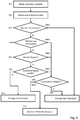
- FIG. 6 is shown a schematic flowchart of a preferred embodiment of the method according to the invention, in which case only the procedure for a first and a second block variable is shown.
- a list of the block variables present in the block diagram is first of all which consecutively checks all block variables. Preferably, all possible pairs of block variables are checked.
- two block variables are selected, ie in step 101 a first block variable and in step 102 a second block variable.
- step 103 it is checked whether the first and second block variables have the same identifier. This may include the evaluation of generation rules. If the block variables have different identifiers, a transition is made to step 109.
- step 104 If the block variables are identically named, it is checked in step 104 whether an allowance flag is set in both variables. If the marker is only set in one of the block variables, it is expedient to create a separate variable in the source code for the block variable without an admissibility marking, and instead select a new block variable for the comparison. If there is no permissibility marking for one or both block variables, a transition is made to step 108.
- step 105 It is then checked in step 105 whether the block variables are arranged in the same region and thus there is a sufficient local reference. If this is not the case, a transition to step 108 takes place.
- step 106 it is checked whether the block variables fulfill an additional condition. For example, it may be necessary for the first and second block variables in the definition data collection to have one or more matching properties, such as scaling. If the additional condition is not met, a transition to step 108 occurs.
- the first and the second block variables are combined in step 107 into a variable in the source code, ie a variable is generated.
- step 108 If the two block variables have the same identifier, but at least one of the other conditions is not satisfied, it is checked in step 108 whether it is possible to avoid it, i. E. for one of the block variables in the program code a differently named variable can be generated. It is advantageous if a generation rule also defines a possible renaming or an evasion rule. If, in the specific case, no evasion is possible, an error message is output to the user in step 110. In addition, it can optionally be provided to cancel the code generation, so that first necessary adjustments to the model are made.
- step 109 a generation of two separate variables takes place.
- step 108 After (in step 108) one or (in step 109) two variables were generated in the source code, the method is expediently carried out with the further block variables to be checked.
- the order of the conditions checked can be changed, and it can also be provided to check several conditions in one step, if, for example, the identifiers of the block variables also contain information about the region.
- the optimization takes place in several steps, that is to say initially a multiplicity of variables in the Source code and then summarized by comparing the associated block variables.
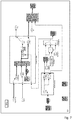
- FIG. 7 shows a detailed embodiment of a block diagram which provides the functionality of a reset-enabled buffer. This serves, in particular, to implement a block with the corresponding functionality in a higher-level model, not shown, wherein the block diagram can be referenced one or more times, that is, if necessary, represents a complex library block.
- the two blocks are DetermineValue and StoreOverwrite atomic subsystems, which are implemented in a subordinate hierarchical level, but are executed in one computing step.
- the respective implementation in the block itself is shown here, whereby the connection between the signal associated with the respective block and the assigned input or output port of the subordinate hierarchical level is indicated by dashed arrows. Ports are shown with rounded corners, and the direction of the signal indicates whether it is an input port receiving a signal or an output port.
- a definition block DR1 which defines a region R1 comprising all the blocks shown.
- the block diagram shown has the input port In, which receives a scalar signal, the input port ResetValue, which receives a vector signal with a width of 11, and the input port Reset, which receives a scalar or Boolean signal. It also has an output port Out which sends a scalar signal.
- Two unconnected MemBuf and MemIdx blocks define memory blocks (DataStoreMemory) which can be accessed using special read / write blocks. The memory blocks can maintain their value between several calls of the functionality implemented in the block diagram and thus represent states.
- the memory block MemBuf is read with the block ReadBuf and described with the block WriteBuf. Accordingly, the memory block MemIdx is read with the block ReadIdx and described with the block WriteIdx.
- An externally applied vector signal ResetValue is applied to the switch input of the block ResetBuf in the atomic subsystem Determine Value; this also receives the externally applied signal Reset and the current value of the memory block MemBuf. This is read out via the block ReadBuf and suitably converted by means of the block RBuf (Convert).
- the block ResetBuf supplies as an output signal either the current value of the memory block or the value of the signal ResetValue as a function of the applied changeover value.
- the selector block Selector the scalar value with the index Idx can be extracted from the bus signal and output via the output port Out. The entire vector signal is next passed to the output port CurBuf.
- the value currently stored in the memory block MemIdx is read out by means of the block ReadIdx, suitably converted by the block RIdx1 (Convert) and then via the input port in_Idx to the atomic subsystem StoreOverwrite fed.
- This has two output ports Overwrite and out_Idx, which each output the same value.
- the output port out_Idx is connected to a first input of the sum block IncrIdx, whose second input is supplied with the fixed value 1 via a constant block Constant.
- the output signal of IncrIdx is fed to one input of the block Normalize_Idx and to a first input of comparison block Rel.
- the value NDelaySize is applied to the second input of the comparison block Rel via constant block Constant1, so that the comparison block Rel outputs the value 1 or 0 depending on whether the output signal of IncrIdx is smaller than NDelaySize.
- the output of comparison block Rel is connected to a switch input of the block NormalizeIdx.
- the block NormalizeIdx is also supplied with the constant value 0 via a constant block Constant2.
- the output of IncrIdx is present as long as it is smaller than NDelaysize; otherwise, the output of the NormalizeIdx block becomes 0.
- the output of the NormalizeIdx block is connected to the WriteIdx block for writing to the MemIdx memory block and the Idx input port of the determineValue atomic subsystem.
- the output port Overwrite is connected to an index input of the allocation block ReplaceOverwrite.
- a value input from ReplaceOverwrite receives via an input port into an externally applied scalar value.
- a vector input of the allocation block ReplaceOverwrite is connected to the output port CurrBuf of the atomic subsystem DetermineValue.
- the output of the allocation block to which a vector signal is applied is connected to the block WriteBuf for writing to the memory block MemBuf.
- the block variables of the blocks MemBuf, ReadBuf, WriteBuf, RBuf, and ResetBuf have been transformed into an array variable BufBWR [] and the block variables of the blocks MemIdx, ReadIdx, WriteIdx, RIdx1, and IncrIdx into a scalar variable Summarized IdxBWR.
- the instance-specific variables are defined in a structure that can be addressed via a pointer to allow convenient reuse of the function.
- the method according to the invention enables particularly great optimization.
Landscapes
- Engineering & Computer Science (AREA)
- General Engineering & Computer Science (AREA)
- Theoretical Computer Science (AREA)
- Software Systems (AREA)
- Physics & Mathematics (AREA)
- General Physics & Mathematics (AREA)
- Stored Programmes (AREA)
- Programmable Controllers (AREA)
Priority Applications (7)
| Application Number | Priority Date | Filing Date | Title |
|---|---|---|---|
| EP17183987.1A EP3438817A1 (de) | 2017-07-31 | 2017-07-31 | Verfahren zur erzeugung von quellcode |
| PCT/EP2018/068986 WO2019025155A1 (de) | 2017-07-31 | 2018-07-12 | Verfahren zur erzeugung von quellcode |
| JP2019556211A JP6861844B2 (ja) | 2017-07-31 | 2018-07-12 | ソースコードを生成するための方法 |
| EP18737311.3A EP3568757B1 (de) | 2017-07-31 | 2018-07-12 | Verfahren zur erzeugung von quellcode |
| CN201880024640.2A CN110506256B (zh) | 2017-07-31 | 2018-07-12 | 用于生成源代码的方法 |
| US16/609,226 US10884715B2 (en) | 2017-07-31 | 2018-07-12 | Method for generating source code |
| DE102018116911.6A DE102018116911A1 (de) | 2017-07-31 | 2018-07-12 | Verfahren zur Erzeugung von Quellcode |
Applications Claiming Priority (1)
| Application Number | Priority Date | Filing Date | Title |
|---|---|---|---|
| EP17183987.1A EP3438817A1 (de) | 2017-07-31 | 2017-07-31 | Verfahren zur erzeugung von quellcode |
Publications (1)
| Publication Number | Publication Date |
|---|---|
| EP3438817A1 true EP3438817A1 (de) | 2019-02-06 |
Family
ID=59506100
Family Applications (2)
| Application Number | Title | Priority Date | Filing Date |
|---|---|---|---|
| EP17183987.1A Withdrawn EP3438817A1 (de) | 2017-07-31 | 2017-07-31 | Verfahren zur erzeugung von quellcode |
| EP18737311.3A Active EP3568757B1 (de) | 2017-07-31 | 2018-07-12 | Verfahren zur erzeugung von quellcode |
Family Applications After (1)
| Application Number | Title | Priority Date | Filing Date |
|---|---|---|---|
| EP18737311.3A Active EP3568757B1 (de) | 2017-07-31 | 2018-07-12 | Verfahren zur erzeugung von quellcode |
Country Status (6)
| Country | Link |
|---|---|
| US (1) | US10884715B2 (https=) |
| EP (2) | EP3438817A1 (https=) |
| JP (1) | JP6861844B2 (https=) |
| CN (1) | CN110506256B (https=) |
| DE (1) | DE102018116911A1 (https=) |
| WO (1) | WO2019025155A1 (https=) |
Cited By (1)
| Publication number | Priority date | Publication date | Assignee | Title |
|---|---|---|---|---|
| EP4148557A1 (de) * | 2021-09-10 | 2023-03-15 | dSPACE GmbH | Verfahren zur erzeugung von quellcode |
Families Citing this family (4)
| Publication number | Priority date | Publication date | Assignee | Title |
|---|---|---|---|---|
| US10860298B2 (en) * | 2018-03-21 | 2020-12-08 | Dspace Digital Signal Processing And Control Engineering Gmbh | Method and system for editing a block diagram model |
| CN111444618B (zh) * | 2020-03-30 | 2023-06-30 | 北京润科通用技术有限公司 | 一种基于变量字典的仿真方法及装置 |
| CN112783505B (zh) * | 2021-01-28 | 2023-07-18 | 东北大学 | 一种用于源代码的函数智能重命名方法 |
| CN116820419A (zh) * | 2022-03-22 | 2023-09-29 | 瑞昱半导体股份有限公司 | 源代码校验方法及非暂态计算机可读存储介质装置 |
Citations (1)
| Publication number | Priority date | Publication date | Assignee | Title |
|---|---|---|---|---|
| US20060136181A1 (en) * | 2004-12-22 | 2006-06-22 | John Masse | Method and system for optimising at least one parameter characteristic of a physical system that is to be subjected to variable external conditions |
Family Cites Families (13)
| Publication number | Priority date | Publication date | Assignee | Title |
|---|---|---|---|---|
| JPH0628166A (ja) * | 1992-07-06 | 1994-02-04 | Toshiba Corp | テキスト入出力システム |
| JP3894421B2 (ja) * | 2001-07-02 | 2007-03-22 | 三菱電機株式会社 | ネットワークシステム |
| US8196056B2 (en) * | 2001-07-24 | 2012-06-05 | The Mathworks, Inc. | Handling parameters in block diagram modeling |
| US7493595B2 (en) * | 2003-12-19 | 2009-02-17 | The United States Of America As Represented By The Secretary Of The Navy | Multiple-user graphical programming and analysis environment |
| US7650574B2 (en) * | 2004-05-11 | 2010-01-19 | National Instruments Corporation | Visually indicating problems found during programmatic analysis of a graphical program |
| US7703027B2 (en) * | 2005-01-13 | 2010-04-20 | National Instruments Corporation | Merging graphical programs |
| US7934194B2 (en) * | 2006-10-17 | 2011-04-26 | The Mathworks, Inc. | User-defined hierarchies of user-defined classes of graphical objects in a graphical modeling environment |
| US8448155B2 (en) * | 2009-06-01 | 2013-05-21 | National Instruments Corporation | Automatically creating parallel iterative program code in a graphical data flow program |
| US8667474B2 (en) * | 2009-06-19 | 2014-03-04 | Microsoft Corporation | Generation of parallel code representations |
| US8555130B2 (en) * | 2011-10-04 | 2013-10-08 | Cleversafe, Inc. | Storing encoded data slices in a dispersed storage unit |
| CN102426550B (zh) * | 2011-10-26 | 2014-05-14 | 中国信息安全测评中心 | 源代码解析方法和系统 |
| US9081900B2 (en) * | 2012-10-15 | 2015-07-14 | Toyota Motor Engineering & Manufacturing North America, Inc. | Systems and methods for mining temporal requirements from block diagram models of control systems |
| CN104375875B (zh) * | 2013-08-15 | 2017-08-25 | 国际商业机器公司 | 用于应用程序的编译优化的方法以及编译器 |
-
2017
- 2017-07-31 EP EP17183987.1A patent/EP3438817A1/de not_active Withdrawn
-
2018
- 2018-07-12 WO PCT/EP2018/068986 patent/WO2019025155A1/de not_active Ceased
- 2018-07-12 DE DE102018116911.6A patent/DE102018116911A1/de not_active Withdrawn
- 2018-07-12 EP EP18737311.3A patent/EP3568757B1/de active Active
- 2018-07-12 US US16/609,226 patent/US10884715B2/en active Active
- 2018-07-12 CN CN201880024640.2A patent/CN110506256B/zh active Active
- 2018-07-12 JP JP2019556211A patent/JP6861844B2/ja active Active
Patent Citations (1)
| Publication number | Priority date | Publication date | Assignee | Title |
|---|---|---|---|---|
| US20060136181A1 (en) * | 2004-12-22 | 2006-06-22 | John Masse | Method and system for optimising at least one parameter characteristic of a physical system that is to be subjected to variable external conditions |
Non-Patent Citations (2)
| Title |
|---|
| AHO A V ET AL: "Compiler - Principles, Techniques, and Tools", 1 January 1986, COMPILERS. PRINCIPLES, TECHNIQUES, AND TOOLS, READING, ADDISON-WESLEY PUBLISHING CO, US, PAGE(S) COMPLETE48, XP002200775 * |
| KOHALA COAST; HAWAI'I; VON H. HANSELMANN: "Production Quality Code Generation from Simulink Block Diagrams", PROCEEDINGS OF THE 1999 INTERNATIONAL SYMPOSIUM ON COMPUTER AIDED CONTROL SYSTEM DESIGN |
Cited By (2)
| Publication number | Priority date | Publication date | Assignee | Title |
|---|---|---|---|---|
| EP4148557A1 (de) * | 2021-09-10 | 2023-03-15 | dSPACE GmbH | Verfahren zur erzeugung von quellcode |
| US12026485B2 (en) | 2021-09-10 | 2024-07-02 | Dspace Gmbh | Method for generating source code |
Also Published As
| Publication number | Publication date |
|---|---|
| EP3568757B1 (de) | 2022-09-07 |
| CN110506256A (zh) | 2019-11-26 |
| CN110506256B (zh) | 2023-09-01 |
| US10884715B2 (en) | 2021-01-05 |
| DE102018116911A1 (de) | 2019-01-31 |
| JP2020529053A (ja) | 2020-10-01 |
| JP6861844B2 (ja) | 2021-04-21 |
| US20200050434A1 (en) | 2020-02-13 |
| WO2019025155A1 (de) | 2019-02-07 |
| EP3568757A1 (de) | 2019-11-20 |
Similar Documents
| Publication | Publication Date | Title |
|---|---|---|
| EP3568757B1 (de) | Verfahren zur erzeugung von quellcode | |
| DE102020124080A1 (de) | Verfahren zur inkrementellen Codegenerierung | |
| WO2021058223A1 (de) | Verfahren zur effizienten, simulativen applikation automatisierter fahrfunktionen | |
| EP3629151A1 (de) | Verfahren zum ändern von modellen für die erzeugung von quellcode | |
| EP2706421A1 (de) | Verfahren zur rechnergestützten Erzeugung mindestens eines Teils eines ausführbaren Steuerungsprogramms | |
| DE102019124018A1 (de) | Verfahren zum Optimieren von Tests von Regelsystemen für automatisierte Fahrdynamiksysteme | |
| EP2799983A1 (de) | Flexible Aufteilung der I/O Kanäle einer Hardware Komponente | |
| DE102019134053A1 (de) | Verfahren zur kontinuierlichen Absicherung im Fahrversuch applizierter automatisierter Fahrfunktionen | |
| DE102010042288A1 (de) | Vorrichtung und Verfahren zum maschinellen Erstellen eines Prozessdiagramms | |
| DE102020123506A1 (de) | Verfahren zur Erzeugung von Quellcode mit servicebasierter Kommunikation | |
| DE102021116315A1 (de) | Verfahren zum Zusammenführen von Architekturinformationen | |
| EP4148557B1 (de) | Verfahren zur erzeugung von quellcode | |
| EP4270176B1 (de) | Verfahren zur erzeugung von quellcode | |
| DE102010047954A1 (de) | Formelle offline-Verifikation ausführbarer Modelle | |
| DE102010047957A1 (de) | Formelle online-Verifikation ausführbarer Modelle | |
| EP4276600A1 (de) | Verfahren zur erzeugung von quellcode | |
| EP4208760B1 (de) | Verfahren und konfigurationssystem zum konfigurieren einer steuereinrichtung für ein technisches system | |
| DE10325513A1 (de) | Verfahren und Vorrichtung zum Erstellen eines Modells einer Schaltung zur formalen Verifikation | |
| EP4521233A1 (de) | Verfahren zum erzeugen eines steuerungsprogrammes für eine zielplattform, vorrichtung zur datenverarbeitung, computerprogrammprodukt und datenträger | |
| EP4654005A1 (de) | Entwicklungssystem für graphische regelungstechnische modelle (autosar), in denen ein signal eines nicht unterstützten typs durch eine bibliotheksfunktion ersetzt wird | |
| DE102024132088A1 (de) | Verfahren zur Erzeugung von Quellcode | |
| EP4557078A1 (de) | Verfahren zur erzeugung von quellcode | |
| DE102023201784A1 (de) | Adaptive realdatenbasierte Simulation eines zentralisiert koordinierten Verkehrsraums | |
| EP4617953A1 (de) | Computer-implementiertes verfahren zum generieren eines trainierten machine-learning-modells zum simulieren eines verhaltens eines technischen systems | |
| DE102024202976A1 (de) | Verfahren und Vorrichtung zum Absichern des Einhaltens von Teilanforderungen von Systemelementen eines Fahrzeugs bei der Entwicklung eines Fahrzeugs |
Legal Events
| Date | Code | Title | Description |
|---|---|---|---|
| PUAI | Public reference made under article 153(3) epc to a published international application that has entered the european phase |
Free format text: ORIGINAL CODE: 0009012 |
|
| AK | Designated contracting states |
Kind code of ref document: A1 Designated state(s): AL AT BE BG CH CY CZ DE DK EE ES FI FR GB GR HR HU IE IS IT LI LT LU LV MC MK MT NL NO PL PT RO RS SE SI SK SM TR |
|
| AX | Request for extension of the european patent |
Extension state: BA ME |
|
| RIC1 | Information provided on ipc code assigned before grant |
Ipc: G06F 9/45 20060101AFI20171013BHEP Ipc: G06F 9/44 20180101ALI20171013BHEP |
|
| STAA | Information on the status of an ep patent application or granted ep patent |
Free format text: STATUS: THE APPLICATION IS DEEMED TO BE WITHDRAWN |
|
| 18D | Application deemed to be withdrawn |
Effective date: 20190807 |