EP3437148B1 - Lithium ion battery for automotive application - Google Patents
Lithium ion battery for automotive application Download PDFInfo
- Publication number
- EP3437148B1 EP3437148B1 EP17773385.4A EP17773385A EP3437148B1 EP 3437148 B1 EP3437148 B1 EP 3437148B1 EP 17773385 A EP17773385 A EP 17773385A EP 3437148 B1 EP3437148 B1 EP 3437148B1
- Authority
- EP
- European Patent Office
- Prior art keywords
- electrolyte
- cell
- ion battery
- lithium ion
- nmc622
- Prior art date
- Legal status (The legal status is an assumption and is not a legal conclusion. Google has not performed a legal analysis and makes no representation as to the accuracy of the status listed.)
- Active
Links
Images




Classifications
-
- H—ELECTRICITY
- H01—ELECTRIC ELEMENTS
- H01M—PROCESSES OR MEANS, e.g. BATTERIES, FOR THE DIRECT CONVERSION OF CHEMICAL ENERGY INTO ELECTRICAL ENERGY
- H01M4/00—Electrodes
- H01M4/02—Electrodes composed of, or comprising, active material
- H01M4/36—Selection of substances as active materials, active masses, active liquids
- H01M4/362—Composites
- H01M4/366—Composites as layered products
-
- C—CHEMISTRY; METALLURGY
- C01—INORGANIC CHEMISTRY
- C01G—COMPOUNDS CONTAINING METALS NOT COVERED BY SUBCLASSES C01D OR C01F
- C01G53/00—Compounds of nickel
- C01G53/40—Complex oxides containing nickel and at least one other metal element
- C01G53/42—Complex oxides containing nickel and at least one other metal element containing alkali metals, e.g. LiNiO2
- C01G53/44—Complex oxides containing nickel and at least one other metal element containing alkali metals, e.g. LiNiO2 containing manganese
- C01G53/50—Complex oxides containing nickel and at least one other metal element containing alkali metals, e.g. LiNiO2 containing manganese of the type (MnO2)n-, e.g. Li(NixMn1-x)O2 or Li(MyNixMn1-x-y)O2
-
- H—ELECTRICITY
- H01—ELECTRIC ELEMENTS
- H01M—PROCESSES OR MEANS, e.g. BATTERIES, FOR THE DIRECT CONVERSION OF CHEMICAL ENERGY INTO ELECTRICAL ENERGY
- H01M10/00—Secondary cells; Manufacture thereof
- H01M10/05—Accumulators with non-aqueous electrolyte
- H01M10/052—Li-accumulators
- H01M10/0525—Rocking-chair batteries, i.e. batteries with lithium insertion or intercalation in both electrodes; Lithium-ion batteries
-
- H—ELECTRICITY
- H01—ELECTRIC ELEMENTS
- H01M—PROCESSES OR MEANS, e.g. BATTERIES, FOR THE DIRECT CONVERSION OF CHEMICAL ENERGY INTO ELECTRICAL ENERGY
- H01M10/00—Secondary cells; Manufacture thereof
- H01M10/05—Accumulators with non-aqueous electrolyte
- H01M10/056—Accumulators with non-aqueous electrolyte characterised by the materials used as electrolytes, e.g. mixed inorganic/organic electrolytes
- H01M10/0564—Accumulators with non-aqueous electrolyte characterised by the materials used as electrolytes, e.g. mixed inorganic/organic electrolytes the electrolyte being constituted of organic materials only
- H01M10/0566—Liquid materials
- H01M10/0567—Liquid materials characterised by the additives
-
- H—ELECTRICITY
- H01—ELECTRIC ELEMENTS
- H01M—PROCESSES OR MEANS, e.g. BATTERIES, FOR THE DIRECT CONVERSION OF CHEMICAL ENERGY INTO ELECTRICAL ENERGY
- H01M10/00—Secondary cells; Manufacture thereof
- H01M10/05—Accumulators with non-aqueous electrolyte
- H01M10/056—Accumulators with non-aqueous electrolyte characterised by the materials used as electrolytes, e.g. mixed inorganic/organic electrolytes
- H01M10/0564—Accumulators with non-aqueous electrolyte characterised by the materials used as electrolytes, e.g. mixed inorganic/organic electrolytes the electrolyte being constituted of organic materials only
- H01M10/0566—Liquid materials
- H01M10/0568—Liquid materials characterised by the solutes
-
- H—ELECTRICITY
- H01—ELECTRIC ELEMENTS
- H01M—PROCESSES OR MEANS, e.g. BATTERIES, FOR THE DIRECT CONVERSION OF CHEMICAL ENERGY INTO ELECTRICAL ENERGY
- H01M10/00—Secondary cells; Manufacture thereof
- H01M10/05—Accumulators with non-aqueous electrolyte
- H01M10/056—Accumulators with non-aqueous electrolyte characterised by the materials used as electrolytes, e.g. mixed inorganic/organic electrolytes
- H01M10/0564—Accumulators with non-aqueous electrolyte characterised by the materials used as electrolytes, e.g. mixed inorganic/organic electrolytes the electrolyte being constituted of organic materials only
- H01M10/0566—Liquid materials
- H01M10/0569—Liquid materials characterised by the solvents
-
- H—ELECTRICITY
- H01—ELECTRIC ELEMENTS
- H01M—PROCESSES OR MEANS, e.g. BATTERIES, FOR THE DIRECT CONVERSION OF CHEMICAL ENERGY INTO ELECTRICAL ENERGY
- H01M4/00—Electrodes
- H01M4/02—Electrodes composed of, or comprising, active material
- H01M4/13—Electrodes for accumulators with non-aqueous electrolyte, e.g. for lithium-accumulators; Processes of manufacture thereof
- H01M4/131—Electrodes based on mixed oxides or hydroxides, or on mixtures of oxides or hydroxides, e.g. LiCoOx
-
- H—ELECTRICITY
- H01—ELECTRIC ELEMENTS
- H01M—PROCESSES OR MEANS, e.g. BATTERIES, FOR THE DIRECT CONVERSION OF CHEMICAL ENERGY INTO ELECTRICAL ENERGY
- H01M4/00—Electrodes
- H01M4/02—Electrodes composed of, or comprising, active material
- H01M4/36—Selection of substances as active materials, active masses, active liquids
- H01M4/48—Selection of substances as active materials, active masses, active liquids of inorganic oxides or hydroxides
- H01M4/485—Selection of substances as active materials, active masses, active liquids of inorganic oxides or hydroxides of mixed oxides or hydroxides for inserting or intercalating light metals, e.g. LiTi2O4 or LiTi2OxFy
-
- H—ELECTRICITY
- H01—ELECTRIC ELEMENTS
- H01M—PROCESSES OR MEANS, e.g. BATTERIES, FOR THE DIRECT CONVERSION OF CHEMICAL ENERGY INTO ELECTRICAL ENERGY
- H01M4/00—Electrodes
- H01M4/02—Electrodes composed of, or comprising, active material
- H01M4/36—Selection of substances as active materials, active masses, active liquids
- H01M4/48—Selection of substances as active materials, active masses, active liquids of inorganic oxides or hydroxides
- H01M4/50—Selection of substances as active materials, active masses, active liquids of inorganic oxides or hydroxides of manganese
- H01M4/505—Selection of substances as active materials, active masses, active liquids of inorganic oxides or hydroxides of manganese of mixed oxides or hydroxides containing manganese for inserting or intercalating light metals, e.g. LiMn2O4 or LiMn2OxFy
-
- H—ELECTRICITY
- H01—ELECTRIC ELEMENTS
- H01M—PROCESSES OR MEANS, e.g. BATTERIES, FOR THE DIRECT CONVERSION OF CHEMICAL ENERGY INTO ELECTRICAL ENERGY
- H01M4/00—Electrodes
- H01M4/02—Electrodes composed of, or comprising, active material
- H01M4/36—Selection of substances as active materials, active masses, active liquids
- H01M4/48—Selection of substances as active materials, active masses, active liquids of inorganic oxides or hydroxides
- H01M4/52—Selection of substances as active materials, active masses, active liquids of inorganic oxides or hydroxides of nickel, cobalt or iron
- H01M4/525—Selection of substances as active materials, active masses, active liquids of inorganic oxides or hydroxides of nickel, cobalt or iron of mixed oxides or hydroxides containing iron, cobalt or nickel for inserting or intercalating light metals, e.g. LiNiO2, LiCoO2 or LiCoOxFy
-
- H—ELECTRICITY
- H01—ELECTRIC ELEMENTS
- H01M—PROCESSES OR MEANS, e.g. BATTERIES, FOR THE DIRECT CONVERSION OF CHEMICAL ENERGY INTO ELECTRICAL ENERGY
- H01M4/00—Electrodes
- H01M4/02—Electrodes composed of, or comprising, active material
- H01M4/62—Selection of inactive substances as ingredients for active masses, e.g. binders, fillers
-
- C—CHEMISTRY; METALLURGY
- C01—INORGANIC CHEMISTRY
- C01P—INDEXING SCHEME RELATING TO STRUCTURAL AND PHYSICAL ASPECTS OF SOLID INORGANIC COMPOUNDS
- C01P2002/00—Crystal-structural characteristics
- C01P2002/50—Solid solutions
- C01P2002/52—Solid solutions containing elements as dopants
-
- C—CHEMISTRY; METALLURGY
- C01—INORGANIC CHEMISTRY
- C01P—INDEXING SCHEME RELATING TO STRUCTURAL AND PHYSICAL ASPECTS OF SOLID INORGANIC COMPOUNDS
- C01P2002/00—Crystal-structural characteristics
- C01P2002/80—Crystal-structural characteristics defined by measured data other than those specified in group C01P2002/70
- C01P2002/85—Crystal-structural characteristics defined by measured data other than those specified in group C01P2002/70 by XPS, EDX or EDAX data
-
- C—CHEMISTRY; METALLURGY
- C01—INORGANIC CHEMISTRY
- C01P—INDEXING SCHEME RELATING TO STRUCTURAL AND PHYSICAL ASPECTS OF SOLID INORGANIC COMPOUNDS
- C01P2004/00—Particle morphology
- C01P2004/60—Particles characterised by their size
- C01P2004/61—Micrometer sized, i.e. from 1-100 micrometer
-
- C—CHEMISTRY; METALLURGY
- C01—INORGANIC CHEMISTRY
- C01P—INDEXING SCHEME RELATING TO STRUCTURAL AND PHYSICAL ASPECTS OF SOLID INORGANIC COMPOUNDS
- C01P2004/00—Particle morphology
- C01P2004/80—Particles consisting of a mixture of two or more inorganic phases
- C01P2004/82—Particles consisting of a mixture of two or more inorganic phases two phases having the same anion, e.g. both oxidic phases
- C01P2004/84—Particles consisting of a mixture of two or more inorganic phases two phases having the same anion, e.g. both oxidic phases one phase coated with the other
-
- H—ELECTRICITY
- H01—ELECTRIC ELEMENTS
- H01M—PROCESSES OR MEANS, e.g. BATTERIES, FOR THE DIRECT CONVERSION OF CHEMICAL ENERGY INTO ELECTRICAL ENERGY
- H01M4/00—Electrodes
- H01M4/02—Electrodes composed of, or comprising, active material
- H01M2004/026—Electrodes composed of, or comprising, active material characterised by the polarity
- H01M2004/027—Negative electrodes
-
- H—ELECTRICITY
- H01—ELECTRIC ELEMENTS
- H01M—PROCESSES OR MEANS, e.g. BATTERIES, FOR THE DIRECT CONVERSION OF CHEMICAL ENERGY INTO ELECTRICAL ENERGY
- H01M4/00—Electrodes
- H01M4/02—Electrodes composed of, or comprising, active material
- H01M2004/026—Electrodes composed of, or comprising, active material characterised by the polarity
- H01M2004/028—Positive electrodes
-
- H—ELECTRICITY
- H01—ELECTRIC ELEMENTS
- H01M—PROCESSES OR MEANS, e.g. BATTERIES, FOR THE DIRECT CONVERSION OF CHEMICAL ENERGY INTO ELECTRICAL ENERGY
- H01M2220/00—Batteries for particular applications
- H01M2220/20—Batteries in motive systems, e.g. vehicle, ship, plane
-
- H—ELECTRICITY
- H01—ELECTRIC ELEMENTS
- H01M—PROCESSES OR MEANS, e.g. BATTERIES, FOR THE DIRECT CONVERSION OF CHEMICAL ENERGY INTO ELECTRICAL ENERGY
- H01M2220/00—Batteries for particular applications
- H01M2220/30—Batteries in portable systems, e.g. mobile phone, laptop
-
- H—ELECTRICITY
- H01—ELECTRIC ELEMENTS
- H01M—PROCESSES OR MEANS, e.g. BATTERIES, FOR THE DIRECT CONVERSION OF CHEMICAL ENERGY INTO ELECTRICAL ENERGY
- H01M2300/00—Electrolytes
- H01M2300/0017—Non-aqueous electrolytes
- H01M2300/0025—Organic electrolyte
- H01M2300/0028—Organic electrolyte characterised by the solvent
- H01M2300/0037—Mixture of solvents
-
- Y—GENERAL TAGGING OF NEW TECHNOLOGICAL DEVELOPMENTS; GENERAL TAGGING OF CROSS-SECTIONAL TECHNOLOGIES SPANNING OVER SEVERAL SECTIONS OF THE IPC; TECHNICAL SUBJECTS COVERED BY FORMER USPC CROSS-REFERENCE ART COLLECTIONS [XRACs] AND DIGESTS
- Y02—TECHNOLOGIES OR APPLICATIONS FOR MITIGATION OR ADAPTATION AGAINST CLIMATE CHANGE
- Y02E—REDUCTION OF GREENHOUSE GAS [GHG] EMISSIONS, RELATED TO ENERGY GENERATION, TRANSMISSION OR DISTRIBUTION
- Y02E60/00—Enabling technologies; Technologies with a potential or indirect contribution to GHG emissions mitigation
- Y02E60/10—Energy storage using batteries
-
- Y—GENERAL TAGGING OF NEW TECHNOLOGICAL DEVELOPMENTS; GENERAL TAGGING OF CROSS-SECTIONAL TECHNOLOGIES SPANNING OVER SEVERAL SECTIONS OF THE IPC; TECHNICAL SUBJECTS COVERED BY FORMER USPC CROSS-REFERENCE ART COLLECTIONS [XRACs] AND DIGESTS
- Y02—TECHNOLOGIES OR APPLICATIONS FOR MITIGATION OR ADAPTATION AGAINST CLIMATE CHANGE
- Y02P—CLIMATE CHANGE MITIGATION TECHNOLOGIES IN THE PRODUCTION OR PROCESSING OF GOODS
- Y02P70/00—Climate change mitigation technologies in the production process for final industrial or consumer products
- Y02P70/50—Manufacturing or production processes characterised by the final manufactured product
-
- Y—GENERAL TAGGING OF NEW TECHNOLOGICAL DEVELOPMENTS; GENERAL TAGGING OF CROSS-SECTIONAL TECHNOLOGIES SPANNING OVER SEVERAL SECTIONS OF THE IPC; TECHNICAL SUBJECTS COVERED BY FORMER USPC CROSS-REFERENCE ART COLLECTIONS [XRACs] AND DIGESTS
- Y02—TECHNOLOGIES OR APPLICATIONS FOR MITIGATION OR ADAPTATION AGAINST CLIMATE CHANGE
- Y02T—CLIMATE CHANGE MITIGATION TECHNOLOGIES RELATED TO TRANSPORTATION
- Y02T10/00—Road transport of goods or passengers
- Y02T10/60—Other road transportation technologies with climate change mitigation effect
- Y02T10/70—Energy storage systems for electromobility, e.g. batteries
Definitions
- This invention relates to secondary lithium ion batteries, containing a surface-treated positive electrode material and a non-aqueous liquid electrolyte, which are of interest for high voltage applications and for use in automotive batteries. More particularly, this positive electrode material comprises a surface modified lithium nickel manganese cobalt oxide compound, which shows improved cycling properties at elevated voltage (>4.2V), when used in combination with suitable electrolyte additives.
- An especially suitable electrolyte is an electrolyte which contains a difluorophosphate additive.
- NMC cathode materials which are derivatives of LCO, where Co ions are partially substituted by more abundant and environmental friendly transition metal ions such as Ni and Mn.
- the space group is R-3M.
- An NMC cathode material can roughly be understood as a solid state solution of LiCoO 2 , LiNi 0.5 Mn 0.5 O 2 and LiNiO 2 .
- LiNi 0.5 Mn 0.5 O 2 Ni is divalent, in LiNiO 2 Ni is trivalent.
- a nominal capacity is about 160 mAh/g for LiCoO 2 and LiNi 0.5 Mn 0.5 O 2 , and 220 mAh/g for LiNiO 2 .
- the reversible capacity of an NMC compound can be roughly estimated from the nominal capacities.
- NMC622 can be understood as 0.2 LiCoO 2 + 0.4 LiNi 0.5 Mn 0.5 O 2 + 0.4 LiNiO 2 .
- NMC622 has a higher energy density than NMC532, NMC111, and definitely LCO. This means - when using NMC materials instead of LCO - less weight or volume of cathode material is required to achieve a certain energy.
- the lower price of nickel and manganese compared to cobalt allows to reduce the cost of a NMC cathode per unit of energy.
- high Ni containing-NMC - like NMC622 - is more preferable for the large battery markets of EV, HEV and PHEV.
- batteries in the automotive may need to withstand elevated temperatures above 45°C and thus NMC cathode materials with a high Ni content have to cycle well at such temperatures.
- state of the art cathode materials exhibit issues like unsatisfactory cycle stability when an elevated voltage (above 4.2V) and high temperature (above 45°C) is applied.
- Li 2 CO 3 and LiOH could either originate from remaining unreacted lithium precursors, which are usually Li 2 CO 3 or LiOH, or from ion exchange reactions of the cathode with solvents, for example water which forms LiOH in the solvent and protons in the cathode.
- solvents for example water which forms LiOH in the solvent and protons in the cathode.
- the soluble bases is a cause for a serious gas generation in full cells during operation which for example causes swelling of polymer cells.
- Dahn et al. propose that an effective surface coating on the cathode or effective functional electrolyte additives could suppress the electrolyte oxidization and thus extend the cycle life of the batteries.
- US2009/0286135 A1 describes the use in general of lithium difluorophosphate in a non-aqueous electrolyte.
- US2012/0177818 A1 describes that an electrolyte including LiPO 2 F 2 and a sultone-based compound may improve the cycle-life characteristics of the battery at room temperature (RT) and high temperature (HT), and suppress swelling.
- An object of the present invention is to provide such an improved rechargeable lithium ion battery for automotive applications that allows to increase the charge voltage to 4.2, 4.3, 4.35V or even beyond.
- the invention is a rechargeable lithium battery as defined in independent claim 1 and its use as defined claim 11.
- This invention provides rechargeable lithium ion batteries (so-called full cells) containing high Ni-based cathode material and LiPO 2 F 2 -containing electrolyte, before cycling.
- the surface modified cathode powders according to the invention present an improved stability under high voltage cycling, so that these powders can be candidate NMC cathode materials for automotive applications. It is observed that uncycled full cells containing Al doped and Al surface enriched high Ni cathode materials and LiPO 2 F 2 -based electrolytes have an improved cycling stability during cycling in the voltage range of 3.0 V to 4.35 V at room temperature, when compared with full cells containing the same cathode material but a LiPO 2 F 2 -free electrolyte.
- LiPO 2 F 2 to the electrolyte and the Al enriched layer at the surface of the cathode together more efficiently prevent side reactions and gas generation in the NMC-full cell system.
- a typical electrolyte salt such as LiPF 6 tends to decompose and form side-products at high voltage, including strong acids, which results in a reaction with the soluble base content on the surface of the NMC cathode material, and solvent decomposition. These acids would e.g. attack active NMC622 material and form a SEI layer on the surface of the NMC particles.
- the addition of LiPO 2 F 2 to the electrolyte system may hinder or reduce the decomposition and side reactions of LiPF 6 and further prevent that byproducts attack the high Ni NMC particles.
- electrolyte contains LiPO 2 F 2
- other electrolyte additives like VC, LiBOB, PRS, VEC are known in the prior art and can still further improve the battery performance.
- Dahn et al. teach that a combination of electrolyte additives can have a positive effect exceeding the sum of the positive contributions of the single additive and thus bringing a synergetic effect.
- the present invention also finds that uncycled full cells containing Al treated high Ni NMC cathode powders show much improved storage properties at high temperature when compared to full cells containing Ca doped or bare high Ni powders, especially in the case of using LiPO 2 F 2 -based electrolyte.
- LiPO 2 F 2 -based electrolyte LiPO 2 F 2 -based electrolyte
- the Al surface treated high Ni NMC cathode powders exhibit superior properties when applied in Li-ion batteries. This is attributed to the Al gradient within the surface layer and may be further enhanced by the presence of a fluor gradient in the surface layer.
- the existence of the Al gradient can help to improve the cycle stability when the cathode materials are charged to a high voltage such as 4.35V.
- the F gradient in the coating layer helps to reduce the amount of soluble base and eventually improves the storage properties of a full cell at elevated temperature.
- the surface modified NMC622 powders according to the invention may have a core and a surface layer that may be an annealed coating layer.
- the surface layer is delimited by an outer and an inner interface, the inner interface being in contact with the core.
- the core may have an Al content more than 0.3 mole% but less than 3.0 mole%, and a F content less than 0.05 mole%, as determined by XPS.
- the surface layer has an Al content that increases continuously from the Al content of the core at the inner interface to more than 4 mole% at the outer interface, and preferably more than 6 mole%.
- the surface layer has an Al content that increases continuously from the Al content of the core at the inner interface to more than 10 mole% at the outer interface, and preferably more than 12 mole%; and has a F content that increases continuously from less than 0.05 mole% at the inner interface to at least 3 mole% at the outer interface, preferably at least 5 mole% at the outer interface.
- concentration of the different elements in the surface layer and the outer part of the core can be determined using X-ray photoelectron spectroscopy (XPS).
- doping elements can be, besides Al, one or more elements from the group of Ca, Mg, Zr, W, Ti, Cr and V.
- the source of doping element is preferably a compound selected from the group consisting of a metal oxide, for example - besides Al 2 O 3 - TiO 2 , MgO, WO 3 , ZrO 2 , Cr 2 O 3 , V 2 O 5 and mixtures thereof.
- the preferred source of Al is a nano-scale alumina powder, for example fumed alumina.
- the alumina can be obtained by precipitation, spray drying, milling, etc.
- fumed alumina or surface treated fumed alumina is used. Fumed alumina nanoparticles are produced in high temperature hydrogen-air flames and are used in several applications that involve products of everyday use.
- the doping element includes Al and F.
- the source of F may be a fluorine-containing polymer.
- a typical example for such a polymer is a PVDF homopolymer or PVDF copolymer (such as HYLAR ® or SOLEF ® PVDF, both from Solvay SA, Belgium).
- Another known PVDF based copolymer is for example a PVDF-HFP (hexa-fluoro propylene).
- PVDF-HFP hexa-fluoro propylene
- Such polymers are often known under the name "Kynar ® ". Teflon - or PTFE - could also be used as polymer.
- the fluorine-containing polymer ⁇ which is free of Li - decomposes in contact with the core material, as described in WO2011/054441 .
- the polymer is completely decomposed and lithium fluoride is formed, which is found in the surface layer of the particles.
- the LiF originates from the reaction of the decomposing polymer with lithium containing surface base of the lithium transition metal oxides. It can be speculated that LiF in the surface layer protects the Li in the particle, thus preventing it from reacting with carbon to form Li 2 CO 3 .
- the obtained surface layer has the following function: the thin layer comprising LiF replaces the reactive surface base layer, thus reducing the base content practically to zero at the core's surface, and improving the overall safety. In the present invention, it can be verified that the surface layer is a mixture of elements of the core, LiF and Al 2 O 3 .
- Surface-modified high Ni NMC cathode powders according to the invention may be used in positive electrodes in a full cell configuration which can be evaluated at room temperature (RT) and elevated temperature (HT) in cycling tests at 25°C and 45°C, respectively.
- 1.5wt% of LiPO 2 F 2 serves as electrolyte additive
- EC ethylene carbonate
- DEC diethyl carbonate
- EMC Ethylmethylcarbonate
- Al treated NMC622- with or without fluorine gradient - may be the active material of the positive electrode of the full cell.
- the electrolyte of the full cell includes 1wt% of LiPO 2 F 2 (lithium difluorophosphate) and 1wt% of VEC (vinyl ethylene carbonate) as electrolyte additives, and EC (ethylene carbonate)/DEC (diethyl carbonate)/EMC (Ethylmethylcarbonate) as solvent with a weight ratio of 25.5:29.6:29.6.
- Al and F surface modified NMC622 is the active material of the positive electrode of the full cell. The RT and HT cycling tests show that the cycling stability of this full cell is better than that of a full cell with only the LiPO 2 F 2 additive.
- This invention discovers the synergetic effect between Al surface modified NMC622 cathode materials and LiPO 2 F 2 -containing electrolyte, which allows to achieve excellent stability of cells during RT and HT cycling at high voltage.
- rechargeable lithium ion battery devices according to this invention have a suitable performance for automotive application especially allowing for a long cycle life.
- Examples 3 and 5 to 9 are examples according to the present invention
- examples 1, 2, 4 and 10 to 13 are examples not according to the present invention:
- a positive electrode material with the formula Li 1.01 ((Ni 0.4 (Ni 1 ⁇ 2 Mn 1 ⁇ 2 ) 0.4 CO 0.2 ) 0.99 O 2 is manufactured through the process (a) without any further treatment and referred to as "Bare-NMC622" hereafter.
- a positive electrode material with the formula Li 1.01 ((Ni 0.4 (Ni 1 ⁇ 2 Mn 1 ⁇ 2 ) 0.4 Co 0.2 ) 0.996 Al 0.004 ) 0.99 O 2 is manufactured through the process (a) and (b), and referred to as "A-NMC622" hereafter.
- the XPS analysis of the surface of the "A-NMC622" material is shown in Figure 1 , where the gradient, surface and core content of Al are clearly visible.
- a positive electrode material with the formula Li 1.01 ((Ni 0.4 (Ni 1/2 Mn 1/2 ) 0.4 Co 0.2 ) 0.992 Al 0.008 ) 0.99 O 1.991 F 0.009 is manufactured through the process (a), (b) and (c), and referred to as "AF-NMC622" hereafter.
- the XPS analysis of the surface of the "AF-NMC622" material is shown in Figure 2 , where the gradients of Al and F are clearly visible, together with their surface and core content.
- Lithium hydroxide, calcium oxide and a mixed Ni-Mn-Co oxy-hydroxide are homogeneously blended in a vertical single-shaft mixer by a dry powder mixing process.
- the blend ratio is targeted to obtain Li 1.01 (Ni 0.4 (Ni 1 ⁇ 2 Mn 1 ⁇ 2 ) 0.4 Co 0.2 Ca 0.001 ) 0.99 O 2 , which can be easily verified by an analysis technique such as ICP.
- the mixture is then sintered in a tunnel furnace in an oxidizing atmosphere.
- the sintering temperature is >900°C and the dwell time is ⁇ 10 hrs. Dry air is used as an oxidizing gas. After sintering, the sample is milled in a grinding machine to a mean particle size of around 12 ⁇ m.
- Ca-NMC622 The final obtained material is referred to "Ca-NMC622" hereafter.
- the addition of Ca in the cathode material is known to realize an outstanding battery capacity (for example a high energy density) and a high reliability at the time of overcharge, as is disclosed e.g. in JP2014-143108 .
- 650 mAh pouch-type cells are prepared by the following two steps: I. Slurry making and coating and II. Full cell assembly.
- a slurry is prepared by mixing 700g of NMC cathode material with NMP, 47.19g of super P ® (conductive carbon black of Timcal) and 393.26g of 10wt% PVDF based binder in NMP solution. The mixture is mixed for 2.5 hrs in a planetary mixer. During mixing additional NMP is added. The mixture is transferred to a Disper mixer and mixed for 1.5 hrs under further NMP addition. A typical total amount of NMP used is 423g. The final solid content in the slurry is about 65wt%. The slurry is transferred to a coating line. Double coated electrodes are prepared. The electrode surface is smooth. The electrodes are compacted by a roll press to achieve an electrode density of about 3.2 g/cm 3 . The electrodes are used to prepare pouch cell type full cells as described hereafter.
- the prepared positive electrodes are assembled with a negative electrode (anode) which is typically a graphite type carbon, and a porous electrically insulating membrane (separator).
- anode typically a graphite type carbon
- a porous electrically insulating membrane separatator
- the thickness of the surface layer may be more than 50 nm and less than 400 nm.
- the thickness of the surface layer is determined by XPS measurement. A sputtering rate in SiO 2 : 6.0 nm / minute is applied to calculate the depth/thickness. The thickness here is obtained by the sputtering time multiplied by the (reference) sputtering rate in SiO 2 . During the XPS measurement, it is difficult to obtain the sputtering rate of measured objectives. A typical way is to normalize the thickness by using a standard sputtering rate (in SiO 2 here) for all samples.
- the thickness calculated here is the same as could be obtained by other spectra methods, for example, Scanning Electron Microscopy (SEM).
- SEM Scanning Electron Microscopy
- Known techniques such as ICP give the average composition of the powder. It is known that ICP gives a more accurate average measurement than XPS, however, for descriptions of the properties of the surface layer, such as element distribution with different layer thickness, XPS can provide accurate qualitative and quantitative data. Practically, the measurements are carried out in a Quantera SXM tm from ULVAC-PHI (Q2). The measurements are performed using monochromatic Al-Ka-radiation and a spot size of 100 ⁇ m scanning across an area of 1200 ⁇ 500 ⁇ m (High Sensitivity Mode).
- the measurement angle ⁇ is 45°; at this setting the information depth is approximately 7 nm.
- the measurement angle ⁇ is 45°; at this setting the information depth is approximately 7 nm.
- Toscat-3100 computer-controlled galvanostatic cycling stations Toyo
- CC/CV constant current/constant voltage
- Example 1 A-NMC622 and Electrolyte 1
- Electrolyte 1 The above prepared electrolyte system is labelled Electrolyte 1.
- the full cell comprises cathode active material "A-NMC622".
- the above prepared 650 mAh pouch-type battery is labelled Cell 1.
- This example presents a full cell prepared through the same procedure as Cell 1, without the addition of 1 wt% of lithium difluorophosphate (LiPO 2 F 2 ).
- LiPO 2 F 2 lithium difluorophosphate
- This electrolyte is commercialized by Panax Etec.
- the prepared 650 mAh pouch-type battery is labelled Cell 2.
- This example presents a full cell prepared through the same procedure as Cell 1, but the cathode material is composed of "AF-NMC622" as described before.
- the prepared 650 mAh pouch-type battery is labelled Cell 3.
- This example presents a full cell prepared through the same procedure as Cell 2, but the cathode material is composed of "AF-NMC622".
- the prepared 650 mAh pouch-type battery is labelled Cell 4.
- Example 5 AF-NMC622 and Electrolyte 2
- This example presents a rechargeable lithium ion full cell prepared as explained before, with the electrolyte consisting of:
- Example 6 AF-NMC622 and Electrolyte 2 with PRS
- This example presents a full cell prepared through the same procedure as Cell 5, with the addition of 0.5 wt% of 1,3-propene sultone (PRS).
- PRS 1,3-propene sultone
- the prepared 650 mAh pouch-type battery is labelled Cell 6.
- Example 7 AF-NMC622 and Electrolyte 2 with addition of LiBOB
- This example presents a full cell prepared through the same procedure as Cell 5, with the addition of 0.5 wt% of Lithium Bis(oxalate)borate (LiBOB).
- LiBOB Lithium Bis(oxalate)borate
- Example 8 AF-NMC622 and Electrolyte 2 with addition of LiBOB and PRS
- This example presents a full cell prepared through the same procedure as Cell 5, but the electrolyte additives are 1 wt% of lithium difluorophosphate (LiPO 2 F 2 ), 0.5 wt% of Lithium Bis(oxalate)borate (LiBOB) and 0.5 wt% of 1,3-propene sultone (PRS).
- the prepared 650 mAh pouch-type battery is labelled Cell 8.
- Example 9 AF-NMC622 and Electrolyte 2 with addition of VEC
- This example presents a full cell prepared through the same procedure as Cell 5, but the electrolyte additives are 1 wt% of lithium difluorophosphate (LiPO 2 F 2 ) and 1 wt% of Vinyl Ethylene carbonate (VEC).
- the prepared 650 mAh pouch-type battery is labelled Cell 9.
- This example presents a full cell prepared through the same procedure as Cell 5, without addition of LiPO 2 F 2 .
- the prepared 650 mAh pouch-type battery is labelled Cell 10.
- This example presents a full cell prepared through the same procedure as Cell 1, but the cathode material is composed of "Ca-NMC622" as described before.
- the prepared 650 mAh pouch-type battery is labelled Cell 11.
- This example presents a full cell prepared through the same procedure as Cell 1, but the cathode material is composed of "Bare-NMC622" as described before.
- the prepared 650 mAh pouch-type battery is labelled Cell 12.
- This example presents a full cell prepared through the same procedure as Cell 2, but the cathode material is composed of "Bare-NMC622".
- Table 1 summarizes the information on electrolyte additives and cathode materials in each cell.
- Table 1 Cathode materials and Electrolyte compositions in Cells 1 to 13 Cell ID
- Electrolyte additive composition Cathode material LiPO 2 F 2 (wt%) VC (wt%) LiBOB (wt%) PRS (wt%) VEC (wt%)
- Cell 1 - comparative example 1 1 0.5 0.5 A-NMC622 Cell 2- comparative example - 1 0.5 0.5 - Cell 3 1 1 0.5 0.5 - AF-NMC622 Cell 4- comparative example - 1 0.5 0.5 - Cell 5 1.5 - - - - Cell 6 1.5 - - 0.5 - Cell 7 1.5 - 0.5 - - Cell 8 1 - 0.5 0.5 - Cell 9 1 - - - 1 Cell 10- comparative example - - - - - Cell 11- comparative example 1 1 1 0.5 0.5 - Ca-NMC622 Cell 12- comparative
- Cells 1 comprises “A-NMC622” and electrolyte system "Electrolyte 1" containing LiPO 2 F 2 .
- Cell 2 uses the same cathode material but an electrolyte system without LiPO 2 F 2 .
- Cell 12 contains the same electrolyte system as Cell 1, but has a different cathode material "Bare-NMC622" that Is NMC622 without any surface or doping treatment.
- Cell 13 serves as reference sample, comprising "Bare-NMC622" and "Electrolyte 1" without LiPO 2 F 2 .
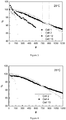
- Figure 3 shows the capacity retention of those cells during cycling in a voltage range of 4.35 to 3.0V (represented as the plots of capacity retention versus cycle number) at room temperature. It is observed that Cells 2 and 12 have a better cycling performance than reference Cell 13, which proves that cathode material "A-NMC622" is more stable than “Bare-NMC622" during cycling, and also that the addition of LiPO 2 F 2 in the electrolyte enhances the stability of the cells. It can be seen moreover that Cell 1 has an even better cyclability than Cells 2 and 12, showing the synergetic effect of "A-NMC622" and LiPO 2 F 2 based electrolyte on cycling performance.
- Cells 2, 4 and 13 contain the same electrolyte system "Electrolyte 1" without LiPO 2 F 2 , but they contain a different cathode material.
- Cell 2 uses “A-NMC622”
- Cell 4 employs “AF-NMC622”
- Cell 13 uses “Bare-NMC622”.
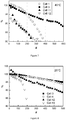
- Figures 4 and 5 show the capacity retention of those cells during cycling in a voltage range of 4,35 to 3.0V (represented as the plots of capacity retention versus cycle number) at room temperature and 45°C respectively. It is observed that the capacity retention in Cell 4 is higher than in Cells 2 & 13, which proves that Al and F treatment on NMC622 improves the cycling stability.
- Cells 1, 3, 11 and 12 contain the same electrolyte system "Electrolyte 1" with LiPO 2 F 2 , but they contain a different cathode material.
- Cell 1 uses “A-NMC622”
- Cell 3 uses “AF-NMC622”
- Cell 11 employs “Ca-NMC622”
- Cell 12 uses “Bare-NMC622”.
- Figures 6 and 7 show the capacity retention of those cells during cycling at room temperature and 45°C, respectively.
- Cell 13 serves as reference sample, comprising "Bare-NMC622" and “Electrolyte 1" without LiPO 2 F 2 .
- Figures 8 and 9 show the capacity retention of those cells during cycling at room temperature and 45°C, respectively. At both temperatures, it is observed that Cells 4 and 12 show the better cycling performance compared with reference sample of Cell 13, which proves that cathode material "AF-NMC622" is more stable than “Bare-NMC622" during cycling, and the addition of LiPO 2 F 2 in the electrolyte also enhances the stability of cells. It can moreover be seen that Cell 3 has an even better cyclability compared to Cells 4 and 12, showing the synergetic effect of "AF-NMC622" and LiPO 2 F 2 based electrolyte on cycling performance.
- Cell 2 Compared with a cell containing the commercial electrolyte (Cell 2), cells with addition of LiPO 2 F 2 (Cells 1 and 3) present a better cycling performance, which demonstrates that the positive effect of LiPO 2 F 2 on cycling stability is not only obtained for "AF-NMC622"-based full cell, but also for "A-NMC622".
- a LiPO 2 F 2 -based electrolyte stabilizes the cycling performance of full cells at high voltage when cathode materials utilize Al-treated NMC622.
- Cell 1 has an improved performance by the positive effect of the LiPO 2 F 2 -based electrolyte.
- the even more superior results of Cell 3 show that there is a synergetic effect between the application of the "AF-NMC622" treatment and the LiPO 2 F 2 -based electrolyte.
- Cells 5 to 10 use the same electrode components and electrolyte solvent, the only difference between the cells are the electrolyte additives.
- Cell 10 has no electrolyte additives and serves as a reference sample.
- Figure 11 illustrates the RT-cycling (at 25°C) property of Cells 5 to 10 in a voltage range of 4.35 to 3.0V, represented as the plots of capacity retention versus cycle number. Compared to Cell 10, the other Cells all possess a higher capacity retention during cycling. This proves that the cyclability of a full cell is promoted by the electrolyte additives of Cells 5 to 10, which all contain LiPO 2 F 2 .
- LiPO 2 F 2 has a positive effect on improving the cycle stability of a high-Ni full cell.
- the best cycling performance belongs to Cell 9, which contains electrolyte additives LiPO 2 F 2 and VEC.
- LiPO 2 F 2 and VEC have a certain synergetic effect on preventing capacity fading.
- PRS - LiPO 2 F 2 as could be expected from the teachings of US 2012/0177818 A1 is not confirmed. This could be because the active electrode material tested there is pure LiCoO 2 .
- Figure 12 shows the results of a similar cycling test at 45°C.
- the cyclability of cells at high temperature is worse but the effect of the electrolyte additives on cycle life is kept.
- Cell 9 still presents the greatest capacity retention, while Cell 10 shows the worst performance.
- the addition of PRS to LiPO 2 F 2 is worse than for LiPO 2 F 2 alone.
- a LiPO 2 F 2 -based electrolyte is beneficial for the cycling properties of a full cell at high voltage where "AF-NMC622" serves as cathode material.
- the cycling stability is further improved when such electrolyte is supplemented with VEC.
Landscapes
- Chemical & Material Sciences (AREA)
- General Chemical & Material Sciences (AREA)
- Chemical Kinetics & Catalysis (AREA)
- Electrochemistry (AREA)
- Engineering & Computer Science (AREA)
- Inorganic Chemistry (AREA)
- Manufacturing & Machinery (AREA)
- Physics & Mathematics (AREA)
- Condensed Matter Physics & Semiconductors (AREA)
- General Physics & Mathematics (AREA)
- Materials Engineering (AREA)
- Composite Materials (AREA)
- Organic Chemistry (AREA)
- Battery Electrode And Active Subsutance (AREA)
- Secondary Cells (AREA)
Description
- This invention relates to secondary lithium ion batteries, containing a surface-treated positive electrode material and a non-aqueous liquid electrolyte, which are of interest for high voltage applications and for use in automotive batteries. More particularly, this positive electrode material comprises a surface modified lithium nickel manganese cobalt oxide compound, which shows improved cycling properties at elevated voltage (>4.2V), when used in combination with suitable electrolyte additives. An especially suitable electrolyte is an electrolyte which contains a difluorophosphate additive.
- By introducing rechargeable lithium ion battery technology into the market of the hybrid electric vehicle (HEV) and plug-in hybrid electric vehicle (PHEV), there is an upsurge in demand of cathode materials with improved properties, such as high energy density, long cycling life, low price and so on. Conventional rechargeable lithium ion batteries use LiCoO2 (LCO) as cathode material, mainly for portable electronic devices. There are however limitations to apply LCO to the automotive market. State-of-the-art LCO has been much improved to satisfy the requirement of high energy density and long cycling life, however, the price of LCO material cannot be cut down due to limited cobalt resources. Thus LCO is not really sustainable for the application of pure electrical vehicles (EV), HEV or PHEV.
- An alternative to LCO are the so-called "NMC" cathode materials, which are derivatives of LCO, where Co ions are partially substituted by more abundant and environmental friendly transition metal ions such as Ni and Mn. "NMC" cathode materials have roughly the stoichiometry Li1+aM1-aO2, where 0≤a≤0.1, M =NixMnyCoz (x+y+z=1), and keep a similar crystal structure which is the ordered rock-salt structure of LCO, where the cations order into 2-dimensional Li and M layers. M may also be doped with other metals to improve the electrochemical properties of the cathode material. The space group is R-3M. For "NMC" cathode materials many different compositions are possible, depending on the substitution level of Co by Ni and Mn. They can be categorized and named after their nickel, manganese and cobalt content. Typical NMC-based materials are "NMC111" with M=Ni1/3Mn1/3Co1/3, "NMC532" with M=Ni0.5Mn0.3Co0.2, "NMC622" with M=Ni0.6Mn0.2Co0.2 etc.
- An NMC cathode material can roughly be understood as a solid state solution of LiCoO2, LiNi0.5Mn0.5O2 and LiNiO2. In LiNi0.5Mn0.5O2 Ni is divalent, in LiNiO2 Ni is trivalent. At 4.3 V a nominal capacity is about 160 mAh/g for LiCoO2and LiNi0.5Mn0.5O2, and 220 mAh/g for LiNiO2. The reversible capacity of an NMC compound can be roughly estimated from the nominal capacities. For example NMC622 can be understood as 0.2 LiCoO2+ 0.4 LiNi0.5Mn0.5O2 + 0.4 LiNiO2. Thus the expected capacity equals 0.2 × 160 + 0.4 × 160 + 0.4 × 220 = 184 mAh/g. Obviously the capacity increases with Ni content, so at the same voltage, NMC622 has a higher energy density than NMC532, NMC111, and definitely LCO. This means - when using NMC materials instead of LCO - less weight or volume of cathode material is required to achieve a certain energy. Also, the lower price of nickel and manganese compared to cobalt allows to reduce the cost of a NMC cathode per unit of energy. Thus, high Ni containing-NMC - like NMC622 - is more preferable for the large battery markets of EV, HEV and PHEV.
- Improving the energy density of the cathode is primordial for the automotive applications. As said before, an effective approach is to apply NMC materials with a high Ni content, for example NMC 622. Current technologies typically apply a charge voltage of 4.1 or even less. This only utilizes a relatively small part of the available lithium in the cathode active material. In general there is much concern about safety, calendar life and especially cycle stability that prevents the industry to increase the voltage further to 4.2V or beyond. An increase to for example 4.3V will increase the capacity per mass of cathode significantly, thus decreasing the cost and the weight of the battery, but the higher cut-off voltage necessitates stricter requirements regarding stability and safety. Besides, batteries in the automotive may need to withstand elevated temperatures above 45°C and thus NMC cathode materials with a high Ni content have to cycle well at such temperatures. However, state of the art cathode materials exhibit issues like unsatisfactory cycle stability when an elevated voltage (above 4.2V) and high temperature (above 45°C) is applied.
- In the case of high Ni NMC it is difficult to achieve a good cycle stability when charged to high voltages, for instance 4.35V. The failure mechanism of NMC/graphite polymer cells during operation at a high charge cut-off voltage is still unclear. The prior art has tried to analyze the failure behavior and provided reasonable explanations as follows: in
WO 2012/148894 A , it is mentioned that the electrolyte tends to react with the oxidized surface of the NMC cathode materials, resulting in irreversible losses and severe capacity fading. In J. Mater. Chem., 2011, 21, 17754, the dissolution of transition metals is believed to be the key contributor to the performance degradation of graphite/NMC full cells. This dissolution could originate from the side reactions between NMC and electrolyte. InUS6,218,048 , electrolyte decomposition during the charging process, or during the shelf life of the battery in its charged state (above 4V) is pointed out as the main cause for the failure of batteries. The decomposition is considerably accelerated at elevated temperatures. - Accordingly, to improve the cycle life of high Ni NMC/graphite full cells, effective solutions could be found by either modifying the high Ni NMC materials, or changing the electrolyte components. For the cathode materials the prior art mostly proposes surface modification or doping, as follows: in
WO2011/054441 , the authors propose a special LiF surface coating layer on NMC cathode materials, which significantly reduces the soluble base content and suppresses the gas generation of NMC polymer cells. The soluble base refers to impurities like Li2CO3 and LiOH. Li2CO3 and LiOH could either originate from remaining unreacted lithium precursors, which are usually Li2CO3 or LiOH, or from ion exchange reactions of the cathode with solvents, for example water which forms LiOH in the solvent and protons in the cathode. The soluble bases is a cause for a serious gas generation in full cells during operation which for example causes swelling of polymer cells. In J. Electrochem. Soc. 2012 160(9): A1451-A1456, Dahn et al. propose that an effective surface coating on the cathode or effective functional electrolyte additives could suppress the electrolyte oxidization and thus extend the cycle life of the batteries. InUS2009/0087362 , the authors provide a LiCoO2 powder which is covered by an AIF3 layer. This coated LiCoO2 shows improved cycle stability in a LiCoO2/Li half-cell when charged to 4.5V, at both 25°C and 55°C. - For the electrolyte, some prior art proposes electrolyte additives, as follows: a publication in J. Electrochem. Soc., 2013, 162 (3), A330-A338 describes that vinylene carbonate (VC) improves the rate performance of a NMC111/graphite cell, but has no obvious benefit on capacity retention when cycled with charge cut-off voltage of 4.4V. In J. Electrochem. Soc., 2014, 161 (12), A1818-A1827, a systematic study of electrolyte additives in NMC111/graphite pouch cells concludes that vinylene carbonate (VC) combined with sultone and sulfur-containing additives can give cells with excellent storage properties and superior long term cycling at 55°C.
US2009/0286135 A1 describes the use in general of lithium difluorophosphate in a non-aqueous electrolyte.US2012/0177818 A1 describes that an electrolyte including LiPO2F2 and a sultone-based compound may improve the cycle-life characteristics of the battery at room temperature (RT) and high temperature (HT), and suppress swelling. - Further prior art includes:
-
US2015/104704 (orEP2851988 ) disclosing an electrode assembly comprising a cathode, an anode and a separator, wherein the cathode comprises a lithium cobalt-based oxide, and a lithium nickel-based composite oxide having a coating layer over its surface, the coating layer being a reaction product of the lithium nickel-based composite oxide and a fluorine-containing polymer; -
WO2014/115754 (alsopublished as US2016/006030 ) disclosing a positive electrode active material for lithium secondary batteries comprising a lithium transition metal oxide Li1+aNixCoyMnzCaβMyO2 (where ―0.05≦α≦0.2, x+y+z+β+y≅1, 0.3≦x≦0.7, 0.1≦y≦0.4, 0.1≤z≤0.4, 0.0002≦β≦0.0025, 0.0002≦β+y≦0.02, and in a case where y>0, M is absent or represents one, two or more elements selected from the group consisting of Na, Mg, Al, Ti, V, Cr, Zr, Nb, Mo, Hf, Ta and W); and -
US2015/288033 disclosing a rechargeable lithium battery including a positive electrode including a positive active material, a negative electrode and an electrolyte including a lithium salt, an organic solvent and an additive. The positive active material includes a compound LiaNixCoyMnzO2 wherein 0<a≦2, 0.2≦5×≦0.6, 0.2≦y≦0.6, 0.2<z≦0.6, and x+y+z=1, and the additive includes about 0.5 to about 2 parts by weight of lithium difluorophosphate (LiPO2F2) and about 0.5 to about 3 parts by weight of vinylene carbonate, based on 100 parts by weight of the organic solvent. - In view of the problems cited before, in order to employ high Ni NMC (such as NMC 622) full cells in high voltage applications, an effective surface modification of the high Ni cathode particles, as well as a suitable electrolyte system may be combined. An object of the present invention is to provide such an improved rechargeable lithium ion battery for automotive applications that allows to increase the charge voltage to 4.2, 4.3, 4.35V or even beyond.
- The invention is a rechargeable lithium battery as defined in
independent claim 1 and its use as defined claim 11. - Preferred embodiments are as defined in
dependent claims 2 to -
-
Figure 1 : XPS analysis of the surface of the "A-NMC622" material; -
Figure 2 : XPS analysis of the surface of the "AF-NMC622" material; -
Figure 3 : capacity retention ofCells -
Figure 4 : capacity retention ofCells -
Figure 5 : capacity retention ofCells -
Figure 6 : capacity retention ofCells -
Figure 7 : capacity retention ofCells -
Figure 8 : capacity retention ofCells -
Figure 9 : capacity retention ofCells -
Figure 10 : capacity retention of Cells 1-3 during cycling at room temperature; -
Figure 11 : capacity retention of Cells 5-10 during cycling at room temperature; -
Figure 12 : capacity retention of Cells 5-10 during cycling at 45°C; -
Figure 13 : capacity retention ofCells -
Figure 14 : capacity retention ofCells - This invention provides rechargeable lithium ion batteries (so-called full cells) containing high Ni-based cathode material and LiPO2F2-containing electrolyte, before cycling. The surface modified cathode powders according to the invention present an improved stability under high voltage cycling, so that these powders can be candidate NMC cathode materials for automotive applications. It is observed that uncycled full cells containing Al doped and Al surface enriched high Ni cathode materials and LiPO2F2-based electrolytes have an improved cycling stability during cycling in the voltage range of 3.0 V to 4.35 V at room temperature, when compared with full cells containing the same cathode material but a LiPO2F2-free electrolyte. Accordingly, there is a synergy between Al treated high Ni cathode materials and LiPO2F2-based electrolyte. Full cells containing such NMC cathode materials possess high stability in the Room Temperature (RT) and High Temperature (HT)-cycling and in High Temperature-storage, but only with the addition of LiPO2F2-based electrolyte additives according to the invention. Thus, the provided rechargeable lithium ion batteries of this invention allow for stable cycling under high voltage conditions.
- It is believed that the addition of LiPO2F2 to the electrolyte and the Al enriched layer at the surface of the cathode together more efficiently prevent side reactions and gas generation in the NMC-full cell system. A typical electrolyte salt such as LiPF6 tends to decompose and form side-products at high voltage, including strong acids, which results in a reaction with the soluble base content on the surface of the NMC cathode material, and solvent decomposition. These acids would e.g. attack active NMC622 material and form a SEI layer on the surface of the NMC particles. The addition of LiPO2F2 to the electrolyte system may hinder or reduce the decomposition and side reactions of LiPF6 and further prevent that byproducts attack the high Ni NMC particles. It is essential that the electrolyte contains LiPO2F2, however other electrolyte additives like VC, LiBOB, PRS, VEC are known in the prior art and can still further improve the battery performance. In Journal of the Electrochemical Society, 2014, 161 (4) A506, Dahn et al. for example teach that a combination of electrolyte additives can have a positive effect exceeding the sum of the positive contributions of the single additive and thus bringing a synergetic effect.
- The present invention also finds that uncycled full cells containing Al treated high Ni NMC cathode powders show much improved storage properties at high temperature when compared to full cells containing Ca doped or bare high Ni powders, especially in the case of using LiPO2F2-based electrolyte. Thus, it can be concluded that the synergetic effect between Al treated high Ni cathode materials and LiPO2F2-based electrolyte enhances the stability of full cells at high temperature.
- According to the present invention, the Al surface treated high Ni NMC cathode powders exhibit superior properties when applied in Li-ion batteries. This is attributed to the Al gradient within the surface layer and may be further enhanced by the presence of a fluor gradient in the surface layer. The existence of the Al gradient can help to improve the cycle stability when the cathode materials are charged to a high voltage such as 4.35V. The F gradient in the coating layer on the other hand helps to reduce the amount of soluble base and eventually improves the storage properties of a full cell at elevated temperature.
- The surface modified NMC622 powders according to the invention may have a core and a surface layer that may be an annealed coating layer. In some embodiments, the surface layer is delimited by an outer and an inner interface, the inner interface being in contact with the core. The core may have an Al content more than 0.3 mole% but less than 3.0 mole%, and a F content less than 0.05 mole%, as determined by XPS. In one embodiment, the surface layer has an Al content that increases continuously from the Al content of the core at the inner interface to more than 4 mole% at the outer interface, and preferably more than 6 mole%. In another embodiment, the surface layer has an Al content that increases continuously from the Al content of the core at the inner interface to more than 10 mole% at the outer interface, and preferably more than 12 mole%; and has a F content that increases continuously from less than 0.05 mole% at the inner interface to at least 3 mole% at the outer interface, preferably at least 5 mole% at the outer interface. The concentration of the different elements in the surface layer and the outer part of the core can be determined using X-ray photoelectron spectroscopy (XPS).
- In another embodiment of this invention, doping elements can be, besides Al, one or more elements from the group of Ca, Mg, Zr, W, Ti, Cr and V. The source of doping element is preferably a compound selected from the group consisting of a metal oxide, for example - besides Al2O3 - TiO2, MgO, WO3, ZrO2, Cr2O3, V2O5 and mixtures thereof. The preferred source of Al is a nano-scale alumina powder, for example fumed alumina. The alumina can be obtained by precipitation, spray drying, milling, etc. In one embodiment fumed alumina or surface treated fumed alumina is used. Fumed alumina nanoparticles are produced in high temperature hydrogen-air flames and are used in several applications that involve products of everyday use.
- As mentioned before, in one embodiment, the doping element includes Al and F. The source of F may be a fluorine-containing polymer. A typical example for such a polymer is a PVDF homopolymer or PVDF copolymer (such as HYLAR ® or SOLEF® PVDF, both from Solvay SA, Belgium). Another known PVDF based copolymer is for example a PVDF-HFP (hexa-fluoro propylene). Such polymers are often known under the name "Kynar®". Teflon - or PTFE - could also be used as polymer. During the sintering step, the fluorine-containing polymer ― which is free of Li - decomposes in contact with the core material, as described in
WO2011/054441 . The polymer is completely decomposed and lithium fluoride is formed, which is found in the surface layer of the particles. The LiF originates from the reaction of the decomposing polymer with lithium containing surface base of the lithium transition metal oxides. It can be speculated that LiF in the surface layer protects the Li in the particle, thus preventing it from reacting with carbon to form Li2CO3. The obtained surface layer has the following function: the thin layer comprising LiF replaces the reactive surface base layer, thus reducing the base content practically to zero at the core's surface, and improving the overall safety. In the present invention, it can be verified that the surface layer is a mixture of elements of the core, LiF and Al2O3. - Surface-modified high Ni NMC cathode powders according to the invention may be used in positive electrodes in a full cell configuration which can be evaluated at room temperature (RT) and elevated temperature (HT) in cycling tests at 25°C and 45°C, respectively. In one embodiment, 1.5wt% of LiPO2F2 (lithium difluorophosphate) serves as electrolyte additive, and EC (ethylene carbonate)/DEC (diethyl carbonate)/EMC (Ethylmethylcarbonate) are employed as solvent with a weight ratio of 25.5:29.6:29.6. Al treated NMC622- with or without fluorine gradient - may be the active material of the positive electrode of the full cell. The RT and HT cycling test of such a full cell shows excellent cycling stability and a good storage property. Compared with full cells using Ca doped or bare NMC622 as cathode materials, it is discovered that full cells containing Al treated NMC622 cathode materials have a much better cycling life during cycling in the voltage range of 3.0 V to 4.5 V at room temperature, especially with LiPO2F2-containing electrolyte.
- In another embodiment, the electrolyte of the full cell includes 1wt% of LiPO2F2 (lithium difluorophosphate) and 1wt% of VEC (vinyl ethylene carbonate) as electrolyte additives, and EC (ethylene carbonate)/DEC (diethyl carbonate)/EMC (Ethylmethylcarbonate) as solvent with a weight ratio of 25.5:29.6:29.6. Al and F surface modified NMC622 is the active material of the positive electrode of the full cell. The RT and HT cycling tests show that the cycling stability of this full cell is better than that of a full cell with only the LiPO2F2 additive. The benefit brought by the addition of LiPO2F2 together with VEC is not observed in such full cells, where Ca doped or bare-NMC622 is the active material of the positive electrode. Accordingly, further addition of VEC to LiPO2F2-based electrolyte has the benefit to increase the capacity retention of Al treated NMC622-based cells during cycling at high voltage.
- This invention discovers the synergetic effect between Al surface modified NMC622 cathode materials and LiPO2F2-containing electrolyte, which allows to achieve excellent stability of cells during RT and HT cycling at high voltage. Thus, rechargeable lithium ion battery devices according to this invention have a suitable performance for automotive application especially allowing for a long cycle life.
- The following description details the preparation of the cathode materials in the Examples. Examples 3 and 5 to 9 are examples according to the present invention, examples 1, 2, 4 and 10 to 13 are examples not according to the present invention:
-
- (a) Preparation of a NMC622 core: lithium hydroxide and a mixed Ni-Mn-Co oxy-hydroxide are homogeneously blended in a vertical single-shaft mixer by a dry powder mixing process. The blend ratio is targeted to obtain Li1.01 (Ni0.4 (Ni1/2 Mn1/2)0.4 Co0.2)0.99 O2, which can be easily verified by an analysis technique such as ICP. The mixture is then sintered in a tunnel furnace in an oxidizing atmosphere. The sintering temperature is >900°C and the dwell time is ~10 hrs. Dry air is used as an oxidizing gas. After sintering, the sample is milled in a grinding machine to a mean particle size of around 12µm.
- (b) Al doping and alumina surface enrichment: NMC 622 powder from step (a) is surface modified by aluminum as described in Example 1 (step (d)) of
WO2016/116862 : 1 kg of the Li1.01 (Ni0.4 (Ni½ Mn½)0.4 CO0.2)0.99 O2 powder from step (a) is filled into a mixer (in the example a 2L Henschel type Mixer) and 2g of fumed alumina (Al2O3) nano-powder is added as well. After homogeneously mixing (usually 30mins at 1000rpm), the mixture is sintered in a box furnace in an oxidizing atmosphere. The sintering temperature is 700°C and the dwell time is ~ 5hrs. Dry air is used as an oxidizing gas. It can be verified that after the surface modification Al is doped in the lithium metal oxide (core) and XPS measurements show a gradient that is established at the surface with increasing Al content, besides the surface layer being enriched with aluminum in the form of alumina. After this step the material could be represented by the overall formula Li1.01 ((Ni0.4 (Ni½ Mn½)0.4 Co0.2)0.996 Al0.004)0.99 O2. - (c) Alumina and LiF surface modification: powder obtained from process (b) is processed according to the procedure described in Example 1 (step (e)) of co-pending application of
WO2016/116862 : 1 kg of powder obtained from process (b) is filled into a mixer (in the example a 2L Henschel type Mixer), 2g of fumed alumina (Al2O3) nano-powder and 3g polyvinylidene fluoride (PVDF) powder is added as well. After homogeneously mixing (usually 30mins at 1000rpm), the mixture is sintered in a box furnace in an oxidizing atmosphere. The sintering temperature is 375°C and the dwell time is ~5hrs. Dry air is used as an oxidizing gas. The surface layer established in step (b) is not creating a barrier for the PVDF to react with Li present at the inner surface, and to form LiF. It can be verified that after the second sintering step the surface layer is a mixture of elements of the core, LiF and Al2O3. The final Al content is 0.8 mole% (as can be determined by ICP). - A positive electrode material with the formula Li1.01 ((Ni0.4 (Ni½ Mn½)0.4 CO0.2)0.99 O2 is manufactured through the process (a) without any further treatment and referred to as "Bare-NMC622" hereafter. A positive electrode material with the formula Li1.01 ((Ni0.4 (Ni½ Mn½)0.4 Co0.2)0.996 Al0.004)0.99 O2 is manufactured through the process (a) and (b), and referred to as "A-NMC622" hereafter. The XPS analysis of the surface of the "A-NMC622" material is shown in
Figure 1 , where the gradient, surface and core content of Al are clearly visible. A positive electrode material with the formula Li1.01((Ni0.4(Ni1/2Mn1/2)0.4Co0.2)0.992Al0.008)0.99O1.991F0.009 is manufactured through the process (a), (b) and (c), and referred to as "AF-NMC622" hereafter. The XPS analysis of the surface of the "AF-NMC622" material is shown inFigure 2 , where the gradients of Al and F are clearly visible, together with their surface and core content. - Lithium hydroxide, calcium oxide and a mixed Ni-Mn-Co oxy-hydroxide are homogeneously blended in a vertical single-shaft mixer by a dry powder mixing process. The blend ratio is targeted to obtain Li1.01 (Ni0.4 (Ni½ Mn½)0.4 Co0.2 Ca0.001)0.99 O2, which can be easily verified by an analysis technique such as ICP. The mixture is then sintered in a tunnel furnace in an oxidizing atmosphere. The sintering temperature is >900°C and the dwell time is ~10 hrs. Dry air is used as an oxidizing gas. After sintering, the sample is milled in a grinding machine to a mean particle size of around 12µm. The final obtained material is referred to "Ca-NMC622" hereafter. The addition of Ca in the cathode material is known to realize an outstanding battery capacity (for example a high energy density) and a high reliability at the time of overcharge, as is disclosed e.g. in
JP2014-143108 - The following description details the preparation of the full cells in the Examples:
- 650 mAh pouch-type cells are prepared by the following two steps: I. Slurry making and coating and II. Full cell assembly.
- A slurry is prepared by mixing 700g of NMC cathode material with NMP, 47.19g of super P® (conductive carbon black of Timcal) and 393.26g of 10wt% PVDF based binder in NMP solution. The mixture is mixed for 2.5 hrs in a planetary mixer. During mixing additional NMP is added. The mixture is transferred to a Disper mixer and mixed for 1.5 hrs under further NMP addition. A typical total amount of NMP used is 423g. The final solid content in the slurry is about 65wt%. The slurry is transferred to a coating line. Double coated electrodes are prepared. The electrode surface is smooth. The electrodes are compacted by a roll press to achieve an electrode density of about 3.2 g/cm3. The electrodes are used to prepare pouch cell type full cells as described hereafter.
- For full cell testing purposes, the prepared positive electrodes (cathode) are assembled with a negative electrode (anode) which is typically a graphite type carbon, and a porous electrically insulating membrane (separator). The full cell is prepared by the following major steps:
- a. Electrode slitting: after NMP coating the electrode active material might be slit by a slitting machine. The width and length of the electrode are determined according to the battery application.
- b. Attaching the tabs: there are two kinds of tabs. Aluminum tabs are attached to the positive electrode (cathode), and copper tabs are attached to the negative electrode (anode).
- c. Electrode drying: the prepared positive electrode (cathode) and negative electrode (anode) are dried at 85°C to 120°C for 8 hrs in a vacuum oven.
- d. Jellyroll winding: after drying the electrode a jellyroll is made using a winding machine. A jellyroll consists of at least a negative electrode (anode) a porous electrically insulating membrane (separator) and a positive electrode (cathode).
- e. Packaging: the prepared jellyroll is incorporated in a 650 mAh cell with an aluminum laminate film package, resulting in a pouch cell. Further, the jellyroll is impregnated with the electrolyte according to this invention. The quantity of electrolyte is calculated in accordance with the porosity and dimensions of the positive and negative electrode, and the porous separator. Finally, the packaged full cell is sealed by a sealing machine.
- The following description details the analysis methods in the Examples:
In the various embodiments of the modified cathode powders, the thickness of the surface layer may be more than 50 nm and less than 400 nm. The thickness of the surface layer is determined by XPS measurement. A sputtering rate in SiO2: 6.0 nm / minute is applied to calculate the depth/thickness. The thickness here is obtained by the sputtering time multiplied by the (reference) sputtering rate in SiO2. During the XPS measurement, it is difficult to obtain the sputtering rate of measured objectives. A typical way is to normalize the thickness by using a standard sputtering rate (in SiO2 here) for all samples. Therefore, it is not necessary true that the thickness calculated here is the same as could be obtained by other spectra methods, for example, Scanning Electron Microscopy (SEM). Known techniques such as ICP give the average composition of the powder. It is known that ICP gives a more accurate average measurement than XPS, however, for descriptions of the properties of the surface layer, such as element distribution with different layer thickness, XPS can provide accurate qualitative and quantitative data. Practically, the measurements are carried out in a Quantera SXMtm from ULVAC-PHI (Q2). The measurements are performed using monochromatic Al-Ka-radiation and a spot size of 100 µm scanning across an area of 1200 × 500 µm (High Sensitivity Mode). The measurement angle Θ is 45°; at this setting the information depth is approximately 7 nm. By means of wide-scan measurements the elements present at the surface are identified. Accurate narrow-scans are performed to determine the precise surface composition. Concentration ― depth profiles are determined by alternating measurements and ion bombardment (Argon ions, Vi = 4 kV,raster 3 × 3 mm, sputter rate in SiO2: 6.0 nm / minute). - Electrochemical properties: the full cell is cycled at 25°C (=RT) and 45°C (=HT) using Toscat-3100 computer-controlled galvanostatic cycling stations (Toyo) between 3.0V and 4.35V under CC/CV (constant current/constant voltage) mode at 1C rate (corresponding to the current which discharges a charged cell within 1 hr).
- The invention is further illustrated in the following examples:
- This example presents a full cell (prepared as explained before), where the electrolyte consists of:
- (a) a non-aqueous solvent with electrolyte salt: ethylene carbonate (EC)/diethyl carbonate (DEC)/ Ethylmethylcarbonate (EMC)/ lithium hexafluorophosphate (LiPF6) with a weight ratio of 25.5:29.6:29.6:13.3; and
- (b) electrolyte additives: 0.5 wt% of lithium bis(oxalato)borate (LiB(C2O4)2, LiBOB), 1 wt% of vinylene carbonate (VC), 0.5 wt% of propene sultone (PRS) and 1wt% of lithium difluorophosphate (LiPO2F2).
- The above prepared electrolyte system is labelled
Electrolyte 1. The full cell comprises cathode active material "A-NMC622". The above prepared 650 mAh pouch-type battery is labelledCell 1. - This example presents a full cell prepared through the same procedure as
Cell 1, without the addition of 1 wt% of lithium difluorophosphate (LiPO2F2). This electrolyte is commercialized by Panax Etec. The prepared 650 mAh pouch-type battery is labelledCell 2. - This example presents a full cell prepared through the same procedure as
Cell 1, but the cathode material is composed of "AF-NMC622" as described before. The prepared 650 mAh pouch-type battery is labelledCell 3. - This example presents a full cell prepared through the same procedure as
Cell 2, but the cathode material is composed of "AF-NMC622". The prepared 650 mAh pouch-type battery is labelledCell 4. - This example presents a rechargeable lithium ion full cell prepared as explained before, with the electrolyte consisting of:
- (a) a non-aqueous solvent combined with electrolyte salt: ethylene carbonate (EC)/diethyl carbonate (DEC)/ Ethylmethylcarbonate (EMC)/ lithium hexafluorophosphate (LiPF6) with a weight ratio of 25.5:29.6:29.6:13.3; and
- (b) an electrolyte additive: 1.5 wt% of lithium difluorophosphate (LiPO2F2);
- This example presents a full cell prepared through the same procedure as
Cell 5, with the addition of 0.5 wt% of 1,3-propene sultone (PRS). The prepared 650 mAh pouch-type battery is labelledCell 6. - This example presents a full cell prepared through the same procedure as
Cell 5, with the addition of 0.5 wt% of Lithium Bis(oxalate)borate (LiBOB). The prepared 650 mAh pouch-type battery is labelledCell 7. - This example presents a full cell prepared through the same procedure as
Cell 5, but the electrolyte additives are 1 wt% of lithium difluorophosphate (LiPO2F2), 0.5 wt% of Lithium Bis(oxalate)borate (LiBOB) and 0.5 wt% of 1,3-propene sultone (PRS). The prepared 650 mAh pouch-type battery is labelledCell 8. - This example presents a full cell prepared through the same procedure as
Cell 5, but the electrolyte additives are 1 wt% of lithium difluorophosphate (LiPO2F2) and 1 wt% of Vinyl Ethylene carbonate (VEC). The prepared 650 mAh pouch-type battery is labelledCell 9. - This example presents a full cell prepared through the same procedure as
Cell 5, without addition of LiPO2F2. The prepared 650 mAh pouch-type battery is labelledCell 10. - This example presents a full cell prepared through the same procedure as
Cell 1, but the cathode material is composed of "Ca-NMC622" as described before. The prepared 650 mAh pouch-type battery is labelled Cell 11. - This example presents a full cell prepared through the same procedure as
Cell 1, but the cathode material is composed of "Bare-NMC622" as described before. The prepared 650 mAh pouch-type battery is labelledCell 12. - This example presents a full cell prepared through the same procedure as
Cell 2, but the cathode material is composed of "Bare-NMC622". The prepared 650 mAh pouch-type battery labelledCell 13. - Table 1 summarizes the information on electrolyte additives and cathode materials in each cell.
Table 1: Cathode materials and Electrolyte compositions in Cells 1 to 13Cell ID Electrolyte additive composition Cathode material LiPO2F2 (wt%) VC (wt%) LiBOB (wt%) PRS (wt%) VEC (wt%) Cell 1 - comparative example 1 1 0.5 0.5 A-NMC622 Cell 2-comparative example - 1 0.5 0.5 - Cell 31 1 0.5 0.5 - AF-NMC622 Cell 4-comparative example - 1 0.5 0.5 - Cell 51.5 - - - - Cell 61.5 - - 0.5 - Cell 71.5 - 0.5 - - Cell 81 - 0.5 0.5 - Cell 91 - - - 1 Cell 10-comparative example - - - - - Cell 11-comparative example 1 1 0.5 0.5 - Ca-NMC622 Cell 12-comparative example 1 1 0.5 0.5 - Bare-NMC622 Cell 13-comparative example - 1 0.5 0.5 - - Discussion of the Examples by comparison of
Cells Cells 1 comprises "A-NMC622" and electrolyte system "Electrolyte 1" containing LiPO2F2. Cell 2 uses the same cathode material but an electrolyte system without LiPO2F2. Cell 12 contains the same electrolyte system asCell 1, but has a different cathode material "Bare-NMC622" that Is NMC622 without any surface or doping treatment.Cell 13 serves as reference sample, comprising "Bare-NMC622" and "Electrolyte 1" without LiPO2F2.Figure 3 shows the capacity retention of those cells during cycling in a voltage range of 4.35 to 3.0V (represented as the plots of capacity retention versus cycle number) at room temperature. It is observed thatCells reference Cell 13, which proves that cathode material "A-NMC622" is more stable than "Bare-NMC622" during cycling, and also that the addition of LiPO2F2 in the electrolyte enhances the stability of the cells. It can be seen moreover thatCell 1 has an even better cyclability thanCells - Discussion of the Examples by comparison of
Cells Cells Electrolyte 1" without LiPO2F2, but they contain a different cathode material.Cell 2 uses "A-NMC622",Cell 4 employs "AF-NMC622" andCell 13 uses "Bare-NMC622".Figures 4 and5 show the capacity retention of those cells during cycling in a voltage range of 4,35 to 3.0V (represented as the plots of capacity retention versus cycle number) at room temperature and 45°C respectively. It is observed that the capacity retention inCell 4 is higher than inCells 2 & 13, which proves that Al and F treatment on NMC622 improves the cycling stability. - Discussion of the Examples by comparison of
Cells Cells Electrolyte 1" with LiPO2F2, but they contain a different cathode material.Cell 1 uses "A-NMC622",Cell 3 uses "AF-NMC622", Cell 11 employs "Ca-NMC622" andCell 12 uses "Bare-NMC622".Figures 6 and7 show the capacity retention of those cells during cycling at room temperature and 45°C, respectively. It is observed that the capacity retention inCell 3 is higher than inCell 1, and much higher than inCells 11 and 12, which proves that Al-treated NMC622 is more stable than Ca doped NMC622 and bare NMC622 during the cycling of cells containing LiPO2F2. This result is analogous to the comparison ofCells Electrolyte 1" without LiPO2F2. - Discussion of the Examples by comparison of
Cells Cell 3 comprises "AF-NMC622" and the electrolyte system "Electrolyte 1" containing LiPO2F2. Cell 4 uses the same cathode material asCell 3 and a comparable electrolyte however without LiPO2F2. Cell 12 contains the same electrolyte system asCell 3, but has a different cathode material "Bare-NMC622" that is NMC622 without any surface or doping treatment.Cell 13 serves as reference sample, comprising "Bare-NMC622" and "Electrolyte 1" without LiPO2F2.Figures 8 and9 show the capacity retention of those cells during cycling at room temperature and 45°C, respectively. At both temperatures, it is observed thatCells Cell 13, which proves that cathode material "AF-NMC622" is more stable than "Bare-NMC622" during cycling, and the addition of LiPO2F2 in the electrolyte also enhances the stability of cells. It can moreover be seen thatCell 3 has an even better cyclability compared toCells - Discussion of the Examples by comparison of
Cells
The electrolyte composition ofCells 1 to 3 is listed in Table 1. InCells Cell 3, "AF-NMC622" is used to make a positive electrode. As toCells Cell 2.Figure 10 shows the capacity retention ofCells 1 to 3 during cycling tests at room temperature. Compared with a cell containing the commercial electrolyte (Cell 2), cells with addition of LiPO2F2 (Cells 1 and 3) present a better cycling performance, which demonstrates that the positive effect of LiPO2F2 on cycling stability is not only obtained for "AF-NMC622"-based full cell, but also for "A-NMC622". Thus, in general a LiPO2F2-based electrolyte stabilizes the cycling performance of full cells at high voltage when cathode materials utilize Al-treated NMC622. Compared toCell 2,Cell 1 has an improved performance by the positive effect of the LiPO2F2-based electrolyte. The even more superior results ofCell 3 show that there is a synergetic effect between the application of the "AF-NMC622" treatment and the LiPO2F2-based electrolyte. - Discussion of the Examples by comparison of
Cells 5 to 10:
Cells 5 to 10 use the same electrode components and electrolyte solvent, the only difference between the cells are the electrolyte additives.Cell 10 has no electrolyte additives and serves as a reference sample.Figure 11 illustrates the RT-cycling (at 25°C) property ofCells 5 to 10 in a voltage range of 4.35 to 3.0V, represented as the plots of capacity retention versus cycle number. Compared toCell 10, the other Cells all possess a higher capacity retention during cycling. This proves that the cyclability of a full cell is promoted by the electrolyte additives ofCells 5 to 10, which all contain LiPO2F2. As this result is already achieved forCell 5 which has no additives other than LiPO2F2 it can be concluded that LiPO2F2 has a positive effect on improving the cycle stability of a high-Ni full cell. Additionally, inFigure 11 , the best cycling performance belongs toCell 9, which contains electrolyte additives LiPO2F2 and VEC. Thus, LiPO2F2 and VEC have a certain synergetic effect on preventing capacity fading. Based on the results ofCells US 2012/0177818 A1 is not confirmed. This could be because the active electrode material tested there is pure LiCoO2. -
Figure 12 shows the results of a similar cycling test at 45°C. The cyclability of cells at high temperature is worse but the effect of the electrolyte additives on cycle life is kept.Cell 9 still presents the greatest capacity retention, whileCell 10 shows the worst performance. Based on the results ofCells Cells 5 to 10, it can be concluded that a LiPO2F2-based electrolyte is beneficial for the cycling properties of a full cell at high voltage where "AF-NMC622" serves as cathode material. The cycling stability is further improved when such electrolyte is supplemented with VEC. - Discussion of the Examples by comparison of
Cells cells Figure 13 (at room temperature) andFigure 14 (at 45°C) proves that "Electrolyte 1" (Cells 3-4) is more effective than "Electrolyte 2" (Cells 5 & 8), and that there is a synergetic effect between the use of a LiPO2F2-based electrolyte and that electrolyte containing additional additives LiBOB, VC and PRS (in Cell 3). The addition of VC in "Electrolyte 1" seems to compensate for the bad result of Cell 8 ("Electrolyte 2" + PRS + LiBOB). - The conclusion of all these discussions is that:
- the modification of the electrolyte, by addition of LiPO2F2, is not sufficient to provide an improved rechargeable lithium ion battery for automotive applications that allows to increase the charge voltage to 4.2, 4.3, 4.35V or even beyond,
- neither is the application of an Al-based surface enrichment taken on its own,
- but suprisingly, there can be found a synergy between the modification of the electrolyte and the surface enrichment of the active material according to the invention.
Claims (11)
- A rechargeable lithium ion battery comprising a positive electrode, a negative electrode and an electrolyte, the positive electrode comprising a lithium nickel manganese cobalt oxide-based powder with particles comprising a core and a surface layer, the core having a layered crystal structure comprising the elements Li, M and oxygen, wherein M has the formula M=(Niz (Ni½ Mn½)y Cox)1-k Ak, with 0.13≤x≤0.30, 0.20≤z<0.55, x+y+z=1 and 0<k≤0.1, wherein A is at least one dopant and comprises Al, the lithium nickel manganese cobalt oxide-based powder having a molar ratio 0.95≤Li:M≤1.10, wherein the surface layer consists of a mixture of elements of the core Li, M and O, and alumina, and further comprises LiF, wherein the electrolyte comprises the additive lithium difluorophosphate.
- The rechargeable lithium ion battery of claim 1, wherein the core of the lithium nickel manganese cobalt oxide-based powder particles has an Al content of 0.3-3 mole%, wherein the surface layer is delimited by an outer and an inner interface, the inner interface being in contact with the core, and wherein the surface layer has an Al content that increases from the Al content of the core at the inner interface to at least 4 mole% at the outer interface, the Al content being determined by XPS.
- The rechargeable lithium ion battery of claim 1, wherein the core of the lithium nickel manganese cobalt oxide-based powder particles has an Al content of 0.3-3 mole% and a F content of less than 0.05 mole%, and wherein the surface layer has an Al content that increases from the Al content of the core at the inner interface to at least 10 mole% at the outer interface, and a F content that increases from less than 0.05 mole% at the inner interface to at least 3 mole% at the outer interface, the Al and F contents being determined by XPS.
- The rechargeable lithium ion battery of claim 1, wherein the lithium nickel manganese cobalt oxide-based powder has a surface layer further comprises either one or more compounds from the group consisting of CaO, TiO2, MgO, WO3, ZrO2, Cr2O3 and V2O5.
- The rechargeable lithium ion battery of claim 1, wherein for the lithium nickel manganese cobalt oxide-based powder A=Al, k=0.005-0.013, x=0.20±0.02, y=0.40±0.05, z=0.40±0.05 and 1≤ Li:M ≤1.10.
- The rechargeable lithium ion battery of claim 1, wherein the electrolyte comprises between 0.5 and 2 wt% of lithium difluorophosphate.
- The rechargeable lithium ion battery of claim 6, wherein the electrolyte further comprises up to 2 wt% of vinyl ethylene carbonate.
- The rechargeable lithium ion battery of claim 6, wherein the electrolyte further comprises up to 2 wt% of one or more additives selected from the group consisting of lithium bis(oxalate)borate, vinylene carbonate and 1,3-propene sultone.
- The rechargeable lithium ion battery of claim 1, wherein the electrolyte comprises a solvent comprising either one or more of EC, DEC and EMC.
- The rechargeable lithium ion battery of claim 1 operating after charging to a final voltage >4.2V.
- Use of a rechargeable lithium ion battery according to claim 1 in either one of a portable computer, a tablet, a mobile phone, an electrically powered vehicle and an energy storage system.
Priority Applications (1)
| Application Number | Priority Date | Filing Date | Title |
|---|---|---|---|
| PL17773385T PL3437148T3 (en) | 2016-03-31 | 2017-03-09 | AUTOMOTIVE LITHIUM ION BATTERY |
Applications Claiming Priority (2)
| Application Number | Priority Date | Filing Date | Title |
|---|---|---|---|
| EP16163091 | 2016-03-31 | ||
| PCT/IB2017/051376 WO2017168274A1 (en) | 2016-03-31 | 2017-03-09 | Lithium ion battery for automotive application |
Publications (3)
| Publication Number | Publication Date |
|---|---|
| EP3437148A1 EP3437148A1 (en) | 2019-02-06 |
| EP3437148A4 EP3437148A4 (en) | 2019-10-30 |
| EP3437148B1 true EP3437148B1 (en) | 2021-12-22 |
Family
ID=55642338
Family Applications (1)
| Application Number | Title | Priority Date | Filing Date |
|---|---|---|---|
| EP17773385.4A Active EP3437148B1 (en) | 2016-03-31 | 2017-03-09 | Lithium ion battery for automotive application |
Country Status (9)
| Country | Link |
|---|---|
| US (1) | US10790510B2 (en) |
| EP (1) | EP3437148B1 (en) |
| JP (1) | JP6753944B2 (en) |
| KR (1) | KR102201126B1 (en) |
| CN (1) | CN109075327B (en) |
| HU (1) | HUE057986T2 (en) |
| PL (1) | PL3437148T3 (en) |
| TW (1) | TWI633692B (en) |
| WO (1) | WO2017168274A1 (en) |
Families Citing this family (25)
| Publication number | Priority date | Publication date | Assignee | Title |
|---|---|---|---|---|
| US20180145317A1 (en) * | 2016-11-18 | 2018-05-24 | Semiconductor Energy Laboratory Co., Ltd. | Positive electrode active material, method for manufacturing positive electrode active material, and secondary battery |
| CN108110311B (en) * | 2016-11-25 | 2021-05-14 | 深圳新宙邦科技股份有限公司 | Lithium ion battery |
| CN121922692A (en) | 2017-08-10 | 2026-04-24 | 三菱化学株式会社 | Nonaqueous electrolyte secondary battery |
| WO2019104099A2 (en) * | 2017-11-22 | 2019-05-31 | A123 Systems Llc | Method and systems for metal doping on battery cathode materials |
| KR102481574B1 (en) * | 2018-03-29 | 2022-12-26 | 유미코아 | Manufacturing method of positive electrode material for rechargeable lithium ion battery |
| KR102272266B1 (en) * | 2018-08-27 | 2021-07-02 | 삼성에스디아이 주식회사 | Positive active material for rechargeable lithium battery and rechargeable lithium battery incluidng the same |
| JPWO2020218475A1 (en) * | 2019-04-26 | 2020-10-29 | ||
| KR20210153742A (en) | 2019-05-09 | 2021-12-17 | 에이일이삼 시스템즈, 엘엘씨 | Method and system for dry surface doping of cathode materials |
| JP7343682B2 (en) * | 2019-07-03 | 2023-09-12 | ユミコア | Lithium nickel manganese cobalt composite oxide as positive electrode active material for rechargeable lithium ion batteries |
| WO2021001500A1 (en) * | 2019-07-03 | 2021-01-07 | Umicore | Lithium nickel manganese cobalt composite oxide as a positive electrode active material for rechargeable lithium ion batteries |
| JP7326681B2 (en) * | 2019-07-30 | 2023-08-16 | 三井化学株式会社 | Non-aqueous electrolyte for batteries and lithium secondary batteries |
| US12255329B2 (en) * | 2019-08-30 | 2025-03-18 | Panasonic Holdings Corporation | Positive electrode active material for nonaqueous electrolyte secondary batteries, and nonaqueous electrolyte secondary battery |
| JP7264792B2 (en) * | 2019-11-12 | 2023-04-25 | Jx金属株式会社 | Positive electrode active material for all-solid-state lithium ion battery, positive electrode for all-solid-state lithium-ion battery, all-solid lithium-ion battery, and method for producing positive electrode active material for all-solid-state lithium ion battery |
| KR102845706B1 (en) * | 2019-12-13 | 2025-08-12 | 현대자동차주식회사 | Electrolyte solution for lithium secondary battery and Lithium secondary battery comprising the same |
| WO2021152997A1 (en) * | 2020-01-27 | 2021-08-05 | パナソニックIpマネジメント株式会社 | Positive electrode active material for nonaqueous electrolyte secondary batteries, and nonaqueous electrolyte secondary battery |
| EP4112558A4 (en) * | 2020-02-28 | 2023-08-30 | Panasonic Intellectual Property Management Co., Ltd. | Positive electrode active material for non-aqueous electrolyte secondary battery, and non-aqueous electrolyte secondary battery |
| WO2021193388A1 (en) * | 2020-03-25 | 2021-09-30 | 三井化学株式会社 | Lithium secondary battery |
| GB202004485D0 (en) * | 2020-03-27 | 2020-05-13 | Johnson Matthey Plc | Cathode material and process |
| CN111498908A (en) * | 2020-04-27 | 2020-08-07 | 中信大锰矿业有限责任公司 | Preparation method of quasi-spherical manganese-rich ternary precursor |
| CA3197555A1 (en) * | 2020-11-04 | 2022-05-12 | Shinichi Kumakura | A positive electrode active material for rechargeable batteries |
| KR102580333B1 (en) * | 2020-12-21 | 2023-09-18 | 포스코홀딩스 주식회사 | Positive active material, preparing method thereof and rechargeable lithium battery |
| US11728490B2 (en) * | 2021-04-22 | 2023-08-15 | GM Global Technology Operations LLC | Current collectors having surface structures for controlling formation of solid-electrolyte interface layers |
| ES3065879T3 (en) * | 2021-11-08 | 2026-05-08 | Lg Energy Solution Ltd | Lithium secondary battery |
| CN117154188B (en) * | 2023-10-30 | 2024-04-12 | 宁德时代新能源科技股份有限公司 | Lithium ion battery, battery and power utilization device |
| WO2025125540A1 (en) * | 2023-12-15 | 2025-06-19 | Umicore | Particle for a positive electrode active material |
Citations (2)
| Publication number | Priority date | Publication date | Assignee | Title |
|---|---|---|---|---|
| DE112014000537T5 (en) * | 2013-01-24 | 2015-11-05 | Sumitomo Metal Mining Co., Ltd. | Positive electrode active material and lithium secondary battery using this |
| EP2851988B1 (en) * | 2012-08-01 | 2016-11-23 | LG Chem, Ltd. | Electrode assembly for secondary battery and lithium secondary battery comprising same |
Family Cites Families (23)
| Publication number | Priority date | Publication date | Assignee | Title |
|---|---|---|---|---|
| JP2007048711A (en) * | 2005-08-12 | 2007-02-22 | Sony Corp | Positive electrode active material, method for producing the same, and battery |
| KR20130090913A (en) * | 2005-10-20 | 2013-08-14 | 미쓰비시 가가꾸 가부시키가이샤 | Lithium secondary cell and nonaqueous electrolytic solution for use therein |
| KR100752703B1 (en) * | 2006-06-29 | 2007-08-29 | 한양대학교 산학협력단 | Cathode active material for lithium secondary battery, manufacturing method thereof, and lithium secondary battery using same |
| CN101507041B (en) * | 2006-08-22 | 2014-12-17 | 三菱化学株式会社 | Lithium difluorophosphate, electrolyte solution containing lithium difluorophosphate, method for producing lithium difluorophosphate, method for producing nonaqueous electrolyte solution, nonaqueous electrolyte solution, and nonaqueous electrolyte secondary battery using the same |
| KR101050438B1 (en) * | 2008-11-10 | 2011-07-19 | 주식회사 코캄 | A positive electrode active material for lithium secondary batteries having excellent safety, a method of manufacturing the same, and a lithium secondary battery comprising the same |
| WO2011054441A1 (en) * | 2009-11-05 | 2011-05-12 | Umicore | Core-shell lithium transition metal oxides |
| KR20130029041A (en) * | 2010-01-08 | 2013-03-21 | 미쓰비시 가가꾸 가부시키가이샤 | Powder for positive electrode material for lithium secondary battery and process for production thereof, and positive electrode for lithium secondary battery and lithium secondary battery each utilizing the powder |
| WO2012022624A1 (en) | 2010-08-17 | 2012-02-23 | Umicore | Aluminum dry-coated and heat treated cathode material precursors |
| US9698418B2 (en) | 2011-02-07 | 2017-07-04 | Umicore | High nickel cathode material having low soluble base content |
| KR101567039B1 (en) * | 2012-12-13 | 2015-11-10 | 주식회사 에코프로 | Manufacuring method of cathode active material for lithium rechargeable battery, and cathode active material made by the same |
| CN103066261B (en) * | 2012-12-28 | 2015-07-29 | 龙能科技(苏州)有限公司 | The synthetic method of the nickelic multi-element metal oxide positive electrode of high power capacity |
| CN103078107A (en) * | 2013-02-22 | 2013-05-01 | 郑州大学 | Polybasic layered oxide lithium ion battery material and preparation method thereof |
| JP6344381B2 (en) * | 2013-03-27 | 2018-06-20 | 三菱ケミカル株式会社 | Non-aqueous electrolyte and non-aqueous electrolyte battery using the same |
| JP6288941B2 (en) | 2013-05-13 | 2018-03-07 | 日産自動車株式会社 | Positive electrode active material including solid solution active material, positive electrode including the positive electrode active material, and nonaqueous electrolyte secondary battery using the positive electrode |
| KR101650569B1 (en) * | 2013-08-21 | 2016-08-23 | 주식회사 엘지화학 | Lithium transition metal cathode active material, preparation method thereof, and lithium secondary battery comprising the same |
| WO2015046475A1 (en) * | 2013-09-26 | 2015-04-02 | 三菱化学株式会社 | Nonaqueous electrolyte solution and nonaqueous electrolyte battery using same |
| JP6207329B2 (en) * | 2013-10-01 | 2017-10-04 | 日立マクセル株式会社 | Positive electrode material for non-aqueous secondary battery and method for producing the same, positive electrode mixture layer for non-aqueous secondary battery using positive electrode material for non-aqueous secondary battery, positive electrode for non-aqueous secondary battery, and non-aqueous secondary battery |
| US20150099193A1 (en) * | 2013-10-04 | 2015-04-09 | Asahi Kasei Kabushiki Kaisha | Electrolytic solution for non-aqueous energy storage device and lithium ion secondary battery |
| WO2015083901A1 (en) * | 2013-12-02 | 2015-06-11 | 주식회사 엘앤에프신소재 | Cathode active material for lithium secondary battery, method for producing same, and lithium secondary battery containing same |
| JPWO2015141179A1 (en) * | 2014-03-17 | 2017-04-06 | 三洋電機株式会社 | Nonaqueous electrolyte secondary battery |
| KR102164007B1 (en) * | 2014-04-07 | 2020-10-12 | 삼성에스디아이 주식회사 | Rechargeable lithium battery |
| CN104241633B (en) * | 2014-09-11 | 2017-09-29 | 北大先行科技产业有限公司 | A kind of anode material for lithium-ion batteries of grade doping and preparation method thereof |
| KR101918345B1 (en) * | 2015-04-30 | 2018-11-13 | 주식회사 엘지화학 | Positive electrode active material for secondary battery, method for preparing the same, and secondary battery comprising the same |
-
2017
- 2017-03-08 TW TW106107627A patent/TWI633692B/en active
- 2017-03-09 JP JP2018549459A patent/JP6753944B2/en active Active
- 2017-03-09 EP EP17773385.4A patent/EP3437148B1/en active Active
- 2017-03-09 HU HUE17773385A patent/HUE057986T2/en unknown
- 2017-03-09 WO PCT/IB2017/051376 patent/WO2017168274A1/en not_active Ceased
- 2017-03-09 PL PL17773385T patent/PL3437148T3/en unknown
- 2017-03-09 KR KR1020187031441A patent/KR102201126B1/en active Active
- 2017-03-09 US US16/088,893 patent/US10790510B2/en active Active
- 2017-03-09 CN CN201780019909.3A patent/CN109075327B/en active Active
Patent Citations (2)
| Publication number | Priority date | Publication date | Assignee | Title |
|---|---|---|---|---|
| EP2851988B1 (en) * | 2012-08-01 | 2016-11-23 | LG Chem, Ltd. | Electrode assembly for secondary battery and lithium secondary battery comprising same |
| DE112014000537T5 (en) * | 2013-01-24 | 2015-11-05 | Sumitomo Metal Mining Co., Ltd. | Positive electrode active material and lithium secondary battery using this |
Also Published As
| Publication number | Publication date |
|---|---|
| JP6753944B2 (en) | 2020-09-09 |
| PL3437148T3 (en) | 2022-02-14 |
| KR20180122736A (en) | 2018-11-13 |
| US10790510B2 (en) | 2020-09-29 |
| EP3437148A4 (en) | 2019-10-30 |
| US20200168908A1 (en) | 2020-05-28 |
| TWI633692B (en) | 2018-08-21 |
| JP2019509605A (en) | 2019-04-04 |
| CN109075327B (en) | 2021-07-16 |
| WO2017168274A1 (en) | 2017-10-05 |
| CN109075327A (en) | 2018-12-21 |
| KR102201126B1 (en) | 2021-01-11 |
| TW201739095A (en) | 2017-11-01 |
| EP3437148A1 (en) | 2019-02-06 |
| HUE057986T2 (en) | 2022-06-28 |
Similar Documents
| Publication | Publication Date | Title |
|---|---|---|
| US10790510B2 (en) | Lithium ion battery for automotive application | |
| US12308422B2 (en) | Lithium nickel-manganese-cobalt oxide cathode powders for high voltage lithium-ion batteries | |
| US10854874B2 (en) | Lithium metal oxide cathode powders for high voltage lithium-ion batteries | |
| KR101675208B1 (en) | Positive-electrode material for nonaqueous-electrolyte secondary battery, manufacturing method therefor, and nonaqueous-electrolyte secondary battery using said positive-electrode material | |
| EP3226330B1 (en) | Positive electrode active material for nonaqueous electrolyte secondary cell, method for manufacturing same, and nonaqueous electrolyte secondary cell in which said positive electrode active material is used | |
| US10784507B2 (en) | Positive electrode active material for nonaqueous electrolyte secondary battery, method for producing same, and nonaqueous electrolyte secondary battery using said positive electrode active material | |
| EP4023604A1 (en) | Positive electrode active material for lithium ion secondary batteries, and lithium ion secondary battery | |
| EP3267517A1 (en) | Positive electrode active substance for non-aqueous electrolyte secondary battery, and method for producing same | |
| US11217817B2 (en) | Lithium ion batteries, electronic devices, and methods | |
| EP4064390B1 (en) | Cathode for lithium secondary battery and lithium secondary battery including the same | |
| JP7276323B2 (en) | Positive electrode active material for non-aqueous electrolyte secondary batteries | |
| JP2023080310A (en) | Positive electrode active material for lithium ion secondary battery, and lithium ion secondary battery | |
| US10587000B2 (en) | Non-aqueous electrolyte secondary battery |
Legal Events
| Date | Code | Title | Description |
|---|---|---|---|
| STAA | Information on the status of an ep patent application or granted ep patent |
Free format text: STATUS: THE INTERNATIONAL PUBLICATION HAS BEEN MADE |
|
| PUAI | Public reference made under article 153(3) epc to a published international application that has entered the european phase |
Free format text: ORIGINAL CODE: 0009012 |
|
| STAA | Information on the status of an ep patent application or granted ep patent |
Free format text: STATUS: REQUEST FOR EXAMINATION WAS MADE |
|
| 17P | Request for examination filed |
Effective date: 20181031 |
|
| AK | Designated contracting states |
Kind code of ref document: A1 Designated state(s): AL AT BE BG CH CY CZ DE DK EE ES FI FR GB GR HR HU IE IS IT LI LT LU LV MC MK MT NL NO PL PT RO RS SE SI SK SM TR |
|
| AX | Request for extension of the european patent |
Extension state: BA ME |
|
| RIN1 | Information on inventor provided before grant (corrected) |
Inventor name: XIA, XIN Inventor name: KIM, GYEONG-OK Inventor name: KIM, JEONG-RAE Inventor name: ZHANG, JING |
|
| DAV | Request for validation of the european patent (deleted) | ||
| DAX | Request for extension of the european patent (deleted) | ||
| REG | Reference to a national code |
Ref country code: DE Ref legal event code: R079 Ref document number: 602017051284 Country of ref document: DE Free format text: PREVIOUS MAIN CLASS: H01M0004360000 Ipc: H01M0004131000 |
|
| A4 | Supplementary search report drawn up and despatched |
Effective date: 20190926 |
|
| RIC1 | Information provided on ipc code assigned before grant |
Ipc: H01M 10/0567 20100101ALI20190920BHEP Ipc: C01G 53/00 20060101ALI20190920BHEP Ipc: H01M 4/62 20060101ALI20190920BHEP Ipc: H01M 4/505 20100101ALI20190920BHEP Ipc: H01M 10/0525 20100101ALI20190920BHEP Ipc: H01M 4/02 20060101ALI20190920BHEP Ipc: H01M 4/131 20100101AFI20190920BHEP Ipc: H01M 4/525 20100101ALI20190920BHEP Ipc: H01M 4/36 20060101ALI20190920BHEP Ipc: H01M 10/0568 20100101ALI20190920BHEP |
|
| GRAP | Despatch of communication of intention to grant a patent |
Free format text: ORIGINAL CODE: EPIDOSNIGR1 |
|
| STAA | Information on the status of an ep patent application or granted ep patent |
Free format text: STATUS: GRANT OF PATENT IS INTENDED |
|
| INTG | Intention to grant announced |
Effective date: 20210914 |
|
| GRAJ | Information related to disapproval of communication of intention to grant by the applicant or resumption of examination proceedings by the epo deleted |
Free format text: ORIGINAL CODE: EPIDOSDIGR1 |
|
| STAA | Information on the status of an ep patent application or granted ep patent |
Free format text: STATUS: REQUEST FOR EXAMINATION WAS MADE |
|
| GRAP | Despatch of communication of intention to grant a patent |
Free format text: ORIGINAL CODE: EPIDOSNIGR1 |
|
| STAA | Information on the status of an ep patent application or granted ep patent |
Free format text: STATUS: GRANT OF PATENT IS INTENDED |
|
| GRAS | Grant fee paid |
Free format text: ORIGINAL CODE: EPIDOSNIGR3 |
|
| GRAA | (expected) grant |
Free format text: ORIGINAL CODE: 0009210 |
|
| STAA | Information on the status of an ep patent application or granted ep patent |
Free format text: STATUS: THE PATENT HAS BEEN GRANTED |
|
| INTC | Intention to grant announced (deleted) | ||
| INTG | Intention to grant announced |
Effective date: 20211109 |
|
| AK | Designated contracting states |
Kind code of ref document: B1 Designated state(s): AL AT BE BG CH CY CZ DE DK EE ES FI FR GB GR HR HU IE IS IT LI LT LU LV MC MK MT NL NO PL PT RO RS SE SI SK SM TR |
|
| REG | Reference to a national code |
Ref country code: GB Ref legal event code: FG4D |
|
| REG | Reference to a national code |
Ref country code: CH Ref legal event code: EP |
|
| REG | Reference to a national code |
Ref country code: DE Ref legal event code: R096 Ref document number: 602017051284 Country of ref document: DE |
|
| REG | Reference to a national code |
Ref country code: AT Ref legal event code: REF Ref document number: 1457656 Country of ref document: AT Kind code of ref document: T Effective date: 20220115 |
|
| REG | Reference to a national code |
Ref country code: IE Ref legal event code: FG4D |
|
| REG | Reference to a national code |
Ref country code: FI Ref legal event code: FGE |
|
| REG | Reference to a national code |
Ref country code: SE Ref legal event code: TRGR |
|
| REG | Reference to a national code |
Ref country code: LT Ref legal event code: MG9D |
|
| PG25 | Lapsed in a contracting state [announced via postgrant information from national office to epo] |
Ref country code: RS Free format text: LAPSE BECAUSE OF FAILURE TO SUBMIT A TRANSLATION OF THE DESCRIPTION OR TO PAY THE FEE WITHIN THE PRESCRIBED TIME-LIMIT Effective date: 20211222 Ref country code: LT Free format text: LAPSE BECAUSE OF FAILURE TO SUBMIT A TRANSLATION OF THE DESCRIPTION OR TO PAY THE FEE WITHIN THE PRESCRIBED TIME-LIMIT Effective date: 20211222 Ref country code: BG Free format text: LAPSE BECAUSE OF FAILURE TO SUBMIT A TRANSLATION OF THE DESCRIPTION OR TO PAY THE FEE WITHIN THE PRESCRIBED TIME-LIMIT Effective date: 20220322 |
|
| REG | Reference to a national code |
Ref country code: NL Ref legal event code: MP Effective date: 20211222 |
|
| REG | Reference to a national code |
Ref country code: AT Ref legal event code: MK05 Ref document number: 1457656 Country of ref document: AT Kind code of ref document: T Effective date: 20211222 |
|
| PG25 | Lapsed in a contracting state [announced via postgrant information from national office to epo] |
Ref country code: NO Free format text: LAPSE BECAUSE OF FAILURE TO SUBMIT A TRANSLATION OF THE DESCRIPTION OR TO PAY THE FEE WITHIN THE PRESCRIBED TIME-LIMIT Effective date: 20220322 Ref country code: LV Free format text: LAPSE BECAUSE OF FAILURE TO SUBMIT A TRANSLATION OF THE DESCRIPTION OR TO PAY THE FEE WITHIN THE PRESCRIBED TIME-LIMIT Effective date: 20211222 Ref country code: HR Free format text: LAPSE BECAUSE OF FAILURE TO SUBMIT A TRANSLATION OF THE DESCRIPTION OR TO PAY THE FEE WITHIN THE PRESCRIBED TIME-LIMIT Effective date: 20211222 Ref country code: GR Free format text: LAPSE BECAUSE OF FAILURE TO SUBMIT A TRANSLATION OF THE DESCRIPTION OR TO PAY THE FEE WITHIN THE PRESCRIBED TIME-LIMIT Effective date: 20220323 |
|
| REG | Reference to a national code |
Ref country code: HU Ref legal event code: AG4A Ref document number: E057986 Country of ref document: HU |
|
| PG25 | Lapsed in a contracting state [announced via postgrant information from national office to epo] |
Ref country code: NL Free format text: LAPSE BECAUSE OF FAILURE TO SUBMIT A TRANSLATION OF THE DESCRIPTION OR TO PAY THE FEE WITHIN THE PRESCRIBED TIME-LIMIT Effective date: 20211222 |
|
| PG25 | Lapsed in a contracting state [announced via postgrant information from national office to epo] |
Ref country code: SM Free format text: LAPSE BECAUSE OF FAILURE TO SUBMIT A TRANSLATION OF THE DESCRIPTION OR TO PAY THE FEE WITHIN THE PRESCRIBED TIME-LIMIT Effective date: 20211222 Ref country code: SK Free format text: LAPSE BECAUSE OF FAILURE TO SUBMIT A TRANSLATION OF THE DESCRIPTION OR TO PAY THE FEE WITHIN THE PRESCRIBED TIME-LIMIT Effective date: 20211222 Ref country code: RO Free format text: LAPSE BECAUSE OF FAILURE TO SUBMIT A TRANSLATION OF THE DESCRIPTION OR TO PAY THE FEE WITHIN THE PRESCRIBED TIME-LIMIT Effective date: 20211222 Ref country code: PT Free format text: LAPSE BECAUSE OF FAILURE TO SUBMIT A TRANSLATION OF THE DESCRIPTION OR TO PAY THE FEE WITHIN THE PRESCRIBED TIME-LIMIT Effective date: 20220422 Ref country code: ES Free format text: LAPSE BECAUSE OF FAILURE TO SUBMIT A TRANSLATION OF THE DESCRIPTION OR TO PAY THE FEE WITHIN THE PRESCRIBED TIME-LIMIT Effective date: 20211222 Ref country code: EE Free format text: LAPSE BECAUSE OF FAILURE TO SUBMIT A TRANSLATION OF THE DESCRIPTION OR TO PAY THE FEE WITHIN THE PRESCRIBED TIME-LIMIT Effective date: 20211222 Ref country code: CZ Free format text: LAPSE BECAUSE OF FAILURE TO SUBMIT A TRANSLATION OF THE DESCRIPTION OR TO PAY THE FEE WITHIN THE PRESCRIBED TIME-LIMIT Effective date: 20211222 |
|
| PG25 | Lapsed in a contracting state [announced via postgrant information from national office to epo] |
Ref country code: AT Free format text: LAPSE BECAUSE OF FAILURE TO SUBMIT A TRANSLATION OF THE DESCRIPTION OR TO PAY THE FEE WITHIN THE PRESCRIBED TIME-LIMIT Effective date: 20211222 |
|
| REG | Reference to a national code |
Ref country code: DE Ref legal event code: R097 Ref document number: 602017051284 Country of ref document: DE |
|
| PG25 | Lapsed in a contracting state [announced via postgrant information from national office to epo] |
Ref country code: IS Free format text: LAPSE BECAUSE OF FAILURE TO SUBMIT A TRANSLATION OF THE DESCRIPTION OR TO PAY THE FEE WITHIN THE PRESCRIBED TIME-LIMIT Effective date: 20220422 |
|
| PLBE | No opposition filed within time limit |
Free format text: ORIGINAL CODE: 0009261 |
|
| STAA | Information on the status of an ep patent application or granted ep patent |
Free format text: STATUS: NO OPPOSITION FILED WITHIN TIME LIMIT |
|
| PG25 | Lapsed in a contracting state [announced via postgrant information from national office to epo] |
Ref country code: MC Free format text: LAPSE BECAUSE OF FAILURE TO SUBMIT A TRANSLATION OF THE DESCRIPTION OR TO PAY THE FEE WITHIN THE PRESCRIBED TIME-LIMIT Effective date: 20211222 Ref country code: DK Free format text: LAPSE BECAUSE OF FAILURE TO SUBMIT A TRANSLATION OF THE DESCRIPTION OR TO PAY THE FEE WITHIN THE PRESCRIBED TIME-LIMIT Effective date: 20211222 Ref country code: AL Free format text: LAPSE BECAUSE OF FAILURE TO SUBMIT A TRANSLATION OF THE DESCRIPTION OR TO PAY THE FEE WITHIN THE PRESCRIBED TIME-LIMIT Effective date: 20211222 |
|
| REG | Reference to a national code |
Ref country code: CH Ref legal event code: PL |
|
| 26N | No opposition filed |
Effective date: 20220923 |
|
| REG | Reference to a national code |
Ref country code: BE Ref legal event code: MM Effective date: 20220331 |
|
| PG25 | Lapsed in a contracting state [announced via postgrant information from national office to epo] |
Ref country code: LU Free format text: LAPSE BECAUSE OF NON-PAYMENT OF DUE FEES Effective date: 20220309 Ref country code: LI Free format text: LAPSE BECAUSE OF NON-PAYMENT OF DUE FEES Effective date: 20220331 Ref country code: IE Free format text: LAPSE BECAUSE OF NON-PAYMENT OF DUE FEES Effective date: 20220309 Ref country code: CH Free format text: LAPSE BECAUSE OF NON-PAYMENT OF DUE FEES Effective date: 20220331 |
|
| PG25 | Lapsed in a contracting state [announced via postgrant information from national office to epo] |
Ref country code: SI Free format text: LAPSE BECAUSE OF FAILURE TO SUBMIT A TRANSLATION OF THE DESCRIPTION OR TO PAY THE FEE WITHIN THE PRESCRIBED TIME-LIMIT Effective date: 20211222 Ref country code: BE Free format text: LAPSE BECAUSE OF NON-PAYMENT OF DUE FEES Effective date: 20220331 |
|
| PG25 | Lapsed in a contracting state [announced via postgrant information from national office to epo] |
Ref country code: IT Free format text: LAPSE BECAUSE OF FAILURE TO SUBMIT A TRANSLATION OF THE DESCRIPTION OR TO PAY THE FEE WITHIN THE PRESCRIBED TIME-LIMIT Effective date: 20211222 |
|
| P01 | Opt-out of the competence of the unified patent court (upc) registered |
Effective date: 20230626 |
|
| PG25 | Lapsed in a contracting state [announced via postgrant information from national office to epo] |
Ref country code: MK Free format text: LAPSE BECAUSE OF FAILURE TO SUBMIT A TRANSLATION OF THE DESCRIPTION OR TO PAY THE FEE WITHIN THE PRESCRIBED TIME-LIMIT Effective date: 20211222 Ref country code: CY Free format text: LAPSE BECAUSE OF FAILURE TO SUBMIT A TRANSLATION OF THE DESCRIPTION OR TO PAY THE FEE WITHIN THE PRESCRIBED TIME-LIMIT Effective date: 20211222 |
|
| PG25 | Lapsed in a contracting state [announced via postgrant information from national office to epo] |
Ref country code: MT Free format text: LAPSE BECAUSE OF FAILURE TO SUBMIT A TRANSLATION OF THE DESCRIPTION OR TO PAY THE FEE WITHIN THE PRESCRIBED TIME-LIMIT Effective date: 20211222 |
|
| PG25 | Lapsed in a contracting state [announced via postgrant information from national office to epo] |
Ref country code: TR Free format text: LAPSE BECAUSE OF FAILURE TO SUBMIT A TRANSLATION OF THE DESCRIPTION OR TO PAY THE FEE WITHIN THE PRESCRIBED TIME-LIMIT Effective date: 20211222 |
|
| PGFP | Annual fee paid to national office [announced via postgrant information from national office to epo] |
Ref country code: FI Payment date: 20251230 Year of fee payment: 10 |
|
| PGFP | Annual fee paid to national office [announced via postgrant information from national office to epo] |
Ref country code: FR Payment date: 20251231 Year of fee payment: 10 |
|
| PGFP | Annual fee paid to national office [announced via postgrant information from national office to epo] |
Ref country code: PL Payment date: 20251212 Year of fee payment: 10 |
|
| PGFP | Annual fee paid to national office [announced via postgrant information from national office to epo] |
Ref country code: SE Payment date: 20260105 Year of fee payment: 10 |
|
| PGFP | Annual fee paid to national office [announced via postgrant information from national office to epo] |
Ref country code: GB Payment date: 20260106 Year of fee payment: 10 |
|
| PGFP | Annual fee paid to national office [announced via postgrant information from national office to epo] |
Ref country code: DE Payment date: 20260102 Year of fee payment: 10 |
|
| PGFP | Annual fee paid to national office [announced via postgrant information from national office to epo] |
Ref country code: HU Payment date: 20260213 Year of fee payment: 10 |