EP3432935B2 - Ortsspezifische biokonjugationsverfahren und zusammensetzungen für nanoporensysteme - Google Patents
Ortsspezifische biokonjugationsverfahren und zusammensetzungen für nanoporensysteme Download PDFInfo
- Publication number
- EP3432935B2 EP3432935B2 EP17714408.6A EP17714408A EP3432935B2 EP 3432935 B2 EP3432935 B2 EP 3432935B2 EP 17714408 A EP17714408 A EP 17714408A EP 3432935 B2 EP3432935 B2 EP 3432935B2
- Authority
- EP
- European Patent Office
- Prior art keywords
- protein
- reactive group
- formula
- pore
- nanopore
- Prior art date
- Legal status (The legal status is an assumption and is not a legal conclusion. Google has not performed a legal analysis and makes no representation as to the accuracy of the status listed.)
- Active
Links
Images
Classifications
-
- C—CHEMISTRY; METALLURGY
- C07—ORGANIC CHEMISTRY
- C07K—PEPTIDES
- C07K14/00—Peptides having more than 20 amino acids; Gastrins; Somatostatins; Melanotropins; Derivatives thereof
- C07K14/195—Peptides having more than 20 amino acids; Gastrins; Somatostatins; Melanotropins; Derivatives thereof from bacteria
- C07K14/315—Peptides having more than 20 amino acids; Gastrins; Somatostatins; Melanotropins; Derivatives thereof from bacteria from Streptococcus (G), e.g. Enterococci
-
- A—HUMAN NECESSITIES
- A61—MEDICAL OR VETERINARY SCIENCE; HYGIENE
- A61K—PREPARATIONS FOR MEDICAL, DENTAL OR TOILETRY PURPOSES
- A61K47/00—Medicinal preparations characterised by the non-active ingredients used, e.g. carriers or inert additives; Targeting or modifying agents chemically bound to the active ingredient
- A61K47/50—Medicinal preparations characterised by the non-active ingredients used, e.g. carriers or inert additives; Targeting or modifying agents chemically bound to the active ingredient the non-active ingredient being chemically bound to the active ingredient, e.g. polymer-drug conjugates
- A61K47/51—Medicinal preparations characterised by the non-active ingredients used, e.g. carriers or inert additives; Targeting or modifying agents chemically bound to the active ingredient the non-active ingredient being chemically bound to the active ingredient, e.g. polymer-drug conjugates the non-active ingredient being a modifying agent
- A61K47/62—Medicinal preparations characterised by the non-active ingredients used, e.g. carriers or inert additives; Targeting or modifying agents chemically bound to the active ingredient the non-active ingredient being chemically bound to the active ingredient, e.g. polymer-drug conjugates the non-active ingredient being a modifying agent the modifying agent being a protein, peptide or polyamino acid
- A61K47/64—Drug-peptide, drug-protein or drug-polyamino acid conjugates, i.e. the modifying agent being a peptide, protein or polyamino acid which is covalently bonded or complexed to a therapeutically active agent
-
- A—HUMAN NECESSITIES
- A61—MEDICAL OR VETERINARY SCIENCE; HYGIENE
- A61K—PREPARATIONS FOR MEDICAL, DENTAL OR TOILETRY PURPOSES
- A61K47/00—Medicinal preparations characterised by the non-active ingredients used, e.g. carriers or inert additives; Targeting or modifying agents chemically bound to the active ingredient
- A61K47/50—Medicinal preparations characterised by the non-active ingredients used, e.g. carriers or inert additives; Targeting or modifying agents chemically bound to the active ingredient the non-active ingredient being chemically bound to the active ingredient, e.g. polymer-drug conjugates
- A61K47/51—Medicinal preparations characterised by the non-active ingredients used, e.g. carriers or inert additives; Targeting or modifying agents chemically bound to the active ingredient the non-active ingredient being chemically bound to the active ingredient, e.g. polymer-drug conjugates the non-active ingredient being a modifying agent
- A61K47/62—Medicinal preparations characterised by the non-active ingredients used, e.g. carriers or inert additives; Targeting or modifying agents chemically bound to the active ingredient the non-active ingredient being chemically bound to the active ingredient, e.g. polymer-drug conjugates the non-active ingredient being a modifying agent the modifying agent being a protein, peptide or polyamino acid
- A61K47/64—Drug-peptide, drug-protein or drug-polyamino acid conjugates, i.e. the modifying agent being a peptide, protein or polyamino acid which is covalently bonded or complexed to a therapeutically active agent
- A61K47/6415—Toxins or lectins, e.g. clostridial toxins or Pseudomonas exotoxins
-
- C—CHEMISTRY; METALLURGY
- C07—ORGANIC CHEMISTRY
- C07K—PEPTIDES
- C07K1/00—General methods for the preparation of peptides, i.e. processes for the organic chemical preparation of peptides or proteins of any length
- C07K1/107—General methods for the preparation of peptides, i.e. processes for the organic chemical preparation of peptides or proteins of any length by chemical modification of precursor peptides
- C07K1/1072—General methods for the preparation of peptides, i.e. processes for the organic chemical preparation of peptides or proteins of any length by chemical modification of precursor peptides by covalent attachment of residues or functional groups
-
- C—CHEMISTRY; METALLURGY
- C07—ORGANIC CHEMISTRY
- C07K—PEPTIDES
- C07K1/00—General methods for the preparation of peptides, i.e. processes for the organic chemical preparation of peptides or proteins of any length
- C07K1/107—General methods for the preparation of peptides, i.e. processes for the organic chemical preparation of peptides or proteins of any length by chemical modification of precursor peptides
- C07K1/1072—General methods for the preparation of peptides, i.e. processes for the organic chemical preparation of peptides or proteins of any length by chemical modification of precursor peptides by covalent attachment of residues or functional groups
- C07K1/1077—General methods for the preparation of peptides, i.e. processes for the organic chemical preparation of peptides or proteins of any length by chemical modification of precursor peptides by covalent attachment of residues or functional groups by covalent attachment of residues other than amino acids or peptide residues, e.g. sugars, polyols, fatty acids
-
- C—CHEMISTRY; METALLURGY
- C07—ORGANIC CHEMISTRY
- C07K—PEPTIDES
- C07K19/00—Hybrid peptides, i.e. peptides covalently bound to nucleic acids, or non-covalently bound protein-protein complexes
-
- C—CHEMISTRY; METALLURGY
- C12—BIOCHEMISTRY; BEER; SPIRITS; WINE; VINEGAR; MICROBIOLOGY; ENZYMOLOGY; MUTATION OR GENETIC ENGINEERING
- C12N—MICROORGANISMS OR ENZYMES; COMPOSITIONS THEREOF; PROPAGATING, PRESERVING, OR MAINTAINING MICROORGANISMS; MUTATION OR GENETIC ENGINEERING; CULTURE MEDIA
- C12N15/00—Mutation or genetic engineering; DNA or RNA concerning genetic engineering, vectors, e.g. plasmids, or their isolation, preparation or purification; Use of hosts therefor
- C12N15/09—Recombinant DNA-technology
- C12N15/11—DNA or RNA fragments; Modified forms thereof; Non-coding nucleic acids having a biological activity
- C12N15/62—DNA sequences coding for fusion proteins
-
- C—CHEMISTRY; METALLURGY
- C12—BIOCHEMISTRY; BEER; SPIRITS; WINE; VINEGAR; MICROBIOLOGY; ENZYMOLOGY; MUTATION OR GENETIC ENGINEERING
- C12N—MICROORGANISMS OR ENZYMES; COMPOSITIONS THEREOF; PROPAGATING, PRESERVING, OR MAINTAINING MICROORGANISMS; MUTATION OR GENETIC ENGINEERING; CULTURE MEDIA
- C12N9/00—Enzymes; Proenzymes; Compositions thereof; Processes for preparing, activating, inhibiting, separating or purifying enzymes
- C12N9/10—Transferases (2.)
- C12N9/12—Transferases (2.) transferring phosphorus containing groups, e.g. kinases (2.7)
- C12N9/1205—Phosphotransferases with an alcohol group as acceptor (2.7.1), e.g. protein kinases
-
- C—CHEMISTRY; METALLURGY
- C12—BIOCHEMISTRY; BEER; SPIRITS; WINE; VINEGAR; MICROBIOLOGY; ENZYMOLOGY; MUTATION OR GENETIC ENGINEERING
- C12N—MICROORGANISMS OR ENZYMES; COMPOSITIONS THEREOF; PROPAGATING, PRESERVING, OR MAINTAINING MICROORGANISMS; MUTATION OR GENETIC ENGINEERING; CULTURE MEDIA
- C12N9/00—Enzymes; Proenzymes; Compositions thereof; Processes for preparing, activating, inhibiting, separating or purifying enzymes
- C12N9/10—Transferases (2.)
- C12N9/12—Transferases (2.) transferring phosphorus containing groups, e.g. kinases (2.7)
- C12N9/1241—Nucleotidyltransferases (2.7.7)
-
- C—CHEMISTRY; METALLURGY
- C12—BIOCHEMISTRY; BEER; SPIRITS; WINE; VINEGAR; MICROBIOLOGY; ENZYMOLOGY; MUTATION OR GENETIC ENGINEERING
- C12N—MICROORGANISMS OR ENZYMES; COMPOSITIONS THEREOF; PROPAGATING, PRESERVING, OR MAINTAINING MICROORGANISMS; MUTATION OR GENETIC ENGINEERING; CULTURE MEDIA
- C12N9/00—Enzymes; Proenzymes; Compositions thereof; Processes for preparing, activating, inhibiting, separating or purifying enzymes
- C12N9/14—Hydrolases (3)
- C12N9/48—Hydrolases (3) acting on peptide bonds (3.4)
- C12N9/50—Proteinases, e.g. Endopeptidases (3.4.21-3.4.25)
- C12N9/52—Proteinases, e.g. Endopeptidases (3.4.21-3.4.25) derived from bacteria or Archaea
-
- C—CHEMISTRY; METALLURGY
- C12—BIOCHEMISTRY; BEER; SPIRITS; WINE; VINEGAR; MICROBIOLOGY; ENZYMOLOGY; MUTATION OR GENETIC ENGINEERING
- C12Q—MEASURING OR TESTING PROCESSES INVOLVING ENZYMES, NUCLEIC ACIDS OR MICROORGANISMS; COMPOSITIONS OR TEST PAPERS THEREFOR; PROCESSES OF PREPARING SUCH COMPOSITIONS; CONDITION-RESPONSIVE CONTROL IN MICROBIOLOGICAL OR ENZYMOLOGICAL PROCESSES
- C12Q1/00—Measuring or testing processes involving enzymes, nucleic acids or microorganisms; Compositions therefor; Processes of preparing such compositions
- C12Q1/68—Measuring or testing processes involving enzymes, nucleic acids or microorganisms; Compositions therefor; Processes of preparing such compositions involving nucleic acids
-
- C—CHEMISTRY; METALLURGY
- C07—ORGANIC CHEMISTRY
- C07K—PEPTIDES
- C07K2319/00—Fusion polypeptide
- C07K2319/01—Fusion polypeptide containing a localisation/targetting motif
- C07K2319/03—Fusion polypeptide containing a localisation/targetting motif containing a transmembrane segment
-
- C—CHEMISTRY; METALLURGY
- C07—ORGANIC CHEMISTRY
- C07K—PEPTIDES
- C07K2319/00—Fusion polypeptide
- C07K2319/20—Fusion polypeptide containing a tag with affinity for a non-protein ligand
-
- C—CHEMISTRY; METALLURGY
- C12—BIOCHEMISTRY; BEER; SPIRITS; WINE; VINEGAR; MICROBIOLOGY; ENZYMOLOGY; MUTATION OR GENETIC ENGINEERING
- C12Y—ENZYMES
- C12Y207/00—Transferases transferring phosphorus-containing groups (2.7)
- C12Y207/07—Nucleotidyltransferases (2.7.7)
Definitions
- the present disclosure relates to fast, efficient chemical reactions for conjugating proteins, such as the pore-forming protein, ⁇ -hemolysin, to biomolecules, such as antibodies, receptors, and enzymes, such as DNA polymerase.
- proteins such as the pore-forming protein, ⁇ -hemolysin
- biomolecules such as antibodies, receptors, and enzymes, such as DNA polymerase.
- Nanopore SBS Single-molecule sequencing-by-synthesis techniques using nanopores have been developed. See e.g., US Pat. Publ. Nos. 2013/0244340 A1 and 2013/0264207 A1 .
- Nanopore SBS involves the use of a polymerase synthesize a DNA strand complementary to a target sequence template and determine the identity of each nucleotide monomer as it is added to the growing strand, thereby determining the target sequence. Each added nucleotide monomer is detected via a nanopore located adjacent to the polymerase active site and the growing strand.
- Obtaining an accurate signal requires proper positioning of a polymerase active site near a nanopore. Proper positioning typically is achieved by covalently linking the polymerase to the pore-protein that makes up the nanopore.
- Monomeric pore-forming proteins have molecular weights range from as little as 5 kDa to 80 kDa, and these monomers form large multimeric complexes of 6, 7, 8, 9, 10, or more monomers, having molecular weights of 160, kDa, 180 kDa, 200 kDa, 220 kDa, or more. Under suitable conditions these multimeric complexes spontaneously form pores through lipid bilayer membranes.
- the well-studied pore-forming protein from S. aureus , ⁇ -hemolysin (a-HL) has a monomer molecular weight of 33 kDa and spontaneously forms a heptameric pore complex having a molecular weight of 231 kDa.
- Polymerases are large proteins that range in molecular weight from about 60 kDa to 100 kDa and even much larger multimeric complexes in some cases (e.g., RNA polymerase -400 kDa multimer).
- the Klenow fragment of DNA polymerase I has a molecular weight of 68 kDa.
- the kinetics of any reaction to conjugate these pore-forming proteins, like the ⁇ -hemolysin heptamer, to large biomolecules, like DNA polymerase, in order to provide a nanopore sensor will be extremely limited by the low concentration achievable (and relative low amounts available) with such large macromolecules.
- the maximum solubility of such large proteins in aqueous solution typically is limited to approximately 0.1 to 10 mg/mL.
- the concentration of the two macromolecules in solution used for a conjugation reaction is limited to ⁇ 1 ⁇ M to 1000 ⁇ M.
- the ⁇ -hemolysin protein pore consists of 7 identical subunits totaling about 235,000 molecular weight.
- a solution of 10 mg/ml has a concentration of about 42 ⁇ M. This relatively low concentration range effectively limits viable conjugation chemistries to those having extremely fast, irreversible reaction rates.
- WO2015/148402A1 describes tagged nucleotides useful for nanopore sequencing, and describes two methods for attaching ⁇ -hemolysin to a polymerase.
- One method involves using the SpyTag-SpyCatcher enzymatic conjugation reaction (see e.g., Zakeri and Howarth (2010).JACS 132:4526-7 ).
- a SpyTag peptide fragment is attached as a recombinant fusion to the C-terminus of an ⁇ -HL monomer
- a SpyCatcher protein fragment is attached as a recombinant fusion to the N-terminus of the Phi29 DNA polymerase.
- a second method involves using an inverse electron demand Diels-Alder (IEDDA) reaction between an ⁇ -HL modified with a trans-cyclooctene group and a polymerase modified with a 6-methyl-tetrazine group.
- IEDDA inverse electron demand Diels-Alder
- NCL Native Chemical Ligation
- the present disclosure provides a composition comprising a modified pore-forming protein of structural formula (IVa) wherein, S is a sulfur atom of a thiol group of the pore forming protein; A is a thiol reactive group; L A is a linker; X is a click chemistry reactive group; Y is a click chemistry reactive group that undergoes a click chemistry reaction with the reactive group X; L B is a linker; and B is a reactive group, and wherein said modified pore forming protein is selected from wherein the modified pore-forming protein of formula (IVa) comprises a compound selected from compounds of formula (IVb), (IVc), (IVd), (IVe), (IVf), and (IVg) as disclosed below.
- S is a sulfur atom of a thiol group of the pore forming protein
- A is a thiol reactive group
- L A is a linker
- X is a click chemistry reactive group
- Y is a click
- the protein is selected from the group consisting of ⁇ -hemolysin, ⁇ -hemolysin, ⁇ -hemolysin, aerolysin, cytolysin, leukocidin, melittin, MspA porin and porin A.
- composition comprising a protein biomolecule conjugate of formula (V)
- the reactive group B comprises a SpyTag peptide and the reactive group Z comprises a SpyCatcher protein.
- the SpyTag peptide comprises an amino acid sequence selected from AHIVMVDAYKPTK (SEQ ID NO: 1), AHIVMVDAYK (SEQ ID NO: 2), AHIVMVDA (SEQ ID NO: 3), and ahA-AHIVMVDAYKPTK (SEQ ID NO: 4).
- the biomolecule comprising a reactive group Z is a fusion with a SpyCatcher protein, optionally wherein the SpyCatcher protein comprises an amino acid sequence of SEQ ID NO: 6, 7, or 8.
- the present disclosure further provides a nanopore composition comprising a protein-biomolecule conjugate of formula (V), wherein the protein is a pore-forming protein that is part of a nanopore.
- the nanopore is embedded in a membrane, and optionally, the membrane can be attached to a solid substrate, and/or is formed such that it spans a well or depression or hole in a solid substrate, which optionally comprises a material selected from the group consisting of polymer, glass, silicon, and a combination thereof.
- the solid substrate further comprises adjacent to the nanopore a sensor, a sensing circuit, or an electrode coupled to a sensing circuit, optionally, a complementary metal-oxide semiconductor (CMOS), or field effect transistor (FET) circuit.
- CMOS complementary metal-oxide semiconductor
- FET field effect transistor
- the present disclosure is directed to only some specific compounds for site-selective conjugation of proteins (e.g., the pore-forming protein, ⁇ -hemolysin) to other biomolecules (e.g., DNA polymerase oligonucleotides, antibodies and receptors) and the resulting protein-biomolecule conjugates of the generic formula (V) wherein, S is a sulfur atom of a thiol group of the protein; A is a thiol reactive group; L A is a linker; X is a click chemistry reactive group; Y is a click chemistry reactive group that undergoes a click chemistry reaction with the reactive group X; L B is a linker; B is a reactive group; and Z is a reactive group capable of forming a covalent bond with the reactive group B.
- proteins e.g., the pore-forming protein, ⁇ -hemolysin
- biomolecules e.g., DNA polymerase oligonucleotides, antibodies
- the present disclosure provides some specific compounds and compositions that form as intermediates in the methods for site-selective conjugation of proteins to biomolecules, including the intermediate composition comprising a modified pore-forming protein of the generic structural formula (IVa) wherein, S is a sulfur atom of a thiol group of the pore forming protein; A is a thiol reactive group; L A is a linker; and X is a click chemistry reactive group; Y is a click chemistry reactive group that undergoes a click chemistry reaction with the reactive group X; L B is a linker; and B is a reactive group.
- S is a sulfur atom of a thiol group of the pore forming protein
- A is a thiol reactive group
- L A is a linker
- X is a click chemistry reactive group
- Y is a click chemistry reactive group that undergoes a click chemistry reaction with the reactive group X
- L B is a linker
- B
- the generic method for site-selective conjugation of a protein to a biomolecule as disclosed herein generally comprises steps of:
- compositions and chemical processes for preparing the conjugates disclosed herein are particularly well-suited for use in preparing nanopore compositions comprising a pore-forming protein embedded in a membrane covalently linked to a biomolecule, such as a DNA polymerase.
- nanopore compositions can be used in applications requiring nanopore detection, including single-molecule DNA sequencing-by-synthesis.
- compositions, methods, and parameters for use in the methods of site-selective conjugation of proteins to biomolecules are described herein below.
- Protein Polypeptide
- peptide a polymer of at least two amino acids covalently linked by an amide bond, regardless of length or post-translational modification (e.g., glycosylation, phosphorylation, lipidation, myristilation, ubiquitination, etc.).
- Pore-forming protein refers to a natural or non-naturally occurring protein capable of forming a pore or channel structure in a barrier material such as a lipid bilayer or cell membrane.
- the terms as used herein are intended to include both a pore-forming protein in solution, and a pore-forming protein embedded in a membrane or barrier material, or immobilized on a solid substrate or support.
- the terms as used herein are intended to including pore-forming proteins as monomers and also as any multimeric forms into which they are capable of assembling.
- Exemplary pore-forming proteins that may be used in the compositions and methods of the present disclosure include ⁇ -hemolysin ( e.g., from S.
- Polymerase refers to any natural or non-naturally occurring enzyme or other catalyst that is capable of catalyzing a polymerization reaction, such as the polymerization of nucleotide monomers to form a nucleic acid polymer.
- Exemplary polymerases that may be used in the compositions and methods of the present disclosure include the nucleic acid polymerases such as DNA polymerase (e.g., enzyme of class EC 2.7.7.7), RNA polymerase (e.g., enzyme of class EC 2.7.7.6 or EC 2.7.7.48), reverse transcriptase ( e.g., enzyme of class EC 2.7.7.49), and DNA ligase (e.g., enzyme of class EC 6.5.1.1).
- DNA polymerase e.g., enzyme of class EC 2.7.7.7
- RNA polymerase e.g., enzyme of class EC 2.7.7.6 or EC 2.7.7.48
- reverse transcriptase e.g., enzyme of class EC 2.7.7.49
- DNA ligase e.g., enzyme of class EC 6.5.1.1
- Nucleic acid generally refers to a molecule of one or more nucleic acid subunits which comprise one of the nucleobases, adenine (A), cytosine (C), guanine (G), thymine (T), and uracil (U), or variants thereof.
- Nucleic acid can refer to a polymer of nucleotides (e.g., dAMP, dCMP, dGMP, dTMP), also referred to as a polynucleotide or oligonucleotide, and includes DNA, RNA, in both single and double-stranded form, and hybrids thereof.
- Naturally occurring or wild-type refers to the form found in nature.
- a naturally occurring or wild-type protein is a protein having a sequence present in an organism that can be isolated from a source found in nature, and which has not been intentionally modified by human manipulation.
- Engineered when used with reference to, e.g ., a cell, nucleic acid, or polypeptide, refers to a material that has been modified in a manner that would not otherwise exist in nature, or is identical thereto but produced or derived from synthetic materials and/or by manipulation using recombinant techniques.
- SpyCatcher protein refers to an amino acid sequence that comprises an N-terminal fragment of the CnaB2 domain of the Streptococcus pycogenes fibronectin binding protein, FbaB that includes Lys31 but excludes Asp117.
- CnaB2 N-terminal sequence fragments useful as SpyCatcher proteins in the methods of the present disclosure include the SpyCatcher proteins disclosed in Li et al., J.Mol.Biol. 2014 January 23; 426(2): 309-317 .
- SpyTag peptide refers to an amino acid sequence that comprises a C-terminal fragment of the CnaB2 domain of the Streptococcus pycogenes fibronectin binding protein, FbaB that includes Asp117 but excludes Lys31.
- Nanopore refers to a pore, channel, or passage formed or otherwise provided in a membrane or other barrier material that has a characteristic width or diameter of about 0.1 nm to about 1000 nm.
- a nanopore can be made of a naturally-occurring pore-forming protein, such as ⁇ -hemolysin from S. aureus, or a mutant or variant of a wild-type pore-forming protein, either non-naturally occurring (i.e., engineered) such as ⁇ -HL-C46, or naturally occurring.
- a membrane may be an organic membrane, such as a lipid bilayer, or a synthetic membrane made of a non-naturally occurring polymeric material.
- the nanopore may be disposed adjacent or in proximity to a sensor, a sensing circuit, or an electrode coupled to a sensing circuit, such as, for example, a complementary metal-oxide semiconductor (CMOS) or field effect transistor (FET) circuit.
- CMOS complementary metal-oxide semiconductor
- FET field effect transistor
- Linker refers to any molecular moiety that provides a bonding attachment with some space between two or more molecules, molecular groups, and/or molecular moieties.
- exemplary linkers that may be used in the compositions and methods of the present disclosure can include polymeric chains of two to 100 polyethylene glycol (PEG) moieties, which polymeric chains can further include alkyl, alkene, alkyne, ester, ether, amide, imide, and/or phosphodiester groups.
- PEG polyethylene glycol
- Solid substrate or “solid support,” as used herein refers to any solid phase material to which a biomolecule can be attached.
- Exemplary solid-substrates that may be used with the compositions and methods of the present disclosure include beads, slides, wells, chips, made of various solid-phase materials including glass, polymer, and silicon.
- This generic conjugation method generally comprises the following steps (a), (b), and (c):
- the general method requires reagent compounds of formula (I) and (III) and results in two modified protein intermediates of formulas (II) and (IV).
- the protein-biomolecule conjugates of formula (V) thus results from three covalent bond forming reactions at each of steps (a), (b) and (c).
- Step (a) comprises the covalent modification of a thiol group on the protein with a linker comprising a click chemistry reactive group of formula (I) resulting in a modified protein of formula (II).
- This step essentially modifies the protein such that it is capable of further modification via a facile and efficient click-chemistry reaction.
- the protein has one reactive thiol group such that the modified protein of formula (II) is modified at a single amino acid residue position.
- the reactive thiol group can be the thiol group of a cysteine amino acid residue located on the surface of the protein or any other region exposed to solvent such that it can react with thiol reactive group A of the compound of formula (I).
- the protein is a variant that has been engineered via recombinant DNA techniques so as to have only a single cysteine residue available for modification by the compound of formula (I).
- the protein is the pore-forming protein ⁇ -hemolysin from Staphyloccocus aureus (also referred to herein as "a-HL").
- ⁇ -HL is one of the most-studied members of the class of pore-forming proteins, and has been sequenced, cloned, extensively characterized structurally and functionally using a wide range of techniques including site-directed mutagenesis and chemical labelling (see e.g., Valeva et al. (2001), and references cited therein).
- ⁇ -HL has had cysteine residue substitutions inserted at numerous positions allowing for covalent modification of the protein through maleimide linker chemistry ( Ibid .)
- the ⁇ -hemolysin useful in the methods of the present disclosure can be a non-naturally occurring engineered pore-forming protein ⁇ -hemolysin-C46 (" ⁇ -HL-C46”), which comprises ⁇ -hemolysin from S. aureus with a K46C amino acid residue substitution.
- the compound of formula (I) generally comprises: a thiol reactive group, A, a linker, L A , and a click chemistry reactive group, X.
- the compound of formula (I) should react efficiently and selectively under relatively mild aqueous conditions to form a covalent linkage between a thiol group on the protein and the click-chemistry reactive group, X.
- the click chemistry reactive group, X should not react with the protein under the conditions wherein the thiol reactive group A reacts with the thiol group of the protein, because X must be available to undergo a reaction with its cognate click chemistry reactive group, Y at step (b).
- the click chemistry reactive group, X must be selected so as to pair with its cognate click chemistry reactive group, Y used in step (b).
- Click chemistry reactive groups X and Y useful in the method can be selected from the following pairs of click chemistry reactive groups: azide and alkyne; azide and cyclooctyne; and azide and dibenzocyclooctyne-amine.
- the click chemistry reactive group, X is selected from alkyne, cyclooctyne, and dibenzocyclooctyne-amine.
- the compound of formula (I) the click chemistry reactive group, X is an azide group.
- thiol reactive groups that react selectively under mild conditions with protein cysteine groups are known in the art.
- Thiol reactive groups, A known to be compatible with the above click-chemistry reactive group pairs and thus, particularly useful in the methods of the present disclosure as thiol reactive group A, are a maleimide group and a haloacetamide group. Accordingly, in some embodiments of the compound of formula (I), the thiol reactive group A is selected from a maleimide and a haloacetamide.
- the linker, L A should provide a covalent tether while also providing adequate spacing between the protein and the click chemistry reactive group X, and ultimately the biomolecule that is conjugated via the method. Because the method of steps (a) - (c) comprises a second linker, L B in the compound of formula (III) used in step (b), the spacing provided by the combination of the two linkers, L A and L B that are part of the conjugate of formula (V), can also be considered.
- the linker groups, L A and L B useful in the compounds of formula (I) and (III) for carrying out the site-selective conjugation method comprising steps (a)-(c) can include a covalently bonded chain of 2 to 100 atoms comprising one or more of the following chemical groups: linear (C 1 -C 5 ) alkyl, linear (C 1 -C 5 ) alkene, linear (C 1 -C 5 ) alkyne, ester, ether, amine, amide, imide, phosphodiester, and/or polyethylene glycol (PEG).
- PEG linkers are well-known for use in conjugating biomolecules.
- the linkers L A and L B comprise a polymer of from 1 to 50 PEG moieties, in some embodiments, a polymer of from 2 to 25 PEG moieties, and in some embodiments, a polymer of from 2 to 15 PEG moieties.
- the linkers, L A and L B have different lengths and/or structures. It is also contemplated that in some embodiments L A and L B are the same.
- linker groups useful in the methods of the present disclosure are well-known and commercially available for use in conjugating or cross-linking proteins or other biomolecules. (See e.g., catalog of "crosslinking reagents” available from Thermo Scientific, USA at www.piercenet.com or Sigma-Aldrich, USA at www.sigmaaldrich.com).
- the compound of formula (I) comprises a compound of formula (Ia) or (Ib) as shown in Table 1.
- the compound of formula (I) comprises a compound selected from compounds of formula (Ic), (Id), (Ie), (If), (Ig), and (Ih) as shown in Table 2.
- the compound of formula (I) comprises a compound selected from compounds of formula (li), and (Ij) as shown in Table 3.
- the compound of formula (I) comprises a compound selected from compounds of formula (Ik), and (Im) as shown in Table 4.
- Step (b) comprises the click chemistry reaction the group X on the modified protein of formula (II), and the cognate click chemistry group Y on the reagent compound of formula (III).
- This step results in the intermediate modified protein compositions of formula (IV) and (IVa) (see above). It is the reactive group B on this intermediate compound of formula (IV) that undergoes the final site-selective reaction with the biomolecule in step (c).
- the compound of formula (III) used as a reagent in step (b) generally comprises: a click chemistry reactive group, Y, a linker, L B , and a reactive group, B.
- the click chemistry reactive group, Y must be selected so as to pair with its cognate click chemistry reactive group, X used in step (a).
- click chemistry reactive groups X and Y useful in the method can be selected from the following pairs of click chemistry reactive groups: azide and alkyne; azide and cyclooctyne; and azide and dibenzocyclooctyne-amine.
- the click chemistry reactive group, Y is an azide group.
- an azide group will undergo a click chemistry reaction with cognate X groups selected from alkyne, cyclooctyne, and dibenzocyclooctyne-amine.
- X groups selected from alkyne, cyclooctyne, and dibenzocyclooctyne-amine.
- the compound of formula (III), the click chemistry reactive group, Y is selected from alkyne, cyclooctyne, and dibenzocyclooctyne-amine.
- the cognate click chemistry reactive group Y of the reagent compound of formula (III) will react efficiently and selectively under relatively mild conditions to form a covalent linkage with the click-chemistry reactive group, X of the modified protein of formula (II).
- the resulting further modified protein of formula (IV) comprises a covalent linkage, depicted schematically herein (see compound of formula (IV) above) as a single line between X and Y, however, this linkage comprises heterocyclic (e.g., triazole) chemical moiety with a structure dependent on the two click chemistry reactive groups X and Y.
- the linker, L B should provide a covalent tether while also providing adequate spacing between the protein and the click chemistry reactive group Y, and ultimately the biomolecule that is conjugated via the method.
- the method of steps (a) - (c) comprises two linkers, L A and L B , the spacing provided by the combination of the two linkers in combination can be considered in selecting linker, L B in the compound of formula (III).
- the linker group, L B useful in the compound of formula (III) can include a covalently bonded chain of 2 to 100 atoms comprising one or more of the following chemical groups: linear (C 1 -C 5 ) alkyl, linear (C 1 -C 5 ) alkene, linear (C 1 -C 5 ) alkyne, ester, ether, amine, amide, imide, phosphodiester, and/or polyethylene glycol (PEG).
- linker L B can also depend on the reactive group B selected for the compound of formula (III). As discussed in greater detail below, a shorter linker L B (e.g., 2-3 carbons) can be used where the reactive group B is a SpyTag peptide, which comprises a chain of 13 amino acids, or a longer linker L B (e.g., 5 - 50 carbons) can be selected when the reactive group B is a benzyl thioester group.
- a shorter linker L B e.g., 2-3 carbons
- a longer linker L B e.g., 5 - 50 carbons
- the present invention is limited to specific embodiments of the modified protein of formula (IV), where the protein is a pore-forming protein as in (IVa), and that illustrate the various heterocyclic covalent linkage structures that can form upon click reaction of the reactive group Y and the reactive group X are shown below in Table 5 as compounds of formulas (IVb) - (IVg).
- the selection of the reactive group B of the compound of formula (III) will depend on the reactive group Z which is the target group of the biomolecule for site-selective conjugation in the reaction of step (c).
- the reactive group Z of the biomolecule comprises an N-terminal cysteine residue and the reactive group B selected is a thioester.
- the thioester reactive group B can undergo a "Native Chemical Ligation” reaction (also referred to herein as "NCL reaction”) that forms a covalent linkage comprising a peptide bond.
- NCL reaction Native Chemical Ligation reaction
- Embodiments of the compounds of formula (III) useful wherein the reactive group Z of the biomolecule comprises an N-terminal cysteine residue and a NCL reaction is used for conjugation are provided in greater detail below.
- the compound of formula (III) can comprise a compound of formula (IIIa) or (IIIb) as shown in Table 6.
- the reactive group B is a benzyl thioester.
- the compound of formula (III) can comprise a compound of formula (IIIc) or (IIId) as shown in Table 7.
- the reactive group Z of the biomolecule comprises a SpyCatcher protein and the reactive group B selected is a SpyTag peptide.
- the SpyCatcher protein and SpyTag peptide undergo a reaction between a lysine residue of the protein and an aspartic acid residue of the peptide that results in a covalent linkage conjugating the two.
- Embodiments of the compounds of formula (III) useful wherein the reactive group Z of the biomolecule comprises a SpyCatcher protein and the SpyCatcher-SpyTag reaction is used for conjugation are provided in greater detail below.
- the reactive group Z comprises a SpyCatcher protein
- the reactive group B of the compound of formula (III) should comprise a SpyTag peptide.
- the compound of formula (III) can comprise a compound of formula (IIIe) or (IIIf) as shown in Table 8.
- the modified protein of formula (IV) is the result of step (b), it is contemplated that in some embodiments, the reactive group B of formula (IV) comprises a SpyTag peptide. Accordingly, in specific embodiments, the modified protein compound of formula (IV) can comprise a compound of formula (IVi) or (Vk) as shown in Table 9.
- the SpyTag peptide and SpyCatcher protein each comprise a fragment of an amino acid sequence of the CnaB2 domain from the Streptococcus pyogenes fibronectin binding protein FbaB.
- the SpyTag peptide comprises a reactive aspartic acid residue from a smaller C-terminal fragment (e.g., 8-20 amino acids)
- the SpyCatcher protein comprises a reactive lysine residue from a larger N-terminal fragment (e.g., 100-140 amino acids).
- the reactive aspartic acid residue of the SpyTag peptide naturally binds to the SpyCatcher protein in an optimal conformation such that the aspartic acid reacts with the lysine to forms a covalent linkage between the two.
- Exemplary C-terminal CnaB2 domain sequence fragments useful as SpyTag peptide in the methods and compositions of the present disclosure comprise the following 13 aa amino acid sequence from Li et al., J.Mol.Biol. 2014 January 23; 426(2): 309-317 : AHIVMVDAYKPTK (SEQ ID NO: 1).
- Other CnaB2 C-terminal sequence fragments useful as SpyTag peptides in the methods and compositions of the present disclosure can include shorter fragments of the SpyTag peptide of SEQ ID NO: 1, such as AHIVMVDAYK (SEQ ID NO: 2), and AHIVMVDA (SEQ ID NO: 3).
- SpyTag peptides useful in the methods and compositions of the present disclosure can comprise additional amino acids, such as modified amino acids, which allow the SpyTag to be covalently attached to linkers.
- the SpyTag can comprise an azido-modified amino acid at its N-terminus, such as 4-azido-L-homoalanine ("L-ahA").
- an exemplary SpyTag peptide can comprise the following amino acid sequence: (L-ahA) AHIVMVDAYKPTK (SEQ ID NO:4).
- the SpyCatcher protein can comprise a range of amino acid sequences that comprise an N-terminal fragment of the CnaB2 domain of the Streptococcus pycogenes fibronectin binding protein, FbaB that includes Lys31 but excludes Asp117.
- a SpyCatcher protein useful in the methods of the disclosure can include the 138 aa amino acid sequence of SEQ ID NO: 2.
- a CnaB2 domain of the Streptococcus pycogenes fibronectin binding protein, FbaB, useful as a SpyCatcher protein in the methods of the present disclosure can include the following 144 aa sequence from Li et al., J.Mol.Biol. 2014 January 23; 426(2): 309-317 :
- N-terminal CnaB2 domain sequence fragment useful as SpyCatcher protein in the methods of the present disclosure includes the following 129 aa amino acid sequence: DYDIPTTENLYFQGAMVDTLSGLSSEQGQSGDMTIEEDSATHIKFSKRDEDGKELAGATM ELRDSSGKTISTWISDGQVKDFYLYPGKYTFVETAAPDGYEVATAITFTVNEQGQVTVNG KATKGDAHI (SEQ ID NO: 6).
- the N-terminal CnaB2 domain sequence fragment useful as SpyCatcher protein in the methods of the present disclosure includes the following 138 aa amino acid sequence from Li et al., J.Mol.Biol. 2014 January 23; 426(2): 309-317 :
- SpyCatcher proteins useful in the methods and conjugate compositions of the present disclosure can comprise additional amino acid linkers at the N- and C-terminii to facilitate purification and fusion to a biomolecule (e.g., DNA polymerase).
- An exemplary SpyCatcher protein comprising additional amino acid sequences e.g., N-terminal His tag and C-terminal GGS linker
- a fusion of a SpyCatcher protein and a biomolecule can be used.
- the fusion comprises a SpyCatcher protein sequence attached via its C-terminus to the N-terminus of the biomolecule aa sequence, wherein the fusion optionally comprises a polypeptide linker sequence between the SpyCatcher protein and the biomolecule.
- the SpyTag peptide can comprise a range of amino acid sequences that comprise a C-terminal fragment of the CnaB2 domain of the Streptococcus pycogenes fibronectin binding protein, FbaB that includes Asp117 but excludes Lys31.
- a SpyTag peptide useful in the methods and compositions of the present disclosure can include an amino acid sequence selected from SEQ ID NO: 1, 2, 3, and 4.
- the SpyTag peptide comprises the amino acid sequence of SEQ ID NO: 1.
- Step (c) comprises the final covalent linkage forming reaction between reactive group B of the modified protein of structural formula (IV) and reactive group Z of the biomolecule. This reaction results in the formation of the protein-biomolecule conjugate composition of formula (V).
- the selection of the reactive groups B and Z will dictate suitable reaction conditions for step (c).
- Both the NCL reaction conditions and the SpyTag-SpyCatcher reaction conditions are well-known in the art and useful in the step (c) reaction of the present disclosure. (See e.g., Dawson et al., (1994) Science 266, 776-779 ; Zakeri and Howarth (2010) JACS 132:4526-7 ; and Li et al. (2014) J.Mol.Biol. 23; 426(2): 309-317 .)
- the present invention is limited to protein-biomolecule conjugate compositions of formula (V) that is the product of step (c) reaction are shown below in Table 10 as compounds of formulas (Vb), (Vd) and (Vf )
- compositions and chemical processes for preparing the conjugates disclosed herein are particularly well-suited for use in preparing nanopore compositions comprising a pore-forming protein embedded in a membrane covalently linked to a biomolecule, such as a DNA polymerase.
- nanopore compositions can be used in applications requiring nanopore detection, including single-molecule DNA sequencing-by-synthesis.
- the general site-selective conjugation methods comprising steps (a)-(c) disclosed herein can be used with a wide range of pore-forming proteins, in both naturally-occurring, and non-naturally occurring (e.g., engineered or recombinant) forms of the protein.
- a wide range of pore-forming proteins are known in the art, and the conjugation reagents and methods provided herein should be broadly applicable to them due to their common amino acid polymeric structure.
- the pore-forming protein used in the methods comprising steps (a) - (c) are selected from the group consisting of ⁇ -hemolysin, ⁇ -hemolysin, ⁇ -hemolysin, aerolysin, cytolysin, leukocidin, melittin, MspA porin and porin A.
- the conjugate compositions of formula (V) are formed fast and efficiently even though both the pore-forming protein and the biomolecule are large proteins, and accordingly only available in the reaction solution in relatively low concentrations.
- the protein and/or the biomolecule are present in the reaction solution at a concentration of less than 1000 ⁇ M, 750 ⁇ M, 500 ⁇ M, 250 ⁇ M, 100 ⁇ M, 50 ⁇ M, 10 ⁇ M, 5 ⁇ M, or 1 ⁇ M or less.
- the protein has a molecular weight of at least 20 kDa, 30 kDa, 40 kDa, 50 kDa, or greater.
- the biomolecule has a molecular weight of at least 30 kDa, 40 kDa, 50 kDa, 60 kDa, 70 kDa, 80 kDa, or greater.
- the protein has a molecular weight of at least 30 kDa and the biomolecule has a molecular weight of at least 50 kDa.
- the site-selective conjugation method comprising steps (a)-(c) has the surprising advantage of allowing for the formation of conjugates of formula (II), (IV), and (V) wherein the protein is part of a large multimeric protein complex.
- the protein is pore-forming protein that is a part of a multimeric complex, wherein the multimer is selected from hexamer, heptamer, octamer, nonamer, decamer, or larger multimer.
- the pore-forming protein is a single monomer which is part of a multmeric complex, wherein the other monomers of the complex are not modified in the method of steps (a)-(c) ( i.e., only a single monomer of the multimer is conjugated to the biomolecule).
- the pore-forming proteins useful in the embodiments of the present disclosure are capable of spontaneously self-assembling nanopores in membranes, wherein the nanopore has a diameter in a range from about 0.5 nanometer to about 25 nanometers.
- the protein is a pore-forming protein that is embedded in a membrane, and thereby forming a nanopore through the membrane (or other barrier material). Accordingly, in some embodiments, the protein is pore-forming protein that is part of a nanopore, and/or is part of a multimeric protein complex or assembly that forms a nanopore.
- a heptameric complex of the ⁇ -HL monomers can spontaneously form a nanopore in a lipid bilayer. It has been shown that heptamers of ⁇ -HL comprising a ratio of 6:1 native ⁇ -HL to mutant ⁇ -HL can form nanopores (see e.g., Valeva et al. (2001), and references cited therein).
- compositions and methods of the present disclosure can comprise a nanopore, wherein the nanopore comprises a heptameric ⁇ -HL complex, which has 6:1 native ⁇ -HL to ⁇ -HL-C46, and further wherein the ⁇ -HL-C46 is conjugated to a biomolecule in carrying out steps (a)-(c).
- the biomolecule conjugated to the nanopore is a DNA polymerase.
- the site-selective conjugation method comprising steps (a)-(c) can be carried out wherein the protein is a pore-forming protein that is part of a multimeric complex that has formed a nanopore.
- the method of forming the conjugate comprises first forming a nanopore comprising a pore-forming protein then carrying out steps (a) - (c) of the method wherein the pore-forming protein is part of a multimer.
- the present disclosure provides a composition comprising a heptameric ⁇ -HL nanopore, wherein at least one of the ⁇ -HL monomer units is covalently modified as in compounds of formula (II), (IV), and (V).
- the heptameric ⁇ -HL nanopore comprises 6 native ⁇ -HL monomers and 1 ⁇ -HL mutant monomer that comprises an amino acid residue covalently modified with a click reactive group X, as in the compound of formula (II).
- the 1 ⁇ -HL mutant monomer is ⁇ -HL-C46, which comprises a single cysteine residue.
- the site-selective conjugation method comprising steps (a)-(c) can be carried out wherein the protein is a pore-forming protein that is part of a nanopore that is in solution.
- the conjugation method of steps (a)-(c) can be carried out wherein the pore-forming protein is part of a nanopore that is immobilized, such as through covalent or non-covalent attachment (directly or indirectly) to a solid support.
- nanopores comprising a pore-forming protein conjugate composition of formula (V) of the present disclosure can be used in typical nanopore applications and devices, such as single-molecule nucleic acid sequencing.
- Nanopore devices and methods for making and using them are disclosed in e.g., U.S. Pat. Nos. 7,005,264 B2 ; 7,846,738 ; 6,617,113 ; 6,746,594 ; 6,673,615 ; 6,627,067 ; 6,464,842 ; 6,362,002 ; 6,267,872 ; 6,015,714 ; 5,795,782 ; and U.S. Publication Nos.
- the pore-forming protein typically is embedded in a membrane attached to a solid substrate.
- the solid substrate comprises a material selected from the group consisting of polymer, glass, silicon, and a combination thereof. Additionally, the solid substrate can further comprise adjacent to the nanopore, a sensor, a sensing circuit, or an electrode coupled to a sensing circuit, optionally, a complementary metal-oxide semiconductor (CMOS), or field effect transistor (FET) circuit.
- CMOS complementary metal-oxide semiconductor
- FET field effect transistor
- biomolecules useful in the embodiments of the present disclosure can be any protein or nucleic acid that might be desirable to conjugate with a pore-forming protein, and thereby position adjacent to a nanopore, and accompanying nanopore detection system.
- the conjugate compositions of the present disclosure can be used in nanopore-based nucleic acid sequencing devices.
- the biomolecule is an enzyme capable of catalyzing the synthesis of a nucleotide polymer.
- the biomolecule is an enzyme selected from the group consisting of a DNA polymerase, RNA polymerase, reverse transcriptase, and DNA ligase.
- the biomolecule is a naturally-occurring or non-naturally occurring (e.g ., engineered) enzyme that has 5' ⁇ 3' DNA polymerase activity and strong strand displacement activity but lacks 5' ⁇ 3' exonuclease activity.
- polymerases and ligases are known in the art, and the conjugation reagents and methods provided herein should be broadly applicable to them due to their common amino acid polymeric structure.
- Exemplary polymerases that may be used in the compositions and methods of the present disclosure include the nucleic acid polymerases such as DNA polymerase (e.g., enzyme of class EC 2.7.7.7), RNA polymerase (e.g., enzyme of class EC 2.7.7.6 or EC 2.7.7.48), reverse transcriptase (e.g., enzyme of class EC 2.7.7.49), and DNA ligase (e.g ., enzyme of class EC 6.5.1.1).
- DNA polymerase e.g., enzyme of class EC 2.7.7.7
- RNA polymerase e.g., enzyme of class EC 2.7.7.6 or EC 2.7.7.48
- reverse transcriptase e.g., enzyme of class EC 2.7.
- the biomolecule comprises a DNA polymerase from Bacillus stearothermophilus. In some embodiments, the biomolecule comprises the large fragment of DNA polymerase from B. stearothermophilus. In one embodiment, the biomolecule is DNA polymerase Bst 2.0 (commercially available from New England BioLabs, Inc., Massachusetts, USA). In some embodiments, the biomolecule is 9°N polymerase, E. Coli DNA Polymerase I, Bacteriophage T4 DNA polymerase, Sequenase, Taq DNA polymerase, 9°N polymerase (exo-)A485L/Y409V or Phi29 DNA polymerase ( ⁇ 29 DNA Polymerase).
- a DNA polymerase useful in the methods and conjugate compositions of the present disclosure is Pol6, which has the following 726 aa sequence:
- a fusion polypeptide of the biomolecule e.g., DNA polymerase
- a SpyCatcher protein can be used in the methods and compositions of the present disclosure.
- One such exemplary fusion polypeptide of DNA polymerase Pol6 and a SpyCatcher protein useful in the methods and compositions of the present disclosure comprises the following 875 amino acid sequence:
- the exemplary 875 aa SpyCatcher-Pol6 fusion polypeptide sequence of SEQ ID NO: 10 can be encoded by any of a broad range of degenerate nucleotide (nt) coding sequences.
- the SpyCatcher-Pol6 fusion sequence is encoded by the 2610 nt sequence:
- the present disclosure provides methods of steps (a) - (c) and associated compositions comprising compounds of formula (I), (II), (III), (IV), and (V), wherein the linkers L A and L B are independently selected from the group consisting of structures of formula (VIa) - formula (VIe) shown below in Table 11.
- This example illustrates the use of the site-selective conjugation method of steps (a) - (c) disclosed herein, wherein the B and Z reactive groups undergo a native chemical ligation (NCL) reaction in step (c).
- NCL native chemical ligation
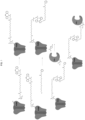
- the example demonstrates preparation of a composition of formula (V), wherein the cysteine side-chain of an ⁇ -HL-C46 pore-forming protein that is part of a heptameric nanopore complex is conjugated to the N-terminus of a DNA polymerase (Pol), as depicted schematically in FIG. 1 .
- Example 2 Site-selective conjugation of a pore-forming protein to a polymerase using click-chemistry and SpyCatcher-SpyTag reaction
- This example illustrates the use of the site-selective conjugation method of steps (a) - (c) disclosed herein with B and Z reactive groups providing a SpyTag peptide to SpyCatcher protein reaction in step (c).
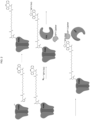
- the example demonstrates preparation of a composition of formula (V), wherein the SpyTag-modified C46 residue of the ⁇ -HL-C46 pore-forming protein, that is part of a heptameric nanopore complex, is site-specifically conjugated to a SpyCatcher-Pol6 DNA polymerase fusion, as is shown schematically in FIG. 2 .
- Example 3 Nanopore sequencing using an ⁇ -HL-Pol6 SpyTag-SpyCatcher conjugate as prepared in Example 2 in a nanopore array
- This example illustrates the use of the ⁇ -HL-Pol6 nanopore conjugates, prepared as in Example 2, in a nanopore array to sequence a nucleic acid.
- the ⁇ -HL-Pol6 nanopore conjugates are embedded in membranes formed over an array of individually addressable integrated circuit chips.
- This ⁇ -HL-Pol6 nanopore array is exposed to a JAM1A self-priming DNA template and a set of four differently 5'-tagged nucleotide substrates corresponding to the four nucleotides dA, dC, dG, and dT.
- the "tail" of the tag moiety becomes positioned in the ⁇ -HL nanopore conjugated nearby.
- the presence of the tag in the pore causes a distinctive blocking current compared to the open pore current (i.e., current with no tag in the nanopore).
- the sequence of blocking currents measured as the Pol6 synthesizes the strand complementary to the template identifies the sequence of DNA template.
- Nanopore detection system The nanopore blocking current measurements are performed using a nanopore array microchip comprising a CMOS microchip that has an array of 128,000 silver electrodes within shallow wells (chip fabricated by Genia Technologies, Mountain View, CA, USA). Methods for fabricating and using such nanopore array microchips can also be found in U.S. Patent Application Publication Nos. 2013/0244340 A1 , US 2013/0264207 A1 , and US2014/0134616 A1 . Each well in the array is manufactured using a standard CMOS process with surface modifications that allow for constant contact with biological reagents and conductive salts. Each well can support a phospholipid bilayer membrane with a nanopore-polymerase conjugate embedded therein.
- the electrode at each well is individually addressable by computer interface. All reagents used are introduced into a simple flow cell above the array microchip using a computer-controlled syringe pump.
- the chip supports analog to digital conversion and reports electrical measurements from all electrodes independently at a rate of over 1000 points per second. Nanopore blocking current measurements can be made asynchronously at each of 128K addressable nanopore-containing membranes in the array at least once every millisecond (msec) and recorded on the interfaced computer.
- lipid bilaver on chip The phospholipid bilayer membrane on the chip is prepared using 1,2-diphytanoyl-sn-glycero-3-phosphocholine (Avanti Polar Lipids). The lipid powder is dissolved in decane at 15 mM and then painted in a layer across the wells on the chip. A thinning process then is initiated by pumping air through the cis side of the array wells, thus reducing multi-lamellar lipid membranes to a single bilayer. Bilayer formation is tested using a ramping voltage from 0 to 1000 mV. A typical single bilayer would temporarily open at an applied voltage of between 300 to 500 mV.
- Nanopore-polymerase conjugate insertion in membrane After the lipid bilayer forms on the wells of the array chip, 3 ⁇ M of the 5'-tagged nucleotides, 0.1 ⁇ M of a 6:1 ⁇ -HL-Pol6 nanopore-polymerase conjugate, 0.4 ⁇ M of the desired "JAM1A" DNA template, all in a buffer solution of 3 mM CaCl 2 , 20 mM Hepes, and 500 mM potassium glutamate, pH 8, at 20°C is added to the cis side of the chip. The nanopore-polymerase conjugate in the mixture spontaneously inserts into the lipid bilayer.
- the ternary complex is able to form at the Pol6 active site but the tagged-nucleotide is not incorporated and the 5'-phosphate-linked tag is not released.
- the "JAM1A" DNA template is a 99-mer self-priming single-strand that has the sequence 5'-TTTTTGCGCTCGAGATCTCCGTAAGGAGATCTCGAGCGCGGGACTACTACTG GGATCATCATAGCCACCTCAGCTGCACGTAAGTGCAGCTGAGGTGGC-3' (SEQ ID NO:12).
- This DNA template has a first available position on the template for binding to a complementary dT nucleotide.
- the four tagged nucleotides used as polymerase substrates in the mixture were: dA6P-Cy3-T4-(idSp-T)4-T18-C3 (SEQ ID NO:13), dC6P-Cy3-T30-C3(SEQ ID NO:14), dT6P-Cy3-dT4(N3-CE-dT)3-dT23-C3(SEQ ID NO:15) , dG6P-T6-Tmp6-T19-C3 (SEQ ID NO:16).
- a wide range of 5'-tagged nucleotides useful for nanopore devices are available, such as those described in U.S. Provisional Appl. No. 61/969,628, filed March 24, 2014 , entitled "Chemical Methods for Producing Tagged Nucleotides”.
- Nanopore blocking current measurements The buffer solution used as the electrolyte solution for the nanopore current blockade measurements is 500 mM potassium glutamate, pH 8, 3 mM MgCl 2 , 20 mM Hepes, 5mM TCEP, at 20°C. A Pt/Ag/AgCl electrode setup is used and an AC current of a -10 mV to 200 mV square waveform applied. AC current can have certain advantages for nanopore detection as it allows for the tag to be repeatedly directed into and then expelled from the nanopore thereby providing more opportunities to detection. AC current also can provide a steadier potential for a more stable current signal and less degradation of the electrodes over time.
Landscapes
- Chemical & Material Sciences (AREA)
- Health & Medical Sciences (AREA)
- Life Sciences & Earth Sciences (AREA)
- Organic Chemistry (AREA)
- Engineering & Computer Science (AREA)
- Genetics & Genomics (AREA)
- Bioinformatics & Cheminformatics (AREA)
- Molecular Biology (AREA)
- Wood Science & Technology (AREA)
- Zoology (AREA)
- General Health & Medical Sciences (AREA)
- Biochemistry (AREA)
- Proteomics, Peptides & Aminoacids (AREA)
- Medicinal Chemistry (AREA)
- Biomedical Technology (AREA)
- Biotechnology (AREA)
- General Engineering & Computer Science (AREA)
- Microbiology (AREA)
- Biophysics (AREA)
- Analytical Chemistry (AREA)
- Physics & Mathematics (AREA)
- Pharmacology & Pharmacy (AREA)
- General Chemical & Material Sciences (AREA)
- Chemical Kinetics & Catalysis (AREA)
- Epidemiology (AREA)
- Animal Behavior & Ethology (AREA)
- Public Health (AREA)
- Veterinary Medicine (AREA)
- Plant Pathology (AREA)
- Toxicology (AREA)
- Immunology (AREA)
- Gastroenterology & Hepatology (AREA)
- Peptides Or Proteins (AREA)
- Enzymes And Modification Thereof (AREA)
Claims (4)
- Zusammensetzung, umfassend ein modifiziertes porenbildendes Protein mit der Strukturformel (IVa)
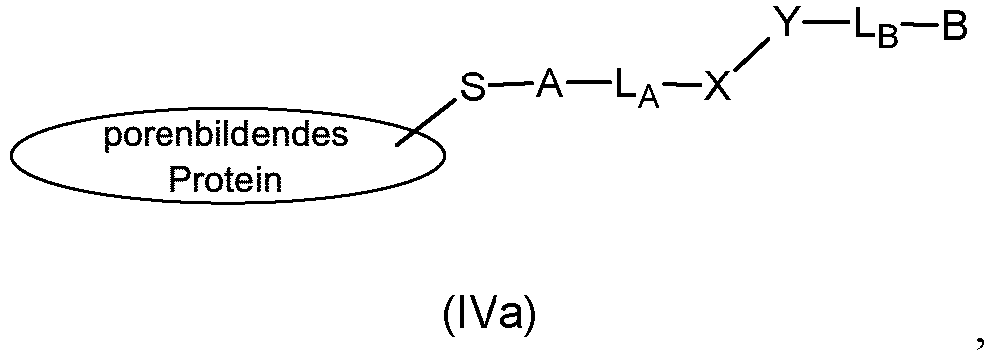 S ein Schwefelatom einer Thiolgruppe des porenbildenden Proteins ist;A eine reaktive Thiolgruppe ist;LA ein Linker ist undX eine reaktive Click-Chemie-Gruppe ist;Y eine reaktive Click-Chemie-Gruppe ist, die eine Click-Chemie-Reaktion mit der reaktiven Gruppe X eingeht;LB ein Linker ist undB eine reaktive Gruppe ist, die ein SpyTag-Peptid umfasst,wobei das modifizierte porenbildende Protein der Formel (IVa) eine Verbindung umfasst, die aus Verbindungen der Formel (IVb), (IVc), (IVd), (IVe), (IVf) und (IVg) ausgewählt ist:

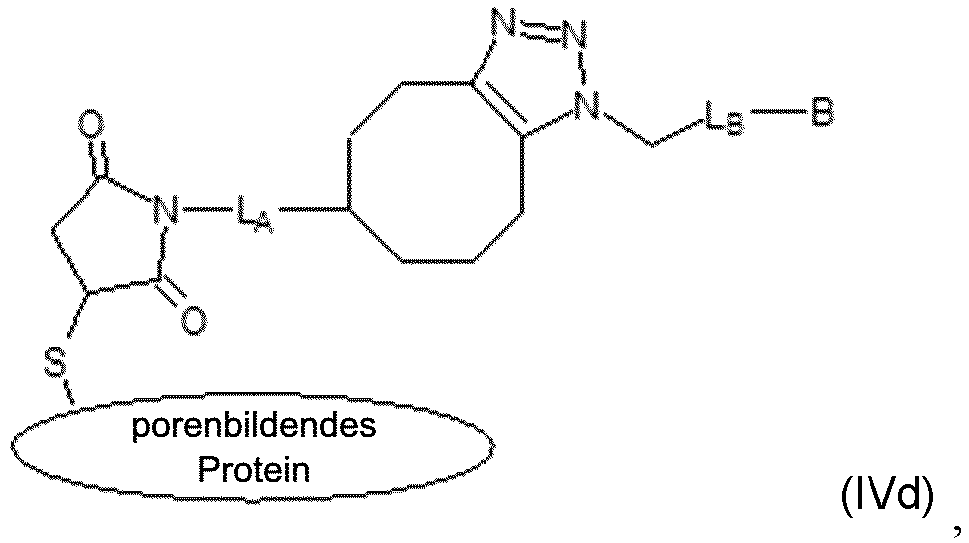


 wobei das Protein aus der Gruppe ausgewählt ist, bestehend aus α-Hämolysin, β-Hämolysin, γ-Hämolysin, Aerolysin, Zytolysin, Leukocidin, Melittin, MspA-Porin und Porin A.
 - Zusammensetzung, umfassend ein Konjugat aus einem Protein und einem Biomolekül der Formel (V)
 S ein Schwefelatom einer Thiolgruppe des Proteins ist;A ein Maleimid ist;LA ein Linker ist undX eine reaktive Click-Chemie-Gruppe ist;Y eine reaktive Click-Chemie-Gruppe ist, die eine Click-Chemie-Reaktion mit der reaktiven Gruppe X eingeht;LB ein Linker ist;B eine reaktive Gruppe ist
undZ eine reaktive Gruppe ist, die eine kovalente Bindung mit der reaktiven Gruppe B bilden kann,wobei das Konjugat der Formel (V) eine Verbindung umfasst, die aus Verbindungen der Formel (Vb), (Vd), und (Vf) ausgewählt ist:
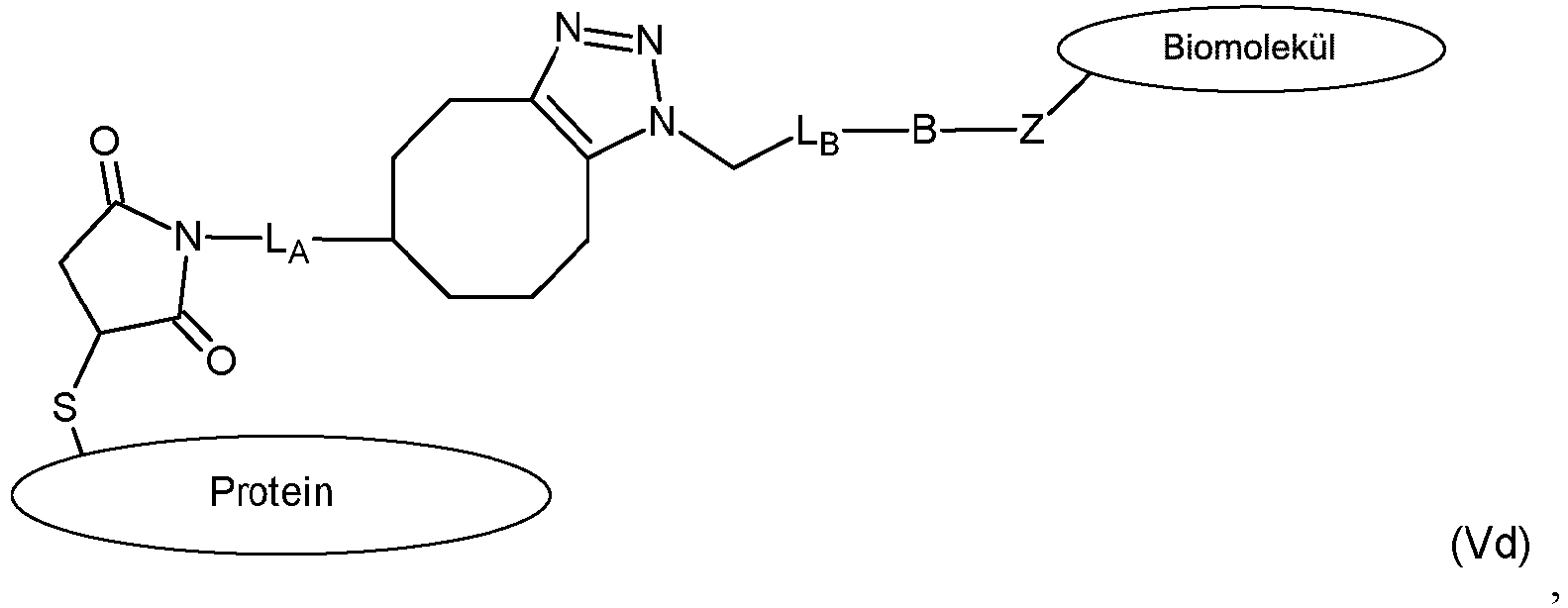
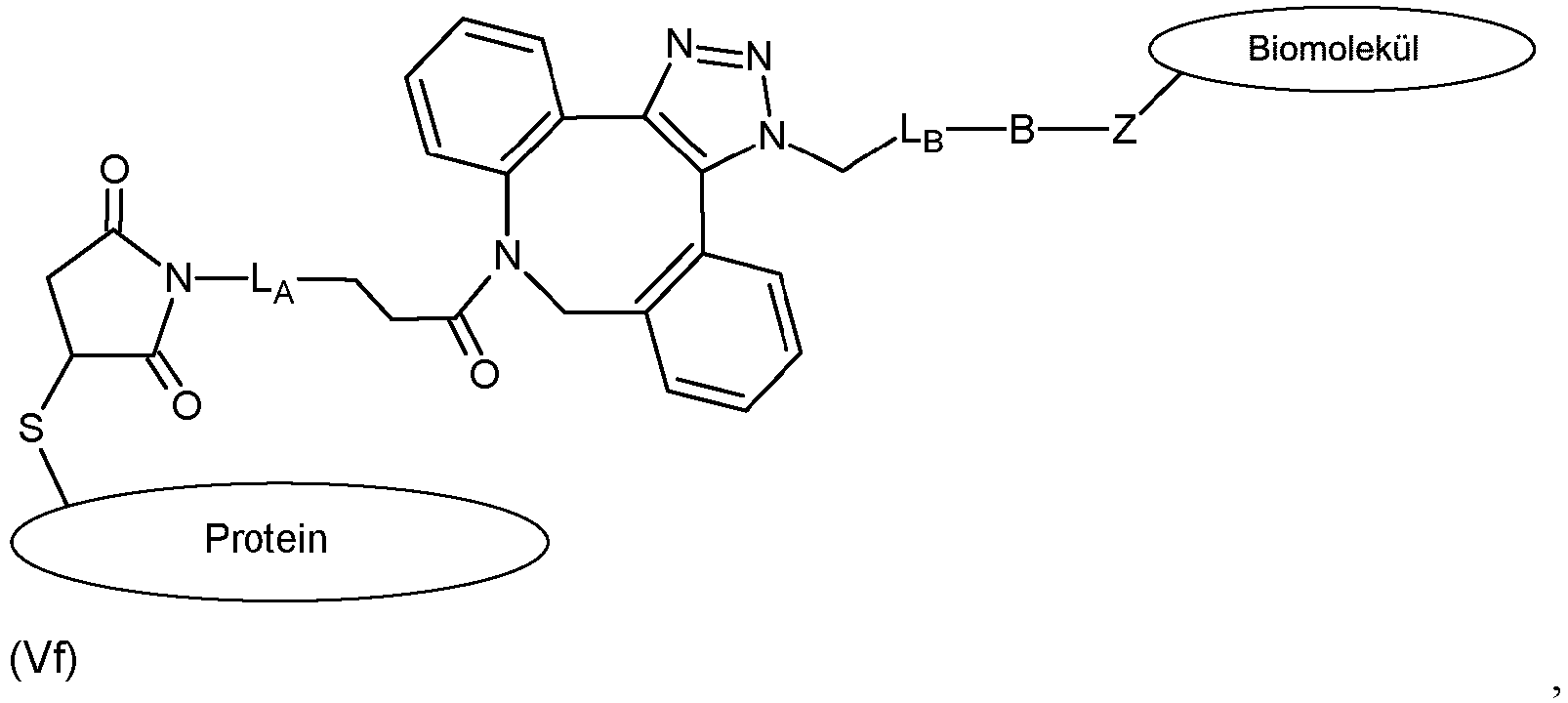 wobei die reaktive Gruppe B ein SpyTag-Peptid umfasst und die reaktive Gruppe Z ein SpyCatcher-Protein umfasst,wobei das Protein ein in eine Membran eingebettetes porenbildendes Protein ist undwobei das Biomolekül ein Enzym ist, das die Synthese eines Polymers katalysieren kann, gegebenenfalls ausgewählt aus der Gruppe, bestehend aus einer DNA-Polymerase, RNA-Polymerase, Umkehrtranskriptase und DNA-Ligase.
 - Zusammensetzung nach Anspruch 2, wobei das SpyTag-Peptid und SpyCatcher-Protein jeweils ein Fragment einer Aminosäuresequenz der CnaB2-Domäne aus dem Streptococcus pyogenes-Fibronectin-Bindungsprotein FbaB umfassen.
- Zusammensetzung nach einem der Ansprüche 2 - 3, wobei das Protein aus der Gruppe ausgewählt ist, bestehend aus α-Hämolysin, β-Hämolysin, γ-Hämolysin, Aerolysin, Zytolysin, Leukocidin, Melittin, MspA-Porin und Porin A.
Applications Claiming Priority (2)
| Application Number | Priority Date | Filing Date | Title |
|---|---|---|---|
| US201662313086P | 2016-03-24 | 2016-03-24 | |
| PCT/EP2017/057002 WO2017162828A1 (en) | 2016-03-24 | 2017-03-23 | Site-specific bio-conjugation methods and compositions useful for nanopore systems |
Publications (3)
| Publication Number | Publication Date |
|---|---|
| EP3432935A1 EP3432935A1 (de) | 2019-01-30 |
| EP3432935B1 EP3432935B1 (de) | 2022-02-23 |
| EP3432935B2 true EP3432935B2 (de) | 2025-02-26 |
Family
ID=58455022
Family Applications (1)
| Application Number | Title | Priority Date | Filing Date |
|---|---|---|---|
| EP17714408.6A Active EP3432935B2 (de) | 2016-03-24 | 2017-03-23 | Ortsspezifische biokonjugationsverfahren und zusammensetzungen für nanoporensysteme |
Country Status (6)
| Country | Link |
|---|---|
| US (3) | US11001611B2 (de) |
| EP (1) | EP3432935B2 (de) |
| JP (1) | JP6959251B2 (de) |
| CN (1) | CN109069662B (de) |
| ES (1) | ES2911439T3 (de) |
| WO (1) | WO2017162828A1 (de) |
Families Citing this family (7)
| Publication number | Priority date | Publication date | Assignee | Title |
|---|---|---|---|---|
| US10729763B2 (en) | 2017-06-10 | 2020-08-04 | Inventprise, Llc | Mixtures of polysaccharide-protein pegylated compounds |
| EP3802875A1 (de) | 2018-05-28 | 2021-04-14 | F. Hoffmann-La Roche AG | Enzymatische anreicherung von dna-poren-polymerase-komplexen |
| BR112021014415A2 (pt) | 2019-02-06 | 2021-09-21 | Synthorx, Inc. | Conjugados de il-2 e métodos de uso dos mesmos |
| US12163164B2 (en) | 2019-07-15 | 2024-12-10 | Bio-Rad Laboratories, Inc. | Hybrid reverse transcriptases |
| CN111413383B (zh) * | 2020-04-20 | 2021-03-02 | 深圳市梅丽纳米孔科技有限公司 | 一种构建双识别位点纳米孔的方法 |
| GB202015993D0 (en) * | 2020-10-08 | 2020-11-25 | Oxford Nanopore Tech Ltd | Method |
| WO2024182291A2 (en) * | 2023-02-27 | 2024-09-06 | Vaxnewmo Llc | Compositions and methods for producing glycoconjugate polypeptides having isopeptide bonds with a second polypeptide partner and uses thereof |
Family Cites Families (21)
| Publication number | Priority date | Publication date | Assignee | Title |
|---|---|---|---|---|
| US6362002B1 (en) | 1995-03-17 | 2002-03-26 | President And Fellows Of Harvard College | Characterization of individual polymer molecules based on monomer-interface interactions |
| US5795782A (en) | 1995-03-17 | 1998-08-18 | President & Fellows Of Harvard College | Characterization of individual polymer molecules based on monomer-interface interactions |
| US6267872B1 (en) | 1998-11-06 | 2001-07-31 | The Regents Of The University Of California | Miniature support for thin films containing single channels or nanopores and methods for using same |
| EP1192453B1 (de) | 1999-06-22 | 2012-02-15 | President and Fellows of Harvard College | Bestimmung von biopolymeren entsprechend der molekularen oder atomaren skala |
| US6464842B1 (en) | 1999-06-22 | 2002-10-15 | President And Fellows Of Harvard College | Control of solid state dimensional features |
| AU783675B2 (en) | 1999-09-07 | 2005-11-24 | Regents Of The University Of California, The | Methods of determining the presence of double stranded nucleic acids in a sample |
| US20030104428A1 (en) | 2001-06-21 | 2003-06-05 | President And Fellows Of Harvard College | Method for characterization of nucleic acid molecules |
| US7005264B2 (en) | 2002-05-20 | 2006-02-28 | Intel Corporation | Method and apparatus for nucleic acid sequencing and identification |
| US6870361B2 (en) | 2002-12-21 | 2005-03-22 | Agilent Technologies, Inc. | System with nano-scale conductor and nano-opening |
| WO2005017025A2 (en) | 2003-08-15 | 2005-02-24 | The President And Fellows Of Harvard College | Study of polymer molecules and conformations with a nanopore |
| US20110229877A1 (en) | 2008-07-07 | 2011-09-22 | Oxford Nanopore Technologies Limited | Enzyme-pore constructs |
| JP2012507565A (ja) * | 2008-10-30 | 2012-03-29 | グオ・ペイシュエン | Dnaのシークエンシング及び他の用途のための、膜に組み込まれたウイルスdnaパッケージングモータタンパク質コネクタバイオセンサ |
| AU2010209508C1 (en) | 2009-01-30 | 2017-10-19 | Oxford Nanopore Technologies Limited | Hybridization linkers |
| US8652779B2 (en) | 2010-04-09 | 2014-02-18 | Pacific Biosciences Of California, Inc. | Nanopore sequencing using charge blockade labels |
| CN107083421A (zh) | 2010-12-17 | 2017-08-22 | 纽约哥伦比亚大学理事会 | 使用经修饰的核苷酸和纳米孔检测的dna边合成边测序 |
| EP2726494B1 (de) * | 2011-06-28 | 2017-01-04 | Whitehead Institute For Biomedical Research | Verwendung von sortasen zur installation von click-chemie-handles für proteinligation |
| WO2013109970A1 (en) | 2012-01-20 | 2013-07-25 | Genia Technologies, Inc. | Nanopore based molecular detection and sequencing |
| US9605309B2 (en) | 2012-11-09 | 2017-03-28 | Genia Technologies, Inc. | Nucleic acid sequencing using tags |
| CN106715453B (zh) | 2014-03-24 | 2021-04-30 | 哥伦比亚大学董事会 | 用于生产带标签的核苷酸的化学方法 |
| ES2846746T3 (es) | 2014-06-03 | 2021-07-29 | Illumina Inc | Composiciones, sistemas y métodos para detectar acontecimientos usando fijaciones ancladas o adyacentes a nanoporos |
| WO2016144973A1 (en) * | 2015-03-09 | 2016-09-15 | The Trustees Of Columbia University In The City Of New York | Pore-forming protein conjugate compositions and methods |
-
2017
- 2017-03-23 ES ES17714408T patent/ES2911439T3/es active Active
- 2017-03-23 JP JP2018549192A patent/JP6959251B2/ja active Active
- 2017-03-23 WO PCT/EP2017/057002 patent/WO2017162828A1/en not_active Ceased
- 2017-03-23 EP EP17714408.6A patent/EP3432935B2/de active Active
- 2017-03-23 CN CN201780019277.0A patent/CN109069662B/zh active Active
-
2018
- 2018-09-18 US US16/134,179 patent/US11001611B2/en active Active
-
2021
- 2021-04-09 US US17/226,378 patent/US11866464B2/en active Active
-
2023
- 2023-11-16 US US18/511,430 patent/US12479893B2/en active Active
Non-Patent Citations (1)
| Title |
|---|
| Fuller et al., PNAS, 2016, 113, 5233-5238 † |
Also Published As
| Publication number | Publication date |
|---|---|
| WO2017162828A1 (en) | 2017-09-28 |
| US20190002509A1 (en) | 2019-01-03 |
| EP3432935B1 (de) | 2022-02-23 |
| EP3432935A1 (de) | 2019-01-30 |
| JP6959251B2 (ja) | 2021-11-02 |
| US12479893B2 (en) | 2025-11-25 |
| US11866464B2 (en) | 2024-01-09 |
| US11001611B2 (en) | 2021-05-11 |
| JP2019512509A (ja) | 2019-05-16 |
| ES2911439T3 (es) | 2022-05-19 |
| US20240166698A1 (en) | 2024-05-23 |
| CN109069662A (zh) | 2018-12-21 |
| CN109069662B (zh) | 2022-02-11 |
| US20210230232A1 (en) | 2021-07-29 |
Similar Documents
| Publication | Publication Date | Title |
|---|---|---|
| EP3432935B2 (de) | Ortsspezifische biokonjugationsverfahren und zusammensetzungen für nanoporensysteme | |
| EP3268050B1 (de) | Porenbildende proteinkonjugatzusammensetzungen und verfahren | |
| US10266885B2 (en) | Mutant pores | |
| US10167503B2 (en) | Mutant pores | |
| CA2869546C (en) | Mutant lysenin pores | |
| US10472673B2 (en) | Hetero-pores | |
| JP2017148052A (ja) | 変異体細孔 | |
| EP3766987A1 (de) | Alpha-hämolysin-varianten | |
| CN108884150A (zh) | 突变孔 | |
| CA3020203A1 (en) | Mutant pore | |
| WO2016132124A1 (en) | Method | |
| WO2020025909A1 (en) | Assemblies | |
| EP3759116A1 (de) | Markierte nukleosidverbindungen für die nanoporendetektion | |
| CN116323634A (zh) | 对形成纳米孔的蛋白质寡聚体的修饰 | |
| EP4569330A1 (de) | Neue porenmonomere und poren | |
| AU2023366350A1 (en) | Pore monomers and pores | |
| WO2026017094A1 (zh) | 核酸测序系统 | |
| KR20250005082A (ko) | 신규 변형된 단백질 기공 및 효소 | |
| CN120153093A (zh) | 新颖孔单体和孔 |
Legal Events
| Date | Code | Title | Description |
|---|---|---|---|
| STAA | Information on the status of an ep patent application or granted ep patent |
Free format text: STATUS: UNKNOWN |
|
| STAA | Information on the status of an ep patent application or granted ep patent |
Free format text: STATUS: THE INTERNATIONAL PUBLICATION HAS BEEN MADE |
|
| PUAI | Public reference made under article 153(3) epc to a published international application that has entered the european phase |
Free format text: ORIGINAL CODE: 0009012 |
|
| STAA | Information on the status of an ep patent application or granted ep patent |
Free format text: STATUS: REQUEST FOR EXAMINATION WAS MADE |
|
| 17P | Request for examination filed |
Effective date: 20181024 |
|
| AK | Designated contracting states |
Kind code of ref document: A1 Designated state(s): AL AT BE BG CH CY CZ DE DK EE ES FI FR GB GR HR HU IE IS IT LI LT LU LV MC MK MT NL NO PL PT RO RS SE SI SK SM TR |
|
| AX | Request for extension of the european patent |
Extension state: BA ME |
|
| DAV | Request for validation of the european patent (deleted) | ||
| DAX | Request for extension of the european patent (deleted) | ||
| STAA | Information on the status of an ep patent application or granted ep patent |
Free format text: STATUS: EXAMINATION IS IN PROGRESS |
|
| 17Q | First examination report despatched |
Effective date: 20191022 |
|
| GRAP | Despatch of communication of intention to grant a patent |
Free format text: ORIGINAL CODE: EPIDOSNIGR1 |
|
| STAA | Information on the status of an ep patent application or granted ep patent |
Free format text: STATUS: GRANT OF PATENT IS INTENDED |
|
| INTG | Intention to grant announced |
Effective date: 20210917 |
|
| RIN1 | Information on inventor provided before grant (corrected) |
Inventor name: TZITZILONIS, CHRISTOS Inventor name: GREMYACHINSKIY, DMITRIY |
|
| GRAS | Grant fee paid |
Free format text: ORIGINAL CODE: EPIDOSNIGR3 |
|
| GRAA | (expected) grant |
Free format text: ORIGINAL CODE: 0009210 |
|
| STAA | Information on the status of an ep patent application or granted ep patent |
Free format text: STATUS: THE PATENT HAS BEEN GRANTED |
|
| AK | Designated contracting states |
Kind code of ref document: B1 Designated state(s): AL AT BE BG CH CY CZ DE DK EE ES FI FR GB GR HR HU IE IS IT LI LT LU LV MC MK MT NL NO PL PT RO RS SE SI SK SM TR |
|
| REG | Reference to a national code |
Ref country code: GB Ref legal event code: FG4D |
|
| REG | Reference to a national code |
Ref country code: CH Ref legal event code: EP |
|
| REG | Reference to a national code |
Ref country code: AT Ref legal event code: REF Ref document number: 1469932 Country of ref document: AT Kind code of ref document: T Effective date: 20220315 |
|
| REG | Reference to a national code |
Ref country code: IE Ref legal event code: FG4D |
|
| REG | Reference to a national code |
Ref country code: DE Ref legal event code: R096 Ref document number: 602017053670 Country of ref document: DE |
|
| REG | Reference to a national code |
Ref country code: ES Ref legal event code: FG2A Ref document number: 2911439 Country of ref document: ES Kind code of ref document: T3 Effective date: 20220519 |
|
| REG | Reference to a national code |
Ref country code: LT Ref legal event code: MG9D |
|
| REG | Reference to a national code |
Ref country code: NL Ref legal event code: MP Effective date: 20220223 |
|
| REG | Reference to a national code |
Ref country code: AT Ref legal event code: MK05 Ref document number: 1469932 Country of ref document: AT Kind code of ref document: T Effective date: 20220223 |
|
| PG25 | Lapsed in a contracting state [announced via postgrant information from national office to epo] |
Ref country code: SE Free format text: LAPSE BECAUSE OF FAILURE TO SUBMIT A TRANSLATION OF THE DESCRIPTION OR TO PAY THE FEE WITHIN THE PRESCRIBED TIME-LIMIT Effective date: 20220223 Ref country code: RS Free format text: LAPSE BECAUSE OF FAILURE TO SUBMIT A TRANSLATION OF THE DESCRIPTION OR TO PAY THE FEE WITHIN THE PRESCRIBED TIME-LIMIT Effective date: 20220223 Ref country code: PT Free format text: LAPSE BECAUSE OF FAILURE TO SUBMIT A TRANSLATION OF THE DESCRIPTION OR TO PAY THE FEE WITHIN THE PRESCRIBED TIME-LIMIT Effective date: 20220623 Ref country code: NO Free format text: LAPSE BECAUSE OF FAILURE TO SUBMIT A TRANSLATION OF THE DESCRIPTION OR TO PAY THE FEE WITHIN THE PRESCRIBED TIME-LIMIT Effective date: 20220523 Ref country code: NL Free format text: LAPSE BECAUSE OF FAILURE TO SUBMIT A TRANSLATION OF THE DESCRIPTION OR TO PAY THE FEE WITHIN THE PRESCRIBED TIME-LIMIT Effective date: 20220223 Ref country code: LT Free format text: LAPSE BECAUSE OF FAILURE TO SUBMIT A TRANSLATION OF THE DESCRIPTION OR TO PAY THE FEE WITHIN THE PRESCRIBED TIME-LIMIT Effective date: 20220223 Ref country code: HR Free format text: LAPSE BECAUSE OF FAILURE TO SUBMIT A TRANSLATION OF THE DESCRIPTION OR TO PAY THE FEE WITHIN THE PRESCRIBED TIME-LIMIT Effective date: 20220223 Ref country code: BG Free format text: LAPSE BECAUSE OF FAILURE TO SUBMIT A TRANSLATION OF THE DESCRIPTION OR TO PAY THE FEE WITHIN THE PRESCRIBED TIME-LIMIT Effective date: 20220523 |
|
| PG25 | Lapsed in a contracting state [announced via postgrant information from national office to epo] |
Ref country code: PL Free format text: LAPSE BECAUSE OF FAILURE TO SUBMIT A TRANSLATION OF THE DESCRIPTION OR TO PAY THE FEE WITHIN THE PRESCRIBED TIME-LIMIT Effective date: 20220223 Ref country code: LV Free format text: LAPSE BECAUSE OF FAILURE TO SUBMIT A TRANSLATION OF THE DESCRIPTION OR TO PAY THE FEE WITHIN THE PRESCRIBED TIME-LIMIT Effective date: 20220223 Ref country code: GR Free format text: LAPSE BECAUSE OF FAILURE TO SUBMIT A TRANSLATION OF THE DESCRIPTION OR TO PAY THE FEE WITHIN THE PRESCRIBED TIME-LIMIT Effective date: 20220524 Ref country code: FI Free format text: LAPSE BECAUSE OF FAILURE TO SUBMIT A TRANSLATION OF THE DESCRIPTION OR TO PAY THE FEE WITHIN THE PRESCRIBED TIME-LIMIT Effective date: 20220223 Ref country code: AT Free format text: LAPSE BECAUSE OF FAILURE TO SUBMIT A TRANSLATION OF THE DESCRIPTION OR TO PAY THE FEE WITHIN THE PRESCRIBED TIME-LIMIT Effective date: 20220223 |
|
| PG25 | Lapsed in a contracting state [announced via postgrant information from national office to epo] |
Ref country code: IS Free format text: LAPSE BECAUSE OF FAILURE TO SUBMIT A TRANSLATION OF THE DESCRIPTION OR TO PAY THE FEE WITHIN THE PRESCRIBED TIME-LIMIT Effective date: 20220623 |
|
| PG25 | Lapsed in a contracting state [announced via postgrant information from national office to epo] |
Ref country code: SM Free format text: LAPSE BECAUSE OF FAILURE TO SUBMIT A TRANSLATION OF THE DESCRIPTION OR TO PAY THE FEE WITHIN THE PRESCRIBED TIME-LIMIT Effective date: 20220223 Ref country code: SK Free format text: LAPSE BECAUSE OF FAILURE TO SUBMIT A TRANSLATION OF THE DESCRIPTION OR TO PAY THE FEE WITHIN THE PRESCRIBED TIME-LIMIT Effective date: 20220223 Ref country code: RO Free format text: LAPSE BECAUSE OF FAILURE TO SUBMIT A TRANSLATION OF THE DESCRIPTION OR TO PAY THE FEE WITHIN THE PRESCRIBED TIME-LIMIT Effective date: 20220223 Ref country code: EE Free format text: LAPSE BECAUSE OF FAILURE TO SUBMIT A TRANSLATION OF THE DESCRIPTION OR TO PAY THE FEE WITHIN THE PRESCRIBED TIME-LIMIT Effective date: 20220223 Ref country code: DK Free format text: LAPSE BECAUSE OF FAILURE TO SUBMIT A TRANSLATION OF THE DESCRIPTION OR TO PAY THE FEE WITHIN THE PRESCRIBED TIME-LIMIT Effective date: 20220223 Ref country code: CZ Free format text: LAPSE BECAUSE OF FAILURE TO SUBMIT A TRANSLATION OF THE DESCRIPTION OR TO PAY THE FEE WITHIN THE PRESCRIBED TIME-LIMIT Effective date: 20220223 |
|
| REG | Reference to a national code |
Ref country code: DE Ref legal event code: R026 Ref document number: 602017053670 Country of ref document: DE |
|
| PLBI | Opposition filed |
Free format text: ORIGINAL CODE: 0009260 |
|
| PG25 | Lapsed in a contracting state [announced via postgrant information from national office to epo] |
Ref country code: MC Free format text: LAPSE BECAUSE OF FAILURE TO SUBMIT A TRANSLATION OF THE DESCRIPTION OR TO PAY THE FEE WITHIN THE PRESCRIBED TIME-LIMIT Effective date: 20220223 Ref country code: AL Free format text: LAPSE BECAUSE OF FAILURE TO SUBMIT A TRANSLATION OF THE DESCRIPTION OR TO PAY THE FEE WITHIN THE PRESCRIBED TIME-LIMIT Effective date: 20220223 |
|
| PLAX | Notice of opposition and request to file observation + time limit sent |
Free format text: ORIGINAL CODE: EPIDOSNOBS2 |
|
| REG | Reference to a national code |
Ref country code: BE Ref legal event code: MM Effective date: 20220331 |
|
| 26 | Opposition filed |
Opponent name: WITHERS & ROGERS LLP Effective date: 20221121 |
|
| PG25 | Lapsed in a contracting state [announced via postgrant information from national office to epo] |
Ref country code: LU Free format text: LAPSE BECAUSE OF NON-PAYMENT OF DUE FEES Effective date: 20220323 Ref country code: IE Free format text: LAPSE BECAUSE OF NON-PAYMENT OF DUE FEES Effective date: 20220323 |
|
| PG25 | Lapsed in a contracting state [announced via postgrant information from national office to epo] |
Ref country code: SI Free format text: LAPSE BECAUSE OF FAILURE TO SUBMIT A TRANSLATION OF THE DESCRIPTION OR TO PAY THE FEE WITHIN THE PRESCRIBED TIME-LIMIT Effective date: 20220223 Ref country code: BE Free format text: LAPSE BECAUSE OF NON-PAYMENT OF DUE FEES Effective date: 20220331 |
|
| PLBB | Reply of patent proprietor to notice(s) of opposition received |
Free format text: ORIGINAL CODE: EPIDOSNOBS3 |
|
| REG | Reference to a national code |
Ref country code: DE Ref legal event code: R082 Ref document number: 602017053670 Country of ref document: DE Representative=s name: KRAUS & LEDERER PARTGMBB, DE |
|
| REG | Reference to a national code |
Ref country code: DE Ref legal event code: R081 Ref document number: 602017053670 Country of ref document: DE Owner name: ROCHE DIAGNOSTICS GMBH, DE Free format text: FORMER OWNER: GENIA TECHNOLOGIES, INC., SANTA CLARA, CA, US |
|
| REG | Reference to a national code |
Ref country code: GB Ref legal event code: 732E Free format text: REGISTERED BETWEEN 20240125 AND 20240131 |
|
| PG25 | Lapsed in a contracting state [announced via postgrant information from national office to epo] |
Ref country code: HU Free format text: LAPSE BECAUSE OF FAILURE TO SUBMIT A TRANSLATION OF THE DESCRIPTION OR TO PAY THE FEE WITHIN THE PRESCRIBED TIME-LIMIT; INVALID AB INITIO Effective date: 20170323 |
|
| PG25 | Lapsed in a contracting state [announced via postgrant information from national office to epo] |
Ref country code: MK Free format text: LAPSE BECAUSE OF FAILURE TO SUBMIT A TRANSLATION OF THE DESCRIPTION OR TO PAY THE FEE WITHIN THE PRESCRIBED TIME-LIMIT Effective date: 20220223 Ref country code: CY Free format text: LAPSE BECAUSE OF FAILURE TO SUBMIT A TRANSLATION OF THE DESCRIPTION OR TO PAY THE FEE WITHIN THE PRESCRIBED TIME-LIMIT Effective date: 20220223 |
|
| PGFP | Annual fee paid to national office [announced via postgrant information from national office to epo] |
Ref country code: ES Payment date: 20240402 Year of fee payment: 8 |
|
| PG25 | Lapsed in a contracting state [announced via postgrant information from national office to epo] |
Ref country code: MT Free format text: LAPSE BECAUSE OF FAILURE TO SUBMIT A TRANSLATION OF THE DESCRIPTION OR TO PAY THE FEE WITHIN THE PRESCRIBED TIME-LIMIT Effective date: 20220223 |
|
| REG | Reference to a national code |
Ref country code: ES Ref legal event code: PC2A Owner name: F. HOFFMANN-LA ROCHE AG Effective date: 20240930 |
|
| PUAH | Patent maintained in amended form |
Free format text: ORIGINAL CODE: 0009272 |
|
| STAA | Information on the status of an ep patent application or granted ep patent |
Free format text: STATUS: PATENT MAINTAINED AS AMENDED |
|
| 27A | Patent maintained in amended form |
Effective date: 20250226 |
|
| AK | Designated contracting states |
Kind code of ref document: B2 Designated state(s): AL AT BE BG CH CY CZ DE DK EE ES FI FR GB GR HR HU IE IS IT LI LT LU LV MC MK MT NL NO PL PT RO RS SE SI SK SM TR |
|
| REG | Reference to a national code |
Ref country code: DE Ref legal event code: R102 Ref document number: 602017053670 Country of ref document: DE |
|
| PGFP | Annual fee paid to national office [announced via postgrant information from national office to epo] |
Ref country code: DE Payment date: 20250218 Year of fee payment: 9 |
|
| PGFP | Annual fee paid to national office [announced via postgrant information from national office to epo] |
Ref country code: FR Payment date: 20250219 Year of fee payment: 9 |
|
| PGFP | Annual fee paid to national office [announced via postgrant information from national office to epo] |
Ref country code: GB Payment date: 20250221 Year of fee payment: 9 Ref country code: IT Payment date: 20250218 Year of fee payment: 9 |
|
| PG25 | Lapsed in a contracting state [announced via postgrant information from national office to epo] |
Ref country code: ES Free format text: LAPSE BECAUSE OF FAILURE TO SUBMIT A TRANSLATION OF THE DESCRIPTION OR TO PAY THE FEE WITHIN THE PRESCRIBED TIME-LIMIT Effective date: 20250226 |
|
| PGFP | Annual fee paid to national office [announced via postgrant information from national office to epo] |
Ref country code: CH Payment date: 20250401 Year of fee payment: 9 |
|
| PG25 | Lapsed in a contracting state [announced via postgrant information from national office to epo] |
Ref country code: TR Free format text: LAPSE BECAUSE OF FAILURE TO SUBMIT A TRANSLATION OF THE DESCRIPTION OR TO PAY THE FEE WITHIN THE PRESCRIBED TIME-LIMIT Effective date: 20220223 |