EP3431239A1 - Verfahren zur herstellung einer holzwerkstoffplatte, insbesondere einer mdf- oder hdf-platte - Google Patents
Verfahren zur herstellung einer holzwerkstoffplatte, insbesondere einer mdf- oder hdf-platte Download PDFInfo
- Publication number
- EP3431239A1 EP3431239A1 EP17182396.6A EP17182396A EP3431239A1 EP 3431239 A1 EP3431239 A1 EP 3431239A1 EP 17182396 A EP17182396 A EP 17182396A EP 3431239 A1 EP3431239 A1 EP 3431239A1
- Authority
- EP
- European Patent Office
- Prior art keywords
- cake
- pigments
- binder
- mixture powder
- primer
- Prior art date
- Legal status (The legal status is an assumption and is not a legal conclusion. Google has not performed a legal analysis and makes no representation as to the accuracy of the status listed.)
- Granted
Links
Images


Classifications
-
- B—PERFORMING OPERATIONS; TRANSPORTING
- B27—WORKING OR PRESERVING WOOD OR SIMILAR MATERIAL; NAILING OR STAPLING MACHINES IN GENERAL
- B27N—MANUFACTURE BY DRY PROCESSES OF ARTICLES, WITH OR WITHOUT ORGANIC BINDING AGENTS, MADE FROM PARTICLES OR FIBRES CONSISTING OF WOOD OR OTHER LIGNOCELLULOSIC OR LIKE ORGANIC MATERIAL
- B27N7/00—After-treatment, e.g. reducing swelling or shrinkage, surfacing; Protecting the edges of boards against access of humidity
- B27N7/005—Coating boards, e.g. with a finishing or decorating layer
-
- B—PERFORMING OPERATIONS; TRANSPORTING
- B05—SPRAYING OR ATOMISING IN GENERAL; APPLYING FLUENT MATERIALS TO SURFACES, IN GENERAL
- B05C—APPARATUS FOR APPLYING FLUENT MATERIALS TO SURFACES, IN GENERAL
- B05C19/00—Apparatus specially adapted for applying particulate materials to surfaces
- B05C19/04—Apparatus specially adapted for applying particulate materials to surfaces the particulate material being projected, poured or allowed to flow onto the surface of the work
-
- B—PERFORMING OPERATIONS; TRANSPORTING
- B27—WORKING OR PRESERVING WOOD OR SIMILAR MATERIAL; NAILING OR STAPLING MACHINES IN GENERAL
- B27N—MANUFACTURE BY DRY PROCESSES OF ARTICLES, WITH OR WITHOUT ORGANIC BINDING AGENTS, MADE FROM PARTICLES OR FIBRES CONSISTING OF WOOD OR OTHER LIGNOCELLULOSIC OR LIKE ORGANIC MATERIAL
- B27N3/00—Manufacture of substantially flat articles, e.g. boards, from particles or fibres
- B27N3/06—Making particle boards or fibreboards, with preformed covering layers, the particles or fibres being compressed with the layers to a board in one single pressing operation
-
- B—PERFORMING OPERATIONS; TRANSPORTING
- B27—WORKING OR PRESERVING WOOD OR SIMILAR MATERIAL; NAILING OR STAPLING MACHINES IN GENERAL
- B27N—MANUFACTURE BY DRY PROCESSES OF ARTICLES, WITH OR WITHOUT ORGANIC BINDING AGENTS, MADE FROM PARTICLES OR FIBRES CONSISTING OF WOOD OR OTHER LIGNOCELLULOSIC OR LIKE ORGANIC MATERIAL
- B27N3/00—Manufacture of substantially flat articles, e.g. boards, from particles or fibres
- B27N3/08—Moulding or pressing
- B27N3/10—Moulding of mats
- B27N3/14—Distributing or orienting the particles or fibres
-
- B—PERFORMING OPERATIONS; TRANSPORTING
- B27—WORKING OR PRESERVING WOOD OR SIMILAR MATERIAL; NAILING OR STAPLING MACHINES IN GENERAL
- B27N—MANUFACTURE BY DRY PROCESSES OF ARTICLES, WITH OR WITHOUT ORGANIC BINDING AGENTS, MADE FROM PARTICLES OR FIBRES CONSISTING OF WOOD OR OTHER LIGNOCELLULOSIC OR LIKE ORGANIC MATERIAL
- B27N3/00—Manufacture of substantially flat articles, e.g. boards, from particles or fibres
- B27N3/08—Moulding or pressing
- B27N3/18—Auxiliary operations, e.g. preheating, humidifying, cutting-off
-
- B—PERFORMING OPERATIONS; TRANSPORTING
- B27—WORKING OR PRESERVING WOOD OR SIMILAR MATERIAL; NAILING OR STAPLING MACHINES IN GENERAL
- B27N—MANUFACTURE BY DRY PROCESSES OF ARTICLES, WITH OR WITHOUT ORGANIC BINDING AGENTS, MADE FROM PARTICLES OR FIBRES CONSISTING OF WOOD OR OTHER LIGNOCELLULOSIC OR LIKE ORGANIC MATERIAL
- B27N7/00—After-treatment, e.g. reducing swelling or shrinkage, surfacing; Protecting the edges of boards against access of humidity
-
- B—PERFORMING OPERATIONS; TRANSPORTING
- B07—SEPARATING SOLIDS FROM SOLIDS; SORTING
- B07B—SEPARATING SOLIDS FROM SOLIDS BY SIEVING, SCREENING, SIFTING OR BY USING GAS CURRENTS; SEPARATING BY OTHER DRY METHODS APPLICABLE TO BULK MATERIAL, e.g. LOOSE ARTICLES FIT TO BE HANDLED LIKE BULK MATERIAL
- B07B13/00—Grading or sorting solid materials by dry methods, not otherwise provided for; Sorting articles otherwise than by indirectly controlled devices
- B07B13/14—Details or accessories
- B07B13/16—Feed or discharge arrangements
-
- B—PERFORMING OPERATIONS; TRANSPORTING
- B27—WORKING OR PRESERVING WOOD OR SIMILAR MATERIAL; NAILING OR STAPLING MACHINES IN GENERAL
- B27N—MANUFACTURE BY DRY PROCESSES OF ARTICLES, WITH OR WITHOUT ORGANIC BINDING AGENTS, MADE FROM PARTICLES OR FIBRES CONSISTING OF WOOD OR OTHER LIGNOCELLULOSIC OR LIKE ORGANIC MATERIAL
- B27N3/00—Manufacture of substantially flat articles, e.g. boards, from particles or fibres
- B27N3/08—Moulding or pressing
- B27N3/086—Presses with means for extracting or introducing gases or liquids in the mat
-
- B—PERFORMING OPERATIONS; TRANSPORTING
- B32—LAYERED PRODUCTS
- B32B—LAYERED PRODUCTS, i.e. PRODUCTS BUILT-UP OF STRATA OF FLAT OR NON-FLAT, e.g. CELLULAR OR HONEYCOMB, FORM
- B32B37/00—Methods or apparatus for laminating, e.g. by curing or by ultrasonic bonding
- B32B37/14—Methods or apparatus for laminating, e.g. by curing or by ultrasonic bonding characterised by the properties of the layers
- B32B37/24—Methods or apparatus for laminating, e.g. by curing or by ultrasonic bonding characterised by the properties of the layers with at least one layer not being coherent before laminating, e.g. made up from granular material sprinkled onto a substrate
- B32B2037/243—Coating
-
- B—PERFORMING OPERATIONS; TRANSPORTING
- B32—LAYERED PRODUCTS
- B32B—LAYERED PRODUCTS, i.e. PRODUCTS BUILT-UP OF STRATA OF FLAT OR NON-FLAT, e.g. CELLULAR OR HONEYCOMB, FORM
- B32B2307/00—Properties of the layers or laminate
- B32B2307/50—Properties of the layers or laminate having particular mechanical properties
- B32B2307/554—Wear resistance
-
- B—PERFORMING OPERATIONS; TRANSPORTING
- B32—LAYERED PRODUCTS
- B32B—LAYERED PRODUCTS, i.e. PRODUCTS BUILT-UP OF STRATA OF FLAT OR NON-FLAT, e.g. CELLULAR OR HONEYCOMB, FORM
- B32B2317/00—Animal or vegetable based
- B32B2317/16—Wood, e.g. woodboard, fibreboard, woodchips
-
- B—PERFORMING OPERATIONS; TRANSPORTING
- B65—CONVEYING; PACKING; STORING; HANDLING THIN OR FILAMENTARY MATERIAL
- B65G—TRANSPORT OR STORAGE DEVICES, e.g. CONVEYORS FOR LOADING OR TIPPING, SHOP CONVEYOR SYSTEMS OR PNEUMATIC TUBE CONVEYORS
- B65G69/00—Auxiliary measures taken, or devices used, in connection with loading or unloading
- B65G69/04—Spreading out the materials conveyed over the whole surface to be loaded; Trimming heaps of loose materials
-
- B—PERFORMING OPERATIONS; TRANSPORTING
- B65—CONVEYING; PACKING; STORING; HANDLING THIN OR FILAMENTARY MATERIAL
- B65G—TRANSPORT OR STORAGE DEVICES, e.g. CONVEYORS FOR LOADING OR TIPPING, SHOP CONVEYOR SYSTEMS OR PNEUMATIC TUBE CONVEYORS
- B65G69/00—Auxiliary measures taken, or devices used, in connection with loading or unloading
- B65G69/04—Spreading out the materials conveyed over the whole surface to be loaded; Trimming heaps of loose materials
- B65G69/0425—Spreading out the materials conveyed over the whole surface to be loaded; Trimming heaps of loose materials with vibrating or shaking means
-
- B—PERFORMING OPERATIONS; TRANSPORTING
- B65—CONVEYING; PACKING; STORING; HANDLING THIN OR FILAMENTARY MATERIAL
- B65G—TRANSPORT OR STORAGE DEVICES, e.g. CONVEYORS FOR LOADING OR TIPPING, SHOP CONVEYOR SYSTEMS OR PNEUMATIC TUBE CONVEYORS
- B65G69/00—Auxiliary measures taken, or devices used, in connection with loading or unloading
- B65G69/04—Spreading out the materials conveyed over the whole surface to be loaded; Trimming heaps of loose materials
- B65G69/0458—Spreading out the materials conveyed over the whole surface to be loaded; Trimming heaps of loose materials with rotating means, e.g. tables, arms
-
- Y—GENERAL TAGGING OF NEW TECHNOLOGICAL DEVELOPMENTS; GENERAL TAGGING OF CROSS-SECTIONAL TECHNOLOGIES SPANNING OVER SEVERAL SECTIONS OF THE IPC; TECHNICAL SUBJECTS COVERED BY FORMER USPC CROSS-REFERENCE ART COLLECTIONS [XRACs] AND DIGESTS
- Y02—TECHNOLOGIES OR APPLICATIONS FOR MITIGATION OR ADAPTATION AGAINST CLIMATE CHANGE
- Y02W—CLIMATE CHANGE MITIGATION TECHNOLOGIES RELATED TO WASTEWATER TREATMENT OR WASTE MANAGEMENT
- Y02W30/00—Technologies for solid waste management
- Y02W30/50—Reuse, recycling or recovery technologies
- Y02W30/91—Use of waste materials as fillers for mortars or concrete
Definitions
- the invention relates to a method for producing a wood-based panel, in particular an MDF or HDF board by spreading a cake of wood chips or wood fibers wetted with a binder, which is then pressed in a hot press to a plate of desired thickness, wherein prior to compression On a top of the cake, a primer is applied without contact.
- Emulsion paints are usually viscous paints or paints consisting of a chemical dispersion (usually an emulsion) of binders and solvents, colorants (usually pigments) and additives.
- This liquid primer may be sprayed onto the top of the cake by means of spray nozzles or by means of a sputtering device.
- the wood-based panels produced by this method can be coated or printed and then divided into individual panels and used, for example, for the construction of floors.
- the generic method is to be improved so that a wood-based panel is provided with a primed top, with which the disadvantages are avoided.
- the primer should have a uniform and brightest color as possible in order to simplify the printing of the finished pressed wood material board.
- existing processes should not be affected by the improved process and larger investments would not be required.
- the generic method is characterized in that the primer is a mixture powder of color pigments and a second binder, which is scattered on the top of the cake.
- the opacity of the primer can be adjusted. If a bright décor is later printed on the pressed wood-based panel, the primer should be as light as possible. If a dark decor is printed, the primer may also be darker or have less opacity so that the mixture powder layer can be thinned thinner.
- the cake is sprayed after sprinkling the mixture powder with water.
- the scattered powder can be fixed and dust formation during the entry of the cake into the subsequent hot press can be avoided.
- the water is preferably sprayed in an amount of 10 to 30 g / m 2 .
- the first binder and the second binder are at least substantially identically constructed, adhesion problems between the pressed layers are avoided.
- the term essentially should take into account that small differences in the composition of the two binders may be possible, the base material, ie the resin used for example, is identical.
- the mixture powder preferably consists of 80 to 90% by weight of pigments and 10 to 20% by weight of the second binder. In order to achieve the highest possible opacity of the primer layer, the pigments are particularly preferably white.
- first and / or second binder powdered melamine resin, urea resin, acrylates, ethylene-vinyl acetate copolymers and the like can be used.
- the mixture powder is sprinkled in an amount between 5 and 120 g / m 2 .
- the powdered pigments used in the mixture powder may consist of a single pigment or of a mixture of different pigments.
- titanium oxide, calcium carbonate, barium sulfate or the like can be used as pigments.
- the order quantity of the mixture powder is 60 to 80 g / m 2 at a desired L value according to the CIELAB color system of about 90 is in a mixture powder consisting only of titanium dioxide and the second binder, a Amount of 12 to 16 g / m 2 needed.
- (inexpensive) iron oxide pigments can be added to the white pigments, so that a slightly tinted color of the primer sets in.
- the sieve is preferably arranged between 5 and 10 cm above the top of the cake.
- roundwood 10 is first crushed in a chipper 100 to wood chips HS and washed and cooked in a subsequent cooker 101.
- the thus prepared wood chips HS are then transferred to the refiner 102, in which they are digested to wood fibers HF.
- the wood fibers HF are glued in a gluing device 103 with a first binder, for example melamine resin, urea resin, acrylate or ethylene-vinyl acetate copolymer.
- the glued wood fibers HF are further transported and then dried in a dryer 104.
- the dryer 104 consists of a pre-dryer 104.1 and a after-dryer 104.2.
- the wood fibers HF are deprived of any residual moisture and the first binder is dried.
- the wood fibers HF are transported for classification in the classifier 105, from which they reach the first spreader 106.
- the wood fibers HF are then scattered to a not shown here, in the transport direction T circulating conveyor belt 111 to a cake 1.
- This fiber cake 1 then passes into the pre-press 107, which performs a pre-compaction of the cake 1.
- At least one second scattering device 108 is provided in the transport direction T behind the pre-press 107, in which the primer 3 is provided and is scattered by means of the second spreader 108 onto the upper side 1.1 of the cake 1.
- the primer is a mixed powder of pigments and a second binder.
- the mixture powder consists of 80 to 90 wt.% Of pigments and 10 to 20 wt.% Of the second binder and is sprinkled in an amount between 5 and 120 g / m 2 .
- the scattered amount depends on the desired opacity of the primer.
- the top 1.1 is sprayed over the sprayer 109 with water, wherein an amount of about 10 to 30 g / m 2 is sprayed.
- the cake 1 in the hot press 110 which is preferably a Contipresse, transported and pressed there under high pressure and high temperature to a wood-based panel 2 of desired thickness.
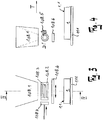
- the structure of the spreader 108 is FIG. 2 schematically removable. It consists of a funnel 108.1 for receiving the mixture powder, a roller 108.2 arranged below the funnel 108.2, which is provided with depressions 108.3 over its circumference, a doctor blade 108.4 sweeping over the depressions 108.3, a brush 108.5 running through the depressions 108.3 and one below the roller 108.2 arranged oscillating driven sieve 108.6.
- the distance of the sieve 108.6 to the top 1.1 of the cake 1 is approximately between 5 and 10 cm.
- the mixture powder to be scattered on the cake 1 is filled.
- the mixture powder falls into the recesses 108.3 of the rotating roller 108.2.
- the control of the order quantity of the mixture powder is effected by the rotational speed of the roller. Via the doctor blade 108.4, the application quantity is kept constant over the production width by the depressions 108.3 being withdrawn by the doctor blade 108.4.
- the brush 108.5 arranged in the direction of rotation D of the roller 108.2 brushes the mixed powder out of the depressions 108.3, in which it roams through them.
- the mixture powder then falls onto the sieve 108.6, which oscillates transversely to the transport direction T and thereby compensates for inhomogeneities in the scattering on the upper side 1.1 of the cake 1.
- the spread rate varies depending on the required opacity and the pigment used between 5 and 120 g of mixture powder per square meter.
- a target L value according to the CIELAB color system of about 90 of a mixture powder, which consists only of titanium oxide and binder, an amount of 12 to 16 g / m 2 needed.
- the application rate of the mixture powder is 60 to 80 g / m 2 .
- This process leads to a homogenization of the surface or a reduction in the cloudiness of the primer.
- mixture powders with less expensive pigments can be used in the forward scattering device 108 in the transport direction T and high-grade titanium dioxide can be used as the pigment in the last scattering device 108.
- a mixture of calcium carbonate (85% by weight) and melamine resin powder (15% by weight) was mixed on the cake 1, which had a thickness of approximately 10 cm, with the aid of two spreaders 108 Quantity of 50 gsm spread. In each case, 25 g / m 2 mixture powder were scattered by each of the two scattering devices 108. In a third spreader 108 was a mixture powder in which the calcium carbonate had been replaced by titanium oxide. This mixture powder was sprinkled on the cake 1 with the calcium carbonate-melamine resin mixture powder in an amount of 5 g / m 2 . Then, in the spraying device 109, water in an amount of 30 g / m 2 was sprayed onto the mixture powder.
- the cake 1 was then pressed in the Contipresse 110 to an 8 mm thick HDF.
- a sample was taken behind the press and the L value determined according to the CIELAB system. A value of 89.3 was measured.
- the wood-based panels 2, which had no distortion despite one-sided coating were freed after cooling in a printing line by a grinding cut of loose components on the surface and then with a synthetic resin primer (melamine resin, about 20 g / m 2 , solids content about 65 wt .%) Provided. Then the primer was dried in a circulating air dryer, provided with a primer and dried again. Subsequently, it was printed in gravure with a decor and provided with a cover / transport layer and complete dried and cooled. The plate 2 was then pressed in a further production step with an overlay and a counter-pull in a short-cycle press to form a laminate.
- the wood-based panels 2, which had no distortions despite one-sided coating were freed after cooling in a printing line by a grinding cut of loose components on the surface and then with a synthetic resin primer (melamine resin, about 20 g / m 2 , solids content about 25 wt .%) Provided. Then, the primer was dried in a circulating air dryer provided with a primer and dried again. Subsequently, it was printed in digital printing with a decor and provided with a cover / transport layer and complete dried and cooled. The wood-based panel 2 was then pressed in a further production step with an overlay and a counter-pull in a short-cycle press to form a laminate.
- a mixture of calcium carbonate (85% by weight) and melamine resin powder (15% by weight) in an amount of 75 g / m was applied to a cake 1 made of wood fibers HF having a thickness of about 13 cm by means of three scatterers 108 2 sprinkled, each of which scattering device (108) were sprinkled 25 g / m 2 .
- the spray device 109 30 g of water per m 2 were then sprayed onto the scattered mixture powder.
- the cake 1 was pressed in the Contipresse 110 to a 10 mm thick HDF plate.
- a sample was taken behind the Contipresse 110 and the L value determined according to the CIELAB color system. A value of 86.1 was measured.
- the wood-based panels 2 which had no distortion despite one-sided coating, were freed from the surface after cooling in a printing line by a grinding cut of loose components and then with a synthetic resin primer (melamine resin: about 20 g / m 2 , solids content: about 65 % By weight). Then the primer was dried in a circulating air dryer, provided with a primer and dried again. Subsequently, it was printed in digital printing with a decor and provided with a cover / transport layer and finally dried and cooled. The wood-based panel 2 was then pressed in a further production step with a liquid overlay and a liquid counter-pull in a short-cycle press to form a laminate.
- a synthetic resin primer melamine resin: about 20 g / m 2 , solids content: about 65 % By weight
Landscapes
- Life Sciences & Earth Sciences (AREA)
- Engineering & Computer Science (AREA)
- Manufacturing & Machinery (AREA)
- Wood Science & Technology (AREA)
- Forests & Forestry (AREA)
- Dry Formation Of Fiberboard And The Like (AREA)
Abstract
Description
- Die Erfindung betrifft ein Verfahren zur Herstellung einer Holzwerkstoffplatte, insbesondere einer MDF- oder HDF-Platte, indem ein Kuchen aus mit einem Bindemittel benetzten Holzspänen oder Holzfasern gestreut wird, der anschließend in einer Heißpresse zu einer Platte gewünschter Dicke verpresst wird, wobei vor dem Verpressen auf eine Oberseite des Kuchens ein Grundierungsmittel berührungslos aufgebracht wird.
- Ein solches Verfahren ist beispielsweise aus der
DE 10 2009 052 413 B4 bekannt. Als Grundiermittel kann eine Dispersionsfarbe oder ein Lack verwendet werden. Dispersionsfarben sind in der Regel zähflüssige Farben bzw. Anstriche, die aus einer chemischen Dispersion (meistens einer Emulsion) aus Binde- und Lösungsmitteln, Farbmitteln (meistens Pigmenten) und Zusatzstoffen bestehen. Dieses flüssige Grundierungsmittel kann auf die Oberseite des Kuchens mittel Sprühdüsen oder mittels einer Zerstäubungsvorrichtung aufgesprüht werden. - Die nach diesem Verfahren hergestellten Holzwerkstoffplatten können beschichtet oder bedruckt werden und dann zu einzelnen Paneelen aufgeteilt und beispielsweise zur Ausbildung von Fußböden verwendet werden.
- Bei der Herstellung von Laminatfußböden wurde zunächst mit harzimprägnierten Papieren gearbeitet, die in einer sogenannten Kurztaktpresse bei hohem Druck und hoher Temperatur auf Holzwerkstoffträger wie Dünnspanplatten oder hochdichten Faserplatten aufgepresst wurden. Als Imprägnate wurden dabei auf der Oberseite ein Overlay als Verschleißschutzschicht, ein Dekorpapier als Designträger und auf der Rückseite ein Gegenzug für die Spannungssymmetrie verwendet. Bei dieser Art der Fertigung muss der Nachteil in Kauf genommen werden, dass alle Papiere während des Imprägnierschrittes durch die Behandlung mit wasserhaltigen Kunstharzen einem unkontrollierten Längen- und Breitenwachstum unterliegen. Dies führt bei vorgegebenen Deckmaß, insbesondere in der Länge, zu einer Verschiebung des Druckbildes auf dem einzelnen Paneel.
- Um diesen Mangel zu beheben wird in der
EP 2 236 313 B1 vorgeschlagen, direkt auf die Oberseite der Holzwerkstoffplatte zu drucken. Dabei wird die Oberseite unmittelbar mit wasserhaltigen Kunstharz- und Pigmentformulierungen grundiert und getrocknet. Auf die Grundierung wird das Dekor aufgedruckt und die bedruckte Holzwerkstoffplatte dann in einer Kurztaktpresse verpresst. Das Aufbringen der Grundierung erfordert einen recht aufwendigen Prozess, weil mehrere Schichten übereinander aufgetragen und diese Schichten jeweils zwischengetrocknet werden müssen. Nach dem letzten Auftrag der Grundierung bzw. nach dem Dekordruck muss die Holzwerkstoffplatte, die sich durch das mehrfache Erwärmen in Umlufttrocknern stark erwärmt hat, aufwändig gekühlt werden. Der Fertigungsprozess ist deshalb recht energie- und anlagenintensiv. Eine für diesen Prozess konzipierte Anlage kann eine Länge von 150 bis 200 Metern erreichen. Produktionsgeschwindigkeiten von 60 bis 90 m/min sind üblich. Die Anlage hat damit einen erheblichen Platz- und Energiebedarf. Die einzelnen pigmentierten Grundierungsschichten werden mittels Walzenauftragsmaschinen nacheinander aufgebracht. Bei Produktionsabstellungen entsteht deshalb ein erheblicher Reinigungsbedarf an den Maschinen. Gleiches gilt für unvorhergesehene Betriebsunterbrechungen, da die für die Grundierung eingesetzten Flotten durch Verdunstung des Lösemittels ihre Viskosität ändern und damit auch Änderungen in der Deckkraft auftreten. - Aus der
EP 2 226 201 B1 ist es bekannt, anstatt eine fertig gepresste Holzwerkstoffplatte mit einem Dekor zu bedrucken, den Dekordruck auf dem gestreuten Faserkuchen vorzunehmen. Zur Vorbereitung der Druckoberfläche kann auf die Oberseite des gestreuten Faserkuchens eine Schicht feinere Fasern mit Zusätzen wie Pigmenten, Harzen oder Salzen vorgesehen werden. Dieses Verfahren hat den Nachteil, dass ein derart komplexes Gemisch leicht zur Separierung neigt. - Von dieser Problemstellung ausgehend soll das gattungsgemäße Verfahren so verbessert werden, dass eine Holzwerkstoffplatte mit einer grundierten Oberseite geschaffen wird, mit dem die geschilderten Nachteile vermieden werden. Insbesondere soll die Grundierung gleichmäßig und einen möglichst hellen Farbton aufweisen, um das Bedrucken der fertig gepressten Holzwerkstoffplatte zu vereinfachen. Darüber hinaus sollen vorhandene Prozesse mit dem verbesserten Verfahren nicht beeinträchtigt werden und größere Investitionen nicht erforderlich sein.
- Zur Problemlösung zeichnet sich das gattungsgemäße Verfahren dadurch aus, dass das Grundierungsmittel ein Gemischpulver aus Farbpigmenten und einem zweiten Bindemittel ist, das auf die Oberseite des Kuchens aufstreut wird.
- Durch die Verwendung eines Pulvers werden Lösungsmittel völlig eliminiert, der beschriebene Reinigungsaufwand entfällt und schädliche Emissionen durch Verdunsten beim Beschichten entfallen. Durch geeignete Auswahl der pulverförmigen Farbpigmente und der Dicke der gestreuten Gemischpulverschicht kann die Deckkraft der Grundierung eingestellt werden. Soll ein helles Dekor später auf die verpresste Holzwerkstoffplatte aufgedruckt, sollte die Grundierung möglichst hell sein. Wird ein dunkles Dekor aufgedruckt werden, kann die Grundierung auch dunkler sein bzw. weniger Deckkraft aufweisen, sodass die Gemischpulverschicht dünner gestreut werden kann.
- Vorzugsweise wird der Kuchen nach dem Aufstreuen des Gemischpulvers mit Wasser besprüht. Dadurch kann das aufgestreute Pulver fixiert und eine Staubbildung beim Einlauf des Kuchens in die nachfolgende Heißpresse vermieden werden.
- Das Wasser wird vorzugsweise in einer Menge von 10 bis 30 g/m2 aufgesprüht.
- Wenn das erste Bindemittel und das zweite Bindemittel zumindest im Wesentlichen identisch aufgebaut sind, werden Haftungsprobleme zwischen den verpressten Schichten vermieden. Der Begriff im Wesentlichen soll dabei berücksichtigen, dass kleine Unterschiede in der Zusammensetzung der beiden Bindemittel möglich sein können, der Grundwerkstoff, also das beispielsweise verwendete Harz, identisch ist. Vorzugsweise besteht das Gemischpulver aus 80 bis 90 Gew.% aus Pigmenten und zu 10 bis 20 Gew.% aus dem zweiten Bindemittel. Um eine möglichst hohe Deckkraft der Grundierungsschicht erzielen zu können, sind die Pigmente insbesondere vorzugsweise weiß.
- Als erstes und/oder zweites Bindemittel können pulverförmiges Melaminharz, Harnstoffharz, Acrylate, Ethylen-Vinylacetat-Copolymere und dergleichen verwendet werden.
- Vorzugsweise wird das Gemischpulver in einer Menge zwischen 5 und 120 g/m2 aufgestreut.
- Die in dem Gemischpulver verwendeten pulverförmigen Pigmente können aus einem einzelnen Pigment oder aus einem Gemisch verschiedener Pigmente bestehen.
- Als Pigmente können Titanoxid, Kalziumkarbonat, Bariumsulfat oder dergleichen verwendet werden. Beim Einsatz von Kalziumkarbonat als Pigment liegt die Auftragsmenge des Gemischpulvers bei 60 bis 80 g/m2 bei einem angestrebten L-Wert nach dem CIELAB-Farbsystem von ca. 90 wird bei einem Gemischpulver, das nur aus Titandioxid und dem zweiten Bindemittel besteht, eine Menge von 12 bis 16 g/m2 benötigt.
- Wenn keine hochweiße Grundierung notwendig ist, können den weißen Pigmenten beispielsweise (preiswerte) Eisenoxidpigmente zugemischt werden, sodass sich eine leicht getönte Farbe der Grundierung einstellt.
- Eine Vorrichtung zum Aufstreuen des Gemischpulvers besteht zumindest aus:
- a) einem Trichter,
- b) einer unterhalb des Trichters rotierbar angeordneten Walze, die über ihren Umfang mit Vertiefungen versehen ist,
- c) einem die Vertiefungen überstreichenden Rakel,
- d) einer die Vertiefungen durchstreifenden Bürste,
- e) einem unterhalb der Walze angeordneten oszillierend angetriebenen Sieb.
- Das Sieb ist vorzugsweise zwischen 5 und 10 cm oberhalb der Oberseite des Kuchens angeordnet.
- Mit Hilfe einer Zeichnung sollen Ausführungsbeispiele der Erfindung nachfolgend kurz erläutert werden. Es zeigen:
- Figur 1 -
- ein Prozessschema zur Herstellung einer Holzfaserplatte,
- Figur 2 -
- eine schematisierte Teildarstellung des Fertigungsprozesses,
- Figur 3 -
- die schematische Schnittdarstellung einer Streuvorrichtung quer zur Transportrichtung,
- Figur 4 -
- den Schnitt entlang der Linie IV-IV nach
Figur 3 . - Anhand von
Figur 1 soll das erfindungsgemäße Herstellungsverfahren erläutert werden. Bereitgestelltes Rundholz 10 wird zunächst in einem Zerspaner 100 zu Holzhackschnitzeln HS zerkleinert und in einem sich daran anschließenden Kocher 101 gewaschen und gekocht. Die so vorbereiteten Hackschnitzel HS werden dann in den Refiner 102 überführt, in dem sie zu Holzfasern HF aufgeschlossen werden. In Transportrichtung T werden die Holzfasern HF in einer Beleimvorrichtung 103 mit einem ersten Bindemittel, beispielsweise Melaminharz, Harnstoffharz, Acrylat oder Ethylen-Vinylacetat-Copolymer beleimt. Die beleimten Holzfasern HF werden weiter transportiert und dann in einem Trockner 104 getrocknet. Der Trockner 104 besteht aus einem Vortrockner 104.1 und einem Nachtrockner 104.2. In dem Trockner 104 wird den Holzfasern HF eine etwa vorhandene Restfeuchte entzogen und das erste Bindemittel getrocknet. Nach dem Trockner 104 werden die Holzfasern HF zur Klassierung in den Sichter 105 transportiert, von dem aus sie in die erste Streuvorrichtung 106 gelangen. Über diese Streuvorrichtung 106 werden die Holzfasern HF dann auf ein hier nicht näher dargestelltes, in Transportrichtung T umlaufendes Transportband 111 zu einem Kuchen 1 gestreut. Dieser Faserkuchen 1 gelangt dann in die Vorpresse 107, die eine Vorverdichtung des Kuchens 1 vornimmt. In Transportrichtung T hinter der Vorpresse 107 ist mindestens eine zweite Streuvorrichtung 108 vorgesehen, in der das Grundierungsmittel 3 vorgesehen ist und mittels der zweiten Streuvorrichtung 108 auf die Oberseite 1.1 des Kuchens 1 aufgestreut wird. Vorzugsweise sind zwei oder drei zweite Streuvorrichtungen 108 in Transportrichtung T hintereinander angeordnet. Das Grundierungsmittel ist ein Gemischpulver aus Pigmenten und einem zweiten Bindemittel. Das Gemischpulver besteht zu 80 bis 90 Gew.% aus Pigmenten und zu 10 bis 20 Gew.% aus dem zweiten Bindemittel und wird in einer Menge zwischen 5 und 120 g/m2 aufgestreut. Die aufgestreute Menge ist abhängig von der gewünschten Deckkraft der Grundierung. Nach dem das Gemischpulver auf den Kuchen 1 aufgestreut wurde, wird die Oberseite 1.1 über die Sprüheinrichtung 109 mit Wasser besprüht, wobei eine Menge etwa 10 bis 30 g/m2 aufgesprüht wird. Anschließend wird der Kuchen 1 in die Heißpresse 110, die vorzugsweise eine Contipresse ist, transportiert und dort unter hohem Druck und hoher Temperatur zu einer Holzwerkstoffplatte 2 gewünschter Dicke verpresst. - Der Aufbau der Streuvorrichtung 108 ist
Figur 2 schematisch entnehmbar. Sie besteht aus einem Trichter 108.1 zur Aufnahme des Gemischpulvers, eine unterhalb des Trichters 108.1 angeordneten Walze 108.2, die über ihren Umfang mit Vertiefungen 108.3 versehen ist, einem die Vertiefungen 108.3 überstreichenden Rakel 108.4, einer die Vertiefungen 108.3 durchstreifenden Bürste 108.5 und einem unterhalb der Walze 108.2 angeordneten oszillierend angetrieben Sieb 108.6. Der Abstand des Siebs 108.6 zur Oberseite 1.1 des Kuchens 1 beträgt etwa zwischen 5 und 10 cm. - In den Trichter 108.1 wird das auf den Kuchen 1 aufzustreuende Gemischpulver eingefüllt. Das Gemischpulver fällt in die Vertiefungen 108.3 der rotierenden Walze 108.2. Die Steuerung der Auftragsmenge des Gemischpulvers erfolgt durch die Rotationsgeschwindigkeit der Walze. Über den Rakel 108.4 wird die Auftragsmenge über die Produktionsbreite konstant gehalten, indem die Vertiefungen 108.3 durch den Rakel 108.4 abgezogen werden. Die in Drehrichtung D der Walze 108.2 angeordnete Bürste 108.5 bürstet das Gemsichpulver aus den Vertiefungen 108.3 aus, in dem es diese durchstreift. Das Gemischpulver fällt dann auf das Sieb 108.6, das quer zur Transportrichtung T oszilliert und dadurch Inhomogenitäten in der Streuung auf der Oberseite 1.1 des Kuchens 1 ausgleicht.
- Die Streumenge variiert abhängig von der benötigten Deckkraft und dem verwendeten Pigment zwischen 5 und 120 g Gemischpulver pro Quadratmeter. Bei einem angestrebten L-Wert nach dem CIELAB-Farbsystem von ca. 90 wird von einem Gemischpulver, das nur aus Titanoxid und Bindemittel besteht, eine Menge von 12 bis 16 g/m2 benötigt. Beim Einsatz von Kalziumkarbonat als Pigment liegt die Auftragsmenge des Gemischpulvers bei 60 bis 80 g/m2. Nach dem Durchlaufen der Contipresse 110 ist der überwiegende Teil (>90%) des Gemischpulvers auf der Oberseite 1.1 des Kuchens 1 fixiert. Der Rest befindet sich auf dem umlaufenden Pressband der Contipresse 110 und wird beim nächsten Umlauf auf der Oberseite 1.1 abgelegt. Dieser Prozess führt zu einer Vergleichmäßigung der Oberfläche bzw. einer Verringerung der Wolkigkeit der Grundierung. Durch die Verwendung von mehr als zwei zweiten Streuvorrichtungen 108 können in der in Transportrichtung T vorderen Streuvorrichtung108 Gemischpulver mit kostengünstigeren Pigmenten eingesetzt werden und in der letzten Streuvorrichtung 108 hochwertiges Titandioxid als Pigment verwendet werden.
- Selbstverständlich kann auch durch das Aufstreuen des Gemischpulvers nur ein Teil der gewünschten Grundierung aufgetragen werden. Trotz des Aufstreuens auf den porösen Kuchen 1 konnte in Versuchen kein signifikantes Wegschlagen des Gemischpulvers in den Kuchen 1 (die Platte) beobachtet werden. Im Gegensatz zu Auftragswalzen hat eine Streuvorrichtung deutlich geringere Auftragsschwankungen. Dadurch kann eine Reduzierung der Auftragsmenge des Grundierungsmittels erreicht werden. Die Probleme, die beim Nassauftrag von Grundierungen durch Änderungen der Viskositäten durch Temperaturschwankungen, Verdunstung von Lüftungsmittel oder Alterungsphänomenen der Flotten auftreten können, werden durch den Auftrag des Gemischpulvers behoben. Eine Umstellung der Produktion von grundierten Platten auf nicht grundierte Platten ist innerhalb von wenigen Minuten möglich, weil nur die Streuvorrichtungen 108 und gegebenenfalls die Sprühvorrichtung 109 außer Betrieb genommen werden müssen. Auch ist eine Änderung der Deckkraft durch Variation der Auftragsmenge des Gemischpulvers schnell und problemlos möglich. Reste von flüssigen Grundierungen müssen nicht entsorgt werden. Anlagen müssen nicht gereinigt werden und auch das Pressband der Contipresse 110 ist nach einem Umlauf wieder pigmentfrei.
- Vor der Contipresse 110 wurde auf den aus Holzfasern HF gestreuten Kuchen 1, der eine Dicke von ca. 10 cm aufweist, mit Hilfe von zwei Streuvorrichtungen 108 ein Gemischpulver aus Kalziumkarbonat (85 Gew.%) und Melaminharzpulver (15 Gew.%) in einer Menge von 50 g/qm aufgestreut. Dabei wurden von jeder der beiden Streuvorrichtungen 108 jeweils 25 g/m2 Gemischpulver gestreut. In einer dritten Streuvorrichtung 108 befand sich ein Gemischpulver in dem das Kalziumkarbonat durch Titanoxid ersetzt worden war. Dieses Gemischpulver wurde in einer Menge von 5 g/m2 auf den Kuchen 1 mit dem Kalziumkarbonat-Melaminharz-Gemischpulver aufgestreut. Dann wurde in der Sprühvorrichtung 109 Wasser in einer Menge 30 g/m2 auf das Gemischpulver aufgedüst. Der Kuchen 1 wurde anschließend in der Contipresse 110 zu einer 8 mm dicken HDF verpresst. Hinter der Presse wurde eine Probe gezogen und der L-Wert gemäß des CIELAB-Systems bestimmt. Es wurde ein Wert von 89,3 gemessen. Die Holzwerkstoffplatten 2, die trotz einseitiger Beschichtung keine Verzüge aufwiesen, wurden nach dem Abkühlen in einer Druckstraße durch einen Reinigungsschliff von losen Bestandteilen an der Oberfläche befreit und dann mit einer Kunstharzgrundierung (Melaminharz, ca. 20 g/m2, Feststoffgehalt ca. 65 Gew.%) versehen. Dann wurde die Grundierung in einem Umlufttrockner getrocknet, mit einem Primer versehen und wieder getrocknet. Im Anschluss daran wurde sie im Tiefdruck mit einem Dekor bedruckt und mit einer Abdeck-/Transportschicht versehen und abschließen getrocknet und abgekühlt. Die Platte 2 wurde dann in einem weiteren Produktionsschritt mit einem Overlay und einem Gegenzug in einer Kurztaktpresse zu einem Laminat verpresst.
- Vor einer Contipresse 110 wurde auf die Oberseite 1.1 eines aus Holzfasern HF bestehenden Kuchens 1 mit einer Dicke von etwa 13 cm mit Hilfe von zwei Streuvorrichtungen 108 ein Gemisch aus Titanoxid (85 Gew.%) und Melaminharzpulver (15 Gew.%) mit einer Menge von 15 g/m2 aufgestreut wird, wobei über jede Streuvorrichtung 108 jeweils 7,5 g/m2 aufgestreut wurden. Über die Sprühvorrichtung 109 wurde dann auf das gestreute Gemischpulver Wasser in einer Menge 15 g/m2 aufgedüst. Der Kuchen 1 wurde anschließend in einer Contipresse 108 zu einer 10 mm dicken HDF-Platte verpresst. Hinter der Contipresse 110 wurde eine Probe gezogen und der L-Wert gemäß des CIELAB-Farbsystems bestimmt. Es wurde ein Wert von 90,1 gemessen. Die Holzwerkstoffplatten 2, die trotz einseitiger Beschichtung keine Verzüge aufwiesen, wurden nach dem Abkühlen in einer Druckstraße durch einen Reinigungsschliff von losen Bestandteilen an der Oberfläche befreit und dann mit einer Kunstharzgrundierung (Melaminharz, ca. 20 g/m2, Feststoffgehalt ca. 25 Gew.%) versehen. Dann wurde die Grundierung in einem Umlufttrockner getrocknet mit einem Primer versehen und wieder getrocknet. Im Anschluss daran wurde sie im Digitaldruck mit einem Dekor bedruckt und mit einer Abdeck-/Transportschicht versehen und abschließen getrocknet und abgekühlt. Die Holzwerkstoffplatte 2 wurde dann in einem weiteren Produktionsschritt mit einem Overlay und einem Gegenzug in einer Kurztaktpresse zu einem Laminat verpresst.
- Vor einer Contipresse 110 wurden auf einen Kuchen 1 aus Holzfasern HF mit einer Dicke von ca. 13 cm mittels drei Streuvorrichtungen 108 ein Gemisch aus Kalziumkarbonat (85 Gew.%) und Melaminharzpulver (15 Gew.%) in einer Menge von 75 g/m2 aufgestreut, wobei von jeder Streuvorrichtung (108) jeweils 25 g/m2 aufgestreut wurden. Mittels der Sprühvorrichtung 109 wurden dann auf das gestreute Gemischpulver 30 g Wasser pro m2 aufgedüst. Der Kuchen 1 wurde in der Contipresse 110 zu einer 10 mm dicken HDF-Platte verpresst. Hinter der Contipresse 110 wurde eine Probe gezogen und der L-Wert gemäß des CIELAB-Farbsystems bestimmt. Es wurde ein Wert von 86,1 gemessen. Die Holzwerkstoffplatten 2, die trotz einseitiger Beschichtung keine Verzüge aufwiesen, wurden nach dem Abkühlen in einer Druckstraße durch einen Reinigungsschliff von losen Bestandteilen von der Oberfläche befreit und dann mit einer Kunstharzgrundierung (Melaminharz: ca. 20 g/m2, Feststoffgehalt: ca. 65 Gew.%) beschichtet. Dann wurde die Grundierung in einem Umlufttrockner getrocknet, mit einem Primer versehen und wieder getrocknet. Im Anschluss daran wurde sie im Digitaldruck mit einem Dekor bedruckt und mit einer Abdeck-/Transportschicht versehen und abschließend getrocknet und abgekühlt. Die Holzwerkstoffplatte 2 wurde dann in einem weiteren Produktionsschritt mit einem flüssigen Overlay und einem flüssigen Gegenzug in einer Kurztaktpresse zu einem Laminat verpresst.
-
- 1
- Kuchen
- 1.1
- Oberseite
- 2
- Holzwerkstoffplatte / Platte
- 3
- Grundierungsmittel
- 10
- Rundholz
- 100
- Zerspaner
- 101
- Kocher
- 102
- Refiner
- 103
- Beleimvorrichtung
- 104
- Trockner
- 104.1
- Vortrockner
- 104.2
- Nachtrockner
- 105
- Sichter
- 106
- erste Streuvorrichtung
- 107
- Vorpresse
- 108
- zweite Streuvorrichtung
- 108.1
- Trichter
- 108.2
- Walze
- 108.3
- Vertiefungen
- 108.4
- Rakel
- 108.5
- Bürste
- 108.6
- Sieb
- 109
- Sprühvorrichtung
- 110
- Heißpresse
- 111
- Transportband
- D
- Drehrichtung
- HS
- Holzhackschnitzel
- HF
- Holzfasern
- T
- Transportrichtung
Claims (13)
- Verfahren zur Herstellung einer Holzwerkstoffplatte (2), insbesondere einer MDF- oder HDF-Platte, indem ein Kuchen (1) aus mit einem ersten Bindemittel benetzen Holzspänen oder Holzfasern gestreut wird, der anschließend in einer Heißpresse (2) zu einer Platte gewünschter Dicke verpresst wird, wobei vor dem Verpressen auf eine Oberseite (1.1) des Kuchens (1) ein Grundierungsmittel (3) berührungslos aufgebracht wird, dadurch gekennzeichnet, dass das Grundierungsmittel (3) ein Gemischpulver aus Farbpigmenten und einem zweiten Bindemittel ist und auf die Oberseite (1.1) des Kuchens (1) aufgestreut wird.
- Verfahren nach Anspruch 1, dadurch gekennzeichnet, dass der Kuchen (1) nach dem Aufstreuen des Gemischpulvers mit Wasser besprüht wird.
- Verfahren nach Anspruch 2, dadurch gekennzeichnet, dass das Wasser in einer Menge von 10 bis 30g/m2 aufgesprüht wird.
- Verfahren nach einem der vorstehenden Ansprüche, dadurch gekennzeichnet, dass das erste Bindemittel und das zweite Bindemittel zumindest im Wesentlichen identisch sind.
- Verfahren nach einem der vorstehenden Ansprüche, dadurch gekennzeichnet, dass das Gemischpulver zu 80 bis 90 Gew.% aus Pigmenten und zu 10 bis 20 Gew.% aus dem zweiten Bindemittel besteht.
- Verfahren nach einem der vorstehenden Ansprüche, dadurch gekennzeichnet, dass die Pigmente weiß sind.
- Verfahren nach einem der vorstehenden Ansprüche, dadurch gekennzeichnet, dass als erstes und/oder zweites Bindemittel pulverförmiges Melaminharz, Harnstoffharz, Acrylat oder Ethylen-Vinylacetat-Copolymere verwendet werden.
- Verfahren nach einem der vorstehenden Ansprüche, dadurch gekennzeichnet, dass das Gemischpulver in einer Menge zwischen 5 und 120g/m2 aufgestreut wird.
- Verfahren nach Anspruch 5, dadurch gekennzeichnet, dass die pulverförmigen Pigmente aus einem einzelnen Pigment oder einem Gemisch verschiedener Pigmente bestehen.
- Verfahren nach Anspruch 6, dadurch gekennzeichnet, dass als Pigmente Titanoxid, Kalciumkarbonat oder Bariumsulfat verwendet werden.
- Verfahren nach Anspruch 6 oder 10, dadurch gekennzeichnet, dass den weißen Pigmenten Eisenoxidpigmente zugemischt werden.
- Vorrichtung zum Aufstreuen des Gemischpulvers nach einem der vorstehenden Ansprüche, zumindest bestehend aus:a) einem Trichter (108.1),b) einer unterhalb des Trichters (108.1) rotierbar angeordneten Walze (108.2), die über ihren Umfang mit Vertiefungen (108.3) versehen ist,c) einem die Vertiefungen (108.3) überstreichenden Rakel (108.4),d) einer die Vertiefungen (108.3) durchstreifenden Bürste (108.5);e) einem unterhalb der Walze (108.3) angeordneten oszillierend angetriebenen Sieb (108.6).
- Vorrichtung nach Anspruch 12, dadurch gekennzeichnet, dass das Sieb (108.6) zwischen 5 und 10 cm oberhalb der Oberseite (1.1) des Kuchens (1) angeordnet ist.
Priority Applications (16)
| Application Number | Priority Date | Filing Date | Title |
|---|---|---|---|
| EP17182396.6A EP3431239B1 (de) | 2017-07-20 | 2017-07-20 | Verfahren zur herstellung einer holzwerkstoffplatte, insbesondere einer mdf- oder hdf-platte |
| PL17182396.6T PL3431239T3 (pl) | 2017-07-20 | 2017-07-20 | Sposób wytwarzania płyty z tworzywa drzewnego, w szczególności płyty mdf lub hdf |
| ES17182396T ES2981384T3 (es) | 2017-07-20 | 2017-07-20 | Procedimiento para la fabricación de un panel a base de madera, en particular un panel de MDF o HDF |
| PT171823966T PT3431239T (pt) | 2017-07-20 | 2017-07-20 | Processo para produção de um painel de madeira, em particular, um painel de mdf ou hdf |
| HUE17182396A HUE067548T2 (hu) | 2017-07-20 | 2017-07-20 | Eljárás faanyagú lemez, különösen MDF- vagy HDF-lemez elõállítására |
| PL18737313T PL3655217T3 (pl) | 2017-07-20 | 2018-07-12 | Sposób wytwarzania płyty drewnopochodnej, w szczególności płyty mdf lub hdf |
| PT187373139T PT3655217T (pt) | 2017-07-20 | 2018-07-12 | Processo para produção de um painel de madeira, em particular, um painel de mdf ou hdf |
| UAA201911608A UA126340C2 (uk) | 2017-07-20 | 2018-07-12 | Спосіб виготовлення плити на основі деревинного матеріалу, зокрема деревноволокнистої плити середньої щільності або високої щільності |
| HUE18737313A HUE058110T2 (hu) | 2017-07-20 | 2018-07-12 | Eljárás faanyagú lemez, különösen MDF- vagy HDF-lemez elõállítására |
| ES18737313T ES2906096T3 (es) | 2017-07-20 | 2018-07-12 | Procedimiento para la fabricación de un panel a base de madera, en particular un tablero de MDF o HDF |
| PCT/EP2018/069010 WO2019016083A1 (de) | 2017-07-20 | 2018-07-12 | Verfahren zur herstellung einer holzwerkstoffplatte, insbesondere einer mdf- oder hdf-platte |
| CA3070019A CA3070019C (en) | 2017-07-20 | 2018-07-12 | Method for producing a wooden composite material board, in particular an mdf or hdf board |
| CN201880048271.0A CN110944813B (zh) | 2017-07-20 | 2018-07-12 | 用于制造木质复合材料板、尤其是mdf或hdf板的方法 |
| US16/629,833 US11224988B2 (en) | 2017-07-20 | 2018-07-12 | Method for producing a wooden composite material board, in particular an MDF or HDF board |
| EP18737313.9A EP3655217B1 (de) | 2017-07-20 | 2018-07-12 | Verfahren zur herstellung einer holzwerkstoffplatte, insbesondere einer mdf- oder hdf-platte |
| RU2019139187A RU2764199C2 (ru) | 2017-07-20 | 2018-07-12 | Способ изготовления плиты на основе древесного материала, в частности древесноволокнистой плиты средней плотности или высокой плотности |
Applications Claiming Priority (1)
| Application Number | Priority Date | Filing Date | Title |
|---|---|---|---|
| EP17182396.6A EP3431239B1 (de) | 2017-07-20 | 2017-07-20 | Verfahren zur herstellung einer holzwerkstoffplatte, insbesondere einer mdf- oder hdf-platte |
Publications (2)
| Publication Number | Publication Date |
|---|---|
| EP3431239A1 true EP3431239A1 (de) | 2019-01-23 |
| EP3431239B1 EP3431239B1 (de) | 2024-04-03 |
Family
ID=59383495
Family Applications (2)
| Application Number | Title | Priority Date | Filing Date |
|---|---|---|---|
| EP17182396.6A Active EP3431239B1 (de) | 2017-07-20 | 2017-07-20 | Verfahren zur herstellung einer holzwerkstoffplatte, insbesondere einer mdf- oder hdf-platte |
| EP18737313.9A Active EP3655217B1 (de) | 2017-07-20 | 2018-07-12 | Verfahren zur herstellung einer holzwerkstoffplatte, insbesondere einer mdf- oder hdf-platte |
Family Applications After (1)
| Application Number | Title | Priority Date | Filing Date |
|---|---|---|---|
| EP18737313.9A Active EP3655217B1 (de) | 2017-07-20 | 2018-07-12 | Verfahren zur herstellung einer holzwerkstoffplatte, insbesondere einer mdf- oder hdf-platte |
Country Status (10)
| Country | Link |
|---|---|
| US (1) | US11224988B2 (de) |
| EP (2) | EP3431239B1 (de) |
| CN (1) | CN110944813B (de) |
| ES (2) | ES2981384T3 (de) |
| HU (2) | HUE067548T2 (de) |
| PL (2) | PL3431239T3 (de) |
| PT (2) | PT3431239T (de) |
| RU (1) | RU2764199C2 (de) |
| UA (1) | UA126340C2 (de) |
| WO (1) | WO2019016083A1 (de) |
Cited By (1)
| Publication number | Priority date | Publication date | Assignee | Title |
|---|---|---|---|---|
| WO2025003229A3 (en) * | 2023-06-27 | 2025-03-13 | Blue Ocean Closures Ab | A multilayer structure, method for its manufacture and usage thereof |
Families Citing this family (1)
| Publication number | Priority date | Publication date | Assignee | Title |
|---|---|---|---|---|
| EP3385046A1 (de) * | 2017-04-07 | 2018-10-10 | Omya International AG | Linear beschichtete, dekorative platten auf holzbasis |
Citations (9)
| Publication number | Priority date | Publication date | Assignee | Title |
|---|---|---|---|---|
| DE2523515A1 (de) * | 1974-07-10 | 1976-01-29 | Potlatch Corp | Einrichtung zum ausrichten von laengsverlaufenden holzstraengen bzw. -fasern |
| DE2922814A1 (de) * | 1979-06-05 | 1980-12-18 | Baehre & Greten | Streuvorrichtung zum herstellen eines spaenevlieses, das zu spanplatten verpressbar ist |
| JPS5663858A (en) * | 1979-10-23 | 1981-05-30 | Kubota Ltd | Manufacture of nonburning material |
| US4359151A (en) * | 1980-10-27 | 1982-11-16 | Morrison-Knudsen Forest Products Company, Inc. | Distribution apparatus |
| JP2008149487A (ja) * | 2006-12-14 | 2008-07-03 | Japan New Furniture:Kk | 木質系基材の表面処理方法 |
| EP2236313B1 (de) | 2009-03-31 | 2012-07-11 | Flooring Technologies Ltd. | Verfahren zum Herstellen von Paneelen und nach dem Verfahren hergestelltes Paneel |
| EP2226201B1 (de) | 2009-03-04 | 2012-11-21 | Flooring Technologies Ltd. | Verfahren und Anlage zur Herstellung einer Holzfaserplatte |
| DE102009052413B4 (de) | 2009-11-10 | 2016-02-04 | Siempelkamp Maschinen- Und Anlagenbau Gmbh | Verfahren zum Herstellen von Holzwerkstoffplatten oder Kartonplatten |
| EP3189952A1 (de) * | 2016-01-08 | 2017-07-12 | Omya International AG | Linear beschichtete platten auf holzbasis |
Family Cites Families (13)
| Publication number | Priority date | Publication date | Assignee | Title |
|---|---|---|---|---|
| US2618813A (en) * | 1950-09-14 | 1952-11-25 | Curtis Companies Inc | Method for making cellulosic board |
| US3649396A (en) * | 1970-01-22 | 1972-03-14 | Motala Verkstad Ab | Method of making rigid particle boards or the like |
| EP1743924A1 (de) * | 2005-07-11 | 2007-01-17 | DSM IP Assets B.V. | Pulverlackzusammensetzung |
| RU2437755C2 (ru) * | 2006-01-17 | 2011-12-27 | Басф Се | Способ сокращения выделения формальдегида в древесных материалах |
| US20090130304A1 (en) | 2007-11-15 | 2009-05-21 | General Electric Company | Methods of forming composite powder coatings and articles thereof |
| DE102011103326B4 (de) * | 2011-05-27 | 2014-08-07 | Siempelkamp Maschinen- Und Anlagenbau Gmbh & Co. Kg | Vorrichtung und Verfahren zum Beleimen von Fasern |
| BR112015002622B1 (pt) * | 2012-08-09 | 2021-12-21 | Ceraloc Innovation Ab | Método de formação de uma camada de superfície |
| US9181698B2 (en) * | 2013-01-11 | 2015-11-10 | Valinge Innovation Ab | Method of producing a building panel and a building panel |
| BR112015030875B1 (pt) | 2013-06-17 | 2022-07-05 | Välinge Innovation AB | Método de fabricação de uma placa à base de madeira e tal placa à base de madeira |
| ES2626393T3 (es) * | 2014-11-20 | 2017-07-24 | Flooring Technologies Ltd. | Procedimiento para realizar el acabado de una placa de material a base de madera |
| WO2016091797A1 (de) * | 2014-12-09 | 2016-06-16 | Basf Se | Verfahren zur herstellung von mehrschichtigen lignocellulosewerkstoffen mit einem kern und mindestens einer oberen und einer unteren deckschicht und speziellen eigenschaften des kerns |
| BE1023310B1 (nl) * | 2015-07-02 | 2017-01-31 | Unilin, Bvba | Vloerpaneel en werkwijze voor het vervaardigen van vloerpanelen. |
| CN105804352B (zh) * | 2016-03-15 | 2018-03-09 | 苏州迪恩斯纺织服饰有限公司 | 自带胶黏剂的环保墙布及其制备方法 |
-
2017
- 2017-07-20 ES ES17182396T patent/ES2981384T3/es active Active
- 2017-07-20 PT PT171823966T patent/PT3431239T/pt unknown
- 2017-07-20 HU HUE17182396A patent/HUE067548T2/hu unknown
- 2017-07-20 EP EP17182396.6A patent/EP3431239B1/de active Active
- 2017-07-20 PL PL17182396.6T patent/PL3431239T3/pl unknown
-
2018
- 2018-07-12 PT PT187373139T patent/PT3655217T/pt unknown
- 2018-07-12 US US16/629,833 patent/US11224988B2/en active Active
- 2018-07-12 UA UAA201911608A patent/UA126340C2/uk unknown
- 2018-07-12 WO PCT/EP2018/069010 patent/WO2019016083A1/de not_active Ceased
- 2018-07-12 RU RU2019139187A patent/RU2764199C2/ru active
- 2018-07-12 PL PL18737313T patent/PL3655217T3/pl unknown
- 2018-07-12 ES ES18737313T patent/ES2906096T3/es active Active
- 2018-07-12 EP EP18737313.9A patent/EP3655217B1/de active Active
- 2018-07-12 HU HUE18737313A patent/HUE058110T2/hu unknown
- 2018-07-12 CN CN201880048271.0A patent/CN110944813B/zh active Active
Patent Citations (9)
| Publication number | Priority date | Publication date | Assignee | Title |
|---|---|---|---|---|
| DE2523515A1 (de) * | 1974-07-10 | 1976-01-29 | Potlatch Corp | Einrichtung zum ausrichten von laengsverlaufenden holzstraengen bzw. -fasern |
| DE2922814A1 (de) * | 1979-06-05 | 1980-12-18 | Baehre & Greten | Streuvorrichtung zum herstellen eines spaenevlieses, das zu spanplatten verpressbar ist |
| JPS5663858A (en) * | 1979-10-23 | 1981-05-30 | Kubota Ltd | Manufacture of nonburning material |
| US4359151A (en) * | 1980-10-27 | 1982-11-16 | Morrison-Knudsen Forest Products Company, Inc. | Distribution apparatus |
| JP2008149487A (ja) * | 2006-12-14 | 2008-07-03 | Japan New Furniture:Kk | 木質系基材の表面処理方法 |
| EP2226201B1 (de) | 2009-03-04 | 2012-11-21 | Flooring Technologies Ltd. | Verfahren und Anlage zur Herstellung einer Holzfaserplatte |
| EP2236313B1 (de) | 2009-03-31 | 2012-07-11 | Flooring Technologies Ltd. | Verfahren zum Herstellen von Paneelen und nach dem Verfahren hergestelltes Paneel |
| DE102009052413B4 (de) | 2009-11-10 | 2016-02-04 | Siempelkamp Maschinen- Und Anlagenbau Gmbh | Verfahren zum Herstellen von Holzwerkstoffplatten oder Kartonplatten |
| EP3189952A1 (de) * | 2016-01-08 | 2017-07-12 | Omya International AG | Linear beschichtete platten auf holzbasis |
Non-Patent Citations (1)
| Title |
|---|
| DATABASE WPI Week 200864, Derwent World Patents Index; AN 2008-K75953 * |
Cited By (1)
| Publication number | Priority date | Publication date | Assignee | Title |
|---|---|---|---|---|
| WO2025003229A3 (en) * | 2023-06-27 | 2025-03-13 | Blue Ocean Closures Ab | A multilayer structure, method for its manufacture and usage thereof |
Also Published As
| Publication number | Publication date |
|---|---|
| US11224988B2 (en) | 2022-01-18 |
| EP3655217A1 (de) | 2020-05-27 |
| ES2981384T3 (es) | 2024-10-08 |
| PL3431239T3 (pl) | 2024-07-22 |
| PT3655217T (pt) | 2022-02-07 |
| PL3655217T3 (pl) | 2022-03-07 |
| CA3070019A1 (en) | 2019-01-24 |
| UA126340C2 (uk) | 2022-09-21 |
| EP3431239B1 (de) | 2024-04-03 |
| ES2906096T3 (es) | 2022-04-13 |
| RU2764199C2 (ru) | 2022-01-14 |
| HUE058110T2 (hu) | 2022-07-28 |
| CN110944813B (zh) | 2022-01-14 |
| HUE067548T2 (hu) | 2024-10-28 |
| EP3655217B1 (de) | 2021-11-10 |
| WO2019016083A1 (de) | 2019-01-24 |
| CN110944813A (zh) | 2020-03-31 |
| US20200346364A1 (en) | 2020-11-05 |
| RU2019139187A3 (de) | 2021-11-10 |
| PT3431239T (pt) | 2024-06-20 |
| RU2019139187A (ru) | 2021-06-03 |
Similar Documents
| Publication | Publication Date | Title |
|---|---|---|
| EP3458281B1 (de) | Produktionslinie zur herstellung einer abriebfesten holzwerkstoffplatte | |
| DE102009044802B4 (de) | Verfahren und Vorrichtung zur Erzeugung einer dreidimensionalen Oberflächenstruktur auf einem Werkstück | |
| EP2942207B1 (de) | Verfahren zum Herstellen dekorierter Holzwerkstoffplatten und aus der Holzwerkstoffplatte hergestelltes Fußbodenpaneel | |
| WO2009080772A1 (de) | Verfahren zur herstellung eines dekorativen laminats | |
| EP3351402B1 (de) | Verfahren zur herstellung einer mit einer dekorschicht versehenen werkstoffplatte | |
| EP2861432A1 (de) | Paneel mit dekorschicht sowie verfahren zum bedrucken von platten | |
| DE102008054908A1 (de) | Verfahren zur mehrfachen Beschichtung einer Faserstoffbahn, insbesondere bewegbaren Kartonbahn und Vorrichtung zur Behandlung und/oder Veredelung von Faserstoffbahnen, insbesondere zum mehrschichtigen Auftrag von flüssigen oder pastösen Auftragsmedien | |
| EP3067219B1 (de) | Verfahren zum herstellen von paneelen | |
| EP3707007B1 (de) | Verfahren zur herstellung einer abriebfesten holzwerkstoffplatte und produktionslinie hierfür | |
| EP3914459B1 (de) | Abriebfeste holzwerkstoffplatte | |
| EP2589499B1 (de) | Grundiertes Paneel mit einem Kern aus Holzwerkstoff | |
| EP3059020B1 (de) | Verfahren zur Herstellung einer Holzwerkstoffplatte, insbesondere einer mit einer Dekorschicht versehenen Holzwerkstoffplatte | |
| EP3655217B1 (de) | Verfahren zur herstellung einer holzwerkstoffplatte, insbesondere einer mdf- oder hdf-platte | |
| AT405265B (de) | Dekorlaminat und verfahren zu seiner herstellung | |
| WO2019076556A1 (de) | Verfahren und vorrichtung zum herstellen einer holzwerkstoffplatte | |
| EP4094848B1 (de) | Verfahren zur herstellung eines abriebfesten laminats | |
| CA3070019C (en) | Method for producing a wooden composite material board, in particular an mdf or hdf board | |
| EP2979895B1 (de) | Verfahren zum Herstellen dekorierter Holzwerkstoffplatten und aus der Holzwerkstoffplatte hergestelltes Fußbodenpaneel | |
| WO2023135248A1 (de) | Verfahren zum herstellen eines dekorpapiers | |
| DE20221953U1 (de) | Vorrichtung zum Auftragen von flüssigem oder pastösem Auftragsmedium auf eine Materialbahn, insbesondere aus Papier oder Karton | |
| WO2026087577A1 (de) | Verfahren zum bedrucken der oberfläche eines gegenstandes | |
| EP3026391A1 (de) | Verfahren zur Bestimmung der Menge einer auf einer Trägerplatte aufgetragenen Schicht, insbesondere einer Grundierungsschicht |
Legal Events
| Date | Code | Title | Description |
|---|---|---|---|
| PUAI | Public reference made under article 153(3) epc to a published international application that has entered the european phase |
Free format text: ORIGINAL CODE: 0009012 |
|
| STAA | Information on the status of an ep patent application or granted ep patent |
Free format text: STATUS: THE APPLICATION HAS BEEN PUBLISHED |
|
| AK | Designated contracting states |
Kind code of ref document: A1 Designated state(s): AL AT BE BG CH CY CZ DE DK EE ES FI FR GB GR HR HU IE IS IT LI LT LU LV MC MK MT NL NO PL PT RO RS SE SI SK SM TR |
|
| AX | Request for extension of the european patent |
Extension state: BA ME |
|
| STAA | Information on the status of an ep patent application or granted ep patent |
Free format text: STATUS: REQUEST FOR EXAMINATION WAS MADE |
|
| 17P | Request for examination filed |
Effective date: 20190118 |
|
| RBV | Designated contracting states (corrected) |
Designated state(s): AL AT BE BG CH CY CZ DE DK EE ES FI FR GB GR HR HU IE IS IT LI LT LU LV MC MK MT NL NO PL PT RO RS SE SI SK SM TR |
|
| STAA | Information on the status of an ep patent application or granted ep patent |
Free format text: STATUS: EXAMINATION IS IN PROGRESS |
|
| 17Q | First examination report despatched |
Effective date: 20201023 |
|
| RAP1 | Party data changed (applicant data changed or rights of an application transferred) |
Owner name: OMYA INTERNATIONAL AG |
|
| GRAP | Despatch of communication of intention to grant a patent |
Free format text: ORIGINAL CODE: EPIDOSNIGR1 |
|
| STAA | Information on the status of an ep patent application or granted ep patent |
Free format text: STATUS: GRANT OF PATENT IS INTENDED |
|
| INTG | Intention to grant announced |
Effective date: 20221018 |
|
| GRAJ | Information related to disapproval of communication of intention to grant by the applicant or resumption of examination proceedings by the epo deleted |
Free format text: ORIGINAL CODE: EPIDOSDIGR1 |
|
| STAA | Information on the status of an ep patent application or granted ep patent |
Free format text: STATUS: EXAMINATION IS IN PROGRESS |
|
| INTC | Intention to grant announced (deleted) | ||
| GRAP | Despatch of communication of intention to grant a patent |
Free format text: ORIGINAL CODE: EPIDOSNIGR1 |
|
| STAA | Information on the status of an ep patent application or granted ep patent |
Free format text: STATUS: GRANT OF PATENT IS INTENDED |
|
| INTG | Intention to grant announced |
Effective date: 20240109 |
|
| GRAS | Grant fee paid |
Free format text: ORIGINAL CODE: EPIDOSNIGR3 |
|
| GRAA | (expected) grant |
Free format text: ORIGINAL CODE: 0009210 |
|
| STAA | Information on the status of an ep patent application or granted ep patent |
Free format text: STATUS: THE PATENT HAS BEEN GRANTED |
|
| AK | Designated contracting states |
Kind code of ref document: B1 Designated state(s): AL AT BE BG CH CY CZ DE DK EE ES FI FR GB GR HR HU IE IS IT LI LT LU LV MC MK MT NL NO PL PT RO RS SE SI SK SM TR |
|
| P01 | Opt-out of the competence of the unified patent court (upc) registered |
Effective date: 20240223 |
|
| REG | Reference to a national code |
Ref country code: GB Ref legal event code: FG4D Free format text: NOT ENGLISH |
|
| REG | Reference to a national code |
Ref country code: CH Ref legal event code: EP |
|
| REG | Reference to a national code |
Ref country code: DE Ref legal event code: R096 Ref document number: 502017015979 Country of ref document: DE |
|
| REG | Reference to a national code |
Ref country code: IE Ref legal event code: FG4D Free format text: LANGUAGE OF EP DOCUMENT: GERMAN |
|
| REG | Reference to a national code |
Ref country code: PT Ref legal event code: SC4A Ref document number: 3431239 Country of ref document: PT Date of ref document: 20240620 Kind code of ref document: T Free format text: AVAILABILITY OF NATIONAL TRANSLATION Effective date: 20240614 |
|
| REG | Reference to a national code |
Ref country code: LT Ref legal event code: MG9D |
|
| REG | Reference to a national code |
Ref country code: NL Ref legal event code: MP Effective date: 20240403 |
|
| PG25 | Lapsed in a contracting state [announced via postgrant information from national office to epo] |
Ref country code: NL Free format text: LAPSE BECAUSE OF FAILURE TO SUBMIT A TRANSLATION OF THE DESCRIPTION OR TO PAY THE FEE WITHIN THE PRESCRIBED TIME-LIMIT Effective date: 20240403 |
|
| PG25 | Lapsed in a contracting state [announced via postgrant information from national office to epo] |
Ref country code: NL Free format text: LAPSE BECAUSE OF FAILURE TO SUBMIT A TRANSLATION OF THE DESCRIPTION OR TO PAY THE FEE WITHIN THE PRESCRIBED TIME-LIMIT Effective date: 20240403 |
|
| PG25 | Lapsed in a contracting state [announced via postgrant information from national office to epo] |
Ref country code: IS Free format text: LAPSE BECAUSE OF FAILURE TO SUBMIT A TRANSLATION OF THE DESCRIPTION OR TO PAY THE FEE WITHIN THE PRESCRIBED TIME-LIMIT Effective date: 20240803 |
|
| PG25 | Lapsed in a contracting state [announced via postgrant information from national office to epo] |
Ref country code: BG Free format text: LAPSE BECAUSE OF FAILURE TO SUBMIT A TRANSLATION OF THE DESCRIPTION OR TO PAY THE FEE WITHIN THE PRESCRIBED TIME-LIMIT Effective date: 20240403 |
|
| REG | Reference to a national code |
Ref country code: ES Ref legal event code: FG2A Ref document number: 2981384 Country of ref document: ES Kind code of ref document: T3 Effective date: 20241008 |
|
| PG25 | Lapsed in a contracting state [announced via postgrant information from national office to epo] |
Ref country code: HR Free format text: LAPSE BECAUSE OF FAILURE TO SUBMIT A TRANSLATION OF THE DESCRIPTION OR TO PAY THE FEE WITHIN THE PRESCRIBED TIME-LIMIT Effective date: 20240403 Ref country code: FI Free format text: LAPSE BECAUSE OF FAILURE TO SUBMIT A TRANSLATION OF THE DESCRIPTION OR TO PAY THE FEE WITHIN THE PRESCRIBED TIME-LIMIT Effective date: 20240403 |
|
| PG25 | Lapsed in a contracting state [announced via postgrant information from national office to epo] |
Ref country code: GR Free format text: LAPSE BECAUSE OF FAILURE TO SUBMIT A TRANSLATION OF THE DESCRIPTION OR TO PAY THE FEE WITHIN THE PRESCRIBED TIME-LIMIT Effective date: 20240704 |
|
| PG25 | Lapsed in a contracting state [announced via postgrant information from national office to epo] |
Ref country code: CZ Free format text: LAPSE BECAUSE OF FAILURE TO SUBMIT A TRANSLATION OF THE DESCRIPTION OR TO PAY THE FEE WITHIN THE PRESCRIBED TIME-LIMIT Effective date: 20240403 |
|
| REG | Reference to a national code |
Ref country code: HU Ref legal event code: AG4A Ref document number: E067548 Country of ref document: HU |
|
| PG25 | Lapsed in a contracting state [announced via postgrant information from national office to epo] |
Ref country code: LV Free format text: LAPSE BECAUSE OF FAILURE TO SUBMIT A TRANSLATION OF THE DESCRIPTION OR TO PAY THE FEE WITHIN THE PRESCRIBED TIME-LIMIT Effective date: 20240403 |
|
| PG25 | Lapsed in a contracting state [announced via postgrant information from national office to epo] |
Ref country code: NO Free format text: LAPSE BECAUSE OF FAILURE TO SUBMIT A TRANSLATION OF THE DESCRIPTION OR TO PAY THE FEE WITHIN THE PRESCRIBED TIME-LIMIT Effective date: 20240703 Ref country code: LV Free format text: LAPSE BECAUSE OF FAILURE TO SUBMIT A TRANSLATION OF THE DESCRIPTION OR TO PAY THE FEE WITHIN THE PRESCRIBED TIME-LIMIT Effective date: 20240403 Ref country code: IS Free format text: LAPSE BECAUSE OF FAILURE TO SUBMIT A TRANSLATION OF THE DESCRIPTION OR TO PAY THE FEE WITHIN THE PRESCRIBED TIME-LIMIT Effective date: 20240803 Ref country code: HR Free format text: LAPSE BECAUSE OF FAILURE TO SUBMIT A TRANSLATION OF THE DESCRIPTION OR TO PAY THE FEE WITHIN THE PRESCRIBED TIME-LIMIT Effective date: 20240403 Ref country code: GR Free format text: LAPSE BECAUSE OF FAILURE TO SUBMIT A TRANSLATION OF THE DESCRIPTION OR TO PAY THE FEE WITHIN THE PRESCRIBED TIME-LIMIT Effective date: 20240704 Ref country code: FI Free format text: LAPSE BECAUSE OF FAILURE TO SUBMIT A TRANSLATION OF THE DESCRIPTION OR TO PAY THE FEE WITHIN THE PRESCRIBED TIME-LIMIT Effective date: 20240403 Ref country code: CZ Free format text: LAPSE BECAUSE OF FAILURE TO SUBMIT A TRANSLATION OF THE DESCRIPTION OR TO PAY THE FEE WITHIN THE PRESCRIBED TIME-LIMIT Effective date: 20240403 Ref country code: BG Free format text: LAPSE BECAUSE OF FAILURE TO SUBMIT A TRANSLATION OF THE DESCRIPTION OR TO PAY THE FEE WITHIN THE PRESCRIBED TIME-LIMIT Effective date: 20240403 Ref country code: RS Free format text: LAPSE BECAUSE OF FAILURE TO SUBMIT A TRANSLATION OF THE DESCRIPTION OR TO PAY THE FEE WITHIN THE PRESCRIBED TIME-LIMIT Effective date: 20240703 |
|
| REG | Reference to a national code |
Ref country code: DE Ref legal event code: R097 Ref document number: 502017015979 Country of ref document: DE |
|
| PG25 | Lapsed in a contracting state [announced via postgrant information from national office to epo] |
Ref country code: DK Free format text: LAPSE BECAUSE OF FAILURE TO SUBMIT A TRANSLATION OF THE DESCRIPTION OR TO PAY THE FEE WITHIN THE PRESCRIBED TIME-LIMIT Effective date: 20240403 |
|
| PG25 | Lapsed in a contracting state [announced via postgrant information from national office to epo] |
Ref country code: EE Free format text: LAPSE BECAUSE OF FAILURE TO SUBMIT A TRANSLATION OF THE DESCRIPTION OR TO PAY THE FEE WITHIN THE PRESCRIBED TIME-LIMIT Effective date: 20240403 |
|
| PG25 | Lapsed in a contracting state [announced via postgrant information from national office to epo] |
Ref country code: RO Free format text: LAPSE BECAUSE OF FAILURE TO SUBMIT A TRANSLATION OF THE DESCRIPTION OR TO PAY THE FEE WITHIN THE PRESCRIBED TIME-LIMIT Effective date: 20240403 Ref country code: SK Free format text: LAPSE BECAUSE OF FAILURE TO SUBMIT A TRANSLATION OF THE DESCRIPTION OR TO PAY THE FEE WITHIN THE PRESCRIBED TIME-LIMIT Effective date: 20240403 |
|
| PG25 | Lapsed in a contracting state [announced via postgrant information from national office to epo] |
Ref country code: SM Free format text: LAPSE BECAUSE OF FAILURE TO SUBMIT A TRANSLATION OF THE DESCRIPTION OR TO PAY THE FEE WITHIN THE PRESCRIBED TIME-LIMIT Effective date: 20240403 |
|
| PG25 | Lapsed in a contracting state [announced via postgrant information from national office to epo] |
Ref country code: SM Free format text: LAPSE BECAUSE OF FAILURE TO SUBMIT A TRANSLATION OF THE DESCRIPTION OR TO PAY THE FEE WITHIN THE PRESCRIBED TIME-LIMIT Effective date: 20240403 Ref country code: SK Free format text: LAPSE BECAUSE OF FAILURE TO SUBMIT A TRANSLATION OF THE DESCRIPTION OR TO PAY THE FEE WITHIN THE PRESCRIBED TIME-LIMIT Effective date: 20240403 Ref country code: RO Free format text: LAPSE BECAUSE OF FAILURE TO SUBMIT A TRANSLATION OF THE DESCRIPTION OR TO PAY THE FEE WITHIN THE PRESCRIBED TIME-LIMIT Effective date: 20240403 Ref country code: EE Free format text: LAPSE BECAUSE OF FAILURE TO SUBMIT A TRANSLATION OF THE DESCRIPTION OR TO PAY THE FEE WITHIN THE PRESCRIBED TIME-LIMIT Effective date: 20240403 Ref country code: DK Free format text: LAPSE BECAUSE OF FAILURE TO SUBMIT A TRANSLATION OF THE DESCRIPTION OR TO PAY THE FEE WITHIN THE PRESCRIBED TIME-LIMIT Effective date: 20240403 |
|
| PG25 | Lapsed in a contracting state [announced via postgrant information from national office to epo] |
Ref country code: MC Free format text: LAPSE BECAUSE OF FAILURE TO SUBMIT A TRANSLATION OF THE DESCRIPTION OR TO PAY THE FEE WITHIN THE PRESCRIBED TIME-LIMIT Effective date: 20240403 |
|
| PLBE | No opposition filed within time limit |
Free format text: ORIGINAL CODE: 0009261 |
|
| STAA | Information on the status of an ep patent application or granted ep patent |
Free format text: STATUS: NO OPPOSITION FILED WITHIN TIME LIMIT |
|
| 26N | No opposition filed |
Effective date: 20250106 |
|
| PG25 | Lapsed in a contracting state [announced via postgrant information from national office to epo] |
Ref country code: SI Free format text: LAPSE BECAUSE OF FAILURE TO SUBMIT A TRANSLATION OF THE DESCRIPTION OR TO PAY THE FEE WITHIN THE PRESCRIBED TIME-LIMIT Effective date: 20240403 |
|
| PG25 | Lapsed in a contracting state [announced via postgrant information from national office to epo] |
Ref country code: IE Free format text: LAPSE BECAUSE OF NON-PAYMENT OF DUE FEES Effective date: 20240720 |
|
| PGFP | Annual fee paid to national office [announced via postgrant information from national office to epo] |
Ref country code: HU Payment date: 20250723 Year of fee payment: 9 |
|
| PGFP | Annual fee paid to national office [announced via postgrant information from national office to epo] |
Ref country code: LU Payment date: 20250721 Year of fee payment: 9 |
|
| PG25 | Lapsed in a contracting state [announced via postgrant information from national office to epo] |
Ref country code: SE Free format text: LAPSE BECAUSE OF FAILURE TO SUBMIT A TRANSLATION OF THE DESCRIPTION OR TO PAY THE FEE WITHIN THE PRESCRIBED TIME-LIMIT Effective date: 20240403 |
|
| PGFP | Annual fee paid to national office [announced via postgrant information from national office to epo] |
Ref country code: ES Payment date: 20250826 Year of fee payment: 9 |
|
| PGFP | Annual fee paid to national office [announced via postgrant information from national office to epo] |
Ref country code: DE Payment date: 20250722 Year of fee payment: 9 |
|
| PGFP | Annual fee paid to national office [announced via postgrant information from national office to epo] |
Ref country code: PL Payment date: 20250711 Year of fee payment: 9 |
|
| PGFP | Annual fee paid to national office [announced via postgrant information from national office to epo] |
Ref country code: BE Payment date: 20250718 Year of fee payment: 9 Ref country code: GB Payment date: 20250722 Year of fee payment: 9 |
|
| PGFP | Annual fee paid to national office [announced via postgrant information from national office to epo] |
Ref country code: FR Payment date: 20250725 Year of fee payment: 9 Ref country code: AT Payment date: 20250722 Year of fee payment: 9 |
|
| PGFP | Annual fee paid to national office [announced via postgrant information from national office to epo] |
Ref country code: CH Payment date: 20250801 Year of fee payment: 9 |
|
| PG25 | Lapsed in a contracting state [announced via postgrant information from national office to epo] |
Ref country code: CY Free format text: LAPSE BECAUSE OF FAILURE TO SUBMIT A TRANSLATION OF THE DESCRIPTION OR TO PAY THE FEE WITHIN THE PRESCRIBED TIME-LIMIT; INVALID AB INITIO Effective date: 20170720 |
|
| PG25 | Lapsed in a contracting state [announced via postgrant information from national office to epo] |
Ref country code: IT Free format text: LAPSE BECAUSE OF NON-PAYMENT OF DUE FEES Effective date: 20240720 |
|
| PG25 | Lapsed in a contracting state [announced via postgrant information from national office to epo] |
Ref country code: IT Free format text: LAPSE BECAUSE OF NON-PAYMENT OF DUE FEES Effective date: 20240720 |
|
| PGFP | Annual fee paid to national office [announced via postgrant information from national office to epo] |
Ref country code: IT Payment date: 20250724 Year of fee payment: 9 |
|
| PGRI | Patent reinstated in contracting state [announced from national office to epo] |
Ref country code: IT Effective date: 20241202 |
|
| PG25 | Lapsed in a contracting state [announced via postgrant information from national office to epo] |
Ref country code: TR Free format text: LAPSE BECAUSE OF FAILURE TO SUBMIT A TRANSLATION OF THE DESCRIPTION OR TO PAY THE FEE WITHIN THE PRESCRIBED TIME-LIMIT Effective date: 20240403 |
|
| PG25 | Lapsed in a contracting state [announced via postgrant information from national office to epo] |
Ref country code: LT Free format text: LAPSE BECAUSE OF FAILURE TO SUBMIT A TRANSLATION OF THE DESCRIPTION OR TO PAY THE FEE WITHIN THE PRESCRIBED TIME-LIMIT Effective date: 20240403 |
|
| PGFP | Annual fee paid to national office [announced via postgrant information from national office to epo] |
Ref country code: PT Payment date: 20260619 Year of fee payment: 10 |
|
| REG | Reference to a national code |
Ref country code: CH Ref legal event code: U11 Free format text: ST27 STATUS EVENT CODE: U-0-0-U10-U11 (AS PROVIDED BY THE NATIONAL OFFICE) Effective date: 20260801 |