EP3422931B1 - Device, system and method for determining a vital sign of a subject - Google Patents
Device, system and method for determining a vital sign of a subject Download PDFInfo
- Publication number
- EP3422931B1 EP3422931B1 EP17706814.5A EP17706814A EP3422931B1 EP 3422931 B1 EP3422931 B1 EP 3422931B1 EP 17706814 A EP17706814 A EP 17706814A EP 3422931 B1 EP3422931 B1 EP 3422931B1
- Authority
- EP
- European Patent Office
- Prior art keywords
- ppg
- signals
- skin
- skin region
- signal
- Prior art date
- Legal status (The legal status is an assumption and is not a legal conclusion. Google has not performed a legal analysis and makes no representation as to the accuracy of the status listed.)
- Active
Links
Images

Classifications
-
- A—HUMAN NECESSITIES
- A61—MEDICAL OR VETERINARY SCIENCE; HYGIENE
- A61B—DIAGNOSIS; SURGERY; IDENTIFICATION
- A61B5/00—Measuring for diagnostic purposes; Identification of persons
- A61B5/72—Signal processing specially adapted for physiological signals or for diagnostic purposes
- A61B5/7203—Signal processing specially adapted for physiological signals or for diagnostic purposes for noise prevention, reduction or removal
- A61B5/7207—Signal processing specially adapted for physiological signals or for diagnostic purposes for noise prevention, reduction or removal of noise induced by motion artifacts
- A61B5/7214—Signal processing specially adapted for physiological signals or for diagnostic purposes for noise prevention, reduction or removal of noise induced by motion artifacts using signal cancellation, e.g. based on input of two identical physiological sensors spaced apart, or based on two signals derived from the same sensor, for different optical wavelengths
-
- A—HUMAN NECESSITIES
- A61—MEDICAL OR VETERINARY SCIENCE; HYGIENE
- A61B—DIAGNOSIS; SURGERY; IDENTIFICATION
- A61B5/00—Measuring for diagnostic purposes; Identification of persons
- A61B5/72—Signal processing specially adapted for physiological signals or for diagnostic purposes
- A61B5/7203—Signal processing specially adapted for physiological signals or for diagnostic purposes for noise prevention, reduction or removal
- A61B5/7207—Signal processing specially adapted for physiological signals or for diagnostic purposes for noise prevention, reduction or removal of noise induced by motion artifacts
-
- A—HUMAN NECESSITIES
- A61—MEDICAL OR VETERINARY SCIENCE; HYGIENE
- A61B—DIAGNOSIS; SURGERY; IDENTIFICATION
- A61B5/00—Measuring for diagnostic purposes; Identification of persons
- A61B5/02—Detecting, measuring or recording for evaluating the cardiovascular system, e.g. pulse, heart rate, blood pressure or blood flow
- A61B5/0205—Simultaneously evaluating both cardiovascular conditions and different types of body conditions, e.g. heart and respiratory condition
-
- A—HUMAN NECESSITIES
- A61—MEDICAL OR VETERINARY SCIENCE; HYGIENE
- A61B—DIAGNOSIS; SURGERY; IDENTIFICATION
- A61B5/00—Measuring for diagnostic purposes; Identification of persons
- A61B5/02—Detecting, measuring or recording for evaluating the cardiovascular system, e.g. pulse, heart rate, blood pressure or blood flow
- A61B5/024—Measuring pulse rate or heart rate
- A61B5/02416—Measuring pulse rate or heart rate using photoplethysmograph signals, e.g. generated by infrared radiation
-
- A—HUMAN NECESSITIES
- A61—MEDICAL OR VETERINARY SCIENCE; HYGIENE
- A61B—DIAGNOSIS; SURGERY; IDENTIFICATION
- A61B5/00—Measuring for diagnostic purposes; Identification of persons
- A61B5/103—Measuring devices for testing the shape, pattern, colour, size or movement of the body or parts thereof, for diagnostic purposes
- A61B5/11—Measuring movement of the entire body or parts thereof, e.g. head or hand tremor or mobility of a limb
- A61B5/1102—Ballistocardiography
-
- A—HUMAN NECESSITIES
- A61—MEDICAL OR VETERINARY SCIENCE; HYGIENE
- A61B—DIAGNOSIS; SURGERY; IDENTIFICATION
- A61B5/00—Measuring for diagnostic purposes; Identification of persons
- A61B5/103—Measuring devices for testing the shape, pattern, colour, size or movement of the body or parts thereof, for diagnostic purposes
- A61B5/11—Measuring movement of the entire body or parts thereof, e.g. head or hand tremor or mobility of a limb
- A61B5/1126—Measuring movement of the entire body or parts thereof, e.g. head or hand tremor or mobility of a limb using a particular sensing technique
- A61B5/1128—Measuring movement of the entire body or parts thereof, e.g. head or hand tremor or mobility of a limb using a particular sensing technique using image analysis
-
- A—HUMAN NECESSITIES
- A61—MEDICAL OR VETERINARY SCIENCE; HYGIENE
- A61B—DIAGNOSIS; SURGERY; IDENTIFICATION
- A61B5/00—Measuring for diagnostic purposes; Identification of persons
- A61B5/145—Measuring characteristics of blood in vivo, e.g. gas concentration or pH-value ; Measuring characteristics of body fluids or tissues, e.g. interstitial fluid or cerebral tissue
- A61B5/1455—Measuring characteristics of blood in vivo, e.g. gas concentration or pH-value ; Measuring characteristics of body fluids or tissues, e.g. interstitial fluid or cerebral tissue using optical sensors, e.g. spectral photometrical oximeters
- A61B5/14551—Measuring characteristics of blood in vivo, e.g. gas concentration or pH-value ; Measuring characteristics of body fluids or tissues, e.g. interstitial fluid or cerebral tissue using optical sensors, e.g. spectral photometrical oximeters for measuring blood gases
-
- A—HUMAN NECESSITIES
- A61—MEDICAL OR VETERINARY SCIENCE; HYGIENE
- A61B—DIAGNOSIS; SURGERY; IDENTIFICATION
- A61B5/00—Measuring for diagnostic purposes; Identification of persons
- A61B5/72—Signal processing specially adapted for physiological signals or for diagnostic purposes
- A61B5/7271—Specific aspects of physiological measurement analysis
- A61B5/7278—Artificial waveform generation or derivation, e.g. synthesizing signals from measured signals
Definitions
- the present invention relates to a device, system and method for determining a vital sign of a subject.
- Vital signs of a person for example the heart rate (HR), the respiration rate (RR) or the arterial blood oxygen saturation (SpO2), serve as indicators of the current health state of a person and as powerful predictors of serious medical events. For this reason, vital signs are extensively monitored in inpatient and outpatient care settings, at home or in further health, leisure and fitness settings.
- HR heart rate
- RR respiration rate
- SpO2 arterial blood oxygen saturation
- Plethysmography generally refers to the measurement of volume changes of an organ or a body part and in particular to the detection of volume changes due to a cardio-vascular pulse wave traveling through the body of a subject with every heartbeat.
- Photoplethysmography is an optical measurement technique that evaluates a time-variant change of light reflectance or transmission of an area or volume of interest.
- PPG is based on the principle that blood absorbs light more than surrounding tissue, so variations in blood volume with every heart beat affect transmission or reflectance correspondingly.
- a PPG waveform can comprise information attributable to further physiological phenomena such as the respiration.
- rPPG remote PPG
- camera rPPG devices also called camera rPPG devices
- Remote PPG utilizes light sources or, in general radiation sources, disposed remotely from the subject of interest.
- a detector e.g., a camera or a photo detector, can be disposed remotely from the subject of interest. Therefore, remote photoplethysmographic systems and devices are considered unobtrusive and well suited for medical as well as non-medical everyday applications.
- This technology particularly has distinct advantages for patients with extreme skin sensitivity requiring vital signs monitoring such as Neonatal Intensive Care Unit (NICU) patients with extremely fragile skin, premature babies, or patients with extensive burns.
- NICU Neonatal Intensive Care Unit
- Verkruysse et al. "Remote plethysmographic imaging using ambient light", Optics Express, 16(26), 22 December 2008, pp. 21434-21445 demonstrates that photoplethysmographic signals can be measured remotely using ambient light and a conventional consumer level video camera, using red, green and blue color channels.
- Remote PPG e.g. for determining SpO2
- motion with respect to the light source also modulates the reflected light. Consequently, an rPPG camera captures the summed effect of motion and changes in blood volume (PPG).
- Band-pass filters and correlation-based approaches are typically used to reduce the motion-component in an rPPG signal, but this is not effective if the motion relates to the cardiac activity itself.
- This subject motion due to cardiac activity is generally referred to as ballistocardiographic (BCG) (micro)-motion and can be measured as variation of reflected light, with different strength at substantially every skin-region.
- BCG ballistocardiographic
- WO 2014/140978 A1 discloses a device for obtaining vital sign information of a subject comprising a first detection unit for acquiring first set of detection data allowing the extraction of a first vital sign information signal related to a first vital sign of the subject, a second detection unit for acquiring a second set of detection data allowing the extraction of a second vital sign information signal related to a second vital sign of the subject, an analysis unit for extracting the first vital sign information signal from the first set of detection data and for extracting the second vital sign information signal from the second set of detection data, a processing unit for combining the first vital sign information signal and the second vital sign information signal to obtain a combined vital sign information signal, and an extracting unit for extracting at least one of the first and second vital signs of the subject from the combined vital sign information signal.
- a processing unit is configured to weight the first vital sign information signal by use of a first quality index and to weight the second vital sign information signal by use of a second quality index.
- the first and second quality indices are derived from one or more features of a set of image data and/or environmental data of the environment of the subject, comprising one or more of an illumination parameter of the subject's illumination, an amplitude, shape and/or variability shape of the first vital sign information signal and motion artefacts detected by a detection unit.
- a device for determining a vital sign of a subject related to pulse and/or a blood gas component comprising
- a system for determining a vital sign of a subject comprising
- a method for determining a vital sign of a subject related to pulse and/or a blood gas component is presented, said method being carried out by a device as defined above or by a computer or by a processor and comprising:
- a computer program which comprises program code means for causing a computer to perform the steps of the method disclosed herein when said computer program is carried out on a computer as well as a non-transitory computer-readable recording medium that stores therein a computer program product, which, when executed by a processor, causes the method disclosed herein to be performed.
- the present invention is based on the idea to recognize skin regions significantly suffering from BCG motion and reduce their contribution to the measurement, increasing the contribution from skin regions that exhibit low BCG motion.
- the discrimination is possible even though the pulse and BCG motion have the same fundamental frequency (pulse rate) since it has been found that the spectrum of the BCG motion has much stronger harmonics than the blood volume changes of the actual PPG signal.
- the (relative or absolute) strength of the fundamental frequency and one or more harmonics is evaluated to find skin regions which exhibit (or suffer from) stronger subject motion, in particular BCG motion, than other skin regions.
- the contribution of those skin regions to the final measurement is reduced compared to the contribution from skin regions that exhibit lower subject motion, in particular BCG motion.
- While the present invention is mainly directed to reducing the effect of BCG motion, it may also be useful in the reducing of other motion effects, which particularly have the same or rather similar fundamental frequency than the pulse. This may e.g. be body motion of the subject's body or motion of the light source.
- the present invention thus achieves motion robust vital sign measurement, e.g. SpO2 measurements, particularly from images acquired with a camera using rPPG technology, but also the measurement of other blood-(gas)-components may be improved with the same technique, such as CO, CO2, bilirubin, glucose, etc.
- the present invention can generally be applied to optical contact PPG sensors, e.g. SpO2 sensors, using radiation (e.g. IR light and red light) reflected from or transmitted through a respective skin region. For instance, the measurements of several of such sensors can be weighted based on the evaluation of the measurements with respect to the strength of the fundamental frequency and one or more harmonics.
- said combination unit is configured to weight each PPG signal with the first weight determined for the respective skin region and to sum the weighted PPG signals. This provides as rather simple but effective way of combining the weighted PPG signals. However, other combinations are possible, e.g. a weighted averaging, suppression of PPG signals having a first weight below a threshold, etc.
- said evaluation unit is configured to determine said first weights for said skin regions depending on the relative or absolute strength of the fundamental frequency and first and/or second harmonics in the spectrum of the PPG signal of the respective skin region. Particularly the relative strength of fundamental and first harmonic of the pulse frequency shows the effect useful for determining the weights. If radiation signals for more than one wavelength (or wavelength channel) are obtained, the weights given to each sub-region may be the same for all wavelengths (or wavelength channels). This case is often preferred, e.g. the SpO2 can be obtained from the similarly combined regions in two wavelength channels.
- the evaluation unit is further configured to determine a lower first weight for a first skin region having stronger harmonics (particularly as compared to the fundamental frequency) in the spectrum of the PPG signal of said first skin region than for a second skin region having weaker harmonics in the spectrum of the PPG signal of said second skin region. This further improves the suppression of motion artifacts.
- the input interface is configured to obtain, per skin region, at least two radiation signals at different wavelength channels
- said extraction unit is configured to extract a PPG signal per radiation signal and to combine, per skin region, said PPG signals of the different wavelength channels to obtain a region-combined PPG signal per skin region
- said evaluation unit is configured to use said region-combined PPG signals for determining the weights for said skin regions depending on the relative or absolute strength of the fundamental frequency and one or more harmonics in the spectrum of said region-combined PPG signal of the respective skin region.
- a region-combined PPG signal may be obtained for a particular skin region as a weighted average of the PPG signals of the different wavelength channels extracted from the radiation signals obtained for said skin region. This further increases robustness of the obtained vital signs.
- the extraction unit may further be configured to compute second weights for use in said weighted averaging using a normalized blood volume pulse vector signature based method, a chrominance based method, a blind source separation method, a principal component analysis or an independent component analysis. Further robustness can be achieved by use of a normalized blood volume pulse vector signature based method adapted to the vital sign to be determined. Still further, in this case, the combination unit may be configured to combine, per wavelength channel, said PPG signals of the different skin regions based on their respective first weights to obtain a wavelength-combined PPG signal per wavelength channel, wherein said vital sign determination unit is configured to derive a vital sign from the wavelength-combined PPG signals.
- the spectrum of the PPG signals is analyzed for every sub-region and a weighted average PPG signal over all regions per wavelength may be computed giving sub-regions that exhibit strong harmonics of the pulse frequency a lower weight in the averaging process.
- Sub-regions preferably get the same weight in the average for the two wavelengths to make sure both combinations reflect the same weighted skin region.
- said input interface is configured to obtain, per skin region, at least two radiation signals at different wavelength channels
- said extraction unit is configured to extract a PPG signal per radiation signal
- said combination unit is configured to combine, per wavelength channel, said PPG signals of the different skin regions based on their respective first weights to obtain a wavelength-combined PPG signal per wavelength channel
- said vital sign determination unit is configured to derive a vital sign from the wavelength-combined PPG signals.
- the present invention can generally be used with contact PPG sensors or, preferably, remote PPG sensors, such as a camera for acquiring image data.
- the input interface is configured to obtain image data comprising a time sequence of image frames, said image data including at least two image data portions from different skin regions of the subject, said image data portions representing said radiation signals.
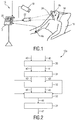
- Fig. 1 shows a schematic diagram of a system 10 according to the present invention including a device 12 for extracting physiological information indicative of at least one vital sign of a subject 14 from detected electromagnetic radiation transmitted through or reflected from a subject.
- the subject 14 in this example a patient, lies in a bed 16, e.g. in a hospital or other healthcare facility, but may also be a neonate or premature infant, e.g. lying in an incubator, or person at home or in a different environment.
- a detector also called signal acquisition unit
- a detector for detecting electromagnetic radiation transmitted through or reflected from a subject
- two different embodiments of the detector are shown and will be explained below.
- Both embodiments of the detector are configured for deriving at least two detection signals (also called radiation signals) from the detected electromagnetic radiation, wherein each detection signal comprises wavelength-dependent reflection or transmission information in a different wavelength channel.
- detection signals also called radiation signals
- optical filters used are preferably different, but can be overlapping. It is sufficient if their wavelength-dependent transmission is different.
- the detector comprises a camera 18 (also referred to as imaging unit, or as camera-based or remote PPG sensor) including a suitable photosensor for (remotely and unobtrusively) capturing image frames of the subject 14, in particular for acquiring a sequence of image frames of the subject 14 over time, from which photoplethysmography (PPG) signals can be derived.
- the image frames captured by the camera 18 may particularly correspond to a video sequence captured by means of an analog or digital photosensor, e.g. in a (digital) camera.
- a camera 18 usually includes a photosensor, such as a CMOS or CCD sensor, which may also operate in a specific spectral range (visible, IR) or provide information for different spectral ranges.
- the camera 18 may provide an analog or digital signal.
- the image frames include a plurality of image pixels having associated pixel values. Particularly, the image frames include pixels representing light intensity values captured with different photosensitive elements of a photosensor. These photosensitive elements may be sensitive in a specific spectral range (i.e. representing a specific color).
- the image frames include at least two groups of some image pixels each being representative of a different skin region of the subject, e.g. the forehead, the cheek, the throat, the hand, etc. Thereby, an image pixel may correspond to one photosensitive element of a photo-detector and its (analog or digital) output or may be determined based on a combination (e.g. through binning) of a plurality of the photosensitive elements.
- the detector comprises two or more optical photoplethysmography sensors 19a, 19b (also referred to as contact PPG sensor(s)) configured for being mounted to different skin region of the subject 14 for acquiring photoplethysmography signals from the different skin regions, in the embodiment shown in Fig. 1 from the forehead and the right hand.
- the PPG sensor 19a may e.g. be designed in the form of a finger-clip (as conventionally used for measuring blood oxygen saturation) and the PPG sensor 19b may e.g. be designed in the form of a sticker (as e.g. used for measuring heart rate), just to name a few of all the possible embodiments.
- the PPG sensors 19a, 19b may also be designed in other forms and arranged at other skin regions of the body.
- the system 10 may further optionally comprise a light source 22 (also called illumination source), such as a lamp, for illuminating a region of interest 24, such as the skin of the patient's face (e.g. part of the cheek or forehead), with light, for instance in a predetermined wavelength range or ranges (e.g. in the red, green and/or infrared wavelength range(s)).
- a region of interest 24 such as the skin of the patient's face (e.g. part of the cheek or forehead), with light, for instance in a predetermined wavelength range or ranges (e.g. in the red, green and/or infrared wavelength range(s)).
- a predetermined wavelength range or ranges e.g. in the red, green and/or infrared wavelength range(s)
- the light reflected from said region of interest 24 in response to said illumination is detected by the camera 18.
- no dedicated light source is provided, but ambient light is used for illumination of the subject 14. From the reflected light only light in a desired wavelength ranges
- the device 12 is further connected to an interface 20 for displaying the determined information and/or for providing medical personnel with an interface to change settings of the device 12, the camera 18, the PPG sensors 19a, 19b, the light source 22 and/or any other parameter of the system 10.
- an interface 20 may comprise different displays, buttons, touchscreens, keyboards or other human machine interface means.
- a system 10 as illustrated in Fig. 1 may, e.g., be located in a hospital, healthcare facility, elderly care facility or the like. Apart from the monitoring of patients, the present invention may also be applied in other fields such as neonate monitoring, general surveillance applications, security monitoring or so-called live style environments, such as fitness equipment, a wearable, a handheld device like a smartphone, or the like.
- the uni- or bidirectional communication between the device 12, the camera 18, the PPG sensors 19a, 19b and the interface 20 may work via a wireless or wired communication interface.
- Other embodiments of the present invention may include a device 12, which is not provided stand-alone, but integrated into the camera 18 or the interface 20.
- Fig. 2 shows a schematic diagram of a first embodiment of a device 12a according to the present invention, which may be used as device 12 in the system 10 shown in Fig. 1 .
- the device 12a comprises an input interface 30 for obtaining at least two radiation signals 40, 41, each radiation signal being acquired from different skin regions (e.g. the forehead and the hand) of the subject 14 by detecting radiation reflected from or transmitted through the respective skin region in response to irradiation.
- An extraction unit 31 extracts PPG signals 42, 43 from the obtained radiation signals to obtain at least one PPG signal per skin region.
- An evaluation unit 32 determines first weights 44, 45 for said skin regions depending on the relative or absolute strength of fundamental frequency and one or more harmonics in the spectrum of the PPG signal of the respective skin region.
- a combination unit 33 combines two or more PPG signals 42, 43 of different skin regions based on their respective first weights 44, 45 to obtain a combined PPG signal 46.
- a vital sign determination unit 34 derives a vital sign 47 from the combined PPG signal 46, in particular in a conventional manner using the commonly known PPG technology.
- the at least two radiation signals 40, 41 can be signals detected by different contact sensors, e.g. the contact sensors 19a, 19b shown in Fig. 1 , or image signals representing different image areas of a common image data stream comprising a time sequence of image frames detected by the camera 18, said different image areas corresponding to different skin regions of the subject 14.
- the different skin regions may be skin regions located at different parts of the body (e.g. forehead and hand, cheek and hand, etc.) or may be sub-regions of a common skin region, such as two (or more) spots on the cheek or on the forehead.
- the present invention enables recognizing skin regions that are significantly suffering from BCG motion and reduce their contribution to the measurement, increasing the contribution from skin regions that exhibit low BCG motion. It is thereby exploited that the spectrum of the BCG motion has much stronger harmonics than the blood-volume changes of reflected in the PPG signals.
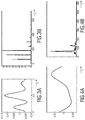
- Figs. 3A and 3B showing the BCG signal ( Fig. 3A ) in the reflected light from the face of a subject as well as the spectrum ( Fig. 3B) and Figs. 4A and 4B showing an rPPG signal ( Fig. 4A ) measured from a region of the face of a subject with little BCG motion as well as its spectrum ( Fig. 4B ).
- Fig. 3A and 3B showing the BCG signal ( Fig. 3A ) in the reflected light from the face of a subject as well as the spectrum ( Fig. 3B)
- Figs. 4A and 4B showing an rPPG signal ( Fig. 4A ) measured from a region
- the second harmonic of the pulse rate (which is 60 bpm in this example) has the highest amplitude, although the fundamental frequency is strong enough to interfere with the rPPG signal.
- the fundamental frequency i.e. the pulse rate
- the harmonics are significantly weaker.
- the SpO2 is computed as a ratio of relative pulsatilities in two (or more) wavelength intervals, e.g. 660nm and 850nm, i.e. from different wavelength channels received at the input sub-interfaces 30a (coupled e.g. to an infrared (IR) wavelength channel of the camera 18) and 30b (coupled e.g. to a red (R) (or another infrared) wavelength channel of the camera 18).
- IR infrared
- R red
- the skin region (ROI) seen by the camera is divided into at least two (preferably many more) sub-regions and the PPG signals for each sub-region for the wavelengths are computed.
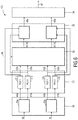
- the extraction unit 31, comprising one extraction sub-unit 31a-31d per radiation signal, is configured to extract a PPG signal 42a, 42b, 43a, 43b per radiation signal.
- combination sub-units 31e, 31f are provided to combine, per skin region, said PPG signals 42a, 42b, 43a, 43b of the different wavelength channels to obtain a region-combined PPG signal 42c, 43c per skin region.
- the evaluation unit 32 which may comprise two evaluation sub-units 32a, 32b, is configured to use said region-combined PPG signals 42c, 42d for determining the weights 44, 45 for said skin regions depending on the relative or absolute strength of the fundamental frequency and one or more harmonics in the spectrum of said region-combined PPG signal 42c, 42d of the respective skin region.
- the PPG signals 42a, 42b, 43a, 43c are combined in combination sub-units 33a, 33b of the combination unit 33 to obtain wavelength-combined PPG signal 46a, 46b per wavelength channel, from which e.g. the Sp02 as vital sign 47 is finally derived.
- a region-combined PPG signal for a particular skin region is obtained by the respective combination sub-unit 31 e, 3 If as a weighted average of the PPG signals 42a, 42b of the different wavelength channels extracted from the radiation signals 40a, 40b obtained for said skin region.
- the extraction unit 31, in particular the combination sub-units 31e, 31f, may further be configured to compute second weights for use in said weighted averaging using a normalized blood volume pulse vector signature based method, a chrominance based method, a blind source separation method, a principal component analysis or an independent component analysis.
- the extraction unit 31 may particularly be configured to compute second weights for use in said weighted averaging using a normalized blood volume pulse vector signature based method adapted to the vital sign to be determined.
- ICA pulse signal S from (normalized) detection signals C n
- these methods can be interpreted as providing the pulse signal S as a mixture of different wavelength channels, e.g. red, green and blue signals from a color video camera, but they differ in the way to determine the optimal weighting scheme.
- the resulting weights are aimed at a mixture in which the distortions disappear, i.e. the "weighting vector" is substantially orthogonal to the main distortions usually caused by subject motion and/or illumination variations.
- the beating of the heart causes pressure variations in the arteries as the heart pumps blood against the resistance of the vascular bed. Since the arteries are elastic, their diameter changes in sync with the pressure variations. These diameter changes occur even in the smaller vessels of the skin, where the blood volume variations cause a changing absorption of the light.
- the unit length normalized blood volume pulse vector (also called signature vector) is defined as Pbv, providing the relative PPG-strength in the red, green and blue camera signal.
- Pbv The unit length normalized blood volume pulse vector
- the precise blood volume pulse vector depends on the color filters of the camera, the spectrum of the light and the skin-reflectance, as the model shows. In practice the vector turns out to be remarkably stable though given a set of wavelength channels (the vector will be different in the infrared compared to RGB-based vector).
- the relative reflectance of the skin, in the red, green and blue channel under white illumination does not depend much on the skin-type. This is likely because the absorption spectra of the blood-free skin is dominated by the melanin absorption. Although a higher melanin concentration can increase the absolute absorption considerably, the relative absorption in the different wavelengths remains the same. This implies an increase of melanin darkens the skin, but hardly changes the normalized color of the skin. Consequently, also the normalized blood volume pulse P bv is quite stable under white illumination. In the infrared wavelengths the influence of melanin is further reduced as its maximum absorption occurs for short wavelengths (UV-light) and decreases for longer wavelengths.
- the stable character of Pbv can be used to distinguish color variations caused by blood volume change from variations due to alternative causes.
- the operator ⁇ corresponds to the mean.
- the noise and the PPG signal may be separated into two independent signals built as a linear combination of two color channels. One combination approximated a clean PPG signal, the other contained noise due to motion. As an optimization criterion the energy in the pulse signal may be minimized.
- a linear combination of the three color channels may be used to obtain the pulse signal.
- the ICA or the PCA may be used to find this linear combination. Since it is a priori unknown which weighted color signal is the pulse signal all of them used the periodic nature of the pulse signal as the selection criterion.
- the Pbv method generally obtains the mixing coefficients using the blood volume pulse vector as basically described in US 2013/271591 A1 and the above cited paper of de Haan and van Leest. The best results are obtained if the band-passed filtered versions of R n , G n and B n are used. According to this method the known direction of Pbv is used to discriminate between the pulse signal and distortions. This not only removes the assumption (of earlier methods) that the pulse is the only periodic component in the video, but also eliminates assumptions on the orientation of the distortion signals. To this end, it is assumed as before that the pulse signal is built as a linear combination of normalized color signals.
- Pbv characteristic wavelength dependency of the PPG signal, as reflected in the normalized blood volume pulse, Pbv, can be used to estimate the pulse signal from the time-sequential RGB pixel data averaged over the skin area. This algorithm is referred to as the P bv method.
- a pulse signal results as a weighted sum of the at least two detection signals C n . Since all detection signals C n contain the pulse and different levels of (common) noise, the weighting (of the detection signals to obtain the pulse signal) can lead to a pure noise-free pulse. This is why ICA and PCA can be used to separate noise and pulse.
- the spectrum is computed and analyzed for every sub-region (i.e. every skin region) after first combining the PPG signals of the at least two wavelength channels into a more motion-robust pulse signal.
- This more robust pulse signal may result from any robust pulse-extraction method using multiple wavelengths, like e.g. PCA, ICA, ratio-of-two-wavelengths, blood-volume pulse signature-based, chrominance-based, etc. From the spectrum of the robust pulse signals from each sub-region a weight of that region is computed similarly as explained above, i.e. regions with high harmonic content get a reduced weight in the combination process.
- a weighted average PPG signal over all regions per wavelength may be computed giving sub-regions that exhibit strong harmonics of the pulse frequency a lower weight in the averaging process.
- Sub-regions preferably get the same weight in the average for the two wavelengths to make sure both combinations reflect the same weighted skin region.
- the weights 44, 45 are determined using the spectrum of the robust PPG signals obtained as a weighted combination of signals from different wavelengths (e.g. using PCA, ICA, PBV-method, or CHROM, as explained above).
- the sub-region with the relatively lowest harmonic pulse energy receives the highest (first) weight in the combined region.
- the spectrum is computed from a pulse signal resulting from combining PPG signals from the wavelength channels using the blood-volume-pulse-signature-method, where the signature is adapted to the measured vital sign (e.g. SpO2).
- Fig. 6 shows a schematic diagram of third embodiment of device 12c according to the present invention.
- the combination unit 33 is again configured to combine, per wavelength channel, said PPG signals of the different skin regions based on their respective first weights 44, 45 to obtain a wavelength-combined PPG signal 46a, 46b per wavelength channel.
- the vital sign determination unit 34 then derives the vital sign 47 from the wavelength-combined PPG signals 46a, 46b.
- additional information 48 is used in this embodiment.
- Said additional information 48 may e.g. be information about motion distortion (e.g. the relative strength of motion distortions) of the PPG signals 42a, 42b, 43a, 43b in the different skin regions, i.e.
- Such additional information 48 may be obtained from an external source, e.g. from motion detectors, or from motion analysis of the original radiation signals or images acquired over time representing the radiation signals or from which the radiation signals are derived.
- the processing and the evaluation of the PPG signals 42a, 42b, 43a, 43b may be performed as explained above with respect to Fig. 5 . However, other options may exist and be used. For instance, a preliminary first weight may be determined for each of the PPG signals 42a, 42b, 43a, 43b, and the preliminary first weights for PPG signals from the same ROI (e.g. for PPG signals 42a, 42b and for PPG signals 43a, 43b) may be averaged to obtain the first weights 44, 45 for the respective ROIs.
- One application of the invention is the camera-based measurement of pulse-rate, respiration and SpO2 for patient monitoring.
- the contactless monitoring with a camera, is assumed to be highly relevant for premature babies with very sensitive skin in NICUs, and for patients with damaged (e.g. burns) skin, but may also be more convenient than contact sensors as used in the general ward.
- the invention can also be used in other scenarios and with contact sensors (as alternatives or additions to the camera).
- a computer program may be stored/distributed on a suitable non-transitory medium, such as an optical storage medium or a solid-state medium supplied together with or as part of other hardware, but may also be distributed in other forms, such as via the Internet or other wired or wireless telecommunication systems.
- a suitable non-transitory medium such as an optical storage medium or a solid-state medium supplied together with or as part of other hardware, but may also be distributed in other forms, such as via the Internet or other wired or wireless telecommunication systems.
Landscapes
- Health & Medical Sciences (AREA)
- Life Sciences & Earth Sciences (AREA)
- Engineering & Computer Science (AREA)
- Physics & Mathematics (AREA)
- Molecular Biology (AREA)
- General Health & Medical Sciences (AREA)
- Veterinary Medicine (AREA)
- Public Health (AREA)
- Animal Behavior & Ethology (AREA)
- Biophysics (AREA)
- Pathology (AREA)
- Biomedical Technology (AREA)
- Heart & Thoracic Surgery (AREA)
- Medical Informatics (AREA)
- Surgery (AREA)
- Physiology (AREA)
- Signal Processing (AREA)
- Cardiology (AREA)
- Computer Vision & Pattern Recognition (AREA)
- Artificial Intelligence (AREA)
- Psychiatry (AREA)
- Dentistry (AREA)
- Oral & Maxillofacial Surgery (AREA)
- Optics & Photonics (AREA)
- Spectroscopy & Molecular Physics (AREA)
- Radiology & Medical Imaging (AREA)
- Nuclear Medicine, Radiotherapy & Molecular Imaging (AREA)
- Pulmonology (AREA)
- Measurement Of The Respiration, Hearing Ability, Form, And Blood Characteristics Of Living Organisms (AREA)
- Measuring Pulse, Heart Rate, Blood Pressure Or Blood Flow (AREA)
Applications Claiming Priority (2)
| Application Number | Priority Date | Filing Date | Title |
|---|---|---|---|
| EP16158005 | 2016-03-01 | ||
| PCT/EP2017/054276 WO2017148807A1 (en) | 2016-03-01 | 2017-02-24 | Device, system and method for determining a vital sign of a subject |
Publications (2)
| Publication Number | Publication Date |
|---|---|
| EP3422931A1 EP3422931A1 (en) | 2019-01-09 |
| EP3422931B1 true EP3422931B1 (en) | 2021-12-29 |
Family
ID=55446719
Family Applications (1)
| Application Number | Title | Priority Date | Filing Date |
|---|---|---|---|
| EP17706814.5A Active EP3422931B1 (en) | 2016-03-01 | 2017-02-24 | Device, system and method for determining a vital sign of a subject |
Country Status (5)
| Country | Link |
|---|---|
| US (1) | US11045146B2 (enExample) |
| EP (1) | EP3422931B1 (enExample) |
| JP (1) | JP6899395B2 (enExample) |
| CN (1) | CN108778109B (enExample) |
| WO (1) | WO2017148807A1 (enExample) |
Families Citing this family (9)
| Publication number | Priority date | Publication date | Assignee | Title |
|---|---|---|---|---|
| EP3449820B1 (en) * | 2017-08-30 | 2023-05-24 | Qompium | Computer-implemented method and system for direct photoplethysmography (ppg) |
| EP3461404A1 (en) * | 2017-09-27 | 2019-04-03 | Koninklijke Philips N.V. | A sensor system and sensing method for use in assessment of circulatory volume |
| FI3758606T3 (fi) | 2018-03-27 | 2023-01-13 | Menetelmä valonlähteen intensiteetin valitsemiseksi veressä olevan analyytin seuraamiseksi ja laite sitä varten | |
| EP3671630A1 (en) * | 2018-12-19 | 2020-06-24 | Nokia Technologies Oy | Movement indication |
| EP3698704A1 (en) * | 2019-02-20 | 2020-08-26 | Koninklijke Philips N.V. | Device, system and method for determining physiological information |
| EP4033972A4 (en) * | 2019-12-02 | 2024-01-10 | Binah.Ai Ltd | SYSTEM AND METHOD FOR PHYSIOLOGICAL MEASUREMENTS FROM OPTICAL DATA |
| EP4032472A1 (en) * | 2021-01-21 | 2022-07-27 | Koninklijke Philips N.V. | Arterial blood oxygenation measurements |
| JP7788138B2 (ja) * | 2021-09-07 | 2025-12-18 | 慶應義塾 | 生体情報検出システム、プログラム、及び、生体情報検出方法 |
| EP4332986A1 (en) * | 2022-08-29 | 2024-03-06 | BIOTRONIK SE & Co. KG | Method and system for assessing a patient's medical condition |
Citations (1)
| Publication number | Priority date | Publication date | Assignee | Title |
|---|---|---|---|---|
| US20080167564A1 (en) * | 2007-01-10 | 2008-07-10 | Starr Life Sciences Corp. | Techniques for accurately deriving physiologic parameters of a subject from photoplethysmographic measurements |
Family Cites Families (22)
| Publication number | Priority date | Publication date | Assignee | Title |
|---|---|---|---|---|
| US4458518A (en) * | 1982-07-01 | 1984-07-10 | Medasonics, Inc. | Apparatus and method for calibrating a photoplethysmograph |
| US5853364A (en) * | 1995-08-07 | 1998-12-29 | Nellcor Puritan Bennett, Inc. | Method and apparatus for estimating physiological parameters using model-based adaptive filtering |
| US7020507B2 (en) * | 2002-01-31 | 2006-03-28 | Dolphin Medical, Inc. | Separating motion from cardiac signals using second order derivative of the photo-plethysmogram and fast fourier transforms |
| WO2009043028A2 (en) * | 2007-09-28 | 2009-04-02 | Tiax Llc | Measurement of physiological signals |
| US8761855B2 (en) * | 2008-07-15 | 2014-06-24 | Nellcor Puritan Bennett Ireland | Systems and methods for determining oxygen saturation |
| US8868205B2 (en) * | 2010-12-20 | 2014-10-21 | General Electric Company | System and method for determining physiological parameters based on electrical impedance measurements |
| EP2661219B1 (en) | 2011-01-05 | 2019-05-15 | Koninklijke Philips N.V. | Device and method for extracting information from characteristic signals |
| JP2014516678A (ja) * | 2011-05-17 | 2014-07-17 | ライオンズゲイト テクノロジーズ,インコーポレイテッド | パルス・オキシメトリを使用して患者の生理特性を確定するためのシステムおよび方法 |
| WO2013038326A1 (en) * | 2011-09-13 | 2013-03-21 | Koninklijke Philips Electronics N.V. | Distortion reduced signal detection |
| GB201302451D0 (en) * | 2013-02-12 | 2013-03-27 | Isis Innovation | Method and system for signal analysis |
| CN105007806B (zh) * | 2013-03-13 | 2019-04-05 | 皇家飞利浦有限公司 | 用于确定来自对象的生命体征的装置和方法 |
| US10052038B2 (en) * | 2013-03-14 | 2018-08-21 | Koninklijke Philips N.V. | Device and method for determining vital signs of a subject |
| BR112015022115A2 (pt) * | 2013-03-14 | 2017-07-18 | Koninklijke Philips Nv | dispositivo para obter informações de sinais vitais de um indivíduo, método para obter informações de sinais vitais de um indivíduo, aparelho de processamento para obter informações de sinais vitais de um indivíduo, método de processamento para obter informações de sinais vitais de um indivíduo, e, programa de computador |
| CN105050492B (zh) * | 2013-03-14 | 2019-01-08 | 皇家飞利浦有限公司 | 用于确定对象的生命体征的设备和方法 |
| JP6052005B2 (ja) * | 2013-03-27 | 2016-12-27 | 富士通株式会社 | 脈波検出装置、脈波検出方法及び脈波検出プログラム |
| JP6135255B2 (ja) * | 2013-04-02 | 2017-05-31 | 富士通株式会社 | 心拍測定プログラム、心拍測定方法及び心拍測定装置 |
| RU2684044C1 (ru) * | 2013-12-12 | 2019-04-03 | Конинклейке Филипс Н.В. | Устройство и способ для определения основных показателей жизнедеятельности субъекта |
| US20150313484A1 (en) * | 2014-01-06 | 2015-11-05 | Scanadu Incorporated | Portable device with multiple integrated sensors for vital signs scanning |
| US9918666B2 (en) * | 2014-01-13 | 2018-03-20 | The Board Of Regents, The University Of Texas System | Systems and methods for physiological signal enhancement and biometric extraction using non-invasive optical sensors |
| CN103932693A (zh) * | 2014-03-27 | 2014-07-23 | 西安电子科技大学 | 一种基于手机图像的人体心率的测量方法 |
| CN105433931A (zh) * | 2014-09-18 | 2016-03-30 | 义明科技股份有限公司 | 光体积变化描述波形的处理装置及其方法 |
| JP2018534968A (ja) | 2015-09-29 | 2018-11-29 | コーニンクレッカ フィリップス エヌ ヴェKoninklijke Philips N.V. | 生理情報を抽出するためのデバイス、システム、及び方法 |
-
2017
- 2017-02-24 CN CN201780014577.XA patent/CN108778109B/zh active Active
- 2017-02-24 EP EP17706814.5A patent/EP3422931B1/en active Active
- 2017-02-24 WO PCT/EP2017/054276 patent/WO2017148807A1/en not_active Ceased
- 2017-02-24 JP JP2018543702A patent/JP6899395B2/ja active Active
- 2017-02-24 US US16/077,748 patent/US11045146B2/en active Active
Patent Citations (1)
| Publication number | Priority date | Publication date | Assignee | Title |
|---|---|---|---|---|
| US20080167564A1 (en) * | 2007-01-10 | 2008-07-10 | Starr Life Sciences Corp. | Techniques for accurately deriving physiologic parameters of a subject from photoplethysmographic measurements |
Also Published As
| Publication number | Publication date |
|---|---|
| US20190038234A1 (en) | 2019-02-07 |
| CN108778109B (zh) | 2022-02-11 |
| EP3422931A1 (en) | 2019-01-09 |
| JP2019511941A (ja) | 2019-05-09 |
| WO2017148807A1 (en) | 2017-09-08 |
| US11045146B2 (en) | 2021-06-29 |
| JP6899395B2 (ja) | 2021-07-07 |
| CN108778109A (zh) | 2018-11-09 |
Similar Documents
| Publication | Publication Date | Title |
|---|---|---|
| US12064269B2 (en) | Device, system and method for generating a photoplethysmographic image carrying vital sign information of a subject | |
| EP2988662B1 (en) | System and method for extracting physiological information | |
| EP3355787B1 (en) | Device, system and method for extracting physiological information | |
| EP3383258B1 (en) | Device, system and method for determining vital sign information of a subject | |
| EP3479754A1 (en) | Device, system and method for determining at least one vital sign of a subject | |
| US11045146B2 (en) | Device, system and method for determining a vital sign of a subject | |
| CN113498326B (zh) | 用于确定生理信息的设备、系统和方法 | |
| EP3809950B1 (en) | Device, system and method for image segmentation of an image of a scene including a subject | |
| EP3773154B1 (en) | Device, system and method for extracting physiological information indicative of at least one vital sign of a subject | |
| EP3517034A1 (en) | Device, system and method for determining at least one vital sign of a subject |
Legal Events
| Date | Code | Title | Description |
|---|---|---|---|
| STAA | Information on the status of an ep patent application or granted ep patent |
Free format text: STATUS: UNKNOWN |
|
| STAA | Information on the status of an ep patent application or granted ep patent |
Free format text: STATUS: THE INTERNATIONAL PUBLICATION HAS BEEN MADE |
|
| PUAI | Public reference made under article 153(3) epc to a published international application that has entered the european phase |
Free format text: ORIGINAL CODE: 0009012 |
|
| STAA | Information on the status of an ep patent application or granted ep patent |
Free format text: STATUS: REQUEST FOR EXAMINATION WAS MADE |
|
| 17P | Request for examination filed |
Effective date: 20181001 |
|
| AK | Designated contracting states |
Kind code of ref document: A1 Designated state(s): AL AT BE BG CH CY CZ DE DK EE ES FI FR GB GR HR HU IE IS IT LI LT LU LV MC MK MT NL NO PL PT RO RS SE SI SK SM TR |
|
| AX | Request for extension of the european patent |
Extension state: BA ME |
|
| DAV | Request for validation of the european patent (deleted) | ||
| DAX | Request for extension of the european patent (deleted) | ||
| RAP1 | Party data changed (applicant data changed or rights of an application transferred) |
Owner name: KONINKLIJKE PHILIPS N.V. |
|
| STAA | Information on the status of an ep patent application or granted ep patent |
Free format text: STATUS: EXAMINATION IS IN PROGRESS |
|
| 17Q | First examination report despatched |
Effective date: 20210216 |
|
| GRAP | Despatch of communication of intention to grant a patent |
Free format text: ORIGINAL CODE: EPIDOSNIGR1 |
|
| STAA | Information on the status of an ep patent application or granted ep patent |
Free format text: STATUS: GRANT OF PATENT IS INTENDED |
|
| INTG | Intention to grant announced |
Effective date: 20210804 |
|
| GRAS | Grant fee paid |
Free format text: ORIGINAL CODE: EPIDOSNIGR3 |
|
| GRAA | (expected) grant |
Free format text: ORIGINAL CODE: 0009210 |
|
| STAA | Information on the status of an ep patent application or granted ep patent |
Free format text: STATUS: THE PATENT HAS BEEN GRANTED |
|
| AK | Designated contracting states |
Kind code of ref document: B1 Designated state(s): AL AT BE BG CH CY CZ DE DK EE ES FI FR GB GR HR HU IE IS IT LI LT LU LV MC MK MT NL NO PL PT RO RS SE SI SK SM TR |
|
| REG | Reference to a national code |
Ref country code: GB Ref legal event code: FG4D |
|
| REG | Reference to a national code |
Ref country code: CH Ref legal event code: EP |
|
| REG | Reference to a national code |
Ref country code: DE Ref legal event code: R096 Ref document number: 602017051513 Country of ref document: DE |
|
| REG | Reference to a national code |
Ref country code: AT Ref legal event code: REF Ref document number: 1458082 Country of ref document: AT Kind code of ref document: T Effective date: 20220115 |
|
| REG | Reference to a national code |
Ref country code: IE Ref legal event code: FG4D |
|
| REG | Reference to a national code |
Ref country code: LT Ref legal event code: MG9D |
|
| PG25 | Lapsed in a contracting state [announced via postgrant information from national office to epo] |
Ref country code: RS Free format text: LAPSE BECAUSE OF FAILURE TO SUBMIT A TRANSLATION OF THE DESCRIPTION OR TO PAY THE FEE WITHIN THE PRESCRIBED TIME-LIMIT Effective date: 20211229 Ref country code: LT Free format text: LAPSE BECAUSE OF FAILURE TO SUBMIT A TRANSLATION OF THE DESCRIPTION OR TO PAY THE FEE WITHIN THE PRESCRIBED TIME-LIMIT Effective date: 20211229 Ref country code: FI Free format text: LAPSE BECAUSE OF FAILURE TO SUBMIT A TRANSLATION OF THE DESCRIPTION OR TO PAY THE FEE WITHIN THE PRESCRIBED TIME-LIMIT Effective date: 20211229 Ref country code: BG Free format text: LAPSE BECAUSE OF FAILURE TO SUBMIT A TRANSLATION OF THE DESCRIPTION OR TO PAY THE FEE WITHIN THE PRESCRIBED TIME-LIMIT Effective date: 20220329 |
|
| REG | Reference to a national code |
Ref country code: NL Ref legal event code: MP Effective date: 20211229 |
|
| REG | Reference to a national code |
Ref country code: AT Ref legal event code: MK05 Ref document number: 1458082 Country of ref document: AT Kind code of ref document: T Effective date: 20211229 |
|
| PG25 | Lapsed in a contracting state [announced via postgrant information from national office to epo] |
Ref country code: SE Free format text: LAPSE BECAUSE OF FAILURE TO SUBMIT A TRANSLATION OF THE DESCRIPTION OR TO PAY THE FEE WITHIN THE PRESCRIBED TIME-LIMIT Effective date: 20211229 Ref country code: NO Free format text: LAPSE BECAUSE OF FAILURE TO SUBMIT A TRANSLATION OF THE DESCRIPTION OR TO PAY THE FEE WITHIN THE PRESCRIBED TIME-LIMIT Effective date: 20220329 Ref country code: LV Free format text: LAPSE BECAUSE OF FAILURE TO SUBMIT A TRANSLATION OF THE DESCRIPTION OR TO PAY THE FEE WITHIN THE PRESCRIBED TIME-LIMIT Effective date: 20211229 Ref country code: HR Free format text: LAPSE BECAUSE OF FAILURE TO SUBMIT A TRANSLATION OF THE DESCRIPTION OR TO PAY THE FEE WITHIN THE PRESCRIBED TIME-LIMIT Effective date: 20211229 Ref country code: GR Free format text: LAPSE BECAUSE OF FAILURE TO SUBMIT A TRANSLATION OF THE DESCRIPTION OR TO PAY THE FEE WITHIN THE PRESCRIBED TIME-LIMIT Effective date: 20220330 |
|
| PG25 | Lapsed in a contracting state [announced via postgrant information from national office to epo] |
Ref country code: NL Free format text: LAPSE BECAUSE OF FAILURE TO SUBMIT A TRANSLATION OF THE DESCRIPTION OR TO PAY THE FEE WITHIN THE PRESCRIBED TIME-LIMIT Effective date: 20211229 |
|
| PG25 | Lapsed in a contracting state [announced via postgrant information from national office to epo] |
Ref country code: SM Free format text: LAPSE BECAUSE OF FAILURE TO SUBMIT A TRANSLATION OF THE DESCRIPTION OR TO PAY THE FEE WITHIN THE PRESCRIBED TIME-LIMIT Effective date: 20211229 Ref country code: SK Free format text: LAPSE BECAUSE OF FAILURE TO SUBMIT A TRANSLATION OF THE DESCRIPTION OR TO PAY THE FEE WITHIN THE PRESCRIBED TIME-LIMIT Effective date: 20211229 Ref country code: RO Free format text: LAPSE BECAUSE OF FAILURE TO SUBMIT A TRANSLATION OF THE DESCRIPTION OR TO PAY THE FEE WITHIN THE PRESCRIBED TIME-LIMIT Effective date: 20211229 Ref country code: PT Free format text: LAPSE BECAUSE OF FAILURE TO SUBMIT A TRANSLATION OF THE DESCRIPTION OR TO PAY THE FEE WITHIN THE PRESCRIBED TIME-LIMIT Effective date: 20220429 Ref country code: ES Free format text: LAPSE BECAUSE OF FAILURE TO SUBMIT A TRANSLATION OF THE DESCRIPTION OR TO PAY THE FEE WITHIN THE PRESCRIBED TIME-LIMIT Effective date: 20211229 Ref country code: EE Free format text: LAPSE BECAUSE OF FAILURE TO SUBMIT A TRANSLATION OF THE DESCRIPTION OR TO PAY THE FEE WITHIN THE PRESCRIBED TIME-LIMIT Effective date: 20211229 Ref country code: CZ Free format text: LAPSE BECAUSE OF FAILURE TO SUBMIT A TRANSLATION OF THE DESCRIPTION OR TO PAY THE FEE WITHIN THE PRESCRIBED TIME-LIMIT Effective date: 20211229 |
|
| PG25 | Lapsed in a contracting state [announced via postgrant information from national office to epo] |
Ref country code: PL Free format text: LAPSE BECAUSE OF FAILURE TO SUBMIT A TRANSLATION OF THE DESCRIPTION OR TO PAY THE FEE WITHIN THE PRESCRIBED TIME-LIMIT Effective date: 20211229 Ref country code: AT Free format text: LAPSE BECAUSE OF FAILURE TO SUBMIT A TRANSLATION OF THE DESCRIPTION OR TO PAY THE FEE WITHIN THE PRESCRIBED TIME-LIMIT Effective date: 20211229 |
|
| PG25 | Lapsed in a contracting state [announced via postgrant information from national office to epo] |
Ref country code: MC Free format text: LAPSE BECAUSE OF FAILURE TO SUBMIT A TRANSLATION OF THE DESCRIPTION OR TO PAY THE FEE WITHIN THE PRESCRIBED TIME-LIMIT Effective date: 20211229 Ref country code: IS Free format text: LAPSE BECAUSE OF FAILURE TO SUBMIT A TRANSLATION OF THE DESCRIPTION OR TO PAY THE FEE WITHIN THE PRESCRIBED TIME-LIMIT Effective date: 20220429 |
|
| REG | Reference to a national code |
Ref country code: DE Ref legal event code: R097 Ref document number: 602017051513 Country of ref document: DE |
|
| REG | Reference to a national code |
Ref country code: CH Ref legal event code: PL |
|
| REG | Reference to a national code |
Ref country code: BE Ref legal event code: MM Effective date: 20220228 |
|
| PG25 | Lapsed in a contracting state [announced via postgrant information from national office to epo] |
Ref country code: LU Free format text: LAPSE BECAUSE OF NON-PAYMENT OF DUE FEES Effective date: 20220224 Ref country code: DK Free format text: LAPSE BECAUSE OF FAILURE TO SUBMIT A TRANSLATION OF THE DESCRIPTION OR TO PAY THE FEE WITHIN THE PRESCRIBED TIME-LIMIT Effective date: 20211229 Ref country code: AL Free format text: LAPSE BECAUSE OF FAILURE TO SUBMIT A TRANSLATION OF THE DESCRIPTION OR TO PAY THE FEE WITHIN THE PRESCRIBED TIME-LIMIT Effective date: 20211229 |
|
| PLBE | No opposition filed within time limit |
Free format text: ORIGINAL CODE: 0009261 |
|
| STAA | Information on the status of an ep patent application or granted ep patent |
Free format text: STATUS: NO OPPOSITION FILED WITHIN TIME LIMIT |
|
| GBPC | Gb: european patent ceased through non-payment of renewal fee |
Effective date: 20220329 |
|
| 26N | No opposition filed |
Effective date: 20220930 |
|
| PG25 | Lapsed in a contracting state [announced via postgrant information from national office to epo] |
Ref country code: FR Free format text: LAPSE BECAUSE OF NON-PAYMENT OF DUE FEES Effective date: 20220228 |
|
| PG25 | Lapsed in a contracting state [announced via postgrant information from national office to epo] |
Ref country code: LI Free format text: LAPSE BECAUSE OF NON-PAYMENT OF DUE FEES Effective date: 20220228 Ref country code: IE Free format text: LAPSE BECAUSE OF NON-PAYMENT OF DUE FEES Effective date: 20220224 Ref country code: GB Free format text: LAPSE BECAUSE OF NON-PAYMENT OF DUE FEES Effective date: 20220329 Ref country code: CH Free format text: LAPSE BECAUSE OF NON-PAYMENT OF DUE FEES Effective date: 20220228 |
|
| PG25 | Lapsed in a contracting state [announced via postgrant information from national office to epo] |
Ref country code: SI Free format text: LAPSE BECAUSE OF FAILURE TO SUBMIT A TRANSLATION OF THE DESCRIPTION OR TO PAY THE FEE WITHIN THE PRESCRIBED TIME-LIMIT Effective date: 20211229 Ref country code: BE Free format text: LAPSE BECAUSE OF NON-PAYMENT OF DUE FEES Effective date: 20220228 |
|
| PG25 | Lapsed in a contracting state [announced via postgrant information from national office to epo] |
Ref country code: IT Free format text: LAPSE BECAUSE OF FAILURE TO SUBMIT A TRANSLATION OF THE DESCRIPTION OR TO PAY THE FEE WITHIN THE PRESCRIBED TIME-LIMIT Effective date: 20211229 |
|
| PG25 | Lapsed in a contracting state [announced via postgrant information from national office to epo] |
Ref country code: HU Free format text: LAPSE BECAUSE OF FAILURE TO SUBMIT A TRANSLATION OF THE DESCRIPTION OR TO PAY THE FEE WITHIN THE PRESCRIBED TIME-LIMIT; INVALID AB INITIO Effective date: 20170224 |
|
| PG25 | Lapsed in a contracting state [announced via postgrant information from national office to epo] |
Ref country code: MK Free format text: LAPSE BECAUSE OF FAILURE TO SUBMIT A TRANSLATION OF THE DESCRIPTION OR TO PAY THE FEE WITHIN THE PRESCRIBED TIME-LIMIT Effective date: 20211229 Ref country code: CY Free format text: LAPSE BECAUSE OF FAILURE TO SUBMIT A TRANSLATION OF THE DESCRIPTION OR TO PAY THE FEE WITHIN THE PRESCRIBED TIME-LIMIT Effective date: 20211229 |
|
| PG25 | Lapsed in a contracting state [announced via postgrant information from national office to epo] |
Ref country code: MT Free format text: LAPSE BECAUSE OF FAILURE TO SUBMIT A TRANSLATION OF THE DESCRIPTION OR TO PAY THE FEE WITHIN THE PRESCRIBED TIME-LIMIT Effective date: 20211229 |
|
| PG25 | Lapsed in a contracting state [announced via postgrant information from national office to epo] |
Ref country code: TR Free format text: LAPSE BECAUSE OF FAILURE TO SUBMIT A TRANSLATION OF THE DESCRIPTION OR TO PAY THE FEE WITHIN THE PRESCRIBED TIME-LIMIT Effective date: 20211229 |
|
| PGFP | Annual fee paid to national office [announced via postgrant information from national office to epo] |
Ref country code: DE Payment date: 20260220 Year of fee payment: 10 |