EP3420005B1 - Glyoxaliertes polyacrylamidterpolymer, basiscopolymer davon, zusammensetzung damit, verwendungen in der papierherstellung und produkte daraus - Google Patents
Glyoxaliertes polyacrylamidterpolymer, basiscopolymer davon, zusammensetzung damit, verwendungen in der papierherstellung und produkte daraus Download PDFInfo
- Publication number
- EP3420005B1 EP3420005B1 EP17708078.5A EP17708078A EP3420005B1 EP 3420005 B1 EP3420005 B1 EP 3420005B1 EP 17708078 A EP17708078 A EP 17708078A EP 3420005 B1 EP3420005 B1 EP 3420005B1
- Authority
- EP
- European Patent Office
- Prior art keywords
- terpolymer
- paper
- units
- alkyl
- acrylamide
- Prior art date
- Legal status (The legal status is an assumption and is not a legal conclusion. Google has not performed a legal analysis and makes no representation as to the accuracy of the status listed.)
- Not-in-force
Links
Images

Classifications
-
- C—CHEMISTRY; METALLURGY
- C08—ORGANIC MACROMOLECULAR COMPOUNDS; THEIR PREPARATION OR CHEMICAL WORKING-UP; COMPOSITIONS BASED THEREON
- C08F—MACROMOLECULAR COMPOUNDS OBTAINED BY REACTIONS ONLY INVOLVING CARBON-TO-CARBON UNSATURATED BONDS
- C08F220/00—Copolymers of compounds having one or more unsaturated aliphatic radicals, each having only one carbon-to-carbon double bond, and only one being terminated by only one carboxyl radical or a salt, anhydride ester, amide, imide or nitrile thereof
- C08F220/02—Monocarboxylic acids having less than ten carbon atoms; Derivatives thereof
- C08F220/52—Amides or imides
- C08F220/54—Amides, e.g. N,N-dimethylacrylamide or N-isopropylacrylamide
- C08F220/56—Acrylamide; Methacrylamide
-
- C—CHEMISTRY; METALLURGY
- C08—ORGANIC MACROMOLECULAR COMPOUNDS; THEIR PREPARATION OR CHEMICAL WORKING-UP; COMPOSITIONS BASED THEREON
- C08F—MACROMOLECULAR COMPOUNDS OBTAINED BY REACTIONS ONLY INVOLVING CARBON-TO-CARBON UNSATURATED BONDS
- C08F8/00—Chemical modification by after-treatment
- C08F8/28—Condensation with aldehydes or ketones
-
- C—CHEMISTRY; METALLURGY
- C08—ORGANIC MACROMOLECULAR COMPOUNDS; THEIR PREPARATION OR CHEMICAL WORKING-UP; COMPOSITIONS BASED THEREON
- C08L—COMPOSITIONS OF MACROMOLECULAR COMPOUNDS
- C08L33/00—Compositions of homopolymers or copolymers of compounds having one or more unsaturated aliphatic radicals, each having only one carbon-to-carbon double bond, and only one being terminated by only one carboxyl radical, or of salts, anhydrides, esters, amides, imides or nitriles thereof; Compositions of derivatives of such polymers
- C08L33/24—Homopolymers or copolymers of amides or imides
- C08L33/26—Homopolymers or copolymers of acrylamide or methacrylamide
-
- D—TEXTILES; PAPER
- D21—PAPER-MAKING; PRODUCTION OF CELLULOSE
- D21H—PULP COMPOSITIONS; PREPARATION THEREOF NOT COVERED BY SUBCLASSES D21C OR D21D; IMPREGNATING OR COATING OF PAPER; TREATMENT OF FINISHED PAPER NOT COVERED BY CLASS B31 OR SUBCLASS D21G; PAPER NOT OTHERWISE PROVIDED FOR
- D21H17/00—Non-fibrous material added to the pulp, characterised by its constitution; Paper-impregnating material characterised by its constitution
- D21H17/20—Macromolecular organic compounds
- D21H17/33—Synthetic macromolecular compounds
- D21H17/34—Synthetic macromolecular compounds obtained by reactions only involving carbon-to-carbon unsaturated bonds
- D21H17/37—Polymers of unsaturated acids or derivatives thereof, e.g. polyacrylates
-
- D—TEXTILES; PAPER
- D21—PAPER-MAKING; PRODUCTION OF CELLULOSE
- D21H—PULP COMPOSITIONS; PREPARATION THEREOF NOT COVERED BY SUBCLASSES D21C OR D21D; IMPREGNATING OR COATING OF PAPER; TREATMENT OF FINISHED PAPER NOT COVERED BY CLASS B31 OR SUBCLASS D21G; PAPER NOT OTHERWISE PROVIDED FOR
- D21H17/00—Non-fibrous material added to the pulp, characterised by its constitution; Paper-impregnating material characterised by its constitution
- D21H17/20—Macromolecular organic compounds
- D21H17/33—Synthetic macromolecular compounds
- D21H17/34—Synthetic macromolecular compounds obtained by reactions only involving carbon-to-carbon unsaturated bonds
- D21H17/41—Synthetic macromolecular compounds obtained by reactions only involving carbon-to-carbon unsaturated bonds containing ionic groups
- D21H17/44—Synthetic macromolecular compounds obtained by reactions only involving carbon-to-carbon unsaturated bonds containing ionic groups cationic
- D21H17/45—Nitrogen-containing groups
- D21H17/455—Nitrogen-containing groups comprising tertiary amine or being at least partially quaternised
-
- D—TEXTILES; PAPER
- D21—PAPER-MAKING; PRODUCTION OF CELLULOSE
- D21H—PULP COMPOSITIONS; PREPARATION THEREOF NOT COVERED BY SUBCLASSES D21C OR D21D; IMPREGNATING OR COATING OF PAPER; TREATMENT OF FINISHED PAPER NOT COVERED BY CLASS B31 OR SUBCLASS D21G; PAPER NOT OTHERWISE PROVIDED FOR
- D21H21/00—Non-fibrous material added to the pulp, characterised by its function, form or properties; Paper-impregnating or coating material, characterised by its function, form or properties
- D21H21/06—Paper forming aids
- D21H21/10—Retention agents or drainage improvers
-
- D—TEXTILES; PAPER
- D21—PAPER-MAKING; PRODUCTION OF CELLULOSE
- D21H—PULP COMPOSITIONS; PREPARATION THEREOF NOT COVERED BY SUBCLASSES D21C OR D21D; IMPREGNATING OR COATING OF PAPER; TREATMENT OF FINISHED PAPER NOT COVERED BY CLASS B31 OR SUBCLASS D21G; PAPER NOT OTHERWISE PROVIDED FOR
- D21H21/00—Non-fibrous material added to the pulp, characterised by its function, form or properties; Paper-impregnating or coating material, characterised by its function, form or properties
- D21H21/14—Non-fibrous material added to the pulp, characterised by its function, form or properties; Paper-impregnating or coating material, characterised by its function, form or properties characterised by function or properties in or on the paper
- D21H21/18—Reinforcing agents
-
- D—TEXTILES; PAPER
- D21—PAPER-MAKING; PRODUCTION OF CELLULOSE
- D21H—PULP COMPOSITIONS; PREPARATION THEREOF NOT COVERED BY SUBCLASSES D21C OR D21D; IMPREGNATING OR COATING OF PAPER; TREATMENT OF FINISHED PAPER NOT COVERED BY CLASS B31 OR SUBCLASS D21G; PAPER NOT OTHERWISE PROVIDED FOR
- D21H23/00—Processes or apparatus for adding material to the pulp or to the paper
- D21H23/02—Processes or apparatus for adding material to the pulp or to the paper characterised by the manner in which substances are added
- D21H23/04—Addition to the pulp; After-treatment of added substances in the pulp
-
- C—CHEMISTRY; METALLURGY
- C08—ORGANIC MACROMOLECULAR COMPOUNDS; THEIR PREPARATION OR CHEMICAL WORKING-UP; COMPOSITIONS BASED THEREON
- C08L—COMPOSITIONS OF MACROMOLECULAR COMPOUNDS
- C08L2201/00—Properties
- C08L2201/54—Aqueous solutions or dispersions
Definitions
- the present invention relates to a glyoxalated polyacrylamide terpolymer, a base copolymer thereof, compositions containing the terpolymer, and their use for papermaking and products thereof.
- Papermaking generally includes forming an aqueous pulp composition and then sheeting and drying the pulp to form a desired paper product.
- Various additives have been used to aid in the colloidal, fines, and drainage management at the wet end of the paper machine. These additives have included materials such as cationic starch, low molecular weight copolymers of acrylamide and diallyldimethylammonium chloride (DADMAC), a terpolymer of acrylamide/DADMAC and glyoxal, and other materials.
- DADMAC diallyldimethylammonium chloride
- U.S. Pat. No. 8,435,382 relates to storage-stable glyoxalated polyacrylamide polymers and high solids aqueous compositions formulated with them.
- the glyoxalated polyacrylamide polymer is obtained from the reaction between glyoxal and a cationic polyacrylamide base polymer comprising at least about 25% by weight cationic monomer.
- the polyacrylamide base polymer comprises acrylamide monomer and cationic monomer copolymerizable with the acrylamide.
- U.S. Pat. Appln. Publication No. 2011/112224 A1 relates to surface applied strength additives for paper, wherein the additives are a coating composition comprising a mixture or blend of a nearly neutral polyacrylamide, a cationic polymer, and starch.
- the cationic polymer of the mixtures can be prepared from monomers selected from dimethylaminoethyl(meth)acrylate, [2-(methacryloyloxy) ethyl]trimethylammonium chloride, [3-(methacryloylamino) propyl]trimethylammonium chloride, [2-(acryloyloxy)ethyl] trimethylammonium chloride, [3-(acryloyloxy)propyl] trimethylammonium chloride, N,N-dimethylamino propyl(meth)acrylamide, and others mentioned in the reference.
- WO 2006/068964 A1 discloses certain reactive cationic resins comprising a dialdehyde reactive copolymer produced from a comonomer which is dialdehyde reactive, a cationic comonomer and a dialdehyde.
- the cationic comonomers include [2-(methacryloyloxy) ethyl]trimethylammonium chloride, [3-(methacryloyloxy) propyl]trimethylammonium chloride, [2-(acryloyloxy)ethyl] trimethylammonium chloride, and [3-(acryloyloxy)propyl] trimethylammonium chloride.
- a feature of the present invention is to provide glyoxalated polyacrylamide terpolymers having good shelf life, which can be used for papermaking or other methods.
- Another feature of the present invention is to provide a superior additive system for papermaking using the indicated terpolymers for improving wet-end drainage and retention.
- a further feature of the present invention is to provide a superior additive system for papermaking using the indicated terpolymers to provide good dry and/or temporary wet strength in paper products that incorporate them.
- An additional feature of the present invention is to provide a process for making the glyoxalated polyacrylamide terpolymers.
- Another feature of the present invention is to provide base copolymers of the glyoxalated polyacrylamide terpolymers, which can be used for broke treatment in a papermaking system.
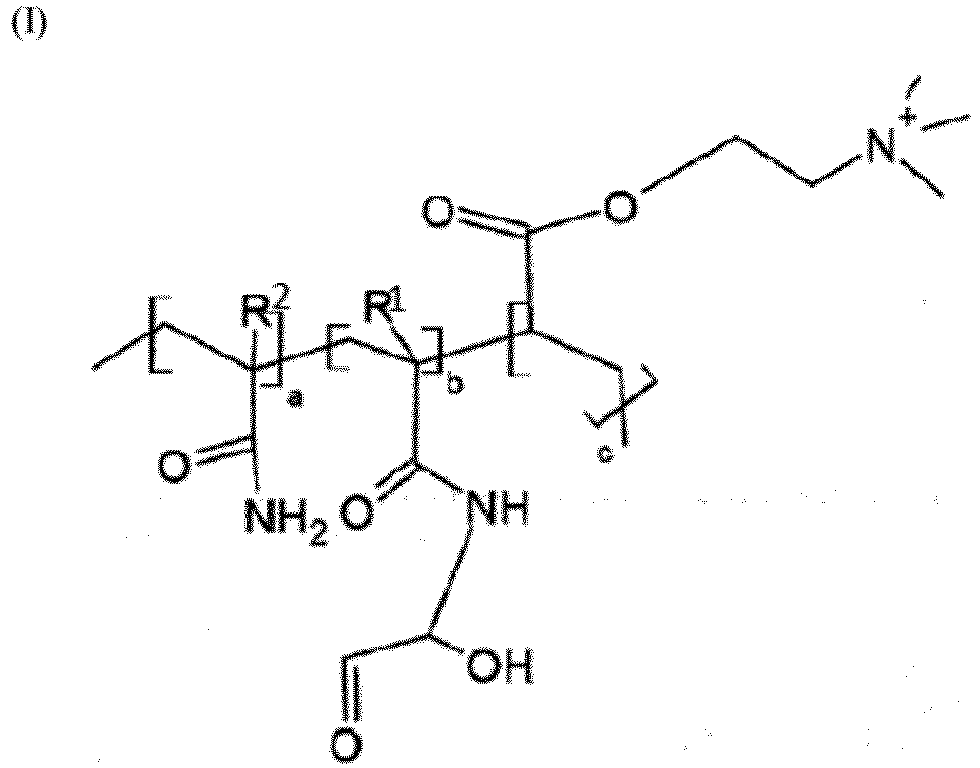
- the present invention relates to a terpolymer comprising at least one glyoxal monomer unit, at least one primary amide-containing monomer unit, and at least one cationic monomer unit, wherein the at least one cationic monomer unit is or includes a quaternary ammonium alkyl(meth)acrylate salt, said terpolymer having structure (I): wherein a is 1 to 6600 units, b is 1 to 3300 units, and c is 1 to 5300 units which randomly or non-randomly repeat in structure (I), and each of R 1 and R 2 , that are the same or different, represent H, C 1 alkyl, C 2 alkyl, C 3 alkyl, or C 4 alkyl, wherein total weight percent of a units is from 17% to 23%, total weight percent of b units is from 32% to 22%, and total weight percent of c units
- the present invention further relates to a polymer composition
- a polymer composition comprising the indicated terpolymer, and an aqueous medium in which the terpolymer is dispersed.
- the present invention further relates to a paper product comprising the indicated terpolymer.
- the present invention further relates to a product comprising a paper layer containing the indicated terpolymer, wherein the product is paper sheeting, paperboard, tissue paper, or wall board.
- the present invention further relates to a process of making paper which comprises absorbing an amount of the indicated terpolymer on cellulose papermaking fibers in an aqueous suspension, forming the suspension into a web, and drying the web.
- the present invention further relates to a process for making a terpolymer comprising: copolymerizing from 20% to 45%, by weight, primary amide-containing monomer and from 30% to 55%, by weight, cationic monomer copolymerizable with the primary amide-containing monomer to form a base copolymer, wherein the cationic monomer comprises a quaternary ammonium alkyl(meth)acrylate salt; and copolymerizing the base copolymer with glyoxal to form a terpolymer, comprising at least one pendant glyoxal monomer unit, said terpolymer having structure (I): wherein a is 1 to 6600 units, b is 1 to 3300 units, and c is 1 to 5300 units which randomly or non-randomly repeat in structure (I), and each of R 1 and R 2 , that are the same or different, represent H, C 1 alkyl, C 2 alkyl, C 3 alkyl, or C 4 al
- the present invention relates, in part, to glyoxalated polyacrylamide terpolymers that can have extended shelf life and represent superior additives for papermaking, or other processes.
- the glyoxalated polyacrylamide terpolymers of the present invention can be used as papermaking additives providing paper with strength and papermaking retention/drainage (dewatering) rates, which are better than non-treated systems and can be as good as, if not superior to, previous treatment programs.
- Efforts to control papermaking performance can be challenging since wet end retention, dewatering rate, and turbidity or other properties can be competitive properties. That is, enhancements made to one may adversely impact another.
- Use of the indicated terpolymers of the present invention can provide well-balanced or mutually improved performances in these and other performance properties associated with papermaking.
- the glyoxalated polyacrylamide terpolymers contain at least one glyoxal monomer unit, at least one primary amide-containing monomer unit, and at least one cationic monomer unit.
- the at least one cationic monomer unit is or includes a quaternary ammonium alkyl(meth)acrylate salt.
- the glyoxalated polyacrylamide terpolymers can have extended shelf life, such as up to about one year (365 days), or longer.
- shelf life can refer to the length of time in which the terpolymer remains stable, which can be determined by measuring the viscosity of the terpolymer solution until the viscosity increases beyond a limit, such as more than approximately 7 cps in storage at 37°C, which can correlate to significant gelation.
- the terpolymers of the present invention can be applied in usual wet end treatment locations of paper machines or other locations.
- glyoxalated polyacrylamide terpolymers on paper mill furnish can provide paper with dry strength (e.g., dry strength impact), temporary wet strength, retention, drainage (dewatering) rate, or more than one of these that are as good as, if not superior to comparative additive programs that use commercial materials.
- Increased papermaking retention efficiencies can be obtained using the glyoxalated polyacrylamide terpolymers at a relatively low dose, such as a dose as low as 0.1 pounds/ton (50 ppm by weight), or other dosages.
- glyoxalated polyacrylamide terpolymers in an additive system in wet end treatments, such as at a concentration of 0.01% to 5% actives or other concentrations, can decrease white water turbidities and concurrently increase drainage rates.
- the terpolymers or base copolymers of the terpolymer of the present invention can be used in coated or uncoated broke treatment in papermaking systems.
- the glyoxalated polyacrylamide terpolymers of the present invention contain at least one glyoxal monomer unit, at least one primary amide-containing monomer unit, and at least one cationic monomer unit, wherein the at least one cationic monomer unit is or includes a quaternary ammonium alkyl(meth)acrylate salt.
- the glyoxalated polyacrylamide terpolymer has structure (I): wherein a is 1 to 6600 units, b is 1 to 3300 units, and c is 1 to 5300 units which randomly or non-randomly repeat in structure (I), and R 1 and R 2 may be the same or different and represent H, C 1 alkyl, C 2 alkyl, C 3 alkyl, or C 4 alkyl.
- the coefficient a can be 100 to 5000 units (or 50 to 6000 units, 200 to 4000 units, 300 to 3000 units, 500 to 2500 units, 750 to 2000 units, 1000 to 4000 units, 1500 to 4000 units, or 2000 to 5500 units), b is 100 to 2500 units (or 50 to 3000 units, 150 to 2500 units, 250 to 2000 units, 300 to 1500 units, or 500 to 1200 units), and c is 100 to 4000 units (or 50 to 4500 units, 150 to 4000 units, 250 to 3500 units, 350 to 3000 units, 500 to 2500 units, 750 to 2000 units, or 1000 to 2000 units).
- the total weight (or mole) percent of a units is from 17% to 23%.
- the total weight (or mole) percent of b units is from 22% to 32%.
- the total weight (or mole) percent of c units is from 51% to 55%, based on 100% of the terpolymer.
- the total weight (or mole) percent of a units can be from 19% to 21%.
- the total weight (or mole) percent of b units can be from 25% to 28%.
- the total weight (or mole) percent of c units can be from 52% to 54%, based on 100% of the terpolymer.
- the units a, b, and c of structure (I) can compose at least 60%, or at least 70%, or at least 80%, or at least 90%, or at least 95%, or at least 98%, or at least 99%, or 100% of all (100%) of the monomeric units of the glyoxalated polyacrylamide terpolymer.
- Unit a derived from acrylamide units and unit c derived from ethanaminium,N,N,N-trimethyl-2-((1-oxo-2-propenyl)oxy)-chloride units.
- Unit a can be derived from other primary amide-containing monomers, and/or unit c can be derived from other quaternary ammonium alkyl(meth)acrylate salts, including those described herein.
- the molecular weight of the glyoxalated polyacrylamide terpolymer ranges from 500,000 Daltons to 2,000,000 Daltons, or from 700,000 Daltons to 1,750,000 Daltons, or from 900,000 Daltons to 1,500,000 Daltons, 1,000,000 Daltons to 1,250,000 Daltons. All molecular weights herein are weight average molecular weights measured by gel permeation chromatography (GPC) unless indicated otherwise.
- the glyoxalated polyacrylamide terpolymers of the present invention include repeating units from at least one or more primary amide-containing monomer compounds.
- the primary amide-containing monomer unit can be acrylamide, methacrylamide, ethacrylamide, crotonamide, N-butyl acrylamide, N-methyl acrylamide, N-methyl methacrylamide, N-ethyl acrylamide, N-ethyl methacrylamide, N-isopropyl (meth)acrylamide, or other primary-amide monomer compound, or any combination thereof.
- the primary amide-containing monomer unit preferably can be acrylamide.
- the quaternary ammonium alkyl(meth)acrylate salt that can be used for the cationic monomer units in the glyoxalated polyacrylamide terpolymers of the present invention can have structure (II): wherein R 1 is hydrogen or methyl, A is a straight chain alkylene group having 2 or 3 carbon atoms, Z is a halogen, and R 2 , R 3 , and R 4 , which can be the same or different, is a C 1 , C 2 , or C 3 alkyl group or benzyl group. Z can be Cl, F, Br, or I.
- the quaternary ammonium alkyl(meth)acrylate salt can be:
- the quaternary ammonium alkyl(meth)acrylate salt preferably can be ethanaminium,N,N,N-trimethyl-2-((1-oxo-2-propenyl)oxy)-chloride.
- the polyacrylamide terpolymers of the present invention are glyoxalated.
- Unit b in structure (I) can be derived in part from glyoxal.
- Glyoxal can react with amide groups in the base copolymer, such as described herein, to form a pendant glyoxalated group, such as shown by the structure of unit b in structure (I).
- the glyoxalated polyacrylamide terpolymer can be the reaction product of glyoxal and a base copolymer of the primary amide-containing monomer and the cationic monomer (quaternary ammonium alkyl(meth)acrylate salt).
- the base copolymer can be comprised of the indicated units a and c of structure (I).
- the primary amide-containing monomer unit can provide the primary reaction sites on the base polymer backbone to which the glyoxal substituents can be subsequently attached.
- the base copolymer, or the base polymer product of the copolymerization of the primary amide-containing monomer and cationic monomer, for use in the present invention can be prepared by free radical polymerization in an aqueous system.
- a base copolymer of a desired chemical composition and monomer distribution the full complement of the cationic monomer(s), primary amide-containing monomer(s), and any other monomers to be incorporated into the base copolymer can be added all at once at the beginning of the polymerization reaction.
- the cationic monomer(s), primary amide-containing monomer(s), and any other monomer(s) to be included in the base copolymer can be added continuously over the time course of the polymerization reaction.
- the base copolymer product can comprise from 20% to 45%, by weight, the primary amide-containing monomer and from 30% to 55%, by weight, the cationic monomer copolymerizable with the primary amide-containing monomer, or from 25% to 40%, by weight, the primary amide-containing monomer and from 35% to 50%, by weight, the cationic monomer, or from 30% to 35%, by weight, the primary amide-containing monomer and from 40% to 45%, by weight, the cationic monomer, or other range values.
- the base copolymer can have a weight average molecular weight ranging from 500,000 Daltons to 1,600,000 Daltons, or from 750,000 Daltons to 1,250,000 Daltons, or from 900,000 Daltons to 1,100,000 Daltons, or other values.
- the molecular weight can be influenced by changing the reaction temperature, the level of solids in the reaction, the amount of initiator, the amount of chain transfer agent, and by other methods used by those skilled in the art.
- suitable chain transfer agents include, but are not limited to, isopropyl alcohol, mercaptans, sodium formate, and sodium acetate.
- the base copolymer optionally can contain at least one non-nucleophilic monomer to reduce amide-glyoxal cross-linking reactions during glyoxalation of the base copolymer in a separate subsequent reaction.
- suitable non-nucleophilic monomers include, but are not limited to, vinyl acetate, N-vinylpyrrolidone, N,N-dimethylacrylamide, acrylonitrile, styrene, hydroxyl alkyl(meth)acrylates and the like.
- the weight percent of this non-nucleophilic unit can range from zero to 45 (e.g., 0 wt% to 45 wt%, 1 wt% to 40 wt%, 5 wt% to 35 wt%, 10 wt% to 30 wt%, 15 wt% to 25 wt% and so on), based on total weight of base copolymer.
- the base copolymer can be isolated from the reaction solution after synthesis and dried to provide a dry solid particulate, e.g., as a flowable dry powder, form of the product.
- the base copolymer can be isolated from the reaction solution by dewatering of the base copolymer, and can be dried and formed into a powder by spray drying or other drying techniques known.
- the base copolymer is stable in the dry particulate form. In view of this, the base copolymer in dry solid particulate form can be handled, transported and stored in less bulk volumes as compared to fluid dispersions or slurries of the material.
- Another advantage of the base copolymer is that the base copolymer can be glyoxalated anywhere.
- the base copolymer does not need to be glyoxalated immediately after synthesis.
- the base copolymer can be handled and stored as a stable material until glyoxalation at a later date.
- the base copolymer can be glyoxalated offsite or onsite (in situ) at the papermaking mill where it will be applied.
- the base copolymer itself can be applied as the active agent in broke treatment in a papermaking system.
- the glyoxalation step can be omitted for coated and uncoated broke treatment using the base copolymer itself as the active agent.
- the base copolymers are glyoxalated to provide terpolymers that are particularly suitable for use as additives for papermaking, such as additives for wet end processing and paper strength development.
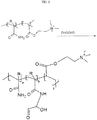
- a glyoxalation of a base copolymer according to an exemplary illustration is schematically indicated in FIG. 1 .
- the acrylamide or other primary amide-containing monomer in the base copolymer can provide the primary reaction sites on the base polymer backbone to which the glyoxal substituents are attached.
- Glyoxal can react with amide groups to form a pendant glyoxalated group, such as shown by the structure of unit b in structure (I).
- glyoxal can be used to crosslink two base copolymer backbone chains of the terpolymer.
- the base copolymer can be formulated to have a sufficient number of acrylamide or other primary amide-containing monomers in its structure (pendant amide groups) so that, once functionalized with glyoxal, the resulting polymer can be thermosetting.
- thermosetting and “crosslinking”, and similar terms are intended to embrace the structural and/or morphological change that occurs, for example, by covalent chemical reaction or ionic interaction between separate molecules in a composition.
- non-nucleophilic monomers may be incorporated into the base copolymer to reduce amide-glyoxal cross-linking reactions during glyoxalation of the base copolymer.
- the base copolymer can be reacted with glyoxal at a pH of 7 to 10, or other pH values.
- the weight ratio of the glyoxal to the base copolymer can range from about 0.01:1 to about 0.6:1, or from about 0.1:1 to about 0.3:1, respectively, or other ratios.
- the reaction temperature can be maintained in the range of 15°C to 50°C, or other suitable reaction temperatures.
- a buffer can be added to control solution pH throughout the reaction. Suitable buffers can be or include a sodium phosphate, sodium pyrophosphate, borax, and/or Tris.
- dilute acid can be added to lower the pH and quench the reaction.
- the final pH of the solution can range from 2 to 5, or other pH values.
- either the glyoxal solution or the base copolymer solution can be added to the reaction mixture slowly over time.
- both the glyoxal and the base polymer solution can be added to the reaction mixture slowly over time.
- Still other options for reacting glyoxal and a base polymer recognized by those skilled in the art may be adapted for application to the synthesis of the terpolymers of the present invention.
- the glyoxalated polyacrylamide terpolymer reaction products of the present invention can be used directly from the reaction solution, or can be isolated from the reaction solution and re-dispersed in another liquid medium for handling and storage before use.
- the glyoxalated polyacrylamide terpolymer products of the present invention can be dispersed in an aqueous medium to provide additive compositions.
- the compositions of glyoxalated polyacrylamide terpolymers according to the present invention can be readily employed or stored for later use in the manufacture of paper as an aqueous solution.
- the compositions are highly storage stable, even at temperatures exceeding room temperature.
- the terpolymer and/or a formulation containing the terpolymer has 0 wt% stabilizers, and/or scavengers, and/or surfactants.
- the glyoxalated polyacrylamide terpolymer compositions according to the present invention do not need extraneous stabilizers, aldehyde scavengers, and/or surfactants, and the like, to achieve the improvements in storage stability, although these materials are not categorically excluded.
- the glyoxalated polyacrylamide terpolymer compositions of the present invention can contain no such stabilizer additives or can be essentially free of them (that is, contain ⁇ 0.1 wt% total stabilizers, scavengers (e.g. aldehyde scavengers), and/or surfactants).
- scavengers e.g. aldehyde scavengers
- surfactants e.g. aldehyde scavengers
- the glyoxalated polyacrylamide terpolymer compositions according to the present invention can have a solids concentration in an aqueous medium (e.g., deionized water or tap water) of from about 1% and about 30%, by weight, or from about 10% to about 30%, by weight, or from about 11% to about 15%, by weight or from about 12% to about 15%, by weight, or other percentages, on a weight/volume (w/v) basis.
- an aqueous medium e.g., deionized water or tap water
- the freshly-synthesized glyoxalated polyacrylamide terpolymers of the present invention can be immediately used or can be stored before use.
- An advantage of the glyoxalated polyacrylamide terpolymers of the present invention is that the terpolymers can be stably stored, such as in aqueous compositions, for extended periods of time before use.
- the glyoxalated polyacrylamide terpolymer can have a shelf life of at least 21 days, or at least 30 days, or at least 60 days, or at least 90 days, or at least 180 days, or up to or over one year (365 days or more), or longer periods of time, or from 21 days to 365 days, or from 30 days to 365 days, or from 60 days to 365 days, or from 90 days to 365 days, or from 180 days to 365 days, or other time periods, such as when stored at temperature from 35 to 85° F (1.7 to 29° C).
- the terpolymer can be added at any time before, during, and/or after the paper is formed.
- the composition can be conveniently added at the wet end of a papermaking facility to the dilute cellulose fiber suspensions, normally at a point when wet strength resins are conventionally added.
- the composition can be added to a previously prepared paper by padding, spraying, immersing, and/or printing and the like.
- the terpolymer When used as a wet end additive, the terpolymer can be contacted with paper or paper board making pulp in a pulp stock prior to draining to provide a treated pulp suspension, then draining the pulp suspension, and forming a drained treated pulp suspension into paper or paperboard.
- the terpolymer can be used in a wet end process of making paper which comprises absorbing an amount of the terpolymer on cellulose papermaking fibers in aqueous suspension, forming the suspension into a web, and drying the web.
- the cellulose papermaking fibers can comprise broke.
- the amount of the terpolymer used can be an amount effective to increase at least one paper property selected from retention, drainage rate or paper dry strength or high humidity dry strength retention, as compared to paper made with the suspension absent the terpolymer.
- the amount of the terpolymer can be effective to increase at least one paper property (e.g., retention or drainage rate or paper dry strength) in an amount of at least 10%, or at least 12.5%, or at least 15%, or at least 20%, or at least 30% or other increases, as compared to paper made with the suspension absent the terpolymer.
- the amount of the terpolymer can be effective to increase at least one paper property (e.g., retention or drainage rate) in an amount of at least 50%, or at least 60%, or at least 70%, or at least 80%, or at least 90%, or at least 100%, or other increases, as compared to paper made with the suspension absent the terpolymer.
- the paper property achieved can be a ring crush percent retention (or high humidity strength retention) of at least 30% (when stored at high humidity for at least 24 hours) compared to the original dry strength.
- This ring crush percent retention (or high humidity strength retention) can be at least 40%, at least 50%, at least 60%, at least 70% or at least 75%, such as from 30% to 80% or from 40% to 80%, or from 50% to 80%, or from 60% to 80%.
- the composition can be added to paper pulp over a wide range of pH values.
- the composition can be added to the paper pulp at a pH of from about 5 to about 8, such as a pH from 5.5 to 7.0, or other pH values.
- Compositions described above can be readily absorbed by the cellulose fibers at these pH values.
- a paper product can be provided comprising the glyoxalated polyacrylamide terpolymer of the present invention.
- the product may comprise at least one paper layer or web containing the glyoxalated polyacrylamide terpolymer, such as paper sheeting, paperboard, tissue paper, or wall board.
- the composition is not limited to treating any particular type of paper and can find application in Kraft paper, sulfite paper, semichemical paper, recycled paper, and the like, including paper produced using bleached pulp, unbleached pulp, or combinations thereof.
- the amount of added glyoxalated polyacrylamide terpolymer can be as low as about 0.03 wt% of the dry weight of the cellulose fibers, and can be about 10% by weight or lower or higher. An amount in the range of about 0.1 wt% to 5 wt% of the dry paper weight can be used.
- the amount of glyoxalated polyacrylamide terpolymer added, on a solids basis, can be expressed in terms of from about 0.1 pound to about 10 pounds (lb.) terpolymer/ton dry fiber, or from about 0.1 lb. to about 5 lb. terpolymer/ton dry fiber, or from about 0.1 lb. to about 3 lb.
- terpolymer/ton dry fiber or from about 0.1 lb. to about 2 lb. terpolymer/ton dry fiber, or from about 0.1 lb. to about 1 lb. terpolymer/ton dry fiber, where 1 pound/ton is 500 ppm by weight.
- a base copolymer was prepared from acrylamide and quaternary ammonium alkyl(meth)acrylate salt monomers, and the resulting base copolymer was glyoxalated.
- the resulting glyoxalated polyacrylamide terpolymer was tested for dry and wet strengths, water retention, drainage, and shelf life (stability).
- a reaction vessel equipped with a reflux condenser, stirrer, and thermometer, were added with water, sodium formate, and a first portion of ethanaminium,N,N,N-trimethyl-2-((1-oxo-2-propenyl)oxy)-chloride, referred to herein by the abbreviation "DMAEAQ” (40% weight aqueous solution of DMAEAQ).
- DMAEAQ 50% weight aqueous solution of DMAEAQ
- the vessel was then heated to 55°C and maintained at this temperature.
- acrylamide acrylamide
- an additional (2nd) portion of DMAEAQ an additional (2nd) portion of DMAEAQ
- ammonium persulfate was 300 minutes and the addition time of ammonium persulfate was 330 minutes.
- the acrylamide was a 40-55% by weight aqueous solution of Am.
- the additional portion of DMAEAQ was added over this 300 minute addition period.
- the reaction mixture was then heated at 70°C for an additional 1 hour and was then cooled.
- the base copolymer was isolated from the reaction solution by dewatering, and dried and formed into a powder by spray drying. Table 1 lists the addition dosages of all the compounds used in synthesizing the base copolymer.
- Table 1 lists the addition dosages of all the compounds used in synthesizing the base copolymer.
- Table 1 Base Copolymer preparation dosages and MW.
- compositions were prepared from the base copolymer dry powder of acrylamide: ethanaminium,N,N,N-trimethyl-2-((1-oxo-2-propenyl)oxy)-chloride ("Am:DMAEAQ”) which was prepared in Example 1.
- Example 1 An amount of the dry powder base copolymer of Example 1 was made down in a reaction vessel by mixing the powdered base copolymer, glyoxal, and sodium pyrophosphate (as a buffer) for no more than one hour at a temperature of 25°C-30°C. After 60 minutes of mixing, the pH of the reaction mixture was raised to 9 using sodium hydroxide solution (2% NaOH). Once the viscosity of the mixture reached about 100 cp, dilution water was added and solution pH was then lowered to 2.5 immediately using sulfuric acid (2%) to quench the reaction between the glyoxal and the pending amide group. The terpolymer product was stored at 25°C in an aqueous medium until further testing, as described in the following examples.
- Table 2 lists the dosages of all the components used for glyoxalation.
- the product of the reaction was an aqueous composition containing the glyoxalated polyacrylamide polymer as an active content therein.
- Table 2 lists the dosages of all the components used for glyoxalation.
- the product of the reaction was an aqueous composition containing the glyoxalated polyacrylamide polymer as an active content therein. Table 2.
- AM:Gly:DMAEAQ Product Water g
- Base Copolymer g
- Glyoxal 40%)
- Sodium Pyrophosphate g
- Dilution water g
- Final active content 900 40 20 2 60 4
- Paper preparations and performance tests were conducted with the glyoxalated polyacrylamide terpolymer product of Example 2 as follows.
- One pound/ton is 500 ppm by weight.
- the terpolymer product of Example 2 designated sample (1225-42), was applied to furnish obtained from a commercial papermaking mill.
- the performance at 0.5, 0.1, 0.2, 0.3, and 0.4 dry pounds terpolymer/ton dried fiber was compared against a comparison program which was a combination of X911 (2 lb./ton)/BFL5132 (1.3 lb./ton)/BFL5504 (2.6 lb./ton).
- BUFLOC® 5132 (cationic polyamine) and BUFLOC® 5504 (cationic polymer) are available from Buckman Laboratories International, Inc. (Memphis, Tennessee USA).
- X911 is for comparison, and is a commercially available product.
- Drainage and retention were determined using a Mutek DFR-4 drainage/retention tester. A faster de-watering process indicates a higher production rate and lower energy consumption during the paper drying process.
- 800 mL furnish was added to a Mutek DFR-4 drainage/retention tester and was then sheared at 550 rpm for five seconds.
- the terpolymer or comparison additive program was then added to the furnish and the suspension was mixed at 550 rpm for an additional five seconds.
- the mixing was then stopped and the time of draining 550 mL water through a 60 mesh wire was recorded. Filtrate turbidity was recorded using a HACH 2100 turbidimeter. A lower turbidity indicates a higher retention efficiency.
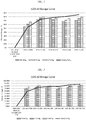
- the bar graph displays drainage time and turbidity results for the terpolymer (1225-42) treated furnish at 0.05, 0.1, 0.2, 0.3, 0.4 dry lbs./ton.
- the bars are grouped in sets of three, wherein the left bar is for 150% change, the middle bar is for 250% change, and the right bar is for 350% change.
- the line in FIG. 2 is for turbidity.
- the results vary with an outstanding 60-85% improvement in drainage time and turbidity as compared to a comparison program.
- drainage and retention were improved using the terpolymer.
- the first comparison additive program on the X-axis (X911/BFL5132 & BFL 5504) represents the comparison benchmark for drainage and retention program. All data was compared to the comparison and reported as percent change.
- FIG. 3 shows the retention/drainage and turbidity results of this study for the terpolymer (Am:Gly:DMAEAQ) ("1225-42") with dosages again set at 0.05, 0.1, 0.2, 0.3, 0.4, and 0.5 dry lbs./ton, and for those of the comparison program (X911/BFL5132/BFL5504) at the indicated dosages of its components (all in lb./ton).
- the results of this study showed excellent results, similar to the first study ( FIG. 2 ), which demonstrated the repeatability of the results.
- the results of these studies also showed that the terpolymer product (1225-42) significantly improved retention and drainage up to an 80% improvement.
- Handsheets were prepared using furnish obtained from the same papermaking mill, which were prepared essentially according to Tappi standard method T205, with the following modifications:
- Tensile strength tests (dry) and burst (Mullen) strength tests were carried out based on Tappi standard methods T494 and T220 respectively.
- wet tensile tests each sample is cut to be one inch in width. After soaking in de-ionized water for 60 seconds, the sample is pulled at 1 in/min rate and the load at the failure is recorded.
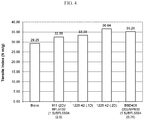
- FIG. 4 illustrates the impact of the terpolymer (1225-42) on tensile strength improvement at 0.1 and 0.2 lb./ton dosages as compared to the comparison strength/retention and drainage program (911/BFL5132/BFL5504). Additionally the terpolymer (1225-42) was compared against an alternative comparison strength/retention aid program (BBD 408, MP 830 and BFL 5504).
- BBD 408, MP 830 and BFL 5504 alternative comparison strength/retention aid program
- FIG. 5 illustrates the impact of the terpolymer (122542) on Burst strength improvement at 0.1 and 0.2 lb./ton dosages as compared to the comparison strength/retention and drainage program (911/BFL5132/BFL 5504). Additionally, as indicated, the terpolymer (1225-42) was compared against an alternative comparison strength/retention aid program (BBD 408, MP 830 and BFL 5504).
- BBD 408, MP 830 and BFL 5504 alternative comparison strength/retention aid program
- Handsheets were prepared using old corrugated containers (OCC) furnish obtained from a commercial papermaking mill, which were otherwise prepared essentially in the same manner as the handsheets in Example 3.
- OCC corrugated containers
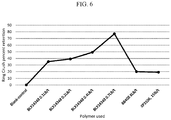
- Ring Crush tests (TAPPI T818) were performed on original samples of all the indicated types of the handsheets, and remaining samples of the handsheets were stored in high humidity (%RH) chamber for at least 24 hours. After a target moisture was reached for all the stored samples, a Ring Crush test was performed for all stored samples. Ring Crush strength retention (%) was determined based on a mathematical comparison of the original strength values and stored strength values for each type of handsheet that was tested. Mean values of Ring Crush % retention values were determined for each type of tested handsheet. The results are shown in FIG. 6 .
- the results in FIG. 6 show that the handsheets treated with a terpolymer of the present invention had greater high humidity dry strength retention compared to handsheets treated with the comparison compounds and the blank.
- the strength retention exceeded 70% of the original dry strength of the handsheet at the highest tested dosage of the terpolymer of the present invention.
- the strength retention was at least about 10% greater or more at all the tested dosages of the terpolymer of the present invention compared to the strength retentions of the comparison compounds, and at least about 30% greater or more at all the tested dosages of the terpolymer of the present invention compared to the strength retention of the blank.
- terpolymer formulations prepared in accordance with the present invention can be effective for use in paper packaging where products are desired that enable the physical properties of paper board to remain unchanged, e.g., non-collapsed, after the board absorbs moisture from the air in high humidity conditions during storage.
- the present invention can include any combination of these various features or embodiments above and/or below as set forth in sentences and/or paragraphs. Any combination of disclosed features herein is considered part of the present invention and no limitation is intended with respect to combinable features.
Landscapes
- Chemical & Material Sciences (AREA)
- Chemical Kinetics & Catalysis (AREA)
- Health & Medical Sciences (AREA)
- Medicinal Chemistry (AREA)
- Polymers & Plastics (AREA)
- Organic Chemistry (AREA)
- General Chemical & Material Sciences (AREA)
- Paper (AREA)
- Addition Polymer Or Copolymer, Post-Treatments, Or Chemical Modifications (AREA)
Claims (15)
- Terpolymer umfassend zumindest eine anhängende Glyoxalmonomereinheit, zumindest eine primäres Amid enthaltende Monomereinheit und zumindest eine kationische Monomereinheit, wobei die zumindest eine kationische Monomereinheit ein quaternäres Ammoniumalkyl(meth)acrylat Halogensalz ist, wobei das Terpolymer die Struktur (I) aufweist:

- Terpolymer nach Anspruch 1, wobei die zumindest eine primäres Amid enthaltende Monomereinheit Acrylamid ist.
- Terpolymer nach Anspruch 1, wobei das quaternäre Ammoniumalkyl(meth)acrylat Halogensalz die Struktur (II) aufweist:

- Terpolymer nach Anspruch 1, wobei das quaternäre Ammoniumalkyl(meth)acrylat Salz
Ethanaminium,N,N,N-trimethyl-2-((1-oxo-2-propenyl)oxy)chlorid,
(2-(Methacryloyloxy)ethyl)trimethylammoniumchlorid,
(3-(Acryloyloxy)propyl)trimethylammoniumchlorid,
(3-(Methacryloyloxy)propyl)trimethylammoniumchlorid,
(2-(Acryloyloxy)ethyl)benzyldimethylammoniumchlorid,
(2-(Methacryloyloxy)ethyl)benzyldimethylammoniumchlorid,
(3-(Acryloyloxy)propyl)benzyldimethylammoniumchlorid,
(3-(Methacryloyloxy)propyl)benzyldimethylammoniumchlorid
oder eine beliebige Kombination dieser ist. - Terpolymer nach Anspruch 1, wobei das quaternäre Ammoniumalkyl(meth)acrylat Salz Ethanaminium,N,N,N-trimethyl-2-((1-oxo-2-propenyl)oxy)chlorid ist.
- Terpolymer nach Anspruch 1, wobei die primäres Amid enthaltende Monomereinheit Acrylamid, Methacrylamid, Ethacrylamid, Crotonamid, N-Butylacrylamid, N-Methylacrylamid, N-Methylmethacrylamid, N-Ethylacrylamid, N-Ethylmethacrylamid, N-Isopropylmethacrylamid oder eine beliebige Kombination davon ist.
- Polymerzusammensetzung, umfassend ein Terpolymer nach Anspruch 1 und ein wässriges Medium, in dem das Terpolymer dispergiert ist.
- Papierprodukt, ausgewählt aus Papierfolie, Pappe, Papiertuch oder Wandpappe, umfassend das Terpolymer nach Anspruch 1.
- Produkt, umfassend eine Papierschicht, die das Terpolymer nach Anspruch 1 enthält, wobei das Produkt Papierfolie, Pappe, Papiertuch oder Wandpappe ist.
- Verfahren zum Herstellen von Papier, umfassend das Absorbieren einer Menge des Terpolymers nach Anspruch 1 auf Cellulose-Papiererzeugungsfasern in wässriger Suspension, Bilden der wässrigen Suspension zu einer Bahn und Trocknen der Bahn, wobei die Menge des Terpolymers wirksam ist, um die Retention, Abflussrate oder Papier-Trockenfestigkeit im Vergleich zu Papier zu erhöhen, das mit der Suspension ohne das Terpolymer hergestellt wurde.
- Verfahren nach Anspruch 10, wobei das Papier von 0,1 Pfund bis 1 Pfund Terpolymer / Tonne Trockenfaser (50 bis 500 Gewichts-ppm) umfasst.
- Verfahren nach Anspruch 10, wobei das Terpolymer vor dem Absorbieren 21 bis 365 Tage bei einer Temperatur von 35 bis 85 °F (1,7 °C bis 29 °C) gelagert wurde.
- Verfahren nach Anspruch 10, wobei die Cellulose-Papiererzeugungsfasern Ausschuss umfassen.
- Verfahren nach Anspruch 10, wobei das Terpolymer mit Papier- oder Karton-Faserstoffaufschwemmung in einem Aufschwemmungsmaterial vor dem Trockenlegen kontaktiert wird, um eine behandelte Faserstoffaufschwemmungssuspension bereitzustellen, die Faserstoffaufschwemmungssuspension danach trockengelegt wird, und eine trockengelegte Faserstoffaufschwemmungssuspension eu Papier oder Karton gebildet wird.
- Verfahren zur Herstellung von Terpolymer, Folgendes umfassend:Copolymerisieren von etwa 20 Gew.--% bis etwa 45 Gew.-% eines primäres Amid enthaltenden Monomers und von etwa 30 Gew.--% bis etwa 55 Gew.-% von kationischem Monomer, das mit dem primäres Amid enthaltenden Monomer copolymerisierbar ist, um ein Basis-Copolymer zu bilden, wobei das kationische Monomer ein quaternäres Ammoniumalkyl(meth)acrylat Halogensalz umfasst; undCopolymerisieren des Basis-Copolymers mit Glyoxal zum Bilden eines Terpolymers, umfassend mindestens eine anhängende Glyoxalmonomereinheit, wobei das Terpolymer die Struktur (I) aufweist:
Applications Claiming Priority (2)
| Application Number | Priority Date | Filing Date | Title |
|---|---|---|---|
| US201662300144P | 2016-02-26 | 2016-02-26 | |
| PCT/US2017/018025 WO2017146965A1 (en) | 2016-02-26 | 2017-02-16 | Glyoxalated polyacrylamide terpolymer, base copolymer thereof, compositions containing same, uses in papermaking and products thereof |
Publications (2)
| Publication Number | Publication Date |
|---|---|
| EP3420005A1 EP3420005A1 (de) | 2019-01-02 |
| EP3420005B1 true EP3420005B1 (de) | 2020-04-15 |
Family
ID=58191645
Family Applications (1)
| Application Number | Title | Priority Date | Filing Date |
|---|---|---|---|
| EP17708078.5A Not-in-force EP3420005B1 (de) | 2016-02-26 | 2017-02-16 | Glyoxaliertes polyacrylamidterpolymer, basiscopolymer davon, zusammensetzung damit, verwendungen in der papierherstellung und produkte daraus |
Country Status (11)
| Country | Link |
|---|---|
| US (1) | US20170247489A1 (de) |
| EP (1) | EP3420005B1 (de) |
| JP (1) | JP2019507816A (de) |
| CN (1) | CN108699194A (de) |
| AU (1) | AU2017223287B2 (de) |
| BR (1) | BR112018015763A2 (de) |
| CA (1) | CA3014062A1 (de) |
| ES (1) | ES2790400T3 (de) |
| MX (1) | MX2018009783A (de) |
| PT (1) | PT3420005T (de) |
| WO (1) | WO2017146965A1 (de) |
Families Citing this family (13)
| Publication number | Priority date | Publication date | Assignee | Title |
|---|---|---|---|---|
| CN107771191B (zh) | 2015-06-17 | 2020-08-28 | 科莱恩国际有限公司 | 作为水泥浆中的降失水剂的水溶性或水溶胀性聚合物 |
| CN110300573B (zh) | 2016-12-12 | 2023-07-25 | 科莱恩国际有限公司 | 生物基聚合物在化妆、皮肤病学或药物学组合物中的用途 |
| WO2018108609A1 (en) | 2016-12-12 | 2018-06-21 | Clariant International Ltd | Polymer comprising certain level of bio-based carbon |
| ES3017507T3 (en) | 2016-12-15 | 2025-05-13 | Clariant Int Ltd | Water-soluble and/or water-swellable hybrid polymer |
| EP3554643B1 (de) | 2016-12-15 | 2025-03-19 | Clariant International Ltd | Wasserlösliches und/oder in wasser quellbares hybridpolymer |
| EP3554644B1 (de) | 2016-12-15 | 2025-03-19 | Clariant International Ltd | Wasserlösliches und/oder in wasser quellbares hybridpolymer |
| US11339241B2 (en) | 2016-12-15 | 2022-05-24 | Clariant International Ltd. | Water-soluble and/or water-swellable hybrid polymer |
| BR112022016553A2 (pt) * | 2020-03-18 | 2022-10-11 | Kemira Oyj | Método para glioxilação no local de poliacrilamida |
| AU2021239958A1 (en) * | 2020-03-18 | 2022-10-20 | Kemira Oyj | Compositions and methods for increased wet and dry strength |
| US12618197B2 (en) * | 2022-01-21 | 2026-05-05 | Solenis Technologies, L.P. | Additive compositions for papermaking |
| CN114292369B (zh) * | 2022-01-25 | 2024-02-06 | 九洲生物技术(苏州)有限公司 | 一种高支链聚丙烯酰胺增强滤水剂及其制备方法和应用 |
| FR3137094B1 (fr) * | 2022-06-24 | 2024-06-14 | Snf Sa | Polymère hydrosoluble cationique et son procédé de préparation |
| FR3137093B1 (fr) * | 2022-06-24 | 2024-06-14 | Snf Sa | Polymère hydrosoluble et son procédé de préparation |
Family Cites Families (9)
| Publication number | Priority date | Publication date | Assignee | Title |
|---|---|---|---|---|
| US3556932A (en) * | 1965-07-12 | 1971-01-19 | American Cyanamid Co | Water-soluble,ionic,glyoxylated,vinylamide,wet-strength resin and paper made therewith |
| US7641766B2 (en) * | 2004-01-26 | 2010-01-05 | Nalco Company | Method of using aldehyde-functionalized polymers to enhance paper machine dewatering |
| PT1828480E (pt) * | 2004-12-21 | 2014-08-29 | Hercules Inc | Resinas catiónicas reactivas para aplicação como agentes de resistência à secura e à humidade em sistemas de fabricação de papel contendo iões de sulfito |
| US7863395B2 (en) * | 2006-12-20 | 2011-01-04 | Georgia-Pacific Chemicals Llc | Polyacrylamide-based strengthening agent |
| BRPI0810314A2 (pt) * | 2007-05-09 | 2014-10-21 | Buckman Labor Inc | "emulsão de colagem de anidrido alquenil succínio, proceso para colar papel, mistura com anidrido alquenil succínico e agente emulsificante" |
| EP2176304B1 (de) * | 2007-06-15 | 2020-09-02 | Buckman Laboratories International, Inc. | Feststoffreiches glyoxaliertes polyacrylamid |
| PT2496651E (pt) | 2009-11-06 | 2015-08-24 | Solenis Technologies Cayman Lp | Aplicação superficial de polímeros e misturas de polímeros para melhorar a resistência de um papel |
| US9347181B2 (en) * | 2013-11-22 | 2016-05-24 | Kemira Oyj | Method for increasing paper strength |
| CN104746388B (zh) * | 2013-12-25 | 2018-05-08 | 艺康美国股份有限公司 | 一种提高高分子乳化剂乳化的asa 乳液的施胶效果的方法 |
-
2017
- 2017-02-16 EP EP17708078.5A patent/EP3420005B1/de not_active Not-in-force
- 2017-02-16 BR BR112018015763A patent/BR112018015763A2/pt not_active IP Right Cessation
- 2017-02-16 CA CA3014062A patent/CA3014062A1/en not_active Abandoned
- 2017-02-16 ES ES17708078T patent/ES2790400T3/es active Active
- 2017-02-16 WO PCT/US2017/018025 patent/WO2017146965A1/en not_active Ceased
- 2017-02-16 US US15/434,082 patent/US20170247489A1/en not_active Abandoned
- 2017-02-16 PT PT177080785T patent/PT3420005T/pt unknown
- 2017-02-16 MX MX2018009783A patent/MX2018009783A/es unknown
- 2017-02-16 AU AU2017223287A patent/AU2017223287B2/en not_active Ceased
- 2017-02-16 CN CN201780013347.1A patent/CN108699194A/zh active Pending
- 2017-02-16 JP JP2018544458A patent/JP2019507816A/ja active Pending
Non-Patent Citations (1)
| Title |
|---|
| None * |
Also Published As
| Publication number | Publication date |
|---|---|
| MX2018009783A (es) | 2018-12-06 |
| JP2019507816A (ja) | 2019-03-22 |
| CA3014062A1 (en) | 2017-08-31 |
| AU2017223287A1 (en) | 2018-08-23 |
| AU2017223287B2 (en) | 2019-06-20 |
| PT3420005T (pt) | 2020-05-19 |
| US20170247489A1 (en) | 2017-08-31 |
| BR112018015763A2 (pt) | 2019-01-02 |
| CN108699194A (zh) | 2018-10-23 |
| WO2017146965A1 (en) | 2017-08-31 |
| ES2790400T3 (es) | 2020-10-27 |
| EP3420005A1 (de) | 2019-01-02 |
Similar Documents
| Publication | Publication Date | Title |
|---|---|---|
| AU2017223287B2 (en) | Glyoxalated polyacrylamide terpolymer, base copolymer thereof, compositions containing same, uses in papermaking and products thereof | |
| CA2690863C (en) | High solids glyoxalated polyacrylamide | |
| EP1828480B1 (de) | Reaktive kationische harze zur verwendung als trockene und feuchte festigungsmittel in sulfitionenhaltigen systemen zur papierherstellung | |
| KR101507190B1 (ko) | 제지에 있어서 첨가제로서의 개질된 비닐아민-함유 중합체 | |
| CZ33099A3 (cs) | Pryskyřice z amfoterních aldehydických polymerů a použití těchto pryskyřic jako pryskyřic s dočasnou pevností za mokra a pevností za sucha pro papír | |
| US20090120601A1 (en) | Papermaking Process | |
| EP3571348B1 (de) | Hochmolekulares temporäres nassfestes harz für papier | |
| CN113785029B (zh) | 用于增加湿纸强度和干纸强度的组合物和方法 | |
| US7740743B2 (en) | Fine particle size lime slurries and their production |
Legal Events
| Date | Code | Title | Description |
|---|---|---|---|
| STAA | Information on the status of an ep patent application or granted ep patent |
Free format text: STATUS: UNKNOWN |
|
| STAA | Information on the status of an ep patent application or granted ep patent |
Free format text: STATUS: THE INTERNATIONAL PUBLICATION HAS BEEN MADE |
|
| PUAI | Public reference made under article 153(3) epc to a published international application that has entered the european phase |
Free format text: ORIGINAL CODE: 0009012 |
|
| STAA | Information on the status of an ep patent application or granted ep patent |
Free format text: STATUS: REQUEST FOR EXAMINATION WAS MADE |
|
| 17P | Request for examination filed |
Effective date: 20180806 |
|
| AK | Designated contracting states |
Kind code of ref document: A1 Designated state(s): AL AT BE BG CH CY CZ DE DK EE ES FI FR GB GR HR HU IE IS IT LI LT LU LV MC MK MT NL NO PL PT RO RS SE SI SK SM TR |
|
| AX | Request for extension of the european patent |
Extension state: BA ME |
|
| DAV | Request for validation of the european patent (deleted) | ||
| DAX | Request for extension of the european patent (deleted) | ||
| GRAP | Despatch of communication of intention to grant a patent |
Free format text: ORIGINAL CODE: EPIDOSNIGR1 |
|
| STAA | Information on the status of an ep patent application or granted ep patent |
Free format text: STATUS: GRANT OF PATENT IS INTENDED |
|
| INTG | Intention to grant announced |
Effective date: 20191108 |
|
| GRAS | Grant fee paid |
Free format text: ORIGINAL CODE: EPIDOSNIGR3 |
|
| GRAA | (expected) grant |
Free format text: ORIGINAL CODE: 0009210 |
|
| STAA | Information on the status of an ep patent application or granted ep patent |
Free format text: STATUS: THE PATENT HAS BEEN GRANTED |
|
| AK | Designated contracting states |
Kind code of ref document: B1 Designated state(s): AL AT BE BG CH CY CZ DE DK EE ES FI FR GB GR HR HU IE IS IT LI LT LU LV MC MK MT NL NO PL PT RO RS SE SI SK SM TR |
|
| REG | Reference to a national code |
Ref country code: CH Ref legal event code: EP |
|
| REG | Reference to a national code |
Ref country code: DE Ref legal event code: R096 Ref document number: 602017014786 Country of ref document: DE |
|
| REG | Reference to a national code |
Ref country code: IE Ref legal event code: FG4D |
|
| REG | Reference to a national code |
Ref country code: FI Ref legal event code: FGE |
|
| REG | Reference to a national code |
Ref country code: AT Ref legal event code: REF Ref document number: 1257201 Country of ref document: AT Kind code of ref document: T Effective date: 20200515 |
|
| REG | Reference to a national code |
Ref country code: PT Ref legal event code: SC4A Ref document number: 3420005 Country of ref document: PT Date of ref document: 20200519 Kind code of ref document: T Free format text: AVAILABILITY OF NATIONAL TRANSLATION Effective date: 20200511 |
|
| REG | Reference to a national code |
Ref country code: SE Ref legal event code: TRGR |
|
| REG | Reference to a national code |
Ref country code: NL Ref legal event code: MP Effective date: 20200415 |
|
| REG | Reference to a national code |
Ref country code: LT Ref legal event code: MG4D |
|
| REG | Reference to a national code |
Ref country code: ES Ref legal event code: FG2A Ref document number: 2790400 Country of ref document: ES Kind code of ref document: T3 Effective date: 20201027 |
|
| PG25 | Lapsed in a contracting state [announced via postgrant information from national office to epo] |
Ref country code: LT Free format text: LAPSE BECAUSE OF FAILURE TO SUBMIT A TRANSLATION OF THE DESCRIPTION OR TO PAY THE FEE WITHIN THE PRESCRIBED TIME-LIMIT Effective date: 20200415 Ref country code: NL Free format text: LAPSE BECAUSE OF FAILURE TO SUBMIT A TRANSLATION OF THE DESCRIPTION OR TO PAY THE FEE WITHIN THE PRESCRIBED TIME-LIMIT Effective date: 20200415 Ref country code: IS Free format text: LAPSE BECAUSE OF FAILURE TO SUBMIT A TRANSLATION OF THE DESCRIPTION OR TO PAY THE FEE WITHIN THE PRESCRIBED TIME-LIMIT Effective date: 20200815 Ref country code: NO Free format text: LAPSE BECAUSE OF FAILURE TO SUBMIT A TRANSLATION OF THE DESCRIPTION OR TO PAY THE FEE WITHIN THE PRESCRIBED TIME-LIMIT Effective date: 20200715 Ref country code: GR Free format text: LAPSE BECAUSE OF FAILURE TO SUBMIT A TRANSLATION OF THE DESCRIPTION OR TO PAY THE FEE WITHIN THE PRESCRIBED TIME-LIMIT Effective date: 20200716 |
|
| PG25 | Lapsed in a contracting state [announced via postgrant information from national office to epo] |
Ref country code: LV Free format text: LAPSE BECAUSE OF FAILURE TO SUBMIT A TRANSLATION OF THE DESCRIPTION OR TO PAY THE FEE WITHIN THE PRESCRIBED TIME-LIMIT Effective date: 20200415 Ref country code: BG Free format text: LAPSE BECAUSE OF FAILURE TO SUBMIT A TRANSLATION OF THE DESCRIPTION OR TO PAY THE FEE WITHIN THE PRESCRIBED TIME-LIMIT Effective date: 20200715 Ref country code: HR Free format text: LAPSE BECAUSE OF FAILURE TO SUBMIT A TRANSLATION OF THE DESCRIPTION OR TO PAY THE FEE WITHIN THE PRESCRIBED TIME-LIMIT Effective date: 20200415 Ref country code: RS Free format text: LAPSE BECAUSE OF FAILURE TO SUBMIT A TRANSLATION OF THE DESCRIPTION OR TO PAY THE FEE WITHIN THE PRESCRIBED TIME-LIMIT Effective date: 20200415 |
|
| PG25 | Lapsed in a contracting state [announced via postgrant information from national office to epo] |
Ref country code: AL Free format text: LAPSE BECAUSE OF FAILURE TO SUBMIT A TRANSLATION OF THE DESCRIPTION OR TO PAY THE FEE WITHIN THE PRESCRIBED TIME-LIMIT Effective date: 20200415 |
|
| REG | Reference to a national code |
Ref country code: DE Ref legal event code: R097 Ref document number: 602017014786 Country of ref document: DE |
|
| PG25 | Lapsed in a contracting state [announced via postgrant information from national office to epo] |
Ref country code: CZ Free format text: LAPSE BECAUSE OF FAILURE TO SUBMIT A TRANSLATION OF THE DESCRIPTION OR TO PAY THE FEE WITHIN THE PRESCRIBED TIME-LIMIT Effective date: 20200415 Ref country code: RO Free format text: LAPSE BECAUSE OF FAILURE TO SUBMIT A TRANSLATION OF THE DESCRIPTION OR TO PAY THE FEE WITHIN THE PRESCRIBED TIME-LIMIT Effective date: 20200415 Ref country code: SM Free format text: LAPSE BECAUSE OF FAILURE TO SUBMIT A TRANSLATION OF THE DESCRIPTION OR TO PAY THE FEE WITHIN THE PRESCRIBED TIME-LIMIT Effective date: 20200415 Ref country code: EE Free format text: LAPSE BECAUSE OF FAILURE TO SUBMIT A TRANSLATION OF THE DESCRIPTION OR TO PAY THE FEE WITHIN THE PRESCRIBED TIME-LIMIT Effective date: 20200415 Ref country code: DK Free format text: LAPSE BECAUSE OF FAILURE TO SUBMIT A TRANSLATION OF THE DESCRIPTION OR TO PAY THE FEE WITHIN THE PRESCRIBED TIME-LIMIT Effective date: 20200415 |
|
| PLBE | No opposition filed within time limit |
Free format text: ORIGINAL CODE: 0009261 |
|
| STAA | Information on the status of an ep patent application or granted ep patent |
Free format text: STATUS: NO OPPOSITION FILED WITHIN TIME LIMIT |
|
| PG25 | Lapsed in a contracting state [announced via postgrant information from national office to epo] |
Ref country code: SK Free format text: LAPSE BECAUSE OF FAILURE TO SUBMIT A TRANSLATION OF THE DESCRIPTION OR TO PAY THE FEE WITHIN THE PRESCRIBED TIME-LIMIT Effective date: 20200415 Ref country code: PL Free format text: LAPSE BECAUSE OF FAILURE TO SUBMIT A TRANSLATION OF THE DESCRIPTION OR TO PAY THE FEE WITHIN THE PRESCRIBED TIME-LIMIT Effective date: 20200415 |
|
| 26N | No opposition filed |
Effective date: 20210118 |
|
| PG25 | Lapsed in a contracting state [announced via postgrant information from national office to epo] |
Ref country code: SI Free format text: LAPSE BECAUSE OF FAILURE TO SUBMIT A TRANSLATION OF THE DESCRIPTION OR TO PAY THE FEE WITHIN THE PRESCRIBED TIME-LIMIT Effective date: 20200415 |
|
| PG25 | Lapsed in a contracting state [announced via postgrant information from national office to epo] |
Ref country code: MC Free format text: LAPSE BECAUSE OF FAILURE TO SUBMIT A TRANSLATION OF THE DESCRIPTION OR TO PAY THE FEE WITHIN THE PRESCRIBED TIME-LIMIT Effective date: 20200415 |
|
| PG25 | Lapsed in a contracting state [announced via postgrant information from national office to epo] |
Ref country code: LU Free format text: LAPSE BECAUSE OF NON-PAYMENT OF DUE FEES Effective date: 20210216 Ref country code: LI Free format text: LAPSE BECAUSE OF NON-PAYMENT OF DUE FEES Effective date: 20210228 Ref country code: CH Free format text: LAPSE BECAUSE OF NON-PAYMENT OF DUE FEES Effective date: 20210228 |
|
| PG25 | Lapsed in a contracting state [announced via postgrant information from national office to epo] |
Ref country code: IE Free format text: LAPSE BECAUSE OF NON-PAYMENT OF DUE FEES Effective date: 20210216 |
|
| PGFP | Annual fee paid to national office [announced via postgrant information from national office to epo] |
Ref country code: GB Payment date: 20220225 Year of fee payment: 6 Ref country code: FI Payment date: 20220225 Year of fee payment: 6 Ref country code: DE Payment date: 20220225 Year of fee payment: 6 Ref country code: AT Payment date: 20220202 Year of fee payment: 6 |
|
| PGFP | Annual fee paid to national office [announced via postgrant information from national office to epo] |
Ref country code: SE Payment date: 20220225 Year of fee payment: 6 Ref country code: PT Payment date: 20220214 Year of fee payment: 6 Ref country code: IT Payment date: 20220222 Year of fee payment: 6 Ref country code: FR Payment date: 20220223 Year of fee payment: 6 Ref country code: ES Payment date: 20220301 Year of fee payment: 6 Ref country code: BE Payment date: 20220225 Year of fee payment: 6 |
|
| REG | Reference to a national code |
Ref country code: AT Ref legal event code: UEP Ref document number: 1257201 Country of ref document: AT Kind code of ref document: T Effective date: 20200415 |
|
| PG25 | Lapsed in a contracting state [announced via postgrant information from national office to epo] |
Ref country code: CY Free format text: LAPSE BECAUSE OF FAILURE TO SUBMIT A TRANSLATION OF THE DESCRIPTION OR TO PAY THE FEE WITHIN THE PRESCRIBED TIME-LIMIT Effective date: 20200415 |
|
| PG25 | Lapsed in a contracting state [announced via postgrant information from national office to epo] |
Ref country code: HU Free format text: LAPSE BECAUSE OF FAILURE TO SUBMIT A TRANSLATION OF THE DESCRIPTION OR TO PAY THE FEE WITHIN THE PRESCRIBED TIME-LIMIT; INVALID AB INITIO Effective date: 20170216 |
|
| REG | Reference to a national code |
Ref country code: DE Ref legal event code: R119 Ref document number: 602017014786 Country of ref document: DE |
|
| REG | Reference to a national code |
Ref country code: SE Ref legal event code: EUG |
|
| REG | Reference to a national code |
Ref country code: AT Ref legal event code: MM01 Ref document number: 1257201 Country of ref document: AT Kind code of ref document: T Effective date: 20230216 |
|
| REG | Reference to a national code |
Ref country code: BE Ref legal event code: MM Effective date: 20230228 |
|
| GBPC | Gb: european patent ceased through non-payment of renewal fee |
Effective date: 20230216 |
|
| PG25 | Lapsed in a contracting state [announced via postgrant information from national office to epo] |
Ref country code: SE Free format text: LAPSE BECAUSE OF NON-PAYMENT OF DUE FEES Effective date: 20230217 Ref country code: PT Free format text: LAPSE BECAUSE OF NON-PAYMENT OF DUE FEES Effective date: 20230816 Ref country code: FI Free format text: LAPSE BECAUSE OF NON-PAYMENT OF DUE FEES Effective date: 20230216 Ref country code: AT Free format text: LAPSE BECAUSE OF NON-PAYMENT OF DUE FEES Effective date: 20230216 |
|
| PG25 | Lapsed in a contracting state [announced via postgrant information from national office to epo] |
Ref country code: GB Free format text: LAPSE BECAUSE OF NON-PAYMENT OF DUE FEES Effective date: 20230216 |
|
| PG25 | Lapsed in a contracting state [announced via postgrant information from national office to epo] |
Ref country code: IT Free format text: LAPSE BECAUSE OF NON-PAYMENT OF DUE FEES Effective date: 20230216 Ref country code: GB Free format text: LAPSE BECAUSE OF NON-PAYMENT OF DUE FEES Effective date: 20230216 Ref country code: FR Free format text: LAPSE BECAUSE OF NON-PAYMENT OF DUE FEES Effective date: 20230228 Ref country code: DE Free format text: LAPSE BECAUSE OF NON-PAYMENT OF DUE FEES Effective date: 20230901 |
|
| PG25 | Lapsed in a contracting state [announced via postgrant information from national office to epo] |
Ref country code: BE Free format text: LAPSE BECAUSE OF NON-PAYMENT OF DUE FEES Effective date: 20230228 |
|
| REG | Reference to a national code |
Ref country code: ES Ref legal event code: FD2A Effective date: 20240404 |
|
| PG25 | Lapsed in a contracting state [announced via postgrant information from national office to epo] |
Ref country code: ES Free format text: LAPSE BECAUSE OF NON-PAYMENT OF DUE FEES Effective date: 20230217 |
|
| PG25 | Lapsed in a contracting state [announced via postgrant information from national office to epo] |
Ref country code: MK Free format text: LAPSE BECAUSE OF FAILURE TO SUBMIT A TRANSLATION OF THE DESCRIPTION OR TO PAY THE FEE WITHIN THE PRESCRIBED TIME-LIMIT Effective date: 20200415 Ref country code: ES Free format text: LAPSE BECAUSE OF NON-PAYMENT OF DUE FEES Effective date: 20230217 |
|
| PG25 | Lapsed in a contracting state [announced via postgrant information from national office to epo] |
Ref country code: MT Free format text: LAPSE BECAUSE OF FAILURE TO SUBMIT A TRANSLATION OF THE DESCRIPTION OR TO PAY THE FEE WITHIN THE PRESCRIBED TIME-LIMIT Effective date: 20200415 |
|
| PG25 | Lapsed in a contracting state [announced via postgrant information from national office to epo] |
Ref country code: TR Free format text: LAPSE BECAUSE OF FAILURE TO SUBMIT A TRANSLATION OF THE DESCRIPTION OR TO PAY THE FEE WITHIN THE PRESCRIBED TIME-LIMIT Effective date: 20200415 |