EP3419268A1 - Emergency report device - Google Patents
Emergency report device Download PDFInfo
- Publication number
- EP3419268A1 EP3419268A1 EP17809933.9A EP17809933A EP3419268A1 EP 3419268 A1 EP3419268 A1 EP 3419268A1 EP 17809933 A EP17809933 A EP 17809933A EP 3419268 A1 EP3419268 A1 EP 3419268A1
- Authority
- EP
- European Patent Office
- Prior art keywords
- communication
- vehicle
- emergency notification
- terminal
- voice
- Prior art date
- Legal status (The legal status is an assumption and is not a legal conclusion. Google has not performed a legal analysis and makes no representation as to the accuracy of the status listed.)
- Withdrawn
Links
Images

Classifications
-
- G—PHYSICS
- G08—SIGNALLING
- G08B—SIGNALLING SYSTEMS, e.g. PERSONAL CALLING SYSTEMS; ORDER TELEGRAPHS; ALARM SYSTEMS
- G08B25/00—Alarm systems in which the location of the alarm condition is signalled to a central station, e.g. fire or police telegraphic systems
- G08B25/01—Alarm systems in which the location of the alarm condition is signalled to a central station, e.g. fire or police telegraphic systems characterised by the transmission medium
- G08B25/08—Alarm systems in which the location of the alarm condition is signalled to a central station, e.g. fire or police telegraphic systems characterised by the transmission medium using communication transmission lines
-
- H—ELECTRICITY
- H04—ELECTRIC COMMUNICATION TECHNIQUE
- H04W—WIRELESS COMMUNICATION NETWORKS
- H04W4/00—Services specially adapted for wireless communication networks; Facilities therefor
- H04W4/90—Services for handling of emergency or hazardous situations, e.g. earthquake and tsunami warning systems [ETWS]
-
- B—PERFORMING OPERATIONS; TRANSPORTING
- B60—VEHICLES IN GENERAL
- B60Q—ARRANGEMENT OF SIGNALLING OR LIGHTING DEVICES, THE MOUNTING OR SUPPORTING THEREOF OR CIRCUITS THEREFOR, FOR VEHICLES IN GENERAL
- B60Q9/00—Arrangement or adaptation of signal devices not provided for in one of main groups B60Q1/00 - B60Q7/00, e.g. haptic signalling
-
- B—PERFORMING OPERATIONS; TRANSPORTING
- B60—VEHICLES IN GENERAL
- B60R—VEHICLES, VEHICLE FITTINGS, OR VEHICLE PARTS, NOT OTHERWISE PROVIDED FOR
- B60R21/00—Arrangements or fittings on vehicles for protecting or preventing injuries to occupants or pedestrians in case of accidents or other traffic risks
-
- G—PHYSICS
- G08—SIGNALLING
- G08B—SIGNALLING SYSTEMS, e.g. PERSONAL CALLING SYSTEMS; ORDER TELEGRAPHS; ALARM SYSTEMS
- G08B25/00—Alarm systems in which the location of the alarm condition is signalled to a central station, e.g. fire or police telegraphic systems
- G08B25/01—Alarm systems in which the location of the alarm condition is signalled to a central station, e.g. fire or police telegraphic systems characterised by the transmission medium
- G08B25/016—Personal emergency signalling and security systems
-
- G—PHYSICS
- G08—SIGNALLING
- G08B—SIGNALLING SYSTEMS, e.g. PERSONAL CALLING SYSTEMS; ORDER TELEGRAPHS; ALARM SYSTEMS
- G08B25/00—Alarm systems in which the location of the alarm condition is signalled to a central station, e.g. fire or police telegraphic systems
- G08B25/01—Alarm systems in which the location of the alarm condition is signalled to a central station, e.g. fire or police telegraphic systems characterised by the transmission medium
- G08B25/10—Alarm systems in which the location of the alarm condition is signalled to a central station, e.g. fire or police telegraphic systems characterised by the transmission medium using wireless transmission systems
-
- H—ELECTRICITY
- H04—ELECTRIC COMMUNICATION TECHNIQUE
- H04M—TELEPHONIC COMMUNICATION
- H04M1/00—Substation equipment, e.g. for use by subscribers
-
- H—ELECTRICITY
- H04—ELECTRIC COMMUNICATION TECHNIQUE
- H04M—TELEPHONIC COMMUNICATION
- H04M11/00—Telephonic communication systems specially adapted for combination with other electrical systems
- H04M11/04—Telephonic communication systems specially adapted for combination with other electrical systems with alarm systems, e.g. fire, police or burglar alarm systems
-
- H—ELECTRICITY
- H04—ELECTRIC COMMUNICATION TECHNIQUE
- H04W—WIRELESS COMMUNICATION NETWORKS
- H04W4/00—Services specially adapted for wireless communication networks; Facilities therefor
- H04W4/02—Services making use of location information
- H04W4/029—Location-based management or tracking services
-
- H—ELECTRICITY
- H04—ELECTRIC COMMUNICATION TECHNIQUE
- H04W—WIRELESS COMMUNICATION NETWORKS
- H04W4/00—Services specially adapted for wireless communication networks; Facilities therefor
- H04W4/30—Services specially adapted for particular environments, situations or purposes
-
- H—ELECTRICITY
- H04—ELECTRIC COMMUNICATION TECHNIQUE
- H04W—WIRELESS COMMUNICATION NETWORKS
- H04W4/00—Services specially adapted for wireless communication networks; Facilities therefor
- H04W4/30—Services specially adapted for particular environments, situations or purposes
- H04W4/40—Services specially adapted for particular environments, situations or purposes for vehicles, e.g. vehicle-to-pedestrians [V2P]
- H04W4/44—Services specially adapted for particular environments, situations or purposes for vehicles, e.g. vehicle-to-pedestrians [V2P] for communication between vehicles and infrastructures, e.g. vehicle-to-cloud [V2C] or vehicle-to-home [V2H]
Definitions
- the present invention relates to an emergency notification device, and more particularly to an emergency notification device and an emergency notification system for, in case of vehicle emergency, notifying an emergency notification center outside the vehicle of emergency information from the vehicle.
- a communication line with the emergency notification center is established in case of emergency to communicate current position information and the like to the emergency notification center, and voice conversation between a driver and an operator of the emergency notification center is enabled using a microphone and a speaker in a vehicle connected to the emergency notification device.
- Patent Document 1 Japanese Patent Laid-Open No. 2015-168379
- the present invention has been made to solve the above problem of the prior-art technique, and an object is to provide an emergency notification device enabling voice conversation with an emergency notification center even if use of a microphone or a speaker in a vehicle is disabled by breakage or malfunction.
- an emergency notification device of a first invention of the present invention is an emergency notification device for notifying an emergency notification center outside a vehicle of emergency information from the vehicle in case of vehicle emergency, the emergency notification device comprising: a voice input/output part for performing input/output of voice in the vehicle; a wireless communication part for performing wireless communication with the emergency notification center; a control part controlling the wireless communication part and the voice input/output part to perform voice conversation by wireless communication with the emergency notification center in case of vehicle emergency; and a vehicle communication part for performing communication with a communication terminal in the vehicle; wherein the control part is configured to, in a voice input/output disabled state in which the voice input/output part is not operable to perform input/output of voice in case of vehicle emergency, communicate with the communication terminal via the vehicle communication part to perform input/output of voice by the communication terminal in the vehicle and perform voice conversation by wireless communication with the emergency notification center via the wireless communication part.
- the control part when it is not possible to perform input/output of voice by the voice input/output part in case of vehicle emergency, the control part performs input/output of voice by the communication terminal via the vehicle communication part and performs voice conversation by wireless communication with the emergency notification center via the wireless communication part. Therefore, even if use of a microphone and a speaker in the vehicle is disabled by breakage or malfunction, it is possible to perform input/output of voice using a microphone and a speaker of the communication terminal, which is a smartphone or the like, via the vehicle communication part, and, thereby, it is possible to perform voice conversation by wireless communication with the emergency notification center via the wireless communication part.
- control part is configured to control the vehicle communication part to establish communication with the communication terminal controllable by the control part.
- the communication terminal which is a smartphone or the like, controllable by the control part exists in the vehicle, it is possible to perform input/output of voice using the microphone and the speaker of the communication terminal, which is a smartphone or the like, via the vehicle communication part, and, thereby, it is possible to certainly perform voice conversation by wireless communication with the emergency notification center via the wireless communication part.
- an emergency notification device of a second invention of the present invention is an emergency notification device mounted on a vehicle comprising a terminal control unit communicating with a communication terminal in the vehicle and being capable of controlling the communication terminal, the emergency notification device being for notifying an emergency notification center outside the vehicle of emergency information from the vehicle in case of vehicle emergency, and the emergency notification device comprising: a voice input/output part for performing input/output of voice in the vehicle; a wireless communication part for performing wireless communication with the emergency notification center; and a control part controlling the wireless communication part and the voice input/output part to perform voice conversation by wireless communication with the emergency notification center in case of vehicle emergency; wherein the control part is configured to, in a voice input/output disabled state in which the voice input/output part is not operable to perform input/output of voice in case of vehicle emergency, communicate with the communication terminal via the terminal communication unit to perform input/output of voice via the communication terminal in the vehicle and perform voice conversation by wireless communication with the emergency notification center via the wireless communication part.
- the control part when it is not possible to perform input/output of voice by the voice input/output part in case of vehicle emergency, the control part performs input/output of voice by the communication terminal via the terminal control unit and performs voice conversation by wireless communication with the emergency notification center via the wireless communication part. Therefore, even if use of the microphone and the speaker in the vehicle is disabled by breakage or malfunction, it is possible to perform input/output of voice using the microphone and the speaker of the communication terminal, which is a smartphone or the like, via the terminal control unit, and, thereby, it is possible to perform voice conversation by wireless communication with the emergency notification center via the wireless communication part.
- control part is configured to control the terminal control unit to establish communication with the communication terminal controllable by the control part.
- the present invention configured as described above, even if use of the microphone and the speaker in the vehicle is disabled by breakage or malfunction, it is possible to perform input/output of voice using the microphone and the speaker of the communication terminal, which is a smartphone or the like, via the terminal control unit if the communication terminal, which is a smartphone or the like, that is connectable to the terminal control unit exists in the vehicle, and, thereby, it is possible to certainly perform voice conversation by wireless communication with the emergency notification center via the wireless communication part.
- the emergency notification device comprises a vehicle communication part for performing communication with the communication terminal in the vehicle; and, if communication between the vehicle communication part and the communication terminal is established in the voice input/output disabled state, the control part is configured to communicate with the communication terminal via the vehicle communication part to perform input/output of voice via the communication terminal in the vehicle and perform voice conversation by wireless communication with the emergency notification center via the wireless communication part; and, if communication between the vehicle communication part and the communication terminal is not established in the voice input/output disabled state, the control part is configured to establish communication with the communication terminal controllable by the control part and, if the control part is not able to establish communication with the communication terminal controllable by the control part, communicate with the communication terminal via the terminal control unit.
- the present invention configured as described above, even if use of the microphone and the speaker in the vehicle is disabled by breakage or malfunction, it is possible to perform input/output of voice using the microphone and the speaker of the communication terminal if the communication terminal controllable by the control part or the communication terminal connectable to the terminal control unit exists in the vehicle, and, thereby, it is possible to more certainly perform voice conversation by wireless communication with the emergency notification center via the wireless communication part.
- the emergency notification device of the present invention it is possible to perform voice conversation with an emergency notification center even if use of a microphone or a speaker in a vehicle is disabled by breakage or malfunction.
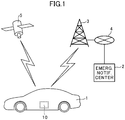
- Figure 1 is an explanatory diagram of the emergency notification system
- Figure 2 is an explanatory diagram showing a configuration of the emergency notification device.
- a vehicle 1 provided with an emergency notification device 10 is configured such that a communication line can be established with an emergency notification center 2 via a base station 3 and a communication network 4 in case of vehicle emergency (for example, a vehicle collision, sudden illness of a driver, or the like).
- vehicle emergency for example, a vehicle collision, sudden illness of a driver, or the like.
- the vehicle 1 acquires current position information about the vehicle 1 using a GPS satellite 5 and communicates the current position information, vehicle identification information and the like via an established communication line.
- the vehicle identification information is a serial number for identifying each vehicle 1, the vehicle identification information may be a communication address of the emergency notification device 10 or the like if the vehicle 1 can be identified. Further, voice conversation between the driver and an operator of the emergency notification center 2 is enabled. Thereby, it is possible to quickly perform necessary actions such as arrangement of an ambulance via the emergency notification center 2.
- the emergency notification device 10 is provided with a control part 11, an I/O part 12, a sound processing part 13, a positioning part 14, a wireless communication part 15, a storage part 16, a near-field communication part 17 and a manual notification switch 18.
- the control part 11 is configured with a CPU, for example, and executes an emergency notification process described below in response to receiving a vehicle emergency signal a1 or a2 (that is, in case of vehicle emergency).
- the I/O part 12 is a communication interface for performing in-vehicle communication with other units (a control device and the like) of the vehicle 1 via an in-vehicle LAN.
- the sound processing part 13 is connected to a microphone 13a and a speaker 13b arranged in the vehicle 1, and is configured to perform conversion processing between a voice signal and an electrical signal when the driver makes a telephone conversation with an operator of the emergency notification center 2.
- the positioning part 14 receives a GPS signal from the GPS satellite 5 and acquires the current position information.
- the wireless communication part 15 performs wireless communication (data communication and voice communication) with the emergency notification center 2 via the base station 3 and the communication network 4.
- the storage part 16 stores vehicle information for identifying the vehicle 1 (the vehicle identification information, a communication address of the emergency notification device 10 and the like) and device information about the emergency notification center 2 (device identification information, a communication destination name, a communication address (a telephone number, an e-mail address and the like) and the like).
- the near-field communication part 17 performs, via a communication link established with the other communication devices of the vehicle 1 (hereinafter referred to as a "vehicle communication link"), communication with the other communication devices by near-field wireless communication and wired communication.
- the near-field wireless communication is communication using, for example, Bluetooth (registered trademark) or wireless LAN (such as Wi-Fi (registered trademark)).
- the wired communication is communication via a cable, for example.
- the manual notification switch 18 is configured such that, when it becomes necessary to make a notification to the emergency notification center 2 because of the driver's sudden illness or the like, the vehicle emergency signal a2 can be outputted to the control part 11 by the driver operating the manual notification switch 18.
- the emergency notification device 10 is connected to a vehicle battery 50 and is configured so that power is supplied by the vehicle battery 50.
- the I/O part 12 and the near-field communication part 17 correspond to a vehicle communication part for performing communication with the communication devices in the vehicle 1.
- An air bag ECU 51 is provided with a vehicle collision detection sensor that detects a collision of the vehicle 1 using an acceleration sensor and the like not shown and is configured to, when detecting a vehicle collision, develop an air bag in a predetermined manner. At this time, the air bag ECU 51 transmits a collision detection signal, which is the vehicle emergency signal a1, via the in-vehicle LAN. The emergency notification device 10 can read the collision detection signal on the in-vehicle LAN as the vehicle emergency signal a1.
- the vehicle emergency signal is generated in response to detection of a vehicle collision in the present embodiment, this is not limitative.
- the vehicle emergency signal may be generated in response to detection of a particular vehicle failure, detection of the driver's bad physical condition by a monitor camera or the like.
- An audio control device 30 is communicably connected to the emergency notification device 10 via the in-vehicle LAN.
- the audio control device 30 outputs a voice signal of a TV, a radio, a musical medium, a navigation system or the like to a speaker drive unit (not shown).
- the speaker drive unit causes voice to be outputted from an onboard speaker (not shown) by amplifying a received voice signal and driving the onboard speaker.
- the audio control device 30 is provided with a control part 31, an I/O part 32, a storage part 36 and a near-field communication part 37.
- the control part 31 acquires a voice signal from outside and causes the speaker drive unit to operate as described above. Further, the control part 31 executes a process to be described later when the emergency notification device 10 executes the emergency notification process.
- the I/O part 32 is a communication interface for performing in-vehicle communication with the other units (the control device and the like) including the emergency notification device 10 via the in-vehicle LAN.
- the storage part 36 stores various pieces of voice-related information and the like.
- the near-field communication part 37 performs communication with other communication devices by the near-field wireless communication and the wired communication described above.
- a mobile terminal 40 is, for example, the driver's mobile phone or smartphone and is brought in the vehicle 1.
- the mobile terminal 40 is provided with a control part 41, a wireless communication part 45, a storage part 46, a near-field communication part 47 and a sound processing part 48.
- the control part 41 performs a communication process as a mobile phone and an internal application execution process and the like.
- the wireless communication part 45 performs wireless communication (data communication and voice communication) with other communication devices (for example, mobile terminals of family members, and the like) via the base station 3 and the communication network 4.
- other communication devices for example, mobile terminals of family members, and the like
- the storage part 46 stores various applications and music information.
- the near-field communication part 47 performs communication with the emergency notification device 10 and the audio control device 30, which are communication devices, via the near-field wireless communication and the wired communication described above.
- the sound processing part 48 is connected to a microphone 48a and a speaker 48b of the mobile terminal 40 and is configured to perform conversion processing between a voice signal and an electrical signal when a user uses the mobile terminal 40 to reproduce music or perform voice conversation.
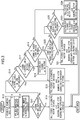
- Figure 3 is a flowchart of a process in case of vehicle emergency in the emergency notification system of the embodiment of the present invention.
- the process of Figure 3 is activated when an ignition of the vehicle 1 is turned on, and the emergency notification device 10 is powered on, and the process is repeatedly executed.
- the emergency notification device 10 receives the vehicle emergency signal a1 or a2 at step S11. Various processes for vehicle emergency are executed in response to reception of the signal.
- the control part 11 of the emergency notification device 10 controls the wireless communication part 15 to establish a wireless communication link with the communication device 20 of the emergency notification center 2 and transmits emergency information to the emergency notification center 2 at step 12 using the communication address of the emergency notification center 2 stored in the storage part 16.
- This emergency information includes information about the vehicle emergency (identifying one of a vehicle collision and an operation of the manual notification switch 18), current position information, the vehicle identification information and the like.
- the emergency information may include other vehicle information (such as the communication address of the emergency notification device 10 and the like).
- the control part 11 of the emergency notification device 10 judges whether communication is normally possible between the sound processing part 13 of the emergency notification device 10, and the microphone 13a and the speaker 13b arranged in the vehicle 1. Specifically, the control part 11 judges that communication is normally possible if resistance values of the microphone 13a and the speaker 13b are within a predetermined range or if current values when desired voltage is applied to the microphone 13a and the speaker 13b in response to control of the sound processing part 13 are within a predetermined range.
- step S14 the emergency notification device 10 and the emergency notification center 2 are enabled to perform voice conversation through a wireless communication link established at step S12.
- the emergency notification center 2 when receiving the emergency information, identifies the vehicle 1 based on the vehicle identification information included in the emergency information and a communication source address accompanying the emergency information, performs a process of displaying the vehicle information and the like about the vehicle 1 on a display device, and performs a voice communication (voice conversation) process via the wireless communication link with the emergency notification device 10 of the vehicle 1.
- the driver of the vehicle 1 is enabled to use the microphone 13a and the speaker 13b in the vehicle 1 to perform voice conversation by wireless communication with an operator of the emergency notification center 2 via the wireless communication part 15 of the emergency notification device 10.
- step S15 the control part 11 judges whether or not a vehicle communication link is established with the mobile terminal 40 controllable by the control part 11 at that point of time. Specifically, the control part 11 judges whether or not a communication link is established with the mobile terminal 40 in which an application for use of the mobile terminal by the emergency notification device 10 is installed.
- control part 11 acquires information about applications installed in the mobile terminal 40 communicating via a vehicle communication link and, if information about the application for use of the mobile terminal by the emergency notification device 10 is included in the acquired information, judges that the communicating mobile terminal 40 is the mobile terminal 40 controllable by the control part 11.
- step S16 the control part 11 performs input/output of voice by the controllable mobile terminal 40 and performs voice communication with the emergency notification center 2 through the wireless communication link established at step S12.
- the driver of the vehicle 1 is enabled to use a microphone 48a and the speaker 48b of the mobile terminal 40 to perform voice conversation by wireless communication with an operator of the emergency notification center 2 via the wireless communication part 15 of the emergency notification device 10.
- step S17 the control part 11 judges whether or not a vehicle communication link can be established with the mobile terminal 40 controllable by the control part 11.
- the control part 11 transmits an inquiry signal to surrounding communication devices based on predetermined communication specifications by the near-field communication part 17 and, if authenticating that a response (including the information about the installed applications) to the inquiry signal is from the mobile terminal 40 controllable by the control part 11, judges that a vehicle communication link can be established.
- step S18 the control part 11 establishes a vehicle communication link with the mobile terminal 40 controllable by the control part 11 and then performs the process of step S16.
- step S19 the control part 11 judges whether or not communication between the emergency notification device 10 and the audio control device 30 via the in-vehicle LAN is normal. For example, if the in-vehicle LAN line is not disconnected, and, as a result, some communication data can be received by the I/O part 12 via the in-vehicle LAN, the emergency notification device 10 judges that the in-vehicle LAN communication is normal.
- a configuration may be made in which, when transmitting a signal for confirming connection to the audio control device 30 via the in-vehicle LAN and then receiving a response to the signal from the audio control device 30, the emergency notification device 10 judges that the in-vehicle LAN communication is normal.
- step S20 the control part 11 judges whether or not a vehicle communication link is established between the audio control device 30 and the mobile terminal 40.
- step S21 If a vehicle communication link is established between the audio control device 30 and the mobile terminal 40, the flow proceeds to step S21, and the control part 11 performs input/output of voice by the mobile terminal 40 connected to the audio control device 30, and communicates with the mobile terminal 40 via the audio control device 30 to perform voice communication with the emergency notification center 2 through the wireless communication link established at step S12.
- the driver of the vehicle 1 is enabled to use the microphone 48a and the speaker 48b of the mobile terminal 40 to perform voice conversation by wireless communication with an operator of the emergency notification center 2 via the wireless communication part 15 of the emergency notification device 10.
- the control part 11 judges whether or not a vehicle communication link can be established between the audio control device 30 and the mobile terminal 40.
- the control part 11 inquires of the audio control device 30 about device information about communication terminals with which a vehicle communication link can be established and, if authenticating that the mobile terminal 40 is a mobile terminal with which a vehicle communication link can be established and authenticating that a microphone and a speaker of the mobile terminal can be controlled by the audio control device 30, based on the device information acquired from the audio control device 30, judges that a vehicle communication link can be established.
- step S23 the control part 11 causes a vehicle communication link to be established between the audio control device 30 and the mobile terminal 40 and then performs the process of step S21.
- step S19 If communication via the in-vehicle LAN between the emergency notification device 10 and the audio control device 30 is not normal at step S19, or if the audio control device 30 cannot establish a vehicle communication link with the mobile terminal 40, for example, for the reason that the mobile terminal 40 does not exist in the vehicle 1 at step S22, the flow proceeds to step S24, and it is disabled to perform voice conversation by wireless communication with an operator of the emergency notification center 2, via the wireless communication part 15 of the emergency notification device 10.
- step S14 After step S14, S16, S21 or S24, the emergency notification device 10 ends the process.
- the control part 11 communicates with the mobile terminal 40 controllable by the control part 11 via the near-field communication part 17 if a vehicle communication link is established or can be established with the mobile terminal 40 controllable by the control part 11; and, if a vehicle communication link cannot be established with the mobile terminal 40 controllable by the control part 11, the control part 11 communicates with the mobile terminal 40 via the audio control device 30. Then, the control part 11 performs input/output of voice by the mobile terminal 40 in the vehicle 1 and performs voice conversation by wireless communication with the emergency notification center 2 via the wireless communication part 15. However, any one of communication with the mobile terminal 40 controllable by the control part 11 via the near-field communication part 17 and communication with the mobile terminal 40 via the audio control device 30 may be performed.
- the control part 11 performs input/output of voice by the mobile terminal 40 via the near-field communication part 17, and performs voice conversation by wireless communication with the emergency notification center 2 via the wireless communication part 15. Therefore, even if use of the microphone 13a and the speaker 13b in the vehicle 1 is disabled by breakage or malfunction, it is possible to perform input/output of voice using the microphone 48a and the speaker 48b of the mobile terminal 40, which is a smartphone or the like, via the near-field communication part 17. Thereby, it is possible to perform voice conversation by wireless communication with the emergency notification center 2 via the wireless communication part 15.
- the control part 11 controls the near-field communication part 17 to establish communication with the mobile terminal 40 controllable by the control part 11. Therefore, even if use of the microphone 13a and the speaker 13b in the vehicle 1 is disabled by breakage or malfunction, it is possible to perform input/output of voice using the microphone 48a and the speaker 48b of the mobile terminal 40, which is a smartphone or the like, via the near-field communication part 17, if the mobile terminal 40, which is a smartphone or the like, controllable by the control part 11 exists in the vehicle 1, and, thereby, it is possible to certainly perform voice conversation by wireless communication with the emergency notification center 2 via the wireless communication part 15.
- the control part 11 performs input/output of voice by the mobile terminal 40 via the audio control device 30, and performs voice conversation by wireless communication with the emergency notification center 2 via the wireless communication part 15. Therefore, even if use of the microphone 13a and the speaker 13b in the vehicle 1 is disabled by breakage or malfunction, it is possible to perform input/output of voice using the microphone 48a and the speaker 48b of the mobile terminal 40, which is a smartphone or the like, via the audio control device 30. Thereby, it is possible to perform voice conversation by wireless communication with the emergency notification center 2 via the wireless communication part 15.
- the control part 11 controls the audio control device 30 to establish communication with the mobile terminal 40 communicable with the audio control device 30. Therefore, even if use of the microphone 13a and the speaker 13b in the vehicle 1 is disabled by breakage or malfunction, it is possible to perform input/output of voice using the microphone 48a and the speaker 48b of the mobile terminal 40, which is a smartphone or the like, via the audio control device 30, if the mobile terminal 40, which is a smartphone or the like, that can connect to the audio control device 30 exists in the vehicle 1, and, thereby, it is possible to certainly perform voice conversation by wireless communication with the emergency notification center 2 via the wireless communication part 15.
- the control part 11 performs input/output of voice by the mobile terminal 40 in the vehicle 1 if communication between the near-field communication part 17 and the mobile terminal 40 is established; performs input/output of voice by the mobile terminal 40 by establishing communication with the mobile terminal 40 controllable by the control part 11 if communication between the near-field communication part 17 and the mobile terminal 40 is not established; and performs input/output of voice by the mobile terminal 40 by communicating with the mobile terminal 40 via the audio control device 30 if communication with the mobile terminal 40 controllable by the control part 11 cannot be established.
Landscapes
- Engineering & Computer Science (AREA)
- Signal Processing (AREA)
- Computer Networks & Wireless Communication (AREA)
- Business, Economics & Management (AREA)
- Emergency Management (AREA)
- General Physics & Mathematics (AREA)
- Physics & Mathematics (AREA)
- Mechanical Engineering (AREA)
- Public Health (AREA)
- Environmental & Geological Engineering (AREA)
- Health & Medical Sciences (AREA)
- Computer Security & Cryptography (AREA)
- Human Computer Interaction (AREA)
- Alarm Systems (AREA)
- Telephonic Communication Services (AREA)
Abstract
Description
- The present invention relates to an emergency notification device, and more particularly to an emergency notification device and an emergency notification system for, in case of vehicle emergency, notifying an emergency notification center outside the vehicle of emergency information from the vehicle.
- Conventionally, emergency notification devices for, in case of emergency such as a vehicle collision and a driver's bad physical condition, notifying a predetermined emergency notification center of emergency information from the vehicle have been known (for example, see Patent Document 1).
- In such an emergency notification device, a communication line with the emergency notification center is established in case of emergency to communicate current position information and the like to the emergency notification center, and voice conversation between a driver and an operator of the emergency notification center is enabled using a microphone and a speaker in a vehicle connected to the emergency notification device.
- Patent Document 1: Japanese Patent Laid-Open No.
2015-168379 - However, when breakage or malfunction of the microphone or the speaker in the vehicle occurs due to a vehicle collision or the like, the voice conversation with the emergency notification center is disabled.
- The present invention has been made to solve the above problem of the prior-art technique, and an object is to provide an emergency notification device enabling voice conversation with an emergency notification center even if use of a microphone or a speaker in a vehicle is disabled by breakage or malfunction.
- In order to achieve the above object, an emergency notification device of a first invention of the present invention is an emergency notification device for notifying an emergency notification center outside a vehicle of emergency information from the vehicle in case of vehicle emergency, the emergency notification device comprising: a voice input/output part for performing input/output of voice in the vehicle; a wireless communication part for performing wireless communication with the emergency notification center; a control part controlling the wireless communication part and the voice input/output part to perform voice conversation by wireless communication with the emergency notification center in case of vehicle emergency; and a vehicle communication part for performing communication with a communication terminal in the vehicle; wherein the control part is configured to, in a voice input/output disabled state in which the voice input/output part is not operable to perform input/output of voice in case of vehicle emergency, communicate with the communication terminal via the vehicle communication part to perform input/output of voice by the communication terminal in the vehicle and perform voice conversation by wireless communication with the emergency notification center via the wireless communication part.
- In the present invention configured as described above, when it is not possible to perform input/output of voice by the voice input/output part in case of vehicle emergency, the control part performs input/output of voice by the communication terminal via the vehicle communication part and performs voice conversation by wireless communication with the emergency notification center via the wireless communication part. Therefore, even if use of a microphone and a speaker in the vehicle is disabled by breakage or malfunction, it is possible to perform input/output of voice using a microphone and a speaker of the communication terminal, which is a smartphone or the like, via the vehicle communication part, and, thereby, it is possible to perform voice conversation by wireless communication with the emergency notification center via the wireless communication part.
- Further, in the present invention, preferably, if communication between the vehicle communication part and the communication terminal is not established in the voice input/output disabled state, the control part is configured to control the vehicle communication part to establish communication with the communication terminal controllable by the control part.
- In the present invention configured as described above, even if use of the microphone and the speaker in the vehicle is disabled by breakage or malfunction, if the communication terminal, which is a smartphone or the like, controllable by the control part exists in the vehicle, it is possible to perform input/output of voice using the microphone and the speaker of the communication terminal, which is a smartphone or the like, via the vehicle communication part, and, thereby, it is possible to certainly perform voice conversation by wireless communication with the emergency notification center via the wireless communication part.
- Further, an emergency notification device of a second invention of the present invention is an emergency notification device mounted on a vehicle comprising a terminal control unit communicating with a communication terminal in the vehicle and being capable of controlling the communication terminal, the emergency notification device being for notifying an emergency notification center outside the vehicle of emergency information from the vehicle in case of vehicle emergency, and the emergency notification device comprising: a voice input/output part for performing input/output of voice in the vehicle; a wireless communication part for performing wireless communication with the emergency notification center; and a control part controlling the wireless communication part and the voice input/output part to perform voice conversation by wireless communication with the emergency notification center in case of vehicle emergency; wherein the control part is configured to, in a voice input/output disabled state in which the voice input/output part is not operable to perform input/output of voice in case of vehicle emergency, communicate with the communication terminal via the terminal communication unit to perform input/output of voice via the communication terminal in the vehicle and perform voice conversation by wireless communication with the emergency notification center via the wireless communication part.
- In the present invention configured as described above, when it is not possible to perform input/output of voice by the voice input/output part in case of vehicle emergency, the control part performs input/output of voice by the communication terminal via the terminal control unit and performs voice conversation by wireless communication with the emergency notification center via the wireless communication part. Therefore, even if use of the microphone and the speaker in the vehicle is disabled by breakage or malfunction, it is possible to perform input/output of voice using the microphone and the speaker of the communication terminal, which is a smartphone or the like, via the terminal control unit, and, thereby, it is possible to perform voice conversation by wireless communication with the emergency notification center via the wireless communication part.
- Further, in the present invention, preferably, if communication between the terminal control unit and the communication terminal is not established in the voice input/output disabled state, the control part is configured to control the terminal control unit to establish communication with the communication terminal controllable by the control part.
- In the present invention configured as described above, even if use of the microphone and the speaker in the vehicle is disabled by breakage or malfunction, it is possible to perform input/output of voice using the microphone and the speaker of the communication terminal, which is a smartphone or the like, via the terminal control unit if the communication terminal, which is a smartphone or the like, that is connectable to the terminal control unit exists in the vehicle, and, thereby, it is possible to certainly perform voice conversation by wireless communication with the emergency notification center via the wireless communication part.
- Further, in the present invention, preferably, the emergency notification device comprises a vehicle communication part for performing communication with the communication terminal in the vehicle; and, if communication between the vehicle communication part and the communication terminal is established in the voice input/output disabled state, the control part is configured to communicate with the communication terminal via the vehicle communication part to perform input/output of voice via the communication terminal in the vehicle and perform voice conversation by wireless communication with the emergency notification center via the wireless communication part; and, if communication between the vehicle communication part and the communication terminal is not established in the voice input/output disabled state, the control part is configured to establish communication with the communication terminal controllable by the control part and, if the control part is not able to establish communication with the communication terminal controllable by the control part, communicate with the communication terminal via the terminal control unit.
- In the present invention configured as described above, even if use of the microphone and the speaker in the vehicle is disabled by breakage or malfunction, it is possible to perform input/output of voice using the microphone and the speaker of the communication terminal if the communication terminal controllable by the control part or the communication terminal connectable to the terminal control unit exists in the vehicle, and, thereby, it is possible to more certainly perform voice conversation by wireless communication with the emergency notification center via the wireless communication part.
- According to the emergency notification device of the present invention, it is possible to perform voice conversation with an emergency notification center even if use of a microphone or a speaker in a vehicle is disabled by breakage or malfunction.
-
- [
Figure 1] Figure 1 is an explanatory diagram of an emergency notification system of an embodiment of the present invention. - [
Figure 2] Figure 2 is an explanatory diagram showing a configuration of an emergency notification device of the embodiment of the present invention. - [
Figure 3] Figure 3 is a flowchart of a process in case of vehicle emergency in the emergency notification system of the embodiment of the present invention. - An emergency notification device according to an embodiment of the present invention will be described below with reference to accompanying drawings.
- First, an outline of an emergency notification system of the embodiment of the present invention will be described with reference to
Figures 1 and2 .Figure 1 is an explanatory diagram of the emergency notification system, andFigure 2 is an explanatory diagram showing a configuration of the emergency notification device. - As shown in
Figure 1 , a vehicle 1 provided with anemergency notification device 10 is configured such that a communication line can be established with anemergency notification center 2 via abase station 3 and acommunication network 4 in case of vehicle emergency (for example, a vehicle collision, sudden illness of a driver, or the like). The vehicle 1 acquires current position information about the vehicle 1 using a GPS satellite 5 and communicates the current position information, vehicle identification information and the like via an established communication line. - Though the vehicle identification information is a serial number for identifying each vehicle 1, the vehicle identification information may be a communication address of the
emergency notification device 10 or the like if the vehicle 1 can be identified. Further, voice conversation between the driver and an operator of theemergency notification center 2 is enabled. Thereby, it is possible to quickly perform necessary actions such as arrangement of an ambulance via theemergency notification center 2. - As shown in
Figure 2 , theemergency notification device 10 is provided with acontrol part 11, an I/O part 12, asound processing part 13, apositioning part 14, awireless communication part 15, astorage part 16, a near-field communication part 17 and amanual notification switch 18. - The
control part 11 is configured with a CPU, for example, and executes an emergency notification process described below in response to receiving a vehicle emergency signal a1 or a2 (that is, in case of vehicle emergency). - The I/
O part 12 is a communication interface for performing in-vehicle communication with other units (a control device and the like) of the vehicle 1 via an in-vehicle LAN. - The
sound processing part 13 is connected to amicrophone 13a and aspeaker 13b arranged in the vehicle 1, and is configured to perform conversion processing between a voice signal and an electrical signal when the driver makes a telephone conversation with an operator of theemergency notification center 2. - The
positioning part 14 receives a GPS signal from the GPS satellite 5 and acquires the current position information. - The
wireless communication part 15 performs wireless communication (data communication and voice communication) with theemergency notification center 2 via thebase station 3 and thecommunication network 4. - The
storage part 16 stores vehicle information for identifying the vehicle 1 (the vehicle identification information, a communication address of theemergency notification device 10 and the like) and device information about the emergency notification center 2 (device identification information, a communication destination name, a communication address (a telephone number, an e-mail address and the like) and the like). - The near-
field communication part 17 performs, via a communication link established with the other communication devices of the vehicle 1 (hereinafter referred to as a "vehicle communication link"), communication with the other communication devices by near-field wireless communication and wired communication. The near-field wireless communication is communication using, for example, Bluetooth (registered trademark) or wireless LAN (such as Wi-Fi (registered trademark)). The wired communication is communication via a cable, for example. - The
manual notification switch 18 is configured such that, when it becomes necessary to make a notification to theemergency notification center 2 because of the driver's sudden illness or the like, the vehicle emergency signal a2 can be outputted to thecontrol part 11 by the driver operating themanual notification switch 18. - The
emergency notification device 10 is connected to avehicle battery 50 and is configured so that power is supplied by thevehicle battery 50. The I/O part 12 and the near-field communication part 17 correspond to a vehicle communication part for performing communication with the communication devices in the vehicle 1. - An air bag ECU 51 is provided with a vehicle collision detection sensor that detects a collision of the vehicle 1 using an acceleration sensor and the like not shown and is configured to, when detecting a vehicle collision, develop an air bag in a predetermined manner. At this time, the air bag ECU 51 transmits a collision detection signal, which is the vehicle emergency signal a1, via the in-vehicle LAN. The
emergency notification device 10 can read the collision detection signal on the in-vehicle LAN as the vehicle emergency signal a1. - Though the vehicle emergency signal is generated in response to detection of a vehicle collision in the present embodiment, this is not limitative. The vehicle emergency signal may be generated in response to detection of a particular vehicle failure, detection of the driver's bad physical condition by a monitor camera or the like.
- An
audio control device 30 is communicably connected to theemergency notification device 10 via the in-vehicle LAN. Theaudio control device 30 outputs a voice signal of a TV, a radio, a musical medium, a navigation system or the like to a speaker drive unit (not shown). The speaker drive unit causes voice to be outputted from an onboard speaker (not shown) by amplifying a received voice signal and driving the onboard speaker. - As shown in
Figure 2 , theaudio control device 30 is provided with acontrol part 31, an I/O part 32, astorage part 36 and a near-field communication part 37. Thecontrol part 31 acquires a voice signal from outside and causes the speaker drive unit to operate as described above. Further, thecontrol part 31 executes a process to be described later when theemergency notification device 10 executes the emergency notification process. - The I/
O part 32 is a communication interface for performing in-vehicle communication with the other units (the control device and the like) including theemergency notification device 10 via the in-vehicle LAN. - The
storage part 36 stores various pieces of voice-related information and the like. - The near-
field communication part 37 performs communication with other communication devices by the near-field wireless communication and the wired communication described above. - As shown in
Figure 2 , amobile terminal 40 is, for example, the driver's mobile phone or smartphone and is brought in the vehicle 1. Themobile terminal 40 is provided with acontrol part 41, awireless communication part 45, astorage part 46, a near-field communication part 47 and asound processing part 48. - The
control part 41 performs a communication process as a mobile phone and an internal application execution process and the like. - The
wireless communication part 45 performs wireless communication (data communication and voice communication) with other communication devices (for example, mobile terminals of family members, and the like) via thebase station 3 and thecommunication network 4. - The
storage part 46 stores various applications and music information. - The near-
field communication part 47 performs communication with theemergency notification device 10 and theaudio control device 30, which are communication devices, via the near-field wireless communication and the wired communication described above. - The
sound processing part 48 is connected to amicrophone 48a and aspeaker 48b of themobile terminal 40 and is configured to perform conversion processing between a voice signal and an electrical signal when a user uses themobile terminal 40 to reproduce music or perform voice conversation. - Next, a process performed by the emergency notification device will be described with
Figure 3 . -
Figure 3 is a flowchart of a process in case of vehicle emergency in the emergency notification system of the embodiment of the present invention. - The process of
Figure 3 is activated when an ignition of the vehicle 1 is turned on, and theemergency notification device 10 is powered on, and the process is repeatedly executed. - After the process is started, when the vehicle emergency signal a1 (a collision detection signal) is outputted from the
air bag ECU 51, or the vehicle emergency signal a2 is outputted from themanual notification switch 18 at step S10, theemergency notification device 10 receives the vehicle emergency signal a1 or a2 at step S11. Various processes for vehicle emergency are executed in response to reception of the signal. - When receiving the vehicle emergency signal a1 or a2, the
control part 11 of theemergency notification device 10 controls thewireless communication part 15 to establish a wireless communication link with thecommunication device 20 of theemergency notification center 2 and transmits emergency information to theemergency notification center 2 atstep 12 using the communication address of theemergency notification center 2 stored in thestorage part 16. This emergency information includes information about the vehicle emergency (identifying one of a vehicle collision and an operation of the manual notification switch 18), current position information, the vehicle identification information and the like. Furthermore, the emergency information may include other vehicle information (such as the communication address of theemergency notification device 10 and the like). - Next, at step S13, the
control part 11 of theemergency notification device 10 judges whether communication is normally possible between thesound processing part 13 of theemergency notification device 10, and themicrophone 13a and thespeaker 13b arranged in the vehicle 1. Specifically, thecontrol part 11 judges that communication is normally possible if resistance values of themicrophone 13a and thespeaker 13b are within a predetermined range or if current values when desired voltage is applied to themicrophone 13a and thespeaker 13b in response to control of thesound processing part 13 are within a predetermined range. - As a result, if communication is normally possible between the
sound processing part 13 of theemergency notification device 10, and themicrophone 13a and thespeaker 13b arranged in the vehicle 1, the flow proceeds to step S14, and theemergency notification device 10 and theemergency notification center 2 are enabled to perform voice conversation through a wireless communication link established at step S12. - Specifically, when receiving the emergency information, the
emergency notification center 2 identifies the vehicle 1 based on the vehicle identification information included in the emergency information and a communication source address accompanying the emergency information, performs a process of displaying the vehicle information and the like about the vehicle 1 on a display device, and performs a voice communication (voice conversation) process via the wireless communication link with theemergency notification device 10 of the vehicle 1. Thereby, the driver of the vehicle 1 is enabled to use themicrophone 13a and thespeaker 13b in the vehicle 1 to perform voice conversation by wireless communication with an operator of theemergency notification center 2 via thewireless communication part 15 of theemergency notification device 10. - On the other hand, if breakage or malfunction of the microphone and/or speaker in the vehicle 1 occurs due to a vehicle collision or the like, and it is not possible to perform normal communication between the
sound processing part 13 of theemergency notification device 10, and themicrophone 13a and thespeaker 13b arranged in the vehicle 1 or perform input/output of voice by themicrophone 13a and thespeaker 13b (a voice input/output disabled state), the flow proceeds to step S15, and thecontrol part 11 judges whether or not a vehicle communication link is established with themobile terminal 40 controllable by thecontrol part 11 at that point of time. Specifically, thecontrol part 11 judges whether or not a communication link is established with themobile terminal 40 in which an application for use of the mobile terminal by theemergency notification device 10 is installed. Therefore, thecontrol part 11 acquires information about applications installed in themobile terminal 40 communicating via a vehicle communication link and, if information about the application for use of the mobile terminal by theemergency notification device 10 is included in the acquired information, judges that the communicatingmobile terminal 40 is themobile terminal 40 controllable by thecontrol part 11. - As a result, if a vehicle communication link is established with the
mobile terminal 40 controllable by thecontrol part 11, the flow proceeds to step S16, and thecontrol part 11 performs input/output of voice by the controllablemobile terminal 40 and performs voice communication with theemergency notification center 2 through the wireless communication link established at step S12. Thereby, the driver of the vehicle 1 is enabled to use amicrophone 48a and thespeaker 48b of themobile terminal 40 to perform voice conversation by wireless communication with an operator of theemergency notification center 2 via thewireless communication part 15 of theemergency notification device 10. - On the other hand, if a vehicle communication link is not established with the
mobile terminal 40 controllable by thecontrol part 11, the flow proceeds to step S17, and thecontrol part 11 judges whether or not a vehicle communication link can be established with themobile terminal 40 controllable by thecontrol part 11. For example, thecontrol part 11 transmits an inquiry signal to surrounding communication devices based on predetermined communication specifications by the near-field communication part 17 and, if authenticating that a response (including the information about the installed applications) to the inquiry signal is from themobile terminal 40 controllable by thecontrol part 11, judges that a vehicle communication link can be established. - As a result, if a vehicle communication link can be established with the
mobile terminal 40 controllable by thecontrol part 11, the flow proceeds to step S18, and thecontrol part 11 establishes a vehicle communication link with themobile terminal 40 controllable by thecontrol part 11 and then performs the process of step S16. - On the other hand, if a vehicle communication link cannot be established with the
mobile terminal 40 controllable by thecontrol part 11, for example, for reasons such as that a mobile terminal in which the application for use of a mobile terminal by theemergency notification device 10 is installed does not exist in the vehicle 1, the flow proceeds to step S19, and thecontrol part 11 judges whether or not communication between theemergency notification device 10 and theaudio control device 30 via the in-vehicle LAN is normal. For example, if the in-vehicle LAN line is not disconnected, and, as a result, some communication data can be received by the I/O part 12 via the in-vehicle LAN, theemergency notification device 10 judges that the in-vehicle LAN communication is normal. Alternatively, a configuration may be made in which, when transmitting a signal for confirming connection to theaudio control device 30 via the in-vehicle LAN and then receiving a response to the signal from theaudio control device 30, theemergency notification device 10 judges that the in-vehicle LAN communication is normal. - As a result, if communication between the
emergency notification device 10 and theaudio control device 30 via the in-vehicle LAN is normal, the flow proceeds to step S20, and thecontrol part 11 judges whether or not a vehicle communication link is established between theaudio control device 30 and themobile terminal 40. - If a vehicle communication link is established between the
audio control device 30 and themobile terminal 40, the flow proceeds to step S21, and thecontrol part 11 performs input/output of voice by themobile terminal 40 connected to theaudio control device 30, and communicates with themobile terminal 40 via theaudio control device 30 to perform voice communication with theemergency notification center 2 through the wireless communication link established at step S12. Thereby, the driver of the vehicle 1 is enabled to use themicrophone 48a and thespeaker 48b of themobile terminal 40 to perform voice conversation by wireless communication with an operator of theemergency notification center 2 via thewireless communication part 15 of theemergency notification device 10. - On the other hand, if a vehicle communication link is not established between the
audio control device 30 and themobile terminal 40, the flow proceeds to step S22, and thecontrol part 11 judges whether or not a vehicle communication link can be established between theaudio control device 30 and themobile terminal 40. For example, thecontrol part 11 inquires of theaudio control device 30 about device information about communication terminals with which a vehicle communication link can be established and, if authenticating that themobile terminal 40 is a mobile terminal with which a vehicle communication link can be established and authenticating that a microphone and a speaker of the mobile terminal can be controlled by theaudio control device 30, based on the device information acquired from theaudio control device 30, judges that a vehicle communication link can be established. - As a result, if a vehicle communication link can be established between the
audio control device 30 and themobile terminal 40, the flow proceeds to step S23, and thecontrol part 11 causes a vehicle communication link to be established between theaudio control device 30 and themobile terminal 40 and then performs the process of step S21. - If communication via the in-vehicle LAN between the
emergency notification device 10 and theaudio control device 30 is not normal at step S19, or if theaudio control device 30 cannot establish a vehicle communication link with themobile terminal 40, for example, for the reason that themobile terminal 40 does not exist in the vehicle 1 at step S22, the flow proceeds to step S24, and it is disabled to perform voice conversation by wireless communication with an operator of theemergency notification center 2, via thewireless communication part 15 of theemergency notification device 10. - After step S14, S16, S21 or S24, the
emergency notification device 10 ends the process. - Next, a further modification of the embodiment of the present invention will be described.
- In the embodiment described above, it has been described that, in a voice input/output disabled state in which it is not possible to perform input/output of voice by the
microphone 13a and thespeaker 13b in the vehicle 1, thecontrol part 11 communicates with themobile terminal 40 controllable by thecontrol part 11 via the near-field communication part 17 if a vehicle communication link is established or can be established with themobile terminal 40 controllable by thecontrol part 11; and, if a vehicle communication link cannot be established with themobile terminal 40 controllable by thecontrol part 11, thecontrol part 11 communicates with themobile terminal 40 via theaudio control device 30. Then, thecontrol part 11 performs input/output of voice by themobile terminal 40 in the vehicle 1 and performs voice conversation by wireless communication with theemergency notification center 2 via thewireless communication part 15. However, any one of communication with themobile terminal 40 controllable by thecontrol part 11 via the near-field communication part 17 and communication with themobile terminal 40 via theaudio control device 30 may be performed. - Next, description will be made on effects of the emergency notification device according to the embodiment of the present invention and the modification of the embodiment of the present invention described above.
- First, when it is not possible to perform input/output of voice by the
microphone 13a and thespeaker 13b in the vehicle 1 in case of emergency of the vehicle 1, thecontrol part 11 performs input/output of voice by themobile terminal 40 via the near-field communication part 17, and performs voice conversation by wireless communication with theemergency notification center 2 via thewireless communication part 15. Therefore, even if use of themicrophone 13a and thespeaker 13b in the vehicle 1 is disabled by breakage or malfunction, it is possible to perform input/output of voice using themicrophone 48a and thespeaker 48b of themobile terminal 40, which is a smartphone or the like, via the near-field communication part 17. Thereby, it is possible to perform voice conversation by wireless communication with theemergency notification center 2 via thewireless communication part 15. - Especially, when communication between the near-
field communication part 17 and themobile terminal 40 is not established, thecontrol part 11 controls the near-field communication part 17 to establish communication with themobile terminal 40 controllable by thecontrol part 11. Therefore, even if use of themicrophone 13a and thespeaker 13b in the vehicle 1 is disabled by breakage or malfunction, it is possible to perform input/output of voice using themicrophone 48a and thespeaker 48b of themobile terminal 40, which is a smartphone or the like, via the near-field communication part 17, if themobile terminal 40, which is a smartphone or the like, controllable by thecontrol part 11 exists in the vehicle 1, and, thereby, it is possible to certainly perform voice conversation by wireless communication with theemergency notification center 2 via thewireless communication part 15. - Further, when it is not possible to perform input/output of voice by the
microphone 13a and thespeaker 13b in the vehicle 1 in case of emergency of the vehicle 1, thecontrol part 11 performs input/output of voice by themobile terminal 40 via theaudio control device 30, and performs voice conversation by wireless communication with theemergency notification center 2 via thewireless communication part 15. Therefore, even if use of themicrophone 13a and thespeaker 13b in the vehicle 1 is disabled by breakage or malfunction, it is possible to perform input/output of voice using themicrophone 48a and thespeaker 48b of themobile terminal 40, which is a smartphone or the like, via theaudio control device 30. Thereby, it is possible to perform voice conversation by wireless communication with theemergency notification center 2 via thewireless communication part 15. - Especially, when communication between the
audio control device 30 and themobile terminal 40 is not established, thecontrol part 11 controls theaudio control device 30 to establish communication with themobile terminal 40 communicable with theaudio control device 30. Therefore, even if use of themicrophone 13a and thespeaker 13b in the vehicle 1 is disabled by breakage or malfunction, it is possible to perform input/output of voice using themicrophone 48a and thespeaker 48b of themobile terminal 40, which is a smartphone or the like, via theaudio control device 30, if themobile terminal 40, which is a smartphone or the like, that can connect to theaudio control device 30 exists in the vehicle 1, and, thereby, it is possible to certainly perform voice conversation by wireless communication with theemergency notification center 2 via thewireless communication part 15. - Further, when it is not possible to perform input/output of voice by the
microphone 13a and thespeaker 13b in the vehicle 1, thecontrol part 11 performs input/output of voice by themobile terminal 40 in the vehicle 1 if communication between the near-field communication part 17 and themobile terminal 40 is established; performs input/output of voice by themobile terminal 40 by establishing communication with themobile terminal 40 controllable by thecontrol part 11 if communication between the near-field communication part 17 and themobile terminal 40 is not established; and performs input/output of voice by themobile terminal 40 by communicating with themobile terminal 40 via theaudio control device 30 if communication with themobile terminal 40 controllable by thecontrol part 11 cannot be established. Therefore, even if use of themicrophone 13a and thespeaker 13b in the vehicle 1 is disabled by breakage or malfunction, it is possible to perform input/output of voice using themicrophone 48a and thespeaker 48b of themobile terminal 40 if themobile terminal 40 controllable by thecontrol part 11 or themobile terminal 40 connectable to theaudio control device 30 exists in the vehicle 1, and, thereby, it is possible to more certainly perform voice conversation by wireless communication with theemergency notification center 2 via thewireless communication part 15. -
- 1
- vehicle
- 2
- emergency notification center
- 3
- base station
- 4
- communication network
- 5
- GPS satellite
- 10
- emergency notification device
- 11
- control part
- 15
- wireless communication part
- 17
- near-field communication part (vehicle communication part)
- 13a, 48a
- microphone (voice input/output part)
- 13b, 48b
- speaker (voice input/output part)
- 20
- communication device
- 30
- audio control device (terminal control unit)
- 40
- mobile terminal (communication terminal)
- a1, a2
- vehicle emergency signal
Claims (8)
- An emergency notification device for notifying an emergency notification center outside a vehicle of emergency information from the vehicle in case of vehicle emergency, the emergency notification device comprising:a voice input/output part for performing input/output of voice in the vehicle;a wireless communication part for performing wireless communication with the emergency notification center;a control part controlling the wireless communication part and the voice input/output part to perform voice conversation by wireless communication with the emergency notification center in case of vehicle emergency; anda vehicle communication part for performing communication with a communication terminal in the vehicle; whereinthe control part is configured to, in a voice input/output disabled state in which the voice input/output part is not operable to perform input/output of voice in case of vehicle emergency, communicate with the communication terminal via the vehicle communication part to perform input/output of voice via the communication terminal in the vehicle and perform voice conversation by wireless communication with the emergency notification center via the wireless communication part.
- The emergency notification device according to claim 1, wherein, if communication between the vehicle communication part and the communication terminal is not established in the voice input/output disabled state, the control part is configured to control the vehicle communication part to establish communication with the communication terminal controllable by the control part.
- The emergency notification device according to claim 2, wherein, if communication between the vehicle communication part and the communication terminal is not established in the voice input/output disabled state, the control part is configured to: acquire installed applications information from the communication terminal in the vehicle; and, if information about an application for use of the communication terminal by the emergency notification device is included in the acquired installed applications information, control the vehicle communication part to establish communication with the communication terminal.
- An emergency notification device mounted on a vehicle comprising a terminal control unit communicating with a communication terminal in the vehicle and being capable of controlling the communication terminal, the emergency notification device being for notifying an emergency notification center outside the vehicle of emergency information from the vehicle in case of vehicle emergency, and the emergency notification device comprising:a voice input/output part for performing input/output of voice in the vehicle;a wireless communication part for performing wireless communication with the emergency notification center; anda control part controlling the wireless communication part and the voice input/output part to perform voice conversation by wireless communication with the emergency notification center in case of vehicle emergency; whereinthe control part is configured to, in a voice input/output disabled state in which the voice input/output part is not operable to perform input/output of voice in case of vehicle emergency, communicate with the communication terminal via the terminal communication unit to perform input/output of voice via the communication terminal in the vehicle and perform voice conversation by wireless communication with the emergency notification center via the wireless communication part.
- The emergency notification device according to claim 4, wherein, if communication between the terminal control unit and the communication terminal is not established in the voice input/output disabled state, the control part is configured to control the terminal control unit to establish communication with the communication terminal communicable with the terminal control unit.
- The emergency notification device according to claim 5, wherein, if communication between the terminal control unit and the communication terminal is not established in the voice input/output disabled state, the control part is configured to:inquire of the terminal control unit about device information about a communication terminal communicable with the terminal control unit;authenticate that the communication terminal is a communication terminal with which the control part can establish communication, based on the device information acquired from the terminal control unit; andcontrol the terminal control unit to establish communication with the communication terminal, if voice input/output of the communication terminal is controllable by the terminal control unit.
- The emergency notification device according to any one of claims 4 to 6, further comprising a vehicle communication part for performing communication with the communication terminal in the vehicle; wherein
if communication between the vehicle communication part and the communication terminal is established in the voice input/output disabled state, the control part is configured to communicate with the communication terminal via the vehicle communication part to perform input/output of voice via the communication terminal in the vehicle and perform voice conversation by wireless communication with the emergency notification center via the wireless communication part; and
if communication between the vehicle communication part and the communication terminal is not established in the voice input/output disabled state, the control part is configured to: establish communication with the communication terminal controllable by the control part; and, if the control part is not able to establish communication with the communication terminal controllable by the control part, communicate with the communication terminal via the terminal control unit. - The emergency notification device according to any one of claims 4 to 7, wherein the terminal control unit is an audio control device capable of controlling a drive unit of an onboard speaker.
Applications Claiming Priority (2)
| Application Number | Priority Date | Filing Date | Title |
|---|---|---|---|
| JP2016113228A JP6455733B2 (en) | 2016-06-07 | 2016-06-07 | Emergency call device |
| PCT/JP2017/012895 WO2017212750A1 (en) | 2016-06-07 | 2017-03-29 | Emergency report device |
Publications (2)
| Publication Number | Publication Date |
|---|---|
| EP3419268A1 true EP3419268A1 (en) | 2018-12-26 |
| EP3419268A4 EP3419268A4 (en) | 2019-03-06 |
Family
ID=60578975
Family Applications (1)
| Application Number | Title | Priority Date | Filing Date |
|---|---|---|---|
| EP17809933.9A Withdrawn EP3419268A4 (en) | 2016-06-07 | 2017-03-29 | EMERGENCY REPORT DEVICE |
Country Status (6)
| Country | Link |
|---|---|
| US (1) | US10382935B2 (en) |
| EP (1) | EP3419268A4 (en) |
| JP (1) | JP6455733B2 (en) |
| CN (1) | CN108886556B (en) |
| RU (1) | RU2713743C1 (en) |
| WO (1) | WO2017212750A1 (en) |
Families Citing this family (2)
| Publication number | Priority date | Publication date | Assignee | Title |
|---|---|---|---|---|
| DE102019126208A1 (en) * | 2019-09-27 | 2021-04-01 | Harman Becker Automotive Systems Gmbh | Emergency system for a vehicle |
| JP7871706B2 (en) * | 2023-01-16 | 2026-06-09 | トヨタ自動車株式会社 | Control device, control method, and program |
Family Cites Families (16)
| Publication number | Priority date | Publication date | Assignee | Title |
|---|---|---|---|---|
| GB2296843B (en) * | 1995-01-05 | 1999-01-27 | Motorola Ltd | Mobile station with automatic transmission of an emergency signal |
| JP3300705B2 (en) * | 1999-11-12 | 2002-07-08 | 松下電器産業株式会社 | In-vehicle communication terminal and information service center that communicates with the in-vehicle communication terminal |
| JP2003022490A (en) * | 2001-07-06 | 2003-01-24 | Toyota Motor Corp | Emergency call device |
| KR20030037175A (en) * | 2001-11-02 | 2003-05-12 | 주식회사 휴림인터랙티브 | Urgency rescue service method of position base |
| US7738509B2 (en) * | 2002-12-27 | 2010-06-15 | General Motors Llc | Method and system for inband emergency notification for voice calls |
| JP4513610B2 (en) * | 2005-03-14 | 2010-07-28 | ソニー株式会社 | In-vehicle device and method for controlling in-vehicle device |
| JP4656022B2 (en) * | 2006-08-11 | 2011-03-23 | 株式会社デンソー | Emergency call vehicle |
| DE102008015840A1 (en) * | 2007-12-06 | 2009-06-10 | Continental Teves Ag & Co. Ohg | Vehicle emergency call for transmission of additional or changed data |
| JP5163689B2 (en) * | 2010-05-11 | 2013-03-13 | 株式会社デンソー | In-vehicle terminal for emergency calls |
| JP2012203799A (en) | 2011-03-28 | 2012-10-22 | Denso Corp | Device for vehicle |
| CN202486937U (en) * | 2012-01-17 | 2012-10-10 | 湖南大学 | A vehicle accident call system |
| US9338605B2 (en) * | 2013-05-08 | 2016-05-10 | Obdedge, Llc | Driver identification and data collection systems for use with mobile communication devices in vehicles |
| CN103342118B (en) * | 2013-07-05 | 2016-12-28 | 鲍晓东 | Vehicle carried method and device |
| JP6176159B2 (en) | 2014-03-10 | 2017-08-09 | マツダ株式会社 | Control device for hybrid vehicle |
| US9432828B1 (en) * | 2015-08-03 | 2016-08-30 | GM Global Technology Operations LLC | Vehicle emergency dialing system |
| CN105208236A (en) * | 2015-09-15 | 2015-12-30 | 奇瑞汽车股份有限公司 | A service system for car emergency call |
-
2016
- 2016-06-07 JP JP2016113228A patent/JP6455733B2/en active Active
-
2017
- 2017-03-29 CN CN201780017925.9A patent/CN108886556B/en not_active Expired - Fee Related
- 2017-03-29 EP EP17809933.9A patent/EP3419268A4/en not_active Withdrawn
- 2017-03-29 RU RU2018146067A patent/RU2713743C1/en active
- 2017-03-29 US US16/085,610 patent/US10382935B2/en active Active
- 2017-03-29 WO PCT/JP2017/012895 patent/WO2017212750A1/en not_active Ceased
Also Published As
| Publication number | Publication date |
|---|---|
| US20190075444A1 (en) | 2019-03-07 |
| CN108886556A (en) | 2018-11-23 |
| WO2017212750A1 (en) | 2017-12-14 |
| JP2017219985A (en) | 2017-12-14 |
| RU2713743C1 (en) | 2020-02-07 |
| EP3419268A4 (en) | 2019-03-06 |
| CN108886556B (en) | 2021-06-22 |
| US10382935B2 (en) | 2019-08-13 |
| JP6455733B2 (en) | 2019-01-23 |
Similar Documents
| Publication | Publication Date | Title |
|---|---|---|
| US9973911B2 (en) | Method of operating AVN, AVN, and vehicle including the same | |
| US10424187B2 (en) | Emergency notification device and emergency notification system | |
| US9674683B2 (en) | Method and system for transmitting vehicle data using an automated voice | |
| US9026045B2 (en) | Short range wireless communication apparatus | |
| JP2013013013A (en) | Short range wireless communication apparatus | |
| JP3849424B2 (en) | Call system using mobile phone and hands-free device | |
| US10382935B2 (en) | Emergency notification device | |
| WO2017183377A1 (en) | Emergency notification device and emergency notification system | |
| US8010166B2 (en) | Handsfree apparatus for vehicle | |
| US11672030B2 (en) | Control method, on-vehicle device, and storage medium | |
| JP4241895B2 (en) | Hands-free device | |
| JP4559761B2 (en) | Wireless terminal device | |
| JP6241171B2 (en) | Portable information terminal | |
| JP5136595B2 (en) | Wireless terminal device | |
| JP4241716B2 (en) | Call system using mobile phone and hands-free device | |
| JP6132693B2 (en) | Wireless communication apparatus and data update device | |
| JP5580184B2 (en) | E-mail data processing device | |
| JP4241894B2 (en) | Hands-free device | |
| JP2008046709A (en) | Emergency call vehicle | |
| JP2017222289A (en) | Emergency notification device | |
| JP2017224199A (en) | Emergency report device and emergency report system | |
| KR20160033945A (en) | Mobile communication terminal for handling incoming call in a situation connected with video display device of vehicle and the program stored in medium for executing the method |
Legal Events
| Date | Code | Title | Description |
|---|---|---|---|
| STAA | Information on the status of an ep patent application or granted ep patent |
Free format text: STATUS: THE INTERNATIONAL PUBLICATION HAS BEEN MADE |
|
| PUAI | Public reference made under article 153(3) epc to a published international application that has entered the european phase |
Free format text: ORIGINAL CODE: 0009012 |
|
| STAA | Information on the status of an ep patent application or granted ep patent |
Free format text: STATUS: REQUEST FOR EXAMINATION WAS MADE |
|
| 17P | Request for examination filed |
Effective date: 20180918 |
|
| AK | Designated contracting states |
Kind code of ref document: A1 Designated state(s): AL AT BE BG CH CY CZ DE DK EE ES FI FR GB GR HR HU IE IS IT LI LT LU LV MC MK MT NL NO PL PT RO RS SE SI SK SM TR |
|
| AX | Request for extension of the european patent |
Extension state: BA ME |
|
| A4 | Supplementary search report drawn up and despatched |
Effective date: 20190205 |
|
| RIC1 | Information provided on ipc code assigned before grant |
Ipc: H04M 1/00 20060101ALI20190130BHEP Ipc: G08B 25/08 20060101ALI20190130BHEP Ipc: G08B 25/10 20060101ALI20190130BHEP Ipc: H04M 11/04 20060101AFI20190130BHEP Ipc: G08B 25/01 20060101ALI20190130BHEP Ipc: B60R 21/00 20060101ALI20190130BHEP |
|
| DAV | Request for validation of the european patent (deleted) | ||
| DAX | Request for extension of the european patent (deleted) | ||
| STAA | Information on the status of an ep patent application or granted ep patent |
Free format text: STATUS: EXAMINATION IS IN PROGRESS |
|
| 17Q | First examination report despatched |
Effective date: 20191115 |
|
| STAA | Information on the status of an ep patent application or granted ep patent |
Free format text: STATUS: THE APPLICATION IS DEEMED TO BE WITHDRAWN |
|
| 18D | Application deemed to be withdrawn |
Effective date: 20220705 |