EP3418312A1 - Verfahren zur verbindung von formkörpern durch injektion einer einkomponentigen hitzehärtenden epoxidharzzusammensetzung in hohlräume - Google Patents
Verfahren zur verbindung von formkörpern durch injektion einer einkomponentigen hitzehärtenden epoxidharzzusammensetzung in hohlräume Download PDFInfo
- Publication number
- EP3418312A1 EP3418312A1 EP17177416.9A EP17177416A EP3418312A1 EP 3418312 A1 EP3418312 A1 EP 3418312A1 EP 17177416 A EP17177416 A EP 17177416A EP 3418312 A1 EP3418312 A1 EP 3418312A1
- Authority
- EP
- European Patent Office
- Prior art keywords
- epoxy resin
- resin composition
- thermosetting epoxy
- component thermosetting
- cavity
- Prior art date
- Legal status (The legal status is an assumption and is not a legal conclusion. Google has not performed a legal analysis and makes no representation as to the accuracy of the status listed.)
- Withdrawn
Links
- 239000000203 mixture Substances 0.000 title claims abstract description 170
- 239000003822 epoxy resin Substances 0.000 title claims abstract description 152
- 229920000647 polyepoxide Polymers 0.000 title claims abstract description 152
- 229920001187 thermosetting polymer Polymers 0.000 title claims abstract description 64
- 238000000034 method Methods 0.000 title claims abstract description 37
- 238000002347 injection Methods 0.000 title claims description 30
- 239000007924 injection Substances 0.000 title claims description 30
- 229920005906 polyester polyol Polymers 0.000 claims abstract description 39
- 238000000465 moulding Methods 0.000 claims abstract description 26
- 150000002009 diols Chemical class 0.000 claims abstract description 16
- 238000006243 chemical reaction Methods 0.000 claims abstract description 12
- LNEPOXFFQSENCJ-UHFFFAOYSA-N haloperidol Chemical compound C1CC(O)(C=2C=CC(Cl)=CC=2)CCN1CCCC(=O)C1=CC=C(F)C=C1 LNEPOXFFQSENCJ-UHFFFAOYSA-N 0.000 claims abstract description 12
- 239000004848 polyfunctional curative Substances 0.000 claims abstract description 9
- OFOBLEOULBTSOW-UHFFFAOYSA-N Malonic acid Chemical compound OC(=O)CC(O)=O OFOBLEOULBTSOW-UHFFFAOYSA-N 0.000 claims abstract description 6
- 125000003178 carboxy group Chemical group [H]OC(*)=O 0.000 claims abstract description 6
- 150000001991 dicarboxylic acids Chemical class 0.000 claims abstract description 6
- 125000003700 epoxy group Chemical group 0.000 claims abstract description 5
- 230000008569 process Effects 0.000 claims abstract description 5
- 238000011049 filling Methods 0.000 claims description 14
- 238000002844 melting Methods 0.000 claims description 12
- 230000008018 melting Effects 0.000 claims description 12
- 150000001875 compounds Chemical class 0.000 claims description 10
- 229910052799 carbon Inorganic materials 0.000 claims description 7
- 239000000463 material Substances 0.000 claims description 7
- 230000008859 change Effects 0.000 claims description 6
- 239000002131 composite material Substances 0.000 claims description 6
- 239000000853 adhesive Substances 0.000 abstract description 17
- 230000001070 adhesive effect Effects 0.000 abstract description 17
- 230000008901 benefit Effects 0.000 abstract description 4
- -1 for example Polymers 0.000 description 31
- 239000004743 Polypropylene Substances 0.000 description 27
- 238000001816 cooling Methods 0.000 description 23
- 125000002887 hydroxy group Chemical group [H]O* 0.000 description 23
- 229920000642 polymer Polymers 0.000 description 22
- 239000007788 liquid Substances 0.000 description 21
- 229920005862 polyol Polymers 0.000 description 20
- 229920005989 resin Polymers 0.000 description 20
- 239000011347 resin Substances 0.000 description 20
- 239000012745 toughening agent Substances 0.000 description 20
- LYCAIKOWRPUZTN-UHFFFAOYSA-N Ethylene glycol Chemical compound OCCO LYCAIKOWRPUZTN-UHFFFAOYSA-N 0.000 description 19
- 229920001730 Moisture cure polyurethane Polymers 0.000 description 19
- 150000003077 polyols Chemical class 0.000 description 19
- 239000004593 Epoxy Substances 0.000 description 17
- 125000005442 diisocyanate group Chemical group 0.000 description 17
- 238000005259 measurement Methods 0.000 description 17
- 239000002994 raw material Substances 0.000 description 17
- KWYUFKZDYYNOTN-UHFFFAOYSA-M Potassium hydroxide Chemical compound [OH-].[K+] KWYUFKZDYYNOTN-UHFFFAOYSA-M 0.000 description 15
- 239000005022 packaging material Substances 0.000 description 15
- 239000002585 base Substances 0.000 description 13
- IISBACLAFKSPIT-UHFFFAOYSA-N bisphenol A Chemical compound C=1C=C(O)C=CC=1C(C)(C)C1=CC=C(O)C=C1 IISBACLAFKSPIT-UHFFFAOYSA-N 0.000 description 13
- 235000013824 polyphenols Nutrition 0.000 description 12
- 239000007787 solid Substances 0.000 description 12
- GYZLOYUZLJXAJU-UHFFFAOYSA-N diglycidyl ether Chemical group C1OC1COCC1CO1 GYZLOYUZLJXAJU-UHFFFAOYSA-N 0.000 description 11
- 229920001451 polypropylene glycol Polymers 0.000 description 11
- 125000002924 primary amino group Chemical group [H]N([H])* 0.000 description 11
- 238000003892 spreading Methods 0.000 description 11
- 230000007480 spreading Effects 0.000 description 11
- PEDCQBHIVMGVHV-UHFFFAOYSA-N Glycerine Chemical compound OCC(O)CO PEDCQBHIVMGVHV-UHFFFAOYSA-N 0.000 description 10
- KAKZBPTYRLMSJV-UHFFFAOYSA-N Butadiene Chemical compound C=CC=C KAKZBPTYRLMSJV-UHFFFAOYSA-N 0.000 description 9
- 125000003118 aryl group Chemical group 0.000 description 9
- XXMIOPMDWAUFGU-UHFFFAOYSA-N hexane-1,6-diol Chemical compound OCCCCCCO XXMIOPMDWAUFGU-UHFFFAOYSA-N 0.000 description 9
- WYURNTSHIVDZCO-UHFFFAOYSA-N Tetrahydrofuran Chemical compound C1CCOC1 WYURNTSHIVDZCO-UHFFFAOYSA-N 0.000 description 8
- PXKLMJQFEQBVLD-UHFFFAOYSA-N bisphenol F Chemical compound C1=CC(O)=CC=C1CC1=CC=C(O)C=C1 PXKLMJQFEQBVLD-UHFFFAOYSA-N 0.000 description 8
- 150000002989 phenols Chemical class 0.000 description 8
- 150000008442 polyphenolic compounds Chemical class 0.000 description 8
- 125000001424 substituent group Chemical group 0.000 description 8
- KUBDPQJOLOUJRM-UHFFFAOYSA-N 2-(chloromethyl)oxirane;4-[2-(4-hydroxyphenyl)propan-2-yl]phenol Chemical compound ClCC1CO1.C=1C=C(O)C=CC=1C(C)(C)C1=CC=C(O)C=C1 KUBDPQJOLOUJRM-UHFFFAOYSA-N 0.000 description 7
- VTYYLEPIZMXCLO-UHFFFAOYSA-L Calcium carbonate Chemical compound [Ca+2].[O-]C([O-])=O VTYYLEPIZMXCLO-UHFFFAOYSA-L 0.000 description 7
- ISWSIDIOOBJBQZ-UHFFFAOYSA-N Phenol Chemical compound OC1=CC=CC=C1 ISWSIDIOOBJBQZ-UHFFFAOYSA-N 0.000 description 7
- 229910000831 Steel Inorganic materials 0.000 description 7
- ZJCCRDAZUWHFQH-UHFFFAOYSA-N Trimethylolpropane Chemical compound CCC(CO)(CO)CO ZJCCRDAZUWHFQH-UHFFFAOYSA-N 0.000 description 7
- 125000003710 aryl alkyl group Chemical group 0.000 description 7
- WERYXYBDKMZEQL-UHFFFAOYSA-N butane-1,4-diol Chemical compound OCCCCO WERYXYBDKMZEQL-UHFFFAOYSA-N 0.000 description 7
- 150000002118 epoxides Chemical group 0.000 description 7
- 239000010959 steel Substances 0.000 description 7
- 150000003573 thiols Chemical group 0.000 description 7
- VPWNQTHUCYMVMZ-UHFFFAOYSA-N 4,4'-sulfonyldiphenol Chemical class C1=CC(O)=CC=C1S(=O)(=O)C1=CC=C(O)C=C1 VPWNQTHUCYMVMZ-UHFFFAOYSA-N 0.000 description 6
- HEMHJVSKTPXQMS-UHFFFAOYSA-M Sodium hydroxide Chemical compound [OH-].[Na+] HEMHJVSKTPXQMS-UHFFFAOYSA-M 0.000 description 6
- 239000002253 acid Substances 0.000 description 6
- 125000000217 alkyl group Chemical group 0.000 description 6
- 238000001723 curing Methods 0.000 description 6
- QGBSISYHAICWAH-UHFFFAOYSA-N dicyandiamide Chemical compound NC(N)=NC#N QGBSISYHAICWAH-UHFFFAOYSA-N 0.000 description 6
- 239000003085 diluting agent Substances 0.000 description 6
- TVIDDXQYHWJXFK-UHFFFAOYSA-N dodecanedioic acid Chemical compound OC(=O)CCCCCCCCCCC(O)=O TVIDDXQYHWJXFK-UHFFFAOYSA-N 0.000 description 6
- 238000004519 manufacturing process Methods 0.000 description 6
- 229910052751 metal Inorganic materials 0.000 description 6
- 239000002184 metal Substances 0.000 description 6
- 238000002360 preparation method Methods 0.000 description 6
- 239000000047 product Substances 0.000 description 6
- 125000006850 spacer group Chemical group 0.000 description 6
- 241000894007 species Species 0.000 description 6
- 230000009974 thixotropic effect Effects 0.000 description 6
- 229930185605 Bisphenol Natural products 0.000 description 5
- WNLRTRBMVRJNCN-UHFFFAOYSA-N adipic acid Chemical compound OC(=O)CCCCC(O)=O WNLRTRBMVRJNCN-UHFFFAOYSA-N 0.000 description 5
- 150000001298 alcohols Chemical class 0.000 description 5
- 229940106691 bisphenol a Drugs 0.000 description 5
- 229920001577 copolymer Polymers 0.000 description 5
- 150000002148 esters Chemical class 0.000 description 5
- NIMLQBUJDJZYEJ-UHFFFAOYSA-N isophorone diisocyanate Chemical compound CC1(C)CC(N=C=O)CC(C)(CN=C=O)C1 NIMLQBUJDJZYEJ-UHFFFAOYSA-N 0.000 description 5
- 229920001748 polybutylene Polymers 0.000 description 5
- 238000010998 test method Methods 0.000 description 5
- UPMLOUAZCHDJJD-UHFFFAOYSA-N 4,4'-Diphenylmethane Diisocyanate Chemical compound C1=CC(N=C=O)=CC=C1CC1=CC=C(N=C=O)C=C1 UPMLOUAZCHDJJD-UHFFFAOYSA-N 0.000 description 4
- NLHHRLWOUZZQLW-UHFFFAOYSA-N Acrylonitrile Chemical compound C=CC#N NLHHRLWOUZZQLW-UHFFFAOYSA-N 0.000 description 4
- IAYPIBMASNFSPL-UHFFFAOYSA-N Ethylene oxide Chemical compound C1CO1 IAYPIBMASNFSPL-UHFFFAOYSA-N 0.000 description 4
- 229920002121 Hydroxyl-terminated polybutadiene Polymers 0.000 description 4
- 239000005058 Isophorone diisocyanate Substances 0.000 description 4
- 239000004721 Polyphenylene oxide Substances 0.000 description 4
- 150000007513 acids Chemical class 0.000 description 4
- 150000001412 amines Chemical class 0.000 description 4
- 239000011324 bead Substances 0.000 description 4
- 230000015572 biosynthetic process Effects 0.000 description 4
- 235000010216 calcium carbonate Nutrition 0.000 description 4
- ODINCKMPIJJUCX-UHFFFAOYSA-N calcium oxide Inorganic materials [Ca]=O ODINCKMPIJJUCX-UHFFFAOYSA-N 0.000 description 4
- 125000004432 carbon atom Chemical group C* 0.000 description 4
- YCIMNLLNPGFGHC-UHFFFAOYSA-N catechol Chemical compound OC1=CC=CC=C1O YCIMNLLNPGFGHC-UHFFFAOYSA-N 0.000 description 4
- MTHSVFCYNBDYFN-UHFFFAOYSA-N diethylene glycol Chemical compound OCCOCCO MTHSVFCYNBDYFN-UHFFFAOYSA-N 0.000 description 4
- 150000002170 ethers Chemical class 0.000 description 4
- 239000000945 filler Substances 0.000 description 4
- 229910021485 fumed silica Inorganic materials 0.000 description 4
- 235000011187 glycerol Nutrition 0.000 description 4
- 150000002334 glycols Chemical class 0.000 description 4
- 229920002857 polybutadiene Polymers 0.000 description 4
- 229920000728 polyester Polymers 0.000 description 4
- 229920000570 polyether Polymers 0.000 description 4
- 229920001223 polyethylene glycol Polymers 0.000 description 4
- 229920002635 polyurethane Polymers 0.000 description 4
- 239000004814 polyurethane Substances 0.000 description 4
- GHMLBKRAJCXXBS-UHFFFAOYSA-N resorcinol Chemical compound OC1=CC=CC(O)=C1 GHMLBKRAJCXXBS-UHFFFAOYSA-N 0.000 description 4
- 229920006395 saturated elastomer Polymers 0.000 description 4
- 238000007789 sealing Methods 0.000 description 4
- HQHCYKULIHKCEB-UHFFFAOYSA-N tetradecanedioic acid Chemical compound OC(=O)CCCCCCCCCCCCC(O)=O HQHCYKULIHKCEB-UHFFFAOYSA-N 0.000 description 4
- 150000004072 triols Chemical class 0.000 description 4
- LWBHHRRTOZQPDM-UHFFFAOYSA-N undecanedioic acid Chemical compound OC(=O)CCCCCCCCCC(O)=O LWBHHRRTOZQPDM-UHFFFAOYSA-N 0.000 description 4
- JOLVYUIAMRUBRK-UHFFFAOYSA-N 11',12',14',15'-Tetradehydro(Z,Z-)-3-(8-Pentadecenyl)phenol Natural products OC1=CC=CC(CCCCCCCC=CCC=CCC=C)=C1 JOLVYUIAMRUBRK-UHFFFAOYSA-N 0.000 description 3
- QTWJRLJHJPIABL-UHFFFAOYSA-N 2-methylphenol;3-methylphenol;4-methylphenol Chemical compound CC1=CC=C(O)C=C1.CC1=CC=CC(O)=C1.CC1=CC=CC=C1O QTWJRLJHJPIABL-UHFFFAOYSA-N 0.000 description 3
- YLKVIMNNMLKUGJ-UHFFFAOYSA-N 3-Delta8-pentadecenylphenol Natural products CCCCCCC=CCCCCCCCC1=CC=CC(O)=C1 YLKVIMNNMLKUGJ-UHFFFAOYSA-N 0.000 description 3
- 229920003319 Araldite® Polymers 0.000 description 3
- WVDDGKGOMKODPV-UHFFFAOYSA-N Benzyl alcohol Chemical compound OCC1=CC=CC=C1 WVDDGKGOMKODPV-UHFFFAOYSA-N 0.000 description 3
- JOLVYUIAMRUBRK-UTOQUPLUSA-N Cardanol Chemical compound OC1=CC=CC(CCCCCCC\C=C/C\C=C/CC=C)=C1 JOLVYUIAMRUBRK-UTOQUPLUSA-N 0.000 description 3
- FAYVLNWNMNHXGA-UHFFFAOYSA-N Cardanoldiene Natural products CCCC=CCC=CCCCCCCCC1=CC=CC(O)=C1 FAYVLNWNMNHXGA-UHFFFAOYSA-N 0.000 description 3
- 241000579895 Chlorostilbon Species 0.000 description 3
- 239000005057 Hexamethylene diisocyanate Substances 0.000 description 3
- ALQSHHUCVQOPAS-UHFFFAOYSA-N Pentane-1,5-diol Chemical compound OCCCCCO ALQSHHUCVQOPAS-UHFFFAOYSA-N 0.000 description 3
- 239000004952 Polyamide Substances 0.000 description 3
- 239000004698 Polyethylene Substances 0.000 description 3
- 125000001931 aliphatic group Chemical group 0.000 description 3
- XXROGKLTLUQVRX-UHFFFAOYSA-N allyl alcohol Chemical compound OCC=C XXROGKLTLUQVRX-UHFFFAOYSA-N 0.000 description 3
- 229910000019 calcium carbonate Inorganic materials 0.000 description 3
- BRPQOXSCLDDYGP-UHFFFAOYSA-N calcium oxide Chemical compound [O-2].[Ca+2] BRPQOXSCLDDYGP-UHFFFAOYSA-N 0.000 description 3
- 239000000292 calcium oxide Substances 0.000 description 3
- 235000013877 carbamide Nutrition 0.000 description 3
- PTFIPECGHSYQNR-UHFFFAOYSA-N cardanol Natural products CCCCCCCCCCCCCCCC1=CC=CC(O)=C1 PTFIPECGHSYQNR-UHFFFAOYSA-N 0.000 description 3
- 239000003054 catalyst Substances 0.000 description 3
- 239000003795 chemical substances by application Substances 0.000 description 3
- 239000000470 constituent Substances 0.000 description 3
- 229930003836 cresol Natural products 0.000 description 3
- 125000004122 cyclic group Chemical group 0.000 description 3
- 239000010976 emerald Substances 0.000 description 3
- 229910052876 emerald Inorganic materials 0.000 description 3
- 239000011521 glass Substances 0.000 description 3
- 238000010438 heat treatment Methods 0.000 description 3
- RRAMGCGOFNQTLD-UHFFFAOYSA-N hexamethylene diisocyanate Chemical compound O=C=NCCCCCCN=C=O RRAMGCGOFNQTLD-UHFFFAOYSA-N 0.000 description 3
- IQPQWNKOIGAROB-UHFFFAOYSA-N isocyanate group Chemical group [N-]=C=O IQPQWNKOIGAROB-UHFFFAOYSA-N 0.000 description 3
- 125000002496 methyl group Chemical group [H]C([H])([H])* 0.000 description 3
- 229920003986 novolac Polymers 0.000 description 3
- 125000000843 phenylene group Chemical group C1(=C(C=CC=C1)*)* 0.000 description 3
- 229920002647 polyamide Polymers 0.000 description 3
- 229920000573 polyethylene Polymers 0.000 description 3
- 239000005056 polyisocyanate Substances 0.000 description 3
- 229920001228 polyisocyanate Polymers 0.000 description 3
- VYPSYNLAJGMNEJ-UHFFFAOYSA-N silicon dioxide Inorganic materials O=[Si]=O VYPSYNLAJGMNEJ-UHFFFAOYSA-N 0.000 description 3
- 239000000126 substance Substances 0.000 description 3
- 238000003786 synthesis reaction Methods 0.000 description 3
- DVKJHBMWWAPEIU-UHFFFAOYSA-N toluene 2,4-diisocyanate Chemical compound CC1=CC=C(N=C=O)C=C1N=C=O DVKJHBMWWAPEIU-UHFFFAOYSA-N 0.000 description 3
- 150000003672 ureas Chemical class 0.000 description 3
- ALQLPWJFHRMHIU-UHFFFAOYSA-N 1,4-diisocyanatobenzene Chemical compound O=C=NC1=CC=C(N=C=O)C=C1 ALQLPWJFHRMHIU-UHFFFAOYSA-N 0.000 description 2
- VZXPHDGHQXLXJC-UHFFFAOYSA-N 1,6-diisocyanato-5,6-dimethylheptane Chemical compound O=C=NC(C)(C)C(C)CCCCN=C=O VZXPHDGHQXLXJC-UHFFFAOYSA-N 0.000 description 2
- CDVGOPJOZUAFPX-UHFFFAOYSA-N 1-(oxiran-2-ylmethoxy)hexan-1-ol Chemical compound CCCCCC(O)OCC1CO1 CDVGOPJOZUAFPX-UHFFFAOYSA-N 0.000 description 2
- QFGCFKJIPBRJGM-UHFFFAOYSA-N 12-[(2-methylpropan-2-yl)oxy]-12-oxododecanoic acid Chemical compound CC(C)(C)OC(=O)CCCCCCCCCCC(O)=O QFGCFKJIPBRJGM-UHFFFAOYSA-N 0.000 description 2
- PQXKWPLDPFFDJP-UHFFFAOYSA-N 2,3-dimethyloxirane Chemical compound CC1OC1C PQXKWPLDPFFDJP-UHFFFAOYSA-N 0.000 description 2
- STMDPCBYJCIZOD-UHFFFAOYSA-N 2-(2,4-dinitroanilino)-4-methylpentanoic acid Chemical compound CC(C)CC(C(O)=O)NC1=CC=C([N+]([O-])=O)C=C1[N+]([O-])=O STMDPCBYJCIZOD-UHFFFAOYSA-N 0.000 description 2
- RUGWIVARLJMKDM-UHFFFAOYSA-N 2-(oxiran-2-ylmethoxymethyl)furan Chemical compound C1OC1COCC1=CC=CO1 RUGWIVARLJMKDM-UHFFFAOYSA-N 0.000 description 2
- GNNHGXRETBSBMR-UHFFFAOYSA-N 2-(pentadec-3-enoxymethyl)oxirane Chemical compound CCCCCCCCCCCC=CCCOCC1CO1 GNNHGXRETBSBMR-UHFFFAOYSA-N 0.000 description 2
- HHRACYLRBOUBKM-UHFFFAOYSA-N 2-[(4-tert-butylphenoxy)methyl]oxirane Chemical compound C1=CC(C(C)(C)C)=CC=C1OCC1OC1 HHRACYLRBOUBKM-UHFFFAOYSA-N 0.000 description 2
- AOBIOSPNXBMOAT-UHFFFAOYSA-N 2-[2-(oxiran-2-ylmethoxy)ethoxymethyl]oxirane Chemical compound C1OC1COCCOCC1CO1 AOBIOSPNXBMOAT-UHFFFAOYSA-N 0.000 description 2
- XMTQQYYKAHVGBJ-UHFFFAOYSA-N 3-(3,4-DICHLOROPHENYL)-1,1-DIMETHYLUREA Chemical compound CN(C)C(=O)NC1=CC=C(Cl)C(Cl)=C1 XMTQQYYKAHVGBJ-UHFFFAOYSA-N 0.000 description 2
- WOCGGVRGNIEDSZ-UHFFFAOYSA-N 4-[2-(4-hydroxy-3-prop-2-enylphenyl)propan-2-yl]-2-prop-2-enylphenol Chemical compound C=1C=C(O)C(CC=C)=CC=1C(C)(C)C1=CC=C(O)C(CC=C)=C1 WOCGGVRGNIEDSZ-UHFFFAOYSA-N 0.000 description 2
- 244000226021 Anacardium occidentale Species 0.000 description 2
- LCFVJGUPQDGYKZ-UHFFFAOYSA-N Bisphenol A diglycidyl ether Chemical compound C=1C=C(OCC2OC2)C=CC=1C(C)(C)C(C=C1)=CC=C1OCC1CO1 LCFVJGUPQDGYKZ-UHFFFAOYSA-N 0.000 description 2
- FBPFZTCFMRRESA-FSIIMWSLSA-N D-Glucitol Natural products OC[C@H](O)[C@H](O)[C@@H](O)[C@H](O)CO FBPFZTCFMRRESA-FSIIMWSLSA-N 0.000 description 2
- FBPFZTCFMRRESA-JGWLITMVSA-N D-glucitol Chemical compound OC[C@H](O)[C@@H](O)[C@H](O)[C@H](O)CO FBPFZTCFMRRESA-JGWLITMVSA-N 0.000 description 2
- VGGSQFUCUMXWEO-UHFFFAOYSA-N Ethene Chemical compound C=C VGGSQFUCUMXWEO-UHFFFAOYSA-N 0.000 description 2
- 239000005977 Ethylene Substances 0.000 description 2
- 229920002430 Fibre-reinforced plastic Polymers 0.000 description 2
- 229910001335 Galvanized steel Inorganic materials 0.000 description 2
- OAKJQQAXSVQMHS-UHFFFAOYSA-N Hydrazine Chemical compound NN OAKJQQAXSVQMHS-UHFFFAOYSA-N 0.000 description 2
- QIGBRXMKCJKVMJ-UHFFFAOYSA-N Hydroquinone Chemical compound OC1=CC=C(O)C=C1 QIGBRXMKCJKVMJ-UHFFFAOYSA-N 0.000 description 2
- 229920005863 Lupranol® Polymers 0.000 description 2
- FQYUMYWMJTYZTK-UHFFFAOYSA-N Phenyl glycidyl ether Chemical compound C1OC1COC1=CC=CC=C1 FQYUMYWMJTYZTK-UHFFFAOYSA-N 0.000 description 2
- YGYAWVDWMABLBF-UHFFFAOYSA-N Phosgene Chemical compound ClC(Cl)=O YGYAWVDWMABLBF-UHFFFAOYSA-N 0.000 description 2
- 239000002202 Polyethylene glycol Substances 0.000 description 2
- DNIAPMSPPWPWGF-UHFFFAOYSA-N Propylene glycol Chemical compound CC(O)CO DNIAPMSPPWPWGF-UHFFFAOYSA-N 0.000 description 2
- GOOHAUXETOMSMM-UHFFFAOYSA-N Propylene oxide Chemical compound CC1CO1 GOOHAUXETOMSMM-UHFFFAOYSA-N 0.000 description 2
- 102220560925 Sialidase-3_R45V_mutation Human genes 0.000 description 2
- PPBRXRYQALVLMV-UHFFFAOYSA-N Styrene Chemical compound C=CC1=CC=CC=C1 PPBRXRYQALVLMV-UHFFFAOYSA-N 0.000 description 2
- KKEYFWRCBNTPAC-UHFFFAOYSA-N Terephthalic acid Chemical compound OC(=O)C1=CC=C(C(O)=O)C=C1 KKEYFWRCBNTPAC-UHFFFAOYSA-N 0.000 description 2
- 238000007792 addition Methods 0.000 description 2
- 229960000250 adipic acid Drugs 0.000 description 2
- 235000011037 adipic acid Nutrition 0.000 description 2
- 239000004202 carbamide Substances 0.000 description 2
- 239000004918 carbon fiber reinforced polymer Substances 0.000 description 2
- 150000001733 carboxylic acid esters Chemical class 0.000 description 2
- 235000020226 cashew nut Nutrition 0.000 description 2
- JXCGFZXSOMJFOA-UHFFFAOYSA-N chlorotoluron Chemical compound CN(C)C(=O)NC1=CC=C(C)C(Cl)=C1 JXCGFZXSOMJFOA-UHFFFAOYSA-N 0.000 description 2
- 239000011258 core-shell material Substances 0.000 description 2
- QSAWQNUELGIYBC-UHFFFAOYSA-N cyclohexane-1,2-dicarboxylic acid Chemical compound OC(=O)C1CCCCC1C(O)=O QSAWQNUELGIYBC-UHFFFAOYSA-N 0.000 description 2
- GJBRTCPWCKRSTQ-UHFFFAOYSA-N decanedioic acid Chemical compound OC(=O)CCCCCCCCC(O)=O.OC(=O)CCCCCCCCC(O)=O GJBRTCPWCKRSTQ-UHFFFAOYSA-N 0.000 description 2
- 150000004985 diamines Chemical class 0.000 description 2
- 150000001990 dicarboxylic acid derivatives Chemical class 0.000 description 2
- 239000000539 dimer Substances 0.000 description 2
- 229920001971 elastomer Polymers 0.000 description 2
- JBKVHLHDHHXQEQ-UHFFFAOYSA-N epsilon-caprolactam Chemical compound O=C1CCCCCN1 JBKVHLHDHHXQEQ-UHFFFAOYSA-N 0.000 description 2
- XXOYNJXVWVNOOJ-UHFFFAOYSA-N fenuron Chemical compound CN(C)C(=O)NC1=CC=CC=C1 XXOYNJXVWVNOOJ-UHFFFAOYSA-N 0.000 description 2
- 239000011151 fibre-reinforced plastic Substances 0.000 description 2
- 238000009472 formulation Methods 0.000 description 2
- 239000008397 galvanized steel Substances 0.000 description 2
- 230000009477 glass transition Effects 0.000 description 2
- 150000002390 heteroarenes Chemical class 0.000 description 2
- QQHJDPROMQRDLA-UHFFFAOYSA-N hexadecanedioic acid Chemical compound OC(=O)CCCCCCCCCCCCCCC(O)=O QQHJDPROMQRDLA-UHFFFAOYSA-N 0.000 description 2
- ACCCMOQWYVYDOT-UHFFFAOYSA-N hexane-1,1-diol Chemical compound CCCCCC(O)O ACCCMOQWYVYDOT-UHFFFAOYSA-N 0.000 description 2
- 239000008240 homogeneous mixture Substances 0.000 description 2
- 125000004435 hydrogen atom Chemical group [H]* 0.000 description 2
- 238000005984 hydrogenation reaction Methods 0.000 description 2
- 125000004464 hydroxyphenyl group Chemical group 0.000 description 2
- 238000005304 joining Methods 0.000 description 2
- 239000004849 latent hardener Substances 0.000 description 2
- 239000004850 liquid epoxy resins (LERs) Substances 0.000 description 2
- 239000011159 matrix material Substances 0.000 description 2
- 238000002156 mixing Methods 0.000 description 2
- BMLIZLVNXIYGCK-UHFFFAOYSA-N monuron Chemical compound CN(C)C(=O)NC1=CC=C(Cl)C=C1 BMLIZLVNXIYGCK-UHFFFAOYSA-N 0.000 description 2
- JAYXSROKFZAHRQ-UHFFFAOYSA-N n,n-bis(oxiran-2-ylmethyl)aniline Chemical compound C1OC1CN(C=1C=CC=CC=1)CC1CO1 JAYXSROKFZAHRQ-UHFFFAOYSA-N 0.000 description 2
- CLCWCGOCHZSFQE-UHFFFAOYSA-N n,n-bis(oxiran-2-ylmethyl)cyclohexanamine Chemical compound C1OC1CN(C1CCCCC1)CC1CO1 CLCWCGOCHZSFQE-UHFFFAOYSA-N 0.000 description 2
- 229940117969 neopentyl glycol Drugs 0.000 description 2
- BNJOQKFENDDGSC-UHFFFAOYSA-N octadecanedioic acid Chemical compound OC(=O)CCCCCCCCCCCCCCCCC(O)=O BNJOQKFENDDGSC-UHFFFAOYSA-N 0.000 description 2
- 239000003921 oil Substances 0.000 description 2
- 230000003647 oxidation Effects 0.000 description 2
- 238000007254 oxidation reaction Methods 0.000 description 2
- KJFMBFZCATUALV-UHFFFAOYSA-N phenolphthalein Chemical compound C1=CC(O)=CC=C1C1(C=2C=CC(O)=CC=2)C2=CC=CC=C2C(=O)O1 KJFMBFZCATUALV-UHFFFAOYSA-N 0.000 description 2
- 239000000049 pigment Substances 0.000 description 2
- 229920003229 poly(methyl methacrylate) Polymers 0.000 description 2
- 229920000768 polyamine Polymers 0.000 description 2
- 238000006116 polymerization reaction Methods 0.000 description 2
- 239000004926 polymethyl methacrylate Substances 0.000 description 2
- 239000005060 rubber Substances 0.000 description 2
- 125000000467 secondary amino group Chemical group [H]N([*:1])[*:2] 0.000 description 2
- 235000012239 silicon dioxide Nutrition 0.000 description 2
- 239000000600 sorbitol Substances 0.000 description 2
- 229920000638 styrene acrylonitrile Polymers 0.000 description 2
- 238000006467 substitution reaction Methods 0.000 description 2
- 229920003051 synthetic elastomer Polymers 0.000 description 2
- 239000005061 synthetic rubber Substances 0.000 description 2
- YLQBMQCUIZJEEH-UHFFFAOYSA-N tetrahydrofuran Natural products C=1C=COC=1 YLQBMQCUIZJEEH-UHFFFAOYSA-N 0.000 description 2
- 239000013008 thixotropic agent Substances 0.000 description 2
- 230000007704 transition Effects 0.000 description 2
- CYRMSUTZVYGINF-UHFFFAOYSA-N trichlorofluoromethane Chemical compound FC(Cl)(Cl)Cl CYRMSUTZVYGINF-UHFFFAOYSA-N 0.000 description 2
- DXNCZXXFRKPEPY-UHFFFAOYSA-N tridecanedioic acid Chemical compound OC(=O)CCCCCCCCCCCC(O)=O DXNCZXXFRKPEPY-UHFFFAOYSA-N 0.000 description 2
- XFVUECRWXACELC-UHFFFAOYSA-N trimethyl oxiran-2-ylmethyl silicate Chemical compound CO[Si](OC)(OC)OCC1CO1 XFVUECRWXACELC-UHFFFAOYSA-N 0.000 description 2
- 239000003981 vehicle Substances 0.000 description 2
- XLYOFNOQVPJJNP-UHFFFAOYSA-N water Chemical compound O XLYOFNOQVPJJNP-UHFFFAOYSA-N 0.000 description 2
- PAPBSGBWRJIAAV-UHFFFAOYSA-N ε-Caprolactone Chemical compound O=C1CCCCCO1 PAPBSGBWRJIAAV-UHFFFAOYSA-N 0.000 description 2
- HSINOMROUCMIEA-FGVHQWLLSA-N (2s,4r)-4-[(3r,5s,6r,7r,8s,9s,10s,13r,14s,17r)-6-ethyl-3,7-dihydroxy-10,13-dimethyl-2,3,4,5,6,7,8,9,11,12,14,15,16,17-tetradecahydro-1h-cyclopenta[a]phenanthren-17-yl]-2-methylpentanoic acid Chemical class C([C@@]12C)C[C@@H](O)C[C@H]1[C@@H](CC)[C@@H](O)[C@@H]1[C@@H]2CC[C@]2(C)[C@@H]([C@H](C)C[C@H](C)C(O)=O)CC[C@H]21 HSINOMROUCMIEA-FGVHQWLLSA-N 0.000 description 1
- 125000003837 (C1-C20) alkyl group Chemical group 0.000 description 1
- DNIAPMSPPWPWGF-GSVOUGTGSA-N (R)-(-)-Propylene glycol Chemical compound C[C@@H](O)CO DNIAPMSPPWPWGF-GSVOUGTGSA-N 0.000 description 1
- SBJCUZQNHOLYMD-UHFFFAOYSA-N 1,5-Naphthalene diisocyanate Chemical compound C1=CC=C2C(N=C=O)=CC=CC2=C1N=C=O SBJCUZQNHOLYMD-UHFFFAOYSA-N 0.000 description 1
- YKPXTMAQTAVHDA-UHFFFAOYSA-N 1-methylcyclohexa-3,5-diene-1,3-diol Chemical compound CC1(O)CC(O)=CC=C1 YKPXTMAQTAVHDA-UHFFFAOYSA-N 0.000 description 1
- HECLRDQVFMWTQS-RGOKHQFPSA-N 1755-01-7 Chemical compound C1[C@H]2[C@@H]3CC=C[C@@H]3[C@@H]1C=C2 HECLRDQVFMWTQS-RGOKHQFPSA-N 0.000 description 1
- BPRJQFIHEGORJE-UHFFFAOYSA-N 2-(1-hydroxypropan-2-yloxy)propan-1-ol 1-(2-hydroxypropoxy)propan-2-ol Chemical compound CC(O)COCC(C)O.CC(CO)OC(C)CO BPRJQFIHEGORJE-UHFFFAOYSA-N 0.000 description 1
- BBBUAWSVILPJLL-UHFFFAOYSA-N 2-(2-ethylhexoxymethyl)oxirane Chemical compound CCCCC(CC)COCC1CO1 BBBUAWSVILPJLL-UHFFFAOYSA-N 0.000 description 1
- HIXDQWDOVZUNNA-UHFFFAOYSA-N 2-(3,4-dimethoxyphenyl)-5-hydroxy-7-methoxychromen-4-one Chemical compound C=1C(OC)=CC(O)=C(C(C=2)=O)C=1OC=2C1=CC=C(OC)C(OC)=C1 HIXDQWDOVZUNNA-UHFFFAOYSA-N 0.000 description 1
- YSUQLAYJZDEMOT-UHFFFAOYSA-N 2-(butoxymethyl)oxirane Chemical compound CCCCOCC1CO1 YSUQLAYJZDEMOT-UHFFFAOYSA-N 0.000 description 1
- JPEGUDKOYOIOOP-UHFFFAOYSA-N 2-(hexoxymethyl)oxirane Chemical compound CCCCCCOCC1CO1 JPEGUDKOYOIOOP-UHFFFAOYSA-N 0.000 description 1
- WNISWKAEAPQCJQ-UHFFFAOYSA-N 2-[(2-nonylphenoxy)methyl]oxirane Chemical compound CCCCCCCCCC1=CC=CC=C1OCC1OC1 WNISWKAEAPQCJQ-UHFFFAOYSA-N 0.000 description 1
- CUFXMPWHOWYNSO-UHFFFAOYSA-N 2-[(4-methylphenoxy)methyl]oxirane Chemical compound C1=CC(C)=CC=C1OCC1OC1 CUFXMPWHOWYNSO-UHFFFAOYSA-N 0.000 description 1
- HSDVRWZKEDRBAG-UHFFFAOYSA-N 2-[1-(oxiran-2-ylmethoxy)hexoxymethyl]oxirane Chemical class C1OC1COC(CCCCC)OCC1CO1 HSDVRWZKEDRBAG-UHFFFAOYSA-N 0.000 description 1
- HIGURUTWFKYJCH-UHFFFAOYSA-N 2-[[1-(oxiran-2-ylmethoxymethyl)cyclohexyl]methoxymethyl]oxirane Chemical class C1OC1COCC1(COCC2OC2)CCCCC1 HIGURUTWFKYJCH-UHFFFAOYSA-N 0.000 description 1
- KUAUJXBLDYVELT-UHFFFAOYSA-N 2-[[2,2-dimethyl-3-(oxiran-2-ylmethoxy)propoxy]methyl]oxirane Chemical compound C1OC1COCC(C)(C)COCC1CO1 KUAUJXBLDYVELT-UHFFFAOYSA-N 0.000 description 1
- 125000003903 2-propenyl group Chemical group [H]C([*])([H])C([H])=C([H])[H] 0.000 description 1
- WMRCTEPOPAZMMN-UHFFFAOYSA-N 2-undecylpropanedioic acid Chemical compound CCCCCCCCCCCC(C(O)=O)C(O)=O WMRCTEPOPAZMMN-UHFFFAOYSA-N 0.000 description 1
- FOLVZNOYNJFEBK-UHFFFAOYSA-N 3,5-bis(isocyanatomethyl)bicyclo[2.2.1]heptane Chemical compound C1C(CN=C=O)C2C(CN=C=O)CC1C2 FOLVZNOYNJFEBK-UHFFFAOYSA-N 0.000 description 1
- UYEMGAFJOZZIFP-UHFFFAOYSA-N 3,5-dihydroxybenzoic acid Chemical class OC(=O)C1=CC(O)=CC(O)=C1 UYEMGAFJOZZIFP-UHFFFAOYSA-N 0.000 description 1
- XRFYZEHRLUNWIJ-UHFFFAOYSA-N 3-pentadec-1-enylphenol Chemical compound CCCCCCCCCCCCCC=CC1=CC=CC(O)=C1 XRFYZEHRLUNWIJ-UHFFFAOYSA-N 0.000 description 1
- PVFQHGDIOXNKIC-UHFFFAOYSA-N 4-[2-[3-[2-(4-hydroxyphenyl)propan-2-yl]phenyl]propan-2-yl]phenol Chemical compound C=1C=CC(C(C)(C)C=2C=CC(O)=CC=2)=CC=1C(C)(C)C1=CC=C(O)C=C1 PVFQHGDIOXNKIC-UHFFFAOYSA-N 0.000 description 1
- 125000004203 4-hydroxyphenyl group Chemical group [H]OC1=C([H])C([H])=C(*)C([H])=C1[H] 0.000 description 1
- OAMHYUFAZBQLPK-UHFFFAOYSA-N 5,6-di(propan-2-ylidene)cyclohexa-1,3-diene Chemical compound CC(C)=C1C=CC=CC1=C(C)C OAMHYUFAZBQLPK-UHFFFAOYSA-N 0.000 description 1
- JDCCCHBBXRQRGU-UHFFFAOYSA-N 5-phenylpenta-2,4-dienenitrile Chemical compound N#CC=CC=CC1=CC=CC=C1 JDCCCHBBXRQRGU-UHFFFAOYSA-N 0.000 description 1
- RGCKGOZRHPZPFP-UHFFFAOYSA-N Alizarin Natural products C1=CC=C2C(=O)C3=C(O)C(O)=CC=C3C(=O)C2=C1 RGCKGOZRHPZPFP-UHFFFAOYSA-N 0.000 description 1
- 239000005995 Aluminium silicate Substances 0.000 description 1
- GIXXQTYGFOHYPT-UHFFFAOYSA-N Bisphenol P Chemical compound C=1C=C(C(C)(C)C=2C=CC(O)=CC=2)C=CC=1C(C)(C)C1=CC=C(O)C=C1 GIXXQTYGFOHYPT-UHFFFAOYSA-N 0.000 description 1
- 239000004604 Blowing Agent Substances 0.000 description 1
- NWVVVBRKAWDGAB-UHFFFAOYSA-N COc(cc1)ccc1O Chemical compound COc(cc1)ccc1O NWVVVBRKAWDGAB-UHFFFAOYSA-N 0.000 description 1
- LHGVFZTZFXWLCP-UHFFFAOYSA-N COc(cccc1)c1O Chemical compound COc(cccc1)c1O LHGVFZTZFXWLCP-UHFFFAOYSA-N 0.000 description 1
- ASHGTJPOSUFTGB-UHFFFAOYSA-N COc1cc(O)ccc1 Chemical compound COc1cc(O)ccc1 ASHGTJPOSUFTGB-UHFFFAOYSA-N 0.000 description 1
- 101100008049 Caenorhabditis elegans cut-5 gene Proteins 0.000 description 1
- 239000005494 Chlorotoluron Substances 0.000 description 1
- XFXPMWWXUTWYJX-UHFFFAOYSA-N Cyanide Chemical compound N#[C-] XFXPMWWXUTWYJX-UHFFFAOYSA-N 0.000 description 1
- 239000005510 Diuron Substances 0.000 description 1
- SNRUBQQJIBEYMU-UHFFFAOYSA-N Dodecane Natural products CCCCCCCCCCCC SNRUBQQJIBEYMU-UHFFFAOYSA-N 0.000 description 1
- VZCYOOQTPOCHFL-OWOJBTEDSA-N Fumaric acid Chemical compound OC(=O)\C=C\C(O)=O VZCYOOQTPOCHFL-OWOJBTEDSA-N 0.000 description 1
- PMMYEEVYMWASQN-DMTCNVIQSA-N Hydroxyproline Chemical compound O[C@H]1CN[C@H](C(O)=O)C1 PMMYEEVYMWASQN-DMTCNVIQSA-N 0.000 description 1
- 229920000459 Nitrile rubber Polymers 0.000 description 1
- IGFHQQFPSIBGKE-UHFFFAOYSA-N Nonylphenol Natural products CCCCCCCCCC1=CC=C(O)C=C1 IGFHQQFPSIBGKE-UHFFFAOYSA-N 0.000 description 1
- 239000004727 Noryl Substances 0.000 description 1
- 229920001207 Noryl Polymers 0.000 description 1
- JPYHHZQJCSQRJY-UHFFFAOYSA-N Phloroglucinol Natural products CCC=CCC=CCC=CCC=CCCCCC(=O)C1=C(O)C=C(O)C=C1O JPYHHZQJCSQRJY-UHFFFAOYSA-N 0.000 description 1
- 229920003171 Poly (ethylene oxide) Polymers 0.000 description 1
- 239000005062 Polybutadiene Substances 0.000 description 1
- 239000004793 Polystyrene Substances 0.000 description 1
- UKLDJPRMSDWDSL-UHFFFAOYSA-L [dibutyl(dodecanoyloxy)stannyl] dodecanoate Chemical compound CCCCCCCCCCCC(=O)O[Sn](CCCC)(CCCC)OC(=O)CCCCCCCCCCC UKLDJPRMSDWDSL-UHFFFAOYSA-L 0.000 description 1
- 150000008065 acid anhydrides Chemical class 0.000 description 1
- 239000000654 additive Substances 0.000 description 1
- 239000002318 adhesion promoter Substances 0.000 description 1
- 229910052783 alkali metal Inorganic materials 0.000 description 1
- 150000001340 alkali metals Chemical class 0.000 description 1
- 125000003545 alkoxy group Chemical group 0.000 description 1
- 125000002877 alkyl aryl group Chemical group 0.000 description 1
- 150000005215 alkyl ethers Chemical class 0.000 description 1
- 125000002947 alkylene group Chemical group 0.000 description 1
- 229910052782 aluminium Inorganic materials 0.000 description 1
- XAGFODPZIPBFFR-UHFFFAOYSA-N aluminium Chemical compound [Al] XAGFODPZIPBFFR-UHFFFAOYSA-N 0.000 description 1
- WNROFYMDJYEPJX-UHFFFAOYSA-K aluminium hydroxide Chemical compound [OH-].[OH-].[OH-].[Al+3] WNROFYMDJYEPJX-UHFFFAOYSA-K 0.000 description 1
- 235000012211 aluminium silicate Nutrition 0.000 description 1
- 150000001414 amino alcohols Chemical class 0.000 description 1
- HAMNKKUPIHEESI-UHFFFAOYSA-N aminoguanidine Chemical class NNC(N)=N HAMNKKUPIHEESI-UHFFFAOYSA-N 0.000 description 1
- 150000008064 anhydrides Chemical class 0.000 description 1
- 150000001448 anilines Chemical class 0.000 description 1
- 239000011952 anionic catalyst Substances 0.000 description 1
- 150000001491 aromatic compounds Chemical class 0.000 description 1
- 125000002102 aryl alkyloxo group Chemical group 0.000 description 1
- 125000004104 aryloxy group Chemical group 0.000 description 1
- 238000005452 bending Methods 0.000 description 1
- 239000000440 bentonite Substances 0.000 description 1
- 229910000278 bentonite Inorganic materials 0.000 description 1
- SVPXDRXYRYOSEX-UHFFFAOYSA-N bentoquatam Chemical compound O.O=[Si]=O.O=[Al]O[Al]=O SVPXDRXYRYOSEX-UHFFFAOYSA-N 0.000 description 1
- 235000019445 benzyl alcohol Nutrition 0.000 description 1
- 125000001797 benzyl group Chemical group [H]C1=C([H])C([H])=C(C([H])=C1[H])C([H])([H])* 0.000 description 1
- VCCBEIPGXKNHFW-UHFFFAOYSA-N biphenyl-4,4'-diol Chemical group C1=CC(O)=CC=C1C1=CC=C(O)C=C1 VCCBEIPGXKNHFW-UHFFFAOYSA-N 0.000 description 1
- JRPRCOLKIYRSNH-UHFFFAOYSA-N bis(oxiran-2-ylmethyl) benzene-1,2-dicarboxylate Chemical compound C=1C=CC=C(C(=O)OCC2OC2)C=1C(=O)OCC1CO1 JRPRCOLKIYRSNH-UHFFFAOYSA-N 0.000 description 1
- 229920001400 block copolymer Polymers 0.000 description 1
- 239000002981 blocking agent Substances 0.000 description 1
- NTXGQCSETZTARF-UHFFFAOYSA-N buta-1,3-diene;prop-2-enenitrile Chemical compound C=CC=C.C=CC#N NTXGQCSETZTARF-UHFFFAOYSA-N 0.000 description 1
- CDQSJQSWAWPGKG-UHFFFAOYSA-N butane-1,1-diol Chemical compound CCCC(O)O CDQSJQSWAWPGKG-UHFFFAOYSA-N 0.000 description 1
- QXJJQWWVWRCVQT-UHFFFAOYSA-K calcium;sodium;phosphate Chemical compound [Na+].[Ca+2].[O-]P([O-])([O-])=O QXJJQWWVWRCVQT-UHFFFAOYSA-K 0.000 description 1
- 150000004649 carbonic acid derivatives Chemical class 0.000 description 1
- 238000005266 casting Methods 0.000 description 1
- 239000004359 castor oil Substances 0.000 description 1
- 235000019438 castor oil Nutrition 0.000 description 1
- 239000000919 ceramic Substances 0.000 description 1
- 239000007795 chemical reaction product Substances 0.000 description 1
- 150000001805 chlorine compounds Chemical class 0.000 description 1
- 229910001919 chlorite Inorganic materials 0.000 description 1
- 229910052619 chlorite group Inorganic materials 0.000 description 1
- QBWCMBCROVPCKQ-UHFFFAOYSA-N chlorous acid Chemical compound OCl=O QBWCMBCROVPCKQ-UHFFFAOYSA-N 0.000 description 1
- 238000010276 construction Methods 0.000 description 1
- 238000005260 corrosion Methods 0.000 description 1
- 230000007797 corrosion Effects 0.000 description 1
- 150000001896 cresols Chemical class 0.000 description 1
- 229910052906 cristobalite Inorganic materials 0.000 description 1
- 125000000753 cycloalkyl group Chemical group 0.000 description 1
- FOTKYAAJKYLFFN-UHFFFAOYSA-N decane-1,10-diol Chemical compound OCCCCCCCCCCO FOTKYAAJKYLFFN-UHFFFAOYSA-N 0.000 description 1
- 230000001419 dependent effect Effects 0.000 description 1
- GUJOJGAPFQRJSV-UHFFFAOYSA-N dialuminum;dioxosilane;oxygen(2-);hydrate Chemical compound O.[O-2].[O-2].[O-2].[Al+3].[Al+3].O=[Si]=O.O=[Si]=O.O=[Si]=O.O=[Si]=O GUJOJGAPFQRJSV-UHFFFAOYSA-N 0.000 description 1
- 239000012975 dibutyltin dilaurate Substances 0.000 description 1
- 235000014113 dietary fatty acids Nutrition 0.000 description 1
- IMHDGJOMLMDPJN-UHFFFAOYSA-N dihydroxybiphenyl Natural products OC1=CC=CC=C1C1=CC=CC=C1O IMHDGJOMLMDPJN-UHFFFAOYSA-N 0.000 description 1
- SZXQTJUDPRGNJN-UHFFFAOYSA-N dipropylene glycol Chemical compound OCCCOCCCO SZXQTJUDPRGNJN-UHFFFAOYSA-N 0.000 description 1
- 238000006073 displacement reaction Methods 0.000 description 1
- 125000003438 dodecyl group Chemical group [H]C([H])([H])C([H])([H])C([H])([H])C([H])([H])C([H])([H])C([H])([H])C([H])([H])C([H])([H])C([H])([H])C([H])([H])C([H])([H])C([H])([H])* 0.000 description 1
- 229910000514 dolomite Inorganic materials 0.000 description 1
- 239000010459 dolomite Substances 0.000 description 1
- 239000000975 dye Substances 0.000 description 1
- RTZKZFJDLAIYFH-UHFFFAOYSA-N ether Substances CCOCC RTZKZFJDLAIYFH-UHFFFAOYSA-N 0.000 description 1
- 125000004494 ethyl ester group Chemical group 0.000 description 1
- 238000002474 experimental method Methods 0.000 description 1
- 238000001125 extrusion Methods 0.000 description 1
- 239000000194 fatty acid Substances 0.000 description 1
- 229930195729 fatty acid Natural products 0.000 description 1
- 150000004665 fatty acids Chemical class 0.000 description 1
- 239000010433 feldspar Substances 0.000 description 1
- 239000011152 fibreglass Substances 0.000 description 1
- GNBHRKFJIUUOQI-UHFFFAOYSA-N fluorescein Chemical compound O1C(=O)C2=CC=CC=C2C21C1=CC=C(O)C=C1OC1=CC(O)=CC=C21 GNBHRKFJIUUOQI-UHFFFAOYSA-N 0.000 description 1
- 125000000524 functional group Chemical group 0.000 description 1
- ZEMPKEQAKRGZGQ-XOQCFJPHSA-N glycerol triricinoleate Natural products CCCCCC[C@@H](O)CC=CCCCCCCCC(=O)OC[C@@H](COC(=O)CCCCCCCC=CC[C@@H](O)CCCCCC)OC(=O)CCCCCCCC=CC[C@H](O)CCCCCC ZEMPKEQAKRGZGQ-XOQCFJPHSA-N 0.000 description 1
- VOZRXNHHFUQHIL-UHFFFAOYSA-N glycidyl methacrylate Chemical compound CC(=C)C(=O)OCC1CO1 VOZRXNHHFUQHIL-UHFFFAOYSA-N 0.000 description 1
- 150000002357 guanidines Chemical class 0.000 description 1
- 150000004820 halides Chemical class 0.000 description 1
- 238000013007 heat curing Methods 0.000 description 1
- 239000012760 heat stabilizer Substances 0.000 description 1
- 239000003779 heat-resistant material Substances 0.000 description 1
- XEUHNWODXVYLFD-UHFFFAOYSA-N heptanedioic acid Chemical compound OC(=O)CCCCCC(O)=O.OC(=O)CCCCCC(O)=O XEUHNWODXVYLFD-UHFFFAOYSA-N 0.000 description 1
- WGCNASOHLSPBMP-UHFFFAOYSA-N hydroxyacetaldehyde Natural products OCC=O WGCNASOHLSPBMP-UHFFFAOYSA-N 0.000 description 1
- 150000002460 imidazoles Chemical class 0.000 description 1
- 239000004615 ingredient Substances 0.000 description 1
- 239000003112 inhibitor Substances 0.000 description 1
- 229910052500 inorganic mineral Inorganic materials 0.000 description 1
- 239000012948 isocyanate Substances 0.000 description 1
- 150000002513 isocyanates Chemical class 0.000 description 1
- QQVIHTHCMHWDBS-UHFFFAOYSA-N isophthalic acid Chemical compound OC(=O)C1=CC=CC(C(O)=O)=C1 QQVIHTHCMHWDBS-UHFFFAOYSA-N 0.000 description 1
- NLYAJNPCOHFWQQ-UHFFFAOYSA-N kaolin Chemical compound O.O.O=[Al]O[Si](=O)O[Si](=O)O[Al]=O NLYAJNPCOHFWQQ-UHFFFAOYSA-N 0.000 description 1
- 150000002596 lactones Chemical class 0.000 description 1
- 239000004611 light stabiliser Substances 0.000 description 1
- 239000000395 magnesium oxide Substances 0.000 description 1
- CPLXHLVBOLITMK-UHFFFAOYSA-N magnesium oxide Inorganic materials [Mg]=O CPLXHLVBOLITMK-UHFFFAOYSA-N 0.000 description 1
- AXZKOIWUVFPNLO-UHFFFAOYSA-N magnesium;oxygen(2-) Chemical compound [O-2].[Mg+2] AXZKOIWUVFPNLO-UHFFFAOYSA-N 0.000 description 1
- 239000003550 marker Substances 0.000 description 1
- 150000002739 metals Chemical class 0.000 description 1
- 239000010445 mica Substances 0.000 description 1
- 229910052618 mica group Inorganic materials 0.000 description 1
- 235000010755 mineral Nutrition 0.000 description 1
- 239000012764 mineral filler Substances 0.000 description 1
- KKZJGLLVHKMTCM-UHFFFAOYSA-N mitoxantrone Chemical compound O=C1C2=C(O)C=CC(O)=C2C(=O)C2=C1C(NCCNCCO)=CC=C2NCCNCCO KKZJGLLVHKMTCM-UHFFFAOYSA-N 0.000 description 1
- 229960001156 mitoxantrone Drugs 0.000 description 1
- 150000002763 monocarboxylic acids Chemical class 0.000 description 1
- 229910052901 montmorillonite Inorganic materials 0.000 description 1
- NXPPAOGUKPJVDI-UHFFFAOYSA-N naphthalene-1,2-diol Chemical compound C1=CC=CC2=C(O)C(O)=CC=C21 NXPPAOGUKPJVDI-UHFFFAOYSA-N 0.000 description 1
- SLCVBVWXLSEKPL-UHFFFAOYSA-N neopentyl glycol Chemical compound OCC(C)(C)CO SLCVBVWXLSEKPL-UHFFFAOYSA-N 0.000 description 1
- 150000002825 nitriles Chemical class 0.000 description 1
- QJGQUHMNIGDVPM-UHFFFAOYSA-N nitrogen group Chemical group [N] QJGQUHMNIGDVPM-UHFFFAOYSA-N 0.000 description 1
- WPBWJEYRHXACLR-UHFFFAOYSA-N nonanedioic acid Chemical compound OC(=O)CCCCCCCC(O)=O.OC(=O)CCCCCCCC(O)=O WPBWJEYRHXACLR-UHFFFAOYSA-N 0.000 description 1
- 125000001400 nonyl group Chemical group [H]C([*])([H])C([H])([H])C([H])([H])C([H])([H])C([H])([H])C([H])([H])C([H])([H])C([H])([H])C([H])([H])[H] 0.000 description 1
- SNQQPOLDUKLAAF-UHFFFAOYSA-N nonylphenol Chemical compound CCCCCCCCCC1=CC=CC=C1O SNQQPOLDUKLAAF-UHFFFAOYSA-N 0.000 description 1
- CQRYARSYNCAZFO-UHFFFAOYSA-N o-hydroxybenzyl alcohol Natural products OCC1=CC=CC=C1O CQRYARSYNCAZFO-UHFFFAOYSA-N 0.000 description 1
- OEIJHBUUFURJLI-UHFFFAOYSA-N octane-1,8-diol Chemical compound OCCCCCCCCO OEIJHBUUFURJLI-UHFFFAOYSA-N 0.000 description 1
- TWHMVKPVFOOAMY-UHFFFAOYSA-N octanedioic acid Chemical compound OC(=O)CCCCCCC(O)=O.OC(=O)CCCCCCC(O)=O TWHMVKPVFOOAMY-UHFFFAOYSA-N 0.000 description 1
- 239000012766 organic filler Substances 0.000 description 1
- QQWAKSKPSOFJFF-UHFFFAOYSA-N oxiran-2-ylmethyl 2,2-dimethyloctanoate Chemical compound CCCCCCC(C)(C)C(=O)OCC1CO1 QQWAKSKPSOFJFF-UHFFFAOYSA-N 0.000 description 1
- XRQKARZTFMEBBY-UHFFFAOYSA-N oxiran-2-ylmethyl benzoate Chemical compound C=1C=CC=CC=1C(=O)OCC1CO1 XRQKARZTFMEBBY-UHFFFAOYSA-N 0.000 description 1
- BVJSUAQZOZWCKN-UHFFFAOYSA-N p-hydroxybenzyl alcohol Chemical compound OCC1=CC=C(O)C=C1 BVJSUAQZOZWCKN-UHFFFAOYSA-N 0.000 description 1
- WXZMFSXDPGVJKK-UHFFFAOYSA-N pentaerythritol Chemical compound OCC(CO)(CO)CO WXZMFSXDPGVJKK-UHFFFAOYSA-N 0.000 description 1
- 125000001997 phenyl group Chemical group [H]C1=C([H])C([H])=C(*)C([H])=C1[H] 0.000 description 1
- QCDYQQDYXPDABM-UHFFFAOYSA-N phloroglucinol Chemical compound OC1=CC(O)=CC(O)=C1 QCDYQQDYXPDABM-UHFFFAOYSA-N 0.000 description 1
- 229960001553 phloroglucinol Drugs 0.000 description 1
- 125000005506 phthalide group Chemical group 0.000 description 1
- 229910052615 phyllosilicate Inorganic materials 0.000 description 1
- 229920003023 plastic Polymers 0.000 description 1
- 239000004033 plastic Substances 0.000 description 1
- 239000004014 plasticizer Substances 0.000 description 1
- 239000004417 polycarbonate Substances 0.000 description 1
- 229920000515 polycarbonate Polymers 0.000 description 1
- 229920001195 polyisoprene Polymers 0.000 description 1
- 229920001955 polyphenylene ether Polymers 0.000 description 1
- 229920001155 polypropylene Polymers 0.000 description 1
- 229920002223 polystyrene Polymers 0.000 description 1
- 239000000843 powder Substances 0.000 description 1
- SCUZVMOVTVSBLE-UHFFFAOYSA-N prop-2-enenitrile;styrene Chemical compound C=CC#N.C=CC1=CC=CC=C1 SCUZVMOVTVSBLE-UHFFFAOYSA-N 0.000 description 1
- 235000013772 propylene glycol Nutrition 0.000 description 1
- 230000001698 pyrogenic effect Effects 0.000 description 1
- 239000010453 quartz Substances 0.000 description 1
- 238000011084 recovery Methods 0.000 description 1
- 150000003335 secondary amines Chemical class 0.000 description 1
- 125000005624 silicic acid group Chemical class 0.000 description 1
- 238000007711 solidification Methods 0.000 description 1
- 230000008023 solidification Effects 0.000 description 1
- 239000002904 solvent Substances 0.000 description 1
- 239000003381 stabilizer Substances 0.000 description 1
- 239000007858 starting material Substances 0.000 description 1
- 238000003860 storage Methods 0.000 description 1
- 239000000758 substrate Substances 0.000 description 1
- 239000004094 surface-active agent Substances 0.000 description 1
- 239000010435 syenite Substances 0.000 description 1
- 239000000454 talc Substances 0.000 description 1
- 229910052623 talc Inorganic materials 0.000 description 1
- 150000003512 tertiary amines Chemical class 0.000 description 1
- 125000001302 tertiary amino group Chemical group 0.000 description 1
- 125000003396 thiol group Chemical class [H]S* 0.000 description 1
- 125000003944 tolyl group Chemical group 0.000 description 1
- 239000013638 trimer Substances 0.000 description 1
- DSROZUMNVRXZNO-UHFFFAOYSA-K tris[(1-naphthalen-1-yl-3-phenylnaphthalen-2-yl)oxy]alumane Chemical compound C=1C=CC=CC=1C=1C=C2C=CC=CC2=C(C=2C3=CC=CC=C3C=CC=2)C=1O[Al](OC=1C(=C2C=CC=CC2=CC=1C=1C=CC=CC=1)C=1C2=CC=CC=C2C=CC=1)OC(C(=C1C=CC=CC1=C1)C=2C3=CC=CC=C3C=CC=2)=C1C1=CC=CC=C1 DSROZUMNVRXZNO-UHFFFAOYSA-K 0.000 description 1
- 229930195735 unsaturated hydrocarbon Natural products 0.000 description 1
- 238000003466 welding Methods 0.000 description 1
- 239000010456 wollastonite Substances 0.000 description 1
- 229910052882 wollastonite Inorganic materials 0.000 description 1
- 125000005023 xylyl group Chemical group 0.000 description 1
Images




Classifications
-
- B—PERFORMING OPERATIONS; TRANSPORTING
- B29—WORKING OF PLASTICS; WORKING OF SUBSTANCES IN A PLASTIC STATE IN GENERAL
- B29C—SHAPING OR JOINING OF PLASTICS; SHAPING OF MATERIAL IN A PLASTIC STATE, NOT OTHERWISE PROVIDED FOR; AFTER-TREATMENT OF THE SHAPED PRODUCTS, e.g. REPAIRING
- B29C65/00—Joining or sealing of preformed parts, e.g. welding of plastics materials; Apparatus therefor
- B29C65/48—Joining or sealing of preformed parts, e.g. welding of plastics materials; Apparatus therefor using adhesives, i.e. using supplementary joining material; solvent bonding
- B29C65/4805—Joining or sealing of preformed parts, e.g. welding of plastics materials; Apparatus therefor using adhesives, i.e. using supplementary joining material; solvent bonding characterised by the type of adhesives
-
- C—CHEMISTRY; METALLURGY
- C08—ORGANIC MACROMOLECULAR COMPOUNDS; THEIR PREPARATION OR CHEMICAL WORKING-UP; COMPOSITIONS BASED THEREON
- C08G—MACROMOLECULAR COMPOUNDS OBTAINED OTHERWISE THAN BY REACTIONS ONLY INVOLVING UNSATURATED CARBON-TO-CARBON BONDS
- C08G59/00—Polycondensates containing more than one epoxy group per molecule; Macromolecules obtained by polymerising compounds containing more than one epoxy group per molecule using curing agents or catalysts which react with the epoxy groups
- C08G59/18—Macromolecules obtained by polymerising compounds containing more than one epoxy group per molecule using curing agents or catalysts which react with the epoxy groups ; e.g. general methods of curing
- C08G59/40—Macromolecules obtained by polymerising compounds containing more than one epoxy group per molecule using curing agents or catalysts which react with the epoxy groups ; e.g. general methods of curing characterised by the curing agents used
- C08G59/42—Polycarboxylic acids; Anhydrides, halides or low molecular weight esters thereof
- C08G59/4246—Polycarboxylic acids; Anhydrides, halides or low molecular weight esters thereof polymers with carboxylic terminal groups
- C08G59/4269—Macromolecular compounds obtained by reactions other than those involving unsaturated carbon-to-carbon bindings
- C08G59/4276—Polyesters
-
- C—CHEMISTRY; METALLURGY
- C08—ORGANIC MACROMOLECULAR COMPOUNDS; THEIR PREPARATION OR CHEMICAL WORKING-UP; COMPOSITIONS BASED THEREON
- C08G—MACROMOLECULAR COMPOUNDS OBTAINED OTHERWISE THAN BY REACTIONS ONLY INVOLVING UNSATURATED CARBON-TO-CARBON BONDS
- C08G59/00—Polycondensates containing more than one epoxy group per molecule; Macromolecules obtained by polymerising compounds containing more than one epoxy group per molecule using curing agents or catalysts which react with the epoxy groups
- C08G59/18—Macromolecules obtained by polymerising compounds containing more than one epoxy group per molecule using curing agents or catalysts which react with the epoxy groups ; e.g. general methods of curing
- C08G59/40—Macromolecules obtained by polymerising compounds containing more than one epoxy group per molecule using curing agents or catalysts which react with the epoxy groups ; e.g. general methods of curing characterised by the curing agents used
- C08G59/4007—Curing agents not provided for by the groups C08G59/42 - C08G59/66
- C08G59/4014—Nitrogen containing compounds
- C08G59/4021—Ureas; Thioureas; Guanidines; Dicyandiamides
-
- C—CHEMISTRY; METALLURGY
- C08—ORGANIC MACROMOLECULAR COMPOUNDS; THEIR PREPARATION OR CHEMICAL WORKING-UP; COMPOSITIONS BASED THEREON
- C08G—MACROMOLECULAR COMPOUNDS OBTAINED OTHERWISE THAN BY REACTIONS ONLY INVOLVING UNSATURATED CARBON-TO-CARBON BONDS
- C08G59/00—Polycondensates containing more than one epoxy group per molecule; Macromolecules obtained by polymerising compounds containing more than one epoxy group per molecule using curing agents or catalysts which react with the epoxy groups
- C08G59/18—Macromolecules obtained by polymerising compounds containing more than one epoxy group per molecule using curing agents or catalysts which react with the epoxy groups ; e.g. general methods of curing
- C08G59/40—Macromolecules obtained by polymerising compounds containing more than one epoxy group per molecule using curing agents or catalysts which react with the epoxy groups ; e.g. general methods of curing characterised by the curing agents used
- C08G59/62—Alcohols or phenols
-
- C—CHEMISTRY; METALLURGY
- C08—ORGANIC MACROMOLECULAR COMPOUNDS; THEIR PREPARATION OR CHEMICAL WORKING-UP; COMPOSITIONS BASED THEREON
- C08L—COMPOSITIONS OF MACROMOLECULAR COMPOUNDS
- C08L63/00—Compositions of epoxy resins; Compositions of derivatives of epoxy resins
-
- C—CHEMISTRY; METALLURGY
- C08—ORGANIC MACROMOLECULAR COMPOUNDS; THEIR PREPARATION OR CHEMICAL WORKING-UP; COMPOSITIONS BASED THEREON
- C08L—COMPOSITIONS OF MACROMOLECULAR COMPOUNDS
- C08L67/00—Compositions of polyesters obtained by reactions forming a carboxylic ester link in the main chain; Compositions of derivatives of such polymers
- C08L67/02—Polyesters derived from dicarboxylic acids and dihydroxy compounds
-
- C—CHEMISTRY; METALLURGY
- C09—DYES; PAINTS; POLISHES; NATURAL RESINS; ADHESIVES; COMPOSITIONS NOT OTHERWISE PROVIDED FOR; APPLICATIONS OF MATERIALS NOT OTHERWISE PROVIDED FOR
- C09J—ADHESIVES; NON-MECHANICAL ASPECTS OF ADHESIVE PROCESSES IN GENERAL; ADHESIVE PROCESSES NOT PROVIDED FOR ELSEWHERE; USE OF MATERIALS AS ADHESIVES
- C09J11/00—Features of adhesives not provided for in group C09J9/00, e.g. additives
- C09J11/08—Macromolecular additives
-
- C—CHEMISTRY; METALLURGY
- C09—DYES; PAINTS; POLISHES; NATURAL RESINS; ADHESIVES; COMPOSITIONS NOT OTHERWISE PROVIDED FOR; APPLICATIONS OF MATERIALS NOT OTHERWISE PROVIDED FOR
- C09J—ADHESIVES; NON-MECHANICAL ASPECTS OF ADHESIVE PROCESSES IN GENERAL; ADHESIVE PROCESSES NOT PROVIDED FOR ELSEWHERE; USE OF MATERIALS AS ADHESIVES
- C09J163/00—Adhesives based on epoxy resins; Adhesives based on derivatives of epoxy resins
-
- C—CHEMISTRY; METALLURGY
- C09—DYES; PAINTS; POLISHES; NATURAL RESINS; ADHESIVES; COMPOSITIONS NOT OTHERWISE PROVIDED FOR; APPLICATIONS OF MATERIALS NOT OTHERWISE PROVIDED FOR
- C09J—ADHESIVES; NON-MECHANICAL ASPECTS OF ADHESIVE PROCESSES IN GENERAL; ADHESIVE PROCESSES NOT PROVIDED FOR ELSEWHERE; USE OF MATERIALS AS ADHESIVES
- C09J5/00—Adhesive processes in general; Adhesive processes not provided for elsewhere, e.g. relating to primers
- C09J5/06—Adhesive processes in general; Adhesive processes not provided for elsewhere, e.g. relating to primers involving heating of the applied adhesive
-
- B—PERFORMING OPERATIONS; TRANSPORTING
- B29—WORKING OF PLASTICS; WORKING OF SUBSTANCES IN A PLASTIC STATE IN GENERAL
- B29K—INDEXING SCHEME ASSOCIATED WITH SUBCLASSES B29B, B29C OR B29D, RELATING TO MOULDING MATERIALS OR TO MATERIALS FOR MOULDS, REINFORCEMENTS, FILLERS OR PREFORMED PARTS, e.g. INSERTS
- B29K2101/00—Use of unspecified macromolecular compounds as moulding material
- B29K2101/10—Thermosetting resins
-
- C—CHEMISTRY; METALLURGY
- C09—DYES; PAINTS; POLISHES; NATURAL RESINS; ADHESIVES; COMPOSITIONS NOT OTHERWISE PROVIDED FOR; APPLICATIONS OF MATERIALS NOT OTHERWISE PROVIDED FOR
- C09J—ADHESIVES; NON-MECHANICAL ASPECTS OF ADHESIVE PROCESSES IN GENERAL; ADHESIVE PROCESSES NOT PROVIDED FOR ELSEWHERE; USE OF MATERIALS AS ADHESIVES
- C09J2463/00—Presence of epoxy resin
-
- C—CHEMISTRY; METALLURGY
- C09—DYES; PAINTS; POLISHES; NATURAL RESINS; ADHESIVES; COMPOSITIONS NOT OTHERWISE PROVIDED FOR; APPLICATIONS OF MATERIALS NOT OTHERWISE PROVIDED FOR
- C09J—ADHESIVES; NON-MECHANICAL ASPECTS OF ADHESIVE PROCESSES IN GENERAL; ADHESIVE PROCESSES NOT PROVIDED FOR ELSEWHERE; USE OF MATERIALS AS ADHESIVES
- C09J2467/00—Presence of polyester
Definitions
- the invention relates to a method for the connection, in particular structural connection, of two shaped bodies, in particular body elements for motor vehicles, and the use of one-component thermosetting epoxy resin composition in such methods.
- thermosetting epoxy resin compositions are often used to join metal substrates such as steel sheets when high strengths are required, e.g. in the automotive industry.
- Another method for connecting molded articles such as sheets, castings and extrusion profiles provides that a liquid adhesive is injected into a closed cavity, thereby adhering the moldings to be joined together.
- a disadvantage of this method is that fluid-tight closed cavities must be created, which dictate a space for the liquid adhesive. This can be achieved for example with seals or requires elements with very small manufacturing tolerances. As a result, such systems are expensive and expensive to manufacture.
- the object of the present invention is therefore to provide an improved method for the connection, in particular structural connection, of two shaped bodies which makes it possible to connect moldings such as, for example, body elements in motor vehicles more cost-effectively and more easily in handling with one another.
- the inventive method has the advantage that no fluid-tight closed space for the adhesive must be provided for the connection of two moldings, but that a more cost-effective and easier-to-use open system without fluid-tight closed spaces can be used.
- body elements can be used which have no seals, which corresponds to a significant cost advantage.
- the present invention also allows moldings with greater manufacturing tolerances to be connected to one another, or bonded, because no fluid-tight sealed spaces must be provided for the adhesive. This also corresponds to a significant cost advantage over the known systems, because thereby the various elements of the system can be produced more cost-effectively and with larger manufacturing tolerances.
- a process of connecting the molded body is easier to accomplish, since filling of closed spaces with adhesive brings difficulties, which can be avoided by this, in particular the displacement of the air in the closed cavity by the adhesive.
- polyesterpolyol PP is 1.5-20% by weight, based on the total weight of the one-component thermosetting epoxy resin composition
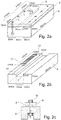
- FIG. 1a is a cross section of two after step b) arranged moldings S1 and S2 , which have a cavity (1) between each other.
- the cavity (1) is an open cavity.
- open or “open cavity” in this document means “liquid-permeable” or “unsealed”.
- the distance in the cavity (1) between the two shaped bodies does not substantially change after the step b) of arranging a shaped body S2 on the shaped body S1 .
- the term "essentially” is to be understood as meaning a change in the distance of less than 30%, less than 20%, in particular less than 10%.
- the distance between the two shaped bodies 0-100 mm, in particular 0-30 mm, next to the cavity (1) after the step b) of arranging a shaped body S2 on the shaped body S1 does not substantially change.
- the term "substantially” is understood to mean preferably a change in the distance of less than 30%, less than 20%, in particular less than 10%.
- the distance between the two moldings 0-100 mm, in particular 0-30 mm, next to the cavity (1) after step b) 0.5-15 mm, in particular 0.5-10 mm, preferably 0.5-5 mm, more preferably 1-3 mm.
- the one-component thermosetting epoxy resin composition is introduced through at least one filling opening (2) in at least one of the two shaped bodies.
- a filling opening (2) is for example in the FIG. 1b can be seen in the shaped body S2 .
- the filling opening (2) is arranged on the side facing away from the other shaped body of the shaped body.
- the at least one filling opening (2) is preferably connected directly to the cavity (1) via a filling channel (3a).
- the one-component thermosetting epoxy resin composition is introduced through a filling channel (3b) in the cavity (1), wherein the filling channel (3b) is arranged on the surface of at least one of the two moldings, which faces the other moldings.
- the Figure 1d shows a side view of the two adjacent moldings.
- the cavity (1) is preferably a connection point for the composite of the two shaped bodies, in particular an intended structural connection point. This is therefore preferably designed such that it can receive a sufficient amount of epoxy resin composition, so that a structural connection between the two moldings can be ensured.
- the cavity (1) is a material recess (4) in at least one of the two moldings.
- the moldings S1 and S2 may be made of the same or a different material.
- shaped bodies of metal or other heat-resistant materials in particular metal or heat-resistant plastics such as polyamides (PA), polyphenylene ether, for example, Noryl ®, or heat-resistant fiber-reinforced plastics such as carbon fiber reinforced plastics (CFRP) or glass fiber reinforced plastics (FRP).
- PA polyamides
- CFRP carbon fiber reinforced plastics
- FRP glass fiber reinforced plastics
- suitable metals are in particular steel, in particular electrolytically galvanized steel, hot-dip galvanized steel or oiled steel, Bonazink-coated steel, and subsequently phosphated steel, and aluminum.
- Shaped bodies S1 and S2 are in particular moldings suitable, for example, as used in transport construction, for example in the automobile industry, or in the production of white goods.
- thermosetting epoxy resin composition according to claim 1
- a self-sealing system can be created. It has surprisingly been found that by using such an epoxy resin composition which, upon cooling, has a sharp transition between an unconsolidated and a solidified state, open systems can be joined without the use of, for example, sealing elements.
- step b) of arranging the shaped body S2 on the shaped body S1 a cavity (1) is formed between the two shaped bodies S1 and S2.
- the two shaped bodies can be arranged, for example, against one another in such a way that the two shaped bodies touch each other directly at at least one location or they can be arranged at a distance from one another.
- the two shaped bodies S1 and S2 are prefixed by one-sided or two-sided mechanical joining technique, in particular by riveting, welding, screws or bolts, optionally with the use of spacers. This joining technique is intended to ensure, in particular, that the two shaped bodies S1 and S2 arranged one on the other remain in the intended position before the introduced epoxy resin composition has solidified and / or hardened.
- the epoxy resin composition is one-component, ie the constituents of the epoxy resin composition, in particular at least one epoxy resin A, the at least one hardener B and the at least one polyester polyol PP, are contained in one component, without curing taking place at the usual ambient temperature or room temperature. Therefore, the one-component epoxy resin composition is storage stable. It is therefore tradable in this form, while in two-component systems, the mixture of components is possible only immediately before use.
- a "toughener” is understood in this document to be an addition to an epoxy resin matrix which causes a marked increase in toughness even at low additions of .gtoreq.5% by weight, in particular .gtoreq.10% by weight, based on the total weight of the epoxy resin compositions and thus is able to absorb higher bending, tensile, impact or impact stress before the matrix enters or breaks.
- molecular weight is meant herein the molar mass (in grams per mole) of a molecule.
- average molecular weight refers to the number average molecular weight M n of an oligomeric or polymeric mixture of molecules, which is usually determined by GPC against polystyrene as standard.
- primary amino group in the present document denotes an NH 2 group which is bonded to an organic radical
- secondary amino group denotes an NH group which is attached to two organic radicals which also together form part of a ring can, is bound. Accordingly, an amine having a primary amino group is referred to as a "primary amine”, one having a secondary amino group is referred to as a “secondary amine” and one having a tertiary amino group as a “tertiary amine”.
- room temperature is referred to in this document a temperature of 23 ° C.
- the epoxy resin A having an average of more than one epoxy group per molecule is preferably an epoxy liquid resin or a solid epoxy resin.
- the term "solid epoxy resin” is well known to the person skilled in the art and is used in contrast to "liquid epoxy resins”.
- the glass transition temperature of solid resins is above room temperature, ie they can be comminuted at room temperature to form pourable powders.
- Preferred epoxy resins have the formula (II)
- substituents R 'and R "independently of one another are either H or CH 3 .
- the index s stands for a value of> 1.5, in particular from 2 to 12.
- Such solid epoxy resins are commercially available, for example, from Dow or Huntsman or Hexion.
- the index s stands for a value of less than 1.
- s stands for a value of less than 0.2.
- DGEBA diglycidyl ethers of bisphenol-A
- bisphenol-F bisphenol-F
- bisphenol-A / F Such liquid resins are available, for example, as Araldite® GY 250, Araldite® PY 304, Araldite® GY 282 (Huntsman) or D.E.R. TM 331 or D.E.R. TM 330 (Dow) or Epikote 828 (Hexion).
- Such epoxy resins are commercially available under the tradename EPN or ECN and Tactix® from Huntsman or under the D.E.N. TM product line from Dow Chemical.
- the epoxy resin A preferably represents an epoxy liquid resin of the formula (II).
- thermosetting epoxy resin composition contains both at least one epoxy liquid resin of the formula (II) with s ⁇ 1, in particular less than 0.2, and at least one solid epoxy resin of the formula (II) with s> 1.5, in particular of 2 until 12.
- the proportion of epoxy resin A is preferably 10 to 60 wt .-%, in particular 30 to 50 wt .-%, based on the total weight of the epoxy resin composition.
- the epoxy resin A is an aforementioned liquid epoxy resin.
- the epoxy resin A is an aforementioned solid epoxy resin.
- the thermosetting one-part epoxy resin composition further contains at least one epoxy resin hardener B which is activated by elevated temperature.
- latent curing agents are substantially inert at room temperature and are activated by elevated temperature, typically at temperatures of 70 ° C or more, thereby starting the curing reaction.
- the usual latent hardeners for epoxy resins can be used. It is preferably a latent nitrogen-containing hardener for epoxy resins.
- latent hardeners examples include dicyandiamide, guanamines, guanidines, aminoguanidines and their derivatives; substituted ureas, in particular 3- (3-chloro-4-methylphenyl) -1,1-dimethylurea (chlorotoluron), or phenyl-dimethylureas, in particular p-chlorophenyl-N, N-dimethylurea (monuron), 3-phenyl-1,1-dimethylurea (Fenuron) or 3,4-dichlorophenyl-N, N-dimethylurea (diuron), as well as imidazoles and amine complexes.
- substituted ureas in particular 3- (3-chloro-4-methylphenyl) -1,1-dimethylurea (chlorotoluron), or phenyl-dimethylureas, in particular p-chlorophenyl-N, N-dimethylurea (mon
- a latent curing agent is dicyandiamide.
- the proportion of the curing agent B is preferably 0.5 to 12 wt .-%, more preferably 1 to 8 wt .-%, based on the total weight of the epoxy resin composition.
- derivatives of these dicarboxylic acids are carboxylic acid esters (especially the methyl and ethyl esters), acid halides (such as acid chlorides) and acid anhydrides.
- the melting point is preferably determined using a DSC apparatus (DIN 53 765).
- the sample and an empty reference crucible are heated at a heating rate of 20 ° C / min.
- the melting point corresponds to the maximum of the melting peak.
- the polyester polyol PP preferably has a softening point of 50 to 110 ° C, especially 70 to 95 ° C.
- the softening point is determined in this document according to the Ring & Ball method according to DIN ISO 4625.
- Preferred polyester polyols PP also have a number average molecular weight of from 1500 to 9000, preferably from 1500 to 6000, particularly preferably from 2500 to 5000.
- Preferred polyester polyols PP have a hydroxyl number (milliequivalents KOH per gram of polyester polyol) of about 20 to 50, preferably about 25 to 40.
- polyesterpolyols have a hydroxy functionality of about 2, in particular from 1.9 to 2.1 (average number of hydroxyl groups per polymer chain).
- the diol useful in the preparation of the polyester polyols PP is selected from the list consisting of ethylene glycol, 1,4-butanediol, 1,5-pentanediol, 1,6-hexanediol, 1,8-octanediol and 1,10 -Decandiol. There are also mixtures of them possible.
- the dicarboxylic acid useful in the preparation of the polyester polyols PP is selected from the list consisting of heptanedioic acid (pimelic acid), octanedioic acid (suberic acid), nonanedioic acid (azelaic acid),
- Decanedioic acid (sebacic acid), undecanedioic acid, dodecanedioic acid, tridecanedioic acid, tetradecanedioic acid, hexadecanedioic acid and octadecanedioic acid.
- the dicarboxylic acid is selected from the list consisting of decanedioic acid (sebacic acid), undecanedioic acid, dodecanedioic acid, tridecanedioic acid, tetradecanedioic acid, particularly preferred is dodecanedioic acid.
- the polyesterpolyol PP is obtainable by the reaction of only one member from the list of diols described above and only one member of the list of dicarboxylic acids described above.
- the proportion of polyesterpolyol PP is 1.5-20% by weight, based on the total weight of the one-component thermosetting epoxy resin composition.
- the proportion of polyesterpolyol PP is preferably 2-15% by weight, 2.5-10% by weight, 3-10% by weight, in particular 4-8% by weight, based on the total weight of the one-component thermosetting epoxy resin composition.
- Such a Proportion leads to good spreading behavior combined with high tensile shear strength values.
- a proportion of the polyesterpolyol PP of 2 to 4.5% by weight, 2.5 to 4% by weight, based on the total weight of the one-component thermosetting epoxy resin composition is for high impact peel strength (I-peel), in particular at -30 ° C. , advantageous.
- thermosetting epoxy resin composition optionally contains at least one toughener D.
- the tougheners D may be solid or liquid.
- the toughener D is selected from the group consisting of terminally blocked polyurethane polymers D1, liquid rubbers D2 and core-shell polymers D3.
- the toughener D is a terminally blocked polyurethane polymer D1, preferably it is a terminally blocked polyurethane prepolymer of the formula (I).
- R 1 is a p-valent radical of an isocyanate-terminated linear or branched polyurethane prepolymer after removal of the terminal isocyanate groups and p is from 2 to 8.
- R 2 is independently a substituent which is selected from the group consisting of
- R 5 , R 6 , R 7 and R 8 are each independently an alkyl or cycloalkyl or aralkyl or arylalkyl group, or R 5 forms together with R 6 , or R 7 together with R 8 , a part of a 4- to 7-membered ring which is optionally substituted.
- R 9 ' and R 10 are each independently an alkyl or aralkyl or arylalkyl group or an alkyloxy or aryloxy or aralkyloxy group and R 11 is an alkyl group.
- R 12 , R 13 and R 14 each independently represent an alkylene group having 2 to 5 C atoms, which optionally has double bonds or is substituted, or for a phenylene group or for a hydrogenated phenylene group.
- R 15 , R 16 and R 17 are each independently H or an alkyl group or an aryl group or an aralkyl group and R 18 is an aralkyl group or a mono- or polynuclear substituted or unsubstituted aromatic group which optionally has aromatic hydroxyl groups.
- R 4 is a radical of a primary or secondary hydroxyl-containing aliphatic, cycloaliphatic, aromatic or araliphatic epoxide after removal of the hydroxy and epoxide groups and m is 1, 2 or 3.
- Phenols or polyphenols, in particular bisphenols, after removal of a hydroxyl group are, in particular, to be regarded as R 18 on the one hand.
- Preferred examples of such phenols and bisphenols are, in particular, phenol, cresol, resorcinol, pyrocatechol, cardanol (3-pentadecenylphenol (from cashew nut shell oil)), nonylphenol, phenols reacted with styrene or dicyclopentadiene, bisphenol A, bisphenol -F and 2,2'-diallyl-bisphenol-A.
- R 18 in particular, hydroxybenzyl alcohol and benzyl alcohol are considered after removal of a hydroxyl group.
- R 5 , R 6 , R 7 , R 8 , R 9 , R 9 ' , R 10 , R 11 , R 15 , R 16 or R 17 is an alkyl group, this is in particular a linear or branched C 1 -C 20 alkyl group.
- R 5 , R 6 , R 7 , R 8 , R 9 , R 9 ' , R 10 , R 15 , R 16 , R 17 or R 18 is an aralkyl group, this grouping is in particular a methylene-bonded aromatic group, in particular a benzyl group.
- R 5, R 6, R 7, R 8, R 9, R 9 'or R 10 is an alkylaryl group, this is especially a phenylene residue, bonded via C 1 - to C 20 alkyl group, such as tolyl or xylyl.
- the radicals R 2 are preferably the substituents of the formulas As a substituent of the formula
- ⁇ -caprolactam is preferred after removal of the NH proton.
- radicals R 2 are radicals which are selected from the group consisting of
- the radical Y in this case represents a saturated, aromatic or olefinically unsaturated hydrocarbon radical having 1 to 20 C atoms, in particular having 1 to 15 C atoms.
- Y in particular allyl, methyl, nonyl, dodecyl, phenyl, alkyl ethers, carboxylic acid esters or an unsaturated C 15 -alkyl radical having 1 to 3 double bonds are preferred.
- R 2 is --- OR 18 .
- the preparation of the terminally blocked polyurethane prepolymer of the formula (I) is carried out from the isocyanate-terminated linear or branched polyurethane prepolymer having one or more isocyanate-reactive compounds R 2 H. If several such isocyanate-reactive compounds are used, the reaction can be sequential or with a mixture these connections take place.
- the reaction is preferably carried out in such a way that the one or more isocyanate-reactive compounds R 2 H are used stoichiometrically or in stoichiometric excess in order to ensure that all NCO groups have reacted.
- the polyurethane prepolymer with isocyanate end groups on which R 1 is based can be prepared from at least one diisocyanate or triisocyanate and from a polymer Q PM with terminal amino, thiol or hydroxyl groups and / or from an optionally substituted polyphenol Q PP .
- Suitable diisocyanates are aliphatic, cycloaliphatic, aromatic or araliphatic diisocyanates, in particular commercial products such as methylene diphenyl diisocyanate (MDI), hexamethylene diisocyanate (HDI), toluene diisocyanate (TDI), tolidine diisocyanate (TODI), isophorone diisocyanate (IPDI), trimethylhexamethylene diisocyanate (TMDI), 2.5- or 2,6-bis (isocyanatomethyl) bicyclo [2.2.1] heptane, 1,5-naphthalene diisocyanate (NDI), dicyclohexylmethyl diisocyanate (H 12 MDI), p-phenylene diisocyanate (PPDI), m-tetramethylxylylene diisocyanate (TMXDI), etc. as well as their dimers.
- Preferred are HDI, IPDI, MDI or TDI
- Suitable triisocyanates are trimers or biurets of aliphatic, cycloaliphatic, aromatic or araliphatic diisocyanates, especially the isocyanurates and biurets of the diisocyanates described in the previous paragraph. Of course, suitable mixtures of di- or triisocyanates can be used.
- polymers Q PM with terminal amino, thiol or hydroxyl groups are particularly suitable polymers Q PM having two or three terminal amino, thiol or hydroxyl groups.
- the polymers Q PM advantageously have an equivalent weight of 300-6000, in particular of 600-4000, preferably of 700-2200 g / equivalent of NCO-reactive groups.
- the polymers Q PM di- or higher functional polyols having OH equivalent weights of 300 to 6000 g / OH equivalent, in particular from 600 to 4000 g / OH equivalent, preferably 700 - 2200 g / OH equivalent.
- the polyols selected from the group consisting of polyethylene glycols, polypropylene glycols, polyethylene glycol-polypropylene glycol block co-polymers, polybutylene glycols, hydroxyl-terminated polybutadienes, hydroxyl-terminated butadiene / acrylonitrile copolymers, hydroxyl-terminated synthetic rubbers, their hydrogenation products and mixtures of said polyols.
- polymers Q PM di- or higher-functional amino-terminated polyethylene ethers
- polypropylene ethers such as those sold under the name Jeffamine® by Huntsman
- polybutylene ethers such as those sold under the name Jeffamine® by Huntsman
- polybutadienes such as those under the name Hypro® ATBN
- Hypro® ATBN acrylonitrile copolymers
- suitable polymers Q PM are in particular hydroxyl-containing polybutadienes or polyisoprenes or their partially or completely hydrogenated reaction products.
- polymers Q PM can also be chain-extended, as can be carried out in a manner known to the person skilled in the art by the reaction of polyamines, polyols and polyisocyanates, in particular of diamines, diols and diisocyanates.
- a species of the formula (VI) or (VII) forms, as shown below, depending on the selected stoichiometry.
- the radicals Y 1 and Y 2 represent a divalent organic radical and the indices u and v vary from 1 to typically 5, depending on the stoichiometric ratio.
- the indices x and y vary from 1 to typically 5, depending on the stoichiometric ratio, and are in particular 1 or 2.
- the species of the formula (VI) can also be reacted with the species of the formula (VII) to give a NCO-containing chain-extended polyurethane prepolymer.
- diols and / or diamines and diisocyanates are preferred.
- higher functionality polyols such as trimethylolpropane or pentaerythritol
- polyisocyanates such as isocyanurates of diisocyanates
- the prepolymers do not have too high viscosities, especially if higher functional compounds are used for the chain extension, since this can be converted into the polyurethane prepolymers of the formula (I) or complicate the application of the adhesive.
- polymers Q PM are preferred polyols with average molecular weights between 600 and 6000 daltons selected from the group consisting of polyethylene glycols, polypropylene glycols, polyethylene glycol-polypropylene glycol block polymers, polybutylene glycols, hydroxyl-terminated polybutadienes, hydroxyl-terminated butadiene-acrylonitrile copolymers and mixtures thereof.
- polymers Q PM particular preference is given to ⁇ , ⁇ -dihydroxypolyalkylene glycols having C 2 -C 6 -alkylene groups or having mixed C 2 -C 6 -alkylene groups which are terminated by amino, thiol or, preferably, hydroxyl groups.
- polyphenol Q PP are particularly suitable bis-, tris- and tetraphenols. These are understood to mean not only pure phenols, but optionally also substituted phenols. The type of substitution can be very diverse. In particular, this is understood to mean a substitution directly on the aromatic nucleus to which the phenolic OH group is bonded. Phenols are furthermore not only understood as mononuclear aromatics, but also as polynuclear or condensed aromatics or heteroaromatics which have the phenolic OH group directly on the aromatic or heteroaromatic compounds.
- the bis- and trisphenols are particularly suitable.
- the polyurethane prepolymer is prepared from at least one diisocyanate or triisocyanate and from a polymer Q PM with terminal amino, thiol or hydroxyl groups.
- the preparation of the polyurethane prepolymer is carried out in a manner known to the person skilled in the art, in particular by using the diisocyanate or triisocyanate in a stoichiometric excess with respect to the amino, thiol or hydroxyl groups of the polymer Q PM .
- the polyurethane prepolymer is prepared from at least one diisocyanate or triisocyanate and from one, optionally substituted, polyphenol Q PP .
- the preparation of the polyurethane prepolymer is carried out in a manner known to the person skilled in the polyurethane art, in particular by using the diisocyanate or triisocyanate in a stoichiometric excess with respect to the phenolic groups of the polyphenol Q PP .
- the polyurethane prepolymer is prepared from at least one diisocyanate or triisocyanate and from a polymer Q PM with terminal amino, thiol or hydroxyl groups and from one, optionally substituted, polyphenol Q PP .
- the polyurethane prepolymer from at least one diisocyanate or triisocyanate as well as from a polymer Q PM with terminal amino, thiol or hydroxyl groups and / or from an optionally substituted polyphenol Q PP different possibilities are available.
- the polyurethane prepolymer having isocyanate end groups preferably has elastic character. It preferably exhibits a glass transition temperature Tg of less than 0 ° C.
- the one-component thermosetting epoxy resin composition additionally contains at least one filler F.
- these are preferably mica, talc, kaolin, wollastonite, feldspar, syenite, chlorite, bentonite, montmorillonite, calcium carbonate (precipitated or ground), dolomite, quartz, Silicic acids (pyrogenic or precipitated), cristobalite, calcium oxide, aluminum hydroxide, magnesium oxide, ceramic hollow spheres, glass hollow spheres, organic hollow spheres, glass spheres, color pigments. Particular preference is given to fillers selected from the group consisting of calcium carbonate, calcium oxide and fumed silicas.
- the total proportion of the total filler F is 5-40% by weight, preferably 5-20% by weight, based on the total weight of the epoxy resin composition.
- hexanediol diglycidyl ethers cresyl glycidyl ethers, p- tert -butylphenyl glycidyl ethers, polypropylene glycol diglycidyl ethers and polyethylene glycol diglycidyl ethers.
- the total proportion of epoxide group-carrying reactive diluent G is 0.1-15% by weight, preferably 0.1-5% by weight, more preferably 0.1-2% by weight, more preferably 0.2-1% by weight, based on the total weight of the epoxy resin composition.
- the one-component thermosetting epoxy resin composition may comprise further constituents, in particular catalysts, stabilizers, in particular heat and / or light stabilizers, thixotropic agents, plasticizers, solvents, mineral or organic fillers, blowing agents, dyes and pigments, corrosion inhibitors, surfactants, defoamers and adhesion promoters.
- the preferred one-part thermosetting epoxy resin composition is greater than 80% by weight, preferably greater than 90% by weight, more preferably greater than 95% by weight, more preferably greater than 98% by weight, most preferably greater than 99% by weight, based on the total weight of the epoxy resin composition, of the aforementioned constituents.
- the one-component thermosetting epoxy resin composition has a threshold value for the complex viscosity ⁇ * of more than 20,000 Pas, in particular more than 40,000 Pas, preferably more than 60,000 Pas, more preferably more than 80 '000 Pas, more preferably more than 100,000 Pas.
- the one-component thermosetting epoxy resin composition reaches more than 50%, in particular more than 70%, in particular more than 80%, of the increase in viscosity, starting from the amount of the complex viscosity ⁇ * at the beginning of the measurement at 150 ° C. (end of phase 1, beginning of Phase 2), ie at the beginning of the cooling, starting from 150 ° C at a cooling rate of -23 ° C / min, to the threshold for the amount of the complex viscosity ⁇ * of more than 20,000 Pas, in particular more than 40,000 Pas, preferably more than 60,000 Pas, more preferably more than 80,000 Pas, more preferably more than 100,000 Pas, within 20 seconds, preferably within 10 seconds.
- thermosetting epoxy resin composition it is further preferred if this is achieved before reaching the cooling of the one-component thermosetting epoxy resin composition to 25 ° C. This is particularly preferably achieved 80 to 280 seconds after the start of the cooling of the one-component thermosetting epoxy resin composition of 150 ° C. with a cooling rate of -23 ° C./min.
- the one-component thermosetting epoxy resin composition reaches a maximum value for the amount of the complex viscosity ⁇ * of more than 100,000 Pas, in particular more than 200,000 Pas, preferably more than 300,000 Pas, more preferably more than 500,000 Pas, more preferably before reaching the cooling of the one-component thermosetting epoxy resin composition to 25 ° C, preferably 80-280 Seconds after the start of the cooling of the composition of 150 ° C with a cooling rate of -23 ° C / min.
- the above-mentioned amount of the complex viscosity ⁇ * is determined oscillographically as described in the examples by means of a rheometer with heatable plate (MCR 302, Anton Paar) (gap 200 ⁇ m, measuring plate diameter: 25 mm (plate / plate), deformation 0, 01 at 5 Hz, in a temperature range of 150 - 25 ° C (cooling rate: -23 ° C / min)
- MCR 302 rheometer with heatable plate
- the one-component heat-curing epoxy resin composition preferably has at least one, preferably more, more preferably all of the mechanical properties listed below.
- Impact peel strength (I-peel) and tensile shear strength (ZSF) are measured as described below in the Examples.
- Tensile strength and modulus of elasticity are determined according to DIN EN ISO 527.
- the one-component thermosetting epoxy resin composition at 23 ° C has a viscosity of> 5,000 Pas,> 10,000 Pas, in particular> 15,000 Pas, wherein the viscosity is determined oscillographically by means of a rheometer with heatable plate (MCR 302, Anton Paar) (gap 1000 ⁇ m, measuring plate diameter: 25 mm (plate / plate), deformation 0.01 at 5 Hz).
- MCR 302, Anton Paar heatable plate
- the one-component thermosetting epoxy resin composition in the introduction in step c) has a temperature of 40-100 ° C., in particular 50-100 ° C., particularly preferably 50-80 ° C.
- the one-component thermosetting epoxy resin composition in the introduction in step c) has a temperature of not more than 20 ° C, not more than 15 ° C, preferably not more than 10 ° C, below the melting point of the polyester polyol PP on. This can be seen, for example, from Table 6.
- the melting point is preferably determined using a DSC apparatus (DIN 53 765). The sample and an empty reference crucible are heated at a heating rate of 20 ° C / min. The melting point corresponds to the maximum of the melting peak.
- the one-component thermosetting epoxy resin composition in the introduction in step c) has a viscosity of ⁇ 3,000 Pas, ⁇ 2,000 Pas, in particular ⁇ 1'000 Pas, wherein the viscosity is determined oscillographically by means of a rheometer with heatable plate (MCR 302, Anton Paar) (gap 1000 ⁇ m, measuring plate diameter: 25 mm (plate / plate), deformation 0.01 at 5 Hz).
- the method additionally comprises the step d) of curing the one-component thermosetting epoxy resin composition, in particular at a temperature of at least 100 ° C., at least 120 ° C., at least 130 ° C., in particular at a temperature of 140-220 ° C. , in particular from 140 to 200 ° C, particularly preferably from 160 to 190 ° C, for at least 10 minutes, at least 20 minutes, in particular between 20 - 60 minutes.
- the introduction of the one-component thermosetting epoxy resin compositions in the cavity (1) in step c) is preferably carried out by a pump, wherein the one-component thermosetting epoxy resin composition is conveyed from a tank.
- thermosetting epoxy resin composition as described above as a one-component thermosetting epoxy resin composition for introducing, in particular injection, into a cavity (1) between two moldings S1 and S2, which are arranged next to one another Connection, in particular bonding, of the two shaped bodies S1 and S2 with one another.
- the one-part thermosetting epoxy resin compositions are those which are preferred in the present specification.
- Yet another aspect of the present invention relates to the use of polyester polyols PP, as described hereinbefore as polyester polyols PP , in one-part thermosetting epoxy resin compositions to reduce leakage through side openings in cavities upon introduction, particularly injection, of one-component thermosetting epoxy resin compositions into cavities having side openings.
- the cavities mentioned are, in particular, open cavities (1) described above.
- the polyester polyols PP, or the one-component thermosetting epoxy resin composition are preferably those which are identified as being preferred in the present description.
- the test method uses a composite of two moldings consisting of a base element 5 and a transparent cover element 6 as shown in FIG Figure 2a is shown.
- the rectangular base member 5 is made of polyamide and has a length of 400 mm, a width of 80 mm and a height of 30 mm.
- the base member 5 has a central recessed channel 7 having a rectangular cross section and a depth of 3 mm and a width of 20 mm. This is for example in the FIG. 2b seen.
- a parallel to the channel 7 extending boundary mark 12 are applied at a distance of 12 mm from the broad side (or 18 mm measured from the channel 7).
- Spread marks 13 extend at right angles to the delimiting mark 12 at a distance of 10 mm each.
- the first delimiting mark begins in the middle of the base element 5 and the remaining delimiting markings are arranged along the delimiting mark as far as the outer edge of the base element.
- spacers 8 are arranged which ensure a gap (with a constant width) between the base element and cover element. This is for example in the Figure 2c seen.
- the height of the gap is by means of washers as Spacer 8 adjustable and is 1 mm.
- Base element and cover element are held together by 8 fixing screws 10.
- the transparent cover element 6 is made of polymethyl methacrylate (PMMA) and has a length of 400 mm, a width of 80 mm and a thickness of 10 mm.
- a filling opening 9 with a diameter of 10 mm is centrally embedded in the cover element 6 (each distance of 35 mm from each longitudinal side, or 195 mm from each broad side). In the assembled state, the filling opening 9 comes to lie exactly over the middle of the channel 7 of the base member 5.
- PMMA polymethyl methacrylate
- the introduction of the epoxy resin composition from the outside through the filling opening 9 into the channel 7 takes place with the subsequently indicated injection rate, respectively injection pressure, and injection temperature.
- Fig. 3a and Fig. 3b show a plan view of the composite with 8 fixing screws 10 composite of base element 5 and transparent cover element 6. They show an introduced epoxy resin composition 11, which has spread along the channel 7. It shows Fig. 3a a situation in which the introduced epoxy resin composition 11 has spread laterally to the limit mark 12.
- the injection is stopped and the propagation marks 13 are used to determine the propagation in the channel direction in number of propagation marks, the propagation marks in the middle of the base element serving as a starting point and not being counted.
- the achieved propagation marks +1 serve as a value for the so-called "squeeze-out ratio".
- Fig. 3b shows a situation in which the already introduced epoxy resin composition 11 has spread predominantly along the channel 7.
- the epoxy resin composition has the Limit marker 12 not reached until it leaves the channel end. This corresponds to an extension of more than 200 mm, or a squeeze-out ratio of> 20.
- epoxy resin compositions according to the invention have a behavior according to the invention, inter alia in the test method FIG. 3b demonstrate.
- the heated epoxy resin compositions according to the invention spread predominantly in the direction of the channel 7 and flow at least partially into the gap with a thickness of 1 mm between the base element 5 and the cover element 6. Because the gap is smaller than the distance between a bottom of the channel 7 and the transparent cover element 6 cools the epoxy resin composition in the gap faster than in the region of the channel 7 and solidifies as a result of this cooling in the region of the gap. This leads to a self-sealing function of the epoxy resin composition in the region of the gap.
- the product was thus used as a toughener D-1.
- the epoxy resin composition according to Table 1 has a viscosity ⁇ of 0-5000 and a thixotropic structure synthesis time to 50% of the starting structure (thixotropic recovery time 50% in seconds) of 5-15.
- the complex viscosity ⁇ * was determined using a rheometer (Physica MCR 302, Anton Paar) by rotary measurement (gap: 1 mm, plate / plate, plate diameter: 25 mm, shear rate: 0.1 s-1) at a temperature of 20 ° C.
- epoxy resin compositions having different viscosity ⁇ and / or different thixotropic structure-building time were prepared.
- the proportions in% by weight of the reactive diluent and of the thixotropic agent (pyrogenic silica) and optionally by exchanging the fumed silica with organophilic phyllosilicates it was possible to obtain epoxy resin compositions having a different viscosity ⁇ and / or different thixotropic structure synthesis time.
- the spreading characteristics i. determines the squeeze-out ratio.
- compositions were at an injection temperature of 60 ° C and an injection pressure of 1 bar, resp. 2 bar, the propagation characteristics, i. determines the squeeze-out ratio.
- the remaining raw materials had a homogeneous mixture after cooling. From these compositions, the viscosity behavior was then determined on cooling from 150 ° C to 25 ° C.
- the method consists of three phases. During the first phase, the mixture is at a temperature of 150 ° C, i. the added raw material is in the liquid state. In the second phase, the temperature cools down to 25 ° C at a constant cooling rate. In the third phase, the mixture is left at a temperature of 25 ° C. This method can be used to determine the behavior of the hardening of the mixture, the "sharpness" of the transition, and the time when solidification of the mixture occurs.
- the amount of the complex viscosity ⁇ * was determined on the basis of the oscillographic measurement.
- the FIGS. 4a-4d show the amount of complex viscosity ⁇ *.
- the course of the complex viscosity ⁇ * as a function of the time [t in seconds] for the mixtures A ( ⁇ ), B ( ⁇ ), C ( ⁇ ), D ( ⁇ ), E ( ⁇ ) and F ( ⁇ ) are in the FIGS. 4a-4d played.
- the FIGS. 4c and 4d show the amount of the complex viscosity ⁇ * shown in logarithmic representation.
- the previously described rheometer was used, respectively the oscillographic measurement described above.
- the mixtures were brought to a temperature of 150 ° C and the measurement started.
- the beginning of the recording of the measured values is from 130 seconds after the start of the measurement in the FIGS. 4a-4d played. 265 seconds after the start of the measurement, the mixture was cooled from a temperature of 150 ° C at a cooling rate of -23 ° C / min to a temperature of 25 ° C. 590 seconds after the beginning of the measurement, the temperature reached 25 ° C.
- the mixture was left at 25 ° C until about 1500 seconds after the start of the measurement.
- the mixture E ( ⁇ ) shows a slow increase in viscosity and the mixtures A ( ⁇ ) and B ( ⁇ ) show a slow and weak increase in viscosity.
- blends of different proportions by weight of Dynacoll 7380 based on the total weight of blends of Dynacoll 7380 with epoxy liquid resin were prepared (33 wt%, 7 wt%, 3 wt%, 2 wt%). %).
- the 2% by weight Dynacoll 7380 blend peaked at the complex viscosity ⁇ * of 39,000. Further, this mixture reached more than 80% of the viscosity increase to 39,000, based on the amount of the complex viscosity ⁇ * at the start of the measurement at 150 ° C, within 50 seconds.
- the other blends reached a maximum value for the complex viscosity ⁇ * amount greater than 100,000. Further, the blends with 33% by weight and 7% by weight reached more than 80% of the viscosity increase to 100,000, starting from the amount of the complex viscosity ⁇ * at the beginning of the measurement at 150 ° C, within 10 seconds
- composition Z-1 additionally contains 15 parts by weight of Epoxidfestharz and 20 instead of 35 parts by weight toughener D-1 and has a viscosity of 2500 Pas.
- Composition Z-2 contains 20 instead of 35 parts by weight toughener D-1 and has a viscosity of 1000 Pas.
- Composition Z-3 additionally contains 10 parts by weight epoxy resin and 15 instead of 35 parts by weight toughener D-1 and has a viscosity of 3500 Pas.
- compositions Z-1, Z-2 and Z-3 was added 5% by weight of Dynacoll 7380, Dynacoll 7330 or Fineplus HM 3123, based on the total weight of the corresponding composition.
- compositions Z-1, Z-2 and Z-3 containing the raw material C (Dynacoll 7380) with the melting point of 70 ° C show a very good spreading behavior at an injection temperature of 60 ° C.
- Table 6 Raw material Injection rate 47 ml / min, injection temperature 60 ° C, 5 wt .-% raw material Z-1 Z-2 Z-3 C > 20 > 20 > 20 > 20 > 20 D 9 9 9 F 9 9 9 9 9
- the one-component thermosetting epoxy resin composition containing the raw material during injection has a temperature of not more than 20 ° C, not more than 15 ° C, preferably not more than 10 ° C, below the melting point of the raw material.
- ZSF Tensile shear strength
- Tested sheets of steel Elo H420 (1.2 mm thick) back-lubricated with Anticorit PL 3802-39S were bonded to the adhesive on a 25 x 10 mm adhesive surface with glass beads as spacers in a layer thickness of 0.3 mm and 175 for 35 min ° C oven temperature cured.
- the tensile shear strength was determined on a tractor at a tensile speed of 10 mm / min in a 3-fold determination according to DIN EN 1465.
- the specimens were produced with the adhesive and steel DC04 + ZE with the dimensions 90 x 20 x 0.8 mm.
- the bond area was 20 ⁇ 30mm at a layer thickness of 0.3mm and glass beads as spacers.
- the samples were cured for 35 minutes at 175 ° C oven temperature.
- the impact peel strength was measured in each case at the indicated temperatures (23 ° C., -30 ° C.) as a triple determination on a Zwick 450 impact pendulum.
- impact peel strength the average force in N / mm under the measurement curve is given from 25% to 90% according to ISO11343.
Landscapes
- Chemical & Material Sciences (AREA)
- Organic Chemistry (AREA)
- Health & Medical Sciences (AREA)
- Chemical Kinetics & Catalysis (AREA)
- Medicinal Chemistry (AREA)
- Polymers & Plastics (AREA)
- Engineering & Computer Science (AREA)
- Mechanical Engineering (AREA)
- Adhesives Or Adhesive Processes (AREA)
- Lining Or Joining Of Plastics Or The Like (AREA)
- Epoxy Resins (AREA)
- Compositions Of Macromolecular Compounds (AREA)
Abstract
Die vorliegende Erfindung betrifft ein Verfahren zur Verbindung von zwei Formkörpern S1 und S2, das Verfahren umfassend die Schritte:
a) Bereitstellen eines Formkörpers S1;
b) Anordnen eines Formkörpers S2 an dem Formkörper S1, wobei sich ein Hohlraum (1) zwischen den beiden Formkörpern S1 und S2 bildet,
c) Einbringen einer einkomponentigen hitzehärtenden Epoxidharzzusammensetzungen in den Hohlraum (1),
wobei es sich bei der einkomponentigen hitzehärtenden Epoxidharzzusammensetzung um eine einkomponentige hitzehärtende Epoxidharzzusammensetzung handelt enthaltend
- mindestens ein Epoxidharz A mit durchschnittlich mehr als einer Epoxidgruppe pro Molekül;
- mindestens einen Härter B für Epoxidharze, welcher durch erhöhte Temperatur aktiviert wird;
- mindestens ein Polyesterpolyol PP, erhältlich durch die Reaktion von
-mindestens einem Diol mit der Struktur HO-(CH 2 ) x' -OH, wobei der Wert von x' = 2 bis 10 ist, und
-mindestens einer Dicarbonsäure mit der Struktur HOOC-(CH 2 ) y' -COOH sowie Derivate dieser Dicarbonsäure, wobei der Wert von y' = 8 bis 18 ist,
und wobei der Anteil des Polyesterpolyol PP 1.5 - 20 Gew.-% beträgt, bezogen auf das Gesamtgewicht der einkomponentigen hitzehärtenden Epoxidharzzusammensetzung. Das erfindungsgemässe Verfahren hat den Vorteil, dass zur Verbindung von zwei Formkörpern kein fluiddicht abgeschlossener Raum für den Klebstoff vorgesehen werden muss, sondern dass ein kostengünstigeres und einfacher zu handhabendes offenes System ohne fluiddicht abgeschlossene Zwischenräume verwendet werden kann.
Description
- Die Erfindung betrifft ein Verfahren zur Verbindung, insbesondere strukturellen Verbindung, von zwei Formkörpern, insbesondere Karosserieelemente für Kraftfahrzeuge, sowie die Verwendung von einkomponentigen hitzehärtenden Epoxidharzzusammensetzung in solchen Verfahren.
- Einkomponentige hitzehärtende Epoxidharzzusammensetzungen werden häufig zum Verbinden von Metallsubstraten wie Stahlblechen eingesetzt, wenn hohe Festigkeiten erforderlich sind, z.B. im Automobilbau.
- Beim Verbund solcher Formkörper werden diese zur Verbindung miteinander verklebt. Dabei kommen typischerweise Klebstoffe zum Einsatz, welche als Klebstoffraupen auf einen ersten Formkörper aufgebracht werden, wobei ein zweiter zu verklebender Formkörper danach auf diese Klebstoffraupe aufgebracht wird, zur Verklebung der beiden Formkörper.
- Eine weitere Methode zur Verbindung von Formkörpern wie Blechen, Gussteilen und Extrusionsprofilen sieht vor, dass ein flüssiger Klebstoff in eine geschlossene Kavität injiziert wird, um dadurch die zu verbindenden Formkörper miteinander zu verklebt. Ein Nachteil dieser Methode ist es, dass fluiddicht geschlossene Hohlräume geschaffen werden müssen, welche einen Raum für den flüssigen Klebstoff vorgeben. Dies kann beispielsweise mit Dichtungen erreicht werden oder erfordert Elemente mit sehr kleinen Fertigungstoleranzen. Das hat zur Folge, dass solche Systeme aufwendig und kostspielig in der Herstellung sind.
- Die Aufgabe der vorliegenden Erfindung ist es daher, ein verbessertes Verfahren zur Verbindung, insbesondere strukturellen Verbindung, von zwei Formkörpern zur Verfügung zu stellen, welches erlaubt, Formkörper wie beispielsweise Karosserieelemente in Kraftfahrzeugen kostengünstiger und einfacher in der Handhabung miteinander zu verbinden.
- Diese Aufgabe wird überraschenderweise gelöst durch ein Verfahren gemäss Anspruch 1.
- Das erfindungsgemässe Verfahren hat den Vorteil, dass zur Verbindung von zwei Formkörpern kein fluiddicht abgeschlossener Raum für den Klebstoff vorgesehen werden muss, sondern dass ein kostengünstigeres und einfacher zu handhabendes offenes System ohne fluiddicht abgeschlossene Zwischenräume verwendet werden kann. Somit können beispielsweise Karosserieelemente verwendet werden, welche keine Dichtungen aufweisen, was einem wesentlichen Kostenvorteil entspricht. Weiterhin erlaubt es die vorliegende Erfindung, auch Formkörper mit grösseren Fertigungstoleranzen miteinander zu verbinden, respektive verkleben, weil keine fluiddicht abgeschlossenen Räume für den Klebstoff vorgesehen werden müssen. Auch dies entspricht einem wesentlichen Kostenvorteil gegenüber den bekannten Systemen, weil dadurch die verschiedenen Elemente des Systems kostengünstiger und mit grösseren Fertigungstoleranzen hergestellt werden können. Zudem ist ein Vorgang des Verbindens der Formkörper einfacher zu bewerkstelligen, da ein Befüllen von geschlossenen Räumen mit Klebstoff Schwierigkeiten mit sich bringt, welche hierdurch vermieden werden können, insbesondere das Verdrängen der Luft im geschlossenen Hohlraum durch den Klebstoff.
- Weiter Aspekte der Erfindung sind Gegenstand der weiteren unabhängigen Ansprüche, bevorzugte Ausführungen der Erfindung sind Gegenstand der abhängigen Ansprüche.
- Die vorliegende Erfindung betrifft somit ein Verfahren zur Verbindung, insbesondere strukturellen Verbindung, von zwei Formkörpern S1 und S2, das Verfahren umfassend die Schritte:
- a) Bereitstellen eines Formkörpers S1;
- b) Anordnen eines Formkörpers S2 an dem Formkörper S1, wobei sich ein Hohlraum (1) zwischen den beiden Formkörpern S1 und S2 bildet,
- c) Einbringen einer einkomponentigen hitzehärtenden Epoxidharzzusammensetzungen in den Hohlraum (1),
- mindestens ein Epoxidharz A mit durchschnittlich mehr als einer Epoxidgruppe pro Molekül;
- mindestens einen Härter B für Epoxidharze, welcher durch erhöhte Temperatur aktiviert wird;
- mindestens ein Polyesterpolyol PP, erhältlich durch die Reaktion von
- mindestens einem Diol mit der Struktur HO-(CH2)x'-OH, wobei der Wert von x' = 2 bis 10 ist, und
- mindestens einer Dicarbonsäure mit der Struktur HOOC-(CH2)y'-COOH sowie Derivate dieser Dicarbonsäure, wobei der Wert von y' = 8 bis 18 ist.
- Der Anteil des Polyesterpolyol PP beträgt 1.5 - 20 Gew.-%, bezogen auf das Gesamtgewicht der einkomponentigen hitzehärtenden Epoxidharzzusammensetzung
- In
Figur 1a ist ein Querschnitt von zwei nach Schritt b) aneinander angeordneten Formkörpern S1 und S2 dargestellt, welche einen Hohlraum (1) zwischen einander aufweisen. - Vorzugsweise handelt es sich bei dem Hohlraum (1) um einen offenen Hohlraum. Die Bezeichnung "offen" bzw. "offener Hohlraum" bedeutet in diesem Dokument "flüssigkeitsdurchlässig" oder "nicht abgedichtet".
- Weiter ist es vorteilhaft, wenn sich der Abstand in dem Hohlraum (1) zwischen den beiden Formkörpern nach dem Schritt b) des Anordnens eines Formkörpers S2 an dem Formkörper S1 im Wesentlichen nicht ändert. Unter dem Begriff "im Wesentlichen" wird vorzugsweise eine Veränderung des Abstands von weniger als 30%, weniger als 20%, insbesondere weniger als 10%, verstanden.
- Weiter kann es vorteilhaft sein, wenn sich der Abstand zwischen den beiden Formkörpern 0 - 100 mm, insbesondere 0 - 30 mm, neben dem Hohlraum (1) nach dem Schritt b) des Anordnens eines Formkörpers S2 an dem Formkörper S1 im Wesentlichen nicht ändert. Unter dem Begriff "im Wesentlichen" wird dabei vorzugsweise eine Veränderung des Abstands von weniger als 30%, weniger als 20%, insbesondere weniger als 10%, verstanden.
- Weiter kann es vorteilhaft sein, wenn der Abstand zwischen den beiden Formkörpern 0 - 100 mm, insbesondere 0 - 30 mm, neben dem Hohlraum (1) nach dem Schritt b) 0.5 - 15 mm, insbesondere 0.5 - 10 mm, bevorzugt 0.5 - 5 mm, besonders bevorzugt 1 - 3 mm, beträgt.
- Es kann weiter bevorzugt sein, wenn die einkomponentige hitzehärtende Epoxidharzzusammensetzung durch mindestens eine Einfüllöffnung (2) in mindestens einem der beiden Formkörper eingebracht wird. Eine solche Einfüllöffnung (2) ist beispielsweise in der
Figur 1b in dem Formkörper S2 ersichtlich. Vorzugsweise ist die Einfüllöffnung (2) auf der dem anderen Formkörper abgewandten Seite des Formkörpers angeordnet. - Weiter ist die die mindestens eine Einfüllöffnung (2) bevorzugt über einen Einfüllkanal (3a) direkt mit dem Hohlraum (1) verbunden.
- Es kann jedoch auf vorteilhaft sein, wenn, wie im Querschnitt von
Figur 1 c gezeigt, die einkomponentige hitzehärtende Epoxidharzzusammensetzung durch einen Einfüllkanal (3b) in den Hohlraum (1) eingebracht wird, wobei die Einfüllkanal (3b) auf der Oberfläche von mindestens einem der beiden Formkörper angeordnet ist, welche dem anderen Formkörper zugewandt ist. DieFigur 1d zeigt eine seitliche Ansicht der beiden aneinander angeordneten Formkörper. - Bei dem Hohlraum (1) handelt es sich vorzugsweise um eine Verbindungsstelle für den Verbund der beiden Formkörper, insbesondere eine beabsichtigte strukturelle Verbindungsstelle. Diese ist daher vorzugsweise derart ausgestaltet, dass sie eine ausreichende Menge an Epoxidharzzusammensetzung aufnehmen kann, damit eine strukturelle Verbindung zwischen den beiden Formkörpern gewährleistet werden kann. Dafür sind insbesondere eine geeignete Dicke der eingebrachten Epoxidharzzusammensetzung sowie eine geeignete Kontaktfläche der eingebrachten Epoxidharzzusammensetzung zu dem Formkörper S1, respektive Formkörper S2, vorteilhaft.
- Vorzugsweise handelt es sich bei dem Hohlraum (1) um eine Materialaussparung (4) in mindestens einem der beiden Formkörper.
- Die Formkörpern S1 und S2 können aus dem gleichen oder einem unterschiedlichen Material sein. Vorzugsweise handelt es sich um Formkörper aus Metall oder anderen hitzebeständigen Materialien, insbesondere Metall oder hitzebeständige Kunststoffe wie z.B. Polyamide (PA), Polyphenylenether, z.B. Noryl®, oder hitzebeständige faserverstärkte Kunststoffe wie carbonfaserverstärkte Kunststoffe (CFK) oder glasfaserverstärkte Kunststoffe (GFK). Beispiele für geeignete Metalle sind insbesondere Stahl, insbesondere elektrolytisch verzinkter Stahl, feuerverzinkter Stahl oder beölter Stahl, Bonazink-beschichteter Stahl, und nachträglich phosphatierter Stahl, sowie Aluminium.
- Als Formkörper S1 und S2 sind insbesondere Formkörper geeignet, wie sie z.B. im Transportmittelbau, z.B. in der Automobilindustrie, oder bei der Herstellung von Weisswaren benutzt werden.
- Überraschenderweise wurde gefunden, dass durch den Einsatz einer einkomponentigen hitzehärtenden Epoxidharzzusammensetzung gemäss Anspruch 1 ein sich selbst abdichtendes System geschaffen werden kann. Es wurde überraschenderweise gefunden, dass unter Verwendung einer solchen Epoxidharzzusammensetzungen, welche bei einer Abkühlung einen scharfen Übergang zwischen einem nicht verfestigten und einem verfestigten Zustand aufweist, offene Systeme ohne die Verwendung von beispielsweise Dichtungselementen verbunden werden können.
- In Schritt b) des Anordnens des Formkörpers S2 an dem Formkörper S1, bildet sich ein Hohlraum (1) zwischen den beiden Formkörpern S1 und S2.
- Die beiden Formkörper können dabei beispielsweise derart aneinander angeordnet werden, dass sich die beiden Formkörper an mindestens einer Stelle direkt berühren oder sie können beabstandet voneinander angeordnet werden. Vorzugsweise werden in Schritt b) die beiden Formkörpern S1 und S2 durch einseitige oder zweiseitige mechanische Fügetechnik, insbesondere durch Nieten, Schweissen, Schrauben oder Bolzen vorfixiert, gegebenenfalls unter Verwendung von Abstandhaltern. Diese Fügetechnik soll insbesondere sicherstellen, dass die beiden aneinander angeordneten Formkörpern S1 und S2 in der vorgesehenen Position verbleiben, bevor die eingebrachte Epoxidharzzusammensetzung verfestigt und/oder ausgehärtet ist.
- Die Epoxidharzzusammensetzung ist einkomponentig, d.h. die Bestandteile der Epoxidharzzusammensetzung, insbesondere mindestens eine Epoxidharz A, der mindestens eine Härter B und das mindestens eine Polyesterpolyol PP, sind in einer Komponente enthalten, ohne dass bei üblicher Umgebungstemperatur bzw. Raumtemperatur eine Härtung stattfindet. Daher ist die einkomponentige Epoxidharzzusammensetzung lagerstabil. Es ist daher in dieser Form handelbar, während bei zweikomponentigen Systemen die Mischung der Komponenten erst unmittelbar vor der Anwendung möglich ist.
- In diesem Dokument ist die Verwendung des Terms "unabhängig voneinander" in Zusammenhang mit Substituenten, Reste oder Gruppen dahin gehend auszulegen, dass in demselben Molekül die gleich bezeichneten Substituenten, Resten oder Gruppen gleichzeitig mit unterschiedlicher Bedeutung auftreten können.
- Unter einem "Zähigkeitsverbesserer" wird in diesem Dokument ein Zusatz zu einer Epoxidharzmatrix verstanden, der bereits bei geringen Zuschlägen von ≥ 5 Gew.-%, insbesondere ≥ 10 Gew.-%, bezogen auf das Gesamtgewicht der Epoxidharzzusammensetzungen, eine deutliche Zunahme der Zähigkeit bewirkt und somit in der Lage ist, höhere Biege-, Zug-, Schlag- oder Stossbeanspruchung aufzunehmen, bevor die Matrix einreisst oder bricht.
- Die Vorsilbe "Poly" in Substanzbezeichnungen wie "Polyol", "Polyisocyanat", "Polyether" oder "Polyamin" weist im vorliegenden Dokument darauf hin, dass die jeweilige Substanz formal mehr als eine der in ihrer Bezeichnung vorkommenden funktionellen Gruppe pro Molekül enthält.
- Unter "Molekulargewicht" versteht man im vorliegenden Dokument die molare Masse (in Gramm pro Mol) eines Moleküls. Als "mittleres Molekulargewicht" wird das zahlenmittlere Molekulargewicht Mn einer oligomeren oder polymeren Mischung von Molekülen bezeichnet, welches üblicherweise mittels GPC gegen Polystyrol als Standard bestimmt wird.
- Als "primäre Hydroxylgruppe" wird eine OH-Gruppe bezeichnet, welche an ein C-Atom mit zwei Wasserstoffen gebunden ist.
- Der Begriff "primäre Aminogruppe" bezeichnet im vorliegenden Dokument eine NH2-Gruppe, die an einen organischen Rest gebunden ist, während der Begriff "sekundäre Aminogruppe" eine NH-Gruppe bezeichnet, die an zwei organische Reste, welche auch gemeinsam Teil eines Rings sein können, gebunden ist. Demzufolge wird ein Amin, welches eine primäre Aminogruppe aufweist, als "primäres Amin" bezeichnet, ein solches mit einer sekundären Aminogruppe wird entsprechend als "sekundäres Amin" und ein solches mit einer tertiären Aminogruppe als "tertiäres Amin" bezeichnet.
- Als "Raumtemperatur" wird im vorliegenden Dokument eine Temperatur von 23°C bezeichnet.
- Unter dem Begriff "strukturell" in Bezug auf die Art der Verbindung zwischen Formkörpern versteht man im vorliegenden Dokument insbesondere eine Verbindung anhand einer ausgehärteten Epoxidharzzusammensetzung, welche mechanischen Eigenschaften aufweist, wie sie nachgehend als bevorzugte mechanische Eigenschaften, insbesondere in Bezug auf Zugfestigkeit, Bruchdehnung und E-Modul, aufgeführt sind.
- Das Epoxidharz A mit durchschnittlich mehr als einer Epoxidgruppe pro Molekül ist vorzugsweise ein Epoxid-Flüssigharz oder ein Epoxid-Festharz. Der Begriff "Epoxid-Festharz" ist dem Epoxid-Fachmann bestens bekannt und wird im Gegensatz zu "Epoxid-Flüssigharzen" verwendet. Die Glastemperatur von Festharzen liegt über Raumtemperatur, d.h. sie lassen sich bei Raumtemperatur zu schüttfähigen Pulvern zerkleinern.
- Bevorzugte Epoxidharze weisen die Formel (II) auf

- Hierbei stehen die Substituenten R' und R" unabhängig voneinander entweder für H oder CH3.
- Bei Epoxid-Festharzen steht der Index s für einen Wert von > 1.5, insbesondere von 2 bis 12.
- Derartige Epoxid-Festharze sind kommerziell erhältlich beispielsweise von Dow oder Huntsman oder Hexion.
- Verbindungen der Formel (II) mit einem Index s von 1 bis 1.5 werden vom Fachmann als Semisolid-Epoxidharze bezeichnet. Für die hier vorliegende Erfindung werden sie ebenfalls als Festharze betrachtet. Bevorzugt als Epoxid-Festharze sind jedoch Epoxidharze im engeren Sinn, d.h. wo der Index s einen Wert von > 1.5 aufweist.
- Bei Epoxid-Flüssigharze steht der Index s für einen Wert von kleiner als 1. Bevorzugt steht s für einen Wert von kleiner als 0.2.
- Es handelt sich somit vorzugsweise um Diglycidylether von Bisphenol-A (DGEBA), von Bisphenol-F sowie von Bisphenol-A/F. Solche Flüssigharze sind beispielsweise als Araldite® GY 250, Araldite® PY 304, Araldite® GY 282 (Huntsman) oder D.E.R.™ 331 oder D.E.R.™ 330 (Dow) oder Epikote 828 (Hexion) erhältlich.
- Weiterhin geeignet als Epoxidharz A sind sogenannte Epoxid-Novolake. Diese weisen insbesondere die folgende Formel auf:


- Insbesondere handelt es sich hierbei um Phenol- oder Kresol-Epoxid-Novolake (R2 = CH2).
- Solche Epoxidharze sind unter dem Handelnamen EPN oder ECN sowie Tactix® von Huntsman oder unter der Produktereihe D.E.N.™ von Dow Chemical kommerziell erhältlich.
- Bevorzugt stellt das Epoxidharz A ein Epoxid-Flüssigharz der Formel (II) dar.
- In einer besonders bevorzugten Ausführungsform enthält die hitzehärtende Epoxidharzzusammensetzung sowohl mindestens ein Epoxid-Flüssigharz der Formel (II) mit s < 1, insbesondere kleiner als 0.2, als auch mindestens ein Epoxid-Festharz der Formel (II) mit s > 1.5, insbesondere von 2 bis 12.
- Der Anteil von Epoxidharzes A beträgt vorzugsweise 10 - 60 Gew.-%, insbesondere 30 - 50 Gew.-%, bezogen auf das Gesamtgewicht der Epoxidharzzusammensetzung.
- Weiter ist es vorteilhaft, wenn es sich bei 50-100 Gew.-%, insbesondere 80-100 Gew.-%, des Epoxidharzes A um ein vorgenanntes Epoxid-Flüssigharz handelt.
- Weiter ist es vorteilhaft, wenn es sich bei 0-30 Gew.-%, insbesondere 0-20 Gew.-%, besonders bevorzugt 5-15 Gew.-%, des Epoxidharzes A um ein vorgenanntes Epoxid-Festharz handelt.
- Die hitzehärtende einkomponentige Epoxidharzzusammensetzung enthält ferner mindestens einen Härter B für Epoxidharze, welcher durch erhöhte Temperatur aktiviert wird. Solche latenten Härter sind bei Raumtemperatur im Wesentlichen inert und werden durch erhöhte Temperatur, typischerweise bei Temperaturen von 70°C oder mehr, aktiviert, wodurch die Härtungsreaktion gestartet wird. Es können die üblichen latenten Härter für Epoxidharze eingesetzt werden. Es handelt sich bevorzugt um einen latenten Stickstoff enthaltenden Härter für Epoxidharze.
- Beispiele für geeignete latente Härter sind Dicyandiamid, Guanamine, Guanidine, Aminoguanidine und deren Derivate; substituierte Harnstoffe, insbesondere 3-(3-Chlor-4-methylphenyl)-1,1-dimethylharnstoff (Chlortoluron), oder Phenyl-dimethylharnstoffe, insbesondere p-Chlorphenyl-N,N-dimethylharnstoff (Monuron), 3-Phenyl-1,1-dimethylharnstoff (Fenuron) oder 3,4-Dichlorphenyl-N,N-dimethylharnstoff (Diuron), sowie Imidazole und Amin-Komplexe.
- Besonders bevorzugt als latenter Härter ist Dicyandiamid.
- Der Anteil des Härters B beträgt bevorzugt 0,5 bis 12 Gew.-%, bevorzugter 1 bis 8 Gew.-%, bezogen auf das Gesamtgewicht des Epoxidharzzusammensetzung.
- Die hitzehärtende einkomponentige Epoxidharzzusammensetzung enthält ferner mindestens ein Polyesterpolyol PP, erhältlich durch die Reaktion von
- mindestens einem Diol mit der Struktur HO-(CH2)x'-OH, wobei der Wert von x' = 2 bis 10 ist, und
- mindestens einer Dicarbonsäure mit der Struktur HOOC-(CH2)y'-COOH sowie Derivate dieser Dicarbonsäure, wobei der Wert von y' = 8 bis 18 ist.
- Vorzugsweise handelt es sich bei Derivaten dieser Dicarbonsäuren um Carbonsäureester (speziell die Methyl- und Ethylester), Säurehalogenide (wie z.B. Säurechloride) und Säureanhydride.
- Der Schmelzpunkt wird vorzugsweise mit einem DSC-Gerät (DIN 53 765) bestimmt. Die Probe und ein leerer Referenztiegel werden mit einer Aufheizrate von 20°C/min erwärmt. Der Schmelzpunkt entspricht dem Maximum des Schmelzpeaks.
- Das Polyesterpolyol PP hat vorzugsweise einen Erweichungspunkt von 50 bis 110°-C, insbesondere 70 bis 95ºC. Der Erweichungspunkt (Softening point) wird in diesem Dokumente nach der Ring & Kugel- Methode gemäss DIN ISO 4625 ermittelt.
- Bevorzugte Polyesterpolyole PP haben auch ein zahlenmittleres Molekulargewicht von 1500 bis 9000, bevorzugt 1500 bis 6000, besonders bevorzugt von 2500 - 5000.
- Bevorzugte Polyesterpolyole PP haben eine Hydroxyzahl (Milliäquivalente KOH pro Gramm Polyesterpolyol) von etwa 20 bis 50, bevorzugt etwa 25 bis 40.
- Weiter haben bevorzugte Polyesterpolyol eine Hydroxyfunktionalität von etwa 2, insbesondere von 1.9 bis 2.1 (mittlere Anzahl von Hydroxygruppen pro Polymerkette).
- Vorzugsweise ist das Diol, das bei der Herstellung der Polyesterpolyole PP verwendbar ist, ausgewählt aus der Liste bestehend aus Ethylenglycol, 1,4-Butandiol, 1,5-Pentandiol, 1,6-Hexandiol, 1,8-Octandiol und 1,10-Decandiol. Es sind auch Mischungen davon möglich.
- Ethylenglycol, 1,4-Butandiol und 1,6-Hexandiol, insbesondere Ethylenglycol und 1,6-Hexandiol, besonders 1,6-Hexandiol, sind die am meisten bevorzugten.
- Vorzugsweise ist die Dicarbonsäure, die bei der Herstellung der Polyesterpolyole PP verwendbar ist, ausgewählt aus der Liste bestehend aus Heptandisäure (Pimelinsäure), Octandisäure (Suberinsäure), Nonandisäure (Azelainsäure),
- Decandisäure (Sebacinsäure), Undecandisäure, Dodecandisäure, Tridecandisäure, Tetradecandisäure, Hexadecandisäure und Octadecandisäure. Es sind auch Derivate davon und Mischungen davon möglich. Vorzugsweise ist die Dicarbonsäure ausgewählt aus der Liste bestehend aus Decandisäure (Sebacinsäure), Undecandisäure, Dodecandisäure, Tridecandisäure, Tetradecandisäure, besonders bevorzugt ist Dodecandisäure.
- Vorzugsweise ist das Polyesterpolyole PP erhältlich durch die Reaktion von nur einem Vertreter aus der vorgehend beschriebenen Liste von Diolen und nur einem Vertreter aus der vorgehend beschriebenen Liste von Dicarbonsäuren.
- Der Anteil des Polyesterpolyol PP beträgt 1.5 - 20 Gew.-%, bezogen auf das Gesamtgewicht der einkomponentigen hitzehärtenden Epoxidharzzusammensetzung. Vorzugsweise beträgt der Anteil des Polyesterpolyols PP 2 - 15 Gew.-%, 2.5 - 10 Gew.-%, 3 - 10 Gew.-%, insbesondere 4 - 8 Gew.-%, bezogen auf das Gesamtgewicht der einkomponentigen hitzehärtenden Epoxidharzzusammensetzung. Ein solcher Anteil führt zu gutem Ausbreitverhalten bei gleichzeitig hohen Zugscherfestigkeitswerten. Ein Anteil des Polyesterpolyols PP von 2 - 4.5 Gew.-%, 2.5 - 4 Gew.-%, bezogen auf das Gesamtgewicht der einkomponentigen hitzehärtenden Epoxidharzzusammensetzung, ist für hohe Werte für die Schlagschälfestigkeit (I-Peel), insbesondere bei - 30°C, vorteilhaft.
- Die hitzehärtende Epoxidharzzusammensetzung enthält gegebenenfalls mindestens einen Zähigkeitsverbesserer D. Die Zähigkeitsverbesserer D können fest oder flüssig sein.
- Insbesondere ist der Zähigkeitsverbesserer D ausgewählt ist aus der Gruppe bestehend aus endständig blockierten Polyurethanpolymeren D1, Flüssigkautschuken D2 und Core-Shell-Polymeren D3.
- Bevorzugt ist der Zähigkeitsverbesserer D ein endständig blockiertes Polyurethanpolymer D1, vorzugsweise handelt es sich um ein endständig blockiertes Polyurethanprepolymer der Formel (I).

- Hierbei steht R1 für einen p-wertigen Rest eines mit Isocyanatgruppen terminierten linearen oder verzweigten Polyurethanprepolymers nach dem Entfernen der endständigen Isocyanatgruppen und p für einen Wert von 2 bis 8.
- Weiterhin stehen R2 unabhängig voneinander für einen Substituenten, welcher ausgewählt ist aus der Gruppe bestehend aus


- Hierbei steht R5, R6, R7 und R8 je unabhängig voneinander für eine Alkyl- oder Cycloalkyl- oder Aralkyl- oder Arylalkyl-Gruppe, oder R5 bildet zusammen mit R6, oder R7 zusammen mit R8, einen Teil eines 4- bis 7-gliedrigen Rings bilden, welcher gegebenenfalls substituiert ist.
- Weiterhin stehen R9' und R10 je unabhängig voneinander für eine Alkyl- oder Aralkyl- oder Arylalkyl-Gruppe oder für eine Alkyloxy- oder Aryloxy- oder Aralkyloxy-Gruppe und R11 für eine Alkylgruppe.
- R12, R13 und R14 stehen je unabhängig voneinander für eine Alkylengruppe mit 2 bis 5 C-Atomen, welche gegebenenfalls Doppelbindungen aufweist oder substituiert ist, oder für eine Phenylengruppe oder für eine hydrierte Phenylengruppe.
- R15, R16 und R17 stehen je unabhängig voneinander für H oder für eine Alkylgruppe oder für eine Arylgruppe oder eine Aralkylgruppe und R18 steht für eine Aralkylgruppe oder für eine ein- oder mehrkernige substituierte oder unsubstituierte Aromatengruppe, welche gegebenenfalls aromatische Hydroxylgruppen aufweist.
- Schliesslich steht R4 für einen Rest eines eine primäre oder sekundäre Hydroxylgruppe enthaltenden aliphatischen, cycloaliphatischen, aromatischen oder araliphatischen Epoxids nach dem Entfernen der Hydroxy- und Epoxidgruppen und m für einen Wert von 1, 2 oder 3.
- Als R18 sind insbesondere einerseits Phenole oder Polyphenole, insbesondere Bisphenole, nach Entfernung einer Hydroxylgruppe zu betrachten. Bevorzugte Bespiele für derartige Phenole und Bisphenole sind insbesondere Phenol, Kresol, Resorcinol, Brenzkatechin, Cardanol (3-Pentadecenylphenol (aus Cashewnuss-Schalen-Öl)), Nonylphenol, mit Styrol oder Dicyclopentadien umgesetzte Phenole, Bis-Phenol-A, Bis-Phenol-F und 2,2'-Diallyl-bisphenol-A. Als R18 sind andererseits insbesondere Hydroxybenzylalkohol und Benzylalkohol nach Entfernung einer Hydroxylgruppe zu betrachten.
- Falls R5, R6, R7, R8, R9, R9', R10, R11, R15, R16 oder R17 für eine Alkylgruppe steht, ist diese insbesondere eine lineare oder verzweigte C1-C20-Alkylgruppe.
- Falls R5, R6, R7, R8, R9, R9', R10, R15, R16, R17 oder R18 für eine Aralkylgruppe steht, ist diese Gruppierung insbesondere eine über Methylen gebundene aromatische Gruppe, insbesondere eine Benzylgruppe.
- Falls R5, R6, R7, R8, R9, R9' oder R10 für eine Alkylarylgruppe steht, ist diese insbesondere eine über Phenylen gebundene C1- bis C20-Alkylgruppe, wie beispielsweise Tolyl oder Xylyl.
- Die Reste R2 sind vorzugsweise die Substituenten der Formeln
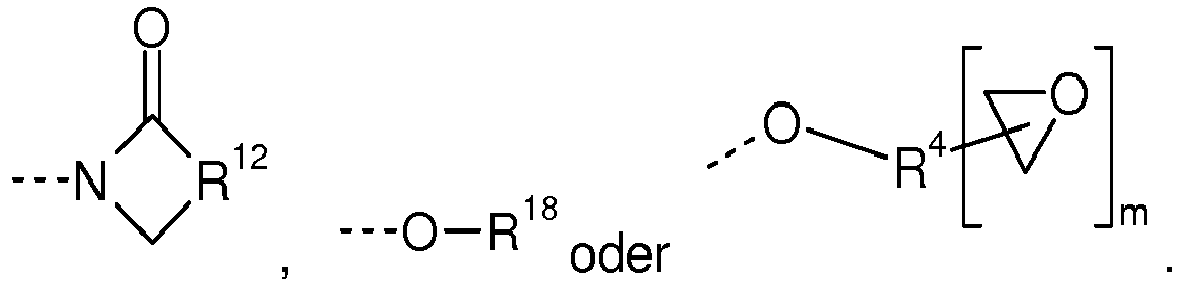

- Als Substituent der Formel ---O-R18 sind Monophenole oder Polyphenole, insbesondere Bisphenole, nach Entfernung eines phenolischen Wasserstoffatoms bevorzugt. Besonders bevorzugte Bespiele für derartigen Reste R2 sind Reste, welche ausgewählt sind aus der Gruppe bestehend aus

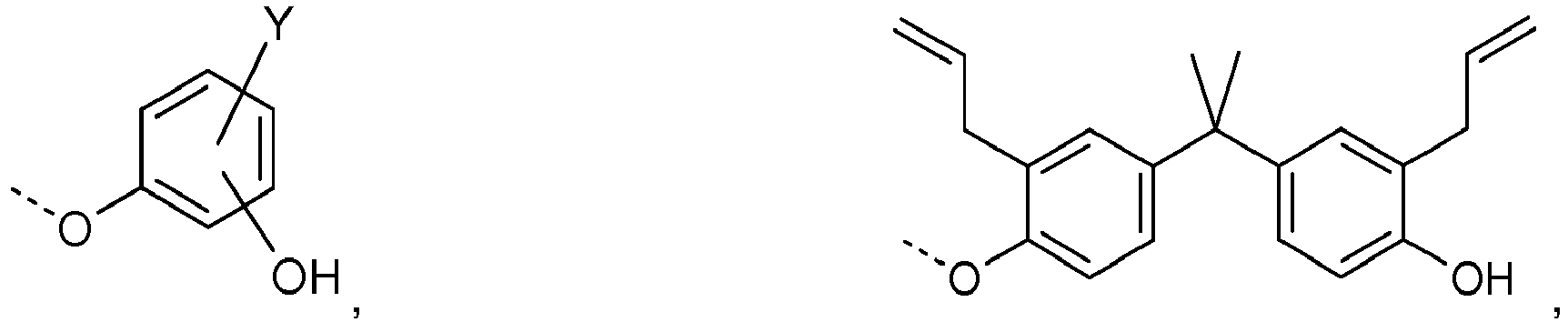

- Der Rest Y steht hierbei für einen gesättigten, aromatischen oder olefinisch ungesättigten Kohlenwasserstoffrest mit 1 bis 20 C-Atomen, insbesondere mit 1 bis 15 C-Atomen. Als Y sind insbesondere Allyl, Methyl, Nonyl, Dodecyl, Phenyl, Alkylether, Carbonsäureester oder ein ungesättigter C15-Alkylrest mit 1 bis 3 Doppelbindungen bevorzugt.
- Meist bevorzugt steht R2 für ---O-R18.
- Die Herstellung des endständig blockierten Polyurethanprepolymers der Formel (I) erfolgt aus dem Isocyanatgruppen terminierten linearen oder verzweigten Polyurethanprepolymer mit einer oder mehreren Isocyanat-reaktiven Verbindungen R2H. Falls mehrere derartige Isocyanat-reaktive Verbindungen eingesetzt werden, kann die Reaktion sequentiell oder mit einer Mischung dieser Verbindungen erfolgen.
- Die Umsetzung erfolgt bevorzugt so, dass die eine oder die mehreren Isocyanat-reaktiven Verbindungen R2H stöchiometrisch oder im stöchiometrischen Überschuss eingesetzt werden, um zu gewährleisten, dass alle NCO-Gruppen umgesetzt sind.
- Das Polyurethanprepolymer mit Isocyanat-Endgruppengruppen, auf dem R1 basiert, lässt sich aus mindestens einem Diisocyanat oder Triisocyanat sowie aus einem Polymeren QPM mit endständigen Amino-, Thiol- oder Hydroxylgruppen und/oder aus einem, gegebenenfalls substituierten, Polyphenol QPP herstellen.
- Geeignete Diisocyanate sind aliphatische, cycloaliphatische, aromatische oder araliphatische Diisocyanate, insbesondere handelsübliche Produkte wie Methylendiphenyldiisocyanat (MDI), Hexamethylendiisocyanat (HDI), Toluoldiisocyanat (TDI), Tolidindiisocyanat (TODI), Isophorondiisocyanat (IPDI), Trimethylhexamethylendiisocyanat (TMDI), 2,5- oder 2,6-Bis-(isocyanatomethyl)-bicyclo[2.2.1]heptan, 1,5-Naphthalindiisocyanat (NDI), Dicyclohexylmethyldiisocyanat (H12MDI), p-Phenylendiisocyanat (PPDI), m-Tetramethylxylylen diisocyanat (TMXDI), etc. sowie deren Dimere. Bevorzugt sind HDI, IPDI, MDI oder TDI.
- Geeignete Triisocyanate sind Trimere oder Biurete von aliphatischen, cycloaliphatischen, aromatischen oder araliphatischen Diisocyanaten, insbesondere die Isocyanurate und Biurete der im vorherigen Absatz beschriebenen Diisocyanate. Selbstverständlich können auch geeignete Mischungen von Di- oder Triisocyanaten eingesetzt werden.
- Als Polymere QPM mit endständigen Amino-, Thiol- oder Hydroxylgruppen sind insbesondere geeignet Polymere QPM mit zwei oder drei endständigen Amino-, Thiol- oder Hydroxylgruppen.
- Die Polymere QPM weisen vorteilhaft ein Equivalenzgewicht von 300 - 6000, insbesondere von 600 - 4000, bevorzugt von 700 - 2200 g/Equivalent NCOreaktiver Gruppen auf.
- Als Polymere QPM geeignet sind Polyole, z.B. die folgenden handelsüblichen Polyole oder beliebige Mischungen davon:
- Polyoxyalkylenpolyole, auch Polyetherpolyole genannt, welche das Polymerisationsprodukt von Ethylenoxid, 1,2-Propylenoxid, 1,2- oder 2,3-Butylenoxid, Tetrahydrofuran oder Mischungen davon sind, gegebenenfalls polymerisiert mit Hilfe eines Startermoleküls mit zwei oder drei aktiven H-Atomen wie beispielsweise Wasser oder Verbindungen mit zwei oder drei OH-Gruppen. Eingesetzt werden können sowohl Polyoxyalkylenpolyole, die einen niedrigen Ungesättigtheitsgrad aufweisen (gemessen nach ASTM D-2849-69 und angegeben in Milliequivalent Ungesättigtheit pro Gramm Polyol (mEq/g)), hergestellt beispielsweise mit Hilfe von sogenannten Double Metal Cyanide Complex Katalysatoren (kurz DMC-Katalysatoren), als auch Polyoxyalkylenpolyole mit einem höheren Ungesättigtheitsgrad, hergestellt beispielsweise mit Hilfe von anionischen Katalysatoren wie NaOH, KOH oder Alkalialkoholaten. Besonders geeignet sind Polyoxypropylendiole und -triole mit einem Ungesättigtheitsgrad tiefer als 0,02 mEq/g und mit einem mittleren Molekulargewicht im Bereich von 1000 - 30'000 Dalton, Polyoxybutylendiole und -triole, Polyoxypropylendiole und - triole mit einem mittleren Molekulargewicht von 400 - 8'000 Dalton, sowie sogenannte "EO-endcapped" (ethylene oxide-endcapped) Polyoxypropylendiole oder -triole. Letztere sind spezielle Polyoxypropylenpolyoxyethylenpolyole, die beispielsweise dadurch erhalten werden, dass reine Polyoxypropylenpolyole nach Abschluss der Polypropoxylierung mit Ethylenoxid alkoxyliert werden und dadurch primäre Hydroxylgruppen aufweisen.
- Hydroxyterminierte Polybutadienpolyole, wie beispielsweise solche, die durch Polymerisation von 1,3-Butadien und Allylalkohol oder durch Oxidation von Polybutadien hergestellt werden, sowie deren Hydrierungsprodukte;
- Styrol-Acrylnitril gepfropfte Polyetherpolyole, wie sie beispielsweise von BASF unter dem Namen Lupranol® geliefert werden;
- Polyhydroxyterminierte Acrylnitril/Butadien-Copolymere, wie sie beispielsweise aus carboxylterminierten Acrylnitril/Butadien-Copolymeren (kommerziell erhältlich unter dem Namen Hypox® CTBN von Emerald Perfomance Materials) und Epoxiden oder Aminoalkoholen hergestellt werden können;
- Polyesterpolyole, hergestellt beispielsweise aus zwei- bis dreiwertigen Alkoholen wie beispielsweise 1,2-Ethandiol, Diethylenglykol, 1,2-Propandiol, Dipropylenglykol, 1,4-Butandiol, 1,5-Pentandiol, 1,6-Hexandiol, Neopentylglykol, Glycerin, 1,1,1-Trimethylolpropan oder Mischungen der vorgenannten Alkohole mit organischen Dicarbonsäuren oder deren Anhydriden oder Estern wie beispielsweise Bernsteinsäure, Glutarsäure, Adipinsäure, Korksäure, Sebacinsäure, Dodecandicarbonsäure, Maleinsäure, Fumarsäure, Phthalsäure, Isophthalsäure, Terephthalsäure und Hexahydrophthalsäure oder Mischungen der vorgenannten Säuren, sowie Polyesterpolyole aus Lactonen wie beispielsweise ε-Caprolacton;
- Polycarbonatpolyole, wie sie durch Umsetzung beispielsweise der oben genannten - zum Aufbau der Polyesterpolyole eingesetzten - Alkohole mit Dialkylcarbonaten, Diarylcarbonaten oder Phosgen zugänglich sind.
- Vorteilhaft sind die Polymere QPM di- oder höherfunktioneller Polyole mit OH-Equivalentgewichten von 300 bis 6000 g/OH-Equivalent, insbesondere von 600 bis 4000 g/OH-Equivalent, vorzugsweise 700 - 2200 g/OH-Equivalent. Weiterhin vorteilhaft sind die Polyole ausgewählt aus der Gruppe bestehend aus Polyethylenglycolen, Polypropylenglycolen, Polyethylenglycol-Polypropylenglycol-Block-Co-polymeren, Polybutylenglycolen, hydroxylterminierten Polybutadienen, hydroxylterminierten Butadien/Acrylnitril-Copolymeren, hydroxylterminierten synthetischen Kautschuken, deren Hydrierungsprodukten und Gemischen dieser genannten Polyole.
- Desweiteren können als Polymere QPM auch di- oder höherfunktionelle aminoterminierte Polyethylenether, Polypropylenether, wie sie zum Beispiel unter dem Namen Jeffamine® von Huntsman vertrieben werden, Polybutylenether, Polybutadiene, Butadien/Acrylnitril-Copolymere, wie sie zum Beispiel die unter dem Namen Hypro® ATBN von Emerald Perfomance Materials vertrieben werden, sowie weitere aminoterminierte synthetische Kautschuke oder Gemische der genannte Komponenten verwendet werden.
- Für gewisse Anwendungen sind als Polymere QPM insbesondere HydroxylGruppen aufweisende Polybutadiene oder Polyisoprene oder deren partiell oder vollständig hydrierte Reaktionsprodukte geeignet.
- Es ist weiterhin möglich, dass die Polymere QPM auch kettenverlängert sein können, wie es in dem Fachmann bekannter Art und Weise durch die Reaktion von Polyaminen, Polyolen und Polyisocyanaten, insbesondere von Diaminen, Diolen und Diisocyanaten, durchgeführt werden kann.
- Am Beispiel eines Diisocyanates und eines Diols bildet sich daraus, wie im Folgenden gezeigt, je nach gewählter Stöchiometrie eine Spezies der Formel (VI) oder (VII)
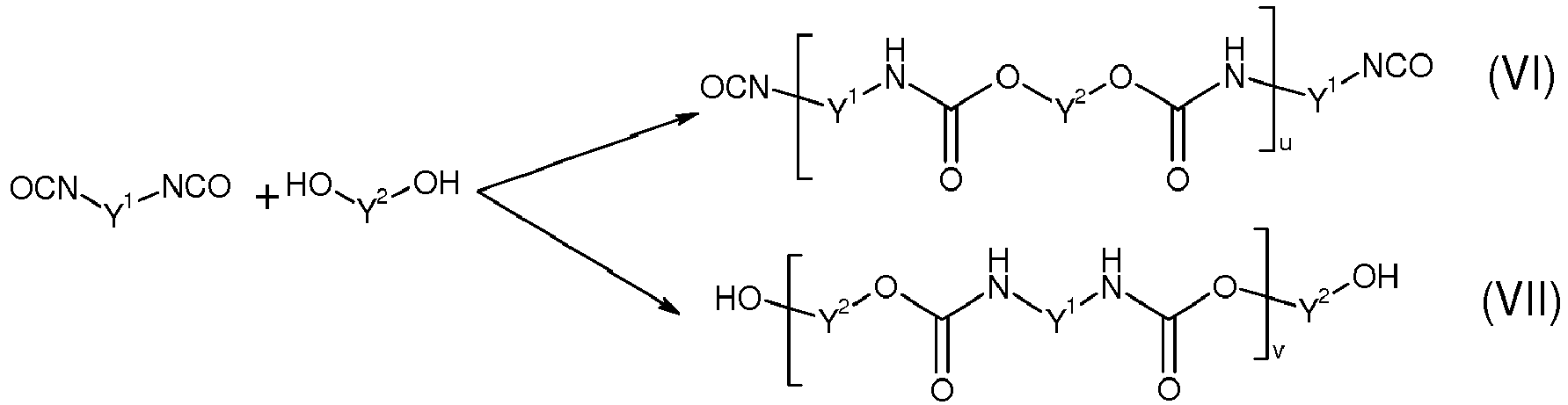
- Diese Spezies der Formel (VI) oder (VII) können dann wiederum weiterreagiert werden. So kann beispielsweise aus der Spezies der Formel (VI) und einem Diol mit einem divalenten organischen Rest Y3 ein kettenverlängertes Polyurethanprepolymer der folgenden Formel gebildet werden:

- Aus der Spezies der Formel (VII) und einem Diisocyanat mit einem divalenten organischen Rest Y4 kann ein kettenverlängertes Polyurethanprepolymer der folgenden Formel gebildet werden:

- Die Indizes x und y variieren je nach Stöchiometrieverhältnis von 1 bis typischerweise 5, und sind insbesondere 1 oder 2.
- Weiterhin kann auch die Spezies der Formel (VI) mit der Spezies der Formel (VII) umgesetzt werden, so dass ein NCO-Gruppen aufweisendes kettenverlängertes Polyurethanprepolymer entsteht.
- Für die Kettenverlängerung werden insbesondere Diole und/oder Diamine und Diisocyanate bevorzugt. Selbstverständlich ist dem Fachmann klar, dass auch höherfunktionelle Polyole, wie beispielsweise Trimethylolpropan oder Pentaerythrit, oder höherfunktionelle Polyisocyanate, wie Isocyanurate von Diisocyanaten, für die Kettenverlängerung verwendet werden können.
- Bei den Polyurethanprepolymeren generell und bei den kettenverlängerten Polyurethanprepolymeren im Speziellen ist vorteilhaft darauf zu achten, dass die Prepolymere nicht zu hohe Viskositäten aufweisen, insbesondere wenn höher funktionelle Verbindungen für die Kettenverlängerung eingesetzt werden, denn dies kann deren Umsetzung zu den Polyurethanprepolymeren der Formel (I) beziehungsweise die Applikation des Klebstoffs erschweren.
- Als Polymere QPM bevorzugt sind Polyole mit mittleren Molekulargewichten zwischen 600 und 6000 Dalton ausgewählt aus der Gruppe bestehend aus Polyethylenglykolen, Polypropylenglykolen, Polyethylenglykol-Polypropylenglykol-Blockpolymeren, Polybutylenglykolen, hydroxylterminierte Polybutadiene, hydroxylterminierte Butadien-Acrylnitril-Copolymere sowie deren Gemische.
- Als Polymere QPM sind insbesondere bevorzugt α,ω-Dihydroxypoly-alkylenglykole mit C2-C6-Alkylengruppen oder mit gemischten C2-C6-Alkylengruppen, die mit Amino-, Thiol- oder, bevorzugt, Hydroxylgruppen terminiert sind. Besonders bevorzugt sind Polypropylenglykole oder Polybutylenglykole. Weiterhin besonders bevorzugt sind Hydroxylgruppen-terminierte Polyoxybutylene.
- Als Polyphenol QPP sind insbesondere geeignet Bis-, Tris- und Tetraphenole. Hierunter werden nicht nur reine Phenole, sondern gegebenenfalls auch substituierte Phenole verstanden. Die Art der Substitution kann sehr vielfältig sein. Insbesondere wird hierunter eine Substitution direkt am aromatischen Kern, an den die phenolische OH-Gruppe gebunden ist, verstanden. Unter Phenolen werden weiterhin nicht nur einkernige Aromaten, sondern auch mehrkernige oder kondensierte Aromaten oder Heteroaromaten verstanden, welche die phenolische OH-Gruppe direkt am Aromaten beziehungsweise Heteroaromaten aufweisen.
- Durch die Art und Stellung eines solchen Substituenten wird unter anderem die für die Bildung des Polyurethanprepolymers nötige Reaktion mit Isocyanaten beeinflusst.
- Besonders eignen sich die Bis- und Trisphenole. Als Bisphenole oder Trisphenole sind beispielsweise geeignet 1,4-Dihydroxybenzol, 1,3-Dihydroxybenzol, 1,2-Dihydroxybenzol, 1,3-Dihydroxytoluol, 3,5-Dihydroxybenzoate, 2,2-Bis(4-hydroxyphenyl)propan (=Bisphenol-A), Bis(4-hydroxyphenyl)methan (=Bisphenol-F), Bis(4-hydroxyphenyl)sulfon (=Bisphenol-S), Naphtoresorcin, Dihydroxynaphthalin, Dihydroxyanthrachinon, Dihydroxy-biphenyl, 3,3-bis(p-hydroxyphenyl)phthalide, 5,5-Bis(4-hydroxyphenyl)hexahydro-4,7-methanoindan, Phenolpthalein, Fluorescein, 4,4'-[bis-(hydroxyphenyl)-1,3-Phenylenebis-(1-Methyl-ethyliden)] (=Bisphenol-M), 4,4'-[bis-(hydroxyphenyl)-1,4-Phenylenbis-(1-Methyl-ethyliden)] (=Bisphenol-P), 2,2'-Diallyl-bisphenol-A, Diphenole und Dikresole hergestellt durch Umsetzung von Phenolen oder Kresolen mit Diisopropylidenbenzol, Phloroglucin, Gallsäureester, Phenol- oder Kresolnovolacke mit -OH-Funktionalität von 2,0 bis 3,5 sowie alle Isomeren der vorgenannten Verbindungen.
- In einer ersten Ausführungsform wird das Polyurethanprepolymer aus mindestens einem Diisocyanat oder Triisocyanat sowie aus einem Polymeren QPM mit endständigen Amino-, Thiol- oder Hydroxylgruppen hergestellt. Die Herstellung des Polyurethanprepolymers erfolgt in einer dem Polyurethan-Fachmann bekannten Art und Weise, insbesondere, indem das Diisocyanat oder Triisocyanat in einem stöchiometrischen Überschuss in Bezug auf die Amino-, Thiol- oder Hydroxylgruppen des Polymeren QPM eingesetzt wird.
- In einer zweiten Ausführungsform wird das Polyurethanprepolymer aus mindestens einem Diisocyanat oder Triisocyanat sowie aus einem, gegebenenfalls substituierten, Polyphenol QPP hergestellt. Die Herstellung des Polyurethanprepolymers erfolgt in einer dem Polyurethan-Fachmann bekannter Art und Weise, insbesondere indem das Diisocyanat oder Triisocyanat in einem stöchiometrischen Überschuss in Bezug auf die phenolischen Gruppen des Polyphenols QPP eingesetzt wird.
- In einer dritten Ausführungsform wird das Polyurethanprepolymer aus mindestens einem Diisocyanat oder Triisocyanat sowie aus einem Polymeren QPM mit endständigen Amino-, Thiol- oder Hydroxylgruppen sowie aus einem, gegebenenfalls substituierten, Polyphenol QPP hergestellt. Zur Herstellung des Polyurethanprepolymers aus mindestens einem Diisocyanat oder Triisocyanat sowie aus einem Polymeren QPM mit endständigen Amino-, Thiol- oder Hydroxylgruppen und / oder aus einem, gegebenenfalls substituierten, Polyphenol QPP stehen unterschiedliche Möglichkeiten zur Verfügung.
- Besonders bevorzugt ist die erste Ausführungsform.
- Das Polyurethanprepolymer mit Isocyanatendgruppen weist bevorzugt elastischen Charakter auf. Es zeigt bevorzugt eine Glasumwandlungstemperatur Tg von kleiner als 0°C.
- Vorzugsweise beträgt der Anteil an:
- Zähigkeitsverbesserer D1 10-60 Gew.-%, insbesondere 20-40 Gew.-%;
- Zähigkeitsverbesserer D2 10-30 Gew.-%, insbesondere 20-30 Gew.-%:
- Zähigkeitsverbesserer D3 10-30 Gew.-%, insbesondere 20-30 Gew.-%;
- In einer bevorzugten Ausführungsform enthält die einkomponentige hitzehärtende Epoxidharzzusammensetzung zusätzlich mindestens einen Füllstoff F. Bevorzugt handelt es sich hierbei um Glimmer, Talk, Kaolin, Wollastonit, Feldspat, Syenith, Chlorit, Bentonit, Montmorillonit, Calciumcarbonat (gefällt oder gemahlen), Dolomit, Quarz, Kieselsäuren (pyrogen oder gefällt), Cristobalit, Calciumoxid, Aluminiumhydroxid, Magnesiumoxid, Keramikhohlkugeln, Glashohlkugeln, organische Hohlkugeln, Glaskugeln, Farbpigmente. Besonders bevorzugt handelt es sich um Füllstoffe ausgewählt aus der Gruppe bestehend aus Calciumcarbonat, Calciumoxid und pyrogene Kieselsäuren.
- Vorteilhaft beträgt der Gesamtanteil des gesamten Füllstoffs F 5 - 40 Gewichts-%, vorzugsweise 5 - 20 Gewichts-%, bezogen auf das Gesamtgewicht der Epoxidharzzusammensetzung.
- Die einkomponentige hitzehärtende Epoxidharzzusammensetzung kann weiter zusätzlich mindestens einen Epoxidgruppen-tragenden Reaktivverdünner G aufweisen. Solche Reaktivverdünner sind dem Fachmann bekannt. Bevorzugte Beispiele für Epoxidgruppen-tragende Reaktivverdünner sind:
- Glycidylether von monofunktionellen gesättigten oder ungesättigten, verzweigten oder unverzweigten, zyklischen oder offenkettigen C4 - C30 Alkoholen, z.B. Butanolglycidylether, Hexanolglycidylether, 2-Ethylhexanolglycidylether, Allylglycidylether, Tetrahydrofurfuryl- und Furfurylglycidylether, Trimethoxysilylglycidylether etc.
- Glycidylether von difunktionellen gesättigten oder ungesättigten, verzweigten oder unverzweigten, zyklischen oder offenkettigen C2 - C30 Alkolen, z.B Ethylenglykol-, Butandiol-, Hexandiol-, Oktandiolgylcidylether, Cyclohexandimethanoldigylcidylether, Neopentylglycoldiglycidylether etc.
- Glycidylether von tri- oder polyfunktionellen, gesättigten oder ungesättigten, verzweigten oder unverzweigten, zyklischen oder offenkettigen Akoholen wie epoxidiertes Rhizinusöl, epoxidiertes Trimethylolpropan, epoxidiertes Pentaerythrol oder Polyglycidylether von aliphatischen Polyolen wie Sorbitol, Glycerin, Trimethylolpropan etc.
- Glycidylether von Phenol- und Anilinverbindungen wie Phenylglycidylether, Kresylglycidylether, p-tert.-Butylphenylglycidylether, Nonylphenolglycidylether, 3-n-Pentadecenyl-glycidylether (aus Cashewnuss-Schalen-Öl), N,N-Diglycidylanilin etc.
- Epoxidierte Amine wie N, N-Diglycidylcyclohexylamin etc.
- Epoxidierte Mono- oder Dicarbonsäuren wie Neodecansäure-glycidylester, Methacrylsäureglycidylester, Benzoesäureglycidylester, Phthalsäure-, Tetra- und Hexahydrophthalsäurediglycidylester, Diglycidylester von dimeren Fettsäuren etc.
- Epoxidierte di- oder trifunktionelle, nieder- bis hochmolekulare Polyetherpolyole wie Polyethylenglycol-diglycidylether, Polypropyleneglycol-diglycidylether etc.
- Besonders bevorzugt sind Hexandioldiglycidylether, Kresylglycidylether, p-tert.-Butylphenylglycidylether, Polypropylenglycoldiglycidylether und Polyethylenglycoldiglycidylether.
- Vorteilhaft beträgt der Gesamtanteil des epoxidgruppentragenden Reaktivverdünners G 0.1 - 15 Gewichts-%, vorzugsweise 0.1 - 5 Gewichts-%, insbesondere bevorzugt 0.1 - 2 Gewichts-%, besonders bevorzugt 0.2 - 1 Gewichts-%, bezogen auf das Gesamtgewicht der Epoxidharzzusammensetzung.
- Die einkomponentige hitzehärtende Epoxidharzzusammensetzung kann weitere Bestandteile, insbesondere Katalysatoren, Stabilisatoren, insbesondere Hitze- und/oder Lichtstabilisatoren, Thixotropiermittel, Weichmacher, Lösungsmittel, mineralische oder organische Füllstoffe, Treibmittel, Farbstoffe und Pigmente, Korrosionsschutzmittel, Tenside, Entschäumer und Haftvermittler umfassen.
- Eine besonders bevorzugte hitzehärtende einkomponentige Epoxidharzzusammensetzung umfasst:
- 10 - 60 Gew.-%, insbesondere 30 - 50 Gew.-%, bezogen auf das Gesamtgewicht der Epoxidharzzusammensetzung, Epoxidharz A mit durchschnittlich mehr als einer Epoxidgruppe pro Molekül; vorzugsweise handelt es sich bei 50-100 Gew.-%, insbesondere 80-100 Gew.-%, des Epoxidharzes A um ein Epoxid-Flüssigharz und bei 0-30 Gew.-%, insbesondere 0-20 Gew.-%, besonders bevorzugt 5-15 Gew.-%, des Epoxidharzes A um ein Epoxid-Festharz;.
- 1 - 10 Gew.-%, insbesondere 2 - 6 Gew.-%, bezogen auf das Gesamtgewicht der Epoxidharzzusammensetzung, mindestens eines Härters B für Epoxidharze, welcher durch erhöhte Temperatur aktiviert wird;
- 1.5 - 20 Gew.-%, 2 - 15 Gew.-%, 2.5 - 10 Gew.-%, 3 - 10 Gew.-%, insbesondere 4 - 8 Gew.-%, bezogen auf das Gesamtgewicht der Epoxidharzzusammensetzung, mindestens eines Polyesterpolyols PP;
- mindestens einen Zähigkeitsverbesserer D, ausgewählt ist aus der Gruppe bestehend aus endständig blockierten Polyurethanpolymeren D1, Flüssigkautschuken D2 und Core-Shell-Polymeren D3, vorzugsweise beträgt dabei der Anteil an:
- Zähigkeitsverbesserer D1 10-60 Gew.-%, insbesondere 20-40 Gew.-%;
- Zähigkeitsverbesserer D2 10-30 Gew.-%, insbesondere 20-30 Gew.-%:
- Zähigkeitsverbesserer D3 10-30 Gew.-%, insbesondere 20-30 Gew.-%;
- bezogen auf das Gesamtgewicht der Epoxidharzzusammensetzung;
- vorzugsweise 5 - 40 Gewichts-%, vorzugsweise 5 - 20 Gewichts-%, bezogen auf das Gesamtgewicht der Epoxidharzzusammensetzung, von einem Füllstoffe F ausgewählt aus der Gruppe bestehend aus Calciumcarbonat, Calciumoxid und pyrogene Kieselsäuren;
- vorzugsweise 0.1 - 15 Gewichts-%, vorzugsweise 0.1 - 5 Gewichts-%, insbesondere bevorzugt 0.1 - 2 Gewichts-%, besonders bevorzugt 0.2 - 1 Gewichts-%, bezogen auf das Gesamtgewicht der Epoxidharzzusammensetzung, von einen Epoxidgruppen-tragenden Reaktivverdünner G;
- Weiter kann es vorteilhaft sein, wenn die bevorzugte einkomponentige hitzehärtende Epoxidharzzusammensetzung zu mehr als 80 Gewichts-%, vorzugsweise mehr als 90 Gewichts-%, insbesondere mehr als 95 Gewichts-%, insbesondere bevorzugt mehr als 98 Gewichts-%, am meisten bevorzugt mehr als 99 Gewichts-%, bezogen auf das Gesamtgewicht der Epoxidharzzusammensetzung, aus den vorgenannten Bestandteilen besteht.
- Weiter kann es vorteilhaft sein, wenn die einkomponentige hitzehärtende Epoxidharzzusammensetzung einen Schwellenwert für den Betrag der komplexen Viskosität η* von mehr als 20'000 Pas, insbesondere mehr als 40'000 Pas, bevorzugt mehr als 60'000 Pas, besonders bevorzugt mehr als 80'000 Pas, insbesondere bevorzugt mehr als 100'000 Pas, aufweist.
- Vorzugsweise erreicht die einkomponentige hitzehärtende Epoxidharzzusammensetzung mehr als 50%, insbesondere mehr als 70%, insbesondere mehr als 80%, des Viskositätsanstiegs, ausgehend von dem Betrag der komplexen Viskosität η* bei Beginn der Messung bei 150°C (Ende Phase 1, Beginn der Phase 2), d.h. bei Beginn der Abkühlung ausgehend von 150°C mit einer Abkühlrate von -23°C/min, auf den Schwellenwert für den Betrag der komplexen Viskosität η* von mehr als 20'000 Pas, insbesondere mehr als 40'000 Pas, bevorzugt mehr als 60'000 Pas, besonders bevorzugt mehr als 80'000 Pas, insbesondere bevorzugt mehr als 100'000 Pas, innerhalb von 20 Sekunden, bevorzugt innerhalb von 10 Sekunden.
- Es ist weiter bevorzugt wenn dies vor dem Erreichen der Abkühlung der einkomponentigen hitzehärtenden Epoxidharzzusammensetzung auf 25°C erreicht wird. Besonders bevorzugt wird dies 80 - 280 Sekunden nach Start der Abkühlung der einkomponentigen hitzehärtenden Epoxidharzzusammensetzung von 150°C mit einer Abkühlrate von -23°C/min erreicht.
- Vorzugsweise erreicht die einkomponentige hitzehärtende Epoxidharzzusammensetzung einen Höchstwert für den Betrag der komplexen Viskosität η* von mehr als 100'000 Pas, insbesondere mehr als 200'000 Pas, bevorzugt mehr als 300'000 Pas, besonders bevorzugt mehr als 500'000 Pas, bevorzugt vor dem Erreichen der Abkühlung der einkomponentigen hitzehärtenden Epoxidharzzusammensetzung auf 25°C, vorzugsweise 80 - 280 Sekunden nach Start der Abkühlung der Zusammensetzung von 150°C mit einer Abkühlrate von -23°C/min.
- Der vorgehend erwähnte Betrag der komplexen Viskosität η* wird wie nachfolgend in den Beispielen beschrieben oszillographisch bestimmt mittels eines Rheometers mit beheizbarer Platte (MCR 302, AntonPaar) (Spalt 200 µm, Mess-Plattendurchmesser: 25 mm (Platte/Platte), Deformation 0,01 bei 5 Hz, in einem Temperaturbereich von 150 - 25°C (Abkühlrate: -23°C/min). Die vorgehend erwähnte Methode aus drei Phasen entspricht der in den Beispielen unter "Messung Viskositätsverhalten" beschriebenen Methode.
- Vorzugsweise weist die einkomponentige hitzehärtende Epoxidharzzusammensetzung im ausgehärteten Zustand mindestens eine, vorzugsweise mehrere, besonders bevorzugt sämtliche nachstehend aufgeführten mechanischen Eigenschaften auf. Schlagschälfestigkeit (I-Peel) und Zugscherfestigkeit (ZSF) werden gemessen wie nachfolgend in den Beispielen beschrieben. Zugfestigkeit und E-Modul werden bestimmt nach DIN EN ISO 527.
Zugfestigkeit [MPa] > 10, > 20, insbesondere > 25 E-Modul [MPa] > 500, > 1000, insbesondere > 2000 I-Peel (23°C) [N/mm] > 20, insbesondere > 25 I-Peel (-30°C) [N/mm] > 10, insbesondere > 15 ZSF [MPa] > 15, insbesondere > 20 - Vorzugsweise weist die einkomponentige hitzehärtende Epoxidharzzusammensetzung bei 23°C eine Viskosität von > 5'000 Pas, > 10'000 Pas, insbesondere > 15'000 Pas, auf, wobei die Viskosität oszillographisch bestimmt wird mittels eines Rheometers mit beheizbarer Platte (MCR 302, AntonPaar) (Spalt 1000 µm, Mess-Plattendurchmesser: 25 mm (Platte/Platte), Deformation 0,01 bei 5 Hz).
- Weiter ist es bevorzugt, wenn die einkomponentige hitzehärtende Epoxidharzzusammensetzung bei dem Einbringen in Schritt c) eine Temperatur von 40 - 100°C, insbesondere 50 - 100°C, besonders bevorzugt 50 - 80°C, aufweist.
- Weiter weist die einkomponentige hitzehärtende Epoxidharzzusammensetzung bei dem Einbringen in Schritt c) eine Temperatur von maximal 20°C, maximal 15°C, vorzugsweise maximal 10°C, unter dem Schmelzpunkt des Polyesterpolyols PP, auf. Dies ist beispielsweise aus Tabelle 6 ersichtlich. Der Schmelzpunkt wird vorzugsweise mit einem DSC-Gerät (DIN 53 765) bestimmt. Die Probe und ein leerer Referenztiegel werden mit einer Aufheizrate von 20°C/min erwärmt. Der Schmelzpunkt entspricht dem Maximum des Schmelzpeaks.
- Auch ist es vorteilhaft, wenn die einkomponentige hitzehärtende Epoxidharzzusammensetzung bei dem Einbringen in Schritt c) eine Viskosität von < 3'000 Pas, < 2'000 Pas, insbesondere < 1'000 Pas, aufweist, wobei die Viskosität oszillographisch bestimmt wird mittels eines Rheometers mit beheizbarer Platte (MCR 302, AntonPaar) (Spalt 1000 µm, Mess-Plattendurchmesser: 25 mm (Platte/Platte), Deformation 0,01 bei 5 Hz).
- Auch ist es bevorzugt, wenn das Verfahren zusätzlich den Schritt d) der Aushärtung der einkomponentigen hitzehärtenden Epoxidharzzusammensetzung, insbesondere bei einer Temperatur von mindestens 100°C, mindestens 120°C, mindestens 130°C, insbesondere auf eine Temperatur von 140 - 220°C, insbesondere von 140 - 200°C, besonders bevorzugt zwischen 160 und 190°C, für mindestens 10 min, mindestens 20 min, insbesondere zwischen 20 - 60 min, umfasst.
- Das Einbringen der einkomponentigen hitzehärtenden Epoxidharzzusammensetzungen in den Hohlraum (1) in Schritt c) erfolgt vorzugsweise durch eine Pumpe, wobei die einkomponentige hitzehärtende Epoxidharzzusammensetzung aus einem Tank gefördert wird.
- Ein weiterer Aspekt der vorliegenden Erfindung betrifft die Verwendung einer einkomponentigen hitzehärtenden Epoxidharzzusammensetzung wie sie als einkomponentige hitzehärtende Epoxidharzzusammensetzung vorgehend beschrieben ist, zur Einbringung, insbesondere Injektion, in einen Hohlraum (1) zwischen zwei aneinander angeordneten Formkörpern S1 und S2, zur Verbindung, insbesondere Verklebung, der beiden Formkörper S1 und S2 miteinander. Vorzugsweise handelt es sich bei den einkomponentigen hitzehärtenden Epoxidharzzusammensetzung um solche, wie sie in der vorliegenden Beschreibung als bevorzugte ausgewiesen sind.
- Noch ein Aspekt der vorliegenden Erfindung betrifft die Verwendung von Polyesterpolyolen PP wie sie als Polyesterpolyole PP vorgehend beschrieben sind, in einkomponentigen hitzehärtenden Epoxidharzzusammensetzungen zur Verringerung des Austrittverhaltens durch seitliche Öffnungen in Hohlräumen bei Einbringen, insbesondere Injektion, der einkomponentigen hitzehärtenden Epoxidharzzusammensetzungen in Hohlräume mit seitlichen Öffnungen. Bei den erwähnten Hohlräumen handelt es sich insbesondere um vorgehend beschriebene offenen Hohlräume (1). Vorzugsweise handelt es sich bei den Polyesterpolyolen PP, respektive den einkomponentigen hitzehärtenden Epoxidharzzusammensetzung, um solche, wie sie in der vorliegenden Beschreibung als bevorzugte ausgewiesen sind.
- Im Folgenden wird die Erfindung durch Beispiele weiter erläutert, die die Erfindung aber in keiner Weise einschränken sollen.
-
- 1
- Hohlraum
- 2
- Einfüllöffnung
- 3a
- Einfüllkanal
- 3b
- Einfüllkanal
- 4
- Materialaussparung
- 5
- Basiselement
- 6
- Transparentes Deckelement
- 7
- Kanal
- 8
- Abstandhalter
- 9
- Einfüllöffnung
- 10
- Fixierschrauben
- 11
- Eingebrachte Epoxidharzzusammensetzung
- 12
- Begrenzungsmarkierung
- 13
- Ausbreitungsmarkierungen
- Es wurde nach Epoxidharzzusammensetzungen gesucht, welche sich bei der Injektion in einen offenen Hohlraum vorwiegend in den für die Epoxidharzzusammensetzungen vorgesehene Hohlraum ausbreiten und die Ausbreitung in seitliche Öffnungen ausreichend gering ist, dass diese nicht durch Dichtungselemente verhindert werden muss. Dafür wurde ein Testverfahren entwickelt um ein solches Ausbreitungsverhalten in hitzehärtenden einkomponentigen Epoxidharzzusammensetzungen zu untersuchen.
- Das Testverfahren benutzt einen Verbund von zwei Formkörpern bestehend aus einem Basiselement 5 und einem transparenten Deckelement 6 wie es in der
Figure 2a dargestellt ist. Das rechteckige Basiselement 5 besteht aus Polyamid und weist eine Länge von 400 mm, eine Breite von 80 mm sowie eine Höhe von 30 mm auf. Das Basiselement 5 weist einen mittig verlaufenden eingelassenen Kanal 7 mit einem rechtwinkligen Querschnitt und einer Tiefe von 3 mm und einer Breite von 20 mm auf. Dies ist beispielsweise in derFigur 2b ersichtlich. - Auf dem Basiselement 5 sind im Abstand von 12 mm von der Breitseite (oder 18 mm gemessen vom Kanal 7) eine parallel zum Kanal 7 verlaufende Begrenzungsmarkierung 12 aufgebracht. Rechtwinklig zur Begrenzungsmarkierung 12, im Abstand von jeweils 10 mm, verlaufen Ausbreitungsmarkierungen 13. Die erste Begrenzungsmarkierung beginnt in der Mitte des Basiselements 5 und die restlichen Begrenzungsmarkierungen sind entlang der Begrenzungsmarkierung bis zum Aussenrand des Basiselements angeordnet.
- Zwischen Basiselement 5 und Deckelelement 6 sind Abstandhalter 8 angeordnet welche einen Spalt (mit einer gleichbleibenden Breite) zwischen Basiselement und Deckelelement gewährleisten. Dies ist beispielsweise in der
Figur 2c ersichtlich. Die Höhe des Spaltes ist mittels Unterlagscheiben als Abstandhalter 8 einstellbar und beträgt 1 mm. Basiselement und Deckelelement werden mittels 8 Fixierschrauben 10 zusammengehalten. - Das transparente Deckelement 6 besteht aus Polymethylmethacrylat (PMMA) und weist eine Länge von 400 mm, eine Breite von 80 mm sowie eine Dicke von 10 mm auf. Im Deckelelement 6 ist mittig (jeweils Abstand von 35 mm von jeder Längsseite, resp. 195 mm von jeder Breitseite) eine Einfüllöffnung 9 mit einer Durchmesser von 10 mm eingelassen. Im zusammengebauten Zustand kommt die Einfüllöffnung 9 genau über der Mitte des Kanals 7 des Basiselements 5 zu liegen.
- Das Einbringen der Epoxidharzzusammensetzung von aussen durch die Einfüllöffnung 9 in den Kanal 7 erfolgt mit der nachfolgend ausgewiesenen Injektionsgeschwindigkeit, respektive Injektionsdruck, und Injektionstemperatur.
- Die Figuren
Fig. 3a und Fig. 3b zeigen eine Aufsicht auf den mit 8 Fixierschrauben 10 zusammengebauten Verbund von Basiselement 5 und transparentem Deckelement 6. Sie zeigen eine eingebrachte Epoxidharzzusammensetzung 11, welche sich entlang des Kanals 7 ausgebreitet hat. Dabei zeigtFig. 3a eine Situation, in der sich die eingebrachte Epoxidharzzusammensetzung 11 seitlich bis zur Begrenzungsmarkierung 12 ausgebreitet hat. Erreicht die Epoxidharzzusammensetzung die Begrenzungsmarkierung 12 wird die Injektion gestoppt und anhand der Ausbreitungsmarkierungen 13 die Ausbreitung in Kanalrichtung in Anzahl Ausbreitungsmarkierungen bestimmt, wobei die Ausbreitungsmarkierungen in der Mitte des Basiselements als Startpunkt dient und nicht mitgezählt wird. Die erreichte Ausbreitungsmarkierungen +1 dient als Wert für die sogenannte "Squeeze-out-ratio". - In dem Beispiel von
Fig. 3a wird die 10te Begrenzungsmarkierung erreicht, was einer Ausdehnung von 100 mm entspricht, respektive einer Squeeze-out-ratio von 11 (Markierung 10+1). -
Fig. 3b zeigt eine Situation, in welcher sich die bereits eingebrachte Epoxidharzzusammensetzung 11 vorwiegend entlang des Kanals 7 ausbreitet hat. Während der Injektion hat die Epoxidharzzusammensetzung die Begrenzungsmarkierung 12 bis zum Austritt aus dem Kanalende nicht erreicht. Dies entspricht einer Ausdehnung von mehr als 200 mm, respektive einer Squeeze-out-ratio von > 20. - Wie nachfolgend beschrieben wurde überraschenderweise gefunden, dass erfindungsgemässe Epoxidharzzusammensetzungen unter anderem in dem Testverfahren ein Verhalten gemäss
Figur 3b zeigen. Die erwärmten erfindungsgemässen Epoxidharzzusammensetzungen verbreiteten sich vorwiegend in Richtung des Kanals 7 und fliessen zumindest teilweise in den Spalt mit einer Dicke von 1 mm zwischen Basiselement 5 und Deckelelement 6. Dadurch, dass der Spalt geringer ist als der Abstand zwischen einem Boden des Kanals 7 und dem transparenten Deckelelement 6 kühlt die Epoxidharzzusammensetzung im Spalt schneller aus als im Bereich des Kanals 7 und verfestigt sich als Folge dieser Abkühlung im Bereich des Spalts. Dies führt zu einer sich selbst abdichtenden Funktion der Epoxidharzzusammensetzung im Bereich des Spalts. - Es wurde zuerst versucht, die Ausbreitungseigenschaften der Epoxidharzzusammensetzung mittels Anpassung der Viskosität und/oder der thixotropen Strukturaufbauzeit zu beeinflussen.
- Es wurden Epoxidharzzusammensetzung gemäss Tabelle 1 (Tab.1) hergestellt.
Tabelle 1 Ingredient Gew.-Teile Epoxy-Flüssigharz, D.E.R. 331 (Bisphenol-A-diglycidylether), Dow 50 Reaktivverdünner, Hexandiol-glycidylether, Denacol EX-212, Nagase America 1 Zähigkeitsverbesserer D-1 35 Härter, Dicyandiamid (= "Dicy") 4.67 Beschleuniger, substituierter Harnstoff 0.22 Pyrogene Kieselsäure 5 - 150 g Poly-THF 2000 (OH-Zahl 57 mg/g KOH) und 150 g PolyBD R45V (OH-Zahl 46 mg/g KOH) wurden 30 Minuten unter Vakuum bei 105°C getrocknet. Nachdem die Temperatur auf 90°C reduziert worden war, wurden 61.5 g IPDI und 0.14 g Dibutylzinndilaurat zugegeben. Die Reaktion wurde unter Vakuum bei 90°C bis zur Konstanz des NCO-Gehaltes bei 3.10% nach 2.0 h geführt (berechneter NCO-Gehalt: 3.15%). Anschliessend wurden 96.1 g Cardanol als Blockierungsmittel zugegeben. Es wurde bei 105°C unter Vakuum weitergerührt bis kein freies NCO mehr nachgewiesen werden konnte. Das Produkt wurde so als Zähigkeitsverbesserer D-1 verwendet. Folgende Rohstoffe wurden dazu eingesetzt:
Poly-THF 2000 (Difunktionelles Polybutylenglykol) (OH-Equivalentgewicht = ca. 1000 g/OH-Equivalent), BASF PolyBD R45V (Hydroxylterminertes Polybutadien) (OH-Equivalentgewicht = ca. 1230 g/OH-Equivalent), Cray Valley Isophoron-diisocyanat (= "IPDI"), Evonik Cardolite NC-700 (Cardanol, meta-substituiertes Alkenyl-mono-Phenol), Cardolite - Die Epoxidharzzusammensetzung gemäss Tabelle 1 hat eine Viskosität η von 0-5000 und eine thixotrope Strukturaufbauzeit auf 50% der Ausgangsstruktur (Thixotropic recovery time 50% in Sekunden) von 5-15. Die komplexe Viskosität η* wurde bestimmt unter Verwendung eines Rheometers (Physica MCR 302, Anton Paar) mittels rotatorischer Messung (Spalt: 1 mm, Platte/Platte, Plattendurchmesser: 25 mm, Scherrate: 0.1 s-1) bei einer Temperatur von 20°C.
- Basierend auf dieser Zusammensetzung wurden Epoxidharzzusammensetzungen mit unterschiedlicher Viskosität η und/oder unterschiedlicher thixotroper Strukturaufbauzeit hergestellt. Durch Variation der Anteile in Gew.-% des Reaktivverdünners und des Thixotropiermittels (pyrogene Kieselsäure) sowie gegebenenfalls durch Austausch der pyrogenen Kieselsäure durch organophile Schichtsilikate konnten Epoxidharzzusammensetzungen mit unterschiedlicher Viskosität η und/oder unterschiedlicher thixotroper Strukturaufbauzeit erhalten werden.

- Von den vorgehend erwähnten Epoxidharzzusammensetzungen wurden bei einer Injektionstemperatur von 60°C und einem Injektionsdruck von 2 bar die Ausbreitungseigenschaften, d.h. die Squeeze-out-ratio bestimmt.
- Überraschenderweise wurde gefunden, dass weder die Viskosität η noch die thixotrope Strukturaufbauzeit einen signifikanten Einfluss auf die Squeeze-out-ratio haben. Weiter sind die Ausbreitungseigenschaften von allen Epoxidharzzusammensetzungen mit einem Wert von 10 - 11 ungenügend.
- Weiter wurde untersucht, ob die Anteile der eingesetzten Rohstoffe der Epoxidharzzusammensetzungen einen Einfluss auf die Ausbreitungseigenschaften haben. Dazu wurde bei der Epoxidharzzusammensetzung aus Tabelle 1 die Menge des Flüssigharzes und des Zähigkeitsverbesserers D-1 verändert.
Tabelle 3 Formulation Variation Squeeze-out-ratio 60°C, 2 bar Squeeze-out-ratio 60°C, 1 bar (Tab.1) 50 Gew.-teile D.E.R. 331, 35 Gew.-teile D-1 11 n.d. INJ-1 +20 Gew.-teile D.E.R. 331, -20 Gew.-teile D-1 10 11 INJ-2 -20 Gew.-teile D.E.R. 331, +20 Gew.-teile D-1 11 12 - Von den Zusammensetzungen wurde bei einer Injektionstemperatur von 60°C und einem Injektionsdruck von 1 bar, resp. 2 bar, die Ausbreitungseigenschaften, d.h. die Squeeze-out-ratio bestimmt.
- Überraschenderweise wurde gefunden, dass die Anteile der eingesetzten Rohstoffe der Epoxidharzzusammensetzungen keinen signifikanten Einfluss auf die Squeeze-out-ratio haben. Weiter sind die Ausbreitungseigenschaften von allen Epoxidharzzusammensetzungen mit einem Wert von 10 - 12 ungenügend.
- Weiter wurde untersucht, ob die Injektionstemperatur oder der Injektionsdruck, respektive die Injektionsgeschwindigkeit, einen Einfluss auf die Ausbreitungseigenschaften haben. Dazu wurden Epoxidharzzusammensetzungen mit unterschiedlichen Viskositäten η (angelehnt an die Epoxidharzzusammensetzung aus Tabelle 1) verwendet. Die Viskosität wurde rotatorisch bestimmt wird mittels eines Rheometers mit beheizbarer Platte (MCR 302, AntonPaar) (Spalt 1000 µm, Mess-Plattendurchmesser: 25 mm (Platte/Platte), Scherrate 0.1 s-1, Temperatur: 20°C).
Tabelle 4, "n.b." = nicht bestimmt Formulation η (Pa*s) Injektionsdruck Injektionstemperatur 23°C 60°C INJ-3 1750 2 bar 8 11 6 bar 8 11 (Tab. 1) 2020 2 bar 8 11 6 bar 8 10 INJ-4 6930 2 bar 8 10 6 bar 8 11 INJ-5 10300 2 bar nicht pumpbar n.b. 6 bar 8 10 INJ-6 27720 2 bar nicht pumpbar n.b. 6 bar 8 10 - Überraschenderweise wurde gefunden, dass weder die Injektionstemperatur noch der Injektionsdruck, respektive die Injektionsgeschwindigkeit, einen signifikanten Einfluss auf die Squeeze-out-ratio haben. Weiter sind die Ausbreitungseigenschaften von allen Epoxidharzzusammensetzungen mit einem Wert von 8 - 11 ungenügend.
- Weiter wurde untersucht, ob die Verwendung von zusätzlichen Rohstoffen in den Epoxidharzzusammensetzungen einen Einfluss auf das Ausbreitungsverhalten hat. Es wurden verschiedene solcher Rohstoffe getestet. Diese sind in der Tabelle 5 ausgeführt.
Tabelle 5, *=Nicht homogen nach Abkühlung, n.b. = nicht bestimmt Mischung Typ Struktur Produkt Hersteller Verhältnis in Flüssigharz Smp. Mischbedingungen Mischbarkeit Viskositätsanstieg (150°C auf 25°C) A Polyesterpolyol Terephthalsäure und Hexandisäure mit 1,6 hexandiol Dynacoll 7340 Evonik 1:2 96°C 30' 140°C JA langsam B Polyesterpolyol Hexandisäure mit 1,6 hexandiol Dynacoll 7360 Evonik 1:2 55°C 30' 100°C JA langsam C Polyesterpolyol Dodecandisäure mit 1,6 hexandiol Dynacoll 7380 Evonik 1:2 70°C 30' 120°C JA schnell D Polyesterpolyol Dodecandisäure mit Ethylenglykol Dynacoll 7330 Evonik 1:2 85°C 30' 130°C JA schnell E Diamidwachs Diamidwachs Thixatrol MAX Elementis 1:4 100-120°C 30' 150°C JA langsam Polyester Ester von Montansäuren Licolub WE 40 P Clariant 1:4 73-79°C 30' 130°C NEIN* n.b. Polyester Esterwachs auf Basis von Montansäuren Licolub WE 4 P Clariant 1:4 79-81°C 30' 130°C NEIN* n.b. Polyester Esterwachs auf Basis von Montansäuren Licowax E P Clariant 1:4 79-83°C 30' 130°C NEIN* n.b. F Polyesterpolyol Fineplus HM 3123 Dic 1:2 85°C 30' 130°C JA schnell - Von diesen Rohstoffen wurden Mischungen mit Epoxy-Flüssigharz erstellt um das Mischverhalten zu bestimmen. Dabei wurden die Rohstoffe etwa 40°C über ihrem Schmelzpunkt während ca. 30 Minuten mit Epoxy-Flüssigharz (Epoxy-Flüssigharz, D.E.R. 331 (Bisphenol-A-diglycidylether), Dow) gemäss dem in Tabelle 5 ausgewiesenen Verhältnis vermischt bis eine klare Mischung entstand. Bei der Mischung mit Dynacoll 7380 bedeutet beispielsweise "1:2" 33.3 Gew.-% Polyesterpolyol und 66.6 Gew.-% Epoxy-Flüssigharz.
- Diese Mischung wurde anschliessend auf 25°C heruntergekühlt. Bei den Mischungen mit den Polyestern Licolub WE 40P, Licolub WE 4P und Licowax EP zeigte sich, dass sich nach Abkühlung keine homogene Mischung bildeten. Diese sind als Zusätze für erfindungsgemässe hitzehärtende Epoxidharzzusammensetzungen nicht geeignet.
- Bei den restlichen Rohstoffen lag nach Abkühlung eine homogene Mischung vor. Von diesen Zusammensetzungen wurde danach das Viskositätsverhalten bei Abkühlung von 150°C auf 25°C bestimmt.
- Die Methode besteht aus drei Phasen. Während der ersten Phase liegt die Mischung bei einer Temperatur von 150°C vor, d.h. der zugegebene Rohstoff befindet sich im flüssigen Zustand. In der zweiten Phase kühlt die Temperatur mit einer konstanten Abkühlungsrate auf 25°C ab. In der dritten Phase wird die Mischung bei einer Temperatur von 25°C belassen. Anhand dieser Methode können das Verhalten der Verfestigung der Mischung, die "Schärfe" des Übergangs, sowie der Zeitpunkt bestimmt werden, wann die Verfestigung der Mischung eintritt.
- Verwendet wurde ein Rheometer (Physica MCR 302, Anton Paar) mittels oszillographischen Messung (Spalt: 200 µm, Platte/Platte, Plattendurchmesser: 25 mm, Frequenz: 5 Hz, Solldeformation: 0.01) in einem Temperaturbereich von 25 - 150°C (Abkühlrate: -23°C/min, Aufheizrate: +53°C/min) gemessen.
- Phase 1: Die Mischung wird auf eine Temperatur von 150°C gebracht und 265 Sekunden dort belassen.
- Phase 2: Die Mischung wurde mit einer Abkühlrate: -23°C/min auf eine Temperatur von 25°C gebracht. D.h. es erfolgte eine gleichmässige und konstante Abkühlung der Mischung von 150°C auf 25°C innerhalb von 325 Sekunden mit einer gleichmässigen und konstanten Abkühlrate: -23°C/min.
- Phase 3: Belassen der Mischung bei einer Temperatur von 25°C.
- Bestimmt wurde aufgrund der oszillographischen Messung der Betrag der komplexen Viskosität η*. Die
Figuren 4a-4d zeigen den Betrag der komplexen Viskosität η*. Der Verlauf des Betrags der komplexen Viskosität η* in Abhängigkeit von der Zeit [t in Sekunden] für die Mischungen A (○), B (□), C (Δ), D (●), E (■) und F (▼) sind in denFiguren 4a-4d wiedergegeben. DieFiguren 4c und4d zeigen den Betrag der komplexen Viskosität η* dargestellt in logarithmischer Darstellung. - Verwendet wurde das vorgehend beschriebene Rheometer, respektive die vorgehend beschriebene oszillographische Messung. Die Mischungen wurden auf eine Temperatur von 150°C gebracht und die Messung gestartet. Der Beginn der Aufzeichnung der Messwerte ist ab 130 Sekunden nach Start der Messung in den
Figuren 4a-4d wiedergegeben. 265 Sekunden nach Start der Messung wurde die Mischung von einer Temperatur von 150°C mit einer Abkühlrate von -23°C/min auf eine Temperatur von 25°C heruntergekühlt. 590 Sekunden nach Messbeginn wurde die Temperatur von 25°C erreicht. Die Mischung wurde bis ca. 1500 Sekunden nach Beginn der Messung bei 25°C belassen. - Für die Mischungen C (Δ), D (●), E (■) und F (T) ist ein hoher und schneller Viskositätsanstieg ersichtlich. Sie erreichen mehr als 80% des Viskositätsanstiegs, ausgehend von dem Betrag der komplexen Viskosität η* bei Beginn der Messung bei 150°C auf den Höchstwert für den Betrag der komplexen Viskosität η* innerhalb von 20 Sekunden.
- Weiter erreichen sie den Höchstwert für den Betrag der komplexen Viskosität η* innerhalb von 80 - 280 Sekunden nach Start der Abkühlung der Mischungen von 150°C mit einer Abkühlrate von -23°C/min, insbesondere vor dem Erreichen einer Temperatur von 25°C.
- Die Mischung E (■) zeigt einen langsamen Viskositätsanstieg und die Mischungen A (○) und B (□) zeigen einen langsamen und schwachen Viskositätsanstieg.
- Basierend auf der Mischung C wurden Mischungen mit unterschiedlichen Gewichtsanteilen von Dynacoll 7380 bezogen auf das Gesamtgewicht der Mischungen von Dynacoll 7380 mit Epoxy-Flüssigharz hergestellt (33 Gew.-%, 7 Gew.-%, 3 Gew.-%, 2 Gew.-%).
- Die Mischung mit 2 Gew.-% Dynacoll 7380 erreichte eine Höchstwert für den Betrag der komplexen Viskosität η* von 39'000. Weiter erreichte diese Mischung mehr als 80% des Viskositätsanstiegs auf 39'000, ausgehend von dem Betrag der komplexen Viskosität η* bei Beginn der Messung bei 150°C, innerhalb von 50 Sekunden.
- Die anderen Mischungen erreichten einen Höchstwert für den Betrag der komplexen Viskosität η* von mehr als 100'000. Weiter erreichten die Mischungen mit 33 Gew.-% und 7 Gew.-% mehr als 80% des Viskositätsanstiegs auf 100'000, ausgehend von dem Betrag der komplexen Viskosität η* bei Beginn der Messung bei 150°C, innerhalb von 10 Sekunden
- Unter Verwendung der Rohstoffe C, D, und F wurden das Ausbreitungsverhalten von hitzehärtenden einkomponentigen Epoxidharzklebstoffen basierend auf der Epoxidharzzusammensetzung aus Tabelle 1 mit unterschiedlicher Viskosität, unterschiedlicher Menge des Zähigkeitsverbesserers D-1 sowie gegebenenfalls zusätzlich enthaltend ein Epoxidfestharz hergestellt. Zusammensetzung Z-1 enthält zusätzlich 15 Gew.-Teile Epoxidfestharz sowie 20 anstelle von 35 Gew.-Teilen Zähigkeitsverbesserer D-1 und weist eine Viskosität von 2500 Pas auf. Zusammensetzung Z-2 enthält 20 anstelle von 35 Gew.-Teilen Zähigkeitsverbesserer D-1 und weist eine Viskosität von 1000 Pas auf. Zusammensetzung Z-3 enthält zusätzlich 10 Gew.-Teile Epoxidfestharz sowie 15 anstelle von 35 Gew.-Teilen Zähigkeitsverbesserer D-1 und weist eine Viskosität von 3500 Pas auf.
- Zu den Zusammensetzungen Z-1, Z-2 und Z-3 wurde 5 Gew.-% von Dynacoll 7380, Dynacoll 7330 oder Fineplus HM 3123, bezogen auf das Gesamtgewicht der entsprechenden Zusammensetzung zugegeben.
- Aus Tabelle 6 ist ersichtlich, dass die Zusammensetzungen Z-1, Z-2 und Z-3 enthaltend den Rohstoff C (Dynacoll 7380) mit dem Schmelzpunkt von 70°C ein sehr gutes Ausbreitungsverhalten bei einer Injektionstemperatur von 60°C zeigen. Die Rohstoffe D (Dynacoll 7330) und F (Fineplus HM 3123) jedoch zeigen aufgrund ihres höheren Schmelzpunkts von jeweils 85°C bei einer Injektionstemperatur von 60°C ein ungeeignetes Ausbreitungsverhalten.
Tabelle 6 Rohst off Injektionsgeschwindigkeit 47 ml/min, Injektionstemperatur 60°C, 5 Gew.-% Rohstoff Z-1 Z-2 Z-3 C >20 >20 >20 D 9 9 9 F 9 9 9 - Wurden dasselbe Experiment mit einer Injektionstemperatur von 80°C anstelle von 60°C durchgeführt zeigten alle Epoxidharzklebstoffe ein gutes Ausbreitungsverhalten. Es ist daher vorteilhaft, wenn die einkomponentige hitzehärtende Epoxidharzzusammensetzung enthaltend den Rohstoff bei der Injektion eine Temperatur von maximal 20°C, maximal 15°C, vorzugsweise maximal 10°C, unter dem Schmelzpunkt des Rohstoffs, aufweist.
- Zu der Epoxidharzzusammensetzung gemäss Tabelle 7 wurden unterschiedliche Gewichtsanteile von Dynacoll 7380 zugegeben und das Ausbreitungsverhalten bestimmt. Weiter wurden die Zugscherfestigkeit (ZSF) sowie die Schlagschälfestigkeit (I-Peel) bestimmt.
Tabelle 7,* = maximale seitliche Ausbreitung im Spalt <10 mm, ** = maximale seitliche Ausbreitung im Spalt <1 mm. Rohstoffe (Gewichtsteile) Z-4 Z-5 Z-6 Z-7 Z-8 Z-9 Epoxy-Flüssigharz, D.E.R. 331 (Bisphenol-A-diplycidylether), Dow 50 50 50 50 50 50 Reaktivverdünner, Hexandiol-glycidylether, Denacol EX-212, Nagase America 1 1 1 1 1 1 Zähigkeitsverbesserer D-1 35 35 35 35 35 35 Härter, Dicyandiamid (= "Dicy") 4.6 4.6 4.6 4.6 4.6 4.6 Beschleuniger, substituierter Harnstoff 0.2 0.2 0.2 0.2 0.2 0.2 Pyrogene Kieselsäure 5 5 5 5 5 5 Dynacoll 7380 0 2.5 5* 10** 20 30 Dynacoll 7380 (Gew.-%) 0 2.5 5.0 9.5 17.3 23.8 Summe (Gewichtsteile) 95.8 98.3 100.8 105.8 115.8 125.8 Injektionsgeschwindigkeit: 47 ml/min 11 19 >20 >20 >20 >20 Injektionstemperatur: 60 °C Squeeze-out-ratio: ZSF 35' 175°C RT MPa 24.8 20.8 20.6 16.0 10.0 7.2 I-Peel 35' 175°C RT N/mm 33.3 35.0 33.7 24.1 5.7 3.8 I-Peel 35' 175°C -30°C N/mm 34.9 37.5 33.9 23.1 0.2 0.2 - Aus Tabelle 7 ist ersichtlich, dass Epoxidharzzusammensetzungen enthaltend eine Menge von mehr als 20 Gew.-% Dynacoll 7380 nicht mehr als strukturelle Klebstoffe geeignet sind. Überraschenderweise wurden gefunden, dass Epoxidharzzusammensetzungen enthaltend 2.5 Gew.-% Dynacoll 7380 besonders hohe Werte für I-Peel, insbesondere bei - 30°C, erhalten werden.
- Gereinigte und mit Anticorit PL 3802-39S rückbeölte Prüfbleche von Stahl Elo H420 (Dicke 1,2mm) wurden auf einer Klebfläche von 25 x 10mm mit Glaskugeln als Abstandshalter in einer Schichtdicke von 0,3 mm mit dem Klebstoff verklebt und für 35 min bei 175°C Ofentemperatur ausgehärtet. Die Zugscherfestigkeit wurde auf einer Zugmaschine bei einer Zuggeschwindigkeit von 10mm/min in einer 3-fach Bestimmung gemäss DIN EN 1465 bestimmt.
- Die Probenkörper wurden mit dem Klebstoff und Stahl DC04+ZE mit dem Mass 90 x 20 x 0,8mm hergestellt. Dabei betrug die Klebfläche 20 x 30mm bei einer Schichtdicke von 0,3mm und Glaskugeln als Abstandshalter. Die Proben wurden für für 35 min bei 175°C Ofentemperatur ausgehärtet. Die Messung der Schlagschälfestigkeit erfolgte jeweils bei den angegebenen Temperaturen (23°C, -30°C) als Dreifachbestimmung auf einem Zwick 450 Schlagpendel. Als Schlagschälfestigkeit, wird die gemittelte Kraft in N/mm unter der Messkurve von 25% bis 90% gemäss ISO11343 angegeben.
Claims (15)
- Verfahren zur Verbindung, insbesondere strukturellen Verbindung, von zwei Formkörpern S1 und S2, das Verfahren umfassend die Schritte:a) Bereitstellen eines Formkörpers S1;b) Anordnen eines Formkörpers S2 an dem Formkörper S1, wobei sich ein Hohlraum (1) zwischen den beiden Formkörpern S1 und S2 bildet,c) Einbringen einer einkomponentigen hitzehärtenden Epoxidharzzusammensetzungen in den Hohlraum (1),wobei es sich bei der einkomponentigen hitzehärtenden Epoxidharzzusammensetzung um eine einkomponentige hitzehärtende Epoxidharzzusammensetzung handelt enthaltend- mindestens ein Epoxidharz A mit durchschnittlich mehr als einer Epoxidgruppe pro Molekül;- mindestens einen Härter B für Epoxidharze, welcher durch erhöhte Temperatur aktiviert wird;- mindestens ein Polyesterpolyol PP, erhältlich durch die Reaktion von- mindestens einem Diol mit der Struktur HO-(CH2)x'-OH, wobei der Wert von x' = 2 bis 10 ist, und- mindestens einer Dicarbonsäure mit der Struktur HOOC-(CH2)y'-COOH sowie Derivate dieser Dicarbonsäure, wobei der Wert von y' = 8 bis 18 ist,und wobei der Anteil des Polyesterpolyol PP 1.5 - 20 Gew.-% beträgt, bezogen auf das Gesamtgewicht der einkomponentigen hitzehärtenden Epoxidharzzusammensetzung.
- Verfahren gemäss Anspruch 1, dadurch gekennzeichnet, dass es sich bei dem Hohlraum (1) um einen offenen Hohlraum handelt.
- Verfahren gemäss einem der vorgehenden Ansprüche, dadurch gekennzeichnet, dass sich der Abstand in dem Hohlraum (1) zwischen den beiden Formkörpern nach dem Schritt b) des Anordnens eines Formkörpers S2 an dem Formkörper S1 im Wesentlichen nicht ändert.
- Verfahren gemäss einem der vorgehenden Ansprüche, dadurch gekennzeichnet, dass sich der Abstand zwischen den beiden Formkörpern , 0 - 100 mm, 0 - 30 mm neben dem Hohlraum (1) nach dem Schritt b) des Anordnens eines Formkörpers S2 an dem Formkörper S1 im Wesentlichen nicht ändert.
- Verfahren gemäss einem der vorgehenden Ansprüche, dadurch gekennzeichnet, dass die einkomponentige hitzehärtende Epoxidharzzusammensetzung durch mindestens eine Einfüllöffnung (2) in mindestens einem der beiden Formkörper eingebracht wird.
- Verfahren gemäss einem der vorgehenden Ansprüche, dadurch gekennzeichnet, dass es sich bei dem Hohlraum (1) um eine Verbindungsstelle für den Verbund der beiden Formkörper handelt, insbesondere eine beabsichtigte strukturelle Verbindungsstelle.
- Verfahren gemäss einem der vorgehenden Ansprüche, dadurch gekennzeichnet, dass es sich bei dem Hohlraum (1) um eine Materialaussparung (4) in mindestens einem der beiden Formkörper handelt.
- Verfahren gemäss einem der vorgehenden Ansprüche, dadurch gekennzeichnet, dass das Verfahren zusätzlich den Schritt d) der Aushärtung der einkomponentigen hitzehärtenden Epoxidharzzusammensetzung, insbesondere bei einer Temperatur von mindestens 100°C, mindestens 120°C, mindestens 130°C, insbesondere auf eine Temperatur von 140 - 220°C, insbesondere von 140 - 200°C, besonders bevorzugt zwischen 160 und 190°C, für mindestens 10 min, mindestens 20 min, insbesondere zwischen 20 - 60 min, umfasst.
- Verfahren gemäss einem der vorgehenden Ansprüche, dadurch gekennzeichnet, dass die einkomponentige hitzehärtende Epoxidharzzusammensetzung bei dem Einbringen in Schritt c) eine Temperatur von 40 - 100°C, insbesondere 50 - 100°C, besonders bevorzugt 50 - 80°C, aufweist.
- Verfahren gemäss einem der vorgehenden Ansprüche, dadurch gekennzeichnet, dass die einkomponentige hitzehärtende Epoxidharzzusammensetzung bei dem Einbringen in Schritt c) eine Temperatur von maximal 20°C, maximal 15°C, vorzugsweise maximal 10°C, unter dem Schmelzpunkt des Polyesterpolyols PP, aufweist.
- Verfahren gemäss einem der vorgehenden Ansprüche, dadurch gekennzeichnet, dass die einkomponentige hitzehärtende Epoxidharzzusammensetzung bei dem Einbringen in Schritt c) eine Viskosität von < 3'000 Pas, < 2'000 Pas, insbesondere < 1'000 Pas, aufweist, wobei die Viskosität oszillographisch bestimmt wird mittels eines Rheometers mit beheizbarer Platte (MCR 302, AntonPaar) (Spalt 1000 µm, Mess-Plattendurchmesser: 25 mm (Platte/Platte), Deformation 0,01 bei 5 Hz).
- Verfahren gemäss einem der vorgehenden Ansprüche, dadurch gekennzeichnet, dass die einkomponentige hitzehärtende Epoxidharzzusammensetzung bei 23°C eine Viskosität von > 5'000 Pas, > 10'000 Pas, insbesondere > 15'000 Pas, aufweist, wobei die Viskosität oszillographisch bestimmt wird mittels eines Rheometers mit beheizbarer Platte (MCR 302, AntonPaar) (Spalt 1000 µm, Mess-Plattendurchmesser: 25 mm (Platte/Platte), Deformation 0,01 bei 5 Hz).
- Verfahren gemäss einem der vorgehenden Ansprüche, dadurch gekennzeichnet, dass der Anteil des Polyesterpolyol PP 2 - 15 Gew.-%, 2.5 - 10 Gew.-%, 3 - 10 Gew.-%, insbesondere 4 - 8 Gew.-%, beträgt, bezogen auf das Gesamtgewicht der einkomponentigen hitzehärtenden Epoxidharzzusammensetzung.
- Verwendung einer einkomponentigen hitzehärtenden Epoxidharzzusammensetzung wie sie als einkomponentige hitzehärtende Epoxidharzzusammensetzung in Anspruch 1 erwähnt wird, zur Einbringung, insbesondere Injektion, in einen Hohlraum (1) zwischen zwei aneinander angeordneten Formkörpern S1 und S2, zur Verbindung, insbesondere Verklebung, der beiden Formkörper S1 und S2 miteinander.
- Verwendung von Polyesterpolyolen PP wie sie als Polyesterpolyole PP in Anspruch 1 erwähnt sind, in einkomponentigen hitzehärtenden Epoxidharzzusammensetzungen zur Verringerung des Austrittverhaltens durch seitliche Öffnungen in Hohlräumen bei Einbringen, insbesondere Injektion, der einkomponentigen hitzehärtenden Epoxidharzzusammensetzungen in Hohlräume mit seitlichen Öffnungen.
Priority Applications (8)
| Application Number | Priority Date | Filing Date | Title |
|---|---|---|---|
| EP17177416.9A EP3418312A1 (de) | 2017-06-22 | 2017-06-22 | Verfahren zur verbindung von formkörpern durch injektion einer einkomponentigen hitzehärtenden epoxidharzzusammensetzung in hohlräume |
| US16/614,714 US11359119B2 (en) | 2017-06-22 | 2018-06-22 | Method for connecting molded bodies by injecting a single-component heat-curing epoxy resin composition into cavities |
| EP18731481.0A EP3642257B1 (de) | 2017-06-22 | 2018-06-22 | Verfahren zur verbindung von formkörpern durch injektion einer einkomponentigen hitzehärtenden epoxidharzzusammensetzung in hohlräume |
| PCT/EP2018/066735 WO2018234534A1 (de) | 2017-06-22 | 2018-06-22 | Verfahren zur verbindung von formkörpern durch injektion einer einkomponentigen hitzehärtenden epoxidharzzusammensetzung in hohlräume |
| ES18731481T ES2909093T3 (es) | 2017-06-22 | 2018-06-22 | Procedimiento para la conexión de cuerpos moldeados mediante inyección de una composición de resina epoxídica termoendurecible de un componente en espacios huecos |
| CN201880040228.XA CN110799570B (zh) | 2017-06-22 | 2018-06-22 | 通过将单组分热固性环氧树脂组合物注入空腔来连接模制体的方法 |
| JP2019570548A JP7123985B2 (ja) | 2017-06-22 | 2018-06-22 | キャビティ中に単一成分熱硬化エポキシ樹脂組成物を注入することによって成形体を連結する方法 |
| KR1020197035172A KR102491704B1 (ko) | 2017-06-22 | 2018-06-22 | 단일 성분 열 경화성 에폭시 수지 조성물을 공동부에 주입함으로써 성형체를 연결하는 방법 |
Applications Claiming Priority (1)
| Application Number | Priority Date | Filing Date | Title |
|---|---|---|---|
| EP17177416.9A EP3418312A1 (de) | 2017-06-22 | 2017-06-22 | Verfahren zur verbindung von formkörpern durch injektion einer einkomponentigen hitzehärtenden epoxidharzzusammensetzung in hohlräume |
Publications (1)
| Publication Number | Publication Date |
|---|---|
| EP3418312A1 true EP3418312A1 (de) | 2018-12-26 |
Family
ID=59325115
Family Applications (2)
| Application Number | Title | Priority Date | Filing Date |
|---|---|---|---|
| EP17177416.9A Withdrawn EP3418312A1 (de) | 2017-06-22 | 2017-06-22 | Verfahren zur verbindung von formkörpern durch injektion einer einkomponentigen hitzehärtenden epoxidharzzusammensetzung in hohlräume |
| EP18731481.0A Active EP3642257B1 (de) | 2017-06-22 | 2018-06-22 | Verfahren zur verbindung von formkörpern durch injektion einer einkomponentigen hitzehärtenden epoxidharzzusammensetzung in hohlräume |
Family Applications After (1)
| Application Number | Title | Priority Date | Filing Date |
|---|---|---|---|
| EP18731481.0A Active EP3642257B1 (de) | 2017-06-22 | 2018-06-22 | Verfahren zur verbindung von formkörpern durch injektion einer einkomponentigen hitzehärtenden epoxidharzzusammensetzung in hohlräume |
Country Status (7)
| Country | Link |
|---|---|
| US (1) | US11359119B2 (de) |
| EP (2) | EP3418312A1 (de) |
| JP (1) | JP7123985B2 (de) |
| KR (1) | KR102491704B1 (de) |
| CN (1) | CN110799570B (de) |
| ES (1) | ES2909093T3 (de) |
| WO (1) | WO2018234534A1 (de) |
Families Citing this family (1)
| Publication number | Priority date | Publication date | Assignee | Title |
|---|---|---|---|---|
| EP4029895A1 (de) * | 2021-01-15 | 2022-07-20 | Rembrandtin Coatings GmbH | Zusammensetzung |
Citations (2)
| Publication number | Priority date | Publication date | Assignee | Title |
|---|---|---|---|---|
| EP1359202A1 (de) * | 2002-05-03 | 2003-11-05 | Sika Schweiz AG | Hitze-härtbare Epoxydharzzusammensetzung |
| WO2016081376A1 (en) * | 2014-11-21 | 2016-05-26 | 3M Innovative Properties Company | Epoxy adhesive, automotive member, and method for manufacturing same |
Family Cites Families (4)
| Publication number | Priority date | Publication date | Assignee | Title |
|---|---|---|---|---|
| EP1602702B2 (de) | 2004-06-01 | 2020-09-16 | Dow Global Technologies LLC | Epoxidharzklebstoffzusammensetzung |
| EP1946995A1 (de) | 2006-12-22 | 2008-07-23 | Sika Technology AG | Verstärkungssystem zur Verstärkung eines Hohlraumes eines Bauelements |
| EP2060592B1 (de) | 2007-11-14 | 2010-01-27 | Sika Technology AG | Hitzehärtende Epoxidharzzusammensetzung enthaltend nichtaromatische Harnstoffe als Beschleuniger |
| WO2010098950A1 (en) | 2009-02-26 | 2010-09-02 | Dow Global Technologies Inc. | One-part structural epoxy resin adhesives containing dimerized fatty acid/epoxy resin adduct and a polyol |
-
2017
- 2017-06-22 EP EP17177416.9A patent/EP3418312A1/de not_active Withdrawn
-
2018
- 2018-06-22 ES ES18731481T patent/ES2909093T3/es active Active
- 2018-06-22 JP JP2019570548A patent/JP7123985B2/ja active Active
- 2018-06-22 WO PCT/EP2018/066735 patent/WO2018234534A1/de not_active Ceased
- 2018-06-22 EP EP18731481.0A patent/EP3642257B1/de active Active
- 2018-06-22 CN CN201880040228.XA patent/CN110799570B/zh active Active
- 2018-06-22 KR KR1020197035172A patent/KR102491704B1/ko active Active
- 2018-06-22 US US16/614,714 patent/US11359119B2/en active Active
Patent Citations (2)
| Publication number | Priority date | Publication date | Assignee | Title |
|---|---|---|---|---|
| EP1359202A1 (de) * | 2002-05-03 | 2003-11-05 | Sika Schweiz AG | Hitze-härtbare Epoxydharzzusammensetzung |
| WO2016081376A1 (en) * | 2014-11-21 | 2016-05-26 | 3M Innovative Properties Company | Epoxy adhesive, automotive member, and method for manufacturing same |
Also Published As
| Publication number | Publication date |
|---|---|
| EP3642257A1 (de) | 2020-04-29 |
| KR102491704B1 (ko) | 2023-01-25 |
| CN110799570A (zh) | 2020-02-14 |
| CN110799570B (zh) | 2023-05-16 |
| JP2020524617A (ja) | 2020-08-20 |
| JP7123985B2 (ja) | 2022-08-23 |
| US20200181464A1 (en) | 2020-06-11 |
| KR20200021457A (ko) | 2020-02-28 |
| ES2909093T3 (es) | 2022-05-05 |
| US11359119B2 (en) | 2022-06-14 |
| WO2018234534A1 (de) | 2018-12-27 |
| EP3642257B1 (de) | 2022-01-26 |
Similar Documents
| Publication | Publication Date | Title |
|---|---|---|
| EP2084200B1 (de) | Derivatisiertes epoxid-festharz und dessen verwendungen | |
| EP2084199B1 (de) | Blockierte polyurethanprepolymere und hitzehärtende epoxidharzzusammensetzungen | |
| EP2084203B1 (de) | Hitzehärtende epoxidharzzusammensetzung mit blockiertem polyurethanprepolymer | |
| EP2085426B1 (de) | Auswaschbeständige hitzehärtende Epoxidharzklebstoffe | |
| EP2060592B1 (de) | Hitzehärtende Epoxidharzzusammensetzung enthaltend nichtaromatische Harnstoffe als Beschleuniger | |
| EP2917255B1 (de) | Neue schlagzähigkeitsmodifikatoren für epoxy-basierte klebstoffe | |
| EP3265499B1 (de) | Verbesserte tieftemperaturschlagzähigkeit in ptmeg basierenden polyurethan-schlagzähigkeitsmodifikatoren | |
| EP1916272A1 (de) | Hitzehärtende Epoxidharzzusammensetzung enthaltend ein blockiertes und ein epoxidterminiertes Polyurethanprepolymer | |
| EP2313464A2 (de) | Auf amphiphilen block-copolymer basierende reaktionsprodukte und deren verwendung als schlagzähigkeitsmodifikator | |
| EP3700958B1 (de) | Hitzehärtende epoxidharzzusammensetzung mit hoher lagerstabilität | |
| WO2010007156A1 (de) | Haftvermittlerverbindungen für beölten stahl | |
| EP4314106B1 (de) | Hitzehärtende epoxidharzzusammensetzung geeignet für vorhärtungsverfahren ohne zusätzliche metallverbindungstechniken | |
| WO2018029311A1 (de) | Blockierte polyurethan-schlagzähigkeitsmodifikatoren zur verbesserung der schlagzähigkeit einkomponentiger tieftemperaturhärtender epoxidklebstoffe | |
| EP3642257B1 (de) | Verfahren zur verbindung von formkörpern durch injektion einer einkomponentigen hitzehärtenden epoxidharzzusammensetzung in hohlräume | |
| EP3559076B1 (de) | Hitzehärtende epoxidharzzusammensetzung enthaltend einen beschleuniger | |
| EP3652047B1 (de) | Einkomponentiger hitzehärtender epoxidklebstoff mit hoher auswaschbeständigkeit | |
| WO2012042058A1 (de) | Schlagzähigkeitsmodifikatoren für epoxidharzzusammensetzungen |
Legal Events
| Date | Code | Title | Description |
|---|---|---|---|
| PUAI | Public reference made under article 153(3) epc to a published international application that has entered the european phase |
Free format text: ORIGINAL CODE: 0009012 |
|
| STAA | Information on the status of an ep patent application or granted ep patent |
Free format text: STATUS: THE APPLICATION HAS BEEN PUBLISHED |
|
| AK | Designated contracting states |
Kind code of ref document: A1 Designated state(s): AL AT BE BG CH CY CZ DE DK EE ES FI FR GB GR HR HU IE IS IT LI LT LU LV MC MK MT NL NO PL PT RO RS SE SI SK SM TR |
|
| AX | Request for extension of the european patent |
Extension state: BA ME |
|
| STAA | Information on the status of an ep patent application or granted ep patent |
Free format text: STATUS: THE APPLICATION IS DEEMED TO BE WITHDRAWN |
|
| 18D | Application deemed to be withdrawn |
Effective date: 20190627 |