EP3415043B1 - Esstischset mit auswechselbarem geschirr - Google Patents
Esstischset mit auswechselbarem geschirr Download PDFInfo
- Publication number
- EP3415043B1 EP3415043B1 EP18172535.9A EP18172535A EP3415043B1 EP 3415043 B1 EP3415043 B1 EP 3415043B1 EP 18172535 A EP18172535 A EP 18172535A EP 3415043 B1 EP3415043 B1 EP 3415043B1
- Authority
- EP
- European Patent Office
- Prior art keywords
- tableware
- fastening mechanism
- placemat
- mat
- fastening
- Prior art date
- Legal status (The legal status is an assumption and is not a legal conclusion. Google has not performed a legal analysis and makes no representation as to the accuracy of the status listed.)
- Active
Links
Images


Classifications
-
- A—HUMAN NECESSITIES
- A47—FURNITURE; DOMESTIC ARTICLES OR APPLIANCES; COFFEE MILLS; SPICE MILLS; SUCTION CLEANERS IN GENERAL
- A47G—HOUSEHOLD OR TABLE EQUIPMENT
- A47G23/00—Other table equipment
-
- A—HUMAN NECESSITIES
- A47—FURNITURE; DOMESTIC ARTICLES OR APPLIANCES; COFFEE MILLS; SPICE MILLS; SUCTION CLEANERS IN GENERAL
- A47G—HOUSEHOLD OR TABLE EQUIPMENT
- A47G19/00—Table service
- A47G19/02—Plates, dishes or the like
- A47G19/08—Plate-holders
- A47G19/10—Devices for securing plates to the table
-
- A—HUMAN NECESSITIES
- A47—FURNITURE; DOMESTIC ARTICLES OR APPLIANCES; COFFEE MILLS; SPICE MILLS; SUCTION CLEANERS IN GENERAL
- A47G—HOUSEHOLD OR TABLE EQUIPMENT
- A47G23/00—Other table equipment
- A47G23/03—Underlays for glasses or drinking-vessels
- A47G23/0303—Table mats
-
- A—HUMAN NECESSITIES
- A47—FURNITURE; DOMESTIC ARTICLES OR APPLIANCES; COFFEE MILLS; SPICE MILLS; SUCTION CLEANERS IN GENERAL
- A47G—HOUSEHOLD OR TABLE EQUIPMENT
- A47G29/00—Supports, holders, or containers for household use, not provided for in groups A47G1/00-A47G27/00 or A47G33/00
- A47G29/093—Devices for securing receptacles to tables, or the like
-
- B—PERFORMING OPERATIONS; TRANSPORTING
- B65—CONVEYING; PACKING; STORING; HANDLING THIN OR FILAMENTARY MATERIAL
- B65D—CONTAINERS FOR STORAGE OR TRANSPORT OF ARTICLES OR MATERIALS, e.g. BAGS, BARRELS, BOTTLES, BOXES, CANS, CARTONS, CRATES, DRUMS, JARS, TANKS, HOPPERS, FORWARDING CONTAINERS; ACCESSORIES, CLOSURES, OR FITTINGS THEREFOR; PACKAGING ELEMENTS; PACKAGES
- B65D21/00—Nestable, stackable or joinable containers; Containers of variable capacity
- B65D21/02—Containers specially shaped, or provided with fittings or attachments, to facilitate nesting, stacking, or joining together
- B65D21/0209—Containers specially shaped, or provided with fittings or attachments, to facilitate nesting, stacking, or joining together stackable or joined together one-upon-the-other in the upright or upside-down position
- B65D21/0217—Containers with a closure presenting stacking elements
- B65D21/0222—Containers with a closure presenting stacking elements the closure and the bottom presenting co-operating peripheral ribs and grooves
-
- A—HUMAN NECESSITIES
- A47—FURNITURE; DOMESTIC ARTICLES OR APPLIANCES; COFFEE MILLS; SPICE MILLS; SUCTION CLEANERS IN GENERAL
- A47G—HOUSEHOLD OR TABLE EQUIPMENT
- A47G23/00—Other table equipment
- A47G23/03—Underlays for glasses or drinking-vessels
Definitions
- the technology relates to dining placemat with non-integrated tableware and more particularly to dining placemat that suctions to an underlying surface and includes separable tableware, and still more particularly to dining placemat that secures to an underlying surface by a partial vacuum and includes a mechanism for fastening tableware thereto.
- placemats may be provided underneath the tableware to catch crumbs or other food debris that may otherwise fall on a surface of the table around the tableware.
- placemats may be carried to the sink for a quick wipe down after a meal.
- a combination of the tableware and the placemats allow for minimal clean-up to the table after each meal.
- Document WO 2006/048637 A1 refers to a mat having a resiliently deformable mat portion and a securing element provided thereon for securing an item attached thereto against movement relative to the mat portion is provided.
- the mat is arranged to grip a support surface on which the mat portion is laid, in use, by formation of at least a partial vacuum between the mat portion and the support surface upon deformation of the mat portion.
- the mat comprises a projection arranged to urge the item away from the mat when held by the mat, thereby to create a deformation in the mat portion.
- the security element is formed as a suction cup for holding an item such as a bowl, plate, tray or other utensil to the mat.
- tableware may become a hindrance during mealtime.
- the tableware may be inadvertently overturned or knocked off a table while attempting to grasp food placed therein.
- the tableware may be deliberately overturned or knocked off a table due to frustrations arising from an inability to access food placed therein.
- One known solution includes dispensing with the tableware and providing food directly onto a placemat that is placed on surface such as a table top. While this solution is adequate for certain solid foods, it is inadequate for other foods including soup, applesauce, rice, or the like.
- Another known solution includes providing a placemat with integrated, non-separable tableware, where the placemat is affixed to a surface such as a table top. While the affixed placemat with integrated tableware enables consumption of various food types, the non-separable placemat is a hindrance to conventional food preparation and tableware storage. For example, the non-separable placemat may be sized such that it does not fit in a microwave or prevents proper operation of the microwave.
- the tableware includes a fastening mechanism that engages a corresponding fastening mechanism provided on the dining placemat.
- the tableware includes a lid with a fastening mechanism that engages a corresponding fastening mechanism provided on another article of tableware.
- a structure of the fastening mechanism provided on the dining mat may be similar to a structure of the fastening mechanism provided on the lid. In this way, two or more articles of tableware may be fastened to the dining mat concurrently.
- two or more articles of tableware may be fastened to a single dining placemat that is secured to an underlying surface by partial vacuum.
- two or more articles of tableware may be vertically stacked on a single dining placemat that is secured to an underlying surface by partial vacuum.
- the tableware may be interchangeably fastened directly to the dining mat.
- the technology may be used in various environments that benefit from a tableware system secured to an underlying surface such as households, restaurants, ships, yachts, boats, airplanes, cars, or the like.
- connection and “coupled” can be such that the objects are permanently connected or releasably connected.
- substantially is defined to be essentially conforming to the thing that it "substantially” modifies, such that the thing need not be exact. For example, substantially 5,08 cm (2 inches (2")) means that the dimension may include a slight variation.
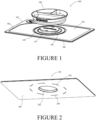
- Figure 1 illustrates a tableware system 100 according to one example of the technology.
- the tableware system 100 includes a placemat or mat 102 and tableware 104.
- the mat 102 and tableware 104 may be detachably coupled.
- the mat 102 includes substantially planar top and bottom surfaces 105,106, respectively.
- the top surface 105 may include a raised edge 103 provided along a perimeter of the mat 102.
- the mat 102 may be formed of any shape.
- the mat 102 may be formed in a substantially rectangular-shape.
- the mat 102 includes a fastening mechanism 107 that secures the tableware 104 thereto.
- the fastening mechanism 107 may be integrally formed with the mat 102.
- the fastening mechanism 107 may be embedded within the mat 102.
- the fastening mechanism 107 may be detachably coupled to the top surface 105 of the mat 102.
- the fastening mechanism 107 may be secured to the top surface 105 of the mat 102 using a fastener such as a screw, adhesive, peg, or the like.
- the fastening mechanism 107 may protrude from the top surface 105 of the mat 102.
- the fastening mechanism 107 may be centrally located on the top surface 105 of the mat 102. Alternatively, the fastening mechanism 107 may be located anywhere along the top surface 105 of the mat 102.
- the mat 102 may include two or more fastening mechanisms 107 provided at the top surface 105.
- the two or more fastening mechanisms 107 may secure multiple articles of tableware 104 such as plates, bowls, cups, utensils, or the like.
- the fastening mechanism 107 includes a disc-shaped protrusion that extends in a direction perpendicular to the top surface 105.
- the disc-shaped protrusion may include flanges 108 that extend in a radial direction from a perimeter thereof.
- the flanges 108 may increase in thickness along a direction perpendicular to the top surface 105 to form a wedge-shaped profile.
- Figure 2 illustrates the mat 102 having a planar bottom surface 106 according to one example of the technology.
- the mat 102 includes an aperture 202 that corresponds to an underside of the protruding portion of the fastening mechanism 107.
- multiple mats 102 may be stacked such that the protruding portion of the fastening mechanism 107 of an underlying mat 102 is inserted into the aperture 202 of an overlying mat 102.
- the mat 102 includes one or more slots 204 provided around a periphery of the aperture 202.
- the slots 204 may be dimensioned to receive protrusions that extend downward from the fastening mechanism 107.
- the slots 204 fixedly secure the fastening mechanism 107 in place.
- the slots 204 may provide increased strength to a bond formed between the fastening mechanism 107 and the mat 102.
- the fastening mechanism 107 may be integrally formed with the mat 102.
- the bottom surface 106 of the mat 102 may be formed from a material having a tacky finish that provides a high coefficient of friction ( ⁇ ), where ⁇ is determined based on a weight of an object and how much force is needed to begin sliding the object across a surface.
- a material for the bottom surface 106 may be selected to form a partial vacuum with a contacting surface such as a table, countertop, tray, or the like.
- the material may be selected such that a force needed to slide the tableware system 100 across the contacting surface exceeds a force needed to lift the tableware system 100 from the contacting surface.
- an edge of the mat 102 may be peeled to remove the mat 102 from the underlying surface.
- the selected material may include silicone, rubber, or the like.
- the tableware 104 includes a corresponding fastening mechanism 302 provided at a bottom surface 304 thereof to mechanically couple to the fastening mechanism 107 of the mat 102.
- the fastening mechanism 302 may include a cavity formed at the bottom surface 304 of the tableware 104.
- a rim 308 may be provided that extends substantially perpendicular from the bottom surface 304 of the tableware 104 to define an outer boundary of the cavity that receives the fastening mechanism 107.
- tabs 306 may be provided along an edge of the rim 308.
- the tabs 306 may extend inward from the edge of the rim 308 to engage the flanges 108 provided on the fastening mechanism 107 of the mat 102.
- the tableware 104 may be positioned over the mat 102 such that the fastening mechanism 302 is seated substantially over the corresponding fastening mechanism 107.
- the tableware 104 may be rotated in a clockwise direction such that the tabs 306 engage the flanges 108.
- the fastening mechanisms 107,302 are configured to mechanically couple the tableware 104 and the mat 102.
- the tableware 104 and the mat 102 may become fixedly engaged such that a release mechanism or tool is needed to disengage the fastening mechanisms 107,302.
- fastening mechanisms may be provided to fixedly engage the tableware 104 and the mat 102.
- the tableware system 100 described herein is an improvement over known tableware systems. For example, infants and children that observe removal of an integrated placemat with the non-separable tableware provided in known systems quickly learn how to peel the edge to release the placemat. Once released, the infants and children using known tableware systems may overturn or knock the tableware off a table. In contrast, the tableware system 100 described herein allows the placemat 102 to remain affixed in place while the fastening mechanisms 107,302 are disengaged to release the tableware 104. In this way, infants and children do not learn how to remove the placemat 102 to overturn or knock the tableware off the table.
- the tableware system 100 may include a lock that fixedly secures the fastening mechanisms 107,302.
- the lock may include a release mechanism that is maintained with the tableware system 100.
- the lock may require a separate tool that is applied to disengage the lock.
- the lock may include apertures provided in the rim 308 and at a side wall of the fastening mechanism 107 that align when the fastening mechanisms 107,302 are engaged.
- the release mechanism may be coupled to the rim 308 of the tableware 104 and may include a spring-loaded pin such that a tip of the pin is inserted by spring force through the apertures in the rim 308 and the side wall of the fastening mechanism 107 when the fastening mechanisms 107,302 are engaged.
- a counter-force may be applied to the release mechanism to extract the pin prior to disengaging the fastening mechanisms 107,302.
- release mechanism may require application of a force to disengage the tableware 104 from the placemat 102.
- the lock may include a stand-alone pin with an expanding tip.
- the rim 308 and the side wall of the fastening mechanism 107 may include apertures that align when the fastening mechanisms 107,302 are engaged.
- the pin may be inserted through the apertures when the fastening mechanisms 107,302 are engaged such that the expanding tip of the pin penetrates through the rim 308 and the side wall of the fastening mechanism 107.
- the tool may be used to retract the expanding tip in order to remove the pin prior to disengaging the fastening mechanisms 107,302.
- tool types may be employed so that infants and children are incapable of separating the placemat 102 and the tableware 104 to prevent overturning or knocking the tableware off the table.
- the mat 102 may include a valve that may be coupled to a vacuum pump for removing air from between the mat 102 and the underlying contact surface. In this way, a suction force may be increased between the mat 102 and the underlying surface to prevent removal of the mat 102 from the underlying surface by peeling an edge of the mat 102.
- the mat 102 may include a relief valve that releases pressure holding the mat 102 onto the underlying surface such that the mat 102 may be peeled from the underlying surface. Accordingly, it may not be possible to remove the mat 102 from the underlying surface without first relieving pressure using the relief valve.
- FIGS 5 and 6 illustrate vertically stacked tableware 104a, 104b according to one example of the technology.
- lids 501a, 501b are provided that secure to the tableware 104a,104b.
- the lids 501a,501b may be secured to the tableware 104a, 104b using a threaded coupling, pressure coupling, or the like.
- the lids 501a,501b may include a fastening mechanism 507a, 507b for vertically stacking the tableware 104a, 104b.
- the fastening mechanism 507a, 507b may be integrally formed with the lids 501a,501b.
- the fastening mechanism 507a, 507b may be detachably coupled to a top surface 503a,503b of the lids 501a,501b.
- the fastening mechanism 507a, 507b may be secured to the top surface 503a,503b of the lids 501a,501b using a fastener such as a screw, adhesive, peg, or the like.
- the fastening mechanism 507a, 507b may protrude from the top surface 503a,503b of the lids 501a,501b.
- the fastening mechanism 507a, 507b may include a disc-shaped protrusion that extends in a direction perpendicular to the top surface 503a,503b of the lids 501a,501b.
- the disc-shaped protrusion may include flanges 508a,508b that extend in a radial direction from a perimeter thereof.
- the flanges 508a,508b may increase in thickness along a direction perpendicular to the top surface 503a,503b to form a wedge-shaped profile.
- the tableware 104a,104b may include a corresponding fastening mechanism provided at a bottom surface thereof to mechanically couple to the fastening mechanism 507a, 507b provided on the lids 501a,501b.
- the fastening mechanism may include a cavity formed at the bottom surface of the tableware 104a,104b.
- a rim may be provided that extends substantially perpendicular from the bottom surface of the tableware 104a,104b to define an outer boundary of the cavity that receives the fastening mechanism 507a, 507b.
- tabs may be provided along an edge of the rim. For example, the tabs may extend inward from the edge of the rim to engage the flanges 508a,508b provided on the fastening mechanisms 507a, 507b of the lids 501a,501b.
- the tableware 104a,104b may be positioned over the lids 501a,501b such that the fastening mechanism is seated substantially over the corresponding fastening mechanism 507a, 507b. According to one example, the tableware 104a,104b may be rotated in a clockwise direction such that the tabs engage the flanges 508a,508b.
- the fastening mechanisms provided on the tableware 104a,104b and lids 501a,501b are configured to mechanically couple the tableware 104a,104b and the lids 501a,501b.
- the tableware 104a,104b and the lids 501a,501b may become fixedly engaged such that a release mechanism or tool is needed to disengage the fastening mechanisms.
- a release mechanism or tool is needed to disengage the fastening mechanisms.
- fastening mechanisms may be employed to fixedly engage the tableware 104a, 104b and the lids 501a,501b.
- the tableware 104a,104b may be formed of a rigid material such as plastic.
- the tableware 104a,104b may be formed from Bisphenol A (BPA) and 2-ethylhexyl (DEHP) free plastic or a similar material.
- the tableware 104a,104b may be formed from a microwave safe material.
- the tableware 104a, 104b may be formed from an insulating material that maintains the contents in a heated or cooled state.
- an interior of the tableware 104 may be partitioned into two or more compartments as illustrated in Figures 1 and 4 .
- the interior of the tableware 104 may include a single compartment.
- the lid 501a,501b may form a fluid tight seal with an upper surface of the tableware 104a, 104b such that any foods or liquids provided within the compartments does not migrate to other compartments when the lid 501a,501b is applied.
Landscapes
- Engineering & Computer Science (AREA)
- Mechanical Engineering (AREA)
- Table Devices Or Equipment (AREA)
- Table Equipment (AREA)
Claims (9)
- Geschirrsystem (100) mit:einer Platzmatte (102), die eine im Wesentlichen ebene Bodenfläche (106) aufweist und dazu ausgelegt ist, ein Teilvakuum zu bilden, wenn sie in Kontakt mit einer darunterliegenden Fläche bereitgestellt ist, wobei die Platzmatte (102) eine Öffnung (202) und Schlitze (204) aufweist, die um eine Umfassung der Öffnung (202) bereitgestellt sind;einem ersten Befestigungsmechanismus (107), der an einer oberen Fläche (105) der Platzmatte (102) bereitgestellt ist, dass er mit der Öffnung (202) zusammenfällt, wobei der erste Befestigungsmechanismus (107) erste Vorsprünge aufweist, die sich nach unten erstrecken und in den Schlitzen (204) aufgenommen sind, wobei der erste Befestigungsmechanismus (107) einen zweiten scheibenförmigen Vorsprung definiert, der sich in einer Richtung senkrecht zu der oberen Fläche (105) erstreckt;einem Geschirr (104) mit einem zweiten Befestigungsmechanismus (302), der dem ersten Befestigungsmechanismus (107) entspricht, wobei der zweite Befestigungsmechanismus (302) lösbar mit dem ersten Befestigungsmechanismus (107) gekoppelt ist, wobei das Geschirr (104) so bemessen ist, dass sich die Umfassung der Platzmatte über eine Umfassung des Geschirrs (104) hinaus erstreckt; undeinem Deckel (501), der an dem Geschirr (104) befestigt ist, wobei der Deckel (501) einen weiteren ersten Befestigungsmechanismus (507) aufweist, der an einer oberen Fläche (503) davon bereitgestellt ist.
- Geschirrsystem (100) nach Anspruch 1, wobei der zweite scheibenförmige Vorsprung Flansche (108) aufweist, die sich in einer Auswärtsrichtung von einem Umfang davon erstrecken, wobei die Flansche (108) eine vergrößerte Dicke entlang einer Richtung senkrecht zu der oberen Fläche aufweisen, damit sie ein keilförmiges Profil bilden.
- Geschirrsystem (100) nach Anspruch 2, wobei der zweite Befestigungsmechanismus (302) an einer unteren Fläche (304) des Geschirrs (104) bereitgestellt ist, wobei der zweite Befestigungsmechanismus (302) einen Hohlraum aufweist, der durch einen Rand (308) definiert ist, wobei der Rand (308) Laschen (306) aufweist, die sich nach innen erstrecken, um in die Flansche (108) einzugreifen, die an dem ersten Befestigungsmechanismus (107) bereitgestellt sind.
- Geschirrsystem (100) nach Anspruch 3, wobei der zweite Befestigungsmechanismus (302) über den ersten Befestigungsmechanismus (107) gedreht wird, um die Platzmatte (102) und das Geschirr (104) lösbar zu koppeln.
- Geschirrsystem (100) nach Anspruch 1, ferner mit einer Verriegelung, die den ersten Befestigungsmechanismus (107) und den zweiten Befestigungsmechanismus (302) fest befestigt, wobei die Verriegelung einen Stift aufweist, der durch Öffnungen eingeführt wird, die in dem ersten Befestigungsmechanismus (107) und dem zweiten Befestigungssystem bereitgestellt sind, wenn sie gekoppelt sind, wobei die Verriegelung einen Freigabemechanismus aufweist, der den Stift bei Anwendung einer Kraft darauf herauszieht, um zu ermöglichen, dass das Geschirr (104) und die Platzmatte (102) gelöst werden.
- Geschirrsystem (100) nach Anspruch 1, ferner mit einer Verriegelung, die den ersten Befestigungsmechanismus (107) und den zweiten Befestigungsmechanismus (302) fest befestigt, wobei die Verriegelung einen eigenständigen Stift aufweist, der durch Öffnungen eingeführt wird, die in dem ersten Befestigungsmechanismus (107) und dem zweiten Befestigungssystem bereitgestellt sind, wenn sie gekoppelt sind, wobei der eigenständige Stift durch ein separates Werkzeug entfernbar ist, um zu ermöglichen, dass das Geschirr (104) und die Platzmatte (102) gelöst werden.
- Geschirrsystem (100) nach Anspruch 1, wobei die im Wesentlichen ebene Bodenfläche aus einem Material mit einer haftenden Oberfläche gebildet ist, die einen Reibungskoeffizienten bereitstellt, der auf der Grundlage von dem Gewicht bestimmt wird.
- Geschirrsystem (100) nach Anspruch 1, wobei das Geschirr (104a) mit dem daran befestigten Deckel (501a) mit einem anderen Geschirr (104b) mit einem daran befestigten weiteren Deckel (501b) stapelbar ist.
- Geschirrsystem (100) nach Anspruch 1, wobei die im Wesentlichen ebene Bodenfläche aus einem anderen Material als die obere Fläche gebildet ist.
Applications Claiming Priority (1)
| Application Number | Priority Date | Filing Date | Title |
|---|---|---|---|
| US15/621,514 US10772447B2 (en) | 2017-06-13 | 2017-06-13 | Dining placemat with interchangeable tableware |
Publications (3)
| Publication Number | Publication Date |
|---|---|
| EP3415043A1 EP3415043A1 (de) | 2018-12-19 |
| EP3415043B1 true EP3415043B1 (de) | 2025-04-02 |
| EP3415043C0 EP3415043C0 (de) | 2025-04-02 |
Family
ID=62186310
Family Applications (1)
| Application Number | Title | Priority Date | Filing Date |
|---|---|---|---|
| EP18172535.9A Active EP3415043B1 (de) | 2017-06-13 | 2018-05-16 | Esstischset mit auswechselbarem geschirr |
Country Status (4)
| Country | Link |
|---|---|
| US (1) | US10772447B2 (de) |
| EP (1) | EP3415043B1 (de) |
| CN (1) | CN109077581B (de) |
| ES (1) | ES3018786T3 (de) |
Families Citing this family (14)
| Publication number | Priority date | Publication date | Assignee | Title |
|---|---|---|---|---|
| AT521197B1 (de) | 2018-04-27 | 2020-02-15 | Marcus Koenig | Set aus einer selbsthaftenden Matte und einem Gefäß |
| CN112805123B (zh) | 2018-09-10 | 2024-07-30 | 米沃奇电动工具公司 | 模块化工具容器 |
| US11779142B2 (en) * | 2018-11-11 | 2023-10-10 | Micha Barnum | Configurable food trays and modular containers |
| CN110200460A (zh) * | 2019-07-04 | 2019-09-06 | 刘春茂 | 合餐防疾病交叉感染离合式安全餐具 |
| US12134180B2 (en) | 2020-04-09 | 2024-11-05 | Milwaukee Electric Tool Corporation | Modular tool container |
| USD980676S1 (en) * | 2020-06-11 | 2023-03-14 | Daina Rowe | Food service assembly |
| USD1064433S1 (en) * | 2021-02-11 | 2025-02-25 | Garret M. Warr | Ergonomic training bowl |
| AU2021101202B4 (en) * | 2021-03-08 | 2024-03-28 | Karen Lay | Placemat |
| TWI762285B (zh) * | 2021-04-27 | 2022-04-21 | 趙偉勛 | 智慧餐盤 |
| USD976617S1 (en) * | 2021-09-20 | 2023-01-31 | Busy Baby LLC | Placemat |
| DE102023100070B3 (de) | 2023-01-03 | 2024-04-11 | BC Boxx Cuisine GmbH | Transportbehälter für zubereitete und unzubereitete Lebensmittel |
| USD1109570S1 (en) * | 2023-05-19 | 2026-01-20 | Isleco Investments Llc | Grasping mat |
| USD1005018S1 (en) * | 2023-07-20 | 2023-11-21 | Dongguan Shengyi Trading Co., Ltd. | Baby placemat |
| EE01628U1 (et) * | 2023-09-27 | 2024-04-15 | Outbox Digitech OÜ | Korduvkasutatav kandiku ning mahutite komplekt |
Citations (1)
| Publication number | Priority date | Publication date | Assignee | Title |
|---|---|---|---|---|
| US20160073805A1 (en) * | 2014-07-17 | 2016-03-17 | Lindsey Laurain | Surface Contact Self-Sealing Integrated Tablewear and Dining Mat |
Family Cites Families (11)
| Publication number | Priority date | Publication date | Assignee | Title |
|---|---|---|---|---|
| GB405174A (en) * | 1933-06-09 | 1934-02-01 | Betty Henriksen | Improvements in or relating to means for attaching a food and like mixing basin to atable top or like support |
| USD254831S (en) * | 1977-01-11 | 1980-04-29 | Phillips Petroleum Company | Combined container and serving dish or the like |
| US6318683B1 (en) * | 1999-11-05 | 2001-11-20 | Adonica B. Savoy | Infant utensil having twist lock coupling |
| US20030075666A1 (en) * | 2001-10-19 | 2003-04-24 | Dunchock Richard Stephen | Plate or bowl anchor |
| GB0424272D0 (en) * | 2004-11-02 | 2004-12-01 | Jackel Int Ltd | Tableware |
| US20070254134A1 (en) * | 2006-04-28 | 2007-11-01 | Han Allen M | Placemat with ribs |
| US7475937B2 (en) * | 2006-09-15 | 2009-01-13 | Mcgrew Alan R | Eating surface with interchangeable accessories |
| US20130206781A1 (en) * | 2011-08-15 | 2013-08-15 | Michelle MacCormick | Method of wrapping a glass and the wrapped glass produced |
| US9750358B2 (en) * | 2012-10-10 | 2017-09-05 | Little People Manufacturing Ltd. | Suction base unit and receptacle |
| US9132932B2 (en) * | 2013-05-03 | 2015-09-15 | Warum Studios Llc | Portable combination dishware set |
| AT519393B1 (de) * | 2016-12-12 | 2019-10-15 | Marcus Koenig | Matte zur lösbaren Aufnahme eines Objektes |
-
2017
- 2017-06-13 US US15/621,514 patent/US10772447B2/en active Active
-
2018
- 2018-05-16 ES ES18172535T patent/ES3018786T3/es active Active
- 2018-05-16 EP EP18172535.9A patent/EP3415043B1/de active Active
- 2018-06-11 CN CN201810595478.1A patent/CN109077581B/zh active Active
Patent Citations (1)
| Publication number | Priority date | Publication date | Assignee | Title |
|---|---|---|---|---|
| US20160073805A1 (en) * | 2014-07-17 | 2016-03-17 | Lindsey Laurain | Surface Contact Self-Sealing Integrated Tablewear and Dining Mat |
Also Published As
| Publication number | Publication date |
|---|---|
| EP3415043A1 (de) | 2018-12-19 |
| EP3415043C0 (de) | 2025-04-02 |
| US10772447B2 (en) | 2020-09-15 |
| CN109077581B (zh) | 2020-12-08 |
| US20180352984A1 (en) | 2018-12-13 |
| CN109077581A (zh) | 2018-12-25 |
| ES3018786T3 (en) | 2025-05-19 |
Similar Documents
| Publication | Publication Date | Title |
|---|---|---|
| EP3415043B1 (de) | Esstischset mit auswechselbarem geschirr | |
| EP1827179B1 (de) | Rutschfeste matte | |
| US20200121102A1 (en) | Surface contact self-sealing integrated tableware and dining mat | |
| US20160338517A1 (en) | Tray insert with retained food service items | |
| CN102186381A (zh) | 食物托盘与食物容器的组件及其在飞机内的用法 | |
| US7874088B2 (en) | Tray-tag | |
| US12016475B2 (en) | System for holding tableware on a table | |
| US20060266748A1 (en) | Combined plate and cupholder | |
| CN111065295A (zh) | 用于将餐具保持在餐桌上的系统 | |
| US20160120342A1 (en) | Plate with retaining structure | |
| US7303172B2 (en) | Secure dish holder | |
| US11622642B2 (en) | System for holding tableware on a table | |
| US9326626B2 (en) | Tableware anchoring tray | |
| WO2015143187A1 (en) | Reusable covers for containers | |
| HK40001784A (en) | Dining placemat with interchangeable tableware | |
| US20060292343A1 (en) | Multi-purpose non-skid mat | |
| US12584300B2 (en) | Kitchen sink system with interchangeable sink components | |
| CN208740584U (zh) | 一种航空用餐具托盘 | |
| US20150250338A1 (en) | Dishware with pendent side dishes attached via slots in the dishware for secure versatile attachment of the side dishes | |
| US8511484B1 (en) | Containers and storage system therefore | |
| WO2018006127A1 (en) | Tableware | |
| JP3193380U (ja) | 滑落防止機能を有するトレイ | |
| NL2010209C2 (en) | Assembly of a tray and an interlocking object. | |
| JP2003189992A (ja) | 調理用器物類 | |
| CN212678562U (zh) | 一种航空用铝箔餐盒 |
Legal Events
| Date | Code | Title | Description |
|---|---|---|---|
| PUAI | Public reference made under article 153(3) epc to a published international application that has entered the european phase |
Free format text: ORIGINAL CODE: 0009012 |
|
| STAA | Information on the status of an ep patent application or granted ep patent |
Free format text: STATUS: THE APPLICATION HAS BEEN PUBLISHED |
|
| AK | Designated contracting states |
Kind code of ref document: A1 Designated state(s): AL AT BE BG CH CY CZ DE DK EE ES FI FR GB GR HR HU IE IS IT LI LT LU LV MC MK MT NL NO PL PT RO RS SE SI SK SM TR |
|
| AX | Request for extension of the european patent |
Extension state: BA ME |
|
| STAA | Information on the status of an ep patent application or granted ep patent |
Free format text: STATUS: REQUEST FOR EXAMINATION WAS MADE |
|
| 17P | Request for examination filed |
Effective date: 20190614 |
|
| RBV | Designated contracting states (corrected) |
Designated state(s): AL AT BE BG CH CY CZ DE DK EE ES FI FR GB GR HR HU IE IS IT LI LT LU LV MC MK MT NL NO PL PT RO RS SE SI SK SM TR |
|
| TPAC | Observations filed by third parties |
Free format text: ORIGINAL CODE: EPIDOSNTIPA |
|
| TPAC | Observations filed by third parties |
Free format text: ORIGINAL CODE: EPIDOSNTIPA |
|
| REG | Reference to a national code |
Ref country code: HK Ref legal event code: DE Ref document number: 40001784 Country of ref document: HK |
|
| STAA | Information on the status of an ep patent application or granted ep patent |
Free format text: STATUS: EXAMINATION IS IN PROGRESS |
|
| 17Q | First examination report despatched |
Effective date: 20211021 |
|
| GRAP | Despatch of communication of intention to grant a patent |
Free format text: ORIGINAL CODE: EPIDOSNIGR1 |
|
| STAA | Information on the status of an ep patent application or granted ep patent |
Free format text: STATUS: GRANT OF PATENT IS INTENDED |
|
| INTG | Intention to grant announced |
Effective date: 20241022 |
|
| GRAS | Grant fee paid |
Free format text: ORIGINAL CODE: EPIDOSNIGR3 |
|
| GRAA | (expected) grant |
Free format text: ORIGINAL CODE: 0009210 |
|
| STAA | Information on the status of an ep patent application or granted ep patent |
Free format text: STATUS: THE PATENT HAS BEEN GRANTED |
|
| AK | Designated contracting states |
Kind code of ref document: B1 Designated state(s): AL AT BE BG CH CY CZ DE DK EE ES FI FR GB GR HR HU IE IS IT LI LT LU LV MC MK MT NL NO PL PT RO RS SE SI SK SM TR |
|
| REG | Reference to a national code |
Ref country code: GB Ref legal event code: FG4D |
|
| REG | Reference to a national code |
Ref country code: CH Ref legal event code: EP |
|
| REG | Reference to a national code |
Ref country code: IE Ref legal event code: FG4D |
|
| REG | Reference to a national code |
Ref country code: DE Ref legal event code: R096 Ref document number: 602018080650 Country of ref document: DE |
|
| REG | Reference to a national code |
Ref country code: ES Ref legal event code: FG2A Ref document number: 3018786 Country of ref document: ES Kind code of ref document: T3 Effective date: 20250519 |
|
| U01 | Request for unitary effect filed |
Effective date: 20250425 |
|
| U07 | Unitary effect registered |
Designated state(s): AT BE BG DE DK EE FI FR IT LT LU LV MT NL PT RO SE SI Effective date: 20250502 |
|
| U20 | Renewal fee for the european patent with unitary effect paid |
Year of fee payment: 8 Effective date: 20250522 |
|
| PGFP | Annual fee paid to national office [announced via postgrant information from national office to epo] |
Ref country code: ES Payment date: 20250627 Year of fee payment: 8 |
|
| PGFP | Annual fee paid to national office [announced via postgrant information from national office to epo] |
Ref country code: TR Payment date: 20250627 Year of fee payment: 8 |
|
| PG25 | Lapsed in a contracting state [announced via postgrant information from national office to epo] |
Ref country code: NO Free format text: LAPSE BECAUSE OF FAILURE TO SUBMIT A TRANSLATION OF THE DESCRIPTION OR TO PAY THE FEE WITHIN THE PRESCRIBED TIME-LIMIT Effective date: 20250702 Ref country code: GR Free format text: LAPSE BECAUSE OF FAILURE TO SUBMIT A TRANSLATION OF THE DESCRIPTION OR TO PAY THE FEE WITHIN THE PRESCRIBED TIME-LIMIT Effective date: 20250703 |
|
| PG25 | Lapsed in a contracting state [announced via postgrant information from national office to epo] |
Ref country code: PL Free format text: LAPSE BECAUSE OF FAILURE TO SUBMIT A TRANSLATION OF THE DESCRIPTION OR TO PAY THE FEE WITHIN THE PRESCRIBED TIME-LIMIT Effective date: 20250402 |
|
| PG25 | Lapsed in a contracting state [announced via postgrant information from national office to epo] |
Ref country code: HR Free format text: LAPSE BECAUSE OF FAILURE TO SUBMIT A TRANSLATION OF THE DESCRIPTION OR TO PAY THE FEE WITHIN THE PRESCRIBED TIME-LIMIT Effective date: 20250402 |
|
| PG25 | Lapsed in a contracting state [announced via postgrant information from national office to epo] |
Ref country code: RS Free format text: LAPSE BECAUSE OF FAILURE TO SUBMIT A TRANSLATION OF THE DESCRIPTION OR TO PAY THE FEE WITHIN THE PRESCRIBED TIME-LIMIT Effective date: 20250702 |
|
| PG25 | Lapsed in a contracting state [announced via postgrant information from national office to epo] |
Ref country code: IS Free format text: LAPSE BECAUSE OF FAILURE TO SUBMIT A TRANSLATION OF THE DESCRIPTION OR TO PAY THE FEE WITHIN THE PRESCRIBED TIME-LIMIT Effective date: 20250802 |
|
| REG | Reference to a national code |
Ref country code: HK Ref legal event code: WD Ref document number: 40001784 Country of ref document: HK |
|
| REG | Reference to a national code |
Ref country code: CH Ref legal event code: H13 Free format text: ST27 STATUS EVENT CODE: U-0-0-H10-H13 (AS PROVIDED BY THE NATIONAL OFFICE) Effective date: 20251223 |
|
| PG25 | Lapsed in a contracting state [announced via postgrant information from national office to epo] |
Ref country code: SM Free format text: LAPSE BECAUSE OF FAILURE TO SUBMIT A TRANSLATION OF THE DESCRIPTION OR TO PAY THE FEE WITHIN THE PRESCRIBED TIME-LIMIT Effective date: 20250402 |
|
| PG25 | Lapsed in a contracting state [announced via postgrant information from national office to epo] |
Ref country code: CH Free format text: LAPSE BECAUSE OF NON-PAYMENT OF DUE FEES Effective date: 20250531 |
|
| PG25 | Lapsed in a contracting state [announced via postgrant information from national office to epo] |
Ref country code: CZ Free format text: LAPSE BECAUSE OF FAILURE TO SUBMIT A TRANSLATION OF THE DESCRIPTION OR TO PAY THE FEE WITHIN THE PRESCRIBED TIME-LIMIT Effective date: 20250402 |
|
| PG25 | Lapsed in a contracting state [announced via postgrant information from national office to epo] |
Ref country code: SK Free format text: LAPSE BECAUSE OF FAILURE TO SUBMIT A TRANSLATION OF THE DESCRIPTION OR TO PAY THE FEE WITHIN THE PRESCRIBED TIME-LIMIT Effective date: 20250402 |
|
| PG25 | Lapsed in a contracting state [announced via postgrant information from national office to epo] |
Ref country code: MC Free format text: LAPSE BECAUSE OF FAILURE TO SUBMIT A TRANSLATION OF THE DESCRIPTION OR TO PAY THE FEE WITHIN THE PRESCRIBED TIME-LIMIT Effective date: 20250402 |
|
| PLBE | No opposition filed within time limit |
Free format text: ORIGINAL CODE: 0009261 |
|
| STAA | Information on the status of an ep patent application or granted ep patent |
Free format text: STATUS: NO OPPOSITION FILED WITHIN TIME LIMIT |
|
| REG | Reference to a national code |
Ref country code: CH Ref legal event code: L10 Free format text: ST27 STATUS EVENT CODE: U-0-0-L10-L00 (AS PROVIDED BY THE NATIONAL OFFICE) Effective date: 20260211 |
|
| 26N | No opposition filed |
Effective date: 20260105 |
|
| GBPC | Gb: european patent ceased through non-payment of renewal fee |
Effective date: 20250702 |
|
| PG25 | Lapsed in a contracting state [announced via postgrant information from national office to epo] |
Ref country code: GB Free format text: LAPSE BECAUSE OF NON-PAYMENT OF DUE FEES Effective date: 20250702 |
|
| PG25 | Lapsed in a contracting state [announced via postgrant information from national office to epo] |
Ref country code: IE Free format text: LAPSE BECAUSE OF NON-PAYMENT OF DUE FEES Effective date: 20250516 |