EP3414682B1 - Systems and methods for storing, updating, searching, and filtering time-series datasets - Google Patents
Systems and methods for storing, updating, searching, and filtering time-series datasets Download PDFInfo
- Publication number
- EP3414682B1 EP3414682B1 EP17750601.1A EP17750601A EP3414682B1 EP 3414682 B1 EP3414682 B1 EP 3414682B1 EP 17750601 A EP17750601 A EP 17750601A EP 3414682 B1 EP3414682 B1 EP 3414682B1
- Authority
- EP
- European Patent Office
- Prior art keywords
- time
- data
- slice
- fvti
- tsti
- Prior art date
- Legal status (The legal status is an assumption and is not a legal conclusion. Google has not performed a legal analysis and makes no representation as to the accuracy of the status listed.)
- Active
Links
Images



Classifications
-
- G—PHYSICS
- G06—COMPUTING OR CALCULATING; COUNTING
- G06F—ELECTRIC DIGITAL DATA PROCESSING
- G06F16/00—Information retrieval; Database structures therefor; File system structures therefor
- G06F16/20—Information retrieval; Database structures therefor; File system structures therefor of structured data, e.g. relational data
- G06F16/22—Indexing; Data structures therefor; Storage structures
- G06F16/2228—Indexing structures
-
- G—PHYSICS
- G06—COMPUTING OR CALCULATING; COUNTING
- G06F—ELECTRIC DIGITAL DATA PROCESSING
- G06F16/00—Information retrieval; Database structures therefor; File system structures therefor
- G06F16/20—Information retrieval; Database structures therefor; File system structures therefor of structured data, e.g. relational data
- G06F16/24—Querying
- G06F16/245—Query processing
- G06F16/2458—Special types of queries, e.g. statistical queries, fuzzy queries or distributed queries
- G06F16/2474—Sequence data queries, e.g. querying versioned data
-
- G—PHYSICS
- G06—COMPUTING OR CALCULATING; COUNTING
- G06F—ELECTRIC DIGITAL DATA PROCESSING
- G06F16/00—Information retrieval; Database structures therefor; File system structures therefor
- G06F16/20—Information retrieval; Database structures therefor; File system structures therefor of structured data, e.g. relational data
- G06F16/24—Querying
- G06F16/245—Query processing
- G06F16/2458—Special types of queries, e.g. statistical queries, fuzzy queries or distributed queries
- G06F16/2477—Temporal data queries
-
- G—PHYSICS
- G06—COMPUTING OR CALCULATING; COUNTING
- G06F—ELECTRIC DIGITAL DATA PROCESSING
- G06F16/00—Information retrieval; Database structures therefor; File system structures therefor
- G06F16/20—Information retrieval; Database structures therefor; File system structures therefor of structured data, e.g. relational data
- G06F16/23—Updating
- G06F16/2379—Updates performed during online database operations; commit processing
-
- Y—GENERAL TAGGING OF NEW TECHNOLOGICAL DEVELOPMENTS; GENERAL TAGGING OF CROSS-SECTIONAL TECHNOLOGIES SPANNING OVER SEVERAL SECTIONS OF THE IPC; TECHNICAL SUBJECTS COVERED BY FORMER USPC CROSS-REFERENCE ART COLLECTIONS [XRACs] AND DIGESTS
- Y02—TECHNOLOGIES OR APPLICATIONS FOR MITIGATION OR ADAPTATION AGAINST CLIMATE CHANGE
- Y02A—TECHNOLOGIES FOR ADAPTATION TO CLIMATE CHANGE
- Y02A90/00—Technologies having an indirect contribution to adaptation to climate change
- Y02A90/10—Information and communication technologies [ICT] supporting adaptation to climate change, e.g. for weather forecasting or climate simulation
Definitions
- the field of the present invention relates to time-series datasets.
- systems and methods are disclosed for storing, updating, searching, and filtering time-series datasets.
- Time-series datasets are generated in a wide variety of circumstances, and can be used for analysis and control.
- One broad arena which is expected to generate vast amounts of time-series data is the so-called Internet-of-Things (loT), in which large numbers of devices of many disparate sorts are provided with network connectivity to provide monitoring or control.
- position data can be included in time-series datasets (e.g., geo-coordinates such as latitude and longitude, perhaps elevation or altitude as well).
- time-series datasets e.g., geo-coordinates such as latitude and longitude, perhaps elevation or altitude as well.
- a few examples (by no means exhaustive) of areas in which time-series datasets might be generated and exploited include the following, some of which overlap with one another.
- time-series datasets can include vital statistics or operating parameters for automobiles, trucks, trains (or individual locomotives or rail cars), aircraft, boats, and ships, and so forth. Those time-series datasets can be analyzed for predictive diagnosis, scheduling maintenance, failure predication or analysis, accident investigation and analysis, and the like. Position coordinates included in a time-series dataset can be employed for vehicle navigation, traffic flow management, fleet or asset management, personnel management, scheduling, and so forth.
- time-series datasets can include parking availability, traffic patterns, monitoring of buildings, roads, bridges, powerlines and power grids, telecommunications grids, water and sewer lines, gas lines, or other infrastructure, water quality monitoring, noise levels, lighting conditions and resources, trash or garbage accumulation, and so forth.
- Those time-series datasets can be employed to monitoring conditions for incident management, maintenance scheduling, load balancing, failure warning or prediction, leak-detection, optimized weather- and time-dependent street lighting, refuse pickup, usage analysis, and so forth.
- Position coordinates can be advantageously included in some of those time-series datasets.
- time-series datasets can include forest weather conditions (temperature, humidity, cloud conditions, precipitation), conditions, soil moisture, rainfall monitoring, waterway flow rates or water levels, flood prediction or monitoring, snowpack levels, avalanche conditions, landslide conditions, seismic monitoring, combustion gas monitoring, pollen levels, airborne or waterborne levels of CO2, methane, other hydrocarbons, or other volatile organic compounds (VOCs), sulfur or nitrogen oxides, soot or other particulates, ozone, or other pollutants, and so forth.
- Those time-series datasets can be employed to for planning, analyzing, or evaluating in order to provide a variety of warnings, management, remediation, mitigation, or other functions.
- Position coordinates can be advantageously included in some of those time-series datasets.
- time-series datasets can include operational parameters, equipment or machinery conditions or operation, tank, storage, pipeline, or supply line monitoring (oil, gas, water, chemical feedstocks, etc.), leak or spill detection, mitigation, or remediation (especially explosive, combustible, toxic, or radioactive materials), power generation (coal, natural gas, nuclear, solar, wind), airborne or waterborne levels of CO2, methane, other hydrocarbons, or other volatile organic compounds (VOCs), sulfur or nitrogen oxides, soot or other particulates, ozone, or other pollutants, leakage from a water line or a roof/window leak, corrosion detection, and so forth.
- Position coordinates can be advantageously included in some of those time-series datasets.
- time-series datasets can include product location (warehouse, retail outlet, in-transit, etc.), product rotation or disposal, supply chain monitoring or control, restocking, monitoring shipments (location, handling, vibration, cold chain maintenance, container openings, and so on), location or contents of specific truck trailers, rail cars, or shipping containers, asset monitoring (via RFID tags, barcodes, and the like), fleet or personnel management, and so forth.
- Position coordinates can be advantageously included in some of those time-series datasets.
- time-series datasets can include rainfall and soil moisture monitoring, weather monitoring, soil chemistry, pH, or microbial conditions, green house temperature and humidity, hydroponics conditions, micro-climate control, temperature and humidity control of crop, grain, hay, straw, alfalfa storage, irrigation control or monitoring, location, identification, fertility, or health of livestock, and so forth. Position coordinates can be advantageously included in some of those time-series datasets.
- time-series datasets can include patient data (historical or nearly real-time) such as height, weight, blood pressure, heart rate, blood chemistry, blood oxygenation, and so on, fall detection, patient surveillance (in hospital or other facility or at home), medical or surgical history, and so on.
- patient data historical or nearly real-time
- patient data such as height, weight, blood pressure, heart rate, blood chemistry, blood oxygenation, and so on
- fall detection patient surveillance (in hospital or other facility or at home), medical or surgical history, and so on.
- EP 2568399 A2 and US2015/040276 A1 disclose computer-implemented methods for (i) subdividing a time-series dataset into smaller segments encompassing only a limited time interval and (ii) in some instances storing the field values of the time-series dataset in a compressed form, to facilitate a query of the time-series dataset.
- Such a time-series dataset includes one or more corresponding field-value (FV) data strings for each one of multiple defined data fields.
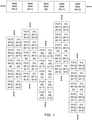
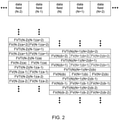
- the data fields are indexed by 1, 2, 3, ..., N-2, N-1, N, N+1, N+2, ..., and the corresponding field values are denoted by FV(n,i) (i.e., the ith field value for the nth data field).
- the time-series dataset also includes multiple field-value-time-index (FVTI) data strings. Each one of the FV strings is associated with a corresponding FVTI data string.
- FVTI field-value-time-index
- each FV data string has its own associated FVTI data string (labelled with the same indices).
- multiple FV data strings are associated with a single FVTI data string.
- datasets that include data fields which nearly always appear together e.g., latitude and longitude of a vehicle at a given time
- redundant storage of a common time index shared by multiple field values can be avoided.
- Each FV data string represents, in any suitable format, alphanumeric or binary data or other data or information (image, sound, video, and so forth) that is generated, measured, recorded, acquired, or otherwise produced, often using a corresponding data acquisition device; the FVTI data string represents, in any suitable format, a time when the associated field value was generated, measured, recorded, acquired, or otherwise produced. Any desired fields can be included in the time-series dataset with their associated time-dependent field values and associated time indices.
- the field values will not always, or even typically, be generated at uniform intervals or at the same time among different generating devices (represented graphically in Figs. 1 and 2 by the relative vertical offsets among the respective time-series for each data field).
- Transmission of data to a central computer system or server typically will not occur uniformly or regularly, or at the same times for different devices.
- Data will not always be received in the order it was produced (i.e., not necessarily received or stored in an order that corresponds to the order of the associated time indices).
- Assimilation of newly received data into a data structure preferably would occur while still enabling access to the dataset, and newly received data should be properly inserted so as to maintain the organization of the data even if received asynchronously or out of order.
- time-series dataset must be accessible responsive to electronic queries of various sorts.
- the sheer size of the dataset and its complexity make searching or filtering the information contained in the time-series dataset both time- and computing-resource-intensive.
- Novel methods for organizing, managing, updating, searching, and filtering large volumes of time-series data are disclosed and claimed herein. Those methods employ generation and use of so-called time-slice datasets to facilitate organization and querying of the time-series dataset. Multiple time-slice datasets are generated from the time-series dataset and are employed to guide subsequent manipulations or queries of the time-series dataset.
- the time-series dataset includes one or more (and typically many) field-value (FV) data strings representing information acquired, measured, generated, or recorded at a time represented by an associated field-value-time-index (FVTI) data string.
- FV field-value
- Electronic indicia of the time-series dataset (i.e., of the constituent FV and FVTI data strings representing the time-series dataset) can be stored, in any suitable format or arrangement, on one or more tangible, non-transitory computer-readable media of a computer system.
- Suitable arrangements of the time-series dataset can include one or more among simple alphanumeric text files, binary files, tables, spreadsheets, relational or non-relational databases, specialized or purpose-built binary or alphanumeric storage formats, and so on.
- the methods disclosed and claimed herein can be implemented with datasets stored in any of those suitable formats or arrangements or in future-developed formats or arrangements.
- references to (i) information in the dataset, (ii) corresponding data strings representing that information, and (iii) corresponding electronic indicia of those data strings are made somewhat interchangeably in the present disclosure and appended claims.
- any reference to one of those in the present disclosure shall be construed as denoting the one appropriate for the given context unless explicitly stated otherwise.
- “updating” or “replacing” a time-index data string would be understood as referring to updating or replacing the stored electronic indicia of that time-index data string.
- references to (i) a time when an event occurred, (ii) a corresponding time-index representing that time, (iii) a corresponding time-index data string representing that time index, and (iv) corresponding electronic indicia of that time-index data string are made somewhat interchangeably in the present disclosure and appended claims. Any reference to one of those in the present disclosure shall be construed as denoting the one appropriate for the given context unless explicitly stated otherwise.
- a first time-index data string being identified as being "later" than a second time-index data string would be understood to mean that a first time represented by a corresponding first time index represented by the first time-index data string is later than a second time represented by a corresponding second time index represented by the second time-index data string.
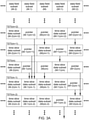
- FIGs. 3A and 3B An example of a set of multiple time-slice datasets is illustrated schematically in Figs. 3A and 3B .
- Data fields of the time-series dataset are assigned to one or more designated data field subsets, e.g., subsets 1, 2, 3, ..., M-2, M-1, M, M+1, M+2, ... as shown in Figs. 3A and 3B .
- Any suitable or desirable assignment of specific data fields into corresponding subsets can be employed, and a specific scheme of those assignments typically is influenced by the nature of the underlying time-series dataset and the types of queries that are desired for searching or filtering the dataset.
- data fields could be grouped into subsets according to one or more of geographic position, shipment contents, shipment owner, or shipment origin or destination. In some instances certain data fields can be omitted from the designated subsets; in some examples one or more data fields might be assigned to multiple subsets (i.e., the data field subsets are not necessarily disjoint). Again, such variants typically are driven by the type of dataset and the types of queries needed or desired.
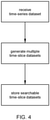
- one or more processors of the computer system are used to automatically generate, from the received indicia, electronic indicia of multiple time-slice datasets ( Fig. 4 ).
- the electronic indicia of the entire time-series dataset might be received all at once (i.e., the complete-at-the-time time-series dataset is received at the computer system) or, more commonly, the electronic indicia are received piecemeal as new FV and FVTI data strings are received (piecemeal from the beginning or only after receiving an earlier complete-at-the-time time-series dataset).
- Each one of the multiple time-slice datasets corresponds to a designated time-slice time index (TSTI) that differs from the corresponding TSTI of at least one other of the multiple time-slice datasets.
- the time-slice datasets are indexed by TSTI(1), TSTI(2), ..., TSTI(m-2), TSTI(m-1), TSTI(m), TSTI(m+1), TSTI(m+2), ... as shown in Figs. 3A and 3B .
- Each time-slice dataset is divided into time-slice data subsets that correspond to the designated subsets of the data fields, and are labelled by the indices (M, m), i.e., the time-slice data subset of the time-slice with TSTI(M) that includes or indicates FV and FVTI data strings for the mth subset of data fields.
- indices (M, m) i.e., the time-slice data subset of the time-slice with TSTI(M) that includes or indicates FV and FVTI data strings for the mth subset of data fields.
- the electronic indicia of the multiple time-slice datasets are stored automatically in a computer-searchable format on one or more tangible, non-transitory computer-readable media of the computer system that are operatively coupled to one or more electronic processors of the computer system.
- One advantage of the methods disclosed herein is the ability to store different time-slice datasets on different computer-readable media, in some cases coupled to different computers or processors of a computer system. That capability can be especially advantageous when employed for very large time-series datasets.
- Each time-slice data subset includes or indicates FV and FVTI data strings for each data field of the corresponding designated subset of the multiple data fields.
- the time-slice subset includes either a corresponding single FV data string from the time-series dataset, or a pointer indicating a corresponding FV data string in an earlier corresponding time-slice data subset (i.e., a time-slice data subset from a time-slice dataset with an earlier TSTI).
- the time-slice subset includes either the FVTI data string from the time-series dataset that is associated with the included or indicated FV data string, or a pointer indicating the associated FVTI data string in an earlier corresponding time-slice data subset.
- an earlier FV or FVTI data string i.e., an FV or FVTI data string in a time-slice subset having an earlier TSTI
- a single pointer can directly indicate the earlier data string (as in Fig. 3A ), or the earlier data string can be indicated by a series of multiple pointers (as in Fig. 3B , in which each pointer indicates a data string or another pointer in only the next-earlier time-slice data subset; other series of pointers can include one or more pointers that "skip" one or more intervening time-slice data subsets).
- the term "indicated by a pointer" shall encompass any suitable arrangement of one direct pointer or a series of multiple pointers. Any of those different pointer arrangements can occur in any desired combination within the set of multiple time-slice datasets.
- each time-slice data subset either includes a single pointer indicating an entire earlier time-slice data subset, or includes only data strings and no pointer. That is a useful arrangement in some instances, however, other useful arrangements can be employed wherein a single time-slice data subset can include both data strings and pointers. If multiple pointers are included, they need not all indicate data strings in the same earlier time-slice data subset.
- a single pointer can be employed to indicate sets of one or more earlier data strings, grouped in any suitable or desirable way.
- a given time-slice data subsets includes both of the corresponding FV and FVTI data strings, pointers indicating both in earlier time-slice data subsets (not necessarily the same one), or a data string for one and a pointer for the other.
- Which of myriad combinations of such arrangements are employed can be selected based on the underlying relationships that exist among the data fields or on the types of search or filter queries that are contemplated.
- each time-slice data subset includes, for a given data field, one or more data strings, one or more pointers, or one or more of each for corresponding FV data string and associated FVTI data string
- each FVTI data string included in, or indicated by a pointer of, each time-slice data subset represents a latest FVTI in the time-series dataset, for the associated FV data string, that is earlier than the TSTI of that time-slice data subset.
- each time-slice data subset (and therefore the entire time-slice dataset of which they are a part) includes or indicates the latest field values present in the time-series dataset that are earlier than the time index of that time-slice dataset. It is that property of the time-slice datasets that provides much of the utility of the disclosed methods.
- TSTIs can be regularly spaced or irregularly spaced (in time), which will often depend on the specific nature of the underlying time-series dataset, incorporation of new data into the time-series dataset, or the types of queries of that dataset that are contemplated.
- the "time-density" of the TSTIs relative to the time-density of data strings in the time-series dataset i.e., how many data strings typically appear between succeeding TSTIs among that time-slice datasets
- Time-series database Many queries of a time-series database include "as of time X" as one criterion, i.e., whatever other criteria or limitations are placed on a search or filter command, the results are desired for the data field values extant at some time X. Queries over a range of times typically would still incorporate one or more "as-of-time-X"-type queries.
- a primary purpose of providing a time-series dataset is to enable just that type of searching or filtering. Searching or filtering the entire time-series dataset to determine the latest field values earlier than time X is inefficient and time-consuming.
- the time-slice datasets are employed in the disclosed methods to limit the required searching or filtering of the time-series dataset to only a range of times between successive TSTIs of the time-slices.
- those field values need to be interrogated (i.e., evaluated for conformance, or not, with one or more search or filter criteria) that are associated FVTIs that are (i) earlier than the time X and (ii) later than the latest TSTI that is earlier than X (i.e., the "next-earlier" TSTI); often the contents of later time-slice datasets can be employed to limit or eliminate the need for even that limited interrogation of the time-series dataset. Reducing the need to directly access and interrogate the time-series dataset (which is quite large), and instead accessing or interrogating one or a few of the time-slice datasets (which are substantially smaller), can enable substantial speed gains.
- a distance might be expressed as miles in the time-series dataset but as kilometers in a corresponding time-slice data subset, might be represented by an alphanumeric string in the time-series dataset but by a binary string in the time-slice data subset, or as an integer with scale factor in the time-series dataset but as a real number in the time-slice data subset.
- the distance field value from the time-series dataset would still be considered to be “included” in the time-slice data subset.
- a convention for consistent treatment of FVTIs that are the same as a TSTI can reduce or eliminate ambiguity that might otherwise arise when using the disclosed methods. Those FVTIs can be treated as being either earlier than or later than the same TSTI; consistent treatment of such TSTIs removes potential ambiguity that could in turn lead to unsatisfactory results of the disclosed methods.
- any FVTI that indicates a time that is the same as a time indicated by a specified TSTI is included among FVTIs that are treated as being earlier than the specified TSTI; in other examples, any FVTI that indicates a time that is the same as a time indicated by a specified TSTI is included among FVTIs that are treated as being later than the specified TSTI. Given the typical queries expected, the former convention might be a more natural choice, but either convention can be implemented with satisfactory outcomes.
- time-slice datasets an earliest time-slice dataset, i.e., a so-called "beginning-of-time" time-slice dataset. That earliest time-slice dataset corresponds to a TSTI that is earlier than every other TSTI among the time-slice datasets and earlier than every FVTI of the time-series dataset. Every time-slice data subset of the earliest time-slice dataset includes one or more strings and no pointers.
- the earliest time-slice dataset can be useful when generating, querying, or otherwise manipulating the time-slice datasets, by providing every later time-slice dataset with an earlier data string to indicate with a pointer, if needed to avoid errors or inconsistencies in the programming.
- a latest time-slice dataset i.e., a so-called "end-of-time” or "present-time” time-slice dataset.
- That latest time-slice dataset corresponds to a TSTI that is later than every other TSTI among the time-slice datasets and later than every FVTI of the time-series dataset.
- the latest TSTI often will correspond to the present time.
- Every time-slice data subset of the latest time-slice dataset includes one or more pointers and no data strings.
- the latest time-slice dataset can be useful when generating, querying, or otherwise manipulating the time-slice datasets, by providing in some instances an indication of the contents of earlier time-slice datasets and thereby obviating in those instances a need to query an earlier time-slice data subset or the time-series dataset.
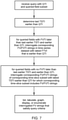
- a computer-implemented method can be employed for searching or filtering a time-series dataset for which multiple time-slice datasets have been generated (illustrative example shown in Fig. 7 ).
- An electronic query is received at the computer system for a list, tabulation, graph, display, or enumeration of FV data strings, of a queried subset of the multiple data fields specified in the query, having latest associated FVTI data strings earlier than a query time index (QTI; i.e., the "time X" referred to above).
- QTI query time index
- a time-series dataset for a multitude of drone aircraft operating across a geographic area includes data fields for latitude, longitude, altitude, inflight/grounded status, charging/discharging status, and percent charge on the battery, and those are recorded roughly every five minutes and reported as soon as is practicable for inclusion in the time-series dataset.
- Time slice datasets can be generated with TSTIs generated every hour on the hour; time-slice subsets can be defined based on specific groups of drones, or even single drones, within the multitude.
- a query of that time-series dataset might be to identify all drones that are in flight with less than 30% charge between 35° and 40° north latitude and between 100° and 105° west longitude as of 10:30 AM 09 FEB 2016.
- the queried data fields in this example are latitude, longitude, percent charge, and inflight/grounded status for each drone; the QTI is 10:30 AM 09 FEB 2016.
- a corresponding latest FVTI data string is automatically identified, for each field of the queried subset, that is earlier than the QTI.
- the latest corresponding FVTI occurring in the time-series dataset that is earlier than 10:30 AM 09 FEB 2016 is determined for each of the latitude, longitude, percent charge, and inflight/grounded status data fields for each drone.
- the FV data strings associated with each of the FVTIs thus identified are then automatically interrogated to determine whether they meet the search or filter criteria.
- interrogated fields indicating inflight with less than 30% charge between 35° and 40° north latitude and between 100° and 105° west longitude satisfy the criteria included in the query.
- those interrogated FV data strings or associated FVTI data strings that satisfy the search or filter criteria are listed, tabulated, graphed, displayed (e.g., on a map), or enumerated.
- the positions of the drones that meet the filter criteria can be plotted on a map.
- Identifying, for each queried data field, the latest FVTI data string in the time-series dataset that is earlier than the QTI can be accomplished by automatically electronically querying the electronic indicia of the time-series dataset itself. However, that direct query can be limited in scope (and time and computing resources) by employing the time-slice datasets.
- a latest TSTI among the time-slice datasets is determined that is earlier than the QTI, i.e., the next-earlier TSTI is identified.
- the QTI is 10:30 AM 09 FEB 2016, so the next-earlier TSTI is 10 AM 09 FEB 2016.
- the time-series dataset need only be queried to determine that there is no associated FVTI that is later than the next-earlier TSTI and earlier than the QTI.
- the latest FVTI (earlier than the QTI) in the time-series dataset is the FVTI included in, or indicated by a pointer of, the corresponding next-earlier time-slice data subset.
- the FV and FVTI data strings included in, or indicated by a pointer of, the time-slice data subset with the TSTI of 10 AM 09 FEB 2016 are interrogated as the latest available values for those fields earlier than 10:30 AM 09 FEB 2016 (i.e., earlier than the QTI).
- Direct access to and interrogation of the time-series dataset can be further limited by using one or more time-slice datasets with corresponding TSTIs later than the QTI.
- An earliest TSTI among the time-slice datasets is automatically determined that is later than the QTI, i.e., the next-later TSTI is identified.
- the next-later TSTI is identified.
- the corresponding time-slice data subset with the next-later TSTI includes a pointer for the corresponding FVTI, then there is certainly no FVTI in the time-series dataset for that field that is later than the next-earlier TSTI, and the time-series dataset need not be queried at all.
- the corresponding FVTI data string indicated by the pointer with the next-later TSTI is identified as the latest FVTI data string for that field, and the corresponding FV and FVTI data strings are interrogated.
- the field values indicated by that pointer in some earlier time-slice data subset
- the field values indicated by that pointer can be interrogated as the most recent value as of 10:30 AM 09 FEB 2016 (the QTI), without ever accessing or interrogating the time-series dataset itself.
- Direct access to and interrogation of the time-series dataset can be further limited, for a given queried data field, if any later time-slice dataset includes, or indicates with a pointer, an FVTI earlier than the QTI.
- any field for which such an FVTI exists (earlier than the QTI in a time-slice later than the QTI)
- there can be no FVTI later than that that is also earlier than the QTI and the time-series dataset need not be queried at all.
- the corresponding FVTI data string indicated by the pointer with the next-later TSTI is identified as the latest FVTI data string for that field, and the corresponding FV and FVTI data strings are interrogated.
- the field values indicated by that pointer can be interrogated as the most recent value as of 10:30 AM 09 FEB 2016 (the QTI), without ever accessing or interrogating the time-series dataset itself. While an FVTI earlier than the QTI that is found in any later time-slice dataset can yield this result, typically the next-later time-slice dataset would be employed.
- a convention for consistent treatment for QTIs that are the same as TSTIs or FVTIs can reduce or eliminate ambiguity that might otherwise arise when using the disclosed methods.
- Those QTIs can be treated as being either earlier than or later than the same TSTI or FVTI; consistent treatment of such QTIs removes potential ambiguity that could in turn lead to unsatisfactory results of the disclosed methods.
- any FVTI that indicates a time that is the same as a time indicated by the QTI is included among FVTIs that are treated as being earlier than the QTI
- any TSTI that indicates a time that is the same as a time indicated by the QTI is included among TSTIs that are treated as being earlier than the QTI.
- any FVTI that indicates a time that is the same as a time indicated by the QTI is included among FVTIs that are treated as being later than the QTI
- any TSTI that indicates a time that is the same as a time indicated by the QTI is included among TSTIs that are treated as being later than the QTI.
- any FVTI that indicates a time that is the same as a time indicated by the QTI is included among FVTIs that are treated as being earlier than the QTI, and any TSTI that indicates a time that is the same as a time indicated by the QTI is included among QTIs that are later than the TSTI.
- any FVTI that indicates a time that is the same as a time indicated by the QTI is included among FVTIs that are later than the QTI
- any TSTI that indicates a time that is the same as a time indicated by the QTI is included among TSTIs that are earlier than the TSTI.
- time-slice datasets it may be desirable in certain circumstances to generate one or more additional time-slice datasets (illustrative example shown in Fig. 5 ).
- One common scenario would be generation of new, later time-slice datasets as time passes and new time-series data is generated, with each new corresponding TSTI later than all others (except perhaps an "end-of-time' slice as described earlier, if employed).
- a new time-slice dataset is generated every hour on the hour that is later than the existing time-slice datasets.
- a new time-slice might be inserted with a corresponding new TSTI between two other extant TSTIs among the time-slice datasets.
- the existing TSTIs and time-slice datasets can be employed to reduce or eliminate accessing the time-series dataset itself to populate the new time-slice dataset.
- the new time-slice dataset can include one or more (or many) pointers to earlier time-slice datasets.
- all fields included in the time-slice datasets must be identified, not just a queried subset of those fields.
- generating a new time-slice dataset is analogous to performing a query of all data fields at the new TSTI and including or pointing to all the identified FV and FVTI strings in the new time-slice dataset.
- a corresponding latest FVTI data string is automatically identified, for each field of the time-slice datasets, that is earlier than the new designated TSTI.
- a new designated TSTI 2:30 PM 03 JAN 2016.
- the latest corresponding FVTI occurring in the time-series dataset that is earlier than 2:30 PM 03 JAN 2016 is determined for each of the latitude, longitude, percent charge, and inflight/grounded status data fields for each drone.
- the FV data strings associated with each of the FVTIs thus identified are then automatically included in, or indicated by pointers of, the new time-slice dataset (and corresponding data subsets thereof) with the new designated TSTI.
- Identifying, for each data field, the latest FVTI data string in the time-series dataset that is earlier than the new designated TSTI can be accomplished by automatically electronically querying the electronic indicia of the time-series dataset itself. However, that direct query can be limited in scope (and time and computing resources) by employing the extant time-slice datasets.
- a latest TSTI among the time-slice datasets is determined that is earlier than the new designated TSTI, i.e., the next-earlier TSTI is identified. In the drone example, if the new designated TSTI is 2:30 PM 03 JAN 2016, then the next-earlier TSTI is 2 PM 03 JAN 2016.
- the time-series dataset need only be queried to determine that there is no associated FVTI that is later than the next-earlier TSTI and earlier than the new TSTI.
- the latest FVTI (earlier than the new designated TSTI) in the time-series dataset is the FVTI included in, or indicated by a pointer of, the corresponding next-earlier time-slice data subset, and the corresponding FV and FVTI data strings are included in, or indicated by a pointer of, the new time-slice dataset.
- the FV and FVTI data strings included in, or indicated by a pointer of, the time-slice data subset with the TSTI of 2 PM 03 JAN 2016 are also included in, or indicated by a pointer of, the new time-slice data subset with the new TSTI of 2:30 PM 03 JAN 2016.
- Direct access to and interrogation of the time-series dataset can be further limited by using one or more time-slice datasets with corresponding TSTIs later than the new designated TSTI.
- An earliest TSTI among the time-slice datasets is automatically determined that is later than the new designated TSTI, i.e., the next-later TSTI is identified.
- the next-later TSTI is identified.
- the corresponding time-slice data subset with the next-later TSTI includes a pointer for the corresponding FVTI, then there is certainly no FVTI in the time-series dataset for that field that is later than the next-earlier TSTI, and the time-series dataset need not be queried at all.
- the corresponding FVTI data string indicated by the pointer with the next-later TSTI is identified as the latest FVTI data string for that field, and the corresponding FV and FVTI data strings are included in, or indicated by a pointer of, the new time-slice data subset with the new designated TSTI.
- the field values indicated by that pointer in some earlier time-slice data subset
- the new time-slice data subset can be included in, or indicated by a pointer of, the new time-slice data subset as the most recent field values as of 2:30 PM 03 JAN 2016 (the new designated TSTI), without ever accessing or interrogating the time-series dataset itself.
- Direct access to and interrogation of the time-series dataset can be further limited, for a given queried data field, if any later time-slice dataset includes, or indicates with a pointer, an FVTI earlier than the new designated TSTI.
- any field for which such an FVTI exists (earlier than the new designated TSTI in a time-slice later than the new designated TSTI)
- the corresponding FVTI data string indicated by the pointer with the next-later TSTI is identified as the latest FVTI data string for that field, and the corresponding FV and FVTI data strings are included in, or indicated by a pointer of, the new time-slice data subset.
- the field values indicated by that pointer can be included in, or indicated by a pointer of, the new time-slice data subset as the most recent value as of 2:30 PM 03 JAN 2016 (the new designated TSTI), without ever accessing or interrogating the time-series dataset itself. While an FVTI earlier than the new designated TSTI that is found in any later time-slice dataset can yield this result, typically the next-later time-slice dataset would be employed.
- any FV or FVTI data string is included in a given time-slice data subset of the new time-slice dataset, then all fields of that data subset are populated with FV and FVTI data strings; in such examples, a single pointer can be included in one time-slice data subset to indicate an entire earlier corresponding time-slice data subset.
- a given time-slice data subset can include a mixture of data strings and pointers. The choice between those arrangements is often suggested by the nature of or connections or correlations among the various data fields of the time-series dataset.
- any pointer of a later time-slice dataset that indicates a time-slice dataset earlier than the new time-slice dataset could be replaced with a new pointer that indicated the corresponding data string or pointer of the new time slice. More specifically, such pointers typically should be replaced in later time-slice data subsets that include at least one field for which a latest FVTI before the new TSTI was found that is also later than the first-earlier TSTI.
- time-slice datasets include pointers to any data strings or pointers of the deleted time-slice dataset, those pointers must be replaced or updated.
- updating such pointers to indicate the corresponding data string or pointer in the latest remaining time-slice dataset earlier than the deleted one will adequately address the issue.
- Other schemes could be devised and implemented.
- time-slice datasets may not always be necessary to generate an entire time-slice for this purpose; in some instances further time or space savings can be realized if only portions of the time-slice dataset are generated, i.e., only those portions that include data fields or pointers to be queried. In those instances, it may be unnecessary, and even undesirable, to alter extant time-slice datasets after generating the new ones. In some instances the additional one or more time-slice datasets are deleted, uncoupled from the extant previously extant time-slice subsets, or otherwise deactivated, in which case leaving the previously extant time-slice datasets unaltered would be preferred.
- a new FV data string and its associated new FVTI data string are received at the computer system, they are first included in and stored with the time-series dataset.
- the corresponding data field subset and corresponding time-slice data subsets are identified so as to indicate which portions of certain time-slice data subsets require updating (illustrative example shown in Fig. 6 ).
- the earliest TSTI among the time-slice datasets is determined that is later than the new FVTI (i.e., the first-later time slice is determined).
- time-slice data subset corresponding to the new FV data string in the first later time-slice includes a pointer, that pointer is replaced with the new FV data string and the associated new FVTI is included in the first-later time slice. If the replaced pointer also indicates other FV and FVTI data strings, those strings, or new pointers thereto, are included in the time-slice data subset along with the new FV and FVTI data strings.
- the corresponding time-slice data subsets of still-later time-slice datasets that include corresponding FVTI data strings, or pointers thereto, that are earlier than the new FVTI data string, are also replaced with the new FV and FVTI data strings or pointers thereto in those later time-slice data subsets.
- the entire group or time-slice data subset of the first-later time slice is replaced with FV and FVTI data strings, including the new FV and FVTI data strings.
- any still-later time-slice data subsets include pointers to FVTI data strings earlier than the new FVTI data string, those pointers are replaced with pointers to the newly updated first-later time-slice data subset.
- Some examples can include: oceanographic data, marine biology data, or geologic data can be collected at various depths, organized as a depth-series dataset, and queried with the assistance of multiple depth-slice datasets; atmospheric data can be collected at various altitudes, organized as an altitude-series dataset, and queried with the assistance of multiple altitude-slice datasets; astronomical data can be collected, evaluated to determine a corresponding spectral red-shift (functionally equivalent to distance), organized as a red-shift-series dataset, and queried with the assistance of multiple red-shift-slice datasets.
- a computer system comprising one or more electronic processors and one or more tangible, non-transitory computer-readable media, can be structured, connected, and programmed to perform any one or more of the preceding methods, including any one or more of the disclosed variations if desired.
- a tangible, non-transitory computer readable medium can encode computer-readable instructions that, when applied to a computer system, instruct the computer system to perform any one or more of the preceding methods, including any one or more of the disclosed variations.
- a tangible, non-transitory, computer-readable medium can be encoded to store the electronic indicia of the time-series dataset or one or more time-slice datasets generated and stored by any one or more of the preceding methods, including any one or more of the disclosed variations.
- a tangible, non-transitory, computer readable medium can be encoded with electronic indicia of a dataset similarly or analogously arranged that was generated or stored using any other suitable method or computer system.
- the systems and methods disclosed or claimed herein can be advantageously employed in conjunction with any type of data structure for the time-series dataset and the multiple time-slice datasets, including data arranged as simple text or numerical table, one or more spreadsheets, one or more relational databases, or one or more specialized data structures, such as those disclosed in (i) U.S. Pat. No. 8,977,656 , (ii) U.S. Pat. No. 8,990,204 , (iii) U.S. Pat. No. 9,002,859 , and (iv) U.S. Pat. No. 9,171,054 .
- a specialized data structure can be specifically optimized for one or more of the methods disclosed or claimed herein.
- Methods disclosed herein typically can be embodied as a computer program operating on one or more computers, computer systems, or servers, which include one or more processors and include or are otherwise operatively coupled to one or more tangible, non-transitory computer-readable media of any suitable type.
- the computers, systems, or servers that perform any given portion of the disclosed processes need not be, and sometimes are not, the same as those that perform the other portions of the disclosed processes.
- the computer, server, or system can be a stand-alone machine or can comprise one or machines connected by a local- or wide-area network (LAN or WAN) or the Internet. Any suitable hardware or hardware-plus-software implementation can be employed.
- the systems and methods disclosed herein can be implemented as or with general or special purpose computers or servers or other programmable hardware devices programmed through software, or as hardware or equipment “programmed” through hard wiring, or a combination of the two.
- a "computer” or “server” can comprise a single machine or can comprise multiple interacting machines (located at a single location or at multiple remote locations).
- Computer programs or other software code can be implemented in tangible, non-transient, temporary or permanent storage or replaceable media, such as by including programming in microcode, machine code, network-based or web-based or distributed software modules that operate together, RAM, ROM, CD-ROM, CD-R, CD-R/W, DVD-ROM, DVD ⁇ R, DVD ⁇ R/W, hard drives, thumb drives, flash memory, optical media, magnetic media, semiconductor media, or any future computer-readable storage alternatives.
- Electronic indicia of a dataset can be read from, received from, or stored on any of the tangible, non-transitory computer-readable media mentioned herein.
- each such phrase shall denote the case wherein the quantity in question has been reduced or diminished to such an extent that, for practical purposes in the context of the intended operation or use of the disclosed or claimed apparatus or method, the overall behavior or performance of the apparatus or method does not differ from that which would have occurred had the null quantity in fact been completely removed, exactly equal to zero, or otherwise exactly nulled.
- any labelling of elements, steps, limitations, or other portions of a claim e.g., (a), (b), (c), etc., or (i), (ii), (iii), etc.) is only for purposes of clarity, and shall not be construed as implying any sort of ordering or precedence of the claim portions so labelled. If any such ordering or precedence is intended, it will be explicitly recited in the claim or, in some instances, it will be implicit or inherent based on the specific content of the claim.
Landscapes
- Engineering & Computer Science (AREA)
- Theoretical Computer Science (AREA)
- Physics & Mathematics (AREA)
- Databases & Information Systems (AREA)
- General Physics & Mathematics (AREA)
- Software Systems (AREA)
- General Engineering & Computer Science (AREA)
- Data Mining & Analysis (AREA)
- Mathematical Physics (AREA)
- Computational Linguistics (AREA)
- Probability & Statistics with Applications (AREA)
- Fuzzy Systems (AREA)
- Information Retrieval, Db Structures And Fs Structures Therefor (AREA)
- Debugging And Monitoring (AREA)
- Management, Administration, Business Operations System, And Electronic Commerce (AREA)
Applications Claiming Priority (2)
| Application Number | Priority Date | Filing Date | Title |
|---|---|---|---|
| US15/019,965 US10248621B2 (en) | 2016-02-09 | 2016-02-09 | Systems and methods for storing, updating, searching, and filtering time-series datasets |
| PCT/US2017/016625 WO2017139207A1 (en) | 2016-02-09 | 2017-02-06 | Systems and methods for storing, updating, searching, and filtering time-series datasets |
Publications (3)
| Publication Number | Publication Date |
|---|---|
| EP3414682A1 EP3414682A1 (en) | 2018-12-19 |
| EP3414682A4 EP3414682A4 (en) | 2019-10-23 |
| EP3414682B1 true EP3414682B1 (en) | 2022-03-23 |
Family
ID=59497699
Family Applications (1)
| Application Number | Title | Priority Date | Filing Date |
|---|---|---|---|
| EP17750601.1A Active EP3414682B1 (en) | 2016-02-09 | 2017-02-06 | Systems and methods for storing, updating, searching, and filtering time-series datasets |
Country Status (8)
| Country | Link |
|---|---|
| US (3) | US10248621B2 (enExample) |
| EP (1) | EP3414682B1 (enExample) |
| JP (1) | JP6989137B2 (enExample) |
| CN (1) | CN108885642B (enExample) |
| AU (1) | AU2017216997B2 (enExample) |
| CA (1) | CA3014045A1 (enExample) |
| ES (1) | ES2913207T3 (enExample) |
| WO (1) | WO2017139207A1 (enExample) |
Families Citing this family (71)
| Publication number | Priority date | Publication date | Assignee | Title |
|---|---|---|---|---|
| US9396283B2 (en) | 2010-10-22 | 2016-07-19 | Daniel Paul Miranker | System for accessing a relational database using semantic queries |
| US10248621B2 (en) | 2016-02-09 | 2019-04-02 | Moonshadow Mobile, Inc. | Systems and methods for storing, updating, searching, and filtering time-series datasets |
| US10984008B2 (en) | 2016-06-19 | 2021-04-20 | Data.World, Inc. | Collaborative dataset consolidation via distributed computer networks |
| US10438013B2 (en) | 2016-06-19 | 2019-10-08 | Data.World, Inc. | Platform management of integrated access of public and privately-accessible datasets utilizing federated query generation and query schema rewriting optimization |
| US10353911B2 (en) | 2016-06-19 | 2019-07-16 | Data.World, Inc. | Computerized tools to discover, form, and analyze dataset interrelations among a system of networked collaborative datasets |
| US11042548B2 (en) | 2016-06-19 | 2021-06-22 | Data World, Inc. | Aggregation of ancillary data associated with source data in a system of networked collaborative datasets |
| US11334625B2 (en) | 2016-06-19 | 2022-05-17 | Data.World, Inc. | Loading collaborative datasets into data stores for queries via distributed computer networks |
| US11468049B2 (en) | 2016-06-19 | 2022-10-11 | Data.World, Inc. | Data ingestion to generate layered dataset interrelations to form a system of networked collaborative datasets |
| US10102258B2 (en) | 2016-06-19 | 2018-10-16 | Data.World, Inc. | Collaborative dataset consolidation via distributed computer networks |
| US11755602B2 (en) | 2016-06-19 | 2023-09-12 | Data.World, Inc. | Correlating parallelized data from disparate data sources to aggregate graph data portions to predictively identify entity data |
| US11036697B2 (en) | 2016-06-19 | 2021-06-15 | Data.World, Inc. | Transmuting data associations among data arrangements to facilitate data operations in a system of networked collaborative datasets |
| US11068847B2 (en) | 2016-06-19 | 2021-07-20 | Data.World, Inc. | Computerized tools to facilitate data project development via data access layering logic in a networked computing platform including collaborative datasets |
| US10346429B2 (en) * | 2016-06-19 | 2019-07-09 | Data.World, Inc. | Management of collaborative datasets via distributed computer networks |
| US11036716B2 (en) | 2016-06-19 | 2021-06-15 | Data World, Inc. | Layered data generation and data remediation to facilitate formation of interrelated data in a system of networked collaborative datasets |
| US11016931B2 (en) | 2016-06-19 | 2021-05-25 | Data.World, Inc. | Data ingestion to generate layered dataset interrelations to form a system of networked collaborative datasets |
| US11941140B2 (en) | 2016-06-19 | 2024-03-26 | Data.World, Inc. | Platform management of integrated access of public and privately-accessible datasets utilizing federated query generation and query schema rewriting optimization |
| US10747774B2 (en) | 2016-06-19 | 2020-08-18 | Data.World, Inc. | Interactive interfaces to present data arrangement overviews and summarized dataset attributes for collaborative datasets |
| US10699027B2 (en) | 2016-06-19 | 2020-06-30 | Data.World, Inc. | Loading collaborative datasets into data stores for queries via distributed computer networks |
| US11042537B2 (en) | 2016-06-19 | 2021-06-22 | Data.World, Inc. | Link-formative auxiliary queries applied at data ingestion to facilitate data operations in a system of networked collaborative datasets |
| US11086896B2 (en) | 2016-06-19 | 2021-08-10 | Data.World, Inc. | Dynamic composite data dictionary to facilitate data operations via computerized tools configured to access collaborative datasets in a networked computing platform |
| US10691710B2 (en) | 2016-06-19 | 2020-06-23 | Data.World, Inc. | Interactive interfaces as computerized tools to present summarization data of dataset attributes for collaborative datasets |
| US10515085B2 (en) | 2016-06-19 | 2019-12-24 | Data.World, Inc. | Consolidator platform to implement collaborative datasets via distributed computer networks |
| US10645548B2 (en) | 2016-06-19 | 2020-05-05 | Data.World, Inc. | Computerized tool implementation of layered data files to discover, form, or analyze dataset interrelations of networked collaborative datasets |
| US10853376B2 (en) | 2016-06-19 | 2020-12-01 | Data.World, Inc. | Collaborative dataset consolidation via distributed computer networks |
| US11023104B2 (en) | 2016-06-19 | 2021-06-01 | data.world,Inc. | Interactive interfaces as computerized tools to present summarization data of dataset attributes for collaborative datasets |
| US11947554B2 (en) | 2016-06-19 | 2024-04-02 | Data.World, Inc. | Loading collaborative datasets into data stores for queries via distributed computer networks |
| US11675808B2 (en) | 2016-06-19 | 2023-06-13 | Data.World, Inc. | Dataset analysis and dataset attribute inferencing to form collaborative datasets |
| US10324925B2 (en) | 2016-06-19 | 2019-06-18 | Data.World, Inc. | Query generation for collaborative datasets |
| US11068475B2 (en) | 2016-06-19 | 2021-07-20 | Data.World, Inc. | Computerized tools to develop and manage data-driven projects collaboratively via a networked computing platform and collaborative datasets |
| US11042556B2 (en) | 2016-06-19 | 2021-06-22 | Data.World, Inc. | Localized link formation to perform implicitly federated queries using extended computerized query language syntax |
| US10452677B2 (en) | 2016-06-19 | 2019-10-22 | Data.World, Inc. | Dataset analysis and dataset attribute inferencing to form collaborative datasets |
| US10824637B2 (en) | 2017-03-09 | 2020-11-03 | Data.World, Inc. | Matching subsets of tabular data arrangements to subsets of graphical data arrangements at ingestion into data driven collaborative datasets |
| US10452975B2 (en) | 2016-06-19 | 2019-10-22 | Data.World, Inc. | Platform management of integrated access of public and privately-accessible datasets utilizing federated query generation and query schema rewriting optimization |
| US11042560B2 (en) | 2016-06-19 | 2021-06-22 | data. world, Inc. | Extended computerized query language syntax for analyzing multiple tabular data arrangements in data-driven collaborative projects |
| US10521411B2 (en) | 2016-08-10 | 2019-12-31 | Moonshadow Mobile, Inc. | Systems, methods, and data structures for high-speed searching or filtering of large datasets |
| US10810662B1 (en) * | 2016-11-10 | 2020-10-20 | Amazon Technologies, Inc. | Utilizing time-series tables for tracking accumulating values |
| US11238109B2 (en) | 2017-03-09 | 2022-02-01 | Data.World, Inc. | Computerized tools configured to determine subsets of graph data arrangements for linking relevant data to enrich datasets associated with a data-driven collaborative dataset platform |
| US11068453B2 (en) | 2017-03-09 | 2021-07-20 | data.world, Inc | Determining a degree of similarity of a subset of tabular data arrangements to subsets of graph data arrangements at ingestion into a data-driven collaborative dataset platform |
| US12008050B2 (en) | 2017-03-09 | 2024-06-11 | Data.World, Inc. | Computerized tools configured to determine subsets of graph data arrangements for linking relevant data to enrich datasets associated with a data-driven collaborative dataset platform |
| US11243960B2 (en) | 2018-03-20 | 2022-02-08 | Data.World, Inc. | Content addressable caching and federation in linked data projects in a data-driven collaborative dataset platform using disparate database architectures |
| US10922308B2 (en) | 2018-03-20 | 2021-02-16 | Data.World, Inc. | Predictive determination of constraint data for application with linked data in graph-based datasets associated with a data-driven collaborative dataset platform |
| US11947529B2 (en) | 2018-05-22 | 2024-04-02 | Data.World, Inc. | Generating and analyzing a data model to identify relevant data catalog data derived from graph-based data arrangements to perform an action |
| US11327991B2 (en) | 2018-05-22 | 2022-05-10 | Data.World, Inc. | Auxiliary query commands to deploy predictive data models for queries in a networked computing platform |
| US12117997B2 (en) | 2018-05-22 | 2024-10-15 | Data.World, Inc. | Auxiliary query commands to deploy predictive data models for queries in a networked computing platform |
| US11537990B2 (en) | 2018-05-22 | 2022-12-27 | Data.World, Inc. | Computerized tools to collaboratively generate queries to access in-situ predictive data models in a networked computing platform |
| USD940732S1 (en) | 2018-05-22 | 2022-01-11 | Data.World, Inc. | Display screen or portion thereof with a graphical user interface |
| USD920353S1 (en) | 2018-05-22 | 2021-05-25 | Data.World, Inc. | Display screen or portion thereof with graphical user interface |
| USD940169S1 (en) | 2018-05-22 | 2022-01-04 | Data.World, Inc. | Display screen or portion thereof with a graphical user interface |
| US11442988B2 (en) | 2018-06-07 | 2022-09-13 | Data.World, Inc. | Method and system for editing and maintaining a graph schema |
| US10671624B2 (en) * | 2018-06-13 | 2020-06-02 | The Mathworks, Inc. | Parallel filtering of large time series of data for filters having recursive dependencies |
| TWI687821B (zh) * | 2018-11-21 | 2020-03-11 | 核桃運算股份有限公司 | 資料追蹤裝置、方法及其電腦程式產品 |
| US11294921B2 (en) * | 2019-03-12 | 2022-04-05 | General Electric Company | Multivariate time-series data search |
| US11372871B1 (en) | 2020-02-21 | 2022-06-28 | Rapid7, Inc. | Programmable framework for distributed computation of statistical functions over time-based data |
| CN111522846B (zh) * | 2020-04-09 | 2023-08-22 | 浙江邦盛科技股份有限公司 | 一种基于时序中间态数据结构的数据聚合方法 |
| WO2022076246A1 (en) * | 2020-10-05 | 2022-04-14 | R2Dio, Inc. | Methods and systems associated with a data input platform and differential graph representations |
| CN112527862A (zh) * | 2020-12-10 | 2021-03-19 | 国网河北省电力有限公司雄安新区供电公司 | 一种时间序列数据的处理方法及装置 |
| US12021861B2 (en) * | 2021-01-04 | 2024-06-25 | Bank Of America Corporation | Identity verification through multisystem cooperation |
| KR102457964B1 (ko) * | 2021-02-18 | 2022-10-24 | 한국전자기술연구원 | 파편적 데이터 검색 장치 및 방법 |
| KR102457965B1 (ko) * | 2021-02-18 | 2022-10-24 | 한국전자기술연구원 | 파편적 데이터 통합 장치 및 방법 |
| TWI767570B (zh) * | 2021-02-19 | 2022-06-11 | 兆竑智聯股份有限公司 | 設備維運系統及設備維運方法 |
| CN113010570B (zh) * | 2021-03-11 | 2023-01-20 | 南方电网数字电网研究院有限公司 | 电网设备矢量数据查询方法、装置、计算机设备和介质 |
| US11941014B1 (en) | 2021-06-16 | 2024-03-26 | Amazon Technologies, Inc. | Versioned metadata management for a time-series database |
| US11461347B1 (en) * | 2021-06-16 | 2022-10-04 | Amazon Technologies, Inc. | Adaptive querying of time-series data over tiered storage |
| US11947600B2 (en) | 2021-11-30 | 2024-04-02 | Data.World, Inc. | Content addressable caching and federation in linked data projects in a data-driven collaborative dataset platform using disparate database architectures |
| US20230280767A1 (en) * | 2022-03-01 | 2023-09-07 | Rockwell Collins, Inc. | Collaborative search mapping for autonomous multi-asset teams |
| US12141163B2 (en) | 2022-06-17 | 2024-11-12 | Palantir Technologies Inc. | Synchronising datasets updates |
| CN115295164A (zh) * | 2022-07-21 | 2022-11-04 | 泰康保险集团股份有限公司 | 医保数据的处理方法、装置、电子设备和存储介质 |
| EP4619875A1 (en) * | 2022-11-18 | 2025-09-24 | Xero Limited | Systems, methods and computer-readable media for categorising information from a visual representation of data |
| US12353393B2 (en) * | 2023-09-28 | 2025-07-08 | Servicenow, Inc. | Time-series database for storing and indexing events and metrics |
| CN120429369B (zh) * | 2025-07-07 | 2025-11-21 | 北方健康医疗大数据科技有限公司 | 基于增量字段自适应智能匹配的增量数据同步方法及系统 |
| CN120805105B (zh) * | 2025-09-12 | 2025-12-02 | 西安交通大学 | 一种滑坡位移预测方法、系统、设备及存储介质 |
Family Cites Families (34)
| Publication number | Priority date | Publication date | Assignee | Title |
|---|---|---|---|---|
| AU2003280474A1 (en) * | 2002-06-28 | 2004-01-19 | Conceptual Speech, Llc | Multi-phoneme streamer and knowledge representation speech recognition system and method |
| US7107629B2 (en) | 2002-08-09 | 2006-09-19 | Coolsystems, Inc. | Apparel including a heat exchanger |
| US7386554B2 (en) * | 2002-09-03 | 2008-06-10 | Infoglide Software Corporation | Remote scoring and aggregating similarity search engine for use with relational databases |
| US20050027690A1 (en) * | 2003-07-29 | 2005-02-03 | International Business Machines Corporation | Dynamic selection of optimal grouping sequence at runtime for grouping sets, rollup and cube operations in SQL query processing |
| US20050256652A1 (en) * | 2004-05-16 | 2005-11-17 | Sai-Ping Li | Reconstruction of gene networks from time-series microarray data |
| US8924269B2 (en) * | 2006-05-13 | 2014-12-30 | Sap Ag | Consistent set of interfaces derived from a business object model |
| KR101266267B1 (ko) | 2006-10-05 | 2013-05-23 | 스플렁크 인코퍼레이티드 | 시계열 검색 엔진 |
| US20080208820A1 (en) * | 2007-02-28 | 2008-08-28 | Psydex Corporation | Systems and methods for performing semantic analysis of information over time and space |
| CA3121387A1 (en) | 2009-08-04 | 2011-02-10 | Evogene Ltd. | Isolated polynucleotides and polypeptides, and methods of using same forincreasing abiotic stress tolerance, yield, growth rate, vigor, biomass oil content, and/or nitrogen use efficiency of plants |
| US8407242B2 (en) * | 2010-12-16 | 2013-03-26 | Microsoft Corporation | Temporal binding for semantic queries |
| US9002859B1 (en) | 2010-12-17 | 2015-04-07 | Moonshadow Mobile, Inc. | Systems and methods for high-speed searching and filtering of large datasets |
| US8977656B2 (en) | 2011-01-10 | 2015-03-10 | Moonshadow Mobile, Inc. | Inline tree data structure for high-speed searching and filtering of large datasets |
| GB2494630A (en) | 2011-09-09 | 2013-03-20 | Onzo Ltd | Storing time series data |
| US20130091266A1 (en) * | 2011-10-05 | 2013-04-11 | Ajit Bhave | System for organizing and fast searching of massive amounts of data |
| US9171054B1 (en) | 2012-01-04 | 2015-10-27 | Moonshadow Mobile, Inc. | Systems and methods for high-speed searching and filtering of large datasets |
| US8990204B1 (en) | 2012-01-17 | 2015-03-24 | Roy W. Ward | Processing and storage of spatial data |
| CN103577456B (zh) | 2012-07-31 | 2016-12-21 | 国际商业机器公司 | 用于处理时序数据的方法和装置 |
| JP6029951B2 (ja) | 2012-11-27 | 2016-11-24 | 株式会社日立製作所 | 時系列データベースの設定自動生成方法、設定自動生成システム並びに監視サーバ |
| US9607067B2 (en) * | 2013-01-25 | 2017-03-28 | International Business Machines Corporation | Synchronization of time between different simulation models |
| US10387429B2 (en) * | 2013-02-08 | 2019-08-20 | Jive Software, Inc. | Fast ad-hoc filtering of time series analytics |
| CN104102680A (zh) * | 2013-04-15 | 2014-10-15 | 肖瑞 | 时间序列的编码索引 |
| CN103390045A (zh) * | 2013-07-19 | 2013-11-13 | 北京京东尚科信息技术有限公司 | 一种用于监控系统的时间序列存储方法及装置 |
| US9921732B2 (en) * | 2013-07-31 | 2018-03-20 | Splunk Inc. | Radial graphs for visualizing data in real-time |
| CN104516894B (zh) * | 2013-09-27 | 2018-08-17 | 国际商业机器公司 | 用于管理时间序列数据库的方法和装置 |
| WO2015064293A1 (ja) * | 2013-11-01 | 2015-05-07 | 株式会社東芝 | データパターン分析最適化処理装置、及びデータパターン分析最適化処理方法 |
| US9361329B2 (en) * | 2013-12-13 | 2016-06-07 | International Business Machines Corporation | Managing time series databases |
| US9697262B2 (en) * | 2013-12-17 | 2017-07-04 | Microsoft Technology Licensing, Llc | Analytical data processing engine |
| KR20150121567A (ko) | 2014-04-21 | 2015-10-29 | 삼성전기주식회사 | 적층 세라믹 커패시터 및 그의 제조 방법 |
| US10445399B2 (en) * | 2014-05-22 | 2019-10-15 | Sap Se | Forecast-model-aware data storage for time series data |
| CN104156385B (zh) * | 2014-06-24 | 2018-09-14 | 北京京东尚科信息技术有限公司 | 一种处理时间序列数据的方法和装置 |
| US10013466B2 (en) * | 2014-12-16 | 2018-07-03 | Sap Se | Using time information to prune queries against partitioned data |
| US10706127B2 (en) * | 2016-01-14 | 2020-07-07 | Sumo Logic | Single click delta analysis |
| US10248621B2 (en) | 2016-02-09 | 2019-04-02 | Moonshadow Mobile, Inc. | Systems and methods for storing, updating, searching, and filtering time-series datasets |
| US10521411B2 (en) | 2016-08-10 | 2019-12-31 | Moonshadow Mobile, Inc. | Systems, methods, and data structures for high-speed searching or filtering of large datasets |
-
2016
- 2016-02-09 US US15/019,965 patent/US10248621B2/en active Active
-
2017
- 2017-02-06 CA CA3014045A patent/CA3014045A1/en active Pending
- 2017-02-06 ES ES17750601T patent/ES2913207T3/es active Active
- 2017-02-06 WO PCT/US2017/016625 patent/WO2017139207A1/en not_active Ceased
- 2017-02-06 AU AU2017216997A patent/AU2017216997B2/en not_active Ceased
- 2017-02-06 JP JP2018560722A patent/JP6989137B2/ja active Active
- 2017-02-06 EP EP17750601.1A patent/EP3414682B1/en active Active
- 2017-02-06 CN CN201780022116.7A patent/CN108885642B/zh active Active
-
2019
- 2019-03-29 US US16/370,802 patent/US11100068B2/en active Active
-
2021
- 2021-08-23 US US17/408,493 patent/US11663183B2/en active Active
Also Published As
| Publication number | Publication date |
|---|---|
| JP2019506697A (ja) | 2019-03-07 |
| US11100068B2 (en) | 2021-08-24 |
| US11663183B2 (en) | 2023-05-30 |
| US10248621B2 (en) | 2019-04-02 |
| EP3414682A1 (en) | 2018-12-19 |
| AU2017216997B2 (en) | 2022-01-20 |
| US20170228405A1 (en) | 2017-08-10 |
| ES2913207T3 (es) | 2022-06-01 |
| WO2017139207A1 (en) | 2017-08-17 |
| CN108885642A (zh) | 2018-11-23 |
| CA3014045A1 (en) | 2017-08-17 |
| CN108885642B (zh) | 2022-04-08 |
| EP3414682A4 (en) | 2019-10-23 |
| JP6989137B2 (ja) | 2022-01-05 |
| US20220043792A1 (en) | 2022-02-10 |
| US20190294599A1 (en) | 2019-09-26 |
| AU2017216997A1 (en) | 2018-09-06 |
Similar Documents
| Publication | Publication Date | Title |
|---|---|---|
| US11663183B2 (en) | Systems and methods for storing, updating, searching, and filtering time-series datasets | |
| Al-Hemoud et al. | Economic impact and risk assessment of sand and dust storms (SDS) on the oil and gas industry in Kuwait | |
| US10267642B2 (en) | Systems and methods for assessing vehicle and vehicle operator efficiency | |
| Czermański et al. | An energy consumption approach to estimate air emission reductions in container shipping | |
| Gong et al. | A comparative study on fuel consumption prediction methods of heavy-duty diesel trucks considering 21 influencing factors | |
| US7341197B2 (en) | Component tagging with maintenance related information in open and closed formats | |
| US10936917B2 (en) | System and method for detecting and classifying recurrent stops of a vehicle fleet | |
| Oszczypała et al. | Analysis of light utility vehicle readiness in military transportation systems using Markov and semi-Markov processes | |
| US20190205829A1 (en) | Automatically clustering shipping units at different hierarchical levels via machine learning models | |
| Yu et al. | Integrated carbon emission estimation method and energy conservation analysis: the Port of Los Angles case study | |
| Woo et al. | Estimation of the efficiency of vessel speed reduction to mitigate gas emission in Busan port using the AIS database | |
| Kannan | A methodology for the development of a production experience database for earthmoving operations using automated data collection | |
| Lagha et al. | Assessment of Greenhouse Gas Emissions from Heavy-Duty Trucking in a Non-Containerized Port through Simulation-Based Methods | |
| Filer et al. | Distribution mapping of specialized amphibian species in rare, ephemeral habitats: Implications for the conservation of threatened “acid” frogs in south‐east Queensland | |
| Arooj et al. | Modeling smart agriculture using SensorML | |
| von Depka Prondzinski et al. | Automated Reporting for Flight Tests: Enhancing Efficiency with AI and Digital Twin Technology | |
| Ponomarev et al. | Main Factors Affecting the Multimodal Transport System | |
| CN117710171A (zh) | 一种突发环境事件应急管理方法及系统 | |
| Stone | Developing an Excel Decision Support System Using In-Transit Visibility to Decrease DoD Transportation Delays |
Legal Events
| Date | Code | Title | Description |
|---|---|---|---|
| STAA | Information on the status of an ep patent application or granted ep patent |
Free format text: STATUS: THE INTERNATIONAL PUBLICATION HAS BEEN MADE |
|
| PUAI | Public reference made under article 153(3) epc to a published international application that has entered the european phase |
Free format text: ORIGINAL CODE: 0009012 |
|
| STAA | Information on the status of an ep patent application or granted ep patent |
Free format text: STATUS: REQUEST FOR EXAMINATION WAS MADE |
|
| 17P | Request for examination filed |
Effective date: 20180808 |
|
| AK | Designated contracting states |
Kind code of ref document: A1 Designated state(s): AL AT BE BG CH CY CZ DE DK EE ES FI FR GB GR HR HU IE IS IT LI LT LU LV MC MK MT NL NO PL PT RO RS SE SI SK SM TR |
|
| AX | Request for extension of the european patent |
Extension state: BA ME |
|
| DAV | Request for validation of the european patent (deleted) | ||
| DAX | Request for extension of the european patent (deleted) | ||
| REG | Reference to a national code |
Ref country code: DE Ref legal event code: R079 Ref document number: 602017054939 Country of ref document: DE Free format text: PREVIOUS MAIN CLASS: G06F0017300000 Ipc: G06F0016245800 |
|
| A4 | Supplementary search report drawn up and despatched |
Effective date: 20190920 |
|
| RIC1 | Information provided on ipc code assigned before grant |
Ipc: G06F 16/2458 20190101AFI20190916BHEP Ipc: G06F 16/22 20190101ALI20190916BHEP |
|
| STAA | Information on the status of an ep patent application or granted ep patent |
Free format text: STATUS: EXAMINATION IS IN PROGRESS |
|
| 17Q | First examination report despatched |
Effective date: 20210224 |
|
| GRAP | Despatch of communication of intention to grant a patent |
Free format text: ORIGINAL CODE: EPIDOSNIGR1 |
|
| STAA | Information on the status of an ep patent application or granted ep patent |
Free format text: STATUS: GRANT OF PATENT IS INTENDED |
|
| INTG | Intention to grant announced |
Effective date: 20210930 |
|
| GRAS | Grant fee paid |
Free format text: ORIGINAL CODE: EPIDOSNIGR3 |
|
| GRAA | (expected) grant |
Free format text: ORIGINAL CODE: 0009210 |
|
| STAA | Information on the status of an ep patent application or granted ep patent |
Free format text: STATUS: THE PATENT HAS BEEN GRANTED |
|
| AK | Designated contracting states |
Kind code of ref document: B1 Designated state(s): AL AT BE BG CH CY CZ DE DK EE ES FI FR GB GR HR HU IE IS IT LI LT LU LV MC MK MT NL NO PL PT RO RS SE SI SK SM TR |
|
| REG | Reference to a national code |
Ref country code: GB Ref legal event code: FG4D |
|
| REG | Reference to a national code |
Ref country code: CH Ref legal event code: EP |
|
| REG | Reference to a national code |
Ref country code: IE Ref legal event code: FG4D |
|
| REG | Reference to a national code |
Ref country code: DE Ref legal event code: R096 Ref document number: 602017054939 Country of ref document: DE |
|
| REG | Reference to a national code |
Ref country code: AT Ref legal event code: REF Ref document number: 1477942 Country of ref document: AT Kind code of ref document: T Effective date: 20220415 |
|
| REG | Reference to a national code |
Ref country code: ES Ref legal event code: FG2A Ref document number: 2913207 Country of ref document: ES Kind code of ref document: T3 Effective date: 20220601 |
|
| REG | Reference to a national code |
Ref country code: NL Ref legal event code: FP |
|
| REG | Reference to a national code |
Ref country code: LT Ref legal event code: MG9D |
|
| PG25 | Lapsed in a contracting state [announced via postgrant information from national office to epo] |
Ref country code: SE Free format text: LAPSE BECAUSE OF FAILURE TO SUBMIT A TRANSLATION OF THE DESCRIPTION OR TO PAY THE FEE WITHIN THE PRESCRIBED TIME-LIMIT Effective date: 20220323 Ref country code: RS Free format text: LAPSE BECAUSE OF FAILURE TO SUBMIT A TRANSLATION OF THE DESCRIPTION OR TO PAY THE FEE WITHIN THE PRESCRIBED TIME-LIMIT Effective date: 20220323 Ref country code: NO Free format text: LAPSE BECAUSE OF FAILURE TO SUBMIT A TRANSLATION OF THE DESCRIPTION OR TO PAY THE FEE WITHIN THE PRESCRIBED TIME-LIMIT Effective date: 20220623 Ref country code: LT Free format text: LAPSE BECAUSE OF FAILURE TO SUBMIT A TRANSLATION OF THE DESCRIPTION OR TO PAY THE FEE WITHIN THE PRESCRIBED TIME-LIMIT Effective date: 20220323 Ref country code: HR Free format text: LAPSE BECAUSE OF FAILURE TO SUBMIT A TRANSLATION OF THE DESCRIPTION OR TO PAY THE FEE WITHIN THE PRESCRIBED TIME-LIMIT Effective date: 20220323 Ref country code: BG Free format text: LAPSE BECAUSE OF FAILURE TO SUBMIT A TRANSLATION OF THE DESCRIPTION OR TO PAY THE FEE WITHIN THE PRESCRIBED TIME-LIMIT Effective date: 20220623 |
|
| REG | Reference to a national code |
Ref country code: AT Ref legal event code: MK05 Ref document number: 1477942 Country of ref document: AT Kind code of ref document: T Effective date: 20220323 |
|
| PG25 | Lapsed in a contracting state [announced via postgrant information from national office to epo] |
Ref country code: LV Free format text: LAPSE BECAUSE OF FAILURE TO SUBMIT A TRANSLATION OF THE DESCRIPTION OR TO PAY THE FEE WITHIN THE PRESCRIBED TIME-LIMIT Effective date: 20220323 Ref country code: GR Free format text: LAPSE BECAUSE OF FAILURE TO SUBMIT A TRANSLATION OF THE DESCRIPTION OR TO PAY THE FEE WITHIN THE PRESCRIBED TIME-LIMIT Effective date: 20220624 Ref country code: FI Free format text: LAPSE BECAUSE OF FAILURE TO SUBMIT A TRANSLATION OF THE DESCRIPTION OR TO PAY THE FEE WITHIN THE PRESCRIBED TIME-LIMIT Effective date: 20220323 |
|
| PG25 | Lapsed in a contracting state [announced via postgrant information from national office to epo] |
Ref country code: SM Free format text: LAPSE BECAUSE OF FAILURE TO SUBMIT A TRANSLATION OF THE DESCRIPTION OR TO PAY THE FEE WITHIN THE PRESCRIBED TIME-LIMIT Effective date: 20220323 Ref country code: SK Free format text: LAPSE BECAUSE OF FAILURE TO SUBMIT A TRANSLATION OF THE DESCRIPTION OR TO PAY THE FEE WITHIN THE PRESCRIBED TIME-LIMIT Effective date: 20220323 Ref country code: RO Free format text: LAPSE BECAUSE OF FAILURE TO SUBMIT A TRANSLATION OF THE DESCRIPTION OR TO PAY THE FEE WITHIN THE PRESCRIBED TIME-LIMIT Effective date: 20220323 Ref country code: PT Free format text: LAPSE BECAUSE OF FAILURE TO SUBMIT A TRANSLATION OF THE DESCRIPTION OR TO PAY THE FEE WITHIN THE PRESCRIBED TIME-LIMIT Effective date: 20220725 Ref country code: EE Free format text: LAPSE BECAUSE OF FAILURE TO SUBMIT A TRANSLATION OF THE DESCRIPTION OR TO PAY THE FEE WITHIN THE PRESCRIBED TIME-LIMIT Effective date: 20220323 Ref country code: CZ Free format text: LAPSE BECAUSE OF FAILURE TO SUBMIT A TRANSLATION OF THE DESCRIPTION OR TO PAY THE FEE WITHIN THE PRESCRIBED TIME-LIMIT Effective date: 20220323 Ref country code: AT Free format text: LAPSE BECAUSE OF FAILURE TO SUBMIT A TRANSLATION OF THE DESCRIPTION OR TO PAY THE FEE WITHIN THE PRESCRIBED TIME-LIMIT Effective date: 20220323 |
|
| PG25 | Lapsed in a contracting state [announced via postgrant information from national office to epo] |
Ref country code: PL Free format text: LAPSE BECAUSE OF FAILURE TO SUBMIT A TRANSLATION OF THE DESCRIPTION OR TO PAY THE FEE WITHIN THE PRESCRIBED TIME-LIMIT Effective date: 20220323 Ref country code: IS Free format text: LAPSE BECAUSE OF FAILURE TO SUBMIT A TRANSLATION OF THE DESCRIPTION OR TO PAY THE FEE WITHIN THE PRESCRIBED TIME-LIMIT Effective date: 20220723 Ref country code: AL Free format text: LAPSE BECAUSE OF FAILURE TO SUBMIT A TRANSLATION OF THE DESCRIPTION OR TO PAY THE FEE WITHIN THE PRESCRIBED TIME-LIMIT Effective date: 20220323 |
|
| REG | Reference to a national code |
Ref country code: DE Ref legal event code: R097 Ref document number: 602017054939 Country of ref document: DE |
|
| PLBE | No opposition filed within time limit |
Free format text: ORIGINAL CODE: 0009261 |
|
| STAA | Information on the status of an ep patent application or granted ep patent |
Free format text: STATUS: NO OPPOSITION FILED WITHIN TIME LIMIT |
|
| PG25 | Lapsed in a contracting state [announced via postgrant information from national office to epo] |
Ref country code: DK Free format text: LAPSE BECAUSE OF FAILURE TO SUBMIT A TRANSLATION OF THE DESCRIPTION OR TO PAY THE FEE WITHIN THE PRESCRIBED TIME-LIMIT Effective date: 20220323 |
|
| 26N | No opposition filed |
Effective date: 20230102 |
|
| PG25 | Lapsed in a contracting state [announced via postgrant information from national office to epo] |
Ref country code: SI Free format text: LAPSE BECAUSE OF FAILURE TO SUBMIT A TRANSLATION OF THE DESCRIPTION OR TO PAY THE FEE WITHIN THE PRESCRIBED TIME-LIMIT Effective date: 20220323 |
|
| PG25 | Lapsed in a contracting state [announced via postgrant information from national office to epo] |
Ref country code: MC Free format text: LAPSE BECAUSE OF FAILURE TO SUBMIT A TRANSLATION OF THE DESCRIPTION OR TO PAY THE FEE WITHIN THE PRESCRIBED TIME-LIMIT Effective date: 20220323 |
|
| PG25 | Lapsed in a contracting state [announced via postgrant information from national office to epo] |
Ref country code: LU Free format text: LAPSE BECAUSE OF NON-PAYMENT OF DUE FEES Effective date: 20230206 |
|
| PGFP | Annual fee paid to national office [announced via postgrant information from national office to epo] |
Ref country code: ES Payment date: 20240304 Year of fee payment: 8 Ref country code: IE Payment date: 20240126 Year of fee payment: 8 Ref country code: NL Payment date: 20240226 Year of fee payment: 8 |
|
| PGFP | Annual fee paid to national office [announced via postgrant information from national office to epo] |
Ref country code: GB Payment date: 20240214 Year of fee payment: 8 Ref country code: CH Payment date: 20240301 Year of fee payment: 8 |
|
| PGFP | Annual fee paid to national office [announced via postgrant information from national office to epo] |
Ref country code: IT Payment date: 20240206 Year of fee payment: 8 Ref country code: FR Payment date: 20240130 Year of fee payment: 8 Ref country code: BE Payment date: 20240226 Year of fee payment: 8 |
|
| PGFP | Annual fee paid to national office [announced via postgrant information from national office to epo] |
Ref country code: DE Payment date: 20250227 Year of fee payment: 9 |
|
| PG25 | Lapsed in a contracting state [announced via postgrant information from national office to epo] |
Ref country code: CY Free format text: LAPSE BECAUSE OF FAILURE TO SUBMIT A TRANSLATION OF THE DESCRIPTION OR TO PAY THE FEE WITHIN THE PRESCRIBED TIME-LIMIT; INVALID AB INITIO Effective date: 20170206 |
|
| PG25 | Lapsed in a contracting state [announced via postgrant information from national office to epo] |
Ref country code: HU Free format text: LAPSE BECAUSE OF FAILURE TO SUBMIT A TRANSLATION OF THE DESCRIPTION OR TO PAY THE FEE WITHIN THE PRESCRIBED TIME-LIMIT; INVALID AB INITIO Effective date: 20170206 |
|
| REG | Reference to a national code |
Ref country code: CH Ref legal event code: PL |
|
| REG | Reference to a national code |
Ref country code: NL Ref legal event code: MM Effective date: 20250301 |
|
| PG25 | Lapsed in a contracting state [announced via postgrant information from national office to epo] |
Ref country code: CH Free format text: LAPSE BECAUSE OF NON-PAYMENT OF DUE FEES Effective date: 20250228 |
|
| GBPC | Gb: european patent ceased through non-payment of renewal fee |
Effective date: 20250206 |
|
| PG25 | Lapsed in a contracting state [announced via postgrant information from national office to epo] |
Ref country code: NL Free format text: LAPSE BECAUSE OF NON-PAYMENT OF DUE FEES Effective date: 20250301 |