EP3404850B1 - System und verfahren zur mehrkanaligen fahrzeugkommunikation - Google Patents
System und verfahren zur mehrkanaligen fahrzeugkommunikation Download PDFInfo
- Publication number
- EP3404850B1 EP3404850B1 EP18171724.0A EP18171724A EP3404850B1 EP 3404850 B1 EP3404850 B1 EP 3404850B1 EP 18171724 A EP18171724 A EP 18171724A EP 3404850 B1 EP3404850 B1 EP 3404850B1
- Authority
- EP
- European Patent Office
- Prior art keywords
- vehicle
- communications
- primary channel
- datalink
- multichannel transceiver
- Prior art date
- Legal status (The legal status is an assumption and is not a legal conclusion. Google has not performed a legal analysis and makes no representation as to the accuracy of the status listed.)
- Active
Links
Images


Classifications
-
- H—ELECTRICITY
- H04—ELECTRIC COMMUNICATION TECHNIQUE
- H04B—TRANSMISSION
- H04B7/00—Radio transmission systems, i.e. using radiation field
- H04B7/14—Relay systems
- H04B7/15—Active relay systems
- H04B7/185—Space-based or airborne stations; Stations for satellite systems
- H04B7/18502—Airborne stations
- H04B7/18506—Communications with or from aircraft, i.e. aeronautical mobile service
-
- G—PHYSICS
- G07—CHECKING-DEVICES
- G07C—TIME OR ATTENDANCE REGISTERS; REGISTERING OR INDICATING THE WORKING OF MACHINES; GENERATING RANDOM NUMBERS; VOTING OR LOTTERY APPARATUS; ARRANGEMENTS, SYSTEMS OR APPARATUS FOR CHECKING NOT PROVIDED FOR ELSEWHERE
- G07C5/00—Registering or indicating the working of vehicles
- G07C5/008—Registering or indicating the working of vehicles communicating information to a remotely located station
-
- G—PHYSICS
- G08—SIGNALLING
- G08G—TRAFFIC CONTROL SYSTEMS
- G08G5/00—Traffic control systems for aircraft
- G08G5/20—Arrangements for acquiring, generating, sharing or displaying traffic information
- G08G5/26—Transmission of traffic-related information between aircraft and ground stations
-
- H—ELECTRICITY
- H04—ELECTRIC COMMUNICATION TECHNIQUE
- H04B—TRANSMISSION
- H04B1/00—Details of transmission systems, not covered by a single one of groups H04B3/00 - H04B13/00; Details of transmission systems not characterised by the medium used for transmission
- H04B1/38—Transceivers, i.e. devices in which transmitter and receiver form a structural unit and in which at least one part is used for functions of transmitting and receiving
-
- H—ELECTRICITY
- H04—ELECTRIC COMMUNICATION TECHNIQUE
- H04B—TRANSMISSION
- H04B1/00—Details of transmission systems, not covered by a single one of groups H04B3/00 - H04B13/00; Details of transmission systems not characterised by the medium used for transmission
- H04B1/38—Transceivers, i.e. devices in which transmitter and receiver form a structural unit and in which at least one part is used for functions of transmitting and receiving
- H04B1/3822—Transceivers, i.e. devices in which transmitter and receiver form a structural unit and in which at least one part is used for functions of transmitting and receiving specially adapted for use in vehicles
-
- H—ELECTRICITY
- H04—ELECTRIC COMMUNICATION TECHNIQUE
- H04B—TRANSMISSION
- H04B1/00—Details of transmission systems, not covered by a single one of groups H04B3/00 - H04B13/00; Details of transmission systems not characterised by the medium used for transmission
- H04B1/38—Transceivers, i.e. devices in which transmitter and receiver form a structural unit and in which at least one part is used for functions of transmitting and receiving
- H04B1/40—Circuits
- H04B1/50—Circuits using different frequencies for the two directions of communication
-
- H—ELECTRICITY
- H04—ELECTRIC COMMUNICATION TECHNIQUE
- H04L—TRANSMISSION OF DIGITAL INFORMATION, e.g. TELEGRAPHIC COMMUNICATION
- H04L69/00—Network arrangements, protocols or services independent of the application payload and not provided for in the other groups of this subclass
- H04L69/18—Multiprotocol handlers, e.g. single devices capable of handling multiple protocols
-
- H—ELECTRICITY
- H04—ELECTRIC COMMUNICATION TECHNIQUE
- H04W—WIRELESS COMMUNICATION NETWORKS
- H04W76/00—Connection management
- H04W76/10—Connection setup
- H04W76/15—Setup of multiple wireless link connections
-
- H—ELECTRICITY
- H04—ELECTRIC COMMUNICATION TECHNIQUE
- H04W—WIRELESS COMMUNICATION NETWORKS
- H04W84/00—Network topologies
- H04W84/02—Hierarchically pre-organised networks, e.g. paging networks, cellular networks, WLAN [Wireless Local Area Network] or WLL [Wireless Local Loop]
- H04W84/04—Large scale networks; Deep hierarchical networks
- H04W84/06—Airborne or Satellite Networks
Definitions
- Modern aircraft include three VHF data radios each of which is capable of receiving only a single channel at any time. Two of the radios are dedicated for voice communications and one radio is dedicated to a single channel for data communications. Many such aircraft do not have the capability to add an additional data radio and antenna(s) to support operation of a second data channel. This may arise due to cost, lack of space for the radio, the undesirability of having too many holes in the aircraft body (e.g. to mount additional antenna(s)), drag caused by the additional antenna(s), and interference by having proximate antennas. As a result, all VHF data traffic, such as messages from air traffic controllers and airline operations centers must be conveyed through the single VHF data channel. This is not always feasible or desirable. Therefore, there is a need to provide more robust data communications without increasing the number of radios and antennas on an aircraft.
- EP2899943 discloses methods and systems for terrestrial data transmission between aircraft and external networks, such as airline networks and/or airport networks. While an aircraft is landed, various data domains may need to be transmitted between the aircraft and such networks using two or more communication channels available to the aircraft. These channels may include wired and/or wireless channels, such as broadband over power line channels, Ethernet channels, Wi-Fi channels, and cellular channels. The available communication channels are allocated to transmit particular data domains based on the security levels of these channels. For example, aircraft control domains may be transmitted using a more secure communication channel than passenger information domains and/or entertainment systems domains. In some embodiments, multiple communication channels may be used to transmit the same domain parsed into multiple transmission packets. The packets are recombined back into the data domain after the transmission.
- wired and/or wireless channels such as broadband over power line channels, Ethernet channels, Wi-Fi channels, and cellular channels.
- the available communication channels are allocated to transmit particular data domains based on the security levels of these channels. For example, aircraft control domains may be transmitted using
- US20140003335 discloses a method and system for data communications is provided.
- the method reduces the overall transmission time of the information to a destination by simultaneously sending different segments of the information over a plurality of data connections.
- the method comprises presenting information content for transmission to a destination entity, and simultaneously sending different segments of the information over a plurality of data link connections. All segments of the information are received from the plurality of data link connections at the destination entity, and the data segments are reconstructed back into the information content at the destination entity.
- EP2129006 discloses a reconfigurable aircraft radio communication subsystem comprising a first radio communication unit communicatively coupled to a first antenna and a second antenna, and a second radio communication unit communicatively coupled to a third antenna and the first or second antenna.
- the first, second, and third antennas are operable in a first frequency band.
- the subsystem includes a first antenna subsystem coupled to the first radio communication unit and a fourth antenna operable in a second frequency band, and a second antenna subsystem coupled to the second radio communication unit and the fourth antenna.
- the first and second radio communication units include reconfigurable voice/data functions operating in the first frequency band, voice/data functions operating in the second frequency band, and a radio communications system management function.
- Cross-connecting buses couple the first radio communication unit and the second radio communication unit.
- US6567395 discloses a radio transceiver includes an alternate channel searching algorithm that reduces alternate channel search times.
- the alternate channel search algorithm determines the actual availability of alternate channels by receiving squitter messages.
- the alternate channels are ranked according to signal-to-noise ratios and displayed for selection by an operator.
- the squitter messages are received while the radio is not communicating on the main channel.
- a method is defined by claim 1
- a system is defined by claim 3.
- a vehicle may be described hereinafter as an aircraft. However, it is understood that the teachings herein are applicable to other types of vehicles including without limitation space craft, ships, automobiles, buses, trains, and any other vehicle.
- a pilot of an aircraft is more generically referred to as an operator of a vehicle 101.
- An airline is more generically referred to as an owner of a vehicle.
- a flight plan of an aircraft is more generically referred to as a travel path of the vehicle.
- FIG. 1 illustrates one embodiment of a multichannel vehicle communications system 100.
- the multichannel vehicle communications system 100 is configured to simultaneously receive communications in two or more channels, e.g. corresponding to two or more communications links.
- the multichannel vehicle communications system 100 is also configured to transmit over a single channel, e.g. one communications link, at any time while simultaneously receiving one or more channels.
- Communications channel, or channel means a frequency band, e.g. a frequency.
- the multichannel vehicle communications system 100 comprises a vehicle 101, a datalink system 102, a vehicle traffic control center (VTC) 104 (e.g. an air traffic control center), and a vehicle operations center (VOC) 106 (e.g. an airline operations center).
- the datalink system 102 is a terrestrial system.
- the vehicle 101 includes a communications management system 108 (CMS; also known as a communications management unit) coupled to a multichannel transceiver 110.
- CMS communications management system 108
- the multichannel transceiver 110 is configured to simultaneously (a) receive on at least two channels and (b) transmit on at least one channel.
- the multichannel transceiver 110 receives on a second channel, while alternating between simultaneously receiving or transmitting on a first channel.
- the channels are in the VHF band; alternatively the channels may be in other bands.
- the vehicle traffic center 104 and vehicle operations center 106 are coupled through the same or different datalink network systems to both the first datalink transceiver station 114A and the second datalink transceiver station 114B, and e.g. thus to the vehicle 101.
- the vehicle 101 e.g. the multichannel transceiver 110
- the vehicle 101 is coupled to the datalink system 102 by at least two communications links, e.g. a first communications link 112A and a second communications link 112B, corresponding to two different channels.
- two communications links 112A and 112B are illustrated in Figure 1 and described elsewhere herein, more than two communications links may be used.
- the multichannel transceiver 110, and hence the corresponding communications links 112 may be a HF, VHF, satellite, cellular network, Wi-Fi, Wi-Max, and/or AeroMACs transceiver and corresponding communications links.
- Data is communicated between the vehicle 101 and the vehicle traffic control center 104 and the vehicle operations center 106 through the datalink system 102.
- the datalink system 102 includes datalink transceiver stations and datalink networks, e.g. part of Rockwell Collins' ARINC network and/or SITA's network.
- the datalink system 102 may communicate using an aircraft communications addressing and reporting system (ACARS) protocol, and/or an aeronautical telecommunication network (ATN) / open system interconnection (OSI) and/or an Internet Protocol (IP) protocols.
- ACARS aircraft communications addressing and reporting system
- ATN aeronautical telecommunication network
- OSI open system interconnection
- IP Internet Protocol
- the vehicle 101 can communicate with the vehicle traffic control center 104 and/or the vehicle operations center 106 through at least two different network service providers.
- the at least one datalink network system 116 comprises two datalink network systems each of which are operated by different service providers. Each datalink network system is coupled to a unique datalink transceiver station which is also operated by the corresponding service provider.
- each datalink network system is coupled to both the vehicle traffic control center 104 and the vehicle operations center 106.
- the vehicle traffic control center 104 and the vehicle operations center 106 are each uniquely coupled to one of the datalink transceiver stations.
- the datalink system 102 includes at least one datalink transceiver station (e.g . a ground datalink transceiver station or ground transceiver station that forms a communications link with the vehicle 101 such as an aircraft) coupled to at least one datalink network system 116.
- Figure 1 illustrates one embodiment of a datalink system 102 including a first datalink transceiver station 114A and a second datalink transceiver station 114B each coupled to the at least one datalink network system 116.
- each datalink transceiver station includes a radio transceiver configured to transmit and receive data respectively to and from the vehicle 101.
- the at least one datalink network system 116 is a ground network which routes data between the vehicle 101, and the vehicle traffic control center 104 and/or the vehicle operations center 106.
- first datalink transceiver station 114A and the second datalink transceiver station 114B are operated by the same or different service providers, e.g. Rockwell Collins and/or SITA. In another embodiment, the first datalink transceiver station 114A and the second datalink transceiver station 114B operate on different channels, e.g. frequencies, even if operated by the same service provider.
- each datalink network system includes one or more routers to facilitate the routing of such data between vehicles, and the vehicle traffic center 104 and/or vehicle operations center 106.
- the one or more routers include an ACARS router, an ATN / OSI router, and/or an IP router such as an ATN/IP router.
- each datalink network system includes one or more communications links that couple the datalink network system to at least one datalink transceiver station, the vehicle traffic center 104 and/or the vehicle operations center 106.
- the datalink system 102 including a first datalink transceiver station 114A, a second datalink transceiver station 114B, and at least one datalink network system 116.
- the at least one datalink network system 116 can be a one, two, three, or more datalink networks.
- the datalink system 102 includes three or more datalink transceiver stations.
- FIG. 2 illustrates one embodiment of a vehicle 201 including a multichannel transceiver 210.
- the vehicle 201 comprises the communications management system (CMS) 208 coupled to the multichannel transceiver 210.
- the communications management system 208 is coupled to the multichannel transceiver 210 by at least one bus 209, e.g. a data bus.
- the at least one bus 209 is one or more ARINC 429 buses.
- the vehicle 201 includes at least one sensor 207 which may be an inertial management unit and/or a global satellite navigation system, e.g. GPS, receiver.
- the at least one sensor 207 is coupled to the communications management system 208, e.g. through the at least one bus 209.
- the multichannel transceiver 210 includes a receiver 210A and transmitter 210B coupled to an antenna 210C.
- the receiver 210A and the transmitter 210B may be coupled to the antenna 210C in different ways, e.g. to reduce interference in the receiver 210B from simultaneous transmission by the transmitter 210B.
- the antenna 210C may comprise a transmit antenna and a receive antenna which are respectively coupled to the transmitter 210B and the receiver 210A.
- a portion of a transmission signal and/or wideband noise generated by the transmitter 210B may be fed back to an interference canceller in the receiver 210A to suppress interference arising from the transmission signal an/or the wideband noise.
- the receiver 210A, or the receiver 210A and the transmitter 210B are software defined radios.
- the software defined radio receiver includes a low noise amplifier coupled to an analog to digital converter (ADC); the ADC is coupled to a digital signal processor (DSP).
- the software defined radio transmitter includes a DSP coupled to a digital to analog converter (DAC); the DAC is coupled to a power amplifier.
- a software defined radio receiver and transmitter share a common DSP.
- the multichannel transceiver 210 is configured to simultaneously receive communications in two or more channels, e.g. corresponding to two or more communications links. In one embodiment, the multichannel transceiver 210 is also configured to transmit over a single channel, e.g. one communications link, at any time while simultaneously receiving one or more communications channels. In another embodiment, if the power amplifier is linear enough to avoid creating interference, e.g. intermodulation distortion products, the multichannel transceiver 210 is also configure to transmit two or more channels simultaneously, even while the receiver 210A is receiving on other channels. In a further embodiment, the power amplifier can be linearized by using pre-distortion.
- the communications management system 208 comprises a processing system 208A.
- the processing system 208A includes a memory 208B coupled to a processor 208C.
- the memory 208B includes a datalink management system 208D.
- the datalink management system 208D includes a mode control system 208D-1, a frequency management system 208D-2, and a data management system 208D-3.
- the processor 208C and memory 208B comprise in whole or in part a state machine or a field programmable gate array.
- the datalink management system 208D is software stored in the memory 208B that is executed by the processor 208C.
- the communications management system 208 routes messages through at least one datalink system 102 between components of the vehicle 101, and the VTC 104 and VOC 106.
- Vehicle components including the communications management system 208 itself and other components such as travel management system (or flight management system for aircraft) and a central maintenance computer.
- the communications management system 208 includes at least one router 208E which performs the routing function in the communications management system 208.
- the at least one router 208E includes an ACARS router, an ATN/OSI router, and/or an IP router such as an ATN/IP router.
- the communications management system 208 controls and sets the frequencies, e.g. of the channels to facilitate reception and transmission, of the multichannel transceiver 210; in other words, the communications management system 208 controls the channels used by the multichannel transceiver 210.
- the datalink management system 208D provides mode control, frequency management and data management services as shall be further described.
- the datalink management system 208D selects at least one datalink network system and at least one datalink transceiver station through which to send and receive data, e.g. messages, respectively to and from a vehicle traffic control center 104 and/or a vehicle operations center 106.
- the datalink management system 208D selects the at least one datalink network system and the at least one datalink transceiver station based on cost (e.g. costs of different service providers), communications link availability, communications link performance, datalink security, ability to communicate vehicle traffic control safety service messages, instructions from a service provider, and/or other factors, e.g. as described elsewhere herein.
- the mode control system 208D-1 determines the mode of operation of the multichannel transceiver 210, e.g. voice or data, and/or the corresponding modulation format. In another embodiment, the mode control system 208D-1 also determines the rate at which data is send and received by the multichannel transceiver 210. In a further embodiment, for a VHF radio, the data modes include Mode A, and Mode 2 which operates at a higher data rate of 32 kbps.
- the frequency management system 208D-2 determines the frequencies or channels through which the multichannel transceiver receives and/or transmits, e.g. through at least one datalink system 102 to a vehicle traffic control center 104 and a vehicle operations center 106. In another embodiment, the frequency management system 208D-2 stores different sets of frequencies, for different geographic regions, used to communicate with ground datalink stations coupled to vehicle traffic control centers 104 and vehicle operations centers 106.
- the data management system 208D-3 determines which communications links 112 and datalink network system(s) 116 will be used to transmit and receive messages from vehicle traffic control centers 104 and vehicle operations centers 106.
- the data management system 208D-3 also assembles and dissembles messages based on industry standards, e.g. ARINC 618, including into blocks or Internet Protocol packets.
- the data management system 208D-3 determines the geographic location of the vehicle 201 from the at least one sensor 207. In another embodiment, the data management system 208D-3 selects the at least one datalink network system and the at least one datalink transceiver station in the geographic region based upon, e.g., the factors described above with regards to the selection of the at least one datalink network system and the at least one datalink transceiver station. In a further embodiment, the data management system 208D-3 provides geographic region, the selected at least one datalink network system, and/or the selected at least one datalink transceiver station to the frequency management system 208D-2.
- the frequency management system 208D-2 selects the corresponding set of frequencies for the selected at least one datalink network system and the at least one datalink transceiver station based upon the geographic region, the selected at least one datalink network system, and/or the selected at least one datalink transceiver station. In another embodiment, the frequency management system 208D-2 then commands the multichannel transceiver 210 to tune to the selected set of frequencies to communicate with the selected at least one datalink network system and the at least one datalink transceiver station.
- the frequency management system 208D-2 commands the receiver 210A to receive signals on two channels (or frequencies) respectively corresponding to a vehicle traffic control center 104 (and a first datalink transceiver station 114A) and a vehicle operations center 106 (and a second datalink transceiver station 114B); the frequency management system 208D-2 tunes the transmitter 210B to either the frequency corresponding to the vehicle traffic control center 104 or the vehicle operations center 106 depending upon to which end point the multichannel transceiver 210 is transmitting.
- the multichannel transceiver 210 is used to establish at least two channels with the vehicle traffic control center 104 and the vehicle operations center 106 through at least two communications links, at least two datalink transceiver stations, and at least one datalink network system 116.
- data e.g. messages
- the transmitter 210B transmits to the first datalink transceiver station 114A through the first communications channel 112A.
- the second channel and second communications link 112B also permits transmission to and reception from both the vehicle traffic control center 104 and the vehicle operations center 106, but are backups only used in the event communications are disrupted over the first channel and the first communications link 112A. Such disruption may occur when the vehicle 101 leaves the operating range of the first datalink transceiver station 114A, because the first datalink transceiver station 114A becomes disabled, or because an interfering signal makes transmission to or reception from the first datalink transceiver station 114A unreliable.
- the communications management system 208 e.g. the datalink manager 208D, detects such disrupted communications, e.g. due to no acknowledgements for messages being received, then the communications management system 208 commands the transmitter 210B to alter its frequency of transmission from a frequency of the first communications link 114A to a frequency of the second communications link 114B. Further, the receiver 210A and communications management system 208 will begin utilizing data, e.g. messages, received through the second communications channel and the second communications link 114B. In another embodiment, the communications management system 208 then selects a new first channel and first communications link 114A to serve as a backup for the second channel and second communications link 114A which have become the primary channel and communications link.
- the communications management system 208 selects a new first channel and first communications link 114A to serve as a backup for the second channel and second communications link 114A which have become the primary channel and communications link.
- the multichannel transceiver 210 is used to establish at least two communications links 112 with at least two datalink transceiver stations, at least one datalink system 116, and the vehicle traffic control center 104 and the vehicle operations center 106.
- messages are transmitted to and received from both the vehicle traffic control center 104 and the vehicle operations center 106 respectively over a first communications channel and the first communications link 112A, and a second channel and the second communications link 112B.
- the first datalink transceiver station 114A transmits and receives messages to and from the vehicle traffic control center 104 over the first channel and the first communications link 112A; the second datalink transceiver station 114B transmits and receives messages to and from the VOC 106 over the second channel and the second communications link 112B.
- the receiver 210A simultaneous receives and processes messages received over the first communications link 112A and the second communications link 122B.
- the transmitter 210B transmits messages through the first communications link 112A and the second communications link 122B one communications link at a time. This approach has the benefit of reducing message congestion on each of the communications links, and effectively increasing communications bandwidth.
- the multichannel transceiver 210 receives information simultaneously from one or both of the vehicle traffic control center 104 and the vehicle operations center 106 over both the first communications link 112A and a first channel, and the second communications link 112B and the second channel. This approach also has the benefit of reducing message congestion, and effectively increasing communications bandwidth.
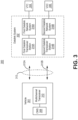
- Figure 3 illustrates another embodiment of a multichannel vehicle communications system 300.
- the multichannel vehicle communications system 300 is configured to be able to simultaneously receive communications over two or more communications links.
- the multichannel vehicle communications system 300 is also configured to transmit over a communications link while receiving over one or more other communications links.
- the multichannel vehicle communications system 300 comprises a vehicle 301, a datalink system 302, a vehicle traffic control center (VTC) 304 (e.g. an air traffic control center), and a vehicle operations center (VOC) 306 (e.g. an airlines operations center).
- the vehicle 301 includes a communications management system 308 coupled to a multichannel transceiver 310.
- the vehicle 301 is coupled the datalink system 302 by at least two communications links, e.g. a first communications link 312A and a second communications link 312B. Although, two communications links 312A and 312B are illustrated in Figure 3 and described elsewhere herein, more than two communications links may be used.
- Each communications link may be a HF, VHF, satellite, cellular network, Wi-Fi, Wi-Max, an AeroMACs, and/or any other communications links.
- the datalink system 302 includes at least two datalink transceiver stations (e.g . ground datalink transceiver station or ground transceiver station each of which forms a communications link between the vehicle 301 and a datalink network system.
- Figure 3 illustrates one embodiment of a datalink system 302 including a first datalink transceiver station 314A and a second datalink transceiver station 314B each of which is respectively coupled to a first datalink network system 316A and a second datalink network system 316B.
- the datalink system 302 can include more than two pairs of datalink transceiver stations and datalink network systems.
- each datalink transceiver station includes a radio transceiver configured to transmit and receive data from the vehicle 301.
- each datalink network is a ground network which routes data to and from the vehicle 301 to the vehicle traffic control center 304 and/or the vehicle operations center 306.
- Each datalink network includes one or more routers to facilitate the routing of such data.
- the receiver 210A is simultaneously coupled (a) through the first communications link 312A to the first datalink transceiver station 314A, the first datalink network system 316A, and the vehicle traffic control center 304, and (b) through the second communications link 312B to the second datalink transceiver station 314B, the second datalink network system 316B, and the vehicle operations center 306.
- the transmitter 210B transmits on the frequenc(ies) of the first channel.
- the communications management system 308 commands the multichannel transceiver 310 to re-establish another communications link via different frequenc(ies) for the first channel while continuously transmitting and receiving on the frequenc(ies) of the second channel.
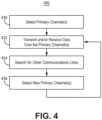
- Figure 4 illustrates one embodiment of a method 400 for utilizing a multichannel transceiver to maintain communications with a vehicle traffic center and/or a vehicle operations center.
- method 400 shown in Figure 4 is described herein as being implemented in the systems shown in Figures 1-3 , it is to be understood that other embodiments can be implemented in other ways.
- the blocks of the flow diagrams have been arranged in a generally sequential manner for ease of explanation; however, it is to be understood that this arrangement is merely exemplary, and it should be recognized that the processing associated with the methods (and the blocks shown in the Figures) can occur in a different order (for example, where at least some of the processing associated with the blocks is performed in parallel and/or in an event-driven manner).
- a primary receive channel and a primary transmit channel with a communications management system 108 of a multichannel transceiver 110 in a vehicle 101 that corresponds to a primary communications link coupling the vehicle 101 with a vehicle traffic control center 104 and/or a vehicle operations center 106 through a first datalink transceiver station 114A of at least one datalink system 102.
- the primary receive channel and the primary transmit channel may be the same channel and thus on the same frequenc(ies).
- the primary receive channel and the primary transmit channel are different channels and are on different frequencies.
- the primary receive channel and the primary transmit channel are selected based upon the geographic location of the vehicle 101; the signal strength of the signals on a channel received by the vehicle 101 from the at least one datalink network 102 and/or received by the at least one datalink network 102 from the vehicle 101; operational cost of a relay network system; instructions received from a service provider, and/or any other factor, e.g. the factors described above with regards to the selection of the at least one datalink network system and the at least one datalink transceiver station.
- transmit and receive data e.g. messages, between the vehicle 101 and the vehicle traffic control center 104 and/or the vehicle operations center 106 over the primary channel(s).
- transmit and receive data using the multichannel transceiver 110.
- Viable communications links are communications links that can be used to facilitate communications with the vehicle traffic center 104 and/or the vehicle operations center 106.
- the signal characteristic is a signal to noise ratio (SNR) and/or a received signal strength indicator (RSSI).
- select new channel(s) based upon the new channel(s) corresponding to a new communications link having a signal characteristic better than the primary communications link, the new communications link has a signal characteristic better than a first threshold level, and/or the primary communications link having a signal characteristic below a second threshold level.
- the threshold levels are SNR and/or RSSI levels.
Landscapes
- Engineering & Computer Science (AREA)
- Computer Networks & Wireless Communication (AREA)
- Signal Processing (AREA)
- Physics & Mathematics (AREA)
- General Physics & Mathematics (AREA)
- Astronomy & Astrophysics (AREA)
- Aviation & Aerospace Engineering (AREA)
- Computer Security & Cryptography (AREA)
- Mobile Radio Communication Systems (AREA)
- Traffic Control Systems (AREA)
Claims (6)
- Verfahren, umfassend:Auswählen, mit einem Kommunikationsmanagementsystem, das dazu konfiguriert ist, in einem Fahrzeug (101) eingebaut zu sein, von mindestens einem primären Kanal auf einem Mehrkanal-Sender-Empfänger (430), der dazu konfiguriert ist, in dem Fahrzeug eingebaut zu sein;mindestens eines aus Senden und Empfangen, mit dem Mehrkanal-Sender-Empfänger, von Daten zwischen dem Fahrzeug und einem Fahrzeugverkehrssteuerzentrum (104) und/oder einem Fahrzeugbetriebszentrum (106) über den mindestens einen primären Kanal (432);Suchen, mit dem Mehrkanal-Sender-Empfänger, nach anderen funktionierenden Kommunikationsverbindungen (434); undAuswählen, mit dem Kommunikationsmanagementsystem, eines neuen mindestens einen primären Kanals (436) für den Mehrkanal-Sender-Empfänger auf Basis darauf, dass der neue mindestens eine primäre Kanal, der einer neuen Kommunikationsverbindung entspricht, ein Signal-Rausch-Verhältnis, SNR, unterhalb eines SNR-Schwellenniveaus und/oder einen empfangenen Signalstärkeindikator, RSSI, unterhalb eines RSSI-Schwellenniveaus aufweist;Kommunizieren, mit dem Mehrkanal-Sender-Empfänger, über sowohl den mindestens einen primären Kanal als auch den neuen mindestens einen primären Kanal, wobei der Mehrkanal-Sender-Empfänger dazu konfiguriert ist, gleichzeitig Daten auf dem mindestens einen primären Kanal und auf dem neuen mindestens einen primären Kanal zu empfangen.
- Verfahren nach Anspruch 1, wobei das Senden und Empfangen der Daten das Senden von Nachrichten in mindestens einem aus Folgendem umfasst: Aircraft Communications Addressing and Reporting System-Protokoll, Luftfahrttelekommunikationsnetzwerk / Open System Interconnection-Protokoll und Luftfahrttelekommunikationsnetzwerk / Internet-Protokoll.
- System, umfassend:einen Mehrkanal-Sender-Empfänger (110), der dazu konfiguriert ist, in einem Fahrzeug (101) eingebaut zu sein und gleichzeitig Daten auf mindestens zwei Kanälen zu empfangen;ein Kommunikationsmanagementsystem (108), das mit dem Mehrkanal-Sender-Empfänger (110) gekoppelt ist; undwobei das Kommunikationsmanagementsystem (108) dazu konfiguriert ist, in dem Fahrzeug (101) eingebaut zu sein;wobei das Kommunikationsmanagementsystem (108) ferner dazu konfiguriert ist, mindestens einen primären Kanal auf dem Mehrkanal-Sender-Empfänger (430) auszuwählen;wobei der Mehrkanal-Sender-Empfänger ferner zu mindestens einem aus Folgendem konfiguriert ist: Daten zwischen dem Fahrzeug und einem Fahrzeugverkehrssteuerzentrum (104) und/oder einem Fahrzeugbetriebszentrum (106) über den mindestens einen primären Kanal (432) zu senden und zu empfangen, und nach anderen funktionierenden Kommunikationsverbindungen (434) zu suchen; undwobei das Kommunikationsmanagementsystem ferner dazu konfiguriert ist, einen neuen mindestens einen primären Kanal (436) für den Mehrkanal-Sender-Empfänger auf Basis darauf auszuwählen, dass der neue mindestens eine primäre Kanal einer neuen Kommunikationsverbindung entspricht, die ein Signal-Rausch-Verhältnis, SNR, unterhalb eines SNR-Schwellenniveaus und/oder einen empfangenen Signalstärkeindikator, RSSI, unterhalb eines RSSI-Schwellenniveaus aufweist,wobei der Mehrkanal-Sender-Empfänger dazu konfiguriert ist, über sowohl den mindestens einen primären Kanal als auch den neuen mindestens einen primären Kanal zu kommunizieren und gleichzeitig Daten auf dem mindestens einen primären Kanal und auf dem neuen mindestens einen primären Kanal zu empfangen.
- System nach Anspruch 3, wobei der Mehrkanal-Sender-Empfänger (110) eine softwaredefinierte Funkvorrichtung umfasst.
- System nach Anspruch 3, ferner umfassend mindestens einen Bus (209), der das Kommunikationsmanagementsystem (208) mit dem Mehrkanal-Sender-Empfänger (210) koppelt.
- System nach Anspruch 3, umfassend:wobei der Mehrkanal-Sender-Empfänger (110) dazu konfiguriert ist, durch ein Datenverbindungssystem (102) mit mindestens einem Fahrzeugverkehrszentrum (104) und einem Fahrzeugbetriebszentrum (106) zu kommunizieren;wobei das Kommunikationsmanagementsystem (108) dazu konfiguriert ist, die Kanäle des Mehrkanal-Sender-Empfängers (110) zu steuern und Daten zwischen Fahrzeugkomponenten und dem mindestens einen aus einem Fahrzeugverkehrszentrum (104) und dem Fahrzeugbetriebszentrum (106) weiterzuleiten.
Applications Claiming Priority (1)
| Application Number | Priority Date | Filing Date | Title |
|---|---|---|---|
| US15/600,249 US10491291B2 (en) | 2017-05-19 | 2017-05-19 | System and method for multi-channel vehicle communications |
Publications (2)
| Publication Number | Publication Date |
|---|---|
| EP3404850A1 EP3404850A1 (de) | 2018-11-21 |
| EP3404850B1 true EP3404850B1 (de) | 2025-03-12 |
Family
ID=62217752
Family Applications (1)
| Application Number | Title | Priority Date | Filing Date |
|---|---|---|---|
| EP18171724.0A Active EP3404850B1 (de) | 2017-05-19 | 2018-05-10 | System und verfahren zur mehrkanaligen fahrzeugkommunikation |
Country Status (4)
| Country | Link |
|---|---|
| US (1) | US10491291B2 (de) |
| EP (1) | EP3404850B1 (de) |
| CN (1) | CN108964739B (de) |
| DE (1) | DE202018006942U1 (de) |
Families Citing this family (24)
| Publication number | Priority date | Publication date | Assignee | Title |
|---|---|---|---|---|
| US12040779B2 (en) | 2020-04-20 | 2024-07-16 | Murata Manufacturing Co., Ltd. | Small transversely-excited film bulk acoustic resonators with enhanced Q-factor |
| US11509279B2 (en) | 2020-07-18 | 2022-11-22 | Resonant Inc. | Acoustic resonators and filters with reduced temperature coefficient of frequency |
| US11936358B2 (en) | 2020-11-11 | 2024-03-19 | Murata Manufacturing Co., Ltd. | Transversely-excited film bulk acoustic resonator with low thermal impedance |
| US12088281B2 (en) | 2021-02-03 | 2024-09-10 | Murata Manufacturing Co., Ltd. | Transversely-excited film bulk acoustic resonator with multi-mark interdigital transducer |
| CN109559568A (zh) * | 2018-12-14 | 2019-04-02 | 中电科(德阳广汉)特种飞机系统工程有限公司 | 通航飞机的空管方法、装置、系统及可读存储介质 |
| US11264969B1 (en) | 2020-08-06 | 2022-03-01 | Resonant Inc. | Transversely-excited film bulk acoustic resonator comprising small cells |
| US11271539B1 (en) | 2020-08-19 | 2022-03-08 | Resonant Inc. | Transversely-excited film bulk acoustic resonator with tether-supported diaphragm |
| US11405017B2 (en) | 2020-10-05 | 2022-08-02 | Resonant Inc. | Acoustic matrix filters and radios using acoustic matrix filters |
| CN114499439A (zh) | 2020-11-13 | 2022-05-13 | 谐振公司 | 形成去除了多余压电材料的xbar装置 |
| US11816937B2 (en) * | 2020-11-18 | 2023-11-14 | Honeywell International Inc. | Systems and methods for reconfigurable on-vehicle data routing |
| US11239816B1 (en) | 2021-01-15 | 2022-02-01 | Resonant Inc. | Decoupled transversely-excited film bulk acoustic resonators |
| US12463615B2 (en) | 2021-01-21 | 2025-11-04 | Murata Manufacturing Co., Ltd | Transversely-excited film bulk acoustic resonators with improved coupling and reduced energy leakage |
| US12308825B2 (en) | 2021-02-12 | 2025-05-20 | Murata Manufacturing Co., Ltd | Transversely-excited film bulk acoustic resonators with narrow gaps between busbars and ends of interdigital transducer fingers |
| US20220262262A1 (en) * | 2021-02-18 | 2022-08-18 | Honeywell International Inc. | Vehicle traffic control communication system |
| US12160220B2 (en) | 2021-04-30 | 2024-12-03 | Murata Manufacturing Co., Ltd. | Transversely-excited film bulk acoustic resonator with oxide strip acoustic confinement structures |
| DE102022111162A1 (de) | 2021-05-07 | 2022-11-10 | Resonant Inc. | Transversal angeregte akustische filmvolumenresonator-matrixfilter mit eingangs- und ausgangsimpedanzen, die an funkfrequenz-frontend-elemente angepasst sind |
| CN115441847A (zh) | 2021-06-03 | 2022-12-06 | 谐振公司 | 低损耗横向激励薄膜体声波谐振器和滤波器 |
| CN113380074B (zh) * | 2021-08-13 | 2021-11-05 | 中国民用航空总局第二研究所 | 通航低空监视系统及方法 |
| CN113890587B (zh) * | 2021-09-28 | 2023-06-23 | 浙江嘉兴数字城市实验室有限公司 | 一种基于bds短报文的车辆安全信息数据交换方法 |
| WO2023081769A1 (en) | 2021-11-04 | 2023-05-11 | Resonant Inc. | Stacked die transversely-excited film bulk acoustic resonator (xbar) filters |
| WO2023097182A1 (en) | 2021-11-23 | 2023-06-01 | Murata Manufacturing Co., Ltd. | Filters using decoupled transversely-excited film bulk acoustic resonators |
| WO2023108006A1 (en) | 2021-12-09 | 2023-06-15 | Murata Manufacturing Co., Ltd. | Decoupled transversely-excited film bulk acoustic resonators for high power filters |
| CN118369852A (zh) | 2021-12-09 | 2024-07-19 | 株式会社村田制作所 | 使用具有电感耦合子谐振器的横向激励薄膜体声谐振器的滤波器 |
| WO2023129921A1 (en) | 2021-12-28 | 2023-07-06 | Murata Manufacturing Co., Ltd. | Transatirsely-excited film bulk acoustic resonators with gap dielectric stripes in busbar-electrode gaps |
Family Cites Families (24)
| Publication number | Priority date | Publication date | Assignee | Title |
|---|---|---|---|---|
| US6567395B1 (en) * | 1999-03-10 | 2003-05-20 | Rockwell Collins, Inc. | Display for a high frequency (HF) radio |
| US6816728B2 (en) * | 2002-04-24 | 2004-11-09 | Teledyne Technologies Incorporated | Aircraft data communication system and method |
| US7331792B2 (en) * | 2002-09-18 | 2008-02-19 | Stoneridge Control Devices, Inc. | Trailer tow connector assembly |
| US7221290B2 (en) | 2004-08-24 | 2007-05-22 | Burgemeister Alvin H | Packetized voice communication method and system |
| US7894779B2 (en) | 2006-06-22 | 2011-02-22 | Honeywell International Inc. | Apparatus and method for transmitting and receiving multiple radio signals over a single antenna |
| US20080084861A1 (en) | 2006-10-10 | 2008-04-10 | Honeywell International Inc. | Avionics communication system and method utilizing multi-channel radio technology and a shared data bus |
| US7876259B2 (en) * | 2006-11-06 | 2011-01-25 | Leonard Schuchman | Automatic dependent surveillance system secure ADS-S |
| US8019338B2 (en) | 2008-05-29 | 2011-09-13 | Honeywell International Inc. | Reconfigurable aircraft communications system with integrated avionics communication router and audio management functions |
| US8385288B2 (en) * | 2008-08-20 | 2013-02-26 | Qualcomm Incorporated | Multi-channel SDMA |
| US20110255506A1 (en) | 2010-04-19 | 2011-10-20 | Honeywell International Inc. | Systems and methods for integration of ip-based data link management in existing avionics architectures |
| KR101225183B1 (ko) * | 2010-11-08 | 2013-01-22 | 한국전자통신연구원 | Wave 기반의 멀티 채널 운용 방법 및 장치 |
| KR20120119430A (ko) * | 2011-04-21 | 2012-10-31 | 삼성디스플레이 주식회사 | 유기발광표시장치 |
| US8923167B2 (en) | 2011-09-27 | 2014-12-30 | Google Technology Holdings LLC | Communication device for simultaneous transmission by multiple transceivers |
| US8654869B2 (en) * | 2011-10-27 | 2014-02-18 | Cooper Technologies Company | Multi-path radio transmission input/output devices, network, systems and methods with link suitability determination |
| US9285472B2 (en) | 2011-12-06 | 2016-03-15 | L-3 Communications Avionics Systems, Inc. | Multi-link transponder for aircraft and method of providing multi-link transponder capability to an aircraft having an existing transponder |
| US10284482B2 (en) * | 2012-06-29 | 2019-05-07 | Honeywell International Inc. | Stateful connectionless overlay protocol for information transfer across multiple datalinks |
| US9094087B2 (en) * | 2013-10-29 | 2015-07-28 | Honeywell International Inc. | Reduced aircraft VHF communication antennas using multi-channel VHF radios |
| US9295032B2 (en) | 2014-01-28 | 2016-03-22 | The Boeing Company | Secure aircraft data transmission using multiple communication channels |
| JP6031460B2 (ja) | 2014-02-06 | 2016-11-24 | 富士重工業株式会社 | 車両用通信装置 |
| FR3018622B1 (fr) | 2014-03-17 | 2016-04-08 | Rockwell Collins France | Procede de gestion de frequences et dispositif de communication dans une plateforme aeroportee |
| US9667338B2 (en) * | 2014-10-17 | 2017-05-30 | The Boeing Company | Multiband wireless data transmission between aircraft and ground systems |
| FR3038464A1 (fr) * | 2015-06-30 | 2017-01-06 | Souriau | Procede de montage d’un connecteur multicontact a insertion par pression |
| US10243646B2 (en) * | 2015-08-17 | 2019-03-26 | The Mitre Corporation | Performance-based link management communications |
| US10986028B2 (en) * | 2016-03-05 | 2021-04-20 | Ge Aviation Systems, Llc | Aircraft message routing system |
-
2017
- 2017-05-19 US US15/600,249 patent/US10491291B2/en active Active
-
2018
- 2018-05-10 EP EP18171724.0A patent/EP3404850B1/de active Active
- 2018-05-10 DE DE202018006942.6U patent/DE202018006942U1/de active Active
- 2018-05-18 CN CN201810479602.8A patent/CN108964739B/zh active Active
Also Published As
| Publication number | Publication date |
|---|---|
| DE202018006942U1 (de) | 2024-09-04 |
| CN108964739B (zh) | 2022-05-17 |
| CN108964739A (zh) | 2018-12-07 |
| EP3404850A1 (de) | 2018-11-21 |
| US20180337720A1 (en) | 2018-11-22 |
| US10491291B2 (en) | 2019-11-26 |
Similar Documents
| Publication | Publication Date | Title |
|---|---|---|
| EP3404850B1 (de) | System und verfahren zur mehrkanaligen fahrzeugkommunikation | |
| US11223417B2 (en) | Terrestrial based high speed data communications mesh network | |
| US10298316B2 (en) | Method and apparatus for routing IP packets in multi-beam satellite networks | |
| US7729263B2 (en) | Aircraft data link network routing | |
| US9100055B2 (en) | Digital IF distribution networks for radio communications | |
| RU2498506C2 (ru) | Система маршрутизации acars по профилю маршрутизации | |
| US9503175B2 (en) | SATCOM data unit with wireless device | |
| EP3605852B1 (de) | System und verfahren für ein integriertes fahrzeugkommunikationssystem | |
| US11070285B2 (en) | System and method for configuring a multistage interconnection network based on user traffic demand | |
| US6721559B1 (en) | Integrated communications management unit and very high frequency data radio | |
| US11038584B2 (en) | Wideband streaming L-band (WISL) methods and systems | |
| US20020004401A1 (en) | Method for enhancing the reliability and efficiency of aeronautical data communications networks using synchronization data transmitted by VHF data link mode 4 aircraft stations | |
| US20020007234A1 (en) | Apparatus and method for transitioning from a dual air/ground and ground/ground aeronautical data network architecture to an end-to-end aeronautical data network architecture | |
| US20130252563A1 (en) | Methods and apparatus for resource sharing for voice and data interlacing | |
| CN104683010A (zh) | 柯林斯vhf-2100航材acars功能激活方法 | |
| KR102153662B1 (ko) | 데이터링크를 이용한 무인비행체의 음성통신 중계장치 및 중계방법 | |
| Zambrano et al. | Development and implementation of new architecture for robust satellite data unit with software defined radio for airborne network | |
| WO2001089114A2 (en) | Method for enhancing the reliability and efficiency of aeronautical data communications networking | |
| US20020045974A1 (en) | Dual-band radio communications system for aeronautical data communications | |
| US8971237B2 (en) | Method of communication between an aircraft and a ground station | |
| RU2681692C1 (ru) | Вч система обмена пакетными данными | |
| WO2023114463A1 (en) | Wireless aircraft communication system | |
| CA2276337A1 (en) | Method and arrangement for exchanging control information between earth stations of a satellite communication network |
Legal Events
| Date | Code | Title | Description |
|---|---|---|---|
| PUAI | Public reference made under article 153(3) epc to a published international application that has entered the european phase |
Free format text: ORIGINAL CODE: 0009012 |
|
| STAA | Information on the status of an ep patent application or granted ep patent |
Free format text: STATUS: REQUEST FOR EXAMINATION WAS MADE |
|
| 17P | Request for examination filed |
Effective date: 20180510 |
|
| AK | Designated contracting states |
Kind code of ref document: A1 Designated state(s): AL AT BE BG CH CY CZ DE DK EE ES FI FR GB GR HR HU IE IS IT LI LT LU LV MC MK MT NL NO PL PT RO RS SE SI SK SM TR |
|
| AX | Request for extension of the european patent |
Extension state: BA ME |
|
| STAA | Information on the status of an ep patent application or granted ep patent |
Free format text: STATUS: EXAMINATION IS IN PROGRESS |
|
| 17Q | First examination report despatched |
Effective date: 20200228 |
|
| P01 | Opt-out of the competence of the unified patent court (upc) registered |
Effective date: 20230421 |
|
| REG | Reference to a national code |
Ref country code: DE Ref legal event code: R079 Free format text: PREVIOUS MAIN CLASS: H04B0007185000 Ipc: H04B0001382200 Ref document number: 602018079996 Country of ref document: DE |
|
| GRAP | Despatch of communication of intention to grant a patent |
Free format text: ORIGINAL CODE: EPIDOSNIGR1 |
|
| STAA | Information on the status of an ep patent application or granted ep patent |
Free format text: STATUS: GRANT OF PATENT IS INTENDED |
|
| RIC1 | Information provided on ipc code assigned before grant |
Ipc: H04B 7/185 20060101ALI20240909BHEP Ipc: H04B 1/38 20150101ALI20240909BHEP Ipc: H04B 1/3822 20150101AFI20240909BHEP |
|
| INTG | Intention to grant announced |
Effective date: 20241016 |
|
| GRAS | Grant fee paid |
Free format text: ORIGINAL CODE: EPIDOSNIGR3 |
|
| GRAA | (expected) grant |
Free format text: ORIGINAL CODE: 0009210 |
|
| STAA | Information on the status of an ep patent application or granted ep patent |
Free format text: STATUS: THE PATENT HAS BEEN GRANTED |
|
| AK | Designated contracting states |
Kind code of ref document: B1 Designated state(s): AL AT BE BG CH CY CZ DE DK EE ES FI FR GB GR HR HU IE IS IT LI LT LU LV MC MK MT NL NO PL PT RO RS SE SI SK SM TR |
|
| REG | Reference to a national code |
Ref country code: GB Ref legal event code: FG4D |
|
| REG | Reference to a national code |
Ref country code: CH Ref legal event code: EP |
|
| REG | Reference to a national code |
Ref country code: DE Ref legal event code: R096 Ref document number: 602018079996 Country of ref document: DE |
|
| REG | Reference to a national code |
Ref country code: IE Ref legal event code: FG4D |
|
| PG25 | Lapsed in a contracting state [announced via postgrant information from national office to epo] |
Ref country code: RS Free format text: LAPSE BECAUSE OF FAILURE TO SUBMIT A TRANSLATION OF THE DESCRIPTION OR TO PAY THE FEE WITHIN THE PRESCRIBED TIME-LIMIT Effective date: 20250612 |
|
| PG25 | Lapsed in a contracting state [announced via postgrant information from national office to epo] |
Ref country code: FI Free format text: LAPSE BECAUSE OF FAILURE TO SUBMIT A TRANSLATION OF THE DESCRIPTION OR TO PAY THE FEE WITHIN THE PRESCRIBED TIME-LIMIT Effective date: 20250312 |
|
| PGFP | Annual fee paid to national office [announced via postgrant information from national office to epo] |
Ref country code: DE Payment date: 20250528 Year of fee payment: 8 |
|
| PG25 | Lapsed in a contracting state [announced via postgrant information from national office to epo] |
Ref country code: ES Free format text: LAPSE BECAUSE OF FAILURE TO SUBMIT A TRANSLATION OF THE DESCRIPTION OR TO PAY THE FEE WITHIN THE PRESCRIBED TIME-LIMIT Effective date: 20250312 |
|
| PGFP | Annual fee paid to national office [announced via postgrant information from national office to epo] |
Ref country code: GB Payment date: 20250527 Year of fee payment: 8 |
|
| REG | Reference to a national code |
Ref country code: LT Ref legal event code: MG9D |
|
| PG25 | Lapsed in a contracting state [announced via postgrant information from national office to epo] |
Ref country code: NO Free format text: LAPSE BECAUSE OF FAILURE TO SUBMIT A TRANSLATION OF THE DESCRIPTION OR TO PAY THE FEE WITHIN THE PRESCRIBED TIME-LIMIT Effective date: 20250612 |
|
| PG25 | Lapsed in a contracting state [announced via postgrant information from national office to epo] |
Ref country code: HR Free format text: LAPSE BECAUSE OF FAILURE TO SUBMIT A TRANSLATION OF THE DESCRIPTION OR TO PAY THE FEE WITHIN THE PRESCRIBED TIME-LIMIT Effective date: 20250312 |
|
| REG | Reference to a national code |
Ref country code: NL Ref legal event code: MP Effective date: 20250312 |
|
| PG25 | Lapsed in a contracting state [announced via postgrant information from national office to epo] |
Ref country code: LV Free format text: LAPSE BECAUSE OF FAILURE TO SUBMIT A TRANSLATION OF THE DESCRIPTION OR TO PAY THE FEE WITHIN THE PRESCRIBED TIME-LIMIT Effective date: 20250312 |
|
| PGFP | Annual fee paid to national office [announced via postgrant information from national office to epo] |
Ref country code: FR Payment date: 20250527 Year of fee payment: 8 |
|
| PG25 | Lapsed in a contracting state [announced via postgrant information from national office to epo] |
Ref country code: GR Free format text: LAPSE BECAUSE OF FAILURE TO SUBMIT A TRANSLATION OF THE DESCRIPTION OR TO PAY THE FEE WITHIN THE PRESCRIBED TIME-LIMIT Effective date: 20250613 Ref country code: BG Free format text: LAPSE BECAUSE OF FAILURE TO SUBMIT A TRANSLATION OF THE DESCRIPTION OR TO PAY THE FEE WITHIN THE PRESCRIBED TIME-LIMIT Effective date: 20250312 |
|
| REG | Reference to a national code |
Ref country code: AT Ref legal event code: MK05 Ref document number: 1775895 Country of ref document: AT Kind code of ref document: T Effective date: 20250312 |
|
| PG25 | Lapsed in a contracting state [announced via postgrant information from national office to epo] |
Ref country code: NL Free format text: LAPSE BECAUSE OF FAILURE TO SUBMIT A TRANSLATION OF THE DESCRIPTION OR TO PAY THE FEE WITHIN THE PRESCRIBED TIME-LIMIT Effective date: 20250312 |
|
| PG25 | Lapsed in a contracting state [announced via postgrant information from national office to epo] |
Ref country code: SE Free format text: LAPSE BECAUSE OF FAILURE TO SUBMIT A TRANSLATION OF THE DESCRIPTION OR TO PAY THE FEE WITHIN THE PRESCRIBED TIME-LIMIT Effective date: 20250312 |
|
| PG25 | Lapsed in a contracting state [announced via postgrant information from national office to epo] |
Ref country code: SM Free format text: LAPSE BECAUSE OF FAILURE TO SUBMIT A TRANSLATION OF THE DESCRIPTION OR TO PAY THE FEE WITHIN THE PRESCRIBED TIME-LIMIT Effective date: 20250312 |
|
| PG25 | Lapsed in a contracting state [announced via postgrant information from national office to epo] |
Ref country code: PT Free format text: LAPSE BECAUSE OF FAILURE TO SUBMIT A TRANSLATION OF THE DESCRIPTION OR TO PAY THE FEE WITHIN THE PRESCRIBED TIME-LIMIT Effective date: 20250714 |
|
| PG25 | Lapsed in a contracting state [announced via postgrant information from national office to epo] |
Ref country code: PL Free format text: LAPSE BECAUSE OF FAILURE TO SUBMIT A TRANSLATION OF THE DESCRIPTION OR TO PAY THE FEE WITHIN THE PRESCRIBED TIME-LIMIT Effective date: 20250312 Ref country code: IT Free format text: LAPSE BECAUSE OF FAILURE TO SUBMIT A TRANSLATION OF THE DESCRIPTION OR TO PAY THE FEE WITHIN THE PRESCRIBED TIME-LIMIT Effective date: 20250312 |
|
| PG25 | Lapsed in a contracting state [announced via postgrant information from national office to epo] |
Ref country code: AT Free format text: LAPSE BECAUSE OF FAILURE TO SUBMIT A TRANSLATION OF THE DESCRIPTION OR TO PAY THE FEE WITHIN THE PRESCRIBED TIME-LIMIT Effective date: 20250312 |
|
| PG25 | Lapsed in a contracting state [announced via postgrant information from national office to epo] |
Ref country code: CZ Free format text: LAPSE BECAUSE OF FAILURE TO SUBMIT A TRANSLATION OF THE DESCRIPTION OR TO PAY THE FEE WITHIN THE PRESCRIBED TIME-LIMIT Effective date: 20250312 Ref country code: EE Free format text: LAPSE BECAUSE OF FAILURE TO SUBMIT A TRANSLATION OF THE DESCRIPTION OR TO PAY THE FEE WITHIN THE PRESCRIBED TIME-LIMIT Effective date: 20250312 |
|
| PG25 | Lapsed in a contracting state [announced via postgrant information from national office to epo] |
Ref country code: RO Free format text: LAPSE BECAUSE OF FAILURE TO SUBMIT A TRANSLATION OF THE DESCRIPTION OR TO PAY THE FEE WITHIN THE PRESCRIBED TIME-LIMIT Effective date: 20250312 |
|
| PG25 | Lapsed in a contracting state [announced via postgrant information from national office to epo] |
Ref country code: SK Free format text: LAPSE BECAUSE OF FAILURE TO SUBMIT A TRANSLATION OF THE DESCRIPTION OR TO PAY THE FEE WITHIN THE PRESCRIBED TIME-LIMIT Effective date: 20250312 |
|
| PG25 | Lapsed in a contracting state [announced via postgrant information from national office to epo] |
Ref country code: IS Free format text: LAPSE BECAUSE OF FAILURE TO SUBMIT A TRANSLATION OF THE DESCRIPTION OR TO PAY THE FEE WITHIN THE PRESCRIBED TIME-LIMIT Effective date: 20250712 |
|
| REG | Reference to a national code |
Ref country code: DE Ref legal event code: R097 Ref document number: 602018079996 Country of ref document: DE |
|
| REG | Reference to a national code |
Ref country code: CH Ref legal event code: H13 Free format text: ST27 STATUS EVENT CODE: U-0-0-H10-H13 (AS PROVIDED BY THE NATIONAL OFFICE) Effective date: 20251223 |
|
| PG25 | Lapsed in a contracting state [announced via postgrant information from national office to epo] |
Ref country code: DK Free format text: LAPSE BECAUSE OF FAILURE TO SUBMIT A TRANSLATION OF THE DESCRIPTION OR TO PAY THE FEE WITHIN THE PRESCRIBED TIME-LIMIT Effective date: 20250312 |
|
| PG25 | Lapsed in a contracting state [announced via postgrant information from national office to epo] |
Ref country code: LU Free format text: LAPSE BECAUSE OF NON-PAYMENT OF DUE FEES Effective date: 20250510 |
|
| PLBE | No opposition filed within time limit |
Free format text: ORIGINAL CODE: 0009261 |
|
| STAA | Information on the status of an ep patent application or granted ep patent |
Free format text: STATUS: NO OPPOSITION FILED WITHIN TIME LIMIT |
|
| PG25 | Lapsed in a contracting state [announced via postgrant information from national office to epo] |
Ref country code: CH Free format text: LAPSE BECAUSE OF NON-PAYMENT OF DUE FEES Effective date: 20250531 |
|
| REG | Reference to a national code |
Ref country code: CH Ref legal event code: L10 Free format text: ST27 STATUS EVENT CODE: U-0-0-L10-L00 (AS PROVIDED BY THE NATIONAL OFFICE) Effective date: 20260121 |
|
| REG | Reference to a national code |
Ref country code: BE Ref legal event code: MM Effective date: 20250531 |
|
| PG25 | Lapsed in a contracting state [announced via postgrant information from national office to epo] |
Ref country code: MC Free format text: LAPSE BECAUSE OF FAILURE TO SUBMIT A TRANSLATION OF THE DESCRIPTION OR TO PAY THE FEE WITHIN THE PRESCRIBED TIME-LIMIT Effective date: 20250312 |
|
| 26N | No opposition filed |
Effective date: 20251215 |