EP3398916B1 - Phosphorylated polycondensate as high efficiency water reducing agent and preparation method thereof - Google Patents
Phosphorylated polycondensate as high efficiency water reducing agent and preparation method thereof Download PDFInfo
- Publication number
- EP3398916B1 EP3398916B1 EP16880783.2A EP16880783A EP3398916B1 EP 3398916 B1 EP3398916 B1 EP 3398916B1 EP 16880783 A EP16880783 A EP 16880783A EP 3398916 B1 EP3398916 B1 EP 3398916B1
- Authority
- EP
- European Patent Office
- Prior art keywords
- water
- reducing agent
- acid
- monomer
- ether
- Prior art date
- Legal status (The legal status is an assumption and is not a legal conclusion. Google has not performed a legal analysis and makes no representation as to the accuracy of the status listed.)
- Active
Links
Classifications
-
- C—CHEMISTRY; METALLURGY
- C08—ORGANIC MACROMOLECULAR COMPOUNDS; THEIR PREPARATION OR CHEMICAL WORKING-UP; COMPOSITIONS BASED THEREON
- C08G—MACROMOLECULAR COMPOUNDS OBTAINED OTHERWISE THAN BY REACTIONS ONLY INVOLVING UNSATURATED CARBON-TO-CARBON BONDS
- C08G12/00—Condensation polymers of aldehydes or ketones with only compounds containing hydrogen attached to nitrogen
- C08G12/46—Block or graft polymers prepared by polycondensation of aldehydes or ketones on to macromolecular compounds
-
- C—CHEMISTRY; METALLURGY
- C04—CEMENTS; CONCRETE; ARTIFICIAL STONE; CERAMICS; REFRACTORIES
- C04B—LIME, MAGNESIA; SLAG; CEMENTS; COMPOSITIONS THEREOF, e.g. MORTARS, CONCRETE OR LIKE BUILDING MATERIALS; ARTIFICIAL STONE; CERAMICS; REFRACTORIES; TREATMENT OF NATURAL STONE
- C04B24/00—Use of organic materials as active ingredients for mortars, concrete or artificial stone, e.g. plasticisers
- C04B24/24—Macromolecular compounds
- C04B24/243—Phosphorus-containing polymers
- C04B24/246—Phosphorus-containing polymers containing polyether side chains
-
- C—CHEMISTRY; METALLURGY
- C04—CEMENTS; CONCRETE; ARTIFICIAL STONE; CERAMICS; REFRACTORIES
- C04B—LIME, MAGNESIA; SLAG; CEMENTS; COMPOSITIONS THEREOF, e.g. MORTARS, CONCRETE OR LIKE BUILDING MATERIALS; ARTIFICIAL STONE; CERAMICS; REFRACTORIES; TREATMENT OF NATURAL STONE
- C04B24/00—Use of organic materials as active ingredients for mortars, concrete or artificial stone, e.g. plasticisers
- C04B24/24—Macromolecular compounds
- C04B24/243—Phosphorus-containing polymers
-
- C—CHEMISTRY; METALLURGY
- C04—CEMENTS; CONCRETE; ARTIFICIAL STONE; CERAMICS; REFRACTORIES
- C04B—LIME, MAGNESIA; SLAG; CEMENTS; COMPOSITIONS THEREOF, e.g. MORTARS, CONCRETE OR LIKE BUILDING MATERIALS; ARTIFICIAL STONE; CERAMICS; REFRACTORIES; TREATMENT OF NATURAL STONE
- C04B24/00—Use of organic materials as active ingredients for mortars, concrete or artificial stone, e.g. plasticisers
- C04B24/24—Macromolecular compounds
- C04B24/28—Macromolecular compounds obtained otherwise than by reactions only involving carbon-to-carbon unsaturated bonds
- C04B24/30—Condensation polymers of aldehydes or ketones
- C04B24/305—Melamine-formaldehyde condensation polymers
-
- C—CHEMISTRY; METALLURGY
- C08—ORGANIC MACROMOLECULAR COMPOUNDS; THEIR PREPARATION OR CHEMICAL WORKING-UP; COMPOSITIONS BASED THEREON
- C08G—MACROMOLECULAR COMPOUNDS OBTAINED OTHERWISE THAN BY REACTIONS ONLY INVOLVING UNSATURATED CARBON-TO-CARBON BONDS
- C08G12/00—Condensation polymers of aldehydes or ketones with only compounds containing hydrogen attached to nitrogen
- C08G12/02—Condensation polymers of aldehydes or ketones with only compounds containing hydrogen attached to nitrogen of aldehydes
- C08G12/26—Condensation polymers of aldehydes or ketones with only compounds containing hydrogen attached to nitrogen of aldehydes with heterocyclic compounds
- C08G12/30—Condensation polymers of aldehydes or ketones with only compounds containing hydrogen attached to nitrogen of aldehydes with heterocyclic compounds with substituted triazines
- C08G12/32—Melamines
-
- C—CHEMISTRY; METALLURGY
- C08—ORGANIC MACROMOLECULAR COMPOUNDS; THEIR PREPARATION OR CHEMICAL WORKING-UP; COMPOSITIONS BASED THEREON
- C08G—MACROMOLECULAR COMPOUNDS OBTAINED OTHERWISE THAN BY REACTIONS ONLY INVOLVING UNSATURATED CARBON-TO-CARBON BONDS
- C08G14/00—Condensation polymers of aldehydes or ketones with two or more other monomers covered by at least two of the groups C08G8/00 - C08G12/00
- C08G14/02—Condensation polymers of aldehydes or ketones with two or more other monomers covered by at least two of the groups C08G8/00 - C08G12/00 of aldehydes
- C08G14/04—Condensation polymers of aldehydes or ketones with two or more other monomers covered by at least two of the groups C08G8/00 - C08G12/00 of aldehydes with phenols
- C08G14/06—Condensation polymers of aldehydes or ketones with two or more other monomers covered by at least two of the groups C08G8/00 - C08G12/00 of aldehydes with phenols and monomers containing hydrogen attached to nitrogen
- C08G14/10—Melamines
-
- C—CHEMISTRY; METALLURGY
- C04—CEMENTS; CONCRETE; ARTIFICIAL STONE; CERAMICS; REFRACTORIES
- C04B—LIME, MAGNESIA; SLAG; CEMENTS; COMPOSITIONS THEREOF, e.g. MORTARS, CONCRETE OR LIKE BUILDING MATERIALS; ARTIFICIAL STONE; CERAMICS; REFRACTORIES; TREATMENT OF NATURAL STONE
- C04B2103/00—Function or property of ingredients for mortars, concrete or artificial stone
- C04B2103/0045—Polymers chosen for their physico-chemical characteristics
- C04B2103/0059—Graft (co-)polymers
- C04B2103/006—Comb polymers
-
- C—CHEMISTRY; METALLURGY
- C04—CEMENTS; CONCRETE; ARTIFICIAL STONE; CERAMICS; REFRACTORIES
- C04B—LIME, MAGNESIA; SLAG; CEMENTS; COMPOSITIONS THEREOF, e.g. MORTARS, CONCRETE OR LIKE BUILDING MATERIALS; ARTIFICIAL STONE; CERAMICS; REFRACTORIES; TREATMENT OF NATURAL STONE
- C04B2103/00—Function or property of ingredients for mortars, concrete or artificial stone
- C04B2103/30—Water reducers, plasticisers, air-entrainers, flow improvers
- C04B2103/302—Water reducers
Definitions
- the present invention belongs to the field of chemical building materials, and more particularly, to a phosphorylated polycondensate high-performance water-reducing agent having a novel structure and a method for preparing the same.
- Polycarboxylate (PCE)-based water-reducing agent known as the 3rd generation concrete superplasticizer, has a comb-like molecular structure and very strong steric effect, and makes a breakthrough to the conventional principle for realizing dispersion of cement particles by electrostatic repulsion.
- PCE Polycarboxylate
- Such a water-reducing agent when used in a concrete system, has the advantages of low dosage, high water-reducing rate and being capable of improving the pore structure and compactness of concrete, and can control the slump loss of concrete and the problems such as air-entraining, regarding and bleeding of concrete.
- the water-reducing agent is highly valuable to be promoted and applied, has growing market shares year by year in important projects and commercial concretes, and represents one of current high-performance water-reducing agents that are most advanced and have the highest technological content, most promising applications, and optimal overall performance.
- polycarboxylic acid water-reducing agent is mainly divided into three types below:
- Patent CN1167739A discloses a method for preparing a polycarboxylic acid cement dispersant, where alkoxypolyalkylene glycol mono(metha)acrylate is prepared by subjecting alkoxypolyalkylene glycol and (metha)acrylate to transesterification reaction in the presence of a basic catalyst, and then mixed with (metha)acrylic acid and is subjected to copolymerization under the action of ammonium persulfate to prepare the polycarboxylic acid water-reducing agent.
- a large excess of (metha)acrylate is required for preparing the alkoxypolyalkylene glycol mono(metha)acrylate monomer, resulting in complicated post-treatment and increased costs of the product.
- Patent CN1412175 discloses a method for preparing an allyl ether ester monomer and a method for preparing a water-reducing agent from the monomer, where allyl alcohol polyether is treated with an adsorbent material such as alumina such that the peroxide value reaches 5.0 meq/kg or less, and then is subjected to esterification with an aliphatic monocarboxylic acid to prepare the allyl ether ester monomer.
- an adsorbent material such as alumina
- a copolymer with a weight average molecular weight of 13500 is prepared from this purified allyl ether ester monomer and maleic anhydride using azobisisobutyronitrile as an initiator at 80°C, and is subjected to esterification with alkylpolyalkylene glycol at 100°C to give a cement dispersant.
- the allyl ether ester monomer has poor reaction activity, so that both water-reducing properties and slump-retaining properties of the cement dispersant are unsatisfactory.
- US patents US5362324 and US5661206 and Chinese patents CN101831037A and CN101066851A disclose a method for preparing a transesterifier-type slump-retaining agent, where a transesterifier is subjected to hydrolytic ester cleavage in a strongly alkaline medium of cement, such that a low-molecular weight polymer is slowly released, thereby improving the slump-retaining ability of cement.
- a crosslinker has poor dispersion at an earlier stage.
- DE 10 2004 050 395 discloses a method for preparing a polycondensation product for the purpose of water reduction in hydraulic setting compositions, the polycondensation product being based on three components A) to C), one aromatic or heteroaromatic unit with a polyether chain, one aromatic or heteroaromatic unit with an anionic groups such as a phosphate and an aldehyde link.
- Modern concrete is facing an increasingly severe situation of raw materials, the use of industrial by-product gypsum as a set-regulating agent results in higher SO 4 2- content in the binder; wide application of a large amount of industrial solid waste such as fly ash, slag powder and coal gangue results in more complicated composition of the binder; in particular, increasingly scarce resources of high-quality sand and stone and increased mud content and water absorption of aggregate directly affect the adaptability between concrete admixtures and the binder, so that the initial fluidity and fluidity-retaining ability of concrete are considerably reduced, the promotion and application of the high-performance water-reducing agent are greatly limited, and the development of concrete technology is progressively affected.
- the present invention provides a comb-like polymer with a phosphate group as an adsorption group, namely, a phosphorylated polycondensate high-performance water-reducing agent and a method for preparing the same.
- the high-performance water-reducing agent has a novel molecular structure and an excellent overall performance, particularly, strong adaptability for cement and low sensitivity to clays and sulfates.
- the preparation process can be used for commercial production and has broad market prospects.
- the phosphorylated polycondensate high-performance water-reducing agent according to the present invention uses a phosphorylated melamine derivative, instead of a conventional carboxyl group or sulfonic group, as a main adsorption group.
- the phosphorylated polycondensate high-performance water-reducing agent according to the present invention uses aryl alkoxypolyether as a side chain of the polymer to provide a strong steric effect to improve the dispersibility and dispersion-retaining properties of the polymer.
- the phosphorylated polycondensate high-performance water-reducing agent according to the present invention has a molecular structure represented by the following formula I:
- the method for preparing the phosphorylated polycondensate high-performance water-reducing agent according to the present invention includes subjecting the three monomers to polycondensateization in a presence of a catalyst at a pH of 1 to 3 to obtain the phosphorylated polycondensate high-performance water-reducing agent;
- the polymerization step is divided into three specific steps: preparation of the monomer A, condensation and neutralization, which can be handled by those skilled in the art through simple modifications with reference to preparation methods of conventional melamine-based, naphthalene-based and sulfamate-based water-reducing agents, and can be accomplished using the "one-pot method".
- the pH of the polymerization reaction system is adjusted with a conventional metal hydroxide such as sodium hydroxide or potassium hydroxide.
- the phosphorylated polycondensate high-performance water-reducing agent according to the present invention has a novel molecular structure and synthesis method.
- the molecular structure contains a phosphate group and a polyether side chain.
- the comb-like polymer having a polyether side chain is synthesized with the conventional polycondensation method, makes a breakthrough to the conventional research system of water-reducing agent, and achieves the innovation effect in the following aspects:
- a polycondensate high-performance water-reducing agent and a method for preparing the same provided by the present invention have excellent overall performance, high adaptability for existing low-grade raw materials of concrete, strong market demands, and vast application prospects. Additionally, the polycondensate has an advanced preparation process provided with the characteristics of industrially scalable production, which offers the prospect of a core technology in the field of water-reducing agent of concrete so as to promote development of the industry.
- Test conditions of molecular weight the molecular weight of the polycondensates in all the examples of the present invention was determined using aqueous gel-permeation chromatography (GPC) under the following experimental conditions:
- the cement used was Onoda 52.5R.P.II cement
- the stone was continuously graded broken stone having a particle size of 5 to 20 mm.
- Testing of fluidity of cement paste was preformed with reference to the GB/T8077-2000 standard, where 87 g of the water addition was used and the fluidity of cement paste was determined on a flat glass after stirring for 3 min. Determination of slump and slump loss was performed with reference to related provisions in JC473-2001 "Pumping Aid for Concrete".
- the data in Table 3 shows that the polycondensate water-reducing agents synthesized according to the preparation method of the present invention have excellent water-reducing and slump-retaining properties, and at a same dosage of 0.12%, compared to the commercial high-performance polycarboxylic acid water-reducing agents (PCA1 and PCA2), have an equivalent initial fluidity of cement paste, but have significantly better 60-minute slump retention, indicating that the polycondensate has excellent dispersion properties and dispersion-retaining properties of cement paste.
- PCA1 and PCA2 commercial high-performance polycarboxylic acid water-reducing agents
- the new polycondensate water-reducing agent provided by the present invention has excellent dispersion properties and dispersion-retaining properties of cement paste that are initially equivalent to those of the polycarboxylic acid water-reducing agent, and significantly better slump retention that is far superior to that of conventional naphthalene-based, amino, aliphatic, and melamine-based water-reducing agents.
- initial fluidity of cement paste is tested according to the method of determining fluidity of cement paste in GB/T8077-2000 "Methods for testing uniformity of concrete admixture", using 300 g of cement, 87 g of water addition, and self-provided and commercial polycarboxylic acid (PCA) water reducing agents as control samples, and using a paste mixer.
- PCA polycarboxylic acid
- the data in Table 4 shows that the polycondensate water-reducing agents provided by the present invention have good adaptability for cement, and exhibit stable fluidity of cement paste among cements produced in different regions.
- initial fluidity of paste is tested according to a method of determining fluidity of cement paste in GB/T8077-2000 "Methods for testing uniformity of concrete admixture", using 300 g of cement (Helin cement), 87 g of water addition, respectively 0.5% and 1% of montmorillonite based on the binder, and self-provided polycondensate water-reducing agent and polycarboxylic acid (PCA) water reducing agent as control samples, and using a paste mixer.
- PCA polycarboxylic acid
- the data in Table 5 shows that the polycondensate water-reducing agents provided by the present invention have resistance to montmorillonite, and when mixed with montmorillonite at 0.5% and 1.0% of the amount of the adhesive cement respectively, have an equivalent slump flow without significant decrease in terms of fluidity of paste compared to that without montmorillonite; the control samples all exhibit low initial fluidity due to differences from the samples in segment structure and molecular weight, and when mixed with respective contents of montmorillonite, exhibit decreased slump flow values to a different extent; and the commercial polycarboxylic acid water-reducing agent (PCA) exhibits fluidity of paste that is rapidly decreased with increase in dosage of montmorillonite by even above 50%.
- PCA commercial polycarboxylic acid water-reducing agent
- initial fluidity of paste is tested according to a method of determining fluidity of cement paste in GB/T8077-2000 "Methods for testing uniformity of concrete admixture", using 300 g of cement (Helin cement), 87 g of water addition, respectively 0.5% and 1% of sodium sulfate based on the binder, and self-provided and commercial melamine (SM)-based water reducing agents as control samples, and using a paste mixer.
- SM commercial melamine
- the data in Table 6 shows that the polycondensate water-reducing agents provided by the present invention have resistance to interference from sulfate ions, and since the adsorption ability of phosphate ions is larger than that of sulfonate ions, in the cement paste system, when mixed with sodium sulfate at 0.5% and 1% of the amount of the adhesive cement respectively, there is no significant decrease in slump flow in terms of fluidity of paste compared to that without the sulfate salt; and the commercial polycarboxylic acid water-reducing agent (PCA) exhibits decreased fluidity of paste to a certain degree with increase in dosage of the sulfate salt, which indicates that competitive adsorption of sulfate ions with respect to the polycarboxylic acid water-reducing agent occurs on the surface of cement particles.
- PCA polycarboxylic acid water-reducing agent
- the indexes such as water-reducing rate, air content and slump-retaining ability of the polycondensate water-reducing agent were measured, according to the test requirements of high-performance water-reducing agent in the GB8076-2008 standard - "Concrete Admixtures", using Helin cement, machine-made sand having a mud content of 1.8% and a fineness modulus of 3.3, and continuously graded broken stone having a mud content of 0.6% and nominal particle sizes of 5-10 mm and 10-20 mm, in the mixing ratio specified in Table 7. The results are shown in Table 8.
- the polycondensate water-reducing agent provided by the present invention has a novel structure, simple preparation process and low material costs, and uses the incorporated phosphate group, in place of conventional carboxyl group and sulfonic group, as a main adsorption group, such that the overall performance of the conventional water-reducing agent is improved.
- the polycondensate water-reducing agent exhibits good adaptability for cement, resistance to clays and resistance to competitive adsorption of sulfate ions, and has strong advantages and vast market prospects in the current market environment in which the quality of concrete admixtures and aggregates is poor.
Landscapes
- Chemical & Material Sciences (AREA)
- Ceramic Engineering (AREA)
- Engineering & Computer Science (AREA)
- Organic Chemistry (AREA)
- Chemical Kinetics & Catalysis (AREA)
- Structural Engineering (AREA)
- Materials Engineering (AREA)
- Polymers & Plastics (AREA)
- Medicinal Chemistry (AREA)
- Health & Medical Sciences (AREA)
- Curing Cements, Concrete, And Artificial Stone (AREA)
- Polyethers (AREA)
- Phenolic Resins Or Amino Resins (AREA)
Description
- The present invention belongs to the field of chemical building materials, and more particularly, to a phosphorylated polycondensate high-performance water-reducing agent having a novel structure and a method for preparing the same.
- Polycarboxylate (PCE)-based water-reducing agent, known as the 3rd generation concrete superplasticizer, has a comb-like molecular structure and very strong steric effect, and makes a breakthrough to the conventional principle for realizing dispersion of cement particles by electrostatic repulsion. Such a water-reducing agent, when used in a concrete system, has the advantages of low dosage, high water-reducing rate and being capable of improving the pore structure and compactness of concrete, and can control the slump loss of concrete and the problems such as air-entraining, regarding and bleeding of concrete. Because of its outstanding overall performance, the water-reducing agent is highly valuable to be promoted and applied, has growing market shares year by year in important projects and commercial concretes, and represents one of current high-performance water-reducing agents that are most advanced and have the highest technological content, most promising applications, and optimal overall performance.
- Improvement in performance of polycarboxylic acids is always a research focus and difficulty in admixture technology, and a number of efforts such as exploration for synthesis, performance testing and characterization of applications have been made around the molecular structure of polyether macromonomers, new comonomers, and types of adsorption groups. In terms of the developmental process and the molecular structure, polycarboxylic acid water-reducing agent is mainly divided into three types below:
- (1) polyester type water-reducing agent, namely, a water-reducing agent prepared by using methoxypoly(ethylene glycol) mono(metha)acrylate generated from methoxypoly(ethylene glycol) and (metha)acrylic acid as a polyoxyalkylene macromonomer. Such a water-reducing agent has the advantages of high water-reducing rate, good slump-retaining properties and good adaptability for cement;
- (2) ordinary polyether type water-reducing agent, namely, a water-reducing agent prepared by using allyl polyethylene glycol or a modified product thereof as a main polyoxyalkylene macromonomer. Such a water-reducing agent has the advantages of simple synthesis process, low costs and high polymerization concentration; and
- (3) high-performance polyether type water-reducing agent, namely, a water-reducing agent prepared by using methallyl polyethylene glycol or a modified product thereof as a main polyoxyalkylene macromonomer. Such a water-reducing agent has the advantages of both ordinary polyether type water-reducing agent and polyester type water-reducing agent.
- Current researches on modification or performance improvement of polycarboxylic acids all are based on the three types above, are relatively fixed in the system, and mainly use a carboxyl group as an adsorption group.
- Patent
CN1167739A discloses a method for preparing a polycarboxylic acid cement dispersant, where alkoxypolyalkylene glycol mono(metha)acrylate is prepared by subjecting alkoxypolyalkylene glycol and (metha)acrylate to transesterification reaction in the presence of a basic catalyst, and then mixed with (metha)acrylic acid and is subjected to copolymerization under the action of ammonium persulfate to prepare the polycarboxylic acid water-reducing agent. However, a large excess of (metha)acrylate is required for preparing the alkoxypolyalkylene glycol mono(metha)acrylate monomer, resulting in complicated post-treatment and increased costs of the product. - Patent
CN1412175 discloses a method for preparing an allyl ether ester monomer and a method for preparing a water-reducing agent from the monomer, where allyl alcohol polyether is treated with an adsorbent material such as alumina such that the peroxide value reaches 5.0 meq/kg or less, and then is subjected to esterification with an aliphatic monocarboxylic acid to prepare the allyl ether ester monomer. Then, a copolymer with a weight average molecular weight of 13500 is prepared from this purified allyl ether ester monomer and maleic anhydride using azobisisobutyronitrile as an initiator at 80°C, and is subjected to esterification with alkylpolyalkylene glycol at 100°C to give a cement dispersant. However, the allyl ether ester monomer has poor reaction activity, so that both water-reducing properties and slump-retaining properties of the cement dispersant are unsatisfactory. - US patents
US5362324 andUS5661206 and Chinese patentsCN101831037A andCN101066851A disclose a method for preparing a transesterifier-type slump-retaining agent, where a transesterifier is subjected to hydrolytic ester cleavage in a strongly alkaline medium of cement, such that a low-molecular weight polymer is slowly released, thereby improving the slump-retaining ability of cement. However, such a crosslinker has poor dispersion at an earlier stage. -
DE 10 2004 050 395 discloses a method for preparing a polycondensation product for the purpose of water reduction in hydraulic setting compositions, the polycondensation product being based on three components A) to C), one aromatic or heteroaromatic unit with a polyether chain, one aromatic or heteroaromatic unit with an anionic groups such as a phosphate and an aldehyde link. - Modern concrete is facing an increasingly severe situation of raw materials, the use of industrial by-product gypsum as a set-regulating agent results in higher SO4 2- content in the binder; wide application of a large amount of industrial solid waste such as fly ash, slag powder and coal gangue results in more complicated composition of the binder; in particular, increasingly scarce resources of high-quality sand and stone and increased mud content and water absorption of aggregate directly affect the adaptability between concrete admixtures and the binder, so that the initial fluidity and fluidity-retaining ability of concrete are considerably reduced, the promotion and application of the high-performance water-reducing agent are greatly limited, and the development of concrete technology is progressively affected.
- For the current market situation in which the quality of concrete aggregates and admixtures is poor, there is a need to develop a high-adaptability water-reducing agent to make a breakthrough to the limitations of the conventional water-reducing agent, and carry out innovative researches on an adsorption group and molecular skeleton of the water-reducing agent for overall improvement of the performance, so as to provide an important support for modem concrete technology.
- For the market situation in which the quality of concrete raw materials becomes poorer, low adaptability of the existing water-reducing agent, and complex preparation process of the existing water-reducing agent, or poor water-reducing properties and slump-retaining properties, the present invention provides a comb-like polymer with a phosphate group as an adsorption group, namely, a phosphorylated polycondensate high-performance water-reducing agent and a method for preparing the same. The high-performance water-reducing agent has a novel molecular structure and an excellent overall performance, particularly, strong adaptability for cement and low sensitivity to clays and sulfates. The preparation process can be used for commercial production and has broad market prospects.
- The phosphorylated polycondensate high-performance water-reducing agent according to the present invention uses a phosphorylated melamine derivative, instead of a conventional carboxyl group or sulfonic group, as a main adsorption group.
- The phosphorylated polycondensate high-performance water-reducing agent according to the present invention uses aryl alkoxypolyether as a side chain of the polymer to provide a strong steric effect to improve the dispersibility and dispersion-retaining properties of the polymer.
- The phosphorylated polycondensate high-performance water-reducing agent according to the present invention has a molecular structure represented by the following formula I:

- wherein the molecular structure of the polymer is formed by condensation of three monomers, phosphorylated melamine A, an aldehyde B and a aryl alkoxy compound C, and the molecular structure is a comb-like structure;
- the monomers of the polymer has a mole ratio of m : n : p = 1.5 to 4.5 : 1.8 to 3.2 : 1, preferably m : n : p = 2.0 to 3.0 : 2.4 to 2.8 : 1;
- the monomer A is phosphorylated melamine, including a monodentate compound II (R1=H,


- the monomer A is prepared by the classical Mannich reaction of melamine, phosphorous acid, and respectively, formaldehyde, acetaldehyde or benzaldehyde as key raw materials in the presence of an acid catalyst at a controlled molar ratio of the materials, which can be readily understood and appreciated by those skilled in the art with reference to the Name reaction or related technical information, so as to prepare the key intermediates II and III;
- wherein a molar ratio of the materials is melamine : phosphorous acid : aldehyde : acid (H+) = 1 : 1.0 to 1.2 : 1.1 to 1.5 : 0.2 to 1.2., this ratio of the materials is based on a single phosphoric acid functional group, and the acid may be in a catalytic amount or stoichiometric amount;
- the monomer B is conventionally one or more of formaldehyde, acetaldehyde and benzaldehyde compounds (R3=H or


- the monomer C is aryl alkylene polyether as a polyether side chain of the polycondensate, with a molecular weight of 1000 to 6000, preferably 2000 to 5000; and R4 and R5 are H, OH, NH2 or phenoxypolyoxyalkylene ether or phenylaminopolyoxyalkylene ether (the polyoxyalkylene ether is formed by ring opening polymerization of an aromatic alcohol or amine with active hydrogen and ethylene oxide/propylene oxide), provided that R4 and R5 cannot both be H, OH or NH2, and at least one of R4 and R5 is phenoxypolyoxyalkylene ether or phenylaminopolyoxyalkylene ether;
- the monomer C may be prepared by conventional anionic alkoxylation polymerization, and this method is relatively mature in the industry of polyether macromonomers; see patents ZL200910027884.9 and ZL200910234991.9 for details; and
- the weight average molecular weight of the polymer is 10000 to 50000.
- The method for preparing the phosphorylated polycondensate high-performance water-reducing agent according to the present invention includes subjecting the three monomers to polycondensateization in a presence of a catalyst at a pH of 1 to 3 to obtain the phosphorylated polycondensate high-performance water-reducing agent;
- wherein the reaction temperature is 100 to 150°C, the reaction time is 1 to 10 h, and the reaction system uses water as solvent; the apparatus is equipped with a condenser (tube) for reflux so as to prevent dissipation of water or the aldehyde in the system to affect the reaction conditions; and
- the acid catalyst may be one of sulfonic acid, sulfuric acid, trifluoroacetic acid (TFAA), 4-toluene sulfonic acid (pTSA), monochloroethanoic acid (MCAA), glacial acetic acid, hydrochloric acid, and formic acid and other acids, or a mixture thereof in any ratio.
- The polymerization step is divided into three specific steps: preparation of the monomer A, condensation and neutralization, which can be handled by those skilled in the art through simple modifications with reference to preparation methods of conventional melamine-based, naphthalene-based and sulfamate-based water-reducing agents, and can be accomplished using the "one-pot method".
- The pH of the polymerization reaction system is adjusted with a conventional metal hydroxide such as sodium hydroxide or potassium hydroxide.
- The phosphorylated polycondensate high-performance water-reducing agent according to the present invention has a novel molecular structure and synthesis method. The molecular structure contains a phosphate group and a polyether side chain. The comb-like polymer having a polyether side chain is synthesized with the conventional polycondensation method, makes a breakthrough to the conventional research system of water-reducing agent, and achieves the innovation effect in the following aspects:
- (1) The polymer water-reducing agent has high adaptability. The incorporated phosphorylated melamine, as an adsorption group, makes a breakthrough to the conventional carboxyl group and sulfonic group systems. The phosphate group has strong adsorption ability. The polycondensate exhibits strong adaptability for cement and high sulfate environments, and low sensitivity to clays, which presents a great performance advantage in the current market environment in which the quality of concrete admixtures and aggregates is poor, and thus can be developed as a core technology.
- (2) The overall performance is excellent. The polymer is of a comb-like structure, similar to the molecular structure of a polycarboxylic acid high-performance water-reducing agent and having very strong steric effect, such that the polymer has excellent water-reducing and slump-retaining properties, and basic performance equal to or even greater than that of the polycarboxylic acid high-performance water-reducing agent.
- (3) The preparation process is advanced. The raw materials selected for the process are inexpensive, and the synthesis process is simple and feasible and has high polycondensation efficiency and low production energy consumption, and can be used for commercial production.
- A polycondensate high-performance water-reducing agent and a method for preparing the same provided by the present invention have excellent overall performance, high adaptability for existing low-grade raw materials of concrete, strong market demands, and vast application prospects. Additionally, the polycondensate has an advanced preparation process provided with the characteristics of industrially scalable production, which offers the prospect of a core technology in the field of water-reducing agent of concrete so as to promote development of the industry.
- The following examples are provided to describe in greater detail the molecular structure and preparation process of a polycondensate high-performance water-reducing agent of the present invention, and these examples are given for illustrative purpose to enable those skilled in the art to understand and implement the content of the present invention, and are not intended to limit the scope of the present invention. Any equivalent change or modification made according to the spirit and essence of the present invention shall fall within the protection scope of the present invention.
- Test conditions of molecular weight: the molecular weight of the polycondensates in all the examples of the present invention was determined using aqueous gel-permeation chromatography (GPC) under the following experimental conditions:
- gel column: Shodex SB806+803 columns in series;
- mobile phase: 0.1M NaNO3 aqueous solution;
- mobile phase velocity: 1.01 ml/min;
- injection: 20 µl 0.5% aqueous solution;
- detector: Shodex RI-71 differential refractive index detector;
- standard: PEG GPC calibration standards (Sigma-Aldrich, molecular weight 1010000, 478000, 263000, 118000, 44700, 18600, 6690, 1960, 628, 232).
- Synthesis parameters of the monomer A in each example are shown in Table 1.
Table 1 Synthesis parameters of monomer A Monomer A Molar ratio of materials melamine : phosphorous acid : aldehyde : H+ Sample 1 Monosubstituted II 1:1.05:1.2:0.8 R1=H, 
Sample 2 Monosubstituted II 1:1.1:1.05:1.0 R1=H, 
Sample 3 Monosubstituted II 1:1.0:1.5:0.2 R1=H, 
Sample 4 Monosubstituted II 1:1.2:1.0:1.2 R1=H, 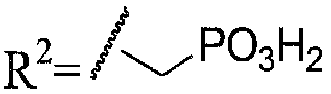
Sample 5 Disubstituted III 1:1.1:1.3:1.0 
Sample 6 Disubstituted 1:1.0:1.1:1.2 
Comparative sample 1 Monosubstituted II 1:0.6:0.8:0.1 R1=H, 
Comparative sample2 Monosubstituted II 1:1.5:1.8:1.6 R1=H, 
- Synthesis parameters of a sample of the water-reducing agent in each example are shown in Table 2.
Table 2 Synthesis parameters of modified water-reducing agents Monomer A Monomer B Monomer C Monomer molar ratio Molecular weight of polymer (104) Sample 1 Monosubstituted II Formaldehyde Phenoxypolyoxyalkylene ether m:n:p= 2.4:2.6:1 25000 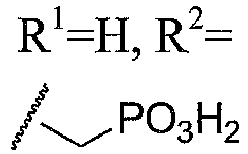
Mw=2500 Sample 2 Monosubstituted II Formaldehyde Phenoxypolyoxyalkylene ether m:n:p= 3.0:2.8:1 24000 
Mw=4500 Sample 3 Monosubstituted II Formaldehyde p-hydroxylphenoxypolyo xyalkylene ether m:n:p= 1.5:1.8:1 12000 
Mw=3500 Sample 4 Monosubstituted II Formaldehyde p-aminophenoxypolyoxy alkylene ether m:n:p= 4.5:3.2:1 46000 
Mw=4000 Sample 5 
Acetaldehyde p-hydroxylphenylaminop olyoxyalkylene ether m:n:p= 2.0:2.5:1 32000 Mw=6000 Sample 6 
Benzaldehyde Phenylaminopolyoxyalky lene ether m:n:p= 2.4:2.8:1 38000 Mw=1000 Compa rative sample 1 Monosubstituted II Formaldehyde Phenoxypolyoxyalkylene ether m:n:p= 0.8:1.2:1 7500 
Mw=750 Compa rative sample 2 Monosubstituted II Formaldehyde Phenoxypolyoxyalkylene ether m:n:p= 5.0:3.8:1 64500 
Mw=7000 Note: the dosing ratios in these steps all refer to a molar ratio of monomer A, monomer B and monomer C. - 126.02 g (1.0 mol) melamine, 86.10 g (1.05 mol) phosphorous acid and 100 ml water were placed into a 1000 ml reaction flask, 78.4 g (0.8 mol) sulfuric acid was added, the temperature was raised to 100°C for 10 min, 97.30 g (1.2 mol) of a 37% aqueous formaldehyde solution was dropwise added, a condenser tube was installed, and the reaction was heated to reflux for 3h and cooled for later use.
- 250 g (0.1 mol) of a monomer C (phenoxypolyoxyalkylene ether) and 52.8 g (0.24 mol) of the monomer A (monosubstituted phosphorylated melamine) were sequentially added in a 1000 ml round-bottomed flask, the temperature was raised to 80°C, 21.08 g (0.26 mol) of a 37% aqueous formaldehyde solution was dropwise added, and the reaction was maintained at 120°C for 6h.
- 34.67 g (0.26 mol) of a 30% sodium hydroxide solution was added and 480 g water was added to adjust the system to a pH=8 to 9, to prepare a high-performance polycondensate water-reducing agent at a weight concentration of about 40%, as a clear light brown viscous liquid. The polycondensate was determined by aqueous gel-permeation chromatography to have a weight average molecular weight of 25000.
- 126.05 g (1.0 mol) melamine, 90.20 g (1.1 mol) phosphorous acid and 100 ml water were placed into a 1000 ml reaction flask, 98.0 g (1.0 mol) sulfuric acid was added, the temperature was raised to 100°C for 10 min, 85.14 g (1.05 mol) of a 37% aqueous formaldehyde solution was dropwise added, a condenser tube was installed, and the reaction was heated to reflux for 3h and cooled for later use.
- 450 g (0.1 mol) of a monomer C (phenoxypolyoxyalkylene ether) and 66.0 g (0.3 mol) of the monomer A (monosubstituted phosphorylated melamine) were sequentially added in a 2000 ml round-bottomed flask, the temperature was raised to 80°C, 22.70 g (0.28 mol) of a 37% aqueous formaldehyde solution was dropwise added, and the reaction was maintained at 110°C for 5h.
- 41.3 g (0.31 mol) of a 30% sodium hydroxide solution was added and 800 g water was added to adjust the system to a pH=8 to 9, to prepare a high-performance polycondensate water-reducing agent at a weight concentration of about 40%, as a clear light brown viscous liquid. The polycondensate was determined by aqueous gel-permeation chromatography to have a weight average molecular weight of 24000.
- 126.0 g (1.0 mol) melamine, 82.06 g (1.0 mol) phosphorous acid and 100 ml water were placed into a 1000 ml reaction flask, 19.6 g (0.2 mol) sulfuric acid was added, the temperature was raised to 100°C for 10 min, 121.62 g (1.5 mol) of a 37% aqueous formaldehyde solution was dropwise added, a condenser tube was installed, and the reaction was heated to reflux for 3.5h and cooled for later use.
- 350 g (0.1 mol) of a monomer C (p-hydroxylphenoxypolyoxyalkylene ether) and 33.0 g (0.15 mol) of the monomer A (monosubstituted phosphorylated melamine) were sequentially added in a 2000 ml round-bottomed flask, the temperature was raised to 80°C, 14.60 g (0.18 mol) of a 37% aqueous formaldehyde solution was dropwise added, and the reaction was maintained at 130°C for 7h.
- 25.33 g (0.15 mol) of a 30% sodium hydroxide solution was added and 600 g water was added to adjust the system to a pH=8 to 9, to prepare a high-performance polycondensate water-reducing agent at a weight concentration of about 40%, as a clear light brown viscous liquid. The polycondensate was determined by aqueous gel-permeation chromatography to have a weight average molecular weight of 12000.
- 126.04 g (1.0 mol) melamine, 98.4 g (1.2 mol) phosphorous acid and 100 ml water were placed into a 1000 ml reaction flask, 117.6 g (1.2 mol) sulfuric acid was added, the temperature was raised to 100°C for 10 min, 81.08 g (1.0 mol) of a 37% aqueous formaldehyde solution was dropwise added, a condenser tube was installed, and the reaction was heated to reflux for 3h and cooled for later use.
- 400 g (0.1 mol) of a monomer C (p-aminophenoxypolyoxyalkylene ether) and 99.0 g (0.45 mol) of the monomer A (monosubstituted phosphorylated melamine) were sequentially added in a 2000 ml round-bottomed flask, the temperature was raised to 80°C, 14.60 g (0.18 mol) of a 37% aqueous formaldehyde solution was dropwise added, and the reaction was maintained at 110°C for 6h.
- 38.67 g (0.29 mol) of a 30% sodium hydroxide solution was added and 775g water was added to adjust the system to a pH=8 to 9, to prepare a high-performance polycondensate water-reducing agent at a weight concentration of about 40%, as a clear light brown viscous liquid. The polycondensate was determined by aqueous gel-permeation chromatography to have a weight average molecular weight of 46000.
- 126.03 g (1.0 mol) melamine, 180.4 g (2.2 mol) phosphorous acid and 150 ml water were placed into a 1000 ml reaction flask, 196 g (2.0 mol) sulfuric acid was added, the temperature was raised to 100°C for 10 min, 210.81 g (2.6 mol) of a 37% aqueous formaldehyde solution was dropwise added, a condenser tube was installed, and the reaction was heated to reflux for 4h and cooled for later use.
- 600 g (0.1 mol) of a monomer C (p-hydroxylphenylaminopolyoxyalkylene ether) and 62.8 g (0.2 mol) of the monomer A (disubstituted phosphorylated melamine) were sequentially added in a 2000 ml round-bottomed flask, the temperature was raised to 80°C, 27.5 g (0.25 mol) of a 40% aqueous acetaldehyde solution was dropwise added, and the reaction was maintained at 120°C for 6h.
- 82.67 g (0.62 mol) of a 30% sodium hydroxide solution was added and 1010 g water was added to adjust the system to a pH=8 to 9, to prepare a high-performance polycondensate water-reducing agent at a weight concentration of about 40%, as a clear light brown viscous liquid. The polycondensate was determined by aqueous gel-permeation chromatography to have a weight average molecular weight of 32000.
- 126.06 g (1.0 mol) melamine, 164.0 g (2.0 mol) phosphorous acid and 150 ml water were placed into a 1000 ml reaction flask, 215.6 g (2.2 mol) sulfuric acid was added, the temperature was raised to 100°C for 10 min, 194.59 g (2.4 mol) of a 37% aqueous formaldehyde solution was dropwise added, a condenser tube was installed, and the reaction was heated to reflux for 4h and cooled for later use.
- 100 g (0.1 mol) of a monomer C (phenylaminopolyoxyalkylene ether) and 75.36 g (0.24 mol) of the monomer A (disubstituted phosphorylated melamine) were sequentially added in a 1000 ml round-bottomed flask, the temperature was raised to 80°C, 29.68 g (0.28 mol) of a benzaldehyde solution was dropwise added, and the reaction was maintained at 120°C for 8h.
- 85.33 g (0.64 mol) of a 30% sodium hydroxide solution was added and 350 g water was added to adjust the system to a pH=8 to 9, to prepare a high-performance polycondensate water-reducing agent at a weight concentration of about 40%, as a clear light brown viscous liquid. The polycondensate was determined by aqueous gel-permeation chromatography to have a weight average molecular weight of 38000.
- 126.00 g (1.0 mol) melamine, 49.2 g (0.6 mol) phosphorous acid and 100 ml water were placed into a 1000 ml reaction flask, 9.8 g (0.1 mol) sulfuric acid was added, the temperature was raised to 100°C for 10 min, 64.86 g (0.8 mol) of a 37% aqueous formaldehyde solution was dropwise added, a condenser tube was installed, and the reaction was heated to reflux for 3h and cooled for later use.
- 75 g (0.1 mol) of a monomer C (phenoxypolyoxyalkylene ether) and 17.6 g (0.08 mol) of the monomer A (monosubstituted phosphorylated melamine) were sequentially added in a 500 ml round-bottomed flask, the temperature was raised to 80°C, 9.73 g (0.12 mol) of a 37% aqueous formaldehyde solution was dropwise added, and the reaction was maintained at 160°C for 10h.
- 10.67 g (0.08 mol) of a 30% sodium hydroxide solution was added and 150 g water was added to adjust the system to a pH=8 to 9, to prepare a high-performance polycondensate water-reducing agent at a weight concentration of about 40%, as a clear light brown viscous liquid. The polycondensate was determined by aqueous gel-permeation chromatography to have a weight average molecular weight of 7500.
- 126.01 g (1.0 mol) melamine, 123 g (1.5 mol) phosphorous acid and 100 ml water were placed into a 1000 ml reaction flask, 156.8 g (1.6 mol) sulfuric acid was added, the temperature was raised to 100°C for 10 min, 145.95 g (1.8 mol) of a 37% aqueous formaldehyde solution was dropwise added, a condenser tube was installed, and the reaction was heated to reflux for 3h and cooled for later use.
- 700 g (0.1 mol) of a monomer C (phenoxypolyoxyalkylene ether) and 110 g (0.5 mol) of the monomer A (monosubstituted phosphorylated melamine) were sequentially added in a 2000 ml round-bottomed flask, the temperature was raised to 80°C, 30.81 g (0.38 mol) of a 37% aqueous formaldehyde solution was dropwise added, and the reaction was maintained at 120°C for 8h.
- 49.33 g (0.47 mol) of a 30% sodium hydroxide solution was added and 1250 g water was added to adjust the system to a pH=8 to 9, to prepare a high-performance polycondensate water-reducing agent at a weight concentration of about 40%, as a clear light brown viscous liquid. The polycondensate was determined by aqueous gel-permeation chromatography to have a weight average molecular weight of 64500.
- To evaluate dispersibility of the high-performance polycondensate water-reducing agent prepared in the present invention for cement paste, testing of fluidity of cement paste was performed according to the GB/T8077-2000 standard. The experimental results are shown in Table 3.
- In all the application examples of the present invention, unless otherwise stated, the cement used was Onoda 52.5R.P.II cement, the sand was medium sand having a fineness modulus Mx=2.6, and the stone was continuously graded broken stone having a particle size of 5 to 20 mm. Testing of fluidity of cement paste was preformed with reference to the GB/T8077-2000 standard, where 87 g of the water addition was used and the fluidity of cement paste was determined on a flat glass after stirring for 3 min. Determination of slump and slump loss was performed with reference to related provisions in JC473-2001 "Pumping Aid for Concrete".
Table 3 Fluidity of cement pastes of samples Sample No. Solid content /wt% Fluidity of paste/mm 0 min 60 min Sample 1 0.12 250 255 Sample 2 0.12 262 257 Sample 3 0.12 246 248 Sample 4 0.12 252 256 Sample 5 0.12 237 230 Sample 6 0.12 247 240 Comparative sample1 0.12 202 158 Comparative sample2 0.12 185 178 Commercial PCA1 0.12 248 225 Commercial PCA2 0.12 252 218 - The data in Table 3 shows that the polycondensate water-reducing agents synthesized according to the preparation method of the present invention have excellent water-reducing and slump-retaining properties, and at a same dosage of 0.12%, compared to the commercial high-performance polycarboxylic acid water-reducing agents (PCA1 and PCA2), have an equivalent initial fluidity of cement paste, but have significantly better 60-minute slump retention, indicating that the polycondensate has excellent dispersion properties and dispersion-retaining properties of cement paste.
- The results from the control samples show that when the ratio of the materials diverges too much from the suggested range, the molecular weight of the polymer is too large or too small, so that the initial fluidity of cement paste of the samples is smaller and the loss increases. Therefore, the new polycondensate water-reducing agent provided by the present invention has excellent dispersion properties and dispersion-retaining properties of cement paste that are initially equivalent to those of the polycarboxylic acid water-reducing agent, and significantly better slump retention that is far superior to that of conventional naphthalene-based, amino, aliphatic, and melamine-based water-reducing agents.
- To evaluate adaptability of the polycondensate water-reducing agent of the present invention for cement, initial fluidity of cement paste is tested according to the method of determining fluidity of cement paste in GB/T8077-2000 "Methods for testing uniformity of concrete admixture", using 300 g of cement, 87 g of water addition, and self-provided and commercial polycarboxylic acid (PCA) water reducing agents as control samples, and using a paste mixer. The test results are shown in Table 4.
Table 4 Adaptability of samples for various cements Solid content/wt% Fluidity of cement paste/mm Onoda cement Helin cement Conch cement Jidong Cement Qilianshan Cement Sample 1 0.12 246 252 240 239 233 Sample 2 0.12 251 248 242 246 231 Sample 3 0.12 238 241 236 233 227 Sample 4 0.12 240 245 241 236 230 Sample 5 0.12 236 242 232 230 228 Sample 6 0.12 234 240 231 232 227 Comparative sample 1 0.12 190 196 181 173 156 Comparative sample2 0.12 167 185 176 168 152 Commercial PCA1 0.12 232 245 210 162 113 Commercial PCA2 0.12 218 235 176 169 121 - The data in Table 4 shows that the polycondensate water-reducing agents provided by the present invention have good adaptability for cement, and exhibit stable fluidity of cement paste among cements produced in different regions.
- In contrast, the initial fluidity of cement paste of the control samples is low, but relatively instable among different cements. In addition, the commercial polycarboxylic acid water-reducing agents (PCA) exhibit large fluctuation among different cements and have poor adaptability for cement.
- To evaluate adaptability of the polycondensate of the present invention for clay, initial fluidity of paste is tested according to a method of determining fluidity of cement paste in GB/T8077-2000 "Methods for testing uniformity of concrete admixture", using 300 g of cement (Helin cement), 87 g of water addition, respectively 0.5% and 1% of montmorillonite based on the binder, and self-provided polycondensate water-reducing agent and polycarboxylic acid (PCA) water reducing agent as control samples, and using a paste mixer. The test results are shown in Table 5.
Table 5 Clay resistance test of samples Solid content/wt% Fluidity of cement paste/mm Initial Mixed with 0.5% montmorillonite Mixed with 1.0% montmorillonite Sample 1 0.12 248 240 233 Sample 2 0.12 240 236 232 Sample 3 0.12 235 240 241 Sample 4 0.12 248 245 246 Sample 5 0.12 236 246 242 Sample 6 0.12 228 220 232 Comparative sample 1 0.12 203 195 186 Comparative sample2 0.12 210 203 201 Commercial PCA1 0.12 226 196 102 Commercial PCA2 0.12 235 203 110 - The data in Table 5 shows that the polycondensate water-reducing agents provided by the present invention have resistance to montmorillonite, and when mixed with montmorillonite at 0.5% and 1.0% of the amount of the adhesive cement respectively, have an equivalent slump flow without significant decrease in terms of fluidity of paste compared to that without montmorillonite; the control samples all exhibit low initial fluidity due to differences from the samples in segment structure and molecular weight, and when mixed with respective contents of montmorillonite, exhibit decreased slump flow values to a different extent; and the commercial polycarboxylic acid water-reducing agent (PCA) exhibits fluidity of paste that is rapidly decreased with increase in dosage of montmorillonite by even above 50%. In the market environment in which the quality of concrete aggregates and admixtures gradually becomes poor, the polycondensate water-reducing agent has vast engineering application prospects and the clay resistance thereof will be gradually recognized by the market.
- To evaluate adaptability of the polycondensate of the present invention for sulfate, initial fluidity of paste is tested according to a method of determining fluidity of cement paste in GB/T8077-2000 "Methods for testing uniformity of concrete admixture", using 300 g of cement (Helin cement), 87 g of water addition, respectively 0.5% and 1% of sodium sulfate based on the binder, and self-provided and commercial melamine (SM)-based water reducing agents as control samples, and using a paste mixer. The test results are shown in Table 6.
Table 6 Sulfate resistance test of samples Solid content/wt% Fluidity of cement paste/mm Initial Mixed with 0.5% sodium sulfate Mixed with 1.0% sodium sulfate Sample 1 0.12 248 245 243 Sample 2 0.12 258 253 249 Sample 3 0.12 234 236 232 Sample 4 0.12 246 243 236 Sample 5 0.12 238 231 226 Sample 6 0.12 236 242 235 Comparative sample 1 0.12 215 211 198 Comparative sample2 0.12 204 206 200 Commercial PCA1 0.12 229 178 130 Commercial PCA2 0.12 235 186 115 - The data in Table 6 shows that the polycondensate water-reducing agents provided by the present invention have resistance to interference from sulfate ions, and since the adsorption ability of phosphate ions is larger than that of sulfonate ions, in the cement paste system, when mixed with sodium sulfate at 0.5% and 1% of the amount of the adhesive cement respectively, there is no significant decrease in slump flow in terms of fluidity of paste compared to that without the sulfate salt; and the commercial polycarboxylic acid water-reducing agent (PCA) exhibits decreased fluidity of paste to a certain degree with increase in dosage of the sulfate salt, which indicates that competitive adsorption of sulfate ions with respect to the polycarboxylic acid water-reducing agent occurs on the surface of cement particles. In a high-sulfate cement system in which the quality of concrete admixtures is poor, the polycondensate water-reducing agent has potential and vast application prospects because of resistance to sulfates.
- The indexes such as water-reducing rate, air content and slump-retaining ability of the polycondensate water-reducing agent were measured, according to the test requirements of high-performance water-reducing agent in the GB8076-2008 standard - "Concrete Admixtures", using Helin cement, machine-made sand having a mud content of 1.8% and a fineness modulus of 3.3, and continuously graded broken stone having a mud content of 0.6% and nominal particle sizes of 5-10 mm and 10-20 mm, in the mixing ratio specified in Table 7. The results are shown in Table 8.
Table 7 Mixing ratio of concrete for testing Raw materials Cement Fly ash Slag powder Machine-made sand 5-10 mm stone 10-20mm stone Water Mixing ratio, Kg/m3 240 85 75 886 380 570 174 Table 8 Results of performance testing of polycondensate water-reducing agent Sample name Solid content (%) Water-reducing rate (%) Air content (%) Slump (mm) Slump flow (mm) Initial After 1h Initial After 1h Sample 1 0.12 29.2 3.8 215 193 468 432 Sample 2 0.12 28.6 3.6 220 189 472 441 Sample 3 0.12 27.2 3.5 213 178 465 431 Sample 4 0.12 28.3 3.7 206 192 457 429 Sample 5 0.12 27.9 4.1 214 196 469 438 Sample 6 0.12 28.4 3.9 221 186 476 445 Comparative sample 1 0.12 20.3 2.3 175 152 410 / Comparative sample2 0.12 19.6 2.1 163 146 403 / Commercial PCA1 0.12 27.9 3.6 182 / 412 / Commercial PCA2 0.12 28.5 3.8 193 / 423 / Note: / indicates that concrete has no slump and slump flow values - The data of flowability of concrete in Table 8 show that under the conditions of machine-made sand having a mud content of 1.8% and stone having a mud content of 0.6% as aggregates, the newly synthesized polycondensate water-reducing agents exhibit better slump values and slump-retaining ability than that of the commercial polycarboxylic acid (PCA) water reducing agents, which indicates that the polycondensate water-reducing agent has good adaptability for machine-made sand and stone having a high mud content and has obvious anti-mud effect.
- The polycondensate water-reducing agent provided by the present invention has a novel structure, simple preparation process and low material costs, and uses the incorporated phosphate group, in place of conventional carboxyl group and sulfonic group, as a main adsorption group, such that the overall performance of the conventional water-reducing agent is improved. The polycondensate water-reducing agent exhibits good adaptability for cement, resistance to clays and resistance to competitive adsorption of sulfate ions, and has strong advantages and vast market prospects in the current market environment in which the quality of concrete admixtures and aggregates is poor.
Claims (6)
- A phosphorylated polycondensate high-performance water-reducing agent, having a molecular structure represented by the following formula I:
 wherein the molecular structure of the polymer comprises three building blocks, formed by condensation of phosphorylated melamine A, an aldehyde B and an aryl alkoxy compound C, and the molecular structure is a comb-like structure;the three monomers has a mole ratio of m : n : p = 1.5 to 4.5 : 1.8 to 3.2 : 1, preferably m : n : p = 2.0 to 3.0 : 2.4 to 2.8 : 1;the monomer A is phosphorylated melamine having a structure selected from the following monodentate compound II and bidentate compound III;
 the monomer B is one of formaldehyde, acetaldehyde and benzaldehyde compounds, or a mixture thereof in any ratio;the monomer C is aryl alkylene polyether as a polyether side chain of the polycondensate, with a molecular weight of 1000 to 6000, wherein R4 and R5 are H, OH, NH2 or phenoxypolyoxyalkylene ether or phenylaminopolyoxyalkylene ether, and wherein the polyoxyalkylene ether is formed by ring opening polymerization of an aromatic alcohol or amine with active hydrogen and ethylene oxide/propylene oxide, provided that R4 and R5 cannot both be H, OH or NH2, and at least one of R4 and R5 is phenoxypolyoxyalkylene ether or phenylaminopolyoxyalkylene ether; and the phosphorylated polycondensate high-performance water-reducing agent has a weight average molecular weight of 10000 to 50000.
 - The phosphorylated polycondensate high-performance water-reducing agent of claim 1, wherein the monomer A is prepared by the Mannich reaction of melamine, phosphorous acid, and respectively, formaldehyde, acetaldehyde or benzaldehyde as key raw materials in the presence of an acid catalyst; wherein a molar ratio of the materials is melamine : phosphorous acid : aldehyde : acid (H+) = 1 : 1.0 to 1.2 : 1.1 to 1.5 : 0.2 to 1.2.
- The phosphorylated polycondensate high-performance water-reducing agent of claim 1, wherein the monomer B is formaldehyde.
- The phosphorylated polycondensate high-performance water-reducing agent of claim 1, wherein the monomer C has a molecular weight of 2000 to 5000, and corresponds to the structural formula I where R4 and R5 are H, OH, NH2 or phenoxypolyoxyalkylene ether or phenylaminopolyoxyalkylene ether, provided that R4 and R5 cannot both be H, OH or NH2, and at least one of R4 and R5 is phenoxypolyoxyalkylene ether or phenylamino polyoxyalkylene ether; and the polyoxyalkylene ether is formed by ring opening polymerization of an aromatic alcohol or amine with active hydrogen and ethylene oxide/propylene oxide.
- A method for preparing the phosphorylated polycondensate high-performance water-reducing agent of any one of claims 1-4, comprising subjecting the three monomers to polycondensateization in a presence of an acid catalyst at a pH of 1 to 3 to obtain the phosphorylated polycondensate high-performance water-reducing agent;wherein the reaction temperature is 100 to 150°C, the reaction time is 1 to 10 h, and the reaction system uses water as solvent; the apparatus is equipped with a condenser (tube) for reflux so as to prevent dissipation of water or the aldehyde in the system to affect the reaction conditions; andthe acid catalyst is one of sulfonic acid, sulfuric acid, trifluoroacetic acid (TFAA), 4-toluene sulfonic acid (pTSA), monochloroethanoic acid (MCAA), glacial acetic acid, hydrochloric acid, and formic acid and other acids, or a mixture thereof in any ratio.
- The method of claim 5, wherein the preparation specifically comprises three steps: preparation of the monomer A, condensation and neutralization, wherein the neutralization uses a pH adjusting agent selected from sodium hydroxide and potassium hydroxide.
Applications Claiming Priority (2)
| Application Number | Priority Date | Filing Date | Title |
|---|---|---|---|
| CN201511028434.3A CN105712649B (en) | 2015-12-31 | 2015-12-31 | A kind of phosphoric acid polycondensates high efficiency water reducing agent and preparation method thereof |
| PCT/CN2016/104954 WO2017113992A1 (en) | 2015-12-31 | 2016-11-07 | Phosphorylated polycondensate as high efficiency water reducing agent and preparation method thereof |
Publications (3)
| Publication Number | Publication Date |
|---|---|
| EP3398916A1 EP3398916A1 (en) | 2018-11-07 |
| EP3398916A4 EP3398916A4 (en) | 2019-09-04 |
| EP3398916B1 true EP3398916B1 (en) | 2023-07-26 |
Family
ID=56146994
Family Applications (1)
| Application Number | Title | Priority Date | Filing Date |
|---|---|---|---|
| EP16880783.2A Active EP3398916B1 (en) | 2015-12-31 | 2016-11-07 | Phosphorylated polycondensate as high efficiency water reducing agent and preparation method thereof |
Country Status (7)
| Country | Link |
|---|---|
| US (1) | US10745510B2 (en) |
| EP (1) | EP3398916B1 (en) |
| CN (1) | CN105712649B (en) |
| MY (1) | MY189400A (en) |
| SG (1) | SG11201805639TA (en) |
| WO (1) | WO2017113992A1 (en) |
| ZA (1) | ZA201805105B (en) |
Families Citing this family (29)
| Publication number | Priority date | Publication date | Assignee | Title |
|---|---|---|---|---|
| CN105712649B (en) | 2015-12-31 | 2018-06-26 | 江苏苏博特新材料股份有限公司 | A kind of phosphoric acid polycondensates high efficiency water reducing agent and preparation method thereof |
| KR102054675B1 (en) | 2017-06-20 | 2019-12-11 | (주)엔나노텍 | flame-retardant ester polyol, the manufacturing method thereof and polyisocyanurates including the anti-flame ester polyol |
| CN107475724B (en) * | 2017-07-06 | 2020-07-10 | 广东石油化工学院 | Nitrogen-containing organic phosphorous acid corrosion inhibitor and synthetic method thereof |
| CN107556446B (en) * | 2017-10-18 | 2020-12-29 | 江苏苏博特新材料股份有限公司 | Amination intermediate, amination polyether and phosphorylation star-shaped product thereof, and preparation method and application thereof |
| AU2018379267B2 (en) * | 2017-12-07 | 2023-10-05 | Construction Research & Technology Gmbh | A dispersant composition |
| CN109880035B (en) * | 2018-09-28 | 2023-05-05 | 江苏苏博特新材料股份有限公司 | Phosphate slump retaining agent special for medium-low slump concrete and preparation method thereof |
| CN109293885B (en) * | 2018-09-28 | 2021-04-20 | 镇江苏博特新材料有限公司 | Phosphate group-containing water reducing agent and preparation method thereof |
| CN109534715B (en) * | 2018-12-14 | 2021-05-28 | 南京福盛新材料有限公司 | Anti-mud polycarboxylate superplasticizer and preparation method thereof |
| CN111362612B (en) * | 2018-12-26 | 2022-03-18 | 江苏苏博特新材料股份有限公司 | Polycarboxylate superplasticizer special for rock-fill dam C15 self-compacting concrete |
| CN111377636B (en) * | 2018-12-29 | 2022-03-15 | 江苏苏博特新材料股份有限公司 | Nano suspension additive for accelerating concrete coagulation |
| CN111377643B (en) * | 2018-12-31 | 2021-09-28 | 江苏苏博特新材料股份有限公司 | High-adaptability viscosity-reduction type polycarboxylate superplasticizer and preparation method and application thereof |
| CN111377642B (en) | 2018-12-31 | 2021-09-28 | 江苏苏博特新材料股份有限公司 | Multi-element adsorption polycarboxylate superplasticizer and preparation method and application thereof |
| CN110467371A (en) * | 2019-07-16 | 2019-11-19 | 江苏博思通新材料有限公司 | A kind of agent on crack resistance of concrete chamotte mould water-reducing agent |
| CN112979234B (en) * | 2019-12-17 | 2023-05-05 | 江苏苏博特新材料股份有限公司 | Concrete mixture for producing PHC pipe pile by steam-free curing and application thereof |
| CN112321784B (en) * | 2019-12-26 | 2023-08-11 | 联泓(江苏)新材料研究院有限公司 | Bulk polymer and preparation method and application thereof |
| CN111234151B (en) * | 2020-02-24 | 2023-01-24 | 金陵科技学院 | Preparation method of melamine-formaldehyde oligomer type migration reinforcing steel bar rust inhibitor containing phosphoric group |
| CN111548073B (en) * | 2020-06-04 | 2022-06-07 | 广州市建筑科学研究院有限公司 | Anti-shrinkage prefabricated part concrete and preparation method and application thereof |
| CN113929832B (en) * | 2020-06-29 | 2023-02-14 | 博特建材(天津)有限公司 | Polyfunctional group superplasticizer for ultrahigh-performance concrete and preparation method thereof |
| CN113968949B (en) * | 2020-07-24 | 2023-11-07 | 博特新材料泰州有限公司 | High-adaptability water reducer based on biological amino acid, and preparation method and application thereof |
| CN114644741B (en) * | 2020-12-21 | 2023-10-31 | 博特新材料泰州有限公司 | An amphoteric phosphonate water-reducing agent, its preparation method and its application |
| CN114685296B (en) * | 2020-12-30 | 2025-02-25 | 南京博特新材料有限公司 | Preparation method of polyether intermediate containing aldehyde group and amine group and application in phosphoric acid-based water reducer |
| CN113307579B (en) * | 2021-06-25 | 2022-08-05 | 天津金隅混凝土有限公司 | Machine-made sand low-shrinkage high-slump-retaining concrete |
| CN113563556B (en) * | 2021-07-05 | 2022-08-19 | 武汉善达化工有限公司 | Impurity-resistant water reducing agent for high-silica-content refractory castable and preparation method thereof |
| CN116178728B (en) * | 2021-11-29 | 2025-07-18 | 金陵科技学院 | A kind of organosilicon polycondensate type high efficiency water reducing agent and preparation method thereof |
| CN115850611A (en) * | 2022-12-06 | 2023-03-28 | 四川奥克化学有限公司 | A kind of highly adaptable polycarboxylate water reducer and its preparation method |
| CN116425500B (en) * | 2023-02-09 | 2024-12-20 | 浙江开元新型墙体材料有限公司 | Autoclaved aerated concrete slab capable of absorbing noise and preparation process thereof |
| CN116621491B (en) * | 2023-05-24 | 2024-10-22 | 山东恒丰天利新材料科技有限公司 | Small molecule anti-mud agent |
| CN117105569B (en) * | 2023-09-22 | 2024-10-11 | 湖南湘鑫科贸发展有限公司 | Polycarboxylate superplasticizer and preparation method thereof |
| CN120118254B (en) * | 2025-05-07 | 2025-08-08 | 江苏苏博特新材料股份有限公司 | Water reducer and preparation method and application thereof |
Family Cites Families (16)
| Publication number | Priority date | Publication date | Assignee | Title |
|---|---|---|---|---|
| IT1263969B (en) | 1993-02-25 | 1996-09-05 | Mario Collepardi | SUPERFLUIDIFYING ADDITIVES WITH HIGH CONSERVATION OF WORKABILITY |
| CH689118A5 (en) | 1993-06-11 | 1998-10-15 | Nippon Catalytic Chem Ind | Additional means of controlling the flow behavior of cementitious compositions. |
| DE19609614A1 (en) * | 1995-03-17 | 1996-09-19 | Sueddeutsche Kalkstickstoff | Water soluble polycondensate, used as cement additive |
| KR100247527B1 (en) | 1996-04-03 | 2000-03-15 | 겐지 아이다 | Cement dispersing method and cement composition |
| JP3610331B2 (en) | 2001-10-16 | 2005-01-12 | 竹本油脂株式会社 | Method for producing allyl ether ester monomer |
| DE102004050395A1 (en) * | 2004-10-15 | 2006-04-27 | Construction Research & Technology Gmbh | Polycondensation product based on aromatic or heteroaromatic compounds, process for its preparation and its use |
| DE102005060947A1 (en) * | 2005-12-20 | 2007-06-28 | Construction Research & Technology Gmbh | Powdered polycondensation products |
| CN101066851B (en) | 2007-06-18 | 2012-10-03 | 江苏博特新材料有限公司 | Concrete slump maintaining agent of polycarboxylate |
| US9156737B2 (en) * | 2008-10-06 | 2015-10-13 | Construction Research & Technology Gmbh | Method for producing phosphated polycondensation products and the use thereof |
| CN102239127B (en) * | 2008-10-06 | 2014-08-06 | 建筑研究和技术有限公司 | Phosphated polycondensation product, method for production and use thereof |
| AU2010294400B2 (en) * | 2009-09-02 | 2014-03-20 | Basf Construction Solutions Gmbh | Formulation and its use |
| CN101831037A (en) | 2010-04-14 | 2010-09-15 | 深圳市五山建材实业有限公司 | Carboxylic acid copolymer concrete slump retaining agent |
| CN107082618A (en) * | 2010-10-11 | 2017-08-22 | 巴斯夫聚合建材有限公司 | Gypsum slurry containing dispersant |
| CN102531450B (en) | 2011-12-26 | 2013-03-20 | 上海三瑞高分子材料有限公司 | Polyether amine modified polycarboxylate high performance water-reducing agent and preparation method thereof |
| CN104031258B (en) | 2014-06-12 | 2015-06-24 | 南京师范大学 | Phosphate group containing terpolymer as well as preparation method and application thereof |
| CN105712649B (en) | 2015-12-31 | 2018-06-26 | 江苏苏博特新材料股份有限公司 | A kind of phosphoric acid polycondensates high efficiency water reducing agent and preparation method thereof |
-
2015
- 2015-12-31 CN CN201511028434.3A patent/CN105712649B/en active Active
-
2016
- 2016-11-07 MY MYPI2018001174A patent/MY189400A/en unknown
- 2016-11-07 EP EP16880783.2A patent/EP3398916B1/en active Active
- 2016-11-07 US US16/067,018 patent/US10745510B2/en active Active
- 2016-11-07 WO PCT/CN2016/104954 patent/WO2017113992A1/en not_active Ceased
- 2016-11-07 SG SG11201805639TA patent/SG11201805639TA/en unknown
-
2018
- 2018-07-30 ZA ZA2018/05105A patent/ZA201805105B/en unknown
Also Published As
| Publication number | Publication date |
|---|---|
| CN105712649A (en) | 2016-06-29 |
| US10745510B2 (en) | 2020-08-18 |
| SG11201805639TA (en) | 2018-07-30 |
| WO2017113992A1 (en) | 2017-07-06 |
| CN105712649B (en) | 2018-06-26 |
| US20190016843A1 (en) | 2019-01-17 |
| EP3398916A4 (en) | 2019-09-04 |
| ZA201805105B (en) | 2019-05-29 |
| EP3398916A1 (en) | 2018-11-07 |
| MY189400A (en) | 2022-02-09 |
Similar Documents
| Publication | Publication Date | Title |
|---|---|---|
| US10745510B2 (en) | Phosphorylated polycondensate as high efficiency water reducing agent and preparation method thereof | |
| EP3398979B1 (en) | Method for preparing concrete superplasticizer having phosphorous acid group and superplasticizer obtained | |
| CN111377642B (en) | Multi-element adsorption polycarboxylate superplasticizer and preparation method and application thereof | |
| CN113929832B (en) | Polyfunctional group superplasticizer for ultrahigh-performance concrete and preparation method thereof | |
| JP6074517B2 (en) | Method for producing slump retention type polycarboxylate-based high performance fluidizing agent | |
| CN107337765B (en) | Phosphonic acid-based polymer with strong adaptability and slump retaining performance as well as preparation method and application thereof | |
| CN108046643B (en) | Preparation method and application of novel anti-soil phosphate superplasticizer | |
| EP3398982B1 (en) | Preparation method for polymer and applications thereof | |
| CN107602870B (en) | Aminated polyether, preparation method of polycondensate containing phosphorous acid groups and application of polycondensate as cement dispersant | |
| CN111378113A (en) | Phosphated polyether, preparation method thereof and application thereof in preparation of high-adaptability phosphonic acid-based water reducing agent | |
| CN107964075A (en) | A kind of preparation method of the phosphate water-reducing agent of amide containing structure | |
| CN105440276A (en) | Preparation method and application of polymer containing phosphorous acid group | |
| CN101215119A (en) | High-performance polycarboxylic acids water reducing agent prepared by one-step method | |
| CN113121815B (en) | Clay-resistant phosphonic acid-based superplasticizer and preparation method thereof | |
| CN113801274A (en) | A kind of polyamino acid and its preparation method and application | |
| JPWO2020208781A1 (en) | Additives for hydraulic compositions | |
| CN109320714B (en) | Special small-molecule superplasticizer for medium-low slump concrete and preparation method thereof | |
| CN107722194B (en) | High-water-reduction polycarboxylic acid cement dispersant and preparation method thereof | |
| US12528907B2 (en) | Polyhydroxy aromatic intermediate, preparation thereof and use thereof in polycondensate water-reducer with branched side chains | |
| CN108129053B (en) | Preparation method and application of concrete plasticizer with improved clay adaptability | |
| CN102093522A (en) | Polycarboxylic acid, use thereof and water reducer containing same | |
| CN105713163B (en) | Modified melamine based water reducer and preparation method thereof | |
| CN111378111A (en) | Phosphonate water reducing agent without halogen ions and preparation method and application thereof | |
| CN117683225A (en) | Preparation method of phosphonic acid water reducer with slump retaining performance | |
| CN115785364B (en) | A highly adaptable polycondensation carboxylate water reducer, preparation method and application thereof |
Legal Events
| Date | Code | Title | Description |
|---|---|---|---|
| STAA | Information on the status of an ep patent application or granted ep patent |
Free format text: STATUS: THE INTERNATIONAL PUBLICATION HAS BEEN MADE |
|
| PUAI | Public reference made under article 153(3) epc to a published international application that has entered the european phase |
Free format text: ORIGINAL CODE: 0009012 |
|
| STAA | Information on the status of an ep patent application or granted ep patent |
Free format text: STATUS: REQUEST FOR EXAMINATION WAS MADE |
|
| 17P | Request for examination filed |
Effective date: 20180724 |
|
| AK | Designated contracting states |
Kind code of ref document: A1 Designated state(s): AL AT BE BG CH CY CZ DE DK EE ES FI FR GB GR HR HU IE IS IT LI LT LU LV MC MK MT NL NO PL PT RO RS SE SI SK SM TR |
|
| AX | Request for extension of the european patent |
Extension state: BA ME |
|
| DAV | Request for validation of the european patent (deleted) | ||
| DAX | Request for extension of the european patent (deleted) | ||
| A4 | Supplementary search report drawn up and despatched |
Effective date: 20190802 |
|
| RIC1 | Information provided on ipc code assigned before grant |
Ipc: C04B 103/30 20060101ALN20190729BHEP Ipc: C08G 12/46 20060101ALI20190729BHEP Ipc: C04B 24/24 20060101AFI20190729BHEP Ipc: C04B 24/30 20060101ALI20190729BHEP |
|
| GRAP | Despatch of communication of intention to grant a patent |
Free format text: ORIGINAL CODE: EPIDOSNIGR1 |
|
| STAA | Information on the status of an ep patent application or granted ep patent |
Free format text: STATUS: GRANT OF PATENT IS INTENDED |
|
| RIC1 | Information provided on ipc code assigned before grant |
Ipc: C04B 103/30 20060101ALN20230124BHEP Ipc: C04B 24/30 20060101ALI20230124BHEP Ipc: C08G 12/46 20060101ALI20230124BHEP Ipc: C04B 24/24 20060101AFI20230124BHEP |
|
| INTG | Intention to grant announced |
Effective date: 20230227 |
|
| GRAS | Grant fee paid |
Free format text: ORIGINAL CODE: EPIDOSNIGR3 |
|
| GRAA | (expected) grant |
Free format text: ORIGINAL CODE: 0009210 |
|
| STAA | Information on the status of an ep patent application or granted ep patent |
Free format text: STATUS: THE PATENT HAS BEEN GRANTED |
|
| AK | Designated contracting states |
Kind code of ref document: B1 Designated state(s): AL AT BE BG CH CY CZ DE DK EE ES FI FR GB GR HR HU IE IS IT LI LT LU LV MC MK MT NL NO PL PT RO RS SE SI SK SM TR |
|
| REG | Reference to a national code |
Ref country code: GB Ref legal event code: FG4D |
|
| REG | Reference to a national code |
Ref country code: CH Ref legal event code: EP |
|
| REG | Reference to a national code |
Ref country code: DE Ref legal event code: R096 Ref document number: 602016081473 Country of ref document: DE |
|
| REG | Reference to a national code |
Ref country code: IE Ref legal event code: FG4D |
|
| P01 | Opt-out of the competence of the unified patent court (upc) registered |
Effective date: 20230721 |
|
| REG | Reference to a national code |
Ref country code: LT Ref legal event code: MG9D |
|
| REG | Reference to a national code |
Ref country code: NL Ref legal event code: MP Effective date: 20230726 |
|
| REG | Reference to a national code |
Ref country code: AT Ref legal event code: MK05 Ref document number: 1591794 Country of ref document: AT Kind code of ref document: T Effective date: 20230726 |
|
| PG25 | Lapsed in a contracting state [announced via postgrant information from national office to epo] |
Ref country code: NL Free format text: LAPSE BECAUSE OF FAILURE TO SUBMIT A TRANSLATION OF THE DESCRIPTION OR TO PAY THE FEE WITHIN THE PRESCRIBED TIME-LIMIT Effective date: 20230726 |
|
| PG25 | Lapsed in a contracting state [announced via postgrant information from national office to epo] |
Ref country code: GR Free format text: LAPSE BECAUSE OF FAILURE TO SUBMIT A TRANSLATION OF THE DESCRIPTION OR TO PAY THE FEE WITHIN THE PRESCRIBED TIME-LIMIT Effective date: 20231027 |
|
| PG25 | Lapsed in a contracting state [announced via postgrant information from national office to epo] |
Ref country code: IS Free format text: LAPSE BECAUSE OF FAILURE TO SUBMIT A TRANSLATION OF THE DESCRIPTION OR TO PAY THE FEE WITHIN THE PRESCRIBED TIME-LIMIT Effective date: 20231126 |
|
| PG25 | Lapsed in a contracting state [announced via postgrant information from national office to epo] |
Ref country code: SE Free format text: LAPSE BECAUSE OF FAILURE TO SUBMIT A TRANSLATION OF THE DESCRIPTION OR TO PAY THE FEE WITHIN THE PRESCRIBED TIME-LIMIT Effective date: 20230726 Ref country code: RS Free format text: LAPSE BECAUSE OF FAILURE TO SUBMIT A TRANSLATION OF THE DESCRIPTION OR TO PAY THE FEE WITHIN THE PRESCRIBED TIME-LIMIT Effective date: 20230726 Ref country code: PT Free format text: LAPSE BECAUSE OF FAILURE TO SUBMIT A TRANSLATION OF THE DESCRIPTION OR TO PAY THE FEE WITHIN THE PRESCRIBED TIME-LIMIT Effective date: 20231127 Ref country code: NO Free format text: LAPSE BECAUSE OF FAILURE TO SUBMIT A TRANSLATION OF THE DESCRIPTION OR TO PAY THE FEE WITHIN THE PRESCRIBED TIME-LIMIT Effective date: 20231026 Ref country code: LV Free format text: LAPSE BECAUSE OF FAILURE TO SUBMIT A TRANSLATION OF THE DESCRIPTION OR TO PAY THE FEE WITHIN THE PRESCRIBED TIME-LIMIT Effective date: 20230726 Ref country code: LT Free format text: LAPSE BECAUSE OF FAILURE TO SUBMIT A TRANSLATION OF THE DESCRIPTION OR TO PAY THE FEE WITHIN THE PRESCRIBED TIME-LIMIT Effective date: 20230726 Ref country code: IS Free format text: LAPSE BECAUSE OF FAILURE TO SUBMIT A TRANSLATION OF THE DESCRIPTION OR TO PAY THE FEE WITHIN THE PRESCRIBED TIME-LIMIT Effective date: 20231126 Ref country code: HR Free format text: LAPSE BECAUSE OF FAILURE TO SUBMIT A TRANSLATION OF THE DESCRIPTION OR TO PAY THE FEE WITHIN THE PRESCRIBED TIME-LIMIT Effective date: 20230726 Ref country code: GR Free format text: LAPSE BECAUSE OF FAILURE TO SUBMIT A TRANSLATION OF THE DESCRIPTION OR TO PAY THE FEE WITHIN THE PRESCRIBED TIME-LIMIT Effective date: 20231027 Ref country code: FI Free format text: LAPSE BECAUSE OF FAILURE TO SUBMIT A TRANSLATION OF THE DESCRIPTION OR TO PAY THE FEE WITHIN THE PRESCRIBED TIME-LIMIT Effective date: 20230726 Ref country code: AT Free format text: LAPSE BECAUSE OF FAILURE TO SUBMIT A TRANSLATION OF THE DESCRIPTION OR TO PAY THE FEE WITHIN THE PRESCRIBED TIME-LIMIT Effective date: 20230726 |
|
| PG25 | Lapsed in a contracting state [announced via postgrant information from national office to epo] |
Ref country code: PL Free format text: LAPSE BECAUSE OF FAILURE TO SUBMIT A TRANSLATION OF THE DESCRIPTION OR TO PAY THE FEE WITHIN THE PRESCRIBED TIME-LIMIT Effective date: 20230726 |
|
| PG25 | Lapsed in a contracting state [announced via postgrant information from national office to epo] |
Ref country code: ES Free format text: LAPSE BECAUSE OF FAILURE TO SUBMIT A TRANSLATION OF THE DESCRIPTION OR TO PAY THE FEE WITHIN THE PRESCRIBED TIME-LIMIT Effective date: 20230726 |
|
| REG | Reference to a national code |
Ref country code: DE Ref legal event code: R097 Ref document number: 602016081473 Country of ref document: DE |
|
| PG25 | Lapsed in a contracting state [announced via postgrant information from national office to epo] |
Ref country code: SM Free format text: LAPSE BECAUSE OF FAILURE TO SUBMIT A TRANSLATION OF THE DESCRIPTION OR TO PAY THE FEE WITHIN THE PRESCRIBED TIME-LIMIT Effective date: 20230726 Ref country code: RO Free format text: LAPSE BECAUSE OF FAILURE TO SUBMIT A TRANSLATION OF THE DESCRIPTION OR TO PAY THE FEE WITHIN THE PRESCRIBED TIME-LIMIT Effective date: 20230726 Ref country code: ES Free format text: LAPSE BECAUSE OF FAILURE TO SUBMIT A TRANSLATION OF THE DESCRIPTION OR TO PAY THE FEE WITHIN THE PRESCRIBED TIME-LIMIT Effective date: 20230726 Ref country code: EE Free format text: LAPSE BECAUSE OF FAILURE TO SUBMIT A TRANSLATION OF THE DESCRIPTION OR TO PAY THE FEE WITHIN THE PRESCRIBED TIME-LIMIT Effective date: 20230726 Ref country code: DK Free format text: LAPSE BECAUSE OF FAILURE TO SUBMIT A TRANSLATION OF THE DESCRIPTION OR TO PAY THE FEE WITHIN THE PRESCRIBED TIME-LIMIT Effective date: 20230726 Ref country code: CZ Free format text: LAPSE BECAUSE OF FAILURE TO SUBMIT A TRANSLATION OF THE DESCRIPTION OR TO PAY THE FEE WITHIN THE PRESCRIBED TIME-LIMIT Effective date: 20230726 Ref country code: SK Free format text: LAPSE BECAUSE OF FAILURE TO SUBMIT A TRANSLATION OF THE DESCRIPTION OR TO PAY THE FEE WITHIN THE PRESCRIBED TIME-LIMIT Effective date: 20230726 |
|
| PG25 | Lapsed in a contracting state [announced via postgrant information from national office to epo] |
Ref country code: IT Free format text: LAPSE BECAUSE OF FAILURE TO SUBMIT A TRANSLATION OF THE DESCRIPTION OR TO PAY THE FEE WITHIN THE PRESCRIBED TIME-LIMIT Effective date: 20230726 |
|
| PLBE | No opposition filed within time limit |
Free format text: ORIGINAL CODE: 0009261 |
|
| STAA | Information on the status of an ep patent application or granted ep patent |
Free format text: STATUS: NO OPPOSITION FILED WITHIN TIME LIMIT |
|
| REG | Reference to a national code |
Ref country code: CH Ref legal event code: PL |
|
| PG25 | Lapsed in a contracting state [announced via postgrant information from national office to epo] |
Ref country code: MC Free format text: LAPSE BECAUSE OF FAILURE TO SUBMIT A TRANSLATION OF THE DESCRIPTION OR TO PAY THE FEE WITHIN THE PRESCRIBED TIME-LIMIT Effective date: 20230726 |
|
| 26N | No opposition filed |
Effective date: 20240429 |
|
| PG25 | Lapsed in a contracting state [announced via postgrant information from national office to epo] |
Ref country code: LU Free format text: LAPSE BECAUSE OF NON-PAYMENT OF DUE FEES Effective date: 20231107 |
|
| PG25 | Lapsed in a contracting state [announced via postgrant information from national office to epo] |
Ref country code: CH Free format text: LAPSE BECAUSE OF NON-PAYMENT OF DUE FEES Effective date: 20231130 |
|
| PG25 | Lapsed in a contracting state [announced via postgrant information from national office to epo] |
Ref country code: MC Free format text: LAPSE BECAUSE OF FAILURE TO SUBMIT A TRANSLATION OF THE DESCRIPTION OR TO PAY THE FEE WITHIN THE PRESCRIBED TIME-LIMIT Effective date: 20230726 Ref country code: LU Free format text: LAPSE BECAUSE OF NON-PAYMENT OF DUE FEES Effective date: 20231107 Ref country code: CH Free format text: LAPSE BECAUSE OF NON-PAYMENT OF DUE FEES Effective date: 20231130 Ref country code: SI Free format text: LAPSE BECAUSE OF FAILURE TO SUBMIT A TRANSLATION OF THE DESCRIPTION OR TO PAY THE FEE WITHIN THE PRESCRIBED TIME-LIMIT Effective date: 20230726 |
|
| REG | Reference to a national code |
Ref country code: BE Ref legal event code: MM Effective date: 20231130 |
|
| REG | Reference to a national code |
Ref country code: IE Ref legal event code: MM4A |
|
| PG25 | Lapsed in a contracting state [announced via postgrant information from national office to epo] |
Ref country code: IE Free format text: LAPSE BECAUSE OF NON-PAYMENT OF DUE FEES Effective date: 20231107 |
|
| PG25 | Lapsed in a contracting state [announced via postgrant information from national office to epo] |
Ref country code: BE Free format text: LAPSE BECAUSE OF NON-PAYMENT OF DUE FEES Effective date: 20231130 |
|
| PG25 | Lapsed in a contracting state [announced via postgrant information from national office to epo] |
Ref country code: IE Free format text: LAPSE BECAUSE OF NON-PAYMENT OF DUE FEES Effective date: 20231107 Ref country code: BE Free format text: LAPSE BECAUSE OF NON-PAYMENT OF DUE FEES Effective date: 20231130 |
|
| PG25 | Lapsed in a contracting state [announced via postgrant information from national office to epo] |
Ref country code: BG Free format text: LAPSE BECAUSE OF FAILURE TO SUBMIT A TRANSLATION OF THE DESCRIPTION OR TO PAY THE FEE WITHIN THE PRESCRIBED TIME-LIMIT Effective date: 20230726 |
|
| PG25 | Lapsed in a contracting state [announced via postgrant information from national office to epo] |
Ref country code: BG Free format text: LAPSE BECAUSE OF FAILURE TO SUBMIT A TRANSLATION OF THE DESCRIPTION OR TO PAY THE FEE WITHIN THE PRESCRIBED TIME-LIMIT Effective date: 20230726 |
|
| PG25 | Lapsed in a contracting state [announced via postgrant information from national office to epo] |
Ref country code: CY Free format text: LAPSE BECAUSE OF FAILURE TO SUBMIT A TRANSLATION OF THE DESCRIPTION OR TO PAY THE FEE WITHIN THE PRESCRIBED TIME-LIMIT; INVALID AB INITIO Effective date: 20161107 |
|
| PG25 | Lapsed in a contracting state [announced via postgrant information from national office to epo] |
Ref country code: HU Free format text: LAPSE BECAUSE OF FAILURE TO SUBMIT A TRANSLATION OF THE DESCRIPTION OR TO PAY THE FEE WITHIN THE PRESCRIBED TIME-LIMIT; INVALID AB INITIO Effective date: 20161107 |
|
| PG25 | Lapsed in a contracting state [announced via postgrant information from national office to epo] |
Ref country code: TR Free format text: LAPSE BECAUSE OF FAILURE TO SUBMIT A TRANSLATION OF THE DESCRIPTION OR TO PAY THE FEE WITHIN THE PRESCRIBED TIME-LIMIT Effective date: 20230726 |
|
| PGFP | Annual fee paid to national office [announced via postgrant information from national office to epo] |
Ref country code: DE Payment date: 20251117 Year of fee payment: 10 |
|
| PGFP | Annual fee paid to national office [announced via postgrant information from national office to epo] |
Ref country code: GB Payment date: 20251126 Year of fee payment: 10 |
|
| PGFP | Annual fee paid to national office [announced via postgrant information from national office to epo] |
Ref country code: FR Payment date: 20251127 Year of fee payment: 10 |