EP3397493B1 - Fluid ejection devices - Google Patents
Fluid ejection devices Download PDFInfo
- Publication number
- EP3397493B1 EP3397493B1 EP16882747.5A EP16882747A EP3397493B1 EP 3397493 B1 EP3397493 B1 EP 3397493B1 EP 16882747 A EP16882747 A EP 16882747A EP 3397493 B1 EP3397493 B1 EP 3397493B1
- Authority
- EP
- European Patent Office
- Prior art keywords
- fluid
- nozzle
- membrane
- layer
- impedance
- Prior art date
- Legal status (The legal status is an assumption and is not a legal conclusion. Google has not performed a legal analysis and makes no representation as to the accuracy of the status listed.)
- Active
Links
Images









Classifications
-
- B—PERFORMING OPERATIONS; TRANSPORTING
- B41—PRINTING; LINING MACHINES; TYPEWRITERS; STAMPS
- B41J—TYPEWRITERS; SELECTIVE PRINTING MECHANISMS, i.e. MECHANISMS PRINTING OTHERWISE THAN FROM A FORME; CORRECTION OF TYPOGRAPHICAL ERRORS
- B41J2/00—Typewriters or selective printing mechanisms characterised by the printing or marking process for which they are designed
- B41J2/005—Typewriters or selective printing mechanisms characterised by the printing or marking process for which they are designed characterised by bringing liquid or particles selectively into contact with a printing material
- B41J2/01—Ink jet
- B41J2/135—Nozzles
- B41J2/14—Structure thereof only for on-demand ink jet heads
- B41J2/14201—Structure of print heads with piezoelectric elements
- B41J2/14209—Structure of print heads with piezoelectric elements of finger type, chamber walls consisting integrally of piezoelectric material
-
- B—PERFORMING OPERATIONS; TRANSPORTING
- B41—PRINTING; LINING MACHINES; TYPEWRITERS; STAMPS
- B41J—TYPEWRITERS; SELECTIVE PRINTING MECHANISMS, i.e. MECHANISMS PRINTING OTHERWISE THAN FROM A FORME; CORRECTION OF TYPOGRAPHICAL ERRORS
- B41J2/00—Typewriters or selective printing mechanisms characterised by the printing or marking process for which they are designed
- B41J2/005—Typewriters or selective printing mechanisms characterised by the printing or marking process for which they are designed characterised by bringing liquid or particles selectively into contact with a printing material
- B41J2/01—Ink jet
-
- B—PERFORMING OPERATIONS; TRANSPORTING
- B41—PRINTING; LINING MACHINES; TYPEWRITERS; STAMPS
- B41J—TYPEWRITERS; SELECTIVE PRINTING MECHANISMS, i.e. MECHANISMS PRINTING OTHERWISE THAN FROM A FORME; CORRECTION OF TYPOGRAPHICAL ERRORS
- B41J2/00—Typewriters or selective printing mechanisms characterised by the printing or marking process for which they are designed
- B41J2/005—Typewriters or selective printing mechanisms characterised by the printing or marking process for which they are designed characterised by bringing liquid or particles selectively into contact with a printing material
- B41J2/01—Ink jet
- B41J2/135—Nozzles
- B41J2/14—Structure thereof only for on-demand ink jet heads
-
- B—PERFORMING OPERATIONS; TRANSPORTING
- B41—PRINTING; LINING MACHINES; TYPEWRITERS; STAMPS
- B41J—TYPEWRITERS; SELECTIVE PRINTING MECHANISMS, i.e. MECHANISMS PRINTING OTHERWISE THAN FROM A FORME; CORRECTION OF TYPOGRAPHICAL ERRORS
- B41J2/00—Typewriters or selective printing mechanisms characterised by the printing or marking process for which they are designed
- B41J2/005—Typewriters or selective printing mechanisms characterised by the printing or marking process for which they are designed characterised by bringing liquid or particles selectively into contact with a printing material
- B41J2/01—Ink jet
- B41J2/135—Nozzles
- B41J2/14—Structure thereof only for on-demand ink jet heads
- B41J2/14201—Structure of print heads with piezoelectric elements
- B41J2/14233—Structure of print heads with piezoelectric elements of film type, deformed by bending and disposed on a diaphragm
-
- B—PERFORMING OPERATIONS; TRANSPORTING
- B41—PRINTING; LINING MACHINES; TYPEWRITERS; STAMPS
- B41J—TYPEWRITERS; SELECTIVE PRINTING MECHANISMS, i.e. MECHANISMS PRINTING OTHERWISE THAN FROM A FORME; CORRECTION OF TYPOGRAPHICAL ERRORS
- B41J2/00—Typewriters or selective printing mechanisms characterised by the printing or marking process for which they are designed
- B41J2/005—Typewriters or selective printing mechanisms characterised by the printing or marking process for which they are designed characterised by bringing liquid or particles selectively into contact with a printing material
- B41J2/01—Ink jet
- B41J2/135—Nozzles
- B41J2/16—Production of nozzles
- B41J2/1607—Production of print heads with piezoelectric elements
- B41J2/161—Production of print heads with piezoelectric elements of film type, deformed by bending and disposed on a diaphragm
-
- B—PERFORMING OPERATIONS; TRANSPORTING
- B41—PRINTING; LINING MACHINES; TYPEWRITERS; STAMPS
- B41J—TYPEWRITERS; SELECTIVE PRINTING MECHANISMS, i.e. MECHANISMS PRINTING OTHERWISE THAN FROM A FORME; CORRECTION OF TYPOGRAPHICAL ERRORS
- B41J2/00—Typewriters or selective printing mechanisms characterised by the printing or marking process for which they are designed
- B41J2/005—Typewriters or selective printing mechanisms characterised by the printing or marking process for which they are designed characterised by bringing liquid or particles selectively into contact with a printing material
- B41J2/01—Ink jet
- B41J2/135—Nozzles
- B41J2/16—Production of nozzles
- B41J2/1621—Manufacturing processes
- B41J2/1623—Manufacturing processes bonding and adhesion
-
- B—PERFORMING OPERATIONS; TRANSPORTING
- B41—PRINTING; LINING MACHINES; TYPEWRITERS; STAMPS
- B41J—TYPEWRITERS; SELECTIVE PRINTING MECHANISMS, i.e. MECHANISMS PRINTING OTHERWISE THAN FROM A FORME; CORRECTION OF TYPOGRAPHICAL ERRORS
- B41J2/00—Typewriters or selective printing mechanisms characterised by the printing or marking process for which they are designed
- B41J2/005—Typewriters or selective printing mechanisms characterised by the printing or marking process for which they are designed characterised by bringing liquid or particles selectively into contact with a printing material
- B41J2/01—Ink jet
- B41J2/135—Nozzles
- B41J2/16—Production of nozzles
- B41J2/1621—Manufacturing processes
- B41J2/1626—Manufacturing processes etching
- B41J2/1628—Manufacturing processes etching dry etching
-
- B—PERFORMING OPERATIONS; TRANSPORTING
- B41—PRINTING; LINING MACHINES; TYPEWRITERS; STAMPS
- B41J—TYPEWRITERS; SELECTIVE PRINTING MECHANISMS, i.e. MECHANISMS PRINTING OTHERWISE THAN FROM A FORME; CORRECTION OF TYPOGRAPHICAL ERRORS
- B41J2/00—Typewriters or selective printing mechanisms characterised by the printing or marking process for which they are designed
- B41J2/005—Typewriters or selective printing mechanisms characterised by the printing or marking process for which they are designed characterised by bringing liquid or particles selectively into contact with a printing material
- B41J2/01—Ink jet
- B41J2/135—Nozzles
- B41J2/16—Production of nozzles
- B41J2/1621—Manufacturing processes
- B41J2/1626—Manufacturing processes etching
- B41J2/1629—Manufacturing processes etching wet etching
-
- B—PERFORMING OPERATIONS; TRANSPORTING
- B41—PRINTING; LINING MACHINES; TYPEWRITERS; STAMPS
- B41J—TYPEWRITERS; SELECTIVE PRINTING MECHANISMS, i.e. MECHANISMS PRINTING OTHERWISE THAN FROM A FORME; CORRECTION OF TYPOGRAPHICAL ERRORS
- B41J2/00—Typewriters or selective printing mechanisms characterised by the printing or marking process for which they are designed
- B41J2/005—Typewriters or selective printing mechanisms characterised by the printing or marking process for which they are designed characterised by bringing liquid or particles selectively into contact with a printing material
- B41J2/01—Ink jet
- B41J2/135—Nozzles
- B41J2/16—Production of nozzles
- B41J2/1621—Manufacturing processes
- B41J2/1631—Manufacturing processes photolithography
-
- B—PERFORMING OPERATIONS; TRANSPORTING
- B41—PRINTING; LINING MACHINES; TYPEWRITERS; STAMPS
- B41J—TYPEWRITERS; SELECTIVE PRINTING MECHANISMS, i.e. MECHANISMS PRINTING OTHERWISE THAN FROM A FORME; CORRECTION OF TYPOGRAPHICAL ERRORS
- B41J2/00—Typewriters or selective printing mechanisms characterised by the printing or marking process for which they are designed
- B41J2/005—Typewriters or selective printing mechanisms characterised by the printing or marking process for which they are designed characterised by bringing liquid or particles selectively into contact with a printing material
- B41J2/01—Ink jet
- B41J2/135—Nozzles
- B41J2/16—Production of nozzles
- B41J2/1621—Manufacturing processes
- B41J2/1632—Manufacturing processes machining
-
- B—PERFORMING OPERATIONS; TRANSPORTING
- B41—PRINTING; LINING MACHINES; TYPEWRITERS; STAMPS
- B41J—TYPEWRITERS; SELECTIVE PRINTING MECHANISMS, i.e. MECHANISMS PRINTING OTHERWISE THAN FROM A FORME; CORRECTION OF TYPOGRAPHICAL ERRORS
- B41J2/00—Typewriters or selective printing mechanisms characterised by the printing or marking process for which they are designed
- B41J2/005—Typewriters or selective printing mechanisms characterised by the printing or marking process for which they are designed characterised by bringing liquid or particles selectively into contact with a printing material
- B41J2/01—Ink jet
- B41J2/135—Nozzles
- B41J2/14—Structure thereof only for on-demand ink jet heads
- B41J2002/14403—Structure thereof only for on-demand ink jet heads including a filter
-
- B—PERFORMING OPERATIONS; TRANSPORTING
- B41—PRINTING; LINING MACHINES; TYPEWRITERS; STAMPS
- B41J—TYPEWRITERS; SELECTIVE PRINTING MECHANISMS, i.e. MECHANISMS PRINTING OTHERWISE THAN FROM A FORME; CORRECTION OF TYPOGRAPHICAL ERRORS
- B41J2/00—Typewriters or selective printing mechanisms characterised by the printing or marking process for which they are designed
- B41J2/005—Typewriters or selective printing mechanisms characterised by the printing or marking process for which they are designed characterised by bringing liquid or particles selectively into contact with a printing material
- B41J2/01—Ink jet
- B41J2/135—Nozzles
- B41J2/14—Structure thereof only for on-demand ink jet heads
- B41J2002/14459—Matrix arrangement of the pressure chambers
-
- B—PERFORMING OPERATIONS; TRANSPORTING
- B41—PRINTING; LINING MACHINES; TYPEWRITERS; STAMPS
- B41J—TYPEWRITERS; SELECTIVE PRINTING MECHANISMS, i.e. MECHANISMS PRINTING OTHERWISE THAN FROM A FORME; CORRECTION OF TYPOGRAPHICAL ERRORS
- B41J2202/00—Embodiments of or processes related to ink-jet or thermal heads
- B41J2202/01—Embodiments of or processes related to ink-jet heads
- B41J2202/12—Embodiments of or processes related to ink-jet heads with ink circulating through the whole print head
Definitions
- the present disclosure relates generally to fluid ejection devices.
- fluid droplets are ejected from one or more nozzles onto a medium.
- the nozzles are fluidically connected to a fluid path that includes a fluid pumping chamber.
- the fluid pumping chamber can be actuated by an actuator, which causes ejection of a fluid droplet.
- the medium can be moved relative to the fluid ejection device.
- the ejection of a fluid droplet from a particular nozzle is timed with the movement of the medium to place a fluid droplet at a desired location on the medium. Ejecting fluid droplets of uniform size and speed and in the same direction enables uniform deposition of fluid droplets onto the medium.
- JP 2008290292 A describes an apparatus for ejecting ink droplets where ink is filtered by a filter feature and subsequently in part discharged from a nozzle and in part returned to an ink tank via a discharge path and a circulation tube.
- the nozzle When fluid is ejected from a nozzle of a fluid ejector, the nozzle can become at least partially depleted of fluid, rendering the nozzle unprepared for ejection of further droplets. Circulation of fluid through "leakage" flow paths to the nozzle can refill the depleted nozzle. If these leakage flow paths have a large cross-sectional area, the depleted nozzle can be refilled quickly after fluid is ejected from the nozzle, the nozzle can be readied more quickly for subsequent fluid ejections. However, large leakage flow paths can make it difficult to achieve a high enough pressure at the nozzle opening for efficient fluid ejection.
- an impedance feature can be positioned in the flow path.
- the impedance feature introduces a fluidic impedance into the leakage flow path that is higher at or around the jet resonance frequency than at other frequencies.
- the jet resonance frequency is the frequency at which the nozzle has high fluid flow, such as during fluid ejection from the nozzle.
- the fluidic impedance in the flow paths is higher during fluid ejection than at other times, e.g., during refilling, thus enabling sufficiently high pressures to be achieved during ejection and while still providing rapid refilling of the depleted nozzle when no fluid is being ejected.
- the impedance feature can be a membrane with apertures positioned in the fluid supply or return path.
- fluid can contain contaminants, e.g., impurities, that can clog or damage a nozzle. It is useful to have a filter to prevent such contaminants from reaching the nozzle or from being ejected onto the surface.
- the impedance feature can be a membrane with apertures positioned in the fluid supply path.
- a fluid ejector in a first aspect, includes a nozzle layer, a body, an actuator, a first membrane, and a second membrane.
- the nozzle layer has an outer surface, an inner surface, and a nozzle extending between the inner surface and the outer surface.
- the nozzle has an entrance at the inner surface to receive fluid and an exit opening at an outer surface for ejection of fluid.
- the inner surface of the nozzle layer is secured to the body.
- the body includes a pumping chamber, a return channel, and a first passage fluidically connecting the pumping chamber to the entrance of the nozzle.
- a second passage fluidically connects the entrance of the nozzle to the return channel.
- the actuator is configured to cause fluid to flow out of the pumping chamber such that actuation of the actuator causes fluid to be ejected from the nozzle.
- the first membrane is disposed between the actuator and the pumping chamber and isolating the actuator from fluid in the pumping chamber.
- the second membrane is different from the first membrane, and the second membrane is formed across and partially blocks the entrance of the nozzle.
- the second membrane has at least one hole therethrough such that in operation of the fluid ejector fluid flows through the at least one hole in the second membrane.
- Implementations may include one or more of the following features.
- the second membrane and hole may be configured such that the first flow path has a first impedance when fluid is being ejected from the nozzle and a second impedance when fluid is not being ejected from the nozzle.
- the first impedance may be greater than the second impedance.
- the second membrane may be configured such that second passage has a maximum impedance at or around a resonance frequency of the nozzle.
- the second membrane may extend substantially parallel to the outer surface.
- the second membrane may have a plurality of holes therethrough.
- the plurality of holes may be spaced uniformly across the second membrane.
- the plurality of holes may be configured to provide a filter.
- the second membrane may extend substantially parallel to the outer surface.
- the second membrane may project inwardly substantially perpendicular to walls of the nozzle.
- the second membrane may be formed of a material that has a lower elastic modulus than an elastic modulus of a material forming walls of the nozzle.
- the second membrane may be more flexible than walls of the nozzle.
- the hole through the second membrane may be narrower than the exit opening of the nozzle.
- the second membrane may be formed of an oxide, and may have a thickness between about 0.5 ⁇ m and about 5 ⁇ m.
- the second membrane may be formed of a polymer, and may have a thickness between about 10 ⁇ m and about 30 ⁇ m.
- a method of fluid ejection includes ejecting fluid from a nozzle of a fluid ejector as described above, and refilling the nozzle with fluid from a flow path.
- the second membrane is formed across the flow path and provides the flow path with a first impedance when fluid is being ejected from the nozzle and a second impedance when fluid is not being ejected from the nozzle.
- the second membrane has at least one hole therethrough.
- Implementations may include one or more of the following features.
- Refilling the nozzle may include flowing fluid in the flow path through the at least one hole defined by the second membrane.
- the flow path may fluidically connect the nozzle to a return channel.
- the flow path may fluidically connect the nozzle to a pumping chamber.
- Ejecting fluid from the nozzle may include actuating an actuator to cause fluid to be ejected from a pumping chamber fluidically connected to the nozzle.
- the impedance feature allow sufficiently high pressures to be achieved during fluid ejection while also allowing rapid refilling of depleted nozzles.
- the impedance feature can be fabricated using existing fabrication techniques and with few additional steps, and thus can be easily integrated into current process flows.
- a filter feature can prevent impurities in from reaching and clogging the nozzle or from being ejected onto the surface.
- the filter can be fabricated in conjunction with compliance features in a supply or return channel without significantly increasing fabrication complexity.
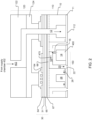
- a printhead 100 can be used for ejecting droplets of fluid, such as ink, biological liquids, polymers, liquids for forming electronic components, or other types of liquid, onto a surface.
- the printhead 100 can include a casing 130 that provides a chamber for holding fluid, a substrate 110 with nozzles and actuators for ejecting fluid from the nozzles, and an interposer 120 to carry fluid from the chamber to the substrate 110.
- the casing and interposer for the printhead is described below, other configurations are possible for the printhead, and the casing and interposer are, in fact, optional.
- flexible tubing could connect inlets and outlets on a top surface of the substrate 110 to a fluid reservoir.
- the casing 130 has an interior volume that is divided into a fluid supply chamber 132 and a fluid return chamber 136, e.g., by divider wall 134.
- the bottom of the fluid supply chamber 132 and the fluid return chamber 136 can be defined by the top surface of the interposer assembly 120.
- the interposer assembly 120 can be attached to the casing 130, e.g., onto the bottom surface of the casing 130, such as by bonding, friction, or another mechanism of attachment.
- the interposer assembly can include an upper interposer 122 and a lower interposer 124 positioned between the upper interposer 122 and a substrate 110.
- the interposer assembly consists of a single interposer body.
- Passages formed in the interposer assembly 120 and the substrate 110 define a flow path 400 for fluid flow.
- the interposer assembly 120 includes a fluid supply inlet opening 402 and a fluid return outlet opening 408.
- the fluid supply inlet opening 402 and fluid return outlet opening 408 can be formed as apertures in the upper interposer 122.
- Fluid can flow along the flow path 400 from the supply chamber 132, through the fluid supply inlet 402 to one or more fluid ejectors 150 (described in greater detail below) in the substrate 110.
- An actuator 30 in the fluid ejector 150 can cause a portion of the fluid to be ejected through a nozzle 22. The remaining fluid that is not ejected can flow along the flow path 400 from one or more fluid ejection devices 150 in the substrate 110 through the fluid return outlet opening 408 and into the return chamber 136.
- a single flow path 400 is shown as a straight passage for illustrative purposes.
- the printhead 100 can include multiple flow paths 400, and the flow paths 400 can be considerably more geometrically complex, e.g., the flow paths are not necessarily straight.
- the substrate 110 can include a body 10 in which various passages of the fluid path, such as the pumping chamber are formed, a nozzle layer 11 in which the nozzles 22 are formed, and the actuators 30 for the fluid ejectors 150.
- the substrate 110 can be formed by semiconductor chip fabrication processes.
- the body 10 can be a monolithic body, e.g., a monolithic semiconductor body, such as a silicon substrate.
- the body 10 can be single-crystal silicon.
- Each fluid ejector includes a nozzle 22 formed in a nozzle layer 11 that is disposed on a bottom surface of the substrate 110.
- the nozzle layer 11 is an integral part of the substrate 110, e.g., the nozzle layer 11 is formed of the same material and crystalline structure, e.g., single crystal silicon, as the body 10.
- the nozzle layer 11 is a layer of different material, e.g., silicon oxide, that is deposited onto the surface of the body 10 to form the substrate 110.
- the nozzle layer 11 comprises multiple layers, e.g., a silicon layer and one or more oxide layers.
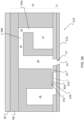
- the ejector flow path 475 can include a pumping chamber inlet passage 16, a pumping chamber 18, a descender 20, and an outlet passage 26.
- the pumping chamber inlet passage 16 fluidically connects the pumping chamber 18 to the inlet feed channel 14 and can include, e.g., an ascender that extends vertically from the inlet feed channel 14 a pumping chamber inlet that extends horizontally from the ascender to the pumping chamber.
- the descender 20 is fluidically connected to a corresponding nozzle 22, e.g., at the bottom of the descender.
- the outlet passage 26 connects the descender 20 to an outlet feed channel 28, which is in fluidic connection with the return chamber through a substrate outlet and the fluid supply outlet 408 (see FIG. 1 ).
- the outlet feed channel 28 is also called a return channel.
- the descender 20 is fluidically connected to a corresponding nozzle 22, e.g., at the bottom of the descender 20.
- the nozzle 22 can be considered the portion of the flow path after the intersection of the outlet passage 26 to the descender.
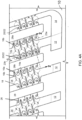
- passages such as the substrate inlet 12, the inlet feed channel 14, and the outlet feed channel 28 are shown in a common plane. However, in some implementations (e.g., in the examples of FIGS. 4A and 4B ), one or more of the substrate inlet 12, the inlet feed channel 14, and the outlet feed channel 28 are not in a common plane with the other passages.
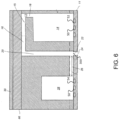
- the substrate 110 includes multiple inlet feed channels 14 formed therein and extending parallel with one another and to the plane of the bottom surface 112 (see FIG. 2 ) of the substrate 110.
- Each inlet feed channel 14 is in fluidic communication with at least one substrate inlet 12 that extends perpendicular to the inlet feed channels 14, e.g., perpendicular to the plane of the bottom surface 112 of the substrate 110.
- the substrate 110 also includes multiple outlet feed channels 28 formed therein and extending parallel with one another and to the plane of the bottom surface 112 of the substrate 110.
- Each outlet feed channel 28 is in fluidic communication with at least one substrate outlet (not shown) that extends perpendicular to the outlet feed channels 28, e.g., perpendicular to the plane of the bottom surface 112 of the substrate 110.
- the inlet feed channels 14 and the outlet feed channels 28 are arranged in alternating rows.
- the outlet feed channel 28 has a larger cross-sectional area than an outlet passages 26, e.g., to handle the combined multiple outlet feed channels 28.
- the outlet feed channel 28 can have a height (measured perpendicular to the surface 11a) that is larger than the height of the outlet passages 26.
- the outlet feed channel 28 can have a width (measured parallel to the surface 11a) that is larger than the width of the outlet passages 26
- the substrate includes multiple fluid ejectors 150. Fluid flows through each fluid ejector 150 along a corresponding ejector flow path 475, which includes the pumping chamber inlet passage 16 (including an ascender 16a and a horizontal pumping chamber inlet 16b), a pumping chamber 18, and a descender 20. Each ascender 16a is fluidically connected to one of the inlet feed channels 14. Each ascender 16a is also fluidically connected to the corresponding pumping chamber 18 through the pumping chamber inlet 16b. The pumping chamber 18 is fluidically connected to the corresponding descender 20, which leads to the associated nozzle 22. Each descender 20 is also connected to one of the outlet feed channels 28 through the corresponding outlet passage 26. For instance, the cross-sectional view of fluid ejectors of FIG. 3A-3D can be taken along line 2-2 of FIG. 4A .
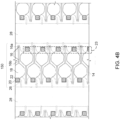
- the printhead 100 includes multiple nozzles 22 arranged in parallel columns 23 (see FIG. 4B ).
- the nozzles 22 in a given column 23 can be all fluidically connected to the same inlet feed channel 14 and the same outlet feed channel 28. That is, for instance, all of the ascenders 16 in a given column can be connected to the same inlet feed channel 14 and all of the descenders 20 in a given column can be connected to the same outlet feed channel 28.
- nozzles 22 in adjacent columns can all be fluidically connected to the same inlet feed channel 14 or the same outlet feed channel 28, but not both.
- each nozzle 22 in column 23a is fluidically connected to the inlet feed channel 14a and to the outlet feed channel 28a.
- Each nozzle 22 in the adjacent column 23b is also connected to the inlet feed channel 14a but is connected to the outlet feed channel 28b.
- columns of nozzles 22 can be connected to the same inlet feed channel 14 or the same outlet feed channel 28 in an alternating pattern. In some implementations, columns of nozzles 22 can be connected to the same inlet feed channel 14 or the same outlet feed channel 28 in an alternating pattern. In some implementations, the walls 14a of the inlet feed channels 14 have indentations, e.g., form a scalloped, wavy or zigzag pattern, to disrupt cross-talk. Further details about the printhead 100 can be found in U.S. Patent No. 7,566,118 .
- each fluid ejector 150 includes a corresponding actuator 30, such as a piezoelectric transducer or a resistive heater.
- the pumping chamber 18 of each fluid ejector 150 is in close proximity to the corresponding actuator 30.
- Each actuator 30 can be selectively actuated to pressurize the corresponding pumping chamber 18, thus ejecting fluid from the nozzle 22 that is connected to the pressurized pumping chamber.
- the actuator 30 can include a piezoelectric layer 31, such as a layer of lead zirconium titanate (PZT).
- the piezoelectric layer 31 can have a thickness of about 50 ⁇ m or less, e.g., about 1 ⁇ m to about 25 ⁇ m, e.g., about 2 ⁇ m to about 5 ⁇ m.
- the piezoelectric layer 31 is continuous.
- the piezoelectric layer 31 can be made discontinuous, e.g., by an etching or sawing step during fabrication. The discontinuous piezoelectric layer 31 can overlie at least the pumping chamber 18, but not the entire body 10.
- the piezoelectric layer 31 is sandwiched between a drive electrode 64 and a ground electrode 65.
- the drive electrode 64 and the ground electrode 65 can be metal, such as copper, gold, tungsten, titanium, platinum, or a combination of metals, or another conductive material, such as indium-tin-oxide (ITO).
- ITO indium-tin-oxide
- the thickness of the drive electrode 64 and the ground electrode 65 can be, e.g., about 2 ⁇ m or less, e.g., about 0.5 ⁇ m.
- a membrane 66 is disposed between the actuator 30 and the pumping chamber 18 and isolates the actuator 30, e.g., the ground electrode 65, from fluid in the pumping chamber 18.
- the membrane 66 is a separate layer, e.g., a layer of silicon oxide, from the body 10.
- the membrane is unitary with the body 10, e.g., the nozzle layer 11 is formed of the same material and crystalline structure, e.g., single crystal silicon, as the body 10.
- two or more of the substrate 110, the nozzle layer 11, and the membrane 66 can be formed as a unitary body.
- the actuator 30 does not include a membrane 66, and the ground electrode 65 is formed on the back side of the piezoelectric layer 31 such that the ground electrode 65 is directly exposed to fluid in the pumping chamber 18.
- an electrical voltage can be applied between the drive electrode 64 and the ground electrode 65 to apply a voltage to the piezoelectric layer 31.
- the applied voltage causes the piezoelectric layer 31 to deflect, which in turn causes the membrane 66 to deflect.
- the deflection of the membrane 66 causes a change in volume of the pumping chamber 18, producing a pressure pulse (also referred to as a firing pulse) in the pumping chamber 18.
- the pressure pulse propagates through the descender 20 to the corresponding nozzle 22, thus causing a droplet of fluid to be ejected from the nozzle 22.
- the membrane 66 can be a single layer of silicon (e.g., single crystalline silicon), another semiconductor material, one or more layers of oxide, such as aluminum oxide (AlO2), zirconium oxide (ZrO2), or silicon oxide (SiO 2 ), aluminum nitride, silicon carbide, ceramics or metal, or another material.
- the membrane 66 can be formed of an inert material that has a compliance such that the actuation of the actuator 30 causes flexure of the membrane 66 sufficient to cause a droplet of fluid to be ejected.
- the membrane 66 can be secured to the actuator 30 with an adhesive layer 67. In some implementations, the layers of the actuator 30 are deposited directly on the membrane 66.
- the nozzle 22 When fluid is ejected from the nozzle 22 of a fluid ejector 150, the nozzle 22 can become at least partially depleted of fluid. Circulation of fluid through the inlet and outlet feed channels 14, 28 (sometimes referred to generally as feed channels) can provide fluid to refill the depleted nozzle 22. Without being limited to any particular theory, although fluid can flow through the outlet passage 26 toward the toward the outlet feed channel 28 during ejection of a droplet of fluid, after ejection when the nozzle 22 is depleted, it is also possible for fluid to flow back through the outlet passage 26 toward the nozzle 22 to refill the nozzle 22.
- the nozzle 22 can be readied more quickly for a subsequent ejection, thus improving the response time of the fluid ejector 150.
- the speed with which the nozzle 22 can be refilled can be increased by increasing the cross-sectional area of one or more of the fluid flow passages that supply fluid to the nozzle 22, such as the descender 20, the outlet passage 26, or another fluid flow passage.
- the speed with which the nozzle 22 can be refilled can be increased by increasing the cross-sectional area of one or more of the fluid flow passages that supply fluid to the nozzle 22, such as the descender 20, the outlet passage 26, or another fluid flow passage.
- it can sometimes be difficult to achieve a high enough pressure at the nozzle opening 24 for efficient fluid ejection (sometimes referred to as jetting).
- smaller fluid flow passages supplying fluid to the nozzle 22 can make it easier to achieve pressures sufficient for efficient jetting, but can also limit the speed with which the nozzle 22 can be refilled.
- an impedance structure 310 such as a membrane 300
- a membrane 300 can be positioned in the fluid flow path close to the nozzle.
- the membrane 300 can have one or more holes 302 through the thickness of the membrane.
- the membrane 300 is positioned in the flow path such that fluid flows through the holes 302 in the membrane 300.
- the membrane 300 is positioned in the outlet passage 26 and provides the impedance structure 310.
- the outlet passage 26 includes a portion 32a above the membrane 300, and a portion 32b below the membrane 26.
- the impedance structure 310 includes a membrane 300 positioned between the outlet passage 26 and the return channel 28.
- the membrane can form a bottom surface of the return channel 28, e.g., the top surface of the membrane 300 can coplanar with the bottom surface of the return channel 28.
- the membrane 300 can alternatively be positioned at other locations in the inlet flow path, the outlet flow path, or both, and can provide other functions.
- a filter feature 320 can be positioned in the fluid flow path close to the nozzle to prevent contaminants from reaching the nozzle or from being ejected from the nozzle.
- the filter feature 320 can be provided by a membrane 300 having one or more holes 302 through the thickness of the membrane.
- the membrane 300 can be positioned across the nozzle 22 after (i.e., closer to the nozzle opening 24 than) the intersection between the descender 20 and the outlet passage 26.
- the membrane 300 can be positioned immediately after the intersection, e.g., the top surface of the membrane can be co-planar with the bottom surface of the outlet passage 26.
- the membrane 300 can be positioned across the descender 20 before (i.e., farther from the nozzle opening 24 than) the intersection between the descender 20 and the outlet passage 26.
- the membrane can be positioned immediately before the intersection, e.g., the bottom surface of the membrane can be co-planar with the top surface of the outlet passage 26.
- the membrane 300 lies in a plane parallel to the outer surface 11a of the nozzle layer 11.
- the holes can extend perpendicular to the outer surface 11a of the nozzle layer 11.
- the membrane 300 can be configured to introduce a fluidic impedance to the flow passage in which the impedance membrane is positioned, such as the fluid flow path between the descender and the return channel.
- the value of the fluidic impedance introduced by the impedance membrane 300 can be dependent on frequency. For instance, oscillations can occur in the fluid in the flow passage.
- the impedance membrane can introduce a fluidic impedance at or around a particular frequency of the fluid oscillations that is higher than the fluidic impedance at other frequencies of the fluid oscillations.
- the impedance membrane 300 can provide a high impedance at or around the jet resonance frequency, which is the frequency at which the nozzle 22 has high fluid flow during jetting.
- the jet resonance frequency is between about 40Khz and 10Mhz.
- the impedance is about 20dB or a factor of 10
- the impedance membrane 300 thus introduces a sufficiently high fluidic impedance into the fluid flow passage in the vicinity of the nozzle 22 to direct fluid flow and pressure to the nozzle to provide efficient jetting.
- the impedance membrane introduces a lower fluidic impedance, thus enabling rapid refilling of the depleted nozzle.
- the impedance membrane 300 can act as a capacitor that is in parallel with an inductor along the fluid flow path.
- the membrane 300 itself can be a compliant membrane that acts as a capacitive element in the fluid flow path, and the holes 302 act as the inductor element.
- the membrane will move and hence there will be some viscous resistance.
- impedance effects from the holes can dominate.
- the compliance of the membrane 300 can also provide a resistance that can help to dampen oscillations in the fluid flow passage, e.g., as discussed below.
- the membrane 300 can also act as a filter to prevent foreign bodies, such as impurities in the fluid, from reaching and clogging the nozzle 22.
- the membrane 300 shown in FIGS. 3C and 3D can act primarily as a filter rather than to adjust the fluidic impedance to affect the rate of refilling of the depleted nozzle.
- the membrane 300 can be formed of a material that is compatible with fabrication processes (e.g., microelectromechanical systems (MEMS) fabrication processes) used to fabricate other components of the fluid ejectors 150.
- MEMS microelectromechanical systems
- the membrane 300 can be formed of an oxide (e.g., SiO 2 ), a nitride (e.g., Si 3 N 4 ), or another insulating material.
- the membrane 300 can be formed of silicon.
- the membrane 300 can be formed of metal, e.g., a sputtered metal layer.
- the membrane 300 can be formed of a relatively soft and compliant material, such as polyimide or a polymer (e.g., poly(methyl methacrylate) (PMMA), polydimethylsiloxane (PDMS), or another polymer).
- the membrane 300 can be formed of a material that is more flexible or softer than the material forming the walls of the fluid flow path, e.g., a material that has a lower elastic modulus than the material forming the walls of the fluid flow path.
- the thickness of the membrane 300 can cause the membrane 300 to be more flexible than the walls of the fluid flow path.
- the membrane 300 when acting as an impedance feature, can be thin enough to be able to deflect slightly in order to act as a capacitive element in the fluid flow path.
- the membrane 300 is also thick enough to be durable against expected pressure fluctuations or fluid flow oscillations.
- the appropriate thickness t i of the impedance membrane 300 to provide this functionality depends on properties of the membrane material, such as the elastic modulus of the membrane material.
- a membrane 300 formed of SiO 2 can have a thickness of between about 0.5 ⁇ m and about 5 ⁇ m, e.g., about 1 ⁇ m, about 2 ⁇ m, or about 3 ⁇ m.
- a membrane 300 formed of a compliant polymer can have a thickness of between about 10 ⁇ m and about 30 ⁇ m, e.g., about 20 ⁇ m, about 25 ⁇ m, or about 30 ⁇ m, e.g., depending on the modulus of the polymer.
- the size of the membrane 300 is determined by the size of the flow passage in which the membrane is placed; for instance, the lateral dimensions of the membrane match the cross-sectional width and depth of the flow passage.
- Characteristics of the holes 302 in the membrane 300 can be selected such that the impedance of the membrane 300 is highest at the desired frequency (e.g., at or around the jet resonance frequency). For instance, there can be between one and ten holes 302 in the impedance membrane 300, e.g., 2 holes, 4 holes, 6 holes, 8 holes, or another number of holes.
- the holes 302 can have a lateral dimension (e.g., a radius r ) of between about 1 ⁇ m and about 10 ⁇ m, e.g., about 2 ⁇ m, 4 ⁇ m, 6 ⁇ m, or 8 ⁇ m.
- the holes 302 can be circles, ovals, ellipses, or other shapes.
- the holes 302 can be shaped such that there are no sharp corners where mechanical stresses can be concentrated.
- the holes 302 can be arranged in ordered patterned, such as a rectangular or hexagonal array, or can be randomly distributed.
- a pressure fluctuation can propagate through the ascender 16 of the fluid ejector 150 and into the inlet feed channel 14.
- energy from the pressure fluctuation can also propagate through the descender 20 of the fluid ejector 150 and the outlet passage 26 and into the outlet feed channel 28.
- this application refers to the inlet feed channel 14 and the outlet feed channel 28 generally as a feed channel 14, 28.
- Pressure fluctuations can thus develop in one or more of the feed channels 14, 28, that are connected to an actuated fluid ejector 150. In some cases, these pressure fluctuations can propagate into the ejector flow paths 475 of other fluid ejectors 150 that are connected to the same feed channel 14, 28.
- pressure fluctuations can adversely affect the drop volume and/or the drop velocity of drops ejected from those fluid ejectors 150, degrading print quality. For instance, variations in drop volume can cause the amount of fluid that is ejected to vary, and variations in drop velocity can cause the location where the ejected drop is deposited onto the printing surface to vary.
- the inducement of pressure fluctuations in fluid ejectors is referred to as fluidic crosstalk.
- Fluidic crosstalk can be reduced by providing greater compliance in the fluid ejectors to attenuate the pressure fluctuations.
- By increasing the compliance available in the fluid ejectors the energy from a pressure fluctuation generated in one of the fluid ejectors can be attenuated, thus reducing the effect of the pressure fluctuation on the neighboring fluid ejectors.
- compliance can be added to the inlet feed channel 14, the outlet feed channel 28, or both, by forming compliant microstructures 50 on one or more surfaces of the inlet feed channel 14 and/or the outlet feed channel 28.
- the compliant microstructures 50 can be, for example, membranes that span a recess and are thus able to deflect in response to pressure variations.
- compliant microstructures 50 are formed in a bottom surface 52 of the inlet feed channel 14 and a bottom surface 54 of the outlet feed channel.
- the bottom surfaces 52, 54 are provided by the top surface of the nozzle layer 11.
- the compliant microstructures 50 can be formed in a top surface of a feed channel 14, 28 or a side wall of a feed channel 14, 28. The additional compliance provided by the compliant microstructures 50 in a feed channel 14, 28 attenuates the energy from a pressure fluctuation in a particular fluid ejector 150 that is connected to that feed channel 14, 28. As a result, the effect of that pressure fluctuation on other fluid ejectors 150 connected to that same feed channel 14, 28 can be reduced.
- the compliant microstructures 50 formed in the nozzle layer 11 of the inlet feed channel 14 and/or the outlet feed channel 28 can be recesses 506 in the nozzle layer 11 that are covered by a thin membrane 502 to provide cavities 500.
- the membrane 520 is provided by the same layer that provides the membrane 300.
- the membrane 502 is disposed over the recesses 506 such that an inner surface 504 of the nozzle layer 11 facing into the feed channel 14, 28 is substantially flat. In some cases, e.g., when a vacuum is present in the cavity 500, the membrane 502 can be slightly deflected into the cavity 500.
- the recesses 506 can be formed in the nozzle layer 11, which is also referred to as the bottom wall of the inlet or outlet feed channel 14, 28. In some cases, the recesses 506 can be formed in a top wall of the inlet or outlet feed channel, which is the wall opposite the bottom wall. In some cases, the recesses 506 can be formed in one or more side walls of the inlet or outlet feed channel 14, 28, which are the walls that intersect the top and bottom walls.
- the membrane 502 when a pressure fluctuation propagates into the feed channel 14, 28, the membrane 502 can deflect into or away from the recess 506, attenuating the pressure fluctuation and mitigating fluidic crosstalk among neighboring fluid ejectors 150 connected to that feed channel 14, 28.
- the deflection of the membrane 502 is reversible such that when the fluid pressure in the feed channel 14, 28 is reduced, the membrane 502 returns to its original configuration. Further details about these compliant microstructures 50 can be found in U.S. Application Serial No. 14/695,525 .
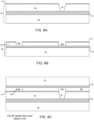
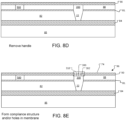
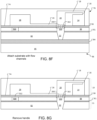
- FIGS. 8A-8G show an example approach to fabricating the body 10 and nozzle layer 11 of the substrate 110.
- the substrate is fabricated to have fluid ejectors 150 with a membrane 300 in the fluid flow path before the intersection between the outlet passage 26 and the descender 20.
- the membrane 300 can provide the filter 320.
- the substrate can be fabricated to have compliant microstructures that include one or more cavities 500 formed in the nozzle layer 11.
- Fluid ejectors 150 having only the membrane 300 or only cavities 500 can be fabricated according to a similar approach. For example, to fabricate a fluid ejector without the cavities 500, one can simply omit the portions of the steps associated with formation of the recess 506 illustrated by FIG. 8B .
- the substrate is fabricated to have a fluid ejector 150 having a membrane 300 in the fluid flow path before the intersection between the outlet passage 26 and the descender.
- the substrate can be fabricated to have one or more cavities 500 formed in the nozzle layer 11 to provide the compliant microstructures.
- a first wafer 80 (e.g., a silicon wafer or a silicon-on-insulator (SOI) wafer) provides a nozzle wafer.
- the first wafer 80 includes a mask layer 81 (e.g., an oxide or nitride mask layer, such as SiO 2 or Si 3 N 4 ), a device layer 82 (e.g., a silicon device layer 82), an etch stop layer 84 (e.g., an oxide or nitride etch stop layer), and a handle layer 85 (e.g., a silicon handle layer).
- the first wafer 80 does not include the etch stop layer 84.
- the insulator layer of the SOI wafer 80 acts as the etch stop layer 84.
- the mask layer 81 is patterned and openings that will provide the nozzles 22 of the fluid ejectors 150 are formed through the device layer 82 (step 900), e.g., using standard microfabrication techniques including lithography and etching. For instance, a first layer of resist can be deposited onto the unpatterned mask layer 81 and lithographically patterned. The mask layer 81 can be etched to form openings through the mask layer 81. Then the device layer 82 can be etched using the mask layer 81 as the mask, e.g., with a deep reactive ion etch (DRIE), potassium hydroxide (KOH) etching, or another type of etching, to form the nozzles 22. The resist can be stripped before or after etching of the device layer 82.
- DRIE deep reactive ion etch
- KOH potassium hydroxide
- a second wafer 86 (e.g., a silicon wafer or an SOI wafer) includes a mask layer 87 (e.g., an oxide or nitride mask layer), a device layer 88 (e.g., a silicon device layer 88), an etch stop layer 90 (e.g., an oxide or nitride etch stop layer 90), and a handle layer 92 (e.g., a silicon handle layer 92).
- the device layer 88 of the second wafer 86 can be formed of the same material as the device layer 82 of the first wafer 80.
- the insulator layer of the SOI wafer 86 acts as the etch stop layer 90.
- the mask layer 87 is patterned and recesses 506 are formed in the device layer 88 of the second wafer 86 (step 902), e.g., using standard microfabrication techniques including lithography and etching. For instance, a layer of resist can be deposited onto the unpatterned mask layer 87 and lithographically patterned. The mask layer 87 can be etched to form openings through the mask layer 87. Then the device layer 88 can be etched using the mask layer 87 as the mask.
- FIG. 8B illustrates the recess 506 as extending entirely through the device layer 88, this is not necessary; the recess 506 extend only partially through the device layer 88.
- the second wafer 86 is bonded to the first wafer 80 (step 904), e.g., using thermal bonding or another wafer bonding technique, to form an assembly 96.
- the second wafer 86 is bonded to the first wafer 80 such that the mask layer side of the first wafer 80 is in contact with the mask layer side of the second wafer 86.
- the opening 200 can align with the opening that will provide the nozzle 22.
- the mask layer 81 can be bonded to the mask layer 87.
- the mask layer 81 and/or the mask layer 87 is removed before the second wafer 86 is bonded to the first wafer 80.
- the etch stop layer 90 covers the recess 506.
- the etch stop layer 90 can provide the membrane 502 and define the cavity 500.
- FIGS. 8B there can be multiple recesses so as to form multiple cavities.
- the cavity 500 shown in FIGS. 8F-8G is below the return channel 28, similar cavities can be formed in addition or alternatively below the supply channel 24 by forming the recesses in the appropriate locations.
- an opening 200 is formed entirely through the mask layer 87 and the device layer 88, e.g., using standard microfabrication techniques including lithography and etching, to provide a portion of the descender 20.
- the handle layer 92 of the second wafer 86 is removed (step 906), e.g., by grinding and polishing, wet etching, plasma etching, or another removal process.
- holes 302 are etched through the etch stop layer 90 to form the membrane 300, e.g., for filtering structure 320, that is positioned close to the nozzle 22 and in the flow path of fluid to the nozzle (see FIG. 3B ) (step 908).
- the device layer 82, the mask layers 81, 87 (if present), and the device layer 88 together can form the nozzle layer 11.
- the approach of Figs. 8A-8E provides a thick, robust nozzle layer 11 that is not thinned by the fabrication of the membrane 300.
- the resulting assembly 96 with formed recesses 500, membranes 300, or both can be further processed (step 910) to form the fluid ejectors 150 of the printhead, e.g., as described below and in U.S. Patent No. 7,566,118 .
- a top surface 74 of the assembly 96 e.g., the exposed surface of the etch stop layer 90, can be bonded to a flow path wafer 76 (960).
- the top face 74 of the first wafer 60 can be bonded to the flow path wafer 76 using low-temperature bonding, such as bonding with an epoxy (e.g., benzocyclobutene (BCB)) or using low-temperature plasma activated bonding.
- BCB benzocyclobutene
- the flow path wafer 76 can be fabricated before bonding to have the flow passages 475, such as supply channel 14, chamber inlet passage 16, pumping chamber 18, descender 20, outlet passage 26 and outlet feed channel 28.
- Other elements such as actuators (not shown) can be formed before or after the assembly 96 is bonded to the flow path wafer 76.
- the handle layer 85 and etch stop layer 84 can be removed, e.g., by grinding and polishing, wet etching, plasma etching, or another removal process, to expose the nozzles 22.
- the etch stop layer 84 is not removed, but apertures are formed through the etch stop layer 84 to complete the nozzles.
- the resulting substrate generally corresponds to the substrate 110 shown in FIG. 3C .
- the same layer 90 can provide the membrane 502 for the compliant microstructure (if present) and the membrane 300. Also as shown in FIG. 8G , with the outlet passage 26 formed as a recess in the bottom of the flow path wafer 76, the top surface 74 of the assembly 96 of the first and second wafers can provide the lower surface of the outlet passage 26. In addition, the top surface of the membrane 300 can be coplanar with the lower surface of the outlet passage 26.
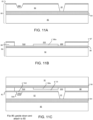
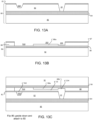
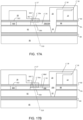
- FIGS. 11A-11G show another example approach to fabricating the body 10 and nozzle layer 11 of the substrate 110.
- the substrate is fabricated to have a fluid ejector 150 having a membrane 300 in the fluid flow path before the intersection between the outlet passage 26 and the descender 20.
- the membrane 300 can provide the filter 320.
- the substrate can be fabricated to have one or more cavities 500 formed in the nozzle layer 11 to provide the compliant microstructures.
- a fluid ejector 150 having only a membranes 300 or only cavities 500 can be fabricated according to a similar approach. For example, to fabricate a fluid ejector without the cavities 500, one can simply begin as shown in FIG. 11A but with a substrate that lacks the recess 506.
- a first wafer 80 (e.g., a silicon wafer or an SOI wafer) includes a mask layer 81 (e.g., an oxide or nitride mask layer), a device layer 81 (e.g., a silicon nozzle layer 11), an etch stop layer 84 (e.g., an oxide or nitride etch stop layer), and a handle layer 85 (e.g., a silicon handle layer).
- the first wafer 80 can be termed the nozzle wafer.
- the first wafer 80 does not include the etch stop layer 84.
- the insulator layer of the SOI wafer acts as the etch stop layer 84.
- the mask layer 81 is patterned and openings that will provide the nozzles 22 of the fluid ejectors 150 are formed through the device layer 82 (step 920), e.g., using standard microfabrication techniques including lithography and etching.
- a first layer of resist can be deposited onto the unpatterned mask layer 81 and lithographically patterned.
- the mask layer 81 can be etched to form openings through the mask layer 81.
- the device layer 82 can be etched using the mask layer 81 as the mask, e.g., with a deep reactive ion etch (DRIE), potassium hydroxide (KOH) etching, or another type of etching, to form the nozzles 22.
- DRIE deep reactive ion etch
- KOH potassium hydroxide
- the first layer of resist can be stripped.
- recesses 506 that extend partially, but not entirely, through the device layer 82 are also formed (step 922), e.g., using standard microfabrication techniques. If recesses 506 are to be formed, a second layer of resist can be deposited onto the mask layer 81 and lithographically patterned. The mask layer 81 and the device layer 82 can be etched according to the patterned resist to form the recesses 506, e.g., using a wet etch or dry etch.
- a second wafer 86 (e.g., a silicon wafer or an SOI wafer) has a handle layer 92, an etch stop layer 90 (e.g., an oxide or nitride etch stop layer), and a device layer 88.
- the insulator layer of the SOI wafer 86 acts as the etch stop layer 90.
- the passage formed recessed area 202 between the top of the second wafer 86 and the portion 88a of the device layer 88 provides the outlet passage 26.
- the etch stop layer 90 covers the recess 506.
- the etch stop layer 90 can provide the membrane 502 and define the cavity 500.
- FIG. 11B there can be multiple recesses so as to form multiple cavities 500.
- the cavity 500 shown in FIGS. 11F-11G is below the return channel 28, similar cavities can be formed in addition or alternatively below the supply channel 24 by forming the recesses in the appropriate locations.
- the handle layer 92 of the second wafer 86 is removed (step 928), e.g., by grinding and polishing, wet etching, plasma etching, or another removal process, leaving the etch stop layer 90 and the device layer 88.
- holes 302 are etched through the etch stop layer 90 (step 930).
- the portion of the etch stop layer 90 with the holes 302 thus forms the filter feature that is positioned close to the nozzle 22 and in the flow path of fluid to the nozzle.
- a hole is etched through the etch stop layer 90 above the opening 510. This exposes the opening 510 that will be the lower portion of the return channel 28.
- FIGS. 11A-11E allows some control over the relative thickness of the membranes 300 and 502. That is, the membrane 300 and membrane 502 need not have the same thickness and/or composition, and the thickness and/or composition of each membrane can thus be selected for different purposes.
- the wafer assembly 96 having nozzles 22, optional recesses 500 formed in the device layer 88, and a membrane 300 positioned close to the nozzles can be further processed, e.g., as described in U.S. Patent No. 7,566,118 , to form the fluid ejectors 150 of the printhead 100.
- a top surface 74 of the assembly 96 can be bonded to a flow path wafer 76 (step 932).
- the top face 74 of the first wafer 60 can be bonded to the flow path wafer 76 using low-temperature bonding, such as bonding with an epoxy (e.g., benzocyclobutene (BCB)) or using low-temperature plasma activated bonding.
- an epoxy e.g., benzocyclobutene (BCB)
- BCB benzocyclobutene
- the flow path wafer 76 can be fabricated before bonding to have portions of the flow passages 475, such as supply channel 14, chamber inlet passage 16, pumping chamber 18, a portion of descender 20 (with the remainder provided by opening 200), and a portion of outlet feed channel 28 (with the remainder provided by opening 510).
- Other elements such as actuators (not shown) can be formed before or after the assembly 96 is bonded to the flow path wafer 76.
- the handle layer 85 can then be removed (step 934), e.g., by grinding and polishing, wet etching, plasma etching, or another removal process.
- the etch stop layer 84 if present, is either removed (as shown in Fig. 11F ) or masked and etched, e.g., using standard microfabrication techniques including lithography and etching, to expose the nozzles (step 936).
- the resulting substrate generally corresponds to the substrate shown in FIG. 3D , although the bottom surface of the membrane 300 is spaced slightly above (by the thickness of the portion 88a) the intersection between the descender 20 and the outlet passage 26.
- the recess 202 extends entirely through the device layer 88, then the bottom surface of the membrane 300 would be coplanar with the top surface of the outlet passage 26.
- the outlet passage 26 is provided by the recess 202 in the device layer 88 rather than a recess in the wafer 76.
- the outlet passage 26 could be provided by a recess in the bottom surface of the flow path wafer 76 rather than the device layer 88.
- the top surface of the etch stop layer 90 provides the bottom surface of the outlet passage 26.
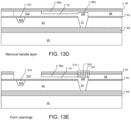
- FIGS. 13A-13G illustrate a process similar to that of FIGS. 8A-8G of fabricating the body 10 and nozzle layer 11 of the substrate 110.
- the holes 302 can pass through some or all of the device layer 88. Fabrication can proceed generally as described above for FIGS. 11A-11G , except as noted below.
- a recessed area 204 is formed where the nozzle 22 will be located.
- This recessed area 204 can be the same depth as the recessed area 202 that will provide the outlet passage 26, or deeper. As shown by FIG. 13C-D, this leaves a thin portion 88b of the device layer 88 that will overlie the nozzle 22 when the first wafer is bonded to the second wafer.
- the etch stop layer 90 can be used as a mask, and openings can be etched through the thin portion 88b of the device layer 88, e.g., by reactive ion etching, until the recess 204 is exposed.
- the resulting openings through both the etch stop layer 90 and the thin portion 88b of the device layer 88 provide the holes 302 through the membrane. Fabrication can then proceed as shown in FIGS. 11F-11G .
- An advantage of this approach is that it permits selection of the thickness of the membrane 300
- the resulting substrate generally corresponds to the substrate shown in FIG. 3D . If the recessed area 204 has the same depth as the recessed area 202, then the bottom surface of the membrane 300 will be coplanar with the top surface of the outlet passage 26.
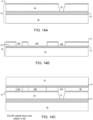
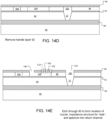
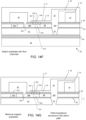
- FIGS. 14-14G show another example approach to fabricating the body 10 and nozzle layer 11 of the substrate 110.
- the substrate is fabricated to have fluid ejectors 150 with a membrane 300 in the outlet passage 26.
- the membrane 300 can be in the outlet passage 26 at a position spaced away from both the descender 20 and the return channel 28.
- the membrane can provide the impedance structure 310.
- the substrate can also include compliant microstructures that include one or more cavities 500 formed in the nozzle layer 11.
- Fluid ejectors 150 having only the membrane 300 can be fabricated according to a similar approach. For example, to fabricate a fluid ejector without the cavities 500, one can simply omit the portions of the steps associated with formation of the recess 506 illustrated by FIG. 14B .
- a first wafer 80 (e.g., a silicon wafer or a silicon-on-insulator (SOI) wafer) provides a nozzle wafer.
- the first wafer 80 includes a mask layer 81 (e.g., an oxide or nitride mask layer, such as SiO2 or Si3N4), a device layer 82 (e.g., a silicon device layer 82), an etch stop layer 84 (e.g., an oxide or nitride etch stop layer), and a handle layer 85 (e.g., a silicon handle layer).
- the first wafer 80 does not include the etch stop layer 84.
- the insulator layer of the SOI wafer 80 acts as the etch stop layer 84.
- the mask layer 81 is patterned and openings that will provide the nozzles 22 of the fluid ejectors 150 are formed through the device layer 82 (step 940), e.g., using standard microfabrication techniques including lithography and etching. For instance, a first layer of resist can be deposited onto the unpatterned mask layer 81 and lithographically patterned. The mask layer 81 can be etched to form openings through the mask layer 81. Then the device layer 82 can be etched using the mask layer 81 as the mask, e.g., with a deep reactive ion etch (DRIE), potassium hydroxide (KOH) etching, or another type of etching, to form the nozzles 22. The resist can be stripped before or after etching of the device layer 82.
- DRIE deep reactive ion etch
- KOH potassium hydroxide
- a second wafer 86 (e.g., a silicon wafer or an SOI wafer) includes a mask layer 87 (e.g., an oxide or nitride mask layer), a device layer 88 (e.g., a silicon device layer 88), an etch stop layer 90 (e.g., an oxide or nitride etch stop layer 90), and a handle layer 92 (e.g., a silicon handle layer 92).
- the device layer 88 of the second wafer 86 can be formed of the same material as the device layer 82 of the first wafer 80.
- the insulator layer of the SOI wafer 86 acts as the etch stop layer 90.
- the mask layer 87 is patterned and recesses 506 are formed in the device layer 88 of the second wafer 86 (step 942), e.g., using standard microfabrication techniques including lithography and etching.
- FIG. 14B illustrates the recess 510 as extending entirely through the device layer 88, this is not necessary; the recess 500 can extend only partially through the device layer 88.
- FIG. 14B illustrates the recess 200 as an opening extending entirely through the device layer 88, but this is not necessary; the recess 200 can extend only partially through the device layer 88.
- FIG. 14B illustrates the recess 208 as extending entirely through the device layer 88, but is not necessary; the recess 208 can extend only partially through the device layer 88. However, the recess 200 should be at least as deep as the recess 208.
- opening 200 and recess 208 can be formed simultaneously in a single etching step.
- the recess 510 (if present), opening 200 and recess 208 would all have the same depth.
- a layer of resist can be deposited onto the unpatterned mask layer 87 and lithographically patterned.
- the mask layer 87 can be etched to form openings through the mask layer 87.
- the device layer 88 can be etched using the mask layer 87 as the mask.
- etching steps can be used. For example, for each feature a layer of resist can be deposited and lithographically patterned, and the substrate then subjected to an etching step (the resist can cover previously defined features to protect them from subsequent etching steps).
- the photoresist itself can be used as the mask.
- the second wafer 86 is bonded to the first wafer 80 (step 946), e.g., using thermal bonding or another wafer bonding technique, to form an assembly 96.
- the second wafer 86 is bonded to the first wafer 80 such that the mask layer side of the first wafer 80 is in contact with the mask layer side of the second wafer 86.
- the mask layer 81 can be bonded to the mask layer 87.
- the mask layer 81 and/or the mask layer 87 is removed before the second wafer 86 is bonded to the first wafer 80.
- the opening 200 can align with the opening that will provide the nozzle 22.
- the etch stop layer 90 covers the recess 506.
- the etch stop layer 90 can provide the membrane 502 and define the cavity 500.
- FIG. 14B there can be multiple recesses so as to form multiple cavities 500.
- the cavity 500 shown in FIGS. 14F-14G is below the return channel 28, similar cavities can be formed in addition or alternatively below the supply channel 24 by forming the recesses in the appropriate locations.
- the handle layer 92 of the second wafer 86 is removed (step 948), e.g., by grinding and polishing, wet etching, plasma etching, or another removal process.
- holes 302 are etched through the etch stop layer 90 until the recess 208 is reached (step 950) to form the impedance feature 300.
- the holes 302 can be formed by an etching process such as wet etching or plasma etching.
- the holes 302 can be formed by an anisotropic etch, e.g., a reactive ion etch.
- an aperture 340 can be formed through the etch stop layer 90 until the recess 208 is reached to provide an opening between the outlet passage 26 and the return channel 28 (step 950).
- an aperture 342 can be formed through the etch stop layer 90 until the recess 200 is reached to provide an opening between the descender 20 and the nozzle 22.
- the openings 302, opening 340 and opening 342 can be formed simultaneously in a single etching step.
- the openings can be formed by an anisotropic etch, e.g., a reactive ion etch.
- a further etching step can be performed, e.g., using the etch stop layer 90 as a mask. Openings 302 and 340 can be etched through a thin portion 88c of the device layer 88 above the recess 208, e.g., by reactive ion etching, until the recess 208 is exposed.
- An advantage of this approach is that it permits selection of the thickness of the membrane 300, e.g., by selecting the depth of the recess 208.
- the aspect shown in FIGS. 16A-16C can be combined with the various alternatives.
- the portion of the etch stop layer 90 spanning the flow path 26 provides the membrane 300.
- the combination of the etch stop layer 90 and the thin portion 88c of the device layer 88 provide the membrane 300.
- the device layer 82, the mask layers 81, 87 (if present), the device layer 88 and the etch stop layer 90 can provide the nozzle layer 11.
- the approach of FIGS. 14A-14E provides a thick, robust nozzle layer 11 that is not thinned by the fabrication of the membrane 304.
- the resulting assembly 96 with cavity 500 and/or membrane 300, can be further processed to form the fluid ejectors 150 of the printhead.
- a top surface 74 of the assembly 96 can be bonded to a flow path wafer 76 (step 952).
- the flow path wafer 76 can be fabricated before bonding to have the flow passages 475, such as supply channel 14, chamber inlet passage 16, pumping chamber 18, descenders 20, a portion of outlet passage 26, and outlet feed channel 28.
- the top face 74 of the first wafer 60 can be bonded to the flow path wafer 76 using low-temperature bonding, such as bonding with an epoxy (e.g., benzocyclobutene (BCB)) or using low-temperature plasma activated bonding.
- Other elements such as actuators (not shown) can be formed before or after the assembly 96 is bonded to the flow path wafer 76.
- one portion of the outlet passage 26 is provided by the recess 208 in the device layer 88, and another portion of the outlet passage 26 is provided by a recess 27 in the bottom of the flow path wafer 76.
- the recess 27 in the bottom can extend from the descender 20.
- the recess 208 and the recess 27 overlap across the holes 302, so that the resulting membrane 300 divides the outlet passage 26 into a first region 26a above the membrane 304 and a second region 26b below the membrane.
- FIGS. 14A-14G has the upper portion 26a of the outlet passage 26 connected to the descender 20 and the lower portion 26b of the outlet passage connected to the return channel 28, this could be reversed as shown in FIG. 17A .
- the recess 27 in the bottom of the flow path wafer 76 could extend from return channel 28, rather than the descender 20, to the openings 302.
- the recess 208 could be joined to (and be considered part of) the opening 200.
- the recess 208 can extend from the descender 20 to the opening 302.
- the recess 208 can be formed so that it extends only partially through the device layer 88, and a further etching step can be performed, e.g., using the etch stop layer 90 as a mask.
- openings 302 are etched through a thin portion 88d of the device layer 88 above the recess 208, e.g., by reactive ion etching, until the recess 208 is exposed.
- the combination of the etch stop layer 90 and the thin portion 88c of the device layer 88 provide the membrane 300 of the impedance feature 310.
- the handle layer 85 and etch stop layer 84 can be removed (step 954), e.g., by grinding and polishing, wet etching, plasma etching, or another removal process, to expose the nozzles 22.
- the etch stop layer 84 is not removed, but apertures are formed through the etch stop layer 84 to complete the nozzles (step 956).
- the resulting substrate generally corresponds to the substrate shown in FIG. 3C .
- the same layer 90 can provide the membrane 502 for the compliant microstructure (if present) and the membrane 300.
- the top surface 74 of the assembly 96 of the first and second wafers can provide the lower surface of the outlet passage 26.
- the top surface of the membrane 300 can be coplanar with the lower surface of the outlet passage 26.
- the top surface of the membrane 300 can be coplanar with the lower surface of the return channel 28.
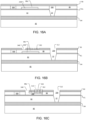
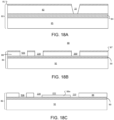
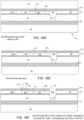
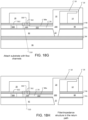
- FIGS. 18A-18H illustrate a process similar to that of FIGS. 14-14G of fabricating the body 10 and nozzle layer 11 of the substrate 110. However, in this example, the openings 302 are located immediately below the return channel 28 rather than within the outlet passage 26. Fabrication can proceed generally as described above for FIGS. 14A-14G and 17A , except as noted below.
- a first recess 200 is formed in the device layer 88 in a region corresponding to the nozzle 22. This recess 200 will be below the outlet passage 26, and could be considered to provide a portion of the descender 20 or the nozzle 22.
- a second recess 220 is formed in the device layer 88 in the region that will underlie a portion of the return channel 28. These recesses 200 and 220 can be formed by patterning the mask layer 87 and using it as a mask for etching the device layer 88.
- a portion 88e of the device layer 88 can remain below recess 222.
- the recess 222 can be formed by patterning the mask layer 87 and using it as a mask for etching the device layer 88.
- the mask layer 87 can be stripped from the entire wafer 86.
- FIGS. 18B-18C illustrate the recess 200 and the recess 220 as openings extending entirely through the device layer 88, this is not necessary.
- the recess 200 and/or the recess 220 can extend only partially through the device layer 88.
- the recess 220 should at least as deep (i.e., the same or greater depth) as the recess 222.
- FIG. 18B illustrates the recess 222 as extending only partially through the device layer 88, this is not necessary.
- the recess 222 can extend entirely through the device layer 88. Where the recesses 200, 220, 222 are the same depth, they can be formed simultaneously in a single etching step.
- the relative depths of the recesses can be selected based on the needs for the height of the outlet passage 26 and thickness of the membrane 300, e.g., based desired resistance to fluid flow.
- FIG. 18D proceeds similarly to FIG. 14C , with the first wafer 80 bonded to the second wafer 86 to form an assembly 98 and the opening 200 aligning to the nozzle 22.
- FIG. 18E proceeds similarly to FIG. 14D , in which the handle layer 92 is removed.
- holes 302 are etched through the etch stop layer 90 until the recess 220 is reached to form the impedance feature 300.
- the holes 302 can be formed by an etching process such as wet etching or plasma etching.
- the holes 302 can be formed by an anisotropic etch, e.g., a reactive ion etch.
- an aperture 342 can be formed through the etch stop layer 90 until the recess 200 is reached to provide an opening between the descender 20 and the nozzle 22.
- the openings 302 and opening 342 can be formed simultaneously in a single etching step.
- the openings can be formed by an anisotropic etch, e.g., a reactive ion etch.
- a further etching step can be performed, e.g., using the etch stop layer 90 as a mask.
- a further etching step can be performed, e.g., using the etch stop layer 90 as a mask.
- openings 302 and 342 can be etched through the thin portion 88e of the device layer 88, e.g., by reactive ion etching, until the recess 208 is exposed.
- the portion of the etch stop layer 90 between the outlet passage 26 and the return channel 28 provides the membrane 300.
- the combination of the etch stop layer 90 and the thin portion 88e of the device layer 88 provides the membrane 300.
- a top surface 74 of the assembly 96 e.g., the exposed surface of the etch stop layer 90, can be bonded to a flow path wafer 76.
- FIG. 18G proceeds similarly to FIG. 14F , but the flow path wafer 76 does not have any recess that defines the outlet passage 26, as it is defined entirely in the device layer 88.
- FIG. 18H proceeds similarly to FIG. 14G , in which the handle layer 85 and etch stop layer 84 are removed or the handle layer 85 is removed and apertures are formed through the etch stop layer 84 to complete the nozzles.
- the resulting substrate generally corresponds to the substrate shown in FIG. 3B .
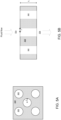
- a mask 40 including multiple openings 42 can be used to define the holes 302 of a desired size for the membrane 300.
- Each opening 42 corresponds to a cell region 44 defined by the corners of the opening 42, and the size and orientation of the openings 42 cause adjacent cell regions 44 to overlap.
- the area of each cell region 44 is approximately the square of the length of the long side l of the corresponding opening 42.
- an anisotropic etch process e.g., a potassium hydroxide etch process
- correctly sized holes can be fabricated by continuing the anisotropic etch until a termination crystal plane (e.g., a ⁇ 111> plane) is reached.
- each opening 42 can be positioned to expose a ⁇ 111> plane, such that each opening 42 will cause the region defined by its corresponding cell region 44 to be etched. Since adjacent cell regions 44 overlap, the entire area can be opening by this etch process.
- a thick layer 82 can be used (e.g., 30 ⁇ m, 50 ⁇ m, or 100 ⁇ m thick). The use of a thick nozzle wafer minimizes the risk that the nozzle fabrication process will thin the nozzle wafer to an extent that the nozzle wafer is weakened.
- the particular flow path configuration of the channel 14, inlet passage 16 and pumping chamber 18 that is common to the various implementations is merely one example of a flow path configuration.
- the approach for the filter feature or impedance feature described below can be used in many other flow path configurations.
- the supply channel 14 is located at the same level as the pumping chamber 18, then the ascender 16a is unnecessary.
- additional horizontal passages could be positioned between the pumping chamber 18 and the nozzle 22.
- discussion of the descender can be generalized to a first passage that connects a pumping chamber to an entrance of the nozzle
- discussion of the outlet passage can be generalized to a second passage that connects the entrance of the nozzle to the return channel.
- terms of positioning such as “above” and “below” are used, these terms are used to indicate relative positioning of elements within the system, and do not necessarily indicate position relative to gravity.
Landscapes
- Engineering & Computer Science (AREA)
- Manufacturing & Machinery (AREA)
- Particle Formation And Scattering Control In Inkjet Printers (AREA)
- Ink Jet (AREA)
- Nozzles (AREA)
Applications Claiming Priority (2)
| Application Number | Priority Date | Filing Date | Title |
|---|---|---|---|
| US201562273891P | 2015-12-31 | 2015-12-31 | |
| PCT/US2016/069462 WO2017117518A1 (en) | 2015-12-31 | 2016-12-30 | Fluid ejection devices |
Publications (3)
| Publication Number | Publication Date |
|---|---|
| EP3397493A1 EP3397493A1 (en) | 2018-11-07 |
| EP3397493A4 EP3397493A4 (en) | 2019-08-14 |
| EP3397493B1 true EP3397493B1 (en) | 2025-04-30 |
Family
ID=59225466
Family Applications (1)
| Application Number | Title | Priority Date | Filing Date |
|---|---|---|---|
| EP16882747.5A Active EP3397493B1 (en) | 2015-12-31 | 2016-12-30 | Fluid ejection devices |
Country Status (5)
| Country | Link |
|---|---|
| US (4) | US10315421B2 (enExample) |
| EP (1) | EP3397493B1 (enExample) |
| JP (3) | JP6883042B2 (enExample) |
| CN (2) | CN112895718B (enExample) |
| WO (1) | WO2017117518A1 (enExample) |
Families Citing this family (18)
| Publication number | Priority date | Publication date | Assignee | Title |
|---|---|---|---|---|
| EP3397493B1 (en) | 2015-12-31 | 2025-04-30 | Fujifilm Dimatix, Inc. | Fluid ejection devices |
| EP3330329B1 (en) * | 2016-12-02 | 2022-06-08 | Ricoh Company, Ltd. | Inkjet recording apparatus, printer, and method for manufacturing cured product |
| EP3634763B1 (en) | 2017-06-09 | 2023-12-13 | Fujifilm Dimatix, Inc. | Fluid ejection apparatus with reduced crosstalk, corresponding operating method and making method |
| JP7031376B2 (ja) * | 2018-03-04 | 2022-03-08 | 株式会社リコー | 液体吐出ヘッド、液体吐出ユニット、液体を吐出する装置 |
| JP7106917B2 (ja) * | 2018-03-23 | 2022-07-27 | セイコーエプソン株式会社 | 液体噴射ヘッドおよび液体噴射装置 |
| WO2019244227A1 (ja) * | 2018-06-19 | 2019-12-26 | コニカミノルタ株式会社 | インクジェットヘッド及びインクジェット記録装置 |
| US20210245151A1 (en) * | 2018-08-10 | 2021-08-12 | Hewlett-Packard Development Company, L.P. | Dual direction dispensers |
| JP7287042B2 (ja) * | 2018-12-21 | 2023-06-06 | セイコーエプソン株式会社 | 液体噴射ヘッド及び液体噴射システム |
| US11104128B2 (en) * | 2018-12-21 | 2021-08-31 | Seiko Epson Corporation | Liquid ejecting head and liquid ejecting system |
| US11007789B2 (en) | 2018-12-21 | 2021-05-18 | Seiko Epson Corporation | Liquid ejecting head and liquid ejecting apparatus |
| JP2020100136A (ja) * | 2018-12-21 | 2020-07-02 | セイコーエプソン株式会社 | 液体噴射ヘッド、液体噴射装置及び液体噴射システム |
| JP7293670B2 (ja) * | 2019-01-29 | 2023-06-20 | ブラザー工業株式会社 | 液体吐出ヘッド |
| IT201900005808A1 (it) * | 2019-04-15 | 2020-10-15 | St Microelectronics Srl | Dispositivo mems a micropompa per la movimentazione o eiezione di un fluido, in particolare microsoffiante o flussimetro |
| IT201900007196A1 (it) | 2019-05-24 | 2020-11-24 | St Microelectronics Srl | Dispositivo microfluidico per l'espulsione continua di fluidi, in particolare per la stampa con inchiostri, e relativo procedimento di fabbricazione |
| JP7302385B2 (ja) * | 2019-08-29 | 2023-07-04 | セイコーエプソン株式会社 | 液体吐出ヘッドユニットおよび液体吐出装置 |
| KR102778272B1 (ko) | 2019-12-16 | 2025-03-12 | 현대자동차주식회사 | 이젝터 노즐과 이를 포함한 이젝터 |
| JP7413864B2 (ja) * | 2020-03-19 | 2024-01-16 | セイコーエプソン株式会社 | 液体噴射ヘッドの製造方法、及び、流路部品の製造方法 |
| US12042991B2 (en) * | 2021-02-25 | 2024-07-23 | Xerox Corporation | Energy dissipative nozzles for drop-on-demand printing and methods thereof |
Citations (1)
| Publication number | Priority date | Publication date | Assignee | Title |
|---|---|---|---|---|
| US20110109694A1 (en) * | 2009-11-06 | 2011-05-12 | Zhenfang Chen | Thermal Oxide Coating On A Fluid Ejector |
Family Cites Families (26)
| Publication number | Priority date | Publication date | Assignee | Title |
|---|---|---|---|---|
| US3958255A (en) * | 1974-12-31 | 1976-05-18 | International Business Machines Corporation | Ink jet nozzle structure |
| JPH0365352A (ja) | 1989-08-03 | 1991-03-20 | Canon Inc | インクジェット記録装置およびそのインク供給装置 |
| EP0448967B1 (en) | 1990-02-26 | 1996-07-03 | Canon Kabushiki Kaisha | Ink jet recording apparatus and method for recovering recording head |
| US5828394A (en) * | 1995-09-20 | 1998-10-27 | The Board Of Trustees Of The Leland Stanford Junior University | Fluid drop ejector and method |
| JP3372765B2 (ja) | 1996-07-12 | 2003-02-04 | キヤノン株式会社 | 液体吐出ヘッド、ヘッドカートリッジ、液体吐出装置、記録システム、ヘッドキット、および液体吐出ヘッドの製造方法 |
| US7052117B2 (en) * | 2002-07-03 | 2006-05-30 | Dimatix, Inc. | Printhead having a thin pre-fired piezoelectric layer |
| KR101137643B1 (ko) | 2003-10-10 | 2012-04-19 | 후지필름 디마틱스, 인크. | 박막을 구비한 프린트 헤드 |
| US7347532B2 (en) * | 2004-08-05 | 2008-03-25 | Fujifilm Dimatix, Inc. | Print head nozzle formation |
| JP5003282B2 (ja) * | 2007-05-23 | 2012-08-15 | 富士ゼロックス株式会社 | 液滴吐出ヘッド及び画像形成装置 |
| JP5385975B2 (ja) * | 2008-05-23 | 2014-01-08 | 富士フイルム株式会社 | 流体液滴吐出 |
| US8538370B2 (en) * | 2008-07-03 | 2013-09-17 | Centurylink Intellectual Property Llc | Emergency message button and method on a wireless communications device for communicating an emergency message to a public safety answering point (PSAP) |
| JP5298790B2 (ja) * | 2008-11-12 | 2013-09-25 | セイコーエプソン株式会社 | 流体噴射装置、及び、流体噴射方法 |
| US8303082B2 (en) * | 2009-02-27 | 2012-11-06 | Fujifilm Corporation | Nozzle shape for fluid droplet ejection |
| KR20120040239A (ko) * | 2009-07-10 | 2012-04-26 | 후지필름 디마틱스, 인크. | 조밀 충진을 위한 마이크로일렉트로미케니칼 시스템 젯팅 구조 |
| US8317302B2 (en) * | 2010-03-18 | 2012-11-27 | Fujifilm Corporation | Restriction of fluid ejector membrane |
| US8272717B2 (en) * | 2010-03-29 | 2012-09-25 | Fujifilm Corporation | Jetting device with reduced crosstalk |
| US8267504B2 (en) * | 2010-04-27 | 2012-09-18 | Eastman Kodak Company | Printhead including integrated stimulator/filter device |
| US8657429B2 (en) * | 2010-10-26 | 2014-02-25 | Eastman Kodak Company | Dispensing liquid using overlapping outlet/return dispenser |
| US20120098899A1 (en) | 2010-10-26 | 2012-04-26 | Yonglin Xie | Dispensing liquid using dispenser with return filter |
| JP2013116590A (ja) * | 2011-12-02 | 2013-06-13 | Ricoh Co Ltd | 液滴吐出ヘッド及び画像形成装置。 |
| EP2620286A1 (en) * | 2012-01-26 | 2013-07-31 | Nederlandse Organisatie voor toegepast -natuurwetenschappelijk onderzoek TNO | Continuous jet printing of a fluid material |
| US9283590B2 (en) * | 2012-07-03 | 2016-03-15 | Hewlett-Packard Development Company, L.P. | Fluid ejection apparatus |
| JP2014061695A (ja) * | 2012-09-20 | 2014-04-10 | Samsung Electro-Mechanics Co Ltd | インクジェットプリントヘッド |
| KR20140076136A (ko) * | 2012-12-12 | 2014-06-20 | 삼성전기주식회사 | 잉크젯 프린트 헤드 |
| US9162454B2 (en) * | 2013-04-11 | 2015-10-20 | Eastman Kodak Company | Printhead including acoustic dampening structure |
| EP3397493B1 (en) | 2015-12-31 | 2025-04-30 | Fujifilm Dimatix, Inc. | Fluid ejection devices |
-
2016
- 2016-12-30 EP EP16882747.5A patent/EP3397493B1/en active Active
- 2016-12-30 CN CN202110060536.2A patent/CN112895718B/zh active Active
- 2016-12-30 JP JP2018533915A patent/JP6883042B2/ja active Active
- 2016-12-30 CN CN201680082235.7A patent/CN108698405B/zh active Active
- 2016-12-30 WO PCT/US2016/069462 patent/WO2017117518A1/en not_active Ceased
- 2016-12-30 US US15/395,549 patent/US10315421B2/en active Active
-
2019
- 2019-04-25 US US16/394,073 patent/US11001059B2/en active Active
-
2021
- 2021-04-28 US US17/242,621 patent/US11904610B2/en active Active
- 2021-05-07 JP JP2021079130A patent/JP7277508B2/ja active Active
-
2023
- 2023-05-08 JP JP2023076590A patent/JP7723465B2/ja active Active
-
2024
- 2024-01-26 US US18/423,505 patent/US12447743B2/en active Active
Patent Citations (1)
| Publication number | Priority date | Publication date | Assignee | Title |
|---|---|---|---|---|
| US20110109694A1 (en) * | 2009-11-06 | 2011-05-12 | Zhenfang Chen | Thermal Oxide Coating On A Fluid Ejector |
Also Published As
| Publication number | Publication date |
|---|---|
| JP6883042B2 (ja) | 2021-06-02 |
| US20210245508A1 (en) | 2021-08-12 |
| JP7277508B2 (ja) | 2023-05-19 |
| JP7723465B2 (ja) | 2025-08-14 |
| CN112895718A (zh) | 2021-06-04 |
| CN108698405B (zh) | 2021-02-02 |
| US11904610B2 (en) | 2024-02-20 |
| CN108698405A (zh) | 2018-10-23 |
| JP2019505411A (ja) | 2019-02-28 |
| JP2021175609A (ja) | 2021-11-04 |
| US12447743B2 (en) | 2025-10-21 |
| EP3397493A4 (en) | 2019-08-14 |
| US11001059B2 (en) | 2021-05-11 |
| WO2017117518A1 (en) | 2017-07-06 |
| US20190248138A1 (en) | 2019-08-15 |
| US10315421B2 (en) | 2019-06-11 |
| EP3397493A1 (en) | 2018-11-07 |
| US20240157699A1 (en) | 2024-05-16 |
| US20170190179A1 (en) | 2017-07-06 |
| CN112895718B (zh) | 2022-09-13 |
| JP2023093768A (ja) | 2023-07-04 |
Similar Documents
| Publication | Publication Date | Title |
|---|---|---|
| US12447743B2 (en) | Fluid ejection devices | |
| JP7663624B2 (ja) | 低減されたクロストークを有する流体吐出デバイス | |
| EP3173235B1 (en) | Fluid ejection device with restriction channel, and manufacturing method thereof | |
| EP1693206B1 (en) | Piezoelectric inkjet printhead and method of manufacturing the same | |
| US8940559B2 (en) | Method of fabricating an integrated orifice plate and cap structure | |
| KR20030079172A (ko) | 잉크젯 프린트 헤드 및 이의 제조 방법 | |
| KR100908115B1 (ko) | 다공성 매체를 통한 잉크 공급 구조를 가진 잉크젯프린트헤드 및 그 제조방법 | |
| KR100528349B1 (ko) | 압전 방식의 잉크젯 프린트헤드 및 그 제조방법 | |
| HK1097229A1 (zh) | 具有薄膜的打印头 |
Legal Events
| Date | Code | Title | Description |
|---|---|---|---|
| STAA | Information on the status of an ep patent application or granted ep patent |
Free format text: STATUS: THE INTERNATIONAL PUBLICATION HAS BEEN MADE |
|
| PUAI | Public reference made under article 153(3) epc to a published international application that has entered the european phase |
Free format text: ORIGINAL CODE: 0009012 |
|
| STAA | Information on the status of an ep patent application or granted ep patent |
Free format text: STATUS: REQUEST FOR EXAMINATION WAS MADE |
|
| 17P | Request for examination filed |
Effective date: 20180731 |
|
| AK | Designated contracting states |
Kind code of ref document: A1 Designated state(s): AL AT BE BG CH CY CZ DE DK EE ES FI FR GB GR HR HU IE IS IT LI LT LU LV MC MK MT NL NO PL PT RO RS SE SI SK SM TR |
|
| AX | Request for extension of the european patent |
Extension state: BA ME |
|
| DAV | Request for validation of the european patent (deleted) | ||
| DAX | Request for extension of the european patent (deleted) | ||
| A4 | Supplementary search report drawn up and despatched |
Effective date: 20190712 |
|
| RIC1 | Information provided on ipc code assigned before grant |
Ipc: B41J 2/14 20060101AFI20190708BHEP Ipc: B41J 2/175 20060101ALI20190708BHEP |
|
| STAA | Information on the status of an ep patent application or granted ep patent |
Free format text: STATUS: EXAMINATION IS IN PROGRESS |
|
| 17Q | First examination report despatched |
Effective date: 20200623 |
|
| REG | Reference to a national code |
Ref legal event code: R079 Ipc: B41J0002160000 Ref country code: DE Ref legal event code: R079 Ref document number: 602016092102 Country of ref document: DE Free format text: PREVIOUS MAIN CLASS: B41J0002140000 Ipc: B41J0002160000 |
|
| RIC1 | Information provided on ipc code assigned before grant |
Ipc: B41J 2/14 20060101ALI20241003BHEP Ipc: B41J 2/16 20060101AFI20241003BHEP |
|
| GRAP | Despatch of communication of intention to grant a patent |
Free format text: ORIGINAL CODE: EPIDOSNIGR1 |
|
| STAA | Information on the status of an ep patent application or granted ep patent |
Free format text: STATUS: GRANT OF PATENT IS INTENDED |
|
| INTG | Intention to grant announced |
Effective date: 20241129 |
|
| GRAS | Grant fee paid |
Free format text: ORIGINAL CODE: EPIDOSNIGR3 |
|
| GRAA | (expected) grant |
Free format text: ORIGINAL CODE: 0009210 |
|
| STAA | Information on the status of an ep patent application or granted ep patent |
Free format text: STATUS: THE PATENT HAS BEEN GRANTED |
|
| AK | Designated contracting states |
Kind code of ref document: B1 Designated state(s): AL AT BE BG CH CY CZ DE DK EE ES FI FR GB GR HR HU IE IS IT LI LT LU LV MC MK MT NL NO PL PT RO RS SE SI SK SM TR |
|
| REG | Reference to a national code |
Ref country code: CH Ref legal event code: EP Ref country code: GB Ref legal event code: FG4D |
|
| REG | Reference to a national code |
Ref country code: IE Ref legal event code: FG4D |
|
| REG | Reference to a national code |
Ref country code: DE Ref legal event code: R096 Ref document number: 602016092102 Country of ref document: DE |
|
| REG | Reference to a national code |
Ref country code: NL Ref legal event code: MP Effective date: 20250430 |
|
| REG | Reference to a national code |
Ref country code: AT Ref legal event code: MK05 Ref document number: 1789689 Country of ref document: AT Kind code of ref document: T Effective date: 20250430 |
|
| PG25 | Lapsed in a contracting state [announced via postgrant information from national office to epo] |
Ref country code: PT Free format text: LAPSE BECAUSE OF FAILURE TO SUBMIT A TRANSLATION OF THE DESCRIPTION OR TO PAY THE FEE WITHIN THE PRESCRIBED TIME-LIMIT Effective date: 20250901 Ref country code: FI Free format text: LAPSE BECAUSE OF FAILURE TO SUBMIT A TRANSLATION OF THE DESCRIPTION OR TO PAY THE FEE WITHIN THE PRESCRIBED TIME-LIMIT Effective date: 20250430 Ref country code: ES Free format text: LAPSE BECAUSE OF FAILURE TO SUBMIT A TRANSLATION OF THE DESCRIPTION OR TO PAY THE FEE WITHIN THE PRESCRIBED TIME-LIMIT Effective date: 20250430 |
|
| REG | Reference to a national code |
Ref country code: LT Ref legal event code: MG9D |
|
| PG25 | Lapsed in a contracting state [announced via postgrant information from national office to epo] |
Ref country code: NO Free format text: LAPSE BECAUSE OF FAILURE TO SUBMIT A TRANSLATION OF THE DESCRIPTION OR TO PAY THE FEE WITHIN THE PRESCRIBED TIME-LIMIT Effective date: 20250730 Ref country code: GR Free format text: LAPSE BECAUSE OF FAILURE TO SUBMIT A TRANSLATION OF THE DESCRIPTION OR TO PAY THE FEE WITHIN THE PRESCRIBED TIME-LIMIT Effective date: 20250731 |
|
| PG25 | Lapsed in a contracting state [announced via postgrant information from national office to epo] |
Ref country code: PL Free format text: LAPSE BECAUSE OF FAILURE TO SUBMIT A TRANSLATION OF THE DESCRIPTION OR TO PAY THE FEE WITHIN THE PRESCRIBED TIME-LIMIT Effective date: 20250430 Ref country code: NL Free format text: LAPSE BECAUSE OF FAILURE TO SUBMIT A TRANSLATION OF THE DESCRIPTION OR TO PAY THE FEE WITHIN THE PRESCRIBED TIME-LIMIT Effective date: 20250430 |
|
| PG25 | Lapsed in a contracting state [announced via postgrant information from national office to epo] |
Ref country code: BG Free format text: LAPSE BECAUSE OF FAILURE TO SUBMIT A TRANSLATION OF THE DESCRIPTION OR TO PAY THE FEE WITHIN THE PRESCRIBED TIME-LIMIT Effective date: 20250430 |
|
| PG25 | Lapsed in a contracting state [announced via postgrant information from national office to epo] |
Ref country code: HR Free format text: LAPSE BECAUSE OF FAILURE TO SUBMIT A TRANSLATION OF THE DESCRIPTION OR TO PAY THE FEE WITHIN THE PRESCRIBED TIME-LIMIT Effective date: 20250430 |
|
| PG25 | Lapsed in a contracting state [announced via postgrant information from national office to epo] |
Ref country code: AT Free format text: LAPSE BECAUSE OF FAILURE TO SUBMIT A TRANSLATION OF THE DESCRIPTION OR TO PAY THE FEE WITHIN THE PRESCRIBED TIME-LIMIT Effective date: 20250430 |
|
| PG25 | Lapsed in a contracting state [announced via postgrant information from national office to epo] |
Ref country code: RS Free format text: LAPSE BECAUSE OF FAILURE TO SUBMIT A TRANSLATION OF THE DESCRIPTION OR TO PAY THE FEE WITHIN THE PRESCRIBED TIME-LIMIT Effective date: 20250731 |
|
| PG25 | Lapsed in a contracting state [announced via postgrant information from national office to epo] |
Ref country code: IS Free format text: LAPSE BECAUSE OF FAILURE TO SUBMIT A TRANSLATION OF THE DESCRIPTION OR TO PAY THE FEE WITHIN THE PRESCRIBED TIME-LIMIT Effective date: 20250830 |
|
| PG25 | Lapsed in a contracting state [announced via postgrant information from national office to epo] |
Ref country code: LV Free format text: LAPSE BECAUSE OF FAILURE TO SUBMIT A TRANSLATION OF THE DESCRIPTION OR TO PAY THE FEE WITHIN THE PRESCRIBED TIME-LIMIT Effective date: 20250430 |