EP3397289B1 - Antimicrobial wipe - Google Patents
Antimicrobial wipe Download PDFInfo
- Publication number
- EP3397289B1 EP3397289B1 EP16882754.1A EP16882754A EP3397289B1 EP 3397289 B1 EP3397289 B1 EP 3397289B1 EP 16882754 A EP16882754 A EP 16882754A EP 3397289 B1 EP3397289 B1 EP 3397289B1
- Authority
- EP
- European Patent Office
- Prior art keywords
- wipe
- fiber
- numerical value
- solution
- total weight
- Prior art date
- Legal status (The legal status is an assumption and is not a legal conclusion. Google has not performed a legal analysis and makes no representation as to the accuracy of the status listed.)
- Active
Links
Classifications
-
- A—HUMAN NECESSITIES
- A01—AGRICULTURE; FORESTRY; ANIMAL HUSBANDRY; HUNTING; TRAPPING; FISHING
- A01N—PRESERVATION OF BODIES OF HUMANS OR ANIMALS OR PLANTS OR PARTS THEREOF; BIOCIDES, e.g. AS DISINFECTANTS, AS PESTICIDES OR AS HERBICIDES; PEST REPELLANTS OR ATTRACTANTS; PLANT GROWTH REGULATORS
- A01N43/00—Biocides, pest repellants or attractants, or plant growth regulators containing heterocyclic compounds
- A01N43/34—Biocides, pest repellants or attractants, or plant growth regulators containing heterocyclic compounds having rings with one nitrogen atom as the only ring hetero atom
- A01N43/40—Biocides, pest repellants or attractants, or plant growth regulators containing heterocyclic compounds having rings with one nitrogen atom as the only ring hetero atom six-membered rings
-
- A—HUMAN NECESSITIES
- A01—AGRICULTURE; FORESTRY; ANIMAL HUSBANDRY; HUNTING; TRAPPING; FISHING
- A01N—PRESERVATION OF BODIES OF HUMANS OR ANIMALS OR PLANTS OR PARTS THEREOF; BIOCIDES, e.g. AS DISINFECTANTS, AS PESTICIDES OR AS HERBICIDES; PEST REPELLANTS OR ATTRACTANTS; PLANT GROWTH REGULATORS
- A01N25/00—Biocides, pest repellants or attractants, or plant growth regulators, characterised by their forms, or by their non-active ingredients or by their methods of application, e.g. seed treatment or sequential application; Substances for reducing the noxious effect of the active ingredients to organisms other than pests
- A01N25/34—Shaped forms, e.g. sheets, not provided for in any other sub-group of this main group
-
- A—HUMAN NECESSITIES
- A01—AGRICULTURE; FORESTRY; ANIMAL HUSBANDRY; HUNTING; TRAPPING; FISHING
- A01P—BIOCIDAL, PEST REPELLANT, PEST ATTRACTANT OR PLANT GROWTH REGULATORY ACTIVITY OF CHEMICAL COMPOUNDS OR PREPARATIONS
- A01P1/00—Disinfectants; Antimicrobial compounds or mixtures thereof
-
- A—HUMAN NECESSITIES
- A47—FURNITURE; DOMESTIC ARTICLES OR APPLIANCES; COFFEE MILLS; SPICE MILLS; SUCTION CLEANERS IN GENERAL
- A47K—SANITARY EQUIPMENT; ACCESSORIES THEREFOR, e.g. TOILET ACCESSORIES
- A47K10/00—Body-drying implements; Toilet paper; Holders therefor
- A47K10/16—Paper towels; Toilet paper; Holders therefor
-
- A—HUMAN NECESSITIES
- A47—FURNITURE; DOMESTIC ARTICLES OR APPLIANCES; COFFEE MILLS; SPICE MILLS; SUCTION CLEANERS IN GENERAL
- A47L—DOMESTIC WASHING OR CLEANING; SUCTION CLEANERS IN GENERAL
- A47L13/00—Implements for cleaning floors, carpets, furniture, walls, or wall coverings
- A47L13/10—Scrubbing; Scouring; Cleaning; Polishing
- A47L13/16—Cloths; Pads; Sponges
- A47L13/17—Cloths; Pads; Sponges containing cleaning agents
-
- A—HUMAN NECESSITIES
- A61—MEDICAL OR VETERINARY SCIENCE; HYGIENE
- A61K—PREPARATIONS FOR MEDICAL, DENTAL OR TOILETRY PURPOSES
- A61K8/00—Cosmetics or similar toiletry preparations
- A61K8/02—Cosmetics or similar toiletry preparations characterised by special physical form
- A61K8/0208—Tissues; Wipes; Patches
-
- A—HUMAN NECESSITIES
- A61—MEDICAL OR VETERINARY SCIENCE; HYGIENE
- A61K—PREPARATIONS FOR MEDICAL, DENTAL OR TOILETRY PURPOSES
- A61K8/00—Cosmetics or similar toiletry preparations
- A61K8/18—Cosmetics or similar toiletry preparations characterised by the composition
- A61K8/30—Cosmetics or similar toiletry preparations characterised by the composition containing organic compounds
- A61K8/49—Cosmetics or similar toiletry preparations characterised by the composition containing organic compounds containing heterocyclic compounds
- A61K8/4906—Cosmetics or similar toiletry preparations characterised by the composition containing organic compounds containing heterocyclic compounds with one nitrogen as the only hetero atom
- A61K8/4926—Cosmetics or similar toiletry preparations characterised by the composition containing organic compounds containing heterocyclic compounds with one nitrogen as the only hetero atom having six membered rings
-
- A—HUMAN NECESSITIES
- A61—MEDICAL OR VETERINARY SCIENCE; HYGIENE
- A61Q—SPECIFIC USE OF COSMETICS OR SIMILAR TOILETRY PREPARATIONS
- A61Q17/00—Barrier preparations; Preparations brought into direct contact with the skin for affording protection against external influences, e.g. sunlight, X-rays or other harmful rays, corrosive materials, bacteria or insect stings
- A61Q17/005—Antimicrobial preparations
-
- C—CHEMISTRY; METALLURGY
- C11—ANIMAL OR VEGETABLE OILS, FATS, FATTY SUBSTANCES OR WAXES; FATTY ACIDS THEREFROM; DETERGENTS; CANDLES
- C11D—DETERGENT COMPOSITIONS; USE OF SINGLE SUBSTANCES AS DETERGENTS; SOAP OR SOAP-MAKING; RESIN SOAPS; RECOVERY OF GLYCEROL
- C11D17/00—Detergent materials or soaps characterised by their shape or physical properties
- C11D17/04—Detergent materials or soaps characterised by their shape or physical properties combined with or containing other objects
- C11D17/049—Cleaning or scouring pads; Wipes
Definitions
- aspects of the present invention relate to the field antimicrobial wipes, and in particular a non-woven wipe soaked with an antiseptic solution.
- U.S. Pat. No. 7,427,574 to Allen discloses a non-woven washcloth formed from a blend of two different size polyester fibers, the majority of which have a length about half of that of the minority.
- the washcloth disclosed by Allen is particularly designed to have absorbing and holding properties for a non-alcoholic solution containing chlorhexidine gluconate (CHG), while also releasing the CHG when wiped on skin.
- CHG chlorhexidine gluconate
- a problem with CHG and CHG blends is that they tend to chemically or mechanically bind with certain fibers.
- Allen discloses a particular washcloth for use with CHG that purports to avoid such problems.
- the washcloth of Allen being specially designed for a non-alcoholic CHG solution is not disclosed as suitable for use with other antiseptic solutions.
- Molecules other than CHG may be more potent and have other advantages over CHG.
- U.S. Pat. No. 7,066,916 to Keaty, Jr. discloses a method of treating a patient prior to surgery using a cloth wipe soaked with a non-alcoholic CHG solution.
- US 2006/079143 Patent Application Laidicide
- EP 2 443 925 A1 Air Liquide
- a wipe comprising an antiseptic solution the antiseptic solution comprising:
- the wipe may include a third fiber having a denier of 5.0 to 6.0, wherein 10 wt% to 30 wt% of the total weight of the wipe is the third fiber.
- about 40 wt% of the total number of fibers is the first fiber
- about 40 wt% of the total weight of the wipe is the second fiber
- about 20 wt% of the total weight of the wipe is the third fiber.
- Each of the first, second, and third fiber may comprise polyester.
- aspects of the present invention include a package containing the wipe.
- the package comprises a metal foil or a metalized plastic.
- the wipe is sterilized by expositing the package containing the wipe to a temperature of 110 to 130°C for at time of 15 to 30 minutes.
- the package may further include a warming mechanism.
- the warming mechanism may comprise reactants that create an exothermic reaction when exposed to ambient air or when exposed to each other.
- exemplary means "serving as an example, instance, or illustration,” and should not necessarily be construed as preferred or advantageous over other embodiments.
- the antiseptic solution is aqueous. That is, the solvent of the solution is primarily water.
- aqueous means at least about 50% v/v or more water, more preferably at least about 60% v/v or more water, more preferably at least about 70% v/v or more water, more preferably at least about 80% v/v or more water, more preferably at least about 90% v/v or more water, more preferably at least about 95% v/v or more water, up to 100% v/v water.
- the remaining volume may include one or more additional solvents, for example, alcoholic solvents.
- Example alcoholic solvents include ethanol, isopropanol, and n-propanol.
- the solution may contain less than about 50% v/v, more preferably less than about 40% v/v, more preferably less than about 30% v/v, more preferably less than about 20% v/v, more preferably less than about 10% v/v, down to 0% v/v alcohol.
- the antiseptic solution is alcoholic, where the above solvent is primarily alcohol.
- the solvent primarily comprises alcohol, there may be about 50% v/v or more alcohol, more preferably about 60% v/v or more alcohol, more preferably about 70% v/v or more alcohol, more preferably about 80% v/v or more alcohol, more preferably 90% v/v or more alcohol, more preferably about 95% v/v or more alcohol.
- the solution comprises less than 100% v/v alcohol, the remaining volume may include one or more additional solvents, for example, water.
- Example alcoholic solvents include ethanol, isopropanol, and n-propanol.
- the solution may contain less than about 50% v/v, more preferably less than about 40% v/v, more preferably less than about 30% v/v, more preferably less than about 20% v/v, more preferably less than about 10% v/v, down to 0% v/v water.
- the antiseptic molecule is octenidine dihydrochloride.
- the concentration of octenidine dihydrochloride is from 0.2% w/v to 0.6% w/v.
- octenidine dihydrochloride may be the only antimicrobial molecule present in the solution.
- the solution may include more than one antiseptic, for example, the solution may include a mixture octenidine dihydrochloride and a biguanide (e.g., chlorhexidine gluconate).
- the solution may include 2.0% w/v or less of a biguanide (e.g., chlorhexidine gluconate) and 0.6% w/v or less of octenidine dihydrochloride.
- the wipe may contain additional components to enhance the effectiveness of the antiseptic solution when applied to a surface (e.g., human skin) via the wipe.
- the wipe may contain non-active ingredients/agents with functions that include skin conditioning (e.g., moisturizing and skin smoothing), visualization, solubility, stability, viscosity, wetting, preservatives, etc.
- the wipe may comprise one or more, including all, of the following additional components: from 0.2% w/v to 8.0% w/v, more preferably from 2.0% w/v to 5.0% w/v of a skin conditioner, from 0.1% w/v to 15% w/v, more preferably 5.0% w/v to 10.0% w/v of a preservative such as isopropyl alcohol, ethanol, and/or n-propanol, from 0.01 % w/v to 3.0% w/v, more preferably 0.05% w/v to 2.0% w/v, and more preferably 0.1% w/v to 1.0% w/v of a antifoaming agent such as dimethicone (polydimethylsiloxane) e.g., dimethicone 350 cst, from 1% w/v to 5.0% w/v of a surfactant selected from polyoxyl 40 hydrogenated castor oil, also known as macro
- one or more of the above-listed components may be entirely omitted.
- all alcohol may be omitted, i.e., no alcohol as solvent and no alcohol as a preservative.
- the skin conditioner may comprise one or more compounds, for example 0.1 % w/v to 5.0% w/v (relative to the overall solution), more preferably 0.1% w/v to 3.0% w/v of glycerin and 0.1% w/v to 3.0% w/v (relative to the overall solution), more preferably 1.0% w/v to 2.0% w/v of 1,3-propanediol.
- the buffer salts may comprise one or more buffer salts, to provide a desired solution overall pH.
- the buffer salts and concentrations of buffer salts may be chosen such that the solution has a pH of 4 to 7, more preferably 5.5 to 7, for example 6.
- Example buffer salts include monobasic potassium phosphate and dibasic sodium phosphate, and combinations thereof.
- polysorbate 20 polyoxyethylene 20 sorbitan monolaurate
- 60, and/or 80 may be used as an alternative to polyoxyl 40 hydrogenated castor oil.
- the above components can be contained in the antiseptic solution. Alternatively, these above components can be added separately to the wipe.
- the wipe to which the antiseptic solution and, optionally the additional components, are applied is a non-woven fabric formed from a plurality of different polymer fibers.
- the wipe may comprise two or more, more preferably three different polymer fiber types.
- the wipe comprises or consists of two different types of fibers and in another example aspect the wipe comprises or consists of three different types of fibers.
- the wipe may be formed using known nonwoven fabric manufacturing techniques.
- One such general process includes first defining the final density of the desired wipe (e.g., the grams per square meter (gsm) of the completed wipe), second homogenously blending the fibers together in a predetermined ratio including relative amounts sufficient to provide the defined density, third carding the blended fibers, fourth cross-lapping the carded fibers, and fifth needle punching the cross-lapped fibers.
- the needle punching serves as a method of mechanical entanglement of the blended fibers. Other suitable mechanical/thermal engagement methods known in the relevant art may also be used.
- needle punching involves punching fine barbed needles into the cross-lapped fibers which generally entangles fibers on the bottom of the cross-lapped fibers with fibers at the top. This technique of needle punching reduces the occurrence of pilling and linting in the completed nonwoven material.
- the first type of fiber may be a polyester fiber having a denier of 1.5 to 2.0, more preferably 1.5
- the second type of fiber may be a polyester fiber having a denier of about 3.0.
- the length of both the first and second fiber types may be 2.54 to 10.16 cm (1.0 to 4.0 inches), more preferably 7.62 cm (3.0 inches).
- 30 wt% to 70 wt%, more preferably 40 wt% to 50 wt% of the wipe may be the first fiber type.
- 30 wt% to 70 wt%, more preferably 40 wt% to 50 wt% of the wipe may be the second fiber type.
- the wipe may consist only of these two fiber types.
- the polyester may comprise polyethylene terephthalate, which is sold for example under the brand name Dacron ® .
- wt% means the weight of the particular fiber relative to the total weight of the final wipe material prior to soaking with solution. For example, if a given wipe material is 160 grams per square meter (gsm), and is 50 wt% of the first fiber and 50 wt% of the second fiber, then 80 gsm is attributable to the first fiber and 80 gsm is attributable to the second fiber.
- gsm grams per square meter
- the wipe may include a third type of fiber in addition to the first and second fiber types.
- the third type of fiber may be a polyester fiber having a denier of 5.0 to 7.0 denier, more preferably 6.0 denier. Having the third fiber of 5.0 to 7.0, more preferably 6.0 denier provides additional exfoliating properties to the wipe. Adding exfoliation properties increases the efficacy of the wipe by removing dead skin when it is being used to wipe the skin.
- the length of the third fiber type may also have a length of 2.54 to 10.16 (1.0 to 4.0 inches), more preferably 7.62 cm (3.0 inches).
- 10 wt% to 30 wt%, more preferably 15 wt% to 25 wt% of the wipe may be the third fiber type, in addition to the relative amounts of the first and second fiber types noted above.
- the wipe may consist only of the three fiber types, in which case the relative amounts of the first, second, and third fiber types would be selected so that the total percentage of type one, type two, and type three together are 100 wt%.
- 40 wt% of the wipe may be the first type
- 40 wt% of the wipe may be the second type
- 20 wt% of the total number of fibers in the wipe may the third type.
- the completed wipe may have a thickness of 0.178 cm (0.070 inches) to 0.279 cm (0.110 inches), more preferably 0.203 cm (0.080 inches) to 0.254 cm (0.100 inches), and more preferably 0.216 cm (0.085 inches) to 0.241 cm (0.095 inches).
- the density may be 130 grams per square meter (gsm) to 175 gsm, more preferably 140 gsm to 165 gsm, and more preferably 145 gsm to 160 gsm.
- the wipe can be cut to a desired size depending on the use. For example, the wipe may be cut to a 20.23 cm by 20.32 cm (8.0 inch by 8.0 inch) square.
- a 20.32 cm by 20.32 cm (8.0 inch by 8.0 inch) wipe having the above properties and comprising the above fibers was found to absorb 20 to 30 mL of the above-described antiseptic solution, with 25 mL being preferable.
- the wipe may absorb from 0.3 mL of solution per 6.452 square cm (square inch) of wipe to 0.4 mL of solution per 6.452 square cm (square inch) of wipe.
- the solution may be applied to the wipe by spraying the solution on the wipe, dipping the wipe into the solution or pouring the solution over the wipe until it is saturated, with spraying being preferred.
- the wipe may then be packaged.
- the package may be made of a material that sufficiently conducts heat while maintaining integrity to allow the wipe to be sterilized by heat sterilization when the package is exposed to a heat sterilization process.
- the package material may be a metal foil (e.g., aluminum foil) or a metalized plastic (e.g., a metalized polyethylene terephthalate film).
- the thickness of the package material may be 0.051 cm (0.002 inches) to 0.0254 cm (0.010 inches).
- the antiseptic solution After sterilization, the antiseptic solution remains in the wipe and the antiseptic molecule remains sufficiently pure to maintain antimicrobial efficacy due in part to the stability of octenidine dihydrochloride.
- purity means the percent concentration of antiseptic molecules in solution relative to the total concentration of antiseptic molecules plus concentration of substances that are derived from or related to the antiseptic molecule.
- a 95% pure antiseptic solution means that if there are 100 molecules that are either antiseptic molecules or molecules derived from or related to the antiseptic molecule, 95 of the molecules are the antiseptic molecule and 5 of those molecules are derived from or related to the antiseptic molecule. These molecules derived from or relating to the antiseptic molecule have reduced or no antimicrobial activity.
- a lower purity solution will have lower antimicrobial efficacy as fewer of the target antiseptic molecules are delivered to the patient's skin. Further, a lower purity solution will not comply with regulatory requirements.
- concentration of antiseptic molecules in solution as compared to concentration of antiseptic molecules and molecules derived from or related to the antiseptic molecule, one can determine the purity of the solution.
- the solution in the wipe following sterilization may be at least 95% pure, more preferably at least 96% pure, more preferably at least 97% pure, more preferably at least 98% pure, more preferably at least 99% pure, and most preferably 99.5% pure.
- the percent of impurities derived from the antiseptic molecule may be 5% or less, more preferably 4% or less, more preferably 3% or less, more preferably 2% or less, more preferably 1% or less, and most preferably 0.5% or less.
- the amount of degradation of the antiseptic molecule can be quantified by measuring the initial purity of antiseptic solution prior to the sterilization process and measuring the post-sterilized purity of antiseptic solution after the sterilization process.
- the "initial purity” is the purity prior to sterilization
- post-sterilization purity is the purity of the solution after sterilization once the wipe has reached room temperature.
- Octenidine dihydrochloride molecules may degrade into one or more of the following molecules when heat treated: N, N'-(decane-1 (pyridine-1-yl-4-ylidene)octan-1-amine)-10,(4-hydroxypyridine) (IUPAC Name: 1- ⁇ 10-[4-(Octylimino)-1H-pyrid-1-yl]decyl ⁇ -1H-pyridin-4-one; molecular formula: C 28 H 45 N 3 O; formula I) and decane-1(pyridine-1-yl-4-ylindene)octan-1-amine)-10-ol (IUPAC Name: 10-[4-(Octylimino)-1H-pyrid-1-yl]decanol; molecular formula: C 23 H 42 N 2 O; formula II).
- the purity of the solution can be determined by comparing the amount of octenidine dihydrochloride molecules to all of the above-listed octenidine dihydrochloride related substances.
- the above list is not exhaustive. One having ordinary skill in the art would be able to determine which molecules are degradants of the antiseptic molecule after the sterilization process.
- the combination of sterilization temperature and sterilization time may be chosen such that the percentage point change in purity from the initial purity to the post-sterilization purity is at most about 5%, more preferably at most about 3%, more preferably at most about 2%, and most preferably at most about 1%.
- the percentage point change refers to the absolute percentage point difference between the initial purity and the post-sterilization purity. For example, a change in initial purity of 95% to a post-sterilization purity of 90% is a percentage point change of 5%.
- Example equipment may include a water bath, oil bath, autoclave, convection oven, cascading water sterilizer, and the like.
- a cascading water sterilizer provides a constant stream of water which heats the solution to the sterilization temperature, maintains the sterilization temperature over the entirety of the sterilization time, and finally cools the solution.
- the wipe in another aspect of the present invention, it is desirable for the wipe to be heated to a comfortable temperature just prior to use on a patient.
- a separate warming device such as an electrically powered warming cabinet.
- the metalized plastic package can also be heated in a microwave.
- the package containing the wipe may include (internally or externally) a warming mechanism that provides an on-demand exothermic (chemical or physical) reaction. The exothermic reaction produces heat to warm the wipe without reacting with or otherwise affecting the antiseptic solution.
- a separate warming device such as an electrically powered warming cabinet.
- the metalized plastic package can also be heated in a microwave.
- the package containing the wipe may include (internally or externally) a warming mechanism that provides an on-demand exothermic (chemical or physical) reaction. The exothermic reaction produces heat to warm the wipe without reacting with or otherwise affecting the antiseptic solution.
- the portable heater described in U.S. Pat. App. Pub. No.
- 2010/0146849 comprises a particulate composite fuel that reacts with oxygen in the air to produce heat, a thermal conductive member, and an insulating member.
- Other suitable warming mechanisms are described in U.S. Pat. App. Pub. Nos. 2010/0163011 , 2010/0326418 , 2013/0174835 , 2014/0102435 , 2014/01809889 , 2014/0109890 .
- any of the above noted warming mechanisms may be specifically tailored so that the user can initiate the reaction by removing a strip, cover, or sticker which exposes one or more reactants to the ambient environment.
- the user may expose one or more reactants which are all contained in the package to each other to initiate the heat-generating reaction, without exposing the reactants to ambient environment.
- reaction initiators may include turning a dial, pressing a button, snapping or breaking a reaction initiator, and/or physical manipulation of the package (e.g. folding, shaking, squeezing, or twisting). In these cases the wipe is heated before the package is opened.
- the reaction may be initiated by the process of opening the package itself.
- the reaction may be particularly tailored such that the wipes reach a temperature of 100°F to 125°F (37.8 0 C to 51.7°C) within 1 to 2 minutes. Preferably, the reaction may be tailored to reach 125°F (51.7 0 C) within 1 minute.
- the user may choose the desired final temperature by activating a specific section of the package to initiate varying degrees of the exothermic reaction. For example, a first final temperature could be obtained by removal of one strip, while a second final temperature could be obtained by removal of a second strip. To this end, other mechanisms mentioned above for initiation of the exothermic reaction could be similarly modified to allow varying degrees of heating or choice between discrete final temperatures.
- Example 1 (Reference) - A wipe was prepared using a blend of a first polyester fiber having a denier of 1.5 and a length of 3.81 cm (1.5 inches) and a second polyester fiber having a denier of 3.0 and a length of 7.62 cm (3.0 inches). 50 wt% of the wipe was the first polyester fiber and 50 wt% of the wipe was the second polyester fiber.
- the wipe was prepared using the manufacturing method described above including needle punching. The amount of each fiber was loaded per square meter to provide a completed wipe density of 160 gsm. Thus, 80 gsm of the wipe weight was attributed to the first fiber and 80 gsm of the wipe weight was attributed to the second fiber.
- the produced wipe had a thickness of 0.229 cm (0.090 inches).
- the wipe was soaked with an antiseptic solution.
- the solution contained 0.4% w/v octenidine dihydrochloride, 1.5% w/v glycerin, 1.5 % w/v 1,3-propanediol, 0.0875% w/v dimethicone, 0.50 % w/v polysorbate 20, 0.06% w/v Nonoxynol-9, 0.62 % w/v Monobasic Potassium Phosphate, 0.07% w/v salt Dibasic Sodium Phosphate, and the remainder water.
- the wipe absorbed 25 mL of solution.
- Example 2 (Reference) - The same wipe of Example 1 was prepared. The wipe was soaked with an antiseptic solution. The solution contained 0.4% w/v octenidine dihydrochloride, 1.5% w/v glycerin, 1.5 %w/v 1,3-propanediol, 0.0875% w/v dimethicone, 0.125% w/v Nonoxynol-9, 0.50% w/v Cremophor ® RH40, 0.62 % w/v pH 6 buffer slat Monobasic Potassium Phosphate, 0.07% w/v pH 6 buffer salt Dibasic Sodium Phosphate, and the remainder water. The wipe absorbed 25 mL of solution.
- Example 3 (Reference) - A wipe was prepared using a blend of a first polyester fiber having a denier of 1.5 and a length of 7.62 cm (3.0 inches) and a second polyester fiber having a denier of 3.0 and a length of 7.62 cm (3.0 inches). 50 wt% of the wipe was the first polyester fiber and 50 wt% of the wipe was the second polyester fiber. The same manufacturing method of Example 1 was used except that the degree of needle punching was increased so that the amount of mechanical entanglement in wipe was increased by 25% as compared to the wipe of Example 1. The resulting wipe has the same relative amount of fibers as Example 1 but had a thickness of 0.216 cm (0.085 inches). The wipe was soaked with the same antiseptic solution of Example 2.
- Example 4 (Reference) - The same wipe of Example 3 was prepared. The wipe was soaked with the same antiseptic solution of Example 1.
- Example 5 (Reference) - The same wipe of Example 3 was prepared. The wipe was soaked with a solution containing 0.4% w/v octenidine dihydrochloride, 1.5% w/v glycerin, 1.5 %w/v 1,3-propanediol, 0.0875% w/v dimethicone, 0.125% w/v Nonoxynol-9, 0.50% w/v polysorbate 20, 0.62 % w/v pH 6 buffer slat Monobasic Potassium Phosphate, 0.07% w/v pH 6 buffer salt Dibasic Sodium Phosphate, and the remainder water.
- Comparative Example 6 (Reference) - A wipe having 2% w/v chlorhexidine gluconate solution soaked therein was obtained from Sage Product Inc., having National Drug Code (NDC) number 53462-705-23.
- Example 7 (Reference) - A wipe was prepared using a blend of a first polyester fiber having a denier of 1.5 and a length of 3.81 cm (1.5 inches), a second polyester fiber having a denier of 3.0 and a length of 7.62 cm (3.0 inches), and a third polyester fiber having a denier of 6.0 and a length of 7.62 cm (3.0 inches).
- 40 wt% of the wipe was the first polyester fiber
- 40 wt% of the wipe was the second polyester fiber
- 20 wt% of wipe was the third polyester fiber.
- the wipe was prepared using the manufacturing method described above including needle punching. The amount of each fiber was loaded per square meter to provide a completed wipe density of 160 gsm.
- the produced wipe has a thickness of 0.229 cm (0.090 inches).
- the same antiseptic solution of Example 1 was soaked into the wipe.
- Example 8 (Reference) - A wipe was prepared using a blend of a first polyester fiber having a denier of 1.5 and a length of 7.62 cm (3.0 inches), a second polyester fiber having a denier of 3.0 and a length of 7.62 cm (3.0 inches), and a third polyester fiber having a denier of 6.0 and a length of 7.62 cm (3.0 inches).
- 40 wt% of the wipe was the first polyester fiber
- 40 wt% of the wipe was the second polyester fiber
- 20 wt% of wipe was the third polyester fiber.
- the wipe was manufactured the same as Example 7, except that the degree of needle punching was increased so that the amount of mechanical entanglement in wipe was increased by 25% as compared to the wipe of Example 7.
- the resulting wipe had a thickness of 0.216 cm (0.085 inches).
- the wipe was soaked with the same antiseptic solution of Example 1.
- Example 9 (Reference) - The same wipe of Example 7 was prepared. The wipe was soaked with the solution of Example 2.
- Example 10 (Reference) - The same wipe of Example 8 was prepared. The wipe was soaked with the solution of Example 2.
- Example 11 (Reference) - A wipe was prepared using a blend of a first polyester fiber having a denier of 1.5 and a length of 3.81 cm (1.5 inches) and a second polyester fiber having a denier of 3.0 and a length of 7.62 cm (3.0 inches). 50 wt% of the wipe was the first polyester fiber and 50 wt% of the wipe was the second polyester fiber.
- the wipe was prepared using the manufacturing method described above including needle punching. The amount of each fiber was loaded per square meter to provide a completed wipe density of 145 gsm. Thus, 72.5 gsm of the wipe weight was attributed to the first fiber and 72.5 gsm of the wipe weight was attributed to the second fiber.
- the produced wipe had a thickness of 0.216 cm (0.085 inches). The same antiseptic solution of Example 1 was soaked into the wipe.
- Example 12 (Reference) - A wipe was prepared using a blend of a first polyester fiber having a denier of 1.5 and a length of 3.81 cm (1.5 inches), a second polyester fiber having a denier of 3.0 and a length of 7.62 cm (3.0 inches), and a third polyester fiber having a denier of 6.0 and a length of 7.62 cm (3.0 inches).
- 40 wt% of the wipe was the first polyester fiber
- 40 wt% of the wipe was the second polyester fiber
- 20 wt% of wipe was the third polyester fiber.
- the wipe was prepared using the manufacturing method described above including needle punching. The amount of each fiber was loaded per square meter to provide a completed wipe density of 145 gsm.
- the produced wipe has a thickness of 0.216 cm (0.085 inches).
- the same antiseptic solution of Example 1 was soaked into the wipe.
- Comparative Example P1 (Reference) - The same wipe of Example 3 was prepared. The wipe was soaked with a solution containing 1.5% w/v glycerin, 1.5 %w/v 1 ,3-propanediol, 0.0875% w/v dimethicone, 0.06% w/v Nonoxynol-9, 0.50% w/v polysorbate 20, 0.62 % w/v pH 6 buffer slat Monobasic Potassium Phosphate, 0.07% w/v pH 6 buffer salt Dibasic Sodium Phosphate, and the remainder water. Notably, no antiseptic was included.
- Example P2 (Reference) - The same wipe of Example 3 was prepared. The wipe was soaked with a solution containing 0.4% w/v octenidine dihydrochloride, 1.5% w/v glycerin, 1.5 %w/v 1,3-propanediol, 0.0875% w/v dimethicone, 0.06% w/v Nonoxynol-9, 0.50% w/v polysorbate 20, 0.62 % w/v pH 6 buffer slat Monobasic Potassium Phosphate, 0.07% w/v pH 6 buffer salt Dibasic Sodium Phosphate, and the remainder water
- Example P3 (Reference) - The same wipe of Example 3 was prepared. The wipe was soaked with a solution containing 0.4% w/v octenidine dihydrochloride, 1.5% w/v glycerin, 1.5 %w/v 1,3-propanediol, 0.0875% w/v dimethicone, 0.06% w/v Nonoxynol-9, 0.50% w/v Cremophor ® RH-40, 0.62 % w/v pH 6 buffer slat Monobasic Potassium Phosphate, 0.07% w/v pH 6 buffer salt Dibasic Sodium Phosphate, and the remainder water.
- the D-value for a microorganism is the time required to reduce its population by 90% at a specified temperature and substrate condition, and the value is used in the art to establish a sterilization time.
- a colony is reduced by 1 D, only 10% of the original organisms remain, i.e., the population number has been reduced by one decimal place in the counting scheme.
- D-values can be calculated using the Survivor Curve Method described in ISO 11138-1:2006, Annex C.
- Example 1 A 10.16 cm x10.16 cm (4.0 inch x 4.0 inch) polyester wipe of Example 1 was soaked with 6 mL of an antiseptic solution consisting of 0.4% w/v octenidine dihydrochloride dissolved in water and innocluated with approximately 10 7 colony-forming units (CFU) of Geobacillus stearothermophilus spores. The soaked sample was enclosed in an aluminum foil pouch and heat sealed. The pouch was then exposed to 121 °C heat for 5.0, 10.0 and 15.0 minutes in a steam vessel. The above steps were duplicated four times for each exposure time. Four samples were also tested that were not exposed to the heat.
- an antiseptic solution consisting of 0.4% w/v octenidine dihydrochloride dissolved in water and innocluated with approximately 10 7 colony-forming units (CFU) of Geobacillus stearothermophilus spores.
- CFU colony-forming units
- CFU Colony Forming Unit
- the above process may also be used to find the D value for other sterilization temperatures.
- Examples P1-P3 and 6 were tested for antimicrobial efficacy.
- five 7" x 7" sections of pig skin were prepared and each delineated with a 5" x 5" treatment and evaluation area.
- Each of the pig skin sections was inoculated with a known population of Staphylococcus epidermidis and allowed to dry at 36.1 °C - 36.2°C, with a relative humidity of 90% - 92% for 30 minutes. After drying, each inoculated section was sampled using standard cup scrub methodology to measure the baseline.
- the CFU/cm 2 recovered from the artificially contaminated pig skin substrate using Staphylococcus epidermidis, Example P3, Example P2 and Comparative Example 6 achieved at least a 2.5 log reduction at the 30 second and 10 minute sampling time points.
- the CFU/cm 2 recovered from the artificially contaminated pig skin substrate using Staphylococcus epidermidis, Comparative Example P1 did not meet the proposed 2.5 log reduction at the 30 second and 10 minute sampling time points.
- Octenidine dihydrochloride is a cationic antimicrobial agent with potent microbicidal activity against a broad range of microorganisms.
- octenidine dihydrochloride has a tendency to interact with anionic or nonionic surfactants (surface active agents) significantly decreasing its potency.
- Surface active agents may be added to antiseptic and cleaning products to provide hygiene benefits and to aid in the overall microbicidal effect of a product.
- the solutions used in wipes may contain multiple excipients that can potentially interact with octenidine dihydrochloride resulting in reduced efficacy.
- PPM Log Reduction Standard Deviation Water 2 3.41 0.15 20 3.78 0.15 100 4.65 0.21 500 5.12 0.06 Phosphate Buffered Water, pH 6.0 2 1.39 0.16 20 2.87 0.28 100 4.78 0.26 500 5.12 0.06 1.5% Polysorbate 20 in water 2 0.30 0.13 20 0.57 0.11 100 1.01 0.11 500 1.12 0.21 0.1% Nonoxynol-9 in water 2 1.52 0.19 20 2.94 0.12 100 4.69 0.32 500 5.12 0.06 0.25% Dimethicone in water 2 1.17 0.11 20 1.41 0.11 100 1.67 0.13 500 2.12 0.07 Full base formulation with Polysorbate 20 2 0.04 0.11 20 0.35 0.12 100 0.49 0.14 500 0.76 0.07 Full base formulation with Nonoxynol-9 and Polysorbate 20 2 0.29 0.23 20 0.58 0.14 100 0.60 0.14 500 1.40 0.10 1000 3.94* 0.35 2000 4.14* 0.07 4000 4.14* 0.07 *Total kill was achieved; log reduction, calculated as the limit of detection, are reported.
- nonionic surfactants reduce the efficacy of octenidine dihydrochloride in a concentration dependent manner and concentration of surfactants and octenidine dihydrochloride can be balanced to provide desired efficacy of the formulated products.
- polysorbate 20 (0.5% to 1.5%) may have >500 PPM of octenidine dihydrochloride to deliver rapid microbicidal efficacy.
- the squeezing volume of a wipe is a measure of the amount of antiseptic solution squeezed out from a soaked wipe. Wipes with high squeezing volumes tend to deliver more volume when scrubbing is performed. It has been found that the use of a bis-(dihydropyridinyl)-decane derivative (e.g., octenidine dihydrochloride) solution soaked into a polyester wipe may lower the squeezing volume, creating a undesirable feeling of dryness on the wipe. It has been found that by increasing the surfactant concentration in the solution, the squeezing volume of the wipe may be increased.
- a bis-(dihydropyridinyl)-decane derivative e.g., octenidine dihydrochloride
- the squeezing volume has been evaluated on different wipes with different formulations.
- the following formulations were prepared (in all of the below formulations the components are reported in terms of w/v basis, which can be calculated from a v/v basis when the final density of the formulation was determined):
- Table 15 shows that the addition of octenidine dihydrochloride or chlorhexidine digluconate to water significantly lowered the squeeze volume delivered as compared to similar formulations lacking octenidine dihydrochloride and chlorhexidine digluconate.
- surfactant polysorbate 20 by increasing concentration of surfactant polysorbate 20, the difference between squeezing volume delivered by the wet wipes with and without octenidine dihydrochloride is reduced. Wipes loaded with 2% polysorbate 20 (F14) or 1.5 % polysorbate 20 (F12) and 0.4% octenidine dihydrochloride delivered no significant volume difference from wet wipes loaded with 1.5% polysorbate 20 and 0.4% chlorhexidine digluconate (F2).
- the squeezing volume in Table 16 is provided for the wipes of Examples 1, 3, 7, 8, 11, and 12, moistened with either 0.5 % Kolliphor TM RH 40 (F16) or 1 % Kolliphor TM RH 40 (F15) under pre-and post-heat treatment conditions.
- Formulation 15 has higher surfactant concentration with 1% Kolliphor TM RH 40 and 0.125% Nonoxynol-9 than Formulation 16, which has 0.5% Kolliphor TM RH 40 and 0.06% Nonoxynol-9.
- Prior to heat treatment there is no significant difference in squeezing volume between the wipes of Examples 1, 3, 7, 8, 11, and 12.
- wipes moistened with higher surfactant delivered a much higher squeezing volume than wipes with formulation F16 and the wipes of Examples 1, 3, 7, 8, 11, and 12 delivered a significantly lower squeezing volume than all other wipe materials.
- Changing wipe density, fiber length or fiber denier to increase or decrease the average pore size of the wipe is a possible approach to adjust the squeezing volume of the wipe. Based on these results, longer fibers, larger fiber denier and higher fiber density appear to result in a wipe with smaller pore size, which in turn leads to a larger formulation holding volume for the wipe and a lower squeezing volume.
- Increasing the surfactant concentration will also help with wetting the wipes. The same characteristics are found following heat treatment in that the squeezing volume is increased with greater surfactant concentration.
Landscapes
- Life Sciences & Earth Sciences (AREA)
- Health & Medical Sciences (AREA)
- General Health & Medical Sciences (AREA)
- Engineering & Computer Science (AREA)
- Wood Science & Technology (AREA)
- Public Health (AREA)
- Veterinary Medicine (AREA)
- Animal Behavior & Ethology (AREA)
- Pest Control & Pesticides (AREA)
- Plant Pathology (AREA)
- Environmental Sciences (AREA)
- Zoology (AREA)
- Chemical & Material Sciences (AREA)
- Agronomy & Crop Science (AREA)
- Dentistry (AREA)
- Birds (AREA)
- Epidemiology (AREA)
- Chemical Kinetics & Catalysis (AREA)
- Biomedical Technology (AREA)
- Dermatology (AREA)
- Oil, Petroleum & Natural Gas (AREA)
- Organic Chemistry (AREA)
- Toxicology (AREA)
- General Chemical & Material Sciences (AREA)
- Agricultural Chemicals And Associated Chemicals (AREA)
- Cleaning Implements For Floors, Carpets, Furniture, Walls, And The Like (AREA)
- Nonwoven Fabrics (AREA)
- Treatments For Attaching Organic Compounds To Fibrous Goods (AREA)
- Artificial Filaments (AREA)
Description
- This application claims priority to
U.S. Patent Appl. No. 14/985,042 titled "ANTIMICROBIAL WIPE" filed December 30, 2015 - Aspects of the present invention relate to the field antimicrobial wipes, and in particular a non-woven wipe soaked with an antiseptic solution.
-
U.S. Pat. No. 7,427,574 to Allen (corresponding to the published applicationUS 2007/042666 A1 ) discloses a non-woven washcloth formed from a blend of two different size polyester fibers, the majority of which have a length about half of that of the minority. The washcloth disclosed by Allen is particularly designed to have absorbing and holding properties for a non-alcoholic solution containing chlorhexidine gluconate (CHG), while also releasing the CHG when wiped on skin. As noted by Allen, a problem with CHG and CHG blends is that they tend to chemically or mechanically bind with certain fibers. Thus, Allen discloses a particular washcloth for use with CHG that purports to avoid such problems. - The washcloth of Allen being specially designed for a non-alcoholic CHG solution is not disclosed as suitable for use with other antiseptic solutions. Molecules other than CHG may be more potent and have other advantages over CHG.
-
U.S. Pat. No. 7,066,916 to Keaty, Jr. discloses a method of treating a patient prior to surgery using a cloth wipe soaked with a non-alcoholic CHG solution.US 2006/079143 (Phan, T.T. et al. ) discloses a non-woven article having a blend of two sizes of polyester fibres, which comprises chlorhexidine gluconate or other antimicrobial compounds.EP 2 443 925 A1 (Air Liquide ) discloses a wipe containing octenidine as the antimicrobial agent, but does not disclose that the wipe comprises two different fibres. - Thus, there is a need in the art for a wipe comprising an antiseptic solution having a more potent antiseptic.
- The present invention is defined by appended claim 1. Preferred embodiments are set forth in the independent claims.
- Aspects of the present invention overcome the above identified problems, as well as others, by providing a wipe comprising an antiseptic solution the antiseptic solution comprising:
- from 0.2% w/v to 0.6 % w/v of octenidine dihydrochloride; and from 1% w/v to 5.0% w/ v of macrogol-glycerolhydroxystearate, polysorbate 20, polysorbate 60, polysorbate 80, or a combination thereof;
- a first fiber having a denier of 1.5 to 2.0; and a second fiber having a denier between 2.85 and 3.15, and more preferably between 2.97 and 3.03, wherein the first and second fiber each comprises polyester, wherein 30 wt% to 70 wt% of the total weight of the nonwoven wipe is the first fiber and 30 wt% to 70 wt% of the total weight of the nonwoven wipe is the second fiber.
- The wipe may include a third fiber having a denier of 5.0 to 6.0, wherein 10 wt% to 30 wt% of the total weight of the wipe is the third fiber. In an example aspect, about 40 wt% of the total number of fibers is the first fiber, about 40 wt% of the total weight of the wipe is the second fiber, and about 20 wt% of the total weight of the wipe is the third fiber. Each of the first, second, and third fiber may comprise polyester.
- Aspects of the present invention include a package containing the wipe. The package comprises a metal foil or a metalized plastic. The wipe is sterilized by expositing the package containing the wipe to a temperature of 110 to 130°C for at time of 15 to 30 minutes.
- The package may further include a warming mechanism. The warming mechanism may comprise reactants that create an exothermic reaction when exposed to ambient air or when exposed to each other.
- Additional advantages and novel features relating to aspects of the present invention will be set forth in part in the description that follows, and in part will become more apparent to those skilled in the art upon examination of the following or upon learning by practice thereof.
- Various aspects of a wipe may be illustrated with reference to one or more exemplary embodiments. As used herein, the term "exemplary" means "serving as an example, instance, or illustration," and should not necessarily be construed as preferred or advantageous over other embodiments.
- The term "about" as used herein preferably means ±5% and more preferably ±1% of the provided value.
- Aspects of the present invention include a wipe comprising an antiseptic solution. In an aspect of the present invention, the antiseptic solution is aqueous. That is, the solvent of the solution is primarily water. As used herein, aqueous means at least about 50% v/v or more water, more preferably at least about 60% v/v or more water, more preferably at least about 70% v/v or more water, more preferably at least about 80% v/v or more water, more preferably at least about 90% v/v or more water, more preferably at least about 95% v/v or more water, up to 100% v/v water. When the solution is less than 100% v/v water, the remaining volume may include one or more additional solvents, for example, alcoholic solvents. Example alcoholic solvents include ethanol, isopropanol, and n-propanol. For example, the solution may contain less than about 50% v/v, more preferably less than about 40% v/v, more preferably less than about 30% v/v, more preferably less than about 20% v/v, more preferably less than about 10% v/v, down to 0% v/v alcohol.
- In another aspect of the present invention, the antiseptic solution is alcoholic, where the above solvent is primarily alcohol. When the solvent primarily comprises alcohol, there may be about 50% v/v or more alcohol, more preferably about 60% v/v or more alcohol, more preferably about 70% v/v or more alcohol, more preferably about 80% v/v or more alcohol, more preferably 90% v/v or more alcohol, more preferably about 95% v/v or more alcohol. When the solution comprises less than 100% v/v alcohol, the remaining volume may include one or more additional solvents, for example, water. Example alcoholic solvents include ethanol, isopropanol, and n-propanol. For example, the solution may contain less than about 50% v/v, more preferably less than about 40% v/v, more preferably less than about 30% v/v, more preferably less than about 20% v/v, more preferably less than about 10% v/v, down to 0% v/v water.
- The antiseptic molecule is octenidine dihydrochloride. The concentration of octenidine dihydrochloride is from 0.2% w/v to 0.6% w/v. In an aspect of the present invention, octenidine dihydrochloride may be the only antimicrobial molecule present in the solution. In another aspect of the present invention, the solution may include more than one antiseptic, for example, the solution may include a mixture octenidine dihydrochloride and a biguanide (e.g., chlorhexidine gluconate). In one example aspect the solution may include 2.0% w/v or less of a biguanide (e.g., chlorhexidine gluconate) and 0.6% w/v or less of octenidine dihydrochloride.
- The wipe may contain additional components to enhance the effectiveness of the antiseptic solution when applied to a surface (e.g., human skin) via the wipe. For example, the wipe may contain non-active ingredients/agents with functions that include skin conditioning (e.g., moisturizing and skin smoothing), visualization, solubility, stability, viscosity, wetting, preservatives, etc. In an aspect of the present invention, the wipe may comprise one or more, including all, of the following additional components: from 0.2% w/v to 8.0% w/v, more preferably from 2.0% w/v to 5.0% w/v of a skin conditioner, from 0.1% w/v to 15% w/v, more preferably 5.0% w/v to 10.0% w/v of a preservative such as isopropyl alcohol, ethanol, and/or n-propanol, from 0.01 % w/v to 3.0% w/v, more preferably 0.05% w/v to 2.0% w/v, and more preferably 0.1% w/v to 1.0% w/v of a antifoaming agent such as dimethicone (polydimethylsiloxane) e.g., dimethicone 350 cst, from 1% w/v to 5.0% w/v of a surfactant selected from polyoxyl 40 hydrogenated castor oil, also known as macrogol-glycerolhydroxystearate (e.g., Cremophor® RH40; Kolliphor™ RH 40, each sold by BASF), polysorbate 20, polysorbate 60, polysorbate 80, or a combination thereof; 0.01 % w/v to 0.2% w/v, more preferably from 0.05% w/v to 0.125% w/v of a surfactant such as nonoxynol-9 (α-(p-Nonylphenyl)-ω-hydroxynona(oxyethylene)), and from 0.1 % w/v to t1.5% w/v, more preferably 0.5% w/v to 1.0% w/v pH buffer salts.
- In an aspect of the present invention, one or more of the above-listed components may be entirely omitted. For example, in one example aspect all alcohol may be omitted, i.e., no alcohol as solvent and no alcohol as a preservative.
- The skin conditioner may comprise one or more compounds, for example 0.1 % w/v to 5.0% w/v (relative to the overall solution), more preferably 0.1% w/v to 3.0% w/v of glycerin and 0.1% w/v to 3.0% w/v (relative to the overall solution), more preferably 1.0% w/v to 2.0% w/v of 1,3-propanediol. The buffer salts may comprise one or more buffer salts, to provide a desired solution overall pH. The buffer salts and concentrations of buffer salts may be chosen such that the solution has a pH of 4 to 7, more preferably 5.5 to 7, for example 6. Example buffer salts include monobasic potassium phosphate and dibasic sodium phosphate, and combinations thereof. As an alternative to polyoxyl 40 hydrogenated castor oil, polysorbate 20 (polyoxyethylene 20 sorbitan monolaurate), 60, and/or 80 may be used. The above components can be contained in the antiseptic solution. Alternatively, these above components can be added separately to the wipe.
- The wipe to which the antiseptic solution and, optionally the additional components, are applied is a non-woven fabric formed from a plurality of different polymer fibers. In an aspect of the present invention, the wipe may comprise two or more, more preferably three different polymer fiber types. In one example aspect the wipe comprises or consists of two different types of fibers and in another example aspect the wipe comprises or consists of three different types of fibers. The wipe may be formed using known nonwoven fabric manufacturing techniques. One such general process includes first defining the final density of the desired wipe (e.g., the grams per square meter (gsm) of the completed wipe), second homogenously blending the fibers together in a predetermined ratio including relative amounts sufficient to provide the defined density, third carding the blended fibers, fourth cross-lapping the carded fibers, and fifth needle punching the cross-lapped fibers. The needle punching serves as a method of mechanical entanglement of the blended fibers. Other suitable mechanical/thermal engagement methods known in the relevant art may also be used. As is known in the relevant art, needle punching involves punching fine barbed needles into the cross-lapped fibers which generally entangles fibers on the bottom of the cross-lapped fibers with fibers at the top. This technique of needle punching reduces the occurrence of pilling and linting in the completed nonwoven material.
- The first type of fiber may be a polyester fiber having a denier of 1.5 to 2.0, more preferably 1.5, and the second type of fiber may be a polyester fiber having a denier of about 3.0. The length of both the first and second fiber types may be 2.54 to 10.16 cm (1.0 to 4.0 inches), more preferably 7.62 cm (3.0 inches). 30 wt% to 70 wt%, more preferably 40 wt% to 50 wt% of the wipe may be the first fiber type. 30 wt% to 70 wt%, more preferably 40 wt% to 50 wt% of the wipe may be the second fiber type. As noted above, in an aspect of the present invention, the wipe may consist only of these two fiber types. The polyester may comprise polyethylene terephthalate, which is sold for example under the brand name Dacron®.
- As used herein, wt% means the weight of the particular fiber relative to the total weight of the final wipe material prior to soaking with solution. For example, if a given wipe material is 160 grams per square meter (gsm), and is 50 wt% of the first fiber and 50 wt% of the second fiber, then 80 gsm is attributable to the first fiber and 80 gsm is attributable to the second fiber.
- In another aspect of the present invention, the wipe may include a third type of fiber in addition to the first and second fiber types. The third type of fiber may be a polyester fiber having a denier of 5.0 to 7.0 denier, more preferably 6.0 denier. Having the third fiber of 5.0 to 7.0, more preferably 6.0 denier provides additional exfoliating properties to the wipe. Adding exfoliation properties increases the efficacy of the wipe by removing dead skin when it is being used to wipe the skin. The length of the third fiber type may also have a length of 2.54 to 10.16 (1.0 to 4.0 inches), more preferably 7.62 cm (3.0 inches). 10 wt% to 30 wt%, more preferably 15 wt% to 25 wt% of the wipe may be the third fiber type, in addition to the relative amounts of the first and second fiber types noted above. In an aspect of the present invention, the wipe may consist only of the three fiber types, in which case the relative amounts of the first, second, and third fiber types would be selected so that the total percentage of type one, type two, and type three together are 100 wt%. For example, 40 wt% of the wipe may be the first type, 40 wt% of the wipe may be the second type, and 20 wt% of the total number of fibers in the wipe may the third type.
- The completed wipe may have a thickness of 0.178 cm (0.070 inches) to 0.279 cm (0.110 inches), more preferably 0.203 cm (0.080 inches) to 0.254 cm (0.100 inches), and more preferably 0.216 cm (0.085 inches) to 0.241 cm (0.095 inches). The density may be 130 grams per square meter (gsm) to 175 gsm, more preferably 140 gsm to 165 gsm, and more preferably 145 gsm to 160 gsm. The wipe can be cut to a desired size depending on the use. For example, the wipe may be cut to a 20.23 cm by 20.32 cm (8.0 inch by 8.0 inch) square.
- A 20.32 cm by 20.32 cm (8.0 inch by 8.0 inch) wipe having the above properties and comprising the above fibers was found to absorb 20 to 30 mL of the above-described antiseptic solution, with 25 mL being preferable. The wipe may absorb from 0.3 mL of solution per 6.452 square cm (square inch) of wipe to 0.4 mL of solution per 6.452 square cm (square inch) of wipe. The solution may be applied to the wipe by spraying the solution on the wipe, dipping the wipe into the solution or pouring the solution over the wipe until it is saturated, with spraying being preferred.
- Once soaked with solution, the wipe may then be packaged. The package may be made of a material that sufficiently conducts heat while maintaining integrity to allow the wipe to be sterilized by heat sterilization when the package is exposed to a heat sterilization process. For example, the package material may be a metal foil (e.g., aluminum foil) or a metalized plastic (e.g., a metalized polyethylene terephthalate film). The thickness of the package material may be 0.051 cm (0.002 inches) to 0.0254 cm (0.010 inches).
- It has been found that when the above-described wipe is soaked with the above-described solution, and then the soaked wipe is applied to skin, the solution is released from the wipe and remains effective as an antimicrobial. Examples and experimental results are discussed below.
- Once packaged, the wipe can be sterilized by exposing the entire package to a heat sterilization process. The heat sterilization process includes exposing the package with the wipe to a predetermined temperature (i.e., a sterilization temperature) for a predetermined period of time (i.e., a sterilization time). In an aspect of the present invention, the package can be exposed to a sterilization temperature from 110°C to 135°C, more preferably 115°C to 130°C, and more preferably 120°C to 125°C. For example, the sterilization temperature may be 121°C. The package may be exposed to the temperature for a time period of 15 minutes to 30 minutes. For example, the sterilization time may be 24 minutes. During the sterilization process, an overpressure may be applied sufficient to maintain the seal on the package and maintain the antiseptic solution in liquid form. For example, an overpressure of 2-3 bar may be used.
- After sterilization, the antiseptic solution remains in the wipe and the antiseptic molecule remains sufficiently pure to maintain antimicrobial efficacy due in part to the stability of octenidine dihydrochloride. As used herein, purity means the percent concentration of antiseptic molecules in solution relative to the total concentration of antiseptic molecules plus concentration of substances that are derived from or related to the antiseptic molecule. For example, a 95% pure antiseptic solution means that if there are 100 molecules that are either antiseptic molecules or molecules derived from or related to the antiseptic molecule, 95 of the molecules are the antiseptic molecule and 5 of those molecules are derived from or related to the antiseptic molecule. These molecules derived from or relating to the antiseptic molecule have reduced or no antimicrobial activity. Thus, a lower purity solution will have lower antimicrobial efficacy as fewer of the target antiseptic molecules are delivered to the patient's skin. Further, a lower purity solution will not comply with regulatory requirements. By measuring the concentration of antiseptic molecules in solution as compared to concentration of antiseptic molecules and molecules derived from or related to the antiseptic molecule, one can determine the purity of the solution. The solution in the wipe following sterilization may be at least 95% pure, more preferably at least 96% pure, more preferably at least 97% pure, more preferably at least 98% pure, more preferably at least 99% pure, and most preferably 99.5% pure. In other words, the percent of impurities derived from the antiseptic molecule (e.g., octenidine dihydrochloride) relative to total number of impurities plus antiseptic molecules may be 5% or less, more preferably 4% or less, more preferably 3% or less, more preferably 2% or less, more preferably 1% or less, and most preferably 0.5% or less.
- It is believed that by heating the antiseptic solution contained in the wipe to the above sterilization temperatures and maintaining the temperature for the above sterilization times, sufficiently sterilizes the solution, while maintaining sufficient antimicrobial efficacy. The amount of degradation of the antiseptic molecule can be quantified by measuring the initial purity of antiseptic solution prior to the sterilization process and measuring the post-sterilized purity of antiseptic solution after the sterilization process. Thus, as used herein, the "initial purity" is the purity prior to sterilization and "post-sterilization purity" is the purity of the solution after sterilization once the wipe has reached room temperature.
- Octenidine dihydrochloride molecules may degrade into one or more of the following molecules when heat treated: N, N'-(decane-1 (pyridine-1-yl-4-ylidene)octan-1-amine)-10,(4-hydroxypyridine) (IUPAC Name: 1-{10-[4-(Octylimino)-1H-pyrid-1-yl]decyl}-1H-pyridin-4-one; molecular formula: C28H45N3O; formula I) and decane-1(pyridine-1-yl-4-ylindene)octan-1-amine)-10-ol (IUPAC Name: 10-[4-(Octylimino)-1H-pyrid-1-yl]decanol; molecular formula: C23H42N2O; formula II).


- Thus, the purity of the solution can be determined by comparing the amount of octenidine dihydrochloride molecules to all of the above-listed octenidine dihydrochloride related substances. However, it should be noted that the above list is not exhaustive. One having ordinary skill in the art would be able to determine which molecules are degradants of the antiseptic molecule after the sterilization process.
- The combination of sterilization temperature and sterilization time may be chosen such that the percentage point change in purity from the initial purity to the post-sterilization purity is at most about 5%, more preferably at most about 3%, more preferably at most about 2%, and most preferably at most about 1%. It should be understood that the percentage point change refers to the absolute percentage point difference between the initial purity and the post-sterilization purity. For example, a change in initial purity of 95% to a post-sterilization purity of 90% is a percentage point change of 5%.
- It is within the scope of the invention that any machine capable of heating the wipe with antiseptic solution to the sterilization temperature and maintaining the wipe with solution at the sterilization temperature for the sterilization time may be used. Example equipment may include a water bath, oil bath, autoclave, convection oven, cascading water sterilizer, and the like. A cascading water sterilizer provides a constant stream of water which heats the solution to the sterilization temperature, maintains the sterilization temperature over the entirety of the sterilization time, and finally cools the solution.
- In another aspect of the present invention, it is desirable for the wipe to be heated to a comfortable temperature just prior to use on a patient. This can be achieved in a variety of ways. In one example, the practitioner can place the package with wipes into a separate warming device, such as an electrically powered warming cabinet. The metalized plastic package can also be heated in a microwave. More preferably, however, to avoid the need for a separate warming device, the package containing the wipe may include (internally or externally) a warming mechanism that provides an on-demand exothermic (chemical or physical) reaction. The exothermic reaction produces heat to warm the wipe without reacting with or otherwise affecting the antiseptic solution. For example the portable heater described in
U.S. Pat. App. Pub. No. 2010/0146849 comprises a particulate composite fuel that reacts with oxygen in the air to produce heat, a thermal conductive member, and an insulating member. Other suitable warming mechanisms are described inU.S. Pat. App. Pub. Nos. 2010/0163011 ,2010/0326418 ,2013/0174835 ,2014/0102435 ,2014/01809889 2014/0109890 . - In an aspect of the present invention, any of the above noted warming mechanisms may be specifically tailored so that the user can initiate the reaction by removing a strip, cover, or sticker which exposes one or more reactants to the ambient environment. Alternatively, the user may expose one or more reactants which are all contained in the package to each other to initiate the heat-generating reaction, without exposing the reactants to ambient environment. Other examples of reaction initiators may include turning a dial, pressing a button, snapping or breaking a reaction initiator, and/or physical manipulation of the package (e.g. folding, shaking, squeezing, or twisting). In these cases the wipe is heated before the package is opened. Alternatively, the reaction may be initiated by the process of opening the package itself. The reaction may be particularly tailored such that the wipes reach a temperature of 100°F to 125°F (37.80C to 51.7°C) within 1 to 2 minutes. Preferably, the reaction may be tailored to reach 125°F (51.70C) within 1 minute. Alternatively, the user may choose the desired final temperature by activating a specific section of the package to initiate varying degrees of the exothermic reaction. For example, a first final temperature could be obtained by removal of one strip, while a second final temperature could be obtained by removal of a second strip. To this end, other mechanisms mentioned above for initiation of the exothermic reaction could be similarly modified to allow varying degrees of heating or choice between discrete final temperatures.
- Example 1 (Reference) - A wipe was prepared using a blend of a first polyester fiber having a denier of 1.5 and a length of 3.81 cm (1.5 inches) and a second polyester fiber having a denier of 3.0 and a length of 7.62 cm (3.0 inches). 50 wt% of the wipe was the first polyester fiber and 50 wt% of the wipe was the second polyester fiber. The wipe was prepared using the manufacturing method described above including needle punching. The amount of each fiber was loaded per square meter to provide a completed wipe density of 160 gsm. Thus, 80 gsm of the wipe weight was attributed to the first fiber and 80 gsm of the wipe weight was attributed to the second fiber. The produced wipe had a thickness of 0.229 cm (0.090 inches). The wipe was soaked with an antiseptic solution. The solution contained 0.4% w/v octenidine dihydrochloride, 1.5% w/v glycerin, 1.5 % w/v 1,3-propanediol, 0.0875% w/v dimethicone, 0.50 % w/v polysorbate 20, 0.06% w/v Nonoxynol-9, 0.62 % w/v Monobasic Potassium Phosphate, 0.07% w/v salt Dibasic Sodium Phosphate, and the remainder water. The wipe absorbed 25 mL of solution.
- Example 2 (Reference) - The same wipe of Example 1 was prepared. The wipe was soaked with an antiseptic solution. The solution contained 0.4% w/v octenidine dihydrochloride, 1.5% w/v glycerin, 1.5 %w/v 1,3-propanediol, 0.0875% w/v dimethicone, 0.125% w/v Nonoxynol-9, 0.50% w/v Cremophor® RH40, 0.62 % w/v pH 6 buffer slat Monobasic Potassium Phosphate, 0.07% w/v pH 6 buffer salt Dibasic Sodium Phosphate, and the remainder water. The wipe absorbed 25 mL of solution.
- Example 3 (Reference) - A wipe was prepared using a blend of a first polyester fiber having a denier of 1.5 and a length of 7.62 cm (3.0 inches) and a second polyester fiber having a denier of 3.0 and a length of 7.62 cm (3.0 inches). 50 wt% of the wipe was the first polyester fiber and 50 wt% of the wipe was the second polyester fiber. The same manufacturing method of Example 1 was used except that the degree of needle punching was increased so that the amount of mechanical entanglement in wipe was increased by 25% as compared to the wipe of Example 1. The resulting wipe has the same relative amount of fibers as Example 1 but had a thickness of 0.216 cm (0.085 inches). The wipe was soaked with the same antiseptic solution of Example 2.
- Example 4 (Reference) - The same wipe of Example 3 was prepared. The wipe was soaked with the same antiseptic solution of Example 1.
- Example 5 (Reference) - The same wipe of Example 3 was prepared. The wipe was soaked with a solution containing 0.4% w/v octenidine dihydrochloride, 1.5% w/v glycerin, 1.5 %w/v 1,3-propanediol, 0.0875% w/v dimethicone, 0.125% w/v Nonoxynol-9, 0.50% w/v polysorbate 20, 0.62 % w/v pH 6 buffer slat Monobasic Potassium Phosphate, 0.07% w/v pH 6 buffer salt Dibasic Sodium Phosphate, and the remainder water.
- Comparative Example 6 (Reference) - A wipe having 2% w/v chlorhexidine gluconate solution soaked therein was obtained from Sage Product Inc., having National Drug Code (NDC) number 53462-705-23.
- Example 7 (Reference) - A wipe was prepared using a blend of a first polyester fiber having a denier of 1.5 and a length of 3.81 cm (1.5 inches), a second polyester fiber having a denier of 3.0 and a length of 7.62 cm (3.0 inches), and a third polyester fiber having a denier of 6.0 and a length of 7.62 cm (3.0 inches). 40 wt% of the wipe was the first polyester fiber, 40 wt% of the wipe was the second polyester fiber, and 20 wt% of wipe was the third polyester fiber. The wipe was prepared using the manufacturing method described above including needle punching. The amount of each fiber was loaded per square meter to provide a completed wipe density of 160 gsm. Thus, 64 gsm of the wipe weight was attributed to the first fiber and 64 gsm of the wipe weight was attributed to the second fiber, and 32 gsm was attributed to the third fiber. The produced wipe has a thickness of 0.229 cm (0.090 inches). The same antiseptic solution of Example 1 was soaked into the wipe.
- Example 8 (Reference) - A wipe was prepared using a blend of a first polyester fiber having a denier of 1.5 and a length of 7.62 cm (3.0 inches), a second polyester fiber having a denier of 3.0 and a length of 7.62 cm (3.0 inches), and a third polyester fiber having a denier of 6.0 and a length of 7.62 cm (3.0 inches). 40 wt% of the wipe was the first polyester fiber, 40 wt% of the wipe was the second polyester fiber, and 20 wt% of wipe was the third polyester fiber. The wipe was manufactured the same as Example 7, except that the degree of needle punching was increased so that the amount of mechanical entanglement in wipe was increased by 25% as compared to the wipe of Example 7. The resulting wipe had a thickness of 0.216 cm (0.085 inches). The wipe was soaked with the same antiseptic solution of Example 1.
- Example 9 (Reference) - The same wipe of Example 7 was prepared. The wipe was soaked with the solution of Example 2.
- Example 10 (Reference) - The same wipe of Example 8 was prepared. The wipe was soaked with the solution of Example 2.
- Example 11 (Reference) - A wipe was prepared using a blend of a first polyester fiber having a denier of 1.5 and a length of 3.81 cm (1.5 inches) and a second polyester fiber having a denier of 3.0 and a length of 7.62 cm (3.0 inches). 50 wt% of the wipe was the first polyester fiber and 50 wt% of the wipe was the second polyester fiber. The wipe was prepared using the manufacturing method described above including needle punching. The amount of each fiber was loaded per square meter to provide a completed wipe density of 145 gsm. Thus, 72.5 gsm of the wipe weight was attributed to the first fiber and 72.5 gsm of the wipe weight was attributed to the second fiber. The produced wipe had a thickness of 0.216 cm (0.085 inches). The same antiseptic solution of Example 1 was soaked into the wipe.
- Example 12 (Reference) - A wipe was prepared using a blend of a first polyester fiber having a denier of 1.5 and a length of 3.81 cm (1.5 inches), a second polyester fiber having a denier of 3.0 and a length of 7.62 cm (3.0 inches), and a third polyester fiber having a denier of 6.0 and a length of 7.62 cm (3.0 inches). 40 wt% of the wipe was the first polyester fiber, 40 wt% of the wipe was the second polyester fiber, and 20 wt% of wipe was the third polyester fiber. The wipe was prepared using the manufacturing method described above including needle punching. The amount of each fiber was loaded per square meter to provide a completed wipe density of 145 gsm. Thus, 58 gsm of the wipe weight was attributed to the first fiber and 58 gsm of the wipe weight was attributed to the second fiber, and 29 gsm was attributed to the third fiber. The produced wipe has a thickness of 0.216 cm (0.085 inches). The same antiseptic solution of Example 1 was soaked into the wipe.
- Comparative Example P1 (Reference) - The same wipe of Example 3 was prepared. The wipe was soaked with a solution containing 1.5% w/v glycerin, 1.5 %w/v 1 ,3-propanediol, 0.0875% w/v dimethicone, 0.06% w/v Nonoxynol-9, 0.50% w/v polysorbate 20, 0.62 % w/v pH 6 buffer slat Monobasic Potassium Phosphate, 0.07% w/v pH 6 buffer salt Dibasic Sodium Phosphate, and the remainder water. Notably, no antiseptic was included.
- Example P2 (Reference) - The same wipe of Example 3 was prepared. The wipe was soaked with a solution containing 0.4% w/v octenidine dihydrochloride, 1.5% w/v glycerin, 1.5 %w/v 1,3-propanediol, 0.0875% w/v dimethicone, 0.06% w/v Nonoxynol-9, 0.50% w/v polysorbate 20, 0.62 % w/v pH 6 buffer slat Monobasic Potassium Phosphate, 0.07% w/v pH 6 buffer salt Dibasic Sodium Phosphate, and the remainder water
- Example P3 (Reference) - The same wipe of Example 3 was prepared. The wipe was soaked with a solution containing 0.4% w/v octenidine dihydrochloride, 1.5% w/v glycerin, 1.5 %w/v 1,3-propanediol, 0.0875% w/v dimethicone, 0.06% w/v Nonoxynol-9, 0.50% w/v Cremophor® RH-40, 0.62 % w/v pH 6 buffer slat Monobasic Potassium Phosphate, 0.07% w/v pH 6 buffer salt Dibasic Sodium Phosphate, and the remainder water.
- The D-value for a microorganism is the time required to reduce its population by 90% at a specified temperature and substrate condition, and the value is used in the art to establish a sterilization time. Thus after a colony is reduced by 1 D, only 10% of the original organisms remain, i.e., the population number has been reduced by one decimal place in the counting scheme. D-values can be calculated using the Survivor Curve Method described in ISO 11138-1:2006, Annex C.
- A 10.16 cm x10.16 cm (4.0 inch x 4.0 inch) polyester wipe of Example 1 was soaked with 6 mL of an antiseptic solution consisting of 0.4% w/v octenidine dihydrochloride dissolved in water and innocluated with approximately 107 colony-forming units (CFU) of Geobacillus stearothermophilus spores. The soaked sample was enclosed in an aluminum foil pouch and heat sealed. The pouch was then exposed to 121 °C heat for 5.0, 10.0 and 15.0 minutes in a steam vessel. The above steps were duplicated four times for each exposure time. Four samples were also tested that were not exposed to the heat.
- A population assay was performed on the wipes. The Colony Forming Unit (CFU) counts from population assays performed on exposed and unexposed wipes are presented in Tables 1 through 4.

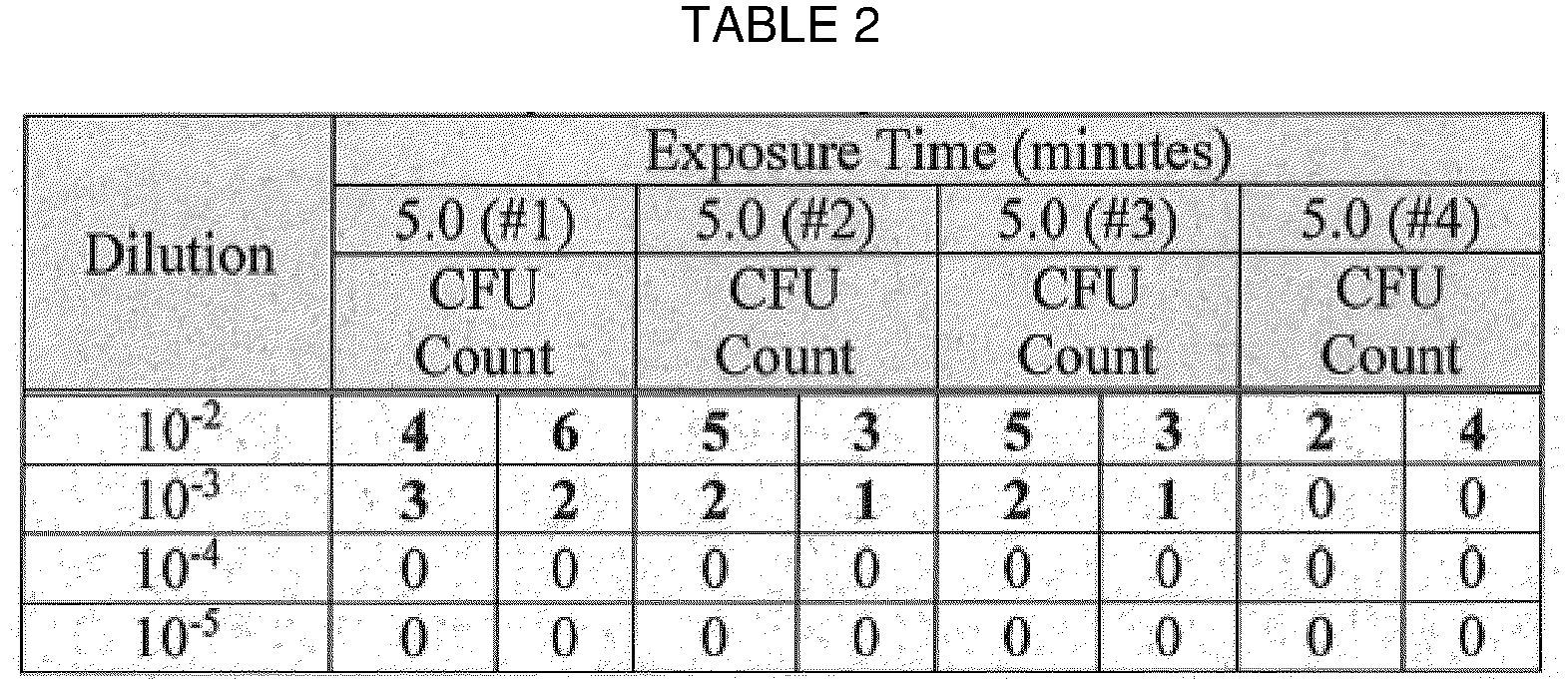


- Using the CFU count data presented in Tables 1-4, the population of G. stearothermophilus spores in the exposed and unexposed units of inoculated polyester wipes was calculated. Based on the average population determined from each exposure time, a survivor curve following the Survivor Curve Method was created and a D121-value of 2.0 minutes was calculated based on a survivor curve with an r2 of 0.9269.
- The above process may also be used to find the D value for other sterilization temperatures.
- Examples P1-P3 and 6 were tested for antimicrobial efficacy. For each example, five 7" x 7" sections of pig skin were prepared and each delineated with a 5" x 5" treatment and evaluation area. Each of the pig skin sections was inoculated with a known population of Staphylococcus epidermidis and allowed to dry at 36.1 °C - 36.2°C, with a relative humidity of 90% - 92% for 30 minutes. After drying, each inoculated section was sampled using standard cup scrub methodology to measure the baseline. After the baseline, the examples were applied to each of the inoculated sections using a back and forth motion for 3-minutes (each wipe was turned over and re-folded after 1 minute 30 seconds) and allowed to dry for 1-minute. After contact times of 30 seconds and 10 minutes post-prep, a specific area was sampled in the same manner as the baseline. Each sample was serially diluted and selected aliquots were plated. All plates were incubated at 36±1 °C for 48±2 hours. The results are shown in the below tables.


- As shown from the above data, the CFU/cm2 recovered from the artificially contaminated pig skin substrate using Staphylococcus epidermidis, Example P3, Example P2 and Comparative Example 6 achieved at least a 2.5 log reduction at the 30 second and 10 minute sampling time points. The CFU/cm2 recovered from the artificially contaminated pig skin substrate using Staphylococcus epidermidis, Comparative Example P1 did not meet the proposed 2.5 log reduction at the 30 second and 10 minute sampling time points.
- Octenidine dihydrochloride is a cationic antimicrobial agent with potent microbicidal activity against a broad range of microorganisms. However, being cationic in nature, octenidine dihydrochloride has a tendency to interact with anionic or nonionic surfactants (surface active agents) significantly decreasing its potency. Surface active agents may be added to antiseptic and cleaning products to provide hygiene benefits and to aid in the overall microbicidal effect of a product. The solutions used in wipes may contain multiple excipients that can potentially interact with octenidine dihydrochloride resulting in reduced efficacy.
- Multiple surfactants in solution formulations were tested for use with the wipes. Effects of individual excipients such as phosphate buffer, polysorbate 20, nonoxynol-9, Cremophor® RH-40, dimethicone, and combinations of these products were investigated to determine the possibility of adverse effects on the antimicrobial efficacy of octenidine dihydrochloride. Bactericidal activities of octenidine dihydrochloride alone and in combinations with various excipients (Table 11) were tested by a time kill method using Staphylococcus aureus ATCC 29213 as test organism (Table 12).
TABLE 11 - Compositions of formulations with Nonoxynol-9 and polysorbate 20 Full base formulation with Nonoxynol-9 with Polysorbate 20 Glycerin 1.50% 1.50% 1,3-Propanediol 1.50% 1.50% Dimethicone USP 0.05% 0.05% Polysorbate 20 0.50% 1.50% Nonoxynol-9 0.10% 0% Na2HPO4 0.62% 0.62% KH2PO4 0.06% 0.06% All percent values are w/v TABLE 12- Effect of excipients on the potency of Octenidine Dihydrochloride (OCT) Base Formulation or Vehicle OCT Conc. (PPM) Log Reduction Standard Deviation Water 2 3.41 0.15 20 3.78 0.15 100 4.65 0.21 500 5.12 0.06 Phosphate Buffered Water, pH 6.0 2 1.39 0.16 20 2.87 0.28 100 4.78 0.26 500 5.12 0.06 1.5% Polysorbate 20 in water 2 0.30 0.13 20 0.57 0.11 100 1.01 0.11 500 1.12 0.21 0.1% Nonoxynol-9 in water 2 1.52 0.19 20 2.94 0.12 100 4.69 0.32 500 5.12 0.06 0.25% Dimethicone in water 2 1.17 0.11 20 1.41 0.11 100 1.67 0.13 500 2.12 0.07 Full base formulation with Polysorbate 20 2 0.04 0.11 20 0.35 0.12 100 0.49 0.14 500 0.76 0.07 Full base formulation with Nonoxynol-9 and Polysorbate 20 2 0.29 0.23 20 0.58 0.14 100 0.60 0.14 500 1.40 0.10 1000 3.94* 0.35 2000 4.14* 0.07 4000 4.14* 0.07 *Total kill was achieved; log reduction, calculated as the limit of detection, are reported. - As shown in Table 12, octenidine dihydrochloride alone, at a concentration as low as 2 PPM and a contact time of 30 seconds, caused rapid loss in bacterial viability resulting in >99.9% reduction in viable count. Octenidine dihydrochloride dissolved in pH 6.0 phosphate buffered water required >20 PPM (>10 times the concentration in water) to showed 99.9% reduction in viable count. Polysorbate 20, dimethicone and nonoxynol-9 were found to have significant neutralizing effects on the bactericidal activity of OCT up to a concentration of 500 PPM. However, higher than 1000 PPM of octenidine dihydrochloride in the full base formulation was found to be rapidly microbicidal. The "full base formulation" is the formulation defined in Table 11.
- Neutralizing effects of two similar surfactants, 0.5% Cremophor® RH40 and 0.5% polysorbate 20, on the bactericidal activity of octenidine dihydrochloride were tested using the Staphylococcus aureus ATCC 29213 as test organism (Table 13 and 14).
TABLE 13 - Adverse effects of Cremophor® RH40 and Polysorbate 20 on bactericidal activity of octenidine dihydrochloride Formulation OCT Conc. in PPM Average Log Average Log Reduction Standard Deviation Percent Reduction Aqueous 20 2.000 5.123 0.066 99.999 100 2.000 5.123 0.066 99.999 500 2.000 5.123 0.066 99.999 0.5% Cremophor® RH40 20 6.383 0.740 0.310 81.808 100 5.651 1.472 0.155 96.624 500 2.000 5.123 0.066 99.999 0.5% Polysorbate 20 20 6.327 0.795 0.140 83.979 100 5.917 1.205 0.236 93.767 500 4.043 3.080 0.116 99.917 Full base formulation with Cremophor® RH40 (Table 11) 4000 3.000 4.123 0.066 99.992 Full base formulation with Polysorbate 20 (Table 11) 4000 3.000 4.123 0.066 99.992 Baseline NA 7.123 Table 14 - Compositions of full base formulations with Polysorbate 20 and Cremphor® RH40 Full Base Formulation With Cremphor® RH40 With Polysorbate 20 USP Purified Water or equivalent qs 100% qs 100% Glycerin, USP 1.50% 1.50% 1,3-propanediol, USP 1.50% 1.50% Dimethicone 0.05% 0.05% Polysorbate 20, USP 0.00% 0.50% Cremophor® RH40 0.50% 0.00% Nonoxynol-9, USP 0.05% 0.05% pH 6 Buffer salt: Monobasic Potassium Phosphate, NF 0.618% 0.618% pH 6 Buffer salt: Dibasic Sodium Phosphate, USP 0.065% 0.065% - Although 0.5% Cremophor® RH40 appeared to be slightly less inhibitory than 0.5% polysorbate 20, both agents required 500 PPM of octenidine dihydrochloride to deliver >3 log reduction in viable count within 30 seconds of contact time.
- The above data indicates that nonionic surfactants reduce the efficacy of octenidine dihydrochloride in a concentration dependent manner and concentration of surfactants and octenidine dihydrochloride can be balanced to provide desired efficacy of the formulated products. For example, polysorbate 20 (0.5% to 1.5%) may have >500 PPM of octenidine dihydrochloride to deliver rapid microbicidal efficacy.
- The squeezing volume of a wipe is a measure of the amount of antiseptic solution squeezed out from a soaked wipe. Wipes with high squeezing volumes tend to deliver more volume when scrubbing is performed. It has been found that the use of a bis-(dihydropyridinyl)-decane derivative (e.g., octenidine dihydrochloride) solution soaked into a polyester wipe may lower the squeezing volume, creating a undesirable feeling of dryness on the wipe. It has been found that by increasing the surfactant concentration in the solution, the squeezing volume of the wipe may be increased. Furthermore, it has been unexpectedly found that unlike biguanides (e.g., chlorohexidine gluconate), the addition of a bis-(dihydropyridinyl)-decane derivative (e.g., octenidine dihydrochloride) and heat treatment significantly changes the wetness feeling of the wipe and less solution can be squeezed out from the wipe.
- The squeezing volume has been evaluated on different wipes with different formulations. The following formulations were prepared (in all of the below formulations the components are reported in terms of w/v basis, which can be calculated from a v/v basis when the final density of the formulation was determined):
- Formulation 1 (F1) (Reference) - 0.4% w/v chlorhexidine digluconate and the remainder water.
- Formulation 2 (F2) (Reference) - 0.4% w/v chlorhexidine digluconate, 1.5% w/v glycerin, 1.5% w/v 1,3-propanediol, 0.5% w/v Dow Corning 365 35% Dimethicone NF Emulsion, 1.5% w/v polysorbate 20, and the remainder water.
- Formulation 3 (F3) (Reference) - pure water.
- Formulation 4 (F4) (Reference) - 0.4% w/v octenidine dihydrochloride and the remainder water.
- Formulation 5 (F5) (Reference) - 0.5% w/v Dow Corning 365 35% Dimethicone NF Emulsion and the remainder water.
- Formulation 6 (F6) (Reference) - 0.4% w/v octenidine dihydrochloride, 0.5% w/v Dow Corning 365 35% Dimethicone NF Emulsion, and the remainder water.
- Formulation 7 (F7) (Reference) - 2.0% w/v glycerin, 2.0% w/v 1,3-propanediol, 0.5% w/v Dow Corning 365 35% Dimethicone NF Emulsion, 0.5% w/v polysorbate 20, and the remainder water.
- Formulation 8 (F8) (Reference) - 0.4% w/v octenidine dihydrochloride, 2.0% w/v glycerin, 2.0% w/v 1,3-propanediol, 0.5% w/v Dow Corning 365 35% Dimethicone NF Emulsion, 0.5% w/v polysorbate 20, and the remainder water.
- Formulation 9 (F9) (Reference) - 2.0% w/v glycerin, 2.0% w/v 1,3-propanediol, 1.0% w/v Dow Corning 365 35% Dimethicone NF Emulsion, 1.0% w/v polysorbate 20, and the remainder water.
- Formulation 10 (F10) - 0.4% w/v octenidine dihydrochloride, 2.0% w/v glycerin, 2.0% w/v 1,3-propanediol, 1.0% w/v Dow Corning 365 35% Dimethicone NF Emulsion, 1.0% w/v polysorbate 20, and the remainder water.
- Formulation 11 (F11) (Reference) - 1.5% w/v glycerin, 1.5% w/v 1,3-propanediol, 0.57% w/v Dow Corning 365 35% Dimethicone NF Emulsion, 1.5% w/v polysorbate 20, and the remainder water.
- Formulation 12 (F12) - 0.4% w/v octenidine dihydrochloride, 1.5% w/v glycerin, 1.5% w/v 1,3-propanediol, 0.57% w/v Dow Corning 365 35% Dimethicone NF Emulsion, 1.5% w/v polysorbate 20, and the remainder water.
- Formulation 13 (F13) (Reference) - 1.0% w/v glycerin, 1.50% w/v 1,3-propanediol, 0.14% w/v Dow Corning 365 35% Dimethicone NF Emulsion, 2.0% w/v polysorbate 20, and the remainder water.
- Formulation 14 (F14) - 0.4% w/v octenidine dihydrochloride, 1.0% w/v glycerin, 1.50% w/v 1,3-propanediol, 0.14% w/v Dow Corning 365 35% Dimethicone NF Emulsion, 2.0% w/v polysorbate 20, and the remainder water.
- 25 mL of each of Formulations 1-14 were individually applied to a different sample of the wipe of Example 8, i.e., producing 14 wipes each soaked with one of the formulations. Each of the soaked wipes was squeezed until no more solution was observed to come out of the wipe. The mass of each wipe was recorded before and after squeezing to obtain the squeezing volume, the results of which are reported below in Table 15.
TABLE 15 - Squeeze Volumes Soaked Formulation Squeeze Volume (g) F1 (no OCT present) 7.9±1.2 F2 (no OCT present) 17±1.4 F3 (no OCT present) 14±2.7 F4 (OCT present) 3.2±1.3 F5 (no OCT present) 15.4±0.9 F6 (OCT present) 4±1 F7 (no OCT present) 14.3±1.5 F8 (OCT present) 5.7±0.8 F9 (no OCT present) 16.5±1.3 F10 (OCT present) 8.8±1.6 F11 (no OCT present) 19.1±1.1 F12 (OCT present) 16.2±0.3 F13 (no OCT present) 18.5±1.1 F14 (OCT present) 16.2±1.6 - Table 15 shows that the addition of octenidine dihydrochloride or chlorhexidine digluconate to water significantly lowered the squeeze volume delivered as compared to similar formulations lacking octenidine dihydrochloride and chlorhexidine digluconate. However, by increasing concentration of surfactant polysorbate 20, the difference between squeezing volume delivered by the wet wipes with and without octenidine dihydrochloride is reduced. Wipes loaded with 2% polysorbate 20 (F14) or 1.5 % polysorbate 20 (F12) and 0.4% octenidine dihydrochloride delivered no significant volume difference from wet wipes loaded with 1.5% polysorbate 20 and 0.4% chlorhexidine digluconate (F2).
- The effect of heat sterilization on the squeezing volume of moistened wipes has further been evaluated. The following formulations were prepared:
- Formula 15 (F15) - 0.4% w/v Octenidine dihydrochloride, 1.5% w/v Glycerin USP, 1.5% w/v 1,3 propanediol USP, 0.71% w/v Dow Corning 365 35% Dimethicone NF Emulsion, 1.0% w/v Kolliphor™ RH 40 (Polyoxyl 40 hydrogenated castor oil), 0.125% w/v noxynol 9 USP, 0.62% w/v monobasic potassium phosphate (KH2PO4), 0.06% w/v and dibasic sodium phosphate (Na2HPO4), and the remainder water.
- Formula 16 (F16) (Reference) - 0.4% w/v Octenidine dihydrochloride, 1.5% w/v Glycerin USP, 1.5% w/v 1,3 propanediol USP, 0.14% w/v Dow Corning 365 35% Dimethicone NF Emulsion, 0.5% w/v Kolliphor™ RH 40 (polyoxyl 40 hydrogenated castor oil), 0.06% w/v noxynol 9 USP, 0.62% w/v monobasic potassium phosphate (KH2PO4), 0.06% w/v dibasic sodium phosphate (Na2HPO4), and the remainder water.
- 20.32 cm by 20.32 cm (8 inch by 8 inch) wipes of Examples 1, 3, 7, 8, 11, and 12 were each moistened with 25 mL of Formulations 15 and 16. Each wipe was placed into a borosilicate 500 mL media bottle, capped tightly, and autoclaved in a Getinge steam sterilizer with liquid cycle at 121ºC for 30 min. Upon completion of the cycle, the bottle was cooled down to room temperature before handling. Each wipe was folded to 1/12 of its original size and fixed with a rubber band. The wipe was set in a mold with the upper mold box containing the wipe and lower mold box holding the squeezed-out liquid. A 226.80 kgf (500 lbf) loading force was applied on the folded wipe with a compression speed of 5.08 cm/min (2 inches/min) and held for 10 seconds before releasing. All the liquid squeezed out was collected in the lower box and disposed of after every squeezing application. The mass of each wipe was recorded before and after squeezing. The results are reported in Table 16 below.
TABLE 16 - Squeeze Volumes pre/post Sterilization Wipe Example No. 1 11 12 7 3 8 pre-sterilization (F16) 17.8 16.65 16.72 16.44 17.55 16.94 pre-sterilization (F15) 16.11 15.54 16.5 16.06 17.48 15.59 post-sterilization (F16) 5.04 7.015 6.85 7.555 8.28 3.71 post-sterilization (F15) 11.98 12.955 13.805 10.57 11.55 7.23 All reported values are grams of liquid (original soaked weight minus final weight after squeezing). - The squeezing volume in Table 16 is provided for the wipes of Examples 1, 3, 7, 8, 11, and 12, moistened with either 0.5 % Kolliphor™ RH 40 (F16) or 1 % Kolliphor™ RH 40 (F15) under pre-and post-heat treatment conditions. Formulation 15 has higher surfactant concentration with 1% Kolliphor™ RH 40 and 0.125% Nonoxynol-9 than Formulation 16, which has 0.5% Kolliphor™ RH 40 and 0.06% Nonoxynol-9. Prior to heat treatment, there is no significant difference in squeezing volume between the wipes of Examples 1, 3, 7, 8, 11, and 12. There was also no significant difference between formulations F15 and 16; however, heat treatment within the autoclave shrinks the polyester wipe by 1.5 - 3%. Without being bound by theory, it is believed that shrinkage after heat treatment lowered the average pore size of the wipe, thus increased the capillary pressure (capillary pressure is the force necessary to squeeze a droplet through a pore and is higher for smaller pore diameter) of the solution spread in the wipe, leading to a lowered squeezing volume for the wipes under compression. Post-autoclave treatment, wipes moistened with higher surfactant (F15) delivered a much higher squeezing volume than wipes with formulation F16 and the wipes of Examples 1, 3, 7, 8, 11, and 12 delivered a significantly lower squeezing volume than all other wipe materials. Changing wipe density, fiber length or fiber denier to increase or decrease the average pore size of the wipe is a possible approach to adjust the squeezing volume of the wipe. Based on these results, longer fibers, larger fiber denier and higher fiber density appear to result in a wipe with smaller pore size, which in turn leads to a larger formulation holding volume for the wipe and a lower squeezing volume. Increasing the surfactant concentration will also help with wetting the wipes. The same characteristics are found following heat treatment in that the squeezing volume is increased with greater surfactant concentration.
- Additional data samples were collected in which the Kolliphor™ RH 40 in Formulations 15 and 16 was replaced with the same amount of polysorbate 20 (i.e., 1.0% w/v polysorbate 20 and 0.5% w/v polysorbate 20, respectively). These solutions were soaked into the wipe of Example 3. The pre and post sterilizing squeeze volumes were measured in the same manner as described above. It was found that the heat treatment also significantly lowered squeeze volume, and that increasing the polysorbate 20 content improved the squeezing volume. The squeeze volume pre- and post- heat treated, reduced from 18.50 grams to 4.64 grams when the polysorbate 20 concentration was 0.5% w/v. The squeeze volume pre- and post- heat treated, reduced from 18.50 grams to 9.43 grams when the polysorbate 20 concentration was 1.0% w/v. Thus, increasing the surfactant concentration to 1.0% allowed for a higher squeeze volume (18.50 grams to 9.43 grams).
Claims (14)
- A nonwoven wipe comprising:an antiseptic solution, the antiseptic solution comprising:from 0.2% w/v to 0.6 % w/v of octenidine dihydrochloride; andfrom 1% w/v to 5.0% w/v of macrogol-glycerolhydroxystearate, polysorbate 20, polysorbate 60, polysorbate 80, or a combination thereof;a first fiber having a denier of 1.5 to 2.0; anda second fiber having a denier of 3.0 +/- 5% of the numerical value and more preferably +/- 1% of the numerical value,wherein the first and second fiber each comprises polyester,wherein 30 wt% to 70 wt% of the total weight of the nonwoven wipe is the first fiber and 30 wt% to 70 wt% of the total weight of the nonwoven wipe is the second fiber, andwherein the wipe contains said antiseptic solution.
- The wipe of claim 1, wherein 50 wt% ±5% of the numerical value of the total weight of the wipe is the first fiber and 50 wt% ±5% of the numerical value wt%) of the total weight of the wipe is the second fiber.
- The wipe of claim 1, further comprising a third fiber having a denier of 5.0 to 6.0, wherein 10 wt% to 30 wt% of the total weight of the wipe is a third fiber.
- The wipe of claim 3, wherein 40 wt% ±5% of the numerical value of the total weight of the wipe is the first fiber, 40 wt% ±5% of the numerical value of the total weight of the wipe is the second fiber, and 20 wt% ±5% of the numerical value of the total weight of the wipe is the third fiber.
- The wipe of claim 1,wherein the first polyester fiber has a denier of 1.5 ±5% of the numerical value; and50 wt% ±5% of the numerical value of the total weight of the nonwoven wipe is the first fiber and 50 wt% ±5% of the numerical value of the total weight of the nonwoven wipe is the second fiber.
- The wipe of claim 1, wherein:the first polyester fiber has a denier of 1.5 ±5% of the numerical value;the second polyester fiber has a denier of 3.0 ±5% of the numerical value; andthe wipe further comprises a third polyester fiber having a denier of 6.0 ±5% of the numerical value,wherein 40 wt% ±5% of the numerical value of the total weight of the nonwoven wipe is the first fiber, 40 wt% ±5% of the numerical value of the total weight of the nonwoven wipe is the second fiber, and 20 wt% ±5% of the numerical value of the total weight of the wipe is the third fiber.
- The wipe of claim 1, wherein the first and second fiber each have a length of 5.08 cm to 7.62 cm (2.0 to 3.0 inches).
- The wipe of claim 1, wherein the solution comprises from 0.2% to 5.0% w/v of a skin conditioner, preferably selected from the group consisting of glycerin and 1,3-propanediol, and combinations thereof.
- The wipe of claim 1, having a thickness of 0.203 cm to 0.254 cm (0.080 inches to 0.100 inches).
- The wipe of claim 1, wherein the solution comprises from 0.1% to 5.0% w/v of an antifoaming agent, said antifoaming agent preferably comprising dimethicone.
- A package containing the wipe of claim 1, wherein the package comprises a metal foil or a metalized plastic.
- The package of claim 11, further comprising a warming mechanism, said warming mechanism comprising a particulate fuel that reacts with oxygen in the air to produce heat, a thermal conductive member, and an insulating member.
- The wipe of claim 1, wherein the antiseptic solution further comprises from 0.01 to 0.2% w/v nonoxynol-9.
- The wipe of claim 1, wherein the wipe has been sterilized and is sterile.
Applications Claiming Priority (2)
| Application Number | Priority Date | Filing Date | Title |
|---|---|---|---|
| US14/985,042 US10264788B2 (en) | 2015-12-30 | 2015-12-30 | Antimicrobial wipe |
| PCT/US2016/069507 WO2017117534A1 (en) | 2015-12-30 | 2016-12-30 | Antimicrobial wipe |
Publications (4)
| Publication Number | Publication Date |
|---|---|
| EP3397289A1 EP3397289A1 (en) | 2018-11-07 |
| EP3397289A4 EP3397289A4 (en) | 2019-06-05 |
| EP3397289B1 true EP3397289B1 (en) | 2024-08-21 |
| EP3397289C0 EP3397289C0 (en) | 2024-08-21 |
Family
ID=59225474
Family Applications (1)
| Application Number | Title | Priority Date | Filing Date |
|---|---|---|---|
| EP16882754.1A Active EP3397289B1 (en) | 2015-12-30 | 2016-12-30 | Antimicrobial wipe |
Country Status (8)
| Country | Link |
|---|---|
| US (2) | US10264788B2 (en) |
| EP (1) | EP3397289B1 (en) |
| CN (1) | CN106973904A (en) |
| AU (1) | AU2016380363A1 (en) |
| BR (1) | BR112018013548A2 (en) |
| CA (1) | CA3010500A1 (en) |
| MX (1) | MX2018008072A (en) |
| WO (1) | WO2017117534A1 (en) |
Families Citing this family (6)
| Publication number | Priority date | Publication date | Assignee | Title |
|---|---|---|---|---|
| AU2018348194B2 (en) * | 2017-10-12 | 2024-04-18 | Medline Industries, Inc. | Antiseptic wipes |
| IT201800008267A1 (en) * | 2018-08-31 | 2020-03-02 | Welcare Ind Spa | PROCEDURE FOR THE STERILIZATION IN AUTOCLAVE OF WET PRODUCTS PACKAGED IN PLASTIC OR THERMOSENSITIVE MATERIALS |
| US20200270042A1 (en) | 2019-02-27 | 2020-08-27 | Medline Industries, Inc. | Packaging for antiseptic wipes and warming of packaged wipes |
| WO2020255037A1 (en) * | 2019-06-20 | 2020-12-24 | 3M Innovative Properties Company | Antimicrobial wipes |
| EP3771770B1 (en) * | 2019-07-29 | 2025-04-09 | The Procter & Gamble Company | Antimicrobial freshening compositions |
| EP3771337B1 (en) * | 2019-07-29 | 2026-04-29 | The Procter & Gamble Company | Antimicrobial composition |
Citations (1)
| Publication number | Priority date | Publication date | Assignee | Title |
|---|---|---|---|---|
| US20060079143A1 (en) * | 2003-05-12 | 2006-04-13 | Sage Products, Inc. | Controlled dosing of fibrous materials |
Family Cites Families (22)
| Publication number | Priority date | Publication date | Assignee | Title |
|---|---|---|---|---|
| US3967756A (en) | 1975-06-09 | 1976-07-06 | Johnson & Johnson | Wet wipe dispenser |
| US4998984A (en) | 1989-11-15 | 1991-03-12 | Mcclendon Evelyn | Premoistened prepackaged disposable disinfectant wiper |
| US6358516B1 (en) | 1998-08-21 | 2002-03-19 | Norris R. Harod | One-step system for cleansing, conditioning, and treating the skin |
| EP1059378A1 (en) * | 1999-06-08 | 2000-12-13 | The Procter & Gamble Company | Wet wipe with antifoaming agent |
| US20030003831A1 (en) * | 2001-06-29 | 2003-01-02 | Childs Stephen Lee | Cleaning sheets comprising multi-denier fibers |
| US6737068B2 (en) | 2001-10-01 | 2004-05-18 | Playtex Products, Inc. | Wipe formulation |
| US6586385B1 (en) * | 2001-11-13 | 2003-07-01 | Colgate-Palmolive Co. | Cleaning wipe |
| US7066916B2 (en) | 2003-05-12 | 2006-06-27 | Sage Products, Inc. | Disinfectant delivery system, and method of providing alcohol-free disinfection |
| US7427574B2 (en) * | 2005-08-19 | 2008-09-23 | Sage Products, Inc. | Non-woven wash cloth |
| DE102005058978A1 (en) * | 2005-08-26 | 2007-03-29 | Bode Chemie Gmbh & Co. Kg | Wound and mucous membrane disinfectant |
| DE102006001954B4 (en) * | 2006-01-16 | 2013-01-03 | Lohmann & Rauscher Gmbh & Co. Kg | Antiseptic alginate preparation, process for their preparation, and their use |
| US9004059B2 (en) | 2006-08-10 | 2015-04-14 | Rechargeable Battery Corporation | Reusable heater in a package |
| US8840911B2 (en) * | 2008-03-07 | 2014-09-23 | Kimberly-Clark Worldwide, Inc. | Moisturizing hand sanitizer |
| US20110212933A1 (en) * | 2008-03-20 | 2011-09-01 | Allan Shapiro | Antiseptic Compositions for the Treatment of Infections |
| US20100158964A1 (en) | 2008-12-22 | 2010-06-24 | Corey Thomas Cunningham | Personal Care Composition Providing Quietness and Softness Enhancement and Articles Using the Same |
| DE102010049114A1 (en) * | 2010-10-22 | 2012-04-26 | Schülke & Mayr GmbH | Fabric impregnated with an antimicrobial agent solution for use on busy surfaces |
| DE102010049113A1 (en) * | 2010-10-22 | 2012-04-26 | Schülke & Mayr GmbH | Textile fabric impregnated with an antimicrobial active ingredient preparation with a polyolefin-based carrier material |
| JP6133858B2 (en) * | 2011-07-28 | 2017-05-24 | スリーエム イノベイティブ プロパティズ カンパニー | Wound healing composition and method of use |
| TW201605444A (en) * | 2013-12-18 | 2016-02-16 | 阿爾米雷爾有限公司 | Topical pharmaceutical or cosmetic compositions comprising octenidine dihydrochloride |
| US11027032B2 (en) | 2014-01-08 | 2021-06-08 | Carefusion 2200, Inc. | Systems, methods, and devices for sterilizing antiseptic solutions |
| GB201405660D0 (en) * | 2014-03-28 | 2014-05-14 | Gama Healthcare Ltd | A liquid disinfecting composition |
| CN104622716A (en) * | 2015-02-27 | 2015-05-20 | 李航 | Medical nursing wet tissue which is non-alcoholic, long-acting, antibacterial and capable of removing dirt and disinfectant |
-
2015
- 2015-12-30 US US14/985,042 patent/US10264788B2/en active Active
-
2016
- 2016-12-30 CA CA3010500A patent/CA3010500A1/en not_active Abandoned
- 2016-12-30 MX MX2018008072A patent/MX2018008072A/en unknown
- 2016-12-30 BR BR112018013548A patent/BR112018013548A2/en not_active Application Discontinuation
- 2016-12-30 WO PCT/US2016/069507 patent/WO2017117534A1/en not_active Ceased
- 2016-12-30 EP EP16882754.1A patent/EP3397289B1/en active Active
- 2016-12-30 CN CN201611260088.6A patent/CN106973904A/en active Pending
- 2016-12-30 AU AU2016380363A patent/AU2016380363A1/en not_active Abandoned
-
2018
- 2018-12-07 US US16/213,875 patent/US10645927B2/en active Active
Patent Citations (1)
| Publication number | Priority date | Publication date | Assignee | Title |
|---|---|---|---|---|
| US20060079143A1 (en) * | 2003-05-12 | 2006-04-13 | Sage Products, Inc. | Controlled dosing of fibrous materials |
Also Published As
| Publication number | Publication date |
|---|---|
| US10645927B2 (en) | 2020-05-12 |
| EP3397289A4 (en) | 2019-06-05 |
| WO2017117534A1 (en) | 2017-07-06 |
| US20170188578A1 (en) | 2017-07-06 |
| EP3397289A1 (en) | 2018-11-07 |
| CN106973904A (en) | 2017-07-25 |
| AU2016380363A1 (en) | 2018-07-19 |
| MX2018008072A (en) | 2018-09-05 |
| US10264788B2 (en) | 2019-04-23 |
| EP3397289C0 (en) | 2024-08-21 |
| US20190104735A1 (en) | 2019-04-11 |
| CA3010500A1 (en) | 2017-07-06 |
| BR112018013548A2 (en) | 2018-12-04 |
Similar Documents
| Publication | Publication Date | Title |
|---|---|---|
| US10645927B2 (en) | Antimicrobial wipe | |
| AU2009335672B2 (en) | Chlorhexidine acetate antiseptic cleaning agent | |
| AU2012347739B2 (en) | Biocidal compositions and methods of using the same | |
| KR101555341B1 (en) | Antibiotic wet tissue, and manufacturing method thereof | |
| KR20120047212A (en) | Antimicrobial compositions | |
| RU2718554C1 (en) | Thermostable composition, having antiviral and antibacterial activity and use thereof | |
| JP7078819B2 (en) | Wet wiper | |
| CA2722349A1 (en) | A formulation | |
| US20230329988A1 (en) | Sanitizing compositions containing ionic liquid | |
| WO2005016363A1 (en) | Non-toxic mucosal disinfectant containing isopropyl alcohol, sesame oil, aloe, and lemon oil | |
| CN110477792A (en) | A kind of nonalcoholic wet tissue and preparation method thereof can be used for breathing mask cleaning-sterilizing | |
| US20230413812A1 (en) | Sanitizing compositions containing ionic liquid | |
| JPH08196461A (en) | Antibacterial wiper | |
| US20050013881A1 (en) | Non-toxic disinfectant containing a isopropyl alcohol and sesame oil composition with lemon oil and menthol | |
| CN114025747A (en) | Antimicrobial wipes | |
| US10688067B2 (en) | Sterilized chlorhexidine article and method of sterilizing a chlorhexidine article | |
| EP4072601A1 (en) | Disinfecting composition, applicator, and method of disinfecting | |
| CN2766851Y (en) | Antibacterial anti-infection medical gauze | |
| KR20090066651A (en) | Sterilizing Desiccant and Spray Cans Containing the Same | |
| KR20130071769A (en) | Anti-allergen composition and spray formulation comprising the same | |
| TR2021012501A2 (en) | ETHANOL BASED HAND DISINFECTANT WITH HERBAL CONTENTS | |
| JP2023036789A (en) | wet sheet | |
| WO2025039048A1 (en) | A method for obtaining a probiotic product for neutralizing allergens, released by house dust mites, product composition and method of use | |
| JPS6219869B2 (en) | ||
| HK1213433A1 (en) | Improved antimicrobial compositions |
Legal Events
| Date | Code | Title | Description |
|---|---|---|---|
| STAA | Information on the status of an ep patent application or granted ep patent |
Free format text: STATUS: THE INTERNATIONAL PUBLICATION HAS BEEN MADE |
|
| PUAI | Public reference made under article 153(3) epc to a published international application that has entered the european phase |
Free format text: ORIGINAL CODE: 0009012 |
|
| STAA | Information on the status of an ep patent application or granted ep patent |
Free format text: STATUS: REQUEST FOR EXAMINATION WAS MADE |
|
| 17P | Request for examination filed |
Effective date: 20180726 |
|
| AK | Designated contracting states |
Kind code of ref document: A1 Designated state(s): AL AT BE BG CH CY CZ DE DK EE ES FI FR GB GR HR HU IE IS IT LI LT LU LV MC MK MT NL NO PL PT RO RS SE SI SK SM TR |
|
| AX | Request for extension of the european patent |
Extension state: BA ME |
|
| DAV | Request for validation of the european patent (deleted) | ||
| DAX | Request for extension of the european patent (deleted) | ||
| A4 | Supplementary search report drawn up and despatched |
Effective date: 20190507 |
|
| RIC1 | Information provided on ipc code assigned before grant |
Ipc: A01N 25/34 20060101AFI20190430BHEP Ipc: A47L 17/00 20060101ALI20190430BHEP Ipc: B32B 27/36 20060101ALI20190430BHEP Ipc: D04H 1/00 20060101ALI20190430BHEP Ipc: C11D 1/00 20060101ALI20190430BHEP Ipc: A01N 43/40 20060101ALI20190430BHEP Ipc: A61L 15/00 20060101ALI20190430BHEP |
|
| STAA | Information on the status of an ep patent application or granted ep patent |
Free format text: STATUS: EXAMINATION IS IN PROGRESS |
|
| 17Q | First examination report despatched |
Effective date: 20200326 |
|
| REG | Reference to a national code |
Ref country code: DE Ref legal event code: R079 Free format text: PREVIOUS MAIN CLASS: A61L0002160000 Ipc: A01N0025340000 Ref country code: DE Ref legal event code: R079 Ref document number: 602016089049 Country of ref document: DE Free format text: PREVIOUS MAIN CLASS: A61L0002160000 Ipc: A01N0025340000 |
|
| RIC1 | Information provided on ipc code assigned before grant |
Ipc: A01P 1/00 20060101ALI20240125BHEP Ipc: C11D 17/04 20060101ALI20240125BHEP Ipc: A61K 8/02 20060101ALI20240125BHEP Ipc: A61K 8/49 20060101ALI20240125BHEP Ipc: A47L 13/17 20060101ALI20240125BHEP Ipc: A01N 43/40 20060101ALI20240125BHEP Ipc: A61Q 17/00 20060101ALI20240125BHEP Ipc: A01N 25/34 20060101AFI20240125BHEP |
|
| GRAP | Despatch of communication of intention to grant a patent |
Free format text: ORIGINAL CODE: EPIDOSNIGR1 |
|
| STAA | Information on the status of an ep patent application or granted ep patent |
Free format text: STATUS: GRANT OF PATENT IS INTENDED |
|
| INTG | Intention to grant announced |
Effective date: 20240312 |
|
| GRAS | Grant fee paid |
Free format text: ORIGINAL CODE: EPIDOSNIGR3 |
|
| GRAA | (expected) grant |
Free format text: ORIGINAL CODE: 0009210 |
|
| STAA | Information on the status of an ep patent application or granted ep patent |
Free format text: STATUS: THE PATENT HAS BEEN GRANTED |
|
| AK | Designated contracting states |
Kind code of ref document: B1 Designated state(s): AL AT BE BG CH CY CZ DE DK EE ES FI FR GB GR HR HU IE IS IT LI LT LU LV MC MK MT NL NO PL PT RO RS SE SI SK SM TR |
|
| REG | Reference to a national code |
Ref country code: GB Ref legal event code: FG4D |
|
| REG | Reference to a national code |
Ref country code: CH Ref legal event code: EP |
|
| REG | Reference to a national code |
Ref country code: IE Ref legal event code: FG4D |
|
| REG | Reference to a national code |
Ref country code: DE Ref legal event code: R096 Ref document number: 602016089049 Country of ref document: DE |
|
| U01 | Request for unitary effect filed |
Effective date: 20240920 |
|
| U07 | Unitary effect registered |
Designated state(s): AT BE BG DE DK EE FI FR IT LT LU LV MT NL PT RO SE SI Effective date: 20241015 |
|
| U20 | Renewal fee for the european patent with unitary effect paid |
Year of fee payment: 9 Effective date: 20241121 |
|
| PG25 | Lapsed in a contracting state [announced via postgrant information from national office to epo] |
Ref country code: NO Free format text: LAPSE BECAUSE OF FAILURE TO SUBMIT A TRANSLATION OF THE DESCRIPTION OR TO PAY THE FEE WITHIN THE PRESCRIBED TIME-LIMIT Effective date: 20241121 |
|
| PG25 | Lapsed in a contracting state [announced via postgrant information from national office to epo] |
Ref country code: GR Free format text: LAPSE BECAUSE OF FAILURE TO SUBMIT A TRANSLATION OF THE DESCRIPTION OR TO PAY THE FEE WITHIN THE PRESCRIBED TIME-LIMIT Effective date: 20241122 Ref country code: PL Free format text: LAPSE BECAUSE OF FAILURE TO SUBMIT A TRANSLATION OF THE DESCRIPTION OR TO PAY THE FEE WITHIN THE PRESCRIBED TIME-LIMIT Effective date: 20240821 |
|
| PG25 | Lapsed in a contracting state [announced via postgrant information from national office to epo] |
Ref country code: IS Free format text: LAPSE BECAUSE OF FAILURE TO SUBMIT A TRANSLATION OF THE DESCRIPTION OR TO PAY THE FEE WITHIN THE PRESCRIBED TIME-LIMIT Effective date: 20241221 |
|
| PG25 | Lapsed in a contracting state [announced via postgrant information from national office to epo] |
Ref country code: HR Free format text: LAPSE BECAUSE OF FAILURE TO SUBMIT A TRANSLATION OF THE DESCRIPTION OR TO PAY THE FEE WITHIN THE PRESCRIBED TIME-LIMIT Effective date: 20240821 |
|
| PG25 | Lapsed in a contracting state [announced via postgrant information from national office to epo] |
Ref country code: RS Free format text: LAPSE BECAUSE OF FAILURE TO SUBMIT A TRANSLATION OF THE DESCRIPTION OR TO PAY THE FEE WITHIN THE PRESCRIBED TIME-LIMIT Effective date: 20241121 Ref country code: ES Free format text: LAPSE BECAUSE OF FAILURE TO SUBMIT A TRANSLATION OF THE DESCRIPTION OR TO PAY THE FEE WITHIN THE PRESCRIBED TIME-LIMIT Effective date: 20240821 |
|
| PG25 | Lapsed in a contracting state [announced via postgrant information from national office to epo] |
Ref country code: RS Free format text: LAPSE BECAUSE OF FAILURE TO SUBMIT A TRANSLATION OF THE DESCRIPTION OR TO PAY THE FEE WITHIN THE PRESCRIBED TIME-LIMIT Effective date: 20241121 Ref country code: PL Free format text: LAPSE BECAUSE OF FAILURE TO SUBMIT A TRANSLATION OF THE DESCRIPTION OR TO PAY THE FEE WITHIN THE PRESCRIBED TIME-LIMIT Effective date: 20240821 Ref country code: NO Free format text: LAPSE BECAUSE OF FAILURE TO SUBMIT A TRANSLATION OF THE DESCRIPTION OR TO PAY THE FEE WITHIN THE PRESCRIBED TIME-LIMIT Effective date: 20241121 Ref country code: IS Free format text: LAPSE BECAUSE OF FAILURE TO SUBMIT A TRANSLATION OF THE DESCRIPTION OR TO PAY THE FEE WITHIN THE PRESCRIBED TIME-LIMIT Effective date: 20241221 Ref country code: HR Free format text: LAPSE BECAUSE OF FAILURE TO SUBMIT A TRANSLATION OF THE DESCRIPTION OR TO PAY THE FEE WITHIN THE PRESCRIBED TIME-LIMIT Effective date: 20240821 Ref country code: GR Free format text: LAPSE BECAUSE OF FAILURE TO SUBMIT A TRANSLATION OF THE DESCRIPTION OR TO PAY THE FEE WITHIN THE PRESCRIBED TIME-LIMIT Effective date: 20241122 Ref country code: ES Free format text: LAPSE BECAUSE OF FAILURE TO SUBMIT A TRANSLATION OF THE DESCRIPTION OR TO PAY THE FEE WITHIN THE PRESCRIBED TIME-LIMIT Effective date: 20240821 |
|
| PG25 | Lapsed in a contracting state [announced via postgrant information from national office to epo] |
Ref country code: SM Free format text: LAPSE BECAUSE OF FAILURE TO SUBMIT A TRANSLATION OF THE DESCRIPTION OR TO PAY THE FEE WITHIN THE PRESCRIBED TIME-LIMIT Effective date: 20240821 |
|
| PG25 | Lapsed in a contracting state [announced via postgrant information from national office to epo] |
Ref country code: CZ Free format text: LAPSE BECAUSE OF FAILURE TO SUBMIT A TRANSLATION OF THE DESCRIPTION OR TO PAY THE FEE WITHIN THE PRESCRIBED TIME-LIMIT Effective date: 20240821 |
|
| PG25 | Lapsed in a contracting state [announced via postgrant information from national office to epo] |
Ref country code: SK Free format text: LAPSE BECAUSE OF FAILURE TO SUBMIT A TRANSLATION OF THE DESCRIPTION OR TO PAY THE FEE WITHIN THE PRESCRIBED TIME-LIMIT Effective date: 20240821 |
|
| PLBE | No opposition filed within time limit |
Free format text: ORIGINAL CODE: 0009261 |
|
| STAA | Information on the status of an ep patent application or granted ep patent |
Free format text: STATUS: NO OPPOSITION FILED WITHIN TIME LIMIT |
|
| PG25 | Lapsed in a contracting state [announced via postgrant information from national office to epo] |
Ref country code: MC Free format text: LAPSE BECAUSE OF FAILURE TO SUBMIT A TRANSLATION OF THE DESCRIPTION OR TO PAY THE FEE WITHIN THE PRESCRIBED TIME-LIMIT Effective date: 20240821 |
|
| 26N | No opposition filed |
Effective date: 20250522 |
|
| REG | Reference to a national code |
Ref country code: CH Ref legal event code: PL |
|
| PG25 | Lapsed in a contracting state [announced via postgrant information from national office to epo] |
Ref country code: CH Free format text: LAPSE BECAUSE OF NON-PAYMENT OF DUE FEES Effective date: 20241231 |
|
| PG25 | Lapsed in a contracting state [announced via postgrant information from national office to epo] |
Ref country code: IE Free format text: LAPSE BECAUSE OF NON-PAYMENT OF DUE FEES Effective date: 20241230 |
|
| U20 | Renewal fee for the european patent with unitary effect paid |
Year of fee payment: 10 Effective date: 20251119 |
|
| PGFP | Annual fee paid to national office [announced via postgrant information from national office to epo] |
Ref country code: GB Payment date: 20251120 Year of fee payment: 10 |