EP3396702A1 - Method of cleaning and drying semiconductor substrate - Google Patents
Method of cleaning and drying semiconductor substrate Download PDFInfo
- Publication number
- EP3396702A1 EP3396702A1 EP18164566.4A EP18164566A EP3396702A1 EP 3396702 A1 EP3396702 A1 EP 3396702A1 EP 18164566 A EP18164566 A EP 18164566A EP 3396702 A1 EP3396702 A1 EP 3396702A1
- Authority
- EP
- European Patent Office
- Prior art keywords
- resin
- cleaning
- semiconductor substrate
- group
- pattern
- Prior art date
- Legal status (The legal status is an assumption and is not a legal conclusion. Google has not performed a legal analysis and makes no representation as to the accuracy of the status listed.)
- Granted
Links
- 0 CC(*)*C1C(*N*C=[*+2])C1 Chemical compound CC(*)*C1C(*N*C=[*+2])C1 0.000 description 3
Images

Classifications
-
- H—ELECTRICITY
- H10—SEMICONDUCTOR DEVICES; ELECTRIC SOLID-STATE DEVICES NOT OTHERWISE PROVIDED FOR
- H10P—GENERIC PROCESSES OR APPARATUS FOR THE MANUFACTURE OR TREATMENT OF DEVICES COVERED BY CLASS H10
- H10P70/00—Cleaning of wafers, substrates or parts of devices
-
- B—PERFORMING OPERATIONS; TRANSPORTING
- B81—MICROSTRUCTURAL TECHNOLOGY
- B81C—PROCESSES OR APPARATUS SPECIALLY ADAPTED FOR THE MANUFACTURE OR TREATMENT OF MICROSTRUCTURAL DEVICES OR SYSTEMS
- B81C1/00—Manufacture or treatment of devices or systems in or on a substrate
- B81C1/00841—Cleaning during or after manufacture
- B81C1/00857—Cleaning during or after manufacture after manufacture, e.g. back-end of the line process
-
- H—ELECTRICITY
- H10—SEMICONDUCTOR DEVICES; ELECTRIC SOLID-STATE DEVICES NOT OTHERWISE PROVIDED FOR
- H10P—GENERIC PROCESSES OR APPARATUS FOR THE MANUFACTURE OR TREATMENT OF DEVICES COVERED BY CLASS H10
- H10P70/00—Cleaning of wafers, substrates or parts of devices
- H10P70/10—Cleaning before device manufacture, i.e. Begin-Of-Line process
- H10P70/12—Cleaning before device manufacture, i.e. Begin-Of-Line process by dry cleaning only
-
- H—ELECTRICITY
- H10—SEMICONDUCTOR DEVICES; ELECTRIC SOLID-STATE DEVICES NOT OTHERWISE PROVIDED FOR
- H10P—GENERIC PROCESSES OR APPARATUS FOR THE MANUFACTURE OR TREATMENT OF DEVICES COVERED BY CLASS H10
- H10P70/00—Cleaning of wafers, substrates or parts of devices
- H10P70/20—Cleaning during device manufacture
- H10P70/27—Cleaning during device manufacture during, before or after processing of conductive materials, e.g. polysilicon or amorphous silicon layers
- H10P70/273—Cleaning during device manufacture during, before or after processing of conductive materials, e.g. polysilicon or amorphous silicon layers the processing being a delineation of conductive layers, e.g. by RIE
-
- B—PERFORMING OPERATIONS; TRANSPORTING
- B08—CLEANING
- B08B—CLEANING IN GENERAL; PREVENTION OF FOULING IN GENERAL
- B08B3/00—Cleaning by methods involving the use or presence of liquid or steam
- B08B3/04—Cleaning involving contact with liquid
- B08B3/08—Cleaning involving contact with liquid the liquid having chemical or dissolving effect
-
- B—PERFORMING OPERATIONS; TRANSPORTING
- B81—MICROSTRUCTURAL TECHNOLOGY
- B81C—PROCESSES OR APPARATUS SPECIALLY ADAPTED FOR THE MANUFACTURE OR TREATMENT OF MICROSTRUCTURAL DEVICES OR SYSTEMS
- B81C1/00—Manufacture or treatment of devices or systems in or on a substrate
- B81C1/00912—Treatments or methods for avoiding stiction of flexible or moving parts of MEMS
- B81C1/0092—For avoiding stiction during the manufacturing process of the device, e.g. during wet etching
- B81C1/00952—Treatments or methods for avoiding stiction during the manufacturing process not provided for in groups B81C1/00928 - B81C1/00944
-
- C—CHEMISTRY; METALLURGY
- C11—ANIMAL OR VEGETABLE OILS, FATS, FATTY SUBSTANCES OR WAXES; FATTY ACIDS THEREFROM; DETERGENTS; CANDLES
- C11D—DETERGENT COMPOSITIONS; USE OF SINGLE SUBSTANCES AS DETERGENTS; SOAP OR SOAP-MAKING; RESIN SOAPS; RECOVERY OF GLYCEROL
- C11D3/00—Other compounding ingredients of detergent compositions covered in group C11D1/00
- C11D3/16—Organic compounds
- C11D3/37—Polymers
-
- C—CHEMISTRY; METALLURGY
- C11—ANIMAL OR VEGETABLE OILS, FATS, FATTY SUBSTANCES OR WAXES; FATTY ACIDS THEREFROM; DETERGENTS; CANDLES
- C11D—DETERGENT COMPOSITIONS; USE OF SINGLE SUBSTANCES AS DETERGENTS; SOAP OR SOAP-MAKING; RESIN SOAPS; RECOVERY OF GLYCEROL
- C11D7/00—Compositions of detergents based essentially on non-surface-active compounds
- C11D7/22—Organic compounds
- C11D7/28—Organic compounds containing halogen
-
- C—CHEMISTRY; METALLURGY
- C11—ANIMAL OR VEGETABLE OILS, FATS, FATTY SUBSTANCES OR WAXES; FATTY ACIDS THEREFROM; DETERGENTS; CANDLES
- C11D—DETERGENT COMPOSITIONS; USE OF SINGLE SUBSTANCES AS DETERGENTS; SOAP OR SOAP-MAKING; RESIN SOAPS; RECOVERY OF GLYCEROL
- C11D7/00—Compositions of detergents based essentially on non-surface-active compounds
- C11D7/50—Solvents
- C11D7/5004—Organic solvents
- C11D7/5018—Halogenated solvents
-
- C—CHEMISTRY; METALLURGY
- C11—ANIMAL OR VEGETABLE OILS, FATS, FATTY SUBSTANCES OR WAXES; FATTY ACIDS THEREFROM; DETERGENTS; CANDLES
- C11D—DETERGENT COMPOSITIONS; USE OF SINGLE SUBSTANCES AS DETERGENTS; SOAP OR SOAP-MAKING; RESIN SOAPS; RECOVERY OF GLYCEROL
- C11D7/00—Compositions of detergents based essentially on non-surface-active compounds
- C11D7/50—Solvents
- C11D7/5004—Organic solvents
- C11D7/5022—Organic solvents containing oxygen
-
- H—ELECTRICITY
- H10—SEMICONDUCTOR DEVICES; ELECTRIC SOLID-STATE DEVICES NOT OTHERWISE PROVIDED FOR
- H10P—GENERIC PROCESSES OR APPARATUS FOR THE MANUFACTURE OR TREATMENT OF DEVICES COVERED BY CLASS H10
- H10P70/00—Cleaning of wafers, substrates or parts of devices
- H10P70/10—Cleaning before device manufacture, i.e. Begin-Of-Line process
- H10P70/15—Cleaning before device manufacture, i.e. Begin-Of-Line process by wet cleaning only
-
- H—ELECTRICITY
- H10—SEMICONDUCTOR DEVICES; ELECTRIC SOLID-STATE DEVICES NOT OTHERWISE PROVIDED FOR
- H10P—GENERIC PROCESSES OR APPARATUS FOR THE MANUFACTURE OR TREATMENT OF DEVICES COVERED BY CLASS H10
- H10P70/00—Cleaning of wafers, substrates or parts of devices
- H10P70/20—Cleaning during device manufacture
-
- H—ELECTRICITY
- H10—SEMICONDUCTOR DEVICES; ELECTRIC SOLID-STATE DEVICES NOT OTHERWISE PROVIDED FOR
- H10P—GENERIC PROCESSES OR APPARATUS FOR THE MANUFACTURE OR TREATMENT OF DEVICES COVERED BY CLASS H10
- H10P70/00—Cleaning of wafers, substrates or parts of devices
- H10P70/50—Cleaning of wafers, substrates or parts of devices characterised by the part to be cleaned
-
- H—ELECTRICITY
- H10—SEMICONDUCTOR DEVICES; ELECTRIC SOLID-STATE DEVICES NOT OTHERWISE PROVIDED FOR
- H10P—GENERIC PROCESSES OR APPARATUS FOR THE MANUFACTURE OR TREATMENT OF DEVICES COVERED BY CLASS H10
- H10P72/00—Handling or holding of wafers, substrates or devices during manufacture or treatment thereof
- H10P72/04—Apparatus for manufacture or treatment
- H10P72/0402—Apparatus for fluid treatment
- H10P72/0404—Apparatus for fluid treatment for general liquid treatment, e.g. etching followed by cleaning
-
- H—ELECTRICITY
- H10—SEMICONDUCTOR DEVICES; ELECTRIC SOLID-STATE DEVICES NOT OTHERWISE PROVIDED FOR
- H10P—GENERIC PROCESSES OR APPARATUS FOR THE MANUFACTURE OR TREATMENT OF DEVICES COVERED BY CLASS H10
- H10P72/00—Handling or holding of wafers, substrates or devices during manufacture or treatment thereof
- H10P72/04—Apparatus for manufacture or treatment
- H10P72/0402—Apparatus for fluid treatment
- H10P72/0406—Apparatus for fluid treatment for cleaning followed by drying, rinsing, stripping, blasting or the like
- H10P72/0408—Apparatus for fluid treatment for cleaning followed by drying, rinsing, stripping, blasting or the like for drying
-
- H—ELECTRICITY
- H10—SEMICONDUCTOR DEVICES; ELECTRIC SOLID-STATE DEVICES NOT OTHERWISE PROVIDED FOR
- H10P—GENERIC PROCESSES OR APPARATUS FOR THE MANUFACTURE OR TREATMENT OF DEVICES COVERED BY CLASS H10
- H10P95/00—Generic processes or apparatus for manufacture or treatments not covered by the other groups of this subclass
- H10P95/90—Thermal treatments, e.g. annealing or sintering
-
- C—CHEMISTRY; METALLURGY
- C11—ANIMAL OR VEGETABLE OILS, FATS, FATTY SUBSTANCES OR WAXES; FATTY ACIDS THEREFROM; DETERGENTS; CANDLES
- C11D—DETERGENT COMPOSITIONS; USE OF SINGLE SUBSTANCES AS DETERGENTS; SOAP OR SOAP-MAKING; RESIN SOAPS; RECOVERY OF GLYCEROL
- C11D2111/00—Cleaning compositions characterised by the objects to be cleaned; Cleaning compositions characterised by non-standard cleaning or washing processes
- C11D2111/10—Objects to be cleaned
- C11D2111/14—Hard surfaces
- C11D2111/22—Electronic devices, e.g. PCBs or semiconductors
Definitions
- the present invention relates to a method of cleaning and drying a semiconductor substrate onto which a pattern has been formed.
- a semiconductor apparatus having a three-dimensional structure is beginning to be proposed as well as improvement in integration degree by planar miniaturization by light exposure.
- the degree of substrate processing in the manufacturing process of the semiconductor apparatus is higher than before, and it has been processed into a substrate on which a thinner and deeper pattern is formed (hereinafter referred to as a high aspect substrate).
- Such a processed substrate is usually processed by dry etching, cleaning and drying are essential for removing and cleaning fine particles, contamination and the like generated during the manufacturing process from the surface of the substrate.
- the drying is very important for preventing pattern collapse or pattern breakdown of the processed substrate and, for example, there have been proposed a method in which water used for cleaning the substrate is removed by using centrifugal force, or is substituted by isopropyl alcohol, and then, drying (Patent Documents 1 and 2), and a method of using various kinds of fluorine compounds (Patent Documents 3 and 4) and the like.
- Patent Documents 1 and 2 a method of using various kinds of fluorine compounds
- Patent Documents 3 and 4 a method of using various kinds of fluorine compounds
- Patent Document 5 As another method, there has been proposed a method in which breakdown of the pattern is prevented by cleaning with a cleaning solution at a supercritical state (Patent Document 5), but according to this method, there is a problem that the cost is increased since a specific device for handling the cleaning solution in a supercritical state is required.
- Patent Document 6 a cleaning and drying method in which a resin which is decomposable by either an acid or heat, or both of these is applied.
- the temperature is made higher than the decomposition temperature of the resin at the time of heating the substrate, so that decomposition and volatilization of the resin occur at the bottom of the pattern of the substrate (that is, the portion on the side of nearer to the substrate which is not exposed to the atmosphere), whereby collapse of the pattern could not be prevented depending on the aspect ratio of the pattern.
- the present invention was made in view of the above problems, and has an object to provide a method of cleaning and drying a semiconductor substrate, which is capable of suppressing collapse or breakdown of the pattern which occurs at the time of drying the cleaning solution after cleaning the substrate, further suppressing the decomposition of the resin at the bottom of the pattern as observed when the heat-decomposable resin is applied, and removing the cleaning solution efficiently, without using a specific device for handling a cleaning solution in a supercritical state.
- a method of cleaning and drying a semiconductor substrate which is a method of cleaning and drying a semiconductor substrate onto which a pattern has been formed, which comprises:
- the resin (A) can be decomposed and volatilized sequentially from the side of a surface in contact with a gas by blowing the gas having a temperature equal to or higher than the decomposition temperature of the resin (A) to the resin (A). Accordingly, it is possible to provide a method for cleaning and drying a semiconductor substrate onto which a pattern having a high aspect ratio has been provided, which has been impossible conventionally.
- the resin (A) is preferably a compound represented by either of the following general formulae (1a) to (1c), wherein, R 1a represents an alkyl group having 1 to 4 carbon atoms or an alkenyl group having 2 to 4 carbon atoms; W a represents a saturated or unsaturated divalent hydrocarbon group having 4 to 10 carbon atoms, which may have an ether bond(s); each of R b1 independently represents -W a -OH, or a saturated or unsaturated monovalent organic group having 1 to 30 carbon atoms which may be substituted; R 1c represents a hydrogen atom, or an aryl group having 6 to 20 carbon atoms or a heteroaryl group having 4 to 20 carbon atoms each of which may be substituted; each of R c1 independently represents an alkyl group having 1 to 4 carbon atoms or -W a -OH; and a repeating unit "n" represents an average number of repeating units and is 3 to 2,000.
- R 1a represents an alkyl group
- Such a resin (A) is employed, it is excellent in flowability and can be easily decomposed and removed from the upper side of the surface of the coating film by selecting the structure and heating conditions.
- the aspect ratio of the pattern is preferably 20:1 or more.
- the cleaning and drying method of the present invention can effectively suppress the collapse or breakdown of a pattern particularly in a semiconductor substrate onto which such a pattern with a high aspect ratio has been formed.
- the cleaning solution is made a liquid containing at least one of water, a water-soluble alcohol and a fluorine compound.
- the cleaning and drying method of the present invention can be applied regardless of the type of the cleaning solution, and when the cleaning and drying method of the present invention is applied particularly to drying such a cleaning solution, collapse or breakdown of the pattern can be suppressed effectively.
- the temperature of the semiconductor substrate onto which the pattern has been formed is 0°C or higher and 100°C or lower in the (III).
- a gas having a vapor pressure at 20°C of 1,013 hPa or higher as the gas which shows acidity in an aqueous solution.
- the gas does not become a liquid and the resin (A) can be decomposed and removed in the order from the side of a surface in contact with the gas, so that it is possible to reliably prevent the collapse or breakdown of the pattern.
- the pressure of the water vapor is set to be equal to or lower than the saturated vapor pressure of the water vapor at the temperature of the gas in the (III).
- the method of cleaning and drying the semiconductor substrate of the present invention particularly in a substrate onto which a pattern having a high aspect ratio of 20:1 or more has been formed, it is possible to suppress the collapse or breakdown of the pattern which occurs at the time of drying the cleaning solution after cleaning the substrate, further suppress the decomposition of the resin at the bottom of the pattern as observed when the heat-decomposable resin is applied, whereby the cleaning solution can be removed efficiently without using a specific device such as supercritical cleaning.
- a specific device such as supercritical cleaning.
- Fig. 1 is a process chart showing an example of a method of cleaning and drying a semiconductor substrate of the present invention.
- the present inventors have intensively studied to solve the problems, and as a result, they have found that when a method of drying a substrate which is not directly drying a cleaning solution, but after replacing the cleaning solution with a polymer compound (a resin (A)) decomposable by heat, the cleaning solution is removed by decomposing and removing the resin (A) from the side opposite to the substrate without decomposing the resin (A) from the side of the semiconductor substrate is employed, deformation of the structure due to the stress to the substrate structure generated at the time of drying by filling the resin (A) into the gaps of the substrate structure, and breakdown can be prevented, and finally, collapse or breakdown of the substrate structure can be suppressed by removing the resin (A) which became a solid by vaporizing from the side of the surface in contact with a gas while suppressing the decomposition of the resin (A) from the side of the substrate, and the cleaning solution can be removed and dried efficiently, whereby they have accomplished the present invention.
- the present invention relates to a method of cleaning and drying a semiconductor substrate which is a method of cleaning and drying a semiconductor substrate onto which a pattern has been formed, which comprises:
- the resin (A) is a compound (hereinafter also referred to as the "heat-decomposable polymer (1)") containing a repeating unit which has an acetal structure represented by the following general formula (1), and a resin which decomposes by heat, or decomposes by both of an acid and heat.
- the resin (A) to be decomposed in such a manner is sometimes referred to as the "heat-decomposable polymer" for convenience, and as the resin (A), a material which is decomposed by both of an acid and heat may be used, wherein, R 1 represents a hydrogen atom or a saturated or unsaturated monovalent organic group having 1 to 30 carbon atoms which may be substituted; and W represents a saturated or unsaturated divalent organic group having 2 to 30 carbon atoms.
- R 1 represents a hydrogen atom or a saturated or unsaturated monovalent organic group having 1 to 30 carbon atoms which may be substituted.
- organic group means a group containing at least one carbon, and further includes hydrogen, and may contain nitrogen, oxygen, sulfur, silicon, halogen atoms and the like.
- R 1 may be a single kind or a plural number of kinds which may be mixedly present.
- R 1 may be more specifically exemplified by a hydrogen atom, a methyl group, an ethyl group, a vinyl group, a 2,2,2-trifluoroethyl group, a propyl group, an isopropyl group, an allyl group, a 1-propenyl group, an isopropenyl group, a butyl group, an s-butyl group, a t-butyl group, an isobutyl group, a pentyl group, a cyclopentyl group, a hexyl group, a cyclohexyl group, a cyclohexenyl group, a decyl group, a dodecyl group, an eicosyl group, a norbornyl group, a adamantyl group, a phenyl group, a tol
- W represents a saturated or unsaturated divalent organic group having 2 to 30 carbon atoms.
- W may be a single kind or a plural number of kinds which may be mixedly present.
- W may be more specifically exemplified by an ethylene group, a propylene group, a butylene group, a trimethylene group, a tetramethylene group, a pentamethylene group, a hexamethylene group, a heptamethylene group, an octamethylene group, a decamethylene group, a dodecamethylene group, an eicosamethylene group, a triacontamethylene group, a cyclopentanediyl group, a cyclohexanediyl group, a dimethylcyclohexanediyl group, a 2-buten-1,4-diyl group, a 2,4-hexadien-1,6-diyl group, a 3-oxapentan-1,
- the heat-decomposable polymer may contain a single kind of a repeating unit as the repeating unit which has an acetal structure represented by the general formula (1), or may contain two or more kinds of the repeating units in combination.
- the repeating unit which has an acetal structure represented by the general formula (1) may be specifically exemplified by the following, but the invention is not limited by these,
- the presence of the chain acetal structure represented by the general formula (1) is effective for imparting appropriate heat decomposability and flowability to the heat-decomposable polymer. Further, after heat decomposition, it is decomposed into low molecular weight compounds with high volatility, so that it is possible to remove these since the resin (A) does not apply its stress to the substrate. That is, by directly vaporizing from the solid (polymer) without passing through the liquid, the surface tension does not act on the substrate structure as in the supercritical cleaning technique, so that it is possible to prevent the breakdown of the substrate structure.
- heat-decomposable polymer (1) may be mentioned a compound (hereinafter sometimes referred to as "heat-decomposable polymer (1a) to (1c)”) represented by any of the following general formula (1a) to (1c), wherein, R 1a represents an alkyl group having 1 to 4 carbon atoms or an alkenyl group having 2 to 4 carbon atoms; W a represents a saturated or unsaturated divalent hydrocarbon group having 4 to 10 carbon atoms, which may have an ether bond(s); each of R b1 independently represents -W a -OH, or, a saturated or unsaturated monovalent organic group having 1 to 30 carbon atoms which may be substituted: R 1c represents a hydrogen atom, or an aryl group having 6 to 20 carbon atoms or a heteroaryl group having 4 to 20 carbon atoms each of which may be substituted; each of R c1 independently represents an alkyl group having 1 to 4 carbon atoms or -W
- R 1a each independently represent an alkyl group having 1 to 4 carbon atoms or an alkenyl group having 2 to 4 carbon atoms; and R 1a may be a single kind or a plural number of kinds which may be mixedly present.
- R 1a may be more specifically exemplified by a methyl group, an ethyl group, a propyl group, an isopropyl group, a butyl group, an s-butyl group, a t-butyl group, an isobutyl group and the like.
- W a represents a saturated or unsaturated divalent hydrocarbon group having 4 to 10 carbon atoms, which may have an ether bond(s); and W a may be a single kind or a plural number of kinds which may be mixedly present.
- W a may be more specifically exemplified by a tetramethylene group, a pentamethylene group, a hexamethylene group, a heptamethylene group, an octamethylene group, a decamethylene group, a cyclopentandiyl group, a cyclohexanediyl group, a dimethylcyclohexanediyl group, a 2-buten-1,4-diyl group, a 2,4-hexadien-1,6-diyl group, a 3-oxapentan-1,5-diyl group, a 3,6-dioxaoctan-1,8-diyl group, a 3,6,9-trioxaundecan-1,11-diyl group, a phenylene group, a xylylene group, an adamantandiyl group and the like.
- each of R b1 independently represents -W a -OH, or, a saturated or unsaturated monovalent organic group having 1 to 30 carbon atoms which may be substituted.
- the saturated or unsaturated monovalent organic group having 1 to 30 carbon atoms which may be substituted may be specifically exemplified by a methyl group, an ethyl group, a vinyl group, a 2,2,2-trifluoroethyl group, a propyl group, an isopropyl group, an allyl group, a 1-propenyl group, an isopropenyl group, a butyl group, an s-butyl group, a t-butyl group, an isobutyl group, a pentyl group, a cyclopentyl group, a hexyl group, a cyclohexyl group, a cyclohexenyl group, a decyl group, a dodecyl
- R 1c represents a hydrogen atom, or an aryl group having 6 to 20 carbon atoms or a heteroaryl group having 4 to 20 carbon atoms each of which may be substituted.
- R 1c may be a single kind or a plural number of kinds which may be mixedly present.
- R 1c may be specifically exemplified by a hydrogen atom, a phenyl group, a toluyl group, a xylyl group, a naphthyl group, a phenanthrenyl group, an anthracenyl group, a 2-furanyl group, an anisyl group and the like.
- each of R c1 independently represents an alkyl group having 1 to 4 carbon atoms or -W a -OH.
- the alkyl group having 1 to 4 carbon atoms may be specifically exemplified by a methyl group, an ethyl group, a propyl group, an isopropyl group, a butyl group, an s-butyl group, a t-butyl group, an isobutyl group and the like.
- the repeating unit "n" represents an average number of the repeating units, and is 3 to 2,000, preferably 3 to 500, more preferably 5 to 300.
- the compound represented by the general formula (1a) may be specifically exemplified by the following, but it is not limited by these.
- the repeating unit "n" represents the same meaning as before.
- the compound represented by the general formula (1b) may be specifically exemplified by the following, but it is not limited by these.
- the repeating unit "n" represents the same meaning as before.
- the compound represented by the general formula (1c) may be specifically exemplified by the following, but it is not limited by these.
- the repeating unit "n" represents the same meaning as before.
- the heat-decomposable polymers (1a) to (1c) are excellent in flowability and can easily be formed on the upper side of the surface of the coating film (that is, on the side of the surface in contact with the gas) of the side wall by selecting the structures of R 1a , R 1c , and W a or heating conditions.
- the heat-decomposable polymers (1a) and (1b) are preferable because the heat decomposition temperature is low, and, as a result, the temperature of the gas at the time of decomposition and removal can be lowered.
- the heat-decomposable polymer (1c) sometimes functions as a crosslinking agent, and it is preferable because it allows further broadening of the range of adjustment of characteristics of the heat-decomposable polymer.
- a weight average molecular weight of the heat-decomposable polymer is preferably 300 to 200,000, more preferably 300 to 50,000, and further preferably 500 to 40,000. If the weight average molecular weight is 300 or more, it is possible to suppress the deterioration of the formulating effect due to volatilization or the like, and sufficient formulation effect can be obtained. In addition, if the weight average molecular weight is 200,000 or less, flowability and the like are not deteriorated, and the embedding and flattening characteristics are excellent.
- the heat-decomposable polymers having the structures represented by the general formulae (1) or (1a) to (1c) can be produced by selecting the optimum method depending on the structure.
- the heat-decomposable polymer (1a) is taken as an example, it can be specifically produced, for example, by the method selecting from the following three methods. It is possible to produce the heat-decomposable polymer (1) other than the heat-decomposable polymer (1a) by the same method.
- the method for producing the heat-decomposable polymer used in the present invention is not limited to these methods.
- R 1a , W a , and the repeating unit "n" represent the same meanings as before; and R 1a' represents a divalent group in which one hydrogen is removed from R 1a .
- the reaction is a general acetal formation reaction by an acid catalyst as an elementary reaction. By proceeding the elementary reaction repeatedly, a polymer can be given finally.
- an optimum amount of the diol compound (6) to be used based on the diether compound (5) is preferably 0.5 mol to 2 mol of the diol compound (6), particularly 0.8 mol to 1.2 mol based on 1 mol of the diether compound (5).
- an optimum amount of the diol compound (6) to be used based on the t-butyl ether compound (7) is preferably 0.5 mol to 2 mol of the diol compound (6), particularly 0.8 mol to 1.2 mol based on 1 mol of the t-butyl ether compound (7).
- the acetal formation reaction can be carried out by mixing the respective starting materials with an acid catalyst in a solvent or in the absence of a solvent, and subjecting to cooling or heating.
- a solvent used for the reaction, the solvent may be used singly or two or more kinds in admixture by selecting from an aliphatic hydrocarbon such as hexane, heptane and the like; an aromatic hydrocarbon such as toluene, xylene, trimethylbenzene, methylnaphthalene and the like; an ether such as diethyl ether, dibutyl ether, diethylene glycol diethyl ether, diethylene glycol dimethyl ether, tetrahydrofuran and the like; a ketone such as acetone, 2-butanone and the like; an alcohol such as t-butyl alcohol, t-amyl alcohol and the like; an ester such as ethyl acetate, propylene glycol monomethyl ether acetate, ⁇ -buty
- an acid catalyst such as hydrochloric acid, nitric acid, sulfuric acid, formic acid, oxalic acid, acetic acid, methanesulfonic acid, camphorsulfonic acid, tosic acid, trifluoromethanesulfonic acid, a cation exchange resin, sodium hydrogen sulfate, pyridinium p-toluenesulfonate and the like.
- An amount of these acid catalysts to be used is preferably 1 ⁇ 10 -5 to 5 ⁇ 10 -1 mol based on 1 mol in total of the starting materials.
- a reaction temperature is preferably -20°C to 100°C, and more preferably 0°C to 80°C.
- the solvent it is preferable to set the upper limit to the boiling point of the solvent. If the reaction temperature is -20°C or higher, the reaction proceeds smoothly, while if it is 100°C or lower, a side reaction such as a decomposition reaction of the product can be suppressed.
- a reaction time is preferably determined by tracing the progress of the reaction by using thin layer chromatography, liquid chromatography, gel filtration chromatography and the like to improve the yield, and is generally 0.5 to 200 hours or so.
- the heat-decomposable polymer (1a) which is an objective material can be obtained by the usual aqueous system post-treatment (aqueous work-up) and/or filtration treatment of insoluble materials.
- the resulting heat-decomposable polymer (1a) may be purified, if necessary, by the conventional method such as liquid separation, crystallization, condensation under reduced pressure, dialysis, ultrafiltration and the like depending on the characteristics thereof.
- a metal content can also be reduced by passing through a commercially available demetallization filter, if necessary.
- a method of the reaction there may be employed, for example, a method in which respective starting materials, an acid catalyst, and, if necessary, a solvent are charged all at once, a method in which respective starting materials or a solution of the starting materials is/are added dropwise solely or in admixture in the presence of a catalyst, or a method in which mixed starting materials or a solution of the mixed starting materials is/are passed through a column filled with an acid catalyst in a solid state.
- control by a reaction time control by an amount of the acid catalyst, control by addition or adjusting a content of a polymerization terminator such as water, an alcohol and a basic compound, control by a ratio of charging starting materials when the starting materials are used two kinds, or control in which a plurality of these are combined.
- a polymerization terminator such as water, an alcohol and a basic compound
- Each of the starting material compounds represented by the general formulae (5) to (8) may be used alone or in combination of two or more kinds.
- the compound such as the starting material compounds and the like represented by the general formulae (5), (7) and (8) may be unstable to oxygen, light, moisture and the like in some cases, and in such a case, it is preferable to carry out the reaction in an inert atmosphere such as nitrogen or the like, and under light shielding.
- the heat-decomposable polymers (1b) and (1c) can be specifically produced, for example, by selecting from the following two methods.
- the heat-decomposable polymers (1) other than the heat-decomposable polymers (1b) and (1c) can be also produced by the same method.
- the method for producing the heat-decomposable polymer to be used in the present invention is not limited to these methods. wherein, R represents R 1a or R 1c ; R' represents R b1 or R c1 ; and W a , R 1a , R b1 , R 1c , R c1 , and the repeating unit "n" represent the same meanings as before.
- the reaction is a general acetal formation by an acid catalyst as an elementary reaction. By proceeding the elementary reaction repeatedly, a polymer can be given finally.
- an optimum amount of the diol compound (6) to be used based on the aldehyde compound (9) is preferably 0.5 mol to 2 mol of the diol compound (6), particularly 0.8 mol to 1.2 mol based on 1 mol of the aldehyde compound (9).
- an optimum amount of the diol compound (6) to be used based on the acetal compound (10) is preferably 0.5 mol to 2 mol of the diol compound (6), particularly 0.8 mol to 1.2 mol based on 1 mol of the acetal compound (10).
- the acetal formation reaction can be carried out by mixing the respective starting materials with an acid catalyst in a solvent or in the absence of a solvent, and subjecting to cooling or heating.
- a solvent used for the reaction, the same solvent to be used in the method for producing the heat-decomposable polymer (1a) may be used.
- the acid catalyst to be used for the reaction various kinds of inorganic acids and organic acids may be used, and specifically the same ones to be used in the method for producing the heat-decomposable polymer (1a) may be used. Also, an amount of the acid catalyst used may be the same amount as that of the method for producing the heat-decomposable polymer (1a).
- a reaction temperature is preferably 0°C to 250°C, and more preferably 20°C to 200°C. When a solvent is used, it is preferable to set the upper limit to the boiling point of the solvent. If the reaction temperature is 0°C or higher, the reaction proceeds smoothly, while if it is 250°C or lower, a side reaction such as a decomposition reaction of the product can be suppressed.
- a reaction time is preferably determined by tracing the progress of the reaction by using thin layer chromatography, liquid chromatography, gel filtration chromatography and the like to improve the yield, and is generally 0.5 to 200 hours or so.
- the heat-decomposable polymer (1") i.e., the heat-decomposable polymer (1b) or the heat-decomposable polymer (1c)
- the heat-decomposable polymer (1b) or the heat-decomposable polymer (1c) which is an objective material can be obtained by the usual aqueous system post-treatment (aqueous work-up) and/or filtration treatment of insoluble materials.
- the resulting heat-decomposable polymer (1") may be purified, if necessary, by the conventional method such as liquid separation, crystallization, condensation under reduced pressure, dialysis, ultrafiltration and the like depending on the characteristics thereof.
- a metal content can also be reduced by passing through a commercially available demetallization filter, if necessary.
- a method of the reaction there may be employed, for example, a method in which respective starting materials, an acid catalyst, and, if necessary, a solvent are charged all at once, a method in which respective starting materials or a solution of the starting materials is/are added dropwise solely or in admixture in the presence of a catalyst, or a method in which mixed starting materials or a solution of the mixed starting materials is/are passed through a column filled with an acid catalyst in a solid state. It is preferable that the reaction is carried out while distilling off water or an alcohol produced by the reaction, since the reaction rate can be improved.
- control by a reaction time control by an amount of the acid catalyst
- control by addition or adjusting a content of a polymerization terminator such as water, an alcohol and a basic compound
- control by a ratio of charging a starting material(s) control in which a plurality of these are combined.
- the resin (A) that which is decomposed by both of an acid and heat may be used.
- a gas which shows acidity in an aqueous solution as a gas to be blown to the resin (A) mentioned later, but a volatile acid may be used.
- an acid generator may be added to the solution of the composition together with the resin (A). By adding an acid generator, the resin (A) is not decomposed in the state of the solution of the composition, and the resin (A) can be decomposed by generating an acid from the acid generator after replacing the cleaning solution.
- the acid generator to be used in the present invention is preferably a material which generates an acid by heat-decomposition, and specifically a material disclosed at the paragraphs (0061) to (0085) in Japanese Unexamined Patent publication (Kokai) No. 2007-199653 can be added.
- a basic compound when an acid generator is used, a basic compound may be formulated for preventing the decomposition of the resin (A) by the action of an acid generated during a dark reaction of the acid generator at room temperature and for improving storage stability.
- a basic compound specifically a material disclosed at the paragraphs (0086) to (0090) in Japanese Unexamined Patent publication (Kokai) No. 2007-199653 can be added.
- the resin (A) to be used in the method of cleaning and drying the semiconductor substrate of the present invention is used in the state of a solution of a composition in which it is dissolved in an organic solvent.
- the organic solvent to be used for dissolving the resin (A) is not particularly limited as long as it can dissolve the resin (A).
- Such an organic solvent may be specifically mentioned a ketone such as 2-heptanone, cyclopentanone, cyclohexanone and the like; an alcohol such as 3-methoxybutanol, 3-methyl-3-methoxybutanol, 1-methoxy-2-propanol, 1-ethoxy-2-propanol and the like; an ether such as propylene glycol monomethyl ether, ethylene glycol monomethyl ether, propylene glycol monoethyl ether, ethylene glycol monoethyl ether, propylene glycol dimethyl ether, diethylene glycol dimethyl ether and the like; an ester such as propylene glycol monomethyl ether acetate, propylene glycol monoethyl ether acetate, ethyl lactate, ethyl pyruvate, butyl acetate, methyl 3-methoxypropionate, ethyl 3-ethoxypropionate, t-butyl acetate,
- propylene glycol monomethyl ether acetate propylene glycol monomethyl ether
- 2-heptanone cyclopentanone
- cyclohexanone cyclohexanone
- ⁇ -butyrolactone a mixture of two or more kinds of these.
- a formulation amount of the organic solvent is preferably 200 to 10,000 parts by mass based on 100 parts by mass of the resin (A), and particularly preferably 300 to 5,000 parts by mass.
- a substrate to which the cleaning and drying method of the present invention can be applied has, for example, a pillar pattern structure and/or a hole pattern structure on the surface of the substrate.
- the pillar pattern structure and/or the hole-like pattern structure may be square or circular. Also, it may be a square pole or a circular column each having a hollow in the central part, or it may be a square hole or a circular hole each having a column in the central part.
- the pattern structure is not specifically limited, and it may be formed by general dry etching.
- the cleaning and drying method of the present invention is particularly effective for a pillar pattern structure and/or a hole-like pattern structure each having a large aspect ratio.
- the aspect ratio of the pattern formed onto the substrate to be used in the cleaning and drying method of the present invention is preferably 10:1 or more, more preferably 20:1 or more, further preferably 50:1 or more, and particularly preferably 70:1 or more.
- the effect can be particularly shown at the size of 3 to 1,000 nm, and further it can be remarkably shown at the size of 5 to 500 nm.
- a material constituting the substrate structure there may be exemplified by a metal film comprising silicon, titanium, tungsten, hafnium, zirconium, chromium, germanium, copper, aluminum, indium, gallium, arsenic, palladium, iron, tantalum, iridium, molybdenum, or an alloy thereof, a metal carbide film, a metal oxide film, a metal nitride film, a metal oxycarbide film, or a metal oxynitride film and the like.
- the cleaning and drying method of the present invention can be applied regardless of the kind of the cleaning solution, and in particular, when a liquid containing at least one of water, a water-soluble alcohol and a fluorine compound is used as the cleaning solution and the cleaning and drying method of the present invention is applied thereto, it is preferable since collapse or breakdown of the pattern can be effectively suppressed.
- the present invention relates to a method of cleaning and drying a semiconductor substrate onto which a pattern has been formed, which comprises
- Fig. 1 is a process chart showing an example of a method of cleaning and drying a semiconductor substrate of the present invention.
- a semiconductor substrate 1 onto which a pattern 2 has been formed is firstly subjected to cleaning with a cleaning solution 3.
- the cleaning solution 3 remained on the semiconductor substrate 1 is replaced with a solution 4 of a composition containing a resin (A).
- the organic solvent in the solution 4 of the composition containing the resin (A) is removed by heating to a temperature at which the resin (A) does not decompose and the organic solvent volatilizes, to bury the gaps of the pattern 2 with the resin (A) 5.
- the cleaning and drying method of the present invention after cleaning with the cleaning solution, the cleaning solution remained on the semiconductor substrate is thus replaced with a solution of a composition containing the resin (A), and further the organic solvent in the solution of the composition is volatilized to bury the gaps in the pattern. According to this procedure, collapse or breakdown of the pattern can be prevented.
- a gas hot air or the like
- a high temperature is blowing to the resin (A) to decompose and remove the resin (A) from the side of the surface contacting with the gas, whereby the resin (A) is removed without the resin (A) exerts a stress on the substrate, and the substrate can be dried. That is, by directly vaporizing from the solid (polymer) without passing through the liquid, the surface tension does not act on the substrate structure as in the supercritical cleaning technique, so that it is possible to prevent the breakdown of the pattern.
- the heating and removal of the solvent in the composition in the (II) is carried out at a temperature lower than the decomposition temperature of the resin (A).
- the decomposition temperature of the resin (A) herein mentioned means a baking temperature at which the film thickness of the polymer film is 50% of the film thickness before baking by coating a composition containing the resin (A) and the solvent and then the solvent is removed to form a polymer film, and the wafer is baked for 1 minute.
- the decomposition temperature of the resin (A) varies depending on the structure of the resin (A), and it is 200°C or lower in most cases.
- the decomposition and removal of the resin (A) in the (III) can be carried out by blowing a gas having a temperature equal to or higher than the decomposition temperature of the resin (A) to the resin (A) on the semiconductor substrate while maintaining the temperature of the semiconductor substrate onto which the pattern has been formed to 0°C or higher and lower than the decomposition temperature of the resin (A).
- the temperature of the semiconductor substrate is preferably maintained to 0°C or higher and 100°C or lower.
- the means for maintaining the temperature of the semiconductor substrate at a predetermined temperature is not particularly limited, and may be mentioned, for example, a method of cooling with a cooling plate and the like.
- the temperature of the gas to be blown to the resin (A) is a temperature equal to or higher than the decomposition temperature of the resin (A), preferably a temperature at which 20% by mass or less of the resin (A) is decomposed per 1 minute, more preferably a temperature at which 10% by mass or less of the resin (A) is decomposed per 1 minute, and further preferably a temperature at which 5% by mass or less of the resin (A) is decomposed per 1 minute.
- the means to blow the gas to the resin (A) is not particularly limited, and it may be mentioned, for example, an air blower as shown in Fig. 1 and the like.
- a speed at which the gas is blown is not particularly limited, and it is preferably about 1 to 1,000 L/min.
- the gas to be blown to the resin (A) it is preferable to use a gas containing either of a gas which shows acidity in an aqueous solution or water vapor, or both of these.
- a gas containing either of a gas which shows acidity in an aqueous solution or water vapor, or both of these By using such a gas, it is possible to decompose and remove the resin (A) more efficiently.
- gases which show acidity in an aqueous solution may be exemplified by carbon dioxide, nitrogen dioxide, hydrogen chloride, hydrogen bromide, sulfur dioxide and the like.
- the gas which shows acidity in an aqueous solution is preferably a material having a vapor pressure of 1,013 hPa or more at 20°C, particularly preferably carbon dioxide.
- an accompanying gas for adjusting the concentration of the gas which shows acidity in an aqueous solution or the water vapor may be used.
- an inert gas such as nitrogen, argon and the like.
- a concentration of the gas which shows acidity in an aqueous solution may be appropriately adjusted according to the kind of the gas so that the decomposition rate of the desired resin (A) can be obtained.
- the concentration is preferably 1 ppm or more and 50% by volume or less, and more preferably 100 ppm or more and 10% by volume or less.
- a pressure in the case of using water vapor is preferably the saturated vapor pressure of the water vapor at the temperature of the gas or less.
- the concentration in the case of using the water vapor is preferably a concentration that satisfies the pressure, for example, 1 ppm or more and the saturated vapor pressure concentration of the water vapor at the temperature of the gas or less. If it is the saturated vapor pressure or less, condensation of the vapor on the semiconductor substrate onto which the pattern has been formed can be prevented, so that collapse or breakdown of the pattern can be prevented.
- the method of cleaning and drying a semiconductor substrate of the present invention is employed, particularly in the substrate onto which a pattern with a high aspect ratio of 20:1, it is possible to suppress the collapse or breakdown of the pattern which occurs at the time of drying the cleaning solution after cleaning the substrate, further suppress the decomposition of the resin at the bottom of the pattern as observed when the heat-decomposable resin is applied, whereby the cleaning solution can be removed efficiently, without using a specific device such as supercritical cleaning. As a result, there is no collapse or breakdown of the pattern, and a semiconductor substrate from which minute particles and stain are removed by cleaning can be obtained.
- Measurement of the molecular weight was specifically carried out by the following method.
- a weight average molecular weight (Mw) and a number average molecular weight (Mn) in terms of polystyrene by gel permeation chromatography (GPC) using tetrahydrofuran as an eluent were determined, and the degree of dispersion (Mw/Mn) was obtained.
- a weight reduction ratio between 30°C and 250°C was determined by TG (thermogravimetry) measurement under the conditions of a temperature rise of 10°C/min in a helium atmosphere using a differential thermal balance.
- a 5% PGMEA solution of the heat-decomposable polymer (A1) was coated onto a silicon wafer and baked at 80°C to form a sample onto which a polymer film with a thickness of 1,800 ⁇ had been formed.
- the film thickness of the polymer film of the sample baked at 165°C became about 50%, so that it could be found that the decomposition temperature of the heat-decomposable polymer (A1) was about 165°C. Further, by the baking at 200°C with increased temperature, no polymer film remained on the wafer.
- a heat-decomposable polymer (A2) was synthesized by a method similar to (Synthesis Example 1) except that the raw material species was changed.
- the decomposition temperature was measured in the same manner as in Synthesis Example 1, the decomposition temperature of the heat-decomposable polymer (A2) was 170°C. Further, no polymer film remained on the wafer by the baking at 200°C with increased temperature.
- a columnar processed pattern containing SiO 2 which has the aspect ratio shown in Table 1 was formed on an Si substrate by dry etching.
- the cleaning solution water or IPA (isopropyl alcohol)
- Table 2 was impregnated into the pattern to prepare a substrate before drying.
- PGMEA propylene glycol methyl ether acetate
- A1 polymer synthesized in Synthesis Example 1
- PGME propylene glycol monomethyl ether
Landscapes
- Engineering & Computer Science (AREA)
- Chemical & Material Sciences (AREA)
- Manufacturing & Machinery (AREA)
- Chemical Kinetics & Catalysis (AREA)
- Wood Science & Technology (AREA)
- Oil, Petroleum & Natural Gas (AREA)
- Life Sciences & Earth Sciences (AREA)
- Organic Chemistry (AREA)
- Microelectronics & Electronic Packaging (AREA)
- General Chemical & Material Sciences (AREA)
- Health & Medical Sciences (AREA)
- Emergency Medicine (AREA)
- Cleaning Or Drying Semiconductors (AREA)
- Drying Of Solid Materials (AREA)
- Detergent Compositions (AREA)
Abstract
(I) cleaning the semiconductor substrate onto which a pattern has been formed with a cleaning solution,
(II) replacing the cleaning solution remained on the semiconductor substrate with a composition containing a resin (A) which contains a repeating unit having an acetal structure represented by the following general formula (1) and a solvent, and removing the solvent in the replaced composition by heating at a temperature lower than a decomposition temperature of the resin (A), and
(III) blowing a gas having a temperature equal to or higher than the decomposition temperature of the resin (A) to the resin (A) on the semiconductor substrate while maintaining a temperature of the semiconductor substrate onto which a pattern has been formed to 0°C or higher and lower than the decomposition temperature of the resin (A), to decompose and remove the resin (A) from a side of a surface contacting with the gas.
Description
- The present invention relates to a method of cleaning and drying a semiconductor substrate onto which a pattern has been formed.
- In recent years, as semiconductor apparatuses toward a high integration and a further acceleration in speed, a semiconductor apparatus having a three-dimensional structure is beginning to be proposed as well as improvement in integration degree by planar miniaturization by light exposure. Thus, the degree of substrate processing in the manufacturing process of the semiconductor apparatus is higher than before, and it has been processed into a substrate on which a thinner and deeper pattern is formed (hereinafter referred to as a high aspect substrate).
- Such a processed substrate is usually processed by dry etching, cleaning and drying are essential for removing and cleaning fine particles, contamination and the like generated during the manufacturing process from the surface of the substrate. In particular, the drying is very important for preventing pattern collapse or pattern breakdown of the processed substrate and, for example, there have been proposed a method in which water used for cleaning the substrate is removed by using centrifugal force, or is substituted by isopropyl alcohol, and then, drying (
Patent Documents 1 and 2), and a method of using various kinds of fluorine compounds (Patent Documents 3 and 4) and the like. However, when such a method is used in a recent high aspect substrate, problems are generated that collapse or breakdown of the pattern occurs at the time of drying, and water marks and the like occur due to insufficient drying of the cleaning solution. - As another method, there has been proposed a method in which breakdown of the pattern is prevented by cleaning with a cleaning solution at a supercritical state (Patent Document 5), but according to this method, there is a problem that the cost is increased since a specific device for handling the cleaning solution in a supercritical state is required.
- The present inventors have proposed a cleaning and drying method in which a resin which is decomposable by either an acid or heat, or both of these is applied (Patent Document 6). According to this method, however, there is a case where the temperature is made higher than the decomposition temperature of the resin at the time of heating the substrate, so that decomposition and volatilization of the resin occur at the bottom of the pattern of the substrate (that is, the portion on the side of nearer to the substrate which is not exposed to the atmosphere), whereby collapse of the pattern could not be prevented depending on the aspect ratio of the pattern.
-
- Patent Document 1: Japanese Unexamined Patent publication (Kokai) No.
H1-140728 - Patent Document 2: Japanese Unexamined Patent publication (Kokai) No.
H6-310486 - Patent Document 3: Japanese Unexamined Patent publication (Kokai) No.
H7-70599 - Patent Document 4: Japanese Unexamined Patent publication (Kokai) No.
2008-98616 - Patent Document 5: Japanese Unexamined Patent publication (Kokai) No.
2005-72568 - Patent Document 6: Japanese Unexamined Patent publication (Kokai) No.
2015-149384 - The present invention was made in view of the above problems, and has an object to provide a method of cleaning and drying a semiconductor substrate, which is capable of suppressing collapse or breakdown of the pattern which occurs at the time of drying the cleaning solution after cleaning the substrate, further suppressing the decomposition of the resin at the bottom of the pattern as observed when the heat-decomposable resin is applied, and removing the cleaning solution efficiently, without using a specific device for handling a cleaning solution in a supercritical state.
- In order to solve the problems, in the present invention, it is provided a method of cleaning and drying a semiconductor substrate which is a method of cleaning and drying a semiconductor substrate onto which a pattern has been formed, which comprises:
- (I) cleaning the semiconductor substrate onto which a pattern has been formed with a cleaning solution,
- (II) replacing the cleaning solution remained on the semiconductor substrate with a composition containing a resin (A) which contains a repeating unit having an acetal structure represented by the following general formula (1) and a solvent, and removing the solvent in the replaced composition by heating at a temperature lower than a decomposition temperature of the resin (A), and
- (III) blowing a gas having a temperature equal to or higher than the decomposition temperature of the resin (A) to the resin (A) on the semiconductor substrate while maintaining a temperature of the semiconductor substrate onto which a pattern has been formed to 0°C or higher and lower than the decomposition temperature of the resin (A), to decompose and remove the resin (A) from a side of a surface contacting with the gas,
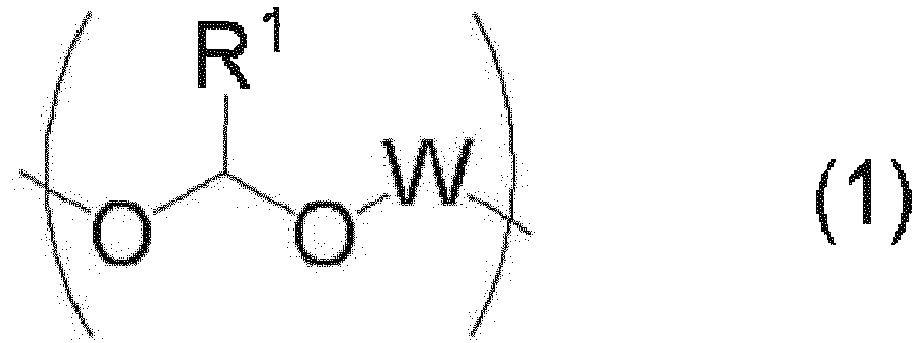
- When such a cleaning and drying method is employed, a resin having heat decomposability and flowability like that of the resin (A) and decomposed into a low molecular compound having high volatility after heat decomposition is used, it is possible to efficiently remove the cleaning solution by suppressing collapse or breakdown of the pattern which occurs at the time of drying the cleaning solution after cleaning the substrate without using a specific device which handles a cleaning solution in a supercritical state. Further, volatilization of the resin (A) at the bottom of the pattern can be suppressed by maintaining the semiconductor substrate having a pattern embedded with this resin (A) to a temperature of 0°C or higher and lower than the decomposition temperature of the resin (A). Moreover, the resin (A) can be decomposed and volatilized sequentially from the side of a surface in contact with a gas by blowing the gas having a temperature equal to or higher than the decomposition temperature of the resin (A) to the resin (A). Accordingly, it is possible to provide a method for cleaning and drying a semiconductor substrate onto which a pattern having a high aspect ratio has been provided, which has been impossible conventionally.
- At this time, the resin (A) is preferably a compound represented by either of the following general formulae (1a) to (1c),


- Such a resin (A) is employed, it is excellent in flowability and can be easily decomposed and removed from the upper side of the surface of the coating film by selecting the structure and heating conditions.
- At this time, the aspect ratio of the pattern is preferably 20:1 or more.
- The cleaning and drying method of the present invention can effectively suppress the collapse or breakdown of a pattern particularly in a semiconductor substrate onto which such a pattern with a high aspect ratio has been formed.
- Also, at this time, it is preferable that the cleaning solution is made a liquid containing at least one of water, a water-soluble alcohol and a fluorine compound.
- The cleaning and drying method of the present invention can be applied regardless of the type of the cleaning solution, and when the cleaning and drying method of the present invention is applied particularly to drying such a cleaning solution, collapse or breakdown of the pattern can be suppressed effectively.
- Further, at this time, it is preferable to keep the temperature of the semiconductor substrate onto which the pattern has been formed at 0°C or higher and 100°C or lower in the (III).
- When such a temperature is employed, it is possible to prevent explosive decomposition and volatilization of the resin (A) at the bottom of the pattern, so that it is possible to reliably decompose and remove the resin (A) while suppressing collapse or breakdown of the pattern.
- Moreover, at this time, it is preferable to use a gas containing either one of or both of a gas which shows acidity in an aqueous solution and water vapor as the gas to be blown to the resin (A).
- By using such a gas, it is possible to decompose and remove the resin (A) more efficiently.
- Furthermore, at this time, it is preferable to use a gas having a vapor pressure at 20°C of 1,013 hPa or higher as the gas which shows acidity in an aqueous solution.
- By using such a gas, the gas does not become a liquid and the resin (A) can be decomposed and removed in the order from the side of a surface in contact with the gas, so that it is possible to reliably prevent the collapse or breakdown of the pattern.
- Still further, at this time, it is preferable that the pressure of the water vapor is set to be equal to or lower than the saturated vapor pressure of the water vapor at the temperature of the gas in the (III).
- By employing such a constitution, it is possible to prevent the water vapor from being condensed in the semiconductor substrate onto the pattern has been formed by becoming the water vapor being supersaturated, so that it is possible to prevent the collapse or breakdown of the pattern.
- As stated above, according to the method of cleaning and drying the semiconductor substrate of the present invention, particularly in a substrate onto which a pattern having a high aspect ratio of 20:1 or more has been formed, it is possible to suppress the collapse or breakdown of the pattern which occurs at the time of drying the cleaning solution after cleaning the substrate, further suppress the decomposition of the resin at the bottom of the pattern as observed when the heat-decomposable resin is applied, whereby the cleaning solution can be removed efficiently without using a specific device such as supercritical cleaning. As a result, it is possible to obtain a semiconductor substrate without collapse or breakdown of the pattern, and fine particles or stain of which are removed by cleaning and dried.
-
Fig. 1 is a process chart showing an example of a method of cleaning and drying a semiconductor substrate of the present invention. - As described above, it has been desired to develop a method of cleaning and drying a semiconductor substrate capable of suppressing collapse or breakdown of a substrate structure (pattern) which occurs at the time of drying a cleaning solution after cleaning the substrate, and suppressing decomposition of a resin at the bottom of the pattern which can be seen when a heat-decomposable resin is applied, and removing the cleaning solution efficiently without using a specific device such as cleaning with a cleaning solution in a supercritical state.
- The present inventors have intensively studied to solve the problems, and as a result, they have found that when a method of drying a substrate which is not directly drying a cleaning solution, but after replacing the cleaning solution with a polymer compound (a resin (A)) decomposable by heat, the cleaning solution is removed by decomposing and removing the resin (A) from the side opposite to the substrate without decomposing the resin (A) from the side of the semiconductor substrate is employed, deformation of the structure due to the stress to the substrate structure generated at the time of drying by filling the resin (A) into the gaps of the substrate structure, and breakdown can be prevented, and finally, collapse or breakdown of the substrate structure can be suppressed by removing the resin (A) which became a solid by vaporizing from the side of the surface in contact with a gas while suppressing the decomposition of the resin (A) from the side of the substrate, and the cleaning solution can be removed and dried efficiently, whereby they have accomplished the present invention.
- That is, the present invention relates to a method of cleaning and drying a semiconductor substrate which is a method of cleaning and drying a semiconductor substrate onto which a pattern has been formed, which comprises:
- (I) cleaning the semiconductor substrate onto which a pattern has been formed with a cleaning solution,
- (II) replacing the cleaning solution remained on the semiconductor substrate with a composition containing a resin (A) which contains a repeating unit having an acetal structure represented by the following general formula (1) and a solvent, and removing the solvent in the replaced composition by heating at a temperature lower than a decomposition temperature of the resin (A), and
- (III) blowing a gas having a temperature equal to or higher than the decomposition temperature of the resin (A) to the resin (A) on the semiconductor substrate while maintaining a temperature of the semiconductor substrate onto which a pattern has been formed to 0°C or higher and lower than the decomposition temperature of the resin (A), to decompose and remove the resin (A) from a side of a surface contacting with the gas,

- In the following, the present invention will be explained in detail, but the present invention is not limited by these.
- First, the resin (A) to be used for the method of cleaning and drying the semiconductor substrate of the present invention will be explained. The resin (A) is a compound (hereinafter also referred to as the "heat-decomposable polymer (1)") containing a repeating unit which has an acetal structure represented by the following general formula (1), and a resin which decomposes by heat, or decomposes by both of an acid and heat. In the following, the resin (A) to be decomposed in such a manner is sometimes referred to as the "heat-decomposable polymer" for convenience, and as the resin (A), a material which is decomposed by both of an acid and heat may be used,

- In the general formula (1), R1 represents a hydrogen atom or a saturated or unsaturated monovalent organic group having 1 to 30 carbon atoms which may be substituted. Here, in the present invention, the terms "organic group" means a group containing at least one carbon, and further includes hydrogen, and may contain nitrogen, oxygen, sulfur, silicon, halogen atoms and the like.
- R1 may be a single kind or a plural number of kinds which may be mixedly present. R1 may be more specifically exemplified by a hydrogen atom, a methyl group, an ethyl group, a vinyl group, a 2,2,2-trifluoroethyl group, a propyl group, an isopropyl group, an allyl group, a 1-propenyl group, an isopropenyl group, a butyl group, an s-butyl group, a t-butyl group, an isobutyl group, a pentyl group, a cyclopentyl group, a hexyl group, a cyclohexyl group, a cyclohexenyl group, a decyl group, a dodecyl group, an eicosyl group, a norbornyl group, a adamantyl group, a phenyl group, a toluyl group, a xylyl group, a naphthyl group, a phenanthrenyl group, an anthracenyl group, a benzyl group, a fluorenyl group, a naphthylmethyl group, a norbornenyl group, a triacontyl group, a 2-furanyl group, a 2-tetrahydrofuranyl group and the like.
- In the general formula (1), W represents a saturated or unsaturated divalent organic group having 2 to 30 carbon atoms. W may be a single kind or a plural number of kinds which may be mixedly present. W may be more specifically exemplified by an ethylene group, a propylene group, a butylene group, a trimethylene group, a tetramethylene group, a pentamethylene group, a hexamethylene group, a heptamethylene group, an octamethylene group, a decamethylene group, a dodecamethylene group, an eicosamethylene group, a triacontamethylene group, a cyclopentanediyl group, a cyclohexanediyl group, a dimethylcyclohexanediyl group, a 2-buten-1,4-diyl group, a 2,4-hexadien-1,6-diyl group, a 3-oxapentan-1,5-diyl group, a 3,6-dioxaoctan-1,8-diyl group, a 3,6,9-trioxaundecan-1,11-diyl group, a phenylene group, a xylylene group, a naphthalenediyl group, a dimethylnaphthalenediyl group, an adamantandiyl group and the like.
- The heat-decomposable polymer may contain a single kind of a repeating unit as the repeating unit which has an acetal structure represented by the general formula (1), or may contain two or more kinds of the repeating units in combination.
- The repeating unit which has an acetal structure represented by the general formula (1) may be specifically exemplified by the following, but the invention is not limited by these,


- The presence of the chain acetal structure represented by the general formula (1) is effective for imparting appropriate heat decomposability and flowability to the heat-decomposable polymer. Further, after heat decomposition, it is decomposed into low molecular weight compounds with high volatility, so that it is possible to remove these since the resin (A) does not apply its stress to the substrate. That is, by directly vaporizing from the solid (polymer) without passing through the liquid, the surface tension does not act on the substrate structure as in the supercritical cleaning technique, so that it is possible to prevent the breakdown of the substrate structure.
- Further, as a preferable embodiment of the heat-decomposable polymer (1) may be mentioned a compound (hereinafter sometimes referred to as "heat-decomposable polymer (1a) to (1c)") represented by any of the following general formula (1a) to (1c),


- In the general formulae (1a) and (1b), R1a each independently represent an alkyl group having 1 to 4 carbon atoms or an alkenyl group having 2 to 4 carbon atoms; and R1a may be a single kind or a plural number of kinds which may be mixedly present. R1a may be more specifically exemplified by a methyl group, an ethyl group, a propyl group, an isopropyl group, a butyl group, an s-butyl group, a t-butyl group, an isobutyl group and the like.
- In the general formula (1a) to (1c), Wa represents a saturated or unsaturated divalent hydrocarbon group having 4 to 10 carbon atoms, which may have an ether bond(s); and Wa may be a single kind or a plural number of kinds which may be mixedly present. Wa may be more specifically exemplified by a tetramethylene group, a pentamethylene group, a hexamethylene group, a heptamethylene group, an octamethylene group, a decamethylene group, a cyclopentandiyl group, a cyclohexanediyl group, a dimethylcyclohexanediyl group, a 2-buten-1,4-diyl group, a 2,4-hexadien-1,6-diyl group, a 3-oxapentan-1,5-diyl group, a 3,6-dioxaoctan-1,8-diyl group, a 3,6,9-trioxaundecan-1,11-diyl group, a phenylene group, a xylylene group, an adamantandiyl group and the like.
- In the general formula (1b), each of Rb1 independently represents -Wa-OH, or, a saturated or unsaturated monovalent organic group having 1 to 30 carbon atoms which may be substituted. The saturated or unsaturated monovalent organic group having 1 to 30 carbon atoms which may be substituted may be specifically exemplified by a methyl group, an ethyl group, a vinyl group, a 2,2,2-trifluoroethyl group, a propyl group, an isopropyl group, an allyl group, a 1-propenyl group, an isopropenyl group, a butyl group, an s-butyl group, a t-butyl group, an isobutyl group, a pentyl group, a cyclopentyl group, a hexyl group, a cyclohexyl group, a cyclohexenyl group, a decyl group, a dodecyl group, an eicosanyl group, a norbornyl group, an adamantyl group, a phenyl group, a toluyl group, a xylyl group, a naphthyl group, a phenanthrenyl group, an anthracenyl group, a benzyl group, a fluorenyl group, a naphthylmethyl group, a norbornenyl group, a triacontyl group, a 2-furanyl group, a 2-tetrahydrofuranyl group and the like.
- In the general formula (1c), R1c represents a hydrogen atom, or an aryl group having 6 to 20 carbon atoms or a heteroaryl group having 4 to 20 carbon atoms each of which may be substituted. R1c may be a single kind or a plural number of kinds which may be mixedly present. R1c may be specifically exemplified by a hydrogen atom, a phenyl group, a toluyl group, a xylyl group, a naphthyl group, a phenanthrenyl group, an anthracenyl group, a 2-furanyl group, an anisyl group and the like.
- In the general formula (1c), each of Rc1 independently represents an alkyl group having 1 to 4 carbon atoms or -Wa-OH. The alkyl group having 1 to 4 carbon atoms may be specifically exemplified by a methyl group, an ethyl group, a propyl group, an isopropyl group, a butyl group, an s-butyl group, a t-butyl group, an isobutyl group and the like.
- The repeating unit "n" represents an average number of the repeating units, and is 3 to 2,000, preferably 3 to 500, more preferably 5 to 300.
- The compound represented by the general formula (1a) may be specifically exemplified by the following, but it is not limited by these. In the following formulae, the repeating unit "n" represents the same meaning as before.


- The compound represented by the general formula (1b) may be specifically exemplified by the following, but it is not limited by these. In the following formulae, the repeating unit "n" represents the same meaning as before.


- The compound represented by the general formula (1c) may be specifically exemplified by the following, but it is not limited by these. In the following formulae, the repeating unit "n" represents the same meaning as before.


- By selecting the structures of R1, R1a, Rb1, P1c,, Rc1, W, and Wa, it is possible to adjust the characteristics such as the heat decomposition temperature, the thermal weight loss, flowability and the like of the heat-decomposable polymer. In particular, the heat-decomposable polymers (1a) to (1c) are excellent in flowability and can easily be formed on the upper side of the surface of the coating film (that is, on the side of the surface in contact with the gas) of the side wall by selecting the structures of R1a, R1c, and Wa or heating conditions. The heat-decomposable polymers (1a) and (1b) are preferable because the heat decomposition temperature is low, and, as a result, the temperature of the gas at the time of decomposition and removal can be lowered. The heat-decomposable polymer (1c) sometimes functions as a crosslinking agent, and it is preferable because it allows further broadening of the range of adjustment of characteristics of the heat-decomposable polymer.
- A weight average molecular weight of the heat-decomposable polymer is preferably 300 to 200,000, more preferably 300 to 50,000, and further preferably 500 to 40,000. If the weight average molecular weight is 300 or more, it is possible to suppress the deterioration of the formulating effect due to volatilization or the like, and sufficient formulation effect can be obtained. In addition, if the weight average molecular weight is 200,000 or less, flowability and the like are not deteriorated, and the embedding and flattening characteristics are excellent.
- The heat-decomposable polymers having the structures represented by the general formulae (1) or (1a) to (1c) can be produced by selecting the optimum method depending on the structure. When the heat-decomposable polymer (1a) is taken as an example, it can be specifically produced, for example, by the method selecting from the following three methods. It is possible to produce the heat-decomposable polymer (1) other than the heat-decomposable polymer (1a) by the same method. The method for producing the heat-decomposable polymer used in the present invention is not limited to these methods.


- Wherein, R1a, Wa, and the repeating unit "n" represent the same meanings as before; and R1a' represents a divalent group in which one hydrogen is removed from R1a.
- The reaction is a general acetal formation reaction by an acid catalyst as an elementary reaction. By proceeding the elementary reaction repeatedly, a polymer can be given finally. In the reaction, an optimum amount of the diol compound (6) to be used based on the diether compound (5) is preferably 0.5 mol to 2 mol of the diol compound (6), particularly 0.8 mol to 1.2 mol based on 1 mol of the diether compound (5). In the reaction, an optimum amount of the diol compound (6) to be used based on the t-butyl ether compound (7) is preferably 0.5 mol to 2 mol of the diol compound (6), particularly 0.8 mol to 1.2 mol based on 1 mol of the t-butyl ether compound (7).
- The acetal formation reaction can be carried out by mixing the respective starting materials with an acid catalyst in a solvent or in the absence of a solvent, and subjecting to cooling or heating. When a solvent is used for the reaction, the solvent may be used singly or two or more kinds in admixture by selecting from an aliphatic hydrocarbon such as hexane, heptane and the like; an aromatic hydrocarbon such as toluene, xylene, trimethylbenzene, methylnaphthalene and the like; an ether such as diethyl ether, dibutyl ether, diethylene glycol diethyl ether, diethylene glycol dimethyl ether, tetrahydrofuran and the like; a ketone such as acetone, 2-butanone and the like; an alcohol such as t-butyl alcohol, t-amyl alcohol and the like; an ester such as ethyl acetate, propylene glycol monomethyl ether acetate, γ-butyrolactone and the like; a nitrile such as acetonitrile and the like; an amide such as N,N-dimethylformamide, N,N-dimethylacetamide and the like; a halogenated hydrocarbon such as o-dichlorobenzene, methylene chloride, 1,2-dichloroethane and the like.
- As the acid catalyst to be used for the reaction, various kinds of inorganic acids and organic acids may be used, and specifically mentioned an acid catalyst such as hydrochloric acid, nitric acid, sulfuric acid, formic acid, oxalic acid, acetic acid, methanesulfonic acid, camphorsulfonic acid, tosic acid, trifluoromethanesulfonic acid, a cation exchange resin, sodium hydrogen sulfate, pyridinium p-toluenesulfonate and the like. An amount of these acid catalysts to be used is preferably 1×10⁻⁵ to 5×10⁻¹ mol based on 1 mol in total of the starting materials.
- A reaction temperature is preferably -20°C to 100°C, and more preferably 0°C to 80°C. When the solvent is used, it is preferable to set the upper limit to the boiling point of the solvent. If the reaction temperature is -20°C or higher, the reaction proceeds smoothly, while if it is 100°C or lower, a side reaction such as a decomposition reaction of the product can be suppressed.
- A reaction time is preferably determined by tracing the progress of the reaction by using thin layer chromatography, liquid chromatography, gel filtration chromatography and the like to improve the yield, and is generally 0.5 to 200 hours or so. After completion of the reaction, the heat-decomposable polymer (1a) which is an objective material can be obtained by the usual aqueous system post-treatment (aqueous work-up) and/or filtration treatment of insoluble materials.
- The resulting heat-decomposable polymer (1a) may be purified, if necessary, by the conventional method such as liquid separation, crystallization, condensation under reduced pressure, dialysis, ultrafiltration and the like depending on the characteristics thereof. In addition, a metal content can also be reduced by passing through a commercially available demetallization filter, if necessary.
- As a method of the reaction, there may be employed, for example, a method in which respective starting materials, an acid catalyst, and, if necessary, a solvent are charged all at once, a method in which respective starting materials or a solution of the starting materials is/are added dropwise solely or in admixture in the presence of a catalyst, or a method in which mixed starting materials or a solution of the mixed starting materials is/are passed through a column filled with an acid catalyst in a solid state. With regard to the adjustment of the molecular weight, there may be carried out, for example, control by a reaction time, control by an amount of the acid catalyst, control by addition or adjusting a content of a polymerization terminator such as water, an alcohol and a basic compound, control by a ratio of charging starting materials when the starting materials are used two kinds, or control in which a plurality of these are combined.
- Each of the starting material compounds represented by the general formulae (5) to (8) may be used alone or in combination of two or more kinds. The compound such as the starting material compounds and the like represented by the general formulae (5), (7) and (8) may be unstable to oxygen, light, moisture and the like in some cases, and in such a case, it is preferable to carry out the reaction in an inert atmosphere such as nitrogen or the like, and under light shielding.
- In addition, the heat-decomposable polymers (1b) and (1c) can be specifically produced, for example, by selecting from the following two methods. The heat-decomposable polymers (1) other than the heat-decomposable polymers (1b) and (1c) can be also produced by the same method. The method for producing the heat-decomposable polymer to be used in the present invention is not limited to these methods.


- The reaction is a general acetal formation by an acid catalyst as an elementary reaction. By proceeding the elementary reaction repeatedly, a polymer can be given finally. In the reaction, an optimum amount of the diol compound (6) to be used based on the aldehyde compound (9) is preferably 0.5 mol to 2 mol of the diol compound (6), particularly 0.8 mol to 1.2 mol based on 1 mol of the aldehyde compound (9). In the reaction, an optimum amount of the diol compound (6) to be used based on the acetal compound (10) is preferably 0.5 mol to 2 mol of the diol compound (6), particularly 0.8 mol to 1.2 mol based on 1 mol of the acetal compound (10).
- The acetal formation reaction can be carried out by mixing the respective starting materials with an acid catalyst in a solvent or in the absence of a solvent, and subjecting to cooling or heating. When a solvent is used for the reaction, the same solvent to be used in the method for producing the heat-decomposable polymer (1a) may be used.
- As the acid catalyst to be used for the reaction, various kinds of inorganic acids and organic acids may be used, and specifically the same ones to be used in the method for producing the heat-decomposable polymer (1a) may be used. Also, an amount of the acid catalyst used may be the same amount as that of the method for producing the heat-decomposable polymer (1a).
- A reaction temperature is preferably 0°C to 250°C, and more preferably 20°C to 200°C. When a solvent is used, it is preferable to set the upper limit to the boiling point of the solvent. If the reaction temperature is 0°C or higher, the reaction proceeds smoothly, while if it is 250°C or lower, a side reaction such as a decomposition reaction of the product can be suppressed.
- A reaction time is preferably determined by tracing the progress of the reaction by using thin layer chromatography, liquid chromatography, gel filtration chromatography and the like to improve the yield, and is generally 0.5 to 200 hours or so. After completion of the reaction, the heat-decomposable polymer (1"), i.e., the heat-decomposable polymer (1b) or the heat-decomposable polymer (1c), which is an objective material can be obtained by the usual aqueous system post-treatment (aqueous work-up) and/or filtration treatment of insoluble materials.
- The resulting heat-decomposable polymer (1") may be purified, if necessary, by the conventional method such as liquid separation, crystallization, condensation under reduced pressure, dialysis, ultrafiltration and the like depending on the characteristics thereof. In addition, a metal content can also be reduced by passing through a commercially available demetallization filter, if necessary.
- As a method of the reaction, there may be employed, for example, a method in which respective starting materials, an acid catalyst, and, if necessary, a solvent are charged all at once, a method in which respective starting materials or a solution of the starting materials is/are added dropwise solely or in admixture in the presence of a catalyst, or a method in which mixed starting materials or a solution of the mixed starting materials is/are passed through a column filled with an acid catalyst in a solid state. It is preferable that the reaction is carried out while distilling off water or an alcohol produced by the reaction, since the reaction rate can be improved. With regard to the adjustment of the molecular weight, there may be carried out, for example, control by a reaction time, control by an amount of the acid catalyst, control by addition or adjusting a content of a polymerization terminator such as water, an alcohol and a basic compound, control by a ratio of charging a starting material(s), or control in which a plurality of these are combined.
- As the resin (A), that which is decomposed by both of an acid and heat may be used. In the case of using such a resin (A), when the resin (A) is removed, it is preferable to use a gas which shows acidity in an aqueous solution as a gas to be blown to the resin (A) mentioned later, but a volatile acid may be used. In addition, an acid generator may be added to the solution of the composition together with the resin (A). By adding an acid generator, the resin (A) is not decomposed in the state of the solution of the composition, and the resin (A) can be decomposed by generating an acid from the acid generator after replacing the cleaning solution. That is, in addition to heat-decomposition by blowing the gas, decomposition by an acid can also be carried out, so that the resin (A) can be removed more efficiently. The acid generator to be used in the present invention is preferably a material which generates an acid by heat-decomposition, and specifically a material disclosed at the paragraphs (0061) to (0085) in Japanese Unexamined Patent publication (Kokai) No.
2007-199653 - Further, when an acid generator is used, a basic compound may be formulated for preventing the decomposition of the resin (A) by the action of an acid generated during a dark reaction of the acid generator at room temperature and for improving storage stability. As such a basic compound, specifically a material disclosed at the paragraphs (0086) to (0090) in Japanese Unexamined Patent publication (Kokai) No.
2007-199653 - The resin (A) to be used in the method of cleaning and drying the semiconductor substrate of the present invention is used in the state of a solution of a composition in which it is dissolved in an organic solvent. The organic solvent to be used for dissolving the resin (A) is not particularly limited as long as it can dissolve the resin (A). Such an organic solvent may be specifically mentioned a ketone such as 2-heptanone, cyclopentanone, cyclohexanone and the like; an alcohol such as 3-methoxybutanol, 3-methyl-3-methoxybutanol, 1-methoxy-2-propanol, 1-ethoxy-2-propanol and the like; an ether such as propylene glycol monomethyl ether, ethylene glycol monomethyl ether, propylene glycol monoethyl ether, ethylene glycol monoethyl ether, propylene glycol dimethyl ether, diethylene glycol dimethyl ether and the like; an ester such as propylene glycol monomethyl ether acetate, propylene glycol monoethyl ether acetate, ethyl lactate, ethyl pyruvate, butyl acetate, methyl 3-methoxypropionate, ethyl 3-ethoxypropionate, t-butyl acetate, t-butyl propionate, γ-butyrolactone, propylene glycol mono-t-butyl ether acetate and the like, and these may be used a single kind alone or two or more kinds in admixture, but the invention is not limited by these.
- Among these, in particular, preferably used are propylene glycol monomethyl ether acetate, propylene glycol monomethyl ether, 2-heptanone, cyclopentanone, cyclohexanone, γ-butyrolactone, and a mixture of two or more kinds of these.
- A formulation amount of the organic solvent is preferably 200 to 10,000 parts by mass based on 100 parts by mass of the resin (A), and particularly preferably 300 to 5,000 parts by mass.
- A substrate to which the cleaning and drying method of the present invention can be applied has, for example, a pillar pattern structure and/or a hole pattern structure on the surface of the substrate. The pillar pattern structure and/or the hole-like pattern structure may be square or circular. Also, it may be a square pole or a circular column each having a hollow in the central part, or it may be a square hole or a circular hole each having a column in the central part. The pattern structure is not specifically limited, and it may be formed by general dry etching.
- In the conventional cleaning and drying method, breakdown of the pattern occurs when it is applied to a pattern having a large aspect ratio (a ratio of height (or depth)/short side (or diameter)). In contrast, the cleaning and drying method of the present invention is particularly effective for a pillar pattern structure and/or a hole-like pattern structure each having a large aspect ratio. The aspect ratio of the pattern formed onto the substrate to be used in the cleaning and drying method of the present invention is preferably 10:1 or more, more preferably 20:1 or more, further preferably 50:1 or more, and particularly preferably 70:1 or more. Further, in the present invention, with regard to the size of the short side (or diameter) of the pillar pattern and/or the short side (or inner diameter) of the hole-like pattern, the effect can be particularly shown at the size of 3 to 1,000 nm, and further it can be remarkably shown at the size of 5 to 500 nm.
- As a material constituting the substrate structure, there may be exemplified by a metal film comprising silicon, titanium, tungsten, hafnium, zirconium, chromium, germanium, copper, aluminum, indium, gallium, arsenic, palladium, iron, tantalum, iridium, molybdenum, or an alloy thereof, a metal carbide film, a metal oxide film, a metal nitride film, a metal oxycarbide film, or a metal oxynitride film and the like.
- The cleaning and drying method of the present invention can be applied regardless of the kind of the cleaning solution, and in particular, when a liquid containing at least one of water, a water-soluble alcohol and a fluorine compound is used as the cleaning solution and the cleaning and drying method of the present invention is applied thereto, it is preferable since collapse or breakdown of the pattern can be effectively suppressed.
- The present invention relates to a method of cleaning and drying a semiconductor substrate onto which a pattern has been formed, which comprises
- (I) cleaning the semiconductor substrate onto which a pattern has been formed with a cleaning solution,
- (II) replacing the cleaning solution remained on the semiconductor substrate with a composition containing a resin (A) which contains a repeating unit having an acetal structure represented by the following general formula (1) and a solvent, and removing the solvent in the replaced composition by heating at a temperature lower than a decomposition temperature of the resin (A), and
- (III) blowing a gas having a temperature equal to or higher than the decomposition temperature of the resin (A) to the resin (A) on the semiconductor substrate while maintaining a temperature of the semiconductor substrate onto which a pattern has been formed to 0°C or higher and lower than the decomposition temperature of the resin (A), to decompose and remove the resin (A) from a side of a surface contacting with the gas,

- In the following, the cleaning and drying method of the present invention will be explained in more detail by referring to the drawing, but the cleaning and drying method of the present invention is not limited thereto.
-
Fig. 1 is a process chart showing an example of a method of cleaning and drying a semiconductor substrate of the present invention. In the method of cleaning and drying a semiconductor substrate of the present invention shown inFIG. 1 , as (I), asemiconductor substrate 1 onto which apattern 2 has been formed is firstly subjected to cleaning with acleaning solution 3. Next, as (II), thecleaning solution 3 remained on thesemiconductor substrate 1 is replaced with asolution 4 of a composition containing a resin (A). Next, as (II'), the organic solvent in thesolution 4 of the composition containing the resin (A) is removed by heating to a temperature at which the resin (A) does not decompose and the organic solvent volatilizes, to bury the gaps of thepattern 2 with the resin (A) 5. Finally, as (III), while maintaining a temperature of thesemiconductor substrate 1 to 0°C or higher and lower than the decomposition temperature of the resin (A) by acooling plate 7, a gas having a temperature equal to or higher than the decomposition temperature of the resin (A) is blown to the resin (A) 5 by anair blower 6 whereby the resin (A) 5 is decomposed and removed from the side of thesurface 8 in contact with the gas. The hollow arrow inFig. 1 indicates the flow of gas. - In the cleaning and drying method of the present invention, after cleaning with the cleaning solution, the cleaning solution remained on the semiconductor substrate is thus replaced with a solution of a composition containing the resin (A), and further the organic solvent in the solution of the composition is volatilized to bury the gaps in the pattern. According to this procedure, collapse or breakdown of the pattern can be prevented. Next, a gas (hot air or the like) with a high temperature is blowing to the resin (A) to decompose and remove the resin (A) from the side of the surface contacting with the gas, whereby the resin (A) is removed without the resin (A) exerts a stress on the substrate, and the substrate can be dried. That is, by directly vaporizing from the solid (polymer) without passing through the liquid, the surface tension does not act on the substrate structure as in the supercritical cleaning technique, so that it is possible to prevent the breakdown of the pattern.
- The heating and removal of the solvent in the composition in the (II) is carried out at a temperature lower than the decomposition temperature of the resin (A). The decomposition temperature of the resin (A) herein mentioned means a baking temperature at which the film thickness of the polymer film is 50% of the film thickness before baking by coating a composition containing the resin (A) and the solvent and then the solvent is removed to form a polymer film, and the wafer is baked for 1 minute. The decomposition temperature of the resin (A) varies depending on the structure of the resin (A), and it is 200°C or lower in most cases.
- The decomposition and removal of the resin (A) in the (III) can be carried out by blowing a gas having a temperature equal to or higher than the decomposition temperature of the resin (A) to the resin (A) on the semiconductor substrate while maintaining the temperature of the semiconductor substrate onto which the pattern has been formed to 0°C or higher and lower than the decomposition temperature of the resin (A). At this time, the temperature of the semiconductor substrate is preferably maintained to 0°C or higher and 100°C or lower. The means for maintaining the temperature of the semiconductor substrate at a predetermined temperature is not particularly limited, and may be mentioned, for example, a method of cooling with a cooling plate and the like. Thus, by maintaining the temperature of the semiconductor substrate to a temperature lower than the decomposition temperature of the resin (A), decomposition and volatilization of the resin (A) at the bottom of the pattern can be prevented and occurrence of collapse of the pattern can be prevented.
- In the (III), the temperature of the gas to be blown to the resin (A) is a temperature equal to or higher than the decomposition temperature of the resin (A), preferably a temperature at which 20% by mass or less of the resin (A) is decomposed per 1 minute, more preferably a temperature at which 10% by mass or less of the resin (A) is decomposed per 1 minute, and further preferably a temperature at which 5% by mass or less of the resin (A) is decomposed per 1 minute.
- In the (III), the means to blow the gas to the resin (A) is not particularly limited, and it may be mentioned, for example, an air blower as shown in
Fig. 1 and the like. A speed at which the gas is blown is not particularly limited, and it is preferably about 1 to 1,000 L/min. When such a method of decomposition and removal is employed, it is possible to decompose and remove the resin (A) from the side of the surface in contact with the gas while suppressing collapse or breakdown of the pattern. - As the gas to be blown to the resin (A), it is preferable to use a gas containing either of a gas which shows acidity in an aqueous solution or water vapor, or both of these. By using such a gas, it is possible to decompose and remove the resin (A) more efficiently. Examples of gases which show acidity in an aqueous solution may be exemplified by carbon dioxide, nitrogen dioxide, hydrogen chloride, hydrogen bromide, sulfur dioxide and the like. The gas which shows acidity in an aqueous solution is preferably a material having a vapor pressure of 1,013 hPa or more at 20°C, particularly preferably carbon dioxide. When a gas containing either of a gas which shows acidity in an aqueous solution or water vapor, or both of these is used, an accompanying gas for adjusting the concentration of the gas which shows acidity in an aqueous solution or the water vapor may be used. As the accompanying gas, it is usually preferable to use an inert gas such as nitrogen, argon and the like. A concentration of the gas which shows acidity in an aqueous solution may be appropriately adjusted according to the kind of the gas so that the decomposition rate of the desired resin (A) can be obtained. For example, when the carbon dioxide is used, the concentration is preferably 1 ppm or more and 50% by volume or less, and more preferably 100 ppm or more and 10% by volume or less. In addition, a pressure in the case of using water vapor is preferably the saturated vapor pressure of the water vapor at the temperature of the gas or less. The concentration in the case of using the water vapor is preferably a concentration that satisfies the pressure, for example, 1 ppm or more and the saturated vapor pressure concentration of the water vapor at the temperature of the gas or less. If it is the saturated vapor pressure or less, condensation of the vapor on the semiconductor substrate onto which the pattern has been formed can be prevented, so that collapse or breakdown of the pattern can be prevented.
- When the method of cleaning and drying a semiconductor substrate of the present invention is employed, particularly in the substrate onto which a pattern with a high aspect ratio of 20:1, it is possible to suppress the collapse or breakdown of the pattern which occurs at the time of drying the cleaning solution after cleaning the substrate, further suppress the decomposition of the resin at the bottom of the pattern as observed when the heat-decomposable resin is applied, whereby the cleaning solution can be removed efficiently, without using a specific device such as supercritical cleaning. As a result, there is no collapse or breakdown of the pattern, and a semiconductor substrate from which minute particles and stain are removed by cleaning can be obtained.
- In the following, the present invention will be more specifically explained by referring to Examples and Comparative Examples, but the present invention is not limited by these.
- Measurement of the molecular weight was specifically carried out by the following method. A weight average molecular weight (Mw) and a number average molecular weight (Mn) in terms of polystyrene by gel permeation chromatography (GPC) using tetrahydrofuran as an eluent were determined, and the degree of dispersion (Mw/Mn) was obtained. A weight reduction ratio between 30°C and 250°C was determined by TG (thermogravimetry) measurement under the conditions of a temperature rise of 10°C/min in a helium atmosphere using a differential thermal balance.
-

- To a mixture of 3.8 g of a cation exchange resin (Amberlyst (Registered Trademark) 15) and 100 g of ethyl acetate was added 100 g of diethylene glycol monovinyl ether at room temperature, and the resulting mixture was further stirred for 3 hours. To the mixture was added 0.8 g of triethylamine to stop the reaction, and the mixture was filtered to remove the cation exchange resin. The filtrate was concentrated under reduced pressure to obtain 100 g of a heat-decomposable polymer (A1) as a high viscous liquid. When the molecular weight and the degree of dispersion thereof were obtained, these were Mw=5,200 and Mw/Mn=2.64. A 5% PGMEA solution of the heat-decomposable polymer (A1) was coated onto a silicon wafer and baked at 80°C to form a sample onto which a polymer film with a thickness of 1,800Å had been formed. When each sample was baked under the conditions of changing the temperature to each 5°C between 150°C to 180°C for each 1 minute, then, the film thickness of the polymer film of the sample baked at 165°C became about 50%, so that it could be found that the decomposition temperature of the heat-decomposable polymer (A1) was about 165°C. Further, by the baking at 200°C with increased temperature, no polymer film remained on the wafer.
- The results of the analysis by 1H-NMR and 13C-NMR of the synthesized heat-decomposable polymer (A1) are shown below.
1H-NMR (600 MHz in DMSO-d6):
δ =1.78 (51H, d, J=5.1Hz), 3.40-3.65 (136H, m), 4.52 (2H, t, J=5.5Hz), 4.70 (17H, q, H=5.1Hz) - From the results of the analysis by 1H-NMR, the repeating unit "n" was determined to be 17.
13C-NMR (150 MHz in DMSO-d6):
δ =19.60, 60.23, 64.04, 69.88, 72.33, 99.29 -

- A heat-decomposable polymer (A2) was synthesized by a method similar to (Synthesis Example 1) except that the raw material species was changed. When the decomposition temperature was measured in the same manner as in Synthesis Example 1, the decomposition temperature of the heat-decomposable polymer (A2) was 170°C. Further, no polymer film remained on the wafer by the baking at 200°C with increased temperature.
- In the following Examples 1 to 4, cleaning and drying of the substrate were carried out by the method shown in
Fig. 1 . - A columnar processed pattern containing SiO2 which has the aspect ratio shown in Table 1 was formed on an Si substrate by dry etching. The cleaning solution (water or IPA (isopropyl alcohol)) shown in Table 2 was impregnated into the pattern to prepare a substrate before drying. Onto the substrate before drying was added dropwise 10 mL of a solution of a composition containing propylene glycol methyl ether acetate (hereinafter referred to as PGMEA) containing 5% by mass of the heat-decomposable polymer (A1) (polymer) synthesized in Synthesis Example 1 and propylene glycol monomethyl ether (hereinafter referred to as PGME) each in an amount of 50% by mass, and spin-coated, then, the substrate was baked at 100°C to remove the solvent.
- As a result, the polymer was filled in the gap of the substrate pattern, and no breakdown of the processed pattern was observed. Subsequently, while cooling the substrate to 20°C, air (0.03% by volume of carbon dioxide, 1% by volume of water vapor, and the remainder being nitrogen, oxygen and the like) was blown to the polymer at 200°C which is the decomposition temperature of the polymer or higher and 1 L/min. After 10 minutes, all of the polymer filled in the gap was decomposed and volatilized, no polymer in the gap of the processed pattern was observed and no collapse of the processed pattern was observed. The combinations of the pattern and the cleaning solution had changed were made Examples 1-1 to 1-6, respectively, and the results are shown in Table 2.
[Table 1] Pattern Height Diameter Aspect ratio 1 800 nm 40 nm 20:1 2 2,000 nm 40 nm 50:1 3 4,000 nm 40 nm 100:1 [Table 2] Example Pattern Cleaning solution Pattern shape after filling polymer Pattern shape after removing polymer with hot air by decomposition 1-1 1 Water No collapse Neither collapse nor breakdown 1-2 1 IPA No collapse Neither collapse nor breakdown 1-3 2 Water No collapse Neither collapse nor breakdown 1-4 2 IPA No collapse Neither collapse nor breakdown 1-5 3 Water No collapse Neither collapse nor breakdown 1-6 3 IPA No collapse Neither collapse nor breakdown - By using the heat-decomposable polymer (A2) synthesized in Synthesis Example 2, cleaning and drying of the substrate were carried out in the same procedure as in Example 1. The combinations of the pattern and the cleaning solution had changed were made Examples 2-1 to 2-6, respectively, and the results are shown in Table 3.
[Table 3] Example Pattern Cleaning solution Pattern shape after filling polymer Pattern shape after removing polymer with hot air bv decomposition 2-1 1 Water No collapse Neither collapse nor breakdown 2-2 1 IPA No collapse Neither collapse nor breakdown 2-3 2 Water No collapse Neither collapse nor breakdown 2-4 2 IPA No collapse Neither collapse nor breakdown 2-5 3 Water No collapse Neither collapse nor breakdown 2-6 3 IPA No collapse Neither collapse nor breakdown - By using the heat-decomposable polymer (A1) synthesized in Synthesis Example 1, cleaning and drying of the substrate were carried out in the same procedure as in Example 1 except for blowing a gas containing 0.5% by volume of carbon dioxide and 99.5% by volume of nitrogen at 250°C and 2 L/min in place of the air at 200°C in Example 1. The combinations of the pattern and the cleaning solution had changed were made Examples 3-1 to 3-6, respectively, and the results are shown in Table 4.
[Table 4] Example Pattern Cleaning solution Pattern shape after filling polymer Pattern shape after removing polymer with hot air bv decomposition 3-1 1 Water No collapse Neither collapse nor breakdown 3-2 1 IPA No collapse Neither collapse nor breakdown 3-3 2 Water No collapse Neither collapse nor breakdown 3-4 2 IPA No collapse Neither collapse nor breakdown 3-5 3 Water No collapse Neither collapse nor breakdown 3-6 3 IPA No collapse Neither collapse nor breakdown - By using the heat-decomposable polymer (A1) synthesized in Synthesis Example 1, cleaning and drying of the substrate were carried out in the same procedure as in Example 1 except for blowing a gas containing 0.5% by volume of water vapor and 99.5% by volume of nitrogen at 250°C and 1 L/min in place of the air at 200°C in Example 1. The combinations of the pattern and the cleaning solution had changed were made Examples 4-1 to 4-6, respectively, and the results are shown in Table 5.
[Table 5] Example Pattern Cleaning solution Pattern shape after filling polymer Pattern shape after removing polymer with hot air by decomposition 4-1 1 Water No collapse Neither collapse nor breakdown 4-2 1 IPA No collapse Neither collapse nor breakdown 4-3 2 Water No collapse Neither collapse nor breakdown 4-4 2 IPA No collapse Neither collapse nor breakdown 4-5 3 Water No collapse Neither collapse nor breakdown 4-6 3 IPA No collapse Neither collapse nor breakdown - When cleaning and drying of the substrate were carried out in the same procedure as in Example 1 except that the substrate was heated under air (the same composition as in Example 1) atmosphere at 200°C without cooling the substrate and without blowing the air at the time of removing the polymer, collapse of the processed pattern was observed. The combinations of the pattern and the cleaning solution had changed were made Comparative Examples 1-1 to 1-6, respectively, and the results are shown in Table 6.
[Table 6] Comparative Example Pattern Cleaning solution Pattern shape after removing polymer with hot air by decomposition 1-1 1 Water Collapse exists 1-2 1 IPA Collapse exists 1-3 2 Water Collapse exists 1-4 2 IPA Collapse exists 1-5 3 Water Collapse exists 1-6 3 IPA Collapse exists - When cleaning and drying of the substrate were carried out in the same procedure as in Example 1 except that the substrate was heated under air atmosphere at 250°C by cooling the substrate to 10°C without blowing the air at the time of removing the polymer, the polymer remained between the patterns even after 5 hours passed. The combinations of the pattern and the cleaning solution had changed were made Comparative Examples 2-1 to 2-6, respectively, and the results are shown in Table 7.
[Table 7] Comparative Example Pattern Cleaning solution Polymer remaining state after lapse of 5 hours when removing polymer in heated atmosphere by decomposition polymer without blowing with gas 2-1 1 Water Polymer remained 2-2 1 IPA Polymer remained 2-3 2 Water Polymer remained 2-4 2 IPA Polymer remained 2-5 3 Water Polymer remained 2-6 3 IPA Polymer remained - As shown in Tables 2 to 5, in Examples 1 to 4 in which the treatment was carried out that the cleaning solution on the substrate was replaced with the solution of the composition of the heat-decomposable polymer, and the heated gas was blown to the heat-decomposable polymer by cooling the substrate and maintaining it at a temperature of 0°C or higher and lower than the decomposition temperature of the heat-decomposable polymer, decomposition of the heat-decomposable polymer at the bottom of the pattern was suppressed, collapse of the processed pattern due to drying did not occur even in the pattern having the aspect ratio of 100:1 since the heat-decomposable polymer was decomposed from the side of the surface in contact with the gas.
- On the other hand, as shown in Table 6, in Comparative Example 1 in which the entire substrate was uniformly heat-treated without maintaining the substrate to a temperature of 0°C or higher and lower than the decomposition temperature of the heat-decomposable polymer, collapse of the processed pattern occurred even in the pattern having the aspect ratio of 20:1.
- Further, as shown in Table 7, in Comparative Example 2 in which the substrate was heat-treated without blowing the gas while maintaining the temperature to 0°C or higher and lower than the decomposition temperature of the heat-decomposable polymer, removal of the polymer was very slow and it could be found out that it was not practically usable process conditions.
- From the above, according to the method of cleaning and drying the semiconductor substrate of the present invention, particularly in the substrate onto which a pattern having a high aspect ratio of 20:1 has been formed, it could be found that it is possible to suppress the collapse or breakdown of the pattern which occurs at the time of drying the cleaning solution after cleaning the substrate, further suppress the decomposition of the resin at the bottom of the pattern as observed when the heat-decomposable resin is applied, and the cleaning solution could be efficiently removed, without using a specific device such as supercritical cleaning.
- It must be stated here that the present invention is not restricted to the embodiments shown by the above-mentioned embodiments. The above-mentioned embodiments are merely examples so that any embodiments composed of substantially the same technical concept as disclosed in the claims of the present invention and expressing a similar effect are included in the technical scope of the present invention.
- 1···Semiconductor substrate, 2···Pattern, 3···Cleaning solution, 4···Composition solution containing resin (A), 5···Resin (A), 6···Air blower, 7···Cooling plate, 8···Surface contacting with gas.
Claims (8)
- A method of cleaning and drying a semiconductor substrate which is a method of cleaning and drying a semiconductor substrate onto which a pattern has been formed, which comprises:(I) cleaning the semiconductor substrate onto which a pattern has been formed with a cleaning solution,(II) replacing the cleaning solution remained on the semiconductor substrate with a composition containing a resin (A) which contains a repeating unit having an acetal structure represented by the following general formula (1) and a solvent, and removing the solvent in the replaced composition by heating at a temperature lower than a decomposition temperature of the resin (A), and(III) blowing a gas having a temperature equal to or higher than the decomposition temperature of the resin (A) to the resin (A) on the semiconductor substrate while maintaining a temperature of the semiconductor substrate onto which a pattern has been formed to 0°C or higher and lower than the decomposition temperature of the resin (A), to decompose and remove the resin (A) from a side of a surface contacting with the gas,

- The method of cleaning and drying a semiconductor substrate according to claim 1, wherein the resin (A) is a compound represented by any of the following general formulae (1a) to (1c),


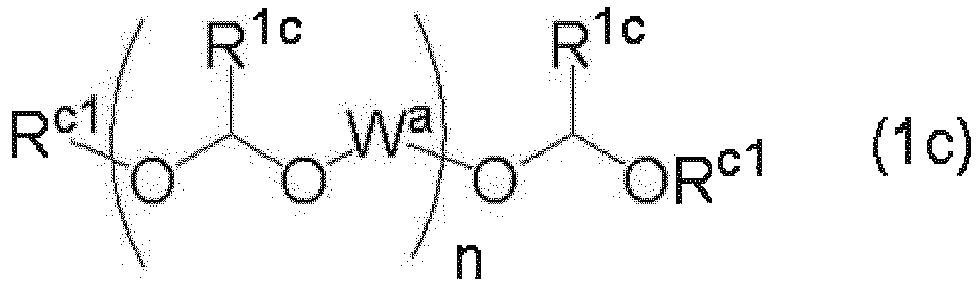
- The method of cleaning and drying a semiconductor substrate according to claim 1 or 2, wherein the aspect ratio of the pattern is 20:1 or more.
- The method of cleaning and drying a semiconductor substrate according to any one of claims 1 to 3, wherein the cleaning solution is a liquid containing at least one of water, a water-soluble alcohol and a fluorine compound.
- The method of cleaning and drying a semiconductor substrate according to any one of claims 1 to 4, wherein a temperature of the semiconductor substrate onto which a pattern has been formed is maintained at 0°C or higher and 100°C or lower in the (III).
- The method of cleaning and drying a semiconductor substrate according to any one of claims 1 to 5, wherein the gas to be blown to the resin (A) is either one of or both of a gas which shows acidity in an aqueous solution and water vapor.
- The method of cleaning and drying a semiconductor substrate according to claim 6, wherein the gas which shows acidity in an aqueous solution is a gas having a vapor pressure at 20°C of 1,013 hPa or higher.
- The method of cleaning and drying a semiconductor substrate according to claim 6 or 7, wherein a pressure of the water vapor is made a saturated vapor pressure of the water vapor at the temperature of the gas of the (III) or lower.
Applications Claiming Priority (1)
| Application Number | Priority Date | Filing Date | Title |
|---|---|---|---|
| JP2017088548A JP2018186231A (en) | 2017-04-27 | 2017-04-27 | Semiconductor substrate cleaning and drying method |
Publications (2)
| Publication Number | Publication Date |
|---|---|
| EP3396702A1 true EP3396702A1 (en) | 2018-10-31 |
| EP3396702B1 EP3396702B1 (en) | 2019-08-28 |
Family
ID=61906611
Family Applications (1)
| Application Number | Title | Priority Date | Filing Date |
|---|---|---|---|
| EP18164566.4A Active EP3396702B1 (en) | 2017-04-27 | 2018-03-28 | Method of cleaning and drying semiconductor substrate |
Country Status (6)
| Country | Link |
|---|---|
| US (1) | US10811247B2 (en) |
| EP (1) | EP3396702B1 (en) |
| JP (1) | JP2018186231A (en) |
| KR (1) | KR102007121B1 (en) |
| CN (1) | CN108807140B (en) |
| TW (1) | TWI664201B (en) |
Cited By (1)
| Publication number | Priority date | Publication date | Assignee | Title |
|---|---|---|---|---|
| US20180315594A1 (en) * | 2017-04-27 | 2018-11-01 | Shin-Etsu Chemical Co., Ltd. | Method of cleaning and drying semiconductor substrate |
Families Citing this family (4)
| Publication number | Priority date | Publication date | Assignee | Title |
|---|---|---|---|---|
| US10748757B2 (en) * | 2017-09-21 | 2020-08-18 | Honeywell International, Inc. | Thermally removable fill materials for anti-stiction applications |
| CN114068345B (en) * | 2020-08-05 | 2025-01-10 | 长鑫存储技术有限公司 | Semiconductor structure processing method and formation method |
| US12040175B2 (en) | 2020-08-05 | 2024-07-16 | Changxin Memory Technologies, Inc. | Semiconductor structure processing method and manufacturing method |
| JP7826052B2 (en) * | 2022-02-25 | 2026-03-09 | 株式会社Screenホールディングス | Substrate processing solution, substrate processing method, and substrate processing apparatus |
Citations (8)
| Publication number | Priority date | Publication date | Assignee | Title |
|---|---|---|---|---|
| JPH01140728A (en) | 1987-11-27 | 1989-06-01 | Hitachi Ltd | How to wash and dry objects |
| JPH06310486A (en) | 1993-04-23 | 1994-11-04 | Dainippon Screen Mfg Co Ltd | Method and apparatus for drying substrate |
| JPH0770599A (en) | 1993-05-10 | 1995-03-14 | Agency Of Ind Science & Technol | Draining solvent containing fluorinated alcohol |
| JP2005072568A (en) | 2003-08-06 | 2005-03-17 | Sony Corp | Cleaning method and cleaning apparatus for microstructure, semiconductor device and manufacturing method thereof, and microstructure and manufacturing method thereof |
| JP2007199653A (en) | 2005-12-27 | 2007-08-09 | Shin Etsu Chem Co Ltd | Photoresist underlayer film forming material and pattern forming method |
| JP2008098616A (en) | 2006-09-14 | 2008-04-24 | Fujifilm Corp | Draining agent for substrate, draining method and drying method using the same |
| US20150221500A1 (en) * | 2014-02-06 | 2015-08-06 | Shin-Etsu Chemical Co., Ltd. | Method for cleaning and drying semiconductor substrate |
| US20160099160A1 (en) * | 2014-10-06 | 2016-04-07 | Lam Research Corporation | Method for collapse-free drying of high aspect ratio structures |
Family Cites Families (8)
| Publication number | Priority date | Publication date | Assignee | Title |
|---|---|---|---|---|
| DE602007007161D1 (en) | 2006-09-14 | 2010-07-29 | Fujifilm Corp | Agent for removing water from a substrate, method of water removal and drying method therewith |
| JP5681560B2 (en) | 2011-05-17 | 2015-03-11 | 東京エレクトロン株式会社 | Substrate drying method and substrate processing apparatus |
| JP6022829B2 (en) * | 2012-07-03 | 2016-11-09 | 株式会社Screenホールディングス | Substrate drying method and substrate drying apparatus |
| JP6427323B2 (en) * | 2014-02-26 | 2018-11-21 | 株式会社Screenホールディングス | Substrate drying apparatus and substrate drying method |
| US9466511B2 (en) * | 2014-09-18 | 2016-10-11 | Lam Research Corporation | Systems and methods for drying high aspect ratio structures without collapse using stimuli-responsive sacrificial bracing material |
| TW201712752A (en) * | 2015-06-04 | 2017-04-01 | 蘭姆研究公司 | Drying method for high aspect ratio structure without causing collapse |
| DE102015009700A1 (en) * | 2015-07-30 | 2017-02-02 | Esw Gmbh | Winch and rope drum |
| JP2018186231A (en) * | 2017-04-27 | 2018-11-22 | 信越化学工業株式会社 | Semiconductor substrate cleaning and drying method |
-
2017
- 2017-04-27 JP JP2017088548A patent/JP2018186231A/en active Pending
-
2018
- 2018-03-28 US US15/937,986 patent/US10811247B2/en active Active
- 2018-03-28 EP EP18164566.4A patent/EP3396702B1/en active Active
- 2018-04-23 CN CN201810366118.4A patent/CN108807140B/en active Active
- 2018-04-24 TW TW107113766A patent/TWI664201B/en active
- 2018-04-26 KR KR1020180048393A patent/KR102007121B1/en active Active
Patent Citations (9)
| Publication number | Priority date | Publication date | Assignee | Title |
|---|---|---|---|---|
| JPH01140728A (en) | 1987-11-27 | 1989-06-01 | Hitachi Ltd | How to wash and dry objects |
| JPH06310486A (en) | 1993-04-23 | 1994-11-04 | Dainippon Screen Mfg Co Ltd | Method and apparatus for drying substrate |
| JPH0770599A (en) | 1993-05-10 | 1995-03-14 | Agency Of Ind Science & Technol | Draining solvent containing fluorinated alcohol |
| JP2005072568A (en) | 2003-08-06 | 2005-03-17 | Sony Corp | Cleaning method and cleaning apparatus for microstructure, semiconductor device and manufacturing method thereof, and microstructure and manufacturing method thereof |
| JP2007199653A (en) | 2005-12-27 | 2007-08-09 | Shin Etsu Chem Co Ltd | Photoresist underlayer film forming material and pattern forming method |
| JP2008098616A (en) | 2006-09-14 | 2008-04-24 | Fujifilm Corp | Draining agent for substrate, draining method and drying method using the same |
| US20150221500A1 (en) * | 2014-02-06 | 2015-08-06 | Shin-Etsu Chemical Co., Ltd. | Method for cleaning and drying semiconductor substrate |
| JP2015149384A (en) | 2014-02-06 | 2015-08-20 | 信越化学工業株式会社 | Method for cleaning and drying semiconductor substrate |
| US20160099160A1 (en) * | 2014-10-06 | 2016-04-07 | Lam Research Corporation | Method for collapse-free drying of high aspect ratio structures |
Cited By (2)
| Publication number | Priority date | Publication date | Assignee | Title |
|---|---|---|---|---|
| US20180315594A1 (en) * | 2017-04-27 | 2018-11-01 | Shin-Etsu Chemical Co., Ltd. | Method of cleaning and drying semiconductor substrate |
| US10811247B2 (en) * | 2017-04-27 | 2020-10-20 | Shin-Etsu Chemical Co., Ltd. | Method of cleaning and drying semiconductor substrate |
Also Published As
| Publication number | Publication date |
|---|---|
| JP2018186231A (en) | 2018-11-22 |
| CN108807140A (en) | 2018-11-13 |
| KR20180120606A (en) | 2018-11-06 |
| CN108807140B (en) | 2023-11-07 |
| US10811247B2 (en) | 2020-10-20 |
| KR102007121B1 (en) | 2019-08-02 |
| TW201843201A (en) | 2018-12-16 |
| TWI664201B (en) | 2019-07-01 |
| US20180315594A1 (en) | 2018-11-01 |
| EP3396702B1 (en) | 2019-08-28 |
Similar Documents
| Publication | Publication Date | Title |
|---|---|---|
| EP3396702B1 (en) | Method of cleaning and drying semiconductor substrate | |
| EP2905803B1 (en) | Method for cleaning and drying semiconductor substrate | |
| KR101772726B1 (en) | Organic film composition, method for forming organic film and patterning process using this, and heat-decomposable polymer | |
| KR101750323B1 (en) | Resins for underlayers | |
| JP2004161601A5 (en) | ||
| KR102345567B1 (en) | Aromatic resins for underlayers | |
| KR101771542B1 (en) | Hardmask composition and method of forming patterns using the hardmask composition | |
| KR101752833B1 (en) | Hardmask composition and method of forming patterns using the hardmask composition | |
| KR20140083621A (en) | Monomer for hardmask composition and hardmask composition including the monomer and method of forming patterns using the hardmask composition | |
| KR101684978B1 (en) | Hardmask composition, method of forming patterns using the hardmask composition and semiconductor integrated circuit device including the patterns including the patterns | |
| US20080311514A1 (en) | Silsesquioxane compound mixture, hydrolyzable silane compound, making methods, resist composition, patterning process, and substrate processing | |
| US20180164686A1 (en) | Method using silicon-containing underlayers | |
| KR101696197B1 (en) | Hardmask composition, method of forming patterns using the hardmask composition and semiconductor integrated circuit device including the patterns including the patterns | |
| JP2010528453A (en) | Compound for gap filling of semiconductor device and coating composition using the compound | |
| KR101354639B1 (en) | Composition for photoresist underlayer, method of forming patterns using the same, and semiconductor integrated circuit device including the patterns | |
| EP4400914B1 (en) | Composition for forming resist underlayer film, patterning process, and method for forming resist underlayer film | |
| EP4495689A1 (en) | Method for forming resist underlayer film and patterning process | |
| KR102944359B1 (en) | A monomer containing a fluorene group, a hard mask composition containing the monomer, and a pattern forming method using the hard mask composition. | |
| KR102875172B1 (en) | Monomer for hardmask composition and hardmask composition including the monomer and method of forming patterns using the hardmask composition | |
| EP4492144A1 (en) | Composition for forming resist underlayer film, patterning process, and method for forming resist underlayer film | |
| US20180164685A1 (en) | Method using silicon-containing underlayers | |
| EP4108693A1 (en) | Resist compound, method for forming pattern using same, and method for manufacturing semiconductor device using same | |
| CN113960882A (en) | Hard mask composition, preparation method thereof and pattern forming method | |
| KR20260060109A (en) | Hardmask composition, hardmask layer and method of forming patterns | |
| KR20250115653A (en) | Hardmask composition, hardmask layer and method of forming patterns |
Legal Events
| Date | Code | Title | Description |
|---|---|---|---|
| PUAI | Public reference made under article 153(3) epc to a published international application that has entered the european phase |
Free format text: ORIGINAL CODE: 0009012 |
|
| STAA | Information on the status of an ep patent application or granted ep patent |
Free format text: STATUS: THE APPLICATION HAS BEEN PUBLISHED |
|
| AK | Designated contracting states |
Kind code of ref document: A1 Designated state(s): AL AT BE BG CH CY CZ DE DK EE ES FI FR GB GR HR HU IE IS IT LI LT LU LV MC MK MT NL NO PL PT RO RS SE SI SK SM TR |
|
| AX | Request for extension of the european patent |
Extension state: BA ME |
|
| STAA | Information on the status of an ep patent application or granted ep patent |
Free format text: STATUS: REQUEST FOR EXAMINATION WAS MADE |
|
| 17P | Request for examination filed |
Effective date: 20181121 |
|
| RBV | Designated contracting states (corrected) |
Designated state(s): AL AT BE BG CH CY CZ DE DK EE ES FI FR GB GR HR HU IE IS IT LI LT LU LV MC MK MT NL NO PL PT RO RS SE SI SK SM TR |
|
| GRAP | Despatch of communication of intention to grant a patent |
Free format text: ORIGINAL CODE: EPIDOSNIGR1 |
|
| STAA | Information on the status of an ep patent application or granted ep patent |
Free format text: STATUS: GRANT OF PATENT IS INTENDED |
|
| INTG | Intention to grant announced |
Effective date: 20190502 |
|
| GRAS | Grant fee paid |
Free format text: ORIGINAL CODE: EPIDOSNIGR3 |
|
| GRAA | (expected) grant |
Free format text: ORIGINAL CODE: 0009210 |
|
| STAA | Information on the status of an ep patent application or granted ep patent |
Free format text: STATUS: THE PATENT HAS BEEN GRANTED |
|
| AK | Designated contracting states |
Kind code of ref document: B1 Designated state(s): AL AT BE BG CH CY CZ DE DK EE ES FI FR GB GR HR HU IE IS IT LI LT LU LV MC MK MT NL NO PL PT RO RS SE SI SK SM TR |
|
| REG | Reference to a national code |
Ref country code: GB Ref legal event code: FG4D |
|
| REG | Reference to a national code |
Ref country code: CH Ref legal event code: EP |
|
| REG | Reference to a national code |
Ref country code: AT Ref legal event code: REF Ref document number: 1173450 Country of ref document: AT Kind code of ref document: T Effective date: 20190915 |
|
| REG | Reference to a national code |
Ref country code: IE Ref legal event code: FG4D |
|
| REG | Reference to a national code |
Ref country code: DE Ref legal event code: R096 Ref document number: 602018000499 Country of ref document: DE |
|
| REG | Reference to a national code |
Ref country code: NL Ref legal event code: MP Effective date: 20190828 |
|
| REG | Reference to a national code |
Ref country code: LT Ref legal event code: MG4D |
|
| PG25 | Lapsed in a contracting state [announced via postgrant information from national office to epo] |
Ref country code: FI Free format text: LAPSE BECAUSE OF FAILURE TO SUBMIT A TRANSLATION OF THE DESCRIPTION OR TO PAY THE FEE WITHIN THE PRESCRIBED TIME-LIMIT Effective date: 20190828 Ref country code: PT Free format text: LAPSE BECAUSE OF FAILURE TO SUBMIT A TRANSLATION OF THE DESCRIPTION OR TO PAY THE FEE WITHIN THE PRESCRIBED TIME-LIMIT Effective date: 20191230 Ref country code: LT Free format text: LAPSE BECAUSE OF FAILURE TO SUBMIT A TRANSLATION OF THE DESCRIPTION OR TO PAY THE FEE WITHIN THE PRESCRIBED TIME-LIMIT Effective date: 20190828 Ref country code: BG Free format text: LAPSE BECAUSE OF FAILURE TO SUBMIT A TRANSLATION OF THE DESCRIPTION OR TO PAY THE FEE WITHIN THE PRESCRIBED TIME-LIMIT Effective date: 20191128 Ref country code: NL Free format text: LAPSE BECAUSE OF FAILURE TO SUBMIT A TRANSLATION OF THE DESCRIPTION OR TO PAY THE FEE WITHIN THE PRESCRIBED TIME-LIMIT Effective date: 20190828 Ref country code: NO Free format text: LAPSE BECAUSE OF FAILURE TO SUBMIT A TRANSLATION OF THE DESCRIPTION OR TO PAY THE FEE WITHIN THE PRESCRIBED TIME-LIMIT Effective date: 20191128 Ref country code: HR Free format text: LAPSE BECAUSE OF FAILURE TO SUBMIT A TRANSLATION OF THE DESCRIPTION OR TO PAY THE FEE WITHIN THE PRESCRIBED TIME-LIMIT Effective date: 20190828 Ref country code: SE Free format text: LAPSE BECAUSE OF FAILURE TO SUBMIT A TRANSLATION OF THE DESCRIPTION OR TO PAY THE FEE WITHIN THE PRESCRIBED TIME-LIMIT Effective date: 20190828 |
|
| PG25 | Lapsed in a contracting state [announced via postgrant information from national office to epo] |
Ref country code: AL Free format text: LAPSE BECAUSE OF FAILURE TO SUBMIT A TRANSLATION OF THE DESCRIPTION OR TO PAY THE FEE WITHIN THE PRESCRIBED TIME-LIMIT Effective date: 20190828 Ref country code: GR Free format text: LAPSE BECAUSE OF FAILURE TO SUBMIT A TRANSLATION OF THE DESCRIPTION OR TO PAY THE FEE WITHIN THE PRESCRIBED TIME-LIMIT Effective date: 20191129 Ref country code: ES Free format text: LAPSE BECAUSE OF FAILURE TO SUBMIT A TRANSLATION OF THE DESCRIPTION OR TO PAY THE FEE WITHIN THE PRESCRIBED TIME-LIMIT Effective date: 20190828 Ref country code: RS Free format text: LAPSE BECAUSE OF FAILURE TO SUBMIT A TRANSLATION OF THE DESCRIPTION OR TO PAY THE FEE WITHIN THE PRESCRIBED TIME-LIMIT Effective date: 20190828 Ref country code: IS Free format text: LAPSE BECAUSE OF FAILURE TO SUBMIT A TRANSLATION OF THE DESCRIPTION OR TO PAY THE FEE WITHIN THE PRESCRIBED TIME-LIMIT Effective date: 20191228 Ref country code: LV Free format text: LAPSE BECAUSE OF FAILURE TO SUBMIT A TRANSLATION OF THE DESCRIPTION OR TO PAY THE FEE WITHIN THE PRESCRIBED TIME-LIMIT Effective date: 20190828 |
|
| REG | Reference to a national code |
Ref country code: AT Ref legal event code: MK05 Ref document number: 1173450 Country of ref document: AT Kind code of ref document: T Effective date: 20190828 |
|
| PG25 | Lapsed in a contracting state [announced via postgrant information from national office to epo] |
Ref country code: TR Free format text: LAPSE BECAUSE OF FAILURE TO SUBMIT A TRANSLATION OF THE DESCRIPTION OR TO PAY THE FEE WITHIN THE PRESCRIBED TIME-LIMIT Effective date: 20190828 |
|
| PG25 | Lapsed in a contracting state [announced via postgrant information from national office to epo] |
Ref country code: EE Free format text: LAPSE BECAUSE OF FAILURE TO SUBMIT A TRANSLATION OF THE DESCRIPTION OR TO PAY THE FEE WITHIN THE PRESCRIBED TIME-LIMIT Effective date: 20190828 Ref country code: AT Free format text: LAPSE BECAUSE OF FAILURE TO SUBMIT A TRANSLATION OF THE DESCRIPTION OR TO PAY THE FEE WITHIN THE PRESCRIBED TIME-LIMIT Effective date: 20190828 Ref country code: DK Free format text: LAPSE BECAUSE OF FAILURE TO SUBMIT A TRANSLATION OF THE DESCRIPTION OR TO PAY THE FEE WITHIN THE PRESCRIBED TIME-LIMIT Effective date: 20190828 Ref country code: IT Free format text: LAPSE BECAUSE OF FAILURE TO SUBMIT A TRANSLATION OF THE DESCRIPTION OR TO PAY THE FEE WITHIN THE PRESCRIBED TIME-LIMIT Effective date: 20190828 Ref country code: RO Free format text: LAPSE BECAUSE OF FAILURE TO SUBMIT A TRANSLATION OF THE DESCRIPTION OR TO PAY THE FEE WITHIN THE PRESCRIBED TIME-LIMIT Effective date: 20190828 Ref country code: PL Free format text: LAPSE BECAUSE OF FAILURE TO SUBMIT A TRANSLATION OF THE DESCRIPTION OR TO PAY THE FEE WITHIN THE PRESCRIBED TIME-LIMIT Effective date: 20190828 |
|
| PG25 | Lapsed in a contracting state [announced via postgrant information from national office to epo] |
Ref country code: SK Free format text: LAPSE BECAUSE OF FAILURE TO SUBMIT A TRANSLATION OF THE DESCRIPTION OR TO PAY THE FEE WITHIN THE PRESCRIBED TIME-LIMIT Effective date: 20190828 Ref country code: IS Free format text: LAPSE BECAUSE OF FAILURE TO SUBMIT A TRANSLATION OF THE DESCRIPTION OR TO PAY THE FEE WITHIN THE PRESCRIBED TIME-LIMIT Effective date: 20200224 Ref country code: CZ Free format text: LAPSE BECAUSE OF FAILURE TO SUBMIT A TRANSLATION OF THE DESCRIPTION OR TO PAY THE FEE WITHIN THE PRESCRIBED TIME-LIMIT Effective date: 20190828 Ref country code: SM Free format text: LAPSE BECAUSE OF FAILURE TO SUBMIT A TRANSLATION OF THE DESCRIPTION OR TO PAY THE FEE WITHIN THE PRESCRIBED TIME-LIMIT Effective date: 20190828 |
|
| REG | Reference to a national code |
Ref country code: DE Ref legal event code: R097 Ref document number: 602018000499 Country of ref document: DE |
|
| PLBE | No opposition filed within time limit |
Free format text: ORIGINAL CODE: 0009261 |
|
| STAA | Information on the status of an ep patent application or granted ep patent |
Free format text: STATUS: NO OPPOSITION FILED WITHIN TIME LIMIT |
|
| PG2D | Information on lapse in contracting state deleted |
Ref country code: IS |
|
| 26N | No opposition filed |
Effective date: 20200603 |
|
| PG25 | Lapsed in a contracting state [announced via postgrant information from national office to epo] |
Ref country code: MC Free format text: LAPSE BECAUSE OF FAILURE TO SUBMIT A TRANSLATION OF THE DESCRIPTION OR TO PAY THE FEE WITHIN THE PRESCRIBED TIME-LIMIT Effective date: 20190828 |
|
| REG | Reference to a national code |
Ref country code: BE Ref legal event code: MM Effective date: 20200331 |
|
| PG25 | Lapsed in a contracting state [announced via postgrant information from national office to epo] |
Ref country code: LU Free format text: LAPSE BECAUSE OF NON-PAYMENT OF DUE FEES Effective date: 20200328 |
|
| PG25 | Lapsed in a contracting state [announced via postgrant information from national office to epo] |
Ref country code: FR Free format text: LAPSE BECAUSE OF NON-PAYMENT OF DUE FEES Effective date: 20200331 Ref country code: IE Free format text: LAPSE BECAUSE OF NON-PAYMENT OF DUE FEES Effective date: 20200328 |
|
| PG25 | Lapsed in a contracting state [announced via postgrant information from national office to epo] |
Ref country code: BE Free format text: LAPSE BECAUSE OF NON-PAYMENT OF DUE FEES Effective date: 20200331 |
|
| REG | Reference to a national code |
Ref country code: CH Ref legal event code: PL |
|
| PG25 | Lapsed in a contracting state [announced via postgrant information from national office to epo] |
Ref country code: CH Free format text: LAPSE BECAUSE OF NON-PAYMENT OF DUE FEES Effective date: 20210331 Ref country code: LI Free format text: LAPSE BECAUSE OF NON-PAYMENT OF DUE FEES Effective date: 20210331 |
|
| PG25 | Lapsed in a contracting state [announced via postgrant information from national office to epo] |
Ref country code: MT Free format text: LAPSE BECAUSE OF FAILURE TO SUBMIT A TRANSLATION OF THE DESCRIPTION OR TO PAY THE FEE WITHIN THE PRESCRIBED TIME-LIMIT Effective date: 20190828 Ref country code: CY Free format text: LAPSE BECAUSE OF FAILURE TO SUBMIT A TRANSLATION OF THE DESCRIPTION OR TO PAY THE FEE WITHIN THE PRESCRIBED TIME-LIMIT Effective date: 20190828 |
|
| PG25 | Lapsed in a contracting state [announced via postgrant information from national office to epo] |
Ref country code: MK Free format text: LAPSE BECAUSE OF FAILURE TO SUBMIT A TRANSLATION OF THE DESCRIPTION OR TO PAY THE FEE WITHIN THE PRESCRIBED TIME-LIMIT Effective date: 20190828 |
|
| GBPC | Gb: european patent ceased through non-payment of renewal fee |
Effective date: 20220328 |
|
| PG25 | Lapsed in a contracting state [announced via postgrant information from national office to epo] |
Ref country code: GB Free format text: LAPSE BECAUSE OF NON-PAYMENT OF DUE FEES Effective date: 20220328 |
|
| PG25 | Lapsed in a contracting state [announced via postgrant information from national office to epo] |
Ref country code: SI Free format text: LAPSE BECAUSE OF FAILURE TO SUBMIT A TRANSLATION OF THE DESCRIPTION OR TO PAY THE FEE WITHIN THE PRESCRIBED TIME-LIMIT Effective date: 20190828 |
|
| REG | Reference to a national code |
Ref country code: DE Ref legal event code: R079 Ref document number: 602018000499 Country of ref document: DE Free format text: PREVIOUS MAIN CLASS: H01L0021306000 Ipc: H10P0050000000 |
|
| PGFP | Annual fee paid to national office [announced via postgrant information from national office to epo] |
Ref country code: DE Payment date: 20260319 Year of fee payment: 9 |