EP3393517B1 - Acetylsalicylsäure zur behandlung von moderater bis schwerer influenza - Google Patents
Acetylsalicylsäure zur behandlung von moderater bis schwerer influenza Download PDFInfo
- Publication number
- EP3393517B1 EP3393517B1 EP16823002.7A EP16823002A EP3393517B1 EP 3393517 B1 EP3393517 B1 EP 3393517B1 EP 16823002 A EP16823002 A EP 16823002A EP 3393517 B1 EP3393517 B1 EP 3393517B1
- Authority
- EP
- European Patent Office
- Prior art keywords
- influenza
- asa
- composition
- use according
- lasag
- Prior art date
- Legal status (The legal status is an assumption and is not a legal conclusion. Google has not performed a legal analysis and makes no representation as to the accuracy of the status listed.)
- Active
Links
Images


Classifications
-
- A—HUMAN NECESSITIES
- A61—MEDICAL OR VETERINARY SCIENCE; HYGIENE
- A61K—PREPARATIONS FOR MEDICAL, DENTAL OR TOILETRY PURPOSES
- A61K31/00—Medicinal preparations containing organic active ingredients
- A61K31/60—Salicylic acid; Derivatives thereof
- A61K31/612—Salicylic acid; Derivatives thereof having the hydroxy group in position 2 esterified, e.g. salicylsulfuric acid
- A61K31/616—Salicylic acid; Derivatives thereof having the hydroxy group in position 2 esterified, e.g. salicylsulfuric acid by carboxylic acids, e.g. acetylsalicylic acid
-
- A—HUMAN NECESSITIES
- A61—MEDICAL OR VETERINARY SCIENCE; HYGIENE
- A61K—PREPARATIONS FOR MEDICAL, DENTAL OR TOILETRY PURPOSES
- A61K31/00—Medicinal preparations containing organic active ingredients
- A61K31/16—Amides, e.g. hydroxamic acids
- A61K31/165—Amides, e.g. hydroxamic acids having aromatic rings, e.g. colchicine, atenolol, progabide
- A61K31/167—Amides, e.g. hydroxamic acids having aromatic rings, e.g. colchicine, atenolol, progabide having the nitrogen of a carboxamide group directly attached to the aromatic ring, e.g. lidocaine, paracetamol
-
- A—HUMAN NECESSITIES
- A61—MEDICAL OR VETERINARY SCIENCE; HYGIENE
- A61K—PREPARATIONS FOR MEDICAL, DENTAL OR TOILETRY PURPOSES
- A61K31/00—Medicinal preparations containing organic active ingredients
- A61K31/21—Esters, e.g. nitroglycerine, selenocyanates
- A61K31/215—Esters, e.g. nitroglycerine, selenocyanates of carboxylic acids
-
- A—HUMAN NECESSITIES
- A61—MEDICAL OR VETERINARY SCIENCE; HYGIENE
- A61K—PREPARATIONS FOR MEDICAL, DENTAL OR TOILETRY PURPOSES
- A61K45/00—Medicinal preparations containing active ingredients not provided for in groups A61K31/00 - A61K41/00
- A61K45/06—Mixtures of active ingredients without chemical characterisation, e.g. antiphlogistics and cardiaca
-
- A—HUMAN NECESSITIES
- A61—MEDICAL OR VETERINARY SCIENCE; HYGIENE
- A61K—PREPARATIONS FOR MEDICAL, DENTAL OR TOILETRY PURPOSES
- A61K9/00—Medicinal preparations characterised by special physical form
- A61K9/0012—Galenical forms characterised by the site of application
- A61K9/007—Pulmonary tract; Aromatherapy
- A61K9/0073—Sprays or powders for inhalation; Aerolised or nebulised preparations generated by other means than thermal energy
- A61K9/0078—Sprays or powders for inhalation; Aerolised or nebulised preparations generated by other means than thermal energy for inhalation via a nebulizer such as a jet nebulizer, ultrasonic nebulizer, e.g. in the form of aqueous drug solutions or dispersions
-
- A—HUMAN NECESSITIES
- A61—MEDICAL OR VETERINARY SCIENCE; HYGIENE
- A61K—PREPARATIONS FOR MEDICAL, DENTAL OR TOILETRY PURPOSES
- A61K9/00—Medicinal preparations characterised by special physical form
- A61K9/08—Solutions
-
- A—HUMAN NECESSITIES
- A61—MEDICAL OR VETERINARY SCIENCE; HYGIENE
- A61P—SPECIFIC THERAPEUTIC ACTIVITY OF CHEMICAL COMPOUNDS OR MEDICINAL PREPARATIONS
- A61P31/00—Antiinfectives, i.e. antibiotics, antiseptics, chemotherapeutics
- A61P31/12—Antivirals
- A61P31/14—Antivirals for RNA viruses
- A61P31/16—Antivirals for RNA viruses for influenza or rhinoviruses
Definitions
- the present invention relates to inhalative compositions for use in the treatment of moderate to severe influenza.
- Influenza sometimes referred to as 'the flu', is a highly contagious and acute viral infection of the respiratory tract caused by a group of RNA viruses from the Orthomyxoviridae family, namely influenza viruses A, B, and C.
- the first two types are responsible for the annual epidemic and pandemic outbreaks of the disease.
- Type C causes milder infections that do not cause epidemics and have not such a severe public health impact as types A and B.
- Influenza is typically characterised by a sudden onset of distinctive malaise (feeling unwell), fatigue, cough (usually dry), headache, muscle and joint pain, and most often fever, as well as inflammations of the respiratory tract mucous membranes, noticeable as sore throat and/or runny nose.
- influenza accounts for around 10 % of sickness absence from work in Europe. Also a number of primary medical conditions such as diabetes, COPD or other chronic lung diseases may be worsened when the patient is additionally suffering from an influenza infection, often requiring hospital treatment as well. Hence, influenza presents serious public health and economic problems.
- epidemics of influenza occur almost every year in temperate climates, the rate and severity of illness caused can vary substantially from year to year.
- the severity of annual epidemics is affected by several factors including the types, subtypes and strains of circulating (for instance, avian flu is frequently more severe, since there is little natural immunity in humans) and/or the level of protective antibodies in the affected population (e. g. lower levels may be present in young and elderly populations or patients with impaired immune system function).
- adamantane derivatives like amantadine and rimantadine inhibiting replication of influenza type A viruses, but not B
- neuraminidase inhibitors such as the orally administered oseltamivir and the inhalative zanamivir (blocking neuraminidase, a viral enzyme common in both influenza A and B viruses). All of these drugs are directed against the virus as such.
- the problem with this approach is that resistances can develop relatively quickly. For instance, in May - September 2011 a widespread cluster of resistant H1N1-viruses was reported in Australia and there is great fear about even wider circulation of multi-drug resistant influenza strains.
- WO 2009/089822 A2 as well as WO 2004/060360 A1 describe the use of acetylsalicylic acid (ASA) or its salt derivative D,L-lysine acetylsalicylate • glycine (LASAG) in the prophylaxis and/or treatment of viral diseases such as influenza.
- ASA is said to inhibit the transcription factor NF- ⁇ B in host cells, leading to essential viral components remaining in the host cell nucleus with the effect that they cannot be incorporated into viral particles anymore such that virus replication is inhibited.
- WO 2004/060360 A1 further describes a pharmaceutical composition formulated for bronchial administration by way of an aerosol and proposes a daily ASA dose for humans in the range of 0.1 to 70 mg, as derived from animal studies.
- WO 2009/089822 A2 tests doses of up to 350 mg LASAG (corresponding to 175 mg ASA) administered in a single inhalation to a small set of four humans suffering from unspecified bronchial infections.
- ASA acetylsalicylic acid
- ASA acetylsalicylic acid
- LASAG D,L-lysine acetylsalicylate • glycine
- the study uses a commercially available LASAG-solution (Aspirin i.v.500mg) with an ASA-concentration of 500 mg/mL.
- This product is usually intended for injection in the treatment of pain symptoms such as migraines and for myocardial events (i.e. not as an inhalative antiviral medication against influenza).
- the invention provides acetylsalicylic acid (ASA) or a pharmaceutically acceptable salt thereof, or a pharmaceutical composition comprising ASA or a pharmaceutically acceptable salt thereof, for use in the treatment of a patient (e.g. a human) suffering from a moderate to severe influenza virus infection and/or a symptom or condition associated therewith (namely symptoms or conditions such as nasal congestion, sore throat, cough, fever, fatigue, headache and myalgias), wherein said use comprises the administration of a composition comprising ASA or a pharmaceutically acceptable salt thereof to the patient by inhalation at a daily dose of ASA of at least about 600 mg, for instance at a daily dose of ASA from about 600 mg to about 2000 mg, or from about 960 mg to about 1440 mg, or from about 1080 mg to 1320 mg, or about 1200 mg.
- the influenza may be caused by an influenza A virus or an influenza B virus.
- the administration of the daily dose may comprise the administration of up to four single doses at a dosing interval of at least 4 hours. Further, a total of at least 9 single doses may be administered over a treatment course of at least 3 days, using a single dose of about 400 mg ASA; e. g. 15 singles doses over a treatment course of 5 to 6 days.
- the composition is administered by inhalation; for instance in the form of an aqueous solution by using a jet nebuliser or a vibrating mesh nebuliser
- the ASA may be provided in the form of its D,L-lysine acetylsalicylate • glycine salt (LASAG).
- the composition may be provided in the form of a powder for reconstitution, which prior to inhalation may be dissolved to form an aqueous solution with a LASAG concentration of 100 mg/mL to 400 mg/mL, or with an ASA concentration of about 50 mg/mL to about 200 mg/mL.
- a single dose of the aqueous solution may e.g. have a volume of about 3 mL to about 5 mL, preferably 4 mL, a LASAG concentration of about 200 mg/mL, and an ASA concentration of about 100 mg/mL.
- the jet nebuliser or the vibrating mesh nebuliser may be adapted to deliver the aqueous solution at a controlled inspiratory flow and/or a controlled inspiratory volume; e.g. a controlled inspiratory flow of about 200 mL/sec and/or a controlled inspiratory volume of about 800 mL.
- a controlled inspiratory flow of about 200 mL/sec and/or a controlled inspiratory volume of about 800 mL.
- the patient may be human and may be hospitalized due to the influenza virus infection and/or a symptom or condition associated therewith (e.g. nasal congestion, sore throat, cough, fever, fatigue, headache and myalgias) .
- a symptom or condition associated therewith e.g. nasal congestion, sore throat, cough, fever, fatigue, headache and myalgias
- the invention provides acetylsalicylic acid (ASA) or a pharmaceutically acceptable salt thereof for use in the treatment of a patient suffering from a moderate to severe influenza virus infection and/or a symptom or condition associated therewith, wherein the use comprises the administration of a composition comprising ASA or a pharmaceutically acceptable salt thereof to the patient by inhalation at a daily dose of ASA of at least about 600 mg.
- ASA acetylsalicylic acid
- a novel use of acetylsalicylic acid (ASA) or a pharmaceutically acceptable salt thereof is provided, which is the use of the compound for the treatment of a patient suffering from a moderate to severe influenza virus infection and/or a symptom or condition associated therewith, comprising the administration of a composition comprising ASA or a pharmaceutically acceptable salt thereof to the patient by inhalation at a daily dose of ASA of at least about 600 mg.
- ASA acetylsalicylic acid
- novel use may also be expressed as the use of acetylsalicylic acid (ASA) or a pharmaceutically acceptable salt thereof for the manufacture of a medicament for the treatment of a patient suffering from a moderate to severe influenza virus infection and/or a symptom or condition associated therewith by administering a composition comprising ASA or a pharmaceutically acceptable salt thereof to the patient by inhalation at a daily dose of ASA of at least about 600 mg.
- ASA acetylsalicylic acid
- a pharmaceutically acceptable salt thereof for the manufacture of a medicament for the treatment of a patient suffering from a moderate to severe influenza virus infection and/or a symptom or condition associated therewith by administering a composition comprising ASA or a pharmaceutically acceptable salt thereof to the patient by inhalation at a daily dose of ASA of at least about 600 mg.
- Symptoms or conditions associated with a moderate to severe influenza virus infection include, for instance, nasal congestion, sore throat, cough, fever, fatigue, headache and myalgias.
- ASA glycine
- the invention provides a pharmaceutical composition comprising acetylsalicylic acid (ASA) or a pharmaceutically acceptable salt thereof for use in the treatment of a patient suffering from a moderate to severe influenza virus infection and/or a symptom or condition associated therewith, wherein the use comprises the administration of the composition by inhalation at a daily dose of ASA of at least about 600 mg.
- ASA acetylsalicylic acid
- a novel use of a composition comprising acetylsalicylic acid (ASA) or a pharmaceutically acceptable salt thereof is provided, which is the use of the composition for the treatment of a patient suffering from a moderate to severe influenza virus infection and/or a symptom or condition associated therewith, comprising the administration of the composition to the patient by inhalation at a daily dose of ASA of at least about 600 mg.
- the novel use may also be expressed as the use of such composition for the manufacture of a medicament for the treatment of a patient suffering from a moderate to severe influenza virus infection and/or a symptom or condition associated therewith by administering the composition to the patient by inhalation at a daily dose of ASA of at least about 600 mg.
- the daily dose of ASA is from about 600 mg to about 2000 mg, or from about 960 mg to about 1440 mg or from about 1080 mg to 1320 mg.
- the daily dose may be about 1100 mg, 1150 mg, 1200 mg, 1250 mg, 1300 mg; in particular about 1200 mg.
- the term 'dose' refers to the nominally administered dose unless specified otherwise; for instance, the amount of drug as contained in a specific single dose unit which is loaded or filled into an inhalation device in order to be administered to the patient, without taking into account the inherent losses during administration (such as losses in the device, losses on exhalation or similar).
- specific dose fractions such as lung dose or alveolar dose (i.e. deposition in the lungs and deposition in the alveoli) are only part of the administered dose.
- the patient suffering from a moderate to severe influenza virus infection and/or a symptom or condition associated therewith is human.
- the inhibition of the transcription factor NF- ⁇ B in host cells by ASA thereby inhibiting virus replication -
- the treatment would be equally successful in other patient groups, too, e.g. mammals and/or productive livestock, as long the virus requires said transcription factor in host cells for its replication.
- the human patient is hospitalized due to the influenza virus infection and/or a symptom or condition associated therewith. Hospitalisation is most commonly required for patients suffering from a moderate to severe influenza virus infection, since moderate to severe influenza is commonly characterized by a higher intensity level of most, if not all, symptoms, very often with fevers ⁇ 38 °C (measured orally) even in adults and a distinct feeling of malaise which usually renders the patient unable to perform his/her routine daily activities.
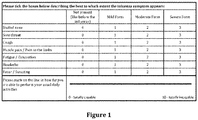
- moderate and severe influenza forms are defined by the so-called composite symptom score (CSS), which is calculated based on seven common influenza symptoms and a patient's rating for each of them in an influenza symptom questionnaire (as depicted in Figure 1 ).
- the seven ratings are summed up to provide a composite symptom score (CSS; maximum value of 21); at baseline in order to define the severity of the infection, and also during treatment, prior to each single dose administration in order to follow the progress of symptom alleviation.
- CSS composite symptom score
- Baseline CSS values of 14 or higher and below 17 are considered moderate forms of influenza, while baseline CSS values of 17 or higher are considered to be severe forms of influenza.
- Baseline CSS values below 14 are considered milder forms of influenza.
- Patients are considered symptom-free, or cured, if at least 5 of the 7 clinical influenza symptoms above are rated 0 or 1 on the influenza symptom questionnaire without the use of relief medications such as pain killers, and remain so for at least 24 ⁇ 2 hours.
- the administration of the daily dose comprises administration of up to four single doses at a dosing interval of at least 4 hours; e.g. 4 single doses every 5 h and a sleep period of 9 h, or 3 single doses every 7 h and a sleep period of 10 h.
- the use of the composition according to the invention comprises the administration of the daily dose in the form of up to four single doses at a dosing interval of at least 4 hours.
- a total of at least 9 single doses are administered over a treatment course of at least 3 days.
- a total of at least 9 single doses are administered over a treatment course of at least 3 days, and a single dose is about 400 mg ASA.
- the use of the composition according to the invention comprises the administration of a total of at least 9 single doses over a treatment course of at least 3 days, and a single dose is 400 mg ASA.
- a total of 15 single doses may be administered over a treatment course of 5 days, typically providing a morning inhalation, a mid-day- and an evening inhalation. Where treatment starts on day 1 with a mid-day- or evening inhalation (e.g.
- the 15 single doses may also be administered over a treatment course of 6 days, such that any morning- and mid-day inhalations missed on day 1 are administered on day 6 instead, in order to complete the treatment with 15 single doses.
- the ASA may be provided in the form of a pharmaceutically acceptable salt thereof.
- the composition for the use according to the invention provides the acetylsalicylic acid (ASA) in the form of its D,L-lysine acetylsalicylate • glycine salt (LASAG):
- LASAG is a white powder that dissociates readily into ASA and the two amino acids lysine and glycine upon dissolution into aqueous media, resulting in a colourless and odourless solution of pH 5.9.
- the benefit of employing LASAG rather than ASA as such in the use according to the invention is the improved solubility of the salt in comparison with ASA (LASAG solubility about 40 % or higher; see e.g. US 4265888 A ).
- a grade of LASAG is used which comprises about 50 wt.-% of ASA, such as Aspirin® i.v.
- the LASAG composition may be provided in the form of a powder for reconstitution; i.e. a powder intended to be reconstituted with / dissolved in an aqueous medium, such as water for injection, saline or aqueous buffers.
- this LASAG composition may be provided in the form of a powder for reconstitution into an aqueous solution with a LASAG concentration of 100 mg/mL to 400 mg/mL, or with an ASA concentration of about 50 mg/mL to about 200 mg/mL; i.e.
- LASAG concentrations in the reconstituted solution may for instance be about 100 mg/mL, 150 mg/mL, 200 mg/mL, 250 mg/mL, 300 mg/mL, 350 mg/mL or 400 mg/mL, in particular 200 mg/mL; which may correspond to ASA concentrations in the reconstituted solution of about 50 mg/mL, 75 mg/mL, 100 mg/mL, 125 mg/mL, 150 mg/mL, 175 mg/mL or 200 mg/mL, in particular 100 mg/mL.
- An exemplary LASAG composition which is commercially available and suitable for the use according to the invention is Aspirin® i.v. (formerly Aspisol®), comprising LASAG at a concentration of 200 mg/mL after correct reconstitution, equalling an ASA concentration of 100 mg/mL.
- Aspirin® i.v. (formerly Aspisol®)
- ASA ASA concentration of 100 mg/mL.
- an exemplary single administered dose of the aqueous solution may have a volume, or filled dose, of about 3 mL to about 5 mL, preferably 4 mL. This filled volume or dose is the amount that is filled into a nebuliser prior to an inhalation treatment.
- the doses and/or concentrations with respect to ASA are theoretical values based on e.g. the assumption of complete dissociation of the LASAG and calculated based on the specific ratios of lysine, glycine and ASA in the LASAG.
- the composition for use according to the invention - and in particular aqueous solutions of ASA or preferably LASAG as described above - is administered using a nebuliser, i.e. a drug delivery device commonly used to administer liquid compositions to a patient's respiratory system in the form of an inhalable mist of droplets.
- a nebuliser i.e. a drug delivery device commonly used to administer liquid compositions to a patient's respiratory system in the form of an inhalable mist of droplets.
- a jet nebuliser or a vibrating mesh nebuliser is used.
- the use of the composition according to the invention comprises the administration of the composition using a jet nebuliser, or a vibrating mesh nebuliser.
- nebuliser such as an ultrasonic nebuliser or a soft mist inhaler
- the jet nebuliser or the vibrating mesh nebuliser is adapted to deliver the aqueous solution at a controlled inspiratory flow and/or a controlled inspiratory volume.
- the inspiratory flow may range from about 150 mL/sec to about 300 mL/sec; e.g. 150 mL/sec, 200 mL/sec, 250 mL/sec or 300 mL/sec, in particular 200 mL/sec. These relatively slow flow rates are advisable due to decreased impaction drug deposition in the oropharyngeal region, which can decrease undesirable side effects.
- the inspiratory volume may range from 500 mL to 1500 mL; e.g. 500 mL, 600 mL, 700 mL, 800 mL, 900 mL, 1000 mL, 1100 mL, 1200 mL, 1300 mL, 1400 mL or 1500 mL, in particular 800 mL.
- Larger inspiratory volumes in combination with slow inspiratory flow rates typically favour alveolar deposition and are thus preferred; yet, the volume shall be selected such that it is tolerable and can be inhaled comfortably even by patients suffering from moderate to severe influenza, who are often affected by severe coughing.
- the inspiratory volume ranges from 700 mL to 1000 mL, e.g. 800 mL.
- smaller volumes may also be used.
- the jet nebuliser or the vibrating mesh nebuliser is adapted to deliver the aqueous solution at a controlled inspiratory flow of about 200 mL/sec and/or a controlled inspiratory volume of about 800 mL.
- These settings may e.g. be achieved using the AKITA® JET nebuliser or the AKITA® Apixneb® nebuliser and setting the inhalation time to 4 seconds and the inspiratory volume to 800 mL; the devices will then guide and support the patient to perform controlled, optimized inhalation manoeuvres.
- the ASA and/or or its pharmaceutically acceptable salt, such as LASAG is selectively targeted to pre-defined target lung regions such as the alveoli of the lungs.
- patients inhale about 4 mL of an aqueous solution comprising LASAG at a concentration of about 200 mg/mL (corresponding to an ASA concentration of 100 mg/mL) in nebulised form over the course of 96 breaths in order to achieve the administered single dose of about 400 mg ASA.
- This number of breaths may be set as a fixed value at the AKITA® devices and also displayed and/or "counted down" for the patient during the administration of a single dose, along with a fixed inspiratory phase and expiratory phase of 4 seconds each, such that these 96 breaths result in a duration of about 12.8 minutes for the administration of a single dose of 400 mg ASA (4 mL of 100 mg/mL ASA), unless where the patient requires pauses during the inhalation treatment.
- these deposition fractions may vary with e.g. the type of drug (ASA, LASAG or other ASA derivatives, such as other pharmaceutically acceptable salts of ASA) and/or the concentration of the drug solution.
- ASA ASA
- LASAG ASA derivatives
- concentration of the drug solution e.g. the concentration of the drug solution.
- the specific nebulisation behaviour of the ASA formulation in question may change so that the administered dose may have to be re-calculated and adjusted accordingly.
- influenza infection is caused by an influenza A virus or an influenza B virus.
- the inhalative ASA administrations according to the invention - optionally using ASA in the form of ASA derivatives such as pharmaceutically acceptable salts like LASAG - may also be used for the purpose of treating patients suffering from a symptom or condition associated with the influenza virus infection, namely a symptom or condition which may be selected from nasal congestion, sore throat, cough, fever, fatigue, headache and myalgias.
- a symptom or condition which may be selected from nasal congestion, sore throat, cough, fever, fatigue, headache and myalgias.
- the inhalative ASA administration according to the invention may be used to treat severe influenza-induced coughing, e.g. where this cough is not or not sufficiently controlled by other cough suppressants.
- the inhalative ASA administration according to the invention may be used to treat the influenza-induced fatigue, fever and/or myalgias.
- the inhalative ASA administrations according to the invention may also be used in treating patients who suffer from a moderate or severe form of influenza (CSS ⁇ 14 and ⁇ 17 or CSS ⁇ 17) and one or more other primary medical diseases or conditions which are worsened / exacerbated by an influenza infection.
- diseases or conditions include but are not limited to diabetes, COPD and other chronic lung diseases.
- ASA was administered in the form of an aqueous liquid solution comprising LASAG at a concentration of about 200 mg/ml, corresponding to an ASA concentration of about 100 mg/ml, using the AKITA® Apixneb® device at controlled inspiratory flow rate of 250 mL/sec and controlled volume of 800 mL.
- Example 2 Clinical phase II study on safety and efficacy of inhaled LASAG and Placebo in adult hospitalized patients with moderate to severe influenza
- inhaled LASAG was evaluated versus inhalation of placebo in adult patients who were hospitalized due to moderate to severe influenza and/or an influenza caused worsening of a another primary medical condition (e.g. diabetes, COPD, or other chronic lung diseases).
- a primary medical condition e.g. diabetes, COPD, or other chronic lung diseases.
- 81 were confirmed by a reverse transcription polymerase chain reaction (RT-PCR) test to be infected with an influenza virus, and received at least one inhalation of LASAG or placebo.
- RT-PCR reverse transcription polymerase chain reaction
- Main exclusion criteria included pregnancy, allergies/hypersensitivities to LASAG or ASA, admittance to intensive care unit (ICU) due to breathing instability, inability to breathe from a nebuliser, evidence or suspicion of an acute non-influenza infectious illness as well as immunisations against influenza with live attenuated virus vaccine in the 4 weeks prior to the study.
- ICU intensive care unit
- the LASAG solution Prior to each inhalation, the LASAG solution was freshly reconstituted (no longer than 30 minutes before usage), in order to prevent or limit the degradation of ASA in water.
- commercially available Aspirin® i.v. was used to prepare the LASAG solutions.
- CSS composite symptom score
- AKITA® JET nebuliser set for all patients to an inhalation volume of 800 mL over a set inhalatory period of 4 seconds; i.e. flow-rate of 200 mL/sec
- the three inhalations were administered at 7 - 9 a.m. (morning), 12 a.m. - 2 p.m. (mid-day) and at 5 - 7 p.m. (evening) and always at least 4 h apart.
- a total of 15 inhalations were administered over the course of 5 days (or 6 days in cases where patients started the study on the first study day with the mid-day or evening inhalation; the "missed inhalations" of day 1 were then done on day 6).
- the primary objective of the study was to evaluate the clinical efficacy of inhaled LASAG plus standard of care compared to placebo plus standard of care in patients hospitalized due to acute serious influenza and/or an influenza caused worsening of a primary medical condition, measured by the time to alleviation of clinical influenza symptoms (primary variable T1).
- T1 was defined as the time in hours from first inhalation until at least 5 of the 7 clinical influenza symptoms (see above) are rated 0 or 1 on the influenza symptom questionnaire without the use of relief medication (acetaminophen) and remained so for at least 24 ⁇ 2 hours. Further, patients were considered 'completely healed' if all of the 7 clinical influenza symptoms were rated 0 or 1 on the influenza symptom questionnaire.
- DAS daily activity score
- the 'per protocol' set included 41 patients having moderate or severe influenza (i.e. with a CSS of ⁇ 14 at baseline), of which a total of 40 were characterized as alleviated during the observation period. Further, of these 41 patients with a CSS of ⁇ 14 at baseline 18 were affected by severe influenza (i.e. CSS ⁇ 17), of which 17 were characterized as alleviated during the observation period; only 1 patient in the placebo group left the study without alleviation of symptoms as defined above. Thus the rates of alleviated patients were similar for both the LASAG and the placebo groups; however, the time to alleviation of clinical influenza symptoms (primary variable T1) differed between LASAG and Placebo group, as was confirmed by log rank test.
- primary variable T1 primary variable
- the study data analysis revealed that the time to alleviation of influenza symptoms T1 was significantly reduced in the LASAG-group compared to the placebo group; from 51.6 h to 38.3 h in patients with CSS ⁇ 14 (p-value: log rank test 0.0313) and from 71.5 h to 44.7 h in patients with CSS ⁇ 17 (p-value: log rank test 0.0152). This difference was also illustrated by the Kaplan-Meier estimation plots, in which the two curves were crossing each other until about 20-25 hours of observation. From then on the LASAG curve is lower than the placebo curve (see Figure 2 and Figure 3 for the patient group subsets having moderate or severe influenza (CSS ⁇ 14) and those affected by severe influenza (CSS ⁇ 17), respectively).
- results may also be interpreted in such a way that patients with CSS ⁇ 17 were alleviated after about 9 placebo inhalations versus only about 6 LASAG inhalations.
Landscapes
- Health & Medical Sciences (AREA)
- Life Sciences & Earth Sciences (AREA)
- Chemical & Material Sciences (AREA)
- Animal Behavior & Ethology (AREA)
- General Health & Medical Sciences (AREA)
- Public Health (AREA)
- Veterinary Medicine (AREA)
- Medicinal Chemistry (AREA)
- Pharmacology & Pharmacy (AREA)
- Epidemiology (AREA)
- Virology (AREA)
- Pulmonology (AREA)
- Bioinformatics & Cheminformatics (AREA)
- Engineering & Computer Science (AREA)
- Organic Chemistry (AREA)
- Oncology (AREA)
- Chemical Kinetics & Catalysis (AREA)
- General Chemical & Material Sciences (AREA)
- Nuclear Medicine, Radiotherapy & Molecular Imaging (AREA)
- Communicable Diseases (AREA)
- Molecular Biology (AREA)
- Emergency Medicine (AREA)
- Dispersion Chemistry (AREA)
- Otolaryngology (AREA)
- Pain & Pain Management (AREA)
- Pharmaceuticals Containing Other Organic And Inorganic Compounds (AREA)
- Medicinal Preparation (AREA)
Claims (14)
- Acetylsalicylsäure (ASS) oder ein pharmazeutisch annehmbares Salz davon zur Verwendung bei der Behandlung eines Patienten, der an einer moderaten bis schweren Influenzavirusinfektion und/oder einem Symptom oder einer Krankheit in Verbindung damit leidet,
wobei CSS-Ausgangswerte (CSS - Composite Symptom Score) von 14 oder höher und von unter 17 als moderate Formen von Influenza angesehen werden und CSS-Ausgangswerte von 17 oder höher als schwere Formen von Influenza angesehen werden und
wobei das Symptom oder die Krankheit in Verbindung mit der Influenzavirusinfektion aus verstopfter Nase, rauem Hals, Husten, Fieber, Erschöpfung, Kopfschmerzen und Myalgien ausgewählt ist und
wobei die Verwendung die Verabreichung einer Zusammensetzung, die ASS oder ein pharmazeutisch annehmbares Salz davon umfasst, an den Patienten mittels Inhalation mit einer ASS-Tagesdosis von mindestens 600 mg umfasst. - Pharmazeutische Zusammensetzung umfassend Acetylsalicylsäure (ASS) oder ein pharmazeutisch annehmbares Salz davon zur Verwendung bei der Behandlung eines Patienten, der an einer moderaten bis schweren Influenzavirusinfektion und/oder einem Symptom oder einer Krankheit in Verbindung damit leidet,
wobei CSS-Ausgangswerte (CSS - Composite Symptom Score) von 14 oder höher und von unter 17 als moderate Formen von Influenza angesehen werden und CSS-Ausgangswerte von 17 oder höher als schwere Formen von Influenza angesehen werden und
wobei das Symptom oder die Krankheit in Verbindung mit der Influenzavirusinfektion aus verstopfter Nase, rauem Hals, Husten, Fieber, Erschöpfung, Kopfschmerzen und Myalgien ausgewählt ist und
wobei die Verwendung die Verabreichung der Zusammensetzung mittels Inhalation mit einer ASS-Tagesdosis von mindestens 600 mg umfasst. - Zusammensetzung zur Verwendung nach Anspruch 2, wobei die ASS-Tagesdosis aus 960 mg bis 1440 mg, oder 1080 mg bis 1320 mg, oder 1200 mg, besteht.
- Zusammensetzung zur Verwendung nach Anspruch 2 oder 3, wobei die Verwendung die Verabreichung der Tagesdosis in Form von bis zu vier Einzeldosen mit Dosisabständen von mindestens 4 Stunden umfasst.
- Zusammensetzung zur Verwendung nach einem der Ansprüche 2 bis 4, wobei die Verwendung die Verabreichung von insgesamt mindestens 9 Einzeldosen über eine Behandlungsdauer von mindestens 3 Tagen umfasst und wobei eine Einzeldosis aus 400 mg ASS besteht.
- Zusammensetzung zur Verwendung nach einem der Ansprüche 2 bis 5, wobei die ASS in Form ihres D,L-Lysinacetylsalicylat-Glycin-Salzes (LASAG-Salzes) bereitgestellt wird.
- Zusammensetzung zur Verwendung nach Anspruch 6, wobei die Zusammensetzung in Form eines Pulvers zur Wiederherstellung in einer wässrigen Lösung mit einer LASAG-Konzentration von 100 mg/ml bis 400 mg/ml oder mit einer ASS-Konzentration von 50 mg/ml bis 200 mg/ml bereitgestellt wird.
- Zusammensetzung zur Verwendung nach Anspruch 7, wobei die Einzeldosis der wässrigen Lösung ein Volumen von 3 ml bis 5 ml, vorzugsweise 4 ml, eine LASAG-Konzentration von 200 mg/ml und eine ASS-Konzentration von 100 mg/ml aufweist.
- Zusammensetzung zur Verwendung nach einem der Ansprüche 2 bis 8, wobei die Verwendung die Verabreichung der Zusammensetzung unter Verwendung eines Düsenverneblers, eines vibrierenden Membranverneblers oder eines Feinnebelinhalators umfasst.
- Zusammensetzung zur Verwendung nach Anspruch 9, wobei der Düsenvernebler oder der vibrierende Membranvernebler dazu ausgelegt ist, die wässrige Lösung in einem geregelten inspiratorischen Fluss und/oder einem geregelten inspiratorischen Volumen abzugeben.
- Zusammensetzung zur Verwendung nach Anspruch 10, wobei der inspiratorische Fluss 200 ml/s beträgt und/oder das inspiratorische Volume 800 ml beträgt.
- Zusammensetzung zur Verwendung nach Anspruch 9 bis 11, wobei der Düsenvernebler oder der vibrierende Membranvernebler dazu ausgelegt ist, eine Einzeldosis für die Dauer von 90 bis 105 Atemzügen innerhalb einer Verabreichungszeit von 12 bis 14 Minuten abzugeben.
- Zusammensetzung zur Verwendung nach einem der Ansprüche 2 bis 12, wobei der Patient aufgrund der Influenzavirusinfektion und/oder eines Symptoms oder einer Krankheit in Verbindung damit ins Krankenhaus eingeliefert wurde.
- Zusammensetzung zur Verwendung nach einem der Ansprüche 2 bis 13, wobei die Influenzainfektion durch ein Influenza-A-Virus oder ein Influenza-B-Virus hervorgerufen wurde.
Applications Claiming Priority (2)
| Application Number | Priority Date | Filing Date | Title |
|---|---|---|---|
| EP15202212 | 2015-12-22 | ||
| PCT/EP2016/082307 WO2017109037A1 (en) | 2015-12-22 | 2016-12-22 | Treatment of moderate to severe influenza |
Publications (2)
| Publication Number | Publication Date |
|---|---|
| EP3393517A1 EP3393517A1 (de) | 2018-10-31 |
| EP3393517B1 true EP3393517B1 (de) | 2021-08-11 |
Family
ID=55022370
Family Applications (1)
| Application Number | Title | Priority Date | Filing Date |
|---|---|---|---|
| EP16823002.7A Active EP3393517B1 (de) | 2015-12-22 | 2016-12-22 | Acetylsalicylsäure zur behandlung von moderater bis schwerer influenza |
Country Status (10)
| Country | Link |
|---|---|
| US (2) | US11376265B2 (de) |
| EP (1) | EP3393517B1 (de) |
| JP (1) | JP7369523B2 (de) |
| CN (1) | CN108472375A (de) |
| AU (1) | AU2016378478B2 (de) |
| CA (1) | CA3001962C (de) |
| DK (1) | DK3393517T3 (de) |
| ES (1) | ES2894330T3 (de) |
| PT (1) | PT3393517T (de) |
| WO (1) | WO2017109037A1 (de) |
Families Citing this family (3)
| Publication number | Priority date | Publication date | Assignee | Title |
|---|---|---|---|---|
| WO2018115434A1 (en) * | 2016-12-23 | 2018-06-28 | Ventaleon Gmbh | Improved synthesis of lysine acetylsalicylate · glycine particles |
| AU2020333973A1 (en) * | 2019-08-22 | 2022-03-17 | Applied Biological Laboratories, Inc. | Compositions and methods using non-steroidal anti-inflammatory drugs |
| GB202003722D0 (en) * | 2020-03-14 | 2020-04-29 | Martin John Francis | Treatment |
Family Cites Families (7)
| Publication number | Priority date | Publication date | Assignee | Title |
|---|---|---|---|---|
| DE19851279B4 (de) * | 1998-06-17 | 2006-05-24 | GSF - Forschungszentrum für Umwelt und Gesundheit GmbH | Vorrichtung zum gesteuerten inhalatorischen Einbringen von dosierten Medikamenten in die Lunge |
| DE19912461B4 (de) * | 1999-03-19 | 2006-07-20 | GSF - Forschungszentrum für Umwelt und Gesundheit GmbH | Vorrichtung zur Flußbegrenzung bei niedrigen Differenzdrücken |
| DE10300222A1 (de) * | 2003-01-03 | 2004-07-15 | MedInnova Gesellschaft für medizinische Innovationen aus akademischer Forschung mbH | Verwendung von Wirksubstanzen zur Prophylaxe und/oder Therapie von Viruserkrankungen |
| DE102008004386A1 (de) * | 2008-01-14 | 2009-07-23 | Activaero Gmbh | Verwendung eines Acetylsalicylsäuresalzes zur Behandlung viraler Infektionen |
| US8668901B2 (en) * | 2009-02-04 | 2014-03-11 | Activaero Gmbh Research & Development | Use of a glucocorticoid composition for the treatment of severe and uncontrolled asthma |
| HK1218720A1 (zh) * | 2013-04-30 | 2017-03-10 | 欧缇托匹克公司 | 干粉制剂及使用方法 |
| KR102681843B1 (ko) * | 2017-09-22 | 2024-07-05 | 벡추라 인코포레이티드 | 스테아르산마그네슘을 갖는 건조 분말 조성물 |
-
2016
- 2016-12-22 EP EP16823002.7A patent/EP3393517B1/de active Active
- 2016-12-22 CA CA3001962A patent/CA3001962C/en active Active
- 2016-12-22 CN CN201680068680.8A patent/CN108472375A/zh active Pending
- 2016-12-22 WO PCT/EP2016/082307 patent/WO2017109037A1/en not_active Ceased
- 2016-12-22 ES ES16823002T patent/ES2894330T3/es active Active
- 2016-12-22 PT PT168230027T patent/PT3393517T/pt unknown
- 2016-12-22 US US16/065,600 patent/US11376265B2/en active Active
- 2016-12-22 JP JP2018533677A patent/JP7369523B2/ja active Active
- 2016-12-22 AU AU2016378478A patent/AU2016378478B2/en active Active
- 2016-12-22 DK DK16823002.7T patent/DK3393517T3/da active
-
2022
- 2022-06-16 US US17/807,184 patent/US20220387455A1/en not_active Abandoned
Non-Patent Citations (1)
| Title |
|---|
| None * |
Also Published As
| Publication number | Publication date |
|---|---|
| US11376265B2 (en) | 2022-07-05 |
| JP2019504040A (ja) | 2019-02-14 |
| PT3393517T (pt) | 2021-10-19 |
| CA3001962A1 (en) | 2017-06-29 |
| EP3393517A1 (de) | 2018-10-31 |
| US20220387455A1 (en) | 2022-12-08 |
| CA3001962C (en) | 2022-09-13 |
| AU2016378478A1 (en) | 2018-05-10 |
| US20190134066A1 (en) | 2019-05-09 |
| CN108472375A (zh) | 2018-08-31 |
| AU2016378478B2 (en) | 2021-11-25 |
| ES2894330T8 (es) | 2023-02-14 |
| WO2017109037A1 (en) | 2017-06-29 |
| DK3393517T3 (da) | 2021-11-01 |
| JP7369523B2 (ja) | 2023-10-26 |
| ES2894330T3 (es) | 2022-02-14 |
Similar Documents
| Publication | Publication Date | Title |
|---|---|---|
| US20220387455A1 (en) | Treatment of moderate to severe influenza | |
| JP2020002144A (ja) | 小児における急性呼吸促迫症候群の治療のための吸入一酸化窒素ガスを使用する方法 | |
| AU2010335594B2 (en) | Synergistic antiviral composition and use thereof | |
| JP2022019937A (ja) | ヒト又は動物の慢性若しくは急性のウイルス感染症及び/又は敗血症の予防若しくは治療のための組成物 | |
| CN115867288A (zh) | 用于治疗呼吸系统病症的组合物 | |
| Krenn et al. | Efficacy of solnatide to treat pulmonary permeability edema in SARS-CoV-2 positive patients with moderate to severe ARDS: A randomized controlled pilot-trial | |
| EP3906934B1 (de) | Verwendung von dalargin zur prävention von viralen atemweginfektionen und zur prävention der entwicklung von komplikationen während viralen atemweginfektionen | |
| US12171732B2 (en) | Compositions and use of N-chlorotaurine for treatment and prevention of respiratory infections | |
| CN103169970A (zh) | 一种治疗病毒性肺炎的药物组合物 | |
| JP2021161105A (ja) | ヒト又は動物の慢性若しくは急性のウイルス感染症及び/又は敗血症の予防若しくは治療のための組成物 | |
| US20230310544A1 (en) | ANTI-RNA VIRAL PHARMACEUTICAL COMBINATION THERAPY WITH APROTININ + anti-RNA DRUG | |
| US20230310467A1 (en) | PHARMACEUTICAL COMBINATION THERAPY AND PREVENTION WITH APROTININ + REMDESIVIR OF SARS-CoV-2 AND/OR DISEASE ASSOCIATED WITH THIS INFECTION, INCLUDI COVID-19 | |
| WO2025104696A1 (en) | Pharmaceutical composition comprising edaravone for use in reducing levels of il-6 and tnf-alpha inflammatory markers and reducing time to withdrawal of oxygen therapy in patients with infectious diseases | |
| EP4370095A1 (de) | Behandlung von atemwegserkrankungen | |
| WO2022216172A1 (ru) | Водная апротинин-содержащая противовирусная фармацевтическая композиция | |
| HK1174835A (en) | Synergistic antiviral composition and use thereof |
Legal Events
| Date | Code | Title | Description |
|---|---|---|---|
| STAA | Information on the status of an ep patent application or granted ep patent |
Free format text: STATUS: UNKNOWN |
|
| STAA | Information on the status of an ep patent application or granted ep patent |
Free format text: STATUS: THE INTERNATIONAL PUBLICATION HAS BEEN MADE |
|
| PUAI | Public reference made under article 153(3) epc to a published international application that has entered the european phase |
Free format text: ORIGINAL CODE: 0009012 |
|
| STAA | Information on the status of an ep patent application or granted ep patent |
Free format text: STATUS: REQUEST FOR EXAMINATION WAS MADE |
|
| 17P | Request for examination filed |
Effective date: 20180723 |
|
| AK | Designated contracting states |
Kind code of ref document: A1 Designated state(s): AL AT BE BG CH CY CZ DE DK EE ES FI FR GB GR HR HU IE IS IT LI LT LU LV MC MK MT NL NO PL PT RO RS SE SI SK SM TR |
|
| AX | Request for extension of the european patent |
Extension state: BA ME |
|
| DAV | Request for validation of the european patent (deleted) | ||
| DAX | Request for extension of the european patent (deleted) | ||
| STAA | Information on the status of an ep patent application or granted ep patent |
Free format text: STATUS: EXAMINATION IS IN PROGRESS |
|
| 17Q | First examination report despatched |
Effective date: 20200612 |
|
| RAP1 | Party data changed (applicant data changed or rights of an application transferred) |
Owner name: ASPIAIR GMBH |
|
| GRAP | Despatch of communication of intention to grant a patent |
Free format text: ORIGINAL CODE: EPIDOSNIGR1 |
|
| STAA | Information on the status of an ep patent application or granted ep patent |
Free format text: STATUS: GRANT OF PATENT IS INTENDED |
|
| INTG | Intention to grant announced |
Effective date: 20210309 |
|
| GRAS | Grant fee paid |
Free format text: ORIGINAL CODE: EPIDOSNIGR3 |
|
| GRAA | (expected) grant |
Free format text: ORIGINAL CODE: 0009210 |
|
| STAA | Information on the status of an ep patent application or granted ep patent |
Free format text: STATUS: THE PATENT HAS BEEN GRANTED |
|
| AK | Designated contracting states |
Kind code of ref document: B1 Designated state(s): AL AT BE BG CH CY CZ DE DK EE ES FI FR GB GR HR HU IE IS IT LI LT LU LV MC MK MT NL NO PL PT RO RS SE SI SK SM TR |
|
| REG | Reference to a national code |
Ref country code: CH Ref legal event code: EP |
|
| REG | Reference to a national code |
Ref country code: DE Ref legal event code: R096 Ref document number: 602016062123 Country of ref document: DE |
|
| REG | Reference to a national code |
Ref country code: IE Ref legal event code: FG4D Ref country code: AT Ref legal event code: REF Ref document number: 1418692 Country of ref document: AT Kind code of ref document: T Effective date: 20210915 |
|
| REG | Reference to a national code |
Ref country code: PT Ref legal event code: SC4A Ref document number: 3393517 Country of ref document: PT Date of ref document: 20211019 Kind code of ref document: T Free format text: AVAILABILITY OF NATIONAL TRANSLATION Effective date: 20211011 |
|
| REG | Reference to a national code |
Ref country code: DK Ref legal event code: T3 Effective date: 20211026 |
|
| REG | Reference to a national code |
Ref country code: FI Ref legal event code: FGE |
|
| REG | Reference to a national code |
Ref country code: NO Ref legal event code: T2 Effective date: 20210811 |
|
| REG | Reference to a national code |
Ref country code: SE Ref legal event code: TRGR |
|
| REG | Reference to a national code |
Ref country code: NL Ref legal event code: FP |
|
| REG | Reference to a national code |
Ref country code: LT Ref legal event code: MG9D |
|
| PG25 | Lapsed in a contracting state [announced via postgrant information from national office to epo] |
Ref country code: LT Free format text: LAPSE BECAUSE OF FAILURE TO SUBMIT A TRANSLATION OF THE DESCRIPTION OR TO PAY THE FEE WITHIN THE PRESCRIBED TIME-LIMIT Effective date: 20210811 Ref country code: BG Free format text: LAPSE BECAUSE OF FAILURE TO SUBMIT A TRANSLATION OF THE DESCRIPTION OR TO PAY THE FEE WITHIN THE PRESCRIBED TIME-LIMIT Effective date: 20211111 Ref country code: HR Free format text: LAPSE BECAUSE OF FAILURE TO SUBMIT A TRANSLATION OF THE DESCRIPTION OR TO PAY THE FEE WITHIN THE PRESCRIBED TIME-LIMIT Effective date: 20210811 Ref country code: RS Free format text: LAPSE BECAUSE OF FAILURE TO SUBMIT A TRANSLATION OF THE DESCRIPTION OR TO PAY THE FEE WITHIN THE PRESCRIBED TIME-LIMIT Effective date: 20210811 |
|
| REG | Reference to a national code |
Ref country code: ES Ref legal event code: FG2A Ref document number: 2894330 Country of ref document: ES Kind code of ref document: T3 Effective date: 20220214 |
|
| PG25 | Lapsed in a contracting state [announced via postgrant information from national office to epo] |
Ref country code: PL Free format text: LAPSE BECAUSE OF FAILURE TO SUBMIT A TRANSLATION OF THE DESCRIPTION OR TO PAY THE FEE WITHIN THE PRESCRIBED TIME-LIMIT Effective date: 20210811 Ref country code: LV Free format text: LAPSE BECAUSE OF FAILURE TO SUBMIT A TRANSLATION OF THE DESCRIPTION OR TO PAY THE FEE WITHIN THE PRESCRIBED TIME-LIMIT Effective date: 20210811 Ref country code: GR Free format text: LAPSE BECAUSE OF FAILURE TO SUBMIT A TRANSLATION OF THE DESCRIPTION OR TO PAY THE FEE WITHIN THE PRESCRIBED TIME-LIMIT Effective date: 20211112 |
|
| REG | Reference to a national code |
Ref country code: DE Ref legal event code: R097 Ref document number: 602016062123 Country of ref document: DE |
|
| PG25 | Lapsed in a contracting state [announced via postgrant information from national office to epo] |
Ref country code: SM Free format text: LAPSE BECAUSE OF FAILURE TO SUBMIT A TRANSLATION OF THE DESCRIPTION OR TO PAY THE FEE WITHIN THE PRESCRIBED TIME-LIMIT Effective date: 20210811 Ref country code: SK Free format text: LAPSE BECAUSE OF FAILURE TO SUBMIT A TRANSLATION OF THE DESCRIPTION OR TO PAY THE FEE WITHIN THE PRESCRIBED TIME-LIMIT Effective date: 20210811 Ref country code: RO Free format text: LAPSE BECAUSE OF FAILURE TO SUBMIT A TRANSLATION OF THE DESCRIPTION OR TO PAY THE FEE WITHIN THE PRESCRIBED TIME-LIMIT Effective date: 20210811 Ref country code: EE Free format text: LAPSE BECAUSE OF FAILURE TO SUBMIT A TRANSLATION OF THE DESCRIPTION OR TO PAY THE FEE WITHIN THE PRESCRIBED TIME-LIMIT Effective date: 20210811 Ref country code: CZ Free format text: LAPSE BECAUSE OF FAILURE TO SUBMIT A TRANSLATION OF THE DESCRIPTION OR TO PAY THE FEE WITHIN THE PRESCRIBED TIME-LIMIT Effective date: 20210811 Ref country code: AL Free format text: LAPSE BECAUSE OF FAILURE TO SUBMIT A TRANSLATION OF THE DESCRIPTION OR TO PAY THE FEE WITHIN THE PRESCRIBED TIME-LIMIT Effective date: 20210811 |
|
| PLBE | No opposition filed within time limit |
Free format text: ORIGINAL CODE: 0009261 |
|
| STAA | Information on the status of an ep patent application or granted ep patent |
Free format text: STATUS: NO OPPOSITION FILED WITHIN TIME LIMIT |
|
| 26N | No opposition filed |
Effective date: 20220512 |
|
| PG25 | Lapsed in a contracting state [announced via postgrant information from national office to epo] |
Ref country code: MC Free format text: LAPSE BECAUSE OF FAILURE TO SUBMIT A TRANSLATION OF THE DESCRIPTION OR TO PAY THE FEE WITHIN THE PRESCRIBED TIME-LIMIT Effective date: 20210811 |
|
| PG25 | Lapsed in a contracting state [announced via postgrant information from national office to epo] |
Ref country code: SI Free format text: LAPSE BECAUSE OF FAILURE TO SUBMIT A TRANSLATION OF THE DESCRIPTION OR TO PAY THE FEE WITHIN THE PRESCRIBED TIME-LIMIT Effective date: 20210811 |
|
| REG | Reference to a national code |
Ref country code: AT Ref legal event code: UEP Ref document number: 1418692 Country of ref document: AT Kind code of ref document: T Effective date: 20210811 |
|
| PG25 | Lapsed in a contracting state [announced via postgrant information from national office to epo] |
Ref country code: CY Free format text: LAPSE BECAUSE OF FAILURE TO SUBMIT A TRANSLATION OF THE DESCRIPTION OR TO PAY THE FEE WITHIN THE PRESCRIBED TIME-LIMIT Effective date: 20210811 |
|
| PG25 | Lapsed in a contracting state [announced via postgrant information from national office to epo] |
Ref country code: HU Free format text: LAPSE BECAUSE OF FAILURE TO SUBMIT A TRANSLATION OF THE DESCRIPTION OR TO PAY THE FEE WITHIN THE PRESCRIBED TIME-LIMIT; INVALID AB INITIO Effective date: 20161222 |
|
| PG25 | Lapsed in a contracting state [announced via postgrant information from national office to epo] |
Ref country code: MK Free format text: LAPSE BECAUSE OF FAILURE TO SUBMIT A TRANSLATION OF THE DESCRIPTION OR TO PAY THE FEE WITHIN THE PRESCRIBED TIME-LIMIT Effective date: 20210811 |
|
| PG25 | Lapsed in a contracting state [announced via postgrant information from national office to epo] |
Ref country code: MT Free format text: LAPSE BECAUSE OF FAILURE TO SUBMIT A TRANSLATION OF THE DESCRIPTION OR TO PAY THE FEE WITHIN THE PRESCRIBED TIME-LIMIT Effective date: 20210811 |
|
| PGFP | Annual fee paid to national office [announced via postgrant information from national office to epo] |
Ref country code: CH Payment date: 20250101 Year of fee payment: 9 |
|
| PG25 | Lapsed in a contracting state [announced via postgrant information from national office to epo] |
Ref country code: TR Free format text: LAPSE BECAUSE OF FAILURE TO SUBMIT A TRANSLATION OF THE DESCRIPTION OR TO PAY THE FEE WITHIN THE PRESCRIBED TIME-LIMIT Effective date: 20210811 |
|
| REG | Reference to a national code |
Ref country code: CH Ref legal event code: U11 Free format text: ST27 STATUS EVENT CODE: U-0-0-U10-U11 (AS PROVIDED BY THE NATIONAL OFFICE) Effective date: 20260101 |
|
| PGFP | Annual fee paid to national office [announced via postgrant information from national office to epo] |
Ref country code: DE Payment date: 20251211 Year of fee payment: 10 |
|
| PGFP | Annual fee paid to national office [announced via postgrant information from national office to epo] |
Ref country code: GB Payment date: 20251219 Year of fee payment: 10 |
|
| PGFP | Annual fee paid to national office [announced via postgrant information from national office to epo] |
Ref country code: PT Payment date: 20251211 Year of fee payment: 10 Ref country code: AT Payment date: 20251222 Year of fee payment: 10 |
|
| PGFP | Annual fee paid to national office [announced via postgrant information from national office to epo] |
Ref country code: IT Payment date: 20251223 Year of fee payment: 10 Ref country code: FI Payment date: 20251223 Year of fee payment: 10 Ref country code: DK Payment date: 20251224 Year of fee payment: 10 |
|
| PGFP | Annual fee paid to national office [announced via postgrant information from national office to epo] |
Ref country code: LU Payment date: 20251219 Year of fee payment: 10 Ref country code: NL Payment date: 20251219 Year of fee payment: 10 Ref country code: FR Payment date: 20251229 Year of fee payment: 10 |
|
| PGFP | Annual fee paid to national office [announced via postgrant information from national office to epo] |
Ref country code: BE Payment date: 20251219 Year of fee payment: 10 |
|
| PGFP | Annual fee paid to national office [announced via postgrant information from national office to epo] |
Ref country code: SE Payment date: 20251219 Year of fee payment: 10 |
|
| PGFP | Annual fee paid to national office [announced via postgrant information from national office to epo] |
Ref country code: IE Payment date: 20251219 Year of fee payment: 10 |
|
| PGFP | Annual fee paid to national office [announced via postgrant information from national office to epo] |
Ref country code: ES Payment date: 20260130 Year of fee payment: 10 |
|
| PGFP | Annual fee paid to national office [announced via postgrant information from national office to epo] |
Ref country code: NO Payment date: 20251230 Year of fee payment: 10 |