EP3393045A1 - Datenkompressionssystem zur speicherung von daten aus einem automatisierten fahrzeug - Google Patents
Datenkompressionssystem zur speicherung von daten aus einem automatisierten fahrzeug Download PDFInfo
- Publication number
- EP3393045A1 EP3393045A1 EP18164809.8A EP18164809A EP3393045A1 EP 3393045 A1 EP3393045 A1 EP 3393045A1 EP 18164809 A EP18164809 A EP 18164809A EP 3393045 A1 EP3393045 A1 EP 3393045A1
- Authority
- EP
- European Patent Office
- Prior art keywords
- data
- sampled
- average
- value
- frame
- Prior art date
- Legal status (The legal status is an assumption and is not a legal conclusion. Google has not performed a legal analysis and makes no representation as to the accuracy of the status listed.)
- Withdrawn
Links
Images


Classifications
-
- H—ELECTRICITY
- H03—ELECTRONIC CIRCUITRY
- H03M—CODING; DECODING; CODE CONVERSION IN GENERAL
- H03M7/00—Conversion of a code where information is represented by a given sequence or number of digits to a code where the same, similar or subset of information is represented by a different sequence or number of digits
- H03M7/30—Compression; Expansion; Suppression of unnecessary data, e.g. redundancy reduction
- H03M7/40—Conversion to or from variable length codes, e.g. Shannon-Fano code, Huffman code, Morse code
- H03M7/4006—Conversion to or from arithmetic code
-
- G—PHYSICS
- G06—COMPUTING OR CALCULATING; COUNTING
- G06F—ELECTRIC DIGITAL DATA PROCESSING
- G06F17/00—Digital computing or data processing equipment or methods, specially adapted for specific functions
- G06F17/10—Complex mathematical operations
- G06F17/14—Fourier, Walsh or analogous domain transformations, e.g. Laplace, Hilbert, Karhunen-Loeve, transforms
- G06F17/147—Discrete orthonormal transforms, e.g. discrete cosine transform, discrete sine transform, and variations therefrom, e.g. modified discrete cosine transform, integer transforms approximating the discrete cosine transform
-
- G—PHYSICS
- G06—COMPUTING OR CALCULATING; COUNTING
- G06F—ELECTRIC DIGITAL DATA PROCESSING
- G06F3/00—Input arrangements for transferring data to be processed into a form capable of being handled by the computer; Output arrangements for transferring data from processing unit to output unit, e.g. interface arrangements
- G06F3/06—Digital input from, or digital output to, record carriers, e.g. RAID, emulated record carriers or networked record carriers
- G06F3/0601—Interfaces specially adapted for storage systems
- G06F3/0628—Interfaces specially adapted for storage systems making use of a particular technique
-
- H—ELECTRICITY
- H03—ELECTRONIC CIRCUITRY
- H03M—CODING; DECODING; CODE CONVERSION IN GENERAL
- H03M7/00—Conversion of a code where information is represented by a given sequence or number of digits to a code where the same, similar or subset of information is represented by a different sequence or number of digits
- H03M7/30—Compression; Expansion; Suppression of unnecessary data, e.g. redundancy reduction
-
- H—ELECTRICITY
- H03—ELECTRONIC CIRCUITRY
- H03M—CODING; DECODING; CODE CONVERSION IN GENERAL
- H03M7/00—Conversion of a code where information is represented by a given sequence or number of digits to a code where the same, similar or subset of information is represented by a different sequence or number of digits
- H03M7/30—Compression; Expansion; Suppression of unnecessary data, e.g. redundancy reduction
- H03M7/40—Conversion to or from variable length codes, e.g. Shannon-Fano code, Huffman code, Morse code
Definitions
- This disclosure generally relates to a data-compression system, and more particularly relates to a system that determines an average-value of sampled-data, and converts the sampled-data to percentage-data using the average-value as the basis for the conversion.
- ECU electronice control unit
- Some known data-collection systems capture and store block or groups of data which in some instances are referred to as freeze-frame data which are stored as captured in the memory of the data-collection system.
- freeze-frame data which are stored as captured in the memory of the data-collection system.
- the amount of data collected to diagnose a failure mode that includes data measured before and after an event often exceeds the storage capacity and/or storage speed of typical examples of these systems.
- vehicle conditions don't change drastically over a short period of time. That is, most of the data remains within some expected tolerance during the time-interval that the freeze-frame data is collected.
- freeze-frame data is used to identify an anomaly in the signal so it is important to capture that moment.
- compression methods already available for signal compression which can be used, but a compression method tailored for specific application can provide fast compression and better compression ratio. Described herein are a system and a method to reduce size of freeze-frame data captured or recorded from a vehicle.
- the freeze-frame data generally consists of or includes several software variables which are of different types, e.g. integer, floating point, etc.
- the system may be configured or programmed to carry out the steps of the method, where the method may include, but are not limited to, the steps of: determining a sample-size or count of freeze-frame data to be captured; capturing the count of sampled-data; finding an average-value of the sampled data for each variable captured in the freeze-frame; converting the sampled-data into a set of percentage-data using the average-value as a basis for the conversion; converting the percentage-data from time-domain to frequency domain by performing discrete cosine transformation (DCT) to produce DCT-data; converting the DCT-data from floating point to integer by rounding to nearest integer value to produce integer-data; encoding the integer-data using standard arithmetic coding or Huffman's coding to produce encoded-data; storing the encoded-data, a symbol-table that consists of a symbol-list and a symbol-count-list, and an average value list in a memory device.
- DCT discrete cosine transformation
- the controller is further configured to convert the percentage-data to discrete cosine transform-data (DCT-data) by applying a discrete cosine transform (DCT) to the percentage-data, convert the DCT-data to integer-data, and encode the integer-data using standard arithmetic coding to produce encoded-data.
- DCT discrete cosine transform
- controller is further configured to store the encoded-data, the average-value, and a count of instances of the sampled-data in the frame.
- the sample-size or count may correspond to a value of 2 n where n is between three (3) and eight (8).
- the percentage-data may correspond to a percentage-difference relative to the average-value of each instance of the sample-data.
- the average-value may be calculated either as an overall average of said sample size for each software variable or as a running average as in for every sample read the value is averaged with previous average value and samples percentage-difference relative to the current average is calculated.
- the average-value is characterized as a running-average of a count of prior instances of the sampled-data.
- the floating to integer conversion may be to the nearest integer
- the arithmetic coding may use a sixteen-bit encoding method which may be Huffman coding.
- a data-compression system for compressing and storing sampled data from an electronic control unit (ECU) in an automated vehicle.
- the system includes an input and a controller.
- the input receives and samples a signal during a time-interval to provide a frame of sampled-data.
- the controller is in communication with the input.
- the controller is configured to capture the frame of sampled-data; determine an average-value of the sampled-data in the frame, and convert the sampled-data to percentage-data using the average-value as the basis for the conversion.
- Fig. 1 illustrates a non-limiting example of a data-compression system 10, hereafter referred to as the system 10.
- the system 10 is suitable for compressing and storing sampled data from an electronic control unit 20 (ECU 20) in an automated vehicle, e.g. a host-vehicle 12.
- ECU 20 electronice control unit
- the term automated vehicle may apply to instances when the host-vehicle 12 is being operated in an automated-mode 14, i.e. a fully autonomous mode, where a human-operator (not shown) of the host-vehicle 12 may do little more than designate a destination in order to operate the host-vehicle 12.
- full automation is not a requirement.
- the teachings presented herein are useful when the host-vehicle 12 is operated in a manual-mode 16 where the degree or level of automation may be little more than providing an audible or visual warning to the human-operator who is generally in control of the steering, accelerator, and brakes of the host-vehicle 12.
- the system 10 may merely assist the human-operator as needed to change lanes and/or avoid interference with and/or a collision with, for example, an object such as another-vehicle, a pedestrian, or a road sign.
- the system 10 includes an input 22 that receives and samples a signal 24 during a time-interval 26 to provide a frame 28 of sampled-data 30.
- the signal 24 may be communicated to the input 22 by way of wires, optical-cable, or wireless communication, as will be recognized by those in the art.
- the signal 24 may be formed of or includes a single data-stream, or may include multiple different data-streams indicated of a variety of types of data from the ECU such as, but not limited to, ambient-temperature, fuel-injector-duty-cycle, throttle-position, mass-airflow-rate, and the like.
- the input 22 may include a commercially available analog-to-digital convertor (A/D) with a selectable sample rate.
- A/D analog-to-digital convertor
- the time-interval 26 may be preselected by a user (not show) of the system 10, or the time-interval 26 may be selected dynamically based on the content of the signal 24. As such, the time-interval 26 may be from a few milliseconds to several minutes depending on the interests of the user.
- the frame 28 of the sampled-data 30 refers to that group or block of data that is received by the input 22 during the time-interval 26. As noted above, the frame 28 may contain a time-sampling of a single data-variable available from the ECU, or may contain a time-sampling of several distinct data-variables such as those noted above.
- the system 10 includes a controller 32 in communication with the input 22.
- the controller 32 may include a processor (not specifically shown) such as a microprocessor or other control circuitry such as analog and/or digital control circuitry including an application specific integrated circuit (ASIC) for processing data as should be evident to those in the art.
- the controller 32 may include or may be in communication with a memory 34, including non-volatile memory, such as electrically erasable programmable read-only memory (EEPROM) for storing one or more routines, thresholds, and captured data.
- EEPROM electrically erasable programmable read-only memory
- the one or more routines may be executed by the processor to perform steps for capturing and processing data from the ECU 20 based on signals received by the controller 32 from the ECU and/or a user-interface (not shown) such as a keyboard and/or a display, optionally a touch-sensitive display as will be recognized by those in the art.
- a user-interface such as a keyboard and/or a display, optionally a touch-sensitive display as will be recognized by those in the art.
- the controller 32 is configured or programmed to capture the frame 28 of the sampled-data 30 which may be by way of storing the frame 28 in the memory 34, or a more temporary fast input/output type of memory such as random-access-memory (RAM) that may be integrated in the aforementioned processor.
- RAM random-access-memory
- Temporary storage in the RAM maybe preferable as subsequent steps or processes performed by the controller 32 to perform a data-compressing 36 of the frame 28 (of the sampled-data 30) will advantageously result in a smaller amount of the memory 34 being occupied, as will be explained in more detail below.
- the controller 32 determines an average-value 38 of the sampled-data 30 in the frame 28.
- the frame 28 may consist of two-hundred-fifty-six (256) samples of fifteen (15) different variables captured from the ECU 20 during the time-interval 26. Accordingly, 15 distinct values of the average-value 38 are calculated for each of the 15 different variables by adding up all 256 samples for each variable and then dividing by 256. This example of how the average-value 38 is calculated is sometimes called a simple average.
- the average-value 38 may be characterized as a running-average 40 of a count 52 of prior instances of the sampled-data 30.
- the average-value 38 for a variable may be based on an average of the latest value of the variable and one or more of the most recent values. That is, the running-average 40 for a variable may be the average of the two most recent instances of the sampled-data 30.
- the advantage of using the running-average 40 is that the data can be compressed as describe below in an 'on the fly' manner.
- a disadvantage of the simple-average describe above is that all of the sampled-data 30 must be temporarily stored until the average-value 38 can be calculated
- a disadvantage of the running average 40 is that the each data stored may be compressed using a different value of the average-value 38.
- the next step of the data-compression 36 is to convert the sampled-data 30 to percentage-data 42 using the average-value 38 as the basis for the conversion. For example, each instance of the sampled-data 30 for a particular variable may be divided by the average-value 38 associated with that instance of the sampled-data 30 in the frame 28. As such, the percentage-data 42 corresponds to a percentage-difference 44 relative to the average-value 38 of each instance of the sampled-data 30. Note that by performing this step the variable values now fluctuate around zero since the average-value 38 has been 'removed'.
- controller 32 is further configured to convert the percentage-data 42 to discrete cosine transform-data 46 (DCT-data 46) by applying a discrete cosine transform (DCT) to the percentage-data 42, convert the DCT-data 46 to integer-data 48, and encode the integer-data using standard arithmetic coding or Huffman's coding to produce encoded-data 50.
- DCT discrete cosine transform
- the controller 32 may store in the memory 34 data that corresponds to, or is, the percentage-data 42 (or the encoded-data 50 if subsequent processing of the percentage-data 42 is selected), the average-value 38, a symbol-table that consists of a symbol-list and a symbol-count-list, i.e. the the count 52 of instances of the sampled-data 30 in the frame 28.
- the steps taken to perform the data-compression 36 may be reversed to de-compress the data stored in the memory 34 so that the data that corresponds to or matches the sampled-data 30 can be recovered.
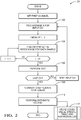
- Fig. 2 illustrates a non-limiting example of a method 100 to perform the data-compression 36.
- the average-value 38 of the sampled-data 30 in the frame 28 for the variable selected is determined in step 102.
- the method 100 proceeds to determine the percentage-difference 44 for each instance of the sampled-data 30 in step 104, and this step is repeated 'n' times where 'n' is equal to the count 52.
- the method 100 performs the discrete cosine transformation (DCT) to provide the DCT-data 46.
- DCT-data is converted into the integer-data 48.
- step 110 the integer-data 48 is converted into the encoded-data by performing arithmetic coding.
- step 112 the compressed-data, e.g. the encoded-data 50 or the percentage-data 42, and the aforementioned symbol-table, and the average-value 38 for each of the variables are stored in the memory 34.
- Fig. 3 illustrates a non-limiting example of a method 200 for decompressing that performs steps that undo the compression of data performed by the method 100.
- a data-compression system (the system 10), a controller 32 for the system 10, and a method 100, 200 of operating the system 10 is provided.
- the percentage-data 42 can be stored in the memory34, or further compression steps can be performed before data is stored in the memory 34.
Landscapes
- Engineering & Computer Science (AREA)
- Theoretical Computer Science (AREA)
- Physics & Mathematics (AREA)
- General Physics & Mathematics (AREA)
- Mathematical Physics (AREA)
- Mathematical Analysis (AREA)
- Mathematical Optimization (AREA)
- Pure & Applied Mathematics (AREA)
- Computational Mathematics (AREA)
- Data Mining & Analysis (AREA)
- General Engineering & Computer Science (AREA)
- Algebra (AREA)
- Databases & Information Systems (AREA)
- Software Systems (AREA)
- Discrete Mathematics (AREA)
- Human Computer Interaction (AREA)
- Compression, Expansion, Code Conversion, And Decoders (AREA)
Applications Claiming Priority (1)
| Application Number | Priority Date | Filing Date | Title |
|---|---|---|---|
| US15/490,367 US10411730B2 (en) | 2017-04-18 | 2017-04-18 | Data compression system for storing data from an automated vehicle |
Publications (1)
| Publication Number | Publication Date |
|---|---|
| EP3393045A1 true EP3393045A1 (de) | 2018-10-24 |
Family
ID=61911377
Family Applications (1)
| Application Number | Title | Priority Date | Filing Date |
|---|---|---|---|
| EP18164809.8A Withdrawn EP3393045A1 (de) | 2017-04-18 | 2018-03-28 | Datenkompressionssystem zur speicherung von daten aus einem automatisierten fahrzeug |
Country Status (2)
| Country | Link |
|---|---|
| US (1) | US10411730B2 (de) |
| EP (1) | EP3393045A1 (de) |
Citations (2)
| Publication number | Priority date | Publication date | Assignee | Title |
|---|---|---|---|---|
| GB2483282A (en) * | 2010-09-03 | 2012-03-07 | Advanced Risc Mach Ltd | Data compression and decompression using relative and absolute delta values |
| EP2819412A1 (de) * | 2013-06-06 | 2014-12-31 | Fujitsu Semiconductor Limited | Kodierer und Dekodierer |
Family Cites Families (3)
| Publication number | Priority date | Publication date | Assignee | Title |
|---|---|---|---|---|
| US5675382A (en) * | 1996-04-08 | 1997-10-07 | Connectix Corporation | Spatial compression and decompression for video |
| US20050193408A1 (en) * | 2000-07-24 | 2005-09-01 | Vivcom, Inc. | Generating, transporting, processing, storing and presenting segmentation information for audio-visual programs |
| US8126283B1 (en) * | 2005-10-13 | 2012-02-28 | Maxim Integrated Products, Inc. | Video encoding statistics extraction using non-exclusive content categories |
-
2017
- 2017-04-18 US US15/490,367 patent/US10411730B2/en active Active
-
2018
- 2018-03-28 EP EP18164809.8A patent/EP3393045A1/de not_active Withdrawn
Patent Citations (2)
| Publication number | Priority date | Publication date | Assignee | Title |
|---|---|---|---|---|
| GB2483282A (en) * | 2010-09-03 | 2012-03-07 | Advanced Risc Mach Ltd | Data compression and decompression using relative and absolute delta values |
| EP2819412A1 (de) * | 2013-06-06 | 2014-12-31 | Fujitsu Semiconductor Limited | Kodierer und Dekodierer |
Also Published As
| Publication number | Publication date |
|---|---|
| US20180302103A1 (en) | 2018-10-18 |
| US10411730B2 (en) | 2019-09-10 |
Similar Documents
| Publication | Publication Date | Title |
|---|---|---|
| CN117278643B (zh) | 基于云边协同的车载云标定数据传输系统 | |
| JP7226938B2 (ja) | 運転評価システム、運転評価方法、プログラム、及び媒体 | |
| US8321084B2 (en) | Control device, control method, control device of vehicle, and control system of vehicle | |
| EP3171553A1 (de) | Verfahren zur übertragung von daten wenigstens eines messgrössenaufnehmers eines steuernetzwerks, sender, empfänger, messgrössenaufnahmevorrichtung und steuernetzwerk | |
| CN110991504A (zh) | 基于motcn-ae的多维时间序列异常值检测方法及系统 | |
| US10809977B2 (en) | Analysis device, analysis method, and computer readable medium | |
| EP2702585A1 (de) | Rahmenbasierte audiosignalklassifizierung | |
| US11427141B2 (en) | Computing system, server and on-vehicle device | |
| CN112802227A (zh) | 车辆adas行驶数据的采集方法、装置、人机交互装置及车辆 | |
| CN112158149A (zh) | 加速踏板卡滞识别方法及系统 | |
| US10411730B2 (en) | Data compression system for storing data from an automated vehicle | |
| JP2003139792A (ja) | 強固なセンサ・オフセット学習アルゴリズムを用いてセンサ・オフセットを更新する方法 | |
| CN119116971A (zh) | 驾驶意图识别方法、装置、设备及存储介质 | |
| JP2001272466A (ja) | レーダ装置 | |
| EP3161809B1 (de) | System und verfahren zur klassifizierung von fahrzeugen | |
| CN117135686A (zh) | 一种基于蓝牙的车载信息交互方法及系统 | |
| CN111130552A (zh) | 数据压缩方法、数据压缩系统以及采用该系统的车辆ecu | |
| CN112421130A (zh) | 一种电池管理系统及其电压采样控制电路和电动汽车 | |
| CN113542225A (zh) | 一种数据的压缩方法、装置、终端设备及存储介质 | |
| US12464326B2 (en) | Method for transmitting a plurality of signals and method for receiving a plurality of signals | |
| DE102010062567A1 (de) | Verfahren, Sensormodul und System zur Datenübertragung | |
| WO2011012447A1 (de) | Elektronische sensorsignalauswerteschaltung in kraftfahrzeugen | |
| KR20190069789A (ko) | 저속 무선 통신을 위한 효율적인 센서 데이터 압축 및 복원 방법과 장치 | |
| CN113506065A (zh) | 配送轨迹修正方法及装置 | |
| WO2019081217A1 (de) | Verfahren und vorrichtung zum bereitstellen eines digitalen sensorsignals eines ultraschallsensors |
Legal Events
| Date | Code | Title | Description |
|---|---|---|---|
| PUAI | Public reference made under article 153(3) epc to a published international application that has entered the european phase |
Free format text: ORIGINAL CODE: 0009012 |
|
| STAA | Information on the status of an ep patent application or granted ep patent |
Free format text: STATUS: THE APPLICATION HAS BEEN PUBLISHED |
|
| AK | Designated contracting states |
Kind code of ref document: A1 Designated state(s): AL AT BE BG CH CY CZ DE DK EE ES FI FR GB GR HR HU IE IS IT LI LT LU LV MC MK MT NL NO PL PT RO RS SE SI SK SM TR |
|
| AX | Request for extension of the european patent |
Extension state: BA ME |
|
| STAA | Information on the status of an ep patent application or granted ep patent |
Free format text: STATUS: REQUEST FOR EXAMINATION WAS MADE |
|
| 17P | Request for examination filed |
Effective date: 20190424 |
|
| RBV | Designated contracting states (corrected) |
Designated state(s): AL AT BE BG CH CY CZ DE DK EE ES FI FR GB GR HR HU IE IS IT LI LT LU LV MC MK MT NL NO PL PT RO RS SE SI SK SM TR |
|
| STAA | Information on the status of an ep patent application or granted ep patent |
Free format text: STATUS: EXAMINATION IS IN PROGRESS |
|
| 17Q | First examination report despatched |
Effective date: 20201022 |
|
| STAA | Information on the status of an ep patent application or granted ep patent |
Free format text: STATUS: THE APPLICATION IS DEEMED TO BE WITHDRAWN |
|
| 18D | Application deemed to be withdrawn |
Effective date: 20210504 |