EP3387920A1 - Tipping paper and filtered cigarette product - Google Patents
Tipping paper and filtered cigarette product Download PDFInfo
- Publication number
- EP3387920A1 EP3387920A1 EP16884894.3A EP16884894A EP3387920A1 EP 3387920 A1 EP3387920 A1 EP 3387920A1 EP 16884894 A EP16884894 A EP 16884894A EP 3387920 A1 EP3387920 A1 EP 3387920A1
- Authority
- EP
- European Patent Office
- Prior art keywords
- tipping paper
- surface layer
- front surface
- paper according
- nonwoven fabric
- Prior art date
- Legal status (The legal status is an assumption and is not a legal conclusion. Google has not performed a legal analysis and makes no representation as to the accuracy of the status listed.)
- Granted
Links
Images




Classifications
-
- D—TEXTILES; PAPER
- D21—PAPER-MAKING; PRODUCTION OF CELLULOSE
- D21H—PULP COMPOSITIONS; PREPARATION THEREOF NOT COVERED BY SUBCLASSES D21C OR D21D; IMPREGNATING OR COATING OF PAPER; TREATMENT OF FINISHED PAPER NOT COVERED BY CLASS B31 OR SUBCLASS D21G; PAPER NOT OTHERWISE PROVIDED FOR
- D21H13/00—Pulp or paper, comprising synthetic cellulose or non-cellulose fibres or web-forming material
- D21H13/02—Synthetic cellulose fibres
- D21H13/08—Synthetic cellulose fibres from regenerated cellulose
-
- A—HUMAN NECESSITIES
- A24—TOBACCO; CIGARS; CIGARETTES; SIMULATED SMOKING DEVICES; SMOKERS' REQUISITES
- A24C—MACHINES FOR MAKING CIGARS OR CIGARETTES
- A24C5/00—Making cigarettes; Making tipping materials for, or attaching filters or mouthpieces to, cigars or cigarettes
- A24C5/56—Making tipping materials, e.g. sheet cork for mouthpieces of cigars or cigarettes, by mechanical means
-
- D—TEXTILES; PAPER
- D21—PAPER-MAKING; PRODUCTION OF CELLULOSE
- D21H—PULP COMPOSITIONS; PREPARATION THEREOF NOT COVERED BY SUBCLASSES D21C OR D21D; IMPREGNATING OR COATING OF PAPER; TREATMENT OF FINISHED PAPER NOT COVERED BY CLASS B31 OR SUBCLASS D21G; PAPER NOT OTHERWISE PROVIDED FOR
- D21H13/00—Pulp or paper, comprising synthetic cellulose or non-cellulose fibres or web-forming material
- D21H13/10—Organic non-cellulose fibres
- D21H13/12—Organic non-cellulose fibres from macromolecular compounds obtained by reactions only involving carbon-to-carbon unsaturated bonds
- D21H13/14—Polyalkenes, e.g. polystyrene polyethylene
-
- D—TEXTILES; PAPER
- D21—PAPER-MAKING; PRODUCTION OF CELLULOSE
- D21H—PULP COMPOSITIONS; PREPARATION THEREOF NOT COVERED BY SUBCLASSES D21C OR D21D; IMPREGNATING OR COATING OF PAPER; TREATMENT OF FINISHED PAPER NOT COVERED BY CLASS B31 OR SUBCLASS D21G; PAPER NOT OTHERWISE PROVIDED FOR
- D21H15/00—Pulp or paper, comprising fibres or web-forming material characterised by features other than their chemical constitution
- D21H15/02—Pulp or paper, comprising fibres or web-forming material characterised by features other than their chemical constitution characterised by configuration
-
- D—TEXTILES; PAPER
- D21—PAPER-MAKING; PRODUCTION OF CELLULOSE
- D21H—PULP COMPOSITIONS; PREPARATION THEREOF NOT COVERED BY SUBCLASSES D21C OR D21D; IMPREGNATING OR COATING OF PAPER; TREATMENT OF FINISHED PAPER NOT COVERED BY CLASS B31 OR SUBCLASS D21G; PAPER NOT OTHERWISE PROVIDED FOR
- D21H19/00—Coated paper; Coating material
- D21H19/10—Coatings without pigments
-
- D—TEXTILES; PAPER
- D21—PAPER-MAKING; PRODUCTION OF CELLULOSE
- D21H—PULP COMPOSITIONS; PREPARATION THEREOF NOT COVERED BY SUBCLASSES D21C OR D21D; IMPREGNATING OR COATING OF PAPER; TREATMENT OF FINISHED PAPER NOT COVERED BY CLASS B31 OR SUBCLASS D21G; PAPER NOT OTHERWISE PROVIDED FOR
- D21H19/00—Coated paper; Coating material
- D21H19/10—Coatings without pigments
- D21H19/14—Coatings without pigments applied in a form other than the aqueous solution defined in group D21H19/12
- D21H19/20—Coatings without pigments applied in a form other than the aqueous solution defined in group D21H19/12 comprising macromolecular compounds obtained by reactions only involving carbon-to-carbon unsaturated bonds
Definitions
- This invention relates to a tipping paper and a filtered cigarette product.
- a filtered cigarette product for example, a filter-tipped cigarette is an article formed by placing a cigarette rod and filter in opposition to each other and in contact with each other, and winding a tipping paper around an outer circumferential surface of the filter and around an outer circumferential surface of the cigarette rod in the vicinity of the opposed part to thereby integrate the cigarette rod and filter into one article.
- Patent Literature 1 a filter-tipped cigarette in which cigarette filter wrapping having a red color as a ground color is used, and which is thereby capable of making the lipstick adhering to the cigarette filter wrapping inconspicuous, and alleviating the feeling of discomfort of the smoker caused by the lipstick adhering to the cigarette filter wrapping to spoil the external appearance of the cigarette is disclosed.
- Patent Literature 1 JP H10-136962 A
- Patent Literature 1 is not to prevent the adhering itself of the lipstick to the cigarette filter wrapping.
- This invention relates to provide a tipping paper and a filtered cigarette product capable of reducing adhesion of lipstick to a tipping paper surface when the filtered cigarette product is smoked.
- a tipping paper characterized by including a front surface layer and back surface layer, and in which the front surface layer has surface properties satisfying a following formula (1) is provided.
- the present invention can reduce adhesion of lipstick or the like to a tipping paper surface when a filtered cigarette product is smoked.
- FIG. 1 is a schematic cross-sectional view of a tipping paper 1 according to a first embodiment.
- the tipping paper 1 is provided with a front surface layer 11 and a back surface layer 12.
- the front surface layer 11 has surface properties which satisfy a formula (1): -8.2 ⁇ Rsk-0.2 ⁇ Rc ⁇ 0.
- Rsk represents the skewness
- Rc represents the average height.
- the tipping paper has the surface properties indicated by the formula (1), whereby it is possible to reduce the area of contact between the lip and tipping paper. It is more desirable that the front surface layer 11 should have surface properties which satisfy a formula (2): -8.2 ⁇ Rsk-0.2 ⁇ Rc ⁇ -20. The surface properties indicated by the formulae (1) and (2) will be described later.
- the front surface layer 11 is normally formed of a material producing surface properties specified by the above formula (1) with respect to the upper surface profile (concavo-convex shape) thereof.
- a material include an aggregate of partially combined fibers, for example, a nonwoven fabric.
- FIG. 2 a part of the flat surface of such a nonwoven fabric is shown in an enlarging manner.
- a plurality of fibers (fibers for nonwoven fabric) 13 constituting the nonwoven fabric are combined with each other at combining parts 14 through fusion bonding substances 15 to thereby form an aggregate.
- the fiber 13 can be a fiber known as a fiber for the nonwoven fabric in the field concerned, such as a rayon fiber, cellulose acetate fiber, polyethylene terephthalate (PET) fiber, nylon fiber, polylactic acid fiber, polyolefin fiber or the like.
- the fusion bonding substance 15 is a substance formed when a binder fiber such as a polyvinyl alcohol (PVA) fiber, polyethylene glycol (PEG) fiber, vinylon fiber or the like is melted in the process of putting the front surface layer 11 and back surface layer 12 one on top of the other to dry the layers 11 and 12 to be described later, and combines the fibers 13 for the nonwoven fabric with each other.
- PVA polyvinyl alcohol
- PEG polyethylene glycol
- the nonwoven fabric may include pulp in addition to the fibers 13 for the nonwoven fabric and binder fiber. It is desirable that the nonwoven fabric should include fibers 13 having a thickness greater than or equal to 0.8dtex and should further has a basis weight greater than or equal to 10gsm. It is more desirable that the nonwoven fabric should include fibers 13 having a thickness greater than or equal to 3.3dtex and should further has a basis weight greater than or equal to 10gsm. Normally, although a thickness of fibers 13 for the nonwoven fabric varies widely depending on the type of the material of the fiber or use application of the nonwoven fabric, there are fibers 13 having thicknesses from 0.0001dtex to 1000dtex or more. Further, the basis weight of the normal nonwoven fabric varies widely according to the purpose.
- each of constituent fibers has a thickness greater than or equal to 0.8dtex and less than or equal to 20dtex, and has a basis weight greater than or equal to 10 and less than or equal to 50gsm.
- each of constituent fibers has a thickness greater than or equal to 3.3dtex and less than or equal to 20dtex, and has a basis weight greater than or equal to 10gsm and less than or equal to 50gsm.
- the nonwoven fabric may be colored by a dye such as a food additive colorant or the like. It should be noted that in this specification, the "nonwoven fabric" includes paper.
- a method of forming a nonwoven fabric for example, a dry method, a wet method, a spunbonding method, a melt-blowing method, and an air-laid method are known. Further, as a method of combining fibers constituting the nonwoven fabric with each other, for example, a chemical bonding method, a thermal bonding method, a needle punching method, and a hydro-entangling method are known.
- a chemical bonding method for the nonwoven fabric contained in the front surface layer 11 is formed by the wet method, and fibers 13 for the nonwoven fabric are combined with each other by the thermal bonding method
- the method of forming the nonwoven fabric and the method of combining the nonwoven fabric fibers 13 other generally known methods may also be used.
- a back surface layer 12 can be provided on the under surface of the front surface layer 11.
- the back surface layer 12 can be formed of a material known in the field concerned as a material for the tipping paper, for example, pulp or the like.
- the tipping paper 1 can be obtained by combining the front surface layer 11 and back surface layer 12 with each other by a papermaking method well known to those skilled in the art.
- This papermaking method includes at least a process of combining a material constituting the front surface layer 11 and material constituting the back surface layer 12 with each other, and a process of drying the resultant.
- the paper machine conventionally known ones, for example, a cylinder paper machine, inclined tanmo machine, fourdrinier paper machine, tanmo machine, and the like can be used, and paper machines can be appropriately combined according to the prescribed properties.
- This papermaking method includes, for example, a process of combining wet paper formed of a suspension of a material constituting the front surface layer 11 by means of a cylinder paper machine and wet paper formed of a suspension of a material constituting the back surface layer 12 by means of a fourdrinier paper machine with each other. Further, the wet paper combined in this way can be dried by using conventionally known drying methods such as the yankee dryer method, multi-cylinder method, hot-air method, infrared heating method, and the like. In one embodiment, the wet paper laminated body of the front surface layer 11 and back surface layer 12 can be dried by using a dryer of a temperature of 100oC to 150oC.
- fibers contained in the front surface layer 11 and having adhesiveness when melted such as polyvinyl alcohol (PVA) fibers, polyethylene glycol (PEG) fibers, vinylon fibers or the like are melted, whereby the fibers become fusion bonding substances 15 having adhesiveness and the fusion bonding substances 15 can combine fibers 13 constituting the front surface layer 11 with each other.
- PVA polyvinyl alcohol
- PEG polyethylene glycol
- vinylon fibers or the like are melted, whereby the fibers become fusion bonding substances 15 having adhesiveness and the fusion bonding substances 15 can combine fibers 13 constituting the front surface layer 11 with each other.
- the method of combining the front surface layer 11 and back surface layer 12 with each other the method is not limited to the aforementioned papermaking methods, and other conventionally known papermaking methods may also be used. As such papermaking methods, methods described in " Hand book of pulp and paper technology 1982", Japan Technical Association of the Pulp and Paper Industry, pp. 284 to 305 can be used.
- the conventional tipping paper has, like the generally used printing paper, not a structure formed by combining two layers having different physical properties, and has a single layer structure, in which the surface properties of the front surface and back surface are approximately identical and the smoothness of both the surfaces is high. For this reason, in a filter-tipped cigarette provided with the conventional tipping paper, the tipping paper tends to come into close contact with the lip of the smoker at the time of smoking. As a result, lipstick or the like attached to the lip of the smoker becomes liable to move onto the tipping paper.
- the tipping paper 1 according to this embodiment is provided with the front surface layer 11 having surface properties satisfying the above formula (1), and thereby can reduce the area of contact between the lip and tipping paper 1, and hence can reduce adhesion of a substance such as lipstick attached to the surface of the smoker's lip to the tipping paper 1. Furthermore, even when lipstick is not used, it is possible to prevent unpleasant phenomena such as adhesion of the skin of the smoker's lip to the tipping paper, coming off of the skin of the lip when the lip is released from the tipping paper, and so on from occurring.
- the quality of the tipping paper which makes it easy for the tipping paper and lip to separate from each other when the cigarette is to be released from the lip is expressed by that the lip-releasability is excellent.
- FIG. 3 a schematic cross-sectional view of a tipping paper 2 according to a second embodiment is shown.
- the tipping paper 2 according to the second embodiment has a configuration identical to the tipping paper 1 according to the first embodiment except that the front surface layer 11 and back surface layer 12 are stuck with an adhesive layer 21.
- a water-based adhesive or hot-melt adhesive can be used as the adhesive layer 21, a water-based adhesive or hot-melt adhesive.
- a water-based adhesive for example, a starch-based, cellulose-based, PVA-based, polyvinyl acetate (PVAc)-based, and ethylene-vinyl acetate (EVA)-based adhesive can be used.
- a hot-melt adhesive a resin-based, polyethylene (PE)-based, and polypropylene (PP)-based adhesive can be used.
- the resin-based adhesive layer 21 has a luster and reflects light incident on the resin-based adhesive layer 21, and hence it is possible to provide elegant tipping paper in which light leaks out of gaps between fibers of the front surface layer 11 to thereby impart a unique feeling to the tipping paper.
- a colored resultant formed by mixing the aforementioned adhesive with dye may also be used.
- FIG. 4 a schematic cross-sectional view of a tipping paper according to a third embodiment is shown.
- the tipping paper according to the third embodiment has a configuration identical to the tipping paper 1 according to the first embodiment except that a coating agent layer 31 is provided on the upper surface of the front surface layer 11.
- the coating agent layer 31 can be provided by applying a coating agent to the upper surface of the front surface layer 11. By providing the coating agent layer 31, it is possible to prevent fibers in the front surface layer 11 from falling off.
- a coating agent for example, starch, nitrocellulose or polyvinyl alcohol or a combination of these can be used. It is desirable that the coating agent be such an amount as not to significantly change the surface properties of the front surface layer 11. For example, it is desirable that the coating agent be less than or equal to 0.8gsm from the viewpoint of guaranteeing the surface properties of the nonwoven fabric.
- FIG. 5 shows the tipping paper 4 according to the fourth embodiment
- (A) is a perspective view of a back surface layer 12 of that
- (B) is a perspective view of the whole tipping paper 4.
- FIG. 6 is a schematic cross-sectional view along a line VI-VI of FIG. 5 .
- the tipping paper 4 according to the fourth embodiment is provided with a front surface layer 11, back surface layer 12, and adhesive layer 21.
- the back surface layer 12 is provided with a decorative section 41 on an upper surface (surface opposed to the front surface layer 11) thereof.
- the decorative section 41 can be provided by printing a decorative pattern on the upper surface of the back surface layer 12.
- the tipping paper 4 has a configuration identical to the tipping paper 2 according to the second embodiment except that the tipping paper 4 is provided with the decorative section 41 on the back surface layer 12, it is desirable that the adhesive to be used as the adhesive layer 21 ( FIG. 6 ) be transparent so that the decorative section 41 can be seen through from the front surface layer 11 side.
- the decorative section 41 is provided on the upper surface of the back surface layer 12, whereby the decorative section 41 can be seen through from the front surface layer 11, thereby making the tipping paper 4 excellent in design.
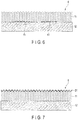
- FIG. 7 a schematic cross-sectional view of a tipping paper 5 according to a fifth embodiment is shown.
- the tipping paper 5 according to the fifth embodiment has a configuration identical to the tipping paper 1 according to the first embodiment except that a surface modifier layer 51 is provided on the upper surface of the front surface layer 11.
- the surface modifier layer 51 can be provided by applying a surface modifier configured to prevent, for example, lipstick or the like from adhering to the tipping paper to the upper surface of the front surface layer 11.
- a surface modifier configured to prevent, for example, lipstick or the like from adhering to the tipping paper to the upper surface of the front surface layer 11.
- a fluorine-based resin or silicon-based resin can be used as the surface modifier.
- the thickness of the surface modifier layer 51 can appropriately be adjusted according to the substance to be used as the surface modifier and the lipstick adhesion reducing effect required of the tipping paper 5.
- FIG. 8 a schematic cross-sectional view of a tipping paper according to a sixth embodiment is shown.
- the tipping paper according to the sixth embodiment has a configuration identical to the tipping paper 1 according to the first embodiment except that an embossed pattern is provided on the front surface layer 11.
- the embossed pattern is constituted of a convex section 61 and concave section 62.
- the embossed pattern can be provided by passing the tipping paper between a pair of embossing rolls.
- the embossing can be carried out to such a degree that the surface properties of the front surface layer 11 are not deteriorated.
- FIG. 9 a schematic cross-sectional view of a tipping paper according to a seventh embodiment is shown.
- the tipping paper 7 according to the seventh embodiment has a configuration identical to the tipping paper 2 according to the second embodiment except that a front surface layer 11 is provided with, for example, a plurality of colored sections 71 separate from each other.
- Each of the colored sections 71 extends from the upper surface of the front surface layer 11 to a plane thereof opposed to the back surface layer 12.
- the colored sections 71 can be formed by carrying out printing such as gravure printing, ink jet printing or the like using a colorant such as ink or the like.
- a filtered cigarette product according to an eighth embodiment will be described below.
- a filter-tipped cigarette will be described as an example of a filtered cigarette product
- the filtered cigarette product is not limited to this and may be other smoking articles to which a filter is connected, such as a cigar and a cigarillo in addition to non-combustion smoking supplies and unheated smoking supplies, and the like which utilize electric heating/heat of chemical reaction.
- a filter-tipped cigarette 8 is provided with a cigarette rod 81, a filter 82 arranged in such a manner that an end part thereof is placed in opposition to and in contact with an end part of the cigarette rod 81, and a tipping paper 83 wound around the whole outer circumferential surface of the filter 82 and around the outer circumferential surface part of the cigarette rod 81 near the opposition/contact position, and integrating the cigarette rod 81 and filter 82 into one body.
- the cigarette rod 81 is provided with shredded tobacco 84 and rolled paper 85 wound around the shredded tobacco 84 into a cylindrical shape.
- the filter 82 is provided with a filter material (not shown) formed by binding or folding up, for example, acetate fibers or nonwoven fabric of pulp, and filter paper 86 rolling the filter material up into a cylindrical shape.
- Such a filter-tipped cigarette 8 according to the embodiment can reduce adhesion of lipstick on the surface of the lip of the smoker to the tipping paper, while maintaining the functional characteristics (tensile strength and opacity) caused by the advantageous effects of the tipping paper according to each of the first to seventh embodiments.
- test samples different from each other in characteristics were prepared.
- Each of the test samples is provided with a front surface layer and a back surface layer.
- the front surface layer is constituted of a nonwoven fabric.
- the nonwoven fabric is formed of wood pulp and/or rayon fiber by hand making, and has different surface roughness, fiber length, and basis weight for each test samples.
- rayon fiber that having a thickness of 0.1dtex to 11.0dtex was used.
- test samples in which polyvinyl alcohol or starch was used as a coating agent for prevention of fiber falling-off were also manufactured.
- back surface layer paper formed by using wood pulp generally used as a material for tipping paper was used. Further, test samples in which the front surface layer and back surface layer were stuck with a vinyl acetate-based adhesive or resin-based adhesive were also manufactured.
- measurement of the surface roughness was carried out by using SURFTEST SJ-210 (trade name) manufactured by Mitutoyo Corporation.
- the filtering process in the surface roughness measurement was carried out by using the Gaussian filter.
- the detector that having a shape of a stylus front R of 2 ⁇ m and front edge angle of 60o was used.
- FIG. 11 is a view for explaining the method of making lipstick 95 adheres to the tipping paper 93 by using a rheometer (CR-3000EX-S manufactured by Sun Scientific Co., Ltd.).
- FIG. 11(A) is a schematic view showing a state where tipping paper 93 of a test sample is put on the rheometer.
- the rheometer is provided with a cylindrical plunger 91 having a diameter of 10mm, and measuring table 92 on which the tipping paper 93 of the test sample is to be placed.
- the tipping paper 93 of the test sample is placed on the top surface of the measuring table 92 of the rheometer.
- a gel 94 is placed on the top surface of the tipping paper 93.
- the gel 94 have elasticity and softness similar to a human lip, and "HITOHADA® gel” (trade name), product number: H0-1, manufactured by EXSEAL Co., Ltd. having such physical properties that the pressure thereof at the time of deformation by 1mm is 0.53N ⁇ 0.34 was used.
- a flat plate 96 is placed on the top surface of the gel 94.
- the flat plate 96 can equalize the pressure to be applied to the tipping paper 93 when the plunger 91 is pressed in the vertical direction against the gel 94 and the flat surface of the tipping paper 93.
- the flat plate 96 is a flat plate formed of, for example, plastic. The tipping paper 93, gel 94, and flat plate 96 are held between the plunger 91 and measuring table 92.
- FIG. 11(B) is a view showing a state where fixed pressure is applied to the flat plate 96, tipping paper 93 and gel 94 in the vertical direction for a constant time by thrusting the plunger 91 in a direction perpendicular to the planes of the flat plate 96, gel 94, and tipping paper 93.
- the pressure to be applied to the tipping paper 93 was set in such a manner that the pressure reaches the maximum pressure 2.5N after an elapse of about one second from the start of application of pressure, and becomes 0N after an elapse of about two seconds in order that the pressure can become approximately equal to the pressure to be applied to the tipping paper when the filter-tipped cigarette is actually smoked.
- Measurement of the degree of adhesion of the lipstick to the tipping paper was carried out, after the lipstick was adhered to the tipping paper by using the rheometer as described above, by measuring a color difference ⁇ E between a place on the tipping paper to which the lipstick was adhered and place to which the lipstick was not adhered.
- Measurement of the color difference ⁇ E was carried out by means of a spectrophotometer (manufactured by X-Rite Inc., product name: SpectroEye) by obtaining an average value of coordinates of the L*a*b* color coordinate system of the color difference display method specified by CIE, and calculating a color difference ⁇ E between the place on the tipping paper to which the lipstick was adhered and place to which the lipstick was not adhered. It should be noted that the condition of measurement by the spectrophotometer was made that the light source was D65, light source filter was not used, and viewing angle was set to 2o.
- the highest lipstick adhesion reducing effect was obtained by the tipping paper of the test sample which has a rayon combination ratio of 90% by weight, fibrous PVA combination ratio of 10% by weight, and basis weight of 15gsm, and in which a starch coating agent is used among the test samples.
- ⁇ E color difference
- the Rsk is increased in order to reduce the area of contact between the lip and tipping paper and/or it is sufficient if the Rc is increased in order to reduce the influence due to biting of the lip into gaps between fibers of the front surface layer.
- FIG. 12 is a view formed by setting the skewness (Rsk) to the X-axis coordinate value, and average height (Rc) to the Y-axis coordinate value, and plotting measurement results of thirty-eight test samples, and is a view showing relationships between the surface roughness and color difference ⁇ E.
- a test sample with ⁇ E ⁇ 10 is indicated by a white circular plot
- test samples with 10 ⁇ E ⁇ 20 are indicated by black circular plots
- test samples with 20 ⁇ E ⁇ 30 are indicated by white square plots
- test samples with 30 ⁇ E ⁇ 40 are indicated by black square plots, respectively.
- a measurement result of the case where existing white tipping paper having 37gsm was used as a comparative example is indicated by a white triangular plot.
- the color difference ⁇ E measured with respect to the existing white tipping paper having 37gsm of the comparative example is 51.2.
- all the color differences ⁇ E measured with respect to the tipping paper of the test samples plotted in FIG. 10 were less than 40, and were on the recognizable level.
- a state of adhesion of a substance attached to the surface of a lip to the tipping paper can be calculated by parameterizing the state of adhesion by means of the surface properties (Rsk and Rc) of the front surface layer.
- FIG. 13 is a view formed by plotting the evaluation results in a state where the horizontal axis is set to the measured color difference ⁇ E, and the longitudinal axis is set to the sensory amount. Evaluation results of the test samples are indicated by white rhombic plots, and evaluation results of the comparative example are indicated by black rhombic plots.
- each of the quadrilaterals surrounding the plotted points in figure indicates a range of variation of 1 ⁇ . That is when the variation in the results of the answers is large, the quadrilateral becomes larger and, when the variation is small, the quadrilateral becomes smaller.
- the straight lines connecting plotted points and quadrilaterals indicating the ranges of variations in the test samples and comparative example when evaluation of a case where the lipstick is not wiped off by using tissue paper or the like is to be indicated, the evaluation is indicated by a solid line and, when evaluation of a case where the lipstick is once wiped off is to be indicated, the evaluation is indicated by dotted lines.
- the comparative example was evaluated as "considerable adhesion” and, conversely, the test samples was evaluated as "a certain degree of adhesion", and the sensory amount associated with the state of adhesion of the lipstick to the tipping paper is lowered.
- ⁇ E is also about 50 in the comparative example and, conversely, ⁇ E is measured about 30 in the test samples, and is lowered like the sensory amount and, it can be seen that when the lipstick attached to the lip is not wiped off by using tissue paper or the like, there is a correlation relationship between the color difference ⁇ E and sensory amount.
- the comparative example was evaluated as "a certain degree of adhesion” and, conversely, the test samples was evaluated as "slight adhesion", and the sensory amount associated with the state of adhesion of the lipstick to the tipping paper is lowered.
- the color difference ⁇ E ⁇ E is also about 20 in the comparative example and, conversely, ⁇ E is measured about 7 in the test samples, and is lowered like the sensory amount and, it can be seen that even when the lipstick attached to the lip is once wiped off by using tissue paper or the like, there is a correlation relationship between the color difference ⁇ E and sensory amount.
- test samples have lip-releasability overwhelmingly superior to the tipping paper of the comparative example.
- the tipping paper of the test samples has a lipstick adhesion reducing effect and lip-releasability effective in the sensory evaluation.
Landscapes
- Chemical & Material Sciences (AREA)
- Chemical Kinetics & Catalysis (AREA)
- Engineering & Computer Science (AREA)
- Mechanical Engineering (AREA)
- Cigarettes, Filters, And Manufacturing Of Filters (AREA)
- Laminated Bodies (AREA)
- Paper (AREA)
Abstract
Description
- This invention relates to a tipping paper and a filtered cigarette product.
- A filtered cigarette product, for example, a filter-tipped cigarette is an article formed by placing a cigarette rod and filter in opposition to each other and in contact with each other, and winding a tipping paper around an outer circumferential surface of the filter and around an outer circumferential surface of the cigarette rod in the vicinity of the opposed part to thereby integrate the cigarette rod and filter into one article.
- When a filter-tipped cigarette is smoked in a state where the smoker is wearing lipstick, the lipstick attached to the lip of the smoker adheres to the tipping paper, and the smoker has a feeling of discomfort in some cases for the reason that the lipstick comes off the lip to require fixing of the smoker's makeup, or that the lipstick adheres to the tipping paper to thereby spoil the external appearance of the cigarette, and so on.
- In
Patent Literature 1, a filter-tipped cigarette in which cigarette filter wrapping having a red color as a ground color is used, and which is thereby capable of making the lipstick adhering to the cigarette filter wrapping inconspicuous, and alleviating the feeling of discomfort of the smoker caused by the lipstick adhering to the cigarette filter wrapping to spoil the external appearance of the cigarette is disclosed. - Patent Literature 1:
JP H10-136962 A - However, the cigarette filter wrapping disclosed in
Patent Literature 1 is not to prevent the adhering itself of the lipstick to the cigarette filter wrapping. - This invention relates to provide a tipping paper and a filtered cigarette product capable of reducing adhesion of lipstick to a tipping paper surface when the filtered cigarette product is smoked.
- According to the present invention, a tipping paper characterized by including a front surface layer and back surface layer, and in which the front surface layer has surface properties satisfying a following formula (1) is provided.

- The present invention can reduce adhesion of lipstick or the like to a tipping paper surface when a filtered cigarette product is smoked.
-
-
FIG. 1 is a schematic cross-sectional view of a tipping paper according to a first embodiment. -
FIG. 2 is a schematic enlarged view of a nonwoven fabric. -
FIG. 3 is a schematic cross-sectional view of a tipping paper according to a second embodiment. -
FIG. 4 is a schematic cross-sectional view of a tipping paper according to a third embodiment. -
FIG. 5 shows a tipping paper according to a fourth embodiment and, (A) is a perspective view of a back surface layer provided with a decorative section at an upper surface thereof, and (B) is a perspective view of the whole tipping paper. -
FIG. 6 is a schematic cross-sectional view along a line VI-VI ofFIG. 5 . -
FIG. 7 is a schematic cross-sectional view of a tipping paper according to a fifth embodiment. -
FIG. 8 is a schematic cross-sectional view of a tipping paper according to a sixth embodiment. -
FIG. 9 is a schematic cross-sectional view of a tipping paper according to a seventh embodiment. -
FIG. 10 is a perspective view showing a filtered cigarette according to an eighth embodiment. -
FIG. 11 is a view for explaining a method of attaching lipstick to tipping paper by using a rheometer. -
FIG. 12 is a view showing a relationship between the surface roughness and color difference ΔE. -
FIG. 13 is a view showing a result of a sensory evaluation. - Mode for Carrying Out the Invention Hereinafter, several embodiments will be described with reference to the accompanying drawings. Elements common throughout the embodiments are to be denoted by identical reference symbols, and duplicated explanation is omitted. Further, each drawing is a schematic view for promoting understanding of the embodiment, and there are positions different from the actual situation in shape, dimensions, and ratio. Further, in this specification, in order to indicate a relative positional relationship, although terms "above", "below", and the like are appropriately used in correlation with the drawings, these terms are not to specify the absolute positional relationship.
-
FIG. 1 is a schematic cross-sectional view of atipping paper 1 according to a first embodiment. The tippingpaper 1 is provided with afront surface layer 11 and aback surface layer 12. - The
front surface layer 11 has surface properties which satisfy a formula (1): -8.2×Rsk-0.2×Rc<0. In the formula (1), Rsk represents the skewness, and Rc represents the average height. The tipping paper has the surface properties indicated by the formula (1), whereby it is possible to reduce the area of contact between the lip and tipping paper. It is more desirable that thefront surface layer 11 should have surface properties which satisfy a formula (2): -8.2×Rsk-0.2×Rc<-20. The surface properties indicated by the formulae (1) and (2) will be described later. - The
front surface layer 11 is normally formed of a material producing surface properties specified by the above formula (1) with respect to the upper surface profile (concavo-convex shape) thereof. Examples of such a material include an aggregate of partially combined fibers, for example, a nonwoven fabric. InFIG. 2 , a part of the flat surface of such a nonwoven fabric is shown in an enlarging manner. A plurality of fibers (fibers for nonwoven fabric) 13 constituting the nonwoven fabric are combined with each other at combiningparts 14 throughfusion bonding substances 15 to thereby form an aggregate. Thefiber 13 can be a fiber known as a fiber for the nonwoven fabric in the field concerned, such as a rayon fiber, cellulose acetate fiber, polyethylene terephthalate (PET) fiber, nylon fiber, polylactic acid fiber, polyolefin fiber or the like. Thefusion bonding substance 15 is a substance formed when a binder fiber such as a polyvinyl alcohol (PVA) fiber, polyethylene glycol (PEG) fiber, vinylon fiber or the like is melted in the process of putting thefront surface layer 11 andback surface layer 12 one on top of the other to dry thelayers fibers 13 for the nonwoven fabric with each other. The nonwoven fabric may include pulp in addition to thefibers 13 for the nonwoven fabric and binder fiber. It is desirable that the nonwoven fabric should includefibers 13 having a thickness greater than or equal to 0.8dtex and should further has a basis weight greater than or equal to 10gsm. It is more desirable that the nonwoven fabric should includefibers 13 having a thickness greater than or equal to 3.3dtex and should further has a basis weight greater than or equal to 10gsm. Normally, although a thickness offibers 13 for the nonwoven fabric varies widely depending on the type of the material of the fiber or use application of the nonwoven fabric, there arefibers 13 having thicknesses from 0.0001dtex to 1000dtex or more. Further, the basis weight of the normal nonwoven fabric varies widely according to the purpose. In one preferred embodiment, in a nonwoven fabric, each of constituent fibers has a thickness greater than or equal to 0.8dtex and less than or equal to 20dtex, and has a basis weight greater than or equal to 10 and less than or equal to 50gsm. In another preferred embodiment, in a nonwoven fabric, each of constituent fibers has a thickness greater than or equal to 3.3dtex and less than or equal to 20dtex, and has a basis weight greater than or equal to 10gsm and less than or equal to 50gsm. Further, the nonwoven fabric may be colored by a dye such as a food additive colorant or the like. It should be noted that in this specification, the "nonwoven fabric" includes paper. In general, as a method of forming a nonwoven fabric, for example, a dry method, a wet method, a spunbonding method, a melt-blowing method, and an air-laid method are known. Further, as a method of combining fibers constituting the nonwoven fabric with each other, for example, a chemical bonding method, a thermal bonding method, a needle punching method, and a hydro-entangling method are known. Although the nonwoven fabric contained in thefront surface layer 11 is formed by the wet method, andfibers 13 for the nonwoven fabric are combined with each other by the thermal bonding method, as the method of forming the nonwoven fabric and the method of combining thenonwoven fabric fibers 13, other generally known methods may also be used. - In Table 1, general physical properties required of the tipping paper are shown. In order that the tipping
paper 1 can satisfy, as a whole, the general physical properties required of the tipping paper, for example, tensile strength or the like, aback surface layer 12 can be provided on the under surface of thefront surface layer 11. Theback surface layer 12 can be formed of a material known in the field concerned as a material for the tipping paper, for example, pulp or the like.Table 1 Physical Properties Units Range Tensile Strength N/15mm 26.0≤ Elongation % 1.4≤ - The tipping
paper 1 can be obtained by combining thefront surface layer 11 and backsurface layer 12 with each other by a papermaking method well known to those skilled in the art. This papermaking method includes at least a process of combining a material constituting thefront surface layer 11 and material constituting theback surface layer 12 with each other, and a process of drying the resultant. As the paper machine, conventionally known ones, for example, a cylinder paper machine, inclined tanmo machine, fourdrinier paper machine, tanmo machine, and the like can be used, and paper machines can be appropriately combined according to the prescribed properties. This papermaking method includes, for example, a process of combining wet paper formed of a suspension of a material constituting thefront surface layer 11 by means of a cylinder paper machine and wet paper formed of a suspension of a material constituting theback surface layer 12 by means of a fourdrinier paper machine with each other. Further, the wet paper combined in this way can be dried by using conventionally known drying methods such as the yankee dryer method, multi-cylinder method, hot-air method, infrared heating method, and the like. In one embodiment, the wet paper laminated body of thefront surface layer 11 and backsurface layer 12 can be dried by using a dryer of a temperature of 100ºC to 150ºC. It should be noted that at this time, fibers contained in thefront surface layer 11 and having adhesiveness when melted, such as polyvinyl alcohol (PVA) fibers, polyethylene glycol (PEG) fibers, vinylon fibers or the like are melted, whereby the fibers becomefusion bonding substances 15 having adhesiveness and thefusion bonding substances 15 can combinefibers 13 constituting thefront surface layer 11 with each other. It should be noted that regarding the method of combining thefront surface layer 11 and backsurface layer 12 with each other, the method is not limited to the aforementioned papermaking methods, and other conventionally known papermaking methods may also be used. As such papermaking methods, methods described in "Hand book of pulp and paper technology 1982", Japan Technical Association of the Pulp and Paper Industry, pp. 284 to 305 can be used. - The conventional tipping paper has, like the generally used printing paper, not a structure formed by combining two layers having different physical properties, and has a single layer structure, in which the surface properties of the front surface and back surface are approximately identical and the smoothness of both the surfaces is high. For this reason, in a filter-tipped cigarette provided with the conventional tipping paper, the tipping paper tends to come into close contact with the lip of the smoker at the time of smoking. As a result, lipstick or the like attached to the lip of the smoker becomes liable to move onto the tipping paper. Further, in the conventional tipping paper, there is sometimes a case where the lip is released from the tipping paper during smoking, the smoker's lip adheres to the tipping paper depending on the state of the smoker's lip or the environment and, when the adhesion is strong, there is even a case where the skin of the lip comes off.
- However, the tipping
paper 1 according to this embodiment is provided with thefront surface layer 11 having surface properties satisfying the above formula (1), and thereby can reduce the area of contact between the lip and tippingpaper 1, and hence can reduce adhesion of a substance such as lipstick attached to the surface of the smoker's lip to thetipping paper 1. Furthermore, even when lipstick is not used, it is possible to prevent unpleasant phenomena such as adhesion of the skin of the smoker's lip to the tipping paper, coming off of the skin of the lip when the lip is released from the tipping paper, and so on from occurring. The quality of the tipping paper which makes it easy for the tipping paper and lip to separate from each other when the cigarette is to be released from the lip is expressed by that the lip-releasability is excellent. - In
FIG. 3 , a schematic cross-sectional view of atipping paper 2 according to a second embodiment is shown. The tippingpaper 2 according to the second embodiment has a configuration identical to thetipping paper 1 according to the first embodiment except that thefront surface layer 11 and backsurface layer 12 are stuck with anadhesive layer 21. - As the
adhesive layer 21, a water-based adhesive or hot-melt adhesive can be used. As the water-based adhesive, for example, a starch-based, cellulose-based, PVA-based, polyvinyl acetate (PVAc)-based, and ethylene-vinyl acetate (EVA)-based adhesive can be used. As the hot-melt adhesive, a resin-based, polyethylene (PE)-based, and polypropylene (PP)-based adhesive can be used. When the resin-based adhesive is used as the adhesive, the resin-basedadhesive layer 21 has a luster and reflects light incident on the resin-basedadhesive layer 21, and hence it is possible to provide elegant tipping paper in which light leaks out of gaps between fibers of thefront surface layer 11 to thereby impart a unique feeling to the tipping paper. Further, as theadhesive layer 21, a colored resultant formed by mixing the aforementioned adhesive with dye may also be used. - In
FIG. 4 , a schematic cross-sectional view of a tipping paper according to a third embodiment is shown. The tipping paper according to the third embodiment has a configuration identical to thetipping paper 1 according to the first embodiment except that acoating agent layer 31 is provided on the upper surface of thefront surface layer 11. - The
coating agent layer 31 can be provided by applying a coating agent to the upper surface of thefront surface layer 11. By providing thecoating agent layer 31, it is possible to prevent fibers in thefront surface layer 11 from falling off. As the coating agent, for example, starch, nitrocellulose or polyvinyl alcohol or a combination of these can be used. It is desirable that the coating agent be such an amount as not to significantly change the surface properties of thefront surface layer 11. For example, it is desirable that the coating agent be less than or equal to 0.8gsm from the viewpoint of guaranteeing the surface properties of the nonwoven fabric. - Next, a tipping
paper 4 according to a fourth embodiment will be described below with reference toFIG. 5 andFIG. 6 . -
FIG. 5 shows the tippingpaper 4 according to the fourth embodiment, and (A) is a perspective view of aback surface layer 12 of that, and (B) is a perspective view of thewhole tipping paper 4.FIG. 6 is a schematic cross-sectional view along a line VI-VI ofFIG. 5 . The tippingpaper 4 according to the fourth embodiment is provided with afront surface layer 11, backsurface layer 12, andadhesive layer 21. As shown inFIG. 5(A) , theback surface layer 12 is provided with adecorative section 41 on an upper surface (surface opposed to the front surface layer 11) thereof. Thedecorative section 41 can be provided by printing a decorative pattern on the upper surface of theback surface layer 12. Although thetipping paper 4 has a configuration identical to thetipping paper 2 according to the second embodiment except that the tippingpaper 4 is provided with thedecorative section 41 on theback surface layer 12, it is desirable that the adhesive to be used as the adhesive layer 21 (FIG. 6 ) be transparent so that thedecorative section 41 can be seen through from thefront surface layer 11 side. - As shown in
FIG. 5(B) , in thetipping paper 4, thedecorative section 41 is provided on the upper surface of theback surface layer 12, whereby thedecorative section 41 can be seen through from thefront surface layer 11, thereby making the tippingpaper 4 excellent in design. - In
FIG. 7 , a schematic cross-sectional view of atipping paper 5 according to a fifth embodiment is shown. The tippingpaper 5 according to the fifth embodiment has a configuration identical to thetipping paper 1 according to the first embodiment except that asurface modifier layer 51 is provided on the upper surface of thefront surface layer 11. - The
surface modifier layer 51 can be provided by applying a surface modifier configured to prevent, for example, lipstick or the like from adhering to the tipping paper to the upper surface of thefront surface layer 11. As the surface modifier, for example, a fluorine-based resin or silicon-based resin can be used. By forming thesurface modifier layer 51, it is possible to further prevent substances from adhering to the surface of the tippingpaper 5. The thickness of thesurface modifier layer 51 can appropriately be adjusted according to the substance to be used as the surface modifier and the lipstick adhesion reducing effect required of the tippingpaper 5. - In
FIG. 8 , a schematic cross-sectional view of a tipping paper according to a sixth embodiment is shown. The tipping paper according to the sixth embodiment has a configuration identical to thetipping paper 1 according to the first embodiment except that an embossed pattern is provided on thefront surface layer 11. The embossed pattern is constituted of aconvex section 61 andconcave section 62. - The embossed pattern can be provided by passing the tipping paper between a pair of embossing rolls. By providing the embossed pattern on the
front surface layer 11, it is possible to obtain a more lipstick adhesion reducing effect and, at the same time, provide tipping paper excellent in design. The embossing can be carried out to such a degree that the surface properties of thefront surface layer 11 are not deteriorated. - In
FIG. 9 , a schematic cross-sectional view of a tipping paper according to a seventh embodiment is shown. The tippingpaper 7 according to the seventh embodiment has a configuration identical to thetipping paper 2 according to the second embodiment except that afront surface layer 11 is provided with, for example, a plurality ofcolored sections 71 separate from each other. - Each of the
colored sections 71 extends from the upper surface of thefront surface layer 11 to a plane thereof opposed to theback surface layer 12. Thecolored sections 71 can be formed by carrying out printing such as gravure printing, ink jet printing or the like using a colorant such as ink or the like. By providing thecolored sections 71 in thefront surface layer 11, it is possible to make a feeling different from a case where printing is carried out on normal tipping paper having a flat surface. - Next, a filtered cigarette product according to an eighth embodiment will be described below. Here, although a filter-tipped cigarette will be described as an example of a filtered cigarette product, the filtered cigarette product is not limited to this and may be other smoking articles to which a filter is connected, such as a cigar and a cigarillo in addition to non-combustion smoking supplies and unheated smoking supplies, and the like which utilize electric heating/heat of chemical reaction.
- As shown in
FIG. 10 , a filter-tippedcigarette 8 is provided with acigarette rod 81, afilter 82 arranged in such a manner that an end part thereof is placed in opposition to and in contact with an end part of thecigarette rod 81, and a tippingpaper 83 wound around the whole outer circumferential surface of thefilter 82 and around the outer circumferential surface part of thecigarette rod 81 near the opposition/contact position, and integrating thecigarette rod 81 andfilter 82 into one body. Thecigarette rod 81 is provided with shreddedtobacco 84 and rolledpaper 85 wound around the shreddedtobacco 84 into a cylindrical shape. Thefilter 82 is provided with a filter material (not shown) formed by binding or folding up, for example, acetate fibers or nonwoven fabric of pulp, andfilter paper 86 rolling the filter material up into a cylindrical shape. - Such a filter-tipped
cigarette 8 according to the embodiment can reduce adhesion of lipstick on the surface of the lip of the smoker to the tipping paper, while maintaining the functional characteristics (tensile strength and opacity) caused by the advantageous effects of the tipping paper according to each of the first to seventh embodiments. - In order to clarify a relationship between the surface properties of the tipping paper and lipstick adhering state, test samples were used to carry out (1) measurement of the lipstick adhering state and (2) sensory evaluation. Hereinafter, descriptions will be given in detail with reference to the accompanying drawings.
- First, test samples different from each other in characteristics were prepared. Each of the test samples is provided with a front surface layer and a back surface layer. The front surface layer is constituted of a nonwoven fabric. The nonwoven fabric is formed of wood pulp and/or rayon fiber by hand making, and has different surface roughness, fiber length, and basis weight for each test samples. As the rayon fiber, that having a thickness of 0.1dtex to 11.0dtex was used. Further, test samples in which polyvinyl alcohol or starch was used as a coating agent for prevention of fiber falling-off were also manufactured.
- As the back surface layer, paper formed by using wood pulp generally used as a material for tipping paper was used. Further, test samples in which the front surface layer and back surface layer were stuck with a vinyl acetate-based adhesive or resin-based adhesive were also manufactured.
- It should be noted that measurement of the surface roughness was carried out by using SURFTEST SJ-210 (trade name) manufactured by Mitutoyo Corporation. The filtering process in the surface roughness measurement was carried out by using the Gaussian filter. Further, as the detector, that having a shape of a stylus front R of 2µm and front edge angle of 60º was used. The measurement condition was obtained by setting the standard condition in conformity with ISO1997 and setting the roughness curve R to cutoff values λc=2.5mm, λs=8µm, and number of sections (N) 4.
- Adhesion of lipstick attached to the lip of a smoker to the tipping paper of a case where a filter-tipped cigarette is actually used was reproduced by using a rheometer.
FIG. 11 is a view for explaining the method of makinglipstick 95 adheres to the tippingpaper 93 by using a rheometer (CR-3000EX-S manufactured by Sun Scientific Co., Ltd.). -
FIG. 11(A) is a schematic view showing a state where tippingpaper 93 of a test sample is put on the rheometer. - The rheometer is provided with a
cylindrical plunger 91 having a diameter of 10mm, and measuring table 92 on which the tippingpaper 93 of the test sample is to be placed. Next, the tippingpaper 93 of the test sample is placed on the top surface of the measuring table 92 of the rheometer. Agel 94 is placed on the top surface of the tippingpaper 93. Thegel 94 have elasticity and softness similar to a human lip, and "HITOHADA® gel" (trade name), product number: H0-1, manufactured by EXSEAL Co., Ltd. having such physical properties that the pressure thereof at the time of deformation by 1mm is 0.53N±0.34 was used. To the lower surface of thegel 94, i.e., to the surface of the tippingpaper 93 side,lipstick 95 is applied. As thelipstick 95, Max Factor Angelic Lip Brilliante (trade name, product number B542) was used. Aflat plate 96 is placed on the top surface of thegel 94. Theflat plate 96 can equalize the pressure to be applied to the tippingpaper 93 when theplunger 91 is pressed in the vertical direction against thegel 94 and the flat surface of the tippingpaper 93. Theflat plate 96 is a flat plate formed of, for example, plastic. The tippingpaper 93,gel 94, andflat plate 96 are held between theplunger 91 and measuring table 92. -
FIG. 11(B) is a view showing a state where fixed pressure is applied to theflat plate 96, tippingpaper 93 andgel 94 in the vertical direction for a constant time by thrusting theplunger 91 in a direction perpendicular to the planes of theflat plate 96,gel 94, and tippingpaper 93. At this time, the pressure to be applied to the tippingpaper 93 was set in such a manner that the pressure reaches the maximum pressure 2.5N after an elapse of about one second from the start of application of pressure, and becomes 0N after an elapse of about two seconds in order that the pressure can become approximately equal to the pressure to be applied to the tipping paper when the filter-tipped cigarette is actually smoked. Further, at this time, setting was made in such a manner that the moving speed of theplunger 91 in the direction toward the measuring table 92 becomes 70mm/min. Thereby, thelipstick 95 attached to thegel 94 is transferred to the tippingpaper 93, and it is possible to reproduce adhesion of thelipstick 95 to the tippingpaper 93 of a case where a filter-tipped cigarette including the tippingpaper 93 of the test sample is actually used. - Measurement of the degree of adhesion of the lipstick to the tipping paper was carried out, after the lipstick was adhered to the tipping paper by using the rheometer as described above, by measuring a color difference ΔE between a place on the tipping paper to which the lipstick was adhered and place to which the lipstick was not adhered. Measurement of the color difference ΔE was carried out by means of a spectrophotometer (manufactured by X-Rite Inc., product name: SpectroEye) by obtaining an average value of coordinates of the L*a*b* color coordinate system of the color difference display method specified by CIE, and calculating a color difference ΔE between the place on the tipping paper to which the lipstick was adhered and place to which the lipstick was not adhered. It should be noted that the condition of measurement by the spectrophotometer was made that the light source was D65, light source filter was not used, and viewing angle was set to 2º.
- A measurement result obtained by the above procedures will be described. It should be noted that as a result of carrying out similar measurement with respect to existing white tipping paper having 37gsm as a comparative example, a color difference ΔE of 51.2 was obtained.
- First, relationships between the fiber length, fiber thickness, and color difference ΔE with respect to a test sample having a rayon combination ratio of 90% by weight, fibrous PVA combination ratio of 10% by weight, and basis weight of 30gsm are shown in Table 2. As is evident from Table 2, the larger the thickness of the fiber, the lower the color difference ΔE becomes, and it can be seen that it is desirable that the fibers of the nonwoven fabric be larger. Further, it was found that when the thickness of the fibers is 0.8dtex or more, the color difference ΔE is lower than the color difference ΔE of the comparative example by about 10, and a lipstick adhesion reducing effect can be obtained. Furthermore, it was found that when the thickness of the fibers is 3.3dtex or more, the color difference ΔE is lower than the color difference ΔE of the comparative example by about 30 or more, and a more lipstick adhesion reducing effect can be obtained.
Table 2 Fiber Thickness (dtx) Fiber Length (mm) Color difference ΔE Test Sample 1 0.8 2 31 Test Sample 20.8 4 43 Test Sample 30.8 10 31 Test Sample 41.7 5 31 Test Sample 51.7 10 31 Test Sample 61.7 15 22 Test Sample 73.3 5 21 Test Sample 83.3 10 18 Test Sample 9 3.3 20 25 Test Sample 107.8 8 10 Test Sample 1111 10 10 - Further, relationships between the basis weight, rayon combination ratio of the nonwoven fabric, and color difference ΔE with respect to a test sample which has a fibrous PVA combination ratio of 10% by weight, rayon combination ratio as shown in Table 3, and in which the remaining combination ratio is constituted of wood pulp, and the thickness of rayon is 7.8dtex are shown in Table 3. First, when an observation of a relationship between the basis weight and color difference ΔE is made, the lower the basis weight, the lower the color difference ΔE becomes, and hence it can be seen that it is desirable that the basis weight be lower. However, although not shown in Table 3, in a nonwoven fabric having a basis weight less than 10gsm, the gel gets into gaps between fibers of the nonwoven fabric to reach the back surface layer, and thus a result that the lipstick adhesion reducing effect was remarkably impaired was obtained, and hence it was found that it is desirable that the basis weight of a nonwoven fabric be greater than or equal to 10gsm. Next, when an observation of a relationship between the rayon combination ratio of the nonwoven fabric and color difference ΔE is made, the higher the rayon combination ratio of the nonwoven fabric, the lower the color difference ΔE becomes, and thus it can be seen that the higher the rayon combination ratio of the nonwoven fabric, the higher the lipstick adhesion reducing effect becomes.
Table 3 Basis Weight (gsm) Rayon combination ratio (%) Color difference ΔE Test Sample 12 30 40 21.6 Test Sample 1330 60 17.9 Test Sample 1430 80 11.9 Test Sample 1550 40 31.0 Test Sample 16 50 60 19.8 Test Sample 17 50 80 12.4 Test Sample 18 70 40 34.8 Test Sample 19 70 60 21.7 Test Sample 2070 80 13.6 - Further, the highest lipstick adhesion reducing effect was obtained by the tipping paper of the test sample which has a rayon combination ratio of 90% by weight, fibrous PVA combination ratio of 10% by weight, and basis weight of 15gsm, and in which a starch coating agent is used among the test samples.
- Further, data on the surface roughness and color difference ΔE obtained in the manner described above was used to carry out multiple regression analysis in which the color difference ΔE was used as an objective variable and various roughness parameters were used as dependent variables. As a result, regarding the roughness parameter, it was found that the color difference ΔE can be estimated by using two variables of the skewness Rsk and average height Rc. That is, it was found that the color difference ΔE is obtained from the skewness Rsk and average height Rc according to a formula: ΔE=-8.18×Rsk-0.21×Rc+40, and the condition of the lipstick adhering to the tipping paper can be estimated from the color difference ΔE. It should be noted that the square of the multiple correlation coefficient by the correlation analysis was r2=0.82. Further, the square (r2) of the single correlation coefficient by the single correlation analysis of each of the Rsk and Rc, r2 was 0.28 in the Rsk, and r2 was 0.67 in the Rc. When it is desired to lower the color difference ΔE, i.e., when it is desired to enhance the lipstick adhesion reducing effect, it is sufficient if the Rsk is increased in order to reduce the area of contact between the lip and tipping paper and/or it is sufficient if the Rc is increased in order to reduce the influence due to biting of the lip into gaps between fibers of the front surface layer.
-
FIG. 12 is a view formed by setting the skewness (Rsk) to the X-axis coordinate value, and average height (Rc) to the Y-axis coordinate value, and plotting measurement results of thirty-eight test samples, and is a view showing relationships between the surface roughness and color difference ΔE. It should be noted that in figure, in the measured color difference ΔE, a test sample with ΔE<10 is indicated by a white circular plot, test samples with 10≤ΔE<20 are indicated by black circular plots, test samples with 20≤ΔE<30 are indicated by white square plots, and test samples with 30≤ΔE<40 are indicated by black square plots, respectively. Further, a measurement result of the case where existing white tipping paper having 37gsm was used as a comparative example is indicated by a white triangular plot. - Further, lines in figure express straight lines specified by a ΔE=-8.18×Rsk-0.21×Rc+40 and, respectively indicate a line (solid line) of a case where ΔE in the formula of straight lines is 10, line (alternate long and short dash line) of a case where ΔE is 20, line (broken line) of a case where ΔE is 30, and line (dotted line) of a case where ΔE is 40.
- As described previously, the color difference ΔE measured with respect to the existing white tipping paper having 37gsm of the comparative example is 51.2. When assuming such a level that can be visually recognized in comparison with the color difference ΔE measured with respect to the existing white tipping paper having 37gsm of the comparative example to be a color difference ΔE=10 corresponding to one rate of the Munsell chroma, i.e., to be a level which can be recognized if the level is lower than the color difference ΔE measured with respect to the comparison example by 10 or more, all the color differences ΔE measured with respect to the tipping paper of the test samples plotted in
FIG. 10 were less than 40, and were on the recognizable level. - Assuming that, on the basis of this result, a color difference ΔE<40 smaller than the color difference ΔE measured with respect to the existing white tipping paper having 37gsm by 10 or more is in the recognizable area, it is necessary that the formula (1): -8.2×Rsk-0.2×Rc<0 should be satisfied. Further, as a more remarkable effect, when a color difference ΔE<20 smaller than the color difference ΔE measured with respect to the existing white tipping paper having 37gsm by 30 or more is required, it is necessary that the formula (2): -8.2×Rsk-0.2×Rc<-20 should be satisfied.
- As described above, it was found that a state of adhesion of a substance attached to the surface of a lip to the tipping paper can be calculated by parameterizing the state of adhesion by means of the surface properties (Rsk and Rc) of the front surface layer.
- Filter-tipped cigarettes each provided with tipping paper of the test samples were actually used by six female panelists in a state where lipstick is attached to the lip or in a state where lipstick attached to the lip is once wiped off by means of tissue paper or the like, whereby sensory evaluation of the state of adhesion of the lipstick to the tipping paper was carried out. In
FIG. 13 , the results are shown.FIG. 13 is a view formed by plotting the evaluation results in a state where the horizontal axis is set to the measured color difference ΔE, and the longitudinal axis is set to the sensory amount. Evaluation results of the test samples are indicated by white rhombic plots, and evaluation results of the comparative example are indicated by black rhombic plots. It should be noted that regarding the sensory amount in the drawing, when it was felt by the female panelists that adhesion of lipstick to the tipping paper was not found at all, evaluation was made as a numerical value of "0", when it was felt that slight adhesion of lipstick was found, evaluation was made as "1", when it was felt that adhesion of lipstick was felt to a certain degree, evaluation was made as "2", when it was felt that adhesion of lipstick was evidently found, evaluation was made as "3", when it was felt that adhesion of lipstick was considerably found, evaluation was made as "4", and when it was felt that adhesion of lipstick was remarkably found, evaluation was made as a numerical value of "5", and the sensory amount is a value acquired by averaging the numerical values obtained from the six female panelists. Further, each of the quadrilaterals surrounding the plotted points in figure indicates a range of variation of 1σ. That is when the variation in the results of the answers is large, the quadrilateral becomes larger and, when the variation is small, the quadrilateral becomes smaller. Further, regarding the straight lines connecting plotted points and quadrilaterals indicating the ranges of variations in the test samples and comparative example, when evaluation of a case where the lipstick is not wiped off by using tissue paper or the like is to be indicated, the evaluation is indicated by a solid line and, when evaluation of a case where the lipstick is once wiped off is to be indicated, the evaluation is indicated by dotted lines. - As is evident from
FIG. 13 , in the sensory evaluation of the case where the lipstick attached to the lip is not wiped off by using tissue paper or the like, the comparative example was evaluated as "considerable adhesion" and, conversely, the test samples was evaluated as "a certain degree of adhesion", and the sensory amount associated with the state of adhesion of the lipstick to the tipping paper is lowered. Further, regarding the color difference ΔE, ΔE is also about 50 in the comparative example and, conversely, ΔE is measured about 30 in the test samples, and is lowered like the sensory amount and, it can be seen that when the lipstick attached to the lip is not wiped off by using tissue paper or the like, there is a correlation relationship between the color difference ΔE and sensory amount. - Further, in the sensory evaluation of the case where the lipstick attached to the lip is once wiped off by using tissue paper or the like, the comparative example was evaluated as "a certain degree of adhesion" and, conversely, the test samples was evaluated as "slight adhesion", and the sensory amount associated with the state of adhesion of the lipstick to the tipping paper is lowered. Further, regarding the color difference ΔE, ΔE is also about 20 in the comparative example and, conversely, ΔE is measured about 7 in the test samples, and is lowered like the sensory amount and, it can be seen that even when the lipstick attached to the lip is once wiped off by using tissue paper or the like, there is a correlation relationship between the color difference ΔE and sensory amount.
- Further, when the lip-releasability of the test samples was measured in the similar manner, it was found that the test samples have lip-releasability overwhelmingly superior to the tipping paper of the comparative example.
- Thus, when a questionnaire was carried out for the above six panelists about whether or not they are charmed by the test samples and tipping paper of the comparative example as a lipstick adhesion reducing product, all the members answered "not feel charm" in the comparative example and, conversely, in the tipping paper of the test samples, one panelist answered "greatly feel charm", one panelist answered "considerably feel charm", three panelists answered "feel a certain degree of charm", one panelist answered "slightly feel charm", and thus it was found that the tipping paper of the test samples is overwhelmingly improved in charm as compared with the existing white tipping paper of the comparative example having 37gsm.
- As described above, it was demonstrated that the tipping paper of the test samples has a lipstick adhesion reducing effect and lip-releasability effective in the sensory evaluation.
- While some embodiments have been described, these embodiments have been presented by way of example, and are not intended to limit the scope of the inventions. These embodiments can be implemented in various other modes and various modifications can be made without departing from the gist of the invention. These embodiments and modifications thereof are included in the scope and gist of the invention and are included in the invention described in the claims and the equivalent scope thereof.
- 1 ··· tipping paper according to the
first embodiment 11 ···front surface layer 12 ··· backsurface layer 13 ···fiber 14 ··· combiningpart 15 ···fusion bonding substances 2 ··· tipping paper according to thesecond embodiment 21 ···adhesive layer 3 ··· tipping paper according to thethird embodiment 31 ···coating agent layer 4 ··· tipping paper according to thefourth embodiment 41 ···decorative section 5 ··· tipping paper according to thefifth embodiment 51 ···surface modifier layer 6 ··· tipping paper according to thesixth embodiment 61 ···convex section 62 ···concave section 7 ··· tipping paper according to theseventh embodiment 71 ···colored section 8 ··· filter-tippedcigarette 81 ···cigarette rod 82 ···filter 83 ··· tippingpaper 84 ···shredded tobacco 85 ··· rolledpaper 86 ···filter paper 91 ···plunger 92 ··· measuring table 93 ··· tippingpaper 94 ···gel 95 ···lipstick 96 ··· flat plate
Claims (14)
- A tipping paper characterized by comprising:a front surface layer and a back surface layer, whereinthe front surface layer possesses surface properties which satisfy a following formula (1).

- The tipping paper according to Claim 1 characterized in that the front surface layer possesses surface properties which satisfy a following formula (2) .

- The tipping paper according to Claim 1 or 2, characterized in that the front surface layer includes an aggregate of partially combined fibers.
- The Tipping paper according to Claim 1 or 2, characterized in that the front surface layer is a nonwoven fabric.
- The tipping paper according to Claim 4, characterized in that the nonwoven fabric includes rayon fiber or polyolefin fiber.
- The tipping paper according to Claim 4 or 5, characterized in that the nonwoven fabric includes fibers with a thickness of 0.8dtex or more and possesses a basis weight of 10gsm or more.
- The tipping paper according to Claim 4 or 5, characterized in that the nonwoven fabric includes fibers with a thickness of 3.3dtex or more and possesses a basis weight of 10gsm or more.
- The tipping paper according to any one of Claims 4 to 7, characterized in that the nonwoven fabric includes a coating agent constituted of a polymer.
- The tipping paper according to Claim 8, characterized in that the coating agent is constituted of starch, nitrocellulose or polyvinyl alcohol or a combination of these.
- The tipping paper according to any one of Claims 1 to 9, characterized in that the front surface layer and the back surface layer are stuck with a water-based adhesive or a hot-melt adhesive.
- The tipping paper according to any one of Claims 1 to 10, characterized in that a surface of the back surface layer opposed to the front surface layer is decorated.
- The tipping paper according to any one of Claims 1 to 11, characterized in that the front surface layer possesses a surface modifier constituted of a fluorine-based resin or a silicon-based resin on a surface.
- The tipping paper according to any one of Claims 1 to 12, characterized in that the front surface layer possesses an embossed pattern.
- A filtered cigarette product characterized by comprising:a cigarette rod;a filter; anda tipping paper connecting the cigarette rod and the filter, whereinthe tipping paper is the tipping paper according to any one of Claims 1 to 13.
Applications Claiming Priority (1)
| Application Number | Priority Date | Filing Date | Title |
|---|---|---|---|
| PCT/JP2016/050807 WO2017122291A1 (en) | 2016-01-13 | 2016-01-13 | Tipping paper and filtered cigarette product |
Publications (3)
| Publication Number | Publication Date |
|---|---|
| EP3387920A1 true EP3387920A1 (en) | 2018-10-17 |
| EP3387920A4 EP3387920A4 (en) | 2019-07-03 |
| EP3387920B1 EP3387920B1 (en) | 2021-12-29 |
Family
ID=59311739
Family Applications (1)
| Application Number | Title | Priority Date | Filing Date |
|---|---|---|---|
| EP16884894.3A Active EP3387920B1 (en) | 2016-01-13 | 2016-01-13 | Tipping paper and filtered cigarette product |
Country Status (3)
| Country | Link |
|---|---|
| EP (1) | EP3387920B1 (en) |
| JP (1) | JP6592532B2 (en) |
| WO (1) | WO2017122291A1 (en) |
Cited By (4)
| Publication number | Priority date | Publication date | Assignee | Title |
|---|---|---|---|---|
| WO2021258134A1 (en) * | 2020-06-22 | 2021-12-30 | Malan Dimopoulos | A smoking tip |
| CN116867385A (en) * | 2021-02-12 | 2023-10-10 | 日本烟草产业株式会社 | Non-combustion heated tobacco products and non-combustion heated tobacco sticks |
| EP3531847B1 (en) | 2016-10-31 | 2024-07-31 | JT International SA | A smoking article with liquid-filled capsule |
| EP3995004B1 (en) | 2019-07-01 | 2024-11-06 | Japan Tobacco Inc. | Heat-not-burn tobacco product and electrically heated tobacco product |
Families Citing this family (3)
| Publication number | Priority date | Publication date | Assignee | Title |
|---|---|---|---|---|
| JP6431998B1 (en) * | 2018-03-20 | 2018-11-28 | タツタ電線株式会社 | Conductive adhesive layer |
| JP7295225B2 (en) * | 2019-05-13 | 2023-06-20 | 日本たばこ産業株式会社 | Non-combustion heating flavor suction article and electric heating flavor suction system |
| JP7544854B2 (en) * | 2020-11-24 | 2024-09-03 | 日本たばこ産業株式会社 | FILTER SEGMENT FOR FLAVOR INHALED DEVICE, METHOD FOR MANUFACTURING SAME, AND FLAVOR INHALED DEVICE |
Family Cites Families (8)
| Publication number | Priority date | Publication date | Assignee | Title |
|---|---|---|---|---|
| US5595196A (en) * | 1992-05-27 | 1997-01-21 | Enso-Gutzeit Oy | Method of producing a filter cigarette with tipping paper having lip release properties |
| JP4125971B2 (en) * | 2003-02-19 | 2008-07-30 | 日本たばこ産業株式会社 | Ventilated filter cigarette and manufacturing system thereof |
| US20090025589A1 (en) * | 2005-12-26 | 2009-01-29 | Takahiro Mori | Support for Printing Material and Printing Plate Material |
| GB0804273D0 (en) * | 2008-03-07 | 2008-04-16 | British American Tobacco Co | Plug wrap or tipping papaer for smoking articles |
| EP2343996A1 (en) * | 2008-10-31 | 2011-07-20 | R.J. Reynolds Tobacco Company | Tipping materials for filtered cigarettes |
| WO2011114530A1 (en) * | 2010-03-19 | 2011-09-22 | 日本たばこ産業株式会社 | Tipping paper and cigarette with filter |
| US9617685B2 (en) * | 2013-04-19 | 2017-04-11 | Eastman Chemical Company | Process for making paper and nonwoven articles comprising synthetic microfiber binders |
| JP2017060406A (en) * | 2014-01-20 | 2017-03-30 | 日本たばこ産業株式会社 | Tip paper for smoking article, and smoking article using the same |
-
2016
- 2016-01-13 WO PCT/JP2016/050807 patent/WO2017122291A1/en not_active Ceased
- 2016-01-13 JP JP2017561103A patent/JP6592532B2/en not_active Expired - Fee Related
- 2016-01-13 EP EP16884894.3A patent/EP3387920B1/en active Active
Cited By (5)
| Publication number | Priority date | Publication date | Assignee | Title |
|---|---|---|---|---|
| EP3531847B1 (en) | 2016-10-31 | 2024-07-31 | JT International SA | A smoking article with liquid-filled capsule |
| EP3995004B1 (en) | 2019-07-01 | 2024-11-06 | Japan Tobacco Inc. | Heat-not-burn tobacco product and electrically heated tobacco product |
| WO2021258134A1 (en) * | 2020-06-22 | 2021-12-30 | Malan Dimopoulos | A smoking tip |
| CN116867385A (en) * | 2021-02-12 | 2023-10-10 | 日本烟草产业株式会社 | Non-combustion heated tobacco products and non-combustion heated tobacco sticks |
| EP4292449A4 (en) * | 2021-02-12 | 2025-01-08 | Japan Tobacco Inc. | TOBACCO PRODUCT FOR HEATING WITHOUT COMBUSTION AND TOBACCO STICK FOR HEATING WITHOUT COMBUSTION |
Also Published As
| Publication number | Publication date |
|---|---|
| WO2017122291A1 (en) | 2017-07-20 |
| EP3387920B1 (en) | 2021-12-29 |
| JP6592532B2 (en) | 2019-10-16 |
| JPWO2017122291A1 (en) | 2018-12-13 |
| EP3387920A4 (en) | 2019-07-03 |
Similar Documents
| Publication | Publication Date | Title |
|---|---|---|
| EP3387920B1 (en) | Tipping paper and filtered cigarette product | |
| RU2757382C1 (en) | Smoking article with a filter | |
| KR102218569B1 (en) | Absorbent body for body fluid-absorbing articles | |
| US20090032037A1 (en) | Degradable cigarette filters | |
| ES2972095T3 (en) | Hydroentangled filter material for smoking articles with improved extension behavior | |
| KR102134249B1 (en) | Smoking product and filter | |
| CN105792643B (en) | Pet tablet and method for producing pet tablet | |
| KR102915780B1 (en) | Paper sheet and method for manufacturing the same | |
| KR20200113204A (en) | Biodegradable filter with improved taste | |
| ES2547422T3 (en) | A non-woven textile material with a fabric-like texture comprising papermaking fibers, a calendering roller and method of manufacturing it | |
| JP2002173863A (en) | Surface sheet for absorbent articles | |
| US10362801B2 (en) | Wrapping paper having transparent regions | |
| JP7043257B2 (en) | Absorbent article with performance signal | |
| KR20130138924A (en) | Cigarette filter including pla laminated paper and cigarette including the same | |
| EP3437494B1 (en) | Tobacco filter wrapping paper, tobacco filter using tobacco filter wrapping paper, and cigarette using tobacco filter | |
| TW202024420A (en) | Nonwoven, use of the nonwoven, and wipe,dryer sheet, and face mask containing the nonwoven | |
| CA2694141A1 (en) | Filter and method for making a filter for a cigarette | |
| US20240114951A1 (en) | Structured filter material for nicotine delivery products | |
| AU2010230085A1 (en) | Nonwoven materal including a functional benefit and a plurality of visually distinct fibers indicative of the functional benefit | |
| EP2818060B1 (en) | Cigarette | |
| KR20240028340A (en) | Mouthpiece lining paper with nano-embossing | |
| TWI599322B (en) | Tipping paer and cigarette article having filter | |
| TWI842670B (en) | Transparent cosmetic mask and manufacturing method thereof | |
| JP2020100573A (en) | Film for skin application and transfer sheet | |
| JP7415408B2 (en) | Thin film and thin film transfer sheet |
Legal Events
| Date | Code | Title | Description |
|---|---|---|---|
| STAA | Information on the status of an ep patent application or granted ep patent |
Free format text: STATUS: THE INTERNATIONAL PUBLICATION HAS BEEN MADE |
|
| PUAI | Public reference made under article 153(3) epc to a published international application that has entered the european phase |
Free format text: ORIGINAL CODE: 0009012 |
|
| STAA | Information on the status of an ep patent application or granted ep patent |
Free format text: STATUS: REQUEST FOR EXAMINATION WAS MADE |
|
| 17P | Request for examination filed |
Effective date: 20180712 |
|
| AK | Designated contracting states |
Kind code of ref document: A1 Designated state(s): AL AT BE BG CH CY CZ DE DK EE ES FI FR GB GR HR HU IE IS IT LI LT LU LV MC MK MT NL NO PL PT RO RS SE SI SK SM TR |
|
| AX | Request for extension of the european patent |
Extension state: BA ME |
|
| DAV | Request for validation of the european patent (deleted) | ||
| DAX | Request for extension of the european patent (deleted) | ||
| A4 | Supplementary search report drawn up and despatched |
Effective date: 20190604 |
|
| RIC1 | Information provided on ipc code assigned before grant |
Ipc: D21H 19/20 20060101ALI20190528BHEP Ipc: D21H 19/10 20060101ALI20190528BHEP Ipc: D21H 15/02 20060101ALI20190528BHEP Ipc: A24C 5/56 20060101AFI20190528BHEP Ipc: D21H 13/08 20060101ALI20190528BHEP Ipc: D21H 13/14 20060101ALI20190528BHEP |
|
| STAA | Information on the status of an ep patent application or granted ep patent |
Free format text: STATUS: EXAMINATION IS IN PROGRESS |
|
| 17Q | First examination report despatched |
Effective date: 20200310 |
|
| GRAP | Despatch of communication of intention to grant a patent |
Free format text: ORIGINAL CODE: EPIDOSNIGR1 |
|
| STAA | Information on the status of an ep patent application or granted ep patent |
Free format text: STATUS: GRANT OF PATENT IS INTENDED |
|
| INTG | Intention to grant announced |
Effective date: 20210311 |
|
| RAP3 | Party data changed (applicant data changed or rights of an application transferred) |
Owner name: JAPAN TOBACCO INC. |
|
| GRAJ | Information related to disapproval of communication of intention to grant by the applicant or resumption of examination proceedings by the epo deleted |
Free format text: ORIGINAL CODE: EPIDOSDIGR1 |
|
| STAA | Information on the status of an ep patent application or granted ep patent |
Free format text: STATUS: EXAMINATION IS IN PROGRESS |
|
| GRAP | Despatch of communication of intention to grant a patent |
Free format text: ORIGINAL CODE: EPIDOSNIGR1 |
|
| STAA | Information on the status of an ep patent application or granted ep patent |
Free format text: STATUS: GRANT OF PATENT IS INTENDED |
|
| INTC | Intention to grant announced (deleted) | ||
| INTG | Intention to grant announced |
Effective date: 20210719 |
|
| GRAS | Grant fee paid |
Free format text: ORIGINAL CODE: EPIDOSNIGR3 |
|
| GRAA | (expected) grant |
Free format text: ORIGINAL CODE: 0009210 |
|
| STAA | Information on the status of an ep patent application or granted ep patent |
Free format text: STATUS: THE PATENT HAS BEEN GRANTED |
|
| AK | Designated contracting states |
Kind code of ref document: B1 Designated state(s): AL AT BE BG CH CY CZ DE DK EE ES FI FR GB GR HR HU IE IS IT LI LT LU LV MC MK MT NL NO PL PT RO RS SE SI SK SM TR |
|
| REG | Reference to a national code |
Ref country code: GB Ref legal event code: FG4D |
|
| REG | Reference to a national code |
Ref country code: CH Ref legal event code: EP |
|
| REG | Reference to a national code |
Ref country code: AT Ref legal event code: REF Ref document number: 1458017 Country of ref document: AT Kind code of ref document: T Effective date: 20220115 |
|
| REG | Reference to a national code |
Ref country code: IE Ref legal event code: FG4D |
|
| REG | Reference to a national code |
Ref country code: DE Ref legal event code: R096 Ref document number: 602016067951 Country of ref document: DE |
|
| REG | Reference to a national code |
Ref country code: LT Ref legal event code: MG9D |
|
| PG25 | Lapsed in a contracting state [announced via postgrant information from national office to epo] |
Ref country code: RS Free format text: LAPSE BECAUSE OF FAILURE TO SUBMIT A TRANSLATION OF THE DESCRIPTION OR TO PAY THE FEE WITHIN THE PRESCRIBED TIME-LIMIT Effective date: 20211229 Ref country code: LT Free format text: LAPSE BECAUSE OF FAILURE TO SUBMIT A TRANSLATION OF THE DESCRIPTION OR TO PAY THE FEE WITHIN THE PRESCRIBED TIME-LIMIT Effective date: 20211229 Ref country code: FI Free format text: LAPSE BECAUSE OF FAILURE TO SUBMIT A TRANSLATION OF THE DESCRIPTION OR TO PAY THE FEE WITHIN THE PRESCRIBED TIME-LIMIT Effective date: 20211229 Ref country code: BG Free format text: LAPSE BECAUSE OF FAILURE TO SUBMIT A TRANSLATION OF THE DESCRIPTION OR TO PAY THE FEE WITHIN THE PRESCRIBED TIME-LIMIT Effective date: 20220329 |
|
| REG | Reference to a national code |
Ref country code: NL Ref legal event code: MP Effective date: 20211229 |
|
| REG | Reference to a national code |
Ref country code: AT Ref legal event code: MK05 Ref document number: 1458017 Country of ref document: AT Kind code of ref document: T Effective date: 20211229 |
|
| PG25 | Lapsed in a contracting state [announced via postgrant information from national office to epo] |
Ref country code: SE Free format text: LAPSE BECAUSE OF FAILURE TO SUBMIT A TRANSLATION OF THE DESCRIPTION OR TO PAY THE FEE WITHIN THE PRESCRIBED TIME-LIMIT Effective date: 20211229 Ref country code: NO Free format text: LAPSE BECAUSE OF FAILURE TO SUBMIT A TRANSLATION OF THE DESCRIPTION OR TO PAY THE FEE WITHIN THE PRESCRIBED TIME-LIMIT Effective date: 20220329 Ref country code: LV Free format text: LAPSE BECAUSE OF FAILURE TO SUBMIT A TRANSLATION OF THE DESCRIPTION OR TO PAY THE FEE WITHIN THE PRESCRIBED TIME-LIMIT Effective date: 20211229 Ref country code: HR Free format text: LAPSE BECAUSE OF FAILURE TO SUBMIT A TRANSLATION OF THE DESCRIPTION OR TO PAY THE FEE WITHIN THE PRESCRIBED TIME-LIMIT Effective date: 20211229 Ref country code: GR Free format text: LAPSE BECAUSE OF FAILURE TO SUBMIT A TRANSLATION OF THE DESCRIPTION OR TO PAY THE FEE WITHIN THE PRESCRIBED TIME-LIMIT Effective date: 20220330 |
|
| PG25 | Lapsed in a contracting state [announced via postgrant information from national office to epo] |
Ref country code: NL Free format text: LAPSE BECAUSE OF FAILURE TO SUBMIT A TRANSLATION OF THE DESCRIPTION OR TO PAY THE FEE WITHIN THE PRESCRIBED TIME-LIMIT Effective date: 20211229 |
|
| PG25 | Lapsed in a contracting state [announced via postgrant information from national office to epo] |
Ref country code: SM Free format text: LAPSE BECAUSE OF FAILURE TO SUBMIT A TRANSLATION OF THE DESCRIPTION OR TO PAY THE FEE WITHIN THE PRESCRIBED TIME-LIMIT Effective date: 20211229 Ref country code: SK Free format text: LAPSE BECAUSE OF FAILURE TO SUBMIT A TRANSLATION OF THE DESCRIPTION OR TO PAY THE FEE WITHIN THE PRESCRIBED TIME-LIMIT Effective date: 20211229 Ref country code: RO Free format text: LAPSE BECAUSE OF FAILURE TO SUBMIT A TRANSLATION OF THE DESCRIPTION OR TO PAY THE FEE WITHIN THE PRESCRIBED TIME-LIMIT Effective date: 20211229 Ref country code: PT Free format text: LAPSE BECAUSE OF FAILURE TO SUBMIT A TRANSLATION OF THE DESCRIPTION OR TO PAY THE FEE WITHIN THE PRESCRIBED TIME-LIMIT Effective date: 20220429 Ref country code: ES Free format text: LAPSE BECAUSE OF FAILURE TO SUBMIT A TRANSLATION OF THE DESCRIPTION OR TO PAY THE FEE WITHIN THE PRESCRIBED TIME-LIMIT Effective date: 20211229 Ref country code: EE Free format text: LAPSE BECAUSE OF FAILURE TO SUBMIT A TRANSLATION OF THE DESCRIPTION OR TO PAY THE FEE WITHIN THE PRESCRIBED TIME-LIMIT Effective date: 20211229 Ref country code: CZ Free format text: LAPSE BECAUSE OF FAILURE TO SUBMIT A TRANSLATION OF THE DESCRIPTION OR TO PAY THE FEE WITHIN THE PRESCRIBED TIME-LIMIT Effective date: 20211229 |
|
| PG25 | Lapsed in a contracting state [announced via postgrant information from national office to epo] |
Ref country code: PL Free format text: LAPSE BECAUSE OF FAILURE TO SUBMIT A TRANSLATION OF THE DESCRIPTION OR TO PAY THE FEE WITHIN THE PRESCRIBED TIME-LIMIT Effective date: 20211229 Ref country code: AT Free format text: LAPSE BECAUSE OF FAILURE TO SUBMIT A TRANSLATION OF THE DESCRIPTION OR TO PAY THE FEE WITHIN THE PRESCRIBED TIME-LIMIT Effective date: 20211229 |
|
| REG | Reference to a national code |
Ref country code: CH Ref legal event code: PL |
|
| PG25 | Lapsed in a contracting state [announced via postgrant information from national office to epo] |
Ref country code: MC Free format text: LAPSE BECAUSE OF FAILURE TO SUBMIT A TRANSLATION OF THE DESCRIPTION OR TO PAY THE FEE WITHIN THE PRESCRIBED TIME-LIMIT Effective date: 20211229 Ref country code: IS Free format text: LAPSE BECAUSE OF FAILURE TO SUBMIT A TRANSLATION OF THE DESCRIPTION OR TO PAY THE FEE WITHIN THE PRESCRIBED TIME-LIMIT Effective date: 20220429 |
|
| REG | Reference to a national code |
Ref country code: DE Ref legal event code: R097 Ref document number: 602016067951 Country of ref document: DE |
|
| REG | Reference to a national code |
Ref country code: BE Ref legal event code: MM Effective date: 20220131 |
|
| PG25 | Lapsed in a contracting state [announced via postgrant information from national office to epo] |
Ref country code: LU Free format text: LAPSE BECAUSE OF NON-PAYMENT OF DUE FEES Effective date: 20220113 Ref country code: DK Free format text: LAPSE BECAUSE OF FAILURE TO SUBMIT A TRANSLATION OF THE DESCRIPTION OR TO PAY THE FEE WITHIN THE PRESCRIBED TIME-LIMIT Effective date: 20211229 Ref country code: AL Free format text: LAPSE BECAUSE OF FAILURE TO SUBMIT A TRANSLATION OF THE DESCRIPTION OR TO PAY THE FEE WITHIN THE PRESCRIBED TIME-LIMIT Effective date: 20211229 |
|
| PLBE | No opposition filed within time limit |
Free format text: ORIGINAL CODE: 0009261 |
|
| STAA | Information on the status of an ep patent application or granted ep patent |
Free format text: STATUS: NO OPPOSITION FILED WITHIN TIME LIMIT |
|
| PG25 | Lapsed in a contracting state [announced via postgrant information from national office to epo] |
Ref country code: BE Free format text: LAPSE BECAUSE OF NON-PAYMENT OF DUE FEES Effective date: 20220131 |
|
| 26N | No opposition filed |
Effective date: 20220930 |
|
| PG25 | Lapsed in a contracting state [announced via postgrant information from national office to epo] |
Ref country code: LI Free format text: LAPSE BECAUSE OF NON-PAYMENT OF DUE FEES Effective date: 20220131 Ref country code: CH Free format text: LAPSE BECAUSE OF NON-PAYMENT OF DUE FEES Effective date: 20220131 |
|
| PG25 | Lapsed in a contracting state [announced via postgrant information from national office to epo] |
Ref country code: IE Free format text: LAPSE BECAUSE OF NON-PAYMENT OF DUE FEES Effective date: 20220113 |
|
| PG25 | Lapsed in a contracting state [announced via postgrant information from national office to epo] |
Ref country code: SI Free format text: LAPSE BECAUSE OF FAILURE TO SUBMIT A TRANSLATION OF THE DESCRIPTION OR TO PAY THE FEE WITHIN THE PRESCRIBED TIME-LIMIT Effective date: 20211229 |
|
| P01 | Opt-out of the competence of the unified patent court (upc) registered |
Effective date: 20230530 |
|
| PG25 | Lapsed in a contracting state [announced via postgrant information from national office to epo] |
Ref country code: HU Free format text: LAPSE BECAUSE OF FAILURE TO SUBMIT A TRANSLATION OF THE DESCRIPTION OR TO PAY THE FEE WITHIN THE PRESCRIBED TIME-LIMIT; INVALID AB INITIO Effective date: 20160113 |
|
| PG25 | Lapsed in a contracting state [announced via postgrant information from national office to epo] |
Ref country code: MK Free format text: LAPSE BECAUSE OF FAILURE TO SUBMIT A TRANSLATION OF THE DESCRIPTION OR TO PAY THE FEE WITHIN THE PRESCRIBED TIME-LIMIT Effective date: 20211229 Ref country code: CY Free format text: LAPSE BECAUSE OF FAILURE TO SUBMIT A TRANSLATION OF THE DESCRIPTION OR TO PAY THE FEE WITHIN THE PRESCRIBED TIME-LIMIT Effective date: 20211229 |
|
| PG25 | Lapsed in a contracting state [announced via postgrant information from national office to epo] |
Ref country code: TR Free format text: LAPSE BECAUSE OF FAILURE TO SUBMIT A TRANSLATION OF THE DESCRIPTION OR TO PAY THE FEE WITHIN THE PRESCRIBED TIME-LIMIT Effective date: 20211229 |
|
| PG25 | Lapsed in a contracting state [announced via postgrant information from national office to epo] |
Ref country code: MT Free format text: LAPSE BECAUSE OF FAILURE TO SUBMIT A TRANSLATION OF THE DESCRIPTION OR TO PAY THE FEE WITHIN THE PRESCRIBED TIME-LIMIT Effective date: 20211229 |
|
| PGFP | Annual fee paid to national office [announced via postgrant information from national office to epo] |
Ref country code: DE Payment date: 20250121 Year of fee payment: 10 |
|
| PGFP | Annual fee paid to national office [announced via postgrant information from national office to epo] |
Ref country code: FR Payment date: 20250127 Year of fee payment: 10 |
|
| PGFP | Annual fee paid to national office [announced via postgrant information from national office to epo] |
Ref country code: IT Payment date: 20250129 Year of fee payment: 10 Ref country code: GB Payment date: 20250128 Year of fee payment: 10 |