EP3385914A1 - Verfahren zur steuerung eines vorrichtung zur erzeugung einer umgebung der erweiterten realität - Google Patents
Verfahren zur steuerung eines vorrichtung zur erzeugung einer umgebung der erweiterten realität Download PDFInfo
- Publication number
- EP3385914A1 EP3385914A1 EP16871136.4A EP16871136A EP3385914A1 EP 3385914 A1 EP3385914 A1 EP 3385914A1 EP 16871136 A EP16871136 A EP 16871136A EP 3385914 A1 EP3385914 A1 EP 3385914A1
- Authority
- EP
- European Patent Office
- Prior art keywords
- model
- image
- photo
- colors
- user device
- Prior art date
- Legal status (The legal status is an assumption and is not a legal conclusion. Google has not performed a legal analysis and makes no representation as to the accuracy of the status listed.)
- Withdrawn
Links
Images


Classifications
-
- G—PHYSICS
- G06—COMPUTING OR CALCULATING; COUNTING
- G06T—IMAGE DATA PROCESSING OR GENERATION, IN GENERAL
- G06T15/00—Three-dimensional [3D] image rendering
- G06T15/08—Volume rendering
-
- G—PHYSICS
- G06—COMPUTING OR CALCULATING; COUNTING
- G06T—IMAGE DATA PROCESSING OR GENERATION, IN GENERAL
- G06T19/00—Manipulating three-dimensional [3D] models or images for computer graphics
- G06T19/006—Mixed reality
-
- G—PHYSICS
- G06—COMPUTING OR CALCULATING; COUNTING
- G06K—GRAPHICAL DATA READING; PRESENTATION OF DATA; RECORD CARRIERS; HANDLING RECORD CARRIERS
- G06K19/00—Record carriers for use with machines and with at least a part designed to carry digital markings
- G06K19/06—Record carriers for use with machines and with at least a part designed to carry digital markings characterised by the kind of the digital marking, e.g. shape, nature, code
- G06K19/06009—Record carriers for use with machines and with at least a part designed to carry digital markings characterised by the kind of the digital marking, e.g. shape, nature, code with optically detectable marking
- G06K19/06037—Record carriers for use with machines and with at least a part designed to carry digital markings characterised by the kind of the digital marking, e.g. shape, nature, code with optically detectable marking multi-dimensional coding
-
- G—PHYSICS
- G06—COMPUTING OR CALCULATING; COUNTING
- G06K—GRAPHICAL DATA READING; PRESENTATION OF DATA; RECORD CARRIERS; HANDLING RECORD CARRIERS
- G06K7/00—Methods or arrangements for sensing record carriers, e.g. for reading patterns
- G06K7/10—Methods or arrangements for sensing record carriers, e.g. for reading patterns by electromagnetic radiation, e.g. optical sensing; by corpuscular radiation
- G06K7/14—Methods or arrangements for sensing record carriers, e.g. for reading patterns by electromagnetic radiation, e.g. optical sensing; by corpuscular radiation using light without selection of wavelength, e.g. sensing reflected white light
- G06K7/1404—Methods for optical code recognition
- G06K7/1408—Methods for optical code recognition the method being specifically adapted for the type of code
- G06K7/1417—2D bar codes
-
- G—PHYSICS
- G06—COMPUTING OR CALCULATING; COUNTING
- G06T—IMAGE DATA PROCESSING OR GENERATION, IN GENERAL
- G06T17/00—Three-dimensional [3D] modelling for computer graphics
-
- G—PHYSICS
- G06—COMPUTING OR CALCULATING; COUNTING
- G06T—IMAGE DATA PROCESSING OR GENERATION, IN GENERAL
- G06T19/00—Manipulating three-dimensional [3D] models or images for computer graphics
- G06T19/20—Editing of three-dimensional [3D] images, e.g. changing shapes or colours, aligning objects or positioning parts
-
- G—PHYSICS
- G06—COMPUTING OR CALCULATING; COUNTING
- G06V—IMAGE OR VIDEO RECOGNITION OR UNDERSTANDING
- G06V10/00—Arrangements for image or video recognition or understanding
- G06V10/20—Image preprocessing
- G06V10/36—Applying a local operator, i.e. means to operate on image points situated in the vicinity of a given point; Non-linear local filtering operations, e.g. median filtering
-
- G—PHYSICS
- G06—COMPUTING OR CALCULATING; COUNTING
- G06V—IMAGE OR VIDEO RECOGNITION OR UNDERSTANDING
- G06V10/00—Arrangements for image or video recognition or understanding
- G06V10/40—Extraction of image or video features
-
- G—PHYSICS
- G06—COMPUTING OR CALCULATING; COUNTING
- G06V—IMAGE OR VIDEO RECOGNITION OR UNDERSTANDING
- G06V10/00—Arrangements for image or video recognition or understanding
- G06V10/40—Extraction of image or video features
- G06V10/42—Global feature extraction by analysis of the whole pattern, e.g. using frequency domain transformations or autocorrelation
-
- G—PHYSICS
- G06—COMPUTING OR CALCULATING; COUNTING
- G06V—IMAGE OR VIDEO RECOGNITION OR UNDERSTANDING
- G06V10/00—Arrangements for image or video recognition or understanding
- G06V10/70—Arrangements for image or video recognition or understanding using pattern recognition or machine learning
- G06V10/74—Image or video pattern matching; Proximity measures in feature spaces
- G06V10/75—Organisation of the matching processes, e.g. simultaneous or sequential comparisons of image or video features; Coarse-fine approaches, e.g. multi-scale approaches; using context analysis; Selection of dictionaries
-
- G—PHYSICS
- G06—COMPUTING OR CALCULATING; COUNTING
- G06V—IMAGE OR VIDEO RECOGNITION OR UNDERSTANDING
- G06V20/00—Scenes; Scene-specific elements
- G06V20/20—Scenes; Scene-specific elements in augmented reality scenes
-
- G—PHYSICS
- G06—COMPUTING OR CALCULATING; COUNTING
- G06V—IMAGE OR VIDEO RECOGNITION OR UNDERSTANDING
- G06V30/00—Character recognition; Recognising digital ink; Document-oriented image-based pattern recognition
- G06V30/10—Character recognition
- G06V30/14—Image acquisition
- G06V30/144—Image acquisition using a slot moved over the image; using discrete sensing elements at predetermined points; using automatic curve following means
-
- G—PHYSICS
- G06—COMPUTING OR CALCULATING; COUNTING
- G06F—ELECTRIC DIGITAL DATA PROCESSING
- G06F18/00—Pattern recognition
- G06F18/20—Analysing
- G06F18/22—Matching criteria, e.g. proximity measures
-
- G—PHYSICS
- G06—COMPUTING OR CALCULATING; COUNTING
- G06F—ELECTRIC DIGITAL DATA PROCESSING
- G06F3/00—Input arrangements for transferring data to be processed into a form capable of being handled by the computer; Output arrangements for transferring data from processing unit to output unit, e.g. interface arrangements
- G06F3/14—Digital output to display device ; Cooperation and interconnection of the display device with other functional units
-
- G—PHYSICS
- G06—COMPUTING OR CALCULATING; COUNTING
- G06T—IMAGE DATA PROCESSING OR GENERATION, IN GENERAL
- G06T2219/00—Indexing scheme for manipulating 3D models or images for computer graphics
- G06T2219/20—Indexing scheme for editing of 3D models
- G06T2219/2012—Colour editing, changing, or manipulating; Use of colour codes
Definitions
- the invention relates to processing and generation of image data, image analysis, including texture and 3D image visualization.
- the closest in technical substance prototype is a computer-implemented method, comprising: using a user device receiving sensory data for a physical object located in close proximity to a user, said data generated by sensors associated with a user device; recognizing the object; generating a virtual object having a predetermined relationship with a physical object in response to the object recognition; and transmitting the virtual object to the display associated with the user device for presentation to the user in accordance with the aforementioned predetermined relationship (see RU 2013154098 A , cl. G06F 15/16).
- a known method can be used to create a virtual object related to a real physical object.
- the disadvantage of the known method is lack of ability to create an augmented reality environment with respect to remote objects due to the use of the sensors to obtain data thereby only detecting effects on the sensor.
- Another disadvantage of the known method is lack of ability to provide high reliability of recognition of the objects that are similar in their characteristics due to the lack of additional data about the object in addition to the data generated by the sensor.
- Another drawback of the known solution is that it does not disclose details of the formation of a virtual object. From the indication that the virtual object is being transmitted to the display associated with the user device, it can be concluded that the virtual object is generated remotely, which means high requirements for communication with the remote generation means in terms of communication speed for transferring large amounts of data.
- the use of the known method does not provide a capability to differentiate access to content depending on user's qualities, for example, according to professional or age criteria.
- the technical objective addressed herein is to provide a capability to create an augmented reality environment with respect to physical objects, including, remote objects using photo or video images of the physical object, while increasing the reliability of recognition of objects that are similar by their characteristics by using a unique activation codes associated with specific objects, simplifying the implementation by reducing requirements for communication means, as well as providing a capability to restrict user access to the formation of augmented reality environment by a certain criterion.
- the above result is achieved by the method of forming an augmented reality environment using a user device consisting in obtaining data associated with an object from sensors of the user device, recognizing the object and generating a virtual object, authenticating an activation code identifying a set of pictures containing a plurality of objects, obtaining data associated with the object in the form of at least one photo or video image frame containing the object, the object recognition is performed on the photo or video frame by comparing with images stored in the memory of the user device, generating a virtual object as a 3D model displayed in real time at the screen of the user device over the frames of the received photo or video image, wherein the object in relation to which the 3D model is formed, is a two-dimensional image of at least one object depicted in a combined set of pictures, which was associated to the activation code.
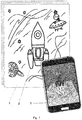
- FIG. 1 shows an example of the formation of augmented reality environment using a user device
- FIG. 2 is a block diagram of the augmented reality environment forming device
- FIG. 3 algorithm for controlling the processor of the user device computing means.
- the method for controlling device adapted to form augmented reality environment provides formation of augmented reality environment using a user device and an activation server, the method comprises the following steps:
- the object in relation to which the augmented reality environment is created is a two-dimensional image of at least one object represented by the picture ( Fig. 1 ).
- Pictures are combined into a set consisting of several pictures, provided with an activation code, which is either a code word containing a sequence of letters and / or numbers, or a two-dimensional image that can be scanned with a photo or video camera.
- the authenticity of the activation code is verified, said code identifying a set of pictures containing objects to be displayed as a 3D model.
- the activation code starts the process of rendering of a 3D spatial model, during which at least one photo or video image frame of the object is acquired by means of a camera or video camera of the user device.
- the object is recognized on the frame, and then a 3D model is formed having a semantic connection to the object, its image reproduced in real time by display means over the frames of the received photo or video image.
- a frame of a photo or video image of the object is acquired, wherein if more than one frame of the photo or video image is acquired, a frame is selected based upon picture quality.
- a 3D model is formed in color, with the coloring being performed in one of three approached.
- the first coloring approach comprises forming a transformation matrix to transform coordinates of the photo image into its own, namely the Cartesian coordinates characterized by the orthogonality of the axes, and color elements of the 3D model into the colors of the corresponding photo image elements by forming the texture of the image by reading area using the coordinate transformation matrix and interpolating the data with subsequent assignment to the 3D texture model, so that the corresponding polygons are covered by the corresponding sections of texture by preforming texture coordinates at stage of texturizing.
- the second coloring approach comprises forming a transformation matrix for transforming coordinates of the photo image into its own, namely the Cartesian coordinates characterized by the orthogonality of the axes, coloring elements of the 3D model in the colors of the corresponding photo elements by determining the colors of the 3D model materials based on the color reading at predetermined points of the photo image using the coordinate transformation matrix, and then assigning colors to the corresponding materials of the 3D model.
- the third coloring approach comprises forming a matrix for converting the coordinates of the photo image into its own, namely the Cartesian coordinates characterized by the orthogonality of the axes, coloring elements of the 3D model in the colors of the corresponding photo elements by creating a texture consisting of photo sections, solid colors taken at predetermined points of the photo image, using the coordinate transformation matrix.
- the method for forming an augmented reality environment using a user device is used as follows.
- the augmented reality effect is created using a user device that is a mobile device comprising a built-in photo or video camera, computing means, memory means, input and display means for displaying images, and also using a server hardware providing an appropriate interface to the user device.
- the mobile device is configured to exchange signals with the server using the Internet and is provided with an appropriate wireless communication means.
- the objects in relation to which the effect of the augmented reality is formed are two-dimensional images, generally a set of pictures.
- a spatial 3D model is created for each such picture.
- Said 3D model can be shown on the display in a form of static image or video sequence, for example, an animated image.
- a certain number of pictures for example in the amount of 20, are combined into a set to which an activation code is associated.
- the activation code is a codeword or other two-dimensional image that can be scanned with the built-in photo or video camera, printed on a special area, for example on the cover, so that it remains hidden until the set of pictures is opened.
- a codeword is an alphanumeric sequence containing letters and / or numbers made by one of known fonts.
- Activation codes are generated in advance in the batch mode: at least 1000 units in the packet. During formation of batches, activation codes are checked for uniqueness in relation to previously generated activation codes. Formed batches are stored on the activation server, which provides an interface for working with activation codes.
- the activation code corresponds to a specific set of objects, and its uniqueness makes it possible to use it as an additional feature that delimits sets of objects that are close in their parameters, for example, it allows separating images of the same type of cars by their brands.
- the process of managing the augmented reality means primarily involves authenticating the activation code corresponding to the set of pictures used, using the interface implemented on the activation server. For this purpose, using information input means a codeword is entered into the corresponding field of one of the initial pages of the mobile management program, or an activation code image is read using a video or camera built into the user device, then recognizing its constituent symbols and after a preliminary check by the computing means the user device, it is sent to the server to obtain permission to activate the process of forming the augmented reality environment. In the case of a positive result of the test, the server generates an activation command for the process of forming the augmented reality environment and transmits it to the user device.
- the user device control program activated this way generates a signal processing command coming from the output of the photo or video camera, by which the image of the object is captured by pointing said photo or video camera of the user device to one of the pictures in the set. At least one frame is obtained with an image of the corresponding figure, on which, by means of the computing means, an object corresponding to the picture is recognized.
- the signals from the photo or video camera output are applied to the input means of the display to show the captured image.
- selection is made based upon image quality.
- An image of the 3D model is rendered in color, while the elements are colored in any acceptable way, including the following options.
- Initial data for coloring is the following:
- the first approach comprises forming a matrix for converting the coordinates of the photo image into its own, namely Cartesian coordinates characterized by the orthogonality of the axes, coloring the 3D model polygons (elements) in the colors of the corresponding photo or video elements by forming the texture of the image reading area using the coordinate transformation matrix and interpolating the data with the subsequent assignment of the texture of the 3D model, such that the corresponding polygons are covered by the corresponding sections of the texture pre-formed at the texturizing step,
- a "Material” is assigned to a group of model polygons and has a number of settings.
- the color can be set either simply by specifying the color or by assigning a texture (picture + coordinates of its sweep along the model).
- Textture is any digital image that is used / planned to be used as a "color” of the 3D model.
- Coordinats of the texture - data that maps the 3D model polygons to the areas of the texture.
- One section of texture can correspond to several polygons. Another name for the coordinates of the texture is a scan or wrap/unwrap.
- the coloring of the first approach comprises: obtaining an image frame, restoring the "orthogonal" marker image using the marker coordinates supplied by the recognition means, superimposing it on the model as a texture using a pre-made orthogonal unwrap.
- the second approach comprises forming a transformation matrix for converting the coordinates of the photo image into its own, namely the Cartesian coordinates characterized by the orthogonality of the axes, coloring the polygons of the 3D model into the colors of the corresponding photo elements by determining the colors of the 3D model materials based on color reading, at predetermined image points using the coordinate transformation matrix, and then assigning colors to the corresponding 3D model materials.
- the second coloring approach comprises: obtaining an image frame, reading the color at the given points in the frame, using the marker coordinates supplied by the recognition means, then applying it to the model as a texture using a pre-made orthogonal scan, the model materials are assigned these colors.
- a point on the marker is pre-aligned with certain model area.
- a new texture is generated based on pre-created masks.
- Masks of the corresponding colors are superimposed on the new texture in the given order, forming an image in the "normal" unwrap, and further on the resulting texture additional maps of illumination / shadows etc. are applied.
- the third approach comprises forming a transformation matrix for converting the coordinates of the photo image into its own, namely the Cartesian coordinates characterized by the orthogonality of the axes, coloring the elements of the 3D model into the colors of the corresponding photo elements by creating a texture consisting of photo segments, at predetermined points of the photo image, using the coordinate transformation matrix.
- the coloring of the third approach comprises: obtaining an image frame, restoring the "orthogonal" marker image using the marker coordinates supplied by the recognition means, generating a new texture in the "normal” unwrap using element-by-element transfer of the entire image from the marker.
- the transfer occurs by relating the two unwrap coordinates - conventional and planar.
- Each polygon of the model is present on both unwraps, thereby associating these areas, and then, if necessary, additional light / shadow maps, etc., are applied over the resulting texture.
- an "erasure" of marker lines can be used by replacing colors of certain pixels with the colors of neighboring pixels. Namely, for removing the contours of the object to be painted on the 3D texture model created, the pre-established areas are colored with colors of the adjacent pixels.
- Additional texture elements are also applied to the texture created for the 3D model, in particular an ambient occlusion map is applied.
- the final image signals are generated wherein the 3D model image is superimposed on the image from the output of the photo or video camera and fed to display input, so that the 3D model image is reproduced over the real-time image, captured photo or video camera.
- the method for forming an augmented reality environment using a user device is implemented using a photo or video camera, which makes it possible to form an augmented reality environment with respect to any object in the field of view of the object, both close and remote.
- the activation code can be used as a detailed set of figures containing objects, facilitating the selection from the memory of images of only a certain category for object recognition, which increases the reliability of correct recognition of objects.
- the server involved in the implementation of the method is used to verify the validity of the activation code, so the communication channel with the server does not require the use of powerful and high-speed communication facilities, which simplifies the hardware implementation of the method.
- the method of forming the augmented reality environment using the user device allows it to be restricted to users who do not have access to the method.
- the criteria for such a restriction can be, for example, the age of the user, thereby restricting the content provided by the implementation to such a user.
- Another example of the restriction criteria may be a professional status of the user affecting the degree of access to confidential information allowed to him. Restrictions may be determined by other criteria.
- the device adapted to form augmented reality comprises a user device, preferably a mobile device comprising computing means connected to the inputs / outputs of memory means, a photo or video camera, a display, information input means, audio output means and means for communication with the server, which is a wireless data transfer node, within the framework of Wi-Fi standards or GPRS standards, or LTE, or the like, for communication with the server, and an activation server equipped with validation means to check validity of the activation code, memory means for storing the activation codes and connected with the user device via the Internet.
- the computing means comprise means for recognizing the activation code, means for checking the activation code, object recognition means, means for forming a 3D model, memory means, and means for generating signals of the resulting image.
- the computing means assume the following operating procedure ( Figure 3 ).
- the activation code data is obtained, which is manually entered by the user using input means or by pointing the photo or video camera to its image.
- Input tools can be control buttons, buttons of the touch keyboard, a voice input node or a photo or video camera.
- the activation code is then verified according to the formal characteristics by comparing the length, and / or parity, and / or allowable symbols, etc., with valid values.
- the activation code data is transmitted by the communication means to the server.
- the server checks the validity of the code by comparing it with the codes stored in its memory.
- the server command is used to activate or unlock the process of managing the formation of the augmented reality environment. If the test results are negative, then the process ends.
- An image is obtained from the output of a photo or video camera pointed by the user to the picture comprising the object.
- the computation means access the memory to locate and recognize an object on the captured image by comparing it with stored object images.
- a 3D model is created that is associated with the recognized object.
- the output of the final image signals is generated.
- the augmented reality forming means comprise a user device, which comprises a mobile communication device equipped with a built-in video camera, computing means, memory means, input means in the form of touch buttons, an integrated display and communication means for communication with the server via the Internet, and also the activation server itself.
- the objects in relation to which the augmented reality is being formed are pictures printed on sheets of paper collected in a pre-sealed album, on the inside of the cover of which a code word is printed.
- the user by unsealing the album, accesses the codeword of said album.
- the user By launching the corresponding application in the mobile communication device, the user enters in the corresponding field of the application the codeword, which in the form of signals is fed to the input of the computing means, wherein the formal characteristics are checked and then the codeword is transmitted to the server by means of communication to verify compliance with one of the stored on the server codewords.
- the server computing means checks the user-entered codeword for authenticity using the interface implemented on the activation server.
- a signal is generated to allow the user device to create an augmented reality environment that is transmitted via the Internet to the mobile communication means and thus unlocks the corresponding application.
- the user directs the video camera of the mobile communication device to one of the album pictures, enabling the camera to capture the image of the object, as well as its detection and recognition by the computing means.
- the computing means access the memory of the mobile device, wherein the images of the objects contained in the album are stored.
- a spatial model is formed and displayed as a corresponding video sequence on the display over the captured image.
- the audio output means is used to reproduce sound effects associated with the reproduced image of the 3D model.
- the method for generating augmented reality environment using a user device can be implemented using standard components and an electronic component base including independent modules such as a camera, display, processor, etc.
- the method of forming an augmented reality environment using a user device allows to create an augmented reality environment with respect to objects, including remote objects, by using a photo or video image of a physical object, provides increased reliability of recognition of objects close in their characteristics by using a unique activation code associated with specific objects, simplifies implementation by reducing the requirements for communications, and provides the ability to restrict access to the formation of an augmented reality environment for certain users.
Landscapes
- Engineering & Computer Science (AREA)
- Physics & Mathematics (AREA)
- Theoretical Computer Science (AREA)
- General Physics & Mathematics (AREA)
- Computer Vision & Pattern Recognition (AREA)
- Multimedia (AREA)
- Computer Graphics (AREA)
- Software Systems (AREA)
- General Engineering & Computer Science (AREA)
- Computer Hardware Design (AREA)
- Artificial Intelligence (AREA)
- Health & Medical Sciences (AREA)
- General Health & Medical Sciences (AREA)
- Architecture (AREA)
- Evolutionary Computation (AREA)
- Toxicology (AREA)
- Electromagnetism (AREA)
- Geometry (AREA)
- Computing Systems (AREA)
- Databases & Information Systems (AREA)
- Medical Informatics (AREA)
- Data Mining & Analysis (AREA)
- Nonlinear Science (AREA)
- Human Computer Interaction (AREA)
- Life Sciences & Earth Sciences (AREA)
- Bioinformatics & Cheminformatics (AREA)
- Bioinformatics & Computational Biology (AREA)
- Evolutionary Biology (AREA)
- Processing Or Creating Images (AREA)
Applications Claiming Priority (2)
| Application Number | Priority Date | Filing Date | Title |
|---|---|---|---|
| RU2015151481A RU2606874C1 (ru) | 2015-12-02 | 2015-12-02 | Способ управления устройством формирования среды дополненной реальности |
| PCT/RU2016/050075 WO2017095273A1 (ru) | 2015-12-02 | 2016-11-27 | Способ управления устройством формирования среды дополненной реальности |
Publications (2)
| Publication Number | Publication Date |
|---|---|
| EP3385914A1 true EP3385914A1 (de) | 2018-10-10 |
| EP3385914A4 EP3385914A4 (de) | 2019-08-14 |
Family
ID=58452426
Family Applications (1)
| Application Number | Title | Priority Date | Filing Date |
|---|---|---|---|
| EP16871136.4A Withdrawn EP3385914A4 (de) | 2015-12-02 | 2016-11-27 | Verfahren zur steuerung eines vorrichtung zur erzeugung einer umgebung der erweiterten realität |
Country Status (6)
| Country | Link |
|---|---|
| US (1) | US10706627B2 (de) |
| EP (1) | EP3385914A4 (de) |
| KR (1) | KR102545296B1 (de) |
| CN (1) | CN108369749B (de) |
| RU (1) | RU2606874C1 (de) |
| WO (1) | WO2017095273A1 (de) |
Families Citing this family (12)
| Publication number | Priority date | Publication date | Assignee | Title |
|---|---|---|---|---|
| RU2667602C2 (ru) * | 2017-03-15 | 2018-09-21 | Общество с ограниченной ответственностью "АВИАРЕАЛ" | Способ формирования изображения дополненной реальности, обеспечивающий совпадение визуальных характеристик реальных и виртуальных объектов |
| CN108182730B (zh) | 2018-01-12 | 2022-08-12 | 北京小米移动软件有限公司 | 虚实对象合成方法及装置 |
| US10565764B2 (en) * | 2018-04-09 | 2020-02-18 | At&T Intellectual Property I, L.P. | Collaborative augmented reality system |
| KR101949103B1 (ko) | 2018-10-10 | 2019-05-21 | (주)셀빅 | 오프라인 스케치 콘텐츠의 3d 동적 활성화 방법 및 3d 동적 활성화 시스템 |
| CN111147747B (zh) * | 2019-12-30 | 2021-07-27 | 深圳市优必选科技股份有限公司 | 一种识别互补组件的方法及图像处理设备 |
| CN111429585A (zh) * | 2020-03-30 | 2020-07-17 | 北京字节跳动网络技术有限公司 | 图像生成方法、装置、电子设备及计算机可读存储介质 |
| CN112053370A (zh) * | 2020-09-09 | 2020-12-08 | 脸萌有限公司 | 基于增强现实的显示方法、设备及存储介质 |
| CN113129814B (zh) * | 2021-04-23 | 2022-11-11 | 浙江博采传媒有限公司 | 应用于led环屏虚拟制片的校色方法及系统 |
| CN113570729B (zh) | 2021-07-28 | 2024-03-15 | 上海哔哩哔哩科技有限公司 | 标记生成方法及装置、对象展示方法及装置 |
| US12469194B2 (en) | 2022-10-03 | 2025-11-11 | Adobe Inc. | Generating shadows for placed objects in depth estimated scenes of two-dimensional images |
| US12482172B2 (en) * | 2022-10-03 | 2025-11-25 | Adobe Inc. | Generating shadows for objects in two-dimensional images utilizing a plurality of shadow maps |
| CN115906044A (zh) * | 2022-12-22 | 2023-04-04 | 中国电信股份有限公司 | 图形验证方法、装置、非易失性存储介质及电子设备 |
Family Cites Families (20)
| Publication number | Priority date | Publication date | Assignee | Title |
|---|---|---|---|---|
| US6571024B1 (en) * | 1999-06-18 | 2003-05-27 | Sarnoff Corporation | Method and apparatus for multi-view three dimensional estimation |
| US6950800B1 (en) * | 1999-12-22 | 2005-09-27 | Eastman Kodak Company | Method of permitting group access to electronically stored images and transaction card used in the method |
| EP1789928A4 (de) * | 2004-07-30 | 2011-03-16 | Extreme Reality Ltd | System und verfahren zur bildverarbeitung auf der basis der 3d-raumdimension |
| RU2295772C1 (ru) * | 2005-09-26 | 2007-03-20 | Пензенский государственный университет (ПГУ) | Способ генерирования текстуры в реальном масштабе времени и устройство для его реализации |
| CN100470452C (zh) * | 2006-07-07 | 2009-03-18 | 华为技术有限公司 | 一种实现三维增强现实的方法及系统 |
| US8203564B2 (en) * | 2007-02-16 | 2012-06-19 | Qualcomm Incorporated | Efficient 2-D and 3-D graphics processing |
| AU2008271910A1 (en) * | 2007-06-29 | 2009-01-08 | Three Pixels Wide Pty Ltd | Method and system for generating a 3D model from images |
| EP2073175A1 (de) * | 2007-12-17 | 2009-06-24 | Gemalto SA | Datenträger für die gesicherte Identifikation und Sicherungsverfahren eines solchen Datenträgers |
| RU2433487C2 (ru) * | 2009-08-04 | 2011-11-10 | Леонид Михайлович Файнштейн | Способ проецирования изображения на поверхности реальных объектов |
| KR101082285B1 (ko) * | 2010-01-29 | 2011-11-09 | 주식회사 팬택 | 증강 현실 제공 단말기 및 방법 |
| CN102375972A (zh) * | 2010-08-23 | 2012-03-14 | 谢铮 | 一种分布式的基于可移动设备的增强现实平台 |
| WO2012067337A1 (ko) * | 2010-11-18 | 2012-05-24 | 주식회사 차후 | 정보 인식 수단을 이용한 관거 종합 관리 시스템 및 방법 |
| US9124881B2 (en) * | 2010-12-03 | 2015-09-01 | Fly's Eye Imaging LLC | Method of displaying an enhanced three-dimensional images |
| CA3035118C (en) * | 2011-05-06 | 2022-01-04 | Magic Leap, Inc. | Massive simultaneous remote digital presence world |
| CN102843347B (zh) * | 2011-06-24 | 2017-10-31 | 中兴通讯股份有限公司 | 实现移动增强现实业务的系统及方法、终端及服务器 |
| KR101984915B1 (ko) * | 2012-12-03 | 2019-09-03 | 삼성전자주식회사 | 증강 현실 컨텐츠 운용 방법 및 이를 지원하는 단말기와 시스템 |
| KR101525115B1 (ko) * | 2012-12-21 | 2015-06-02 | 이기호 | 이미지 인식을 이용한 스마트 보안인증 시스템 및 그 방법 |
| CN103761460B (zh) * | 2013-12-18 | 2017-01-18 | 微软技术许可有限责任公司 | 显示设备上的用户认证 |
| CN104915579A (zh) * | 2015-05-06 | 2015-09-16 | 腾讯科技(深圳)有限公司 | 一种信息处理方法和装置 |
| US10607230B2 (en) * | 2016-12-02 | 2020-03-31 | Bank Of America Corporation | Augmented reality dynamic authentication for electronic transactions |
-
2015
- 2015-12-02 RU RU2015151481A patent/RU2606874C1/ru active
-
2016
- 2016-11-27 EP EP16871136.4A patent/EP3385914A4/de not_active Withdrawn
- 2016-11-27 CN CN201680070830.9A patent/CN108369749B/zh not_active Expired - Fee Related
- 2016-11-27 WO PCT/RU2016/050075 patent/WO2017095273A1/ru not_active Ceased
- 2016-11-27 KR KR1020187018631A patent/KR102545296B1/ko active Active
- 2016-11-27 US US15/773,274 patent/US10706627B2/en active Active - Reinstated
Also Published As
| Publication number | Publication date |
|---|---|
| US20180322703A1 (en) | 2018-11-08 |
| CN108369749B (zh) | 2022-03-29 |
| WO2017095273A1 (ru) | 2017-06-08 |
| KR102545296B1 (ko) | 2023-06-20 |
| EP3385914A4 (de) | 2019-08-14 |
| US10706627B2 (en) | 2020-07-07 |
| KR20180088886A (ko) | 2018-08-07 |
| RU2606874C1 (ru) | 2017-01-10 |
| CN108369749A (zh) | 2018-08-03 |
Similar Documents
| Publication | Publication Date | Title |
|---|---|---|
| US10706627B2 (en) | Method of controlling a device for generating an augmented reality environment | |
| CN107484428B (zh) | 用于显示对象的方法 | |
| KR102112959B1 (ko) | 증강 현실과 가상 현실을 이용한 시험지 처리 시스템 및 그 처리 방법 | |
| CN112598627A (zh) | 检测图像缺陷的方法、系统、电子设备及介质 | |
| CN107509080A (zh) | 一种编码图像显示方法、装置和电子设备 | |
| CN116074618B (zh) | 防止人像信息泄露的智慧拍照服务方法、系统及存储介质 | |
| CN111833413B (zh) | 图像处理方法、装置、电子设备及计算机可读存储介质 | |
| CN111523105B (zh) | 基于语义理解的交互式图片验证方法 | |
| CN109089102A (zh) | 一种基于双目视觉的机器人物品识别分类方法及系统 | |
| CN113763233A (zh) | 一种图像处理方法、服务器及拍照设备 | |
| CN109840885A (zh) | 图像融合方法及相关产品 | |
| KR101582225B1 (ko) | 인터랙티브 증강현실 서비스 시스템 및 방법 | |
| CN112734657A (zh) | 基于人工智能和三维模型的云合影方法、装置及存储介质 | |
| US20240177439A1 (en) | Information processing system, information processing method, and program | |
| JP4550460B2 (ja) | コンテンツ表現制御装置およびコンテンツ表現制御プログラム | |
| CN118733845A (zh) | 数据处理方法、数据搜索方法、电子设备以及存储介质 | |
| JP2009259254A (ja) | コンテンツ表現制御装置、コンテンツ表現制御システム、コンテンツ表現制御用基準物体およびコンテンツ表現制御プログラム | |
| CN112733987A (zh) | 二维码及其识别方法、识别装置和电子设备 | |
| WO2021060016A1 (ja) | 画像処理装置、画像処理方法、プログラム、および画像処理システム | |
| CN113223103A (zh) | 素描画生成的方法、装置、电子设备及介质 | |
| CN115114557B (zh) | 基于区块链的页面数据获取方法及装置 | |
| KR102903275B1 (ko) | 사진 이미지를 색칠용 밑그림 이미지로 변환하는 인공지능 기반의 변환 서비스를 제공하기 위한 서비스 제공 서버 및 그 동작 방법 | |
| CN103136660A (zh) | 扩展名片信息的方法及系统 | |
| KR102602213B1 (ko) | 2차원 코드 인식과 생체 정보 인증을 기반으로 상품에 대한 정품 인증 및 부가 정보 제공을 수행하는 전자 단말 장치 및 그 동작 방법 | |
| JP7626142B2 (ja) | 情報処理装置、情報処理方法、およびプログラム |
Legal Events
| Date | Code | Title | Description |
|---|---|---|---|
| STAA | Information on the status of an ep patent application or granted ep patent |
Free format text: STATUS: THE INTERNATIONAL PUBLICATION HAS BEEN MADE |
|
| PUAI | Public reference made under article 153(3) epc to a published international application that has entered the european phase |
Free format text: ORIGINAL CODE: 0009012 |
|
| STAA | Information on the status of an ep patent application or granted ep patent |
Free format text: STATUS: REQUEST FOR EXAMINATION WAS MADE |
|
| 17P | Request for examination filed |
Effective date: 20180608 |
|
| AK | Designated contracting states |
Kind code of ref document: A1 Designated state(s): AL AT BE BG CH CY CZ DE DK EE ES FI FR GB GR HR HU IE IS IT LI LT LU LV MC MK MT NL NO PL PT RO RS SE SI SK SM TR |
|
| AX | Request for extension of the european patent |
Extension state: BA ME |
|
| DAV | Request for validation of the european patent (deleted) | ||
| DAX | Request for extension of the european patent (deleted) | ||
| A4 | Supplementary search report drawn up and despatched |
Effective date: 20190711 |
|
| RIC1 | Information provided on ipc code assigned before grant |
Ipc: G06T 19/20 20110101ALI20190705BHEP Ipc: G06F 3/14 20060101ALI20190705BHEP Ipc: G06T 15/00 20110101ALI20190705BHEP Ipc: G06K 9/28 20060101ALI20190705BHEP Ipc: G06K 9/00 20060101AFI20190705BHEP |
|
| STAA | Information on the status of an ep patent application or granted ep patent |
Free format text: STATUS: EXAMINATION IS IN PROGRESS |
|
| 17Q | First examination report despatched |
Effective date: 20210528 |
|
| STAA | Information on the status of an ep patent application or granted ep patent |
Free format text: STATUS: THE APPLICATION IS DEEMED TO BE WITHDRAWN |
|
| 18D | Application deemed to be withdrawn |
Effective date: 20240601 |