EP3385310A1 - Food packaging film, and gift-boxed small roll of food packaging film - Google Patents
Food packaging film, and gift-boxed small roll of food packaging film Download PDFInfo
- Publication number
- EP3385310A1 EP3385310A1 EP16870666.1A EP16870666A EP3385310A1 EP 3385310 A1 EP3385310 A1 EP 3385310A1 EP 16870666 A EP16870666 A EP 16870666A EP 3385310 A1 EP3385310 A1 EP 3385310A1
- Authority
- EP
- European Patent Office
- Prior art keywords
- film
- mass
- food
- food wrapping
- resin
- Prior art date
- Legal status (The legal status is an assumption and is not a legal conclusion. Google has not performed a legal analysis and makes no representation as to the accuracy of the status listed.)
- Granted
Links
Images
Classifications
-
- B—PERFORMING OPERATIONS; TRANSPORTING
- B65—CONVEYING; PACKING; STORING; HANDLING THIN OR FILAMENTARY MATERIAL
- B65D—CONTAINERS FOR STORAGE OR TRANSPORT OF ARTICLES OR MATERIALS, e.g. BAGS, BARRELS, BOTTLES, BOXES, CANS, CARTONS, CRATES, DRUMS, JARS, TANKS, HOPPERS, FORWARDING CONTAINERS; ACCESSORIES, CLOSURES, OR FITTINGS THEREFOR; PACKAGING ELEMENTS; PACKAGES
- B65D65/00—Wrappers or flexible covers; Packaging materials of special type or form
- B65D65/02—Wrappers or flexible covers
- B65D65/16—Wrappers or flexible covers with provision for excluding or admitting light
- B65D65/20—Wrappers or flexible covers with provision for excluding or admitting light with provision for excluding light of a particular wavelength
-
- B—PERFORMING OPERATIONS; TRANSPORTING
- B32—LAYERED PRODUCTS
- B32B—LAYERED PRODUCTS, i.e. PRODUCTS BUILT-UP OF STRATA OF FLAT OR NON-FLAT, e.g. CELLULAR OR HONEYCOMB, FORM
- B32B27/00—Layered products comprising a layer of synthetic resin
- B32B27/28—Layered products comprising a layer of synthetic resin comprising synthetic resins not wholly covered by any one of the sub-groups B32B27/30 - B32B27/42
- B32B27/285—Layered products comprising a layer of synthetic resin comprising synthetic resins not wholly covered by any one of the sub-groups B32B27/30 - B32B27/42 comprising polyethers
-
- B—PERFORMING OPERATIONS; TRANSPORTING
- B32—LAYERED PRODUCTS
- B32B—LAYERED PRODUCTS, i.e. PRODUCTS BUILT-UP OF STRATA OF FLAT OR NON-FLAT, e.g. CELLULAR OR HONEYCOMB, FORM
- B32B27/00—Layered products comprising a layer of synthetic resin
- B32B27/06—Layered products comprising a layer of synthetic resin as the main or only constituent of a layer, which is next to another layer of the same or of a different material
- B32B27/08—Layered products comprising a layer of synthetic resin as the main or only constituent of a layer, which is next to another layer of the same or of a different material of synthetic resin
-
- B—PERFORMING OPERATIONS; TRANSPORTING
- B32—LAYERED PRODUCTS
- B32B—LAYERED PRODUCTS, i.e. PRODUCTS BUILT-UP OF STRATA OF FLAT OR NON-FLAT, e.g. CELLULAR OR HONEYCOMB, FORM
- B32B27/00—Layered products comprising a layer of synthetic resin
- B32B27/16—Layered products comprising a layer of synthetic resin specially treated, e.g. irradiated
-
- B—PERFORMING OPERATIONS; TRANSPORTING
- B32—LAYERED PRODUCTS
- B32B—LAYERED PRODUCTS, i.e. PRODUCTS BUILT-UP OF STRATA OF FLAT OR NON-FLAT, e.g. CELLULAR OR HONEYCOMB, FORM
- B32B27/00—Layered products comprising a layer of synthetic resin
- B32B27/18—Layered products comprising a layer of synthetic resin characterised by the use of special additives
-
- B—PERFORMING OPERATIONS; TRANSPORTING
- B32—LAYERED PRODUCTS
- B32B—LAYERED PRODUCTS, i.e. PRODUCTS BUILT-UP OF STRATA OF FLAT OR NON-FLAT, e.g. CELLULAR OR HONEYCOMB, FORM
- B32B27/00—Layered products comprising a layer of synthetic resin
- B32B27/18—Layered products comprising a layer of synthetic resin characterised by the use of special additives
- B32B27/20—Layered products comprising a layer of synthetic resin characterised by the use of special additives using fillers, pigments, thixotroping agents
-
- B—PERFORMING OPERATIONS; TRANSPORTING
- B32—LAYERED PRODUCTS
- B32B—LAYERED PRODUCTS, i.e. PRODUCTS BUILT-UP OF STRATA OF FLAT OR NON-FLAT, e.g. CELLULAR OR HONEYCOMB, FORM
- B32B27/00—Layered products comprising a layer of synthetic resin
- B32B27/18—Layered products comprising a layer of synthetic resin characterised by the use of special additives
- B32B27/22—Layered products comprising a layer of synthetic resin characterised by the use of special additives using plasticisers
-
- B—PERFORMING OPERATIONS; TRANSPORTING
- B32—LAYERED PRODUCTS
- B32B—LAYERED PRODUCTS, i.e. PRODUCTS BUILT-UP OF STRATA OF FLAT OR NON-FLAT, e.g. CELLULAR OR HONEYCOMB, FORM
- B32B27/00—Layered products comprising a layer of synthetic resin
- B32B27/30—Layered products comprising a layer of synthetic resin comprising vinyl (co)polymers; comprising acrylic (co)polymers
- B32B27/302—Layered products comprising a layer of synthetic resin comprising vinyl (co)polymers; comprising acrylic (co)polymers comprising aromatic vinyl (co)polymers, e.g. styrenic (co)polymers
-
- B—PERFORMING OPERATIONS; TRANSPORTING
- B32—LAYERED PRODUCTS
- B32B—LAYERED PRODUCTS, i.e. PRODUCTS BUILT-UP OF STRATA OF FLAT OR NON-FLAT, e.g. CELLULAR OR HONEYCOMB, FORM
- B32B27/00—Layered products comprising a layer of synthetic resin
- B32B27/30—Layered products comprising a layer of synthetic resin comprising vinyl (co)polymers; comprising acrylic (co)polymers
- B32B27/304—Layered products comprising a layer of synthetic resin comprising vinyl (co)polymers; comprising acrylic (co)polymers comprising vinyl halide (co)polymers, e.g. PVC, PVDC, PVF, PVDF
-
- B—PERFORMING OPERATIONS; TRANSPORTING
- B32—LAYERED PRODUCTS
- B32B—LAYERED PRODUCTS, i.e. PRODUCTS BUILT-UP OF STRATA OF FLAT OR NON-FLAT, e.g. CELLULAR OR HONEYCOMB, FORM
- B32B27/00—Layered products comprising a layer of synthetic resin
- B32B27/30—Layered products comprising a layer of synthetic resin comprising vinyl (co)polymers; comprising acrylic (co)polymers
- B32B27/306—Layered products comprising a layer of synthetic resin comprising vinyl (co)polymers; comprising acrylic (co)polymers comprising vinyl acetate or vinyl alcohol (co)polymers
-
- B—PERFORMING OPERATIONS; TRANSPORTING
- B32—LAYERED PRODUCTS
- B32B—LAYERED PRODUCTS, i.e. PRODUCTS BUILT-UP OF STRATA OF FLAT OR NON-FLAT, e.g. CELLULAR OR HONEYCOMB, FORM
- B32B27/00—Layered products comprising a layer of synthetic resin
- B32B27/30—Layered products comprising a layer of synthetic resin comprising vinyl (co)polymers; comprising acrylic (co)polymers
- B32B27/308—Layered products comprising a layer of synthetic resin comprising vinyl (co)polymers; comprising acrylic (co)polymers comprising acrylic (co)polymers
-
- B—PERFORMING OPERATIONS; TRANSPORTING
- B32—LAYERED PRODUCTS
- B32B—LAYERED PRODUCTS, i.e. PRODUCTS BUILT-UP OF STRATA OF FLAT OR NON-FLAT, e.g. CELLULAR OR HONEYCOMB, FORM
- B32B27/00—Layered products comprising a layer of synthetic resin
- B32B27/32—Layered products comprising a layer of synthetic resin comprising polyolefins
-
- B—PERFORMING OPERATIONS; TRANSPORTING
- B32—LAYERED PRODUCTS
- B32B—LAYERED PRODUCTS, i.e. PRODUCTS BUILT-UP OF STRATA OF FLAT OR NON-FLAT, e.g. CELLULAR OR HONEYCOMB, FORM
- B32B27/00—Layered products comprising a layer of synthetic resin
- B32B27/34—Layered products comprising a layer of synthetic resin comprising polyamides
-
- B—PERFORMING OPERATIONS; TRANSPORTING
- B32—LAYERED PRODUCTS
- B32B—LAYERED PRODUCTS, i.e. PRODUCTS BUILT-UP OF STRATA OF FLAT OR NON-FLAT, e.g. CELLULAR OR HONEYCOMB, FORM
- B32B27/00—Layered products comprising a layer of synthetic resin
- B32B27/36—Layered products comprising a layer of synthetic resin comprising polyesters
-
- B—PERFORMING OPERATIONS; TRANSPORTING
- B32—LAYERED PRODUCTS
- B32B—LAYERED PRODUCTS, i.e. PRODUCTS BUILT-UP OF STRATA OF FLAT OR NON-FLAT, e.g. CELLULAR OR HONEYCOMB, FORM
- B32B7/00—Layered products characterised by the relation between layers; Layered products characterised by the relative orientation of features between layers, or by the relative values of a measurable parameter between layers, i.e. products comprising layers having different physical, chemical or physicochemical properties; Layered products characterised by the interconnection of layers
- B32B7/04—Interconnection of layers
-
- B—PERFORMING OPERATIONS; TRANSPORTING
- B32—LAYERED PRODUCTS
- B32B—LAYERED PRODUCTS, i.e. PRODUCTS BUILT-UP OF STRATA OF FLAT OR NON-FLAT, e.g. CELLULAR OR HONEYCOMB, FORM
- B32B7/00—Layered products characterised by the relation between layers; Layered products characterised by the relative orientation of features between layers, or by the relative values of a measurable parameter between layers, i.e. products comprising layers having different physical, chemical or physicochemical properties; Layered products characterised by the interconnection of layers
- B32B7/04—Interconnection of layers
- B32B7/12—Interconnection of layers using interposed adhesives or interposed materials with bonding properties
-
- B—PERFORMING OPERATIONS; TRANSPORTING
- B65—CONVEYING; PACKING; STORING; HANDLING THIN OR FILAMENTARY MATERIAL
- B65D—CONTAINERS FOR STORAGE OR TRANSPORT OF ARTICLES OR MATERIALS, e.g. BAGS, BARRELS, BOTTLES, BOXES, CANS, CARTONS, CRATES, DRUMS, JARS, TANKS, HOPPERS, FORWARDING CONTAINERS; ACCESSORIES, CLOSURES, OR FITTINGS THEREFOR; PACKAGING ELEMENTS; PACKAGES
- B65D25/00—Details of other kinds or types of rigid or semi-rigid containers
- B65D25/38—Devices for discharging contents
- B65D25/52—Devices for discharging successive articles or portions of contents
-
- B—PERFORMING OPERATIONS; TRANSPORTING
- B65—CONVEYING; PACKING; STORING; HANDLING THIN OR FILAMENTARY MATERIAL
- B65D—CONTAINERS FOR STORAGE OR TRANSPORT OF ARTICLES OR MATERIALS, e.g. BAGS, BARRELS, BOTTLES, BOXES, CANS, CARTONS, CRATES, DRUMS, JARS, TANKS, HOPPERS, FORWARDING CONTAINERS; ACCESSORIES, CLOSURES, OR FITTINGS THEREFOR; PACKAGING ELEMENTS; PACKAGES
- B65D65/00—Wrappers or flexible covers; Packaging materials of special type or form
- B65D65/02—Wrappers or flexible covers
- B65D65/16—Wrappers or flexible covers with provision for excluding or admitting light
- B65D65/18—Wrappers or flexible covers with provision for excluding or admitting light with some areas transparent and others opaque
-
- B—PERFORMING OPERATIONS; TRANSPORTING
- B65—CONVEYING; PACKING; STORING; HANDLING THIN OR FILAMENTARY MATERIAL
- B65D—CONTAINERS FOR STORAGE OR TRANSPORT OF ARTICLES OR MATERIALS, e.g. BAGS, BARRELS, BOTTLES, BOXES, CANS, CARTONS, CRATES, DRUMS, JARS, TANKS, HOPPERS, FORWARDING CONTAINERS; ACCESSORIES, CLOSURES, OR FITTINGS THEREFOR; PACKAGING ELEMENTS; PACKAGES
- B65D83/00—Containers or packages with special means for dispensing contents
- B65D83/08—Containers or packages with special means for dispensing contents for dispensing thin flat articles in succession
-
- B—PERFORMING OPERATIONS; TRANSPORTING
- B65—CONVEYING; PACKING; STORING; HANDLING THIN OR FILAMENTARY MATERIAL
- B65D—CONTAINERS FOR STORAGE OR TRANSPORT OF ARTICLES OR MATERIALS, e.g. BAGS, BARRELS, BOTTLES, BOXES, CANS, CARTONS, CRATES, DRUMS, JARS, TANKS, HOPPERS, FORWARDING CONTAINERS; ACCESSORIES, CLOSURES, OR FITTINGS THEREFOR; PACKAGING ELEMENTS; PACKAGES
- B65D85/00—Containers, packaging elements or packages, specially adapted for particular articles or materials
- B65D85/50—Containers, packaging elements or packages, specially adapted for particular articles or materials for living organisms, articles or materials sensitive to changes of environment or atmospheric conditions, e.g. land animals, birds, fish, water plants, non-aquatic plants, flower bulbs, cut flowers or foliage
-
- B—PERFORMING OPERATIONS; TRANSPORTING
- B65—CONVEYING; PACKING; STORING; HANDLING THIN OR FILAMENTARY MATERIAL
- B65H—HANDLING THIN OR FILAMENTARY MATERIAL, e.g. SHEETS, WEBS, CABLES
- B65H35/00—Delivering articles from cutting or line-perforating machines; Article or web delivery apparatus incorporating cutting or line-perforating devices, e.g. adhesive tape dispensers
- B65H35/0006—Article or web delivery apparatus incorporating cutting or line-perforating devices
- B65H35/002—Hand-held or table apparatus
-
- B—PERFORMING OPERATIONS; TRANSPORTING
- B65—CONVEYING; PACKING; STORING; HANDLING THIN OR FILAMENTARY MATERIAL
- B65H—HANDLING THIN OR FILAMENTARY MATERIAL, e.g. SHEETS, WEBS, CABLES
- B65H35/00—Delivering articles from cutting or line-perforating machines; Article or web delivery apparatus incorporating cutting or line-perforating devices, e.g. adhesive tape dispensers
- B65H35/04—Delivering articles from cutting or line-perforating machines; Article or web delivery apparatus incorporating cutting or line-perforating devices, e.g. adhesive tape dispensers from or with transverse cutters or perforators
- B65H35/06—Delivering articles from cutting or line-perforating machines; Article or web delivery apparatus incorporating cutting or line-perforating devices, e.g. adhesive tape dispensers from or with transverse cutters or perforators from or with blade, e.g. shear-blade, cutters or perforators
-
- C—CHEMISTRY; METALLURGY
- C08—ORGANIC MACROMOLECULAR COMPOUNDS; THEIR PREPARATION OR CHEMICAL WORKING-UP; COMPOSITIONS BASED THEREON
- C08J—WORKING-UP; GENERAL PROCESSES OF COMPOUNDING; AFTER-TREATMENT NOT COVERED BY SUBCLASSES C08B, C08C, C08F, C08G or C08H
- C08J5/00—Manufacture of articles or shaped materials containing macromolecular substances
- C08J5/18—Manufacture of films or sheets
-
- C—CHEMISTRY; METALLURGY
- C08—ORGANIC MACROMOLECULAR COMPOUNDS; THEIR PREPARATION OR CHEMICAL WORKING-UP; COMPOSITIONS BASED THEREON
- C08L—COMPOSITIONS OF MACROMOLECULAR COMPOUNDS
- C08L27/00—Compositions of homopolymers or copolymers of compounds having one or more unsaturated aliphatic radicals, each having only one carbon-to-carbon double bond, and at least one being terminated by a halogen; Compositions of derivatives of such polymers
- C08L27/02—Compositions of homopolymers or copolymers of compounds having one or more unsaturated aliphatic radicals, each having only one carbon-to-carbon double bond, and at least one being terminated by a halogen; Compositions of derivatives of such polymers not modified by chemical after-treatment
- C08L27/04—Compositions of homopolymers or copolymers of compounds having one or more unsaturated aliphatic radicals, each having only one carbon-to-carbon double bond, and at least one being terminated by a halogen; Compositions of derivatives of such polymers not modified by chemical after-treatment containing chlorine atoms
- C08L27/06—Homopolymers or copolymers of vinyl chloride
-
- C—CHEMISTRY; METALLURGY
- C08—ORGANIC MACROMOLECULAR COMPOUNDS; THEIR PREPARATION OR CHEMICAL WORKING-UP; COMPOSITIONS BASED THEREON
- C08L—COMPOSITIONS OF MACROMOLECULAR COMPOUNDS
- C08L27/00—Compositions of homopolymers or copolymers of compounds having one or more unsaturated aliphatic radicals, each having only one carbon-to-carbon double bond, and at least one being terminated by a halogen; Compositions of derivatives of such polymers
- C08L27/02—Compositions of homopolymers or copolymers of compounds having one or more unsaturated aliphatic radicals, each having only one carbon-to-carbon double bond, and at least one being terminated by a halogen; Compositions of derivatives of such polymers not modified by chemical after-treatment
- C08L27/04—Compositions of homopolymers or copolymers of compounds having one or more unsaturated aliphatic radicals, each having only one carbon-to-carbon double bond, and at least one being terminated by a halogen; Compositions of derivatives of such polymers not modified by chemical after-treatment containing chlorine atoms
- C08L27/08—Homopolymers or copolymers of vinylidene chloride
-
- B—PERFORMING OPERATIONS; TRANSPORTING
- B32—LAYERED PRODUCTS
- B32B—LAYERED PRODUCTS, i.e. PRODUCTS BUILT-UP OF STRATA OF FLAT OR NON-FLAT, e.g. CELLULAR OR HONEYCOMB, FORM
- B32B2250/00—Layers arrangement
- B32B2250/03—3 layers
-
- B—PERFORMING OPERATIONS; TRANSPORTING
- B32—LAYERED PRODUCTS
- B32B—LAYERED PRODUCTS, i.e. PRODUCTS BUILT-UP OF STRATA OF FLAT OR NON-FLAT, e.g. CELLULAR OR HONEYCOMB, FORM
- B32B2250/00—Layers arrangement
- B32B2250/24—All layers being polymeric
-
- B—PERFORMING OPERATIONS; TRANSPORTING
- B32—LAYERED PRODUCTS
- B32B—LAYERED PRODUCTS, i.e. PRODUCTS BUILT-UP OF STRATA OF FLAT OR NON-FLAT, e.g. CELLULAR OR HONEYCOMB, FORM
- B32B2255/00—Coating on the layer surface
- B32B2255/10—Coating on the layer surface on synthetic resin layer or on natural or synthetic rubber layer
-
- B—PERFORMING OPERATIONS; TRANSPORTING
- B32—LAYERED PRODUCTS
- B32B—LAYERED PRODUCTS, i.e. PRODUCTS BUILT-UP OF STRATA OF FLAT OR NON-FLAT, e.g. CELLULAR OR HONEYCOMB, FORM
- B32B2270/00—Resin or rubber layer containing a blend of at least two different polymers
-
- B—PERFORMING OPERATIONS; TRANSPORTING
- B32—LAYERED PRODUCTS
- B32B—LAYERED PRODUCTS, i.e. PRODUCTS BUILT-UP OF STRATA OF FLAT OR NON-FLAT, e.g. CELLULAR OR HONEYCOMB, FORM
- B32B2307/00—Properties of the layers or laminate
- B32B2307/20—Properties of the layers or laminate having particular electrical or magnetic properties, e.g. piezoelectric
- B32B2307/21—Anti-static
-
- B—PERFORMING OPERATIONS; TRANSPORTING
- B32—LAYERED PRODUCTS
- B32B—LAYERED PRODUCTS, i.e. PRODUCTS BUILT-UP OF STRATA OF FLAT OR NON-FLAT, e.g. CELLULAR OR HONEYCOMB, FORM
- B32B2307/00—Properties of the layers or laminate
- B32B2307/30—Properties of the layers or laminate having particular thermal properties
- B32B2307/306—Resistant to heat
-
- B—PERFORMING OPERATIONS; TRANSPORTING
- B32—LAYERED PRODUCTS
- B32B—LAYERED PRODUCTS, i.e. PRODUCTS BUILT-UP OF STRATA OF FLAT OR NON-FLAT, e.g. CELLULAR OR HONEYCOMB, FORM
- B32B2307/00—Properties of the layers or laminate
- B32B2307/30—Properties of the layers or laminate having particular thermal properties
- B32B2307/308—Heat stability
-
- B—PERFORMING OPERATIONS; TRANSPORTING
- B32—LAYERED PRODUCTS
- B32B—LAYERED PRODUCTS, i.e. PRODUCTS BUILT-UP OF STRATA OF FLAT OR NON-FLAT, e.g. CELLULAR OR HONEYCOMB, FORM
- B32B2307/00—Properties of the layers or laminate
- B32B2307/40—Properties of the layers or laminate having particular optical properties
-
- B—PERFORMING OPERATIONS; TRANSPORTING
- B32—LAYERED PRODUCTS
- B32B—LAYERED PRODUCTS, i.e. PRODUCTS BUILT-UP OF STRATA OF FLAT OR NON-FLAT, e.g. CELLULAR OR HONEYCOMB, FORM
- B32B2307/00—Properties of the layers or laminate
- B32B2307/40—Properties of the layers or laminate having particular optical properties
- B32B2307/402—Coloured
- B32B2307/4026—Coloured within the layer by addition of a colorant, e.g. pigments, dyes
-
- B—PERFORMING OPERATIONS; TRANSPORTING
- B32—LAYERED PRODUCTS
- B32B—LAYERED PRODUCTS, i.e. PRODUCTS BUILT-UP OF STRATA OF FLAT OR NON-FLAT, e.g. CELLULAR OR HONEYCOMB, FORM
- B32B2307/00—Properties of the layers or laminate
- B32B2307/40—Properties of the layers or laminate having particular optical properties
- B32B2307/422—Luminescent, fluorescent, phosphorescent
-
- B—PERFORMING OPERATIONS; TRANSPORTING
- B32—LAYERED PRODUCTS
- B32B—LAYERED PRODUCTS, i.e. PRODUCTS BUILT-UP OF STRATA OF FLAT OR NON-FLAT, e.g. CELLULAR OR HONEYCOMB, FORM
- B32B2307/00—Properties of the layers or laminate
- B32B2307/50—Properties of the layers or laminate having particular mechanical properties
- B32B2307/58—Cuttability
-
- B—PERFORMING OPERATIONS; TRANSPORTING
- B32—LAYERED PRODUCTS
- B32B—LAYERED PRODUCTS, i.e. PRODUCTS BUILT-UP OF STRATA OF FLAT OR NON-FLAT, e.g. CELLULAR OR HONEYCOMB, FORM
- B32B2307/00—Properties of the layers or laminate
- B32B2307/70—Other properties
- B32B2307/71—Resistive to light or to UV
-
- B—PERFORMING OPERATIONS; TRANSPORTING
- B32—LAYERED PRODUCTS
- B32B—LAYERED PRODUCTS, i.e. PRODUCTS BUILT-UP OF STRATA OF FLAT OR NON-FLAT, e.g. CELLULAR OR HONEYCOMB, FORM
- B32B2307/00—Properties of the layers or laminate
- B32B2307/70—Other properties
- B32B2307/732—Dimensional properties
-
- B—PERFORMING OPERATIONS; TRANSPORTING
- B32—LAYERED PRODUCTS
- B32B—LAYERED PRODUCTS, i.e. PRODUCTS BUILT-UP OF STRATA OF FLAT OR NON-FLAT, e.g. CELLULAR OR HONEYCOMB, FORM
- B32B2307/00—Properties of the layers or laminate
- B32B2307/70—Other properties
- B32B2307/732—Dimensional properties
- B32B2307/734—Dimensional stability
- B32B2307/736—Shrinkable
-
- B—PERFORMING OPERATIONS; TRANSPORTING
- B32—LAYERED PRODUCTS
- B32B—LAYERED PRODUCTS, i.e. PRODUCTS BUILT-UP OF STRATA OF FLAT OR NON-FLAT, e.g. CELLULAR OR HONEYCOMB, FORM
- B32B2307/00—Properties of the layers or laminate
- B32B2307/70—Other properties
- B32B2307/738—Thermoformability
-
- B—PERFORMING OPERATIONS; TRANSPORTING
- B32—LAYERED PRODUCTS
- B32B—LAYERED PRODUCTS, i.e. PRODUCTS BUILT-UP OF STRATA OF FLAT OR NON-FLAT, e.g. CELLULAR OR HONEYCOMB, FORM
- B32B2307/00—Properties of the layers or laminate
- B32B2307/70—Other properties
- B32B2307/746—Slipping, anti-blocking, low friction
-
- B—PERFORMING OPERATIONS; TRANSPORTING
- B32—LAYERED PRODUCTS
- B32B—LAYERED PRODUCTS, i.e. PRODUCTS BUILT-UP OF STRATA OF FLAT OR NON-FLAT, e.g. CELLULAR OR HONEYCOMB, FORM
- B32B2307/00—Properties of the layers or laminate
- B32B2307/70—Other properties
- B32B2307/75—Printability
-
- B—PERFORMING OPERATIONS; TRANSPORTING
- B32—LAYERED PRODUCTS
- B32B—LAYERED PRODUCTS, i.e. PRODUCTS BUILT-UP OF STRATA OF FLAT OR NON-FLAT, e.g. CELLULAR OR HONEYCOMB, FORM
- B32B2439/00—Containers; Receptacles
- B32B2439/70—Food packaging
-
- B—PERFORMING OPERATIONS; TRANSPORTING
- B65—CONVEYING; PACKING; STORING; HANDLING THIN OR FILAMENTARY MATERIAL
- B65H—HANDLING THIN OR FILAMENTARY MATERIAL, e.g. SHEETS, WEBS, CABLES
- B65H2701/00—Handled material; Storage means
- B65H2701/10—Handled articles or webs
- B65H2701/17—Nature of material
- B65H2701/171—Physical features of handled article or web
- B65H2701/1712—Transparent
-
- B—PERFORMING OPERATIONS; TRANSPORTING
- B65—CONVEYING; PACKING; STORING; HANDLING THIN OR FILAMENTARY MATERIAL
- B65H—HANDLING THIN OR FILAMENTARY MATERIAL, e.g. SHEETS, WEBS, CABLES
- B65H2701/00—Handled material; Storage means
- B65H2701/10—Handled articles or webs
- B65H2701/17—Nature of material
- B65H2701/175—Plastic
- B65H2701/1752—Polymer film
-
- B—PERFORMING OPERATIONS; TRANSPORTING
- B65—CONVEYING; PACKING; STORING; HANDLING THIN OR FILAMENTARY MATERIAL
- B65H—HANDLING THIN OR FILAMENTARY MATERIAL, e.g. SHEETS, WEBS, CABLES
- B65H2701/00—Handled material; Storage means
- B65H2701/10—Handled articles or webs
- B65H2701/19—Specific article or web
- B65H2701/1944—Wrapping or packing material
-
- C—CHEMISTRY; METALLURGY
- C08—ORGANIC MACROMOLECULAR COMPOUNDS; THEIR PREPARATION OR CHEMICAL WORKING-UP; COMPOSITIONS BASED THEREON
- C08J—WORKING-UP; GENERAL PROCESSES OF COMPOUNDING; AFTER-TREATMENT NOT COVERED BY SUBCLASSES C08B, C08C, C08F, C08G or C08H
- C08J2323/00—Characterised by the use of homopolymers or copolymers of unsaturated aliphatic hydrocarbons having only one carbon-to-carbon double bond; Derivatives of such polymers
- C08J2323/02—Characterised by the use of homopolymers or copolymers of unsaturated aliphatic hydrocarbons having only one carbon-to-carbon double bond; Derivatives of such polymers not modified by chemical after treatment
- C08J2323/04—Homopolymers or copolymers of ethene
- C08J2323/06—Polyethene
-
- C—CHEMISTRY; METALLURGY
- C08—ORGANIC MACROMOLECULAR COMPOUNDS; THEIR PREPARATION OR CHEMICAL WORKING-UP; COMPOSITIONS BASED THEREON
- C08J—WORKING-UP; GENERAL PROCESSES OF COMPOUNDING; AFTER-TREATMENT NOT COVERED BY SUBCLASSES C08B, C08C, C08F, C08G or C08H
- C08J2327/00—Characterised by the use of homopolymers or copolymers of compounds having one or more unsaturated aliphatic radicals, each having only one carbon-to-carbon double bond, and at least one being terminated by a halogen; Derivatives of such polymers
- C08J2327/02—Characterised by the use of homopolymers or copolymers of compounds having one or more unsaturated aliphatic radicals, each having only one carbon-to-carbon double bond, and at least one being terminated by a halogen; Derivatives of such polymers not modified by chemical after-treatment
- C08J2327/04—Characterised by the use of homopolymers or copolymers of compounds having one or more unsaturated aliphatic radicals, each having only one carbon-to-carbon double bond, and at least one being terminated by a halogen; Derivatives of such polymers not modified by chemical after-treatment containing chlorine atoms
- C08J2327/06—Homopolymers or copolymers of vinyl chloride
-
- C—CHEMISTRY; METALLURGY
- C08—ORGANIC MACROMOLECULAR COMPOUNDS; THEIR PREPARATION OR CHEMICAL WORKING-UP; COMPOSITIONS BASED THEREON
- C08J—WORKING-UP; GENERAL PROCESSES OF COMPOUNDING; AFTER-TREATMENT NOT COVERED BY SUBCLASSES C08B, C08C, C08F, C08G or C08H
- C08J2327/00—Characterised by the use of homopolymers or copolymers of compounds having one or more unsaturated aliphatic radicals, each having only one carbon-to-carbon double bond, and at least one being terminated by a halogen; Derivatives of such polymers
- C08J2327/02—Characterised by the use of homopolymers or copolymers of compounds having one or more unsaturated aliphatic radicals, each having only one carbon-to-carbon double bond, and at least one being terminated by a halogen; Derivatives of such polymers not modified by chemical after-treatment
- C08J2327/04—Characterised by the use of homopolymers or copolymers of compounds having one or more unsaturated aliphatic radicals, each having only one carbon-to-carbon double bond, and at least one being terminated by a halogen; Derivatives of such polymers not modified by chemical after-treatment containing chlorine atoms
- C08J2327/08—Homopolymers or copolymers of vinylidene chloride
Definitions
- the present invention relates to a food wrapping film and an article that is a food wrapping rolled film with a box.
- Patent Literature 1 discloses a food wrapping film in which embossing is applied to a predetermined portion of the film, for the purposes of preventing assimilation of a food material and container to be wrapped, with a film, and also easily distinguishing an end face of a film, and preventing excessive adhesion between films in the end face or a food material and container with a film, and the like.
- Patent Literature 1 Japanese Unexamined Patent Publication No. 2003-63555
- the present invention provides a food wrapping film containing a thermoplastic resin, a blue colorant, and a white colorant.
- the content of the blue colorant is preferably 0.45 to 2.2% by mass based on the total amount of the film.
- the content of the white colorant is preferably 0.15 to 0.55% by mass based on the total amount of the film.
- the thermoplastic resin may be at least one selected from the group consisting of polyvinyl chloride resins, polyvinylidene chloride resins, polyolefin resins, polyester resins and polyamide resins.
- the film may contain, as the thermoplastic resin, 70% by mass or more based on the total amount of the film of at least one resin selected from the group consisting of polyvinyl chloride resins, polyvinylidene chloride resins and polyolefin resins.
- the film may be a film through which a wrapped food is visually recognizable from the outside.
- the total light transmittance of the film may be 70% or more.
- the present invention also provides an article including the food wrapping film, a core material on which the food wrapping film is rolled, and a box in which the food wrapping film and the core material are stored, wherein the box is provided with a blade part for cutting the food wrapping film.
- the present invention it is possible to provide a food wrapping film that is distinguishable even when it is mixed in food and is excellent in film-forming properties and productivity, and to provide an article that is a food wrapping rolled film with a box.
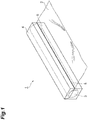
- FIG. 1 is a schematic view showing a food wrapping rolled film with a box.
- the film according to this embodiment contains a thermoplastic resin, a blue colorant and a white colorant, and is suitably used as a food wrapping film.
- the thermoplastic resin may be a polyvinyl chloride resin such as polyvinyl chloride; a polyvinylidene chloride resin such as polyvinylidene chloride; a polyolefin resin such as polyethylene, polypropylene or saponified ethylene-vinyl acetate copolymer; a polystyrene resin such as butadiene-styrene copolymer, acrylonitrile-styrene copolymer, polystyrene, styrene-butadiene-styrene copolymer, styrene-isoprene-styrene copolymer or styrene-acrylic acid copolymer; a polyester resin such as polyethylene terephthalate, polyethylene naphthalate or polybutylene terephthalate; a polyamide resin such as 6-nylon, 6,6-nylon or 12-nylon; or the like.
- the thermoplastic resin is preferably a polyvinyl chloride resin, a polyvinylidene chloride resin or a polyolefin resin, and more preferably a polyvinyl chloride resin, a polyvinylidene chloride resin or a polyethylene resin, from the viewpoint of excellent handling property.
- polyvinyl chloride resin a polyvinyl chloride resin having an average degree of polymerization of 700 to 1300 is preferable from the viewpoint of excellent moldability, heat resistance and fluidity of the film.
- the average polymerization degree in the present specification means an average degree of polymerization measured according to JIS K6720-2.
- the polyvinyl chloride resin may be a vinyl chloride homopolymer (polyvinyl chloride resin) from the viewpoint of excellent mechanical properties, or the polyvinyl chloride resin may be a copolymer of a vinyl chloride and other monomer copolymerizable therewith, for the purpose of imparting other properties.
- the copolymer may be a graft copolymer, a block copolymer or a random copolymer.
- Examples of the other monomer include olefins such as ethylene, propylene and polybutene; vinyl esters of saturated acids such as vinyl acetate and vinyl laurate; alkyl esters of unsaturated acids such as methyl acrylate and methyl methacrylate; alkyl vinyl ethers such as lauryl vinyl ether; maleic acid, acrylonitrile, styrene, methylstyrene, vinylidene fluoride; and the like.
- olefins such as ethylene, propylene and polybutene
- vinyl esters of saturated acids such as vinyl acetate and vinyl laurate
- alkyl esters of unsaturated acids such as methyl acrylate and methyl methacrylate
- alkyl vinyl ethers such as lauryl vinyl ether
- maleic acid acrylonitrile, styrene, methylstyrene, vinylidene fluoride
- the content of the vinyl chloride unit in the copolymer may be 10% by mass or more based on the total amount of monomer units, and is preferably 30% by mass or more and more preferably 50% by mass or more, from the viewpoint of excellent mechanical properties.
- the upper limit of the content of the vinyl chloride unit in the copolymer is not particularly limited, and may be, for example, 99% by mass or less based on the total amount of monomer units.
- the polyvinyl chloride resin may be, for example, a polymer blend with a three-dimensional polymer of acrylonitrile-butadiene-styrene or the like, a post-treatment product with an alcohol or the like, or a post-treatment product with a chlorine-containing compound.
- the content of the vinyl chloride unit in the polyvinyl chloride resin may be 10% by mass or more based on the total amount of the resin.
- the polyvinylidene chloride resin may be a vinylidene chloride homopolymer (polyvinylidene chloride resin), for example, may be a copolymer containing vinylidene chloride and other monomer copolymerizable with vinylidene chloride as monomer units.
- the other monomer may be vinyl chloride, an acrylate ester of acrylic acid and an alcohol having 1 to 8 carbon atoms, a methacrylic acid ester of methacrylic acid and an alcohol having 1 to 8 carbon atoms, a vinyl ester of an aliphatic carboxylic acid, an unsaturated aliphatic carboxylic acid, an olefin, a vinyl ether, or the like.
- the copolymer of vinylidene chloride and vinyl chloride shall belong to the polyvinylidene chloride resin.
- the content of the vinylidene chloride unit in the polyvinylidene chloride resin may be, for example, 60% by mass or more, 70% by mass or more, or 80% by mass or more, based on the total amount of monomer units, from the viewpoint of moldability and heat resistance of the film.
- the upper limit of the content of the vinylidene chloride unit in the polyvinylidene chloride resin is not particularly limited, and may be, for example, 99% by mass or less based on the total amount of monomer units.
- the content of the vinylidene chloride unit can be measured by a nuclear magnetic resonance (NMR) apparatus.
- NMR nuclear magnetic resonance
- the weight average molecular weight of the polyvinylidene chloride resin may be, for example, 40,000 to 180,000, 60,000 to 160,000, or 80,000 to 140,000.
- the weight average molecular weight of the polyvinylidene chloride resin can be measured by GPC method using polystyrene of known molecular weight as a standard substance.
- the conditions of the GPC method used for measuring the weight average molecular weight of the polyvinylidene chloride resin are as follows.
- a gel chromatograph Alliance GPC 2000 model manufactured by Waters Corporation is used as a measuring device.
- a solution prepared by dissolving a polyvinylidene chloride resin in tetrahydrofuran so as to be 0.5% by weight is used as a sample.
- TSKgel GMHHR-H(S) HT 30 cm ⁇ 2 TSKgel GMH6-HTL 30 cm ⁇ 2 manufactured by Tosoh Corporation
- Mobile phase Tetrahydrofuran Detector: Differential refractometer Flow rate: 1.0 mL/min
- the film may further contain a plasticizer.
- the plasticizer include epoxidized oils such as epoxidized linseed oil, epoxidized soybean oil and epoxidized fatty acid alkyl ester, adipic acid esters having a linear or branched alkyl group having 6 to 10 carbon atoms, hydroxy polycarboxylic acid esters such as tributyl acetylcitrate and triethyl acetylate, fatty acid group dibasic acid esters such as di-normal butyl sebacate, glycol esters such as pentaerythritol ester and diethylene glycol benzoate, phosphate esters such as triphenyl phosphate and tricresyl phosphate, glycerin diacetomonolaurate, chlorinated paraffin, polyester plasticizers, and the like.
- plasticizers are used singly or in combination of two or more.
- the content of the plasticizer is appropriately adjusted within the range of, for example, 20 to 50 parts by mass, based on 100 parts by mass of the polyvinyl chloride resin, depending on application such as the type of food to be wrapped, wrapping form, and wrapping method.
- polystyrene resin examples include polyethylene resins and the like, and the polyethylene resin may be a copolymer using low density polyethylene, linear low density polyethylene, linear ultra low density polyethylene, medium density polyethylene, high density polyethylene, ethylene or the like, as monomer units.
- the polyethylene resin is a copolymer of ethylene and one or more selected from ⁇ -olefins having 3 to 10 carbon atoms, such as propylene, 1-butene, 1-pentene, 1-hexene, 4-methyl-1-pentene, 1-heptene and 1-octene, vinyl esters such as vinyl acetate and vinyl propionate, unsaturated carboxylic acid esters such as methyl acrylate, ethyl acrylate, methyl methacrylate and ethyl methacrylate, unsaturated compounds such as conjugated diene and non-conjugated diene; and the like.
- the content of the ethylene unit in the polyethylene resin may be 50% by mass or more based on the total amount of monomer units.
- the content of the thermoplastic resin may be 70% by mass or more or 75% by mass or more, and may be 85% by mass or less or 80% by mass or less, based on the total amount of the film, from the viewpoint of excellent productivity.
- the content of the polyvinyl chloride resin, the polyvinylidene chloride resin or the polyolefin resin is preferably within the above range, and the content of the polyvinyl chloride resin, the polyvinylidene chloride resin or the polyethylene resin is more preferably within the above range.
- the blue colorant is, for example, a colorant having a maximum absorption wavelength in the visible light region (380 to 750 nm) of 600 to 750 nm.
- the absorbance at the maximum absorption wavelength in the visible light region of the blue colorant is preferably at least 2 times and more preferably at least 3 times the absorbance at 470 nm.
- the blue colorant may be copper phthalocyanine (copper phthalocyanine blue), iron(III) hexacyanoferrate(II), cobalt oxide-aluminum oxide mixture, indigo, ultramarine, or the like.
- the content of the blue colorant is preferably 0.45% by mass or more, more preferably 0.6% by mass or more, further preferably 0.75% by mass or more, and particularly preferably 1.0% by mass or more, based on the total amount of the film, from the viewpoint of more excellent discrimination.
- the content of the blue colorant is preferably 2.2% by mass or less, more preferably 2.0% by mass or less, further preferably 1.9% by mass or less, and particularly preferably 1.8% by mass or less, based on the total amount of the film, from the viewpoint of more excellent film-forming properties and productivity.
- the content of the blue colorant is preferably 0.45 to 2.2% by mass, 0.45 to 2.0% by mass, 0.45 to 1.9% by mass, 0.45 to 1.8% by mass, 0.6 to 2.2% by mass, 0.6 to 2.0% by mass, 0.6 to 1.9% by mass, 0.6 to 1.8% by mass, 0.75 to 2.2% by mass, 0.75 to 2.0% by mass, 0.75 to 1.9% by mass, 0.75 to 1.8% by mass, 1.0 to 2.2% by mass, 1.0 to 2.0% by mass, 1.0 to 1.9% by mass, or 1.0 to 1.8% by mass, based on the total amount of the film, from the viewpoint of more excellent discrimination, film-forming properties and productivity.
- the content of the blue colorant is preferably higher than the content of the white colorant described later.
- the white colorant is, for example, a colorant having an absorbance in the whole range of the visible light region (380 nm to 750 nm) of 0.3 or less (that scatters visible light).
- the white colorant may be titanium oxide, titanium oxide-barium sulfate, titanium oxide-magnesium silicate, titanium oxide-calcium sulfate, or zinc oxide.
- the content of the white colorant is preferably 0.15% by mass or more, more preferably 0.2% by mass or more, further preferably 0.25% by mass or more, and particularly preferably 0.3% by mass or more, based on the total amount of the film, from the viewpoint of more excellent discrimination.
- the content of the white colorant is preferably 0.55% by mass or less, more preferably 0.5% by mass or less, further preferably 0.45% by mass or less, and particularly preferably 0.4% by mass or less, based on the total amount of the film, from the viewpoint of more excellent film-forming properties and productivity.
- the content of the white colorant is preferably 0.15 to 0.55% by mass, 0.15 to 0.5% by mass, 0.15 to 0.45% by mass, 0.15 to 0.4% by mass, 0.2 to 0.55% by mass, 0.2 to 0.5% by mass, 0.2 to 0.45% by mass, 0.2 to 0.4% by mass, 0.25 to 0.55% by mass, 0.25 to 0.5% by mass, 0.25 to 0.45% by mass, 0.25 to 0.4% by mass, 0.3 to 0.55% by mass, 0.3 to 0.50% by mass, 0.3 to 0.45% by mass, or 0.3 to 0.4% by mass, based on the total amount of the film, from the viewpoint of more excellent discrimination, film-forming properties and productivity.
- the film may further contain other components.
- the other components include an anti-fogging agent, a heat stabilizer, a light stabilizer, a lubricant, a filler, a plate-out preventing agent, an antioxidant, a releasing agent, a viscosity reducing agent, a surfactant, a colorant other than the blue colorant and the white colorant, a fluorescent agent, a surface treatment agent, a crosslinking agent, a processing aid, a pressure sensitive adhesive, an antistatic agent, an ultraviolet absorber, an anti-blocking agent, and the like.
- the film may consist of a single layer containing the thermoplastic resin, the blue colorant and the white colorant, or may consist of a plurality of layers.
- the film may include, for example, a first surface layer, an intermediate layer and a second surface layer in this order.
- the intermediate layer may contain the blue colorant and the white colorant.
- the film may further includes, for example, an adhesive layer containing an acid-modified polyolefin resin or the like in order to improve the adhesion between layers, and a heat resistant layer containing a polyamide resin may be further provided in order to improve the heat resistance of the film.
- the thermoplastic resin is a polyvinyl chloride resin
- the film preferably consists of a single layer containing the thermoplastic resin (polyvinyl chloride resin), the blue colorant and the white colorant.
- the thickness of the film may be preferably 5 ⁇ m or more and more preferably 6 ⁇ m or more, from the viewpoint of efficiently shielding the food from the outside air, and may be preferably 25 ⁇ m or less and more preferably 12 ⁇ m or less, from the viewpoint of excellent handling property.
- the total light transmittance of the film is preferably 70% or more, and more preferably 75% or more.
- the total light transmittance of the film is preferably 85% or less, more preferably 80% or less, and further preferably 79% or less, from the viewpoint of more excellent discrimination for food.
- the total light transmittance of the film is calculated according to the following formula based on the total transmitted light amount measured in accordance with JIS K7361-1.
- Total light transmittance % Total transmitted light amount / Incident light amount ⁇ 100
- the film is produced by mixing a composition containing a thermoplastic resin, a blue colorant and a white colorant with a mixer such as a V-type blender, a ribbon blender, a Henschel mixer or a super mixer, and further kneading the mixture with a mixing roll, a Banbury mixer or a kneading machine such as a kneader, as necessary, to obtain a composition, followed by extrusion molding, for example.
- a mixer such as a V-type blender, a ribbon blender, a Henschel mixer or a super mixer
- a mixing roll such as a mixing roll, a Banbury mixer or a kneading machine such as a kneader, as necessary, to obtain a composition, followed by extrusion molding, for example.
- the composition is supplied to a hopper of an extruder, and a targeted film is obtained by an inflation method, a T-die method, or the like.
- the film is wound while the film is being produced, and the wound film is further rewound (rolled) for each desired length such as 20 m or 50 m, packed in a box (decorative box), thereby forming a product.
- the film in this embodiment may be in the form of a food wrapping rolled film or in the form of a food wrapping rolled film with a box.
- an article (a food wrapping rolled film) 1 with a box includes a food wrapping film 2, a core material 3 on which the food wrapping film 2 is rolled, and a box 4 in which the food wrapping film 2 and the core material 3 are stored, and the box 4 may be provided with a blade part 5 for cutting the food wrapping film 2.
- the material of the core material 3 and the box 4 is not particularly limited. From the viewpoint of easily recognizing the color of the film 2 from the outside, at least a part of the box 4 is preferably transparent, or has a hole in such a degree as not to impair the function as a box.
- the film When the film is composed of a plurality of layers, the film can be obtained by putting the constituent raw materials of each layer into separate extruders, melt-extruding them, co-extruding each layer by inflation, T-die method or the like and laminating them. In this case, it is preferable to form the film by directly drawing the molten substance extruded from the T-die while rapidly cooling it with a casting roll or the like.
- the film described above is a film through which a wrapped food is visually recognizable from the outside. Further, the film is a film (stretch film) having stretchability (extendablility).
- the film according to the present embodiment may be a sorting film for foods used for sorting foods.
- two or more types of foods can be sorted into at least two groups according to the type of food. That is, for example, the first food can be wrapped in the film according to the present embodiment and sorted into the first group, while the second food can be wrapped in a film having a color different from that of the film according to the present embodiment or a colorless film and sorted into the second group.
- the first food when there is a first food containing a first allergic substance and a second food containing a second allergic substance, the first food is sorted into a first group that is a group of foods to be provided to a person having no allergic symptom with the first allergic substance, while the second food is sorted into a second group that is a group of foods to be provided to a person having no allergic symptom with the second allergic substance.
- occurrence of an accident that the first or second allergic substance is provided to a person having an allergic symptom to the allergic substance can be suppressed.
- thermoplastic resin blue colorant, white colorant and various additives shown in Tables 1 and 2 into a super mixer
- the material temperature was raised from normal temperature to 130°C while stirring the mixture.
- the mixture was taken out when cooled down to 70°C to prepare a resin composition.
- the numerical values in the tables are values in terms of solid content and represent % by mass.
- Resin compositions were prepared using the following thermoplastic resin, blue colorant, white colorant and various additives shown in Tables 3 and 4, and each resin composition was extruded with an inflation film forming apparatus to prepare a film with a thickness of 9 ⁇ m.
- the numerical values in the tables are values in terms of solid content and represent % by mass.
- Thermoplastic resin a1 Polyvinyl chloride resin ("TH-1000” manufactured by TAIYO VINYL CORPORATION, average degree of polymerization: 1000)
- Thermoplastic resin a2 Polyethylene resin ("Neozex 0234N” manufactured by Prime Polymer Co., Ltd.)
- White colorant c1 Titanium oxide ("FTR-700" manufactured by SAKAI CHEMICAL INDUSTRY CO.,LTD.)
- Total transmitted light amount of the film was measured by a haze meter (model: NDH5000) manufactured by NIPPON DENSHOKU INDUSTRIES CO., LTD. in accordance with JIS K7361-1, and the total light transmittance of the film was calculated according to the following formula.
- Total light transmittance % Total transmitted light amount / Incident light amount ⁇ 100
- Fragments of 3 mm to 10 mm square were prepared from the obtained film, and when the films were mixed in food, whether the fragments of the film could be identified was visually observed. Evaluation criteria are as follows. When it is evaluated as A or B, it can be said that the film is excellent in discrimination.
- Each resin composition was extruded at a resin temperature of 200°C with a T-die extruder to mold a film, and the appearance of the obtained film was observed to evaluate film-forming properties. Evaluation criteria are as follows. When it is evaluated as A or B, it can be said that the film is excellent in film-forming properties.
Landscapes
- Chemical & Material Sciences (AREA)
- Engineering & Computer Science (AREA)
- Health & Medical Sciences (AREA)
- Mechanical Engineering (AREA)
- Manufacturing & Machinery (AREA)
- Chemical Kinetics & Catalysis (AREA)
- Medicinal Chemistry (AREA)
- Polymers & Plastics (AREA)
- Organic Chemistry (AREA)
- Materials Engineering (AREA)
- Life Sciences & Earth Sciences (AREA)
- Evolutionary Biology (AREA)
- General Health & Medical Sciences (AREA)
- Marine Sciences & Fisheries (AREA)
- Toxicology (AREA)
- Zoology (AREA)
- Manufacture Of Macromolecular Shaped Articles (AREA)
- Compositions Of Macromolecular Compounds (AREA)
- Wrappers (AREA)
- Details Of Rigid Or Semi-Rigid Containers (AREA)
Abstract
Description
- The present invention relates to a food wrapping film and an article that is a food wrapping rolled film with a box.
- Conventionally, food wrapping films have been widely used for business use in hotels, restaurants and the like, or when storing foods at home, during cooking, and the like. Various improvements have been made for food wrapping films in order to improve convenience in use. For example, Patent Literature 1 discloses a food wrapping film in which embossing is applied to a predetermined portion of the film, for the purposes of preventing assimilation of a food material and container to be wrapped, with a film, and also easily distinguishing an end face of a film, and preventing excessive adhesion between films in the end face or a food material and container with a film, and the like.
- Patent Literature 1: Japanese Unexamined Patent Publication No.
2003-63555 - It is an object of the present invention to provide a food wrapping film that is distinguishable even when it is mixed in food and is excellent in film-forming properties and productivity, and to provide an article that is a food wrapping rolled film with a box.
- The present invention provides a food wrapping film containing a thermoplastic resin, a blue colorant, and a white colorant.
- The content of the blue colorant is preferably 0.45 to 2.2% by mass based on the total amount of the film.
- The content of the white colorant is preferably 0.15 to 0.55% by mass based on the total amount of the film.
- The thermoplastic resin may be at least one selected from the group consisting of polyvinyl chloride resins, polyvinylidene chloride resins, polyolefin resins, polyester resins and polyamide resins.
- The film may contain, as the thermoplastic resin, 70% by mass or more based on the total amount of the film of at least one resin selected from the group consisting of polyvinyl chloride resins, polyvinylidene chloride resins and polyolefin resins.
- The film may be a film through which a wrapped food is visually recognizable from the outside.
- The total light transmittance of the film may be 70% or more.
- The present invention also provides an article including the food wrapping film, a core material on which the food wrapping film is rolled, and a box in which the food wrapping film and the core material are stored, wherein the box is provided with a blade part for cutting the food wrapping film.
- According to the present invention, it is possible to provide a food wrapping film that is distinguishable even when it is mixed in food and is excellent in film-forming properties and productivity, and to provide an article that is a food wrapping rolled film with a box.
-
FIG. 1 is a schematic view showing a food wrapping rolled film with a box. - The film according to this embodiment contains a thermoplastic resin, a blue colorant and a white colorant, and is suitably used as a food wrapping film.
- The thermoplastic resin may be a polyvinyl chloride resin such as polyvinyl chloride; a polyvinylidene chloride resin such as polyvinylidene chloride; a polyolefin resin such as polyethylene, polypropylene or saponified ethylene-vinyl acetate copolymer; a polystyrene resin such as butadiene-styrene copolymer, acrylonitrile-styrene copolymer, polystyrene, styrene-butadiene-styrene copolymer, styrene-isoprene-styrene copolymer or styrene-acrylic acid copolymer; a polyester resin such as polyethylene terephthalate, polyethylene naphthalate or polybutylene terephthalate; a polyamide resin such as 6-nylon, 6,6-nylon or 12-nylon; or the like. The thermoplastic resin is preferably a polyvinyl chloride resin, a polyvinylidene chloride resin or a polyolefin resin, and more preferably a polyvinyl chloride resin, a polyvinylidene chloride resin or a polyethylene resin, from the viewpoint of excellent handling property.
- As the polyvinyl chloride resin, a polyvinyl chloride resin having an average degree of polymerization of 700 to 1300 is preferable from the viewpoint of excellent moldability, heat resistance and fluidity of the film. The average polymerization degree in the present specification means an average degree of polymerization measured according to JIS K6720-2.
- The polyvinyl chloride resin may be a vinyl chloride homopolymer (polyvinyl chloride resin) from the viewpoint of excellent mechanical properties, or the polyvinyl chloride resin may be a copolymer of a vinyl chloride and other monomer copolymerizable therewith, for the purpose of imparting other properties. The copolymer may be a graft copolymer, a block copolymer or a random copolymer. Examples of the other monomer include olefins such as ethylene, propylene and polybutene; vinyl esters of saturated acids such as vinyl acetate and vinyl laurate; alkyl esters of unsaturated acids such as methyl acrylate and methyl methacrylate; alkyl vinyl ethers such as lauryl vinyl ether; maleic acid, acrylonitrile, styrene, methylstyrene, vinylidene fluoride; and the like. When the polyvinyl chloride resin is a copolymer, the content of the vinyl chloride unit in the copolymer may be 10% by mass or more based on the total amount of monomer units, and is preferably 30% by mass or more and more preferably 50% by mass or more, from the viewpoint of excellent mechanical properties. The upper limit of the content of the vinyl chloride unit in the copolymer is not particularly limited, and may be, for example, 99% by mass or less based on the total amount of monomer units.
- The polyvinyl chloride resin may be, for example, a polymer blend with a three-dimensional polymer of acrylonitrile-butadiene-styrene or the like, a post-treatment product with an alcohol or the like, or a post-treatment product with a chlorine-containing compound. In these cases, the content of the vinyl chloride unit in the polyvinyl chloride resin may be 10% by mass or more based on the total amount of the resin.
- The polyvinylidene chloride resin may be a vinylidene chloride homopolymer (polyvinylidene chloride resin), for example, may be a copolymer containing vinylidene chloride and other monomer copolymerizable with vinylidene chloride as monomer units. The other monomer may be vinyl chloride, an acrylate ester of acrylic acid and an alcohol having 1 to 8 carbon atoms, a methacrylic acid ester of methacrylic acid and an alcohol having 1 to 8 carbon atoms, a vinyl ester of an aliphatic carboxylic acid, an unsaturated aliphatic carboxylic acid, an olefin, a vinyl ether, or the like. The copolymer of vinylidene chloride and vinyl chloride shall belong to the polyvinylidene chloride resin.
- The content of the vinylidene chloride unit in the polyvinylidene chloride resin may be, for example, 60% by mass or more, 70% by mass or more, or 80% by mass or more, based on the total amount of monomer units, from the viewpoint of moldability and heat resistance of the film. The upper limit of the content of the vinylidene chloride unit in the polyvinylidene chloride resin is not particularly limited, and may be, for example, 99% by mass or less based on the total amount of monomer units. The content of the vinylidene chloride unit can be measured by a nuclear magnetic resonance (NMR) apparatus.
- The weight average molecular weight of the polyvinylidene chloride resin may be, for example, 40,000 to 180,000, 60,000 to 160,000, or 80,000 to 140,000. The weight average molecular weight of the polyvinylidene chloride resin can be measured by GPC method using polystyrene of known molecular weight as a standard substance.
- The conditions of the GPC method used for measuring the weight average molecular weight of the polyvinylidene chloride resin are as follows. A gel chromatograph Alliance GPC 2000 model manufactured by Waters Corporation is used as a measuring device. A solution prepared by dissolving a polyvinylidene chloride resin in tetrahydrofuran so as to be 0.5% by weight is used as a sample.
- Column: TSKgel GMHHR-H(S) HT 30 cm × 2, TSKgel GMH6-HTL 30 cm × 2 manufactured by Tosoh Corporation
Mobile phase: Tetrahydrofuran
Detector: Differential refractometer
Flow rate: 1.0 mL/min
Column temperature: 20°C
Injection amount: 500 µL - When the thermoplastic resin is a polyvinyl chloride resin or a polyvinylidene chloride resin, the film may further contain a plasticizer. Examples of the plasticizer include epoxidized oils such as epoxidized linseed oil, epoxidized soybean oil and epoxidized fatty acid alkyl ester, adipic acid esters having a linear or branched alkyl group having 6 to 10 carbon atoms, hydroxy polycarboxylic acid esters such as tributyl acetylcitrate and triethyl acetylate, fatty acid group dibasic acid esters such as di-normal butyl sebacate, glycol esters such as pentaerythritol ester and diethylene glycol benzoate, phosphate esters such as triphenyl phosphate and tricresyl phosphate, glycerin diacetomonolaurate, chlorinated paraffin, polyester plasticizers, and the like. These plasticizers are used singly or in combination of two or more. The content of the plasticizer is appropriately adjusted within the range of, for example, 20 to 50 parts by mass, based on 100 parts by mass of the polyvinyl chloride resin, depending on application such as the type of food to be wrapped, wrapping form, and wrapping method.
- Examples of the polyolefin resin include polyethylene resins and the like, and the polyethylene resin may be a copolymer using low density polyethylene, linear low density polyethylene, linear ultra low density polyethylene, medium density polyethylene, high density polyethylene, ethylene or the like, as monomer units. Specifically, the polyethylene resin is a copolymer of ethylene and one or more selected from α-olefins having 3 to 10 carbon atoms, such as propylene, 1-butene, 1-pentene, 1-hexene, 4-methyl-1-pentene, 1-heptene and 1-octene, vinyl esters such as vinyl acetate and vinyl propionate, unsaturated carboxylic acid esters such as methyl acrylate, ethyl acrylate, methyl methacrylate and ethyl methacrylate, unsaturated compounds such as conjugated diene and non-conjugated diene; and the like. The content of the ethylene unit in the polyethylene resin may be 50% by mass or more based on the total amount of monomer units.
- The content of the thermoplastic resin may be 70% by mass or more or 75% by mass or more, and may be 85% by mass or less or 80% by mass or less, based on the total amount of the film, from the viewpoint of excellent productivity. The content of the polyvinyl chloride resin, the polyvinylidene chloride resin or the polyolefin resin is preferably within the above range, and the content of the polyvinyl chloride resin, the polyvinylidene chloride resin or the polyethylene resin is more preferably within the above range.
- The blue colorant is, for example, a colorant having a maximum absorption wavelength in the visible light region (380 to 750 nm) of 600 to 750 nm. The absorbance at the maximum absorption wavelength in the visible light region of the blue colorant is preferably at least 2 times and more preferably at least 3 times the absorbance at 470 nm. Specifically, the blue colorant may be copper phthalocyanine (copper phthalocyanine blue), iron(III) hexacyanoferrate(II), cobalt oxide-aluminum oxide mixture, indigo, ultramarine, or the like.
- The content of the blue colorant is preferably 0.45% by mass or more, more preferably 0.6% by mass or more, further preferably 0.75% by mass or more, and particularly preferably 1.0% by mass or more, based on the total amount of the film, from the viewpoint of more excellent discrimination. The content of the blue colorant is preferably 2.2% by mass or less, more preferably 2.0% by mass or less, further preferably 1.9% by mass or less, and particularly preferably 1.8% by mass or less, based on the total amount of the film, from the viewpoint of more excellent film-forming properties and productivity. The content of the blue colorant is preferably 0.45 to 2.2% by mass, 0.45 to 2.0% by mass, 0.45 to 1.9% by mass, 0.45 to 1.8% by mass, 0.6 to 2.2% by mass, 0.6 to 2.0% by mass, 0.6 to 1.9% by mass, 0.6 to 1.8% by mass, 0.75 to 2.2% by mass, 0.75 to 2.0% by mass, 0.75 to 1.9% by mass, 0.75 to 1.8% by mass, 1.0 to 2.2% by mass, 1.0 to 2.0% by mass, 1.0 to 1.9% by mass, or 1.0 to 1.8% by mass, based on the total amount of the film, from the viewpoint of more excellent discrimination, film-forming properties and productivity. The content of the blue colorant is preferably higher than the content of the white colorant described later.
- The white colorant is, for example, a colorant having an absorbance in the whole range of the visible light region (380 nm to 750 nm) of 0.3 or less (that scatters visible light). Specifically, the white colorant may be titanium oxide, titanium oxide-barium sulfate, titanium oxide-magnesium silicate, titanium oxide-calcium sulfate, or zinc oxide.
- The content of the white colorant is preferably 0.15% by mass or more, more preferably 0.2% by mass or more, further preferably 0.25% by mass or more, and particularly preferably 0.3% by mass or more, based on the total amount of the film, from the viewpoint of more excellent discrimination. The content of the white colorant is preferably 0.55% by mass or less, more preferably 0.5% by mass or less, further preferably 0.45% by mass or less, and particularly preferably 0.4% by mass or less, based on the total amount of the film, from the viewpoint of more excellent film-forming properties and productivity. The content of the white colorant is preferably 0.15 to 0.55% by mass, 0.15 to 0.5% by mass, 0.15 to 0.45% by mass, 0.15 to 0.4% by mass, 0.2 to 0.55% by mass, 0.2 to 0.5% by mass, 0.2 to 0.45% by mass, 0.2 to 0.4% by mass, 0.25 to 0.55% by mass, 0.25 to 0.5% by mass, 0.25 to 0.45% by mass, 0.25 to 0.4% by mass, 0.3 to 0.55% by mass, 0.3 to 0.50% by mass, 0.3 to 0.45% by mass, or 0.3 to 0.4% by mass, based on the total amount of the film, from the viewpoint of more excellent discrimination, film-forming properties and productivity.
- In addition to the thermoplastic resin, the blue colorant and the white colorant, the film may further contain other components. Examples of the other components include an anti-fogging agent, a heat stabilizer, a light stabilizer, a lubricant, a filler, a plate-out preventing agent, an antioxidant, a releasing agent, a viscosity reducing agent, a surfactant, a colorant other than the blue colorant and the white colorant, a fluorescent agent, a surface treatment agent, a crosslinking agent, a processing aid, a pressure sensitive adhesive, an antistatic agent, an ultraviolet absorber, an anti-blocking agent, and the like.
- The film may consist of a single layer containing the thermoplastic resin, the blue colorant and the white colorant, or may consist of a plurality of layers. When the film consists of a plurality of layers, the film may include, for example, a first surface layer, an intermediate layer and a second surface layer in this order. In this case, for example, the intermediate layer may contain the blue colorant and the white colorant. The film may further includes, for example, an adhesive layer containing an acid-modified polyolefin resin or the like in order to improve the adhesion between layers, and a heat resistant layer containing a polyamide resin may be further provided in order to improve the heat resistance of the film. When the thermoplastic resin is a polyvinyl chloride resin, the film preferably consists of a single layer containing the thermoplastic resin (polyvinyl chloride resin), the blue colorant and the white colorant.
- The thickness of the film may be preferably 5 µm or more and more preferably 6 µm or more, from the viewpoint of efficiently shielding the food from the outside air, and may be preferably 25 µm or less and more preferably 12 µm or less, from the viewpoint of excellent handling property.
- From the viewpoint of excellent visibility of the food, the total light transmittance of the film is preferably 70% or more, and more preferably 75% or more. The total light transmittance of the film is preferably 85% or less, more preferably 80% or less, and further preferably 79% or less, from the viewpoint of more excellent discrimination for food. The total light transmittance of the film is calculated according to the following formula based on the total transmitted light amount measured in accordance with JIS K7361-1.

- The film is produced by mixing a composition containing a thermoplastic resin, a blue colorant and a white colorant with a mixer such as a V-type blender, a ribbon blender, a Henschel mixer or a super mixer, and further kneading the mixture with a mixing roll, a Banbury mixer or a kneading machine such as a kneader, as necessary, to obtain a composition, followed by extrusion molding, for example.
Specifically, the composition is supplied to a hopper of an extruder, and a targeted film is obtained by an inflation method, a T-die method, or the like. Generally, the film is wound while the film is being produced, and the wound film is further rewound (rolled) for each desired length such as 20 m or 50 m, packed in a box (decorative box), thereby forming a product. That is, the film in this embodiment may be in the form of a food wrapping rolled film or in the form of a food wrapping rolled film with a box. - Specifically, as shown in
FIG 1 , an article (a food wrapping rolled film) 1 with a box includes afood wrapping film 2, acore material 3 on which thefood wrapping film 2 is rolled, and abox 4 in which thefood wrapping film 2 and thecore material 3 are stored, and thebox 4 may be provided with ablade part 5 for cutting thefood wrapping film 2. The material of thecore material 3 and thebox 4 is not particularly limited. From the viewpoint of easily recognizing the color of thefilm 2 from the outside, at least a part of thebox 4 is preferably transparent, or has a hole in such a degree as not to impair the function as a box. - When the film is composed of a plurality of layers, the film can be obtained by putting the constituent raw materials of each layer into separate extruders, melt-extruding them, co-extruding each layer by inflation, T-die method or the like and laminating them. In this case, it is preferable to form the film by directly drawing the molten substance extruded from the T-die while rapidly cooling it with a casting roll or the like.
- For the film obtained as above, depending on the purpose such as reduction in thermal shrinkage, natural shrinkage, etc. and suppression of occurrence of width contraction, longitudinal stretching between heating rolls, various heat setting, or heat treatment such as aging may be carried out. For the purpose of imparting and promoting anti-fogging property, antistatic property, tackiness, etc., surface treatment and surface processing such as treatment such as corona treatment and ripening, printing and coating and the like may be carried out.
- The film described above is a film through which a wrapped food is visually recognizable from the outside. Further, the film is a film (stretch film) having stretchability (extendablility).
- The film according to the present embodiment may be a sorting film for foods used for sorting foods. When using the film according to the present embodiment, two or more types of foods can be sorted into at least two groups according to the type of food. That is, for example, the first food can be wrapped in the film according to the present embodiment and sorted into the first group, while the second food can be wrapped in a film having a color different from that of the film according to the present embodiment or a colorless film and sorted into the second group.
- Specifically, for example, when there is a first food containing a first allergic substance and a second food containing a second allergic substance, the first food is sorted into a first group that is a group of foods to be provided to a person having no allergic symptom with the first allergic substance, while the second food is sorted into a second group that is a group of foods to be provided to a person having no allergic symptom with the second allergic substance. In the above example, occurrence of an accident that the first or second allergic substance is provided to a person having an allergic symptom to the allergic substance can be suppressed.
- Hereinafter, the present invention will be more specifically described based on examples, but the present invention is not limited to the examples.
- After charging the thermoplastic resin, blue colorant, white colorant and various additives shown in Tables 1 and 2 into a super mixer, the material temperature was raised from normal temperature to 130°C while stirring the mixture. After mixing, the mixture was taken out when cooled down to 70°C to prepare a resin composition. Each resin composition was extruded at a resin temperature of 200°C with a Φ 40 mm single screw extruder (L/D = 20) equipped with a T-die (width 350 mm, gap 0.4 mm) to prepare a film having a thickness of 8 µm. The numerical values in the tables are values in terms of solid content and represent % by mass.
- Resin compositions were prepared using the following thermoplastic resin, blue colorant, white colorant and various additives shown in Tables 3 and 4, and each resin composition was extruded with an inflation film forming apparatus to prepare a film with a thickness of 9 µm. The numerical values in the tables are values in terms of solid content and represent % by mass.
- Thermoplastic resin a1: Polyvinyl chloride resin ("TH-1000" manufactured by TAIYO VINYL CORPORATION, average degree of polymerization: 1000)
Thermoplastic resin a2: Polyethylene resin ("Neozex 0234N" manufactured by Prime Polymer Co., Ltd.)
Vinylidene chloride resin a3: Copolymer of vinylidene chloride and vinyl chloride (vinylidene chloride/vinyl chloride (mass ratio) = 90/10), weight average molecular weight: 80,000
Blue colorant b1: Copper phthalocyanine (copper phthalocyanine blue, "NX-053 blue" manufactured by Dainichiseika Color & Chemicals Mfg. Co., Ltd.)
White colorant c1: Titanium oxide ("FTR-700" manufactured by SAKAI CHEMICAL INDUSTRY CO.,LTD.) - Additive d1: Dioctyl adipate ("SANSO CIZER DOA" manufactured by New Japan Chemical Co., Ltd.)
- Additive d2: Epoxidized soybean oil ("Chemicizer SE-100" manufactured by Sanwa Synthetic Chemical Industry Co., Ltd.)
- Additive d3: Glycerin fatty acid ester ("XO-100" manufactured by RIKEN VITAMIN CO., LTD.)
- Additive d4: Ca/Zn Stabilizer ("SC-308E" manufactured by ADEKA Corporation)
- Additive d5: Dibutyl sebacate ("DBS" manufactured by HOKOKU Co.,Ltd.)
- Additive d6: Acetyl tributyl citrate ("ATBC" manufactured by ASAHI KASEI FINECHEM CO.,LTD.)
- For each of the obtained films, measurement of total light transmittance and evaluation of discrimination for food were carried out as described below. The results are shown in Tables 1 to 4.
- The total transmitted light amount of the film was measured by a haze meter (model: NDH5000) manufactured by NIPPON DENSHOKU INDUSTRIES CO., LTD. in accordance with JIS K7361-1, and the total light transmittance of the film was calculated according to the following formula.

- Fragments of 3 mm to 10 mm square were prepared from the obtained film, and when the films were mixed in food, whether the fragments of the film could be identified was visually observed. Evaluation criteria are as follows. When it is evaluated as A or B, it can be said that the film is excellent in discrimination.
- A: It is extremely easy to discriminate the film for food.
- B: It is easy to discriminate the film for food.
- C: It is difficult to discriminate the film for food.
- Each resin composition was extruded at a resin temperature of 200°C with a T-die extruder to mold a film, and the appearance of the obtained film was observed to evaluate film-forming properties. Evaluation criteria are as follows. When it is evaluated as A or B, it can be said that the film is excellent in film-forming properties.
- A: A film having a substantially uniform thickness was obtained, and no scorch occurred by extrusion for 24 hours.
- B: Slight unevenness in the film thickness was observed, and a scorch occurred by extrusion for 24 hours.
- C: Unevenness in the film thickness was large, and a scorch occurred by extrusion for 8 hours.
- The number of occurrences of production trouble (perforation, film runout and slit defect) per 24 hours occurring when extruding each resin composition at a resin temperature of 200°C with a T-die extruder to mold a film was counted to evaluate productivity. Evaluation criteria are as follows. When it is evaluated as A or B, it can be said that the film is excellent in productivity.
- A: The number of production trouble was 0 to 2
- B: The number of production trouble was 3 to 4
- C: The number of production trouble was 5 or more
- 1... food wrapping rolled film with a box, 2... food wrapping film, 3... core material, 4... box, 5... blade part.
| Example 1 | Example 2 | Example 3 | Example 4 | Example 5 | Example 6 | ||
| Composition (% by mass) | a1 | 75.0 | 75.0 | 75.0 | 75.0 | - | - |
| a2 | - | - | - | - | 95.5 | 97.3 | |
| b1 | 2.0 | 1.3 | 0.5 | 0.5 | 2.0 | 0.5 | |
| c1 | 0.5 | 0.3 | 0.2 | 0.5 | 0.5 | 0.2 | |
| d1 | 10.5 | 11.4 | 12.3 | 12.0 | - | - | |
| d2 | 9.0 | 9.0 | 9.0 | 9.0 | - | - | |
| d3 | 2.0 | 2.0 | 2.0 | 2.0 | 2.0 | 2.0 | |
| d4 | 1.0 | 1.0 | 1.0 | 1.0 | - | - | |
| Total light transmittance (%) | 76.0 | 79.0 | 82.0 | 80.0 | 76.0 | 83.0 | |
| Discrimination | A | A | B | B | A | B | |
| Film-forming properties | A | A | A | A | A | A | |
| Productivity | A | A | A | A | A | A | |
| Comparative Example 1 | Comparative Example 2 | Comparative Example 3 | Comparative Example 4 | ||
| Composition (% by mass) | a1 | 75.0 | 75.0 | - | - |
| a2 | - | - | 97.5 | 96.0 | |
| b1 | - | 2.0 | - | 2.0 | |
| c1 | 0.5 | - | 0.5 | - | |
| d1 | 11.5 | 10 | - | - | |
| d2 | 10 | 10 | - | - | |
| d3 | 2.0 | 2.0 | 2.0 | 2.0 | |
| d4 | 1.0 | 1.0 | - | - | |
| Total light transmittance (%) | 80.0 | 78.0 | 81.0 | 78.0 | |
| Discrimination | C | A | C | A | |
| Film-forming properties | A | C | A | C | |
| Productivity | A | C | A | C | |
| Example 7 | Example 8 | Example 9 | Example 10 | Example 11 | ||
| Composition (% by mass) | a3 | 92.0 | 92.0 | 92.0 | 92.0 | 92.5 |
| b1 | 2.0 | 1.6 | 1.2 | 1.0 | 0.5 | |
| c1 | 0.5 | 0.3 | 0.2 | 0.2 | 0.2 | |
| d2 | 1.4 | 1.7 | 1.9 | 2.0 | 2.0 | |
| d4 | 0.2 | 0.2 | 0.2 | 0.2 | 0.2 | |
| d5 | 3.5 | 3.7 | 3.9 | 4.0 | 4.0 | |
| d6 | 0.4 | 0.5 | 0.6 | 0.6 | 0.6 | |
| Total light transmittance (%) | 77.0 | 79.0 | 80.0 | 81.0 | 82.0 | |
| Discrimination | A | A | A | A | B | |
| Film-forming properties | A | A | A | A | A | |
| Productivity | A | A | A | A | A | |
| Example 12 | Example 13 | Example 14 | Example 15 | Comparative Example 5 | Comparative Example 6 | ||
| Composition (% by mass) | a3 | 92.0 | 92.6 | 92.0 | 92.0 | 92.7 | 93.7 |
| b1 | 2.5 | 0.5 | 0.5 | 1.0 | - | 2.0 | |
| c1 | 0.5 | 0.1 | 0.7 | 0.1 | 0.5 | - | |
| d2 | 1.2 | 2.0 | 2.0 | 2.0 | 2.0 | 0.8 | |
| d4 | 0.2 | 0.2 | 0.2 | 0.2 | 0.2 | 0.2 | |
| d5 | 3.3 | 4.0 | 4.0 | 4.0 | 4.0 | 3.0 | |
| d6 | 0.3 | 0.6 | 0.6 | 0.7 | 0.6 | 0.3 | |
| Total light transmittance (%) | 75.0 | 84.0 | 78.0 | 82.5 | 79.0 | 78.0 | |
| Discrimination | A | B | B | B | C | A | |
| Film-forming properties | B | A | B | A | A | C | |
| Productivity | B | A | B | A | A | C | |
Claims (8)
- A food wrapping film comprising:a thermoplastic resin;a blue colorant; anda white colorant.
- The food wrapping film according to claim 1, wherein a content of the blue colorant is 0.45 to 2.2% by mass based on a total amount of the film.
- The food wrapping film according to claim 1 or 2, wherein a content of the white colorant is 0.15 to 0.55% by mass based on the total amount of the film.
- The food wrapping film according to any one of claims 1 to 3, wherein the thermoplastic resin is at least one selected from the group consisting of polyvinyl chloride resins, polyvinylidene chloride resins, polyolefin resins, polyester resins and polyamide resins.
- The food wrapping film according to any one of claims 1 to 4, comprising, as the thermoplastic resin, 70% by mass or more based on the total amount of the film of at least one resin selected from the group consisting of polyvinyl chloride resins, polyvinylidene chloride resins and polyolefin resins.
- The food wrapping film according to any one of claims 1 to 5, wherein the film is a film through which a wrapped food is visually recognizable from an outside.
- The food wrapping film according to any one of claims 1 to 6, wherein the film has a total light transmittance of 70% or more.
- An article comprising:the food wrapping film according to any one of claims 1 to 7;a core material on which the food wrapping film is rolled; anda box in which the food wrapping film and the core material are stored,wherein the box is provided with a blade part for cutting the food wrapping film.
Applications Claiming Priority (2)
| Application Number | Priority Date | Filing Date | Title |
|---|---|---|---|
| PCT/JP2015/083644 WO2017094083A1 (en) | 2015-11-30 | 2015-11-30 | Food packaging film |
| PCT/JP2016/085434 WO2017094729A1 (en) | 2015-11-30 | 2016-11-29 | Food packaging film, and gift-boxed small roll of food packaging film |
Publications (3)
| Publication Number | Publication Date |
|---|---|
| EP3385310A1 true EP3385310A1 (en) | 2018-10-10 |
| EP3385310A4 EP3385310A4 (en) | 2018-11-21 |
| EP3385310B1 EP3385310B1 (en) | 2021-07-21 |
Family
ID=58796471
Family Applications (1)
| Application Number | Title | Priority Date | Filing Date |
|---|---|---|---|
| EP16870666.1A Active EP3385310B1 (en) | 2015-11-30 | 2016-11-29 | Food packaging film, and gift-boxed small roll of food packaging film |
Country Status (8)
| Country | Link |
|---|---|
| US (1) | US20180312313A1 (en) |
| EP (1) | EP3385310B1 (en) |
| JP (3) | JP6195046B1 (en) |
| KR (1) | KR20180088691A (en) |
| CN (1) | CN108291040B (en) |
| SG (1) | SG11201804531RA (en) |
| TW (1) | TWI747859B (en) |
| WO (2) | WO2017094083A1 (en) |
Cited By (1)
| Publication number | Priority date | Publication date | Assignee | Title |
|---|---|---|---|---|
| EP3385311A4 (en) * | 2015-11-30 | 2019-01-09 | Hitachi Chemical Company, Ltd. | FOOD PACKAGING FILM, AND SMALL FOAM PACKAGE FILM ROLL |
Families Citing this family (6)
| Publication number | Priority date | Publication date | Assignee | Title |
|---|---|---|---|---|
| WO2017094083A1 (en) * | 2015-11-30 | 2017-06-08 | 日立化成株式会社 | Food packaging film |
| JP7155590B2 (en) * | 2017-11-28 | 2022-10-19 | 三菱ケミカル株式会社 | Blown film for food packaging, stretch film for food, small wrapping film for food, and method for producing food packaging film |
| WO2020262249A1 (en) * | 2019-06-24 | 2020-12-30 | 昭和電工マテリアルズ株式会社 | Stretch packaging film |
| CN112519359B (en) * | 2020-11-05 | 2023-02-03 | 江西春光新材料科技股份有限公司 | High-barrier composite hard sheet and preparation method thereof |
| JP7545318B2 (en) | 2020-12-22 | 2024-09-04 | 株式会社キッチニスタ | Craft Film |
| KR102786498B1 (en) * | 2024-08-09 | 2025-03-26 | (주) 덕성기업 | Eco-friendly packing film for maintaining food freshness and manufacturing method thereof |
Family Cites Families (24)
| Publication number | Priority date | Publication date | Assignee | Title |
|---|---|---|---|---|
| JP3337261B2 (en) * | 1993-03-04 | 2002-10-21 | 出光石油化学株式会社 | Method for producing polypropylene resin sheet or film |
| DE10007719A1 (en) * | 2000-02-19 | 2001-08-23 | Mitsubishi Polyester Film Gmbh | White-opaque film with low transparency made of a crystallizable thermoplastic with additional functionality |
| JP2001316558A (en) * | 2000-05-01 | 2001-11-16 | Daicel Chem Ind Ltd | Rubber modified styrenic resin composition |
| JP4966443B2 (en) * | 2000-05-01 | 2012-07-04 | 株式会社ダイセル | Thermoplastic resin composition |
| JP2002012686A (en) * | 2000-06-29 | 2002-01-15 | Asahi Kasei Corp | Resin sheet or film |
| JP2003063555A (en) | 2001-08-23 | 2003-03-05 | Tsuneo Kamiya | Wrap film for food packaging and method for producing the same |
| EP1293447A3 (en) * | 2001-08-24 | 2004-01-14 | Alu-Vertriebsstelle AG | Package for receiving a roll of foil and for dispensing separate foil-lengths |
| WO2003029099A1 (en) * | 2001-09-27 | 2003-04-10 | Tetra Laval Holdings & Finance S.A. | Paper packaging material for liquid food and method for production thereof |
| JP2003104432A (en) | 2001-09-27 | 2003-04-09 | Nihon Tetra Pak Kk | Liquid food paper packaging material |
| JP2003191617A (en) * | 2001-12-26 | 2003-07-09 | Oji Paper Co Ltd | Inkjet recording sheet |
| JP3881547B2 (en) * | 2001-12-27 | 2007-02-14 | 株式会社クレハ | Polyvinylidene chloride resin composition, stretched film, and production method thereof |
| DE10227439A1 (en) * | 2002-06-20 | 2004-01-08 | Mitsubishi Polyester Film Gmbh | Transparent film made of PET and PEN with UV protection, process for their production and use in packaging with an extended service life |
| JP4240455B2 (en) * | 2002-12-13 | 2009-03-18 | 株式会社細川洋行 | Packaging materials |
| JP3095720U (en) | 2003-02-04 | 2003-08-15 | トーホー加工株式会社 | Packaging material with UV cut and translucent processing |
| US8318847B2 (en) * | 2005-09-30 | 2012-11-27 | Sabic Innovative Plastics Ip B.V. | Plastic compositions and products produced therefrom |
| JP5273934B2 (en) * | 2006-04-05 | 2013-08-28 | 株式会社クレハ | Heat-shrinkable multilayer film for deep drawing and method for producing the same |
| JP4898548B2 (en) * | 2007-05-11 | 2012-03-14 | 株式会社クレハ | Film distribution case and film case |
| JP2010202749A (en) | 2009-03-03 | 2010-09-16 | Mitsubishi Plastics Inc | White polyester film |
| JP5295929B2 (en) * | 2009-10-29 | 2013-09-18 | 株式会社クレハ | Polyvinylidene chloride resin composition, process for producing the same, and molded article formed from the resin composition |
| US20120190780A1 (en) * | 2011-01-25 | 2012-07-26 | Danielson Todd D | Additive compositions and thermoplastic polymer compositions comprising the same |
| JP5688194B2 (en) * | 2012-12-14 | 2015-03-25 | オカモト株式会社 | Wrapping film for food packaging |
| JP2014237273A (en) | 2013-06-10 | 2014-12-18 | 三菱樹脂株式会社 | Biaxially oriented polyester film |
| JP6201450B2 (en) * | 2013-06-26 | 2017-09-27 | 三菱ケミカル株式会社 | Food wrap film and food small roll wrap film |
| WO2017094083A1 (en) * | 2015-11-30 | 2017-06-08 | 日立化成株式会社 | Food packaging film |
-
2015
- 2015-11-30 WO PCT/JP2015/083644 patent/WO2017094083A1/en not_active Ceased
- 2015-11-30 JP JP2017533655A patent/JP6195046B1/en active Active
-
2016
- 2016-03-16 JP JP2016052589A patent/JP7028544B2/en active Active
- 2016-11-29 CN CN201680069821.8A patent/CN108291040B/en active Active
- 2016-11-29 WO PCT/JP2016/085434 patent/WO2017094729A1/en not_active Ceased
- 2016-11-29 JP JP2017554115A patent/JP7089367B2/en active Active
- 2016-11-29 KR KR1020187018230A patent/KR20180088691A/en not_active Withdrawn
- 2016-11-29 SG SG11201804531RA patent/SG11201804531RA/en unknown
- 2016-11-29 US US15/779,882 patent/US20180312313A1/en not_active Abandoned
- 2016-11-29 EP EP16870666.1A patent/EP3385310B1/en active Active
- 2016-11-30 TW TW105139348A patent/TWI747859B/en active
Cited By (1)
| Publication number | Priority date | Publication date | Assignee | Title |
|---|---|---|---|---|
| EP3385311A4 (en) * | 2015-11-30 | 2019-01-09 | Hitachi Chemical Company, Ltd. | FOOD PACKAGING FILM, AND SMALL FOAM PACKAGE FILM ROLL |
Also Published As
| Publication number | Publication date |
|---|---|
| CN108291040A (en) | 2018-07-17 |
| JPWO2017094083A1 (en) | 2017-11-30 |
| TWI747859B (en) | 2021-12-01 |
| JP2017100800A (en) | 2017-06-08 |
| CN108291040B (en) | 2021-08-24 |
| JP7028544B2 (en) | 2022-03-02 |
| JPWO2017094729A1 (en) | 2018-09-20 |
| WO2017094083A1 (en) | 2017-06-08 |
| EP3385310B1 (en) | 2021-07-21 |
| TW201726774A (en) | 2017-08-01 |
| US20180312313A1 (en) | 2018-11-01 |
| KR20180088691A (en) | 2018-08-06 |
| EP3385310A4 (en) | 2018-11-21 |
| JP7089367B2 (en) | 2022-06-22 |
| SG11201804531RA (en) | 2018-06-28 |
| JP6195046B1 (en) | 2017-09-13 |
| WO2017094729A1 (en) | 2017-06-08 |
Similar Documents
| Publication | Publication Date | Title |
|---|---|---|
| EP3385310B1 (en) | Food packaging film, and gift-boxed small roll of food packaging film | |
| TWI771318B (en) | Film for food packaging, film container, and method for providing food | |
| TWI747858B (en) | Film for food packaging and small roll film for food packaging with color boxes | |
| EP3385311B1 (en) | Food packaging film, and gift-boxed small roll of food packaging film | |
| JP7261293B2 (en) | RESIN COMPOSITION, WRAP FILM AND WRAP FILM CONTAINER | |
| WO2020262249A1 (en) | Stretch packaging film | |
| JP6191809B1 (en) | Food packaging film |
Legal Events
| Date | Code | Title | Description |
|---|---|---|---|
| STAA | Information on the status of an ep patent application or granted ep patent |
Free format text: STATUS: THE INTERNATIONAL PUBLICATION HAS BEEN MADE |
|
| PUAI | Public reference made under article 153(3) epc to a published international application that has entered the european phase |
Free format text: ORIGINAL CODE: 0009012 |
|
| STAA | Information on the status of an ep patent application or granted ep patent |
Free format text: STATUS: REQUEST FOR EXAMINATION WAS MADE |
|
| 17P | Request for examination filed |
Effective date: 20180608 |
|
| AK | Designated contracting states |
Kind code of ref document: A1 Designated state(s): AL AT BE BG CH CY CZ DE DK EE ES FI FR GB GR HR HU IE IS IT LI LT LU LV MC MK MT NL NO PL PT RO RS SE SI SK SM TR |
|
| AX | Request for extension of the european patent |
Extension state: BA ME |
|
| A4 | Supplementary search report drawn up and despatched |
Effective date: 20181022 |
|
| RIC1 | Information provided on ipc code assigned before grant |
Ipc: B32B 27/20 20060101ALI20181015BHEP Ipc: B65D 65/02 20060101ALI20181015BHEP Ipc: C08J 5/18 20060101AFI20181015BHEP Ipc: B65D 25/52 20060101ALI20181015BHEP |
|
| DAV | Request for validation of the european patent (deleted) | ||
| DAX | Request for extension of the european patent (deleted) | ||
| STAA | Information on the status of an ep patent application or granted ep patent |
Free format text: STATUS: EXAMINATION IS IN PROGRESS |
|
| 17Q | First examination report despatched |
Effective date: 20190821 |
|
| REG | Reference to a national code |
Ref country code: DE Ref legal event code: R079 Ref document number: 602016061092 Country of ref document: DE Free format text: PREVIOUS MAIN CLASS: C08J0005180000 Ipc: B32B0007040000 |
|
| RIC1 | Information provided on ipc code assigned before grant |
Ipc: B32B 27/28 20060101ALI20201218BHEP Ipc: C08J 5/18 20060101ALI20201218BHEP Ipc: B32B 27/34 20060101ALI20201218BHEP Ipc: B32B 27/16 20060101ALI20201218BHEP Ipc: B32B 27/22 20060101ALI20201218BHEP Ipc: B32B 27/30 20060101ALI20201218BHEP Ipc: B32B 27/08 20060101ALI20201218BHEP Ipc: B32B 7/04 20190101AFI20201218BHEP Ipc: B32B 27/32 20060101ALI20201218BHEP Ipc: B32B 7/12 20060101ALI20201218BHEP Ipc: B32B 27/36 20060101ALI20201218BHEP Ipc: B32B 27/18 20060101ALI20201218BHEP Ipc: B32B 27/20 20060101ALI20201218BHEP |
|
| GRAP | Despatch of communication of intention to grant a patent |
Free format text: ORIGINAL CODE: EPIDOSNIGR1 |
|
| STAA | Information on the status of an ep patent application or granted ep patent |
Free format text: STATUS: GRANT OF PATENT IS INTENDED |
|
| INTG | Intention to grant announced |
Effective date: 20210203 |
|
| GRAS | Grant fee paid |
Free format text: ORIGINAL CODE: EPIDOSNIGR3 |
|
| GRAA | (expected) grant |
Free format text: ORIGINAL CODE: 0009210 |
|
| STAA | Information on the status of an ep patent application or granted ep patent |
Free format text: STATUS: THE PATENT HAS BEEN GRANTED |
|
| RAP3 | Party data changed (applicant data changed or rights of an application transferred) |
Owner name: SHOWA DENKO MATERIALS CO., LTD. |
|
| AK | Designated contracting states |
Kind code of ref document: B1 Designated state(s): AL AT BE BG CH CY CZ DE DK EE ES FI FR GB GR HR HU IE IS IT LI LT LU LV MC MK MT NL NO PL PT RO RS SE SI SK SM TR |
|
| REG | Reference to a national code |
Ref country code: GB Ref legal event code: FG4D |
|
| REG | Reference to a national code |
Ref country code: CH Ref legal event code: EP |
|
| REG | Reference to a national code |
Ref country code: DE Ref legal event code: R096 Ref document number: 602016061092 Country of ref document: DE |
|
| REG | Reference to a national code |
Ref country code: AT Ref legal event code: REF Ref document number: 1412234 Country of ref document: AT Kind code of ref document: T Effective date: 20210815 |
|
| REG | Reference to a national code |
Ref country code: IE Ref legal event code: FG4D |
|
| REG | Reference to a national code |
Ref country code: LT Ref legal event code: MG9D |
|
| REG | Reference to a national code |
Ref country code: NL Ref legal event code: MP Effective date: 20210721 |
|
| REG | Reference to a national code |
Ref country code: AT Ref legal event code: MK05 Ref document number: 1412234 Country of ref document: AT Kind code of ref document: T Effective date: 20210721 |
|
| REG | Reference to a national code |
Ref country code: DE Ref legal event code: R081 Ref document number: 602016061092 Country of ref document: DE Owner name: KITCHE NISTA CO., LTD., CHIKUSEI-SHI, JP Free format text: FORMER OWNER: SHOWA DENKO MATERIALS CO., LTD., TOKYO, JP |
|
| PG25 | Lapsed in a contracting state [announced via postgrant information from national office to epo] |
Ref country code: RS Free format text: LAPSE BECAUSE OF FAILURE TO SUBMIT A TRANSLATION OF THE DESCRIPTION OR TO PAY THE FEE WITHIN THE PRESCRIBED TIME-LIMIT Effective date: 20210721 Ref country code: SE Free format text: LAPSE BECAUSE OF FAILURE TO SUBMIT A TRANSLATION OF THE DESCRIPTION OR TO PAY THE FEE WITHIN THE PRESCRIBED TIME-LIMIT Effective date: 20210721 Ref country code: LT Free format text: LAPSE BECAUSE OF FAILURE TO SUBMIT A TRANSLATION OF THE DESCRIPTION OR TO PAY THE FEE WITHIN THE PRESCRIBED TIME-LIMIT Effective date: 20210721 Ref country code: BG Free format text: LAPSE BECAUSE OF FAILURE TO SUBMIT A TRANSLATION OF THE DESCRIPTION OR TO PAY THE FEE WITHIN THE PRESCRIBED TIME-LIMIT Effective date: 20211021 Ref country code: AT Free format text: LAPSE BECAUSE OF FAILURE TO SUBMIT A TRANSLATION OF THE DESCRIPTION OR TO PAY THE FEE WITHIN THE PRESCRIBED TIME-LIMIT Effective date: 20210721 Ref country code: HR Free format text: LAPSE BECAUSE OF FAILURE TO SUBMIT A TRANSLATION OF THE DESCRIPTION OR TO PAY THE FEE WITHIN THE PRESCRIBED TIME-LIMIT Effective date: 20210721 Ref country code: ES Free format text: LAPSE BECAUSE OF FAILURE TO SUBMIT A TRANSLATION OF THE DESCRIPTION OR TO PAY THE FEE WITHIN THE PRESCRIBED TIME-LIMIT Effective date: 20210721 Ref country code: FI Free format text: LAPSE BECAUSE OF FAILURE TO SUBMIT A TRANSLATION OF THE DESCRIPTION OR TO PAY THE FEE WITHIN THE PRESCRIBED TIME-LIMIT Effective date: 20210721 Ref country code: NO Free format text: LAPSE BECAUSE OF FAILURE TO SUBMIT A TRANSLATION OF THE DESCRIPTION OR TO PAY THE FEE WITHIN THE PRESCRIBED TIME-LIMIT Effective date: 20211021 Ref country code: NL Free format text: LAPSE BECAUSE OF FAILURE TO SUBMIT A TRANSLATION OF THE DESCRIPTION OR TO PAY THE FEE WITHIN THE PRESCRIBED TIME-LIMIT Effective date: 20210721 Ref country code: PT Free format text: LAPSE BECAUSE OF FAILURE TO SUBMIT A TRANSLATION OF THE DESCRIPTION OR TO PAY THE FEE WITHIN THE PRESCRIBED TIME-LIMIT Effective date: 20211122 |
|
| PG25 | Lapsed in a contracting state [announced via postgrant information from national office to epo] |
Ref country code: PL Free format text: LAPSE BECAUSE OF FAILURE TO SUBMIT A TRANSLATION OF THE DESCRIPTION OR TO PAY THE FEE WITHIN THE PRESCRIBED TIME-LIMIT Effective date: 20210721 Ref country code: LV Free format text: LAPSE BECAUSE OF FAILURE TO SUBMIT A TRANSLATION OF THE DESCRIPTION OR TO PAY THE FEE WITHIN THE PRESCRIBED TIME-LIMIT Effective date: 20210721 Ref country code: GR Free format text: LAPSE BECAUSE OF FAILURE TO SUBMIT A TRANSLATION OF THE DESCRIPTION OR TO PAY THE FEE WITHIN THE PRESCRIBED TIME-LIMIT Effective date: 20211022 |
|
| RAP2 | Party data changed (patent owner data changed or rights of a patent transferred) |
Owner name: KITCHE NISTA CO., LTD. |
|
| REG | Reference to a national code |
Ref country code: DE Ref legal event code: R097 Ref document number: 602016061092 Country of ref document: DE |
|
| PG25 | Lapsed in a contracting state [announced via postgrant information from national office to epo] |
Ref country code: DK Free format text: LAPSE BECAUSE OF FAILURE TO SUBMIT A TRANSLATION OF THE DESCRIPTION OR TO PAY THE FEE WITHIN THE PRESCRIBED TIME-LIMIT Effective date: 20210721 |
|
| PLBE | No opposition filed within time limit |
Free format text: ORIGINAL CODE: 0009261 |
|
| STAA | Information on the status of an ep patent application or granted ep patent |
Free format text: STATUS: NO OPPOSITION FILED WITHIN TIME LIMIT |
|
| PG25 | Lapsed in a contracting state [announced via postgrant information from national office to epo] |
Ref country code: SM Free format text: LAPSE BECAUSE OF FAILURE TO SUBMIT A TRANSLATION OF THE DESCRIPTION OR TO PAY THE FEE WITHIN THE PRESCRIBED TIME-LIMIT Effective date: 20210721 Ref country code: SK Free format text: LAPSE BECAUSE OF FAILURE TO SUBMIT A TRANSLATION OF THE DESCRIPTION OR TO PAY THE FEE WITHIN THE PRESCRIBED TIME-LIMIT Effective date: 20210721 Ref country code: RO Free format text: LAPSE BECAUSE OF FAILURE TO SUBMIT A TRANSLATION OF THE DESCRIPTION OR TO PAY THE FEE WITHIN THE PRESCRIBED TIME-LIMIT Effective date: 20210721 Ref country code: EE Free format text: LAPSE BECAUSE OF FAILURE TO SUBMIT A TRANSLATION OF THE DESCRIPTION OR TO PAY THE FEE WITHIN THE PRESCRIBED TIME-LIMIT Effective date: 20210721 Ref country code: CZ Free format text: LAPSE BECAUSE OF FAILURE TO SUBMIT A TRANSLATION OF THE DESCRIPTION OR TO PAY THE FEE WITHIN THE PRESCRIBED TIME-LIMIT Effective date: 20210721 Ref country code: AL Free format text: LAPSE BECAUSE OF FAILURE TO SUBMIT A TRANSLATION OF THE DESCRIPTION OR TO PAY THE FEE WITHIN THE PRESCRIBED TIME-LIMIT Effective date: 20210721 |
|
| 26N | No opposition filed |
Effective date: 20220422 |
|
| PG25 | Lapsed in a contracting state [announced via postgrant information from national office to epo] |
Ref country code: MC Free format text: LAPSE BECAUSE OF FAILURE TO SUBMIT A TRANSLATION OF THE DESCRIPTION OR TO PAY THE FEE WITHIN THE PRESCRIBED TIME-LIMIT Effective date: 20210721 |
|
| REG | Reference to a national code |
Ref country code: CH Ref legal event code: PL |
|
| GBPC | Gb: european patent ceased through non-payment of renewal fee |
Effective date: 20211129 |
|
| PG25 | Lapsed in a contracting state [announced via postgrant information from national office to epo] |
Ref country code: LU Free format text: LAPSE BECAUSE OF NON-PAYMENT OF DUE FEES Effective date: 20211129 Ref country code: IT Free format text: LAPSE BECAUSE OF FAILURE TO SUBMIT A TRANSLATION OF THE DESCRIPTION OR TO PAY THE FEE WITHIN THE PRESCRIBED TIME-LIMIT Effective date: 20210721 Ref country code: BE Free format text: LAPSE BECAUSE OF NON-PAYMENT OF DUE FEES Effective date: 20211130 |
|
| REG | Reference to a national code |
Ref country code: BE Ref legal event code: MM Effective date: 20211130 |
|
| PG25 | Lapsed in a contracting state [announced via postgrant information from national office to epo] |
Ref country code: LI Free format text: LAPSE BECAUSE OF NON-PAYMENT OF DUE FEES Effective date: 20211130 Ref country code: CH Free format text: LAPSE BECAUSE OF NON-PAYMENT OF DUE FEES Effective date: 20211130 |
|
| PG25 | Lapsed in a contracting state [announced via postgrant information from national office to epo] |
Ref country code: IE Free format text: LAPSE BECAUSE OF NON-PAYMENT OF DUE FEES Effective date: 20211129 Ref country code: GB Free format text: LAPSE BECAUSE OF NON-PAYMENT OF DUE FEES Effective date: 20211129 |
|
| PG25 | Lapsed in a contracting state [announced via postgrant information from national office to epo] |
Ref country code: FR Free format text: LAPSE BECAUSE OF NON-PAYMENT OF DUE FEES Effective date: 20211130 |
|
| PGFP | Annual fee paid to national office [announced via postgrant information from national office to epo] |
Ref country code: DE Payment date: 20221123 Year of fee payment: 7 |
|
| PG25 | Lapsed in a contracting state [announced via postgrant information from national office to epo] |
Ref country code: HU Free format text: LAPSE BECAUSE OF FAILURE TO SUBMIT A TRANSLATION OF THE DESCRIPTION OR TO PAY THE FEE WITHIN THE PRESCRIBED TIME-LIMIT; INVALID AB INITIO Effective date: 20161129 |
|
| PG25 | Lapsed in a contracting state [announced via postgrant information from national office to epo] |
Ref country code: CY Free format text: LAPSE BECAUSE OF FAILURE TO SUBMIT A TRANSLATION OF THE DESCRIPTION OR TO PAY THE FEE WITHIN THE PRESCRIBED TIME-LIMIT Effective date: 20210721 |
|
| PG25 | Lapsed in a contracting state [announced via postgrant information from national office to epo] |
Ref country code: MK Free format text: LAPSE BECAUSE OF FAILURE TO SUBMIT A TRANSLATION OF THE DESCRIPTION OR TO PAY THE FEE WITHIN THE PRESCRIBED TIME-LIMIT Effective date: 20210721 |
|
| REG | Reference to a national code |
Ref country code: DE Ref legal event code: R119 Ref document number: 602016061092 Country of ref document: DE |
|
| PG25 | Lapsed in a contracting state [announced via postgrant information from national office to epo] |
Ref country code: MT Free format text: LAPSE BECAUSE OF FAILURE TO SUBMIT A TRANSLATION OF THE DESCRIPTION OR TO PAY THE FEE WITHIN THE PRESCRIBED TIME-LIMIT Effective date: 20210721 |
|
| PG25 | Lapsed in a contracting state [announced via postgrant information from national office to epo] |
Ref country code: DE Free format text: LAPSE BECAUSE OF NON-PAYMENT OF DUE FEES Effective date: 20240601 |
|
| PG25 | Lapsed in a contracting state [announced via postgrant information from national office to epo] |
Ref country code: DE Free format text: LAPSE BECAUSE OF NON-PAYMENT OF DUE FEES Effective date: 20240601 |
|
| PG25 | Lapsed in a contracting state [announced via postgrant information from national office to epo] |
Ref country code: TR Free format text: LAPSE BECAUSE OF FAILURE TO SUBMIT A TRANSLATION OF THE DESCRIPTION OR TO PAY THE FEE WITHIN THE PRESCRIBED TIME-LIMIT Effective date: 20210721 |