EP3379500A1 - Data acquisition device, printing device, authenticity determination device, method, and program - Google Patents
Data acquisition device, printing device, authenticity determination device, method, and program Download PDFInfo
- Publication number
- EP3379500A1 EP3379500A1 EP16865955.5A EP16865955A EP3379500A1 EP 3379500 A1 EP3379500 A1 EP 3379500A1 EP 16865955 A EP16865955 A EP 16865955A EP 3379500 A1 EP3379500 A1 EP 3379500A1
- Authority
- EP
- European Patent Office
- Prior art keywords
- data
- registration data
- printing
- feature
- tablet
- Prior art date
- Legal status (The legal status is an assumption and is not a legal conclusion. Google has not performed a legal analysis and makes no representation as to the accuracy of the status listed.)
- Granted
Links
Images















Classifications
-
- G—PHYSICS
- G16—INFORMATION AND COMMUNICATION TECHNOLOGY [ICT] SPECIALLY ADAPTED FOR SPECIFIC APPLICATION FIELDS
- G16H—HEALTHCARE INFORMATICS, i.e. INFORMATION AND COMMUNICATION TECHNOLOGY [ICT] SPECIALLY ADAPTED FOR THE HANDLING OR PROCESSING OF MEDICAL OR HEALTHCARE DATA
- G16H20/00—ICT specially adapted for therapies or health-improving plans, e.g. for handling prescriptions, for steering therapy or for monitoring patient compliance
- G16H20/10—ICT specially adapted for therapies or health-improving plans, e.g. for handling prescriptions, for steering therapy or for monitoring patient compliance relating to drugs or medications, e.g. for ensuring correct administration to patients
- G16H20/13—ICT specially adapted for therapies or health-improving plans, e.g. for handling prescriptions, for steering therapy or for monitoring patient compliance relating to drugs or medications, e.g. for ensuring correct administration to patients delivered from dispensers
-
- A—HUMAN NECESSITIES
- A61—MEDICAL OR VETERINARY SCIENCE; HYGIENE
- A61J—CONTAINERS SPECIALLY ADAPTED FOR MEDICAL OR PHARMACEUTICAL PURPOSES; DEVICES OR METHODS SPECIALLY ADAPTED FOR BRINGING PHARMACEUTICAL PRODUCTS INTO PARTICULAR PHYSICAL OR ADMINISTERING FORMS; DEVICES FOR ADMINISTERING FOOD OR MEDICINES ORALLY; BABY COMFORTERS; DEVICES FOR RECEIVING SPITTLE
- A61J3/00—Devices or methods specially adapted for bringing pharmaceutical products into particular physical or administering forms
- A61J3/007—Marking tablets or the like
-
- A—HUMAN NECESSITIES
- A61—MEDICAL OR VETERINARY SCIENCE; HYGIENE
- A61J—CONTAINERS SPECIALLY ADAPTED FOR MEDICAL OR PHARMACEUTICAL PURPOSES; DEVICES OR METHODS SPECIALLY ADAPTED FOR BRINGING PHARMACEUTICAL PRODUCTS INTO PARTICULAR PHYSICAL OR ADMINISTERING FORMS; DEVICES FOR ADMINISTERING FOOD OR MEDICINES ORALLY; BABY COMFORTERS; DEVICES FOR RECEIVING SPITTLE
- A61J3/00—Devices or methods specially adapted for bringing pharmaceutical products into particular physical or administering forms
- A61J3/06—Devices or methods specially adapted for bringing pharmaceutical products into particular physical or administering forms into the form of pills, lozenges or dragees
-
- B—PERFORMING OPERATIONS; TRANSPORTING
- B41—PRINTING; LINING MACHINES; TYPEWRITERS; STAMPS
- B41F—PRINTING MACHINES OR PRESSES
- B41F17/00—Printing apparatus or machines of special types or for particular purposes, not otherwise provided for
- B41F17/36—Printing apparatus or machines of special types or for particular purposes, not otherwise provided for for printing on tablets, pills, or like small articles
-
- G—PHYSICS
- G01—MEASURING; TESTING
- G01N—INVESTIGATING OR ANALYSING MATERIALS BY DETERMINING THEIR CHEMICAL OR PHYSICAL PROPERTIES
- G01N21/00—Investigating or analysing materials by the use of optical means, i.e. using sub-millimetre waves, infrared, visible or ultraviolet light
- G01N21/84—Systems specially adapted for particular applications
- G01N21/85—Investigating moving fluids or granular solids
-
- G—PHYSICS
- G06—COMPUTING OR CALCULATING; COUNTING
- G06F—ELECTRIC DIGITAL DATA PROCESSING
- G06F18/00—Pattern recognition
- G06F18/20—Analysing
- G06F18/21—Design or setup of recognition systems or techniques; Extraction of features in feature space; Blind source separation
- G06F18/211—Selection of the most significant subset of features
- G06F18/2113—Selection of the most significant subset of features by ranking or filtering the set of features, e.g. using a measure of variance or of feature cross-correlation
-
- G—PHYSICS
- G07—CHECKING-DEVICES
- G07D—HANDLING OF COINS OR VALUABLE PAPERS, e.g. TESTING, SORTING BY DENOMINATIONS, COUNTING, DISPENSING, CHANGING OR DEPOSITING
- G07D5/00—Testing specially adapted to determine the identity or genuineness of coins, e.g. for segregating coins which are unacceptable or alien to a currency
- G07D5/02—Testing the dimensions, e.g. thickness, diameter; Testing the deformation
Definitions
- the present invention relates to a data acquiring apparatus, a printing apparatus, a genuineness discriminating apparatus, a method and a program.
- a tablet printing apparatus which is designed to be capable of performing printing processing on tablets fed at random, at high speed in accordance with directions of the tablets has been disclosed in Patent document 2.
- a unique random pattern is present on each of front surfaces of various objects such as paper, tablet, metal and resin, in the same manner as a fingerprint, a vein pattern, an iris pattern, etc. of a human body. Therefore, there has been proposed a technique in which an image of a portion of the random pattern distributed along the front surface of the object is acquired and registered as registration data in advance, and image data of the random pattern acquired again from the object is compared with the registration data so that it is determined whether an object in the image data of the random pattern and an object in the registration data are the same or not.
- genuineness discrimination is performed based on whether the registration data registered in advance and the collation data acquired from the object to be discriminated agree with each other or not.
- the position of the region for acquiring the registration data is determined based on a printing pattern which has been printed on the object.
- the object to be discriminated is a circular tablet.
- the circular tablet is irradiated with light in this case, a shade appears weak at a central portion of the tablet but appears intense at a peripheral portion thereof. That is, an information quantity of a random pattern at the peripheral portion is larger than that at the central portion. Therefore, when registration data is acquired from the object such as the circular tablet, it is desirable that a position of a region for acquiring the registration data is set at the peripheral portion of the object if possible.
- the position of the region for acquiring the registration data is determined based on the printing pattern which has been printed on the object as described above.
- the position for acquiring the registration data is also displaced so that there arises a possibility that the registration data containing sufficient information for making determination cannot be acquired.
- An object of the invention is to provide a data acquiring apparatus, a printing apparatus, a genuineness discriminating apparatus, a method and a program, which can determine a region for acquiring registration data without being affected by misalignment of printing information of an object, in comparison with a case where a position of the region for acquiring the registration data is determined from the printing information.
- the data acquiring apparatus According to the data acquiring apparatus according to [1], it is possible to determine the region for acquiring the registration data without being affected by misalignment of the printing information of the object, in comparison with a case where the position of the region for acquiring the registration data is determined from the printing information.
- the printing apparatus According to the printing apparatus according to [2], it is possible to determine the region for acquiring the registration data without being affected by misalignment of the printing information of the object, in comparison with a case where the position of the region for acquiring the registration data is determined from the printing information.
- the genuineness discriminating apparatus According to the genuineness discriminating apparatus according to [3], it is possible to determine the region for acquiring the registration data without being affected by misalignment of the printing information of the object, in comparison with a case where the position of the region for acquiring the registration data is determined from the printing information.
- the genuineness discriminating apparatus According to the genuineness discriminating apparatus according to [4], it is possible to determine the region for acquiring the registration data without being affected by misalignment of the printing information of the object, in comparison with a case where the position of the region for acquiring the registration data is determined from the printing information.
- the genuineness discriminating apparatus According to the genuineness discriminating apparatus according to [5], it is possible to determine the region for acquiring the registration data without being affected by misalignment of the printing information of the object, in comparison with a case where the position of the region for acquiring the registration data is determined from the printing information.
- the genuineness discriminating apparatus According to the genuineness discriminating apparatus according to [6], it is possible to determine the region for acquiring the registration data without being affected by misalignment of the printing information of the object, in comparison with a case where the position of the region for acquiring the registration data is determined from the printing information.
- the genuineness discriminating apparatus According to the genuineness discriminating apparatus according to [7], it is possible to determine the region for acquiring the registration data without being affected by misalignment of the printing information of the tablet, in comparison with a case where the position of the region for acquiring the registration data is determined from the printing information.
- the data acquiring method it is possible to determine the region for acquiring the registration data without being affected by misalignment of the printing information of the object, in comparison with a case where the position of the region for acquiring the registration data is determined from the printing information.
- the printing method according to [9] it is possible to provide the printing method which can determine the region for acquiring the registration data without being affected by misalignment of the printing information of the object, in comparison with a case where the position of the region for acquiring the registration data is determined from the printing information.
- the genuineness discriminating method it is possible to determine the region for acquiring the registration data without being affected by misalignment of the printing information of the object, in comparison with a case where the position of the region for acquiring the registration data is determined from the printing information.
- Fig. 1 is a view showing a configuration of the printing apparatus according to the first exemplary embodiment of the invention.
- feature data based on which the tablet can be identified uniquely is acquired and stored as registration data (registration image data) when printing is performed on the tablet.
- the tablets can be discriminated from one another. For example, assume that a tablet which is suspected to be counterfeit has been found in the market. In this case, feature data of the tablet collected from the market and suspected to be counterfeit is acquired and compared with all the stored registration data. Thus, determination can be made as to whether the tablet is a genuinely manufactured and shipped tablet or a counterfeit tablet.
- the invention may be also applied to a tablet having another shape than the circular shape in a similar manner.
- the invention may be also applied to any kind of tablet, a coated tablet such as a film-coated tablet or a sugar-coated tablet, or an uncoated tablet (naked tablet).
- the circular tablet is used as an example of an object in the invention.
- the invention may be applied to any object as long as the object has a readable unique feature with randomness, such as fine surface unevenness, distributed along the front surface.
- the invention may be also applied to items using various objects including a chip component such as a chip capacitor, a component such as a gear or a washer, an IC chip, a semiconductor component, a credit card, a ticket, securities and a document.
- the printing apparatus includes a controller 10, a hopper 20 for feeding tablets 90, a detection camera 30, a ring illumination unit 31, an inspection camera 40, a ring illumination unit 41, a print head portion 50, a transport conveyor (transport path) 60 for transporting the tablets 90 fed by the hopper 20, a defective product discharging unit 70, a good product storing box 71, and a defective product storing box 72.
- Each of the ring illumination units 31 and 41 is an illumination device for radiating light onto the tablets 90 which are transported on the transport conveyor 60.
- the detection camera 30 is an imager which captures an image (first image) including each of the tablets transported on the transport conveyor 60.
- the detection camera 30 is provided directly above the ring illumination unit 31.
- the detection camera 30 can capture an image of the tablet 90 onto which light is radiated by the ring illumination unit 31. Since the image of the tablet 90 is captured by the detection camera 30, a position, a direction, or the like of the tablet can be detected.
- the print head portion 50 is a printer which performs printing on the tablet 90 based on the image captured by the detection camera 30.
- the print head portion 50 uses an inkjet method to print characters, numerals, symbols, etc. of a manufacturing number, a lot number, a trade name etc. on the tablet 90 which is transported on the transport conveyor 60.
- printing operation of the print head portion 50 is controlled by the controller 10.
- the controller 10 detects information about the position or direction of the tablet 90 and the front/back etc. thereof based on the image captured by the detection camera 30.
- the controller 10 controls the print head portion 50 at a timing when designated characters etc. are printed at a designated position on the tablet 90 on the transport conveyor 60 based on the detected information.
- the tablet 90 is a circular tablet without any cleavage line
- information about the direction or the front/back of the tablet 90 does not have to be detected in the exemplary embodiment.
- the direction of the tablet on the transport conveyor 60 or the front/back based on presence/absence of the cleavage line is determined, and a printing controller 21 controls a direction etc. of the characters to be printed based on a result of the determination.
- the inspection camera 40 is an imager which captures an image (second image) including the tablet 90 on which printing has been performed by the print head portion 50.
- the inspection camera 40 is provided directly above the ring illumination unit 41, and can capture an image of the tablet 90 onto which light is radiated by the ring illumination unit 41.
- the inspection camera 40 is provided in order to detect and exclude any tablet 90 having printing failure such as printing misalignment or printing blur.
- the defective product storing box 72 is a discharge place for storing defective tablets discharged by the defective product discharging unit 70.
- the good product storing box 71 is a storage place for storing good tablets not discharged by the defective product discharging unit 70.
- the defective product discharging unit 70 performs an operation of discharging any tablet 90 transported on the transport conveyor 60 into the defective product storing box 72 based on the control of the controller 10.
- the controller 10 Based on the image captured by the inspection camera 40, the controller 10 checks a printing state of the tablet 90 in the image. When the printing state is determined as printing failure, the controller 10 controls the defective product discharging unit 70 which thereby discharges the defective tablet 90 into the defective product storing box 72.
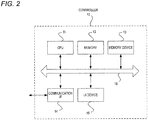
- Fig. 2 shows hardware a configuration of the controller 10 in the printing apparatus according to the exemplary embodiment.
- the controller 10 has a CPU 11, a memory 12, a memory device 13 such as a hard disk drive (HDD), a communication interface (IF) 14 performing transmission and reception of data to and from internal devices such as the detection camera 30, the print head portion 50, the inspection camera 40 and the defective product discharging unit 70, and a user interface (UI) device 15 including a touch panel or a liquid crystal display and a keyboard.
- a control bus 16 a control bus 16.
- the CPU 11 executes predetermined processing based on a control program stored in the memory 12 or the memory device 13, so as to control operation of the controller 10.
- the CPU 11 is described as a device which reads and executes the control program stored in the memory 12 or the memory device 13.
- the program may be stored in a memory medium such as a CD-ROM and provided to the CPU 11.
- Fig. 3 is a block diagram showing a functional configuration of the controller 10 achieved by execution of the aforementioned control program.
- the controller 10 includes the printing controller 21, a registration data acquirer 22, a registration data memory 23, a defective product detector 24, a collation data acquirer 25, a verifier 26, and a processor 27.
- the printing controller 21 detects a position of the tablet 90 to be printed, from the image captured by the detection camera 30, and controls a printing timing of the print head portion 50 based on the detected position. That is, the printing controller 21 calculates a timing for outputting a printing instruction to the print head portion 50, from information about transport speed of the transport conveyor 60, the position of the tablet 90 in the captured image, printing speed of the print head portion 50, etc., and transmits the printing instruction to the print head portion 50 at the calculated timing.
- the defective product detector 24 determines whether or not there is a problem such as printing blur or printing misalignment in printing information of the characters etc. printed on the tablet 90, from the image including the tablet 90 which is imaged after the printing by the inspection camera 40. When there is printing failure, the detective product detector 24 controls the defective product discharging unit 70 which thereby discharges the tablet 90 from the transport conveyor 60. Incidentally, the defective product detector 24 detects not only the printing failure but also a problem such as chipping of the tablet 90.
- the registration data acquirer 22 acquires feature data, as registration data, from the image captured by the detection camera 30, the feature data representing a feature distributed in a first region of a predetermined size on the front surface of the tablet 90. Specifically, the registration data acquirer 22 acquires a 32 ⁇ 32 dot region in a preset registration data acquisition region of the tablet 90, as the registration data.
- Fig. 4 shows a schematic view of, for example, an image captured by the detection camera 30.
- Fig. 5 shows an example of an actually captured tablet image and an example of a position of a registration data acquisition region 81.
- Fig. 4 a state in which the image including a tablet 90 on the transport conveyor 60 is captured is shown.
- the registration data acquisition region 81 is set at a predetermined position on the actually captured tablet image.
- the registration data acquisition region 81 is determined based on an external shape of the tablet and a position defined by a position of a printing pattern (printing information) scheduled to be printed on the tablet.
- a printing pattern printing information
- Fig. 6 shows an example of registration data obtained by cutting out data of a 32x32 dot region in the registration data acquisition region 81.
- the printing controller 21 controls the print head portion 50 to execute processing of printing the designated characters etc. on the tablet 90 based on the position of the tablet 90 in the image captured by the detection camera 30.
- Fig. 7 shows a state in which printing processing is performed thus by the print head portion 50.
- characters "XY-001" and “ABC” and a horizontal line (line) are printed on tablets 90 when each of the tablets 90 is passed under the print head portion 50 by the transport conveyor 60.
- the collation data acquirer 25 acquires feature data as collation data (collation image data) from an image captured by the inspection camera 40, the feature data representing a feature distributed in a second region of a predetermined size on the tablet 90.
- the collation data acquirer 25 acquires the feature data as the collation data, the feature data representing the feature distributed in a collation data acquisition region (the second region) which includes the registration data acquisition region (first region) 81 on the tablet and which is larger in size than the registration data acquisition region 81.
- the collation data acquirer 25 acquires a 64 ⁇ 64 dot image in the preset collation data acquisition region of the tablet 90, as the collation data.
- the position of the region for acquiring registration data is defined based on the printing pattern and the external shape, as described above. Therefore, the position of the region for acquiring collation data is also defined based on both the printing pattern and the external shape.
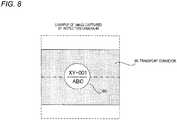
- Fig. 8 shows a schematic view of, for example, an image captured by the inspection camera 40.
- Fig. 9 shows an example of an actually captured tablet image and an example of a position of a collation data acquisition region 82.
- Fig. 8 a state in which the image including the tablet 90 which is transported on the transport conveyor 60 after the printing is captured is shown.
- the collation data acquisition region 82 is set at a predetermined position on the actually acquired tablet image.
- the collation data acquisition region 82 is a wider region including the registration data acquisition region 81.
- each of the positions of the registration data acquisition region 81 and the collation data acquisition region 82 is defined based on both the position of the printing pattern of the printed characters etc. and the external shape. Specifically, each of the registration data acquisition region 81 and the collation data acquisition region 82 is defined based on a position determined from the horizontal line (line) printed on the tablet and the external shape.
- Fig. 10 shows an example of collation data obtained by cutting out data of a 64 ⁇ 64 dot region in the collation data acquisition region 82.
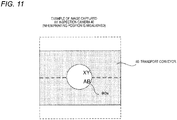
- Fig. 11 shows an example of an image captured by the inspection camera 40 in a case where printing was not performed properly on a tablet by printing processing by the print head portion 50.
- a state in which a tablet 90a having printing failure is imaged is shown in the example of the image shown in Fig. 11 .
- the defective product detector 24 controls the defective product discharging unit 70 which thereby discharges the defective tablet 90a into the defective product storing box 72.
- the registration data memory 23 stores the registration data acquired by the registration data acquirer 22, as data for determining identity of the tablet. Incidentally, when there is an empty space in storage capacity of the registration data memory 23, the entire image of the tablet after the printing may be stored as the registration data.
- the verifier 26 compares the registration data stored in the registration data memory 23 with collation data in the same tablet acquired by the collation data acquirer 25, and verifies whether reliability of the registration data is equal to or larger than a predetermined criterion value or not.
- the verifier 26 calculates a correlation value between the registration data and data acquired from a corresponding region of the collation data. When the calculated correlation value satisfies a predetermined criterion, the verifier 26 outputs a verification result that the reliability of the registration data is equal to or larger than the predetermined criterion value.
- the verifier 26 sequentially selects data having same size as the registration data from the collation data, and sequentially calculates a correlation value between the selected data and the registration data by a normalized correlation method to consequently acquire plural correlation values.
- a maximum of the acquired correlation values is equal to or larger than a first predetermined value
- a normalized score of the maximum of the correlation values is equal to or larger than a second predetermined value
- the verifier 26 outputs a verification result that the reliability of the registration data is equal to or larger than the predetermined criterion value.
- the normalized score of the maximum of the correlation values is obtained by subtracting an average of the correlation values from the maximum of the correlation values and dividing a value obtained thus by a standard deviation of the correlation values.
- the processor 27 executes processing based on the verification result in the verifier 26. For example, the processor 27 issues an instruction to the registration data memory 23 to store information of the verification result in the verifier 26. Thus, the registration data memory 23 stores the information of the verification result in the verifier 26 corresponding to the registration data together with the registration data.
- Fig. 12 shows an example of data stored in the registration data memory 23.
- verification results of stored registration data are stored together with the registration data.
- "registration data 1007" indicates that reliability does not satisfy the predetermined criterion value in a verification result by the verifier 26, and there is a possibility that the tablet which is genuine may be wrongly determined as a counterfeit tablet when collation processing is performed thereon in the future.
- the processor 27 may make control to stop operation of the printing apparatus to which the processor 27 belongs in the case where the reliability of the registration data is smaller than the predetermined criterion value in the verification result in the verifier 26.
- the registration data acquirer 22 acquires 32 ⁇ 32 dot registration data from the image captured by the detection camera 30 (step S101).
- the registration data acquired by the registration data acquirer 22 is stored in the registration data memory 23 (step S102).
- the printing controller 21 grasps a position of the tablet 90 based on the image captured by the detection camera 30, and controls the print head portion 50 which thereby performs printing at a timing when the tablet 90 is passed directly under the print head portion 50 (step S103).
- the collation data acquirer 25 acquires 64 ⁇ 64 dot collation data from the image captured by the inspection camera 40 (step S104).
- the verifier 26 reads registration data of the same tablet as the acquired collation data from the registration data memory 23, performs collation calculation between the read registration data and the collation data, and verifies whether or not it is possible to obtain determination that the read registration data and the collation data were acquired from the same tablet (step S105).
- the registration data and the collation data in the collation calculation were acquired from the same tablet. Therefore, when a calculation result that the read registration data and the collation data were acquired from the same tablet can be obtained in the collation calculation, determination can be made that there is a low possibility that wrong determination may occur even if the collation calculation using the registration data is performed in the future.
- the verifier 26 outputs the verification result, and the processor 27 executes processing based on the verification result in the verifier 26 (step S106).
- the calculation method for checking whether the reliability of the registration data is equal to or larger than the predetermined criterion or not will be described in the following description.
- a similar calculation method can be also used when collation calculation is performed between collation data acquired from an object whose identity is to be discriminated, and registration data which has been stored in advance.
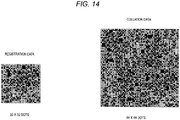
- Fig. 14 shows the example of the registration data and the example of the collation data which are targets of collation calculation.
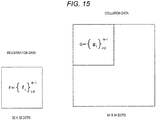
- the collation data is data acquired from a region including a region from which the registration data has been acquired. Accordingly, when the collation data and the registration data are acquired from the same object, data corresponding to the registration data should be included in the collation data.
- a correlation value is calculated between the aforementioned registration data and data cut out of the collation data repeatedly whenever a position where the data is cut out of the collation data is sequentially shifted by one dot (pixel) in an X direction and a Y direction, as shown in Fig. 16 .
- Fig. 17 shows an example in which the 1,089 correlation values obtained thus are graphed with respect to positions at which collation with the registration data has been performed in the collation data.
- a correlation value between data at a certain position in the collation data and the registration data is a value close to 1, which is larger than at any other place.
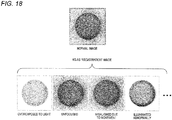
- Fig. 18 shows tablet image examples from which the normal registration data cannot be acquired thus.
- tablet images captured in cases where the tablet is overexposed to light, unfocused, misaligned due to movement, illuminated abnormally, etc. are shown in Fig. 18 .
- the acquired registration data is not normal but there is a high possibility that wrong determination may occur even when collation calculation is performed.
- the reliability of the registration data is not verified by use of only the maximum of the correlation values, but the maximum of the correlation values and the normalized score of the maximum of the correlation values are calculated and the reliability of the registration data is verified by use of the two values.
- the normalized score means a feature amount expressing a distribution state of the correlation values.
- the normalized score is an index indicating how far a value in question is from an average of a population. Therefore, the normalized score of the maximum of the correlation values is an index indicating how far the maximum of the 1,089 correlation values is from the average of the correlation values.
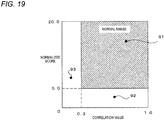
- the verifier 26 determines that the registration data can be determined with reliability high enough to be subjected to collation calculation.
- a plot value 91 indicates that the reliability of the registration data is high
- plot values 92 and 93 indicate that the reliability of the registration data is low.
- Fig. 20 shows an example of a graph of correlation values in which a maximum of the correlation values is small.
- Fig. 21 shows an example of a graph of correlation values in which registration data is not normal in spite of a maximum of the correlation values equal to or larger than a criterion value.
- the maximum of the correlation values does not satisfy the criterion of 0.3. Accordingly, the registration data cannot be determined with high reliability even when collation calculation is performed thereon.
- the maximum of the correlation values exceeds the criterion of 0.3, but the correlation values at the other collation positions are also large on the whole. This indicates that a large correlation value can be always obtained when collation calculation is performed at any collation position. Therefore, there is a high possibility that the registration data cannot be determined with high reliability even when collation calculation is performed thereon.
- the normalized score of the maximum of the correlation values is calculated in such a case, the value of the normalized score is small. Accordingly, the reliability of such registration data can be verified accurately by use of not only the maximum of the correlation values but also the normalized score of the maximum of the correlation values.
- the printing apparatus according to the exemplary embodiment has a similar configuration to that of the aforementioned printing apparatus according to the first exemplary embodiment. Therefore, description will be made only on the configuration which is different from that of the printing apparatus according to the first exemplary embodiment.
- the printing apparatus according to the exemplary embodiment has a configuration in which the controller 10 in the printing apparatus according to the first exemplary embodiment shown in Fig. 3 is replaced with a controller 10a shown in Fig. 22 .
- a collation data memory 28 is added to the controller 10 in the first exemplary embodiment shown in Fig. 3 .
- a collation data acquirer 25 acquires feature data as 64 ⁇ 64 dot collation data from an image captured by a detection camera 30, the feature data representing a feature distributed in a second region of a predetermined size on a tablet 90.
- the collation data memory 28 temporarily stores the collation data acquired by the collation data acquirer 25.
- a registration data acquirer 22 acquires feature data as 32 ⁇ 32 dot registration data from an image of the tablet 90 which is captured after printing processing by an inspection camera 40, the feature data representing a feature distributed in a first region of a predetermined size on a front surface of the tablet 90.
- the collation data which is acquired from an image of the tablet 90 captured initially by the detection camera 30 is stored once.
- the registration data is acquired from an image of the tablet 90 captured after the printing processing by the inspection camera 40, and reliability of the registration data is checked by use of the collation data stored in advance.
- the registration data is acquired from the image including the tablet 90 after the printing. Accordingly, the whole image of the tablet after the printing may be stored as the registration data when there is an empty space in memory capacity of a registration data memory 23.
- the collation data acquirer 25 acquires the collation data from one of the image captured by the detection camera 30 and the image captured by the inspection camera 40.
- the registration data acquirer 22 acquires the registration data from the other of the image captured by the detection camera 30 and the image captured by the inspection camera 40.
- the printing apparatus when one of tablets 90 fed by a hopper 20 and transported on a transport conveyor 60 is passed directly under the detection camera 30, an image of the tablet 90 is captured by the detection camera 30.
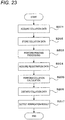
- the collation data acquirer 25 acquires 64 ⁇ 64 dot collation data from the image captured by the detection camera 30 (step S201).
- the collation data acquired by the collation data acquirer 25 is stored in the collation data memory 28 (step S202).
- a printing controller 21 grasps a position of the tablet 90 based on the image captured by the detection camera 30, and controls a print head portion 50 which thereby performs printing on the tablet 90 at a timing when the tablet 90 is passed directly under the print head portion 50 (step S203).
- the registration data acquirer 22 acquires 32 ⁇ 32 dot registration data from the image captured by the inspection camera 40 (step S204).
- a verifier 26 reads collation data of the same tablet as the acquired registration data from the collation data memory 28, performs collation calculation between the read collation data and the registration data, and verifies whether determination can be made that the read collation data and the registration data were obtained from the same tablet or not (step S205). That is, the registration data and the collation data in the collation calculation were acquired from the same tablet. Accordingly, as long as it is possible to obtain a calculation result that the registration data and the collation data were acquired from the same tablet in the collation calculation, determination can be made that there is a low possibility that wrong determination may occur even if collation calculation using the registration data is performed in the future.
- the collation data used for the collation calculation is discarded (step S206).
- the verifier 26 outputs a verification result in the collation calculation, and a processor 27 executes processing based on the verification result in the verifier 26 (step S207).
- the registration data is acquired from the image of the tablet after the printing processing.
- the processor 27 may perform character recognition processing of information printed on the tablet after the printing, and store the character information obtained by the character recognition processing into the registration data memory 23.
- the registration data memory 23 stores the character information obtained by the character recognition processing of the verifier 26, together with the registration data.
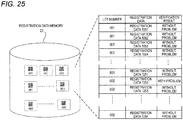
- Fig. 24 and Fig. 25 show examples of the registration data memory 23 which are designed to store the character information together with the registration data by such processing.
- Fig. 24 an example in which information pieces about manufacturing numbers differing from one tablet to another are stored together with registration data acquired from the tablets respectively.
- registration data of each tablet is stored together with an information piece like a manufacturing number by which the tablet can be specified uniquely.
- Fig. 25 shows an example in which an information piece about a lot number for specifying a production unit (lot) with which each tablet was manufactured is stored together with registration data acquired from the tablet.
- registration data of each tablet is stored together with an information piece like a lot number for specifying a lot with which the tablet was manufactured.
- the registration data acquirer 22 determines a position of a registration data acquisition region 81 based on a position defined by an external shape of a tablet to be registered and a position of a printing pattern printed on the tablet, from an image including the tablet.
- the collation data acquirer 25 similarly determines a position of a collation data acquisition region 82 based on a position defined by the external shape of the tablet and the position of the printing pattern printed on the tablet, from an image including the tablet. The reason why the position of the registration data acquisition region 81 and the position of the collation data acquisition region 82 are determined thus will be described below.
- the information amount of the random pattern is larger as it goes from the central portion of the tablet toward the peripheral portion thereof, for example, as in an example shown in (B) of Fig. 26 .
- the position of the registration data acquisition region 81 is set at the peripheral portion of the object if possible.
- the printing pattern is not always located at a fixed position relative to the shape of the object. Therefore, when the position of the registration data acquisition region 81 is defined based on the printing pattern, normal registration data may not be able to be acquired in some cases if printing misalignment occurs.
- Fig. 27 shows an example in which how the registration data acquisition region changes if printing misalignment occurs in a case where characters "XY-001" and a horizontal line are printed on the circular tablet.
- a perpendicular bisector of the horizontal line is virtually drawn on the tablet and a point on the perpendicular bisector at a fixed distance from the horizontal line is defined as the center of the registration data acquisition region is shown.
- the registration data acquisition region is set at an appropriate position when the printing pattern is printed normally, as shown in (A) of Fig. 27 .
- the registration data acquisition region is set at an appropriate position.
- the registration data acquisition region is set out of the external shape of the tablet so that the registration data acquisition region cannot be set at a position where registration data can be acquired normally.
- the registration data acquirer 22 in the printing apparatus determines the position of the registration data acquisition region 81 for acquiring the registration data based on the position defined by both the external shape of the tablet and the position of the printing pattern (printing information) printed on the tablet.
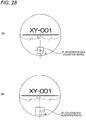
- the registration data acquirer 22 determines the position of the registration data acquisition region 81 by the following procedure, as shown in (A) of Fig. 28 .
- the position of the collation data acquisition region 82 is determined by a similar procedure, as shown in (B) of Fig. 28 .
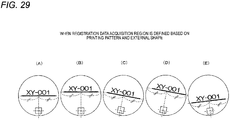
- the registration data acquisition region is set at an appropriate position.
- the registration data acquisition region is set at an appropriate position.
- a genuineness discriminating apparatus for determining whether, for example, a tablet which has been collected from the market is a regularly manufactured genuine tablet (authentic object) or a counterfeit tablet will be described with reference to Fig. 30 .
- Fig. 30 is a view showing a configuration of an exemplary embodiment of such a genuineness discriminating apparatus 300.
- the genuineness discriminating apparatus 300 includes a ring illumination unit 310, a camera 320, a collation data acquirer 330, a registration data memory 340, a correlation value calculator 350, and an identity determiner 360.
- the ring illumination unit 310 is an illumination device for radiating light onto a tablet 90 serving as a discrimination target on which genuineness discrimination (authenticity discrimination) is performed.
- the camera 320 is an imager for capturing an image including the tablet serving as the discrimination target.
- the collation data acquirer 330 acquires feature data, as collation data, from the image captured by the camera 320, the featuring data representing a feature distributed in a region determined based on a position defined by an external shape of the tablet 90 and a position of a printing pattern printed on the tablet 90.
- the registration data memory 340 stores registration data which has been acquired from a genuine tablet (authentic object) and registered in advance. That is, similar data to the data stored in the registration data memory 23 which has been described in the aforementioned first and second exemplary embodiments is stored in the registration data memory 340.
- the correlation value calculator 350 performs correlation value calculation between the collation data acquired by the collation data acquirer 330 and the registration data stored in the registration data memory 340. Since the correlation value calculation in the correlation value calculator 350 is a similar calculation method to the calculation method performed in the verifier 26 which has been described in the aforementioned first and second exemplary embodiments, detailed description thereof will be omitted.
- the identity determiner 360 compares the collation data acquired by the collation data acquirer 330 with the registration data stored in the registration data memory 340, to thereby determine identity of the tablet serving as the discrimination target. Specifically, the identity determiner 360 determines whether the tablet serving as the discrimination target is same as one of tablets from which registration data stored in the registration data memory 340 have been acquired or not.
- the case where registration data for determining identity of a tablet is acquired and stored when printing processing is performed on a front surface of the tablet by the printing apparatus has been used and described.
- the invention is not limited to such a case.
- the invention may be also similarly applied in a case where an image of a tablet to be registered is captured and registration data is acquired from the captured image in a data acquiring apparatus which does not perform printing processing.
- the invention is not limited thereto.
- the invention may be also similarly applied in a case of a configuration in which a turnover device for turning over the tablet is provided at the end of the transport conveyor 60, and another set of a detection camera 30, an inspection camera 40, a print head portion 50, etc. is prepared so that printing processing can be also performed on the tablet which has been turned over.
Landscapes
- Health & Medical Sciences (AREA)
- Chemical & Material Sciences (AREA)
- Engineering & Computer Science (AREA)
- Medicinal Chemistry (AREA)
- General Health & Medical Sciences (AREA)
- Life Sciences & Earth Sciences (AREA)
- Public Health (AREA)
- Physics & Mathematics (AREA)
- General Physics & Mathematics (AREA)
- Veterinary Medicine (AREA)
- Animal Behavior & Ethology (AREA)
- Pharmacology & Pharmacy (AREA)
- Bioinformatics & Cheminformatics (AREA)
- Medical Informatics (AREA)
- Immunology (AREA)
- Pathology (AREA)
- Biochemistry (AREA)
- Analytical Chemistry (AREA)
- Epidemiology (AREA)
- Primary Health Care (AREA)
- Theoretical Computer Science (AREA)
- Data Mining & Analysis (AREA)
- Artificial Intelligence (AREA)
- General Engineering & Computer Science (AREA)
- Bioinformatics & Computational Biology (AREA)
- Evolutionary Computation (AREA)
- Computer Vision & Pattern Recognition (AREA)
- Evolutionary Biology (AREA)
- Image Analysis (AREA)
- Investigating Materials By The Use Of Optical Means Adapted For Particular Applications (AREA)
- Medical Preparation Storing Or Oral Administration Devices (AREA)
Abstract
Description
- The present invention relates to a data acquiring apparatus, a printing apparatus, a genuineness discriminating apparatus, a method and a program.
- An authenticity discriminating method for discriminating authenticity of a solid body which has a readable unique feature with randomness distributed along its front surface has been disclosed in
Patent document 1. - A tablet printing apparatus which is designed to be capable of performing printing processing on tablets fed at random, at high speed in accordance with directions of the tablets has been disclosed in
Patent document 2. -
- Patent document 1: Japanese Patent No.
4103826 - Patent document 2:
JP-A-2013-121432 - A unique random pattern is present on each of front surfaces of various objects such as paper, tablet, metal and resin, in the same manner as a fingerprint, a vein pattern, an iris pattern, etc. of a human body. Therefore, there has been proposed a technique in which an image of a portion of the random pattern distributed along the front surface of the object is acquired and registered as registration data in advance, and image data of the random pattern acquired again from the object is compared with the registration data so that it is determined whether an object in the image data of the random pattern and an object in the registration data are the same or not.
- In this technique, genuineness discrimination (authenticity discrimination) is performed based on whether the registration data registered in advance and the collation data acquired from the object to be discriminated agree with each other or not.
- To this end, it is necessary to correspond, of a region from which the registration data has been acquired, a position in an object to a position of a region from which the collation data has been acquired. However, when a position of a data acquisition region in an object such as a circular tablet is tried to be specified, it is however impossible to specify the position based on an external shape of the object.
- For such a reason, the position of the region for acquiring the registration data is determined based on a printing pattern which has been printed on the object.
- In addition, assume that the object to be discriminated is a circular tablet. When the circular tablet is irradiated with light in this case, a shade appears weak at a central portion of the tablet but appears intense at a peripheral portion thereof. That is, an information quantity of a random pattern at the peripheral portion is larger than that at the central portion. Therefore, when registration data is acquired from the object such as the circular tablet, it is desirable that a position of a region for acquiring the registration data is set at the peripheral portion of the object if possible.
- However, assume that the position of the region for acquiring the registration data is determined based on the printing pattern which has been printed on the object as described above. When positional displacement etc. occurs during printing of printing information (the printing pattern) on the object in this case, the position for acquiring the registration data is also displaced so that there arises a possibility that the registration data containing sufficient information for making determination cannot be acquired.
- An object of the invention is to provide a data acquiring apparatus, a printing apparatus, a genuineness discriminating apparatus, a method and a program, which can determine a region for acquiring registration data without being affected by misalignment of printing information of an object, in comparison with a case where a position of the region for acquiring the registration data is determined from the printing information.
-
- [1] An exemplary embodiment of the invention is a data acquiring apparatus comprising: an acquirer that acquires feature data, as registration data, from an image including an object to be registered, the feature data representing a feature that is distributed in a region of a predetermined size determined based on a position defined by an external shape of the object and a position of printing information that has been printed on the object; and a memory that stores the registration data acquired by the acquirer as data for determining identity of the object.
-
- [2] An exemplary embodiment of the invention is a printing apparatus comprising: a printer that performs printing on an object to be registered; an acquirer that acquires feature data, as registration data, from a captured image of the object on which printing has been performed by the printer, the feature data representing a feature distributed in a region of a predetermined size determined based on a position defined by an external shape of the object and a position of printing information that has been printed on the object; and a memory that stores the registration data acquired by the acquirer, as data for determining identity of the object.
-
- [3] An exemplary embodiment of the invention is a genuineness discriminating apparatus comprising: an imager that captures an image including an object to be discriminated; an acquirer that acquires feature data, as collation data, from the image captured by the imager, the feature data representing a feature that is distributed in a region of a predetermined size determined based on a position defined by an external shape of the object and a position of printing information that has been printed on the object; and a determiner that compares the collation data acquired by the acquirer with registration data acquired from a genuine object and registered in advance, to thereby determine identity of the object to be discriminated.
- [4] In the genuineness discriminating apparatus according to [3], the determiner may calculate a correlation value between the registration data and data acquired from a corresponding region of the collation data, and determine that the object to be discriminated is same as the object from which the registration data was acquired when the correlation value satisfies a predetermined criterion.
- [5] In the genuineness determining apparatus according to [3], the acquirer may acquire feature data as collation data, the feature data representing a feature that is distributed in a region of a size including a region for acquiring registration data on the object and being larger than the region; and the determiner may sequentially select data having same size as the registration data from the collation data, sequentially calculate a correlation value between the selected data and the registration data to consequently obtain a plurality of correlation values, and determine that the object to be discriminated is same as the object from which the registration data was acquired when a maximum of the acquired correlation values is equal to or larger than a first predetermined value and a normalized score of the maximum of the correlation values obtained by subtracting an average of the correlation values from the maximum of the correlation values and dividing a value obtained by the subtracting by a standard deviation of the correlation values is equal to or larger than a second predetermined value.
- [6] In the genuineness discriminating apparatus according to [4] or [5], the determiner may calculate the correlation values by a normalized correlation method to acquire the correlation values.
- [7] In the genuineness discriminating apparatus according to any one of [3] to [6], the object may be a tablet.
-
- [8] An exemplary embodiment of the invention is a data acquiring method comprising: an acquisition step of acquiring feature data, as registration data, from an image including an object to be registered, the feature data representing a feature that is distributed in a region of a predetermined size determined based on a position defined by an external shape of the object and a position of printing information that has been printed on the object; and a storage step of storing the registration data acquired in the acquisition step, as data for determining identity of the object.
-
- [9] An exemplary embodiment of the invention is a printing method comprising: a printing step of performing printing on an object to be registered; an acquisition step of acquiring feature data, as registration data, from a captured image of the object on which printing has been performed in the printing step, the feature data representing a feature distributed in a region of a predetermined size determined based on an external shape of the object and a position defined by a position of printing information that has been printed on the object; and a storage step of storing the registration data acquired in the acquisition step, as data for determining identity of the object.
-
- [10] An exemplary embodiment of the invention is a genuineness discriminating method comprising: an imaging step of capturing an image including an object to be discriminated; an acquisition step of acquiring feature data, as collation data, from the image captured in the imaging step, the feature data representing a feature that is distributed in a region of a predetermined size determined based on a position defined by an external shape of the object and a position of printing information that has been printed on the object; and a determination step of comparing the collation data acquired in the acquisition step with registration data acquired from a genuine object and registered in advance, to thereby determine identity of the object to be discriminated.
-
- [11] An exemplary embodiment of the invention is a program causing a computer to execute: an acquisition step of acquiring feature data, as registration data, from an image including an object to be registered, the feature data representing a feature that is distributed in a region of a predetermined size determined based on a position defined by an external shape of the object and a position of printing information that has been printed on the object; and a storage step of storing the registration data acquired in the acquisition step, as data for determining identity of the object.
- [12] An exemplary embodiment of the invention is a program causing a computer to execute: a printing step of performing printing on an object to be registered; an acquisition step of acquiring feature data, as registration data, from a captured image of the object on which printing has been performed in the printing step, the feature data representing a feature distributed in a region of a predetermined size determined based on a position defined by an external shape of the object and a position of printing information that has been printed on the object; and a storage step of storing the registration data acquired in the acquisition step, as data for determining identity of the object.
- [13] An exemplary embodiment of the invention is a program causing a computer to execute: an imaging step of capturing an image including an object to be discriminated; an acquisition step of acquiring feature data, as collation data, from the image captured in the imaging step, the feature data representing a feature that is distributed in a region of a predetermined size determined based on a position defined by an external shape of the object and a position of printing information that has been printed on the object; and a determination step of comparing the collation data acquired in the acquisition step with registration data acquired from a genuine object and registered in advance, to thereby determine identity of the object to be discriminated.
- According to the data acquiring apparatus according to [1], it is possible to determine the region for acquiring the registration data without being affected by misalignment of the printing information of the object, in comparison with a case where the position of the region for acquiring the registration data is determined from the printing information.
- According to the printing apparatus according to [2], it is possible to determine the region for acquiring the registration data without being affected by misalignment of the printing information of the object, in comparison with a case where the position of the region for acquiring the registration data is determined from the printing information.
- According to the genuineness discriminating apparatus according to [3], it is possible to determine the region for acquiring the registration data without being affected by misalignment of the printing information of the object, in comparison with a case where the position of the region for acquiring the registration data is determined from the printing information.
- According to the genuineness discriminating apparatus according to [4], it is possible to determine the region for acquiring the registration data without being affected by misalignment of the printing information of the object, in comparison with a case where the position of the region for acquiring the registration data is determined from the printing information.
- According to the genuineness discriminating apparatus according to [5], it is possible to determine the region for acquiring the registration data without being affected by misalignment of the printing information of the object, in comparison with a case where the position of the region for acquiring the registration data is determined from the printing information.
- According to the genuineness discriminating apparatus according to [6], it is possible to determine the region for acquiring the registration data without being affected by misalignment of the printing information of the object, in comparison with a case where the position of the region for acquiring the registration data is determined from the printing information.
- According to the genuineness discriminating apparatus according to [7], it is possible to determine the region for acquiring the registration data without being affected by misalignment of the printing information of the tablet, in comparison with a case where the position of the region for acquiring the registration data is determined from the printing information.
- According to the data acquiring method according to [8], it is possible to determine the region for acquiring the registration data without being affected by misalignment of the printing information of the object, in comparison with a case where the position of the region for acquiring the registration data is determined from the printing information.
- According to the printing method according to [9], it is possible to provide the printing method which can determine the region for acquiring the registration data without being affected by misalignment of the printing information of the object, in comparison with a case where the position of the region for acquiring the registration data is determined from the printing information.
- According to the genuineness discriminating method according to [10], it is possible to determine the region for acquiring the registration data without being affected by misalignment of the printing information of the object, in comparison with a case where the position of the region for acquiring the registration data is determined from the printing information.
- According to the program according to [11], it is possible to determine the region for acquiring the registration data without being affected by misalignment of the printing information of the object, in comparison with a case where the position of the region for acquiring the registration data is determined from the printing information.
- According to the program according to [12], it is possible to determine the region for acquiring the registration data without being affected by misalignment of the printing information of the object, in comparison with a case where the position of the region for acquiring the registration data is determined from the printing information.
- According to the program according to [13], it is possible to determine the region for acquiring the registration data without being affected by misalignment of the printing information of the object, in comparison with a case where the position of the region for acquiring the registration data is determined from the printing information.
-
- [
Fig. 1 ] A view showing a configuration of a printing apparatus according to a first exemplary embodiment of the invention. - [
Fig. 2 ] A block diagram showing a hardware configuration of acontroller 10 in the first exemplary embodiment of the invention. - [
Fig. 3 ] A block diagram showing a functional configuration of thecontroller 10 in the first exemplary embodiment of the invention. - [
Fig. 4 ] A view schematically showing an image captured by adetection camera 30. - [
Fig. 5 ] A view showing an example of an actually acquired tablet image and an example of a position of a registrationdata acquisition region 81. - [
Fig. 6 ] A view showing an example of registration data. - [
Fig. 7 ] A view showing a state in which printing processing is performed by aprint head portion 50. - [
Fig. 8 ] A view schematically showing an image captured by aninspection camera 40. - [
Fig. 9 ] A view showing an example of an actually acquired tablet image and an example of a position of a collationdata acquisition region 82. - [
Fig. 10 ] A view showing an example of collation data. - [
Fig. 11 ] A view showing an example of an image captured by theinspection camera 40 in a case where printing was not performed on the tablet properly. - [
Fig. 12 ] A view showing an example of data stored in aregistration data memory 23. - [
Fig. 13 ] A flow chart for explaining a flow of operation of the printing apparatus according to the first exemplary embodiment of the invention. - [
Fig. 14 ] A view showing the example of the registration data and the example of the collation data which are targets of collation calculation. - [
Fig. 15 ] A view for explaining a state in which data having same size as the registration data is sequentially cut out of the collation data. - [
Fig. 16 ] A view for explaining a state in which a correlation value is calculated between the registration data and the data cut out of the collation data repeatedly whenever a position where the data is cut out of the collation data is sequentially shifted by one dot (pixel) in an X direction and a Y direction. - [
Fig. 17 ] A view showing an example in which 1,089 correlation values obtained by the collation calculation are graphed. - [
Fig. 18 ] A view showing tablet image examples from which normal registration data cannot be acquired. - [
Fig. 19 ] A view showing an example of a graph of a maximum of correlation values and a normalized score of the maximum of the correlation values, showing a range where registration data can be regarded as high in reliability. - [
Fig. 20 ] A view showing an example of a graph of correlation values in which a maximum of the correlation values is small. - [
Fig. 21 ] A view showing an example of a graph of correlation values in which registration data is not normal in spite of a maximum of the correlation values equal to or larger than a criterion value. - [
Fig. 22 ] A block diagram showing a functional configuration of acontroller 10a in a second exemplary embodiment of the invention. - [
Fig. 23 ] A flow chart for explaining a flow of operation of a printing apparatus according to the second exemplary embodiment of the invention. - [
Fig. 24 ] A view showing an example in which information pieces about manufacturing numbers different from one tablet from another are stored together with registration data acquired from the tablets respectively. - [
Fig. 25 ] A view showing an example in which an information piece about a lot number for specifying a production unit (lot) with which each tablet was manufactured is stored together with registration data acquired from the tablet. - [
Fig. 26 ] A view for explaining a state of a case where light emitted from a ring illumination unit 31 (41) is radiated onto a circular tablet, in which (A) ofFig. 26 is a view of the tablet seen from a side surface side, and (B) ofFig. 26 is a view of the tablet seen from an upper surface side. - [
Fig. 27 ] A view showing examples (A), (B), (C), (D) and (E) of a case where a registration data acquisition region is determined based on only a printing pattern. - [
Fig. 28 ] A view for explaining a procedure when positions of data acquisition regions are determined, in which (A) ofFig. 28 is a view for explaining a procedure when aregistration data acquirer 22 determines a position of a registrationdata acquisition region 81, and (B) ofFig. 28 is a view for explaining the procedure when acollation data acquirer 25 determines a position of a collationdata acquisition region 82. - [
Fig. 29 ] A view showing examples (A), (B), (C), (D) and (E) of a case where the registration data acquisition region is determined based on both an external shape of a tablet and a printing pattern. - [
Fig. 30 ] A block diagram for explaining a configuration of agenuineness discriminating apparatus 300. - Next, exemplary embodiments of the invention will be described in detail with reference to the drawings.
- First, a printing apparatus according to a first exemplary embodiment of the invention will be described.
Fig. 1 is a view showing a configuration of the printing apparatus according to the first exemplary embodiment of the invention. - In the printing apparatus for printing printing information of characters etc. on a circular tablet according to the exemplary embodiment, feature data based on which the tablet can be identified uniquely is acquired and stored as registration data (registration image data) when printing is performed on the tablet.
- Incidentally, since registration data of all tablets on which printing processing has been performed are acquired and stored in advance in this manner, the tablets can be discriminated from one another. For example, assume that a tablet which is suspected to be counterfeit has been found in the market. In this case, feature data of the tablet collected from the market and suspected to be counterfeit is acquired and compared with all the stored registration data. Thus, determination can be made as to whether the tablet is a genuinely manufactured and shipped tablet or a counterfeit tablet.
- Incidentally, a case where printing is performed on the circular tablet will be described in the exemplary embodiment. However, the invention may be also applied to a tablet having another shape than the circular shape in a similar manner. In addition, the invention may be also applied to any kind of tablet, a coated tablet such as a film-coated tablet or a sugar-coated tablet, or an uncoated tablet (naked tablet).
- Further, the circular tablet is used as an example of an object in the invention. However, the invention may be applied to any object as long as the object has a readable unique feature with randomness, such as fine surface unevenness, distributed along the front surface. For example, the invention may be also applied to items using various objects including a chip component such as a chip capacitor, a component such as a gear or a washer, an IC chip, a semiconductor component, a credit card, a ticket, securities and a document.
- As shown in
Fig. 1 , the printing apparatus according to the exemplary embodiment includes acontroller 10, ahopper 20 for feedingtablets 90, adetection camera 30, aring illumination unit 31, aninspection camera 40, aring illumination unit 41, aprint head portion 50, a transport conveyor (transport path) 60 for transporting thetablets 90 fed by thehopper 20, a defectiveproduct discharging unit 70, a goodproduct storing box 71, and a defectiveproduct storing box 72. - Each of the
ring illumination units tablets 90 which are transported on thetransport conveyor 60. - The
detection camera 30 is an imager which captures an image (first image) including each of the tablets transported on thetransport conveyor 60. Thedetection camera 30 is provided directly above thering illumination unit 31. Thedetection camera 30 can capture an image of thetablet 90 onto which light is radiated by thering illumination unit 31. Since the image of thetablet 90 is captured by thedetection camera 30, a position, a direction, or the like of the tablet can be detected. - The
print head portion 50 is a printer which performs printing on thetablet 90 based on the image captured by thedetection camera 30. Here, theprint head portion 50 uses an inkjet method to print characters, numerals, symbols, etc. of a manufacturing number, a lot number, a trade name etc. on thetablet 90 which is transported on thetransport conveyor 60. - Specifically, printing operation of the
print head portion 50 is controlled by thecontroller 10. Thecontroller 10 detects information about the position or direction of thetablet 90 and the front/back etc. thereof based on the image captured by thedetection camera 30. Thecontroller 10 controls theprint head portion 50 at a timing when designated characters etc. are printed at a designated position on thetablet 90 on thetransport conveyor 60 based on the detected information. - Incidentally, since the
tablet 90 is a circular tablet without any cleavage line, information about the direction or the front/back of thetablet 90 does not have to be detected in the exemplary embodiment. When printing is performed on a circular tablet with a cleavage line, the direction of the tablet on thetransport conveyor 60 or the front/back based on presence/absence of the cleavage line is determined, and aprinting controller 21 controls a direction etc. of the characters to be printed based on a result of the determination. - The
inspection camera 40 is an imager which captures an image (second image) including thetablet 90 on which printing has been performed by theprint head portion 50. Theinspection camera 40 is provided directly above thering illumination unit 41, and can capture an image of thetablet 90 onto which light is radiated by thering illumination unit 41. Theinspection camera 40 is provided in order to detect and exclude anytablet 90 having printing failure such as printing misalignment or printing blur. - The defective
product storing box 72 is a discharge place for storing defective tablets discharged by the defectiveproduct discharging unit 70. The goodproduct storing box 71 is a storage place for storing good tablets not discharged by the defectiveproduct discharging unit 70. - The defective
product discharging unit 70 performs an operation of discharging anytablet 90 transported on thetransport conveyor 60 into the defectiveproduct storing box 72 based on the control of thecontroller 10. - Based on the image captured by the
inspection camera 40, thecontroller 10 checks a printing state of thetablet 90 in the image. When the printing state is determined as printing failure, thecontroller 10 controls the defectiveproduct discharging unit 70 which thereby discharges thedefective tablet 90 into the defectiveproduct storing box 72. -
Fig. 2 shows hardware a configuration of thecontroller 10 in the printing apparatus according to the exemplary embodiment. - As shown in
Fig. 2 , thecontroller 10 has aCPU 11, amemory 12, amemory device 13 such as a hard disk drive (HDD), a communication interface (IF) 14 performing transmission and reception of data to and from internal devices such as thedetection camera 30, theprint head portion 50, theinspection camera 40 and the defectiveproduct discharging unit 70, and a user interface (UI)device 15 including a touch panel or a liquid crystal display and a keyboard. These constituent elements are connected to one another through acontrol bus 16. - The
CPU 11 executes predetermined processing based on a control program stored in thememory 12 or thememory device 13, so as to control operation of thecontroller 10. Incidentally, in the exemplary embodiment, theCPU 11 is described as a device which reads and executes the control program stored in thememory 12 or thememory device 13. However, the program may be stored in a memory medium such as a CD-ROM and provided to theCPU 11. -
Fig. 3 is a block diagram showing a functional configuration of thecontroller 10 achieved by execution of the aforementioned control program. - As shown in
Fig. 3 , thecontroller 10 according to the exemplary embodiment includes theprinting controller 21, aregistration data acquirer 22, aregistration data memory 23, adefective product detector 24, acollation data acquirer 25, averifier 26, and aprocessor 27. - The
printing controller 21 detects a position of thetablet 90 to be printed, from the image captured by thedetection camera 30, and controls a printing timing of theprint head portion 50 based on the detected position. That is, theprinting controller 21 calculates a timing for outputting a printing instruction to theprint head portion 50, from information about transport speed of thetransport conveyor 60, the position of thetablet 90 in the captured image, printing speed of theprint head portion 50, etc., and transmits the printing instruction to theprint head portion 50 at the calculated timing. - The
defective product detector 24 determines whether or not there is a problem such as printing blur or printing misalignment in printing information of the characters etc. printed on thetablet 90, from the image including thetablet 90 which is imaged after the printing by theinspection camera 40. When there is printing failure, thedetective product detector 24 controls the defectiveproduct discharging unit 70 which thereby discharges thetablet 90 from thetransport conveyor 60. Incidentally, thedefective product detector 24 detects not only the printing failure but also a problem such as chipping of thetablet 90. - The
registration data acquirer 22 acquires feature data, as registration data, from the image captured by thedetection camera 30, the feature data representing a feature distributed in a first region of a predetermined size on the front surface of thetablet 90. Specifically, theregistration data acquirer 22 acquires a 32×32 dot region in a preset registration data acquisition region of thetablet 90, as the registration data. -
Fig. 4 shows a schematic view of, for example, an image captured by thedetection camera 30. In addition,Fig. 5 shows an example of an actually captured tablet image and an example of a position of a registrationdata acquisition region 81. - In
Fig. 4 , a state in which the image including atablet 90 on thetransport conveyor 60 is captured is shown. - In addition, in
Fig. 5 , it can be known that the registrationdata acquisition region 81 is set at a predetermined position on the actually captured tablet image. The registrationdata acquisition region 81 is determined based on an external shape of the tablet and a position defined by a position of a printing pattern (printing information) scheduled to be printed on the tablet. Incidentally, in the exemplary embodiment, details of the reason why the position of the region for acquiring registration data is determined based on both the external shape and the printing pattern of the tablet will be described later. -
Fig. 6 shows an example of registration data obtained by cutting out data of a 32x32 dot region in the registrationdata acquisition region 81. - In the example of the registration data shown in
Fig. 6 , it can be known that concentration values of respective pixels of 1,024 (32×32) dots are acquired as data. - The
printing controller 21 controls theprint head portion 50 to execute processing of printing the designated characters etc. on thetablet 90 based on the position of thetablet 90 in the image captured by thedetection camera 30. -
Fig. 7 shows a state in which printing processing is performed thus by theprint head portion 50. Refer toFig. 7 . It can be known that characters "XY-001" and "ABC" and a horizontal line (line) are printed ontablets 90 when each of thetablets 90 is passed under theprint head portion 50 by thetransport conveyor 60. - The
collation data acquirer 25 acquires feature data as collation data (collation image data) from an image captured by theinspection camera 40, the feature data representing a feature distributed in a second region of a predetermined size on thetablet 90. Thecollation data acquirer 25 acquires the feature data as the collation data, the feature data representing the feature distributed in a collation data acquisition region (the second region) which includes the registration data acquisition region (first region) 81 on the tablet and which is larger in size than the registrationdata acquisition region 81. - Specifically, the
collation data acquirer 25 acquires a 64×64 dot image in the preset collation data acquisition region of thetablet 90, as the collation data. - Incidentally, the position of the region for acquiring registration data is defined based on the printing pattern and the external shape, as described above. Therefore, the position of the region for acquiring collation data is also defined based on both the printing pattern and the external shape.
-
Fig. 8 shows a schematic view of, for example, an image captured by theinspection camera 40. In addition,Fig. 9 shows an example of an actually captured tablet image and an example of a position of a collationdata acquisition region 82. - In
Fig. 8 , a state in which the image including thetablet 90 which is transported on thetransport conveyor 60 after the printing is captured is shown. - In addition, in
Fig. 9 , it can be known that the collationdata acquisition region 82 is set at a predetermined position on the actually acquired tablet image. The collationdata acquisition region 82 is a wider region including the registrationdata acquisition region 81. - In the exemplary embodiment, each of the positions of the registration
data acquisition region 81 and the collationdata acquisition region 82 is defined based on both the position of the printing pattern of the printed characters etc. and the external shape. Specifically, each of the registrationdata acquisition region 81 and the collationdata acquisition region 82 is defined based on a position determined from the horizontal line (line) printed on the tablet and the external shape. -
Fig. 10 shows an example of collation data obtained by cutting out data of a 64×64 dot region in the collationdata acquisition region 82. - In the example of the registration data shown in
Fig. 10 , it can be known that concentration values of respective pixels of 4,096 (64 × 64) dots are acquired as data. -
Fig. 11 shows an example of an image captured by theinspection camera 40 in a case where printing was not performed properly on a tablet by printing processing by theprint head portion 50. A state in which atablet 90a having printing failure is imaged is shown in the example of the image shown inFig. 11 . - When the image shown in
Fig. 11 is captured by theinspection camera 40, thedefective product detector 24 controls the defectiveproduct discharging unit 70 which thereby discharges thedefective tablet 90a into the defectiveproduct storing box 72. - The
registration data memory 23 stores the registration data acquired by theregistration data acquirer 22, as data for determining identity of the tablet. Incidentally, when there is an empty space in storage capacity of theregistration data memory 23, the entire image of the tablet after the printing may be stored as the registration data. - The
verifier 26 compares the registration data stored in theregistration data memory 23 with collation data in the same tablet acquired by thecollation data acquirer 25, and verifies whether reliability of the registration data is equal to or larger than a predetermined criterion value or not. - For example, the
verifier 26 calculates a correlation value between the registration data and data acquired from a corresponding region of the collation data. When the calculated correlation value satisfies a predetermined criterion, theverifier 26 outputs a verification result that the reliability of the registration data is equal to or larger than the predetermined criterion value. - Specifically, the
verifier 26 sequentially selects data having same size as the registration data from the collation data, and sequentially calculates a correlation value between the selected data and the registration data by a normalized correlation method to consequently acquire plural correlation values. When a maximum of the acquired correlation values is equal to or larger than a first predetermined value, and a normalized score of the maximum of the correlation values is equal to or larger than a second predetermined value, theverifier 26 outputs a verification result that the reliability of the registration data is equal to or larger than the predetermined criterion value. The normalized score of the maximum of the correlation values is obtained by subtracting an average of the correlation values from the maximum of the correlation values and dividing a value obtained thus by a standard deviation of the correlation values. - Incidentally, a specific calculation method of each of the correlation values or a specific calculation method of the normalized score will be described later.
- The
processor 27 executes processing based on the verification result in theverifier 26. For example, theprocessor 27 issues an instruction to theregistration data memory 23 to store information of the verification result in theverifier 26. Thus, theregistration data memory 23 stores the information of the verification result in theverifier 26 corresponding to the registration data together with the registration data. -
Fig. 12 shows an example of data stored in theregistration data memory 23. In the example shown inFig. 12 , it can be known that verification results of stored registration data are stored together with the registration data. For example, in the example shown inFig. 12 , "registration data 1007" indicates that reliability does not satisfy the predetermined criterion value in a verification result by theverifier 26, and there is a possibility that the tablet which is genuine may be wrongly determined as a counterfeit tablet when collation processing is performed thereon in the future. - In addition, the
processor 27 may make control to stop operation of the printing apparatus to which theprocessor 27 belongs in the case where the reliability of the registration data is smaller than the predetermined criterion value in the verification result in theverifier 26. - Next, a flow of the operation of the printing apparatus according to the exemplary embodiment will be described with reference to a flow chart of
Fig. 13 . - In the printing apparatus according to the exemplary embodiment, when one of
tablets 90 fed by thehopper 20 and transported on thetransport conveyor 60 is passed directly under thedetection camera 30, an image of thetablet 90 is captured by thedetection camera 30. Theregistration data acquirer 22 acquires 32×32 dot registration data from the image captured by the detection camera 30 (step S101). - The registration data acquired by the
registration data acquirer 22 is stored in the registration data memory 23 (step S102). - The
printing controller 21 grasps a position of thetablet 90 based on the image captured by thedetection camera 30, and controls theprint head portion 50 which thereby performs printing at a timing when thetablet 90 is passed directly under the print head portion 50 (step S103). - When the
tablet 90 on which the printing processing has been performed is passed directly under theinspection camera 40, an image of thetablet 90 is captured after the printing processing by theinspection camera 40. Thecollation data acquirer 25 acquires 64×64 dot collation data from the image captured by the inspection camera 40 (step S104). - The
verifier 26 reads registration data of the same tablet as the acquired collation data from theregistration data memory 23, performs collation calculation between the read registration data and the collation data, and verifies whether or not it is possible to obtain determination that the read registration data and the collation data were acquired from the same tablet (step S105). The registration data and the collation data in the collation calculation were acquired from the same tablet. Therefore, when a calculation result that the read registration data and the collation data were acquired from the same tablet can be obtained in the collation calculation, determination can be made that there is a low possibility that wrong determination may occur even if the collation calculation using the registration data is performed in the future. - The
verifier 26 outputs the verification result, and theprocessor 27 executes processing based on the verification result in the verifier 26 (step S106). - Next, a specific calculation method of the collation calculation between the registration data and the collation data will be described in detail with reference to
Figs. 14 to 21 . - Incidentally, the calculation method for checking whether the reliability of the registration data is equal to or larger than the predetermined criterion or not will be described in the following description. However, a similar calculation method can be also used when collation calculation is performed between collation data acquired from an object whose identity is to be discriminated, and registration data which has been stored in advance.
- First,
Fig. 14 shows the example of the registration data and the example of the collation data which are targets of collation calculation. The collation data is data acquired from a region including a region from which the registration data has been acquired. Accordingly, when the collation data and the registration data are acquired from the same object, data corresponding to the registration data should be included in the collation data. - Therefore, as shown in
Fig. 15 , data having same size as the registration data is sequentially cut out of the collation data, and correlation value calculation is performed. - The correlation value calculation is performed based on the following expression (1). In the following expression (1), a set of the registration data is designated by F; a pixel value of each of pixels of the registration data, fi; a total pixel number of the registration data (and each of the cut regions of the collation data), N (N= 32×32= 1024); the data of the cut region of the collation data, G; a pixel value of each of pixels of the cut region of the collation data, gi; an average of the pixel values of the respective pixels of the registration data, fAVE; and an average of the pixel values of the respective pixels of the cut region of the collation data, gAVE.

- A correlation value is calculated between the aforementioned registration data and data cut out of the collation data repeatedly whenever a position where the data is cut out of the collation data is sequentially shifted by one dot (pixel) in an X direction and a Y direction, as shown in
Fig. 16 . - As a result, by collation calculation performed between one registration data (32×32 dots) and the collation data (64×64 dots), 1,089 ((64-32+1)×(64-32+1)) correlation values can be obtained.
-
Fig. 17 shows an example in which the 1,089 correlation values obtained thus are graphed with respect to positions at which collation with the registration data has been performed in the collation data. - In the example shown in
Fig. 17 , it can be known that a correlation value between data at a certain position in the collation data and the registration data is a value close to 1, which is larger than at any other place. - That is, in the example shown in
Fig. 17 , it is possible to determine that the registration data and the collation data were acquired from the same object. - When such a correlation value is obtained in the collation calculation, it is possible to determine that the acquired registration data is reliable enough to be subjected to collation calculation.
- However, there may be considered cases where normal registration data cannot be acquired due to various factors such as an illumination quantity when the registration data is acquired, failure in focus setting of the
detection camera 30, and a fluctuation in distance between thedetection camera 30 and thetransport conveyor 60 due to vibration. -
Fig. 18 shows tablet image examples from which the normal registration data cannot be acquired thus. For example, tablet images captured in cases where the tablet is overexposed to light, unfocused, misaligned due to movement, illuminated abnormally, etc. are shown inFig. 18 . When a captured tablet image is one of such images, the acquired registration data is not normal but there is a high possibility that wrong determination may occur even when collation calculation is performed. - Therefore, in the exemplary embodiment, the reliability of the registration data is not verified by use of only the maximum of the correlation values, but the maximum of the correlation values and the normalized score of the maximum of the correlation values are calculated and the reliability of the registration data is verified by use of the two values.
- The normalized score means a feature amount expressing a distribution state of the correlation values. The normalized score of the maximum of the correlation values is calculated based on the following expression (2).

- The normalized score is an index indicating how far a value in question is from an average of a population. Therefore, the normalized score of the maximum of the correlation values is an index indicating how far the maximum of the 1,089 correlation values is from the average of the correlation values.
- In the exemplary embodiment, when, for example, the maximum of the correlation values is equal to or lager than 0.3 and the normalized score of the maximum of the correlation values is equal to or larger than 5.0, as shown in
Fig. 19 , theverifier 26 determines that the registration data can be determined with reliability high enough to be subjected to collation calculation. - That is, assume that the maximum of the correlation values and the normalized score thereof are plotted on the graph shown in
Fig. 19 . When a plot value in this case falls into a hatched area, theverifier 26 determines that the reliability of the registration data is high. When a plot value in this case falls out of the hatched area, theverifier 26 determines that the reliability of the registration data is low. - For example, in the graph shown in
Fig. 19 , aplot value 91 indicates that the reliability of the registration data is high, andplot values -
Fig. 20 shows an example of a graph of correlation values in which a maximum of the correlation values is small.Fig. 21 shows an example of a graph of correlation values in which registration data is not normal in spite of a maximum of the correlation values equal to or larger than a criterion value. - In the example of the graph shown in
Fig. 20 , the maximum of the correlation values does not satisfy the criterion of 0.3. Accordingly, the registration data cannot be determined with high reliability even when collation calculation is performed thereon. - In addition, in the example of the graph shown in
Fig. 21 , the maximum of the correlation values exceeds the criterion of 0.3, but the correlation values at the other collation positions are also large on the whole. This indicates that a large correlation value can be always obtained when collation calculation is performed at any collation position. Therefore, there is a high possibility that the registration data cannot be determined with high reliability even when collation calculation is performed thereon. When the normalized score of the maximum of the correlation values is calculated in such a case, the value of the normalized score is small. Accordingly, the reliability of such registration data can be verified accurately by use of not only the maximum of the correlation values but also the normalized score of the maximum of the correlation values. - Next, a printing apparatus according to a second exemplary embodiment of the invention will be described.
- The printing apparatus according to the exemplary embodiment has a similar configuration to that of the aforementioned printing apparatus according to the first exemplary embodiment. Therefore, description will be made only on the configuration which is different from that of the printing apparatus according to the first exemplary embodiment.
- The printing apparatus according to the exemplary embodiment has a configuration in which the
controller 10 in the printing apparatus according to the first exemplary embodiment shown inFig. 3 is replaced with acontroller 10a shown inFig. 22 . - In the
controller 10a in the exemplary embodiment, acollation data memory 28 is added to thecontroller 10 in the first exemplary embodiment shown inFig. 3 . - In addition, in the
controller 10a in the exemplary embodiment, acollation data acquirer 25 acquires feature data as 64×64 dot collation data from an image captured by adetection camera 30, the feature data representing a feature distributed in a second region of a predetermined size on atablet 90. - The
collation data memory 28 temporarily stores the collation data acquired by thecollation data acquirer 25. - Further, in the
controller 10a in the exemplary embodiment, aregistration data acquirer 22 acquires feature data as 32×32 dot registration data from an image of thetablet 90 which is captured after printing processing by aninspection camera 40, the feature data representing a feature distributed in a first region of a predetermined size on a front surface of thetablet 90. - That is, in the printing apparatus according to the exemplary embodiment, the collation data which is acquired from an image of the
tablet 90 captured initially by thedetection camera 30 is stored once. The registration data is acquired from an image of thetablet 90 captured after the printing processing by theinspection camera 40, and reliability of the registration data is checked by use of the collation data stored in advance. - Incidentally, in the printing apparatus according to the exemplary embodiment, the registration data is acquired from the image including the
tablet 90 after the printing. Accordingly, the whole image of the tablet after the printing may be stored as the registration data when there is an empty space in memory capacity of aregistration data memory 23. - Thus, according to the aforementioned two exemplary embodiments, i.e. the first exemplary embodiment and the second exemplary embodiment, the
collation data acquirer 25 acquires the collation data from one of the image captured by thedetection camera 30 and the image captured by theinspection camera 40. Moreover, theregistration data acquirer 22 acquires the registration data from the other of the image captured by thedetection camera 30 and the image captured by theinspection camera 40. - Next, a flow of operation of the printing apparatus according to the exemplary embodiment will be described with reference to a flow chart of
Fig. 23 . - In the printing apparatus according to the exemplary embodiment, when one of
tablets 90 fed by ahopper 20 and transported on atransport conveyor 60 is passed directly under thedetection camera 30, an image of thetablet 90 is captured by thedetection camera 30. Thecollation data acquirer 25 acquires 64×64 dot collation data from the image captured by the detection camera 30 (step S201). - The collation data acquired by the
collation data acquirer 25 is stored in the collation data memory 28 (step S202). - A
printing controller 21 grasps a position of thetablet 90 based on the image captured by thedetection camera 30, and controls aprint head portion 50 which thereby performs printing on thetablet 90 at a timing when thetablet 90 is passed directly under the print head portion 50 (step S203). - When the
tablet 90 on which the printing processing has been performed is passed directly under theinspection camera 40, an image of thetablet 90 is captured after the printing processing by theinspection camera 40. Theregistration data acquirer 22 acquires 32×32 dot registration data from the image captured by the inspection camera 40 (step S204). - A
verifier 26 reads collation data of the same tablet as the acquired registration data from thecollation data memory 28, performs collation calculation between the read collation data and the registration data, and verifies whether determination can be made that the read collation data and the registration data were obtained from the same tablet or not (step S205). That is, the registration data and the collation data in the collation calculation were acquired from the same tablet. Accordingly, as long as it is possible to obtain a calculation result that the registration data and the collation data were acquired from the same tablet in the collation calculation, determination can be made that there is a low possibility that wrong determination may occur even if collation calculation using the registration data is performed in the future. - When the collation calculation is completed, the collation data used for the collation calculation is discarded (step S206). The
verifier 26 outputs a verification result in the collation calculation, and aprocessor 27 executes processing based on the verification result in the verifier 26 (step S207). - In the processing apparatus according to the exemplary embodiment, the registration data is acquired from the image of the tablet after the printing processing. Accordingly, the
processor 27 may perform character recognition processing of information printed on the tablet after the printing, and store the character information obtained by the character recognition processing into theregistration data memory 23. - In this manner, the
registration data memory 23 stores the character information obtained by the character recognition processing of theverifier 26, together with the registration data. -
Fig. 24 andFig. 25 show examples of theregistration data memory 23 which are designed to store the character information together with the registration data by such processing. - In the example shown in
Fig. 24 , an example in which information pieces about manufacturing numbers differing from one tablet to another are stored together with registration data acquired from the tablets respectively. Thus, registration data of each tablet is stored together with an information piece like a manufacturing number by which the tablet can be specified uniquely. With this configuration, it will go well if collation calculation is performed once in order to discriminate genuineness of any tablet available on the market. - In addition,
Fig. 25 shows an example in which an information piece about a lot number for specifying a production unit (lot) with which each tablet was manufactured is stored together with registration data acquired from the tablet. Thus, registration data of each tablet is stored together with an information piece like a lot number for specifying a lot with which the tablet was manufactured. With this configuration, in order to discriminate genuineness of any tablet available on the market, it will go well if collation calculation is performed a number of times corresponding to the number of tablets in the lot to which the tablet belongs. - In the aforementioned first and second exemplary embodiments, as described above, the
registration data acquirer 22 determines a position of a registrationdata acquisition region 81 based on a position defined by an external shape of a tablet to be registered and a position of a printing pattern printed on the tablet, from an image including the tablet. In addition, thecollation data acquirer 25 similarly determines a position of a collationdata acquisition region 82 based on a position defined by the external shape of the tablet and the position of the printing pattern printed on the tablet, from an image including the tablet. The reason why the position of the registrationdata acquisition region 81 and the position of the collationdata acquisition region 82 are determined thus will be described below. - First, in an object having an inclined surface like a circular tablet, a shadow (intensity of a shade) generated due to fine surface unevenness by a surface light source such as the
ring illumination unit - For example, when light emitted from the ring illumination unit 31 (41) is radiated onto the circular tablet as shown in (A) of
Fig. 26 , the shade appears weakly at a central portion of the tablet but appears intensely at a peripheral portion of the tablet. That is, an information amount of a random pattern at the peripheral portion is larger than that at the central portion. - It can be known that the information amount of the random pattern is larger as it goes from the central portion of the tablet toward the peripheral portion thereof, for example, as in an example shown in (B) of
Fig. 26 . - Therefore, when registration data is acquired from the object such as the circular tablet, it is desirable that the position of the registration
data acquisition region 81 is set at the peripheral portion of the object if possible. - However, when characters etc. are printed on the object and the position of the registration
data acquisition region 81 is defined based on the characters etc., a problem arises if printing misalignment etc. occurs. - When printing is performed on the object such as the tablet, the printing is performed on the object during transport. Therefore, the printing pattern is not always located at a fixed position relative to the shape of the object. Therefore, when the position of the registration
data acquisition region 81 is defined based on the printing pattern, normal registration data may not be able to be acquired in some cases if printing misalignment occurs. - For example,
Fig. 27 shows an example in which how the registration data acquisition region changes if printing misalignment occurs in a case where characters "XY-001" and a horizontal line are printed on the circular tablet. - In this
Fig. 27 , a case where a perpendicular bisector of the horizontal line is virtually drawn on the tablet and a point on the perpendicular bisector at a fixed distance from the horizontal line is defined as the center of the registration data acquisition region is shown. - In such a case, the registration data acquisition region is set at an appropriate position when the printing pattern is printed normally, as shown in (A) of
Fig. 27 . - In addition, even when the printing pattern is slightly tilted in terms of direction as shown in (C) of
Fig. 27 , the registration data acquisition region is set at an appropriate position. - However, when the printing pattern is displaced from the center and printed as shown in (B) or (D) of
Fig. 27 , the registration data acquisition region cannot be set at an appropriate position. - Further, when the printing pattern is displaced greatly from the center and printed as shown in (E) of
Fig. 27 , the registration data acquisition region is set out of the external shape of the tablet so that the registration data acquisition region cannot be set at a position where registration data can be acquired normally. - Therefore, the
registration data acquirer 22 in the printing apparatus according to the exemplary embodiment determines the position of the registrationdata acquisition region 81 for acquiring the registration data based on the position defined by both the external shape of the tablet and the position of the printing pattern (printing information) printed on the tablet. - Specifically, the
registration data acquirer 22 determines the position of the registrationdata acquisition region 81 by the following procedure, as shown in (A) ofFig. 28 . -
- (1) Draw a line segment which extends from the horizontal line (line) in the printing pattern to a circumferential portion (edge portion) of the tablet,
- (2) Extend a perpendicular bisector of the drawn line segment to a side where the characters "XY-100" are not printed with respect to the horizontal line,
- (3) Obtain a position of an intersection point between the perpendicular bisector and the circumferential portion of the tablet,
- (4) Move a preset distance d from the intersection point toward the center of the tablet along the perpendicular bisector, and
- (5) Determine a registration
data acquisition region 81 in which an arrival point on the perpendicular bisector moved by the distance d from the intersection point serves as center coordinates. - In addition, also when the
collation data acquirer 25 acquires collation data or when collation data is acquired from a tablet whose genuineness is to be discriminated, the position of the collationdata acquisition region 82 is determined by a similar procedure, as shown in (B) ofFig. 28 . - When the position of the registration
data acquisition region 81 is determined thus based on both the external shape of the tablet and the printing pattern, description about how the registrationdata acquisition region 81 changes if printing misalignment occurs will be made with reference toFig. 29 . - When the printing pattern is normally printed as shown in (A) of
Fig. 29 , it is a matter of course that the registration data acquisition region is set at an appropriate position. - In addition, also when the printing pattern is slightly tilted in terms of direction as shown in (C) of
Fig. 29 , the registration data acquisition region is set at an appropriate position. - Even when the printing pattern is displaced from the center and printed as shown in (B) or (D) of
Fig. 29 , it can be known that the registration data acquisition region is set at an appropriate position. - Further, even when the printing pattern is displaced greatly from the center and printed as shown in (E) of
Fig. 29 , it can be known that the registration data acquisition region is set at an appropriate position. - Next, a genuineness discriminating apparatus for determining whether, for example, a tablet which has been collected from the market is a regularly manufactured genuine tablet (authentic object) or a counterfeit tablet will be described with reference to
Fig. 30 . -
Fig. 30 is a view showing a configuration of an exemplary embodiment of such agenuineness discriminating apparatus 300. - As shown in
Fig. 30 , thegenuineness discriminating apparatus 300 includes aring illumination unit 310, acamera 320, acollation data acquirer 330, aregistration data memory 340, acorrelation value calculator 350, and anidentity determiner 360. - The
ring illumination unit 310 is an illumination device for radiating light onto atablet 90 serving as a discrimination target on which genuineness discrimination (authenticity discrimination) is performed. Thecamera 320 is an imager for capturing an image including the tablet serving as the discrimination target. - The
collation data acquirer 330 acquires feature data, as collation data, from the image captured by thecamera 320, the featuring data representing a feature distributed in a region determined based on a position defined by an external shape of thetablet 90 and a position of a printing pattern printed on thetablet 90. - The
registration data memory 340 stores registration data which has been acquired from a genuine tablet (authentic object) and registered in advance. That is, similar data to the data stored in theregistration data memory 23 which has been described in the aforementioned first and second exemplary embodiments is stored in theregistration data memory 340. - The
correlation value calculator 350 performs correlation value calculation between the collation data acquired by thecollation data acquirer 330 and the registration data stored in theregistration data memory 340. Since the correlation value calculation in thecorrelation value calculator 350 is a similar calculation method to the calculation method performed in theverifier 26 which has been described in the aforementioned first and second exemplary embodiments, detailed description thereof will be omitted. - The
identity determiner 360 compares the collation data acquired by thecollation data acquirer 330 with the registration data stored in theregistration data memory 340, to thereby determine identity of the tablet serving as the discrimination target. Specifically, theidentity determiner 360 determines whether the tablet serving as the discrimination target is same as one of tablets from which registration data stored in theregistration data memory 340 have been acquired or not. - That is, when a determination result is obtained that the tablet serving as the discrimination target is same as one of tablets which were manufactured in the past and sold in the market, determination can be made that the tablet serving as the discrimination target is a genuine tablet. On the other hand, when a determination result is obtained that the tablet serving as the discrimination target is not the same as any of the tablets which were manufactured in the past and sold in the market, determination can be made that the tablet serving as the discrimination target is a counterfeit tablet.
- In the aforementioned exemplary embodiment, the case where registration data for determining identity of a tablet is acquired and stored when printing processing is performed on a front surface of the tablet by the printing apparatus has been used and described. However, the invention is not limited to such a case. For example, the invention may be also similarly applied in a case where an image of a tablet to be registered is captured and registration data is acquired from the captured image in a data acquiring apparatus which does not perform printing processing.
- In addition, the case where printing is performed only on a single side of the tablet has been used and described in the aforementioned exemplary embodiments. However, the invention is not limited thereto. The invention may be also similarly applied in a case of a configuration in which a turnover device for turning over the tablet is provided at the end of the
transport conveyor 60, and another set of adetection camera 30, aninspection camera 40, aprint head portion 50, etc. is prepared so that printing processing can be also performed on the tablet which has been turned over. - In addition, in order to simplify description, the case where
tablets 90 are transported in one line on thetransport conveyor 60 in the printing apparatus according to each of the aforementioned exemplary embodiments has been used and described. However, the invention may be also similarly applied in a case where plural lines of tablets are transported simultaneously and printing is performed on the plural tablets simultaneously. - Further, the case where 32×32 dot image data is acquired as the registration data, image data measuring 64 dots by 64 dots is acquired as the collation data, and collation calculation is performed therebetween has been used and described in each of the aforementioned exemplary embodiments. However, the data sizes of the registration data and the collation data are not limited to such sizes.
- Although various exemplary embodiments have been described above, these exemplary embodiments may be combined and configured. In addition, the present disclosure is not limited to the aforementioned exemplary embodiments at all but can be carried out in various modes without departing from the gist of the present disclosure.
- The present application is based on a Japanese patent application (Patent Application No.
2015-225265) filed on November 18, 2015 -
- 10, 10a controller
- 11 CPU
- 12 memory
- 13 memory device
- 14 communication interface (IF)
- 15 user interface (UI) device
- 16 control bus
- 20 hopper
- 21 printing controller
- 22 registration data acquirer
- 23 registration data memory
- 24 defective product detector
- 25 collation data acquirer
- 26 verifier
- 27 processor
- 28 collation data memory
- 29 test data memory
- 30 detection camera
- 31 ring illumination unit
- 40 inspection camera
- 41 ring illumination unit
- 50 print head portion
- 60 transport conveyor
- 70 defective product discharging unit
- 71 good product storing box
- 72 defective product storing box
- 81 registration data acquisition region
- 82 collation data acquisition region
- 90 tablet
- 90a tablet (printing failure)
- 91 to 93 plot value
- 300 genuineness discriminating apparatus
- 310 ring illumination unit
- 320 camera
- 330 collation data acquirer
- 340 registration data memory
- 350 correlation value calculator
- 360 identity determiner
Claims (13)
- A data acquiring apparatus comprising:an acquirer that acquires feature data, as registration data, from an image including an object to be registered, the feature data representing a feature that is distributed in a region of a predetermined size determined based on a position defined by an external shape of the object and a position of printing information that has been printed on the object; anda memory that stores the registration data acquired by the acquirer as data for determining identity of the object.
- A printing apparatus comprising:a printer that performs printing on an object to be registered;an acquirer that acquires feature data, as registration data, from a captured image of the object on which printing has been performed by the printer, the feature data representing a feature distributed in a region of a predetermined size determined based on a position defined by an external shape of the object and a position of printing information that has been printed on the object; anda memory that stores the registration data acquired by the acquirer, as data for determining identity of the object.
- A genuineness discriminating apparatus comprising:an imager that captures an image including an object to be discriminated;an acquirer that acquires feature data, as collation data, from the image captured by the imager, the feature data representing a feature that is distributed in a region of a predetermined size determined based on a position defined by an external shape of the object and a position of printing information that has been printed on the object; anda determiner that compares the collation data acquired by the acquirer with registration data acquired from a genuine object and registered in advance, to thereby determine identity of the object to be discriminated.
- The genuineness discriminating apparatus according to Claim 3, wherein:
the determiner calculates a correlation value between the registration data and data acquired from a corresponding region of the collation data, and determines that the object to be discriminated is same as the object from which the registration data was acquired when the correlation value satisfies a predetermined criterion. - The genuineness determining apparatus according to Claim 3, wherein:the acquirer acquires feature data as collation data, the feature data representing a feature that is distributed in a region of a size including a region for acquiring registration data on the object and being larger than the region; andthe determiner sequentially selects data having same size as the registration data from the collation data, sequentially calculates a correlation value between the selected data and the registration data to consequently obtain a plurality of correlation values, and determines that the object to be discriminated is same as the object from which the registration data was acquired when a maximum of the acquired correlation values is equal to or larger than a first predetermined value and a normalized score of the maximum of the correlation values obtained by subtracting an average of the correlation values from the maximum of the correlation values and dividing a value obtained by the subtracting by a standard deviation of the correlation values is equal to or larger than a second predetermined value.
- The genuineness discriminating apparatus according to Claim 4 or 5, wherein:
the determiner calculates the correlation values by a normalized correlation method to acquire the correlation values. - The genuineness discriminating apparatus according to any one of Claims 3 to 6, wherein: the object is a tablet.
- A data acquiring method comprising:an acquisition step of acquiring feature data, as registration data, from an image including an object to be registered, the feature data representing a feature that is distributed in a region of a predetermined size determined based on a position defined by an external shape of the object and a position of printing information that has been printed on the object; anda storage step of storing the registration data acquired in the acquisition step, as data for determining identity of the object.
- A printing method comprising:a printing step of performing printing on an object to be registered;an acquisition step of acquiring feature data, as registration data, from a captured image of the object on which printing has been performed in the printing step, the feature data representing a feature distributed in a region of a predetermined size determined based on an external shape of the object and a position defined by a position of printing information that has been printed on the object; anda storage step of storing the registration data acquired in the acquisition step, as data for determining identity of the object.
- A genuineness discriminating method comprising:an imaging step of capturing an image including an object to be discriminated;an acquisition step of acquiring feature data, as collation data, from the image captured in the imaging step, the feature data representing a feature that is distributed in a region of a predetermined size determined based on a position defined by an external shape of the object and a position of printing information that has been printed on the object; anda determination step of comparing the collation data acquired in the acquisition step with registration data acquired from a genuine object and registered in advance, to thereby determine identity of the object to be discriminated.
- A program causing a computer to execute:an acquisition step of acquiring feature data, as registration data, from an image including an object to be registered, the feature data representing a feature that is distributed in a region of a predetermined size determined based on a position defined by an external shape of the object and a position of printing information that has been printed on the object; anda storage step of storing the registration data acquired in the acquisition step, as data for determining identity of the object.
- A program causing a computer to execute:a printing step of performing printing on an object to be registered;an acquisition step of acquiring feature data, as registration data, from a captured image of the object on which printing has been performed in the printing step, the feature data representing a feature distributed in a region of a predetermined size determined based on a position defined by an external shape of the object and a position of printing information that has been printed on the object; anda storage step of storing the registration data acquired in the acquisition step, as data for determining identity of the object.
- A program causing a computer to execute:an imaging step of capturing an image including an object to be discriminated;an acquisition step of acquiring feature data, as collation data, from the image captured in the imaging step, the feature data representing a feature that is distributed in a region of a predetermined size determined based on a position defined by an external shape of the object and a position of printing information that has been printed on the object; anda determination step of comparing the collation data acquired in the acquisition step with registration data acquired from a genuine object and registered in advance, to thereby determine identity of the object to be discriminated.
Applications Claiming Priority (2)
| Application Number | Priority Date | Filing Date | Title |
|---|---|---|---|
| JP2015225265A JP6751521B2 (en) | 2015-11-18 | 2015-11-18 | Data acquisition device, printing device, authenticity judgment device and program |
| PCT/JP2016/062741 WO2017085952A1 (en) | 2015-11-18 | 2016-04-22 | Data acquisition device, printing device, authenticity determination device, method, and program |
Publications (3)
| Publication Number | Publication Date |
|---|---|
| EP3379500A1 true EP3379500A1 (en) | 2018-09-26 |
| EP3379500A4 EP3379500A4 (en) | 2019-10-16 |
| EP3379500B1 EP3379500B1 (en) | 2023-07-26 |
Family
ID=58718608
Family Applications (1)
| Application Number | Title | Priority Date | Filing Date |
|---|---|---|---|
| EP16865955.5A Active EP3379500B1 (en) | 2015-11-18 | 2016-04-22 | Data acquisition device, printing device, authenticity determination device, method, and program |
Country Status (5)
| Country | Link |
|---|---|
| US (1) | US10691970B2 (en) |
| EP (1) | EP3379500B1 (en) |
| JP (1) | JP6751521B2 (en) |
| CN (1) | CN108352092B (en) |
| WO (1) | WO2017085952A1 (en) |
Families Citing this family (6)
| Publication number | Priority date | Publication date | Assignee | Title |
|---|---|---|---|---|
| JP2017225784A (en) * | 2016-06-25 | 2017-12-28 | フロイント産業株式会社 | Tablet mark printing method, tablet mark printer, and tablet |
| WO2020039567A1 (en) | 2018-08-23 | 2020-02-27 | 日本電気株式会社 | Object collation device |
| JP7388564B2 (en) * | 2020-08-13 | 2023-11-29 | 日本電気株式会社 | PTP management system |
| JP2023044071A (en) * | 2021-09-17 | 2023-03-30 | 富士フイルムビジネスイノベーション株式会社 | Verification device and verification program |
| JP7767798B2 (en) | 2021-09-24 | 2025-11-12 | 富士フイルムビジネスイノベーション株式会社 | Verification device and program |
| US20260080649A1 (en) * | 2024-09-13 | 2026-03-19 | Toshiba Global Commerce Solutions, Inc. | Self-checkout illumination system |
Family Cites Families (18)
| Publication number | Priority date | Publication date | Assignee | Title |
|---|---|---|---|---|
| JP2825601B2 (en) * | 1990-03-24 | 1998-11-18 | 武田薬品工業株式会社 | Automatic printing defect inspection system |
| JP4103826B2 (en) | 2003-06-24 | 2008-06-18 | 富士ゼロックス株式会社 | Authenticity determination method, apparatus and program |
| JP4687060B2 (en) * | 2004-10-07 | 2011-05-25 | 富士ゼロックス株式会社 | Authentication information generating apparatus and authentication apparatus |
| JP5019183B2 (en) * | 2008-05-30 | 2012-09-05 | 富士ゼロックス株式会社 | Original collation apparatus, original collation method, and original collation program |
| EP2379044A1 (en) * | 2008-12-23 | 2011-10-26 | Alpvision SA | Method to authenticate genuine tablets manufactured by compressing powder |
| JP2011197610A (en) * | 2010-03-24 | 2011-10-06 | Fuji Xerox Co Ltd | Fixing device and image forming apparatus |
| JP5752081B2 (en) | 2011-06-09 | 2015-07-22 | 株式会社京都製作所 | Tablet printing apparatus and tablet printing method |
| JP5414917B2 (en) | 2011-07-13 | 2014-02-12 | パナソニック株式会社 | Tablet inspection device and tablet inspection method |
| JP6031736B2 (en) * | 2011-07-21 | 2016-11-24 | 富士ゼロックス株式会社 | Object identification system and program |
| JP6044059B2 (en) | 2011-09-16 | 2016-12-14 | 富士ゼロックス株式会社 | Object information management system and program. |
| JP5688770B2 (en) | 2011-12-09 | 2015-03-25 | 株式会社京都製作所 | Tablet printer |
| JP6069835B2 (en) * | 2012-01-05 | 2017-02-01 | 富士ゼロックス株式会社 | Image processing apparatus and image processing program |
| JP5917964B2 (en) | 2012-03-19 | 2016-05-18 | 富士ゼロックス株式会社 | Tablet, tablet manufacturing method, tablet management device, tablet verification device, and program |
| US9517639B2 (en) * | 2012-07-19 | 2016-12-13 | Otsuka Pharmaceutical Co., Ltd. | Printer and tablet |
| CN102824321A (en) * | 2012-09-15 | 2012-12-19 | 海南亚元防伪技术研究所 | Anti-counterfeiting tablets |
| JP6009888B2 (en) | 2012-09-27 | 2016-10-19 | 富士フイルム株式会社 | Drug inspection apparatus and method |
| US8712163B1 (en) * | 2012-12-14 | 2014-04-29 | EyeNode, LLC | Pill identification and counterfeit detection method |
| JP6330483B2 (en) * | 2013-06-13 | 2018-05-30 | キヤノンマーケティングジャパン株式会社 | Tablet supply device, its control method and program |
-
2015
- 2015-11-18 JP JP2015225265A patent/JP6751521B2/en active Active
-
2016
- 2016-04-22 US US15/765,674 patent/US10691970B2/en active Active
- 2016-04-22 EP EP16865955.5A patent/EP3379500B1/en active Active
- 2016-04-22 WO PCT/JP2016/062741 patent/WO2017085952A1/en not_active Ceased
- 2016-04-22 CN CN201680065125.XA patent/CN108352092B/en active Active
Also Published As
| Publication number | Publication date |
|---|---|
| WO2017085952A1 (en) | 2017-05-26 |
| CN108352092B (en) | 2021-02-26 |
| JP2017097389A (en) | 2017-06-01 |
| JP6751521B2 (en) | 2020-09-09 |
| EP3379500B1 (en) | 2023-07-26 |
| US20190087678A1 (en) | 2019-03-21 |
| EP3379500A4 (en) | 2019-10-16 |
| US10691970B2 (en) | 2020-06-23 |
| CN108352092A (en) | 2018-07-31 |
Similar Documents
| Publication | Publication Date | Title |
|---|---|---|
| EP3379500B1 (en) | Data acquisition device, printing device, authenticity determination device, method, and program | |
| US10748387B2 (en) | Device for reading a magnetic stripe and/or chip card having a camera for the detection of inserted skimming modules | |
| US11842593B2 (en) | Systems and methods for detection of counterfeit documents | |
| EP3674696A1 (en) | Medicine inspection assistance device, image processing device, image processing method, and program | |
| CN102713982B (en) | Paper sheet identification device and paper sheet identification method | |
| US11983864B2 (en) | Object matching device | |
| US10262200B2 (en) | Method for examining a value document, and means for carrying out the method | |
| KR101438443B1 (en) | Identification system of forged ids and identification method using the same | |
| JP5715022B2 (en) | Medium processing apparatus and medium processing method | |
| EP3379489B1 (en) | Printing device, method, and program | |
| CN109074696B (en) | Device and method for checking documents of value, especially banknotes, and a document processing system | |
| JP6719723B2 (en) | Data acquisition device, printing device, and program | |
| CN114651290B (en) | Device and method for processing value documents and value-document processing system | |
| JP6880947B2 (en) | Information processing equipment, collation equipment, card issuing machine | |
| RU2822139C2 (en) | Method and control device for checking valuable documents, as well as method and device for generating control parameters used in implementing the method of checking valuable documents | |
| US20180122174A1 (en) | Apparatus, Method and Assembly for Checking Value Documents, in Particular Bank Notes, and Value-Document Processing System | |
| JP2018163474A (en) | Verification device, card issuing machine | |
| US9928612B2 (en) | Information processing apparatus | |
| EP2916296B1 (en) | Inspection apparatus | |
| RU2661536C1 (en) | Method of work of counting-sorting machines with dividing cards | |
| CN116097318A (en) | Method and device for checking value documents and method and device for generating checking parameters for use in a method for checking value documents | |
| US20230334884A1 (en) | Smartphone or tablet comprising a device for generating a digital identifier of a copy, including at least one print image of a printed product produced in a production system, and method for using this device | |
| JP2006260257A (en) | Medium processor |
Legal Events
| Date | Code | Title | Description |
|---|---|---|---|
| STAA | Information on the status of an ep patent application or granted ep patent |
Free format text: STATUS: THE INTERNATIONAL PUBLICATION HAS BEEN MADE |
|
| PUAI | Public reference made under article 153(3) epc to a published international application that has entered the european phase |
Free format text: ORIGINAL CODE: 0009012 |
|
| STAA | Information on the status of an ep patent application or granted ep patent |
Free format text: STATUS: REQUEST FOR EXAMINATION WAS MADE |
|
| 17P | Request for examination filed |
Effective date: 20180410 |
|
| AK | Designated contracting states |
Kind code of ref document: A1 Designated state(s): AL AT BE BG CH CY CZ DE DK EE ES FI FR GB GR HR HU IE IS IT LI LT LU LV MC MK MT NL NO PL PT RO RS SE SI SK SM TR |
|
| AX | Request for extension of the european patent |
Extension state: BA ME |
|
| DAV | Request for validation of the european patent (deleted) | ||
| DAX | Request for extension of the european patent (deleted) | ||
| RIC1 | Information provided on ipc code assigned before grant |
Ipc: G01N 21/85 20060101ALI20190529BHEP Ipc: A61J 3/06 20060101ALI20190529BHEP Ipc: G16H 20/13 20180101ALI20190529BHEP Ipc: G07D 5/02 20060101AFI20190529BHEP |
|
| A4 | Supplementary search report drawn up and despatched |
Effective date: 20190918 |
|
| RIC1 | Information provided on ipc code assigned before grant |
Ipc: G07D 5/02 20060101AFI20190912BHEP Ipc: G01N 21/85 20060101ALI20190912BHEP Ipc: A61J 3/06 20060101ALI20190912BHEP Ipc: G16H 20/13 20180101ALI20190912BHEP |
|
| STAA | Information on the status of an ep patent application or granted ep patent |
Free format text: STATUS: EXAMINATION IS IN PROGRESS |
|
| 17Q | First examination report despatched |
Effective date: 20200702 |
|
| RAP3 | Party data changed (applicant data changed or rights of an application transferred) |
Owner name: FUJIFILM BUSINESS INNOVATION CORP. |
|
| GRAP | Despatch of communication of intention to grant a patent |
Free format text: ORIGINAL CODE: EPIDOSNIGR1 |
|
| STAA | Information on the status of an ep patent application or granted ep patent |
Free format text: STATUS: GRANT OF PATENT IS INTENDED |
|
| INTG | Intention to grant announced |
Effective date: 20230222 |
|
| GRAS | Grant fee paid |
Free format text: ORIGINAL CODE: EPIDOSNIGR3 |
|
| GRAA | (expected) grant |
Free format text: ORIGINAL CODE: 0009210 |
|
| STAA | Information on the status of an ep patent application or granted ep patent |
Free format text: STATUS: THE PATENT HAS BEEN GRANTED |
|
| AK | Designated contracting states |
Kind code of ref document: B1 Designated state(s): AL AT BE BG CH CY CZ DE DK EE ES FI FR GB GR HR HU IE IS IT LI LT LU LV MC MK MT NL NO PL PT RO RS SE SI SK SM TR |
|
| REG | Reference to a national code |
Ref country code: GB Ref legal event code: FG4D |
|
| REG | Reference to a national code |
Ref country code: CH Ref legal event code: EP |
|
| REG | Reference to a national code |
Ref country code: IE Ref legal event code: FG4D |
|
| REG | Reference to a national code |
Ref country code: DE Ref legal event code: R096 Ref document number: 602016081455 Country of ref document: DE |
|
| REG | Reference to a national code |
Ref country code: LT Ref legal event code: MG9D |
|
| REG | Reference to a national code |
Ref country code: NL Ref legal event code: MP Effective date: 20230726 |
|
| P01 | Opt-out of the competence of the unified patent court (upc) registered |
Effective date: 20231102 |
|
| REG | Reference to a national code |
Ref country code: AT Ref legal event code: MK05 Ref document number: 1592845 Country of ref document: AT Kind code of ref document: T Effective date: 20230726 |
|
| PG25 | Lapsed in a contracting state [announced via postgrant information from national office to epo] |
Ref country code: NL Free format text: LAPSE BECAUSE OF FAILURE TO SUBMIT A TRANSLATION OF THE DESCRIPTION OR TO PAY THE FEE WITHIN THE PRESCRIBED TIME-LIMIT Effective date: 20230726 |
|
| PG25 | Lapsed in a contracting state [announced via postgrant information from national office to epo] |
Ref country code: GR Free format text: LAPSE BECAUSE OF FAILURE TO SUBMIT A TRANSLATION OF THE DESCRIPTION OR TO PAY THE FEE WITHIN THE PRESCRIBED TIME-LIMIT Effective date: 20231027 |
|
| PG25 | Lapsed in a contracting state [announced via postgrant information from national office to epo] |
Ref country code: IS Free format text: LAPSE BECAUSE OF FAILURE TO SUBMIT A TRANSLATION OF THE DESCRIPTION OR TO PAY THE FEE WITHIN THE PRESCRIBED TIME-LIMIT Effective date: 20231126 |
|
| PG25 | Lapsed in a contracting state [announced via postgrant information from national office to epo] |
Ref country code: SE Free format text: LAPSE BECAUSE OF FAILURE TO SUBMIT A TRANSLATION OF THE DESCRIPTION OR TO PAY THE FEE WITHIN THE PRESCRIBED TIME-LIMIT Effective date: 20230726 Ref country code: RS Free format text: LAPSE BECAUSE OF FAILURE TO SUBMIT A TRANSLATION OF THE DESCRIPTION OR TO PAY THE FEE WITHIN THE PRESCRIBED TIME-LIMIT Effective date: 20230726 Ref country code: PT Free format text: LAPSE BECAUSE OF FAILURE TO SUBMIT A TRANSLATION OF THE DESCRIPTION OR TO PAY THE FEE WITHIN THE PRESCRIBED TIME-LIMIT Effective date: 20231127 Ref country code: NO Free format text: LAPSE BECAUSE OF FAILURE TO SUBMIT A TRANSLATION OF THE DESCRIPTION OR TO PAY THE FEE WITHIN THE PRESCRIBED TIME-LIMIT Effective date: 20231026 Ref country code: LV Free format text: LAPSE BECAUSE OF FAILURE TO SUBMIT A TRANSLATION OF THE DESCRIPTION OR TO PAY THE FEE WITHIN THE PRESCRIBED TIME-LIMIT Effective date: 20230726 Ref country code: LT Free format text: LAPSE BECAUSE OF FAILURE TO SUBMIT A TRANSLATION OF THE DESCRIPTION OR TO PAY THE FEE WITHIN THE PRESCRIBED TIME-LIMIT Effective date: 20230726 Ref country code: IS Free format text: LAPSE BECAUSE OF FAILURE TO SUBMIT A TRANSLATION OF THE DESCRIPTION OR TO PAY THE FEE WITHIN THE PRESCRIBED TIME-LIMIT Effective date: 20231126 Ref country code: HR Free format text: LAPSE BECAUSE OF FAILURE TO SUBMIT A TRANSLATION OF THE DESCRIPTION OR TO PAY THE FEE WITHIN THE PRESCRIBED TIME-LIMIT Effective date: 20230726 Ref country code: GR Free format text: LAPSE BECAUSE OF FAILURE TO SUBMIT A TRANSLATION OF THE DESCRIPTION OR TO PAY THE FEE WITHIN THE PRESCRIBED TIME-LIMIT Effective date: 20231027 Ref country code: FI Free format text: LAPSE BECAUSE OF FAILURE TO SUBMIT A TRANSLATION OF THE DESCRIPTION OR TO PAY THE FEE WITHIN THE PRESCRIBED TIME-LIMIT Effective date: 20230726 Ref country code: AT Free format text: LAPSE BECAUSE OF FAILURE TO SUBMIT A TRANSLATION OF THE DESCRIPTION OR TO PAY THE FEE WITHIN THE PRESCRIBED TIME-LIMIT Effective date: 20230726 |
|
| PG25 | Lapsed in a contracting state [announced via postgrant information from national office to epo] |
Ref country code: PL Free format text: LAPSE BECAUSE OF FAILURE TO SUBMIT A TRANSLATION OF THE DESCRIPTION OR TO PAY THE FEE WITHIN THE PRESCRIBED TIME-LIMIT Effective date: 20230726 |
|
| PG25 | Lapsed in a contracting state [announced via postgrant information from national office to epo] |
Ref country code: ES Free format text: LAPSE BECAUSE OF FAILURE TO SUBMIT A TRANSLATION OF THE DESCRIPTION OR TO PAY THE FEE WITHIN THE PRESCRIBED TIME-LIMIT Effective date: 20230726 |
|
| REG | Reference to a national code |
Ref country code: DE Ref legal event code: R097 Ref document number: 602016081455 Country of ref document: DE |
|
| PG25 | Lapsed in a contracting state [announced via postgrant information from national office to epo] |
Ref country code: SM Free format text: LAPSE BECAUSE OF FAILURE TO SUBMIT A TRANSLATION OF THE DESCRIPTION OR TO PAY THE FEE WITHIN THE PRESCRIBED TIME-LIMIT Effective date: 20230726 Ref country code: RO Free format text: LAPSE BECAUSE OF FAILURE TO SUBMIT A TRANSLATION OF THE DESCRIPTION OR TO PAY THE FEE WITHIN THE PRESCRIBED TIME-LIMIT Effective date: 20230726 Ref country code: ES Free format text: LAPSE BECAUSE OF FAILURE TO SUBMIT A TRANSLATION OF THE DESCRIPTION OR TO PAY THE FEE WITHIN THE PRESCRIBED TIME-LIMIT Effective date: 20230726 Ref country code: EE Free format text: LAPSE BECAUSE OF FAILURE TO SUBMIT A TRANSLATION OF THE DESCRIPTION OR TO PAY THE FEE WITHIN THE PRESCRIBED TIME-LIMIT Effective date: 20230726 Ref country code: DK Free format text: LAPSE BECAUSE OF FAILURE TO SUBMIT A TRANSLATION OF THE DESCRIPTION OR TO PAY THE FEE WITHIN THE PRESCRIBED TIME-LIMIT Effective date: 20230726 Ref country code: CZ Free format text: LAPSE BECAUSE OF FAILURE TO SUBMIT A TRANSLATION OF THE DESCRIPTION OR TO PAY THE FEE WITHIN THE PRESCRIBED TIME-LIMIT Effective date: 20230726 Ref country code: SK Free format text: LAPSE BECAUSE OF FAILURE TO SUBMIT A TRANSLATION OF THE DESCRIPTION OR TO PAY THE FEE WITHIN THE PRESCRIBED TIME-LIMIT Effective date: 20230726 |
|
| PG25 | Lapsed in a contracting state [announced via postgrant information from national office to epo] |
Ref country code: IT Free format text: LAPSE BECAUSE OF FAILURE TO SUBMIT A TRANSLATION OF THE DESCRIPTION OR TO PAY THE FEE WITHIN THE PRESCRIBED TIME-LIMIT Effective date: 20230726 |
|
| PLBE | No opposition filed within time limit |
Free format text: ORIGINAL CODE: 0009261 |
|
| STAA | Information on the status of an ep patent application or granted ep patent |
Free format text: STATUS: NO OPPOSITION FILED WITHIN TIME LIMIT |
|
| 26N | No opposition filed |
Effective date: 20240429 |
|
| PG25 | Lapsed in a contracting state [announced via postgrant information from national office to epo] |
Ref country code: SI Free format text: LAPSE BECAUSE OF FAILURE TO SUBMIT A TRANSLATION OF THE DESCRIPTION OR TO PAY THE FEE WITHIN THE PRESCRIBED TIME-LIMIT Effective date: 20230726 |
|
| PG25 | Lapsed in a contracting state [announced via postgrant information from national office to epo] |
Ref country code: BG Free format text: LAPSE BECAUSE OF FAILURE TO SUBMIT A TRANSLATION OF THE DESCRIPTION OR TO PAY THE FEE WITHIN THE PRESCRIBED TIME-LIMIT Effective date: 20230726 |
|
| PG25 | Lapsed in a contracting state [announced via postgrant information from national office to epo] |
Ref country code: MC Free format text: LAPSE BECAUSE OF FAILURE TO SUBMIT A TRANSLATION OF THE DESCRIPTION OR TO PAY THE FEE WITHIN THE PRESCRIBED TIME-LIMIT Effective date: 20230726 |
|
| PG25 | Lapsed in a contracting state [announced via postgrant information from national office to epo] |
Ref country code: MC Free format text: LAPSE BECAUSE OF FAILURE TO SUBMIT A TRANSLATION OF THE DESCRIPTION OR TO PAY THE FEE WITHIN THE PRESCRIBED TIME-LIMIT Effective date: 20230726 Ref country code: BG Free format text: LAPSE BECAUSE OF FAILURE TO SUBMIT A TRANSLATION OF THE DESCRIPTION OR TO PAY THE FEE WITHIN THE PRESCRIBED TIME-LIMIT Effective date: 20230726 |
|
| REG | Reference to a national code |
Ref country code: CH Ref legal event code: PL |
|
| PG25 | Lapsed in a contracting state [announced via postgrant information from national office to epo] |
Ref country code: LU Free format text: LAPSE BECAUSE OF NON-PAYMENT OF DUE FEES Effective date: 20240422 |
|
| GBPC | Gb: european patent ceased through non-payment of renewal fee |
Effective date: 20240422 |
|
| REG | Reference to a national code |
Ref country code: BE Ref legal event code: MM Effective date: 20240430 |
|
| PG25 | Lapsed in a contracting state [announced via postgrant information from national office to epo] |
Ref country code: LU Free format text: LAPSE BECAUSE OF NON-PAYMENT OF DUE FEES Effective date: 20240422 |
|
| PG25 | Lapsed in a contracting state [announced via postgrant information from national office to epo] |
Ref country code: BE Free format text: LAPSE BECAUSE OF NON-PAYMENT OF DUE FEES Effective date: 20240430 |
|
| PG25 | Lapsed in a contracting state [announced via postgrant information from national office to epo] |
Ref country code: GB Free format text: LAPSE BECAUSE OF NON-PAYMENT OF DUE FEES Effective date: 20240422 |
|
| PG25 | Lapsed in a contracting state [announced via postgrant information from national office to epo] |
Ref country code: FR Free format text: LAPSE BECAUSE OF NON-PAYMENT OF DUE FEES Effective date: 20240430 |
|
| PG25 | Lapsed in a contracting state [announced via postgrant information from national office to epo] |
Ref country code: GB Free format text: LAPSE BECAUSE OF NON-PAYMENT OF DUE FEES Effective date: 20240422 Ref country code: FR Free format text: LAPSE BECAUSE OF NON-PAYMENT OF DUE FEES Effective date: 20240430 Ref country code: BE Free format text: LAPSE BECAUSE OF NON-PAYMENT OF DUE FEES Effective date: 20240430 Ref country code: CH Free format text: LAPSE BECAUSE OF NON-PAYMENT OF DUE FEES Effective date: 20240430 |
|
| PG25 | Lapsed in a contracting state [announced via postgrant information from national office to epo] |
Ref country code: IE Free format text: LAPSE BECAUSE OF NON-PAYMENT OF DUE FEES Effective date: 20240422 |
|
| PGFP | Annual fee paid to national office [announced via postgrant information from national office to epo] |
Ref country code: DE Payment date: 20250305 Year of fee payment: 10 |
|
| PG25 | Lapsed in a contracting state [announced via postgrant information from national office to epo] |
Ref country code: CY Free format text: LAPSE BECAUSE OF FAILURE TO SUBMIT A TRANSLATION OF THE DESCRIPTION OR TO PAY THE FEE WITHIN THE PRESCRIBED TIME-LIMIT; INVALID AB INITIO Effective date: 20160422 |
|
| PG25 | Lapsed in a contracting state [announced via postgrant information from national office to epo] |
Ref country code: HU Free format text: LAPSE BECAUSE OF FAILURE TO SUBMIT A TRANSLATION OF THE DESCRIPTION OR TO PAY THE FEE WITHIN THE PRESCRIBED TIME-LIMIT; INVALID AB INITIO Effective date: 20160422 |