EP3373626B1 - Method and device for use in risk management of application information - Google Patents
Method and device for use in risk management of application information Download PDFInfo
- Publication number
- EP3373626B1 EP3373626B1 EP16861478.2A EP16861478A EP3373626B1 EP 3373626 B1 EP3373626 B1 EP 3373626B1 EP 16861478 A EP16861478 A EP 16861478A EP 3373626 B1 EP3373626 B1 EP 3373626B1
- Authority
- EP
- European Patent Office
- Prior art keywords
- information
- target application
- application information
- risk
- target
- Prior art date
- Legal status (The legal status is an assumption and is not a legal conclusion. Google has not performed a legal analysis and makes no representation as to the accuracy of the status listed.)
- Active
Links
Images


Classifications
-
- H—ELECTRICITY
- H04—ELECTRIC COMMUNICATION TECHNIQUE
- H04W—WIRELESS COMMUNICATION NETWORKS
- H04W12/00—Security arrangements; Authentication; Protecting privacy or anonymity
- H04W12/30—Security of mobile devices; Security of mobile applications
- H04W12/33—Security of mobile devices; Security of mobile applications using wearable devices, e.g. using a smartwatch or smart-glasses
-
- H—ELECTRICITY
- H04—ELECTRIC COMMUNICATION TECHNIQUE
- H04W—WIRELESS COMMUNICATION NETWORKS
- H04W12/00—Security arrangements; Authentication; Protecting privacy or anonymity
- H04W12/12—Detection or prevention of fraud
-
- G—PHYSICS
- G06—COMPUTING OR CALCULATING; COUNTING
- G06F—ELECTRIC DIGITAL DATA PROCESSING
- G06F16/00—Information retrieval; Database structures therefor; File system structures therefor
- G06F16/20—Information retrieval; Database structures therefor; File system structures therefor of structured data, e.g. relational data
- G06F16/23—Updating
- G06F16/2365—Ensuring data consistency and integrity
-
- G—PHYSICS
- G06—COMPUTING OR CALCULATING; COUNTING
- G06F—ELECTRIC DIGITAL DATA PROCESSING
- G06F16/00—Information retrieval; Database structures therefor; File system structures therefor
- G06F16/90—Details of database functions independent of the retrieved data types
- G06F16/95—Retrieval from the web
- G06F16/951—Indexing; Web crawling techniques
-
- G—PHYSICS
- G06—COMPUTING OR CALCULATING; COUNTING
- G06F—ELECTRIC DIGITAL DATA PROCESSING
- G06F16/00—Information retrieval; Database structures therefor; File system structures therefor
- G06F16/90—Details of database functions independent of the retrieved data types
- G06F16/95—Retrieval from the web
- G06F16/955—Retrieval from the web using information identifiers, e.g. uniform resource locators [URL]
-
- G—PHYSICS
- G06—COMPUTING OR CALCULATING; COUNTING
- G06F—ELECTRIC DIGITAL DATA PROCESSING
- G06F21/00—Security arrangements for protecting computers, components thereof, programs or data against unauthorised activity
- G06F21/50—Monitoring users, programs or devices to maintain the integrity of platforms, e.g. of processors, firmware or operating systems
- G06F21/52—Monitoring users, programs or devices to maintain the integrity of platforms, e.g. of processors, firmware or operating systems during program execution, e.g. stack integrity ; Preventing unwanted data erasure; Buffer overflow
- G06F21/53—Monitoring users, programs or devices to maintain the integrity of platforms, e.g. of processors, firmware or operating systems during program execution, e.g. stack integrity ; Preventing unwanted data erasure; Buffer overflow by executing in a restricted environment, e.g. sandbox or secure virtual machine
-
- G—PHYSICS
- G06—COMPUTING OR CALCULATING; COUNTING
- G06F—ELECTRIC DIGITAL DATA PROCESSING
- G06F21/00—Security arrangements for protecting computers, components thereof, programs or data against unauthorised activity
- G06F21/50—Monitoring users, programs or devices to maintain the integrity of platforms, e.g. of processors, firmware or operating systems
- G06F21/57—Certifying or maintaining trusted computer platforms, e.g. secure boots or power-downs, version controls, system software checks, secure updates or assessing vulnerabilities
-
- H—ELECTRICITY
- H04—ELECTRIC COMMUNICATION TECHNIQUE
- H04L—TRANSMISSION OF DIGITAL INFORMATION, e.g. TELEGRAPHIC COMMUNICATION
- H04L63/00—Network architectures or network communication protocols for network security
- H04L63/14—Network architectures or network communication protocols for network security for detecting or protecting against malicious traffic
- H04L63/1433—Vulnerability analysis
-
- H—ELECTRICITY
- H04—ELECTRIC COMMUNICATION TECHNIQUE
- H04L—TRANSMISSION OF DIGITAL INFORMATION, e.g. TELEGRAPHIC COMMUNICATION
- H04L63/00—Network architectures or network communication protocols for network security
- H04L63/14—Network architectures or network communication protocols for network security for detecting or protecting against malicious traffic
- H04L63/1441—Countermeasures against malicious traffic
- H04L63/145—Countermeasures against malicious traffic the attack involving the propagation of malware through the network, e.g. viruses, trojans or worms
-
- H—ELECTRICITY
- H04—ELECTRIC COMMUNICATION TECHNIQUE
- H04L—TRANSMISSION OF DIGITAL INFORMATION, e.g. TELEGRAPHIC COMMUNICATION
- H04L63/00—Network architectures or network communication protocols for network security
- H04L63/14—Network architectures or network communication protocols for network security for detecting or protecting against malicious traffic
- H04L63/1441—Countermeasures against malicious traffic
- H04L63/1483—Countermeasures against malicious traffic service impersonation, e.g. phishing, pharming or web spoofing
-
- H—ELECTRICITY
- H04—ELECTRIC COMMUNICATION TECHNIQUE
- H04L—TRANSMISSION OF DIGITAL INFORMATION, e.g. TELEGRAPHIC COMMUNICATION
- H04L63/00—Network architectures or network communication protocols for network security
- H04L63/14—Network architectures or network communication protocols for network security for detecting or protecting against malicious traffic
- H04L63/1441—Countermeasures against malicious traffic
- H04L63/1491—Countermeasures against malicious traffic using deception as countermeasure, e.g. honeypots, honeynets, decoys or entrapment
-
- H—ELECTRICITY
- H04—ELECTRIC COMMUNICATION TECHNIQUE
- H04W—WIRELESS COMMUNICATION NETWORKS
- H04W12/00—Security arrangements; Authentication; Protecting privacy or anonymity
- H04W12/08—Access security
-
- H—ELECTRICITY
- H04—ELECTRIC COMMUNICATION TECHNIQUE
- H04W—WIRELESS COMMUNICATION NETWORKS
- H04W12/00—Security arrangements; Authentication; Protecting privacy or anonymity
- H04W12/12—Detection or prevention of fraud
- H04W12/121—Wireless intrusion detection systems [WIDS]; Wireless intrusion prevention systems [WIPS]
- H04W12/122—Counter-measures against attacks; Protection against rogue devices
-
- H—ELECTRICITY
- H04—ELECTRIC COMMUNICATION TECHNIQUE
- H04W—WIRELESS COMMUNICATION NETWORKS
- H04W12/00—Security arrangements; Authentication; Protecting privacy or anonymity
- H04W12/12—Detection or prevention of fraud
- H04W12/128—Anti-malware arrangements, e.g. protection against SMS fraud or mobile malware
-
- H—ELECTRICITY
- H04—ELECTRIC COMMUNICATION TECHNIQUE
- H04W—WIRELESS COMMUNICATION NETWORKS
- H04W4/00—Services specially adapted for wireless communication networks; Facilities therefor
- H04W4/12—Messaging; Mailboxes; Announcements
-
- H—ELECTRICITY
- H04—ELECTRIC COMMUNICATION TECHNIQUE
- H04W—WIRELESS COMMUNICATION NETWORKS
- H04W4/00—Services specially adapted for wireless communication networks; Facilities therefor
- H04W4/12—Messaging; Mailboxes; Announcements
- H04W4/14—Short messaging services, e.g. short message services [SMS] or unstructured supplementary service data [USSD]
Definitions
- the present application relates to the computer field, and in particular, to an application information risk management technology.
- a suspected SMS phishing (Smishing) message corresponding security software usually needs to be installed in a mobile phone of a user, so that the user can use the security software to upload all SMS messages in the mobile phone of the user to the cloud, and then the cloud performs screening analysis on all the SMS messages one by one.
- both a volume of transmitted data and a volume of validation data are relatively large, a user privacy leakage risk is relatively high, and a user's participation level in user privacy information management is low. Consequently, the user experience is poor.
- US 2008/189770 A1 describes methods and systems for authenticating and confidence marking e-mail messages.
- US 2008/082662 A1 describes a method and apparatus for controlling access to network resources based on reputation.
- WO 2015/105222 A1 describes techniques for preventing a mobile terminal from being hacked and a system and method for identifying whether link information is safe.
- WO2014148854 discloses a method which enables a user to identify whether an authentication message transmitted to the user's mobile communication terminal originates from a trusted source, thereby preventing damage caused by pharming, smishing.
- SMS message management efficiency is low, and a user privacy leakage risk is relatively high.
- the present application aims to provide a method and device for application information risk management and to resolve such problems.
- a terminal, a serving network device, and a credible party each include one or more central processing units (CPU), an input/output interface, a network interface, and a memory.
- CPU central processing units
- input/output interface a network interface
- memory a memory
- the memory can include a non-persistent memory, a random access memory (RAM), a non-volatile memory, etc. in a computer-readable medium, for example, a read-only memory (ROM) or a flash memory (flash RAM).
- ROM read-only memory
- flash RAM flash memory
- the computer-readable medium includes persistent, non-persistent, movable, and unmovable media that can implement information storage by using any method or technology.
- Information can be a computer-readable instruction, a data structure, a program module, or other data.
- a computer storage medium includes, but is not limited to, a phase-change memory (PRAM), a static random access memory (SRAM), a dynamic random access memory (DRAM), a random access memory (RAM) of another type, a read-only memory (ROM), an electrically erasable programmable read-only memory (EEPROM), a flash memory or another memory technology, a compact disc read-only memory (CD-ROM), a digital versatile disc (DVD), or another optical storage, a cassette, a cassette magnetic disk storage, or another magnetic storage device or any other non-transmission medium.
- PRAM phase-change memory
- SRAM static random access memory
- DRAM dynamic random access memory
- RAM random access memory
- ROM read-only memory
- EEPROM electrically erasable
- the computer storage medium can be configured to store information that can be accessed by a computing device. Based on a definition in this specification, the computer-readable medium does not include a non-transitory computer-readable storage medium, such as a modulated digital signal and a carrier.
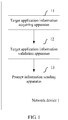
- FIG. 1 shows a schematic diagram of a network device 1 for application information risk management based on an aspect of the present application.
- the network device 1 includes a target application information acquiring apparatus 11, a target application information validation apparatus 12, and a prompt information sending apparatus 13.
- the target application information acquiring apparatus 11 acquires target application information that a user selects and requests for validation by using user equipment 2.
- the target application information validation apparatus 12 validates the target application information to obtain corresponding risk information.
- the prompt information sending apparatus 13 returns corresponding prompt information to the user equipment based on the risk information.
- the target application information acquiring apparatus 11 acquires the target application information that the user selects and requests for validation by using the user equipment 2 (referring to FIG. 2 ).
- the network device 1 includes various intelligent terminals, such as various cloud servers or server clusters.
- the user equipment 2 includes various intelligent terminal devices, such as various personal computers and smartphones.
- the application information includes, but is not limited to, an SMS message, a WeChat message, an e-mail, or other information transferred based on a specific application program in the user equipment 2.
- the target application information acquired by the network device 1 comes from the corresponding user equipment 2.
- the target application information is autonomously selected by the user from application information in a target application of the user equipment 2.
- the user can copy the target application information to a text box, and select to submit the target application information. Then, the user equipment 2 sends the target application information to the corresponding network device 1.
- the user can directly select and submit the target application information in an application.
- the network device 1 acquires the target application information sent by the user equipment 2 in an encrypted transmission manner.
- the target application information is an SMS message.
- the target application information is an SMS message.
- the target application information acquired by the target application information acquiring apparatus 11 can be in an original form of the target application information acquired by the user equipment 2.
- the target application information is an SMS message
- the target application information acquired by the network device 1 can be in the form of an SMS message text displayed on the SMS application interface of the user equipment 2.
- the user equipment 2 can first analyze original application information received by the user equipment 2 or extract information from the original application information. For example, the user equipment 2 extracts a keyword from an SMS message based on a category and sends the extracted keyword to the network device 1.
- target application information to be validated can be preliminarily analyzed and sorted out, and a volume of data transmitted between devices is reduced.
- the network device 1 can correspondingly acquire related attribute information of the target application information, such as sender information of the target application information or user guide information of the target application information.
- the target application information validation apparatus 12 validates the target application information to obtain the corresponding risk information.
- the network device 1 performs a risk validation analysis on the target application information by using the network device 1.
- a risk of the target application information can include a direct risk imposed on user privacy security and user equipment security, and can further include a potential risk imposed on the user by junk application information, such as a false advertisement.
- the target application information and the related attribute information can be comprehensively considered or evaluated by means of classification.
- specific validation methods can be flexibly selected and combined based on actual needs.
- the target application information can be validated and analyzed based on a pre-existing validation database.
- simulation execution can be performed on the user guide information of the target application information in a sandbox environment to identify whether the target application information includes risk information.
- security of the target application information can be validated for a plurality of times by combining a plurality of validation methods.
- the target application information is validated by separately using the methods described in the two previous examples to improve the accuracy of the finally obtained risk information.
- the risk information can include determining information that there is a risk or determining information that there is no risk. Further, preferably, the determining information that there is a risk can be specifically classified and graded based on the content of the risk and the adverse consequence caused by the risk.
- the target application information includes content such as a phishing website, a Trojan horse, or a rogue base station and the like, a risk value of the target application information is set to 99%, or the target application information is defined to be at a high-risk level.
- the prompt information sending apparatus 13 returns, based on the risk information, the corresponding prompt information to the user equipment 2.
- the network device 1 generates the corresponding prompt information based on the risk information obtained through validation, and returns the prompt information to the user equipment 2.
- the risk information is the determining information that there is a risk
- the corresponding risk warning information is generated.
- the content of the risk warning information can include a highlighting of an SMS message with a risk warning in the user equipment 2, a specific prompt SMS message, or prompt information in another form, or even a direct process of the SMS message as a junk SMS message by the user equipment 2, etc.
- the risk information is the determining information that there is no risk
- the corresponding validation security information can be sent to the user equipment 2.
- the target application information that the user selects and requests for validation is validated by using the network device 1, and the prompt information corresponding to the risk information obtained through validation is returned to the corresponding user equipment 2.
- the user can directly select one or more pieces of target application information from a corresponding application information interface of the user equipment without the need to jump to a third-party application operation.
- the user can autonomously determine some or all to-be-uploaded target application information. Therefore, a user's participation level in user privacy information management is improved, and a user's privacy leakage probability is reduced.
- a volume of data transmitted between the devices can be reduced, so that a volume of validation data that the network device processes is accordingly reduced, and overall application information risk management efficiency is improved.
- the target application information validation apparatus 12 includes a match query unit (not shown) and a first risk information determining unit (not shown).
- the match query unit performs match querying in a corresponding validation database based on the related attribute information of the target application information.
- the first risk information determining unit determines the corresponding risk information based on record information that is in the validation database and that matches the related attribute information.
- the match query unit performs match querying in the corresponding validation database based on the related attribute information of the target application information.
- the validation database is preferably an SMS message template library, a phishing website library, a Trojan virus library, etc.
- the SMS message template library includes an SMS message that is determined as a template, and that is collected by the network device 1 and is of a high historical risk factor, such as a determined Smishing message, or a derived SMS message template with relatively high similarity inferred based on a pre-known Smishing message.
- the phishing website library, the Trojan virus library, etc. include information about a website that is collected by the network device 1 and that is determined as a phishing website, or information about a file determined to include a Trojan virus.
- the information in the previous phishing website library and the Trojan virus library can be directly extracted from the application information in each user equipment 2, or can be existing data from another database, or a third-party device.
- the related attribute information includes any information that is associated with the target application information, for example, sender information of the target application information, the content information of the target application information, user guide information of the target application information, etc.
- corresponding match querying can be performed on appropriate information selected from the related attribute information of the target application information.
- the validation database is a phishing website library
- the user guide information of the target application information can be selected.
- a target SMS message includes information about a website, and math querying is performed on the information.
- the validation database is the SMS message template library
- the content of the target application information is selected, and match querying is performed on the content.
- one or more validation databases can be selected and used as a reference database based on needs, for example, based on a user's selection, or based on an intelligent decision of a type of the target application information.
- each validation database can be graded based on the risk level corresponding to the application information, and a validation database at a specific grade is selected for the target application information based on the grade, or validation databases at a plurality of grades are selected for successively validating the target application information.
- SMS message template library the phishing website library, and the Trojan virus library are only examples, and an existing database or a future database that can be used for target application information validation and is applicable to the solution shall fall within the protection scope of the present application, and is incorporated here by reference.
- the first risk information determining unit determines the corresponding risk information based on the record information that is in the validation database and that matches the related attribute information.
- the record information that matches the related attribute information is identified in the corresponding validation database, for example, if a target SMS message includes information about a website, and its corresponding record in the phishing website library is a phishing website.
- the risk information corresponding to the target application information can be determined, for example, as the determining information that there is a risk, or further, the risk information includes corresponding risk level information.
- the target application information can be inferred to be security information with a relatively low risk based on needs, and corresponding validation security information is returned to the user equipment 2.
- another validation database or even another validation method is selected for risk validation, and corresponding risk information is provided.
- match queries are further performed based on the phishing website library.
- matching can be performed in another validation method, for example, matching with an SMS message/phone number library of a financial institution.
- simulation execution can be performed on the user guide information of the target application information in a sandbox environment to identify whether the target application information includes risk information.
- the related attribute information includes at least one of the following: sender information of the target application information, content information of the target application information, or user guide information of the target application information.
- the related attribute information includes the sender information of the target application information, for example, a device number of a sender of an SMS message, a cell phone number, or an institution-specific number, or e-mail address information of a sender of an e-mail.
- the related attribute information further includes the content of the target application information, for example, text content of an SMS message or body content of an e-mail, and the like.
- the related attribute information further includes the user guide information.
- the user guide information includes any information instructing a user to perform a related operation. For example, a website hyperlink provided to the user or download address information provided to the user, and the like.
- different validation and analysis operations are performed based on different specific contents of the related attribute information, for example, different validation databases are selected for different related attribute information to perform match querying.
- the sender information of the target application information, the content information of the target application information, or the user guide information of the target application information are only examples, and related attribute information of other existing or future target application information that is applicable to the solution shall fall within the protection scope of the present application, and is incorporated here by reference.
- the related attribute information includes the user guide information of the target application information.
- the target application information validation apparatus 12 further includes a second risk information determining unit (not shown). When no record information that matches the user guide information is identified in the validation database, the second risk information determining unit simulates execution of the target application information based on the user guide information to obtain the corresponding risk information.
- the network device 1 can be disposed in a sandbox environment to perform a simulation experiment.
- the network device 1 extracts the user guide information, and runs a browser or another corresponding program in a preconfigured sandbox environment to open the foregoing website URL information or the downlink link to perform the operation indicated by the user guide information.
- the security problem in an execution operation process is analyzed, or the execution result of the simulation execution is further determined and analyzed to obtain the corresponding risk information. For example, if a website link corresponding to the user guide information is opened through simulation execution, and the result corresponds to a phishing website, it can be inferred that the target application information is risky, and the corresponding risk information is determined.
- changes caused by an operation executed in the sandbox environment are subsequently deleted.
- possible risks that can be brought by executing a program in the virtual execution environment cause no actual damage to related devices such as the network device 1.
- risk information extraction and classification can be performed on relatively high-risk target application information determined through the simulation execution, so as to update information about the corresponding validation database, and feedback the risk information to different financial institutions based on risk types.
- the network device 1 performs match querying in the corresponding validation database based on the related attribute information of the target application information. For target application information that does not match the corresponding record information, the network device 1 can further simulate execution of the corresponding user guide information to determine the corresponding risk information. Therefore, risk information determining accuracy is ensured through a multi-level determining manner. As such, the user can perform effective processing based on the prompt information corresponding to high-accuracy risk information.
- the second risk information determining unit simulates acquiring, based on the user guide information, target information that is in the target application information and that the user is guided to acquire; and validates the correspondence between the target information and the target application information to obtain the corresponding risk information.
- the target information that is in the target application information and is acquired by a guided user is first obtained by means of simulation based on the guided user information.
- the target information includes a corresponding result that the network device 1 points to by executing the guide user information through simulation.
- the target information can be a webpage that the user is guided to open, or can be a file that the user is guided to download.
- the network device 1 validates the correspondence between the target information and the target application information to obtain the corresponding risk information.
- the risks brought by the target information include a direct risk imposed on user privacy security and user equipment security, for example, a downloaded file includes a virus.
- the risks brought by the target information also include a potential risk brought by some spam information, for example, when an opened website is a false advertisement website, some damage can be caused if the user performs a corresponding operation based on instruction information on the website.
- the correspondence between the target information and the target application information is determined in order to determine the relevance of the target information and the target application information.
- high-risk target application information such as a false SMS message with the purpose to deceive the user into performing an operation against his will or unintentionally performing an unfavorable operation. Therefore, there is a relatively high possibility that the target information corresponding to such target application information is inconsistent with or does not match the target application information. This is an important basis for validating the correspondence in the present application.
- the correspondence validation between the target information and the target application information can include checking whether sender information of the target information is consistent with the sender information of the target application information; checking whether content of the target information is associated with the content of the target application information; or checking whether sandbox operation information of the target information matches the target application information.
- the correspondence validation between the target information and the target application information includes at least one of the following: checking whether sender information of the target information is consistent with the sender information of the target application information; checking whether content of the target information is associated with the content of the target application information; or checking whether sandbox operation information of the target information matches the target application information.
- the correspondence validation between the target information and the target application information includes checking whether the sender information of the target information is consistent with the sender information of the target application information. If the sender information of the target information is consistent with the sender information of the target application information, it can be inferred that the target information matches the target application information. Therefore, it can be inferred from the validation that the target application information has high security and low risk. Otherwise, it is inferred that the target information does not match the target application information. It can be inferred from the validation that the target application information has a low security and a high risk.
- the target application information is an SMS message.
- a sender of the SMS message is a number of a mobile operator
- the content of the SMS message is about providing free calls
- user guide information is a webpage link of the operator
- the acquired target information is a related webpage of the mobile operation indeed, it is considered that the sender of the target information is consistent with the sender of the SMS message, and it can be inferred that the target information matches the target application information.
- an irrelevant webpage is opened after clicking the link, it can be inferred that the target information does not match the target application information.
- the sender information is inconsistent, it can be further determined whether the sender of the target application information is a rogue base station that dedicatedly sends false information. If so, it can be inferred that the application information sent by the sender is false information.
- the network device 1 can further record information about the rogue base station, and warn the related user equipment 2.
- the correspondence validation between the target information and the target application information further includes checking whether the content of the target information is associated with the content of the target application information.
- the target application information is an SMS message. If the content of the SMS message is a link about shopping mall discount information, but an irrelevant payment website is opened after clicking the link, it is inferred that the content of the target information is unrelated to the content of the target application information, and the target information can be potentially dangerous.
- the correspondence validation between the target information and the target application information further includes checking whether the sandbox operation information of the target information matches the target application information.
- the target application information is relatively secure with a lower risk.
- the target application information is an SMS message.
- the target information is a downloaded application corresponding to a download link in the SMS message
- the downloaded application is installed or run in the sandbox, and if a specific operation step is different from what described in the target application information, or a result obtained by executing the application is different from what described in the target application information, it can be inferred that the sandbox operation information of the target information does not match the target application information, and there is a high security risk.
- the target application information includes an SMS message
- the network device 1 further includes a rogue base station prompt information sending apparatus (not shown).
- the rogue base station prompt information sending apparatus sends rogue base station prompt information to nearby user equipment of the user equipment when the risk information is that the SMS message is false information.
- a distance between the nearby user equipment and the user equipment is less than or equal to a predetermined device distance threshold.
- the rogue base station is a pseudo base station, and usually comprises a host and a laptop.
- the rogue base station can be configured to search for the information about a subscriber identity module (SIM) card in an area within a certain radius of the base station by using a device such as an SMS message blasts device, an SMS message sender, or the like.
- SIM subscriber identity module
- the rogue base station forcibly sends an SMS message such as a Smishing message or an advertisement SMS message to the user's mobile phone by disguising itself as a base station of a carrier and fraudulently using a cell phone number of another user.
- the target application information includes SMS message information.
- the location information of the rogue base station can be determined, or a movement track of the rogue base station can be determined to infer the location information of the rogue base station.
- the rogue base station prompt information sending apparatus sends the rogue base station prompt information to the nearby user equipment of the user equipment, wherein the distance between the nearby user equipment and the user equipment is less than or equal to a predetermined device distance threshold information.
- the nearby user equipment includes various mobile intelligent terminal devices, and preferably, includes a device with a mobile communication function, for example, a terminal device that can receive an SMS message, such as a mobile phone, or a tablet computer with an SMS message receiving/sending function.
- the predetermined device distance threshold can be set based on the location information of the rogue base station and the coverage of sending the SMS message.
- the rogue base station prompt information is sent to the nearby user equipment when the network device 1 first acquires and determines the information about the rogue base station. Each time when the SMS message is determined as false information, the rogue base station prompt information is sent to the nearby user equipment at the same time.
- the network device 1 can search for and obtain corresponding latitude and longitude information of the mobile phone. In this case, if the distance between the nearby user equipment and the user equipment is less than or equal to the predetermined device distance threshold, the rogue base station prompt information is sent to the nearby user equipment.
- a GPS Global Positioning System, global positioning system
- the network device 1 when the risk information includes the SMS message information being false information, the network device 1 sends the rogue base station prompt information to the nearby user equipment of the user equipment 2.
- the false information corresponds to a rogue base station
- a warning can be sent to other user equipment that is in the coverage area of the rogue base station and that can receive the Smishing message to reduce and prevent more risks caused by the false information sent by the rogue base station.
- the network device 1 can send information about a rogue base station exists near the network device 1, and the network device 1 can directly push a warning with permission of other user equipment.
- FIG. 2 shows a schematic diagram of a system of a network device 1 and user equipment 2 for application information risk management based on a preferred embodiment of the present application.
- the network device 1 includes a target application information acquiring apparatus 11', a target application information validation apparatus 12', and a prompt information sending apparatus 13'.
- the user equipment 2 includes a user-selected target application information acquiring apparatus 21', a target application information sending apparatus 22', and a prompt information receiving apparatus 23'.
- the target application information acquiring apparatus 11' acquires target application information that a user selects and requests for validation by using the user equipment 2.
- the target application information validation apparatus 12' validates the target application information to obtain corresponding risk information.
- the prompt information sending apparatus 13' returns corresponding prompt information to the user equipment 2 based on the risk information.
- the user-selected target application information acquiring apparatus 21' acquires the target application information that the user selects and requests for validation by using the user equipment 2.
- the target application information sending apparatus 22' sends the target application information to the corresponding network device 1.
- the prompt information receiving apparatus 23' acquires the prompt information that is returned by the network device 1 and that is based on the risk information of the target application information.
- the target application information acquiring apparatus 11', the target application information validation apparatus 12', and the prompt information sending apparatus 13' are basically the same as the target application information acquiring apparatus 11, the target application information validation apparatus 12, and the prompt information sending apparatus 13 shown in FIG. 1 . Details are not described here again, and are incorporated here by reference.
- the user-selected target application information acquiring apparatus 21' acquires the target application information that the user selects and requests for validation by using the user equipment 2.
- the target application information is directly determined based on an autonomous selection operation of the user.
- application information such as an SMS message, a WeChat message, or an e-mail includes massive user privacy information. Therefore, if all the information is uploaded by a third-party application, an information leakage risk is increased. Therefore, in the present application, preferably, the user can autonomously select one or more pieces of target application information that actually needs to be sent to the network device for validation.
- the user can directly perform a selection operation on an operating interface of a target application corresponding to the target application information in the user equipment 2.
- the target application information is an SMS message
- the user can directly select a suspected Smishing message when entering the SMS application, so that the need to jump to another third-party application interface is avoided.
- a response operation for an instruction of the user for selection and validation request can be implemented by executing an independent application program loaded to the network device 1, or by running a corresponding plug-in that matches the target application such as the SMS application.
- the target application information sending apparatus 22' sends the target application information to the corresponding network device 1.
- the target application information sent to the network device 1 can be in an original form of the target application information acquired by the user equipment 2.
- the target application information is an SMS message
- the target application information acquired by the network device 1 can be in the form of an SMS message text displayed on the SMS application interface of the user equipment 2.
- the user equipment 2 can first analyze original application information received by the user equipment 2 or extract information from the original application information. For example, the user equipment 2 extracts a keyword from an SMS message based on a category and sends the extracted keyword to the network device 1.
- the user equipment 2 can first preliminarily analyze and sort out target application information to be validated, and reduce a volume of data transmitted between devices.
- the user equipment 2 can further send, to the network device 1, related attribute information corresponding to the target application information, such as sender information of the target application information or user guide information of the target application information, so as to subsequently perform risk validation operations on the target application information in the network device 1 in a plurality of manners.
- the user equipment 2 sends the target application information to the network device 1 in an encrypted transmission manner.
- the target application information acquiring apparatus 11' of the network device 1 acquires the target application information that the user selects and requests for validation by using the user equipment 2. Then, the target application information validation apparatus 12' of the network device 1 validates the target application information to obtain the corresponding risk information.
- the prompt information sending apparatus 13' of the network device 1 returns the corresponding prompt information to the user equipment 2 based on the risk information.
- the prompt information receiving apparatus 23' of the user equipment 2 acquires the prompt information that is returned by the network device 1 and that is based on the risk information of the target application information.
- the prompt information received by the user equipment 2 is corresponding prompt information generated by the network device 1 based on the risk information obtained through validation. For example, when the risk information is determining information that there is a risk, such as when the risk information is that a target SMS message is false information, the corresponding risk warning information is generated.
- the content of the risk warning information can include a highlighting of an SMS message with a risk warning in the user equipment 2, a specific prompt SMS message, or prompt information in another form, or even a direct process of the SMS message as a junk SMS message by the user equipment 2, etc.
- the network device 1 determines that the risk information is determining information that there is no risk
- the user equipment 2 acquires corresponding validation security information.
- the user can choose to adopt the prompt information sent by the network device 1 to perform subsequent processing on the application information such as an SMS message of the user, or choose not to adopt the prompt information and retain the target application information. As such, a user's right for processing privacy-related information of the user is fully respected.
- prompt information content can be automatically executed based on predetermined settings made by the user when the corresponding prompt information is obtained.
- the user can perform pre-selecting.
- the network device 1 performs risk validation
- the target application information is automatically deleted. Therefore, after the user equipment 2 receives prompt information that meets a condition, a corresponding instruction operation can be automatically performed, and the user does not need to be inquired. To sum up, the automatic operation does not go against the user's will, but also the result of user participation in the operation.
- the user equipment 2 sends the target application information selected by the user to the corresponding network device 1 for validation, and receives the prompt information that is returned by the network device 1 and that is based on the risk information of the target application information.
- the user equipment cooperates with the network device 1 to implement risk management on the application information.
- apparatus (not shown) and an application information display apparatus (not shown).
- the risk pre-analysis apparatus performs a risk pre-analysis on the application information received by the user equipment 2.
- the application information display apparatus displays, in a corresponding application, one or more pieces of application information that are at risk acquired through the risk pre-analysis.
- the user-selected target application information acquiring apparatus 21' acquires the target application information that the user selects from the one or more pieces of application information and requests for validation by using the user equipment 2.
- the risk pre-analysis apparatus can be configured to perform the risk pre-analysis on the application information received by the user equipment 2, and then a corresponding prompt assistance is provided to the user based on the result of the risk pre-analysis.
- the user equipment 2 can acquire and store in advance some related information about application information that is recently collected and that is with a relatively high risk.
- a recent collection database of Smishing message sender numbers is pre-acquired, and then based on information of the database, a risk pre-analysis is performed on an SMS message received by the user equipment 2.
- data information that is used as pre-analysis reference data can be from the corresponding network device 1, for example, from a collection of related information about recent validation database information corresponding to the network device 1, for example, validation database information within one month.
- a list of recent risky data in a current region can be cached in the user equipment 2, and then the application information acquired by the user equipment 2 is compared with the data list.
- a preliminary evaluation analysis of the application information can be performed without increasing an operation burden of the user equipment 2, so as to effectively prompt the user.
- the application information display apparatus displays, in a corresponding application, one or more pieces of application information that are at risk acquired through the risk pre-analysis.
- the result of the risk pre-analysis can be
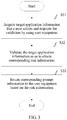
- FIG 3 shows a flowchart of a method for application information risk management on a network device side based on another aspect of the present application.
- the method includes steps S31, S32, and S33.
- step S31 a network device 1 acquires target application information that a user selects and requests for validation by using user equipment 2.
- the network device 1 validates the target application information to obtain corresponding risk information.
- step S33 the network device 1 returns corresponding prompt information to the user equipment based on the risk information.
- the network device 1 acquires the target application information that the user selects and requests for validation by using the user equipment 2 (referring to FIG. 4 ).
- the network device 1 includes various intelligent terminals, such as various cloud servers or server clusters.
- the user equipment 2 includes various intelligent terminal devices, such as various personal computers and smartphones.
- the application information includes, but is not limited to, an SMS message, a WeChat message, an e-mail, or other information transferred based on a specific application program in the user equipment 2.
- the target application information acquired by the network device 1 comes from the corresponding user equipment 2.
- the target application information is autonomously selected by the user from application information in a target application of the user equipment 2.
- the user can copy the target application information to a text box, and select to submit the target application information. Then the user equipment 2 sends the target application information to the corresponding network device 1.
- the user can directly select and submit the target application information in an application.
- the network device 1 acquires the target application information sent by the user equipment 2 in an encrypted transmission manner.
- the target application information is an SMS message.
- the target application information is an SMS message.
- the target application information acquired by the network device 1 can be in an original form of the target application information acquired by the user equipment 2.
- the target application information is an SMS message
- the target application information acquired by the network device 1 can be in the form of an SMS message text displayed on the SMS application interface of the user equipment 2.
- the user equipment 2 can first analyze the original application information received by the user equipment 2 or extract information from the original application information. For example, the user equipment 2 extracts a keyword from an SMS message based on a category and sends the extracted keyword to the network device 1.
- target application information to be validated can be preliminarily analyzed and sorted out, and a volume of data transmitted between devices is reduced.
- the network device 1 can correspondingly acquire related attribute information of the target application information, such as sender information of the target application information or user guide information of the target application information.
- the network device 1 validates the target application information to obtain the corresponding risk information.
- the network device 1 performs a risk validation analysis on the target application information by using the network device 1.
- a risk of the target application information can include a direct risk imposed on user privacy security and user equipment security, and can further include a potential risk imposed on the user by junk application information such as a false advertisement.
- the target application information and the related attribute information can be comprehensively considered or evaluated by means of classification.
- specific validation methods can be flexibly selected and combined based on actual needs.
- the target application information can be validated and analyzed based on a pre-existing validation database.
- simulation execution can be performed on the user guide information of the target application information in a sandbox environment to identify whether the target application information includes risk information.
- security of the target application information can be validated for a plurality of times by combining a plurality of validation methods.
- the target application information is validated by separately using the methods described in the two previous examples to improve the accuracy of the finally obtained risk information.
- the risk information can include determining information that there is a risk or determining information that there is no risk. Further, preferably, the determining information that there is a risk can be specifically classified and graded based on the content of the risk and the adverse consequence caused by the risk.
- the target application information includes content such as a phishing website, a Trojan horse, or a rogue base station and the like, a risk value of the target application information is set to 99%, or the target application information is defined to be at a high-risk level.
- the network device 1 returns, based on the risk information, the corresponding prompt information to the user equipment 2.
- the network device 1 generates the corresponding prompt information based on the risk information obtained through validation, and returns the prompt information to the user equipment 2.
- the risk information is the determining information that there is a risk
- the corresponding risk warning information is generated.
- the content of the risk warning information can include a highlighting of an SMS message with a risk warning in the user equipment 2, a specific prompt SMS message, or prompt information in another form, or even a direct process of the SMS message as a junk SMS message by the user equipment 2, etc.
- the risk information is the determining information that there is no risk
- the corresponding validation security information can be sent to the user equipment 2.
- the target application information that the user selects and requests for validation is validated by using the network device 1, and the prompt information corresponding to the risk information obtained through validation is returned to the corresponding user equipment 2.
- the user can directly select one or more pieces of target application information from a corresponding application information interface of the user equipment without the need to jump to a third-party application operation.
- the user can autonomously determine some or all to-be-uploaded target application information. Therefore, a user's participation level in user privacy information management is improved, and a user's privacy leakage probability is reduced.
- a volume of data transmitted between the devices can be reduced, so that a volume of validation data that the network device processes is accordingly reduced, and overall application information risk management efficiency is improved.
- step S32 includes step S321 (not shown) and step S322 (not shown).
- step S321 the network device 1 performs match querying in a corresponding validation database based on related attribute information of the target application information.
- step S322 the network device 1 determines the corresponding risk information based on record information that is in the validation database and that matches the related attribute information.
- the network device 1 performs match querying in the corresponding validation database based on the related attribute information of the target application information.
- the validation database is preferably an SMS message template library, a phishing website library, a Trojan virus library, etc.
- the SMS message template library includes an SMS message that is determined as a template, and that is collected by the network device 1 and is of a high historical risk factor, such as a determined Smishing message, or a derived SMS message template with relatively high similarity inferred based on a pre-known Smishing message.
- the related attribute information includes any information that is associated with the target application information, for example, sender information of the target application information, the content information of the target application information, user guide information of the target application information, etc.
- corresponding match querying can be performed on appropriate information selected from the related attribute information of the target application information.
- the validation database is a phishing website library
- the user guide information of the target application information can be selected.
- a target SMS message includes information about a website, and math querying is performed on the information.
- the validation database is the SMS message template library
- the content of the target application information is selected, and match querying is performed on the content.
- one or more validation databases can be selected and used as a reference database based on needs, for example, based on a user's selection, or based on an intelligent decision of a type of the target application information.
- each validation database can be graded based on the risk level corresponding to the application information, and a validation database at a specific grade is selected for the target application information based on the grade, or validation databases at a plurality of grades are selected for successively validating the target application information.
- SMS message template library the phishing website library, and the Trojan virus library are only examples, and an existing database or a future database that can be used for target application information validation and is applicable to the solution shall fall within the protection scope of the present application, and is incorporated here by reference.
- the network device 1 determines the corresponding risk information based on the record information that is in the validation database and that matches the related attribute information.
- the record information that matches the related attribute information is identified in the corresponding validation database, for example, if a target SMS message includes information about a website, and its corresponding record in the phishing website library is a phishing website.
- the risk information corresponding to the target application information can be determined, for example, determined as the determining information that there is a risk, or further, the risk information includes corresponding risk level information.
- the target application information can be inferred to be security information with a relatively low risk based on needs, and corresponding validation security information is returned to the user equipment 2.
- another validation database or even another validation method is selected for risk validation, and corresponding risk information is provided.
- match queries are further performed based on the phishing website library.
- matching can be performed in another validation method, for example, matching with an SMS message/phone number library of a financial institution.
- simulation execution can be performed on the user guide information of the target application information in a sandbox environment to identify whether the target application information includes risk information.
- the related attribute information includes at least one of the following: sender information of the target application information, content information of the target application information, or user guide information of the target application information.
- the related attribute information includes the sender information of the target application information, for example, a device number of a sender of an SMS message, a cell phone number, or an institution-specific number, or e-mail address information of a sender of an e-mail.
- the related attribute information further includes the content of the target application information, for example, text content of an SMS message or body content of an e-mail, and the like.
- the related attribute information further includes the user guide information.
- the user guide information includes any information instructing a user to perform a related operation. For example, a website hyperlink provided to the user or download address information provided to the user, and the like.
- different validation and analysis operations are performed based on different specific contents of the related attribute information, for example, different validation databases are selected for different related attribute information to perform match querying.
- the sender information of the target application information, the content information of the target application information, or the user guide information of the target application information are only examples, and related attribute information of other existing or future target application information that is applicable to the solution shall fall within the protection scope of the present application, and is incorporated here by reference.
- the related attribute information includes the user guide information of the target application information.
- Step S32 further includes step S323 (not shown).
- step S323 when no record information that matches the user guide information is identified in the validation database, the network device 1 simulates execution of the target application information based on the user guide information to obtain the corresponding risk information.
- the network device 1 can be disposed in a sandbox environment to perform a simulation experiment.
- the network device 1 extracts the user guide information, and runs a browser or another corresponding program in a preconfigured sandbox environment to open the foregoing website URL information or the downlink link to perform the operation indicated by the user guide information.
- the security problem in an execution operation process is analyzed, or the execution result of the simulation execution is further determined and analyzed to obtain the corresponding risk information. For example, if a website link corresponding to the user guide information is opened through simulation execution, and the result corresponds to a phishing website, it can be inferred that the target application information is risky, and the corresponding risk information is determined.
- changes caused by an operation executed in the sandbox environment are subsequently deleted.
- possible risks that can be brought by executing a program in the virtual execution environment cause no actual damage to related devices such as the network device 1.
- risk information extraction and classification can be performed on relatively high-risk target application information determined through the simulation execution, so as to update information about the corresponding validation database, and feedback the risk information to different financial institutions based on risk types.
- the network device 1 performs match querying in the corresponding validation database based on the related attribute information of the target application information. For target application information that does not match the corresponding record information, the network device 1 can further simulate execution of the corresponding user guide information to determine the corresponding risk information. Therefore, risk information determining accuracy is ensured through a multi-level determining manner. As such, the user can perform effective processing based on the prompt information corresponding to high-accuracy risk information.
- step S323 when no record information that matches the user guide information is identified in the validation database, the network device 1 simulates acquiring, based on the user guide information, target information that is in the target application information and that the user is guided to acquire; and validates the correspondence between the target information and the target application information to obtain the corresponding risk information.
- the target information that is in the target application information and is acquired by a guided user is first obtained by means of simulation based on the guided user information.
- the target information includes a corresponding result that the network device 1 points to by executing the guide user information through simulation.
- the target information can be a webpage that the user is guided to open, or can be a file that the user is guided to download.
- the network device 1 validates the correspondence between the target information and the target application information to obtain the corresponding risk information.
- the risks brought by the target information include a direct risk imposed on user privacy security and user equipment security, for example, a downloaded file includes a virus.
- the risks brought by the target information also include a potential risk brought by some spam information, for example, when an opened website is a false advertisement website, some damage can be caused if the user performs a corresponding operation based on instruction information on the website.
- the correspondence between the target information and the target application information is determined in order to determine the relevance of the target information and the target application information.
- high-risk target application information such as a false SMS message with the purpose to deceive the user into performing an operation against his will or unintentionally performing an unfavorable operation. Therefore, there is a relatively high possibility that the target information corresponding to such target application information is inconsistent with or does not match the target application information. This is an important basis for validating the correspondence in the present application.
- the correspondence validation between the target information and the target application information can include checking whether sender information of the target information is consistent with the sender information of the target application information; checking whether content of the target information is associated with the content of the target application information; or checking whether sandbox operation information of the target information matches the target application information.
- the correspondence validation between the target information and the target application information includes at least one of the following: checking whether sender information of the target information is consistent with the sender information of the target application information; checking whether content of the target information is associated with the content of the target application information; or checking whether sandbox operation information of the target information matches the target application information.
- the correspondence validation between the target information and the target application information includes checking whether the sender information of the target information is consistent with the sender information of the target application information. If the sender information of the target information is consistent with the sender information of the target application information, it can be inferred that the target information matches the target application information. Therefore, it can be inferred from the validation that the target application information has high security and low risk. Otherwise, it is inferred that the target information does not match the target application information. It can be inferred from the validation that the target application information has a low security and a high risk.
- the target application information is an SMS message.
- a sender of the SMS message is a number of a mobile operator
- the content of the SMS message is about providing free calls
- user guide information is a webpage link of the operator
- the acquired target information is a related webpage of the mobile operation indeed, it is considered that the sender of the target information is consistent with the sender of the SMS message, and it can be inferred that the target information matches the target application information.
- an irrelevant webpage is opened after clicking the link, it can be inferred that the target information does not match the target application information.
- the sender information is inconsistent, it can be further determined whether the sender of the target application information is a rogue base station that dedicatedly sends false information. If so, it can be inferred that the application information sent by the sender is false information.
- the network device 1 can further record information about the rogue base station, and warn the related user equipment 2.
- the correspondence validation between the target information and the target application information further includes checking whether the content of the target information is associated with the content of the target application information.
- the target application information is an SMS message. If the content of the SMS message is a link about shopping mall discount information, but an irrelevant payment website is opened after clicking the link, it is inferred that the content of the target information is unrelated to the content of the target application information, and the target information can be potentially dangerous.
- the correspondence validation between the target information and the target application information further includes checking whether the sandbox operation information of the target information matches the target application information.
- the target application information is relatively secure with a lower risk.
- the target application information is an SMS message.
- the target information is a downloaded application corresponding to a download link in the SMS message
- the downloaded application is installed or run in the sandbox, and if a specific operation step is different from what described in the target application information, or a result obtained by executing the application is different from what described in the target application information, it can be inferred that the sandbox operation information of the target information does not match the target application information, and there is a high security risk.
- the target application information includes an SMS message
- the method further includes step S34 (not shown).
- step S34 the network device 1 sends rogue base station prompt information to nearby user equipment of the user equipment when the risk information is that the SMS message is false information.
- a distance between the nearby user equipment and the user equipment is less than or equal to a predetermined device distance threshold.
- the rogue base station is a pseudo base station, and usually comprises a host and a laptop.
- the rogue base station can be configured to search for the information about a subscriber identity module (SIM) card in an area within a certain radius of the base station by using a device such as an SMS message blasts device, an SMS message sender, or the like.
- SIM subscriber identity module
- the rogue base station forcibly sends an SMS message such as a Smishing message or an advertisement SMS message to the user's mobile phone by disguising itself as a base station of a carrier and fraudulently using a cell phone number of another user.
- the target application information includes SMS message information.
- the location information of the rogue base station can be determined, or a movement track of the rogue base station can be determined to infer the location information of the rogue base station.
- the rogue base station prompt information sending apparatus sends the rogue base station prompt information to the nearby user equipment of the user equipment, wherein the distance between the nearby user equipment and the user equipment is less than or equal to a predetermined device distance threshold information.
- the nearby user equipment includes various mobile intelligent terminal devices, and preferably, includes a device with a mobile communication function, for example, a terminal device that can receive an SMS message, such as a mobile phone, or a tablet computer with an SMS message receiving/sending function.
- the predetermined device distance threshold can be set based on the location information of the rogue base station and the coverage of sending the SMS message.
- the rogue base station prompt information can be sent to the nearby user equipment when the network device 1 first acquires and determines the information about the rogue base station. Alternatively, each time when the SMS message is determined as false information, the rogue base station prompt information can be sent to the nearby user equipment at the same time.
- the network device 1 can search for and obtain corresponding latitude and longitude information of the mobile phone. In this case, if the distance between the nearby user equipment and the user equipment is less than or equal to the predetermined device distance threshold, the rogue base station prompt information is sent to the nearby user equipment.
- a GPS Global Positioning System, global positioning system
- the network device 1 when the risk information includes the SMS message information being false information, the network device 1 sends the rogue base station prompt information to the nearby user equipment of the user equipment 2.
- the false information corresponds to a rogue base station
- a warning can be sent to other user equipment that is in the coverage area of the rogue base station and that can receive the Smishing message to reduce and prevent more risks caused by the false information sent by the rogue base station.
- the network device 1 can send information about a rogue base station exists near the network device 1, and the network device 1 can directly push a warning with permission of other user equipment.
- FIG. 4 shows a flowchart of a method for application information risk management on a network device side and a user equipment side.
- user equipment 2 acquires target application information that a user selects and requests for validation by using the user equipment 2.
- the user equipment 2 sends the target application information to a corresponding network device 1.
- the network device 1 validates the target application information to obtain corresponding risk information.
- the network device 1 returns corresponding prompt information to the user equipment 2 based on the risk information.
- step S42 and step S44 are the same or basically the same as step S32 and step S33 shown in FIG. 3 . Details are not described here again, and are incorporated here by reference.
- the user equipment 2 acquires the target application information that the user selects and requests for validation by using the user equipment 2.
- the target application information is directly determined based on an autonomous selection operation of the user.
- application information such as an SMS message, a WeChat message, or an e-mail includes massive user privacy information. Therefore, if all the information is uploaded by a third-party application, an information leakage risk is increased. Therefore, in the present application, preferably, the user can autonomously select one or more pieces of target application information that actually needs to be sent to the network device for validation.
- the user can directly perform a selection operation on an operating interface of a target application corresponding to the target application information in the user equipment 2.
- the target application information is an SMS message
- the user can directly select a suspected Smishing message when entering the SMS application, so that the need to jump to another third-party application interface is avoided.
- a response operation for an instruction of the user for selection and validation request can be implemented by executing an independent application program loaded to the network device 1, or by running a corresponding plug-in that matches the target application such as the SMS application.
- the user equipment 2 sends the target application information to the corresponding network device 1.
- the target application information sent to the network device 1 can be in an original form of the target application information acquired by the user equipment 2.
- the target application information is an SMS message
- the target application information acquired by the network device 1 can be in the form of an SMS message text displayed on the SMS application interface of the user equipment 2.
- the user equipment 2 can first analyze original application information received by the user equipment 2 or extract information from the original application information. For example, the user equipment 2 extracts a keyword from an SMS message based on a category and sends the extracted keyword to the network device 1.
- the user equipment 2 can first preliminarily analyze and sort out target application information to be validated, and reduce a volume of data transmitted between devices.
- the user equipment 2 can further send, to the network device 1, related attribute information corresponding to the target application information, such as sender information of the target application information or user guide information of the target application information, so as to subsequently perform risk validation operations on the target application information in the network device 1 in a plurality of manners.
- the user equipment 2 sends the target application information to the network device 1 in an encrypted transmission manner.
- step S42 the network device 1 validates the target application information to obtain the corresponding risk information.
- step S44 the network device 1 returns the corresponding prompt information to the user equipment 2 based on the risk information.
- the prompt information received by the user equipment 2 is corresponding prompt information generated by the network device 1 based on the risk information obtained through validation. For example, when the risk information is determining information that there is a risk, such as when the risk information is that a target SMS message is false information, the corresponding risk warning information is generated.
- the content of the risk warning information can include a highlighting of an SMS message with a risk warning in the user equipment 2, a specific prompt SMS message, or prompt information in another form, or even a direct process of the SMS message as a junk SMS message by the user equipment 2, etc.
- the network device 1 determines that the risk information is determining information that there is no risk
- the user equipment 2 acquires corresponding validation security information.
- the user can choose to adopt the prompt information sent by the network device 1 to perform subsequent processing on the application information such as an SMS message of the user, or choose not to adopt the prompt information and retain the target application information. As such, a user's right for processing privacy-related information of the user is fully respected.
- prompt information content can be automatically executed based on predetermined settings made by the user when the corresponding prompt information is obtained.
- the user can perform pre-selecting.
- the network device 1 performs risk validation
- the target application information is automatically deleted. Therefore, after the user equipment 2 receives prompt information that meets a condition, a corresponding instruction operation can be automatically performed, and the user does not need to be inquired. To sum up, the automatic operation does not go against the user's will, but also the result of user participation in the operation.
- the user equipment 2 sends the target application information selected by the user to the corresponding network device 1 for validation, and receives the prompt information that is returned by the network device 1 and that is based on the risk information of the target application information.
- the user equipment cooperates with the network device 1 to implement risk management on the application information. selects from the one or more pieces of application information and requests for validation by using the user equipment 2.
- target application information with a relatively high risk such as a false SMS message
- target application information with a relatively high risk usually cannot be easily recognized. Therefore, in order to facilitate the autonomous selection of the target application information by the user, improve the probability that the target application information autonomously selected by the user is determined as high-risk application information, and improve the efficiency of performing target application information risk validation by the network device 1 subsequently, preferably, in step S45, the user equipment 2 can perform the risk pre-analysis on the application information received by the user equipment 2, and then a corresponding prompt assistance is provided to the user based on the result of the risk pre-analysis.
- the user equipment 2 can acquire and store in advance some related information about application information that is recently collected and that is with a relatively high risk.
- a recent collection database of Smishing message sender numbers is pre-acquired, and then based on information of the database, a risk pre-analysis is performed on an SMS message received by the user equipment 2.
- data information that is used as pre-analysis reference data can be from the corresponding network device 1, for example, from a collection of related information about recent validation database information corresponding to the network device 1, for example, validation database information within one month.
- a list of recent risky data in a current region can be cached in the user equipment 2, and then the application information acquired by the user equipment 2 is compared with the data list.
- a preliminary evaluation analysis of the application information can be performed without increasing an operation burden of the user equipment 2, so as to effectively prompt the user.
- step S46 the user equipment 2 displays, in a corresponding application, one or more pieces of application information that are at risk acquired through the risk pre-analysis.
- the result of the risk pre-analysis can be effectively displayed on a target application interface, for example, shown in a highlighted manner.
- the application information that is at risk can be displayed in a manner including but not limited to different colors or fonts, or specific prompting markers.
- the user is prompted by a prompt window.
- step S41 the user equipment 2 acquires the target application information that the user selects from the one or more pieces of application
Landscapes
- Engineering & Computer Science (AREA)
- Computer Security & Cryptography (AREA)
- Computer Networks & Wireless Communication (AREA)
- Signal Processing (AREA)
- General Engineering & Computer Science (AREA)
- Theoretical Computer Science (AREA)
- Computer Hardware Design (AREA)
- Physics & Mathematics (AREA)
- General Physics & Mathematics (AREA)
- Computing Systems (AREA)
- Software Systems (AREA)
- Databases & Information Systems (AREA)
- Data Mining & Analysis (AREA)
- Health & Medical Sciences (AREA)
- General Health & Medical Sciences (AREA)
- Virology (AREA)
- Information Transfer Between Computers (AREA)
- Debugging And Monitoring (AREA)
- Management, Administration, Business Operations System, And Electronic Commerce (AREA)
- Telephonic Communication Services (AREA)
Priority Applications (1)
| Application Number | Priority Date | Filing Date | Title |
|---|---|---|---|
| PL16861478T PL3373626T3 (pl) | 2015-11-05 | 2016-10-27 | Sposób i urządzenie do zarządzania ryzykiem informacji z aplikacji |
Applications Claiming Priority (2)
| Application Number | Priority Date | Filing Date | Title |
|---|---|---|---|
| CN201510746296.6A CN106686599B (zh) | 2015-11-05 | 2015-11-05 | 一种用于应用信息的风险管理的方法与设备 |
| PCT/CN2016/103489 WO2017076210A1 (zh) | 2015-11-05 | 2016-10-27 | 一种用于应用信息的风险管理的方法与设备 |
Publications (3)
| Publication Number | Publication Date |
|---|---|
| EP3373626A1 EP3373626A1 (en) | 2018-09-12 |
| EP3373626A4 EP3373626A4 (en) | 2019-04-10 |
| EP3373626B1 true EP3373626B1 (en) | 2020-07-22 |
Family
ID=58662494
Family Applications (1)
| Application Number | Title | Priority Date | Filing Date |
|---|---|---|---|
| EP16861478.2A Active EP3373626B1 (en) | 2015-11-05 | 2016-10-27 | Method and device for use in risk management of application information |
Country Status (12)
| Country | Link |
|---|---|
| US (1) | US10715550B2 (pl) |
| EP (1) | EP3373626B1 (pl) |
| JP (1) | JP6609047B2 (pl) |
| KR (1) | KR102071160B1 (pl) |
| CN (1) | CN106686599B (pl) |
| AU (1) | AU2016351177B2 (pl) |
| ES (1) | ES2808954T3 (pl) |
| MY (1) | MY186170A (pl) |
| PH (1) | PH12018500971B1 (pl) |
| PL (1) | PL3373626T3 (pl) |
| SG (2) | SG10201908340RA (pl) |
| WO (1) | WO2017076210A1 (pl) |
Families Citing this family (19)
| Publication number | Priority date | Publication date | Assignee | Title |
|---|---|---|---|---|
| CN107896287B (zh) * | 2017-09-30 | 2021-06-18 | 深圳壹账通智能科技有限公司 | 手机号码风险监测方法、移动终端及计算机可读存储介质 |
| CN111212432B (zh) * | 2018-11-21 | 2023-04-28 | 中国移动通信集团江西有限公司 | 定位伪基站的方法、装置、设备和介质 |
| CN109981567A (zh) * | 2019-02-13 | 2019-07-05 | 平安科技(深圳)有限公司 | 网络验证数据的发送方法、装置、存储介质和服务器 |
| JP7338847B2 (ja) * | 2019-02-20 | 2023-09-05 | 日本電気通信システム株式会社 | Sms詐欺対策システム、sms詐欺対策方法、およびsms詐欺対策プログラム |
| CN110139230B (zh) * | 2019-05-28 | 2021-11-09 | 北京小米移动软件有限公司 | 转发短信的方法、装置及智能设备 |
| US12101349B2 (en) | 2019-09-16 | 2024-09-24 | The Toronto-Dominion Bank | Systems and methods for detecting changes in data access pattern of third-party applications |
| US11275842B2 (en) | 2019-09-20 | 2022-03-15 | The Toronto-Dominion Bank | Systems and methods for evaluating security of third-party applications |
| US11436336B2 (en) | 2019-09-23 | 2022-09-06 | The Toronto-Dominion Bank | Systems and methods for evaluating data access signature of third-party applications |
| CN110908556A (zh) * | 2019-10-24 | 2020-03-24 | 深圳传音控股股份有限公司 | 交互方法、交互装置、移动终端及计算机可读存储介质 |
| US11914719B1 (en) | 2020-04-15 | 2024-02-27 | Wells Fargo Bank, N.A. | Systems and methods for cyberthreat-risk education and awareness |
| CN111898159B (zh) * | 2020-07-31 | 2024-07-12 | 维沃移动通信有限公司 | 风险提示方法、装置、电子设备及可读存储介质 |
| US11496514B2 (en) * | 2020-07-31 | 2022-11-08 | KnowBe4, Inc. | Systems and methods for security awareness using ad-based simulated phishing attacks |
| CN113015170A (zh) * | 2021-03-05 | 2021-06-22 | 中国工商银行股份有限公司 | 短信验证方法、装置、电子设备和介质 |
| WO2022265404A1 (ko) * | 2021-06-15 | 2022-12-22 | 주식회사 에스앤피랩 | 개인정보 관리 서버 및 이의 작동 방법 |
| US12271502B2 (en) * | 2021-09-28 | 2025-04-08 | Docusign, Inc. | Delegated signing using sensitivity classification |
| US11909804B2 (en) * | 2022-01-11 | 2024-02-20 | Red Hat, Inc. | Selective validation of a portion of a server response to a client request |
| CN114943601A (zh) * | 2022-05-31 | 2022-08-26 | 中国银行股份有限公司 | 一种业务代办理审核方法和系统、电子设备、存储介质 |
| CN116709339B (zh) * | 2022-10-09 | 2024-07-12 | 荣耀终端有限公司 | 一种应用通知消息的检测方法及电子设备 |
| CN116701914B (zh) * | 2023-06-21 | 2024-07-05 | 广东星云开物科技股份有限公司 | 一种硬件设备异常使用识别方法、装置、存储装置及系统 |
Family Cites Families (27)
| Publication number | Priority date | Publication date | Assignee | Title |
|---|---|---|---|---|
| US9106694B2 (en) * | 2004-04-01 | 2015-08-11 | Fireeye, Inc. | Electronic message analysis for malware detection |
| US8037527B2 (en) * | 2004-11-08 | 2011-10-11 | Bt Web Solutions, Llc | Method and apparatus for look-ahead security scanning |
| US20080082662A1 (en) * | 2006-05-19 | 2008-04-03 | Richard Dandliker | Method and apparatus for controlling access to network resources based on reputation |
| WO2008097869A1 (en) * | 2007-02-02 | 2008-08-14 | Iconix, Inc. | Authenticating and confidence marking e-mail messages |
| EP1990750A1 (en) | 2007-05-09 | 2008-11-12 | Nokia Siemens Networks Oy | Method and device for data processing and communication system comprising such device |
| JP2009289001A (ja) * | 2008-05-29 | 2009-12-10 | Softbank Mobile Corp | 迷惑メール対策支援システム、迷惑メール対策支援方法及び迷惑メール対策支援プログラム |
| US20100083381A1 (en) * | 2008-09-30 | 2010-04-01 | Khosravi Hormuzd M | Hardware-based anti-virus scan service |
| JP5440973B2 (ja) * | 2009-02-23 | 2014-03-12 | 独立行政法人情報通信研究機構 | コンピュータ検査システム、コンピュータ検査方法 |
| CN101815262A (zh) * | 2010-04-13 | 2010-08-25 | 深圳市五巨科技有限公司 | 一种移动终端垃圾短信息屏蔽方法和装置 |
| KR20110128632A (ko) * | 2010-05-24 | 2011-11-30 | 충남대학교산학협력단 | 스마트폰 응용프로그램의 악성행위 탐지 방법 및 장치 |
| WO2012027588A1 (en) * | 2010-08-25 | 2012-03-01 | Lookout, Inc. | System and method for server-coupled malware prevention |
| US8959626B2 (en) * | 2010-12-14 | 2015-02-17 | F-Secure Corporation | Detecting a suspicious entity in a communication network |
| US20130019281A1 (en) * | 2011-07-11 | 2013-01-17 | Cisco Technology, Inc. | Server Based Remote Authentication for BIOS |
| CN103391520B (zh) * | 2012-05-08 | 2016-01-20 | 腾讯科技(深圳)有限公司 | 一种拦截恶意短信的方法、终端、服务器及系统 |
| CN102801706A (zh) * | 2012-06-28 | 2012-11-28 | 宇龙计算机通信科技(深圳)有限公司 | 终端和信息内容的安全性处理方法 |
| WO2014056538A1 (en) * | 2012-10-11 | 2014-04-17 | Nokia Solutions And Networks Oy | Fake base station detection with core network support |
| CN103118026B (zh) * | 2013-02-01 | 2017-07-11 | 北京奇虎科技有限公司 | 显示网址安全鉴定信息的方法及装置 |
| KR101321721B1 (ko) * | 2013-03-20 | 2013-10-28 | 주식회사 시큐브 | 적법한 인증 메시지 확인 시스템 및 방법 |
| US9100831B2 (en) * | 2013-04-15 | 2015-08-04 | Cellco Partnership | Disabling mobile devices that originate message service spam |
| US9300686B2 (en) * | 2013-06-28 | 2016-03-29 | Fireeye, Inc. | System and method for detecting malicious links in electronic messages |
| KR101507404B1 (ko) * | 2013-10-01 | 2015-04-07 | 주식회사 엘지유플러스 | 이동 통신 단말기 및 응용 프로그램 정보 관리 서버 및 그 제어 방법, 악성 응용 프로그램 처리 방법 |
| JP5973413B2 (ja) * | 2013-11-26 | 2016-08-23 | ビッグローブ株式会社 | 端末装置、webメールサーバ、安全確認方法、及び安全確認プログラム |
| KR20150062644A (ko) * | 2013-11-29 | 2015-06-08 | (주)노르마 | 스미싱 메시지 검출 시스템과 이에 사용되는 서버 및 프로그램을 기록한 기록매체 |
| KR101540672B1 (ko) * | 2014-01-13 | 2015-07-31 | 주식회사 엔피코어 | 이동 단말기의 해킹 방지 시스템 및 그 방법 |
| CN104023320A (zh) * | 2014-05-14 | 2014-09-03 | 北京奇虎科技有限公司 | 消息提示方法及装置 |
| CN104378345B (zh) * | 2014-06-24 | 2016-04-13 | 腾讯科技(深圳)有限公司 | 移动客户端url的安全检测方法及系统 |
| CN104539624B (zh) * | 2015-01-08 | 2019-06-04 | 北京奇虎科技有限公司 | 文本中号码信息的安全监测方法及装置 |
-
2015
- 2015-11-05 CN CN201510746296.6A patent/CN106686599B/zh active Active
-
2016
- 2016-10-27 KR KR1020187015998A patent/KR102071160B1/ko active Active
- 2016-10-27 SG SG10201908340R patent/SG10201908340RA/en unknown
- 2016-10-27 ES ES16861478T patent/ES2808954T3/es active Active
- 2016-10-27 MY MYPI2018701804A patent/MY186170A/en unknown
- 2016-10-27 JP JP2018522965A patent/JP6609047B2/ja active Active
- 2016-10-27 WO PCT/CN2016/103489 patent/WO2017076210A1/zh not_active Ceased
- 2016-10-27 PL PL16861478T patent/PL3373626T3/pl unknown
- 2016-10-27 AU AU2016351177A patent/AU2016351177B2/en not_active Ceased
- 2016-10-27 EP EP16861478.2A patent/EP3373626B1/en active Active
- 2016-10-27 SG SG11201803771TA patent/SG11201803771TA/en unknown
-
2018
- 2018-05-04 US US15/971,386 patent/US10715550B2/en active Active
- 2018-05-04 PH PH12018500971A patent/PH12018500971B1/en unknown
Non-Patent Citations (1)
| Title |
|---|
| None * |
Also Published As
| Publication number | Publication date |
|---|---|
| US10715550B2 (en) | 2020-07-14 |
| JP2019502192A (ja) | 2019-01-24 |
| PH12018500971A1 (en) | 2018-12-17 |
| MY186170A (en) | 2021-06-30 |
| AU2016351177B2 (en) | 2020-01-30 |
| KR102071160B1 (ko) | 2020-01-29 |
| EP3373626A4 (en) | 2019-04-10 |
| US20180255097A1 (en) | 2018-09-06 |
| JP6609047B2 (ja) | 2019-11-20 |
| PL3373626T3 (pl) | 2021-01-11 |
| SG11201803771TA (en) | 2018-06-28 |
| ES2808954T3 (es) | 2021-03-02 |
| EP3373626A1 (en) | 2018-09-12 |
| SG10201908340RA (en) | 2019-10-30 |
| CN106686599B (zh) | 2020-10-20 |
| KR20180082504A (ko) | 2018-07-18 |
| AU2016351177A1 (en) | 2018-06-14 |
| WO2017076210A1 (zh) | 2017-05-11 |
| CN106686599A (zh) | 2017-05-17 |
| PH12018500971B1 (en) | 2021-08-20 |
Similar Documents
| Publication | Publication Date | Title |
|---|---|---|
| EP3373626B1 (en) | Method and device for use in risk management of application information | |
| EP3561708B1 (en) | Method and device for classifying uniform resource locators based on content in corresponding websites | |
| Ham et al. | Linear SVM‐based android malware detection for reliable IoT services | |
| CN112106049B (zh) | 生成隐私数据隔离和报告的系统和方法 | |
| US11165793B2 (en) | Method and system for detecting credential stealing attacks | |
| US12608503B2 (en) | Systems and methods for sanitizing sensitive data and preventing data leakage using on-demand artificial intelligence models | |
| CN110417718B (zh) | 处理网站中的风险数据的方法、装置、设备及存储介质 | |
| US11860753B1 (en) | Monitoring a distributed ledger network using hierarchical validation workflows | |
| US20240111892A1 (en) | Systems and methods for facilitating on-demand artificial intelligence models for sanitizing sensitive data | |
| CN112685774B (zh) | 基于大数据和区块链金融的支付数据处理方法及云服务器 | |
| US12542808B2 (en) | Computer-based systems for determining a look-alike domain names in webpages and methods of use thereof | |
| Teppap et al. | Automating hidden gambling detection in web sites: A beautifulsoup implementation | |
| CN120415852A (zh) | 管理数据访问的方法、装置、设备及存储介质 | |
| KR101645882B1 (ko) | 문자 인식과 검색 순위 정보를 이용한 피싱 방지 방법 및 시스템 | |
| CN117675284A (zh) | 越权检测方法、装置、处理器及机器可读存储介质 | |
| Njoku et al. | URL Based Phishing Website Detection Using Machine Learning. | |
| US12361163B2 (en) | Systems and methods for sanitizing sensitive data and preventing data leakage from mobile devices | |
| CN115695052B (zh) | 共享界面的数据防护方法及装置 | |
| CN118316999B (zh) | 数据处理方法、装置、设备、介质和程序产品 | |
| US12231409B2 (en) | Methods and systems for linking mobile applications to multi-access point providers using an intermediary database | |
| US11809601B2 (en) | System, method, computer program and data signal for identifying software capable of capturing personally identifiable information | |
| US20260039684A1 (en) | System and method for detection and mitigation of network-based computing threats | |
| US20260106891A1 (en) | Machine Learning-Based Platform to Detect and Handle Volumetric Attacks | |
| Lee | Preventing Remote control Smishing on Android OS | |
| CN118659890A (zh) | 安全检测处理方法及相关设备 |
Legal Events
| Date | Code | Title | Description |
|---|---|---|---|
| STAA | Information on the status of an ep patent application or granted ep patent |
Free format text: STATUS: THE INTERNATIONAL PUBLICATION HAS BEEN MADE |
|
| PUAI | Public reference made under article 153(3) epc to a published international application that has entered the european phase |
Free format text: ORIGINAL CODE: 0009012 |
|
| STAA | Information on the status of an ep patent application or granted ep patent |
Free format text: STATUS: REQUEST FOR EXAMINATION WAS MADE |
|
| 17P | Request for examination filed |
Effective date: 20180605 |
|
| AK | Designated contracting states |
Kind code of ref document: A1 Designated state(s): AL AT BE BG CH CY CZ DE DK EE ES FI FR GB GR HR HU IE IS IT LI LT LU LV MC MK MT NL NO PL PT RO RS SE SI SK SM TR |
|
| AX | Request for extension of the european patent |
Extension state: BA ME |
|
| RIC1 | Information provided on ipc code assigned before grant |
Ipc: H04W 12/08 20090101ALI20181011BHEP Ipc: H04L 29/06 20060101ALI20181011BHEP Ipc: G06F 21/57 20130101ALI20181011BHEP Ipc: H04W 12/12 20090101AFI20181011BHEP Ipc: G06F 17/30 20060101ALI20181011BHEP Ipc: H04W 4/12 20090101ALI20181011BHEP Ipc: H04W 4/14 20090101ALI20181011BHEP |
|
| RIC1 | Information provided on ipc code assigned before grant |
Ipc: H04W 4/12 20090101ALI20181016BHEP Ipc: H04W 12/12 20090101AFI20181016BHEP Ipc: G06F 17/30 20060101ALI20181016BHEP Ipc: G06F 21/57 20130101ALI20181016BHEP Ipc: H04W 4/14 20090101ALI20181016BHEP Ipc: H04L 29/06 20060101ALI20181016BHEP Ipc: H04W 12/08 20090101ALI20181016BHEP |
|
| RIC1 | Information provided on ipc code assigned before grant |
Ipc: H04W 4/14 20090101ALI20181024BHEP Ipc: H04W 12/12 20090101AFI20181024BHEP Ipc: H04W 4/12 20090101ALI20181024BHEP Ipc: G06F 17/30 20060101ALI20181024BHEP Ipc: G06F 21/57 20130101ALI20181024BHEP Ipc: H04W 12/08 20090101ALI20181024BHEP Ipc: H04L 29/06 20060101ALI20181024BHEP |
|
| RIN1 | Information on inventor provided before grant (corrected) |
Inventor name: LI, LIZHONG Inventor name: ZHANG, YANAN |
|
| DAV | Request for validation of the european patent (deleted) | ||
| DAX | Request for extension of the european patent (deleted) | ||
| A4 | Supplementary search report drawn up and despatched |
Effective date: 20190314 |
|
| RIC1 | Information provided on ipc code assigned before grant |
Ipc: H04W 12/08 20090101ALI20190307BHEP Ipc: H04L 29/06 20060101ALI20190307BHEP Ipc: G06F 21/57 20130101ALI20190307BHEP Ipc: H04W 12/12 20090101AFI20190307BHEP Ipc: G06F 16/951 20190101ALI20190307BHEP Ipc: G06F 21/53 20130101ALI20190307BHEP Ipc: H04W 4/12 20090101ALI20190307BHEP Ipc: G06F 16/23 20190101ALI20190307BHEP Ipc: H04W 4/14 20090101ALI20190307BHEP |
|
| STAA | Information on the status of an ep patent application or granted ep patent |
Free format text: STATUS: EXAMINATION IS IN PROGRESS |
|
| 17Q | First examination report despatched |
Effective date: 20191211 |
|
| GRAP | Despatch of communication of intention to grant a patent |
Free format text: ORIGINAL CODE: EPIDOSNIGR1 |
|
| STAA | Information on the status of an ep patent application or granted ep patent |
Free format text: STATUS: GRANT OF PATENT IS INTENDED |
|
| INTG | Intention to grant announced |
Effective date: 20200422 |
|
| RIN1 | Information on inventor provided before grant (corrected) |
Inventor name: ZHANG, YANAN Inventor name: LI, LIZHONG |
|
| GRAS | Grant fee paid |
Free format text: ORIGINAL CODE: EPIDOSNIGR3 |
|
| GRAA | (expected) grant |
Free format text: ORIGINAL CODE: 0009210 |
|
| STAA | Information on the status of an ep patent application or granted ep patent |
Free format text: STATUS: THE PATENT HAS BEEN GRANTED |
|
| AK | Designated contracting states |
Kind code of ref document: B1 Designated state(s): AL AT BE BG CH CY CZ DE DK EE ES FI FR GB GR HR HU IE IS IT LI LT LU LV MC MK MT NL NO PL PT RO RS SE SI SK SM TR |
|
| REG | Reference to a national code |
Ref country code: GB Ref legal event code: FG4D |
|
| REG | Reference to a national code |
Ref country code: FI Ref legal event code: FGE |
|
| REG | Reference to a national code |
Ref country code: CH Ref legal event code: EP |
|
| REG | Reference to a national code |
Ref country code: DE Ref legal event code: R096 Ref document number: 602016040597 Country of ref document: DE |
|
| REG | Reference to a national code |
Ref country code: AT Ref legal event code: REF Ref document number: 1294585 Country of ref document: AT Kind code of ref document: T Effective date: 20200815 |
|
| REG | Reference to a national code |
Ref country code: IE Ref legal event code: FG4D |
|
| REG | Reference to a national code |
Ref country code: NL Ref legal event code: FP |
|
| REG | Reference to a national code |
Ref country code: NO Ref legal event code: T2 Effective date: 20200722 |
|
| REG | Reference to a national code |
Ref country code: LT Ref legal event code: MG4D |
|
| REG | Reference to a national code |
Ref country code: AT Ref legal event code: MK05 Ref document number: 1294585 Country of ref document: AT Kind code of ref document: T Effective date: 20200722 |
|
| RAP2 | Party data changed (patent owner data changed or rights of a patent transferred) |
Owner name: ADVANCED NEW TECHNOLOGIES CO., LTD. |
|
| REG | Reference to a national code |
Ref country code: NO Ref legal event code: CHAD Owner name: ADVANCED NEW TECHNOLOGIES CO., KY |
|
| PG25 | Lapsed in a contracting state [announced via postgrant information from national office to epo] |
Ref country code: HR Free format text: LAPSE BECAUSE OF FAILURE TO SUBMIT A TRANSLATION OF THE DESCRIPTION OR TO PAY THE FEE WITHIN THE PRESCRIBED TIME-LIMIT Effective date: 20200722 Ref country code: PT Free format text: LAPSE BECAUSE OF FAILURE TO SUBMIT A TRANSLATION OF THE DESCRIPTION OR TO PAY THE FEE WITHIN THE PRESCRIBED TIME-LIMIT Effective date: 20201123 Ref country code: BG Free format text: LAPSE BECAUSE OF FAILURE TO SUBMIT A TRANSLATION OF THE DESCRIPTION OR TO PAY THE FEE WITHIN THE PRESCRIBED TIME-LIMIT Effective date: 20201022 Ref country code: LT Free format text: LAPSE BECAUSE OF FAILURE TO SUBMIT A TRANSLATION OF THE DESCRIPTION OR TO PAY THE FEE WITHIN THE PRESCRIBED TIME-LIMIT Effective date: 20200722 Ref country code: GR Free format text: LAPSE BECAUSE OF FAILURE TO SUBMIT A TRANSLATION OF THE DESCRIPTION OR TO PAY THE FEE WITHIN THE PRESCRIBED TIME-LIMIT Effective date: 20201023 Ref country code: AT Free format text: LAPSE BECAUSE OF FAILURE TO SUBMIT A TRANSLATION OF THE DESCRIPTION OR TO PAY THE FEE WITHIN THE PRESCRIBED TIME-LIMIT Effective date: 20200722 Ref country code: SE Free format text: LAPSE BECAUSE OF FAILURE TO SUBMIT A TRANSLATION OF THE DESCRIPTION OR TO PAY THE FEE WITHIN THE PRESCRIBED TIME-LIMIT Effective date: 20200722 |
|
| REG | Reference to a national code |
Ref country code: DE Ref legal event code: R082 Ref document number: 602016040597 Country of ref document: DE Representative=s name: FISH & RICHARDSON P.C., DE Ref country code: DE Ref legal event code: R081 Ref document number: 602016040597 Country of ref document: DE Owner name: ADVANCED NEW TECHNOLOGIES CO., LTD., GEORGE TO, KY Free format text: FORMER OWNER: ALIBABA GROUP HOLDING LIMITED, GEORGE TOWN, GRAND CAYMAN, KY |
|
| REG | Reference to a national code |
Ref country code: NL Ref legal event code: PD Owner name: ADVANCED NEW TECHNOLOGIES CO., LTD.; KY Free format text: DETAILS ASSIGNMENT: CHANGE OF OWNER(S), ASSIGNMENT; FORMER OWNER NAME: ALIBABA GROUP HOLDING LIMITED Effective date: 20210129 |
|
| PG25 | Lapsed in a contracting state [announced via postgrant information from national office to epo] |
Ref country code: LV Free format text: LAPSE BECAUSE OF FAILURE TO SUBMIT A TRANSLATION OF THE DESCRIPTION OR TO PAY THE FEE WITHIN THE PRESCRIBED TIME-LIMIT Effective date: 20200722 Ref country code: RS Free format text: LAPSE BECAUSE OF FAILURE TO SUBMIT A TRANSLATION OF THE DESCRIPTION OR TO PAY THE FEE WITHIN THE PRESCRIBED TIME-LIMIT Effective date: 20200722 Ref country code: IS Free format text: LAPSE BECAUSE OF FAILURE TO SUBMIT A TRANSLATION OF THE DESCRIPTION OR TO PAY THE FEE WITHIN THE PRESCRIBED TIME-LIMIT Effective date: 20201122 |
|
| REG | Reference to a national code |
Ref country code: ES Ref legal event code: FG2A Ref document number: 2808954 Country of ref document: ES Kind code of ref document: T3 Effective date: 20210302 |
|
| REG | Reference to a national code |
Ref country code: GB Ref legal event code: 732E Free format text: REGISTERED BETWEEN 20210218 AND 20210224 |
|
| REG | Reference to a national code |
Ref country code: DE Ref legal event code: R097 Ref document number: 602016040597 Country of ref document: DE |
|
| PG25 | Lapsed in a contracting state [announced via postgrant information from national office to epo] |
Ref country code: CZ Free format text: LAPSE BECAUSE OF FAILURE TO SUBMIT A TRANSLATION OF THE DESCRIPTION OR TO PAY THE FEE WITHIN THE PRESCRIBED TIME-LIMIT Effective date: 20200722 Ref country code: DK Free format text: LAPSE BECAUSE OF FAILURE TO SUBMIT A TRANSLATION OF THE DESCRIPTION OR TO PAY THE FEE WITHIN THE PRESCRIBED TIME-LIMIT Effective date: 20200722 Ref country code: RO Free format text: LAPSE BECAUSE OF FAILURE TO SUBMIT A TRANSLATION OF THE DESCRIPTION OR TO PAY THE FEE WITHIN THE PRESCRIBED TIME-LIMIT Effective date: 20200722 Ref country code: EE Free format text: LAPSE BECAUSE OF FAILURE TO SUBMIT A TRANSLATION OF THE DESCRIPTION OR TO PAY THE FEE WITHIN THE PRESCRIBED TIME-LIMIT Effective date: 20200722 Ref country code: SM Free format text: LAPSE BECAUSE OF FAILURE TO SUBMIT A TRANSLATION OF THE DESCRIPTION OR TO PAY THE FEE WITHIN THE PRESCRIBED TIME-LIMIT Effective date: 20200722 |
|
| PLBE | No opposition filed within time limit |
Free format text: ORIGINAL CODE: 0009261 |
|
| STAA | Information on the status of an ep patent application or granted ep patent |
Free format text: STATUS: NO OPPOSITION FILED WITHIN TIME LIMIT |
|
| PG25 | Lapsed in a contracting state [announced via postgrant information from national office to epo] |
Ref country code: AL Free format text: LAPSE BECAUSE OF FAILURE TO SUBMIT A TRANSLATION OF THE DESCRIPTION OR TO PAY THE FEE WITHIN THE PRESCRIBED TIME-LIMIT Effective date: 20200722 |
|
| 26N | No opposition filed |
Effective date: 20210423 |
|
| PG25 | Lapsed in a contracting state [announced via postgrant information from national office to epo] |
Ref country code: SK Free format text: LAPSE BECAUSE OF FAILURE TO SUBMIT A TRANSLATION OF THE DESCRIPTION OR TO PAY THE FEE WITHIN THE PRESCRIBED TIME-LIMIT Effective date: 20200722 Ref country code: LU Free format text: LAPSE BECAUSE OF NON-PAYMENT OF DUE FEES Effective date: 20201027 Ref country code: MC Free format text: LAPSE BECAUSE OF FAILURE TO SUBMIT A TRANSLATION OF THE DESCRIPTION OR TO PAY THE FEE WITHIN THE PRESCRIBED TIME-LIMIT Effective date: 20200722 |
|
| REG | Reference to a national code |
Ref country code: BE Ref legal event code: MM Effective date: 20201031 |
|
| PG25 | Lapsed in a contracting state [announced via postgrant information from national office to epo] |
Ref country code: BE Free format text: LAPSE BECAUSE OF NON-PAYMENT OF DUE FEES Effective date: 20201031 Ref country code: SI Free format text: LAPSE BECAUSE OF FAILURE TO SUBMIT A TRANSLATION OF THE DESCRIPTION OR TO PAY THE FEE WITHIN THE PRESCRIBED TIME-LIMIT Effective date: 20200722 |
|
| PG25 | Lapsed in a contracting state [announced via postgrant information from national office to epo] |
Ref country code: IE Free format text: LAPSE BECAUSE OF NON-PAYMENT OF DUE FEES Effective date: 20201027 |
|
| PG25 | Lapsed in a contracting state [announced via postgrant information from national office to epo] |
Ref country code: MT Free format text: LAPSE BECAUSE OF FAILURE TO SUBMIT A TRANSLATION OF THE DESCRIPTION OR TO PAY THE FEE WITHIN THE PRESCRIBED TIME-LIMIT Effective date: 20200722 Ref country code: CY Free format text: LAPSE BECAUSE OF FAILURE TO SUBMIT A TRANSLATION OF THE DESCRIPTION OR TO PAY THE FEE WITHIN THE PRESCRIBED TIME-LIMIT Effective date: 20200722 |
|
| PG25 | Lapsed in a contracting state [announced via postgrant information from national office to epo] |
Ref country code: MK Free format text: LAPSE BECAUSE OF FAILURE TO SUBMIT A TRANSLATION OF THE DESCRIPTION OR TO PAY THE FEE WITHIN THE PRESCRIBED TIME-LIMIT Effective date: 20200722 |
|
| PGFP | Annual fee paid to national office [announced via postgrant information from national office to epo] |
Ref country code: TR Payment date: 20221020 Year of fee payment: 7 |
|
| P01 | Opt-out of the competence of the unified patent court (upc) registered |
Effective date: 20230521 |
|
| PGFP | Annual fee paid to national office [announced via postgrant information from national office to epo] |
Ref country code: ES Payment date: 20231102 Year of fee payment: 8 |
|
| PGFP | Annual fee paid to national office [announced via postgrant information from national office to epo] |
Ref country code: NO Payment date: 20231027 Year of fee payment: 8 Ref country code: IT Payment date: 20231023 Year of fee payment: 8 Ref country code: FI Payment date: 20231025 Year of fee payment: 8 Ref country code: CH Payment date: 20231102 Year of fee payment: 8 |
|
| PGFP | Annual fee paid to national office [announced via postgrant information from national office to epo] |
Ref country code: PL Payment date: 20231005 Year of fee payment: 8 |
|
| REG | Reference to a national code |
Ref country code: CH Ref legal event code: PL |
|
| PG25 | Lapsed in a contracting state [announced via postgrant information from national office to epo] |
Ref country code: FI Free format text: LAPSE BECAUSE OF NON-PAYMENT OF DUE FEES Effective date: 20241027 |
|
| PG25 | Lapsed in a contracting state [announced via postgrant information from national office to epo] |
Ref country code: NO Free format text: LAPSE BECAUSE OF NON-PAYMENT OF DUE FEES Effective date: 20241031 |
|
| PG25 | Lapsed in a contracting state [announced via postgrant information from national office to epo] |
Ref country code: CH Free format text: LAPSE BECAUSE OF NON-PAYMENT OF DUE FEES Effective date: 20241031 |
|
| PG25 | Lapsed in a contracting state [announced via postgrant information from national office to epo] |
Ref country code: IT Free format text: LAPSE BECAUSE OF NON-PAYMENT OF DUE FEES Effective date: 20241027 |
|
| PGFP | Annual fee paid to national office [announced via postgrant information from national office to epo] |
Ref country code: NL Payment date: 20250912 Year of fee payment: 10 |
|
| PGFP | Annual fee paid to national office [announced via postgrant information from national office to epo] |
Ref country code: GB Payment date: 20250904 Year of fee payment: 10 |
|
| PGFP | Annual fee paid to national office [announced via postgrant information from national office to epo] |
Ref country code: FR Payment date: 20250908 Year of fee payment: 10 |
|
| REG | Reference to a national code |
Ref country code: ES Ref legal event code: FD2A Effective date: 20251205 |
|
| PGFP | Annual fee paid to national office [announced via postgrant information from national office to epo] |
Ref country code: DE Payment date: 20250902 Year of fee payment: 10 |
|
| PG25 | Lapsed in a contracting state [announced via postgrant information from national office to epo] |
Ref country code: ES Free format text: LAPSE BECAUSE OF NON-PAYMENT OF DUE FEES Effective date: 20241028 |